Cambridge A Level Design and Technology 9705 — 2020 Oct/Nov Paper 3 · Variant 3
9705/33/O/N/20 · 120 marks · ≈135 min
The question paper and its mark scheme, free to read here and free to download. This is Cambridge’s own paper, exactly as it was sat.
Question paper12 pages



Mark scheme17 pages
Answers below. Sit the paper first if you are practising.
Paper as text
Question paper, page 1
Cambridge International AS & A Level This document has 12 pages. Blank pages are indicated. DESIGN & TECHNOLOGY 9705/33 Paper 3 October/November 2020 3 hours You must answer on the answer booklet/paper. You will need: Answer booklet/paper Coloured pencils A3 drawing paper (5 sheets) A range of design drawing equipment INSTRUCTIONS ● Answer three questions in total: Section A: answer two questions from one of the Parts A, B or C. Section B: answer one question. ● If you have been given an answer booklet, follow the instructions on the front cover of the answer booklet. ● Use a black or dark blue pen. ● Write your name, centre number and candidate number on all the work you hand in. ● Do not use an erasable pen or correction fluid. ● You may use an HB pencil, or coloured pencils as appropriate, for any diagrams, graphs or rough working. ● At the end of the examination, fasten all your work together. Do not use staples, paper clips or glue. INFORMATION ● The total mark for this paper is 120. ● The number of marks for each question or part question is shown in brackets [ ]. ● All dimensions are in millimetres. DC (ST/CT) 188745/1 © UCLES 2020 [Turn over * 1 8 8 5 7 3 0 7 5 1 *
Question paper, page 2
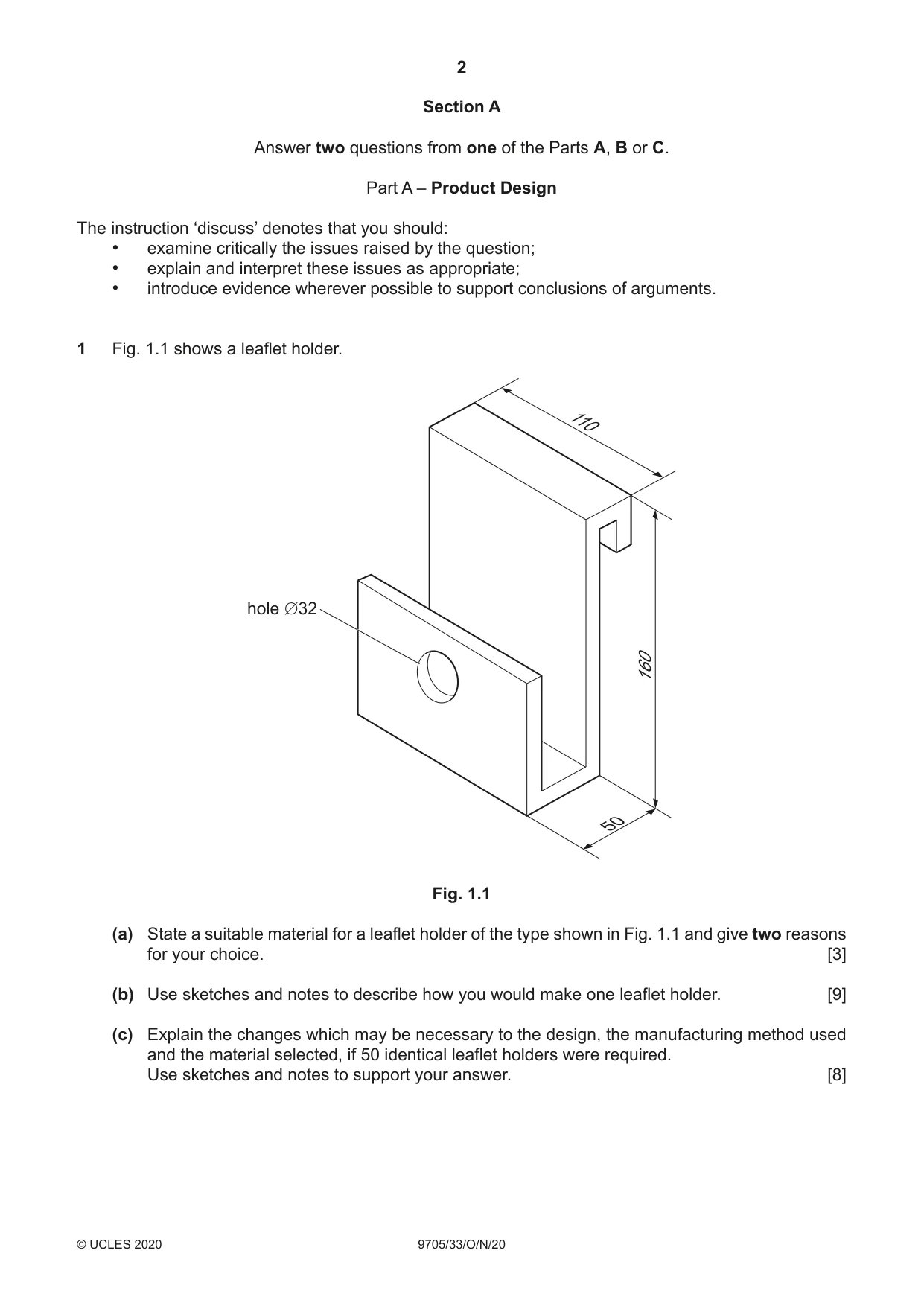
2 9705/33/O/N/20 © UCLES 2020 Section A Answer two questions from one of the Parts A, B or C. Part A – Product Design The instruction ‘discuss’ denotes that you should: • examine critically the issues raised by the question; • explain and interpret these issues as appropriate; • introduce evidence wherever possible to support conclusions of arguments. 1 Fig. 1.1 shows a leaflet holder. hole ∅32 110 160 50 Fig. 1.1 (a) State a suitable material for a leaflet holder of the type shown in Fig. 1.1 and give two reasons for your choice. [3] (b) Use sketches and notes to describe how you would make one leaflet holder. [9] (c) Explain the changes which may be necessary to the design, the manufacturing method used and the material selected, if 50 identical leaflet holders were required. Use sketches and notes to support your answer. [8]
Question paper, page 3
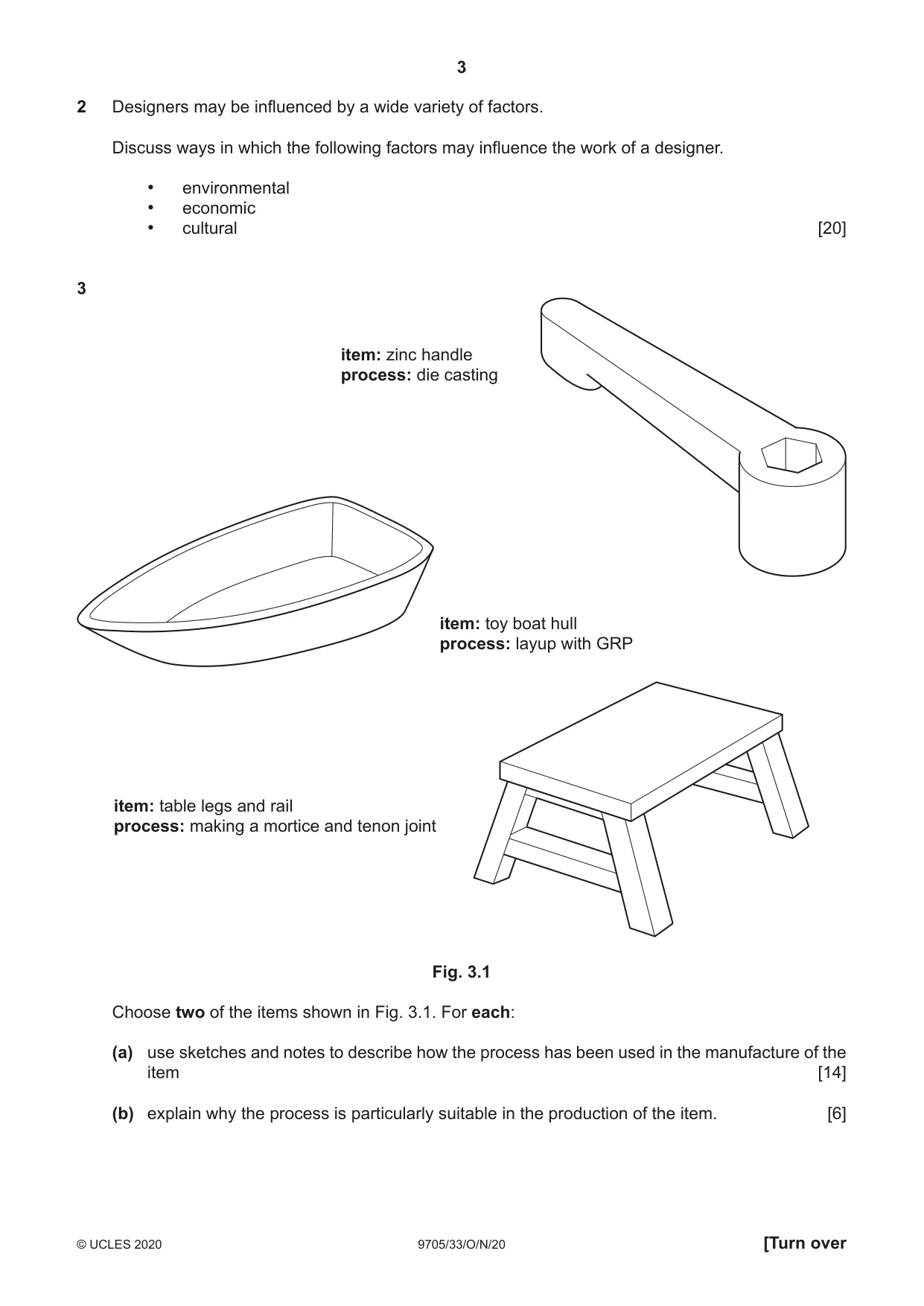
3 9705/33/O/N/20 © UCLES 2020 [Turn over 2 Designers may be influenced by a wide variety of factors. Discuss ways in which the following factors may influence the work of a designer. • environmental • economic • cultural [20] 3 item: zinc handle process: die casting item: table legs and rail process: making a mortice and tenon joint Fig. 3.1 Choose two of the items shown in Fig. 3.1. For each: (a) use sketches and notes to describe how the process has been used in the manufacture of the item [14] (b) explain why the process is particularly suitable in the production of the item. [6] item: toy boat hull process: layup with GRP
Question paper, page 4
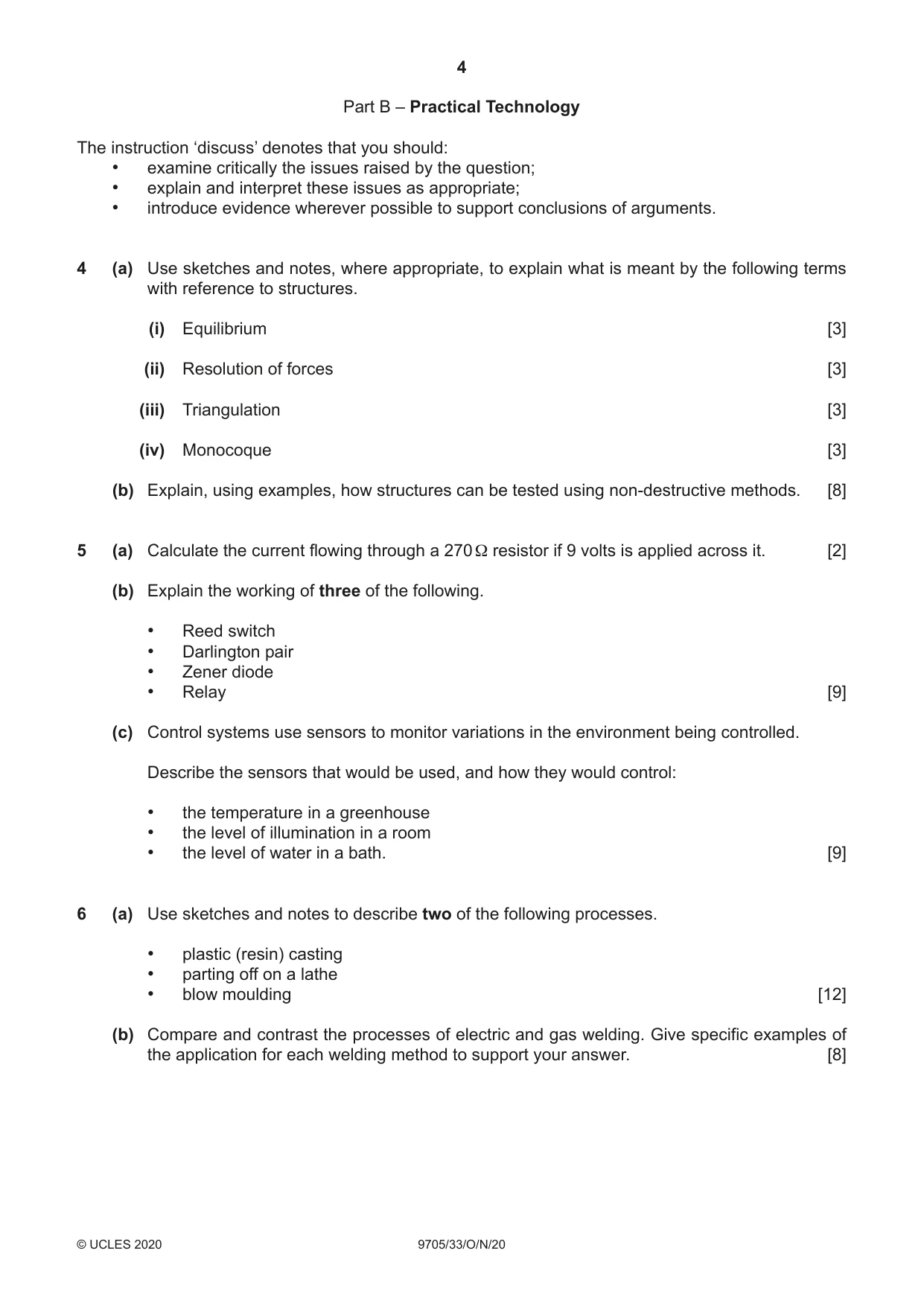
4 9705/33/O/N/20 © UCLES 2020 Part B – Practical Technology The instruction ‘discuss’ denotes that you should: • examine critically the issues raised by the question; • explain and interpret these issues as appropriate; • introduce evidence wherever possible to support conclusions of arguments. 4 (a) Use sketches and notes, where appropriate, to explain what is meant by the following terms with reference to structures. (i) Equilibrium [3] (ii) Resolution of forces [3] (iii) Triangulation [3] (iv) Monocoque [3] (b) Explain, using examples, how structures can be tested using non-destructive methods. [8] 5 (a) Calculate the current flowing through a 270 Ω resistor if 9 volts is applied across it. [2] (b) Explain the working of three of the following. • Reed switch • Darlington pair • Zener diode • Relay [9] (c) Control systems use sensors to monitor variations in the environment being controlled. Describe the sensors that would be used, and how they would control: • the temperature in a greenhouse • the level of illumination in a room • the level of water in a bath. [9] 6 (a) Use sketches and notes to describe two of the following processes. • plastic (resin) casting • parting off on a lathe • blow moulding [12] (b) Compare and contrast the processes of electric and gas welding. Give specific examples of the application for each welding method to support your answer. [8]
Question paper, page 5
5 9705/33/O/N/20 © UCLES 2020 [Turn over Part C – Graphic Products The instruction ‘discuss’ denotes that you should: • examine critically the issues raised by the question; • explain and interpret these issues as appropriate; • introduce evidence wherever possible to support conclusions of arguments.
Question paper, page 6
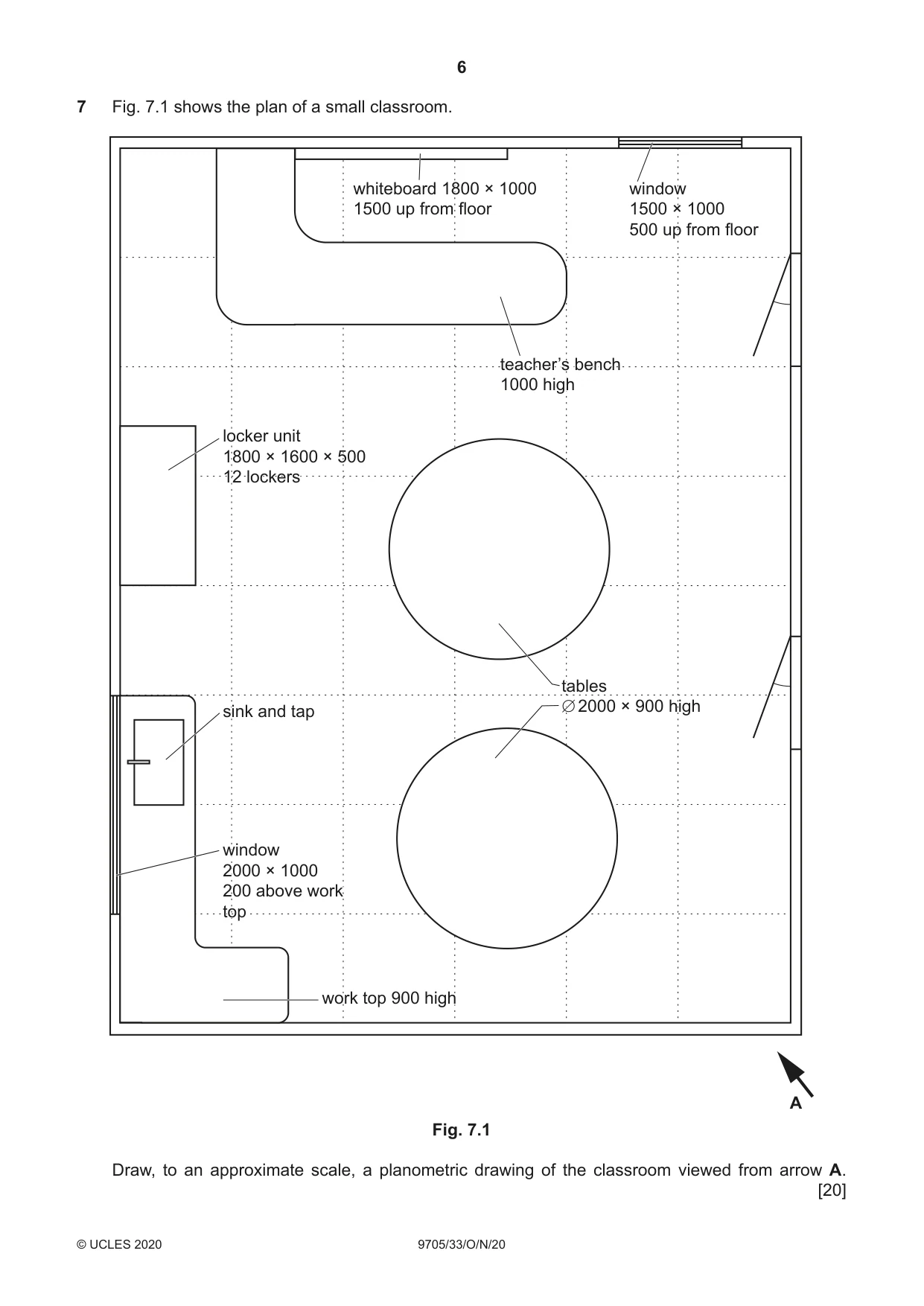
6 9705/33/O/N/20 © UCLES 2020 7 Fig. 7.1 shows the plan of a small classroom. A locker unit 1800 × 1600 × 500 12 lockers window 2000 × 1000 200 above work top window 1500 × 1000 500 up from floor teachers bench 1000 high tables ∅ 2000 × 900 high whiteboard 1800 × 1000 1500 up from floor sink and tap work top 900 high locker unit 1800 × 1600 × 500 12 lockers window 2000 × 1000 200 above work top window 1500 × 1000 500 up from floor teacher’s bench 1000 high tables ∅ 2000 × 900 high whiteboard 1800 × 1000 1500 up from floor sink and tap work top 900 high Fig. 7.1 Draw, to an approximate scale, a planometric drawing of the classroom viewed from arrow A. [20]
Question paper, page 7
7 9705/33/O/N/20 © UCLES 2020 [Turn over 8 Graphic designers use a range of techniques to present information that is clear and easy to understand. Use sketches and notes to explain the following techniques, giving an example for each. • bar charts • tables • pictograms • graphs [20] 9 Discuss the impact of computers in the design and manufacture of products. Consider in your answer: • the generation and presentation of design ideas • opportunities for collaborative work • the integration of data for costing, stock control and production. [20]
Question paper, page 8
8 9705/33/O/N/20 © UCLES 2020 Section B Answer one question on the A3 paper provided. Each question is worth 80 marks. You should approach the design question of your choice in the following manner: Analysis Produce an analysis of the given situation/problem, which may be in written or graphical form. [5] Specification From the analysis produce a detailed written specification of the design requirements. Include at least five specification points other than those given in the question. [5] Exploration Use bold sketches and brief notes to show your exploration of ideas for a design solution, with reasons for selection. [25] Development Show using bold sketches and notes, the development, reasoning and composition of ideas into a single design proposal. Give details of materials, constructional and other relevant technical details. [25] Proposed solution Produce drawings of an appropriate kind to show the complete solution. [15] Evaluation Give a written evaluation of the final design solution. [5]
Question paper, page 9
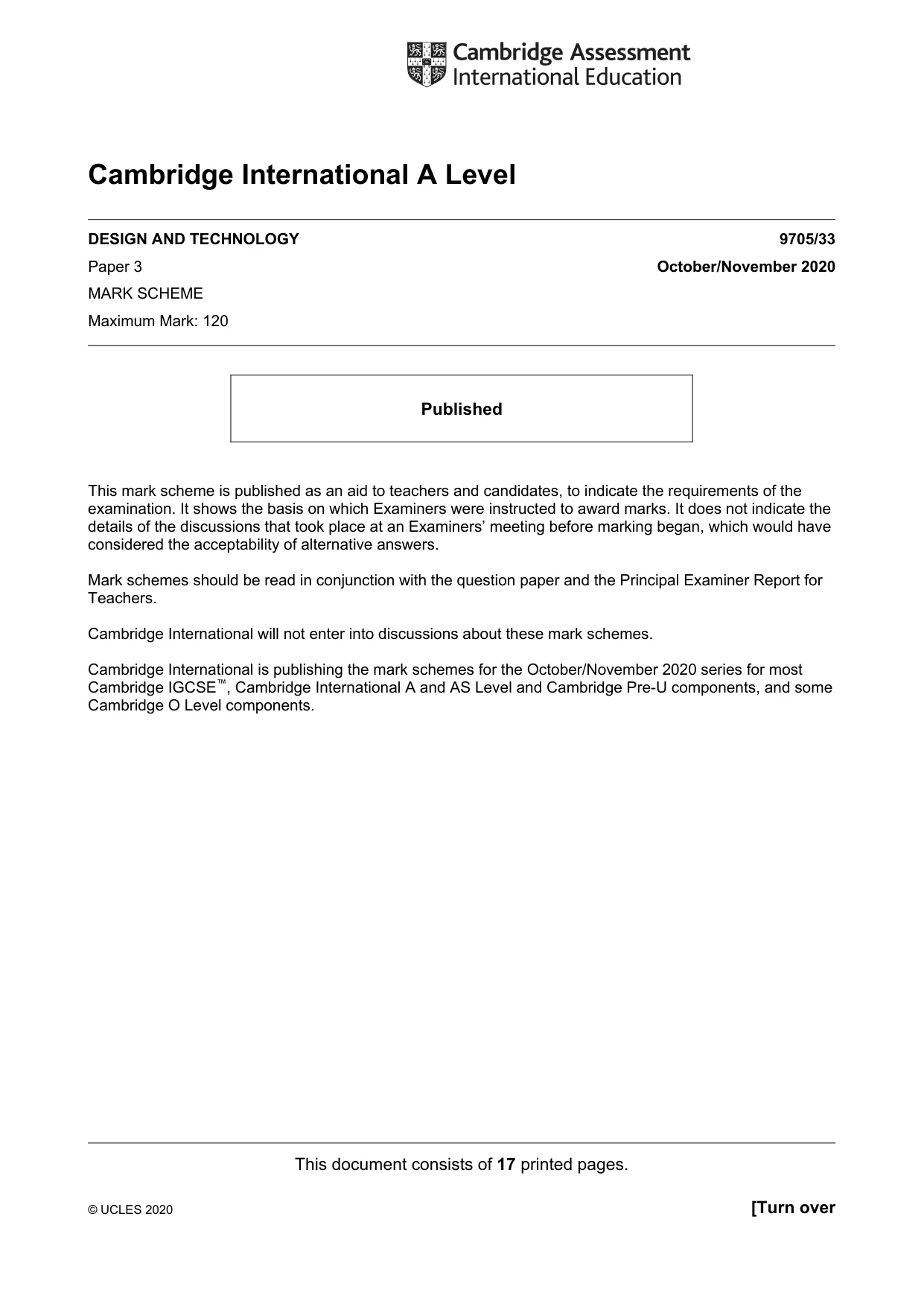
9 9705/33/O/N/20 © UCLES 2020 10 Environmental Agencies are to provide compostable bags to encourage households to recycle food waste. A product to be used in a kitchen to collect food waste is required. The product must: • be freestanding and/or attached to a wall in a kitchen • allow easy insertion and removal of compostable bags measuring 250 × 200 × 180. [80] 11 Maintaining and repairing bicycles can be an awkward and difficult task. You are to design a product that can support a bicycle whilst work is being carried out. The product must: • be adjustable in height • hold the bicycle without damaging its surface finish. [80] 12 A school wishes to organise a Fun Run to raise funds to support a project that focusses on a single environmental issue. Select an environmental issue for the project. You are to design: • a name and logo for the project • an interactive display unit to be situated in the main reception area of the school. The interactive display unit must: • be freestanding and hold up to 25 A4 information sheets • reflect the image of the project. [80]
Question paper, page 10
10 9705/33/O/N/20 © UCLES 2020 BLANK PAGE
Question paper, page 11
11 9705/33/O/N/20 © UCLES 2020 BLANK PAGE
Question paper, page 12
12 9705/33/O/N/20 © UCLES 2020 Permission to reproduce items where third-party owned material protected by copyright is included has been sought and cleared where possible. Every reasonable effort has been made by the publisher (UCLES) to trace copyright holders, but if any items requiring clearance have unwittingly been included, the publisher will be pleased to make amends at the earliest possible opportunity. To avoid the issue of disclosure of answer-related information to candidates, all copyright acknowledgements are reproduced online in the Cambridge Assessment International Education Copyright Acknowledgements Booklet. This is produced for each series of examinations and is freely available to download at www.cambridgeinternational.org after the live examination series. Cambridge Assessment International Education is part of the Cambridge Assessment Group. Cambridge Assessment is the brand name of the University of Cambridge Local Examinations Syndicate (UCLES), which itself is a department of the University of Cambridge. BLANK PAGE
Mark scheme, page 1
This document consists of 17 printed pages. © UCLES 2020 [Turn over Cambridge International A Level DESIGN AND TECHNOLOGY 9705/33 Paper 3 October/November 2020 MARK SCHEME Maximum Mark: 120 Published This mark scheme is published as an aid to teachers and candidates, to indicate the requirements of the examination. It shows the basis on which Examiners were instructed to award marks. It does not indicate the details of the discussions that took place at an Examiners’ meeting before marking began, which would have considered the acceptability of alternative answers. Mark schemes should be read in conjunction with the question paper and the Principal Examiner Report for Teachers. Cambridge International will not enter into discussions about these mark schemes. Cambridge International is publishing the mark schemes for the October/November 2020 series for most Cambridge IGCSE™, Cambridge International A and AS Level and Cambridge Pre-U components, and some Cambridge O Level components.
Mark scheme, page 2
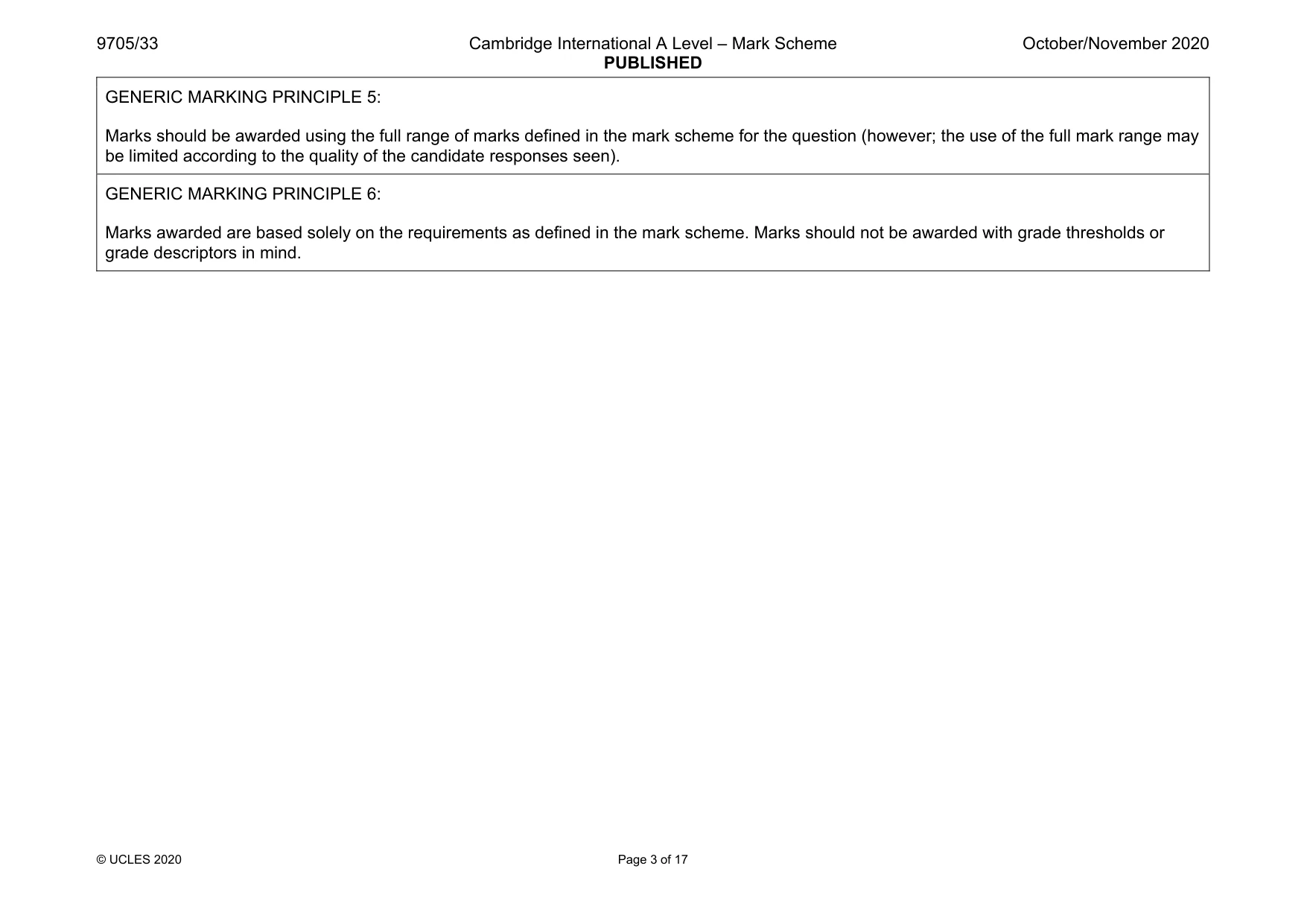
9705/33 Cambridge International A Level – Mark Scheme PUBLISHED October/November 2020 © UCLES 2020 Page 2 of 17 Generic Marking Principles These general marking principles must be applied by all examiners when marking candidate answers. They should be applied alongside the specific content of the mark scheme or generic level descriptors for a question. Each question paper and mark scheme will also comply with these marking principles. GENERIC MARKING PRINCIPLE 1: Marks must be awarded in line with: • the specific content of the mark scheme or the generic level descriptors for the question • the specific skills defined in the mark scheme or in the generic level descriptors for the question • the standard of response required by a candidate as exemplified by the standardisation scripts. GENERIC MARKING PRINCIPLE 2: Marks awarded are always whole marks (not half marks, or other fractions). GENERIC MARKING PRINCIPLE 3: Marks must be awarded positively: • marks are awarded for correct/valid answers, as defined in the mark scheme. However, credit is given for valid answers which go beyond the scope of the syllabus and mark scheme, referring to your Team Leader as appropriate • marks are awarded when candidates clearly demonstrate what they know and can do • marks are not deducted for errors • marks are not deducted for omissions • answers should only be judged on the quality of spelling, punctuation and grammar when these features are specifically assessed by the question as indicated by the mark scheme. The meaning, however, should be unambiguous. GENERIC MARKING PRINCIPLE 4: Rules must be applied consistently, e.g. in situations where candidates have not followed instructions or in the application of generic level descriptors.
Mark scheme, page 3
9705/33 Cambridge International A Level – Mark Scheme PUBLISHED October/November 2020 © UCLES 2020 Page 3 of 17 GENERIC MARKING PRINCIPLE 5: Marks should be awarded using the full range of marks defined in the mark scheme for the question (however; the use of the full mark range may be limited according to the quality of the candidate responses seen). GENERIC MARKING PRINCIPLE 6: Marks awarded are based solely on the requirements as defined in the mark scheme. Marks should not be awarded with grade thresholds or grade descriptors in mind.
Mark scheme, page 4
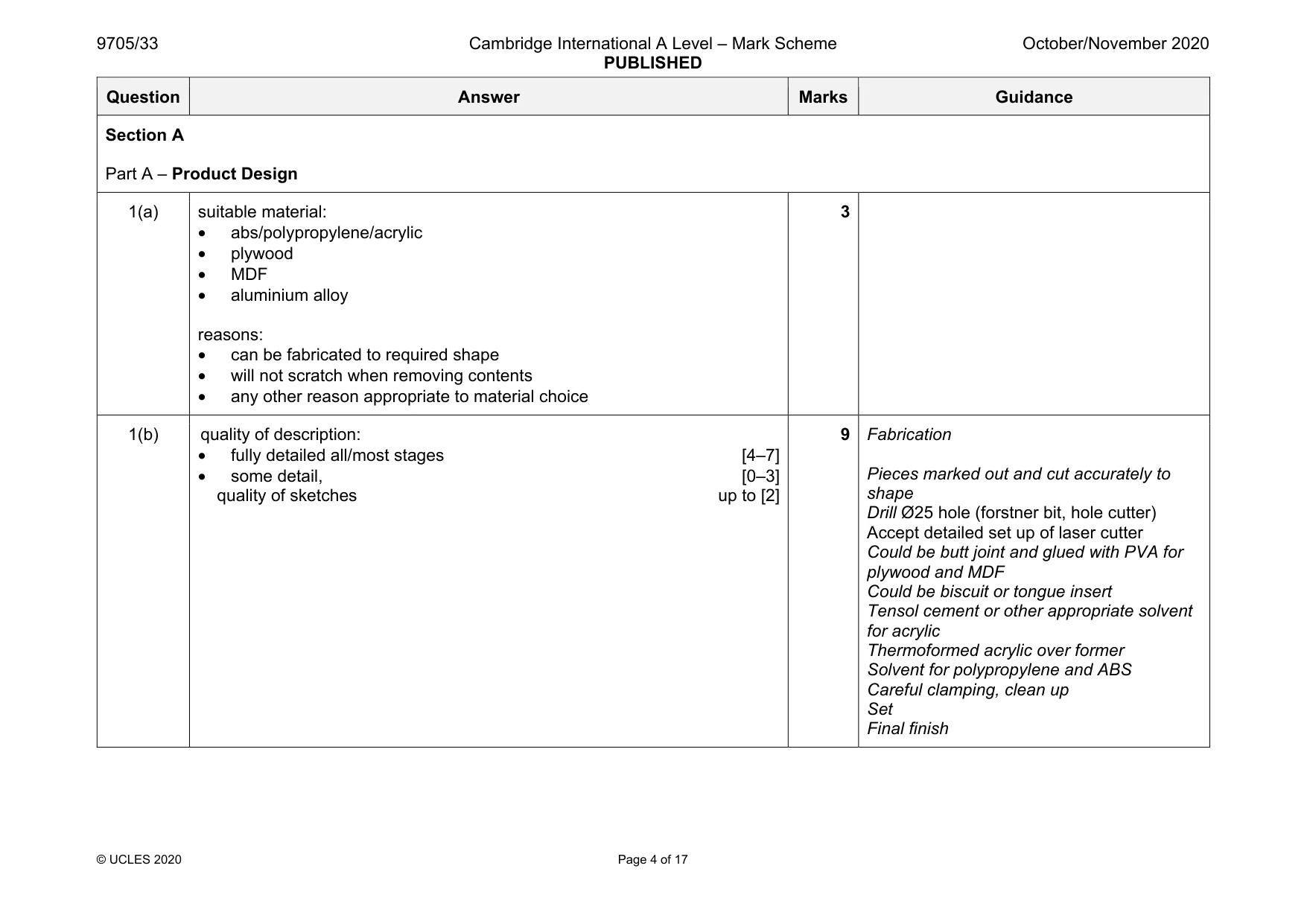
9705/33 Cambridge International A Level – Mark Scheme PUBLISHED October/November 2020 © UCLES 2020 Page 4 of 17 Question Answer Marks Guidance Section A Part A – Product Design 1(a) suitable material: • abs/polypropylene/acrylic • plywood • MDF • aluminium alloy reasons: • can be fabricated to required shape • will not scratch when removing contents • any other reason appropriate to material choice 3 1(b) quality of description: • fully detailed all/most stages [4–7] • some detail, [0–3] quality of sketches up to [2] 9 Fabrication Pieces marked out and cut accurately to shape Drill Ø25 hole (forstner bit, hole cutter) Accept detailed set up of laser cutter Could be butt joint and glued with PVA for plywood and MDF Could be biscuit or tongue insert Tensol cement or other appropriate solvent for acrylic Thermoformed acrylic over former Solvent for polypropylene and ABS Careful clamping, clean up Set Final finish
Mark scheme, page 5
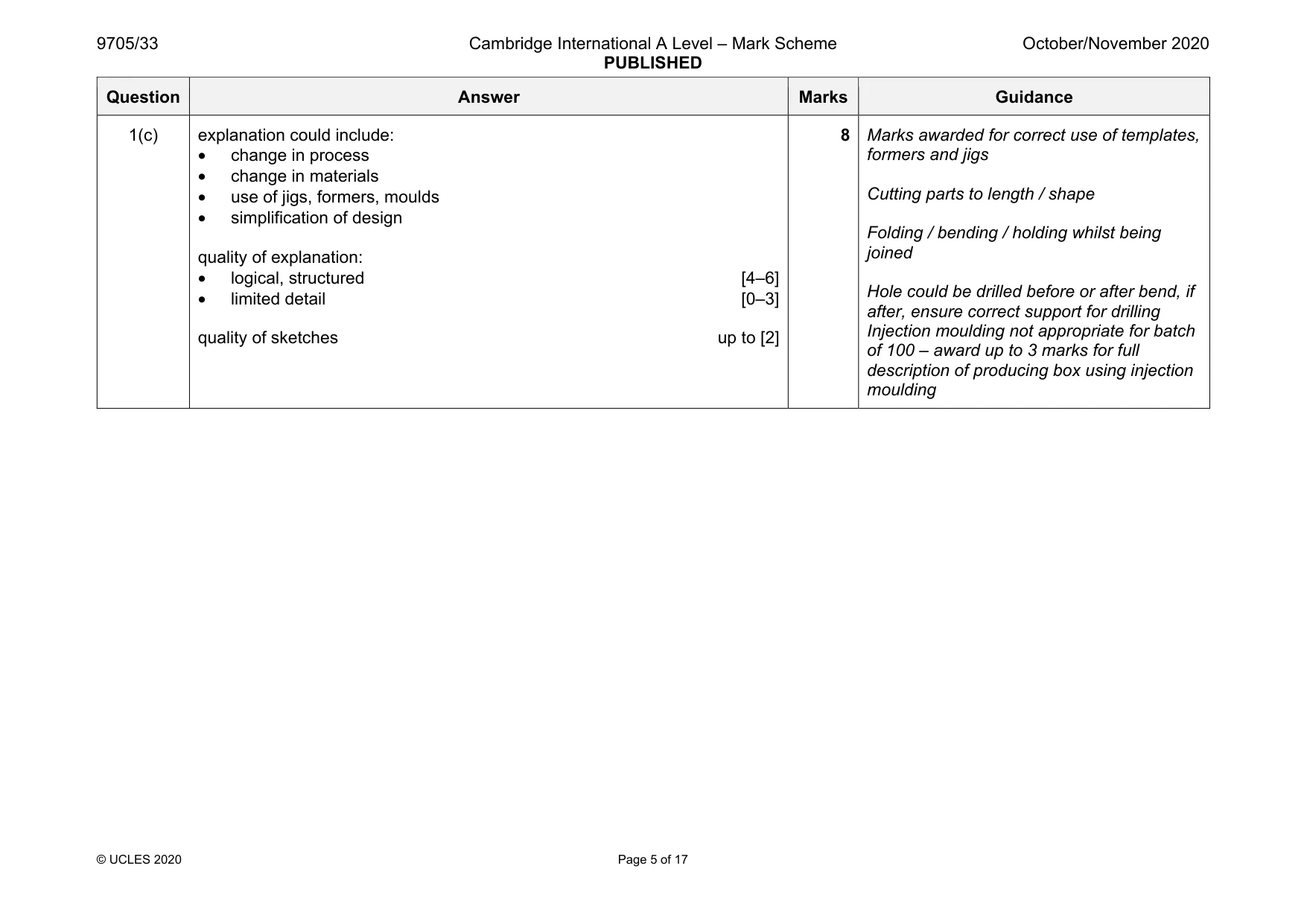
9705/33 Cambridge International A Level – Mark Scheme PUBLISHED October/November 2020 © UCLES 2020 Page 5 of 17 Question Answer Marks Guidance 1(c) explanation could include: • change in process • change in materials • use of jigs, formers, moulds • simplification of design quality of explanation: • logical, structured [4–6] • limited detail [0–3] quality of sketches up to [2] 8 Marks awarded for correct use of templates, formers and jigs Cutting parts to length / shape Folding / bending / holding whilst being joined Hole could be drilled before or after bend, if after, ensure correct support for drilling Injection moulding not appropriate for batch of 100 – award up to 3 marks for full description of producing box using injection moulding
Mark scheme, page 6
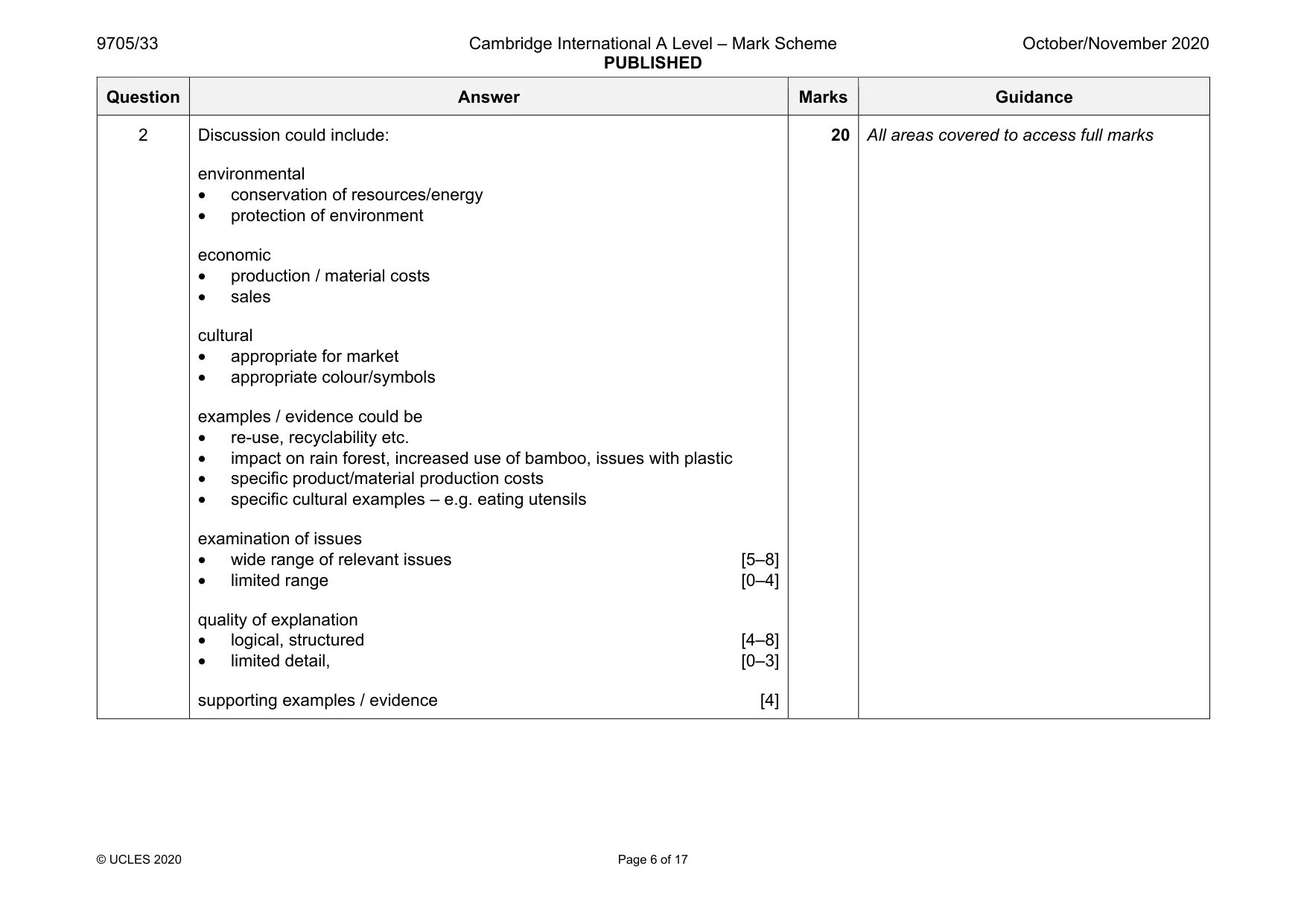
9705/33 Cambridge International A Level – Mark Scheme PUBLISHED October/November 2020 © UCLES 2020 Page 6 of 17 Question Answer Marks Guidance 2 Discussion could include: environmental • conservation of resources/energy • protection of environment economic • production / material costs • sales cultural • appropriate for market • appropriate colour/symbols examples / evidence could be • re-use, recyclability etc. • impact on rain forest, increased use of bamboo, issues with plastic • specific product/material production costs • specific cultural examples – e.g. eating utensils examination of issues • wide range of relevant issues [5–8] • limited range [0–4] quality of explanation • logical, structured [4–8] • limited detail, [0–3] supporting examples / evidence [4] 20 All areas covered to access full marks
Mark scheme, page 7
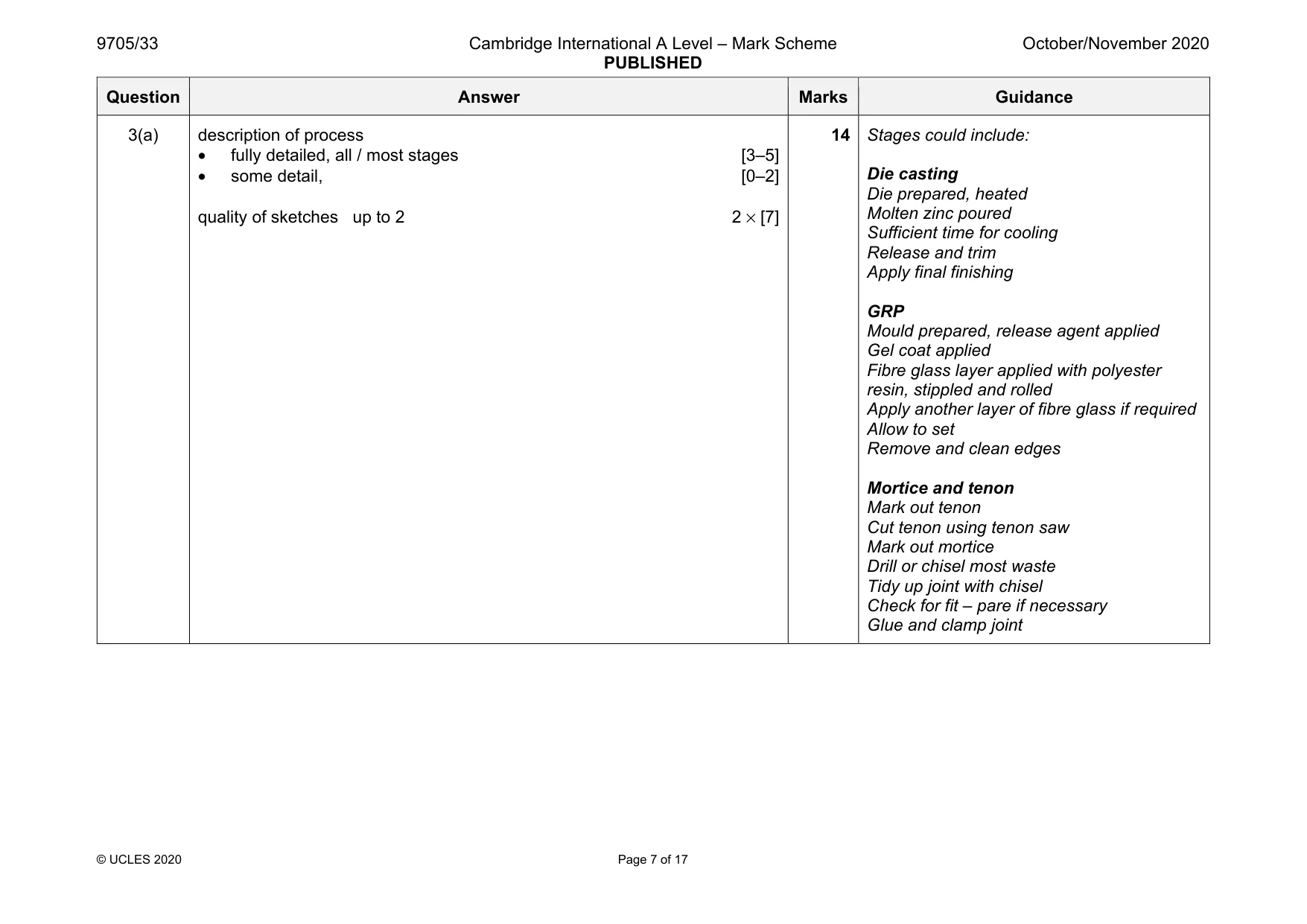
9705/33 Cambridge International A Level – Mark Scheme PUBLISHED October/November 2020 © UCLES 2020 Page 7 of 17 Question Answer Marks Guidance 3(a) description of process • fully detailed, all / most stages [3–5] • some detail, [0–2] quality of sketches up to 2 2 × [7] 14 Stages could include: Die casting Die prepared, heated Molten zinc poured Sufficient time for cooling Release and trim Apply final finishing GRP Mould prepared, release agent applied Gel coat applied Fibre glass layer applied with polyester resin, stippled and rolled Apply another layer of fibre glass if required Allow to set Remove and clean edges Mortice and tenon Mark out tenon Cut tenon using tenon saw Mark out mortice Drill or chisel most waste Tidy up joint with chisel Check for fit – pare if necessary Glue and clamp joint
Mark scheme, page 8
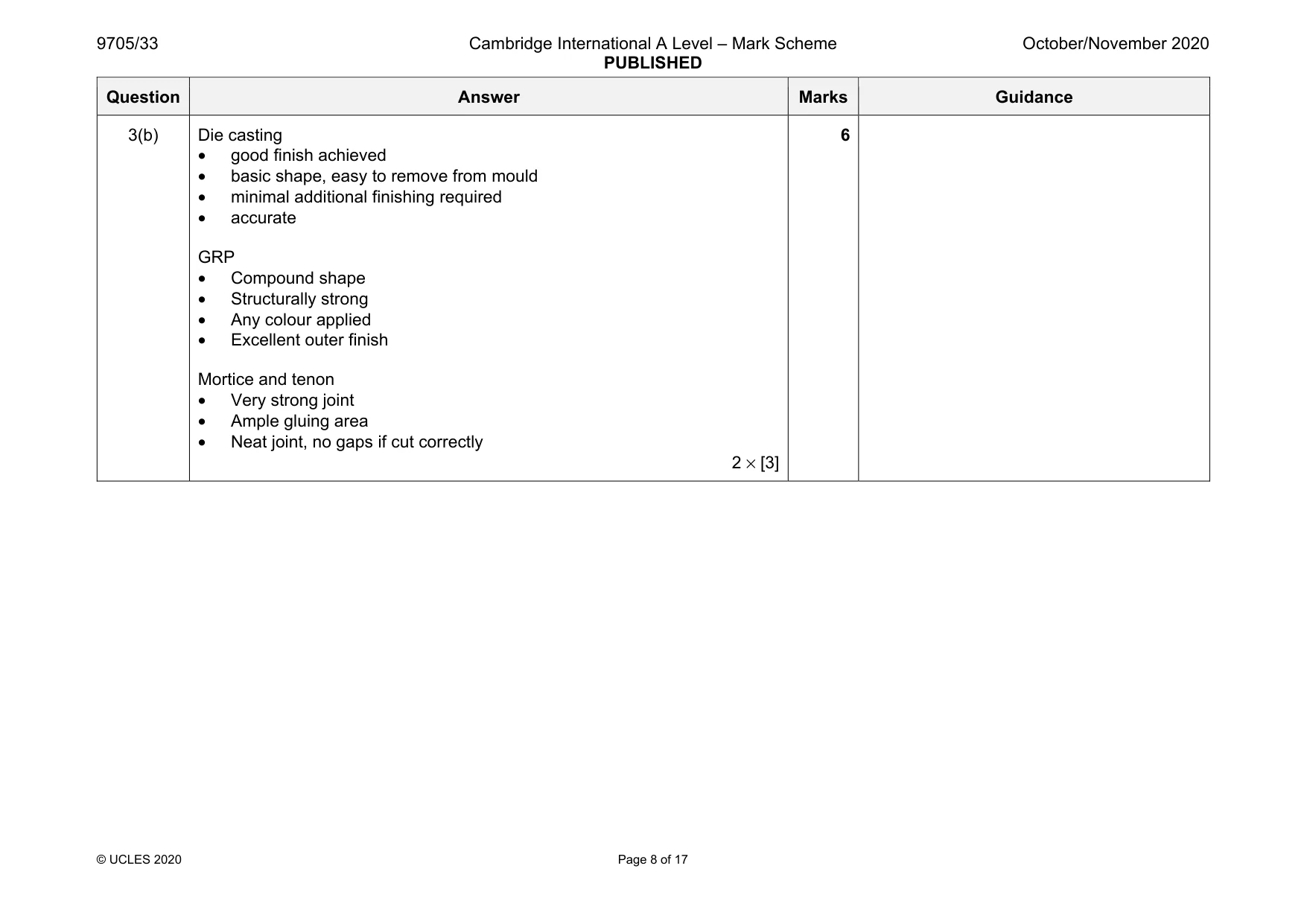
9705/33 Cambridge International A Level – Mark Scheme PUBLISHED October/November 2020 © UCLES 2020 Page 8 of 17 Question Answer Marks Guidance 3(b) Die casting • good finish achieved • basic shape, easy to remove from mould • minimal additional finishing required • accurate GRP • Compound shape • Structurally strong • Any colour applied • Excellent outer finish Mortice and tenon • Very strong joint • Ample gluing area • Neat joint, no gaps if cut correctly 2 × [3] 6
Mark scheme, page 9
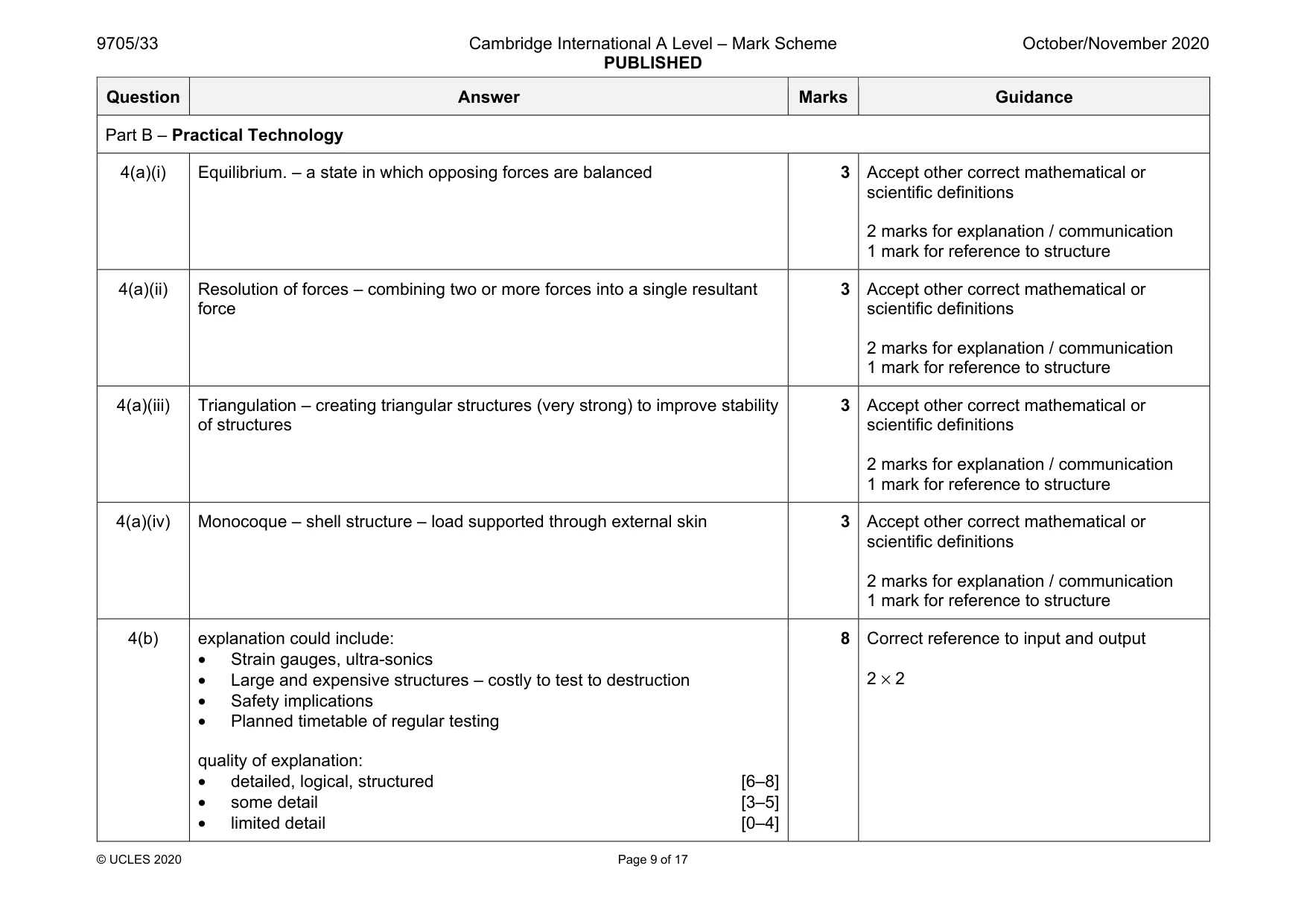
9705/33 Cambridge International A Level – Mark Scheme PUBLISHED October/November 2020 © UCLES 2020 Page 9 of 17 Question Answer Marks Guidance Part B – Practical Technology 4(a)(i) Equilibrium. – a state in which opposing forces are balanced 3 Accept other correct mathematical or scientific definitions 2 marks for explanation / communication 1 mark for reference to structure 4(a)(ii) Resolution of forces – combining two or more forces into a single resultant force 3 Accept other correct mathematical or scientific definitions 2 marks for explanation / communication 1 mark for reference to structure 4(a)(iii) Triangulation – creating triangular structures (very strong) to improve stability of structures 3 Accept other correct mathematical or scientific definitions 2 marks for explanation / communication 1 mark for reference to structure 4(a)(iv) Monocoque – shell structure – load supported through external skin 3 Accept other correct mathematical or scientific definitions 2 marks for explanation / communication 1 mark for reference to structure 4(b) explanation could include: • Strain gauges, ultra-sonics • Large and expensive structures – costly to test to destruction • Safety implications • Planned timetable of regular testing quality of explanation: • detailed, logical, structured [6–8] • some detail [3–5] • limited detail [0–4] 8 Correct reference to input and output 2 × 2
Mark scheme, page 10
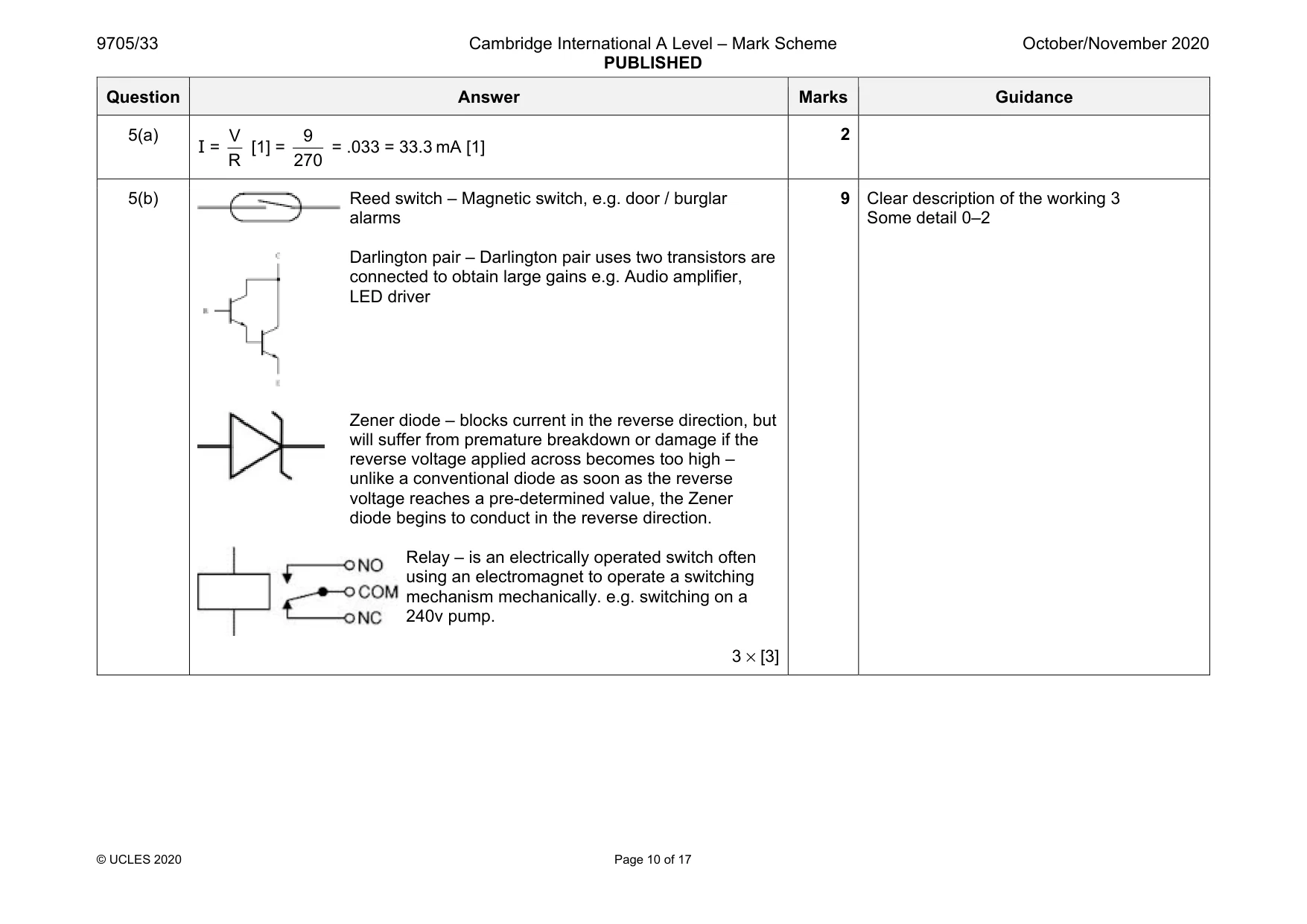
9705/33 Cambridge International A Level – Mark Scheme PUBLISHED October/November 2020 © UCLES 2020 Page 10 of 17 Question Answer Marks Guidance 5(a) I = V R [1] = 9 270 = .033 = 33.3 mA [1] 2 5(b) Reed switch – Magnetic switch, e.g. door / burglar alarms Darlington pair – Darlington pair uses two transistors are connected to obtain large gains e.g. Audio amplifier, LED driver Zener diode – blocks current in the reverse direction, but will suffer from premature breakdown or damage if the reverse voltage applied across becomes too high – unlike a conventional diode as soon as the reverse voltage reaches a pre-determined value, the Zener diode begins to conduct in the reverse direction. Relay – is an electrically operated switch often using an electromagnet to operate a switching mechanism mechanically. e.g. switching on a 240v pump. 3 × [3] 9 Clear description of the working 3 Some detail 0–2
Mark scheme, page 11
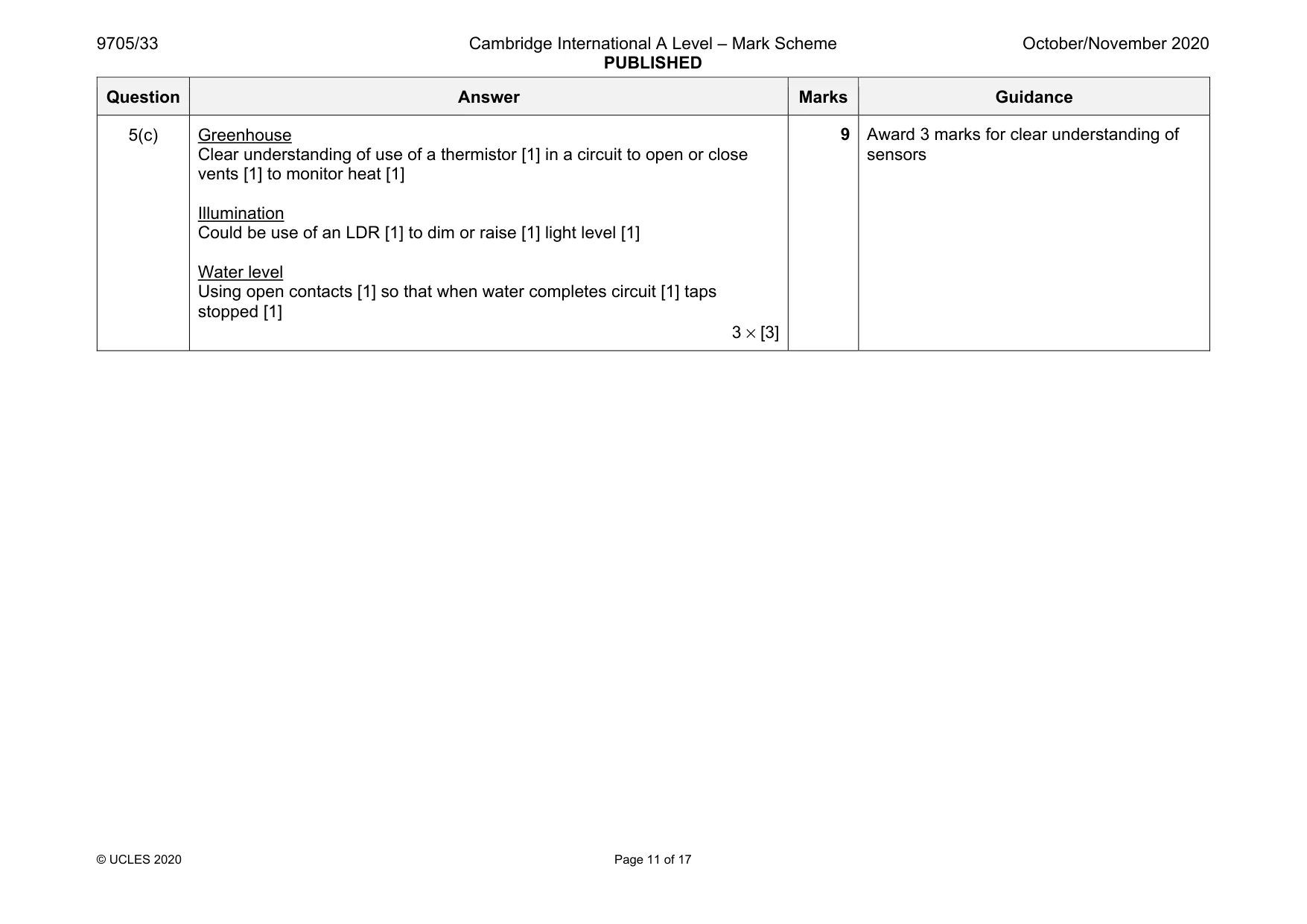
9705/33 Cambridge International A Level – Mark Scheme PUBLISHED October/November 2020 © UCLES 2020 Page 11 of 17 Question Answer Marks Guidance 5(c) Greenhouse Clear understanding of use of a thermistor [1] in a circuit to open or close vents [1] to monitor heat [1] Illumination Could be use of an LDR [1] to dim or raise [1] light level [1] Water level Using open contacts [1] so that when water completes circuit [1] taps stopped [1] 3 × [3] 9 Award 3 marks for clear understanding of sensors
Mark scheme, page 12
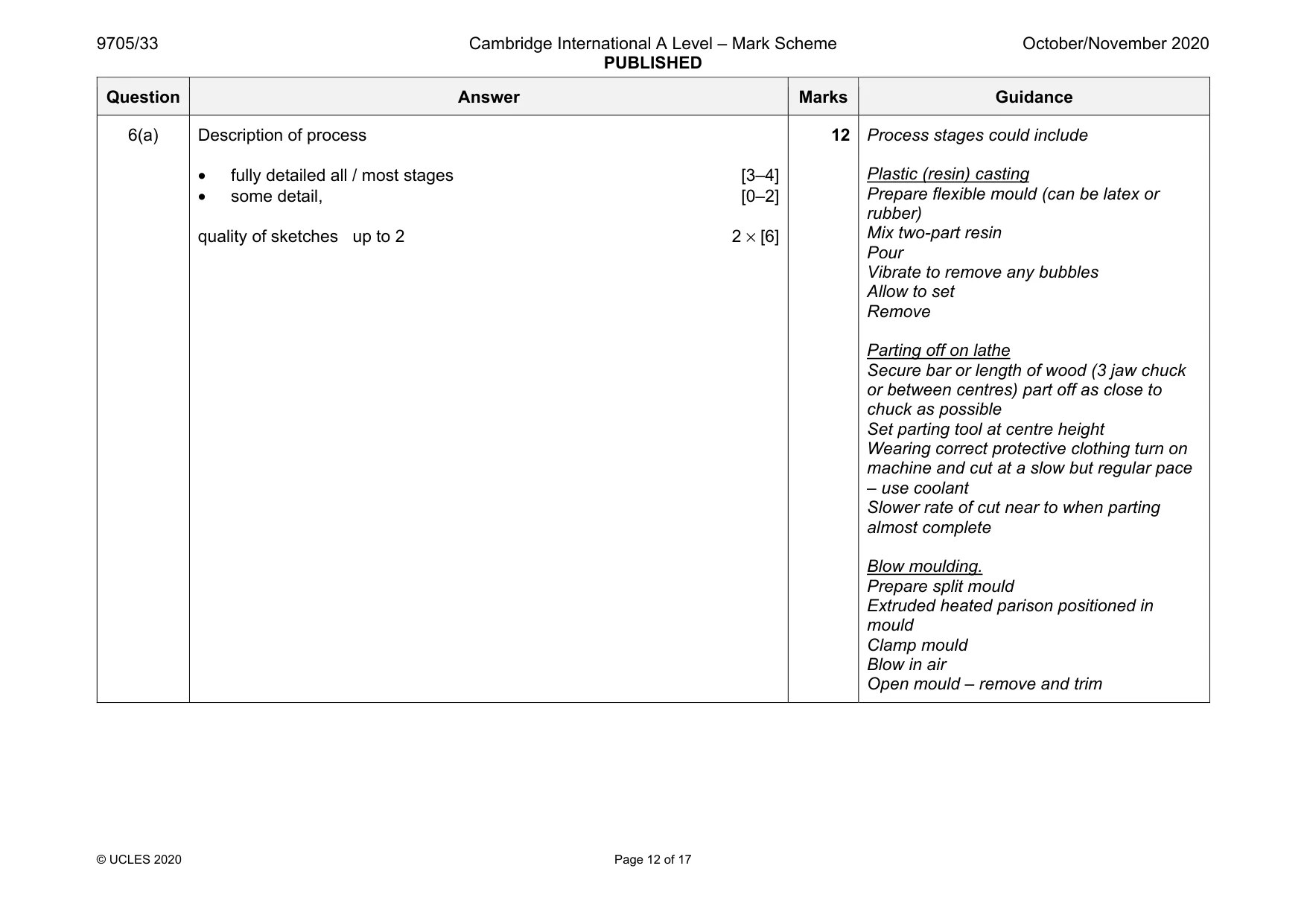
9705/33 Cambridge International A Level – Mark Scheme PUBLISHED October/November 2020 © UCLES 2020 Page 12 of 17 Question Answer Marks Guidance 6(a) Description of process • fully detailed all / most stages [3–4] • some detail, [0–2] quality of sketches up to 2 2 × [6] 12 Process stages could include Plastic (resin) casting Prepare flexible mould (can be latex or rubber) Mix two-part resin Pour Vibrate to remove any bubbles Allow to set Remove Parting off on lathe Secure bar or length of wood (3 jaw chuck or between centres) part off as close to chuck as possible Set parting tool at centre height Wearing correct protective clothing turn on machine and cut at a slow but regular pace – use coolant Slower rate of cut near to when parting almost complete Blow moulding. Prepare split mould Extruded heated parison positioned in mould Clamp mould Blow in air Open mould – remove and trim
Mark scheme, page 13
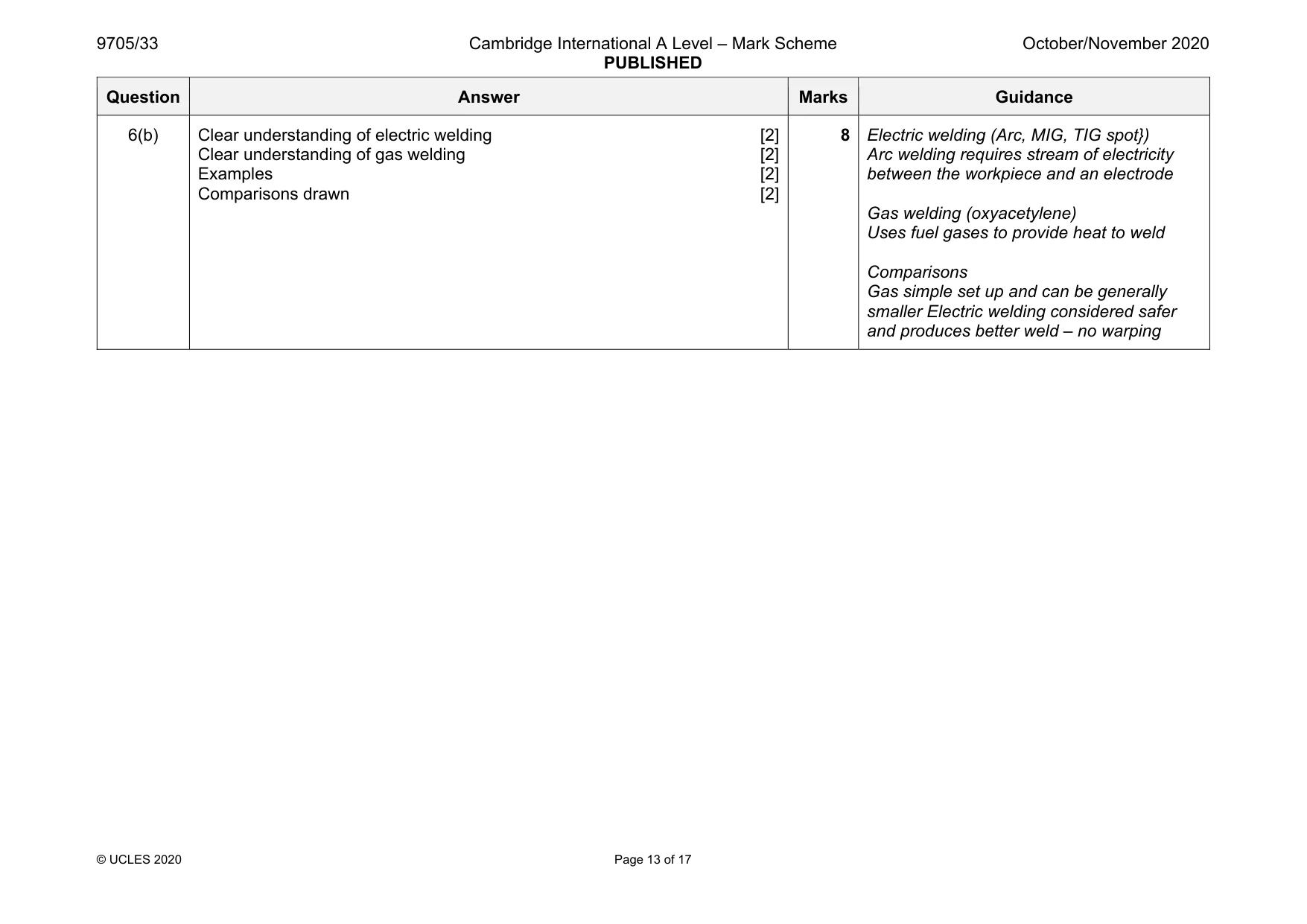
9705/33 Cambridge International A Level – Mark Scheme PUBLISHED October/November 2020 © UCLES 2020 Page 13 of 17 Question Answer Marks Guidance 6(b) Clear understanding of electric welding [2] Clear understanding of gas welding [2] Examples [2] Comparisons drawn [2] 8 Electric welding (Arc, MIG, TIG spot}) Arc welding requires stream of electricity between the workpiece and an electrode Gas welding (oxyacetylene) Uses fuel gases to provide heat to weld Comparisons Gas simple set up and can be generally smaller Electric welding considered safer and produces better weld – no warping
Mark scheme, page 14
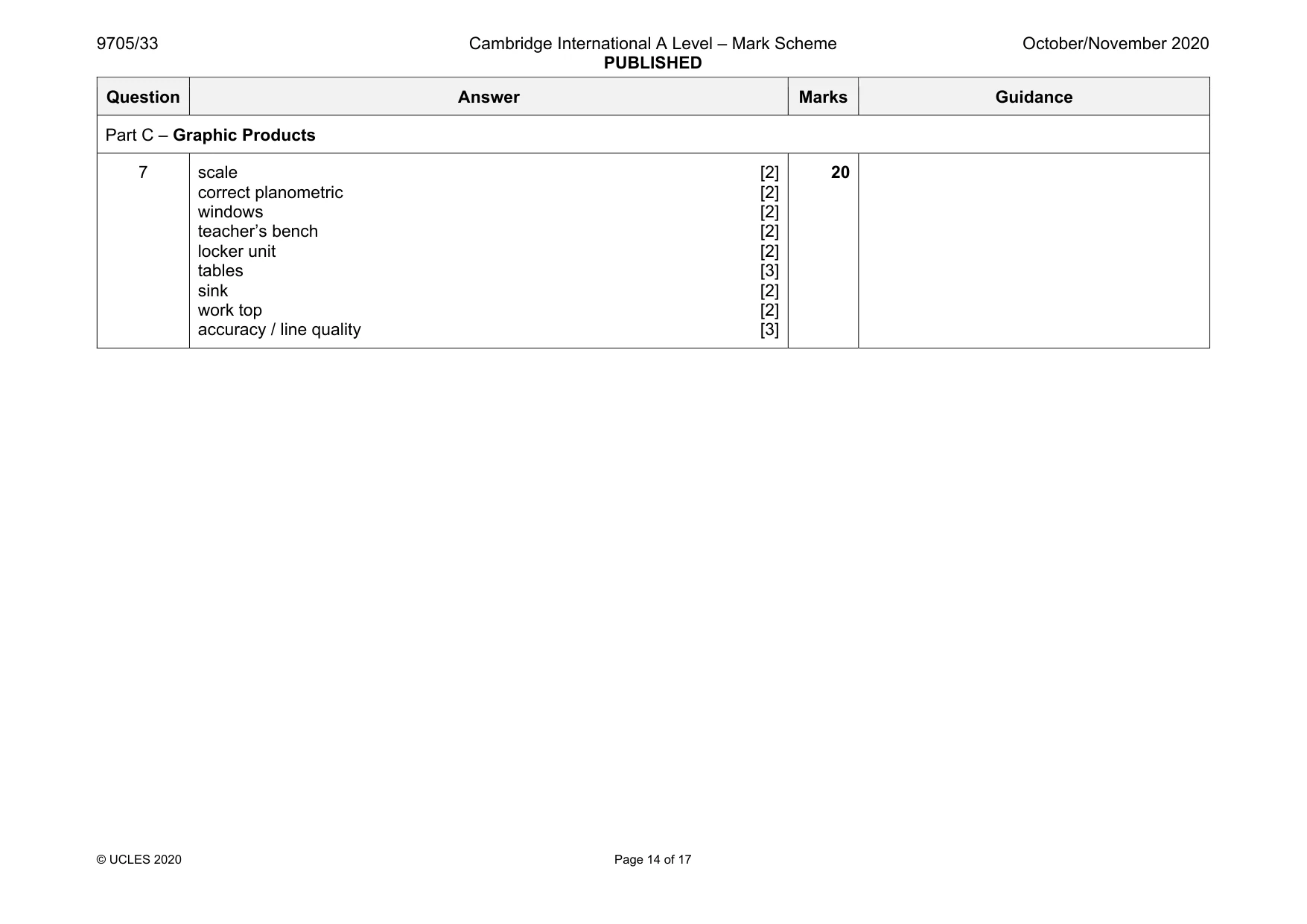
9705/33 Cambridge International A Level – Mark Scheme PUBLISHED October/November 2020 © UCLES 2020 Page 14 of 17 Question Answer Marks Guidance Part C – Graphic Products 7 scale [2] correct planometric [2] windows [2] teacher’s bench [2] locker unit [2] tables [3] sink [2] work top [2] accuracy / line quality [3] 20
Mark scheme, page 15
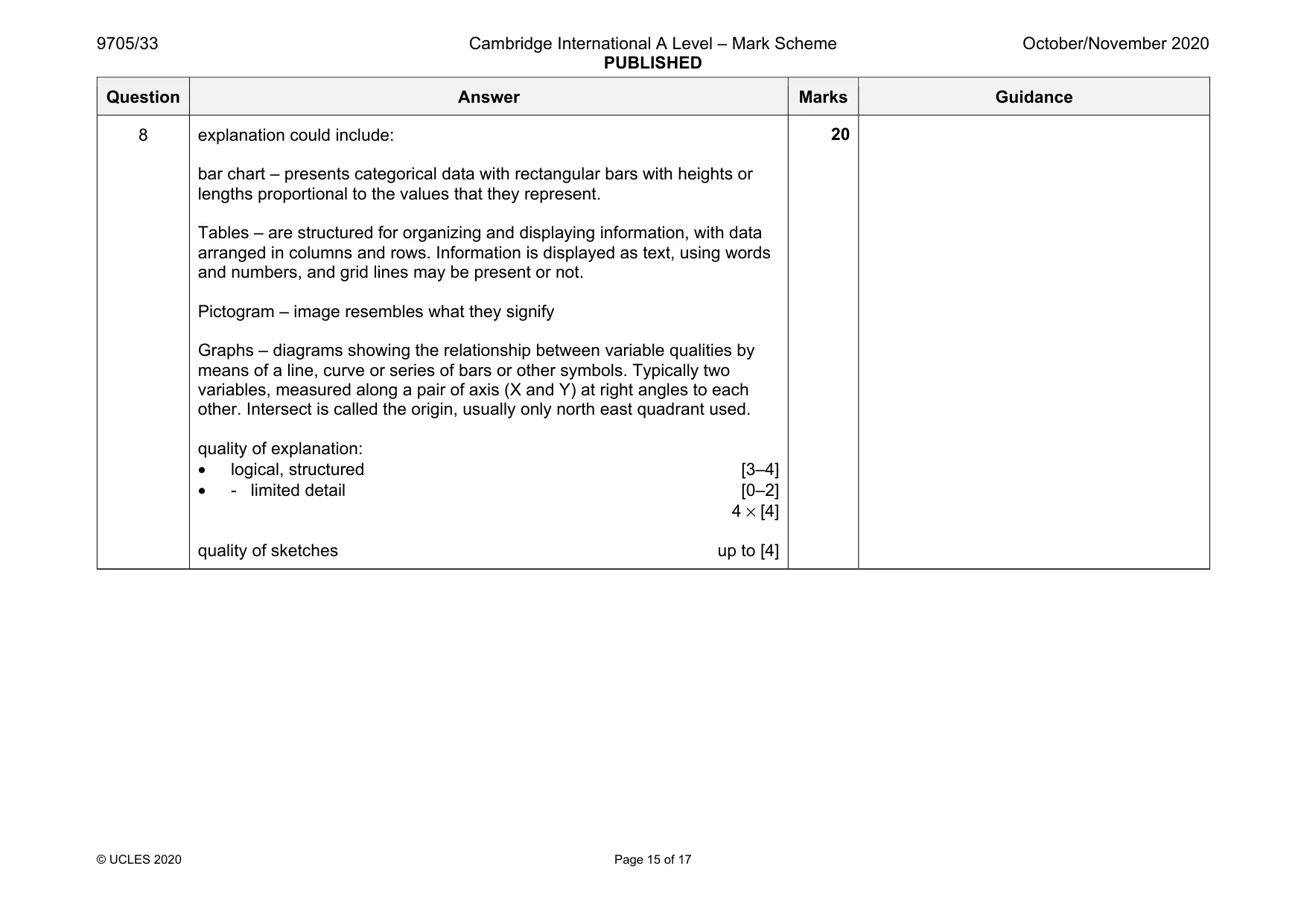
9705/33 Cambridge International A Level – Mark Scheme PUBLISHED October/November 2020 © UCLES 2020 Page 15 of 17 Question Answer Marks Guidance 8 explanation could include: bar chart – presents categorical data with rectangular bars with heights or lengths proportional to the values that they represent. Tables – are structured for organizing and displaying information, with data arranged in columns and rows. Information is displayed as text, using words and numbers, and grid lines may be present or not. Pictogram – image resembles what they signify Graphs – diagrams showing the relationship between variable qualities by means of a line, curve or series of bars or other symbols. Typically two variables, measured along a pair of axis (X and Y) at right angles to each other. Intersect is called the origin, usually only north east quadrant used. quality of explanation: • logical, structured [3–4] • - limited detail [0–2] 4 × [4] quality of sketches up to [4] 20
Mark scheme, page 16
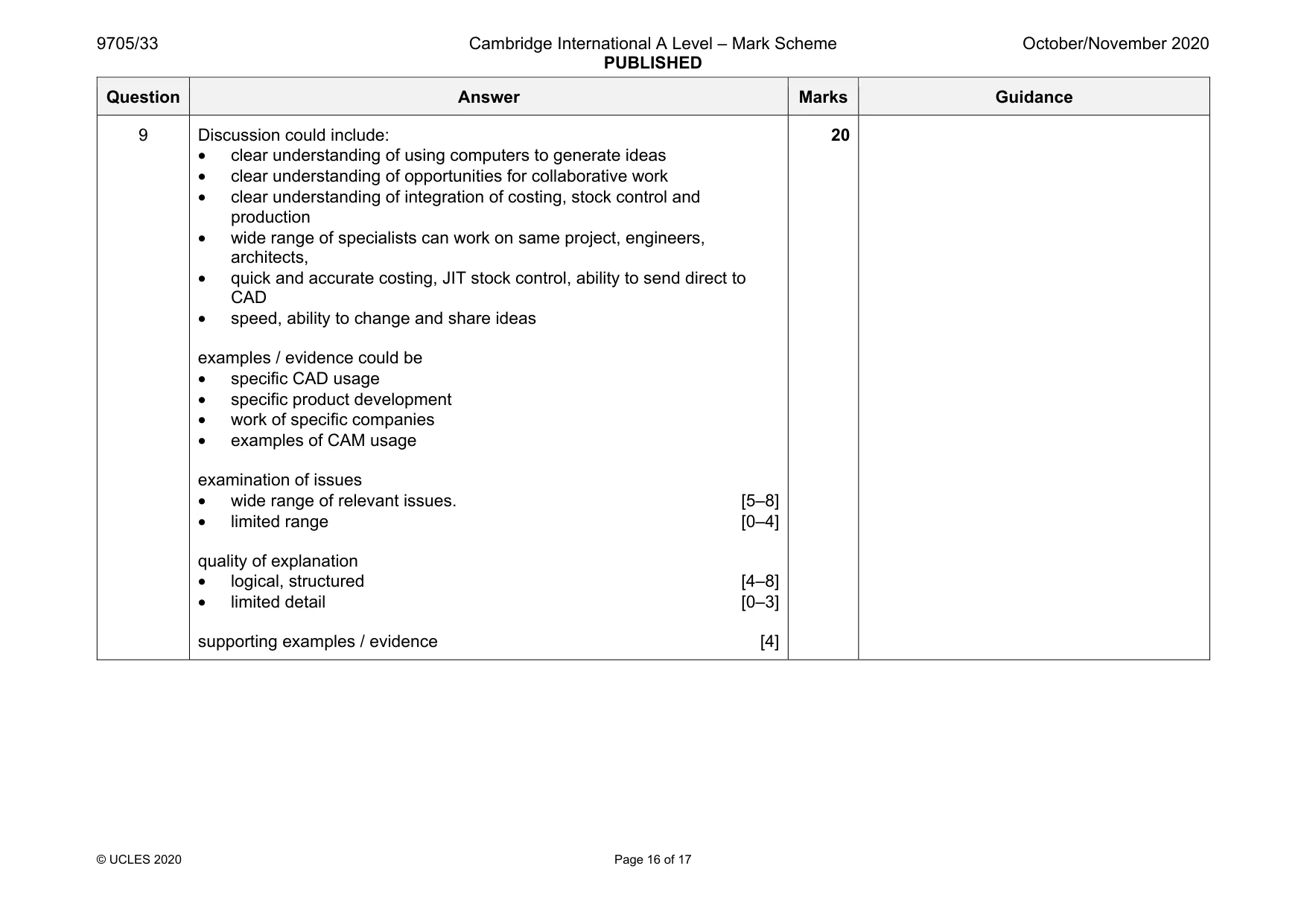
9705/33 Cambridge International A Level – Mark Scheme PUBLISHED October/November 2020 © UCLES 2020 Page 16 of 17 Question Answer Marks Guidance 9 Discussion could include: • clear understanding of using computers to generate ideas • clear understanding of opportunities for collaborative work • clear understanding of integration of costing, stock control and production • wide range of specialists can work on same project, engineers, architects, • quick and accurate costing, JIT stock control, ability to send direct to CAD • speed, ability to change and share ideas examples / evidence could be • specific CAD usage • specific product development • work of specific companies • examples of CAM usage examination of issues • wide range of relevant issues. [5–8] • limited range [0–4] quality of explanation • logical, structured [4–8] • limited detail [0–3] supporting examples / evidence [4] 20
Mark scheme, page 17
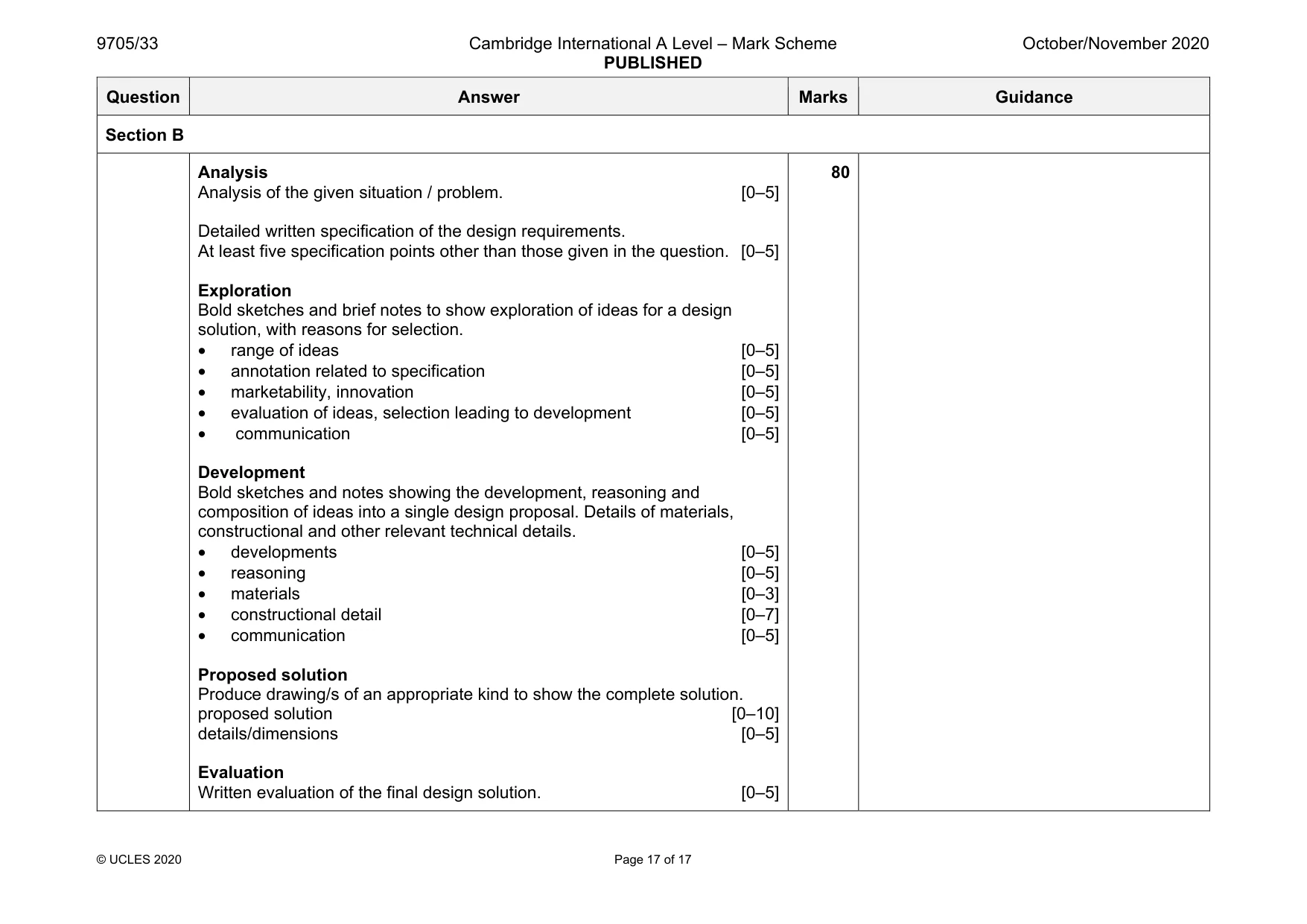
9705/33 Cambridge International A Level – Mark Scheme PUBLISHED October/November 2020 © UCLES 2020 Page 17 of 17 Question Answer Marks Guidance Section B Analysis Analysis of the given situation / problem. [0–5] Detailed written specification of the design requirements. At least five specification points other than those given in the question. [0–5] Exploration Bold sketches and brief notes to show exploration of ideas for a design solution, with reasons for selection. • range of ideas [0–5] • annotation related to specification [0–5] • marketability, innovation [0–5] • evaluation of ideas, selection leading to development [0–5] • communication [0–5] Development Bold sketches and notes showing the development, reasoning and composition of ideas into a single design proposal. Details of materials, constructional and other relevant technical details. • developments [0–5] • reasoning [0–5] • materials [0–3] • constructional detail [0–7] • communication [0–5] Proposed solution Produce drawing/s of an appropriate kind to show the complete solution. proposed solution [0–10] details/dimensions [0–5] Evaluation Written evaluation of the final design solution. [0–5] 80
What you needed in this session
Cambridge’s own grade thresholds for 2020 Oct/Nov, Paper 3 · Variant 3. A higher threshold means an easier paper — the bar moves with how the cohort did.