Cambridge A Level Design and Technology 9705 — 2022 Oct/Nov Paper 3 · Variant 3
9705/33/O/N/22 · 120 marks · ≈135 min
The question paper and its mark scheme, free to read here and free to download. This is Cambridge’s own paper, exactly as it was sat.
Question paper12 pages



Mark scheme16 pages
Answers below. Sit the paper first if you are practising.
Paper as text
Question paper, page 1
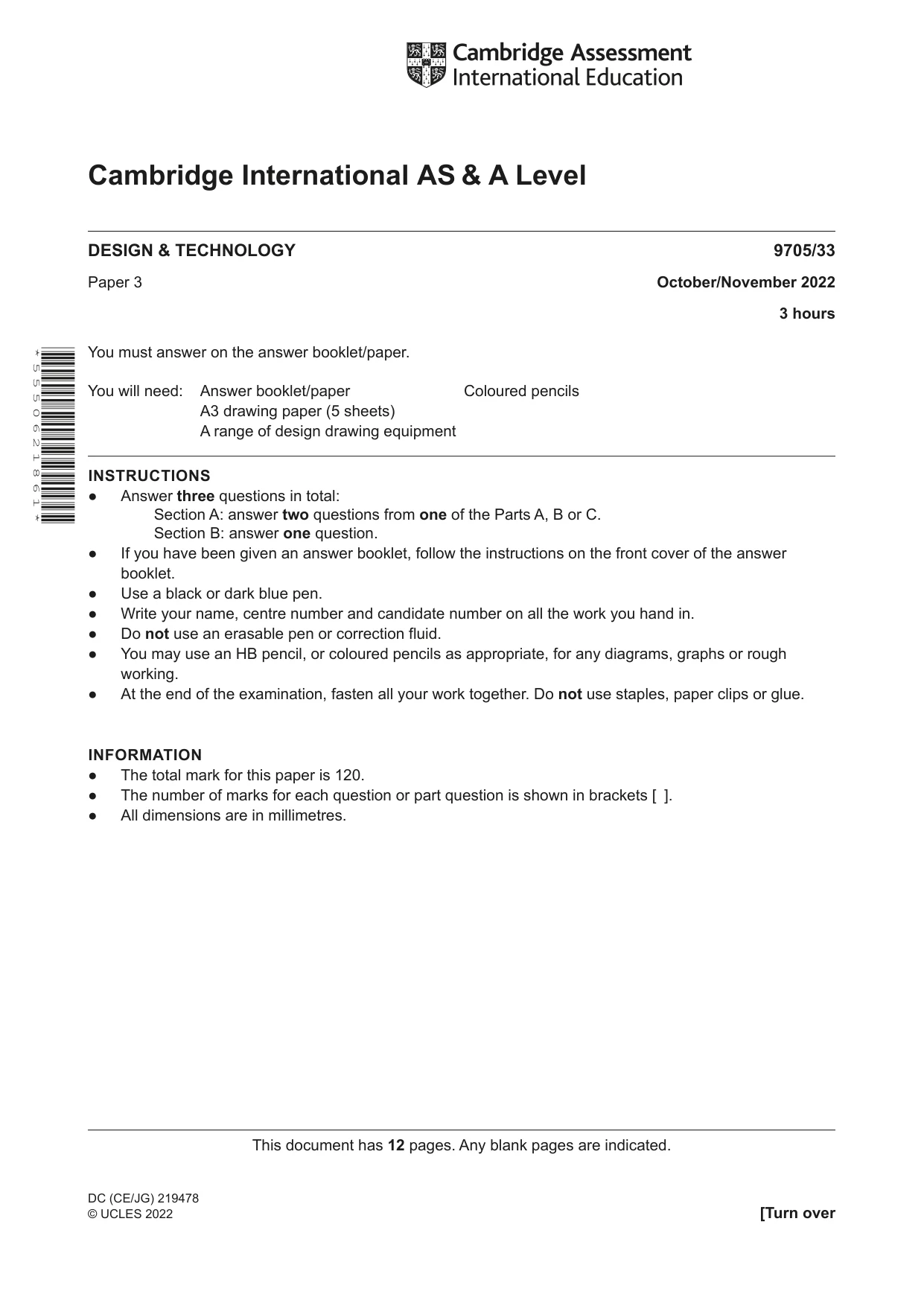
This document has 12 pages. Any blank pages are indicated. [Turn over Cambridge International AS & A Level DESIGN & TECHNOLOGY 9705/33 Paper 3 October/November 2022 3 hours You must answer on the answer booklet/paper. You will need: Answer booklet/paper Coloured pencils A3 drawing paper (5 sheets) A range of design drawing equipment INSTRUCTIONS ● Answer three questions in total: Section A: answer two questions from one of the Parts A, B or C. Section B: answer one question. ● If you have been given an answer booklet, follow the instructions on the front cover of the answer booklet. ● Use a black or dark blue pen. ● Write your name, centre number and candidate number on all the work you hand in. ● Do not use an erasable pen or correction fluid. ● You may use an HB pencil, or coloured pencils as appropriate, for any diagrams, graphs or rough working. ● At the end of the examination, fasten all your work together. Do not use staples, paper clips or glue. INFORMATION ● The total mark for this paper is 120. ● The number of marks for each question or part question is shown in brackets [ ]. ● All dimensions are in millimetres. DC (CE/JG) 219478 © UCLES 2022 * 5 5 5 0 6 2 1 8 6 1 *
Question paper, page 2
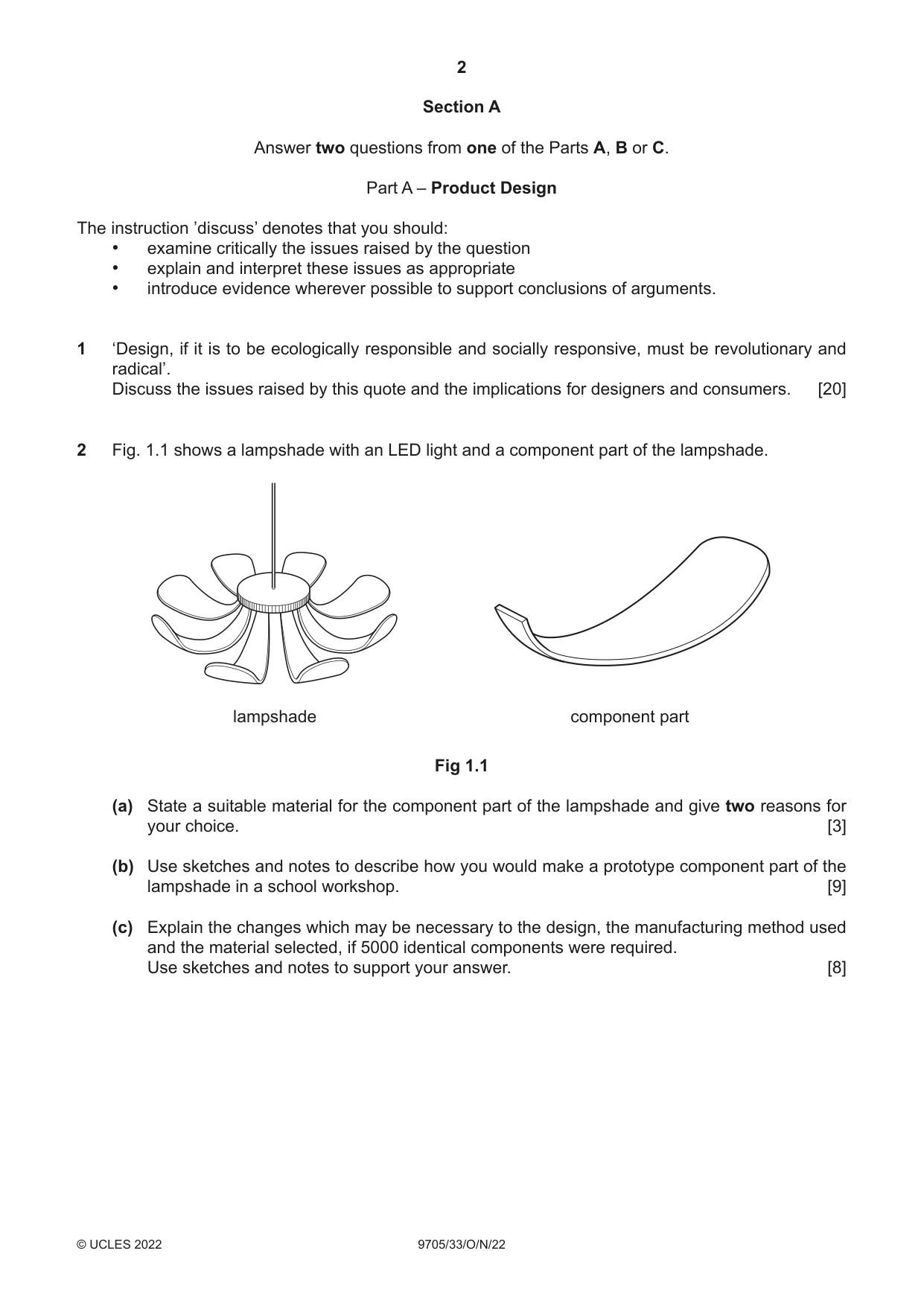
2 9705/33/O/N/22 © UCLES 2022 Section A Answer two questions from one of the Parts A, B or C. Part A – Product Design The instruction ’discuss’ denotes that you should: • examine critically the issues raised by the question • explain and interpret these issues as appropriate • introduce evidence wherever possible to support conclusions of arguments. 1 ‘Design, if it is to be ecologically responsible and socially responsive, must be revolutionary and radical’. Discuss the issues raised by this quote and the implications for designers and consumers. [20] 2 Fig. 1.1 shows a lampshade with an LED light and a component part of the lampshade. lampshade component part Fig 1.1 (a) State a suitable material for the component part of the lampshade and give two reasons for your choice. [3] (b) Use sketches and notes to describe how you would make a prototype component part of the lampshade in a school workshop. [9] (c) Explain the changes which may be necessary to the design, the manufacturing method used and the material selected, if 5000 identical components were required. Use sketches and notes to support your answer. [8]
Question paper, page 3
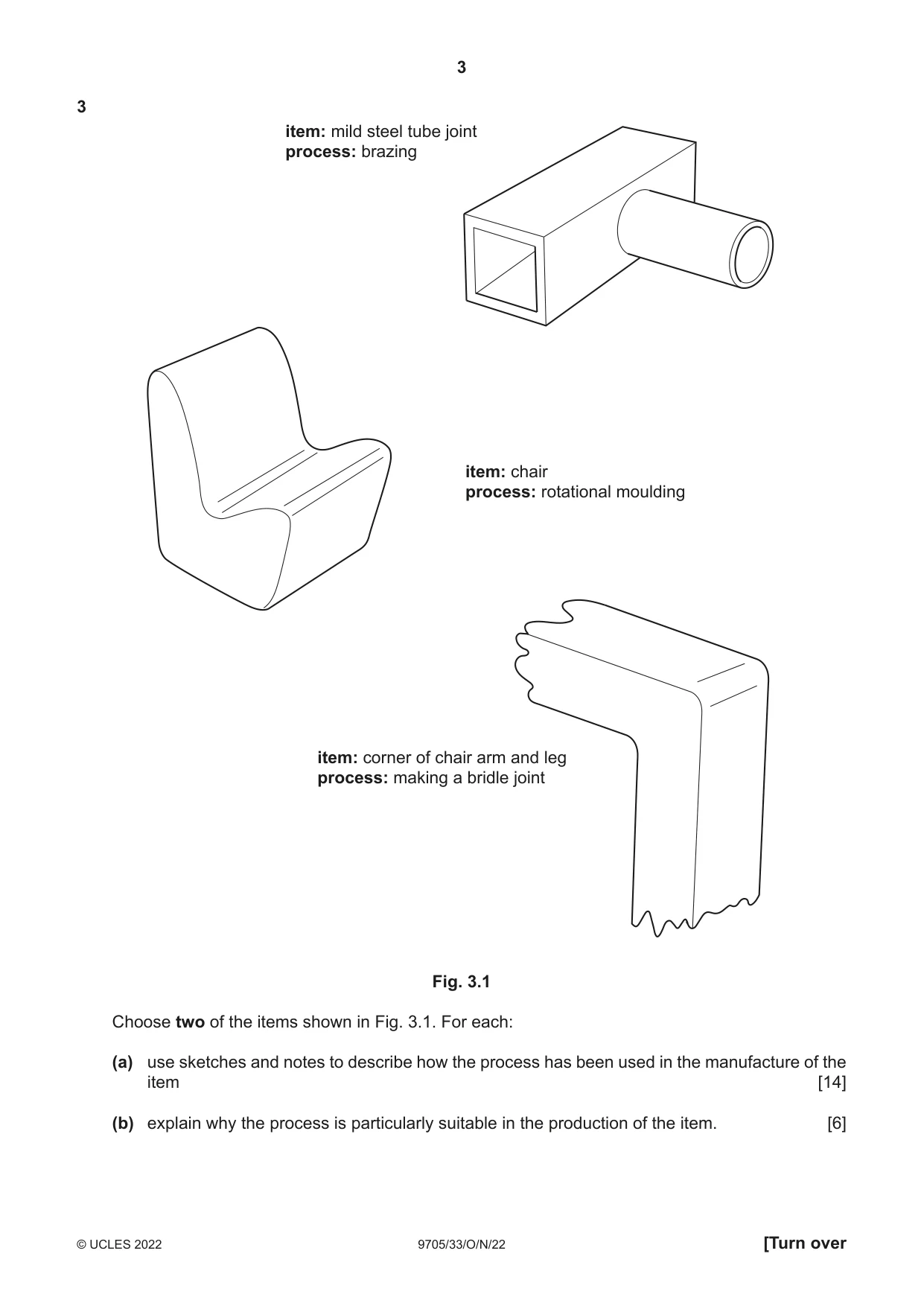
3 9705/33/O/N/22 © UCLES 2022 [Turn over 3 item: mild steel tube joint process: brazing item: chair process: rotational moulding item: corner of chair arm and leg process: making a bridle joint Fig. 3.1 Choose two of the items shown in Fig. 3.1. For each: (a) use sketches and notes to describe how the process has been used in the manufacture of the item [14] (b) explain why the process is particularly suitable in the production of the item. [6]
Question paper, page 4
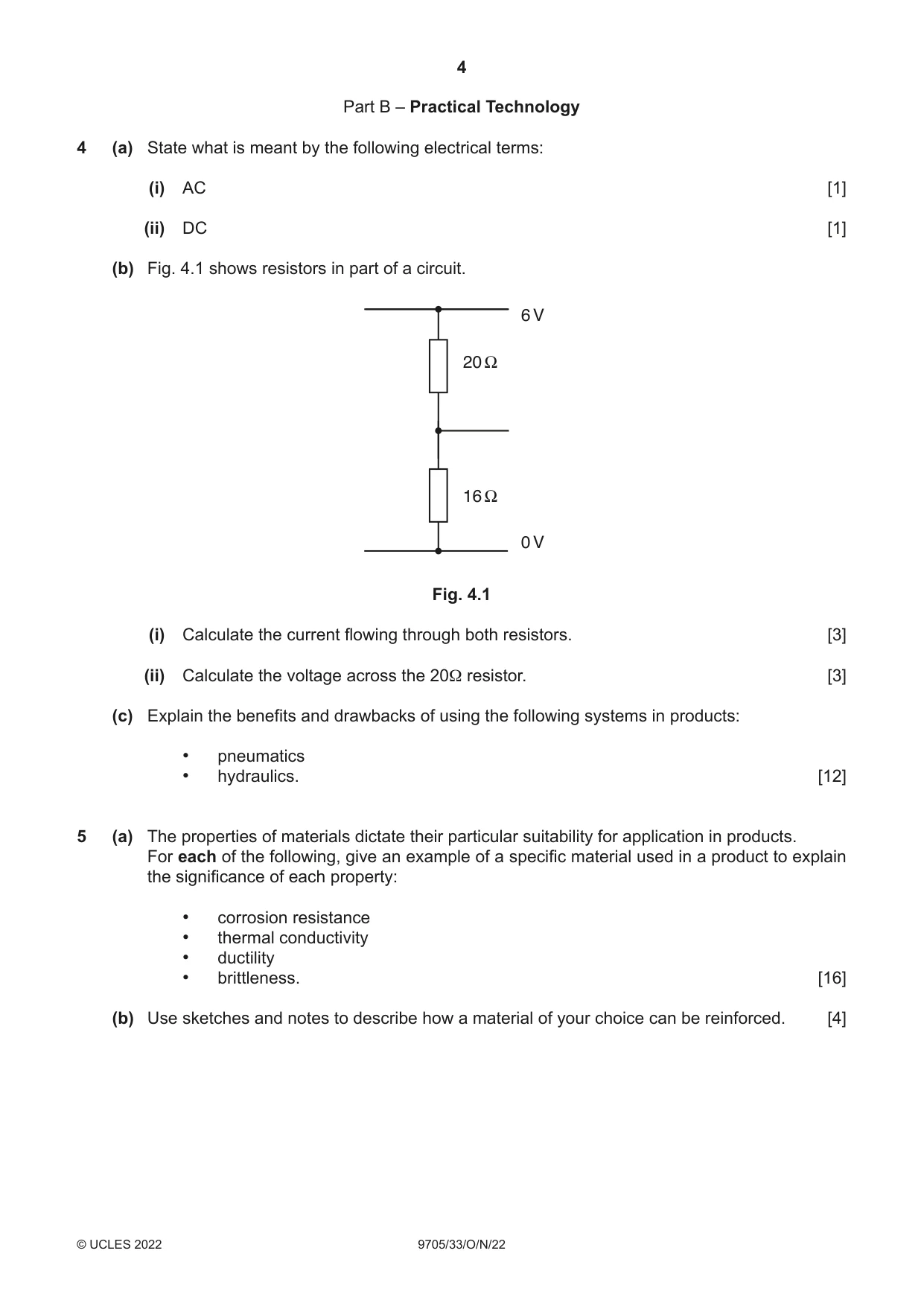
4 9705/33/O/N/22 © UCLES 2022 Part B – Practical Technology 4 (a) State what is meant by the following electrical terms: (i) AC [1] (ii) DC [1] (b) Fig. 4.1 shows resistors in part of a circuit. 6 V 0 V 20 Ω 16 Ω Fig. 4.1 (i) Calculate the current flowing through both resistors. [3] (ii) Calculate the voltage across the 20Ω resistor. [3] (c) Explain the benefits and drawbacks of using the following systems in products: • pneumatics • hydraulics. [12] 5 (a) The properties of materials dictate their particular suitability for application in products. For each of the following, give an example of a specific material used in a product to explain the significance of each property: • corrosion resistance • thermal conductivity • ductility • brittleness. [16] (b) Use sketches and notes to describe how a material of your choice can be reinforced. [4]
Question paper, page 5
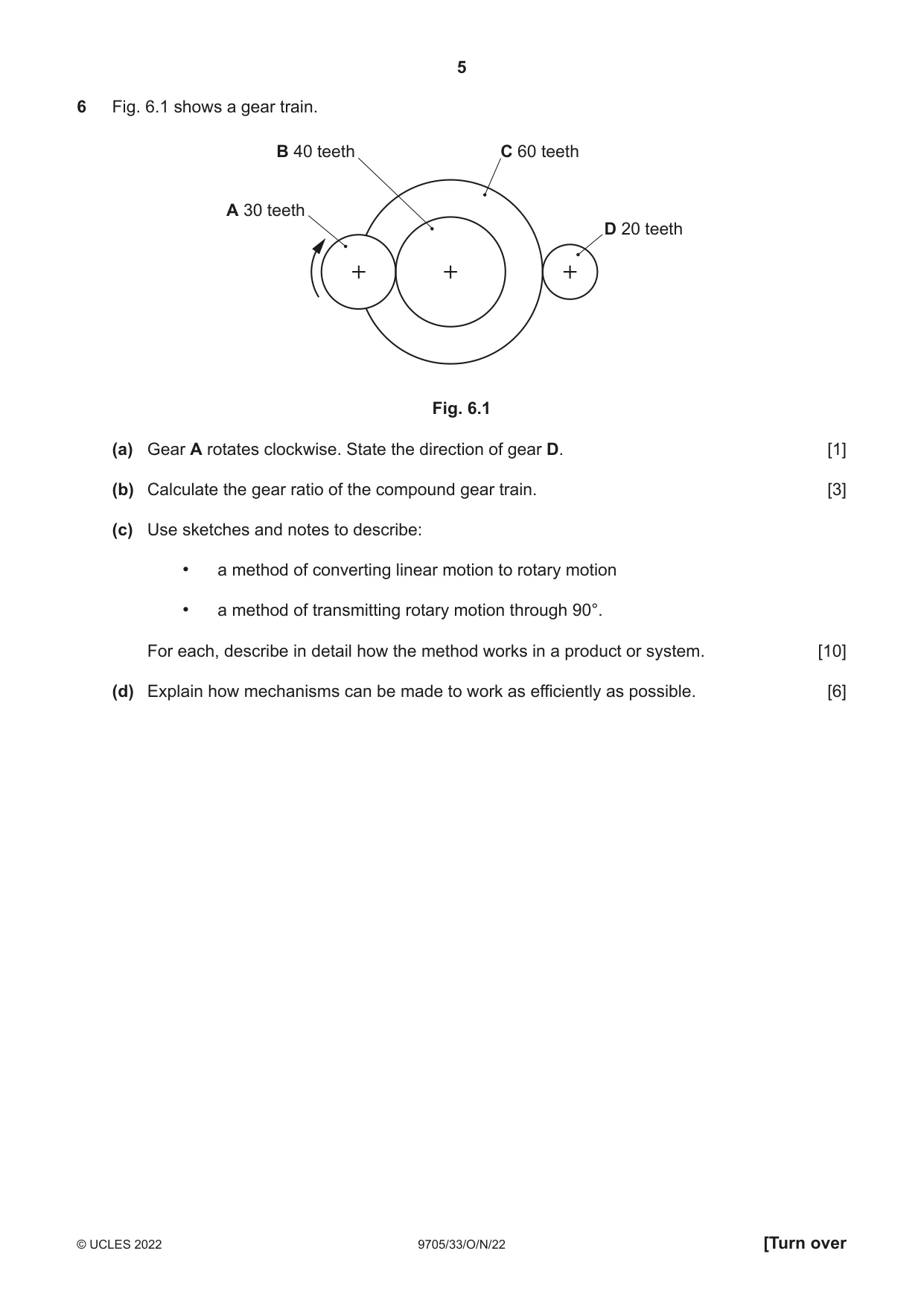
5 9705/33/O/N/22 © UCLES 2022 [Turn over 6 Fig. 6.1 shows a gear train. A 30 teeth B 40 teeth C 60 teeth D 20 teeth Fig. 6.1 (a) Gear A rotates clockwise. State the direction of gear D. [1] (b) Calculate the gear ratio of the compound gear train. [3] (c) Use sketches and notes to describe: • a method of converting linear motion to rotary motion • a method of transmitting rotary motion through 90°. For each, describe in detail how the method works in a product or system. [10] (d) Explain how mechanisms can be made to work as efficiently as possible. [6]
Question paper, page 6
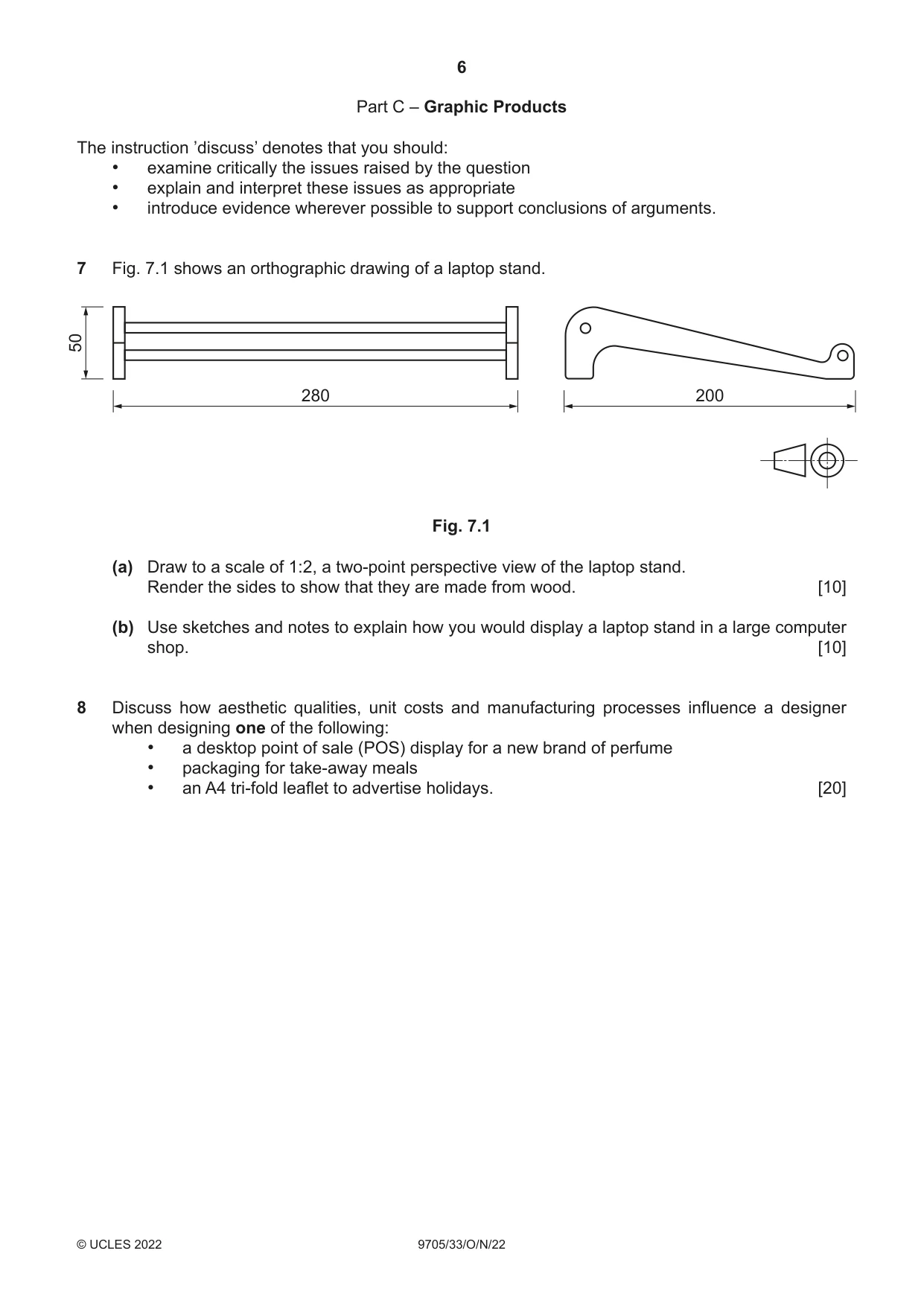
6 9705/33/O/N/22 © UCLES 2022 Part C – Graphic Products The instruction ’discuss’ denotes that you should: • examine critically the issues raised by the question • explain and interpret these issues as appropriate • introduce evidence wherever possible to support conclusions of arguments. 7 Fig. 7.1 shows an orthographic drawing of a laptop stand. 280 200 50 Fig. 7.1 (a) Draw to a scale of 1:2, a two-point perspective view of the laptop stand. Render the sides to show that they are made from wood. [10] (b) Use sketches and notes to explain how you would display a laptop stand in a large computer shop. [10] 8 Discuss how aesthetic qualities, unit costs and manufacturing processes influence a designer when designing one of the following: • a desktop point of sale (POS) display for a new brand of perfume • packaging for take-away meals • an A4 tri-fold leaflet to advertise holidays. [20]
Question paper, page 7
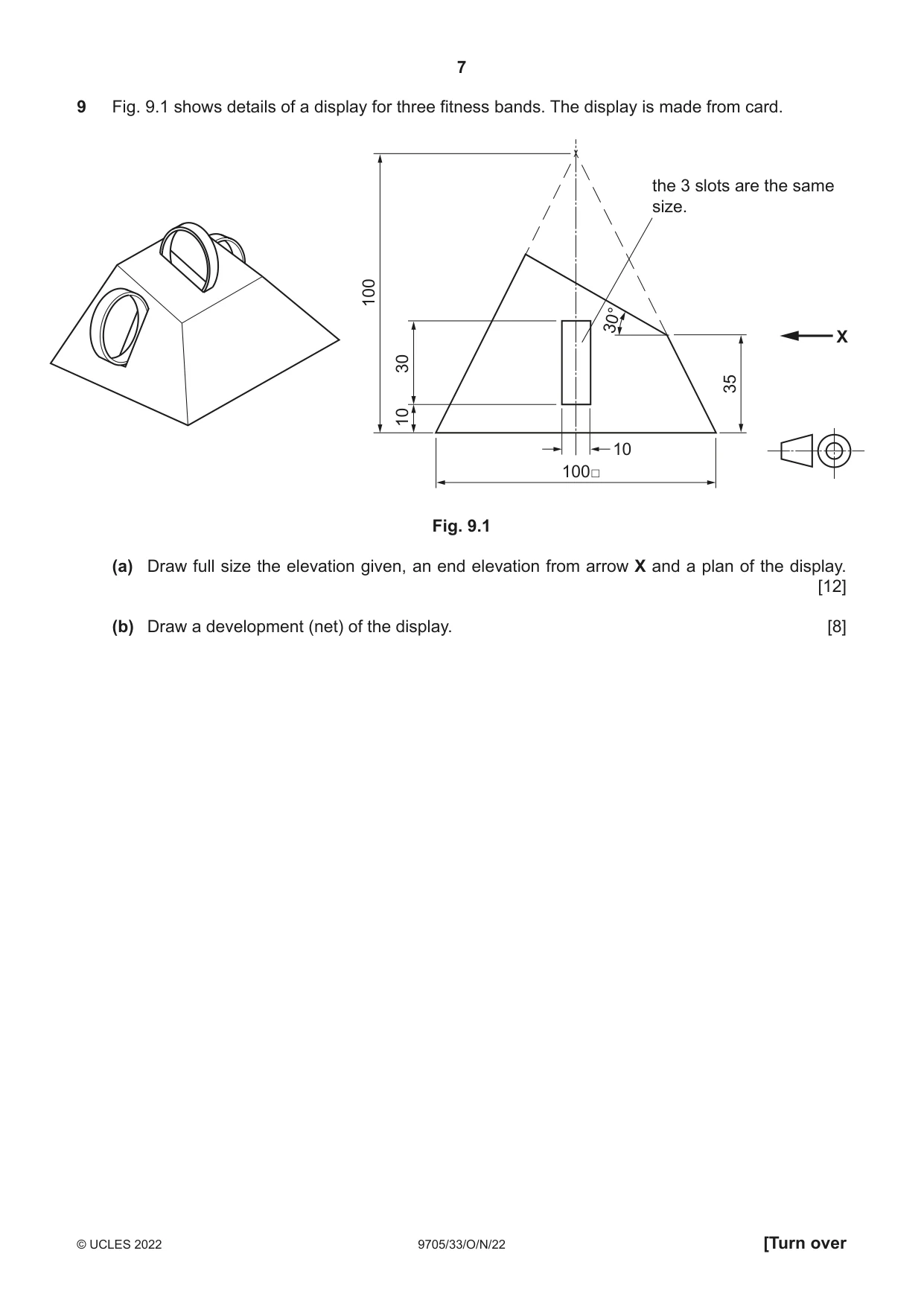
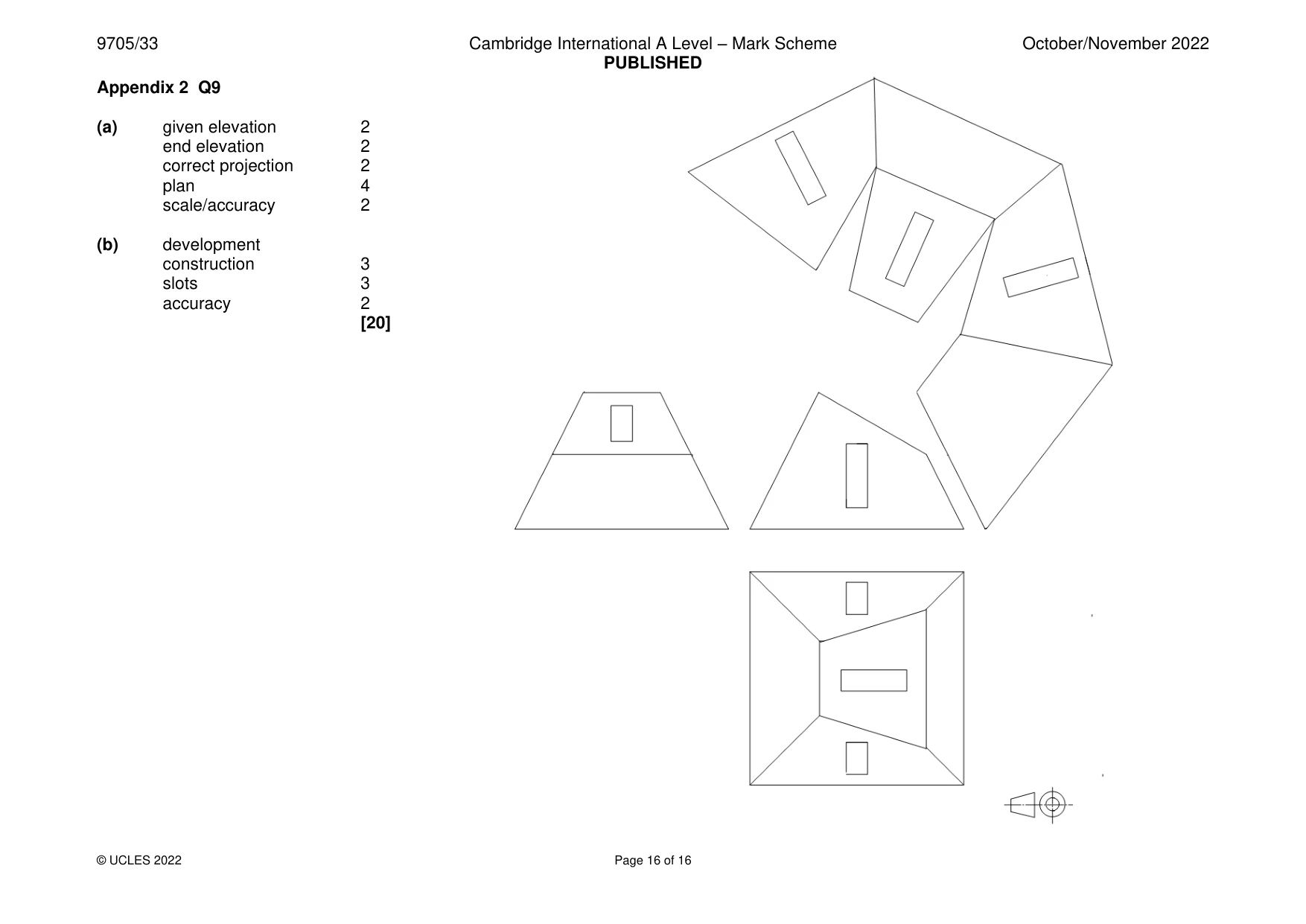
7 9705/33/O/N/22 © UCLES 2022 [Turn over 9 Fig. 9.1 shows details of a display for three fitness bands. The display is made from card. 30° 100□ 10 35 the 3 slots are the same size. 10 30 100 X Fig. 9.1 (a) Draw full size the elevation given, an end elevation from arrow X and a plan of the display. [12] (b) Draw a development (net) of the display. [8]
Question paper, page 8
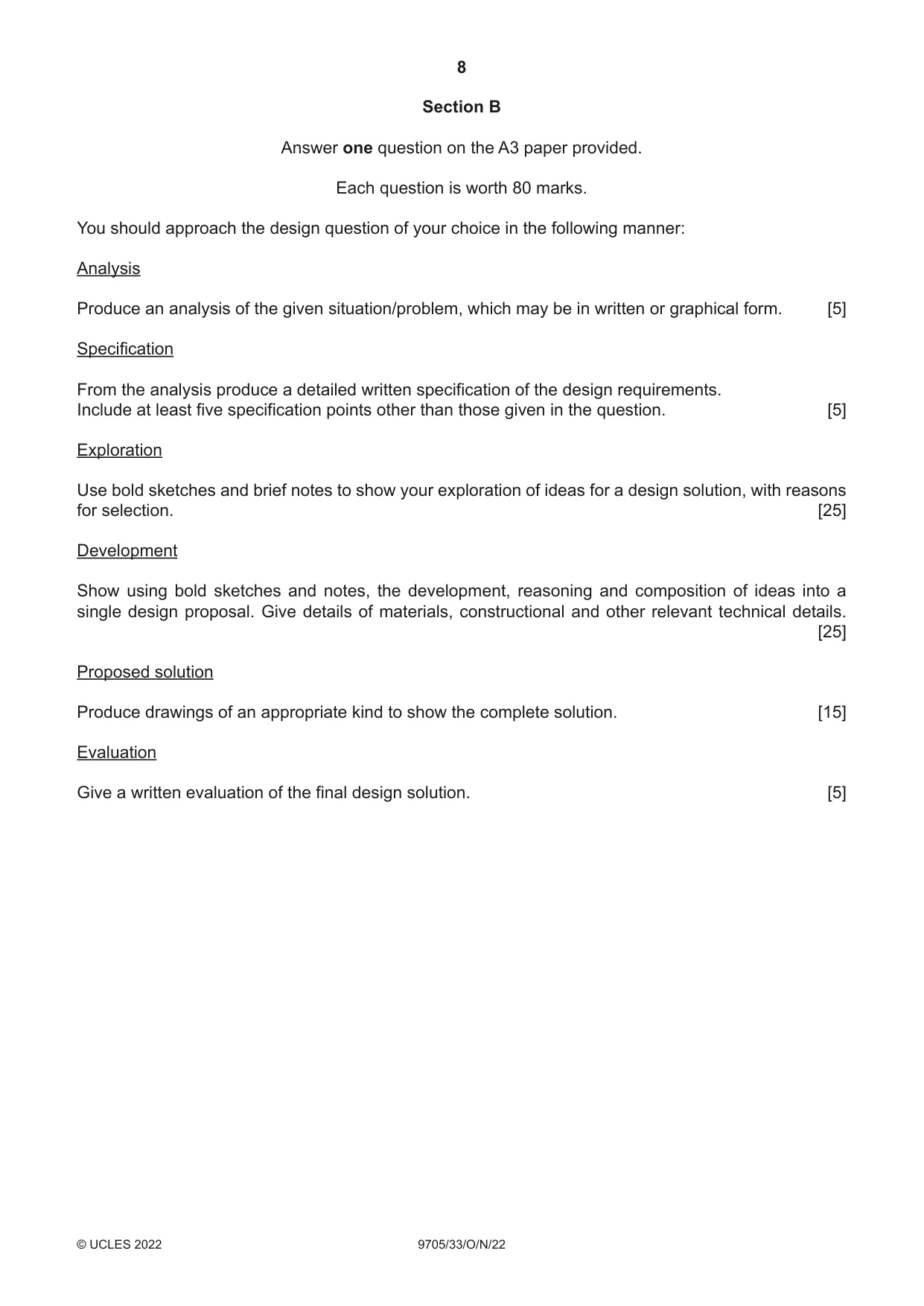
8 9705/33/O/N/22 © UCLES 2022 Section B Answer one question on the A3 paper provided. Each question is worth 80 marks. You should approach the design question of your choice in the following manner: Analysis Produce an analysis of the given situation/problem, which may be in written or graphical form. [5] Specification From the analysis produce a detailed written specification of the design requirements. Include at least five specification points other than those given in the question. [5] Exploration Use bold sketches and brief notes to show your exploration of ideas for a design solution, with reasons for selection. [25] Development Show using bold sketches and notes, the development, reasoning and composition of ideas into a single design proposal. Give details of materials, constructional and other relevant technical details. [25] Proposed solution Produce drawings of an appropriate kind to show the complete solution. [15] Evaluation Give a written evaluation of the final design solution. [5]
Question paper, page 9
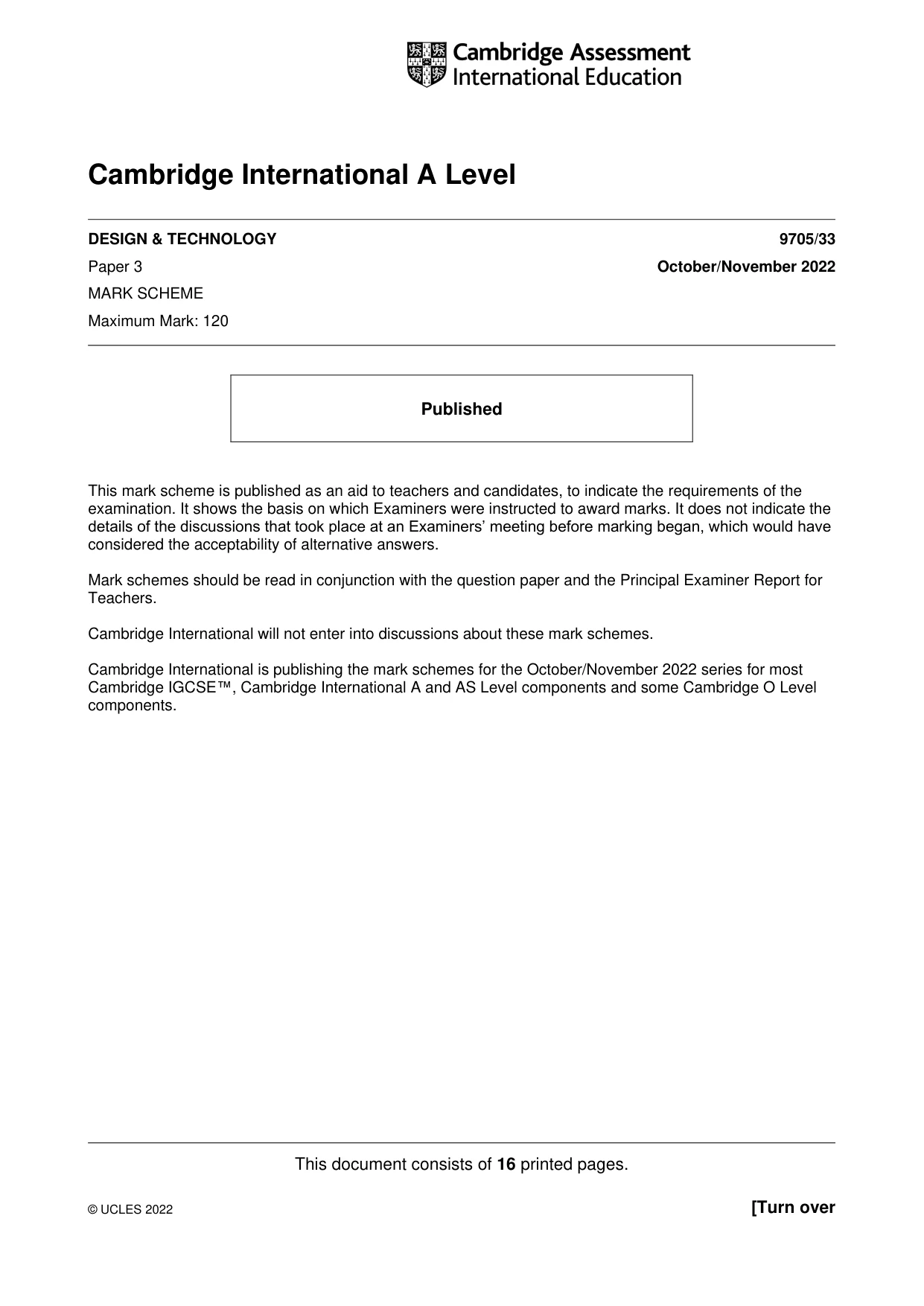
9 9705/33/O/N/22 © UCLES 2022 10 Many families enjoy visiting the beach. Carrying items across a beach to a desired spot can be difficult. You are to design a product that will: • transport items across a beach and provide a dual purpose • fit easily in a car. [80] 11 A games company wishes to expand its product line and produce a timer to be included in games. Design an imaginative timer for a game of your choice, incorporating a mechanical and/or electronic system. The timer must: • provide at least two different time durations • be based on the theme of the chosen game. [80] 12 A school has been asked to raise awareness of local or national environmental concerns. You are to design a free standing eco-display to be placed at the entrance of the school. The display must: • take up no more than 1 m × 1.5 m floor space • include an interactive feature. [80]
Question paper, page 10
10 9705/33/O/N/22 © UCLES 2022 BLANK PAGE
Question paper, page 11
11 9705/33/O/N/22 © UCLES 2022 BLANK PAGE
Question paper, page 12
12 9705/33/O/N/22 © UCLES 2022 Permission to reproduce items where third-party owned material protected by copyright is included has been sought and cleared where possible. Every reasonable effort has been made by the publisher (UCLES) to trace copyright holders, but if any items requiring clearance have unwittingly been included, the publisher will be pleased to make amends at the earliest possible opportunity. To avoid the issue of disclosure of answer-related information to candidates, all copyright acknowledgements are reproduced online in the Cambridge Assessment International Education Copyright Acknowledgements Booklet. This is produced for each series of examinations and is freely available to download at www.cambridgeinternational.org after the live examination series. Cambridge Assessment International Education is part of Cambridge Assessment. Cambridge Assessment is the brand name of the University of Cambridge Local Examinations Syndicate (UCLES), which is a department of the University of Cambridge. BLANK PAGE
Mark scheme, page 1
This document consists of 16 printed pages. © UCLES 2022 [Turn over Cambridge International A Level DESIGN & TECHNOLOGY 9705/33 Paper 3 October/November 2022 MARK SCHEME Maximum Mark: 120 Published This mark scheme is published as an aid to teachers and candidates, to indicate the requirements of the examination. It shows the basis on which Examiners were instructed to award marks. It does not indicate the details of the discussions that took place at an Examiners’ meeting before marking began, which would have considered the acceptability of alternative answers. Mark schemes should be read in conjunction with the question paper and the Principal Examiner Report for Teachers. Cambridge International will not enter into discussions about these mark schemes. Cambridge International is publishing the mark schemes for the October/November 2022 series for most Cambridge IGCSE™, Cambridge International A and AS Level components and some Cambridge O Level components.
Mark scheme, page 2
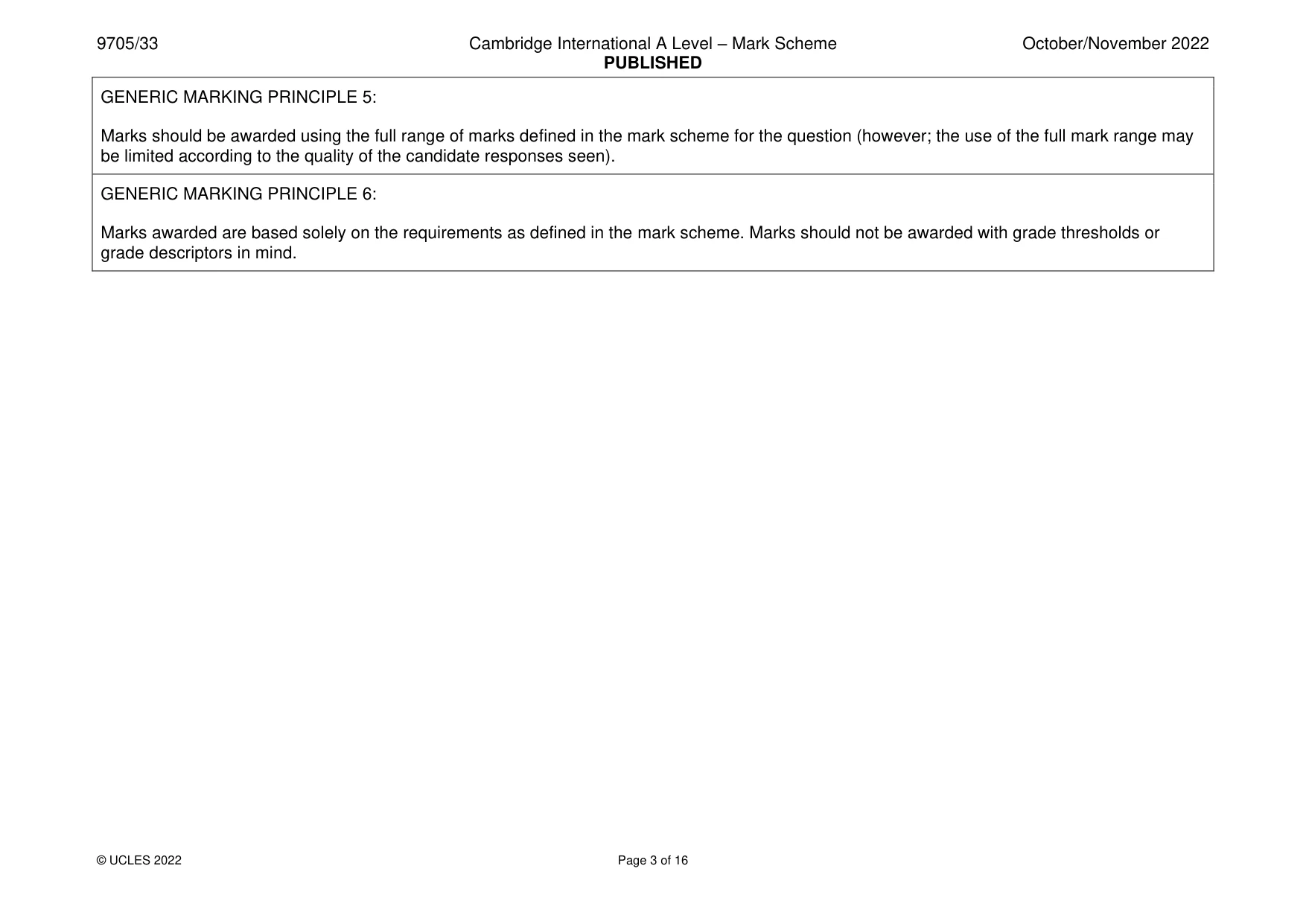
9705/33 Cambridge International A Level – Mark Scheme PUBLISHED October/November 2022 © UCLES 2022 Page 2 of 16 Generic Marking Principles These general marking principles must be applied by all examiners when marking candidate answers. They should be applied alongside the specific content of the mark scheme or generic level descriptors for a question. Each question paper and mark scheme will also comply with these marking principles. GENERIC MARKING PRINCIPLE 1: Marks must be awarded in line with: • the specific content of the mark scheme or the generic level descriptors for the question • the specific skills defined in the mark scheme or in the generic level descriptors for the question • the standard of response required by a candidate as exemplified by the standardisation scripts. GENERIC MARKING PRINCIPLE 2: Marks awarded are always whole marks (not half marks, or other fractions). GENERIC MARKING PRINCIPLE 3: Marks must be awarded positively: • marks are awarded for correct/valid answers, as defined in the mark scheme. However, credit is given for valid answers which go beyond the scope of the syllabus and mark scheme, referring to your Team Leader as appropriate • marks are awarded when candidates clearly demonstrate what they know and can do • marks are not deducted for errors • marks are not deducted for omissions • answers should only be judged on the quality of spelling, punctuation and grammar when these features are specifically assessed by the question as indicated by the mark scheme. The meaning, however, should be unambiguous. GENERIC MARKING PRINCIPLE 4: Rules must be applied consistently, e.g. in situations where candidates have not followed instructions or in the application of generic level descriptors.
Mark scheme, page 3
9705/33 Cambridge International A Level – Mark Scheme PUBLISHED October/November 2022 © UCLES 2022 Page 3 of 16 GENERIC MARKING PRINCIPLE 5: Marks should be awarded using the full range of marks defined in the mark scheme for the question (however; the use of the full mark range may be limited according to the quality of the candidate responses seen). GENERIC MARKING PRINCIPLE 6: Marks awarded are based solely on the requirements as defined in the mark scheme. Marks should not be awarded with grade thresholds or grade descriptors in mind.
Mark scheme, page 4
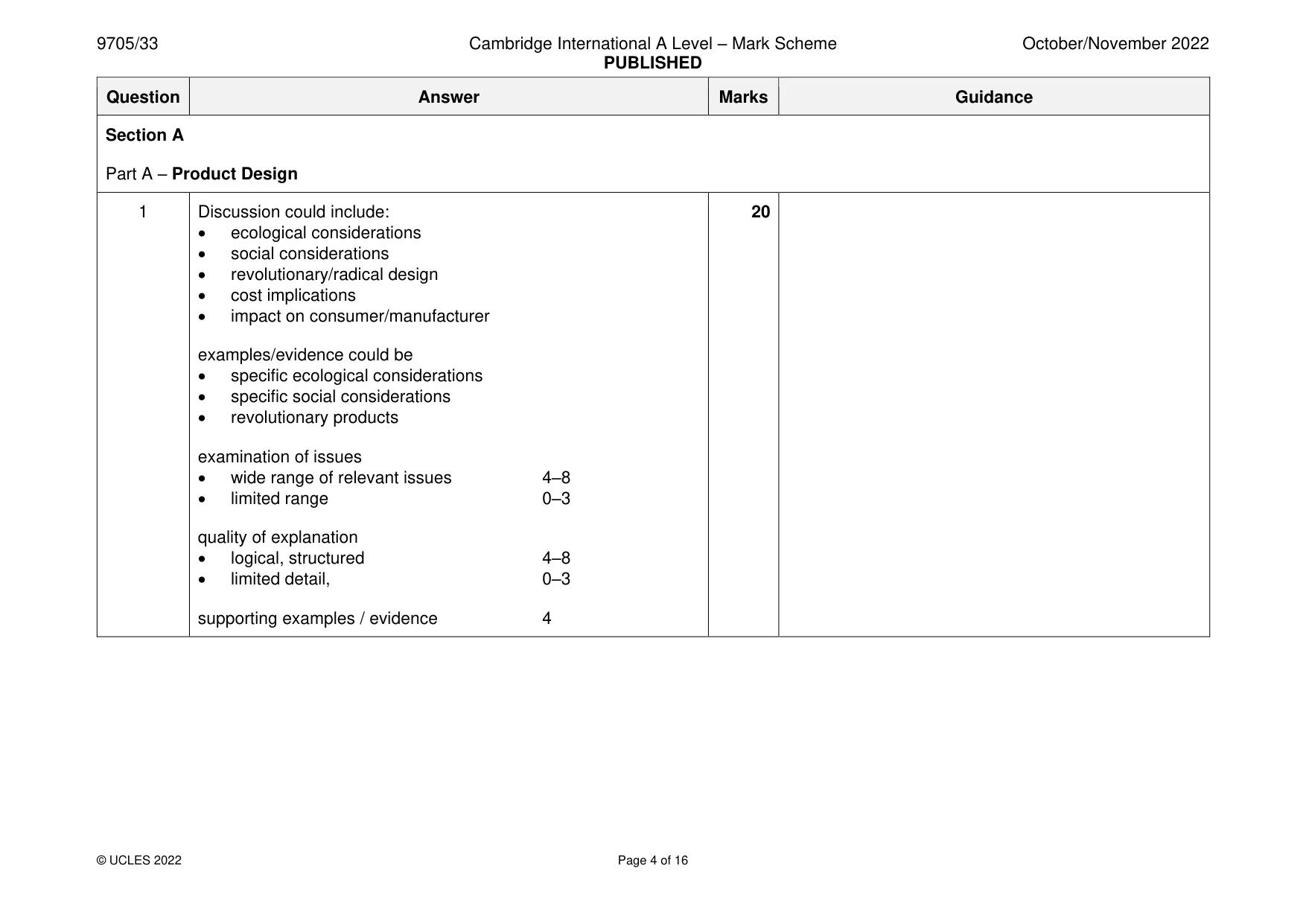
9705/33 Cambridge International A Level – Mark Scheme PUBLISHED October/November 2022 © UCLES 2022 Page 4 of 16 Question Answer Marks Guidance Section A Part A – Product Design 1 Discussion could include: • ecological considerations • social considerations • revolutionary/radical design • cost implications • impact on consumer/manufacturer examples/evidence could be • specific ecological considerations • specific social considerations • revolutionary products examination of issues • wide range of relevant issues 4–8 • limited range 0–3 quality of explanation • logical, structured 4–8 • limited detail, 0–3 supporting examples / evidence 4 20
Mark scheme, page 5
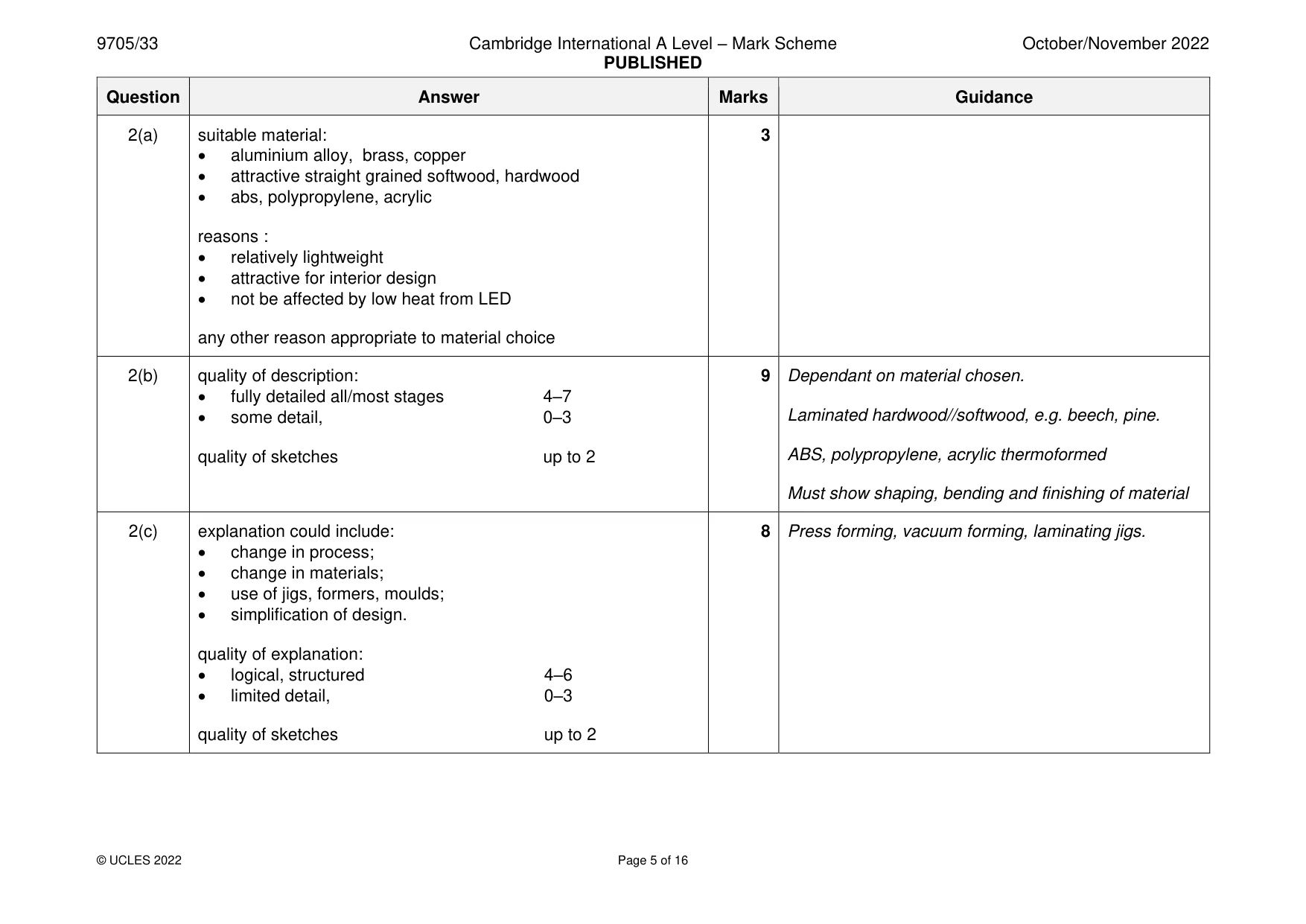
9705/33 Cambridge International A Level – Mark Scheme PUBLISHED October/November 2022 © UCLES 2022 Page 5 of 16 Question Answer Marks Guidance 2(a) suitable material: • aluminium alloy, brass, copper • attractive straight grained softwood, hardwood • abs, polypropylene, acrylic reasons : • relatively lightweight • attractive for interior design • not be affected by low heat from LED any other reason appropriate to material choice 3 2(b) quality of description: • fully detailed all/most stages 4–7 • some detail, 0–3 quality of sketches up to 2 9 Dependant on material chosen. Laminated hardwood//softwood, e.g. beech, pine. ABS, polypropylene, acrylic thermoformed Must show shaping, bending and finishing of material 2(c) explanation could include: • change in process; • change in materials; • use of jigs, formers, moulds; • simplification of design. quality of explanation: • logical, structured 4–6 • limited detail, 0–3 quality of sketches up to 2 8 Press forming, vacuum forming, laminating jigs.
Mark scheme, page 6
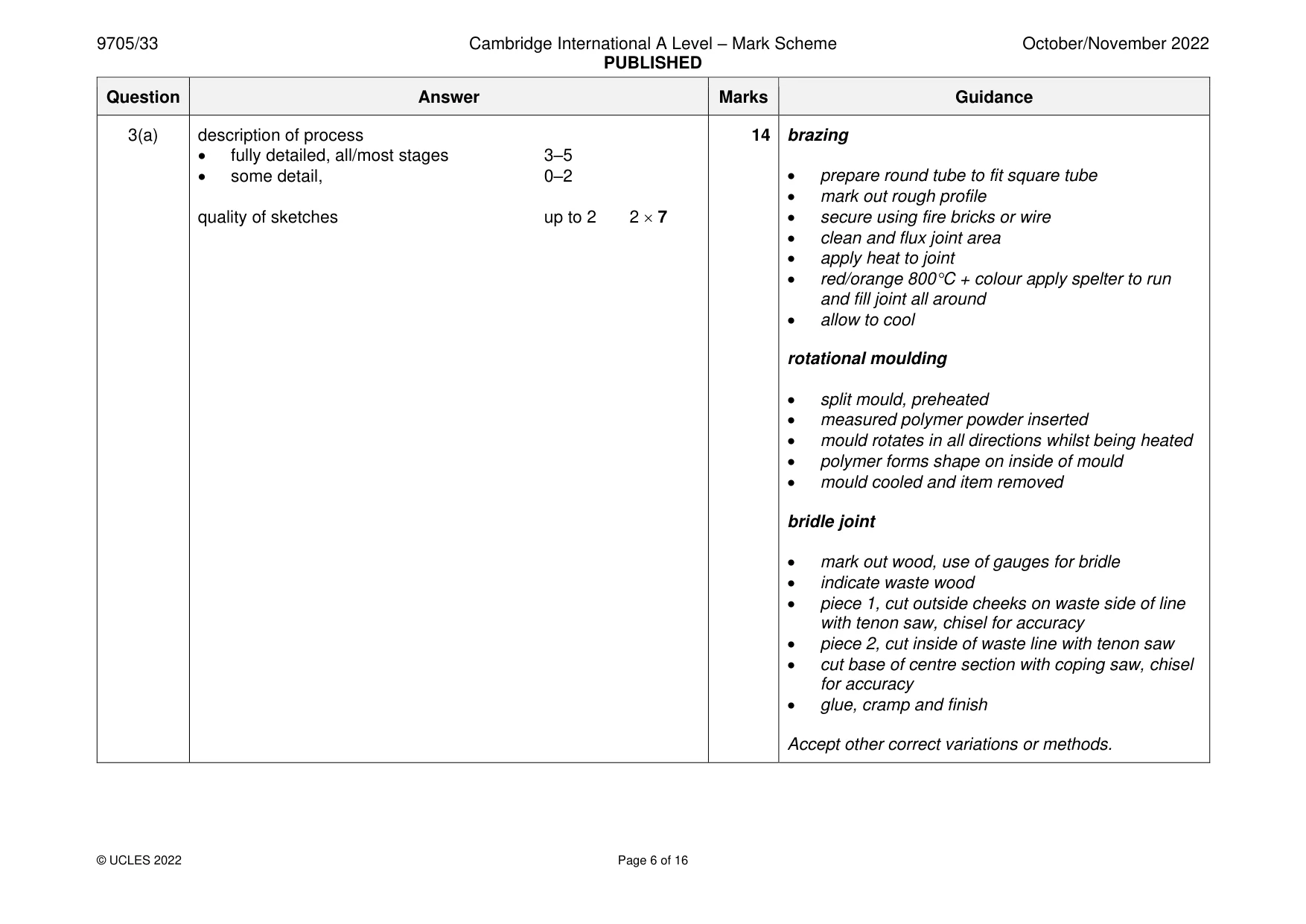
9705/33 Cambridge International A Level – Mark Scheme PUBLISHED October/November 2022 © UCLES 2022 Page 6 of 16 Question Answer Marks Guidance 3(a) description of process • fully detailed, all/most stages 3–5 • some detail, 0–2 quality of sketches up to 2 2 7 14 brazing • prepare round tube to fit square tube • mark out rough profile • secure using fire bricks or wire • clean and flux joint area • apply heat to joint • red/orange 800°C + colour apply spelter to run and fill joint all around • allow to cool rotational moulding • split mould, preheated • measured polymer powder inserted • mould rotates in all directions whilst being heated • polymer forms shape on inside of mould • mould cooled and item removed bridle joint • mark out wood, use of gauges for bridle • indicate waste wood • piece 1, cut outside cheeks on waste side of line with tenon saw, chisel for accuracy • piece 2, cut inside of waste line with tenon saw • cut base of centre section with coping saw, chisel for accuracy • glue, cramp and finish Accept other correct variations or methods.
Mark scheme, page 7
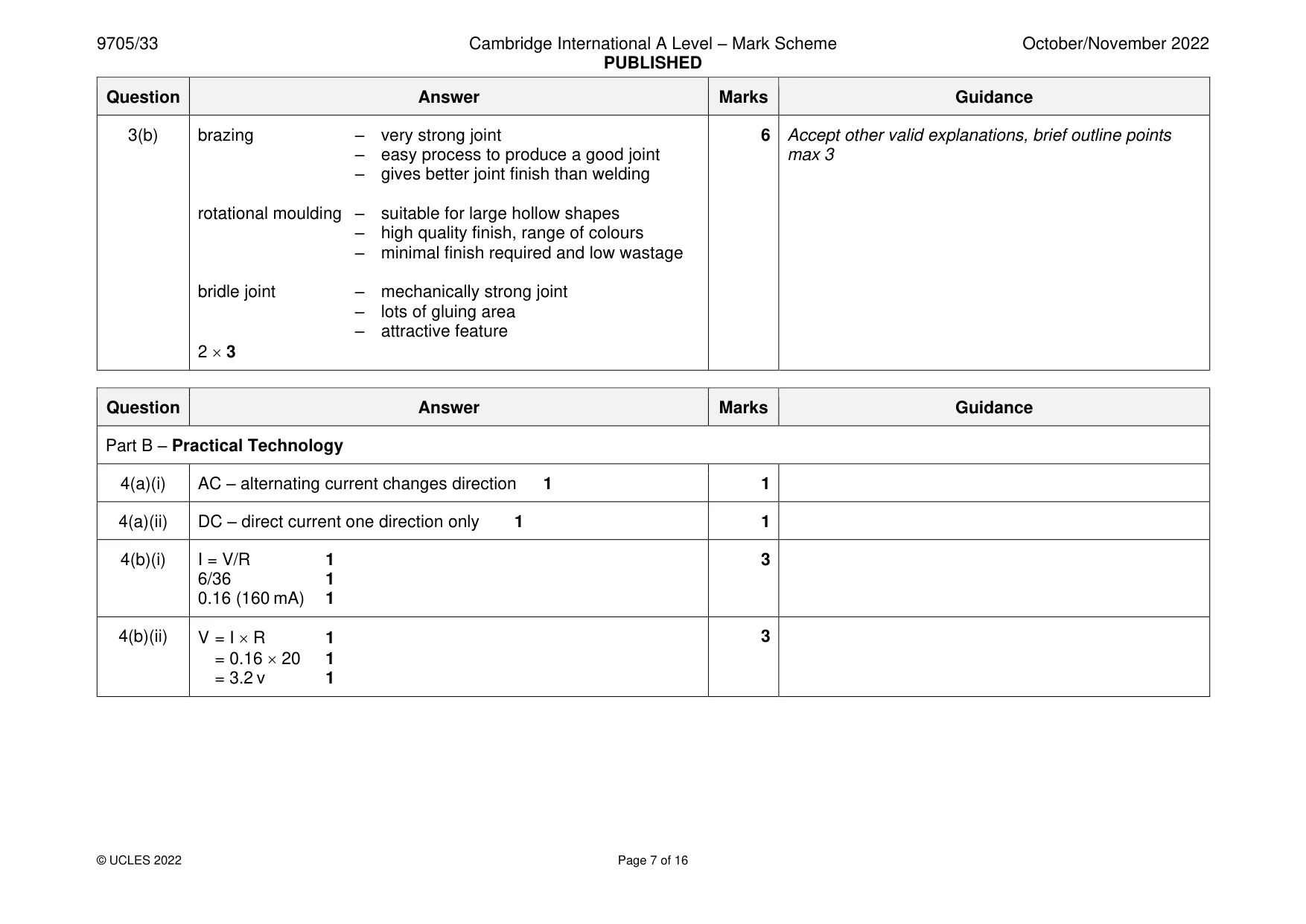
9705/33 Cambridge International A Level – Mark Scheme PUBLISHED October/November 2022 © UCLES 2022 Page 7 of 16 Question Answer Marks Guidance 3(b) brazing – very strong joint – easy process to produce a good joint – gives better joint finish than welding rotational moulding – suitable for large hollow shapes – high quality finish, range of colours – minimal finish required and low wastage bridle joint – mechanically strong joint – lots of gluing area – attractive feature 2 3 6 Accept other valid explanations, brief outline points max 3 Question Answer Marks Guidance Part B – Practical Technology 4(a)(i) AC – alternating current changes direction 1 1 4(a)(ii) DC – direct current one direction only 1 1 4(b)(i) I = V/R 1 6/36 1 0.16 (160 mA) 1 3 4(b)(ii) V = I R 1 = 0.16 20 1 = 3.2 v 1 3
Mark scheme, page 8
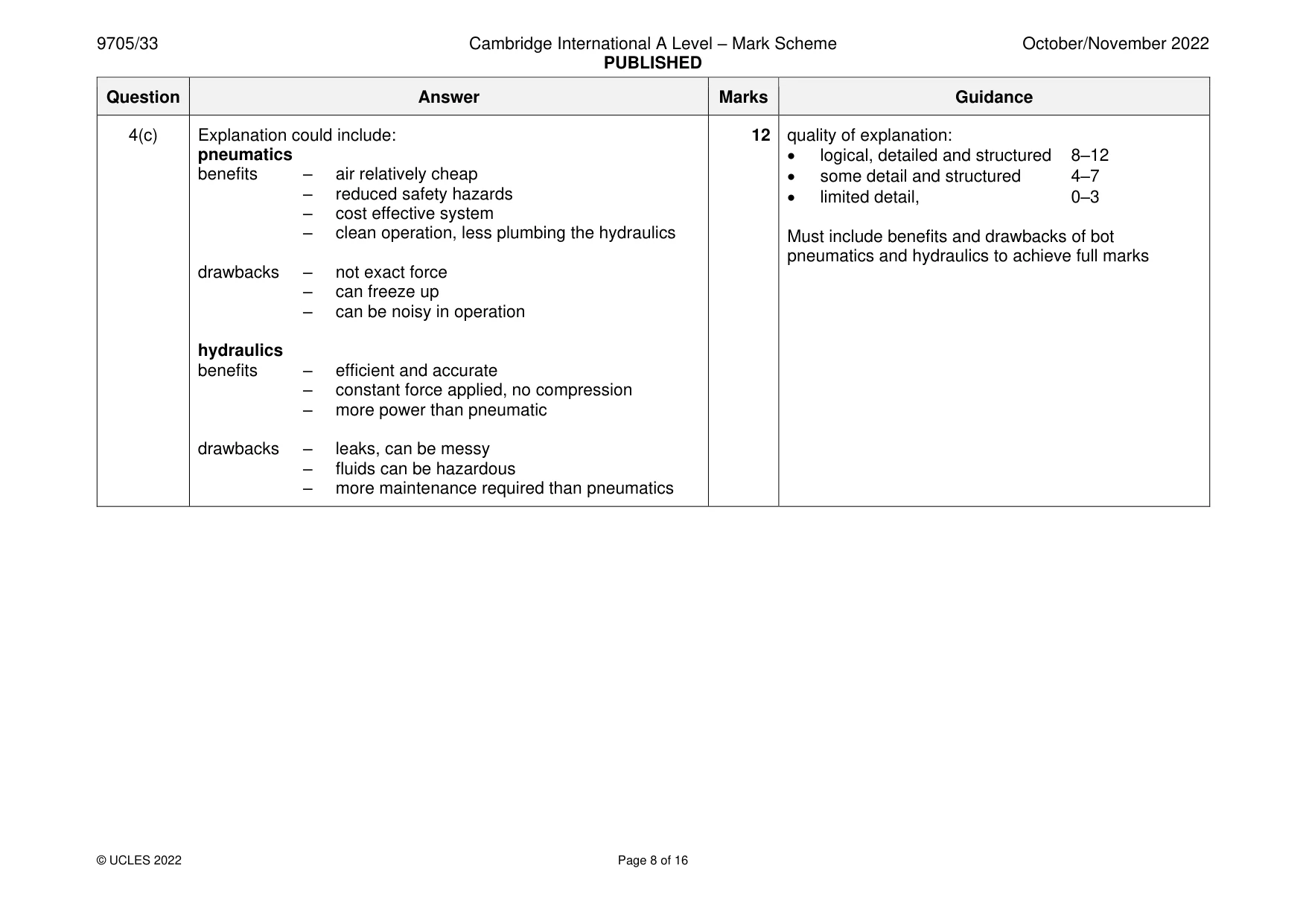
9705/33 Cambridge International A Level – Mark Scheme PUBLISHED October/November 2022 © UCLES 2022 Page 8 of 16 Question Answer Marks Guidance 4(c) Explanation could include: pneumatics benefits – air relatively cheap – reduced safety hazards – cost effective system – clean operation, less plumbing the hydraulics drawbacks – not exact force – can freeze up – can be noisy in operation hydraulics benefits – efficient and accurate – constant force applied, no compression – more power than pneumatic drawbacks – leaks, can be messy – fluids can be hazardous – more maintenance required than pneumatics 12 quality of explanation: • logical, detailed and structured 8–12 • some detail and structured 4–7 • limited detail, 0–3 Must include benefits and drawbacks of bot pneumatics and hydraulics to achieve full marks
Mark scheme, page 9
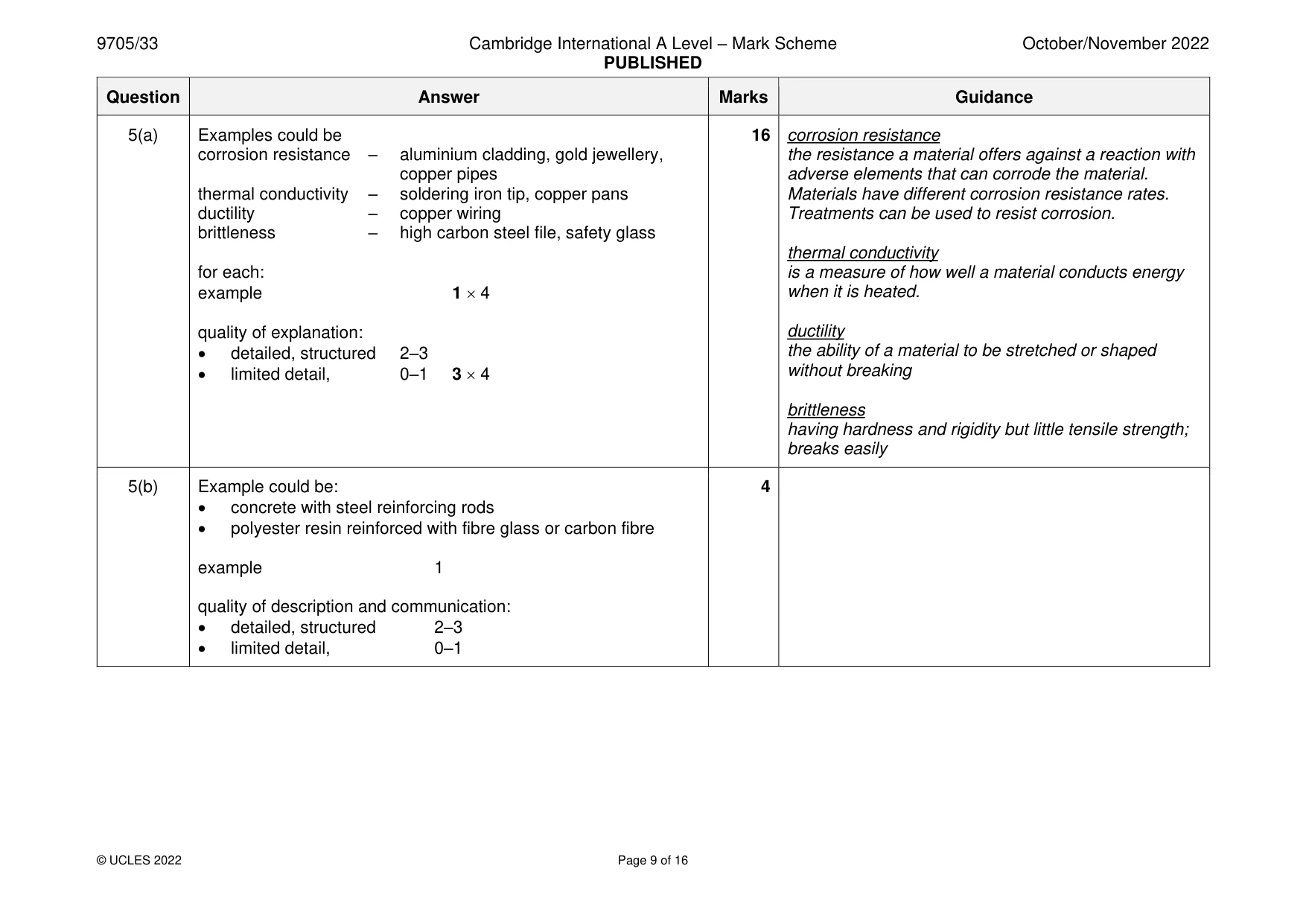
9705/33 Cambridge International A Level – Mark Scheme PUBLISHED October/November 2022 © UCLES 2022 Page 9 of 16 Question Answer Marks Guidance 5(a) Examples could be corrosion resistance – aluminium cladding, gold jewellery, copper pipes thermal conductivity – soldering iron tip, copper pans ductility – copper wiring brittleness – high carbon steel file, safety glass for each: example 1 4 quality of explanation: • detailed, structured 2–3 • limited detail, 0–1 3 4 16 corrosion resistance the resistance a material offers against a reaction with adverse elements that can corrode the material. Materials have different corrosion resistance rates. Treatments can be used to resist corrosion. thermal conductivity is a measure of how well a material conducts energy when it is heated. ductility the ability of a material to be stretched or shaped without breaking brittleness having hardness and rigidity but little tensile strength; breaks easily 5(b) Example could be: • concrete with steel reinforcing rods • polyester resin reinforced with fibre glass or carbon fibre example 1 quality of description and communication: • detailed, structured 2–3 • limited detail, 0–1 4
Mark scheme, page 10
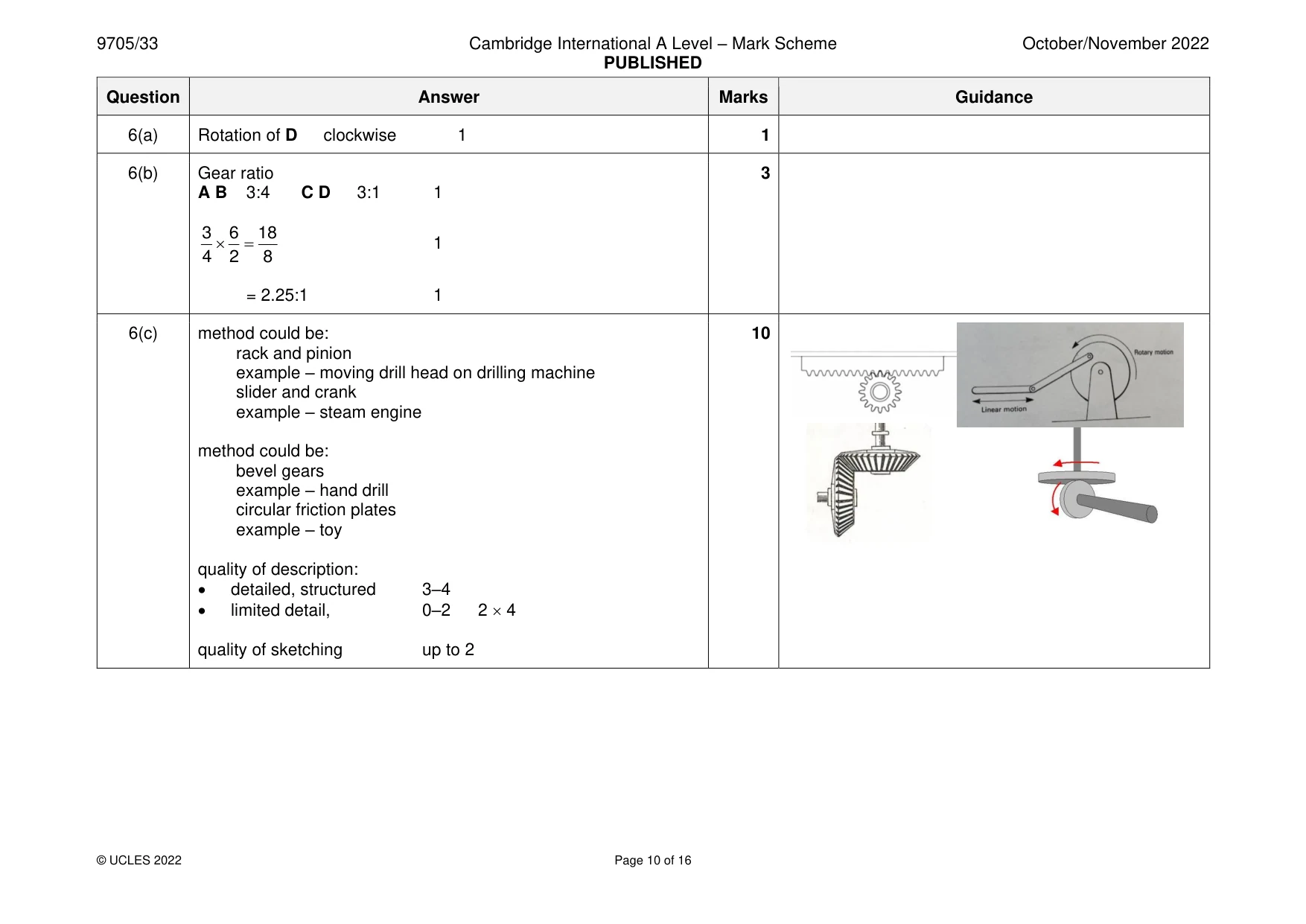
9705/33 Cambridge International A Level – Mark Scheme PUBLISHED October/November 2022 © UCLES 2022 Page 10 of 16 Question Answer Marks Guidance 6(a) Rotation of D clockwise 1 1 6(b) Gear ratio A B 3:4 C D 3:1 1 3 6 18 4 2 8 = 1 = 2.25:1 1 3 6(c) method could be: rack and pinion example – moving drill head on drilling machine slider and crank example – steam engine method could be: bevel gears example – hand drill circular friction plates example – toy quality of description: • detailed, structured 3–4 • limited detail, 0–2 2 4 quality of sketching up to 2 10
Mark scheme, page 11
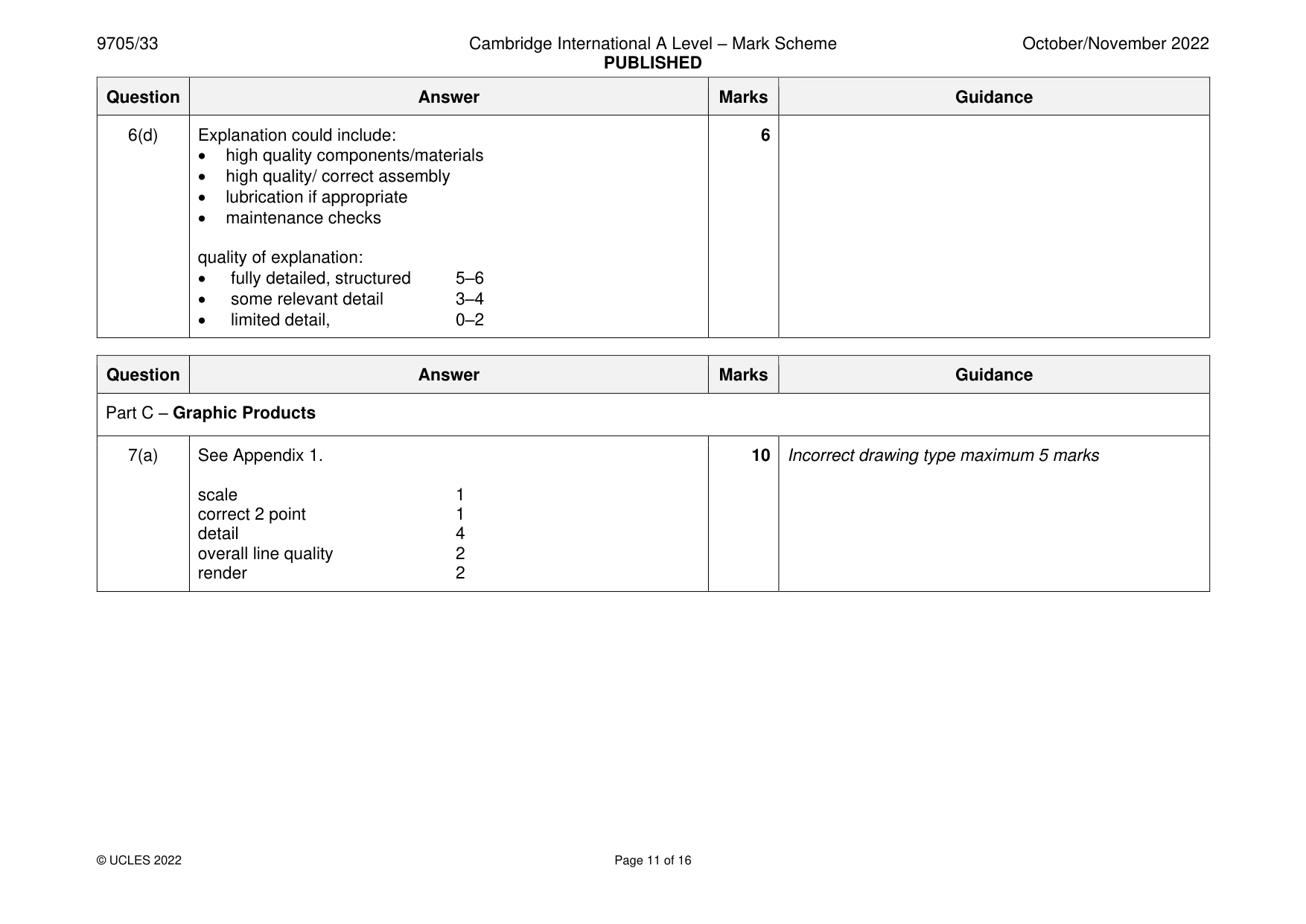
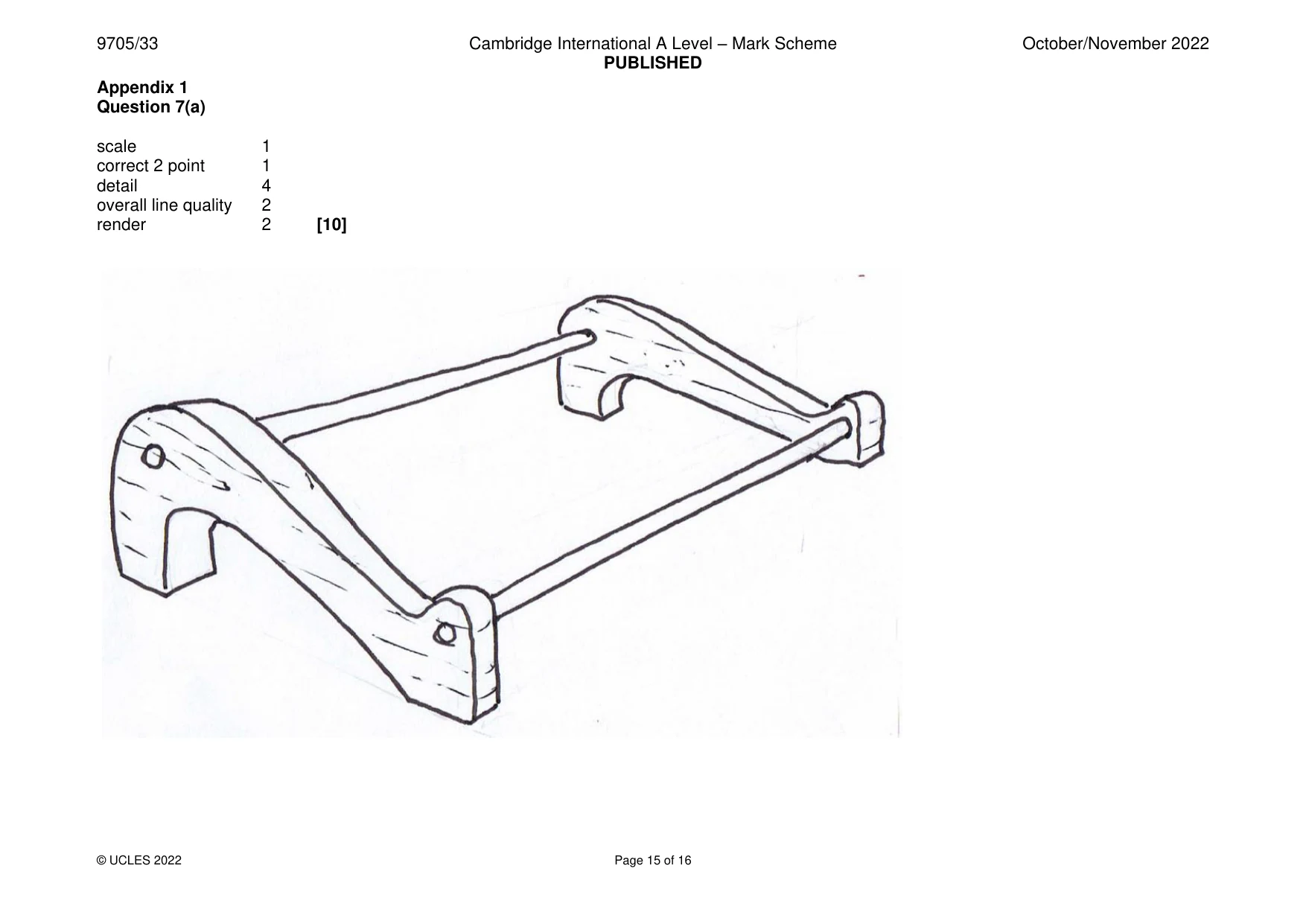
9705/33 Cambridge International A Level – Mark Scheme PUBLISHED October/November 2022 © UCLES 2022 Page 11 of 16 Question Answer Marks Guidance 6(d) Explanation could include: • high quality components/materials • high quality/ correct assembly • lubrication if appropriate • maintenance checks quality of explanation: • fully detailed, structured 5–6 • some relevant detail 3–4 • limited detail, 0–2 6 Question Answer Marks Guidance Part C – Graphic Products 7(a) See Appendix 1. scale 1 correct 2 point 1 detail 4 overall line quality 2 render 2 10 Incorrect drawing type maximum 5 marks
Mark scheme, page 12
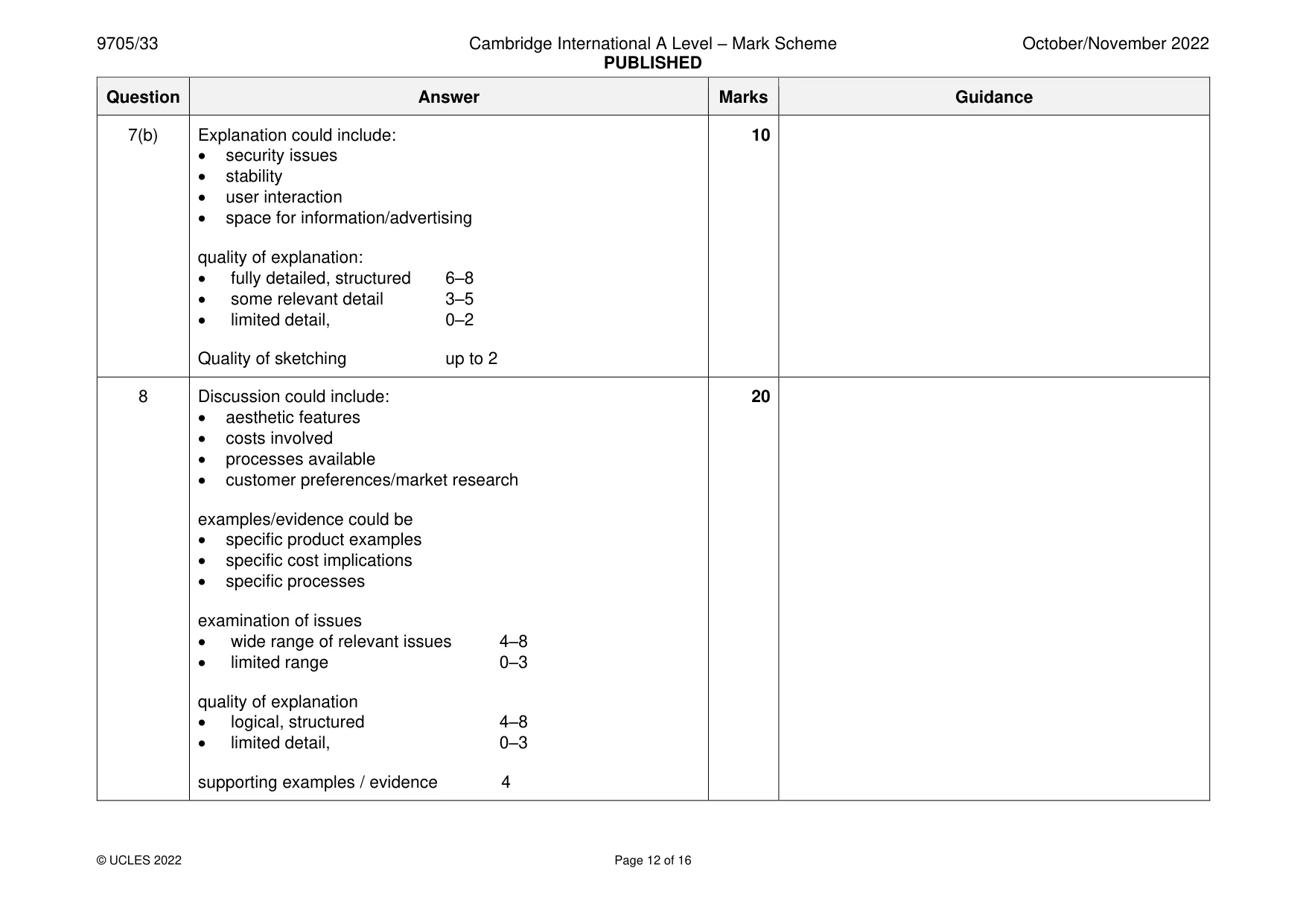
9705/33 Cambridge International A Level – Mark Scheme PUBLISHED October/November 2022 © UCLES 2022 Page 12 of 16 Question Answer Marks Guidance 7(b) Explanation could include: • security issues • stability • user interaction • space for information/advertising quality of explanation: • fully detailed, structured 6–8 • some relevant detail 3–5 • limited detail, 0–2 Quality of sketching up to 2 10 8 Discussion could include: • aesthetic features • costs involved • processes available • customer preferences/market research examples/evidence could be • specific product examples • specific cost implications • specific processes examination of issues • wide range of relevant issues 4–8 • limited range 0–3 quality of explanation • logical, structured 4–8 • limited detail, 0–3 supporting examples / evidence 4 20
Mark scheme, page 13
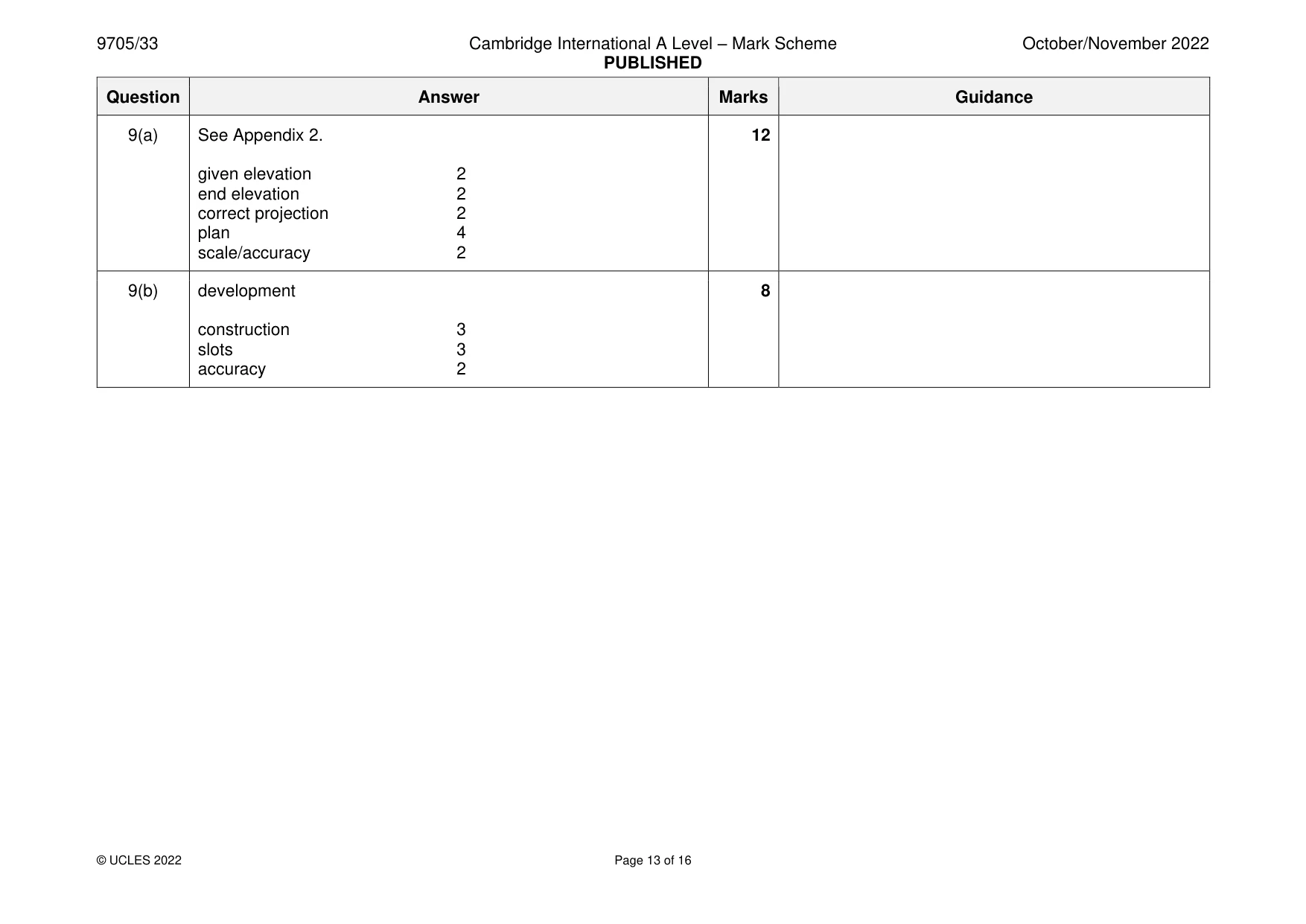
9705/33 Cambridge International A Level – Mark Scheme PUBLISHED October/November 2022 © UCLES 2022 Page 13 of 16 Question Answer Marks Guidance 9(a) See Appendix 2. given elevation 2 end elevation 2 correct projection 2 plan 4 scale/accuracy 2 12 9(b) development construction 3 slots 3 accuracy 2 8
Mark scheme, page 14
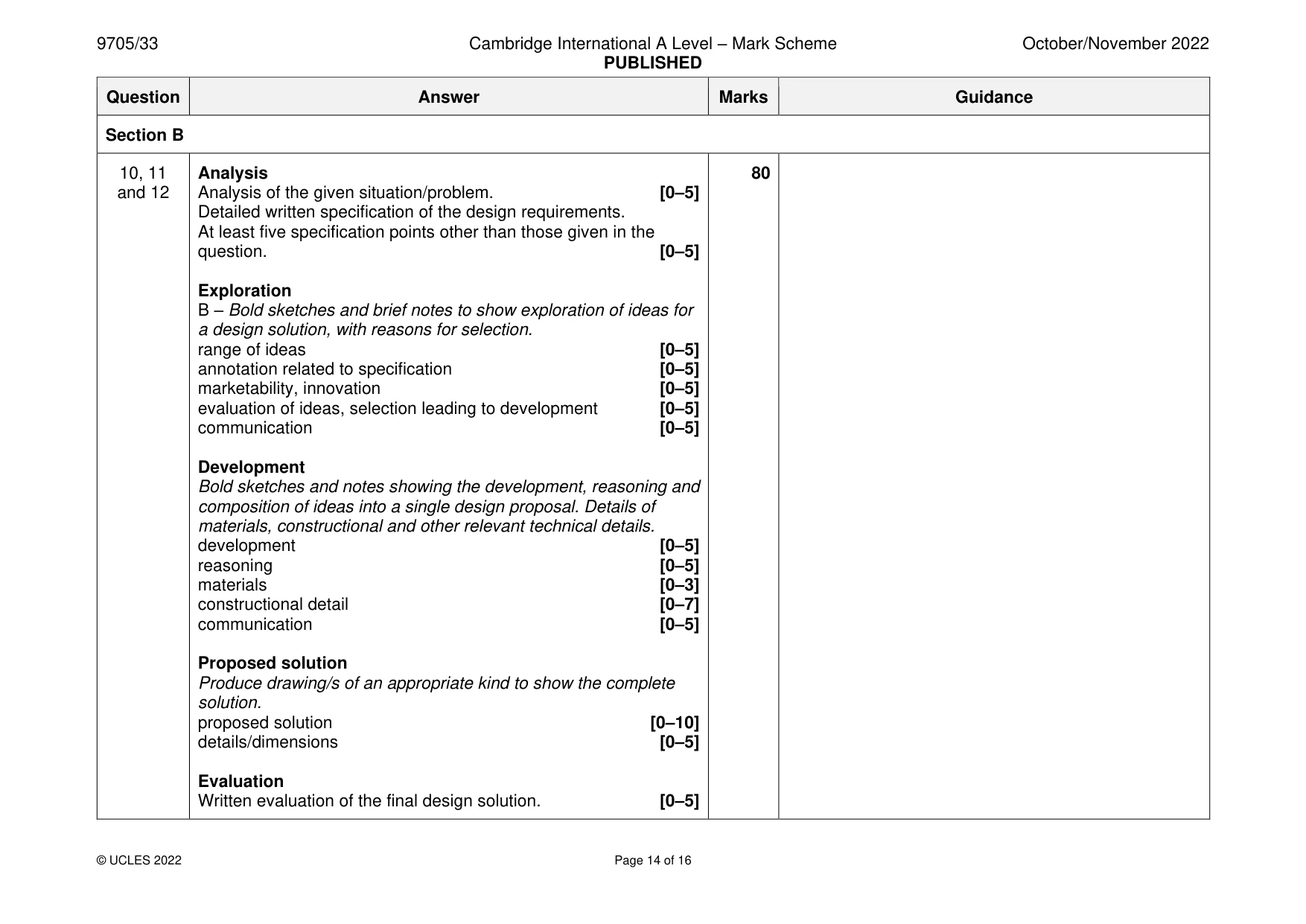
9705/33 Cambridge International A Level – Mark Scheme PUBLISHED October/November 2022 © UCLES 2022 Page 14 of 16 Question Answer Marks Guidance Section B 10, 11 and 12 Analysis Analysis of the given situation/problem. [0–5] Detailed written specification of the design requirements. At least five specification points other than those given in the question. [0–5] Exploration B – Bold sketches and brief notes to show exploration of ideas for a design solution, with reasons for selection. range of ideas [0–5] annotation related to specification [0–5] marketability, innovation [0–5] evaluation of ideas, selection leading to development [0–5] communication [0–5] Development Bold sketches and notes showing the development, reasoning and composition of ideas into a single design proposal. Details of materials, constructional and other relevant technical details. development [0–5] reasoning [0–5] materials [0–3] constructional detail [0–7] communication [0–5] Proposed solution Produce drawing/s of an appropriate kind to show the complete solution. proposed solution [0–10] details/dimensions [0–5] Evaluation Written evaluation of the final design solution. [0–5] 80
Mark scheme, page 15
9705/33 Cambridge International A Level – Mark Scheme PUBLISHED October/November 2022 © UCLES 2022 Page 15 of 16 Appendix 1 Question 7(a) scale 1 correct 2 point 1 detail 4 overall line quality 2 render 2 [10]
Mark scheme, page 16
9705/33 Cambridge International A Level – Mark Scheme PUBLISHED October/November 2022 © UCLES 2022 Page 16 of 16 Appendix 2 Q9 (a) given elevation 2 end elevation 2 correct projection 2 plan 4 scale/accuracy 2 (b) development construction 3 slots 3 accuracy 2 [20]
What you needed in this session
Cambridge’s own grade thresholds for 2022 Oct/Nov, Paper 3 · Variant 3. A higher threshold means an easier paper — the bar moves with how the cohort did.