Cambridge A Level Design and Technology 9705 — 2024 Oct/Nov Paper 3 · Variant 2
9705/32/O/N/24 · 120 marks · ≈135 min
The question paper and its mark scheme, free to read here and free to download. This is Cambridge’s own paper, exactly as it was sat.
Question paper12 pages
Mark scheme14 pages
Answers below. Sit the paper first if you are practising.
Paper as text
Question paper, page 1
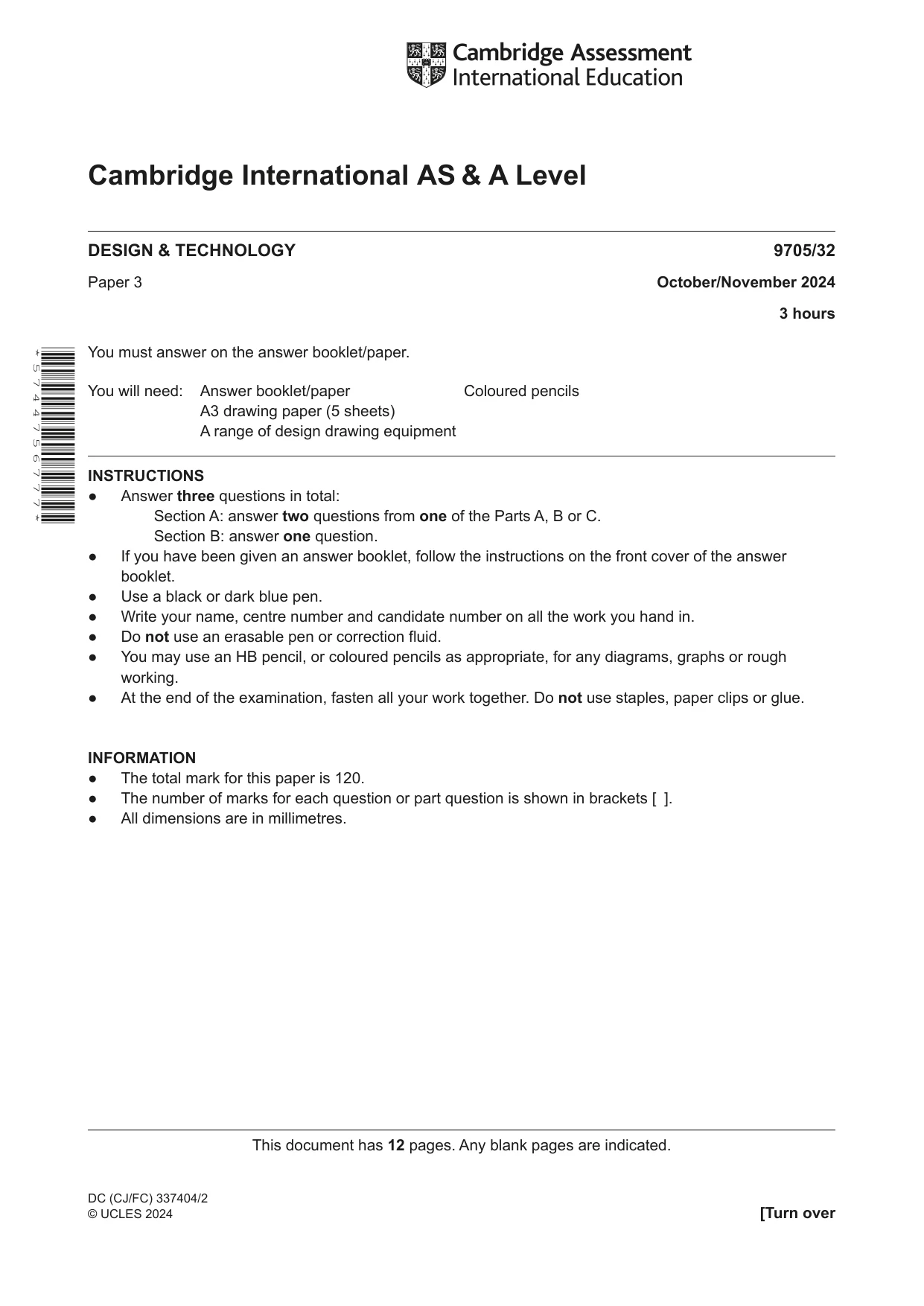
This document has 12 pages. Any blank pages are indicated. [Turn over Cambridge International AS & A Level DESIGN & TECHNOLOGY 9705/32 Paper 3 October/November 2024 3 hours You must answer on the answer booklet/paper. You will need: Answer booklet/paper Coloured pencils A3 drawing paper (5 sheets) A range of design drawing equipment INSTRUCTIONS ● Answer three questions in total: Section A: answer two questions from one of the Parts A, B or C. Section B: answer one question. ● If you have been given an answer booklet, follow the instructions on the front cover of the answer booklet. ● Use a black or dark blue pen. ● Write your name, centre number and candidate number on all the work you hand in. ● Do not use an erasable pen or correction fluid. ● You may use an HB pencil, or coloured pencils as appropriate, for any diagrams, graphs or rough working. ● At the end of the examination, fasten all your work together. Do not use staples, paper clips or glue. INFORMATION ● The total mark for this paper is 120. ● The number of marks for each question or part question is shown in brackets [ ]. ● All dimensions are in millimetres. * 5 7 4 4 7 5 6 7 7 7 * DC (CJ/FC) 337404/2 © UCLES 2024
Question paper, page 2
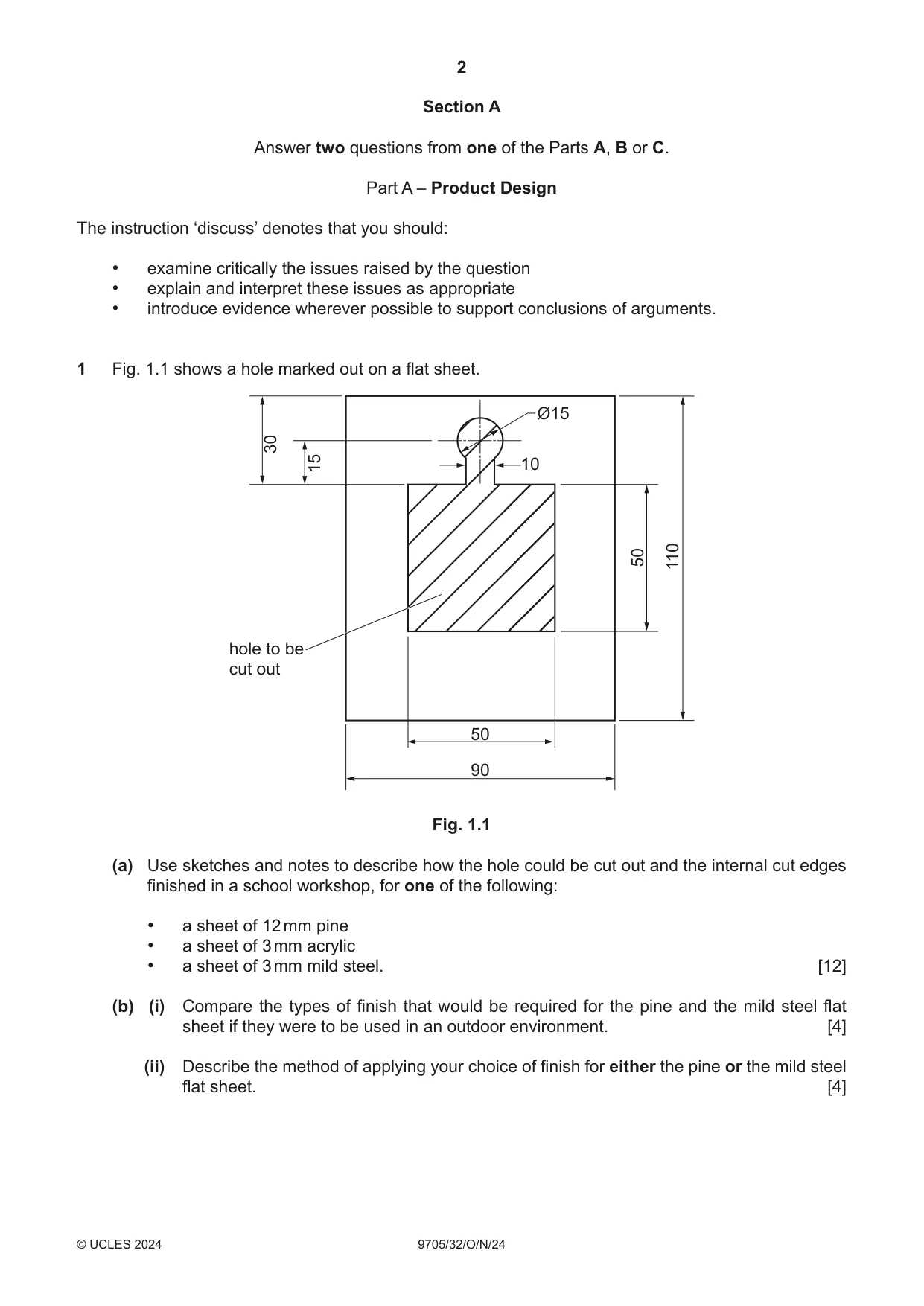
2 9705/32/O/N/24 © UCLES 2024 Section A Answer two questions from one of the Parts A, B or C. Part A – Product Design The instruction ‘discuss’ denotes that you should: • examine critically the issues raised by the question • explain and interpret these issues as appropriate • introduce evidence wherever possible to support conclusions of arguments. 1 Fig. 1.1 shows a hole marked out on a flat sheet. Ø15 10 15 50 50 90 110 30 hole to be cut out Fig. 1.1 (a) Use sketches and notes to describe how the hole could be cut out and the internal cut edges finished in a school workshop, for one of the following: • a sheet of 12 mm pine • a sheet of 3 mm acrylic • a sheet of 3 mm mild steel. [12] (b) (i) Compare the types of finish that would be required for the pine and the mild steel flat sheet if they were to be used in an outdoor environment. [4] (ii) Describe the method of applying your choice of finish for either the pine or the mild steel flat sheet. [4]
Question paper, page 3
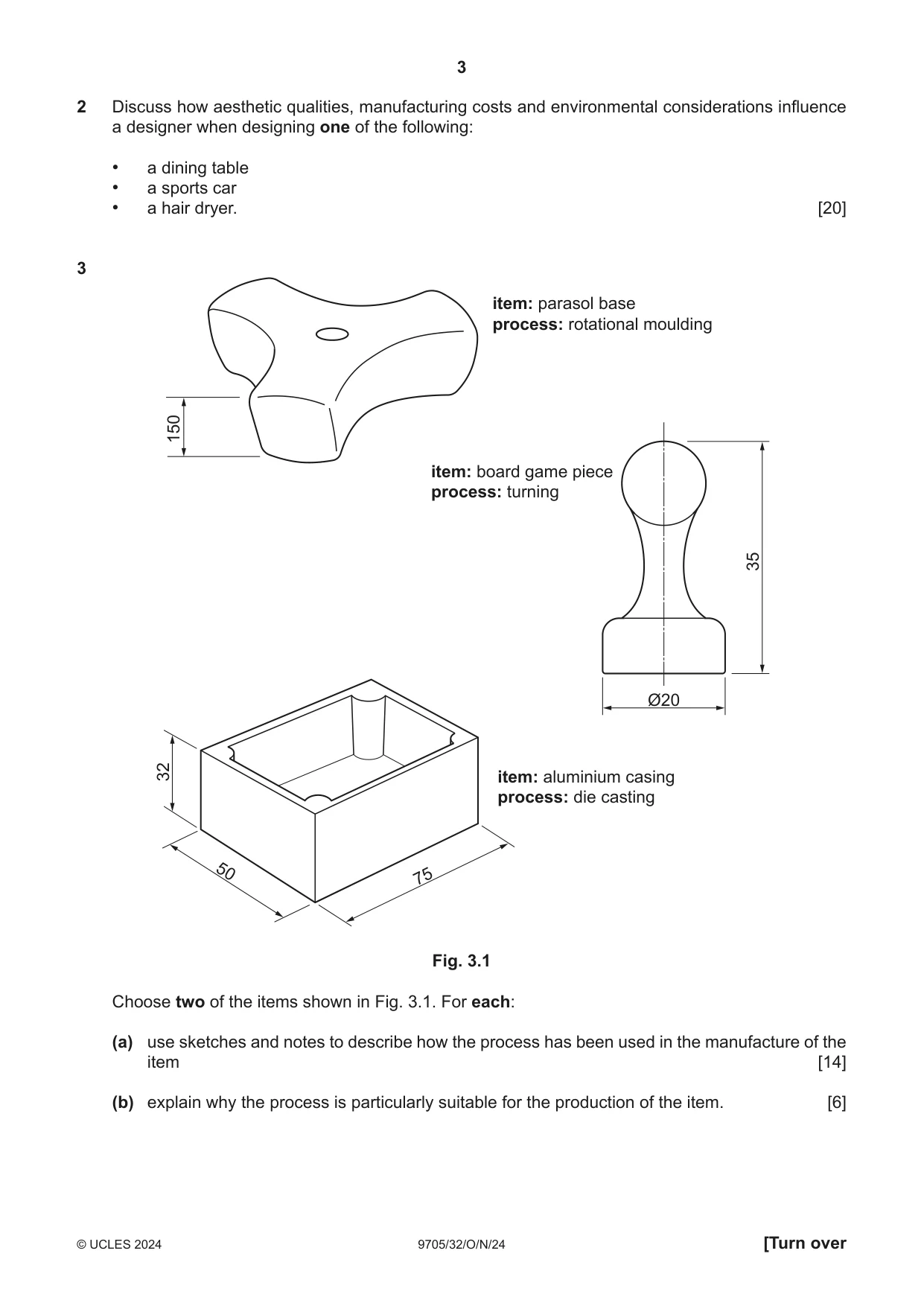
3 9705/32/O/N/24 © UCLES 2024 [Turn over 2 Discuss how aesthetic qualities, manufacturing costs and environmental considerations influence a designer when designing one of the following: • a dining table • a sports car • a hair dryer. [20] 3 150 35 32 50 75 Ø20 item: parasol base process: rotational moulding item: board game piece process: turning item: aluminium casing process: die casting Fig. 3.1 Choose two of the items shown in Fig. 3.1. For each: (a) use sketches and notes to describe how the process has been used in the manufacture of the item [14] (b) explain why the process is particularly suitable for the production of the item. [6]
Question paper, page 4
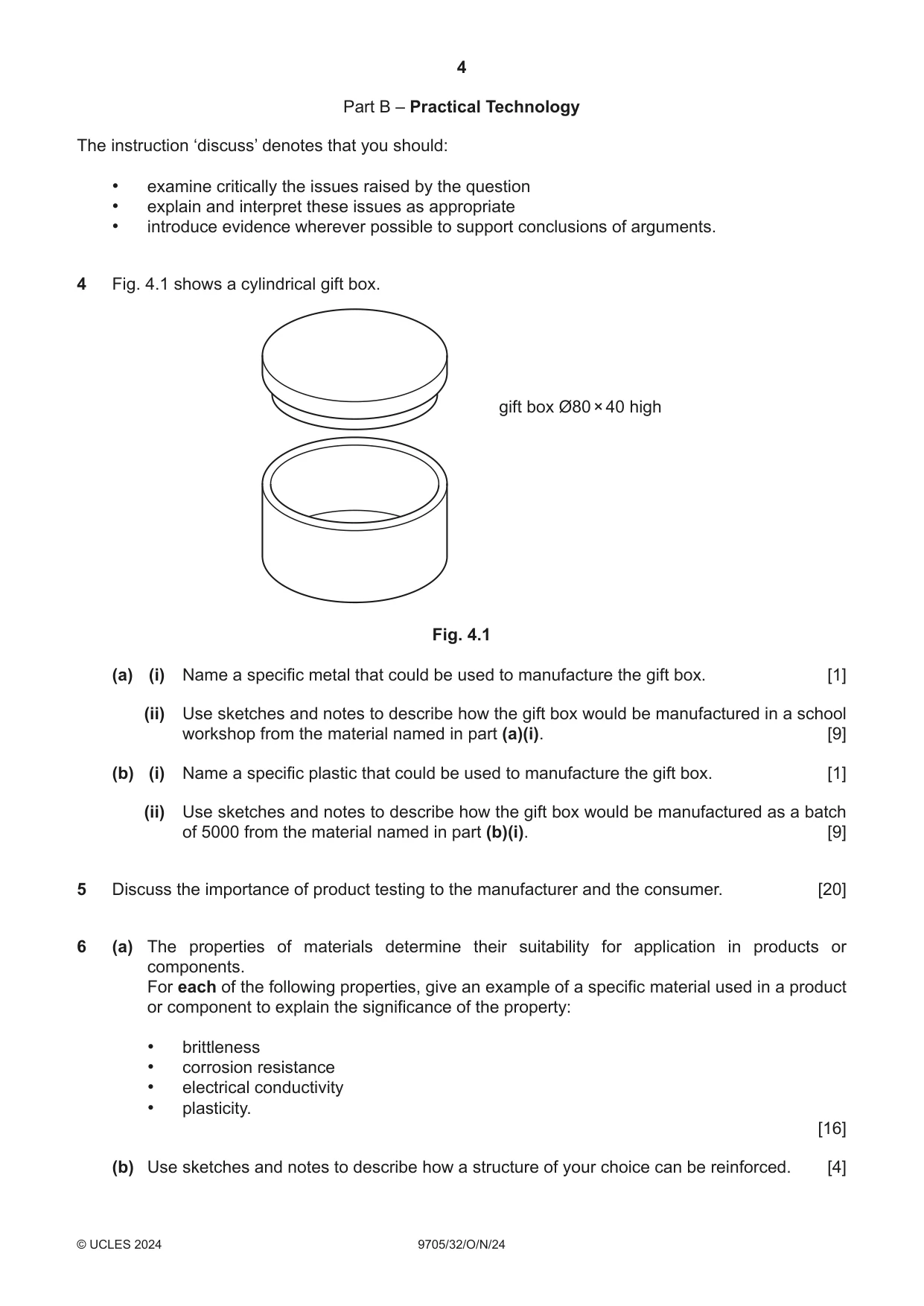
4 9705/32/O/N/24 © UCLES 2024 Part B – Practical Technology The instruction ‘discuss’ denotes that you should: • examine critically the issues raised by the question • explain and interpret these issues as appropriate • introduce evidence wherever possible to support conclusions of arguments. 4 Fig. 4.1 shows a cylindrical gift box. gift box Ø80 × 40 high Fig. 4.1 (a) (i) Name a specific metal that could be used to manufacture the gift box. [1] (ii) Use sketches and notes to describe how the gift box would be manufactured in a school workshop from the material named in part (a)(i). [9] (b) (i) Name a specific plastic that could be used to manufacture the gift box. [1] (ii) Use sketches and notes to describe how the gift box would be manufactured as a batch of 5000 from the material named in part (b)(i). [9] 5 Discuss the importance of product testing to the manufacturer and the consumer. [20] 6 (a) The properties of materials determine their suitability for application in products or components. For each of the following properties, give an example of a specific material used in a product or component to explain the significance of the property: • brittleness • corrosion resistance • electrical conductivity • plasticity. [16] (b) Use sketches and notes to describe how a structure of your choice can be reinforced. [4]
Question paper, page 5
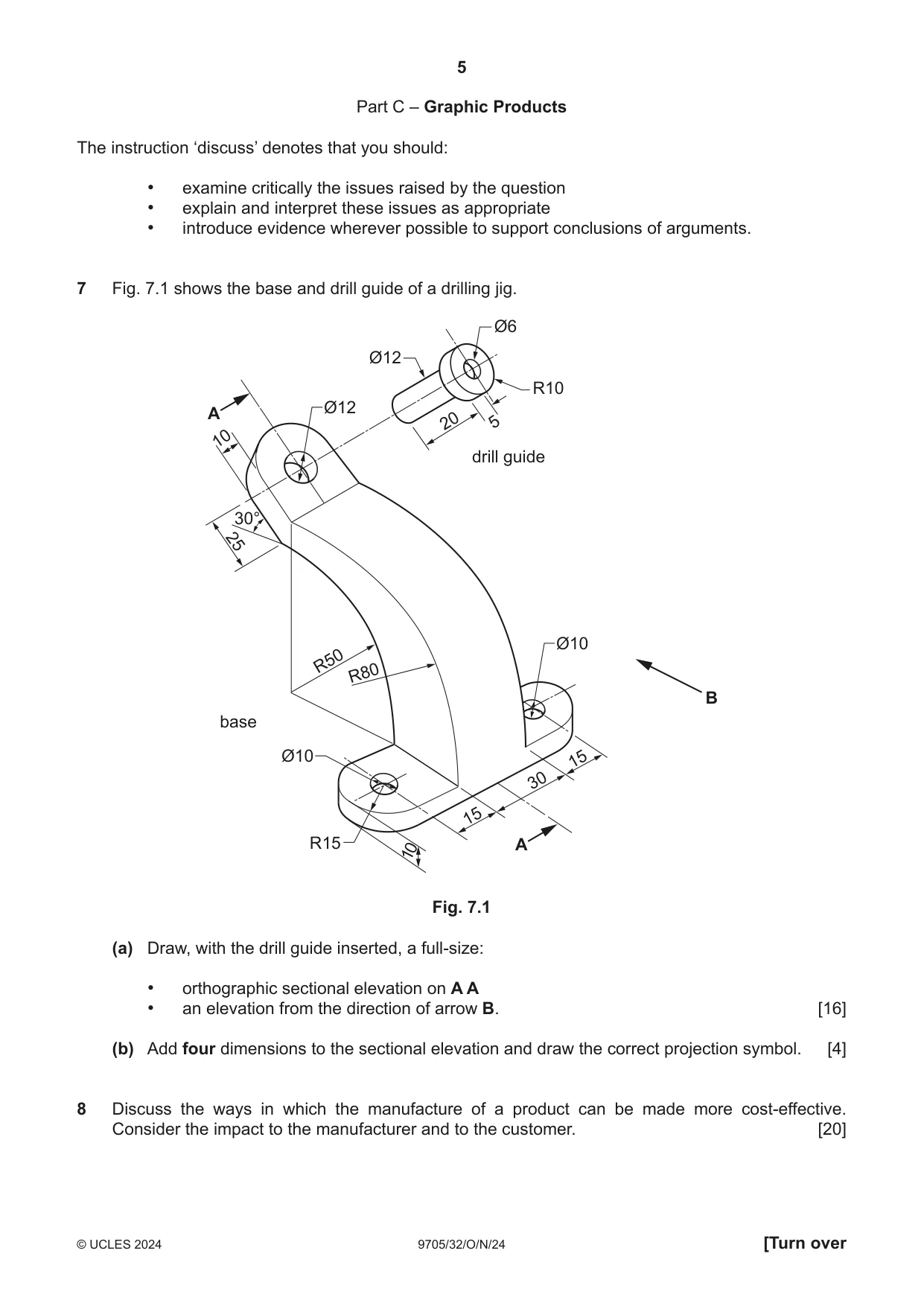
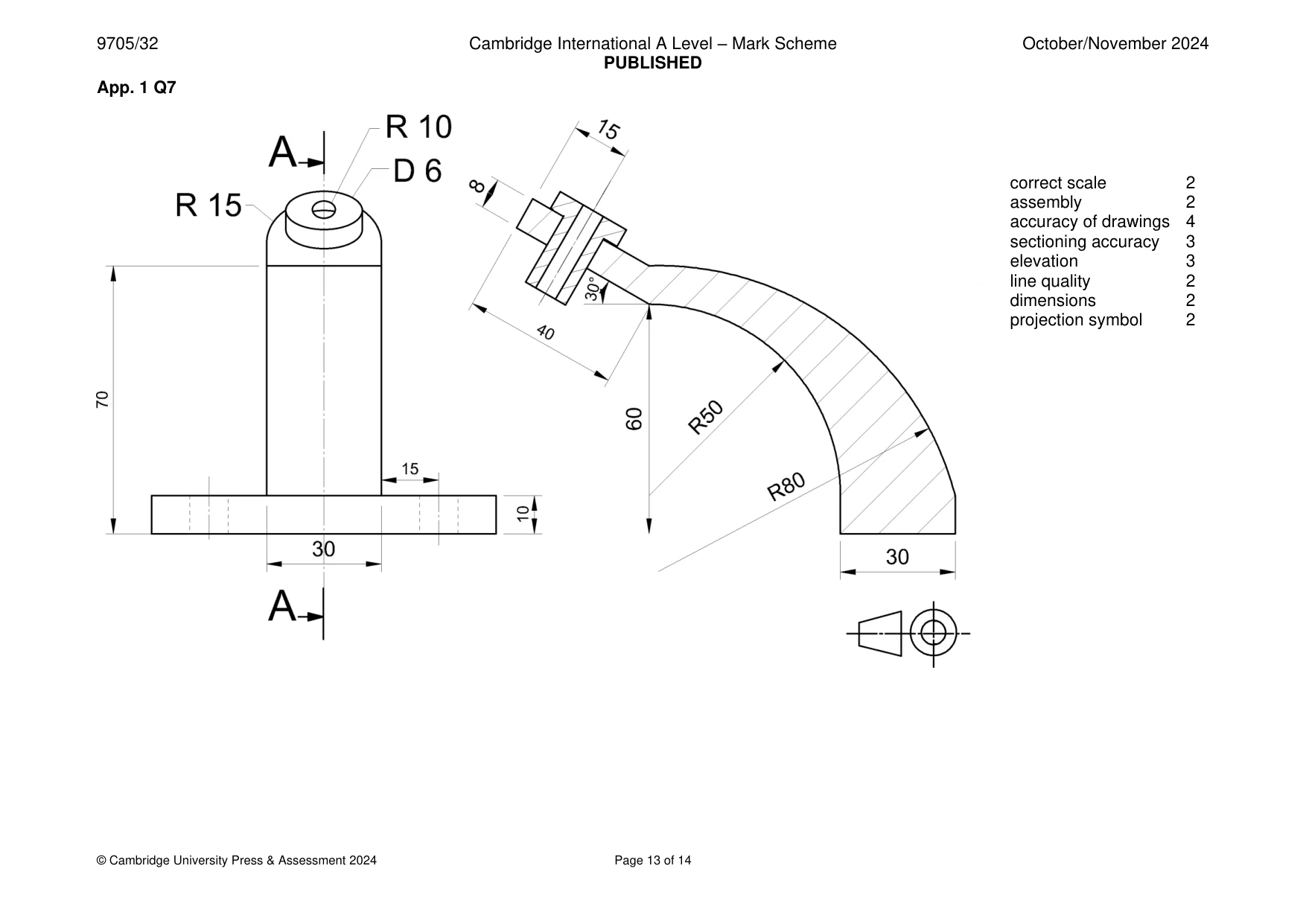
5 9705/32/O/N/24 © UCLES 2024 [Turn over Part C – Graphic Products The instruction ‘discuss’ denotes that you should: • examine critically the issues raised by the question • explain and interpret these issues as appropriate • introduce evidence wherever possible to support conclusions of arguments. 7 Fig. 7.1 shows the base and drill guide of a drilling jig. 25 30° Ø12 Ø6 Ø10 R10 R15 5 10 15 30 15 10 20 Ø12 Ø10 A A B drill guide base R50 R80 Fig. 7.1 (a) Draw, with the drill guide inserted, a full-size: • orthographic sectional elevation on A A • an elevation from the direction of arrow B. [16] (b) Add four dimensions to the sectional elevation and draw the correct projection symbol. [4] 8 Discuss the ways in which the manufacture of a product can be made more cost-effective. Consider the impact to the manufacturer and to the customer. [20]
Question paper, page 6
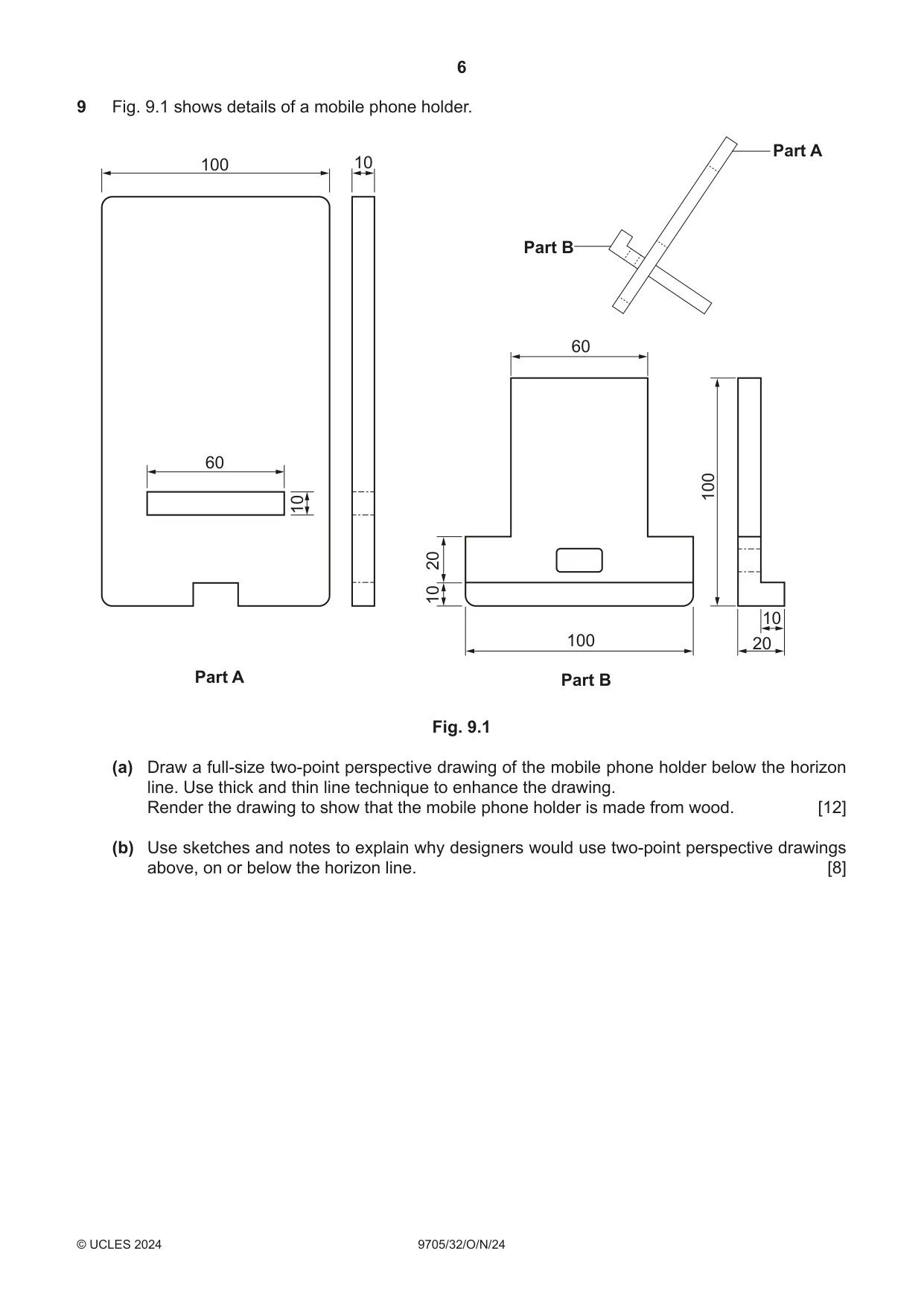
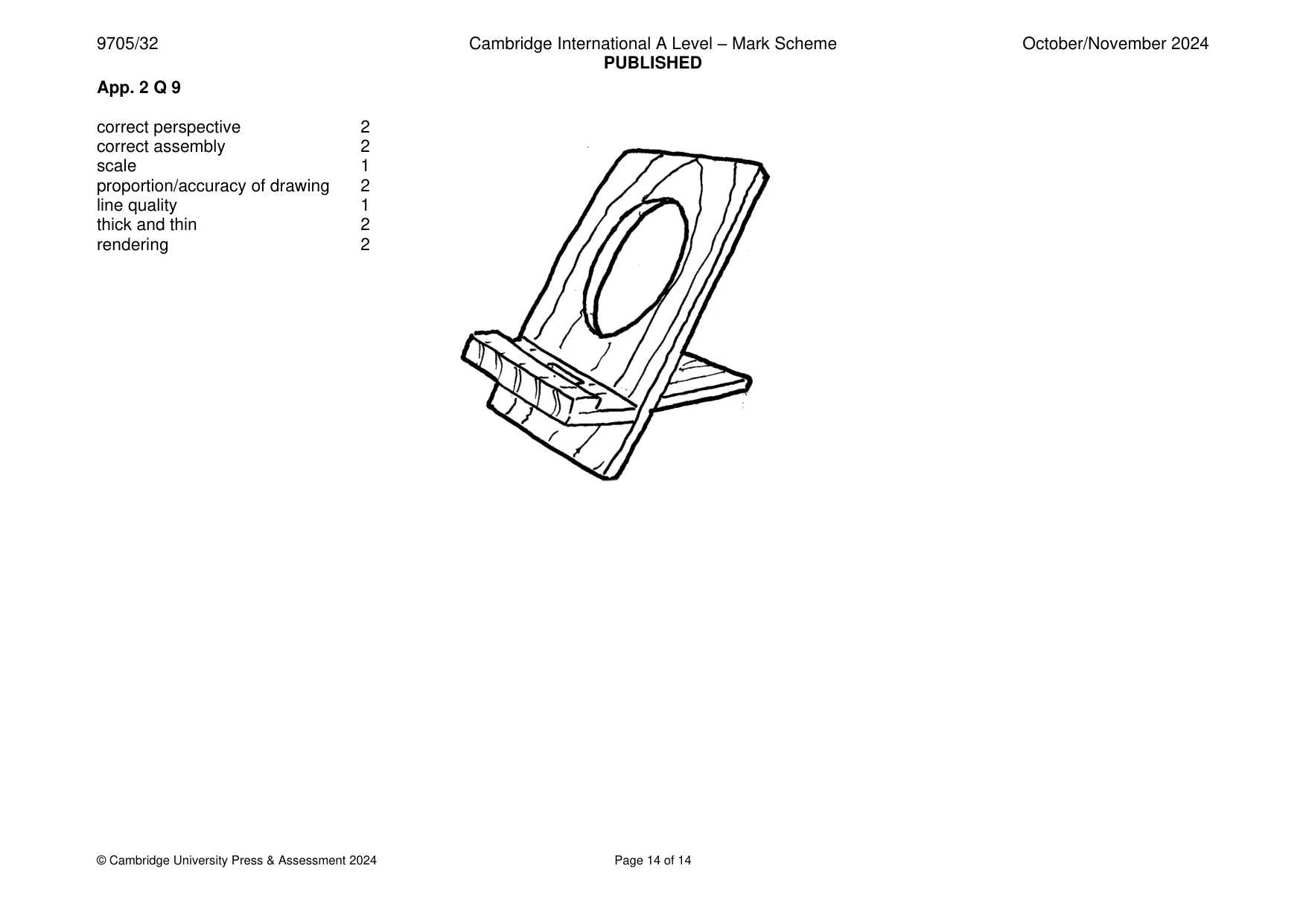
6 9705/32/O/N/24 © UCLES 2024 9 Fig. 9.1 shows details of a mobile phone holder. Part B Part B Part A 60 60 100 20 10 100 100 10 10 10 20 Part A Fig. 9.1 (a) Draw a full-size two-point perspective drawing of the mobile phone holder below the horizon line. Use thick and thin line technique to enhance the drawing. Render the drawing to show that the mobile phone holder is made from wood. [12] (b) Use sketches and notes to explain why designers would use two-point perspective drawings above, on or below the horizon line. [8]
Question paper, page 7
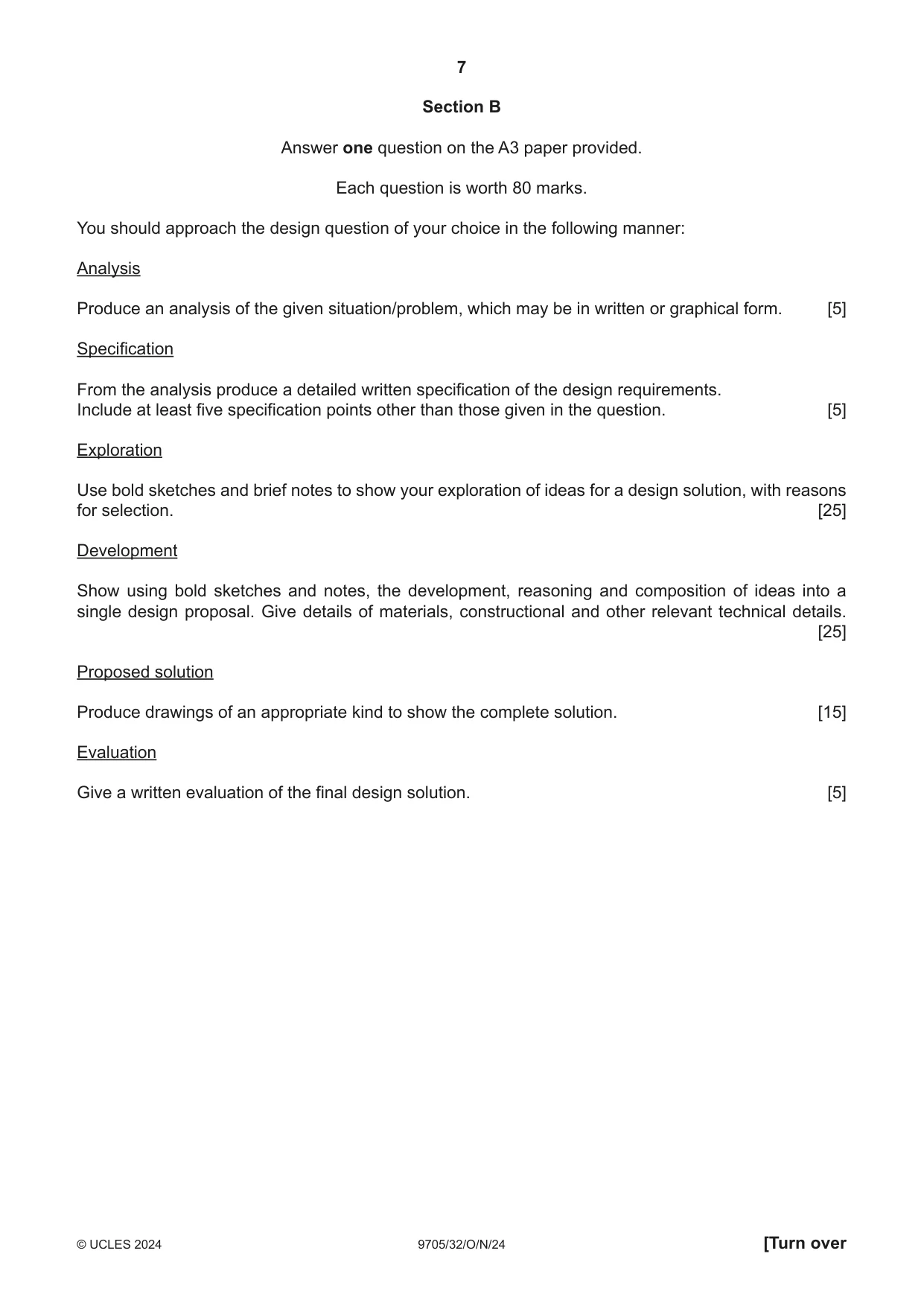
7 9705/32/O/N/24 © UCLES 2024 [Turn over Section B Answer one question on the A3 paper provided. Each question is worth 80 marks. You should approach the design question of your choice in the following manner: Analysis Produce an analysis of the given situation/problem, which may be in written or graphical form. [5] Specification From the analysis produce a detailed written specification of the design requirements. Include at least five specification points other than those given in the question. [5] Exploration Use bold sketches and brief notes to show your exploration of ideas for a design solution, with reasons for selection. [25] Development Show using bold sketches and notes, the development, reasoning and composition of ideas into a single design proposal. Give details of materials, constructional and other relevant technical details. [25] Proposed solution Produce drawings of an appropriate kind to show the complete solution. [15] Evaluation Give a written evaluation of the final design solution. [5]
Question paper, page 8
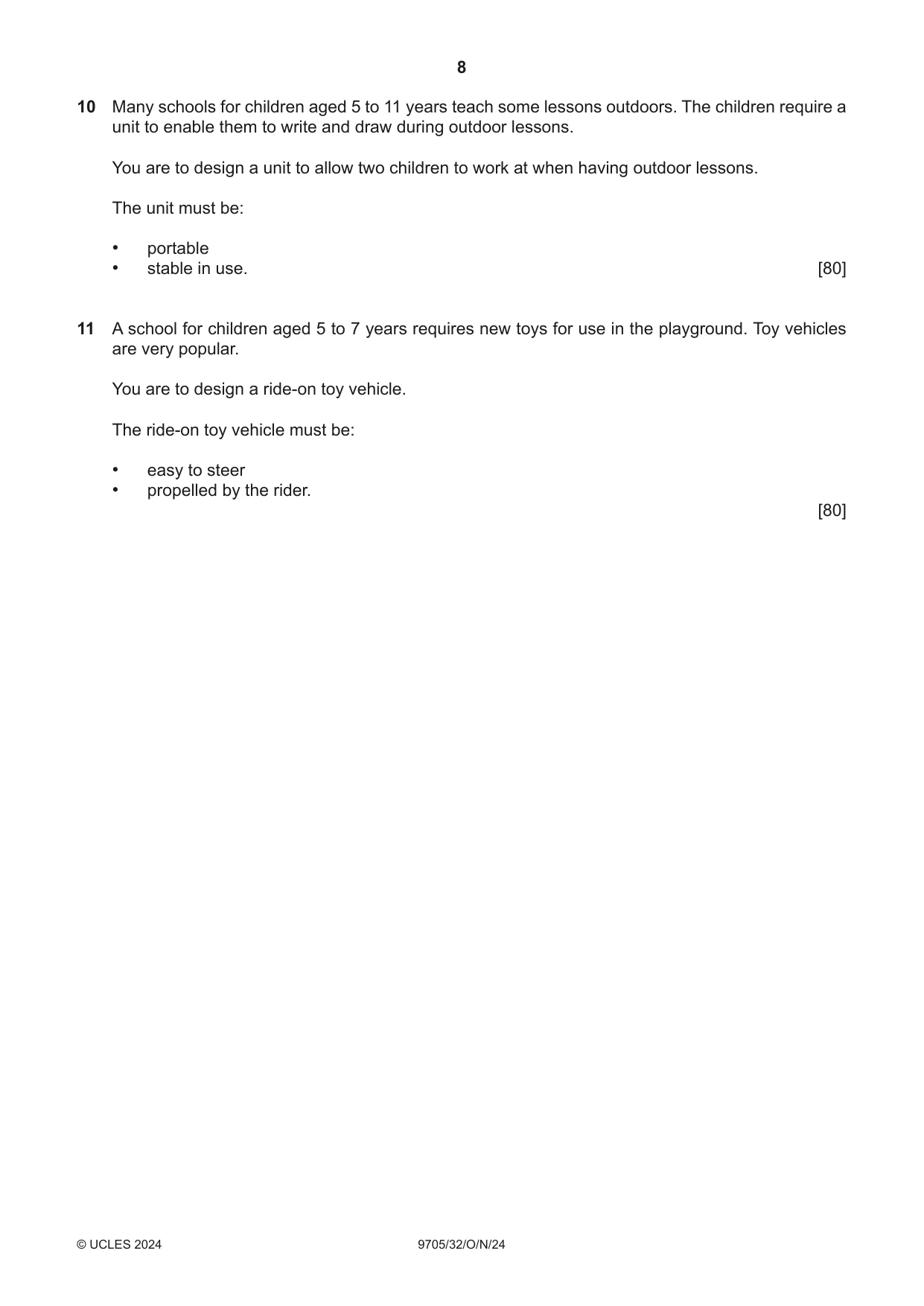
8 9705/32/O/N/24 © UCLES 2024 10 Many schools for children aged 5 to 11 years teach some lessons outdoors. The children require a unit to enable them to write and draw during outdoor lessons. You are to design a unit to allow two children to work at when having outdoor lessons. The unit must be: • portable • stable in use. [80] 11 A school for children aged 5 to 7 years requires new toys for use in the playground. Toy vehicles are very popular. You are to design a ride-on toy vehicle. The ride-on toy vehicle must be: • easy to steer • propelled by the rider. [80]
Question paper, page 9
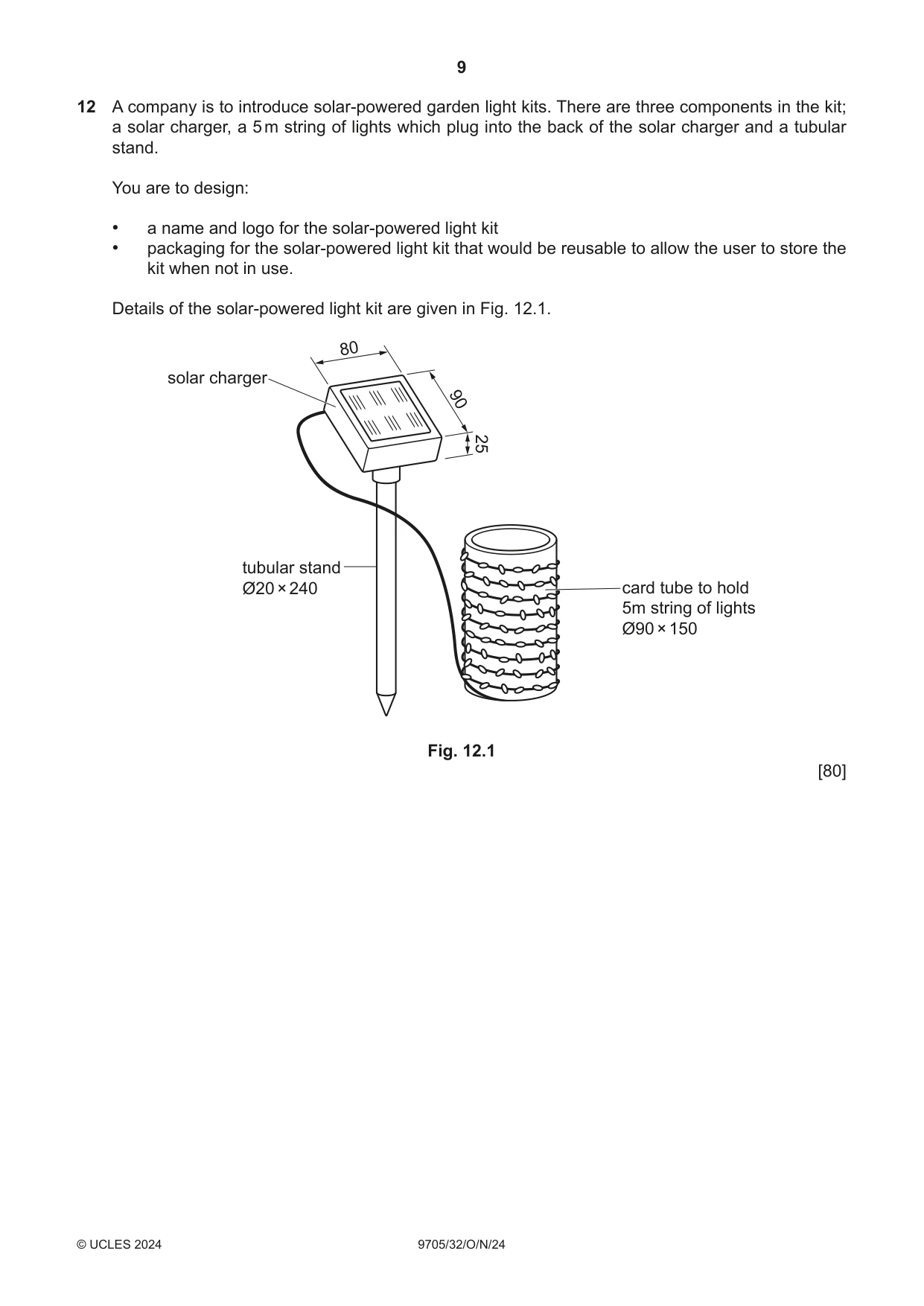
9 9705/32/O/N/24 © UCLES 2024 12 A company is to introduce solar-powered garden light kits. There are three components in the kit; a solar charger, a 5 m string of lights which plug into the back of the solar charger and a tubular stand. You are to design: • a name and logo for the solar-powered light kit • packaging for the solar-powered light kit that would be reusable to allow the user to store the kit when not in use. Details of the solar-powered light kit are given in Fig. 12.1. 80 90 25 solar charger tubular stand Ø20 × 240 card tube to hold 5m string of lights Ø90 × 150 Fig. 12.1 [80]
Question paper, page 10
10 9705/32/O/N/24 © UCLES 2024 BLANK PAGE
Question paper, page 11
11 9705/32/O/N/24 © UCLES 2024 BLANK PAGE
Question paper, page 12
12 9705/32/O/N/24 © UCLES 2024 Permission to reproduce items where third-party owned material protected by copyright is included has been sought and cleared where possible. Every reasonable effort has been made by the publisher (UCLES) to trace copyright holders, but if any items requiring clearance have unwittingly been included, the publisher will be pleased to make amends at the earliest possible opportunity. To avoid the issue of disclosure of answer-related information to candidates, all copyright acknowledgements are reproduced online in the Cambridge Assessment International Education Copyright Acknowledgements Booklet. This is produced for each series of examinations and is freely available to download at www.cambridgeinternational.org after the live examination series. Cambridge Assessment International Education is part of Cambridge Assessment. Cambridge Assessment is the brand name of the University of Cambridge Local Examinations Syndicate (UCLES), which is a department of the University of Cambridge. BLANK PAGE
Mark scheme, page 1
This document consists of 14 printed pages. © Cambridge University Press & Assessment 2024 [Turn over Cambridge International A Level DESIGN & TECHNOLOGY 9705/32 Paper 3 October/November 2024 MARK SCHEME Maximum Mark: 120 Published This mark scheme is published as an aid to teachers and candidates, to indicate the requirements of the examination. It shows the basis on which Examiners were instructed to award marks. It does not indicate the details of the discussions that took place at an Examiners’ meeting before marking began, which would have considered the acceptability of alternative answers. Mark schemes should be read in conjunction with the question paper and the Principal Examiner Report for Teachers. Cambridge International will not enter into discussions about these mark schemes. Cambridge International is publishing the mark schemes for the October/November 2024 series for most Cambridge IGCSE, Cambridge International A and AS Level components, and some Cambridge O Level components.
Mark scheme, page 2
9705/32 Cambridge International A Level – Mark Scheme PUBLISHED October/November 2024 © Cambridge University Press & Assessment 2024 Page 2 of 14 Generic Marking Principles These general marking principles must be applied by all examiners when marking candidate answers. They should be applied alongside the specific content of the mark scheme or generic level descriptions for a question. Each question paper and mark scheme will also comply with these marking principles. GENERIC MARKING PRINCIPLE 1: Marks must be awarded in line with: • the specific content of the mark scheme or the generic level descriptors for the question • the specific skills defined in the mark scheme or in the generic level descriptors for the question • the standard of response required by a candidate as exemplified by the standardisation scripts. GENERIC MARKING PRINCIPLE 2: Marks awarded are always whole marks (not half marks, or other fractions). GENERIC MARKING PRINCIPLE 3: Marks must be awarded positively: • marks are awarded for correct/valid answers, as defined in the mark scheme. However, credit is given for valid answers which go beyond the scope of the syllabus and mark scheme, referring to your Team Leader as appropriate • marks are awarded when candidates clearly demonstrate what they know and can do • marks are not deducted for errors • marks are not deducted for omissions • answers should only be judged on the quality of spelling, punctuation and grammar when these features are specifically assessed by the question as indicated by the mark scheme. The meaning, however, should be unambiguous. GENERIC MARKING PRINCIPLE 4: Rules must be applied consistently, e.g. in situations where candidates have not followed instructions or in the application of generic level descriptors.
Mark scheme, page 3
9705/32 Cambridge International A Level – Mark Scheme PUBLISHED October/November 2024 © Cambridge University Press & Assessment 2024 Page 3 of 14 GENERIC MARKING PRINCIPLE 5: Marks should be awarded using the full range of marks defined in the mark scheme for the question (however; the use of the full mark range may be limited according to the quality of the candidate responses seen). GENERIC MARKING PRINCIPLE 6: Marks awarded are based solely on the requirements as defined in the mark scheme. Marks should not be awarded with grade thresholds or grade descriptors in mind.
Mark scheme, page 4
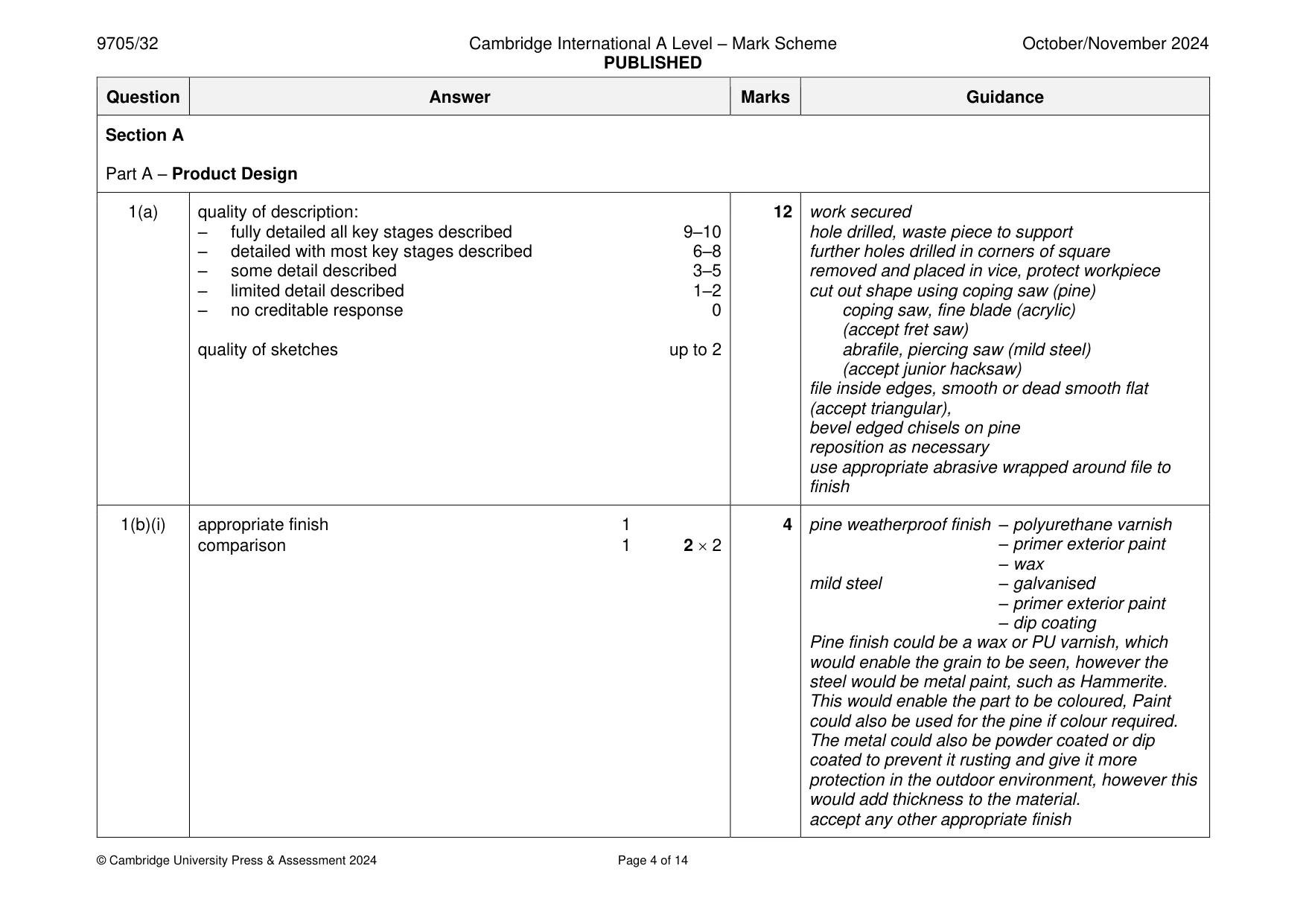
9705/32 Cambridge International A Level – Mark Scheme PUBLISHED October/November 2024 © Cambridge University Press & Assessment 2024 Page 4 of 14 Question Answer Marks Guidance Section A Part A – Product Design 1(a) quality of description: – fully detailed all key stages described 9–10 – detailed with most key stages described 6–8 – some detail described 3–5 – limited detail described 1–2 – no creditable response 0 quality of sketches up to 2 12 work secured hole drilled, waste piece to support further holes drilled in corners of square removed and placed in vice, protect workpiece cut out shape using coping saw (pine) coping saw, fine blade (acrylic) (accept fret saw) abrafile, piercing saw (mild steel) (accept junior hacksaw) file inside edges, smooth or dead smooth flat (accept triangular), bevel edged chisels on pine reposition as necessary use appropriate abrasive wrapped around file to finish 1(b)(i) appropriate finish 1 comparison 1 2 2 4 pine weatherproof finish – polyurethane varnish – primer exterior paint – wax mild steel – galvanised – primer exterior paint – dip coating Pine finish could be a wax or PU varnish, which would enable the grain to be seen, however the steel would be metal paint, such as Hammerite. This would enable the part to be coloured, Paint could also be used for the pine if colour required. The metal could also be powder coated or dip coated to prevent it rusting and give it more protection in the outdoor environment, however this would add thickness to the material. accept any other appropriate finish
Mark scheme, page 5
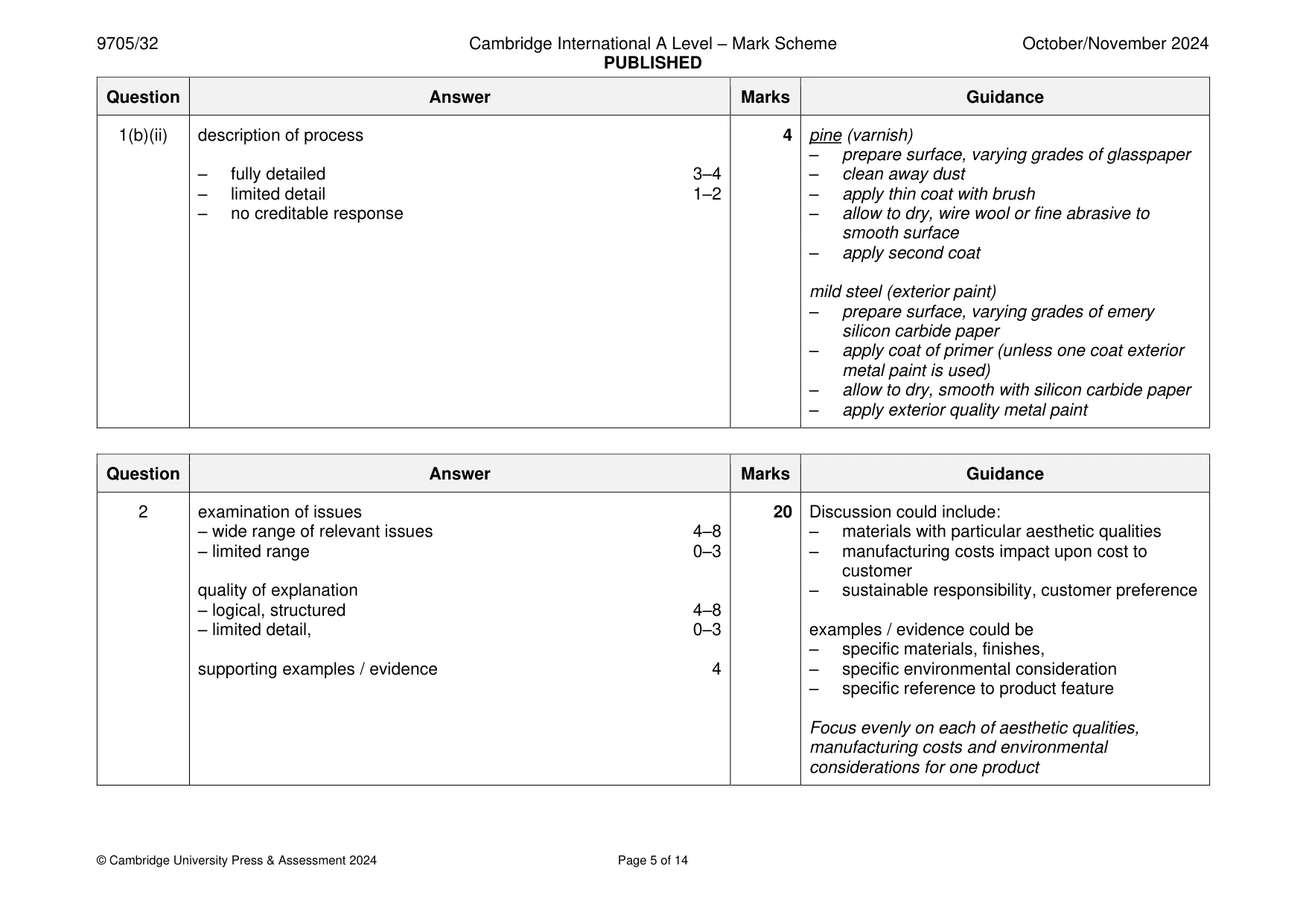
9705/32 Cambridge International A Level – Mark Scheme PUBLISHED October/November 2024 © Cambridge University Press & Assessment 2024 Page 5 of 14 Question Answer Marks Guidance 1(b)(ii) description of process – fully detailed 3–4 – limited detail 1–2 – no creditable response 4 pine (varnish) – prepare surface, varying grades of glasspaper – clean away dust – apply thin coat with brush – allow to dry, wire wool or fine abrasive to smooth surface – apply second coat mild steel (exterior paint) – prepare surface, varying grades of emery silicon carbide paper – apply coat of primer (unless one coat exterior metal paint is used) – allow to dry, smooth with silicon carbide paper – apply exterior quality metal paint Question Answer Marks Guidance 2 examination of issues – wide range of relevant issues 4–8 – limited range 0–3 quality of explanation – logical, structured 4–8 – limited detail, 0–3 supporting examples / evidence 4 20 Discussion could include: – materials with particular aesthetic qualities – manufacturing costs impact upon cost to customer – sustainable responsibility, customer preference examples / evidence could be – specific materials, finishes, – specific environmental consideration – specific reference to product feature Focus evenly on each of aesthetic qualities, manufacturing costs and environmental considerations for one product
Mark scheme, page 6
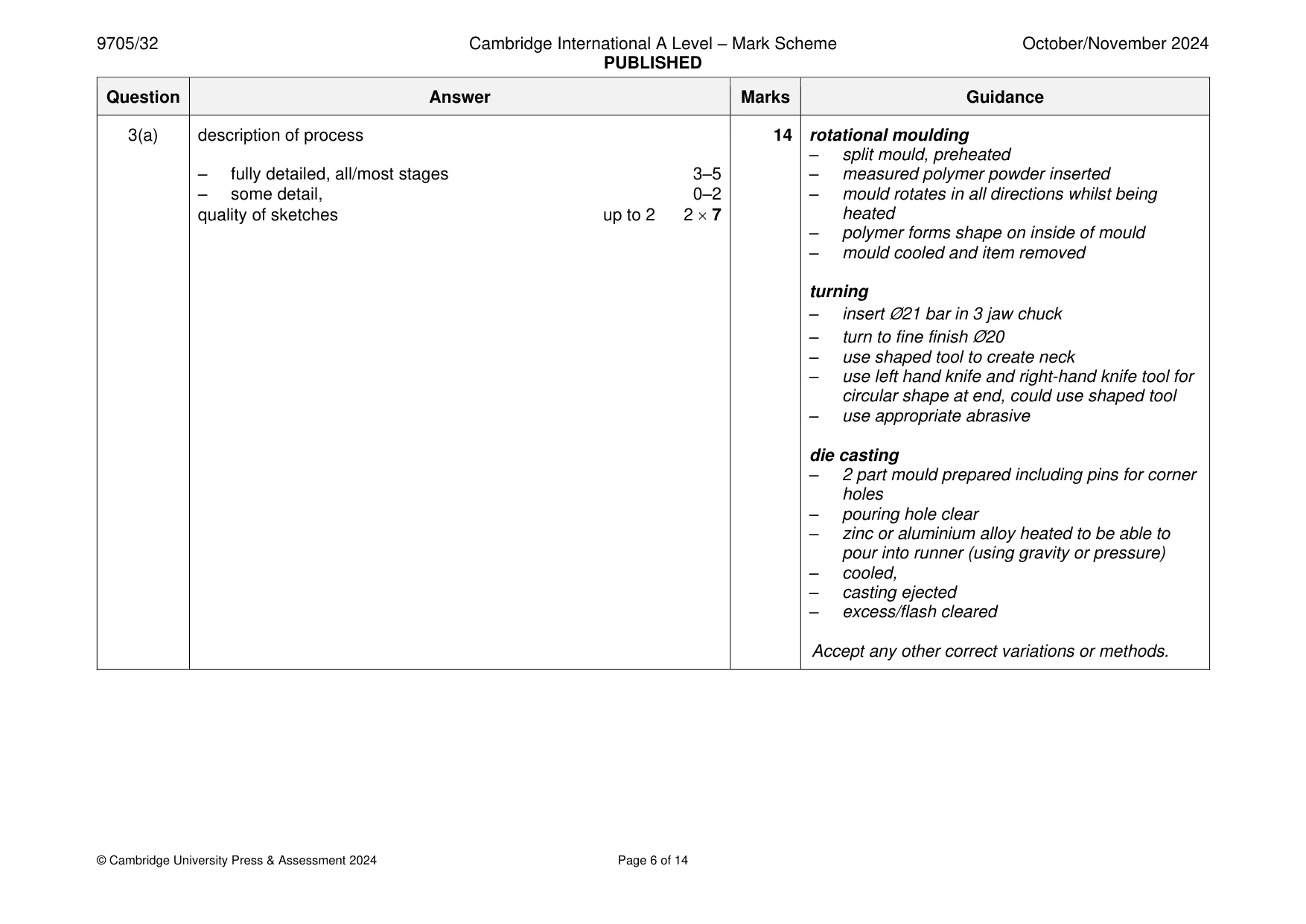
9705/32 Cambridge International A Level – Mark Scheme PUBLISHED October/November 2024 © Cambridge University Press & Assessment 2024 Page 6 of 14 Question Answer Marks Guidance 3(a) description of process – fully detailed, all/most stages 3–5 – some detail, 0–2 quality of sketches up to 2 2 7 14 rotational moulding – split mould, preheated – measured polymer powder inserted – mould rotates in all directions whilst being heated – polymer forms shape on inside of mould – mould cooled and item removed turning – insert Ø21 bar in 3 jaw chuck – turn to fine finish Ø20 – use shaped tool to create neck – use left hand knife and right-hand knife tool for circular shape at end, could use shaped tool – use appropriate abrasive die casting – 2 part mould prepared including pins for corner holes – pouring hole clear – zinc or aluminium alloy heated to be able to pour into runner (using gravity or pressure) – cooled, – casting ejected – excess/flash cleared Accept any other correct variations or methods.
Mark scheme, page 7
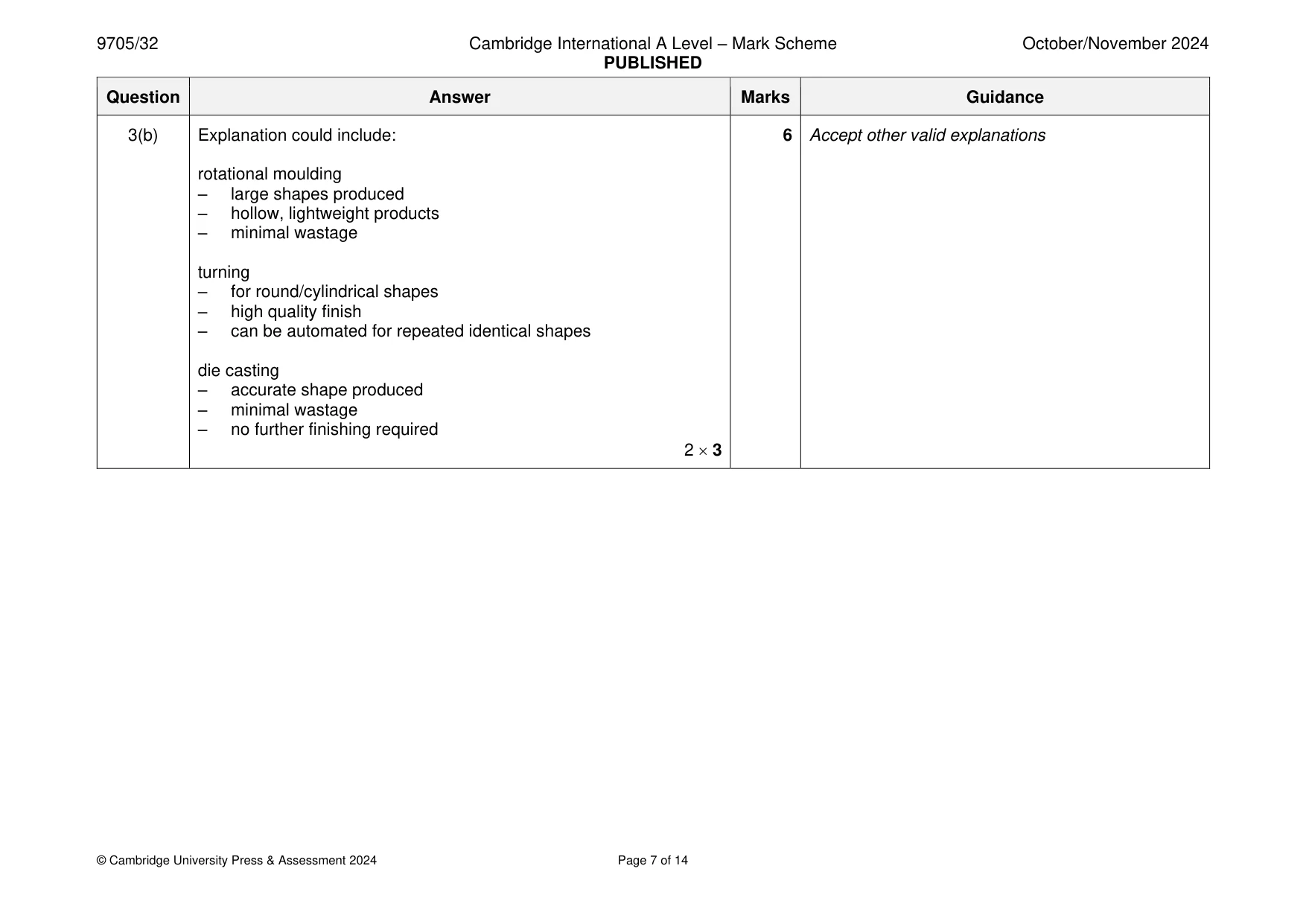
9705/32 Cambridge International A Level – Mark Scheme PUBLISHED October/November 2024 © Cambridge University Press & Assessment 2024 Page 7 of 14 Question Answer Marks Guidance 3(b) Explanation could include: rotational moulding – large shapes produced – hollow, lightweight products – minimal wastage turning – for round/cylindrical shapes – high quality finish – can be automated for repeated identical shapes die casting – accurate shape produced – minimal wastage – no further finishing required 2 3 6 Accept other valid explanations
Mark scheme, page 8
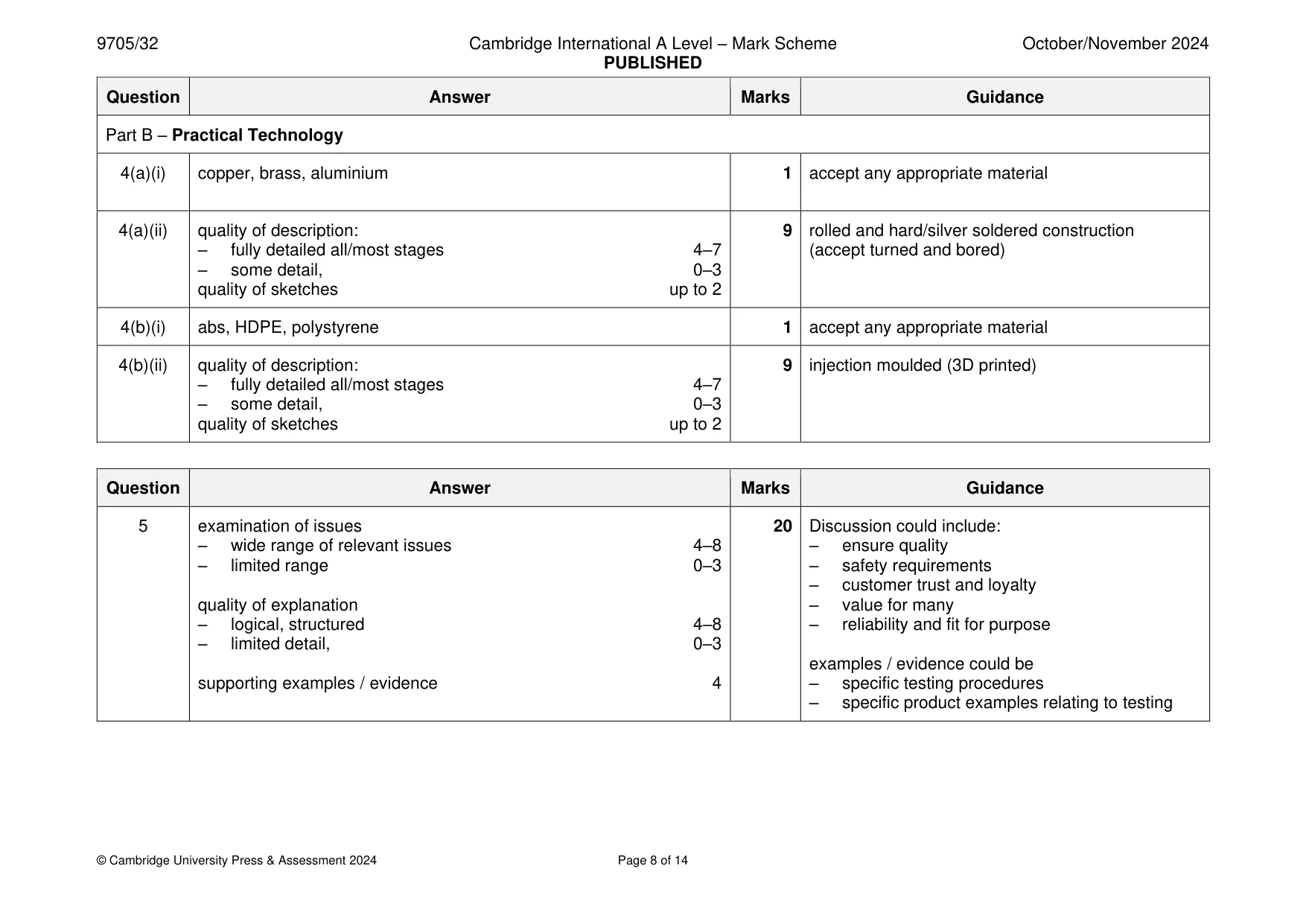
9705/32 Cambridge International A Level – Mark Scheme PUBLISHED October/November 2024 © Cambridge University Press & Assessment 2024 Page 8 of 14 Question Answer Marks Guidance Part B – Practical Technology 4(a)(i) copper, brass, aluminium 1 accept any appropriate material 4(a)(ii) quality of description: – fully detailed all/most stages 4–7 – some detail, 0–3 quality of sketches up to 2 9 rolled and hard/silver soldered construction (accept turned and bored) 4(b)(i) abs, HDPE, polystyrene 1 accept any appropriate material 4(b)(ii) quality of description: – fully detailed all/most stages 4–7 – some detail, 0–3 quality of sketches up to 2 9 injection moulded (3D printed) Question Answer Marks Guidance 5 examination of issues – wide range of relevant issues 4–8 – limited range 0–3 quality of explanation – logical, structured 4–8 – limited detail, 0–3 supporting examples / evidence 4 20 Discussion could include: – ensure quality – safety requirements – customer trust and loyalty – value for many – reliability and fit for purpose examples / evidence could be – specific testing procedures – specific product examples relating to testing
Mark scheme, page 9
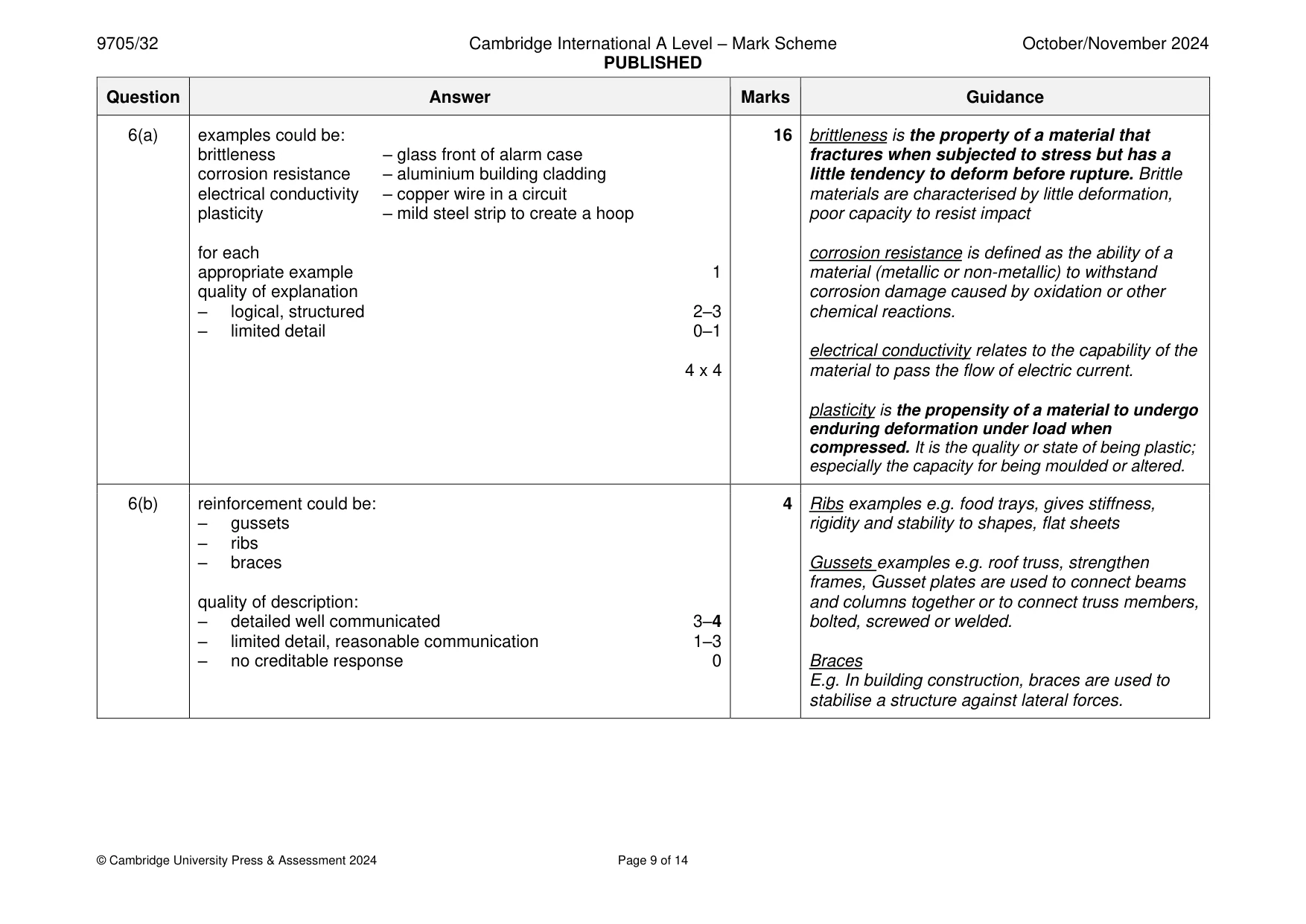
9705/32 Cambridge International A Level – Mark Scheme PUBLISHED October/November 2024 © Cambridge University Press & Assessment 2024 Page 9 of 14 Question Answer Marks Guidance 6(a) examples could be: brittleness – glass front of alarm case corrosion resistance – aluminium building cladding electrical conductivity – copper wire in a circuit plasticity – mild steel strip to create a hoop for each appropriate example 1 quality of explanation – logical, structured 2–3 – limited detail 0–1 4 x 4 16 brittleness is the property of a material that fractures when subjected to stress but has a little tendency to deform before rupture. Brittle materials are characterised by little deformation, poor capacity to resist impact corrosion resistance is defined as the ability of a material (metallic or non-metallic) to withstand corrosion damage caused by oxidation or other chemical reactions. electrical conductivity relates to the capability of the material to pass the flow of electric current. plasticity is the propensity of a material to undergo enduring deformation under load when compressed. It is the quality or state of being plastic; especially the capacity for being moulded or altered. 6(b) reinforcement could be: – gussets – ribs – braces quality of description: – detailed well communicated 3–4 – limited detail, reasonable communication 1–3 – no creditable response 0 4 Ribs examples e.g. food trays, gives stiffness, rigidity and stability to shapes, flat sheets Gussets examples e.g. roof truss, strengthen frames, Gusset plates are used to connect beams and columns together or to connect truss members, bolted, screwed or welded. Braces E.g. In building construction, braces are used to stabilise a structure against lateral forces.
Mark scheme, page 10
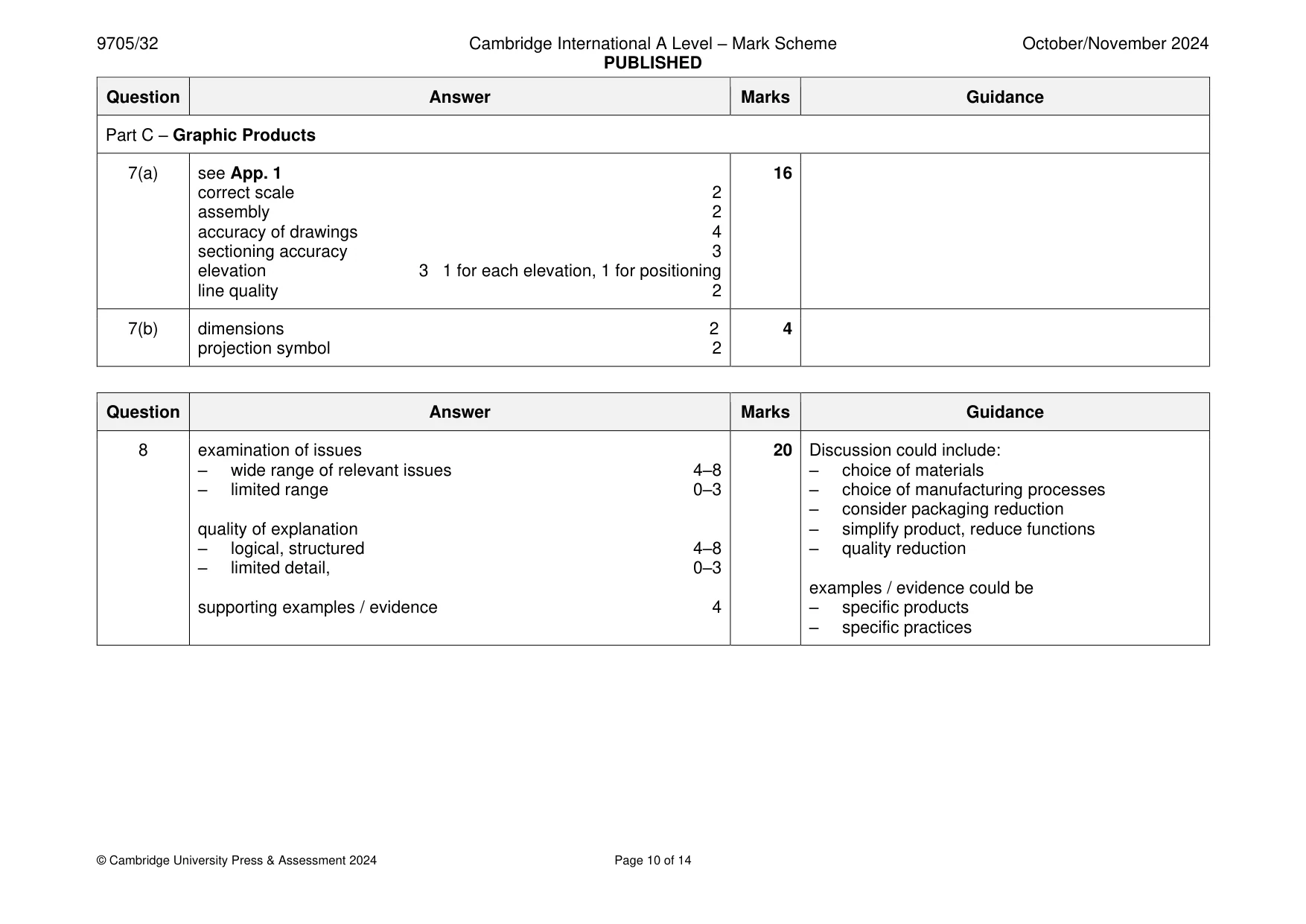
9705/32 Cambridge International A Level – Mark Scheme PUBLISHED October/November 2024 © Cambridge University Press & Assessment 2024 Page 10 of 14 Question Answer Marks Guidance Part C – Graphic Products 7(a) see App. 1 correct scale 2 assembly 2 accuracy of drawings 4 sectioning accuracy 3 elevation 3 1 for each elevation, 1 for positioning line quality 2 16 7(b) dimensions 2 projection symbol 2 4 Question Answer Marks Guidance 8 examination of issues – wide range of relevant issues 4–8 – limited range 0–3 quality of explanation – logical, structured 4–8 – limited detail, 0–3 supporting examples / evidence 4 20 Discussion could include: – choice of materials – choice of manufacturing processes – consider packaging reduction – simplify product, reduce functions – quality reduction examples / evidence could be – specific products – specific practices
Mark scheme, page 11
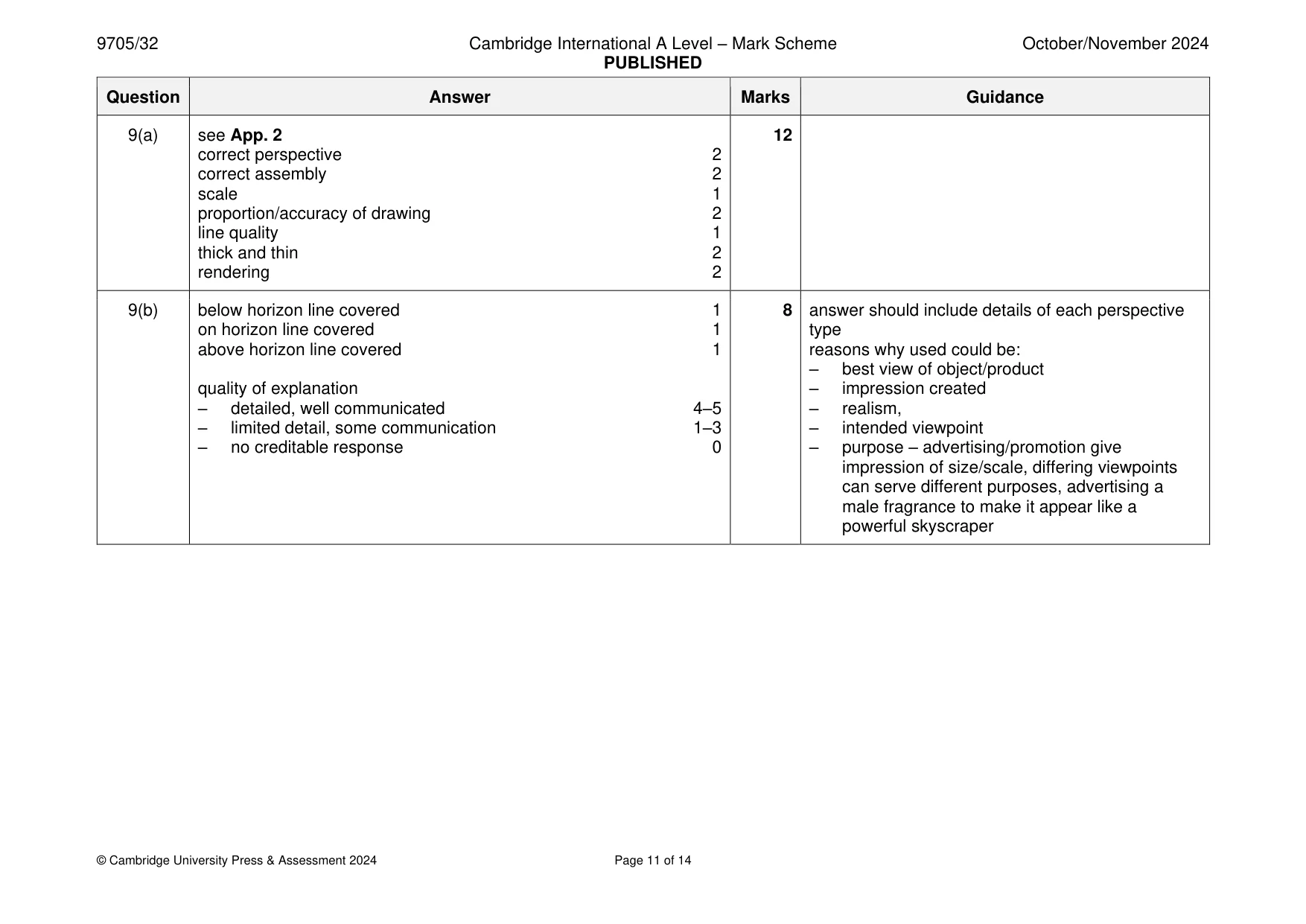
9705/32 Cambridge International A Level – Mark Scheme PUBLISHED October/November 2024 © Cambridge University Press & Assessment 2024 Page 11 of 14 Question Answer Marks Guidance 9(a) see App. 2 correct perspective 2 correct assembly 2 scale 1 proportion/accuracy of drawing 2 line quality 1 thick and thin 2 rendering 2 12 9(b) below horizon line covered 1 on horizon line covered 1 above horizon line covered 1 quality of explanation – detailed, well communicated 4–5 – limited detail, some communication 1–3 – no creditable response 0 8 answer should include details of each perspective type reasons why used could be: – best view of object/product – impression created – realism, – intended viewpoint – purpose – advertising/promotion give impression of size/scale, differing viewpoints can serve different purposes, advertising a male fragrance to make it appear like a powerful skyscraper
Mark scheme, page 12
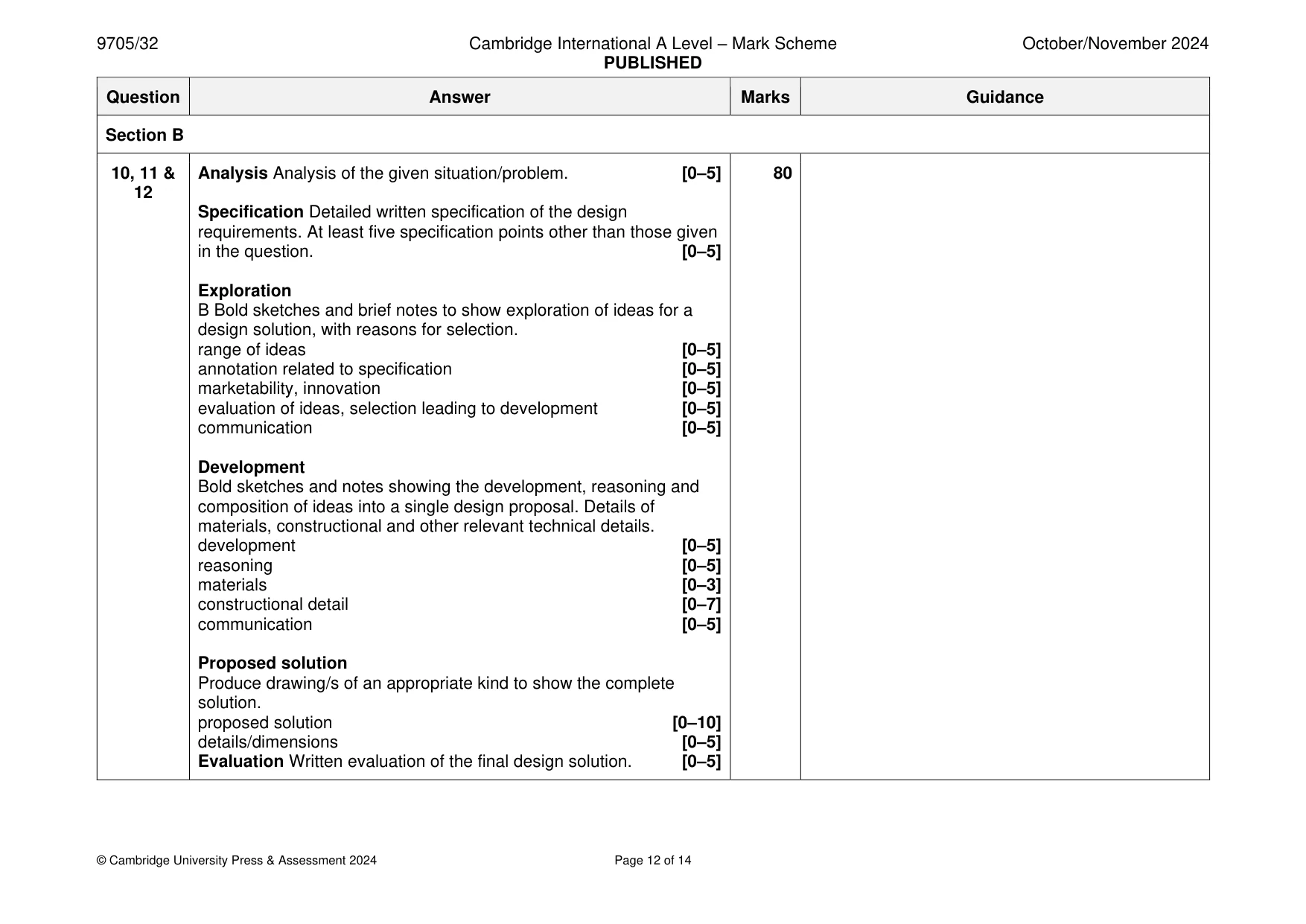
9705/32 Cambridge International A Level – Mark Scheme PUBLISHED October/November 2024 © Cambridge University Press & Assessment 2024 Page 12 of 14 Question Answer Marks Guidance Section B 10, 11 & 12 Analysis Analysis of the given situation/problem. [0–5] Specification Detailed written specification of the design requirements. At least five specification points other than those given in the question. [0–5] Exploration B Bold sketches and brief notes to show exploration of ideas for a design solution, with reasons for selection. range of ideas [0–5] annotation related to specification [0–5] marketability, innovation [0–5] evaluation of ideas, selection leading to development [0–5] communication [0–5] Development Bold sketches and notes showing the development, reasoning and composition of ideas into a single design proposal. Details of materials, constructional and other relevant technical details. development [0–5] reasoning [0–5] materials [0–3] constructional detail [0–7] communication [0–5] Proposed solution Produce drawing/s of an appropriate kind to show the complete solution. proposed solution [0–10] details/dimensions [0–5] Evaluation Written evaluation of the final design solution. [0–5] 80
Mark scheme, page 13
9705/32 Cambridge International A Level – Mark Scheme PUBLISHED October/November 2024 © Cambridge University Press & Assessment 2024 Page 13 of 14 App. 1 Q7 correct scale 2 assembly 2 accuracy of drawings 4 sectioning accuracy 3 elevation 3 line quality 2 dimensions 2 projection symbol 2
Mark scheme, page 14
9705/32 Cambridge International A Level – Mark Scheme PUBLISHED October/November 2024 © Cambridge University Press & Assessment 2024 Page 14 of 14 App. 2 Q 9 correct perspective 2 correct assembly 2 scale 1 proportion/accuracy of drawing 2 line quality 1 thick and thin 2 rendering 2
What you needed in this session
Cambridge’s own grade thresholds for 2024 Oct/Nov, Paper 3 · Variant 2. A higher threshold means an easier paper — the bar moves with how the cohort did.