Cambridge A Level Design and Technology 9705 — 2022 Oct/Nov Paper 3 · Variant 2
9705/32/O/N/22 · 120 marks · ≈135 min
The question paper and its mark scheme, free to read here and free to download. This is Cambridge’s own paper, exactly as it was sat.
Question paper12 pages



Mark scheme14 pages
Answers below. Sit the paper first if you are practising.
Paper as text
Question paper, page 1
This document has 12 pages. Any blank pages are indicated. [Turn over Cambridge International AS & A Level * 6 1 3 3 7 7 0 5 0 6 * DC (KN/JG) 303233/2 © UCLES 2022 DESIGN & TECHNOLOGY 9705/32 Paper 3 October/November 2022 3 hours You must answer on the answer booklet/paper. You will need: Answer booklet/paper Coloured pencils A3 drawing paper (5 sheets) A range of design drawing equipment INSTRUCTIONS ● Answer three questions in total: Section A: answer two questions from one of the Parts A, B or C. Section B: answer one question. ● If you have been given an answer booklet, follow the instructions on the front cover of the answer booklet. ● Use a black or dark blue pen. ● Write your name, centre number and candidate number on all the work you hand in. ● Do not use an erasable pen or correction fluid. ● You may use an HB pencil, or coloured pencils as appropriate, for any diagrams, graphs or rough working. ● At the end of the examination, fasten all your work together. Do not use staples, paper clips or glue. INFORMATION ● The total mark for this paper is 120. ● The number of marks for each question or part question is shown in brackets [ ]. ● All dimensions are in millimetres.
Question paper, page 2
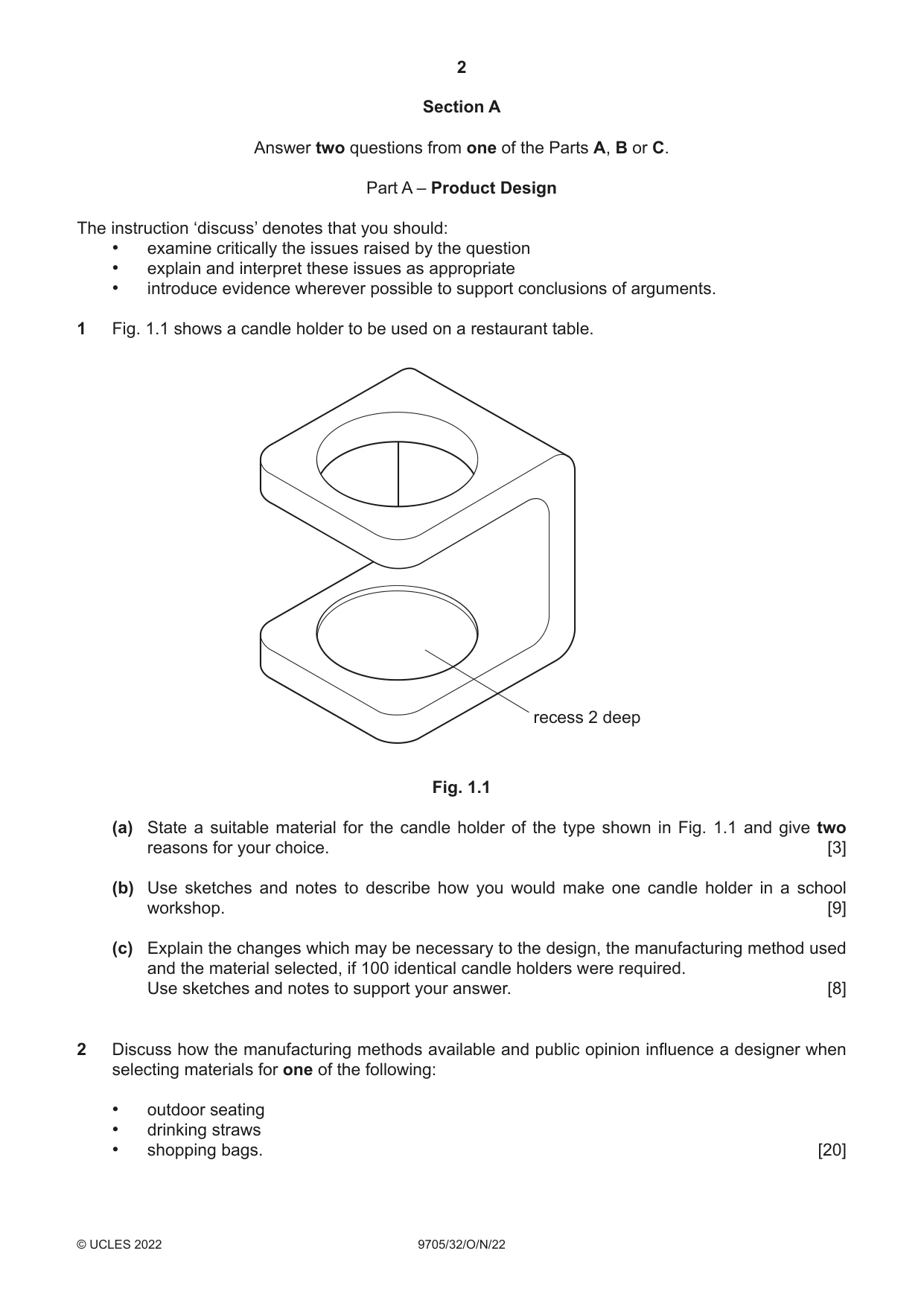
2 9705/32/O/N/22 © UCLES 2022 Section A Answer two questions from one of the Parts A, B or C. Part A – Product Design The instruction ‘discuss’ denotes that you should: • examine critically the issues raised by the question • explain and interpret these issues as appropriate • introduce evidence wherever possible to support conclusions of arguments. 1 Fig. 1.1 shows a candle holder to be used on a restaurant table. recess 2 deep Fig. 1.1 (a) State a suitable material for the candle holder of the type shown in Fig. 1.1 and give two reasons for your choice. [3] (b) Use sketches and notes to describe how you would make one candle holder in a school workshop. [9] (c) Explain the changes which may be necessary to the design, the manufacturing method used and the material selected, if 100 identical candle holders were required. Use sketches and notes to support your answer. [8] 2 Discuss how the manufacturing methods available and public opinion influence a designer when selecting materials for one of the following: • outdoor seating • drinking straws • shopping bags. [20]
Question paper, page 3
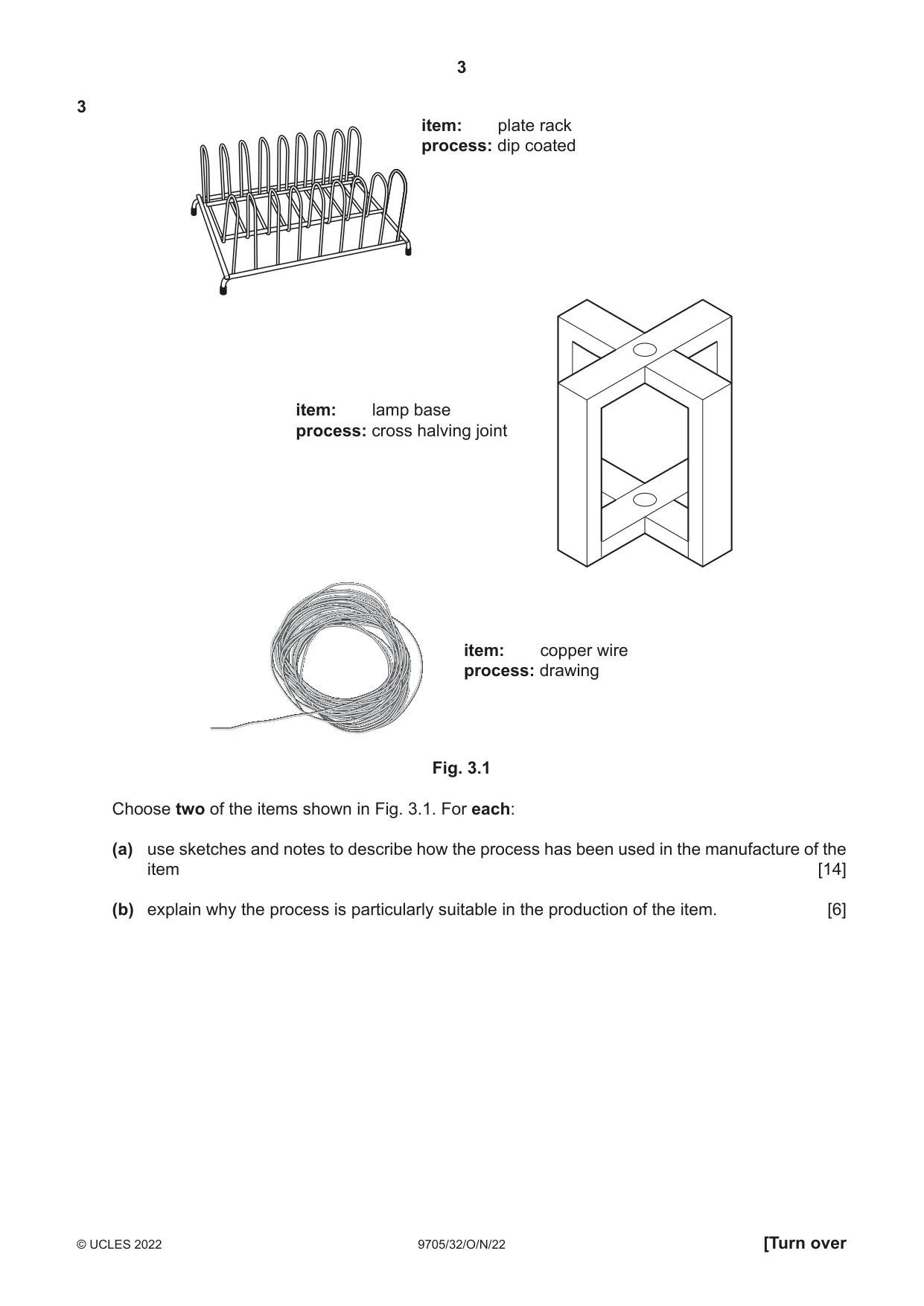
3 9705/32/O/N/22 © UCLES 2022 [Turn over 3 item: plate rack process: dip coated item: lamp base process: cross halving joint item: copper wire process: drawing Fig. 3.1 Choose two of the items shown in Fig. 3.1. For each: (a) use sketches and notes to describe how the process has been used in the manufacture of the item [14] (b) explain why the process is particularly suitable in the production of the item. [6]
Question paper, page 4
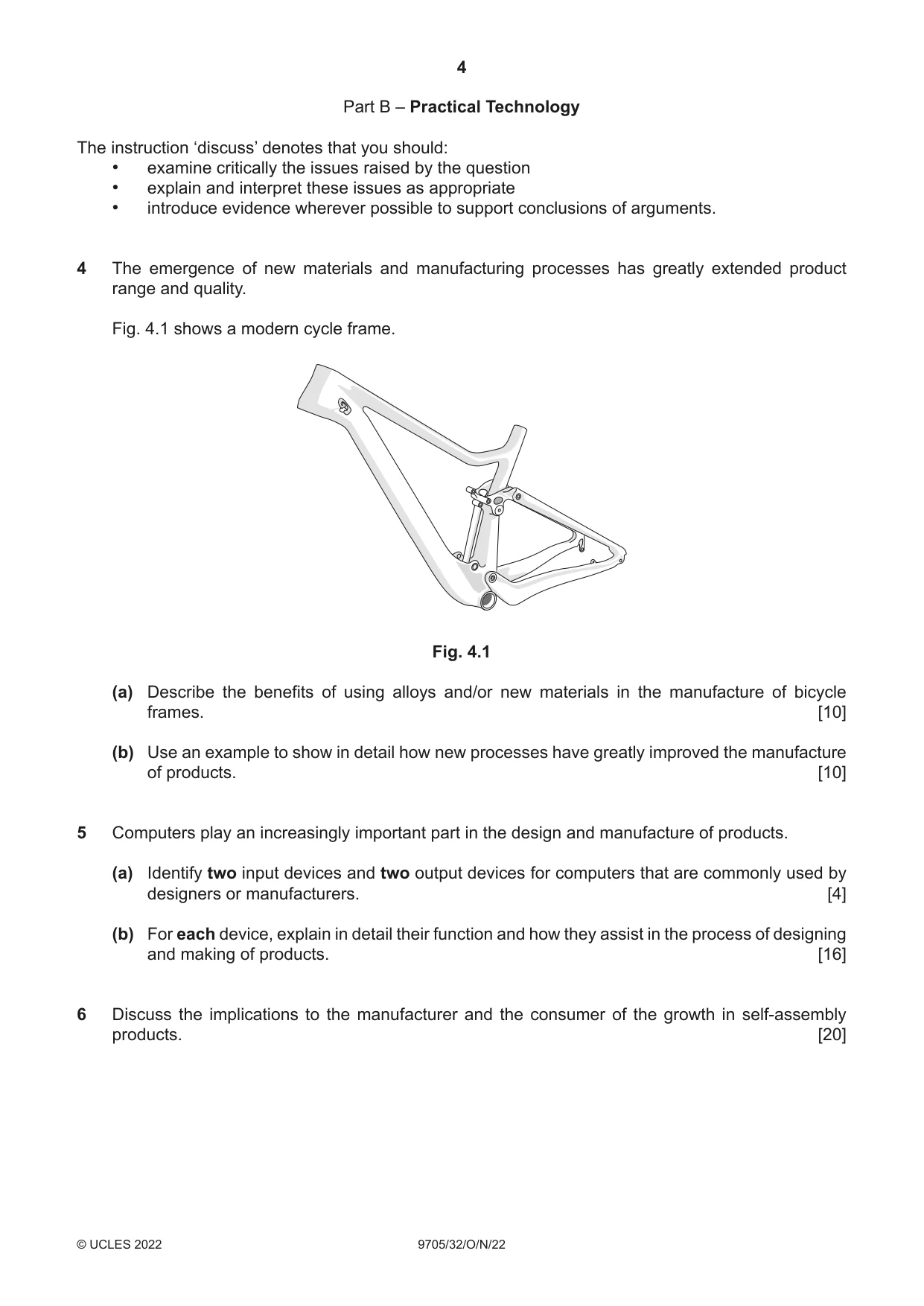
4 9705/32/O/N/22 © UCLES 2022 Part B – Practical Technology The instruction ‘discuss’ denotes that you should: • examine critically the issues raised by the question • explain and interpret these issues as appropriate • introduce evidence wherever possible to support conclusions of arguments. 4 The emergence of new materials and manufacturing processes has greatly extended product range and quality. Fig. 4.1 shows a modern cycle frame. Fig. 4.1 (a) Describe the benefits of using alloys and/or new materials in the manufacture of bicycle frames. [10] (b) Use an example to show in detail how new processes have greatly improved the manufacture of products. [10] 5 Computers play an increasingly important part in the design and manufacture of products. (a) Identify two input devices and two output devices for computers that are commonly used by designers or manufacturers. [4] (b) For each device, explain in detail their function and how they assist in the process of designing and making of products. [16] 6 Discuss the implications to the manufacturer and the consumer of the growth in self-assembly products. [20]
Question paper, page 5
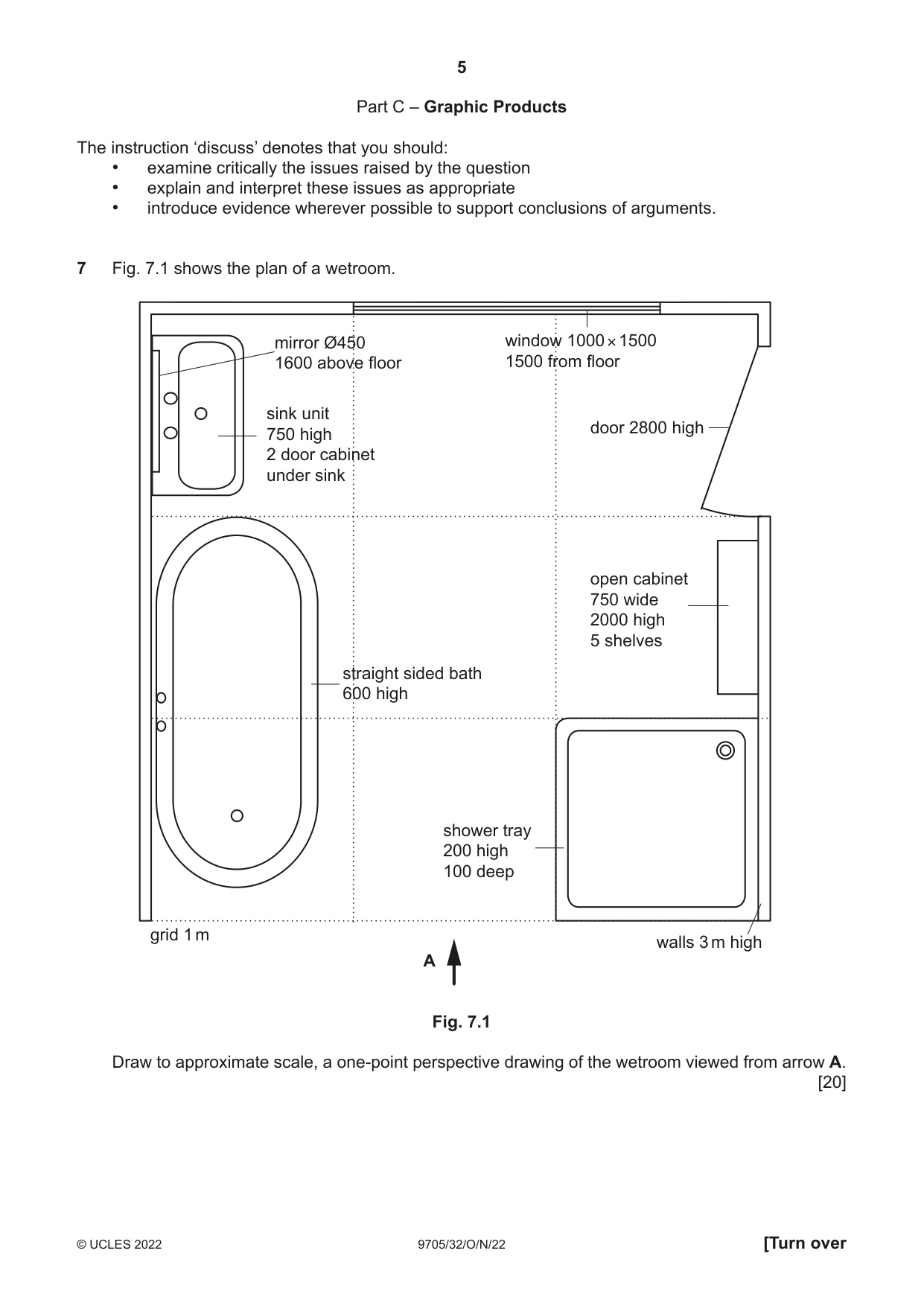
5 9705/32/O/N/22 © UCLES 2022 [Turn over Part C – Graphic Products The instruction ‘discuss’ denotes that you should: • examine critically the issues raised by the question • explain and interpret these issues as appropriate • introduce evidence wherever possible to support conclusions of arguments. 7 Fig. 7.1 shows the plan of a wetroom. grid 1 m mirror Ø450 1600 above floor sink unit 750 high 2 door cabinet under sink window 1000 × 1500 1500 from floor door 2800 high open cabinet 750 wide 2000 high 5 shelves walls 3 m high straight sided bath 600 high shower tray 200 high 100 deep A Fig. 7.1 Draw to approximate scale, a one-point perspective drawing of the wetroom viewed from arrow A. [20]
Question paper, page 6
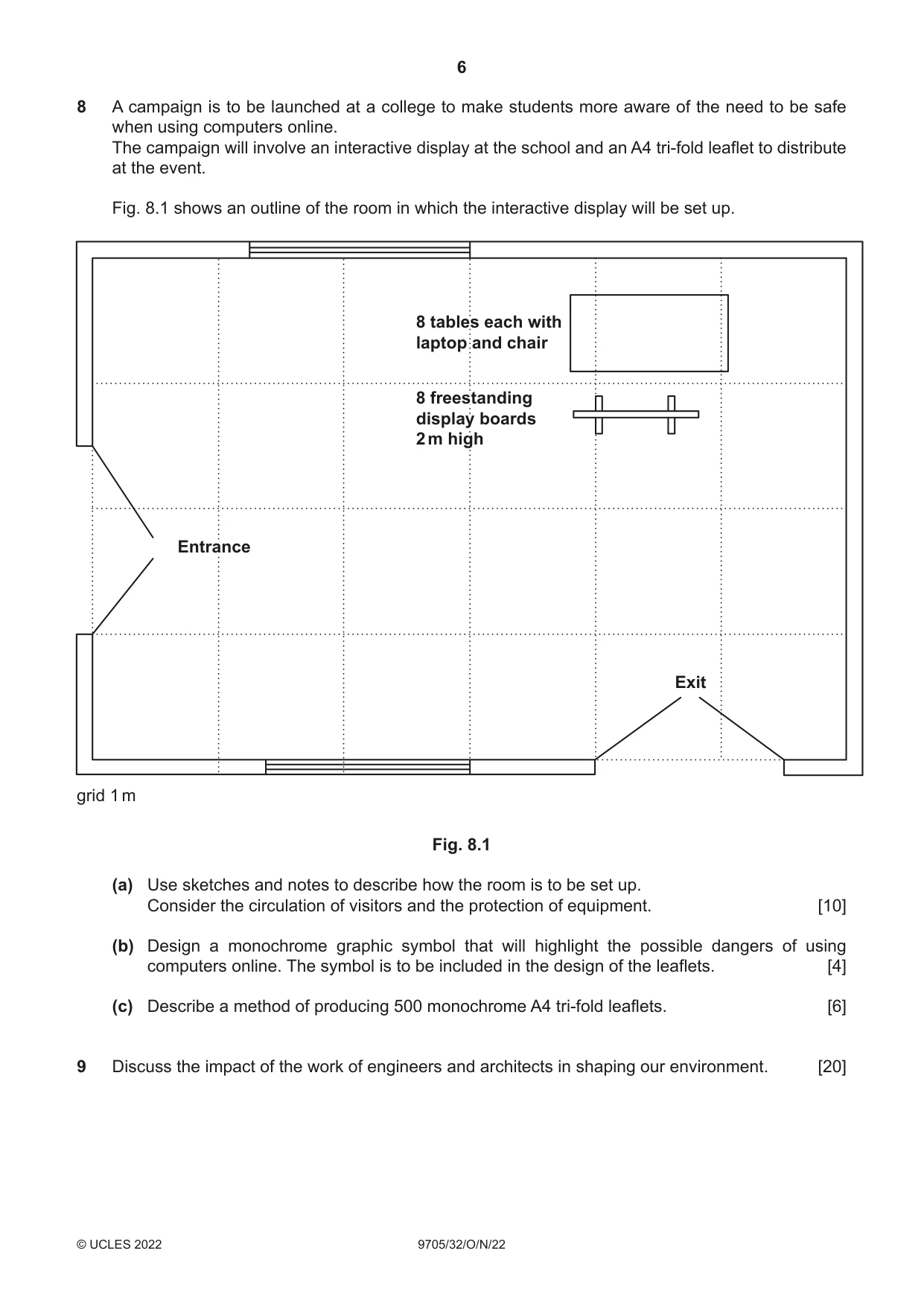
6 9705/32/O/N/22 © UCLES 2022 8 A campaign is to be launched at a college to make students more aware of the need to be safe when using computers online. The campaign will involve an interactive display at the school and an A4 tri-fold leaflet to distribute at the event. Fig. 8.1 shows an outline of the room in which the interactive display will be set up. grid 1 m Entrance Exit 8 freestanding display boards 2 m high 8 tables each with laptop and chair Entrance Exit 8 freestanding display boards 2 m high 8 tables each with laptop and chair Fig. 8.1 (a) Use sketches and notes to describe how the room is to be set up. Consider the circulation of visitors and the protection of equipment. [10] (b) Design a monochrome graphic symbol that will highlight the possible dangers of using computers online. The symbol is to be included in the design of the leaflets. [4] (c) Describe a method of producing 500 monochrome A4 tri-fold leaflets. [6] 9 Discuss the impact of the work of engineers and architects in shaping our environment. [20]
Question paper, page 7
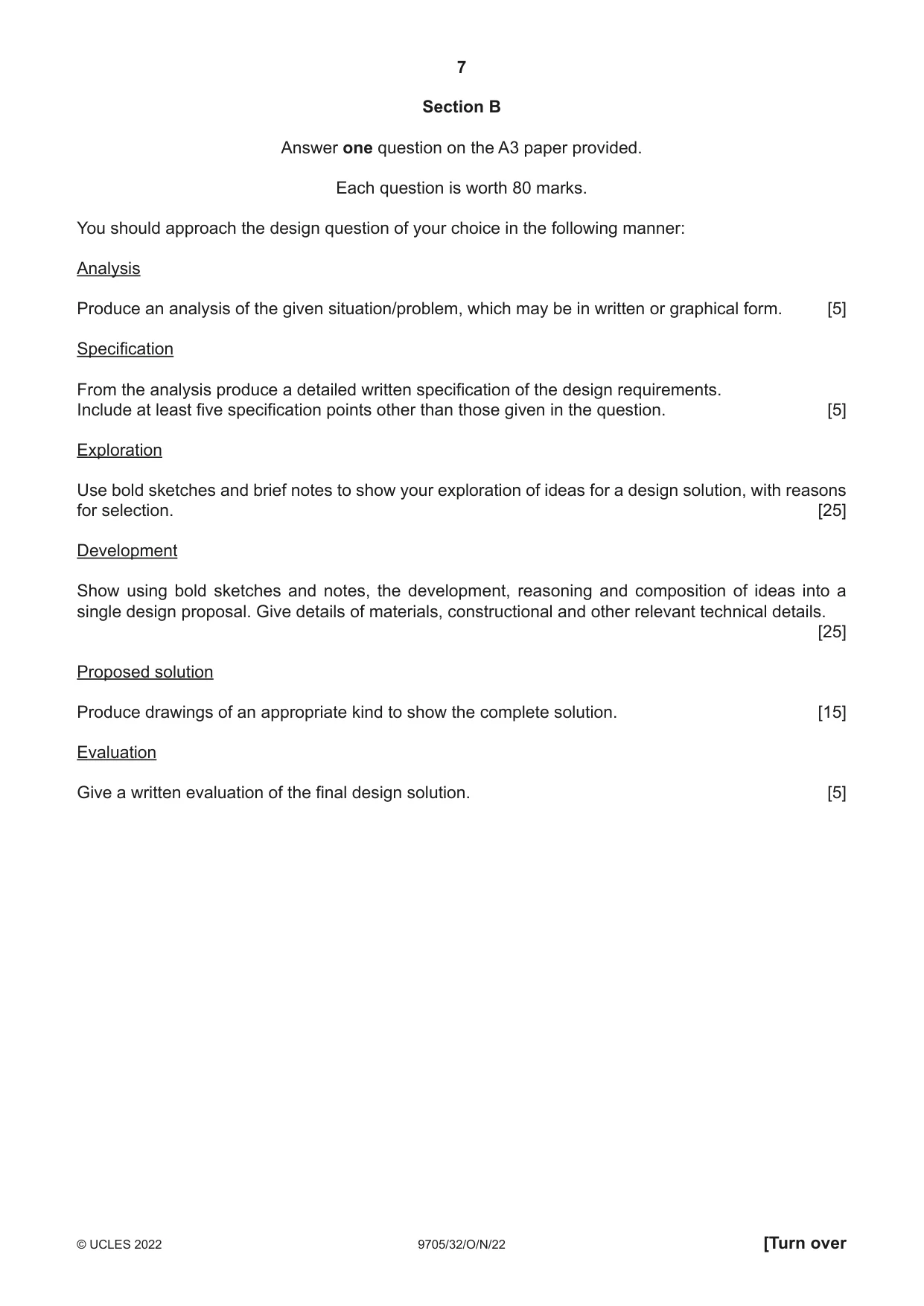
7 9705/32/O/N/22 © UCLES 2022 [Turn over Section B Answer one question on the A3 paper provided. Each question is worth 80 marks. You should approach the design question of your choice in the following manner: Analysis Produce an analysis of the given situation/problem, which may be in written or graphical form. [5] Specification From the analysis produce a detailed written specification of the design requirements. Include at least five specification points other than those given in the question. [5] Exploration Use bold sketches and brief notes to show your exploration of ideas for a design solution, with reasons for selection. [25] Development Show using bold sketches and notes, the development, reasoning and composition of ideas into a single design proposal. Give details of materials, constructional and other relevant technical details. [25] Proposed solution Produce drawings of an appropriate kind to show the complete solution. [15] Evaluation Give a written evaluation of the final design solution. [5]
Question paper, page 8
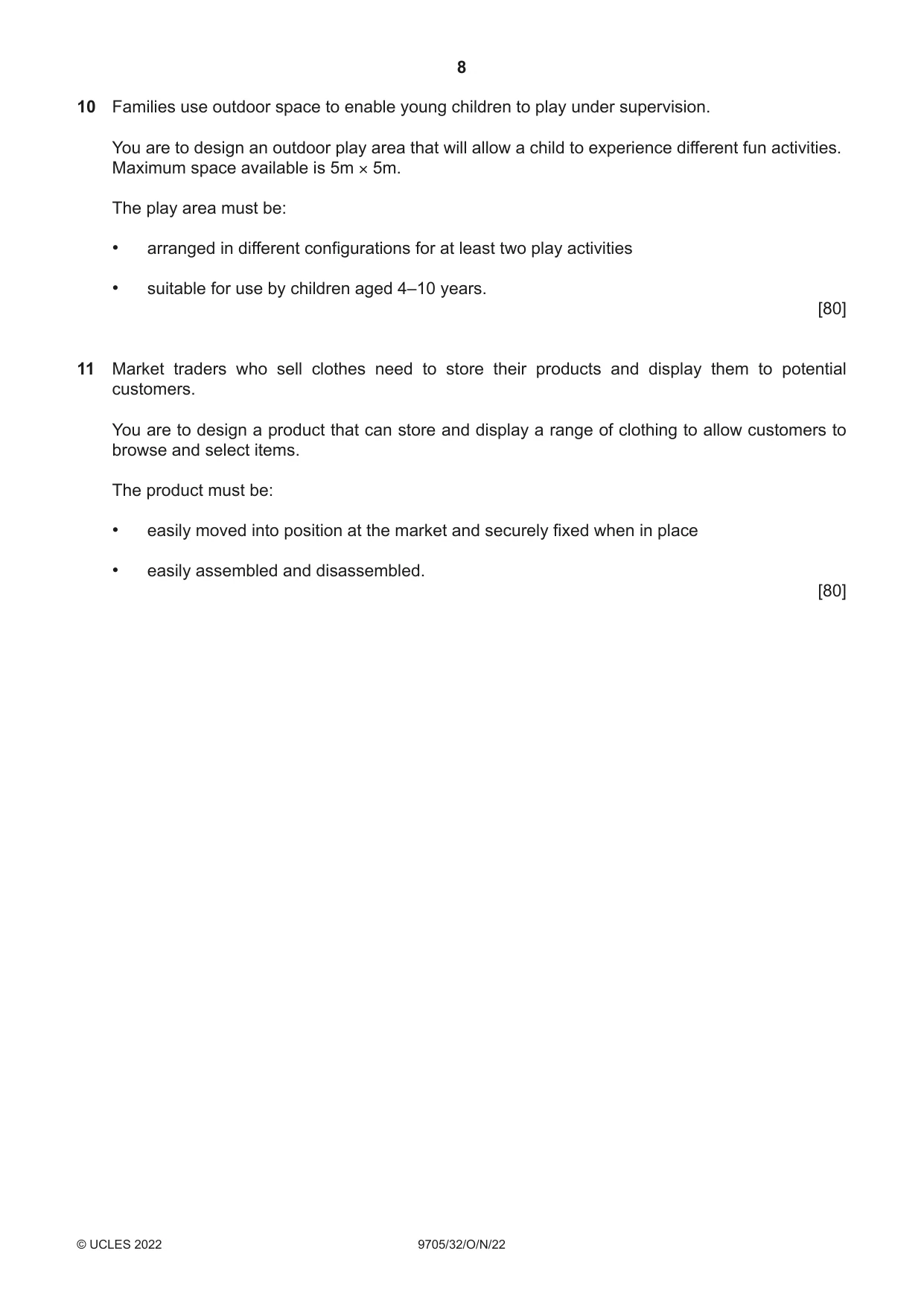
8 9705/32/O/N/22 © UCLES 2022 10 Families use outdoor space to enable young children to play under supervision. You are to design an outdoor play area that will allow a child to experience different fun activities. Maximum space available is 5m × 5m. The play area must be: • arranged in different configurations for at least two play activities • suitable for use by children aged 4–10 years. [80] 11 Market traders who sell clothes need to store their products and display them to potential customers. You are to design a product that can store and display a range of clothing to allow customers to browse and select items. The product must be: • easily moved into position at the market and securely fixed when in place • easily assembled and disassembled. [80]
Question paper, page 9
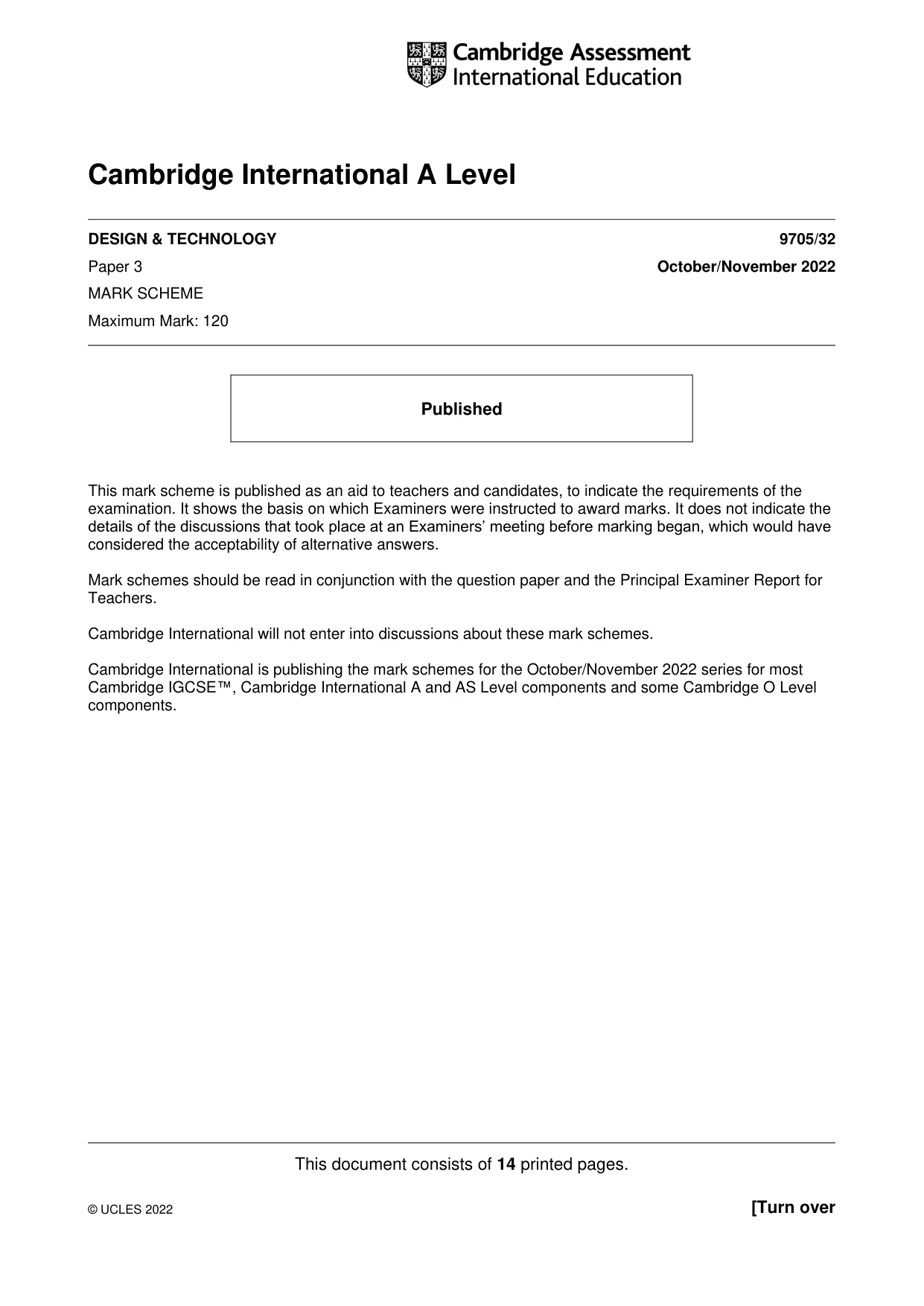
9 9705/32/O/N/22 © UCLES 2022 12 Many students and workers use their mobile device (phone or tablet) at home or when out of the office to communicate with friends or colleagues. A new broadband company wishes to distribute a free gift to potential customers. You are to design: • a name and logo for a new broadband company • a product that would hold a mobile device in an appropriate position when in use. The product must be: • produced as flat pack • able to be used for a range of mobile devices. [80] Details of mobile devices are given in Fig. 12.1. 170 60 8 12 240 110 phone minimum size tablet maximum size Fig. 12.1
Question paper, page 10
10 9705/32/O/N/22 © UCLES 2022 BLANK PAGE
Question paper, page 11
11 9705/32/O/N/22 © UCLES 2022 BLANK PAGE
Question paper, page 12
12 9705/32/O/N/22 © UCLES 2022 Permission to reproduce items where third-party owned material protected by copyright is included has been sought and cleared where possible. Every reasonable effort has been made by the publisher (UCLES) to trace copyright holders, but if any items requiring clearance have unwittingly been included, the publisher will be pleased to make amends at the earliest possible opportunity. To avoid the issue of disclosure of answer-related information to candidates, all copyright acknowledgements are reproduced online in the Cambridge Assessment International Education Copyright Acknowledgements Booklet. This is produced for each series of examinations and is freely available to download at www.cambridgeinternational.org after the live examination series. Cambridge Assessment International Education is part of Cambridge Assessment. Cambridge Assessment is the brand name of the University of Cambridge Local Examinations Syndicate (UCLES), which is a department of the University of Cambridge. BLANK PAGE
Mark scheme, page 1
This document consists of 14 printed pages. © UCLES 2022 [Turn over Cambridge International A Level DESIGN & TECHNOLOGY 9705/32 Paper 3 October/November 2022 MARK SCHEME Maximum Mark: 120 Published This mark scheme is published as an aid to teachers and candidates, to indicate the requirements of the examination. It shows the basis on which Examiners were instructed to award marks. It does not indicate the details of the discussions that took place at an Examiners’ meeting before marking began, which would have considered the acceptability of alternative answers. Mark schemes should be read in conjunction with the question paper and the Principal Examiner Report for Teachers. Cambridge International will not enter into discussions about these mark schemes. Cambridge International is publishing the mark schemes for the October/November 2022 series for most Cambridge IGCSE™, Cambridge International A and AS Level components and some Cambridge O Level components.
Mark scheme, page 2
9705/32 Cambridge International A Level – Mark Scheme PUBLISHED October/November 2022 © UCLES 2022 Page 2 of 14 Generic Marking Principles These general marking principles must be applied by all examiners when marking candidate answers. They should be applied alongside the specific content of the mark scheme or generic level descriptors for a question. Each question paper and mark scheme will also comply with these marking principles. GENERIC MARKING PRINCIPLE 1: Marks must be awarded in line with: • the specific content of the mark scheme or the generic level descriptors for the question • the specific skills defined in the mark scheme or in the generic level descriptors for the question • the standard of response required by a candidate as exemplified by the standardisation scripts. GENERIC MARKING PRINCIPLE 2: Marks awarded are always whole marks (not half marks, or other fractions). GENERIC MARKING PRINCIPLE 3: Marks must be awarded positively: • marks are awarded for correct/valid answers, as defined in the mark scheme. However, credit is given for valid answers which go beyond the scope of the syllabus and mark scheme, referring to your Team Leader as appropriate • marks are awarded when candidates clearly demonstrate what they know and can do • marks are not deducted for errors • marks are not deducted for omissions • answers should only be judged on the quality of spelling, punctuation and grammar when these features are specifically assessed by the question as indicated by the mark scheme. The meaning, however, should be unambiguous. GENERIC MARKING PRINCIPLE 4: Rules must be applied consistently, e.g. in situations where candidates have not followed instructions or in the application of generic level descriptors.
Mark scheme, page 3
9705/32 Cambridge International A Level – Mark Scheme PUBLISHED October/November 2022 © UCLES 2022 Page 3 of 14 GENERIC MARKING PRINCIPLE 5: Marks should be awarded using the full range of marks defined in the mark scheme for the question (however; the use of the full mark range may be limited according to the quality of the candidate responses seen). GENERIC MARKING PRINCIPLE 6: Marks awarded are based solely on the requirements as defined in the mark scheme. Marks should not be awarded with grade thresholds or grade descriptors in mind.
Mark scheme, page 4
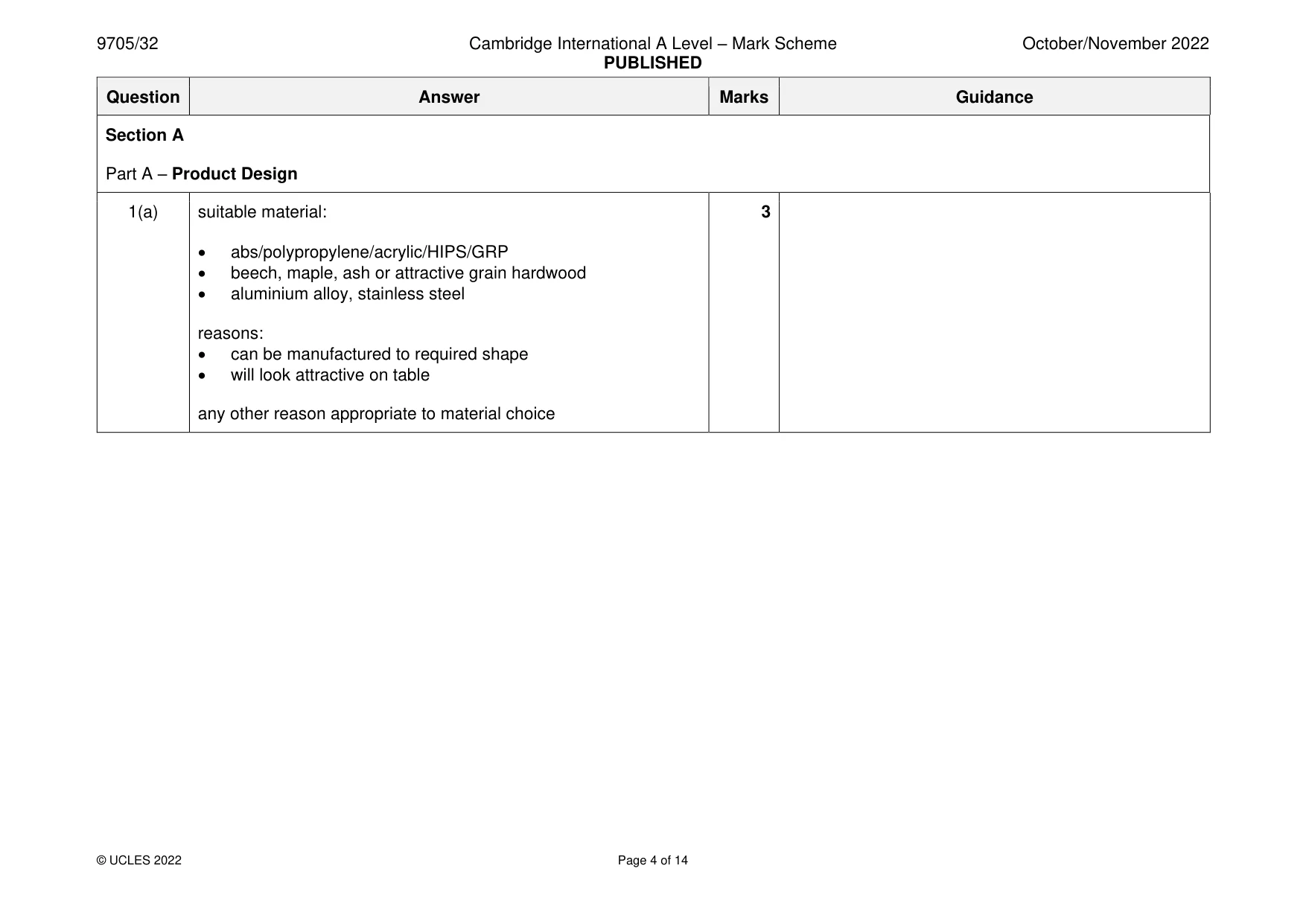
9705/32 Cambridge International A Level – Mark Scheme PUBLISHED October/November 2022 © UCLES 2022 Page 4 of 14 Question Answer Marks Guidance Section A Part A – Product Design 1(a) suitable material: • abs/polypropylene/acrylic/HIPS/GRP • beech, maple, ash or attractive grain hardwood • aluminium alloy, stainless steel reasons: • can be manufactured to required shape • will look attractive on table any other reason appropriate to material choice 3
Mark scheme, page 5
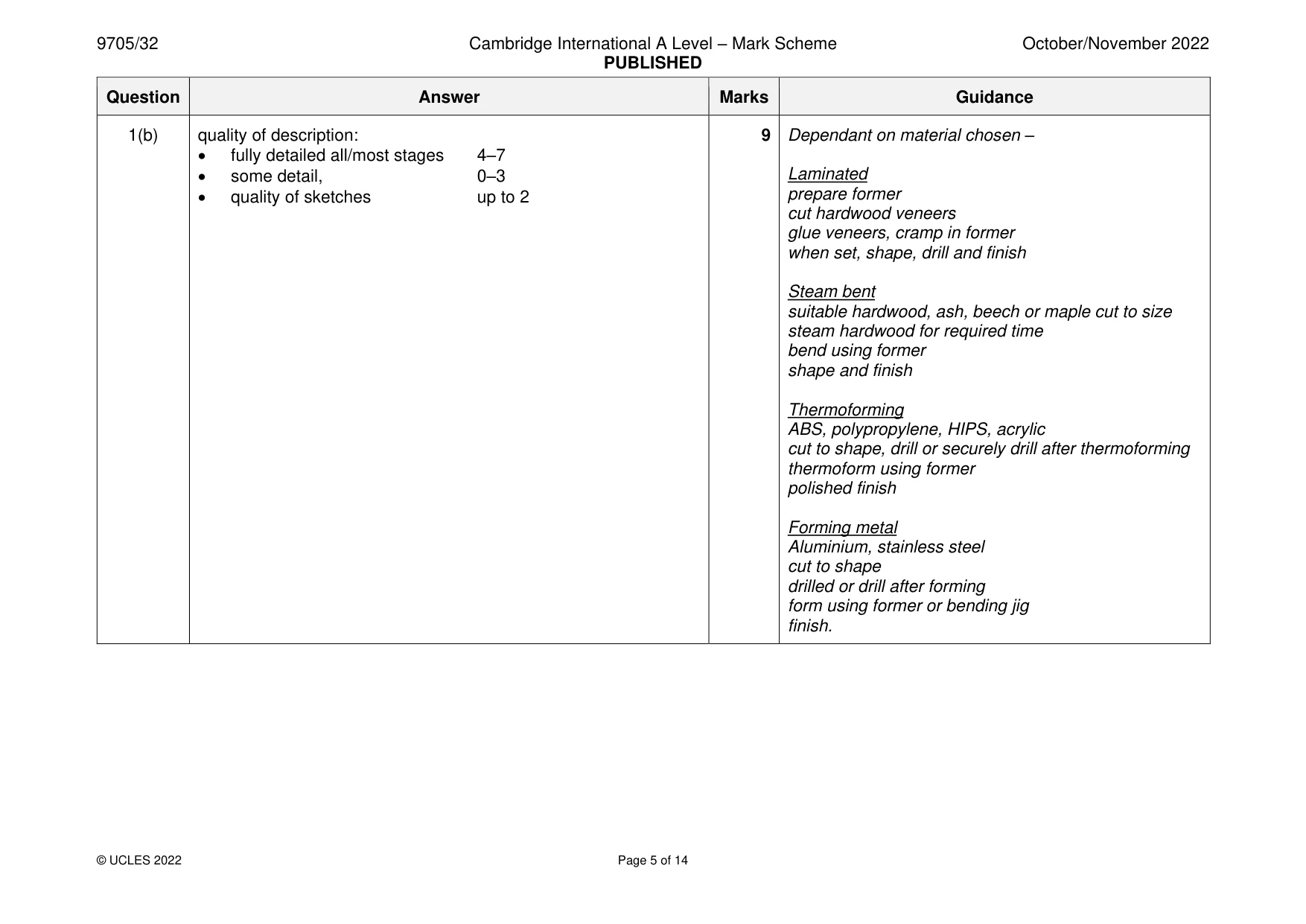
9705/32 Cambridge International A Level – Mark Scheme PUBLISHED October/November 2022 © UCLES 2022 Page 5 of 14 Question Answer Marks Guidance 1(b) quality of description: • fully detailed all/most stages 4–7 • some detail, 0–3 • quality of sketches up to 2 9 Dependant on material chosen – Laminated prepare former cut hardwood veneers glue veneers, cramp in former when set, shape, drill and finish Steam bent suitable hardwood, ash, beech or maple cut to size steam hardwood for required time bend using former shape and finish Thermoforming ABS, polypropylene, HIPS, acrylic cut to shape, drill or securely drill after thermoforming thermoform using former polished finish Forming metal Aluminium, stainless steel cut to shape drilled or drill after forming form using former or bending jig finish.
Mark scheme, page 6
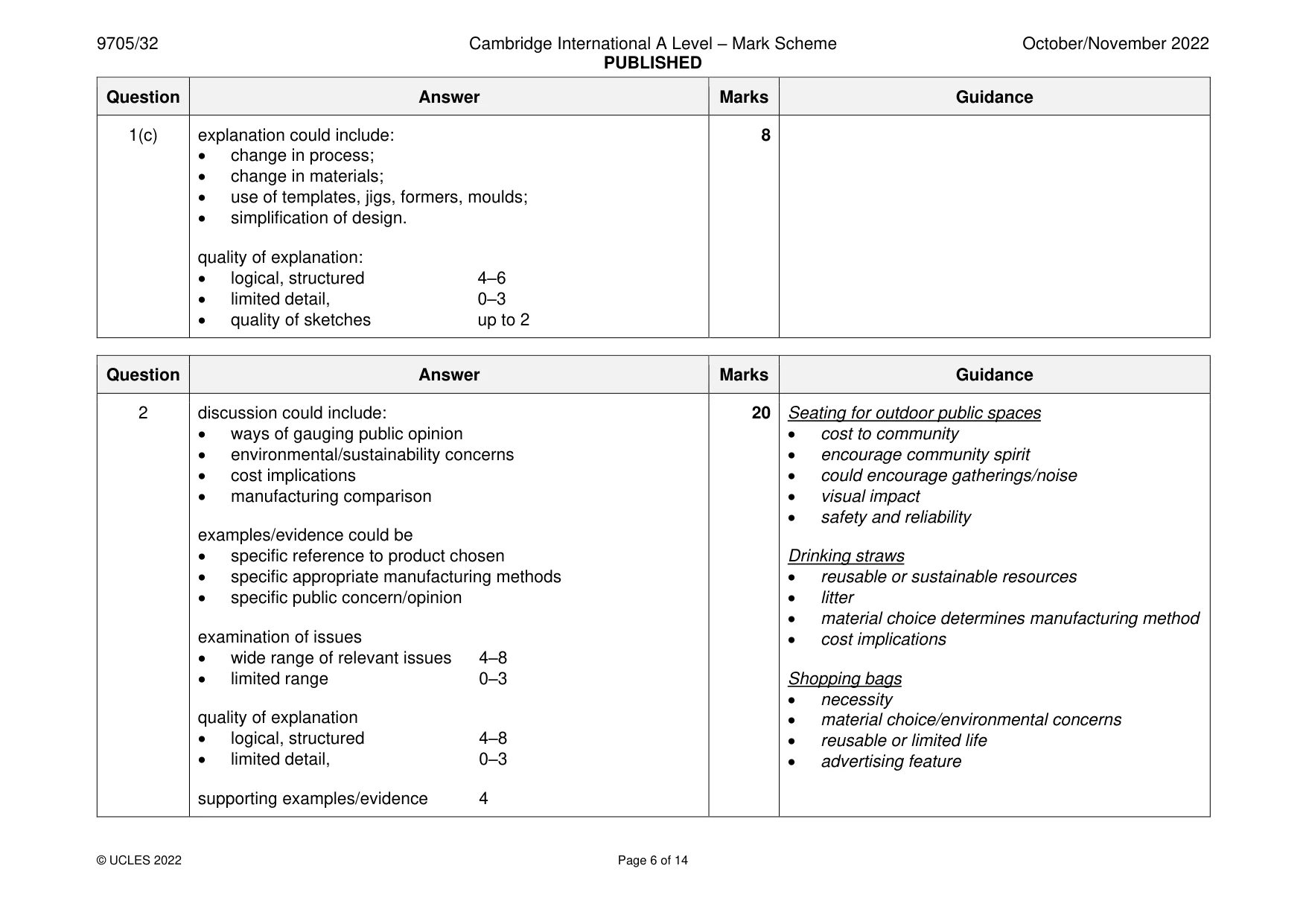
9705/32 Cambridge International A Level – Mark Scheme PUBLISHED October/November 2022 © UCLES 2022 Page 6 of 14 Question Answer Marks Guidance 1(c) explanation could include: • change in process; • change in materials; • use of templates, jigs, formers, moulds; • simplification of design. quality of explanation: • logical, structured 4–6 • limited detail, 0–3 • quality of sketches up to 2 8 Question Answer Marks Guidance 2 discussion could include: • ways of gauging public opinion • environmental/sustainability concerns • cost implications • manufacturing comparison examples/evidence could be • specific reference to product chosen • specific appropriate manufacturing methods • specific public concern/opinion examination of issues • wide range of relevant issues 4–8 • limited range 0–3 quality of explanation • logical, structured 4–8 • limited detail, 0–3 supporting examples/evidence 4 20 Seating for outdoor public spaces • cost to community • encourage community spirit • could encourage gatherings/noise • visual impact • safety and reliability Drinking straws • reusable or sustainable resources • litter • material choice determines manufacturing method • cost implications Shopping bags • necessity • material choice/environmental concerns • reusable or limited life • advertising feature
Mark scheme, page 7
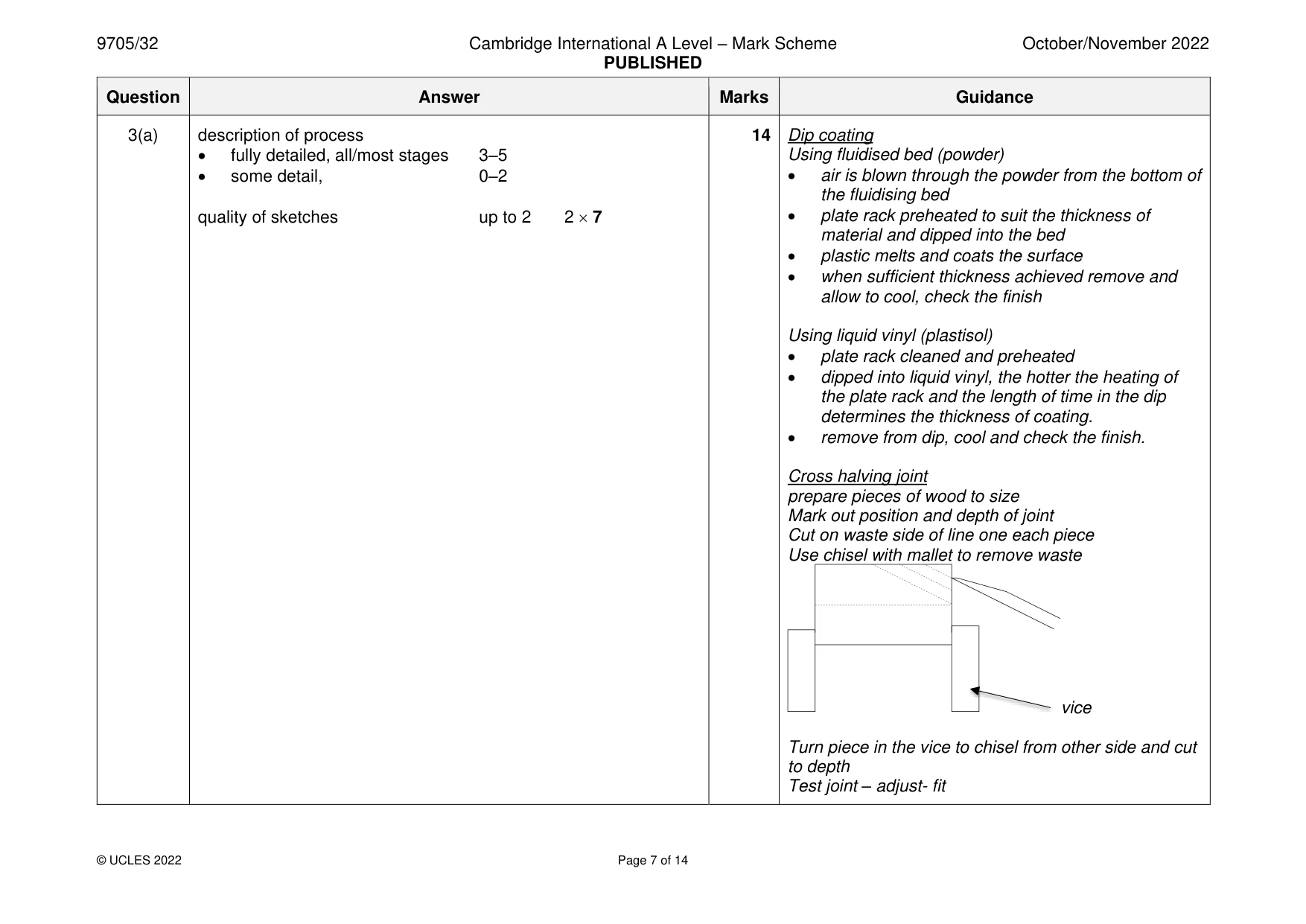
9705/32 Cambridge International A Level – Mark Scheme PUBLISHED October/November 2022 © UCLES 2022 Page 7 of 14 Question Answer Marks Guidance 3(a) description of process • fully detailed, all/most stages 3–5 • some detail, 0–2 quality of sketches up to 2 2 7 14 Dip coating Using fluidised bed (powder) • air is blown through the powder from the bottom of the fluidising bed • plate rack preheated to suit the thickness of material and dipped into the bed • plastic melts and coats the surface • when sufficient thickness achieved remove and allow to cool, check the finish Using liquid vinyl (plastisol) • plate rack cleaned and preheated • dipped into liquid vinyl, the hotter the heating of the plate rack and the length of time in the dip determines the thickness of coating. • remove from dip, cool and check the finish. Cross halving joint prepare pieces of wood to size Mark out position and depth of joint Cut on waste side of line one each piece Use chisel with mallet to remove waste vice Turn piece in the vice to chisel from other side and cut to depth Test joint – adjust- fit
Mark scheme, page 8
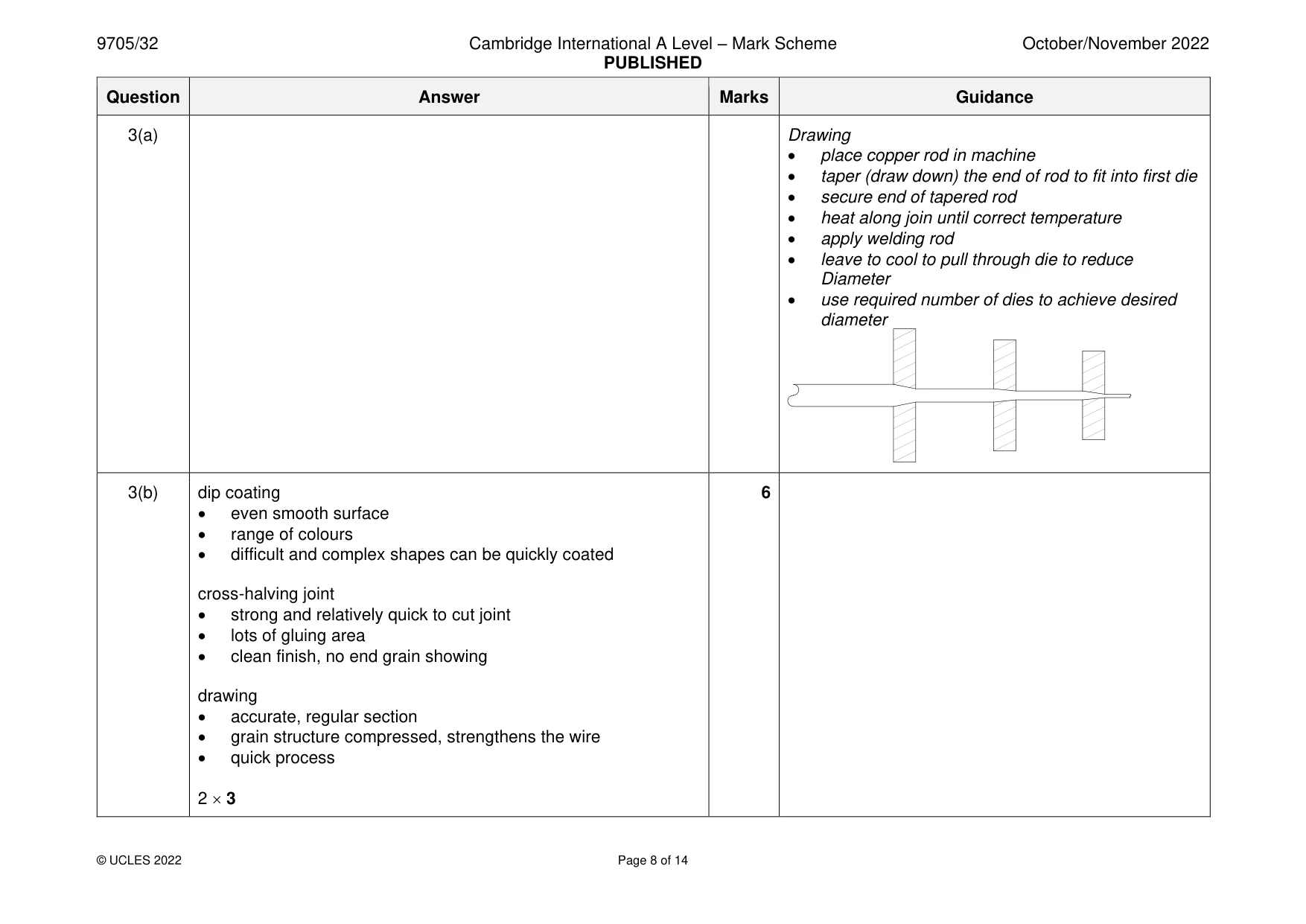
9705/32 Cambridge International A Level – Mark Scheme PUBLISHED October/November 2022 © UCLES 2022 Page 8 of 14 Question Answer Marks Guidance 3(a) Drawing • place copper rod in machine • taper (draw down) the end of rod to fit into first die • secure end of tapered rod • heat along join until correct temperature • apply welding rod • leave to cool to pull through die to reduce Diameter • use required number of dies to achieve desired diameter 3(b) dip coating • even smooth surface • range of colours • difficult and complex shapes can be quickly coated cross-halving joint • strong and relatively quick to cut joint • lots of gluing area • clean finish, no end grain showing drawing • accurate, regular section • grain structure compressed, strengthens the wire • quick process 2 3 6
Mark scheme, page 9
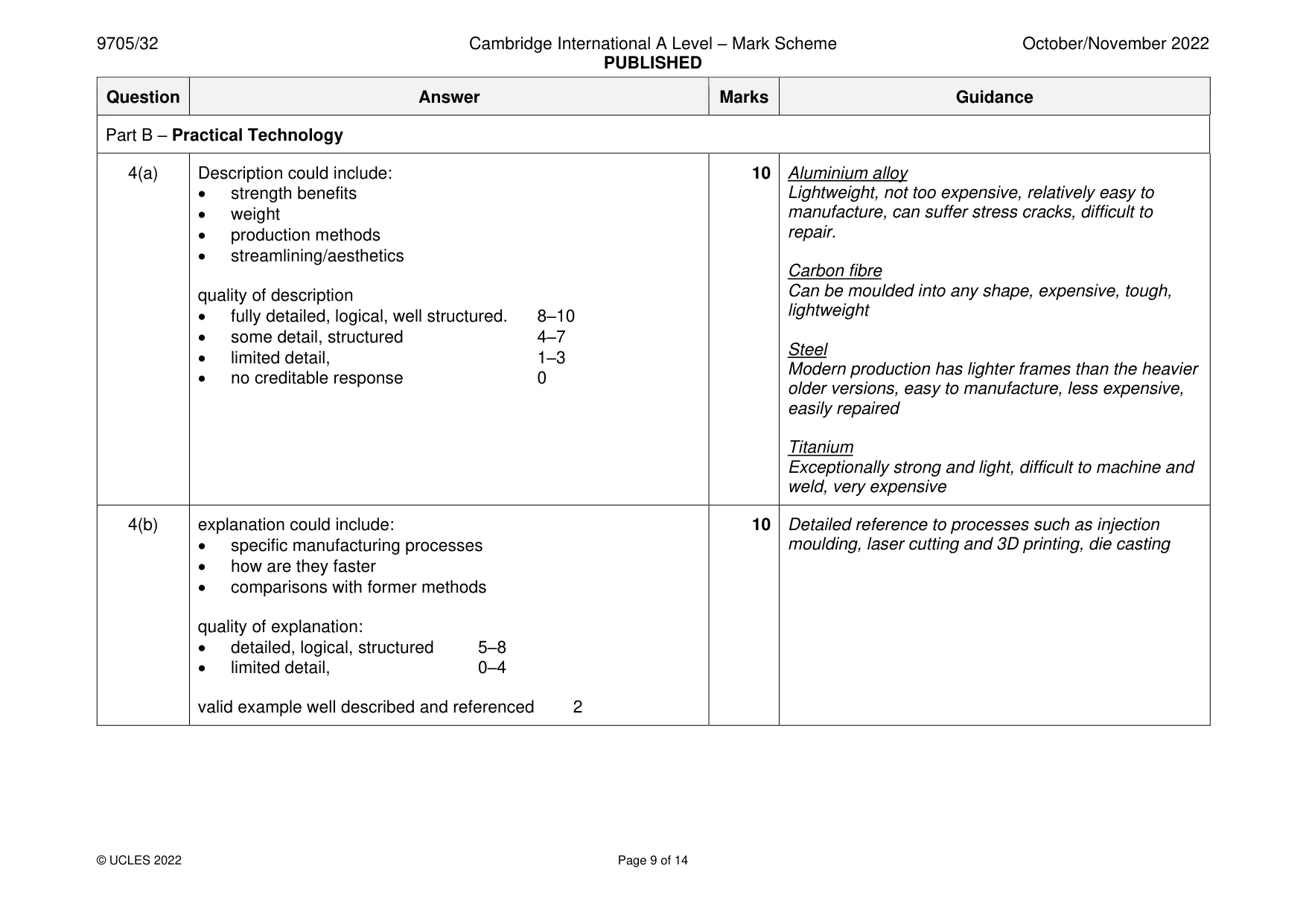
9705/32 Cambridge International A Level – Mark Scheme PUBLISHED October/November 2022 © UCLES 2022 Page 9 of 14 Question Answer Marks Guidance Part B – Practical Technology 4(a) Description could include: • strength benefits • weight • production methods • streamlining/aesthetics quality of description • fully detailed, logical, well structured. 8–10 • some detail, structured 4–7 • limited detail, 1–3 • no creditable response 0 10 Aluminium alloy Lightweight, not too expensive, relatively easy to manufacture, can suffer stress cracks, difficult to repair. Carbon fibre Can be moulded into any shape, expensive, tough, lightweight Steel Modern production has lighter frames than the heavier older versions, easy to manufacture, less expensive, easily repaired Titanium Exceptionally strong and light, difficult to machine and weld, very expensive 4(b) explanation could include: • specific manufacturing processes • how are they faster • comparisons with former methods quality of explanation: • detailed, logical, structured 5–8 • limited detail, 0–4 valid example well described and referenced 2 10 Detailed reference to processes such as injection moulding, laser cutting and 3D printing, die casting
Mark scheme, page 10
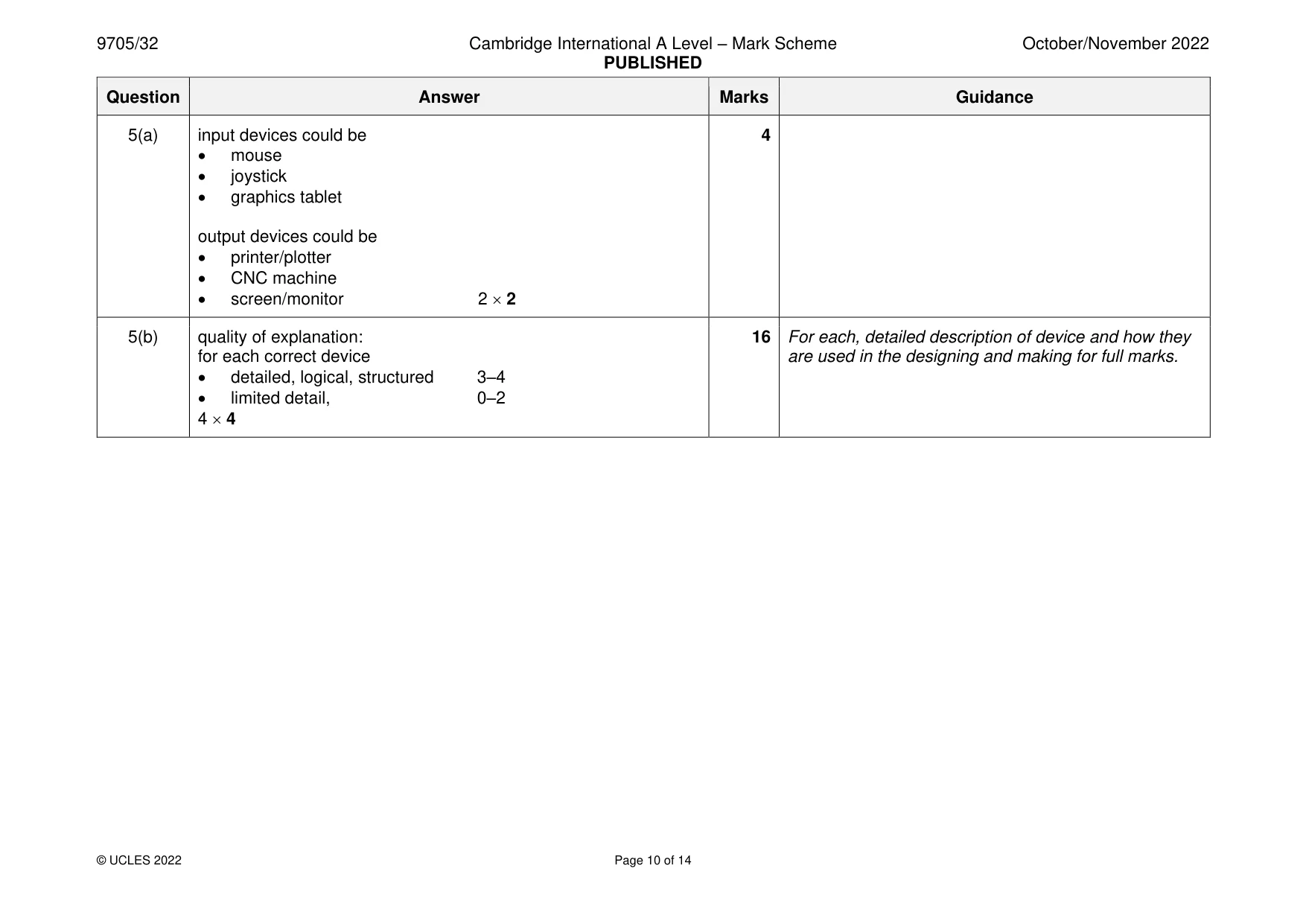
9705/32 Cambridge International A Level – Mark Scheme PUBLISHED October/November 2022 © UCLES 2022 Page 10 of 14 Question Answer Marks Guidance 5(a) input devices could be • mouse • joystick • graphics tablet output devices could be • printer/plotter • CNC machine • screen/monitor 2 2 4 5(b) quality of explanation: for each correct device • detailed, logical, structured 3–4 • limited detail, 0–2 4 4 16 For each, detailed description of device and how they are used in the designing and making for full marks.
Mark scheme, page 11
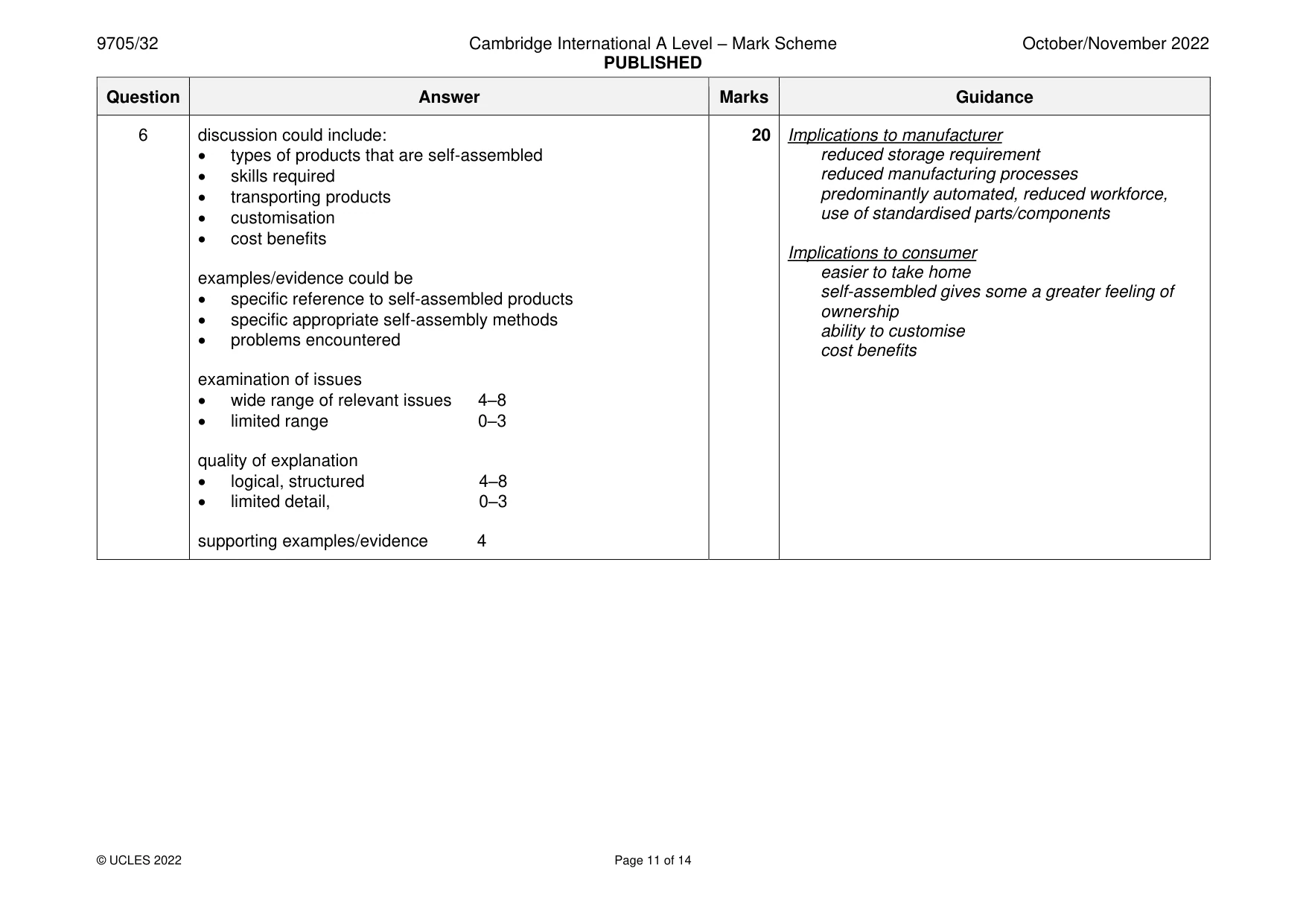
9705/32 Cambridge International A Level – Mark Scheme PUBLISHED October/November 2022 © UCLES 2022 Page 11 of 14 Question Answer Marks Guidance 6 discussion could include: • types of products that are self-assembled • skills required • transporting products • customisation • cost benefits examples/evidence could be • specific reference to self-assembled products • specific appropriate self-assembly methods • problems encountered examination of issues • wide range of relevant issues 4–8 • limited range 0–3 quality of explanation • logical, structured 4–8 • limited detail, 0–3 supporting examples/evidence 4 20 Implications to manufacturer reduced storage requirement reduced manufacturing processes predominantly automated, reduced workforce, use of standardised parts/components Implications to consumer easier to take home self-assembled gives some a greater feeling of ownership ability to customise cost benefits
Mark scheme, page 12
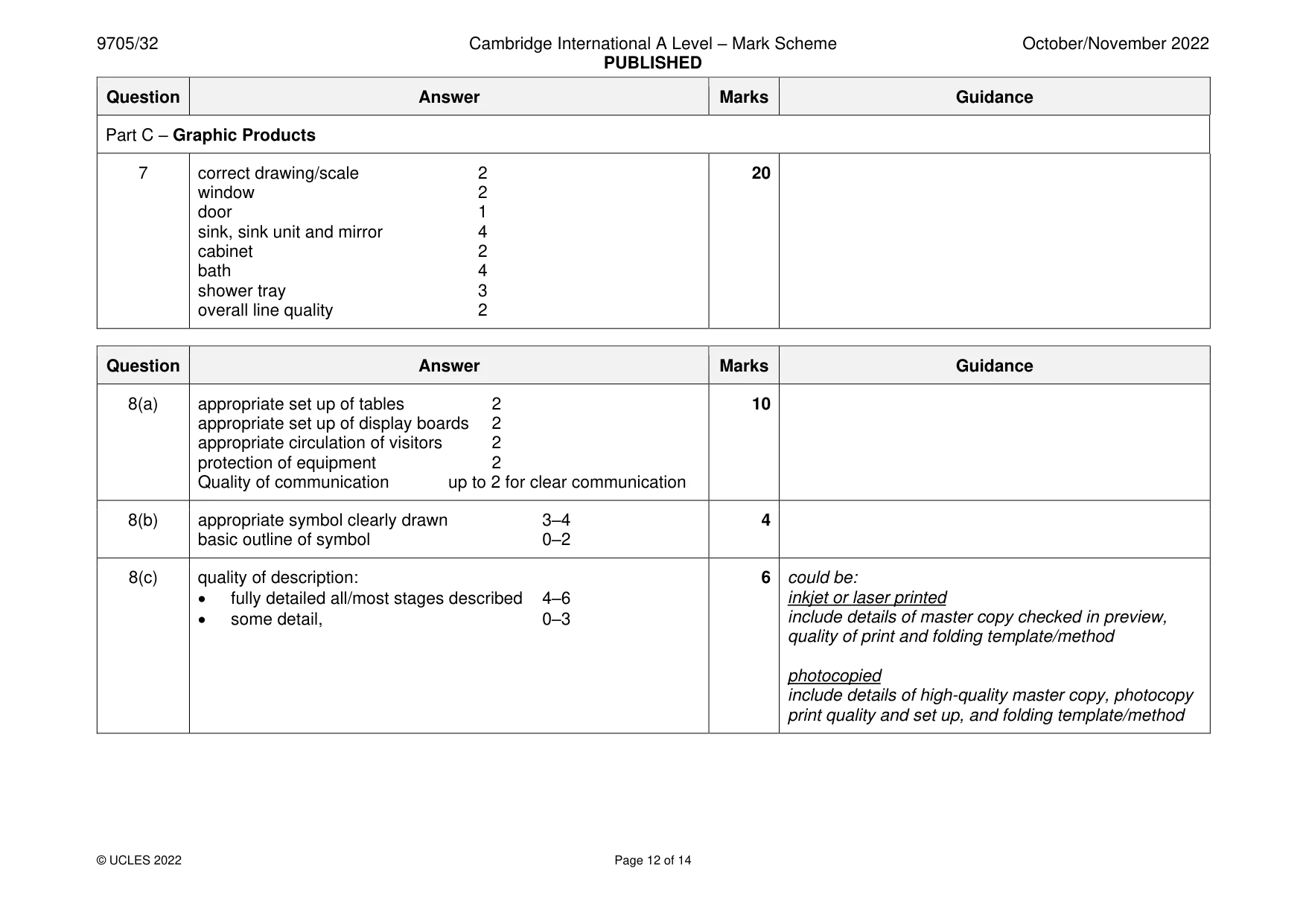
9705/32 Cambridge International A Level – Mark Scheme PUBLISHED October/November 2022 © UCLES 2022 Page 12 of 14 Question Answer Marks Guidance Part C – Graphic Products 7 correct drawing/scale 2 window 2 door 1 sink, sink unit and mirror 4 cabinet 2 bath 4 shower tray 3 overall line quality 2 20 Question Answer Marks Guidance 8(a) appropriate set up of tables 2 appropriate set up of display boards 2 appropriate circulation of visitors 2 protection of equipment 2 Quality of communication up to 2 for clear communication 10 8(b) appropriate symbol clearly drawn 3–4 basic outline of symbol 0–2 4 8(c) quality of description: • fully detailed all/most stages described 4–6 • some detail, 0–3 6 could be: inkjet or laser printed include details of master copy checked in preview, quality of print and folding template/method photocopied include details of high-quality master copy, photocopy print quality and set up, and folding template/method
Mark scheme, page 13
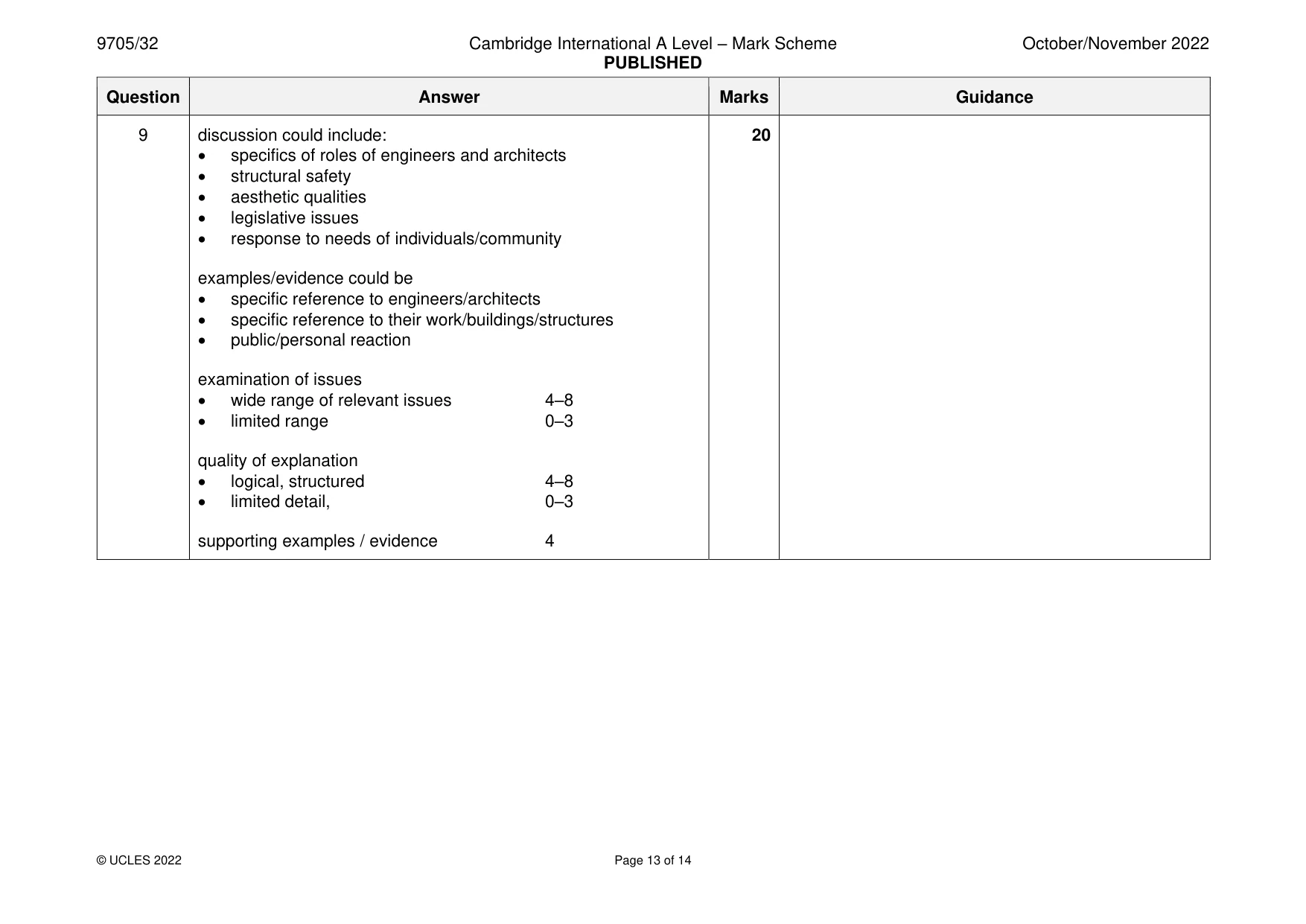
9705/32 Cambridge International A Level – Mark Scheme PUBLISHED October/November 2022 © UCLES 2022 Page 13 of 14 Question Answer Marks Guidance 9 discussion could include: • specifics of roles of engineers and architects • structural safety • aesthetic qualities • legislative issues • response to needs of individuals/community examples/evidence could be • specific reference to engineers/architects • specific reference to their work/buildings/structures • public/personal reaction examination of issues • wide range of relevant issues 4–8 • limited range 0–3 quality of explanation • logical, structured 4–8 • limited detail, 0–3 supporting examples / evidence 4 20
Mark scheme, page 14
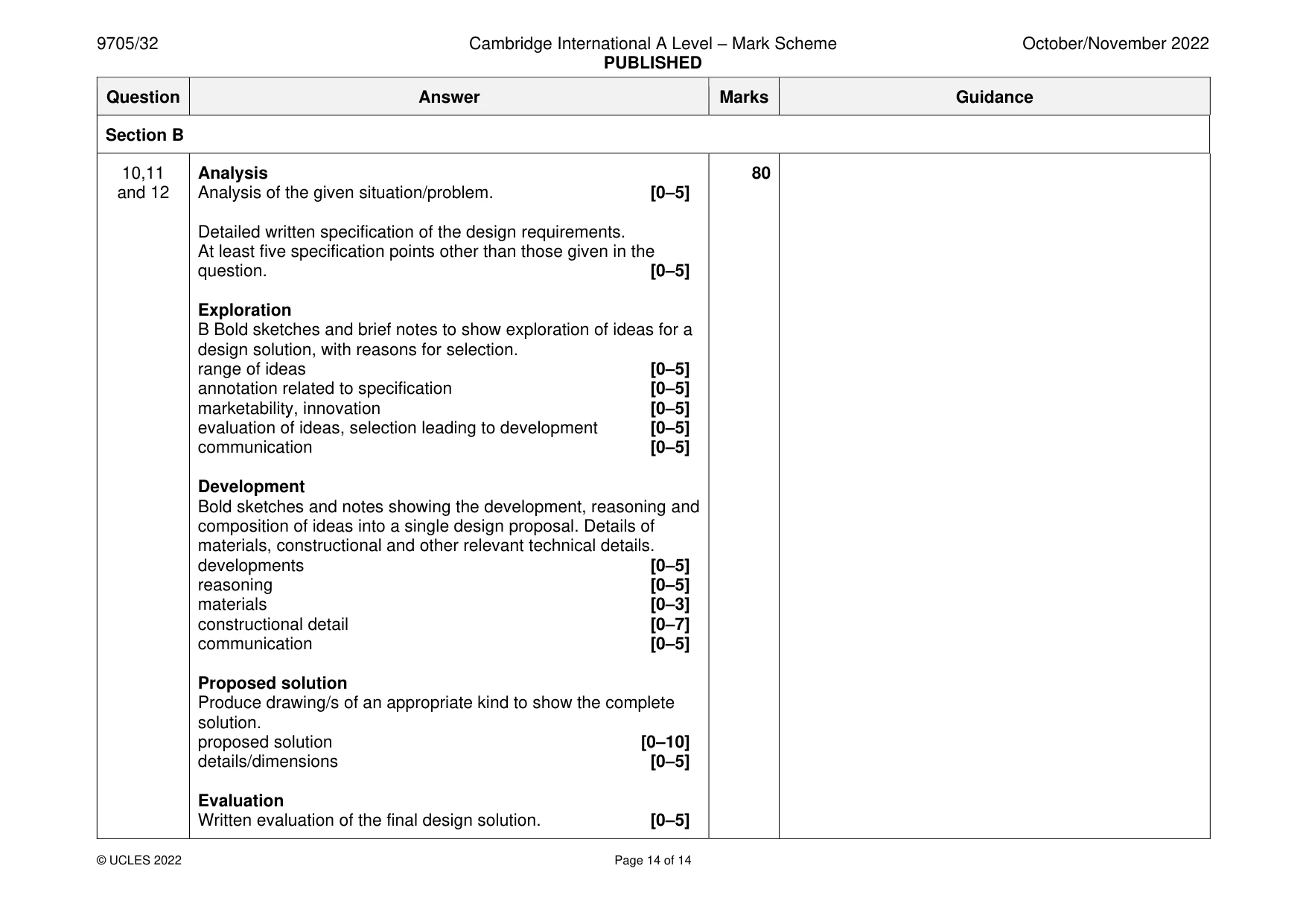
9705/32 Cambridge International A Level – Mark Scheme PUBLISHED October/November 2022 © UCLES 2022 Page 14 of 14 Question Answer Marks Guidance Section B 10,11 and 12 Analysis Analysis of the given situation/problem. [0–5] Detailed written specification of the design requirements. At least five specification points other than those given in the question. [0–5] Exploration B Bold sketches and brief notes to show exploration of ideas for a design solution, with reasons for selection. range of ideas [0–5] annotation related to specification [0–5] marketability, innovation [0–5] evaluation of ideas, selection leading to development [0–5] communication [0–5] Development Bold sketches and notes showing the development, reasoning and composition of ideas into a single design proposal. Details of materials, constructional and other relevant technical details. developments [0–5] reasoning [0–5] materials [0–3] constructional detail [0–7] communication [0–5] Proposed solution Produce drawing/s of an appropriate kind to show the complete solution. proposed solution [0–10] details/dimensions [0–5] Evaluation Written evaluation of the final design solution. [0–5] 80
What you needed in this session
Cambridge’s own grade thresholds for 2022 Oct/Nov, Paper 3 · Variant 2. A higher threshold means an easier paper — the bar moves with how the cohort did.