Cambridge A Level Design and Technology 9705 — 2021 Oct/Nov Paper 3 · Variant 2
9705/32/O/N/21 · 120 marks · ≈135 min
The question paper and its mark scheme, free to read here and free to download. This is Cambridge’s own paper, exactly as it was sat.
Question paper12 pages
Mark scheme17 pages
Answers below. Sit the paper first if you are practising.

Paper as text
Question paper, page 1
This document has 12 pages. Any blank pages are indicated. Cambridge International AS & A Level DESIGN & TECHNOLOGY 9705/32 Paper 3 October/November 2021 3 hours You must answer on the answer booklet/paper. You will need: Answer booklet/paper Coloured pencils A3 drawing paper (5 sheets) A range of design drawing equipment INSTRUCTIONS ● Answer three questions in total: Section A: answer two questions from one of the Parts A, B or C. Section B: answer one question. ● If you have been given an answer booklet, follow the instructions on the front cover of the answer booklet. ● Use a black or dark blue pen. ● Write your name, centre number and candidate number on all the work you hand in. ● Do not use an erasable pen or correction fluid. ● You may use an HB pencil, or coloured pencils as appropriate, for any diagrams, graphs or rough working. ● At the end of the examination, fasten all your work together. Do not use staples, paper clips or glue. INFORMATION ● The total mark for this paper is 120. ● The number of marks for each question or part question is shown in brackets [ ]. ● All dimensions are in millimetres. * 3 5 8 5 7 0 9 7 7 3 * DC (CJ/CT) 217336/2 © UCLES 2021 [Turn over
Question paper, page 2
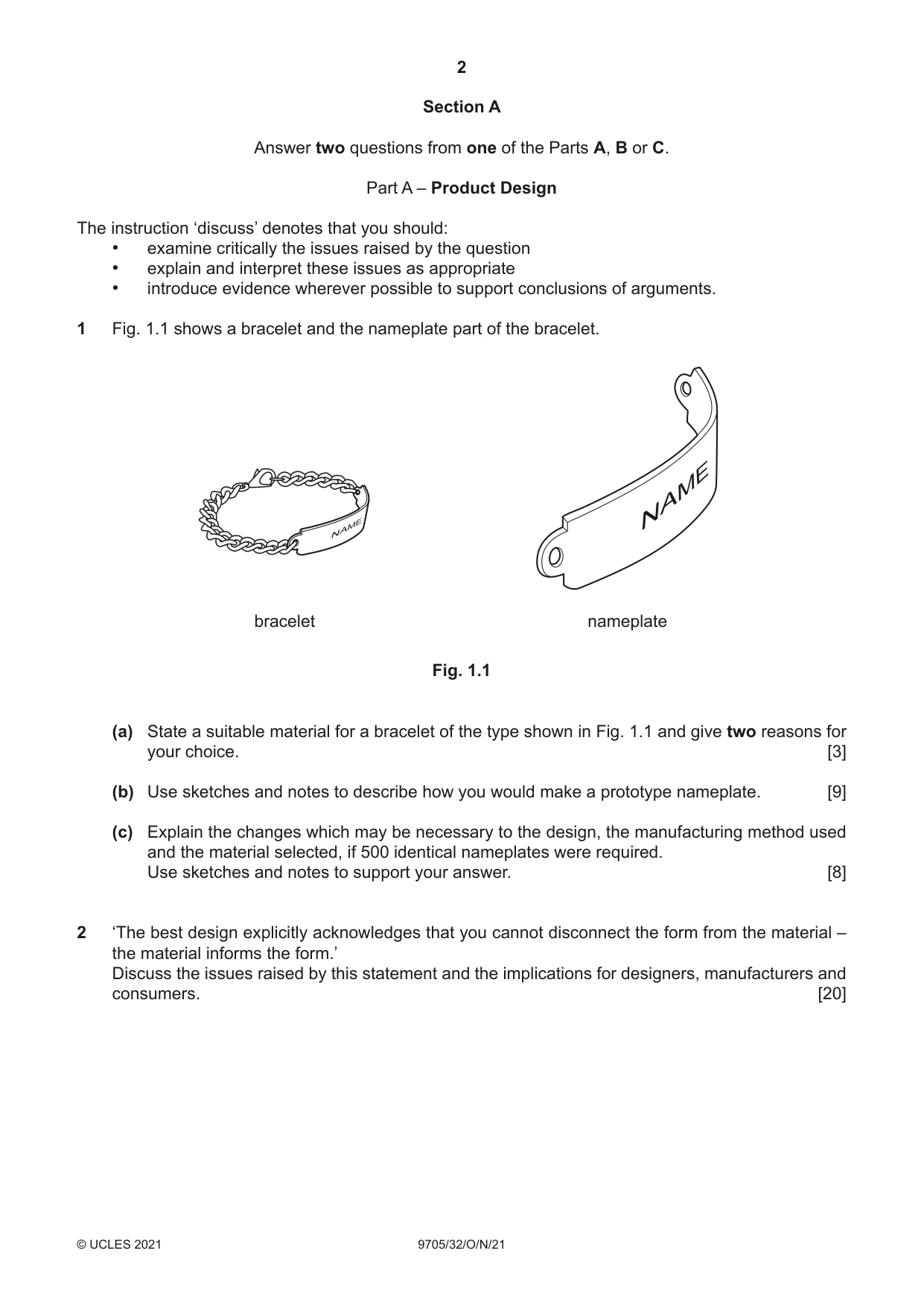
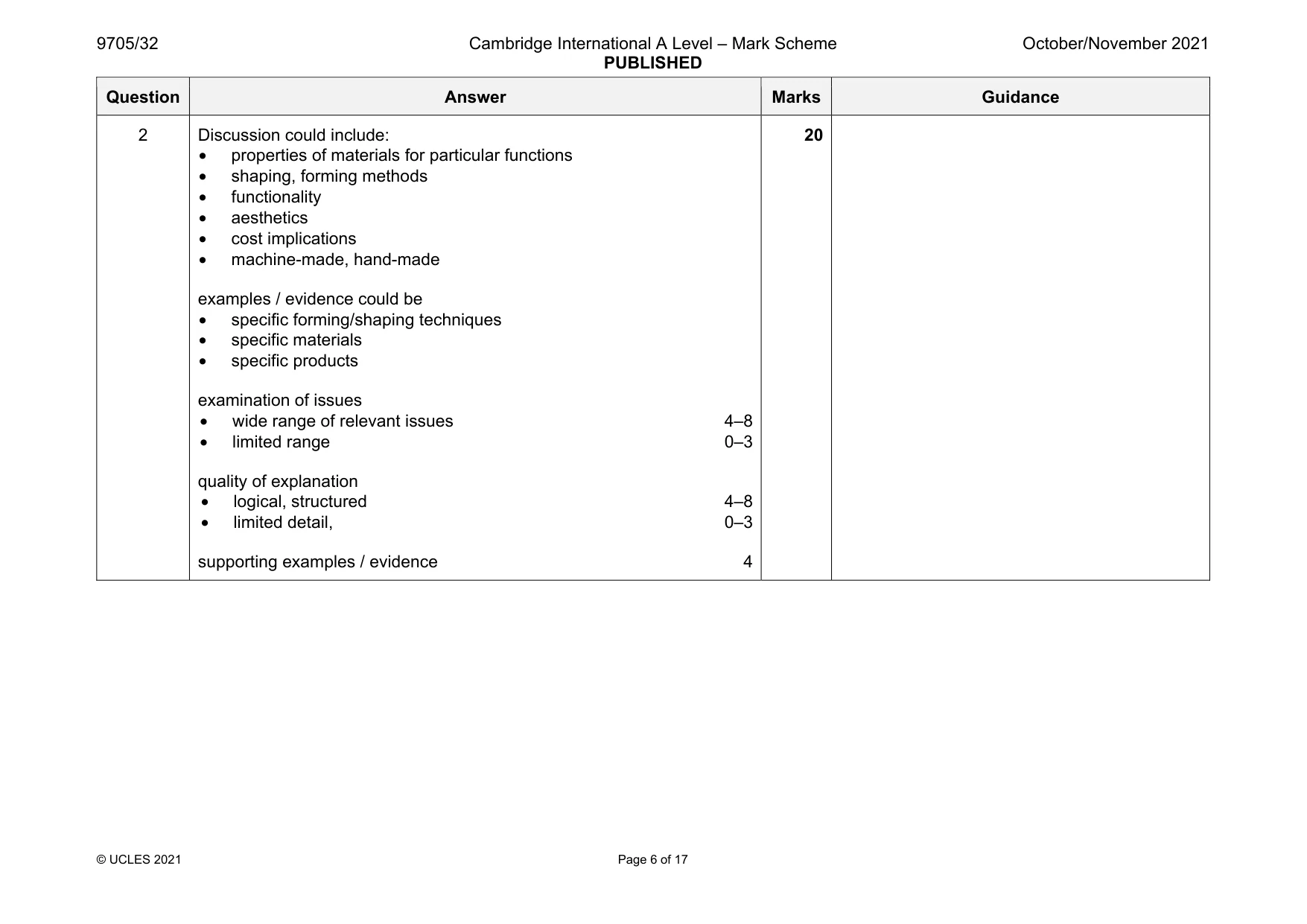
2 9705/32/O/N/21 © UCLES 2021 Section A Answer two questions from one of the Parts A, B or C. Part A – Product Design The instruction ‘discuss’ denotes that you should: • examine critically the issues raised by the question • explain and interpret these issues as appropriate • introduce evidence wherever possible to support conclusions of arguments. 1 Fig. 1.1 shows a bracelet and the nameplate part of the bracelet. bracelet nameplate Fig. 1.1 (a) State a suitable material for a bracelet of the type shown in Fig. 1.1 and give two reasons for your choice. [3] (b) Use sketches and notes to describe how you would make a prototype nameplate. [9] (c) Explain the changes which may be necessary to the design, the manufacturing method used and the material selected, if 500 identical nameplates were required. Use sketches and notes to support your answer. [8] 2 ‘The best design explicitly acknowledges that you cannot disconnect the form from the material – the material informs the form.’ Discuss the issues raised by this statement and the implications for designers, manufacturers and consumers. [20]
Question paper, page 3
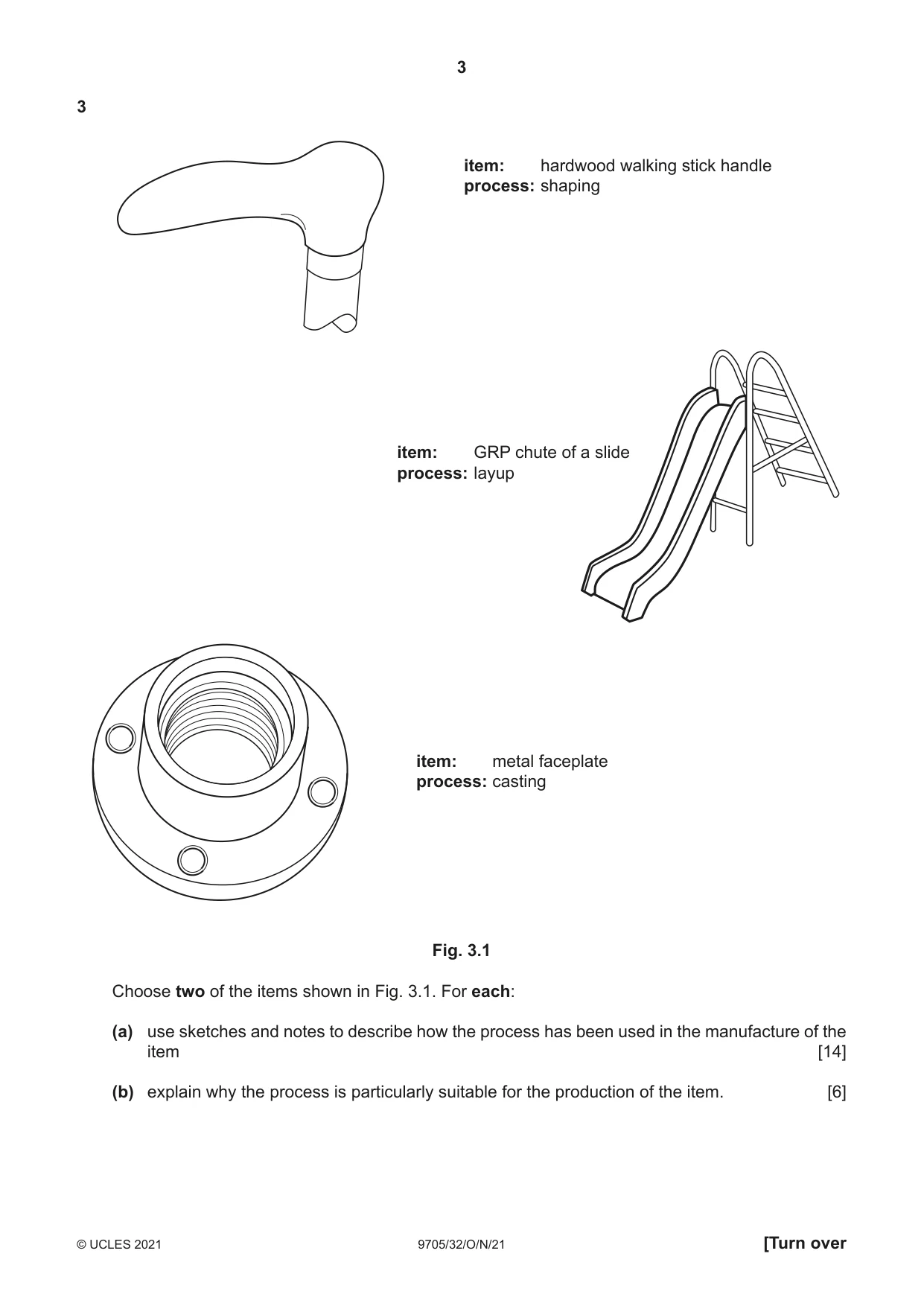
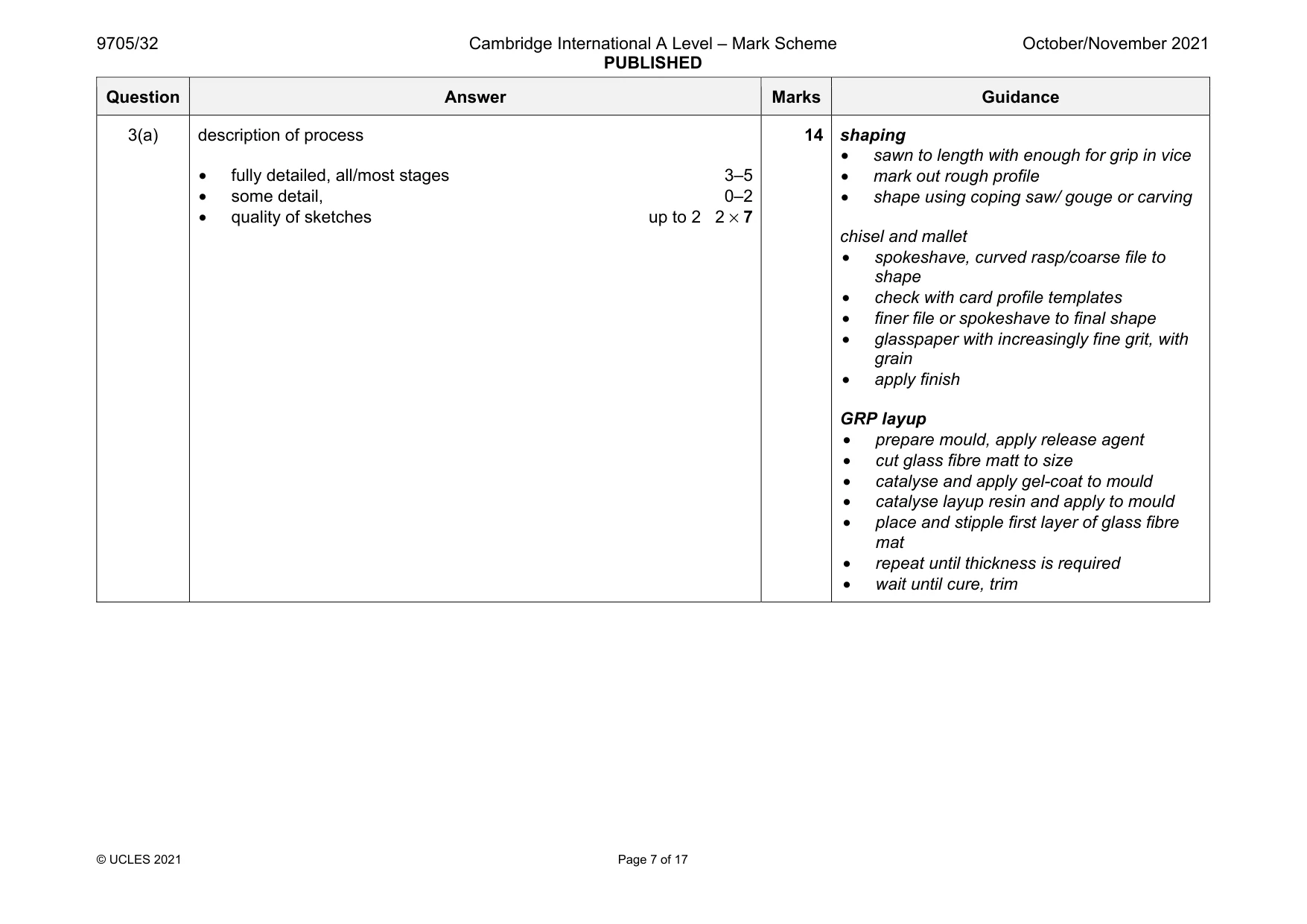
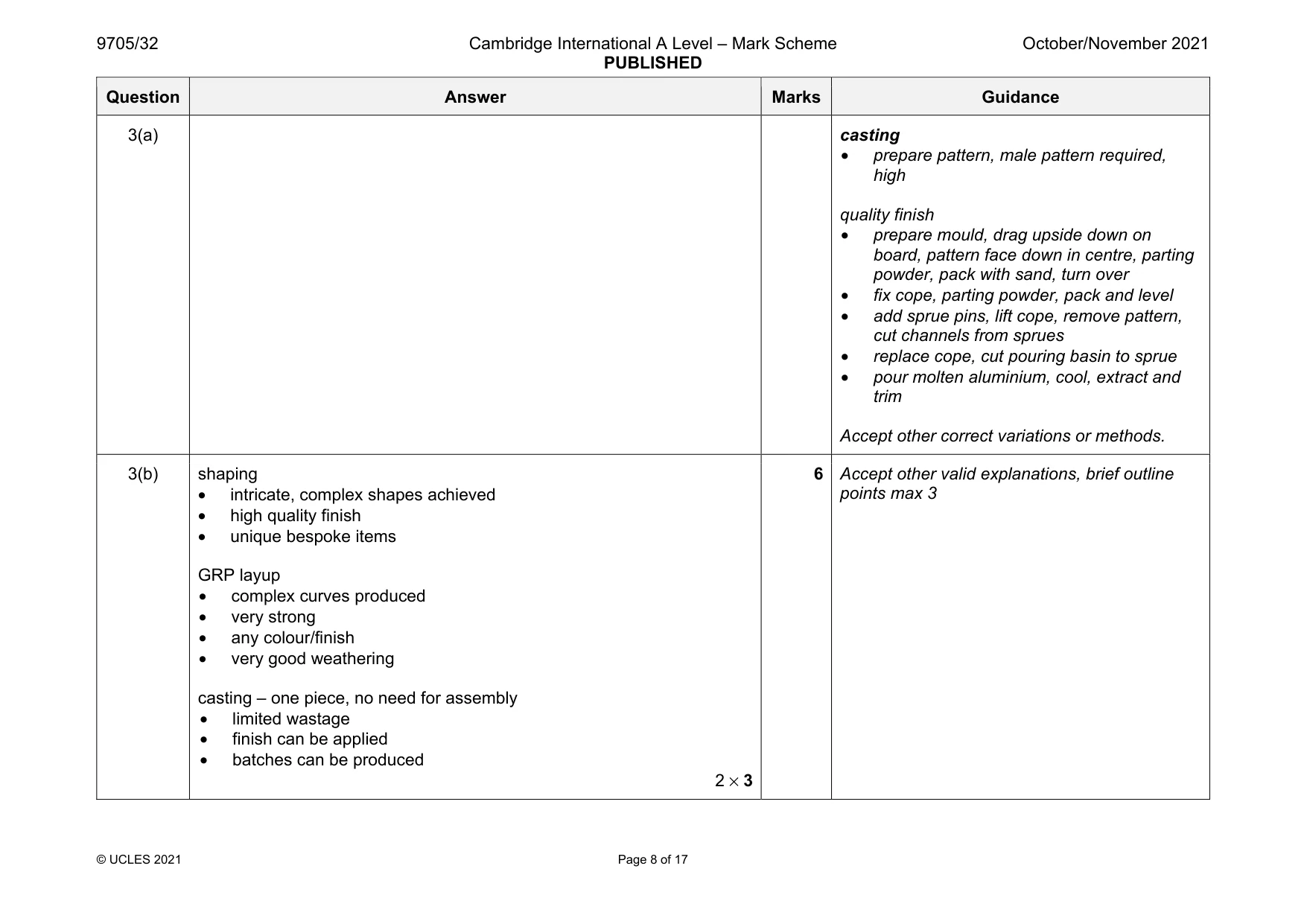
3 9705/32/O/N/21 © UCLES 2021 [Turn over 3 item: hardwood walking stick handle process: shaping item: GRP chute of a slide process: layup item: metal faceplate process: casting Fig. 3.1 Choose two of the items shown in Fig. 3.1. For each: (a) use sketches and notes to describe how the process has been used in the manufacture of the item [14] (b) explain why the process is particularly suitable for the production of the item. [6]
Question paper, page 4
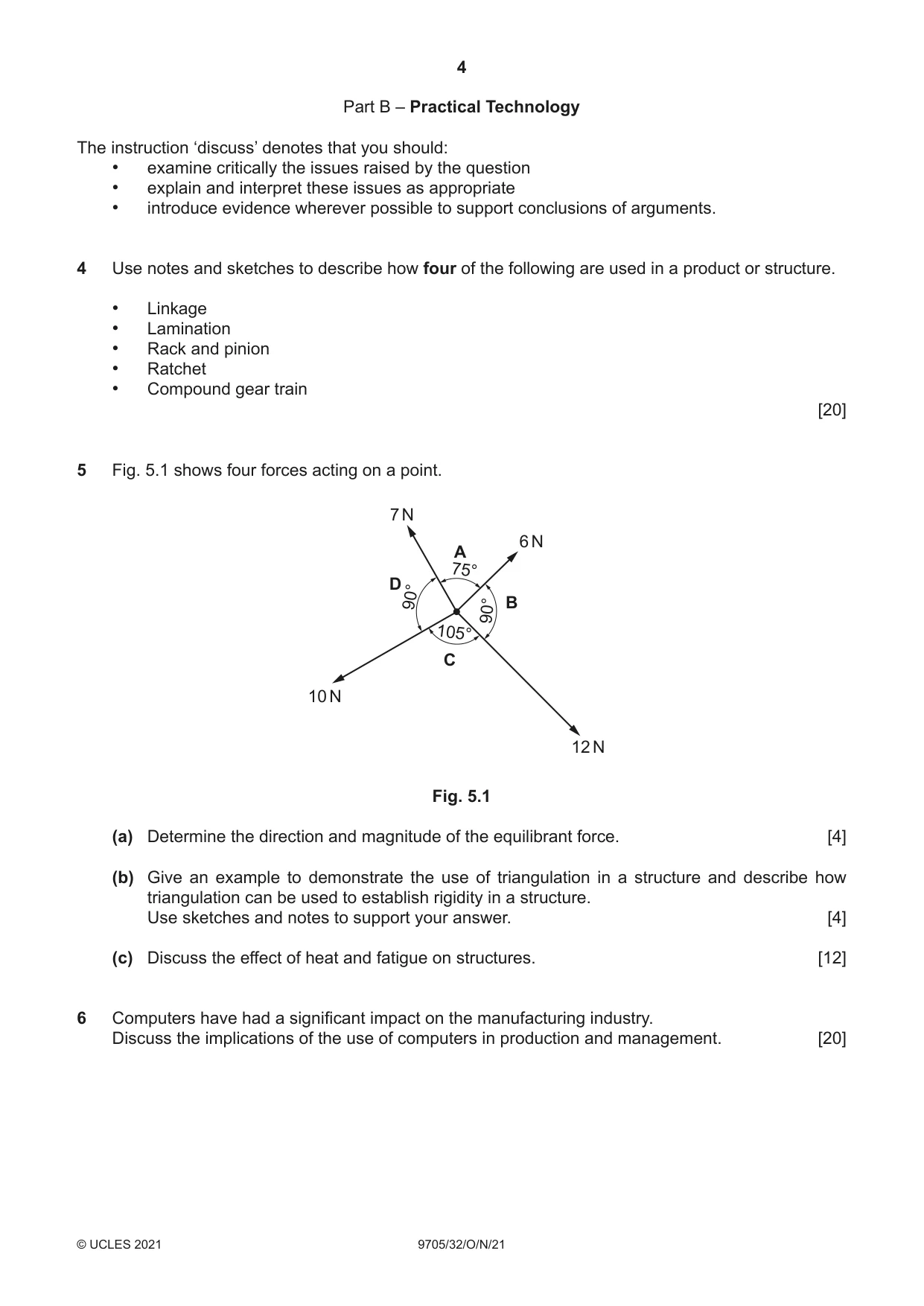
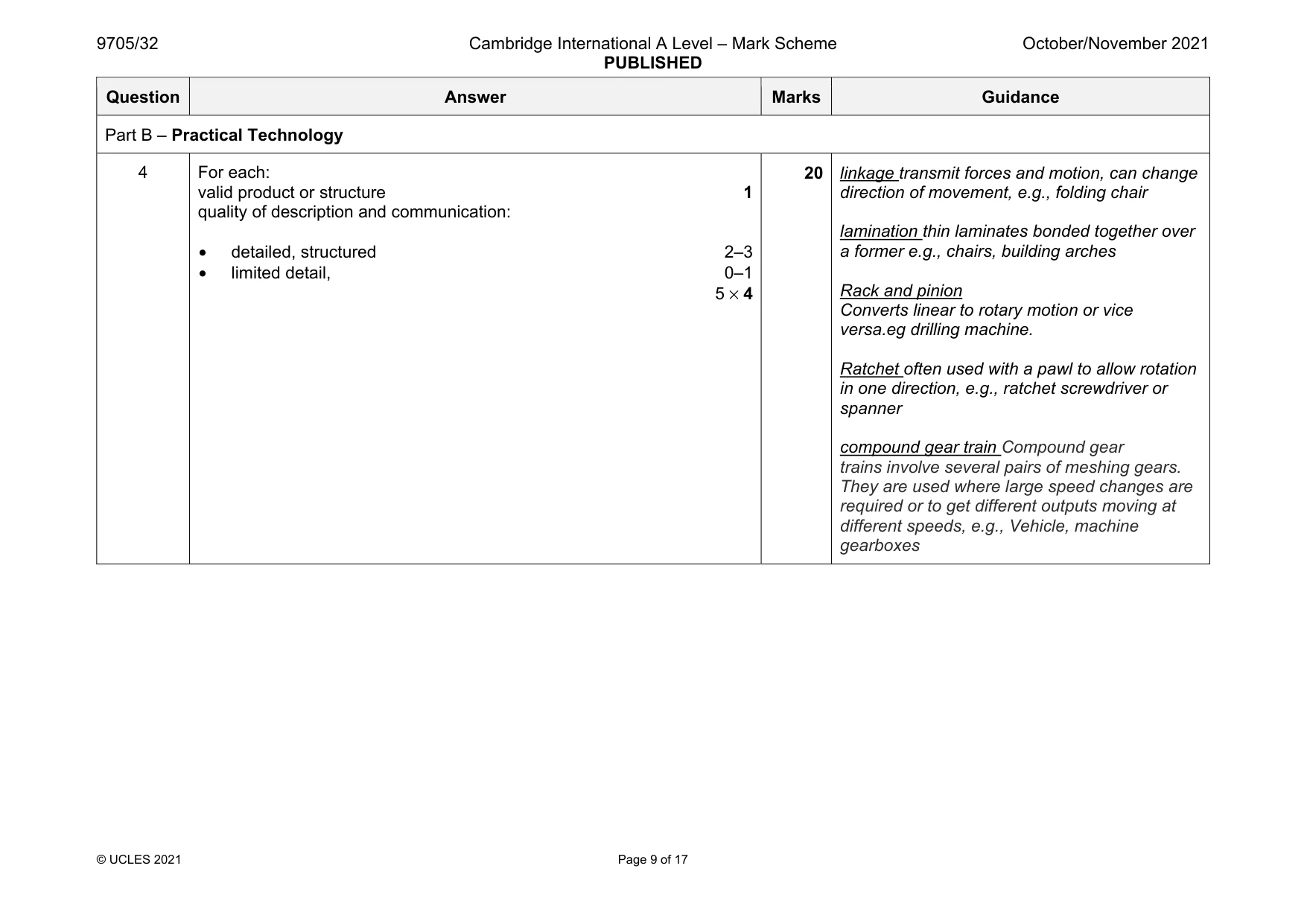
4 9705/32/O/N/21 © UCLES 2021 Part B – Practical Technology The instruction ‘discuss’ denotes that you should: • examine critically the issues raised by the question • explain and interpret these issues as appropriate • introduce evidence wherever possible to support conclusions of arguments. 4 Use notes and sketches to describe how four of the following are used in a product or structure. • Linkage • Lamination • Rack and pinion • Ratchet • Compound gear train [20] 5 Fig. 5.1 shows four forces acting on a point. 7 N 6 N 12 N 10 N D A B C 75° 90° 90° 105° Fig. 5.1 (a) Determine the direction and magnitude of the equilibrant force. [4] (b) Give an example to demonstrate the use of triangulation in a structure and describe how triangulation can be used to establish rigidity in a structure. Use sketches and notes to support your answer. [4] (c) Discuss the effect of heat and fatigue on structures. [12] 6 Computers have had a significant impact on the manufacturing industry. Discuss the implications of the use of computers in production and management. [20]
Question paper, page 5
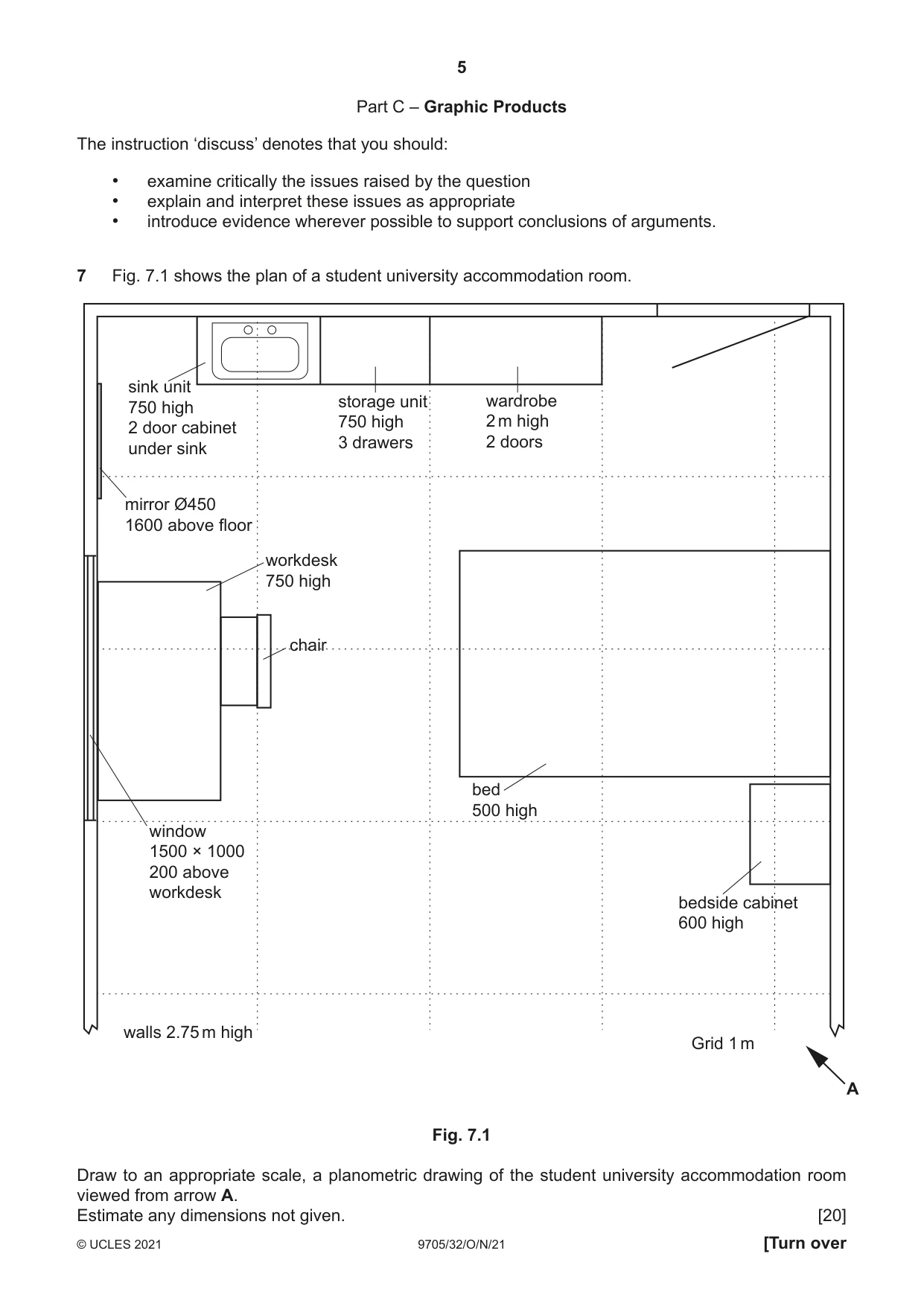
5 9705/32/O/N/21 © UCLES 2021 [Turn over Part C – Graphic Products The instruction ‘discuss’ denotes that you should: • examine critically the issues raised by the question • explain and interpret these issues as appropriate • introduce evidence wherever possible to support conclusions of arguments. 7 Fig. 7.1 shows the plan of a student university accommodation room. A Grid 1 m walls 2.75 m high chair workdesk 750 high bed 500 high bedside cabinet 600 high window 1500 × 1000 200 above workdesk sink unit 750 high 2 door cabinet under sink storage unit 750 high 3 drawers wardrobe 2 m high 2 doors mirror Ø450 1600 above floor Fig. 7.1 Draw to an appropriate scale, a planometric drawing of the student university accommodation room viewed from arrow A. Estimate any dimensions not given. [20]
Question paper, page 6
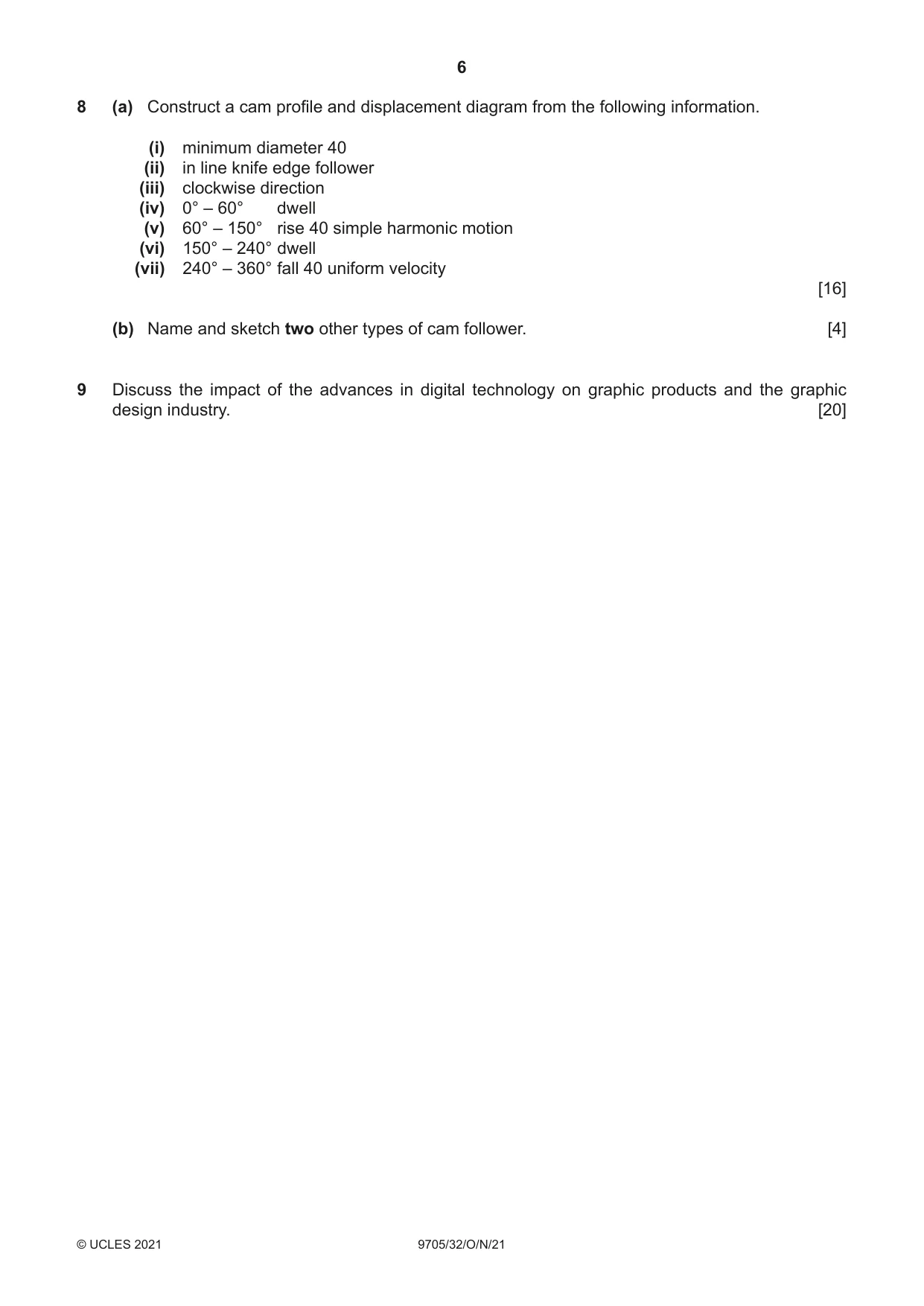
6 9705/32/O/N/21 © UCLES 2021 8 (a) Construct a cam profile and displacement diagram from the following information. (i) minimum diameter 40 (ii) in line knife edge follower (iii) clockwise direction (iv) 0° – 60° dwell (v) 60° – 150° rise 40 simple harmonic motion (vi) 150° – 240° dwell (vii) 240° – 360° fall 40 uniform velocity [16] (b) Name and sketch two other types of cam follower. [4] 9 Discuss the impact of the advances in digital technology on graphic products and the graphic design industry. [20]
Question paper, page 7
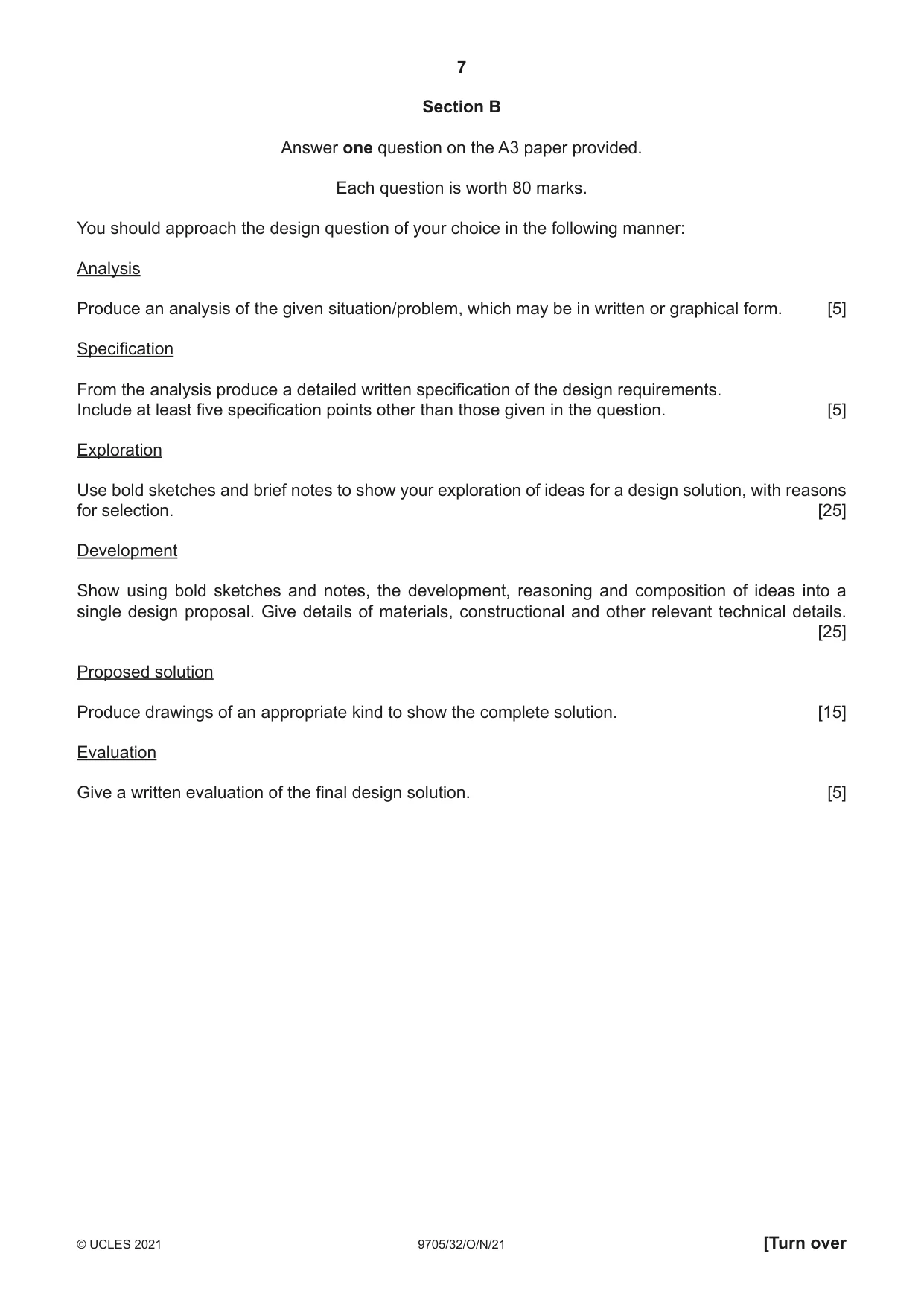
7 9705/32/O/N/21 © UCLES 2021 [Turn over Section B Answer one question on the A3 paper provided. Each question is worth 80 marks. You should approach the design question of your choice in the following manner: Analysis Produce an analysis of the given situation/problem, which may be in written or graphical form. [5] Specification From the analysis produce a detailed written specification of the design requirements. Include at least five specification points other than those given in the question. [5] Exploration Use bold sketches and brief notes to show your exploration of ideas for a design solution, with reasons for selection. [25] Development Show using bold sketches and notes, the development, reasoning and composition of ideas into a single design proposal. Give details of materials, constructional and other relevant technical details. [25] Proposed solution Produce drawings of an appropriate kind to show the complete solution. [15] Evaluation Give a written evaluation of the final design solution. [5]
Question paper, page 8
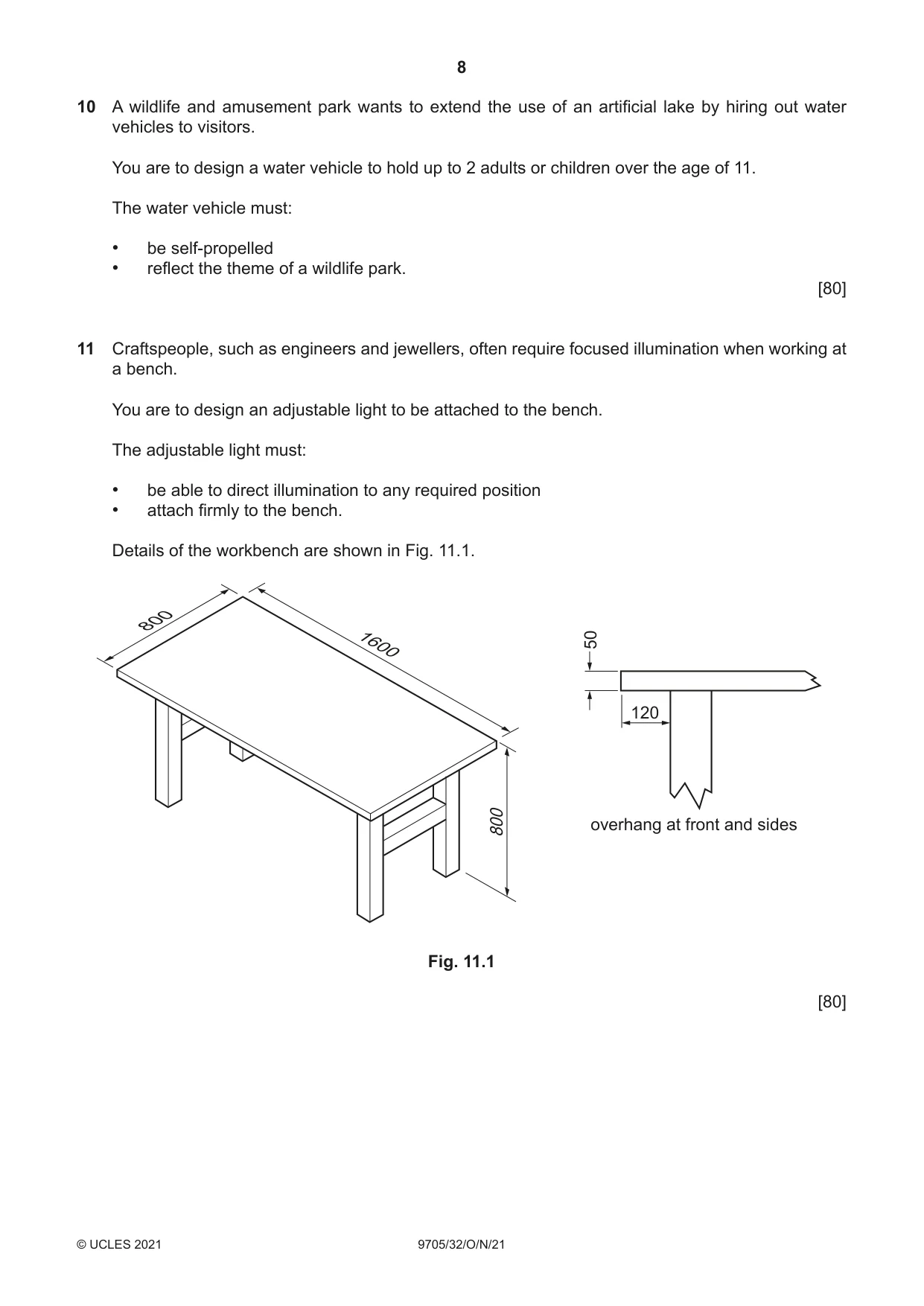
8 9705/32/O/N/21 © UCLES 2021 10 A wildlife and amusement park wants to extend the use of an artificial lake by hiring out water vehicles to visitors. You are to design a water vehicle to hold up to 2 adults or children over the age of 11. The water vehicle must: • be self-propelled • reflect the theme of a wildlife park. [80] 11 Craftspeople, such as engineers and jewellers, often require focused illumination when working at a bench. You are to design an adjustable light to be attached to the bench. The adjustable light must: • be able to direct illumination to any required position • attach firmly to the bench. Details of the workbench are shown in Fig. 11.1. 120 50 overhang at front and sides 800 800 1600 Fig. 11.1 [80]
Question paper, page 9
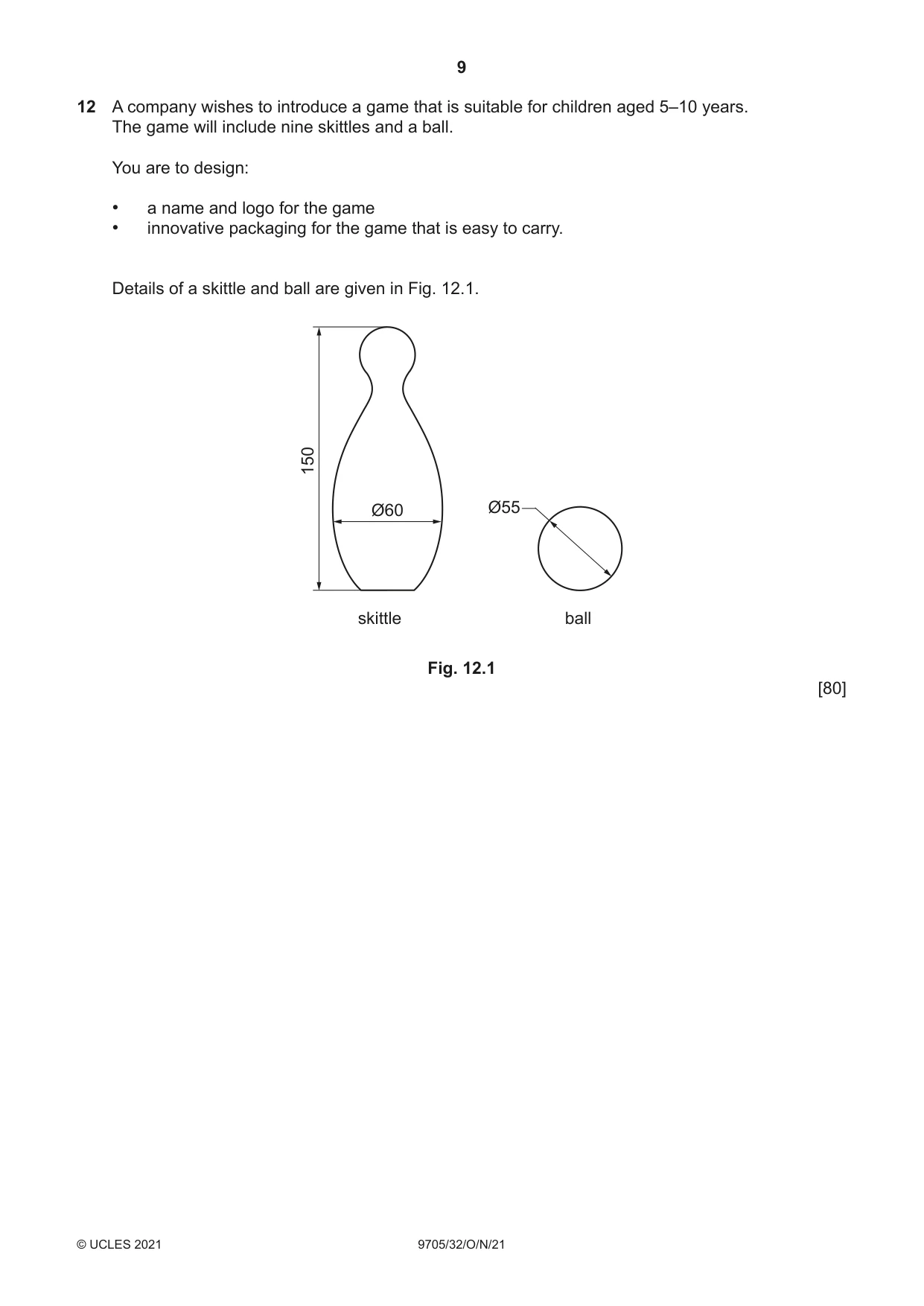
9 9705/32/O/N/21 © UCLES 2021 12 A company wishes to introduce a game that is suitable for children aged 5–10 years. The game will include nine skittles and a ball. You are to design: • a name and logo for the game • innovative packaging for the game that is easy to carry. Details of a skittle and ball are given in Fig. 12.1. skittle ball 150 Ø60 Ø55 Fig. 12.1 [80]
Question paper, page 10
10 9705/32/O/N/21 © UCLES 2021 BLANK PAGE
Question paper, page 11
11 9705/32/O/N/21 © UCLES 2021 BLANK PAGE
Question paper, page 12
12 9705/32/O/N/21 © UCLES 2021 Permission to reproduce items where third-party owned material protected by copyright is included has been sought and cleared where possible. Every reasonable effort has been made by the publisher (UCLES) to trace copyright holders, but if any items requiring clearance have unwittingly been included, the publisher will be pleased to make amends at the earliest possible opportunity. To avoid the issue of disclosure of answer-related information to candidates, all copyright acknowledgements are reproduced online in the Cambridge Assessment International Education Copyright Acknowledgements Booklet. This is produced for each series of examinations and is freely available to download at www.cambridgeinternational.org after the live examination series. Cambridge Assessment International Education is part of the Cambridge Assessment Group. Cambridge Assessment is the brand name of the University of Cambridge Local Examinations Syndicate (UCLES), which itself is a department of the University of Cambridge. BLANK PAGE
Mark scheme, page 1
This document consists of 17 printed pages. © UCLES 2021 [Turn over Cambridge International A Level DESIGN AND TECHNOLOGY 9705/32 Paper 3 October/November 2021 MARK SCHEME Maximum Mark: 120 Published This mark scheme is published as an aid to teachers and candidates, to indicate the requirements of the examination. It shows the basis on which Examiners were instructed to award marks. It does not indicate the details of the discussions that took place at an Examiners’ meeting before marking began, which would have considered the acceptability of alternative answers. Mark schemes should be read in conjunction with the question paper and the Principal Examiner Report for Teachers. Cambridge International will not enter into discussions about these mark schemes. Cambridge International is publishing the mark schemes for the October/November 2021 series for most Cambridge IGCSE™, Cambridge International A and AS Level components and some Cambridge O Level components.
Mark scheme, page 2
9705/32 Cambridge International A Level – Mark Scheme PUBLISHED October/November 2021 © UCLES 2021 Page 2 of 17 Generic Marking Principles These general marking principles must be applied by all examiners when marking candidate answers. They should be applied alongside the specific content of the mark scheme or generic level descriptors for a question. Each question paper and mark scheme will also comply with these marking principles. GENERIC MARKING PRINCIPLE 1: Marks must be awarded in line with: • the specific content of the mark scheme or the generic level descriptors for the question • the specific skills defined in the mark scheme or in the generic level descriptors for the question • the standard of response required by a candidate as exemplified by the standardisation scripts. GENERIC MARKING PRINCIPLE 2: Marks awarded are always whole marks (not half marks, or other fractions). GENERIC MARKING PRINCIPLE 3: Marks must be awarded positively: • marks are awarded for correct/valid answers, as defined in the mark scheme. However, credit is given for valid answers which go beyond the scope of the syllabus and mark scheme, referring to your Team Leader as appropriate • marks are awarded when candidates clearly demonstrate what they know and can do • marks are not deducted for errors • marks are not deducted for omissions • answers should only be judged on the quality of spelling, punctuation and grammar when these features are specifically assessed by the question as indicated by the mark scheme. The meaning, however, should be unambiguous. GENERIC MARKING PRINCIPLE 4: Rules must be applied consistently, e.g. in situations where candidates have not followed instructions or in the application of generic level descriptors.
Mark scheme, page 3
9705/32 Cambridge International A Level – Mark Scheme PUBLISHED October/November 2021 © UCLES 2021 Page 3 of 17 GENERIC MARKING PRINCIPLE 5: Marks should be awarded using the full range of marks defined in the mark scheme for the question (however; the use of the full mark range may be limited according to the quality of the candidate responses seen). GENERIC MARKING PRINCIPLE 6: Marks awarded are based solely on the requirements as defined in the mark scheme. Marks should not be awarded with grade thresholds or grade descriptors in mind.
Mark scheme, page 4
9705/32 Cambridge International A Level – Mark Scheme PUBLISHED October/November 2021 © UCLES 2021 Page 4 of 17 Question Answer Marks Guidance Section A Part A – Product Design 1(a) suitable material: • brass, copper, siver, gold • aluminium alloy, stainless steel • attractive hardwood • abs, acrylic reasons: • attractive material, good finish • smooth finish, will not cause skin irritation any other reason appropriate to material choice 3 1(b) quality of description: • fully detailed all/most stages 4–7 • some detail, 0–3 • quality of sketches up to 2 9 Dependant on material chosen. Laminated hardwood, e.g., rosewood. ABS,polypropylene, acrylic thermoformed Must show shaping, drilling, and bending of material
Mark scheme, page 5
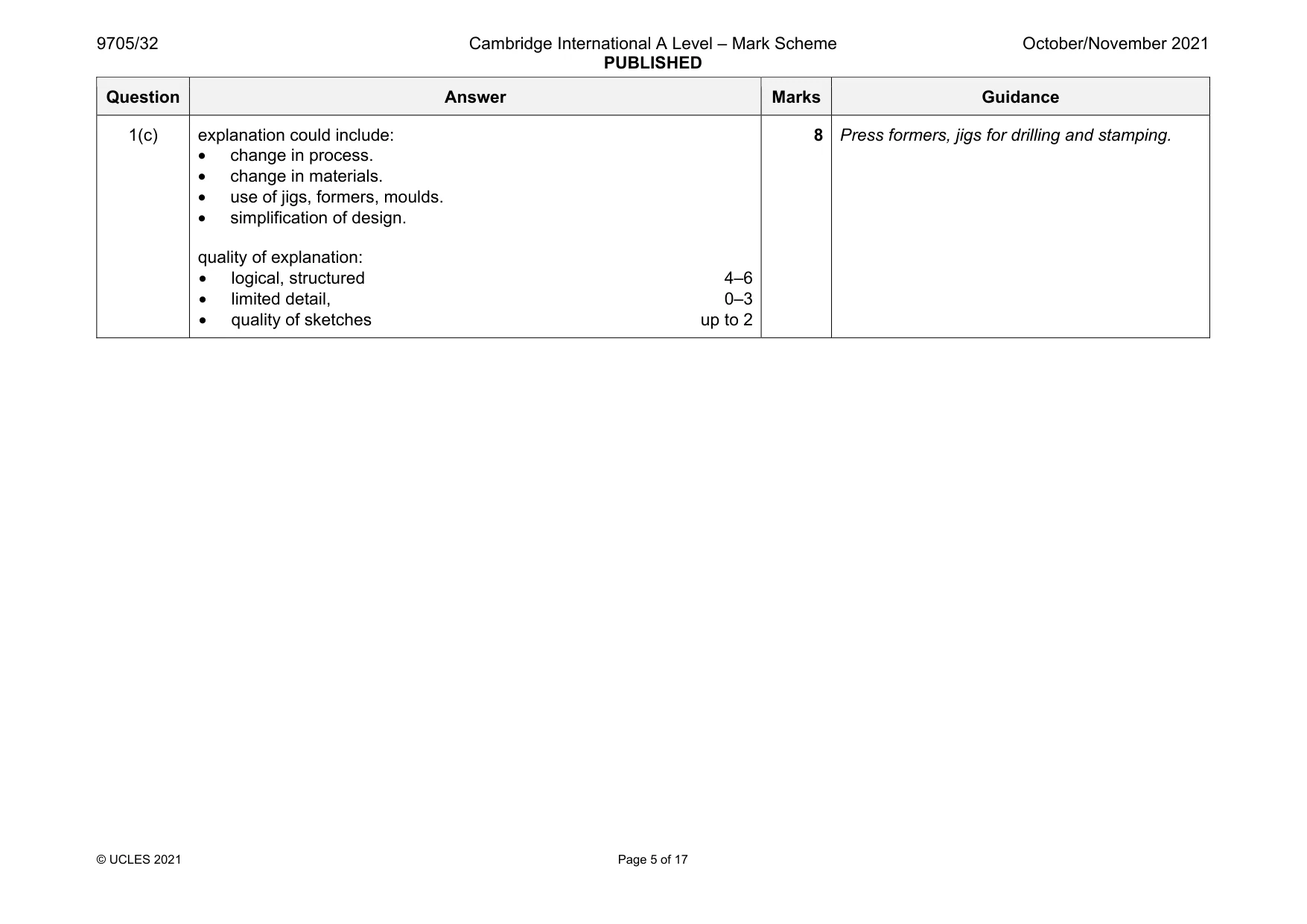
9705/32 Cambridge International A Level – Mark Scheme PUBLISHED October/November 2021 © UCLES 2021 Page 5 of 17 Question Answer Marks Guidance 1(c) explanation could include: • change in process. • change in materials. • use of jigs, formers, moulds. • simplification of design. quality of explanation: • logical, structured 4–6 • limited detail, 0–3 • quality of sketches up to 2 8 Press formers, jigs for drilling and stamping.
Mark scheme, page 6
9705/32 Cambridge International A Level – Mark Scheme PUBLISHED October/November 2021 © UCLES 2021 Page 6 of 17 Question Answer Marks Guidance 2 Discussion could include: • properties of materials for particular functions • shaping, forming methods • functionality • aesthetics • cost implications • machine-made, hand-made examples / evidence could be • specific forming/shaping techniques • specific materials • specific products examination of issues • wide range of relevant issues 4–8 • limited range 0–3 quality of explanation • logical, structured 4–8 • limited detail, 0–3 supporting examples / evidence 4 20
Mark scheme, page 7
9705/32 Cambridge International A Level – Mark Scheme PUBLISHED October/November 2021 © UCLES 2021 Page 7 of 17 Question Answer Marks Guidance 3(a) description of process • fully detailed, all/most stages 3–5 • some detail, 0–2 • quality of sketches up to 2 2 × 7 14 shaping • sawn to length with enough for grip in vice • mark out rough profile • shape using coping saw/ gouge or carving chisel and mallet • spokeshave, curved rasp/coarse file to shape • check with card profile templates • finer file or spokeshave to final shape • glasspaper with increasingly fine grit, with grain • apply finish GRP layup • prepare mould, apply release agent • cut glass fibre matt to size • catalyse and apply gel-coat to mould • catalyse layup resin and apply to mould • place and stipple first layer of glass fibre mat • repeat until thickness is required • wait until cure, trim
Mark scheme, page 8
9705/32 Cambridge International A Level – Mark Scheme PUBLISHED October/November 2021 © UCLES 2021 Page 8 of 17 Question Answer Marks Guidance 3(a) casting • prepare pattern, male pattern required, high quality finish • prepare mould, drag upside down on board, pattern face down in centre, parting powder, pack with sand, turn over • fix cope, parting powder, pack and level • add sprue pins, lift cope, remove pattern, cut channels from sprues • replace cope, cut pouring basin to sprue • pour molten aluminium, cool, extract and trim Accept other correct variations or methods. 3(b) shaping • intricate, complex shapes achieved • high quality finish • unique bespoke items GRP layup • complex curves produced • very strong • any colour/finish • very good weathering casting – one piece, no need for assembly • limited wastage • finish can be applied • batches can be produced 2 × 3 6 Accept other valid explanations, brief outline points max 3
Mark scheme, page 9
9705/32 Cambridge International A Level – Mark Scheme PUBLISHED October/November 2021 © UCLES 2021 Page 9 of 17 Question Answer Marks Guidance Part B – Practical Technology 4 For each: valid product or structure 1 quality of description and communication: • detailed, structured 2–3 • limited detail, 0–1 5 × 4 20 linkage transmit forces and motion, can change direction of movement, e.g., folding chair lamination thin laminates bonded together over a former e.g., chairs, building arches Rack and pinion Converts linear to rotary motion or vice versa.eg drilling machine. Ratchet often used with a pawl to allow rotation in one direction, e.g., ratchet screwdriver or spanner compound gear train Compound gear trains involve several pairs of meshing gears. They are used where large speed changes are required or to get different outputs moving at different speeds, e.g., Vehicle, machine gearboxes
Mark scheme, page 10
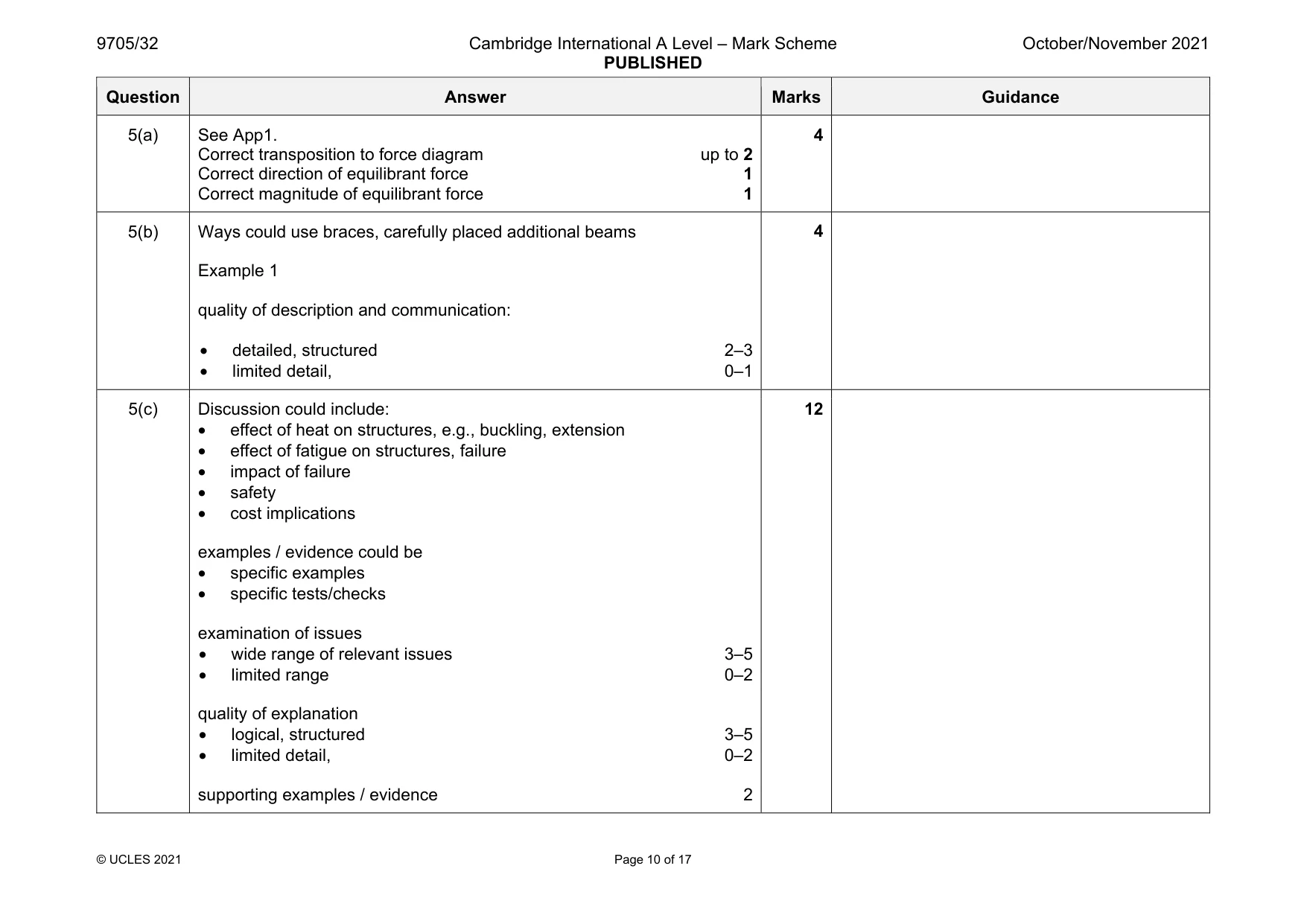
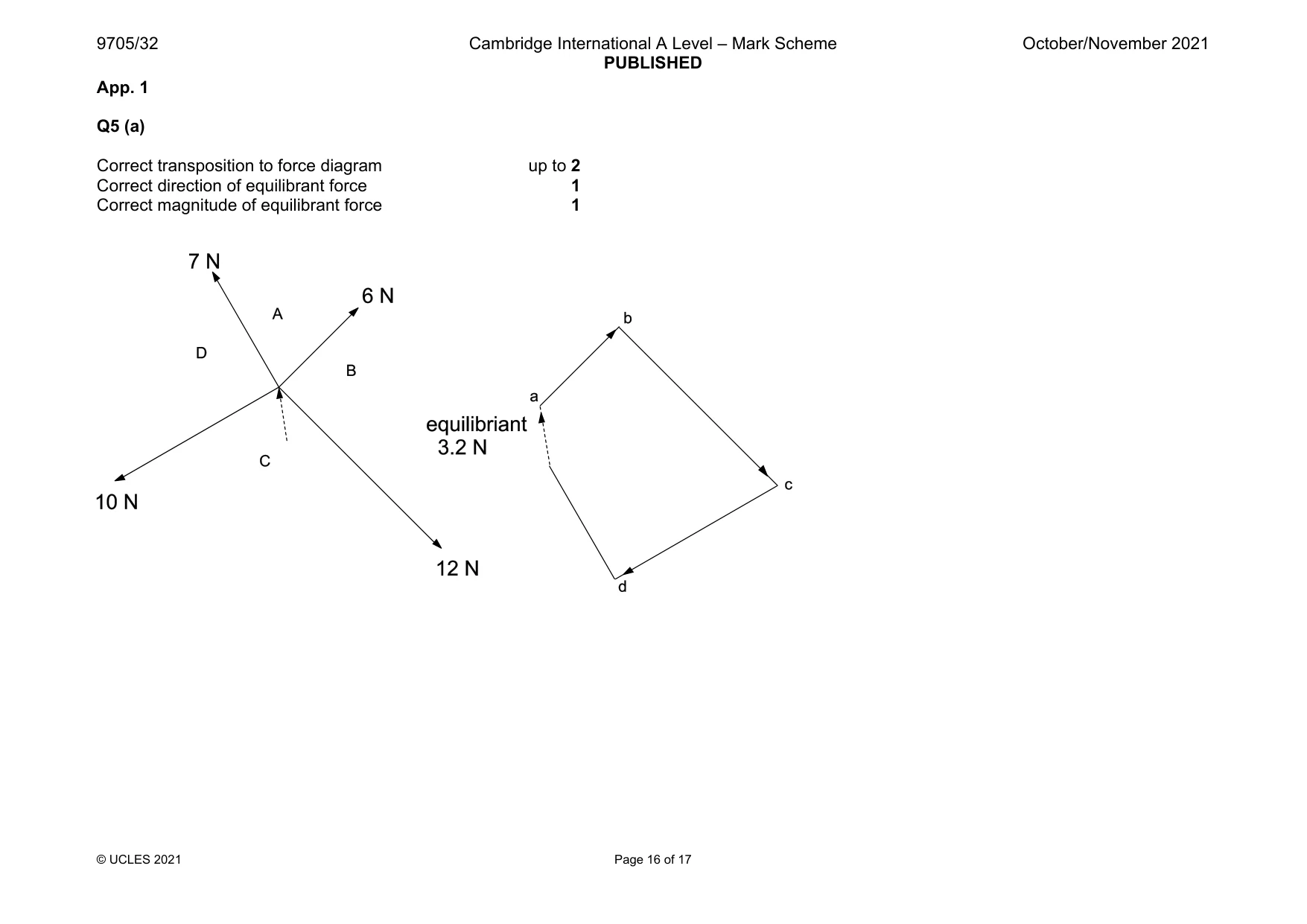
9705/32 Cambridge International A Level – Mark Scheme PUBLISHED October/November 2021 © UCLES 2021 Page 10 of 17 Question Answer Marks Guidance 5(a) See App1. Correct transposition to force diagram up to 2 Correct direction of equilibrant force 1 Correct magnitude of equilibrant force 1 4 5(b) Ways could use braces, carefully placed additional beams Example 1 quality of description and communication: • detailed, structured 2–3 • limited detail, 0–1 4 5(c) Discussion could include: • effect of heat on structures, e.g., buckling, extension • effect of fatigue on structures, failure • impact of failure • safety • cost implications examples / evidence could be • specific examples • specific tests/checks examination of issues • wide range of relevant issues 3–5 • limited range 0–2 quality of explanation • logical, structured 3–5 • limited detail, 0–2 supporting examples / evidence 2 12
Mark scheme, page 11
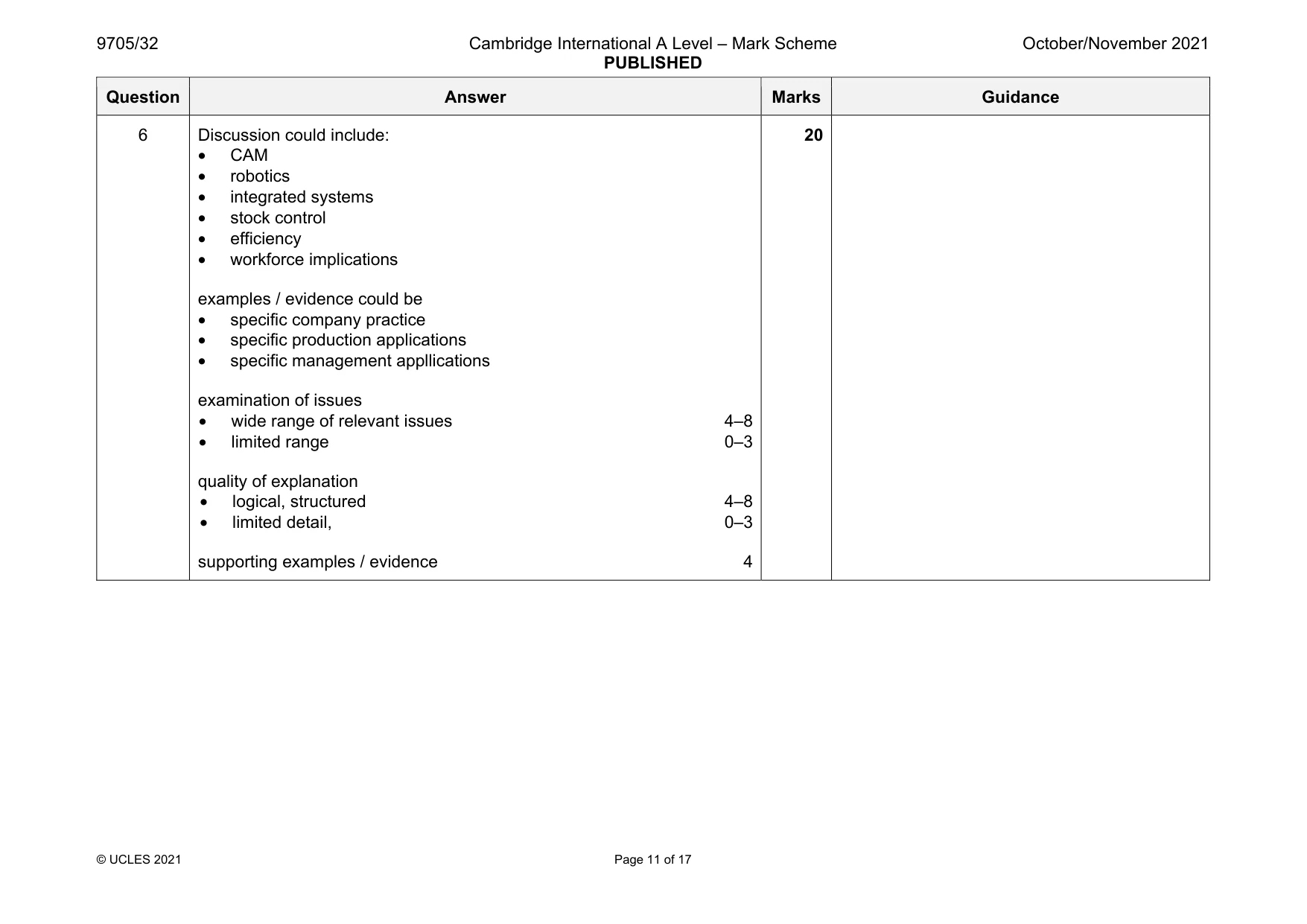
9705/32 Cambridge International A Level – Mark Scheme PUBLISHED October/November 2021 © UCLES 2021 Page 11 of 17 Question Answer Marks Guidance 6 Discussion could include: • CAM • robotics • integrated systems • stock control • efficiency • workforce implications examples / evidence could be • specific company practice • specific production applications • specific management appllications examination of issues • wide range of relevant issues 4–8 • limited range 0–3 quality of explanation • logical, structured 4–8 • limited detail, 0–3 supporting examples / evidence 4 20
Mark scheme, page 12
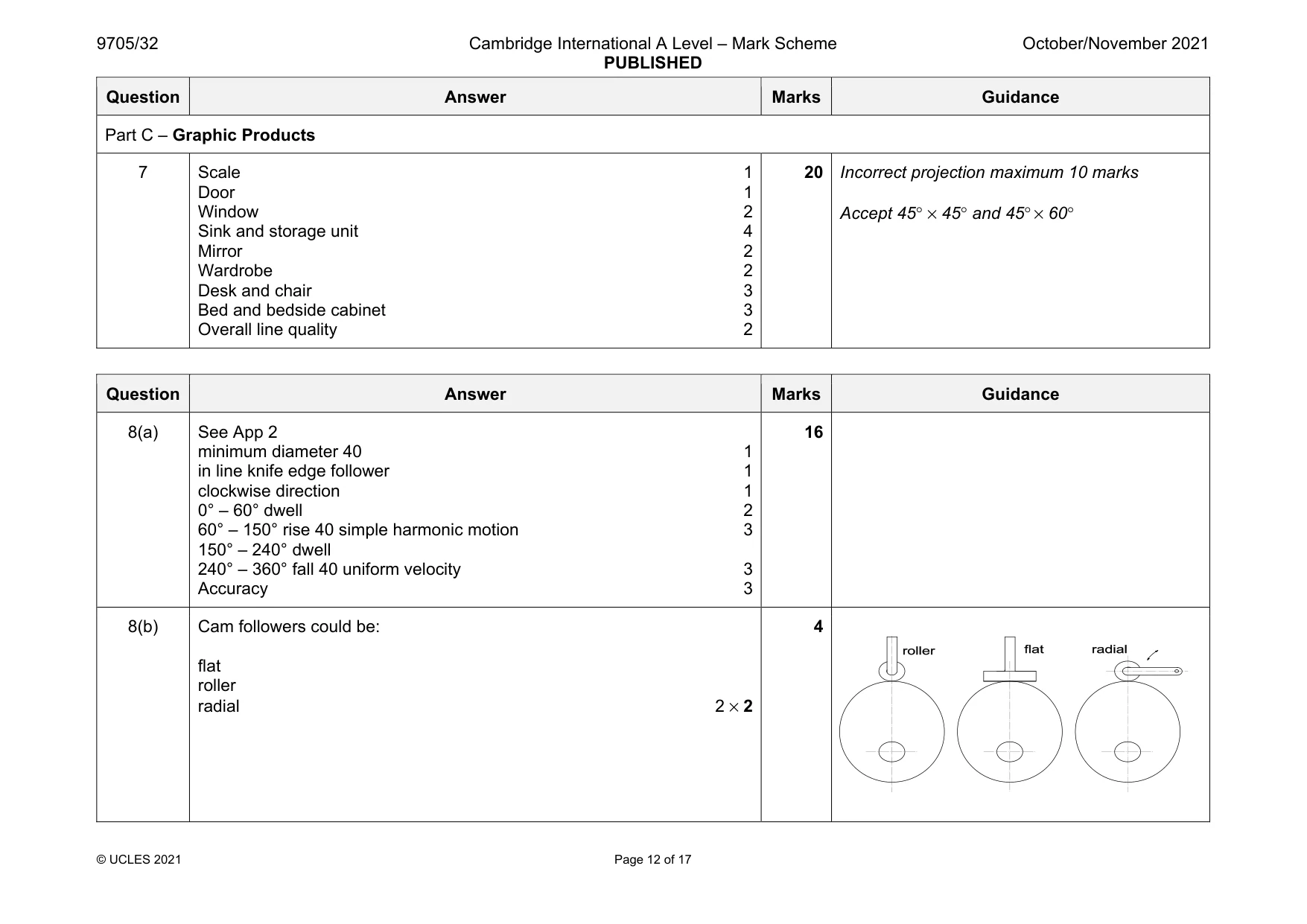
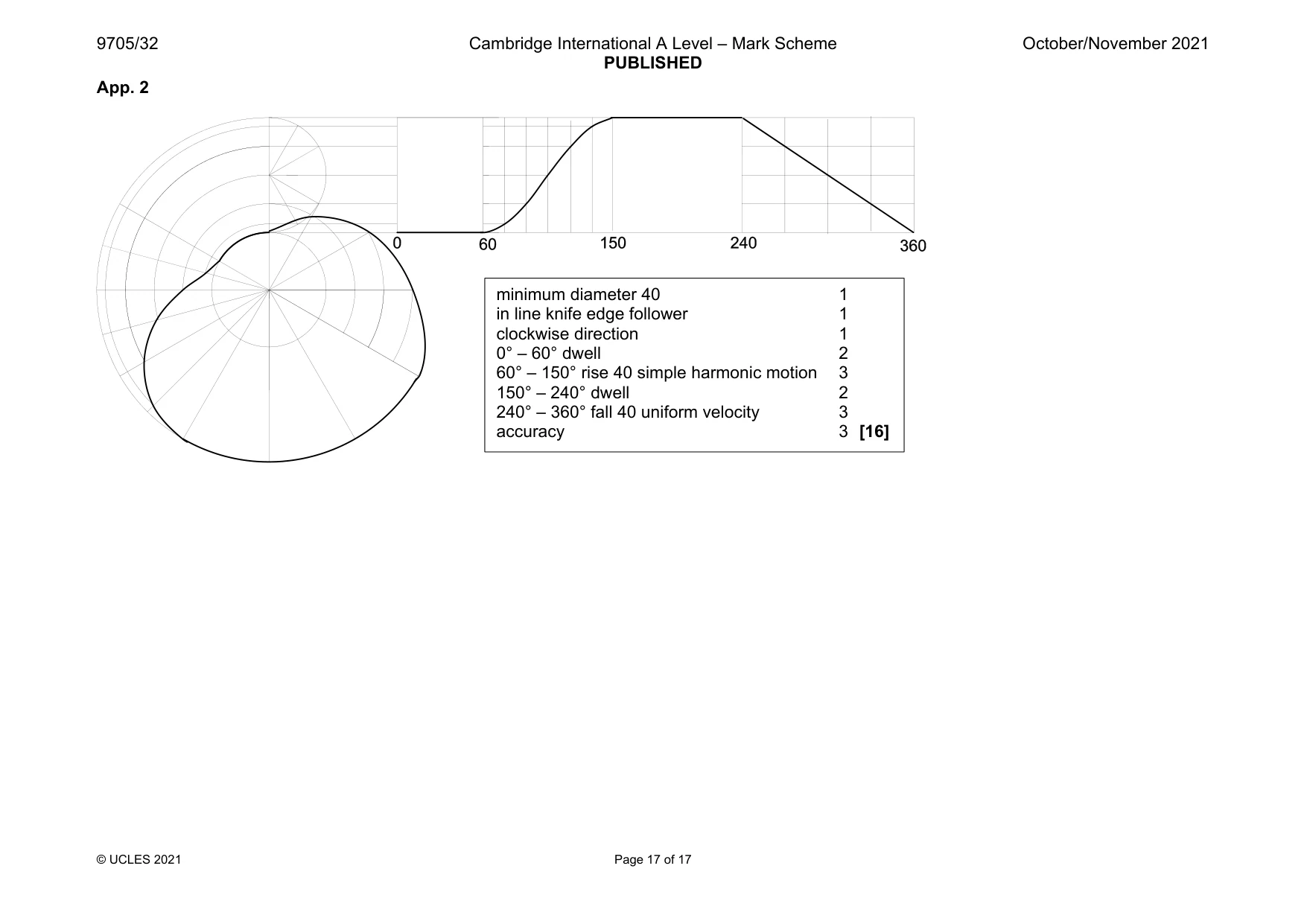
9705/32 Cambridge International A Level – Mark Scheme PUBLISHED October/November 2021 © UCLES 2021 Page 12 of 17 Question Answer Marks Guidance Part C – Graphic Products 7 Scale 1 Door 1 Window 2 Sink and storage unit 4 Mirror 2 Wardrobe 2 Desk and chair 3 Bed and bedside cabinet 3 Overall line quality 2 20 Incorrect projection maximum 10 marks Accept 45° × 45° and 45° × 60° Question Answer Marks Guidance 8(a) See App 2 minimum diameter 40 1 in line knife edge follower 1 clockwise direction 1 0° – 60° dwell 2 60° – 150° rise 40 simple harmonic motion 3 150° – 240° dwell 240° – 360° fall 40 uniform velocity 3 Accuracy 3 16 8(b) Cam followers could be: flat roller radial 2 × 2 4
Mark scheme, page 13
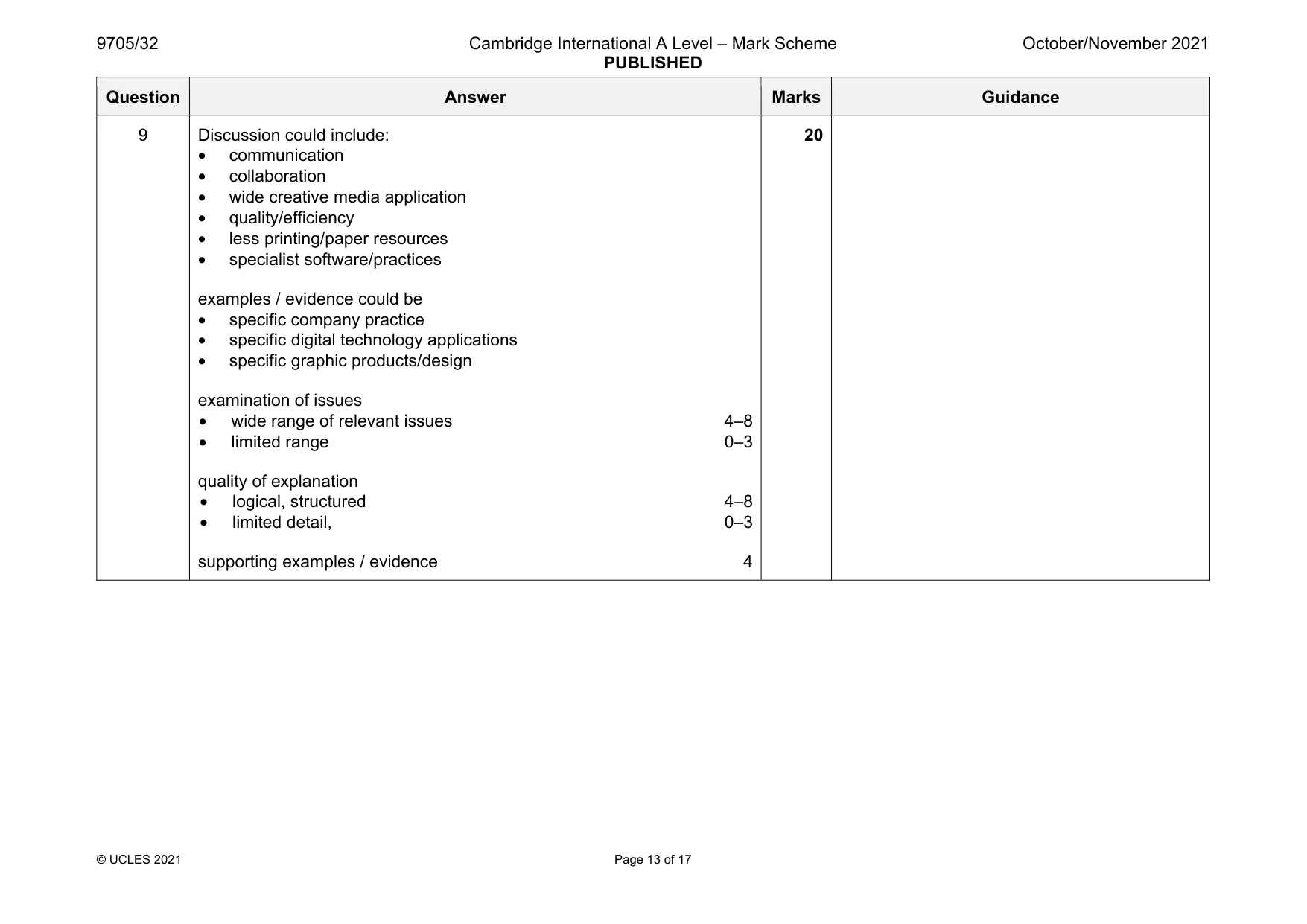
9705/32 Cambridge International A Level – Mark Scheme PUBLISHED October/November 2021 © UCLES 2021 Page 13 of 17 Question Answer Marks Guidance 9 Discussion could include: • communication • collaboration • wide creative media application • quality/efficiency • less printing/paper resources • specialist software/practices examples / evidence could be • specific company practice • specific digital technology applications • specific graphic products/design examination of issues • wide range of relevant issues 4–8 • limited range 0–3 quality of explanation • logical, structured 4–8 • limited detail, 0–3 supporting examples / evidence 4 20
Mark scheme, page 14
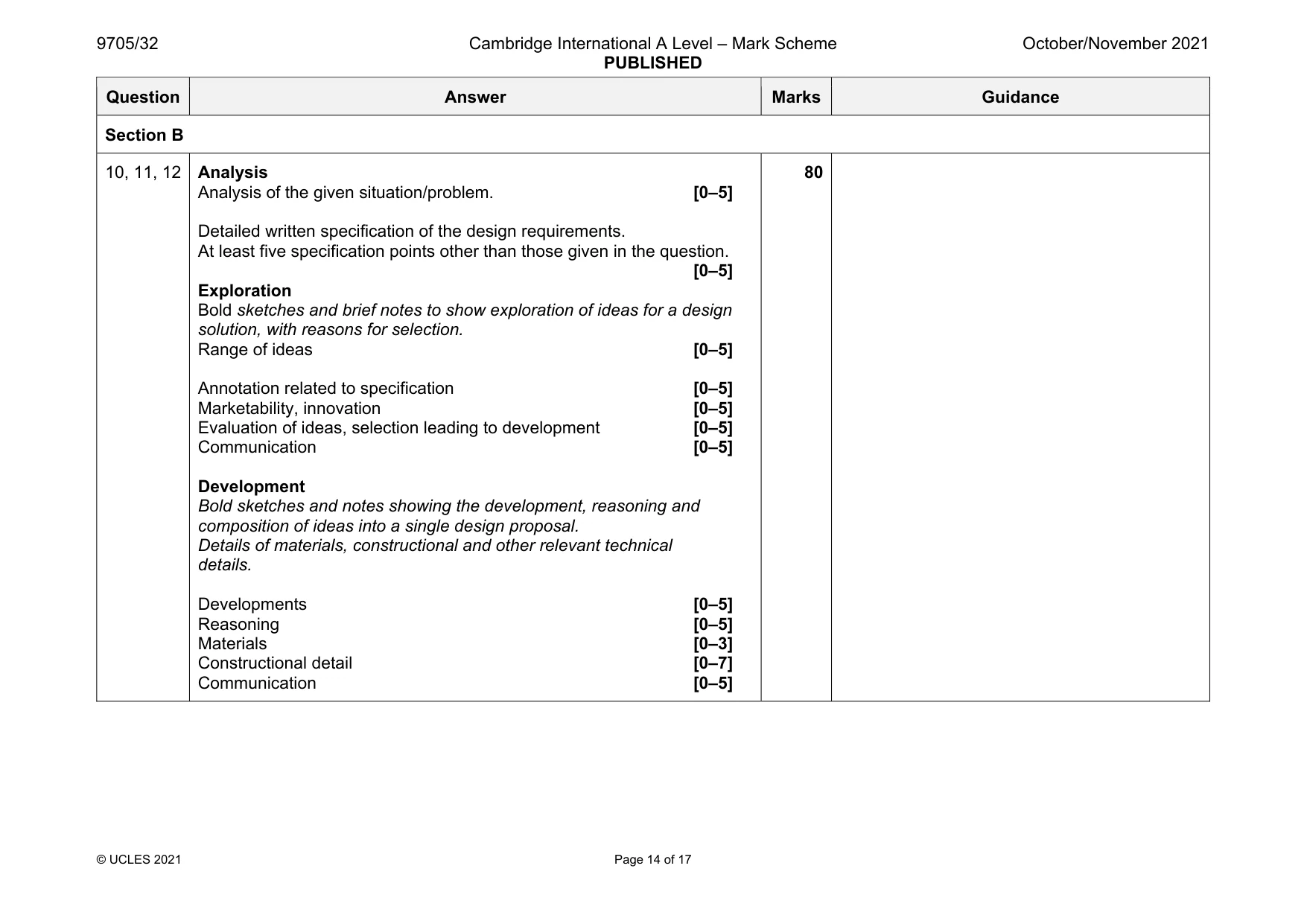
9705/32 Cambridge International A Level – Mark Scheme PUBLISHED October/November 2021 © UCLES 2021 Page 14 of 17 Question Answer Marks Guidance Section B 10, 11, 12 Analysis Analysis of the given situation/problem. [0–5] Detailed written specification of the design requirements. At least five specification points other than those given in the question. [0–5] Exploration Bold sketches and brief notes to show exploration of ideas for a design solution, with reasons for selection. Range of ideas [0–5] Annotation related to specification [0–5] Marketability, innovation [0–5] Evaluation of ideas, selection leading to development [0–5] Communication [0–5] Development Bold sketches and notes showing the development, reasoning and composition of ideas into a single design proposal. Details of materials, constructional and other relevant technical details. Developments [0–5] Reasoning [0–5] Materials [0–3] Constructional detail [0–7] Communication [0–5] 80
Mark scheme, page 15
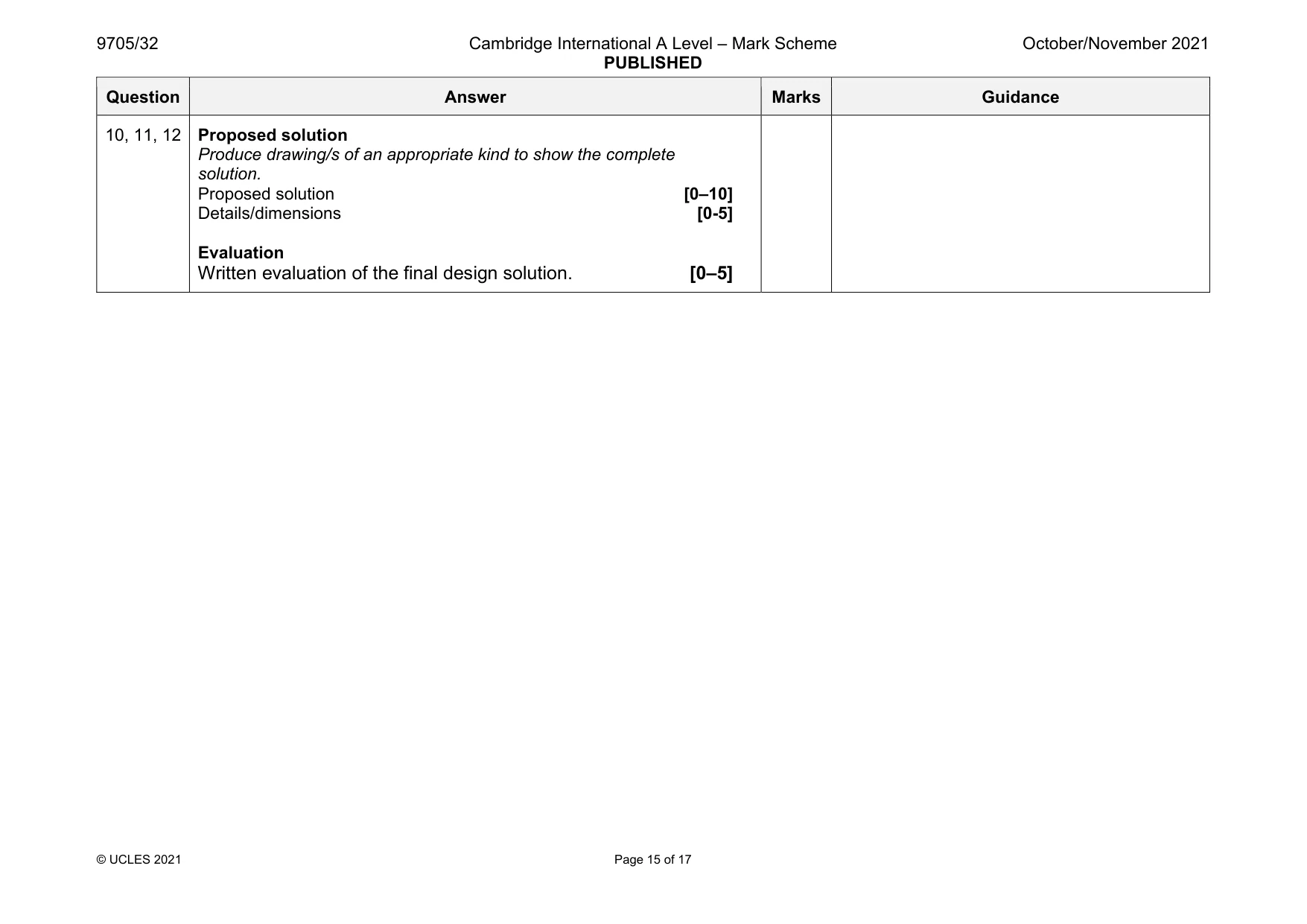
9705/32 Cambridge International A Level – Mark Scheme PUBLISHED October/November 2021 © UCLES 2021 Page 15 of 17 Question Answer Marks Guidance 10, 11, 12 Proposed solution Produce drawing/s of an appropriate kind to show the complete solution. Proposed solution [0–10] Details/dimensions [0-5] Evaluation Written evaluation of the final design solution. [0–5]
Mark scheme, page 16
9705/32 Cambridge International A Level – Mark Scheme PUBLISHED October/November 2021 © UCLES 2021 Page 16 of 17 App. 1 Q5 (a) Correct transposition to force diagram up to 2 Correct direction of equilibrant force 1 Correct magnitude of equilibrant force 1
Mark scheme, page 17
9705/32 Cambridge International A Level – Mark Scheme PUBLISHED October/November 2021 © UCLES 2021 Page 17 of 17 App. 2 minimum diameter 40 1 in line knife edge follower 1 clockwise direction 1 0° – 60° dwell 2 60° – 150° rise 40 simple harmonic motion 3 150° – 240° dwell 2 240° – 360° fall 40 uniform velocity 3 accuracy 3 [16]
What you needed in this session
Cambridge’s own grade thresholds for 2021 Oct/Nov, Paper 3 · Variant 2. A higher threshold means an easier paper — the bar moves with how the cohort did.