Cambridge A Level Design and Technology 9705 — 2020 Oct/Nov Paper 3 · Variant 2
9705/32/O/N/20 · 120 marks · ≈135 min
The question paper and its mark scheme, free to read here and free to download. This is Cambridge’s own paper, exactly as it was sat.
Question paper12 pages

Mark scheme13 pages
Answers below. Sit the paper first if you are practising.
Paper as text
Question paper, page 1
Cambridge International AS & A Level DC (JC/JG) 188743/3 © UCLES 2020 [Turn over This document has 12 pages. Blank pages are indicated. * 6 5 4 6 4 8 6 4 0 1 * DESIGN & TECHNOLOGY 9705/32 Paper 3 October/November 2020 3 hours You must answer on the answer booklet/paper. You will need: Answer booklet/paper Coloured pencils A3 drawing paper (5 sheets) A range of design drawing equipment INSTRUCTIONS ● Answer three questions in total: Section A: answer two questions from one of the Parts A, B or C. Section B: answer one question. ● If you have been given an answer booklet, follow the instructions on the front cover of the answer booklet. ● Use a black or dark blue pen. ● Write your name, centre number and candidate number on all the work you hand in. ● Do not use an erasable pen or correction fluid. ● You may use an HB pencil, or coloured pencils as appropriate, for any diagrams, graphs or rough working. ● At the end of the examination, fasten all your work together. Do not use staples, paper clips or glue. INFORMATION ● The total mark for this paper is 120. ● The number of marks for each question or part question is shown in brackets [ ]. ● All dimensions are in millimetres.
Question paper, page 2
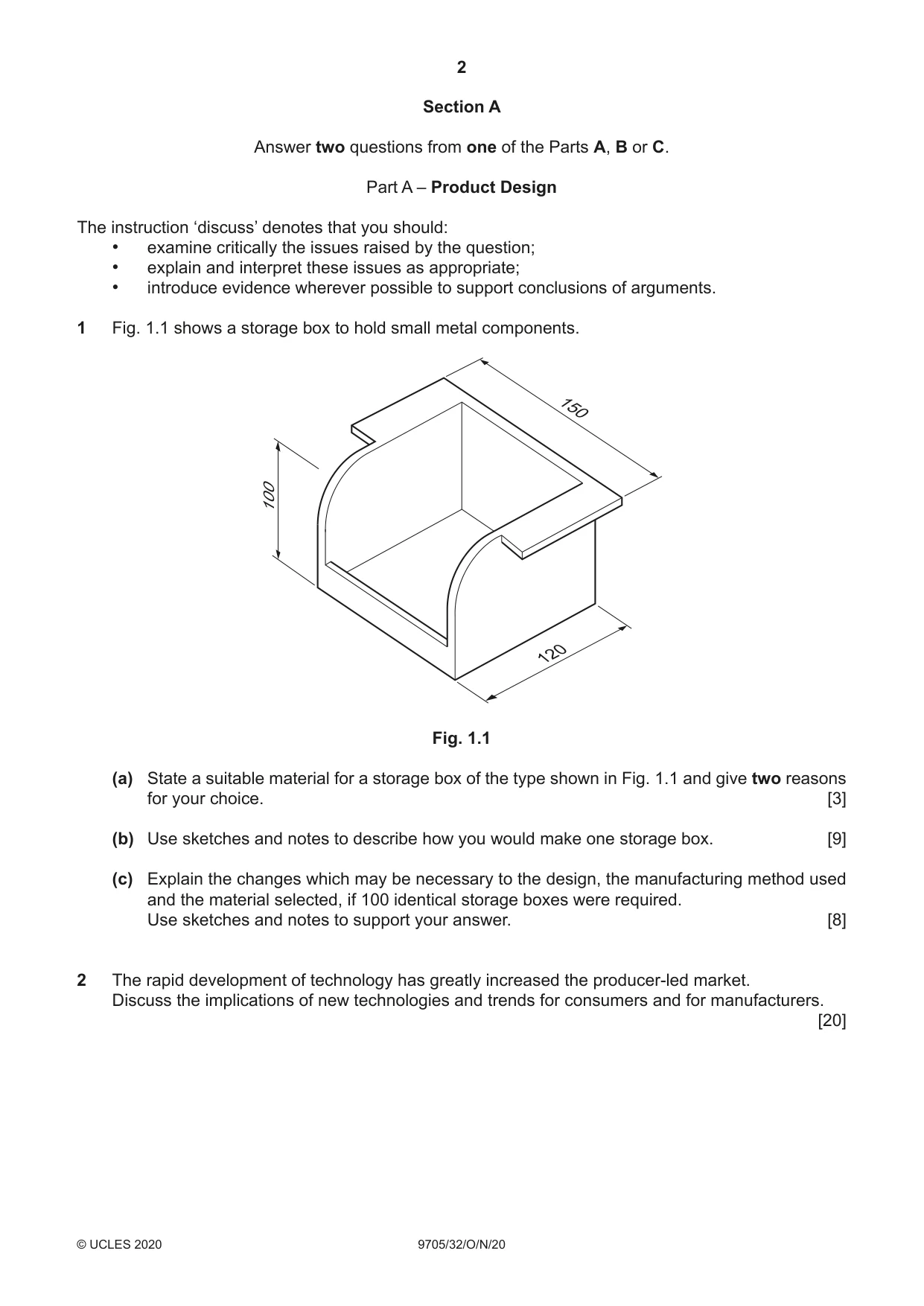
2 9705/32/O/N/20 © UCLES 2020 Section A Answer two questions from one of the Parts A, B or C. Part A – Product Design The instruction ‘discuss’ denotes that you should: • examine critically the issues raised by the question; • explain and interpret these issues as appropriate; • introduce evidence wherever possible to support conclusions of arguments. 1 Fig. 1.1 shows a storage box to hold small metal components. 100 150 120 Fig. 1.1 (a) State a suitable material for a storage box of the type shown in Fig. 1.1 and give two reasons for your choice. [3] (b) Use sketches and notes to describe how you would make one storage box. [9] (c) Explain the changes which may be necessary to the design, the manufacturing method used and the material selected, if 100 identical storage boxes were required. Use sketches and notes to support your answer. [8] 2 The rapid development of technology has greatly increased the producer-led market. Discuss the implications of new technologies and trends for consumers and for manufacturers. [20]
Question paper, page 3
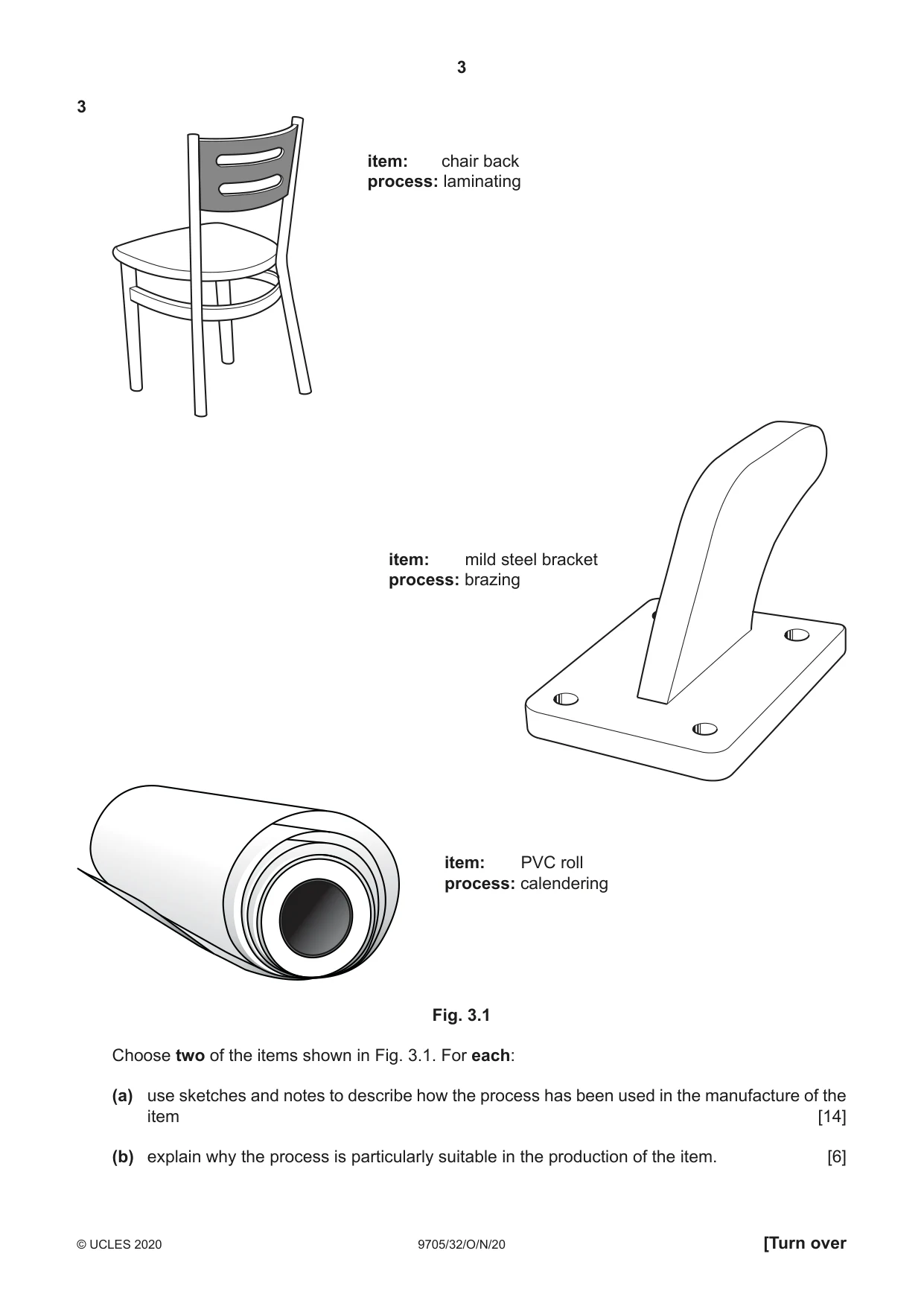
3 9705/32/O/N/20 © UCLES 2020 [Turn over 3 item: chair back process: laminating item: mild steel bracket process: brazing item: PVC roll process: calendering Fig. 3.1 Choose two of the items shown in Fig. 3.1. For each: (a) use sketches and notes to describe how the process has been used in the manufacture of the item [14] (b) explain why the process is particularly suitable in the production of the item. [6]
Question paper, page 4
4 9705/32/O/N/20 © UCLES 2020 Part B – Practical Technology The instruction ‘discuss’ denotes that you should: • examine critically the issues raised by the question; • explain and interpret these issues as appropriate; • introduce evidence wherever possible to support conclusions of arguments. 4 (a) Define the following properties relating to materials. • hardness • stiffness [2] (b) State one material that is hard and one material that is stiff. [2] (c) Use sketches and notes to describe a method that could be carried out in a workshop to compare the stiffness of different materials. [10] (d) Explain the importance of the data obtained from material testing to a designer when developing new products. [6]
Question paper, page 5
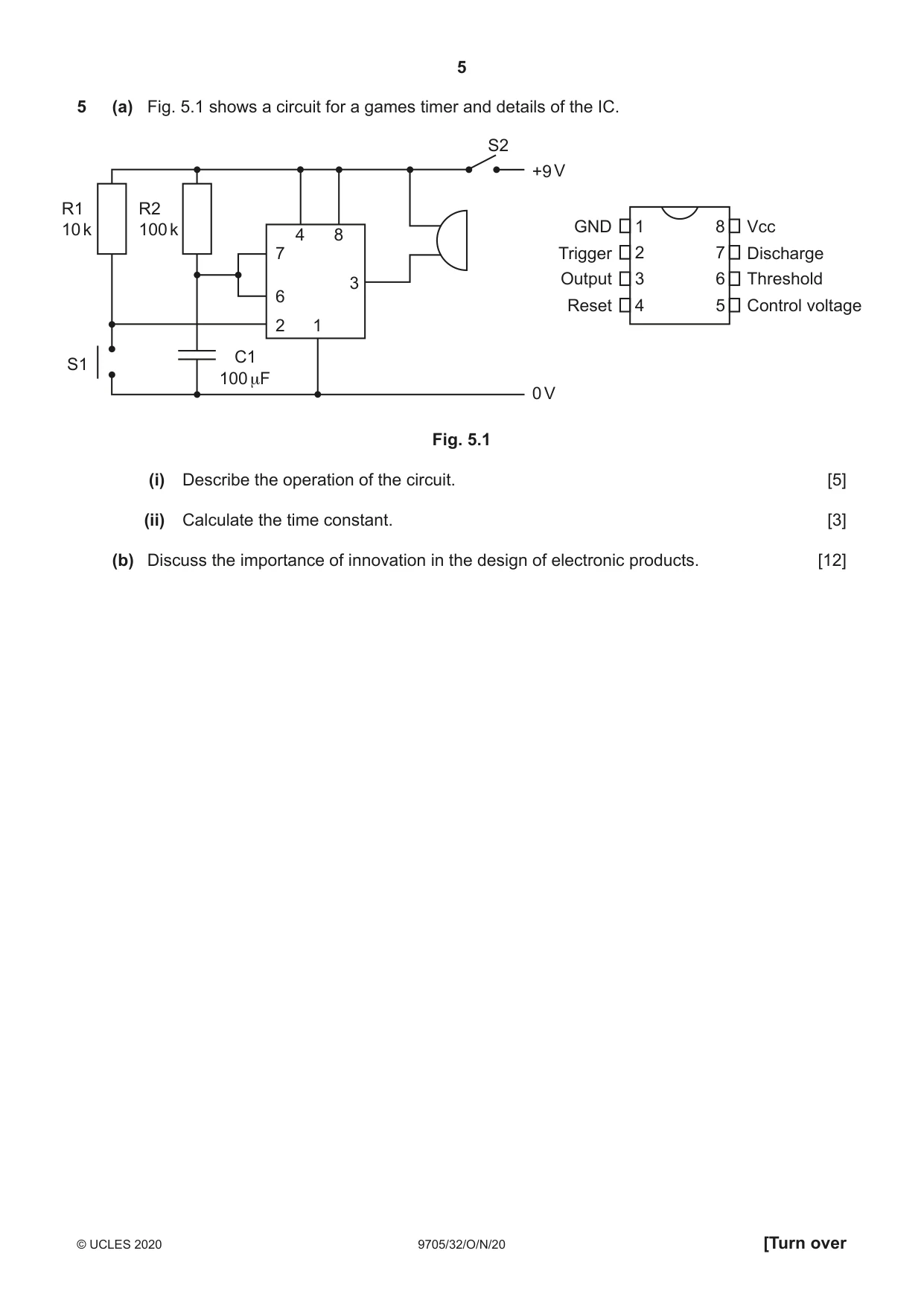
5 9705/32/O/N/20 © UCLES 2020 [Turn over 5 (a) Fig. 5.1 shows a circuit for a games timer and details of the IC. R1 10 k R2 100 k S1 C1 100 μF 7 6 2 1 3 8 S2 4 +9 V 0 V 1 2 3 4 8 7 6 5 GND Trigger Output Reset Vcc Discharge Threshold Control voltage Fig. 5.1 (i) Describe the operation of the circuit. [5] (ii) Calculate the time constant. [3] (b) Discuss the importance of innovation in the design of electronic products. [12]
Question paper, page 6
6 9705/32/O/N/20 © UCLES 2020 6 (a) Use sketches and notes to describe an application of each of the following mechanisms in a product. • cam • crank • ratchet [12] (b) Pneumatic and hydraulic systems are commonly used in vehicles. Give an example of how each system is used in a vehicle and explain why the system is suitable. [8]
Question paper, page 7
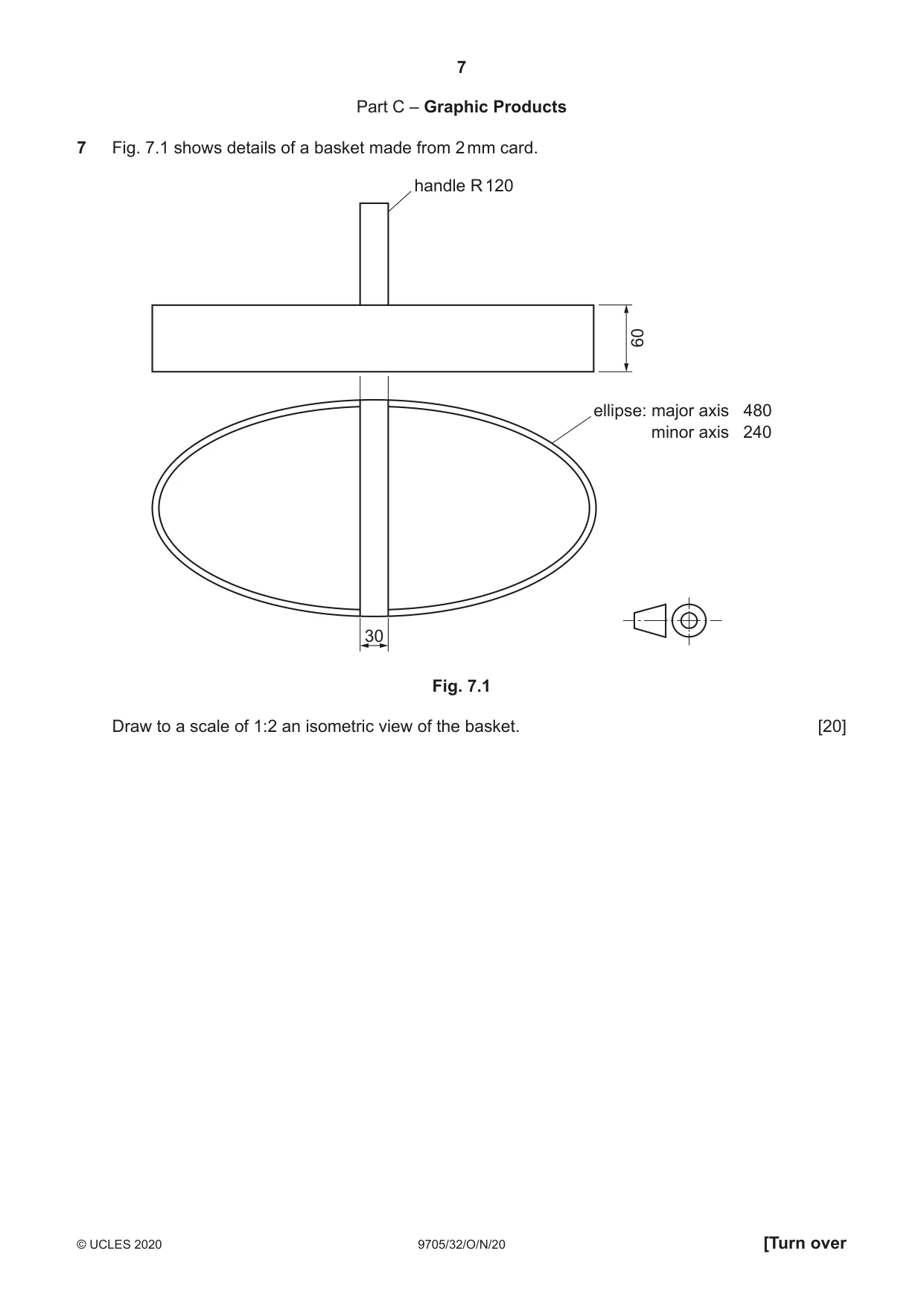
7 9705/32/O/N/20 © UCLES 2020 [Turn over Part C – Graphic Products 7 Fig. 7.1 shows details of a basket made from 2 mm card. handle R 120 60 30 ellipse: major axis 480 minor axis 240 Fig. 7.1 Draw to a scale of 1:2 an isometric view of the basket. [20]
Question paper, page 8
8 9705/32/O/N/20 © UCLES 2020 8 Reprographics involves the reproduction of graphic images using electronic or mechanical methods. Use sketches and notes to describe a method of reproducing graphic images: • electronically • mechanically. For each, give details of a graphic product that would be produced by the method and explain why the method is particularly suitable. [20]
Question paper, page 9
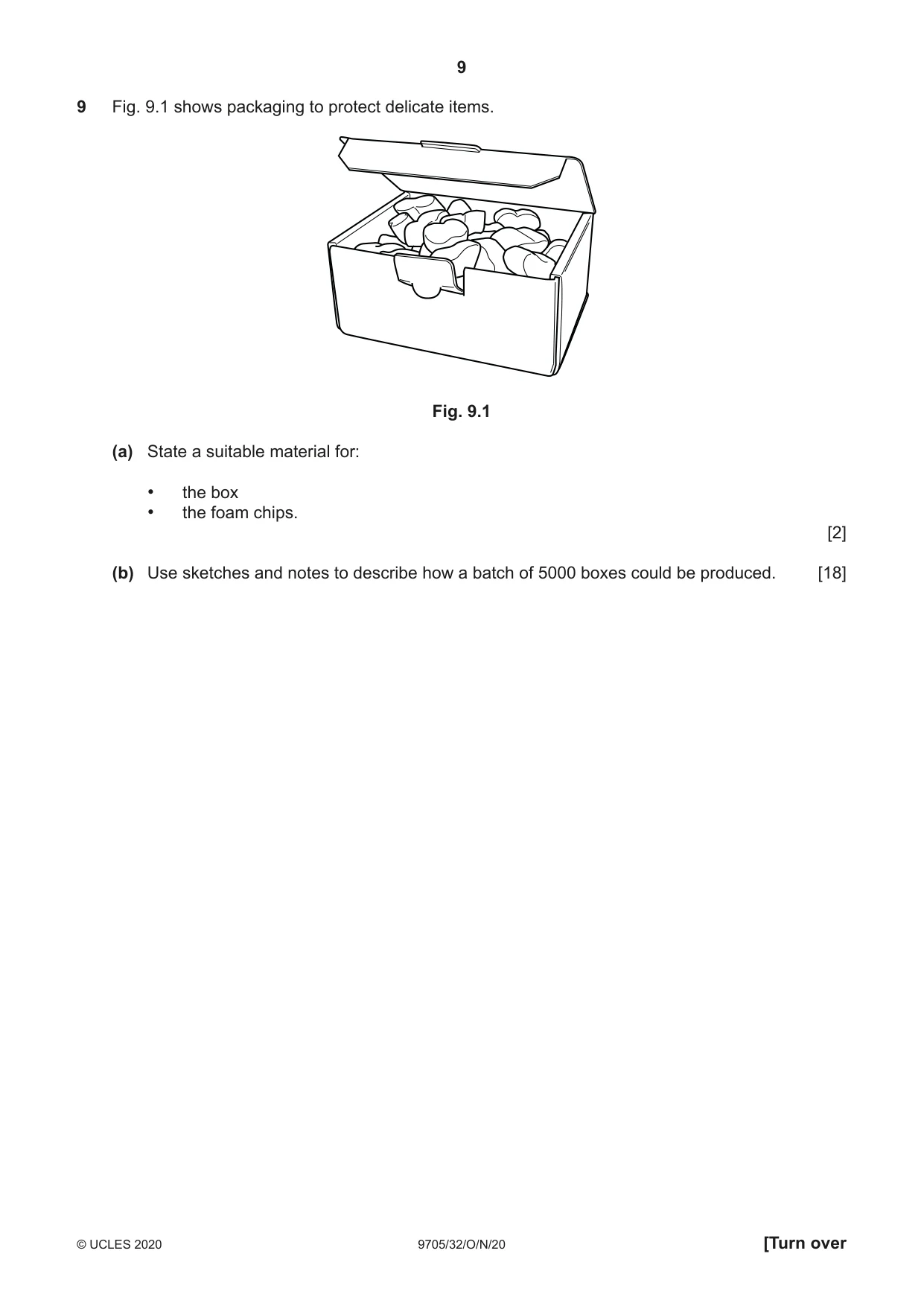
9 9705/32/O/N/20 © UCLES 2020 [Turn over 9 Fig. 9.1 shows packaging to protect delicate items. Fig. 9.1 (a) State a suitable material for: • the box • the foam chips. [2] (b) Use sketches and notes to describe how a batch of 5000 boxes could be produced. [18]
Question paper, page 10
10 9705/32/O/N/20 © UCLES 2020 Section B Answer one question on the A3 paper provided. Each question is worth 80 marks. You should approach the design question of your choice in the following manner: Analysis Produce an analysis of the given situation/problem, which may be in written or graphical form. [5] Specification From the analysis produce a detailed written specification of the design requirements. Include at least five specification points other than those given in the question. [5] Exploration Use bold sketches and brief notes to show your exploration of ideas for a design solution, with reasons for selection. [25] Development Show using bold sketches and notes, the development, reasoning and composition of ideas into a single design proposal. Give details of materials, constructional and other relevant technical details. [25] Proposed solution Produce drawings of an appropriate kind to show the complete solution. [15] Evaluation Give a written evaluation of the final design solution. [5]
Question paper, page 11
11 9705/32/O/N/20 © UCLES 2020 10 The music department in a school has limited space for its students to practise playing their instruments. You are to design a music stand that can be used on a school desk. The music stand must: • be able to hold sheet music up to a maximum of A3 in size • be easy to store. [80] 11 Ground staff at a school collect litter from around the school in bags. You are to design a product that will hold a bag to enable the collection of litter and transport it around the school. The product must: • hold a bag measuring ∅ 500 × 750 • allow the bag to be easily removed. [80] 12 A new art and graphics equipment supply company named Star+, wishes to extend its market by giving a free promotional gift to students who enrol on University Arts, Graphics and Design courses. You are to design: • a logo for the company Star+ • a promotional desk organiser to hold brushes, pens and assorted stationery equipment. The desk organiser must: • be ‘flat pack’ to allow for postage in a 324 × 458 sized envelope • reflect the image of the company Star+. [80]
Question paper, page 12
12 9705/32/O/N/20 © UCLES 2020 Permission to reproduce items where third-party owned material protected by copyright is included has been sought and cleared where possible. Every reasonable effort has been made by the publisher (UCLES) to trace copyright holders, but if any items requiring clearance have unwittingly been included, the publisher will be pleased to make amends at the earliest possible opportunity. To avoid the issue of disclosure of answer-related information to candidates, all copyright acknowledgements are reproduced online in the Cambridge Assessment International Education Copyright Acknowledgements Booklet. This is produced for each series of examinations and is freely available to download at www.cambridgeinternational.org after the live examination series. Cambridge Assessment International Education is part of the Cambridge Assessment Group. Cambridge Assessment is the brand name of the University of Cambridge Local Examinations Syndicate (UCLES), which itself is a department of the University of Cambridge. BLANK PAGE
Mark scheme, page 1
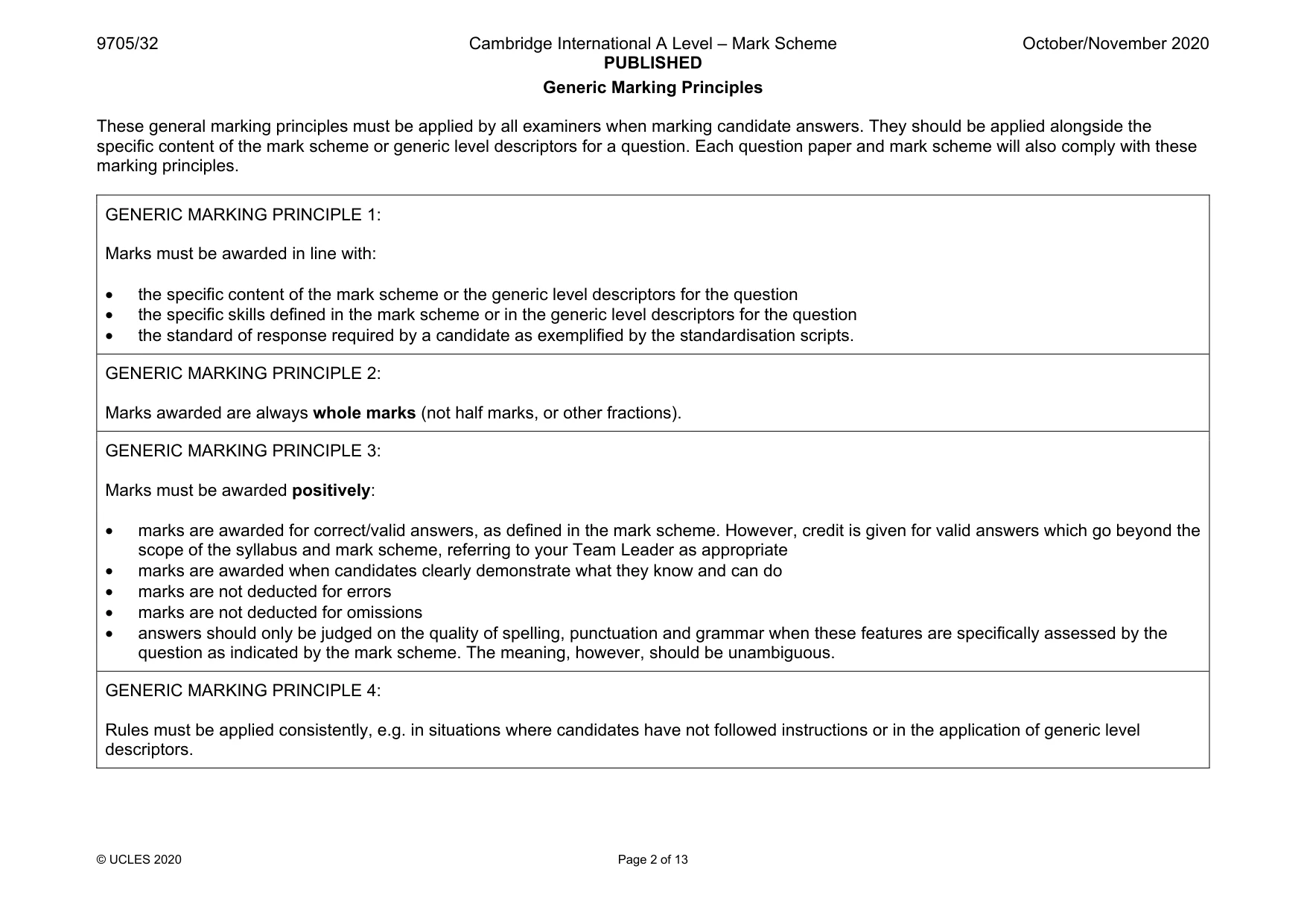
This document consists of 13 printed pages. © UCLES 2020 [Turn over Cambridge International A Level DESIGN AND TECHNOLOGY 9705/32 Paper 3 October/November 2020 MARK SCHEME Maximum Mark: 120 Published This mark scheme is published as an aid to teachers and candidates, to indicate the requirements of the examination. It shows the basis on which Examiners were instructed to award marks. It does not indicate the details of the discussions that took place at an Examiners’ meeting before marking began, which would have considered the acceptability of alternative answers. Mark schemes should be read in conjunction with the question paper and the Principal Examiner Report for Teachers. Cambridge International will not enter into discussions about these mark schemes. Cambridge International is publishing the mark schemes for the October/November 2020 series for most Cambridge IGCSE™, Cambridge International A and AS Level and Cambridge Pre-U components, and some Cambridge O Level components.
Mark scheme, page 2
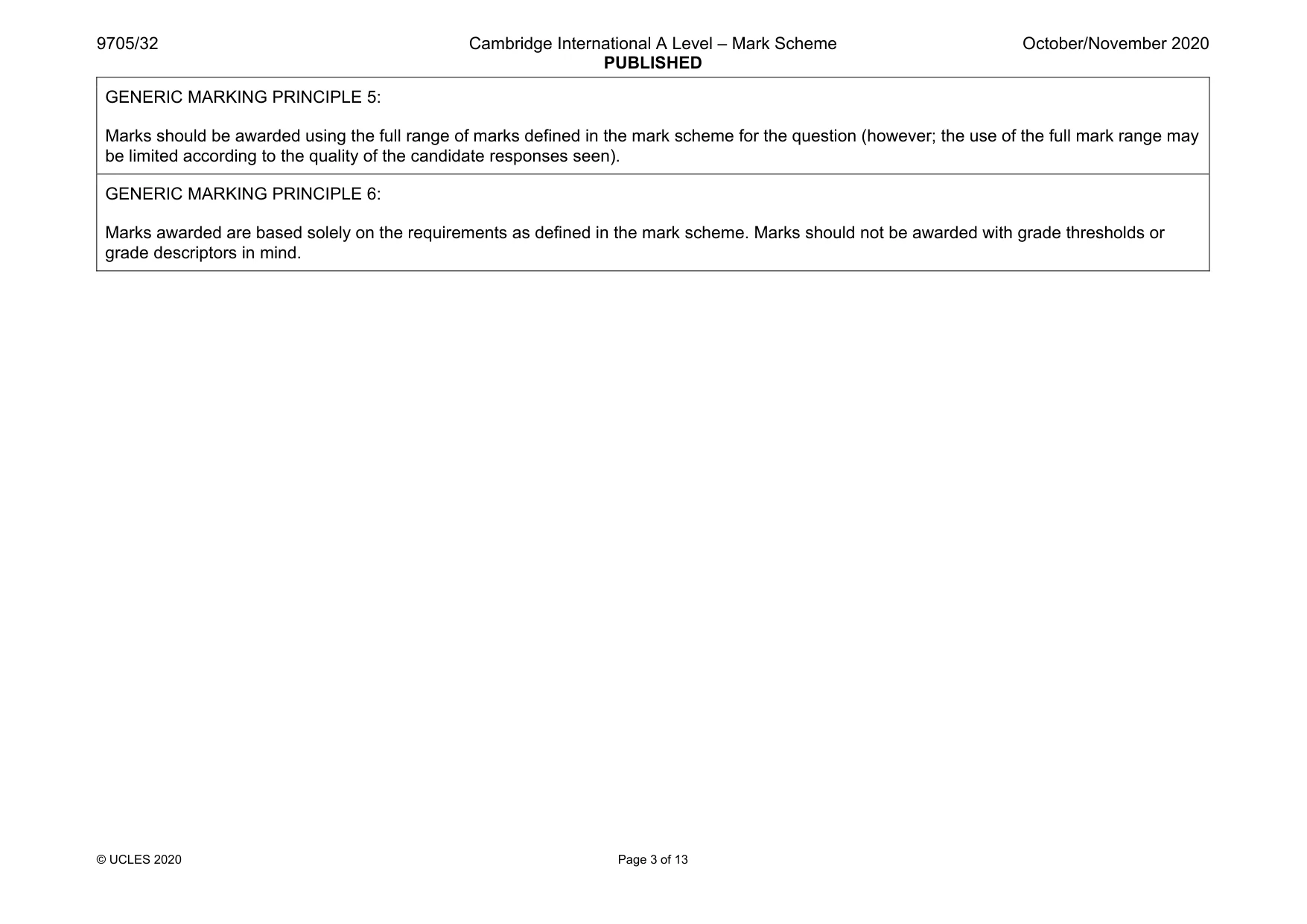
9705/32 Cambridge International A Level – Mark Scheme PUBLISHED October/November 2020 © UCLES 2020 Page 2 of 13 Generic Marking Principles These general marking principles must be applied by all examiners when marking candidate answers. They should be applied alongside the specific content of the mark scheme or generic level descriptors for a question. Each question paper and mark scheme will also comply with these marking principles. GENERIC MARKING PRINCIPLE 1: Marks must be awarded in line with: • the specific content of the mark scheme or the generic level descriptors for the question • the specific skills defined in the mark scheme or in the generic level descriptors for the question • the standard of response required by a candidate as exemplified by the standardisation scripts. GENERIC MARKING PRINCIPLE 2: Marks awarded are always whole marks (not half marks, or other fractions). GENERIC MARKING PRINCIPLE 3: Marks must be awarded positively: • marks are awarded for correct/valid answers, as defined in the mark scheme. However, credit is given for valid answers which go beyond the scope of the syllabus and mark scheme, referring to your Team Leader as appropriate • marks are awarded when candidates clearly demonstrate what they know and can do • marks are not deducted for errors • marks are not deducted for omissions • answers should only be judged on the quality of spelling, punctuation and grammar when these features are specifically assessed by the question as indicated by the mark scheme. The meaning, however, should be unambiguous. GENERIC MARKING PRINCIPLE 4: Rules must be applied consistently, e.g. in situations where candidates have not followed instructions or in the application of generic level descriptors.
Mark scheme, page 3
9705/32 Cambridge International A Level – Mark Scheme PUBLISHED October/November 2020 © UCLES 2020 Page 3 of 13 GENERIC MARKING PRINCIPLE 5: Marks should be awarded using the full range of marks defined in the mark scheme for the question (however; the use of the full mark range may be limited according to the quality of the candidate responses seen). GENERIC MARKING PRINCIPLE 6: Marks awarded are based solely on the requirements as defined in the mark scheme. Marks should not be awarded with grade thresholds or grade descriptors in mind.
Mark scheme, page 4
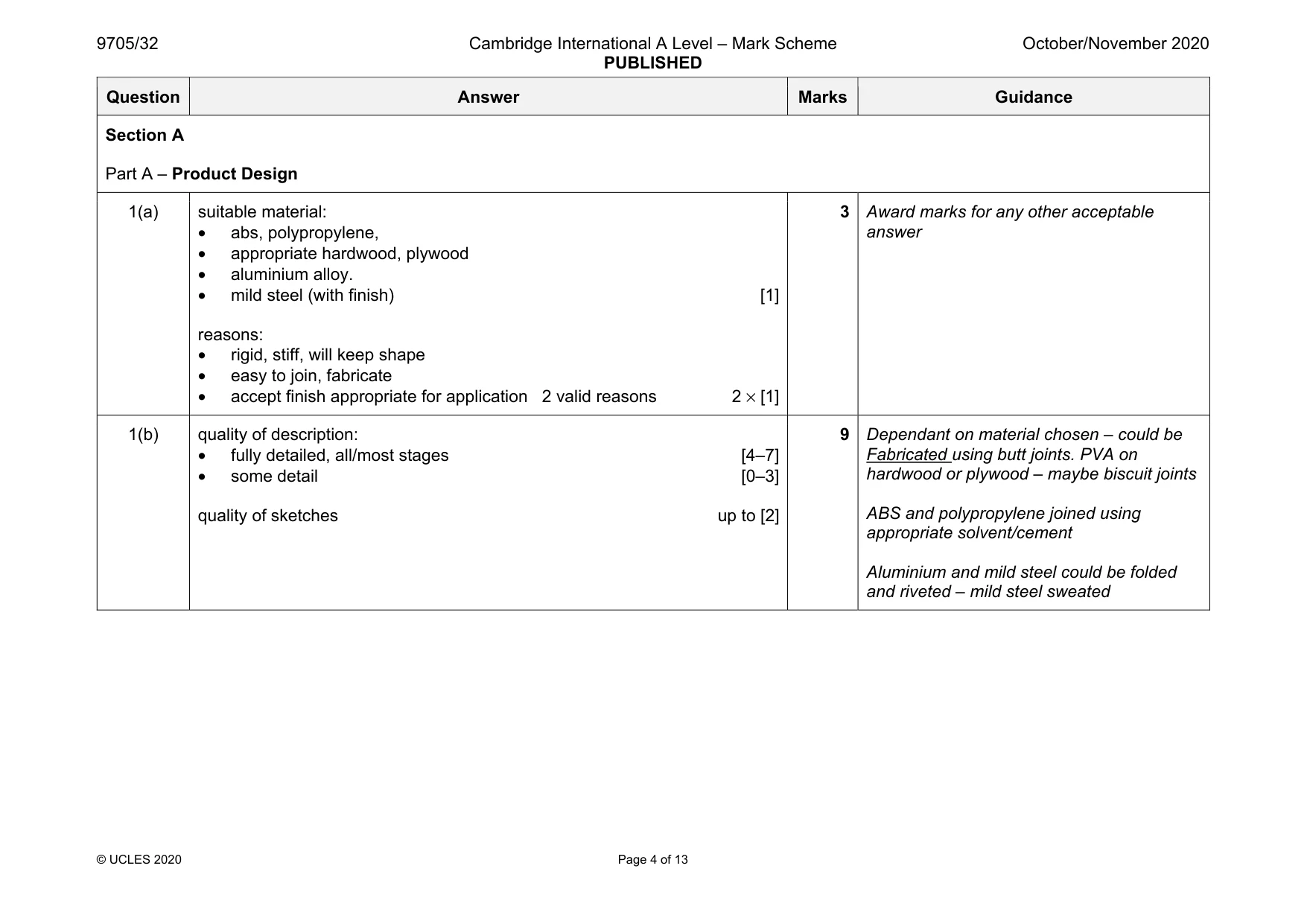
9705/32 Cambridge International A Level – Mark Scheme PUBLISHED October/November 2020 © UCLES 2020 Page 4 of 13 Question Answer Marks Guidance Section A Part A – Product Design 1(a) suitable material: • abs, polypropylene, • appropriate hardwood, plywood • aluminium alloy. • mild steel (with finish) [1] reasons: • rigid, stiff, will keep shape • easy to join, fabricate • accept finish appropriate for application 2 valid reasons 2 × [1] 3 Award marks for any other acceptable answer 1(b) quality of description: • fully detailed, all/most stages [4–7] • some detail [0–3] quality of sketches up to [2] 9 Dependant on material chosen – could be Fabricated using butt joints. PVA on hardwood or plywood – maybe biscuit joints ABS and polypropylene joined using appropriate solvent/cement Aluminium and mild steel could be folded and riveted – mild steel sweated
Mark scheme, page 5
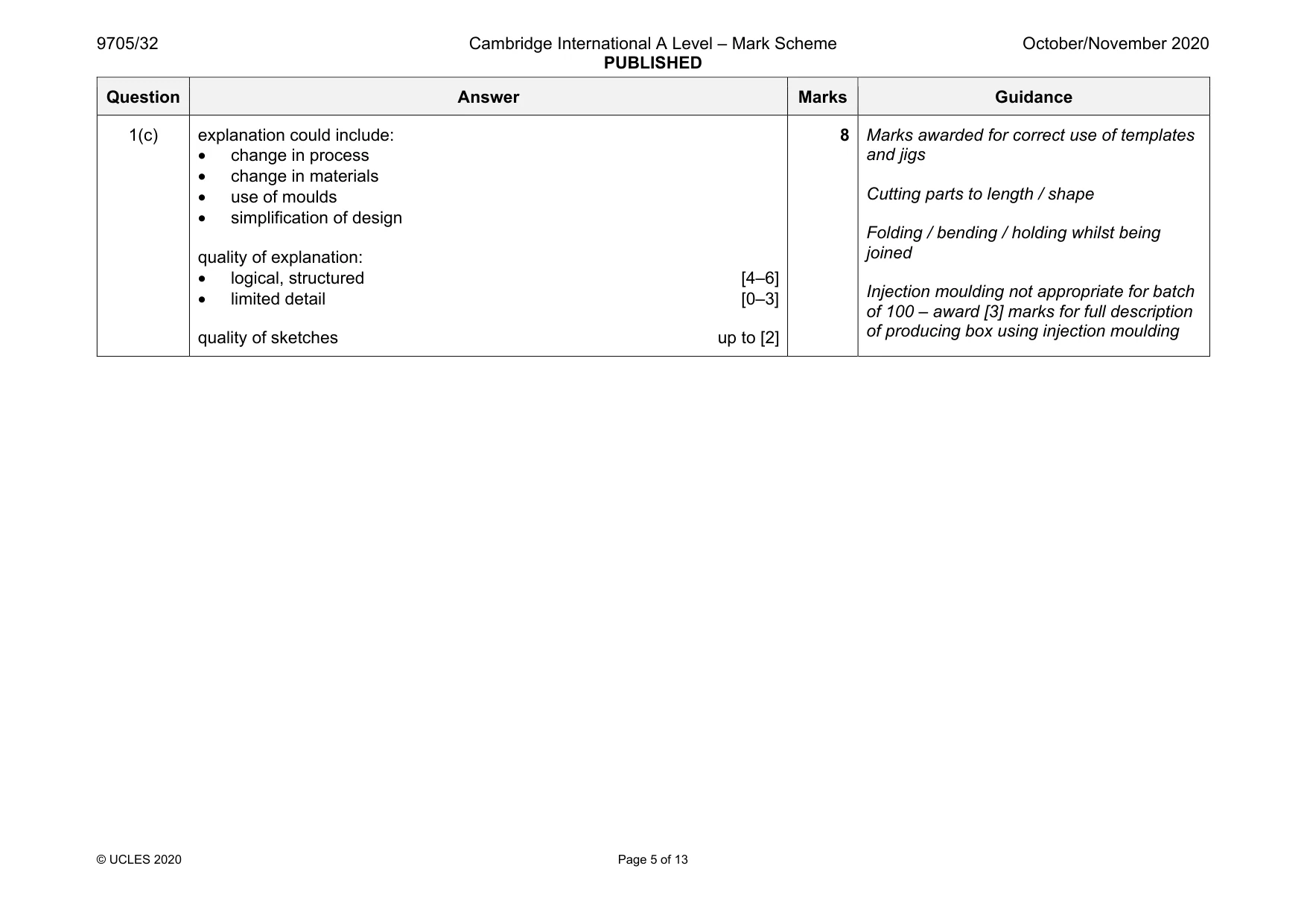
9705/32 Cambridge International A Level – Mark Scheme PUBLISHED October/November 2020 © UCLES 2020 Page 5 of 13 Question Answer Marks Guidance 1(c) explanation could include: • change in process • change in materials • use of moulds • simplification of design quality of explanation: • logical, structured [4–6] • limited detail [0–3] quality of sketches up to [2] 8 Marks awarded for correct use of templates and jigs Cutting parts to length / shape Folding / bending / holding whilst being joined Injection moulding not appropriate for batch of 100 – award [3] marks for full description of producing box using injection moulding
Mark scheme, page 6
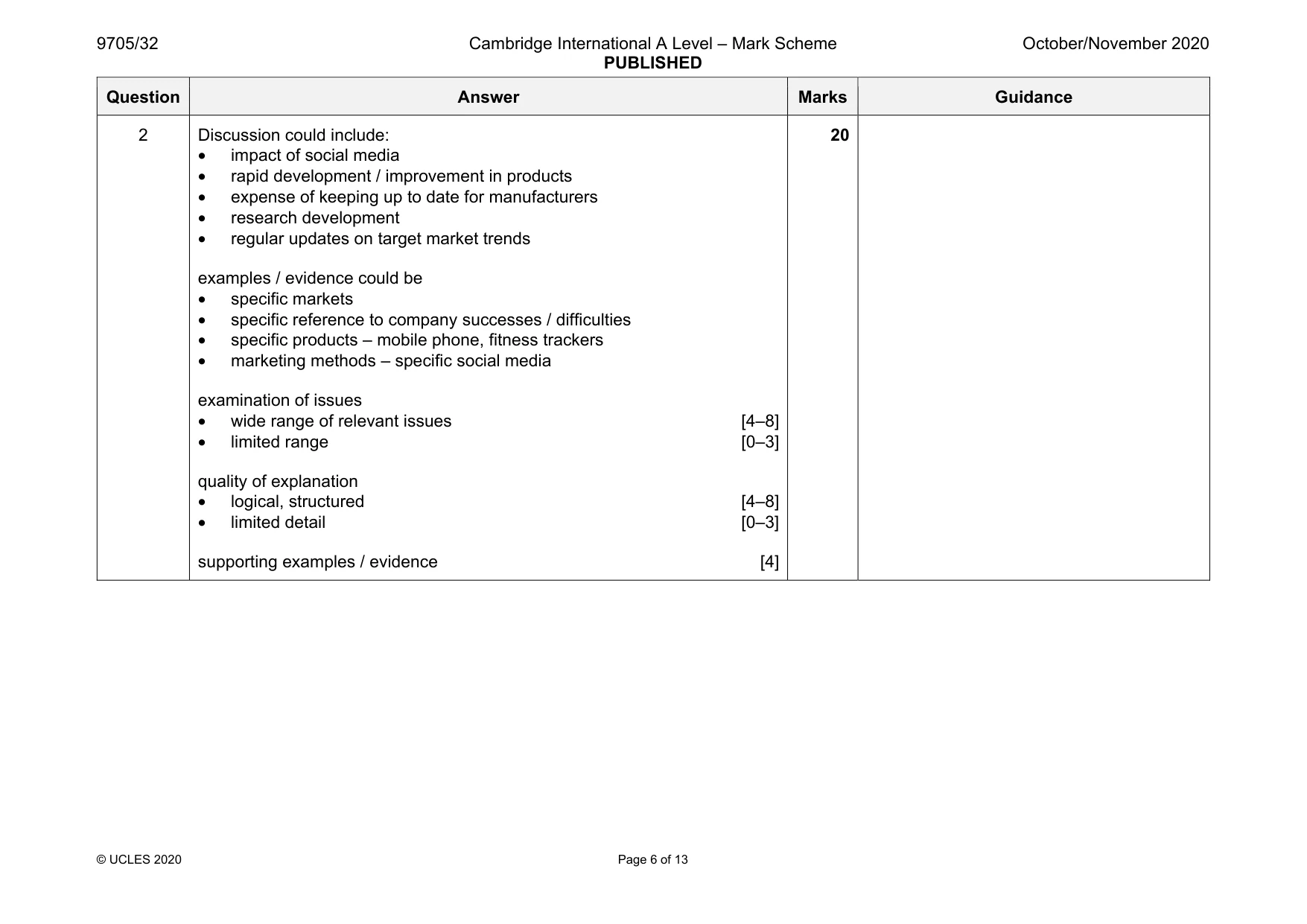
9705/32 Cambridge International A Level – Mark Scheme PUBLISHED October/November 2020 © UCLES 2020 Page 6 of 13 Question Answer Marks Guidance 2 Discussion could include: • impact of social media • rapid development / improvement in products • expense of keeping up to date for manufacturers • research development • regular updates on target market trends examples / evidence could be • specific markets • specific reference to company successes / difficulties • specific products – mobile phone, fitness trackers • marketing methods – specific social media examination of issues • wide range of relevant issues [4–8] • limited range [0–3] quality of explanation • logical, structured [4–8] • limited detail [0–3] supporting examples / evidence [4] 20
Mark scheme, page 7
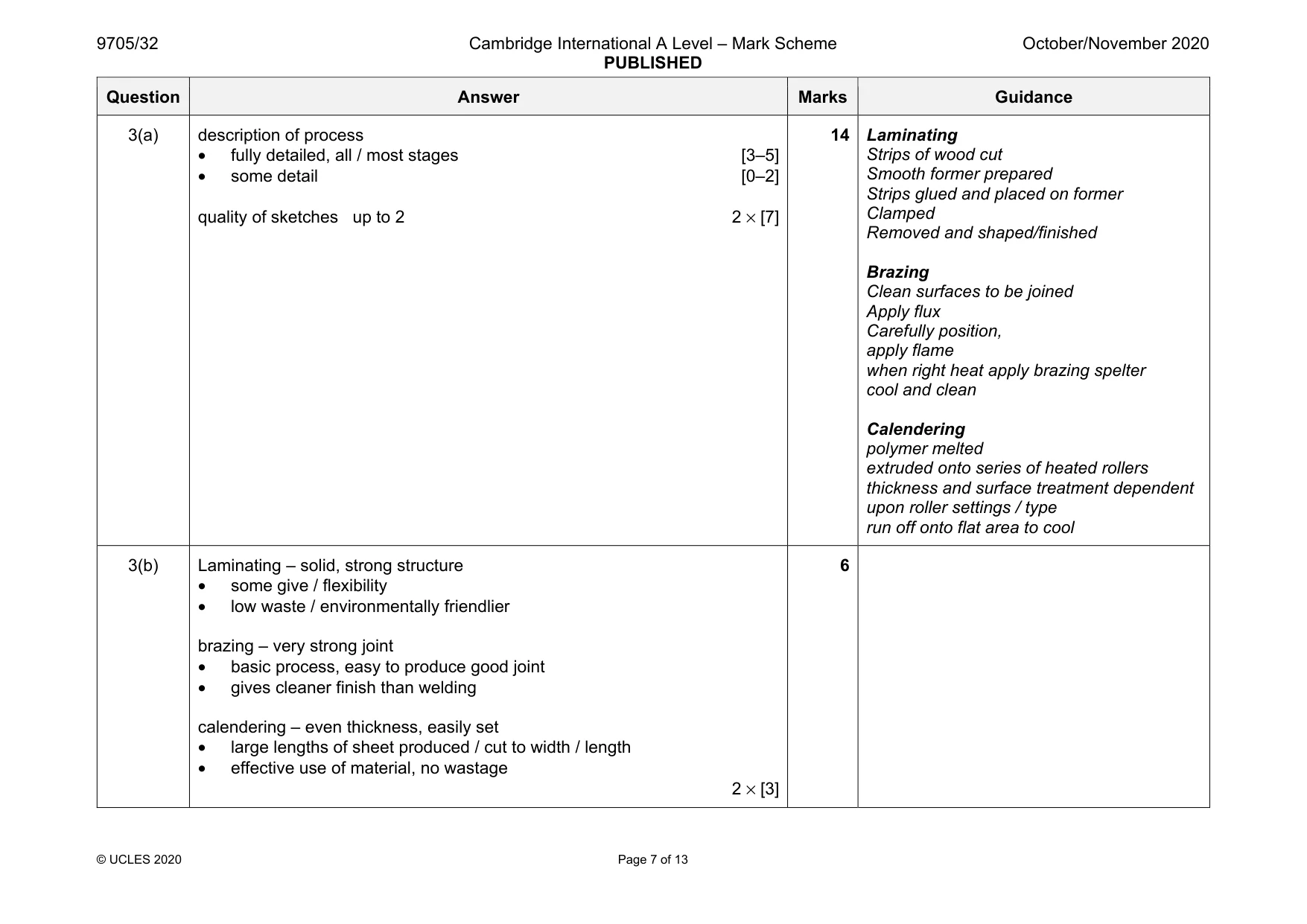
9705/32 Cambridge International A Level – Mark Scheme PUBLISHED October/November 2020 © UCLES 2020 Page 7 of 13 Question Answer Marks Guidance 3(a) description of process • fully detailed, all / most stages [3–5] • some detail [0–2] quality of sketches up to 2 2 × [7] 14 Laminating Strips of wood cut Smooth former prepared Strips glued and placed on former Clamped Removed and shaped/finished Brazing Clean surfaces to be joined Apply flux Carefully position, apply flame when right heat apply brazing spelter cool and clean Calendering polymer melted extruded onto series of heated rollers thickness and surface treatment dependent upon roller settings / type run off onto flat area to cool 3(b) Laminating – solid, strong structure • some give / flexibility • low waste / environmentally friendlier brazing – very strong joint • basic process, easy to produce good joint • gives cleaner finish than welding calendering – even thickness, easily set • large lengths of sheet produced / cut to width / length • effective use of material, no wastage 2 × [3] 6
Mark scheme, page 8
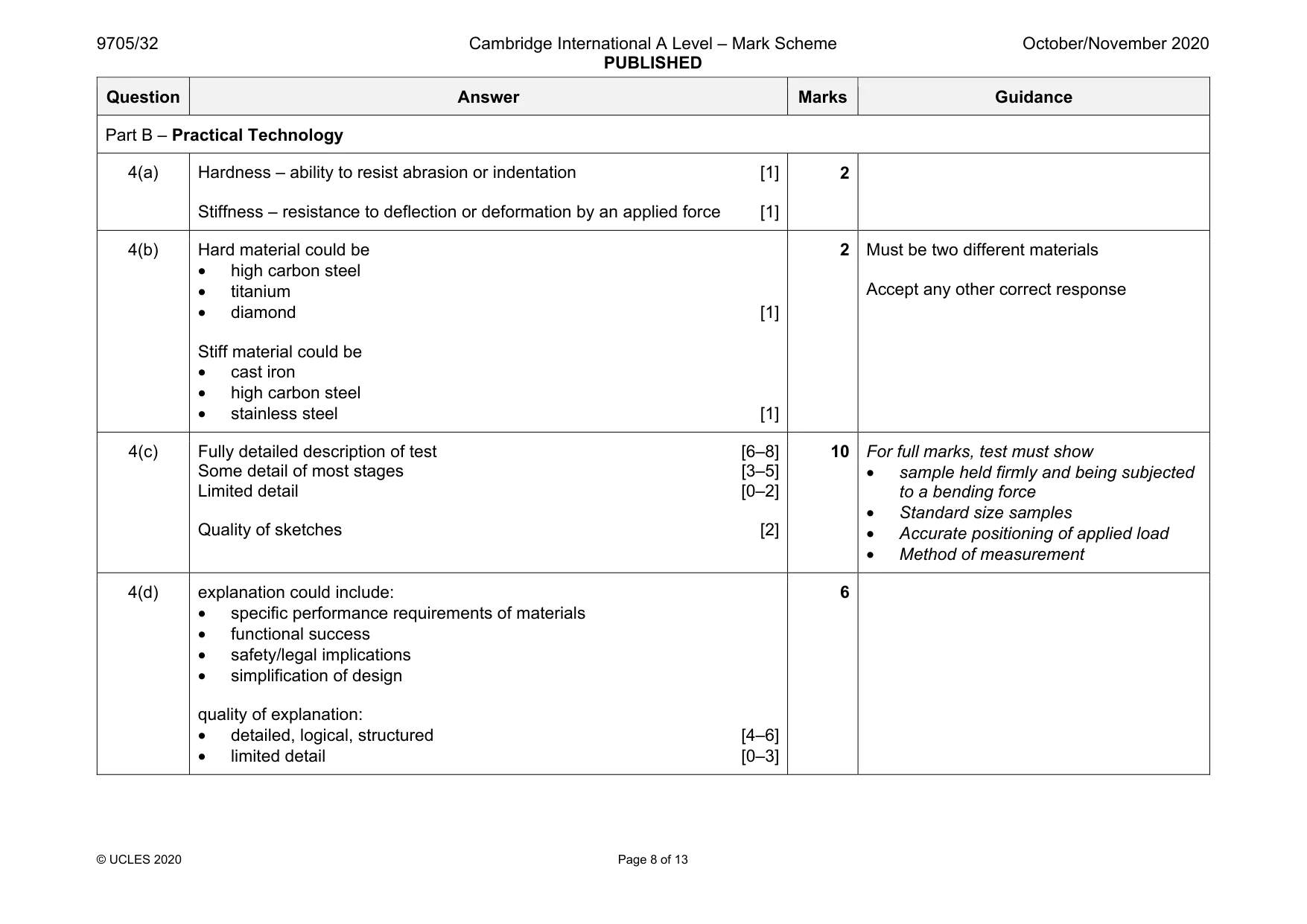
9705/32 Cambridge International A Level – Mark Scheme PUBLISHED October/November 2020 © UCLES 2020 Page 8 of 13 Question Answer Marks Guidance Part B – Practical Technology 4(a) Hardness – ability to resist abrasion or indentation [1] Stiffness – resistance to deflection or deformation by an applied force [1] 2 4(b) Hard material could be • high carbon steel • titanium • diamond [1] Stiff material could be • cast iron • high carbon steel • stainless steel [1] 2 Must be two different materials Accept any other correct response 4(c) Fully detailed description of test [6–8] Some detail of most stages [3–5] Limited detail [0–2] Quality of sketches [2] 10 For full marks, test must show • sample held firmly and being subjected to a bending force • Standard size samples • Accurate positioning of applied load • Method of measurement 4(d) explanation could include: • specific performance requirements of materials • functional success • safety/legal implications • simplification of design quality of explanation: • detailed, logical, structured [4–6] • limited detail [0–3] 6
Mark scheme, page 9
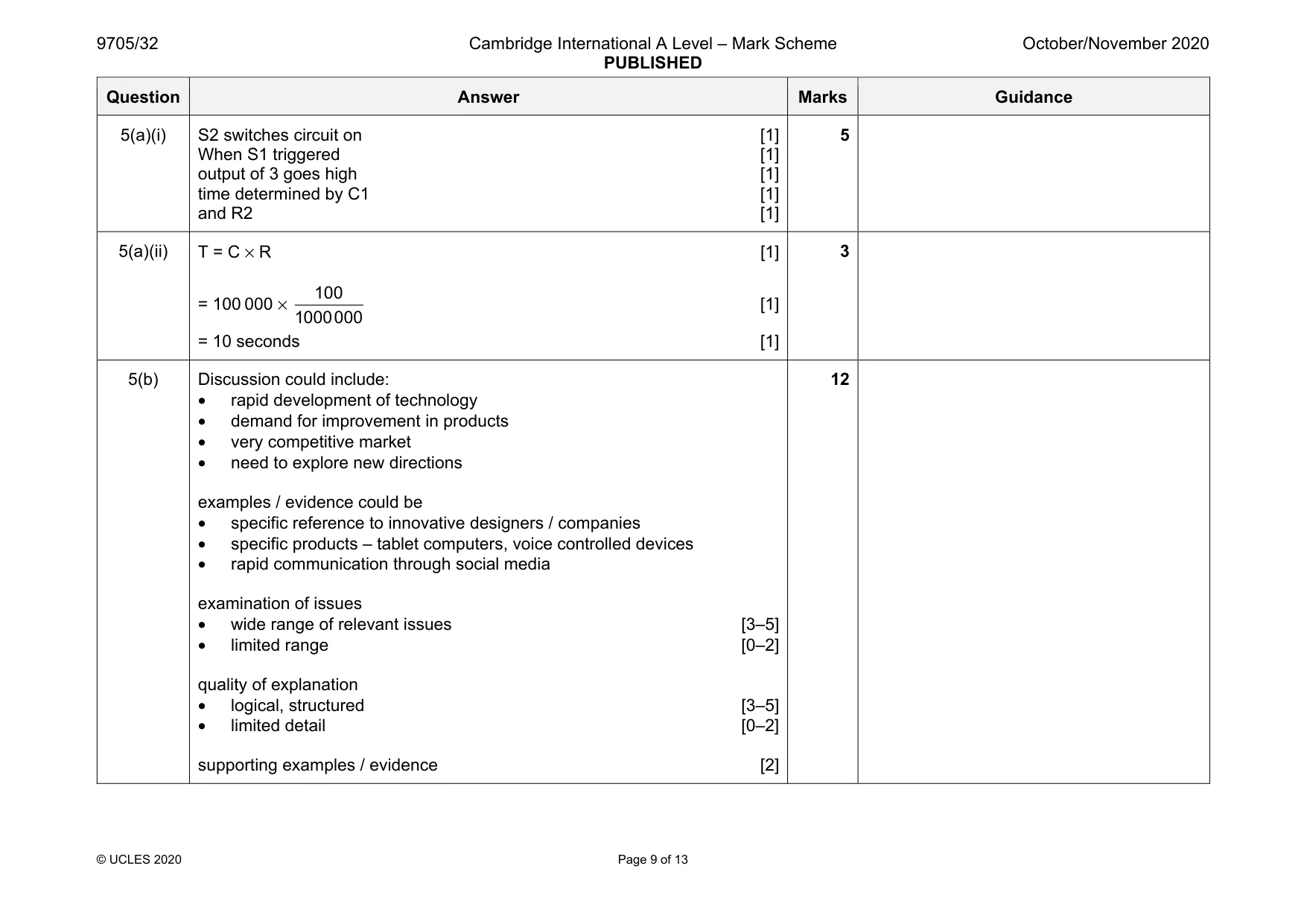
9705/32 Cambridge International A Level – Mark Scheme PUBLISHED October/November 2020 © UCLES 2020 Page 9 of 13 Question Answer Marks Guidance 5(a)(i) S2 switches circuit on [1] When S1 triggered [1] output of 3 goes high [1] time determined by C1 [1] and R2 [1] 5 5(a)(ii) T = C × R [1] = 100 000 × 100 1000000 [1] = 10 seconds [1] 3 5(b) Discussion could include: • rapid development of technology • demand for improvement in products • very competitive market • need to explore new directions examples / evidence could be • specific reference to innovative designers / companies • specific products – tablet computers, voice controlled devices • rapid communication through social media examination of issues • wide range of relevant issues [3–5] • limited range [0–2] quality of explanation • logical, structured [3–5] • limited detail [0–2] supporting examples / evidence [2] 12
Mark scheme, page 10
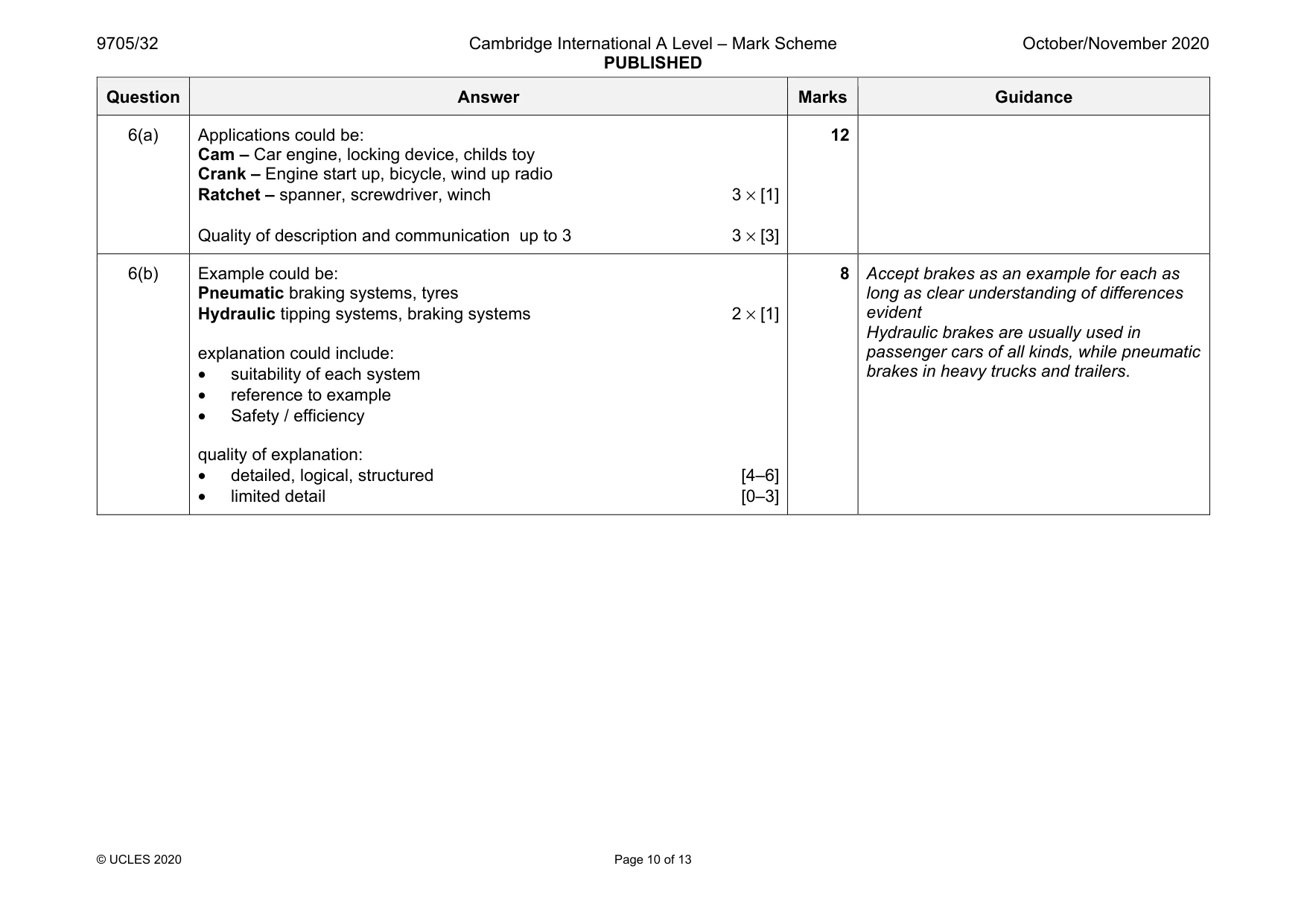
9705/32 Cambridge International A Level – Mark Scheme PUBLISHED October/November 2020 © UCLES 2020 Page 10 of 13 Question Answer Marks Guidance 6(a) Applications could be: Cam – Car engine, locking device, childs toy Crank – Engine start up, bicycle, wind up radio Ratchet – spanner, screwdriver, winch 3 × [1] Quality of description and communication up to 3 3 × [3] 12 6(b) Example could be: Pneumatic braking systems, tyres Hydraulic tipping systems, braking systems 2 × [1] explanation could include: • suitability of each system • reference to example • Safety / efficiency quality of explanation: • detailed, logical, structured [4–6] • limited detail [0–3] 8 Accept brakes as an example for each as long as clear understanding of differences evident Hydraulic brakes are usually used in passenger cars of all kinds, while pneumatic brakes in heavy trucks and trailers.
Mark scheme, page 11
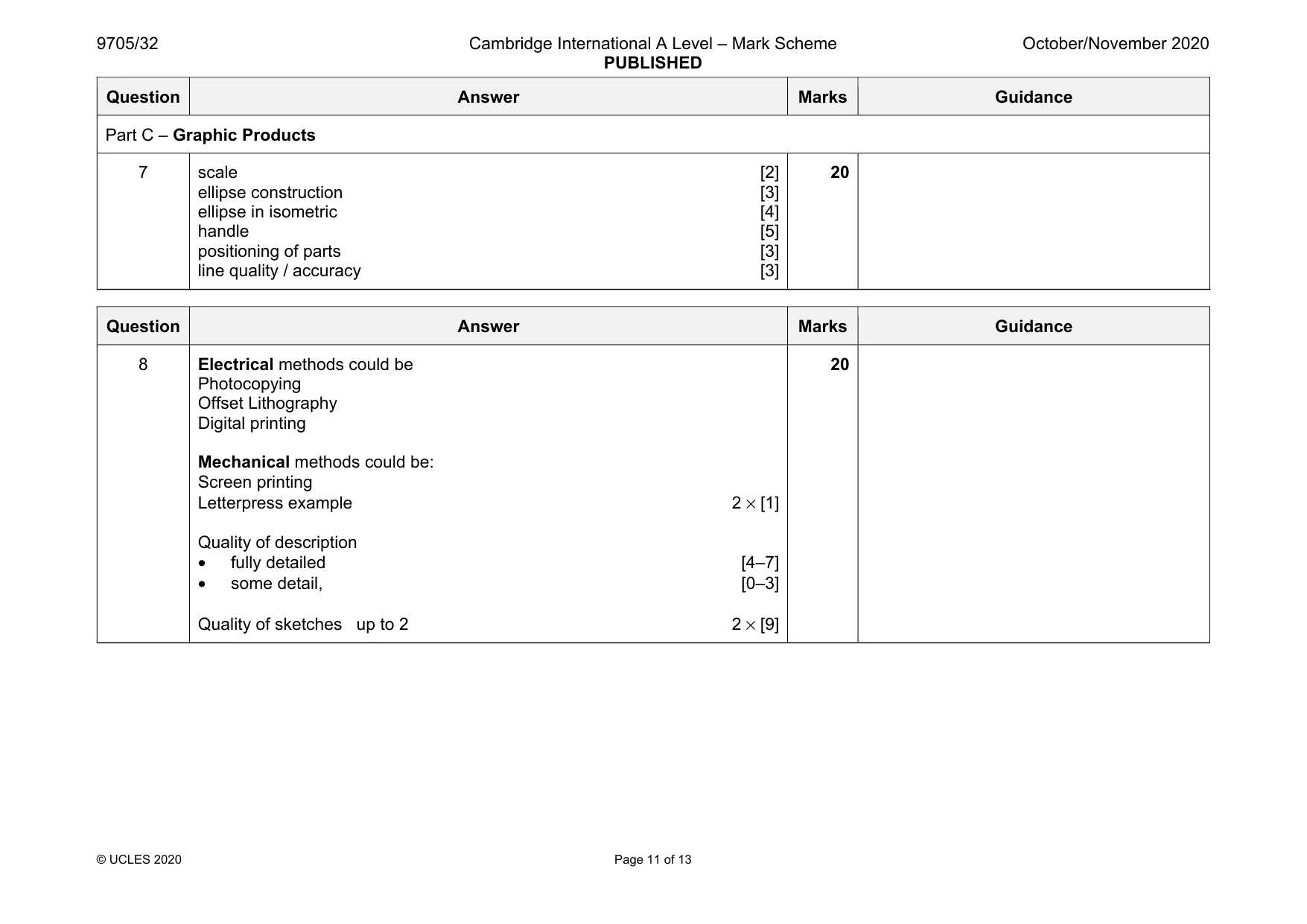
9705/32 Cambridge International A Level – Mark Scheme PUBLISHED October/November 2020 © UCLES 2020 Page 11 of 13 Question Answer Marks Guidance Part C – Graphic Products 7 scale [2] ellipse construction [3] ellipse in isometric [4] handle [5] positioning of parts [3] line quality / accuracy [3] 20 Question Answer Marks Guidance 8 Electrical methods could be Photocopying Offset Lithography Digital printing Mechanical methods could be: Screen printing Letterpress example 2 × [1] Quality of description • fully detailed [4–7] • some detail, [0–3] Quality of sketches up to 2 2 × [9] 20
Mark scheme, page 12
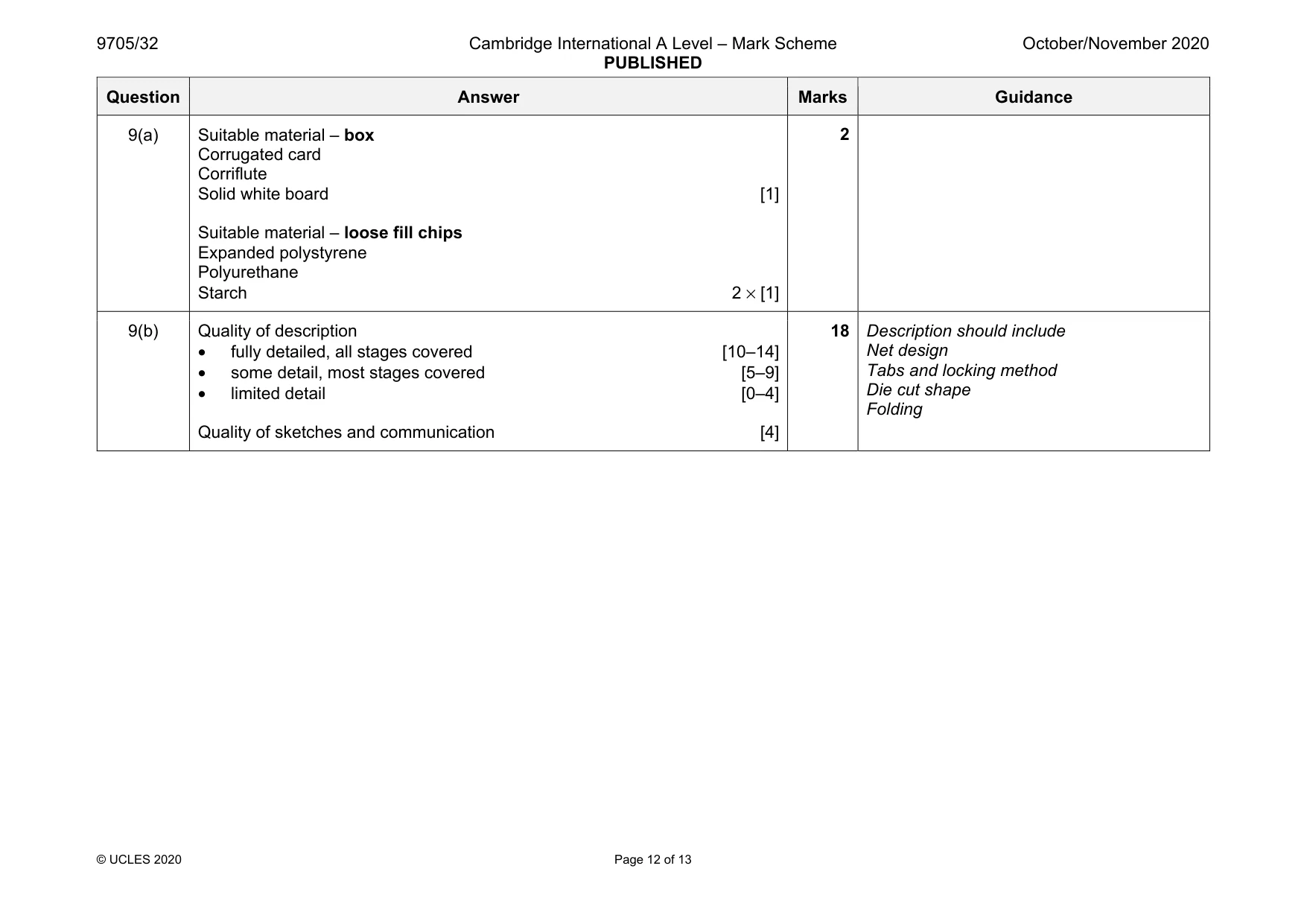
9705/32 Cambridge International A Level – Mark Scheme PUBLISHED October/November 2020 © UCLES 2020 Page 12 of 13 Question Answer Marks Guidance 9(a) Suitable material – box Corrugated card Corriflute Solid white board [1] Suitable material – loose fill chips Expanded polystyrene Polyurethane Starch 2 × [1] 2 9(b) Quality of description • fully detailed, all stages covered [10–14] • some detail, most stages covered [5–9] • limited detail [0–4] Quality of sketches and communication [4] 18 Description should include Net design Tabs and locking method Die cut shape Folding
Mark scheme, page 13
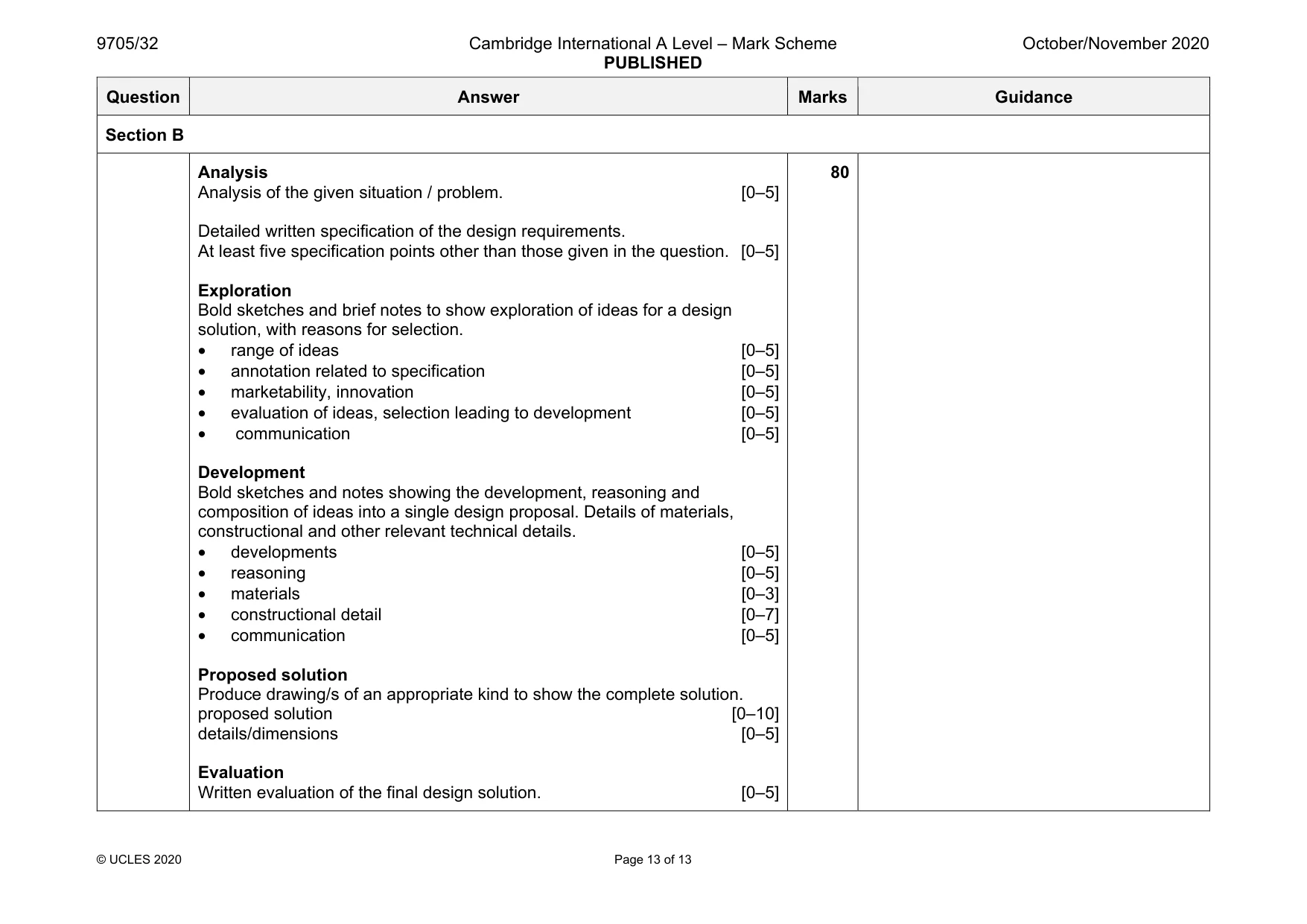
9705/32 Cambridge International A Level – Mark Scheme PUBLISHED October/November 2020 © UCLES 2020 Page 13 of 13 Question Answer Marks Guidance Section B Analysis Analysis of the given situation / problem. [0–5] Detailed written specification of the design requirements. At least five specification points other than those given in the question. [0–5] Exploration Bold sketches and brief notes to show exploration of ideas for a design solution, with reasons for selection. • range of ideas [0–5] • annotation related to specification [0–5] • marketability, innovation [0–5] • evaluation of ideas, selection leading to development [0–5] • communication [0–5] Development Bold sketches and notes showing the development, reasoning and composition of ideas into a single design proposal. Details of materials, constructional and other relevant technical details. • developments [0–5] • reasoning [0–5] • materials [0–3] • constructional detail [0–7] • communication [0–5] Proposed solution Produce drawing/s of an appropriate kind to show the complete solution. proposed solution [0–10] details/dimensions [0–5] Evaluation Written evaluation of the final design solution. [0–5] 80
What you needed in this session
Cambridge’s own grade thresholds for 2020 Oct/Nov, Paper 3 · Variant 2. A higher threshold means an easier paper — the bar moves with how the cohort did.