Cambridge A Level Design and Technology 9705 — 2018 Oct/Nov Paper 3 · Variant 3
9705/33/O/N/18 · 120 marks · ≈135 min
The question paper and its mark scheme, free to read here and free to download. This is Cambridge’s own paper, exactly as it was sat.
Question paper12 pages

Mark scheme11 pages
Answers below. Sit the paper first if you are practising.
Paper as text
Question paper, page 1
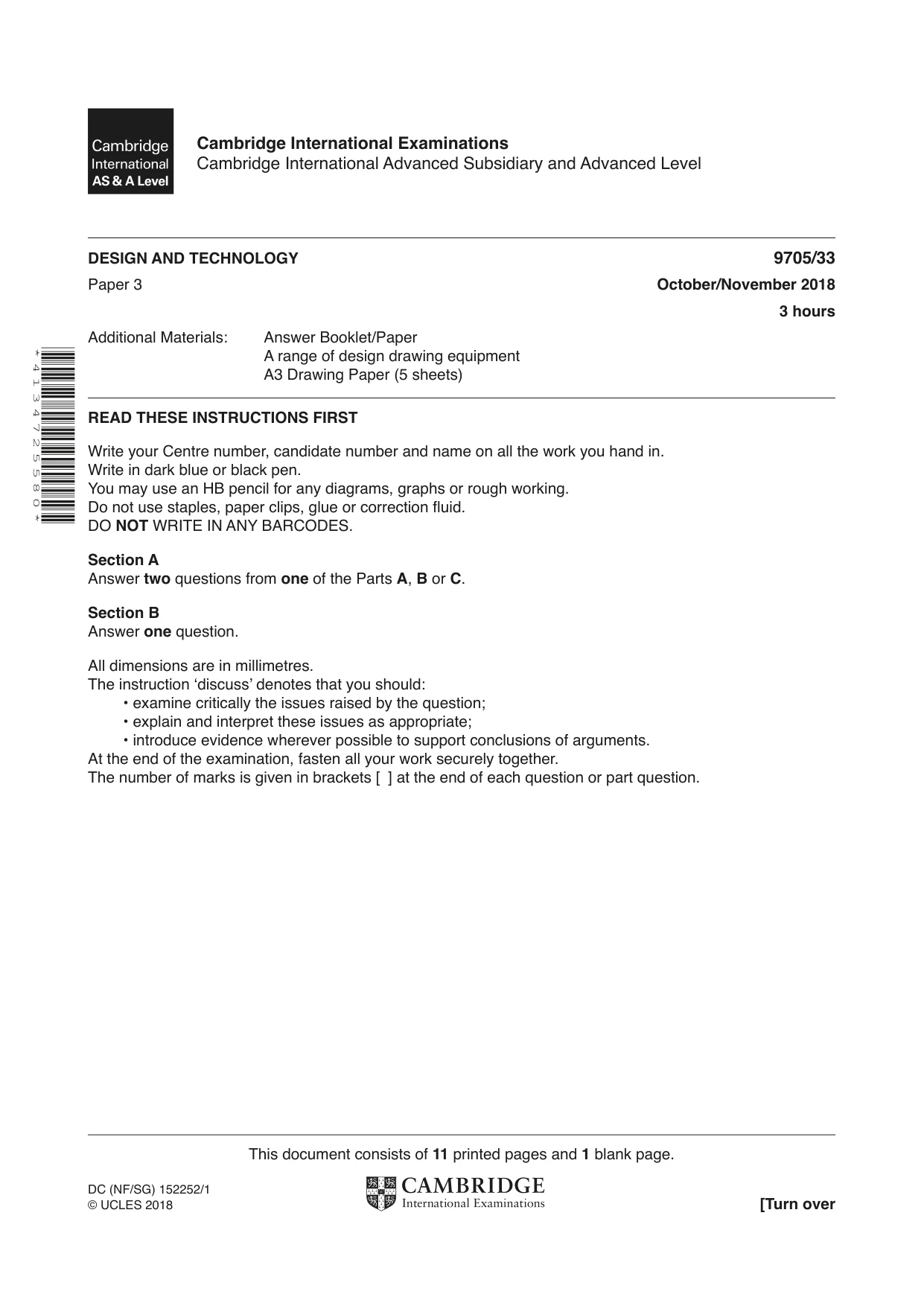
* 4 1 3 4 7 2 5 5 8 0 * This document consists of 11 printed pages and 1 blank page. DC (NF/SG) 152252/1 © UCLES 2018 [Turn over Cambridge International Examinations Cambridge International Advanced Subsidiary and Advanced Level DESIGN AND TECHNOLOGY 9705/33 Paper 3 October/November 2018 3 hours Additional Materials: Answer Booklet/Paper A range of design drawing equipment A3 Drawing Paper (5 sheets) READ THESE INSTRUCTIONS FIRST Write your Centre number, candidate number and name on all the work you hand in. Write in dark blue or black pen. You may use an HB pencil for any diagrams, graphs or rough working. Do not use staples, paper clips, glue or correction fluid. DO NOT WRITE IN ANY BARCODES. Section A Answer two questions from one of the Parts A, B or C. Section B Answer one question. All dimensions are in millimetres. The instruction ‘discuss’ denotes that you should: • examine critically the issues raised by the question; • explain and interpret these issues as appropriate; • introduce evidence wherever possible to support conclusions of arguments. At the end of the examination, fasten all your work securely together. The number of marks is given in brackets [ ] at the end of each question or part question.
Question paper, page 2
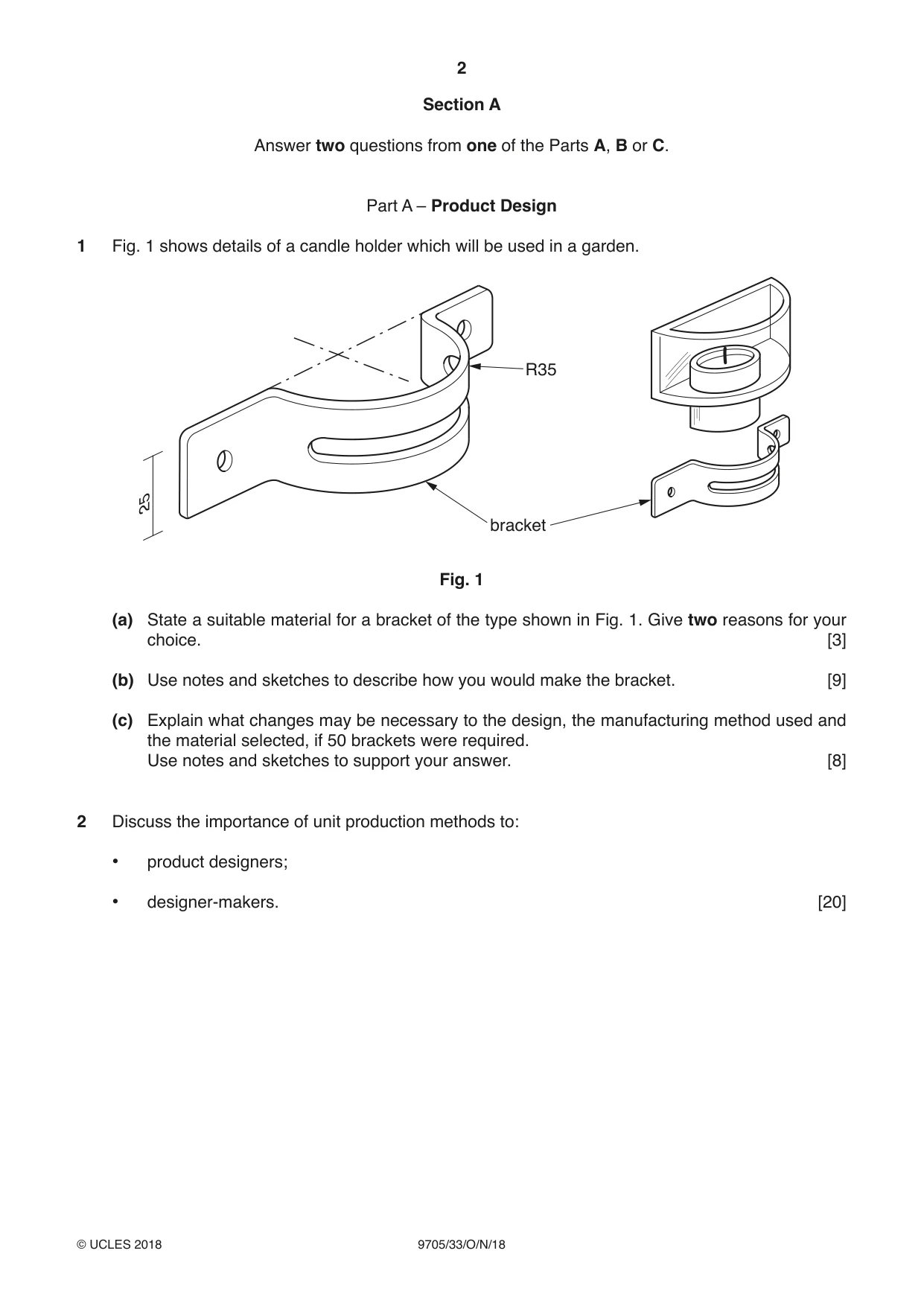
2 9705/33/O/N/18 © UCLES 2018 Section A Answer two questions from one of the Parts A, B or C. Part A – Product Design 1 Fig. 1 shows details of a candle holder which will be used in a garden. 25 R35 bracket Fig. 1 (a) State a suitable material for a bracket of the type shown in Fig. 1. Give two reasons for your choice. [3] (b) Use notes and sketches to describe how you would make the bracket. [9] (c) Explain what changes may be necessary to the design, the manufacturing method used and the material selected, if 50 brackets were required. Use notes and sketches to support your answer. [8] 2 Discuss the importance of unit production methods to: • product designers; • designer-makers. [20]
Question paper, page 3
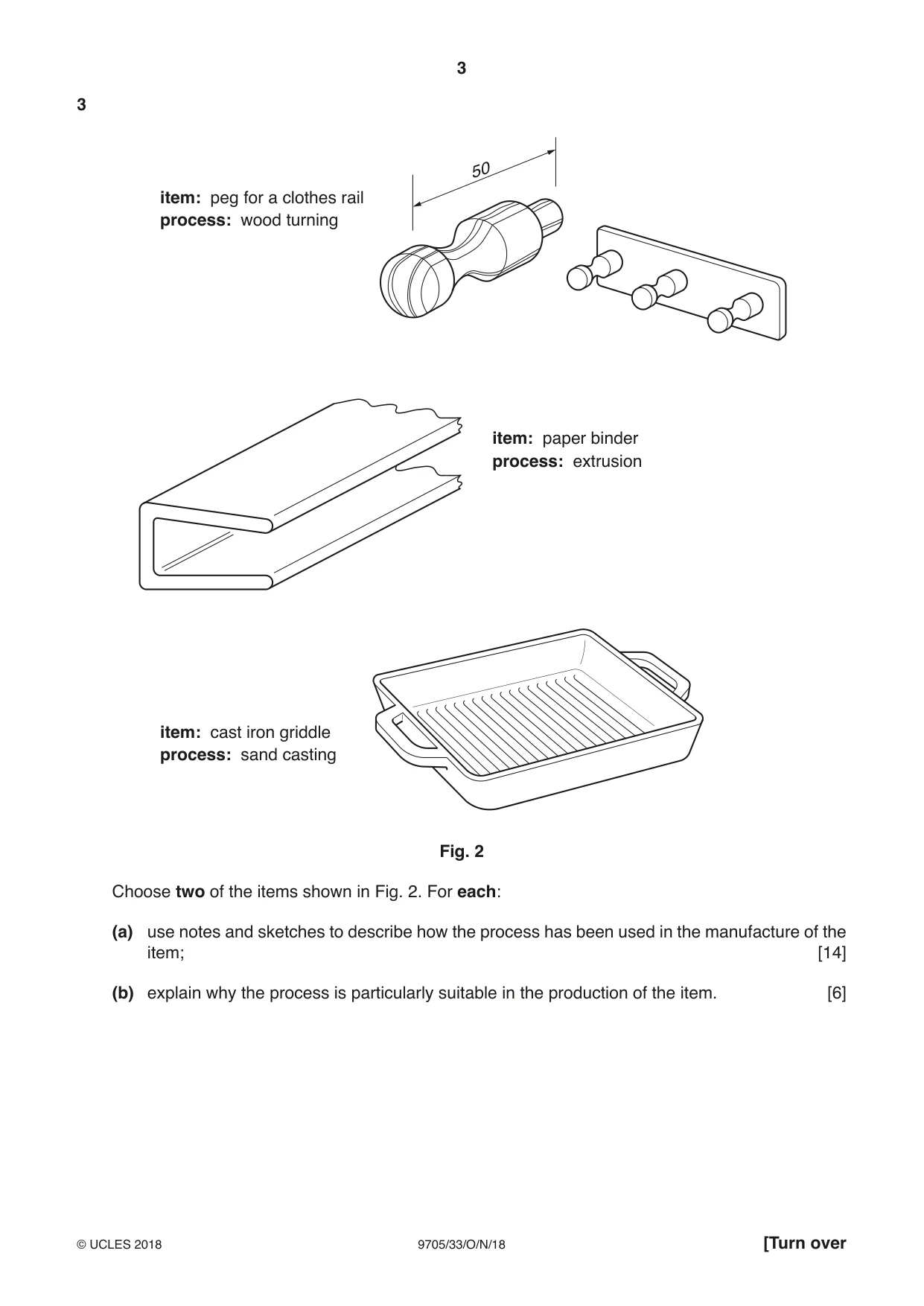
3 9705/33/O/N/18 © UCLES 2018 [Turn over 3 50 item: peg for a clothes rail process: wood turning item: paper binder process: extrusion item: cast iron griddle process: sand casting Fig. 2 Choose two of the items shown in Fig. 2. For each: (a) use notes and sketches to describe how the process has been used in the manufacture of the item; [14] (b) explain why the process is particularly suitable in the production of the item. [6]
Question paper, page 4
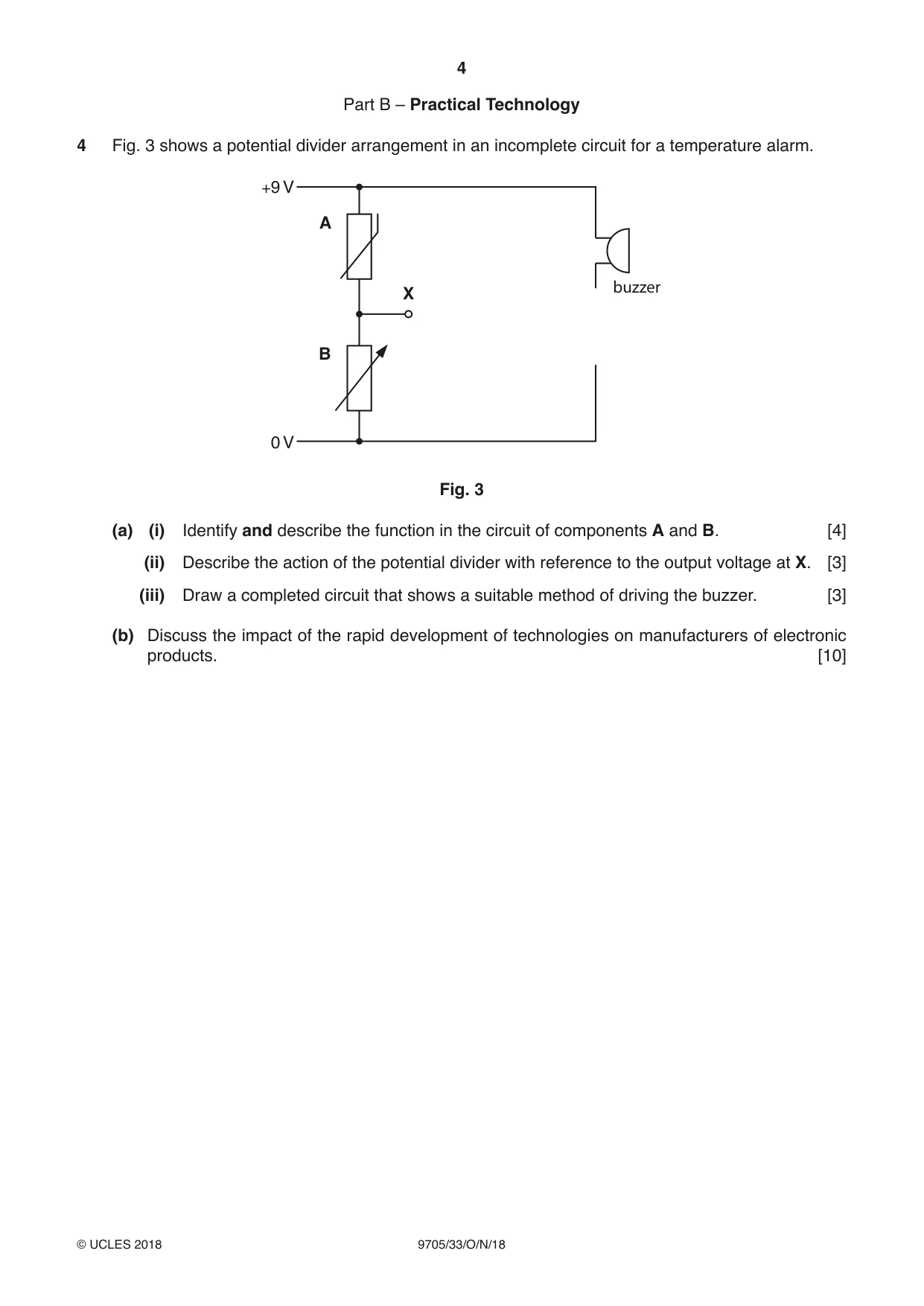
4 9705/33/O/N/18 © UCLES 2018 Part B – Practical Technology 4 Fig. 3 shows a potential divider arrangement in an incomplete circuit for a temperature alarm. A B X 0 V +9 V buzzer Fig. 3 (a) (i) Identify and describe the function in the circuit of components A and B. [4] (ii) Describe the action of the potential divider with reference to the output voltage at X. [3] (iii) Draw a completed circuit that shows a suitable method of driving the buzzer. [3] (b) Discuss the impact of the rapid development of technologies on manufacturers of electronic products. [10]
Question paper, page 5
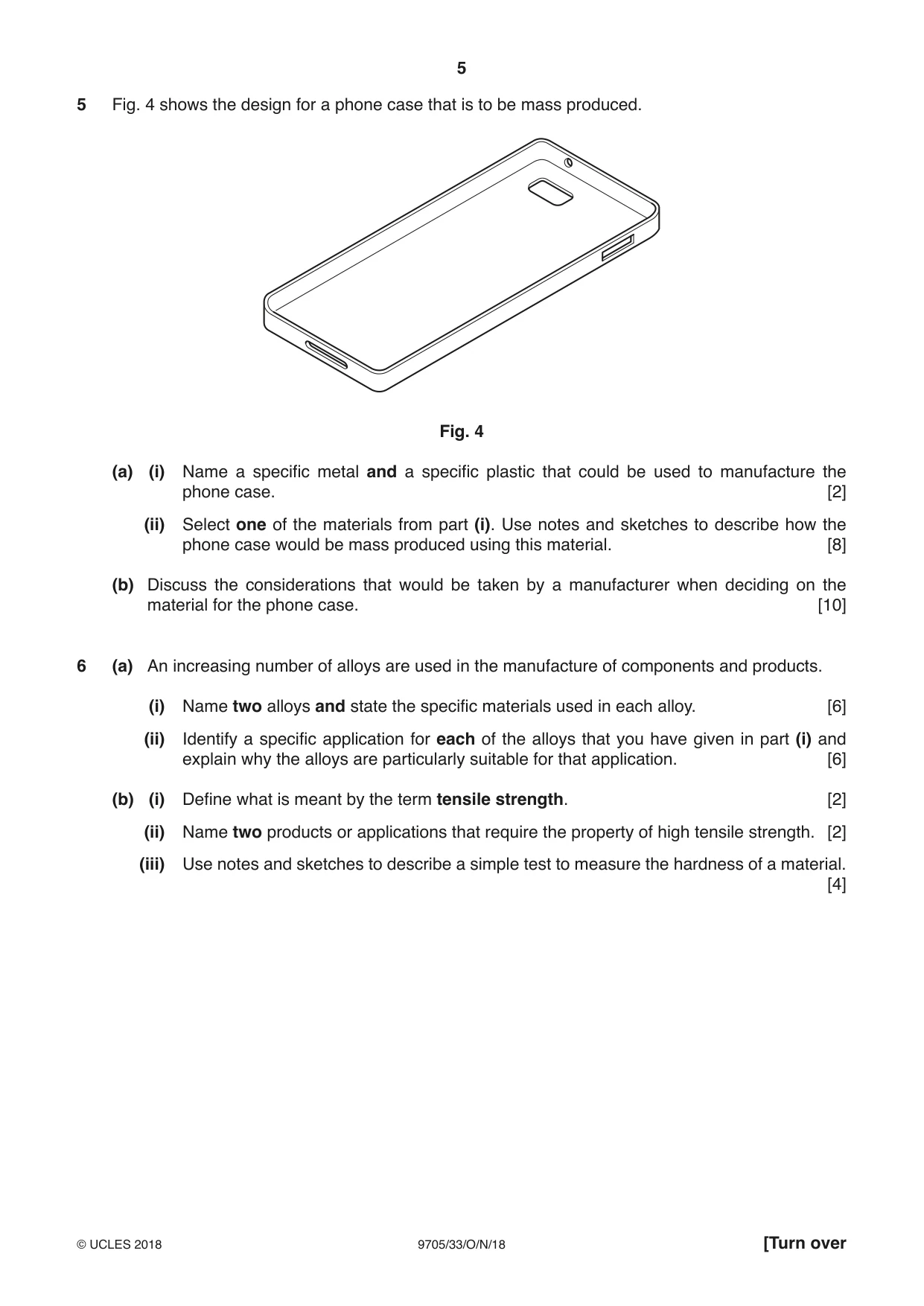
5 9705/33/O/N/18 © UCLES 2018 [Turn over 5 Fig. 4 shows the design for a phone case that is to be mass produced. Fig. 4 (a) (i) Name a specific metal and a specific plastic that could be used to manufacture the phone case. [2] (ii) Select one of the materials from part (i). Use notes and sketches to describe how the phone case would be mass produced using this material. [8] (b) Discuss the considerations that would be taken by a manufacturer when deciding on the material for the phone case. [10] 6 (a) An increasing number of alloys are used in the manufacture of components and products. (i) Name two alloys and state the specific materials used in each alloy. [6] (ii) Identify a specific application for each of the alloys that you have given in part (i) and explain why the alloys are particularly suitable for that application. [6] (b) (i) Define what is meant by the term tensile strength. [2] (ii) Name two products or applications that require the property of high tensile strength. [2] (iii) Use notes and sketches to describe a simple test to measure the hardness of a material. [4]
Question paper, page 6
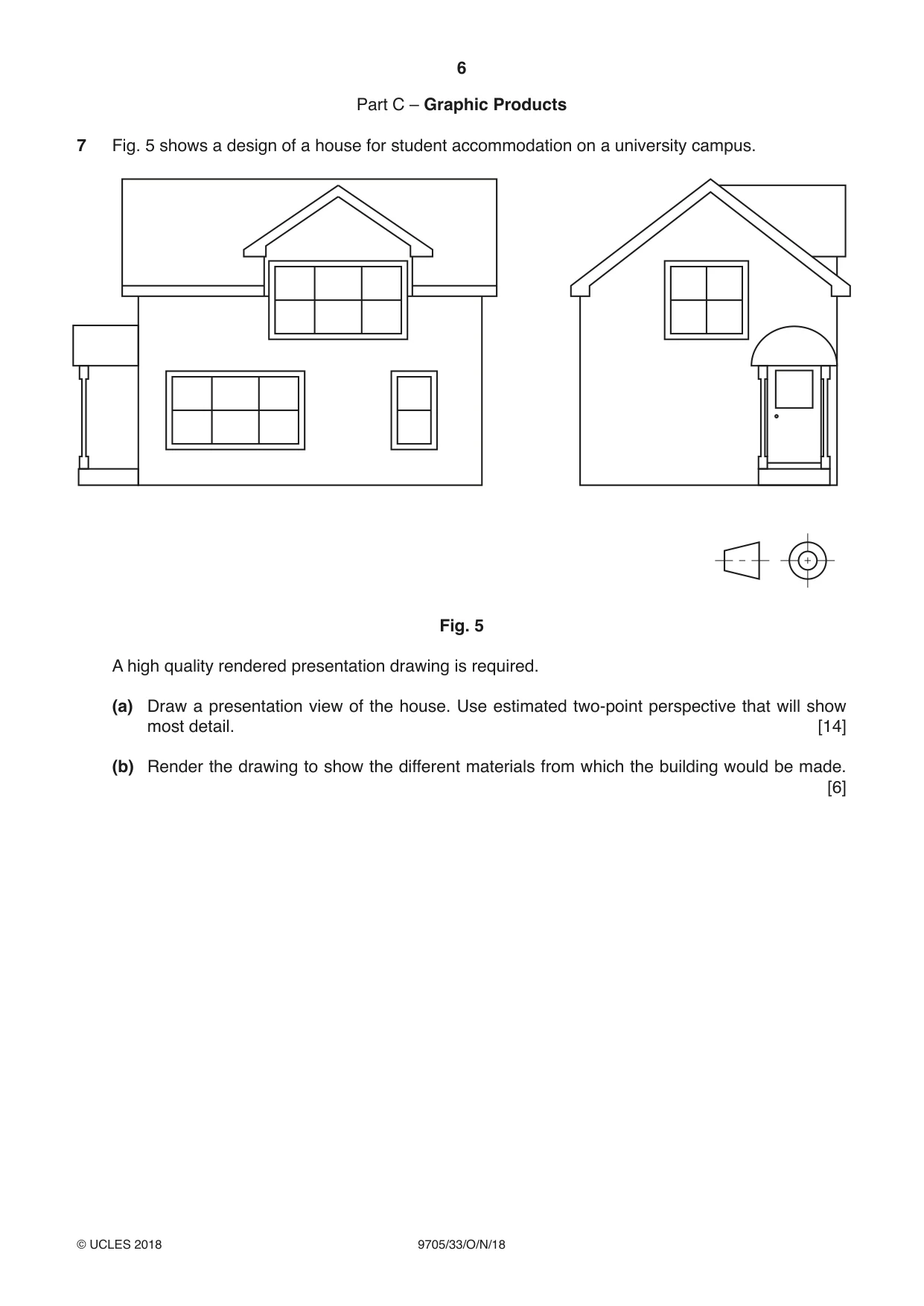
6 9705/33/O/N/18 © UCLES 2018 Part C – Graphic Products 7 Fig. 5 shows a design of a house for student accommodation on a university campus. Fig. 5 A high quality rendered presentation drawing is required. (a) Draw a presentation view of the house. Use estimated two-point perspective that will show most detail. [14] (b) Render the drawing to show the different materials from which the building would be made. [6]
Question paper, page 7
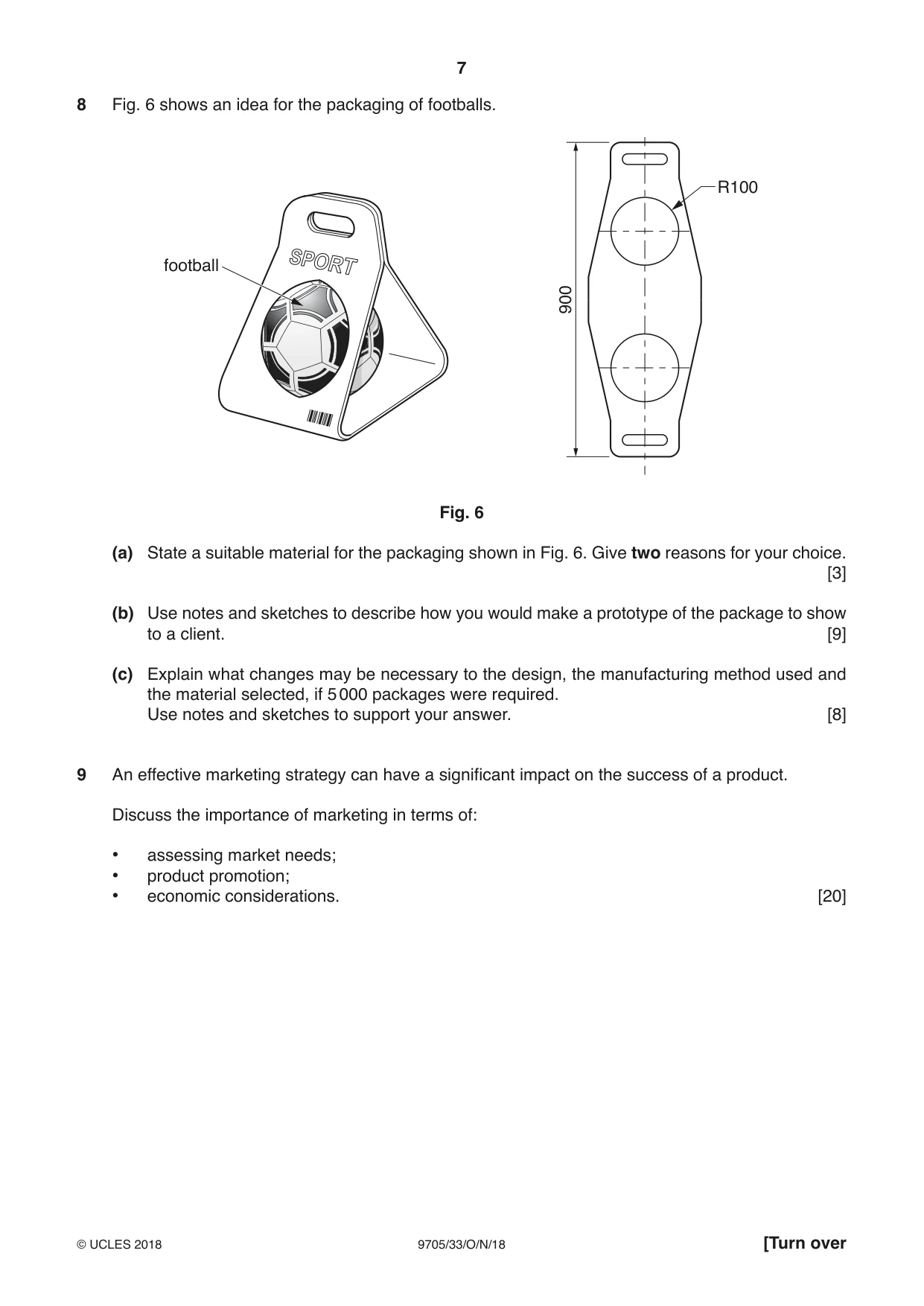
7 9705/33/O/N/18 © UCLES 2018 [Turn over 8 Fig. 6 shows an idea for the packaging of footballs. 900 R100 football Fig. 6 (a) State a suitable material for the packaging shown in Fig. 6. Give two reasons for your choice. [3] (b) Use notes and sketches to describe how you would make a prototype of the package to show to a client. [9] (c) Explain what changes may be necessary to the design, the manufacturing method used and the material selected, if 5 000 packages were required. Use notes and sketches to support your answer. [8] 9 An effective marketing strategy can have a significant impact on the success of a product. Discuss the importance of marketing in terms of: • assessing market needs; • product promotion; • economic considerations. [20]
Question paper, page 8
8 9705/33/O/N/18 © UCLES 2018 Section B Answer one question on the A3 paper provided. You should approach the design question of your choice in the following manner: Analysis Produce an analysis of the given situation/problem, which may be in written or graphical form. [5] Specification Produce a detailed written specification of the design requirements from the analysis. Include at least five specification points other than those given in the question. [5] Exploration Use bold sketches and brief notes to show your exploration of ideas for a design solution, with reasons for selection. [25] Development Use bold sketches and notes to show the development, reasoning and composition of ideas into a single design proposal. Give details of materials, constructional and other relevant technical details. [25] Proposed solution Produce drawings of an appropriate kind to show the complete solution. [15] Evaluation Give a written evaluation of the final design solution. [5] [Total: 80]
Question paper, page 9
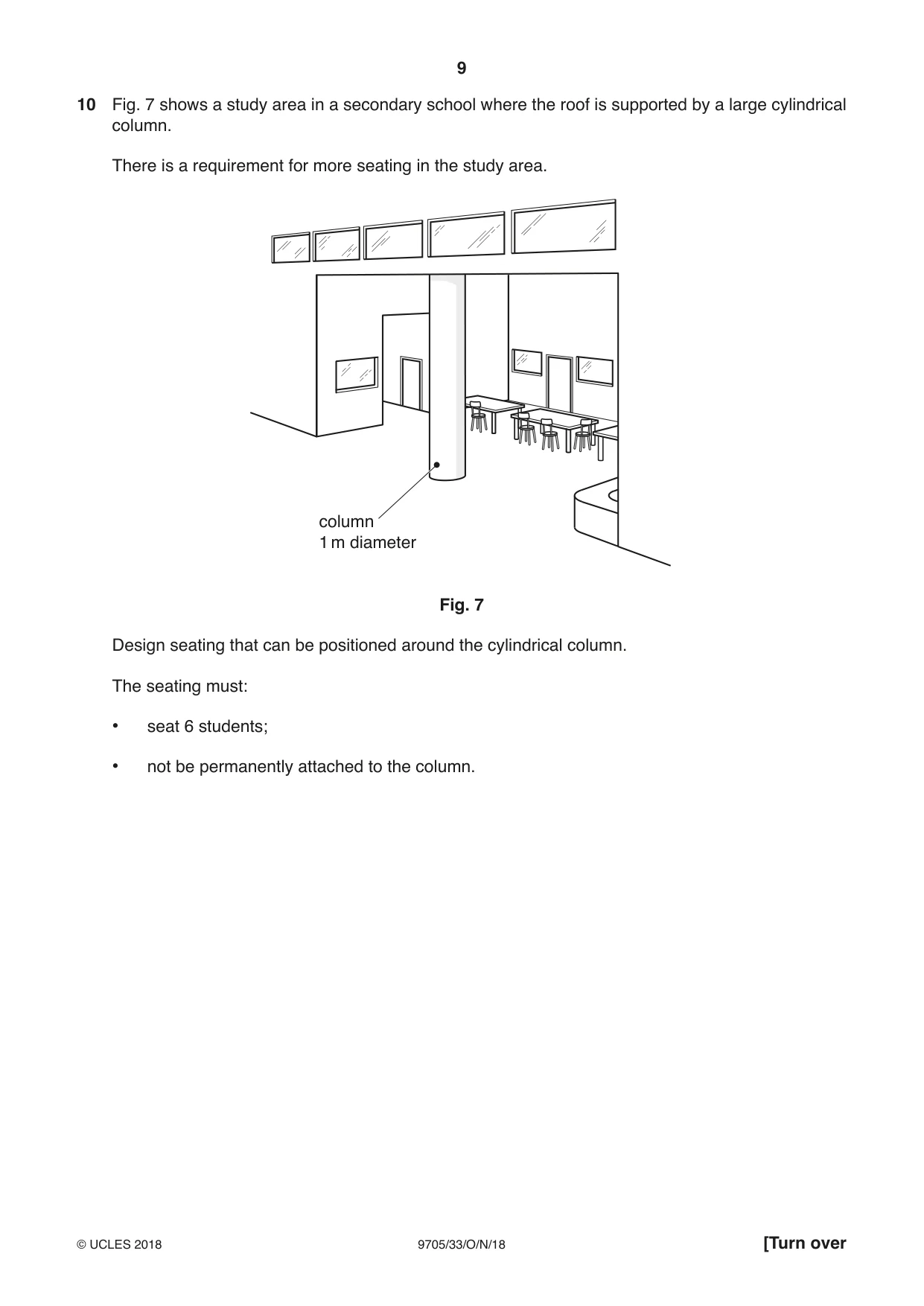
9 9705/33/O/N/18 © UCLES 2018 [Turn over 10 Fig. 7 shows a study area in a secondary school where the roof is supported by a large cylindrical column. There is a requirement for more seating in the study area. column 1 m diameter Fig. 7 Design seating that can be positioned around the cylindrical column. The seating must: • seat 6 students; • not be permanently attached to the column.
Question paper, page 10
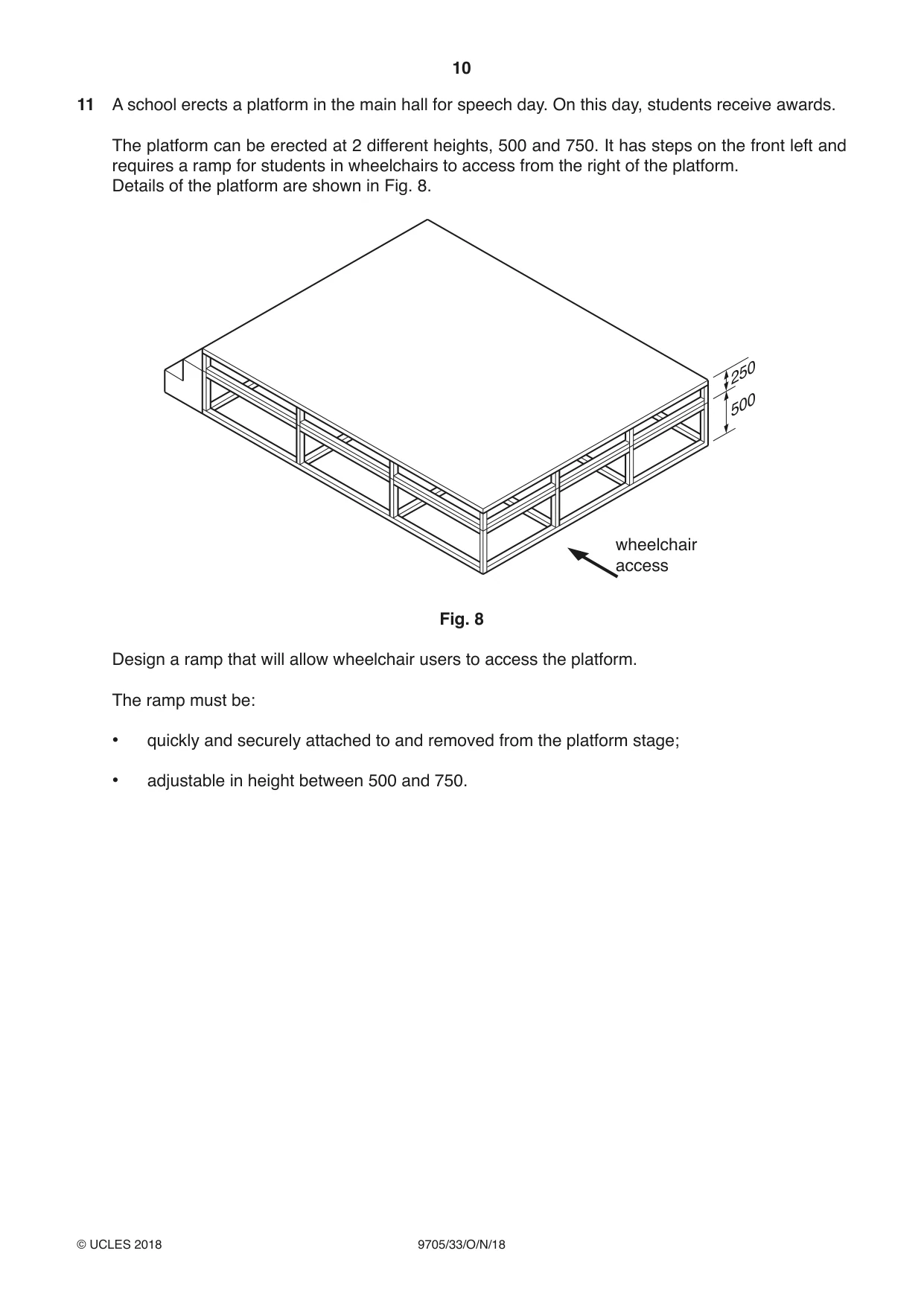
10 9705/33/O/N/18 © UCLES 2018 11 A school erects a platform in the main hall for speech day. On this day, students receive awards. The platform can be erected at 2 different heights, 500 and 750. It has steps on the front left and requires a ramp for students in wheelchairs to access from the right of the platform. Details of the platform are shown in Fig. 8. 250 500 wheelchair access Fig. 8 Design a ramp that will allow wheelchair users to access the platform. The ramp must be: • quickly and securely attached to and removed from the platform stage; • adjustable in height between 500 and 750.
Question paper, page 11
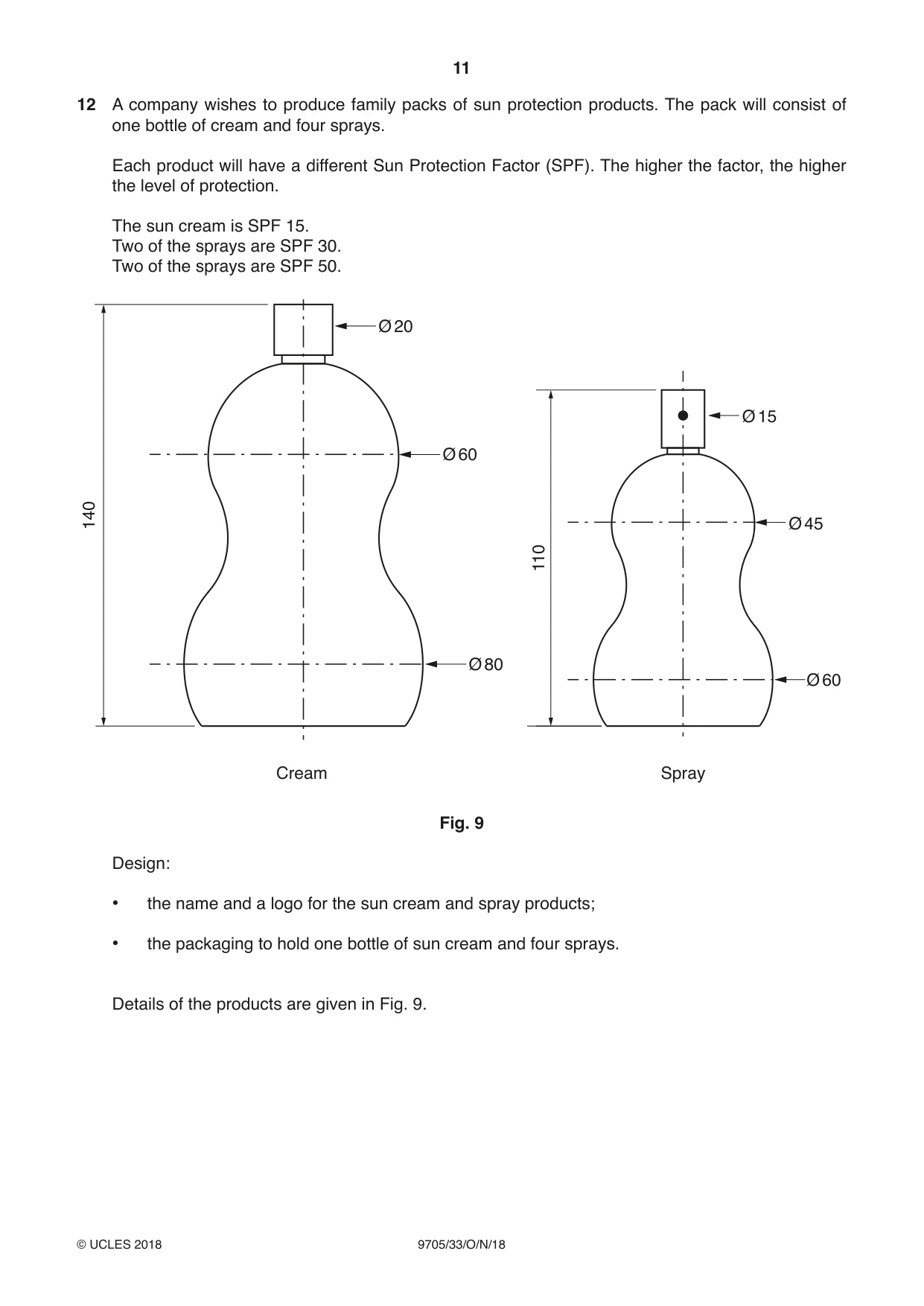
11 9705/33/O/N/18 © UCLES 2018 12 A company wishes to produce family packs of sun protection products. The pack will consist of one bottle of cream and four sprays. Each product will have a different Sun Protection Factor (SPF). The higher the factor, the higher the level of protection. The sun cream is SPF 15. Two of the sprays are SPF 30. Two of the sprays are SPF 50. 140 110 Ø 20 Ø 60 Ø 80 Ø 45 Ø 15 Ø 60 Cream Spray Fig. 9 Design: • the name and a logo for the sun cream and spray products; • the packaging to hold one bottle of sun cream and four sprays. Details of the products are given in Fig. 9.
Question paper, page 12
12 9705/33/O/N/18 © UCLES 2018 BLANK PAGE Permission to reproduce items where third-party owned material protected by copyright is included has been sought and cleared where possible. Every reasonable effort has been made by the publisher (UCLES) to trace copyright holders, but if any items requiring clearance have unwittingly been included, the publisher will be pleased to make amends at the earliest possible opportunity. To avoid the issue of disclosure of answer-related information to candidates, all copyright acknowledgements are reproduced online in the Cambridge International Examinations Copyright Acknowledgements Booklet. This is produced for each series of examinations and is freely available to download at www.cie.org.uk after the live examination series. Cambridge International Examinations is part of the Cambridge Assessment Group. Cambridge Assessment is the brand name of University of Cambridge Local Examinations Syndicate (UCLES), which is itself a department of the University of Cambridge.
Mark scheme, page 1
This document consists of 11 printed pages. © UCLES 2018 [Turn over Cambridge Assessment International Education Cambridge International Advanced Level DESIGN AND TECHNOLOGY 9705/33 Paper 3 October/November 2018 MARK SCHEME Maximum Mark: 120 Published This mark scheme is published as an aid to teachers and candidates, to indicate the requirements of the examination. It shows the basis on which Examiners were instructed to award marks. It does not indicate the details of the discussions that took place at an Examiners’ meeting before marking began, which would have considered the acceptability of alternative answers. Mark schemes should be read in conjunction with the question paper and the Principal Examiner Report for Teachers. Cambridge International will not enter into discussions about these mark schemes. Cambridge International is publishing the mark schemes for the October/November 2018 series for most Cambridge IGCSE™, Cambridge International A and AS Level components and some Cambridge O Level components.
Mark scheme, page 2
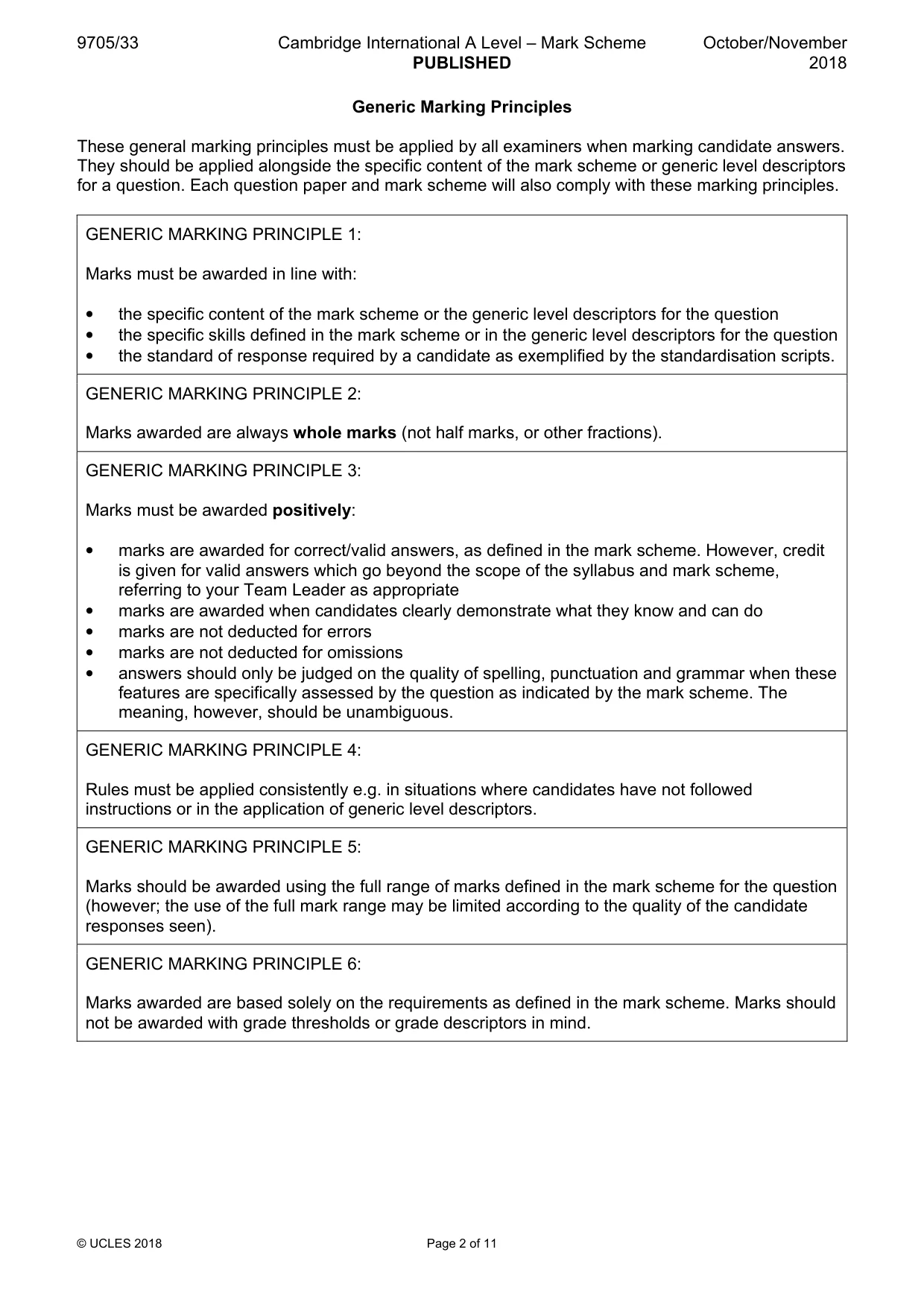
9705/33 Cambridge International A Level – Mark Scheme PUBLISHED October/November 2018 © UCLES 2018 Page 2 of 11 Generic Marking Principles These general marking principles must be applied by all examiners when marking candidate answers. They should be applied alongside the specific content of the mark scheme or generic level descriptors for a question. Each question paper and mark scheme will also comply with these marking principles. GENERIC MARKING PRINCIPLE 1: Marks must be awarded in line with: • the specific content of the mark scheme or the generic level descriptors for the question • the specific skills defined in the mark scheme or in the generic level descriptors for the question • the standard of response required by a candidate as exemplified by the standardisation scripts. GENERIC MARKING PRINCIPLE 2: Marks awarded are always whole marks (not half marks, or other fractions). GENERIC MARKING PRINCIPLE 3: Marks must be awarded positively: • marks are awarded for correct/valid answers, as defined in the mark scheme. However, credit is given for valid answers which go beyond the scope of the syllabus and mark scheme, referring to your Team Leader as appropriate • marks are awarded when candidates clearly demonstrate what they know and can do • marks are not deducted for errors • marks are not deducted for omissions • answers should only be judged on the quality of spelling, punctuation and grammar when these features are specifically assessed by the question as indicated by the mark scheme. The meaning, however, should be unambiguous. GENERIC MARKING PRINCIPLE 4: Rules must be applied consistently e.g. in situations where candidates have not followed instructions or in the application of generic level descriptors. GENERIC MARKING PRINCIPLE 5: Marks should be awarded using the full range of marks defined in the mark scheme for the question (however; the use of the full mark range may be limited according to the quality of the candidate responses seen). GENERIC MARKING PRINCIPLE 6: Marks awarded are based solely on the requirements as defined in the mark scheme. Marks should not be awarded with grade thresholds or grade descriptors in mind.
Mark scheme, page 3
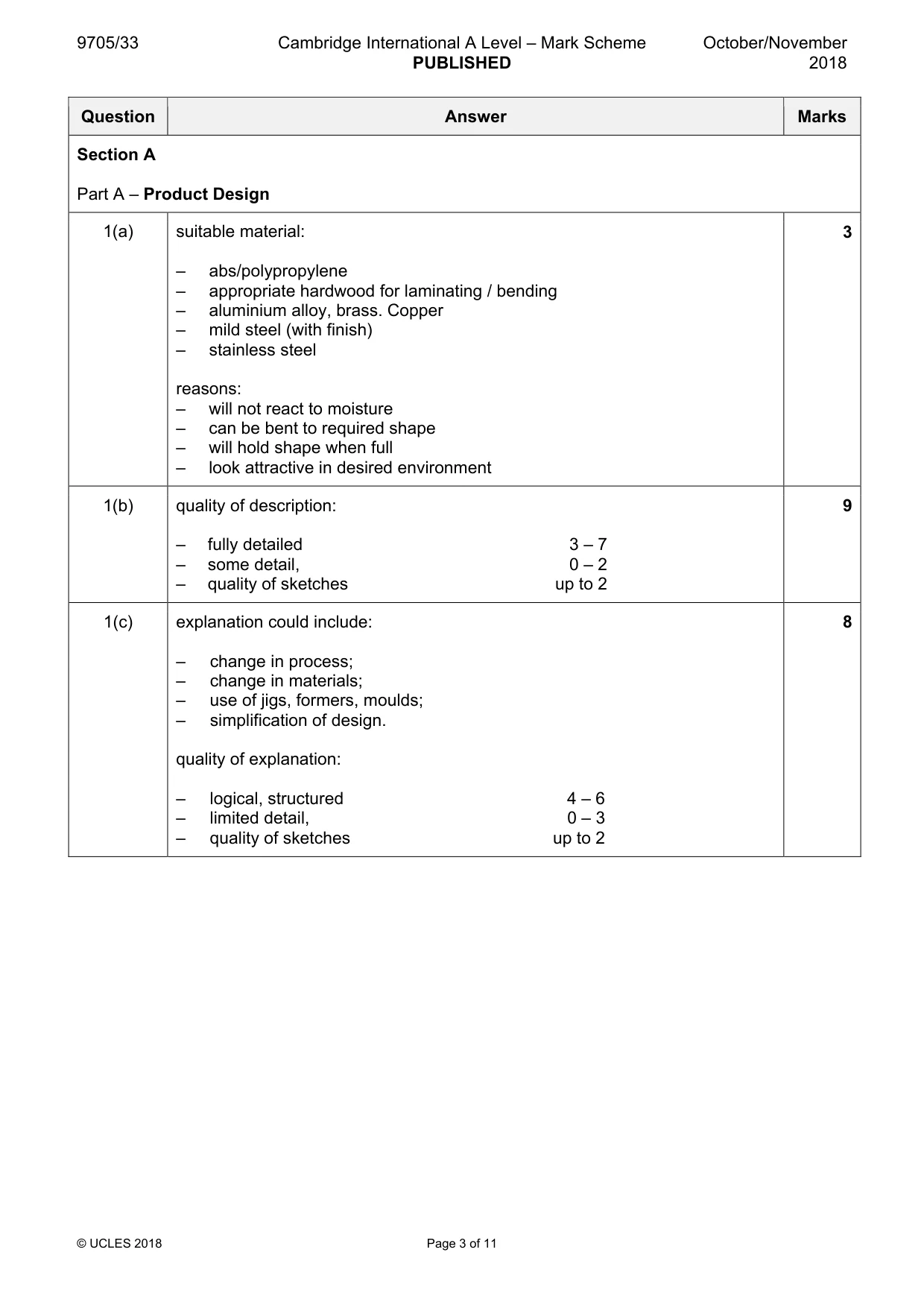
9705/33 Cambridge International A Level – Mark Scheme PUBLISHED October/November 2018 © UCLES 2018 Page 3 of 11 Question Answer Marks Section A Part A – Product Design 1(a) suitable material: – abs/polypropylene – appropriate hardwood for laminating / bending – aluminium alloy, brass. Copper – mild steel (with finish) – stainless steel reasons: – will not react to moisture – can be bent to required shape – will hold shape when full – look attractive in desired environment 3 1(b) quality of description: – fully detailed 3 – 7 – some detail, 0 – 2 – quality of sketches up to 2 9 1(c) explanation could include: – change in process; – change in materials; – use of jigs, formers, moulds; – simplification of design. quality of explanation: – logical, structured 4 – 6 – limited detail, 0 – 3 – quality of sketches up to 2 8
Mark scheme, page 4
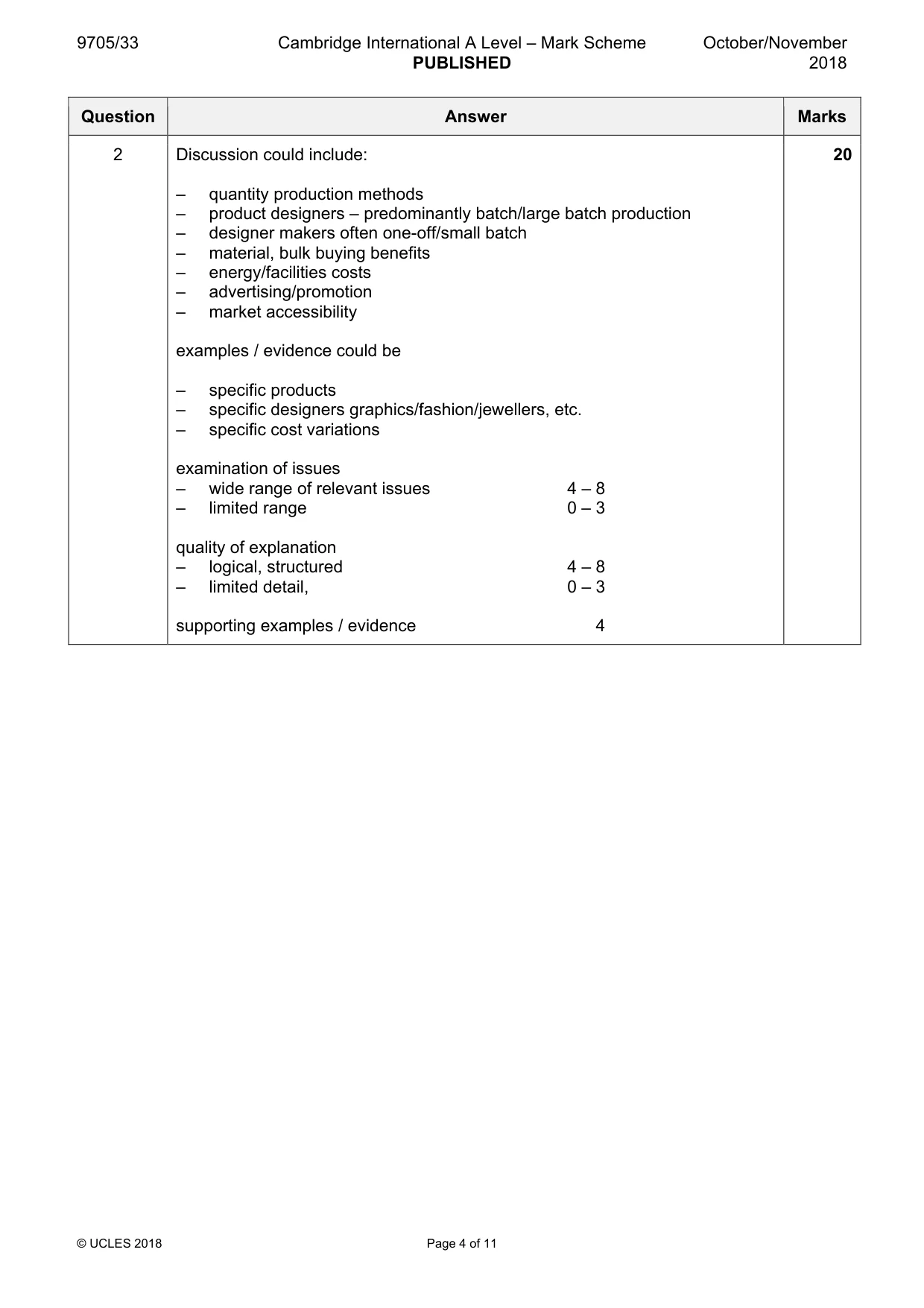
9705/33 Cambridge International A Level – Mark Scheme PUBLISHED October/November 2018 © UCLES 2018 Page 4 of 11 Question Answer Marks 2 Discussion could include: – quantity production methods – product designers – predominantly batch/large batch production – designer makers often one-off/small batch – material, bulk buying benefits – energy/facilities costs – advertising/promotion – market accessibility examples / evidence could be – specific products – specific designers graphics/fashion/jewellers, etc. – specific cost variations examination of issues – wide range of relevant issues 4 – 8 – limited range 0 – 3 quality of explanation – logical, structured 4 – 8 – limited detail, 0 – 3 supporting examples / evidence 4 20
Mark scheme, page 5
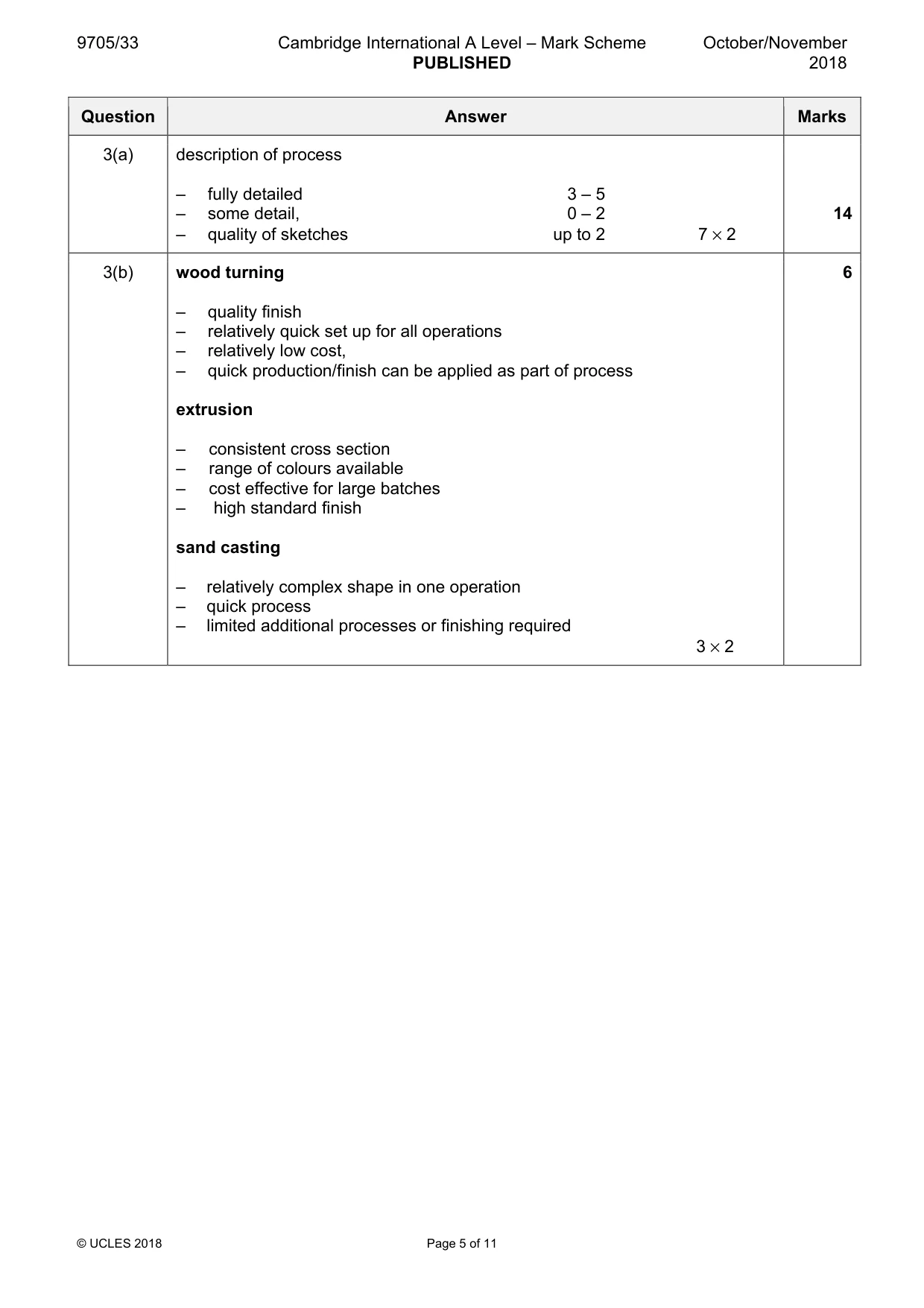
9705/33 Cambridge International A Level – Mark Scheme PUBLISHED October/November 2018 © UCLES 2018 Page 5 of 11 Question Answer Marks 3(a) description of process – fully detailed 3 – 5 – some detail, 0 – 2 – quality of sketches up to 2 7 × 2 14 3(b) wood turning – quality finish – relatively quick set up for all operations – relatively low cost, – quick production/finish can be applied as part of process extrusion – consistent cross section – range of colours available – cost effective for large batches – high standard finish sand casting – relatively complex shape in one operation – quick process – limited additional processes or finishing required 3 × 2 6
Mark scheme, page 6
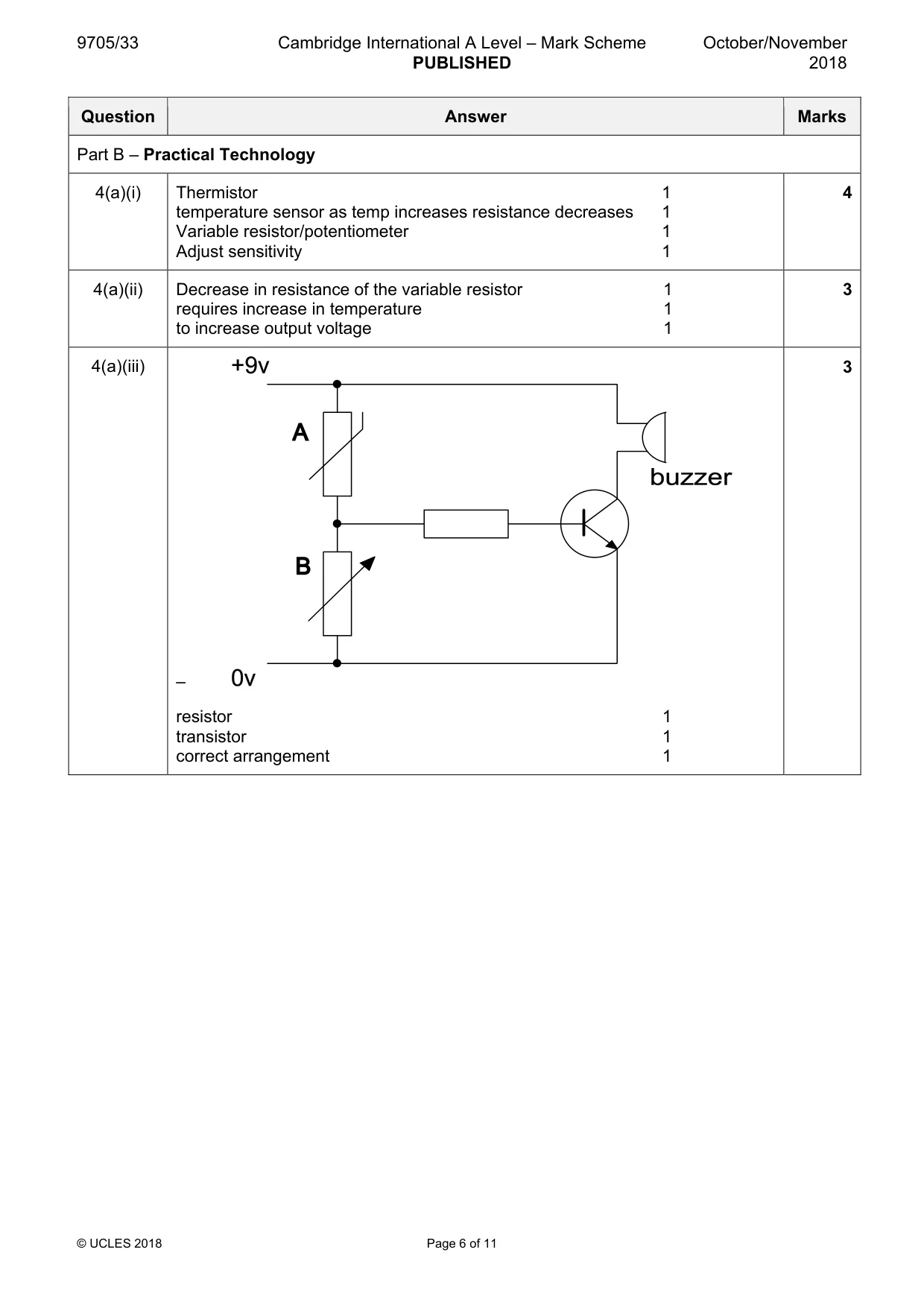
9705/33 Cambridge International A Level – Mark Scheme PUBLISHED October/November 2018 © UCLES 2018 Page 6 of 11 Question Answer Marks Part B – Practical Technology 4(a)(i) Thermistor 1 temperature sensor as temp increases resistance decreases 1 Variable resistor/potentiometer 1 Adjust sensitivity 1 4 4(a)(ii) Decrease in resistance of the variable resistor 1 requires increase in temperature 1 to increase output voltage 1 3 4(a)(iii) – resistor 1 transistor 1 correct arrangement 1 3
Mark scheme, page 7
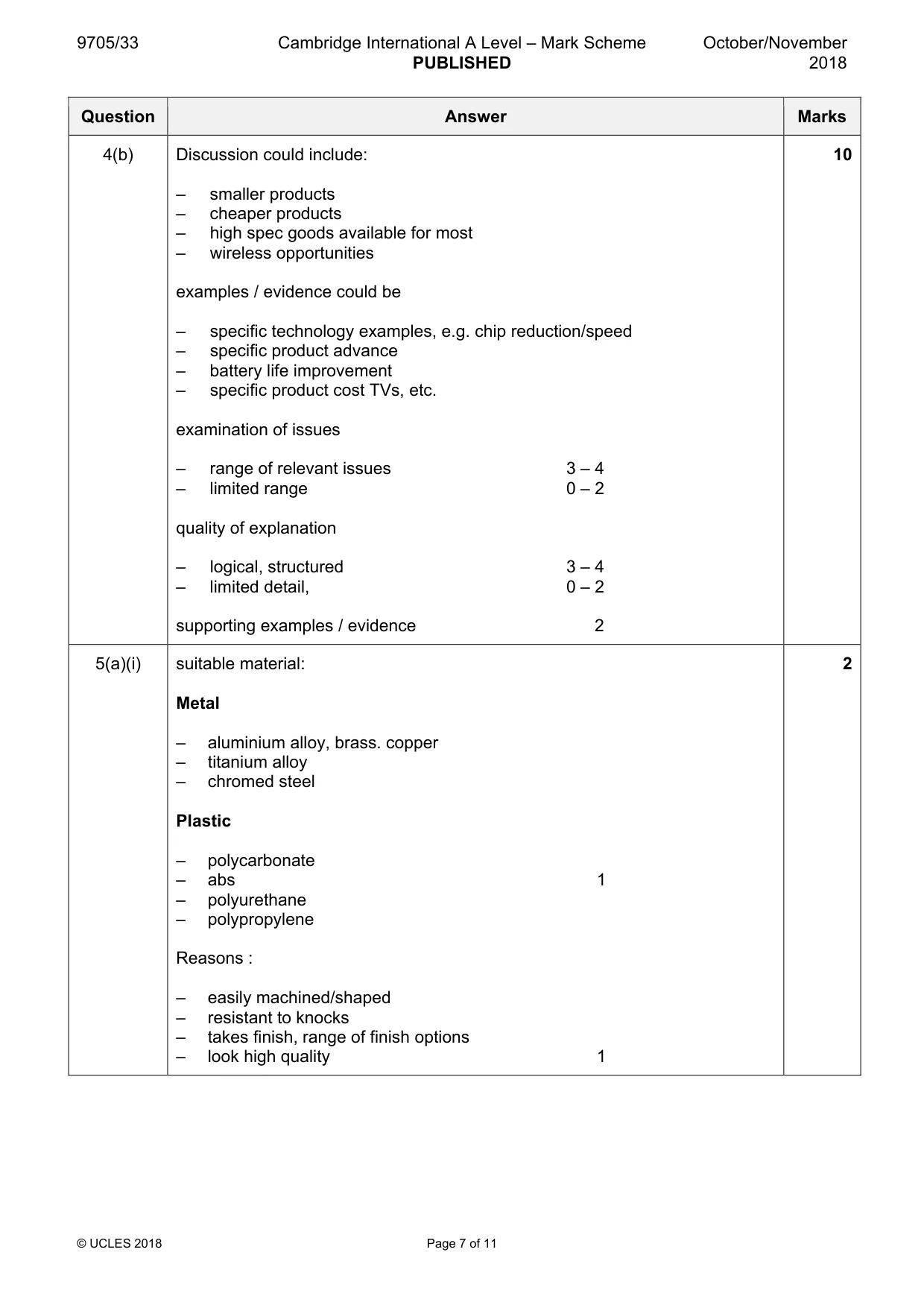
9705/33 Cambridge International A Level – Mark Scheme PUBLISHED October/November 2018 © UCLES 2018 Page 7 of 11 Question Answer Marks 4(b) Discussion could include: – smaller products – cheaper products – high spec goods available for most – wireless opportunities examples / evidence could be – specific technology examples, e.g. chip reduction/speed – specific product advance – battery life improvement – specific product cost TVs, etc. examination of issues – range of relevant issues 3 – 4 – limited range 0 – 2 quality of explanation – logical, structured 3 – 4 – limited detail, 0 – 2 supporting examples / evidence 2 10 5(a)(i) suitable material: Metal – aluminium alloy, brass. copper – titanium alloy – chromed steel Plastic – polycarbonate – abs 1 – polyurethane – polypropylene Reasons : – easily machined/shaped – resistant to knocks – takes finish, range of finish options – look high quality 1 2
Mark scheme, page 8
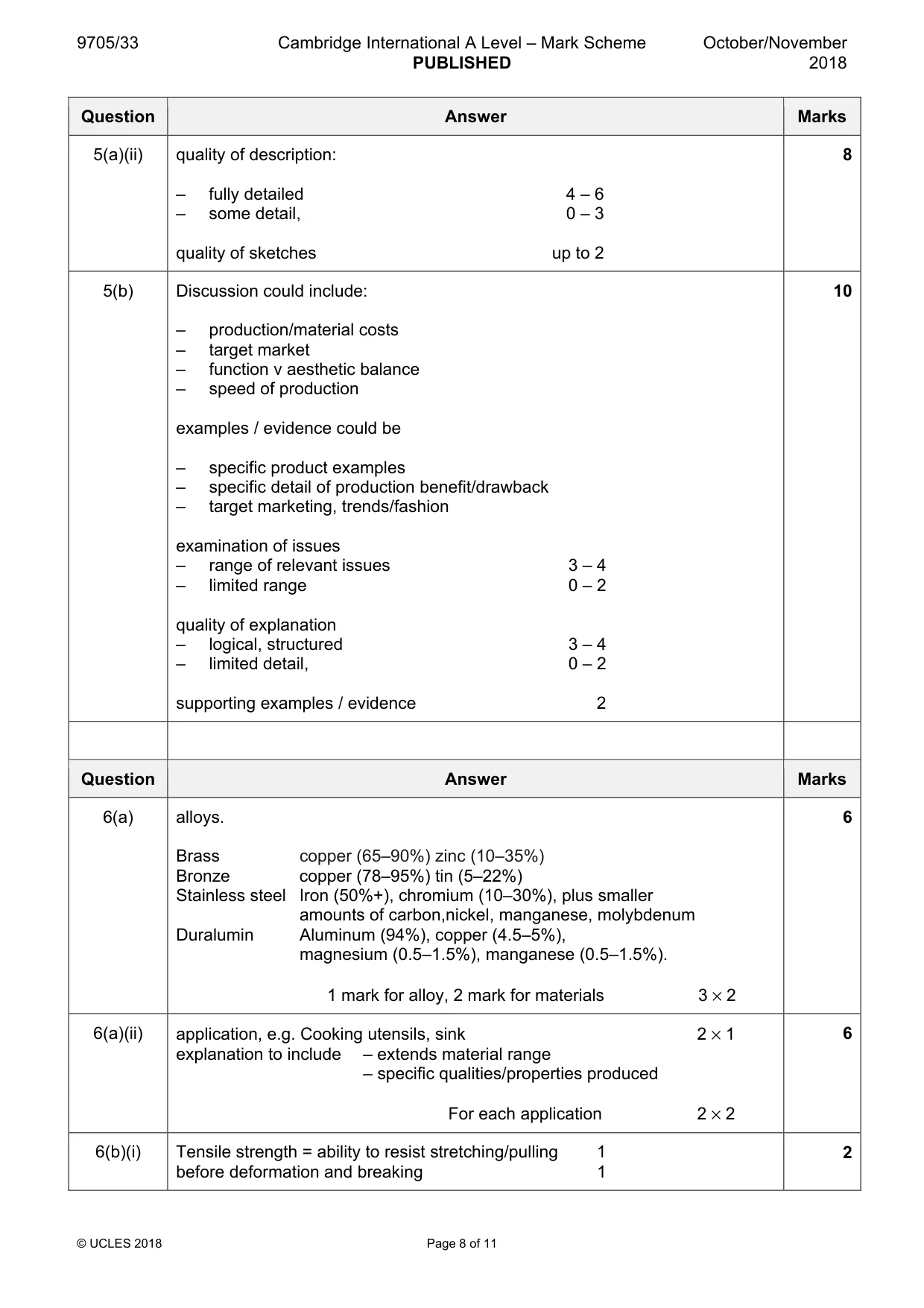
9705/33 Cambridge International A Level – Mark Scheme PUBLISHED October/November 2018 © UCLES 2018 Page 8 of 11 Question Answer Marks 5(a)(ii) quality of description: – fully detailed 4 – 6 – some detail, 0 – 3 quality of sketches up to 2 8 5(b) Discussion could include: – production/material costs – target market – function v aesthetic balance – speed of production examples / evidence could be – specific product examples – specific detail of production benefit/drawback – target marketing, trends/fashion examination of issues – range of relevant issues 3 – 4 – limited range 0 – 2 quality of explanation – logical, structured 3 – 4 – limited detail, 0 – 2 supporting examples / evidence 2 10 Question Answer Marks 6(a) alloys. Brass copper (65–90%) zinc (10–35%) Bronze copper (78–95%) tin (5–22%) Stainless steel Iron (50%+), chromium (10–30%), plus smaller amounts of carbon,nickel, manganese, molybdenum Duralumin Aluminum (94%), copper (4.5–5%), magnesium (0.5–1.5%), manganese (0.5–1.5%). 1 mark for alloy, 2 mark for materials 3 × 2 6 6(a)(ii) application, e.g. Cooking utensils, sink 2 × 1 explanation to include – extends material range – specific qualities/properties produced For each application 2 × 2 6 6(b)(i) Tensile strength = ability to resist stretching/pulling 1 before deformation and breaking 1 2
Mark scheme, page 9
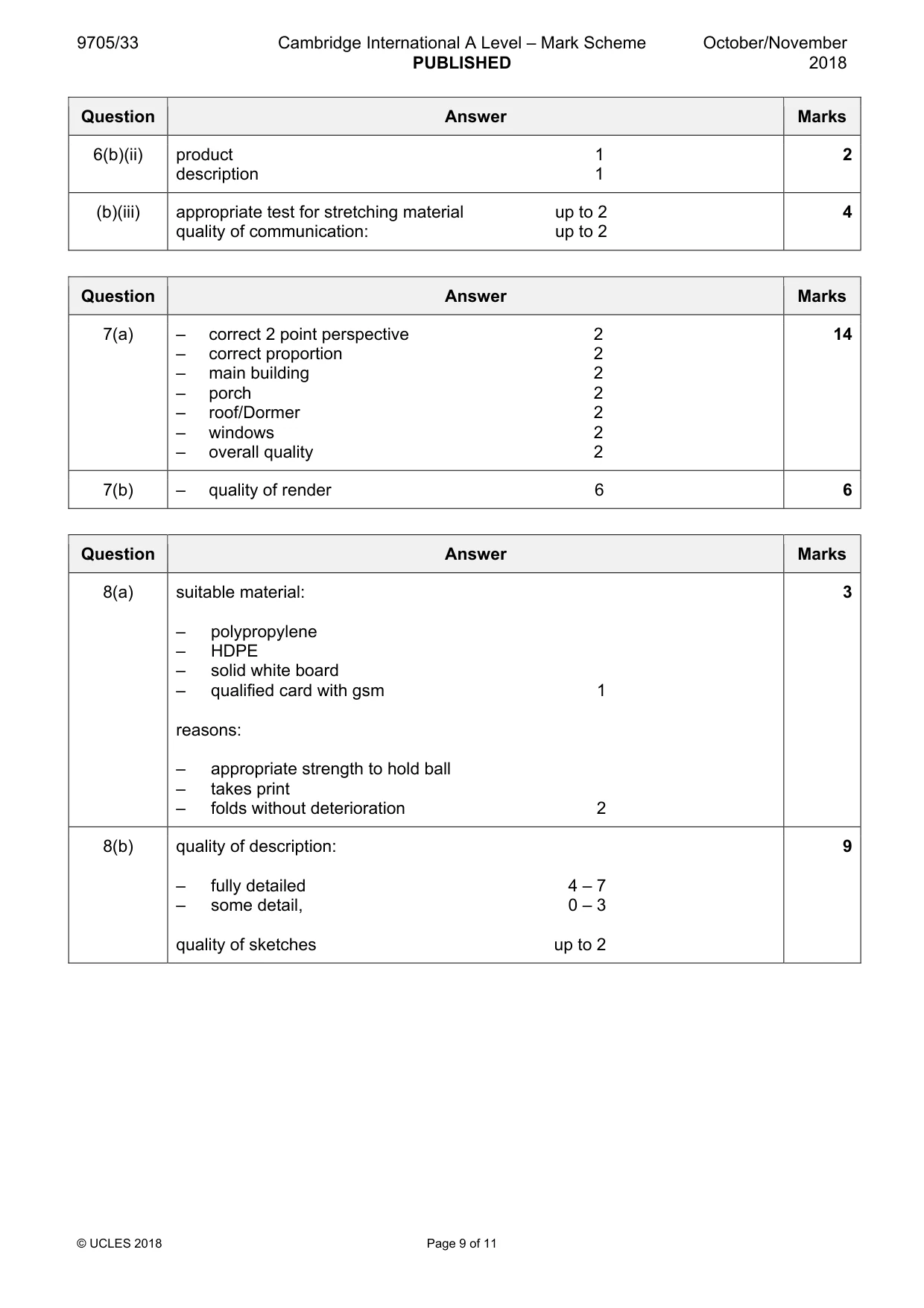
9705/33 Cambridge International A Level – Mark Scheme PUBLISHED October/November 2018 © UCLES 2018 Page 9 of 11 Question Answer Marks 6(b)(ii) product 1 description 1 2 (b)(iii) appropriate test for stretching material up to 2 quality of communication: up to 2 4 Question Answer Marks 7(a) – correct 2 point perspective 2 – correct proportion 2 – main building 2 – porch 2 – roof/Dormer 2 – windows 2 – overall quality 2 14 7(b) – quality of render 6 6 Question Answer Marks 8(a) suitable material: – polypropylene – HDPE – solid white board – qualified card with gsm 1 reasons: – appropriate strength to hold ball – takes print – folds without deterioration 2 3 8(b) quality of description: – fully detailed 4 – 7 – some detail, 0 – 3 quality of sketches up to 2 9
Mark scheme, page 10
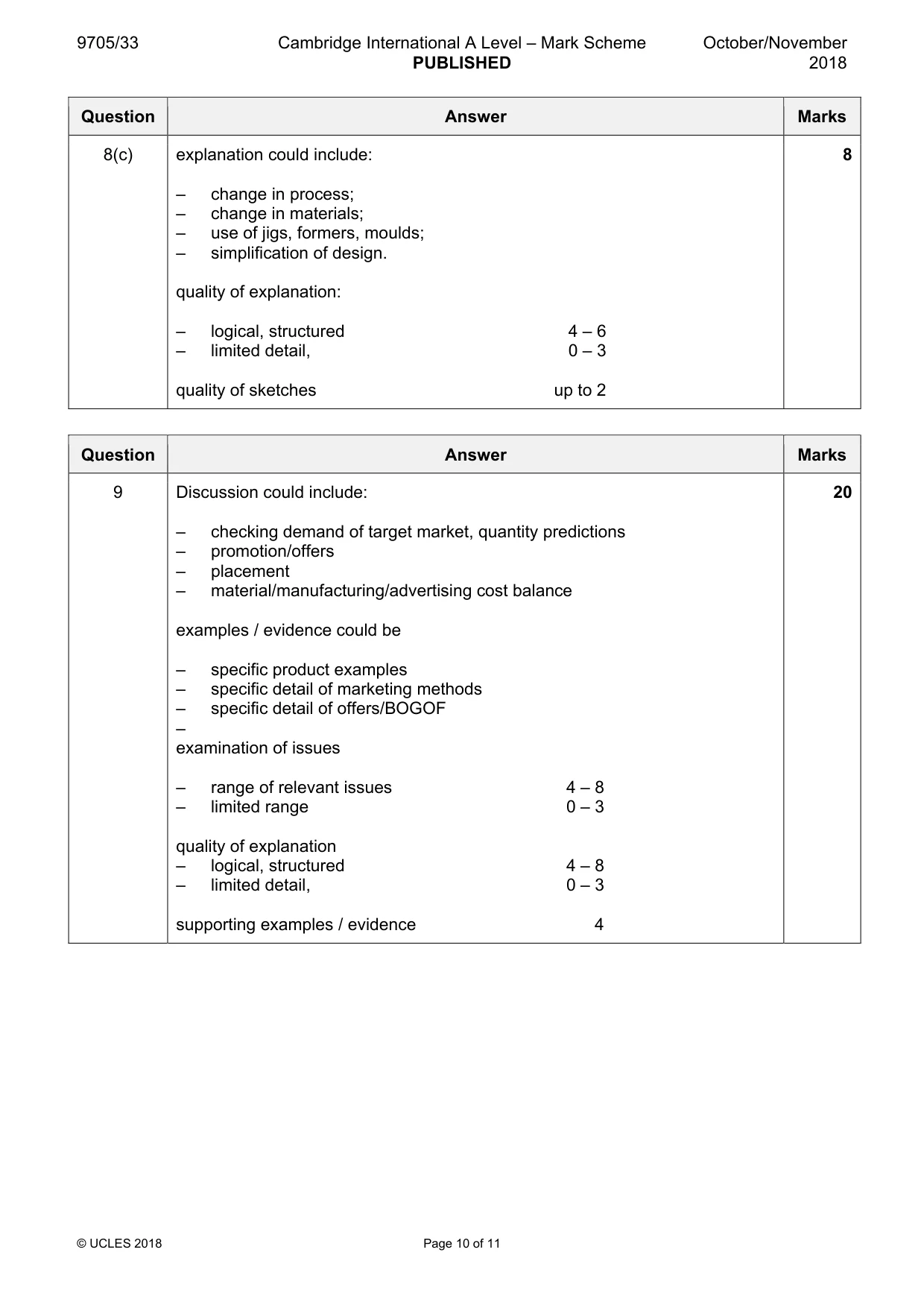
9705/33 Cambridge International A Level – Mark Scheme PUBLISHED October/November 2018 © UCLES 2018 Page 10 of 11 Question Answer Marks 8(c) explanation could include: – change in process; – change in materials; – use of jigs, formers, moulds; – simplification of design. quality of explanation: – logical, structured 4 – 6 – limited detail, 0 – 3 quality of sketches up to 2 8 Question Answer Marks 9 Discussion could include: – checking demand of target market, quantity predictions – promotion/offers – placement – material/manufacturing/advertising cost balance examples / evidence could be – specific product examples – specific detail of marketing methods – specific detail of offers/BOGOF – examination of issues – range of relevant issues 4 – 8 – limited range 0 – 3 quality of explanation – logical, structured 4 – 8 – limited detail, 0 – 3 supporting examples / evidence 4 20
Mark scheme, page 11
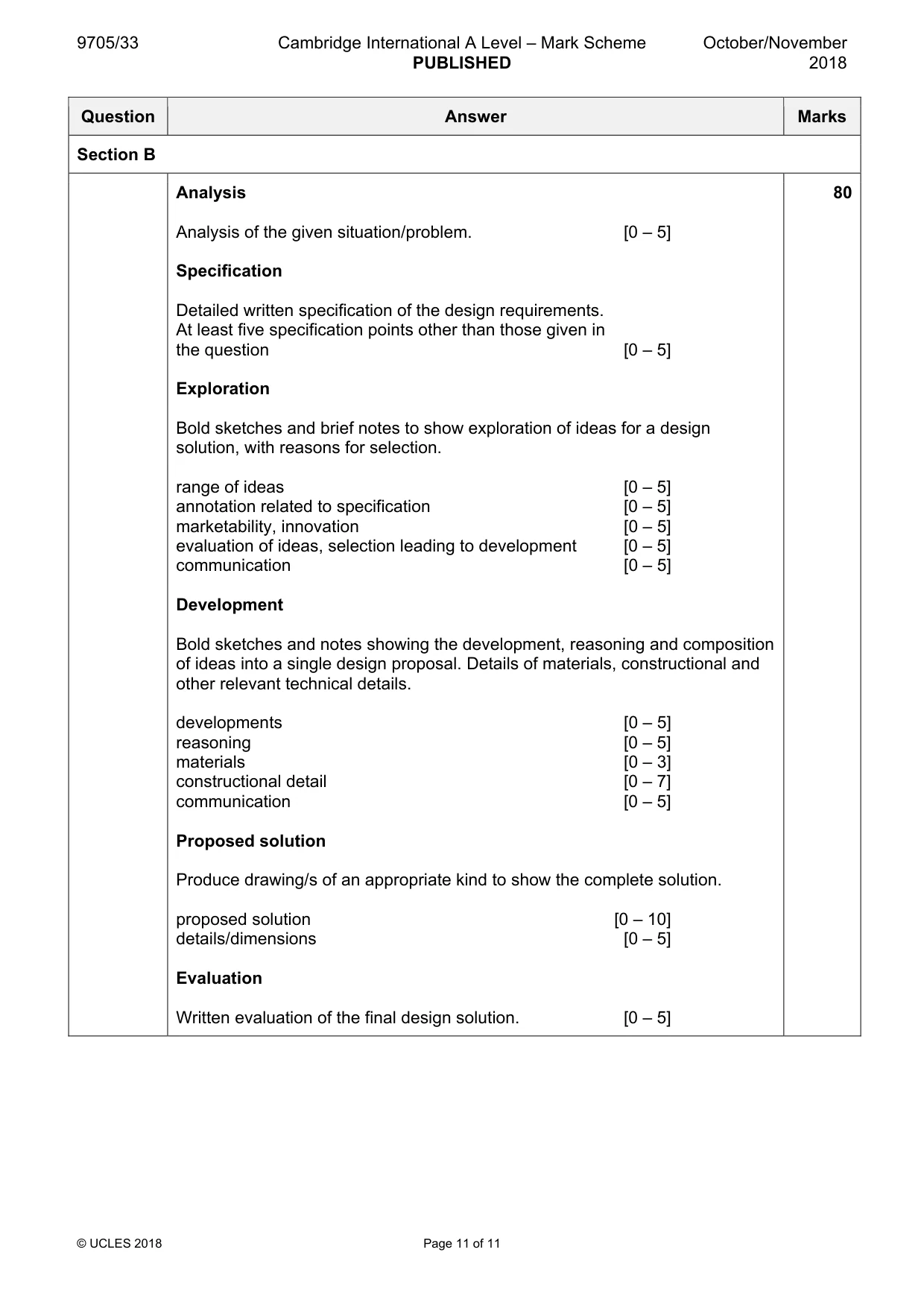
9705/33 Cambridge International A Level – Mark Scheme PUBLISHED October/November 2018 © UCLES 2018 Page 11 of 11 Question Answer Marks Section B Analysis Analysis of the given situation/problem. [0 – 5] Specification Detailed written specification of the design requirements. At least five specification points other than those given in the question [0 – 5] Exploration Bold sketches and brief notes to show exploration of ideas for a design solution, with reasons for selection. range of ideas [0 – 5] annotation related to specification [0 – 5] marketability, innovation [0 – 5] evaluation of ideas, selection leading to development [0 – 5] communication [0 – 5] Development Bold sketches and notes showing the development, reasoning and composition of ideas into a single design proposal. Details of materials, constructional and other relevant technical details. developments [0 – 5] reasoning [0 – 5] materials [0 – 3] constructional detail [0 – 7] communication [0 – 5] Proposed solution Produce drawing/s of an appropriate kind to show the complete solution. proposed solution [0 – 10] details/dimensions [0 – 5] Evaluation Written evaluation of the final design solution. [0 – 5] 80
What you needed in this session
Cambridge’s own grade thresholds for 2018 Oct/Nov, Paper 3 · Variant 3. A higher threshold means an easier paper — the bar moves with how the cohort did.