Cambridge A Level Design and Technology 9705 — 2018 Oct/Nov Paper 3 · Variant 2
9705/32/O/N/18 · 120 marks · ≈135 min
The question paper and its mark scheme, free to read here and free to download. This is Cambridge’s own paper, exactly as it was sat.
Question paper12 pages
Mark scheme9 pages
Answers below. Sit the paper first if you are practising.
Paper as text
Question paper, page 1
* 1 2 3 4 4 3 9 5 0 3 * This document consists of 10 printed pages and 2 blank pages. DC (NF/SW) 152423/3 © UCLES 2018 [Turn over Cambridge International Examinations Cambridge International Advanced Subsidiary and Advanced Level DESIGN AND TECHNOLOGY 9705/32 Paper 3 October/November 2018 3 hours Additional Materials: Answer Booklet/Paper A range of design drawing equipment A3 Drawing Paper (5 sheets) READ THESE INSTRUCTIONS FIRST Write your Centre number, candidate number and name on all the work you hand in. Write in dark blue or black pen. You may use an HB pencil for any diagrams, graphs or rough working. Do not use staples, paper clips, glue or correction fluid. DO NOT WRITE IN ANY BARCODES. Section A Answer two questions from one of the Parts A, B or C. Section B Answer one question. All dimensions are in millimetres. The instruction ‘discuss’ denotes that you should: • examine critically the issues raised by the question; • explain and interpret these issues as appropriate; • introduce evidence wherever possible to support conclusions of arguments. At the end of the examination, fasten all your work securely together. The number of marks is given in brackets [ ] at the end of each question or part question.
Question paper, page 2
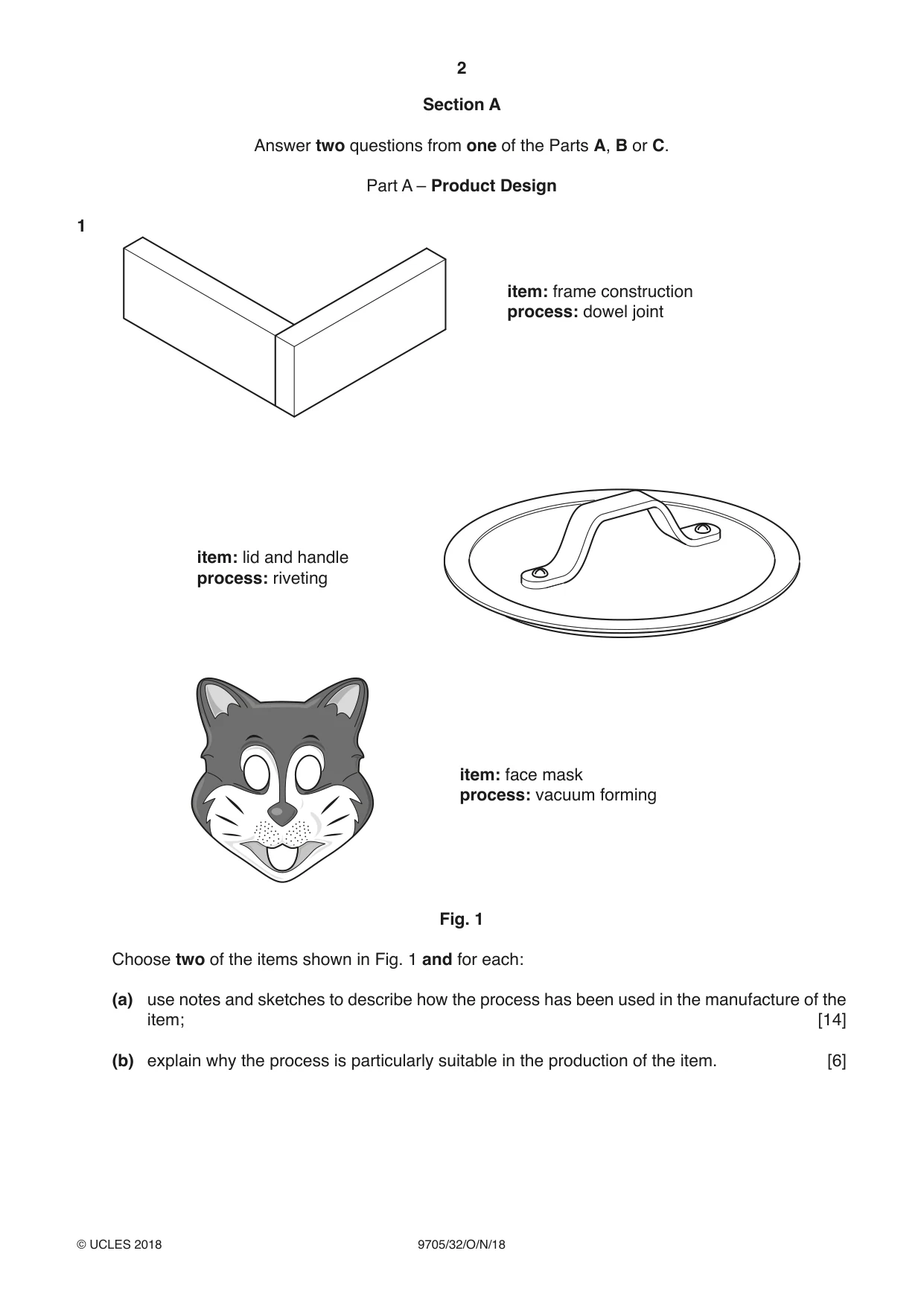
2 9705/32/O/N/18 © UCLES 2018 Section A Answer two questions from one of the Parts A, B or C. Part A – Product Design 1 item: frame construction process: dowel joint item: lid and handle process: riveting item: face mask process: vacuum forming Fig. 1 Choose two of the items shown in Fig. 1 and for each: (a) use notes and sketches to describe how the process has been used in the manufacture of the item; [14] (b) explain why the process is particularly suitable in the production of the item. [6]
Question paper, page 3
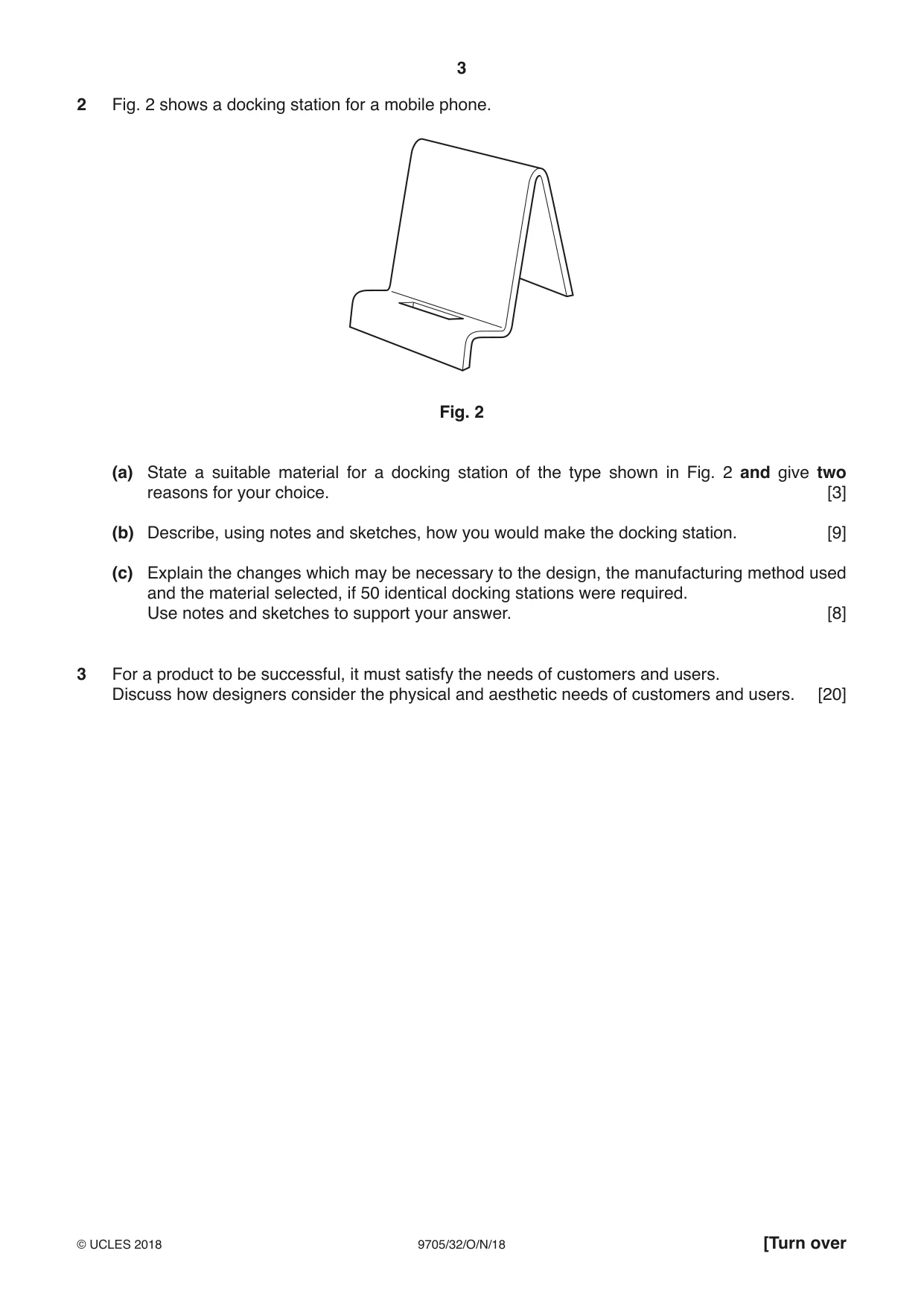
3 9705/32/O/N/18 © UCLES 2018 [Turn over 2 Fig. 2 shows a docking station for a mobile phone. Fig. 2 (a) State a suitable material for a docking station of the type shown in Fig. 2 and give two reasons for your choice. [3] (b) Describe, using notes and sketches, how you would make the docking station. [9] (c) Explain the changes which may be necessary to the design, the manufacturing method used and the material selected, if 50 identical docking stations were required. Use notes and sketches to support your answer. [8] 3 For a product to be successful, it must satisfy the needs of customers and users. Discuss how designers consider the physical and aesthetic needs of customers and users. [20]
Question paper, page 4
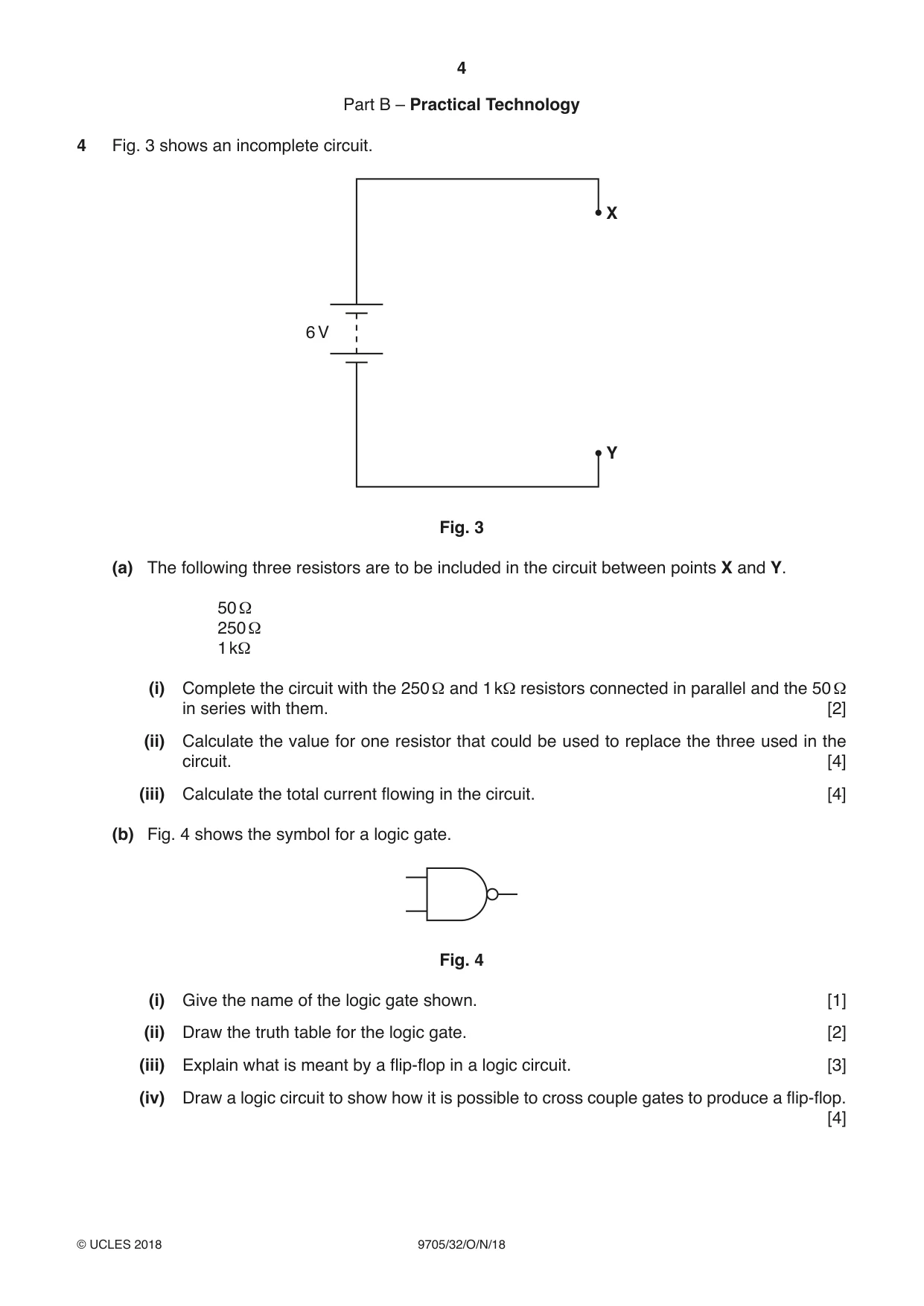
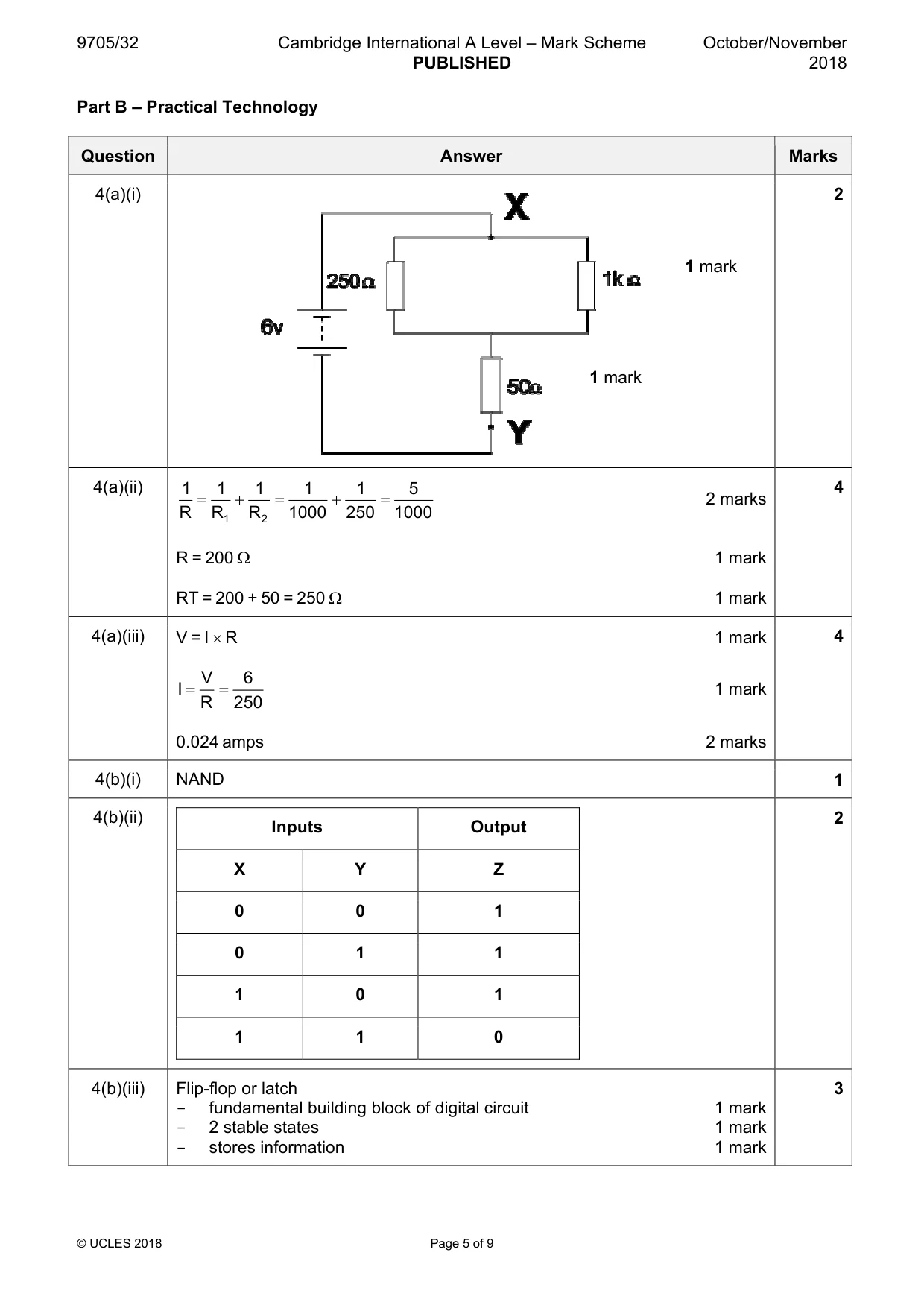
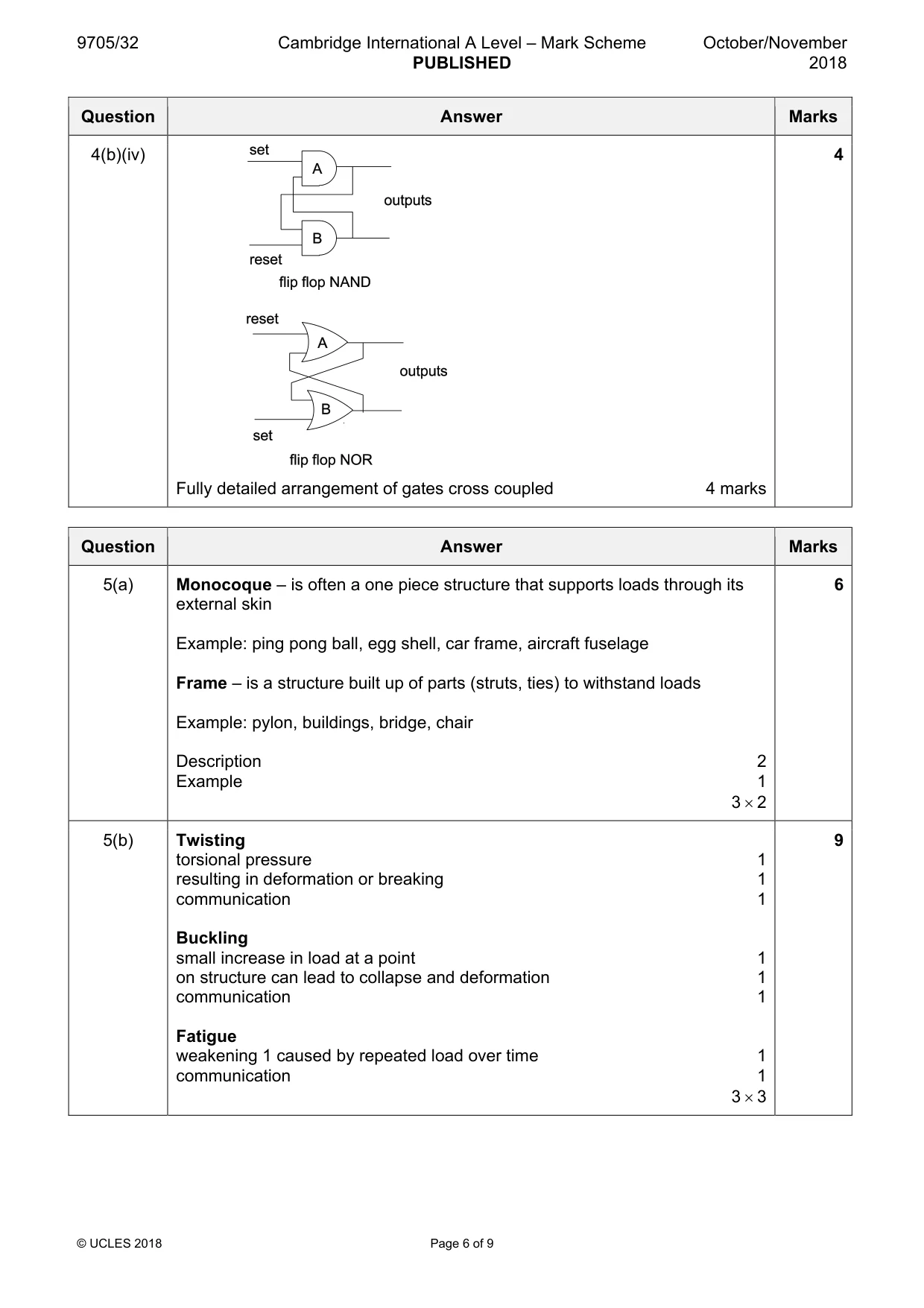
4 9705/32/O/N/18 © UCLES 2018 Part B – Practical Technology 4 Fig. 3 shows an incomplete circuit. X Y 6 V Fig. 3 (a) The following three resistors are to be included in the circuit between points X and Y. 50 Ω 250 Ω 1 kΩ (i) Complete the circuit with the 250 Ω and 1 kΩ resistors connected in parallel and the 50 Ω in series with them. [2] (ii) Calculate the value for one resistor that could be used to replace the three used in the circuit. [4] (iii) Calculate the total current flowing in the circuit. [4] (b) Fig. 4 shows the symbol for a logic gate. Fig. 4 (i) Give the name of the logic gate shown. [1] (ii) Draw the truth table for the logic gate. [2] (iii) Explain what is meant by a flip-flop in a logic circuit. [3] (iv) Draw a logic circuit to show how it is possible to cross couple gates to produce a flip-flop. [4]
Question paper, page 5
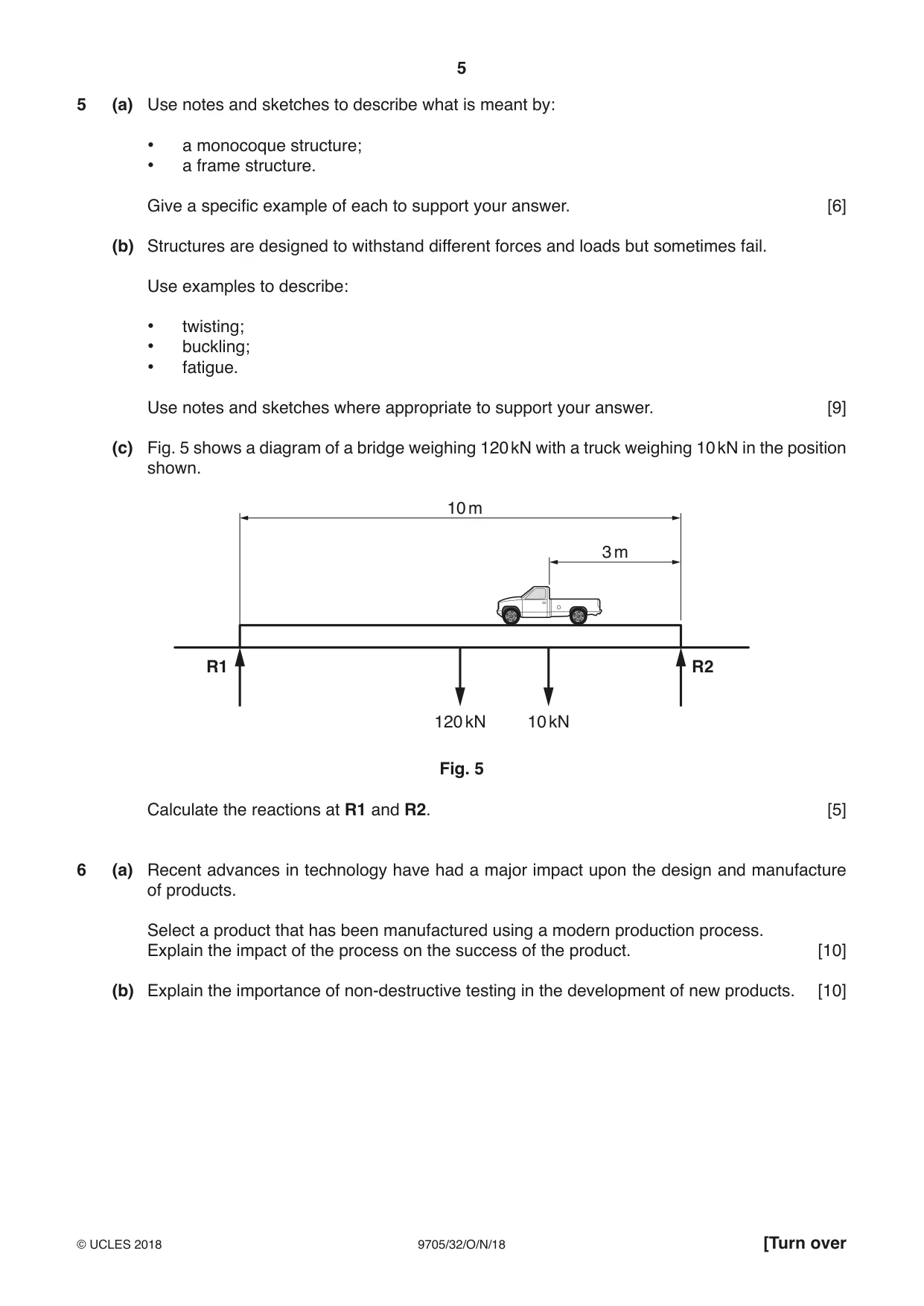
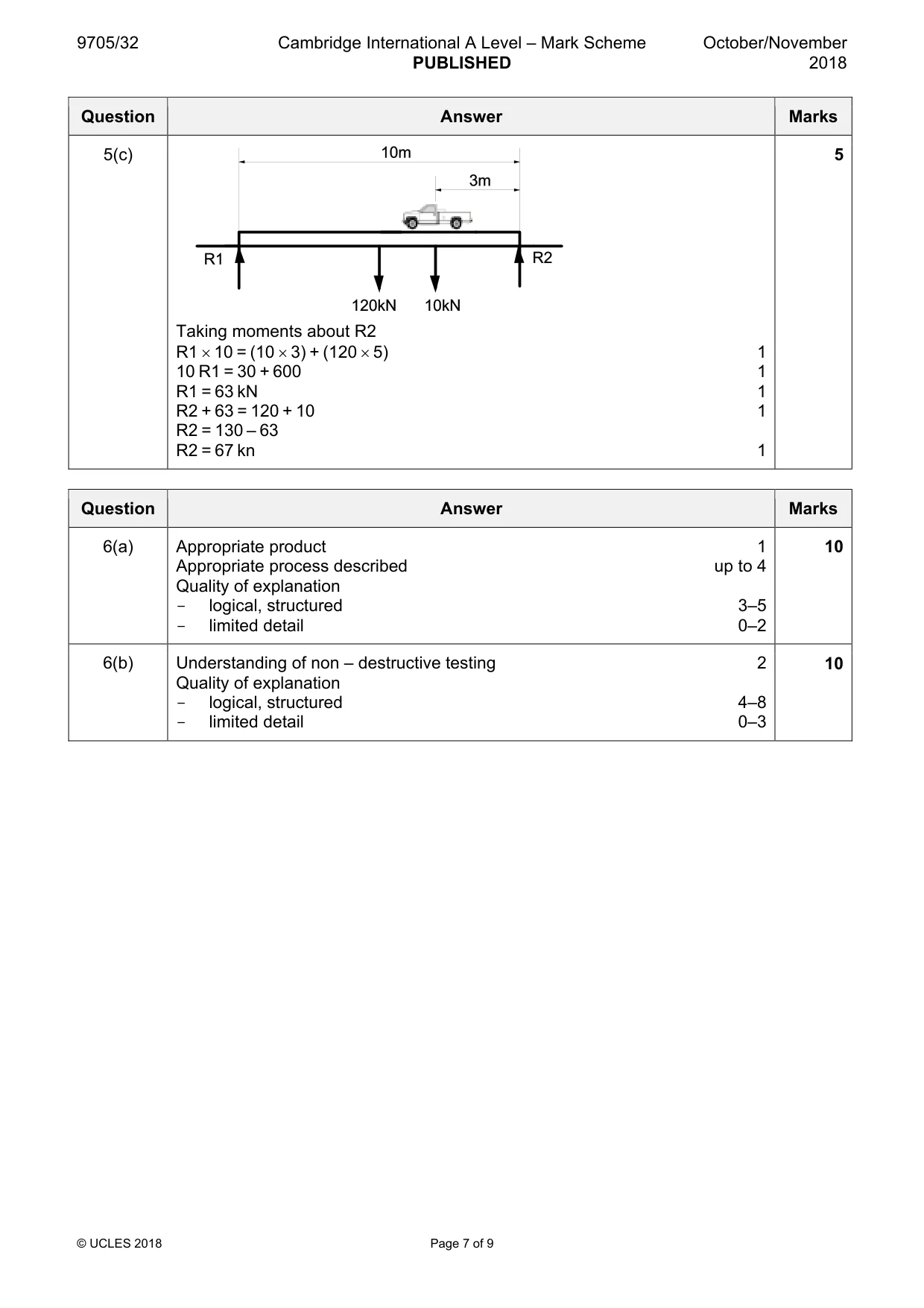
5 9705/32/O/N/18 © UCLES 2018 [Turn over 5 (a) Use notes and sketches to describe what is meant by: • a monocoque structure; • a frame structure. Give a specific example of each to support your answer. [6] (b) Structures are designed to withstand different forces and loads but sometimes fail. Use examples to describe: • twisting; • buckling; • fatigue. Use notes and sketches where appropriate to support your answer. [9] (c) Fig. 5 shows a diagram of a bridge weighing 120 kN with a truck weighing 10 kN in the position shown. 120 kN 10 kN 3 m 10 m R1 R2 Fig. 5 Calculate the reactions at R1 and R2. [5] 6 (a) Recent advances in technology have had a major impact upon the design and manufacture of products. Select a product that has been manufactured using a modern production process. Explain the impact of the process on the success of the product. [10] (b) Explain the importance of non-destructive testing in the development of new products. [10]
Question paper, page 6
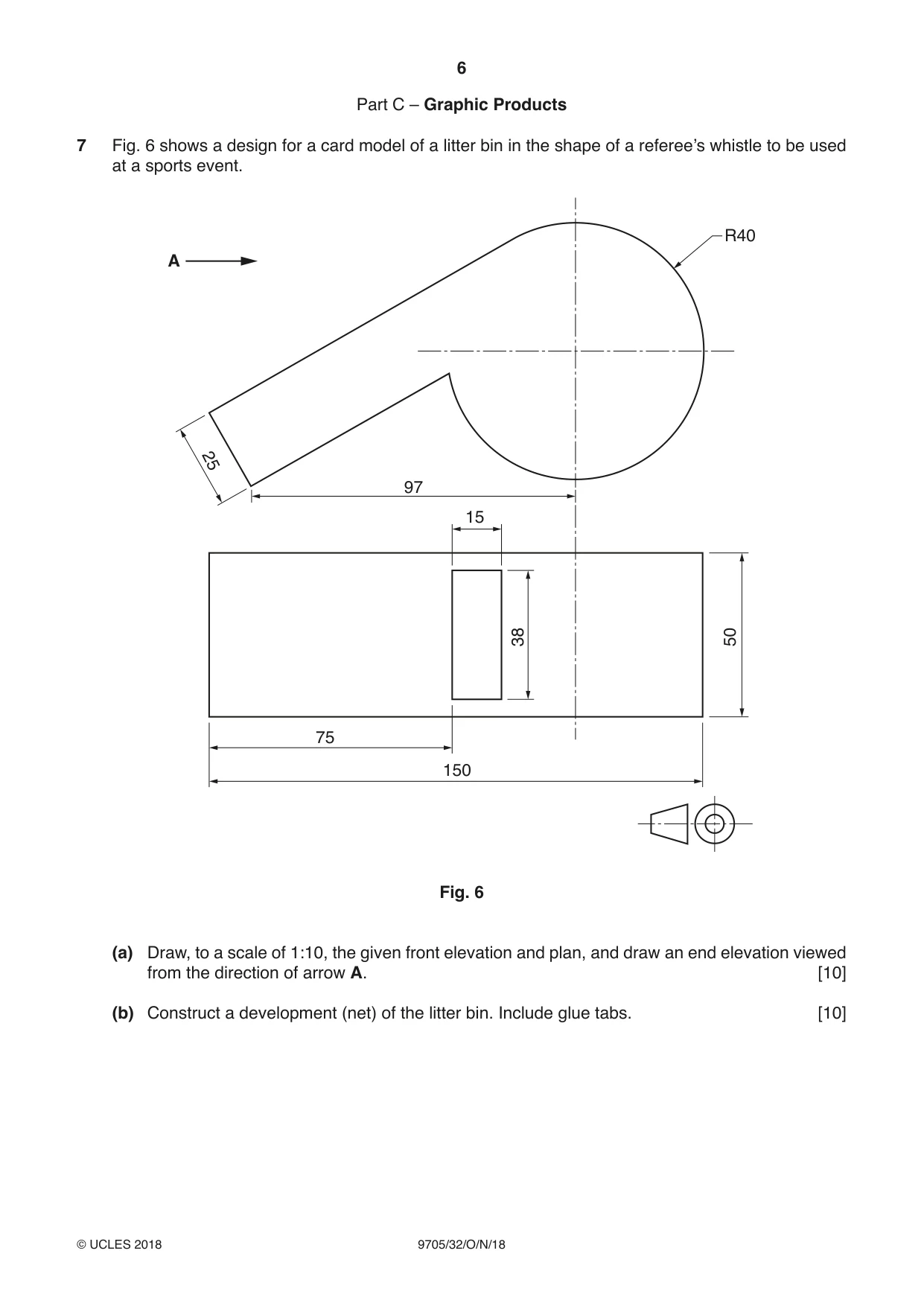
6 9705/32/O/N/18 © UCLES 2018 Part C – Graphic Products 7 Fig. 6 shows a design for a card model of a litter bin in the shape of a referee’s whistle to be used at a sports event. 15 R40 75 97 150 38 50 25 A Fig. 6 (a) Draw, to a scale of 1:10, the given front elevation and plan, and draw an end elevation viewed from the direction of arrow A. [10] (b) Construct a development (net) of the litter bin. Include glue tabs. [10]
Question paper, page 7
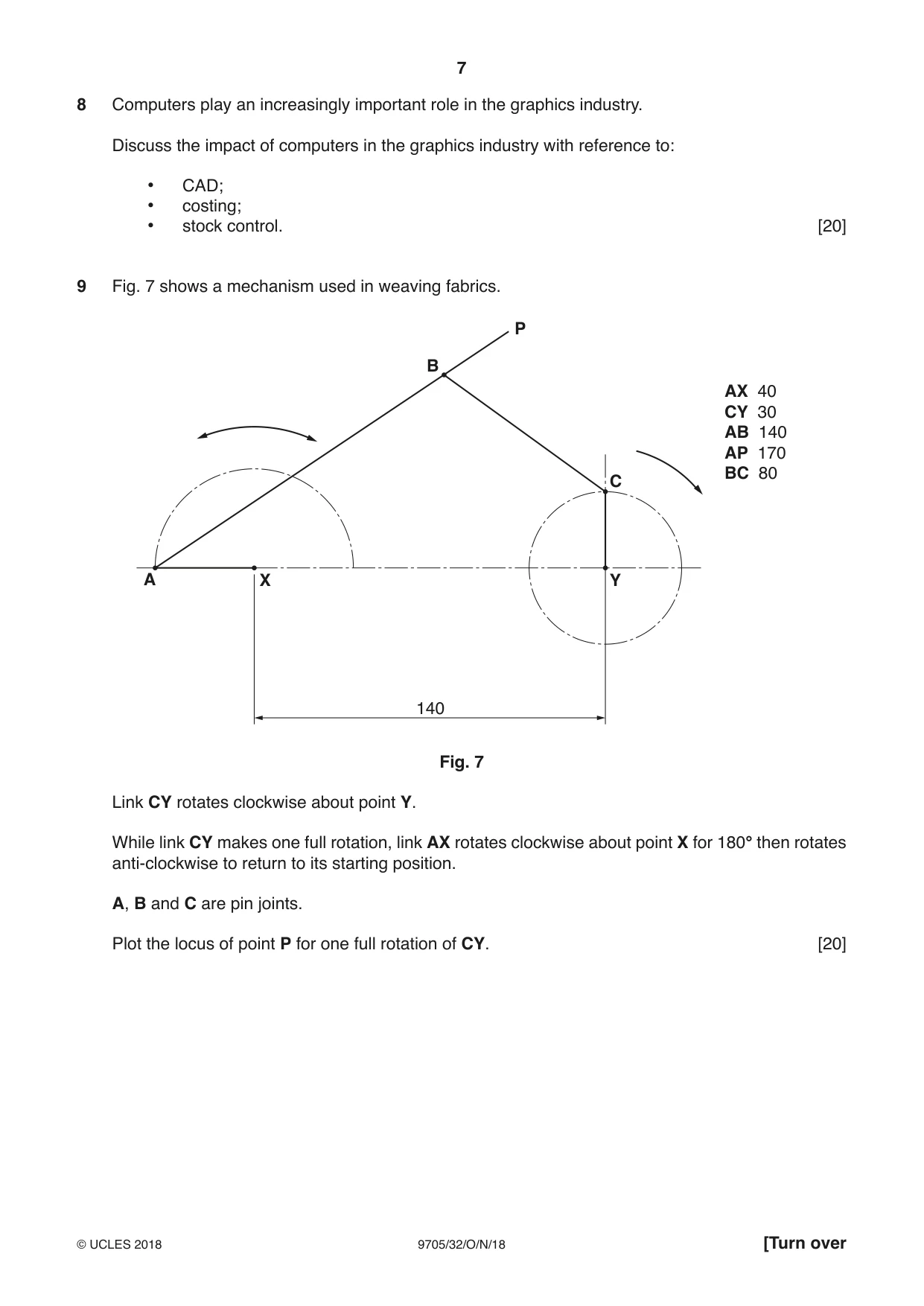
7 9705/32/O/N/18 © UCLES 2018 [Turn over 8 Computers play an increasingly important role in the graphics industry. Discuss the impact of computers in the graphics industry with reference to: • CAD; • costing; • stock control. [20] 9 Fig. 7 shows a mechanism used in weaving fabrics. 140 X Y C P AX 40 CY 30 AB 140 AP 170 BC 80 B A Fig. 7 Link CY rotates clockwise about point Y. While link CY makes one full rotation, link AX rotates clockwise about point X for 180° then rotates anti-clockwise to return to its starting position. A, B and C are pin joints. Plot the locus of point P for one full rotation of CY. [20]
Question paper, page 8
8 9705/32/O/N/18 © UCLES 2018 Section B Answer one question on the A3 paper provided. You should approach the design question of your choice in the following manner: Analysis Produce an analysis of the given situation/problem, which may be in written or graphical form. [5] Specification From the analysis produce a detailed written specification of the design requirements. Include at least five specification points other than those given in the question. [5] Exploration Use bold sketches and brief notes to show your exploration of ideas for a design solution, with reasons for selection. [25] Development Show using bold sketches and notes, the development, reasoning and composition of ideas into a single design proposal. Give details of materials, constructional and other relevant technical details. [25] Proposed solution Produce drawings of an appropriate kind to show the complete solution. [15] Evaluation Give a written evaluation of the final design solution. [5] Total: [80]
Question paper, page 9
9 9705/32/O/N/18 © UCLES 2018 [Turn over 10 Builders, plumbers and joiners often work on sites some distance away from where they park their vehicles. They need to transport tools and equipment to their workplace and often require a device to hold materials when cutting and drilling. Design a dual-purpose product that can transport tools and equipment from a vehicle to the workplace, and that can also hold materials when cutting or drilling. The product must: • fold for ease of storage in a vehicle; • securely transport tools and equipment. 11 A nursery school for children aged 3-5 years has classrooms that become very hot during certain times of the year. Design a portable innovative product that will help to maintain a more comfortable temperature in a classroom. The product must: • be freestanding; • present no risk to children. Question 12 begins on the next page.
Question paper, page 10
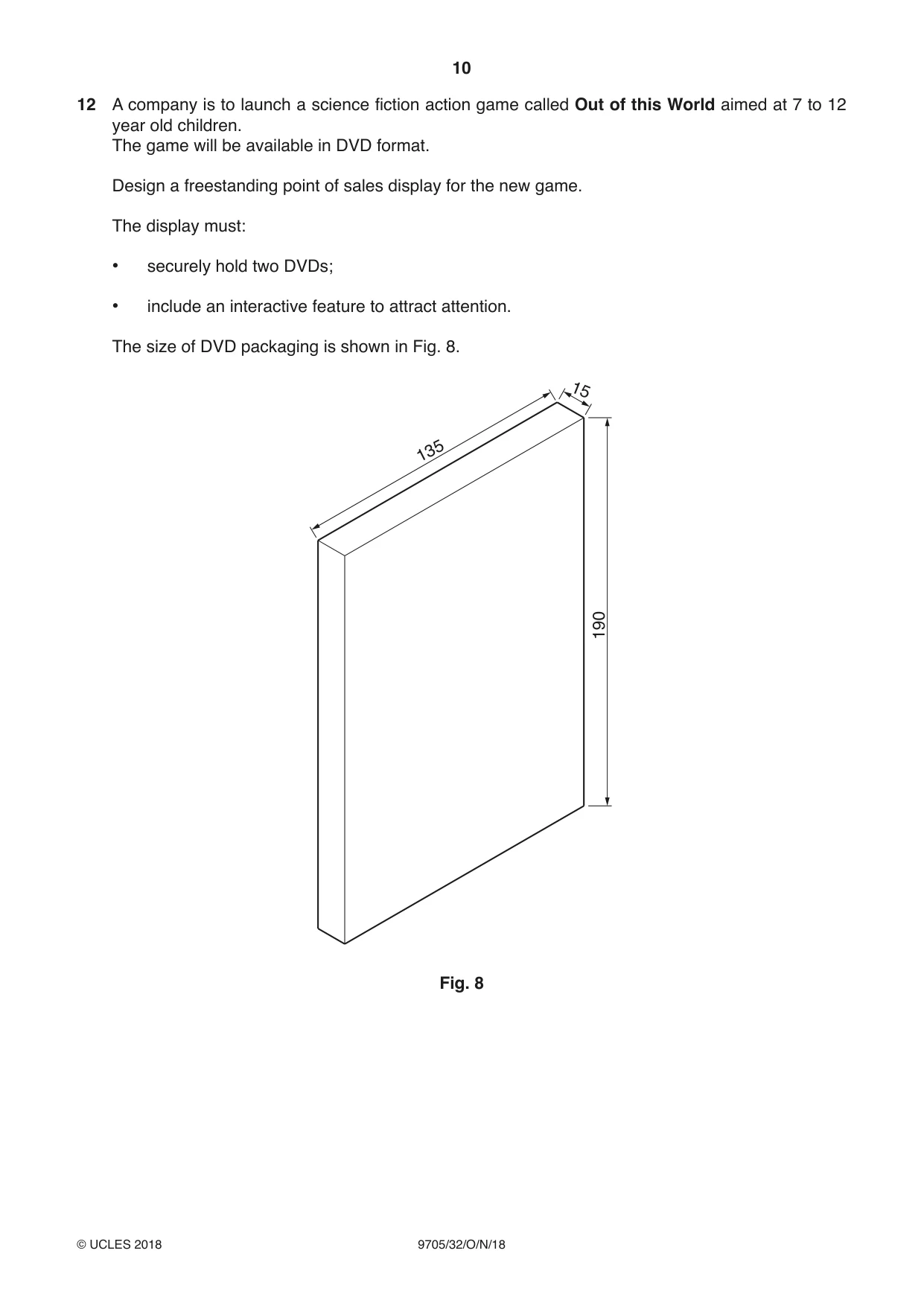
10 9705/32/O/N/18 © UCLES 2018 12 A company is to launch a science fiction action game called Out of this World aimed at 7 to 12 year old children. The game will be available in DVD format. Design a freestanding point of sales display for the new game. The display must: • securely hold two DVDs; • include an interactive feature to attract attention. The size of DVD packaging is shown in Fig. 8. 190 135 15 Fig. 8
Question paper, page 11
11 9705/32/O/N/18 © UCLES 2018 BLANK PAGE
Question paper, page 12
12 9705/32/O/N/18 © UCLES 2018 BLANK PAGE Permission to reproduce items where third-party owned material protected by copyright is included has been sought and cleared where possible. Every reasonable effort has been made by the publisher (UCLES) to trace copyright holders, but if any items requiring clearance have unwittingly been included, the publisher will be pleased to make amends at the earliest possible opportunity. To avoid the issue of disclosure of answer-related information to candidates, all copyright acknowledgements are reproduced online in the Cambridge International Examinations Copyright Acknowledgements Booklet. This is produced for each series of examinations and is freely available to download at www.cie.org.uk after the live examination series. Cambridge International Examinations is part of the Cambridge Assessment Group. Cambridge Assessment is the brand name of University of Cambridge Local Examinations Syndicate (UCLES), which is itself a department of the University of Cambridge.
Mark scheme, page 1
This document consists of 9 printed pages. © UCLES 2018 [Turn over Cambridge Assessment International Education Cambridge International Advanced Level DESIGN AND TECHNOLOGY 9705/32 Paper 3 October/November 2018 MARK SCHEME Maximum Mark: 120 Published This mark scheme is published as an aid to teachers and candidates, to indicate the requirements of the examination. It shows the basis on which Examiners were instructed to award marks. It does not indicate the details of the discussions that took place at an Examiners’ meeting before marking began, which would have considered the acceptability of alternative answers. Mark schemes should be read in conjunction with the question paper and the Principal Examiner Report for Teachers. Cambridge International will not enter into discussions about these mark schemes. Cambridge International is publishing the mark schemes for the October/November 2018 series for most Cambridge IGCSE™, Cambridge International A and AS Level components and some Cambridge O Level components.
Mark scheme, page 2
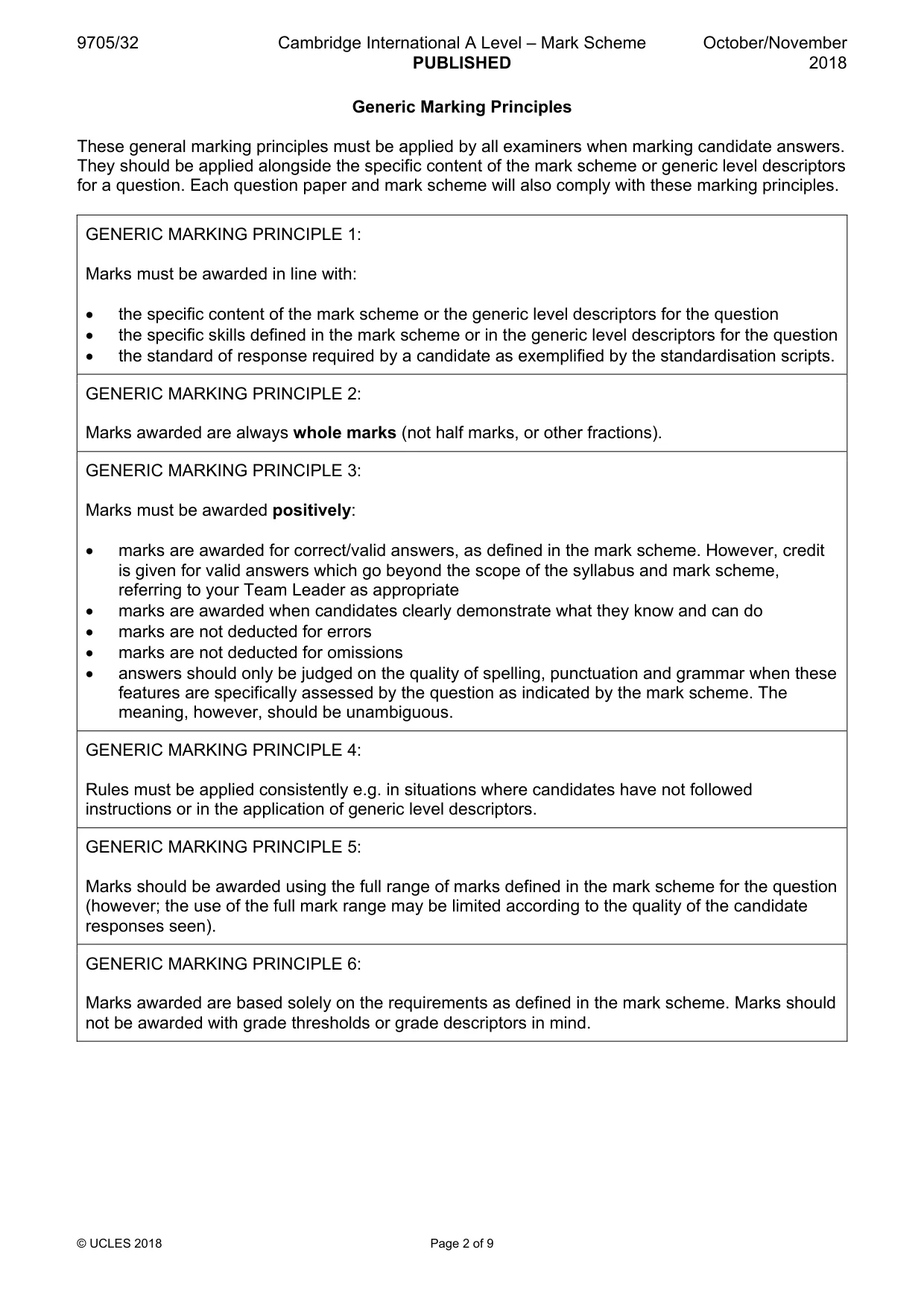
9705/32 Cambridge International A Level – Mark Scheme PUBLISHED October/November 2018 © UCLES 2018 Page 2 of 9 Generic Marking Principles These general marking principles must be applied by all examiners when marking candidate answers. They should be applied alongside the specific content of the mark scheme or generic level descriptors for a question. Each question paper and mark scheme will also comply with these marking principles. GENERIC MARKING PRINCIPLE 1: Marks must be awarded in line with: • the specific content of the mark scheme or the generic level descriptors for the question • the specific skills defined in the mark scheme or in the generic level descriptors for the question • the standard of response required by a candidate as exemplified by the standardisation scripts. GENERIC MARKING PRINCIPLE 2: Marks awarded are always whole marks (not half marks, or other fractions). GENERIC MARKING PRINCIPLE 3: Marks must be awarded positively: • marks are awarded for correct/valid answers, as defined in the mark scheme. However, credit is given for valid answers which go beyond the scope of the syllabus and mark scheme, referring to your Team Leader as appropriate • marks are awarded when candidates clearly demonstrate what they know and can do • marks are not deducted for errors • marks are not deducted for omissions • answers should only be judged on the quality of spelling, punctuation and grammar when these features are specifically assessed by the question as indicated by the mark scheme. The meaning, however, should be unambiguous. GENERIC MARKING PRINCIPLE 4: Rules must be applied consistently e.g. in situations where candidates have not followed instructions or in the application of generic level descriptors. GENERIC MARKING PRINCIPLE 5: Marks should be awarded using the full range of marks defined in the mark scheme for the question (however; the use of the full mark range may be limited according to the quality of the candidate responses seen). GENERIC MARKING PRINCIPLE 6: Marks awarded are based solely on the requirements as defined in the mark scheme. Marks should not be awarded with grade thresholds or grade descriptors in mind.
Mark scheme, page 3
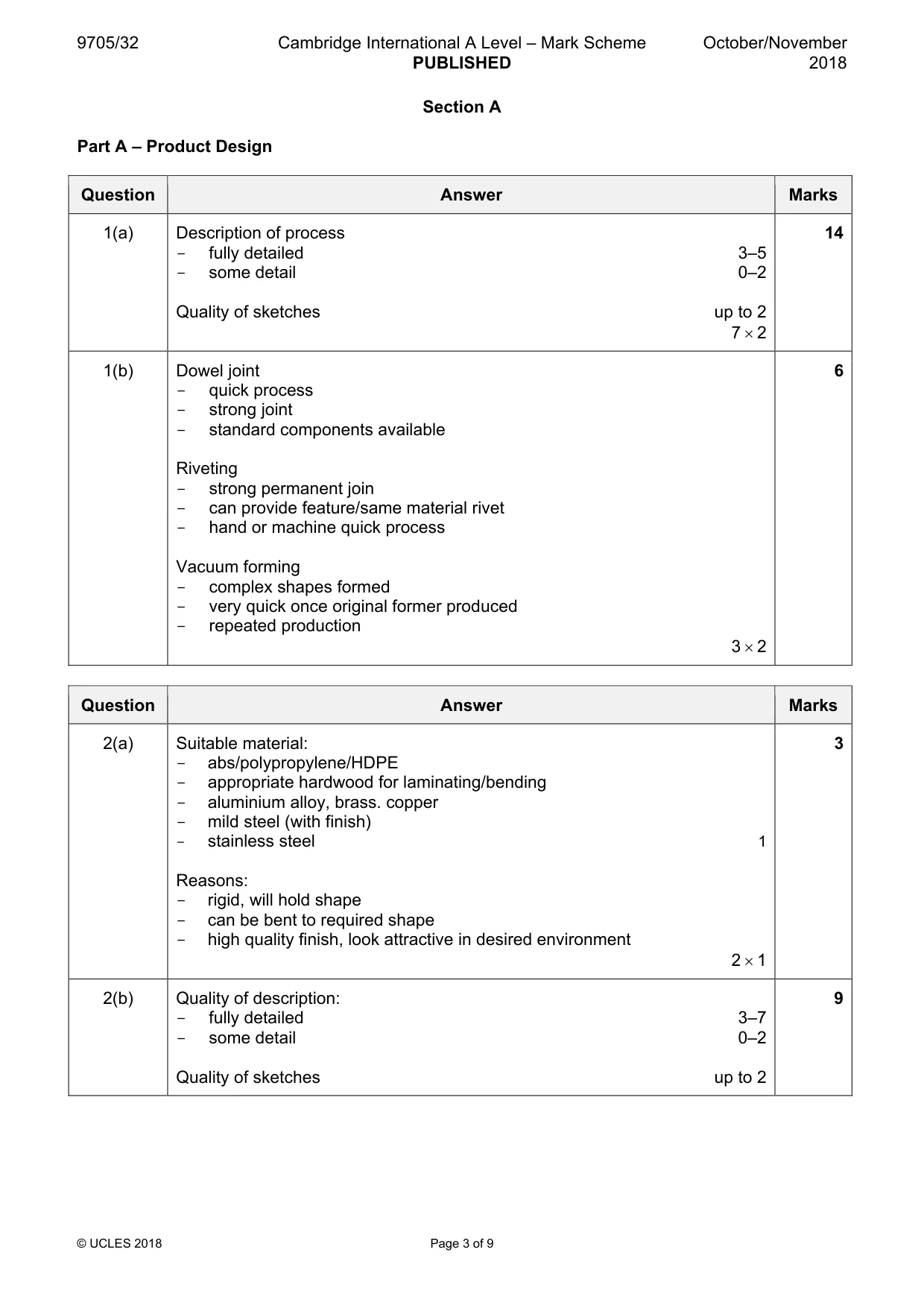
9705/32 Cambridge International A Level – Mark Scheme PUBLISHED October/November 2018 © UCLES 2018 Page 3 of 9 Section A Part A – Product Design Question Answer Marks 1(a) Description of process - fully detailed 3–5 - some detail 0–2 Quality of sketches up to 2 7 × 2 14 1(b) Dowel joint - quick process - strong joint - standard components available Riveting - strong permanent join - can provide feature/same material rivet - hand or machine quick process Vacuum forming - complex shapes formed - very quick once original former produced - repeated production 3 × 2 6 Question Answer Marks 2(a) Suitable material: - abs/polypropylene/HDPE - appropriate hardwood for laminating/bending - aluminium alloy, brass. copper - mild steel (with finish) - stainless steel 1 Reasons: - rigid, will hold shape - can be bent to required shape - high quality finish, look attractive in desired environment 2 × 1 3 2(b) Quality of description: - fully detailed 3–7 - some detail 0–2 Quality of sketches up to 2 9
Mark scheme, page 4
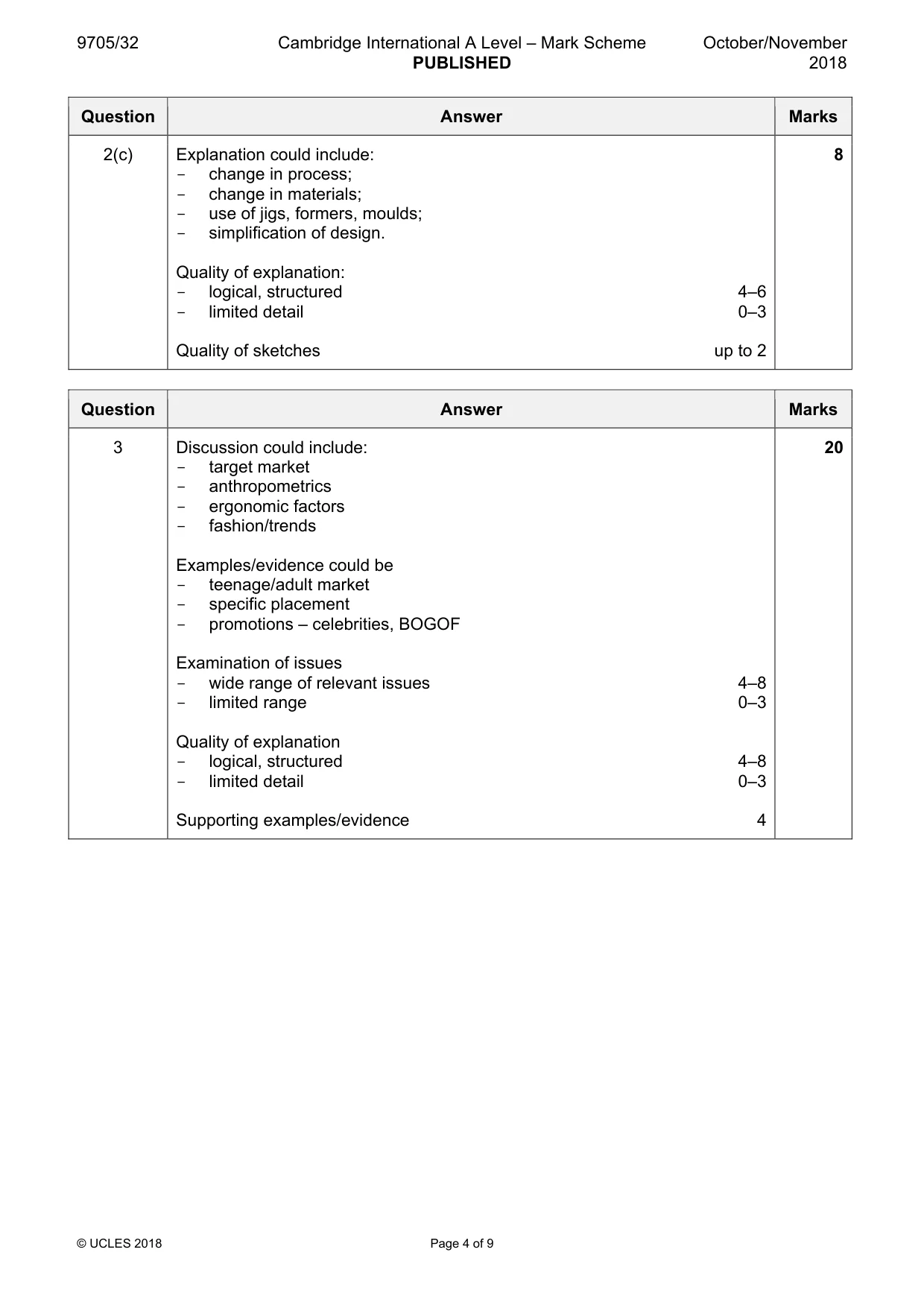
9705/32 Cambridge International A Level – Mark Scheme PUBLISHED October/November 2018 © UCLES 2018 Page 4 of 9 Question Answer Marks 2(c) Explanation could include: - change in process; - change in materials; - use of jigs, formers, moulds; - simplification of design. Quality of explanation: - logical, structured 4–6 - limited detail 0–3 Quality of sketches up to 2 8 Question Answer Marks 3 Discussion could include: - target market - anthropometrics - ergonomic factors - fashion/trends Examples/evidence could be - teenage/adult market - specific placement - promotions – celebrities, BOGOF Examination of issues - wide range of relevant issues 4–8 - limited range 0–3 Quality of explanation - logical, structured 4–8 - limited detail 0–3 Supporting examples/evidence 4 20
Mark scheme, page 5
9705/32 Cambridge International A Level – Mark Scheme PUBLISHED October/November 2018 © UCLES 2018 Page 5 of 9 Part B – Practical Technology Question Answer Marks 4(a)(i) 2 4(a)(ii) 1 2 1 1 1 1 1 5 R R R 1000 250 1000 = + = + = 2 marks R = 200 Ω 1 mark RT = 200 + 50 = 250 Ω 1 mark 4 4(a)(iii) V = I × R 1 mark V 6 I R 250 = = 1 mark 0.024 amps 2 marks 4 4(b)(i) NAND 1 4(b)(ii) Inputs Output X Y Z 0 0 1 0 1 1 1 0 1 1 1 0 2 4(b)(iii) Flip-flop or latch - fundamental building block of digital circuit 1 mark - 2 stable states 1 mark - stores information 1 mark 3 1 mark 1 mark
Mark scheme, page 6
9705/32 Cambridge International A Level – Mark Scheme PUBLISHED October/November 2018 © UCLES 2018 Page 6 of 9 Question Answer Marks 4(b)(iv) Fully detailed arrangement of gates cross coupled 4 marks 4 Question Answer Marks 5(a) Monocoque – is often a one piece structure that supports loads through its external skin Example: ping pong ball, egg shell, car frame, aircraft fuselage Frame – is a structure built up of parts (struts, ties) to withstand loads Example: pylon, buildings, bridge, chair Description 2 Example 1 3 × 2 6 5(b) Twisting torsional pressure 1 resulting in deformation or breaking 1 communication 1 Buckling small increase in load at a point 1 on structure can lead to collapse and deformation 1 communication 1 Fatigue weakening 1 caused by repeated load over time 1 communication 1 3 × 3 9
Mark scheme, page 7
9705/32 Cambridge International A Level – Mark Scheme PUBLISHED October/November 2018 © UCLES 2018 Page 7 of 9 Question Answer Marks 5(c) Taking moments about R2 R1 × 10 = (10 × 3) + (120 × 5) 1 10 R1 = 30 + 600 1 R1 = 63 kN 1 R2 + 63 = 120 + 10 1 R2 = 130 – 63 R2 = 67 kn 1 5 Question Answer Marks 6(a) Appropriate product 1 Appropriate process described up to 4 Quality of explanation - logical, structured 3–5 - limited detail 0–2 10 6(b) Understanding of non – destructive testing 2 Quality of explanation - logical, structured 4–8 - limited detail 0–3 10
Mark scheme, page 8
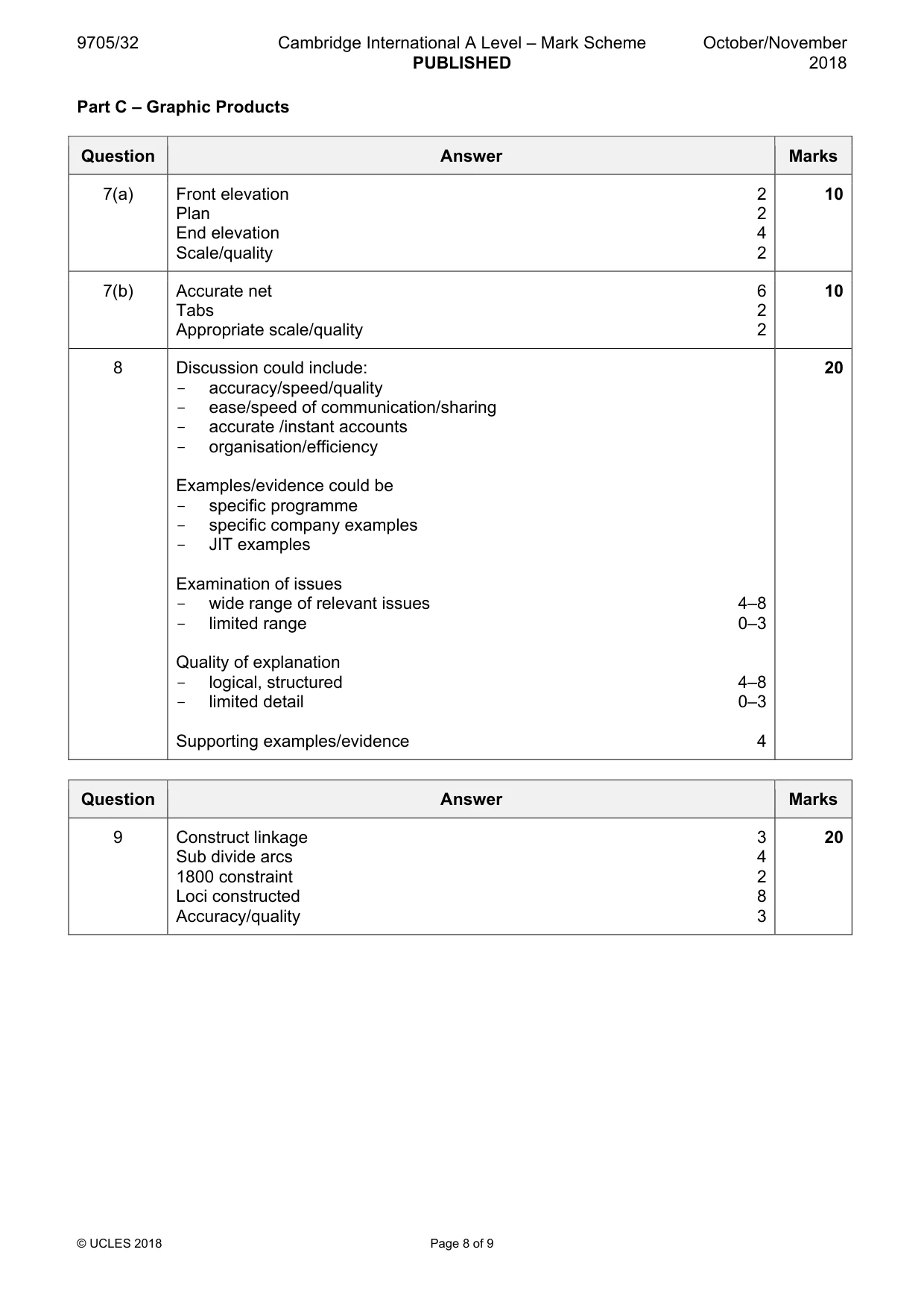
9705/32 Cambridge International A Level – Mark Scheme PUBLISHED October/November 2018 © UCLES 2018 Page 8 of 9 Part C – Graphic Products Question Answer Marks 7(a) Front elevation 2 Plan 2 End elevation 4 Scale/quality 2 10 7(b) Accurate net 6 Tabs 2 Appropriate scale/quality 2 10 8 Discussion could include: - accuracy/speed/quality - ease/speed of communication/sharing - accurate /instant accounts - organisation/efficiency Examples/evidence could be - specific programme - specific company examples - JIT examples Examination of issues - wide range of relevant issues 4–8 - limited range 0–3 Quality of explanation - logical, structured 4–8 - limited detail 0–3 Supporting examples/evidence 4 20 Question Answer Marks 9 Construct linkage 3 Sub divide arcs 4 1800 constraint 2 Loci constructed 8 Accuracy/quality 3 20
Mark scheme, page 9
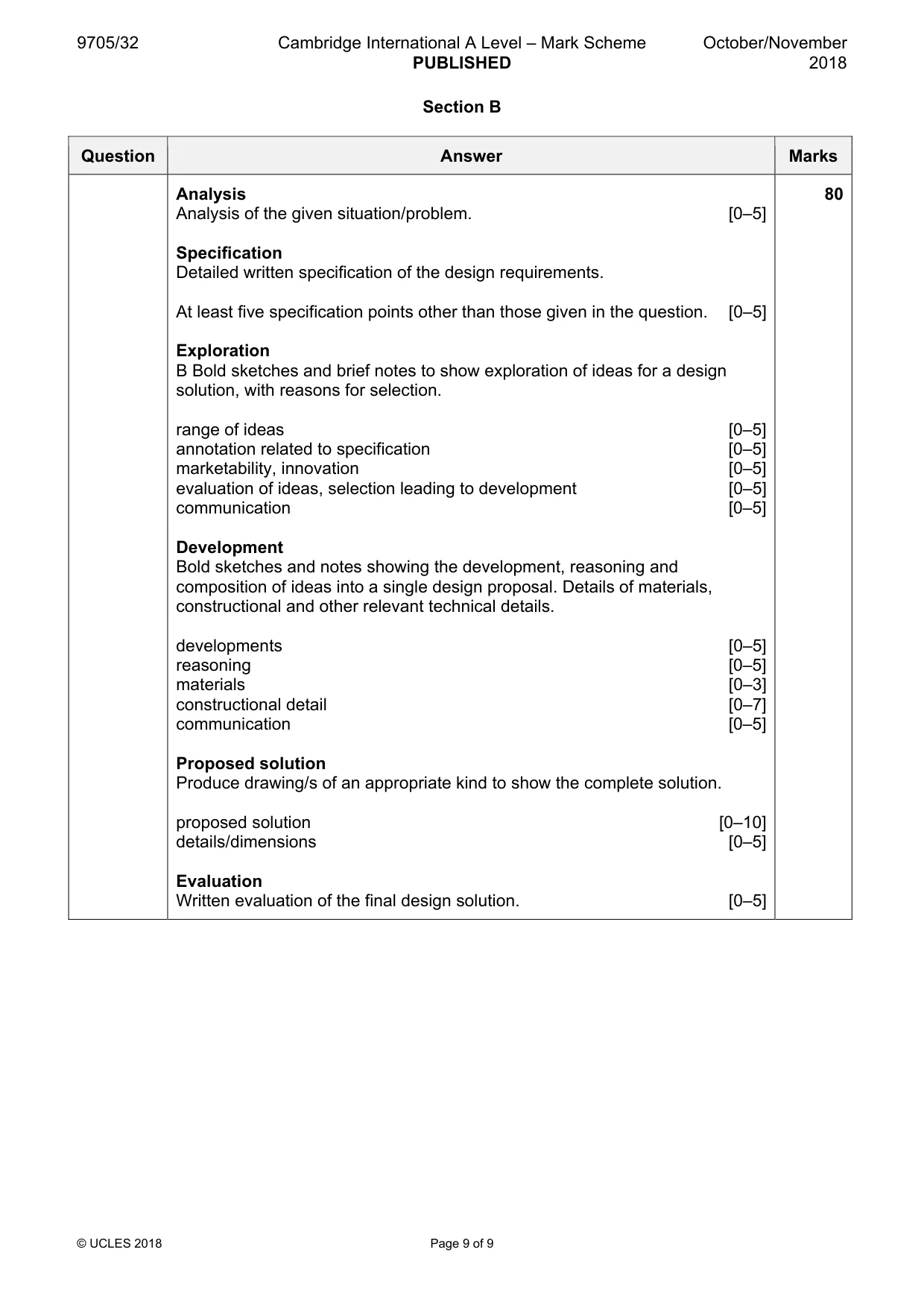
9705/32 Cambridge International A Level – Mark Scheme PUBLISHED October/November 2018 © UCLES 2018 Page 9 of 9 Section B Question Answer Marks Analysis Analysis of the given situation/problem. [0–5] Specification Detailed written specification of the design requirements. At least five specification points other than those given in the question. [0–5] Exploration B Bold sketches and brief notes to show exploration of ideas for a design solution, with reasons for selection. range of ideas [0–5] annotation related to specification [0–5] marketability, innovation [0–5] evaluation of ideas, selection leading to development [0–5] communication [0–5] Development Bold sketches and notes showing the development, reasoning and composition of ideas into a single design proposal. Details of materials, constructional and other relevant technical details. developments [0–5] reasoning [0–5] materials [0–3] constructional detail [0–7] communication [0–5] Proposed solution Produce drawing/s of an appropriate kind to show the complete solution. proposed solution [0–10] details/dimensions [0–5] Evaluation Written evaluation of the final design solution. [0–5] 80
What you needed in this session
Cambridge’s own grade thresholds for 2018 Oct/Nov, Paper 3 · Variant 2. A higher threshold means an easier paper — the bar moves with how the cohort did.