Cambridge A Level Design and Technology 9705 — 2017 Oct/Nov Paper 3 · Variant 3
9705/33/O/N/17 · 120 marks · ≈135 min
The question paper and its mark scheme, free to read here and free to download. This is Cambridge’s own paper, exactly as it was sat.
Question paper12 pages


Mark scheme8 pages
Answers below. Sit the paper first if you are practising.
Paper as text
Question paper, page 1
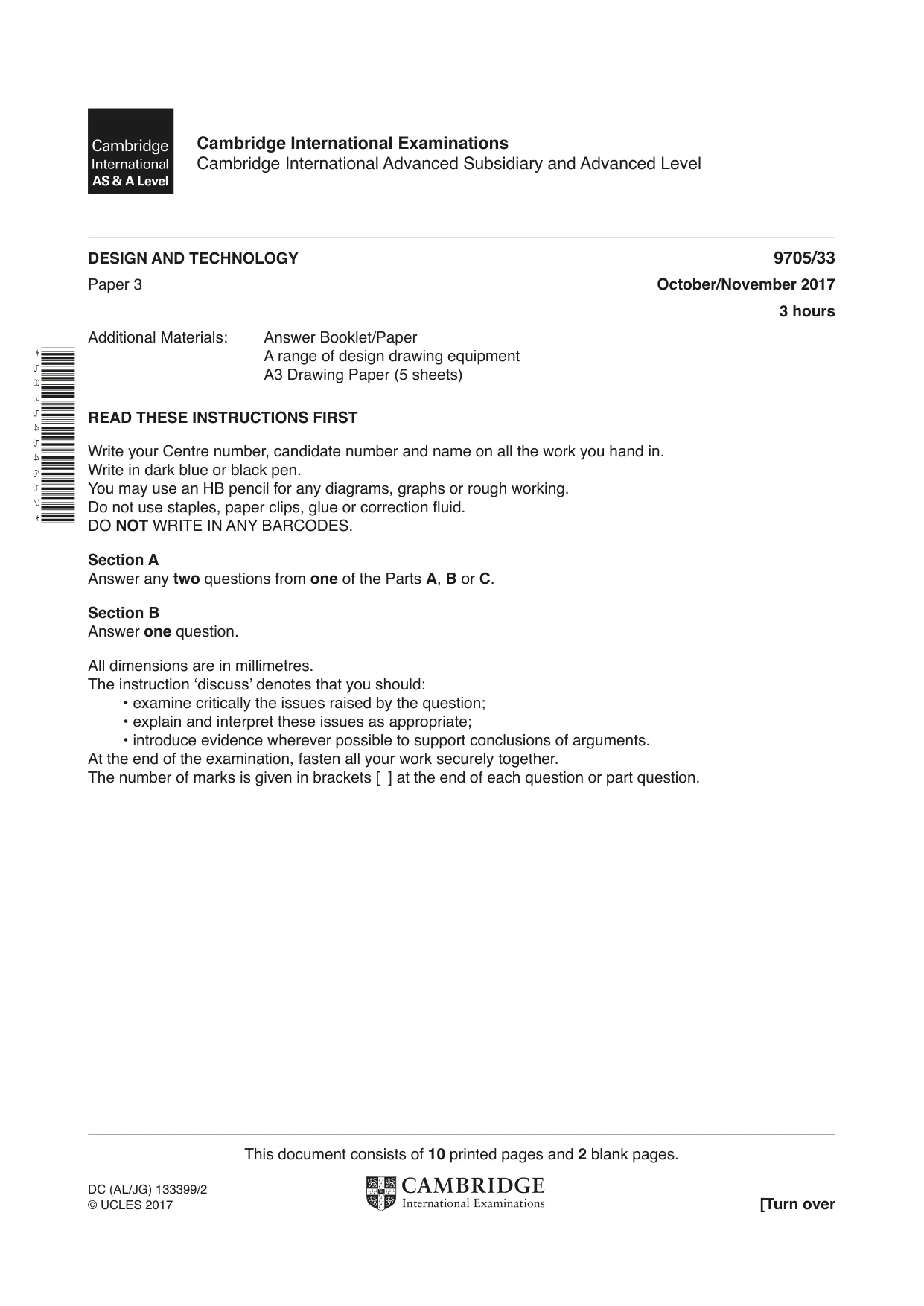
This document consists of 10 printed pages and 2 blank pages. DC (AL/JG) 133399/2 © UCLES 2017 [Turn over Cambridge International Examinations Cambridge International Advanced Subsidiary and Advanced Level * 5 8 3 5 4 5 4 6 5 2 * DESIGN AND TECHNOLOGY 9705/33 Paper 3 October/November 2017 3 hours Additional Materials: Answer Booklet/Paper A range of design drawing equipment A3 Drawing Paper (5 sheets) READ THESE INSTRUCTIONS FIRST Write your Centre number, candidate number and name on all the work you hand in. Write in dark blue or black pen. You may use an HB pencil for any diagrams, graphs or rough working. Do not use staples, paper clips, glue or correction fluid. DO NOT WRITE IN ANY BARCODES. Section A Answer any two questions from one of the Parts A, B or C. Section B Answer one question. All dimensions are in millimetres. The instruction ‘discuss’ denotes that you should: • examine critically the issues raised by the question; • explain and interpret these issues as appropriate; • introduce evidence wherever possible to support conclusions of arguments. At the end of the examination, fasten all your work securely together. The number of marks is given in brackets [ ] at the end of each question or part question.
Question paper, page 2
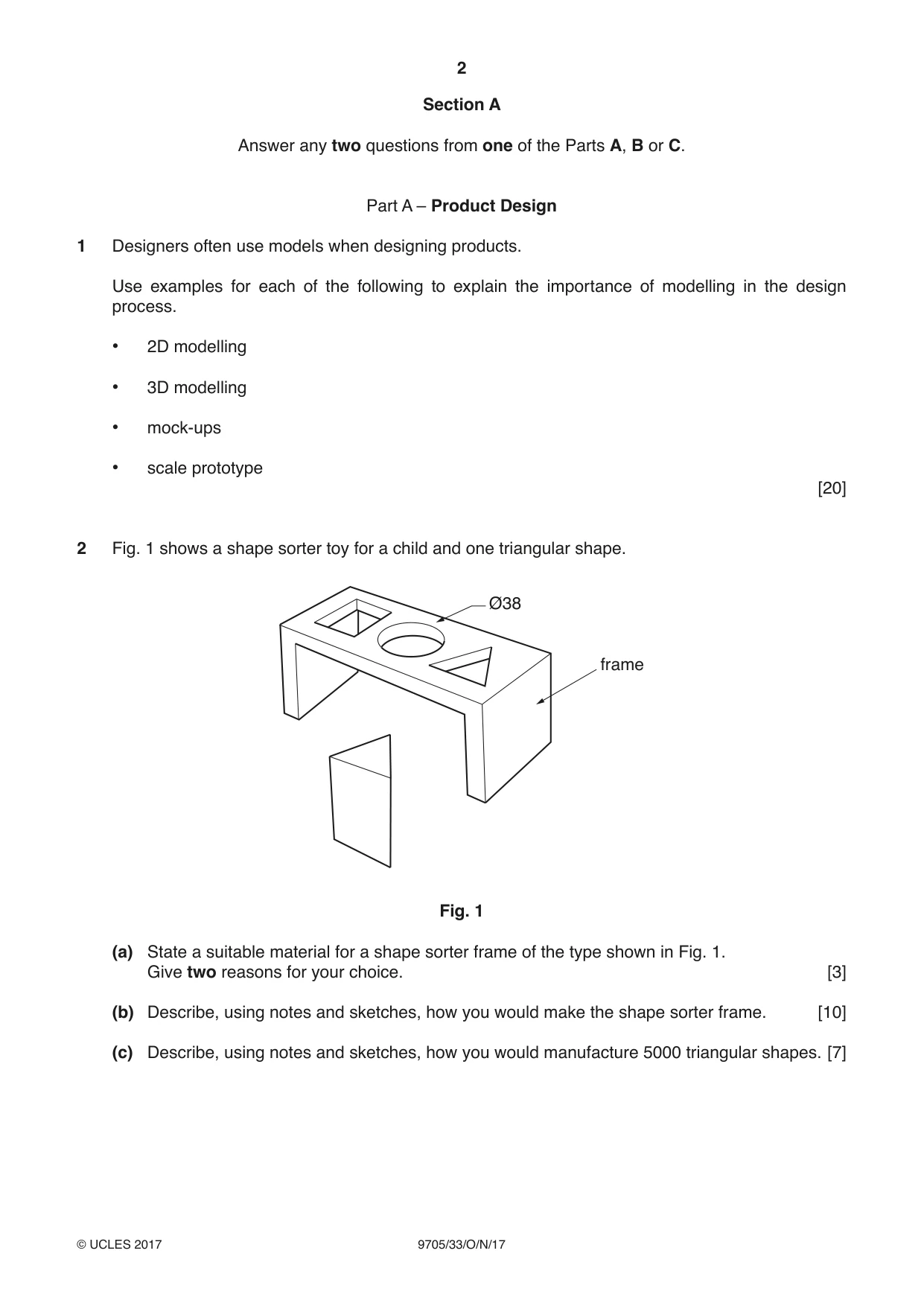
2 9705/33/O/N/17 © UCLES 2017 Section A Answer any two questions from one of the Parts A, B or C. Part A – Product Design 1 Designers often use models when designing products. Use examples for each of the following to explain the importance of modelling in the design process. • 2D modelling • 3D modelling • mock-ups • scale prototype [20] 2 Fig. 1 shows a shape sorter toy for a child and one triangular shape. Ø38 frame Fig. 1 (a) State a suitable material for a shape sorter frame of the type shown in Fig. 1. Give two reasons for your choice. [3] (b) Describe, using notes and sketches, how you would make the shape sorter frame. [10] (c) Describe, using notes and sketches, how you would manufacture 5000 triangular shapes. [7]
Question paper, page 3
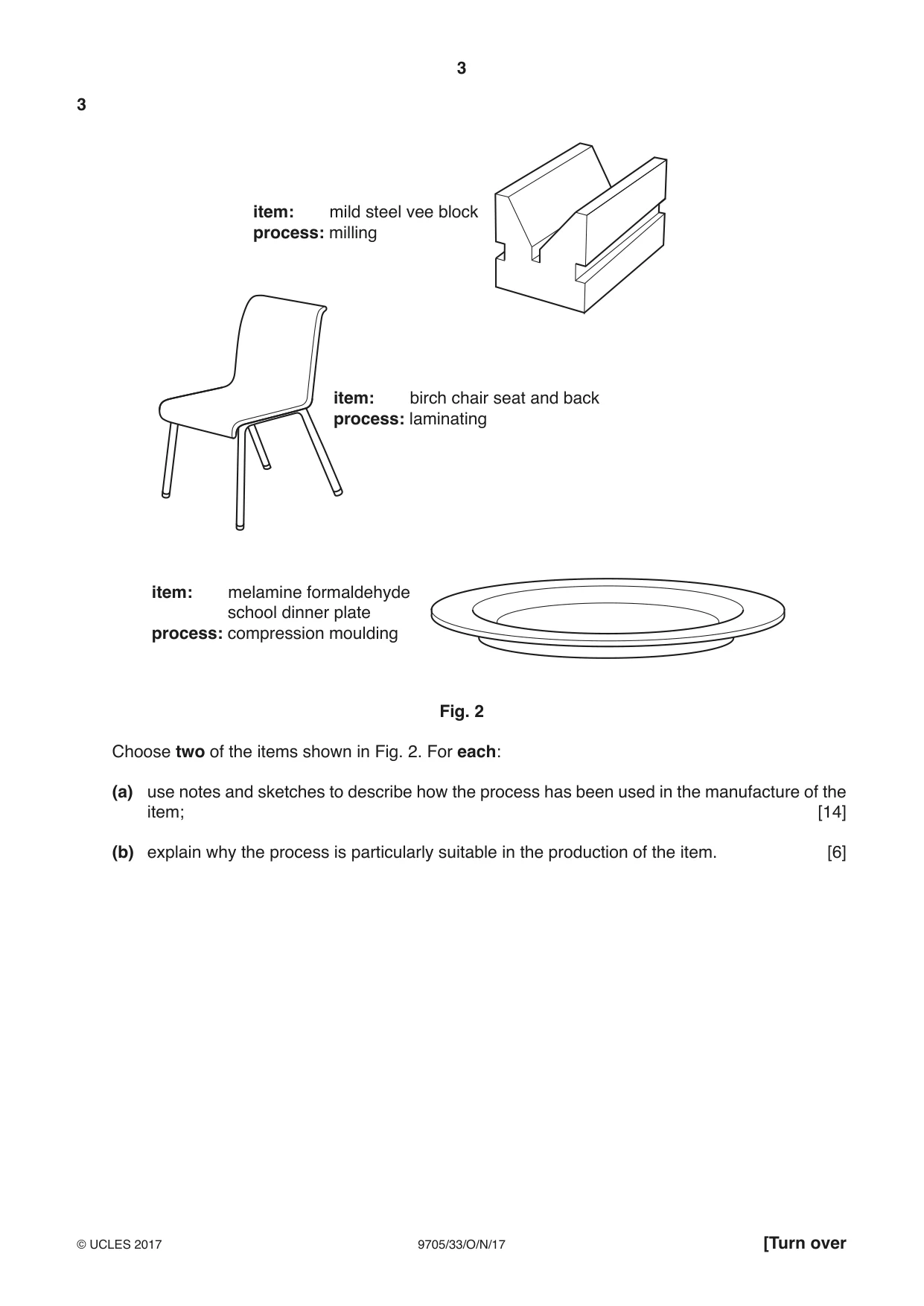
3 9705/33/O/N/17 © UCLES 2017 [Turn over 3 item: mild steel vee block process: milling item: birch chair seat and back process: laminating item: melamine formaldehyde school dinner plate process: compression moulding Fig. 2 Choose two of the items shown in Fig. 2. For each: (a) use notes and sketches to describe how the process has been used in the manufacture of the item; [14] (b) explain why the process is particularly suitable in the production of the item. [6]
Question paper, page 4
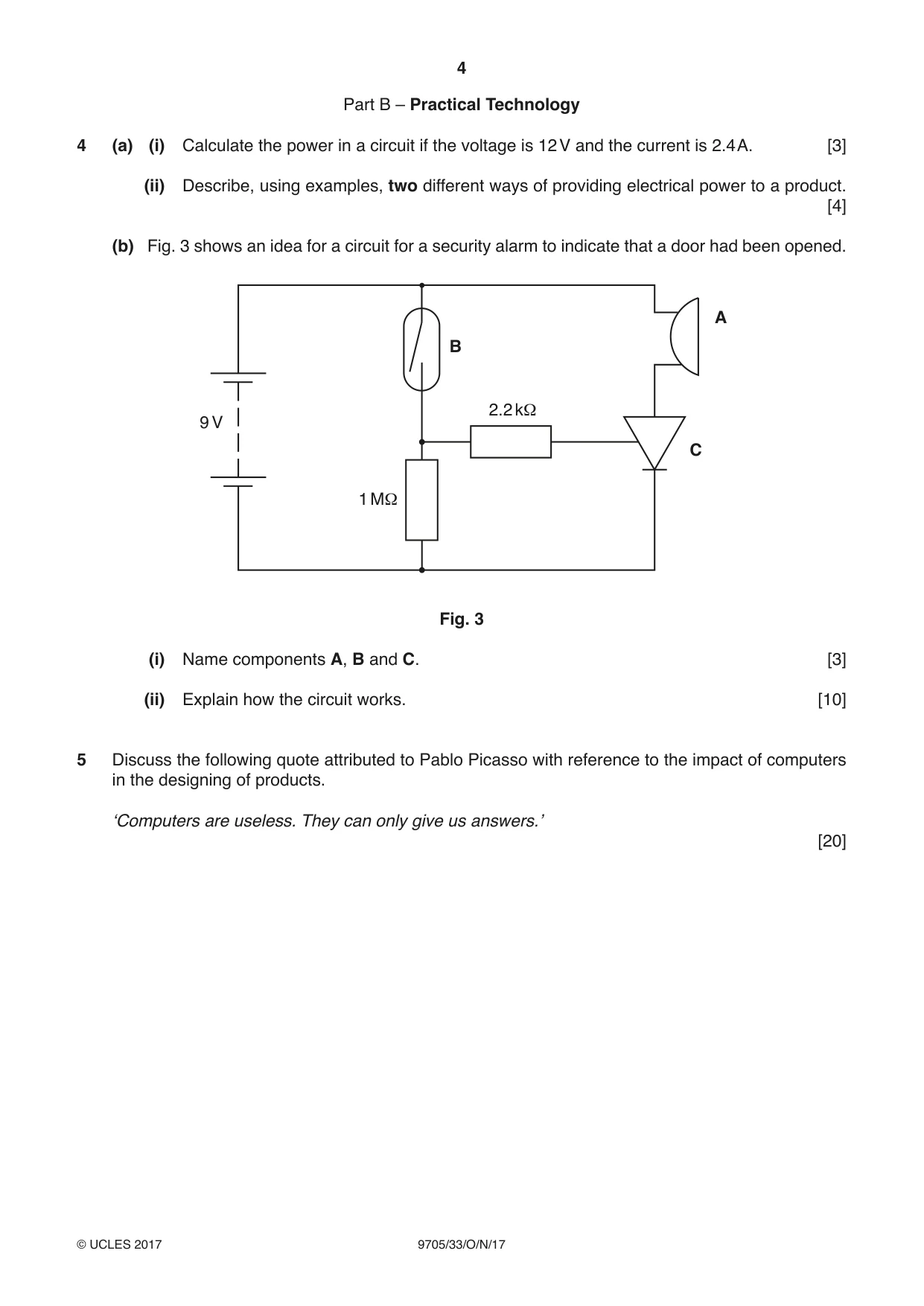
4 9705/33/O/N/17 © UCLES 2017 Part B – Practical Technology 4 (a) (i) Calculate the power in a circuit if the voltage is 12 V and the current is 2.4 A. [3] (ii) Describe, using examples, two different ways of providing electrical power to a product. [4] (b) Fig. 3 shows an idea for a circuit for a security alarm to indicate that a door had been opened. 2.2 kΩ 1 MΩ A B 9 V C Fig. 3 (i) Name components A, B and C. [3] (ii) Explain how the circuit works. [10] 5 Discuss the following quote attributed to Pablo Picasso with reference to the impact of computers in the designing of products. ‘Computers are useless. They can only give us answers.’ [20]
Question paper, page 5
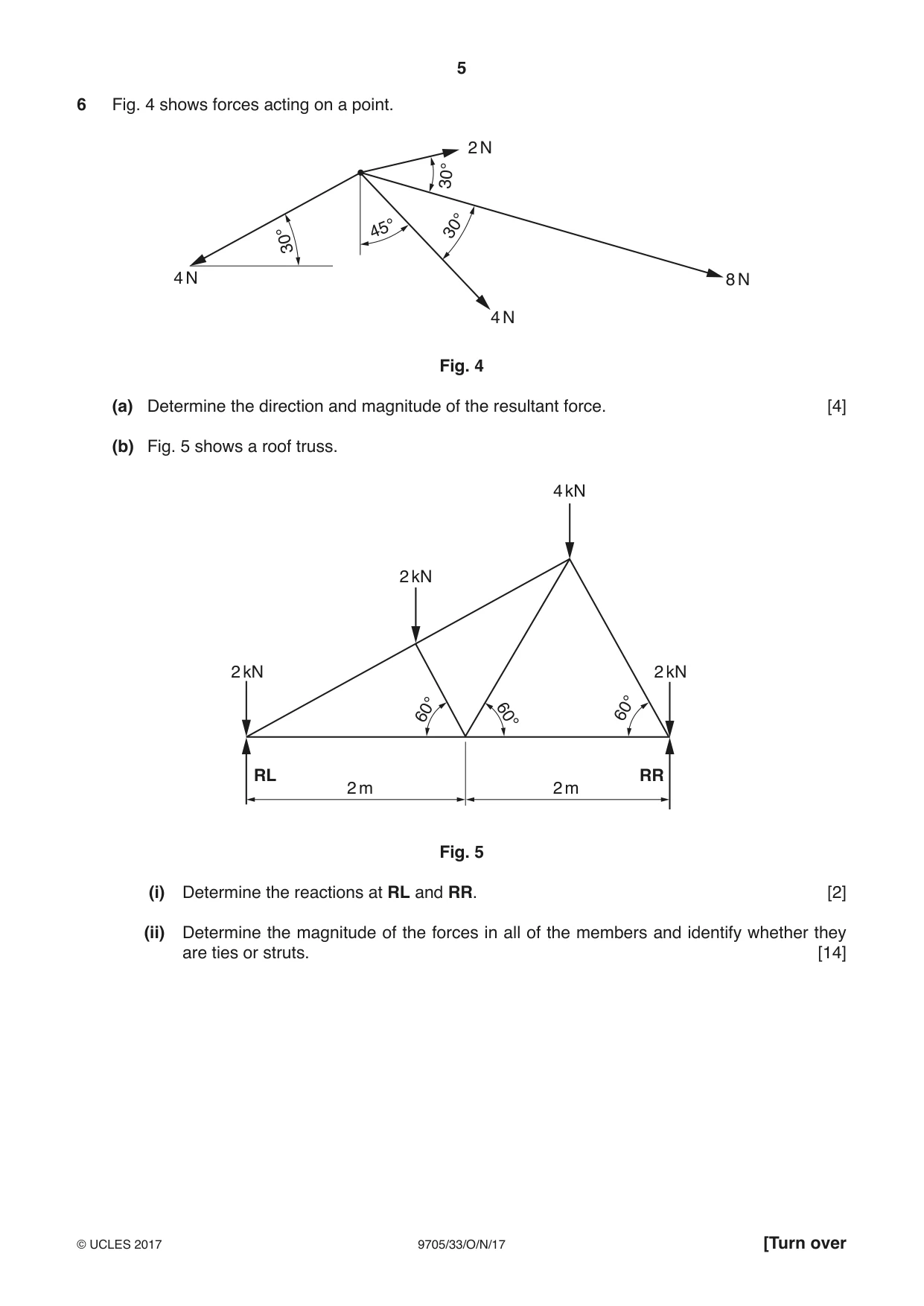
5 9705/33/O/N/17 © UCLES 2017 [Turn over 6 Fig. 4 shows forces acting on a point. 30° 45° 30° 30° 2 N 4 N 8 N 4 N Fig. 4 (a) Determine the direction and magnitude of the resultant force. [4] (b) Fig. 5 shows a roof truss. 4 kN 2 kN 2 kN 2 m 2 m 2 kN RR RL 60° 60° 60° Fig. 5 (i) Determine the reactions at RL and RR. [2] (ii) Determine the magnitude of the forces in all of the members and identify whether they are ties or struts. [14]
Question paper, page 6
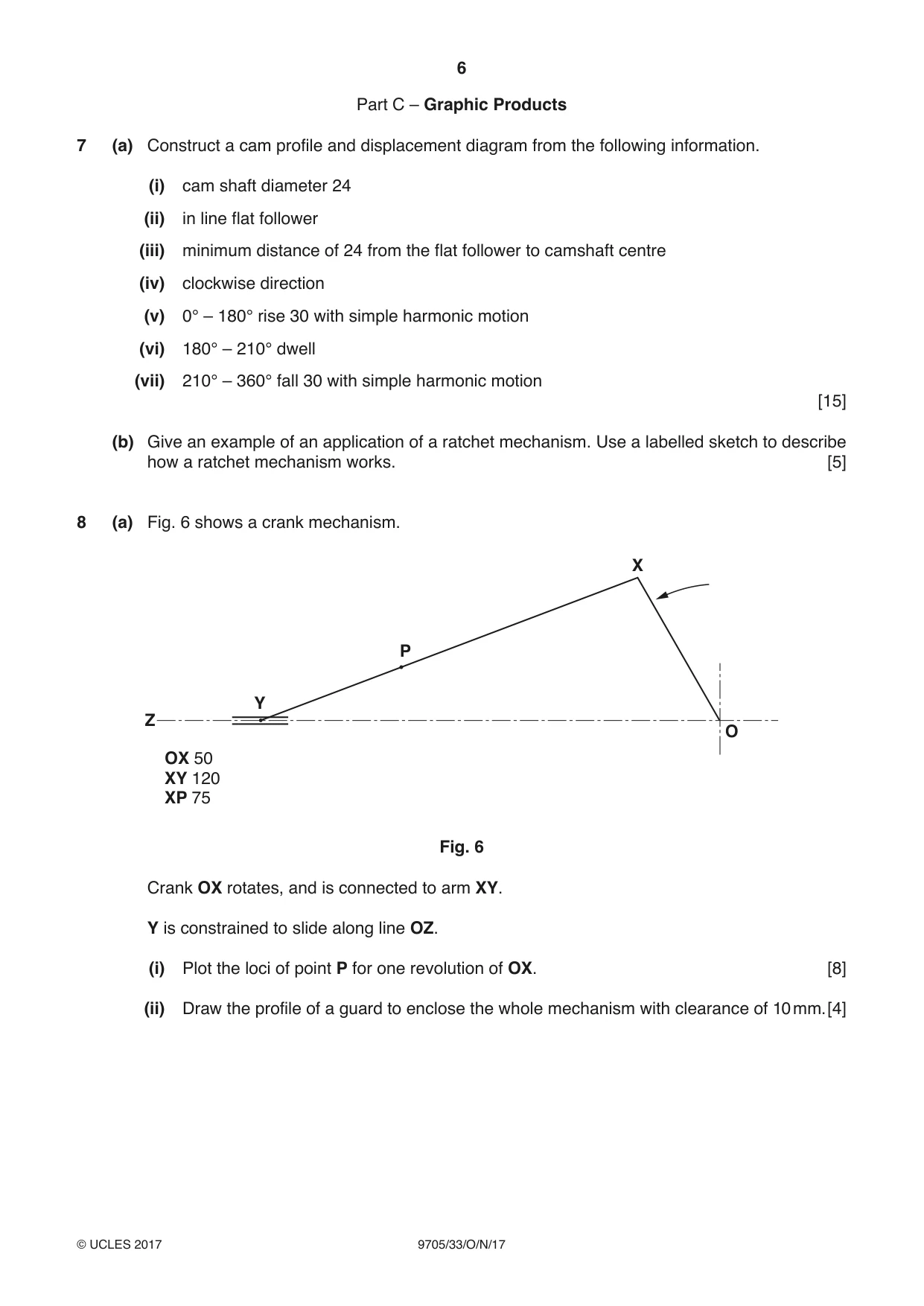
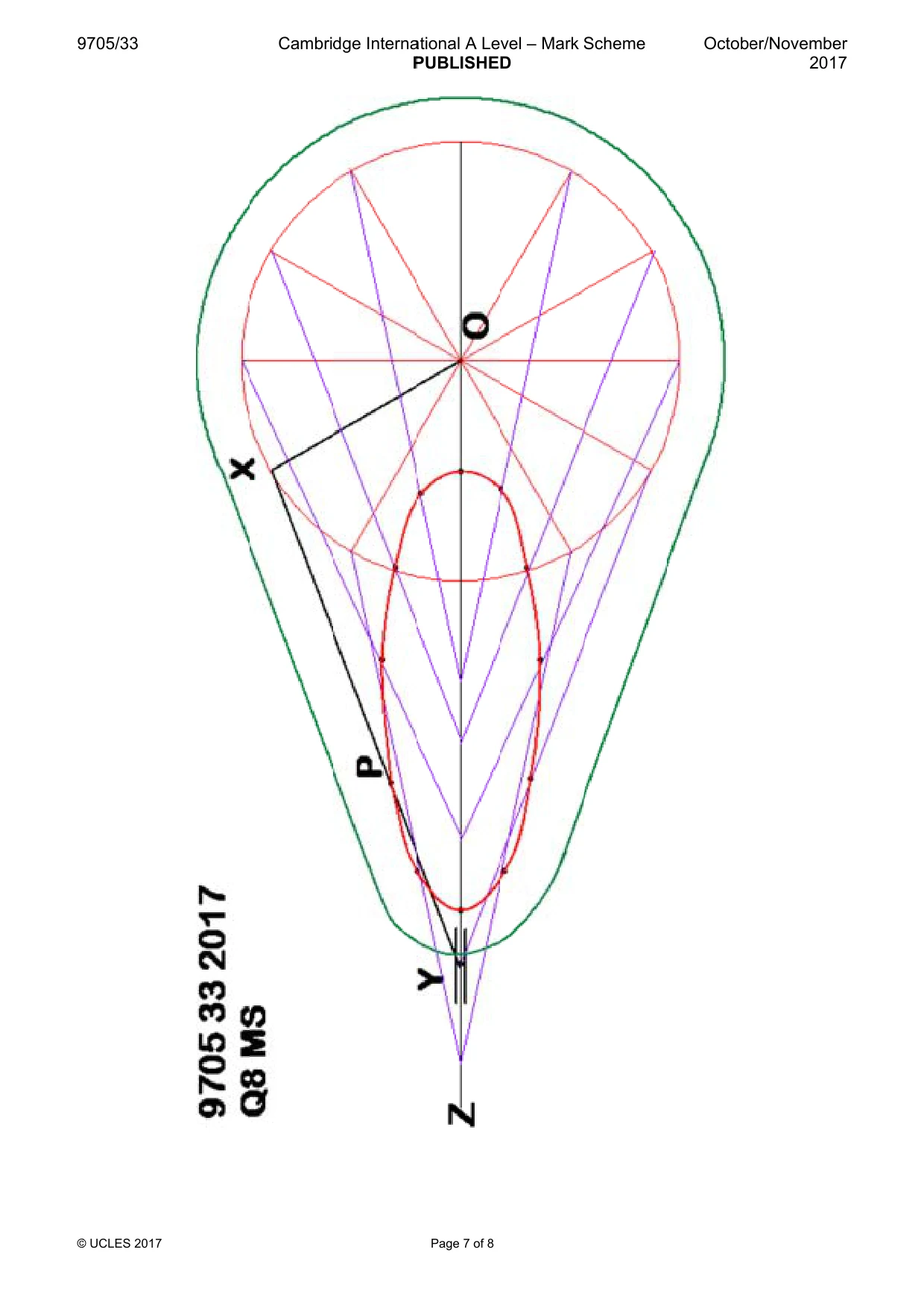
6 9705/33/O/N/17 © UCLES 2017 Part C – Graphic Products 7 (a) Construct a cam profile and displacement diagram from the following information. (i) cam shaft diameter 24 (ii) in line flat follower (iii) minimum distance of 24 from the flat follower to camshaft centre (iv) clockwise direction (v) 0° – 180° rise 30 with simple harmonic motion (vi) 180° – 210° dwell (vii) 210° – 360° fall 30 with simple harmonic motion [15] (b) Give an example of an application of a ratchet mechanism. Use a labelled sketch to describe how a ratchet mechanism works. [5] 8 (a) Fig. 6 shows a crank mechanism. Z Y P X O OX 50 XY 120 XP 75 Fig. 6 Crank OX rotates, and is connected to arm XY. Y is constrained to slide along line OZ. (i) Plot the loci of point P for one revolution of OX. [8] (ii) Draw the profile of a guard to enclose the whole mechanism with clearance of 10 mm. [4]
Question paper, page 7
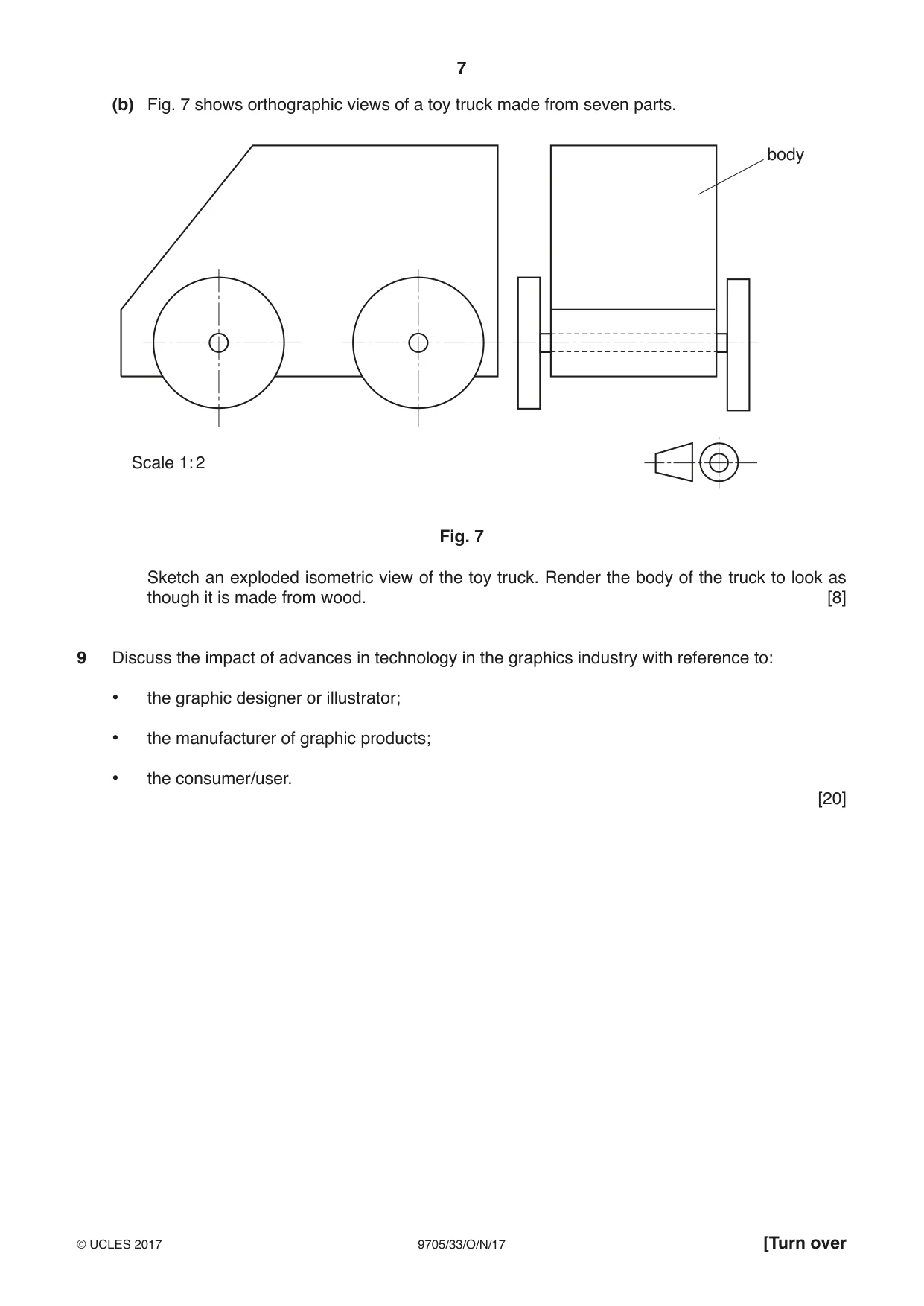
7 9705/33/O/N/17 © UCLES 2017 [Turn over (b) Fig. 7 shows orthographic views of a toy truck made from seven parts. body Scale 1: 2 Fig. 7 Sketch an exploded isometric view of the toy truck. Render the body of the truck to look as though it is made from wood. [8] 9 Discuss the impact of advances in technology in the graphics industry with reference to: • the graphic designer or illustrator; • the manufacturer of graphic products; • the consumer/user. [20]
Question paper, page 8
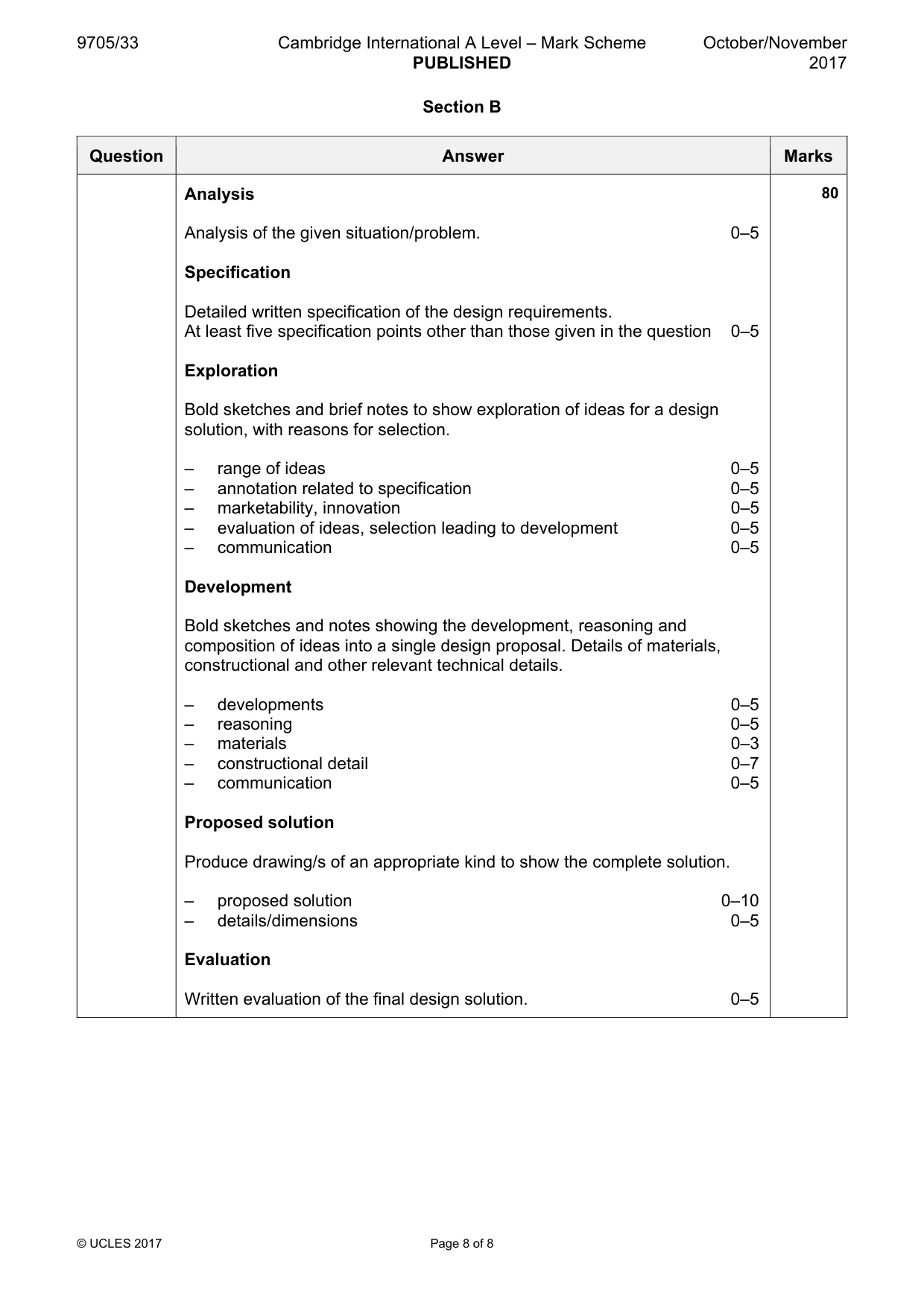
8 9705/33/O/N/17 © UCLES 2017 Section B Answer one question on the A3 paper provided. You should approach the design question of your choice in the following manner: Analysis Produce an analysis of the given situation/problem, which may be in written or graphical form. [5] Specification From the analysis produce a detailed written specification of the design requirements. Include at least five specification points other than those given in the question. [5] Exploration Use bold sketches and brief notes to show your exploration of ideas for a design solution, with reasons for selection. [25] Development Use bold sketches and notes to show the development, reasoning and composition of ideas into a single design proposal. Give details of materials, constructional and other relevant technical details. [25] Proposed solution Produce drawings of an appropriate kind to show the complete solution. [15] Evaluation Give a written evaluation of the final design solution. [5] Total: [80]
Question paper, page 9
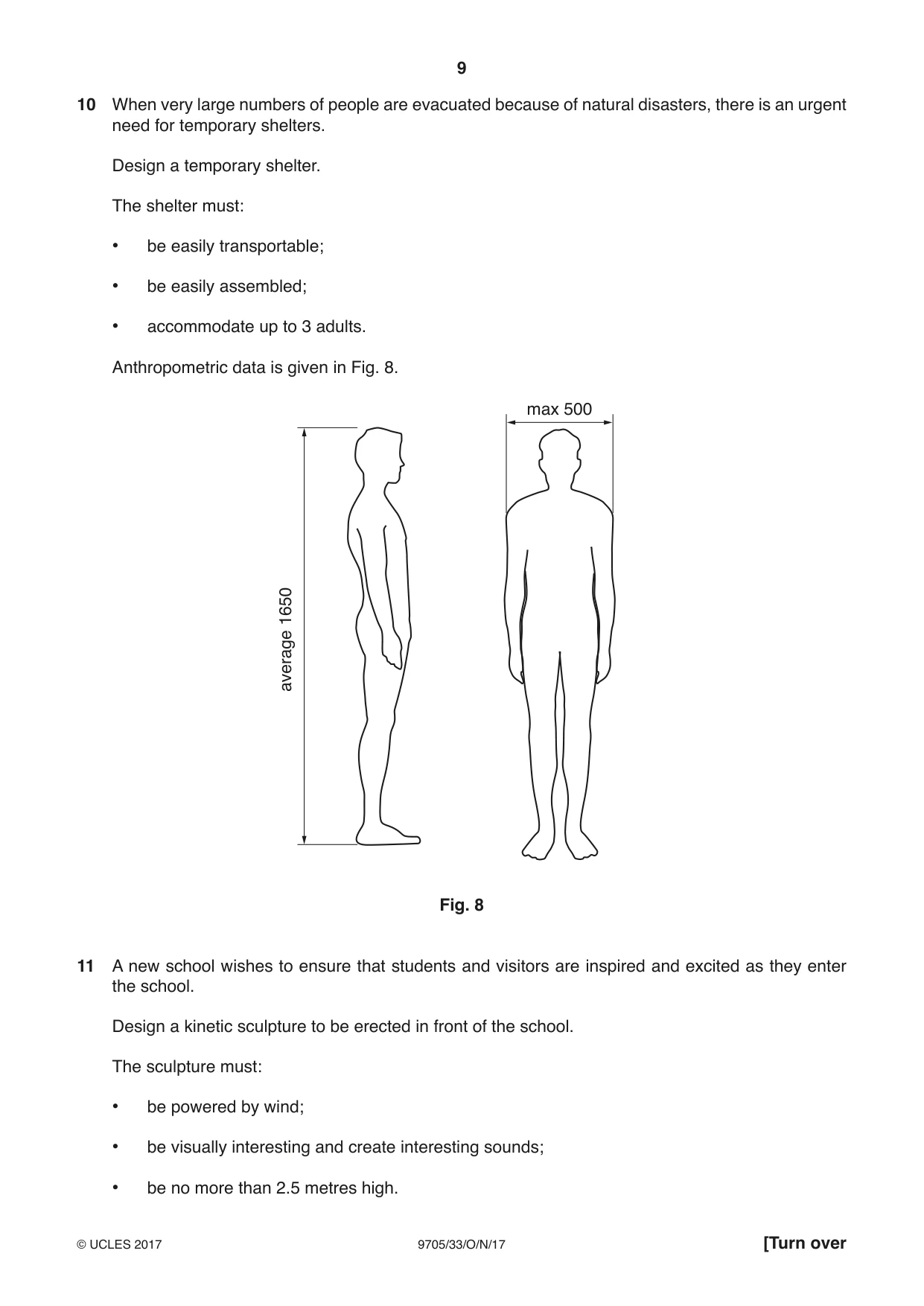
9 9705/33/O/N/17 © UCLES 2017 [Turn over 10 When very large numbers of people are evacuated because of natural disasters, there is an urgent need for temporary shelters. Design a temporary shelter. The shelter must: • be easily transportable; • be easily assembled; • accommodate up to 3 adults. Anthropometric data is given in Fig. 8. average 1650 max 500 Fig. 8 11 A new school wishes to ensure that students and visitors are inspired and excited as they enter the school. Design a kinetic sculpture to be erected in front of the school. The sculpture must: • be powered by wind; • be visually interesting and create interesting sounds; • be no more than 2.5 metres high.
Question paper, page 10
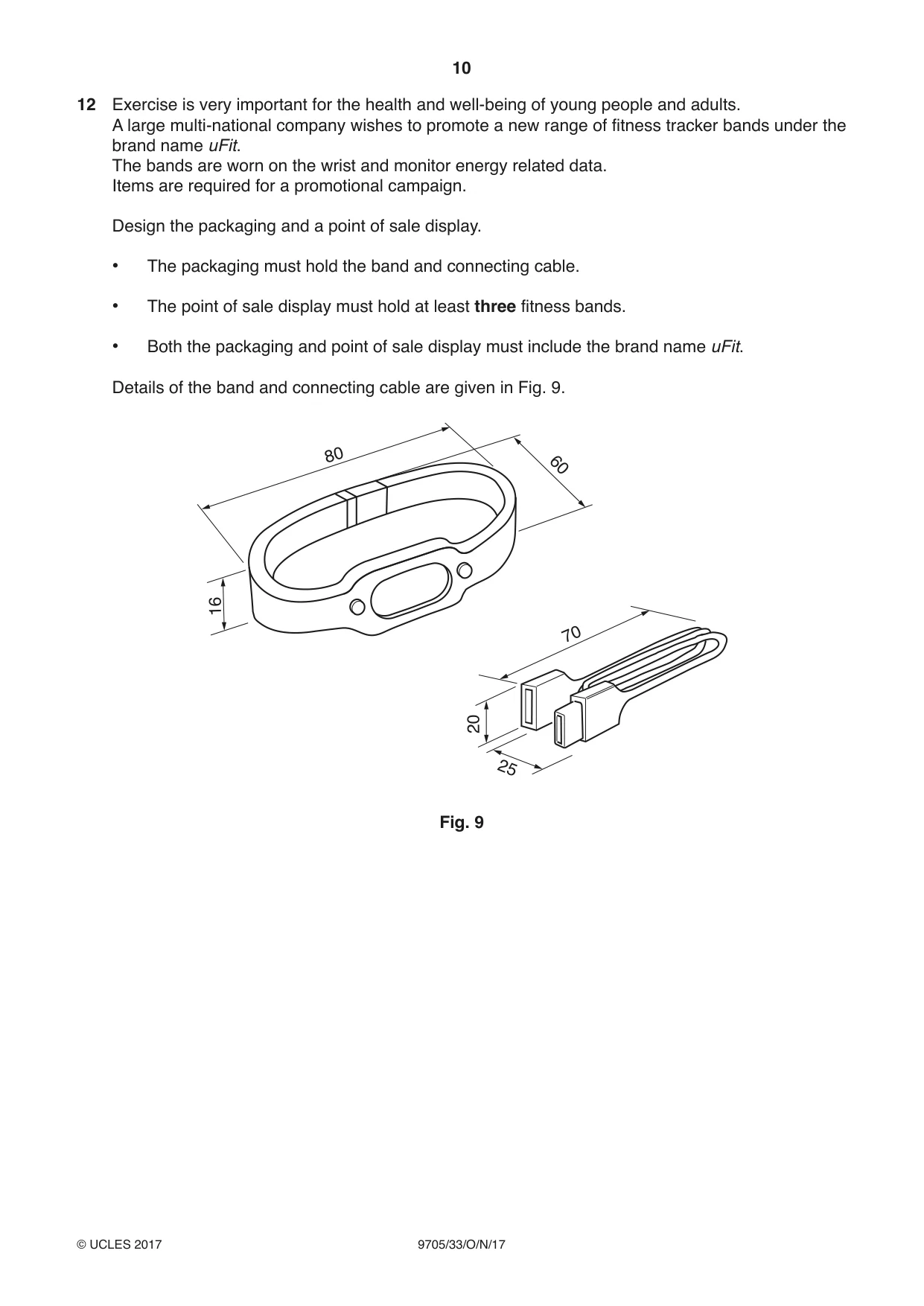
10 9705/33/O/N/17 © UCLES 2017 12 Exercise is very important for the health and well-being of young people and adults. A large multi-national company wishes to promote a new range of fitness tracker bands under the brand name uFit. The bands are worn on the wrist and monitor energy related data. Items are required for a promotional campaign. Design the packaging and a point of sale display. • The packaging must hold the band and connecting cable. • The point of sale display must hold at least three fitness bands. • Both the packaging and point of sale display must include the brand name uFit. Details of the band and connecting cable are given in Fig. 9. 70 80 16 20 25 60 Fig. 9
Question paper, page 11
11 9705/33/O/N/17 © UCLES 2017 BLANK PAGE
Question paper, page 12
12 9705/33/O/N/17 © UCLES 2017 BLANK PAGE Permission to reproduce items where third-party owned material protected by copyright is included has been sought and cleared where possible. Every reasonable effort has been made by the publisher (UCLES) to trace copyright holders, but if any items requiring clearance have unwittingly been included, the publisher will be pleased to make amends at the earliest possible opportunity. To avoid the issue of disclosure of answer-related information to candidates, all copyright acknowledgements are reproduced online in the Cambridge International Examinations Copyright Acknowledgements Booklet. This is produced for each series of examinations and is freely available to download at www.cie.org.uk after the live examination series. Cambridge International Examinations is part of the Cambridge Assessment Group. Cambridge Assessment is the brand name of University of Cambridge Local Examinations Syndicate (UCLES), which is itself a department of the University of Cambridge.
Mark scheme, page 1
® IGCSE is a registered trademark. This document consists of 8 printed pages. © UCLES 2017 [Turn over Cambridge Assessment International Education Cambridge International Advanced Level DESIGN AND TECHNOLOGY 9705/33 Paper 3 October/November 2017 MARK SCHEME Maximum Mark: 120 Published This mark scheme is published as an aid to teachers and candidates, to indicate the requirements of the examination. It shows the basis on which Examiners were instructed to award marks. It does not indicate the details of the discussions that took place at an Examiners’ meeting before marking began, which would have considered the acceptability of alternative answers. Mark schemes should be read in conjunction with the question paper and the Principal Examiner Report for Teachers. Cambridge International will not enter into discussions about these mark schemes. Cambridge International is publishing the mark schemes for the October/November 2017 series for most Cambridge IGCSE®, Cambridge International A and AS Level components and some Cambridge O Level components.
Mark scheme, page 2
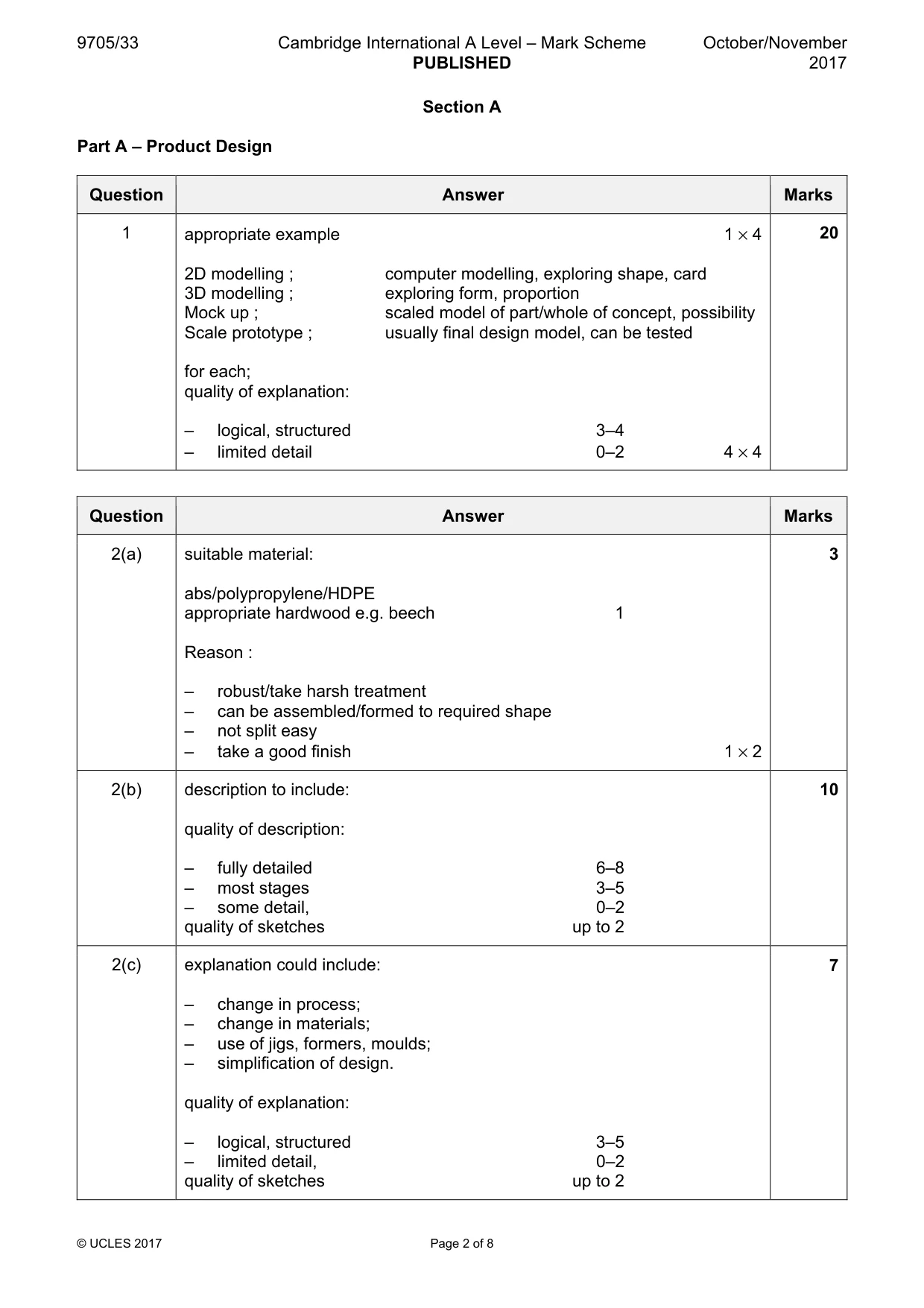
9705/33 Cambridge International A Level – Mark Scheme PUBLISHED October/November 2017 © UCLES 2017 Page 2 of 8 Section A Part A – Product Design Question Answer Marks 1 appropriate example 1 × 4 2D modelling ; computer modelling, exploring shape, card 3D modelling ; exploring form, proportion Mock up ; scaled model of part/whole of concept, possibility Scale prototype ; usually final design model, can be tested for each; quality of explanation: – logical, structured 3–4 – limited detail 0–2 4 × 4 20 Question Answer Marks 2(a) suitable material: abs/polypropylene/HDPE appropriate hardwood e.g. beech 1 Reason : – robust/take harsh treatment – can be assembled/formed to required shape – not split easy – take a good finish 1 × 2 3 2(b) description to include: quality of description: – fully detailed 6–8 – most stages 3–5 – some detail, 0–2 quality of sketches up to 2 10 2(c) explanation could include: – change in process; – change in materials; – use of jigs, formers, moulds; – simplification of design. quality of explanation: – logical, structured 3–5 – limited detail, 0–2 quality of sketches up to 2 7
Mark scheme, page 3
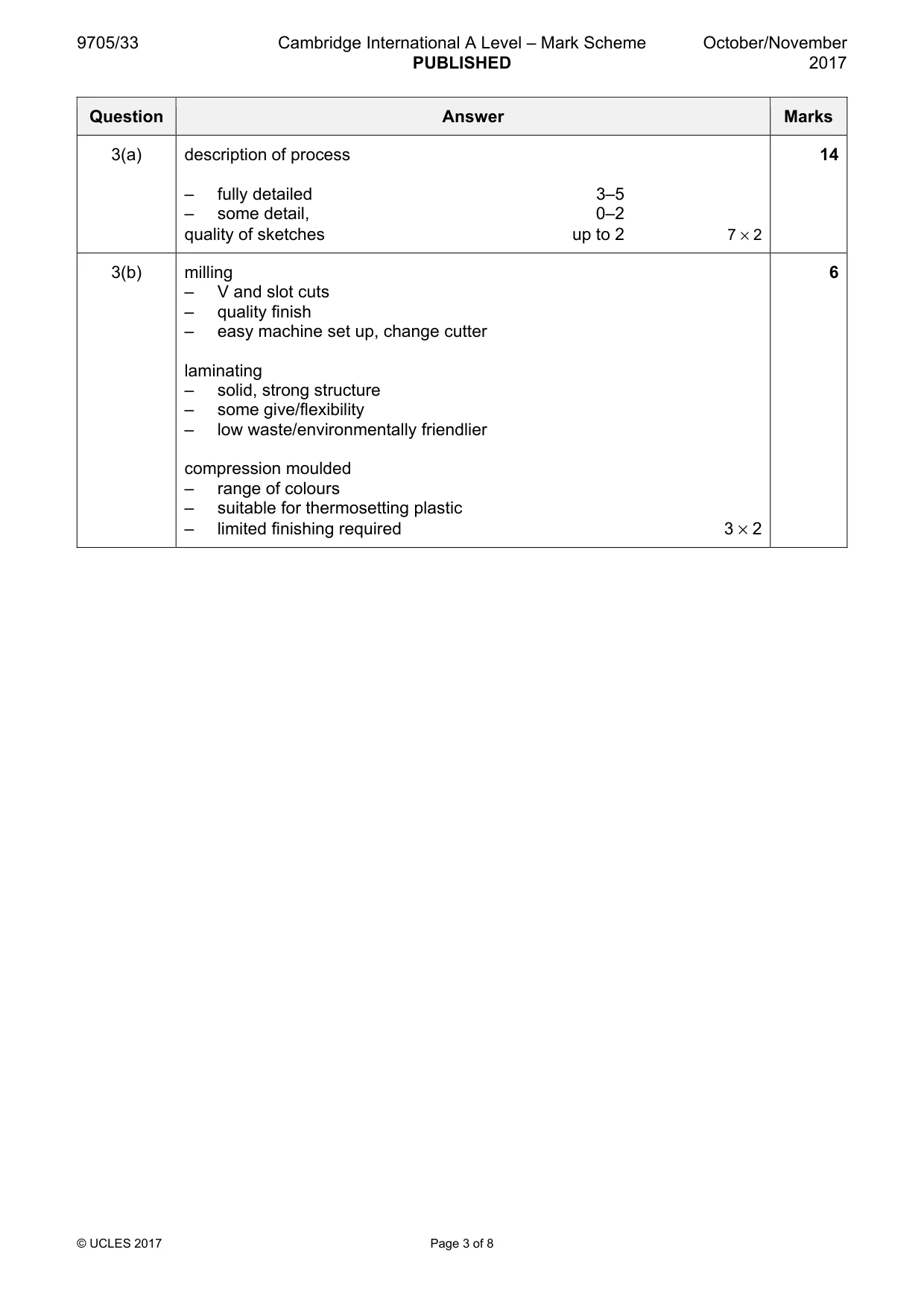
9705/33 Cambridge International A Level – Mark Scheme PUBLISHED October/November 2017 © UCLES 2017 Page 3 of 8 Question Answer Marks 3(a) description of process – fully detailed 3–5 – some detail, 0–2 quality of sketches up to 2 7 × 2 14 3(b) milling – V and slot cuts – quality finish – easy machine set up, change cutter laminating – solid, strong structure – some give/flexibility – low waste/environmentally friendlier compression moulded – range of colours – suitable for thermosetting plastic – limited finishing required 3 × 2 6
Mark scheme, page 4
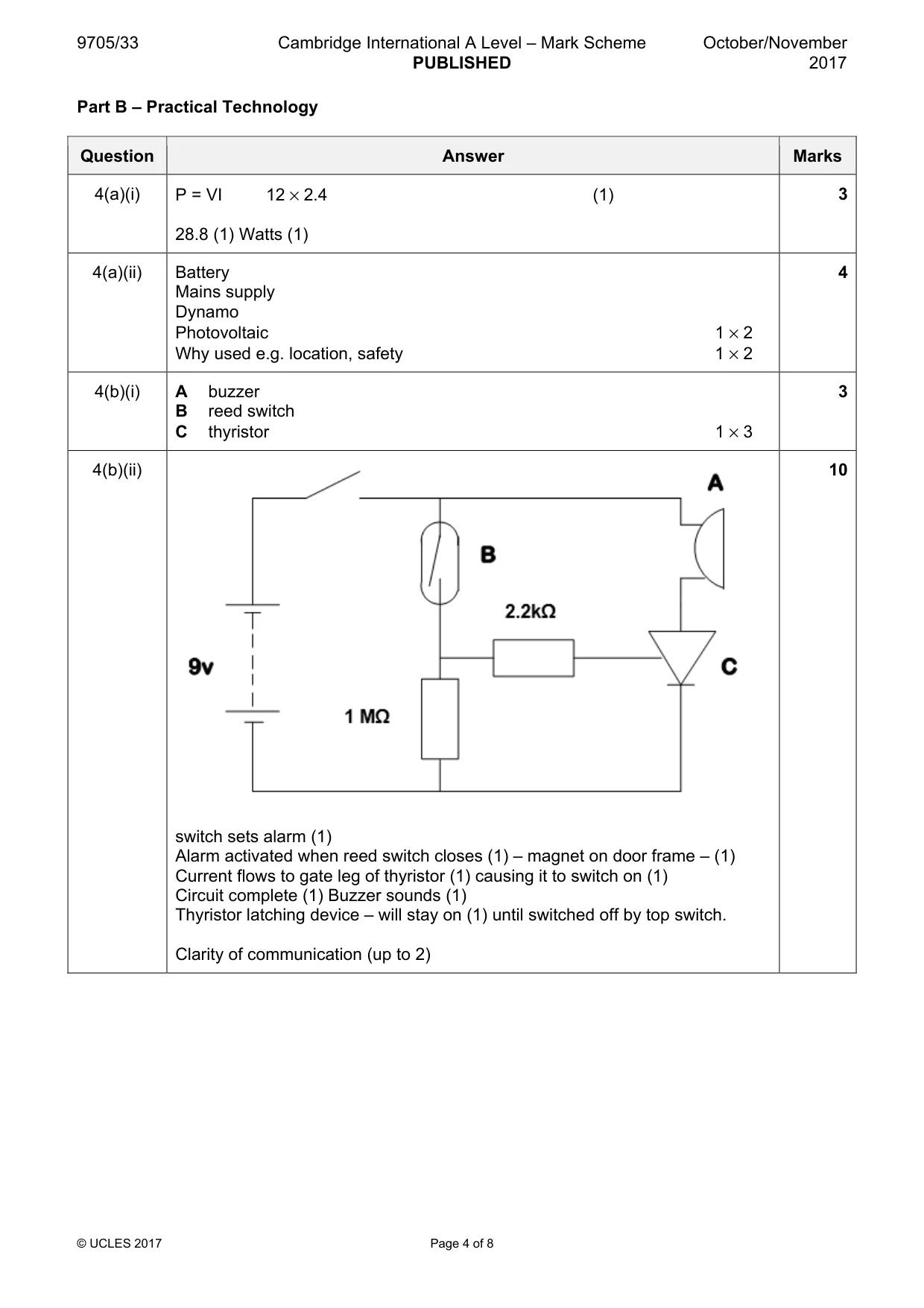
9705/33 Cambridge International A Level – Mark Scheme PUBLISHED October/November 2017 © UCLES 2017 Page 4 of 8 Part B – Practical Technology Question Answer Marks 4(a)(i) P = VI 12 × 2.4 (1) 28.8 (1) Watts (1) 3 4(a)(ii) Battery Mains supply Dynamo Photovoltaic 1 × 2 Why used e.g. location, safety 1 × 2 4 4(b)(i) A buzzer B reed switch C thyristor 1 × 3 3 4(b)(ii) switch sets alarm (1) Alarm activated when reed switch closes (1) – magnet on door frame – (1) Current flows to gate leg of thyristor (1) causing it to switch on (1) Circuit complete (1) Buzzer sounds (1) Thyristor latching device – will stay on (1) until switched off by top switch. Clarity of communication (up to 2) 10
Mark scheme, page 5
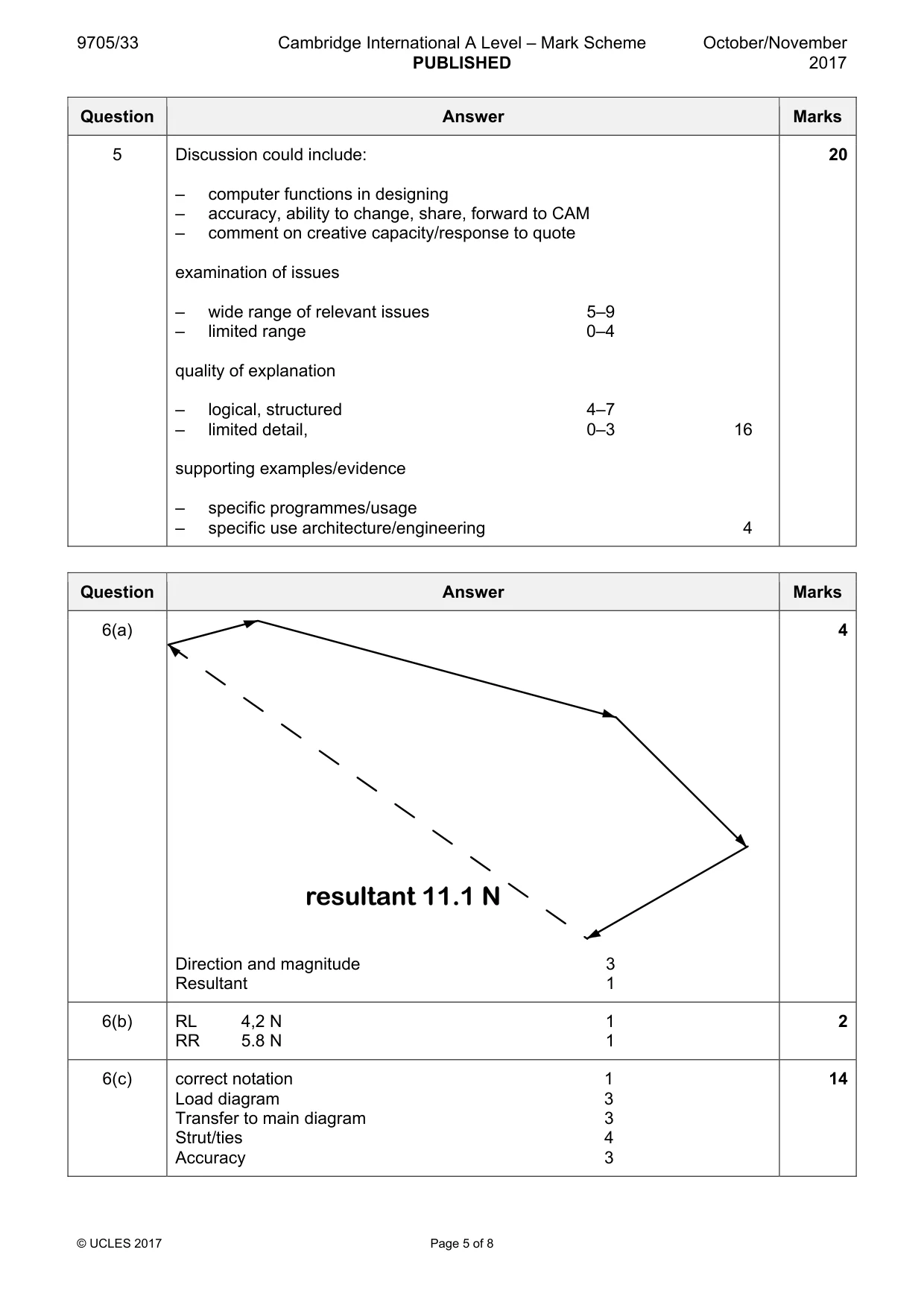
9705/33 Cambridge International A Level – Mark Scheme PUBLISHED October/November 2017 © UCLES 2017 Page 5 of 8 Question Answer Marks 5 Discussion could include: – computer functions in designing – accuracy, ability to change, share, forward to CAM – comment on creative capacity/response to quote examination of issues – wide range of relevant issues 5–9 – limited range 0–4 quality of explanation – logical, structured 4–7 – limited detail, 0–3 16 supporting examples/evidence – specific programmes/usage – specific use architecture/engineering 4 20 Question Answer Marks 6(a) Direction and magnitude 3 Resultant 1 4 6(b) RL 4,2 N 1 RR 5.8 N 1 2 6(c) correct notation 1 Load diagram 3 Transfer to main diagram 3 Strut/ties 4 Accuracy 3 14
Mark scheme, page 6
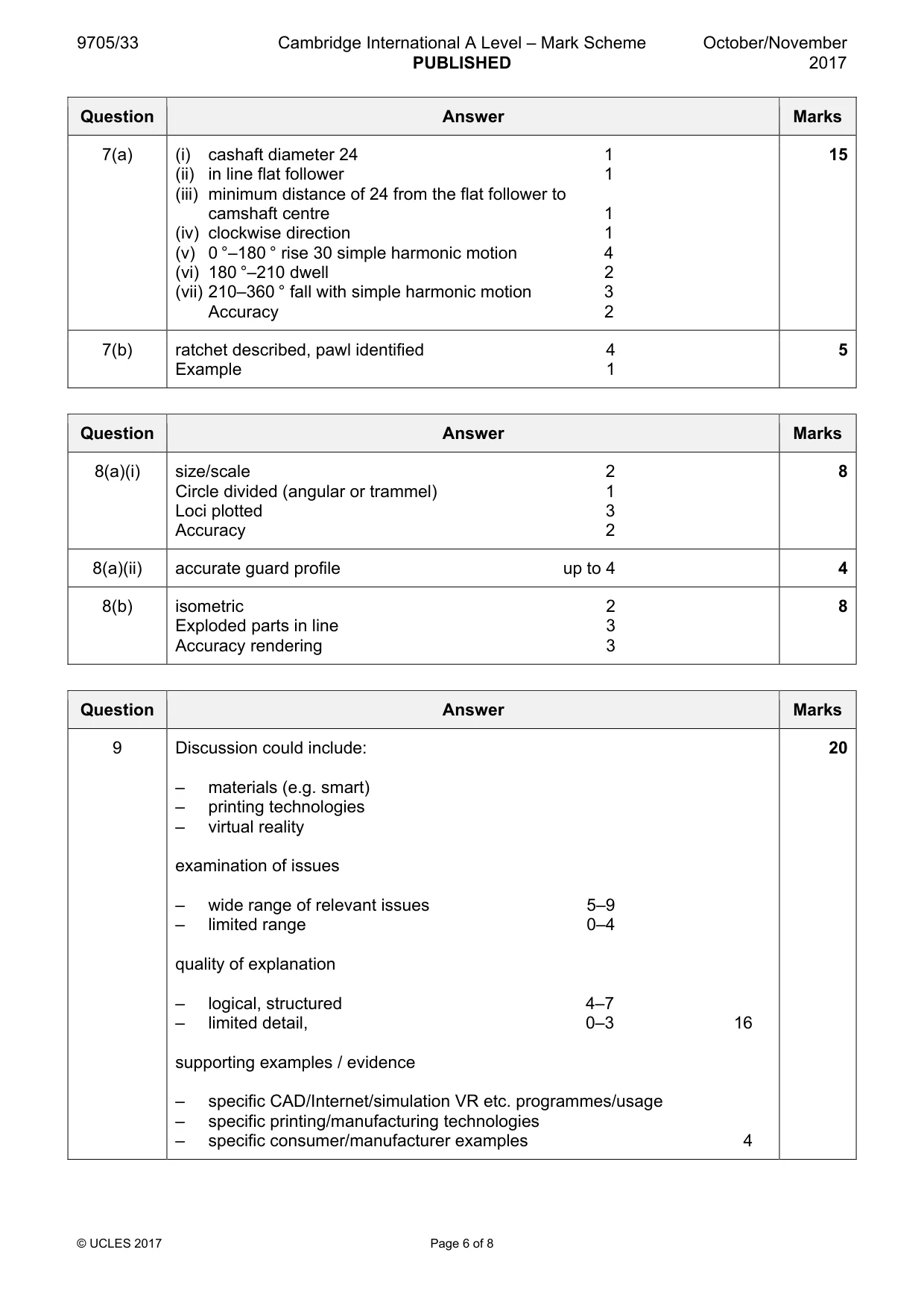
9705/33 Cambridge International A Level – Mark Scheme PUBLISHED October/November 2017 © UCLES 2017 Page 6 of 8 Question Answer Marks 7(a) (i) cashaft diameter 24 1 (ii) in line flat follower 1 (iii) minimum distance of 24 from the flat follower to camshaft centre 1 (iv) clockwise direction 1 (v) 0 °–180 ° rise 30 simple harmonic motion 4 (vi) 180 °–210 dwell 2 (vii) 210–360 ° fall with simple harmonic motion 3 Accuracy 2 15 7(b) ratchet described, pawl identified 4 Example 1 5 Question Answer Marks 8(a)(i) size/scale 2 Circle divided (angular or trammel) 1 Loci plotted 3 Accuracy 2 8 8(a)(ii) accurate guard profile up to 4 4 8(b) isometric 2 Exploded parts in line 3 Accuracy rendering 3 8 Question Answer Marks 9 Discussion could include: – materials (e.g. smart) – printing technologies – virtual reality examination of issues – wide range of relevant issues 5–9 – limited range 0–4 quality of explanation – logical, structured 4–7 – limited detail, 0–3 16 supporting examples / evidence – specific CAD/Internet/simulation VR etc. programmes/usage – specific printing/manufacturing technologies – specific consumer/manufacturer examples 4 20
Mark scheme, page 7
9 © 9705/33 © UCLES 2017 Cambridge Interna P ational A Lev PUBLISHED Page 7 of 8 vel – Mark D Scheme Octobe er/Novembe 201 er 17
Mark scheme, page 8
9705/33 Cambridge International A Level – Mark Scheme PUBLISHED October/November 2017 © UCLES 2017 Page 8 of 8 Section B Question Answer Marks Analysis Analysis of the given situation/problem. 0–5 Specification Detailed written specification of the design requirements. At least five specification points other than those given in the question 0–5 Exploration Bold sketches and brief notes to show exploration of ideas for a design solution, with reasons for selection. – range of ideas 0–5 – annotation related to specification 0–5 – marketability, innovation 0–5 – evaluation of ideas, selection leading to development 0–5 – communication 0–5 Development Bold sketches and notes showing the development, reasoning and composition of ideas into a single design proposal. Details of materials, constructional and other relevant technical details. – developments 0–5 – reasoning 0–5 – materials 0–3 – constructional detail 0–7 – communication 0–5 Proposed solution Produce drawing/s of an appropriate kind to show the complete solution. – proposed solution 0–10 – details/dimensions 0–5 Evaluation Written evaluation of the final design solution. 0–5 80
What you needed in this session
Cambridge’s own grade thresholds for 2017 Oct/Nov, Paper 3 · Variant 3. A higher threshold means an easier paper — the bar moves with how the cohort did.