Cambridge A Level Design and Technology 9705 — 2017 Oct/Nov Paper 3 · Variant 2
9705/32/O/N/17 · 120 marks · ≈135 min
The question paper and its mark scheme, free to read here and free to download. This is Cambridge’s own paper, exactly as it was sat.
Question paper12 pages

Mark scheme10 pages
Answers below. Sit the paper first if you are practising.
Paper as text
Question paper, page 1
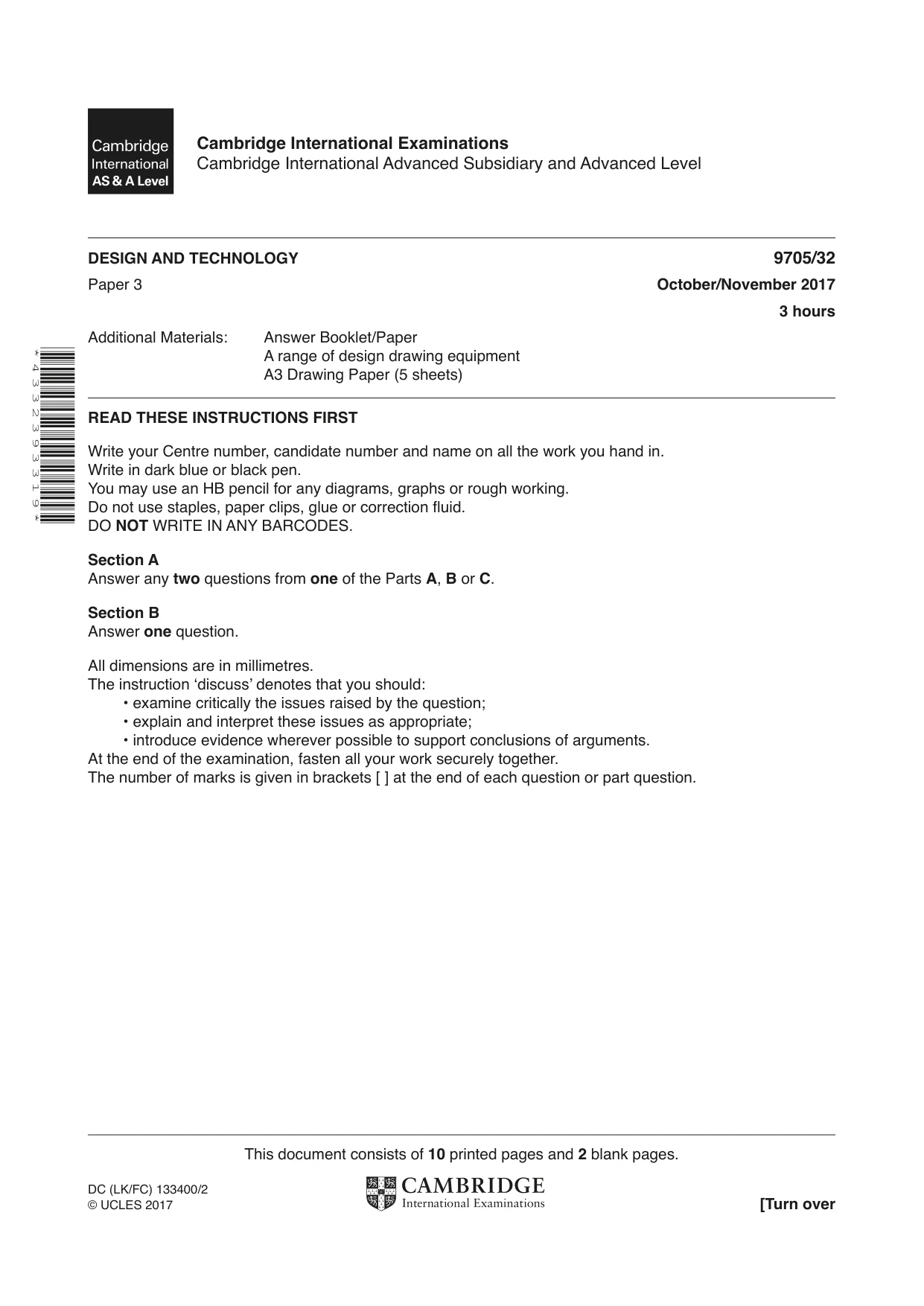
This document consists of 10 printed pages and 2 blank pages. DC (LK/FC) 133400/2 © UCLES 2017 [Turn over Cambridge International Examinations Cambridge International Advanced Subsidiary and Advanced Level * 4 3 3 2 3 9 3 3 1 9 * DESIGN AND TECHNOLOGY 9705/32 Paper 3 October/November 2017 3 hours Additional Materials: Answer Booklet/Paper A range of design drawing equipment A3 Drawing Paper (5 sheets) READ THESE INSTRUCTIONS FIRST Write your Centre number, candidate number and name on all the work you hand in. Write in dark blue or black pen. You may use an HB pencil for any diagrams, graphs or rough working. Do not use staples, paper clips, glue or correction fluid. DO NOT WRITE IN ANY BARCODES. Section A Answer any two questions from one of the Parts A, B or C. Section B Answer one question. All dimensions are in millimetres. The instruction ‘discuss’ denotes that you should: • examine critically the issues raised by the question; • explain and interpret these issues as appropriate; • introduce evidence wherever possible to support conclusions of arguments. At the end of the examination, fasten all your work securely together. The number of marks is given in brackets [ ] at the end of each question or part question.
Question paper, page 2
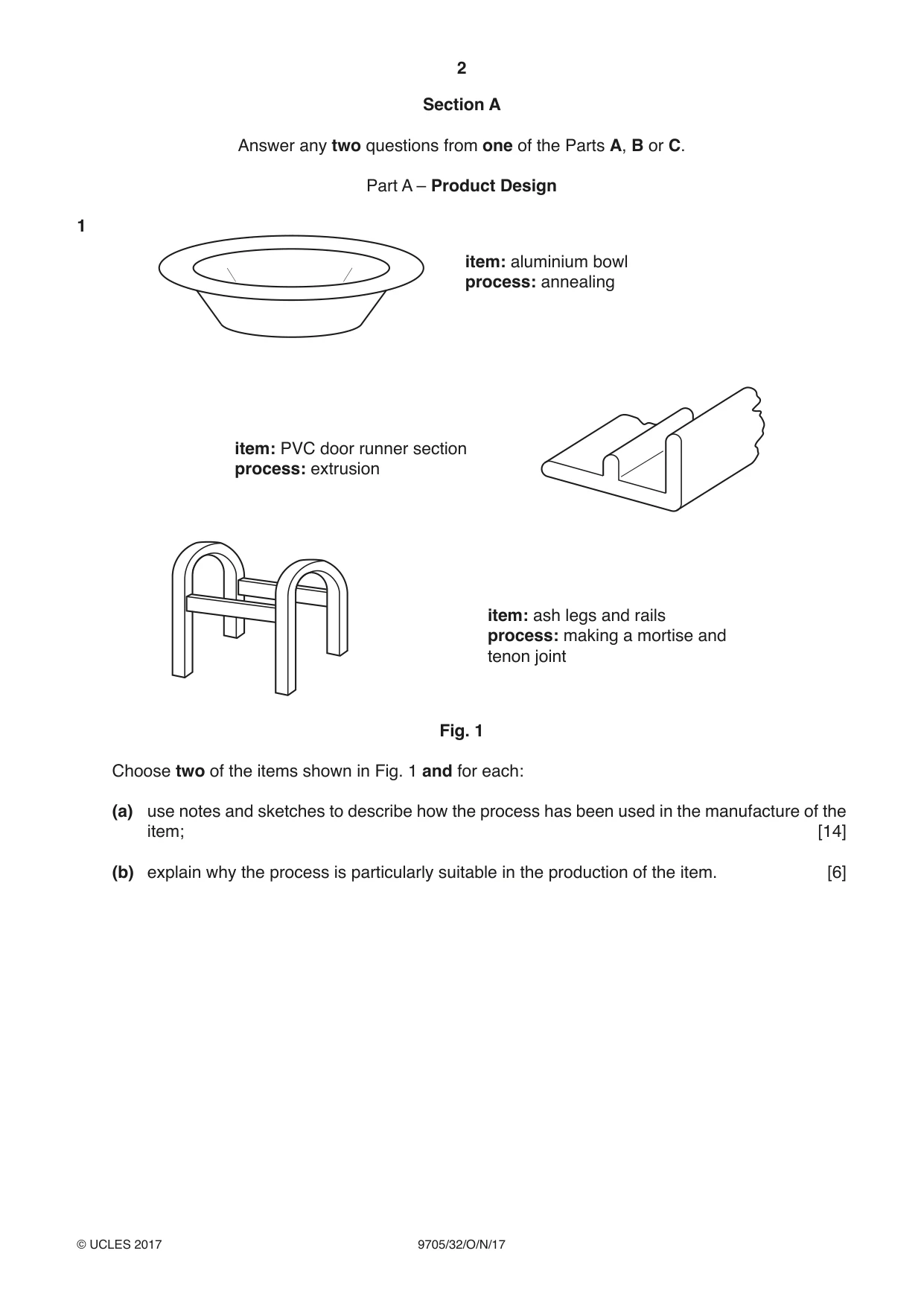
2 9705/32/O/N/17 © UCLES 2017 Section A Answer any two questions from one of the Parts A, B or C. Part A – Product Design 1 item: aluminium bowl process: annealing item: PVC door runner section process: extrusion item: ash legs and rails process: making a mortise and tenon joint Fig. 1 Choose two of the items shown in Fig. 1 and for each: (a) use notes and sketches to describe how the process has been used in the manufacture of the item; [14] (b) explain why the process is particularly suitable in the production of the item. [6]
Question paper, page 3
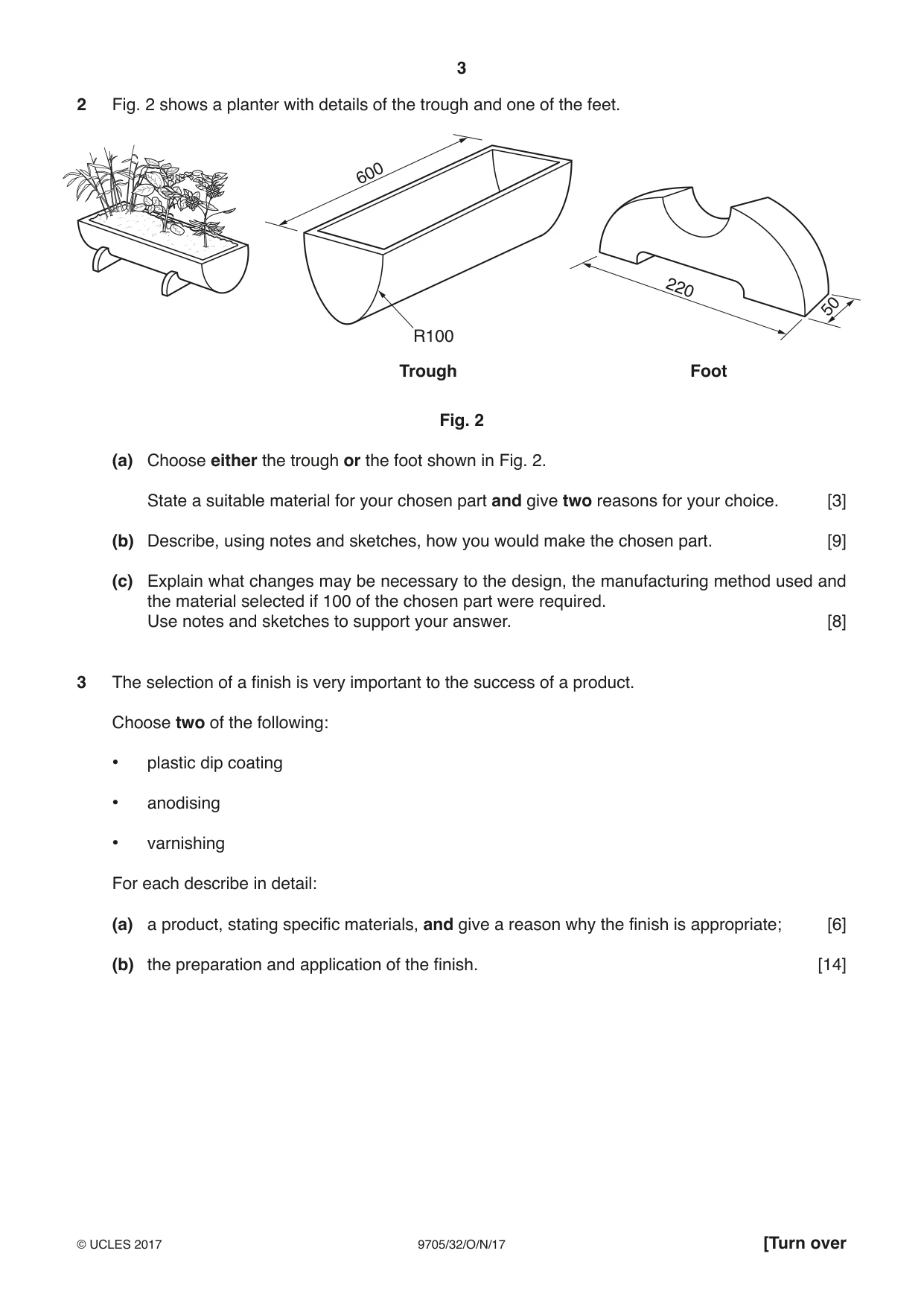
3 9705/32/O/N/17 © UCLES 2017 [Turn over 2 Fig. 2 shows a planter with details of the trough and one of the feet. 600 50 220 R100 Trough Foot Fig. 2 (a) Choose either the trough or the foot shown in Fig. 2. State a suitable material for your chosen part and give two reasons for your choice. [3] (b) Describe, using notes and sketches, how you would make the chosen part. [9] (c) Explain what changes may be necessary to the design, the manufacturing method used and the material selected if 100 of the chosen part were required. Use notes and sketches to support your answer. [8] 3 The selection of a finish is very important to the success of a product. Choose two of the following: • plastic dip coating • anodising • varnishing For each describe in detail: (a) a product, stating specific materials, and give a reason why the finish is appropriate; [6] (b) the preparation and application of the finish. [14]
Question paper, page 4
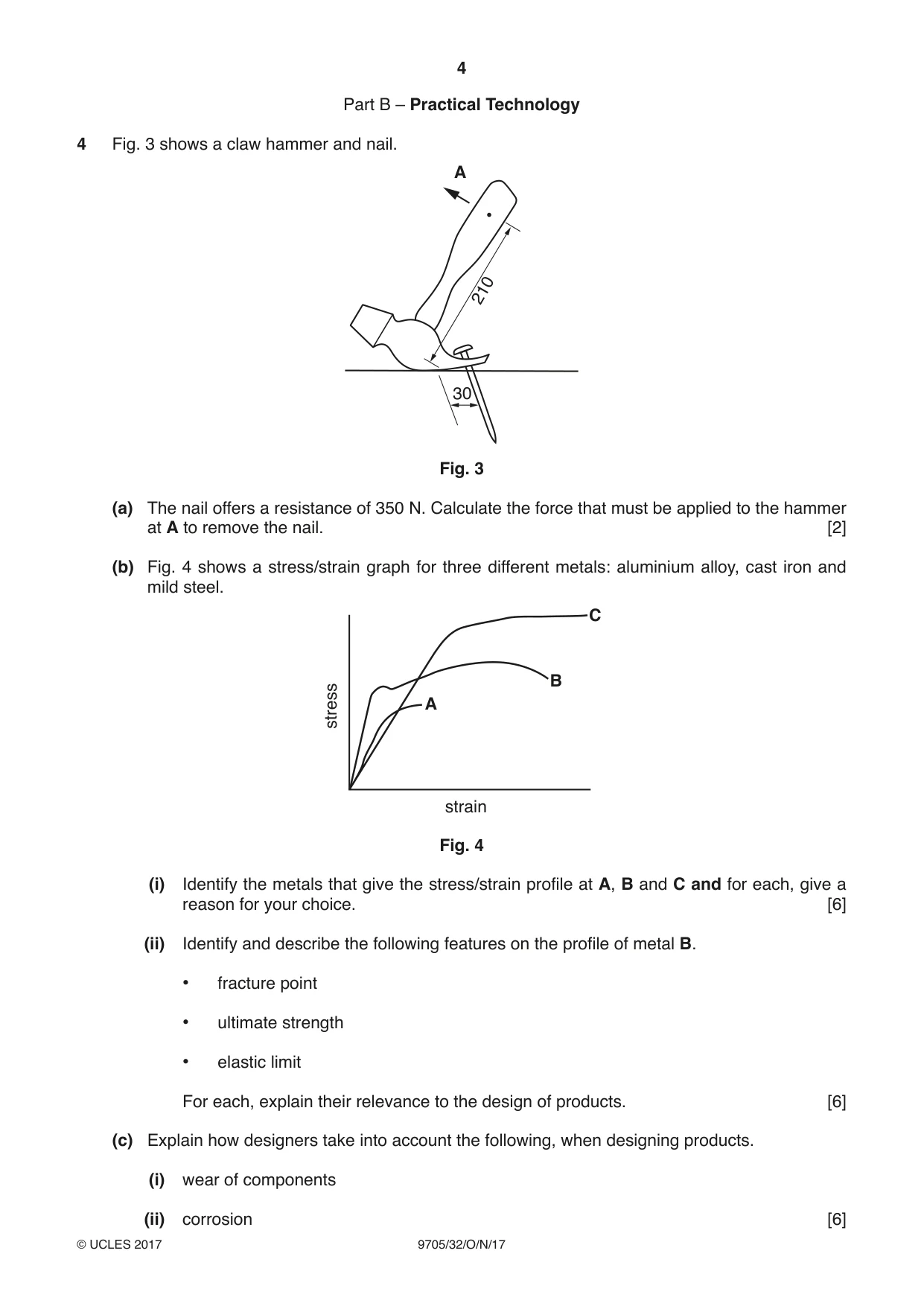
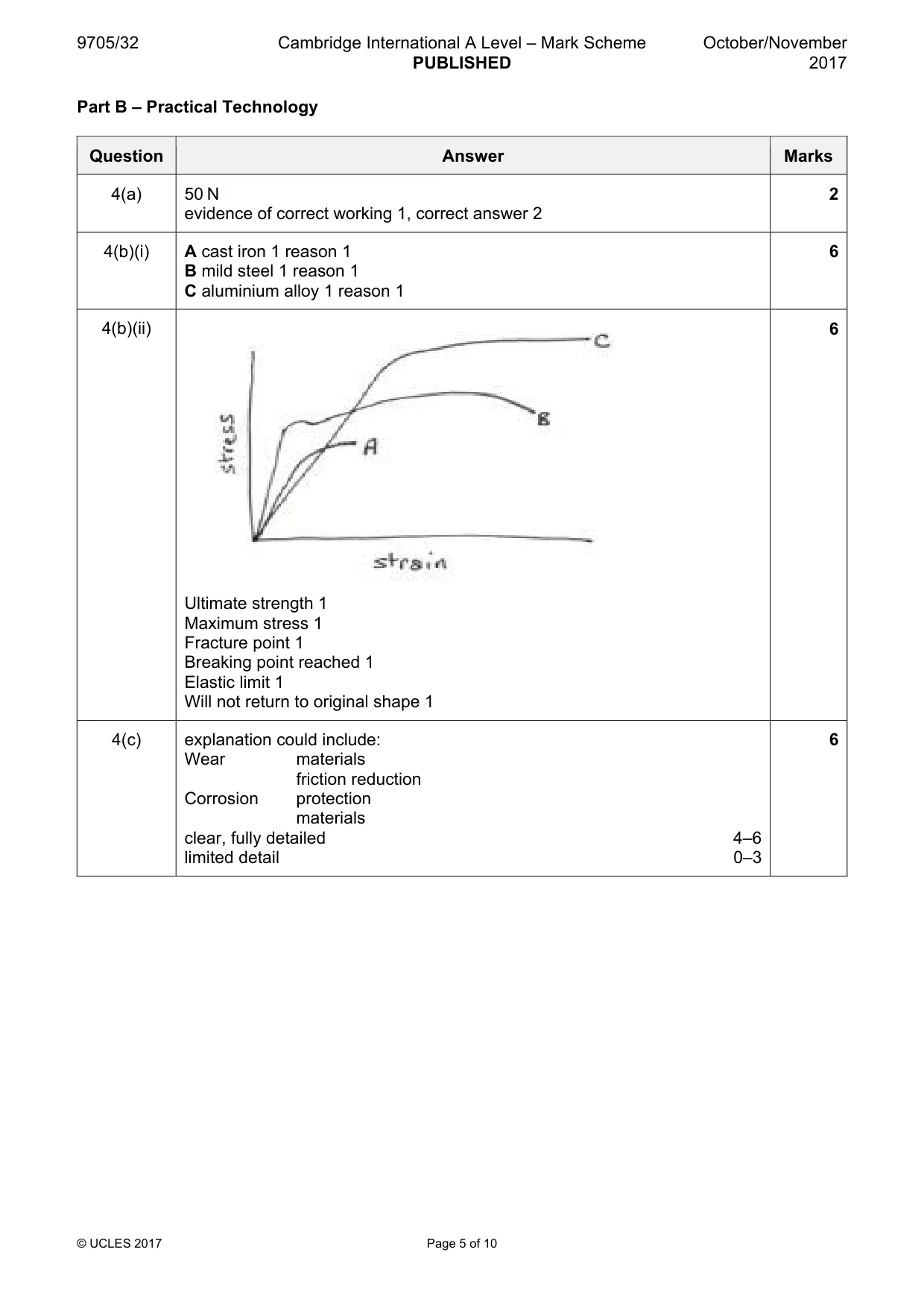
4 9705/32/O/N/17 © UCLES 2017 Part B – Practical Technology 4 Fig. 3 shows a claw hammer and nail. A 210 30 Fig. 3 (a) The nail offers a resistance of 350 N. Calculate the force that must be applied to the hammer at A to remove the nail. [2] (b) Fig. 4 shows a stress/strain graph for three different metals: aluminium alloy, cast iron and mild steel. stress strain A B C Fig. 4 (i) Identify the metals that give the stress/strain profile at A, B and C and for each, give a reason for your choice. [6] (ii) Identify and describe the following features on the profile of metal B. • fracture point • ultimate strength • elastic limit For each, explain their relevance to the design of products. [6] (c) Explain how designers take into account the following, when designing products. (i) wear of components (ii) corrosion [6]
Question paper, page 5
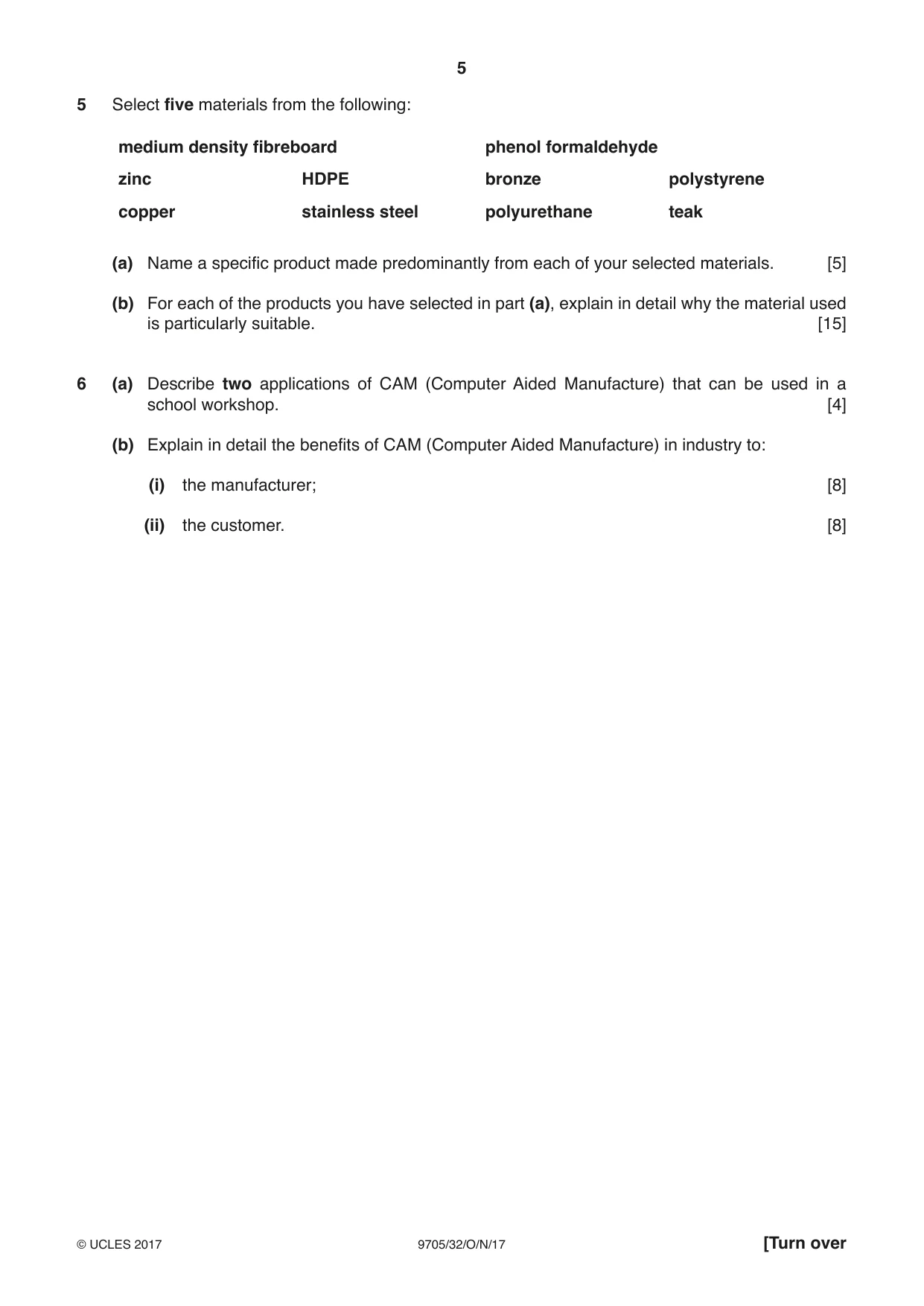
5 9705/32/O/N/17 © UCLES 2017 [Turn over 5 Select five materials from the following: medium density fibreboard phenol formaldehyde zinc HDPE bronze polystyrene copper stainless steel polyurethane teak (a) Name a specific product made predominantly from each of your selected materials. [5] (b) For each of the products you have selected in part (a), explain in detail why the material used is particularly suitable. [15] 6 (a) Describe two applications of CAM (Computer Aided Manufacture) that can be used in a school workshop. [4] (b) Explain in detail the benefits of CAM (Computer Aided Manufacture) in industry to: (i) the manufacturer; [8] (ii) the customer. [8]
Question paper, page 6
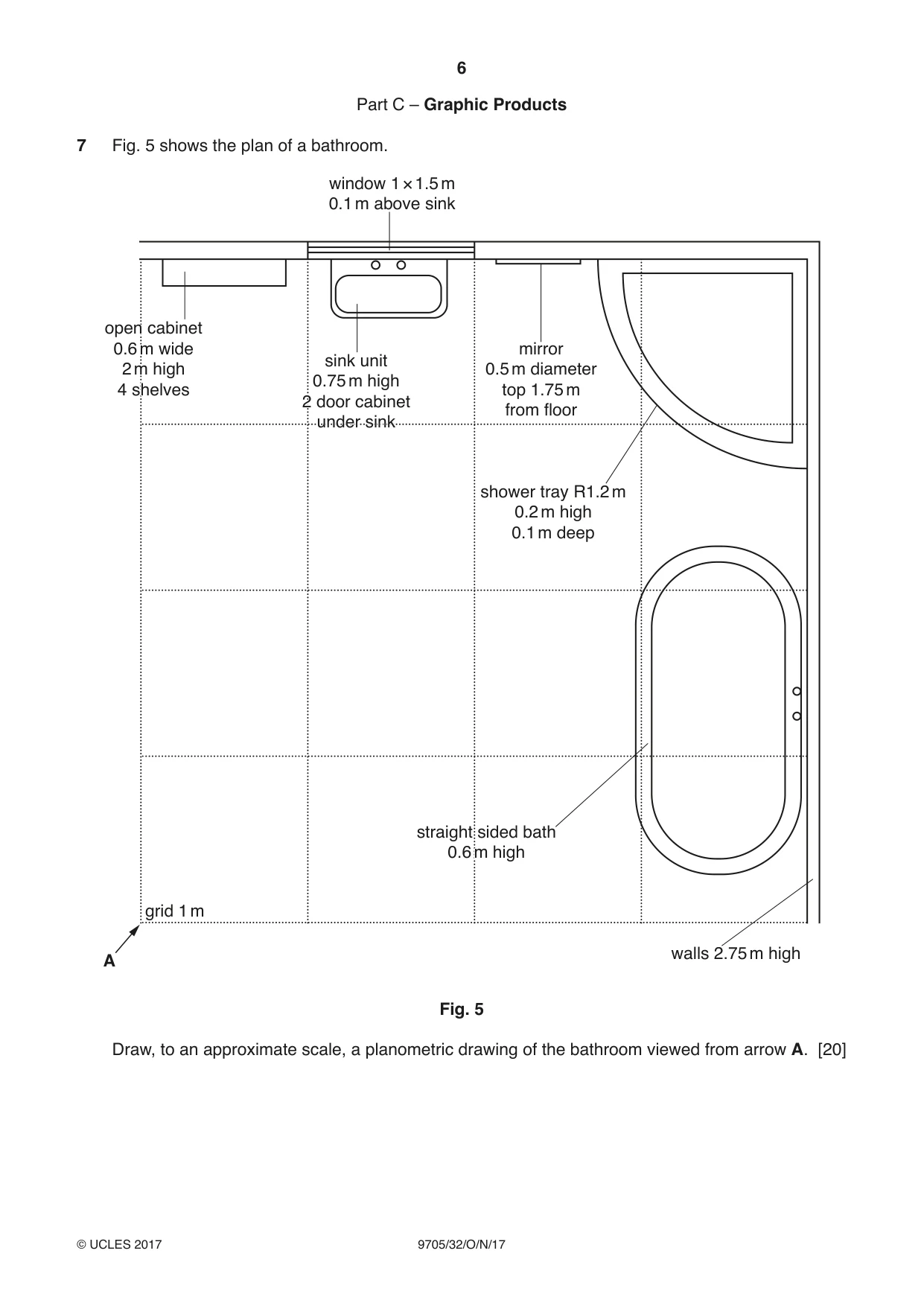
6 9705/32/O/N/17 © UCLES 2017 Part C – Graphic Products 7 Fig. 5 shows the plan of a bathroom. window 1 × 1.5 m 0.1 m above sink mirror 0.5 m diameter top 1.75 m from floor shower tray R1.2 m 0.2 m high 0.1 m deep straight sided bath 0.2 m high straight sided bath 0.6 m high walls 2.75 m high grid 1 m A sink unit 0.75 m high 2 door cabinet under sink sink unit 0.75 m high 2 door cabinet under sink open cabinet 0.6 m wide 2 m high 4 shelves open cabinet 0.6 m wide 2 m high 4 shelves Fig. 5 Draw, to an approximate scale, a planometric drawing of the bathroom viewed from arrow A. [20]
Question paper, page 7
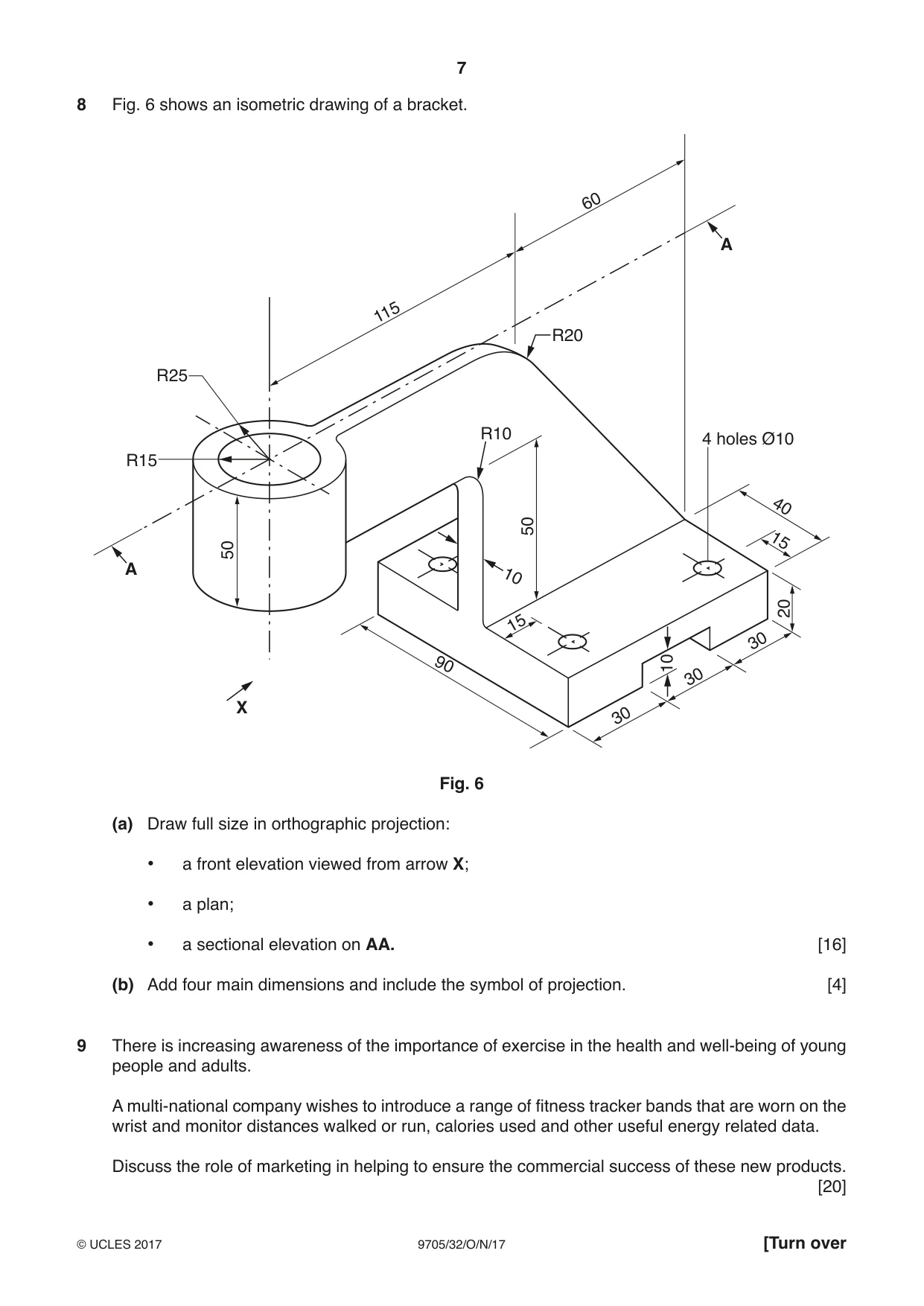
7 9705/32/O/N/17 © UCLES 2017 [Turn over 8 Fig. 6 shows an isometric drawing of a bracket. A X A 50 R15 R25 R20 R10 4 holes Ø10 50 10 90 15 30 30 15 40 30 10 20 115 60 Fig. 6 (a) Draw full size in orthographic projection: • a front elevation viewed from arrow X; • a plan; • a sectional elevation on AA. [16] (b) Add four main dimensions and include the symbol of projection. [4] 9 There is increasing awareness of the importance of exercise in the health and well-being of young people and adults. A multi-national company wishes to introduce a range of fitness tracker bands that are worn on the wrist and monitor distances walked or run, calories used and other useful energy related data. Discuss the role of marketing in helping to ensure the commercial success of these new products. [20]
Question paper, page 8
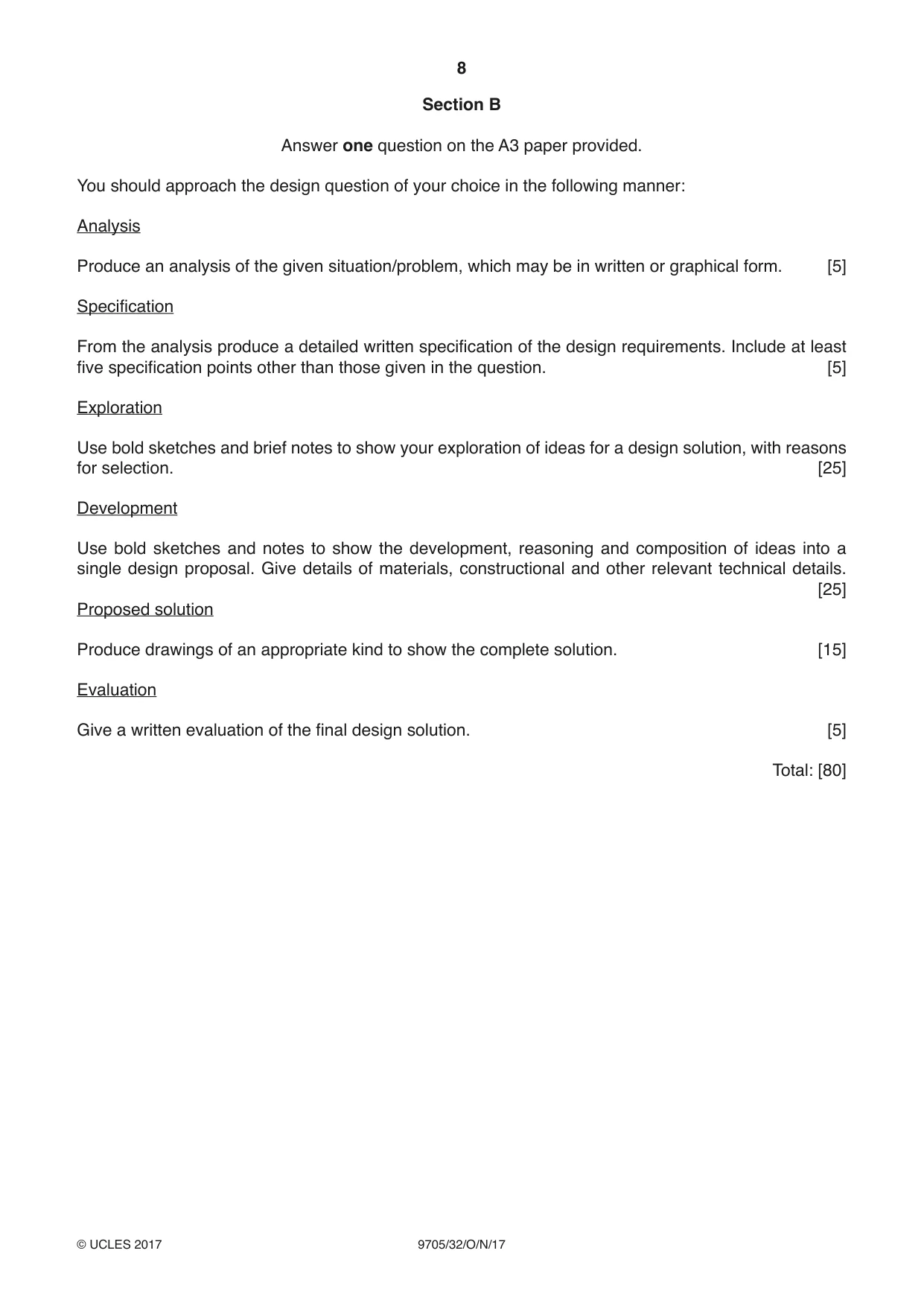
8 9705/32/O/N/17 © UCLES 2017 Section B Answer one question on the A3 paper provided. You should approach the design question of your choice in the following manner: Analysis Produce an analysis of the given situation/problem, which may be in written or graphical form. [5] Specification From the analysis produce a detailed written specification of the design requirements. Include at least five specification points other than those given in the question. [5] Exploration Use bold sketches and brief notes to show your exploration of ideas for a design solution, with reasons for selection. [25] Development Use bold sketches and notes to show the development, reasoning and composition of ideas into a single design proposal. Give details of materials, constructional and other relevant technical details. [25] Proposed solution Produce drawings of an appropriate kind to show the complete solution. [15] Evaluation Give a written evaluation of the final design solution. [5] Total: [80]
Question paper, page 9
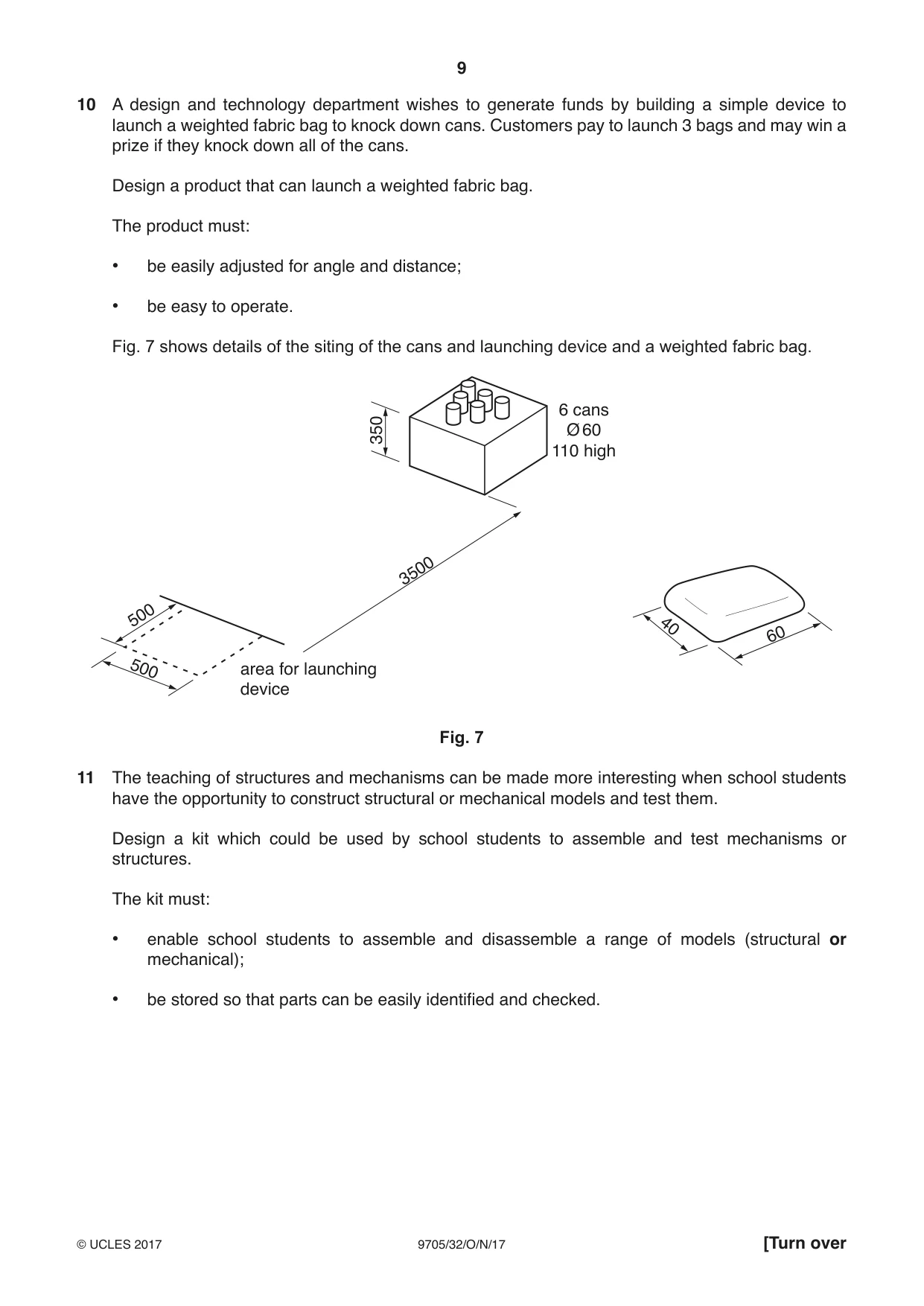
9 9705/32/O/N/17 © UCLES 2017 [Turn over 10 A design and technology department wishes to generate funds by building a simple device to launch a weighted fabric bag to knock down cans. Customers pay to launch 3 bags and may win a prize if they knock down all of the cans. Design a product that can launch a weighted fabric bag. The product must: • be easily adjusted for angle and distance; • be easy to operate. Fig. 7 shows details of the siting of the cans and launching device and a weighted fabric bag. 60 3500 500 500 40 350 6 cans Ø 60 110 high area for launching device Fig. 7 11 The teaching of structures and mechanisms can be made more interesting when school students have the opportunity to construct structural or mechanical models and test them. Design a kit which could be used by school students to assemble and test mechanisms or structures. The kit must: • enable school students to assemble and disassemble a range of models (structural or mechanical); • be stored so that parts can be easily identified and checked.
Question paper, page 10
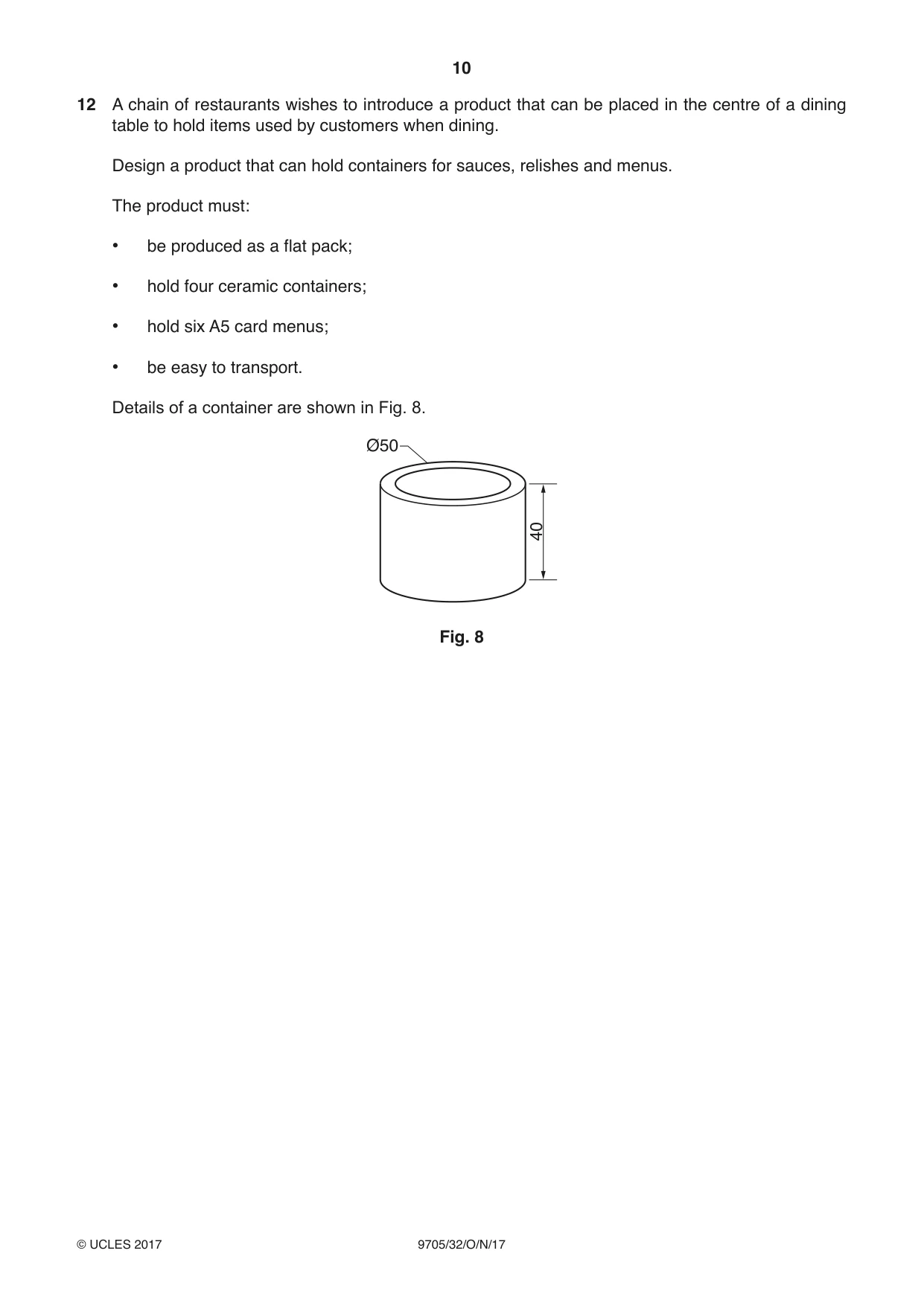
10 9705/32/O/N/17 © UCLES 2017 12 A chain of restaurants wishes to introduce a product that can be placed in the centre of a dining table to hold items used by customers when dining. Design a product that can hold containers for sauces, relishes and menus. The product must: • be produced as a flat pack; • hold four ceramic containers; • hold six A5 card menus; • be easy to transport. Details of a container are shown in Fig. 8. Ø50 40 Fig. 8
Question paper, page 11
11 9705/32/O/N/17 © UCLES 2017 BLANK PAGE
Question paper, page 12
12 9705/32/O/N/17 © UCLES 2017 Permission to reproduce items where third-party owned material protected by copyright is included has been sought and cleared where possible. Every reasonable effort has been made by the publisher (UCLES) to trace copyright holders, but if any items requiring clearance have unwittingly been included, the publisher will be pleased to make amends at the earliest possible opportunity. To avoid the issue of disclosure of answer-related information to candidates, all copyright acknowledgements are reproduced online in the Cambridge International Examinations Copyright Acknowledgements Booklet. This is produced for each series of examinations and is freely available to download at www.cie.org.uk after the live examination series. Cambridge International Examinations is part of the Cambridge Assessment Group. Cambridge Assessment is the brand name of University of Cambridge Local Examinations Syndicate (UCLES), which is itself a department of the University of Cambridge. BLANK PAGE
Mark scheme, page 1
® IGCSE is a registered trademark. This document consists of 10 printed pages. © UCLES 2017 [Turn over Cambridge Assessment International Education Cambridge International Advanced Level DESIGN AND TECHNOLOGY 9705/32 Paper 3 October/November 2017 MARK SCHEME Maximum Mark: 120 Published This mark scheme is published as an aid to teachers and candidates, to indicate the requirements of the examination. It shows the basis on which Examiners were instructed to award marks. It does not indicate the details of the discussions that took place at an Examiners’ meeting before marking began, which would have considered the acceptability of alternative answers. Mark schemes should be read in conjunction with the question paper and the Principal Examiner Report for Teachers. Cambridge International will not enter into discussions about these mark schemes. Cambridge International is publishing the mark schemes for the October/November 2017 series for most Cambridge IGCSE®, Cambridge International A and AS Level components and some Cambridge O Level components.
Mark scheme, page 2
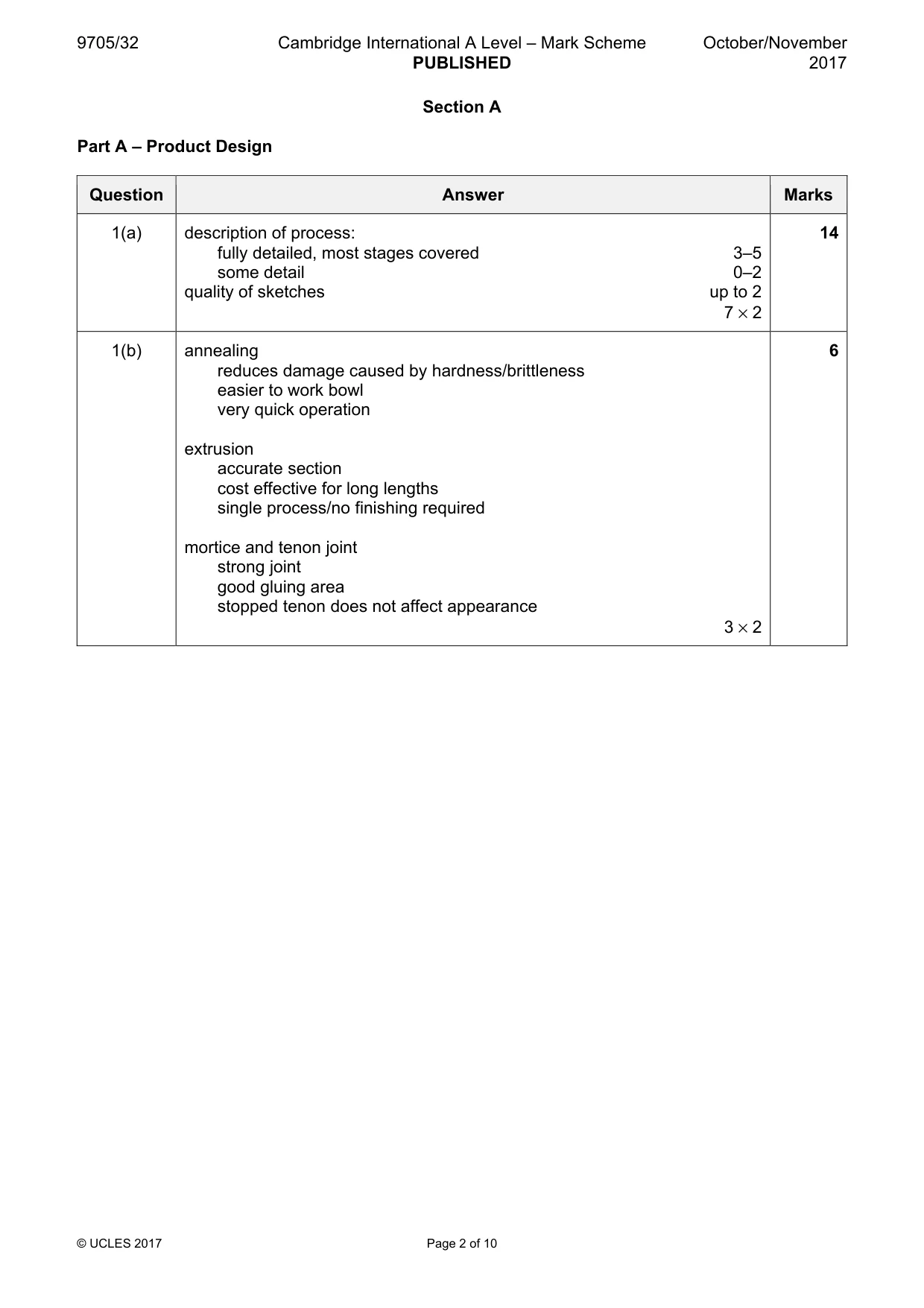
9705/32 Cambridge International A Level – Mark Scheme PUBLISHED October/November 2017 © UCLES 2017 Page 2 of 10 Section A Part A – Product Design Question Answer Marks 1(a) description of process: fully detailed, most stages covered 3–5 some detail 0–2 quality of sketches up to 2 7 × 2 14 1(b) annealing reduces damage caused by hardness/brittleness easier to work bowl very quick operation extrusion accurate section cost effective for long lengths single process/no finishing required mortice and tenon joint strong joint good gluing area stopped tenon does not affect appearance 3 × 2 6
Mark scheme, page 3
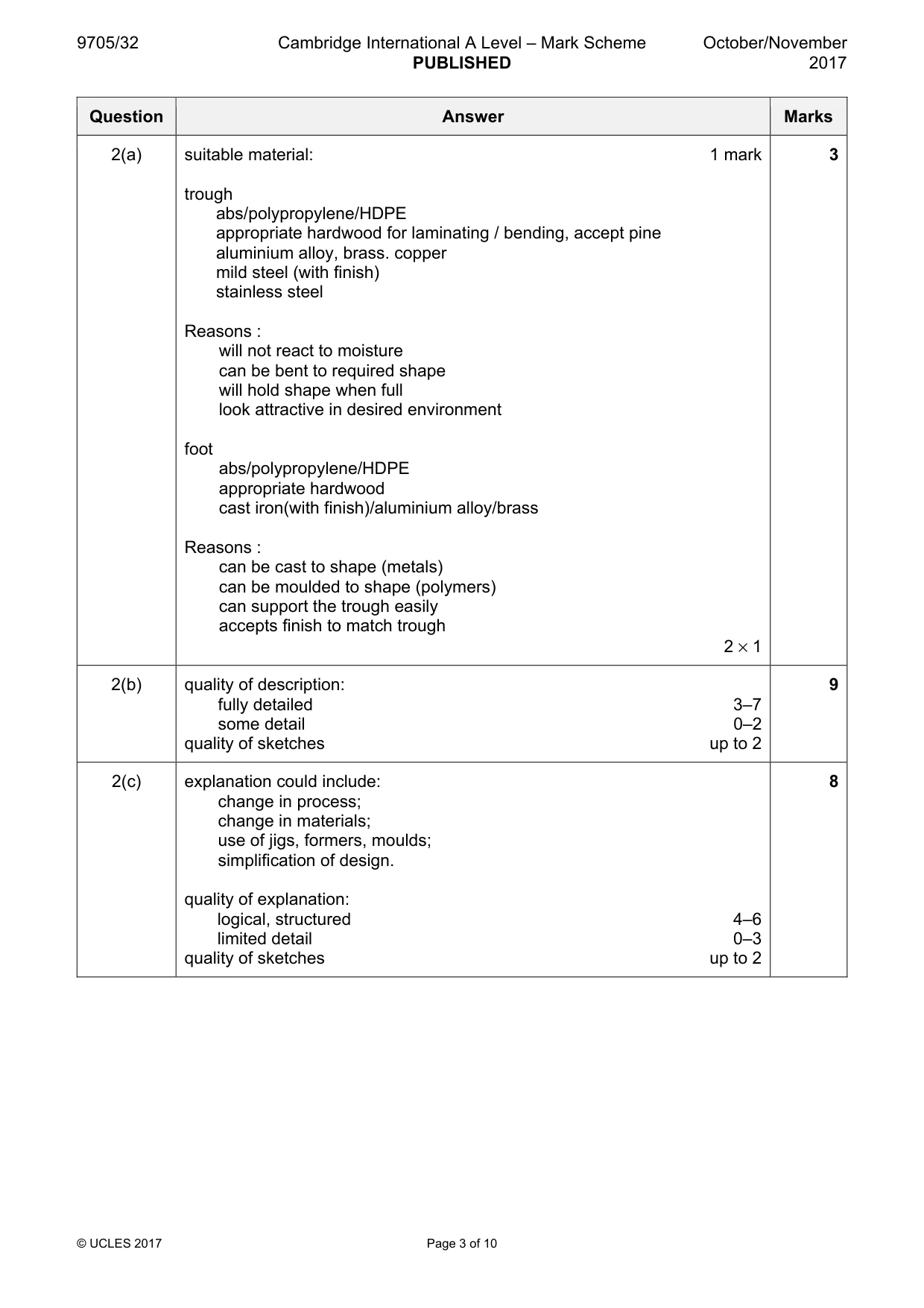
9705/32 Cambridge International A Level – Mark Scheme PUBLISHED October/November 2017 © UCLES 2017 Page 3 of 10 Question Answer Marks 2(a) suitable material: 1 mark trough abs/polypropylene/HDPE appropriate hardwood for laminating / bending, accept pine aluminium alloy, brass. copper mild steel (with finish) stainless steel Reasons : will not react to moisture can be bent to required shape will hold shape when full look attractive in desired environment foot abs/polypropylene/HDPE appropriate hardwood cast iron(with finish)/aluminium alloy/brass Reasons : can be cast to shape (metals) can be moulded to shape (polymers) can support the trough easily accepts finish to match trough 2 × 1 3 2(b) quality of description: fully detailed 3–7 some detail 0–2 quality of sketches up to 2 9 2(c) explanation could include: change in process; change in materials; use of jigs, formers, moulds; simplification of design. quality of explanation: logical, structured 4–6 limited detail 0–3 quality of sketches up to 2 8
Mark scheme, page 4
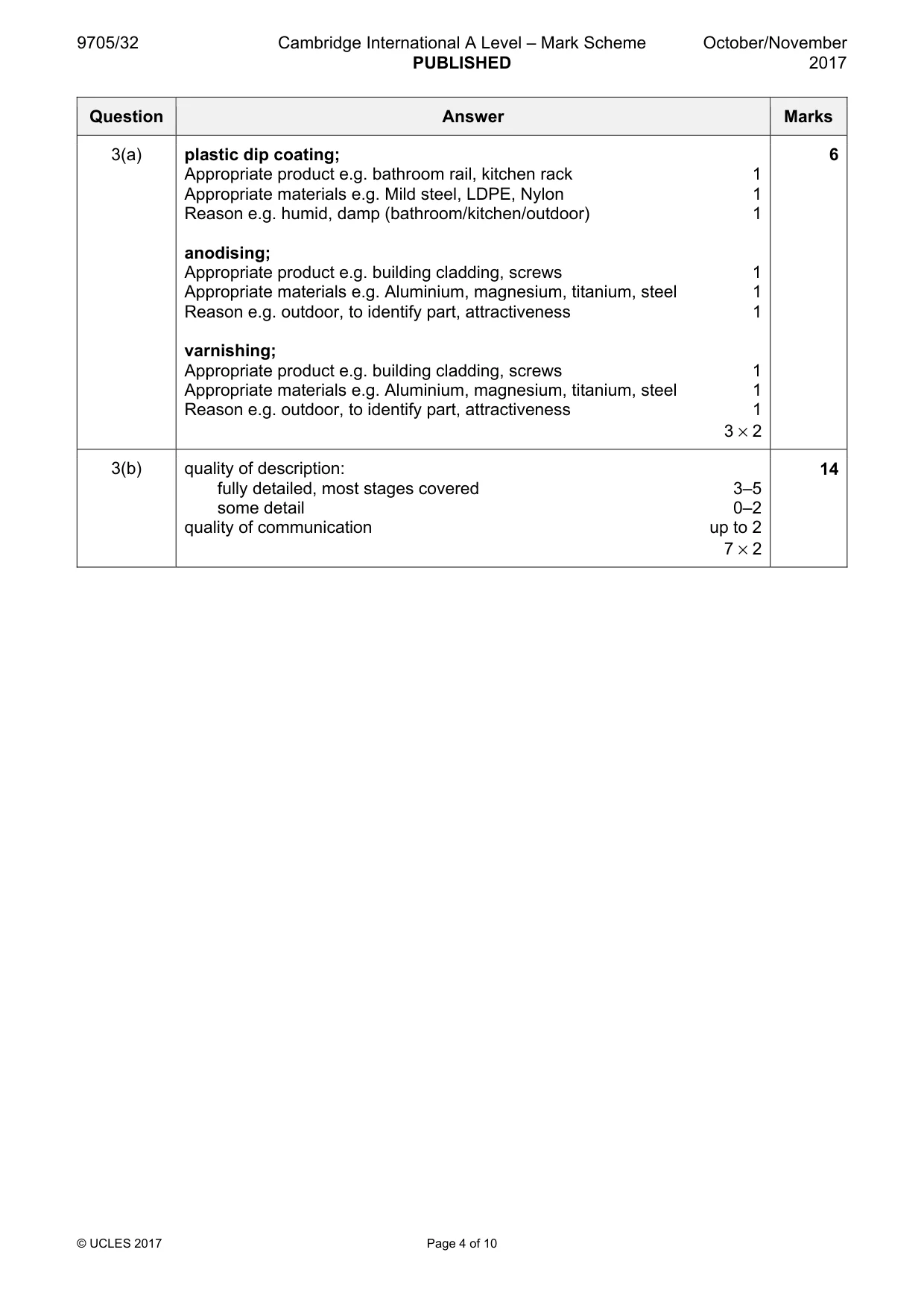
9705/32 Cambridge International A Level – Mark Scheme PUBLISHED October/November 2017 © UCLES 2017 Page 4 of 10 Question Answer Marks 3(a) plastic dip coating; Appropriate product e.g. bathroom rail, kitchen rack 1 Appropriate materials e.g. Mild steel, LDPE, Nylon 1 Reason e.g. humid, damp (bathroom/kitchen/outdoor) 1 anodising; Appropriate product e.g. building cladding, screws 1 Appropriate materials e.g. Aluminium, magnesium, titanium, steel 1 Reason e.g. outdoor, to identify part, attractiveness 1 varnishing; Appropriate product e.g. building cladding, screws 1 Appropriate materials e.g. Aluminium, magnesium, titanium, steel 1 Reason e.g. outdoor, to identify part, attractiveness 1 3 × 2 6 3(b) quality of description: fully detailed, most stages covered 3–5 some detail 0–2 quality of communication up to 2 7 × 2 14
Mark scheme, page 5
9705/32 Cambridge International A Level – Mark Scheme PUBLISHED October/November 2017 © UCLES 2017 Page 5 of 10 Part B – Practical Technology Question Answer Marks 4(a) 50 N evidence of correct working 1, correct answer 2 2 4(b)(i) A cast iron 1 reason 1 B mild steel 1 reason 1 C aluminium alloy 1 reason 1 6 4(b)(ii) Ultimate strength 1 Maximum stress 1 Fracture point 1 Breaking point reached 1 Elastic limit 1 Will not return to original shape 1 6 4(c) explanation could include: Wear materials friction reduction Corrosion protection materials clear, fully detailed 4–6 limited detail 0–3 6
Mark scheme, page 6
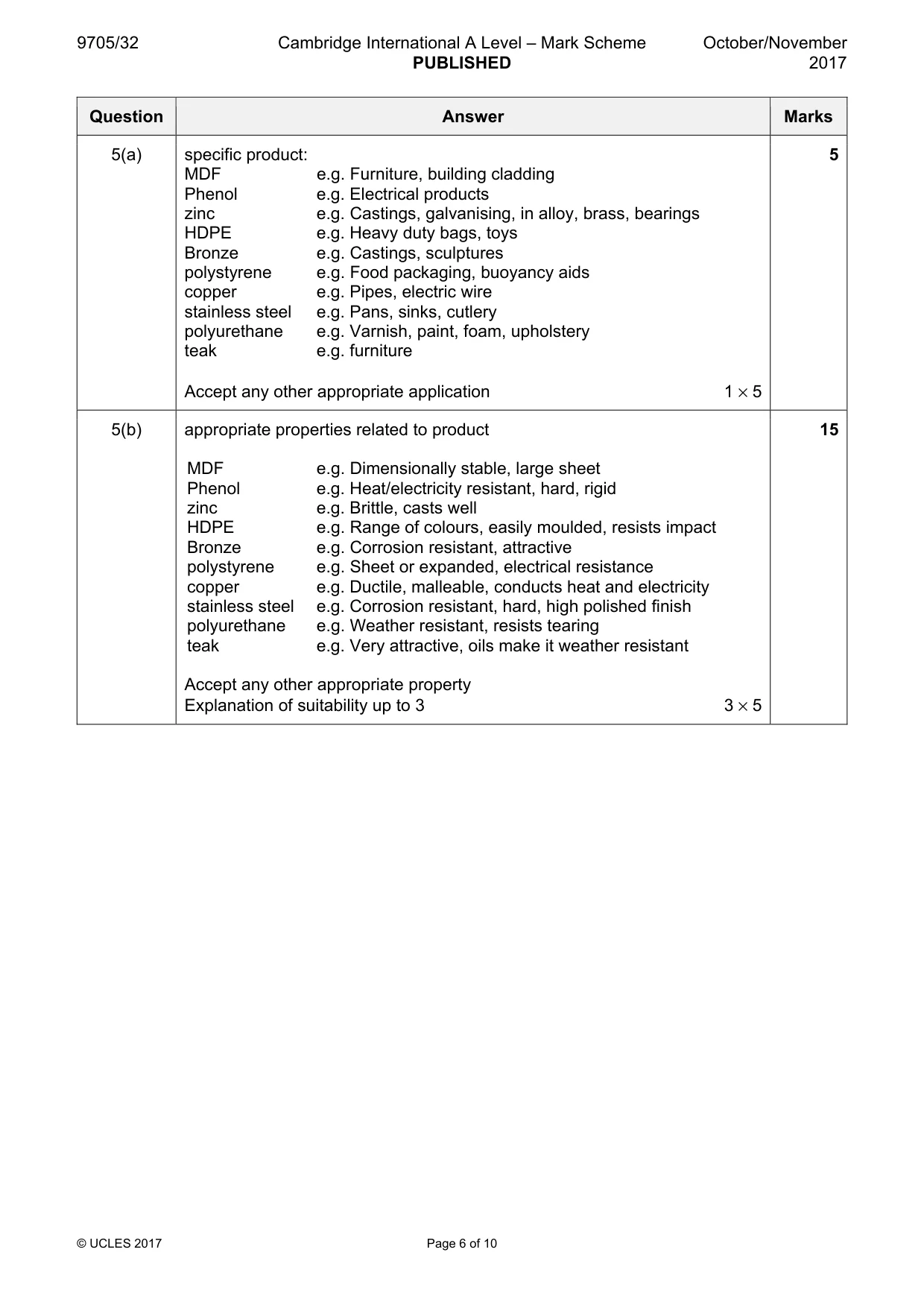
9705/32 Cambridge International A Level – Mark Scheme PUBLISHED October/November 2017 © UCLES 2017 Page 6 of 10 Question Answer Marks 5(a) specific product: MDF e.g. Furniture, building cladding Phenol e.g. Electrical products zinc e.g. Castings, galvanising, in alloy, brass, bearings HDPE e.g. Heavy duty bags, toys Bronze e.g. Castings, sculptures polystyrene e.g. Food packaging, buoyancy aids copper e.g. Pipes, electric wire stainless steel e.g. Pans, sinks, cutlery polyurethane e.g. Varnish, paint, foam, upholstery teak e.g. furniture Accept any other appropriate application 1 × 5 5 5(b) appropriate properties related to product MDF e.g. Dimensionally stable, large sheet Phenol e.g. Heat/electricity resistant, hard, rigid zinc e.g. Brittle, casts well HDPE e.g. Range of colours, easily moulded, resists impact Bronze e.g. Corrosion resistant, attractive polystyrene e.g. Sheet or expanded, electrical resistance copper e.g. Ductile, malleable, conducts heat and electricity stainless steel e.g. Corrosion resistant, hard, high polished finish polyurethane e.g. Weather resistant, resists tearing teak e.g. Very attractive, oils make it weather resistant Accept any other appropriate property Explanation of suitability up to 3 3 × 5 15
Mark scheme, page 7
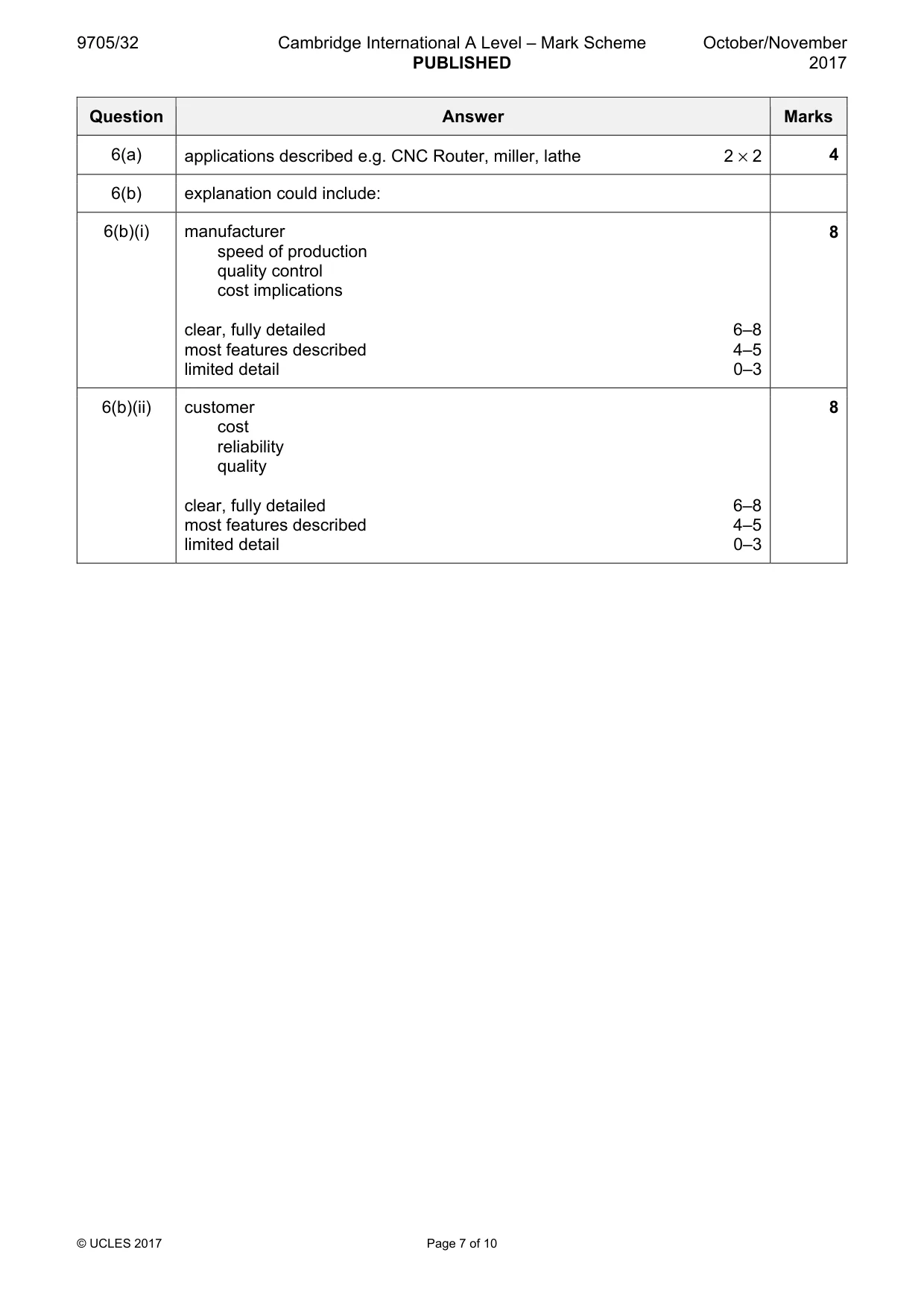
9705/32 Cambridge International A Level – Mark Scheme PUBLISHED October/November 2017 © UCLES 2017 Page 7 of 10 Question Answer Marks 6(a) applications described e.g. CNC Router, miller, lathe 2 × 2 4 6(b) explanation could include: 6(b)(i) manufacturer speed of production quality control cost implications clear, fully detailed 6–8 most features described 4–5 limited detail 0–3 8 6(b)(ii) customer cost reliability quality clear, fully detailed 6–8 most features described 4–5 limited detail 0–3 8
Mark scheme, page 8
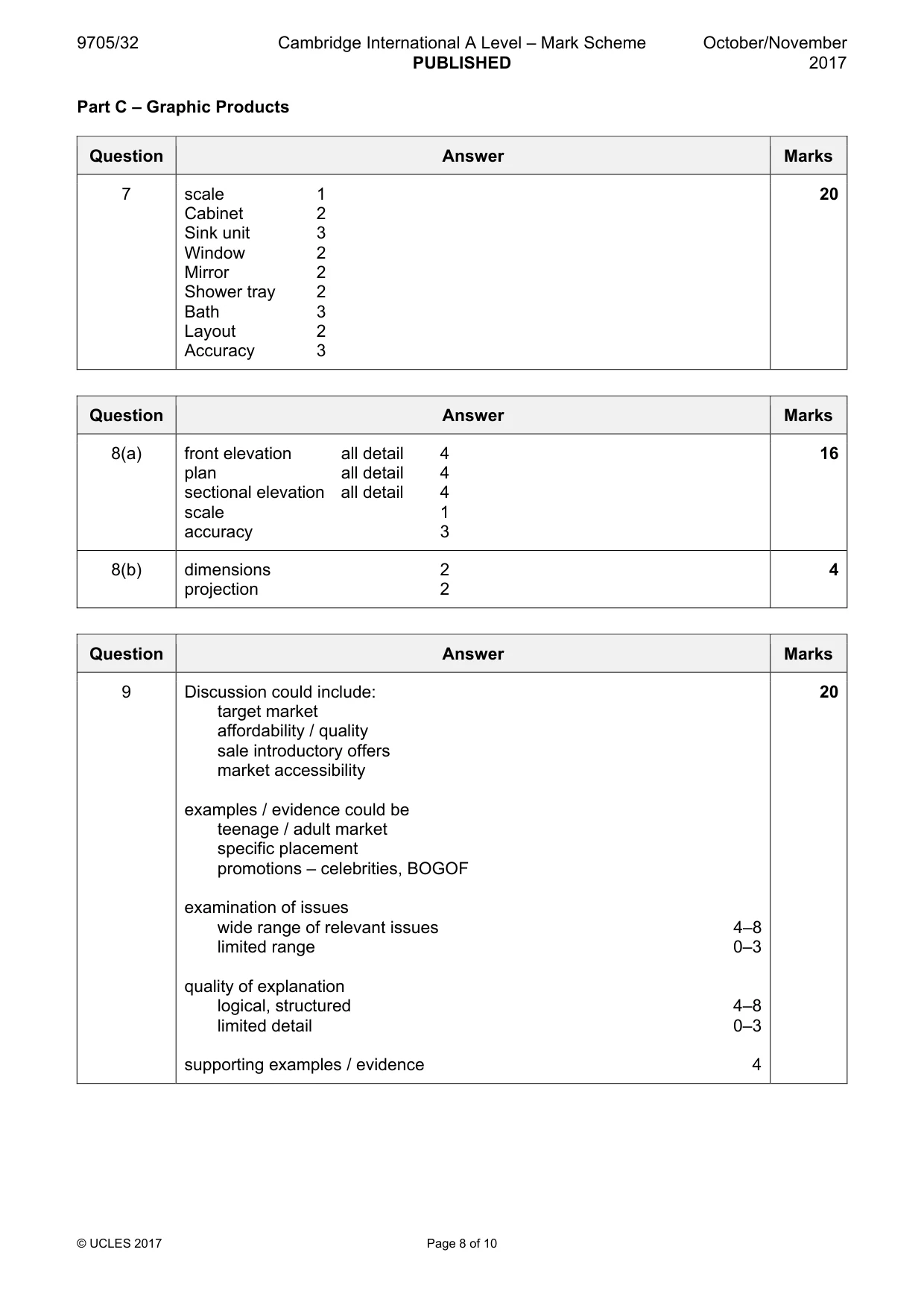
9705/32 Cambridge International A Level – Mark Scheme PUBLISHED October/November 2017 © UCLES 2017 Page 8 of 10 Part C – Graphic Products Question Answer Marks 7 scale 1 Cabinet 2 Sink unit 3 Window 2 Mirror 2 Shower tray 2 Bath 3 Layout 2 Accuracy 3 20 Question Answer Marks 8(a) front elevation all detail 4 plan all detail 4 sectional elevation all detail 4 scale 1 accuracy 3 16 8(b) dimensions 2 projection 2 4 Question Answer Marks 9 Discussion could include: target market affordability / quality sale introductory offers market accessibility examples / evidence could be teenage / adult market specific placement promotions – celebrities, BOGOF examination of issues wide range of relevant issues 4–8 limited range 0–3 quality of explanation logical, structured 4–8 limited detail 0–3 supporting examples / evidence 4 20
Mark scheme, page 9
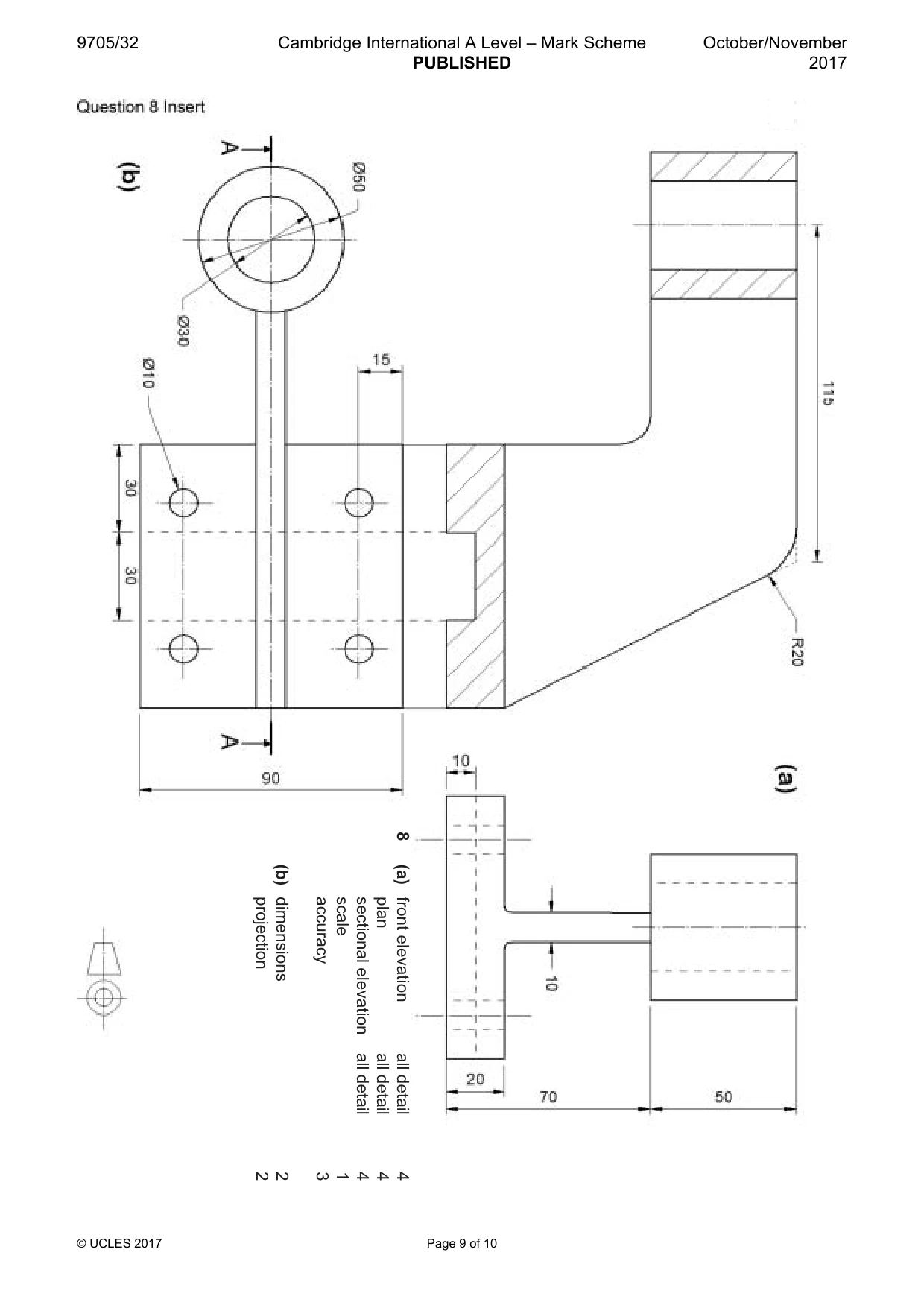
9705/32 Cambridge International A Level – Mark Scheme PUBLISHED October/November 2017 © UCLES 2017 Page 9 of 10 Question 8 Insert 8 (a) front elevation all detail 4 plan all detail 4 sectional elevation all detail 4 scale 1 accuracy 3 (b) dimensions 2 projection 2
Mark scheme, page 10
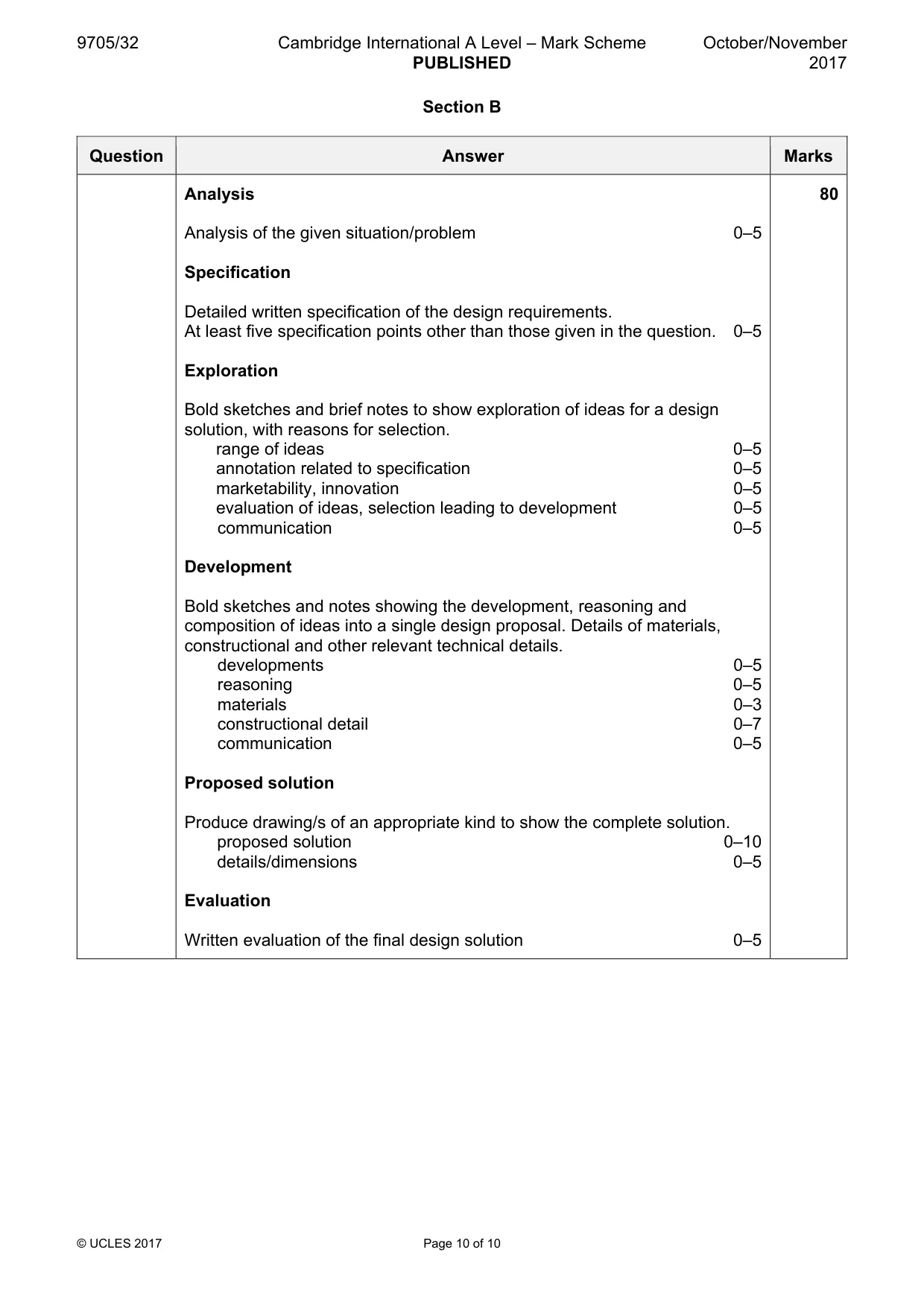
9705/32 Cambridge International A Level – Mark Scheme PUBLISHED October/November 2017 © UCLES 2017 Page 10 of 10 Section B Question Answer Marks Analysis Analysis of the given situation/problem 0–5 Specification Detailed written specification of the design requirements. At least five specification points other than those given in the question. 0–5 Exploration Bold sketches and brief notes to show exploration of ideas for a design solution, with reasons for selection. range of ideas 0–5 annotation related to specification 0–5 marketability, innovation 0–5 evaluation of ideas, selection leading to development 0–5 communication 0–5 Development Bold sketches and notes showing the development, reasoning and composition of ideas into a single design proposal. Details of materials, constructional and other relevant technical details. developments 0–5 reasoning 0–5 materials 0–3 constructional detail 0–7 communication 0–5 Proposed solution Produce drawing/s of an appropriate kind to show the complete solution. proposed solution 0–10 details/dimensions 0–5 Evaluation Written evaluation of the final design solution 0–5 80
What you needed in this session
Cambridge’s own grade thresholds for 2017 Oct/Nov, Paper 3 · Variant 2. A higher threshold means an easier paper — the bar moves with how the cohort did.