Cambridge A Level Design and Technology 9705 — 2016 Oct/Nov Paper 3 · Variant 3
9705/33/O/N/16 · 120 marks · ≈135 min
The question paper and its mark scheme, free to read here and free to download. This is Cambridge’s own paper, exactly as it was sat.
Question paper12 pages



Mark scheme8 pages
Answers below. Sit the paper first if you are practising.
Paper as text
Question paper, page 1
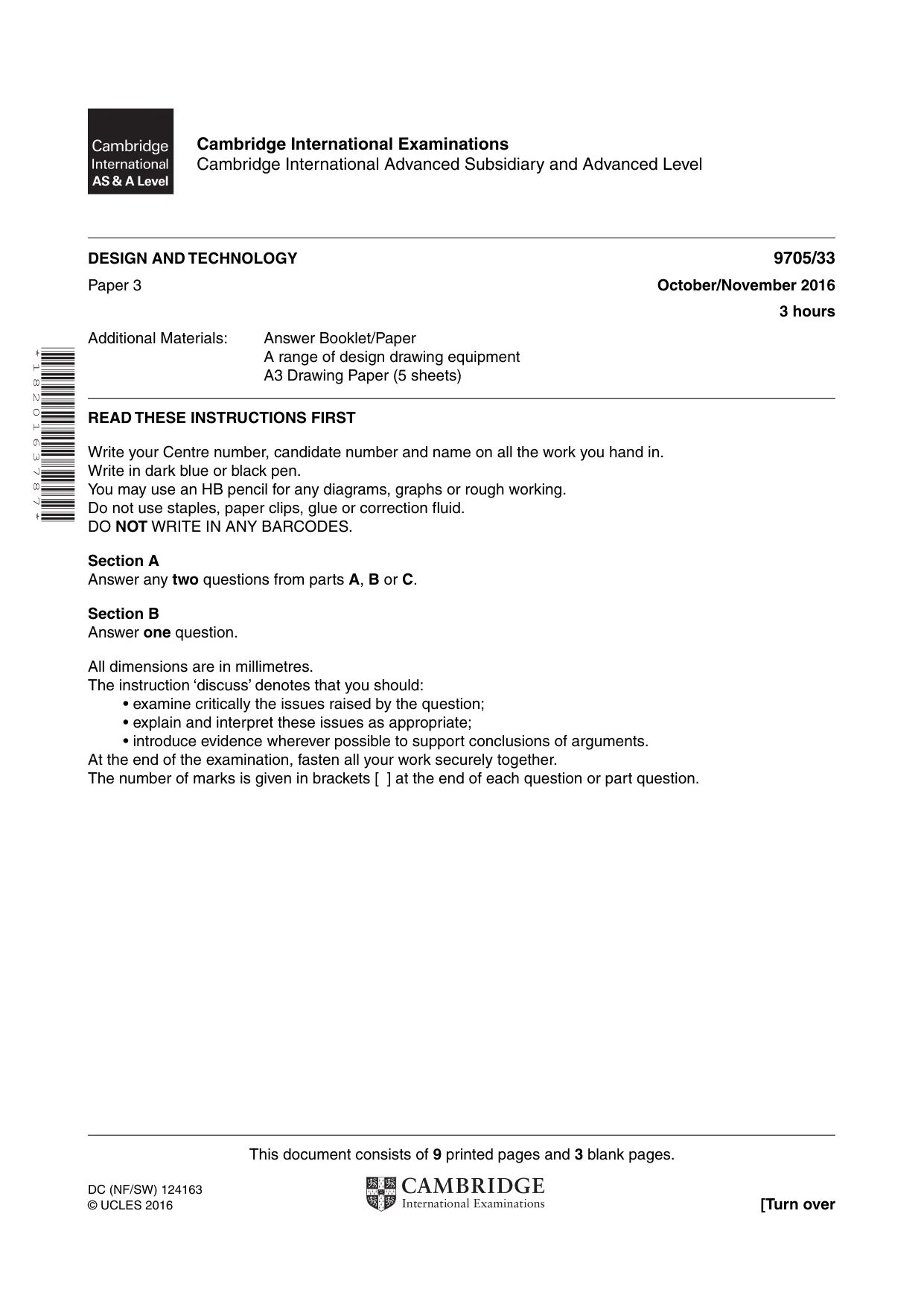
This document consists of 9 printed pages and 3 blank pages. DC (NF/SW) 124163 © UCLES 2016 [Turn over Cambridge International Examinations Cambridge International Advanced Subsidiary and Advanced Level * 1 8 2 0 1 6 3 7 8 7 * DESIGN AND TECHNOLOGY 9705/33 Paper 3 October/November 2016 3 hours Additional Materials: Answer Booklet/Paper A range of design drawing equipment A3 Drawing Paper (5 sheets) READ THESE INSTRUCTIONS FIRST Write your Centre number, candidate number and name on all the work you hand in. Write in dark blue or black pen. You may use an HB pencil for any diagrams, graphs or rough working. Do not use staples, paper clips, glue or correction fluid. DO NOT WRITE IN ANY BARCODES. Section A Answer any two questions from parts A, B or C. Section B Answer one question. All dimensions are in millimetres. The instruction ‘discuss’ denotes that you should: • examine critically the issues raised by the question; • explain and interpret these issues as appropriate; • introduce evidence wherever possible to support conclusions of arguments. At the end of the examination, fasten all your work securely together. The number of marks is given in brackets [ ] at the end of each question or part question.
Question paper, page 2
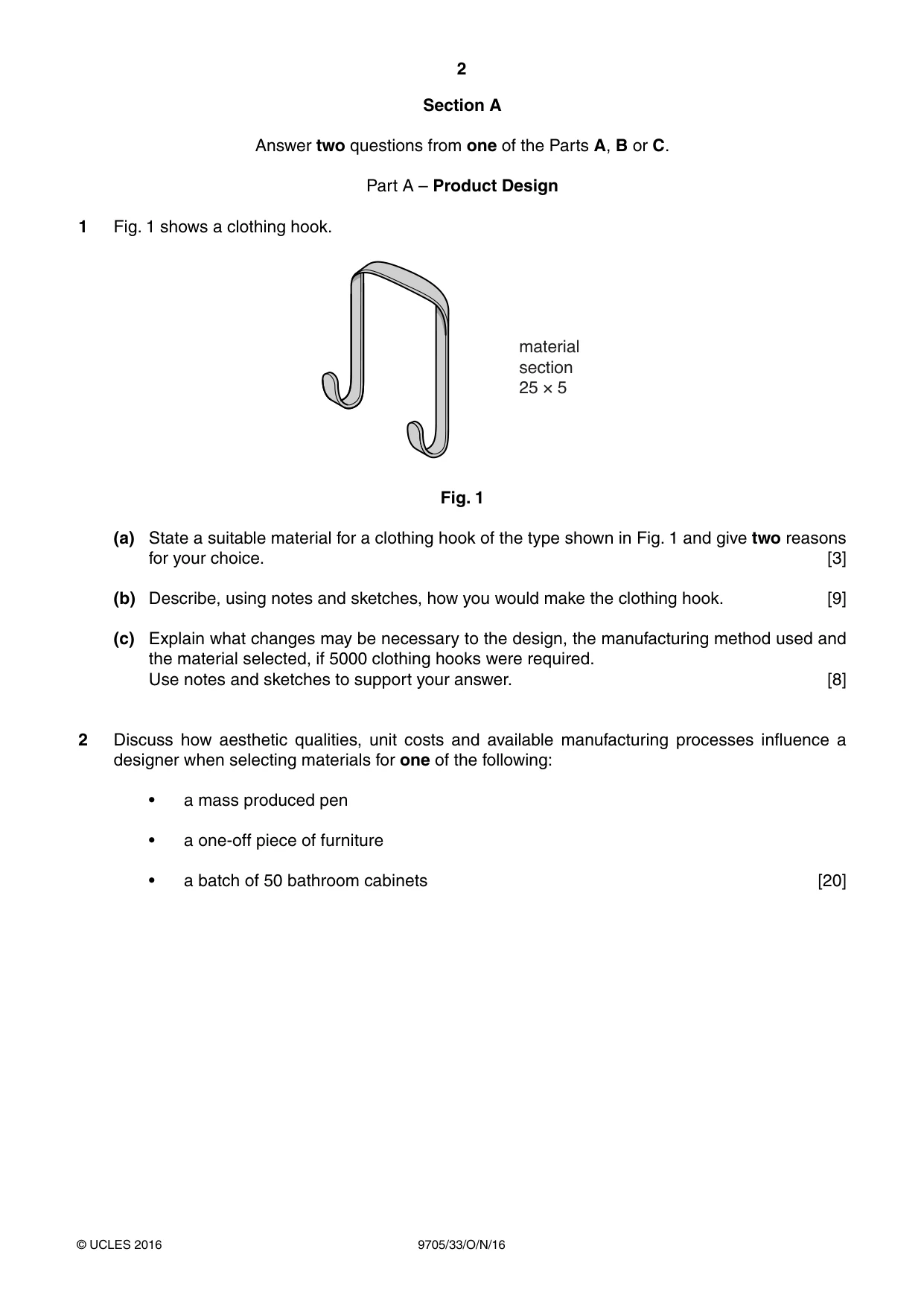
2 9705/33/O/N/16 © UCLES 2016 Section A Answer two questions from one of the Parts A, B or C. Part A – Product Design 1 Fig. 1 shows a clothing hook. material section 25 × 5 Fig. 1 (a) State a suitable material for a clothing hook of the type shown in Fig. 1 and give two reasons for your choice. [3] (b) Describe, using notes and sketches, how you would make the clothing hook. [9] (c) Explain what changes may be necessary to the design, the manufacturing method used and the material selected, if 5000 clothing hooks were required. Use notes and sketches to support your answer. [8] 2 Discuss how aesthetic qualities, unit costs and available manufacturing processes influence a designer when selecting materials for one of the following: • a mass produced pen • a one-off piece of furniture • a batch of 50 bathroom cabinets [20]
Question paper, page 3
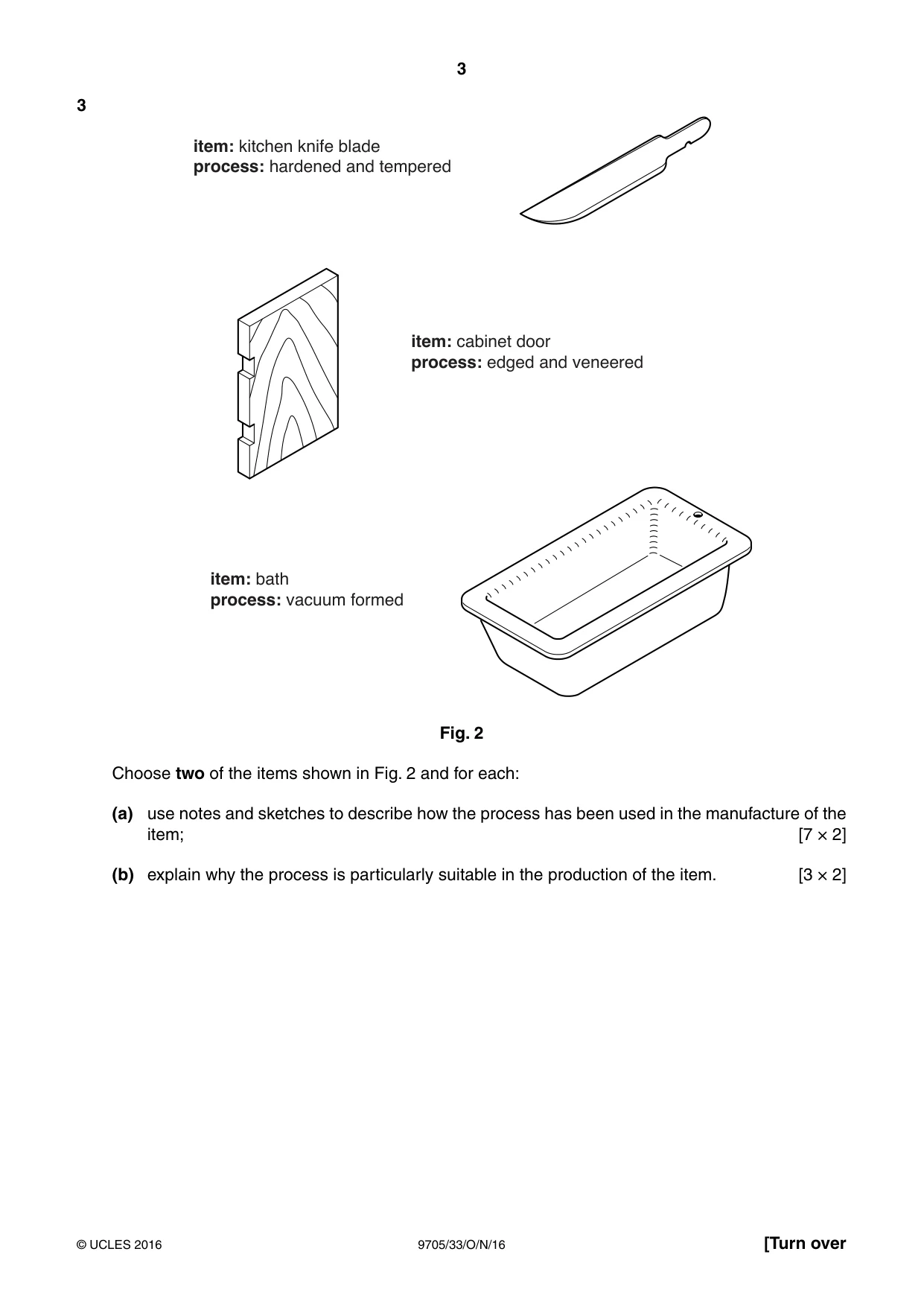
3 9705/33/O/N/16 © UCLES 2016 [Turn over 3 item: bath process: vacuum formed item: kitchen knife blade process: hardened and tempered item: cabinet door process: edged and veneered Fig. 2 Choose two of the items shown in Fig. 2 and for each: (a) use notes and sketches to describe how the process has been used in the manufacture of the item; [7 × 2] (b) explain why the process is particularly suitable in the production of the item. [3 × 2]
Question paper, page 4
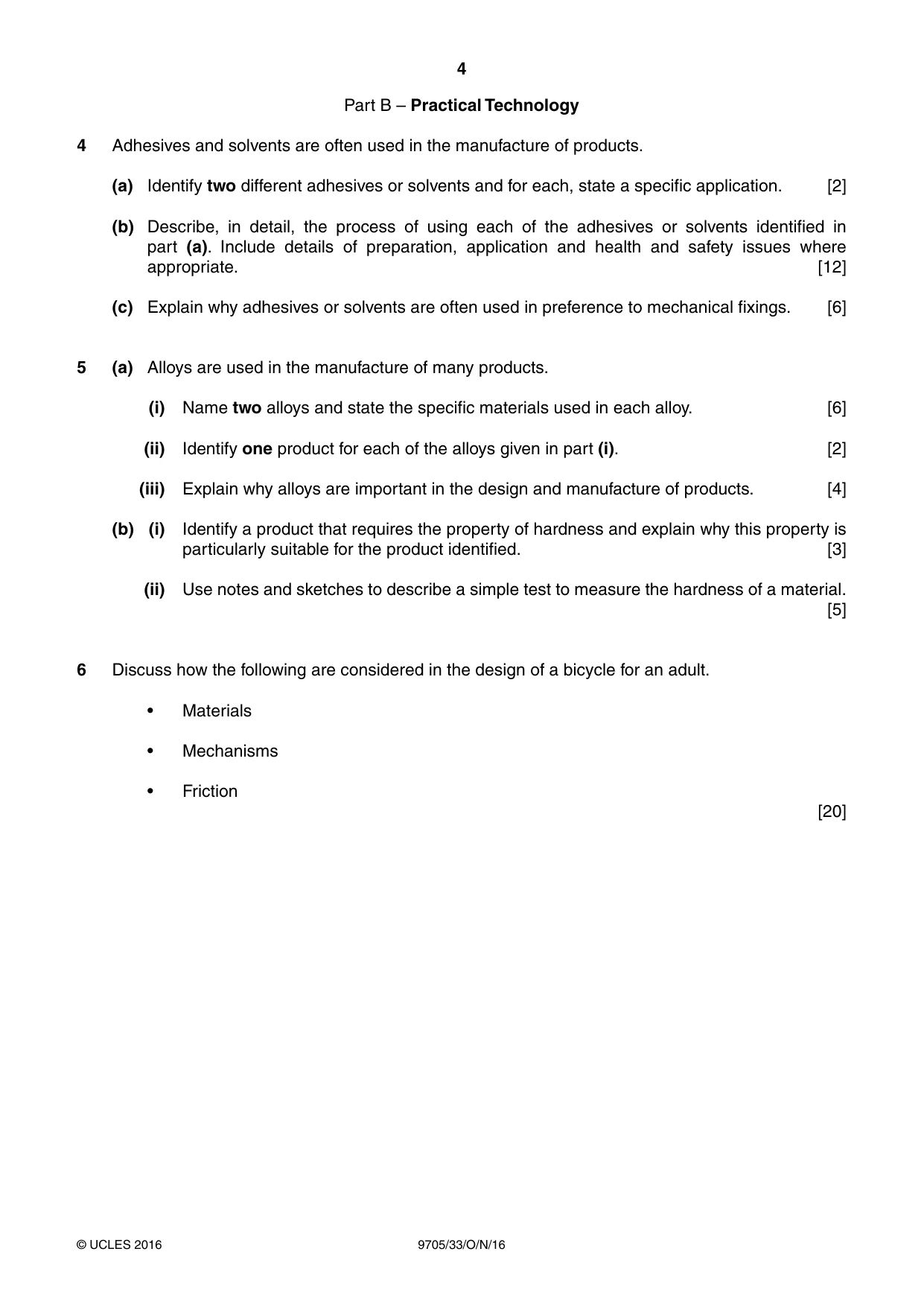
4 9705/33/O/N/16 © UCLES 2016 Part B – Practical Technology 4 Adhesives and solvents are often used in the manufacture of products. (a) Identify two different adhesives or solvents and for each, state a specific application. [2] (b) Describe, in detail, the process of using each of the adhesives or solvents identified in part (a). Include details of preparation, application and health and safety issues where appropriate. [12] (c) Explain why adhesives or solvents are often used in preference to mechanical fixings. [6] 5 (a) Alloys are used in the manufacture of many products. (i) Name two alloys and state the specific materials used in each alloy. [6] (ii) Identify one product for each of the alloys given in part (i). [2] (iii) Explain why alloys are important in the design and manufacture of products. [4] (b) (i) Identify a product that requires the property of hardness and explain why this property is particularly suitable for the product identified. [3] (ii) Use notes and sketches to describe a simple test to measure the hardness of a material. [5] 6 Discuss how the following are considered in the design of a bicycle for an adult. • Materials • Mechanisms • Friction [20]
Question paper, page 5
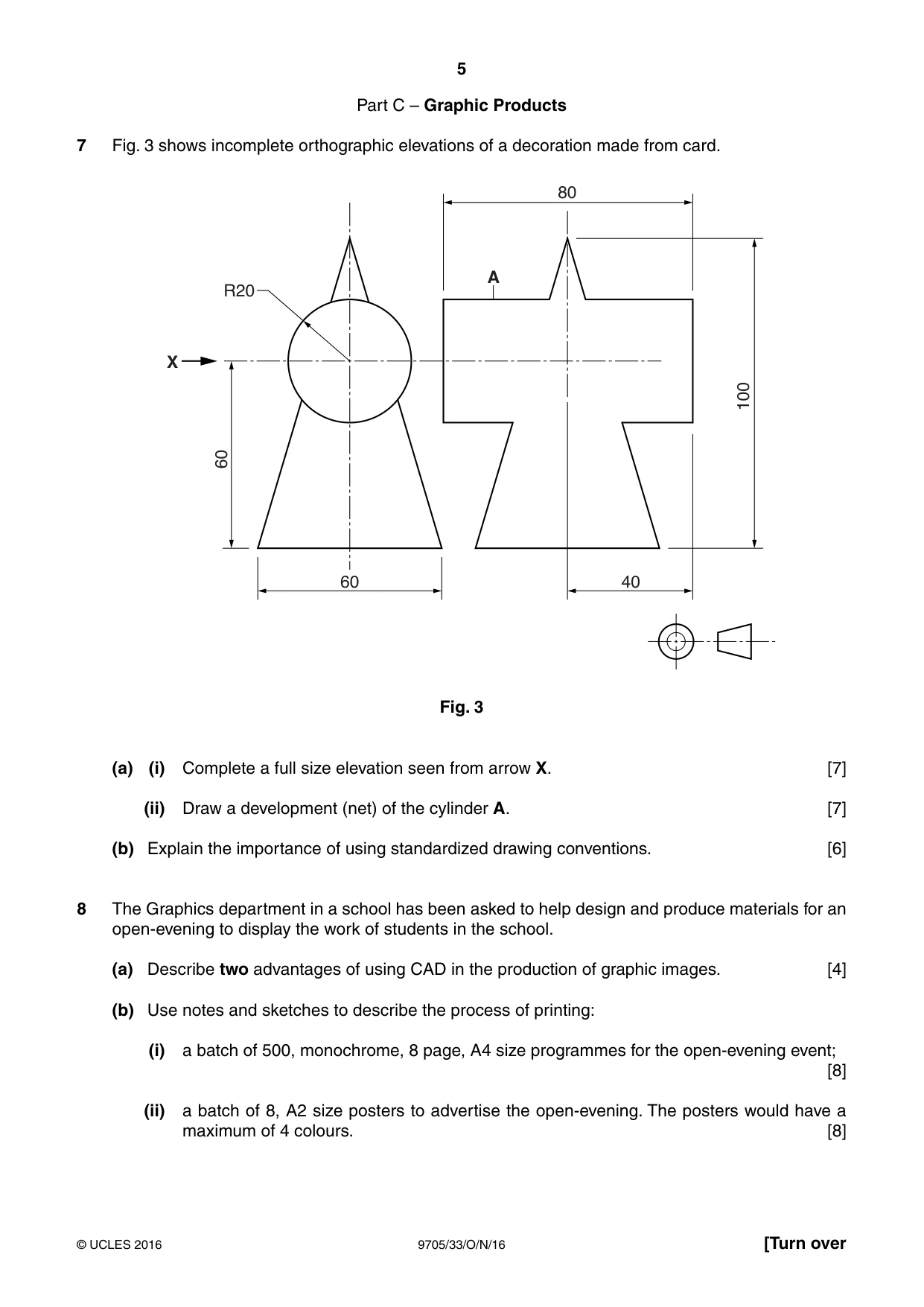
5 9705/33/O/N/16 © UCLES 2016 [Turn over Part C – Graphic Products 7 Fig. 3 shows incomplete orthographic elevations of a decoration made from card. 60 40 100 80 60 R20 A X Fig. 3 (a) (i) Complete a full size elevation seen from arrow X. [7] (ii) Draw a development (net) of the cylinder A. [7] (b) Explain the importance of using standardized drawing conventions. [6] 8 The Graphics department in a school has been asked to help design and produce materials for an open-evening to display the work of students in the school. (a) Describe two advantages of using CAD in the production of graphic images. [4] (b) Use notes and sketches to describe the process of printing: (i) a batch of 500, monochrome, 8 page, A4 size programmes for the open-evening event; [8] (ii) a batch of 8, A2 size posters to advertise the open-evening. The posters would have a maximum of 4 colours. [8]
Question paper, page 6
6 9705/33/O/N/16 © UCLES 2016 9 Designers use a wide range of techniques to record and manipulate information and to communicate their ideas effectively. Use notes and sketches to explain the following and give an appropriate example for each. • Pictograms • Bar charts • Pie charts • Ideograms [20]
Question paper, page 7
7 9705/33/O/N/16 © UCLES 2016 [Turn over Section B Answer one question on the A3 paper provided. You should approach the design question of your choice in the following manner: Analysis Produce an analysis of the given situation/problem, which may be in written or graphical form. [5] Specifi cation From the analysis produce a detailed written specification of the design requirements. Include at least five specification points other than those given in the question. [5] Exploration Use bold sketches and brief notes to show your exploration of ideas for a design solution, with reasons for selection. [25] Development Show using bold sketches and notes, the development, reasoning and composition of ideas into a single design proposal. Give details of materials, constructional and other relevant technical details. [25] Proposed solution Produce drawings of an appropriate kind to show the complete solution. [15] Evaluation Give a written evaluation of the final design solution. [5] Total: [80]
Question paper, page 8
8 9705/33/O/N/16 © UCLES 2016 10 Many families enjoy camping holidays. When camping in remote areas, personal washing facilities may be limited. You are to design a portable washing facility that could be used on a camping holiday. The product must be: • easy to assemble; • able to be used by children and adults. 11 Many schools support charities through fundraising events or collecting donations. You are to design a collection box to be situated at the entrance of the school that will enable staff, students and visitors to donate coins. The collection box must: • give an electronic and/or mechanical response when a coin is donated; • securely contain donations which are collected at the end of each school day.
Question paper, page 9
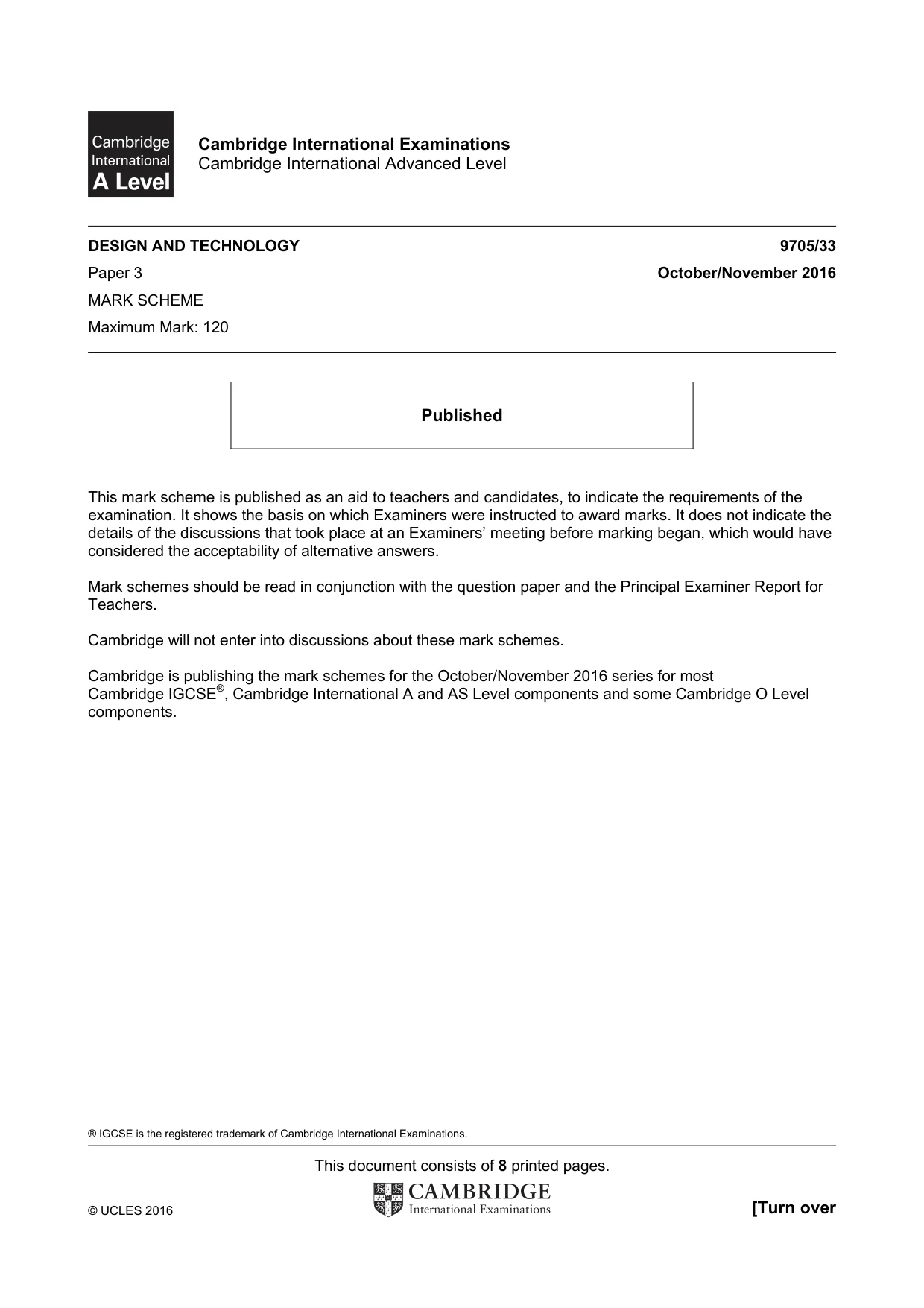
9 9705/33/O/N/16 © UCLES 2016 12 A Hotel chain, Sunrise Hotels, is to provide a range of bathroom cosmetic products. They wish to supply shampoo, conditioner and body wash in 3 similarly shaped containers. Design the packaging which will hold and display the 3 containers. The packaging must clearly display the containers and allow customers to remove and replace them after use. Design the labels for each of the containers to identify the contents. The labels must reflect the image of the Sunrise Hotels chain. Details of the containers are given in Fig. 4. 35 5 5 Ø40 Ø20 Fig. 4
Question paper, page 10
10 9705/33/O/N/16 © UCLES 2016 BLANK PAGE
Question paper, page 11
11 9705/33/O/N/16 © UCLES 2016 BLANK PAGE
Question paper, page 12
12 9705/33/O/N/16 © UCLES 2016 Permission to reproduce items where third-party owned material protected by copyright is included has been sought and cleared where possible. Every reasonable effort has been made by the publisher (UCLES) to trace copyright holders, but if any items requiring clearance have unwittingly been included, the publisher will be pleased to make amends at the earliest possible opportunity. To avoid the issue of disclosure of answer-related information to candidates, all copyright acknowledgements are reproduced online in the Cambridge International Examinations Copyright Acknowledgements Booklet. This is produced for each series of examinations and is freely available to download at www.cie.org.uk after the live examination series. Cambridge International Examinations is part of the Cambridge Assessment Group. Cambridge Assessment is the brand name of University of Cambridge Local Examinations Syndicate (UCLES), which is itself a department of the University of Cambridge. BLANK PAGE
Mark scheme, page 1
® IGCSE is the registered trademark of Cambridge International Examinations. This document consists of 8 printed pages. © UCLES 2016 [Turn over Cambridge International Examinations Cambridge International Advanced Level DESIGN AND TECHNOLOGY 9705/33 Paper 3 October/November 2016 MARK SCHEME Maximum Mark: 120 Published This mark scheme is published as an aid to teachers and candidates, to indicate the requirements of the examination. It shows the basis on which Examiners were instructed to award marks. It does not indicate the details of the discussions that took place at an Examiners’ meeting before marking began, which would have considered the acceptability of alternative answers. Mark schemes should be read in conjunction with the question paper and the Principal Examiner Report for Teachers. Cambridge will not enter into discussions about these mark schemes. Cambridge is publishing the mark schemes for the October/November 2016 series for most Cambridge IGCSE®, Cambridge International A and AS Level components and some Cambridge O Level components.
Mark scheme, page 2
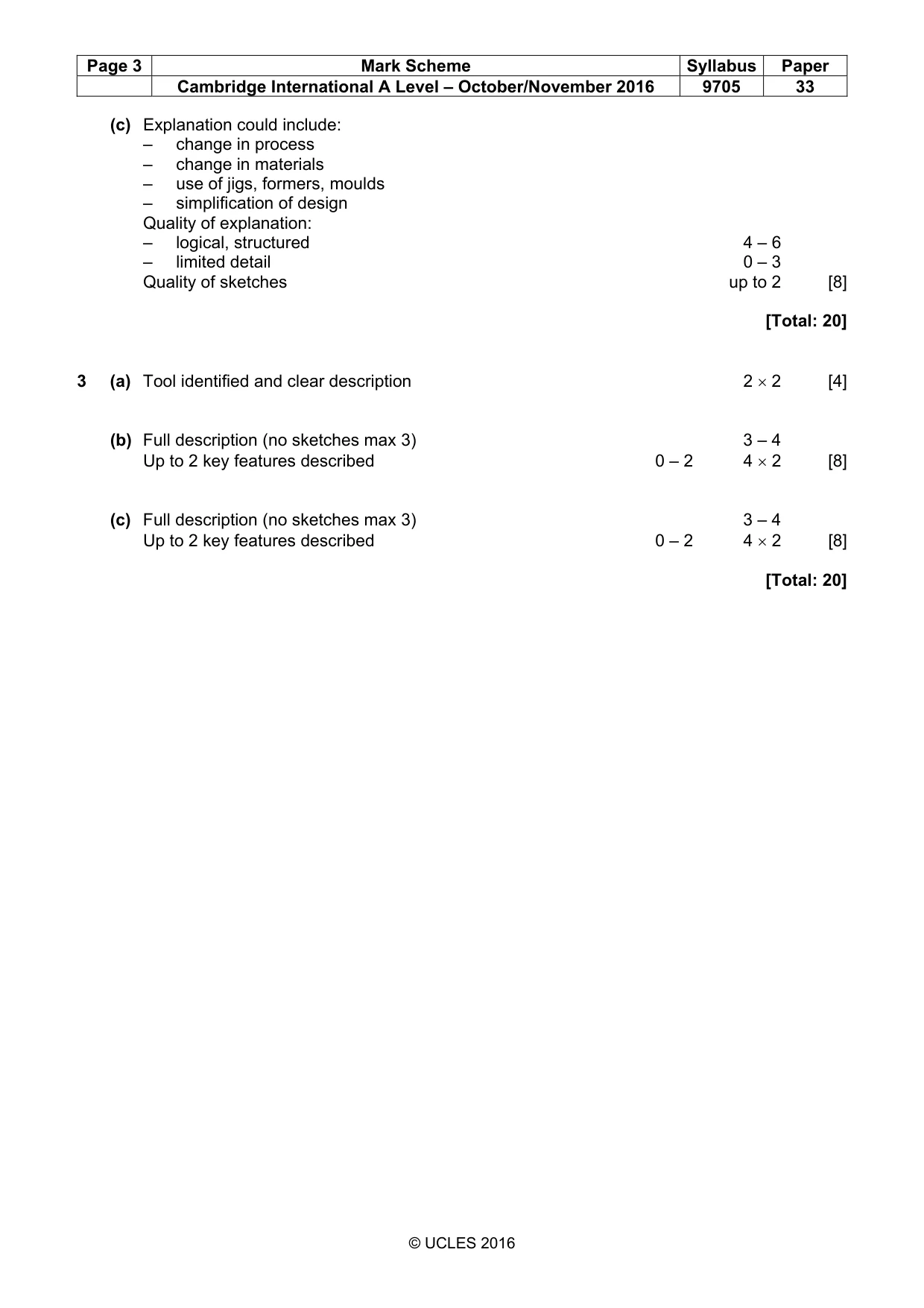
Page 2 Mark Scheme Syllabus Paper Cambridge International A Level – October/November 2016 9705 33 © UCLES 2016 Section A Part A – Product Design 1 (a) Description of process – fully detailed 3 – 5 – some detail, 0 – 2 – quality of sketches up to 2 7 × 2 [14] (b) Rotational moulding – large hollow shape – excellent finish – minimal wastage – exact amounts used Turning – regular cylindrical shape – high quality finish – shape easily repeated Etching – accurate detail – relatively quick operation – needs minimal equipment/cost 3 × 2 [6] [Total:20] 2 (a) Suitable material: – appropriate straight grained hardwood – aluminium alloy – stainless steel – nylon/abs/polypropylene 1 Reasons : – can produce high quality finish – will gentle flex on bumpy conditions – easy to bend/press/shape 2 × 1 [3] (b) Description to include: shaping/forming/pressing finishing/laminating Quality of description: – fully detailed 3 – 7 – some detail 0 – 2 Quality of sketches up to 2 [9]
Mark scheme, page 3
Page 3 Mark Scheme Syllabus Paper Cambridge International A Level – October/November 2016 9705 33 © UCLES 2016 (c) Explanation could include: – change in process – change in materials – use of jigs, formers, moulds – simplification of design Quality of explanation: – logical, structured 4 – 6 – limited detail 0 – 3 Quality of sketches up to 2 [8] [Total: 20] 3 (a) Tool identified and clear description 2 × 2 [4] (b) Full description (no sketches max 3) 3 – 4 Up to 2 key features described 0 – 2 4 × 2 [8] (c) Full description (no sketches max 3) 3 – 4 Up to 2 key features described 0 – 2 4 × 2 [8] [Total: 20]
Mark scheme, page 4
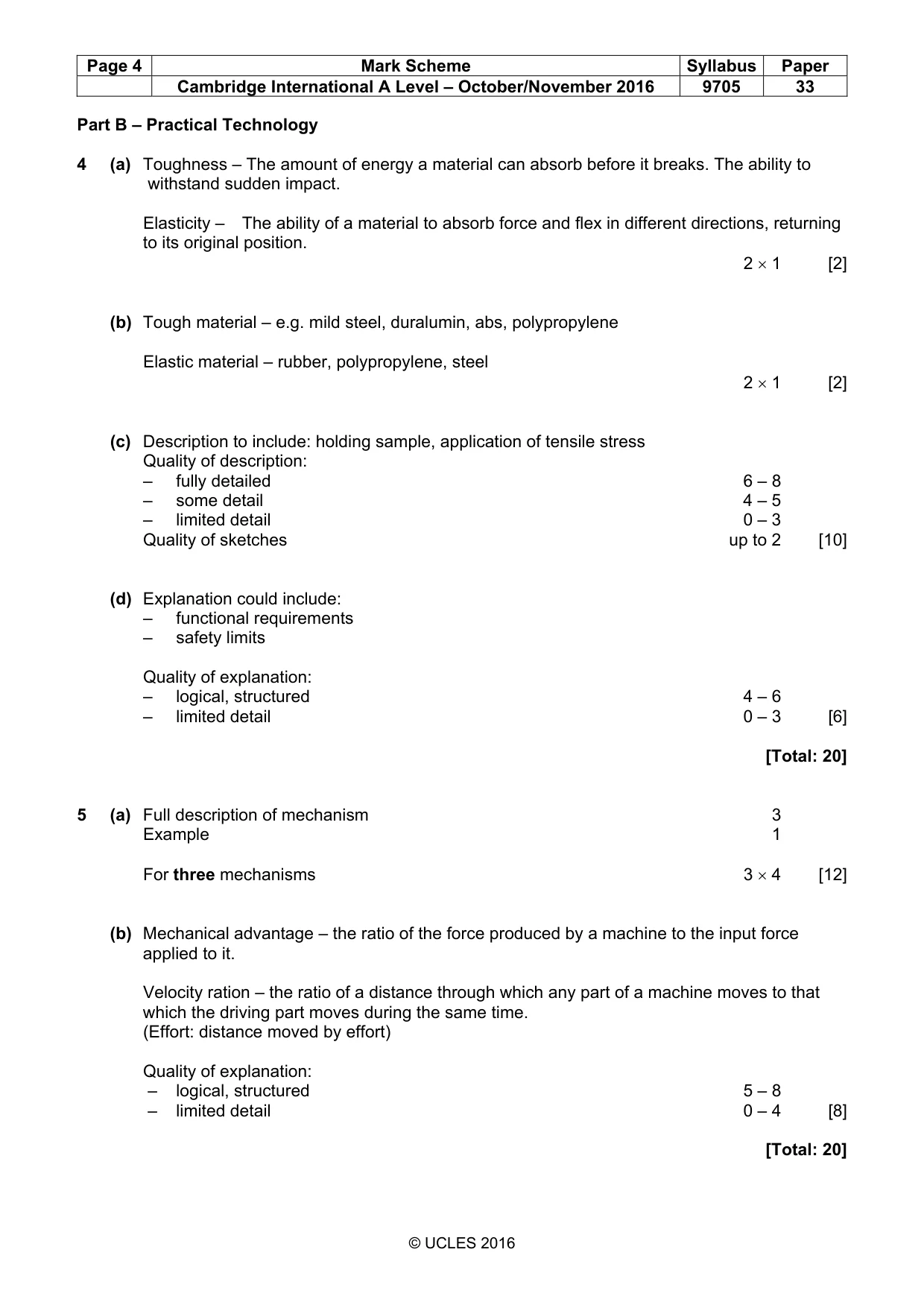
Page 4 Mark Scheme Syllabus Paper Cambridge International A Level – October/November 2016 9705 33 © UCLES 2016 Part B – Practical Technology 4 (a) Toughness – The amount of energy a material can absorb before it breaks. The ability to withstand sudden impact. Elasticity – The ability of a material to absorb force and flex in different directions, returning to its original position. 2 × 1 [2] (b) Tough material – e.g. mild steel, duralumin, abs, polypropylene Elastic material – rubber, polypropylene, steel 2 × 1 [2] (c) Description to include: holding sample, application of tensile stress Quality of description: – fully detailed 6 – 8 – some detail 4 – 5 – limited detail 0 – 3 Quality of sketches up to 2 [10] (d) Explanation could include: – functional requirements – safety limits Quality of explanation: – logical, structured 4 – 6 – limited detail 0 – 3 [6] [Total: 20] 5 (a) Full description of mechanism 3 Example 1 For three mechanisms 3 × 4 [12] (b) Mechanical advantage – the ratio of the force produced by a machine to the input force applied to it. Velocity ration – the ratio of a distance through which any part of a machine moves to that which the driving part moves during the same time. (Effort: distance moved by effort) Quality of explanation: – logical, structured 5 – 8 – limited detail 0 – 4 [8] [Total: 20]
Mark scheme, page 5
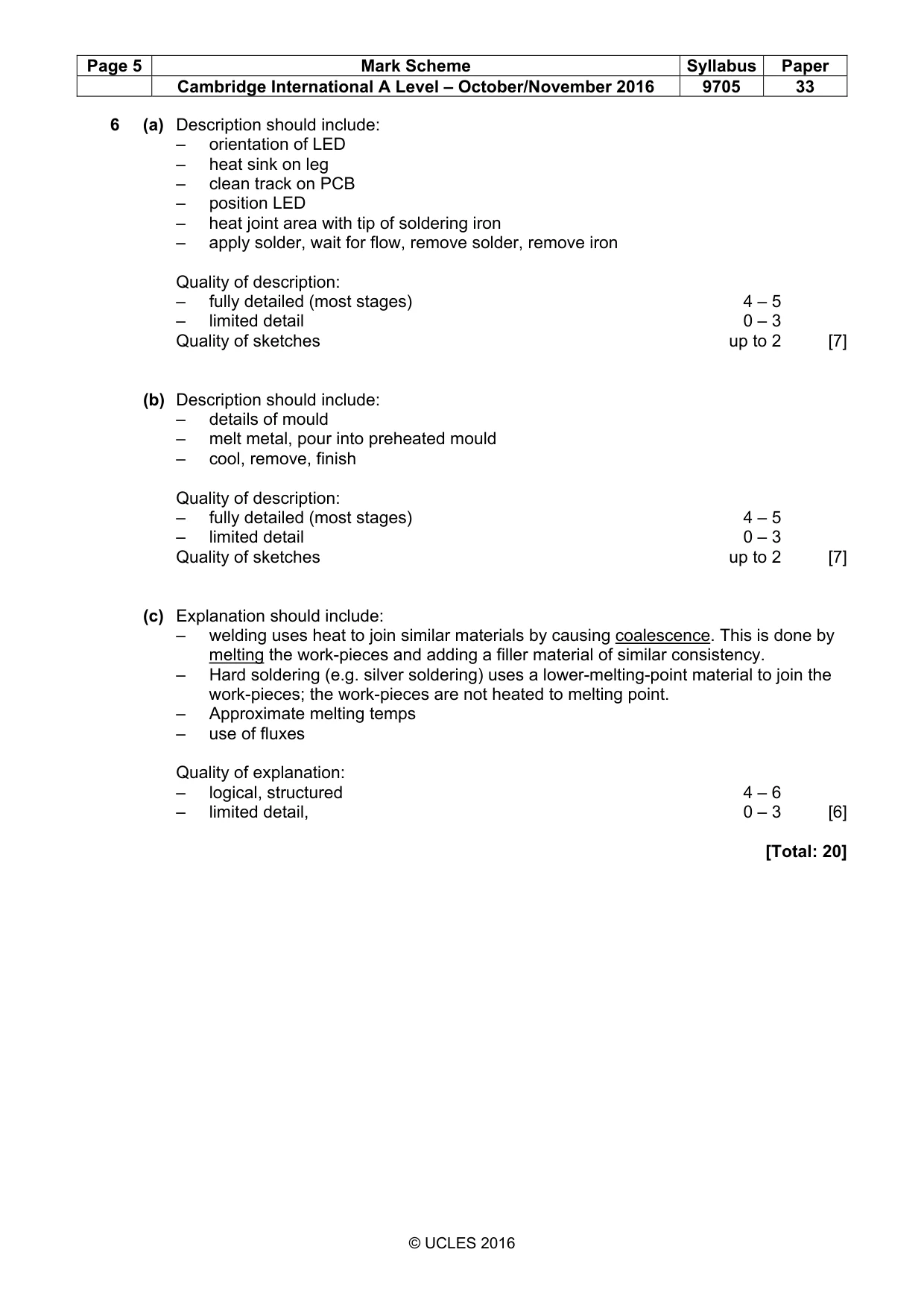
Page 5 Mark Scheme Syllabus Paper Cambridge International A Level – October/November 2016 9705 33 © UCLES 2016 6 (a) Description should include: – orientation of LED – heat sink on leg – clean track on PCB – position LED – heat joint area with tip of soldering iron – apply solder, wait for flow, remove solder, remove iron Quality of description: – fully detailed (most stages) 4 – 5 – limited detail 0 – 3 Quality of sketches up to 2 [7] (b) Description should include: – details of mould – melt metal, pour into preheated mould – cool, remove, finish Quality of description: – fully detailed (most stages) 4 – 5 – limited detail 0 – 3 Quality of sketches up to 2 [7] (c) Explanation should include: – welding uses heat to join similar materials by causing coalescence. This is done by melting the work-pieces and adding a filler material of similar consistency. – Hard soldering (e.g. silver soldering) uses a lower-melting-point material to join the work-pieces; the work-pieces are not heated to melting point. – Approximate melting temps – use of fluxes Quality of explanation: – logical, structured 4 – 6 – limited detail, 0 – 3 [6] [Total: 20]
Mark scheme, page 6
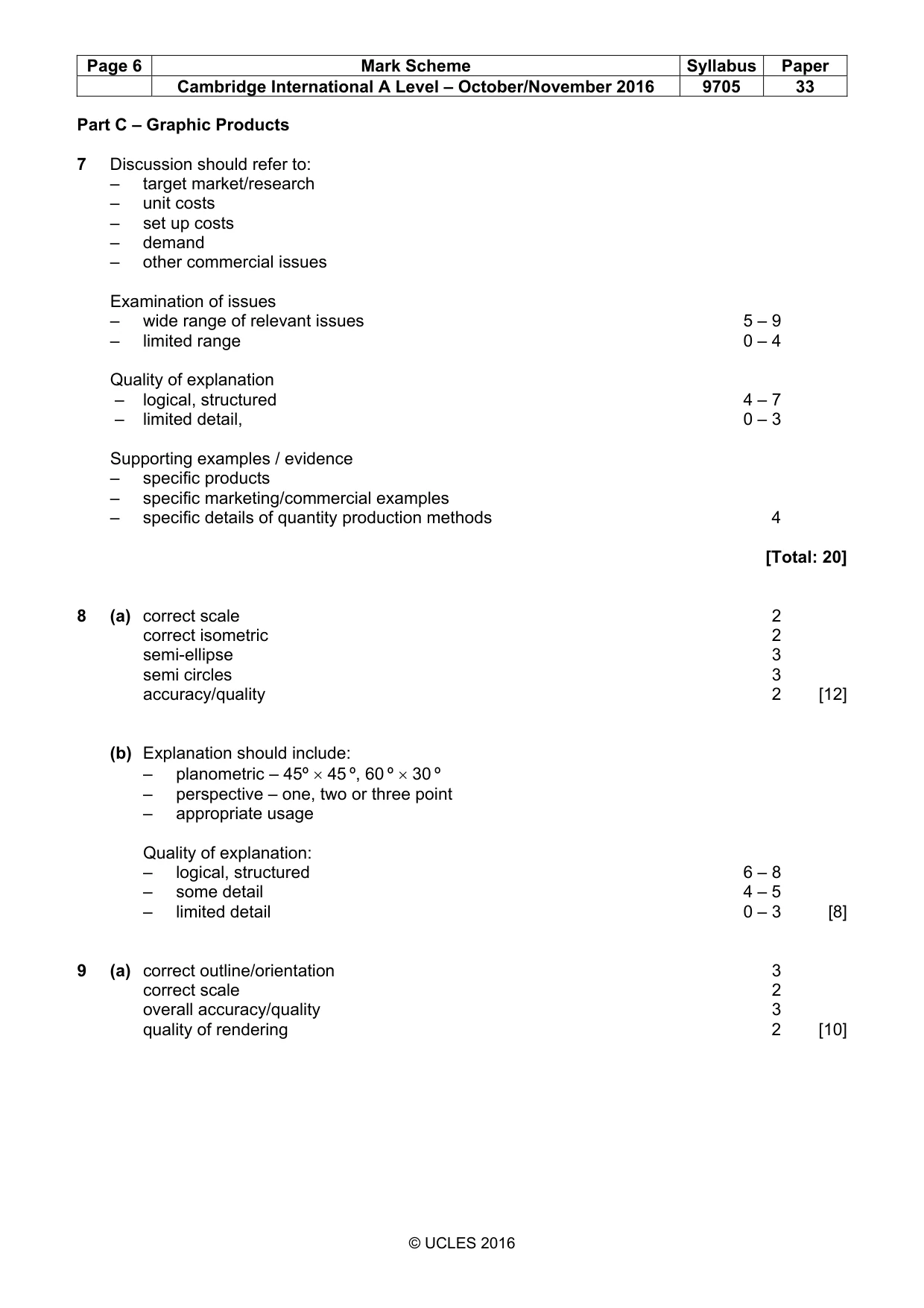
Page 6 Mark Scheme Syllabus Paper Cambridge International A Level – October/November 2016 9705 33 © UCLES 2016 Part C – Graphic Products 7 Discussion should refer to: – target market/research – unit costs – set up costs – demand – other commercial issues Examination of issues – wide range of relevant issues 5 – 9 – limited range 0 – 4 Quality of explanation – logical, structured 4 – 7 – limited detail, 0 – 3 Supporting examples / evidence – specific products – specific marketing/commercial examples – specific details of quantity production methods 4 [Total: 20] 8 (a) correct scale 2 correct isometric 2 semi-ellipse 3 semi circles 3 accuracy/quality 2 [12] (b) Explanation should include: – planometric – 45º × 45 º, 60 º × 30 º – perspective – one, two or three point – appropriate usage Quality of explanation: – logical, structured 6 – 8 – some detail 4 – 5 – limited detail 0 – 3 [8] 9 (a) correct outline/orientation 3 correct scale 2 overall accuracy/quality 3 quality of rendering 2 [10]
Mark scheme, page 7
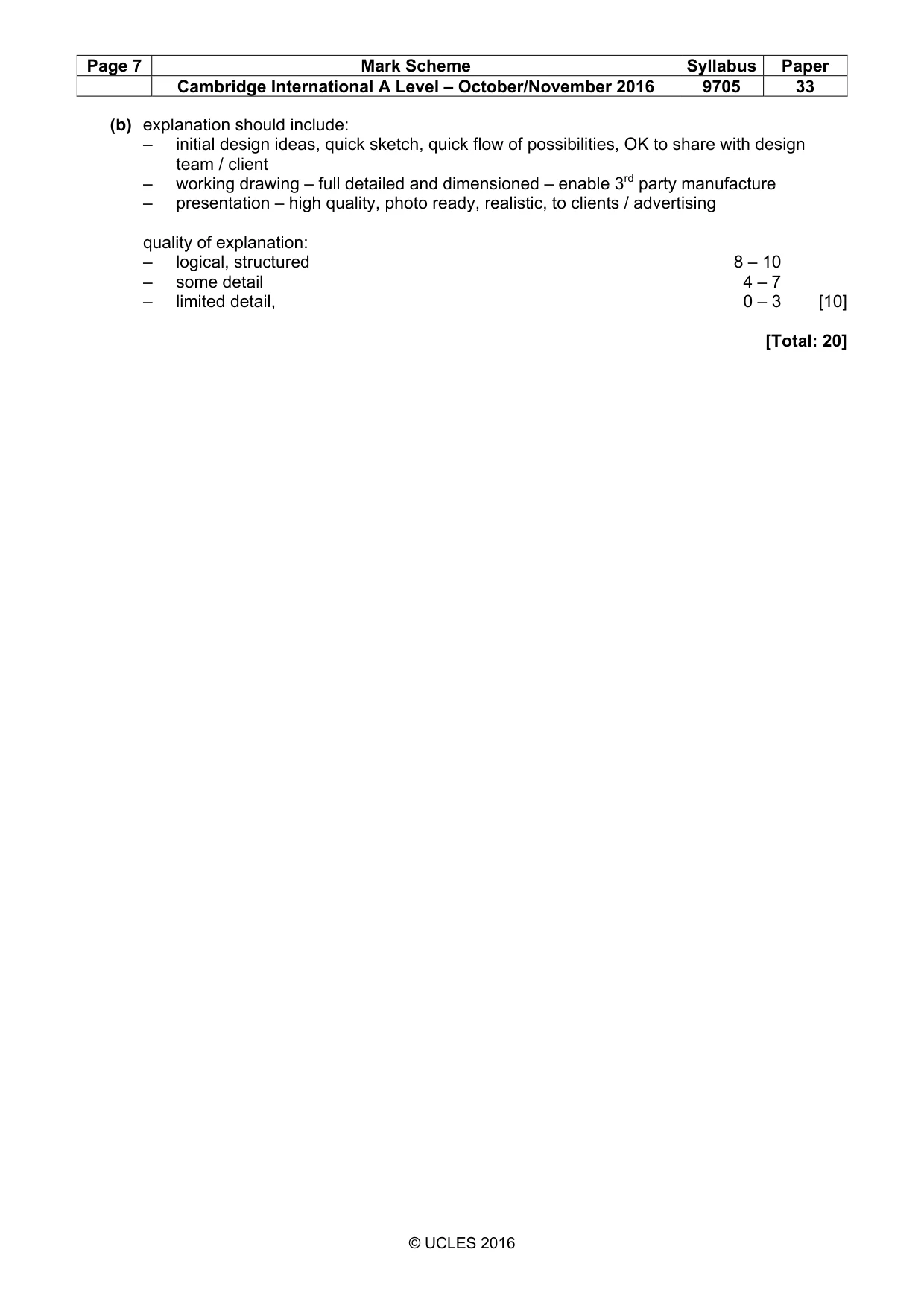
Page 7 Mark Scheme Syllabus Paper Cambridge International A Level – October/November 2016 9705 33 © UCLES 2016 (b) explanation should include: – initial design ideas, quick sketch, quick flow of possibilities, OK to share with design team / client – working drawing – full detailed and dimensioned – enable 3rd party manufacture – presentation – high quality, photo ready, realistic, to clients / advertising quality of explanation: – logical, structured 8 – 10 – some detail 4 – 7 – limited detail, 0 – 3 [10] [Total: 20]
Mark scheme, page 8
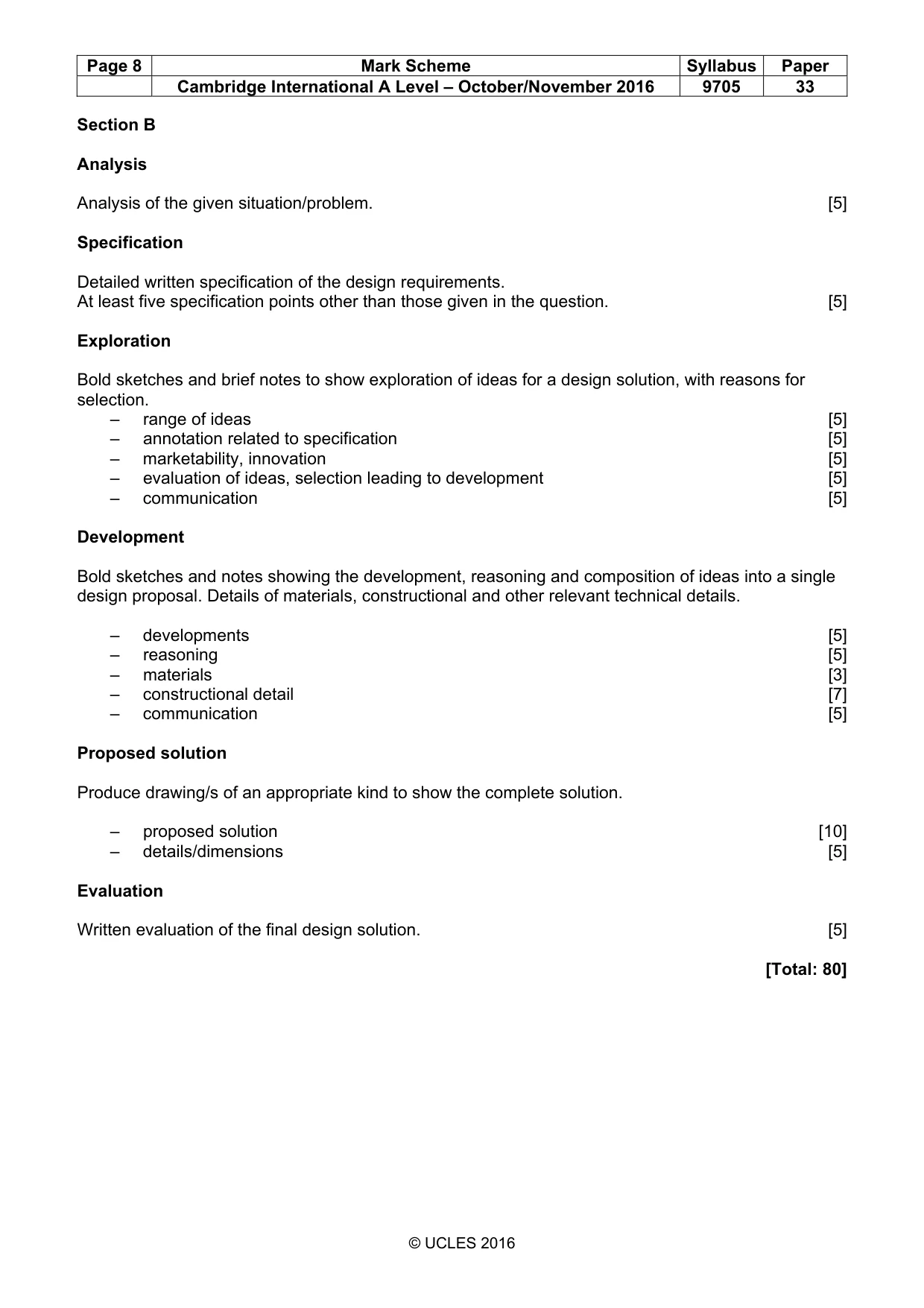
Page 8 Mark Scheme Syllabus Paper Cambridge International A Level – October/November 2016 9705 33 © UCLES 2016 Section B Analysis Analysis of the given situation/problem. [5] Specification Detailed written specification of the design requirements. At least five specification points other than those given in the question. [5] Exploration Bold sketches and brief notes to show exploration of ideas for a design solution, with reasons for selection. – range of ideas [5] – annotation related to specification [5] – marketability, innovation [5] – evaluation of ideas, selection leading to development [5] – communication [5] Development Bold sketches and notes showing the development, reasoning and composition of ideas into a single design proposal. Details of materials, constructional and other relevant technical details. – developments [5] – reasoning [5] – materials [3] – constructional detail [7] – communication [5] Proposed solution Produce drawing/s of an appropriate kind to show the complete solution. – proposed solution [10] – details/dimensions [5] Evaluation Written evaluation of the final design solution. [5] [Total: 80]
What you needed in this session
Cambridge’s own grade thresholds for 2016 Oct/Nov, Paper 3 · Variant 3. A higher threshold means an easier paper — the bar moves with how the cohort did.