Cambridge A Level Design and Technology 9705 — 2016 Oct/Nov Paper 3 · Variant 2
9705/32/O/N/16 · 120 marks · ≈135 min
The question paper and its mark scheme, free to read here and free to download. This is Cambridge’s own paper, exactly as it was sat.
Question paper8 pages
Mark scheme8 pages
Answers below. Sit the paper first if you are practising.
Paper as text
Question paper, page 1
This document consists of 8 printed pages. DC (LK/SW) 116848/3 © UCLES 2016 [Turn over Cambridge International Examinations Cambridge International Advanced Subsidiary and Advanced Level * 7 0 2 6 9 7 3 4 7 4 * DESIGN AND TECHNOLOGY 9705/32 Paper 3 October/November 2016 3 hours Additional Materials: Answer Booklet/Paper A range of design drawing equipment A3 Drawing Paper (5 sheets) READ THESE INSTRUCTIONS FIRST Write your Centre number, candidate number and name on all the work you hand in. Write in dark blue or black pen. You may use an HB pencil for any diagrams, graphs or rough working. Do not use staples, paper clips, glue or correction fluid. DO NOT WRITE IN ANY BARCODES. Section A Answer any two questions from Parts A, B or C. Section B Answer one question. All dimensions are in millimetres. The instruction ‘discuss’ denotes that you should: • examine critically the issues raised by the question; • explain and interpret these issues as appropriate; • introduce evidence wherever possible to support conclusions of arguments. At the end of the examination, fasten all your work securely together. The number of marks is given in brackets [ ] at the end of each question or part question.
Question paper, page 2
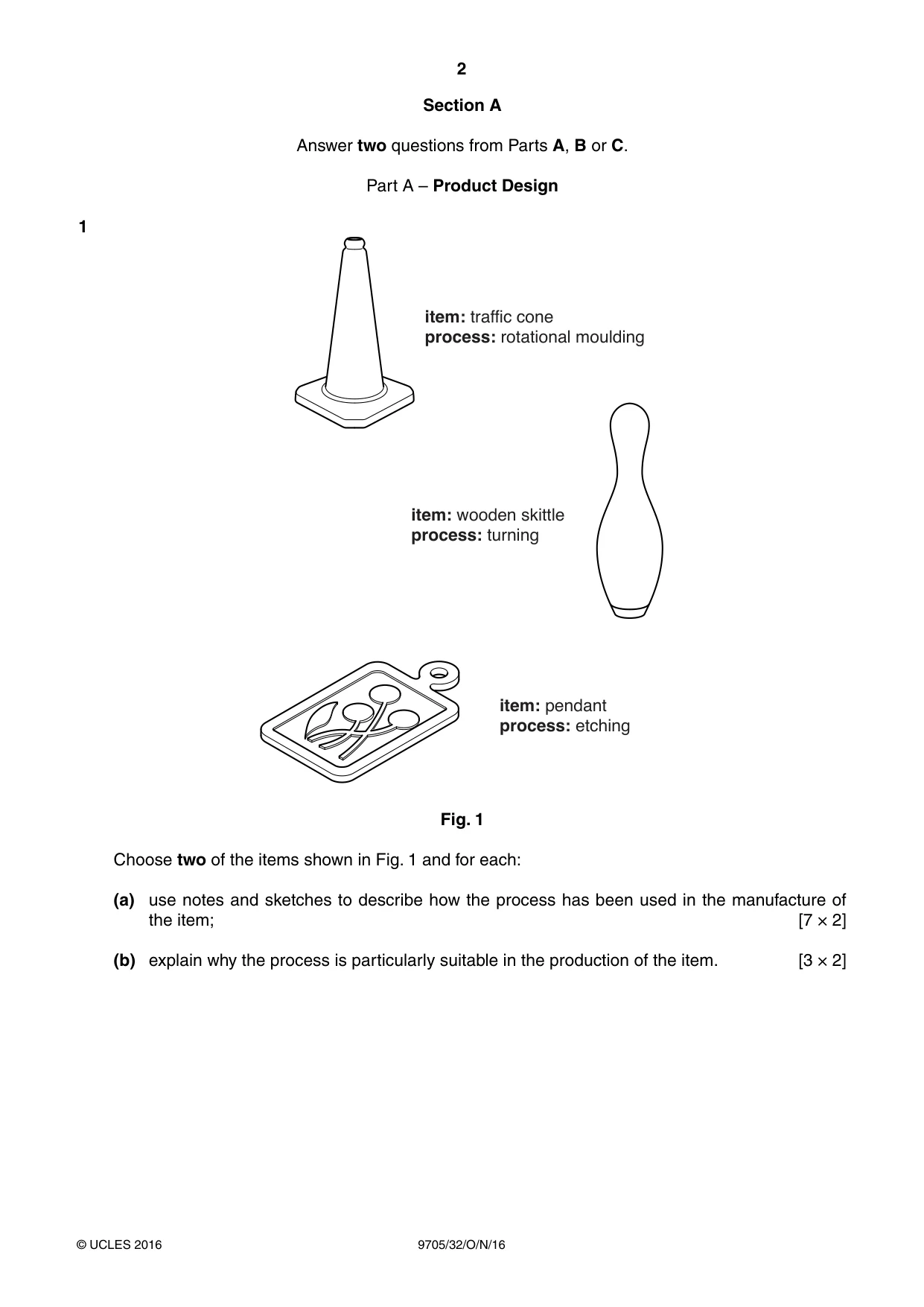
2 9705/32/O/N/16 © UCLES 2016 Section A Answer two questions from Parts A, B or C. Part A – Product Design 1 item: pendant process: etching item: traffic cone process: rotational moulding item: wooden skittle process: turning Fig. 1 Choose two of the items shown in Fig. 1 and for each: (a) use notes and sketches to describe how the process has been used in the manufacture of the item; [7 × 2] (b) explain why the process is particularly suitable in the production of the item. [3 × 2]
Question paper, page 3
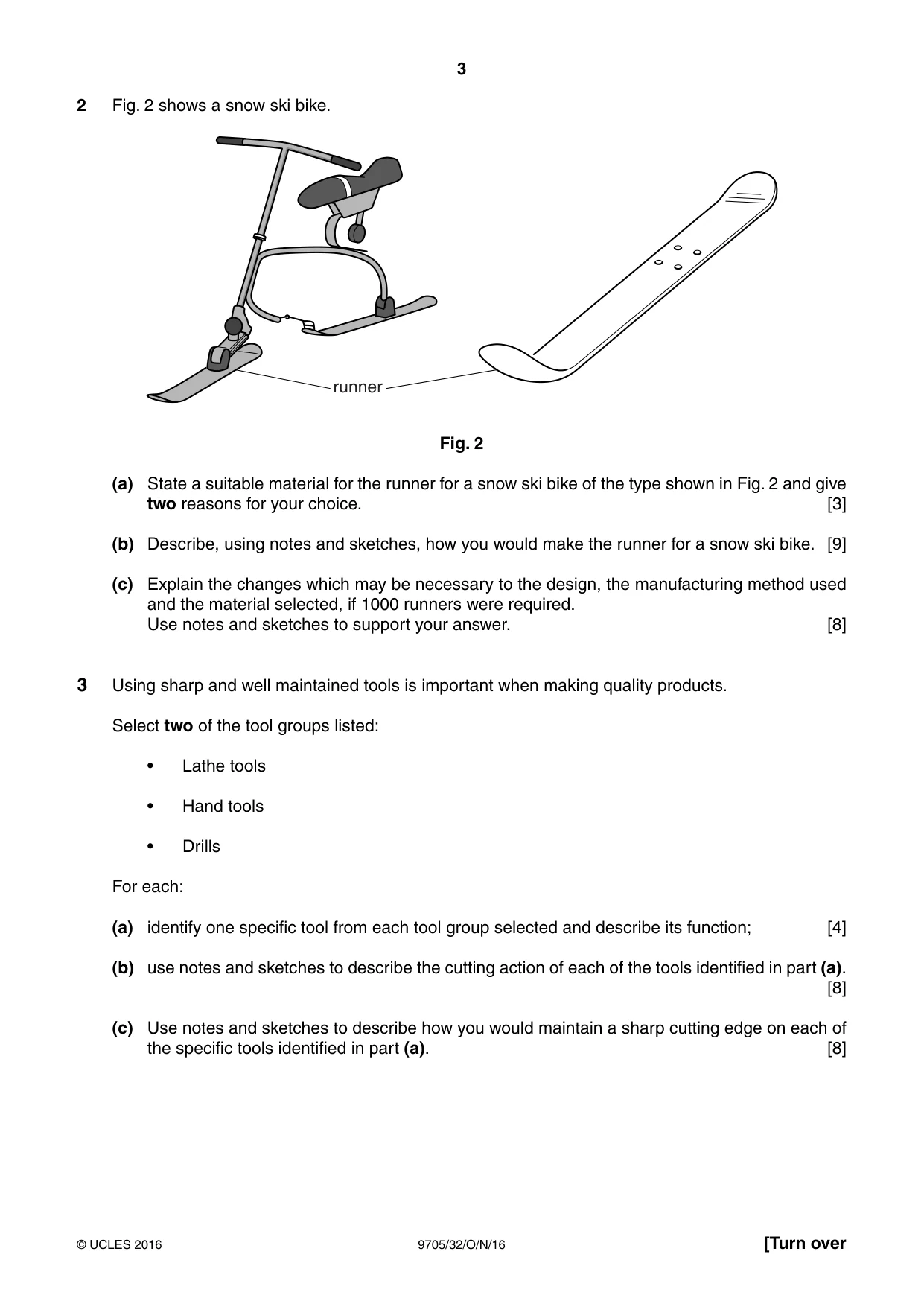
3 9705/32/O/N/16 © UCLES 2016 [Turn over 2 Fig. 2 shows a snow ski bike. runner Fig. 2 (a) State a suitable material for the runner for a snow ski bike of the type shown in Fig. 2 and give two reasons for your choice. [3] (b) Describe, using notes and sketches, how you would make the runner for a snow ski bike. [9] (c) Explain the changes which may be necessary to the design, the manufacturing method used and the material selected, if 1000 runners were required. Use notes and sketches to support your answer. [8] 3 Using sharp and well maintained tools is important when making quality products. Select two of the tool groups listed: • Lathe tools • Hand tools • Drills For each: (a) identify one specific tool from each tool group selected and describe its function; [4] (b) use notes and sketches to describe the cutting action of each of the tools identified in part (a). [8] (c) Use notes and sketches to describe how you would maintain a sharp cutting edge on each of the specific tools identified in part (a). [8]
Question paper, page 4
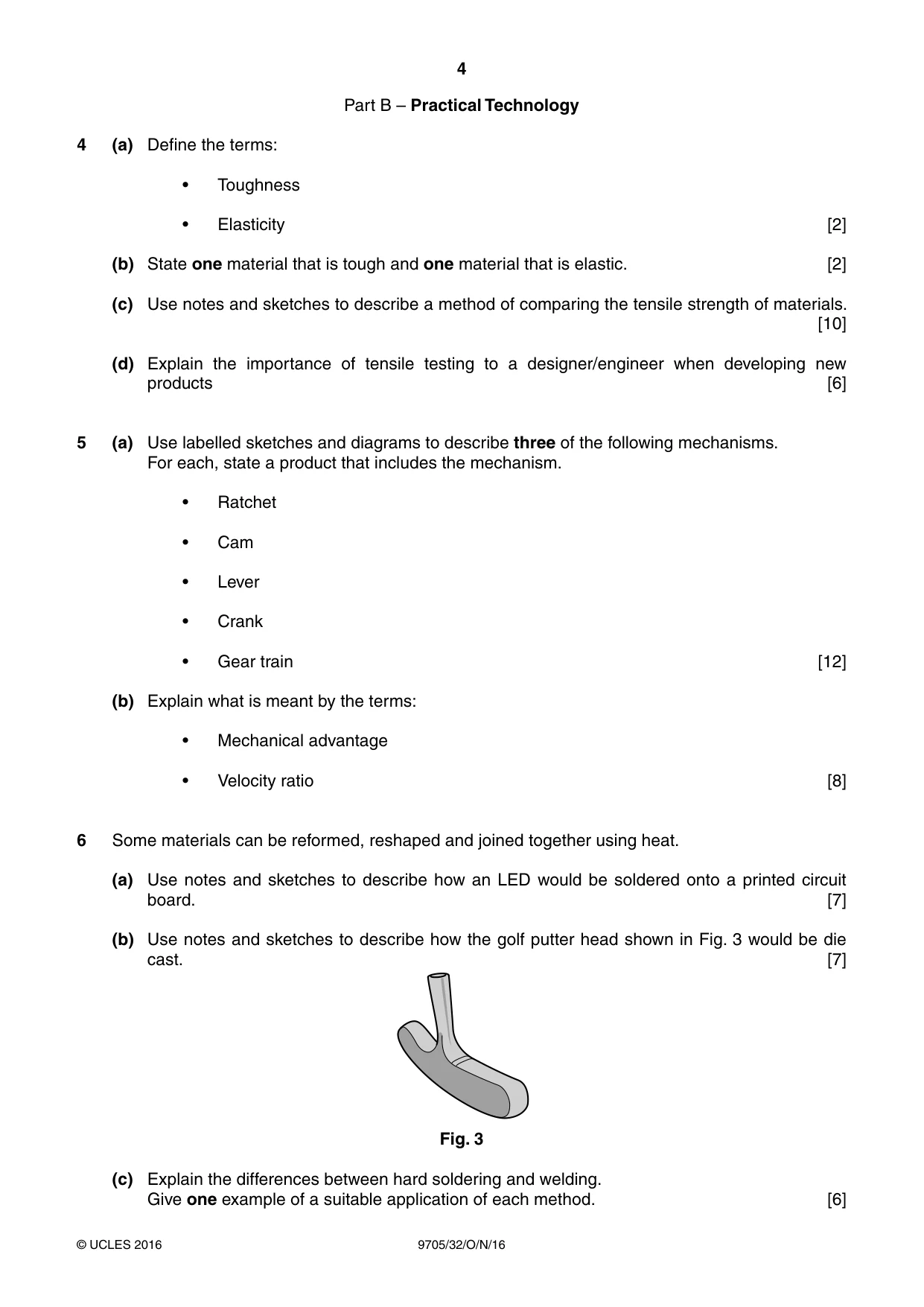
4 9705/32/O/N/16 © UCLES 2016 Part B – Practical Technology 4 (a) Define the terms: • Toughness • Elasticity [2] (b) State one material that is tough and one material that is elastic. [2] (c) Use notes and sketches to describe a method of comparing the tensile strength of materials. [10] (d) Explain the importance of tensile testing to a designer/engineer when developing new products [6] 5 (a) Use labelled sketches and diagrams to describe three of the following mechanisms. For each, state a product that includes the mechanism. • Ratchet • Cam • Lever • Crank • Gear train [12] (b) Explain what is meant by the terms: • Mechanical advantage • Velocity ratio [8] 6 Some materials can be reformed, reshaped and joined together using heat. (a) Use notes and sketches to describe how an LED would be soldered onto a printed circuit board. [7] (b) Use notes and sketches to describe how the golf putter head shown in Fig. 3 would be die cast. [7] Fig. 3 (c) Explain the differences between hard soldering and welding. Give one example of a suitable application of each method. [6]
Question paper, page 5
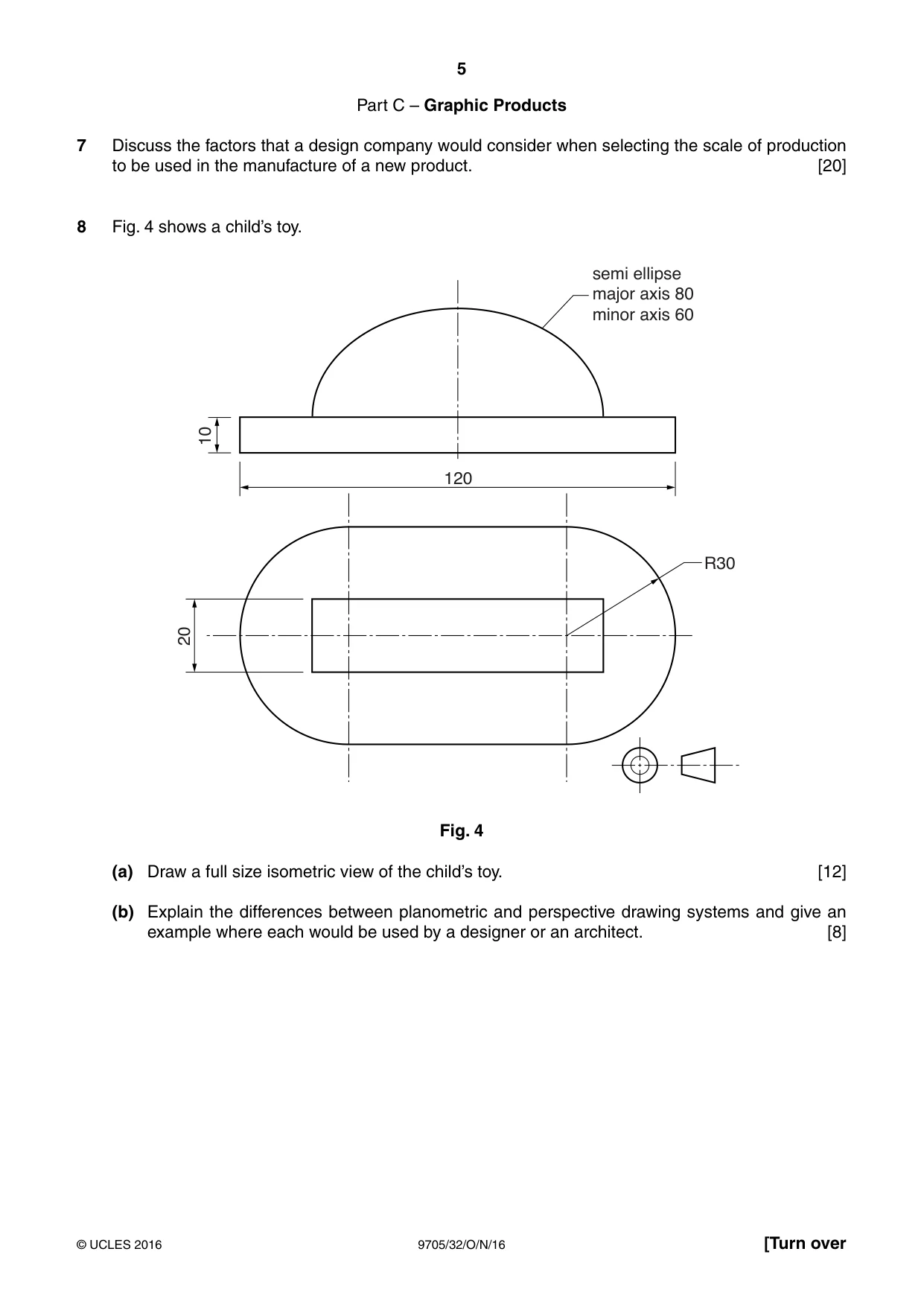
5 9705/32/O/N/16 © UCLES 2016 [Turn over Part C – Graphic Products 7 Discuss the factors that a design company would consider when selecting the scale of production to be used in the manufacture of a new product. [20] 8 Fig. 4 shows a child’s toy. 20 10 120 R30 semi ellipse major axis 80 minor axis 60 Fig. 4 (a) Draw a full size isometric view of the child’s toy. [12] (b) Explain the differences between planometric and perspective drawing systems and give an example where each would be used by a designer or an architect. [8]
Question paper, page 6
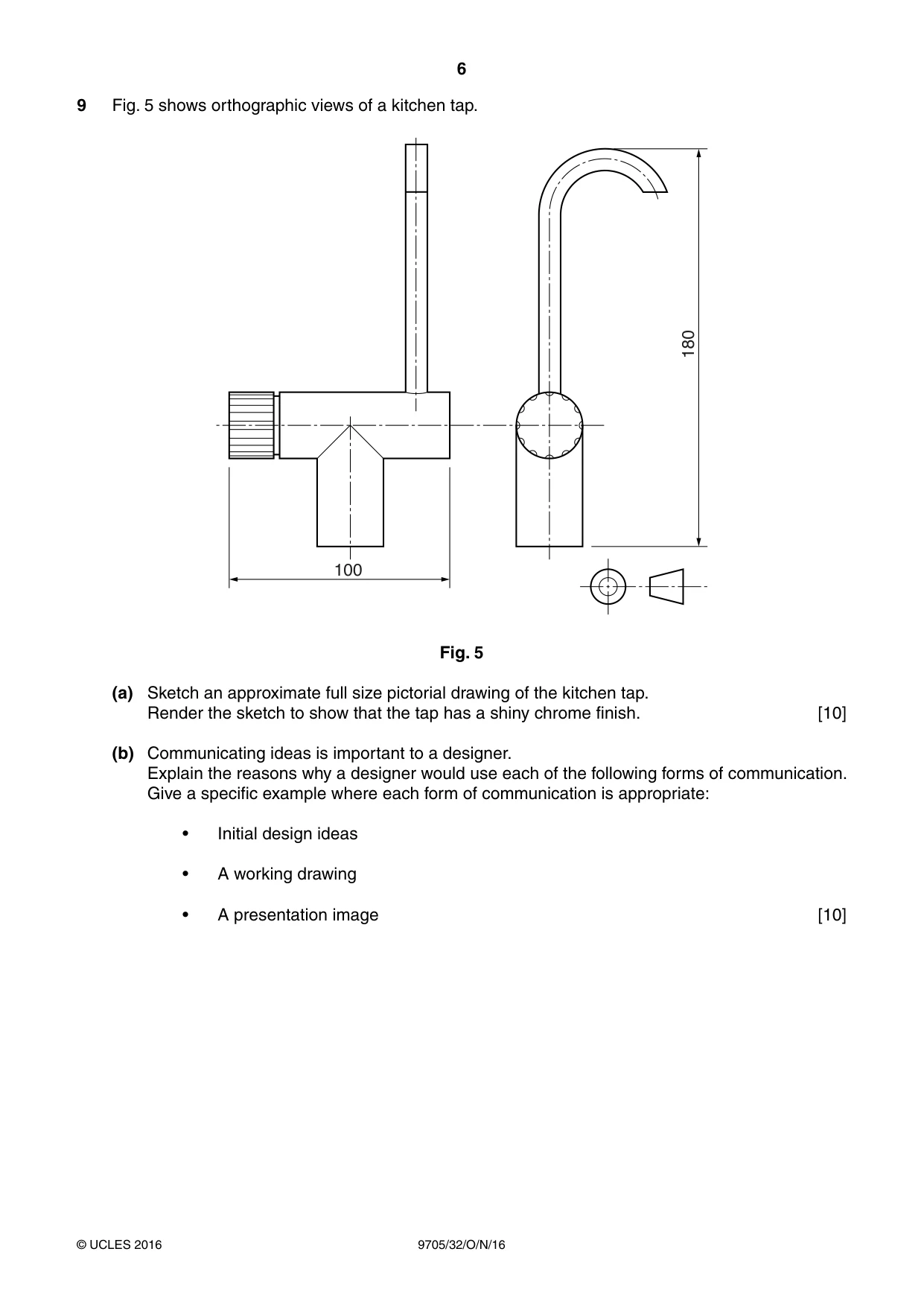
6 9705/32/O/N/16 © UCLES 2016 9 Fig. 5 shows orthographic views of a kitchen tap. 100 180 Fig. 5 (a) Sketch an approximate full size pictorial drawing of the kitchen tap. Render the sketch to show that the tap has a shiny chrome finish. [10] (b) Communicating ideas is important to a designer. Explain the reasons why a designer would use each of the following forms of communication. Give a specific example where each form of communication is appropriate: • Initial design ideas • A working drawing • A presentation image [10]
Question paper, page 7
7 9705/32/O/N/16 © UCLES 2016 [Turn over Section B Answer one question on the A3 paper provided. You should approach the design question of your choice in the following manner: Analysis Produce an analysis of the given situation/problem, which may be in written or graphical form. [5] Specification From the analysis produce a detailed written specification of the design requirements. Include at least five specification points other than those given in the question. [5] Exploration Use bold sketches and brief notes to show your exploration of ideas for a design solution, with reasons for selection. [25] Development Show using bold sketches and notes, the development, reasoning and composition of ideas into a single design proposal. Give details of materials, constructional and other relevant technical details. [25] Proposed solution Produce drawings of an appropriate kind to show the complete solution. [15] Evaluation Give a written evaluation of the final design solution. [5] Total: [80]
Question paper, page 8
8 9705/32/O/N/16 © UCLES 2016 Permission to reproduce items where third-party owned material protected by copyright is included has been sought and cleared where possible. Every reasonable effort has been made by the publisher (UCLES) to trace copyright holders, but if any items requiring clearance have unwittingly been included, the publisher will be pleased to make amends at the earliest possible opportunity. To avoid the issue of disclosure of answer-related information to candidates, all copyright acknowledgements are reproduced online in the Cambridge International Examinations Copyright Acknowledgements Booklet. This is produced for each series of examinations and is freely available to download at www.cie.org.uk after the live examination series. Cambridge International Examinations is part of the Cambridge Assessment Group. Cambridge Assessment is the brand name of University of Cambridge Local Examinations Syndicate (UCLES), which is itself a department of the University of Cambridge. 10 An increasing number of adults are making greater efforts to exercise more and maintain a healthy lifestyle. Design a product that can be used in the home or garden to provide exercise. The product must: • be easy to store away when not in use; • encourage the user to improve fitness. 11 Children often get bored when travelling in a car, bus or train. Design a game or toy that can be used on a long journey. The game or toy must: • have an electronic and/or mechanical feature; • be able to be used by one or more children. 12 A school wishes to reward the success of students in particular school subjects by posting a celebration card home to parents/guardians. Design a card to celebrate the success of a student in a school subject of your choice. The card must: • have a ‘pop up’ or interactive feature; • reflect the school subject.
Mark scheme, page 1
® IGCSE is the registered trademark of Cambridge International Examinations. This document consists of 8 printed pages. © UCLES 2016 [Turn over Cambridge International Examinations Cambridge International Advanced Level DESIGN AND TECHNOLOGY 9705/32 Paper 3 October/November 2016 MARK SCHEME Maximum Mark: 120 Published This mark scheme is published as an aid to teachers and candidates, to indicate the requirements of the examination. It shows the basis on which Examiners were instructed to award marks. It does not indicate the details of the discussions that took place at an Examiners’ meeting before marking began, which would have considered the acceptability of alternative answers. Mark schemes should be read in conjunction with the question paper and the Principal Examiner Report for Teachers. Cambridge will not enter into discussions about these mark schemes. Cambridge is publishing the mark schemes for the October/November 2016 series for most Cambridge IGCSE®, Cambridge International A and AS Level components and some Cambridge O Level components.
Mark scheme, page 2
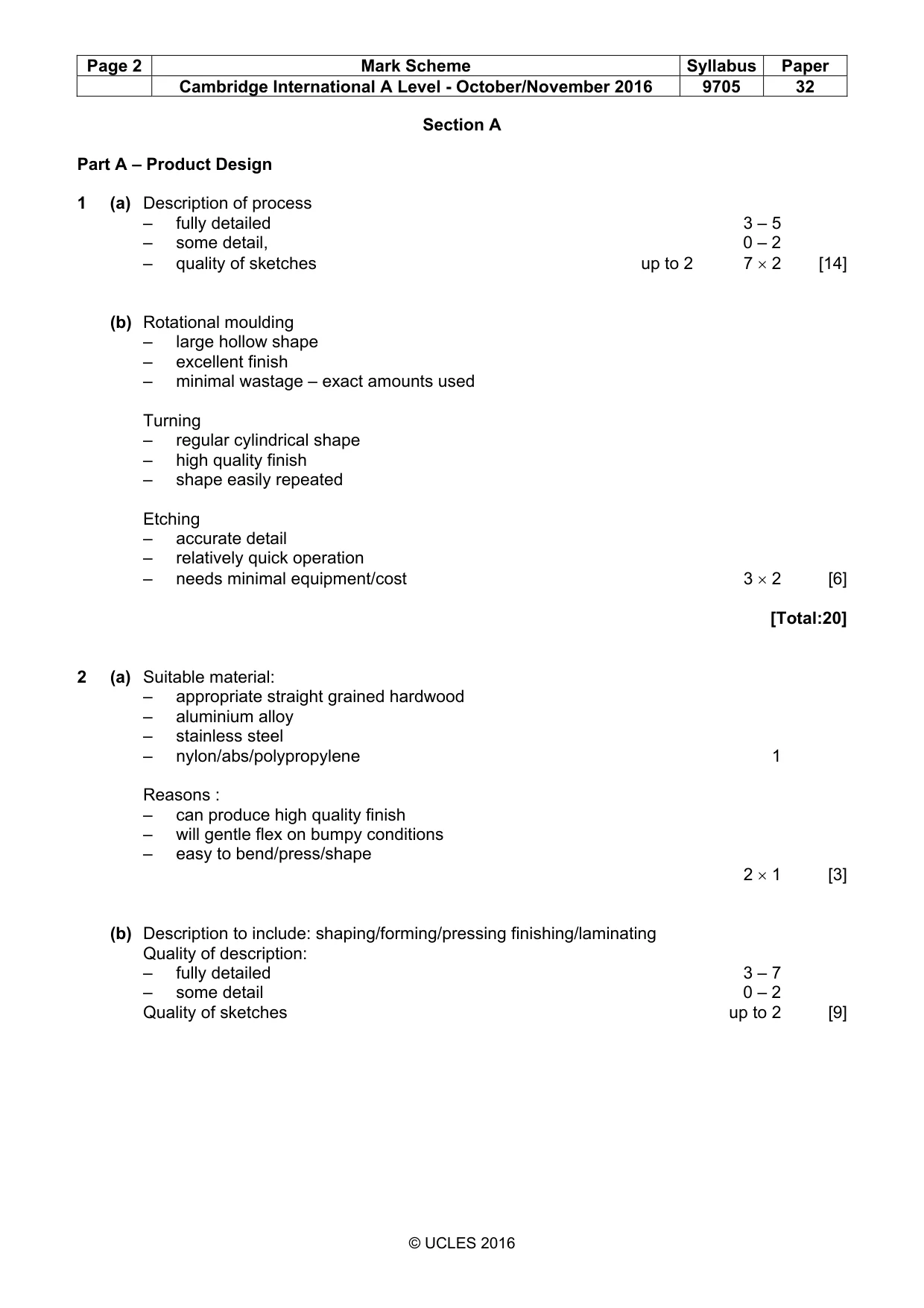
Page 2 Mark Scheme Syllabus Paper Cambridge International A Level - October/November 2016 9705 32 © UCLES 2016 Section A Part A – Product Design 1 (a) Description of process – fully detailed 3 – 5 – some detail, 0 – 2 – quality of sketches up to 2 7 × 2 [14] (b) Rotational moulding – large hollow shape – excellent finish – minimal wastage – exact amounts used Turning – regular cylindrical shape – high quality finish – shape easily repeated Etching – accurate detail – relatively quick operation – needs minimal equipment/cost 3 × 2 [6] [Total:20] 2 (a) Suitable material: – appropriate straight grained hardwood – aluminium alloy – stainless steel – nylon/abs/polypropylene 1 Reasons : – can produce high quality finish – will gentle flex on bumpy conditions – easy to bend/press/shape 2 × 1 [3] (b) Description to include: shaping/forming/pressing finishing/laminating Quality of description: – fully detailed 3 – 7 – some detail 0 – 2 Quality of sketches up to 2 [9]
Mark scheme, page 3
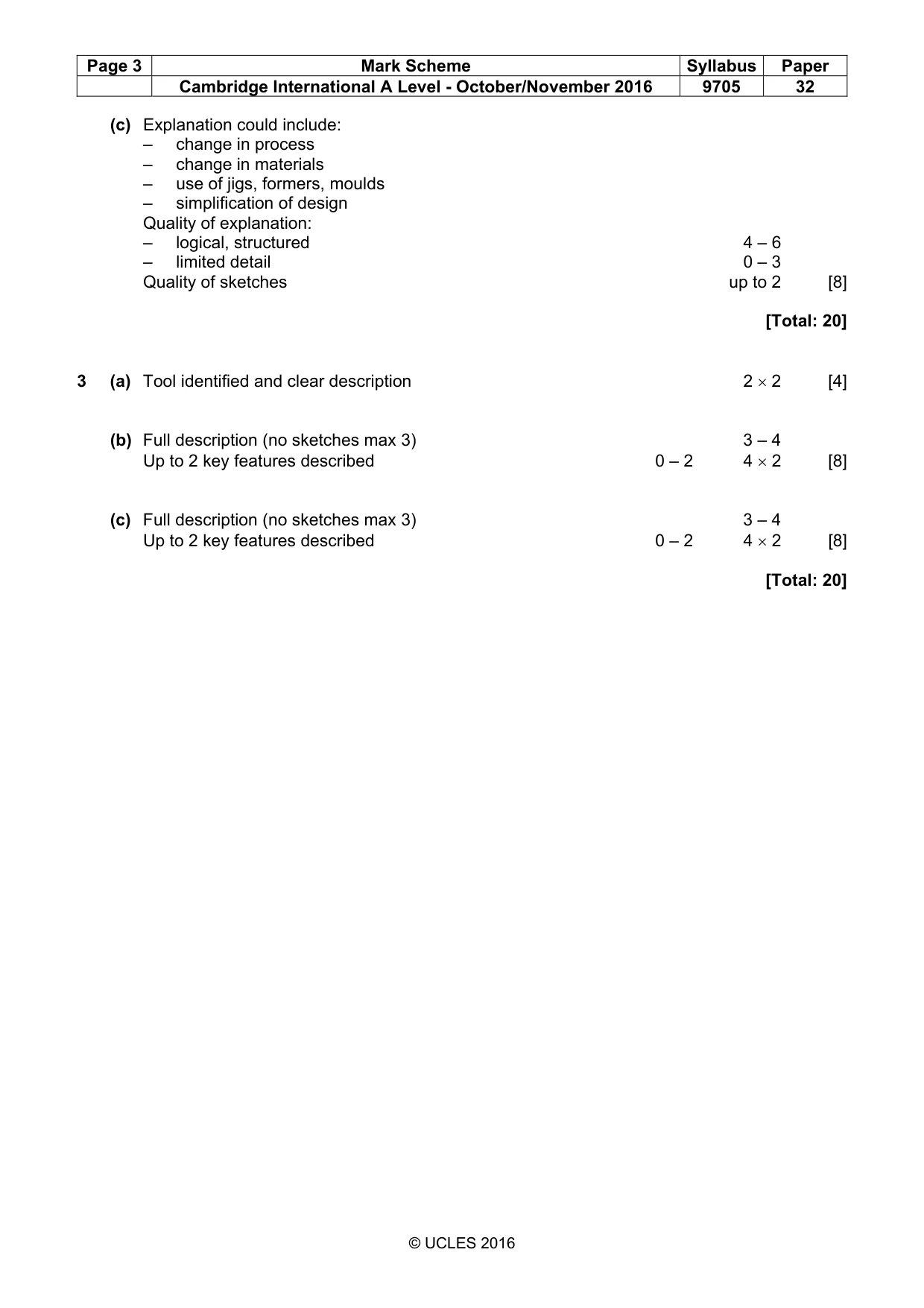
Page 3 Mark Scheme Syllabus Paper Cambridge International A Level - October/November 2016 9705 32 © UCLES 2016 (c) Explanation could include: – change in process – change in materials – use of jigs, formers, moulds – simplification of design Quality of explanation: – logical, structured 4 – 6 – limited detail 0 – 3 Quality of sketches up to 2 [8] [Total: 20] 3 (a) Tool identified and clear description 2 × 2 [4] (b) Full description (no sketches max 3) 3 – 4 Up to 2 key features described 0 – 2 4 × 2 [8] (c) Full description (no sketches max 3) 3 – 4 Up to 2 key features described 0 – 2 4 × 2 [8] [Total: 20]
Mark scheme, page 4
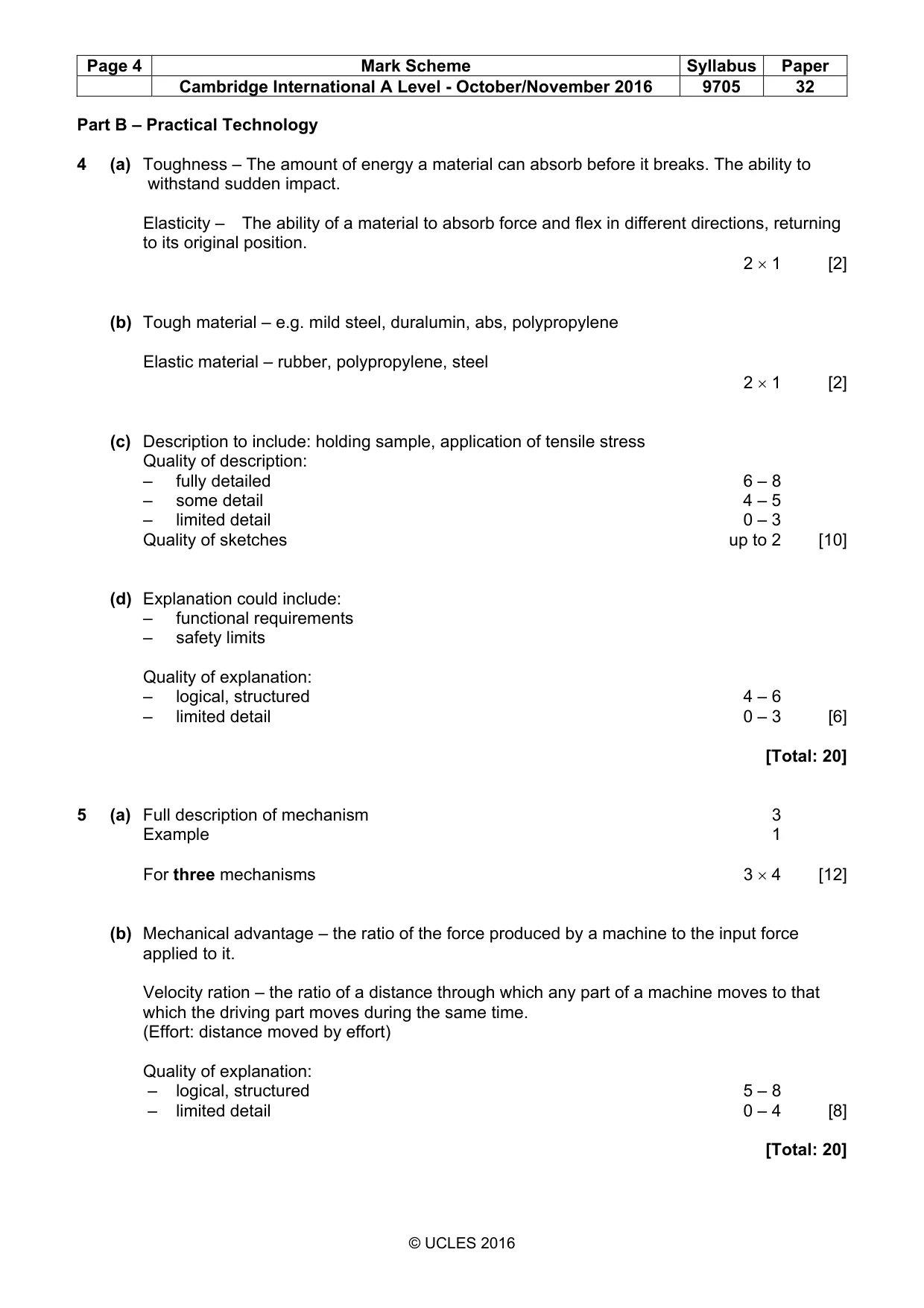
Page 4 Mark Scheme Syllabus Paper Cambridge International A Level - October/November 2016 9705 32 © UCLES 2016 Part B – Practical Technology 4 (a) Toughness – The amount of energy a material can absorb before it breaks. The ability to withstand sudden impact. Elasticity – The ability of a material to absorb force and flex in different directions, returning to its original position. 2 × 1 [2] (b) Tough material – e.g. mild steel, duralumin, abs, polypropylene Elastic material – rubber, polypropylene, steel 2 × 1 [2] (c) Description to include: holding sample, application of tensile stress Quality of description: – fully detailed 6 – 8 – some detail 4 – 5 – limited detail 0 – 3 Quality of sketches up to 2 [10] (d) Explanation could include: – functional requirements – safety limits Quality of explanation: – logical, structured 4 – 6 – limited detail 0 – 3 [6] [Total: 20] 5 (a) Full description of mechanism 3 Example 1 For three mechanisms 3 × 4 [12] (b) Mechanical advantage – the ratio of the force produced by a machine to the input force applied to it. Velocity ration – the ratio of a distance through which any part of a machine moves to that which the driving part moves during the same time. (Effort: distance moved by effort) Quality of explanation: – logical, structured 5 – 8 – limited detail 0 – 4 [8] [Total: 20]
Mark scheme, page 5
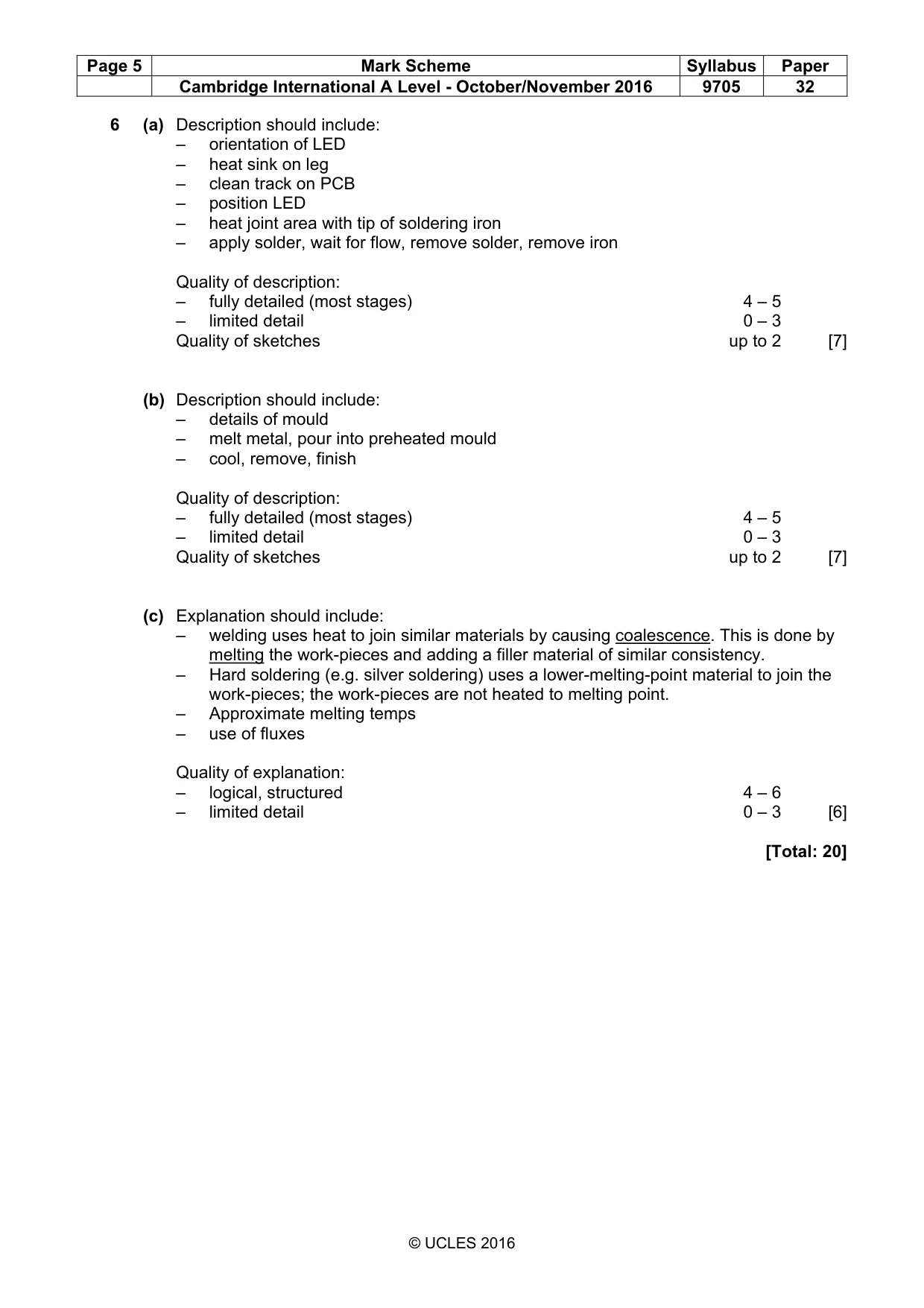
Page 5 Mark Scheme Syllabus Paper Cambridge International A Level - October/November 2016 9705 32 © UCLES 2016 6 (a) Description should include: – orientation of LED – heat sink on leg – clean track on PCB – position LED – heat joint area with tip of soldering iron – apply solder, wait for flow, remove solder, remove iron Quality of description: – fully detailed (most stages) 4 – 5 – limited detail 0 – 3 Quality of sketches up to 2 [7] (b) Description should include: – details of mould – melt metal, pour into preheated mould – cool, remove, finish Quality of description: – fully detailed (most stages) 4 – 5 – limited detail 0 – 3 Quality of sketches up to 2 [7] (c) Explanation should include: – welding uses heat to join similar materials by causing coalescence. This is done by melting the work-pieces and adding a filler material of similar consistency. – Hard soldering (e.g. silver soldering) uses a lower-melting-point material to join the work-pieces; the work-pieces are not heated to melting point. – Approximate melting temps – use of fluxes Quality of explanation: – logical, structured 4 – 6 – limited detail 0 – 3 [6] [Total: 20]
Mark scheme, page 6
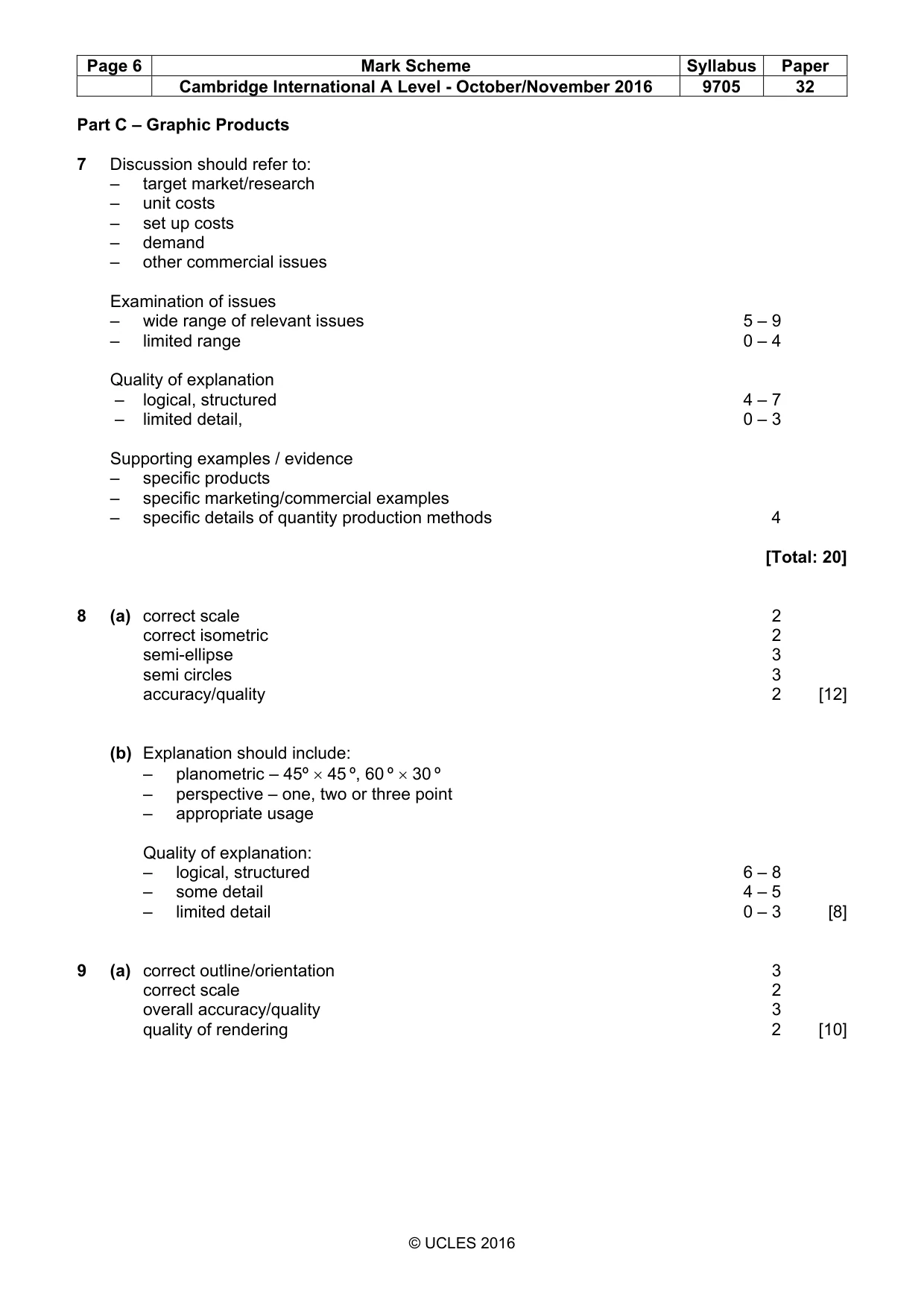
Page 6 Mark Scheme Syllabus Paper Cambridge International A Level - October/November 2016 9705 32 © UCLES 2016 Part C – Graphic Products 7 Discussion should refer to: – target market/research – unit costs – set up costs – demand – other commercial issues Examination of issues – wide range of relevant issues 5 – 9 – limited range 0 – 4 Quality of explanation – logical, structured 4 – 7 – limited detail, 0 – 3 Supporting examples / evidence – specific products – specific marketing/commercial examples – specific details of quantity production methods 4 [Total: 20] 8 (a) correct scale 2 correct isometric 2 semi-ellipse 3 semi circles 3 accuracy/quality 2 [12] (b) Explanation should include: – planometric – 45º × 45 º, 60 º × 30 º – perspective – one, two or three point – appropriate usage Quality of explanation: – logical, structured 6 – 8 – some detail 4 – 5 – limited detail 0 – 3 [8] 9 (a) correct outline/orientation 3 correct scale 2 overall accuracy/quality 3 quality of rendering 2 [10]
Mark scheme, page 7
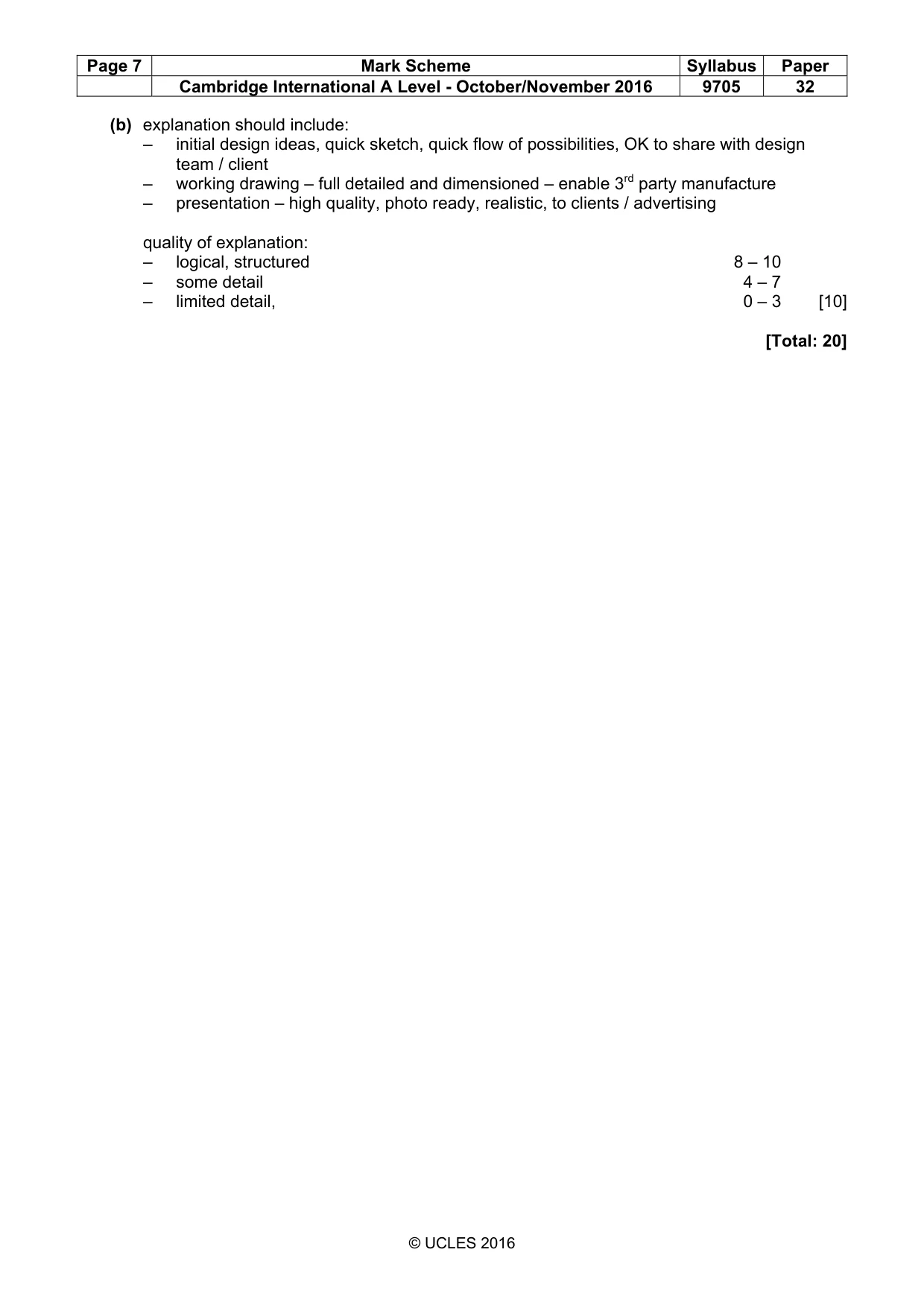
Page 7 Mark Scheme Syllabus Paper Cambridge International A Level - October/November 2016 9705 32 © UCLES 2016 (b) explanation should include: – initial design ideas, quick sketch, quick flow of possibilities, OK to share with design team / client – working drawing – full detailed and dimensioned – enable 3rd party manufacture – presentation – high quality, photo ready, realistic, to clients / advertising quality of explanation: – logical, structured 8 – 10 – some detail 4 – 7 – limited detail, 0 – 3 [10] [Total: 20]
Mark scheme, page 8
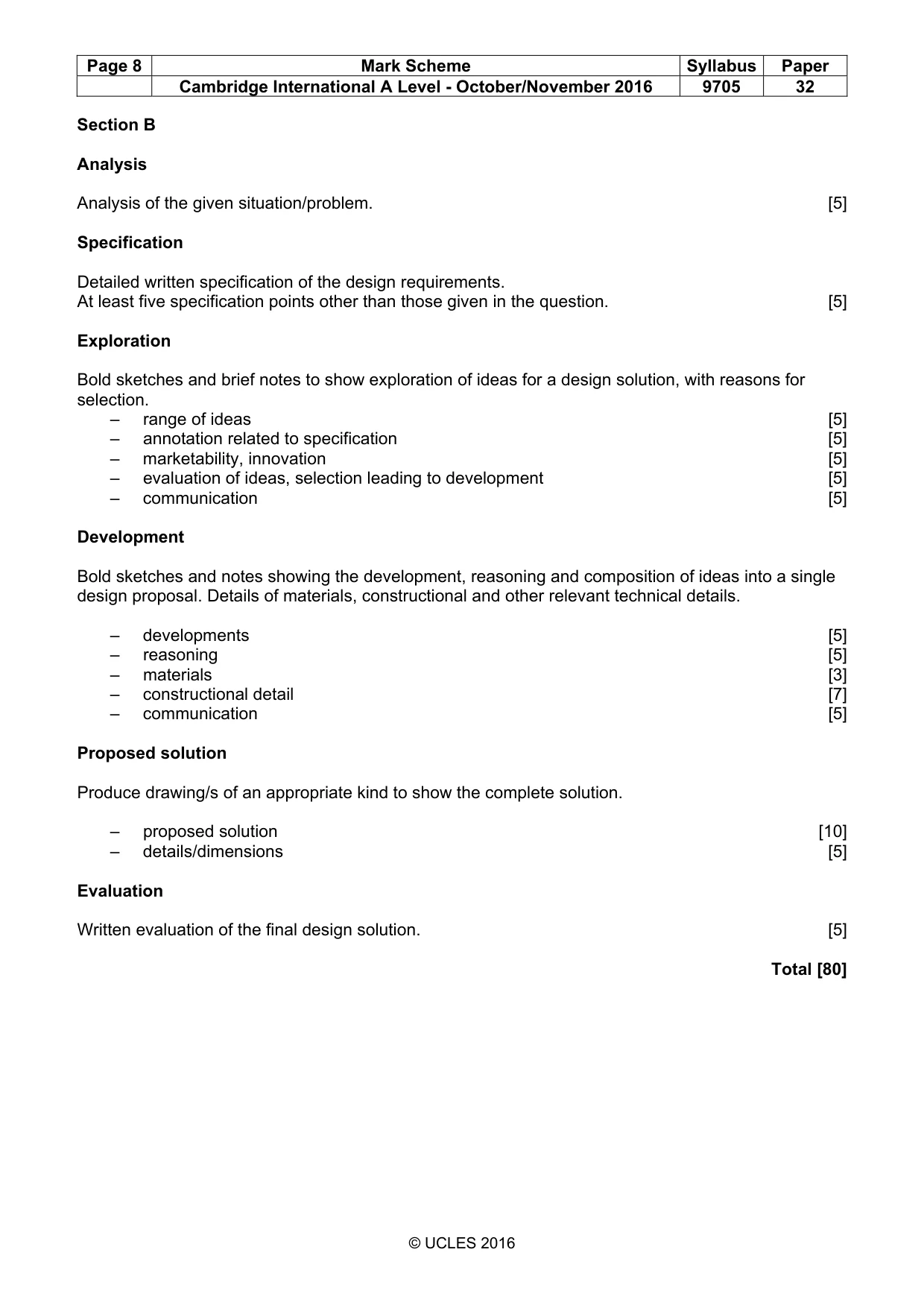
Page 8 Mark Scheme Syllabus Paper Cambridge International A Level - October/November 2016 9705 32 © UCLES 2016 Section B Analysis Analysis of the given situation/problem. [5] Specification Detailed written specification of the design requirements. At least five specification points other than those given in the question. [5] Exploration Bold sketches and brief notes to show exploration of ideas for a design solution, with reasons for selection. – range of ideas [5] – annotation related to specification [5] – marketability, innovation [5] – evaluation of ideas, selection leading to development [5] – communication [5] Development Bold sketches and notes showing the development, reasoning and composition of ideas into a single design proposal. Details of materials, constructional and other relevant technical details. – developments [5] – reasoning [5] – materials [3] – constructional detail [7] – communication [5] Proposed solution Produce drawing/s of an appropriate kind to show the complete solution. – proposed solution [10] – details/dimensions [5] Evaluation Written evaluation of the final design solution. [5] Total [80]
What you needed in this session
Cambridge’s own grade thresholds for 2016 Oct/Nov, Paper 3 · Variant 2. A higher threshold means an easier paper — the bar moves with how the cohort did.