Cambridge A Level Design and Technology 9705 — 2015 Oct/Nov Paper 3 · Variant 3
9705/33/O/N/15 · 120 marks · ≈135 min
The question paper and its mark scheme, free to read here and free to download. This is Cambridge’s own paper, exactly as it was sat.
Question paper12 pages


Mark scheme9 pages
Answers below. Sit the paper first if you are practising.
Paper as text
Question paper, page 1
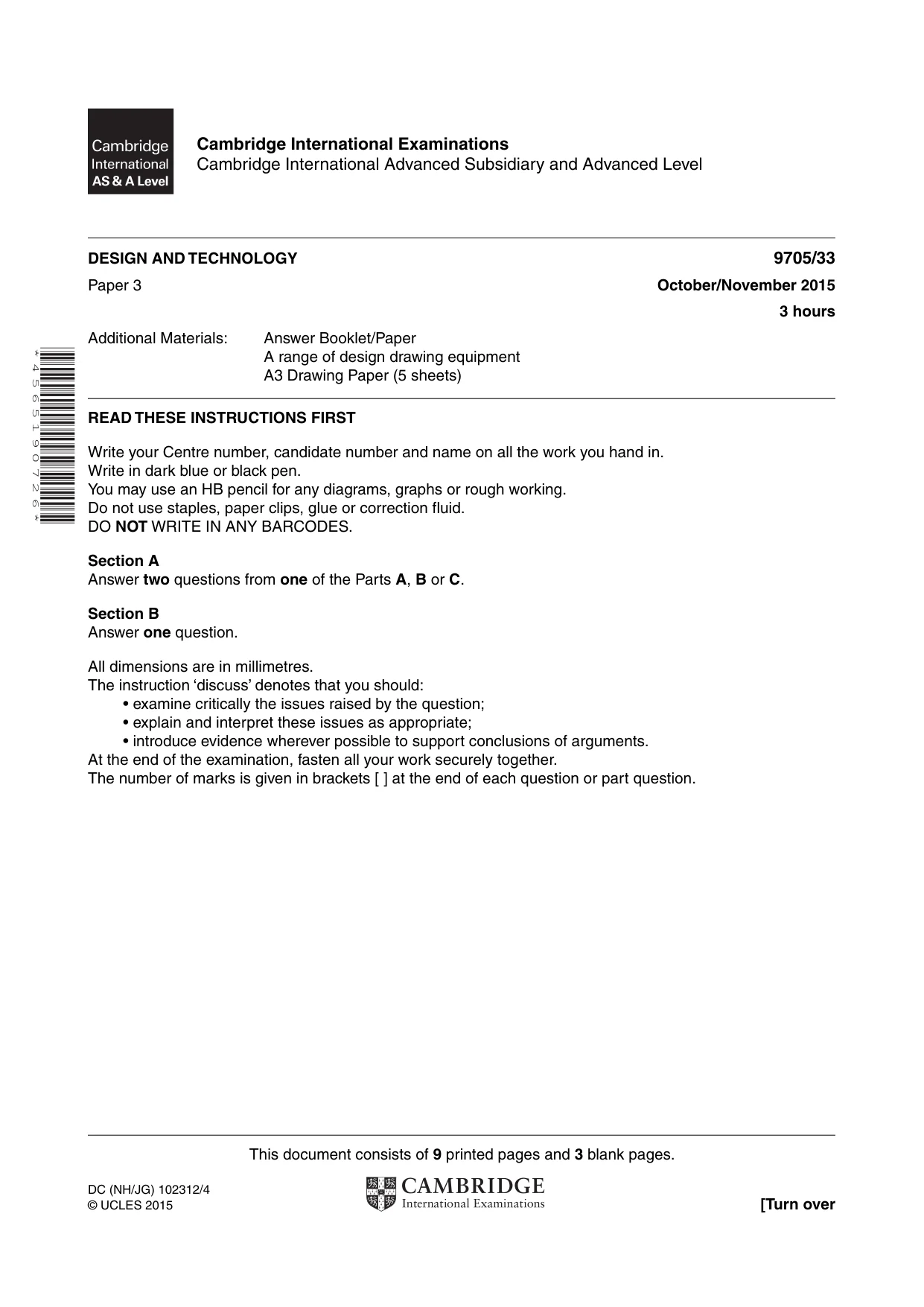
This document consists of 9 printed pages and 3 blank pages. DC (NH/JG) 102312/4 © UCLES 2015 [Turn over * 4 5 6 5 1 9 0 7 2 6 * DESIGN AND TECHNOLOGY 9705/33 Paper 3 October/November 2015 3 hours Additional Materials: Answer Booklet/Paper A range of design drawing equipment A3 Drawing Paper (5 sheets) READ THESE INSTRUCTIONS FIRST Write your Centre number, candidate number and name on all the work you hand in. Write in dark blue or black pen. You may use an HB pencil for any diagrams, graphs or rough working. Do not use staples, paper clips, glue or correction fluid. DO NOT WRITE IN ANY BARCODES. Section A Answer two questions from one of the Parts A, B or C. Section B Answer one question. All dimensions are in millimetres. The instruction ‘discuss’ denotes that you should: • examine critically the issues raised by the question; • explain and interpret these issues as appropriate; • introduce evidence wherever possible to support conclusions of arguments. At the end of the examination, fasten all your work securely together. The number of marks is given in brackets [ ] at the end of each question or part question. Cambridge International Examinations Cambridge International Advanced Subsidiary and Advanced Level
Question paper, page 2
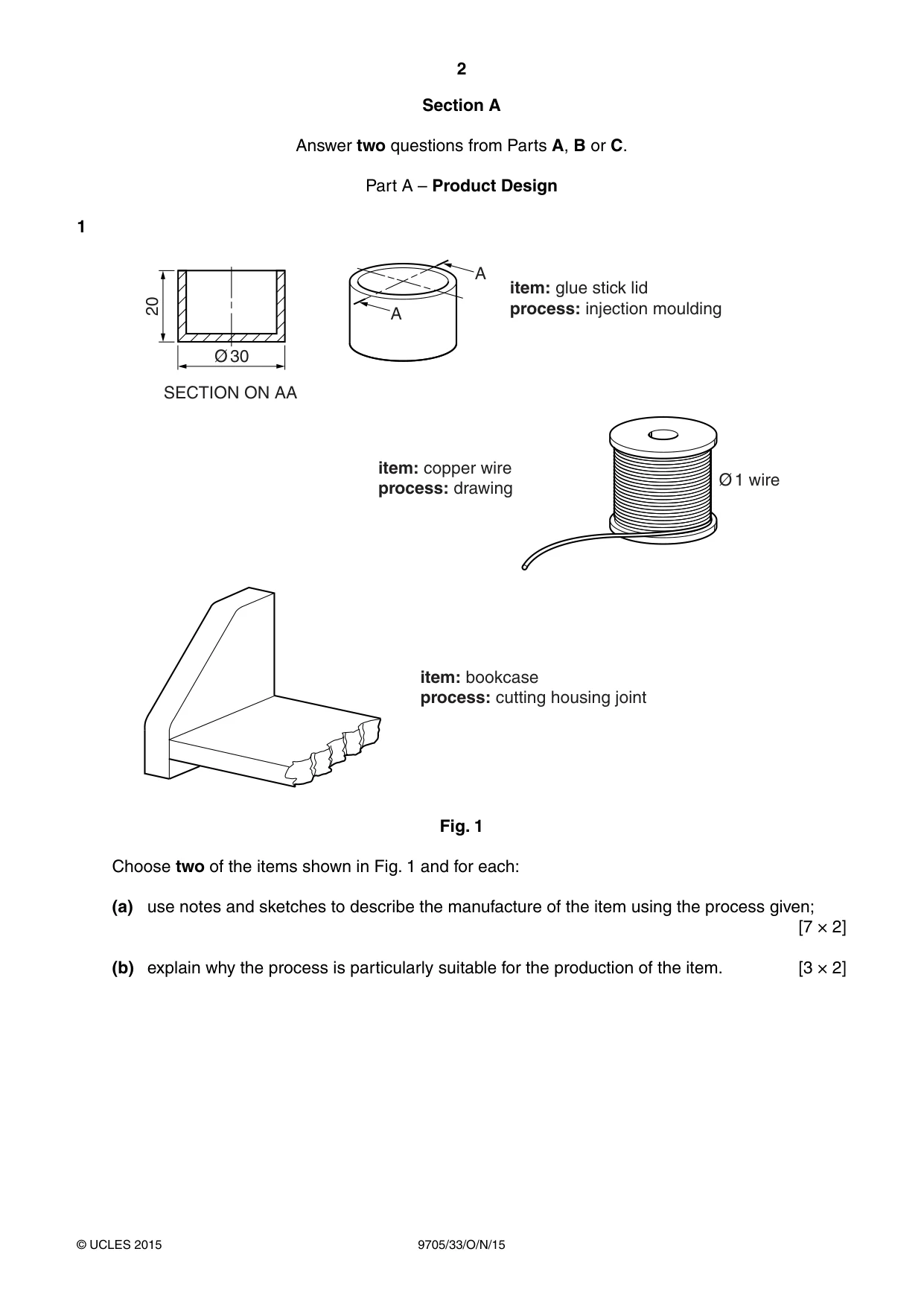
2 9705/33/O/N/15 © UCLES 2015 Section A Answer two questions from Parts A, B or C. Part A – Product Design 1 20 Ø 30 Ø 1 wire SECTION ON AA A A item: glue stick lid process: injection moulding item: copper wire process: drawing item: bookcase process: cutting housing joint Fig. 1 Choose two of the items shown in Fig. 1 and for each: (a) use notes and sketches to describe the manufacture of the item using the process given; [7 × 2] (b) explain why the process is particularly suitable for the production of the item. [3 × 2]
Question paper, page 3
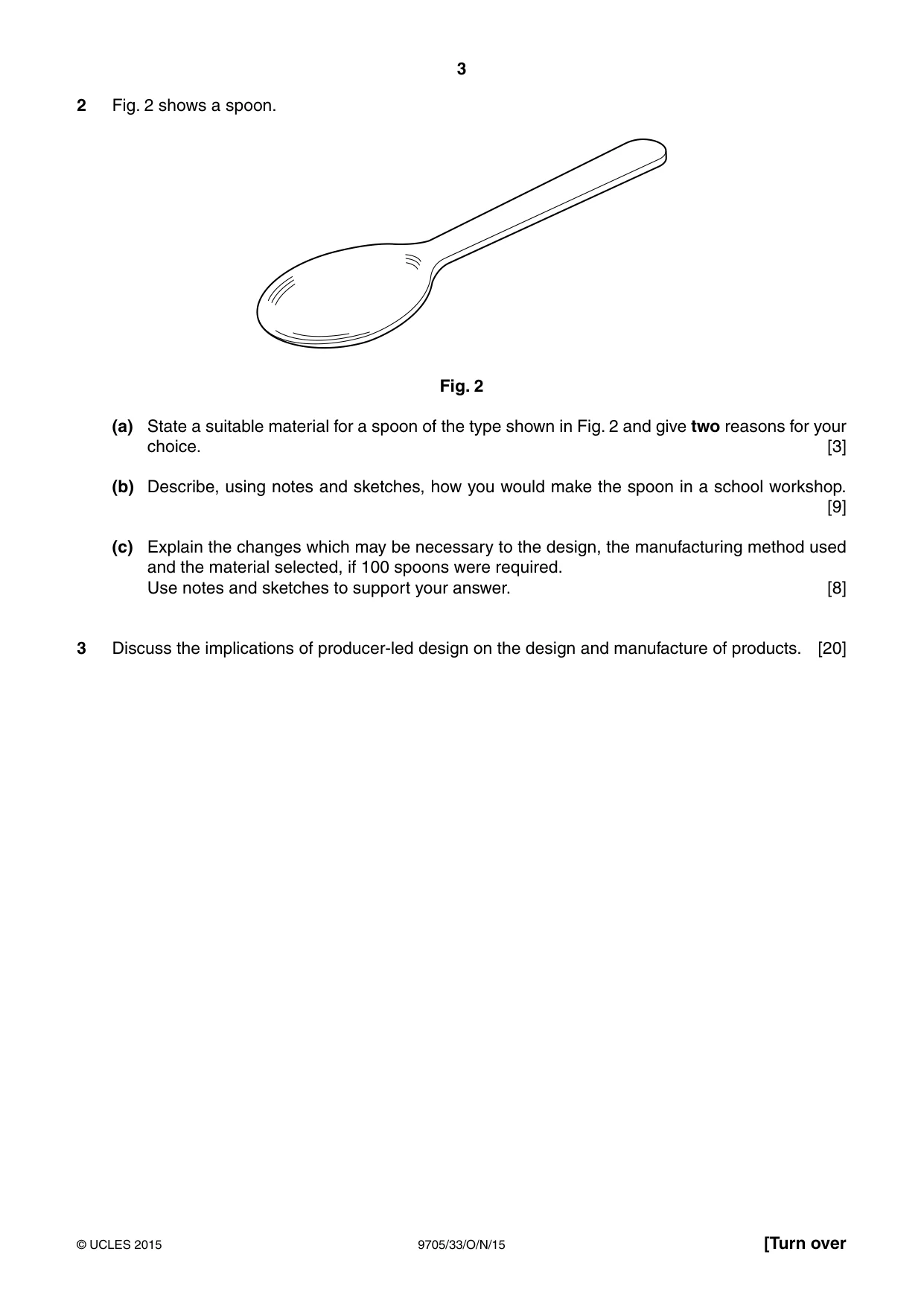
3 9705/33/O/N/15 © UCLES 2015 [Turn over 2 Fig. 2 shows a spoon. Fig. 2 (a) State a suitable material for a spoon of the type shown in Fig. 2 and give two reasons for your choice. [3] (b) Describe, using notes and sketches, how you would make the spoon in a school workshop. [9] (c) Explain the changes which may be necessary to the design, the manufacturing method used and the material selected, if 100 spoons were required. Use notes and sketches to support your answer. [8] 3 Discuss the implications of producer-led design on the design and manufacture of products. [20]
Question paper, page 4
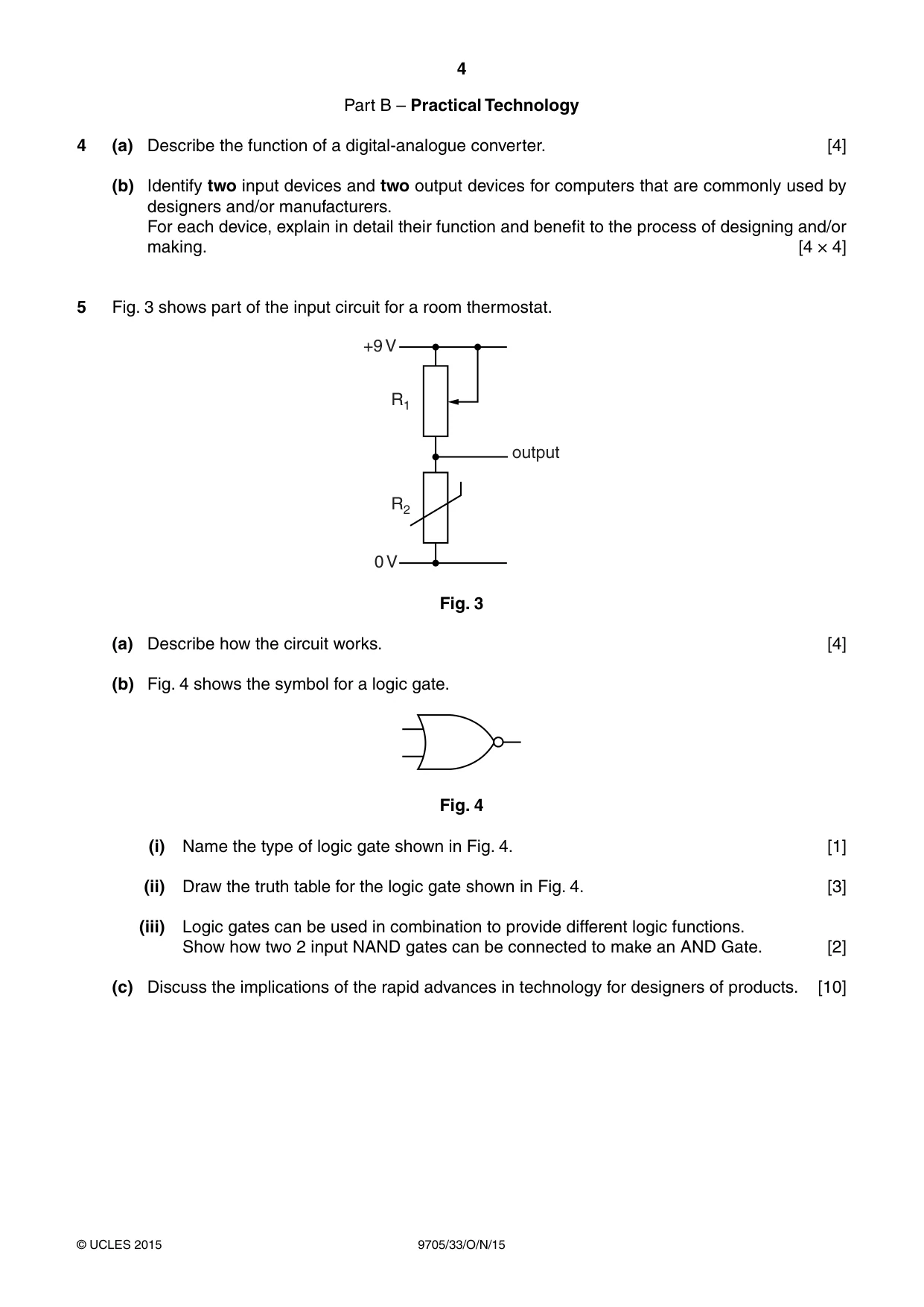
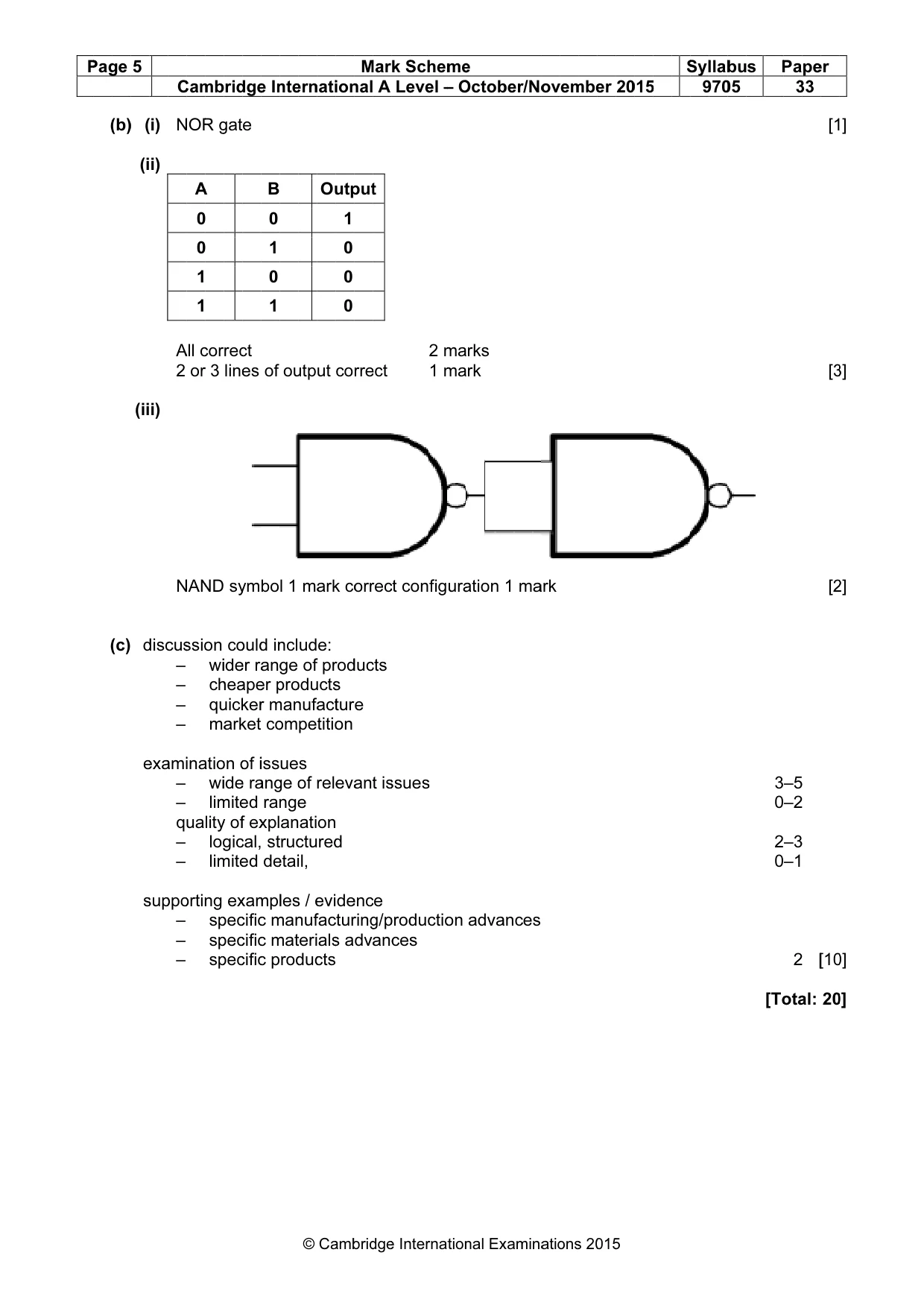
4 9705/33/O/N/15 © UCLES 2015 Part B – Practical Technology 4 (a) Describe the function of a digital-analogue converter. [4] (b) Identify two input devices and two output devices for computers that are commonly used by designers and/or manufacturers. For each device, explain in detail their function and benefit to the process of designing and/or making. [4 × 4] 5 Fig. 3 shows part of the input circuit for a room thermostat. output +9 V 0 V R2 R1 Fig. 3 (a) Describe how the circuit works. [4] (b) Fig. 4 shows the symbol for a logic gate. Fig. 4 (i) Name the type of logic gate shown in Fig. 4. [1] (ii) Draw the truth table for the logic gate shown in Fig. 4. [3] (iii) Logic gates can be used in combination to provide different logic functions. Show how two 2 input NAND gates can be connected to make an AND Gate. [2] (c) Discuss the implications of the rapid advances in technology for designers of products. [10]
Question paper, page 5
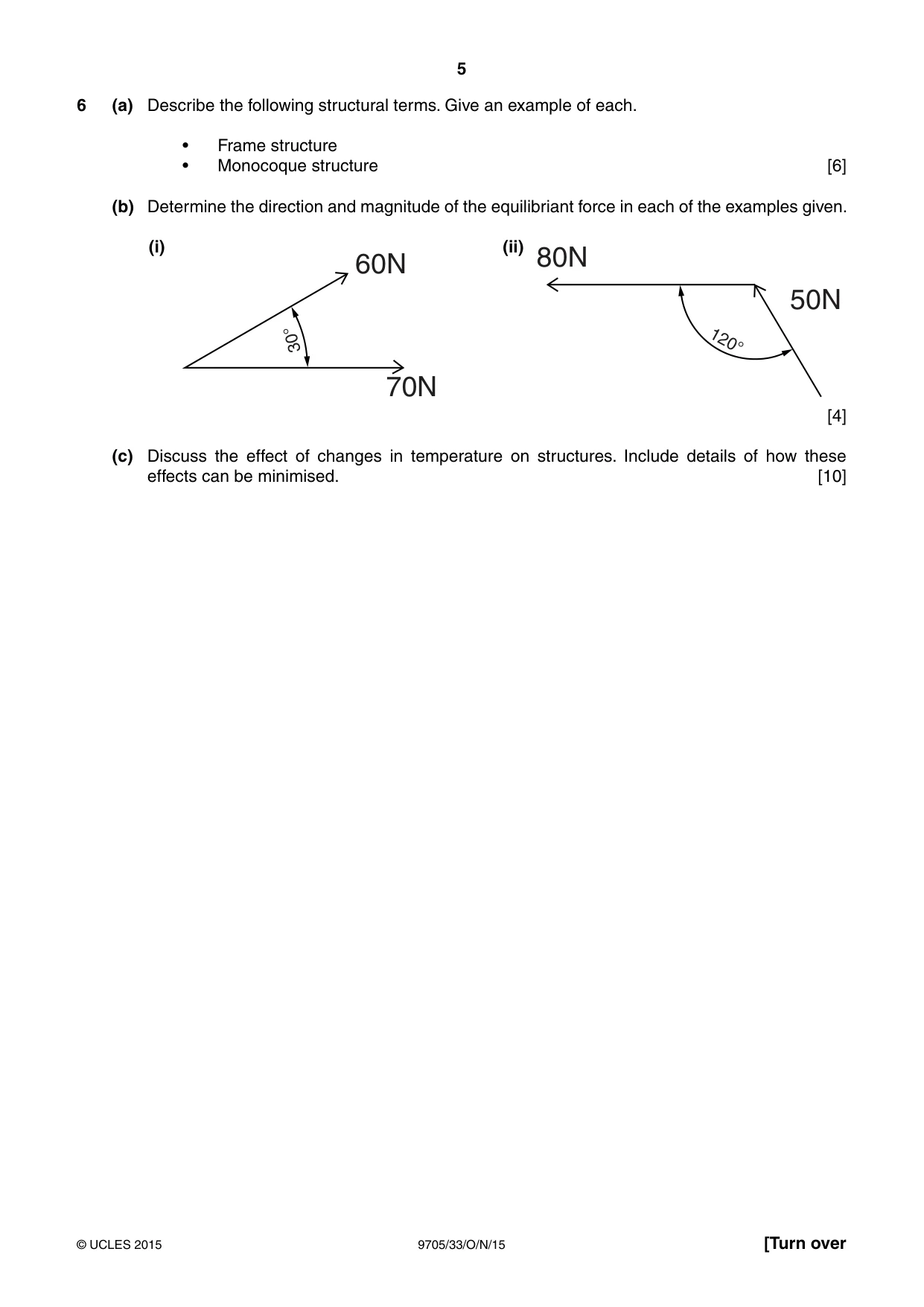
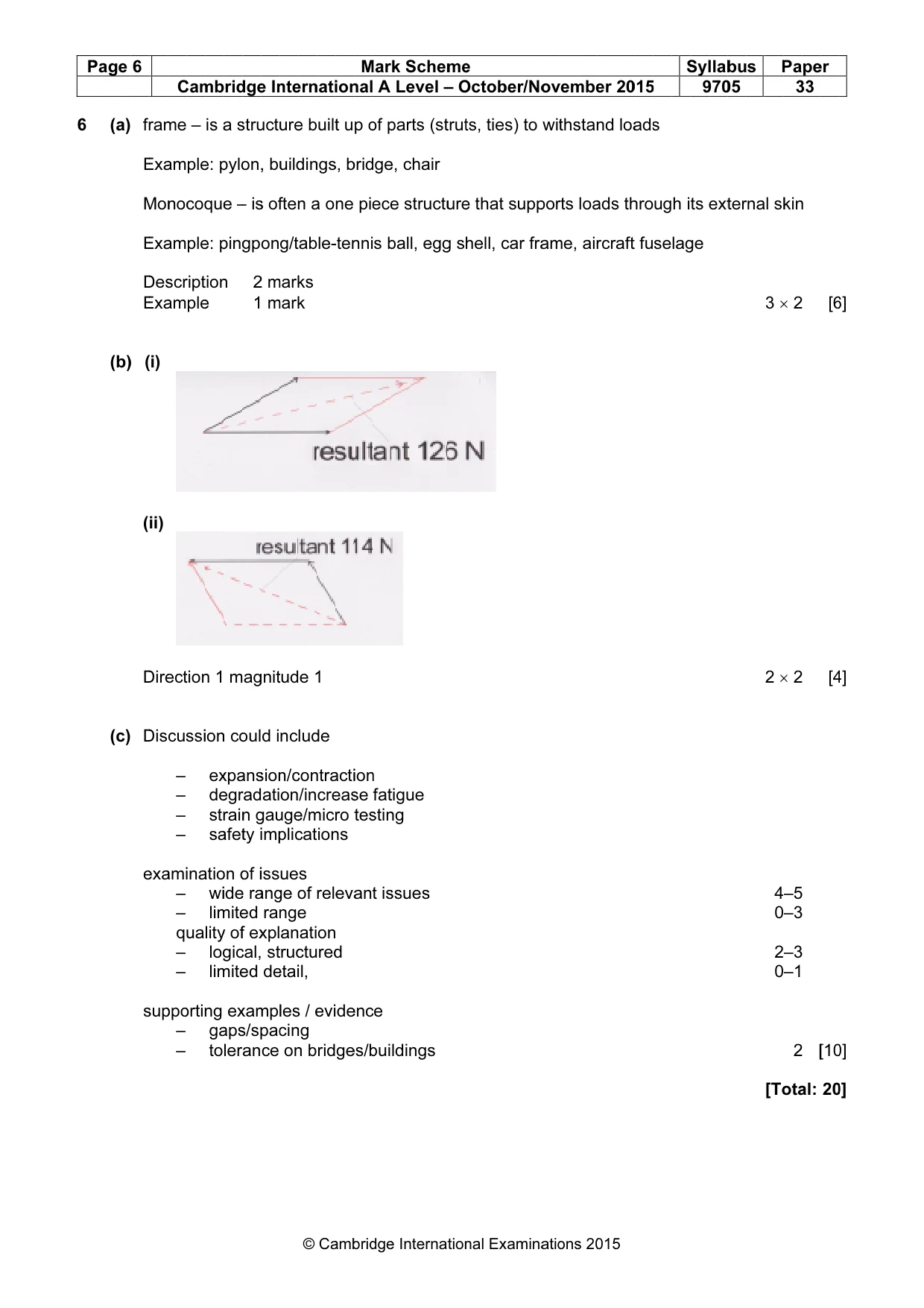
5 9705/33/O/N/15 © UCLES 2015 [Turn over 6 (a) Describe the following structural terms. Give an example of each. • Frame structure • Monocoque structure [6] (b) Determine the direction and magnitude of the equilibriant force in each of the examples given. (i) (ii) 30° 120° 60N 70N 80N 50N [4] (c) Discuss the effect of changes in temperature on structures. Include details of how these effects can be minimised. [10]
Question paper, page 6
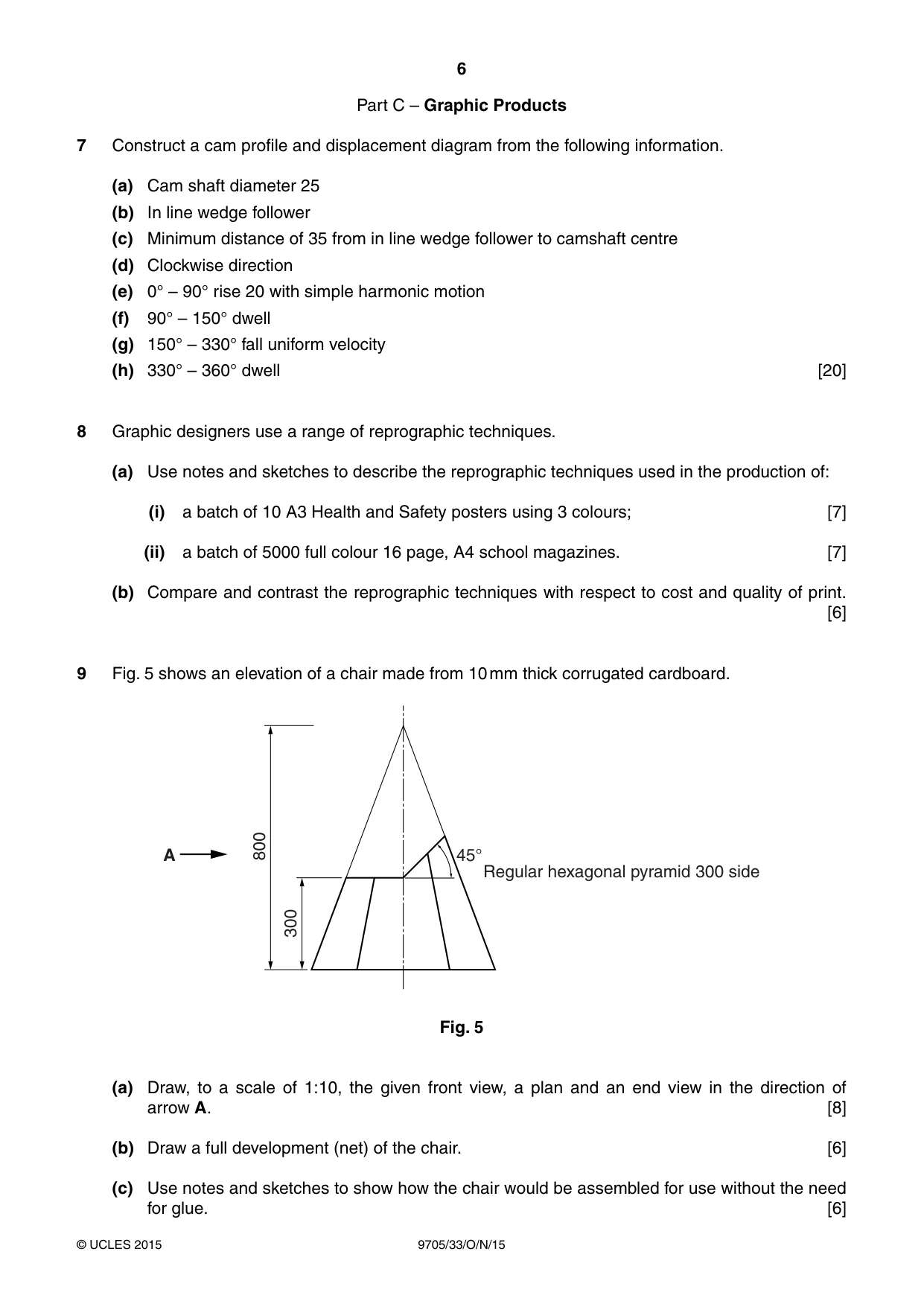
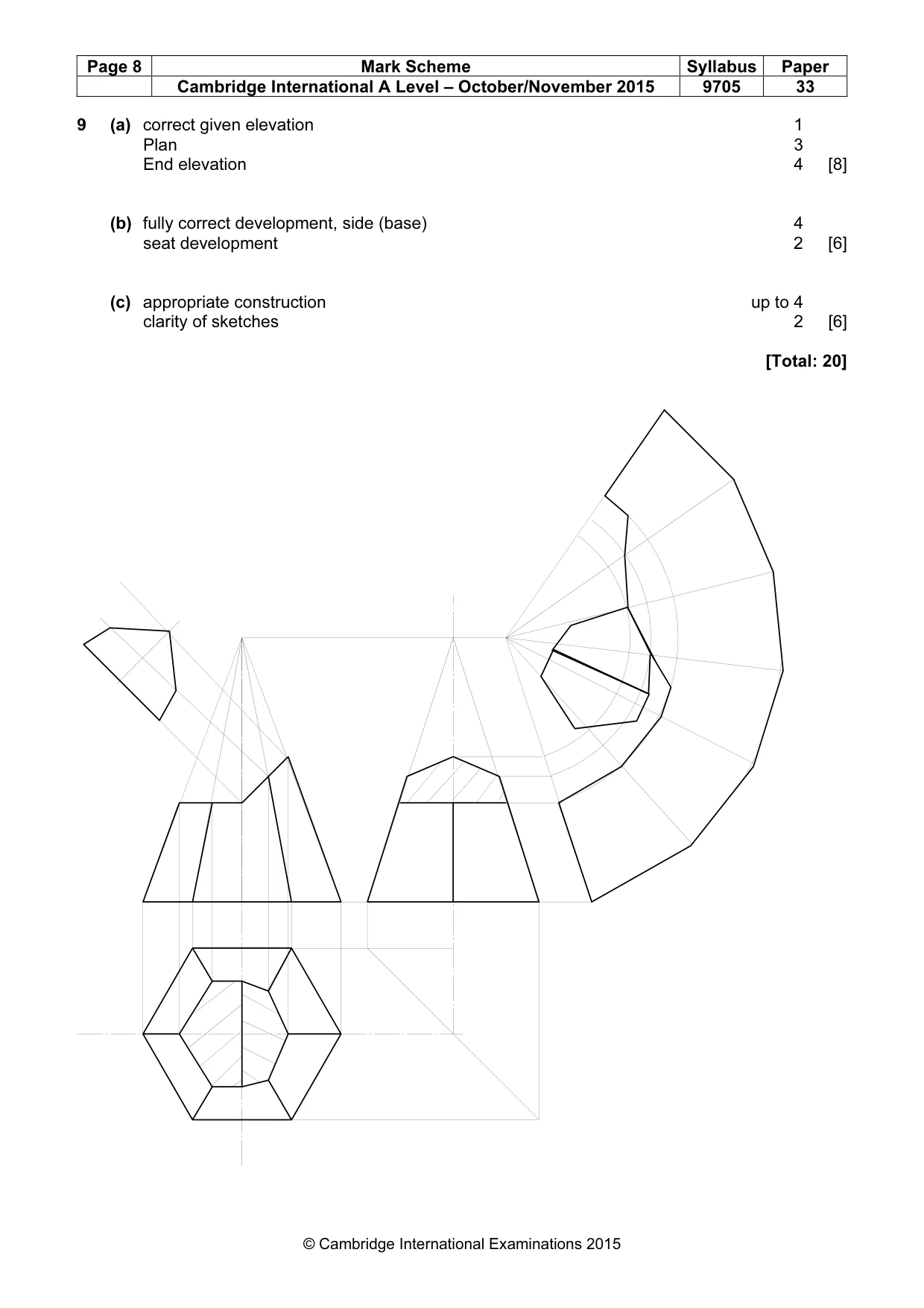
6 9705/33/O/N/15 © UCLES 2015 Part C – Graphic Products 7 Construct a cam profile and displacement diagram from the following information. (a) Cam shaft diameter 25 (b) In line wedge follower (c) Minimum distance of 35 from in line wedge follower to camshaft centre (d) Clockwise direction (e) 0° – 90° rise 20 with simple harmonic motion (f) 90° – 150° dwell (g) 150° – 330° fall uniform velocity (h) 330° – 360° dwell [20] 8 Graphic designers use a range of reprographic techniques. (a) Use notes and sketches to describe the reprographic techniques used in the production of: (i) a batch of 10 A3 Health and Safety posters using 3 colours; [7] (ii) a batch of 5000 full colour 16 page, A4 school magazines. [7] (b) Compare and contrast the reprographic techniques with respect to cost and quality of print. [6] 9 Fig. 5 shows an elevation of a chair made from 10 mm thick corrugated cardboard. 45° 800 300 Regular hexagonal pyramid 300 side A Fig. 5 (a) Draw, to a scale of 1:10, the given front view, a plan and an end view in the direction of arrow A. [8] (b) Draw a full development (net) of the chair. [6] (c) Use notes and sketches to show how the chair would be assembled for use without the need for glue. [6]
Question paper, page 7
7 9705/33/O/N/15 © UCLES 2015 [Turn over Section B Answer one question on the A3 paper provided. You should approach the design question of your choice in the following manner: Analysis Produce an analysis of the given situation/problem, which may be in written or graphical form. [5] Specifi cation From the analysis produce a detailed written specification of the design requirements. Include at least five specification points other than those given in the question. [5] Exploration Use bold sketches and brief notes to show your exploration of ideas for a design solution, with reasons for selection. [25] Development Show, using bold sketches and notes, the development, reasoning and composition of ideas into a single design proposal. Give details of materials, constructional and other relevant technical details. [25] Proposed solution Produce drawings of an appropriate kind to show the complete solution. [15] Evaluation Give a written evaluation of the final design solution. [5] [Total: 80]
Question paper, page 8
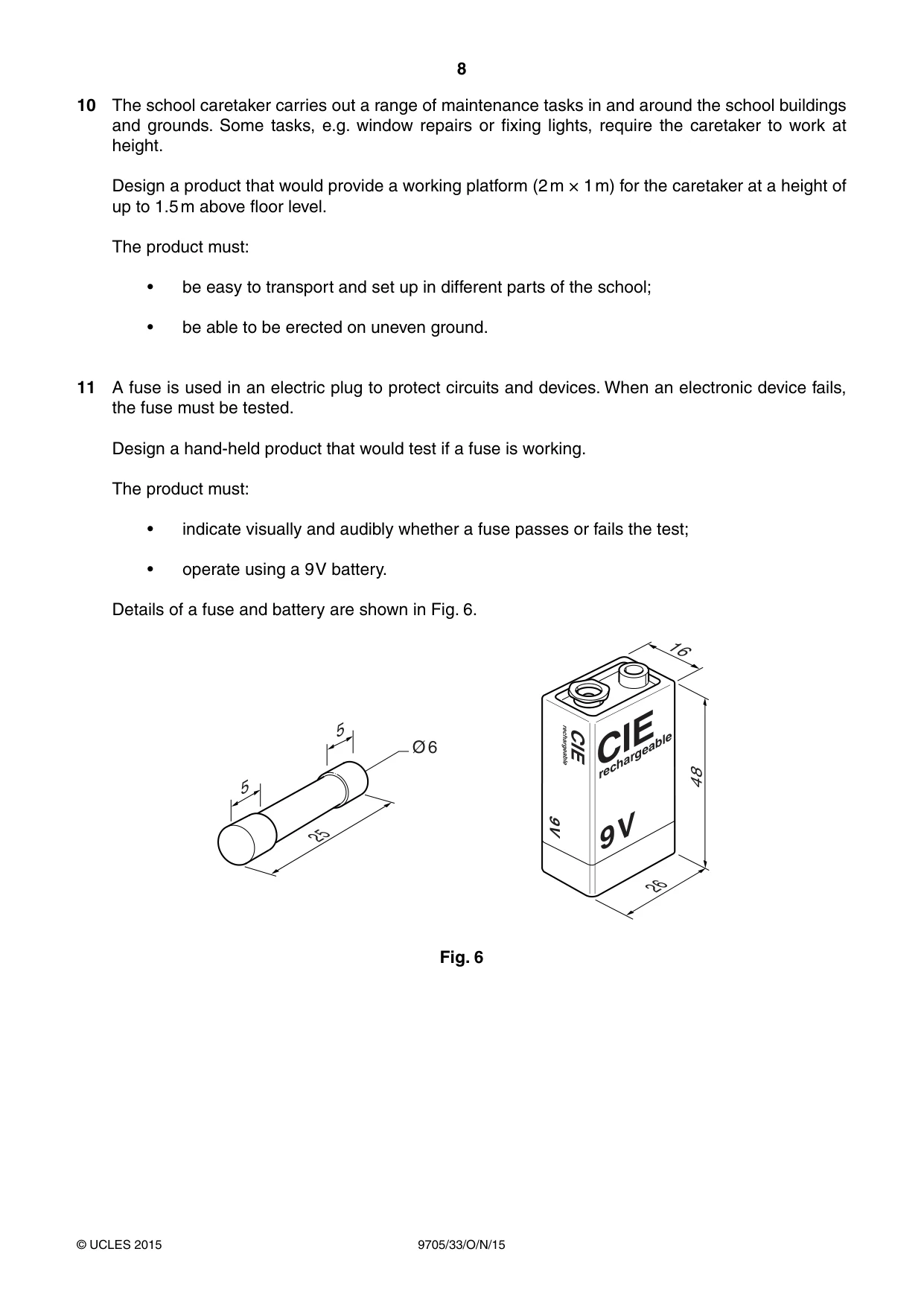
8 9705/33/O/N/15 © UCLES 2015 10 The school caretaker carries out a range of maintenance tasks in and around the school buildings and grounds. Some tasks, e.g. window repairs or fixing lights, require the caretaker to work at height. Design a product that would provide a working platform (2 m × 1 m) for the caretaker at a height of up to 1.5 m above floor level. The product must: • be easy to transport and set up in different parts of the school; • be able to be erected on uneven ground. 11 A fuse is used in an electric plug to protect circuits and devices. When an electronic device fails, the fuse must be tested. Design a hand-held product that would test if a fuse is working. The product must: • indicate visually and audibly whether a fuse passes or fails the test; • operate using a 9 V battery. Details of a fuse and battery are shown in Fig. 6. 25 26 CIE 9 V 5 5 rechargeable CIE 9 V rechargeable Ø 6 48 16 Fig. 6
Question paper, page 9
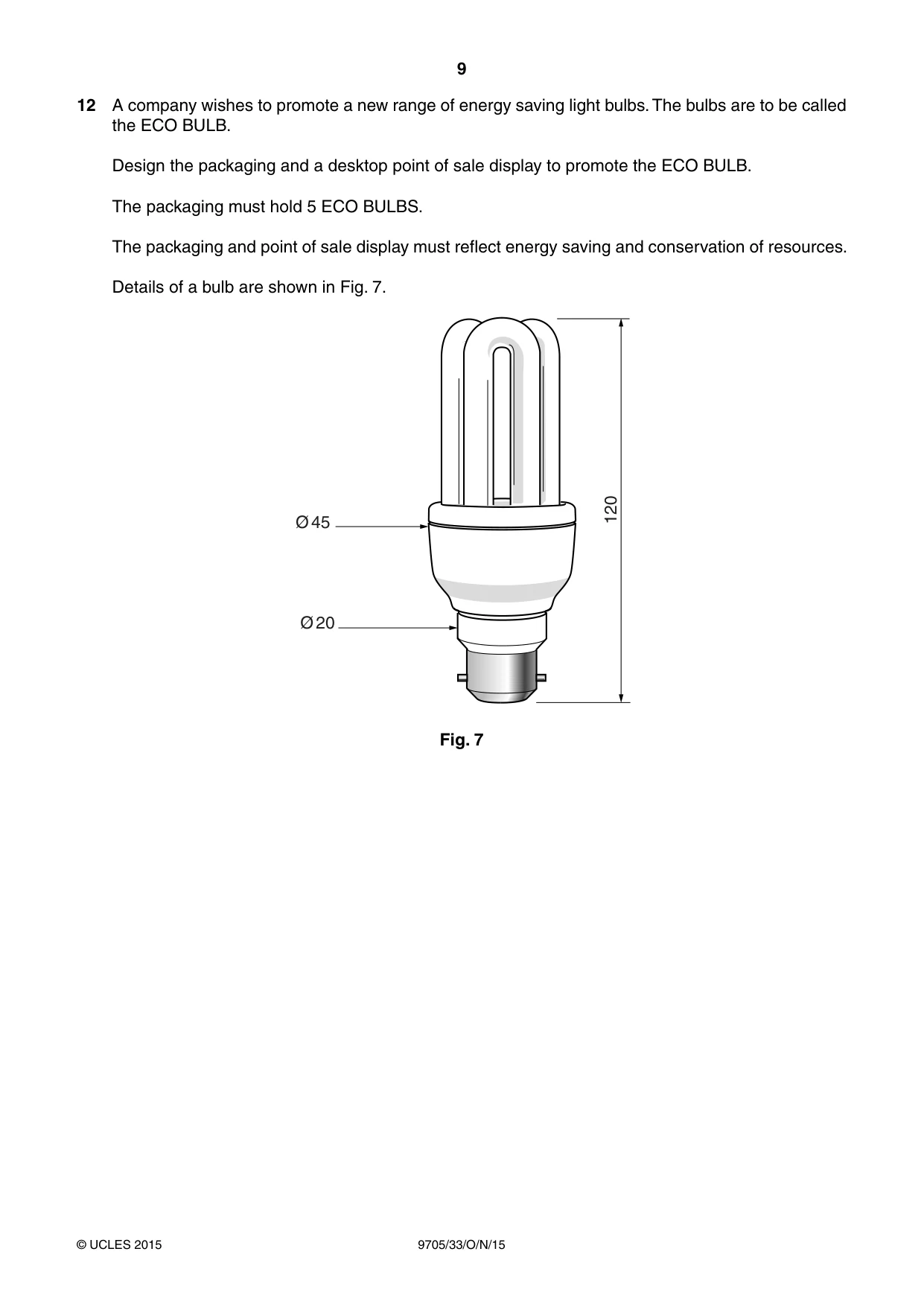
9 9705/33/O/N/15 © UCLES 2015 12 A company wishes to promote a new range of energy saving light bulbs. The bulbs are to be called the ECO BULB. Design the packaging and a desktop point of sale display to promote the ECO BULB. The packaging must hold 5 ECO BULBS. The packaging and point of sale display must reflect energy saving and conservation of resources. Details of a bulb are shown in Fig. 7. Ø 45 Ø 20 120 Fig. 7
Question paper, page 10
10 9705/33/O/N/15 © UCLES 2015 BLANK PAGE
Question paper, page 11
11 9705/33/O/N/15 © UCLES 2015 BLANK PAGE
Question paper, page 12
12 9705/33/O/N/15 © UCLES 2015 BLANK PAGE Permission to reproduce items where third-party owned material protected by copyright is included has been sought and cleared where possible. Every reasonable effort has been made by the publisher (UCLES) to trace copyright holders, but if any items requiring clearance have unwittingly been included, the publisher will be pleased to make amends at the earliest possible opportunity. To avoid the issue of disclosure of answer-related information to candidates, all copyright acknowledgements are reproduced online in the Cambridge International Examinations Copyright Acknowledgements Booklet. This is produced for each series of examinations and is freely available to download at www.cie.org.uk after the live examination series. Cambridge International Examinations is part of the Cambridge Assessment Group. Cambridge Assessment is the brand name of University of Cambridge Local Examinations Syndicate (UCLES), which is itself a department of the University of Cambridge.
Mark scheme, page 1
® IGCSE is the registered trademark of Cambridge International Examinations. CAMBRIDGE INTERNATIONAL EXAMINATIONS Cambridge International Advanced Level MARK SCHEME for the October/November 2015 series 9705 DESIGN AND TECHNOLOGY 9705/33 Paper 3, maximum raw mark 120 This mark scheme is published as an aid to teachers and candidates, to indicate the requirements of the examination. It shows the basis on which Examiners were instructed to award marks. It does not indicate the details of the discussions that took place at an Examiners’ meeting before marking began, which would have considered the acceptability of alternative answers. Mark schemes should be read in conjunction with the question paper and the Principal Examiner Report for Teachers. Cambridge will not enter into discussions about these mark schemes. Cambridge is publishing the mark schemes for the October/November 2015 series for most Cambridge IGCSE®, Cambridge International A and AS Level components and some Cambridge O Level components.
Mark scheme, page 2
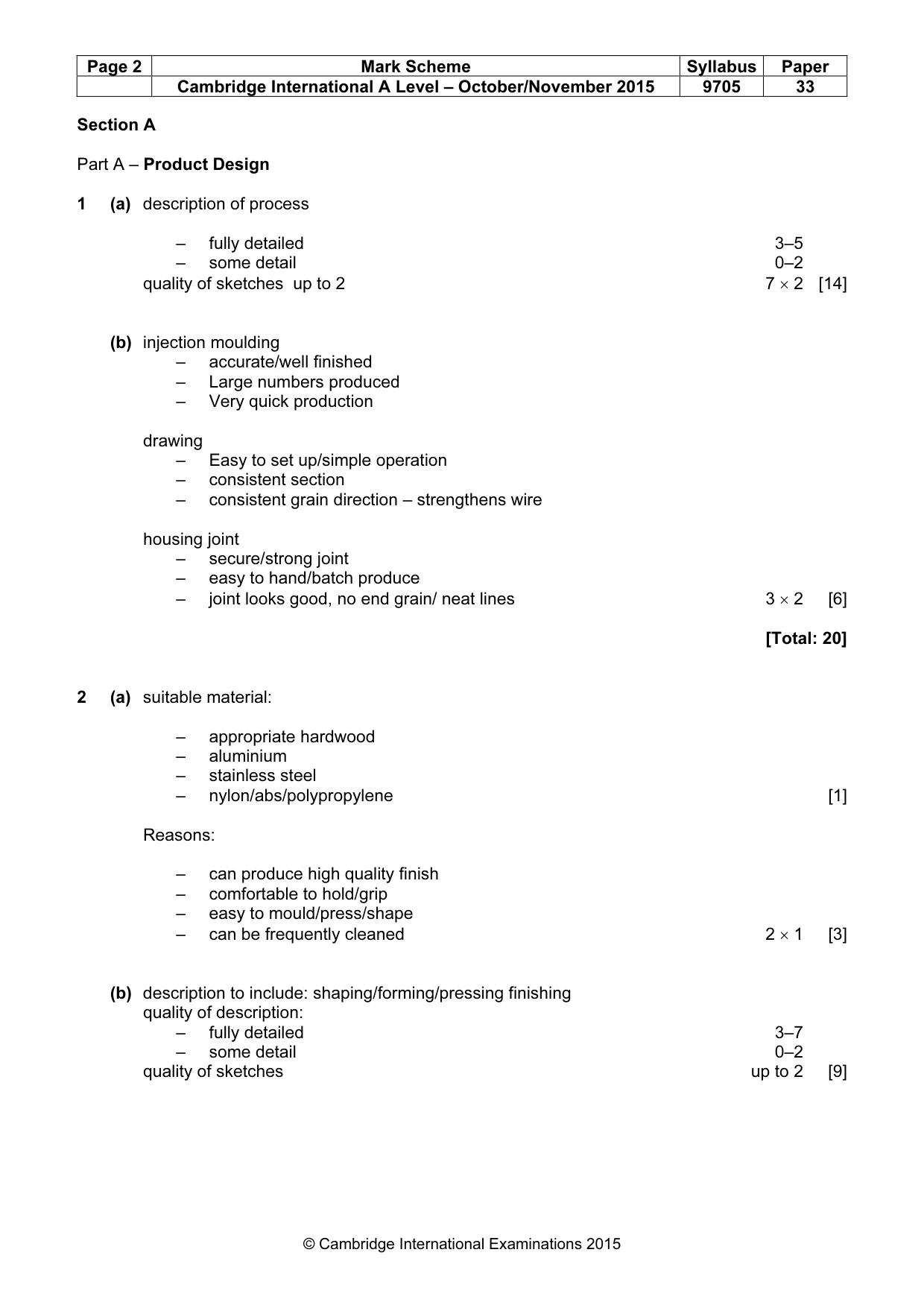
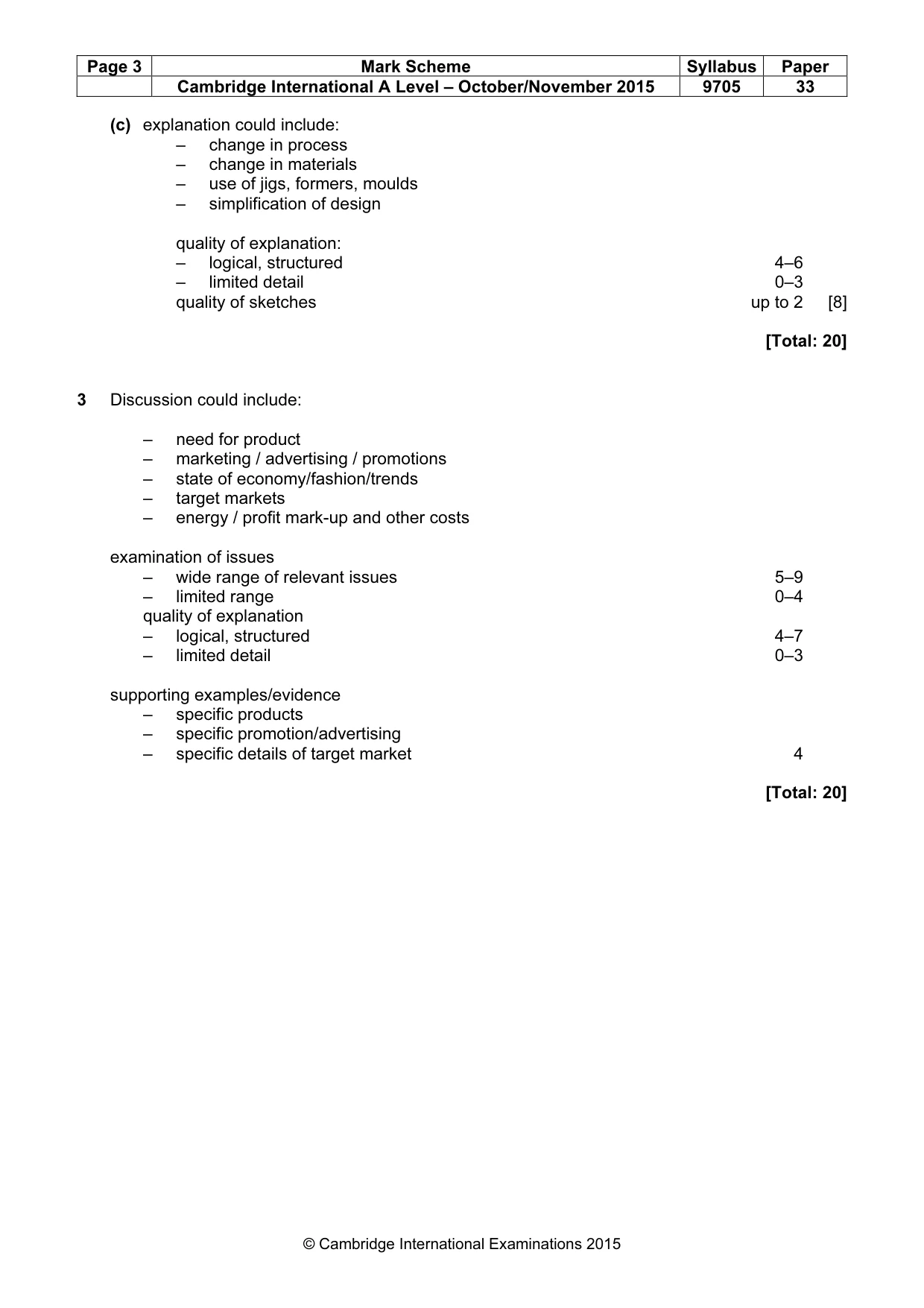
Page 2 Mark Scheme Syllabus Paper Cambridge International A Level – October/November 2015 9705 33 © Cambridge International Examinations 2015 Section A Part A – Product Design 1 (a) description of process – fully detailed 3–5 – some detail 0–2 quality of sketches up to 2 7 × 2 [14] (b) injection moulding – accurate/well finished – Large numbers produced – Very quick production drawing – Easy to set up/simple operation – consistent section – consistent grain direction – strengthens wire housing joint – secure/strong joint – easy to hand/batch produce – joint looks good, no end grain/ neat lines 3 × 2 [6] [Total: 20] 2 (a) suitable material: – appropriate hardwood – aluminium – stainless steel – nylon/abs/polypropylene [1] Reasons: – can produce high quality finish – comfortable to hold/grip – easy to mould/press/shape – can be frequently cleaned 2 × 1 [3] (b) description to include: shaping/forming/pressing finishing quality of description: – fully detailed 3–7 – some detail 0–2 quality of sketches up to 2 [9]
Mark scheme, page 3
Page 3 Mark Scheme Syllabus Paper Cambridge International A Level – October/November 2015 9705 33 © Cambridge International Examinations 2015 (c) explanation could include: – change in process – change in materials – use of jigs, formers, moulds – simplification of design quality of explanation: – logical, structured 4–6 – limited detail 0–3 quality of sketches up to 2 [8] [Total: 20] 3 Discussion could include: – need for product – marketing / advertising / promotions – state of economy/fashion/trends – target markets – energy / profit mark-up and other costs examination of issues – wide range of relevant issues 5–9 – limited range 0–4 quality of explanation – logical, structured 4–7 – limited detail 0–3 supporting examples/evidence – specific products – specific promotion/advertising – specific details of target market 4 [Total: 20]
Mark scheme, page 4
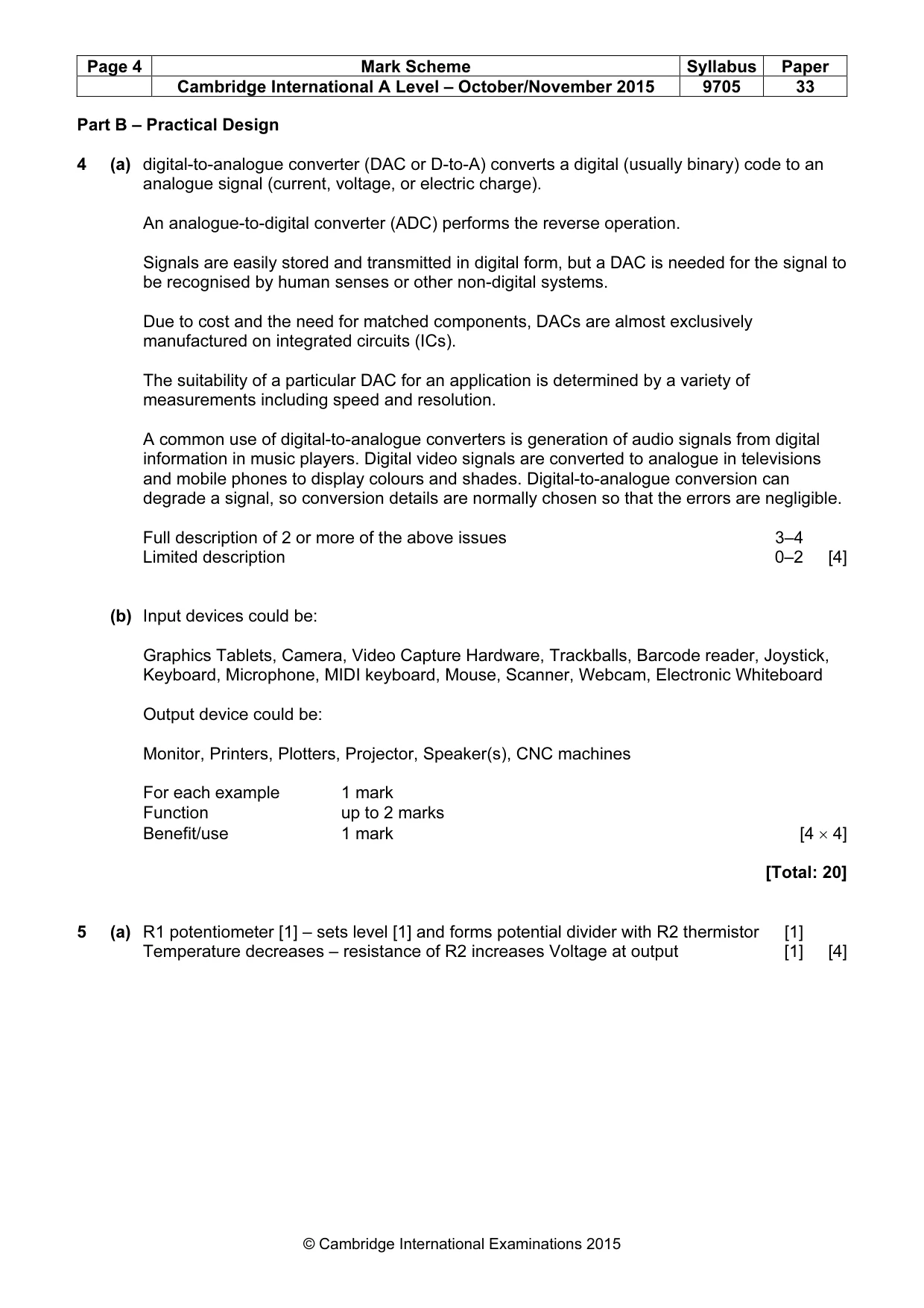
Page 4 Mark Scheme Syllabus Paper Cambridge International A Level – October/November 2015 9705 33 © Cambridge International Examinations 2015 Part B – Practical Design 4 (a) digital-to-analogue converter (DAC or D-to-A) converts a digital (usually binary) code to an analogue signal (current, voltage, or electric charge). An analogue-to-digital converter (ADC) performs the reverse operation. Signals are easily stored and transmitted in digital form, but a DAC is needed for the signal to be recognised by human senses or other non-digital systems. Due to cost and the need for matched components, DACs are almost exclusively manufactured on integrated circuits (ICs). The suitability of a particular DAC for an application is determined by a variety of measurements including speed and resolution. A common use of digital-to-analogue converters is generation of audio signals from digital information in music players. Digital video signals are converted to analogue in televisions and mobile phones to display colours and shades. Digital-to-analogue conversion can degrade a signal, so conversion details are normally chosen so that the errors are negligible. Full description of 2 or more of the above issues 3–4 Limited description 0–2 [4] (b) Input devices could be: Graphics Tablets, Camera, Video Capture Hardware, Trackballs, Barcode reader, Joystick, Keyboard, Microphone, MIDI keyboard, Mouse, Scanner, Webcam, Electronic Whiteboard Output device could be: Monitor, Printers, Plotters, Projector, Speaker(s), CNC machines For each example 1 mark Function up to 2 marks Benefit/use 1 mark [4 × 4] [Total: 20] 5 (a) R1 potentiometer [1] – sets level [1] and forms potential divider with R2 thermistor [1] Temperature decreases – resistance of R2 increases Voltage at output [1] [4]
Mark scheme, page 5
P Pag ( ( ge (b) (c) 5 ) ( (i (ii d e s (i) i) i) disc exa sup C N A 2 N cus – – – – ami – – q – – ppo – – – Cam NOR A 0 0 1 1 All c or NAN ssio ina ua ortin mb R g A cor r 3 ND on wi ch qu ma atio wi lim lity log lim ng sp sp sp rid gat rec line sy co ide hea uick ark on o ide mite y of gic mite ex pec pec pec dge e ct es ym ould er ra ape ker ket of i e ra ed f ex cal, ed xam cific cific cific e In B 0 1 0 1 of bo d in ang er p r m co iss ang ran xpl st de mpl c m c m c p nte ou l 1 ncl ge pro man om ue ge o nge an truc etai les man mat rod ern © utp ma ud of odu nufa pe s of e ati ctu il, s / e nuf teri duc nati Ca Ou ut ark e: f pr ucts act titio rele on red evi fac als cts ion amb utp 1 0 0 0 co k co rod s tur on eva d de ctur s a M nal brid put rre orr duc e ant enc ring dva Mar A dge t ect rec cts t is ce g/p anc k S Le e In ct c ssu prod ces Sch eve nter on ues duc s hem el – rnat 2 m 1 m fig s ctio me – O tion ma ma ura on e Oct nal rks rk atio ad tob Ex s on dva ber xam 1 m anc r/No mina ma ces ov atio ark vem ons mbe s 20 er 015 20 5 015 Syl 9 llab 970 bu 05 s P 3 0 2 0 [To Pa 3 –5 –2 –3 –1 2 ota pe 33 [ al: er [1 [3 [2 [10 20 ] 3] 2] 0] 0]
Mark scheme, page 6
P 6 Pag ( ( ( ge (a) (b) (c) 6 fr E M E D E ) ( ( D D e s ram Exa Mon Exa Des Exa (i) ii) Dire Dis exa sup C me am noc am scr am ect cus – – – – ami – – q – – ppo – – Cam – ple coq ple ript ple tion ssi ina ua ortin mb is a e: p que e: p tion e n 1 ion ex de str sa atio wi lim lity log lim ng ga to rid a s pylo e – ping n m n co xpa egr rain afet on o ide mite y of gic mite ex aps ler dge stru on, – is gp 2 1 ag oul ans rad n g ty i of i e ra ed f ex cal, ed xam s/sp an e In uctu , bu s of on 2 m m gnit d i sion ati gau imp iss ang ran xpl st de mpl pac ce nte ure uild ften g/t mark mark tud nc n/c on uge plic ue ge o nge an truc etai les cin on ern © e b din n a ab ks k e 1 lud con /in e/m cat s of e ati ctu il, s / e ng n b nati Ca uilt ngs a o le- 1 de ntra cre micr ion rele on red evi rid ion amb t u s, b ne -ten acti eas ro t ns eva d de ge M nal brid p o brid pie nni ion se tes ant enc es/b Mar A dge of p dge ece s b n fat stin t is ce bui k S Le e In par e, c e s bal tigu ng ssu ldin Sch eve nter rts cha stru l, e ue ues ngs hem el – rnat (st air uctu egg s s me – O tion trut ure g sh e Oct nal ts, e th hel tob Ex tie hat ll, c ber xam s) su car r/No mina to upp r fra ov atio wit por am vem ons ths rts me, mbe s 20 stan loa air er 015 nd ads rcr 20 5 loa s th raft 015 ads hro t fu 5 s ug se S h i lag Syl 9 ts ge llab 970 ext bu 05 ter s rna P l sk 3 × 2 × 4 0 2 0 [To Pa 3 kin × 2 × 2 –5 –3 –3 –1 2 ota pe 33 n [ al: er [6 [4 [10 20 6] 4] 0] 0]
Mark scheme, page 7
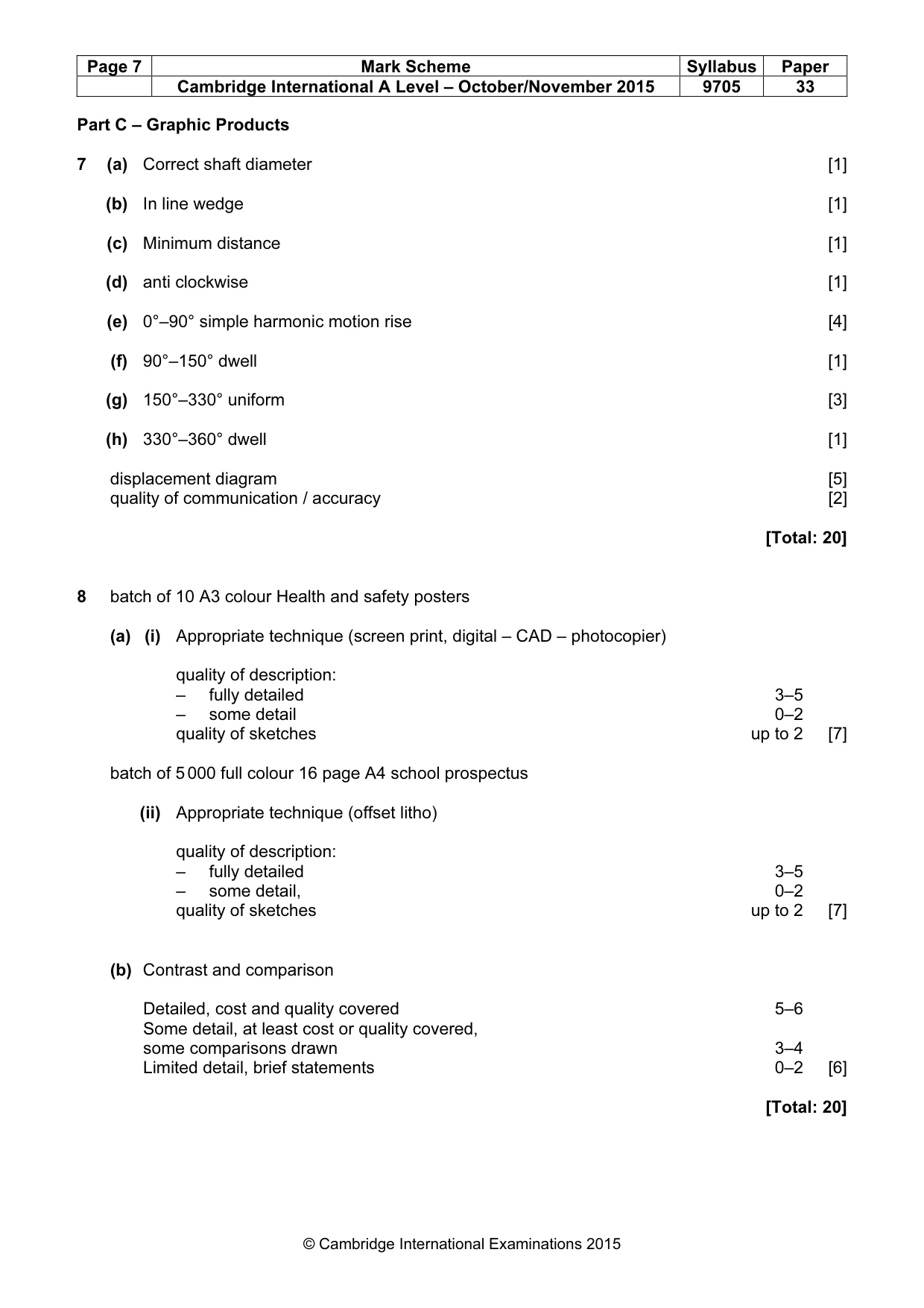
Page 7 Mark Scheme Syllabus Paper Cambridge International A Level – October/November 2015 9705 33 © Cambridge International Examinations 2015 Part C – Graphic Products 7 (a) Correct shaft diameter [1] (b) In line wedge [1] (c) Minimum distance [1] (d) anti clockwise [1] (e) 0°–90° simple harmonic motion rise [4] (f) 90°–150° dwell [1] (g) 150°–330° uniform [3] (h) 330°–360° dwell [1] displacement diagram [5] quality of communication / accuracy [2] [Total: 20] 8 batch of 10 A3 colour Health and safety posters (a) (i) Appropriate technique (screen print, digital – CAD – photocopier) quality of description: – fully detailed 3–5 – some detail 0–2 quality of sketches up to 2 [7] batch of 5 000 full colour 16 page A4 school prospectus (ii) Appropriate technique (offset litho) quality of description: – fully detailed 3–5 – some detail, 0–2 quality of sketches up to 2 [7] (b) Contrast and comparison Detailed, cost and quality covered 5–6 Some detail, at least cost or quality covered, some comparisons drawn 3–4 Limited detail, brief statements 0–2 [6] [Total: 20]
Mark scheme, page 8
Page 8 Mark Scheme Syllabus Paper Cambridge International A Level – October/November 2015 9705 33 © Cambridge International Examinations 2015 9 (a) correct given elevation 1 Plan 3 End elevation 4 [8] (b) fully correct development, side (base) 4 seat development 2 [6] (c) appropriate construction up to 4 clarity of sketches 2 [6] [Total: 20]
Mark scheme, page 9
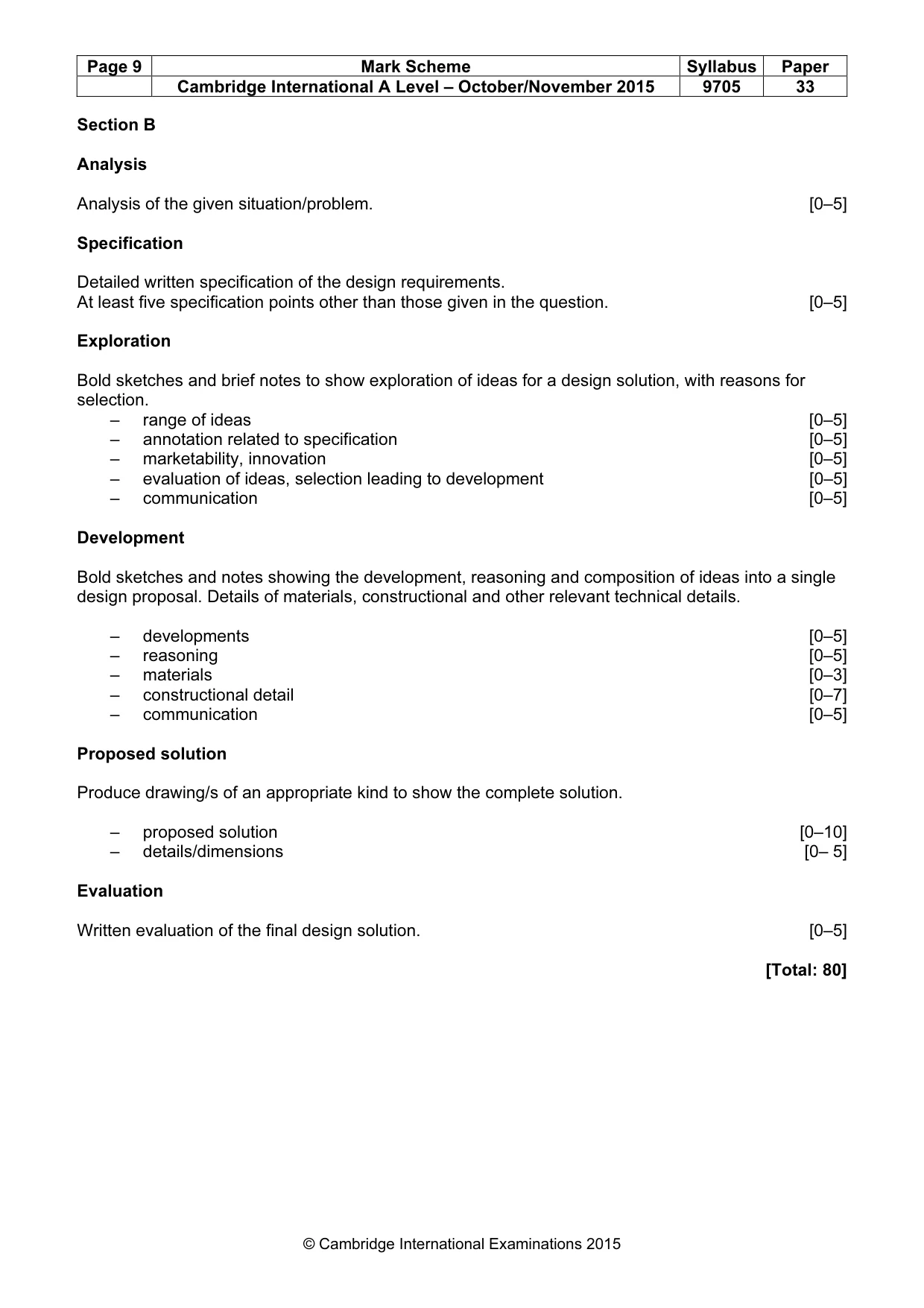
Page 9 Mark Scheme Syllabus Paper Cambridge International A Level – October/November 2015 9705 33 © Cambridge International Examinations 2015 Section B Analysis Analysis of the given situation/problem. [0–5] Specification Detailed written specification of the design requirements. At least five specification points other than those given in the question. [0–5] Exploration Bold sketches and brief notes to show exploration of ideas for a design solution, with reasons for selection. – range of ideas [0–5] – annotation related to specification [0–5] – marketability, innovation [0–5] – evaluation of ideas, selection leading to development [0–5] – communication [0–5] Development Bold sketches and notes showing the development, reasoning and composition of ideas into a single design proposal. Details of materials, constructional and other relevant technical details. – developments [0–5] – reasoning [0–5] – materials [0–3] – constructional detail [0–7] – communication [0–5] Proposed solution Produce drawing/s of an appropriate kind to show the complete solution. – proposed solution [0–10] – details/dimensions [0– 5] Evaluation Written evaluation of the final design solution. [0–5] [Total: 80]
What you needed in this session
Cambridge’s own grade thresholds for 2015 Oct/Nov, Paper 3 · Variant 3. A higher threshold means an easier paper — the bar moves with how the cohort did.