Cambridge A Level Design and Technology 9705 — 2015 Oct/Nov Paper 3 · Variant 1
9705/31/O/N/15
The question paper and its mark scheme, free to read here and free to download. This is Cambridge’s own paper, exactly as it was sat.
Question paper12 pages


Mark scheme7 pages
Answers below. Sit the paper first if you are practising.
Paper as text
Question paper, page 1
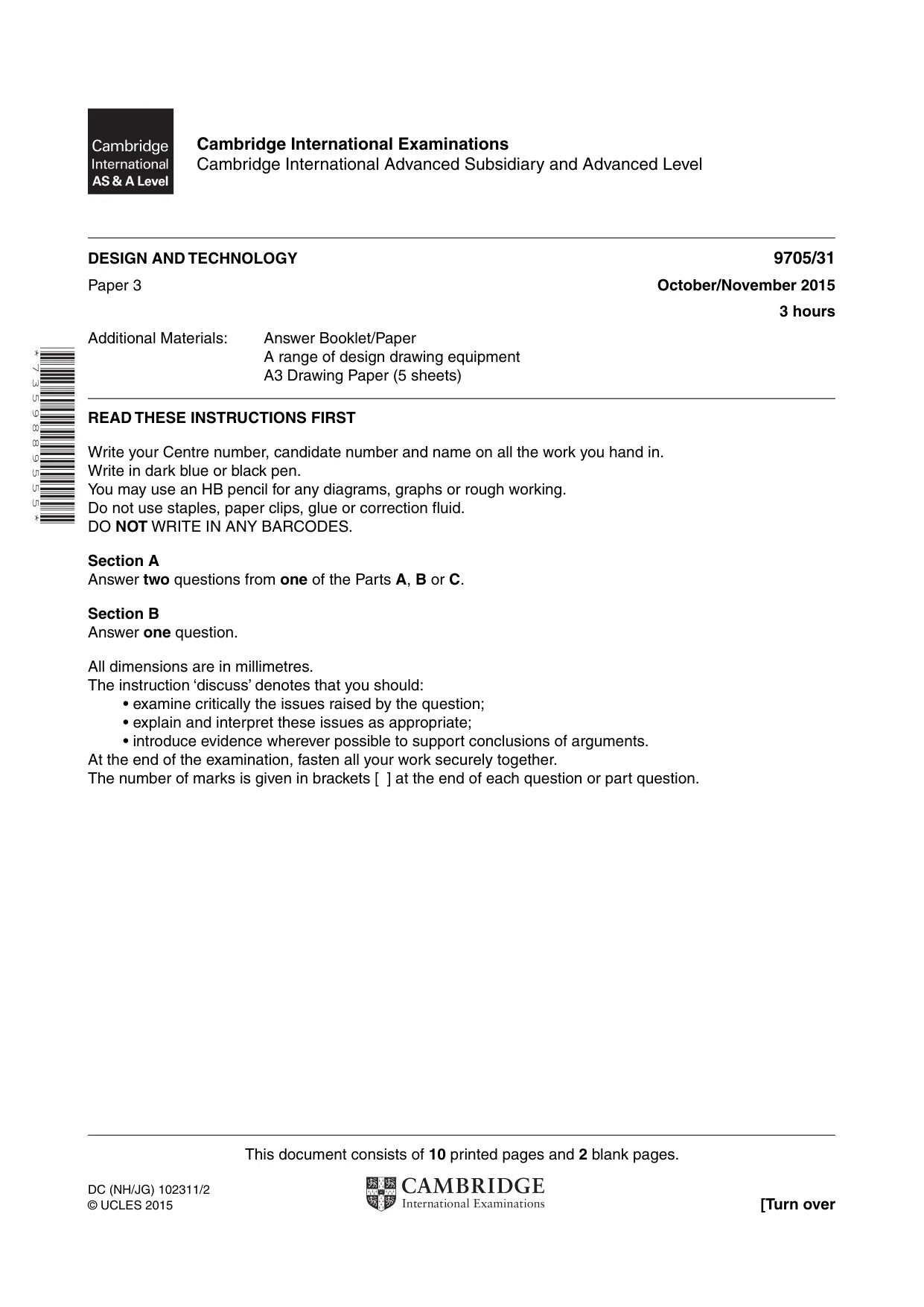
This document consists of 10 printed pages and 2 blank pages. DC (NH/JG) 102311/2 © UCLES 2015 [Turn over * 7 3 5 9 8 8 9 5 5 5 * DESIGN AND TECHNOLOGY 9705/31 Paper 3 October/November 2015 3 hours Additional Materials: Answer Booklet/Paper A range of design drawing equipment A3 Drawing Paper (5 sheets) READ THESE INSTRUCTIONS FIRST Write your Centre number, candidate number and name on all the work you hand in. Write in dark blue or black pen. You may use an HB pencil for any diagrams, graphs or rough working. Do not use staples, paper clips, glue or correction fluid. DO NOT WRITE IN ANY BARCODES. Section A Answer two questions from one of the Parts A, B or C. Section B Answer one question. All dimensions are in millimetres. The instruction ‘discuss’ denotes that you should: • examine critically the issues raised by the question; • explain and interpret these issues as appropriate; • introduce evidence wherever possible to support conclusions of arguments. At the end of the examination, fasten all your work securely together. The number of marks is given in brackets [ ] at the end of each question or part question. Cambridge International Examinations Cambridge International Advanced Subsidiary and Advanced Level
Question paper, page 2
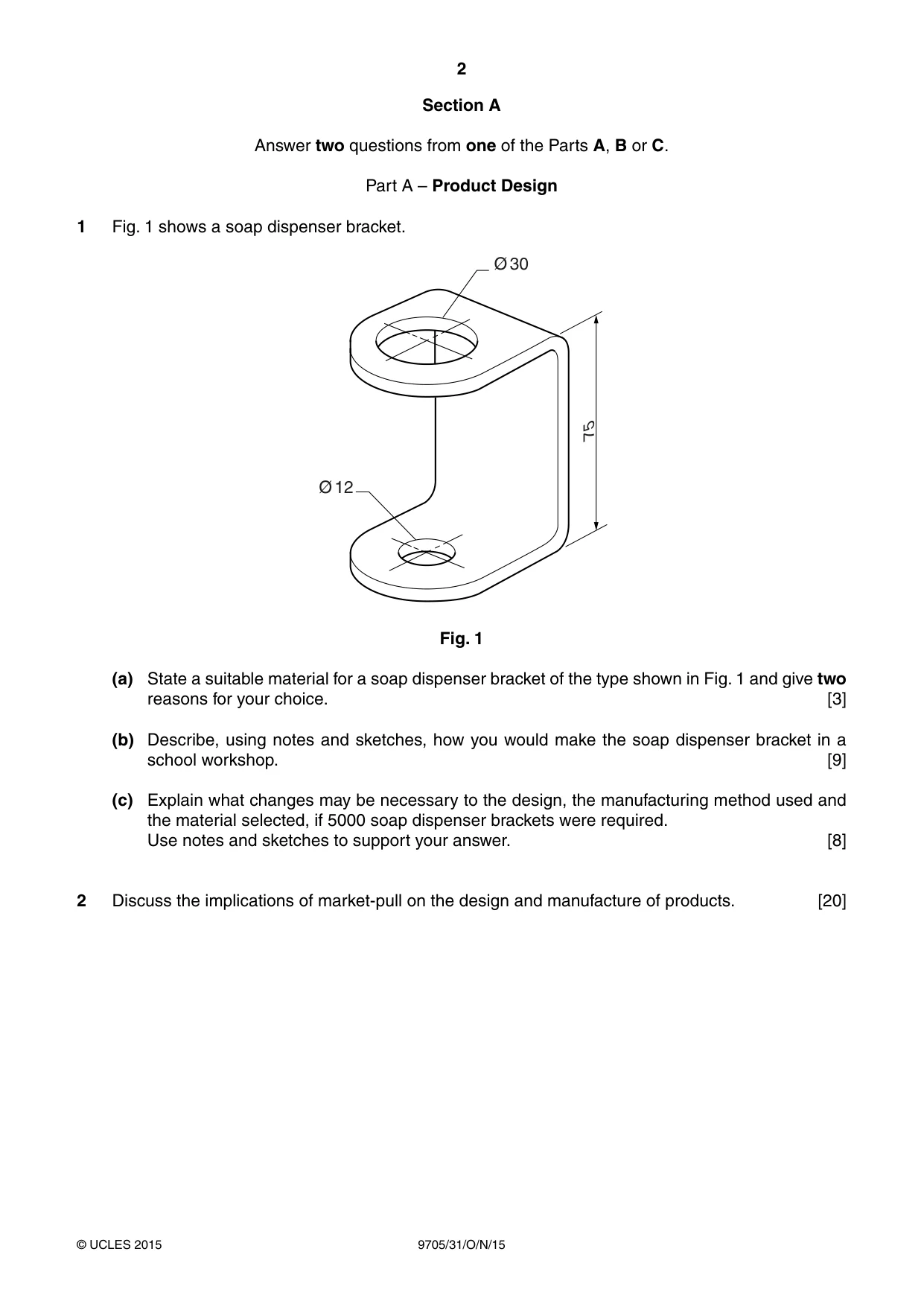
2 9705/31/O/N/15 © UCLES 2015 Section A Answer two questions from one of the Parts A, B or C. Part A – Product Design 1 Fig. 1 shows a soap dispenser bracket. Ø 30 Ø 12 75 Fig. 1 (a) State a suitable material for a soap dispenser bracket of the type shown in Fig. 1 and give two reasons for your choice. [3] (b) Describe, using notes and sketches, how you would make the soap dispenser bracket in a school workshop. [9] (c) Explain what changes may be necessary to the design, the manufacturing method used and the material selected, if 5000 soap dispenser brackets were required. Use notes and sketches to support your answer. [8] 2 Discuss the implications of market-pull on the design and manufacture of products. [20]
Question paper, page 3
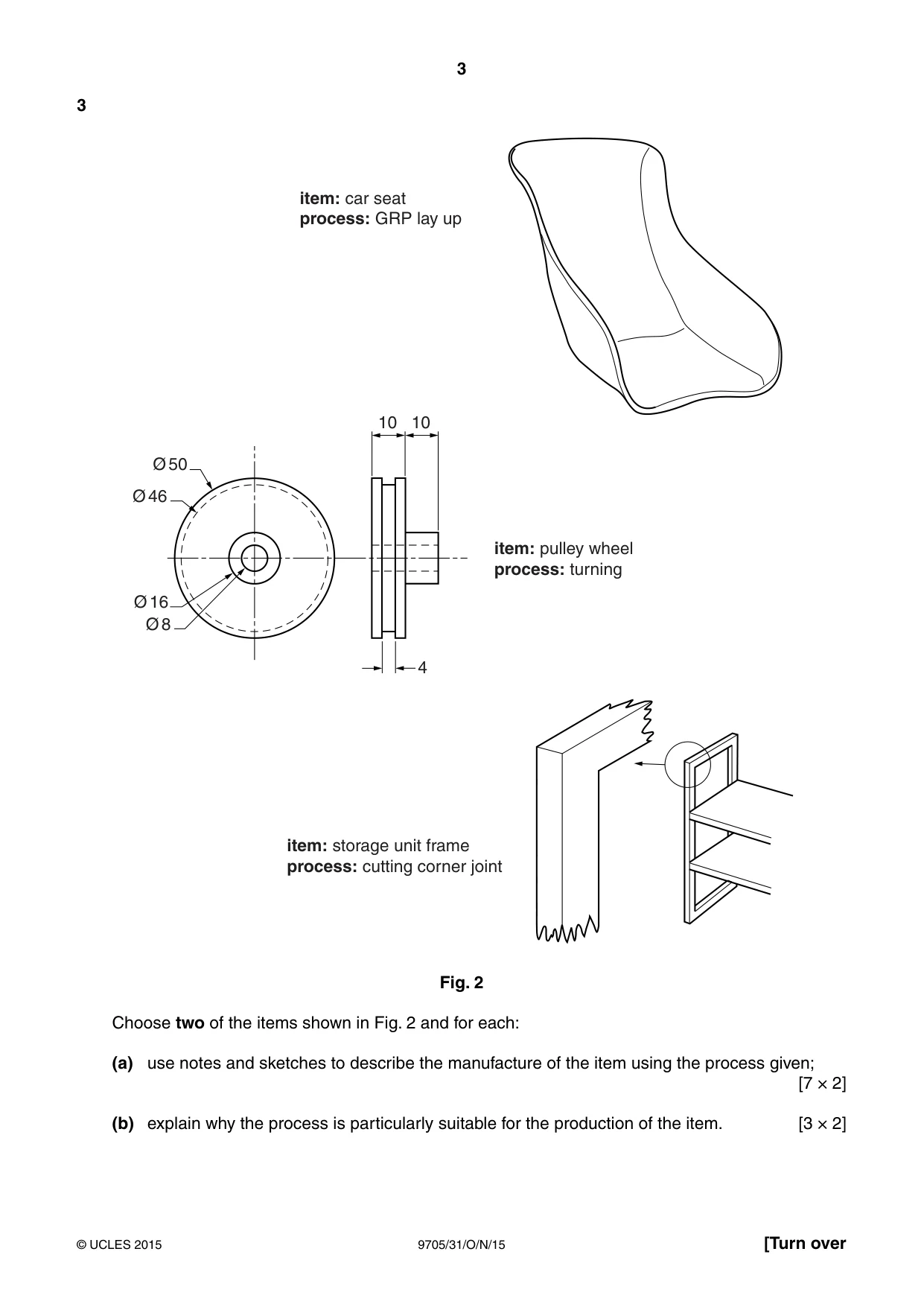
3 9705/31/O/N/15 © UCLES 2015 [Turn over 3 item: car seat process: GRP lay up item: pulley wheel process: turning item: storage unit frame process: cutting corner joint 10 10 Ø 50 Ø 46 Ø 16 Ø 8 4 Fig. 2 Choose two of the items shown in Fig. 2 and for each: (a) use notes and sketches to describe the manufacture of the item using the process given; [7 × 2] (b) explain why the process is particularly suitable for the production of the item. [3 × 2]
Question paper, page 4
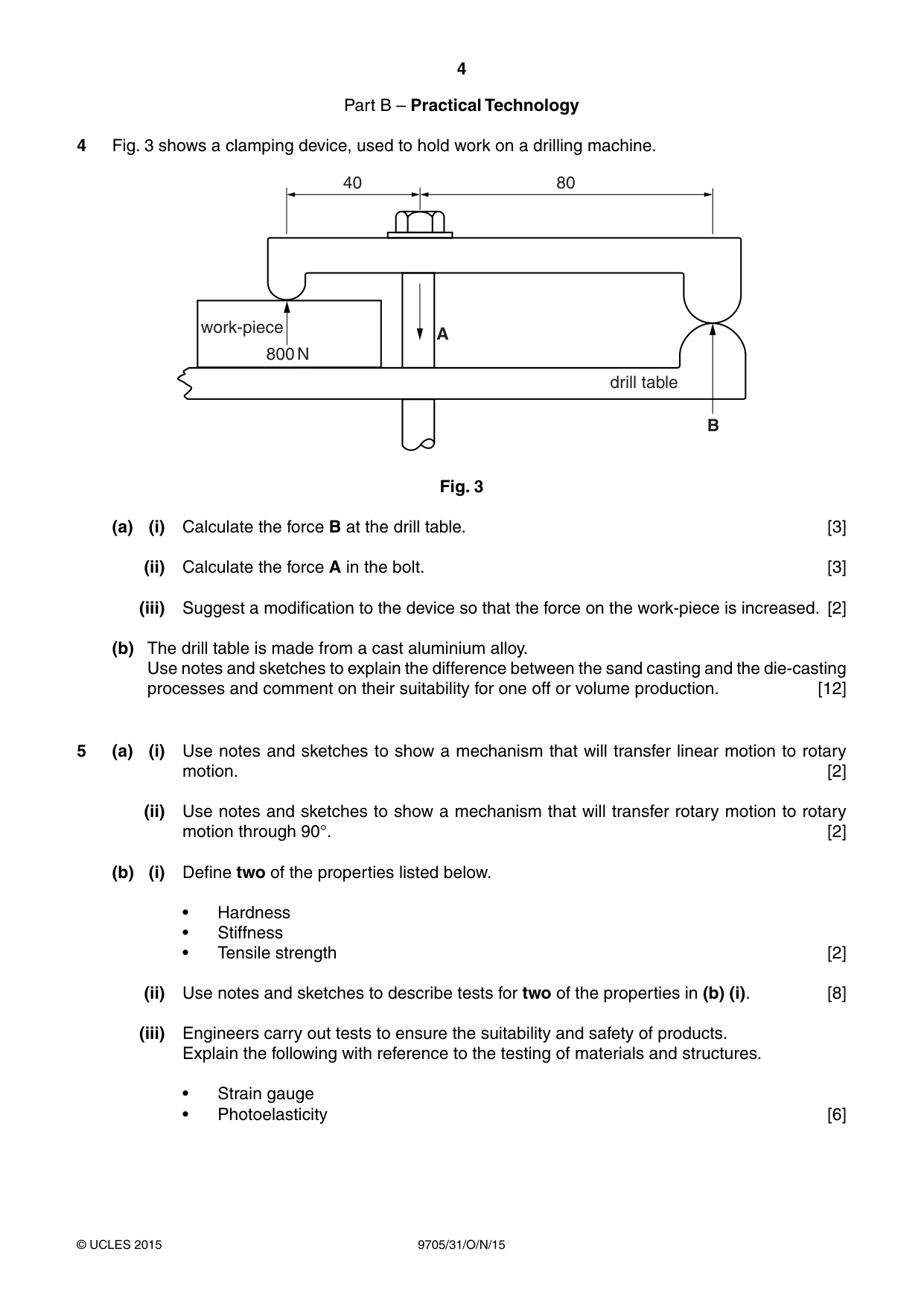
4 9705/31/O/N/15 © UCLES 2015 Part B – Practical Technology 4 Fig. 3 shows a clamping device, used to hold work on a drilling machine. 800 N work-piece drill table B A 40 80 Fig. 3 (a) (i) Calculate the force B at the drill table. [3] (ii) Calculate the force A in the bolt. [3] (iii) Suggest a modification to the device so that the force on the work-piece is increased. [2] (b) The drill table is made from a cast aluminium alloy. Use notes and sketches to explain the difference between the sand casting and the die-casting processes and comment on their suitability for one off or volume production. [12] 5 (a) (i) Use notes and sketches to show a mechanism that will transfer linear motion to rotary motion. [2] (ii) Use notes and sketches to show a mechanism that will transfer rotary motion to rotary motion through 90°. [2] (b) (i) Define two of the properties listed below. • Hardness • Stiffness • Tensile strength [2] (ii) Use notes and sketches to describe tests for two of the properties in (b) (i). [8] (iii) Engineers carry out tests to ensure the suitability and safety of products. Explain the following with reference to the testing of materials and structures. • Strain gauge • Photoelasticity [6]
Question paper, page 5
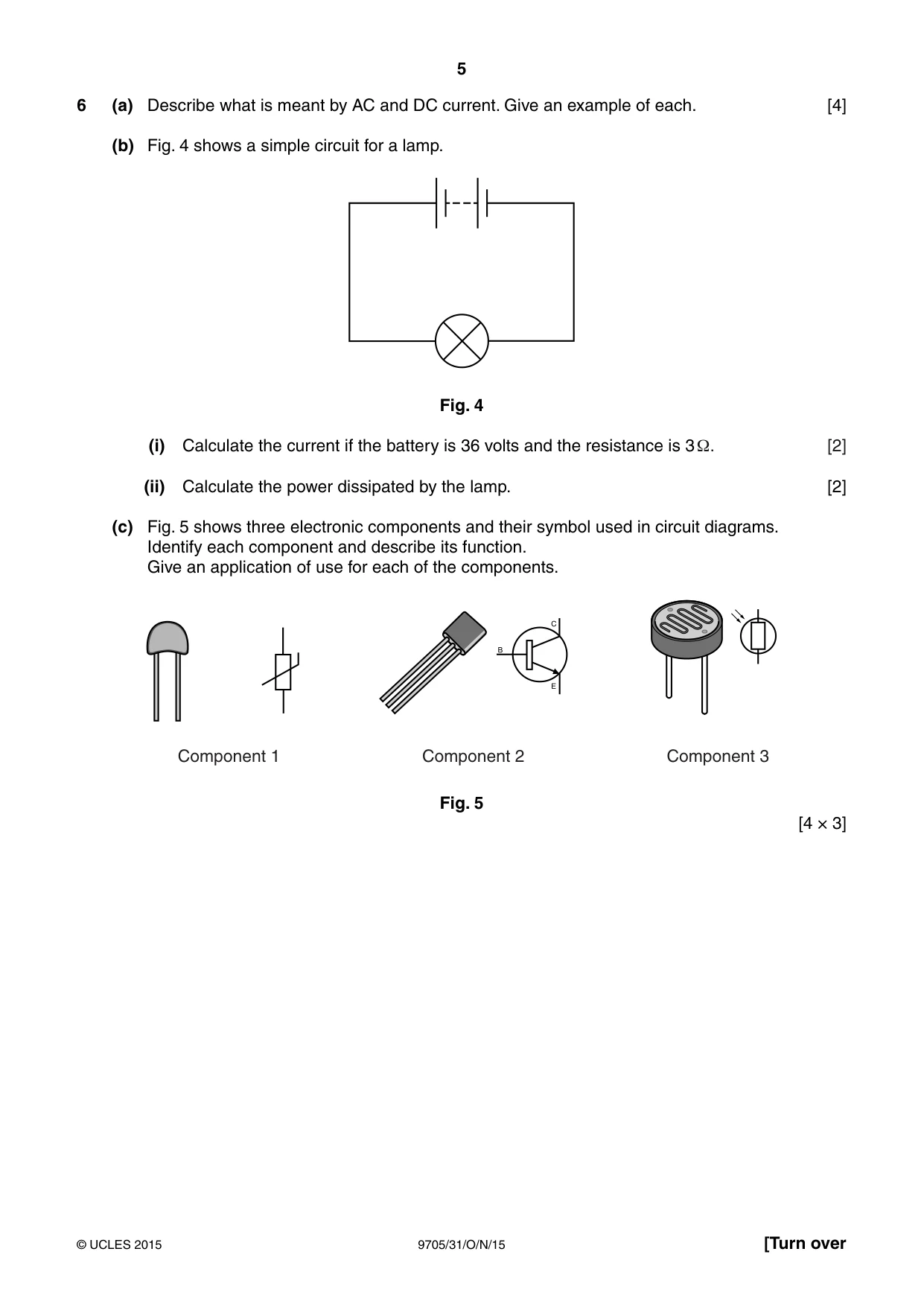
5 9705/31/O/N/15 © UCLES 2015 [Turn over 6 (a) Describe what is meant by AC and DC current. Give an example of each. [4] (b) Fig. 4 shows a simple circuit for a lamp. Fig. 4 (i) Calculate the current if the battery is 36 volts and the resistance is 3 Ω. [2] (ii) Calculate the power dissipated by the lamp. [2] (c) Fig. 5 shows three electronic components and their symbol used in circuit diagrams. Identify each component and describe its function. Give an application of use for each of the components. Component 1 Component 2 Component 3 Fig. 5 [4 × 3]
Question paper, page 6
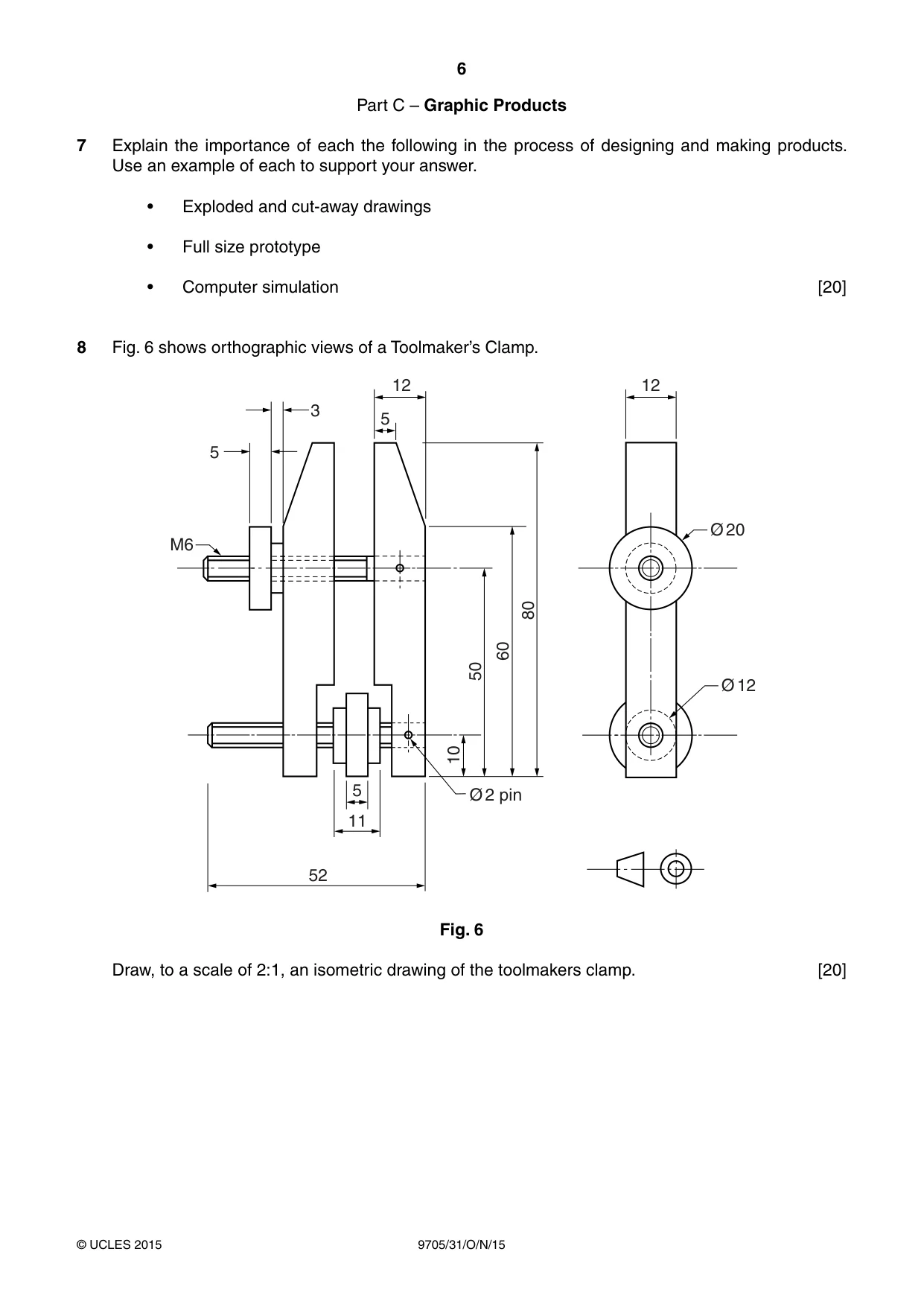
6 9705/31/O/N/15 © UCLES 2015 Part C – Graphic Products 7 Explain the importance of each the following in the process of designing and making products. Use an example of each to support your answer. • Exploded and cut-away drawings • Full size prototype • Computer simulation [20] 8 Fig. 6 shows orthographic views of a Toolmaker’s Clamp. M6 Ø 20 Ø 2 pin Ø 12 5 3 80 60 50 10 5 5 11 12 12 52 Fig. 6 Draw, to a scale of 2:1, an isometric drawing of the toolmakers clamp. [20]
Question paper, page 7
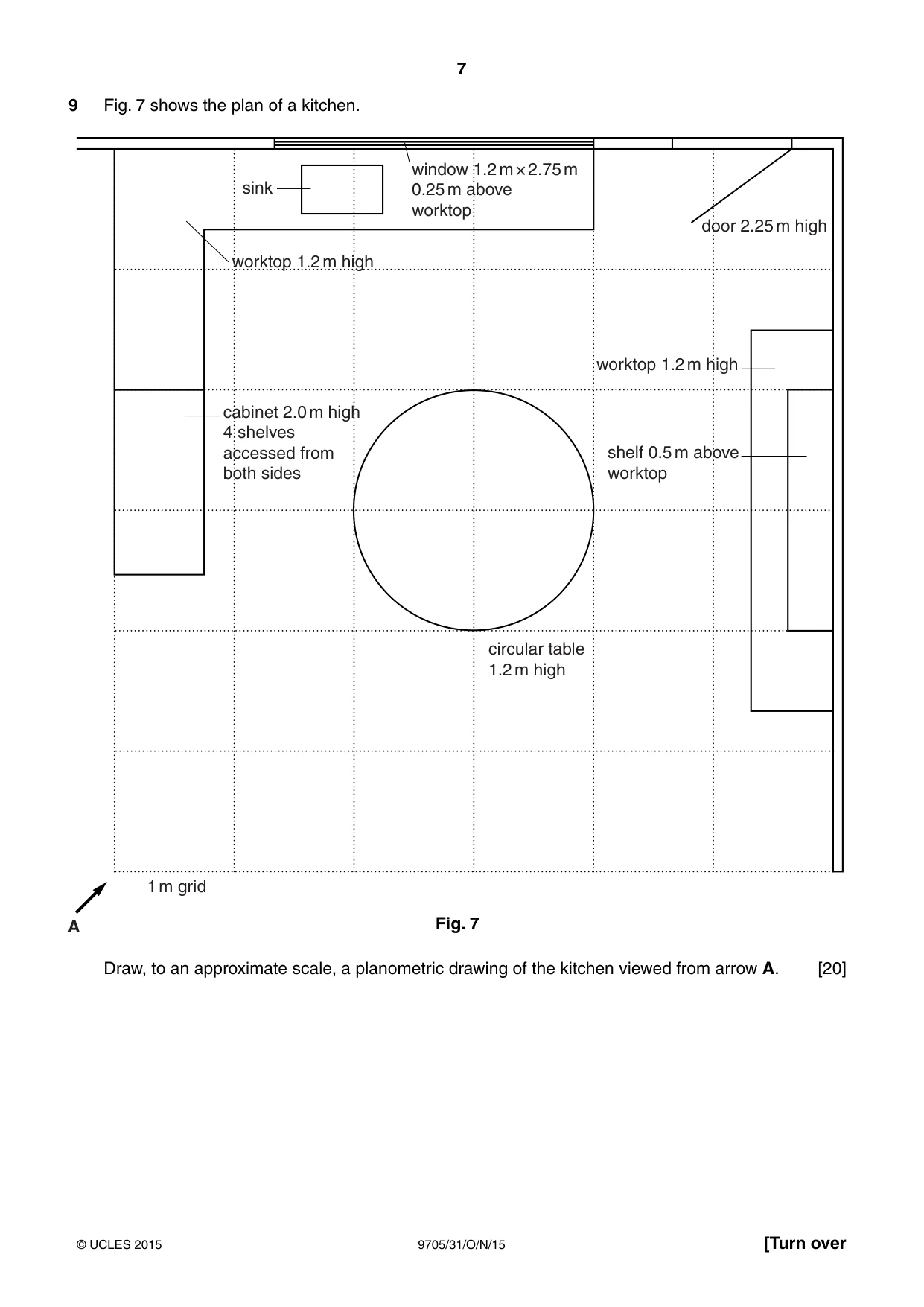
7 9705/31/O/N/15 © UCLES 2015 [Turn over 9 Fig. 7 shows the plan of a kitchen. Fig. 7 sink window 1.2 m × 2.75 m 0.25 m above worktop door 2.25 m high worktop 1.2 m high 1 m grid worktop 1.2 m high cabinet 2.0 m high 4 shelves accessed from both sides circular table 1.2 m high shelf 0.5 m above worktop A Draw, to an approximate scale, a planometric drawing of the kitchen viewed from arrow A. [20]
Question paper, page 8
8 9705/31/O/N/15 © UCLES 2015 Section B Answer one question on the A3 paper provided. You should approach the design question of your choice in the following manner: Analysis Produce an analysis of the given situation/problem, which may be in written or graphical form. [5] Specifi cation From the analysis produce a detailed written specification of the design requirements. Include at least five specification points other than those given in the question. [5] Exploration Use bold sketches and brief notes to show your exploration of ideas for a design solution, with reasons for selection. [25] Development Show, using bold sketches and notes, the development, reasoning and composition of ideas into a single design proposal. Give details of materials, constructional and other relevant technical details. [25] Proposed solution Produce drawings of an appropriate kind to show the complete solution. [15] Evaluation Give a written evaluation of the final design solution. [5] [Total: 80]
Question paper, page 9
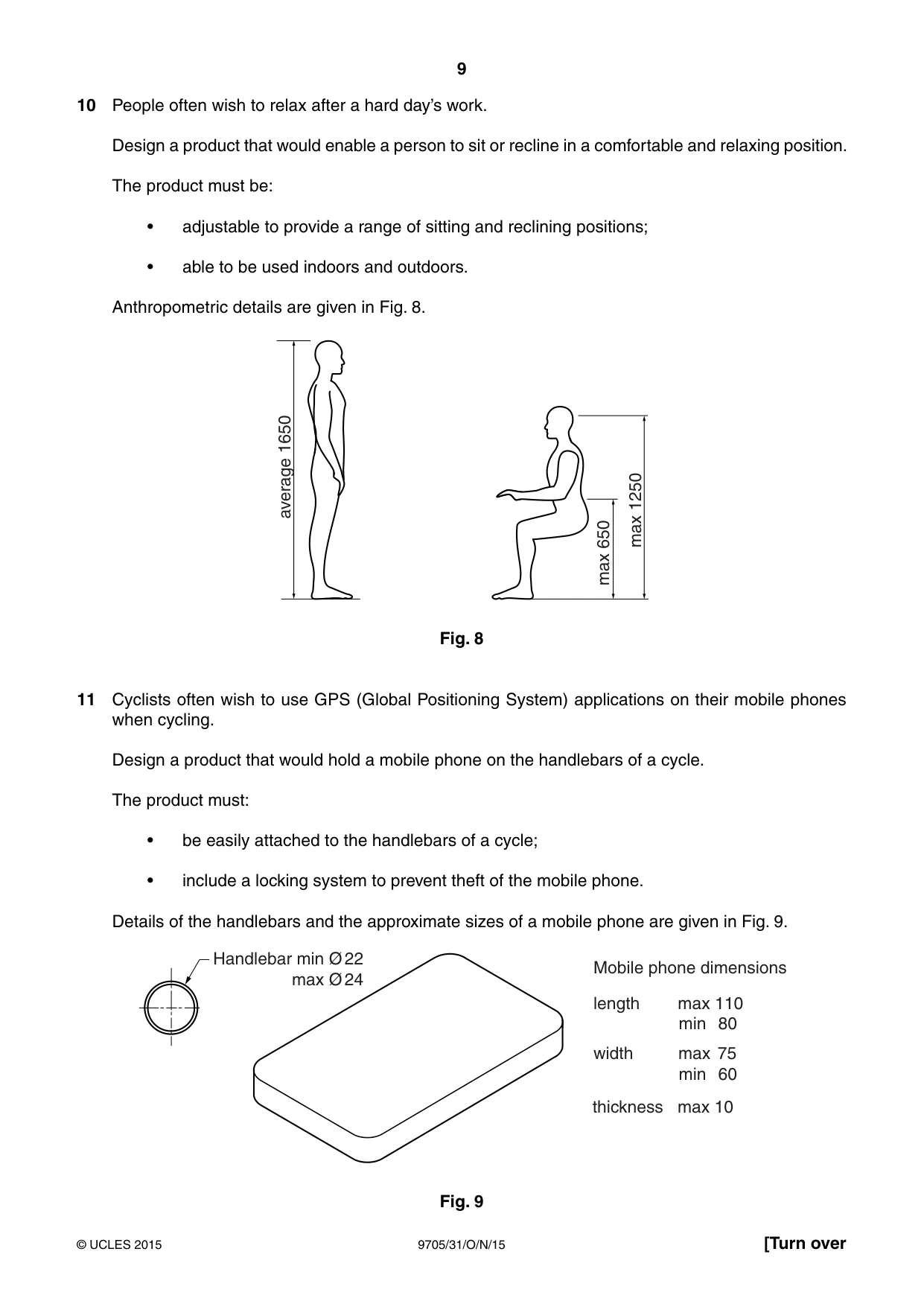
9 9705/31/O/N/15 © UCLES 2015 [Turn over 10 People often wish to relax after a hard day’s work. Design a product that would enable a person to sit or recline in a comfortable and relaxing position. The product must be: • adjustable to provide a range of sitting and reclining positions; • able to be used indoors and outdoors. Anthropometric details are given in Fig. 8. max 650 max 1250 average 1650 Fig. 8 11 Cyclists often wish to use GPS (Global Positioning System) applications on their mobile phones when cycling. Design a product that would hold a mobile phone on the handlebars of a cycle. The product must: • be easily attached to the handlebars of a cycle; • include a locking system to prevent theft of the mobile phone. Details of the handlebars and the approximate sizes of a mobile phone are given in Fig. 9. Handlebar min Ø 22 max Ø 24 Mobile phone dimensions length max 110 min 80 width max 75 min 60 thickness max 10 Fig. 9
Question paper, page 10
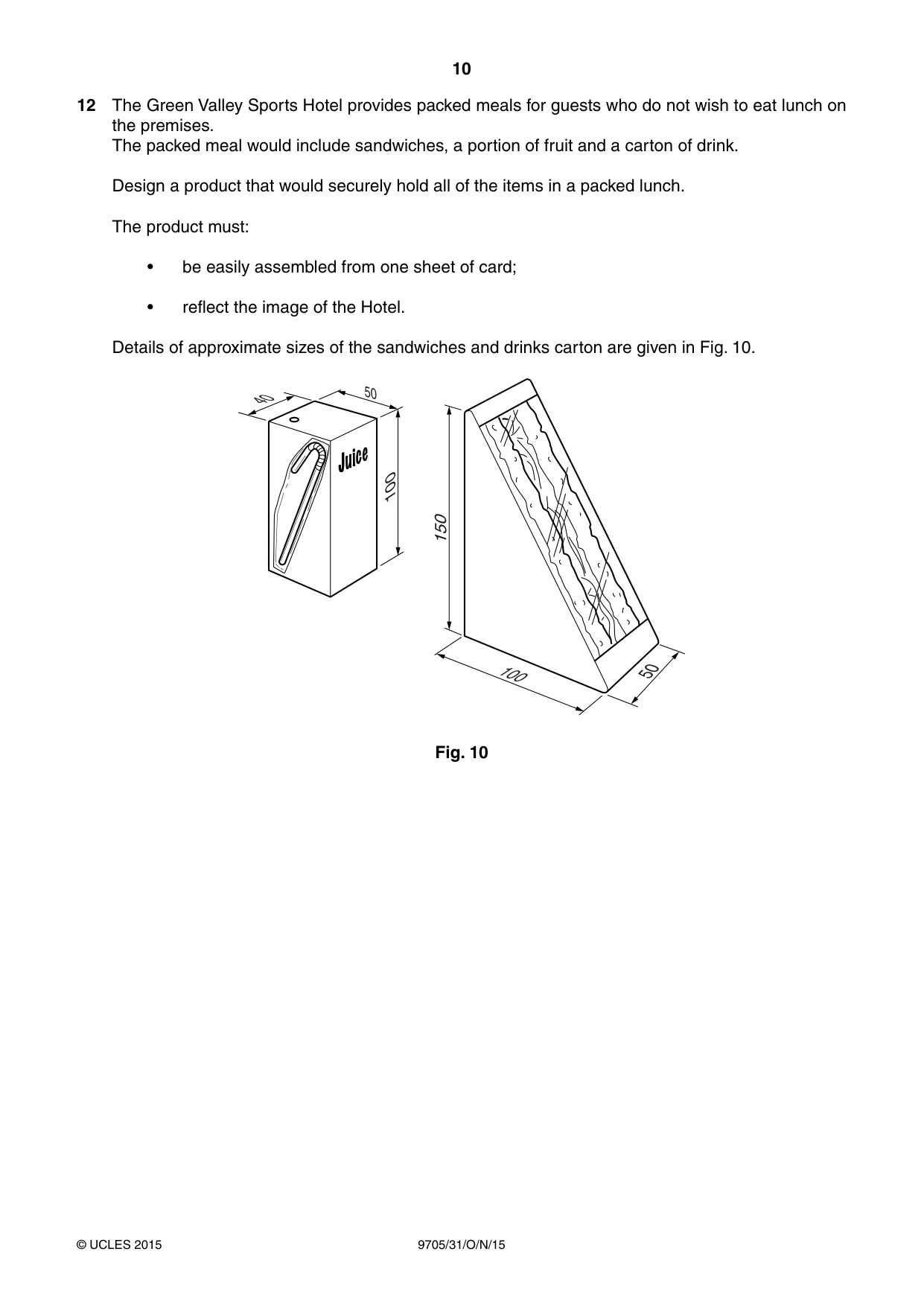
10 9705/31/O/N/15 © UCLES 2015 12 The Green Valley Sports Hotel provides packed meals for guests who do not wish to eat lunch on the premises. The packed meal would include sandwiches, a portion of fruit and a carton of drink. Design a product that would securely hold all of the items in a packed lunch. The product must: • be easily assembled from one sheet of card; • reflect the image of the Hotel. Details of approximate sizes of the sandwiches and drinks carton are given in Fig. 10. 40 50 50 100 100 150 Fig. 10
Question paper, page 11
11 9705/31/O/N/15 © UCLES 2015 BLANK PAGE
Question paper, page 12
12 9705/31/O/N/15 © UCLES 2015 BLANK PAGE Permission to reproduce items where third-party owned material protected by copyright is included has been sought and cleared where possible. Every reasonable effort has been made by the publisher (UCLES) to trace copyright holders, but if any items requiring clearance have unwittingly been included, the publisher will be pleased to make amends at the earliest possible opportunity. To avoid the issue of disclosure of answer-related information to candidates, all copyright acknowledgements are reproduced online in the Cambridge International Examinations Copyright Acknowledgements Booklet. This is produced for each series of examinations and is freely available to download at www.cie.org.uk after the live examination series. Cambridge International Examinations is part of the Cambridge Assessment Group. Cambridge Assessment is the brand name of University of Cambridge Local Examinations Syndicate (UCLES), which is itself a department of the University of Cambridge.
Mark scheme, page 1
® IGCSE is the registered trademark of Cambridge International Examinations. CAMBRIDGE INTERNATIONAL EXAMINATIONS Cambridge International Advanced Level MARK SCHEME for the October/November 2015 series 9705 DESIGN AND TECHNOLOGY 9705/31 Paper 3, maximum raw mark 120 This mark scheme is published as an aid to teachers and candidates, to indicate the requirements of the examination. It shows the basis on which Examiners were instructed to award marks. It does not indicate the details of the discussions that took place at an Examiners’ meeting before marking began, which would have considered the acceptability of alternative answers. Mark schemes should be read in conjunction with the question paper and the Principal Examiner Report for Teachers. Cambridge will not enter into discussions about these mark schemes. Cambridge is publishing the mark schemes for the October/November 2015 series for most Cambridge IGCSE®, Cambridge International A and AS Level components and some Cambridge O Level components.
Mark scheme, page 2
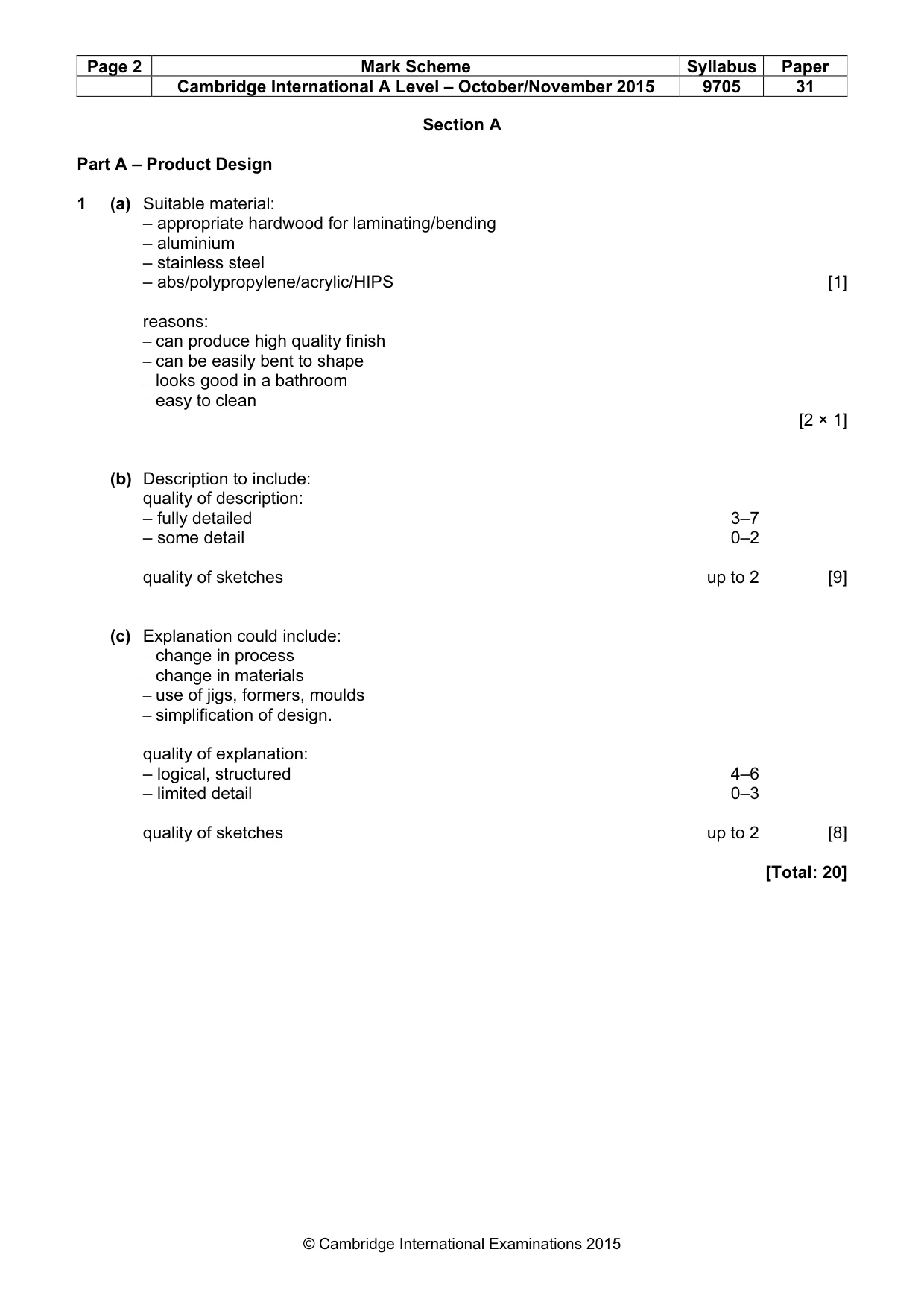
Page 2 Mark Scheme Syllabus Paper Cambridge International A Level – October/November 2015 9705 31 © Cambridge International Examinations 2015 Section A Part A – Product Design 1 (a) Suitable material: – appropriate hardwood for laminating/bending – aluminium – stainless steel – abs/polypropylene/acrylic/HIPS [1] reasons: – can produce high quality finish – can be easily bent to shape – looks good in a bathroom – easy to clean [2 × 1] (b) Description to include: quality of description: – fully detailed 3–7 – some detail 0–2 quality of sketches up to 2 [9] (c) Explanation could include: – change in process – change in materials – use of jigs, formers, moulds – simplification of design. quality of explanation: – logical, structured 4–6 – limited detail 0–3 quality of sketches up to 2 [8] [Total: 20]
Mark scheme, page 3
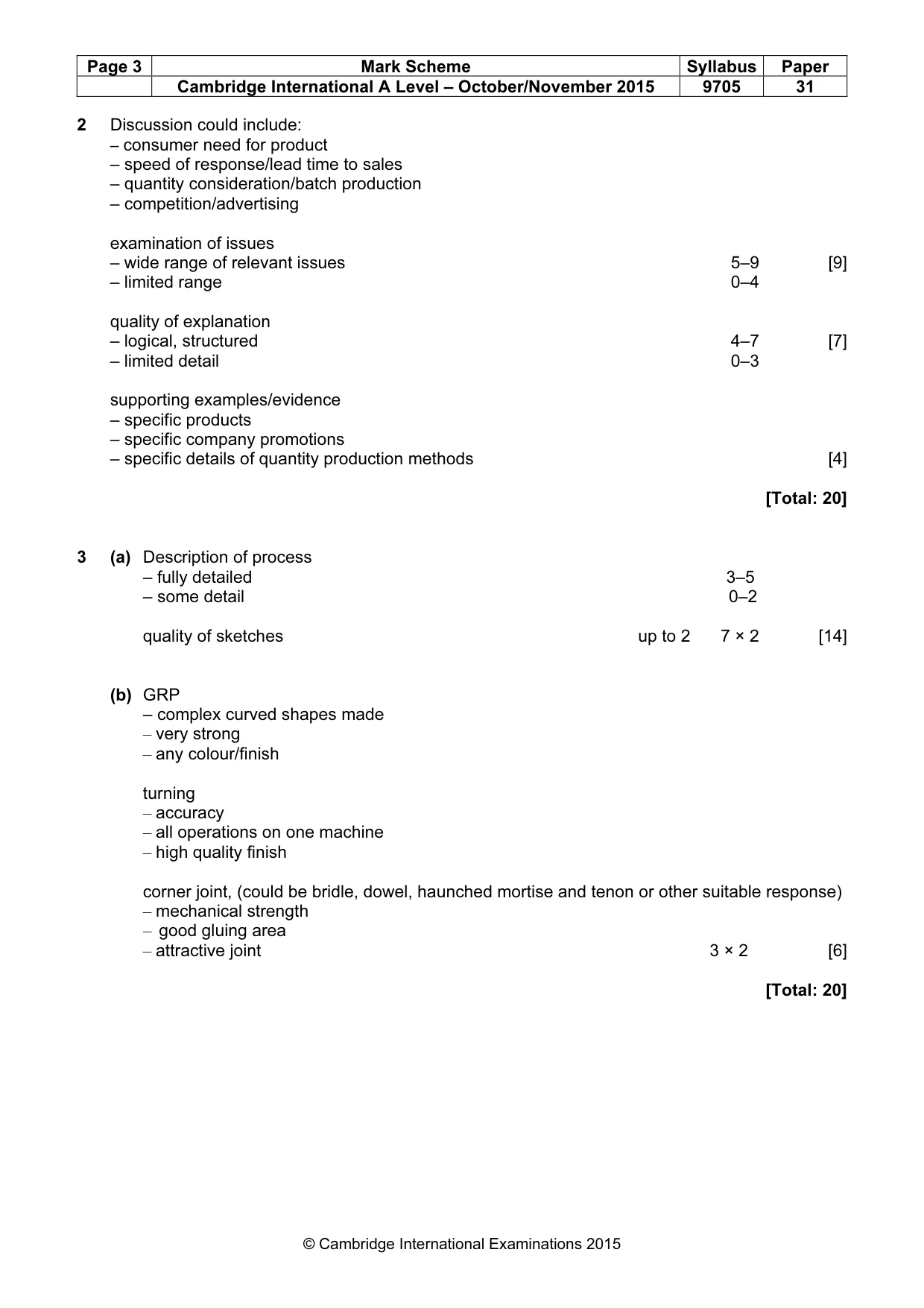
Page 3 Mark Scheme Syllabus Paper Cambridge International A Level – October/November 2015 9705 31 © Cambridge International Examinations 2015 2 Discussion could include: – consumer need for product – speed of response/lead time to sales – quantity consideration/batch production – competition/advertising examination of issues – wide range of relevant issues 5–9 [9] – limited range 0–4 quality of explanation – logical, structured 4–7 [7] – limited detail 0–3 supporting examples/evidence – specific products – specific company promotions – specific details of quantity production methods [4] [Total: 20] 3 (a) Description of process – fully detailed 3–5 – some detail 0–2 quality of sketches up to 2 7 × 2 [14] (b) GRP – complex curved shapes made – very strong – any colour/finish turning – accuracy – all operations on one machine – high quality finish corner joint, (could be bridle, dowel, haunched mortise and tenon or other suitable response) – mechanical strength – good gluing area – attractive joint 3 × 2 [6] [Total: 20]
Mark scheme, page 4
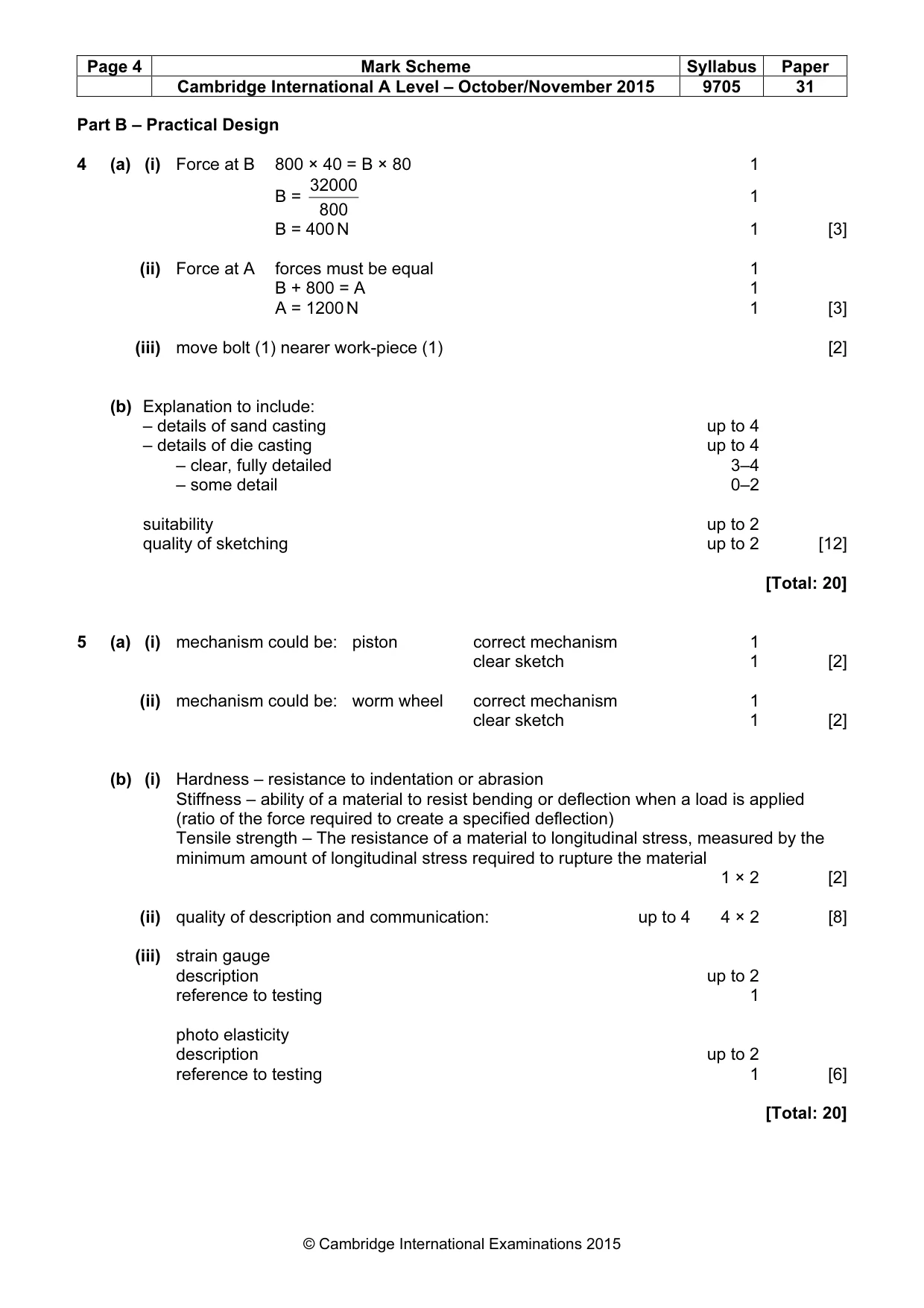
Page 4 Mark Scheme Syllabus Paper Cambridge International A Level – October/November 2015 9705 31 © Cambridge International Examinations 2015 Part B – Practical Design 4 (a) (i) Force at B 800 × 40 = B × 80 1 B = 800 32000 1 B = 400 N 1 [3] (ii) Force at A forces must be equal 1 B + 800 = A 1 A = 1200 N 1 [3] (iii) move bolt (1) nearer work-piece (1) [2] (b) Explanation to include: – details of sand casting up to 4 – details of die casting up to 4 – clear, fully detailed 3–4 – some detail 0–2 suitability up to 2 quality of sketching up to 2 [12] [Total: 20] 5 (a) (i) mechanism could be: piston correct mechanism 1 clear sketch 1 [2] (ii) mechanism could be: worm wheel correct mechanism 1 clear sketch 1 [2] (b) (i) Hardness – resistance to indentation or abrasion Stiffness – ability of a material to resist bending or deflection when a load is applied (ratio of the force required to create a specified deflection) Tensile strength – The resistance of a material to longitudinal stress, measured by the minimum amount of longitudinal stress required to rupture the material 1 × 2 [2] (ii) quality of description and communication: up to 4 4 × 2 [8] (iii) strain gauge description up to 2 reference to testing 1 photo elasticity description up to 2 reference to testing 1 [6] [Total: 20]
Mark scheme, page 5
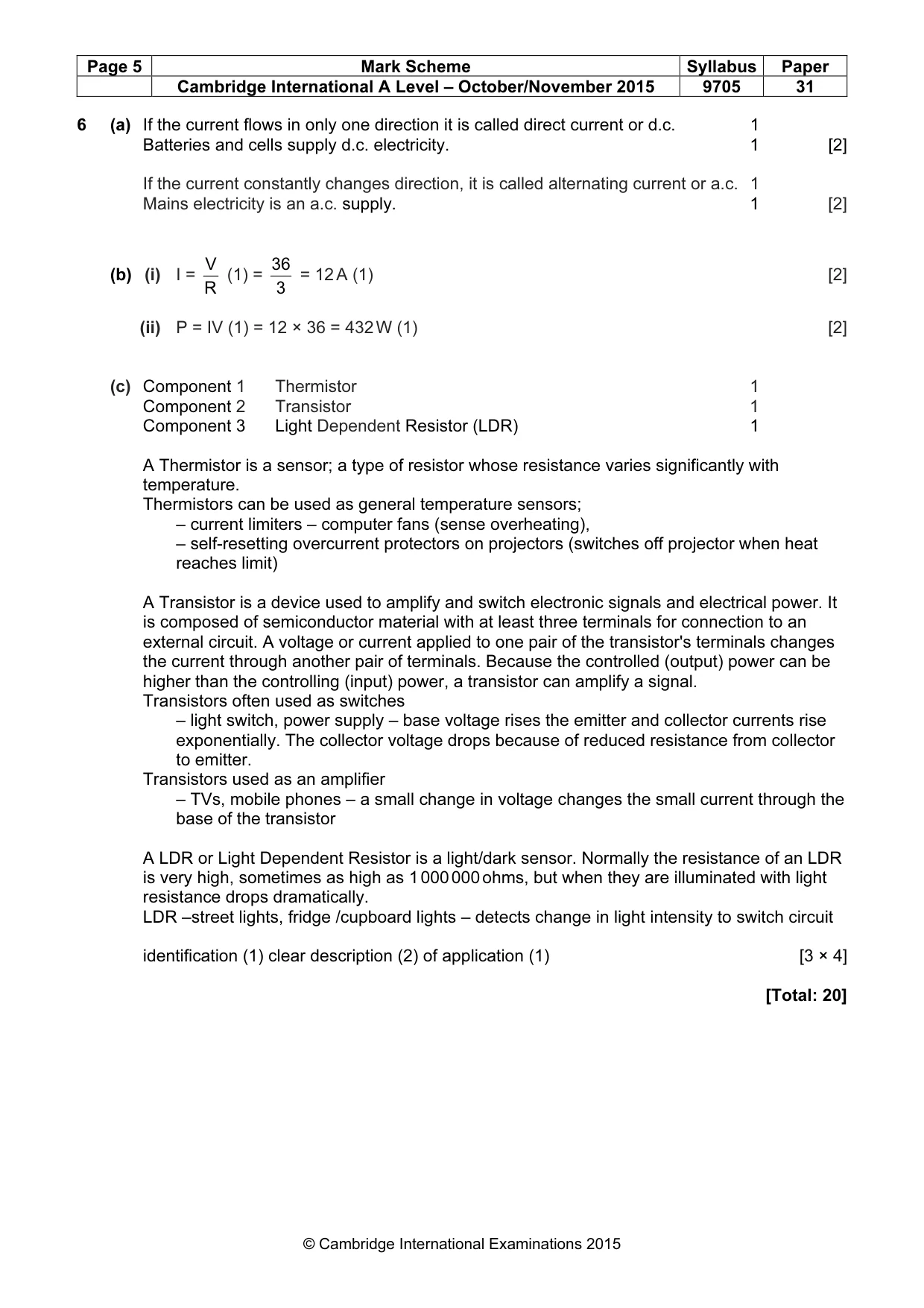
Page 5 Mark Scheme Syllabus Paper Cambridge International A Level – October/November 2015 9705 31 © Cambridge International Examinations 2015 6 (a) If the current flows in only one direction it is called direct current or d.c. 1 Batteries and cells supply d.c. electricity. 1 [2] If the current constantly changes direction, it is called alternating current or a.c. 1 Mains electricity is an a.c. supply. 1 [2] (b) (i) I = R V (1) = 3 36 = 12 A (1) [2] (ii) P = IV (1) = 12 × 36 = 432 W (1) [2] (c) Component 1 Thermistor 1 Component 2 Transistor 1 Component 3 Light Dependent Resistor (LDR) 1 A Thermistor is a sensor; a type of resistor whose resistance varies significantly with temperature. Thermistors can be used as general temperature sensors; – current limiters – computer fans (sense overheating), – self-resetting overcurrent protectors on projectors (switches off projector when heat reaches limit) A Transistor is a device used to amplify and switch electronic signals and electrical power. It is composed of semiconductor material with at least three terminals for connection to an external circuit. A voltage or current applied to one pair of the transistor's terminals changes the current through another pair of terminals. Because the controlled (output) power can be higher than the controlling (input) power, a transistor can amplify a signal. Transistors often used as switches – light switch, power supply – base voltage rises the emitter and collector currents rise exponentially. The collector voltage drops because of reduced resistance from collector to emitter. Transistors used as an amplifier – TVs, mobile phones – a small change in voltage changes the small current through the base of the transistor A LDR or Light Dependent Resistor is a light/dark sensor. Normally the resistance of an LDR is very high, sometimes as high as 1 000 000 ohms, but when they are illuminated with light resistance drops dramatically. LDR –street lights, fridge /cupboard lights – detects change in light intensity to switch circuit identification (1) clear description (2) of application (1) [3 × 4] [Total: 20]
Mark scheme, page 6
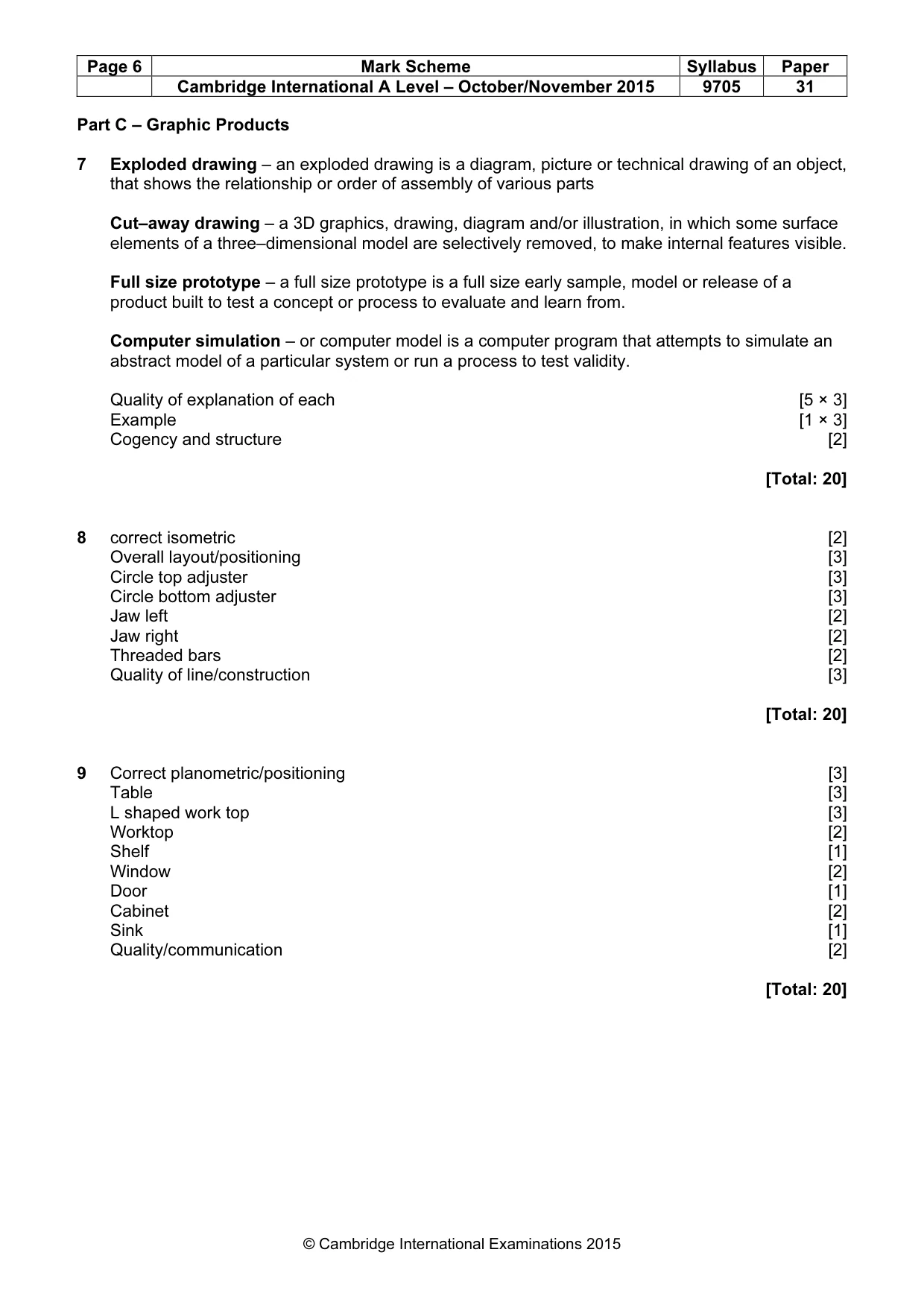
Page 6 Mark Scheme Syllabus Paper Cambridge International A Level – October/November 2015 9705 31 © Cambridge International Examinations 2015 Part C – Graphic Products 7 Exploded drawing – an exploded drawing is a diagram, picture or technical drawing of an object, that shows the relationship or order of assembly of various parts Cut–away drawing – a 3D graphics, drawing, diagram and/or illustration, in which some surface elements of a three–dimensional model are selectively removed, to make internal features visible. Full size prototype – a full size prototype is a full size early sample, model or release of a product built to test a concept or process to evaluate and learn from. Computer simulation – or computer model is a computer program that attempts to simulate an abstract model of a particular system or run a process to test validity. Quality of explanation of each [5 × 3] Example [1 × 3] Cogency and structure [2] [Total: 20] 8 correct isometric [2] Overall layout/positioning [3] Circle top adjuster [3] Circle bottom adjuster [3] Jaw left [2] Jaw right [2] Threaded bars [2] Quality of line/construction [3] [Total: 20] 9 Correct planometric/positioning [3] Table [3] L shaped work top [3] Worktop [2] Shelf [1] Window [2] Door [1] Cabinet [2] Sink [1] Quality/communication [2] [Total: 20]
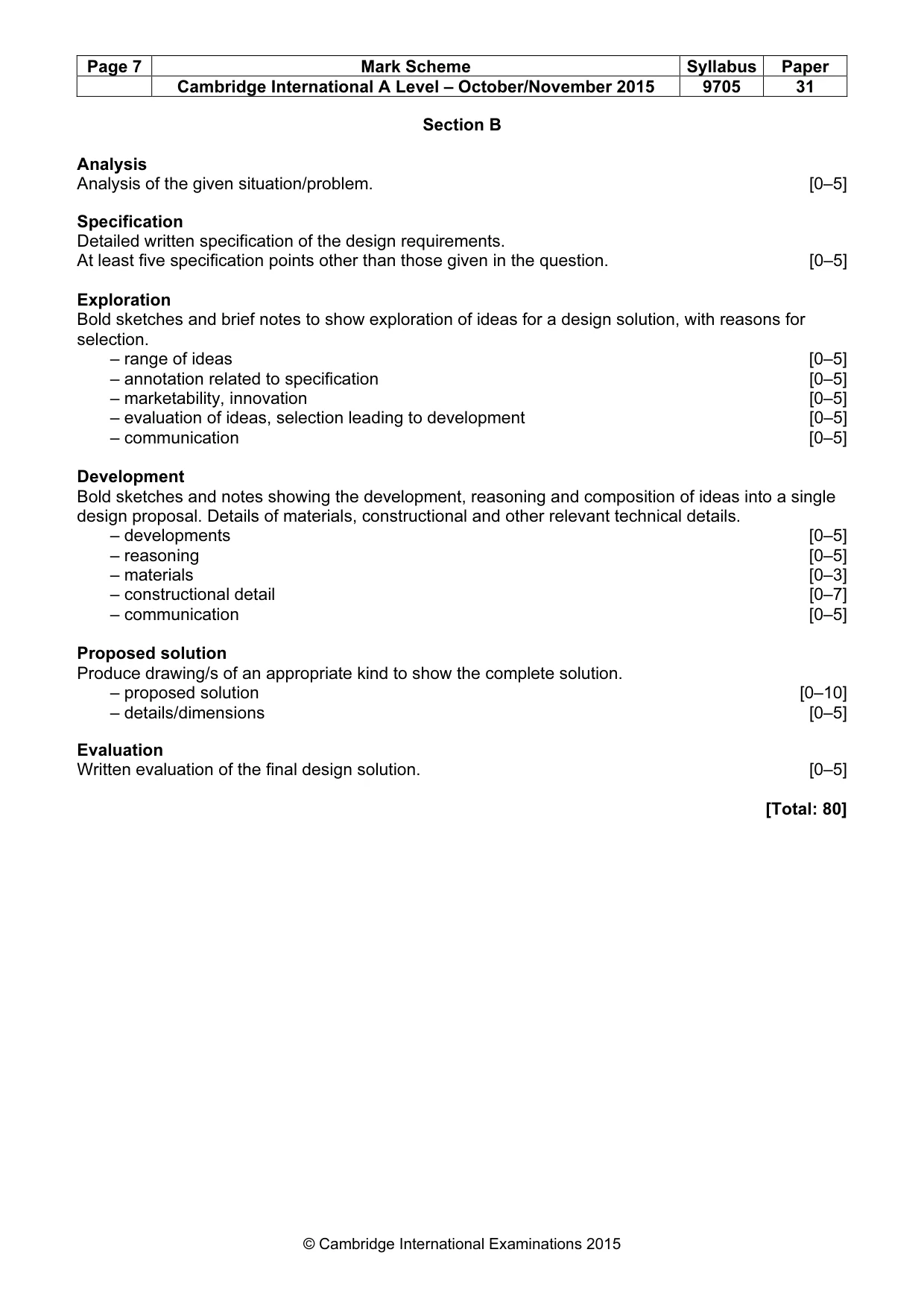
Mark scheme, page 7
Page 7 Mark Scheme Syllabus Paper Cambridge International A Level – October/November 2015 9705 31 © Cambridge International Examinations 2015 Section B Analysis Analysis of the given situation/problem. [0–5] Specification Detailed written specification of the design requirements. At least five specification points other than those given in the question. [0–5] Exploration Bold sketches and brief notes to show exploration of ideas for a design solution, with reasons for selection. – range of ideas [0–5] – annotation related to specification [0–5] – marketability, innovation [0–5] – evaluation of ideas, selection leading to development [0–5] – communication [0–5] Development Bold sketches and notes showing the development, reasoning and composition of ideas into a single design proposal. Details of materials, constructional and other relevant technical details. – developments [0–5] – reasoning [0–5] – materials [0–3] – constructional detail [0–7] – communication [0–5] Proposed solution Produce drawing/s of an appropriate kind to show the complete solution. – proposed solution [0–10] – details/dimensions [0–5] Evaluation Written evaluation of the final design solution. [0–5] [Total: 80]