Cambridge A Level Design and Technology 9705 — 2013 Oct/Nov Paper 3 · Variant 3
9705/33/O/N/13 · 120 marks · ≈135 min
The question paper and its mark scheme, free to read here and free to download. This is Cambridge’s own paper, exactly as it was sat.
Question paper12 pages
Mark scheme8 pages
Answers below. Sit the paper first if you are practising.
Paper as text
Question paper, page 1
This document consists of 9 printed pages and 3 blank pages. DC (LEG/SW) 64872/2 © UCLES 2013 [Turn over UNIVERSITY OF CAMBRIDGE INTERNATIONAL EXAMINATIONS General Certificate of Education Advanced Subsidiary Level and Advanced Level * 9 1 1 8 0 6 5 8 9 8 * DESIGN AND TECHNOLOGY 9705/33 Paper 3 October/November 2013 3 hours Additional Materials: Answer Booklet/Paper A range of design drawing equipment A3 Drawing Paper (5 sheets) READ THESE INSTRUCTIONS FIRST Write your Centre number, candidate number and name on all the work you hand in. Write in dark blue or black pen. You may use a soft pencil for any diagrams, graphs or rough working. Do not use staples, paper clips, highlighters, glue or correction fluid. Section A Answer two questions from one of the Parts A, B or C. Section B Answer one question. All dimensions are in millimetres. The instruction ‘discuss’ denotes that you should: • examine critically the issues raised by the question; • explain and interpret these issues as appropriate; • introduce evidence wherever possible to support conclusions of arguments. At the end of the examination, fasten all your work securely together. The number of marks is given in brackets [ ] at the end of each question or part question.
Question paper, page 2
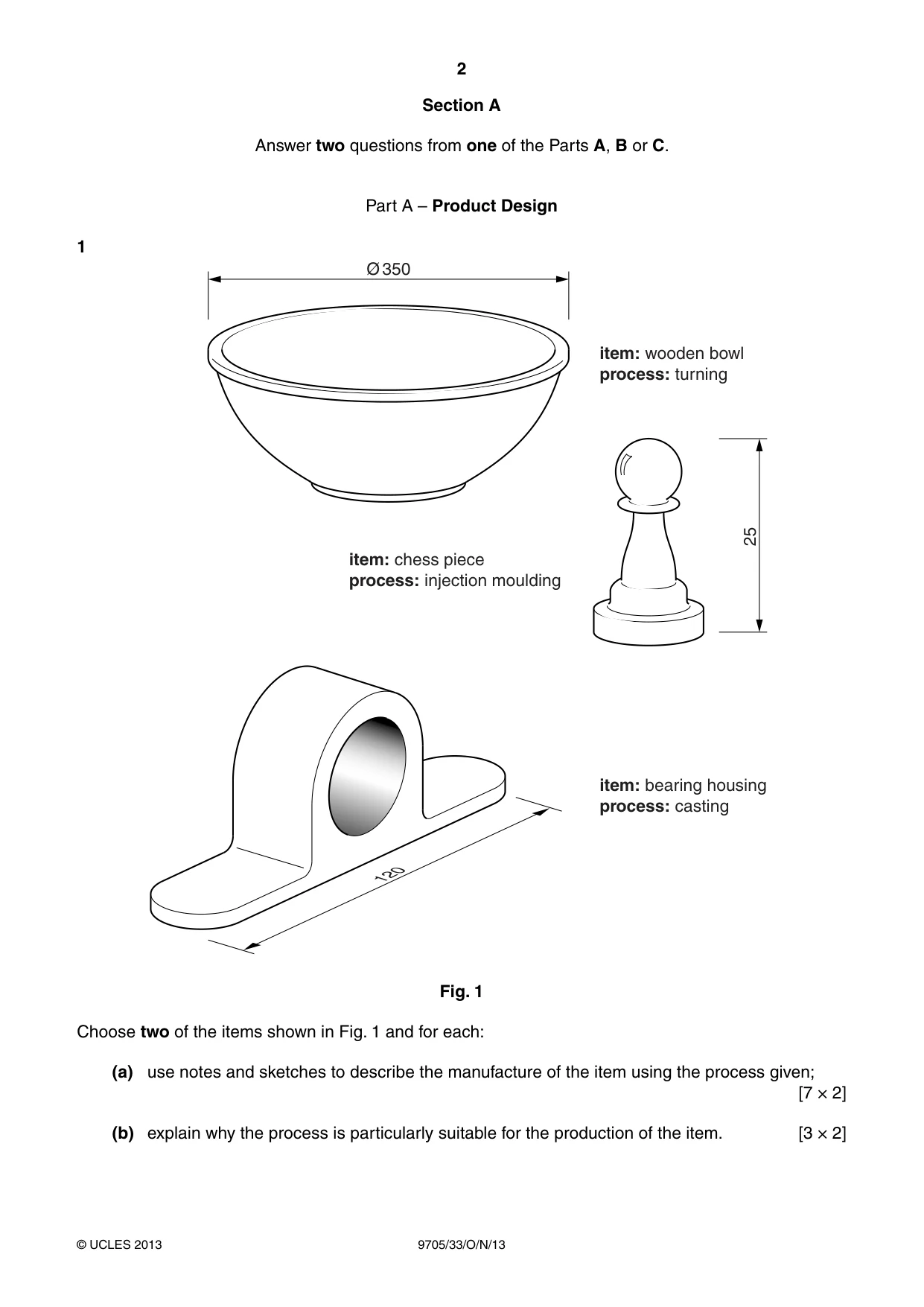
2 9705/33/O/N/13 © UCLES 2013 Section A Answer two questions from one of the Parts A, B or C. Part A – Product Design 1 Ø 350 item: chess piece process: injection moulding item: wooden bowl process: turning item: bearing housing process: casting 25 120 Fig. 1 Choose two of the items shown in Fig. 1 and for each: (a) use notes and sketches to describe the manufacture of the item using the process given; [7 × 2] (b) explain why the process is particularly suitable for the production of the item. [3 × 2]
Question paper, page 3
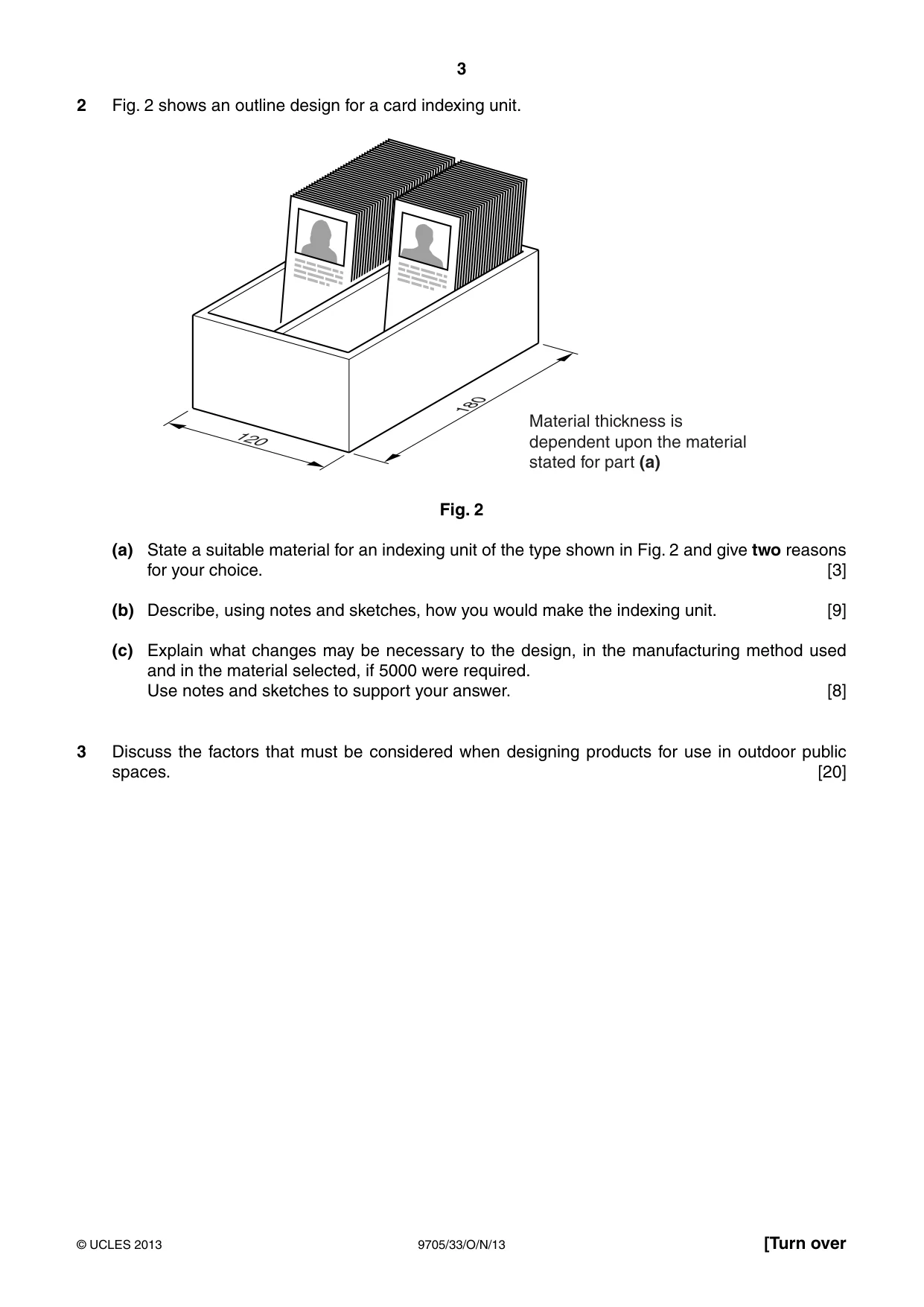
3 9705/33/O/N/13 © UCLES 2013 [Turn over 2 Fig. 2 shows an outline design for a card indexing unit. 180 120 Material thickness is dependent upon the material stated for part (a) Fig. 2 (a) State a suitable material for an indexing unit of the type shown in Fig. 2 and give two reasons for your choice. [3] (b) Describe, using notes and sketches, how you would make the indexing unit. [9] (c) Explain what changes may be necessary to the design, in the manufacturing method used and in the material selected, if 5000 were required. Use notes and sketches to support your answer. [8] 3 Discuss the factors that must be considered when designing products for use in outdoor public spaces. [20]
Question paper, page 4
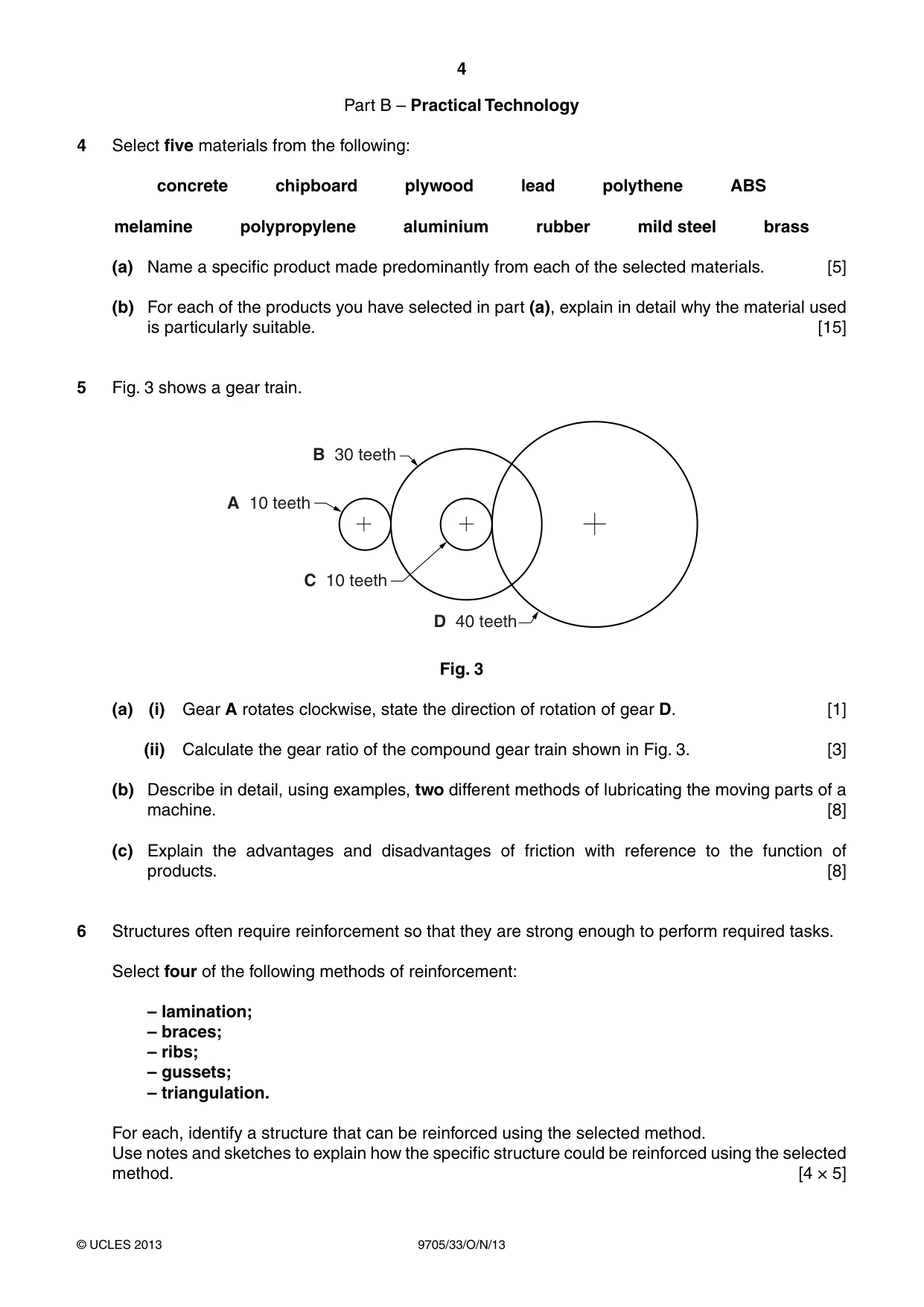
4 9705/33/O/N/13 © UCLES 2013 Part B – Practical Technology 4 Select five materials from the following: concrete chipboard plywood lead polythene ABS melamine polypropylene aluminium rubber mild steel brass (a) Name a specific product made predominantly from each of the selected materials. [5] (b) For each of the products you have selected in part (a), explain in detail why the material used is particularly suitable. [15] 5 Fig. 3 shows a gear train. B 30 teeth A 10 teeth C 10 teeth D 40 teeth Fig. 3 (a) (i) Gear A rotates clockwise, state the direction of rotation of gear D. [1] (ii) Calculate the gear ratio of the compound gear train shown in Fig. 3. [3] (b) Describe in detail, using examples, two different methods of lubricating the moving parts of a machine. [8] (c) Explain the advantages and disadvantages of friction with reference to the function of products. [8] 6 Structures often require reinforcement so that they are strong enough to perform required tasks. Select four of the following methods of reinforcement: – lamination; – braces; – ribs; – gussets; – triangulation. For each, identify a structure that can be reinforced using the selected method. Use notes and sketches to explain how the specific structure could be reinforced using the selected method. [4 × 5]
Question paper, page 5
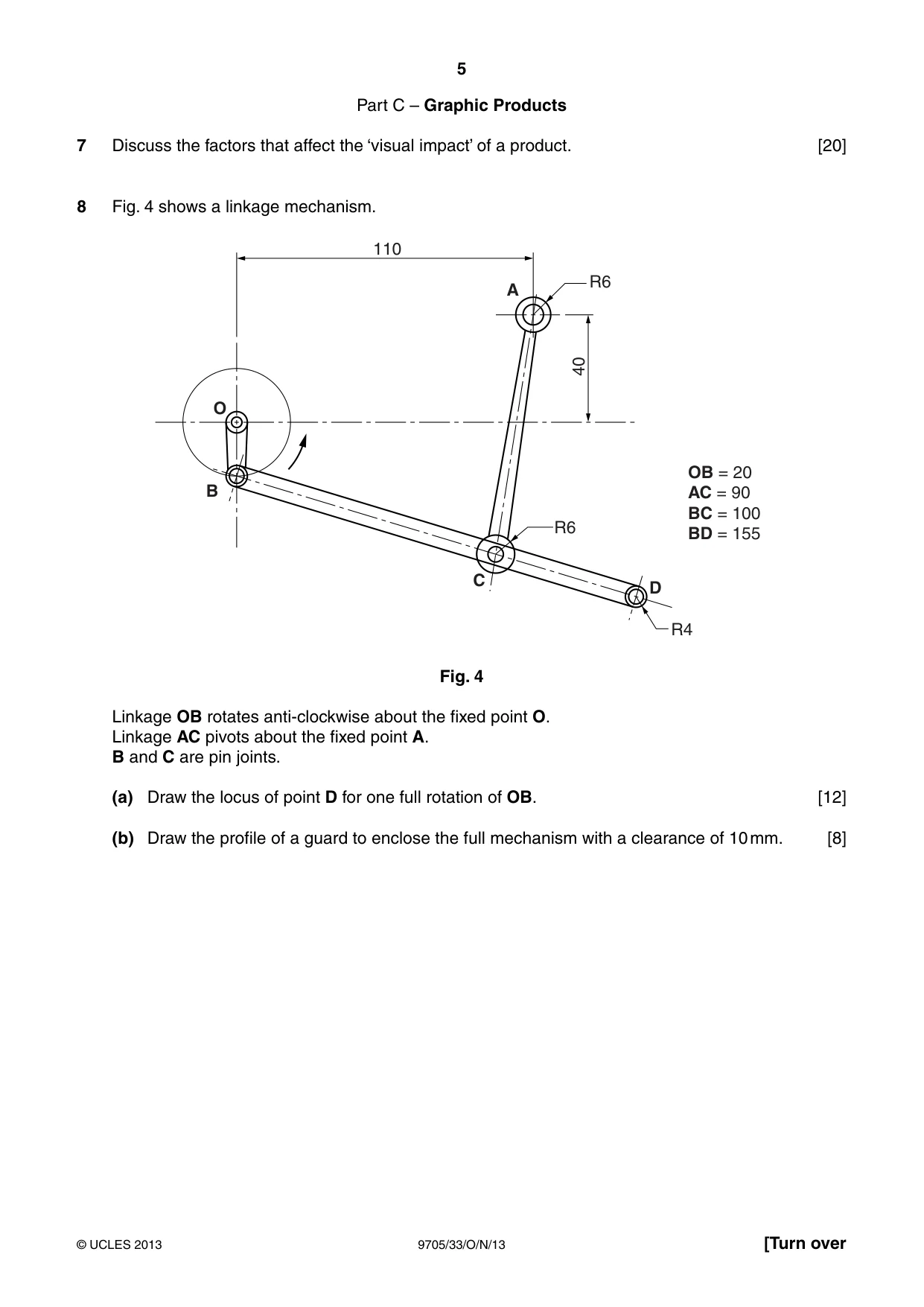
5 9705/33/O/N/13 © UCLES 2013 [Turn over Part C – Graphic Products 7 Discuss the factors that affect the ‘visual impact’ of a product. [20] 8 Fig. 4 shows a linkage mechanism. 40 110 R6 R6 R4 A B C D OB = 20 AC = 90 BC = 100 BD = 155 O Fig. 4 Linkage OB rotates anti-clockwise about the fixed point O. Linkage AC pivots about the fixed point A. B and C are pin joints. (a) Draw the locus of point D for one full rotation of OB. [12] (b) Draw the profile of a guard to enclose the full mechanism with a clearance of 10 mm. [8]
Question paper, page 6
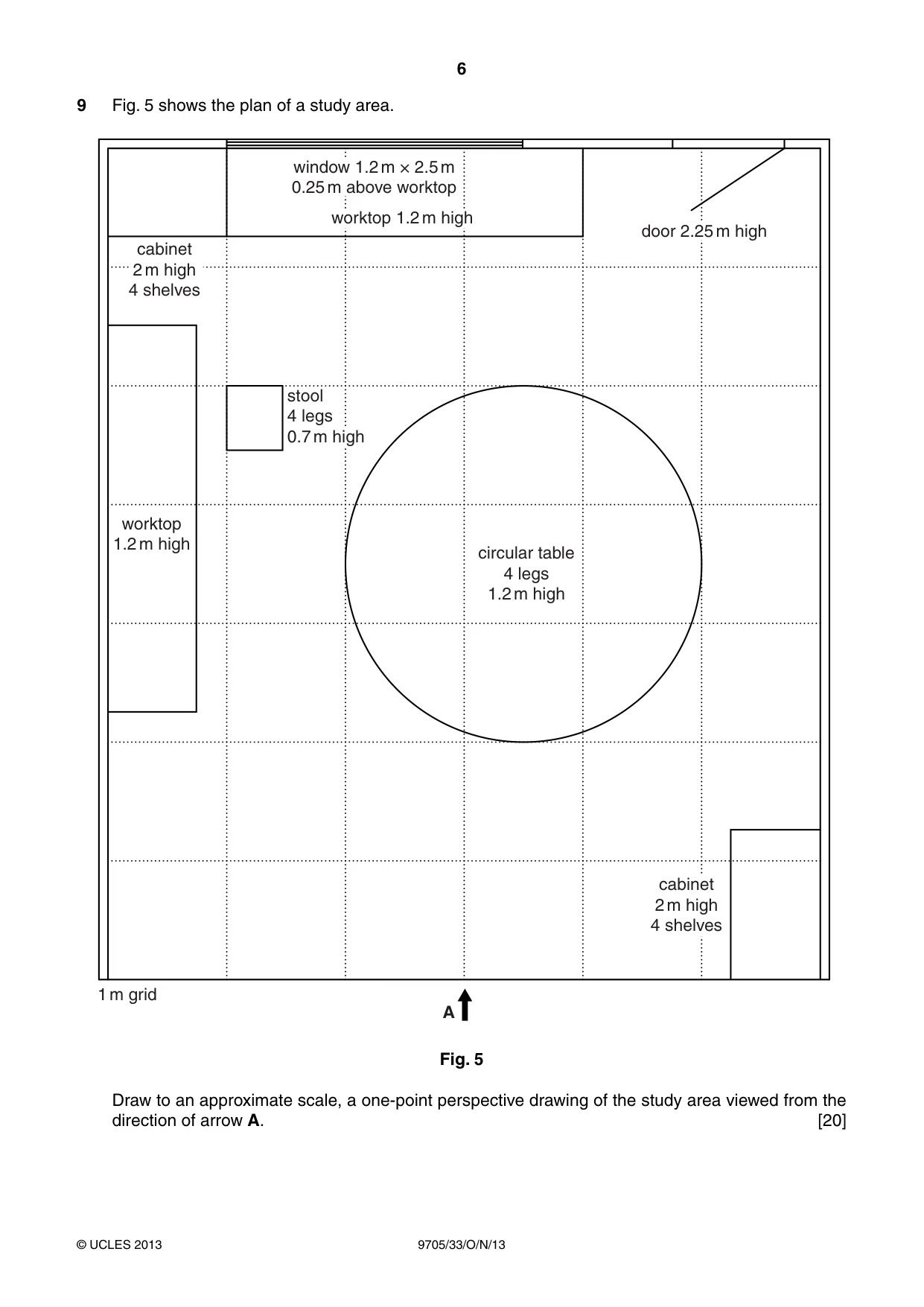
6 9705/33/O/N/13 © UCLES 2013 9 Fig. 5 shows the plan of a study area. cabinet 2 m high 4 shelves 1 m grid A worktop 1.2 m high circular table 4 legs 1.2 m high window 1.2 m × 2.5 m 0.25 m above worktop worktop 1.2 m high door 2.25 m high cabinet 2 m high 4 shelves stool 4 legs 0.7 m high Fig. 5 Draw to an approximate scale, a one-point perspective drawing of the study area viewed from the direction of arrow A. [20]
Question paper, page 7
7 9705/33/O/N/13 © UCLES 2013 [Turn over Section B Answer one question on the A3 paper provided. You should approach the design question of your choice in the following manner: Analysis Produce an analysis of the given situation/problem, which may be in written or graphical form. [5] Specification From the analysis, produce a detailed written specification of the design requirements. Include at least five specification points other than those given in the question. [5] Exploration Use bold sketches and brief notes to show your exploration of ideas for a design solution, with reasons for selection. [25] Development Show, using bold sketches and notes, the development, reasoning and composition of ideas into a single design proposal. Give details of materials, constructional and other relevant technical details. [25] Proposed solution Produce drawings of an appropriate kind to show the complete solution. [15] Evaluation Give a written evaluation of the final design solution. [5] [Total: 80]
Question paper, page 8
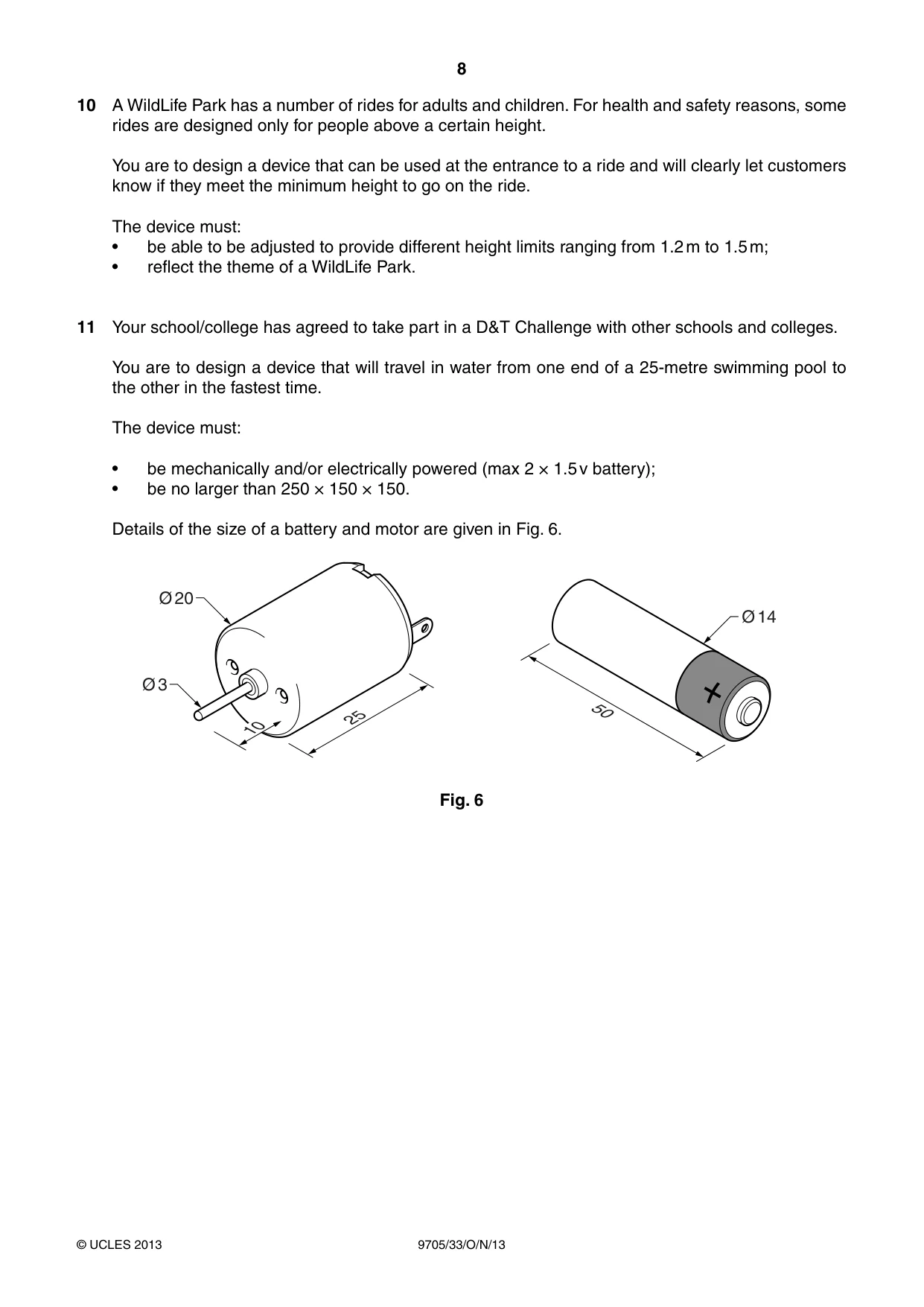
8 9705/33/O/N/13 © UCLES 2013 10 A WildLife Park has a number of rides for adults and children. For health and safety reasons, some rides are designed only for people above a certain height. You are to design a device that can be used at the entrance to a ride and will clearly let customers know if they meet the minimum height to go on the ride. The device must: • be able to be adjusted to provide different height limits ranging from 1.2 m to 1.5 m; • reflect the theme of a WildLife Park. 11 Your school/college has agreed to take part in a D&T Challenge with other schools and colleges. You are to design a device that will travel in water from one end of a 25-metre swimming pool to the other in the fastest time. The device must: • be mechanically and/or electrically powered (max 2 × 1.5 v battery); • be no larger than 250 × 150 × 150. Details of the size of a battery and motor are given in Fig. 6. 25 Ø 3 Ø 14 Ø 20 10 50 Fig. 6
Question paper, page 9
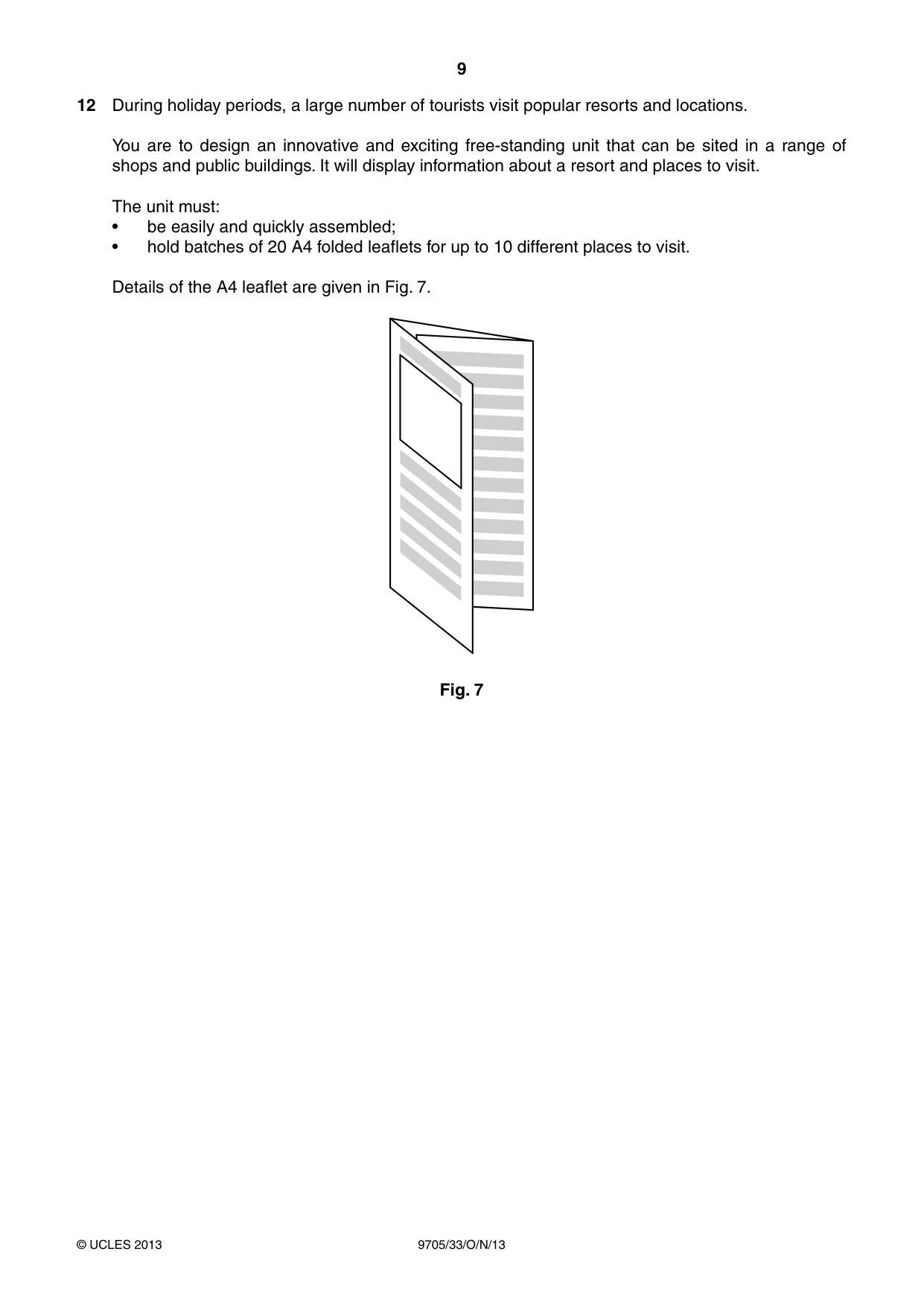
9 9705/33/O/N/13 © UCLES 2013 1 2 During holiday periods, a large number of tourists visit popular resorts and locations. You are to design an innovative and exciting free-standing unit that can be sited in a range of shops and public buildings. It will display information about a resort and places to visit. The unit must: • be easily and quickly assembled; • hold batches of 20 A4 folded leaflets for up to 10 different places to visit. Details of the A4 leaflet are given in Fig. 7. Fig. 7
Question paper, page 10
10 9705/33/O/N/13 © UCLES 2013 BLANK PAGE
Question paper, page 11
11 9705/33/O/N/13 © UCLES 2013 BLANK PAGE
Question paper, page 12
12 9705/33/O/N/13 © UCLES 2013 Permission to reproduce items where third-party owned material protected by copyright is included has been sought and cleared where possible. Every reasonable effort has been made by the publisher (UCLES) to trace copyright holders, but if any items requiring clearance have unwittingly been included, the publisher will be pleased to make amends at the earliest possible opportunity. University of Cambridge International Examinations is part of the Cambridge Assessment Group. Cambridge Assessment is the brand name of University of Cambridge Local Examinations Syndicate (UCLES), which is itself a department of the University of Cambridge. BLANK PAGE
Mark scheme, page 1
CAMBRIDGE INTERNATIONAL EXAMINATIONS GCE Advanced Level MARK SCHEME for the October/November 2013 series 9705 DESIGN AND TECHNOLOGY 9705/33 Paper 3, maximum raw mark 120 This mark scheme is published as an aid to teachers and candidates, to indicate the requirements of the examination. It shows the basis on which Examiners were instructed to award marks. It does not indicate the details of the discussions that took place at an Examiners’ meeting before marking began, which would have considered the acceptability of alternative answers. Mark schemes should be read in conjunction with the question paper and the Principal Examiner Report for Teachers. Cambridge will not enter into discussions about these mark schemes. Cambridge is publishing the mark schemes for the October/November 2013 series for most IGCSE, GCE Advanced Level and Advanced Subsidiary Level components and some Ordinary Level components.
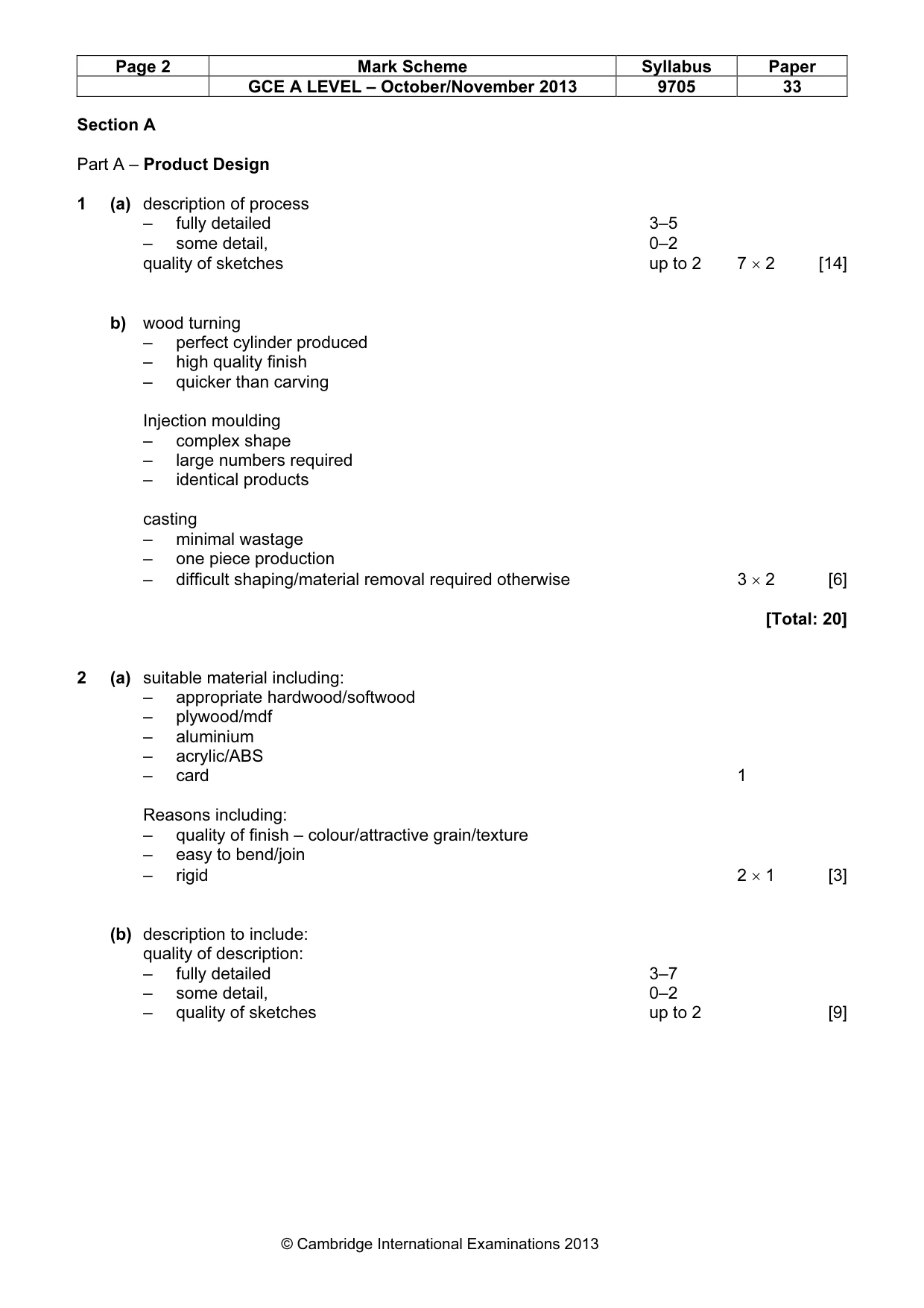
Mark scheme, page 2
Page 2 Mark Scheme Syllabus Paper GCE A LEVEL – October/November 2013 9705 33 © Cambridge International Examinations 2013 Section A Part A – Product Design 1 (a) description of process – fully detailed 3–5 – some detail, 0–2 quality of sketches up to 2 7 × 2 [14] b) wood turning – perfect cylinder produced – high quality finish – quicker than carving Injection moulding – complex shape – large numbers required – identical products casting – minimal wastage – one piece production – difficult shaping/material removal required otherwise 3 × 2 [6] [Total: 20] 2 (a) suitable material including: – appropriate hardwood/softwood – plywood/mdf – aluminium – acrylic/ABS – card 1 Reasons including: – quality of finish – colour/attractive grain/texture – easy to bend/join – rigid 2 × 1 [3] (b) description to include: quality of description: – fully detailed 3–7 – some detail, 0–2 – quality of sketches up to 2 [9]
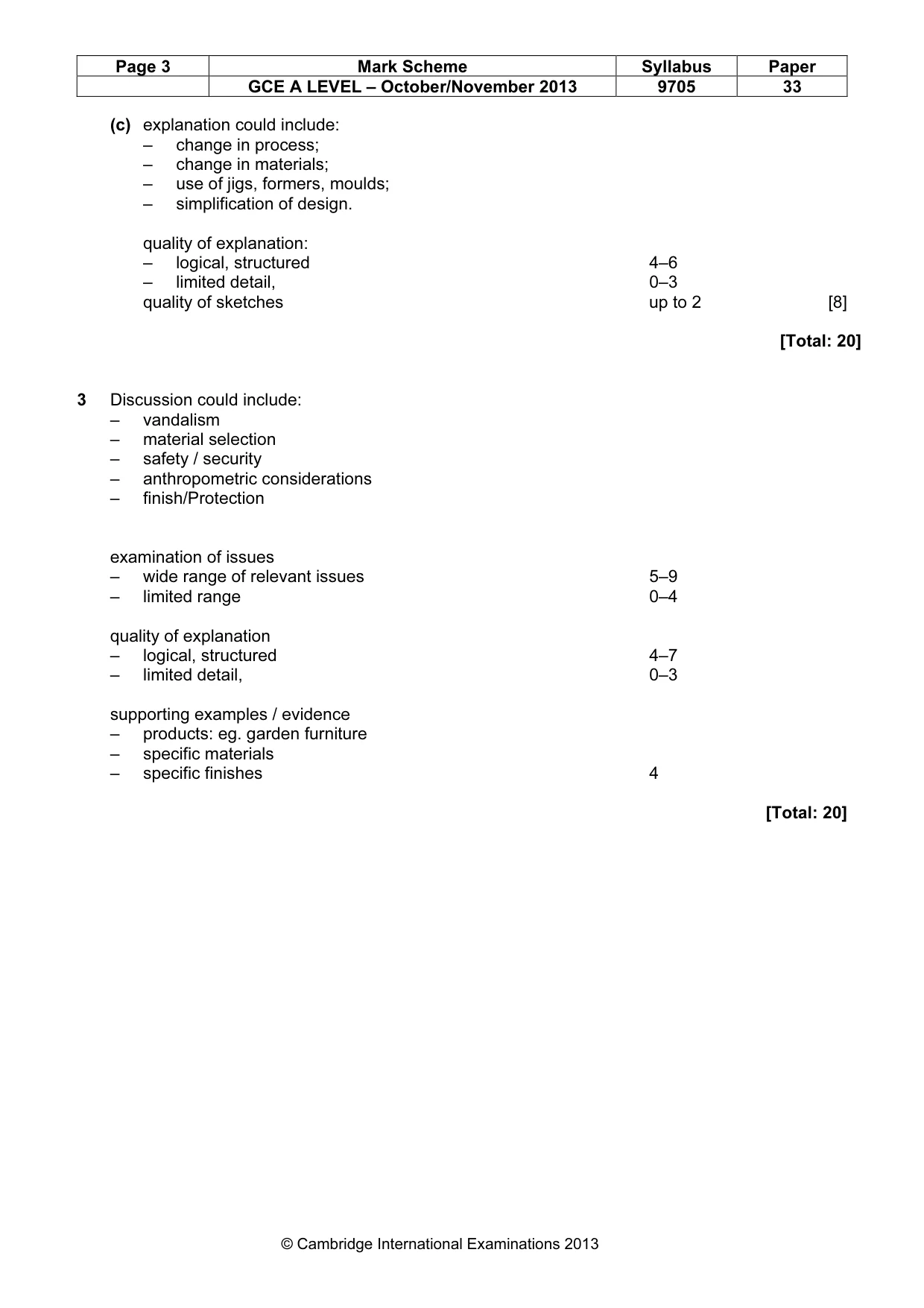
Mark scheme, page 3
Page 3 Mark Scheme Syllabus Paper GCE A LEVEL – October/November 2013 9705 33 © Cambridge International Examinations 2013 (c) explanation could include: – change in process; – change in materials; – use of jigs, formers, moulds; – simplification of design. quality of explanation: – logical, structured 4–6 – limited detail, 0–3 quality of sketches up to 2 [8] [Total: 20] 3 Discussion could include: – vandalism – material selection – safety / security – anthropometric considerations – finish/Protection examination of issues – wide range of relevant issues 5–9 – limited range 0–4 quality of explanation – logical, structured 4–7 – limited detail, 0–3 supporting examples / evidence – products: eg. garden furniture – specific materials – specific finishes 4 [Total: 20]
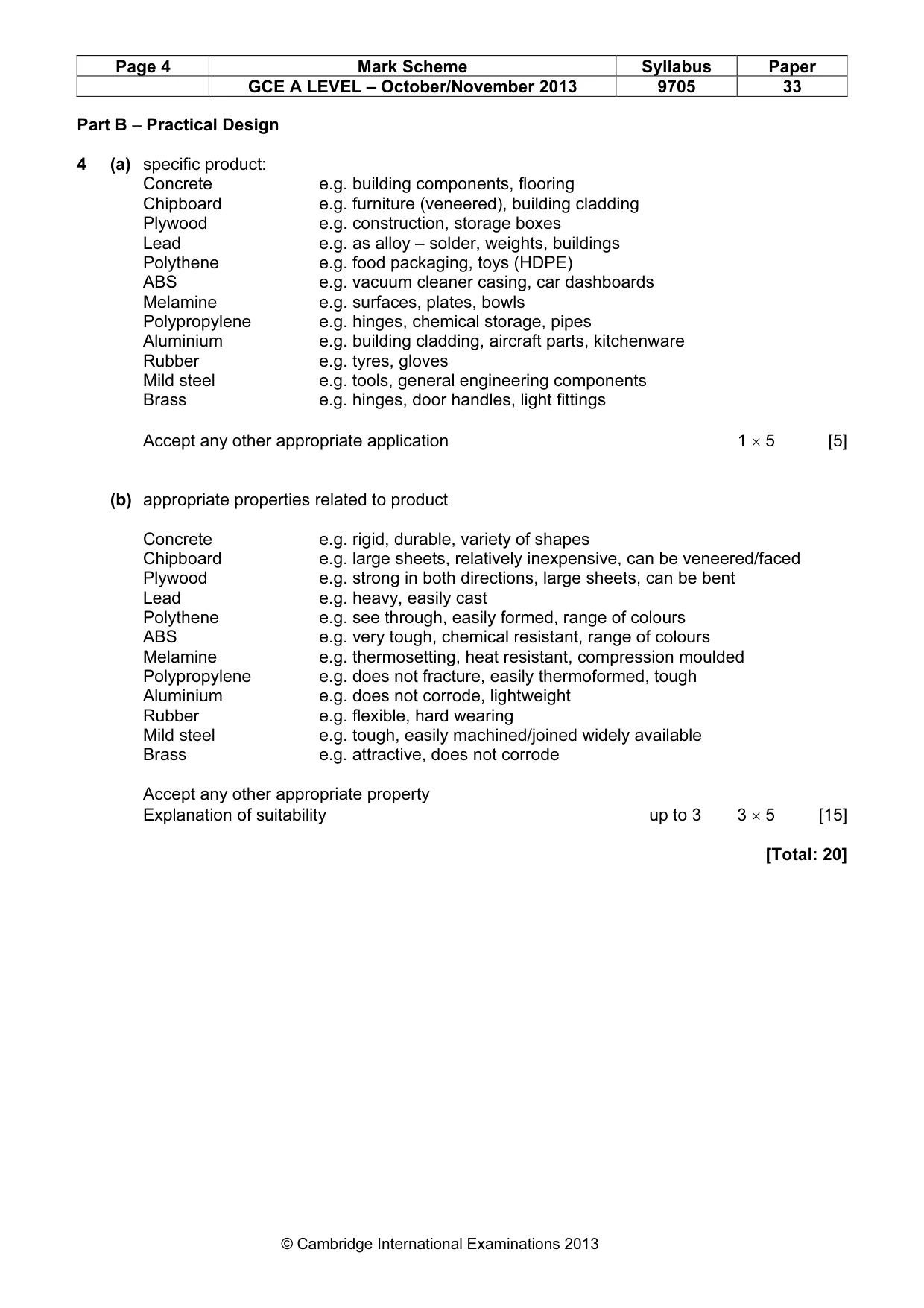
Mark scheme, page 4
Page 4 Mark Scheme Syllabus Paper GCE A LEVEL – October/November 2013 9705 33 © Cambridge International Examinations 2013 Part B – Practical Design 4 (a) specific product: Concrete e.g. building components, flooring Chipboard e.g. furniture (veneered), building cladding Plywood e.g. construction, storage boxes Lead e.g. as alloy – solder, weights, buildings Polythene e.g. food packaging, toys (HDPE) ABS e.g. vacuum cleaner casing, car dashboards Melamine e.g. surfaces, plates, bowls Polypropylene e.g. hinges, chemical storage, pipes Aluminium e.g. building cladding, aircraft parts, kitchenware Rubber e.g. tyres, gloves Mild steel e.g. tools, general engineering components Brass e.g. hinges, door handles, light fittings Accept any other appropriate application 1 × 5 [5] (b) appropriate properties related to product Concrete e.g. rigid, durable, variety of shapes Chipboard e.g. large sheets, relatively inexpensive, can be veneered/faced Plywood e.g. strong in both directions, large sheets, can be bent Lead e.g. heavy, easily cast Polythene e.g. see through, easily formed, range of colours ABS e.g. very tough, chemical resistant, range of colours Melamine e.g. thermosetting, heat resistant, compression moulded Polypropylene e.g. does not fracture, easily thermoformed, tough Aluminium e.g. does not corrode, lightweight Rubber e.g. flexible, hard wearing Mild steel e.g. tough, easily machined/joined widely available Brass e.g. attractive, does not corrode Accept any other appropriate property Explanation of suitability up to 3 3 × 5 [15] [Total: 20]
Mark scheme, page 5
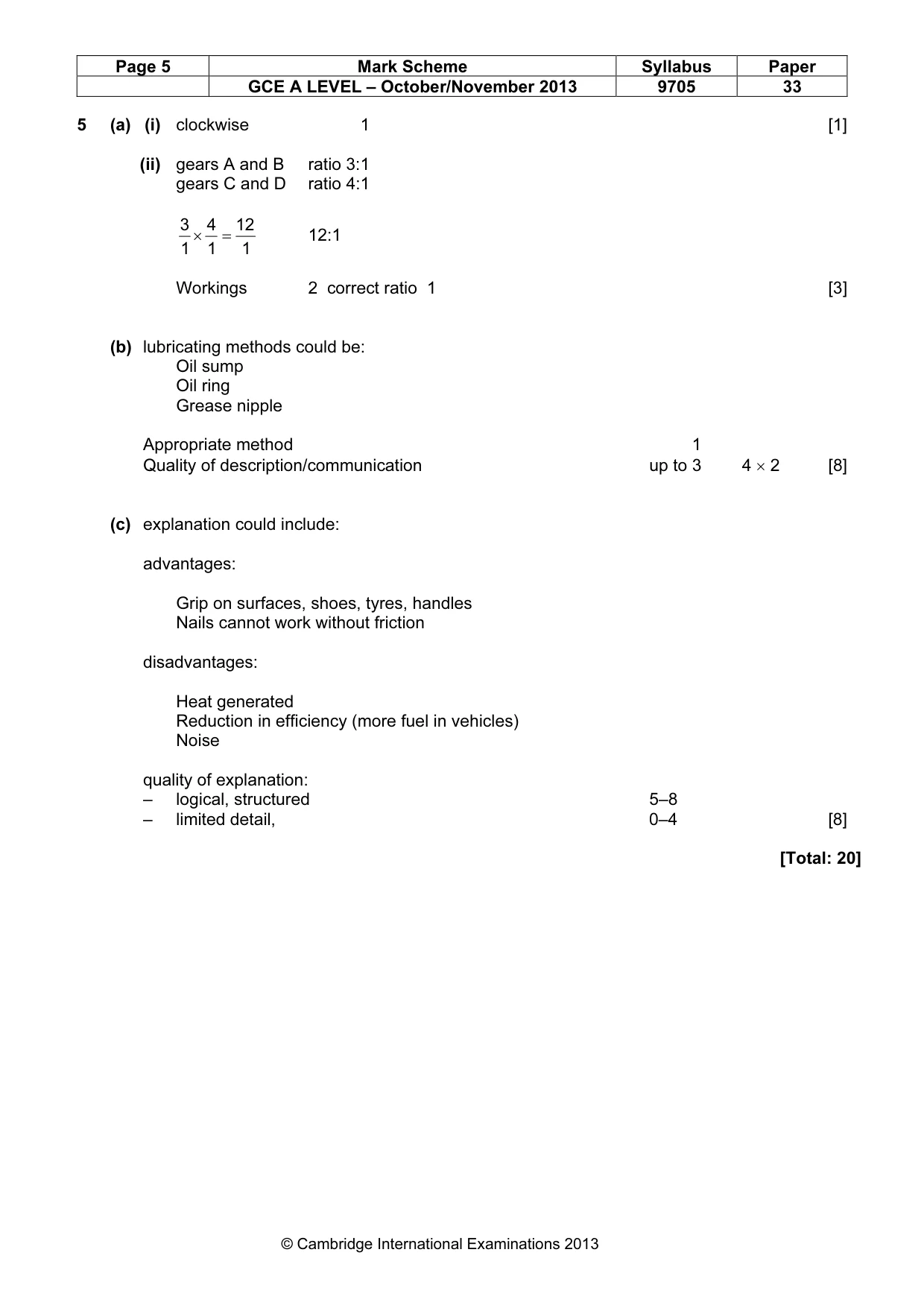
Page 5 Mark Scheme Syllabus Paper GCE A LEVEL – October/November 2013 9705 33 © Cambridge International Examinations 2013 5 (a) (i) clockwise ratio 3:1 [1] (ii) gears A and B ratio 3:1 gears C and D ratio 4:1 1 12 1 4 1 3 = × 12:1 Workings 2 correct ratio 1 [3] (b) lubricating methods could be: Oil sump Oil ring Grease nipple Appropriate method up to 1 Quality of description/communication up to 3 4 × 2 [8] (c) explanation could include: advantages: Grip on surfaces, shoes, tyres, handles Nails cannot work without friction disadvantages: Heat generated Reduction in efficiency (more fuel in vehicles) Noise quality of explanation: – logical, structured 5–8 – limited detail, 0–4 [8] [Total: 20]
Mark scheme, page 6
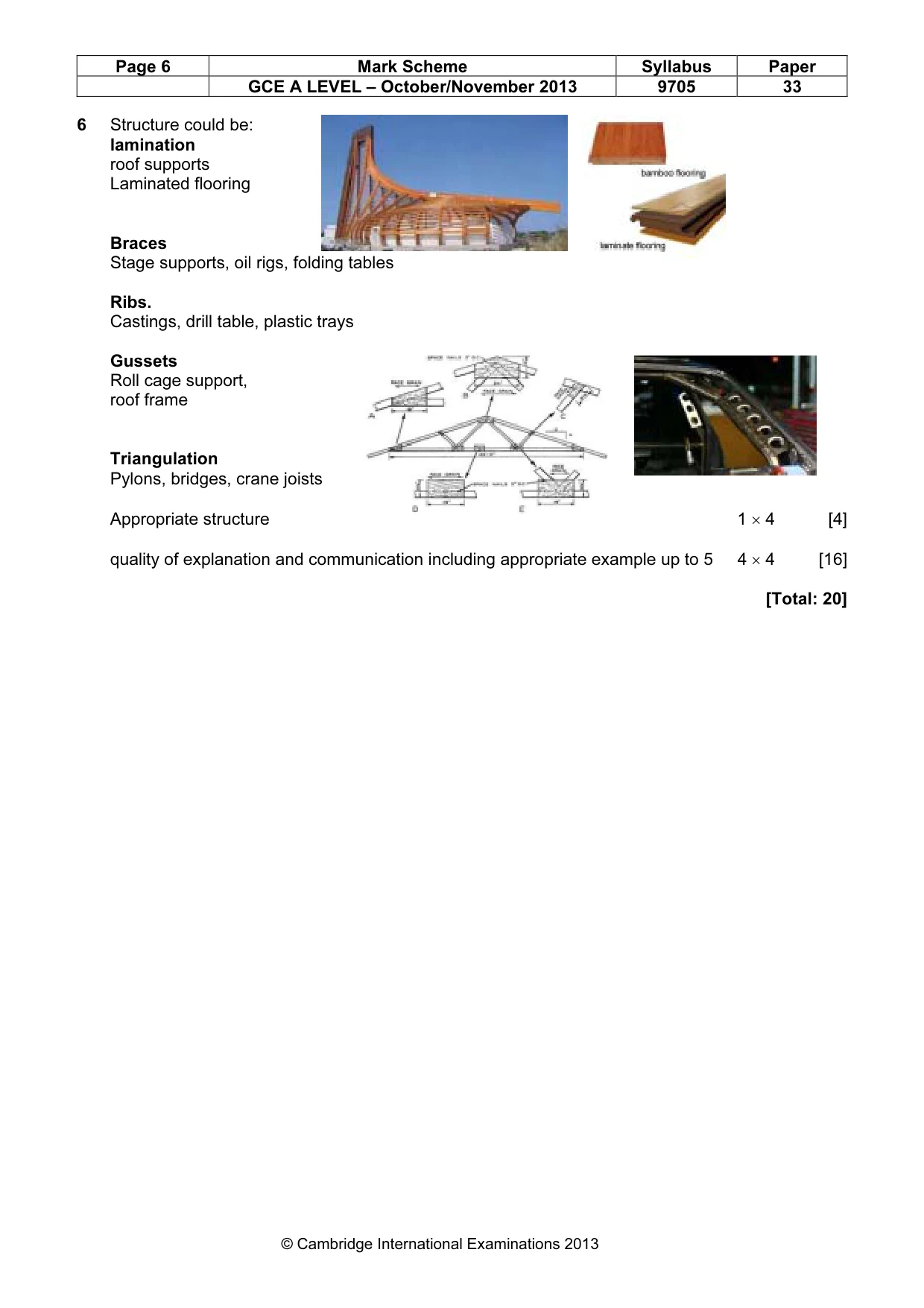
Page 6 Mark Scheme Syllabus Paper GCE A LEVEL – October/November 2013 9705 33 © Cambridge International Examinations 2013 6 Structure could be: lamination roof supports Laminated flooring Braces Stage supports, oil rigs, folding tables Ribs. Castings, drill table, plastic trays Gussets Roll cage support, roof frame Triangulation Pylons, bridges, crane joists Appropriate structure 1 × 4 [4] quality of explanation and communication including appropriate example up to 5 4 × 4 [16] [Total: 20]
Mark scheme, page 7
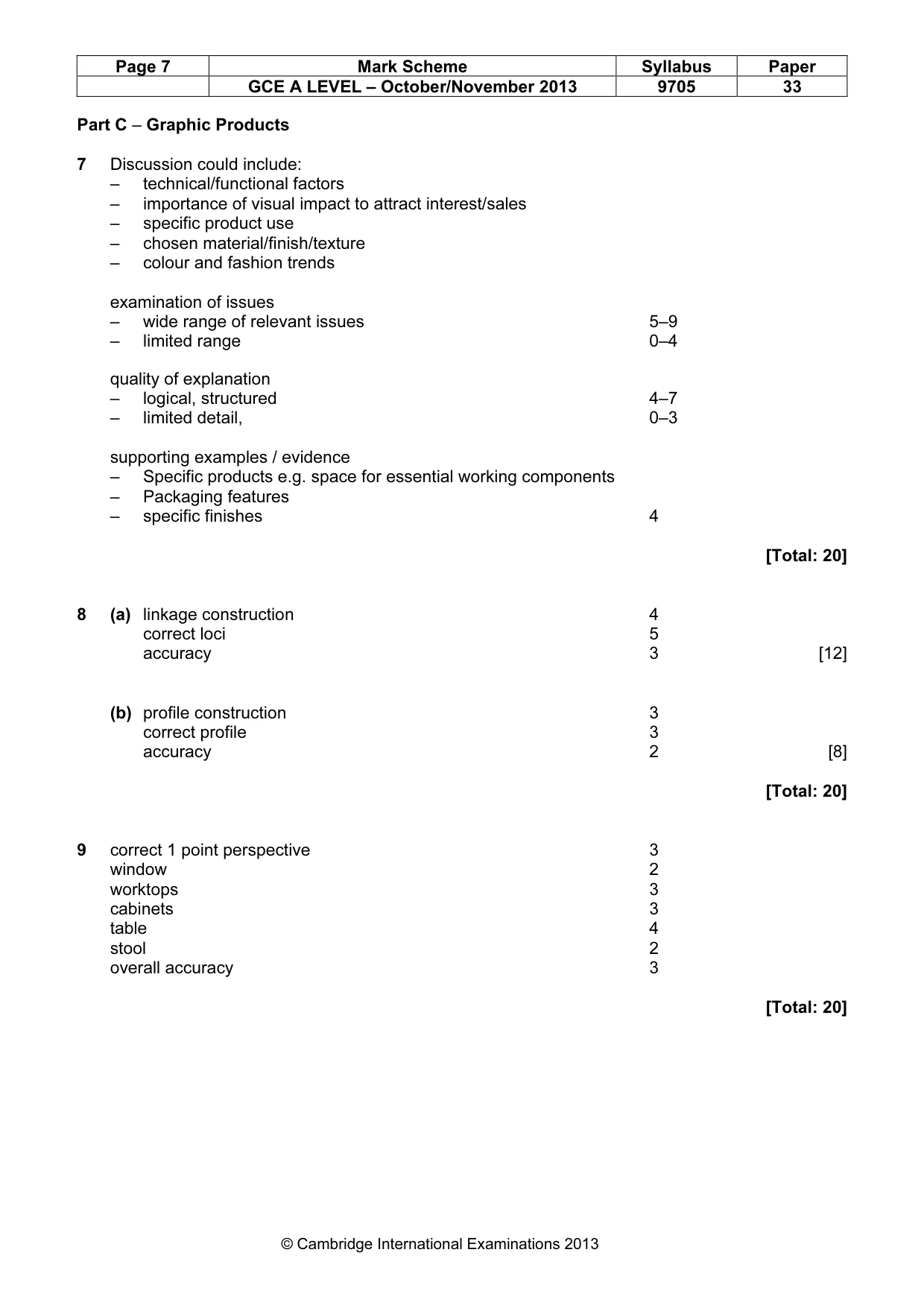
Page 7 Mark Scheme Syllabus Paper GCE A LEVEL – October/November 2013 9705 33 © Cambridge International Examinations 2013 Part C – Graphic Products 7 Discussion could include: – technical/functional factors – importance of visual impact to attract interest/sales – specific product use – chosen material/finish/texture – colour and fashion trends examination of issues – wide range of relevant issues 5–9 – limited range 0–4 quality of explanation – logical, structured 4–7 – limited detail, 0–3 supporting examples / evidence – Specific products e.g. space for essential working components – Packaging features – specific finishes 4 [Total: 20] 8 (a) linkage construction 4 correct loci 5 accuracy 3 [12] (b) profile construction 3 correct profile 3 accuracy 2 [8] [Total: 20] 9 correct 1 point perspective 3 window 2 worktops 3 cabinets 3 table 4 stool 2 overall accuracy 3 [Total: 20]
Mark scheme, page 8
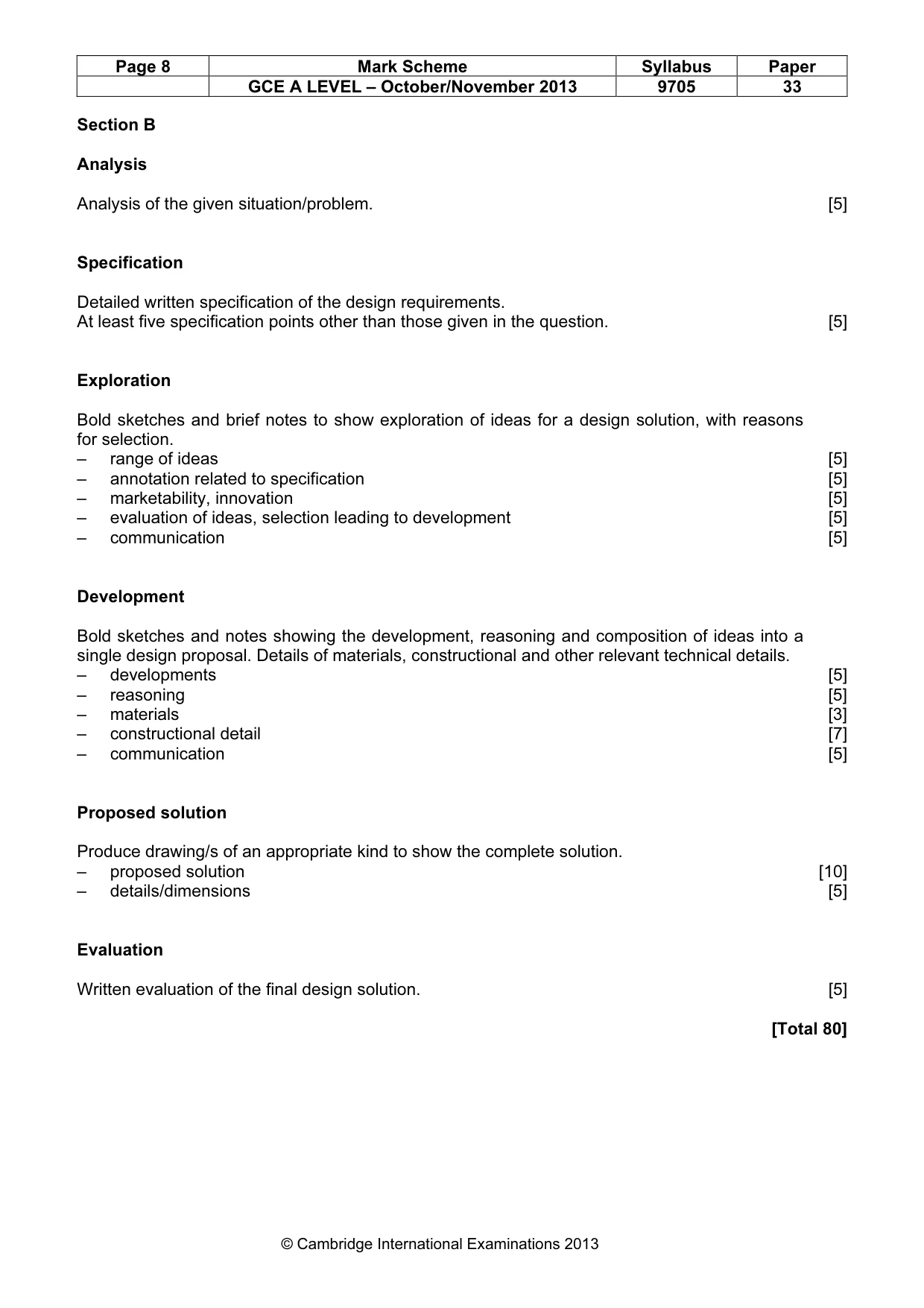
Page 8 Mark Scheme Syllabus Paper GCE A LEVEL – October/November 2013 9705 33 © Cambridge International Examinations 2013 Section B Analysis Analysis of the given situation/problem. [5] Specification Detailed written specification of the design requirements. At least five specification points other than those given in the question. [5] Exploration Bold sketches and brief notes to show exploration of ideas for a design solution, with reasons for selection. – range of ideas [5] – annotation related to specification [5] – marketability, innovation [5] – evaluation of ideas, selection leading to development [5] – communication [5] Development Bold sketches and notes showing the development, reasoning and composition of ideas into a single design proposal. Details of materials, constructional and other relevant technical details. – developments [5] – reasoning [5] – materials [3] – constructional detail [7] – communication [5] Proposed solution Produce drawing/s of an appropriate kind to show the complete solution. – proposed solution [10] – details/dimensions [5] Evaluation Written evaluation of the final design solution. [5] [Total 80]
What you needed in this session
Cambridge’s own grade thresholds for 2013 Oct/Nov, Paper 3 · Variant 3. A higher threshold means an easier paper — the bar moves with how the cohort did.