Cambridge A Level Design and Technology 9705 — 2013 Oct/Nov Paper 3 · Variant 2
9705/32/O/N/13 · 120 marks · ≈135 min
The question paper and its mark scheme, free to read here and free to download. This is Cambridge’s own paper, exactly as it was sat.
Question paper12 pages


Mark scheme11 pages
Answers below. Sit the paper first if you are practising.
Paper as text
Question paper, page 1
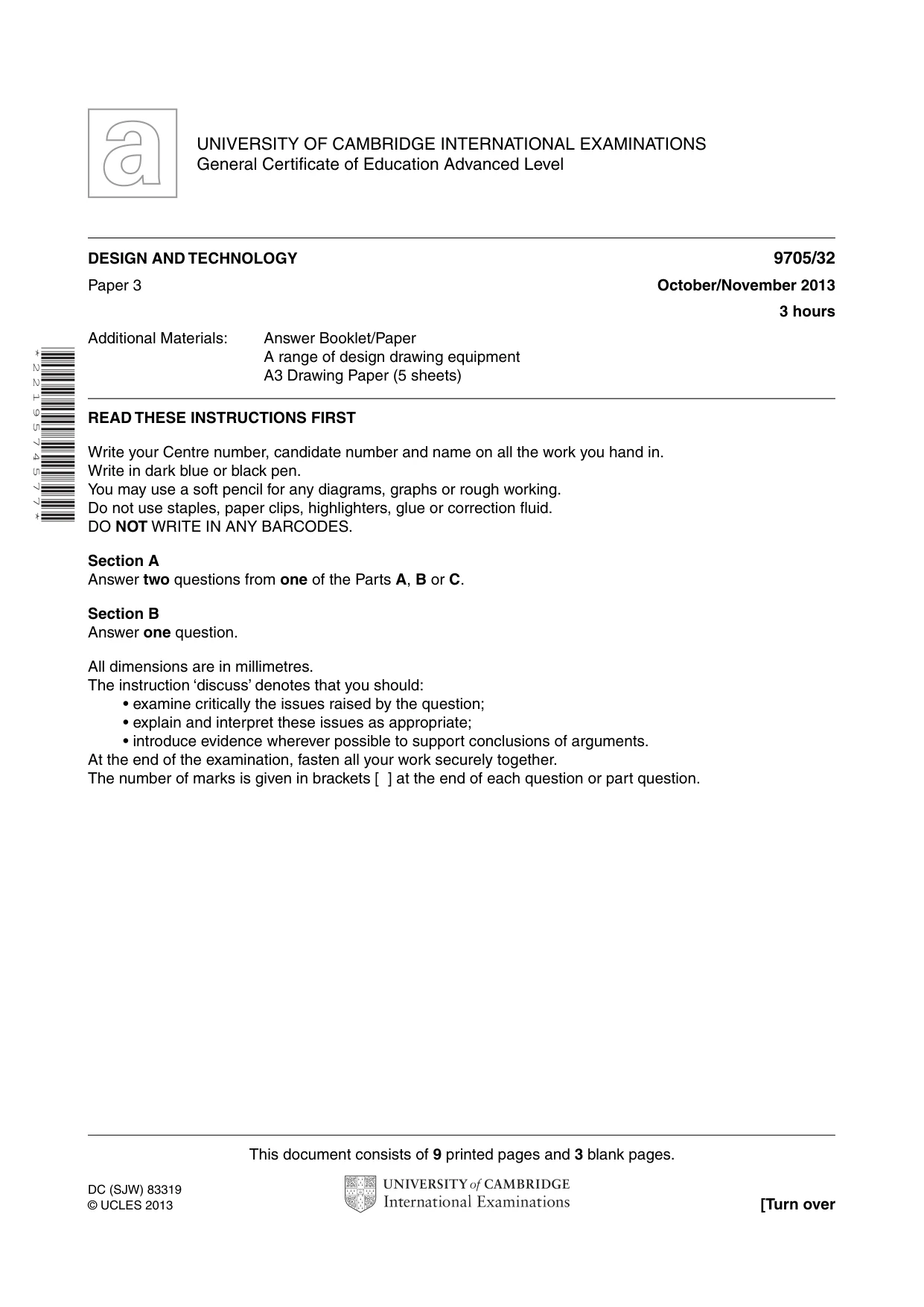
This document consists of 9 printed pages and 3 blank pages. DC (SJW) 83319 © UCLES 2013 [Turn over UNIVERSITY OF CAMBRIDGE INTERNATIONAL EXAMINATIONS General Certificate of Education Advanced Level * 2 2 1 9 5 7 4 5 7 7 * DESIGN AND TECHNOLOGY 9705/32 Paper 3 October/November 2013 3 hours Additional Materials: Answer Booklet/Paper A range of design drawing equipment A3 Drawing Paper (5 sheets) READ THESE INSTRUCTIONS FIRST Write your Centre number, candidate number and name on all the work you hand in. Write in dark blue or black pen. You may use a soft pencil for any diagrams, graphs or rough working. Do not use staples, paper clips, highlighters, glue or correction fluid. DO NOT WRITE IN ANY BARCODES. Section A Answer two questions from one of the Parts A, B or C. Section B Answer one question. All dimensions are in millimetres. The instruction ‘discuss’ denotes that you should: • examine critically the issues raised by the question; • explain and interpret these issues as appropriate; • introduce evidence wherever possible to support conclusions of arguments. At the end of the examination, fasten all your work securely together. The number of marks is given in brackets [ ] at the end of each question or part question.
Question paper, page 2
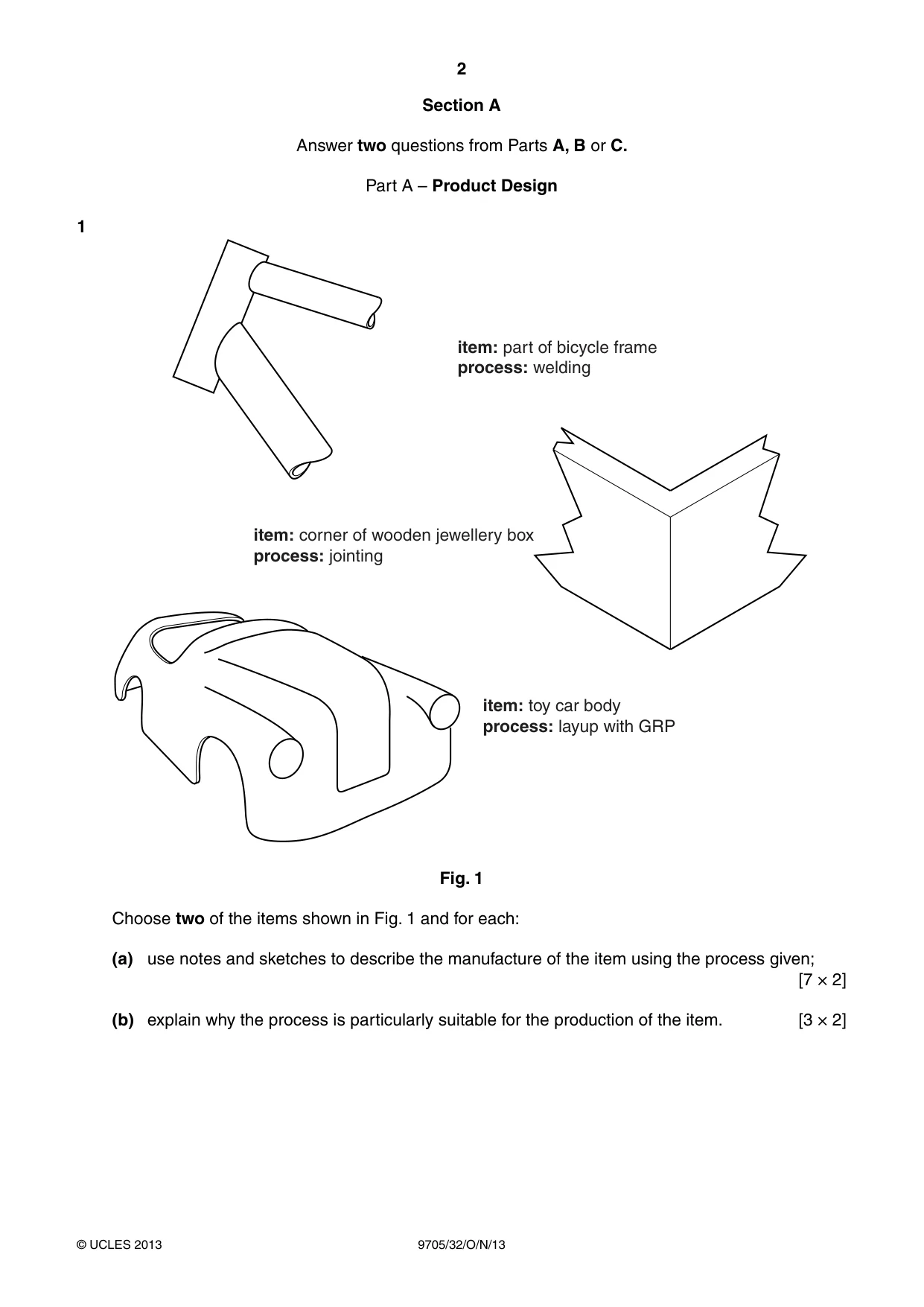
2 9705/32/O/N/13 © UCLES 2013 Section A Answer two questions from Parts A, B or C. Part A – Product Design 1 item: corner of wooden jewellery box process: jointing item: part of bicycle frame process: welding item: toy car body process: layup with GRP Fig. 1 Choose two of the items shown in Fig. 1 and for each: (a) use notes and sketches to describe the manufacture of the item using the process given; [7 × 2] (b) explain why the process is particularly suitable for the production of the item. [3 × 2]
Question paper, page 3
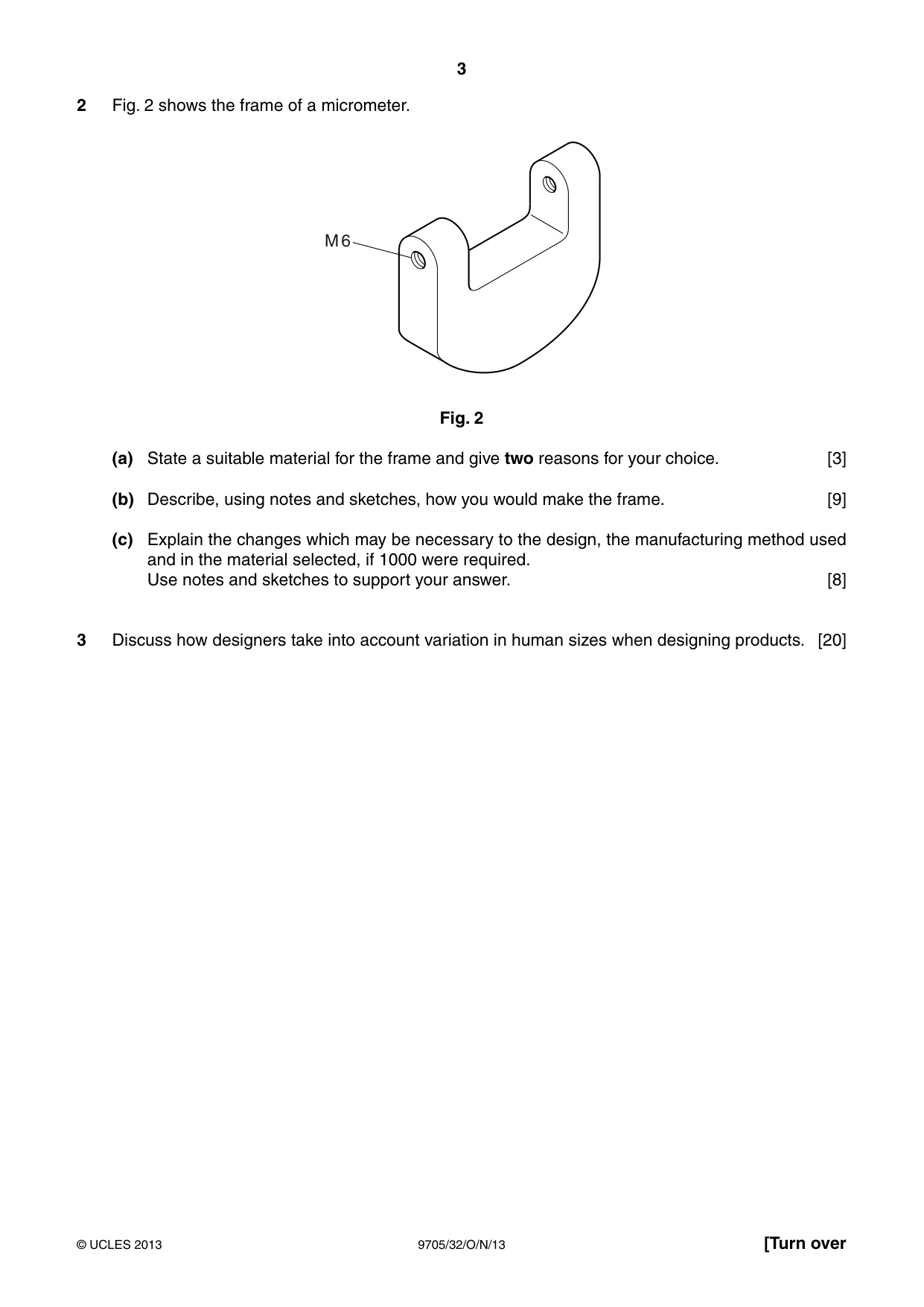
3 9705/32/O/N/13 © UCLES 2013 [Turn over 2 Fig. 2 shows the frame of a micrometer. M 6 Fig. 2 (a) State a suitable material for the frame and give two reasons for your choice. [3] (b) Describe, using notes and sketches, how you would make the frame. [9] (c) Explain the changes which may be necessary to the design, the manufacturing method used and in the material selected, if 1000 were required. Use notes and sketches to support your answer. [8] 3 Discuss how designers take into account variation in human sizes when designing products. [20]
Question paper, page 4
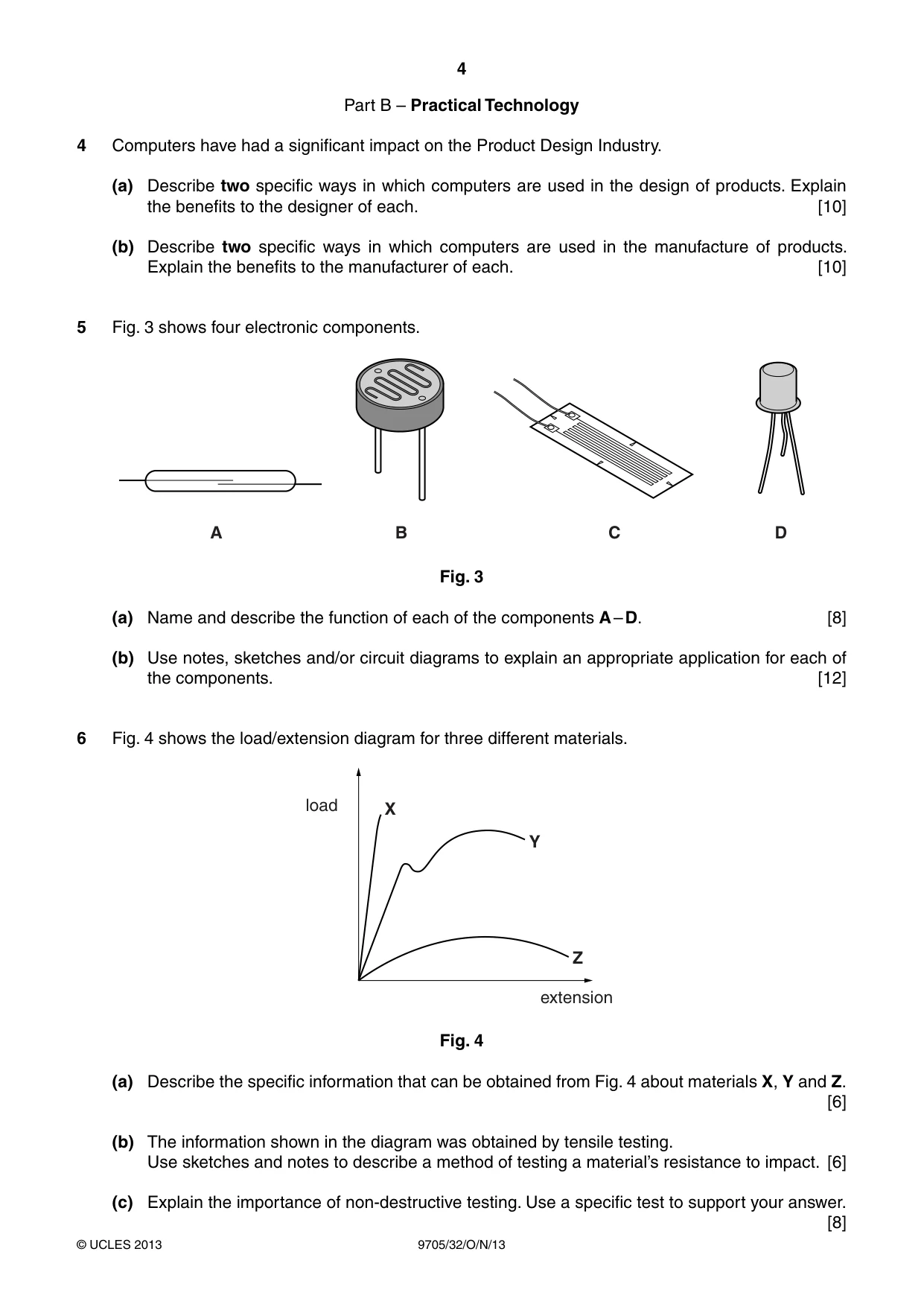
4 9705/32/O/N/13 © UCLES 2013 Part B – Practical Technology 4 Computers have had a significant impact on the Product Design Industry. (a) Describe two specific ways in which computers are used in the design of products. Explain the benefits to the designer of each. [10] (b) Describe two specific ways in which computers are used in the manufacture of products. Explain the benefits to the manufacturer of each. [10] 5 Fig. 3 shows four electronic components. A B C D Fig. 3 (a) Name and describe the function of each of the components A – D. [8] (b) Use notes, sketches and/or circuit diagrams to explain an appropriate application for each of the components. [12] 6 Fig. 4 shows the load/extension diagram for three different materials. X Y Z load extension Fig. 4 (a) Describe the specific information that can be obtained from Fig. 4 about materials X, Y and Z. [6] (b) The information shown in the diagram was obtained by tensile testing. Use sketches and notes to describe a method of testing a material’s resistance to impact. [6] (c) Explain the importance of non-destructive testing. Use a specific test to support your answer. [8]
Question paper, page 5
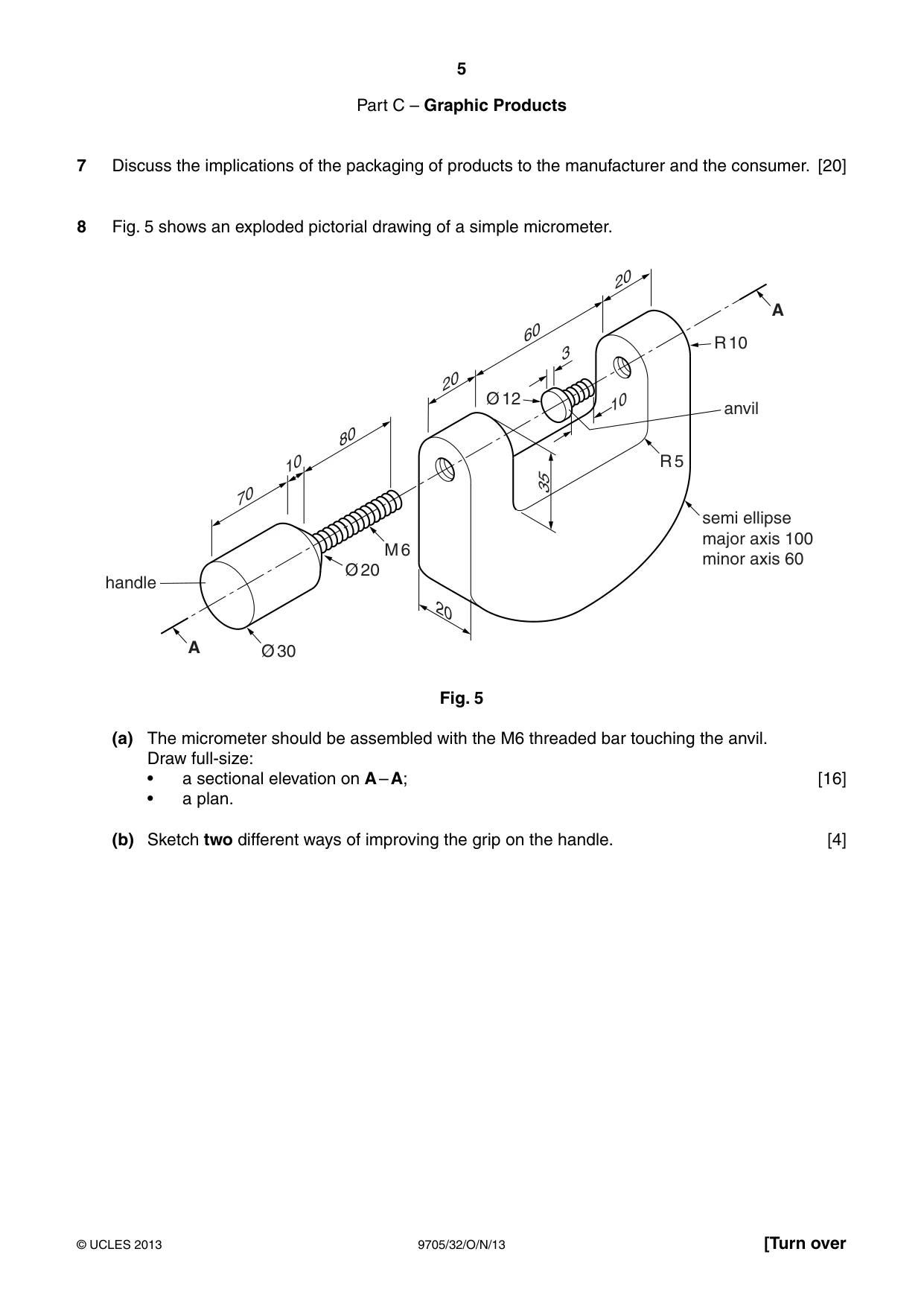
5 9705/32/O/N/13 © UCLES 2013 [Turn over Part C – Graphic Products 7 Discuss the implications of the packaging of products to the manufacturer and the consumer. [20] 8 Fig. 5 shows an exploded pictorial drawing of a simple micrometer. 70 10 80 20 60 3 10 20 20 35 A A handle anvil semi ellipse major axis 100 minor axis 60 Ø 30 Ø 20 Ø 12 M 6 R 5 R 10 Fig. 5 (a) The micrometer should be assembled with the M6 threaded bar touching the anvil. Draw full-size: • a sectional elevation on A – A; [16] • a plan. (b) Sketch two different ways of improving the grip on the handle. [4]
Question paper, page 6
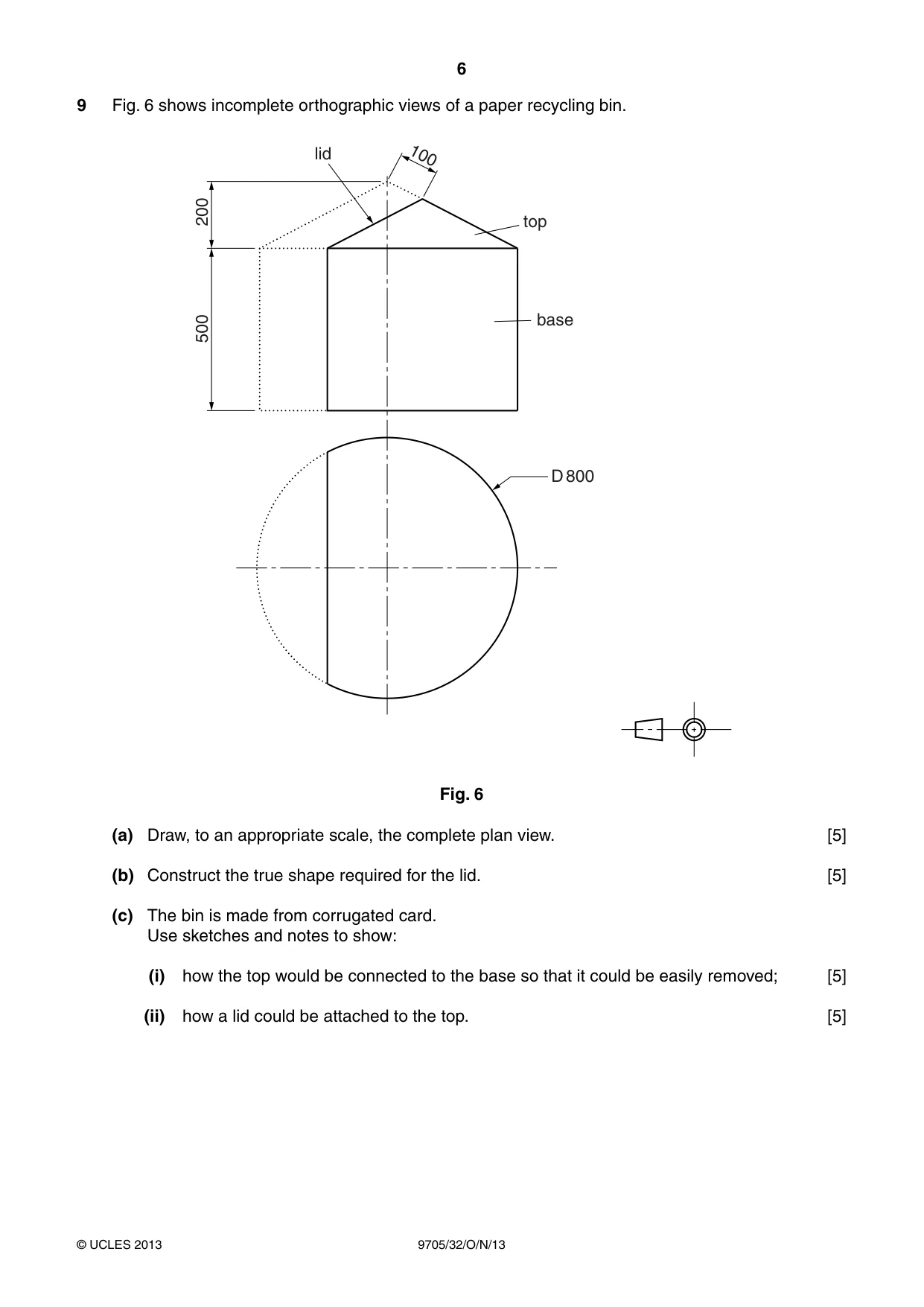
6 9705/32/O/N/13 © UCLES 2013 9 Fig. 6 shows incomplete orthographic views of a paper recycling bin. 200 500 100 top base lid D 800 Fig. 6 (a) Draw, to an appropriate scale, the complete plan view. [5 ] (b) Construct the true shape required for the lid. [5] (c) The bin is made from corrugated card. Use sketches and notes to show: (i) how the top would be connected to the base so that it could be easily removed; [5] (ii) how a lid could be attached to the top. [5]
Question paper, page 7
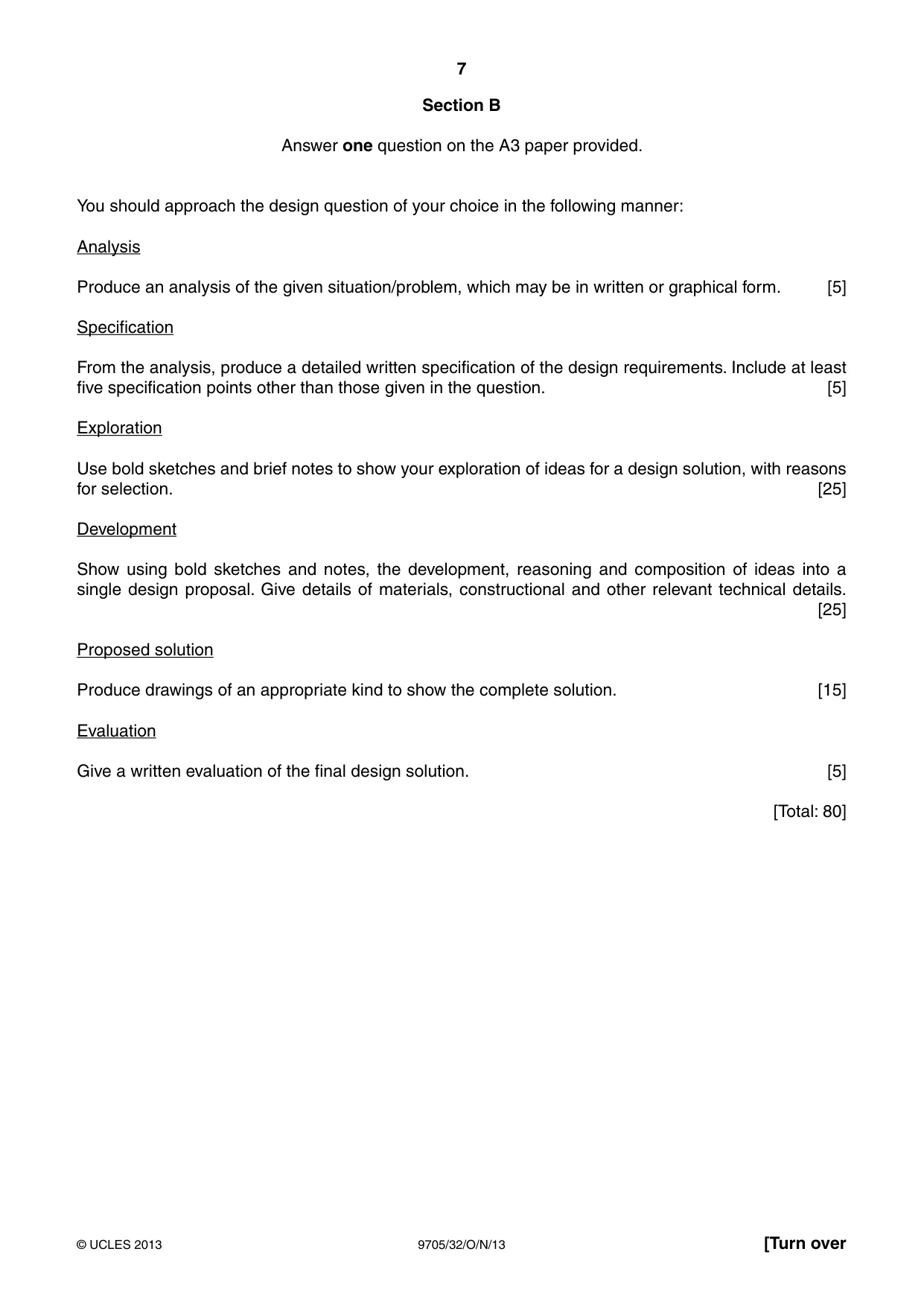
7 9705/32/O/N/13 © UCLES 2013 [Turn over Section B Answer one question on the A3 paper provided. You should approach the design question of your choice in the following manner: Analysis Produce an analysis of the given situation/problem, which may be in written or graphical form. [5] Specification From the analysis, produce a detailed written specification of the design requirements. Include at least five specification points other than those given in the question. [5] Exploration Use bold sketches and brief notes to show your exploration of ideas for a design solution, with reasons for selection. [25] Development Show using bold sketches and notes, the development, reasoning and composition of ideas into a single design proposal. Give details of materials, constructional and other relevant technical details. [25] Proposed solution Produce drawings of an appropriate kind to show the complete solution. [15] Evaluation Give a written evaluation of the final design solution. [5] [Total: 80]
Question paper, page 8
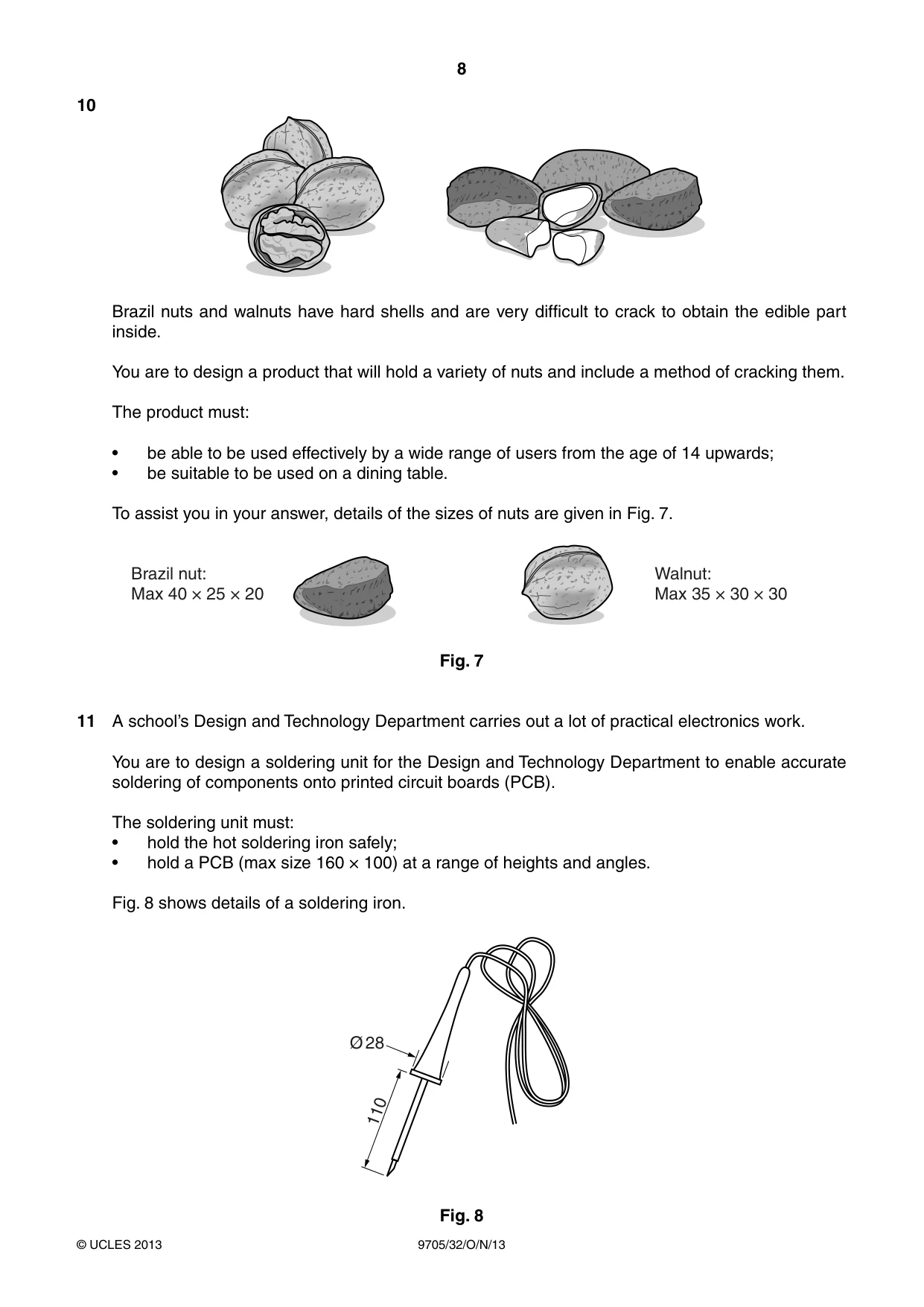
8 9705/32/O/N/13 © UCLES 2013 10 Brazil nuts and walnuts have hard shells and are very difficult to crack to obtain the edible part inside. You are to design a product that will hold a variety of nuts and include a method of cracking them. The product must: • be able to be used effectively by a wide range of users from the age of 14 upwards; • be suitable to be used on a dining table. To assist you in your answer, details of the sizes of nuts are given in Fig. 7. Brazil nut: Max 40 × 25 × 20 Walnut: Max 35 × 30 × 30 Fig. 7 11 A school’s Design and Technology Department carries out a lot of practical electronics work. You are to design a soldering unit for the Design and Technology Department to enable accurate soldering of components onto printed circuit boards (PCB). The soldering unit must: • hold the hot soldering iron safely; • hold a PCB (max size 160 × 100) at a range of heights and angles. Fig. 8 shows details of a soldering iron. 110 Ø 28 Fig. 8
Question paper, page 9
9 9705/32/O/N/13 © UCLES 2013 12 A company wishes to increase its range of products after disappointing sales figures. The current packaging is shown in Fig. 9. A new chocolate shape is shown in Fig. 10. The shapes are to be sold in packs of 36. You are to design a new innovative package for the chocolate shapes. The packaging must: • hold the shapes securely, to avoid damage in transportation; • include a name for the product and suitable graphics to excite and interest consumers. Fig. 9 Chocolate shape, each side 25 long Fig. 10
Question paper, page 10
10 9705/32/O/N/13 © UCLES 2013 BLANK PAGE
Question paper, page 11
11 9705/32/O/N/13 © UCLES 2013 BLANK PAGE
Question paper, page 12
12 9705/32/O/N/13 © UCLES 2013 Permission to reproduce items where third-party owned material protected by copyright is included has been sought and cleared where possible. Every reasonable effort has been made by the publisher (UCLES) to trace copyright holders, but if any items requiring clearance have unwittingly been included, the publisher will be pleased to make amends at the earliest possible opportunity. University of Cambridge International Examinations is part of the Cambridge Assessment Group. Cambridge Assessment is the brand name of University of Cambridge Local Examinations Syndicate (UCLES), which is itself a department of the University of Cambridge. BLANK PAGE
Mark scheme, page 1
CAMBRIDGE INTERNATIONAL EXAMINATIONS GCE Advanced Level MARK SCHEME for the October/November 2013 series 9705 DESIGN AND TECHNOLOGY 9705/32 Paper 3, maximum raw mark 120 This mark scheme is published as an aid to teachers and candidates, to indicate the requirements of the examination. It shows the basis on which Examiners were instructed to award marks. It does not indicate the details of the discussions that took place at an Examiners’ meeting before marking began, which would have considered the acceptability of alternative answers. Mark schemes should be read in conjunction with the question paper and the Principal Examiner Report for Teachers. Cambridge will not enter into discussions about these mark schemes. Cambridge is publishing the mark schemes for the October/November 2013 series for most IGCSE, GCE Advanced Level and Advanced Subsidiary Level components and some Ordinary Level components.
Mark scheme, page 2
Page 2 Mark Scheme Syllabus Paper GCE A LEVEL – October/November 2013 9705 32 © Cambridge International Examinations 2013 Section A Part A – Product Design 1 (a) description of process – fully detailed 3 – 5 – some detail, 0 – 2 quality of sketches up to 2 (7 × 2) [14] (b) welding – very strong joint – can used to fabricate components of similar material – relatively quick process jointing – structurally strong – can be aesthetic – effective for joining wood parts Laying up with GRP – compound shape/easy once mould made – structurally strong/resists loads – colour applied 3 × 2 [6] [Total: 20] 2 (a) suitable material including: – aluminium/brass – ABS/nylon – Mild steel – appropriate hardwood 1 Reasons including: – rigid – easy to shape – accepts good finish 2 × 1 [3] (b) description to include: quality of description: – fully detailed 3 – 7 – some detail, 0 – 2 quality of sketches up to 2 [9]
Mark scheme, page 3
Page 3 Mark Scheme Syllabus Paper GCE A LEVEL – October/November 2013 9705 32 © Cambridge International Examinations 2013 (c) explanation could include: – change in process; – change in materials; – use of jigs, formers, moulds; – simplification of design. quality of explanation: – logical, structured 4 – 6 – limited detail, 0 – 3 quality of sketches up to 2 [8] [Total: 20] 3 Discussion could include: – range of sizes/models; – adjustability (car seats); – flexibility (clothing) – use of anthropometric data examination of issues – wide range of relevant issues 5 – 9 – limited range 0 – 4 quality of explanation – logical, structured 4 – 7 – limited detail, 0 – 3 supporting examples/evidence – watches, – clothes – chairs – spectacles 4 [Total: 20]
Mark scheme, page 4
Page 4 Mark Scheme Syllabus Paper GCE A LEVEL – October/November 2013 9705 32 © Cambridge International Examinations 2013 Part B – Practical Design 4 (a) ways could be: – CAD – Internet (research, comparisons) – communication in design teams benefits could be: – speed/quality of design presentation – accuracy – up to date info on competitors quality of description – logical, structured/detailed 2 – 3 – limited detail, 0 – 1 benefits up to 2 (5 × 2) [10] (b) ways could be: – CAM (CNC machining) – quality control – stock control benefits could be: – high speed manufacture – no labour issues – consistency of product – quality assurance quality of description – logical, structured/detailed 2 – 3 – limited detail, 0 – 1 benefits up to 2 (5 × 2) [10] [Total: 20]
Mark scheme, page 5
Page 5 Mark Scheme Syllabus Paper GCE A LEVEL – October/November 2013 9705 32 © Cambridge International Examinations 2013 5 (a) Reed Switch When a magnetic force is generated parallel to the reed switch, the reeds become flux carriers in the magnetic circuit. The overlapping ends of the reeds become opposite magnetic poles, which attract each other. If the magnetic force between the poles is strong enough to overcome the restoring force of the reeds, the reeds will be drawn together. Light Dependent Resistor LDR A photoresistor or light dependent resistor LDR is a resistor whose resistance decreases with increasing incident light intensity. Strain gauge is a device used to measure the strain of an object. The most common type of strain gauge consists of an insulating flexible backing which supports a metallic foil pattern. The gauge is attached to the object by a suitable adhesive, such as cyanoacrylate. As the object is deformed, the foil is deformed, causing its electrical resistance to change. This resistance change, usually measured using a Wheatstone bridge, is related to the strain by the quantity known as the gauge factor. Transistor is a semiconductor device used to amplify and switch electronic signals and power. It is composed of a semiconductor material with at least three terminals for connection to an external circuit. A voltage or current applied to one pair of the transistor's terminals changes the current flowing through another pair of terminals. Because the controlled (output) power can be much more than the controlling (input) power, a transistor can amplify a signal. Name 1 mark Description 1 mark (2 × 4) [8]
Mark scheme, page 6
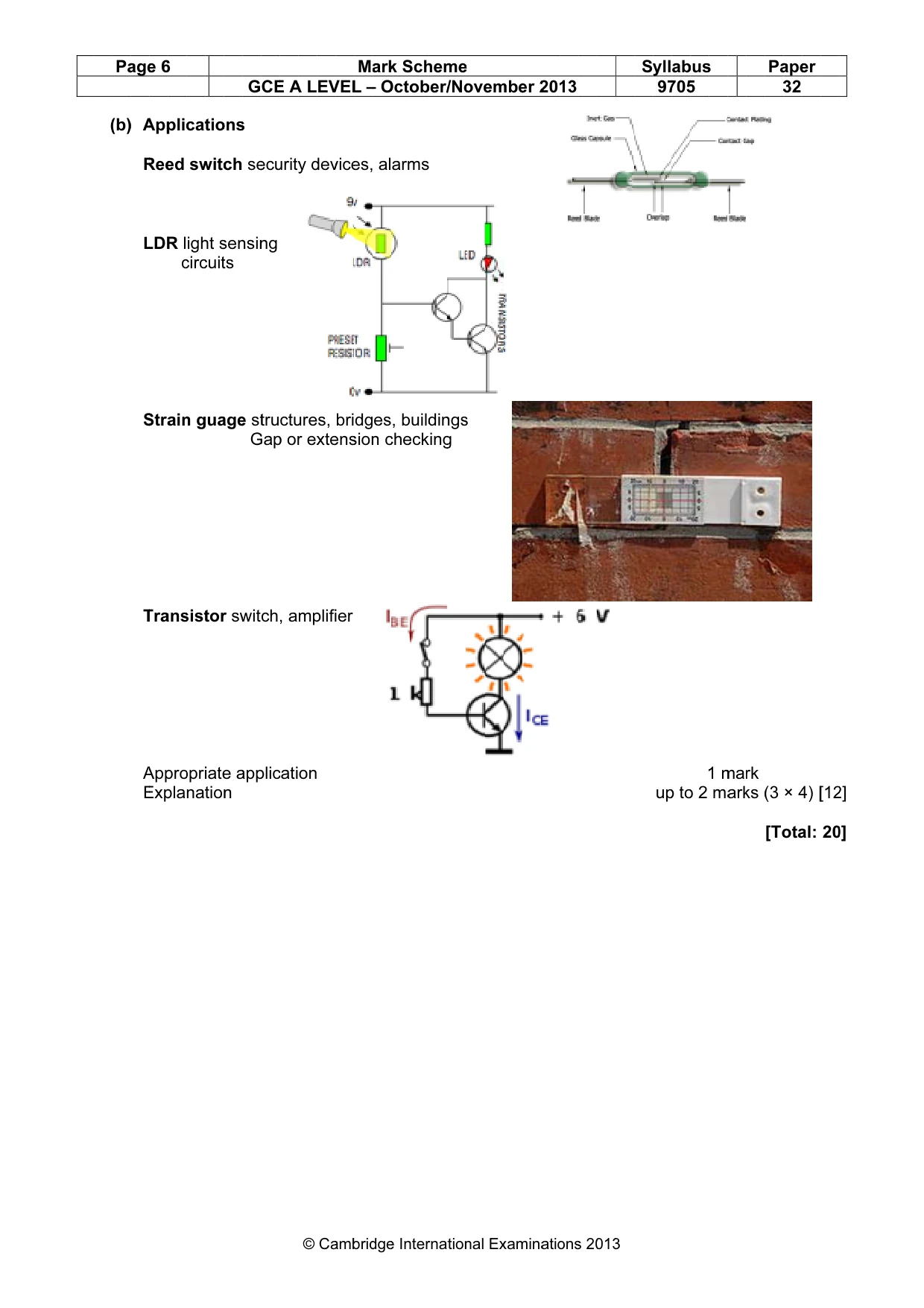
( Pa (b) age ) A R L S T A E e 6 App Ree LDR Stra Tra App Exp 6 plic ed R l c ain ans pro pla cat sw igh circ n g sist opri nat tio witc ht s cuit gua tor iate tion ons ch sen ts age r sw e a n G s se nsin e st G wit app CE ecu ng tru Gap ch plic E A urity ctu p or , a cati A L © y d ure r ex mp on EV Ca dev s, xte plifi VEL amb vice bri ens ier Ma L – brid es, dg sion ark – O dge al es n c k S Octo e In arm , b che Sch ob nter ms uild eck hem ber/ rnat din king me /No tion ngs g e ove nal s em Ex mbe xam er 2 mina 201 atio 13 ons 2013 Syll 97 up ab 705 p to bus 5 1 o 2 s 1 m ma mar ark rk ks ( Pa 3 (3 [To ape 32 × 4 ota er 4) [ al: [12 20 2] 0]
Mark scheme, page 7
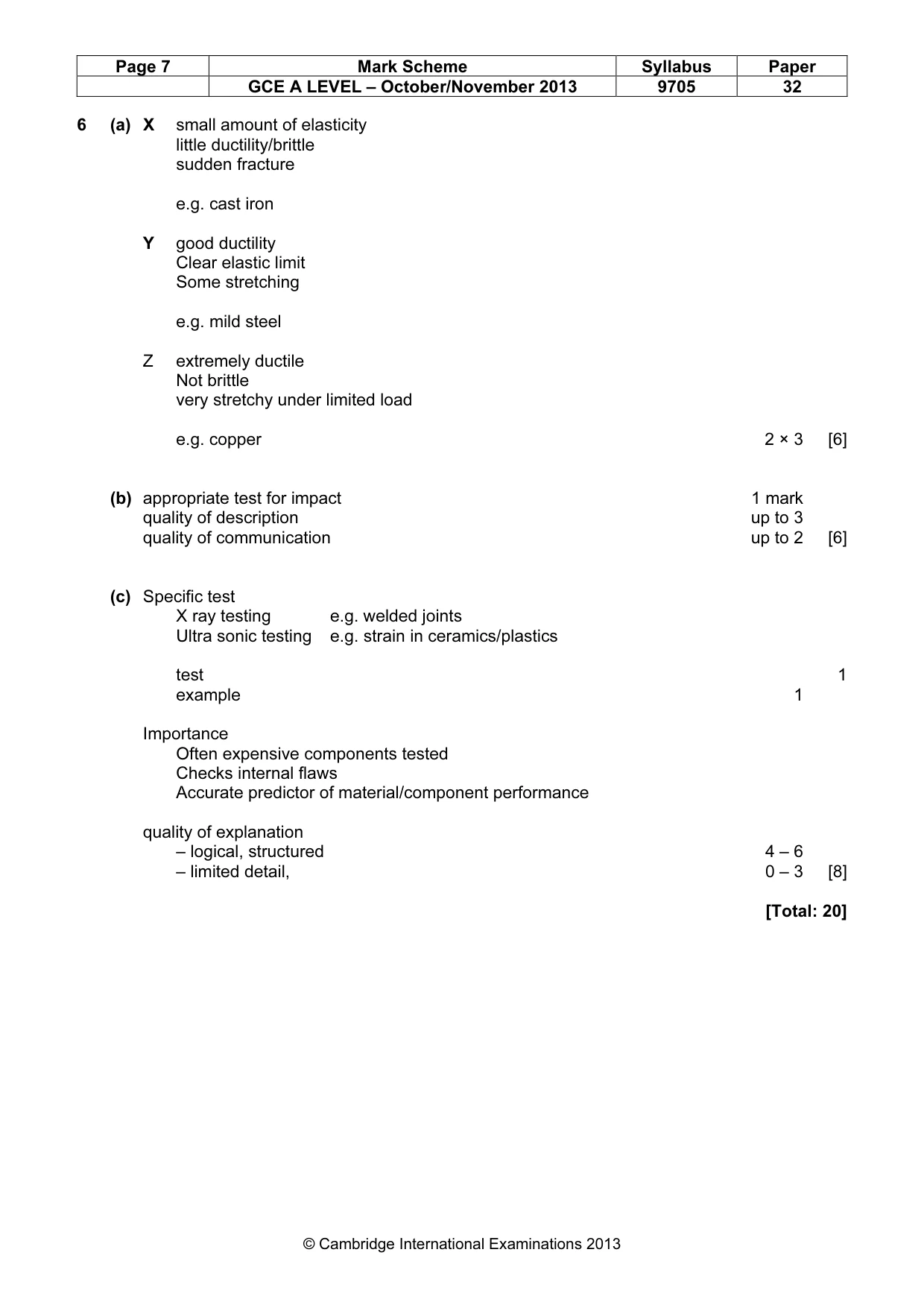
Page 7 Mark Scheme Syllabus Paper GCE A LEVEL – October/November 2013 9705 32 © Cambridge International Examinations 2013 6 (a) X small amount of elasticity little ductility/brittle sudden fracture e.g. cast iron Y good ductility Clear elastic limit Some stretching e.g. mild steel Z extremely ductile Not brittle very stretchy under limited load e.g. copper 2 × 3 [6] (b) appropriate test for impact 1 mark quality of description up to 3 quality of communication up to 2 [6] (c) Specific test X ray testing e.g. welded joints Ultra sonic testing e.g. strain in ceramics/plastics test 1 example 1 Importance Often expensive components tested Checks internal flaws Accurate predictor of material/component performance quality of explanation – logical, structured 4 – 6 – limited detail, 0 – 3 [8] [Total: 20]
Mark scheme, page 8
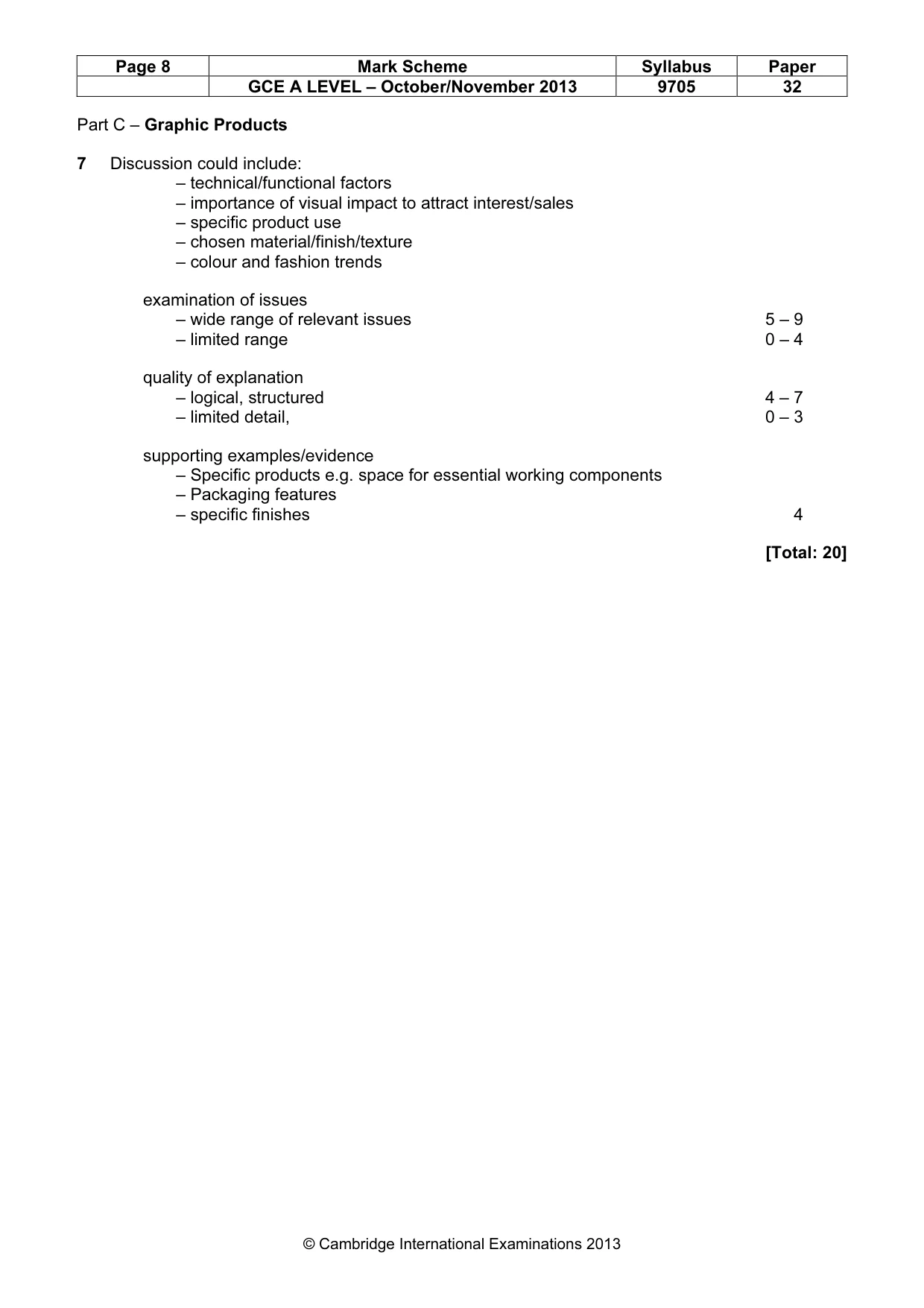
Page 8 Mark Scheme Syllabus Paper GCE A LEVEL – October/November 2013 9705 32 © Cambridge International Examinations 2013 Part C – Graphic Products 7 Discussion could include: – technical/functional factors – importance of visual impact to attract interest/sales – specific product use – chosen material/finish/texture – colour and fashion trends examination of issues – wide range of relevant issues 5 – 9 – limited range 0 – 4 quality of explanation – logical, structured 4 – 7 – limited detail, 0 – 3 supporting examples/evidence – Specific products e.g. space for essential working components – Packaging features – specific finishes 4 [Total: 20]
Mark scheme, page 9
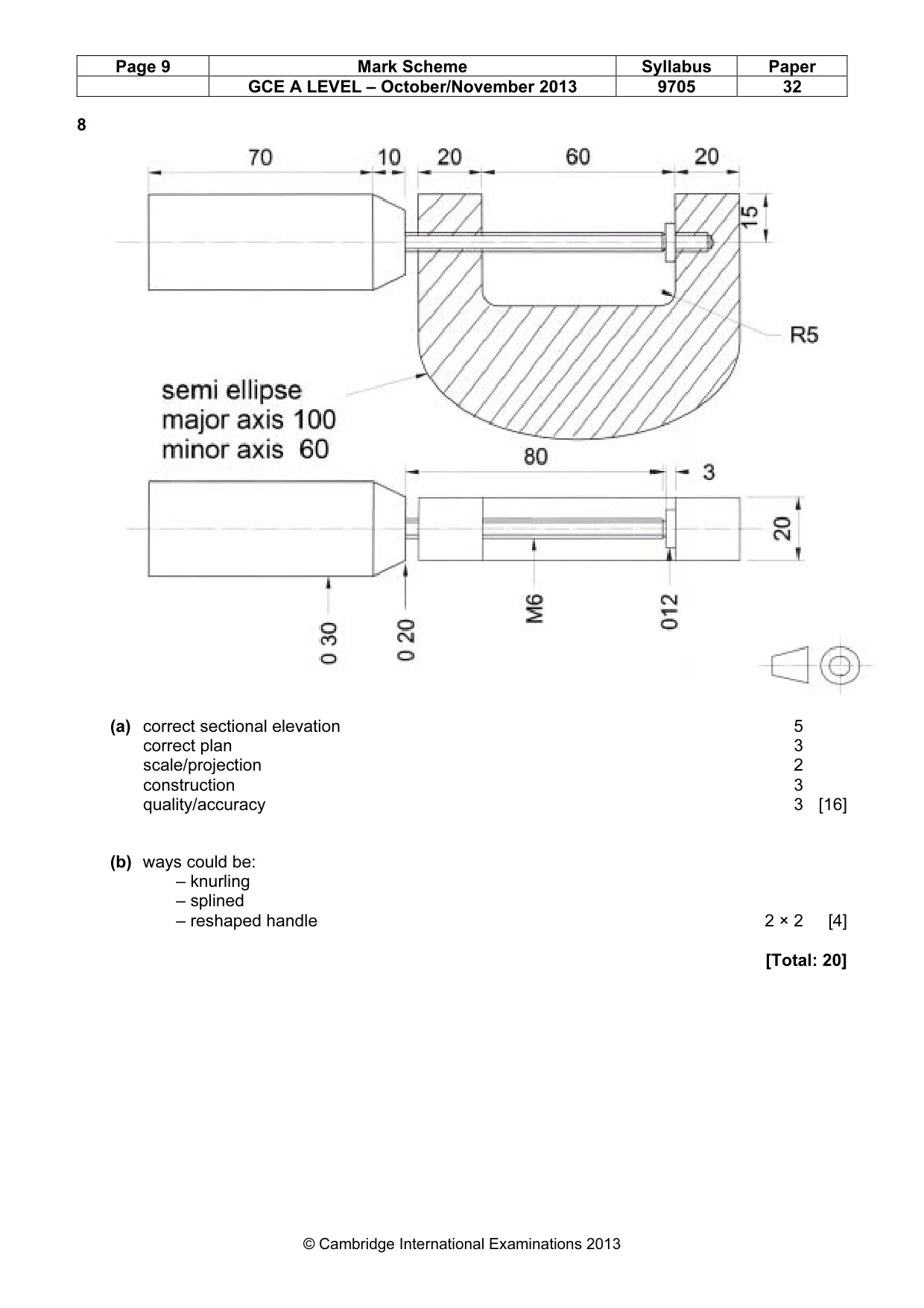
Page 9 Mark Scheme Syllabus Paper GCE A LEVEL – October/November 2013 9705 32 © Cambridge International Examinations 2013 8 (a) correct sectional elevation 5 correct plan 3 scale/projection 2 construction 3 quality/accuracy 3 [16] (b) ways could be: – knurling – splined – reshaped handle 2 × 2 [4] [Total: 20]
Mark scheme, page 10
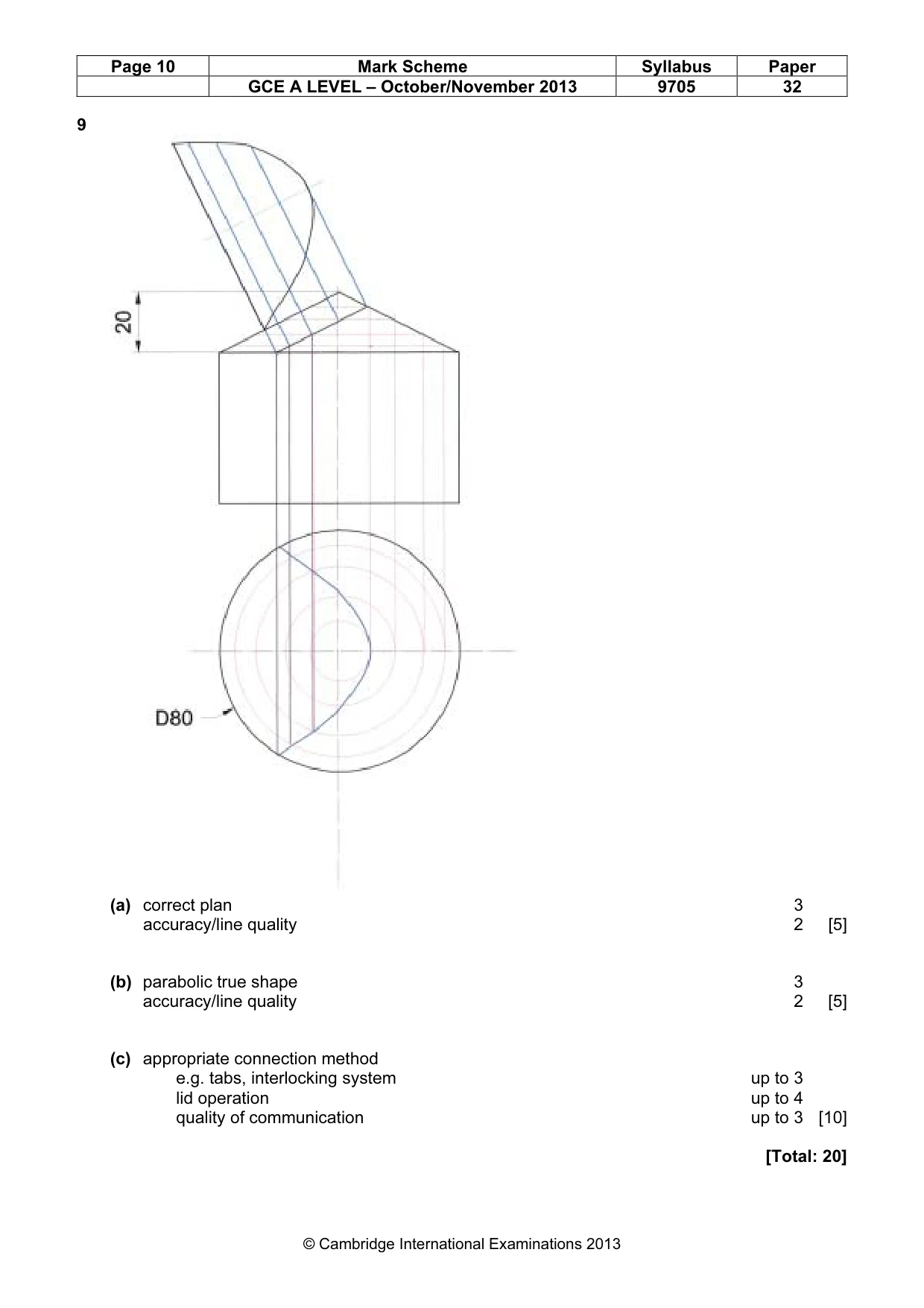
Page 10 Mark Scheme Syllabus Paper GCE A LEVEL – October/November 2013 9705 32 © Cambridge International Examinations 2013 9 (a) correct plan 3 accuracy/line quality 2 [5] (b) parabolic true shape 3 accuracy/line quality 2 [5] (c) appropriate connection method e.g. tabs, interlocking system up to 3 lid operation up to 4 quality of communication up to 3 [10] [Total: 20]
Mark scheme, page 11
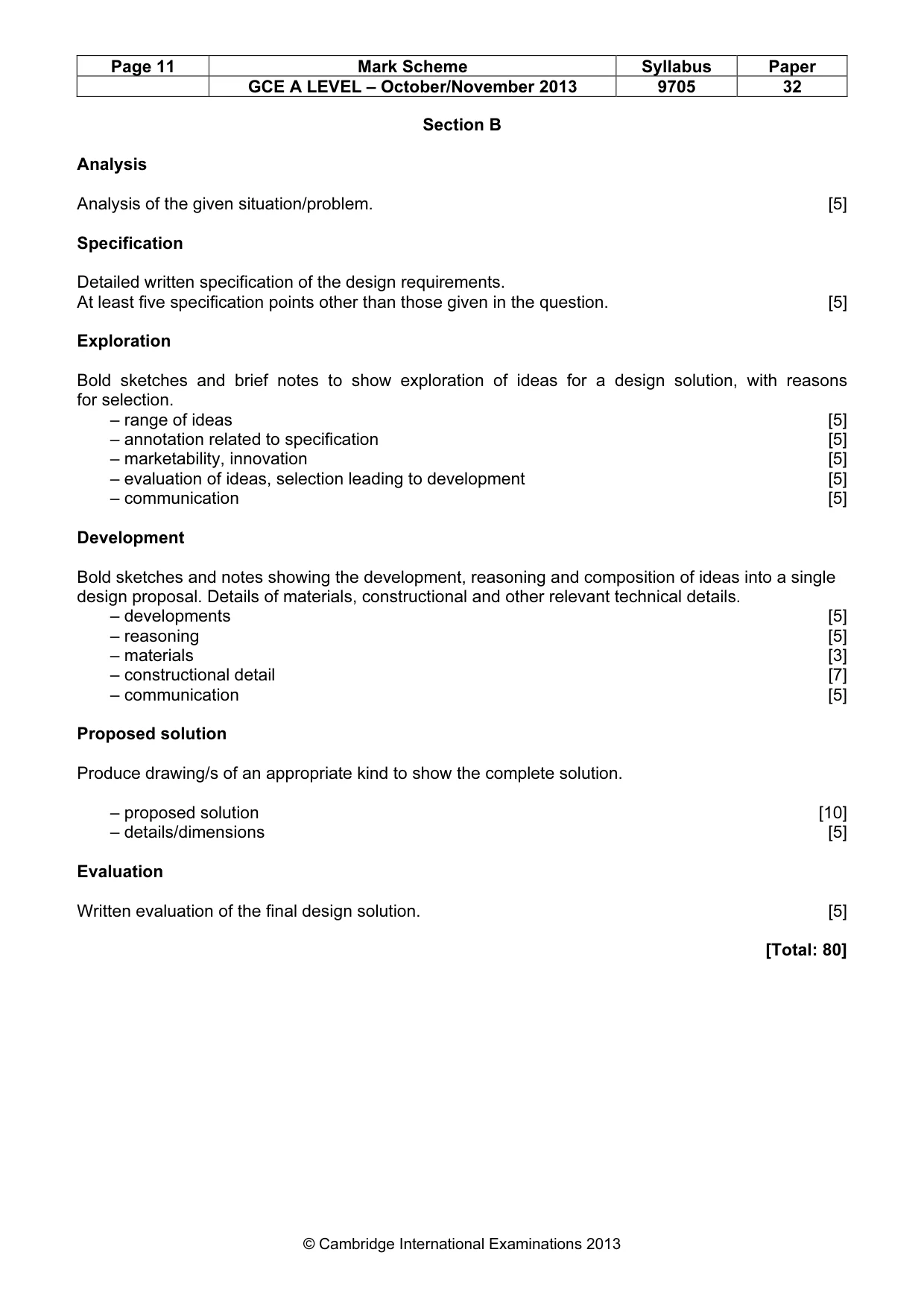
Page 11 Mark Scheme Syllabus Paper GCE A LEVEL – October/November 2013 9705 32 © Cambridge International Examinations 2013 Section B Analysis Analysis of the given situation/problem. [5] Specification Detailed written specification of the design requirements. At least five specification points other than those given in the question. [5] Exploration Bold sketches and brief notes to show exploration of ideas for a design solution, with reasons for selection. – range of ideas [5] – annotation related to specification [5] – marketability, innovation [5] – evaluation of ideas, selection leading to development [5] – communication [5] Development Bold sketches and notes showing the development, reasoning and composition of ideas into a single design proposal. Details of materials, constructional and other relevant technical details. – developments [5] – reasoning [5] – materials [3] – constructional detail [7] – communication [5] Proposed solution Produce drawing/s of an appropriate kind to show the complete solution. – proposed solution [10] – details/dimensions [5] Evaluation Written evaluation of the final design solution. [5] [Total: 80]
What you needed in this session
Cambridge’s own grade thresholds for 2013 Oct/Nov, Paper 3 · Variant 2. A higher threshold means an easier paper — the bar moves with how the cohort did.