Cambridge A Level Design and Technology 9705 — 2012 Oct/Nov Paper 3 · Variant 3
9705/33/O/N/12 · 120 marks · ≈135 min
The question paper and its mark scheme, free to read here and free to download. This is Cambridge’s own paper, exactly as it was sat.
Question paper12 pages
Mark scheme7 pages
Answers below. Sit the paper first if you are practising.
Paper as text
Question paper, page 1
This document consists of 10 printed pages and 2 blank pages. DC (NS/SW) 51720/4 © UCLES 2012 [Turn over UNIVERSITY OF CAMBRIDGE INTERNATIONAL EXAMINATIONS General Certificate of Education Advanced Subsidiary Level and Advanced Level * 8 8 0 7 9 4 5 4 4 4 * DESIGN AND TECHNOLOGY 9705/33 Paper 3 October/November 2012 3 hours Additional Materials: Answer Booklet/Paper A range of design drawing equipment A3 Drawing paper (5 sheets) READ THESE INSTRUCTIONS FIRST Write your Centre number, candidate number and name on all the work you hand in. Write in dark blue or black pen. You may use a soft pencil for any diagrams, graphs or rough working. Do not use staples, paper clips, highlighters, glue or correction fluid. Section A Answer any two questions from one of the Parts A, B or C. Section B Answer one question. All dimensions are in millimetres. The instruction ‘discuss’ denotes that you should: • examine critically the issues raised by the question; • explain and interpret these issues as appropriate; • introduce evidence wherever possible to support conclusions of arguments. At the end of the examination, fasten all your work securely together. The number of marks is given in brackets [ ] at the end of each question or part question.
Question paper, page 2
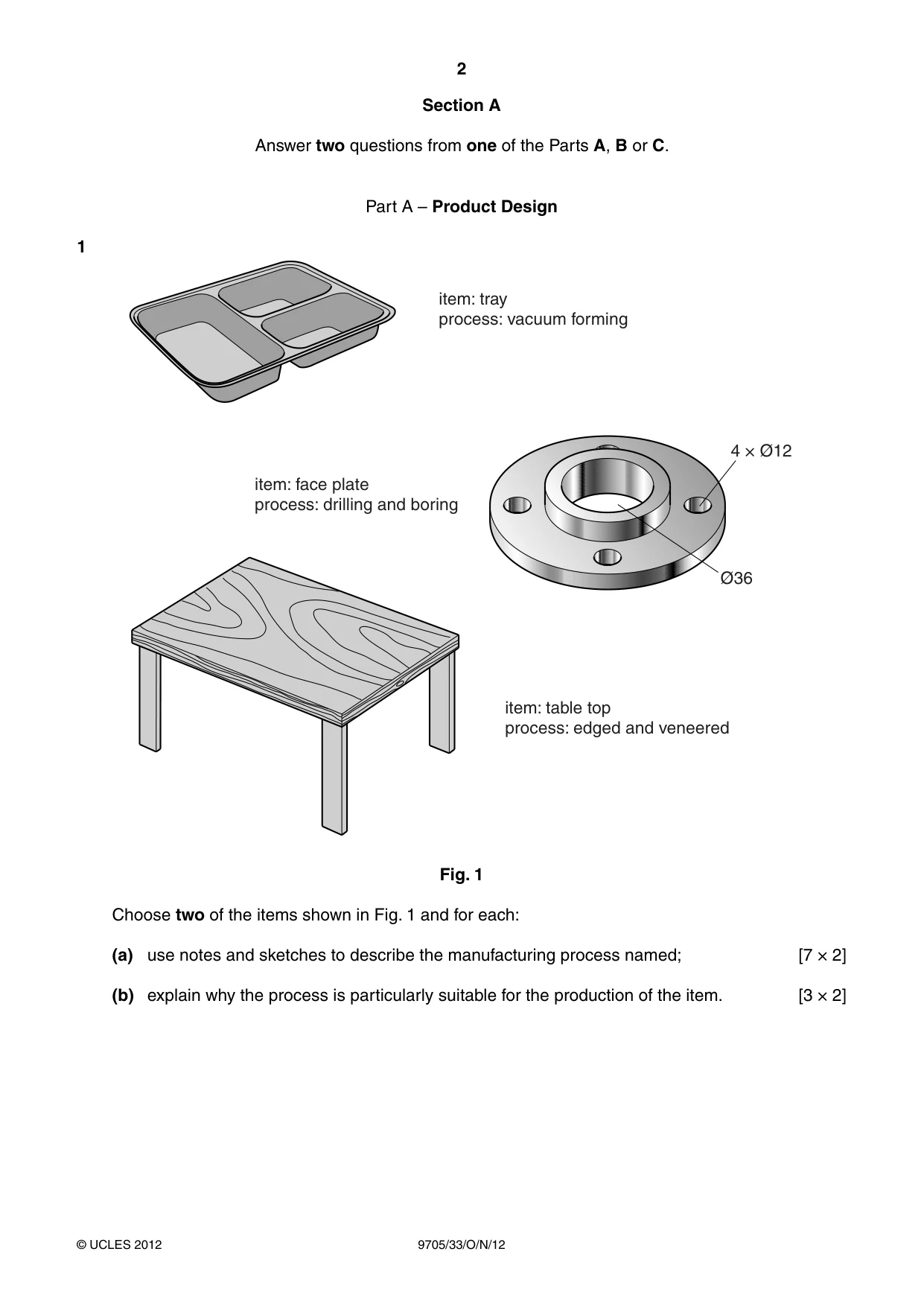
2 9705/33/O/N/12 © UCLES 2012 Section A Answer two questions from one of the Parts A, B or C. Part A – Product Design 1 item: tray process: vacuum forming item: face plate process: drilling and boring item: table top process: edged and veneered 4 × Ø12 Ø36 Fig. 1 Choose two of the items shown in Fig. 1 and for each: (a) use notes and sketches to describe the manufacturing process named; [7 × 2] (b) explain why the process is particularly suitable for the production of the item. [3 × 2]
Question paper, page 3
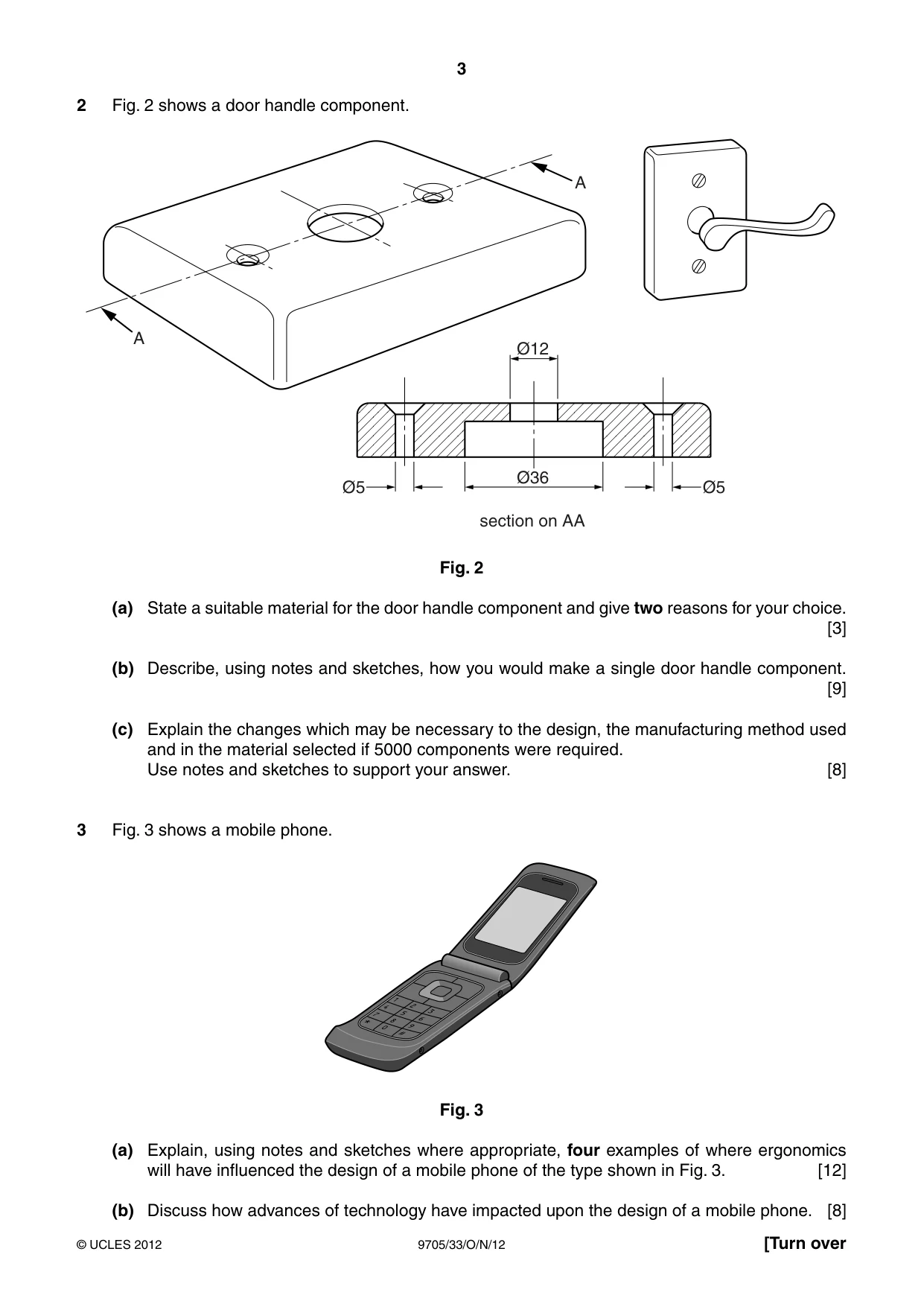
3 9705/33/O/N/12 © UCLES 2012 [Turn over 2 Fig. 2 shows a door handle component. Ø5 Ø5 Ø36 Ø12 A A section on AA Fig. 2 (a) State a suitable material for the door handle component and give two reasons for your choice. [3] (b) Describe, using notes and sketches, how you would make a single door handle component. [9] (c) Explain the changes which may be necessary to the design, the manufacturing method used and in the material selected if 5000 components were required. Use notes and sketches to support your answer. [8] 3 Fig. 3 shows a mobile phone. Fig. 3 (a) Explain, using notes and sketches where appropriate, four examples of where ergonomics will have influenced the design of a mobile phone of the type shown in Fig. 3. [12] (b) Discuss how advances of technology have impacted upon the design of a mobile phone. [8]
Question paper, page 4
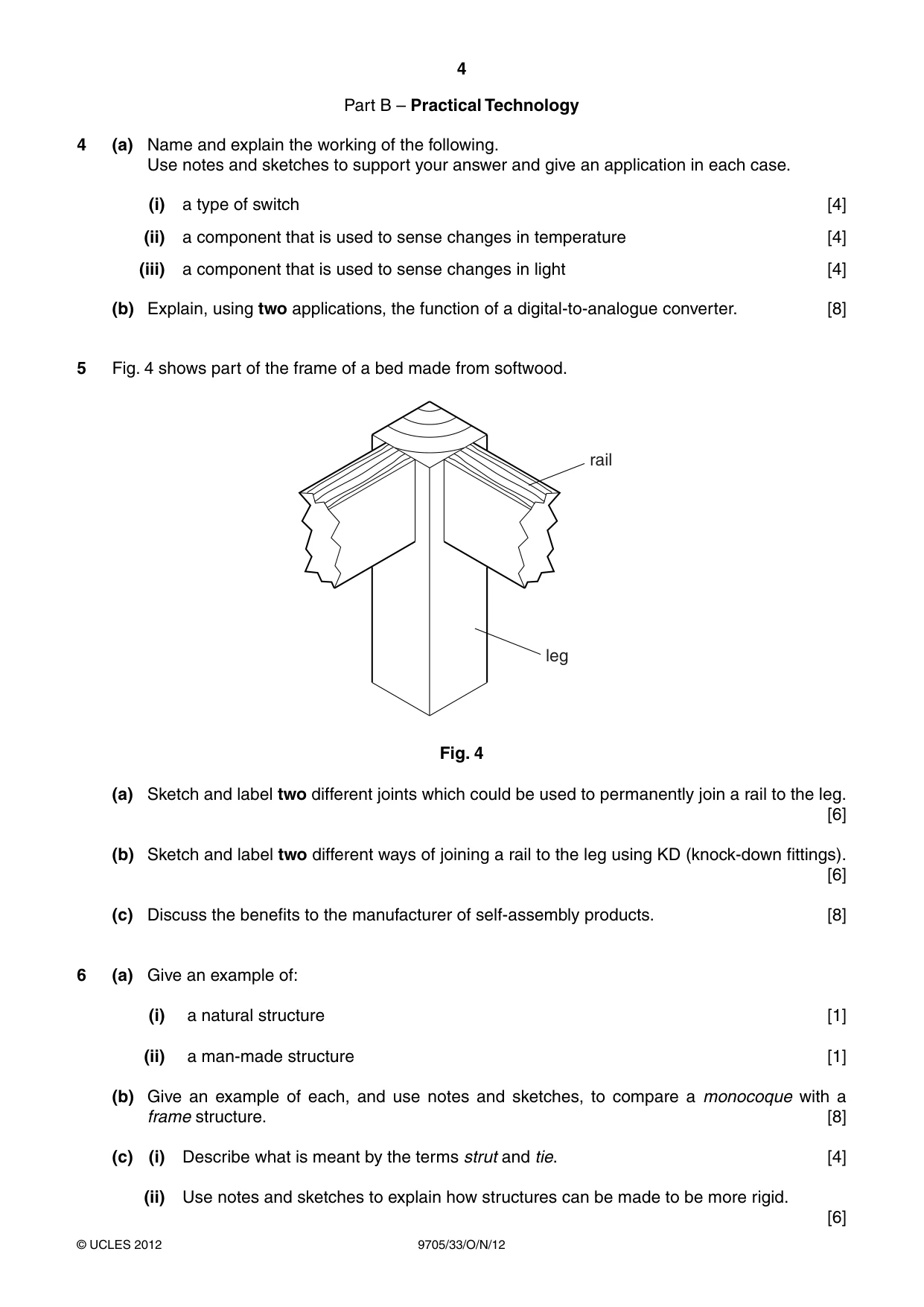
4 9705/33/O/N/12 © UCLES 2012 Part B – Practical Technology 4 (a) Name and explain the working of the following. Use notes and sketches to support your answer and give an application in each case. (i) a type of switch [4] (ii) a component that is used to sense changes in temperature [4] (iii) a component that is used to sense changes in light [4] (b) Explain, using two applications, the function of a digital-to-analogue converter. [8] 5 Fig. 4 shows part of the frame of a bed made from softwood. rail leg Fig. 4 (a) Sketch and label two different joints which could be used to permanently join a rail to the leg. [6] (b) Sketch and label two different ways of joining a rail to the leg using KD (knock-down fittings). [6] (c) Discuss the benefits to the manufacturer of self-assembly products. [8] 6 (a) Give an example of: (i) a natural structure [1] (ii) a man-made structure [1] (b) Give an example of each, and use notes and sketches, to compare a monocoque with a frame structure. [8] (c) (i) Describe what is meant by the terms strut and tie. [4] (ii) Use notes and sketches to explain how structures can be made to be more rigid. [6]
Question paper, page 5
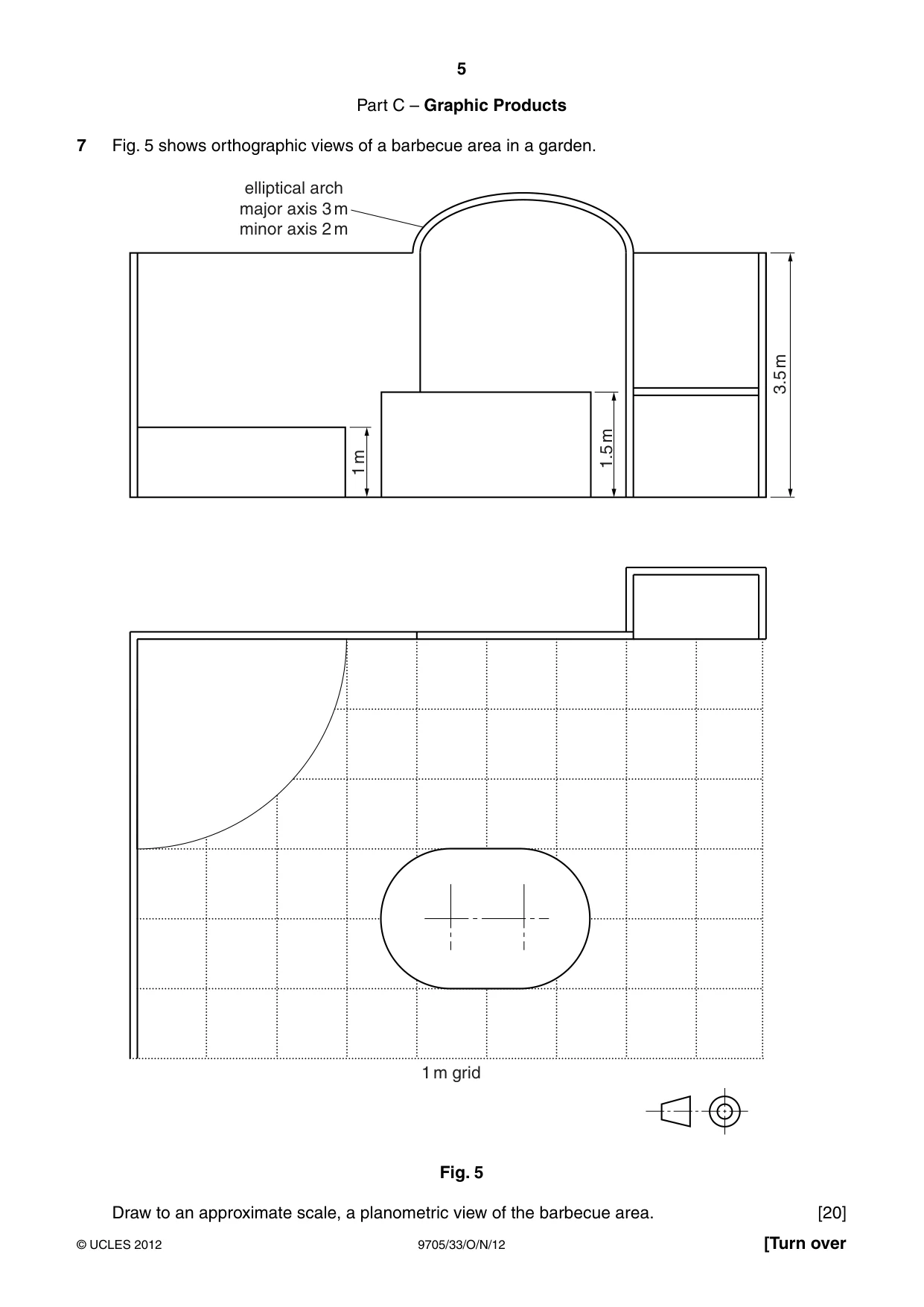
5 9705/33/O/N/12 © UCLES 2012 [Turn over Part C – Graphic Products 7 Fig. 5 shows orthographic views of a barbecue area in a garden. 1 m 1.5 m 3.5 m elliptical arch major axis 3 m minor axis 2 m 1 m grid Fig. 5 Draw to an approximate scale, a planometric view of the barbecue area. [20]
Question paper, page 6
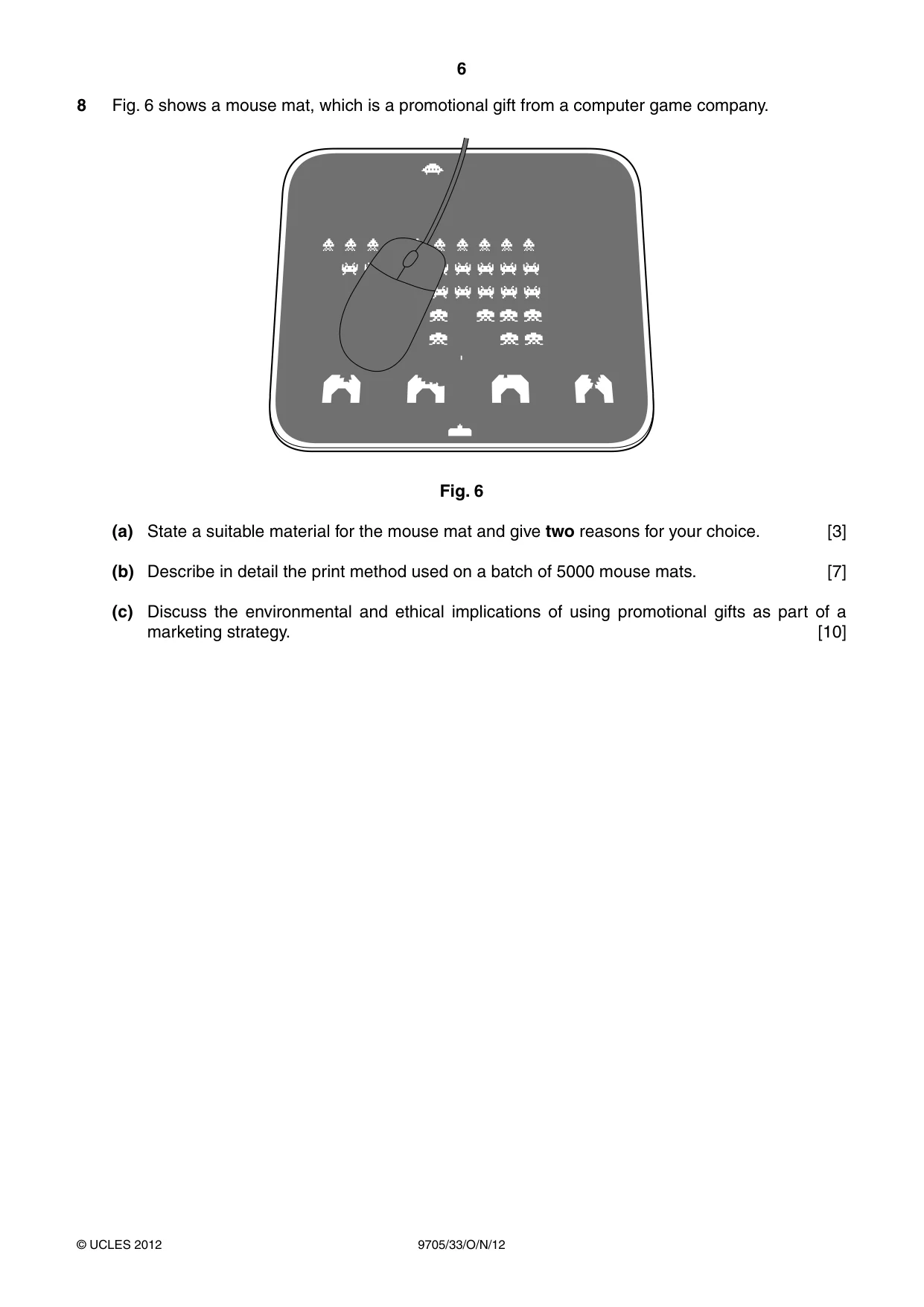
6 9705/33/O/N/12 © UCLES 2012 8 Fig. 6 shows a mouse mat, which is a promotional gift from a computer game company. Fig. 6 (a) State a suitable material for the mouse mat and give two reasons for your choice. [3] (b) Describe in detail the print method used on a batch of 5000 mouse mats. [7] (c) Discuss the environmental and ethical implications of using promotional gifts as part of a marketing strategy. [10]
Question paper, page 7
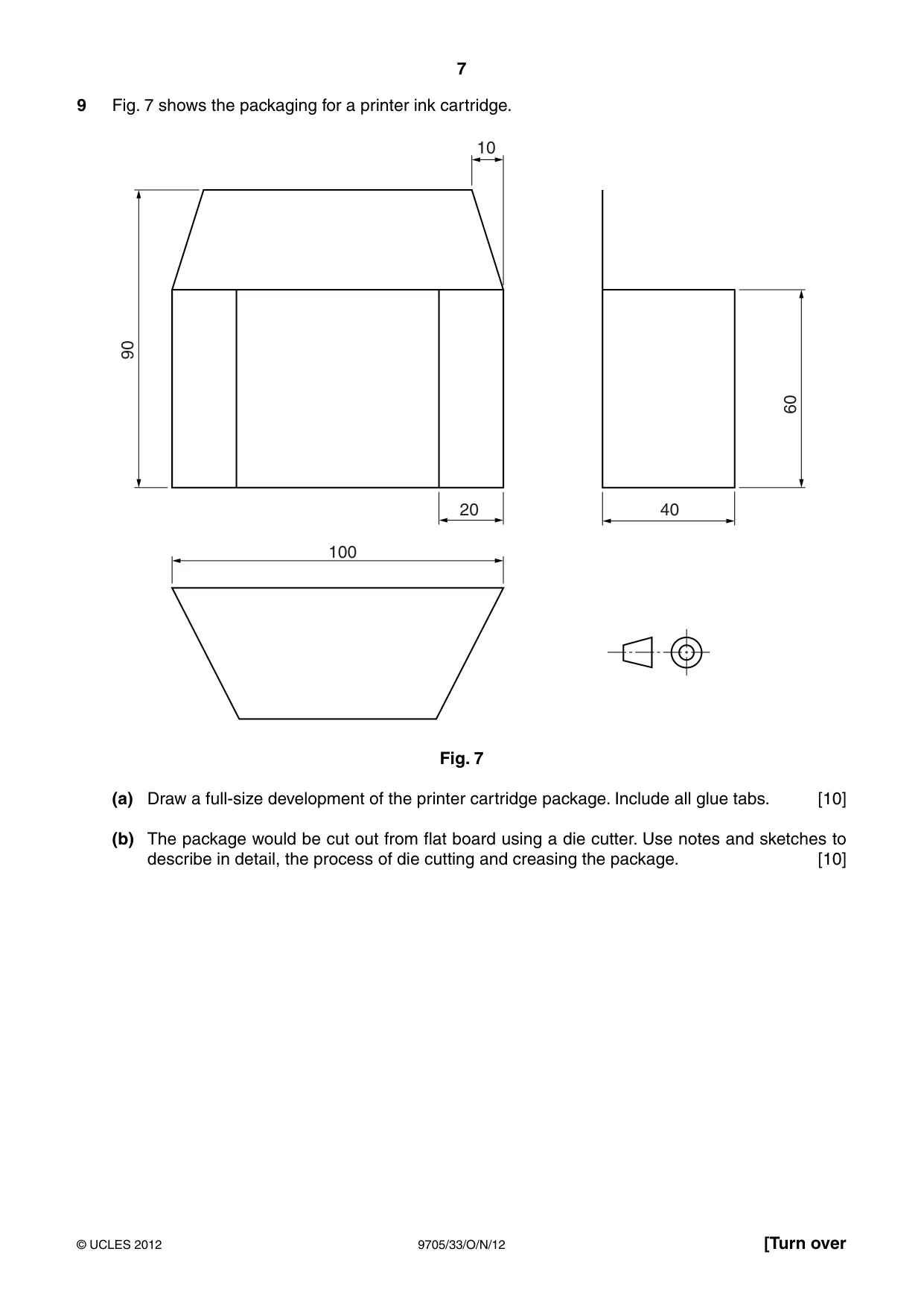
7 9705/33/O/N/12 © UCLES 2012 [Turn over 9 Fig. 7 shows the packaging for a printer ink cartridge. 20 10 40 100 90 60 Fig. 7 (a) Draw a full-size development of the printer cartridge package. Include all glue tabs. [10] (b) The package would be cut out from flat board using a die cutter. Use notes and sketches to describe in detail, the process of die cutting and creasing the package. [10]
Question paper, page 8
8 9705/33/O/N/12 © UCLES 2012 Section B Answer one question on the A3 paper provided. You should approach the design question of your choice in the following manner: Analysis Produce an analysis of the given situation/problem, which may be in written or graphical form. [5] Specification From the analysis produce a detailed written specification of the design requirements. Include at least five specification points other than those given in the question. [5] Exploration Use bold sketches and brief notes to show your exploration of ideas for a design solution, with reasons for selection. [25] Development Show, using bold sketches and notes, the development, reasoning and composition of ideas into a single design proposal. Give details of materials, constructional and other relevant technical details. [25] Proposed solution Produce drawings of an appropriate kind to show the complete solution. [15] Evaluation Give a written evaluation of the final design solution. [5] [Total: 80]
Question paper, page 9
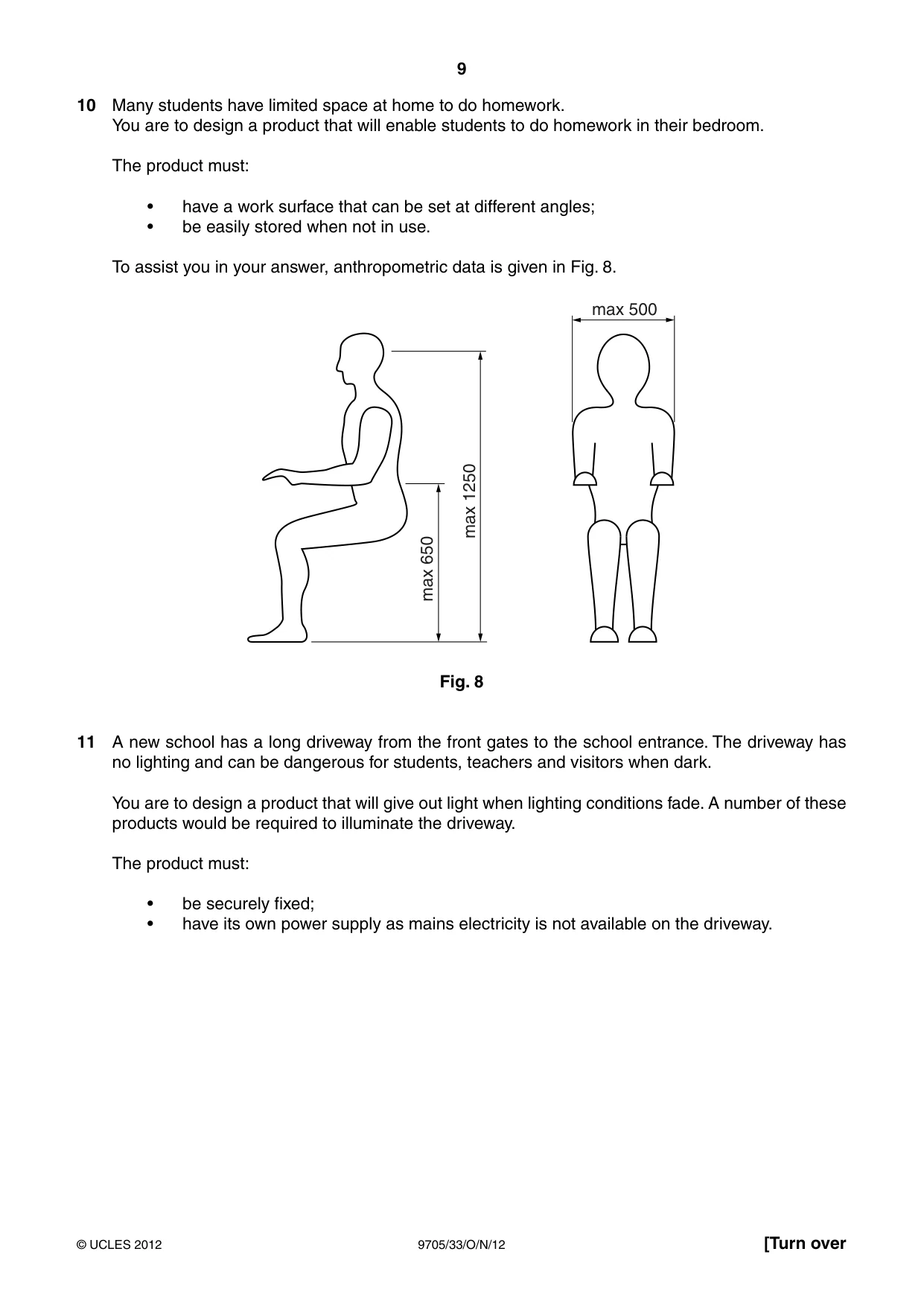
9 9705/33/O/N/12 © UCLES 2012 [Turn over 10 Many students have limited space at home to do homework. You are to design a product that will enable students to do homework in their bedroom. The product must: • have a work surface that can be set at different angles; • be easily stored when not in use. To assist you in your answer, anthropometric data is given in Fig. 8. max 650 max 1250 max 500 Fig. 8 11 A new school has a long driveway from the front gates to the school entrance. The driveway has no lighting and can be dangerous for students, teachers and visitors when dark. You are to design a product that will give out light when lighting conditions fade. A number of these products would be required to illuminate the driveway. The product must: • be securely fixed; • have its own power supply as mains electricity is not available on the driveway.
Question paper, page 10
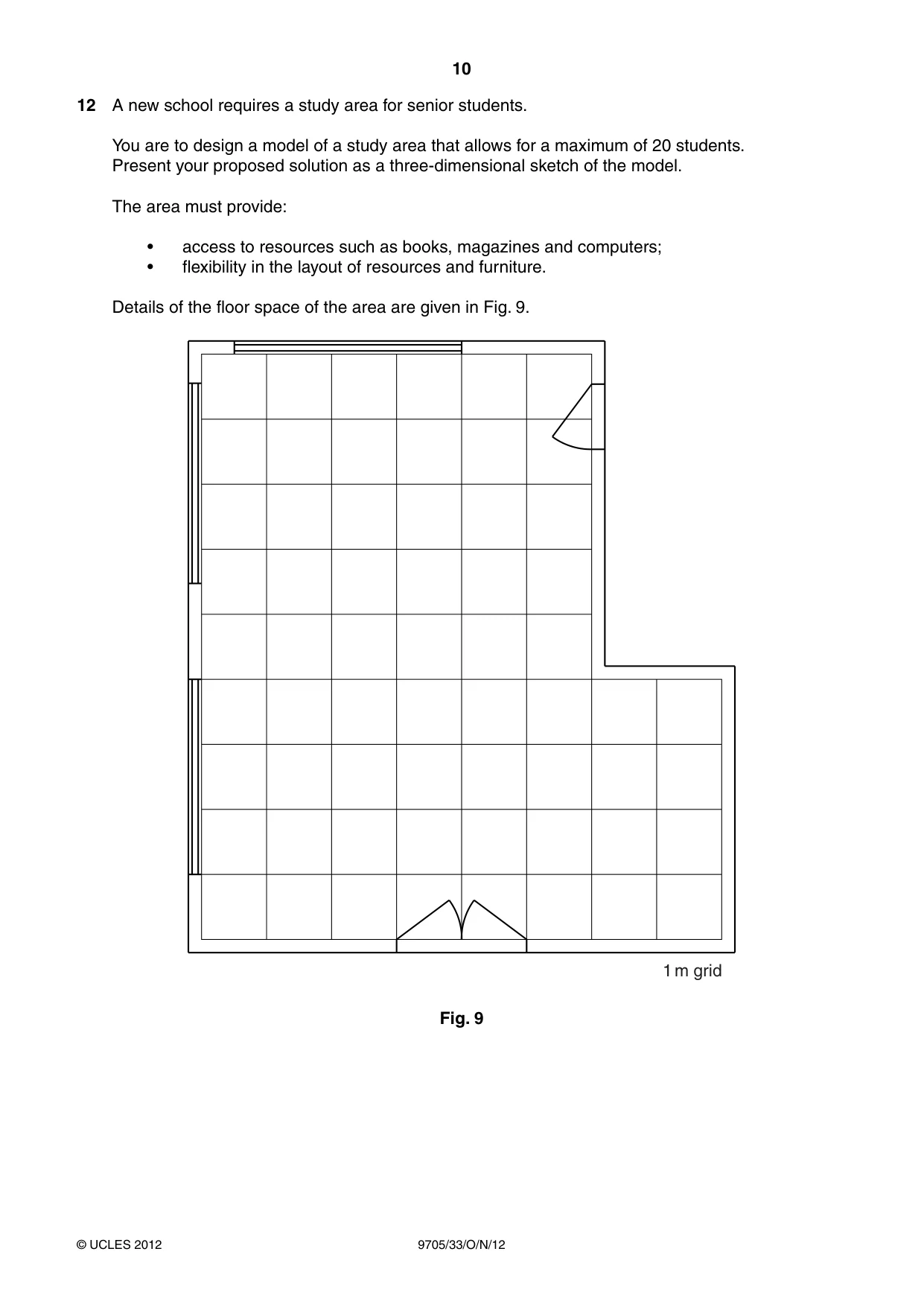
10 9705/33/O/N/12 © UCLES 2012 12 A new school requires a study area for senior students. You are to design a model of a study area that allows for a maximum of 20 students. Present your proposed solution as a three-dimensional sketch of the model. The area must provide: • access to resources such as books, magazines and computers; • flexibility in the layout of resources and furniture. Details of the floor space of the area are given in Fig. 9. 1 m grid Fig. 9
Question paper, page 11
11 9705/33/O/N/12 © UCLES 2012 BLANK PAGE
Question paper, page 12
12 9705/33/O/N/12 © UCLES 2012 Permission to reproduce items where third-party owned material protected by copyright is included has been sought and cleared where possible. Every reasonable effort has been made by the publisher (UCLES) to trace copyright holders, but if any items requiring clearance have unwittingly been included, the publisher will be pleased to make amends at the earliest possible opportunity. University of Cambridge International Examinations is part of the Cambridge Assessment Group. Cambridge Assessment is the brand name of University of Cambridge Local Examinations Syndicate (UCLES), which is itself a department of the University of Cambridge. BLANK PAGE
Mark scheme, page 1
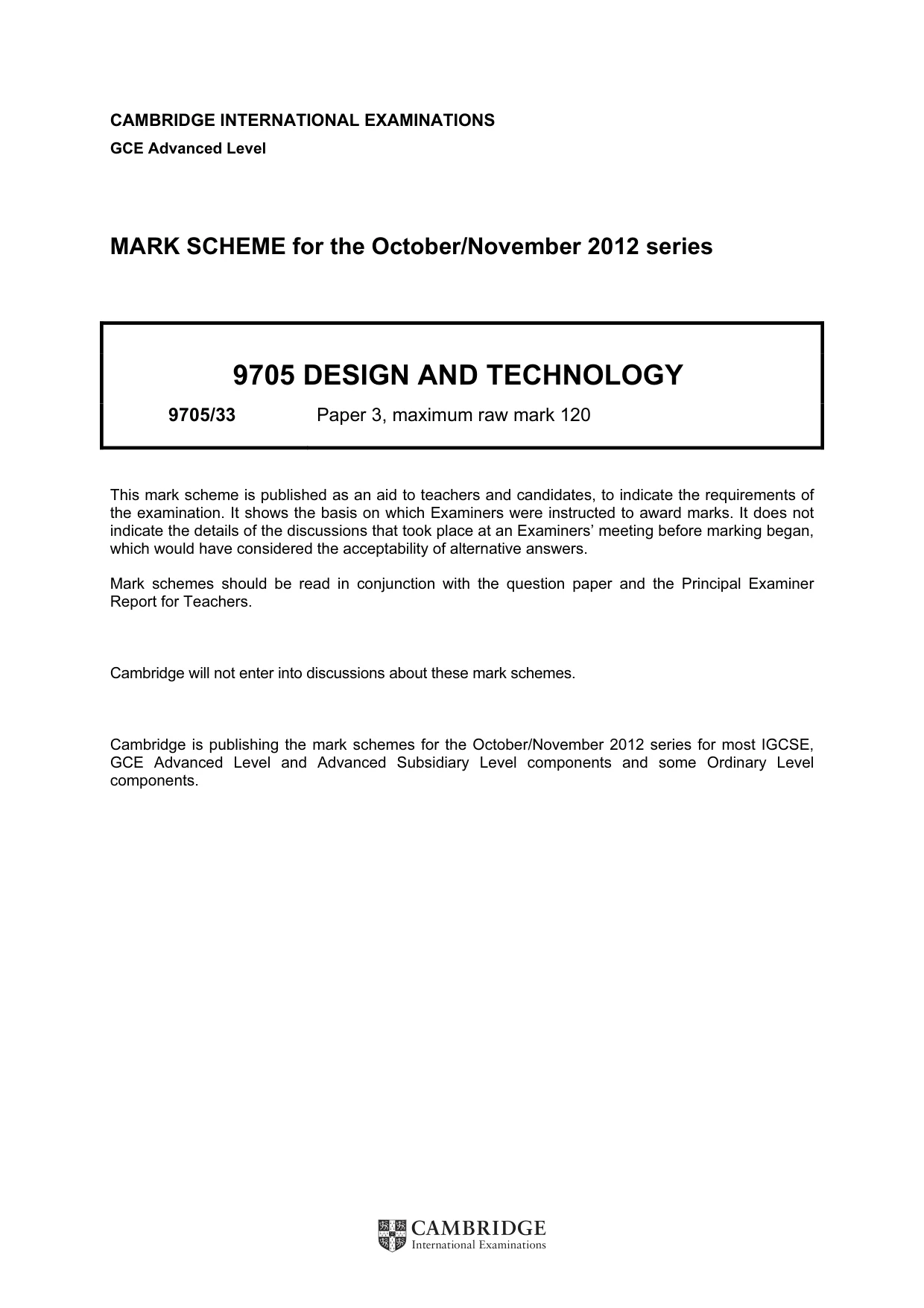
CAMBRIDGE INTERNATIONAL EXAMINATIONS GCE Advanced Level MARK SCHEME for the October/November 2012 series 9705 DESIGN AND TECHNOLOGY 9705/33 Paper 3, maximum raw mark 120 This mark scheme is published as an aid to teachers and candidates, to indicate the requirements of the examination. It shows the basis on which Examiners were instructed to award marks. It does not indicate the details of the discussions that took place at an Examiners’ meeting before marking began, which would have considered the acceptability of alternative answers. Mark schemes should be read in conjunction with the question paper and the Principal Examiner Report for Teachers. Cambridge will not enter into discussions about these mark schemes. Cambridge is publishing the mark schemes for the October/November 2012 series for most IGCSE, GCE Advanced Level and Advanced Subsidiary Level components and some Ordinary Level components.
Mark scheme, page 2
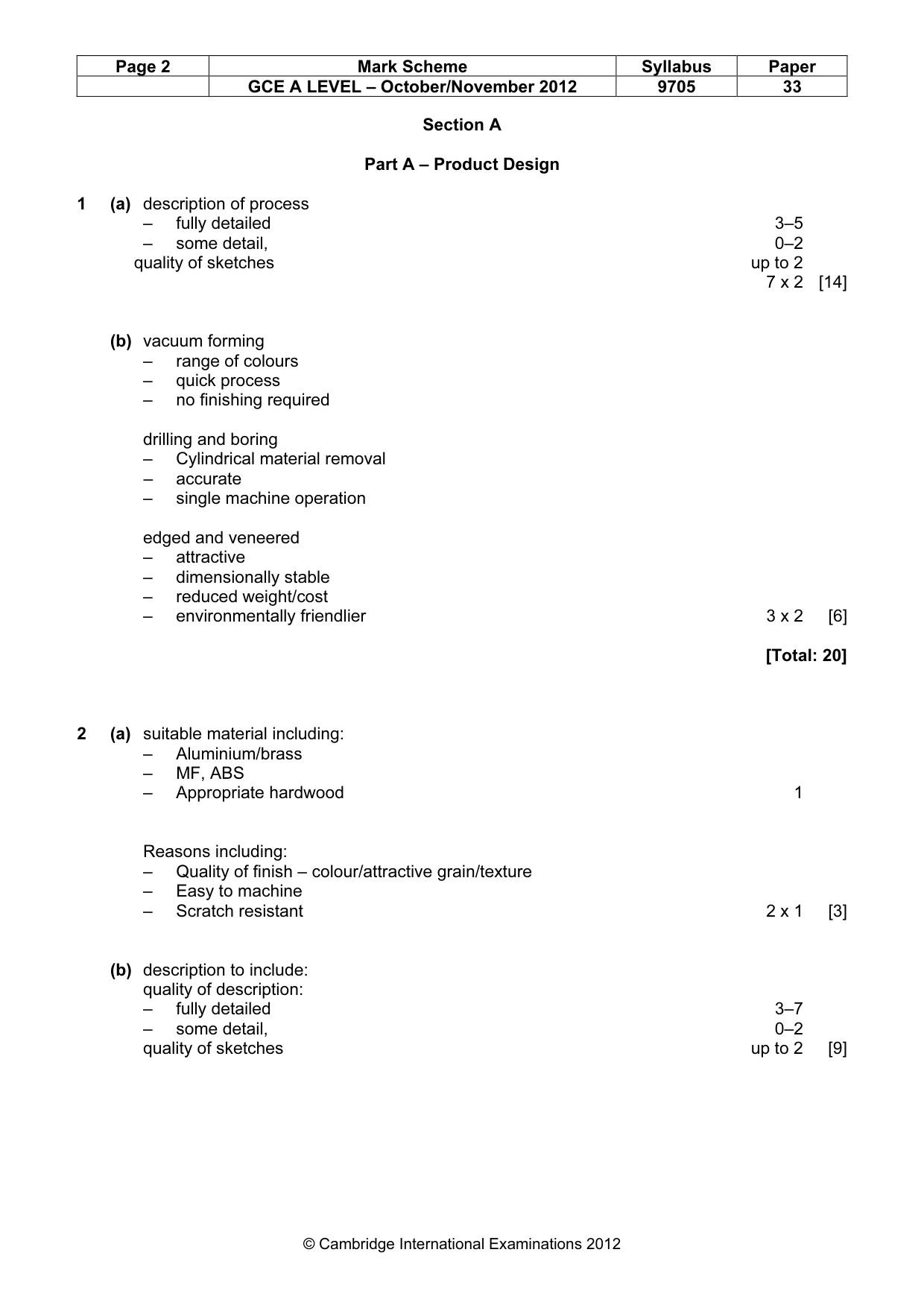
Page 2 Mark Scheme Syllabus Paper GCE A LEVEL – October/November 2012 9705 33 © Cambridge International Examinations 2012 Section A Part A – Product Design 1 (a) description of process – fully detailed 3–5 – some detail, 0–2 quality of sketches up to 2 7 x 2 [14] (b) vacuum forming – range of colours – quick process – no finishing required drilling and boring – Cylindrical material removal – accurate – single machine operation edged and veneered – attractive – dimensionally stable – reduced weight/cost – environmentally friendlier 3 x 2 [6] [Total: 20] 2 (a) suitable material including: – Aluminium/brass – MF, ABS – Appropriate hardwood 1 Reasons including: – Quality of finish – colour/attractive grain/texture – Easy to machine – Scratch resistant 2 x 1 [3] (b) description to include: quality of description: – fully detailed 3–7 – some detail, 0–2 quality of sketches up to 2 [9]
Mark scheme, page 3
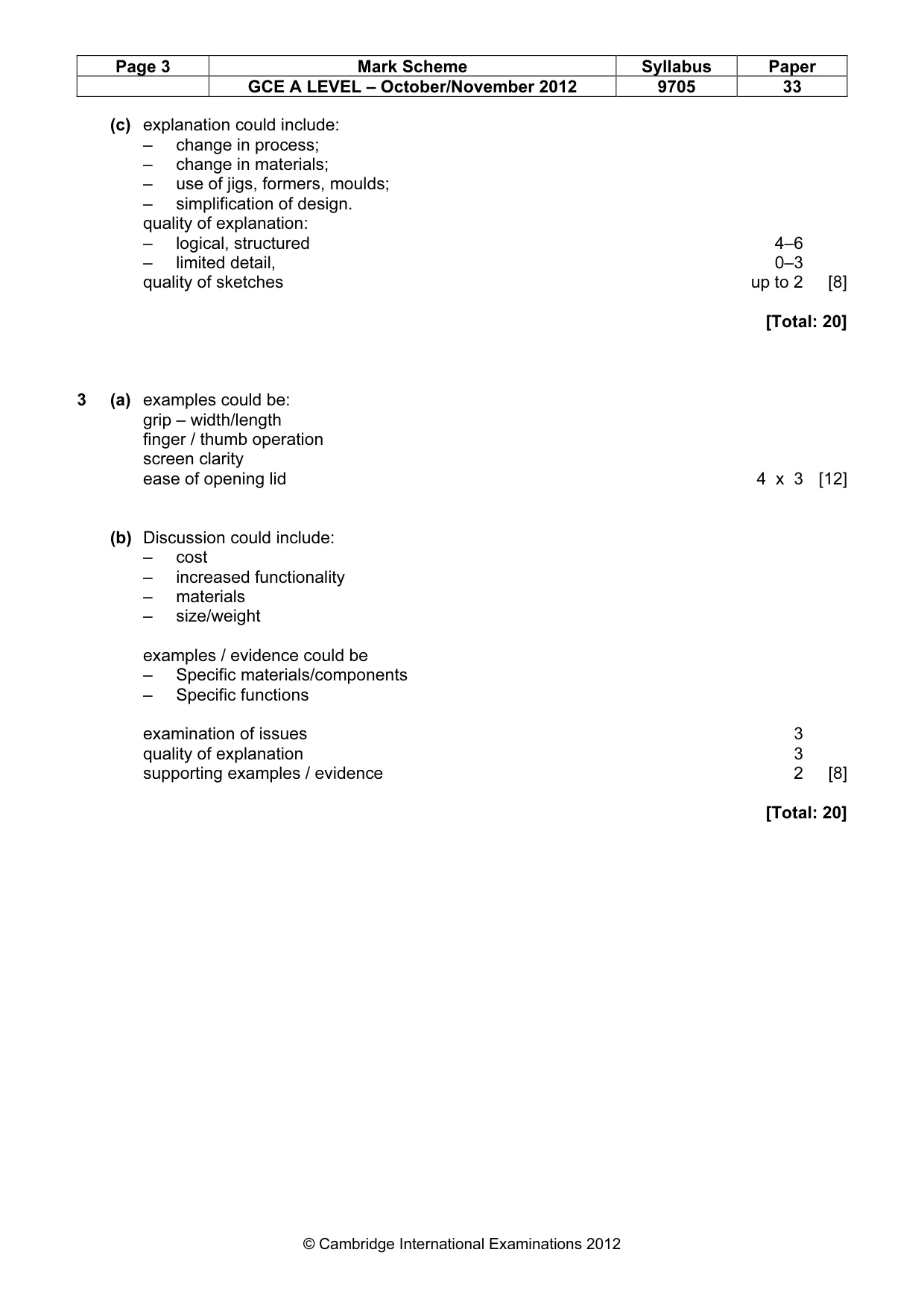
Page 3 Mark Scheme Syllabus Paper GCE A LEVEL – October/November 2012 9705 33 © Cambridge International Examinations 2012 (c) explanation could include: – change in process; – change in materials; – use of jigs, formers, moulds; – simplification of design. quality of explanation: – logical, structured 4–6 – limited detail, 0–3 quality of sketches up to 2 [8] [Total: 20] 3 (a) examples could be: grip – width/length finger / thumb operation screen clarity ease of opening lid 4 x 3 [12] (b) Discussion could include: – cost – increased functionality – materials – size/weight examples / evidence could be – Specific materials/components – Specific functions examination of issues 3 quality of explanation 3 supporting examples / evidence 2 [8] [Total: 20]
Mark scheme, page 4
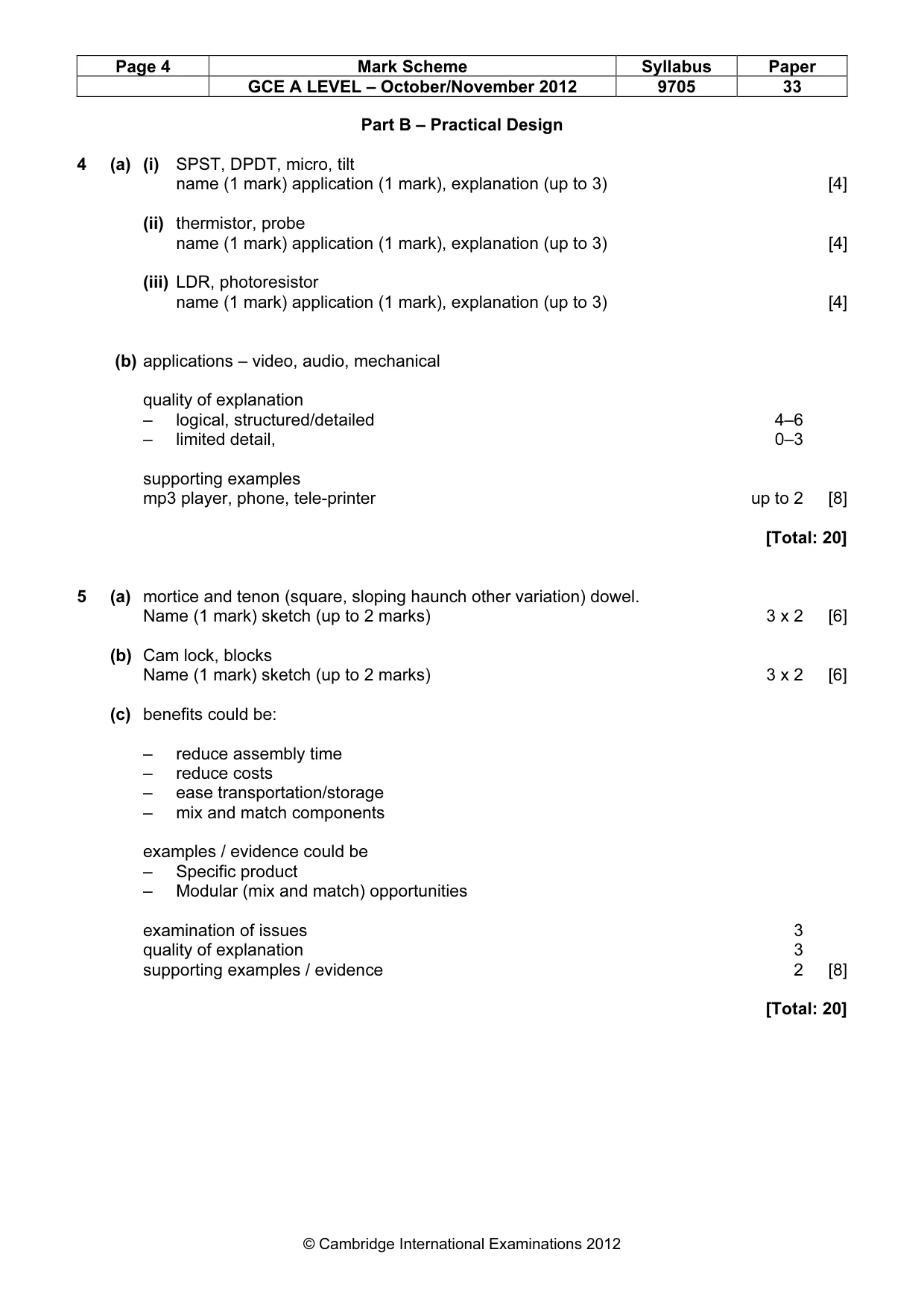
Page 4 Mark Scheme Syllabus Paper GCE A LEVEL – October/November 2012 9705 33 © Cambridge International Examinations 2012 Part B – Practical Design 4 (a) (i) SPST, DPDT, micro, tilt name (1 mark) application (1 mark), explanation (up to 3) [4] (ii) thermistor, probe name (1 mark) application (1 mark), explanation (up to 3) [4] (iii) LDR, photoresistor name (1 mark) application (1 mark), explanation (up to 3) [4] (b) applications – video, audio, mechanical quality of explanation – logical, structured/detailed 4–6 – limited detail, 0–3 supporting examples mp3 player, phone, tele-printer up to 2 [8] [Total: 20] 5 (a) mortice and tenon (square, sloping haunch other variation) dowel. Name (1 mark) sketch (up to 2 marks) 3 x 2 [6] (b) Cam lock, blocks Name (1 mark) sketch (up to 2 marks) 3 x 2 [6] (c) benefits could be: – reduce assembly time – reduce costs – ease transportation/storage – mix and match components examples / evidence could be – Specific product – Modular (mix and match) opportunities examination of issues 3 quality of explanation 3 supporting examples / evidence 2 [8] [Total: 20]
Mark scheme, page 5
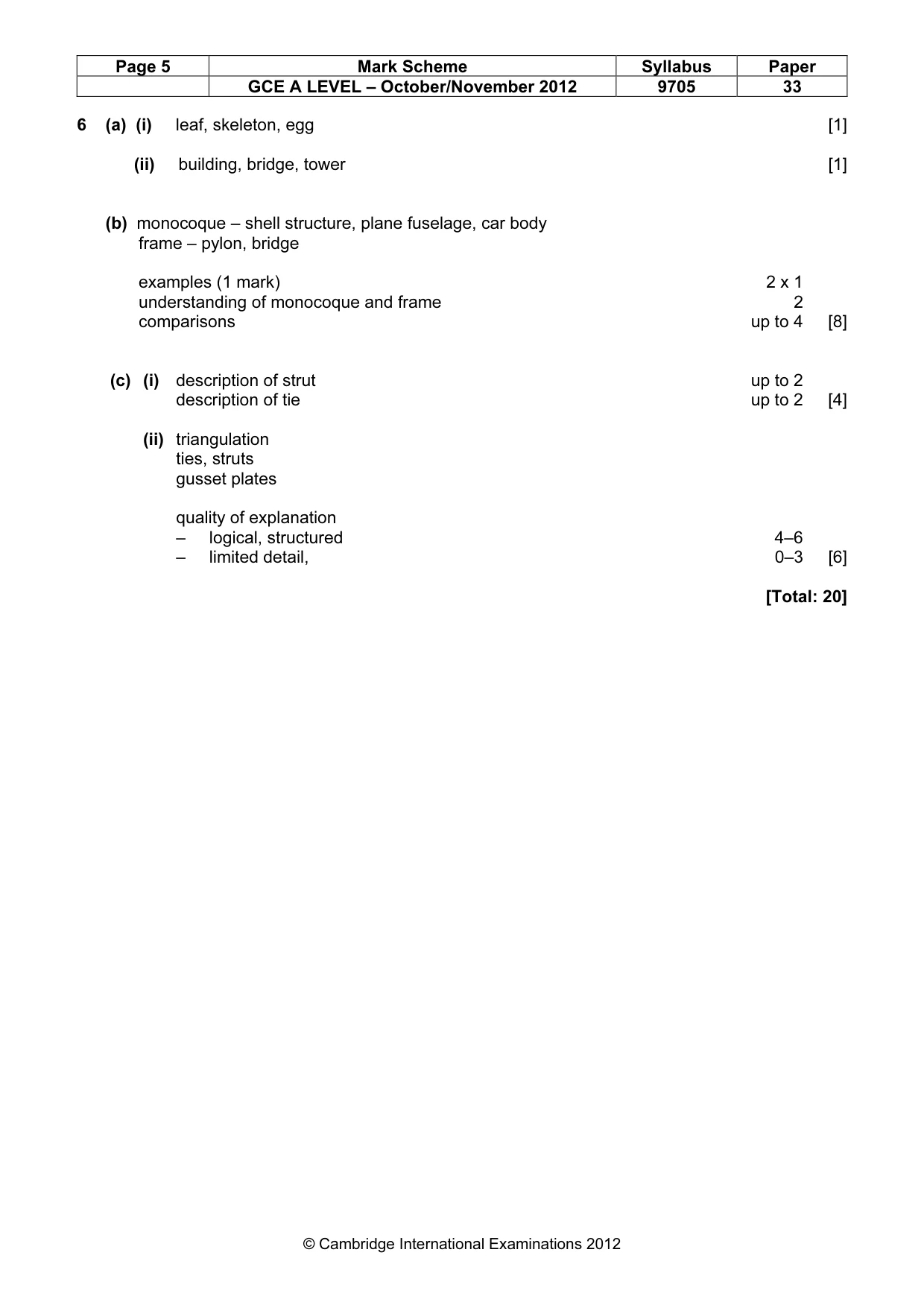
Page 5 Mark Scheme Syllabus Paper GCE A LEVEL – October/November 2012 9705 33 © Cambridge International Examinations 2012 6 (a) (i) leaf, skeleton, egg [1] (ii) building, bridge, tower [1] (b) monocoque – shell structure, plane fuselage, car body frame – pylon, bridge examples (1 mark) 2 x 1 understanding of monocoque and frame 2 comparisons up to 4 [8] (c) (i) description of strut up to 2 description of tie up to 2 [4] (ii) triangulation ties, struts gusset plates quality of explanation – logical, structured 4–6 – limited detail, 0–3 [6] [Total: 20]
Mark scheme, page 6
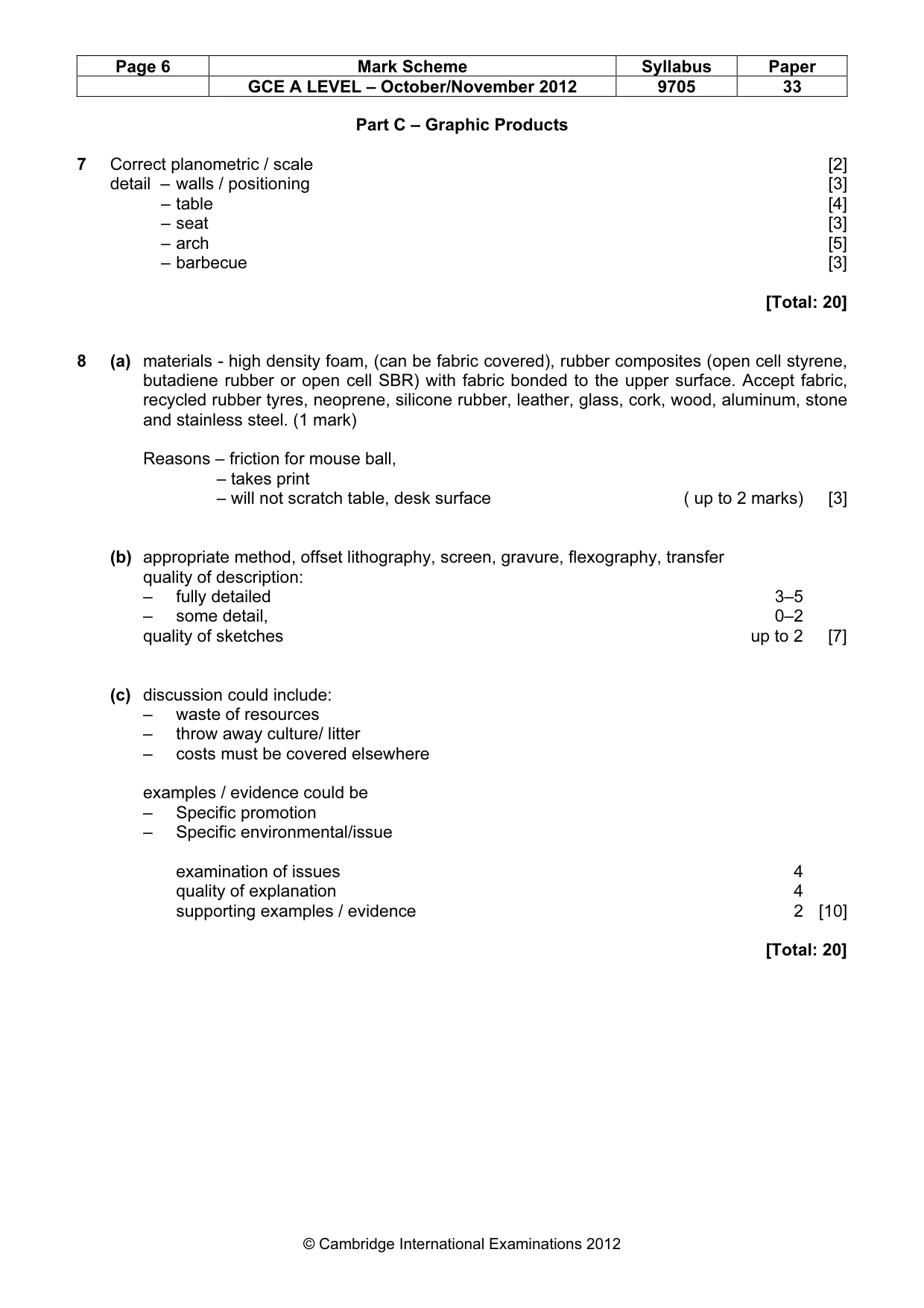
Page 6 Mark Scheme Syllabus Paper GCE A LEVEL – October/November 2012 9705 33 © Cambridge International Examinations 2012 Part C – Graphic Products 7 Correct planometric / scale [2] detail – walls / positioning [3] – table [4] – seat [3] – arch [5] – barbecue [3] [Total: 20] 8 (a) materials - high density foam, (can be fabric covered), rubber composites (open cell styrene, butadiene rubber or open cell SBR) with fabric bonded to the upper surface. Accept fabric, recycled rubber tyres, neoprene, silicone rubber, leather, glass, cork, wood, aluminum, stone and stainless steel. (1 mark) Reasons – friction for mouse ball, – takes print – will not scratch table, desk surface ( up to 2 marks) [3] (b) appropriate method, offset lithography, screen, gravure, flexography, transfer quality of description: – fully detailed 3–5 – some detail, 0–2 quality of sketches up to 2 [7] (c) discussion could include: – waste of resources – throw away culture/ litter – costs must be covered elsewhere examples / evidence could be – Specific promotion – Specific environmental/issue examination of issues 4 quality of explanation 4 supporting examples / evidence 2 [10] [Total: 20]
Mark scheme, page 7
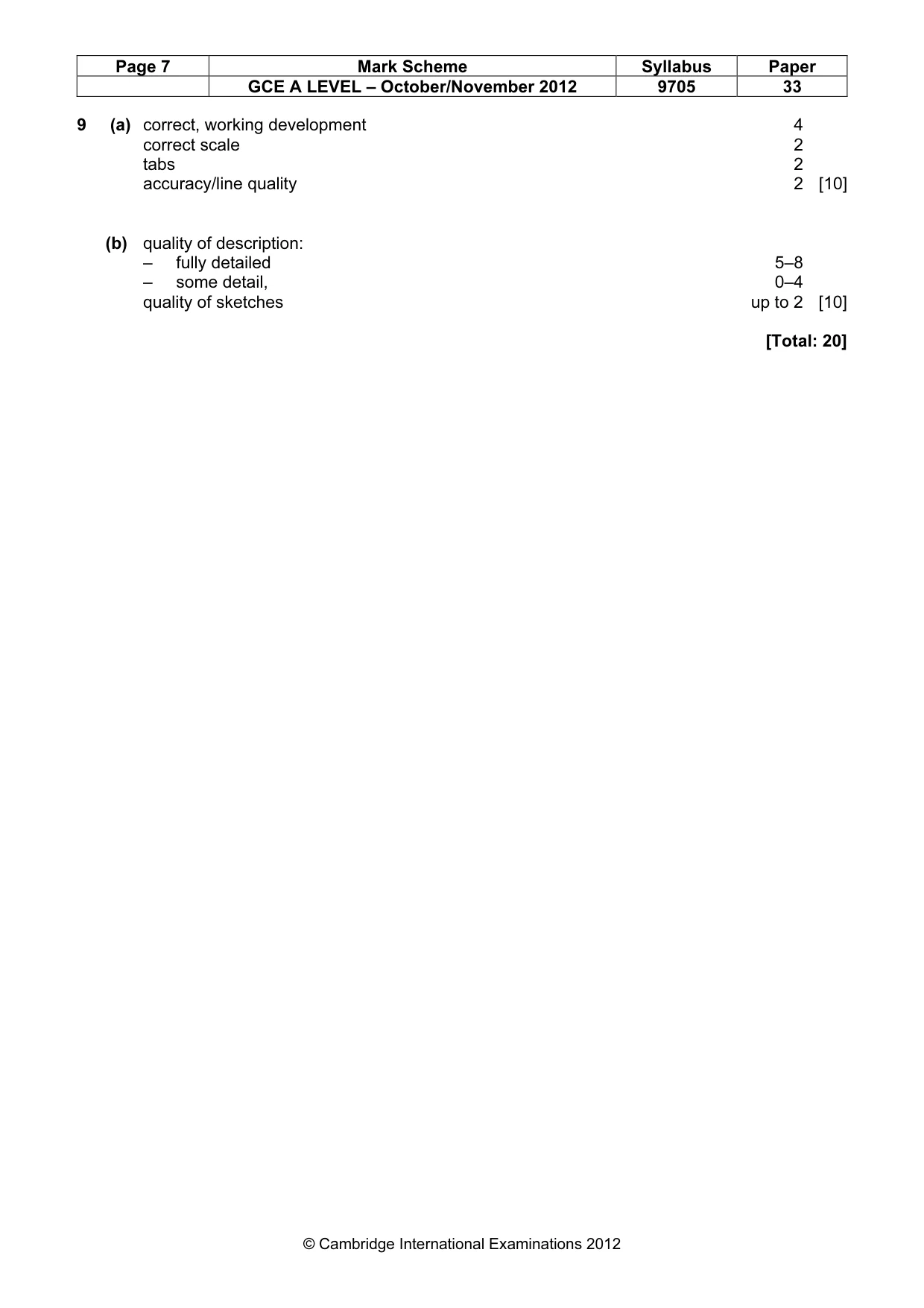
Page 7 Mark Scheme Syllabus Paper GCE A LEVEL – October/November 2012 9705 33 © Cambridge International Examinations 2012 9 (a) correct, working development 4 correct scale 2 tabs 2 accuracy/line quality 2 [10] (b) quality of description: – fully detailed 5–8 – some detail, 0–4 quality of sketches up to 2 [10] [Total: 20]
What you needed in this session
Cambridge’s own grade thresholds for 2012 Oct/Nov, Paper 3 · Variant 3. A higher threshold means an easier paper — the bar moves with how the cohort did.