Cambridge A Level Design and Technology 9705 — 2012 Oct/Nov Paper 3 · Variant 1
9705/31/O/N/12 · 120 marks · ≈135 min
The question paper and its mark scheme, free to read here and free to download. This is Cambridge’s own paper, exactly as it was sat.
Question paper12 pages
Mark scheme6 pages
Answers below. Sit the paper first if you are practising.
Paper as text
Question paper, page 1
This document consists of 9 printed pages and 3 blank pages. DC (NS/SW) 51719/3 © UCLES 2012 [Turn over UNIVERSITY OF CAMBRIDGE INTERNATIONAL EXAMINATIONS General Certificate of Education Advanced Level * 1 8 3 0 4 8 2 0 5 6 * DESIGN AND TECHNOLOGY 9705/31 Paper 3 October/November 2012 3 hours Additional Materials: Answer Booklet/Paper A range of design drawing equipment A3 Drawing Paper (5 sheets) READ THESE INSTRUCTIONS FIRST Write your Centre number, candidate number and name on all the work you hand in. Write in dark blue or black pen. You may use a soft pencil for any diagrams, graphs or rough working. Do not use staples, paper clips, highlighters, glue or correction fluid. Section A Answer any two questions from one of the Parts A, B or C. Section B Answer one question. All dimensions are in millimetres. The instruction ‘discuss’ denotes that you should: • examine critically the issues raised by the question; • explain and interpret these issues as appropriate; • introduce evidence wherever possible to support conclusions of arguments. At the end of the examination, fasten all your work securely together. The number of marks is given in brackets [ ] at the end of each question or part question.
Question paper, page 2
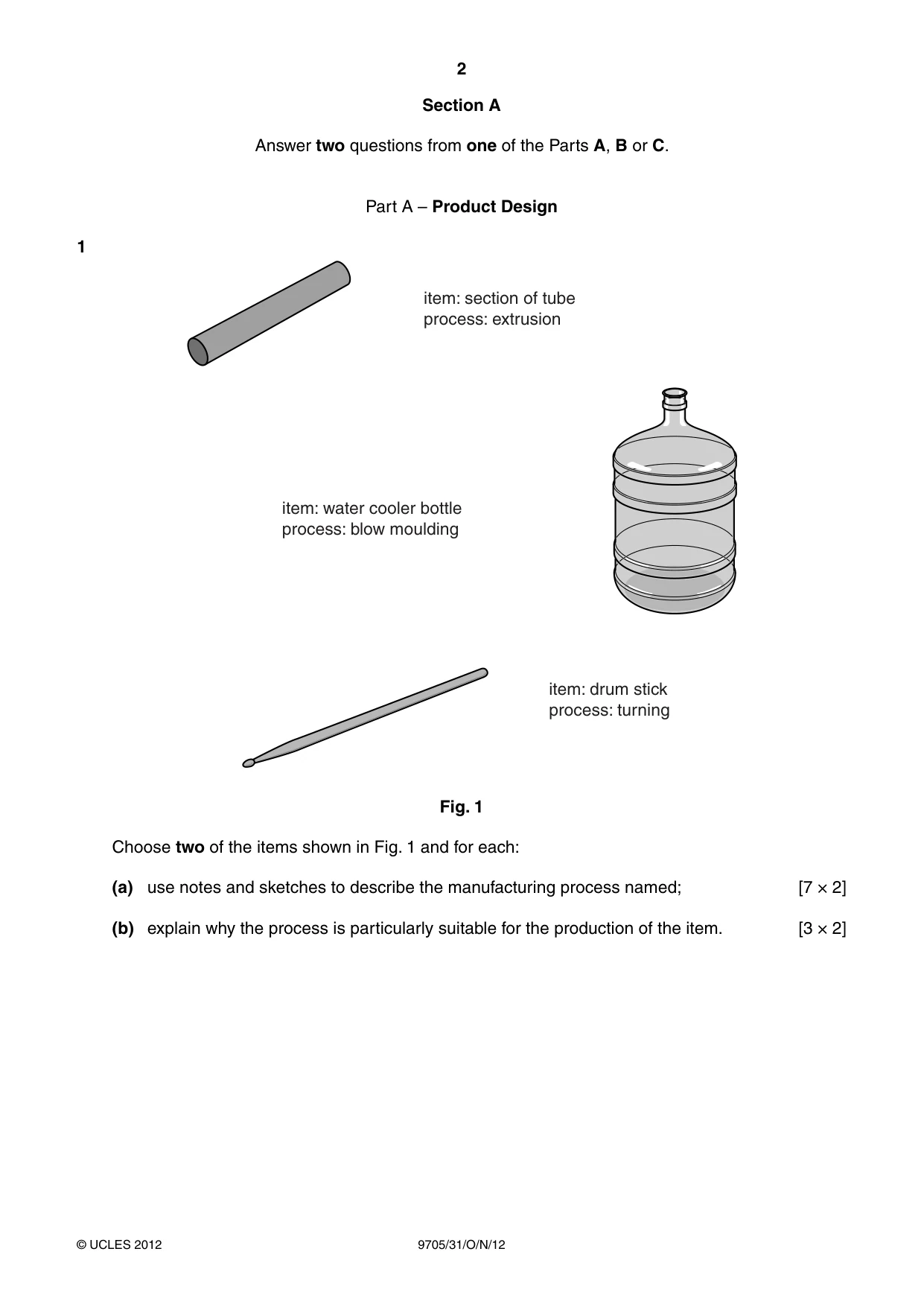
2 9705/31/O/N/12 © UCLES 2012 Section A Answer two questions from one of the Parts A, B or C. Part A – Product Design 1 item: section of tube process: extrusion item: water cooler bottle process: blow moulding item: drum stick process: turning Fig. 1 Choose two of the items shown in Fig. 1 and for each: (a) use notes and sketches to describe the manufacturing process named; [7 × 2] (b) explain why the process is particularly suitable for the production of the item. [3 × 2]
Question paper, page 3
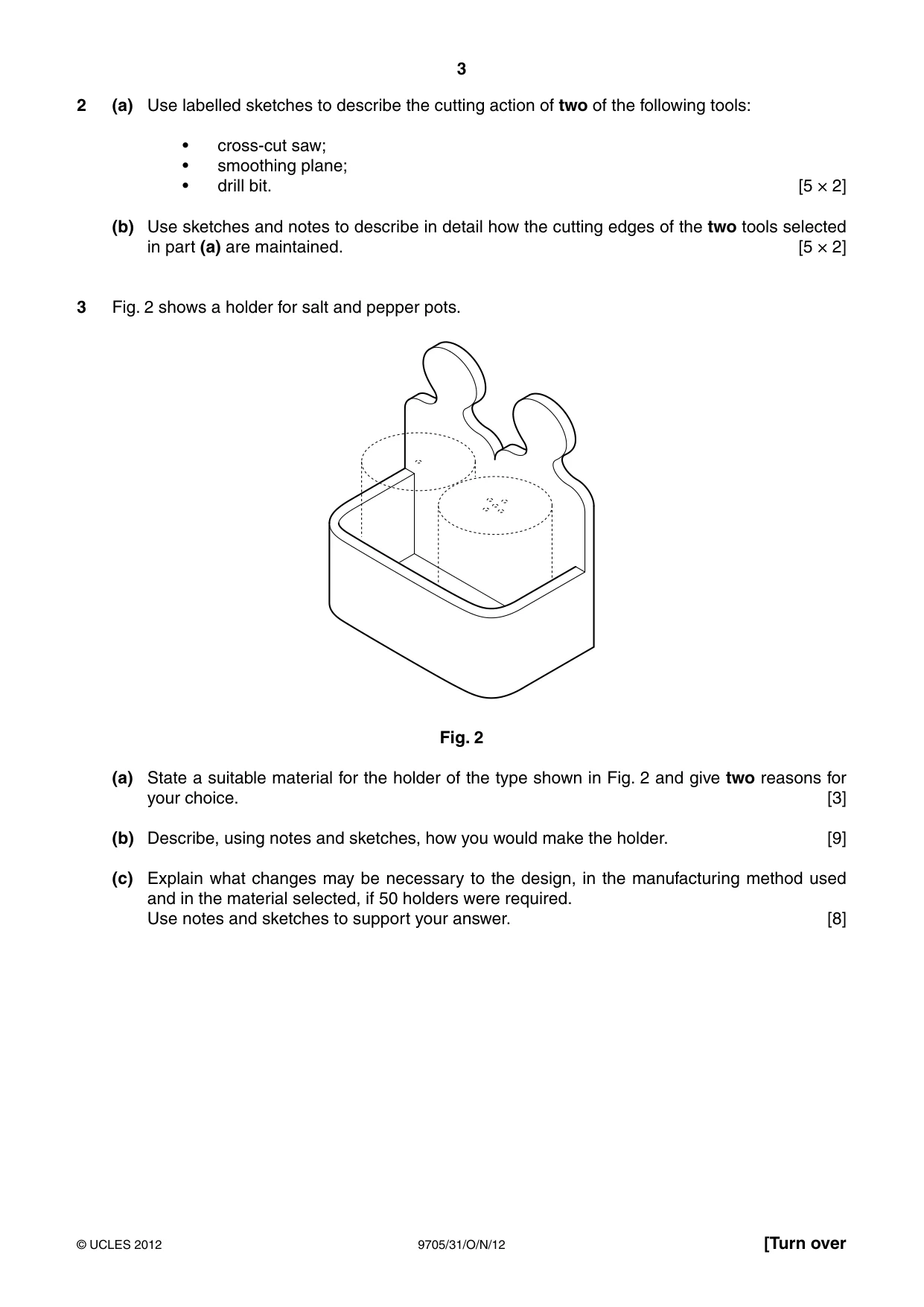
3 9705/31/O/N/12 © UCLES 2012 [Turn over 2 (a) Use labelled sketches to describe the cutting action of two of the following tools: • cross-cut saw; • smoothing plane; • drill bit. [5 × 2] (b) Use sketches and notes to describe in detail how the cutting edges of the two tools selected in part (a) are maintained. [5 × 2] 3 Fig. 2 shows a holder for salt and pepper pots. Fig. 2 (a) State a suitable material for the holder of the type shown in Fig. 2 and give two reasons for your choice. [3] (b) Describe, using notes and sketches, how you would make the holder. [9] (c) Explain what changes may be necessary to the design, in the manufacturing method used and in the material selected, if 50 holders were required. Use notes and sketches to support your answer. [8]
Question paper, page 4
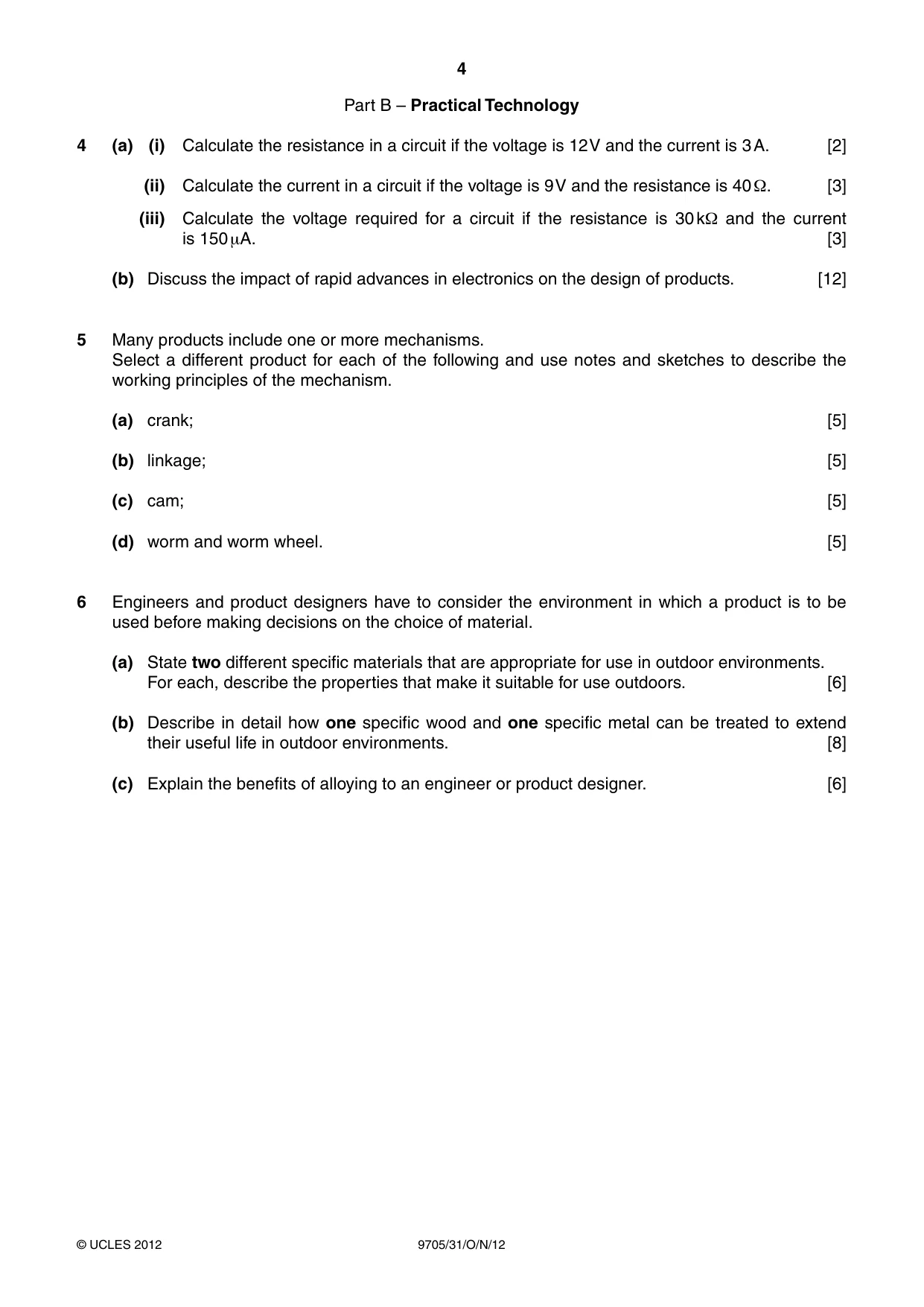
4 9705/31/O/N/12 © UCLES 2012 Part B – Practical Technology 4 (a) (i) Calculate the resistance in a circuit if the voltage is 12 V and the current is 3 A. [2] (ii) Calculate the current in a circuit if the voltage is 9 V and the resistance is 40 Ω. [3] (iii) Calculate the voltage required for a circuit if the resistance is 30 kΩ and the current is 150 μA. [3] (b) Discuss the impact of rapid advances in electronics on the design of products. [12] 5 Many products include one or more mechanisms. Select a different product for each of the following and use notes and sketches to describe the working principles of the mechanism. (a) crank; [5] (b) linkage; [5] (c) cam; [5] (d) worm and worm wheel. [5] 6 Engineers and product designers have to consider the environment in which a product is to be used before making decisions on the choice of material. (a) State two different specific materials that are appropriate for use in outdoor environments. For each, describe the properties that make it suitable for use outdoors. [6] (b) Describe in detail how one specific wood and one specific metal can be treated to extend their useful life in outdoor environments. [8] (c) Explain the benefits of alloying to an engineer or product designer. [6]
Question paper, page 5
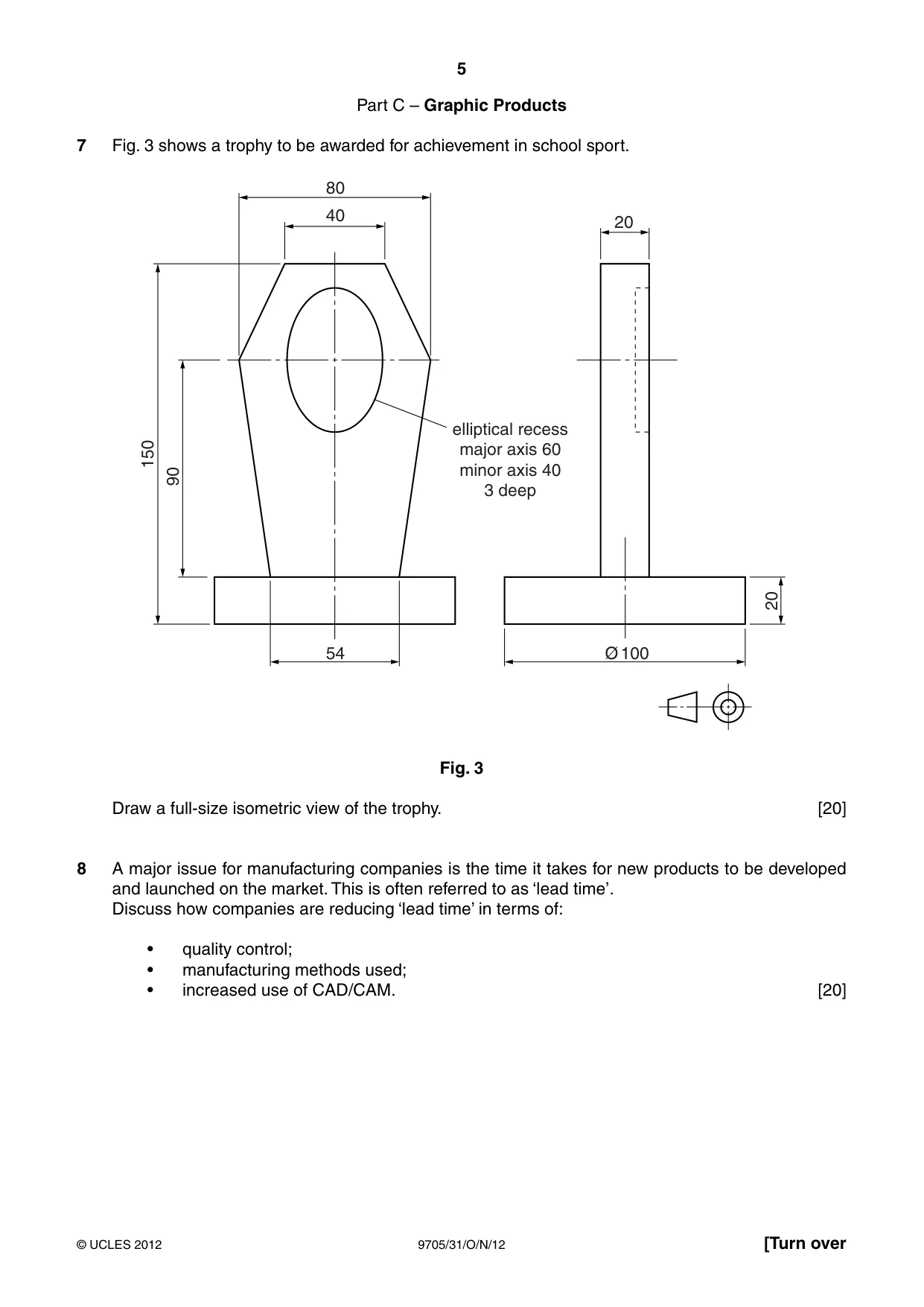
5 9705/31/O/N/12 © UCLES 2012 [Turn over Part C – Graphic Products 7 Fig. 3 shows a trophy to be awarded for achievement in school sport. 150 90 40 20 20 54 Ø 100 80 elliptical recess major axis 60 minor axis 40 3 deep Fig. 3 Draw a full-size isometric view of the trophy. [20] 8 A major issue for manufacturing companies is the time it takes for new products to be developed and launched on the market. This is often referred to as ‘lead time’. Discuss how companies are reducing ‘lead time’ in terms of: • quality control; • manufacturing methods used; • increased use of CAD/CAM. [20]
Question paper, page 6
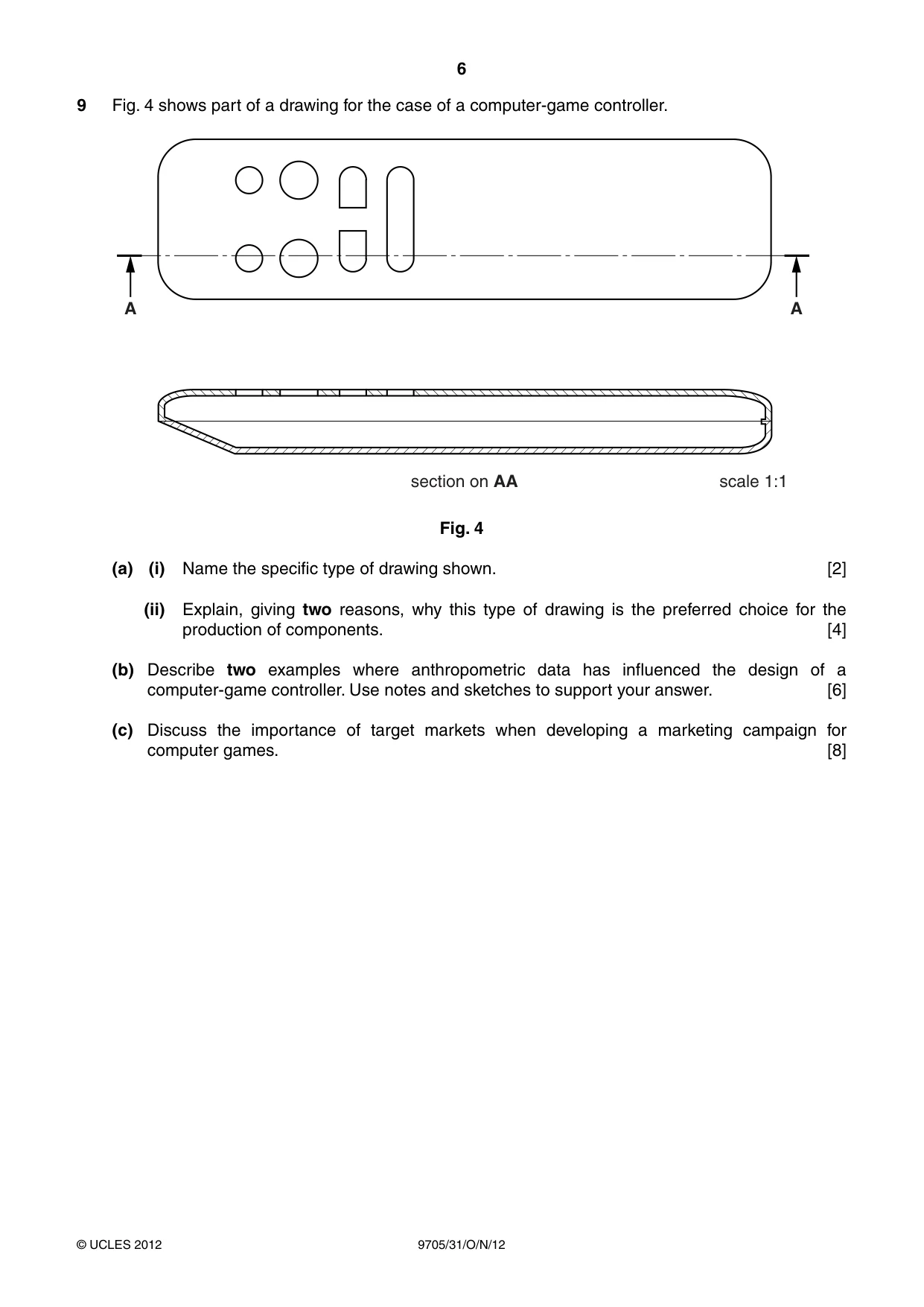
6 9705/31/O/N/12 © UCLES 2012 9 Fig. 4 shows part of a drawing for the case of a computer-game controller. A A section on AA scale 1:1 Fig. 4 (a) (i) Name the specific type of drawing shown. [2] (ii) Explain, giving two reasons, why this type of drawing is the preferred choice for the production of components. [4] (b) Describe two examples where anthropometric data has influenced the design of a computer-game controller. Use notes and sketches to support your answer. [6] (c) Discuss the importance of target markets when developing a marketing campaign for computer games. [8]
Question paper, page 7
7 9705/31/O/N/12 © UCLES 2012 [Turn over BLANK PAGE
Question paper, page 8
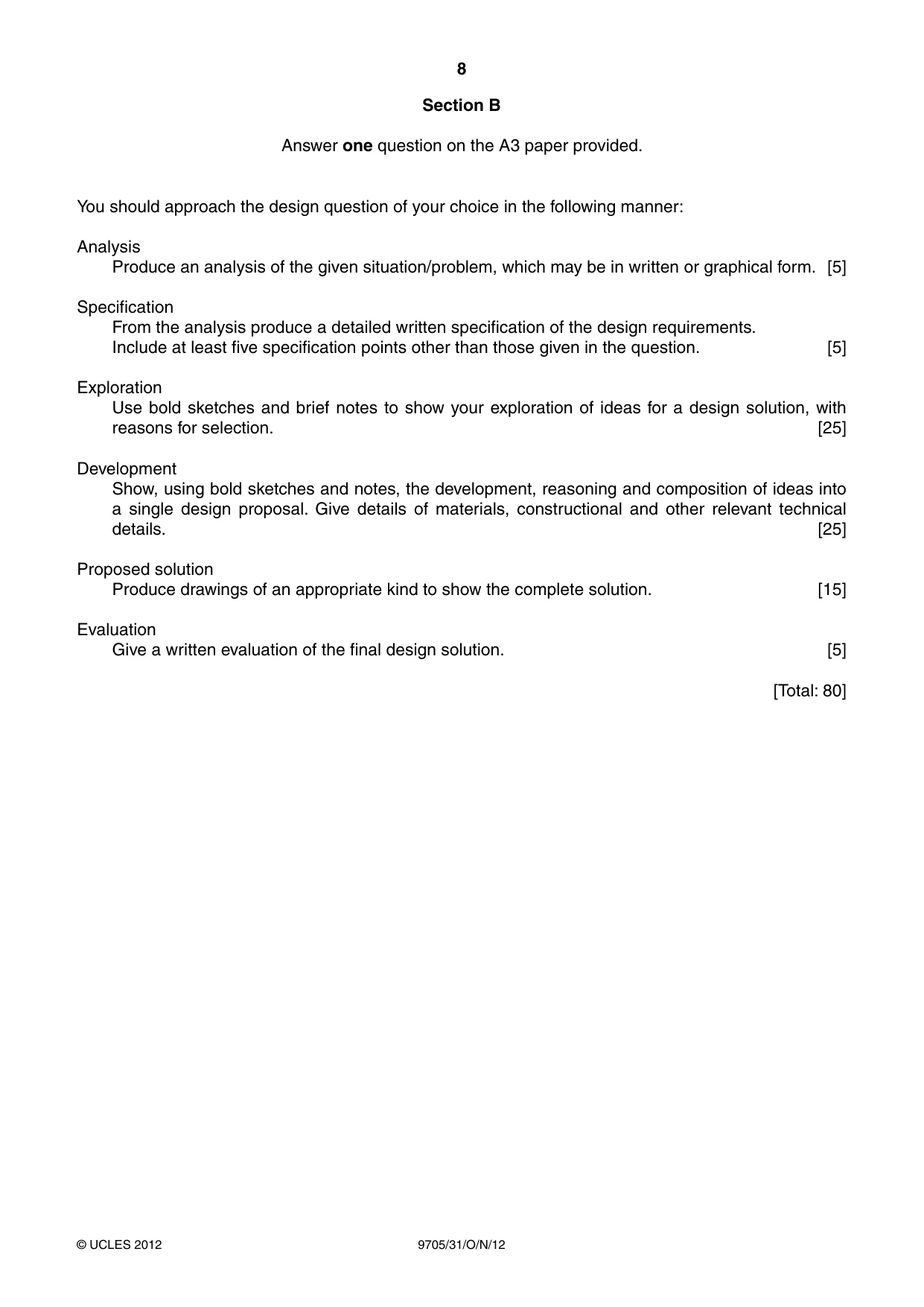
8 9705/31/O/N/12 © UCLES 2012 Section B Answer one question on the A3 paper provided. You should approach the design question of your choice in the following manner: Analysis Produce an analysis of the given situation/problem, which may be in written or graphical form. [5] Specification From the analysis produce a detailed written specification of the design requirements. Include at least five specification points other than those given in the question. [5] Exploration Use bold sketches and brief notes to show your exploration of ideas for a design solution, with reasons for selection. [25] Development Show, using bold sketches and notes, the development, reasoning and composition of ideas into a single design proposal. Give details of materials, constructional and other relevant technical details. [25] Proposed solution Produce drawings of an appropriate kind to show the complete solution. [15] Evaluation Give a written evaluation of the final design solution. [5] [Total: 80]
Question paper, page 9
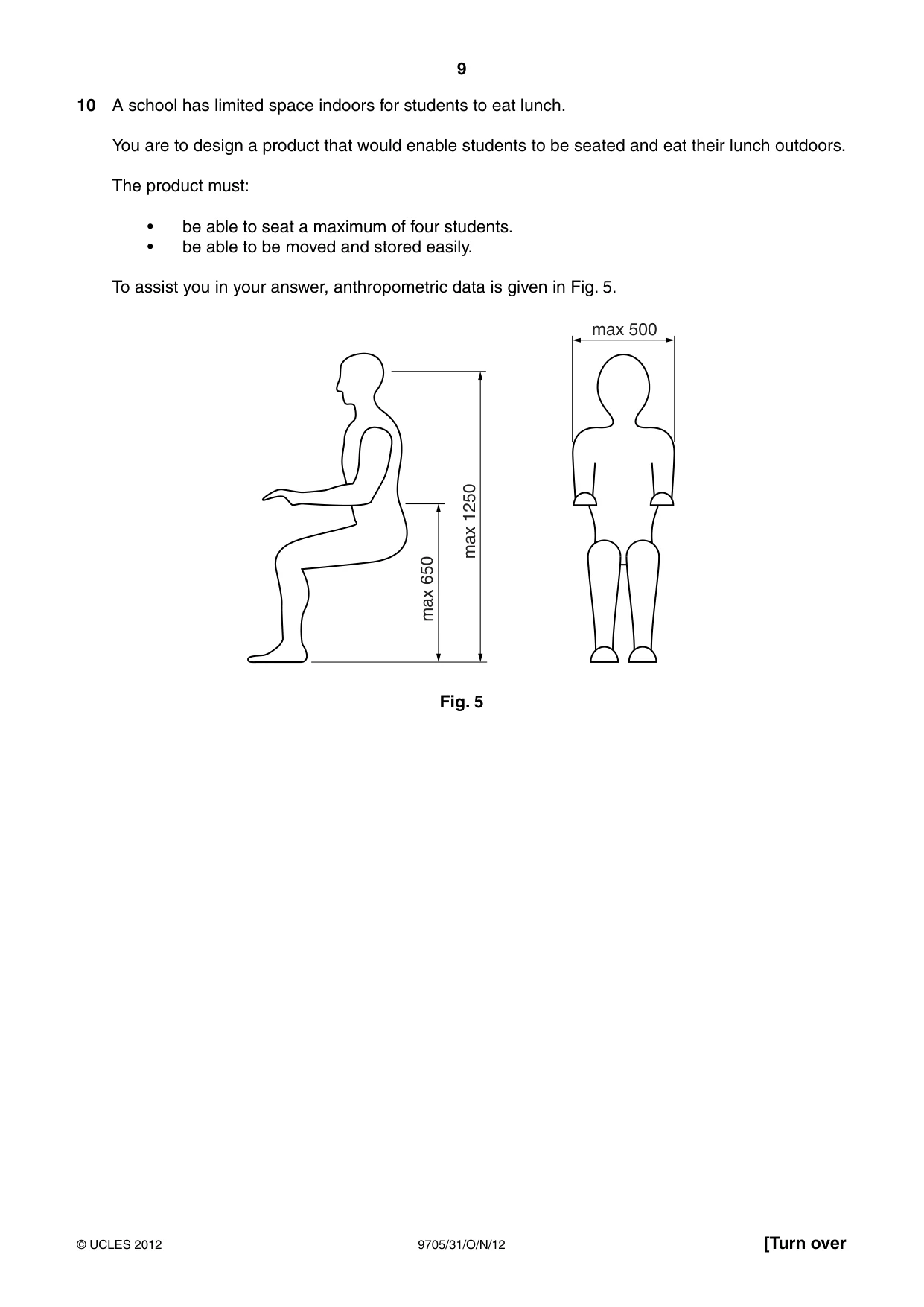
9 9705/31/O/N/12 © UCLES 2012 [Turn over 10 A school has limited space indoors for students to eat lunch. You are to design a product that would enable students to be seated and eat their lunch outdoors. The product must: • be able to seat a maximum of four students. • be able to be moved and stored easily. To assist you in your answer, anthropometric data is given in Fig. 5. max 650 max 1250 max 500 Fig. 5
Question paper, page 10
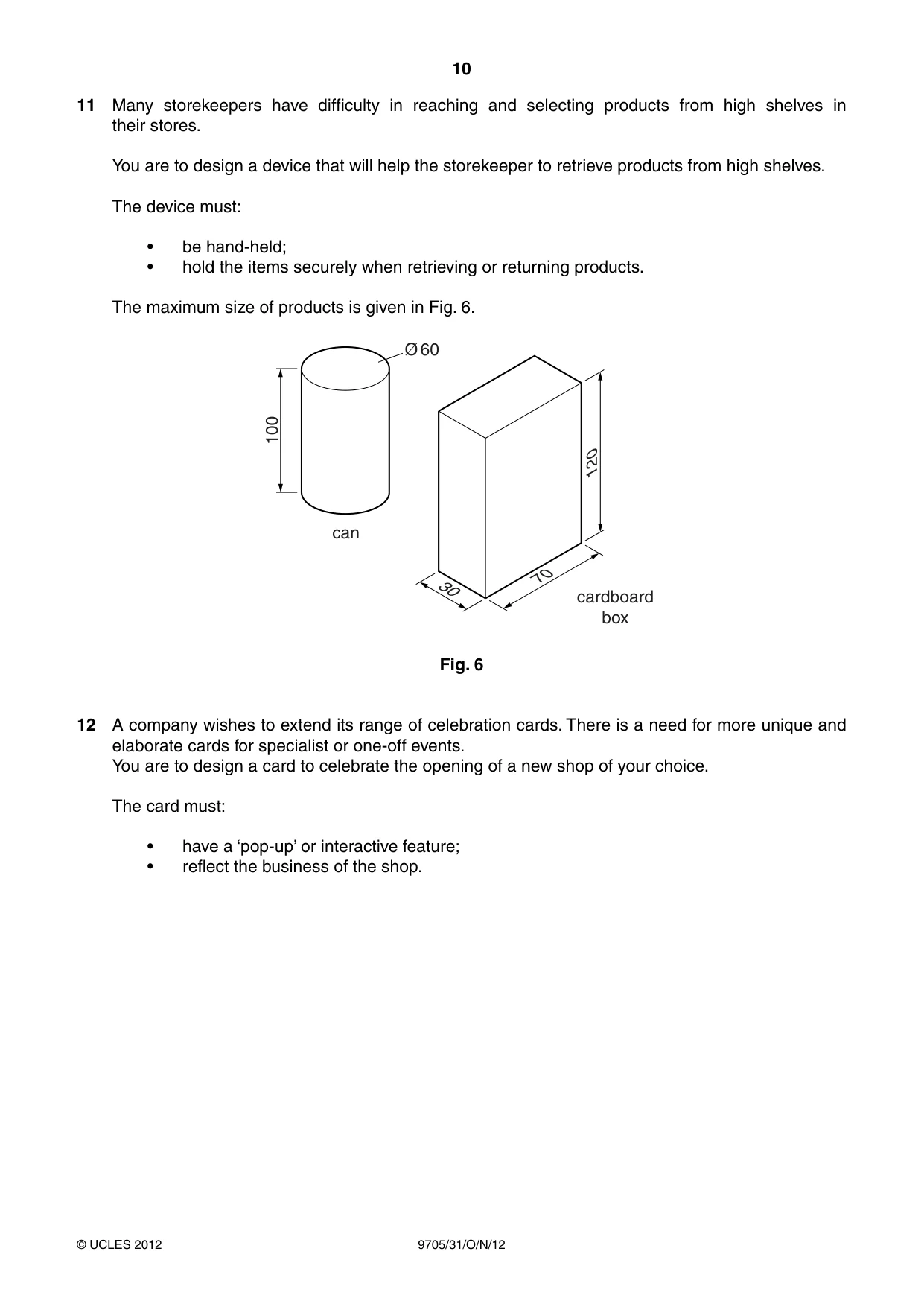
10 9705/31/O/N/12 © UCLES 2012 11 Many storekeepers have difficulty in reaching and selecting products from high shelves in their stores. You are to design a device that will help the storekeeper to retrieve products from high shelves. The device must: • be hand-held; • hold the items securely when retrieving or returning products. The maximum size of products is given in Fig. 6. Ø 60 100 30 70 120 cardboard box can Fig. 6 12 A company wishes to extend its range of celebration cards. There is a need for more unique and elaborate cards for specialist or one-off events. You are to design a card to celebrate the opening of a new shop of your choice. The card must: • have a ‘pop-up’ or interactive feature; • reflect the business of the shop.
Question paper, page 11
11 9705/31/O/N/12 © UCLES 2012 BLANK PAGE
Question paper, page 12
12 9705/31/O/N/12 © UCLES 2012 Permission to reproduce items where third-party owned material protected by copyright is included has been sought and cleared where possible. Every reasonable effort has been made by the publisher (UCLES) to trace copyright holders, but if any items requiring clearance have unwittingly been included, the publisher will be pleased to make amends at the earliest possible opportunity. University of Cambridge International Examinations is part of the Cambridge Assessment Group. Cambridge Assessment is the brand name of University of Cambridge Local Examinations Syndicate (UCLES), which is itself a department of the University of Cambridge. BLANK PAGE
Mark scheme, page 1
CAMBRIDGE INTERNATIONAL EXAMINATIONS GCE Advanced Level MARK SCHEME for the October/November 2012 series 9705 DESIGN AND TECHNOLOGY 9705/31 Paper 3, maximum raw mark 120 This mark scheme is published as an aid to teachers and candidates, to indicate the requirements of the examination. It shows the basis on which Examiners were instructed to award marks. It does not indicate the details of the discussions that took place at an Examiners’ meeting before marking began, which would have considered the acceptability of alternative answers. Mark schemes should be read in conjunction with the question paper and the Principal Examiner Report for Teachers. Cambridge will not enter into discussions about these mark schemes. Cambridge is publishing the mark schemes for the October/November 2012 series for most IGCSE, GCE Advanced Level and Advanced Subsidiary Level components and some Ordinary Level components.
Mark scheme, page 2
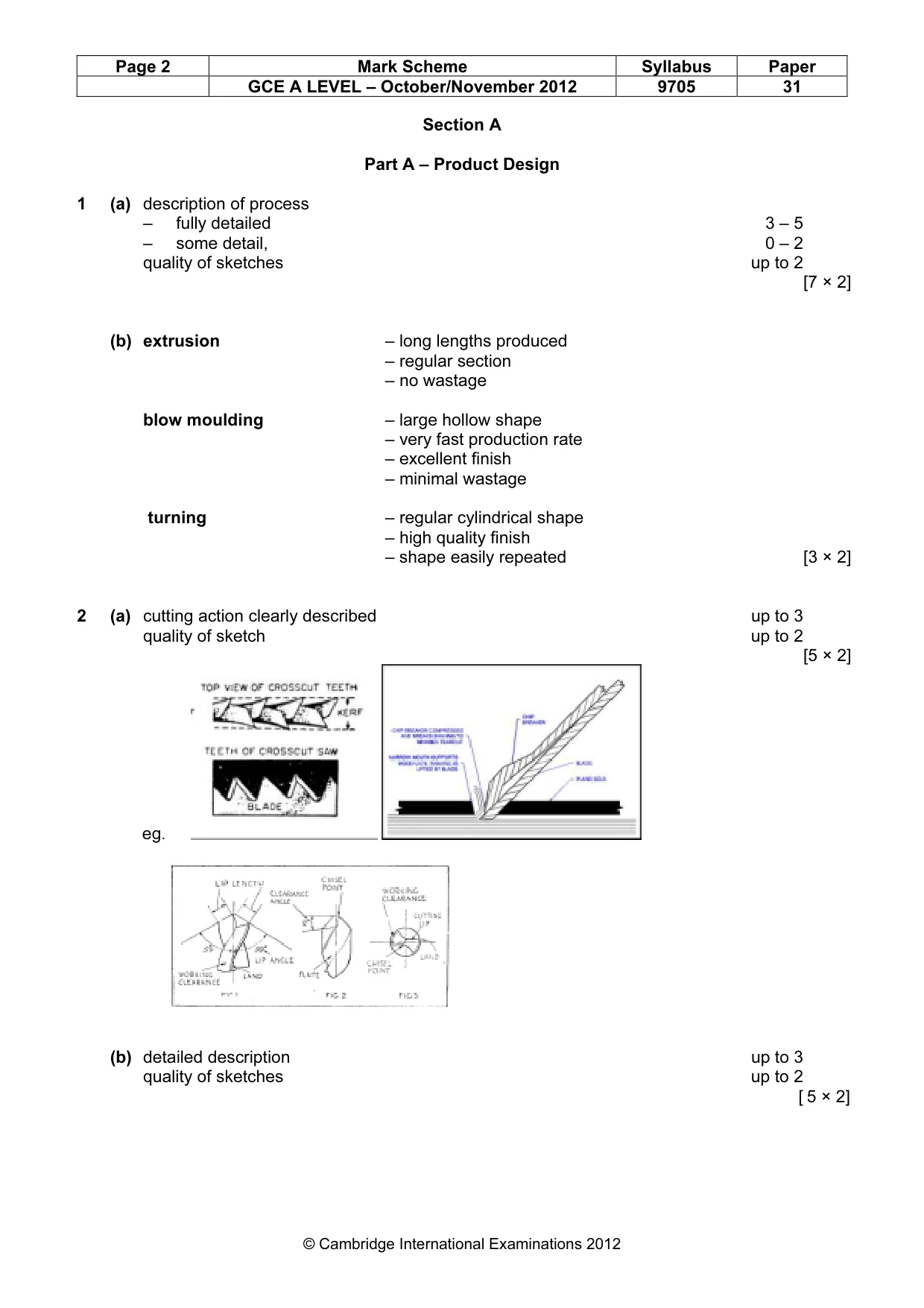
Page 2 Mark Scheme Syllabus Paper GCE A LEVEL – October/November 2012 9705 31 © Cambridge International Examinations 2012 Section A Part A – Product Design 1 (a) description of process – fully detailed 3 – 5 – some detail, 0 – 2 quality of sketches up to 2 [7 × 2] (b) extrusion – long lengths produced – regular section – no wastage blow moulding – large hollow shape – very fast production rate – excellent finish – minimal wastage turning – regular cylindrical shape – high quality finish – shape easily repeated [3 × 2] 2 (a) cutting action clearly described up to 3 quality of sketch up to 2 [5 × 2] eg. (b) detailed description up to 3 quality of sketches up to 2 [ 5 × 2]
Mark scheme, page 3
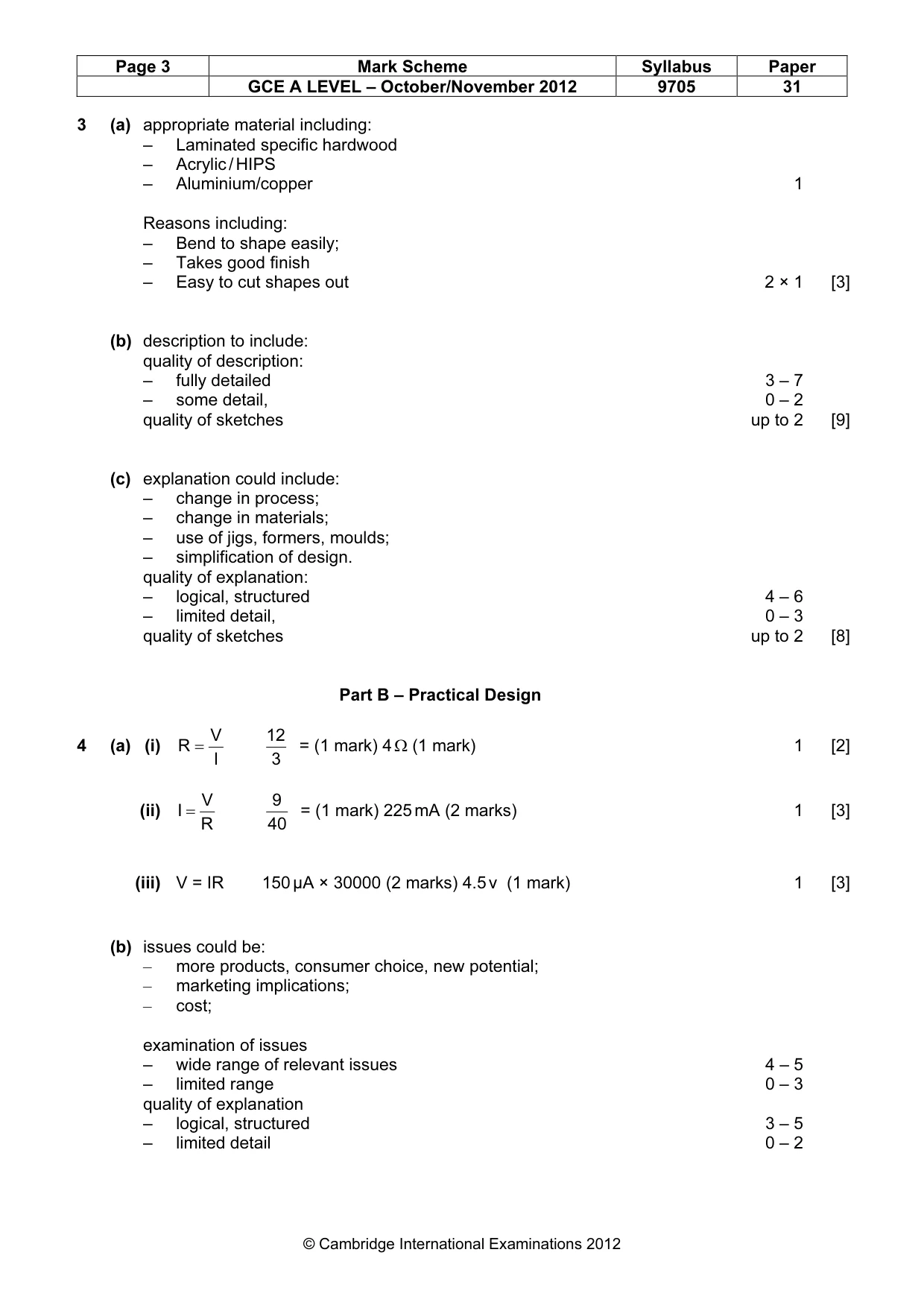
Page 3 Mark Scheme Syllabus Paper GCE A LEVEL – October/November 2012 9705 31 © Cambridge International Examinations 2012 3 (a) appropriate material including: – Laminated specific hardwood – Acrylic / HIPS – Aluminium/copper 1 Reasons including: – Bend to shape easily; – Takes good finish – Easy to cut shapes out 2 × 1 [3] (b) description to include: quality of description: – fully detailed 3 – 7 – some detail, 0 – 2 quality of sketches up to 2 [9] (c) explanation could include: – change in process; – change in materials; – use of jigs, formers, moulds; – simplification of design. quality of explanation: – logical, structured 4 – 6 – limited detail, 0 – 3 quality of sketches up to 2 [8] Part B – Practical Design 4 (a) (i) l V R = 3 12 = (1 mark) 4 Ω (1 mark) 1 [2] (ii) R V I = 40 9 = (1 mark) 225 mA (2 marks) 1 [3] (iii) V = IR 150 µA × 30000 (2 marks) 4.5 v (1 mark) 1 [3] (b) issues could be: – more products, consumer choice, new potential; – marketing implications; – cost; examination of issues – wide range of relevant issues 4 – 5 – limited range 0 – 3 quality of explanation – logical, structured 3 – 5 – limited detail 0 – 2
Mark scheme, page 4
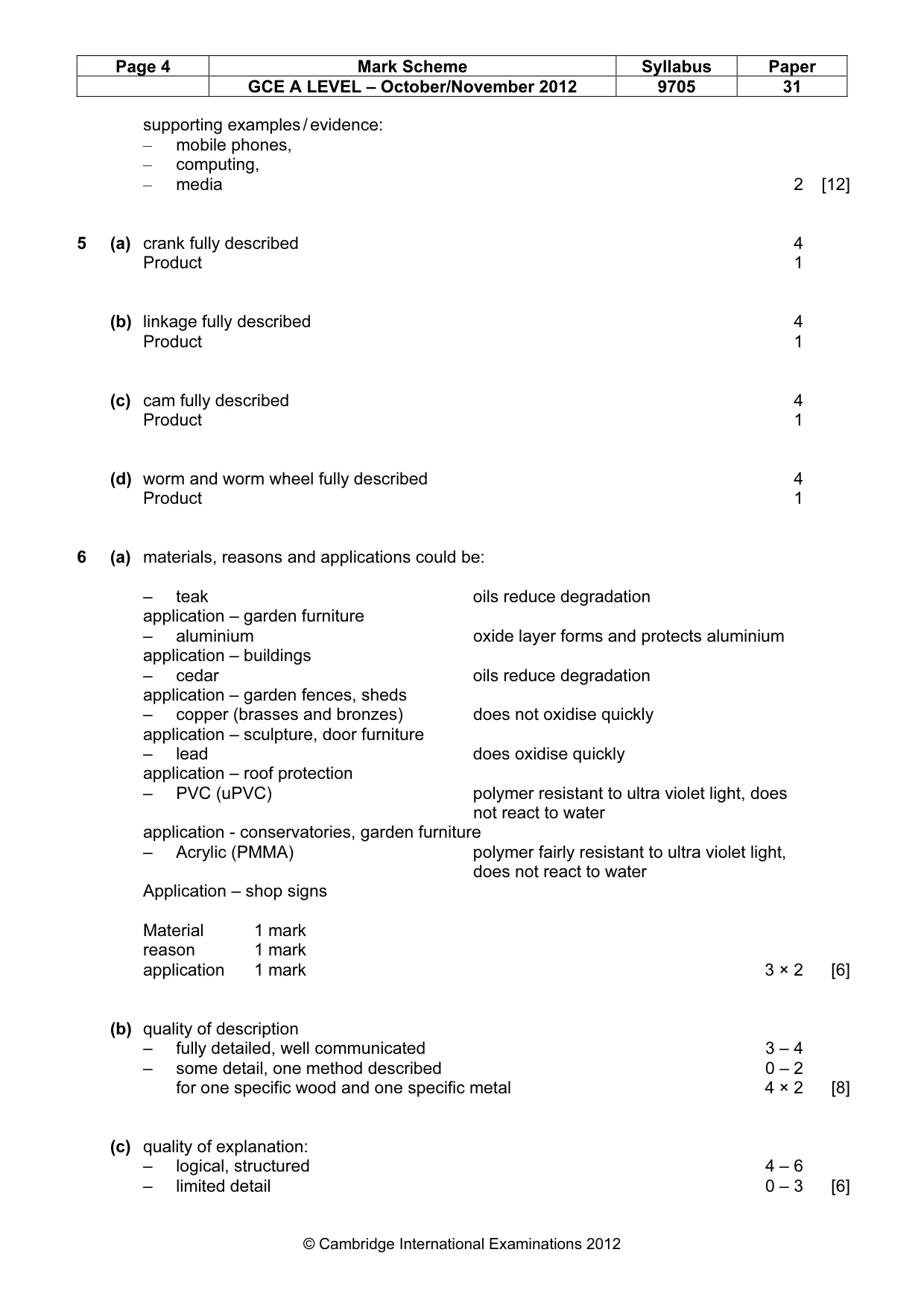
Page 4 Mark Scheme Syllabus Paper GCE A LEVEL – October/November 2012 9705 31 © Cambridge International Examinations 2012 supporting examples / evidence: – mobile phones, – computing, – media 2 [12] 5 (a) crank fully described 4 Product 1 (b) linkage fully described 4 Product 1 (c) cam fully described 4 Product 1 (d) worm and worm wheel fully described 4 Product 1 6 (a) materials, reasons and applications could be: – teak oils reduce degradation application – garden furniture – aluminium oxide layer forms and protects aluminium application – buildings – cedar oils reduce degradation application – garden fences, sheds – copper (brasses and bronzes) does not oxidise quickly application – sculpture, door furniture – lead does oxidise quickly application – roof protection – PVC (uPVC) polymer resistant to ultra violet light, does not react to water application - conservatories, garden furniture – Acrylic (PMMA) polymer fairly resistant to ultra violet light, does not react to water Application – shop signs Material 1 mark reason 1 mark application 1 mark 3 × 2 [6] (b) quality of description – fully detailed, well communicated 3 – 4 – some detail, one method described 0 – 2 for one specific wood and one specific metal 4 × 2 [8] (c) quality of explanation: – logical, structured 4 – 6 – limited detail 0 – 3 [6]
Mark scheme, page 5
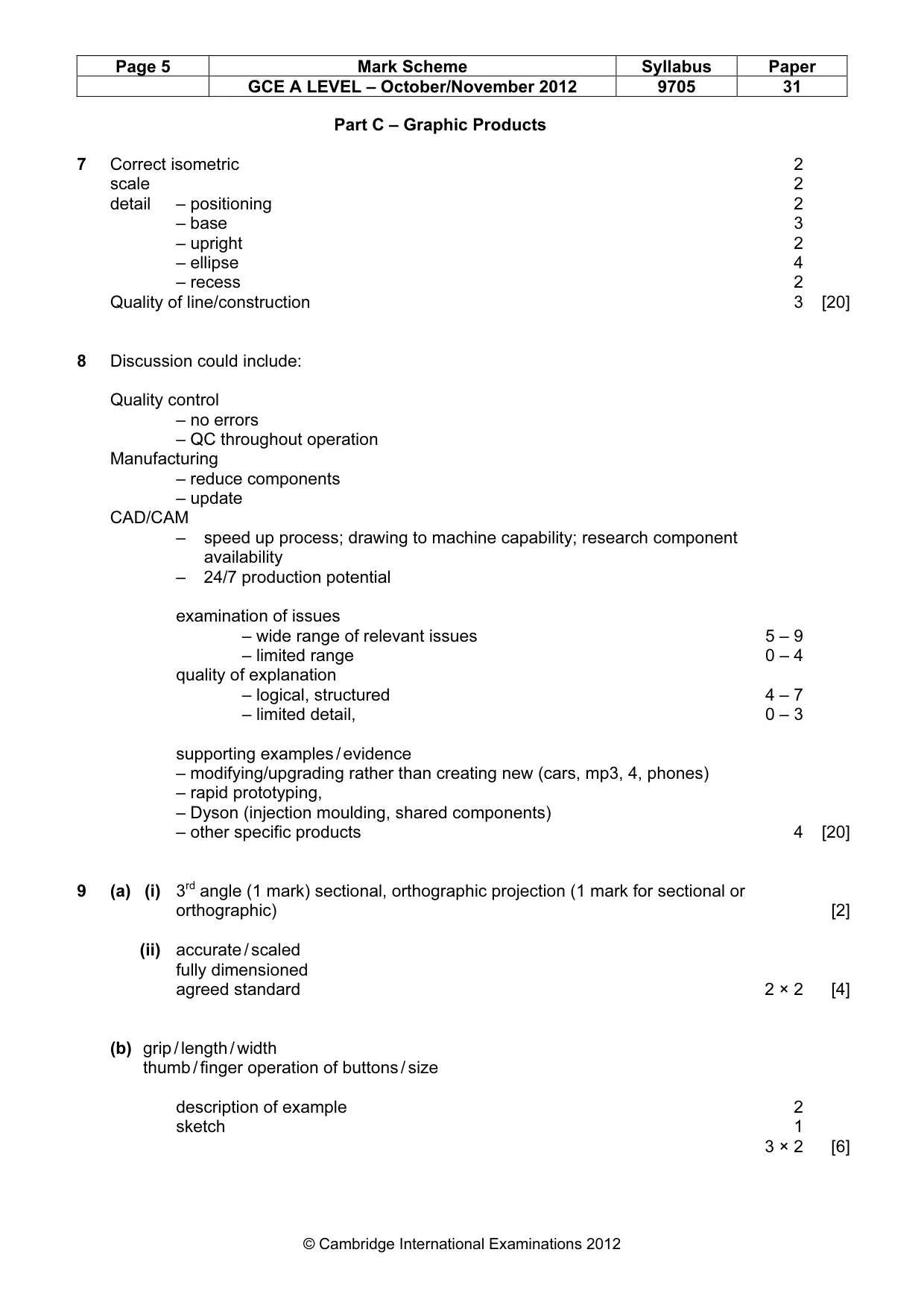
Page 5 Mark Scheme Syllabus Paper GCE A LEVEL – October/November 2012 9705 31 © Cambridge International Examinations 2012 Part C – Graphic Products 7 Correct isometric 2 scale 2 detail – positioning 2 – base 3 – upright 2 – ellipse 4 – recess 2 Quality of line/construction 3 [20] 8 Discussion could include: Quality control – no errors – QC throughout operation Manufacturing – reduce components – update CAD/CAM – speed up process; drawing to machine capability; research component availability – 24/7 production potential examination of issues – wide range of relevant issues 5 – 9 – limited range 0 – 4 quality of explanation – logical, structured 4 – 7 – limited detail, 0 – 3 supporting examples / evidence – modifying/upgrading rather than creating new (cars, mp3, 4, phones) – rapid prototyping, – Dyson (injection moulding, shared components) – other specific products 4 [20] 9 (a) (i) 3rd angle (1 mark) sectional, orthographic projection (1 mark for sectional or orthographic) [2] (ii) accurate / scaled fully dimensioned agreed standard 2 × 2 [4] (b) grip / length / width thumb / finger operation of buttons / size description of example 2 sketch 1 3 × 2 [6]
Mark scheme, page 6
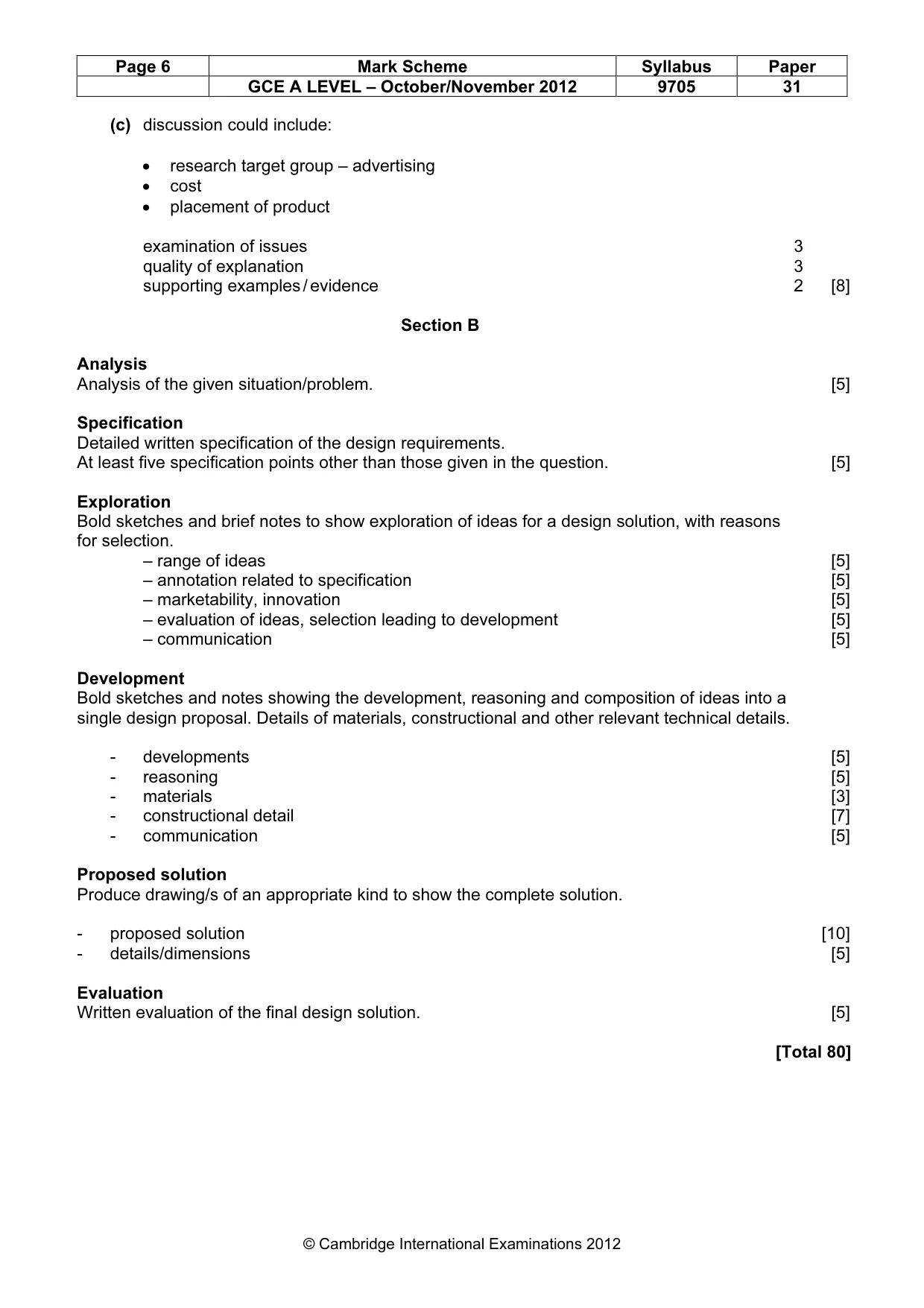
Page 6 Mark Scheme Syllabus Paper GCE A LEVEL – October/November 2012 9705 31 © Cambridge International Examinations 2012 (c) discussion could include: • research target group – advertising • cost • placement of product examination of issues 3 quality of explanation 3 supporting examples / evidence 2 [8] Section B Analysis Analysis of the given situation/problem. [5] Specification Detailed written specification of the design requirements. At least five specification points other than those given in the question. [5] Exploration Bold sketches and brief notes to show exploration of ideas for a design solution, with reasons for selection. – range of ideas [5] – annotation related to specification [5] – marketability, innovation [5] – evaluation of ideas, selection leading to development [5] – communication [5] Development Bold sketches and notes showing the development, reasoning and composition of ideas into a single design proposal. Details of materials, constructional and other relevant technical details. - developments [5] - reasoning [5] - materials [3] - constructional detail [7] - communication [5] Proposed solution Produce drawing/s of an appropriate kind to show the complete solution. - proposed solution [10] - details/dimensions [5] Evaluation Written evaluation of the final design solution. [5] [Total 80]
What you needed in this session
Cambridge’s own grade thresholds for 2012 Oct/Nov, Paper 3 · Variant 1. A higher threshold means an easier paper — the bar moves with how the cohort did.