Cambridge A Level Design and Technology 9705 — 2011 Oct/Nov Paper 3 · Variant 3
9705/33/O/N/11 · 120 marks · ≈135 min
The question paper and its mark scheme, free to read here and free to download. This is Cambridge’s own paper, exactly as it was sat.
Question paper12 pages
Mark scheme8 pages
Answers below. Sit the paper first if you are practising.
Paper as text
Question paper, page 1
This document consists of 10 printed pages and 2 blank pages. DC (CW/SW) 35768/3 © UCLES 2011 [Turn over UNIVERSITY OF CAMBRIDGE INTERNATIONAL EXAMINATIONS General Certificate of Education Advanced Subsidiary Level and Advanced Level * 5 0 0 4 0 6 9 0 8 8 * DESIGN AND TECHNOLOGY 9705/33 Paper 3 October/November 2011 3 hours Additional Materials: Answer Booklet/Paper A range of design drawing equipment A3 Drawing paper (5 sheets) READ THESE INSTRUCTIONS FIRST Write your Centre number, candidate number and name on all the work you hand in. Write in dark blue or black pen. You may use a soft pencil for any diagrams, graphs or rough working. Do not use staples, paper clips, highlighters, glue or correction fluid. Section A Answer any two questions from one of the Parts A, B or C. Section B Answer one question. All dimensions are in millimetres. The instruction ‘discuss’ denotes that you should: • examine critically the issues raised by the question; • explain and interpret these issues as appropriate; • introduce evidence wherever possible to support conclusions of arguments. At the end of the examination, fasten all your work securely together. The number of marks is given in brackets [ ] at the end of each question or part question.
Question paper, page 2
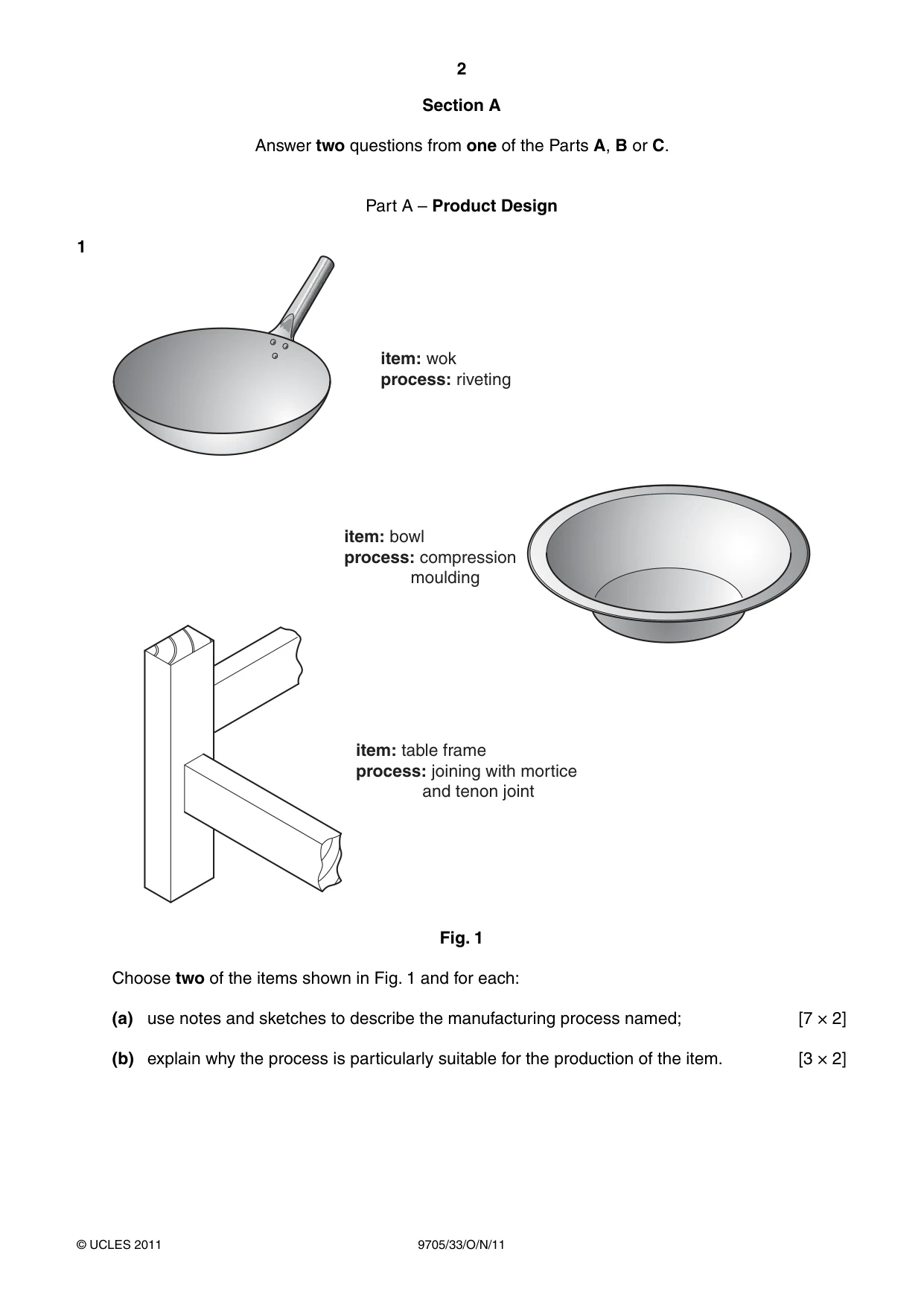
2 9705/33/O/N/11 © UCLES 2011 Section A Answer two questions from one of the Parts A, B or C. Part A – Product Design 1 item: wok process: riveting item: bowl process: compression moulding item: table frame process: joining with mortice and tenon joint Fig. 1 Choose two of the items shown in Fig. 1 and for each: (a) use notes and sketches to describe the manufacturing process named; [7 × 2] (b) explain why the process is particularly suitable for the production of the item. [3 × 2]
Question paper, page 3
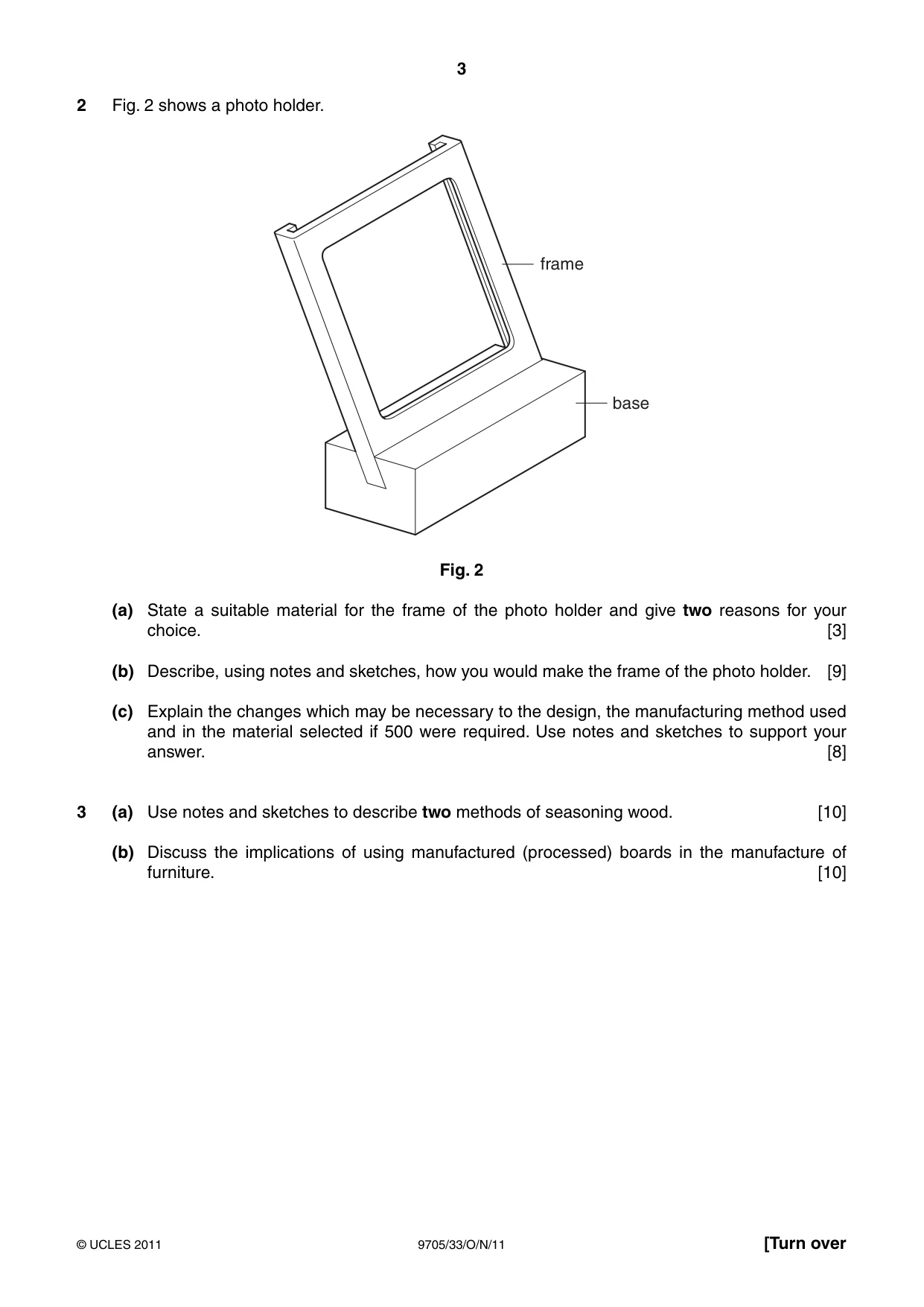
3 9705/33/O/N/11 © UCLES 2011 [Turn over 2 Fig. 2 shows a photo holder. frame base Fig. 2 (a) State a suitable material for the frame of the photo holder and give two reasons for your choice. [3] (b) Describe, using notes and sketches, how you would make the frame of the photo holder. [9] (c) Explain the changes which may be necessary to the design, the manufacturing method used and in the material selected if 500 were required. Use notes and sketches to support your answer. [8] 3 (a) Use notes and sketches to describe two methods of seasoning wood. [10] (b) Discuss the implications of using manufactured (processed) boards in the manufacture of furniture. [10]
Question paper, page 4
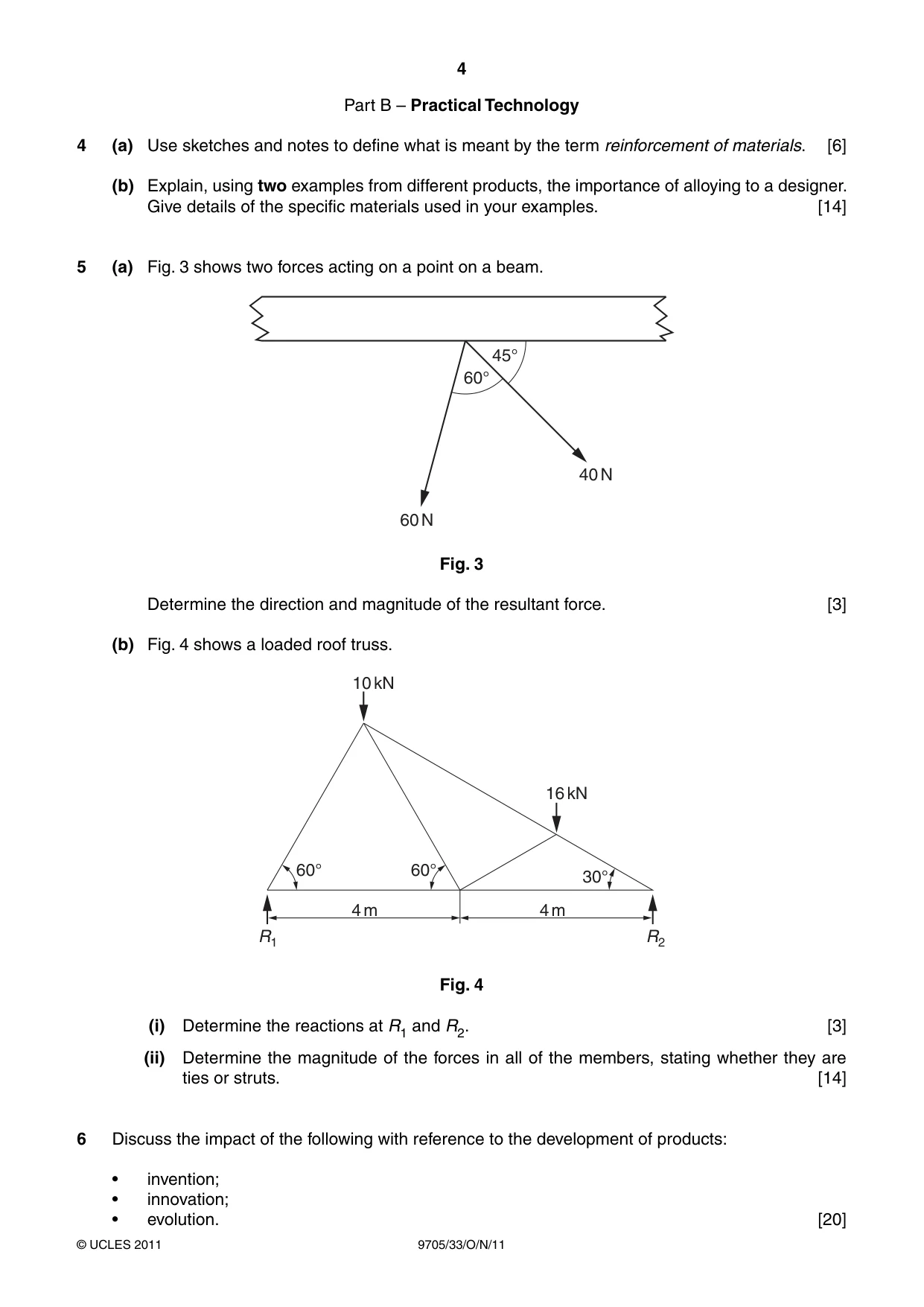
4 9705/33/O/N/11 © UCLES 2011 Part B – Practical Technology 4 (a) Use sketches and notes to define what is meant by the term reinforcement of materials. [6] (b) Explain, using two examples from different products, the importance of alloying to a designer. Give details of the specific materials used in your examples. [14] 5 (a) Fig. 3 shows two forces acting on a point on a beam. 60° 40 N 60 N 45° Fig. 3 Determine the direction and magnitude of the resultant force. [3] (b) Fig. 4 shows a loaded roof truss. 60° 60° 30° 4 m R1 R2 10 kN 16 kN 4 m Fig. 4 (i) Determine the reactions at R1 and R2. [3] (ii) Determine the magnitude of the forces in all of the members, stating whether they are ties or struts. [14] 6 Discuss the impact of the following with reference to the development of products: • invention; • innovation; • evolution. [20]
Question paper, page 5
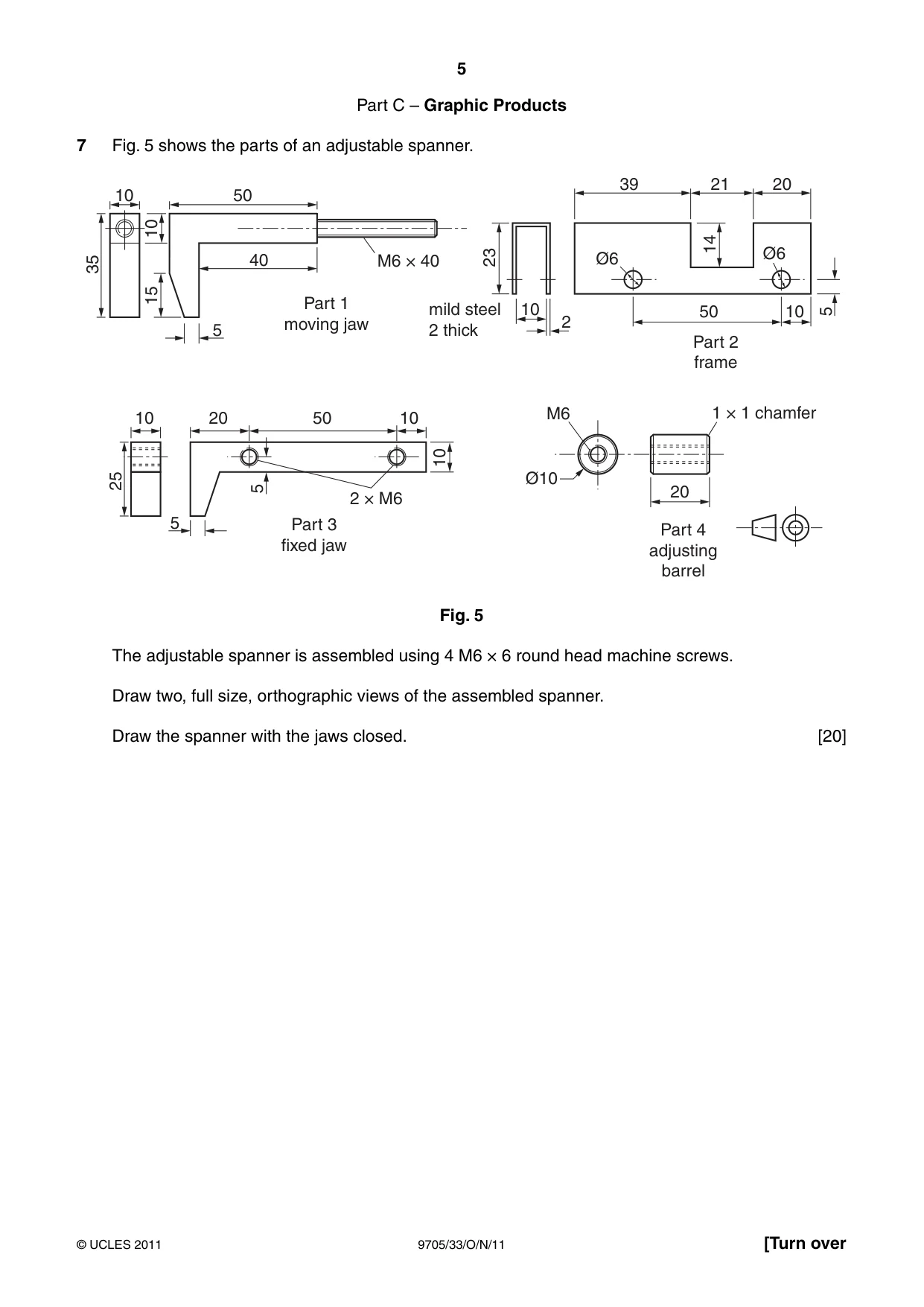
5 9705/33/O/N/11 © UCLES 2011 [Turn over Part C – Graphic Products 7 Fig. 5 shows the parts of an adjustable spanner. 50 10 10 20 50 10 10 10 10 15 5 35 25 23 14 40 39 50 10 5 21 20 20 M6 × 40 1 × 1 chamfer 2 × M6 M6 Ø10 Part 1 moving jaw mild steel 2 thick Part 3 fixed jaw Part 4 adjusting barrel Part 2 frame 5 5 2 Ø6 Ø6 Fig. 5 The adjustable spanner is assembled using 4 M6 × 6 round head machine screws. Draw two, full size, orthographic views of the assembled spanner. Draw the spanner with the jaws closed. [20]
Question paper, page 6
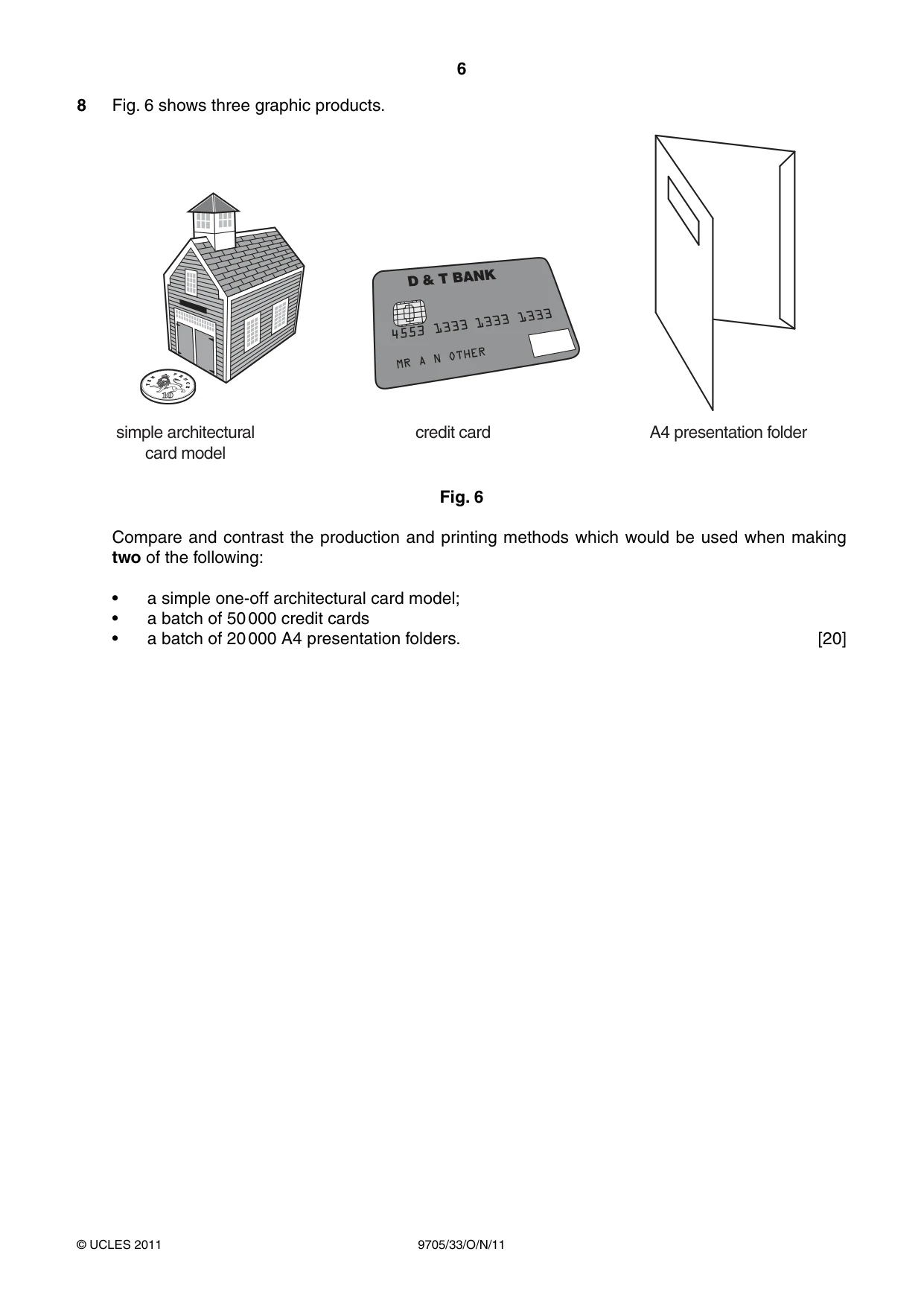
6 9705/33/O/N/11 © UCLES 2011 8 Fig. 6 shows three graphic products. simple architectural card model credit card A4 presentation folder Fig. 6 Compare and contrast the production and printing methods which would be used when making two of the following: • a simple one-off architectural card model; • a batch of 50 000 credit cards • a batch of 20 000 A4 presentation folders. [20]
Question paper, page 7
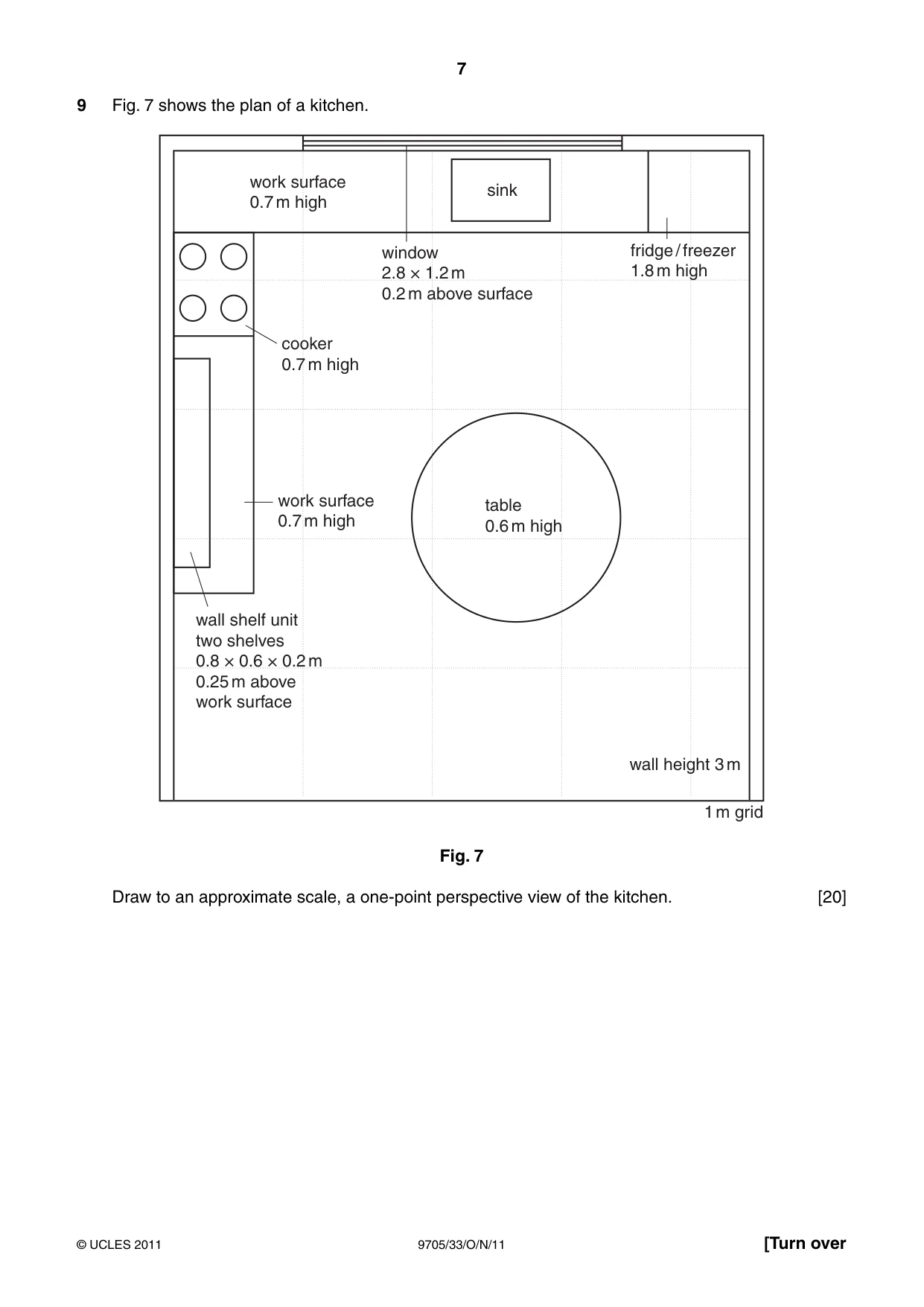
7 9705/33/O/N/11 © UCLES 2011 [Turn over 9 Fig. 7 shows the plan of a kitchen. work surface 0.7 m high sink window 2.8 × 1.2 m 0.2 m above surface wall shelf unit two shelves 0.8 × 0.6 × 0.2 m 0.25 m above work surface wall height 3 m 1 m grid fridge / freezer 1.8 m high cooker 0.7 m high work surface 0.7 m high table 0.6 m high Fig. 7 Draw to an approximate scale, a one-point perspective view of the kitchen. [20]
Question paper, page 8
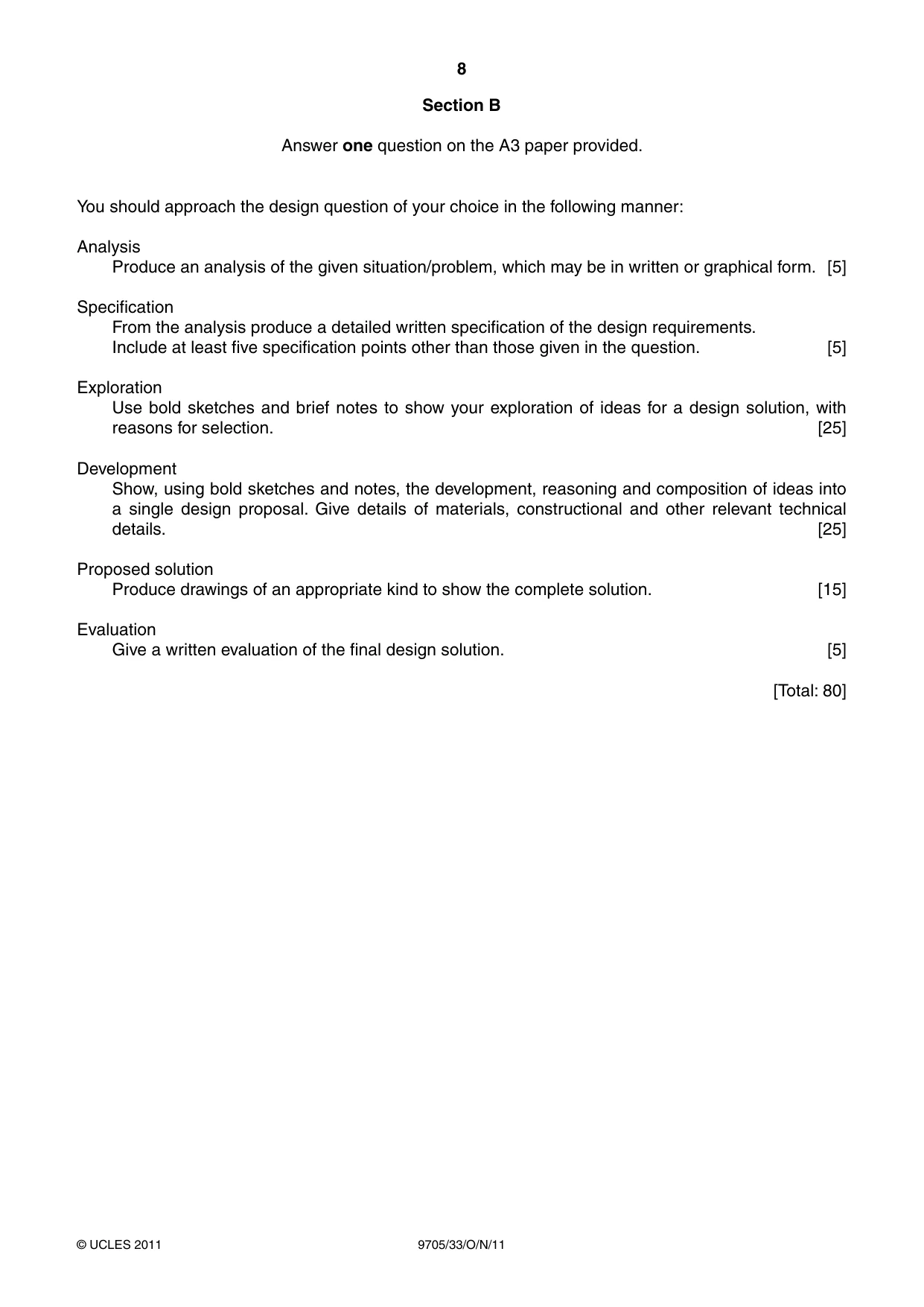
8 9705/33/O/N/11 © UCLES 2011 Section B Answer one question on the A3 paper provided. You should approach the design question of your choice in the following manner: Analysis Produce an analysis of the given situation/problem, which may be in written or graphical form. [5] Specification From the analysis produce a detailed written specification of the design requirements. Include at least five specification points other than those given in the question. [5] Exploration Use bold sketches and brief notes to show your exploration of ideas for a design solution, with reasons for selection. [25] Development Show, using bold sketches and notes, the development, reasoning and composition of ideas into a single design proposal. Give details of materials, constructional and other relevant technical details. [25] Proposed solution Produce drawings of an appropriate kind to show the complete solution. [15] Evaluation Give a written evaluation of the final design solution. [5] [Total: 80]
Question paper, page 9
9 9705/33/O/N/11 © UCLES 2011 [Turn over 10 A school garden requires regular watering. Design a product that would collect rainfall, and dispense water where required. The product must: • be easily moved around the garden; • hold a minimum of 25 litres of water. 11 Many schools are becoming Eco Schools. One of the criteria to be an Eco School is that each classroom must have at least one plant. Design a product that would indicate that the soil/compost was drying out and that the plant needs to be watered. The product must: • have a visual and/or audible alarm; • be easily produced as a batch of 50. To assist you in your answer, details of a rechargeable 9 volt battery are given in Fig. 8. 48 26 16 Fig. 8
Question paper, page 10
10 9705/33/O/N/11 © UCLES 2011 12 A school wishes to sell produce from its Garden Shop. You are to design a packaging system that would enable customers to take seedlings (young plants) home in any combination of 4, 8 or 12. The packaging must include a name of your choice for the Garden Shop and a simple logo. To assist you in your answer, details of the seedlings are given in Fig. 9. 100 65 Ø 60 Ø 45 bio-degradable fibre pot Fig. 9
Question paper, page 11
11 9705/33/O/N/11 © UCLES 2011 BLANK PAGE
Question paper, page 12
12 9705/33/O/N/11 © UCLES 2011 BLANK PAGE Permission to reproduce items where third-party owned material protected by copyright is included has been sought and cleared where possible. Every reasonable effort has been made by the publisher (UCLES) to trace copyright holders, but if any items requiring clearance have unwittingly been included, the publisher will be pleased to make amends at the earliest possible opportunity. University of Cambridge International Examinations is part of the Cambridge Assessment Group. Cambridge Assessment is the brand name of University of Cambridge Local Examinations Syndicate (UCLES), which is itself a department of the University of Cambridge.
Mark scheme, page 1
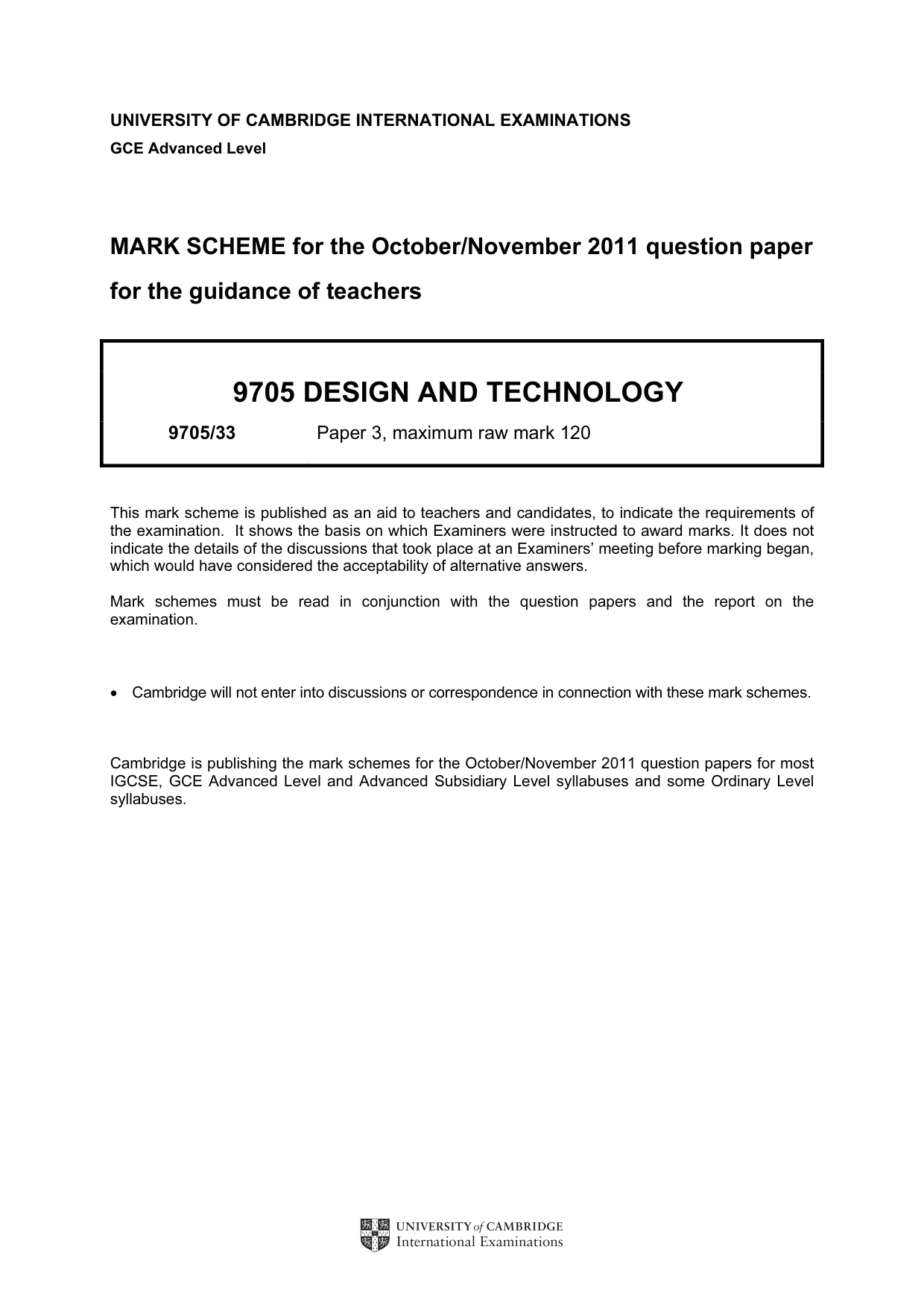
UNIVERSITY OF CAMBRIDGE INTERNATIONAL EXAMINATIONS GCE Advanced Level MARK SCHEME for the October/November 2011 question paper for the guidance of teachers 9705 DESIGN AND TECHNOLOGY 9705/33 Paper 3, maximum raw mark 120 This mark scheme is published as an aid to teachers and candidates, to indicate the requirements of the examination. It shows the basis on which Examiners were instructed to award marks. It does not indicate the details of the discussions that took place at an Examiners’ meeting before marking began, which would have considered the acceptability of alternative answers. Mark schemes must be read in conjunction with the question papers and the report on the examination. • Cambridge will not enter into discussions or correspondence in connection with these mark schemes. Cambridge is publishing the mark schemes for the October/November 2011 question papers for most IGCSE, GCE Advanced Level and Advanced Subsidiary Level syllabuses and some Ordinary Level syllabuses.
Mark scheme, page 2
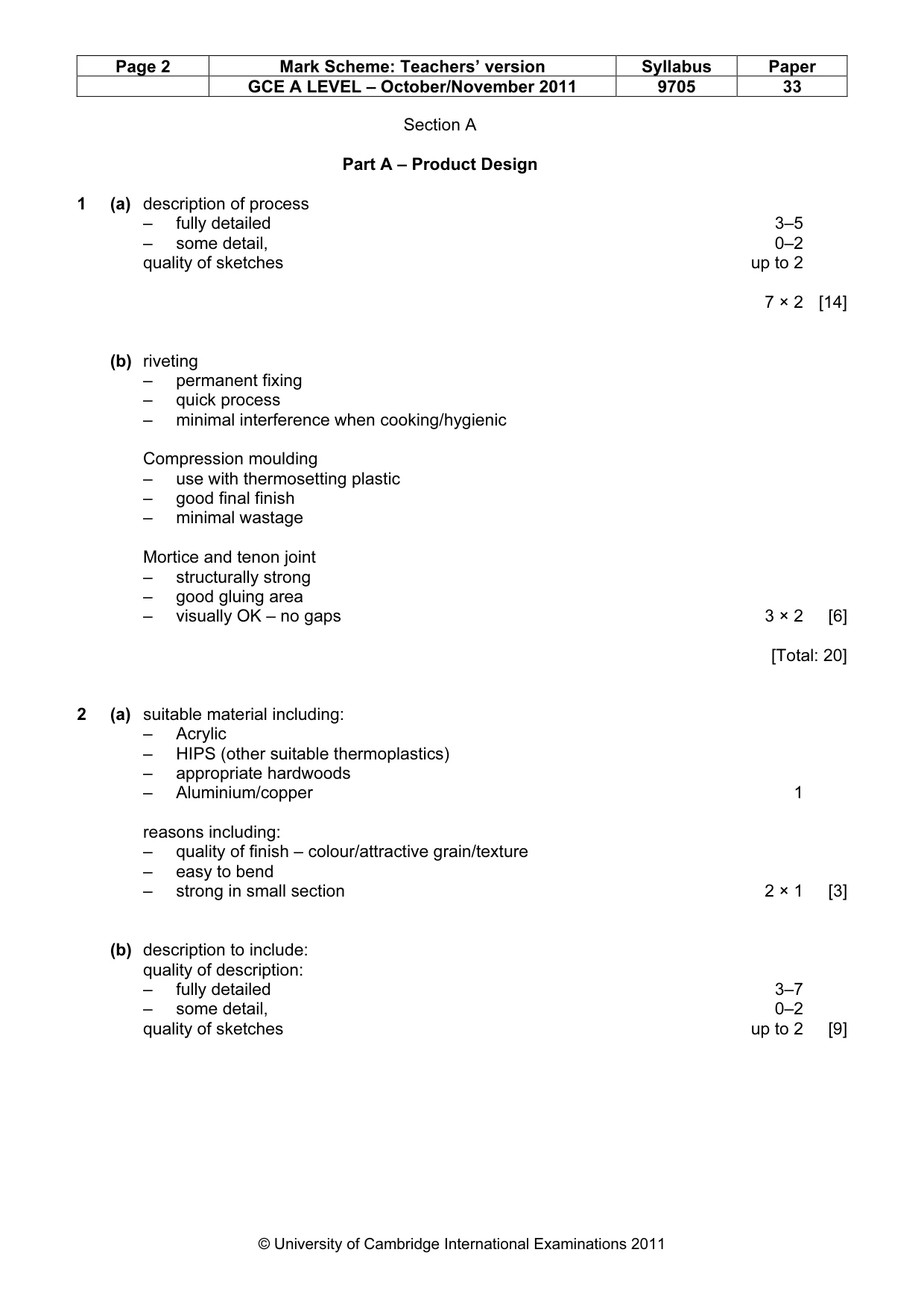
Page 2 Mark Scheme: Teachers’ version Syllabus Paper GCE A LEVEL – October/November 2011 9705 33 © University of Cambridge International Examinations 2011 Section A Part A – Product Design 1 (a) description of process – fully detailed 3–5 – some detail, 0–2 quality of sketches up to 2 7 × 2 [14] (b) riveting – permanent fixing – quick process – minimal interference when cooking/hygienic Compression moulding – use with thermosetting plastic – good final finish – minimal wastage Mortice and tenon joint – structurally strong – good gluing area – visually OK – no gaps 3 × 2 [6] [Total: 20] 2 (a) suitable material including: – Acrylic – HIPS (other suitable thermoplastics) – appropriate hardwoods – Aluminium/copper 1 reasons including: – quality of finish – colour/attractive grain/texture – easy to bend – strong in small section 2 × 1 [3] (b) description to include: quality of description: – fully detailed 3–7 – some detail, 0–2 quality of sketches up to 2 [9]
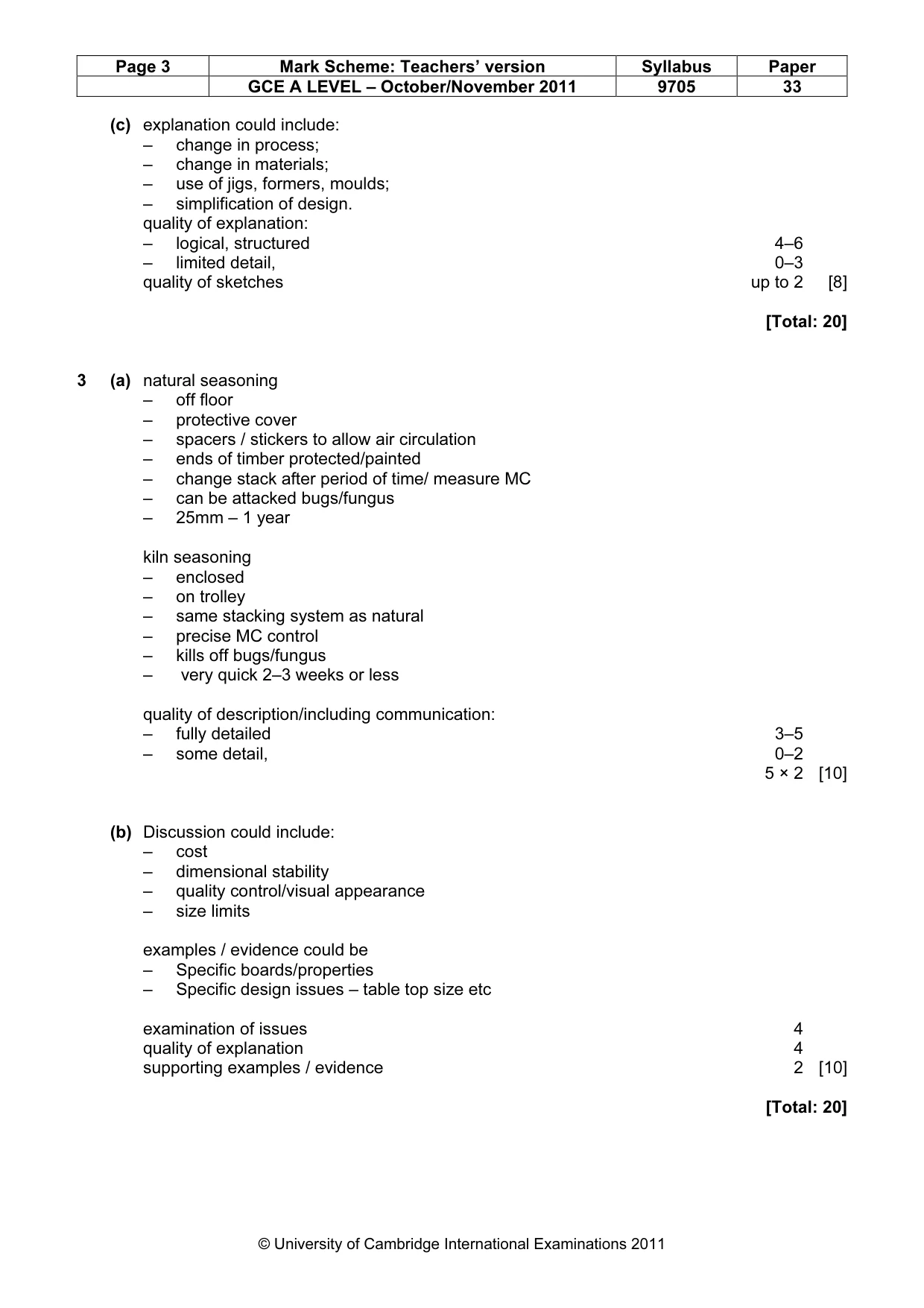
Mark scheme, page 3
Page 3 Mark Scheme: Teachers’ version Syllabus Paper GCE A LEVEL – October/November 2011 9705 33 © University of Cambridge International Examinations 2011 (c) explanation could include: – change in process; – change in materials; – use of jigs, formers, moulds; – simplification of design. quality of explanation: – logical, structured 4–6 – limited detail, 0–3 quality of sketches up to 2 [8] [Total: 20] 3 (a) natural seasoning – off floor – protective cover – spacers / stickers to allow air circulation – ends of timber protected/painted – change stack after period of time/ measure MC – can be attacked bugs/fungus – 25mm – 1 year kiln seasoning – enclosed – on trolley – same stacking system as natural – precise MC control – kills off bugs/fungus – very quick 2–3 weeks or less quality of description/including communication: – fully detailed 3–5 – some detail, 0–2 5 × 2 [10] (b) Discussion could include: – cost – dimensional stability – quality control/visual appearance – size limits examples / evidence could be – Specific boards/properties – Specific design issues – table top size etc examination of issues 4 quality of explanation 4 supporting examples / evidence 2 [10] [Total: 20]
Mark scheme, page 4
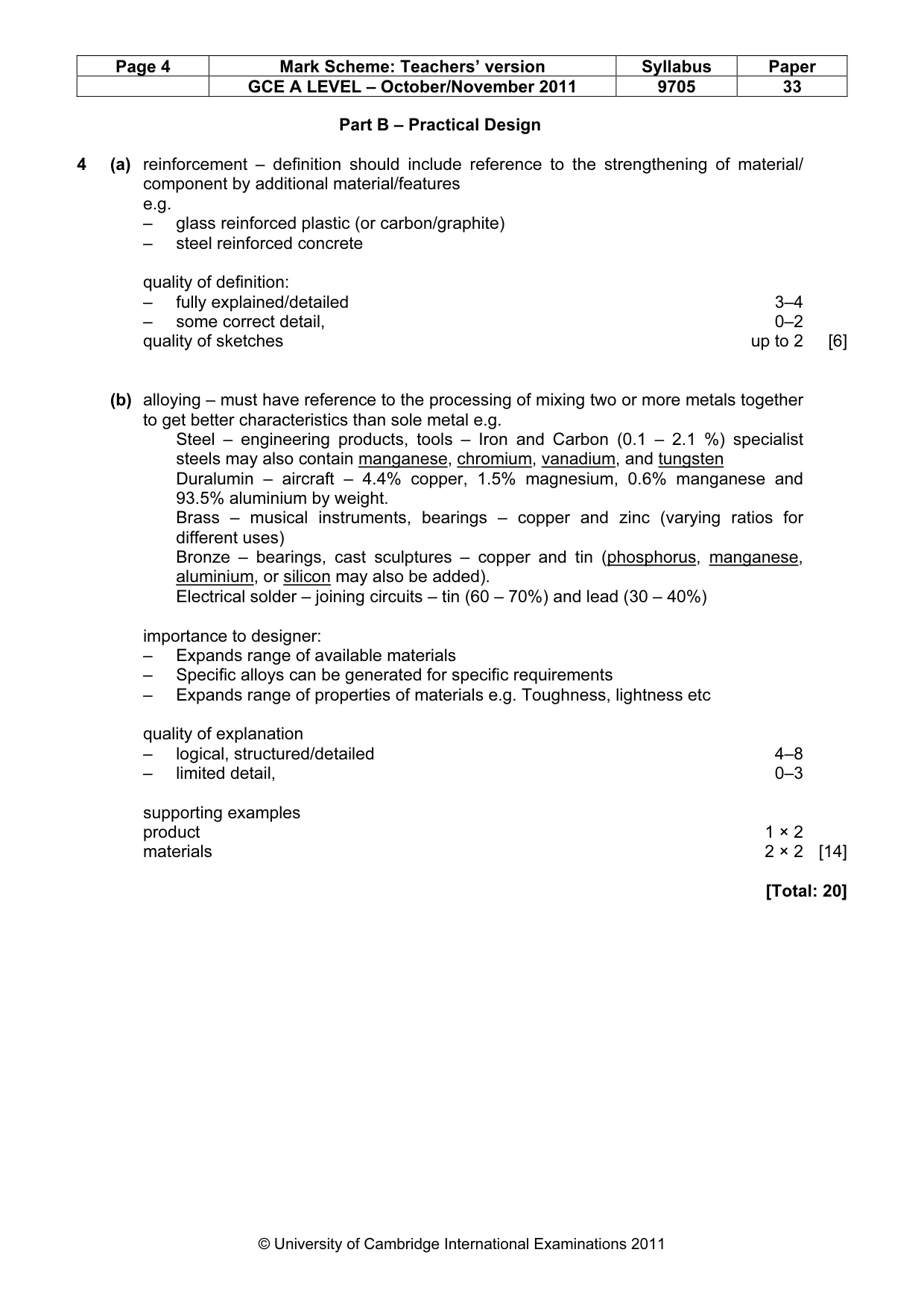
Page 4 Mark Scheme: Teachers’ version Syllabus Paper GCE A LEVEL – October/November 2011 9705 33 © University of Cambridge International Examinations 2011 Part B – Practical Design 4 (a) reinforcement – definition should include reference to the strengthening of material/ component by additional material/features e.g. – glass reinforced plastic (or carbon/graphite) – steel reinforced concrete quality of definition: – fully explained/detailed 3–4 – some correct detail, 0–2 quality of sketches up to 2 [6] (b) alloying – must have reference to the processing of mixing two or more metals together to get better characteristics than sole metal e.g. Steel – engineering products, tools – Iron and Carbon (0.1 – 2.1 %) specialist steels may also contain manganese, chromium, vanadium, and tungsten Duralumin – aircraft – 4.4% copper, 1.5% magnesium, 0.6% manganese and 93.5% aluminium by weight. Brass – musical instruments, bearings – copper and zinc (varying ratios for different uses) Bronze – bearings, cast sculptures – copper and tin (phosphorus, manganese, aluminium, or silicon may also be added). Electrical solder – joining circuits – tin (60 – 70%) and lead (30 – 40%) importance to designer: – Expands range of available materials – Specific alloys can be generated for specific requirements – Expands range of properties of materials e.g. Toughness, lightness etc quality of explanation – logical, structured/detailed 4–8 – limited detail, 0–3 supporting examples product 1 × 2 materials 2 × 2 [14] [Total: 20]
Mark scheme, page 5
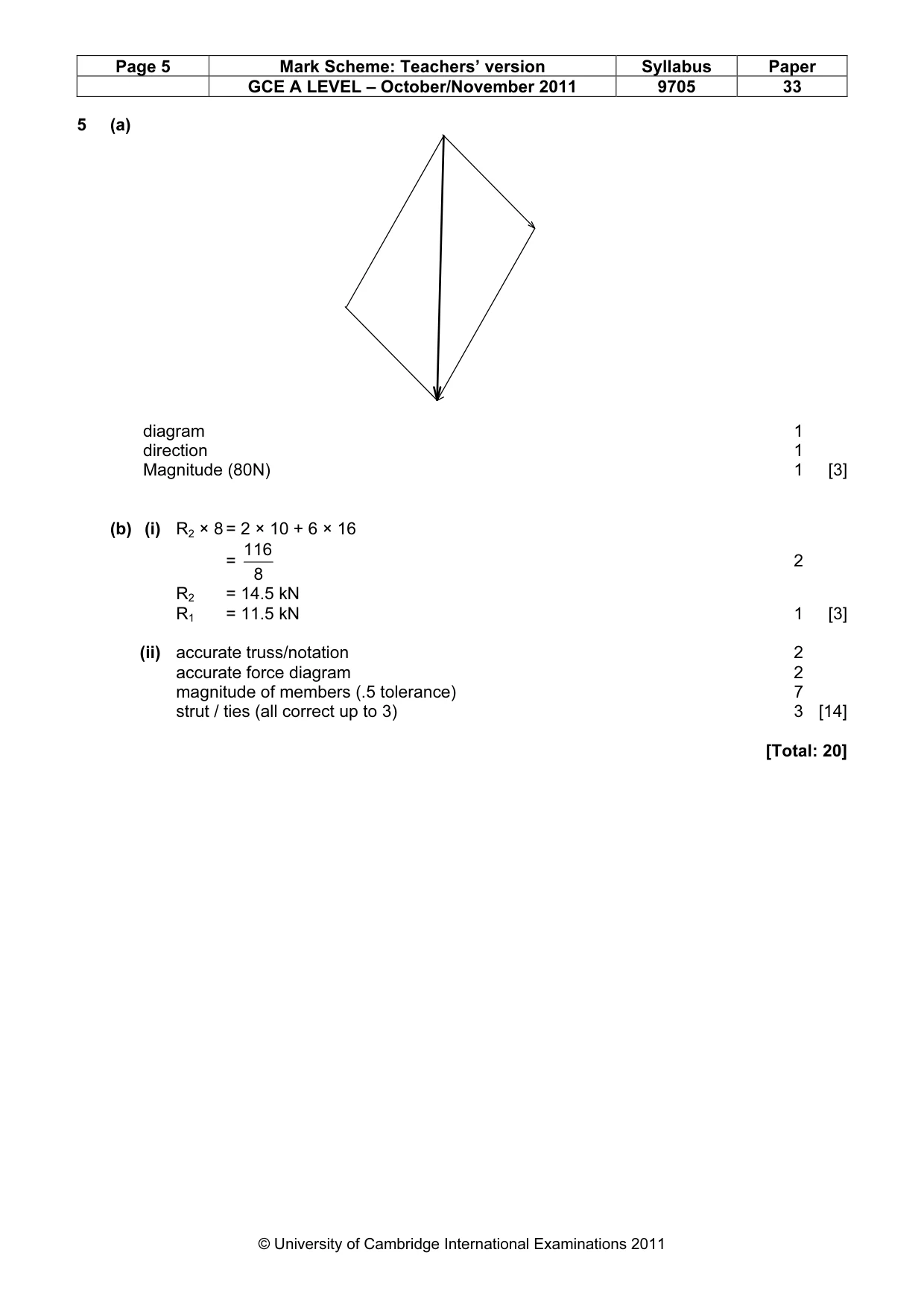
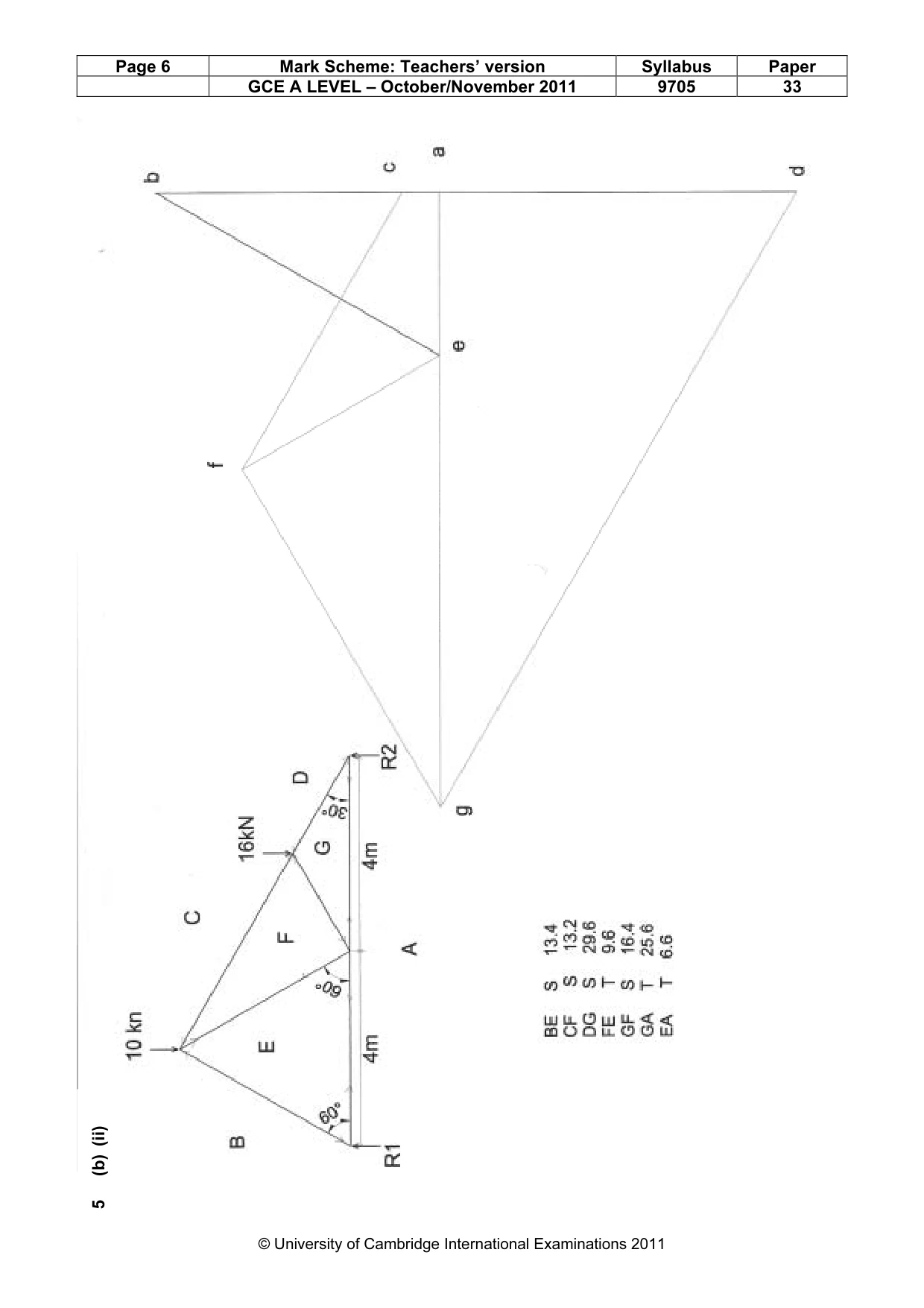
Page 5 Mark Scheme: Teachers’ version Syllabus Paper GCE A LEVEL – October/November 2011 9705 33 © University of Cambridge International Examinations 2011 5 (a) diagram 1 direction 1 Magnitude (80N) 1 [3] (b) (i) R2 × 8 = 2 × 10 + 6 × 16 = 8 116 2 R2 = 14.5 kN R1 = 11.5 kN 1 [3] (ii) accurate truss/notation 2 accurate force diagram 2 magnitude of members (.5 tolerance) 7 strut / ties (all correct up to 3) 3 [14] [Total: 20]
Mark scheme, page 6
Page 6 Mark Scheme: Teachers’ version Syllabus Paper GCE A LEVEL – October/November 2011 9705 33 © University of Cambridge International Examinations 2011 5 (b) (ii)
Mark scheme, page 7
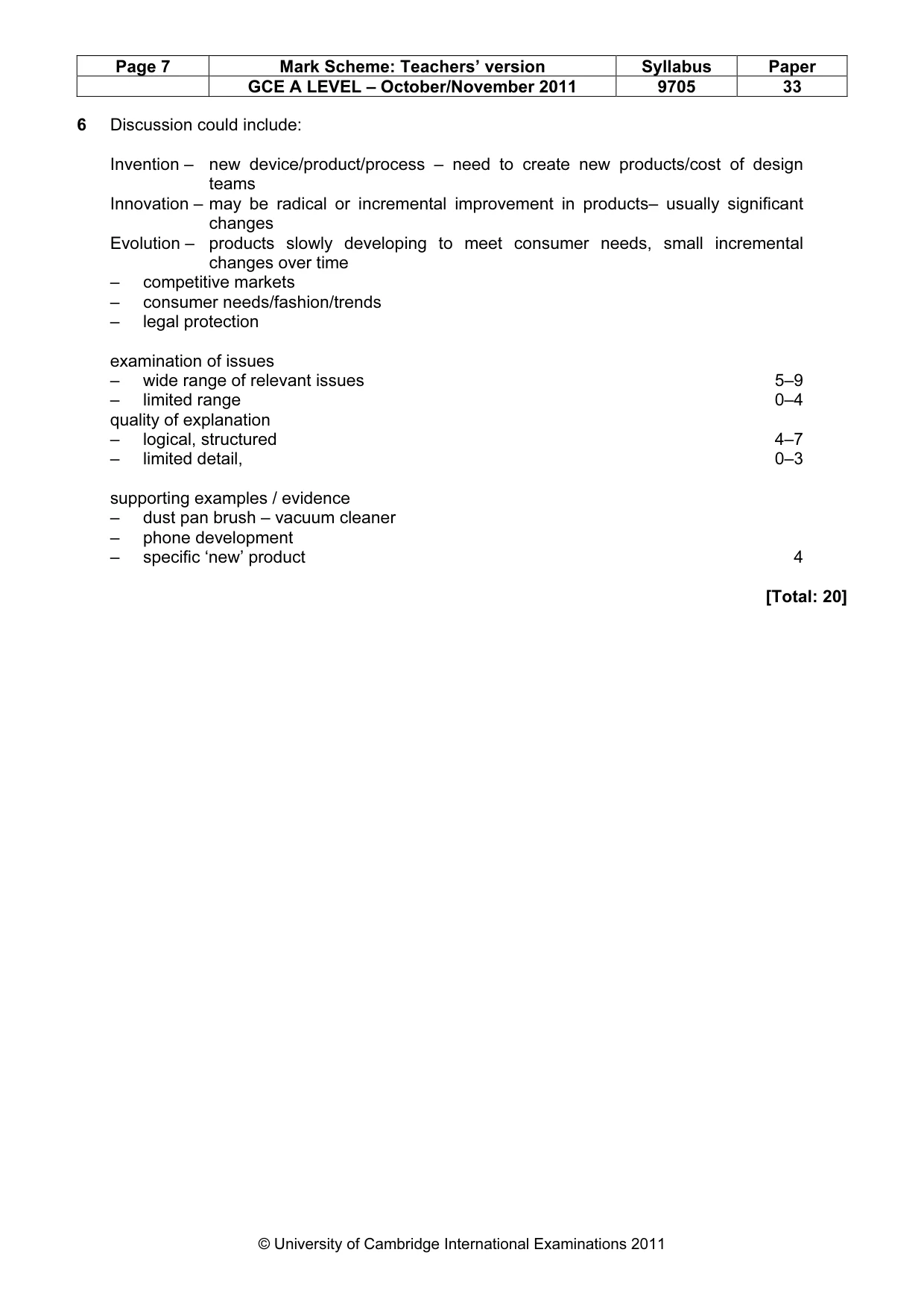
Page 7 Mark Scheme: Teachers’ version Syllabus Paper GCE A LEVEL – October/November 2011 9705 33 © University of Cambridge International Examinations 2011 6 Discussion could include: Invention – new device/product/process – need to create new products/cost of design teams Innovation – may be radical or incremental improvement in products– usually significant changes Evolution – products slowly developing to meet consumer needs, small incremental changes over time – competitive markets – consumer needs/fashion/trends – legal protection examination of issues – wide range of relevant issues 5–9 – limited range 0–4 quality of explanation – logical, structured 4–7 – limited detail, 0–3 supporting examples / evidence – dust pan brush – vacuum cleaner – phone development – specific ‘new’ product 4 [Total: 20]
Mark scheme, page 8
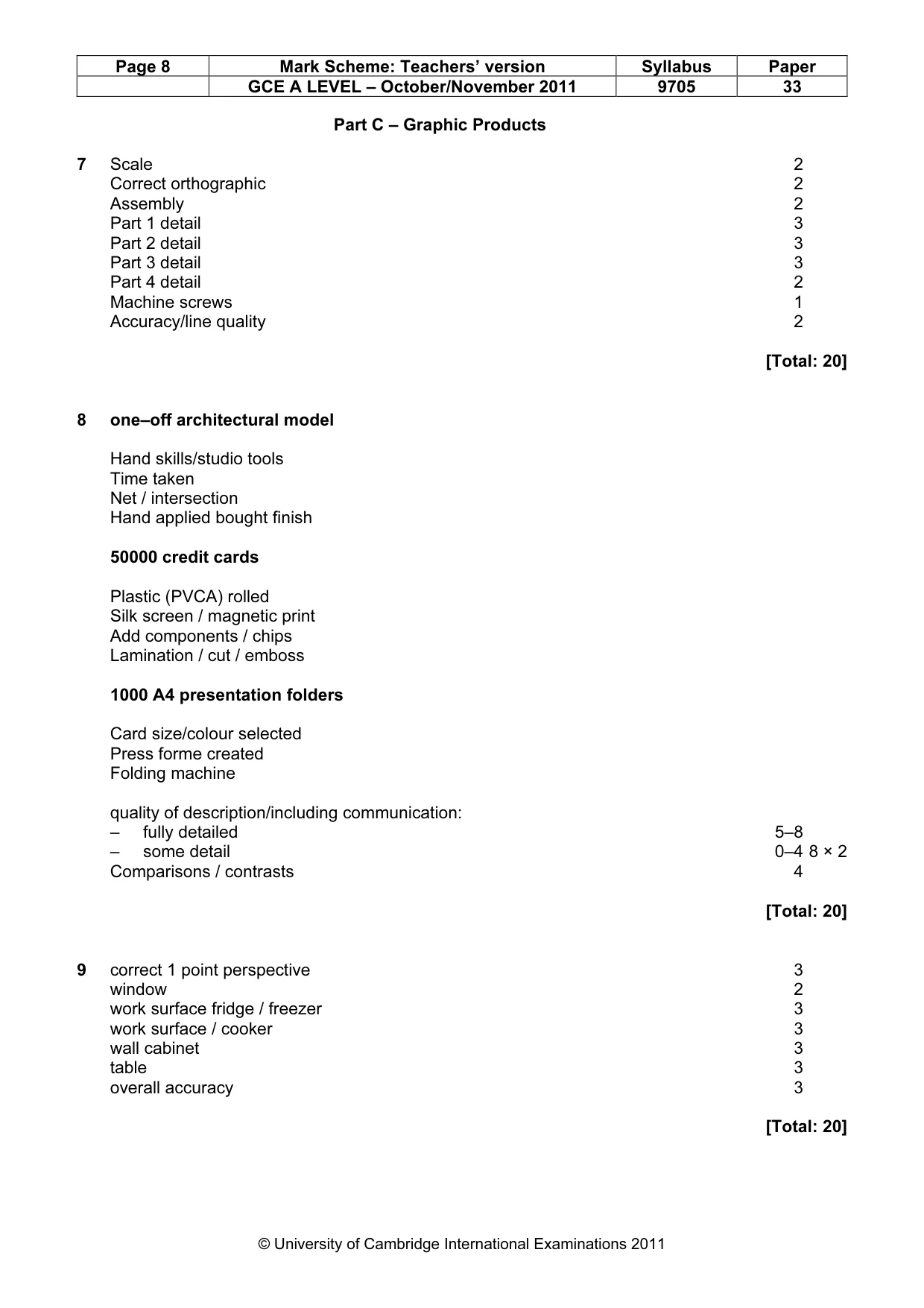
Page 8 Mark Scheme: Teachers’ version Syllabus Paper GCE A LEVEL – October/November 2011 9705 33 © University of Cambridge International Examinations 2011 Part C – Graphic Products 7 Scale 2 Correct orthographic 2 Assembly 2 Part 1 detail 3 Part 2 detail 3 Part 3 detail 3 Part 4 detail 2 Machine screws 1 Accuracy/line quality 2 [Total: 20] 8 one–off architectural model Hand skills/studio tools Time taken Net / intersection Hand applied bought finish 50000 credit cards Plastic (PVCA) rolled Silk screen / magnetic print Add components / chips Lamination / cut / emboss 1000 A4 presentation folders Card size/colour selected Press forme created Folding machine quality of description/including communication: – fully detailed 5–8 – some detail 0–4 8 × 2 Comparisons / contrasts 4 [Total: 20] 9 correct 1 point perspective 3 window 2 work surface fridge / freezer 3 work surface / cooker 3 wall cabinet 3 table 3 overall accuracy 3 [Total: 20]
What you needed in this session
Cambridge’s own grade thresholds for 2011 Oct/Nov, Paper 3 · Variant 3. A higher threshold means an easier paper — the bar moves with how the cohort did.