Cambridge A Level Design and Technology 9705 — 2011 Oct/Nov Paper 3 · Variant 2
9705/32/O/N/11 · 120 marks · ≈135 min
The question paper and its mark scheme, free to read here and free to download. This is Cambridge’s own paper, exactly as it was sat.
Question paper12 pages


Mark scheme6 pages
Answers below. Sit the paper first if you are practising.
Paper as text
Question paper, page 1
This document consists of 10 printed pages and 2 blank pages. DC (NF/SW) 51482 © UCLES 2011 [Turn over UNIVERSITY OF CAMBRIDGE INTERNATIONAL EXAMINATIONS General Certificate of Education Advanced Subsidiary Level and Advanced Level * 2 4 9 0 7 4 0 5 6 5 * DESIGN AND TECHNOLOGY 9705/32 Paper 3 October/November 2011 3 hours Additional Materials: Answer Booklet/Paper A range of design drawing equipment A3 Drawing Paper (5 sheets) READ THESE INSTRUCTIONS FIRST Write your Centre number, candidate number and name on all the work you hand in. Write in dark blue or black pen. You may use a soft pencil for any diagrams, graphs or rough working. Do not use staples, paper clips, highlighters, glue or correction fluid. Section A Answer any two questions from one of the Parts A, B or C. Section B Answer one question. All dimensions are in millimetres. The instruction ‘discuss’ denotes that you should: • examine critically the issues raised by the question; • explain and interpret these issues as appropriate; • introduce evidence wherever possible to support conclusions of arguments. At the end of the examination, fasten all your work securely together. The number of marks is given in brackets [ ] at the end of each question or part question.
Question paper, page 2
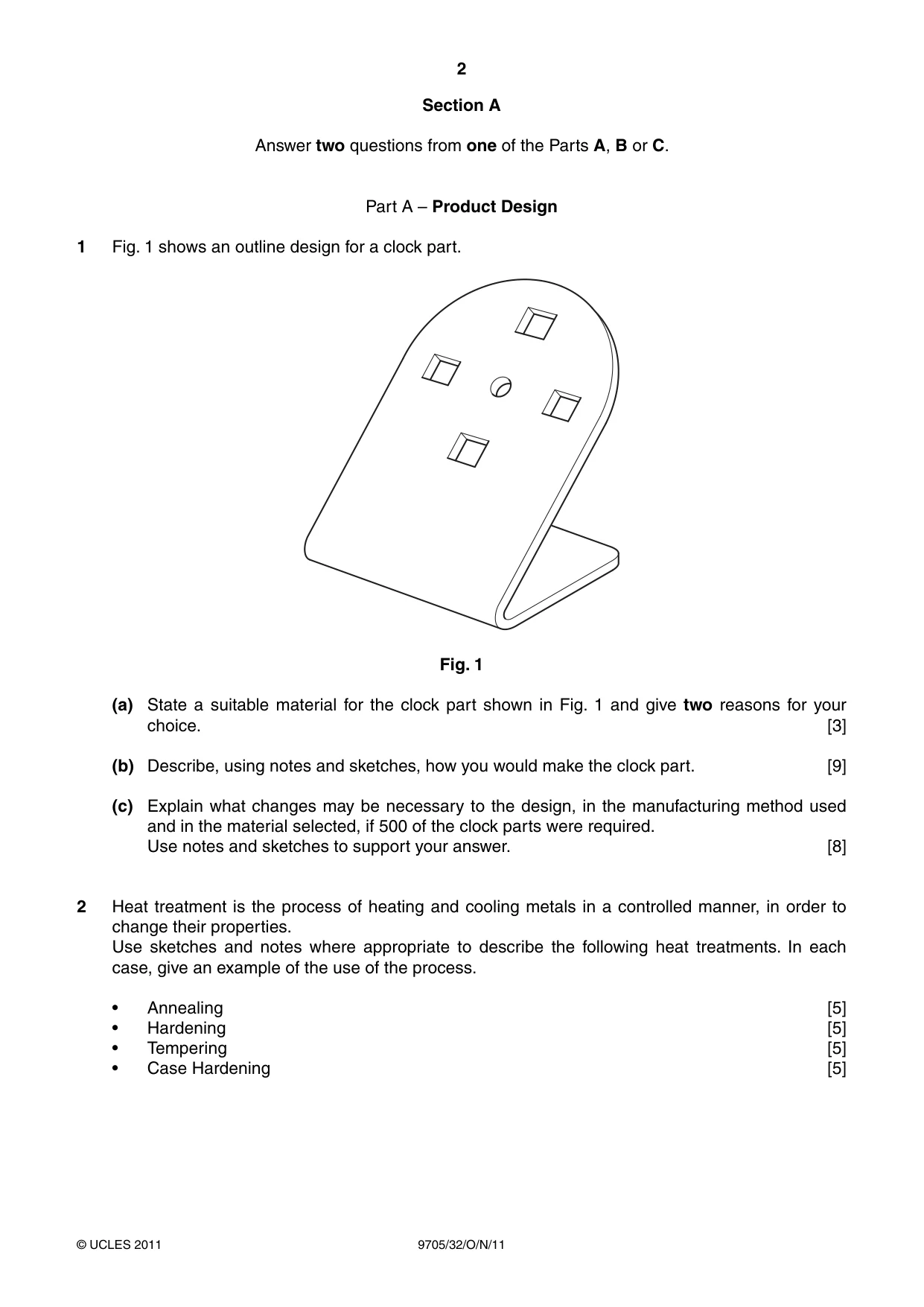
2 9705/32/O/N/11 © UCLES 2011 Section A Answer two questions from one of the Parts A, B or C. Part A – Product Design 1 Fig. 1 shows an outline design for a clock part. Fig. 1 (a) State a suitable material for the clock part shown in Fig. 1 and give two reasons for your choice. [3] (b) Describe, using notes and sketches, how you would make the clock part. [9] (c) Explain what changes may be necessary to the design, in the manufacturing method used and in the material selected, if 500 of the clock parts were required. Use notes and sketches to support your answer. [8] 2 Heat treatment is the process of heating and cooling metals in a controlled manner, in order to change their properties. Use sketches and notes where appropriate to describe the following heat treatments. In each case, give an example of the use of the process. • Annealing [5] • Hardening [5] • Tempering [5] • Case Hardening [5]
Question paper, page 3
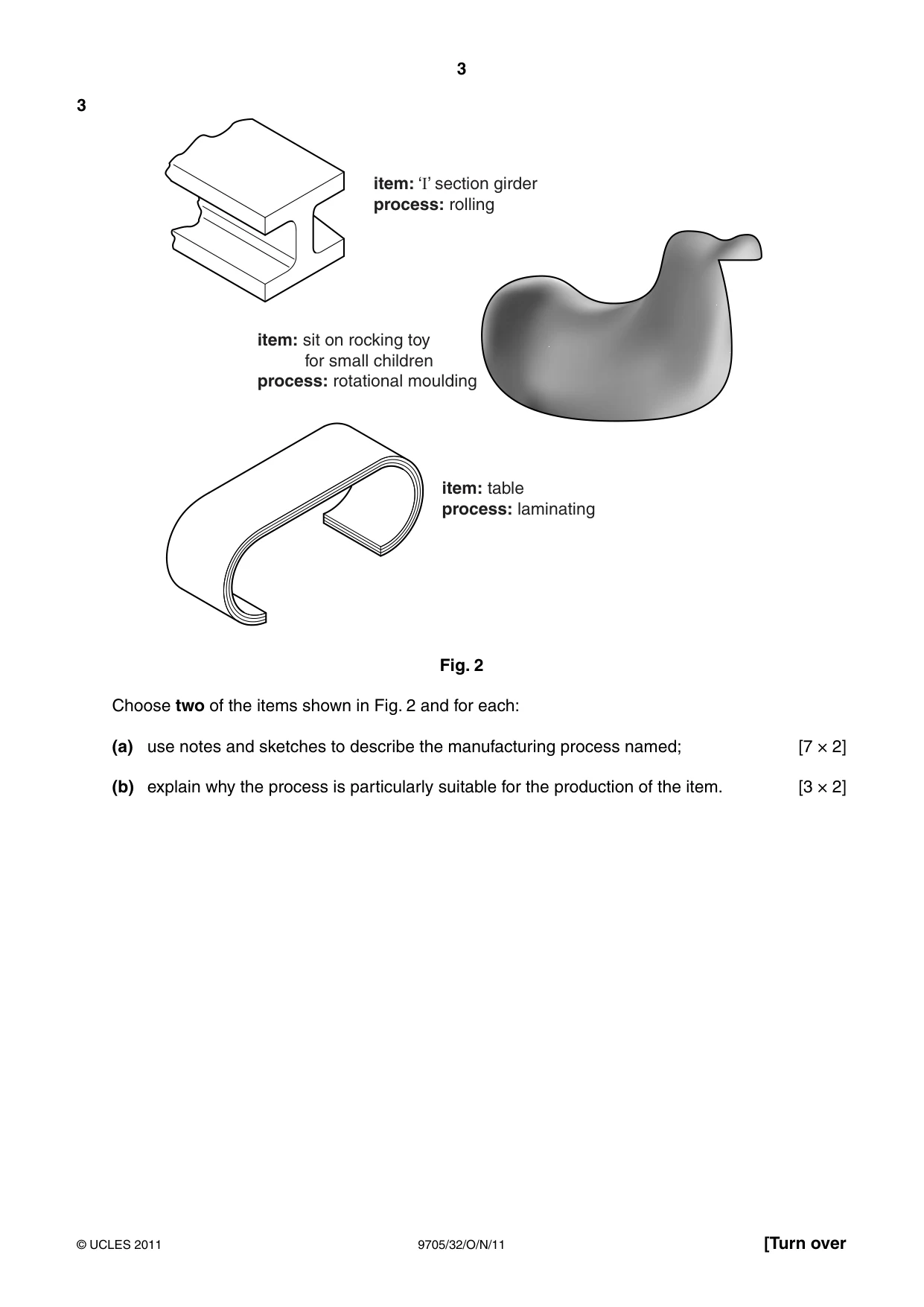
3 9705/32/O/N/11 © UCLES 2011 [Turn over 3 item: ‘I’ section girder process: rolling item: table process: laminating item: sit on rocking toy for small children process: rotational moulding Fig. 2 Choose two of the items shown in Fig. 2 and for each: (a) use notes and sketches to describe the manufacturing process named; [7 × 2] (b) explain why the process is particularly suitable for the production of the item. [3 × 2]
Question paper, page 4
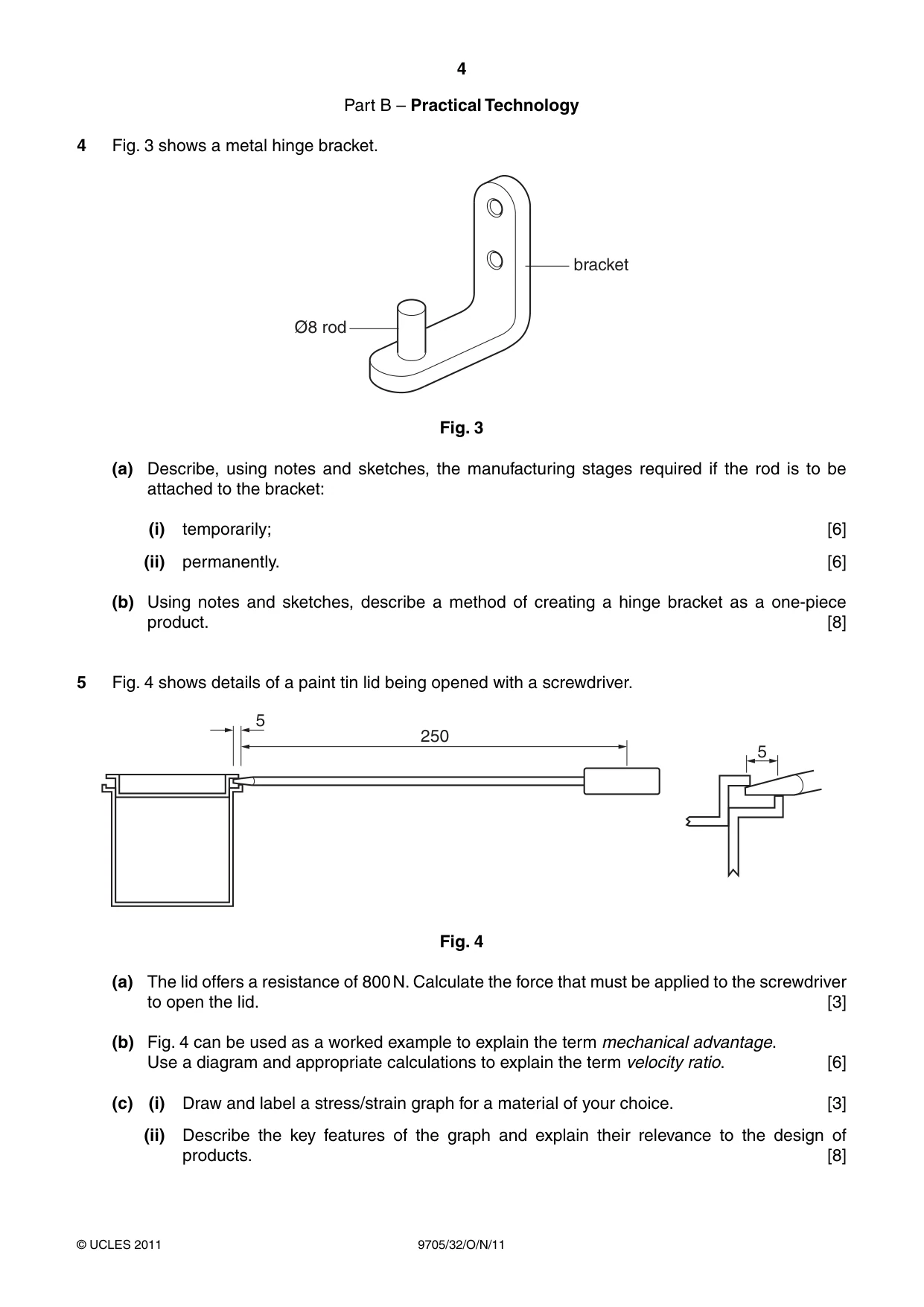
4 9705/32/O/N/11 © UCLES 2011 Part B – Practical Technology 4 Fig. 3 shows a metal hinge bracket. Ø8 rod bracket Fig. 3 (a) Describe, using notes and sketches, the manufacturing stages required if the rod is to be attached to the bracket: (i) temporarily; [6] (ii) permanently. [6] (b) Using notes and sketches, describe a method of creating a hinge bracket as a one-piece product. [8] 5 Fig. 4 shows details of a paint tin lid being opened with a screwdriver. 250 5 5 Fig. 4 (a) The lid offers a resistance of 800 N. Calculate the force that must be applied to the screwdriver to open the lid. [3] (b) Fig. 4 can be used as a worked example to explain the term mechanical advantage. Use a diagram and appropriate calculations to explain the term velocity ratio. [6] (c) (i) Draw and label a stress/strain graph for a material of your choice. [3] (ii) Describe the key features of the graph and explain their relevance to the design of products. [8]
Question paper, page 5
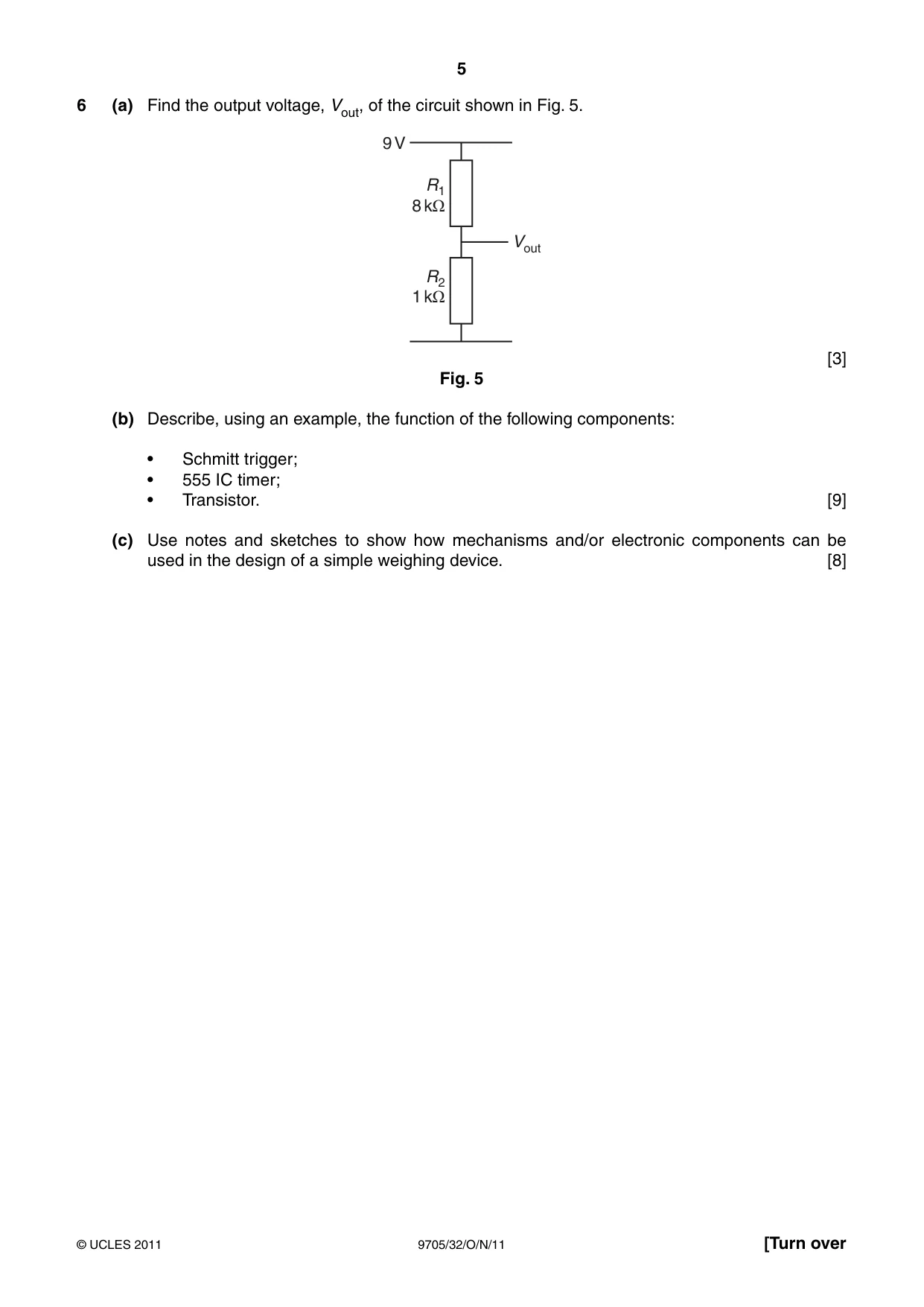
5 9705/32/O/N/11 © UCLES 2011 [Turn over 6 (a) Find the output voltage, Vout, of the circuit shown in Fig. 5. 9 V Vout R1 8 kΩ R2 1 kΩ [3] Fig. 5 (b) Describe, using an example, the function of the following components: • Schmitt trigger; • 555 IC timer; • Transistor. [9] (c) Use notes and sketches to show how mechanisms and/or electronic components can be used in the design of a simple weighing device. [8]
Question paper, page 6
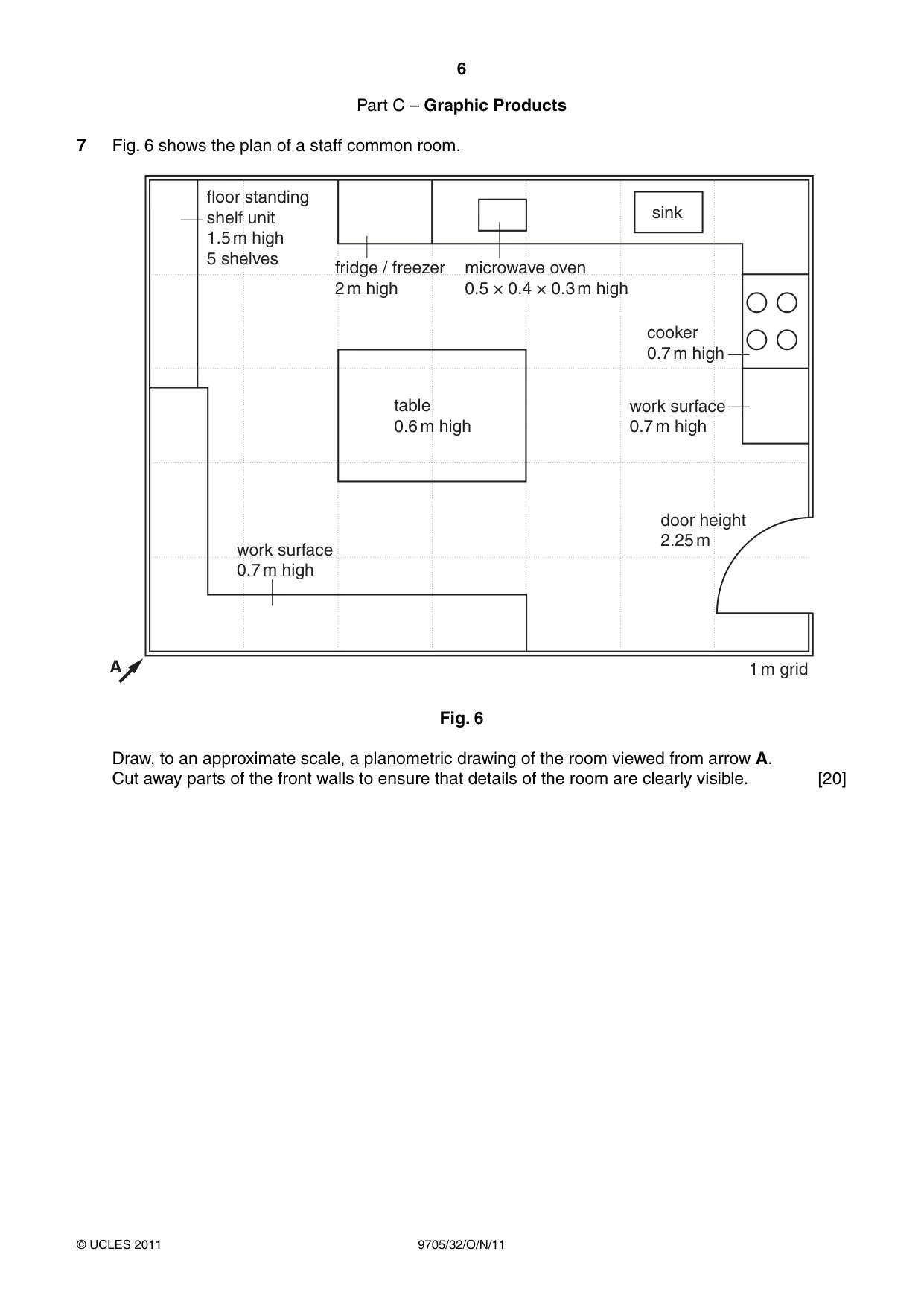
6 9705/32/O/N/11 © UCLES 2011 Part C – Graphic Products 7 Fig. 6 shows the plan of a staff common room. floor standing shelf unit 1.5 m high 5 shelves fridge / freezer 2 m high microwave oven 0.5 × 0.4 × 0.3 m high cooker 0.7 m high work surface 0.7 m high door height 2.25 m 1 m grid table 0.6 m high work surface 0.7 m high A sink Fig. 6 Draw, to an approximate scale, a planometric drawing of the room viewed from arrow A. Cut away parts of the front walls to ensure that details of the room are clearly visible. [20]
Question paper, page 7
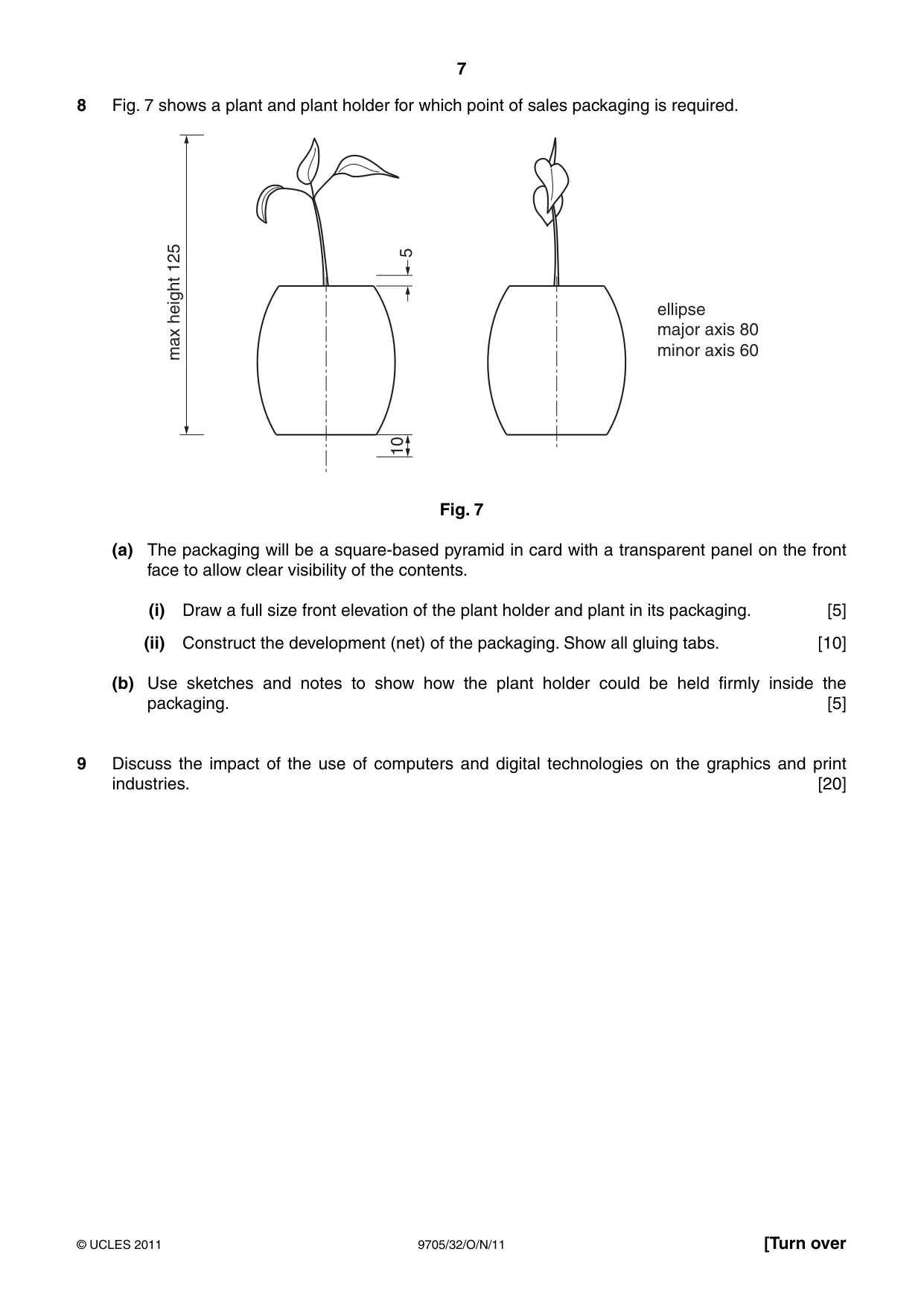
7 9705/32/O/N/11 © UCLES 2011 [Turn over 8 Fig. 7 shows a plant and plant holder for which point of sales packaging is required. max height 125 10 5 ellipse major axis 80 minor axis 60 Fig. 7 (a) The packaging will be a square-based pyramid in card with a transparent panel on the front face to allow clear visibility of the contents. (i) Draw a full size front elevation of the plant holder and plant in its packaging. [5] (ii) Construct the development (net) of the packaging. Show all gluing tabs. [10] (b) Use sketches and notes to show how the plant holder could be held firmly inside the packaging. [5] 9 Discuss the impact of the use of computers and digital technologies on the graphics and print industries. [20]
Question paper, page 8
8 9705/32/O/N/11 © UCLES 2011 Section B Answer one question on the A3 paper provided. You should approach the design question of your choice in the following manner: Analysis Produce an analysis of the given situation/problem, which may be in written or graphical form. [5] Specification From the analysis produce a detailed written specification of the design requirements. Include at least five specification points other than those given in the question. [5] Exploration Use bold sketches and brief notes to show your exploration of ideas for a design solution, with reasons for selection. [25] Development Show, using bold sketches and notes, the development, reasoning and composition of ideas into a single design proposal. Give details of materials, constructional and other relevant technical details. [25] Proposed solution Produce drawings of an appropriate kind to show the complete solution. [15] Evaluation Give a written evaluation of the final design solution. [5] [Total: 80]
Question paper, page 9
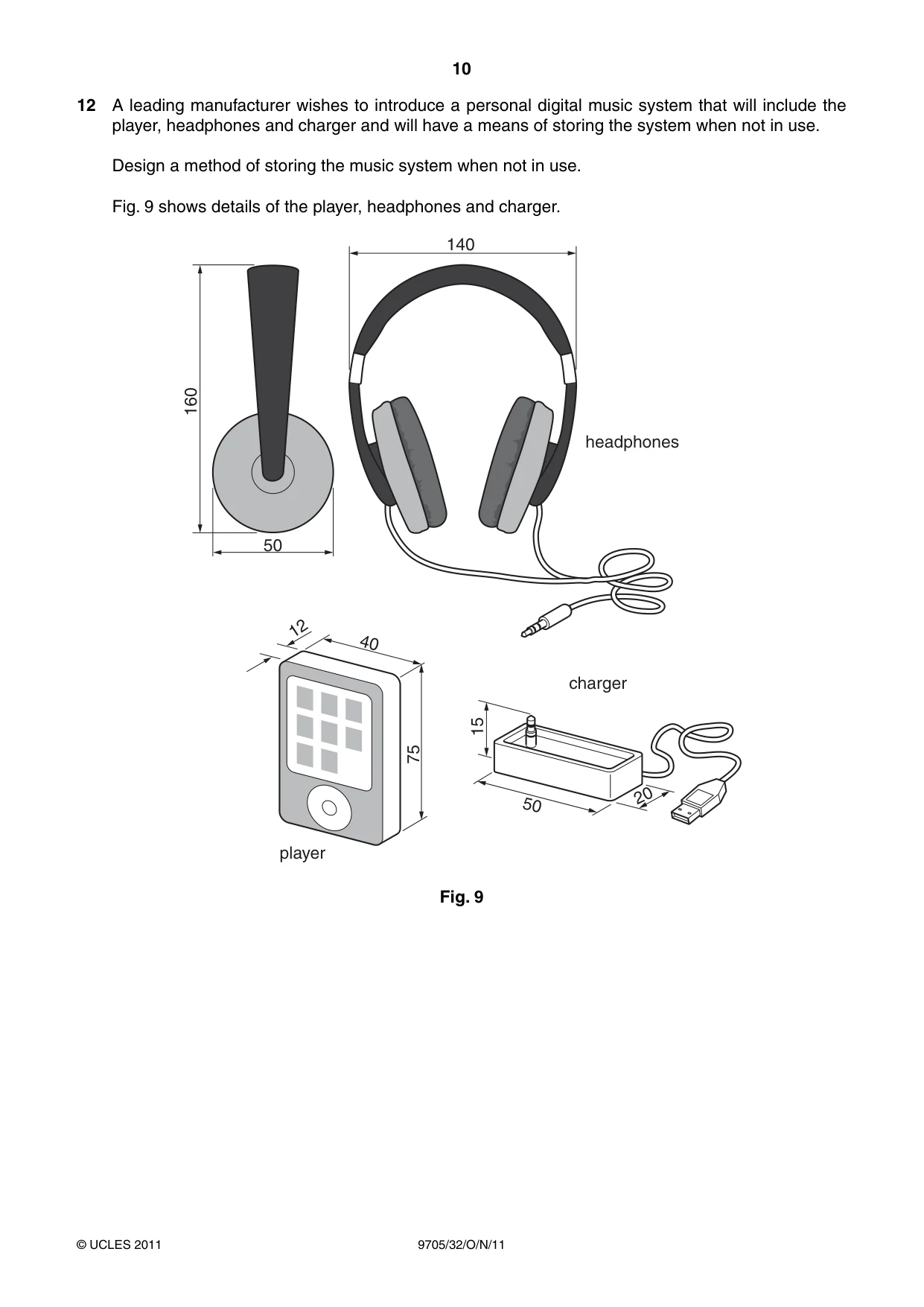
9 9705/32/O/N/11 © UCLES 2011 [Turn over 10 A jewellery designer wishes to extend their range of high-quality products to include matching sets of jewellery. Design a matching set of jewellery to consist of a wrist bracelet, ear-rings and a necklace. 11 Fig. 8 shows a chicken coop. The door/ramp is hinged and has to be opened and closed manually. Some owners of chicken coops find it difficult to get up every morning to open and lower the door/ ramp to let the chickens out. Design a system that will automatically open the door and lower it gently for the chickens to get out of the coop. door/ramp Fig. 8
Question paper, page 10
10 9705/32/O/N/11 © UCLES 2011 12 A leading manufacturer wishes to introduce a personal digital music system that will include the player, headphones and charger and will have a means of storing the system when not in use. Design a method of storing the music system when not in use. Fig. 9 shows details of the player, headphones and charger. 40 12 75 15 50 20 player charger headphones 160 50 140 Fig. 9
Question paper, page 11
11 9705/32/O/N/11 © UCLES 2011 BLANK PAGE
Question paper, page 12
12 9705/32/O/N/11 © UCLES 2011 BLANK PAGE Permission to reproduce items where third-party owned material protected by copyright is included has been sought and cleared where possible. Every reasonable effort has been made by the publisher (UCLES) to trace copyright holders, but if any items requiring clearance have unwittingly been included, the publisher will be pleased to make amends at the earliest possible opportunity. University of Cambridge International Examinations is part of the Cambridge Assessment Group. Cambridge Assessment is the brand name of University of Cambridge Local Examinations Syndicate (UCLES), which is itself a department of the University of Cambridge.
Mark scheme, page 1
UNIVERSITY OF CAMBRIDGE INTERNATIONAL EXAMINATIONS GCE Advanced Level MARK SCHEME for the October/November 2011 question paper for the guidance of teachers 9705 DESIGN AND TECHNOLOGY 9705/32 Paper 3, maximum raw mark 120 This mark scheme is published as an aid to teachers and candidates, to indicate the requirements of the examination. It shows the basis on which Examiners were instructed to award marks. It does not indicate the details of the discussions that took place at an Examiners’ meeting before marking began, which would have considered the acceptability of alternative answers. Mark schemes must be read in conjunction with the question papers and the report on the examination. • Cambridge will not enter into discussions or correspondence in connection with these mark schemes. Cambridge is publishing the mark schemes for the October/November 2011 question papers for most IGCSE, GCE Advanced Level and Advanced Subsidiary Level syllabuses and some Ordinary Level syllabuses.
Mark scheme, page 2
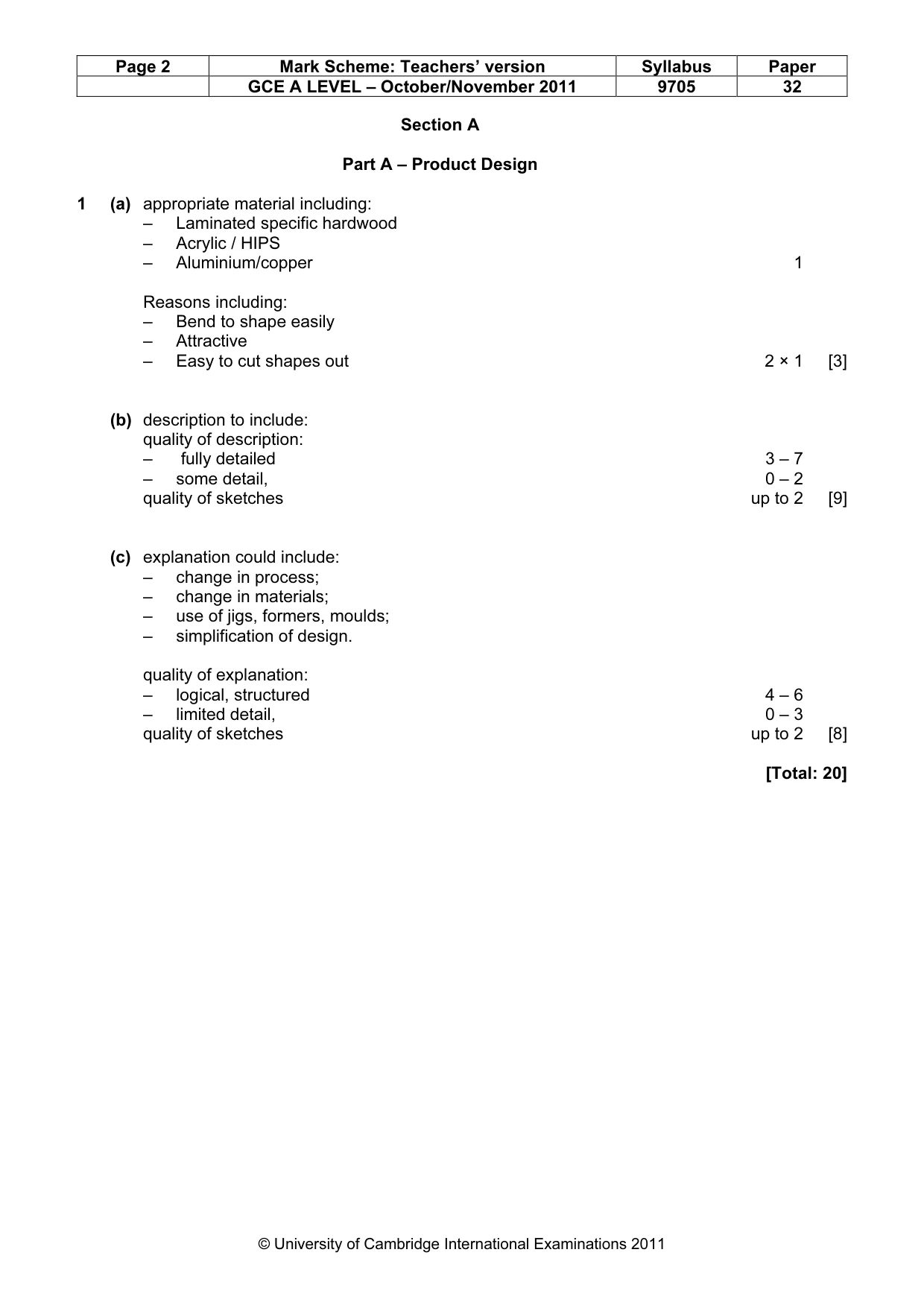
Page 2 Mark Scheme: Teachers’ version Syllabus Paper GCE A LEVEL – October/November 2011 9705 32 © University of Cambridge International Examinations 2011 Section A Part A – Product Design 1 (a) appropriate material including: – Laminated specific hardwood – Acrylic / HIPS – Aluminium/copper 1 Reasons including: – Bend to shape easily – Attractive – Easy to cut shapes out 2 × 1 [3] (b) description to include: quality of description: – fully detailed 3 – 7 – some detail, 0 – 2 quality of sketches up to 2 [9] (c) explanation could include: – change in process; – change in materials; – use of jigs, formers, moulds; – simplification of design. quality of explanation: – logical, structured 4 – 6 – limited detail, 0 – 3 quality of sketches up to 2 [8] [Total: 20]
Mark scheme, page 3
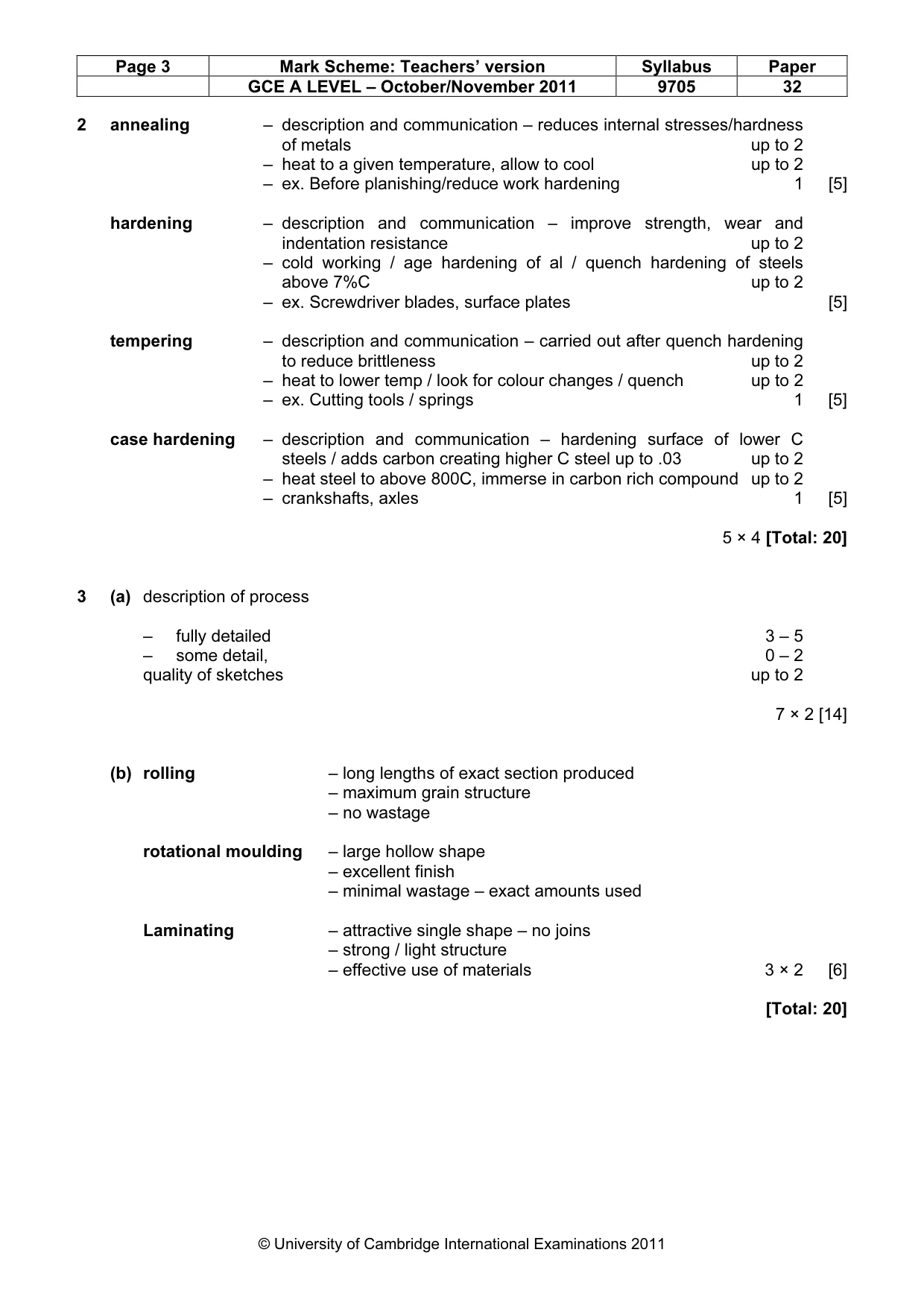
Page 3 Mark Scheme: Teachers’ version Syllabus Paper GCE A LEVEL – October/November 2011 9705 32 © University of Cambridge International Examinations 2011 2 annealing – description and communication – reduces internal stresses/hardness of metals up to 2 – heat to a given temperature, allow to cool up to 2 – ex. Before planishing/reduce work hardening 1 [5] hardening – description and communication – improve strength, wear and indentation resistance up to 2 – cold working / age hardening of al / quench hardening of steels above 7%C up to 2 – ex. Screwdriver blades, surface plates [5] tempering – description and communication – carried out after quench hardening to reduce brittleness up to 2 – heat to lower temp / look for colour changes / quench up to 2 – ex. Cutting tools / springs 1 [5] case hardening – description and communication – hardening surface of lower C steels / adds carbon creating higher C steel up to .03 up to 2 – heat steel to above 800C, immerse in carbon rich compound up to 2 – crankshafts, axles 1 [5] 5 × 4 [Total: 20] 3 (a) description of process – fully detailed 3 – 5 – some detail, 0 – 2 quality of sketches up to 2 7 × 2 [14] (b) rolling – long lengths of exact section produced – maximum grain structure – no wastage rotational moulding – large hollow shape – excellent finish – minimal wastage – exact amounts used Laminating – attractive single shape – no joins – strong / light structure – effective use of materials 3 × 2 [6] [Total: 20]
Mark scheme, page 4
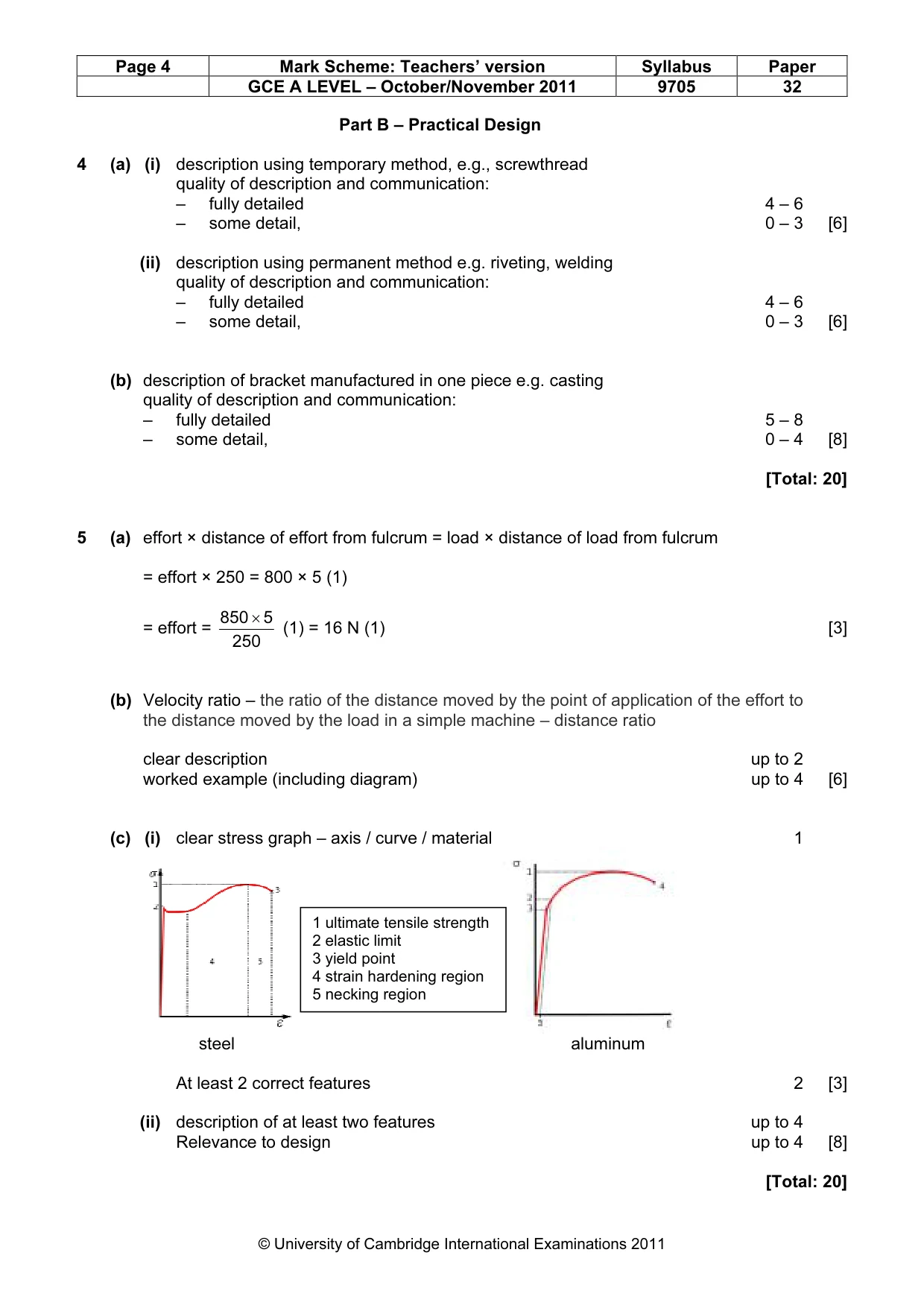
Page 4 Mark Scheme: Teachers’ version Syllabus Paper GCE A LEVEL – October/November 2011 9705 32 © University of Cambridge International Examinations 2011 Part B – Practical Design 4 (a) (i) description using temporary method, e.g., screwthread quality of description and communication: – fully detailed 4 – 6 – some detail, 0 – 3 [6] (ii) description using permanent method e.g. riveting, welding quality of description and communication: – fully detailed 4 – 6 – some detail, 0 – 3 [6] (b) description of bracket manufactured in one piece e.g. casting quality of description and communication: – fully detailed 5 – 8 – some detail, 0 – 4 [8] [Total: 20] 5 (a) effort × distance of effort from fulcrum = load × distance of load from fulcrum = effort × 250 = 800 × 5 (1) = effort = 250 5 850 × (1) = 16 N (1) [3] (b) Velocity ratio – the ratio of the distance moved by the point of application of the effort to the distance moved by the load in a simple machine – distance ration clear description up to 2 worked example (including diagram) up to 4 [6] (c) (i) clear stress graph – axis / curve / material 1 steel aluminum At least 2 correct features 2 [3] (ii) description of at least two features up to 4 Relevance to design up to 4 [8] [Total: 20] 1 ultimate tensile strength 2 elastic limit 3 yield point 4 strain hardening region 5 necking region
Mark scheme, page 5
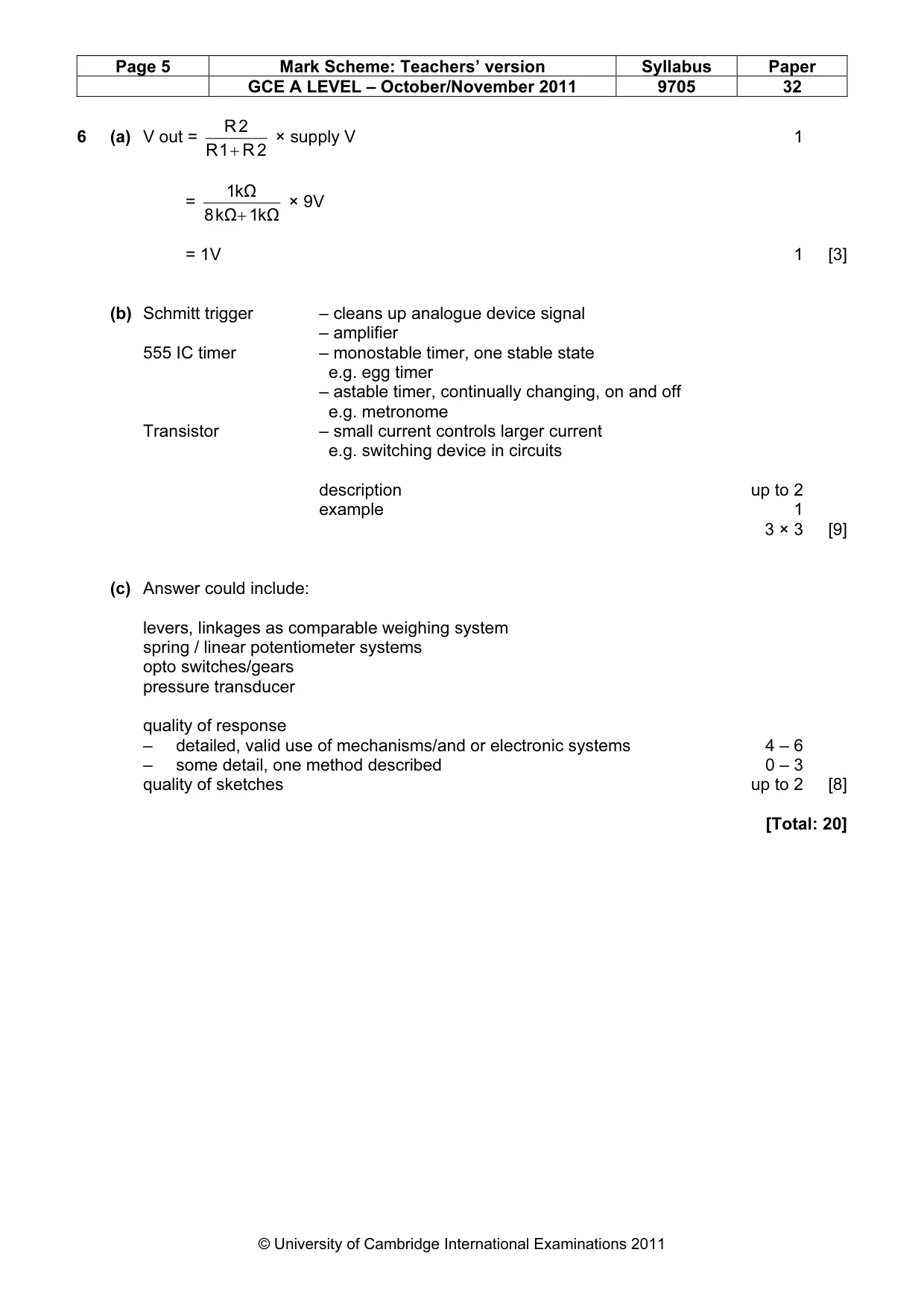
Page 5 Mark Scheme: Teachers’ version Syllabus Paper GCE A LEVEL – October/November 2011 9705 32 © University of Cambridge International Examinations 2011 6 (a) V out = 2 R 1 R 2 R + × supply V 1 = kΩ 1 kΩ 8 kΩ 1 + × 9V = 1V 1 [3] (b) Schmitt trigger – cleans up analogue device signal – amplifier 555 IC timer – monostable timer, one stable state e.g. egg timer – astable timer, continually changing, on and off e.g. metronome Transistor – small current controls larger current e.g. switching device in circuits description up to 2 example 1 3 × 3 [9] (c) Answer could include: levers, linkages as comparable weighing system spring / linear potentiometer systems opto switches/gears pressure transducer quality of response – detailed, valid use of mechanisms/and or electronic systems 4 – 6 – some detail, one method described 0 – 3 quality of sketches up to 2 [8] [Total: 20]
Mark scheme, page 6
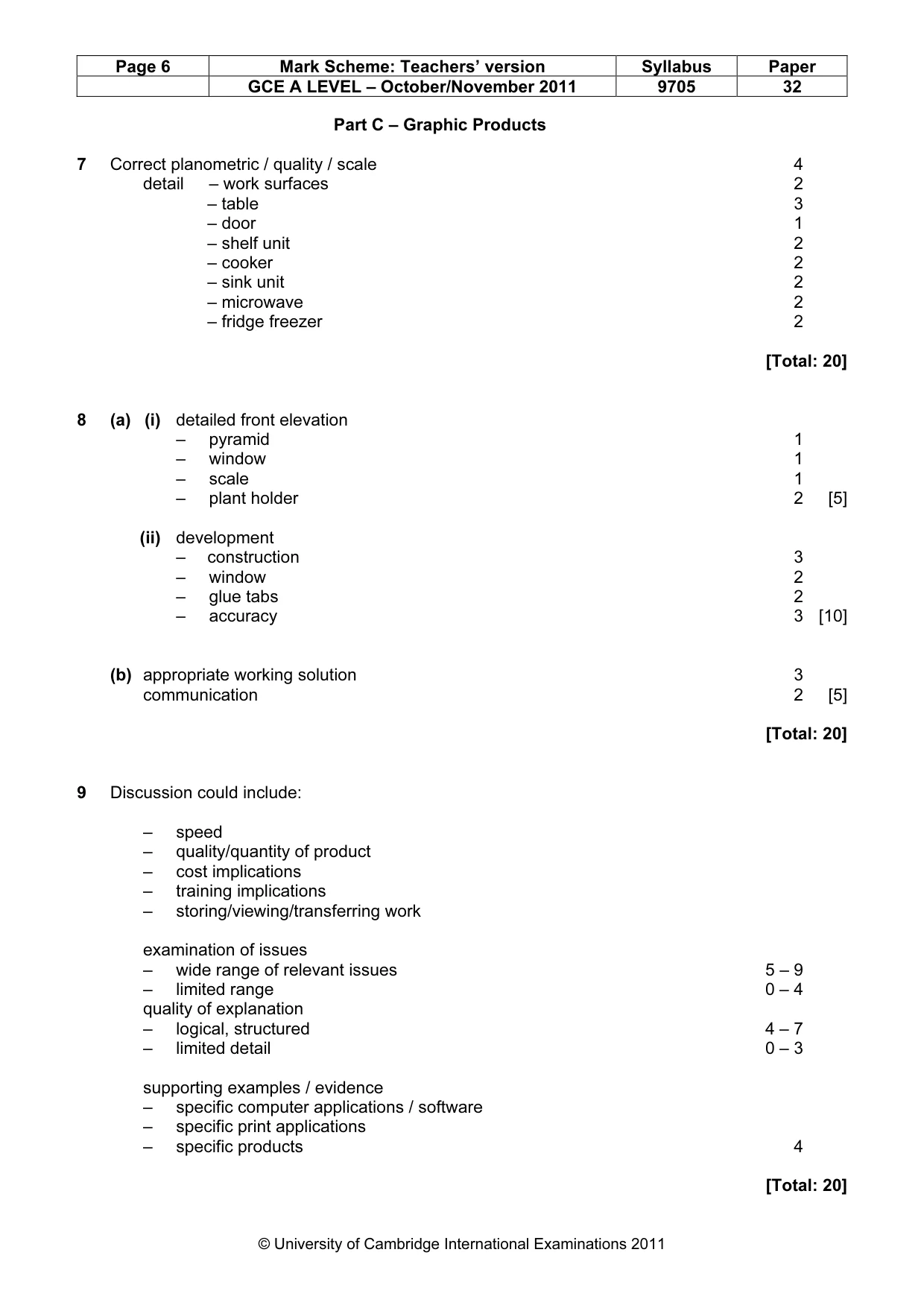
Page 6 Mark Scheme: Teachers’ version Syllabus Paper GCE A LEVEL – October/November 2011 9705 32 © University of Cambridge International Examinations 2011 Part C – Graphic Products 7 Correct planometric / quality / scale 4 detail – work surfaces 2 – table 3 – door 1 – shelf unit 2 – cooker 2 – sink unit 2 – microwave 2 – fridge freezer 2 [Total: 20] 8 (a) (i) detailed front elevation – pyramid 1 – window 1 – scale 1 – plant holder 2 [5] (ii) development – construction 3 – window 2 – glue tabs 2 – accuracy 3 [10] (b) appropriate working solution 3 communication 2 [5] [Total: 20] 9 Discussion could include: – speed – quality/quantity of product – cost implications – training implications – storing/viewing/transferring work examination of issues – wide range of relevant issues 5 – 9 – limited range 0 – 4 quality of explanation – logical, structured 4 – 7 – limited detail 0 – 3 supporting examples / evidence – specific computer applications / software – specific print applications – specific products 4 [Total: 20]
What you needed in this session
Cambridge’s own grade thresholds for 2011 Oct/Nov, Paper 3 · Variant 2. A higher threshold means an easier paper — the bar moves with how the cohort did.