Cambridge A Level Design and Technology 9705 — 2010 Oct/Nov Paper 3 · Variant 3
9705/33/O/N/10 · 120 marks · ≈135 min
The question paper and its mark scheme, free to read here and free to download. This is Cambridge’s own paper, exactly as it was sat.
Question paper12 pages

Mark scheme6 pages
Answers below. Sit the paper first if you are practising.
Paper as text
Question paper, page 1
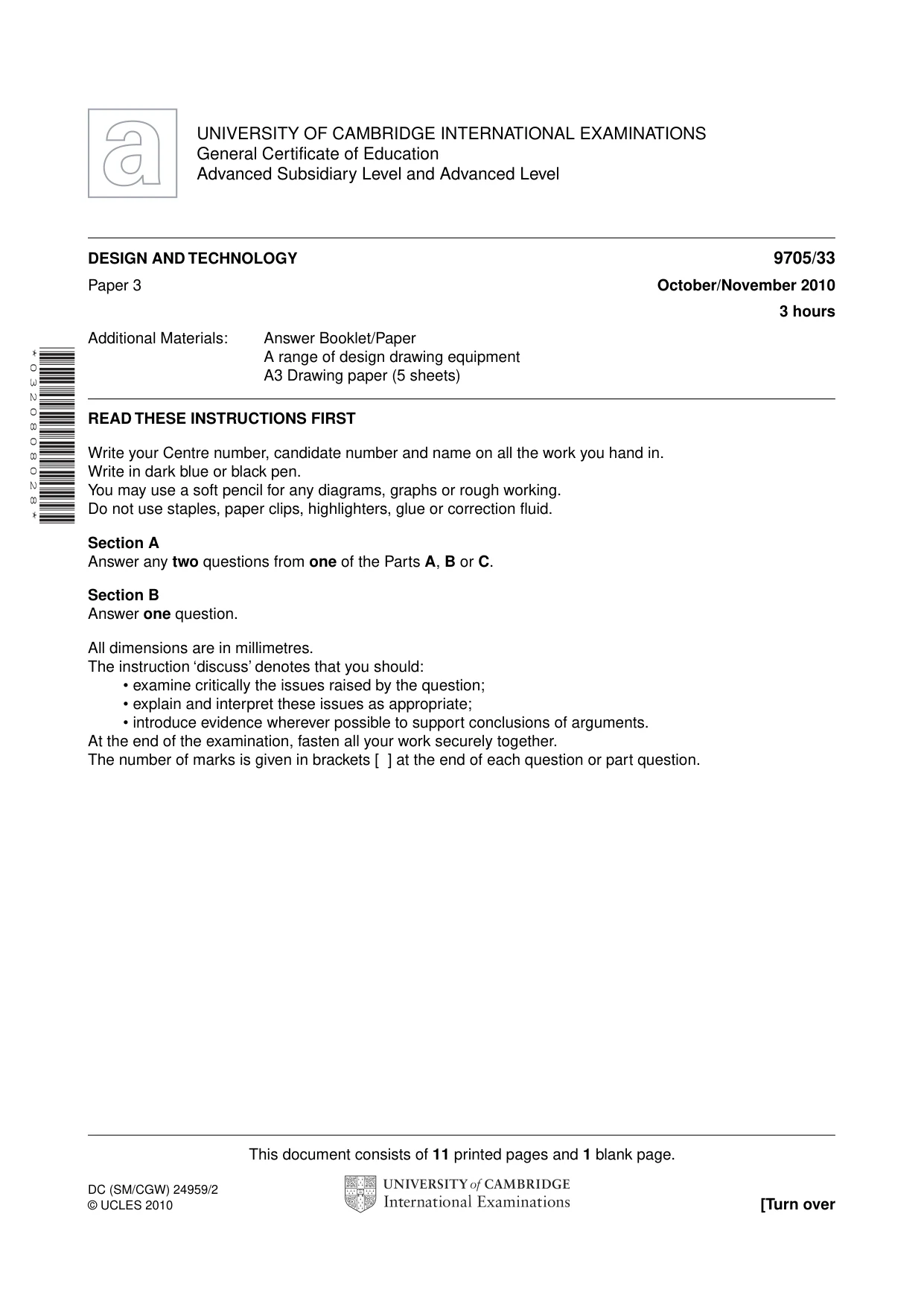
This document consists of 11 printed pages and 1 blank page. DC (SM/CGW) 24959/2 © UCLES 2010 [Turn over UNIVERSITY OF CAMBRIDGE INTERNATIONAL EXAMINATIONS General Certificate of Education Advanced Subsidiary Level and Advanced Level READ THESE INSTRUCTIONS FIRST Write your Centre number, candidate number and name on all the work you hand in. Write in dark blue or black pen. You may use a soft pencil for any diagrams, graphs or rough working. Do not use staples, paper clips, highlighters, glue or correction fluid. Section A Answer any two questions from one of the Parts A, B or C. Section B Answer one question. All dimensions are in millimetres. The instruction ‘discuss’ denotes that you should: • examine critically the issues raised by the question; • explain and interpret these issues as appropriate; • introduce evidence wherever possible to support conclusions of arguments. At the end of the examination, fasten all your work securely together. The number of marks is given in brackets [ ] at the end of each question or part question. * 0 3 2 0 8 0 8 0 2 8 * DESIGN AND TECHNOLOGY 9705/33 Paper 3 October/November 2010 3 hours Additional Materials: Answer Booklet/Paper A range of design drawing equipment A3 Drawing paper (5 sheets)
Question paper, page 2
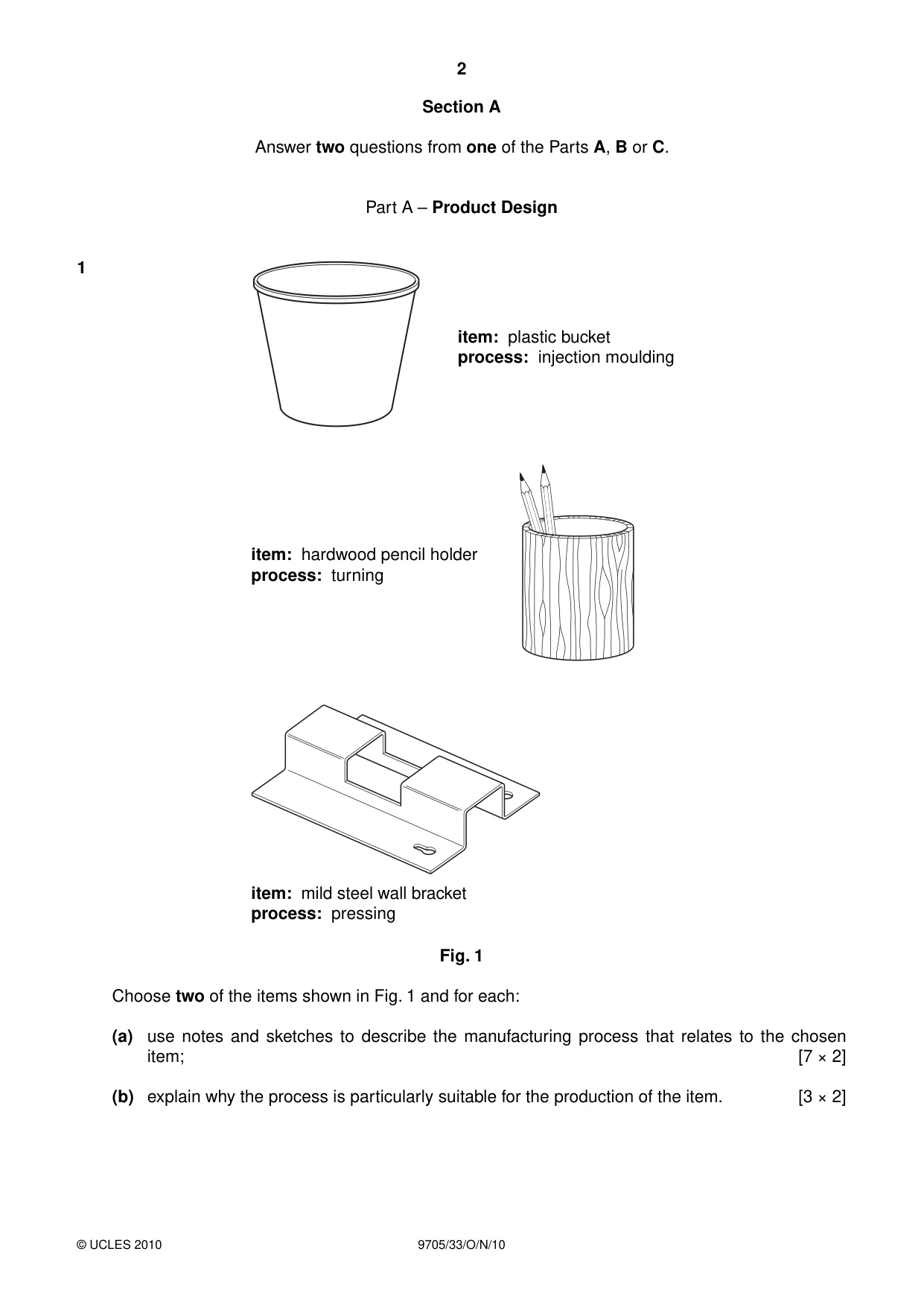
2 © UCLES 2010 9705/33/O/N/10 Section A Answer two questions from one of the Parts A, B or C. Part A – Product Design 1 item: hardwood pencil holder process: turning item: plastic bucket process: injection moulding item: mild steel wall bracket process: pressing Fig. 1 Choose two of the items shown in Fig. 1 and for each: (a) use notes and sketches to describe the manufacturing process that relates to the chosen item; [7 × 2] (b) explain why the process is particularly suitable for the production of the item. [3 × 2]
Question paper, page 3
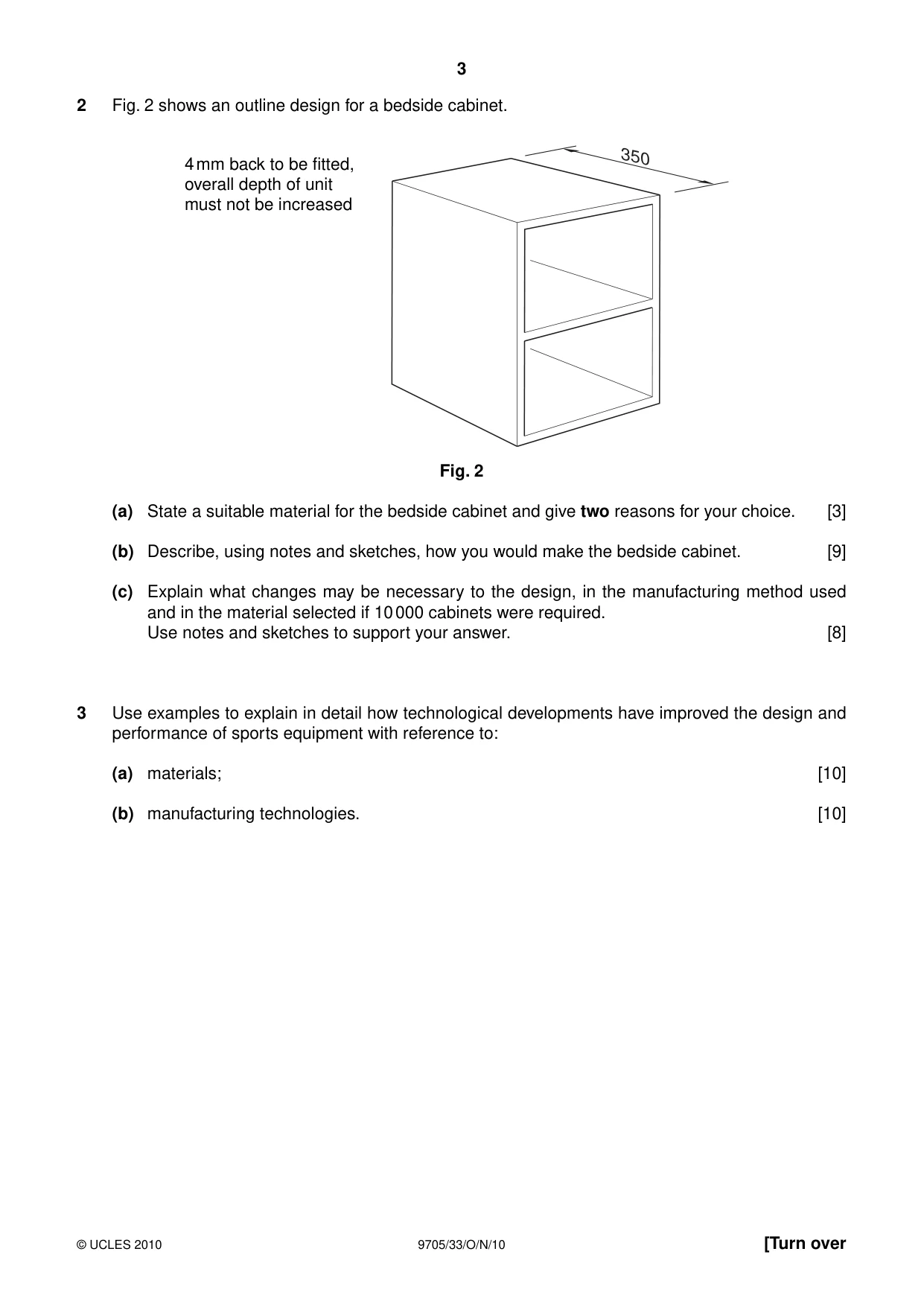
3 © UCLES 2010 [Turn over 9705/33/O/N/10 2 Fig. 2 shows an outline design for a bedside cabinet. 350 4 mm back to be fitted, overall depth of unit must not be increased Fig. 2 (a) State a suitable material for the bedside cabinet and give two reasons for your choice. [3] (b) Describe, using notes and sketches, how you would make the bedside cabinet. [9] (c) Explain what changes may be necessary to the design, in the manufacturing method used and in the material selected if 10 000 cabinets were required. Use notes and sketches to support your answer. [8] 3 Use examples to explain in detail how technological developments have improved the design and performance of sports equipment with reference to: (a) materials; [10] (b) manufacturing technologies. [10]
Question paper, page 4
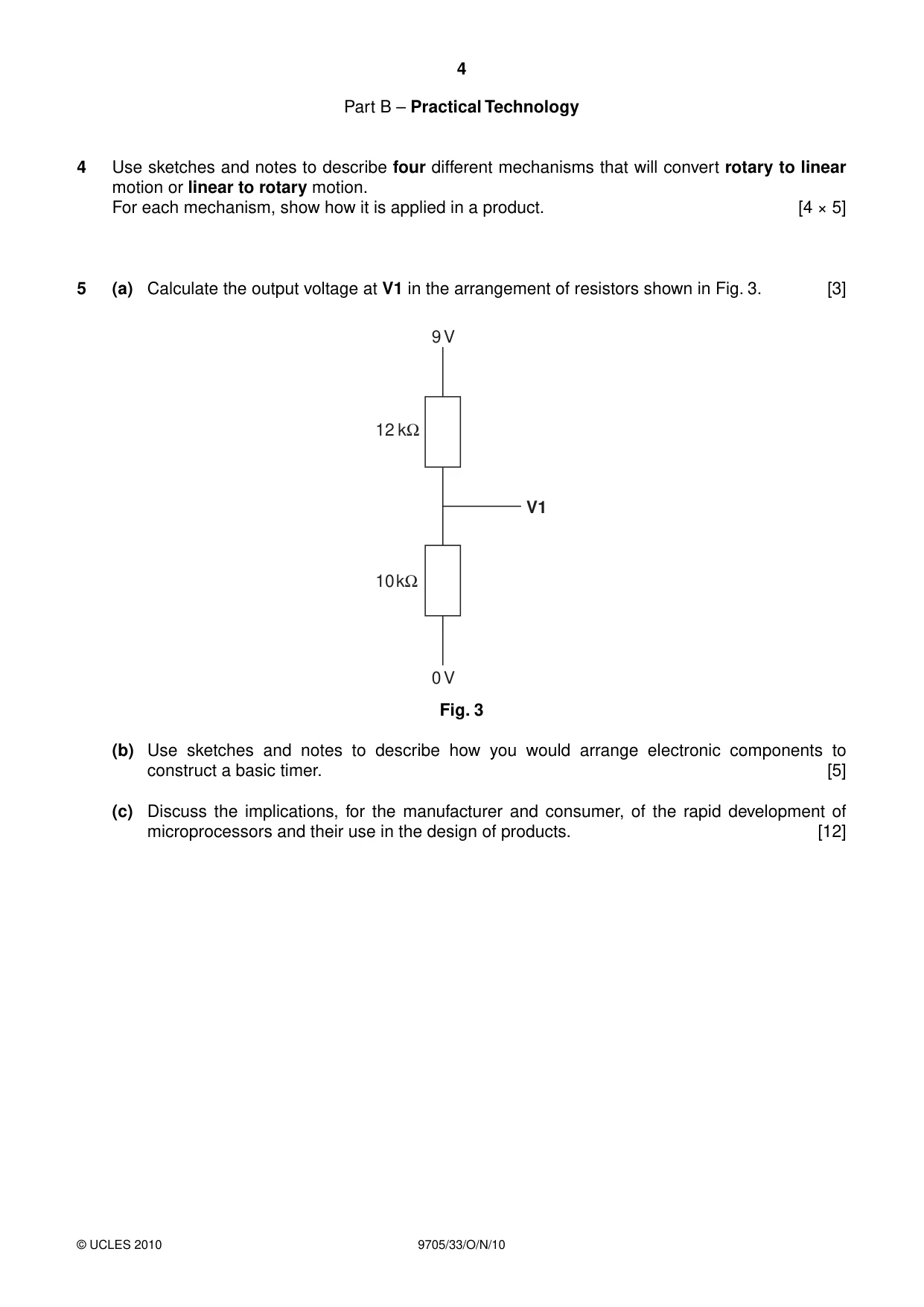
4 9705/33/O/N/10 © UCLES 2010 Part B – Practical Technology 4 Use sketches and notes to describe four different mechanisms that will convert rotary to linear motion or linear to rotary motion. For each mechanism, show how it is applied in a product. [4 × 5] 5 (a) Calculate the output voltage at V1 in the arrangement of resistors shown in Fig. 3. [3] 12 kΩ 10kΩ 9 V 0 V V1 Fig. 3 (b) Use sketches and notes to describe how you would arrange electronic components to construct a basic timer. [5] (c) Discuss the implications, for the manufacturer and consumer, of the rapid development of microprocessors and their use in the design of products. [12]
Question paper, page 5
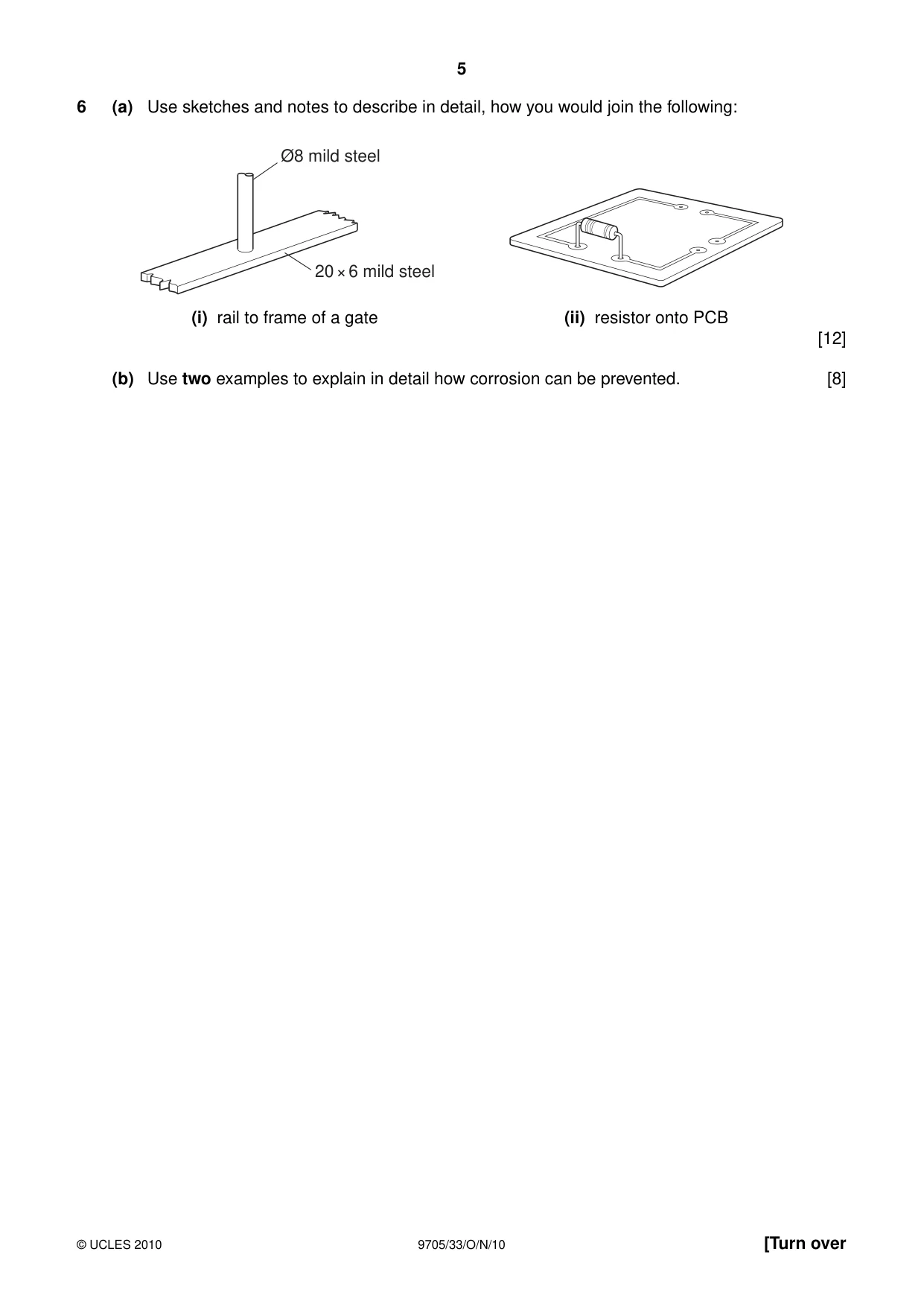
5 9705/33/O/N/10 © UCLES 2010 [Turn over 6 (a) Use sketches and notes to describe in detail, how you would join the following: Ø8 mild steel 20 × 6 mild steel (i) rail to frame of a gate (ii) resistor onto PCB [12] (b) Use two examples to explain in detail how corrosion can be prevented. [8]
Question paper, page 6
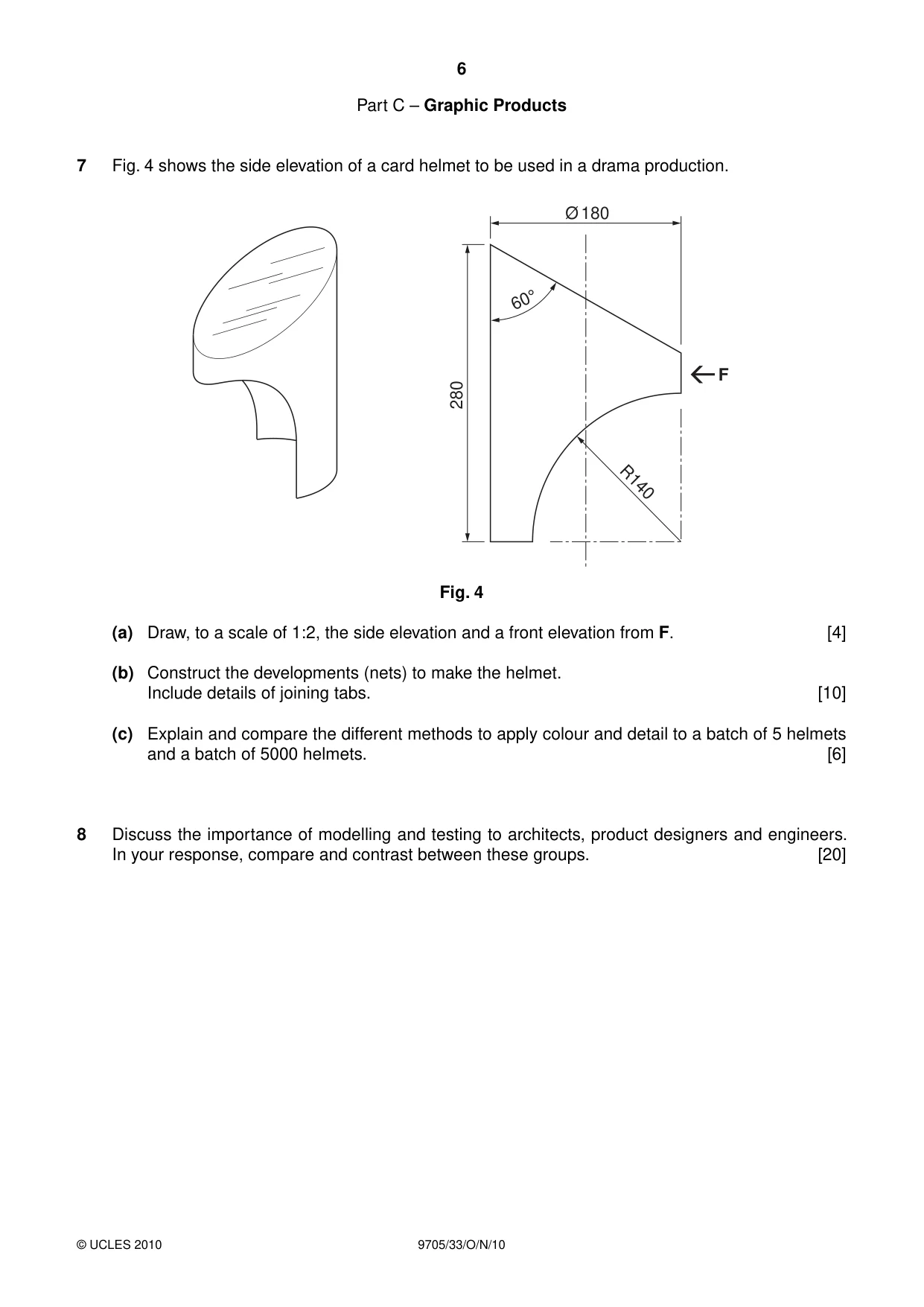
6 9705/33/O/N/10 © UCLES 2010 Part C – Graphic Products 7 Fig. 4 shows the side elevation of a card helmet to be used in a drama production. Ø 180 F 280 R140 60° Fig. 4 (a) Draw, to a scale of 1:2, the side elevation and a front elevation from F. [4] (b) Construct the developments (nets) to make the helmet. Include details of joining tabs. [10] (c) Explain and compare the different methods to apply colour and detail to a batch of 5 helmets and a batch of 5000 helmets. [6] 8 Discuss the importance of modelling and testing to architects, product designers and engineers. In your response, compare and contrast between these groups. [20]
Question paper, page 7
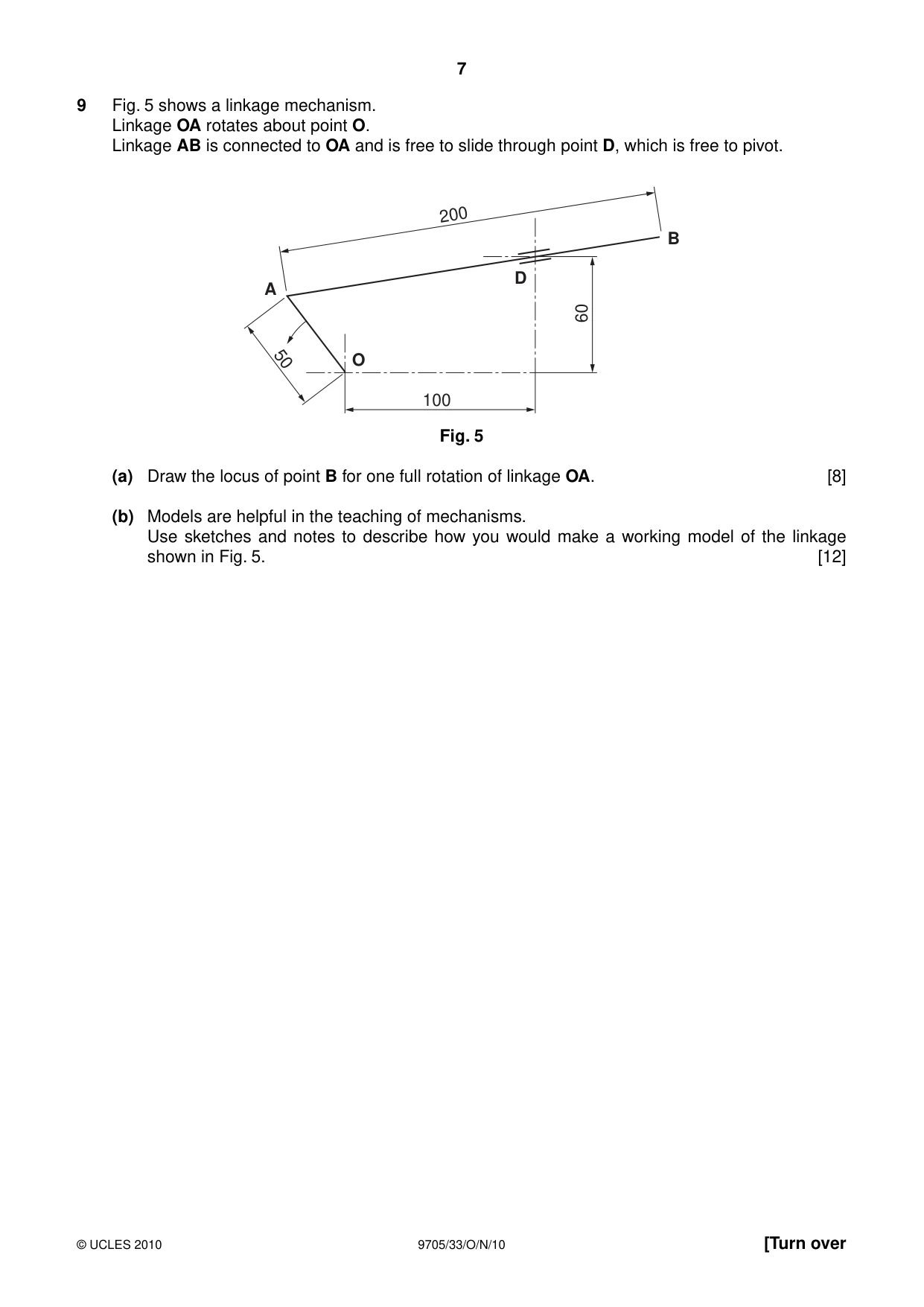
7 9705/33/O/N/10 © UCLES 2010 [Turn over 9 Fig. 5 shows a linkage mechanism. Linkage OA rotates about point O. Linkage AB is connected to OA and is free to slide through point D, which is free to pivot. 100 A B D O 200 60 50 Fig. 5 (a) Draw the locus of point B for one full rotation of linkage OA. [8] (b) Models are helpful in the teaching of mechanisms. Use sketches and notes to describe how you would make a working model of the linkage shown in Fig. 5. [12]
Question paper, page 8
8 9705/33/O/N/10 © UCLES 2010 Section B Answer one question on the A3 paper provided. You should approach the design question of your choice in the following manner: Analysis Produce an analysis of the given situation/problem, which may be in written or graphical form. [5] Specification From the analysis produce a detailed written specification of the design requirements. Include at least five specification points other than those given in the question. [5] Exploration Use bold sketches and brief notes to show your exploration of ideas for a design solution, with reasons for selection. [25] Development Show, using bold sketches and notes, the development, reasoning and composition of ideas into a single design proposal. Give details of materials, constructional and other relevant technical details. [25] Proposed solution Produce drawings of an appropriate kind to show the complete solution. [15] Evaluation Give a written evaluation of the final design solution. [5] [Total: 80]
Question paper, page 9
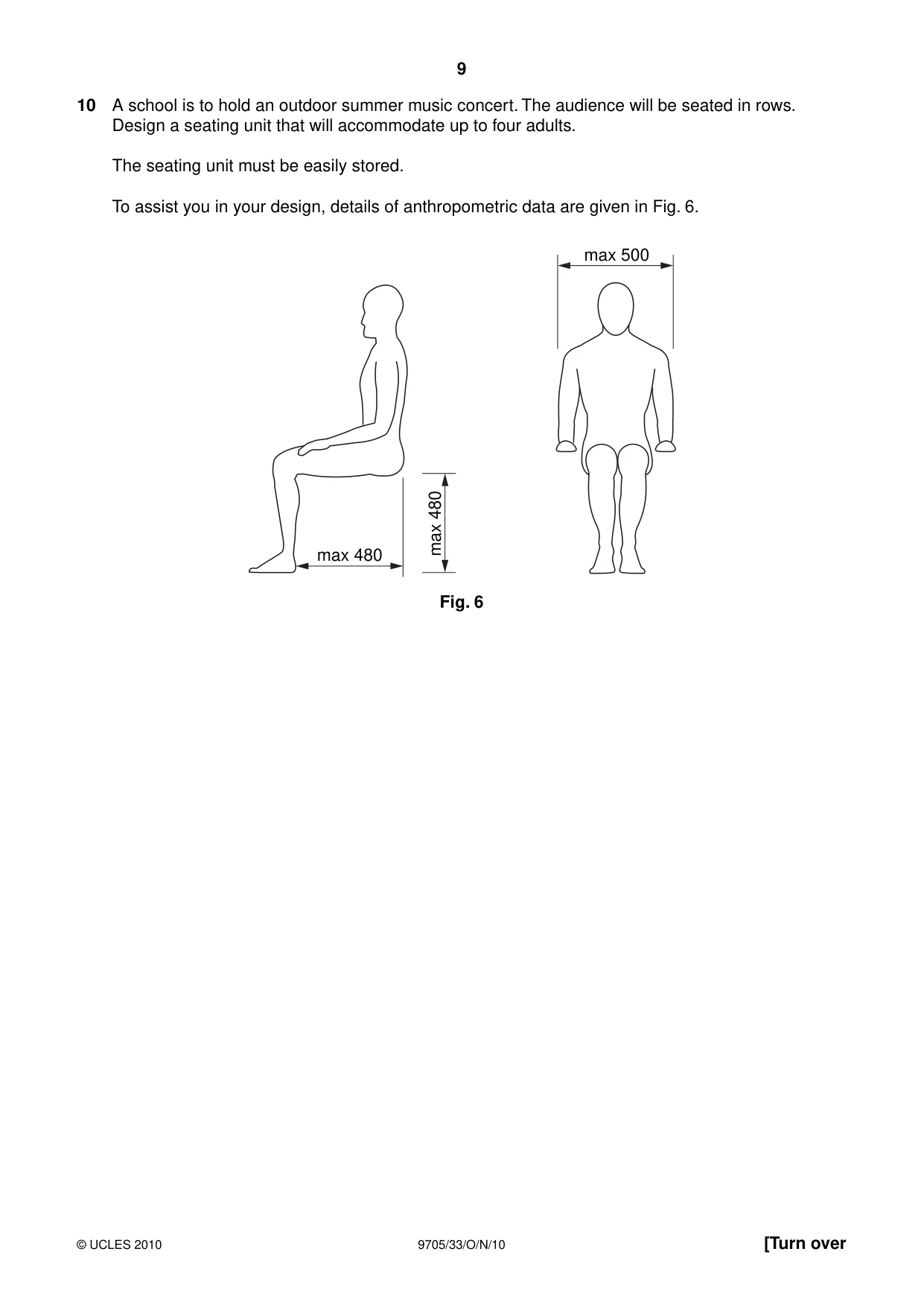
9 9705/33/O/N/10 © UCLES 2010 [Turn over 10 A school is to hold an outdoor summer music concert. The audience will be seated in rows. Design a seating unit that will accommodate up to four adults. The seating unit must be easily stored. To assist you in your design, details of anthropometric data are given in Fig. 6. max 480 max 480 max 500 Fig. 6
Question paper, page 10
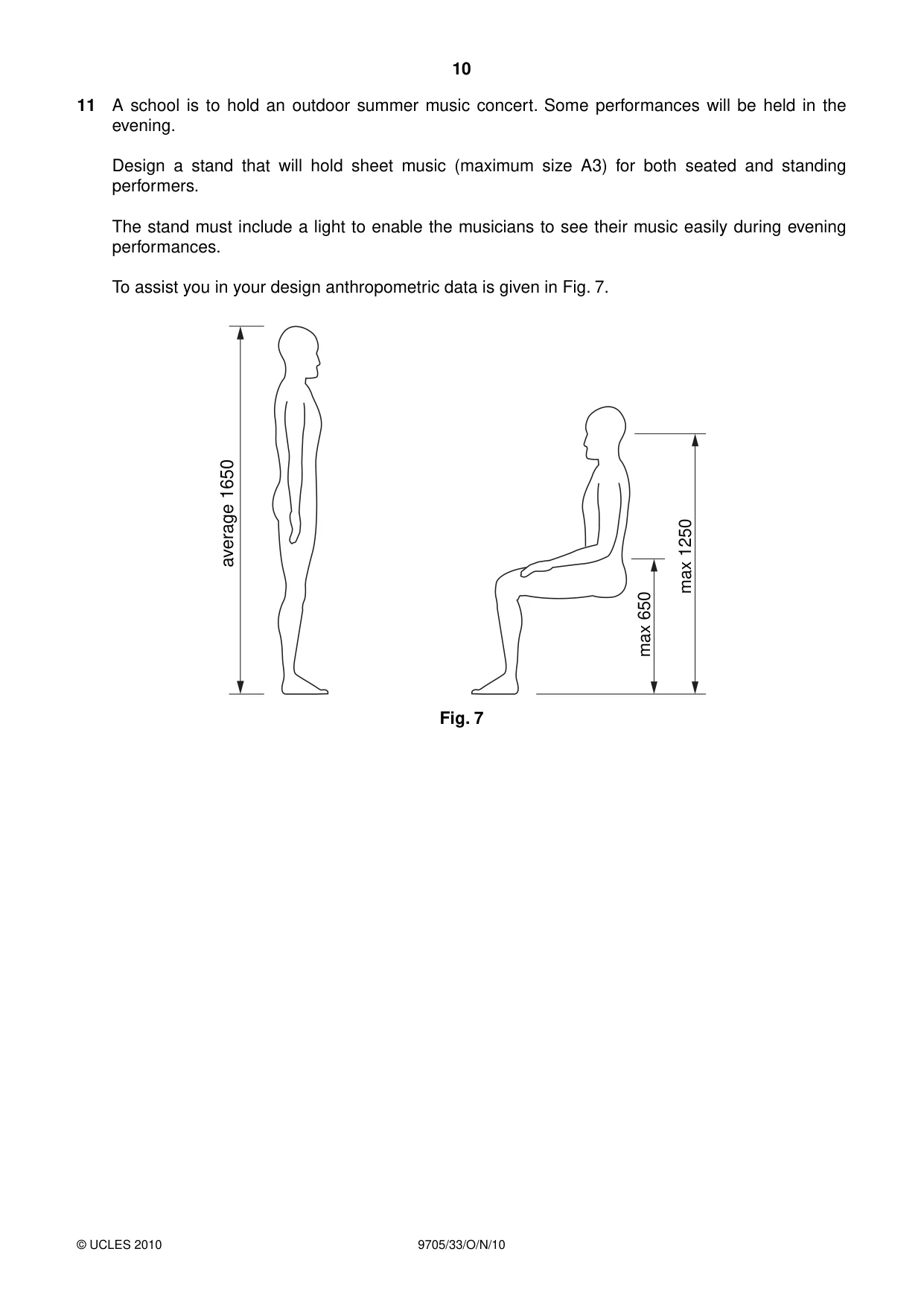
10 9705/33/O/N/10 © UCLES 2010 11 A school is to hold an outdoor summer music concert. Some performances will be held in the evening. Design a stand that will hold sheet music (maximum size A3) for both seated and standing performers. The stand must include a light to enable the musicians to see their music easily during evening performances. To assist you in your design anthropometric data is given in Fig. 7. max 650 max 1250 average 1650 Fig. 7
Question paper, page 11
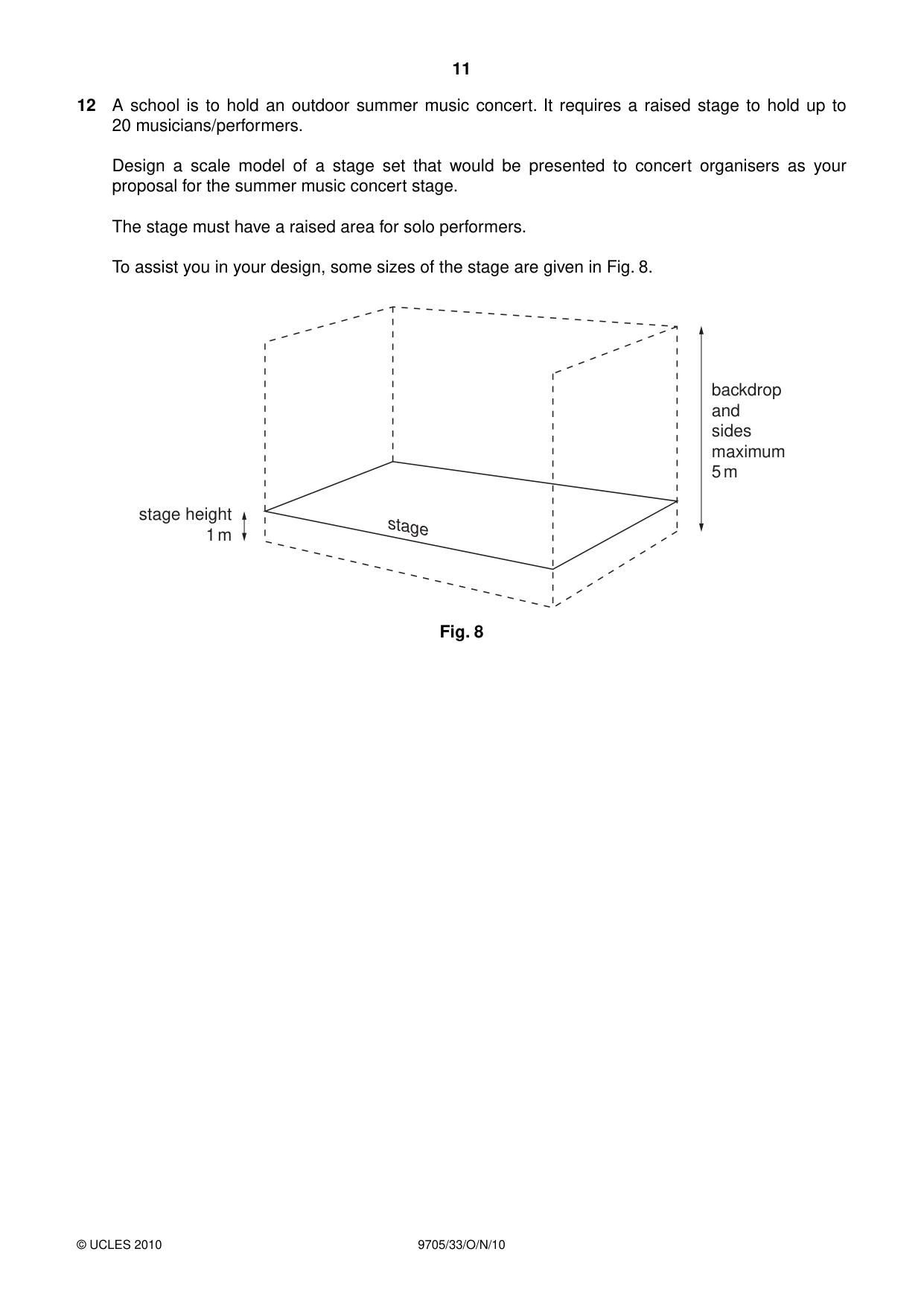
11 9705/33/O/N/10 © UCLES 2010 12 A school is to hold an outdoor summer music concert. It requires a raised stage to hold up to 20 musicians/performers. Design a scale model of a stage set that would be presented to concert organisers as your proposal for the summer music concert stage. The stage must have a raised area for solo performers. To assist you in your design, some sizes of the stage are given in Fig. 8. stage backdrop and sides maximum 5 m stage height 1 m Fig. 8
Question paper, page 12
12 9705/33/O/N/10 © UCLES 2010 BLANK PAGE Permission to reproduce items where third-party owned material protected by copyright is included has been sought and cleared where possible. Every reasonable effort has been made by the publisher (UCLES) to trace copyright holders, but if any items requiring clearance have unwittingly been included, the publisher will be pleased to make amends at the earliest possible opportunity. University of Cambridge International Examinations is part of the Cambridge Assessment Group. Cambridge Assessment is the brand name of University of Cambridge Local Examinations Syndicate (UCLES), which is itself a department of the University of Cambridge.
Mark scheme, page 1
UNIVERSITY OF CAMBRIDGE INTERNATIONAL EXAMINATIONS GCE Advanced Subsidiary Level and GCE Advanced Level MARK SCHEME for the October/November 2010 question paper for the guidance of teachers 9705 DESIGN AND TECHNOLOGY 9705/33 Paper 3, maximum raw mark 120 This mark scheme is published as an aid to teachers and candidates, to indicate the requirements of the examination. It shows the basis on which Examiners were instructed to award marks. It does not indicate the details of the discussions that took place at an Examiners’ meeting before marking began, which would have considered the acceptability of alternative answers. Mark schemes must be read in conjunction with the question papers and the report on the examination. • CIE will not enter into discussions or correspondence in connection with these mark schemes. CIE is publishing the mark schemes for the October/November 2010 question papers for most IGCSE, GCE Advanced Level and Advanced Subsidiary Level syllabuses and some Ordinary Level syllabuses.
Mark scheme, page 2
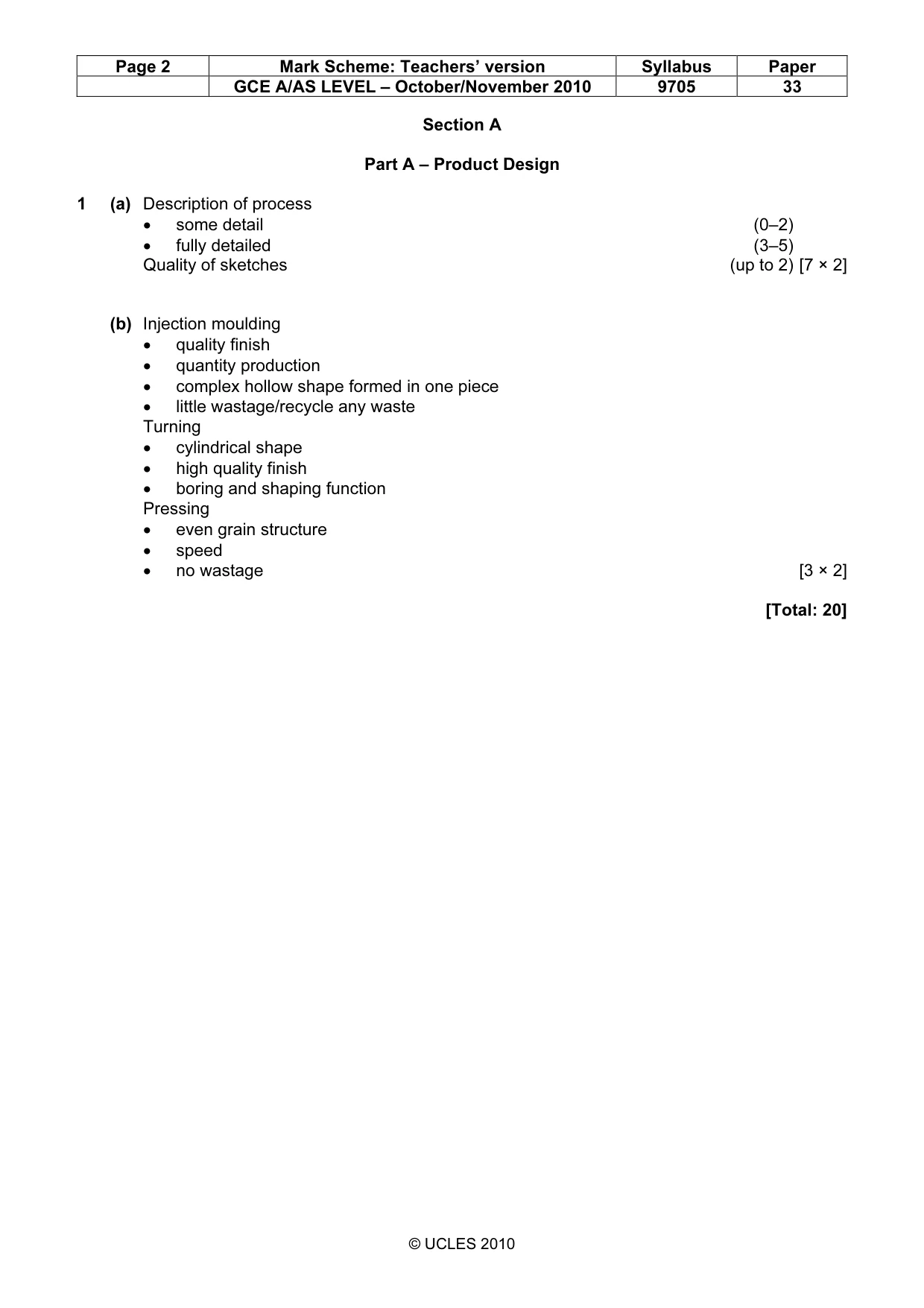
Page 2 Mark Scheme: Teachers’ version Syllabus Paper GCE A/AS LEVEL – October/November 2010 9705 33 © UCLES 2010 Section A Part A – Product Design 1 (a) Description of process • some detail (0–2) • fully detailed (3–5) Quality of sketches (up to 2) [7 × 2] (b) Injection moulding • quality finish • quantity production • complex hollow shape formed in one piece • little wastage/recycle any waste Turning • cylindrical shape • high quality finish • boring and shaping function Pressing • even grain structure • speed • no wastage [3 × 2] [Total: 20]
Mark scheme, page 3
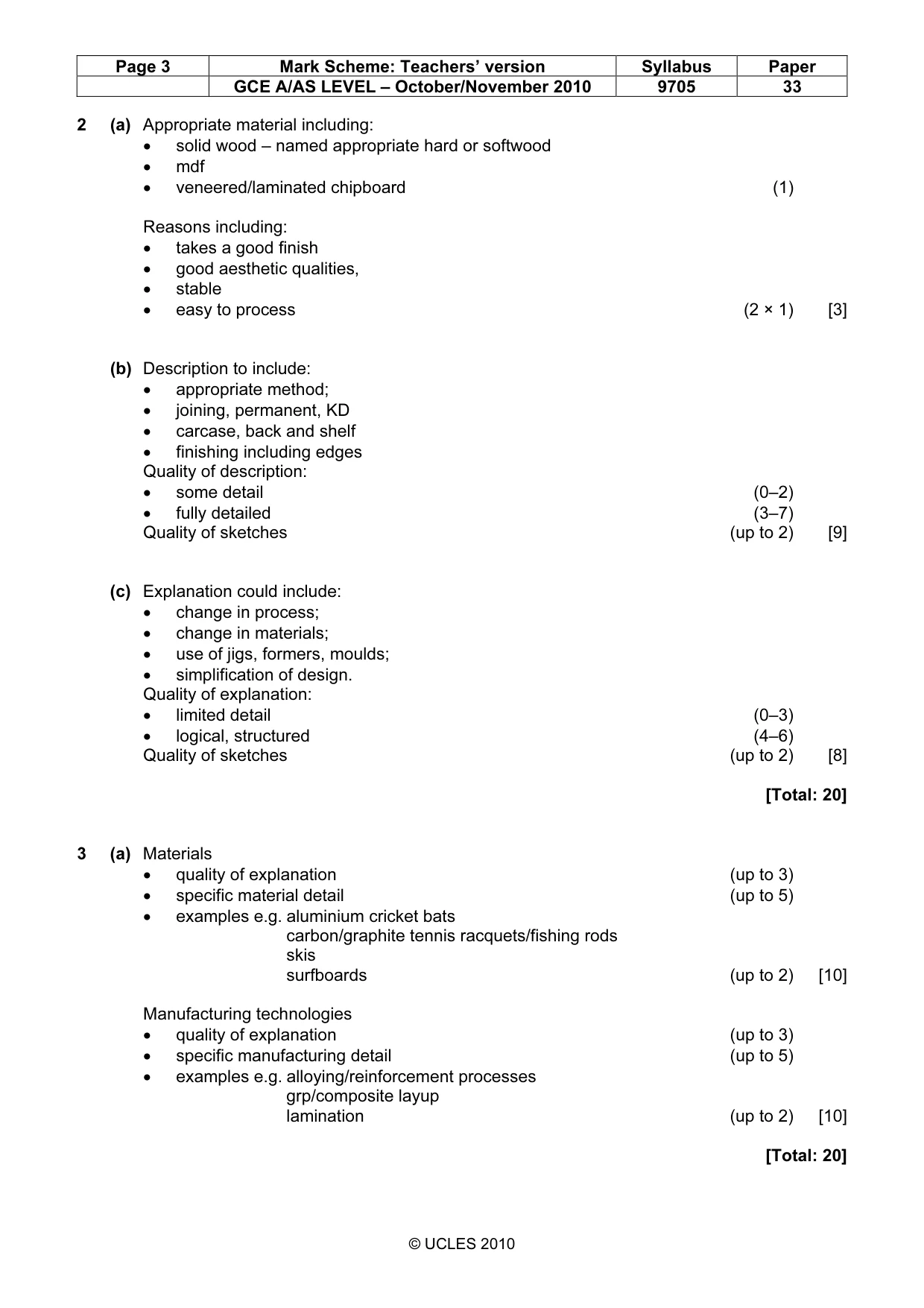
Page 3 Mark Scheme: Teachers’ version Syllabus Paper GCE A/AS LEVEL – October/November 2010 9705 33 © UCLES 2010 2 (a) Appropriate material including: • solid wood – named appropriate hard or softwood • mdf • veneered/laminated chipboard (1) Reasons including: • takes a good finish • good aesthetic qualities, • stable • easy to process (2 × 1) [3] (b) Description to include: • appropriate method; • joining, permanent, KD • carcase, back and shelf • finishing including edges Quality of description: • some detail (0–2) • fully detailed (3–7) Quality of sketches (up to 2) [9] (c) Explanation could include: • change in process; • change in materials; • use of jigs, formers, moulds; • simplification of design. Quality of explanation: • limited detail (0–3) • logical, structured (4–6) Quality of sketches (up to 2) [8] [Total: 20] 3 (a) Materials • quality of explanation (up to 3) • specific material detail (up to 5) • examples e.g. aluminium cricket bats carbon/graphite tennis racquets/fishing rods skis surfboards (up to 2) [10] Manufacturing technologies • quality of explanation (up to 3) • specific manufacturing detail (up to 5) • examples e.g. alloying/reinforcement processes grp/composite layup lamination (up to 2) [10] [Total: 20]
Mark scheme, page 4
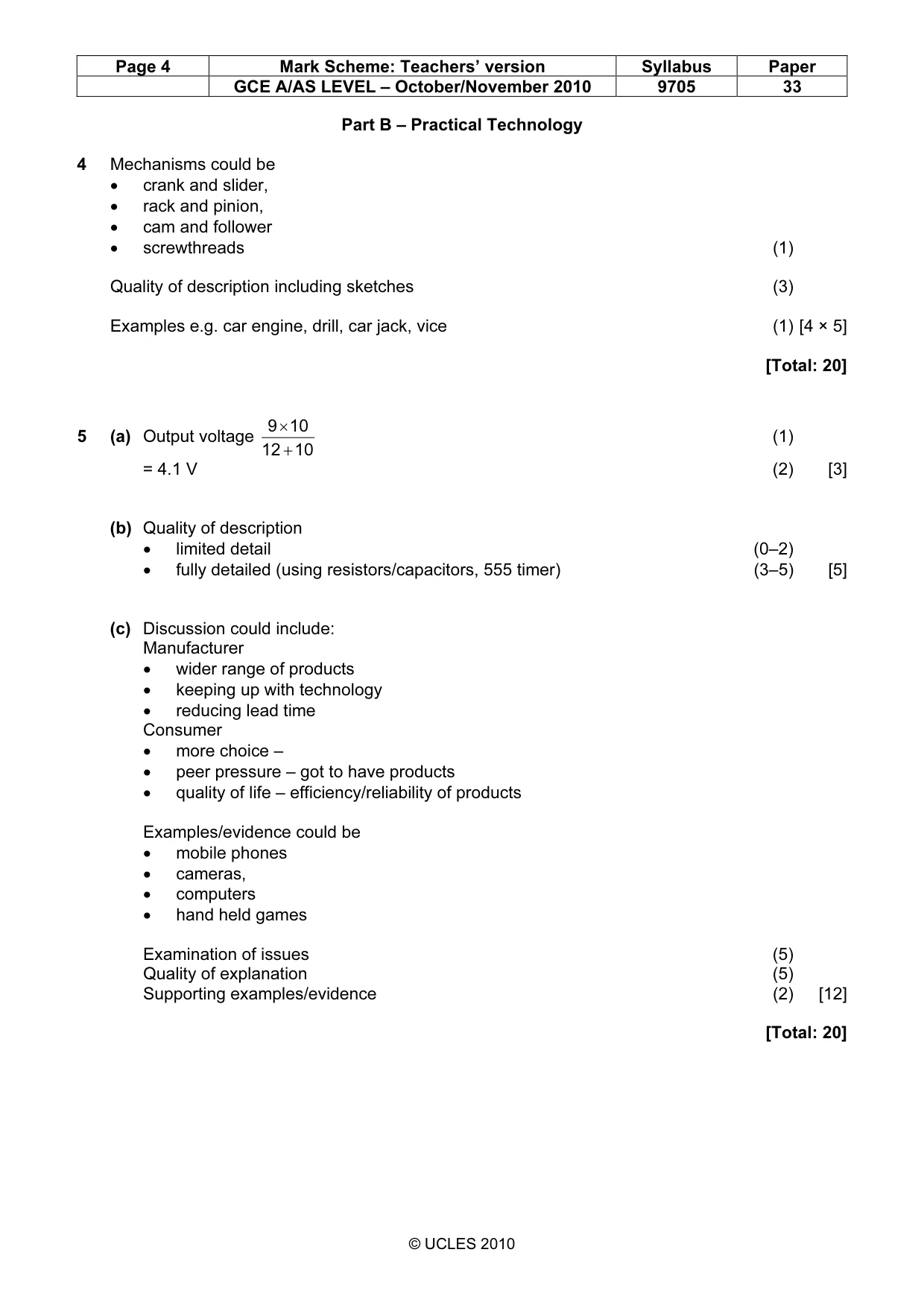
Page 4 Mark Scheme: Teachers’ version Syllabus Paper GCE A/AS LEVEL – October/November 2010 9705 33 © UCLES 2010 Part B – Practical Technology 4 Mechanisms could be • crank and slider, • rack and pinion, • cam and follower • screwthreads (1) Quality of description including sketches (3) Examples e.g. car engine, drill, car jack, vice (1) [4 × 5] [Total: 20] 5 (a) Output voltage 10 12 10 9 + × (1) = 4.1 V (2) [3] (b) Quality of description • limited detail (0–2) • fully detailed (using resistors/capacitors, 555 timer) (3–5) [5] (c) Discussion could include: Manufacturer • wider range of products • keeping up with technology • reducing lead time Consumer • more choice – • peer pressure – got to have products • quality of life – efficiency/reliability of products Examples/evidence could be • mobile phones • cameras, • computers • hand held games Examination of issues (5) Quality of explanation (5) Supporting examples/evidence (2) [12] [Total: 20]
Mark scheme, page 5
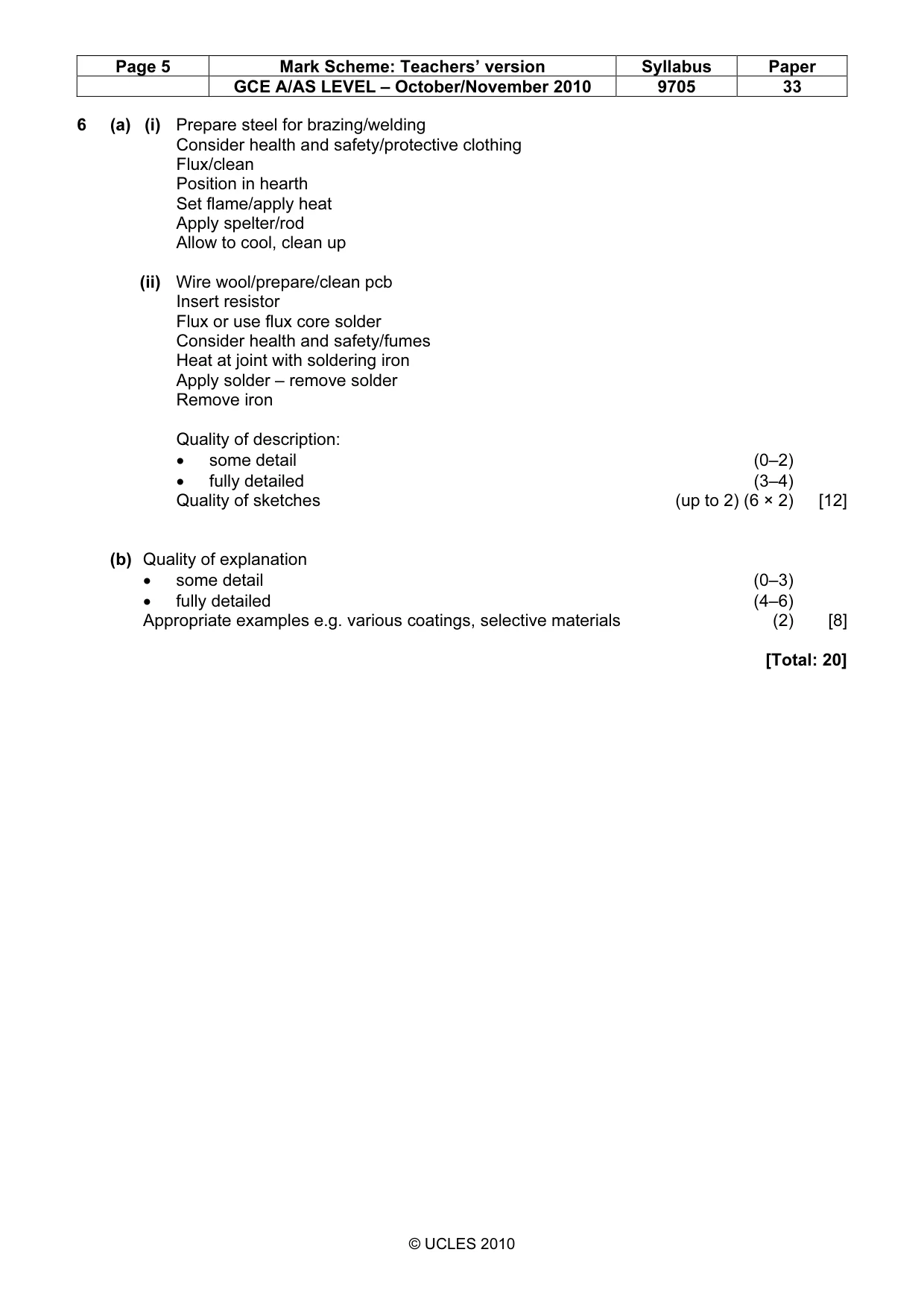
Page 5 Mark Scheme: Teachers’ version Syllabus Paper GCE A/AS LEVEL – October/November 2010 9705 33 © UCLES 2010 6 (a) (i) Prepare steel for brazing/welding Consider health and safety/protective clothing Flux/clean Position in hearth Set flame/apply heat Apply spelter/rod Allow to cool, clean up (ii) Wire wool/prepare/clean pcb Insert resistor Flux or use flux core solder Consider health and safety/fumes Heat at joint with soldering iron Apply solder – remove solder Remove iron Quality of description: • some detail (0–2) • fully detailed (3–4) Quality of sketches (up to 2) (6 × 2) [12] (b) Quality of explanation • some detail (0–3) • fully detailed (4–6) Appropriate examples e.g. various coatings, selective materials (2) [8] [Total: 20]
Mark scheme, page 6
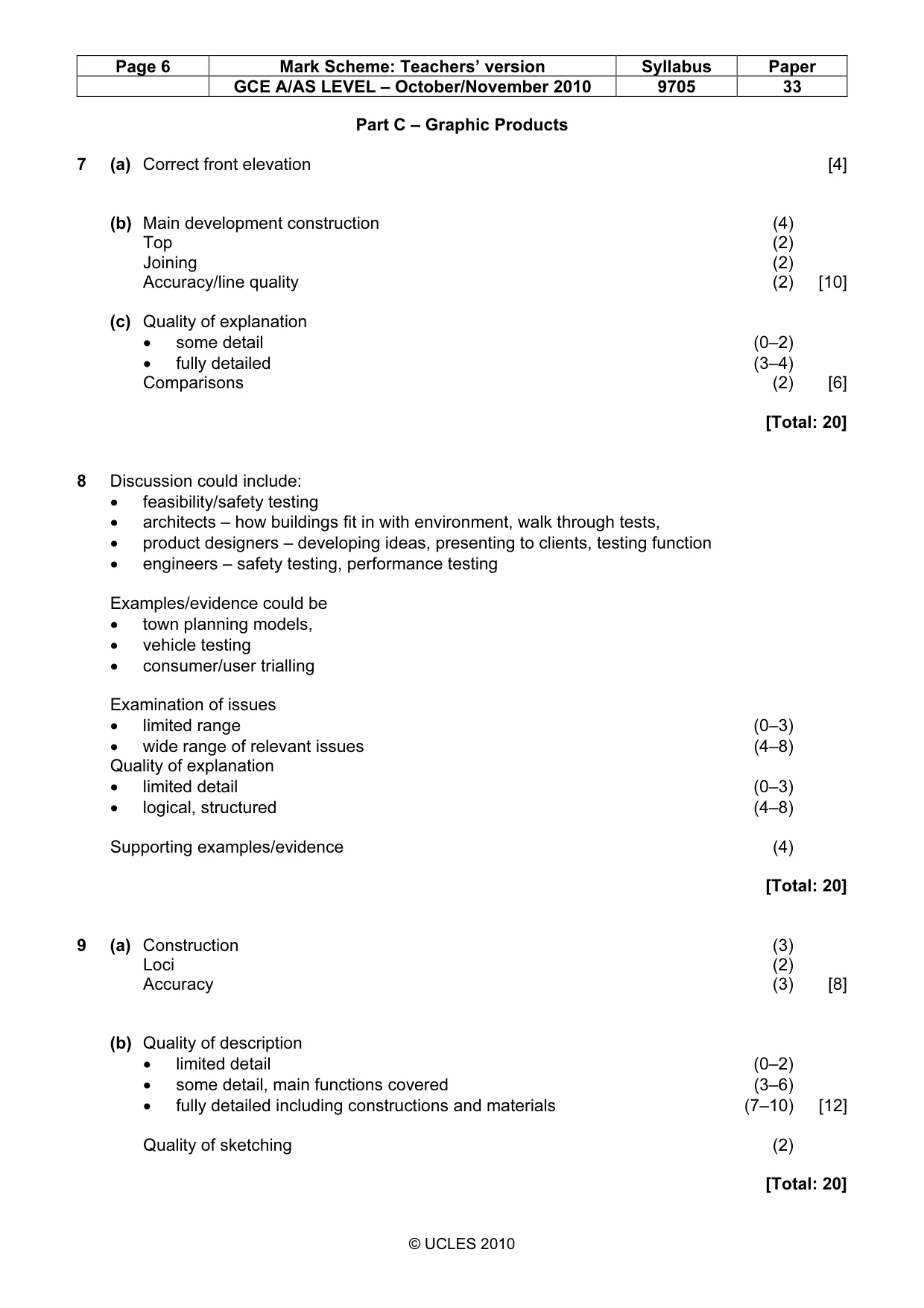
Page 6 Mark Scheme: Teachers’ version Syllabus Paper GCE A/AS LEVEL – October/November 2010 9705 33 © UCLES 2010 Part C – Graphic Products 7 (a) Correct front elevation [4] (b) Main development construction (4) Top (2) Joining (2) Accuracy/line quality (2) [10] (c) Quality of explanation • some detail (0–2) • fully detailed (3–4) Comparisons (2) [6] [Total: 20] 8 Discussion could include: • feasibility/safety testing • architects – how buildings fit in with environment, walk through tests, • product designers – developing ideas, presenting to clients, testing function • engineers – safety testing, performance testing Examples/evidence could be • town planning models, • vehicle testing • consumer/user trialling Examination of issues • limited range (0–3) • wide range of relevant issues (4–8) Quality of explanation • limited detail (0–3) • logical, structured (4–8) Supporting examples/evidence (4) [Total: 20] 9 (a) Construction (3) Loci (2) Accuracy (3) [8] (b) Quality of description • limited detail (0–2) • some detail, main functions covered (3–6) • fully detailed including constructions and materials (7–10) [12] Quality of sketching (2) [Total: 20]
What you needed in this session
Cambridge’s own grade thresholds for 2010 Oct/Nov, Paper 3 · Variant 3. A higher threshold means an easier paper — the bar moves with how the cohort did.