Cambridge A Level Design and Technology 9705 — 2010 Oct/Nov Paper 3 · Variant 1
9705/31/O/N/10 · 120 marks · ≈135 min
The question paper and its mark scheme, free to read here and free to download. This is Cambridge’s own paper, exactly as it was sat.
Question paper12 pages
Mark scheme7 pages
Answers below. Sit the paper first if you are practising.
Paper as text
Question paper, page 1
This document consists of 11 printed pages and 1 blank page. DC (SM/CGW) 24956/3 © UCLES 2010 [Turn over UNIVERSITY OF CAMBRIDGE INTERNATIONAL EXAMINATIONS General Certificate of Education Advanced Subsidiary Level and Advanced Level READ THESE INSTRUCTIONS FIRST Write your Centre number, candidate number and name on all the work you hand in. Write in dark blue or black pen. You may use a soft pencil for any diagrams, graphs or rough working. Do not use staples, paper clips, highlighters, glue or correction fluid. Section A Answer any two questions from one of the Parts A, B or C. Section B Answer one question. All dimensions are in millimetres. The instruction ‘discuss’ denotes that you should: • examine critically the issues raised by the question; • explain and interpret these issues as appropriate; • introduce evidence wherever possible to support conclusions of arguments. At the end of the examination, fasten all your work securely together. The number of marks is given in brackets [ ] at the end of each question or part question. * 2 6 4 3 5 8 3 5 9 5 * DESIGN AND TECHNOLOGY 9705/31 Paper 3 October/November 2010 3 hours Additional Materials: Answer Booklet/Paper A range of design drawing equipment A3 Drawing paper (5 sheets)
Question paper, page 2
2 9705/31/O/N/10 © UCLES 2010 Section A Answer two questions from one of the Parts A, B or C. Part A – Product Design 1 Fig. 1 shows an item of jewellery. 70 Fig. 1 (a) State a suitable material for the item of jewellery and give two reasons for your choice. [3] (b) Describe, using notes and sketches, how you would make the item of jewellery. [9] (c) Explain what changes may be necessary to the design, in the manufacturing method used and in the material selected if 50 000 items were required. Use notes and sketches to support your answer. [8]
Question paper, page 3
3 9705/31/O/N/10 © UCLES 2010 [Turn over 2 item: chair side process: shaping and joining item: football process: blow moulding item: display board holder process: milling Fig. 2 Choose two of the items shown in Fig. 2 and for each: (a) use notes and sketches to describe the manufacturing process that relates to the chosen item; [7 × 2] (b) explain why the process is particularly suitable for the production of the item. [3 × 2] 3 Discuss the economic and cultural implications of introducing products for a tourist target market compared with products for worldwide distribution. [20]
Question paper, page 4
4 9705/31/O/N/10 © UCLES 2010 Part B – Practical Technology 4 (a) Fig. 3 shows a simple frame. A B C Fig. 3 State which member is in tension and which member is in compression. [2] (b) Fig. 4 shows a simple beam supported at F. X F 25 N 30 N Fig. 4 Calculate what force X would be required to keep the beam in balance. [2] (c) Explain the difference between a monocoque and a frame structure. Use an example of each to support your answer. [6] (d) Discuss how fatigue and changes in temperature may cause structures to fail. [10]
Question paper, page 5
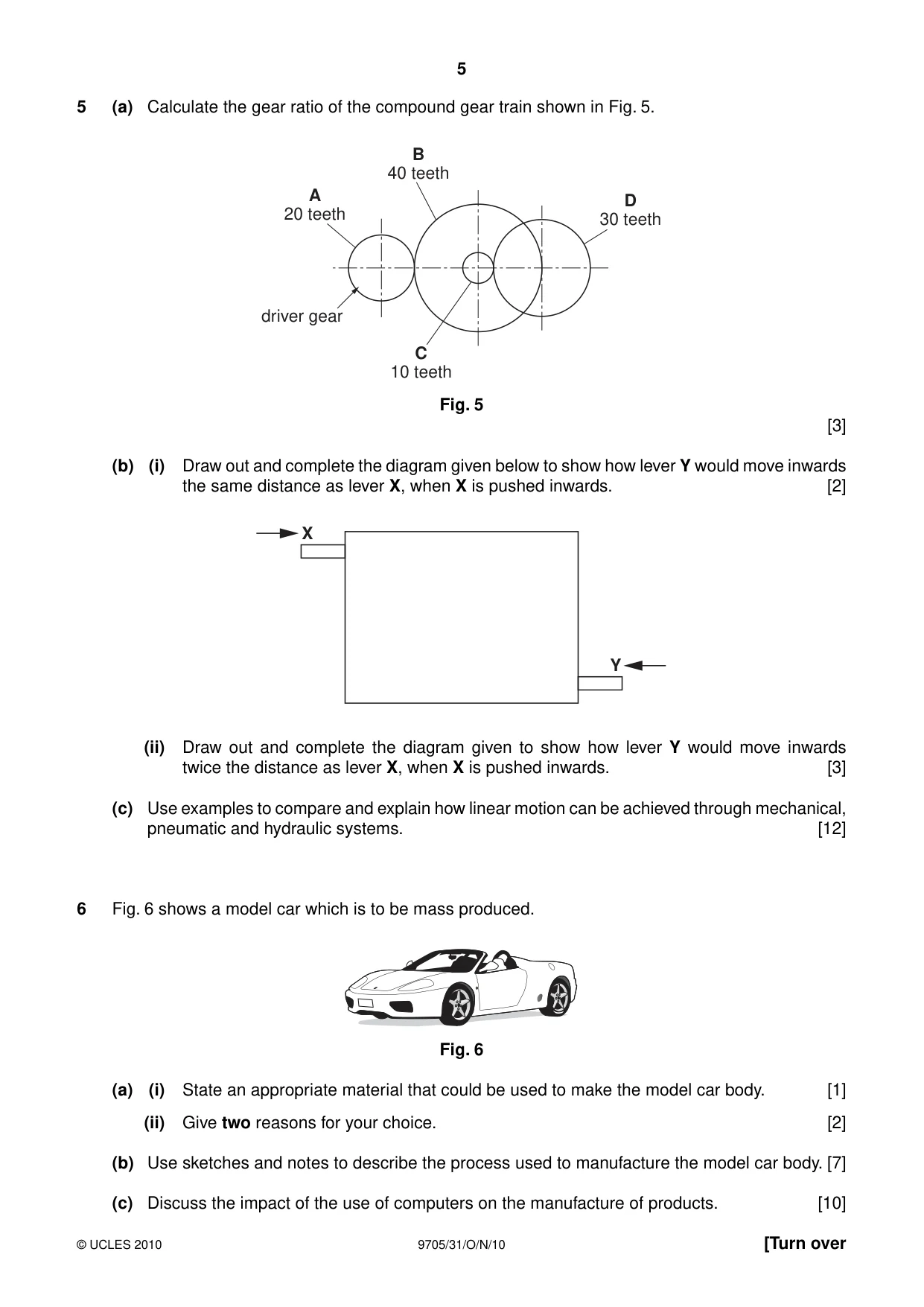
5 9705/31/O/N/10 © UCLES 2010 [Turn over 5 (a) Calculate the gear ratio of the compound gear train shown in Fig. 5. driver gear C 10 teeth A 20 teeth B 40 teeth D 30 teeth Fig. 5 [3] (b) (i) Draw out and complete the diagram given below to show how lever Y would move inwards the same distance as lever X, when X is pushed inwards. [2] X Y (ii) Draw out and complete the diagram given to show how lever Y would move inwards twice the distance as lever X, when X is pushed inwards. [3] (c) Use examples to compare and explain how linear motion can be achieved through mechanical, pneumatic and hydraulic systems. [12] 6 Fig. 6 shows a model car which is to be mass produced. Fig. 6 (a) (i) State an appropriate material that could be used to make the model car body. [1] (ii) Give two reasons for your choice. [2] (b) Use sketches and notes to describe the process used to manufacture the model car body. [7] (c) Discuss the impact of the use of computers on the manufacture of products. [10]
Question paper, page 6
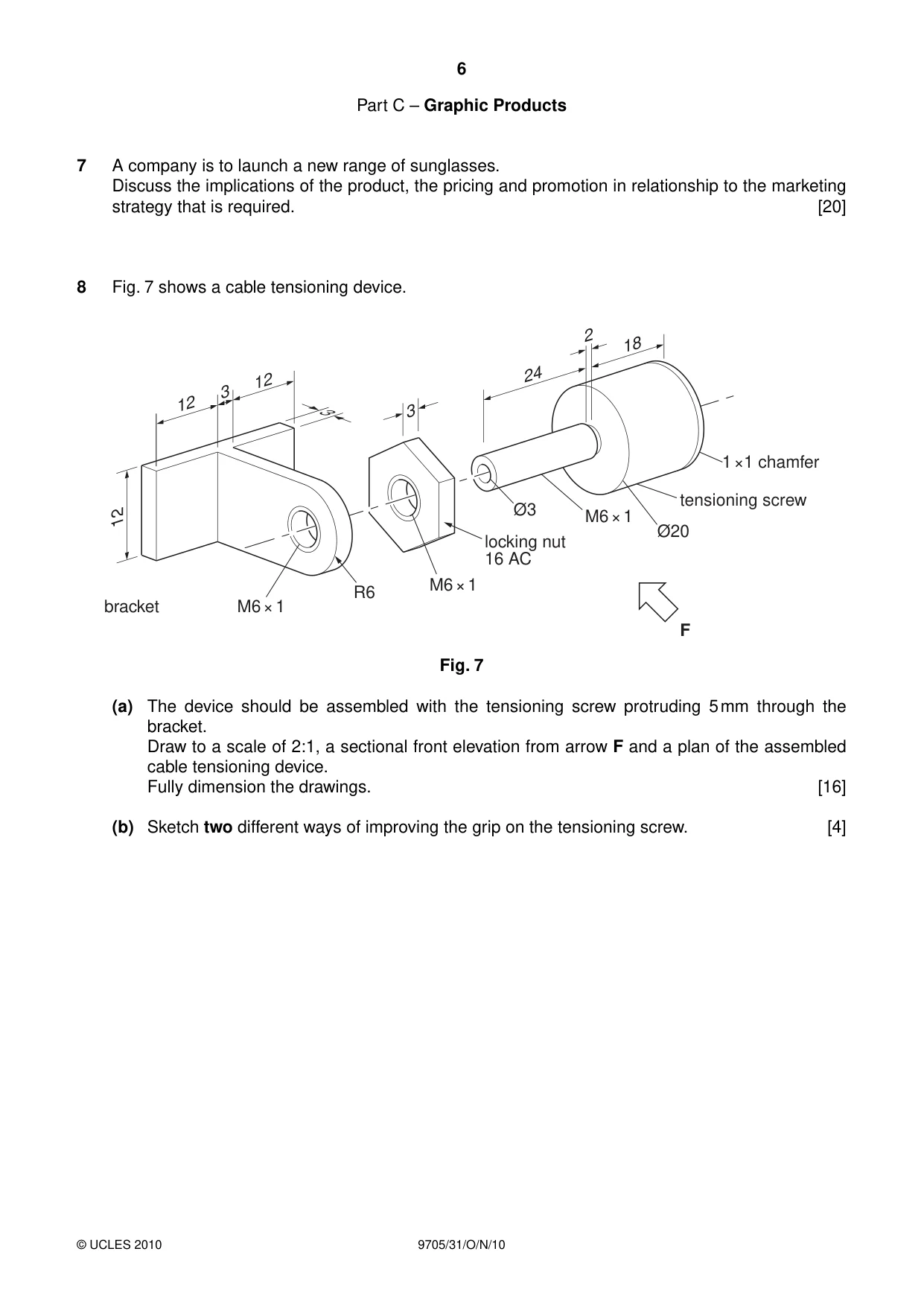
6 9705/31/O/N/10 © UCLES 2010 Part C – Graphic Products 7 A company is to launch a new range of sunglasses. Discuss the implications of the product, the pricing and promotion in relationship to the marketing strategy that is required. [20] 8 Fig. 7 shows a cable tensioning device. 12 12 12 3 3 3 24 18 2 bracket M6 × 1 M6 × 1 M6 × 1 1 ×1 chamfer tensioning screw F Ø3 locking nut 16 AC R6 Ø20 Fig. 7 (a) The device should be assembled with the tensioning screw protruding 5 mm through the bracket. Draw to a scale of 2:1, a sectional front elevation from arrow F and a plan of the assembled cable tensioning device. Fully dimension the drawings. [16] (b) Sketch two different ways of improving the grip on the tensioning screw. [4]
Question paper, page 7
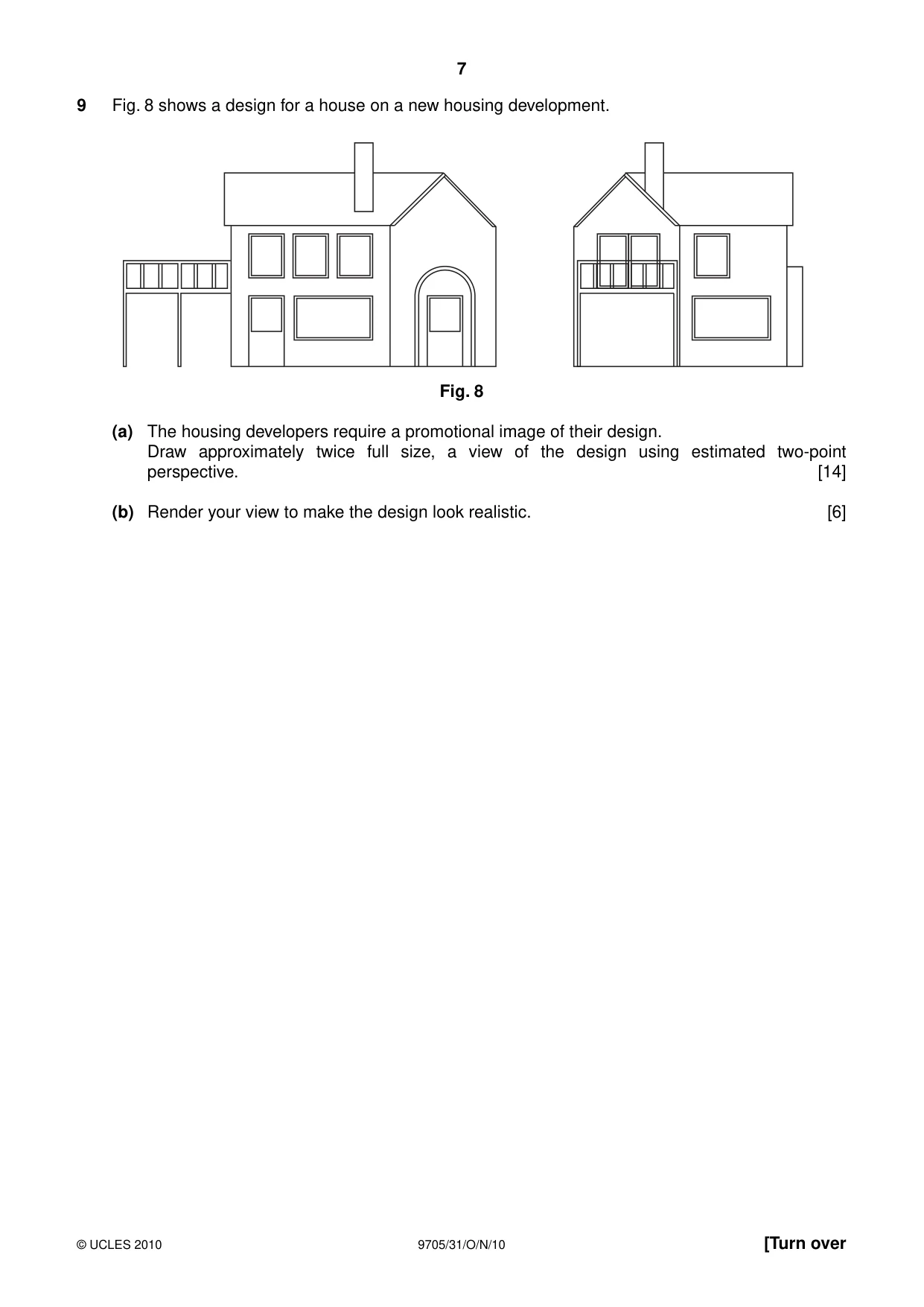
7 9705/31/O/N/10 © UCLES 2010 [Turn over 9 Fig. 8 shows a design for a house on a new housing development. Fig. 8 (a) The housing developers require a promotional image of their design. Draw approximately twice full size, a view of the design using estimated two-point perspective. [14] (b) Render your view to make the design look realistic. [6]
Question paper, page 8
8 9705/31/O/N/10 © UCLES 2010 Section B Answer one question on the A3 paper provided. You should approach the design question of your choice in the following manner: Analysis Produce an analysis of the given situation/problem, which may be in written or graphical form. [5] Specification From the analysis produce a detailed written specification of the design requirements. Include at least five specification points other than those given in the question. [5] Exploration Use bold sketches and brief notes to show your exploration of ideas for a design solution, with reasons for selection. [25] Development Show, using bold sketches and notes, the development, reasoning and composition of ideas into a single design proposal. Give details of materials, constructional and other relevant technical details. [25] Proposed solution Produce drawings of an appropriate kind to show the complete solution. [15] Evaluation Give a written evaluation of the final design solution. [5] [Total: 80]
Question paper, page 9
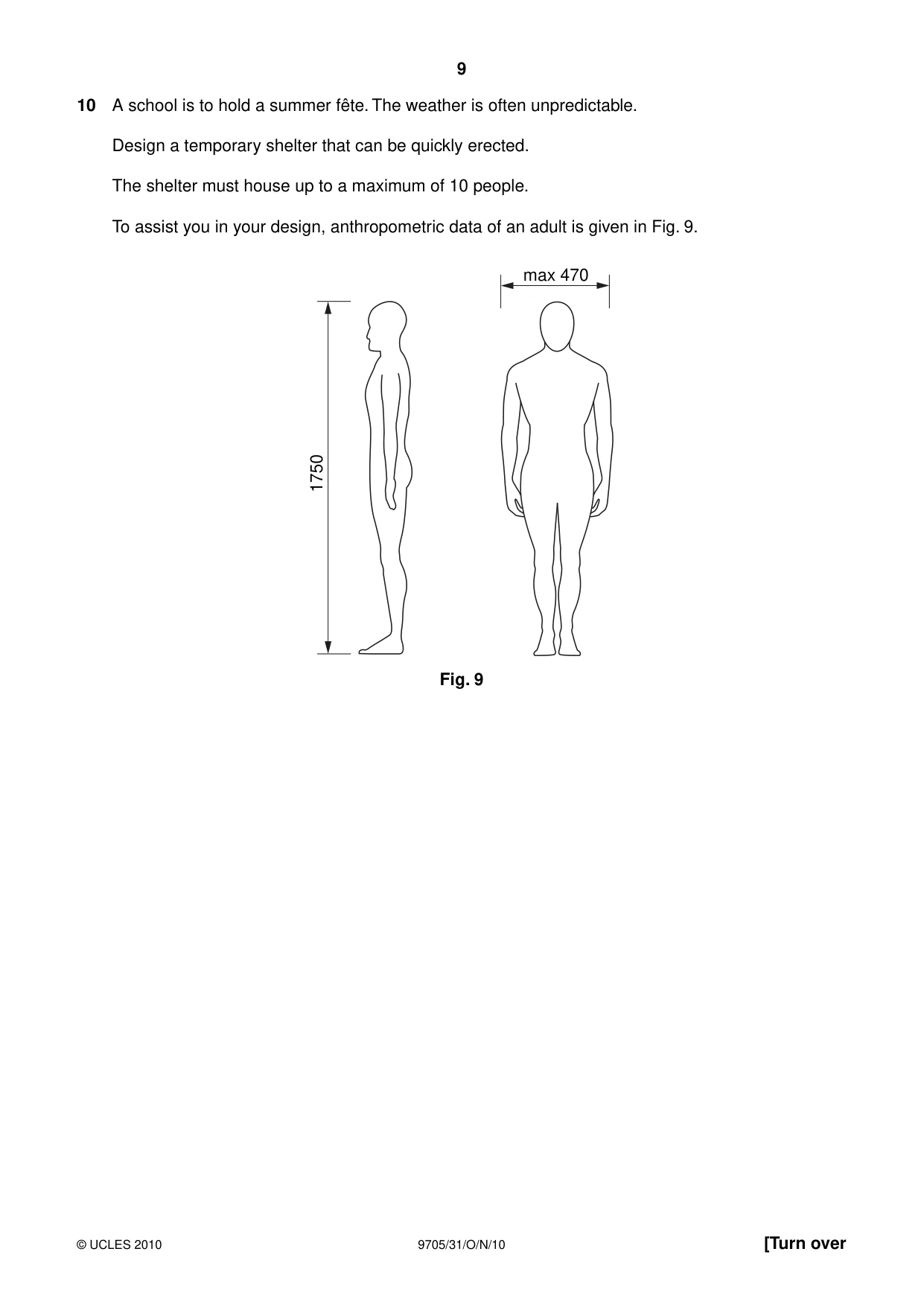
9 9705/31/O/N/10 © UCLES 2010 [Turn over 10 A school is to hold a summer fête. The weather is often unpredictable. Design a temporary shelter that can be quickly erected. The shelter must house up to a maximum of 10 people. To assist you in your design, anthropometric data of an adult is given in Fig. 9. 1750 max 470 Fig. 9
Question paper, page 10
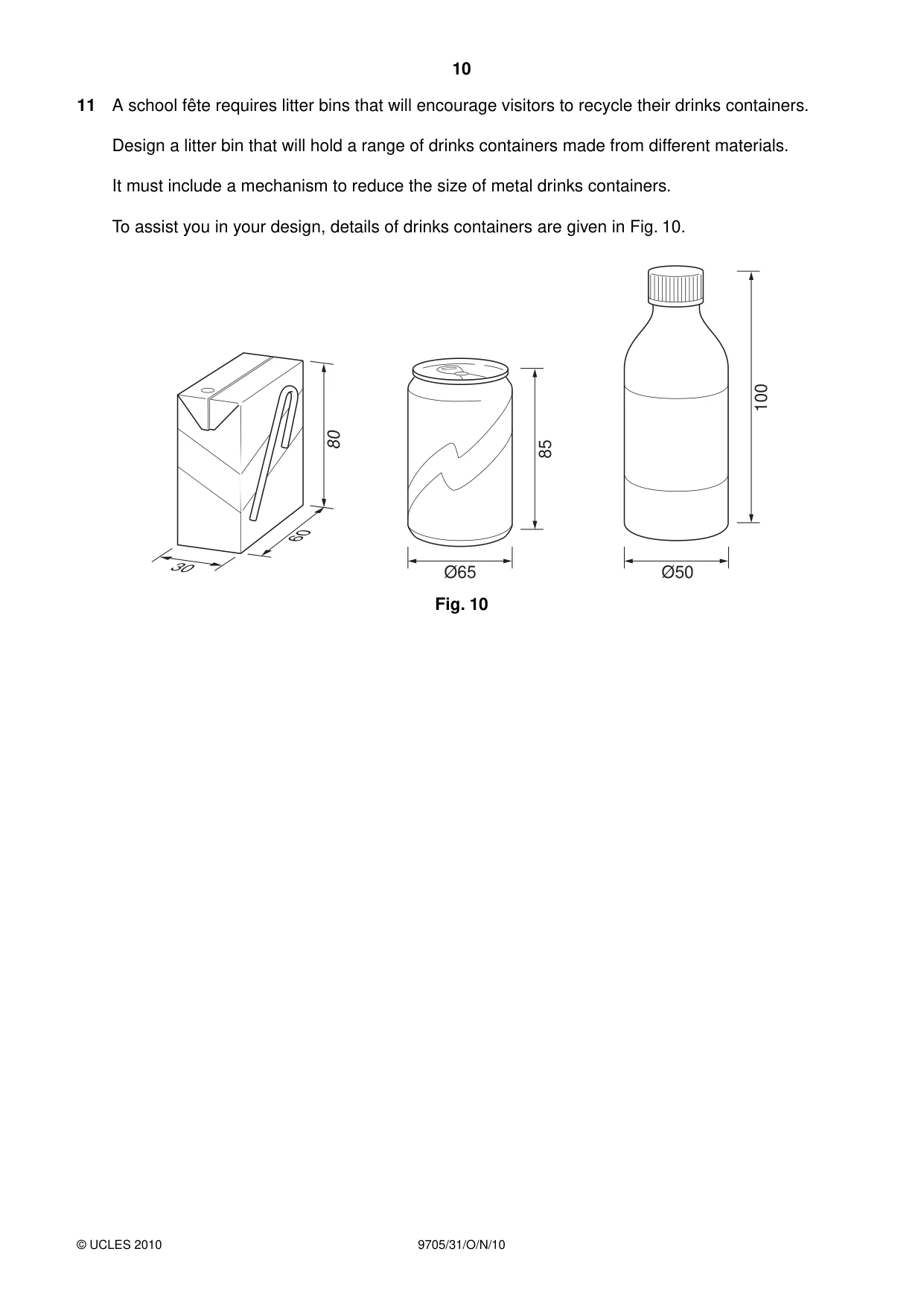
10 9705/31/O/N/10 © UCLES 2010 11 A school fête requires litter bins that will encourage visitors to recycle their drinks containers. Design a litter bin that will hold a range of drinks containers made from different materials. It must include a mechanism to reduce the size of metal drinks containers. To assist you in your design, details of drinks containers are given in Fig. 10. Ø50 Ø65 100 85 80 30 60 Fig. 10
Question paper, page 11
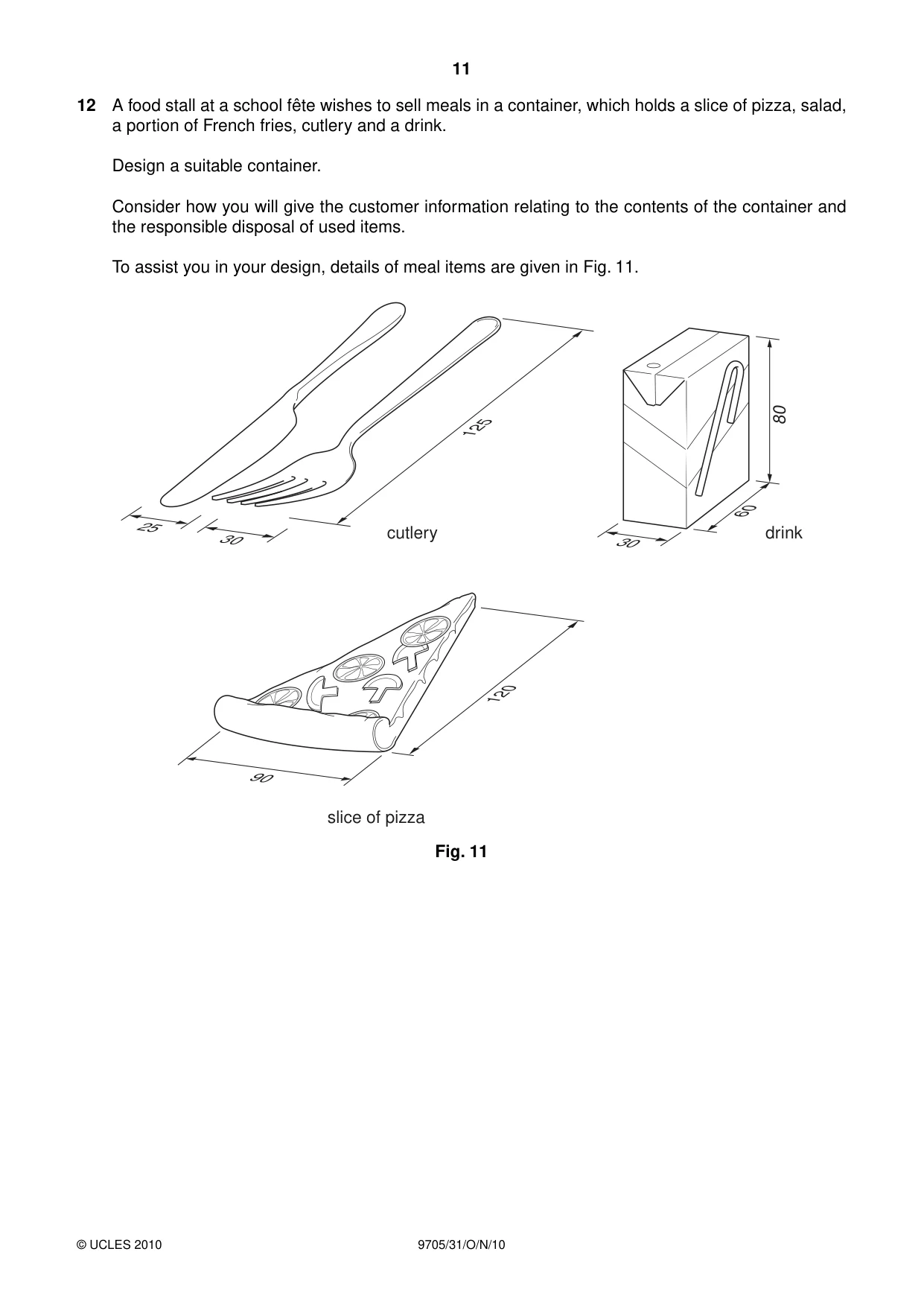
11 9705/31/O/N/10 © UCLES 2010 12 A food stall at a school fête wishes to sell meals in a container, which holds a slice of pizza, salad, a portion of French fries, cutlery and a drink. Design a suitable container. Consider how you will give the customer information relating to the contents of the container and the responsible disposal of used items. To assist you in your design, details of meal items are given in Fig. 11. 80 30 30 25 90 60 120 125 drink cutlery slice of pizza Fig. 11
Question paper, page 12
12 9705/31/O/N/10 © UCLES 2010 BLANK PAGE Permission to reproduce items where third-party owned material protected by copyright is included has been sought and cleared where possible. Every reasonable effort has been made by the publisher (UCLES) to trace copyright holders, but if any items requiring clearance have unwittingly been included, the publisher will be pleased to make amends at the earliest possible opportunity. University of Cambridge International Examinations is part of the Cambridge Assessment Group. Cambridge Assessment is the brand name of University of Cambridge Local Examinations Syndicate (UCLES), which is itself a department of the University of Cambridge.
Mark scheme, page 1
UNIVERSITY OF CAMBRIDGE INTERNATIONAL EXAMINATIONS GCE Advanced Subsidiary Level and GCE Advanced Level MARK SCHEME for the October/November 2010 question paper for the guidance of teachers 9705 DESIGN AND TECHNOLOGY 9705/31 Paper 3, maximum raw mark 120 This mark scheme is published as an aid to teachers and candidates, to indicate the requirements of the examination. It shows the basis on which Examiners were instructed to award marks. It does not indicate the details of the discussions that took place at an Examiners’ meeting before marking began, which would have considered the acceptability of alternative answers. Mark schemes must be read in conjunction with the question papers and the report on the examination. • CIE will not enter into discussions or correspondence in connection with these mark schemes. CIE is publishing the mark schemes for the October/November 2010 question papers for most IGCSE, GCE Advanced Level and Advanced Subsidiary Level syllabuses and some Ordinary Level syllabuses.
Mark scheme, page 2
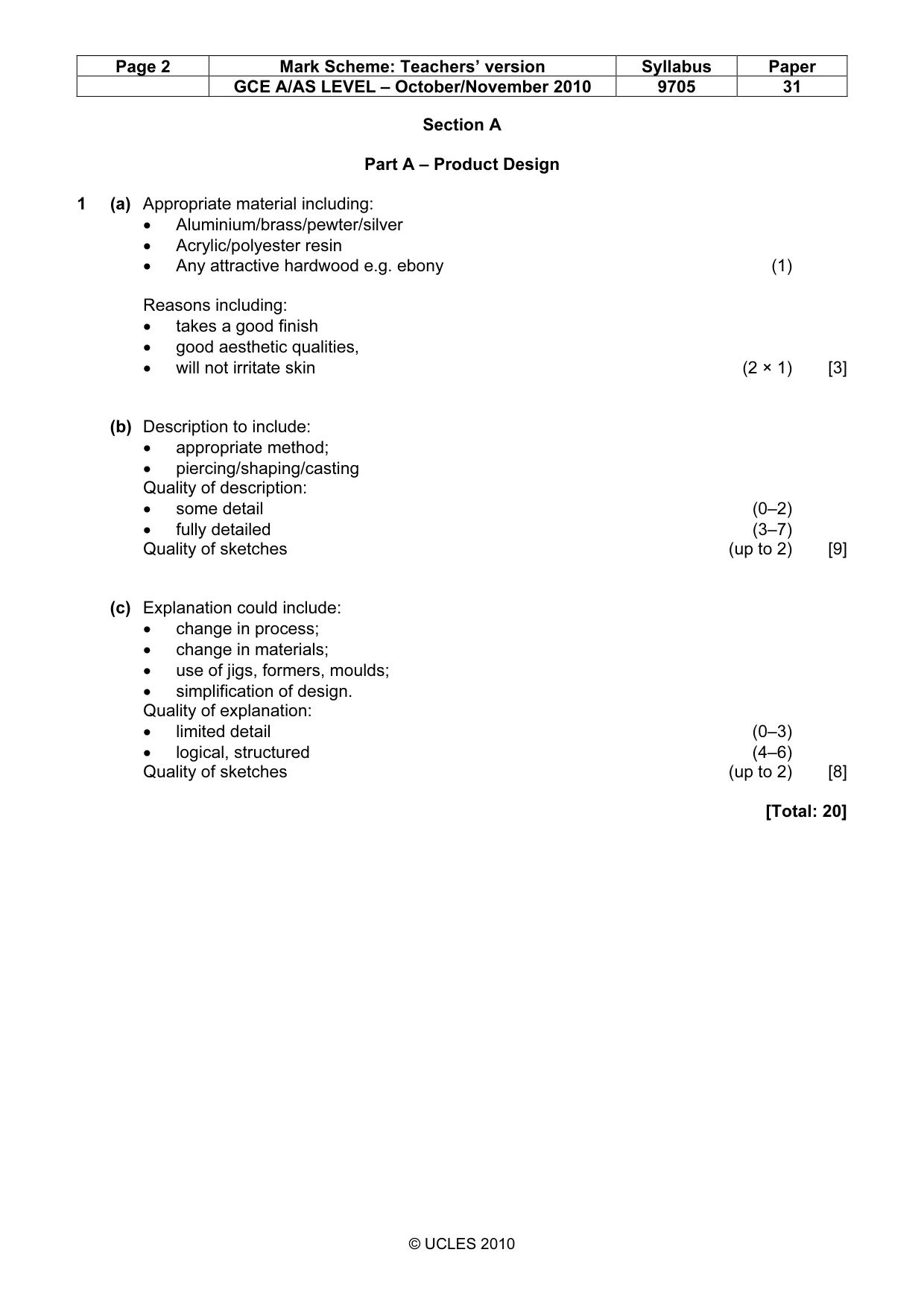
Page 2 Mark Scheme: Teachers’ version Syllabus Paper GCE A/AS LEVEL – October/November 2010 9705 31 © UCLES 2010 Section A Part A – Product Design 1 (a) Appropriate material including: • Aluminium/brass/pewter/silver • Acrylic/polyester resin • Any attractive hardwood e.g. ebony (1) Reasons including: • takes a good finish • good aesthetic qualities, • will not irritate skin (2 × 1) [3] (b) Description to include: • appropriate method; • piercing/shaping/casting Quality of description: • some detail (0–2) • fully detailed (3–7) Quality of sketches (up to 2) [9] (c) Explanation could include: • change in process; • change in materials; • use of jigs, formers, moulds; • simplification of design. Quality of explanation: • limited detail (0–3) • logical, structured (4–6) Quality of sketches (up to 2) [8] [Total: 20]
Mark scheme, page 3
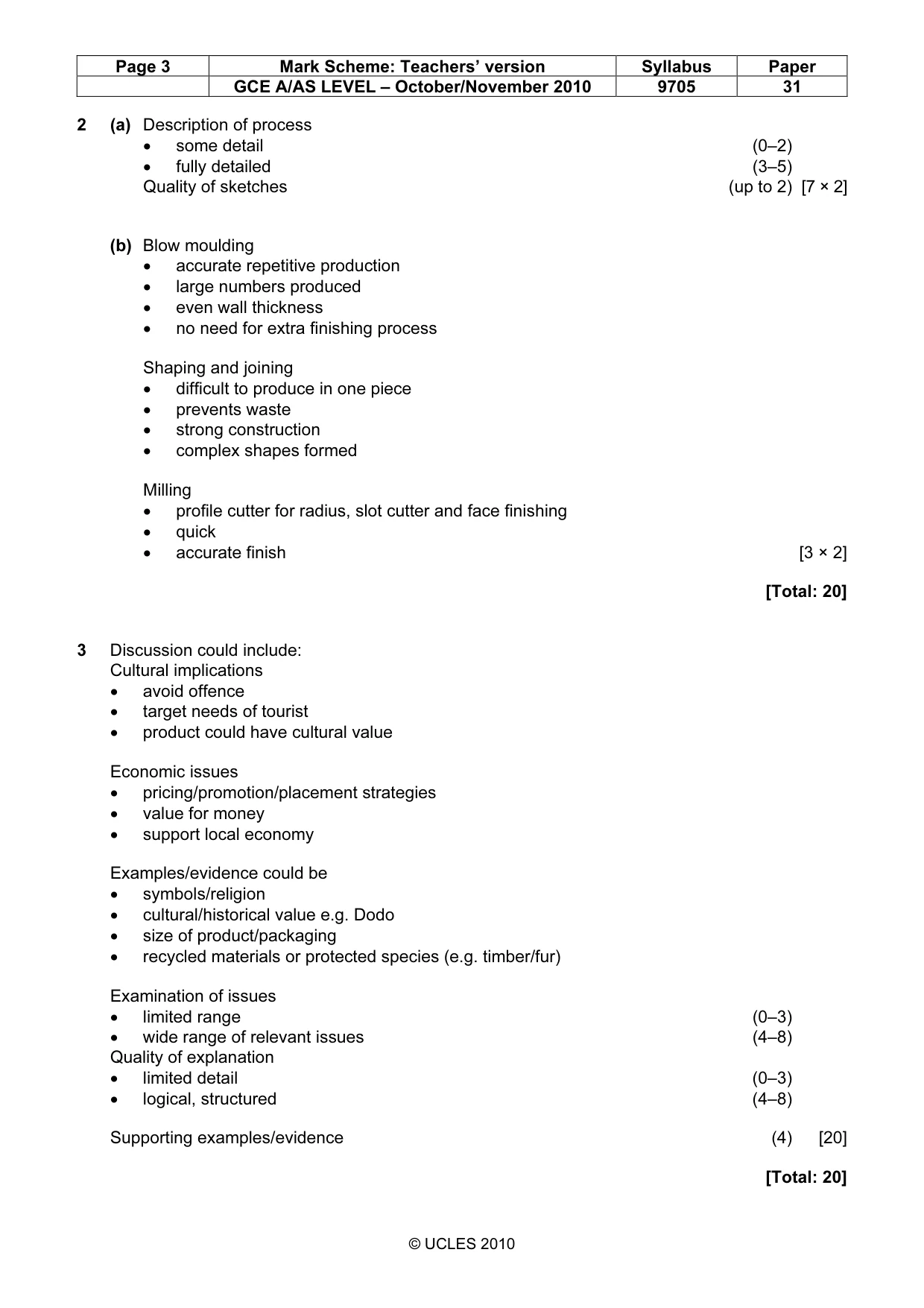
Page 3 Mark Scheme: Teachers’ version Syllabus Paper GCE A/AS LEVEL – October/November 2010 9705 31 © UCLES 2010 2 (a) Description of process • some detail (0–2) • fully detailed (3–5) Quality of sketches (up to 2) [7 × 2] (b) Blow moulding • accurate repetitive production • large numbers produced • even wall thickness • no need for extra finishing process Shaping and joining • difficult to produce in one piece • prevents waste • strong construction • complex shapes formed Milling • profile cutter for radius, slot cutter and face finishing • quick • accurate finish [3 × 2] [Total: 20] 3 Discussion could include: Cultural implications • avoid offence • target needs of tourist • product could have cultural value Economic issues • pricing/promotion/placement strategies • value for money • support local economy Examples/evidence could be • symbols/religion • cultural/historical value e.g. Dodo • size of product/packaging • recycled materials or protected species (e.g. timber/fur) Examination of issues • limited range (0–3) • wide range of relevant issues (4–8) Quality of explanation • limited detail (0–3) • logical, structured (4–8) Supporting examples/evidence (4) [20] [Total: 20]
Mark scheme, page 4
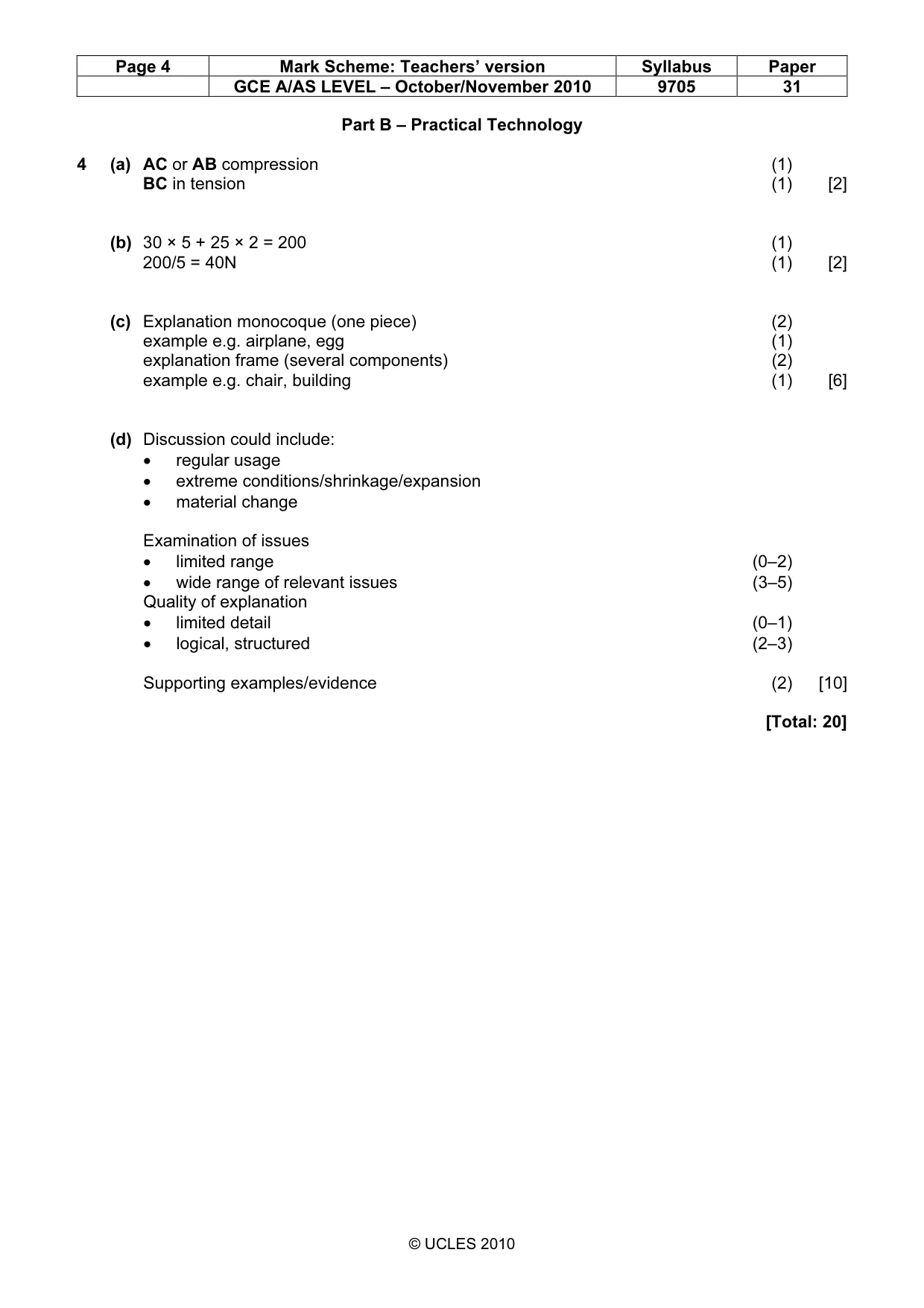
Page 4 Mark Scheme: Teachers’ version Syllabus Paper GCE A/AS LEVEL – October/November 2010 9705 31 © UCLES 2010 Part B – Practical Technology 4 (a) AC or AB compression (1) BC in tension (1) [2] (b) 30 × 5 + 25 × 2 = 200 (1) 200/5 = 40N (1) [2] (c) Explanation monocoque (one piece) (2) example e.g. airplane, egg (1) explanation frame (several components) (2) example e.g. chair, building (1) [6] (d) Discussion could include: • regular usage • extreme conditions/shrinkage/expansion • material change Examination of issues • limited range (0–2) • wide range of relevant issues (3–5) Quality of explanation • limited detail (0–1) • logical, structured (2–3) Supporting examples/evidence (2) [10] [Total: 20]
Mark scheme, page 5
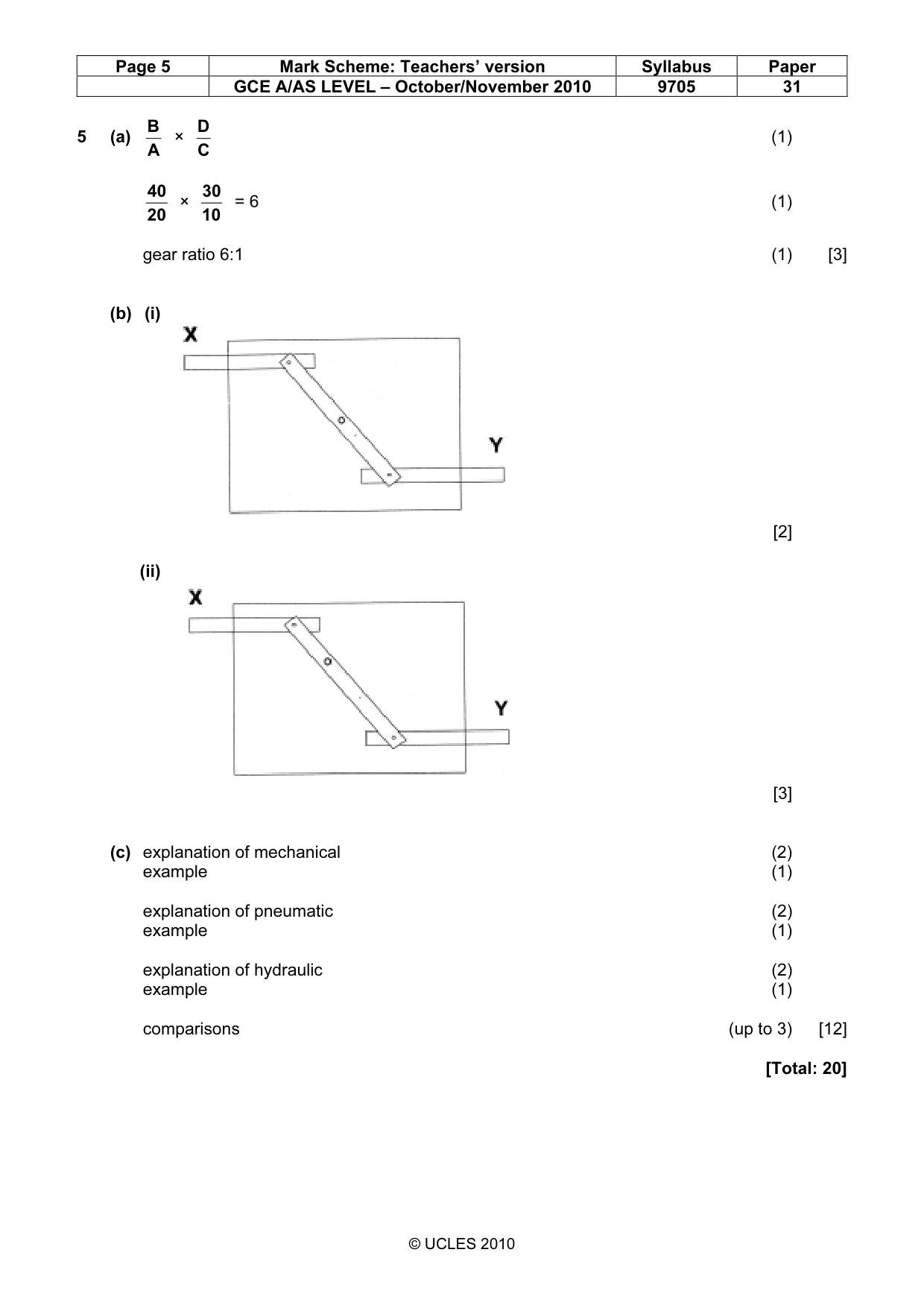
Page 5 Mark Scheme: Teachers’ version Syllabus Paper GCE A/AS LEVEL – October/November 2010 9705 31 © UCLES 2010 5 (a) A B × C D (1) 20 40 × 10 30 = 6 (1) gear ratio 6:1 (1) [3] (b) (i) [2] (ii) [3] (c) explanation of mechanical (2) example (1) explanation of pneumatic (2) example (1) explanation of hydraulic (2) example (1) comparisons (up to 3) [12] [Total: 20]
Mark scheme, page 6
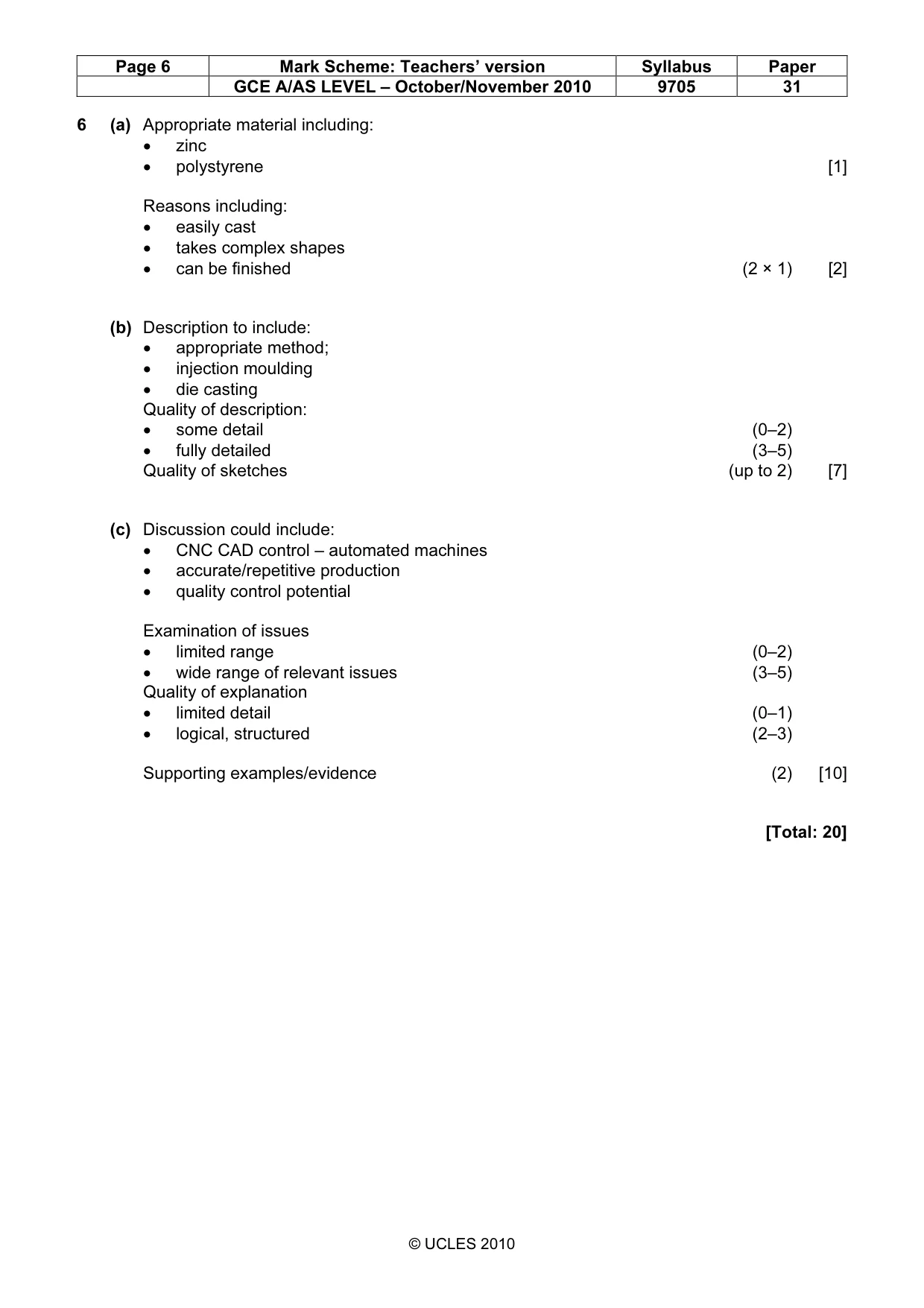
Page 6 Mark Scheme: Teachers’ version Syllabus Paper GCE A/AS LEVEL – October/November 2010 9705 31 © UCLES 2010 6 (a) Appropriate material including: • zinc • polystyrene [1] Reasons including: • easily cast • takes complex shapes • can be finished (2 × 1) [2] (b) Description to include: • appropriate method; • injection moulding • die casting Quality of description: • some detail (0–2) • fully detailed (3–5) Quality of sketches (up to 2) [7] (c) Discussion could include: • CNC CAD control – automated machines • accurate/repetitive production • quality control potential Examination of issues • limited range (0–2) • wide range of relevant issues (3–5) Quality of explanation • limited detail (0–1) • logical, structured (2–3) Supporting examples/evidence (2) [10] [Total: 20]
Mark scheme, page 7
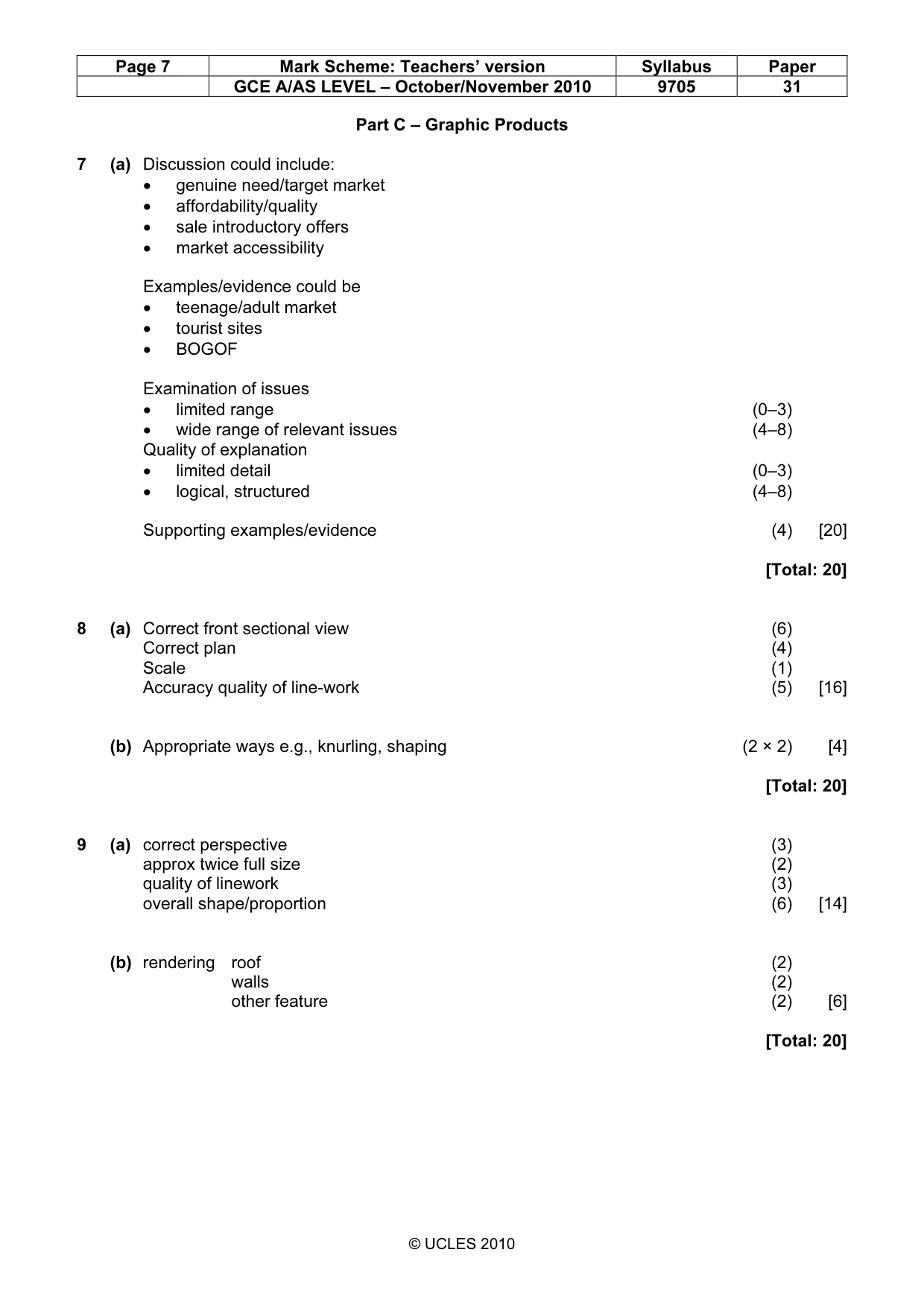
Page 7 Mark Scheme: Teachers’ version Syllabus Paper GCE A/AS LEVEL – October/November 2010 9705 31 © UCLES 2010 Part C – Graphic Products 7 (a) Discussion could include: • genuine need/target market • affordability/quality • sale introductory offers • market accessibility Examples/evidence could be • teenage/adult market • tourist sites • BOGOF Examination of issues • limited range (0–3) • wide range of relevant issues (4–8) Quality of explanation • limited detail (0–3) • logical, structured (4–8) Supporting examples/evidence (4) [20] [Total: 20] 8 (a) Correct front sectional view (6) Correct plan (4) Scale (1) Accuracy quality of line-work (5) [16] (b) Appropriate ways e.g., knurling, shaping (2 × 2) [4] [Total: 20] 9 (a) correct perspective (3) approx twice full size (2) quality of linework (3) overall shape/proportion (6) [14] (b) rendering roof (2) walls (2) other feature (2) [6] [Total: 20]
What you needed in this session
Cambridge’s own grade thresholds for 2010 Oct/Nov, Paper 3 · Variant 1. A higher threshold means an easier paper — the bar moves with how the cohort did.