Cambridge A Level Computer Science 9618 — 2024 May/June Paper 1 · Variant 1
9618/11/M/J/24 · 75 marks · ≈84 min
The question paper and its mark scheme, free to read here and free to download. This is Cambridge’s own paper, exactly as it was sat.
Question paper16 pages



Mark scheme8 pages
Answers below. Sit the paper first if you are practising.
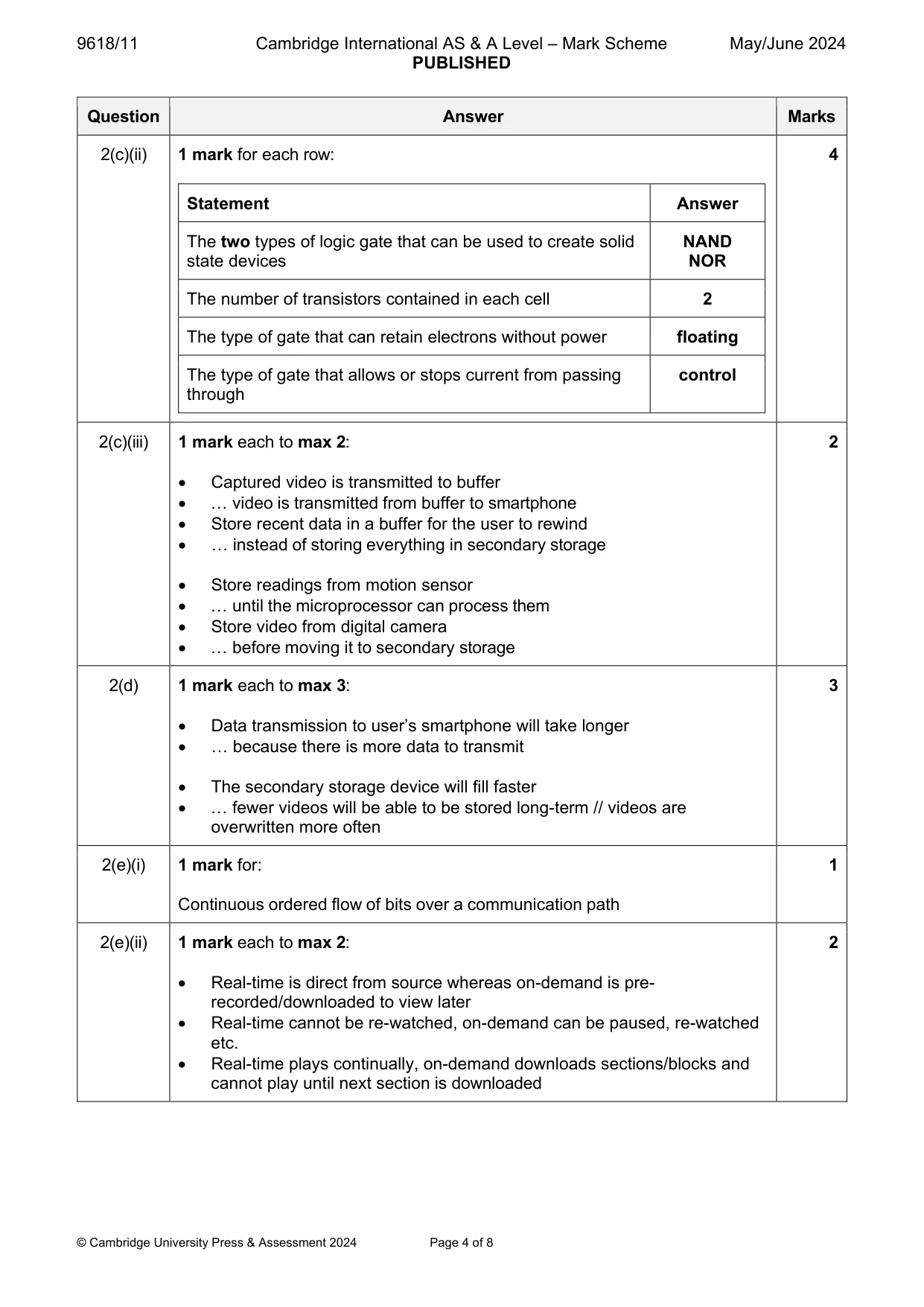
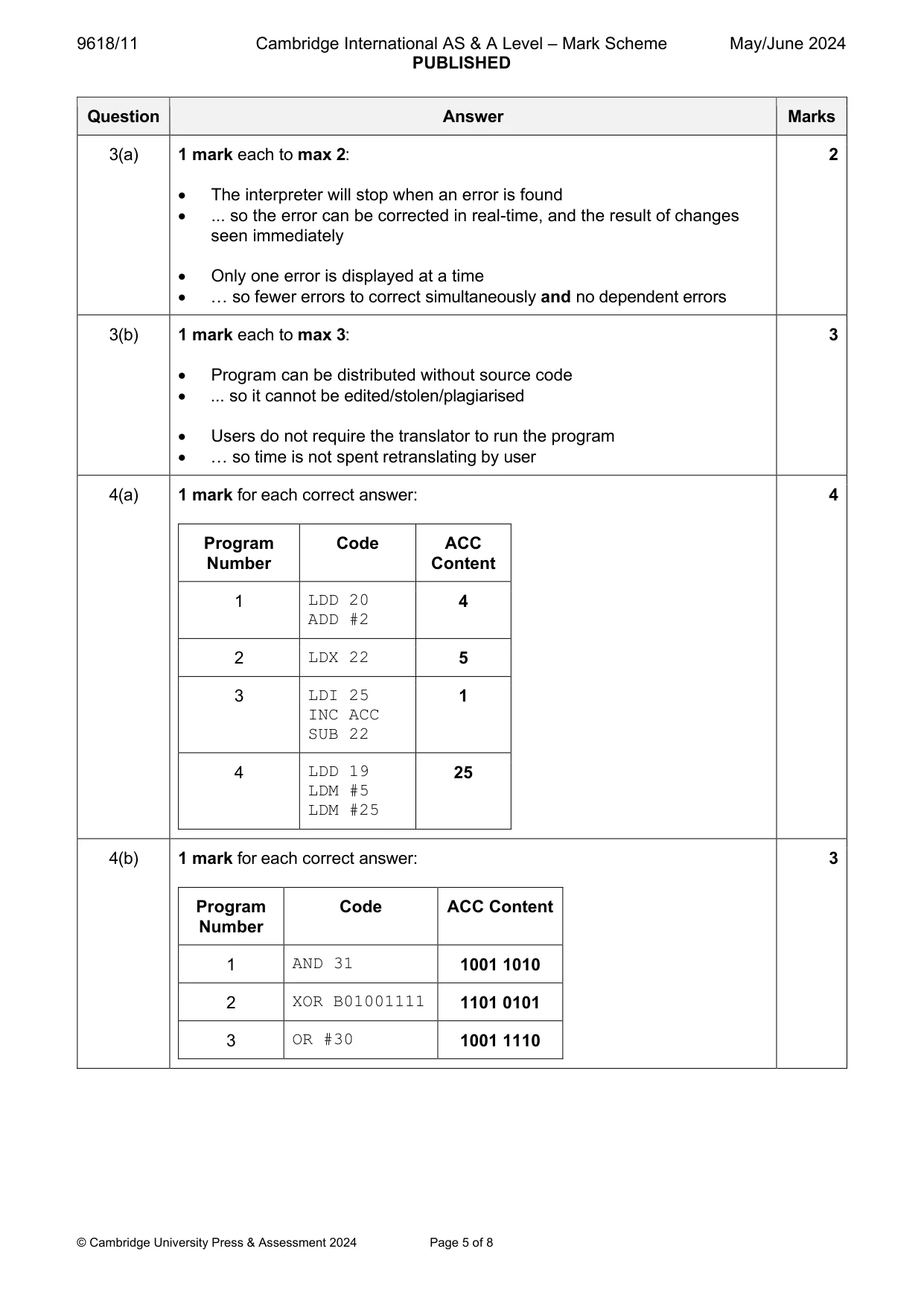
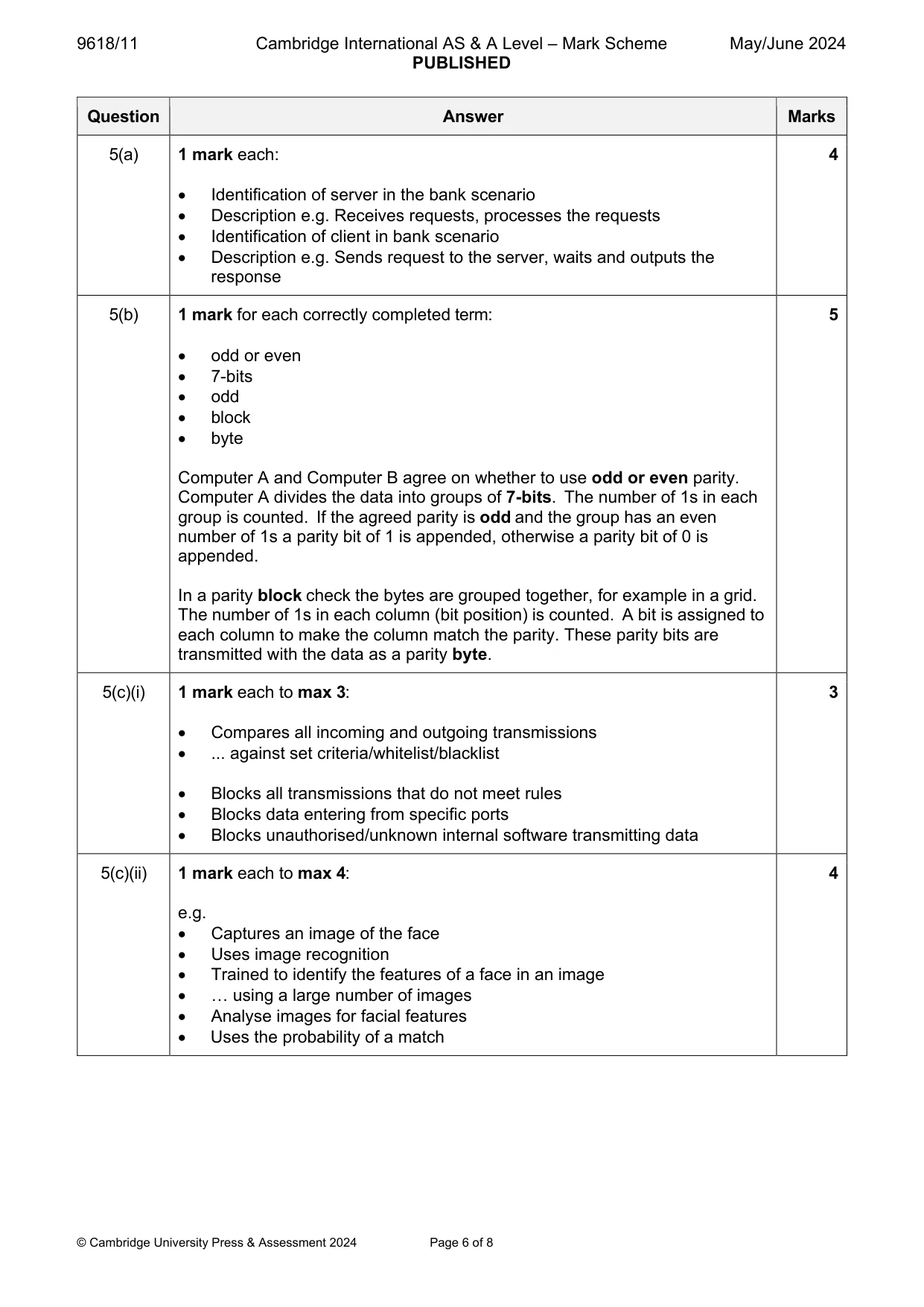
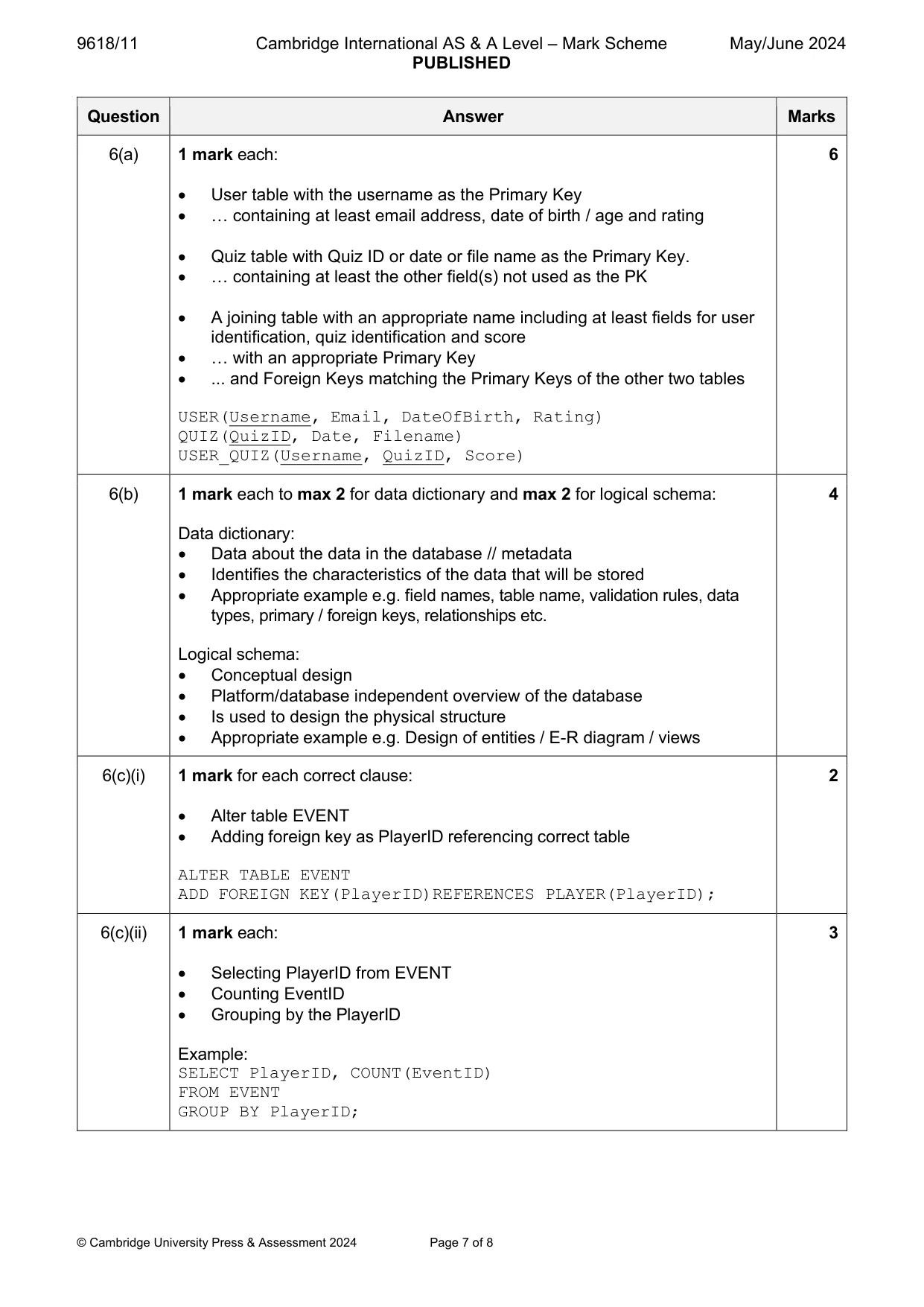
Paper as text
Question paper, page 1
This document has 16 pages. Any blank pages are indicated. [Turn over * 1 2 6 0 4 7 3 9 2 9 * Cambridge International AS & A Level COMPUTER SCIENCE 9618/11 Paper 1 Theory Fundamentals May/June 2024 1 hour 30 minutes You must answer on the question paper. No additional materials are needed. INSTRUCTIONS ● Answer all questions. ● Use a black or dark blue pen. ● Write your name, centre number and candidate number in the boxes at the top of the page. ● Write your answer to each question in the space provided. ● Do not use an erasable pen or correction fluid. ● Do not write on any bar codes. ● You may use an HB pencil for any diagrams, graphs or rough working. ● Calculators must not be used in this paper. INFORMATION ● The total mark for this paper is 75. ● The number of marks for each question or part question is shown in brackets [ ]. ● No marks will be awarded for using brand names of software packages or hardware. DC (DE/SG) 329372/2 © UCLES 2024
Question paper, page 2
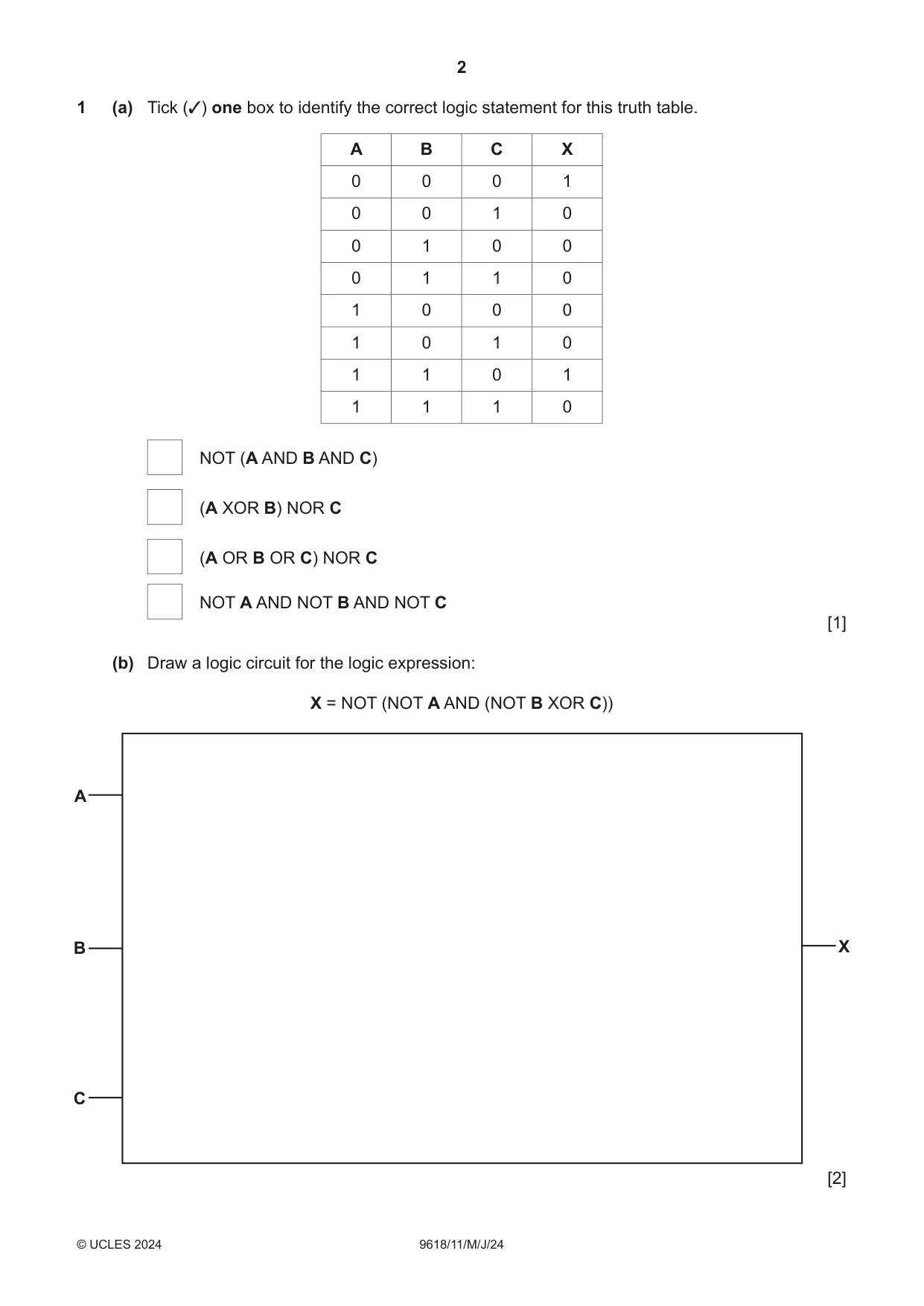
2 9618/11/M/J/24 © UCLES 2024 1 (a) Tick (✓) one box to identify the correct logic statement for this truth table. A B C X 0 0 0 1 0 0 1 0 0 1 0 0 0 1 1 0 1 0 0 0 1 0 1 0 1 1 0 1 1 1 1 0 NOT (A AND B AND C) (A XOR B) NOR C (A OR B OR C) NOR C NOT A AND NOT B AND NOT C [1] (b) Draw a logic circuit for the logic expression: X = NOT (NOT A AND (NOT B XOR C)) A X B C [2]
Question paper, page 3
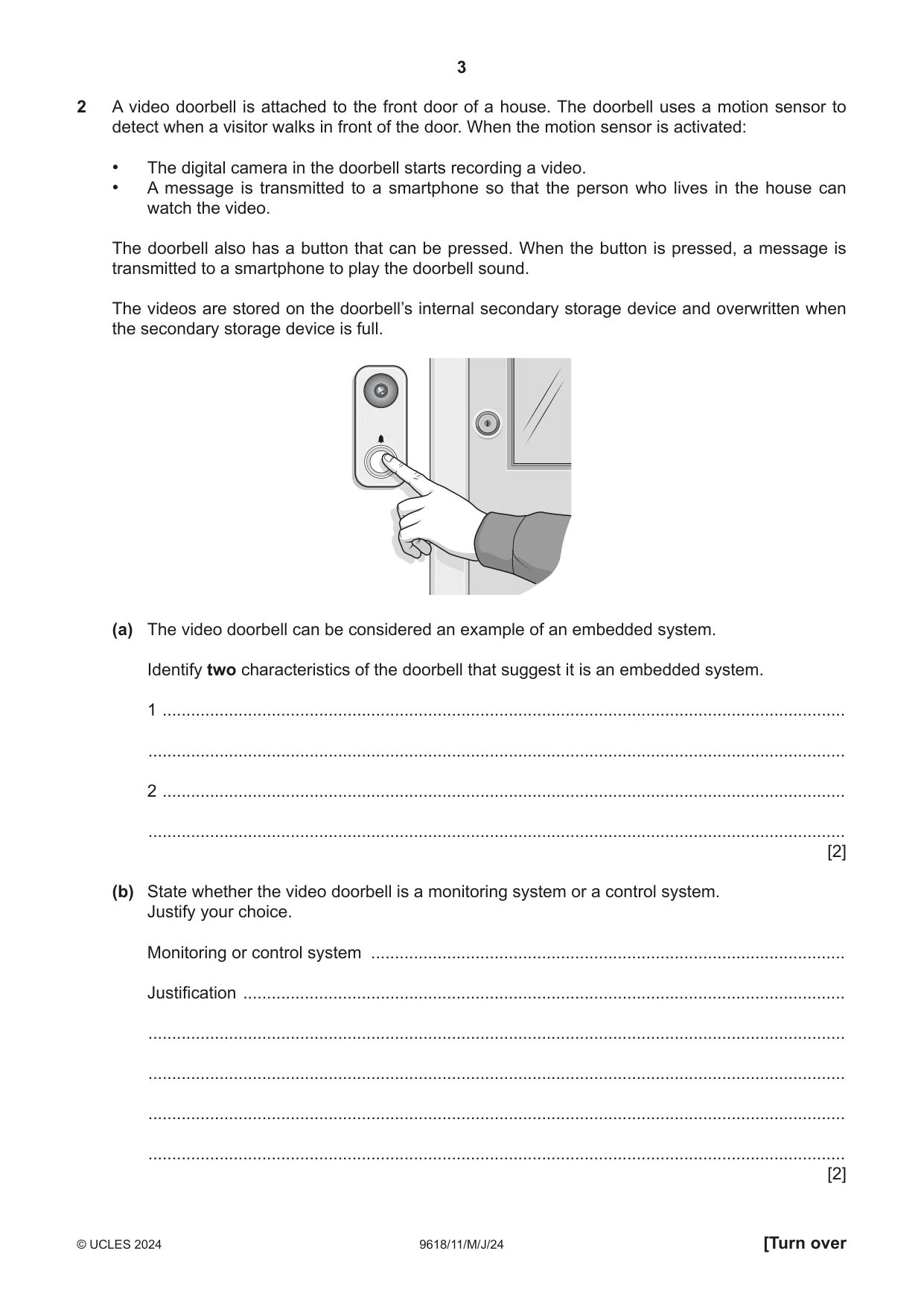
3 9618/11/ M/J/24 © UCLES 2024 [Turn over 2 A video doorbell is attached to the front door of a house. The doorbell uses a motion sensor to detect when a visitor walks in front of the door. When the motion sensor is activated: • The digital camera in the doorbell starts recording a video. • A message is transmitted to a smartphone so that the person who lives in the house can watch the video. The doorbell also has a button that can be pressed. When the button is pressed, a message is transmitted to a smartphone to play the doorbell sound. The videos are stored on the doorbell’s internal secondary storage device and overwritten when the secondary storage device is full. (a) The video doorbell can be considered an example of an embedded system. Identify two characteristics of the doorbell that suggest it is an embedded system. 1 … … 2 … … [2] (b) State whether the video doorbell is a monitoring system or a control system. Justify your choice. Monitoring or control system … Justification … … … … … [2]
Question paper, page 4
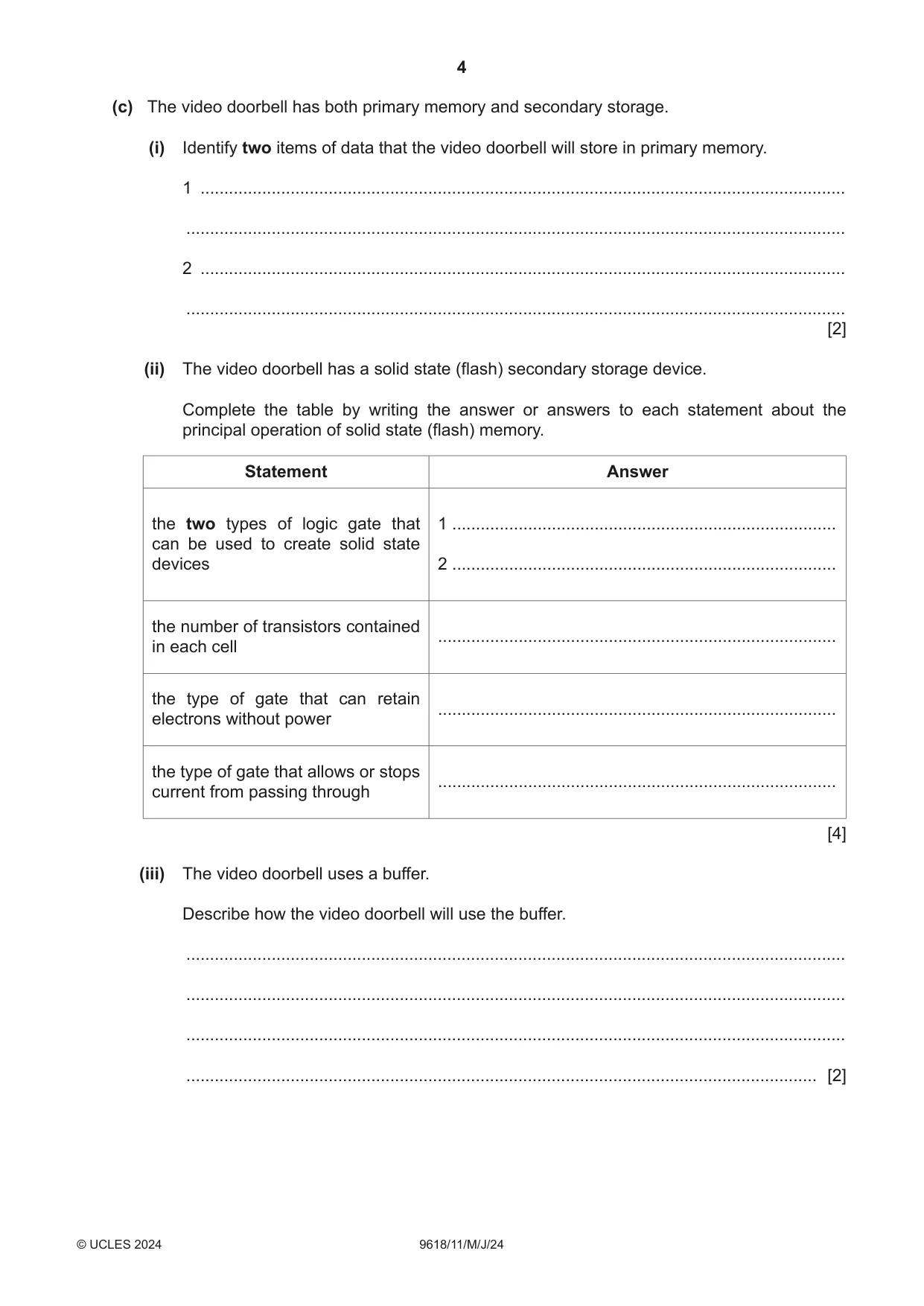
4 9618/11/M/J/24 © UCLES 2024 (c) The video doorbell has both primary memory and secondary storage. (i) Identify two items of data that the video doorbell will store in primary memory. 1 … … 2 … … [2] (ii) The video doorbell has a solid state (flash) secondary storage device. Complete the table by writing the answer or answers to each statement about the principal operation of solid state (flash) memory. Statement Answer the two types of logic gate that can be used to create solid state devices 1 … 2 … the number of transistors contained in each cell … the type of gate that can retain electrons without power … the type of gate that allows or stops current from passing through … [4] (iii) The video doorbell uses a buffer. Describe how the video doorbell will use the buffer. … … … … [2]
Question paper, page 5
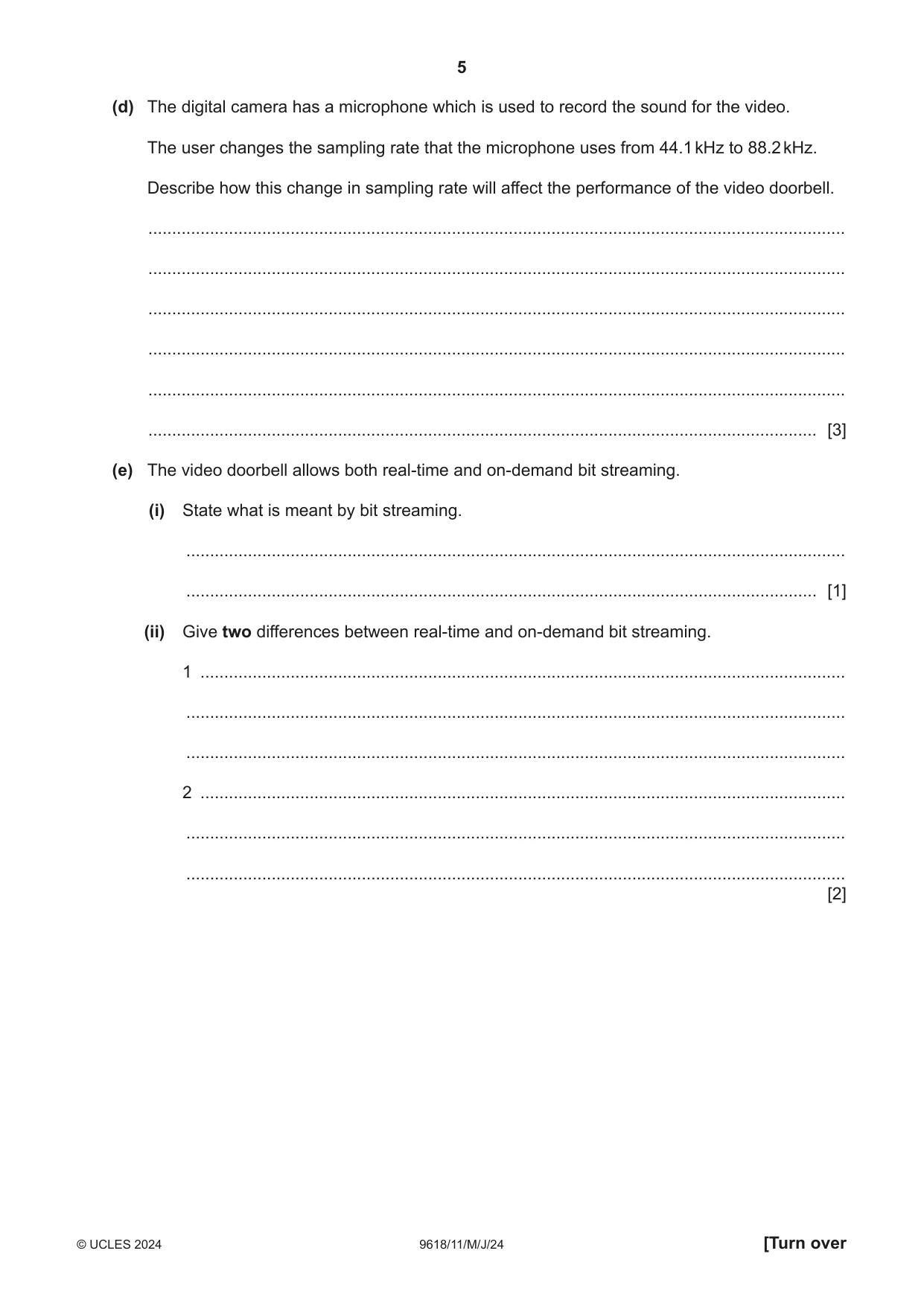
5 9618/11/M/J/24 © UCLES 2024 [Turn over (d) The digital camera has a microphone which is used to record the sound for the video. The user changes the sampling rate that the microphone uses from 44.1 kHz to 88.2 kHz. Describe how this change in sampling rate will affect the performance of the video doorbell. … … … … … … [3] (e) The video doorbell allows both real-time and on-demand bit streaming. (i) State what is meant by bit streaming. … … [1] (ii) Give two differences between real-time and on-demand bit streaming. 1 … … … 2 … … … [2]
Question paper, page 6
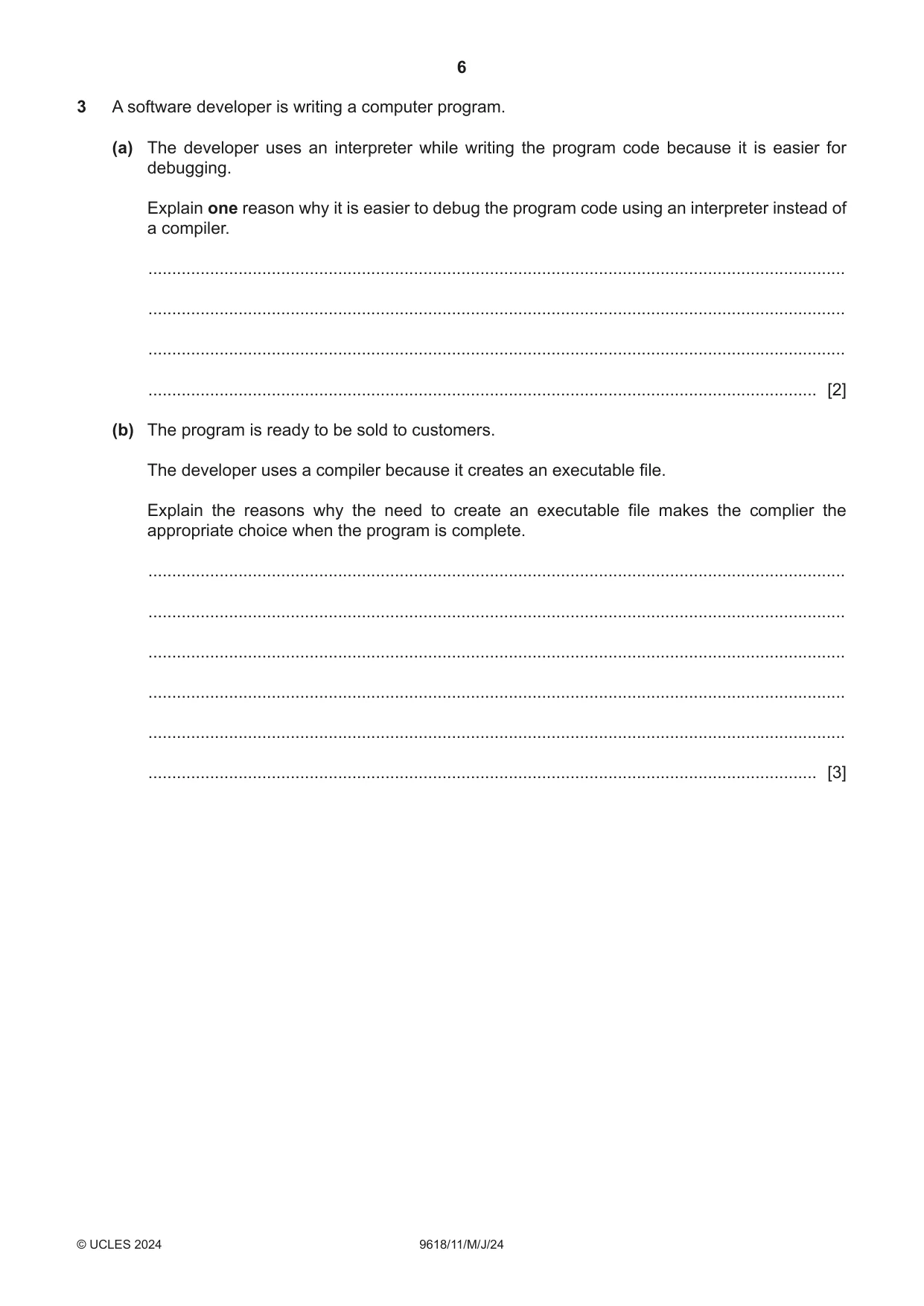
6 9618/11/M/J/24 © UCLES 2024 3 A software developer is writing a computer program. (a) The developer uses an interpreter while writing the program code because it is easier for debugging. Explain one reason why it is easier to debug the program code using an interpreter instead of a compiler. … … … … [2] (b) The program is ready to be sold to customers. The developer uses a compiler because it creates an executable file. Explain the reasons why the need to create an executable file makes the complier the appropriate choice when the program is complete. … … … … … … [3]
Question paper, page 7
7 9618/11/M/J/24 © UCLES 2024 [Turn over BLANK PAGE
Question paper, page 8
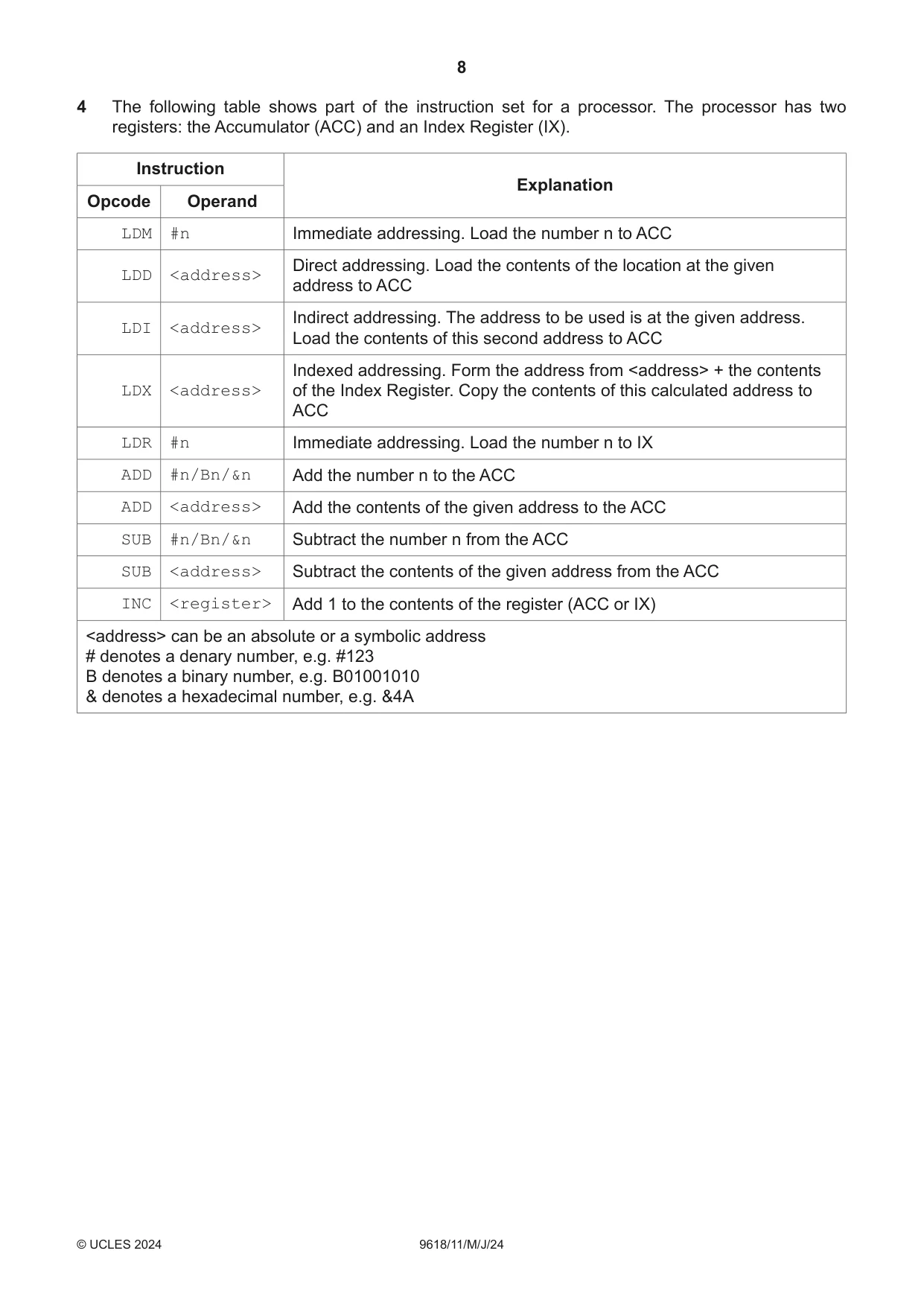
8 9618/11/M/J/24 © UCLES 2024 4 The following table shows part of the instruction set for a processor. The processor has two registers: the Accumulator (ACC) and an Index Register (IX). Instruction Explanation Opcode Operand LDM #n Immediate addressing. Load the number n to ACC LDD <address> Direct addressing. Load the contents of the location at the given address to ACC LDI <address> Indirect addressing. The address to be used is at the given address. Load the contents of this second address to ACC LDX <address> Indexed addressing. Form the address from <address> + the contents of the Index Register. Copy the contents of this calculated address to ACC LDR #n Immediate addressing. Load the number n to IX ADD #n/Bn/&n Add the number n to the ACC ADD <address> Add the contents of the given address to the ACC SUB #n/Bn/&n Subtract the number n from the ACC SUB <address> Subtract the contents of the given address from the ACC INC <register> Add 1 to the contents of the register (ACC or IX) <address> can be an absolute or a symbolic address # denotes a denary number, e.g. #123 B denotes a binary number, e.g. B01001010 & denotes a hexadecimal number, e.g. &4A
Question paper, page 9
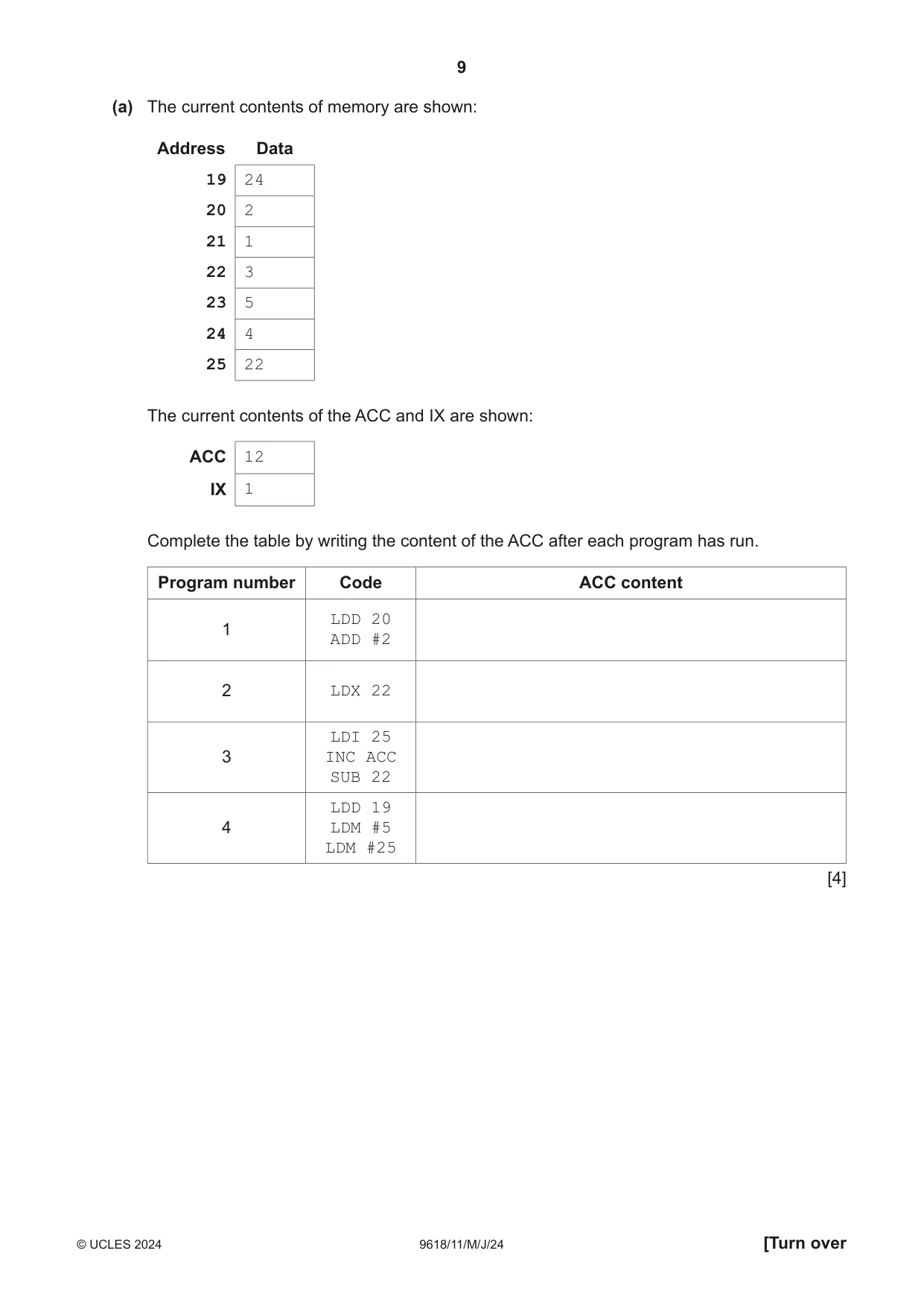
9 9618/11/M/J/24 © UCLES 2024 [Turn over (a) The current contents of memory are shown: Address Data 19 24 20 2 21 1 22 3 23 5 24 4 25 22 The current contents of the ACC and IX are shown: ACC 12 IX 1 Complete the table by writing the content of the ACC after each program has run. Program number Code ACC content 1 LDD 20 ADD #2 2 LDX 22 3 LDI 25 INC ACC SUB 22 4 LDD 19 LDM #5 LDM #25 [4]
Question paper, page 10
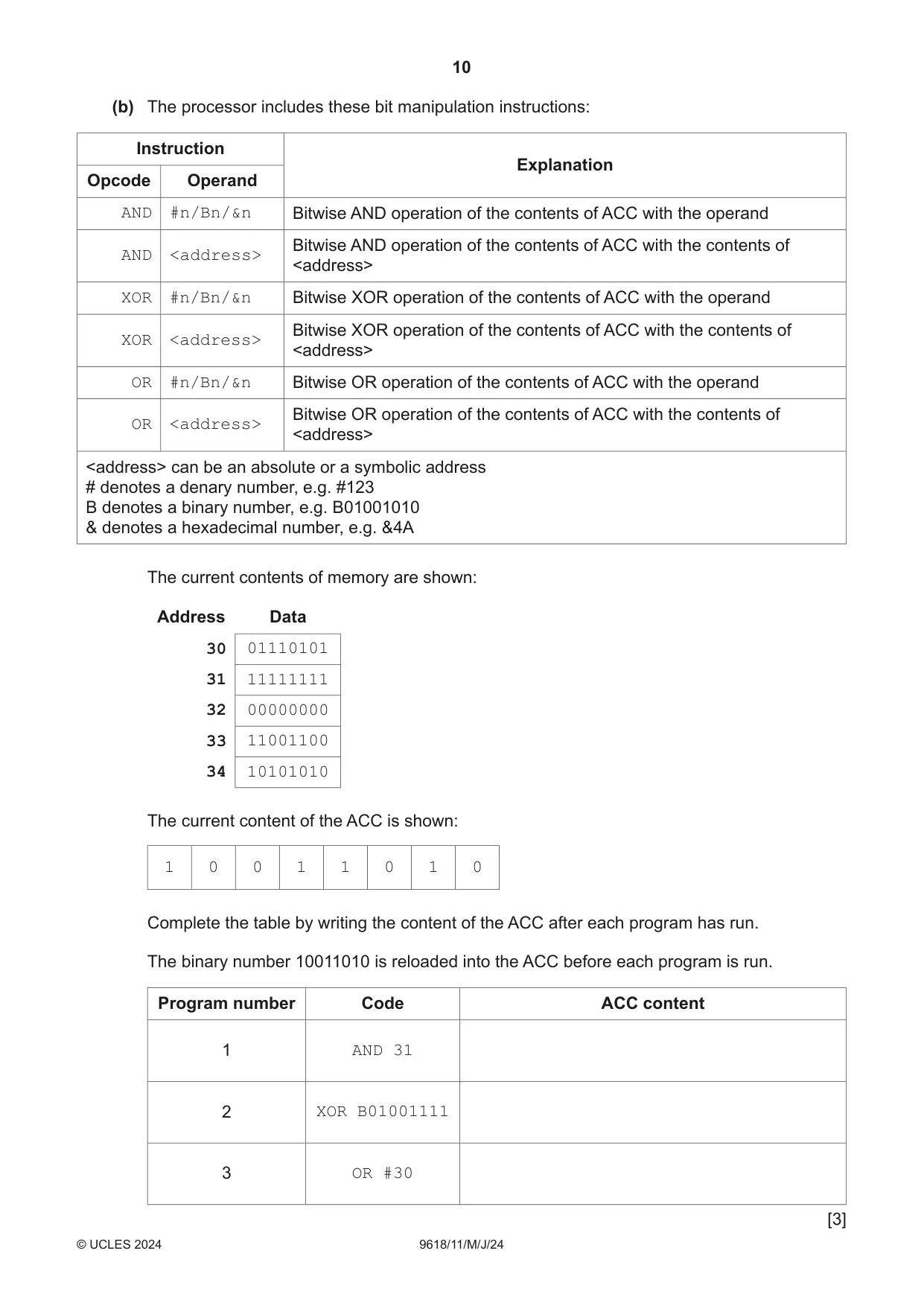
10 9618/11/M/J/24 © UCLES 2024 (b) The processor includes these bit manipulation instructions: Instruction Explanation Opcode Operand AND #n/Bn/&n Bitwise AND operation of the contents of ACC with the operand AND <address> Bitwise AND operation of the contents of ACC with the contents of <address> XOR #n/Bn/&n Bitwise XOR operation of the contents of ACC with the operand XOR <address> Bitwise XOR operation of the contents of ACC with the contents of <address> OR #n/Bn/&n Bitwise OR operation of the contents of ACC with the operand OR <address> Bitwise OR operation of the contents of ACC with the contents of <address> <address> can be an absolute or a symbolic address # denotes a denary number, e.g. #123 B denotes a binary number, e.g. B01001010 & denotes a hexadecimal number, e.g. &4A The current contents of memory are shown: Address Data 30 01110101 31 11111111 32 00000000 33 11001100 34 10101010 The current content of the ACC is shown: 1 0 0 1 1 0 1 0 Complete the table by writing the content of the ACC after each program has run. The binary number 10011010 is reloaded into the ACC before each program is run. Program number Code ACC content 1 AND 31 2 XOR B01001111 3 OR #30 [3]
Question paper, page 11
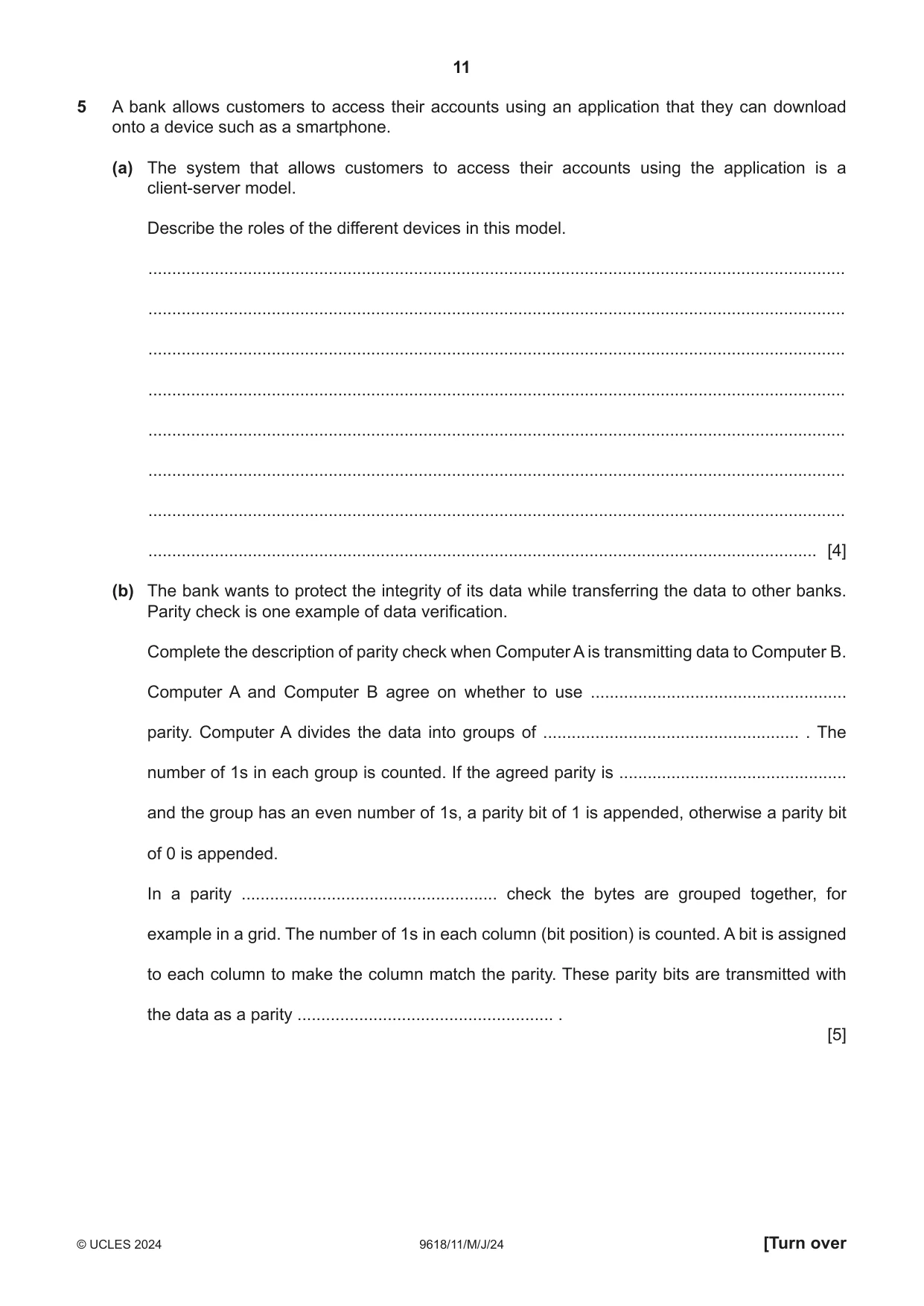
11 9618/11/M/J/24 © UCLES 2024 [Turn over 5 A bank allows customers to access their accounts using an application that they can download onto a device such as a smartphone. (a) The system that allows customers to access their accounts using the application is a client-server model. Describe the roles of the different devices in this model. … … … … … … … … [4] (b) The bank wants to protect the integrity of its data while transferring the data to other banks. Parity check is one example of data verification. Complete the description of parity check when Computer A is transmitting data to Computer B. Computer A and Computer B agree on whether to use … parity. Computer A divides the data into groups of … . The number of 1s in each group is counted. If the agreed parity is … and the group has an even number of 1s, a parity bit of 1 is appended, otherwise a parity bit of 0 is appended. In a parity … check the bytes are grouped together, for example in a grid. The number of 1s in each column (bit position) is counted. A bit is assigned to each column to make the column match the parity. These parity bits are transmitted with the data as a parity … . [5]
Question paper, page 12
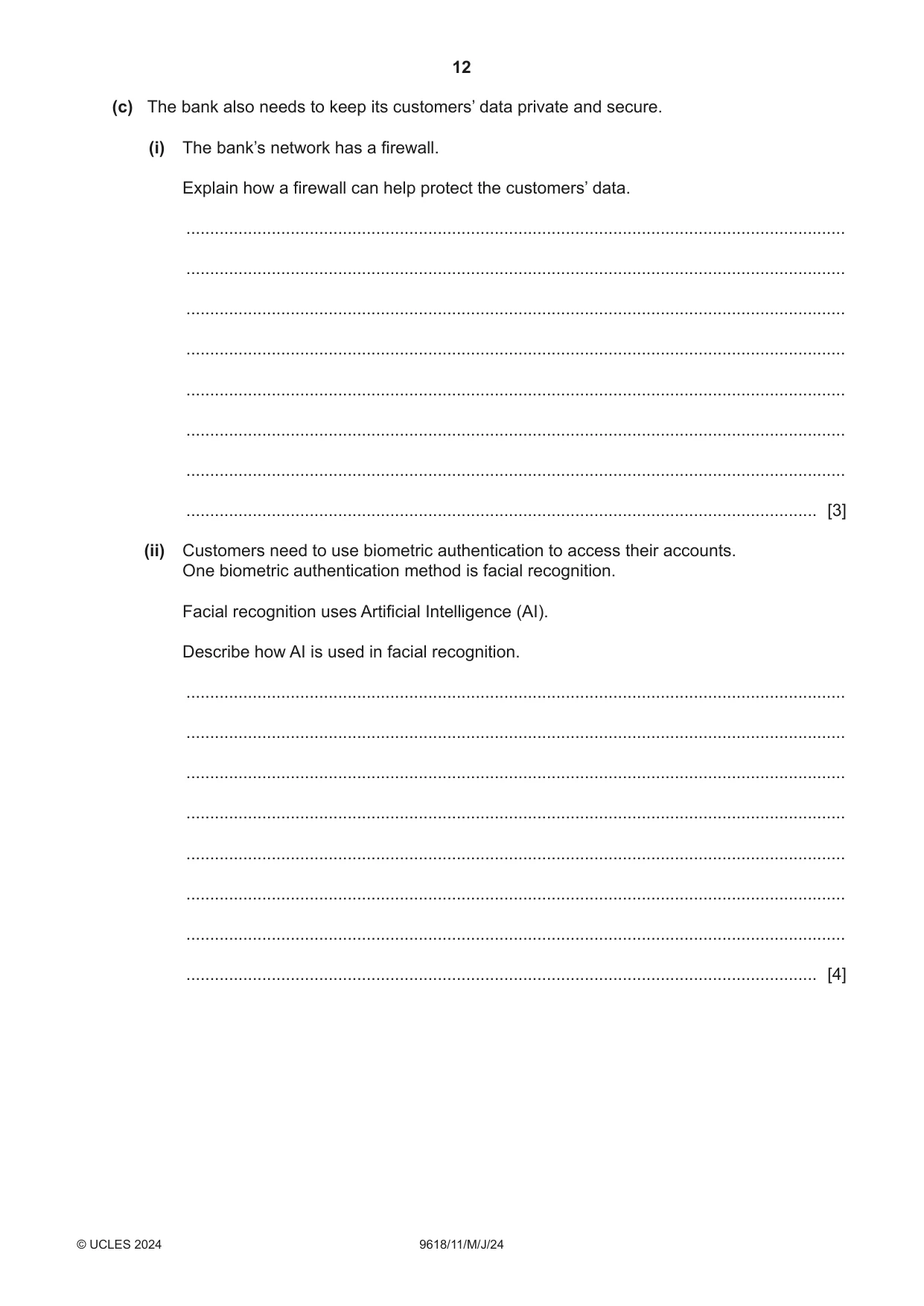
12 9618/11/M/J/24 © UCLES 2024 (c) The bank also needs to keep its customers’ data private and secure. (i) The bank’s network has a firewall. Explain how a firewall can help protect the customers’ data. … … … … … … … … [3] (ii) Customers need to use biometric authentication to access their accounts. One biometric authentication method is facial recognition. Facial recognition uses Artificial Intelligence (AI). Describe how AI is used in facial recognition. … … … … … … … … [4]
Question paper, page 13
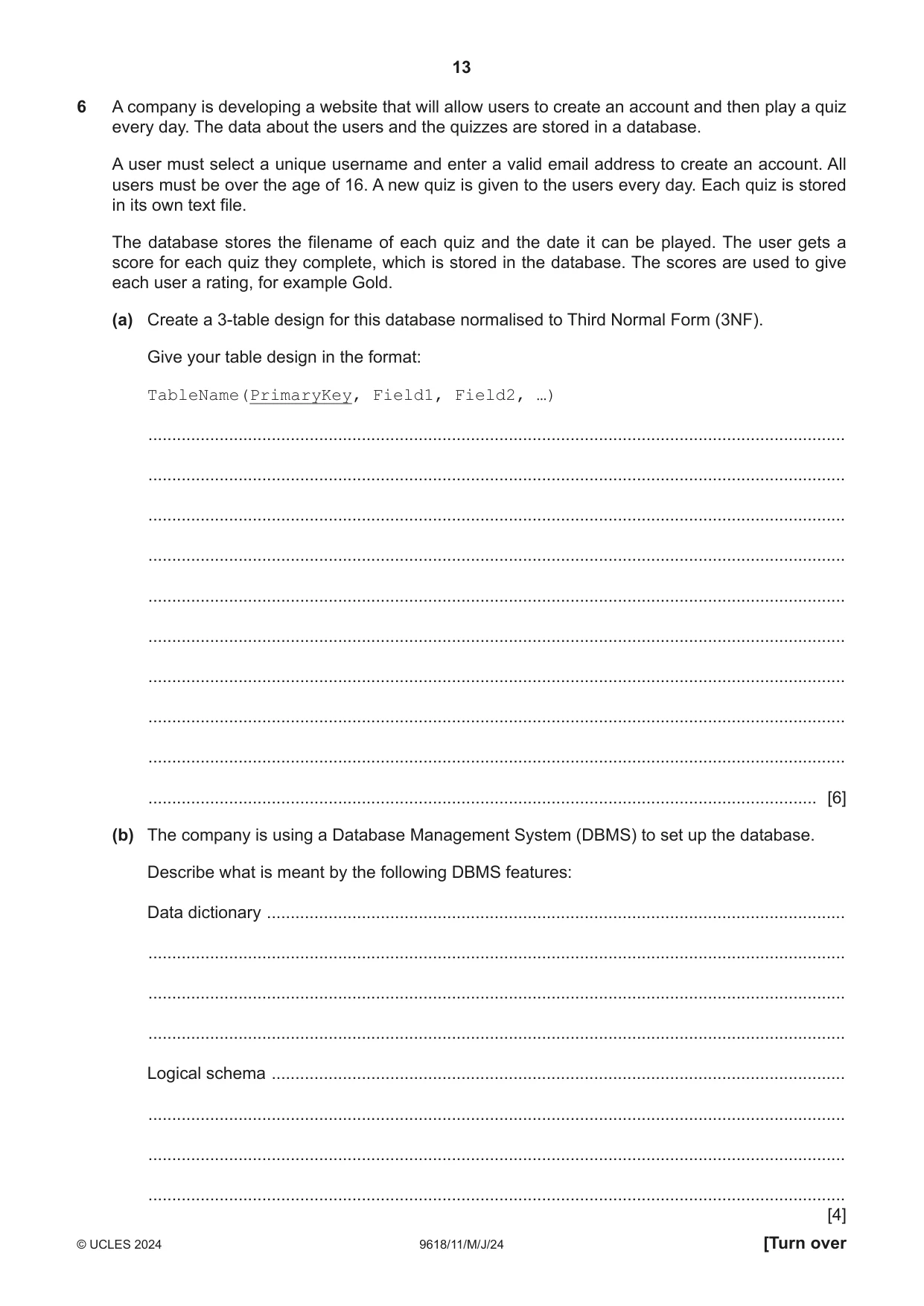
13 9618/11/M/J/24 © UCLES 2024 [Turn over 6 A company is developing a website that will allow users to create an account and then play a quiz every day. The data about the users and the quizzes are stored in a database. A user must select a unique username and enter a valid email address to create an account. All users must be over the age of 16. A new quiz is given to the users every day. Each quiz is stored in its own text file. The database stores the filename of each quiz and the date it can be played. The user gets a score for each quiz they complete, which is stored in the database. The scores are used to give each user a rating, for example Gold. (a) Create a 3-table design for this database normalised to Third Normal Form (3NF). Give your table design in the format: TableName(PrimaryKey, Field1, Field2, …) … … … … … … … … … … [6] (b) The company is using a Database Management System (DBMS) to set up the database. Describe what is meant by the following DBMS features: Data dictionary … … … … Logical schema … … … … [4]
Question paper, page 14
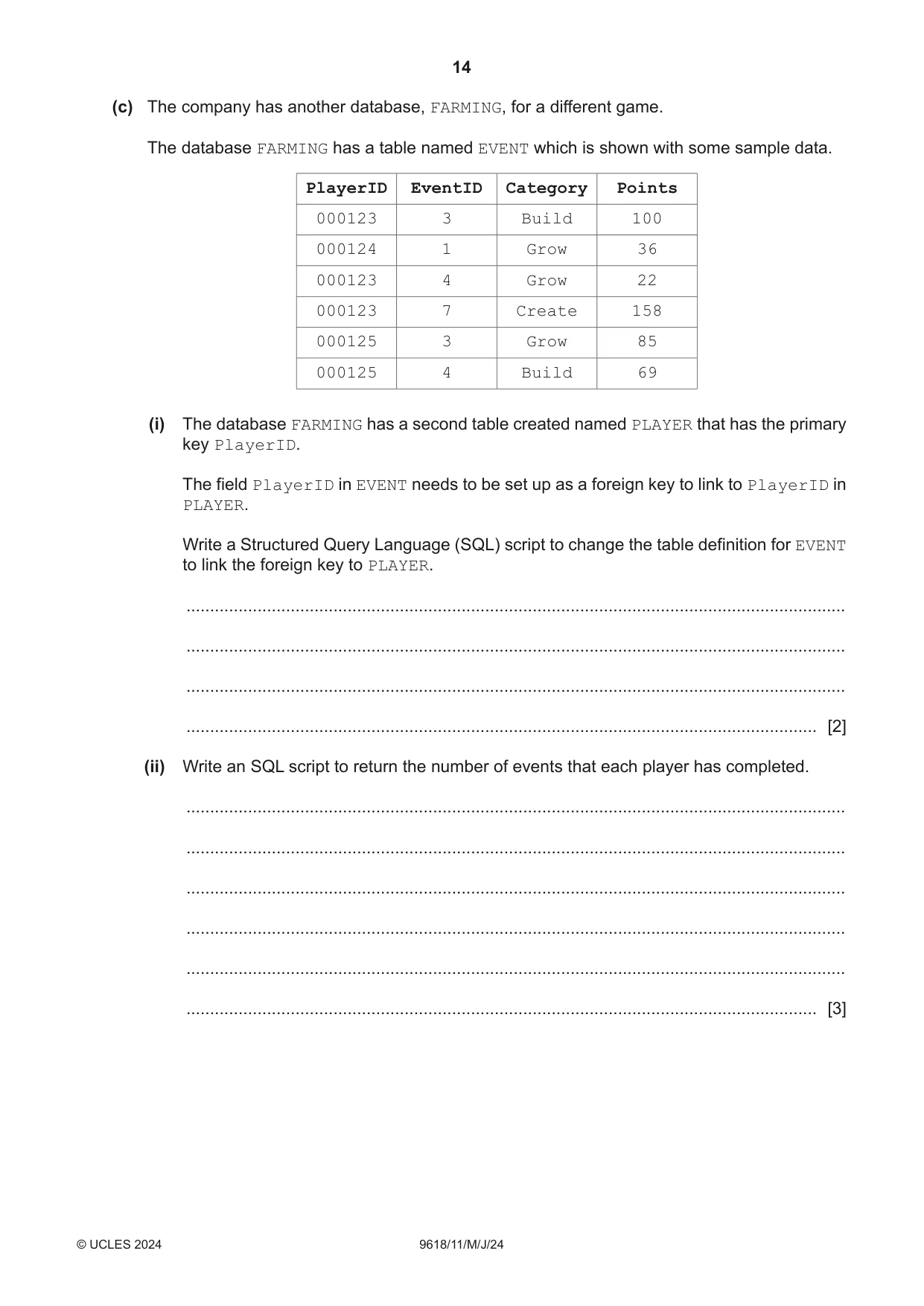
14 9618/11/M/J/24 © UCLES 2024 (c) The company has another database, FARMING, for a different game. The database FARMING has a table named EVENT which is shown with some sample data. PlayerID EventID Category Points 000123 3 Build 100 000124 1 Grow 36 000123 4 Grow 22 000123 7 Create 158 000125 3 Grow 85 000125 4 Build 69 (i) The database FARMING has a second table created named PLAYER that has the primary key PlayerID. The field PlayerID in EVENT needs to be set up as a foreign key to link to PlayerID in PLAYER. Write a Structured Query Language (SQL) script to change the table definition for EVENT to link the foreign key to PLAYER. … … … … [2] (ii) Write an SQL script to return the number of events that each player has completed. … … … … … … [3]
Question paper, page 15
15 9618/11/M/J/24 © UCLES 2024 [Turn over 7 Complete the binary addition. Show your working. 1 0 0 1 1 1 1 0 0 1 1 0 0 0 0 1 + 0 0 0 1 1 0 0 1 [3]
Question paper, page 16
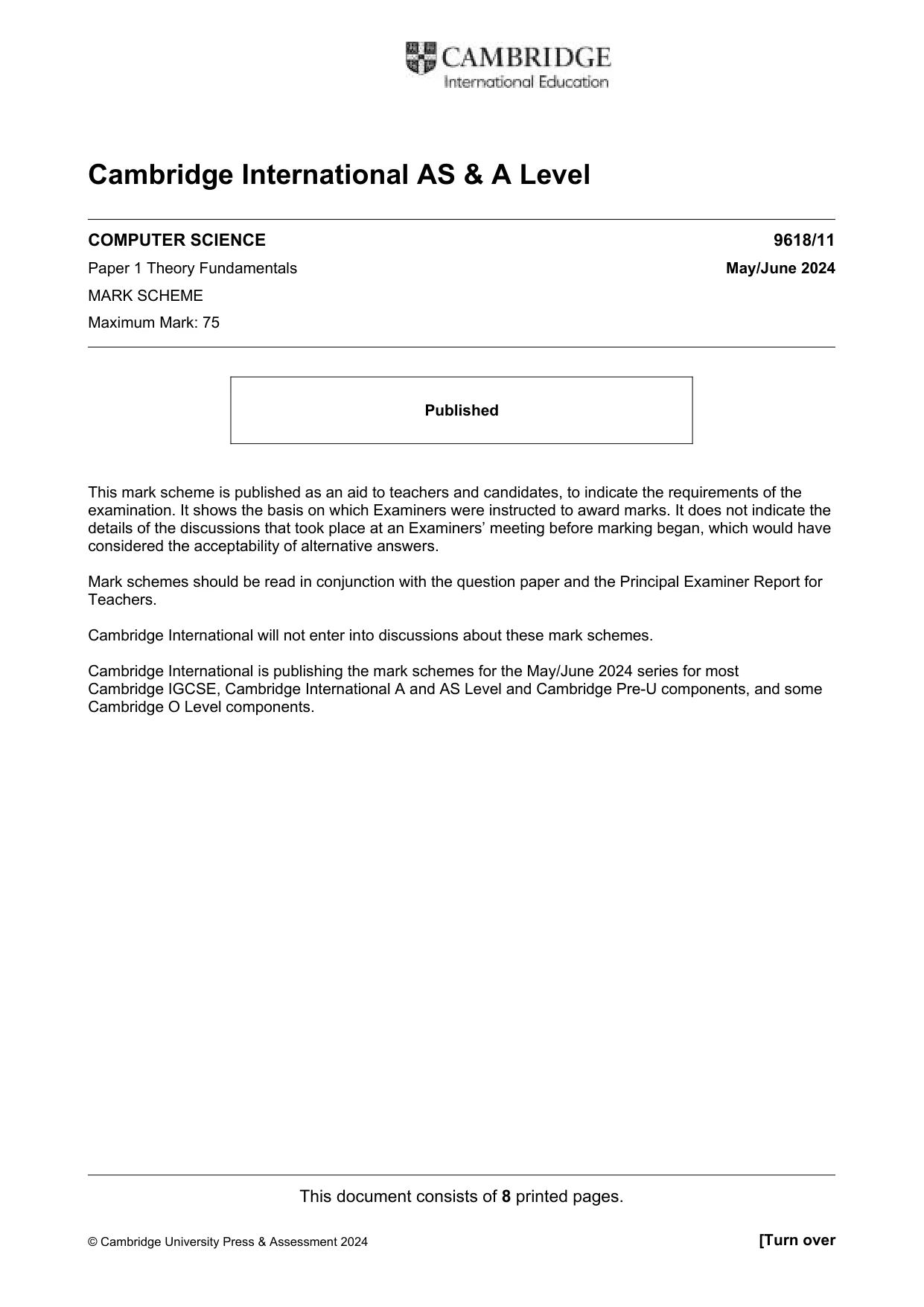
16 9618/11/M/J/24 © UCLES 2024 Permission to reproduce items where third-party owned material protected by copyright is included has been sought and cleared where possible. Every reasonable effort has been made by the publisher (UCLES) to trace copyright holders, but if any items requiring clearance have unwittingly been included, the publisher will be pleased to make amends at the earliest possible opportunity. To avoid the issue of disclosure of answer-related information to candidates, all copyright acknowledgements are reproduced online in the Cambridge Assessment International Education Copyright Acknowledgements Booklet. This is produced for each series of examinations and is freely available to download at www.cambridgeinternational.org after the live examination series. Cambridge Assessment International Education is part of Cambridge Assessment. Cambridge Assessment is the brand name of the University of Cambridge Local Examinations Syndicate (UCLES), which is a department of the University of Cambridge. 8 A business is creating a local area network (LAN) in its office. (a) The business is deciding which topology to use. Tick (✓) one or more boxes in each row to identify the topology, or topologies, each statement describes. Statement Bus Star Mesh all devices connect to one central device all devices connect to a central cable multiple paths for the packets to travel along robust against damage because if any line fails, the rest of the network retains full functionality most likely to lose data through collisions [5] (b) The LAN will connect to the internet through a router. The router has a public IPv6 address. (i) State why the router has a public IP address. … … [1] (ii) One difference between an IPv4 and IPv6 address is that the numbers in an IPv4 address are separated by full stops and in an IPv6 address they are separated by colons. Identify two other differences between an IPv4 and IPv6 address. 1 … … … 2 … … … [2]
Mark scheme, page 1
This document consists of 8 printed pages. © Cambridge University Press & Assessment 2024 [Turn over Cambridge International AS & A Level COMPUTER SCIENCE 9618/11 Paper 1 Theory Fundamentals May/June 2024 MARK SCHEME Maximum Mark: 75 Published This mark scheme is published as an aid to teachers and candidates, to indicate the requirements of the examination. It shows the basis on which Examiners were instructed to award marks. It does not indicate the details of the discussions that took place at an Examiners’ meeting before marking began, which would have considered the acceptability of alternative answers. Mark schemes should be read in conjunction with the question paper and the Principal Examiner Report for Teachers. Cambridge International will not enter into discussions about these mark schemes. Cambridge International is publishing the mark schemes for the May/June 2024 series for most Cambridge IGCSE, Cambridge International A and AS Level and Cambridge Pre-U components, and some Cambridge O Level components.
Mark scheme, page 2
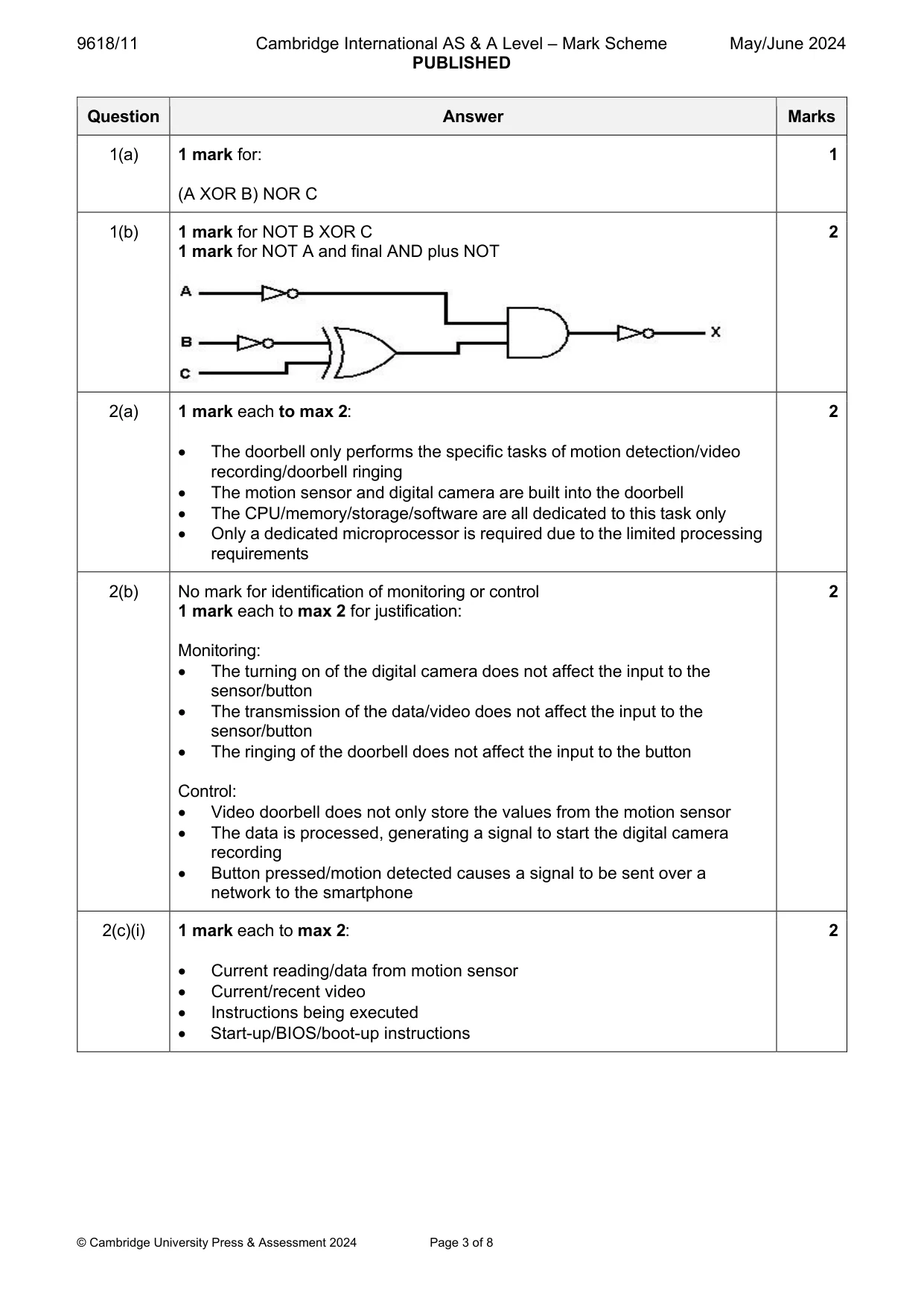
9618/11 Cambridge International AS & A Level – Mark Scheme PUBLISHED May/June 2024 © Cambridge University Press & Assessment 2024 Page 2 of 8 Generic Marking Principles These general marking principles must be applied by all examiners when marking candidate answers. They should be applied alongside the specific content of the mark scheme or generic level descriptions for a question. Each question paper and mark scheme will also comply with these marking principles. GENERIC MARKING PRINCIPLE 1: Marks must be awarded in line with: the specific content of the mark scheme or the generic level descriptors for the question the specific skills defined in the mark scheme or in the generic level descriptors for the question the standard of response required by a candidate as exemplified by the standardisation scripts. GENERIC MARKING PRINCIPLE 2: Marks awarded are always whole marks (not half marks, or other fractions). GENERIC MARKING PRINCIPLE 3: Marks must be awarded positively: marks are awarded for correct/valid answers, as defined in the mark scheme. However, credit is given for valid answers which go beyond the scope of the syllabus and mark scheme, referring to your Team Leader as appropriate marks are awarded when candidates clearly demonstrate what they know and can do marks are not deducted for errors marks are not deducted for omissions answers should only be judged on the quality of spelling, punctuation and grammar when these features are specifically assessed by the question as indicated by the mark scheme. The meaning, however, should be unambiguous. GENERIC MARKING PRINCIPLE 4: Rules must be applied consistently, e.g. in situations where candidates have not followed instructions or in the application of generic level descriptors. GENERIC MARKING PRINCIPLE 5: Marks should be awarded using the full range of marks defined in the mark scheme for the question (however; the use of the full mark range may be limited according to the quality of the candidate responses seen). GENERIC MARKING PRINCIPLE 6: Marks awarded are based solely on the requirements as defined in the mark scheme. Marks should not be awarded with grade thresholds or grade descriptors in mind.
Mark scheme, page 3
9618/11 Cambridge International AS & A Level – Mark Scheme PUBLISHED May/June 2024 © Cambridge University Press & Assessment 2024 Page 3 of 8 Question Answer Marks 1(a) 1 mark for: (A XOR B) NOR C 1 1(b) 1 mark for NOT B XOR C 1 mark for NOT A and final AND plus NOT 2 2(a) 1 mark each to max 2: The doorbell only performs the specific tasks of motion detection/video recording/doorbell ringing The motion sensor and digital camera are built into the doorbell The CPU/memory/storage/software are all dedicated to this task only Only a dedicated microprocessor is required due to the limited processing requirements 2 2(b) No mark for identification of monitoring or control 1 mark each to max 2 for justification: Monitoring: The turning on of the digital camera does not affect the input to the sensor/button The transmission of the data/video does not affect the input to the sensor/button The ringing of the doorbell does not affect the input to the button Control: Video doorbell does not only store the values from the motion sensor The data is processed, generating a signal to start the digital camera recording Button pressed/motion detected causes a signal to be sent over a network to the smartphone 2 2(c)(i) 1 mark each to max 2: Current reading/data from motion sensor Current/recent video Instructions being executed Start-up/BIOS/boot-up instructions 2
Mark scheme, page 4
9618/11 Cambridge International AS & A Level – Mark Scheme PUBLISHED May/June 2024 © Cambridge University Press & Assessment 2024 Page 4 of 8 Question Answer Marks 2(c)(ii) 1 mark for each row: Statement Answer The two types of logic gate that can be used to create solid state devices NAND NOR The number of transistors contained in each cell 2 The type of gate that can retain electrons without power floating The type of gate that allows or stops current from passing through control 4 2(c)(iii) 1 mark each to max 2: Captured video is transmitted to buffer … video is transmitted from buffer to smartphone Store recent data in a buffer for the user to rewind … instead of storing everything in secondary storage Store readings from motion sensor … until the microprocessor can process them Store video from digital camera … before moving it to secondary storage 2 2(d) 1 mark each to max 3: Data transmission to user’s smartphone will take longer … because there is more data to transmit The secondary storage device will fill faster … fewer videos will be able to be stored long-term // videos are overwritten more often 3 2(e)(i) 1 mark for: Continuous ordered flow of bits over a communication path 1 2(e)(ii) 1 mark each to max 2: Real-time is direct from source whereas on-demand is pre- recorded/downloaded to view later Real-time cannot be re-watched, on-demand can be paused, re-watched etc. Real-time plays continually, on-demand downloads sections/blocks and cannot play until next section is downloaded 2
Mark scheme, page 5
9618/11 Cambridge International AS & A Level – Mark Scheme PUBLISHED May/June 2024 © Cambridge University Press & Assessment 2024 Page 5 of 8 Question Answer Marks 3(a) 1 mark each to max 2: The interpreter will stop when an error is found ... so the error can be corrected in real-time, and the result of changes seen immediately Only one error is displayed at a time … so fewer errors to correct simultaneously and no dependent errors 2 3(b) 1 mark each to max 3: Program can be distributed without source code ... so it cannot be edited/stolen/plagiarised Users do not require the translator to run the program … so time is not spent retranslating by user 3 4(a) 1 mark for each correct answer: Program Number Code ACC Content 1 LDD 20 ADD #2 4 2 LDX 22 5 3 LDI 25 INC ACC SUB 22 1 4 LDD 19 LDM #5 LDM #25 25 4 4(b) 1 mark for each correct answer: Program Number Code ACC Content 1 AND 31 1001 1010 2 XOR B01001111 1101 0101 3 OR #30 1001 1110 3
Mark scheme, page 6
9618/11 Cambridge International AS & A Level – Mark Scheme PUBLISHED May/June 2024 © Cambridge University Press & Assessment 2024 Page 6 of 8 Question Answer Marks 5(a) 1 mark each: Identification of server in the bank scenario Description e.g. Receives requests, processes the requests Identification of client in bank scenario Description e.g. Sends request to the server, waits and outputs the response 4 5(b) 1 mark for each correctly completed term: odd or even 7-bits odd block byte Computer A and Computer B agree on whether to use odd or even parity. Computer A divides the data into groups of 7-bits. The number of 1s in each group is counted. If the agreed parity is odd and the group has an even number of 1s a parity bit of 1 is appended, otherwise a parity bit of 0 is appended. In a parity block check the bytes are grouped together, for example in a grid. The number of 1s in each column (bit position) is counted. A bit is assigned to each column to make the column match the parity. These parity bits are transmitted with the data as a parity byte. 5 5(c)(i) 1 mark each to max 3: Compares all incoming and outgoing transmissions ... against set criteria/whitelist/blacklist Blocks all transmissions that do not meet rules Blocks data entering from specific ports Blocks unauthorised/unknown internal software transmitting data 3 5(c)(ii) 1 mark each to max 4: e.g. Captures an image of the face Uses image recognition Trained to identify the features of a face in an image … using a large number of images Analyse images for facial features Uses the probability of a match 4
Mark scheme, page 7
9618/11 Cambridge International AS & A Level – Mark Scheme PUBLISHED May/June 2024 © Cambridge University Press & Assessment 2024 Page 7 of 8 Question Answer Marks 6(a) 1 mark each: User table with the username as the Primary Key … containing at least email address, date of birth / age and rating Quiz table with Quiz ID or date or file name as the Primary Key. … containing at least the other field(s) not used as the PK A joining table with an appropriate name including at least fields for user identification, quiz identification and score … with an appropriate Primary Key ... and Foreign Keys matching the Primary Keys of the other two tables USER(Username, Email, DateOfBirth, Rating) QUIZ(QuizID, Date, Filename) USER_QUIZ(Username, QuizID, Score) 6 6(b) 1 mark each to max 2 for data dictionary and max 2 for logical schema: Data dictionary: Data about the data in the database // metadata Identifies the characteristics of the data that will be stored Appropriate example e.g. field names, table name, validation rules, data types, primary / foreign keys, relationships etc. Logical schema: Conceptual design Platform/database independent overview of the database Is used to design the physical structure Appropriate example e.g. Design of entities / E-R diagram / views 4 6(c)(i) 1 mark for each correct clause: Alter table EVENT Adding foreign key as PlayerID referencing correct table ALTER TABLE EVENT ADD FOREIGN KEY(PlayerID)REFERENCES PLAYER(PlayerID); 2 6(c)(ii) 1 mark each: Selecting PlayerID from EVENT Counting EventID Grouping by the PlayerID Example: SELECT PlayerID, COUNT(EventID) FROM EVENT GROUP BY PlayerID; 3
Mark scheme, page 8
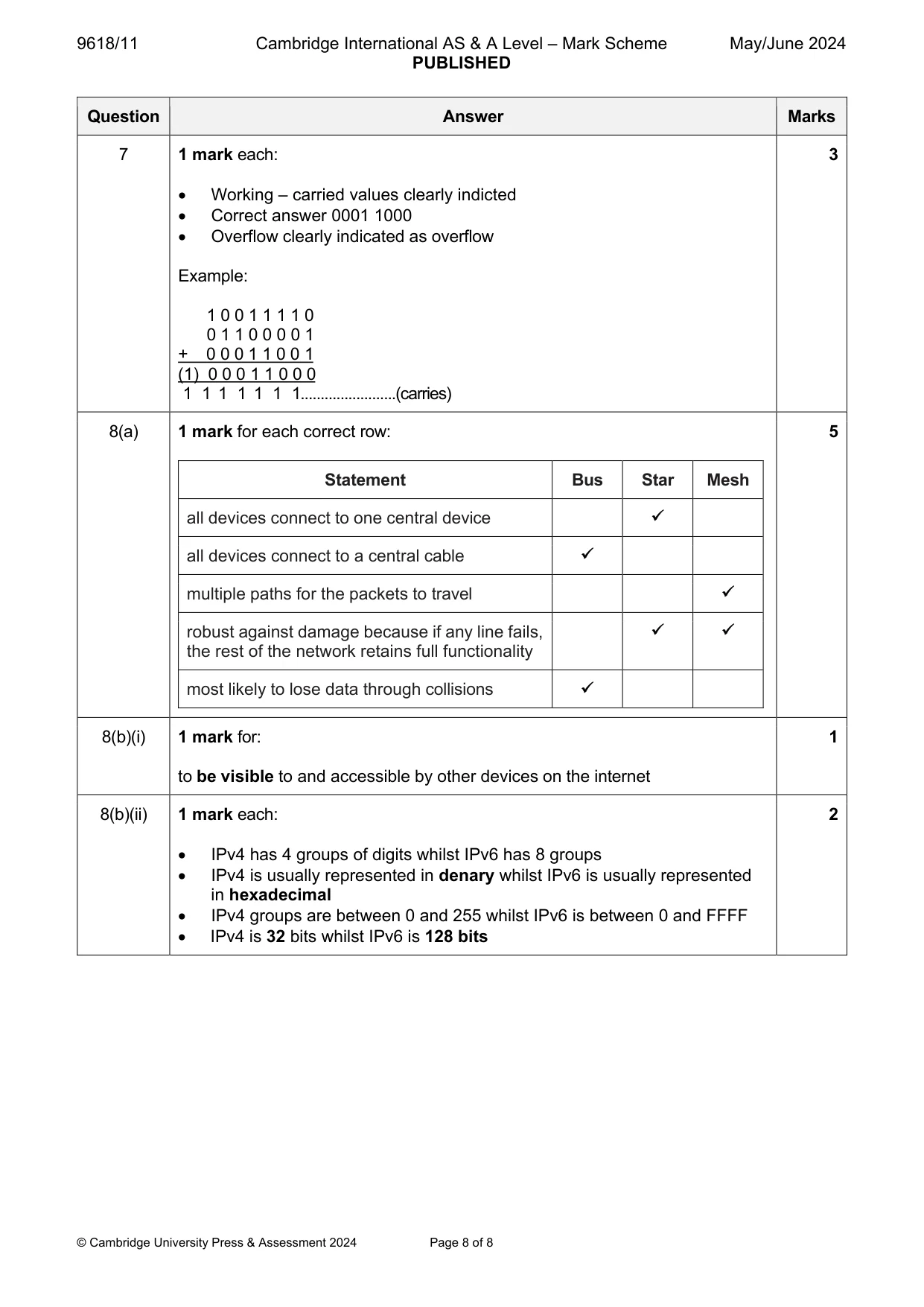
9618/11 Cambridge International AS & A Level – Mark Scheme PUBLISHED May/June 2024 © Cambridge University Press & Assessment 2024 Page 8 of 8 Question Answer Marks 7 1 mark each: Working – carried values clearly indicted Correct answer 0001 1000 Overflow clearly indicated as overflow Example: 1 0 0 1 1 1 1 0 0 1 1 0 0 0 0 1 + 0 0 0 1 1 0 0 1 (1) 0 0 0 1 1 0 0 0 1 1 1 1 1 1 1…(carries) 3 8(a) 1 mark for each correct row: Statement Bus Star Mesh all devices connect to one central device all devices connect to a central cable multiple paths for the packets to travel robust against damage because if any line fails, the rest of the network retains full functionality most likely to lose data through collisions 5 8(b)(i) 1 mark for: to be visible to and accessible by other devices on the internet 1 8(b)(ii) 1 mark each: IPv4 has 4 groups of digits whilst IPv6 has 8 groups IPv4 is usually represented in denary whilst IPv6 is usually represented in hexadecimal IPv4 groups are between 0 and 255 whilst IPv6 is between 0 and FFFF IPv4 is 32 bits whilst IPv6 is 128 bits 2
What you needed in this session
Cambridge’s own grade thresholds for 2024 May/June, Paper 1 · Variant 1. A higher threshold means an easier paper — the bar moves with how the cohort did.