Cambridge A Level Computer Science 9618 — 2024 May/June Paper 1 · Variant 2
9618/12/M/J/24 · 75 marks · ≈84 min
The question paper and its mark scheme, free to read here and free to download. This is Cambridge’s own paper, exactly as it was sat.
Question paper16 pages







Mark scheme11 pages
Answers below. Sit the paper first if you are practising.

Paper as text
Question paper, page 1
This document has 16 pages. Any blank pages are indicated. [Turn over Cambridge International AS & A Level DC (CE/SG) 329373/3 © UCLES 2024 * 9 0 9 1 5 1 7 7 3 8 * COMPUTER SCIENCE 9618/12 Paper 1 Theory Fundamentals May/June 2024 1 hour 30 minutes You must answer on the question paper. No additional materials are needed. INSTRUCTIONS ● Answer all questions. ● Use a black or dark blue pen. ● Write your name, centre number and candidate number in the boxes at the top of the page. ● Write your answer to each question in the space provided. ● Do not use an erasable pen or correction fluid. ● Do not write on any bar codes. ● You may use an HB pencil for any diagrams, graphs or rough working. ● Calculators must not be used in this paper. INFORMATION ● The total mark for this paper is 75. ● The number of marks for each question or part question is shown in brackets [ ]. ● No marks will be awarded for using brand names of software packages or hardware.
Question paper, page 2
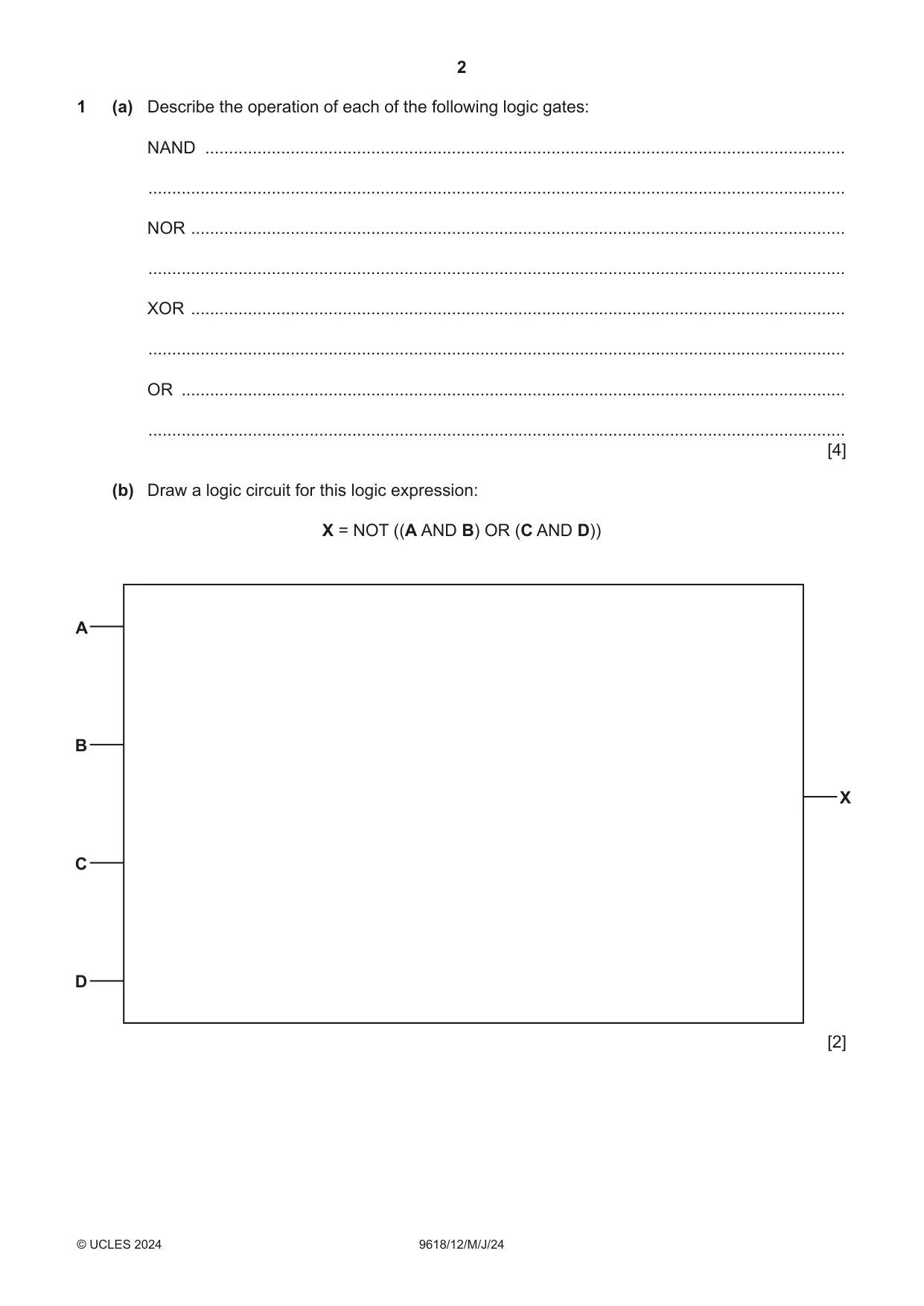
2 9618/12/M/J/24 © UCLES 2024 1 (a) Describe the operation of each of the following logic gates: NAND … … NOR … … XOR … … OR … … [4] (b) Draw a logic circuit for this logic expression: X = NOT ((A AND B) OR (C AND D)) A X B C D [2]
Question paper, page 3
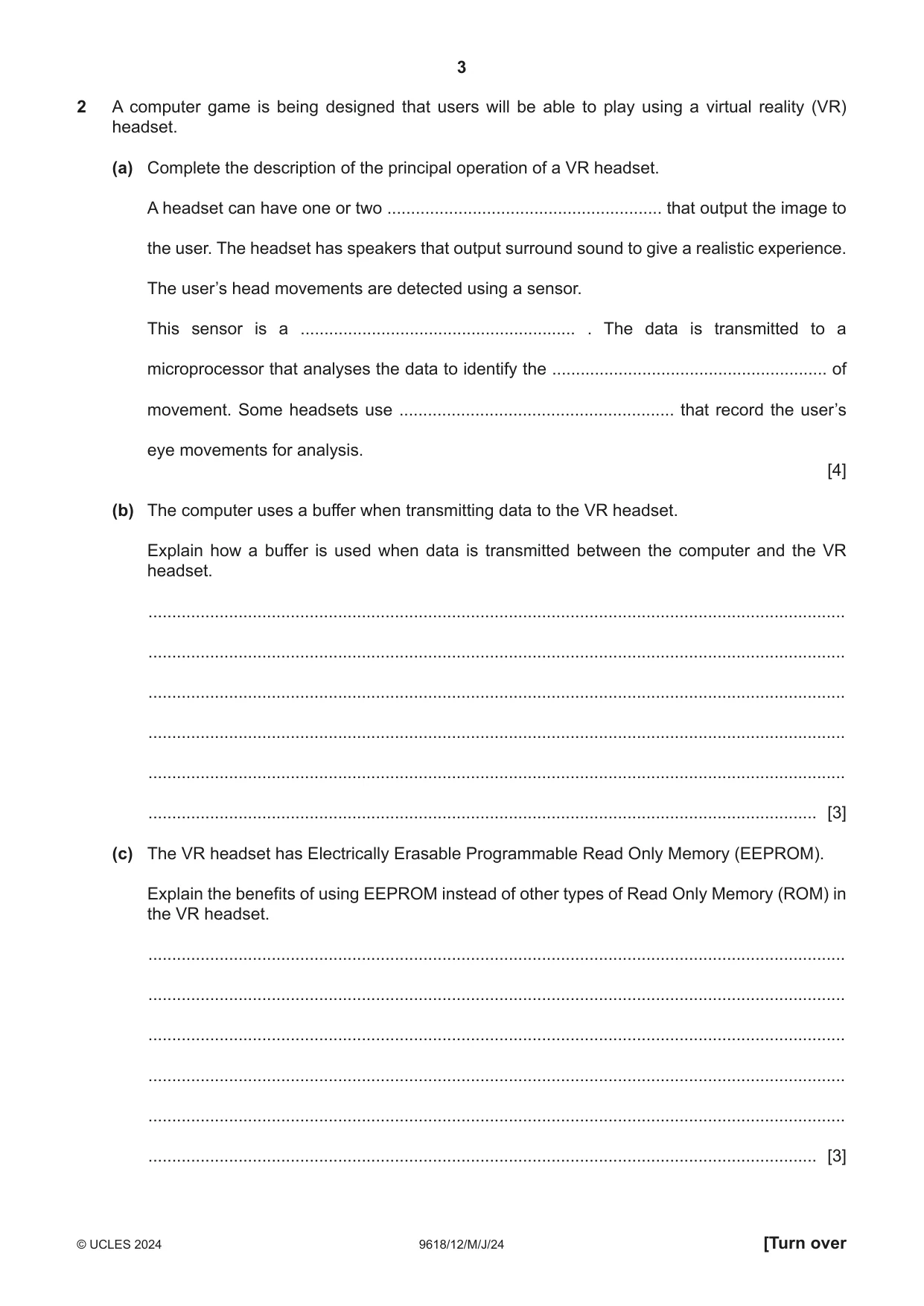
3 9618/12/M/J/24 © UCLES 2024 [Turn over 2 A computer game is being designed that users will be able to play using a virtual reality (VR) headset. (a) Complete the description of the principal operation of a VR headset. A headset can have one or two … that output the image to the user. The headset has speakers that output surround sound to give a realistic experience. The user’s head movements are detected using a sensor. This sensor is a … . The data is transmitted to a microprocessor that analyses the data to identify the … of movement. Some headsets use … that record the user’s eye movements for analysis. [4] (b) The computer uses a buffer when transmitting data to the VR headset. Explain how a buffer is used when data is transmitted between the computer and the VR headset. … … … … … … [3] (c) The VR headset has Electrically Erasable Programmable Read Only Memory (EEPROM). Explain the benefits of using EEPROM instead of other types of Read Only Memory (ROM) in the VR headset. … … … … … … [3]
Question paper, page 4
4 9618/12/M/J/24 © UCLES 2024 (d) The computer can transmit a video made from bitmap images and vector graphic animations to the VR headset. (i) Describe how the data for a bitmapped image is encoded. … … … … … … [3] (ii) Describe the contents of a vector graphic drawing list. … … … … [2] (iii) The bitmap video is not compressed before transmission to the VR headset. Give two reasons why the video does not need to be compressed. 1 … … 2 … … [2]
Question paper, page 5
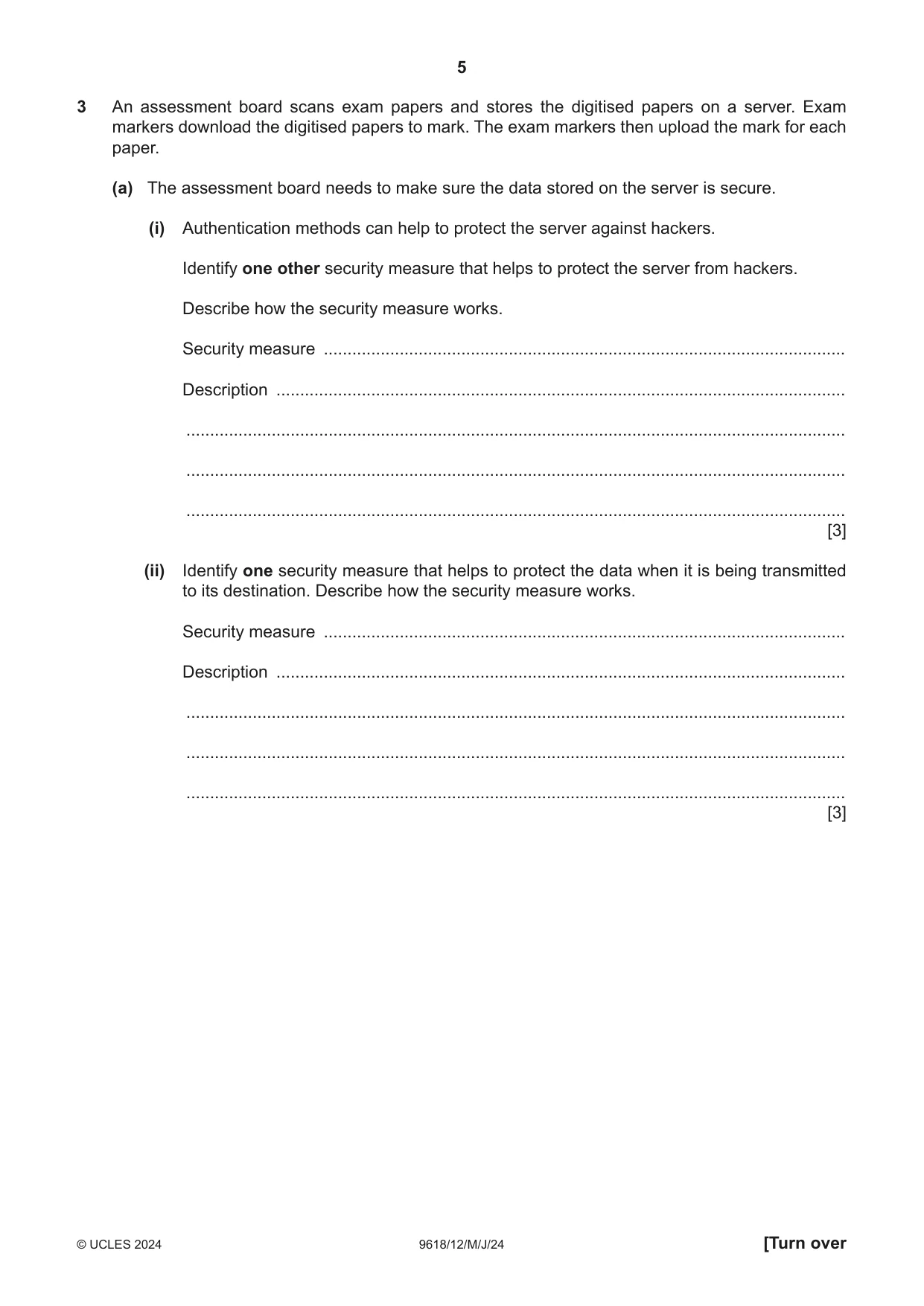
5 9618/12/M/J/24 © UCLES 2024 [Turn over 3 An assessment board scans exam papers and stores the digitised papers on a server. Exam markers download the digitised papers to mark. The exam markers then upload the mark for each paper. (a) The assessment board needs to make sure the data stored on the server is secure. (i) Authentication methods can help to protect the server against hackers. Identify one other security measure that helps to protect the server from hackers. Describe how the security measure works. Security measure … Description … … … … [3] (ii) Identify one security measure that helps to protect the data when it is being transmitted to its destination. Describe how the security measure works. Security measure … Description … … … … [3]
Question paper, page 6
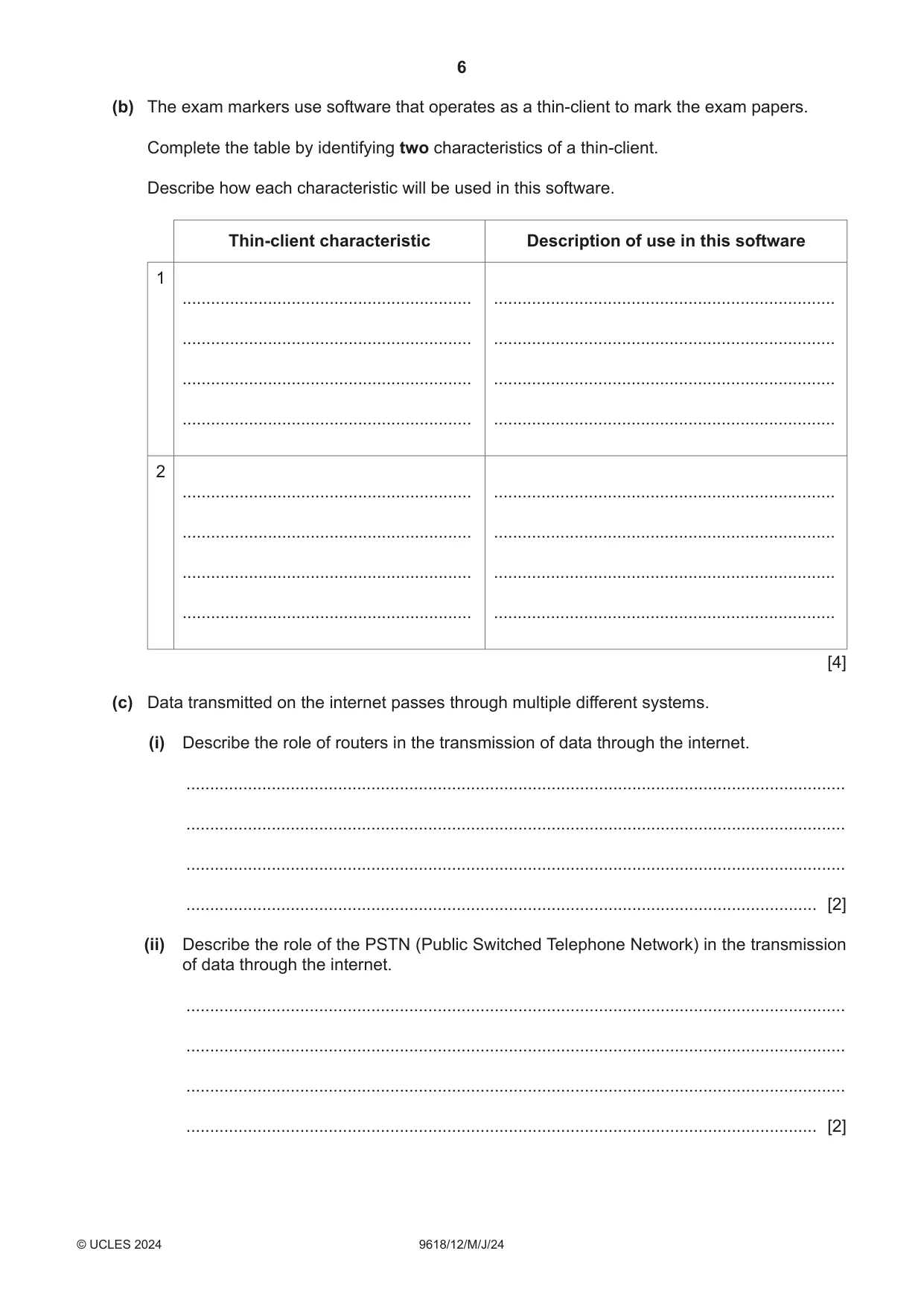
6 9618/12/M/J/24 © UCLES 2024 (b) The exam markers use software that operates as a thin-client to mark the exam papers. Complete the table by identifying two characteristics of a thin-client. Describe how each characteristic will be used in this software. Thin-client characteristic Description of use in this software 1 … … … … … … … … 2 … … … … … … … … [4] (c) Data transmitted on the internet passes through multiple different systems. (i) Describe the role of routers in the transmission of data through the internet. … … … … [2] (ii) Describe the role of the PSTN (Public Switched Telephone Network) in the transmission of data through the internet. … … … … [2]
Question paper, page 7
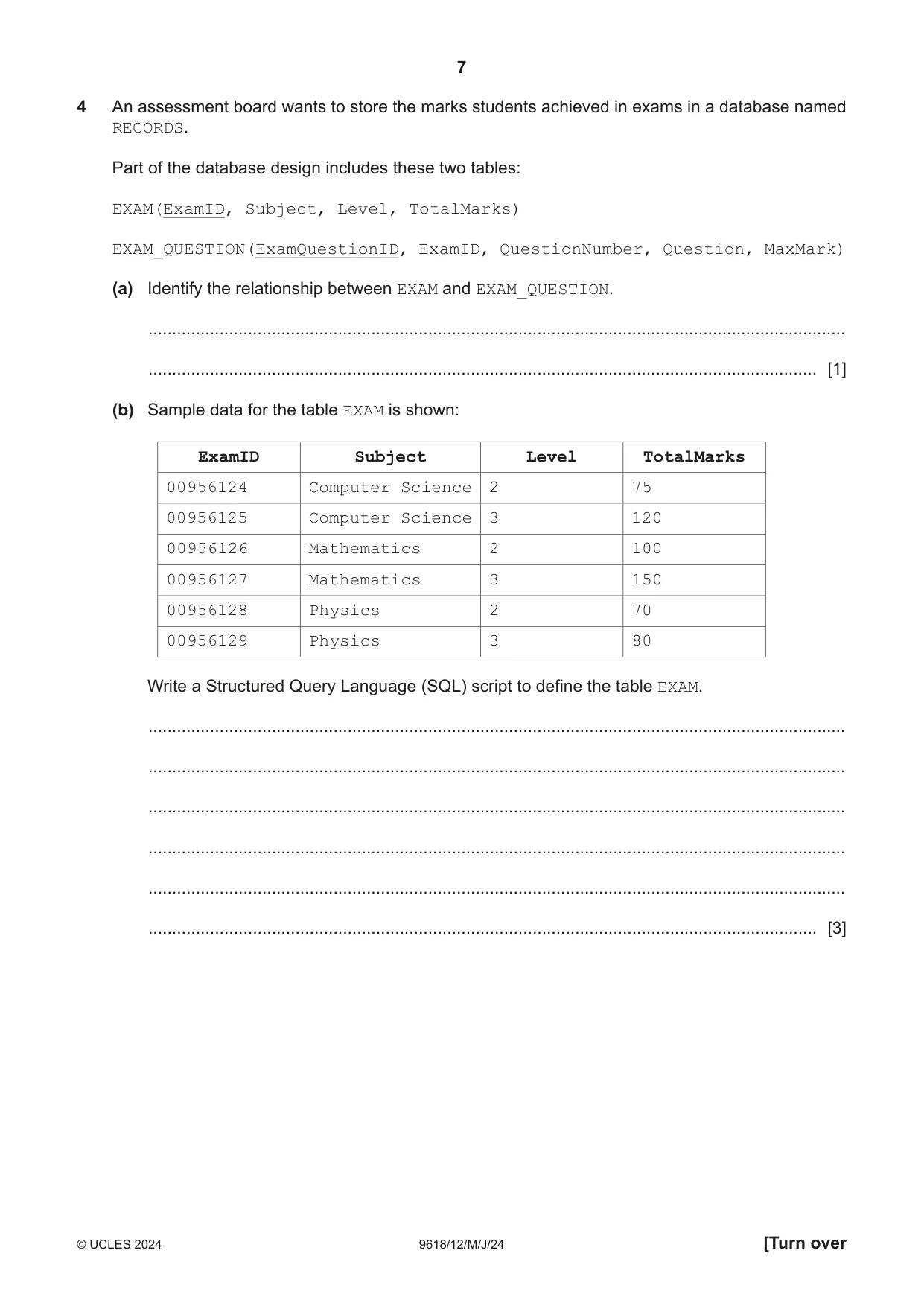
7 9618/12/M/J/24 © UCLES 2024 [Turn over 4 An assessment board wants to store the marks students achieved in exams in a database named RECORDS. Part of the database design includes these two tables: EXAM(ExamID, Subject, Level, TotalMarks) EXAM_QUESTION(ExamQuestionID, ExamID, QuestionNumber, Question, MaxMark) (a) Identify the relationship between EXAM and EXAM_QUESTION. … … [1] (b) Sample data for the table EXAM is shown: ExamID Subject Level TotalMarks 00956124 Computer Science 2 75 00956125 Computer Science 3 120 00956126 Mathematics 2 100 00956127 Mathematics 3 150 00956128 Physics 2 70 00956129 Physics 3 80 Write a Structured Query Language (SQL) script to define the table EXAM. … … … … … … [3]
Question paper, page 8
8 9618/12/M/J/24 © UCLES 2024 (c) The table EXAM_QUESTION has been created but the foreign key has not been linked. Write an SQL script to update EXAM_QUESTION and link the foreign key to EXAM. … … … … [2] (d) The database also needs to store data about the students, the exams the students have taken and the marks the students achieved in each question of each exam. Describe the additional tables that will need to be included in the database and explain how all the tables in the database will be linked. … … … … … … … … … … [5]
Question paper, page 9
9 9618/12/M/J/24 © UCLES 2024 [Turn over BLANK PAGE
Question paper, page 10
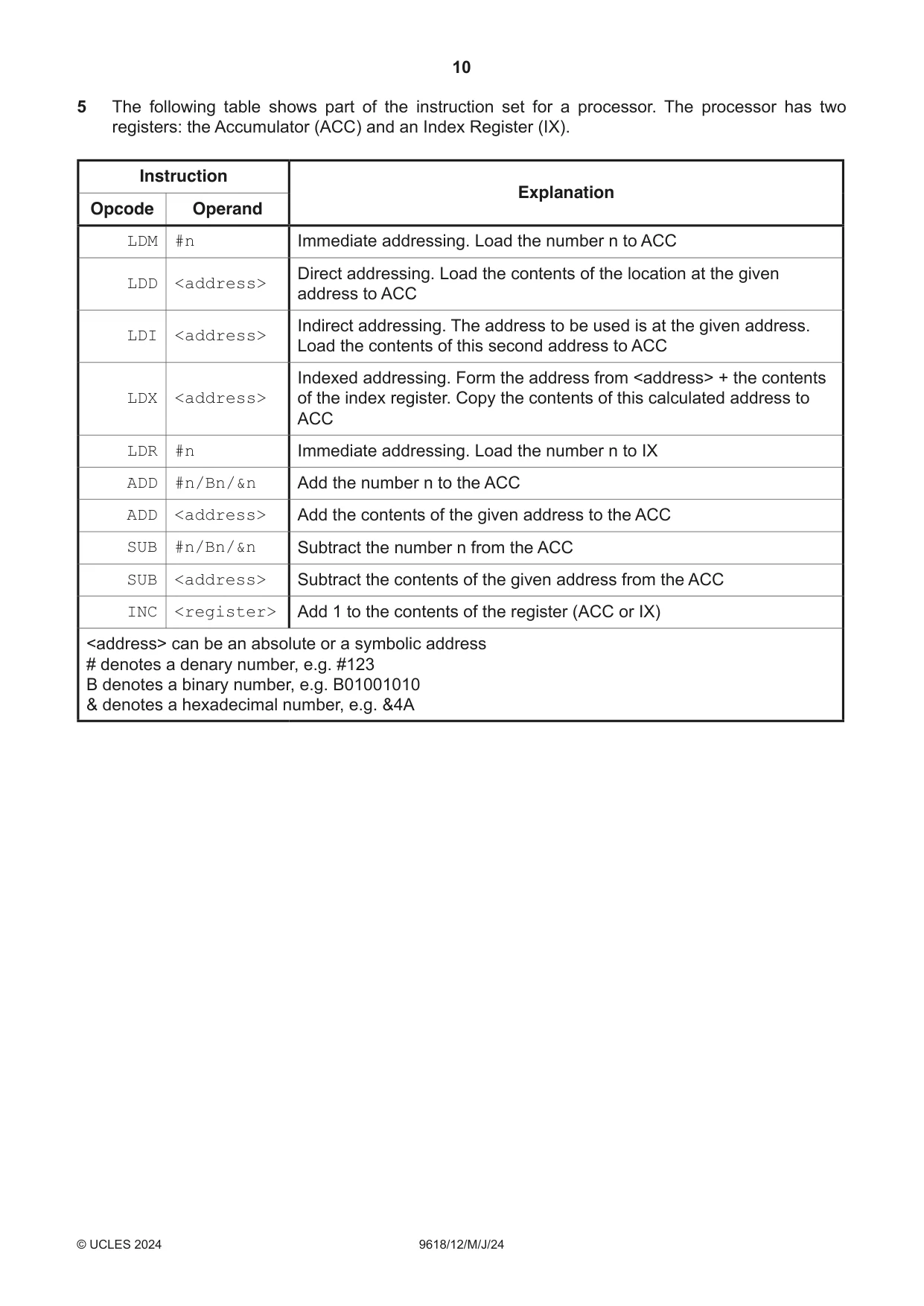
10 9618/12/M/J/24 © UCLES 2024 5 The following table shows part of the instruction set for a processor. The processor has two registers: the Accumulator (ACC) and an Index Register (IX). Instruction Explanation Opcode Operand LDM #n Immediate addressing. Load the number n to ACC LDD <address> Direct addressing. Load the contents of the location at the given address to ACC LDI <address> Indirect addressing. The address to be used is at the given address. Load the contents of this second address to ACC LDX <address> Indexed addressing. Form the address from <address> + the contents of the index register. Copy the contents of this calculated address to ACC LDR #n Immediate addressing. Load the number n to IX ADD #n/Bn/&n Add the number n to the ACC ADD <address> Add the contents of the given address to the ACC SUB #n/Bn/&n Subtract the number n from the ACC SUB <address> Subtract the contents of the given address from the ACC INC <register> Add 1 to the contents of the register (ACC or IX) <address> can be an absolute or a symbolic address # denotes a denary number, e.g. #123 B denotes a binary number, e.g. B01001010 & denotes a hexadecimal number, e.g. &4A
Question paper, page 11
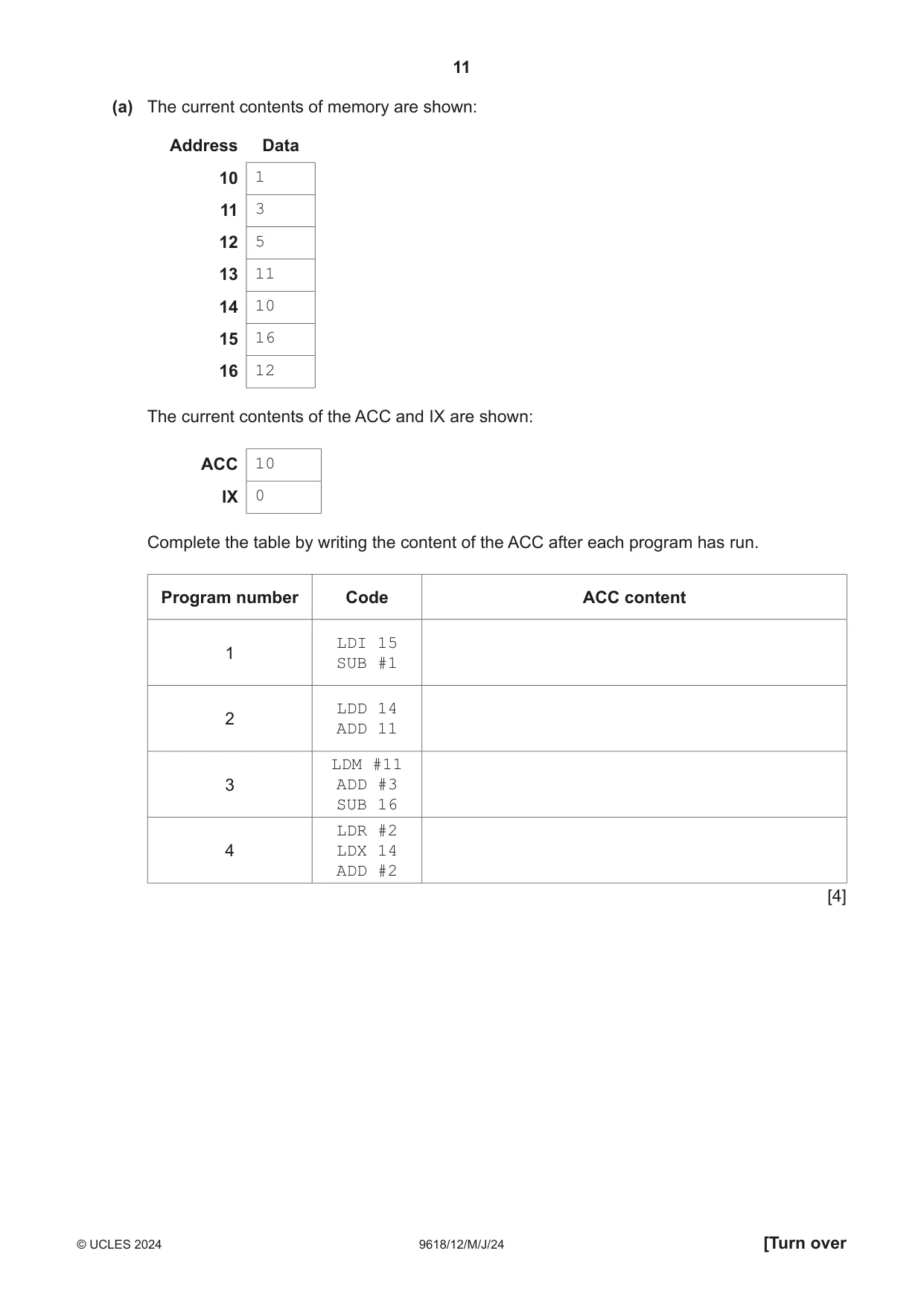
11 9618/12/M/J/24 © UCLES 2024 [Turn over (a) The current contents of memory are shown: Address Data 10 1 11 3 12 5 13 11 14 10 15 16 16 12 The current contents of the ACC and IX are shown: ACC 10 IX 0 Complete the table by writing the content of the ACC after each program has run. Program number Code ACC content 1 LDI 15 SUB #1 2 LDD 14 ADD 11 3 LDM #11 ADD #3 SUB 16 4 LDR #2 LDX 14 ADD #2 [4]
Question paper, page 12
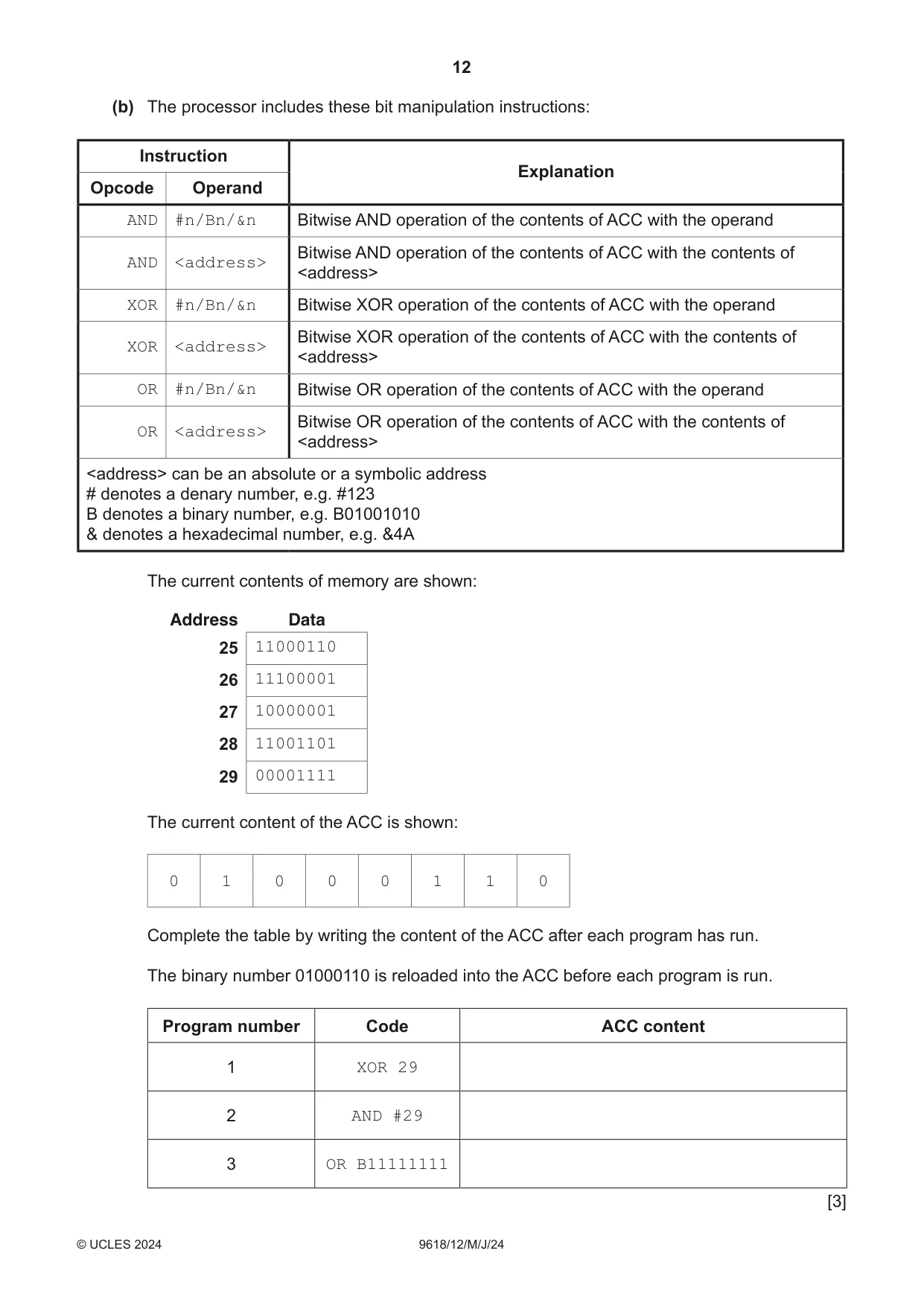
12 9618/12/M/J/24 © UCLES 2024 (b) The processor includes these bit manipulation instructions: Instruction Explanation Opcode Operand AND #n/Bn/&n Bitwise AND operation of the contents of ACC with the operand AND <address> Bitwise AND operation of the contents of ACC with the contents of <address> XOR #n/Bn/&n Bitwise XOR operation of the contents of ACC with the operand XOR <address> Bitwise XOR operation of the contents of ACC with the contents of <address> OR #n/Bn/&n Bitwise OR operation of the contents of ACC with the operand OR <address> Bitwise OR operation of the contents of ACC with the contents of <address> <address> can be an absolute or a symbolic address # denotes a denary number, e.g. #123 B denotes a binary number, e.g. B01001010 & denotes a hexadecimal number, e.g. &4A The current contents of memory are shown: Address Data 25 11000110 26 11100001 27 10000001 28 11001101 29 00001111 The current content of the ACC is shown: 0 1 0 0 0 1 1 0 Complete the table by writing the content of the ACC after each program has run. The binary number 01000110 is reloaded into the ACC before each program is run. Program number Code ACC content 1 XOR 29 2 AND #29 3 OR B11111111 [3]
Question paper, page 13
13 9618/12/M/J/24 © UCLES 2024 [Turn over 6 A computer has an Operating System (OS). Memory management and process management are two OS tasks. Explain how memory management and process management support multi-tasking. … … … … … … … … … … [4]
Question paper, page 14
14 9618/12/M/J/24 © UCLES 2024 7 A computer stores binary data. (a) Tick (3) one box only to identify the largest file size. 3300 kibibytes 0.3 megabytes 3 mebibytes 3300 kilobytes [1] (b) Subtract the denary number 10 from the denary number 100 using binary subtraction. Show your working. Working … … … … … … Answer … [3] (c) Convert the hexadecimal number C0F into denary. Show your working. Working … … … Answer … [2]
Question paper, page 15
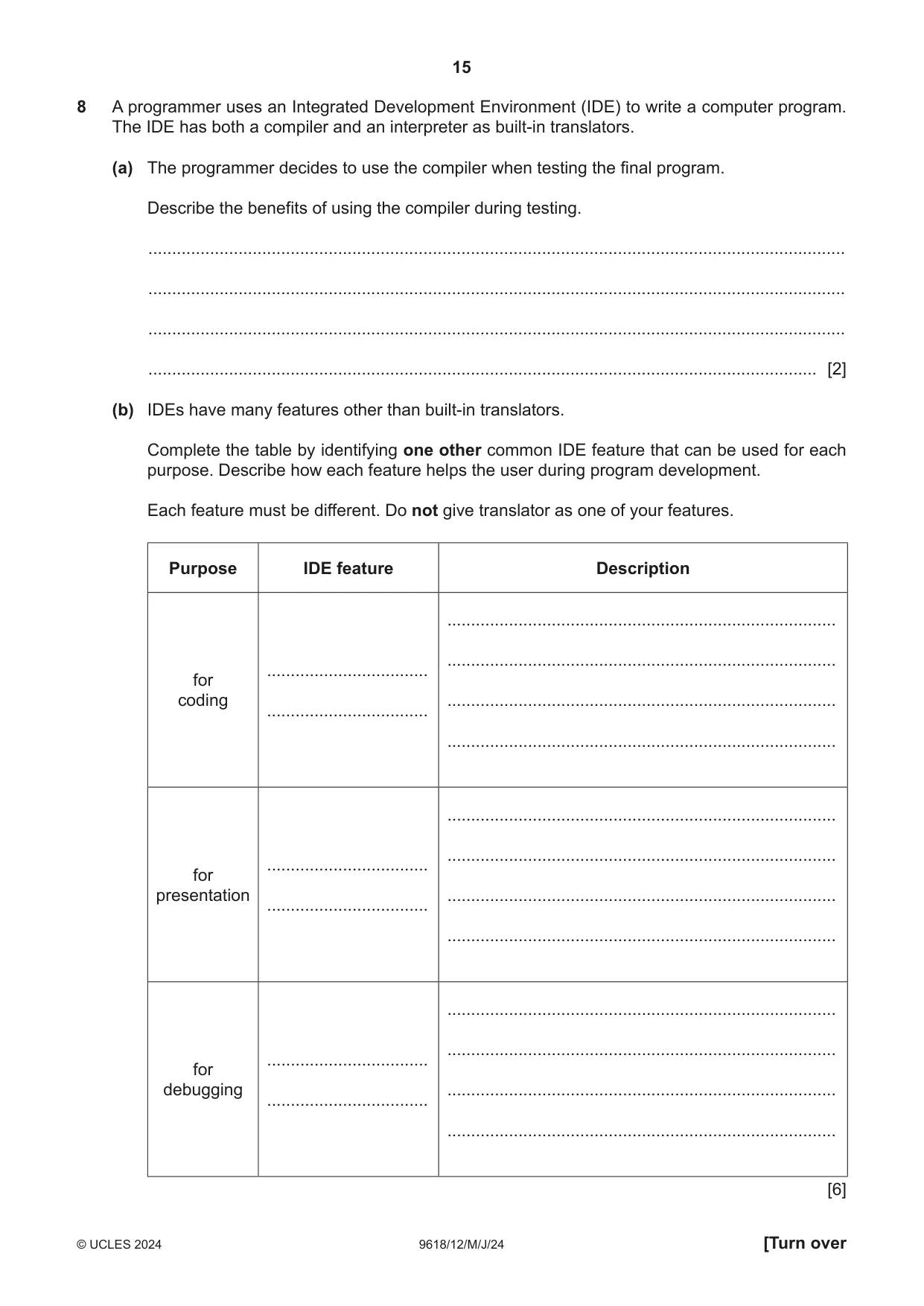
15 9618/12/M/J/24 © UCLES 2024 [Turn over 8 A programmer uses an Integrated Development Environment (IDE) to write a computer program. The IDE has both a compiler and an interpreter as built-in translators. (a) The programmer decides to use the compiler when testing the final program. Describe the benefits of using the compiler during testing. … … … … [2] (b) IDEs have many features other than built-in translators. Complete the table by identifying one other common IDE feature that can be used for each purpose. Describe how each feature helps the user during program development. Each feature must be different. Do not give translator as one of your features. Purpose IDE feature Description for coding … … … … … … for presentation … … … … … … for debugging … … … … … … [6]
Question paper, page 16
16 9618/12/M/J/24 © UCLES 2024 Permission to reproduce items where third-party owned material protected by copyright is included has been sought and cleared where possible. Every reasonable effort has been made by the publisher (UCLES) to trace copyright holders, but if any items requiring clearance have unwittingly been included, the publisher will be pleased to make amends at the earliest possible opportunity. To avoid the issue of disclosure of answer-related information to candidates, all copyright acknowledgements are reproduced online in the Cambridge Assessment International Education Copyright Acknowledgements Booklet. This is produced for each series of examinations and is freely available to download at www.cambridgeinternational.org after the live examination series. Cambridge Assessment International Education is part of Cambridge Assessment. Cambridge Assessment is the brand name of the University of Cambridge Local Examinations Syndicate (UCLES), which is a department of the University of Cambridge. (c) The programmer uses program libraries when developing the program. Describe two benefits to the programmer of using program libraries. 1 … … 2 … … [2]
Mark scheme, page 1
This document consists of 11 printed pages. © Cambridge University Press & Assessment 2024 [Turn over Cambridge International AS & A Level COMPUTER SCIENCE 9618/12 Paper 1 Theory Fundamentals May/June 2024 MARK SCHEME Maximum Mark: 75 Published This mark scheme is published as an aid to teachers and candidates, to indicate the requirements of the examination. It shows the basis on which Examiners were instructed to award marks. It does not indicate the details of the discussions that took place at an Examiners’ meeting before marking began, which would have considered the acceptability of alternative answers. Mark schemes should be read in conjunction with the question paper and the Principal Examiner Report for Teachers. Cambridge International will not enter into discussions about these mark schemes. Cambridge International is publishing the mark schemes for the May/June 2024 series for most Cambridge IGCSE, Cambridge International A and AS Level and Cambridge Pre-U components, and some Cambridge O Level components.
Mark scheme, page 2
9618/12 Cambridge International AS & A Level – Mark Scheme PUBLISHED May/June 2024 © Cambridge University Press & Assessment 2024 Page 2 of 11 Generic Marking Principles These general marking principles must be applied by all examiners when marking candidate answers. They should be applied alongside the specific content of the mark scheme or generic level descriptions for a question. Each question paper and mark scheme will also comply with these marking principles. GENERIC MARKING PRINCIPLE 1: Marks must be awarded in line with: the specific content of the mark scheme or the generic level descriptors for the question the specific skills defined in the mark scheme or in the generic level descriptors for the question the standard of response required by a candidate as exemplified by the standardisation scripts. GENERIC MARKING PRINCIPLE 2: Marks awarded are always whole marks (not half marks, or other fractions). GENERIC MARKING PRINCIPLE 3: Marks must be awarded positively: marks are awarded for correct/valid answers, as defined in the mark scheme. However, credit is given for valid answers which go beyond the scope of the syllabus and mark scheme, referring to your Team Leader as appropriate marks are awarded when candidates clearly demonstrate what they know and can do marks are not deducted for errors marks are not deducted for omissions answers should only be judged on the quality of spelling, punctuation and grammar when these features are specifically assessed by the question as indicated by the mark scheme. The meaning, however, should be unambiguous. GENERIC MARKING PRINCIPLE 4: Rules must be applied consistently, e.g. in situations where candidates have not followed instructions or in the application of generic level descriptors. GENERIC MARKING PRINCIPLE 5: Marks should be awarded using the full range of marks defined in the mark scheme for the question (however; the use of the full mark range may be limited according to the quality of the candidate responses seen). GENERIC MARKING PRINCIPLE 6: Marks awarded are based solely on the requirements as defined in the mark scheme. Marks should not be awarded with grade thresholds or grade descriptors in mind.
Mark scheme, page 3
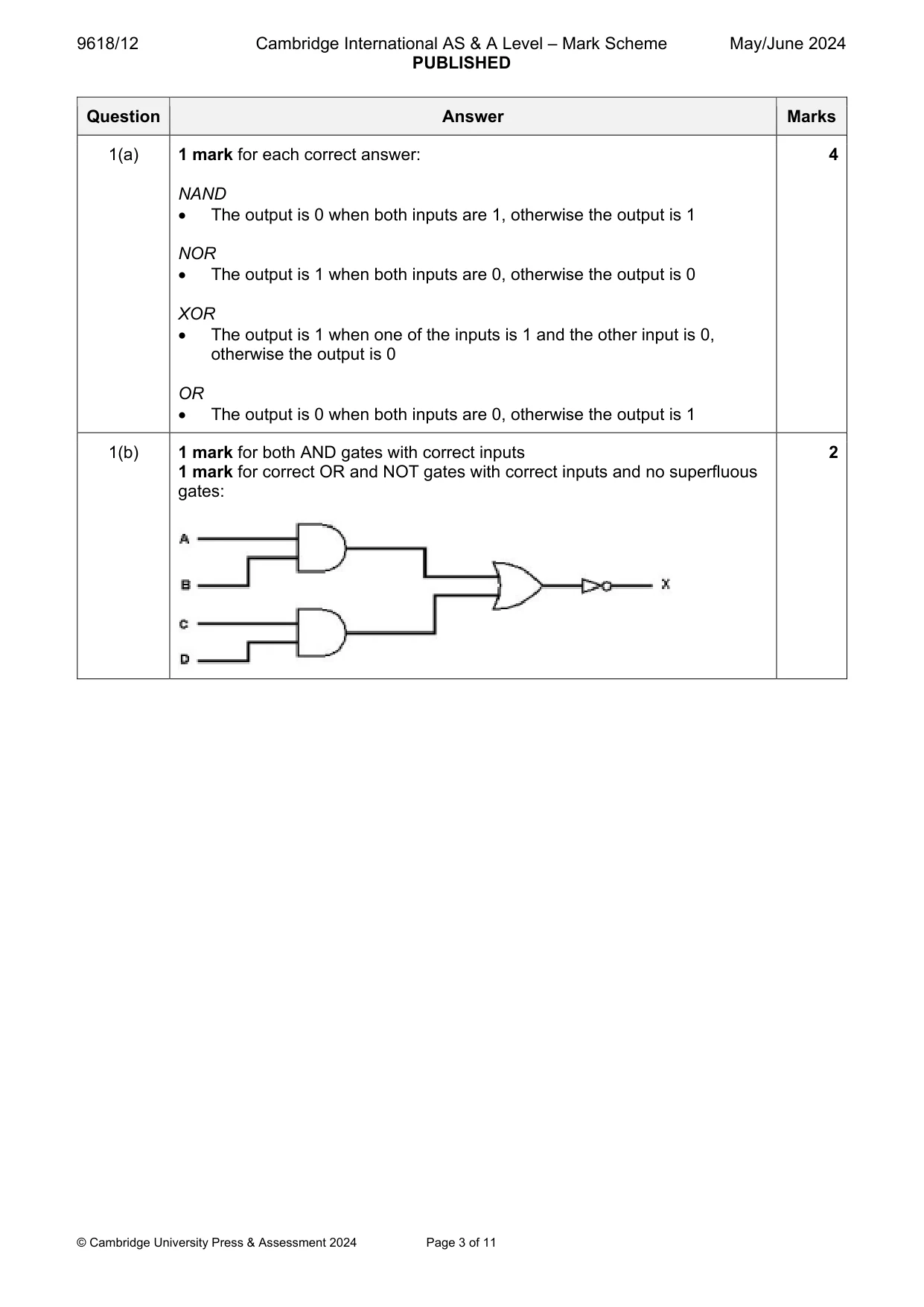
9618/12 Cambridge International AS & A Level – Mark Scheme PUBLISHED May/June 2024 © Cambridge University Press & Assessment 2024 Page 3 of 11 Question Answer Marks 1(a) 1 mark for each correct answer: NAND The output is 0 when both inputs are 1, otherwise the output is 1 NOR The output is 1 when both inputs are 0, otherwise the output is 0 XOR The output is 1 when one of the inputs is 1 and the other input is 0, otherwise the output is 0 OR The output is 0 when both inputs are 0, otherwise the output is 1 4 1(b) 1 mark for both AND gates with correct inputs 1 mark for correct OR and NOT gates with correct inputs and no superfluous gates: 2
Mark scheme, page 4
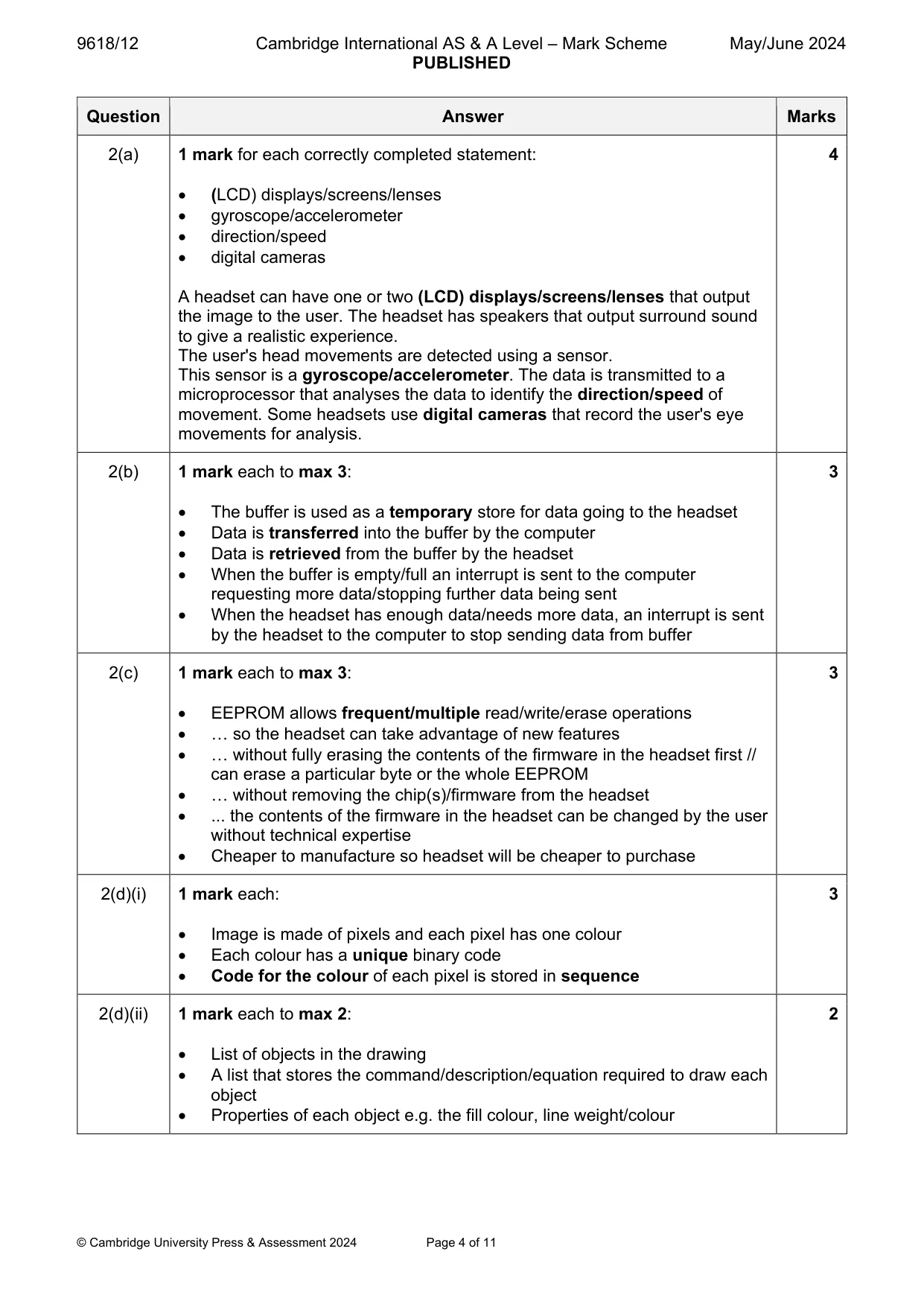
9618/12 Cambridge International AS & A Level – Mark Scheme PUBLISHED May/June 2024 © Cambridge University Press & Assessment 2024 Page 4 of 11 Question Answer Marks 2(a) 1 mark for each correctly completed statement: (LCD) displays/screens/lenses gyroscope/accelerometer direction/speed digital cameras A headset can have one or two (LCD) displays/screens/lenses that output the image to the user. The headset has speakers that output surround sound to give a realistic experience. The user's head movements are detected using a sensor. This sensor is a gyroscope/accelerometer. The data is transmitted to a microprocessor that analyses the data to identify the direction/speed of movement. Some headsets use digital cameras that record the user's eye movements for analysis. 4 2(b) 1 mark each to max 3: The buffer is used as a temporary store for data going to the headset Data is transferred into the buffer by the computer Data is retrieved from the buffer by the headset When the buffer is empty/full an interrupt is sent to the computer requesting more data/stopping further data being sent When the headset has enough data/needs more data, an interrupt is sent by the headset to the computer to stop sending data from buffer 3 2(c) 1 mark each to max 3: EEPROM allows frequent/multiple read/write/erase operations … so the headset can take advantage of new features … without fully erasing the contents of the firmware in the headset first // can erase a particular byte or the whole EEPROM … without removing the chip(s)/firmware from the headset ... the contents of the firmware in the headset can be changed by the user without technical expertise Cheaper to manufacture so headset will be cheaper to purchase 3 2(d)(i) 1 mark each: Image is made of pixels and each pixel has one colour Each colour has a unique binary code Code for the colour of each pixel is stored in sequence 3 2(d)(ii) 1 mark each to max 2: List of objects in the drawing A list that stores the command/description/equation required to draw each object Properties of each object e.g. the fill colour, line weight/colour 2
Mark scheme, page 5
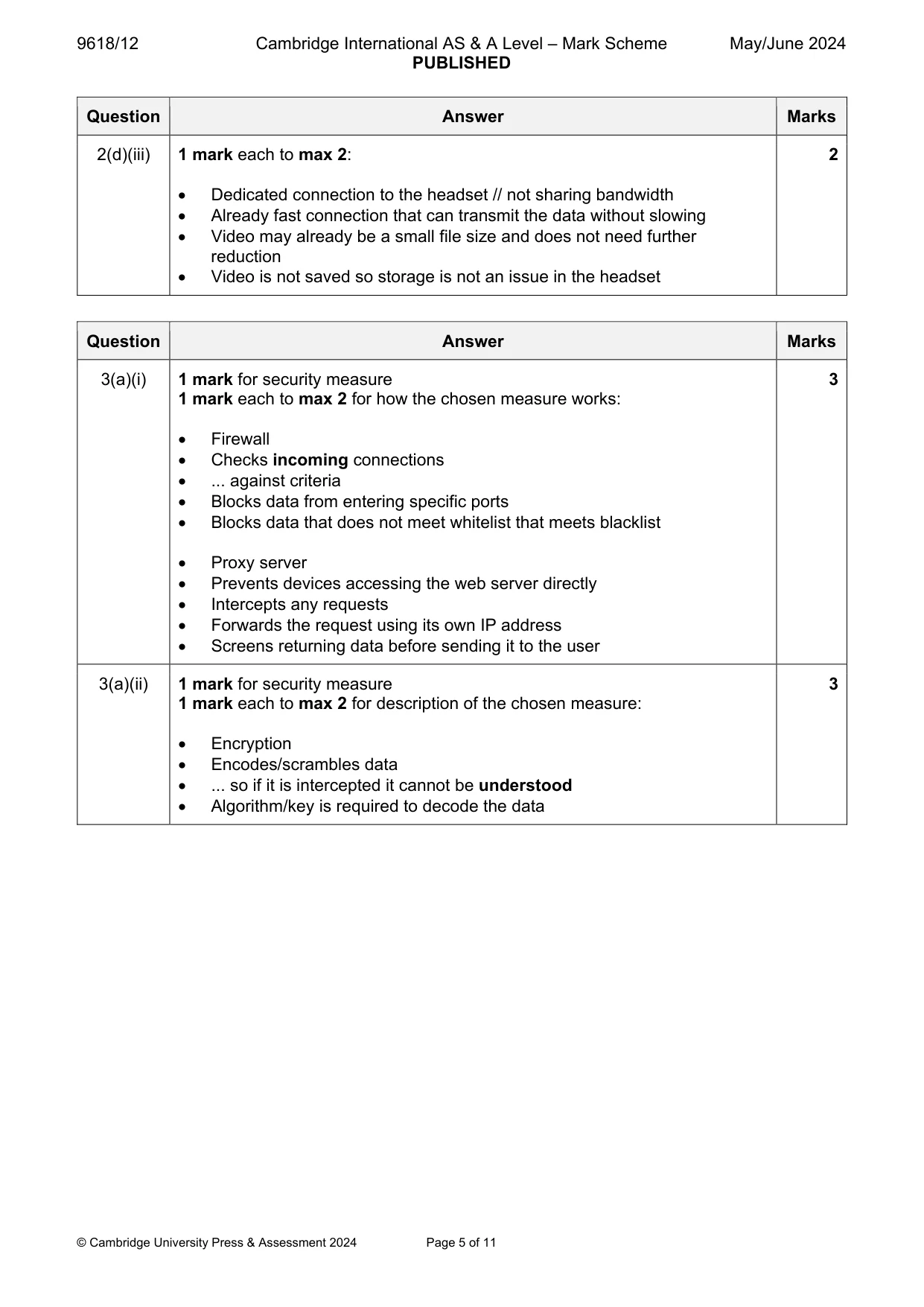
9618/12 Cambridge International AS & A Level – Mark Scheme PUBLISHED May/June 2024 © Cambridge University Press & Assessment 2024 Page 5 of 11 Question Answer Marks 2(d)(iii) 1 mark each to max 2: Dedicated connection to the headset // not sharing bandwidth Already fast connection that can transmit the data without slowing Video may already be a small file size and does not need further reduction Video is not saved so storage is not an issue in the headset 2 Question Answer Marks 3(a)(i) 1 mark for security measure 1 mark each to max 2 for how the chosen measure works: Firewall Checks incoming connections ... against criteria Blocks data from entering specific ports Blocks data that does not meet whitelist that meets blacklist Proxy server Prevents devices accessing the web server directly Intercepts any requests Forwards the request using its own IP address Screens returning data before sending it to the user 3 3(a)(ii) 1 mark for security measure 1 mark each to max 2 for description of the chosen measure: Encryption Encodes/scrambles data ... so if it is intercepted it cannot be understood Algorithm/key is required to decode the data 3
Mark scheme, page 6
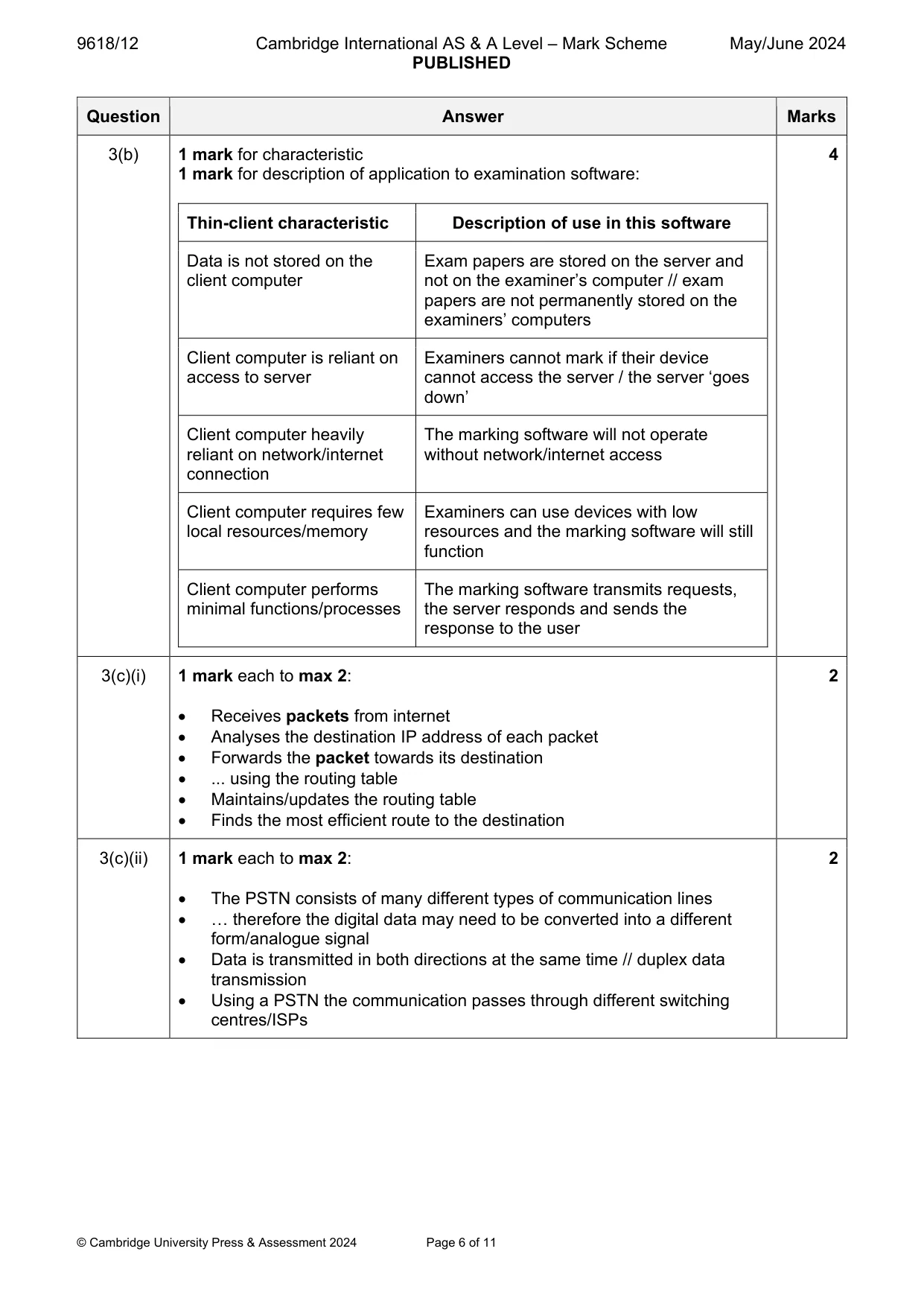
9618/12 Cambridge International AS & A Level – Mark Scheme PUBLISHED May/June 2024 © Cambridge University Press & Assessment 2024 Page 6 of 11 Question Answer Marks 3(b) 1 mark for characteristic 1 mark for description of application to examination software: Thin-client characteristic Description of use in this software Data is not stored on the client computer Exam papers are stored on the server and not on the examiner’s computer // exam papers are not permanently stored on the examiners’ computers Client computer is reliant on access to server Examiners cannot mark if their device cannot access the server / the server ‘goes down’ Client computer heavily reliant on network/internet connection The marking software will not operate without network/internet access Client computer requires few local resources/memory Examiners can use devices with low resources and the marking software will still function Client computer performs minimal functions/processes The marking software transmits requests, the server responds and sends the response to the user 4 3(c)(i) 1 mark each to max 2: Receives packets from internet Analyses the destination IP address of each packet Forwards the packet towards its destination ... using the routing table Maintains/updates the routing table Finds the most efficient route to the destination 2 3(c)(ii) 1 mark each to max 2: The PSTN consists of many different types of communication lines … therefore the digital data may need to be converted into a different form/analogue signal Data is transmitted in both directions at the same time // duplex data transmission Using a PSTN the communication passes through different switching centres/ISPs 2
Mark scheme, page 7
9618/12 Cambridge International AS & A Level – Mark Scheme PUBLISHED May/June 2024 © Cambridge University Press & Assessment 2024 Page 7 of 11 Question Answer Marks 4(a) 1 mark for: 1-to-many 1 4(b) 1 mark each: Creating table EXAM with opening and closing brackets All fields with appropriate data types and commas at end of lines ExamID as primary key Example: CREATE TABLE EXAM( ExamID varchar NOT NULL, Subject varchar, Level int, TotalMarks int, PRIMARY KEY(ExamID) ); 3 4(c) 1 mark each: Altering table EXAM_QUESTION Linking ExamID to ExamID in EXAM Example. ALTER TABLE EXAM_QUESTION ADD FOREIGN KEY (ExamID) REFERENCES EXAM(ExamID); 2 4(d) 1 mark each to max 5: STUDENT table identified with suitable Primary Key A linking table between STUDENT and EXAM with suitable Primary Key and appropriate name … that includes the Primary Key of the STUDENT table as a Foreign Key to join with STUDENT ... and includes the Primary Key of the EXAM table as a Foreign Key to join with EXAM A linking table between STUDENT and EXAM_QUESTION with suitable Primary Key and appropriate name … that includes the Primary Key of Table 2 as a Foreign Key to join with Table 2 … that stores the ExamQuestionID and the mark for that question 5
Mark scheme, page 8
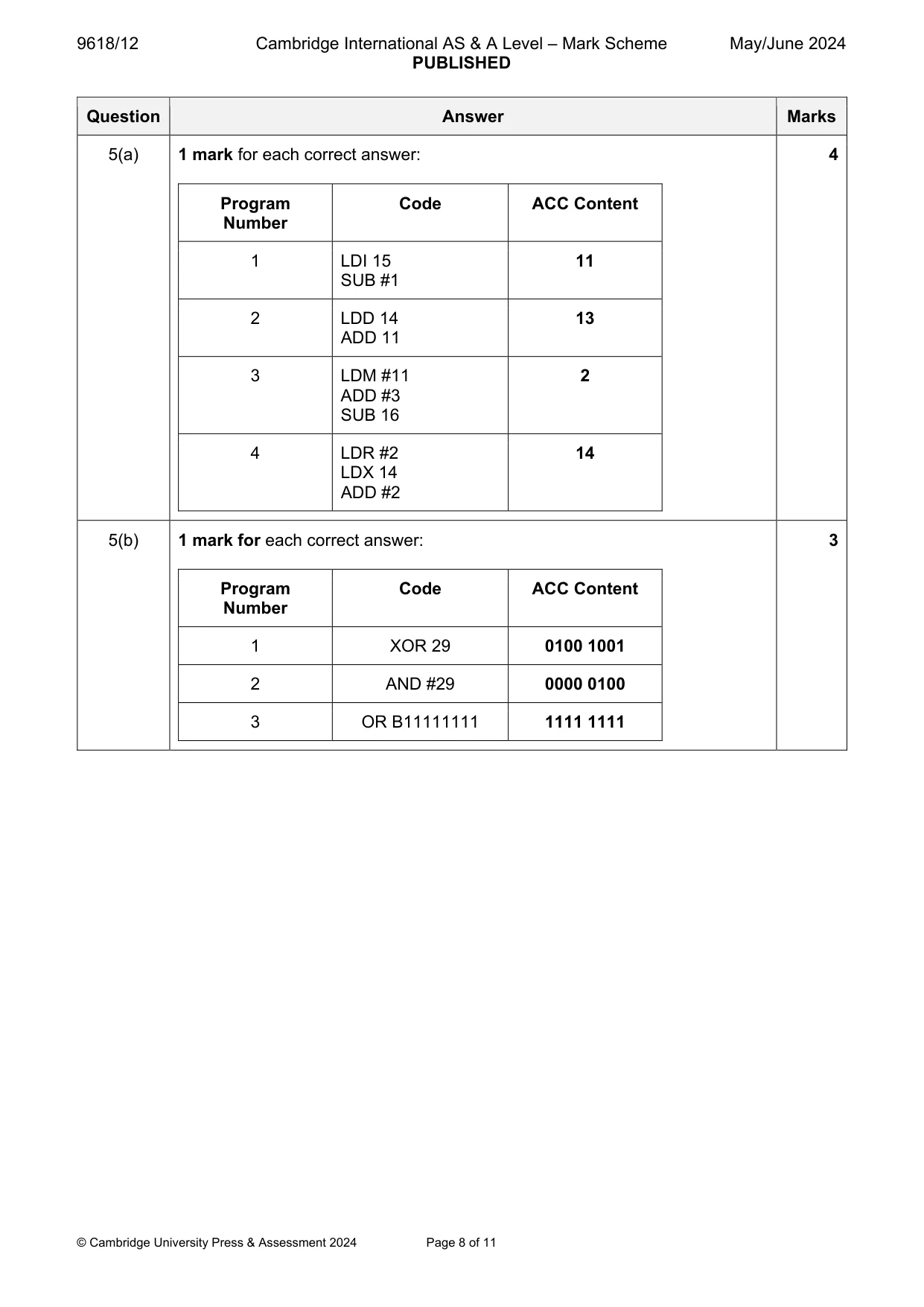
9618/12 Cambridge International AS & A Level – Mark Scheme PUBLISHED May/June 2024 © Cambridge University Press & Assessment 2024 Page 8 of 11 Question Answer Marks 5(a) 1 mark for each correct answer: Program Number Code ACC Content 1 LDI 15 SUB #1 11 2 LDD 14 ADD 11 13 3 LDM #11 ADD #3 SUB 16 2 4 LDR #2 LDX 14 ADD #2 14 4 5(b) 1 mark for each correct answer: Program Number Code ACC Content 1 XOR 29 0100 1001 2 AND #29 0000 0100 3 OR B11111111 1111 1111 3
Mark scheme, page 9
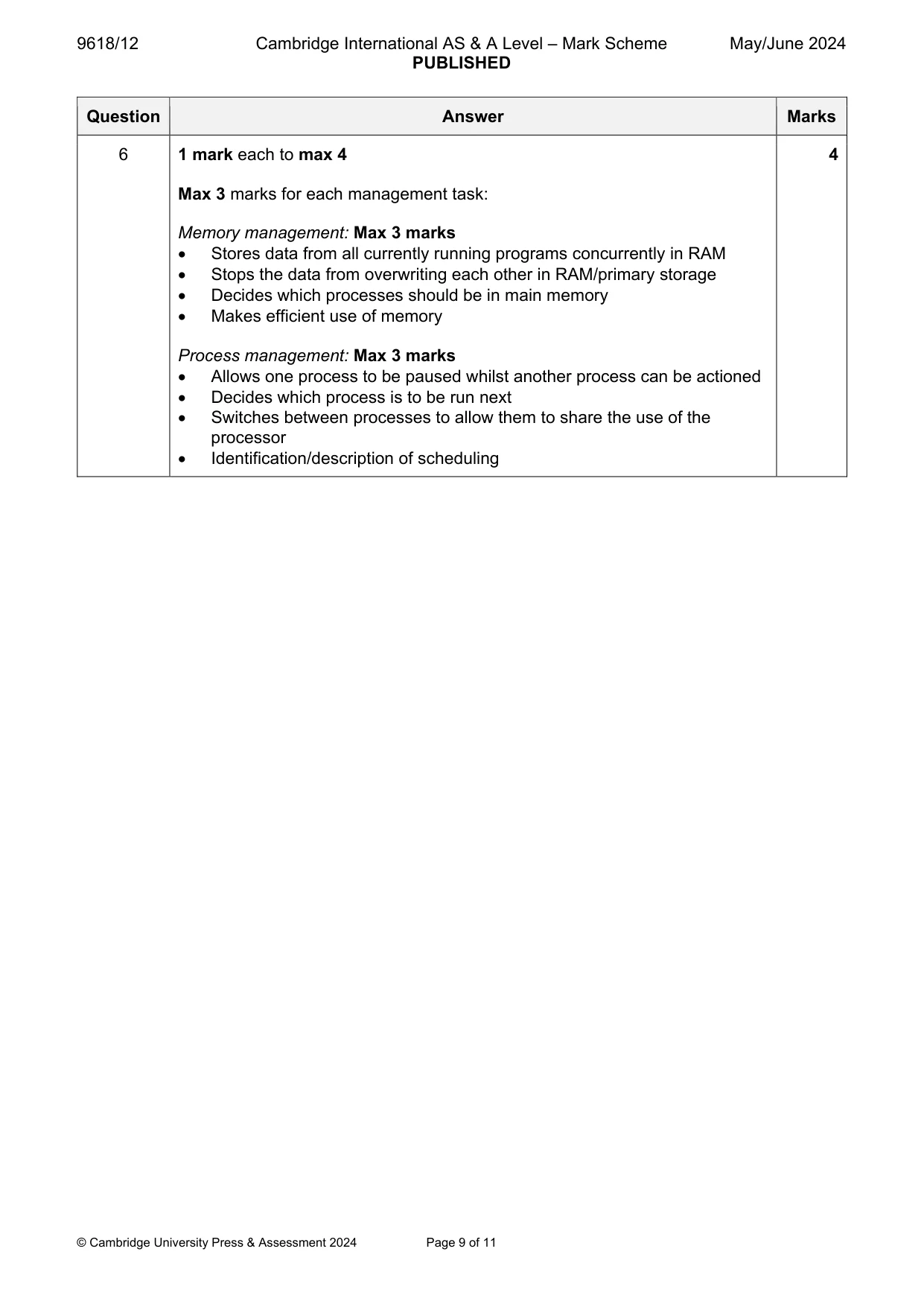
9618/12 Cambridge International AS & A Level – Mark Scheme PUBLISHED May/June 2024 © Cambridge University Press & Assessment 2024 Page 9 of 11 Question Answer Marks 6 1 mark each to max 4 Max 3 marks for each management task: Memory management: Max 3 marks Stores data from all currently running programs concurrently in RAM Stops the data from overwriting each other in RAM/primary storage Decides which processes should be in main memory Makes efficient use of memory Process management: Max 3 marks Allows one process to be paused whilst another process can be actioned Decides which process is to be run next Switches between processes to allow them to share the use of the processor Identification/description of scheduling 4
Mark scheme, page 10
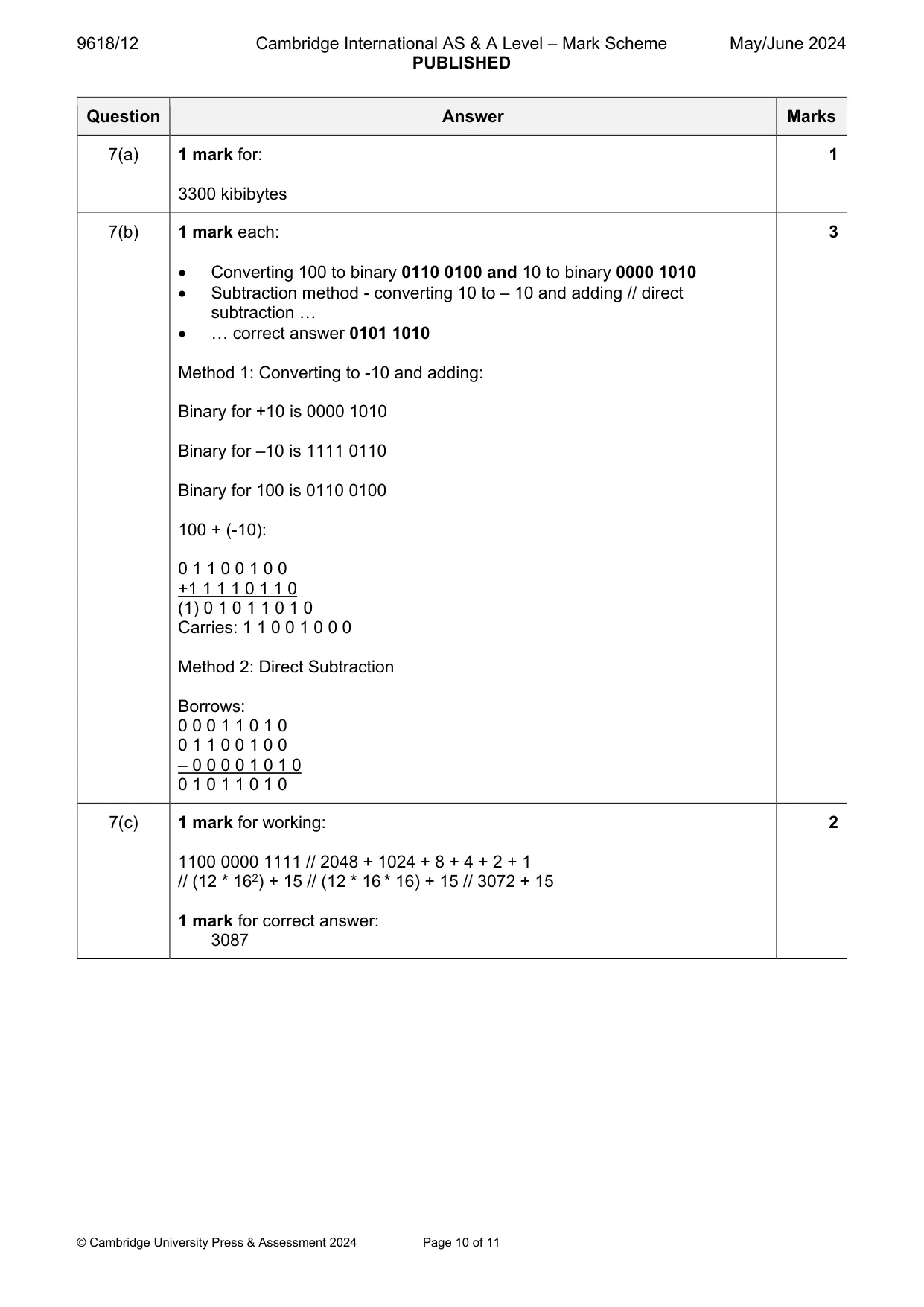
9618/12 Cambridge International AS & A Level – Mark Scheme PUBLISHED May/June 2024 © Cambridge University Press & Assessment 2024 Page 10 of 11 Question Answer Marks 7(a) 1 mark for: 3300 kibibytes 1 7(b) 1 mark each: Converting 100 to binary 0110 0100 and 10 to binary 0000 1010 Subtraction method - converting 10 to – 10 and adding // direct subtraction … … correct answer 0101 1010 Method 1: Converting to -10 and adding: Binary for +10 is 0000 1010 Binary for –10 is 1111 0110 Binary for 100 is 0110 0100 100 + (-10): 0 1 1 0 0 1 0 0 +1 1 1 1 0 1 1 0 (1) 0 1 0 1 1 0 1 0 Carries: 1 1 0 0 1 0 0 0 Method 2: Direct Subtraction Borrows: 0 0 0 1 1 0 1 0 0 1 1 0 0 1 0 0 – 0 0 0 0 1 0 1 0 0 1 0 1 1 0 1 0 3 7(c) 1 mark for working: 1100 0000 1111 // 2048 + 1024 + 8 + 4 + 2 + 1 // (12 * 162) + 15 // (12 * 16 * 16) + 15 // 3072 + 15 1 mark for correct answer: 3087 2
Mark scheme, page 11
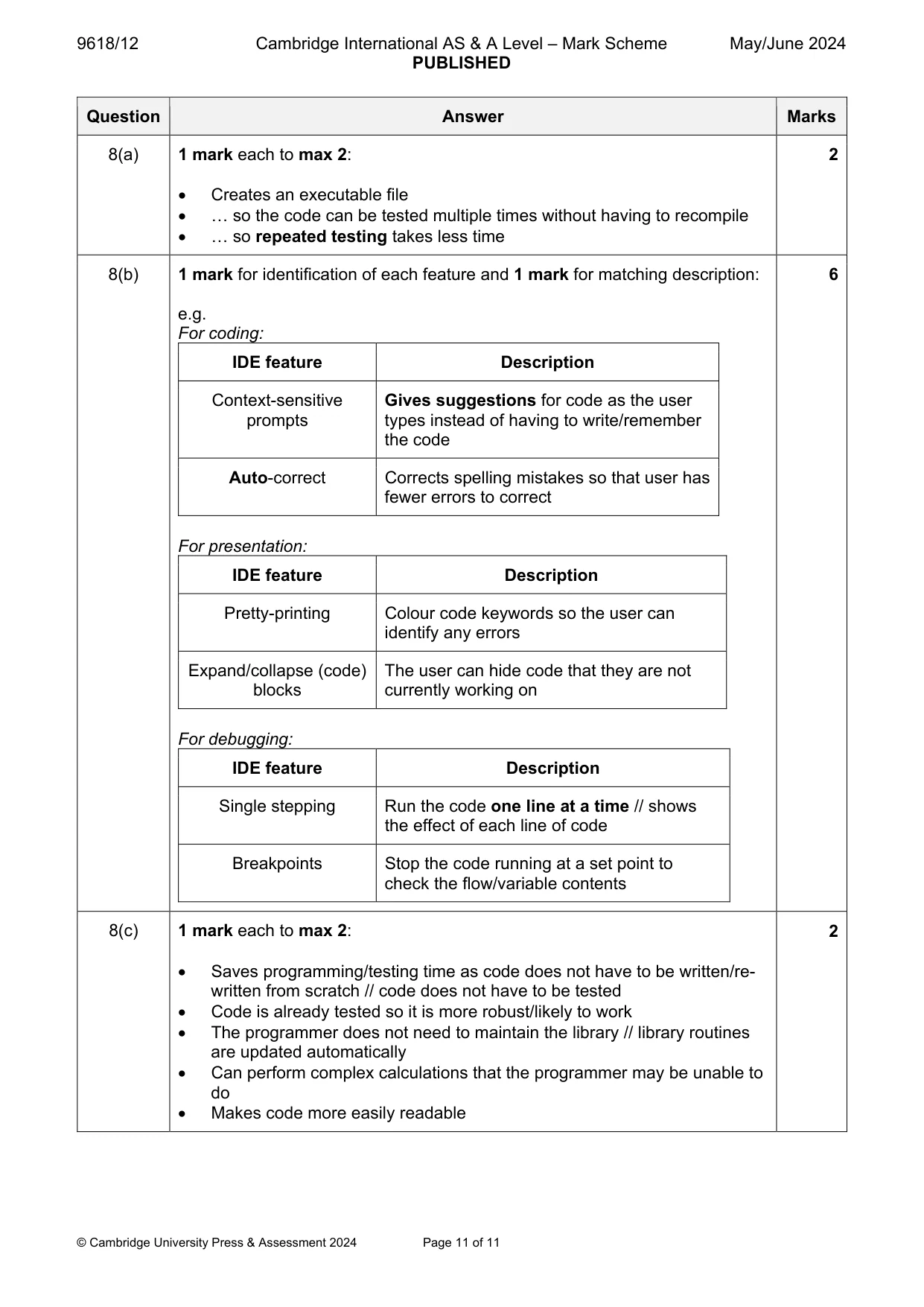
9618/12 Cambridge International AS & A Level – Mark Scheme PUBLISHED May/June 2024 © Cambridge University Press & Assessment 2024 Page 11 of 11 Question Answer Marks 8(a) 1 mark each to max 2: Creates an executable file … so the code can be tested multiple times without having to recompile … so repeated testing takes less time 2 8(b) 1 mark for identification of each feature and 1 mark for matching description: e.g. For coding: IDE feature Description Context-sensitive prompts Gives suggestions for code as the user types instead of having to write/remember the code Auto-correct Corrects spelling mistakes so that user has fewer errors to correct For presentation: IDE feature Description Pretty-printing Colour code keywords so the user can identify any errors Expand/collapse (code) blocks The user can hide code that they are not currently working on For debugging: IDE feature Description Single stepping Run the code one line at a time // shows the effect of each line of code Breakpoints Stop the code running at a set point to check the flow/variable contents 6 8(c) 1 mark each to max 2: Saves programming/testing time as code does not have to be written/re- written from scratch // code does not have to be tested Code is already tested so it is more robust/likely to work The programmer does not need to maintain the library // library routines are updated automatically Can perform complex calculations that the programmer may be unable to do Makes code more easily readable 2
What you needed in this session
Cambridge’s own grade thresholds for 2024 May/June, Paper 1 · Variant 2. A higher threshold means an easier paper — the bar moves with how the cohort did.