Cambridge A Level Computer Science 9618 — 2023 Oct/Nov Paper 1 · Variant 1
9618/11/O/N/23 · 75 marks · ≈84 min
The question paper and its mark scheme, free to read here and free to download. This is Cambridge’s own paper, exactly as it was sat.
Question paper16 pages






Mark scheme10 pages
Answers below. Sit the paper first if you are practising.
Paper as text
Question paper, page 1
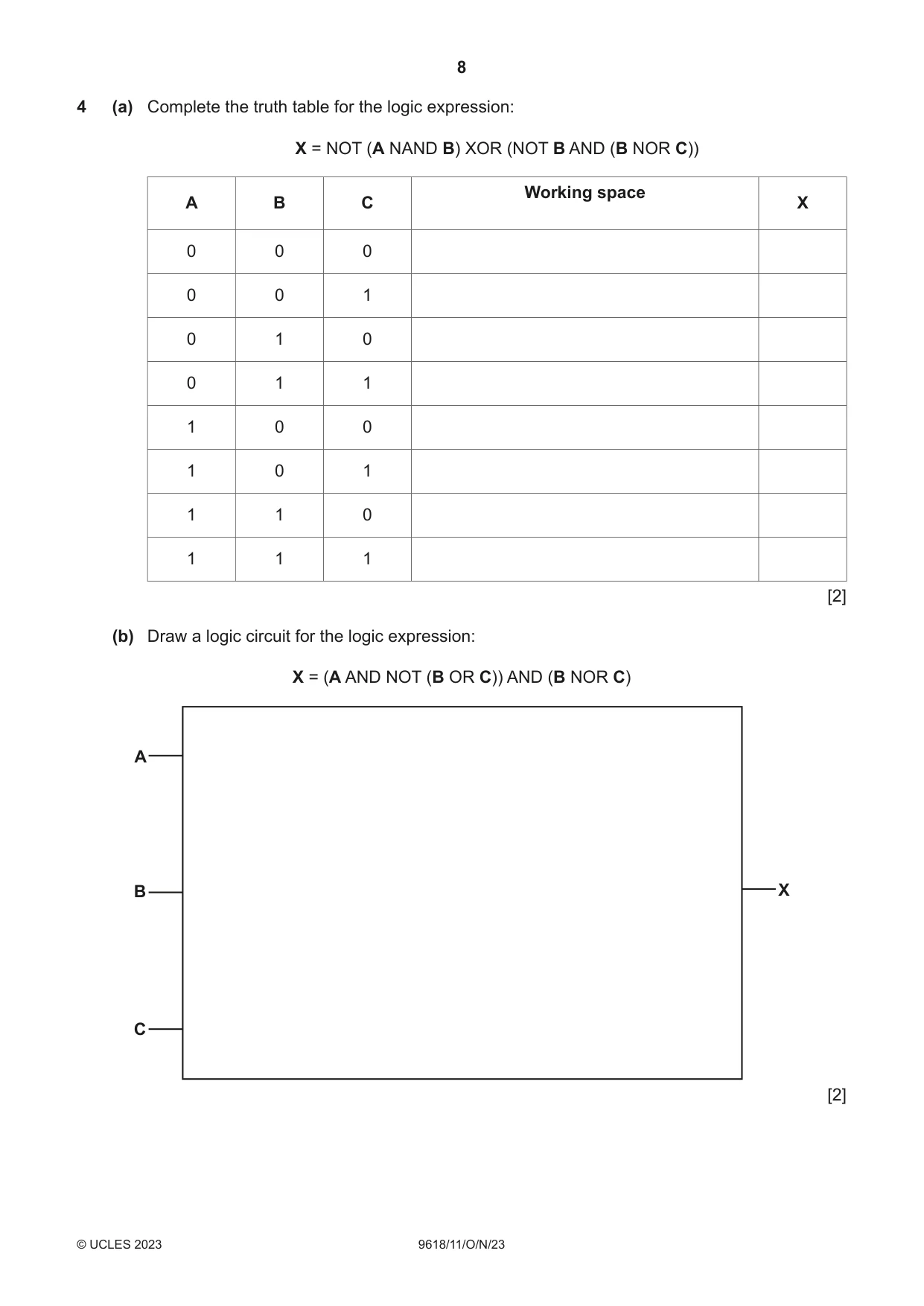
This document has 16 pages. Any blank pages are indicated. [Turn over Cambridge International AS & A Level COMPUTER SCIENCE 9618/11 Paper 1 Theory Fundamentals October/November 2023 1 hour 30 minutes You must answer on the question paper. No additional materials are needed. INSTRUCTIONS ● Answer all questions. ● Use a black or dark blue pen. ● Write your name, centre number and candidate number in the boxes at the top of the page. ● Write your answer to each question in the space provided. ● Do not use an erasable pen or correction fluid. ● Do not write on any bar codes. ● You may use an HB pencil for any diagrams, graphs or rough working. ● Calculators must not be used in this paper. INFORMATION ● The total mark for this paper is 75. ● The number of marks for each question or part question is shown in brackets [ ]. ● No marks will be awarded for using brand names of software packages or hardware. * 4 8 7 7 1 9 5 4 5 9 * DC (PQ/FC) 318308/2 © UCLES 2023
Question paper, page 2
2 9618/11/O/N/23 © UCLES 2023 BLANK PAGE
Question paper, page 3
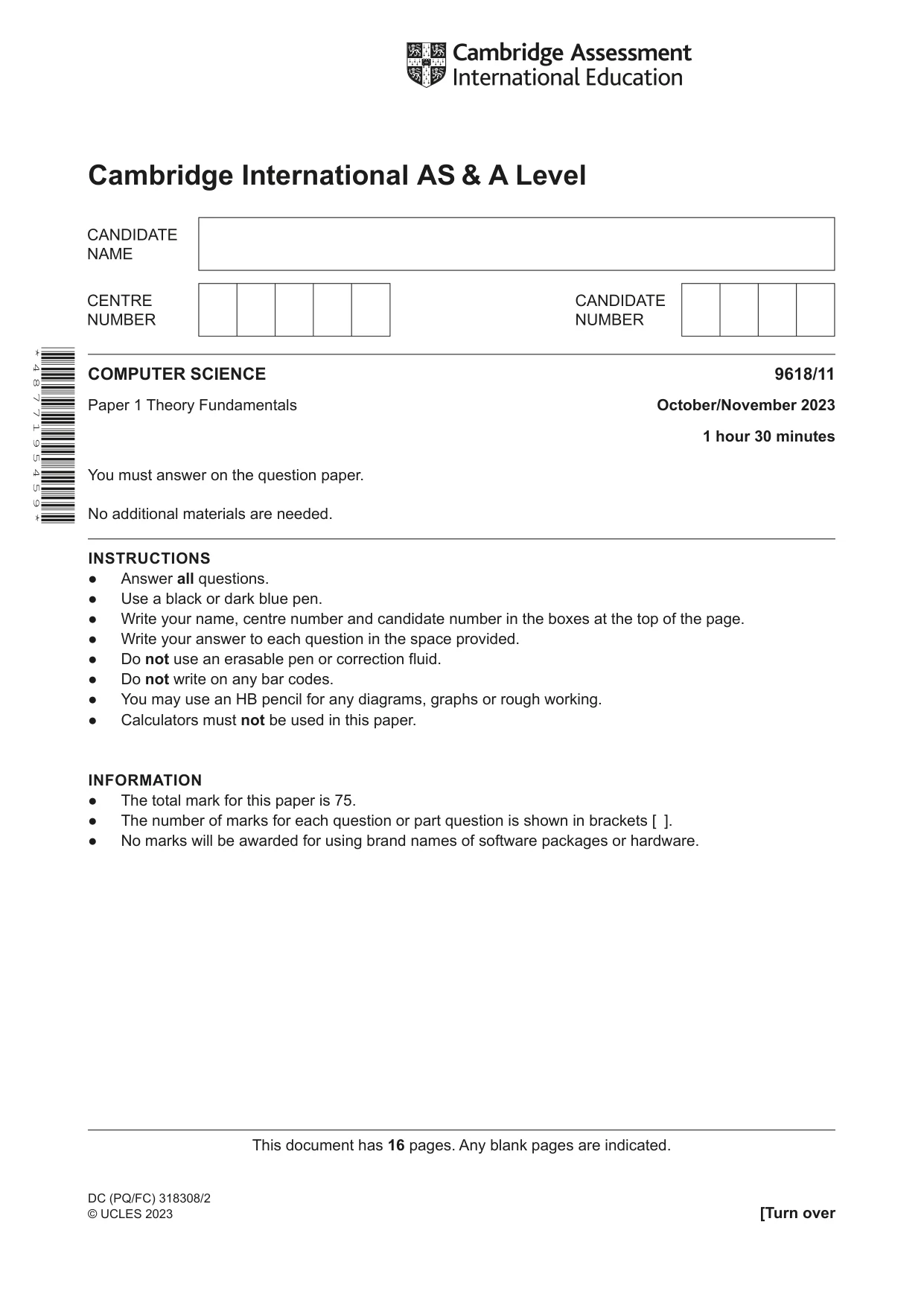
3 9618/11/O/N/23 © UCLES 2023 [Turn over 1 (a) Draw one line from each vector graphic term to its most appropriate description. Term drawing list Description a component created using a formula drawing object defines one characteristic of a component property data required to create all components in the graphic [2] (b) State what is meant by the bit depth of a bitmap image and explain how changing the bit depth affects the image. Definition … … Explanation … … … … [3] (c) Explain why a bitmap image is often compressed before it is attached to an email. … … … … [2]
Question paper, page 4
4 9618/11/O/N/23 © UCLES 2023 2 A school has a Local Area Network (LAN). (a) The LAN connects to the internet using a router. Describe the function of a router in a network. … … … … … … [3] (b) Complete the following table by writing the purpose of each of these other hardware devices used to support the LAN. Hardware device Purpose switch … … … Wireless Access Point (WAP) … … … bridge … … … [3]
Question paper, page 5
5 9618/11/O/N/23 © UCLES 2023 [Turn over (c) The students can save their school files on a public cloud. Identify two drawbacks of the students storing their files on the public cloud. 1 … … 2 … … [2] (d) A new classroom is being set up with 20 computers and a switch. Explain one advantage of implementing a star topology instead of a bus topology in the new classroom. … … … … [2]
Question paper, page 6
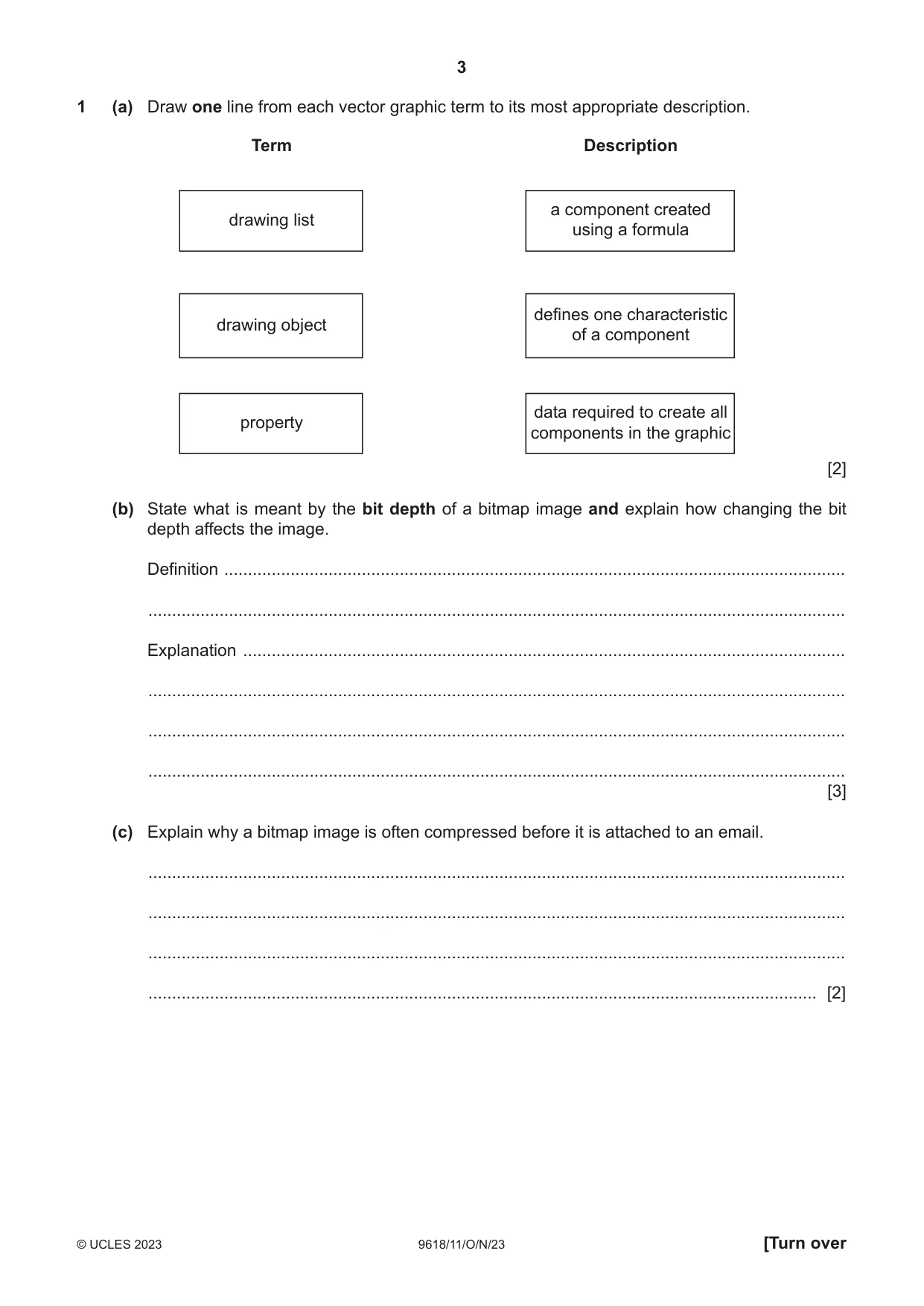
6 9618/11/O/N/23 © UCLES 2023 3 A shop manager has designed a relational database to store customer orders. The database will have the following tables: CUSTOMER(CustomerID, FirstName, LastName, Town) SHOP_ORDER(OrderNo, CustomerID, OrderDate) SUPPLIER(SupplierID, EmailAddress, TelephoneNumber) ITEM(ItemNumber, SupplierID, Description, Price) ORDER_ITEM(ItemNumber, OrderNo, Quantity) (a) Complete the entity-relationship (E-R) diagram for the relational database. SHOP_ORDER CUSTOMER SUPPLIER ORDER_ITEM ITEM [3] (b) Identify three advantages of a relational database compared to a file-based approach. 1 … … 2 … … 3 … … [3]
Question paper, page 7
7 9618/11/O/N/23 © UCLES 2023 [Turn over (c) (i) Write a Structured Query Language (SQL) script to define the database called SHOP. … … [1] (ii) Write the SQL script to return the total quantity of items that the customer with the ID of HJ231 has ordered. … … … … … … [4]
Question paper, page 8
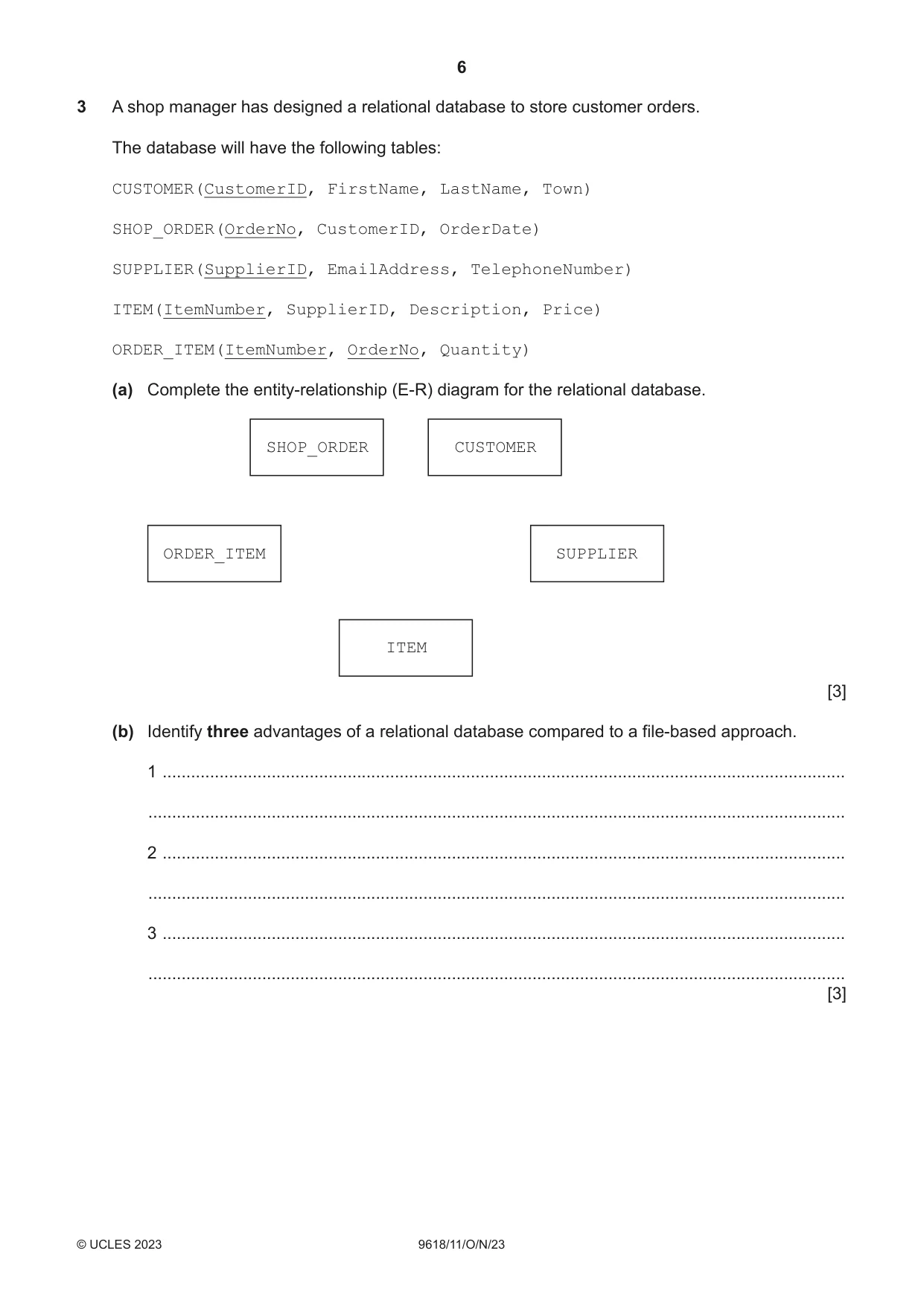
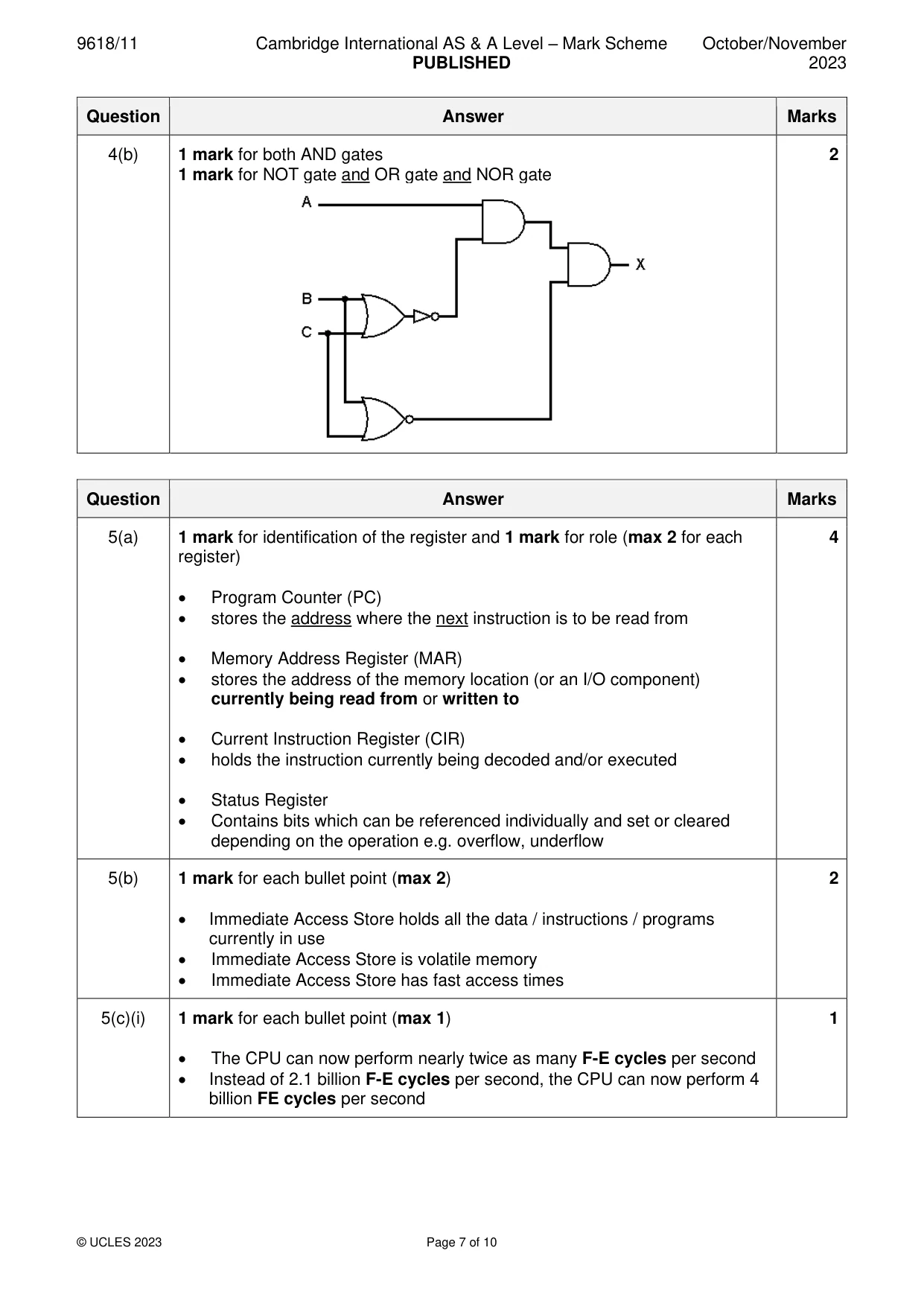
8 9618/11/O/N/23 © UCLES 2023 4 (a) Complete the truth table for the logic expression: X = NOT (A NAND B) XOR (NOT B AND (B NOR C)) A B C Working space X 0 0 0 0 0 1 0 1 0 0 1 1 1 0 0 1 0 1 1 1 0 1 1 1 [2] (b) Draw a logic circuit for the logic expression: X = (A AND NOT (B OR C)) AND (B NOR C) X A B C [2]
Question paper, page 9
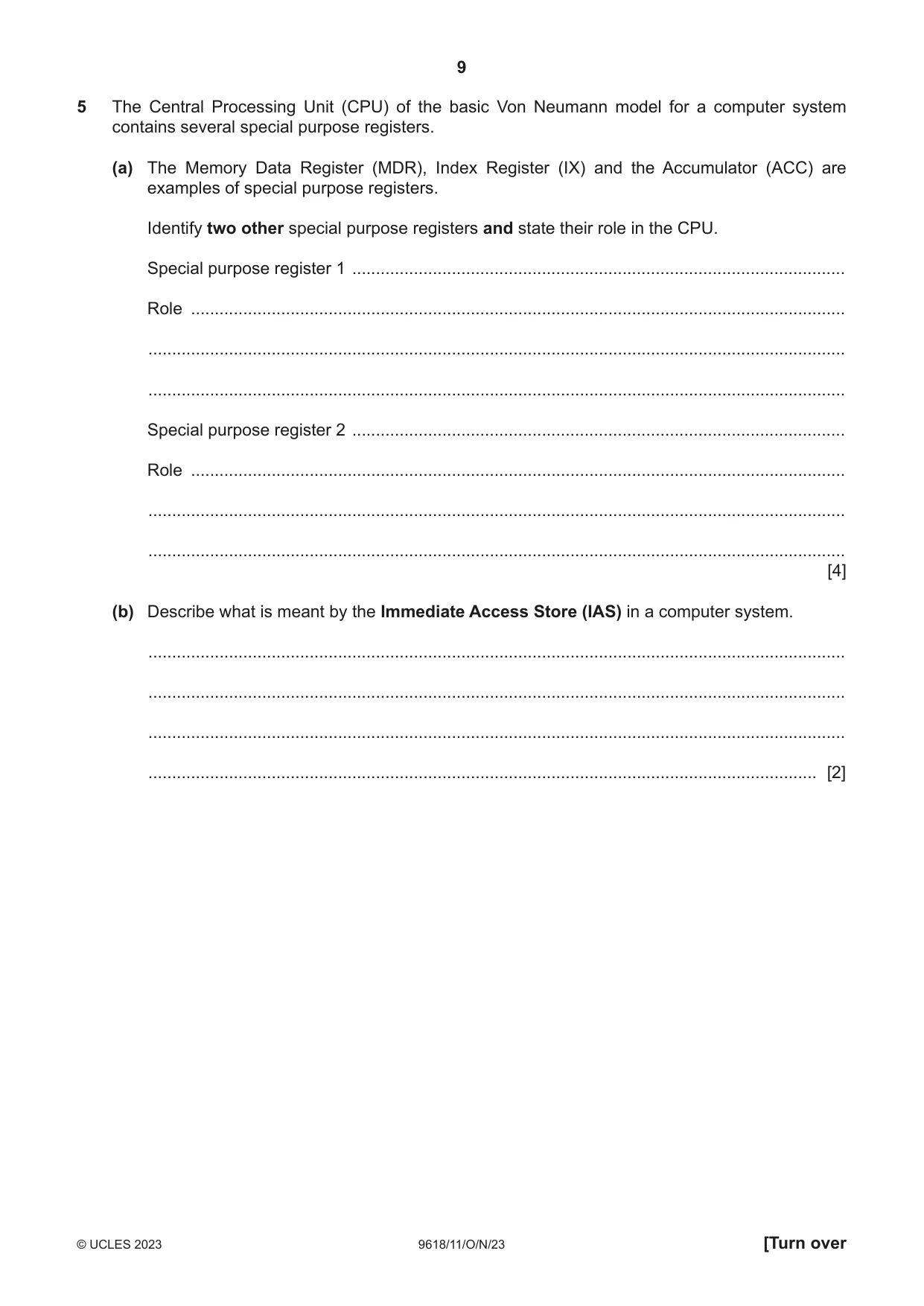
9 9618/11/O/N/23 © UCLES 2023 [Turn over 5 The Central Processing Unit (CPU) of the basic Von Neumann model for a computer system contains several special purpose registers. (a) The Memory Data Register (MDR), Index Register (IX) and the Accumulator (ACC) are examples of special purpose registers. Identify two other special purpose registers and state their role in the CPU. Special purpose register 1 … Role … … … Special purpose register 2 … Role … … … [4] (b) Describe what is meant by the Immediate Access Store (IAS) in a computer system. … … … … [2]
Question paper, page 10
10 9618/11/O/N/23 © UCLES 2023 (c) A computer has a single 2.1 GHz CPU. (i) Describe how increasing the clock speed to 4 GHz can increase the performance of the computer. … … … [1] (ii) A second computer has a CPU with two 2.1 GHz cores. Explain why the second computer does not always run twice as fast as the computer with one 2.1 GHz CPU. … … … … … … … … … … [5]
Question paper, page 11
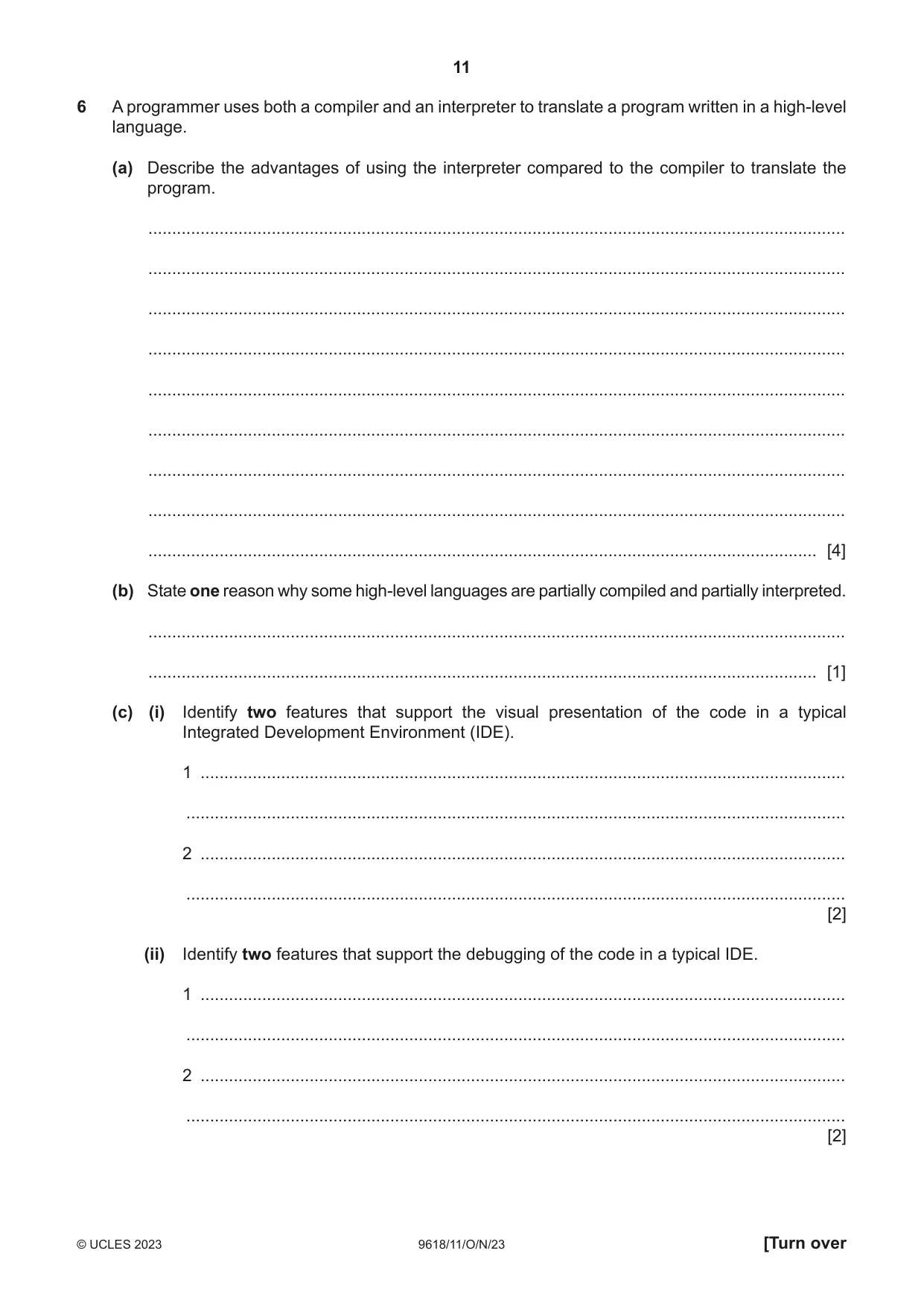
11 9618/11/O/N/23 © UCLES 2023 [Turn over 6 A programmer uses both a compiler and an interpreter to translate a program written in a high-level language. (a) Describe the advantages of using the interpreter compared to the compiler to translate the program. … … … … … … … … … [4] (b) State one reason why some high-level languages are partially compiled and partially interpreted. … … [1] (c) (i) Identify two features that support the visual presentation of the code in a typical Integrated Development Environment (IDE). 1 … … 2 … … [2] (ii) Identify two features that support the debugging of the code in a typical IDE. 1 … … 2 … … [2]
Question paper, page 12
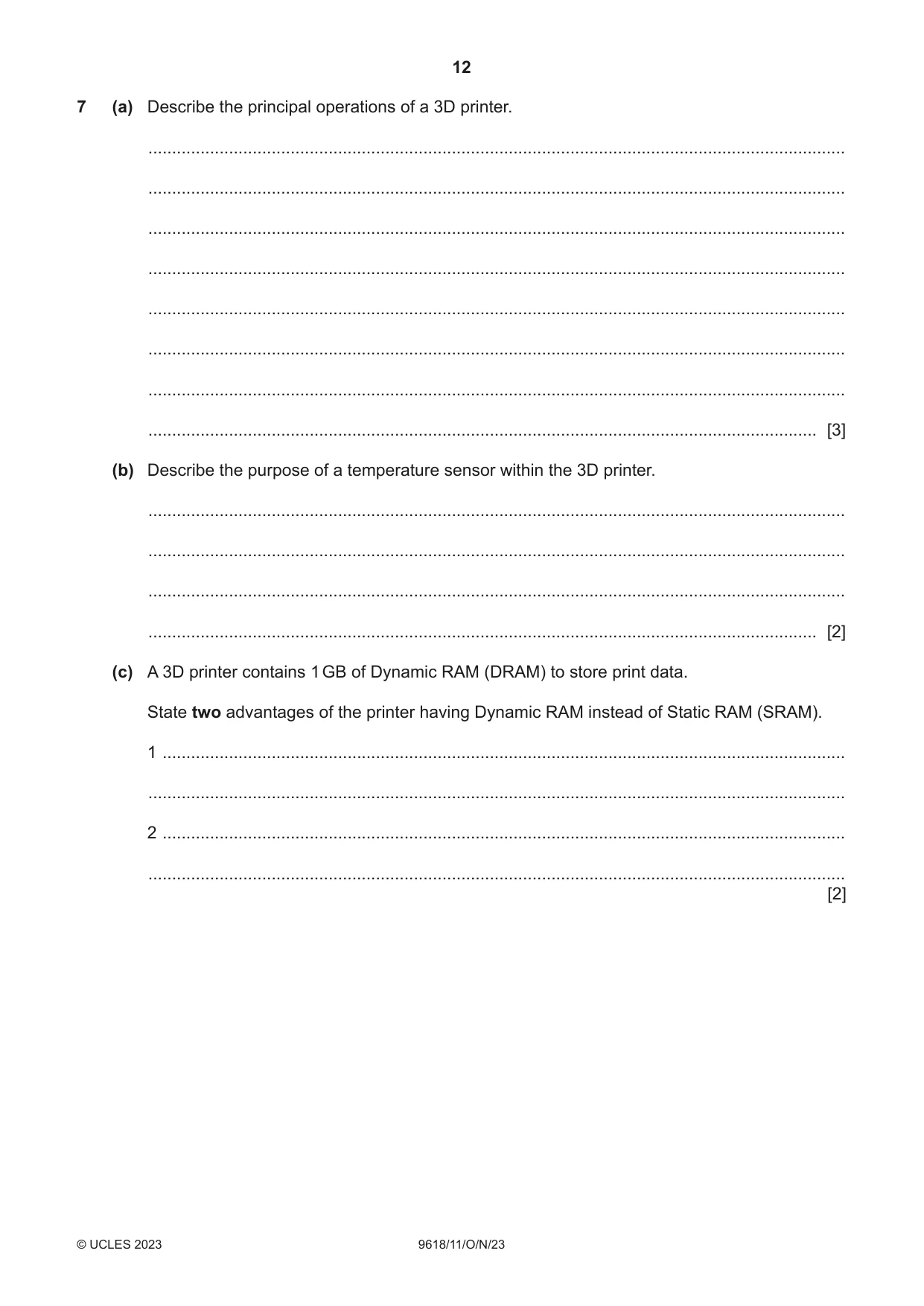
12 9618/11/O/N/23 © UCLES 2023 7 (a) Describe the principal operations of a 3D printer. … … … … … … … … [3] (b) Describe the purpose of a temperature sensor within the 3D printer. … … … … [2] (c) A 3D printer contains 1 GB of Dynamic RAM (DRAM) to store print data. State two advantages of the printer having Dynamic RAM instead of Static RAM (SRAM). 1 … … 2 … … [2]
Question paper, page 13
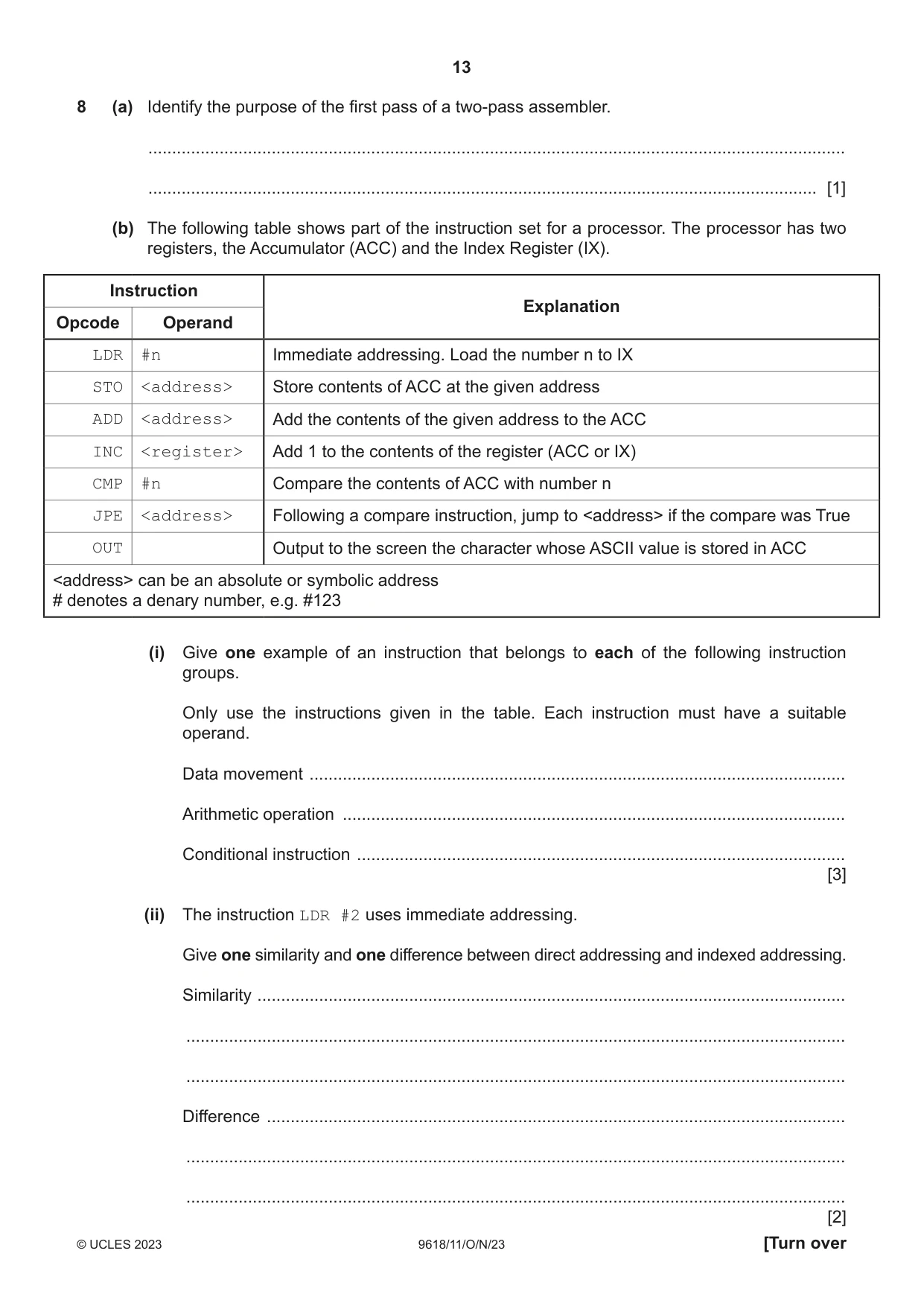
13 9618/11/O/N/23 © UCLES 2023 [Turn over 8 (a) Identify the purpose of the first pass of a two-pass assembler. … … [1] (b) The following table shows part of the instruction set for a processor. The processor has two registers, the Accumulator (ACC) and the Index Register (IX). Instruction Explanation Opcode Operand LDR #n Immediate addressing. Load the number n to IX STO <address> Store contents of ACC at the given address ADD <address> Add the contents of the given address to the ACC INC <register> Add 1 to the contents of the register (ACC or IX) CMP #n Compare the contents of ACC with number n JPE <address> Following a compare instruction, jump to <address> if the compare was True OUT Output to the screen the character whose ASCII value is stored in ACC <address> can be an absolute or symbolic address # denotes a denary number, e.g. #123 (i) Give one example of an instruction that belongs to each of the following instruction groups. Only use the instructions given in the table. Each instruction must have a suitable operand. Data movement … Arithmetic operation … Conditional instruction … [3] (ii) The instruction LDR #2 uses immediate addressing. Give one similarity and one difference between direct addressing and indexed addressing. Similarity … … … Difference … … … [2]
Question paper, page 14
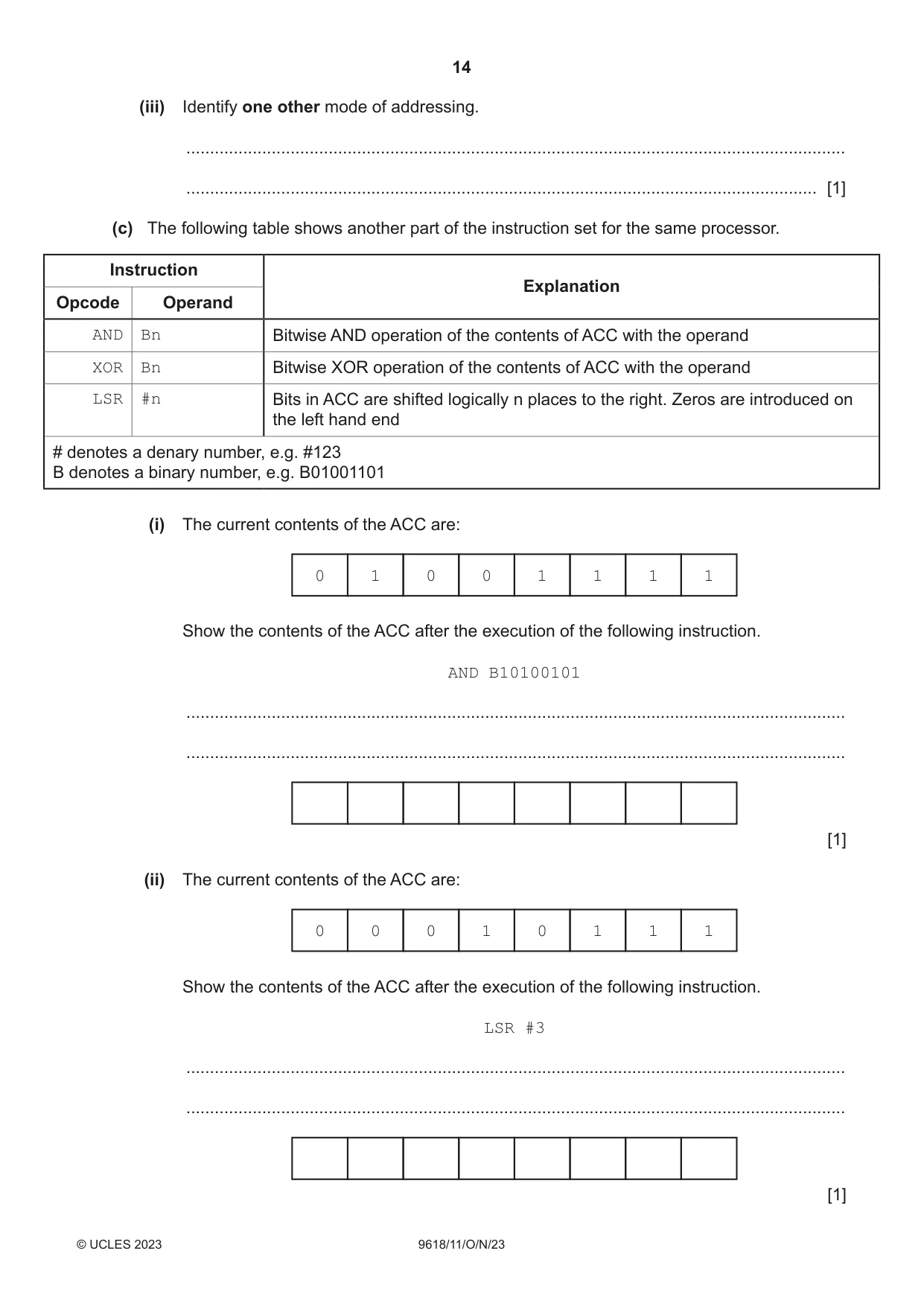
14 9618/11/O/N/23 © UCLES 2023 (iii) Identify one other mode of addressing. … … [1] (c) The following table shows another part of the instruction set for the same processor. Instruction Explanation Opcode Operand AND Bn Bitwise AND operation of the contents of ACC with the operand XOR Bn Bitwise XOR operation of the contents of ACC with the operand LSR #n Bits in ACC are shifted logically n places to the right. Zeros are introduced on the left hand end # denotes a denary number, e.g. #123 B denotes a binary number, e.g. B01001101 (i) The current contents of the ACC are: 0 1 0 0 1 1 1 1 Show the contents of the ACC after the execution of the following instruction. AND B10100101 … … [1] (ii) The current contents of the ACC are: 0 0 0 1 0 1 1 1 Show the contents of the ACC after the execution of the following instruction. LSR #3 … … [1]
Question paper, page 15
15 9618/11/O/N/23 © UCLES 2023 [Turn over (iii) The current contents of the ACC are: 1 1 1 1 0 1 1 1 Show the contents of the ACC after the execution of the following instruction. XOR B00100101 … … [1]
Question paper, page 16
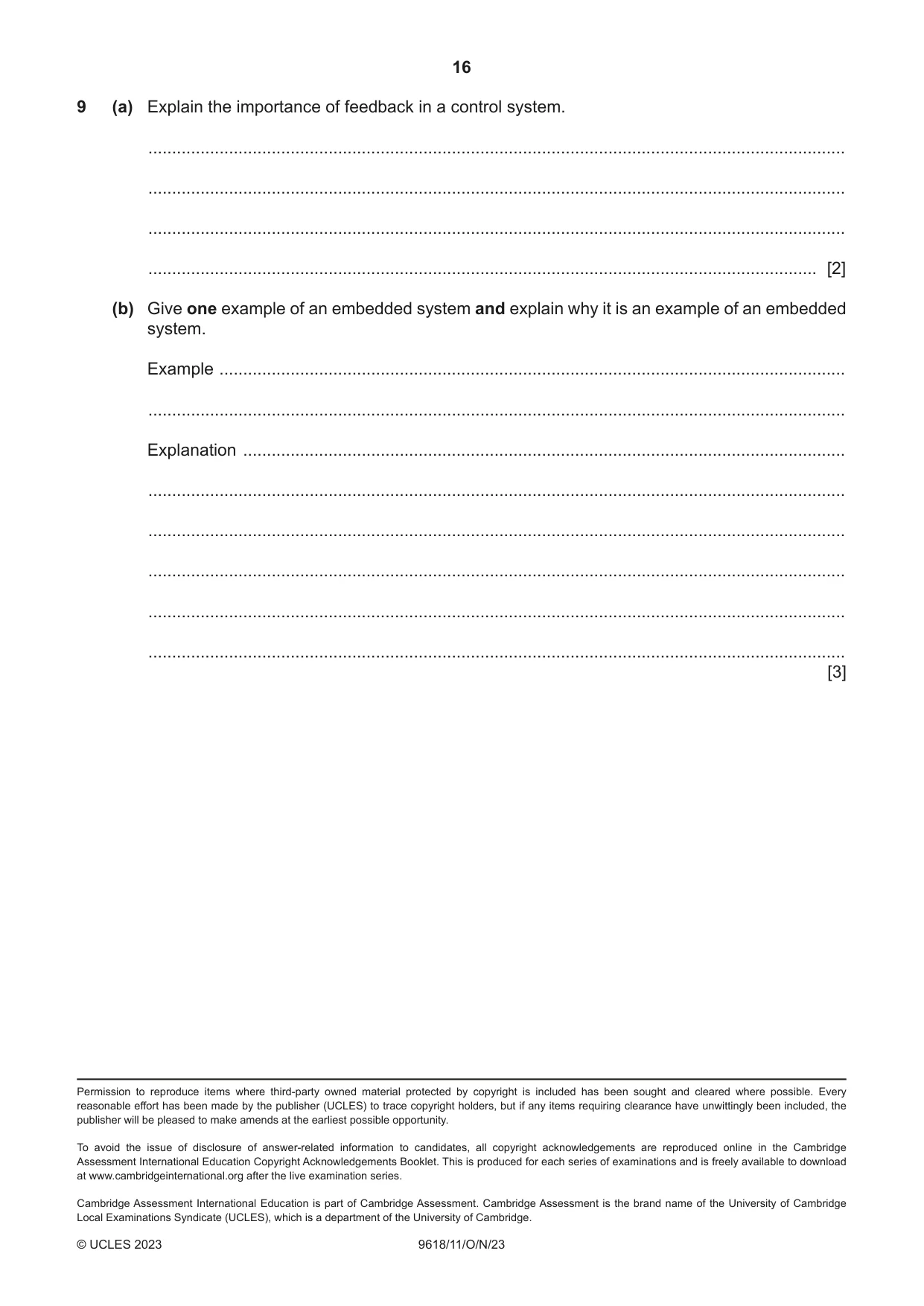
16 9618/11/O/N/23 © UCLES 2023 Permission to reproduce items where third-party owned material protected by copyright is included has been sought and cleared where possible. Every reasonable effort has been made by the publisher (UCLES) to trace copyright holders, but if any items requiring clearance have unwittingly been included, the publisher will be pleased to make amends at the earliest possible opportunity. To avoid the issue of disclosure of answer-related information to candidates, all copyright acknowledgements are reproduced online in the Cambridge Assessment International Education Copyright Acknowledgements Booklet. This is produced for each series of examinations and is freely available to download at www.cambridgeinternational.org after the live examination series. Cambridge Assessment International Education is part of Cambridge Assessment. Cambridge Assessment is the brand name of the University of Cambridge Local Examinations Syndicate (UCLES), which is a department of the University of Cambridge. 9 (a) Explain the importance of feedback in a control system. … … … … [2] (b) Give one example of an embedded system and explain why it is an example of an embedded system. Example … … Explanation … … … … … … [3]
Mark scheme, page 1
This document consists of 10 printed pages. © UCLES 2023 [Turn over Cambridge International AS & A Level COMPUTER SCIENCE 9618/11 Paper 1 Theory Fundamentals October/November 2023 MARK SCHEME Maximum Mark: 75 Published This mark scheme is published as an aid to teachers and candidates, to indicate the requirements of the examination. It shows the basis on which Examiners were instructed to award marks. It does not indicate the details of the discussions that took place at an Examiners’ meeting before marking began, which would have considered the acceptability of alternative answers. Mark schemes should be read in conjunction with the question paper and the Principal Examiner Report for Teachers. Cambridge International will not enter into discussions about these mark schemes. Cambridge International is publishing the mark schemes for the October/November 2023 series for most Cambridge IGCSE, Cambridge International A and AS Level components, and some Cambridge O Level components.
Mark scheme, page 2
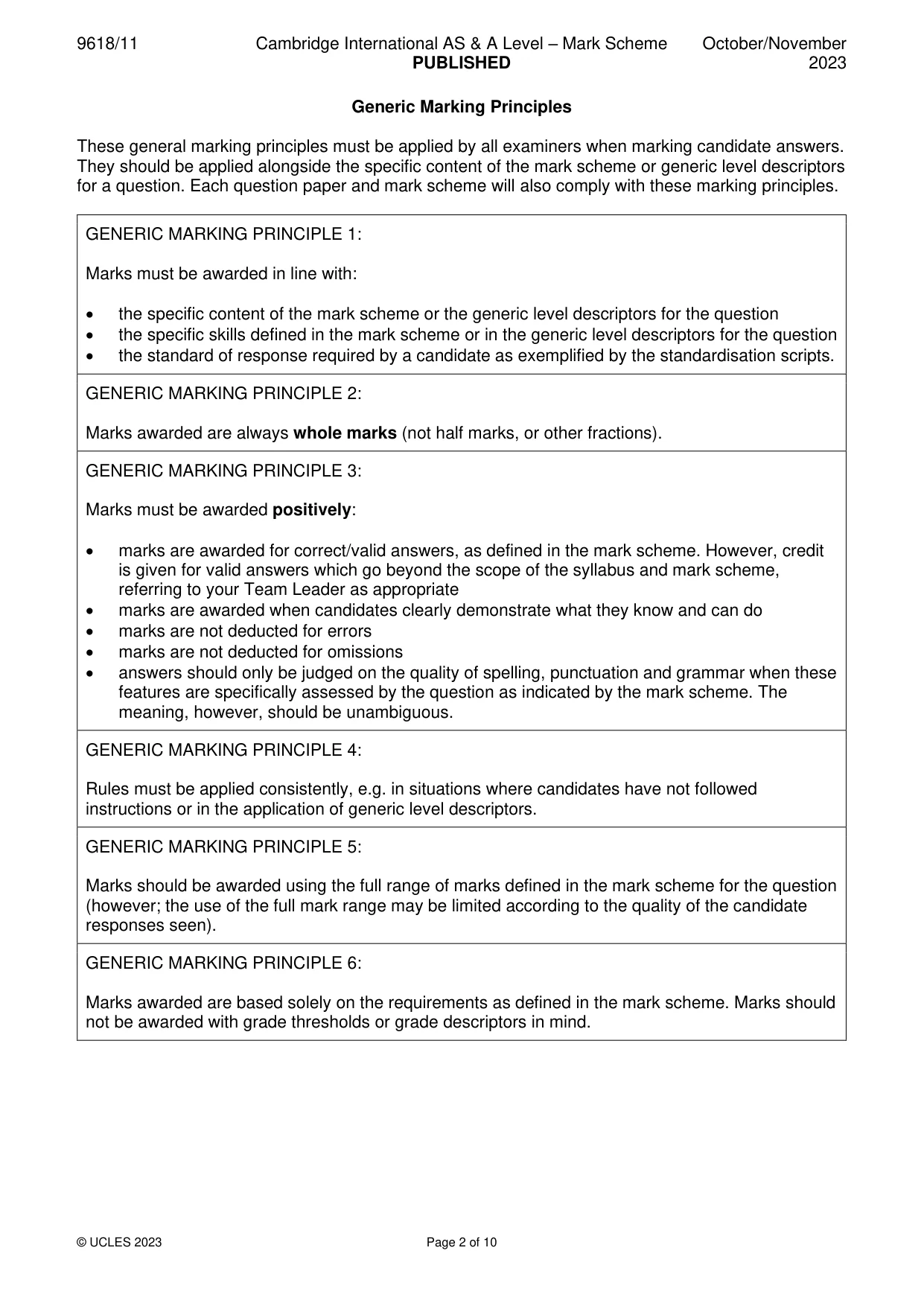
9618/11 Cambridge International AS & A Level – Mark Scheme PUBLISHED October/November 2023 © UCLES 2023 Page 2 of 10 Generic Marking Principles These general marking principles must be applied by all examiners when marking candidate answers. They should be applied alongside the specific content of the mark scheme or generic level descriptors for a question. Each question paper and mark scheme will also comply with these marking principles. GENERIC MARKING PRINCIPLE 1: Marks must be awarded in line with: • the specific content of the mark scheme or the generic level descriptors for the question • the specific skills defined in the mark scheme or in the generic level descriptors for the question • the standard of response required by a candidate as exemplified by the standardisation scripts. GENERIC MARKING PRINCIPLE 2: Marks awarded are always whole marks (not half marks, or other fractions). GENERIC MARKING PRINCIPLE 3: Marks must be awarded positively: • marks are awarded for correct/valid answers, as defined in the mark scheme. However, credit is given for valid answers which go beyond the scope of the syllabus and mark scheme, referring to your Team Leader as appropriate • marks are awarded when candidates clearly demonstrate what they know and can do • marks are not deducted for errors • marks are not deducted for omissions • answers should only be judged on the quality of spelling, punctuation and grammar when these features are specifically assessed by the question as indicated by the mark scheme. The meaning, however, should be unambiguous. GENERIC MARKING PRINCIPLE 4: Rules must be applied consistently, e.g. in situations where candidates have not followed instructions or in the application of generic level descriptors. GENERIC MARKING PRINCIPLE 5: Marks should be awarded using the full range of marks defined in the mark scheme for the question (however; the use of the full mark range may be limited according to the quality of the candidate responses seen). GENERIC MARKING PRINCIPLE 6: Marks awarded are based solely on the requirements as defined in the mark scheme. Marks should not be awarded with grade thresholds or grade descriptors in mind.
Mark scheme, page 3
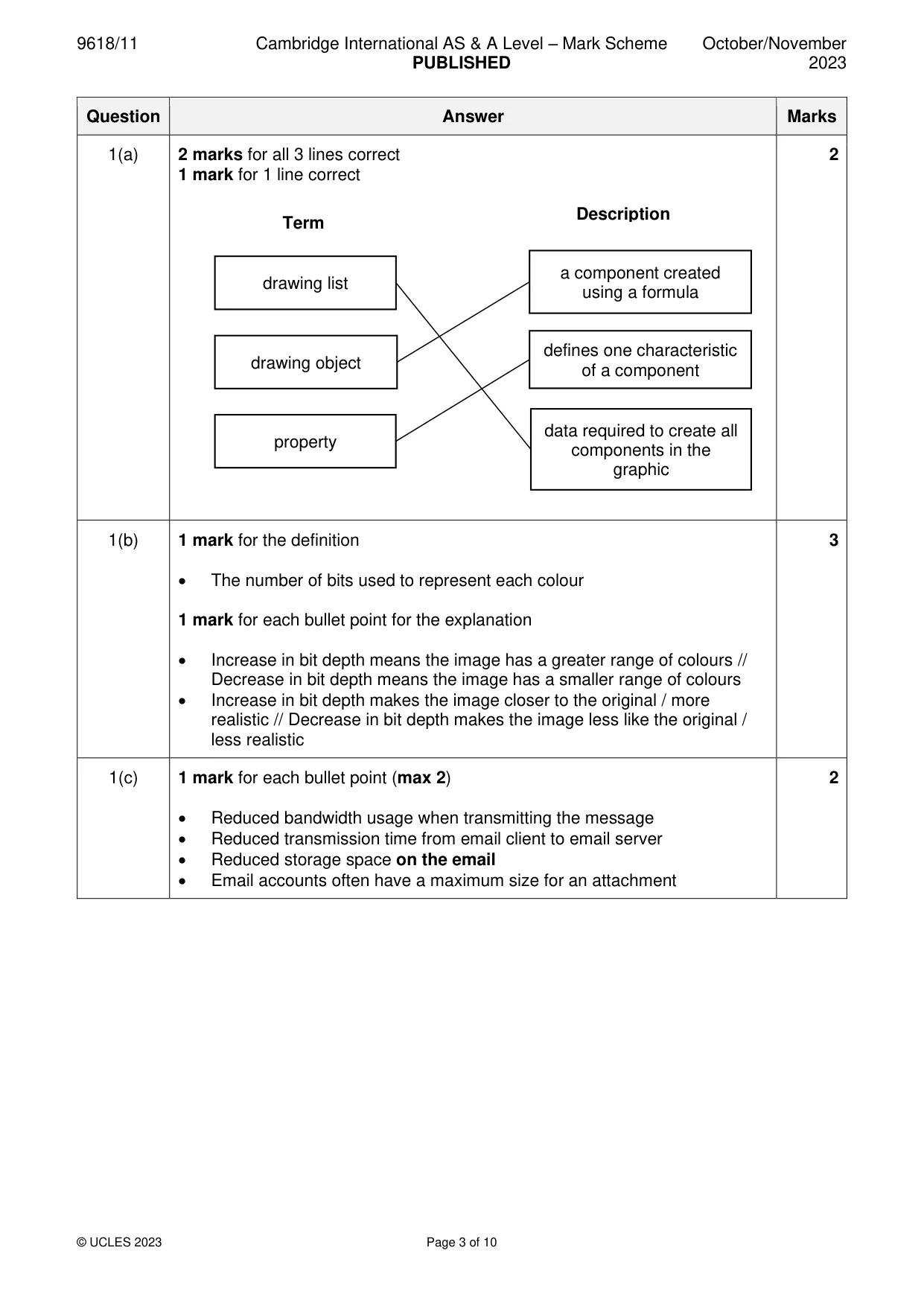
9618/11 Cambridge International AS & A Level – Mark Scheme PUBLISHED October/November 2023 © UCLES 2023 Page 3 of 10 Question Answer Marks 1(a) 2 marks for all 3 lines correct 1 mark for 1 line correct 2 1(b) 1 mark for the definition • The number of bits used to represent each colour 1 mark for each bullet point for the explanation • Increase in bit depth means the image has a greater range of colours // Decrease in bit depth means the image has a smaller range of colours • Increase in bit depth makes the image closer to the original / more realistic // Decrease in bit depth makes the image less like the original / less realistic 3 1(c) 1 mark for each bullet point (max 2) • Reduced bandwidth usage when transmitting the message • Reduced transmission time from email client to email server • Reduced storage space on the email • Email accounts often have a maximum size for an attachment 2 drawing list drawing object property data required to create all components in the graphic defines one characteristic of a component a component created using a formula Term Description
Mark scheme, page 4
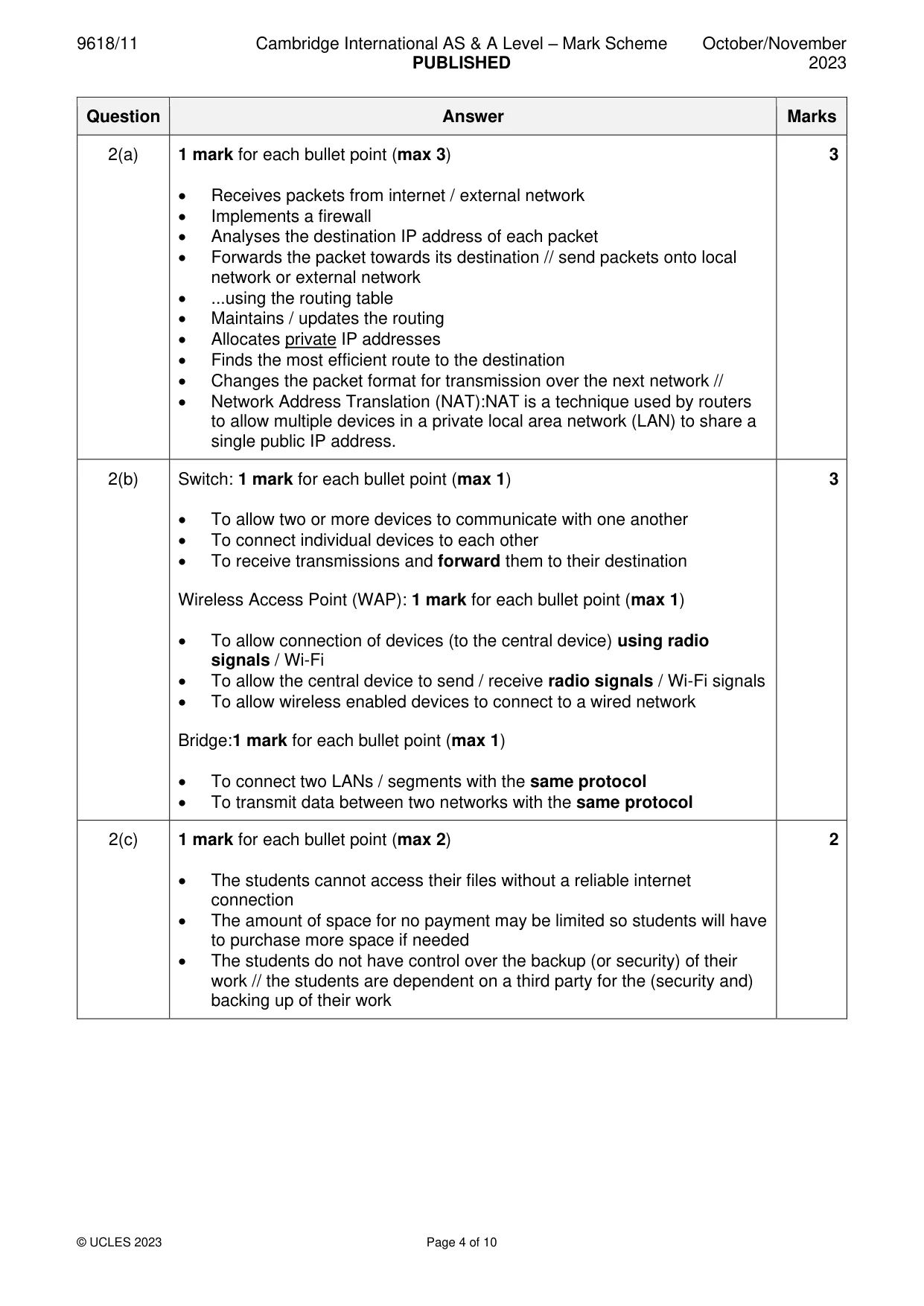
9618/11 Cambridge International AS & A Level – Mark Scheme PUBLISHED October/November 2023 © UCLES 2023 Page 4 of 10 Question Answer Marks 2(a) 1 mark for each bullet point (max 3) • Receives packets from internet / external network • Implements a firewall • Analyses the destination IP address of each packet • Forwards the packet towards its destination // send packets onto local network or external network • ...using the routing table • Maintains / updates the routing • Allocates private IP addresses • Finds the most efficient route to the destination • Changes the packet format for transmission over the next network // • Network Address Translation (NAT):NAT is a technique used by routers to allow multiple devices in a private local area network (LAN) to share a single public IP address. 3 2(b) Switch: 1 mark for each bullet point (max 1) • To allow two or more devices to communicate with one another • To connect individual devices to each other • To receive transmissions and forward them to their destination Wireless Access Point (WAP): 1 mark for each bullet point (max 1) • To allow connection of devices (to the central device) using radio signals / Wi-Fi • To allow the central device to send / receive radio signals / Wi-Fi signals • To allow wireless enabled devices to connect to a wired network Bridge:1 mark for each bullet point (max 1) • To connect two LANs / segments with the same protocol • To transmit data between two networks with the same protocol 3 2(c) 1 mark for each bullet point (max 2) • The students cannot access their files without a reliable internet connection • The amount of space for no payment may be limited so students will have to purchase more space if needed • The students do not have control over the backup (or security) of their work // the students are dependent on a third party for the (security and) backing up of their work 2
Mark scheme, page 5
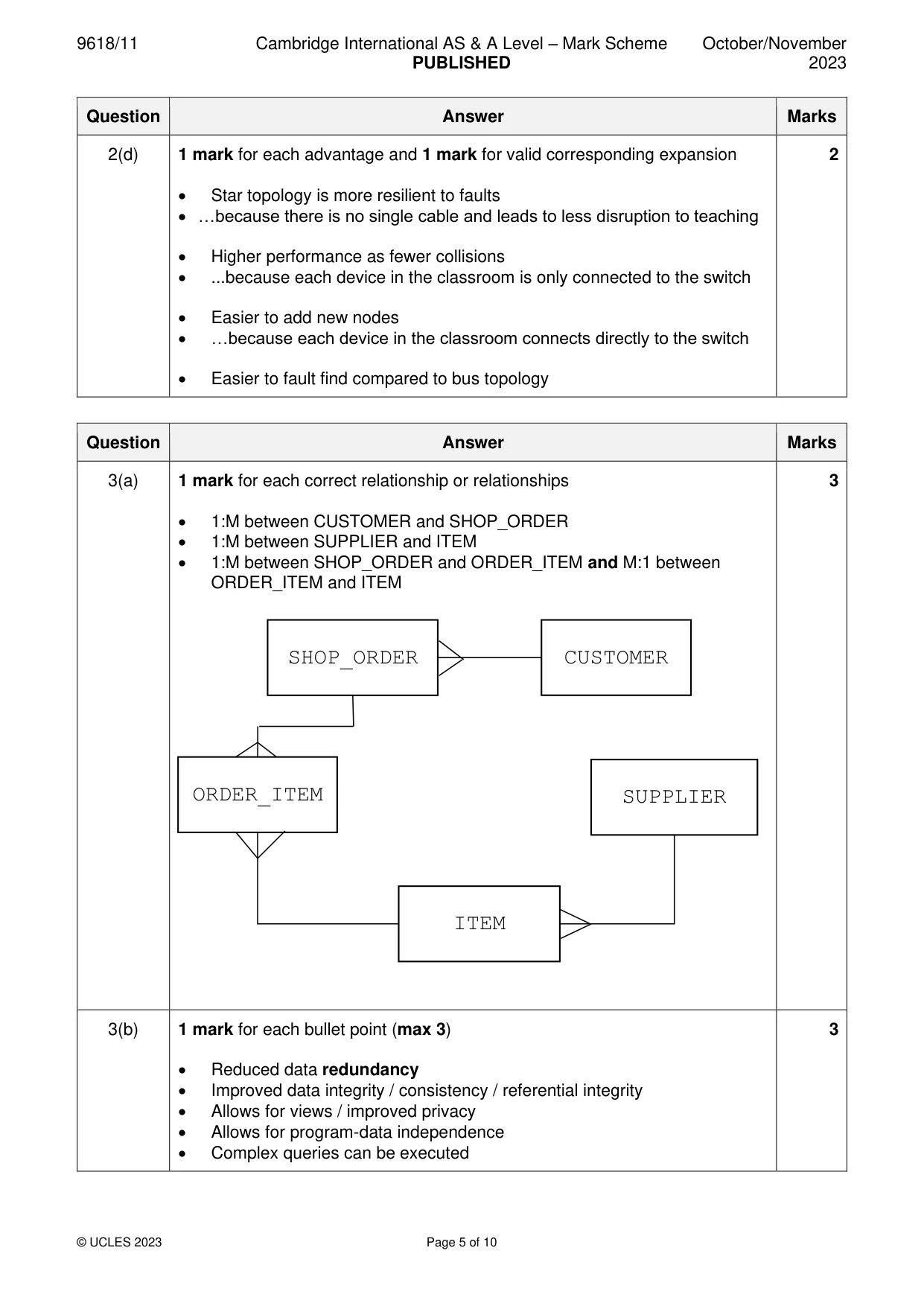
9618/11 Cambridge International AS & A Level – Mark Scheme PUBLISHED October/November 2023 © UCLES 2023 Page 5 of 10 Question Answer Marks 2(d) 1 mark for each advantage and 1 mark for valid corresponding expansion • Star topology is more resilient to faults • …because there is no single cable and leads to less disruption to teaching • Higher performance as fewer collisions • ...because each device in the classroom is only connected to the switch • Easier to add new nodes • …because each device in the classroom connects directly to the switch • Easier to fault find compared to bus topology 2 Question Answer Marks 3(a) 1 mark for each correct relationship or relationships • 1:M between CUSTOMER and SHOP_ORDER • 1:M between SUPPLIER and ITEM • 1:M between SHOP_ORDER and ORDER_ITEM and M:1 between ORDER_ITEM and ITEM 3 3(b) 1 mark for each bullet point (max 3) • Reduced data redundancy • Improved data integrity / consistency / referential integrity • Allows for views / improved privacy • Allows for program-data independence • Complex queries can be executed 3 SUPPLIER ORDER_ITEM ITEM SHOP_ORDER CUSTOMER
Mark scheme, page 6
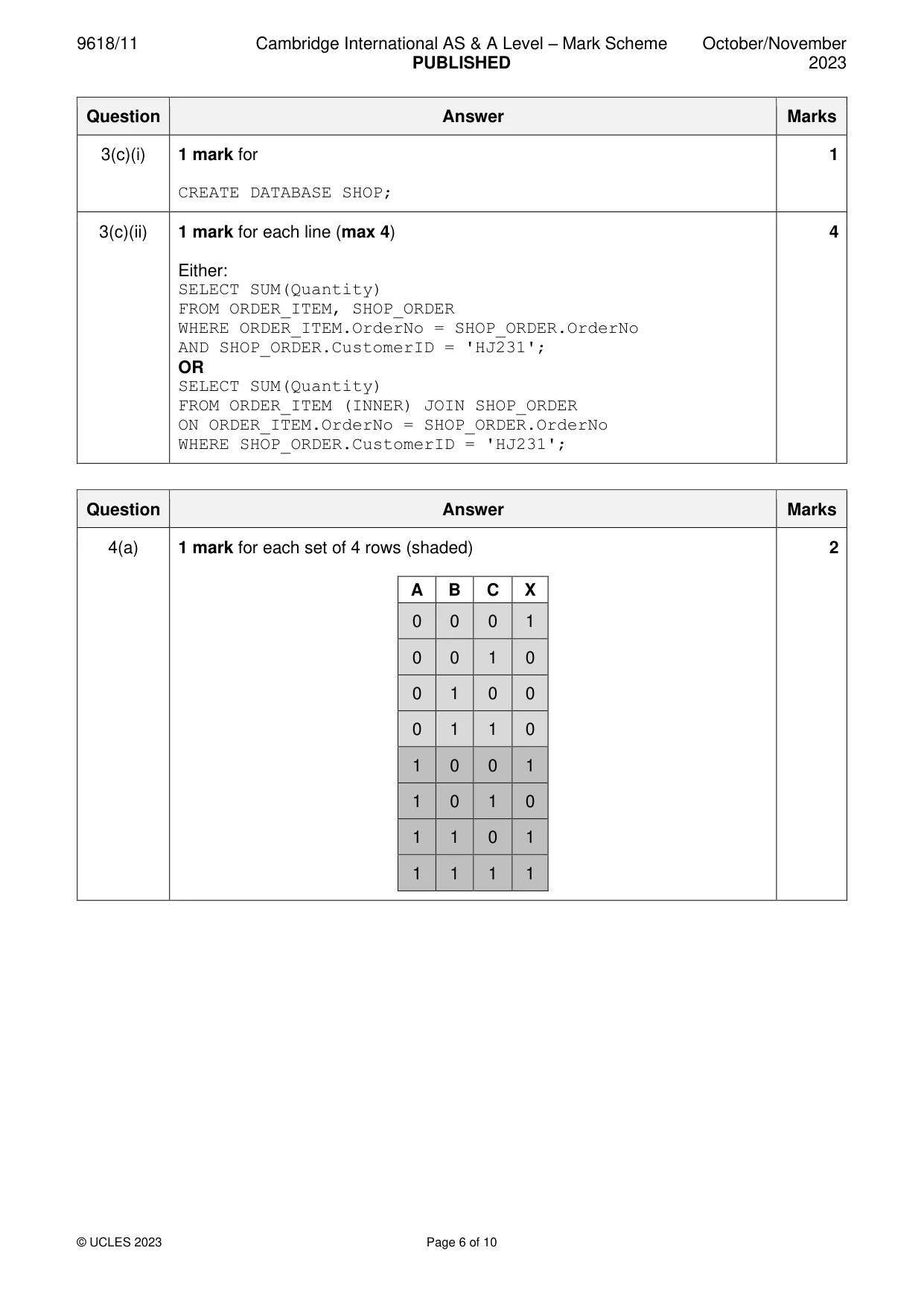
9618/11 Cambridge International AS & A Level – Mark Scheme PUBLISHED October/November 2023 © UCLES 2023 Page 6 of 10 Question Answer Marks 3(c)(i) 1 mark for CREATE DATABASE SHOP; 1 3(c)(ii) 1 mark for each line (max 4) Either: SELECT SUM(Quantity) FROM ORDER_ITEM, SHOP_ORDER WHERE ORDER_ITEM.OrderNo = SHOP_ORDER.OrderNo AND SHOP_ORDER.CustomerID = 'HJ231'; OR SELECT SUM(Quantity) FROM ORDER_ITEM (INNER) JOIN SHOP_ORDER ON ORDER_ITEM.OrderNo = SHOP_ORDER.OrderNo WHERE SHOP_ORDER.CustomerID = 'HJ231'; 4 Question Answer Marks 4(a) 1 mark for each set of 4 rows (shaded) A B C X 0 0 0 1 0 0 1 0 0 1 0 0 0 1 1 0 1 0 0 1 1 0 1 0 1 1 0 1 1 1 1 1 2
Mark scheme, page 7
9618/11 Cambridge International AS & A Level – Mark Scheme PUBLISHED October/November 2023 © UCLES 2023 Page 7 of 10 Question Answer Marks 4(b) 1 mark for both AND gates 1 mark for NOT gate and OR gate and NOR gate 2 Question Answer Marks 5(a) 1 mark for identification of the register and 1 mark for role (max 2 for each register) • Program Counter (PC) • stores the address where the next instruction is to be read from • Memory Address Register (MAR) • stores the address of the memory location (or an I/O component) currently being read from or written to • Current Instruction Register (CIR) • holds the instruction currently being decoded and/or executed • Status Register • Contains bits which can be referenced individually and set or cleared depending on the operation e.g. overflow, underflow 4 5(b) 1 mark for each bullet point (max 2) • Immediate Access Store holds all the data / instructions / programs currently in use • Immediate Access Store is volatile memory • Immediate Access Store has fast access times 2 5(c)(i) 1 mark for each bullet point (max 1) • The CPU can now perform nearly twice as many F-E cycles per second • Instead of 2.1 billion F-E cycles per second, the CPU can now perform 4 billion FE cycles per second 1
Mark scheme, page 8
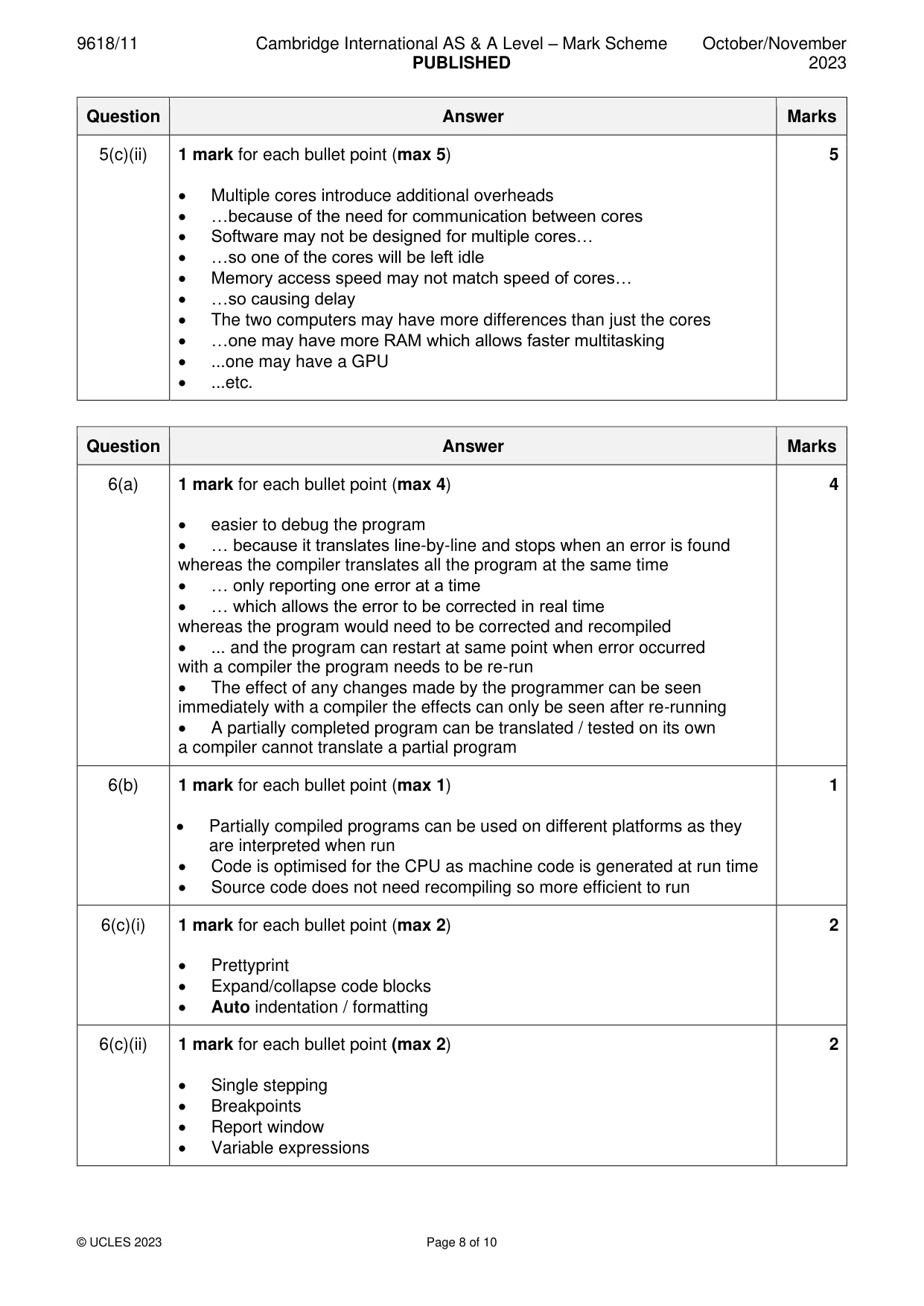
9618/11 Cambridge International AS & A Level – Mark Scheme PUBLISHED October/November 2023 © UCLES 2023 Page 8 of 10 Question Answer Marks 5(c)(ii) 1 mark for each bullet point (max 5) • Multiple cores introduce additional overheads • …because of the need for communication between cores • Software may not be designed for multiple cores… • …so one of the cores will be left idle • Memory access speed may not match speed of cores… • …so causing delay • The two computers may have more differences than just the cores • …one may have more RAM which allows faster multitasking • ...one may have a GPU • ...etc. 5 Question Answer Marks 6(a) 1 mark for each bullet point (max 4) • easier to debug the program • … because it translates line-by-line and stops when an error is found whereas the compiler translates all the program at the same time • … only reporting one error at a time • … which allows the error to be corrected in real time whereas the program would need to be corrected and recompiled • ... and the program can restart at same point when error occurred with a compiler the program needs to be re-run • The effect of any changes made by the programmer can be seen immediately with a compiler the effects can only be seen after re-running • A partially completed program can be translated / tested on its own a compiler cannot translate a partial program 4 6(b) 1 mark for each bullet point (max 1) • Partially compiled programs can be used on different platforms as they are interpreted when run • Code is optimised for the CPU as machine code is generated at run time • Source code does not need recompiling so more efficient to run 1 6(c)(i) 1 mark for each bullet point (max 2) • Prettyprint • Expand/collapse code blocks • Auto indentation / formatting 2 6(c)(ii) 1 mark for each bullet point (max 2) • Single stepping • Breakpoints • Report window • Variable expressions 2
Mark scheme, page 9
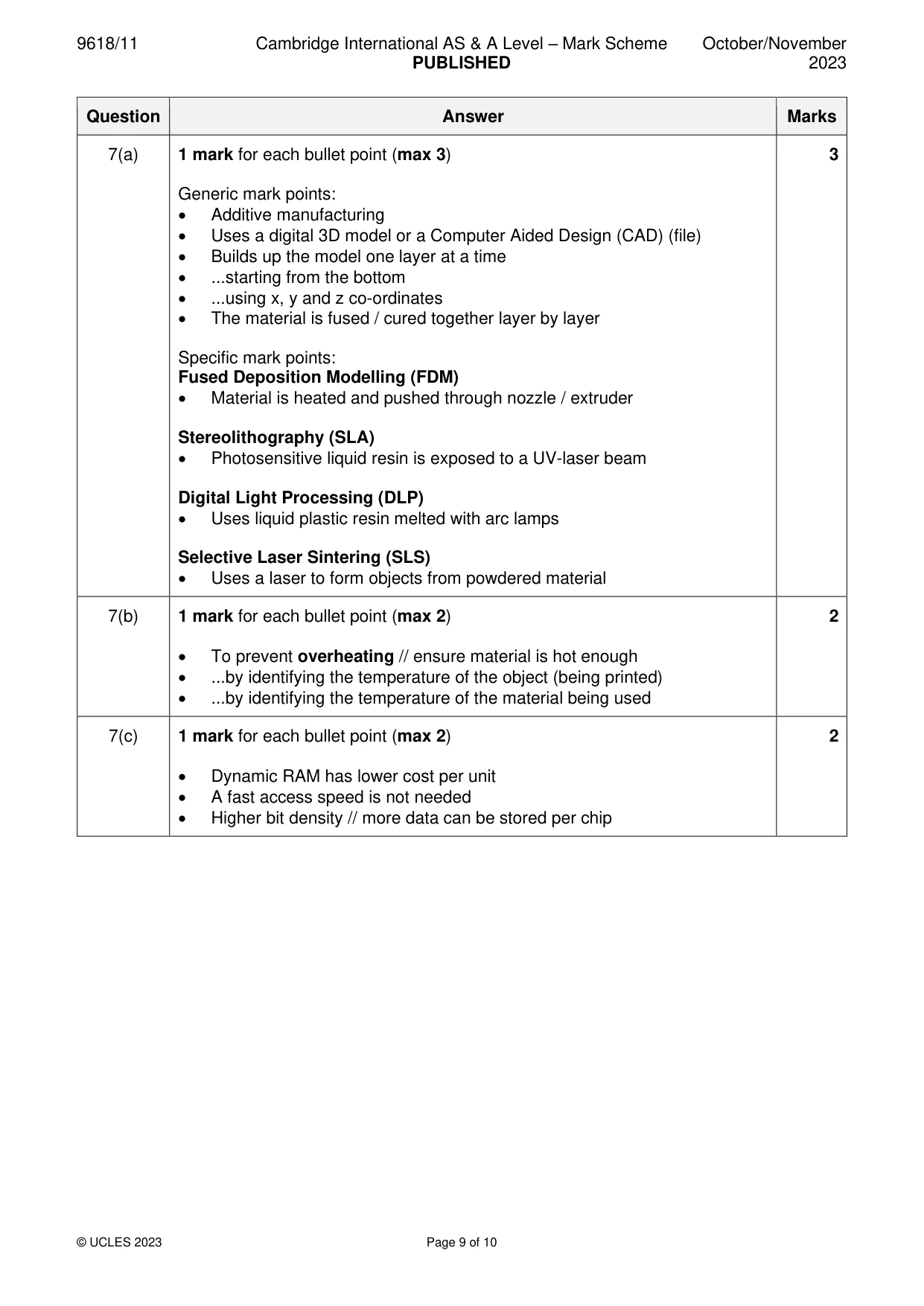
9618/11 Cambridge International AS & A Level – Mark Scheme PUBLISHED October/November 2023 © UCLES 2023 Page 9 of 10 Question Answer Marks 7(a) 1 mark for each bullet point (max 3) Generic mark points: • Additive manufacturing • Uses a digital 3D model or a Computer Aided Design (CAD) (file) • Builds up the model one layer at a time • ...starting from the bottom • ...using x, y and z co-ordinates • The material is fused / cured together layer by layer Specific mark points: Fused Deposition Modelling (FDM) • Material is heated and pushed through nozzle / extruder Stereolithography (SLA) • Photosensitive liquid resin is exposed to a UV-laser beam Digital Light Processing (DLP) • Uses liquid plastic resin melted with arc lamps Selective Laser Sintering (SLS) • Uses a laser to form objects from powdered material 3 7(b) 1 mark for each bullet point (max 2) • To prevent overheating // ensure material is hot enough • ...by identifying the temperature of the object (being printed) • ...by identifying the temperature of the material being used 2 7(c) 1 mark for each bullet point (max 2) • Dynamic RAM has lower cost per unit • A fast access speed is not needed • Higher bit density // more data can be stored per chip 2
Mark scheme, page 10
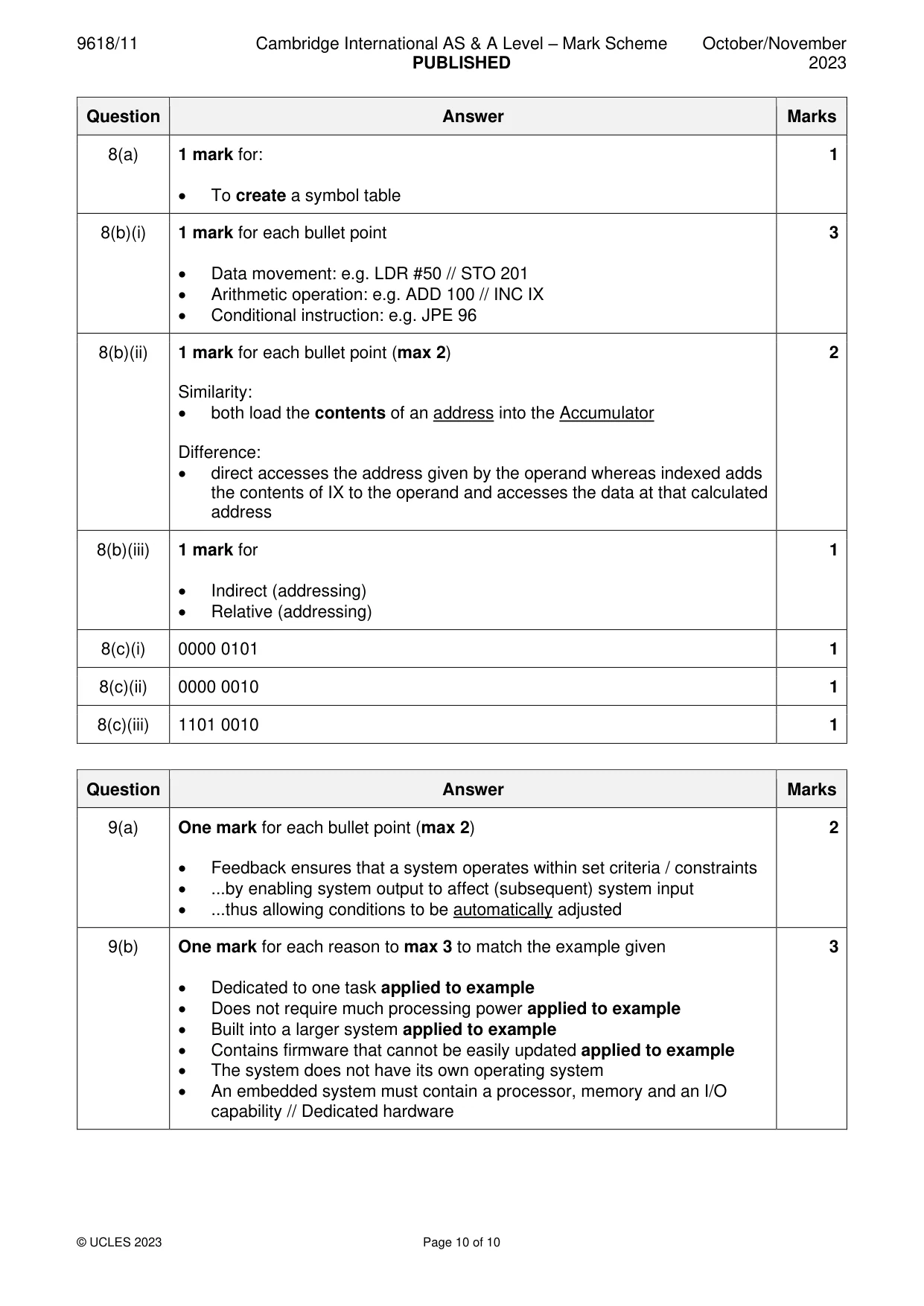
9618/11 Cambridge International AS & A Level – Mark Scheme PUBLISHED October/November 2023 © UCLES 2023 Page 10 of 10 Question Answer Marks 8(a) 1 mark for: • To create a symbol table 1 8(b)(i) 1 mark for each bullet point • Data movement: e.g. LDR #50 // STO 201 • Arithmetic operation: e.g. ADD 100 // INC IX • Conditional instruction: e.g. JPE 96 3 8(b)(ii) 1 mark for each bullet point (max 2) Similarity: • both load the contents of an address into the Accumulator Difference: • direct accesses the address given by the operand whereas indexed adds the contents of IX to the operand and accesses the data at that calculated address 2 8(b)(iii) 1 mark for • Indirect (addressing) • Relative (addressing) 1 8(c)(i) 0000 0101 1 8(c)(ii) 0000 0010 1 8(c)(iii) 1101 0010 1 Question Answer Marks 9(a) One mark for each bullet point (max 2) • Feedback ensures that a system operates within set criteria / constraints • ...by enabling system output to affect (subsequent) system input • ...thus allowing conditions to be automatically adjusted 2 9(b) One mark for each reason to max 3 to match the example given • Dedicated to one task applied to example • Does not require much processing power applied to example • Built into a larger system applied to example • Contains firmware that cannot be easily updated applied to example • The system does not have its own operating system • An embedded system must contain a processor, memory and an I/O capability // Dedicated hardware 3
What you needed in this session
Cambridge’s own grade thresholds for 2023 Oct/Nov, Paper 1 · Variant 1. A higher threshold means an easier paper — the bar moves with how the cohort did.