Cambridge A Level Computer Science 9618 — 2023 May/June Paper 1 · Variant 1
9618/11/M/J/23 · 75 marks · ≈84 min
The question paper and its mark scheme, free to read here and free to download. This is Cambridge’s own paper, exactly as it was sat.
Question paper16 pages






Mark scheme9 pages
Answers below. Sit the paper first if you are practising.

Paper as text
Question paper, page 1
This document has 16 pages. Any blank pages are indicated. [Turn over Cambridge International AS & A Level * 0 9 4 2 4 1 6 2 8 5 * DC (EF/SG) 313479/3 © UCLES 2023 COMPUTER SCIENCE 9618/11 Paper 1 Theory Fundamentals May/June 2023 1 hour 30 minutes You must answer on the question paper. No additional materials are needed. INSTRUCTIONS ● Answer all questions. ● Use a black or dark blue pen. ● Write your name, centre number and candidate number in the boxes at the top of the page. ● Write your answer to each question in the space provided. ● Do not use an erasable pen or correction fluid. ● Do not write on any bar codes. ● You may use an HB pencil for any diagrams, graphs or rough working. ● Calculators must not be used in this paper. INFORMATION ● The total mark for this paper is 75. ● The number of marks for each question or part question is shown in brackets [ ]. ● No marks will be awarded for using brand names of software packages or hardware.
Question paper, page 2
2 9618/11/M/J/23 © UCLES 2023 1 Images are being created to advertise holidays. Some of the images are bitmap images and some are vector graphics. (a) Complete the table by defining the image terms. Term Definition Drawing list … … … Pixel … … … Colour depth … … … [3] (b) The bitmap images are photographs of the holiday locations. (i) Colour depth and image resolution are both included in the file header of a bitmap image. Identify two other items that could be included in the file header of each photograph. 1 … 2 … [2]
Question paper, page 3
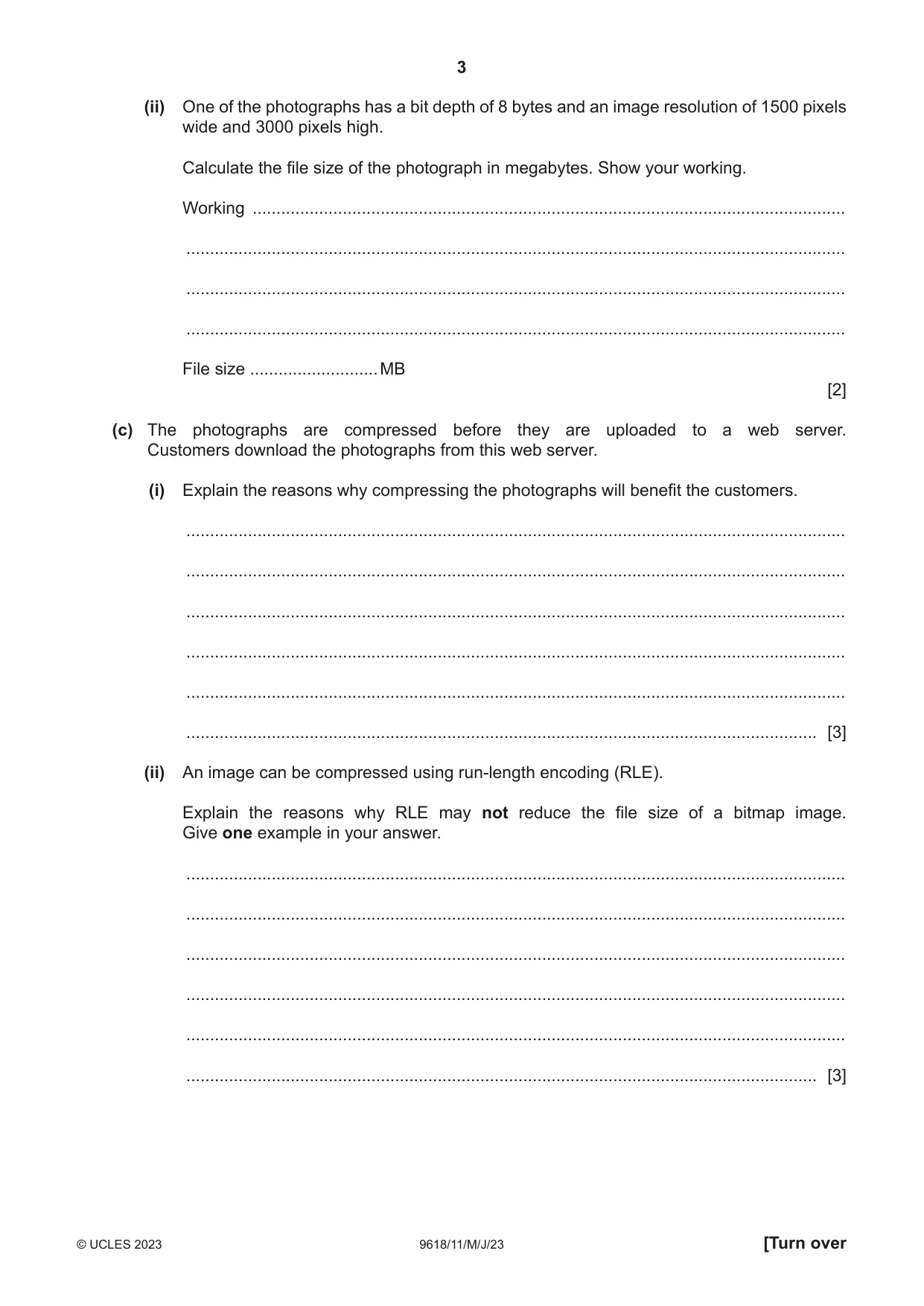
3 9618/11/M/J/23 © UCLES 2023 [Turn over (ii) One of the photographs has a bit depth of 8 bytes and an image resolution of 1500 pixels wide and 3000 pixels high. Calculate the file size of the photograph in megabytes. Show your working. Working … … … … File size … MB [2] (c) The photographs are compressed before they are uploaded to a web server. Customers download the photographs from this web server. (i) Explain the reasons why compressing the photographs will benefit the customers. … … … … … … [3] (ii) An image can be compressed using run‑length encoding (RLE). Explain the reasons why RLE may not reduce the file size of a bitmap image. Give one example in your answer. … … … … … … [3]
Question paper, page 4
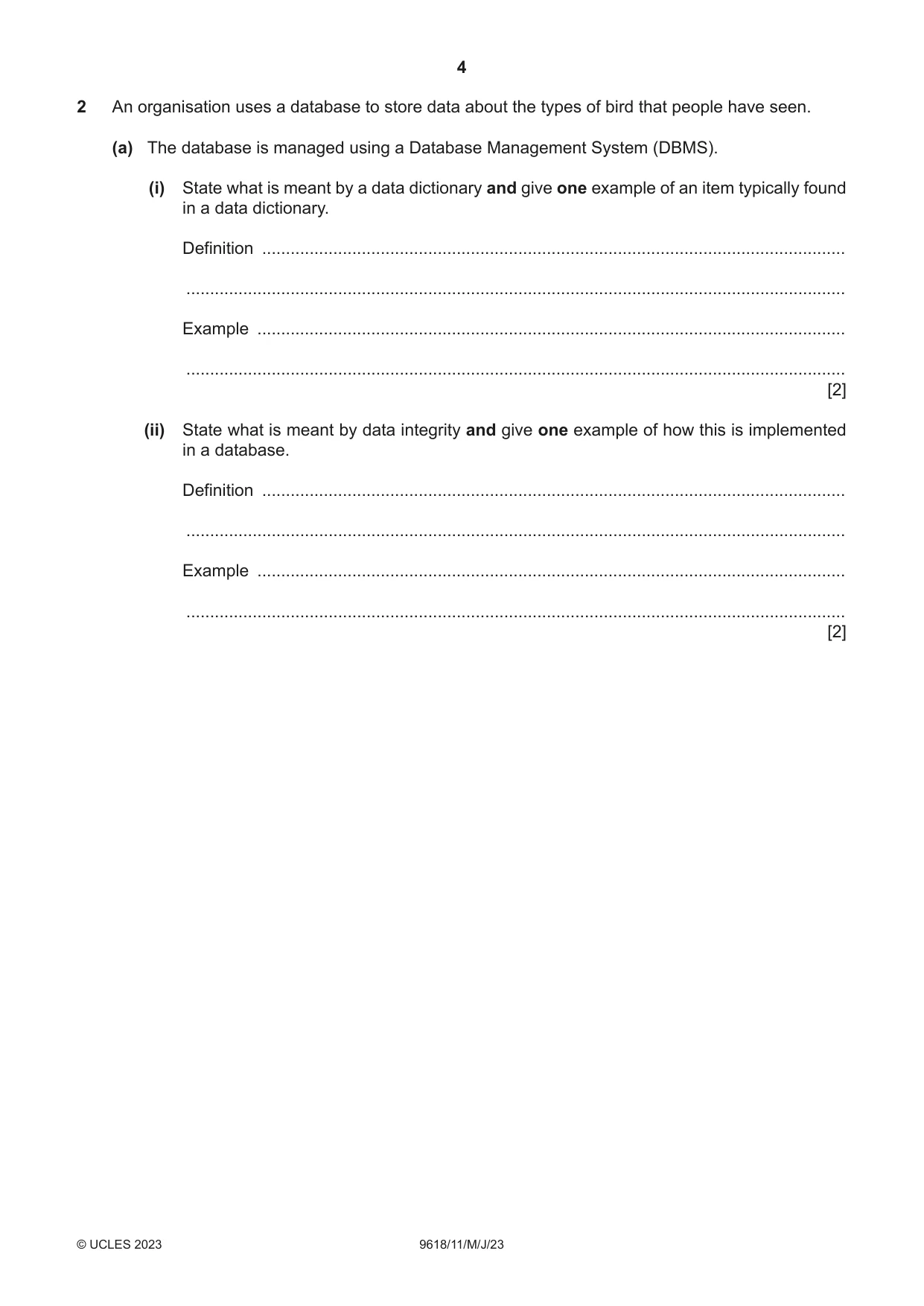
4 9618/11/M/J/23 © UCLES 2023 2 An organisation uses a database to store data about the types of bird that people have seen. (a) The database is managed using a Database Management System (DBMS). (i) State what is meant by a data dictionary and give one example of an item typically found in a data dictionary. Definition … … Example … … [2] (ii) State what is meant by data integrity and give one example of how this is implemented in a database. Definition … … Example … … [2]
Question paper, page 5
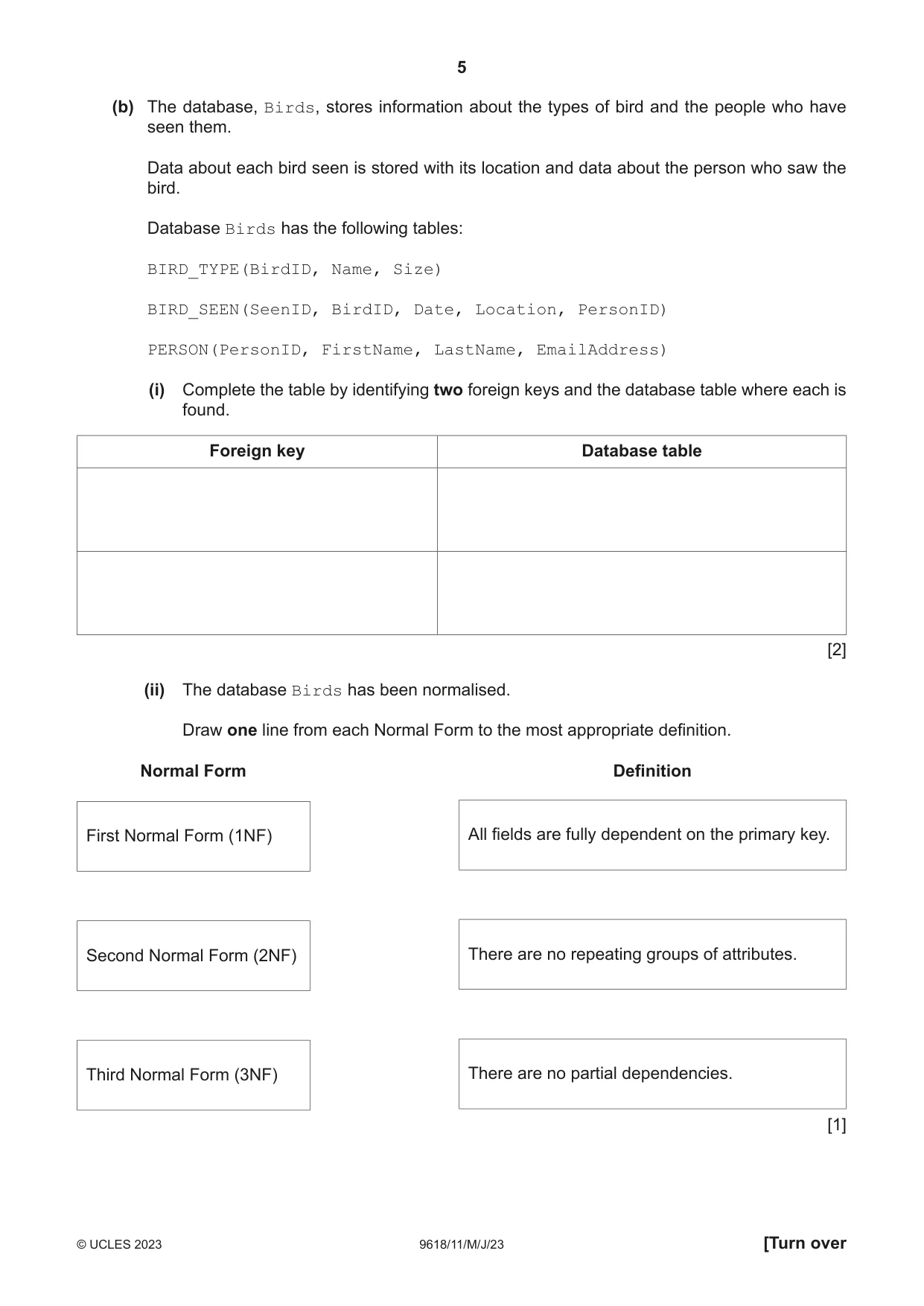
5 9618/11/M/J/23 © UCLES 2023 [Turn over (b) The database, Birds, stores information about the types of bird and the people who have seen them. Data about each bird seen is stored with its location and data about the person who saw the bird. Database Birds has the following tables: BIRD_TYPE(BirdID, Name, Size) BIRD_SEEN(SeenID, BirdID, Date, Location, PersonID) PERSON(PersonID, FirstName, LastName, EmailAddress) (i) Complete the table by identifying two foreign keys and the database table where each is found. Foreign key Database table [2] (ii) The database Birds has been normalised. Draw one line from each Normal Form to the most appropriate definition. Normal Form Definition All fields are fully dependent on the primary key. There are no repeating groups of attributes. There are no partial dependencies. First Normal Form (1NF) Second Normal Form (2NF) Third Normal Form (3NF) [1]
Question paper, page 6
6 9618/11/M/J/23 © UCLES 2023 (iii) Part of the database table BIRD_TYPE is shown: BirdID Name Size 0123 Blackbird Medium 0035 Jay Large 0004 Raven Large 0085 Robin Small The database only supports these data types: • character • varchar • Boolean • integer • real • date • time Write a Structured Query Language (SQL) script to define the table Bird_Type. … … … … … … … … [4]
Question paper, page 7
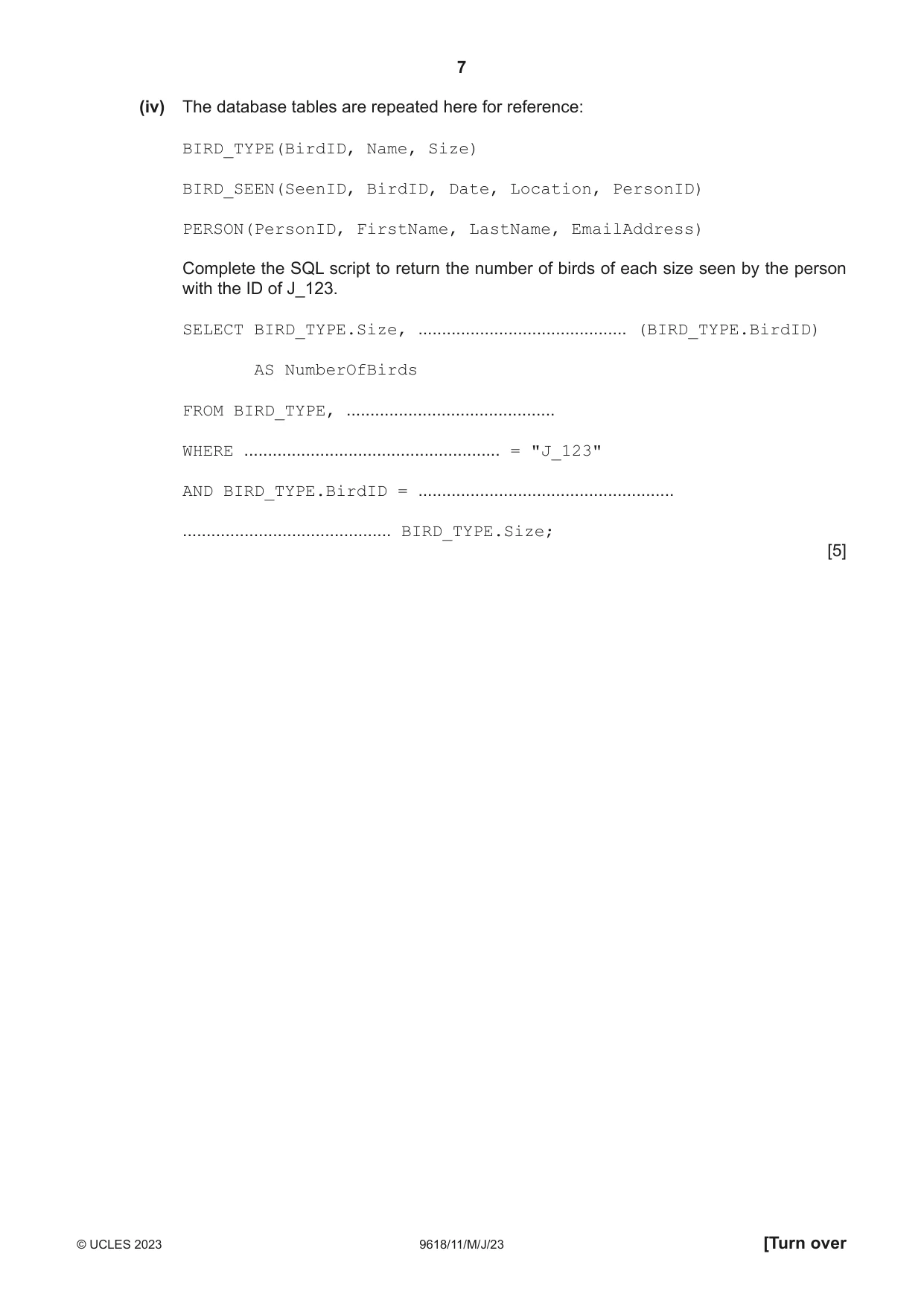
7 9618/11/M/J/23 © UCLES 2023 [Turn over (iv) The database tables are repeated here for reference: BIRD_TYPE(BirdID, Name, Size) BIRD_SEEN(SeenID, BirdID, Date, Location, PersonID) PERSON(PersonID, FirstName, LastName, EmailAddress) Complete the SQL script to return the number of birds of each size seen by the person with the ID of J_123. SELECT BIRD_TYPE.Size, … (BIRD_TYPE.BirdID) AS NumberOfBirds FROM BIRD_TYPE, … WHERE … = "J_123" AND BIRD_TYPE.BirdID = … … BIRD_TYPE.Size; [5]
Question paper, page 8
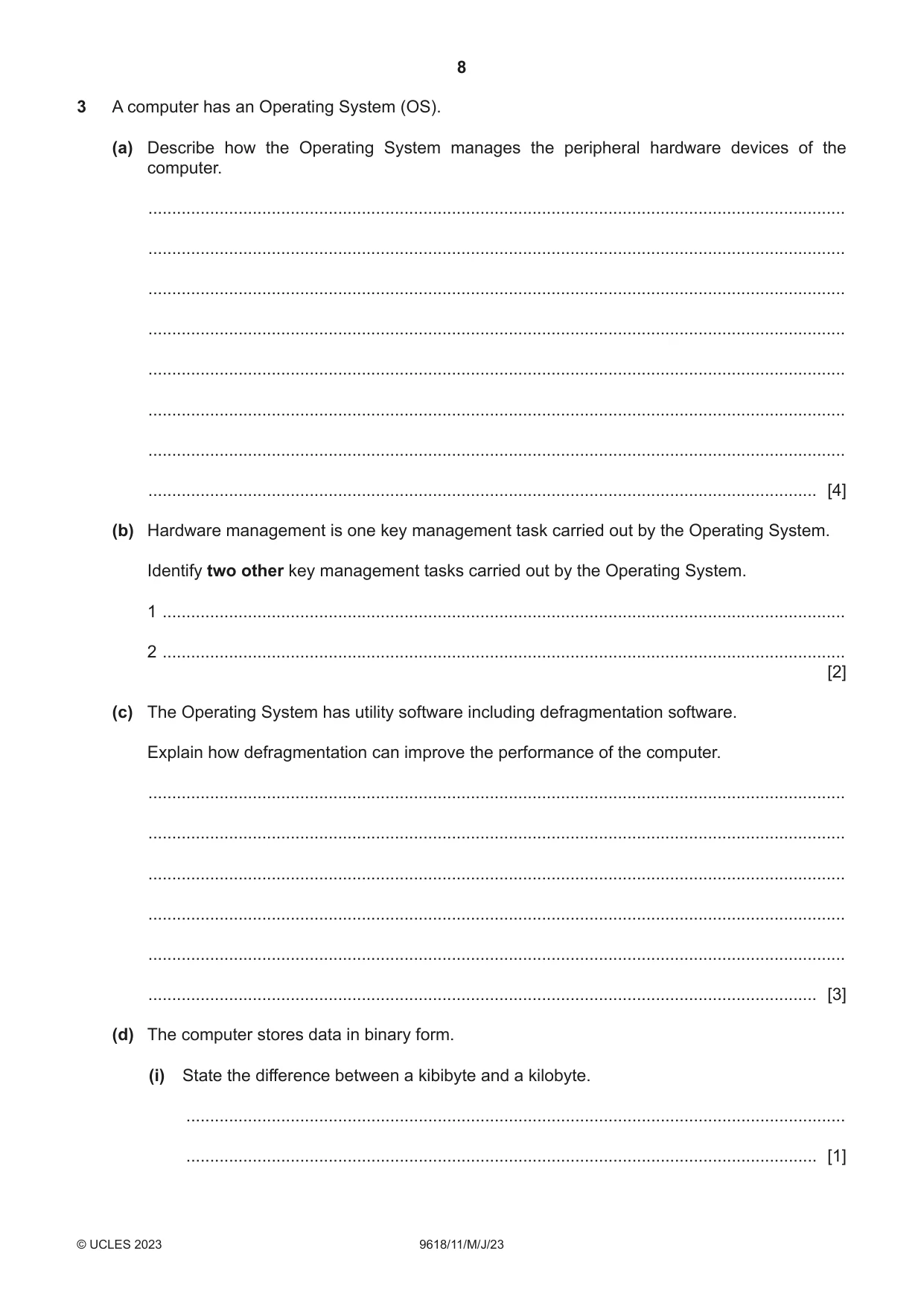
8 9618/11/M/J/23 © UCLES 2023 3 A computer has an Operating System (OS). (a) Describe how the Operating System manages the peripheral hardware devices of the computer. … … … … … … … … [4] (b) Hardware management is one key management task carried out by the Operating System. Identify two other key management tasks carried out by the Operating System. 1 … 2 … [2] (c) The Operating System has utility software including defragmentation software. Explain how defragmentation can improve the performance of the computer. … … … … … … [3] (d) The computer stores data in binary form. (i) State the difference between a kibibyte and a kilobyte. … … [1]
Question paper, page 9
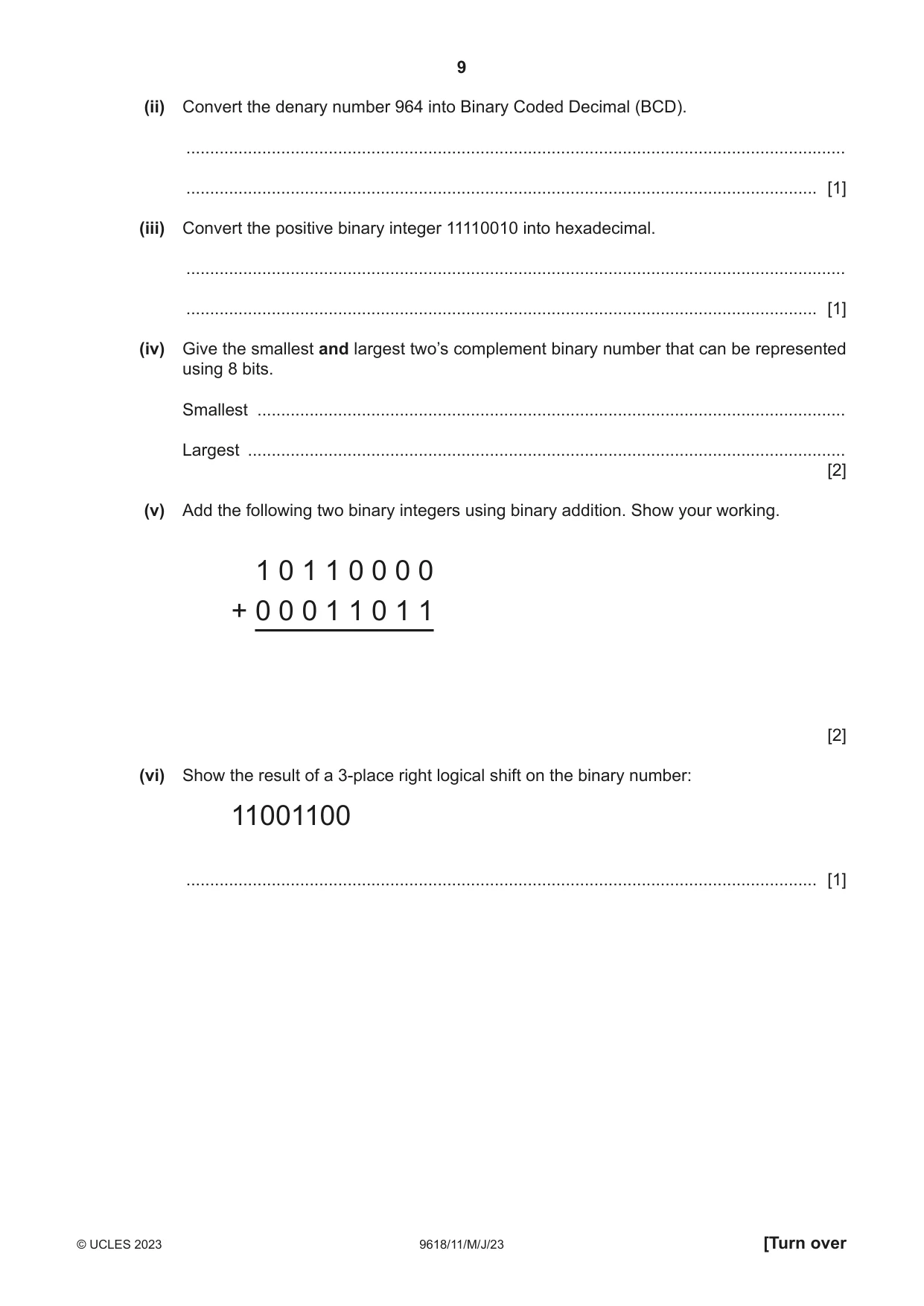
9 9618/11/M/J/23 © UCLES 2023 [Turn over (ii) Convert the denary number 964 into Binary Coded Decimal (BCD). … … [1] (iii) Convert the positive binary integer 11110010 into hexadecimal. … … [1] (iv) Give the smallest and largest two’s complement binary number that can be represented using 8 bits. Smallest … Largest … [2] (v) Add the following two binary integers using binary addition. Show your working. 1 0 1 1 0 0 0 0 + 0 0 0 1 1 0 1 1 [2] (vi) Show the result of a 3‑place right logical shift on the binary number: 11001100 … [1]
Question paper, page 10
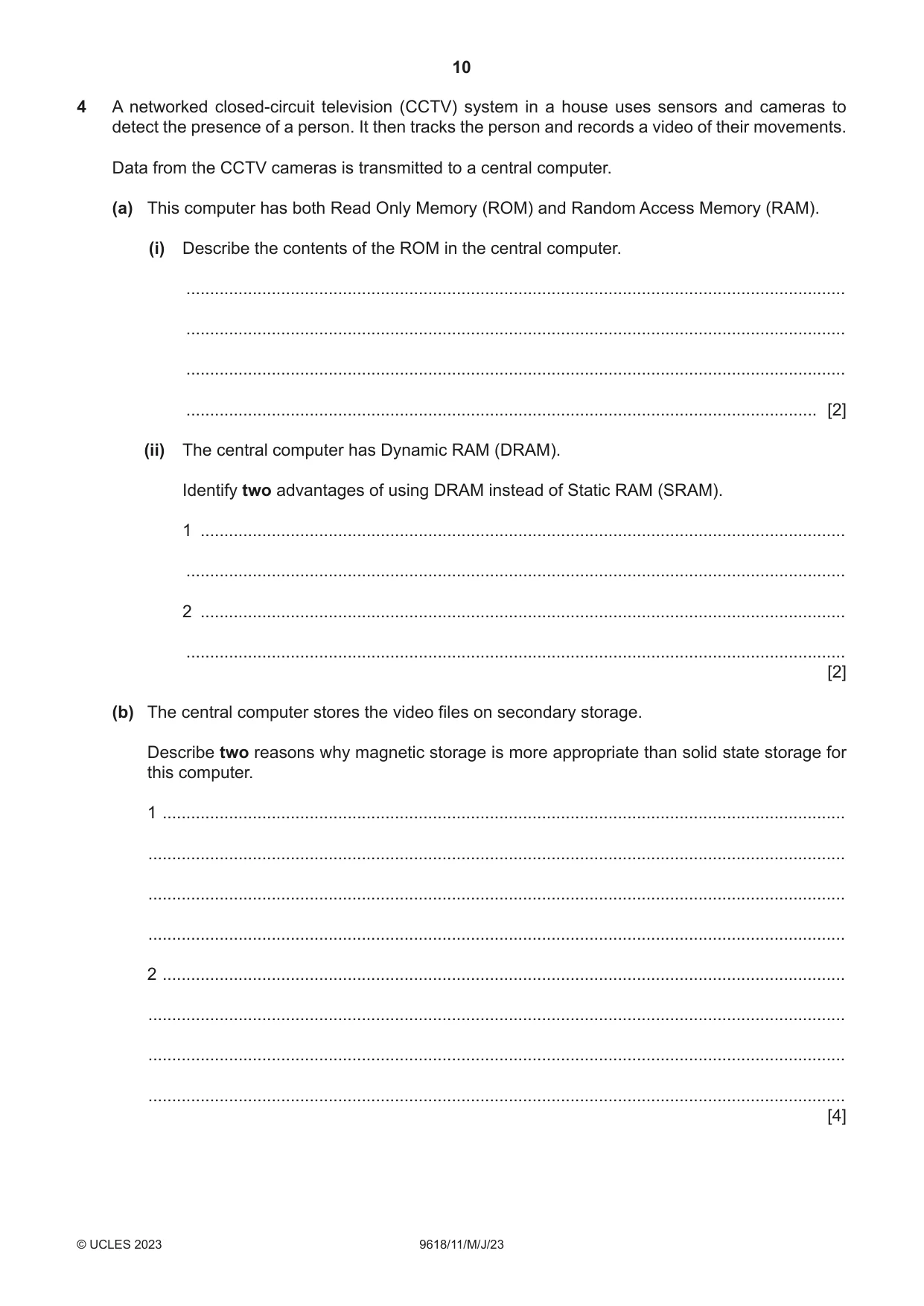
10 9618/11/M/J/23 © UCLES 2023 4 A networked closed‑circuit television (CCTV) system in a house uses sensors and cameras to detect the presence of a person. It then tracks the person and records a video of their movements. Data from the CCTV cameras is transmitted to a central computer. (a) This computer has both Read Only Memory (ROM) and Random Access Memory (RAM). (i) Describe the contents of the ROM in the central computer. … … … … [2] (ii) The central computer has Dynamic RAM (DRAM). Identify two advantages of using DRAM instead of Static RAM (SRAM). 1 … … 2 … … [2] (b) The central computer stores the video files on secondary storage. Describe two reasons why magnetic storage is more appropriate than solid state storage for this computer. 1 … … … … 2 … … … … [4]
Question paper, page 11
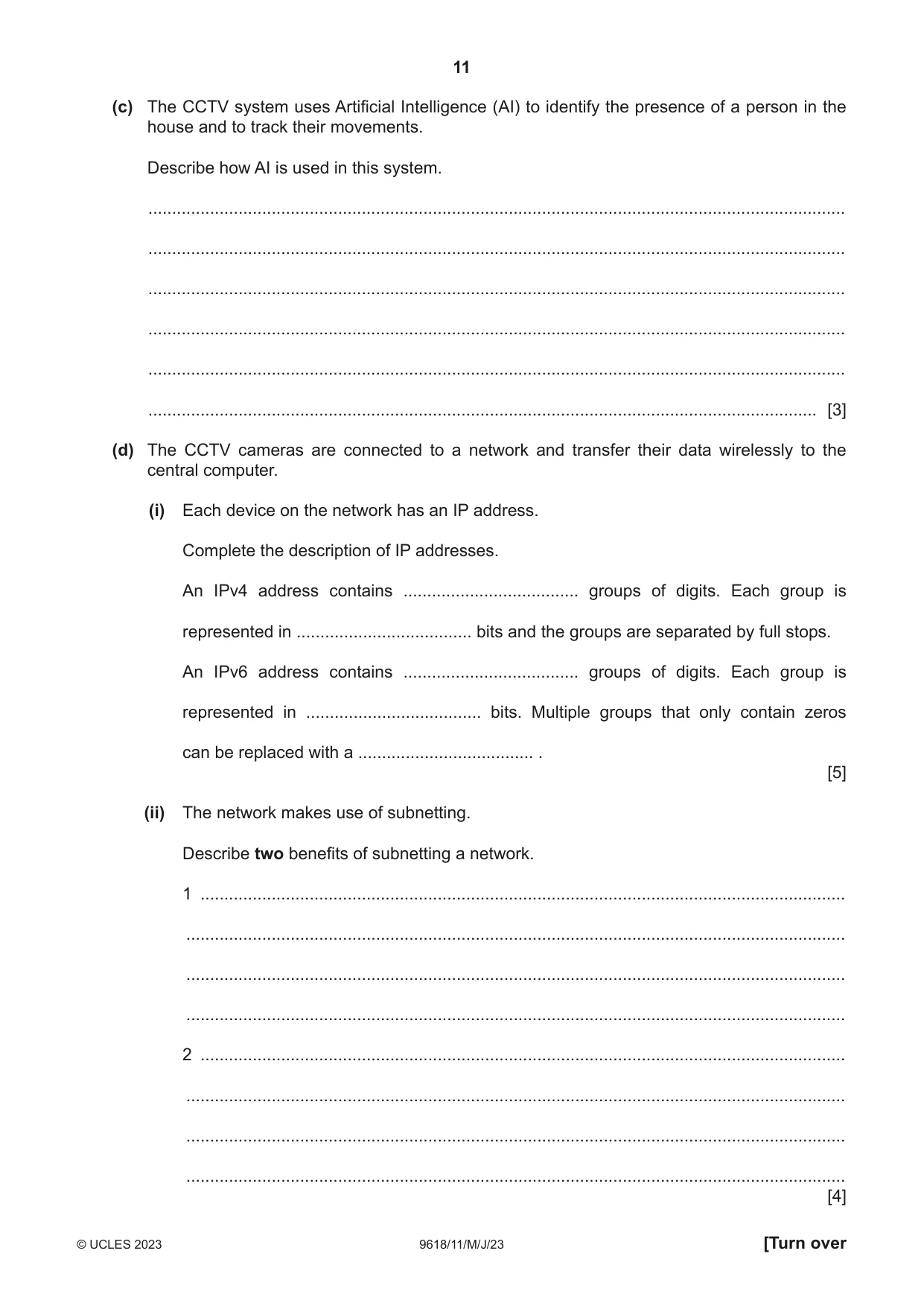
11 9618/11/M/J/23 © UCLES 2023 [Turn over (c) The CCTV system uses Artificial Intelligence (AI) to identify the presence of a person in the house and to track their movements. Describe how AI is used in this system. … … … … … … [3] (d) The CCTV cameras are connected to a network and transfer their data wirelessly to the central computer. (i) Each device on the network has an IP address. Complete the description of IP addresses. An IPv4 address contains … groups of digits. Each group is represented in … bits and the groups are separated by full stops. An IPv6 address contains … groups of digits. Each group is represented in … bits. Multiple groups that only contain zeros can be replaced with a … . [5] (ii) The network makes use of subnetting. Describe two benefits of subnetting a network. 1 … … … … 2 … … … … [4]
Question paper, page 12
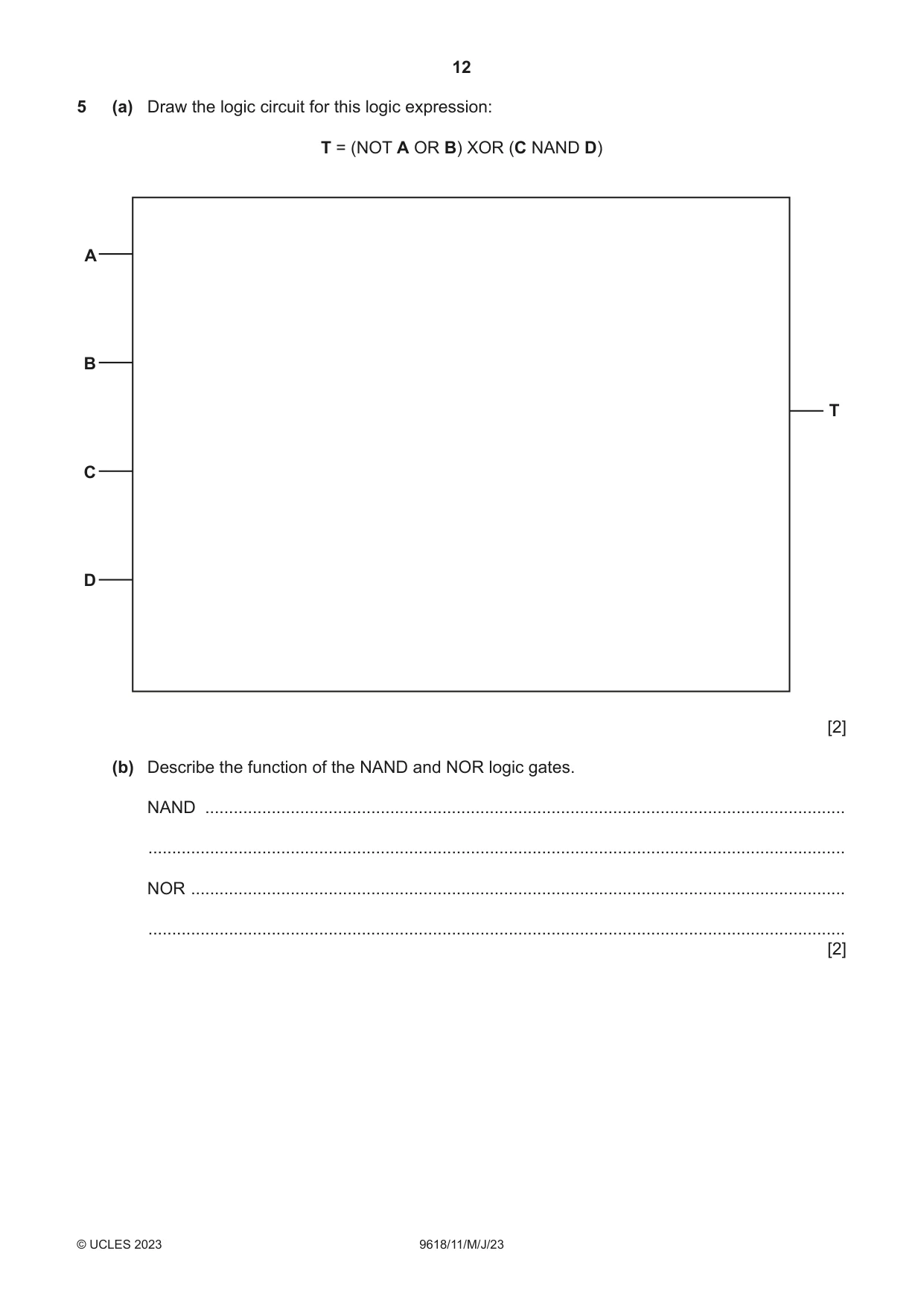
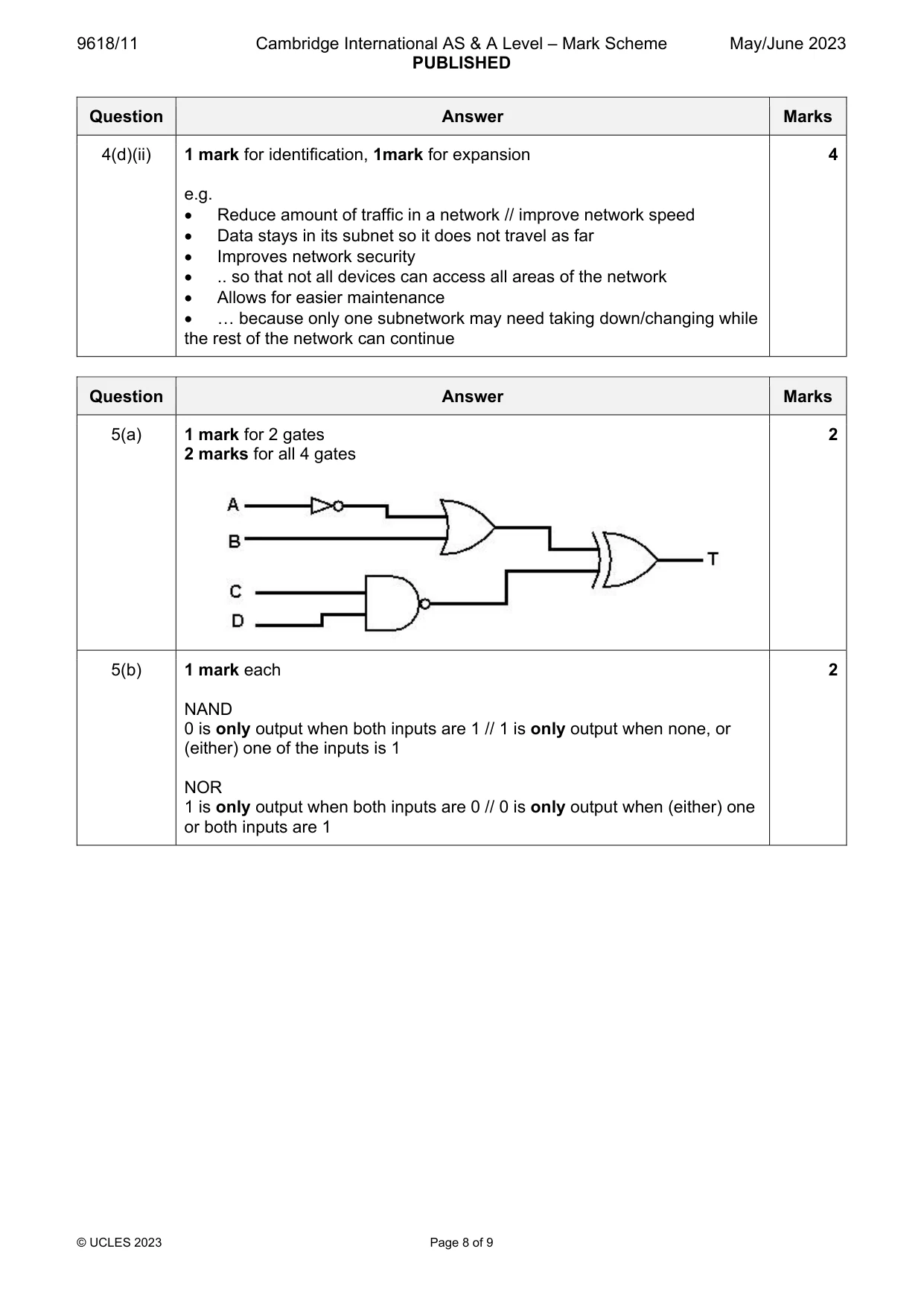
12 9618/11/M/J/23 © UCLES 2023 5 (a) Draw the logic circuit for this logic expression: T = (NOT A OR B) XOR (C NAND D) A T B C D [2] (b) Describe the function of the NAND and NOR logic gates. NAND … … NOR … … [2]
Question paper, page 13
13 9618/11/M/J/23 © UCLES 2023 6 An interrupt is generated when a key is pressed on a computer keyboard. Explain how the computer handles this interrupt. … … … … … … … … … … [5]
Question paper, page 14
14 9618/11/M/J/23 © UCLES 2023 BLANK PAGE
Question paper, page 15
15 9618/11/M/J/23 © UCLES 2023 BLANK PAGE
Question paper, page 16
16 9618/11/M/J/23 © UCLES 2023 Permission to reproduce items where third‑party owned material protected by copyright is included has been sought and cleared where possible. Every reasonable effort has been made by the publisher (UCLES) to trace copyright holders, but if any items requiring clearance have unwittingly been included, the publisher will be pleased to make amends at the earliest possible opportunity. To avoid the issue of disclosure of answer‑related information to candidates, all copyright acknowledgements are reproduced online in the Cambridge Assessment International Education Copyright Acknowledgements Booklet. This is produced for each series of examinations and is freely available to download at www.cambridgeinternational.org after the live examination series. Cambridge Assessment International Education is part of Cambridge Assessment. Cambridge Assessment is the brand name of the University of Cambridge Local Examinations Syndicate (UCLES), which is a department of the University of Cambridge. BLANK PAGE
Mark scheme, page 1
This document consists of 9 printed pages. © UCLES 2023 [Turn over Cambridge International AS & A Level COMPUTER SCIENCE 9618/11 Paper 1 Theory Fundamentals May/June 2023 MARK SCHEME Maximum Mark: 75 Published This mark scheme is published as an aid to teachers and candidates, to indicate the requirements of the examination. It shows the basis on which Examiners were instructed to award marks. It does not indicate the details of the discussions that took place at an Examiners’ meeting before marking began, which would have considered the acceptability of alternative answers. Mark schemes should be read in conjunction with the question paper and the Principal Examiner Report for Teachers. Cambridge International will not enter into discussions about these mark schemes. Cambridge International is publishing the mark schemes for the May/June 2023 series for most Cambridge IGCSE, Cambridge International A and AS Level and Cambridge Pre-U components, and some Cambridge O Level components.
Mark scheme, page 2
9618/11 Cambridge International AS & A Level – Mark Scheme PUBLISHED May/June 2023 © UCLES 2023 Page 2 of 9 Generic Marking Principles These general marking principles must be applied by all examiners when marking candidate answers. They should be applied alongside the specific content of the mark scheme or generic level descriptors for a question. Each question paper and mark scheme will also comply with these marking principles. GENERIC MARKING PRINCIPLE 1: Marks must be awarded in line with: the specific content of the mark scheme or the generic level descriptors for the question the specific skills defined in the mark scheme or in the generic level descriptors for the question the standard of response required by a candidate as exemplified by the standardisation scripts. GENERIC MARKING PRINCIPLE 2: Marks awarded are always whole marks (not half marks, or other fractions). GENERIC MARKING PRINCIPLE 3: Marks must be awarded positively: marks are awarded for correct/valid answers, as defined in the mark scheme. However, credit is given for valid answers which go beyond the scope of the syllabus and mark scheme, referring to your Team Leader as appropriate marks are awarded when candidates clearly demonstrate what they know and can do marks are not deducted for errors marks are not deducted for omissions answers should only be judged on the quality of spelling, punctuation and grammar when these features are specifically assessed by the question as indicated by the mark scheme. The meaning, however, should be unambiguous. GENERIC MARKING PRINCIPLE 4: Rules must be applied consistently, e.g. in situations where candidates have not followed instructions or in the application of generic level descriptors. GENERIC MARKING PRINCIPLE 5: Marks should be awarded using the full range of marks defined in the mark scheme for the question (however; the use of the full mark range may be limited according to the quality of the candidate responses seen). GENERIC MARKING PRINCIPLE 6: Marks awarded are based solely on the requirements as defined in the mark scheme. Marks should not be awarded with grade thresholds or grade descriptors in mind.
Mark scheme, page 3
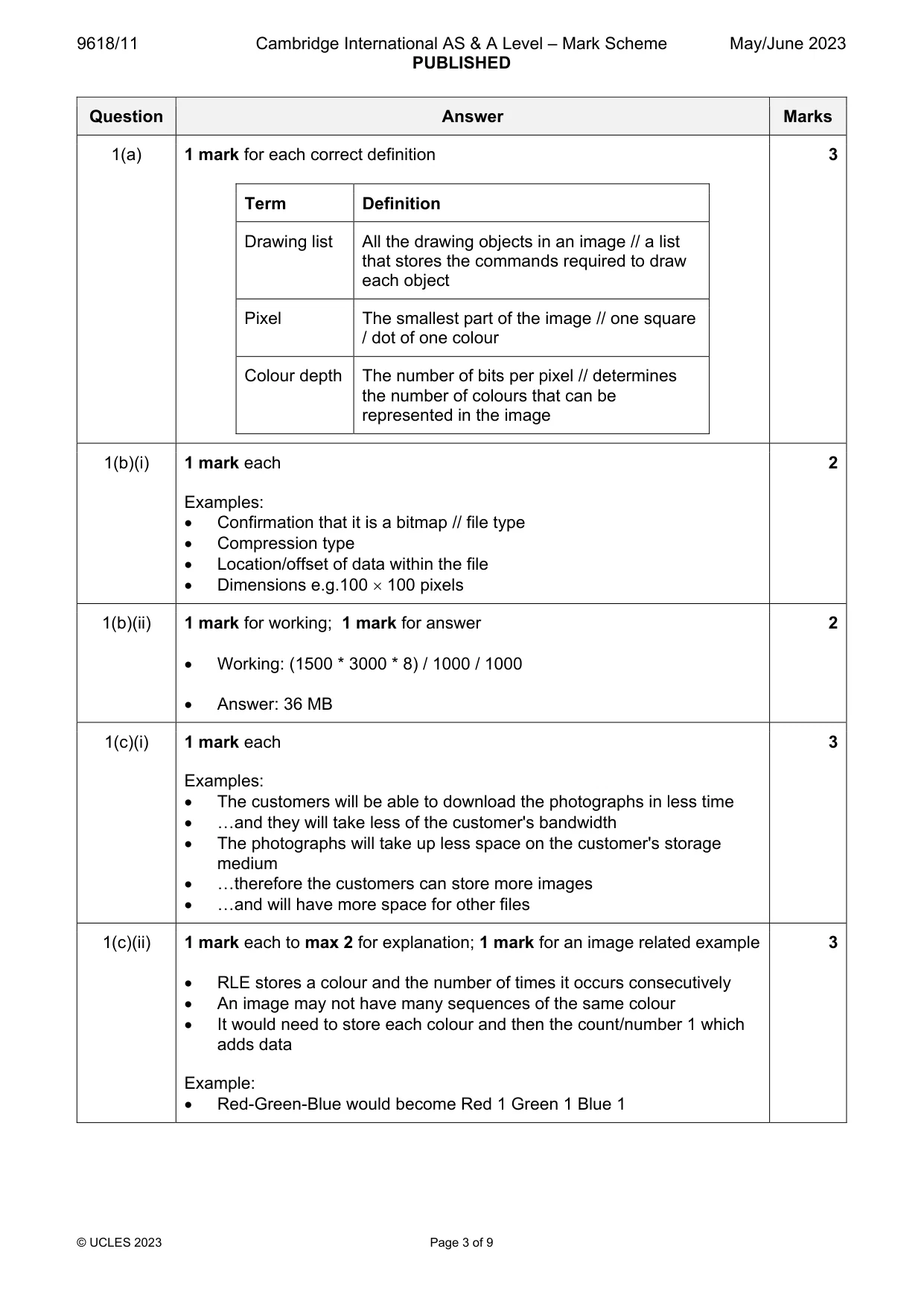
9618/11 Cambridge International AS & A Level – Mark Scheme PUBLISHED May/June 2023 © UCLES 2023 Page 3 of 9 Question Answer Marks 1(a) 1 mark for each correct definition Term Definition Drawing list All the drawing objects in an image // a list that stores the commands required to draw each object Pixel The smallest part of the image // one square / dot of one colour Colour depth The number of bits per pixel // determines the number of colours that can be represented in the image 3 1(b)(i) 1 mark each Examples: Confirmation that it is a bitmap // file type Compression type Location/offset of data within the file Dimensions e.g.100 100 pixels 2 1(b)(ii) 1 mark for working; 1 mark for answer Working: (1500 * 3000 * 8) / 1000 / 1000 Answer: 36 MB 2 1(c)(i) 1 mark each Examples: The customers will be able to download the photographs in less time …and they will take less of the customer's bandwidth The photographs will take up less space on the customer's storage medium …therefore the customers can store more images …and will have more space for other files 3 1(c)(ii) 1 mark each to max 2 for explanation; 1 mark for an image related example RLE stores a colour and the number of times it occurs consecutively An image may not have many sequences of the same colour It would need to store each colour and then the count/number 1 which adds data Example: Red-Green-Blue would become Red 1 Green 1 Blue 1 3
Mark scheme, page 4
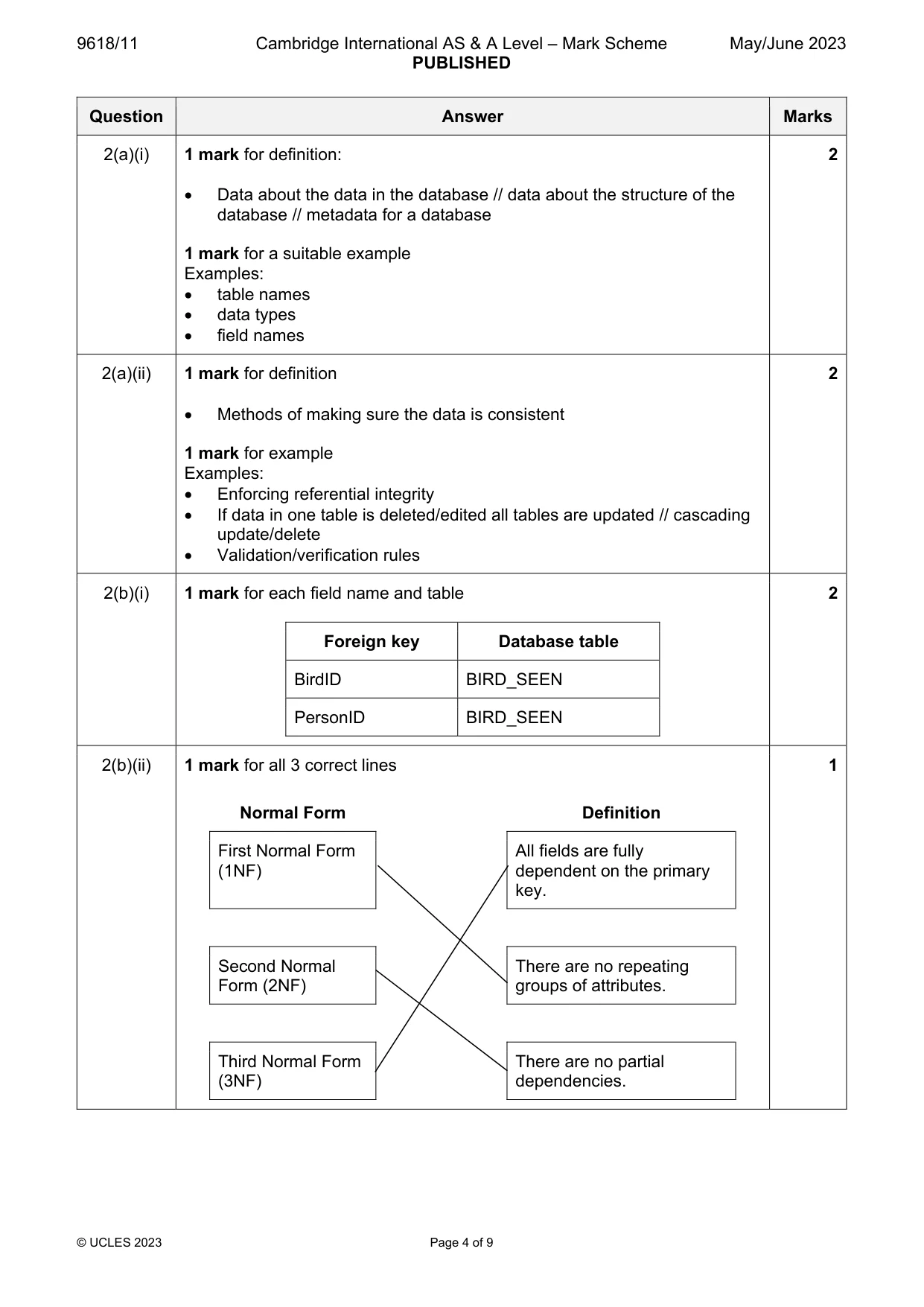
9618/11 Cambridge International AS & A Level – Mark Scheme PUBLISHED May/June 2023 © UCLES 2023 Page 4 of 9 Question Answer Marks 2(a)(i) 1 mark for definition: Data about the data in the database // data about the structure of the database // metadata for a database 1 mark for a suitable example Examples: table names data types field names 2 2(a)(ii) 1 mark for definition Methods of making sure the data is consistent 1 mark for example Examples: Enforcing referential integrity If data in one table is deleted/edited all tables are updated // cascading update/delete Validation/verification rules 2 2(b)(i) 1 mark for each field name and table Foreign key Database table BirdID BIRD_SEEN PersonID BIRD_SEEN 2 2(b)(ii) 1 mark for all 3 correct lines Normal Form Definition First Normal Form (1NF) All fields are fully dependent on the primary key. Second Normal Form (2NF) There are no repeating groups of attributes. Third Normal Form (3NF) There are no partial dependencies. 1
Mark scheme, page 5
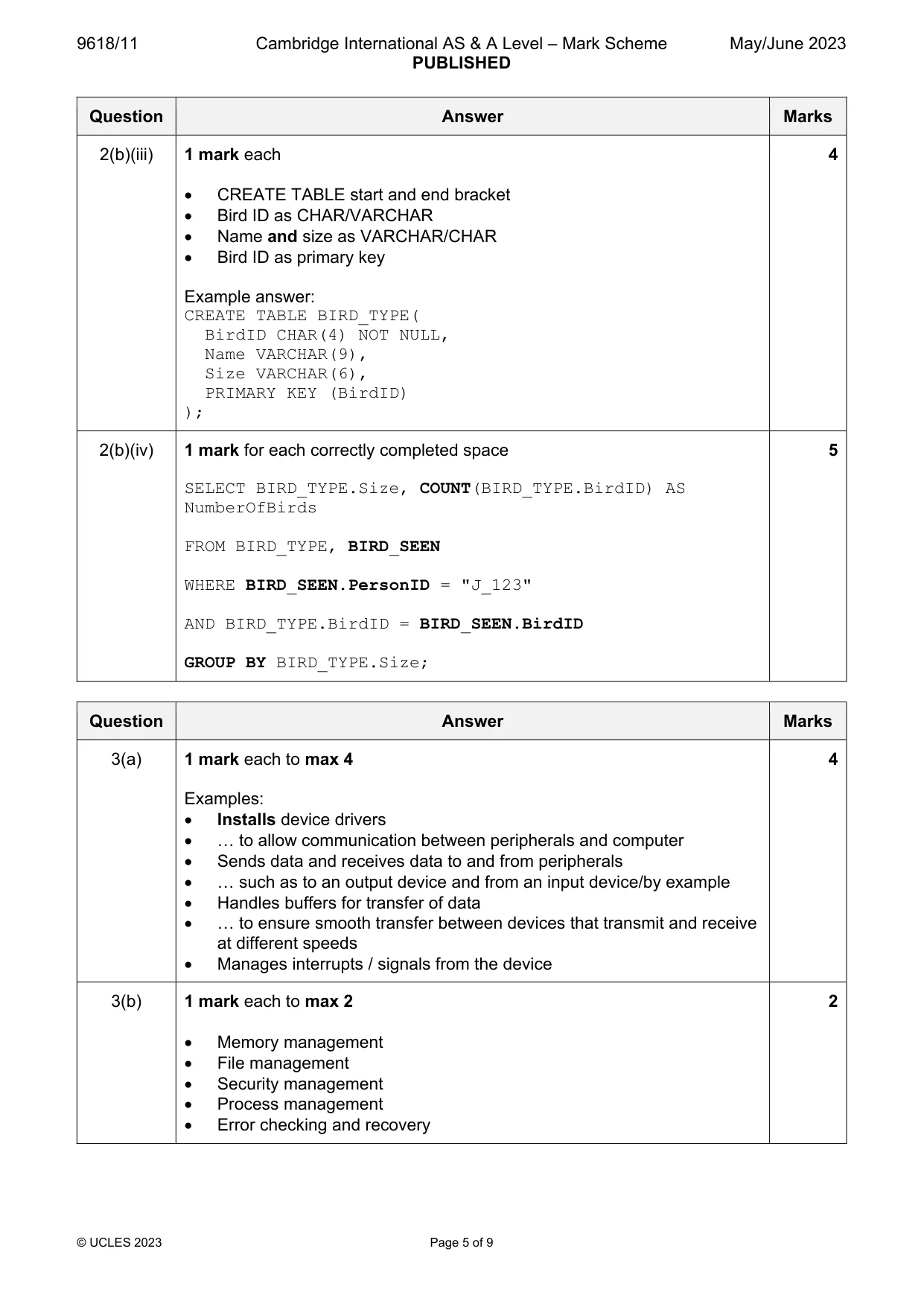
9618/11 Cambridge International AS & A Level – Mark Scheme PUBLISHED May/June 2023 © UCLES 2023 Page 5 of 9 Question Answer Marks 2(b)(iii) 1 mark each CREATE TABLE start and end bracket Bird ID as CHAR/VARCHAR Name and size as VARCHAR/CHAR Bird ID as primary key Example answer: CREATE TABLE BIRD_TYPE( BirdID CHAR(4) NOT NULL, Name VARCHAR(9), Size VARCHAR(6), PRIMARY KEY (BirdID) ); 4 2(b)(iv) 1 mark for each correctly completed space SELECT BIRD_TYPE.Size, COUNT(BIRD_TYPE.BirdID) AS NumberOfBirds FROM BIRD_TYPE, BIRD_SEEN WHERE BIRD_SEEN.PersonID = "J_123" AND BIRD_TYPE.BirdID = BIRD_SEEN.BirdID GROUP BY BIRD_TYPE.Size; 5 Question Answer Marks 3(a) 1 mark each to max 4 Examples: Installs device drivers … to allow communication between peripherals and computer Sends data and receives data to and from peripherals … such as to an output device and from an input device/by example Handles buffers for transfer of data … to ensure smooth transfer between devices that transmit and receive at different speeds Manages interrupts / signals from the device 4 3(b) 1 mark each to max 2 Memory management File management Security management Process management Error checking and recovery 2
Mark scheme, page 6
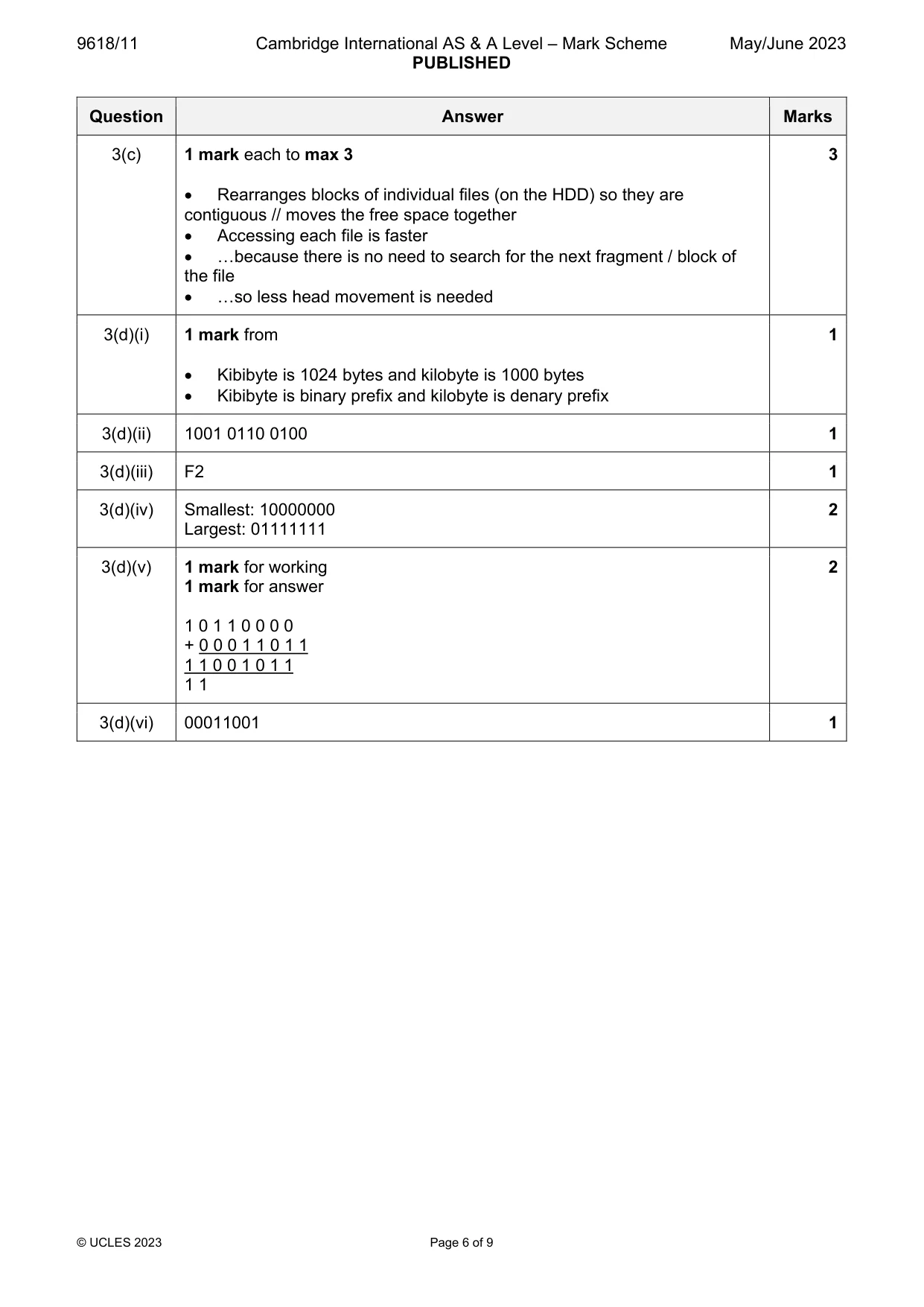
9618/11 Cambridge International AS & A Level – Mark Scheme PUBLISHED May/June 2023 © UCLES 2023 Page 6 of 9 Question Answer Marks 3(c) 1 mark each to max 3 Rearranges blocks of individual files (on the HDD) so they are contiguous // moves the free space together Accessing each file is faster …because there is no need to search for the next fragment / block of the file …so less head movement is needed 3 3(d)(i) 1 mark from Kibibyte is 1024 bytes and kilobyte is 1000 bytes Kibibyte is binary prefix and kilobyte is denary prefix 1 3(d)(ii) 1001 0110 0100 1 3(d)(iii) F2 1 3(d)(iv) Smallest: 10000000 Largest: 01111111 2 3(d)(v) 1 mark for working 1 mark for answer 1 0 1 1 0 0 0 0 + 0 0 0 1 1 0 1 1 1 1 0 0 1 0 1 1 1 1 2 3(d)(vi) 00011001 1
Mark scheme, page 7
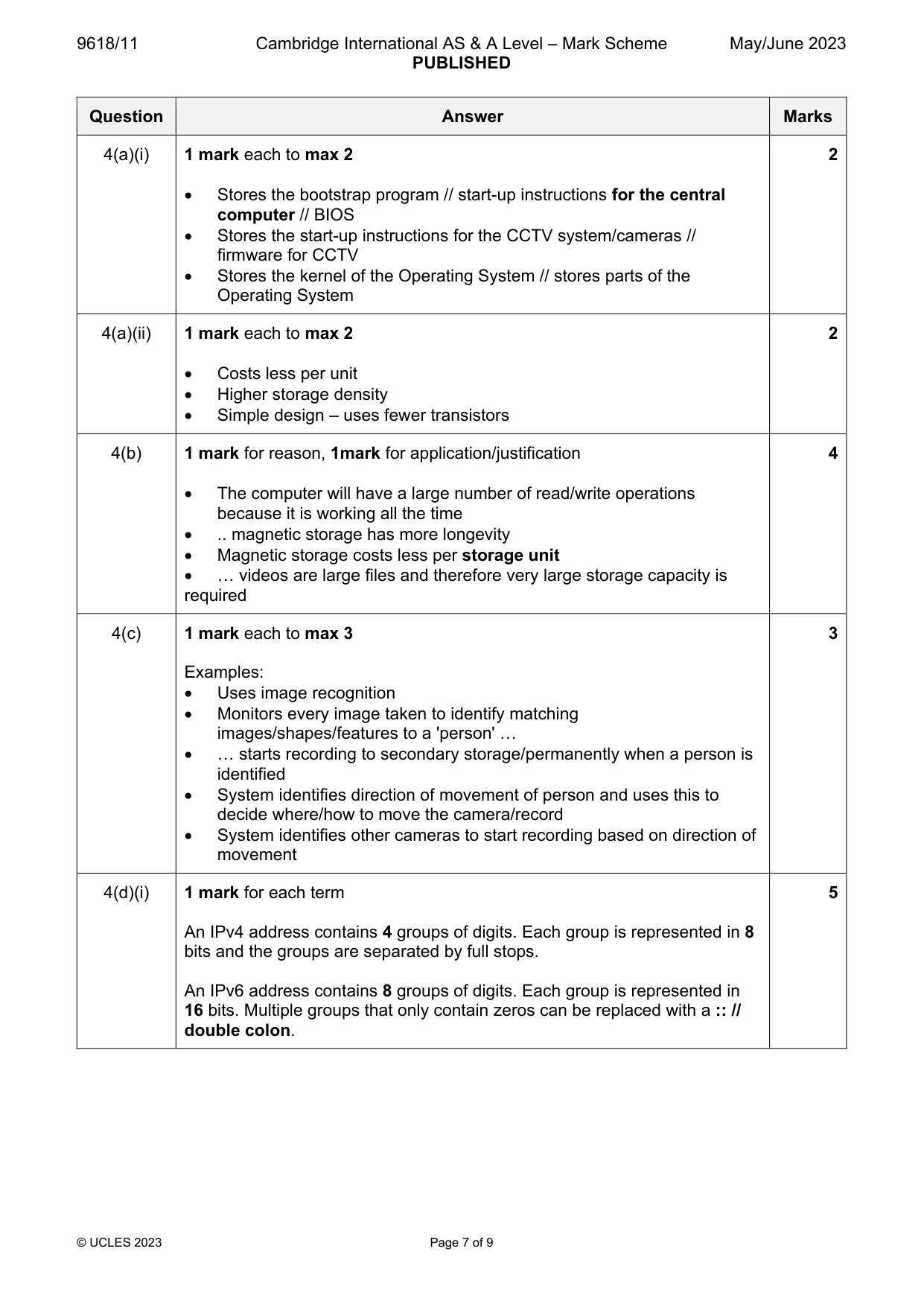
9618/11 Cambridge International AS & A Level – Mark Scheme PUBLISHED May/June 2023 © UCLES 2023 Page 7 of 9 Question Answer Marks 4(a)(i) 1 mark each to max 2 Stores the bootstrap program // start-up instructions for the central computer // BIOS Stores the start-up instructions for the CCTV system/cameras // firmware for CCTV Stores the kernel of the Operating System // stores parts of the Operating System 2 4(a)(ii) 1 mark each to max 2 Costs less per unit Higher storage density Simple design – uses fewer transistors 2 4(b) 1 mark for reason, 1mark for application/justification The computer will have a large number of read/write operations because it is working all the time .. magnetic storage has more longevity Magnetic storage costs less per storage unit … videos are large files and therefore very large storage capacity is required 4 4(c) 1 mark each to max 3 Examples: Uses image recognition Monitors every image taken to identify matching images/shapes/features to a 'person' … … starts recording to secondary storage/permanently when a person is identified System identifies direction of movement of person and uses this to decide where/how to move the camera/record System identifies other cameras to start recording based on direction of movement 3 4(d)(i) 1 mark for each term An IPv4 address contains 4 groups of digits. Each group is represented in 8 bits and the groups are separated by full stops. An IPv6 address contains 8 groups of digits. Each group is represented in 16 bits. Multiple groups that only contain zeros can be replaced with a :: // double colon. 5
Mark scheme, page 8
9618/11 Cambridge International AS & A Level – Mark Scheme PUBLISHED May/June 2023 © UCLES 2023 Page 8 of 9 Question Answer Marks 4(d)(ii) 1 mark for identification, 1mark for expansion e.g. Reduce amount of traffic in a network // improve network speed Data stays in its subnet so it does not travel as far Improves network security .. so that not all devices can access all areas of the network Allows for easier maintenance … because only one subnetwork may need taking down/changing while the rest of the network can continue 4 Question Answer Marks 5(a) 1 mark for 2 gates 2 marks for all 4 gates 2 5(b) 1 mark each NAND 0 is only output when both inputs are 1 // 1 is only output when none, or (either) one of the inputs is 1 NOR 1 is only output when both inputs are 0 // 0 is only output when (either) one or both inputs are 1 2
Mark scheme, page 9
9618/11 Cambridge International AS & A Level – Mark Scheme PUBLISHED May/June 2023 © UCLES 2023 Page 9 of 9 Question Answer Marks 6 1 mark each to max 5 An interrupt flag is raised in the (interrupt) register At the end of the current FE cycle // at the start of the next FE cycle The system checks the interrupt register for higher priority interrupts than current process If true, it stores the current contents of the registers on the stack The appropriate interrupt service routine (ISR) for the key press is called The input data from the keyboard is processed The contents of the registers are restored from the stack ... and control is passed back to previous process 5
What you needed in this session
Cambridge’s own grade thresholds for 2023 May/June, Paper 1 · Variant 1. A higher threshold means an easier paper — the bar moves with how the cohort did.