Cambridge A Level Computer Science 9618 — 2022 May/June Paper 1 · Variant 1
9618/11/M/J/22 · 75 marks · ≈84 min
The question paper and its mark scheme, free to read here and free to download. This is Cambridge’s own paper, exactly as it was sat.
Question paper16 pages








Mark scheme8 pages
Answers below. Sit the paper first if you are practising.
Paper as text
Question paper, page 1
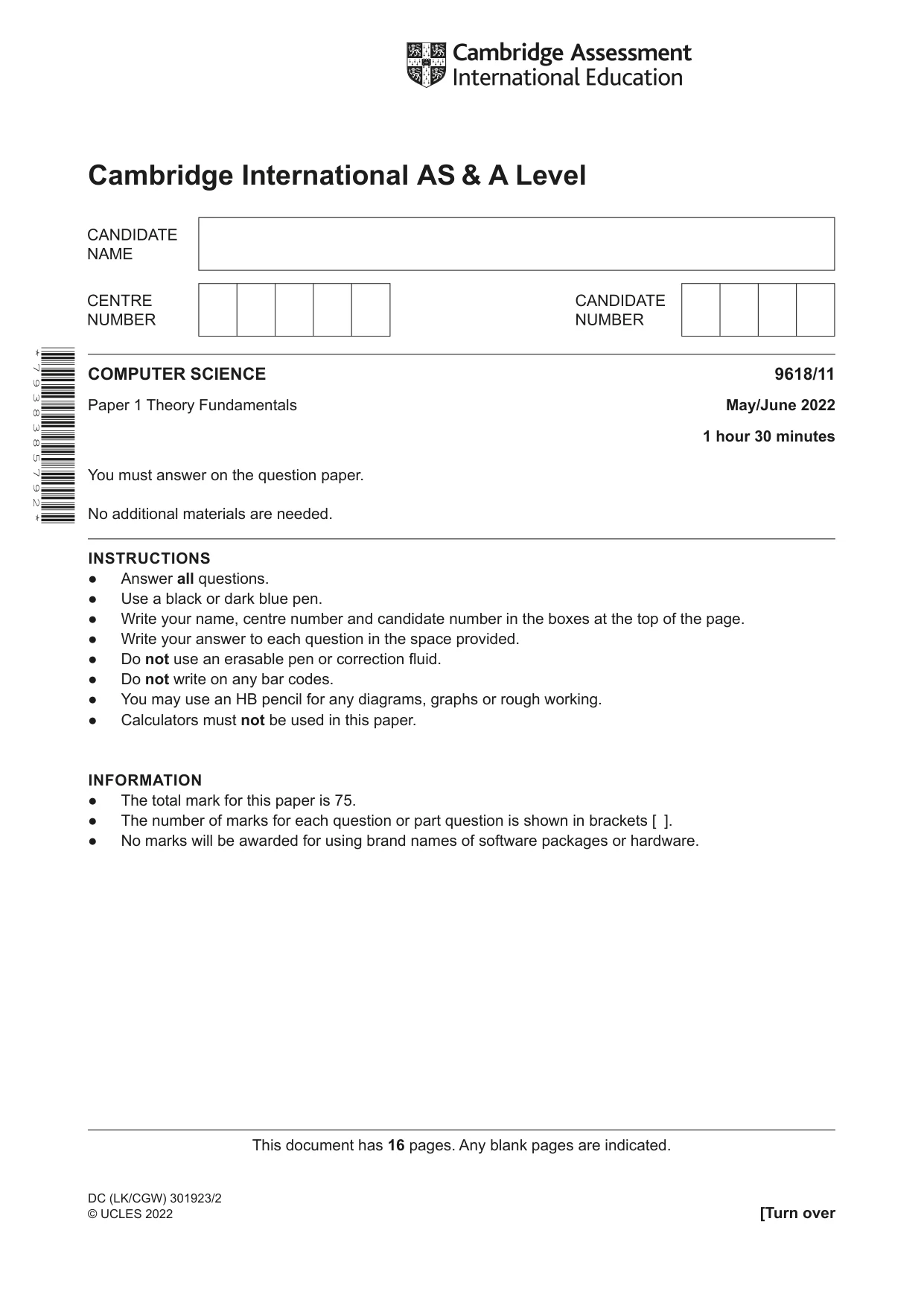
This document has 16 pages. Any blank pages are indicated. [Turn over Cambridge International AS & A Level COMPUTER SCIENCE 9618/11 Paper 1 Theory Fundamentals May/June 2022 1 hour 30 minutes You must answer on the question paper. No additional materials are needed. INSTRUCTIONS ● Answer all questions. ● Use a black or dark blue pen. ● Write your name, centre number and candidate number in the boxes at the top of the page. ● Write your answer to each question in the space provided. ● Do not use an erasable pen or correction fluid. ● Do not write on any bar codes. ● You may use an HB pencil for any diagrams, graphs or rough working. ● Calculators must not be used in this paper. INFORMATION ● The total mark for this paper is 75. ● The number of marks for each question or part question is shown in brackets [ ]. ● No marks will be awarded for using brand names of software packages or hardware. DC (LK/CGW) 301923/2 © UCLES 2022 * 7 9 3 8 3 8 5 7 9 2 *
Question paper, page 2
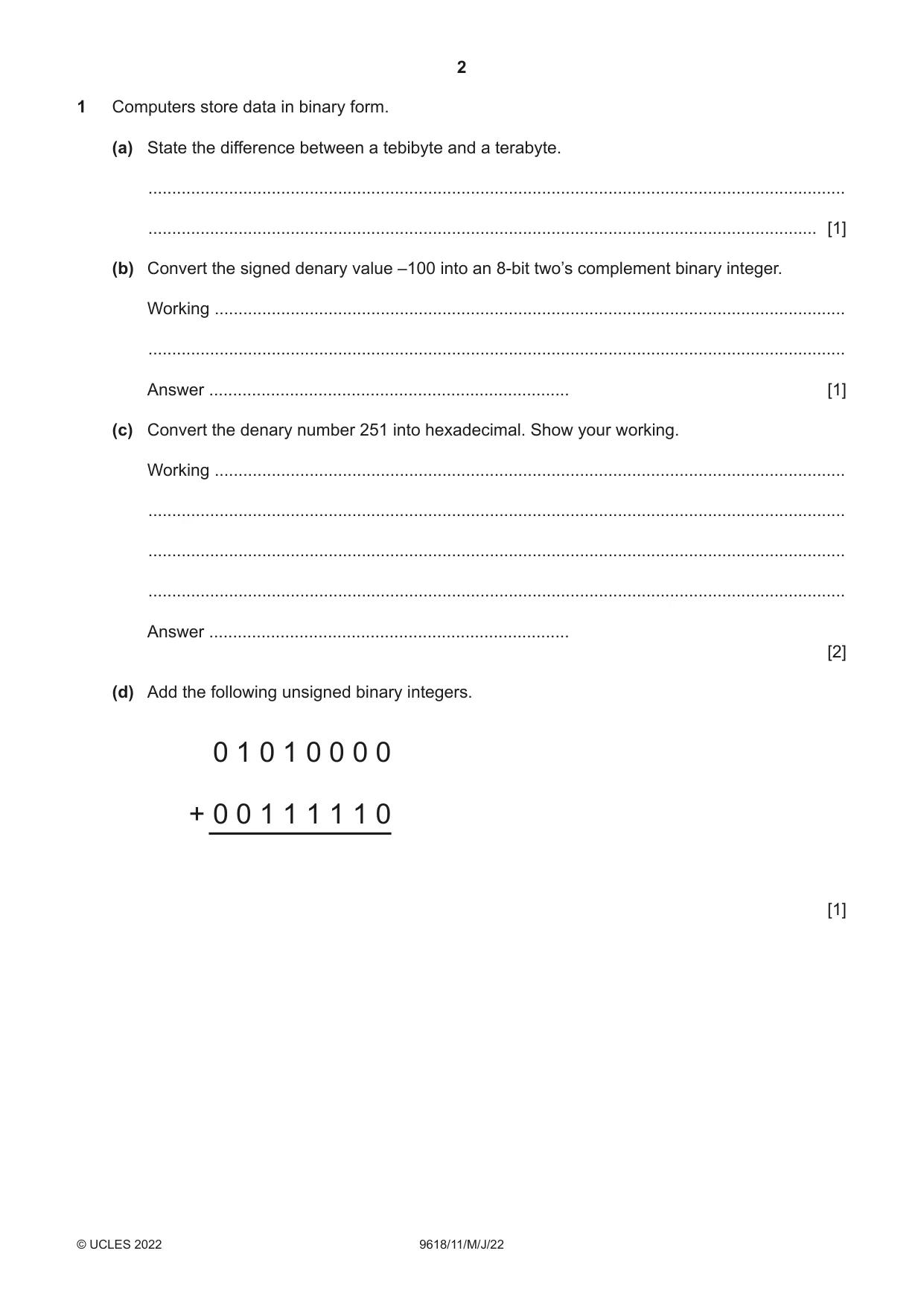
2 9618/11/M/J/22 © UCLES 2022 1 Computers store data in binary form. (a) State the difference between a tebibyte and a terabyte. … … [1] (b) Convert the signed denary value –100 into an 8-bit two’s complement binary integer. Working … … Answer … [1] (c) Convert the denary number 251 into hexadecimal. Show your working. Working … … … … Answer … [2] (d) Add the following unsigned binary integers. 0 1 0 1 0 0 0 0 + 0 0 1 1 1 1 1 0 [1]
Question paper, page 3
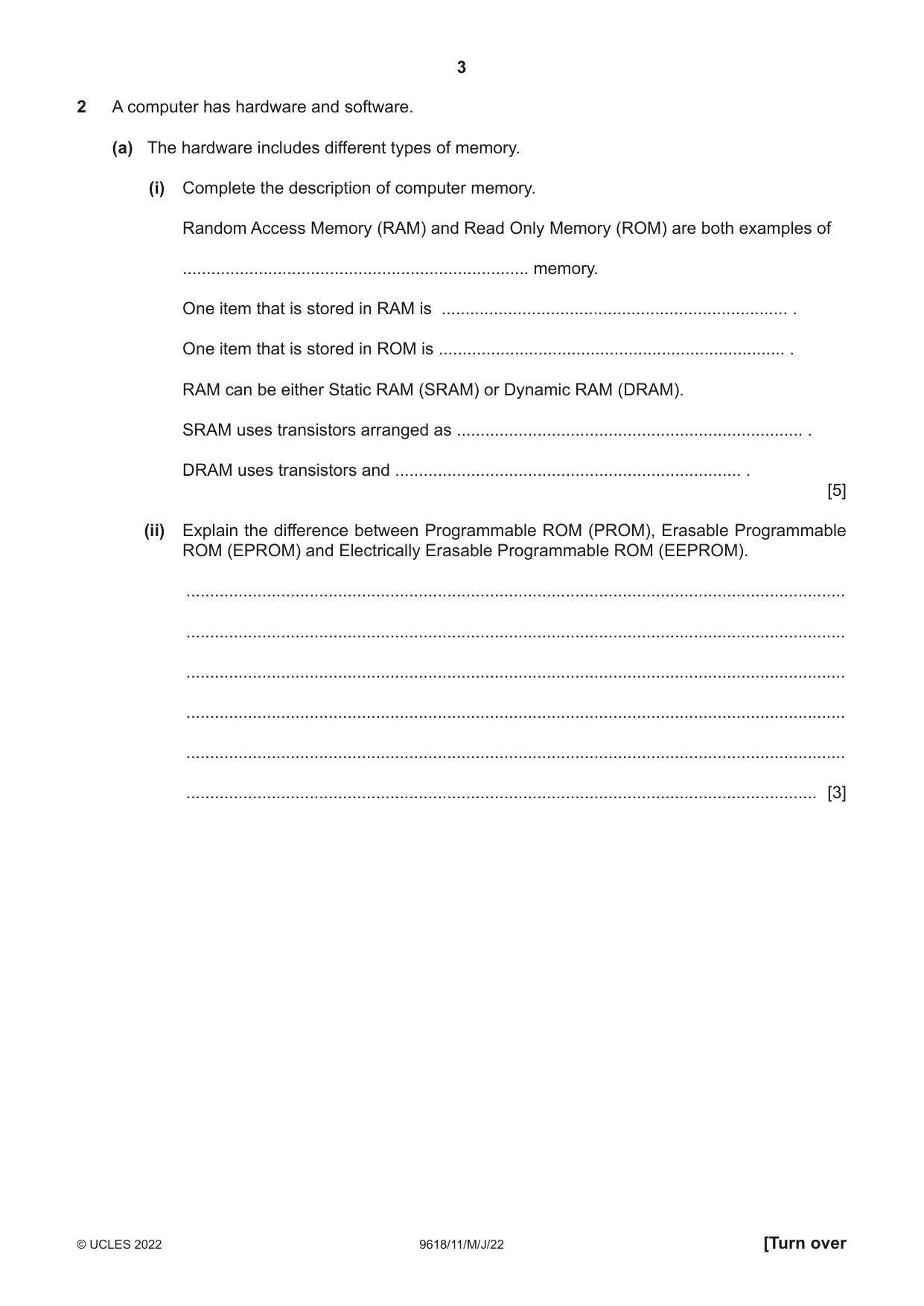
3 9618/11/M/J/22 © UCLES 2022 [Turn over 2 A computer has hardware and software. (a) The hardware includes different types of memory. (i) Complete the description of computer memory. Random Access Memory (RAM) and Read Only Memory (ROM) are both examples of … memory. One item that is stored in RAM is … . One item that is stored in ROM is … . RAM can be either Static RAM (SRAM) or Dynamic RAM (DRAM). SRAM uses transistors arranged as … . DRAM uses transistors and … . [5] (ii) Explain the difference between Programmable ROM (PROM), Erasable Programmable ROM (EPROM) and Electrically Erasable Programmable ROM (EEPROM). … … … … … … [3]
Question paper, page 4
4 9618/11/M/J/22 © UCLES 2022 (b) A magnetic hard disk is used to store data on the computer. Describe the principal operations of a magnetic hard disk. … … … … … … … … … … … … … … [5]
Question paper, page 5
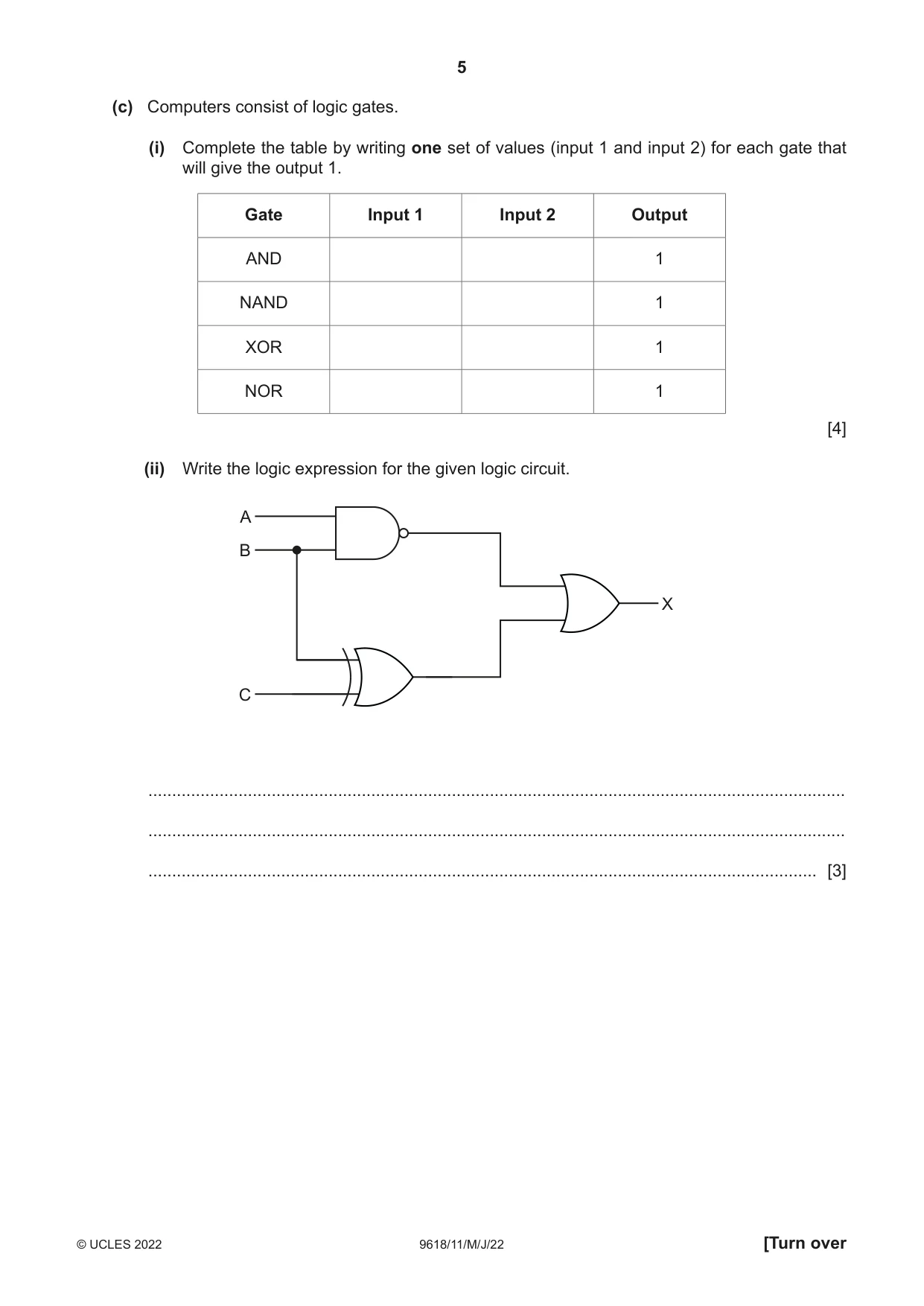
5 9618/11/M/J/22 © UCLES 2022 [Turn over (c) Computers consist of logic gates. (i) Complete the table by writing one set of values (input 1 and input 2) for each gate that will give the output 1. Gate Input 1 Input 2 Output AND 1 NAND 1 XOR 1 NOR 1 [4] (ii) Write the logic expression for the given logic circuit. A B C X … … … [3]
Question paper, page 6
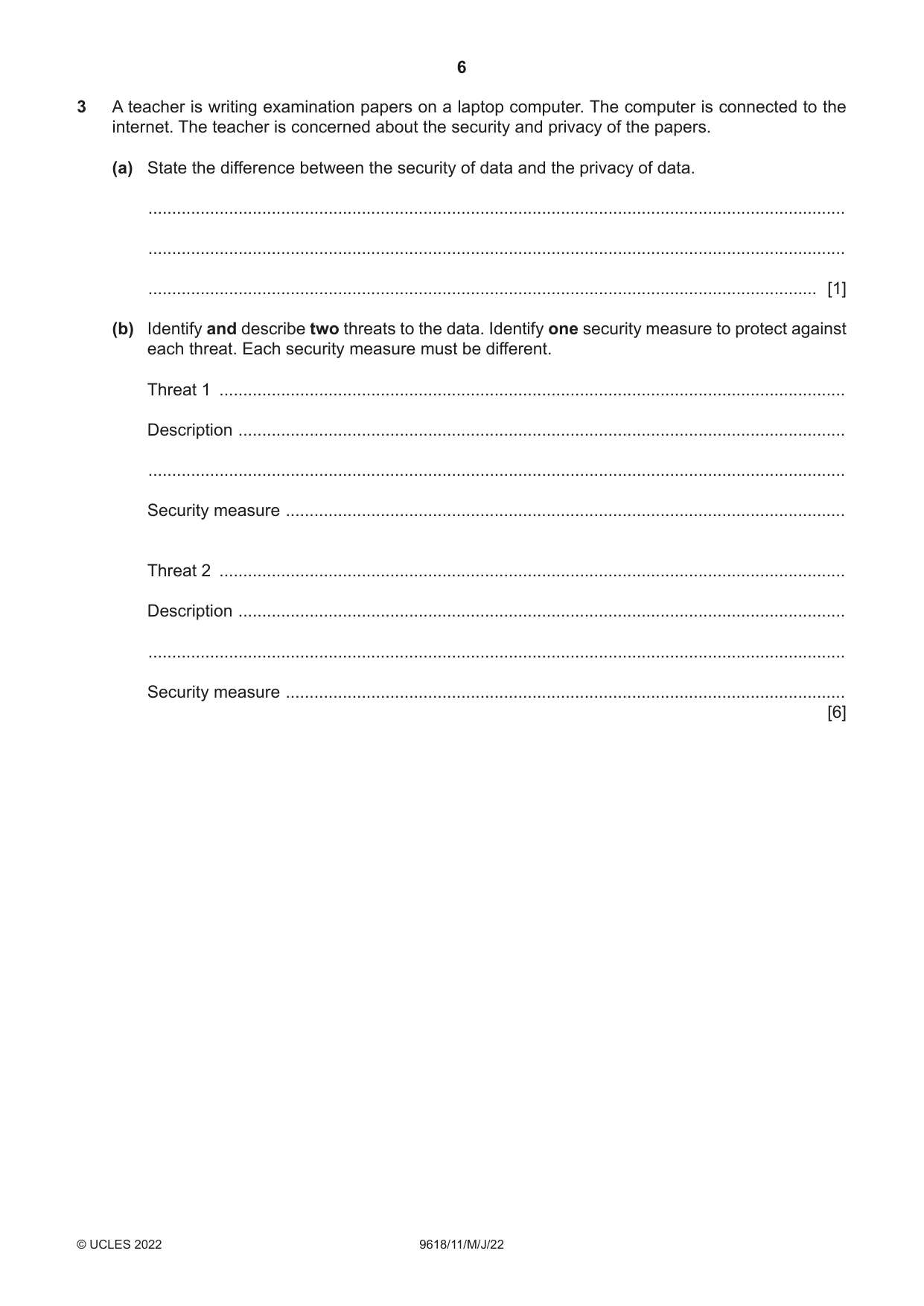
6 9618/11/M/J/22 © UCLES 2022 3 A teacher is writing examination papers on a laptop computer. The computer is connected to the internet. The teacher is concerned about the security and privacy of the papers. (a) State the difference between the security of data and the privacy of data. … … … [1] (b) Identify and describe two threats to the data. Identify one security measure to protect against each threat. Each security measure must be different. Threat 1 … Description … … Security measure … Threat 2 … Description … … Security measure … [6]
Question paper, page 7
7 9618/11/M/J/22 © UCLES 2022 [Turn over 4 A teacher uses a relational database, MARKS, to store data about students and their test marks. The database has the following structure: STUDENT(StudentID, FirstName, LastName) TEST(TestID, Description, TotalMarks) STUDENT_TEST(StudentID, TestID, Mark) (a) Describe the advantages of using a relational database compared to a file-based approach. … … … … … … … … … … [4] (b) Give the highest level of Normal Form (NF) the database MARKS is in and justify your choice. Normal Form … Justification … … … [3]
Question paper, page 8
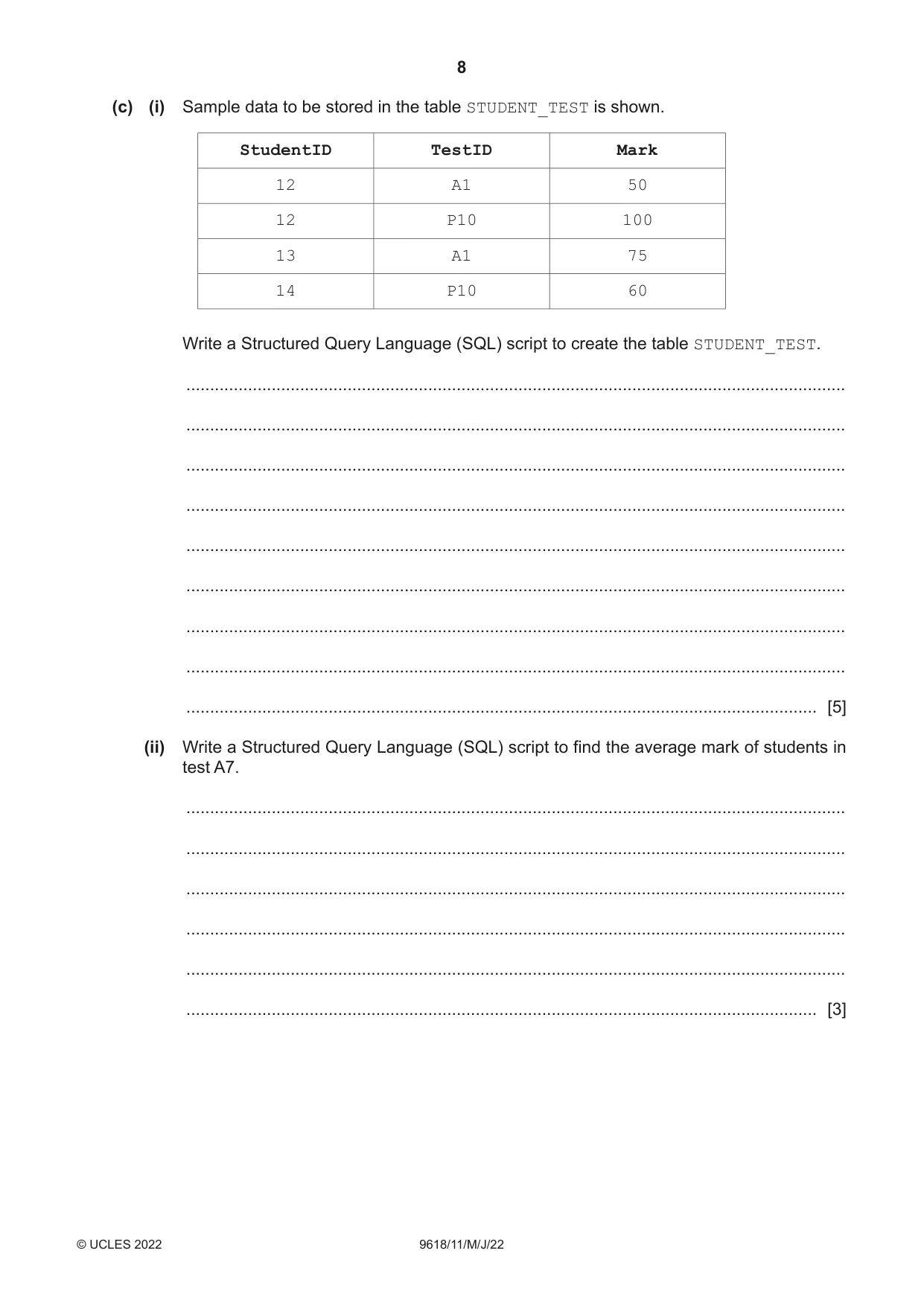
8 9618/11/M/J/22 © UCLES 2022 (c) (i) Sample data to be stored in the table STUDENT_TEST is shown. StudentID TestID Mark 12 A1 50 12 P10 100 13 A1 75 14 P10 60 Write a Structured Query Language (SQL) script to create the table STUDENT_TEST. … … … … … … … … … [5] (ii) Write a Structured Query Language (SQL) script to find the average mark of students in test A7. … … … … … … [3]
Question paper, page 9
9 9618/11/M/J/22 © UCLES 2022 [Turn over (d) The mark a student is awarded in a test will be entered into the database. This mark needs to be a whole number between 0 and the maximum number of marks for that test (inclusive). Explain how data validation and data verification can be used when a mark is entered. … … … … … … … … [4]
Question paper, page 10
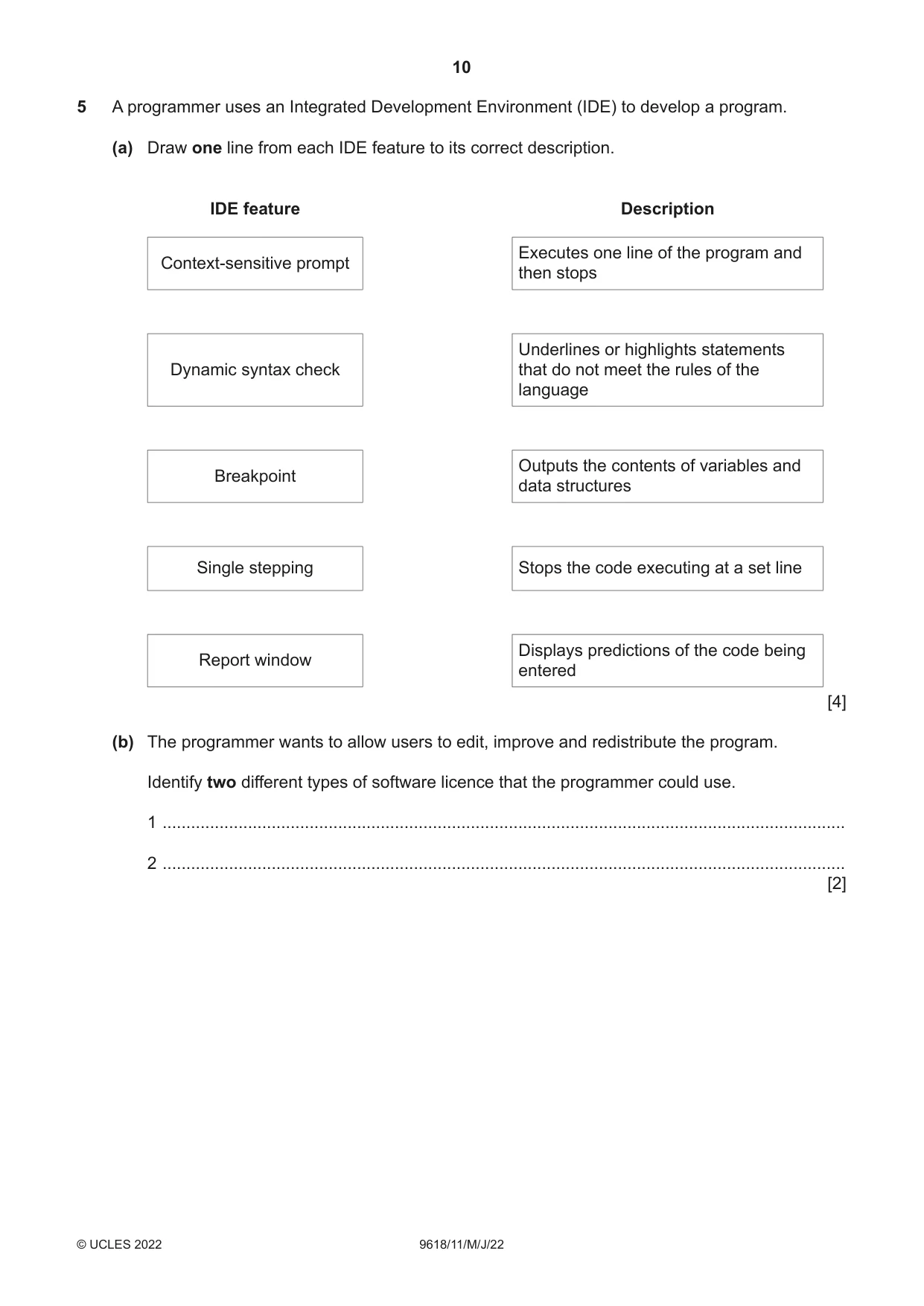
10 9618/11/M/J/22 © UCLES 2022 5 A programmer uses an Integrated Development Environment (IDE) to develop a program. (a) Draw one line from each IDE feature to its correct description. IDE feature Description Context-sensitive prompt Executes one line of the program and then stops Dynamic syntax check Underlines or highlights statements that do not meet the rules of the language Breakpoint Outputs the contents of variables and data structures Single stepping Stops the code executing at a set line Report window Displays predictions of the code being entered [4] (b) The programmer wants to allow users to edit, improve and redistribute the program. Identify two different types of software licence that the programmer could use. 1 … 2 … [2]
Question paper, page 11
11 9618/11/M/J/22 © UCLES 2022 [Turn over (c) Explain the benefits to the programmer of using program libraries. … … … … … … … … [3]
Question paper, page 12
12 9618/11/M/J/22 © UCLES 2022 6 (a) A computer system is designed using the basic Von Neumann model. (i) Describe the role of the registers in the Fetch-Execute (F-E) cycle. … … … … … … … … … … [5] (ii) Describe when interrupts are detected in the F-E cycle and how the interrupts are handled. Detected … … Handled … … … … … … … … … … [5]
Question paper, page 13
13 9618/11/M/J/22 © UCLES 2022 [Turn over (b) Identify one factor that can affect the performance of the computer system and state how it impacts the performance. Factor … Impact … … … [2] Question 6 continues on the next page.
Question paper, page 14
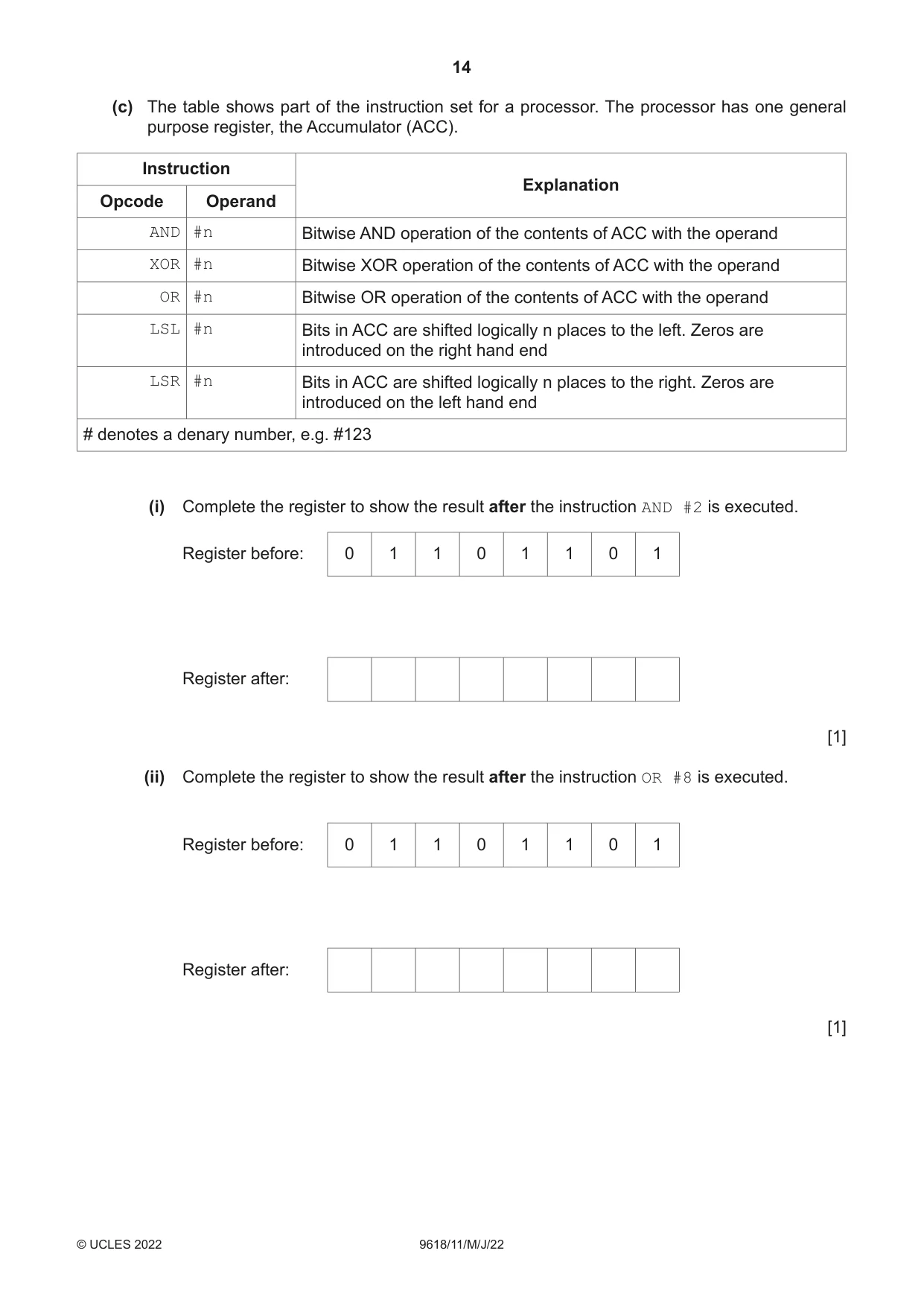
14 9618/11/M/J/22 © UCLES 2022 (c) The table shows part of the instruction set for a processor. The processor has one general purpose register, the Accumulator (ACC). Instruction Explanation Opcode Operand AND #n Bitwise AND operation of the contents of ACC with the operand XOR #n Bitwise XOR operation of the contents of ACC with the operand OR #n Bitwise OR operation of the contents of ACC with the operand LSL #n Bits in ACC are shifted logically n places to the left. Zeros are introduced on the right hand end LSR #n Bits in ACC are shifted logically n places to the right. Zeros are introduced on the left hand end # denotes a denary number, e.g. #123 (i) Complete the register to show the result after the instruction AND #2 is executed. Register before: 0 1 1 0 1 1 0 1 Register after: [1] (ii) Complete the register to show the result after the instruction OR #8 is executed. Register before: 0 1 1 0 1 1 0 1 Register after: [1]
Question paper, page 15
15 9618/11/M/J/22 © UCLES 2022 (iii) Complete the register to show the result after the operation LSL #4 is executed. Register before: 0 1 1 0 1 1 0 1 Register after: [1]
Question paper, page 16
16 9618/11/M/J/22 © UCLES 2022 Permission to reproduce items where third-party owned material protected by copyright is included has been sought and cleared where possible. Every reasonable effort has been made by the publisher (UCLES) to trace copyright holders, but if any items requiring clearance have unwittingly been included, the publisher will be pleased to make amends at the earliest possible opportunity. To avoid the issue of disclosure of answer-related information to candidates, all copyright acknowledgements are reproduced online in the Cambridge Assessment International Education Copyright Acknowledgements Booklet. This is produced for each series of examinations and is freely available to download at www.cambridgeinternational.org after the live examination series. Cambridge Assessment International Education is part of Cambridge Assessment. Cambridge Assessment is the brand name of the University of Cambridge Local Examinations Syndicate (UCLES), which is a department of the University of Cambridge. BLANK PAGE
Mark scheme, page 1
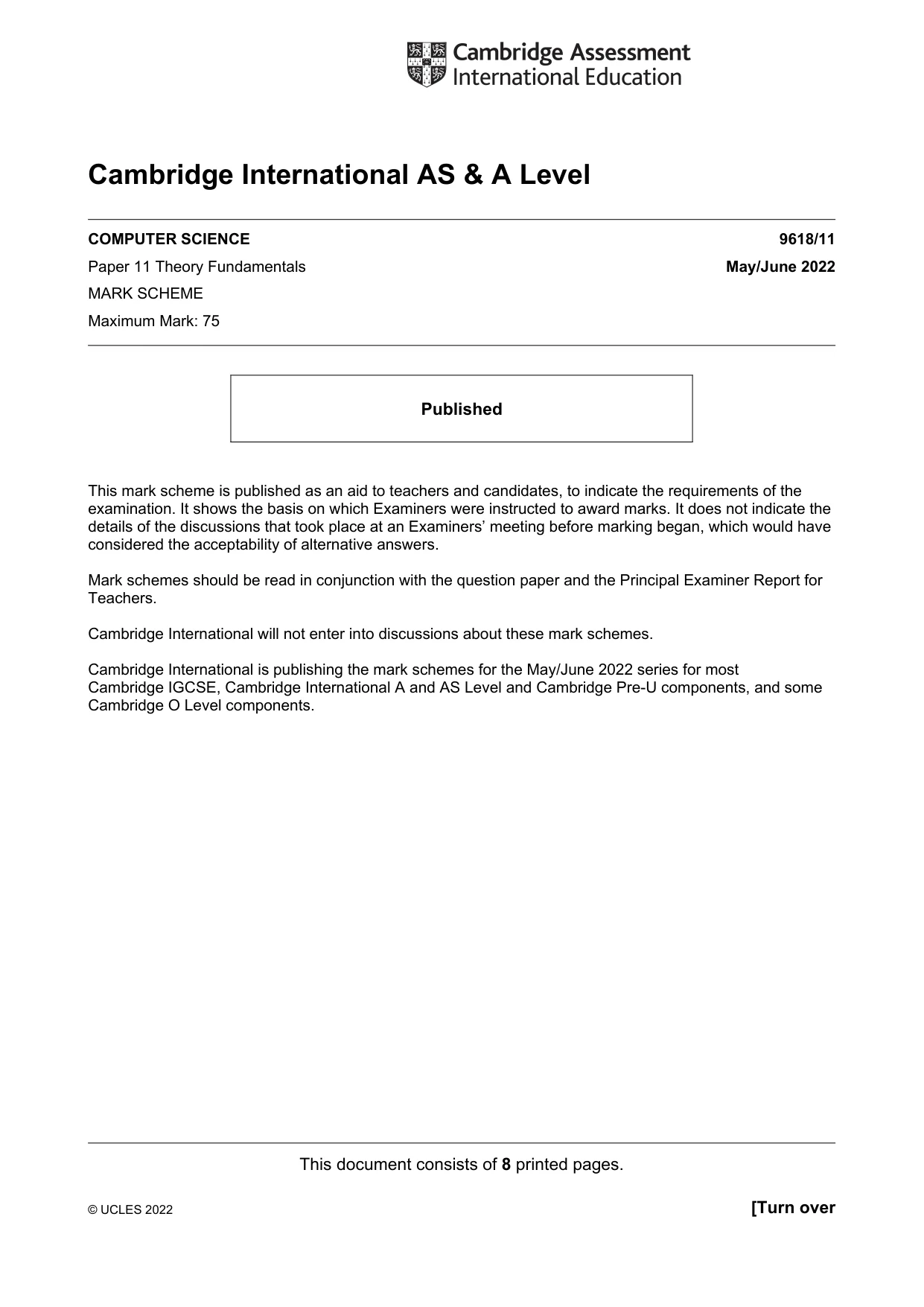
This document consists of 8 printed pages. © UCLES 2022 [Turn over Cambridge International AS & A Level COMPUTER SCIENCE 9618/11 Paper 11 Theory Fundamentals May/June 2022 MARK SCHEME Maximum Mark: 75 This mark scheme is published as an aid to teachers and candidates, to indicate the requirements of the examination. It shows the basis on which Examiners were instructed to award marks. It does not indicate the details of the discussions that took place at an Examiners’ meeting before marking began, which would have considered the acceptability of alternative answers. Mark schemes should be read in conjunction with the question paper and the Principal Examiner Report for Teachers. Cambridge International will not enter into discussions about these mark schemes. Cambridge International is publishing the mark schemes for the May/June 2022 series for most Cambridge IGCSE, Cambridge International A and AS Level and Cambridge Pre-U components, and some Cambridge O Level components. Published
Mark scheme, page 2
9618/11 Cambridge International AS & A Level – Mark Scheme PUBLISHED May/June 2022 © UCLES 2022 Page 2 of 8 Generic Marking Principles These general marking principles must be applied by all examiners when marking candidate answers. They should be applied alongside the specific content of the mark scheme or generic level descriptors for a question. Each question paper and mark scheme will also comply with these marking principles. GENERIC MARKING PRINCIPLE 1: Marks must be awarded in line with: the specific content of the mark scheme or the generic level descriptors for the question the specific skills defined in the mark scheme or in the generic level descriptors for the question the standard of response required by a candidate as exemplified by the standardisation scripts. GENERIC MARKING PRINCIPLE 2: Marks awarded are always whole marks (not half marks, or other fractions). GENERIC MARKING PRINCIPLE 3: Marks must be awarded positively: marks are awarded for correct/valid answers, as defined in the mark scheme. However, credit is given for valid answers which go beyond the scope of the syllabus and mark scheme, referring to your Team Leader as appropriate marks are awarded when candidates clearly demonstrate what they know and can do marks are not deducted for errors marks are not deducted for omissions answers should only be judged on the quality of spelling, punctuation and grammar when these features are specifically assessed by the question as indicated by the mark scheme. The meaning, however, should be unambiguous. GENERIC MARKING PRINCIPLE 4: Rules must be applied consistently, e.g. in situations where candidates have not followed instructions or in the application of generic level descriptors. GENERIC MARKING PRINCIPLE 5: Marks should be awarded using the full range of marks defined in the mark scheme for the question (however; the use of the full mark range may be limited according to the quality of the candidate responses seen). GENERIC MARKING PRINCIPLE 6: Marks awarded are based solely on the requirements as defined in the mark scheme. Marks should not be awarded with grade thresholds or grade descriptors in mind.
Mark scheme, page 3
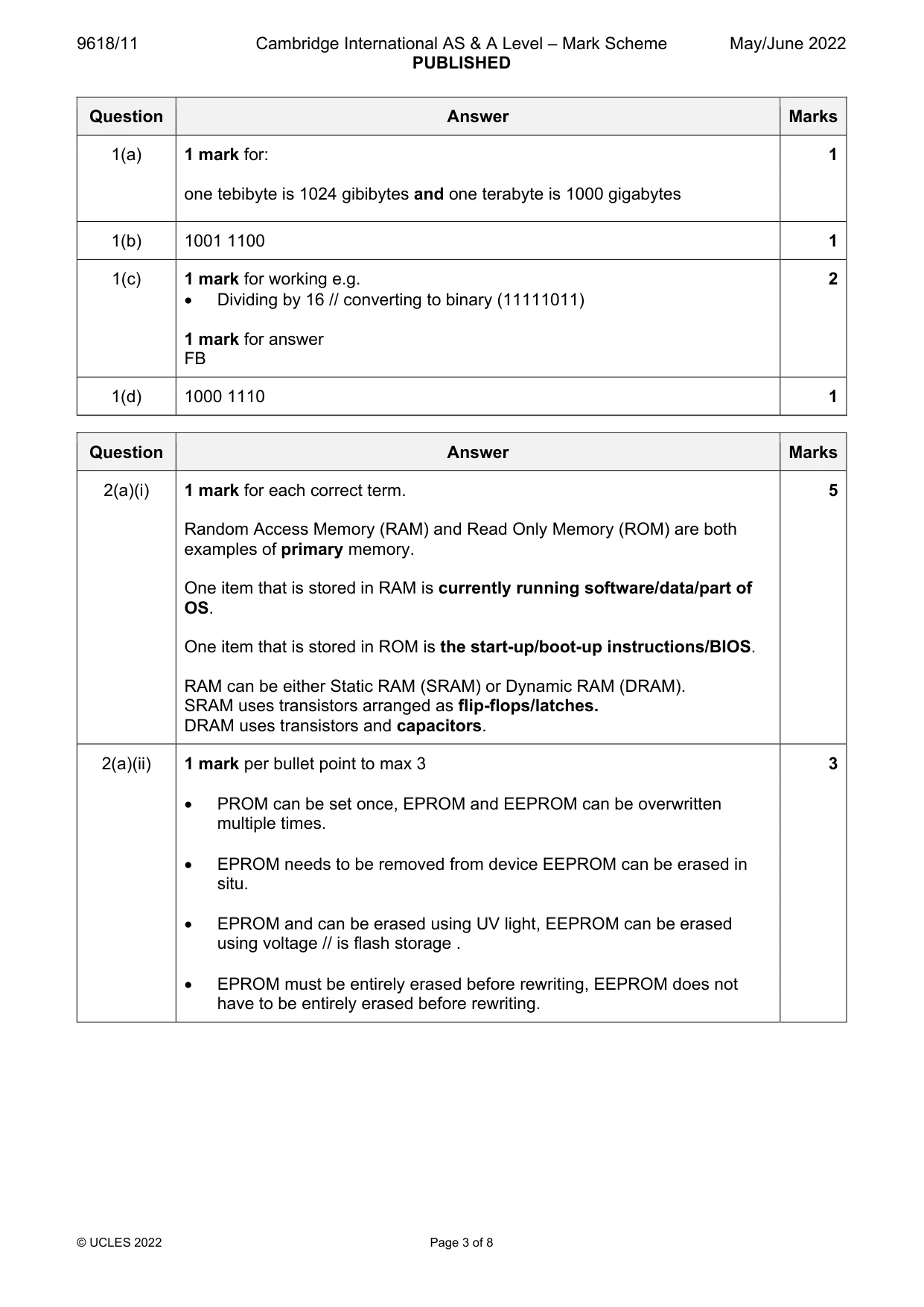
9618/11 Cambridge International AS & A Level – Mark Scheme PUBLISHED May/June 2022 © UCLES 2022 Page 3 of 8 Question Answer Marks 1(a) 1 mark for: one tebibyte is 1024 gibibytes and one terabyte is 1000 gigabytes 1 1(b) 1001 1100 1 1(c) 1 mark for working e.g. Dividing by 16 // converting to binary (11111011) 1 mark for answer FB 2 1(d) 1000 1110 1 Question Answer Marks 2(a)(i) 1 mark for each correct term. Random Access Memory (RAM) and Read Only Memory (ROM) are both examples of primary memory. One item that is stored in RAM is currently running software/data/part of OS. One item that is stored in ROM is the start-up/boot-up instructions/BIOS. RAM can be either Static RAM (SRAM) or Dynamic RAM (DRAM). SRAM uses transistors arranged as flip-flops/latches. DRAM uses transistors and capacitors. 5 2(a)(ii) 1 mark per bullet point to max 3 PROM can be set once, EPROM and EEPROM can be overwritten multiple times. EPROM needs to be removed from device EEPROM can be erased in situ. EPROM and can be erased using UV light, EEPROM can be erased using voltage // is flash storage . EPROM must be entirely erased before rewriting, EEPROM does not have to be entirely erased before rewriting. 3
Mark scheme, page 4
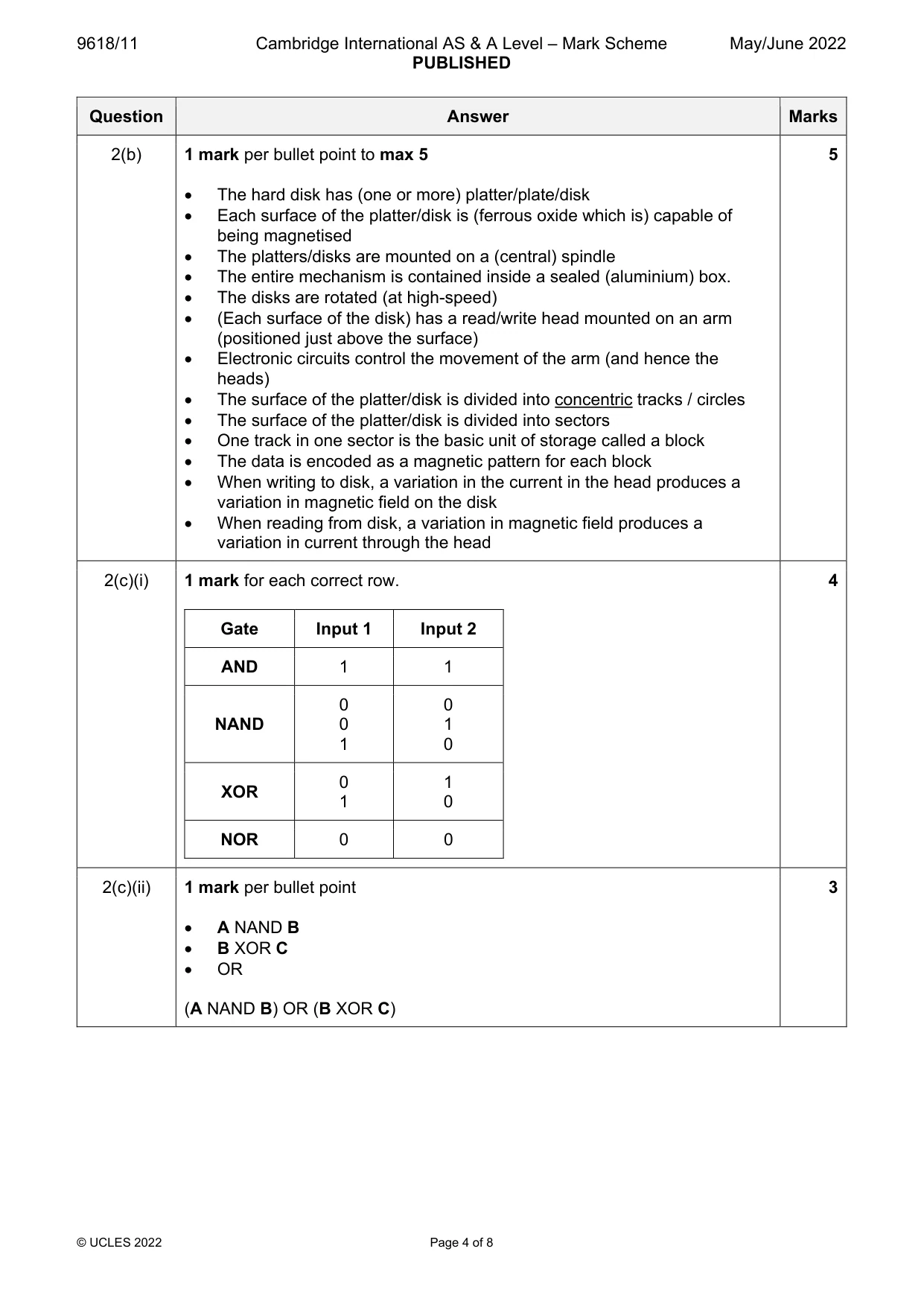
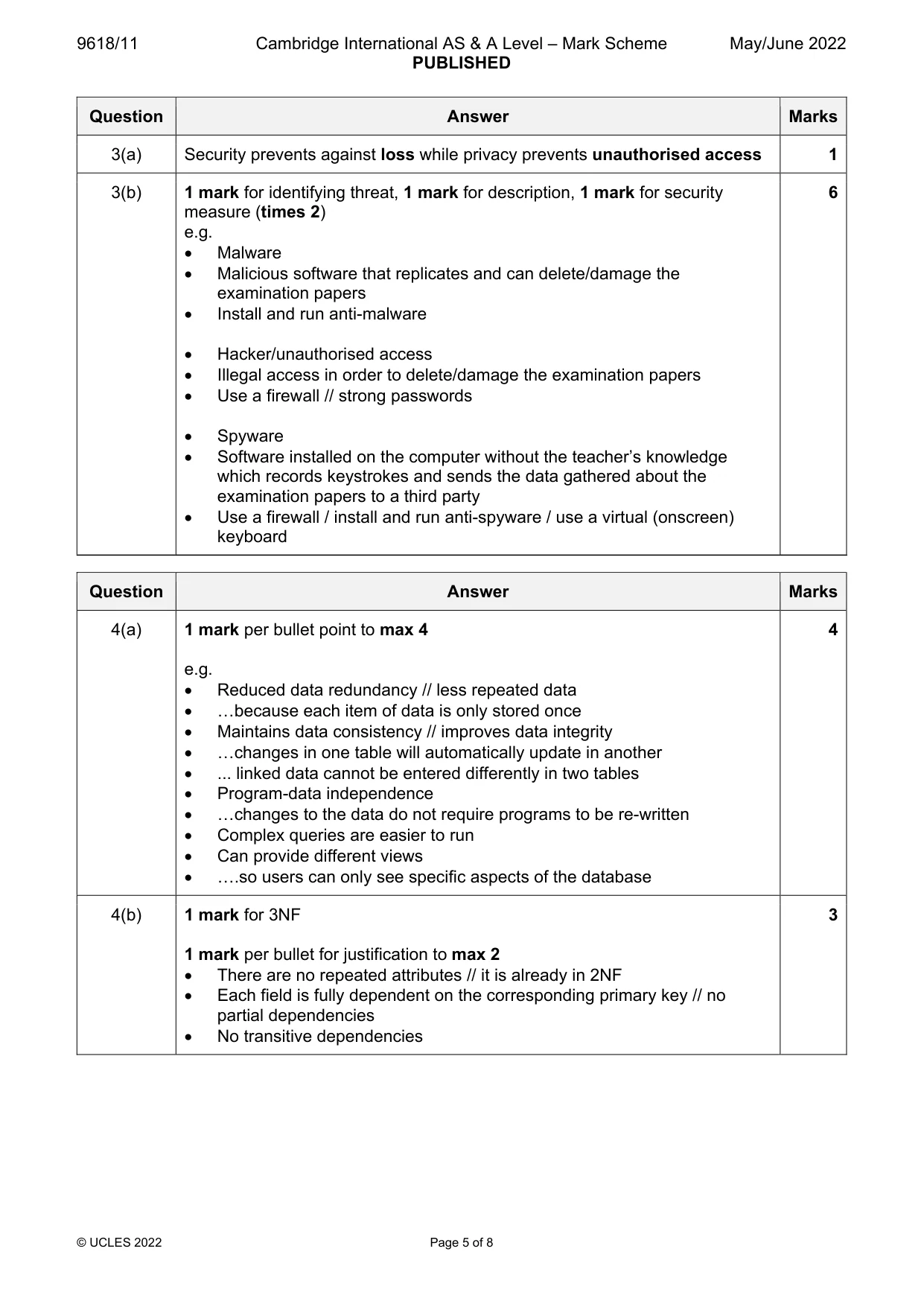
9618/11 Cambridge International AS & A Level – Mark Scheme PUBLISHED May/June 2022 © UCLES 2022 Page 4 of 8 Question Answer Marks 2(b) 1 mark per bullet point to max 5 The hard disk has (one or more) platter/plate/disk Each surface of the platter/disk is (ferrous oxide which is) capable of being magnetised The platters/disks are mounted on a (central) spindle The entire mechanism is contained inside a sealed (aluminium) box. The disks are rotated (at high-speed) (Each surface of the disk) has a read/write head mounted on an arm (positioned just above the surface) Electronic circuits control the movement of the arm (and hence the heads) The surface of the platter/disk is divided into concentric tracks / circles The surface of the platter/disk is divided into sectors One track in one sector is the basic unit of storage called a block The data is encoded as a magnetic pattern for each block When writing to disk, a variation in the current in the head produces a variation in magnetic field on the disk When reading from disk, a variation in magnetic field produces a variation in current through the head 5 2(c)(i) 1 mark for each correct row. Gate Input 1 Input 2 AND 1 1 NAND 0 0 1 0 1 0 XOR 0 1 1 0 NOR 0 0 4 2(c)(ii) 1 mark per bullet point A NAND B B XOR C OR (A NAND B) OR (B XOR C) 3
Mark scheme, page 5
9618/11 Cambridge International AS & A Level – Mark Scheme PUBLISHED May/June 2022 © UCLES 2022 Page 5 of 8 Question Answer Marks 3(a) Security prevents against loss while privacy prevents unauthorised access 1 3(b) 1 mark for identifying threat, 1 mark for description, 1 mark for security measure (times 2) e.g. Malware Malicious software that replicates and can delete/damage the examination papers Install and run anti-malware Hacker/unauthorised access Illegal access in order to delete/damage the examination papers Use a firewall // strong passwords Spyware Software installed on the computer without the teacher’s knowledge which records keystrokes and sends the data gathered about the examination papers to a third party Use a firewall / install and run anti-spyware / use a virtual (onscreen) keyboard 6 Question Answer Marks 4(a) 1 mark per bullet point to max 4 e.g. Reduced data redundancy // less repeated data …because each item of data is only stored once Maintains data consistency // improves data integrity …changes in one table will automatically update in another ... linked data cannot be entered differently in two tables Program-data independence …changes to the data do not require programs to be re-written Complex queries are easier to run Can provide different views ….so users can only see specific aspects of the database 4 4(b) 1 mark for 3NF 1 mark per bullet for justification to max 2 There are no repeated attributes // it is already in 2NF Each field is fully dependent on the corresponding primary key // no partial dependencies No transitive dependencies 3
Mark scheme, page 6
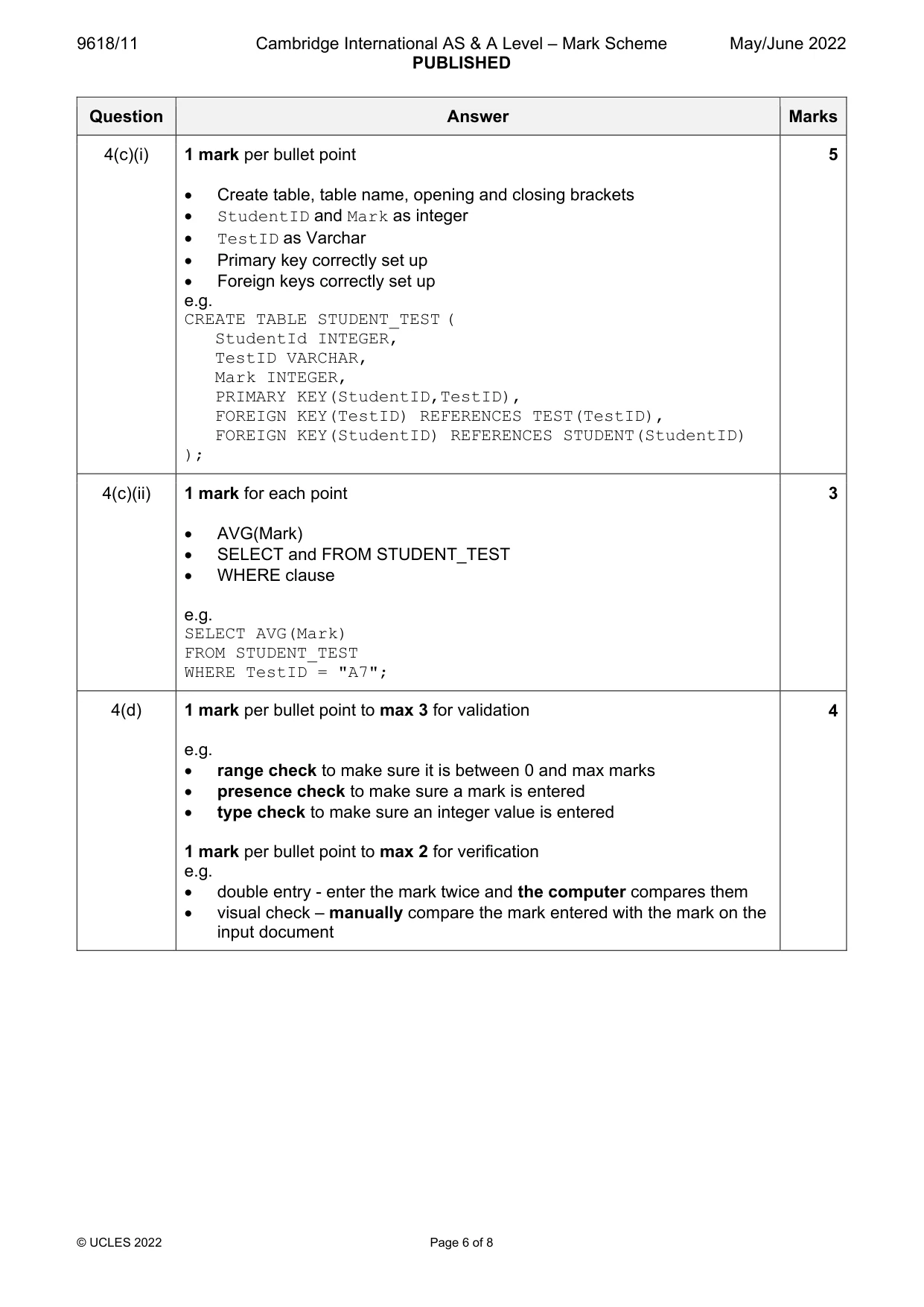
9618/11 Cambridge International AS & A Level – Mark Scheme PUBLISHED May/June 2022 © UCLES 2022 Page 6 of 8 Question Answer Marks 4(c)(i) 1 mark per bullet point Create table, table name, opening and closing brackets StudentID and Mark as integer TestID as Varchar Primary key correctly set up Foreign keys correctly set up e.g. CREATE TABLE STUDENT_TEST ( StudentId INTEGER, TestID VARCHAR, Mark INTEGER, PRIMARY KEY(StudentID,TestID), FOREIGN KEY(TestID) REFERENCES TEST(TestID), FOREIGN KEY(StudentID) REFERENCES STUDENT(StudentID) ); 5 4(c)(ii) 1 mark for each point AVG(Mark) SELECT and FROM STUDENT_TEST WHERE clause e.g. SELECT AVG(Mark) FROM STUDENT_TEST WHERE TestID = "A7"; 3 4(d) 1 mark per bullet point to max 3 for validation e.g. range check to make sure it is between 0 and max marks presence check to make sure a mark is entered type check to make sure an integer value is entered 1 mark per bullet point to max 2 for verification e.g. double entry - enter the mark twice and the computer compares them visual check – manually compare the mark entered with the mark on the input document 4
Mark scheme, page 7
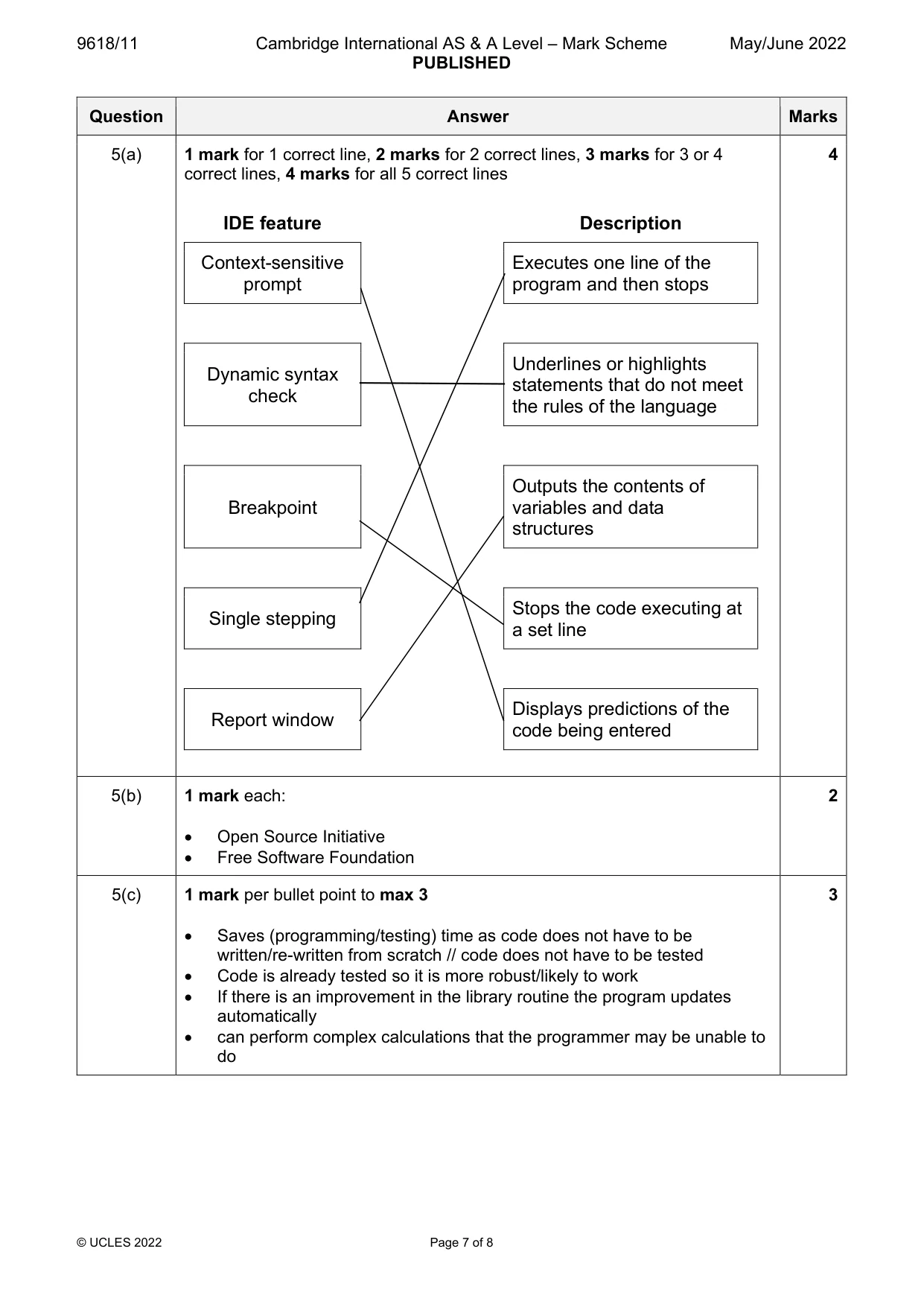
9618/11 Cambridge International AS & A Level – Mark Scheme PUBLISHED May/June 2022 © UCLES 2022 Page 7 of 8 Question Answer Marks 5(a) 1 mark for 1 correct line, 2 marks for 2 correct lines, 3 marks for 3 or 4 correct lines, 4 marks for all 5 correct lines IDE feature Description Context-sensitive prompt Executes one line of the program and then stops Dynamic syntax check Underlines or highlights statements that do not meet the rules of the language Breakpoint Outputs the contents of variables and data structures Single stepping Stops the code executing at a set line Report window Displays predictions of the code being entered 4 5(b) 1 mark each: Open Source Initiative Free Software Foundation 2 5(c) 1 mark per bullet point to max 3 Saves (programming/testing) time as code does not have to be written/re-written from scratch // code does not have to be tested Code is already tested so it is more robust/likely to work If there is an improvement in the library routine the program updates automatically can perform complex calculations that the programmer may be unable to do 3
Mark scheme, page 8
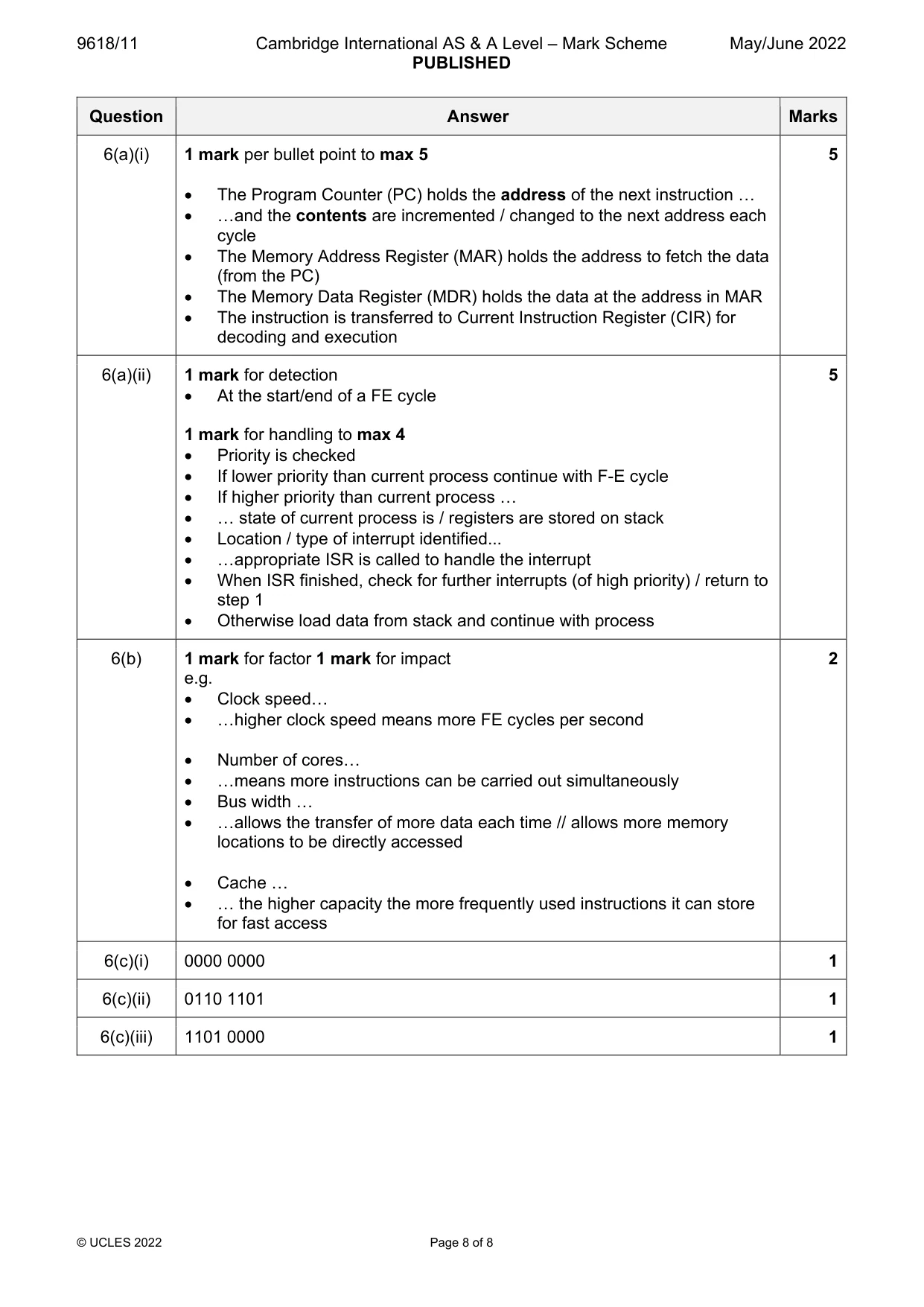
9618/11 Cambridge International AS & A Level – Mark Scheme PUBLISHED May/June 2022 © UCLES 2022 Page 8 of 8 Question Answer Marks 6(a)(i) 1 mark per bullet point to max 5 The Program Counter (PC) holds the address of the next instruction … …and the contents are incremented / changed to the next address each cycle The Memory Address Register (MAR) holds the address to fetch the data (from the PC) The Memory Data Register (MDR) holds the data at the address in MAR The instruction is transferred to Current Instruction Register (CIR) for decoding and execution 5 6(a)(ii) 1 mark for detection At the start/end of a FE cycle 1 mark for handling to max 4 Priority is checked If lower priority than current process continue with F-E cycle If higher priority than current process … … state of current process is / registers are stored on stack Location / type of interrupt identified... …appropriate ISR is called to handle the interrupt When ISR finished, check for further interrupts (of high priority) / return to step 1 Otherwise load data from stack and continue with process 5 6(b) 1 mark for factor 1 mark for impact e.g. Clock speed… …higher clock speed means more FE cycles per second Number of cores… …means more instructions can be carried out simultaneously Bus width … …allows the transfer of more data each time // allows more memory locations to be directly accessed Cache … … the higher capacity the more frequently used instructions it can store for fast access 2 6(c)(i) 0000 0000 1 6(c)(ii) 0110 1101 1 6(c)(iii) 1101 0000 1
What you needed in this session
Cambridge’s own grade thresholds for 2022 May/June, Paper 1 · Variant 1. A higher threshold means an easier paper — the bar moves with how the cohort did.