Cambridge A Level Classical Studies 9274 — 2024 Oct/Nov Paper 4 · Variant 3
9274/43/O/N/24 · 50 marks · ≈56 min
The question paper and its mark scheme, free to read here and free to download. This is Cambridge’s own paper, exactly as it was sat.
Question paper4 pages

Mark scheme11 pages
Answers below. Sit the paper first if you are practising.
Paper as text
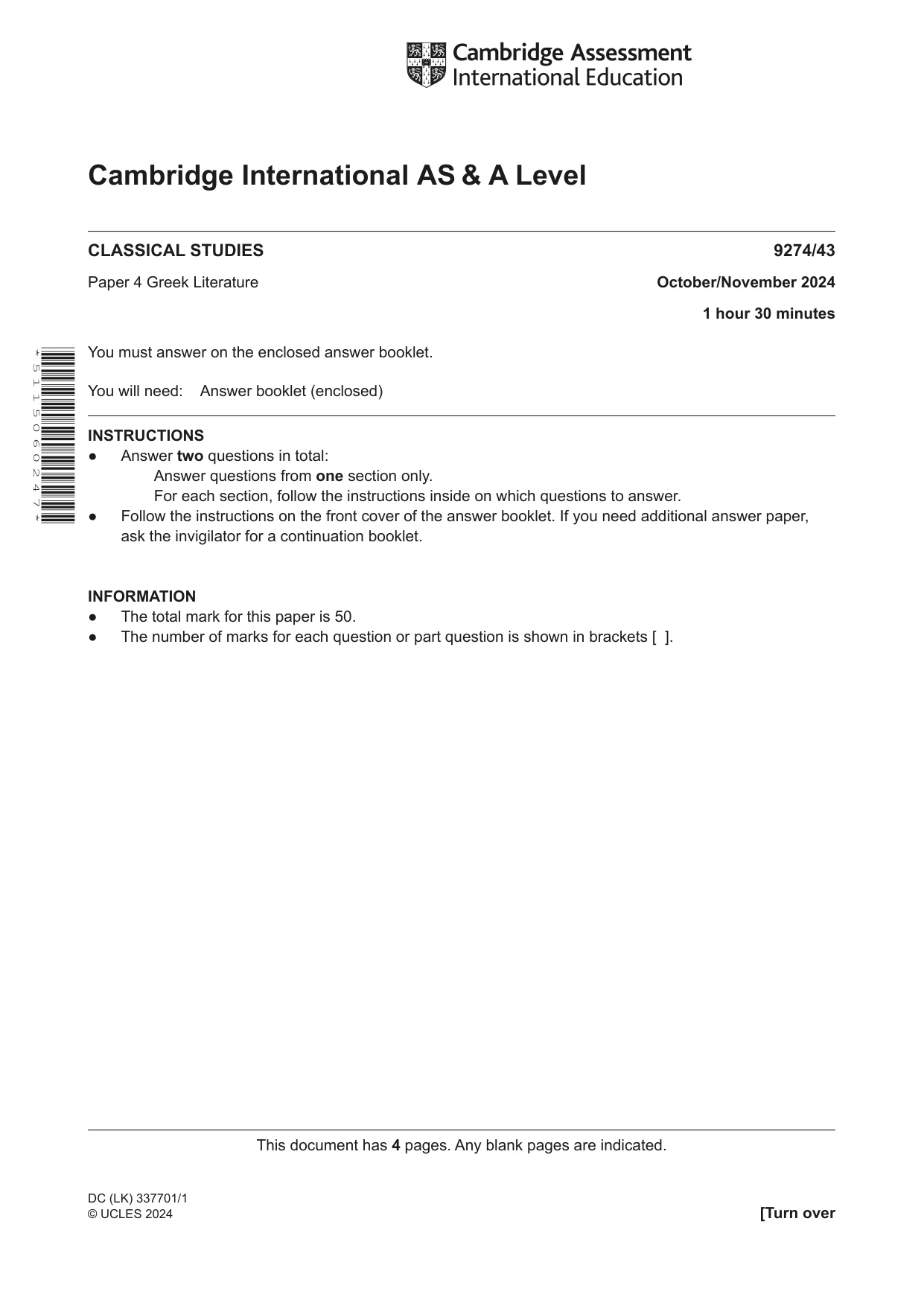
Question paper, page 1
This document has 4 pages. Any blank pages are indicated. [Turn over Cambridge International AS & A Level CLASSICAL STUDIES 9274/43 Paper 4 Greek Literature October/November 2024 1 hour 30 minutes You must answer on the enclosed answer booklet. You will need: Answer booklet (enclosed) INSTRUCTIONS ● Answer two questions in total: Answer questions from one section only. For each section, follow the instructions inside on which questions to answer. ● Follow the instructions on the front cover of the answer booklet. If you need additional answer paper, ask the invigilator for a continuation booklet. INFORMATION ● The total mark for this paper is 50. ● The number of marks for each question or part question is shown in brackets [ ]. * 5 1 1 5 0 6 0 2 4 7 * DC (LK) 337701/1 © UCLES 2024
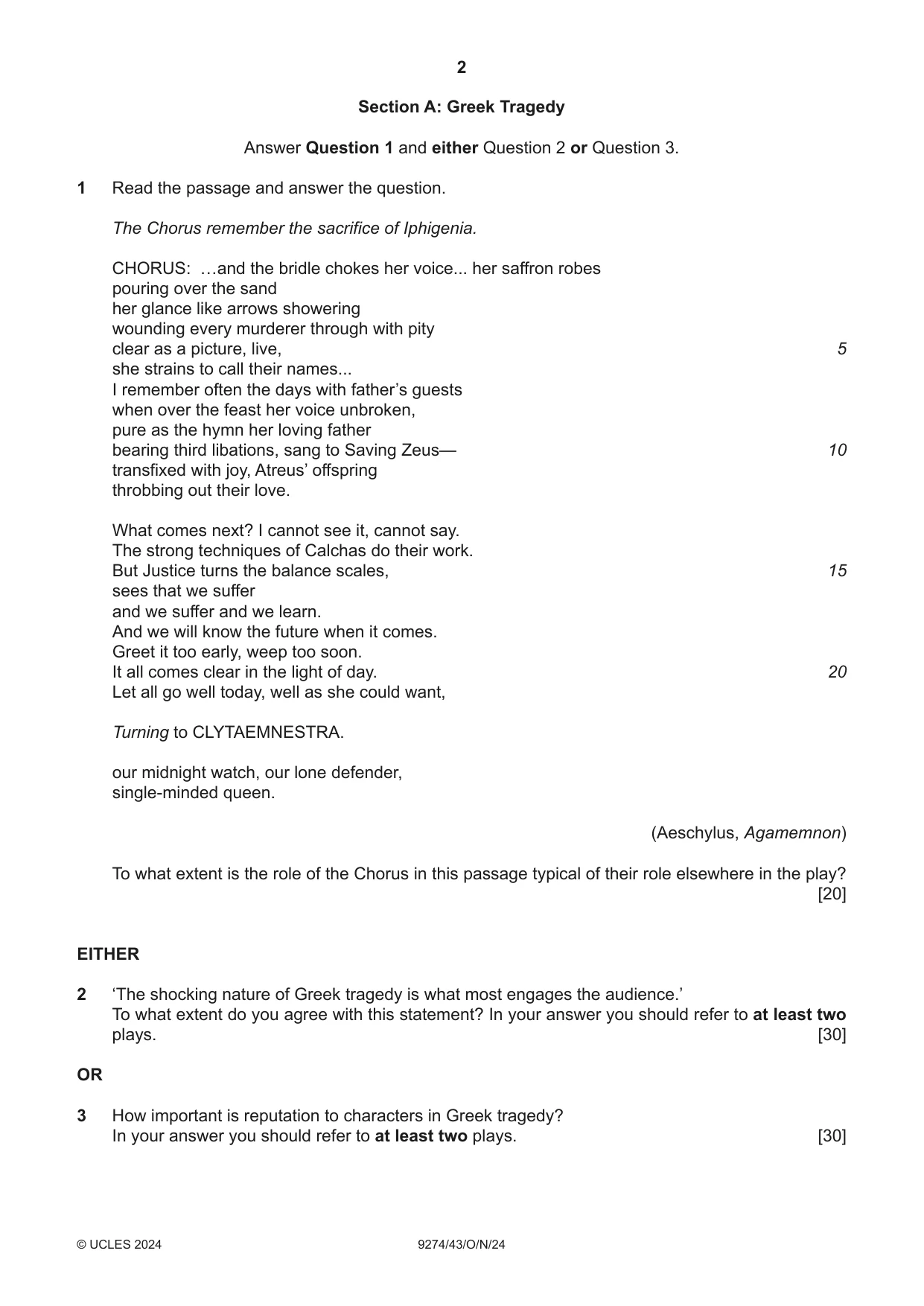
Question paper, page 2
2 9274/43/O/N/24 © UCLES 2024 Section A: Greek Tragedy Answer Question 1 and either Question 2 or Question 3. 1 Read the passage and answer the question. The Chorus remember the sacrifice of Iphigenia. CHORUS: …and the bridle chokes her voice... her saffron robes pouring over the sand her glance like arrows showering wounding every murderer through with pity clear as a picture, live, 5 she strains to call their names... I remember often the days with father’s guests when over the feast her voice unbroken, pure as the hymn her loving father bearing third libations, sang to Saving Zeus— 10 transfixed with joy, Atreus’ offspring throbbing out their love. What comes next? I cannot see it, cannot say. The strong techniques of Calchas do their work. But Justice turns the balance scales, 15 sees that we suffer and we suffer and we learn. And we will know the future when it comes. Greet it too early, weep too soon. It all comes clear in the light of day. 20 Let all go well today, well as she could want, Turning to CLYTAEMNESTRA. our midnight watch, our lone defender, single-minded queen. (Aeschylus, Agamemnon) To what extent is the role of the Chorus in this passage typical of their role elsewhere in the play? [20] EITHER 2 ‘The shocking nature of Greek tragedy is what most engages the audience.’ To what extent do you agree with this statement? In your answer you should refer to at least two plays. [30] OR 3 How important is reputation to characters in Greek tragedy? In your answer you should refer to at least two plays. [30]
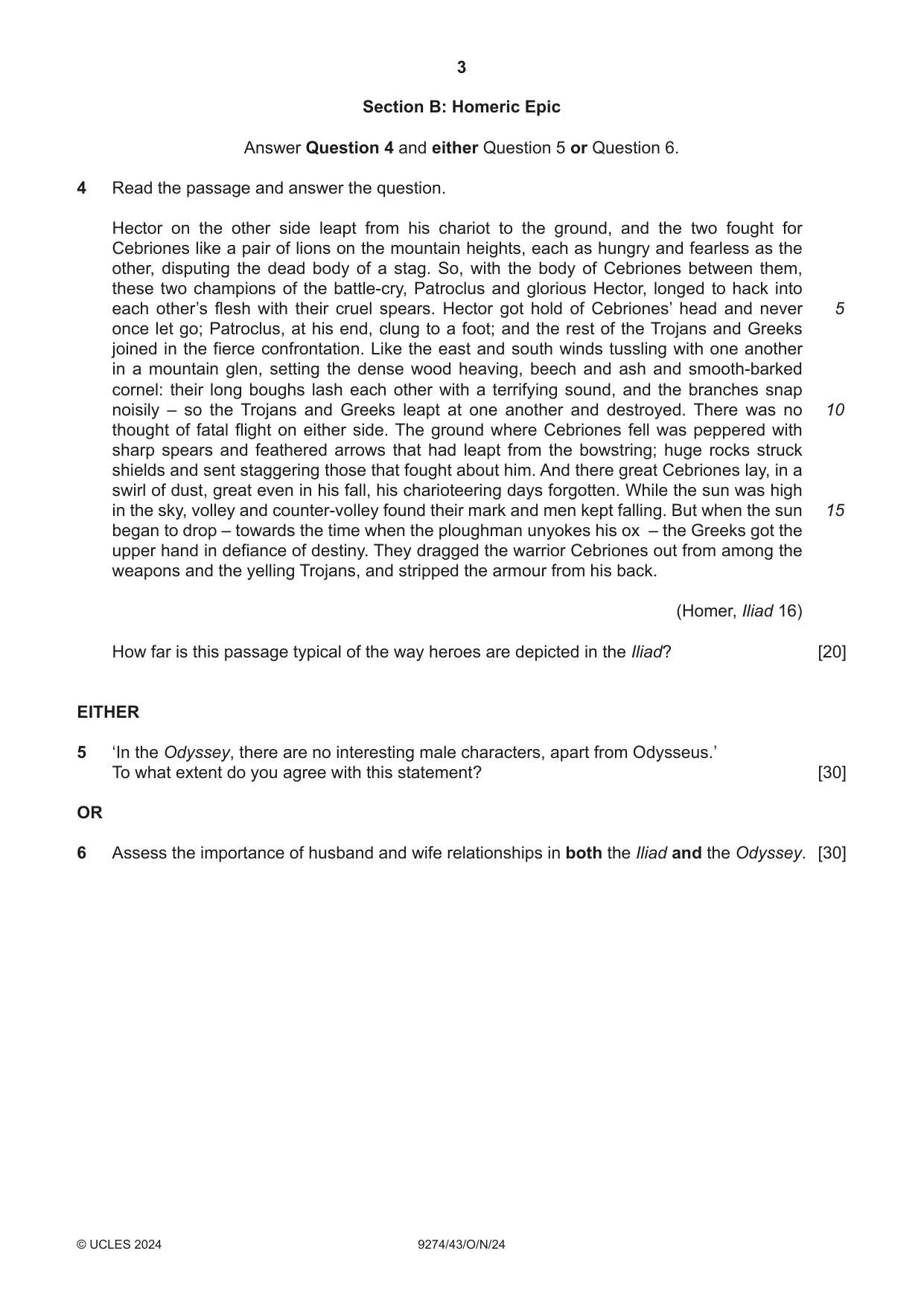
Question paper, page 3
3 9274/43/O/N/24 © UCLES 2024 Section B: Homeric Epic Answer Question 4 and either Question 5 or Question 6. 4 Read the passage and answer the question. Hector on the other side leapt from his chariot to the ground, and the two fought for Cebriones like a pair of lions on the mountain heights, each as hungry and fearless as the other, disputing the dead body of a stag. So, with the body of Cebriones between them, these two champions of the battle-cry, Patroclus and glorious Hector, longed to hack into each other’s flesh with their cruel spears. Hector got hold of Cebriones’ head and never once let go; Patroclus, at his end, clung to a foot; and the rest of the Trojans and Greeks joined in the fierce confrontation. Like the east and south winds tussling with one another in a mountain glen, setting the dense wood heaving, beech and ash and smooth-barked cornel: their long boughs lash each other with a terrifying sound, and the branches snap noisily – so the Trojans and Greeks leapt at one another and destroyed. There was no thought of fatal flight on either side. The ground where Cebriones fell was peppered with sharp spears and feathered arrows that had leapt from the bowstring; huge rocks struck shields and sent staggering those that fought about him. And there great Cebriones lay, in a swirl of dust, great even in his fall, his charioteering days forgotten. While the sun was high in the sky, volley and counter-volley found their mark and men kept falling. But when the sun began to drop – towards the time when the ploughman unyokes his ox – the Greeks got the upper hand in defiance of destiny. They dragged the warrior Cebriones out from among the weapons and the yelling Trojans, and stripped the armour from his back. (Homer, Iliad 16) How far is this passage typical of the way heroes are depicted in the Iliad? [20] EITHER 5 ‘In the Odyssey, there are no interesting male characters, apart from Odysseus.’ To what extent do you agree with this statement? [30] OR 6 Assess the importance of husband and wife relationships in both the Iliad and the Odyssey. [30] 5 10 15
Question paper, page 4
4 9274/43/O/N/24 © UCLES 2024 Permission to reproduce items where third-party owned material protected by copyright is included has been sought and cleared where possible. Every reasonable effort has been made by the publisher (UCLES) to trace copyright holders, but if any items requiring clearance have unwittingly been included, the publisher will be pleased to make amends at the earliest possible opportunity. To avoid the issue of disclosure of answer-related information to candidates, all copyright acknowledgements are reproduced online in the Cambridge Assessment International Education Copyright Acknowledgements Booklet. This is produced for each series of examinations and is freely available to download at www.cambridgeinternational.org after the live examination series. Cambridge Assessment International Education is part of Cambridge Assessment. Cambridge Assessment is the brand name of the University of Cambridge Local Examinations Syndicate (UCLES), which is a department of the University of Cambridge. BLANK PAGE
Mark scheme, page 1
This document consists of 11 printed pages. © Cambridge University Press & Assessment 2024 [Turn over Cambridge International AS & A Level CLASSICAL STUDIES 9274/43 Paper 4 Greek Literature October/November 2024 MARK SCHEME Maximum Mark: 50 Published This mark scheme is published as an aid to teachers and candidates, to indicate the requirements of the examination. It shows the basis on which Examiners were instructed to award marks. It does not indicate the details of the discussions that took place at an Examiners’ meeting before marking began, which would have considered the acceptability of alternative answers. Mark schemes should be read in conjunction with the question paper and the Principal Examiner Report for Teachers. Cambridge International will not enter into discussions about these mark schemes. Cambridge International is publishing the mark schemes for the October/November 2024 series for most Cambridge IGCSE, Cambridge International A and AS Level components, and some Cambridge O Level components.
Mark scheme, page 2
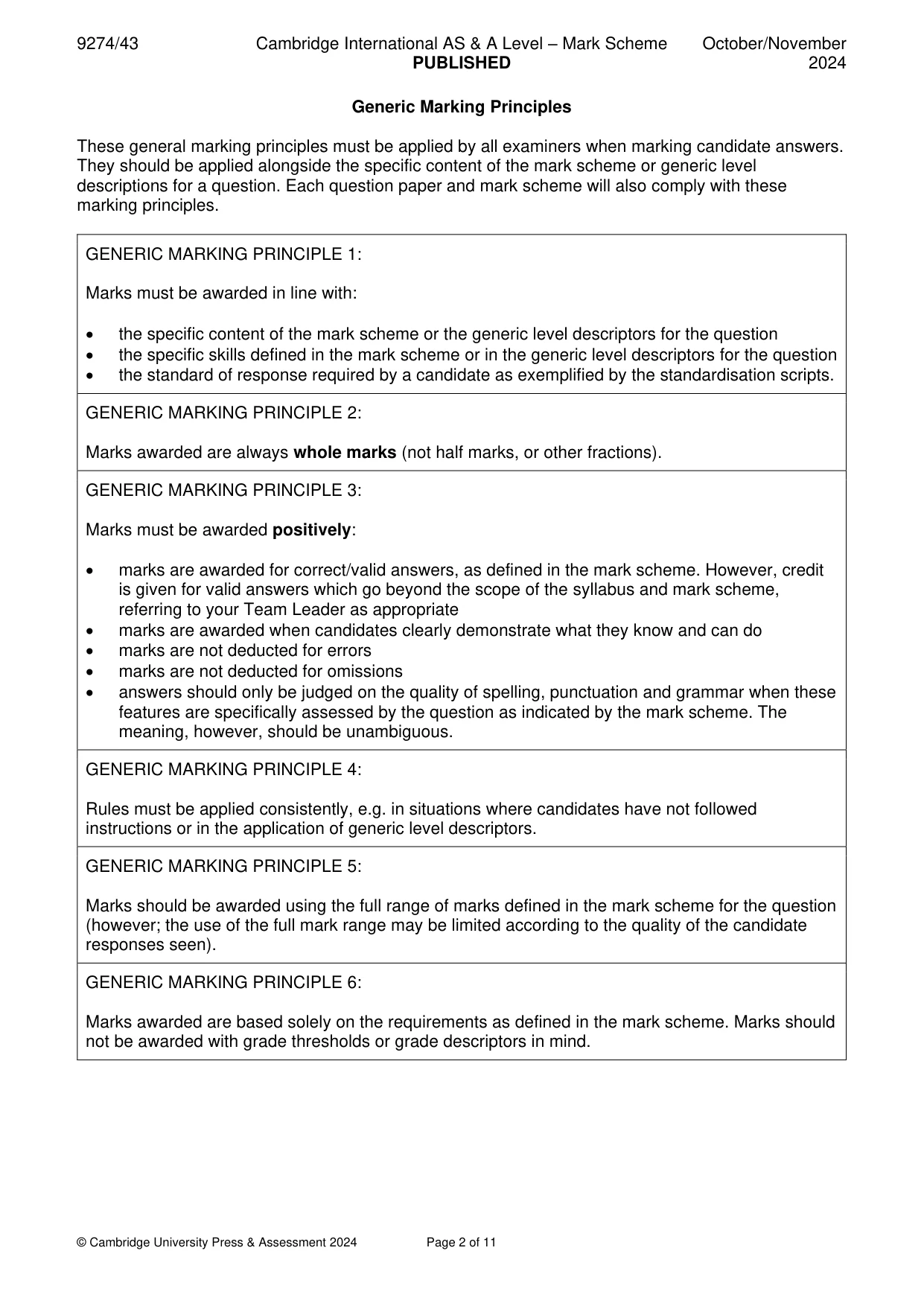
9274/43 Cambridge International AS & A Level – Mark Scheme PUBLISHED October/November 2024 © Cambridge University Press & Assessment 2024 Page 2 of 11 Generic Marking Principles These general marking principles must be applied by all examiners when marking candidate answers. They should be applied alongside the specific content of the mark scheme or generic level descriptions for a question. Each question paper and mark scheme will also comply with these marking principles. GENERIC MARKING PRINCIPLE 1: Marks must be awarded in line with: • the specific content of the mark scheme or the generic level descriptors for the question • the specific skills defined in the mark scheme or in the generic level descriptors for the question • the standard of response required by a candidate as exemplified by the standardisation scripts. GENERIC MARKING PRINCIPLE 2: Marks awarded are always whole marks (not half marks, or other fractions). GENERIC MARKING PRINCIPLE 3: Marks must be awarded positively: • marks are awarded for correct/valid answers, as defined in the mark scheme. However, credit is given for valid answers which go beyond the scope of the syllabus and mark scheme, referring to your Team Leader as appropriate • marks are awarded when candidates clearly demonstrate what they know and can do • marks are not deducted for errors • marks are not deducted for omissions • answers should only be judged on the quality of spelling, punctuation and grammar when these features are specifically assessed by the question as indicated by the mark scheme. The meaning, however, should be unambiguous. GENERIC MARKING PRINCIPLE 4: Rules must be applied consistently, e.g. in situations where candidates have not followed instructions or in the application of generic level descriptors. GENERIC MARKING PRINCIPLE 5: Marks should be awarded using the full range of marks defined in the mark scheme for the question (however; the use of the full mark range may be limited according to the quality of the candidate responses seen). GENERIC MARKING PRINCIPLE 6: Marks awarded are based solely on the requirements as defined in the mark scheme. Marks should not be awarded with grade thresholds or grade descriptors in mind.
Mark scheme, page 3
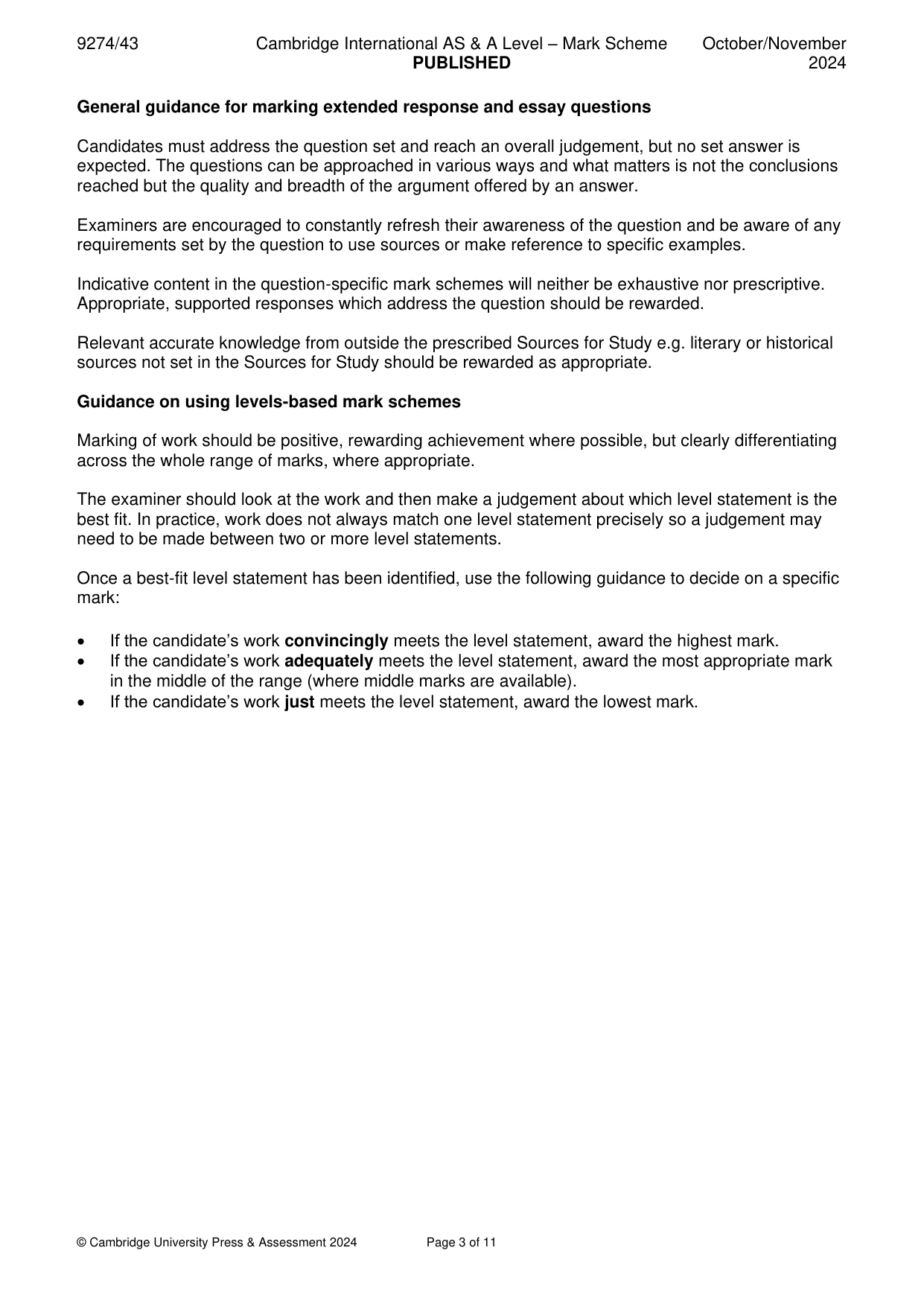
9274/43 Cambridge International AS & A Level – Mark Scheme PUBLISHED October/November 2024 © Cambridge University Press & Assessment 2024 Page 3 of 11 General guidance for marking extended response and essay questions Candidates must address the question set and reach an overall judgement, but no set answer is expected. The questions can be approached in various ways and what matters is not the conclusions reached but the quality and breadth of the argument offered by an answer. Examiners are encouraged to constantly refresh their awareness of the question and be aware of any requirements set by the question to use sources or make reference to specific examples. Indicative content in the question-specific mark schemes will neither be exhaustive nor prescriptive. Appropriate, supported responses which address the question should be rewarded. Relevant accurate knowledge from outside the prescribed Sources for Study e.g. literary or historical sources not set in the Sources for Study should be rewarded as appropriate. Guidance on using levels-based mark schemes Marking of work should be positive, rewarding achievement where possible, but clearly differentiating across the whole range of marks, where appropriate. The examiner should look at the work and then make a judgement about which level statement is the best fit. In practice, work does not always match one level statement precisely so a judgement may need to be made between two or more level statements. Once a best-fit level statement has been identified, use the following guidance to decide on a specific mark: • If the candidate’s work convincingly meets the level statement, award the highest mark. • If the candidate’s work adequately meets the level statement, award the most appropriate mark in the middle of the range (where middle marks are available). • If the candidate’s work just meets the level statement, award the lowest mark.
Mark scheme, page 4
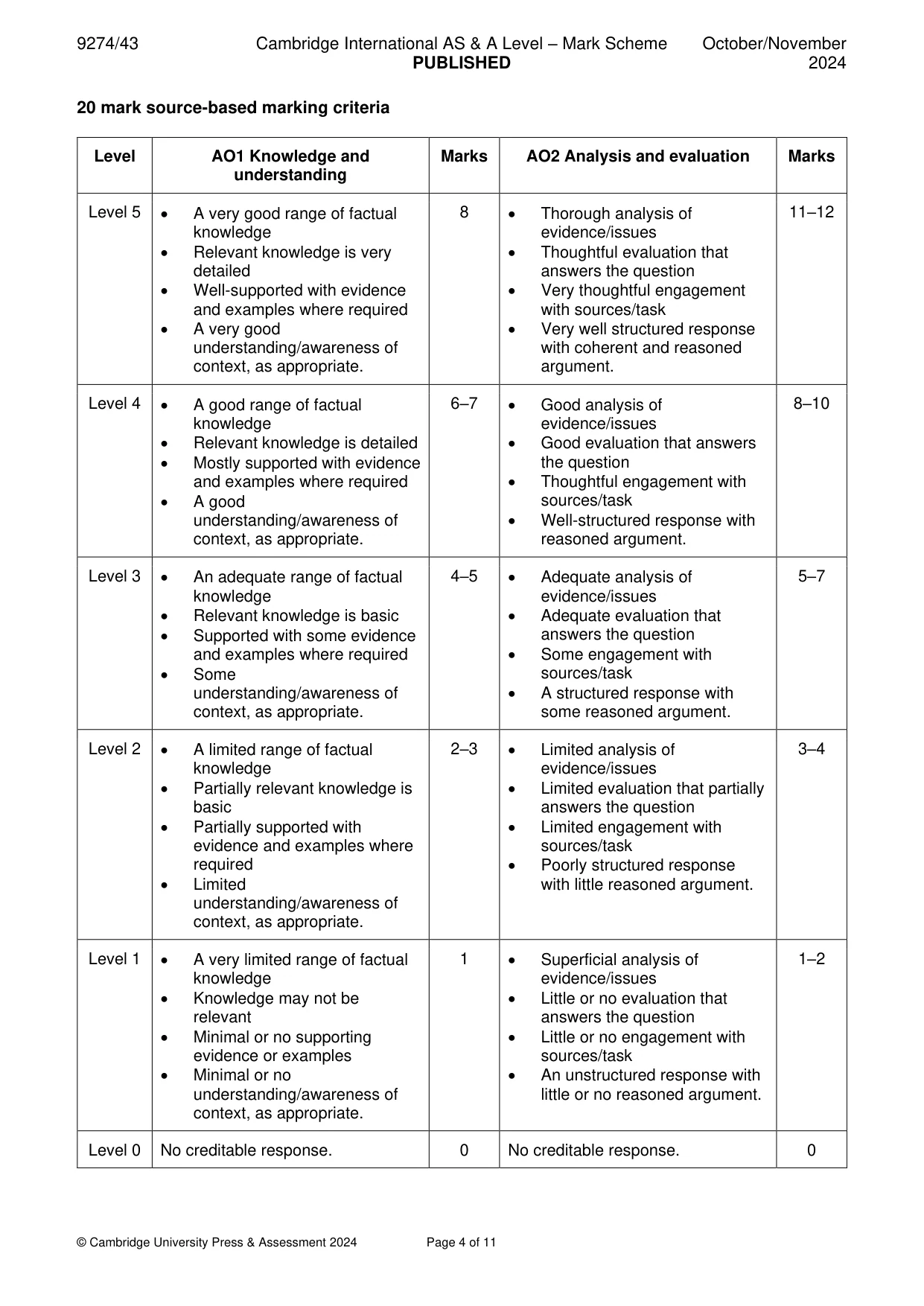
9274/43 Cambridge International AS & A Level – Mark Scheme PUBLISHED October/November 2024 © Cambridge University Press & Assessment 2024 Page 4 of 11 20 mark source-based marking criteria Level AO1 Knowledge and understanding Marks AO2 Analysis and evaluation Marks Level 5 • A very good range of factual knowledge • Relevant knowledge is very detailed • Well-supported with evidence and examples where required • A very good understanding/awareness of context, as appropriate. 8 • Thorough analysis of evidence/issues • Thoughtful evaluation that answers the question • Very thoughtful engagement with sources/task • Very well structured response with coherent and reasoned argument. 11–12 Level 4 • A good range of factual knowledge • Relevant knowledge is detailed • Mostly supported with evidence and examples where required • A good understanding/awareness of context, as appropriate. 6–7 • Good analysis of evidence/issues • Good evaluation that answers the question • Thoughtful engagement with sources/task • Well-structured response with reasoned argument. 8–10 Level 3 • An adequate range of factual knowledge • Relevant knowledge is basic • Supported with some evidence and examples where required • Some understanding/awareness of context, as appropriate. 4–5 • Adequate analysis of evidence/issues • Adequate evaluation that answers the question • Some engagement with sources/task • A structured response with some reasoned argument. 5–7 Level 2 • A limited range of factual knowledge • Partially relevant knowledge is basic • Partially supported with evidence and examples where required • Limited understanding/awareness of context, as appropriate. 2–3 • Limited analysis of evidence/issues • Limited evaluation that partially answers the question • Limited engagement with sources/task • Poorly structured response with little reasoned argument. 3–4 Level 1 • A very limited range of factual knowledge • Knowledge may not be relevant • Minimal or no supporting evidence or examples • Minimal or no understanding/awareness of context, as appropriate. 1 • Superficial analysis of evidence/issues • Little or no evaluation that answers the question • Little or no engagement with sources/task • An unstructured response with little or no reasoned argument. 1–2 Level 0 No creditable response. 0 No creditable response. 0
Mark scheme, page 5
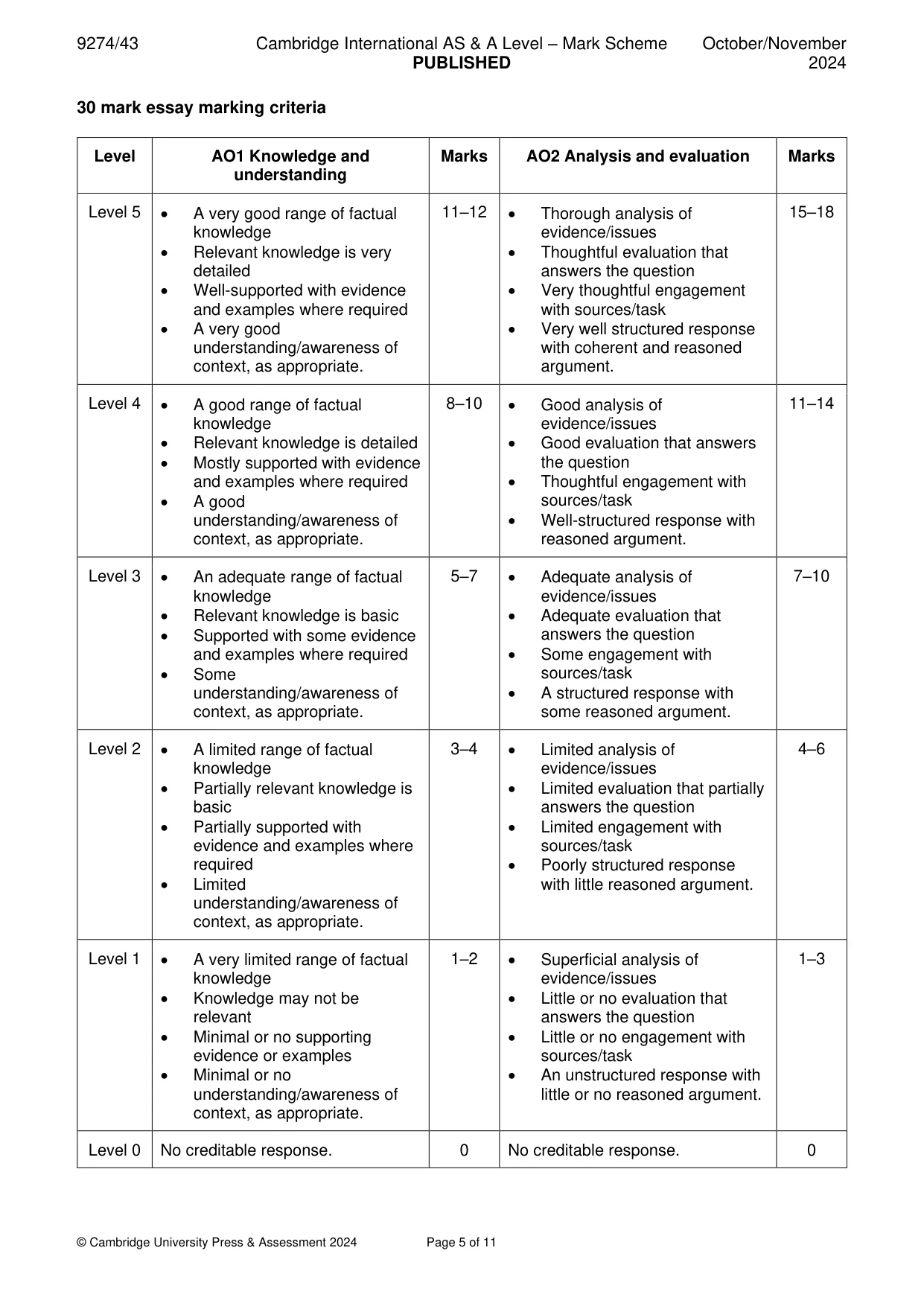
9274/43 Cambridge International AS & A Level – Mark Scheme PUBLISHED October/November 2024 © Cambridge University Press & Assessment 2024 Page 5 of 11 30 mark essay marking criteria Level AO1 Knowledge and understanding Marks AO2 Analysis and evaluation Marks Level 5 • A very good range of factual knowledge • Relevant knowledge is very detailed • Well-supported with evidence and examples where required • A very good understanding/awareness of context, as appropriate. 11–12 • Thorough analysis of evidence/issues • Thoughtful evaluation that answers the question • Very thoughtful engagement with sources/task • Very well structured response with coherent and reasoned argument. 15–18 Level 4 • A good range of factual knowledge • Relevant knowledge is detailed • Mostly supported with evidence and examples where required • A good understanding/awareness of context, as appropriate. 8–10 • Good analysis of evidence/issues • Good evaluation that answers the question • Thoughtful engagement with sources/task • Well-structured response with reasoned argument. 11–14 Level 3 • An adequate range of factual knowledge • Relevant knowledge is basic • Supported with some evidence and examples where required • Some understanding/awareness of context, as appropriate. 5–7 • Adequate analysis of evidence/issues • Adequate evaluation that answers the question • Some engagement with sources/task • A structured response with some reasoned argument. 7–10 Level 2 • A limited range of factual knowledge • Partially relevant knowledge is basic • Partially supported with evidence and examples where required • Limited understanding/awareness of context, as appropriate. 3–4 • Limited analysis of evidence/issues • Limited evaluation that partially answers the question • Limited engagement with sources/task • Poorly structured response with little reasoned argument. 4–6 Level 1 • A very limited range of factual knowledge • Knowledge may not be relevant • Minimal or no supporting evidence or examples • Minimal or no understanding/awareness of context, as appropriate. 1–2 • Superficial analysis of evidence/issues • Little or no evaluation that answers the question • Little or no engagement with sources/task • An unstructured response with little or no reasoned argument. 1–3 Level 0 No creditable response. 0 No creditable response. 0
Mark scheme, page 6
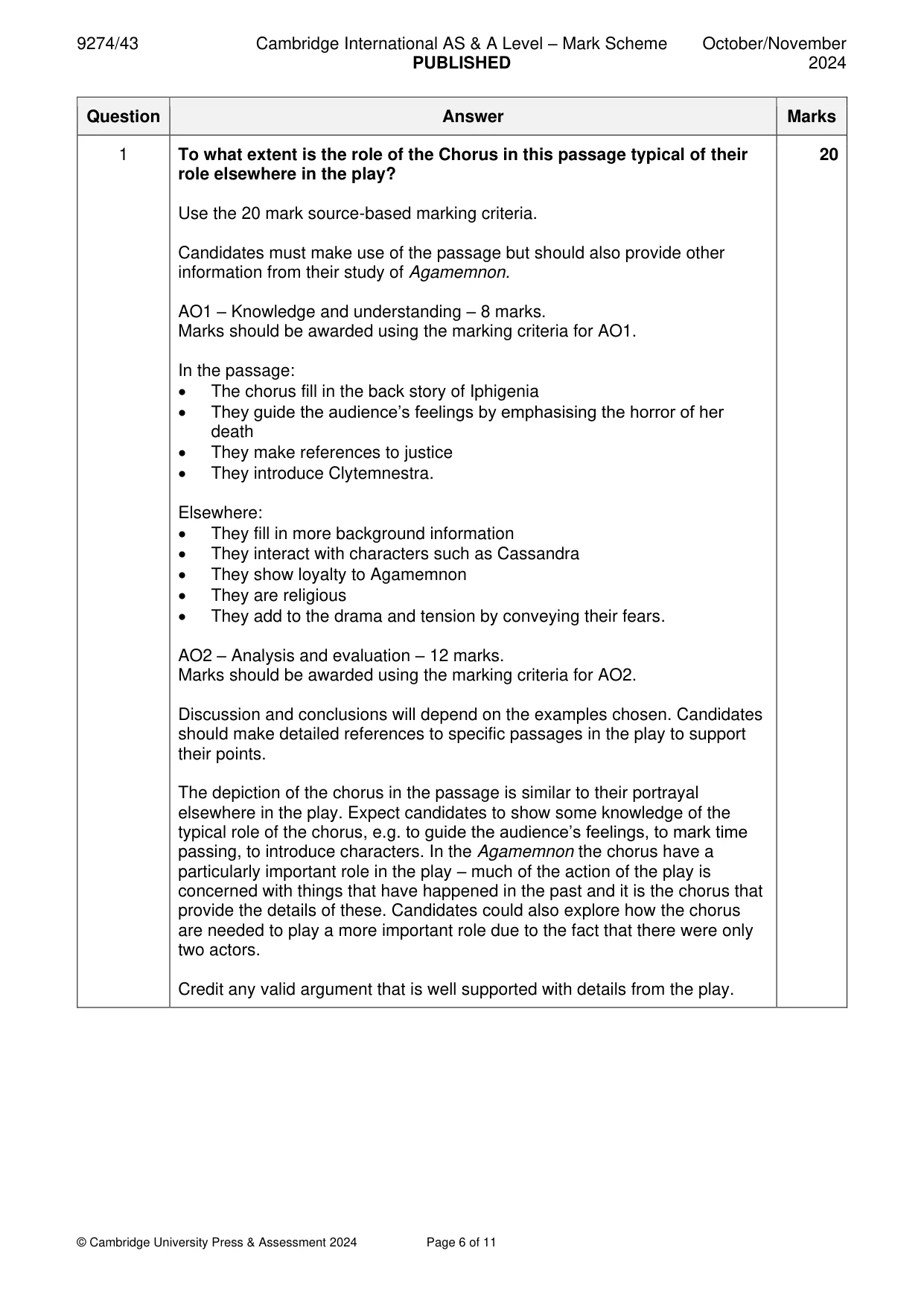
9274/43 Cambridge International AS & A Level – Mark Scheme PUBLISHED October/November 2024 © Cambridge University Press & Assessment 2024 Page 6 of 11 Question Answer Marks 1 To what extent is the role of the Chorus in this passage typical of their role elsewhere in the play? Use the 20 mark source-based marking criteria. Candidates must make use of the passage but should also provide other information from their study of Agamemnon. AO1 – Knowledge and understanding – 8 marks. Marks should be awarded using the marking criteria for AO1. In the passage: • The chorus fill in the back story of Iphigenia • They guide the audience’s feelings by emphasising the horror of her death • They make references to justice • They introduce Clytemnestra. Elsewhere: • They fill in more background information • They interact with characters such as Cassandra • They show loyalty to Agamemnon • They are religious • They add to the drama and tension by conveying their fears. AO2 – Analysis and evaluation – 12 marks. Marks should be awarded using the marking criteria for AO2. Discussion and conclusions will depend on the examples chosen. Candidates should make detailed references to specific passages in the play to support their points. The depiction of the chorus in the passage is similar to their portrayal elsewhere in the play. Expect candidates to show some knowledge of the typical role of the chorus, e.g. to guide the audience’s feelings, to mark time passing, to introduce characters. In the Agamemnon the chorus have a particularly important role in the play – much of the action of the play is concerned with things that have happened in the past and it is the chorus that provide the details of these. Candidates could also explore how the chorus are needed to play a more important role due to the fact that there were only two actors. Credit any valid argument that is well supported with details from the play. 20
Mark scheme, page 7
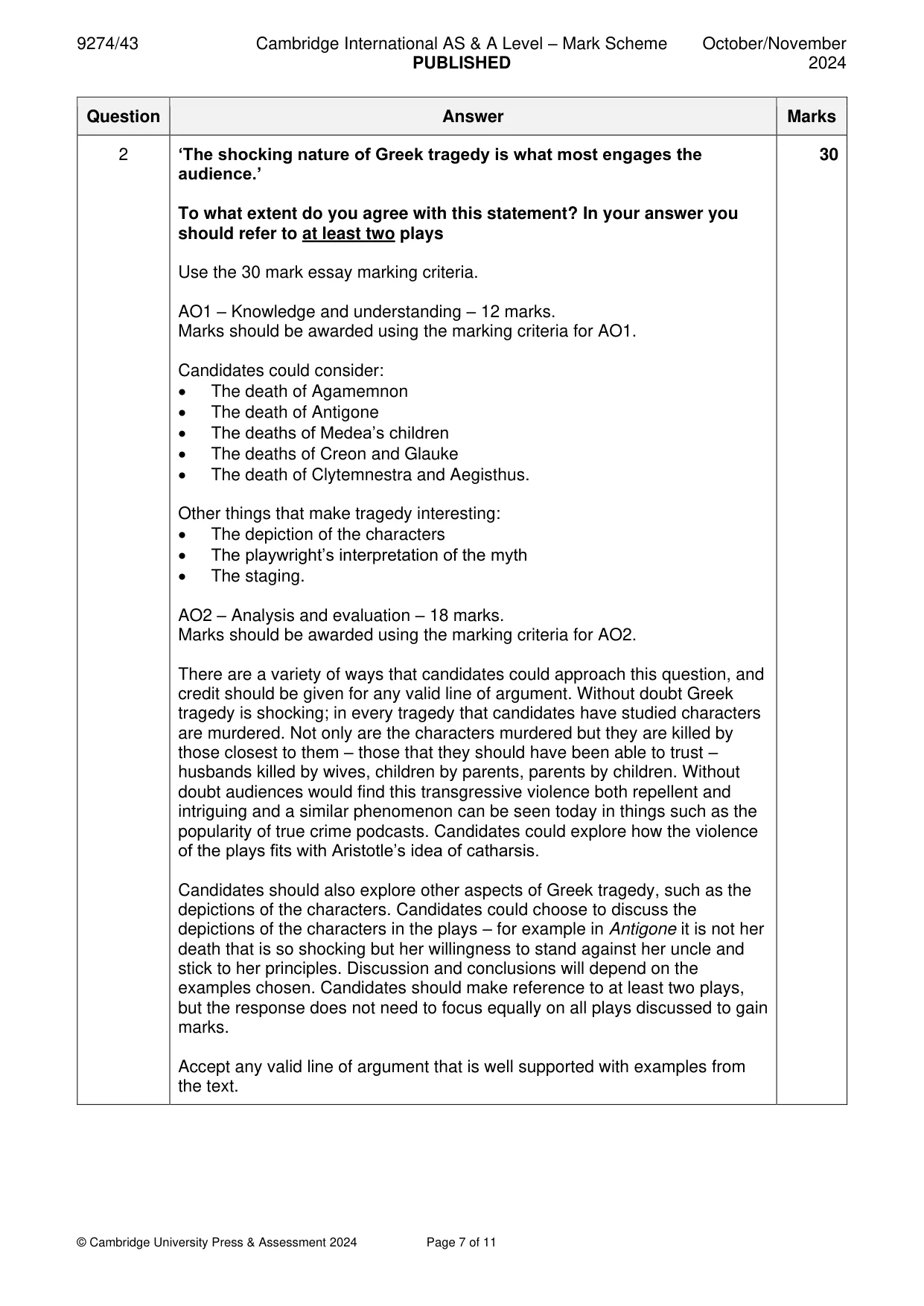
9274/43 Cambridge International AS & A Level – Mark Scheme PUBLISHED October/November 2024 © Cambridge University Press & Assessment 2024 Page 7 of 11 Question Answer Marks 2 ‘The shocking nature of Greek tragedy is what most engages the audience.’ To what extent do you agree with this statement? In your answer you should refer to at least two plays Use the 30 mark essay marking criteria. AO1 – Knowledge and understanding – 12 marks. Marks should be awarded using the marking criteria for AO1. Candidates could consider: • The death of Agamemnon • The death of Antigone • The deaths of Medea’s children • The deaths of Creon and Glauke • The death of Clytemnestra and Aegisthus. Other things that make tragedy interesting: • The depiction of the characters • The playwright’s interpretation of the myth • The staging. AO2 – Analysis and evaluation – 18 marks. Marks should be awarded using the marking criteria for AO2. There are a variety of ways that candidates could approach this question, and credit should be given for any valid line of argument. Without doubt Greek tragedy is shocking; in every tragedy that candidates have studied characters are murdered. Not only are the characters murdered but they are killed by those closest to them – those that they should have been able to trust – husbands killed by wives, children by parents, parents by children. Without doubt audiences would find this transgressive violence both repellent and intriguing and a similar phenomenon can be seen today in things such as the popularity of true crime podcasts. Candidates could explore how the violence of the plays fits with Aristotle’s idea of catharsis. Candidates should also explore other aspects of Greek tragedy, such as the depictions of the characters. Candidates could choose to discuss the depictions of the characters in the plays – for example in Antigone it is not her death that is so shocking but her willingness to stand against her uncle and stick to her principles. Discussion and conclusions will depend on the examples chosen. Candidates should make reference to at least two plays, but the response does not need to focus equally on all plays discussed to gain marks. Accept any valid line of argument that is well supported with examples from the text. 30
Mark scheme, page 8
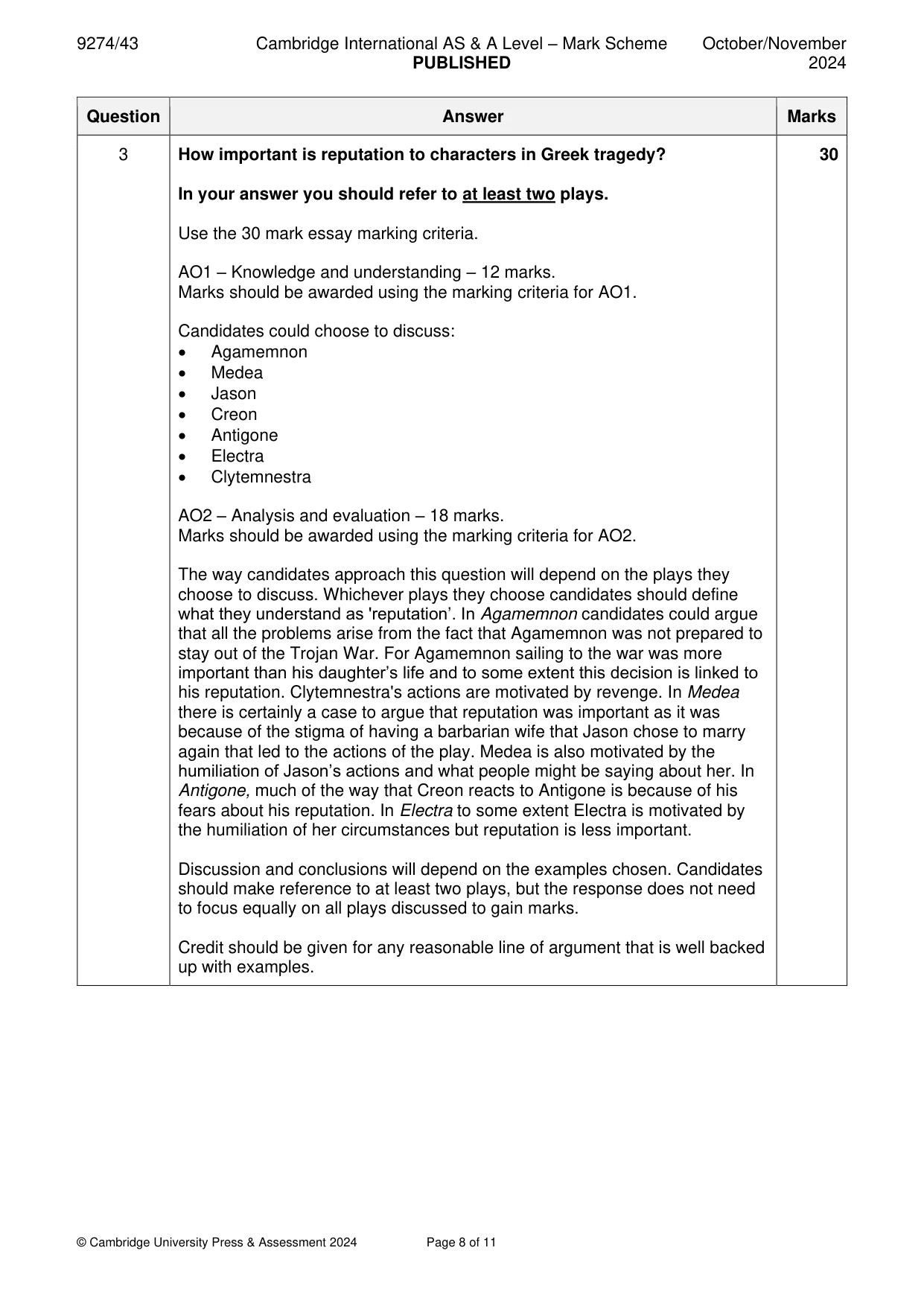
9274/43 Cambridge International AS & A Level – Mark Scheme PUBLISHED October/November 2024 © Cambridge University Press & Assessment 2024 Page 8 of 11 Question Answer Marks 3 How important is reputation to characters in Greek tragedy? In your answer you should refer to at least two plays. Use the 30 mark essay marking criteria. AO1 – Knowledge and understanding – 12 marks. Marks should be awarded using the marking criteria for AO1. Candidates could choose to discuss: • Agamemnon • Medea • Jason • Creon • Antigone • Electra • Clytemnestra AO2 – Analysis and evaluation – 18 marks. Marks should be awarded using the marking criteria for AO2. The way candidates approach this question will depend on the plays they choose to discuss. Whichever plays they choose candidates should define what they understand as 'reputation’. In Agamemnon candidates could argue that all the problems arise from the fact that Agamemnon was not prepared to stay out of the Trojan War. For Agamemnon sailing to the war was more important than his daughter’s life and to some extent this decision is linked to his reputation. Clytemnestra's actions are motivated by revenge. In Medea there is certainly a case to argue that reputation was important as it was because of the stigma of having a barbarian wife that Jason chose to marry again that led to the actions of the play. Medea is also motivated by the humiliation of Jason’s actions and what people might be saying about her. In Antigone, much of the way that Creon reacts to Antigone is because of his fears about his reputation. In Electra to some extent Electra is motivated by the humiliation of her circumstances but reputation is less important. Discussion and conclusions will depend on the examples chosen. Candidates should make reference to at least two plays, but the response does not need to focus equally on all plays discussed to gain marks. Credit should be given for any reasonable line of argument that is well backed up with examples. 30
Mark scheme, page 9
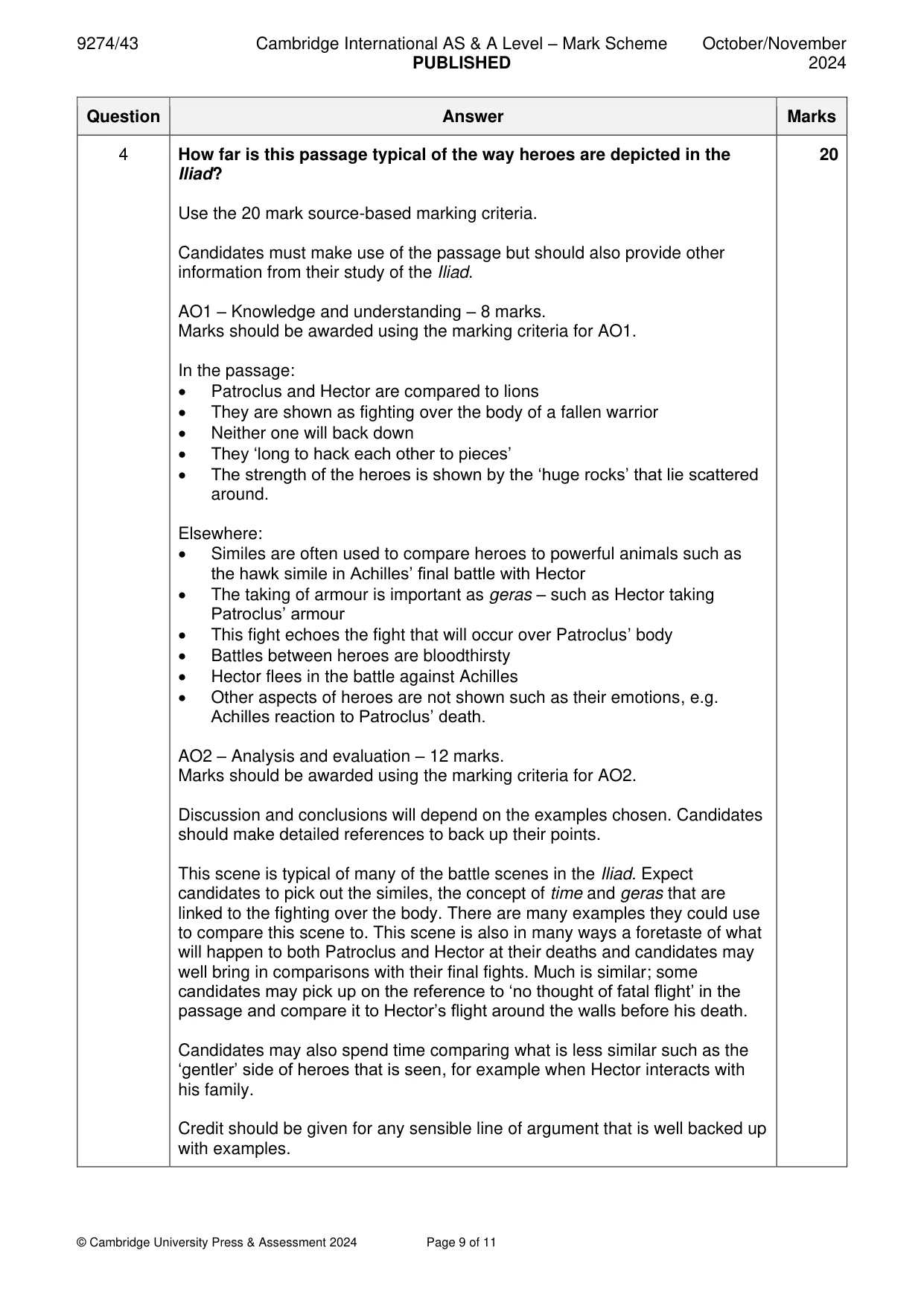
9274/43 Cambridge International AS & A Level – Mark Scheme PUBLISHED October/November 2024 © Cambridge University Press & Assessment 2024 Page 9 of 11 Question Answer Marks 4 How far is this passage typical of the way heroes are depicted in the Iliad? Use the 20 mark source-based marking criteria. Candidates must make use of the passage but should also provide other information from their study of the Iliad. AO1 – Knowledge and understanding – 8 marks. Marks should be awarded using the marking criteria for AO1. In the passage: • Patroclus and Hector are compared to lions • They are shown as fighting over the body of a fallen warrior • Neither one will back down • They ‘long to hack each other to pieces’ • The strength of the heroes is shown by the ‘huge rocks’ that lie scattered around. Elsewhere: • Similes are often used to compare heroes to powerful animals such as the hawk simile in Achilles’ final battle with Hector • The taking of armour is important as geras – such as Hector taking Patroclus’ armour • This fight echoes the fight that will occur over Patroclus’ body • Battles between heroes are bloodthirsty • Hector flees in the battle against Achilles • Other aspects of heroes are not shown such as their emotions, e.g. Achilles reaction to Patroclus’ death. AO2 – Analysis and evaluation – 12 marks. Marks should be awarded using the marking criteria for AO2. Discussion and conclusions will depend on the examples chosen. Candidates should make detailed references to back up their points. This scene is typical of many of the battle scenes in the Iliad. Expect candidates to pick out the similes, the concept of time and geras that are linked to the fighting over the body. There are many examples they could use to compare this scene to. This scene is also in many ways a foretaste of what will happen to both Patroclus and Hector at their deaths and candidates may well bring in comparisons with their final fights. Much is similar; some candidates may pick up on the reference to ‘no thought of fatal flight’ in the passage and compare it to Hector’s flight around the walls before his death. Candidates may also spend time comparing what is less similar such as the ‘gentler’ side of heroes that is seen, for example when Hector interacts with his family. Credit should be given for any sensible line of argument that is well backed up with examples. 20
Mark scheme, page 10
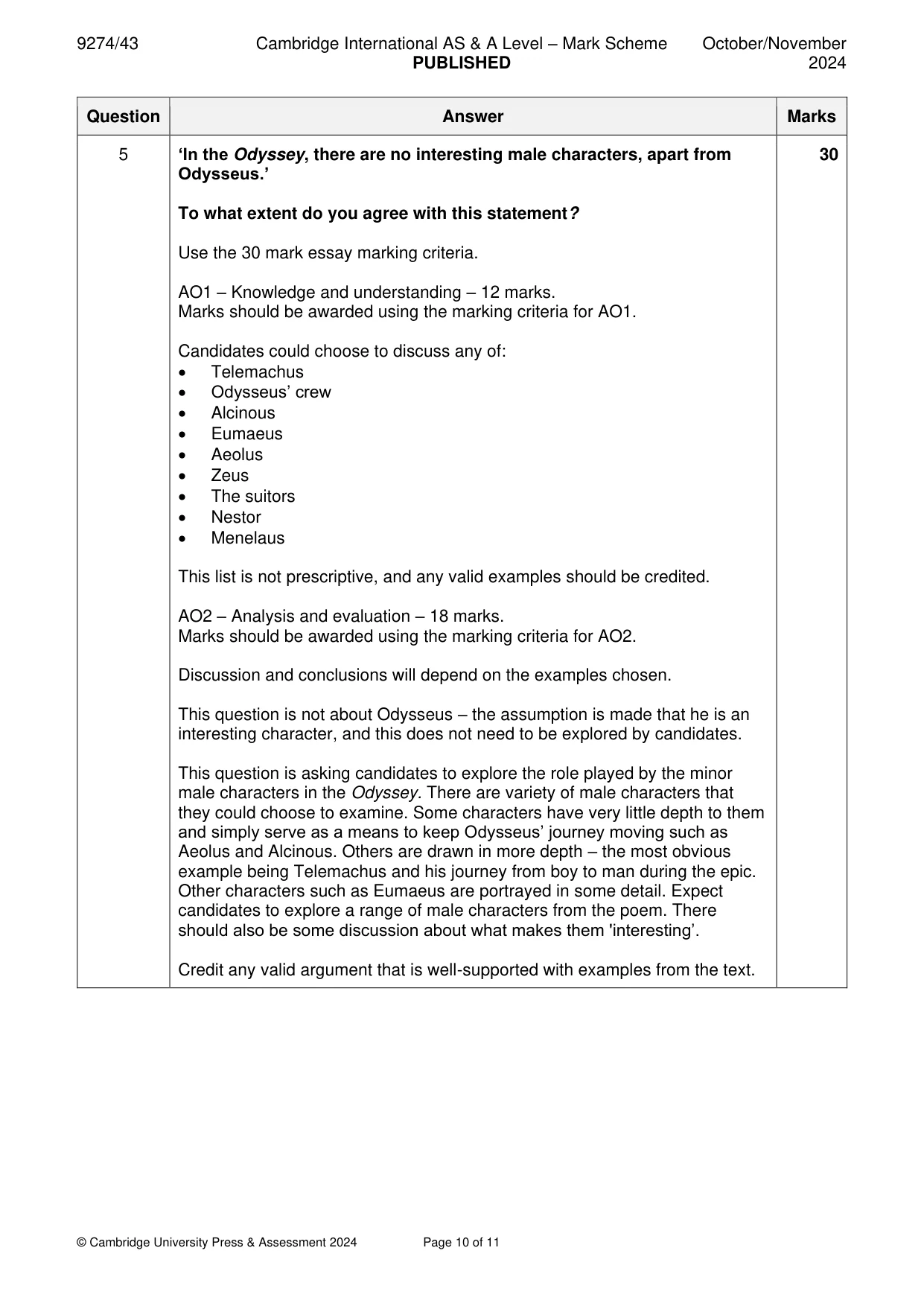
9274/43 Cambridge International AS & A Level – Mark Scheme PUBLISHED October/November 2024 © Cambridge University Press & Assessment 2024 Page 10 of 11 Question Answer Marks 5 ‘In the Odyssey, there are no interesting male characters, apart from Odysseus.’ To what extent do you agree with this statement? Use the 30 mark essay marking criteria. AO1 – Knowledge and understanding – 12 marks. Marks should be awarded using the marking criteria for AO1. Candidates could choose to discuss any of: • Telemachus • Odysseus’ crew • Alcinous • Eumaeus • Aeolus • Zeus • The suitors • Nestor • Menelaus This list is not prescriptive, and any valid examples should be credited. AO2 – Analysis and evaluation – 18 marks. Marks should be awarded using the marking criteria for AO2. Discussion and conclusions will depend on the examples chosen. This question is not about Odysseus – the assumption is made that he is an interesting character, and this does not need to be explored by candidates. This question is asking candidates to explore the role played by the minor male characters in the Odyssey. There are variety of male characters that they could choose to examine. Some characters have very little depth to them and simply serve as a means to keep Odysseus’ journey moving such as Aeolus and Alcinous. Others are drawn in more depth – the most obvious example being Telemachus and his journey from boy to man during the epic. Other characters such as Eumaeus are portrayed in some detail. Expect candidates to explore a range of male characters from the poem. There should also be some discussion about what makes them 'interesting’. Credit any valid argument that is well-supported with examples from the text. 30
Mark scheme, page 11
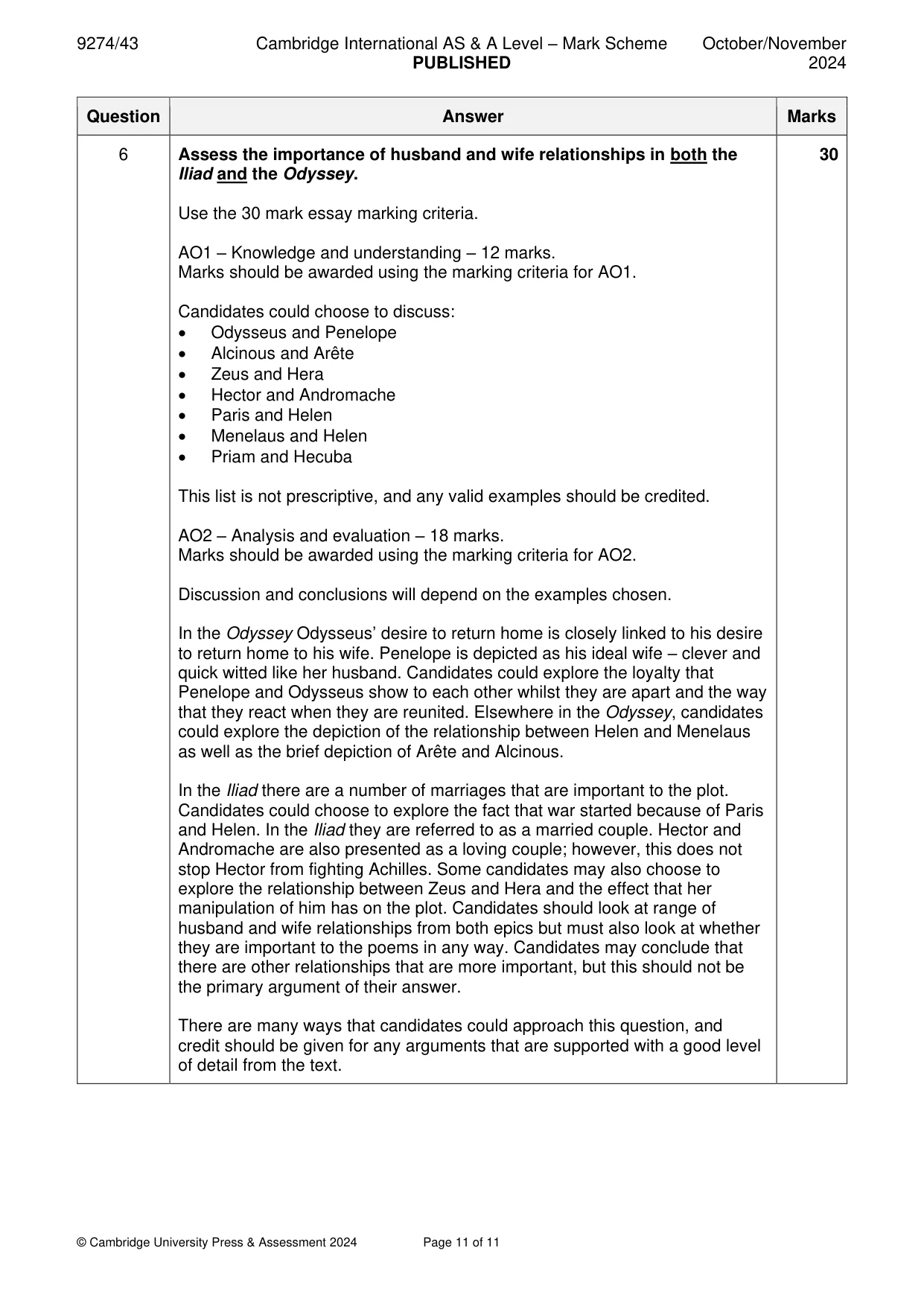
9274/43 Cambridge International AS & A Level – Mark Scheme PUBLISHED October/November 2024 © Cambridge University Press & Assessment 2024 Page 11 of 11 Question Answer Marks 6 Assess the importance of husband and wife relationships in both the Iliad and the Odyssey. Use the 30 mark essay marking criteria. AO1 – Knowledge and understanding – 12 marks. Marks should be awarded using the marking criteria for AO1. Candidates could choose to discuss: • Odysseus and Penelope • Alcinous and Arête • Zeus and Hera • Hector and Andromache • Paris and Helen • Menelaus and Helen • Priam and Hecuba This list is not prescriptive, and any valid examples should be credited. AO2 – Analysis and evaluation – 18 marks. Marks should be awarded using the marking criteria for AO2. Discussion and conclusions will depend on the examples chosen. In the Odyssey Odysseus’ desire to return home is closely linked to his desire to return home to his wife. Penelope is depicted as his ideal wife – clever and quick witted like her husband. Candidates could explore the loyalty that Penelope and Odysseus show to each other whilst they are apart and the way that they react when they are reunited. Elsewhere in the Odyssey, candidates could explore the depiction of the relationship between Helen and Menelaus as well as the brief depiction of Arête and Alcinous. In the Iliad there are a number of marriages that are important to the plot. Candidates could choose to explore the fact that war started because of Paris and Helen. In the Iliad they are referred to as a married couple. Hector and Andromache are also presented as a loving couple; however, this does not stop Hector from fighting Achilles. Some candidates may also choose to explore the relationship between Zeus and Hera and the effect that her manipulation of him has on the plot. Candidates should look at range of husband and wife relationships from both epics but must also look at whether they are important to the poems in any way. Candidates may conclude that there are other relationships that are more important, but this should not be the primary argument of their answer. There are many ways that candidates could approach this question, and credit should be given for any arguments that are supported with a good level of detail from the text. 30
What you needed in this session
Cambridge’s own grade thresholds for 2024 Oct/Nov, Paper 4 · Variant 3. A higher threshold means an easier paper — the bar moves with how the cohort did.