Cambridge A Level Classical Studies 9274 — 2023 Oct/Nov Paper 4 · Variant 3
9274/43/O/N/23 · 50 marks · ≈56 min
The question paper and its mark scheme, free to read here and free to download. This is Cambridge’s own paper, exactly as it was sat.
Question paper4 pages

Mark scheme13 pages
Answers below. Sit the paper first if you are practising.
Paper as text
Question paper, page 1
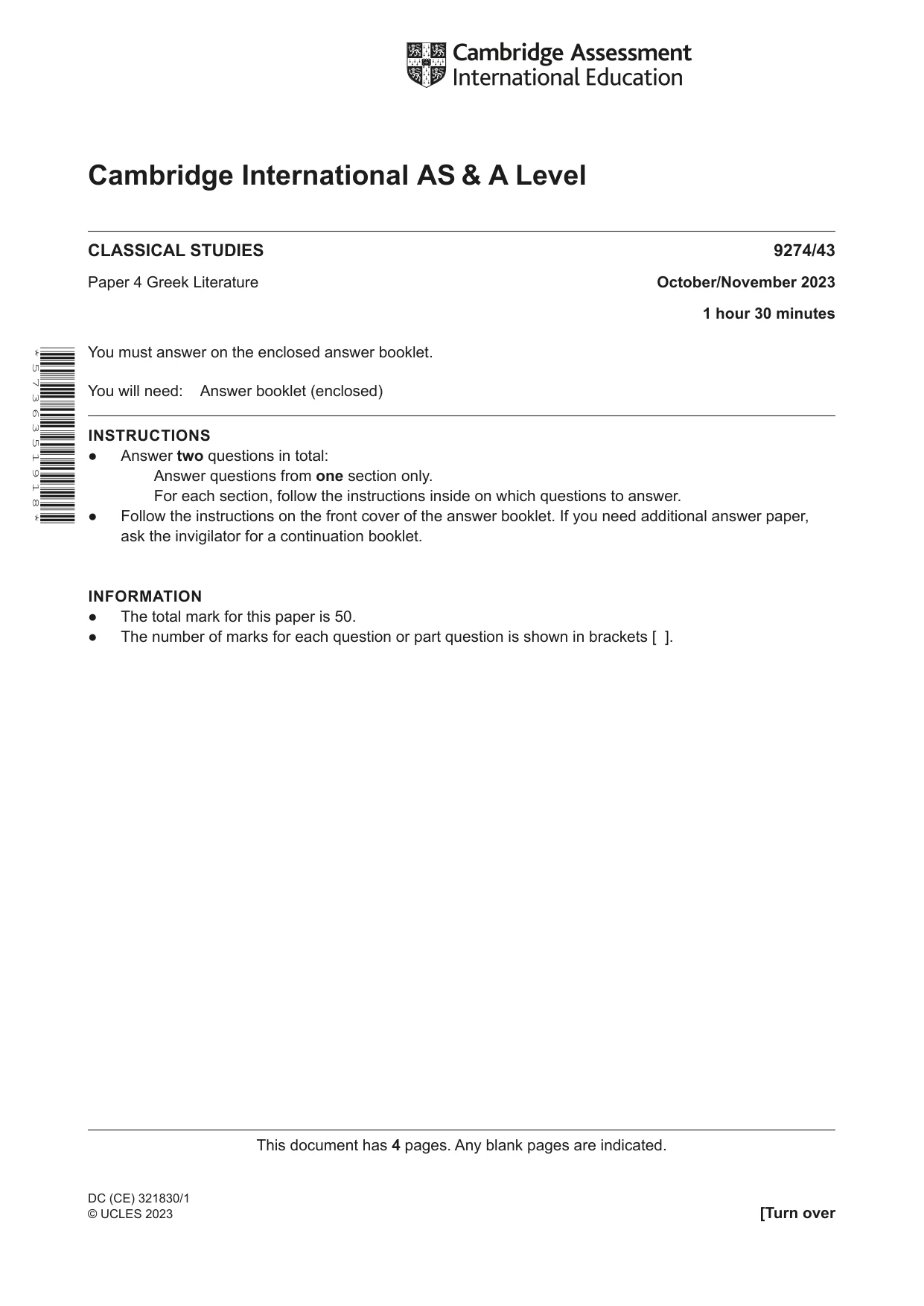
This document has 4 pages. Any blank pages are indicated. [Turn over Cambridge International AS & A Level DC (CE) 321830/1 © UCLES 2023 * 5 7 3 6 3 5 1 9 1 8 * CLASSICAL STUDIES 9274/43 Paper 4 Greek Literature October/November 2023 1 hour 30 minutes You must answer on the enclosed answer booklet. You will need: Answer booklet (enclosed) INSTRUCTIONS ● Answer two questions in total: Answer questions from one section only. For each section, follow the instructions inside on which questions to answer. ● Follow the instructions on the front cover of the answer booklet. If you need additional answer paper, ask the invigilator for a continuation booklet. INFORMATION ● The total mark for this paper is 50. ● The number of marks for each question or part question is shown in brackets [ ].
Question paper, page 2
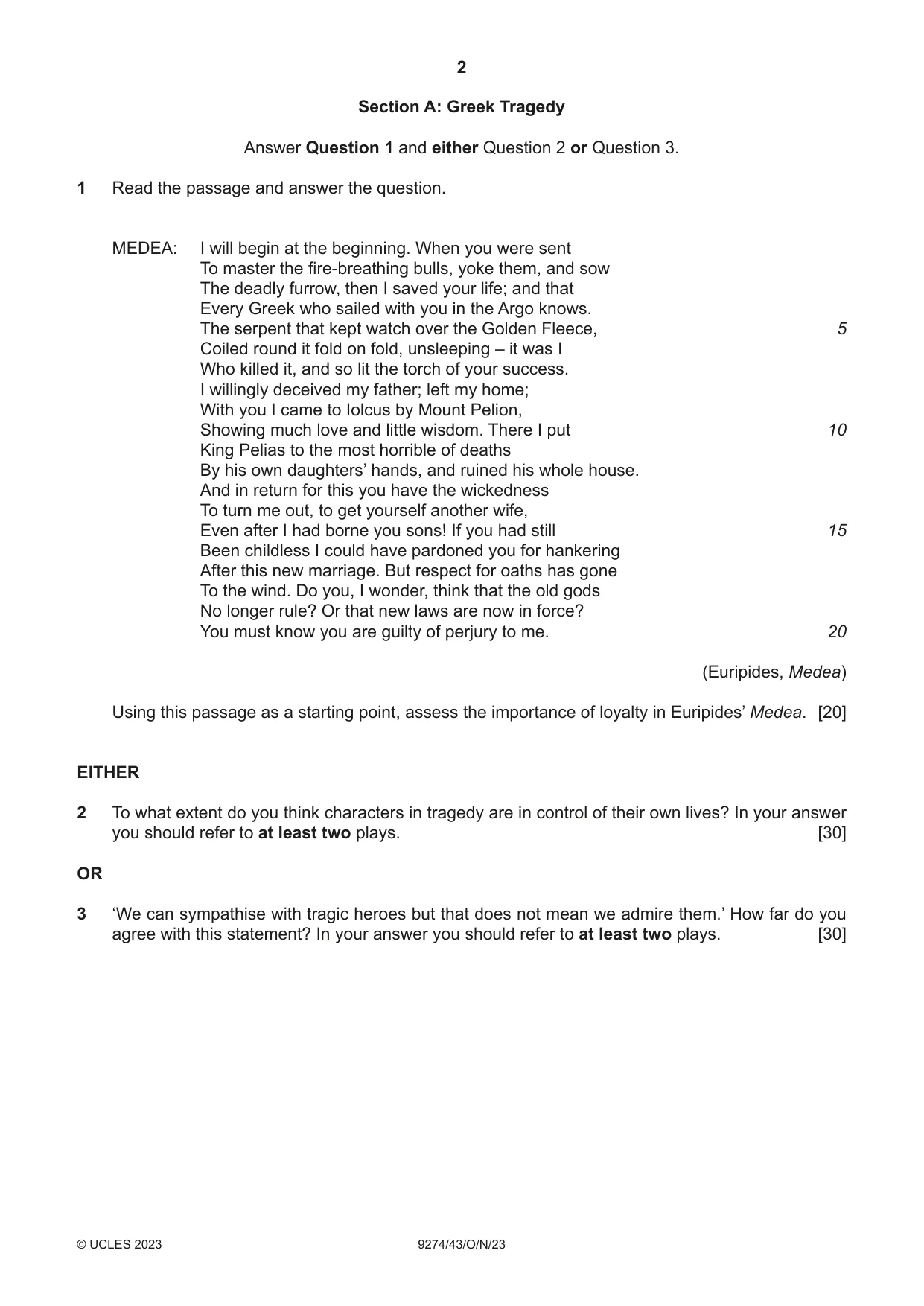
2 9274/43/O/N/23 © UCLES 2023 Section A: Greek Tragedy Answer Question 1 and either Question 2 or Question 3. 1 Read the passage and answer the question. MEDEA: I will begin at the beginning. When you were sent To master the fire-breathing bulls, yoke them, and sow The deadly furrow, then I saved your life; and that Every Greek who sailed with you in the Argo knows. The serpent that kept watch over the Golden Fleece, 5 Coiled round it fold on fold, unsleeping – it was I Who killed it, and so lit the torch of your success. I willingly deceived my father; left my home; With you I came to Iolcus by Mount Pelion, Showing much love and little wisdom. There I put 10 King Pelias to the most horrible of deaths By his own daughters’ hands, and ruined his whole house. And in return for this you have the wickedness To turn me out, to get yourself another wife, Even after I had borne you sons! If you had still 15 Been childless I could have pardoned you for hankering After this new marriage. But respect for oaths has gone To the wind. Do you, I wonder, think that the old gods No longer rule? Or that new laws are now in force? You must know you are guilty of perjury to me. 20 (Euripides, Medea) Using this passage as a starting point, assess the importance of loyalty in Euripides’ Medea. [20] EITHER 2 To what extent do you think characters in tragedy are in control of their own lives? In your answer you should refer to at least two plays. [30] OR 3 ‘We can sympathise with tragic heroes but that does not mean we admire them.’ How far do you agree with this statement? In your answer you should refer to at least two plays. [30]
Question paper, page 3
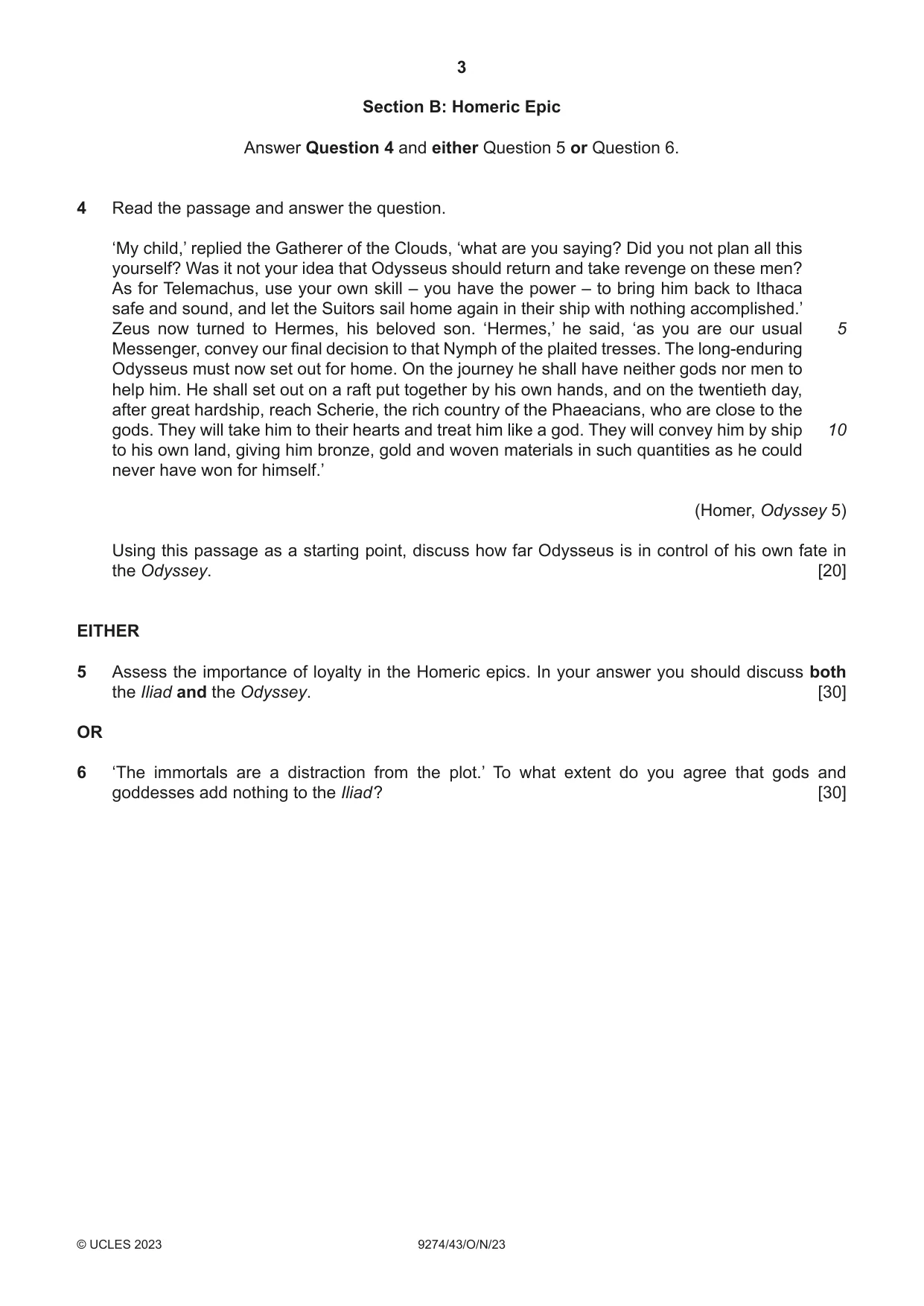
3 9274/43/O/N/23 © UCLES 2023 Section B: Homeric Epic Answer Question 4 and either Question 5 or Question 6. 4 Read the passage and answer the question. ‘My child,’ replied the Gatherer of the Clouds, ‘what are you saying? Did you not plan all this yourself? Was it not your idea that Odysseus should return and take revenge on these men? As for Telemachus, use your own skill – you have the power – to bring him back to Ithaca safe and sound, and let the Suitors sail home again in their ship with nothing accomplished.’ Zeus now turned to Hermes, his beloved son. ‘Hermes,’ he said, ‘as you are our usual Messenger, convey our final decision to that Nymph of the plaited tresses. The long-enduring Odysseus must now set out for home. On the journey he shall have neither gods nor men to help him. He shall set out on a raft put together by his own hands, and on the twentieth day, after great hardship, reach Scherie, the rich country of the Phaeacians, who are close to the gods. They will take him to their hearts and treat him like a god. They will convey him by ship to his own land, giving him bronze, gold and woven materials in such quantities as he could never have won for himself.’ (Homer, Odyssey 5) Using this passage as a starting point, discuss how far Odysseus is in control of his own fate in the Odyssey. [20] EITHER 5 Assess the importance of loyalty in the Homeric epics. In your answer you should discuss both the Iliad and the Odyssey. [30] OR 6 ‘The immortals are a distraction from the plot.’ To what extent do you agree that gods and goddesses add nothing to the Iliad ? [30] 5 10
Question paper, page 4
4 9274/43/O/N/23 © UCLES 2023 Permission to reproduce items where third-party owned material protected by copyright is included has been sought and cleared where possible. Every reasonable effort has been made by the publisher (UCLES) to trace copyright holders, but if any items requiring clearance have unwittingly been included, the publisher will be pleased to make amends at the earliest possible opportunity. To avoid the issue of disclosure of answer-related information to candidates, all copyright acknowledgements are reproduced online in the Cambridge Assessment International Education Copyright Acknowledgements Booklet. This is produced for each series of examinations and is freely available to download at www.cambridgeinternational.org after the live examination series. Cambridge Assessment International Education is part of Cambridge Assessment. Cambridge Assessment is the brand name of the University of Cambridge Local Examinations Syndicate (UCLES), which is a department of the University of Cambridge. BLANK PAGE
Mark scheme, page 1
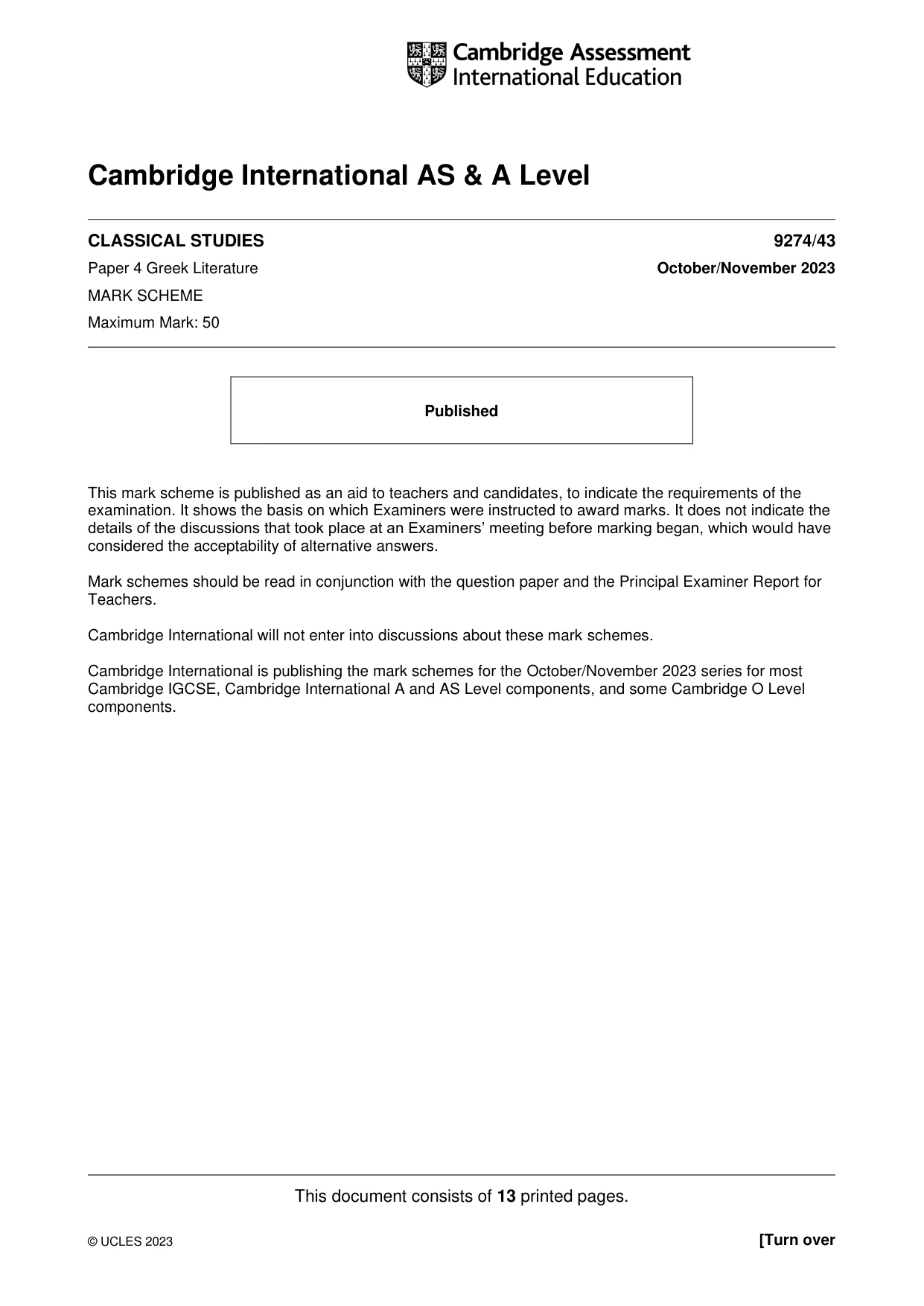
This document consists of 13 printed pages. © UCLES 2023 [Turn over Cambridge International AS & A Level CLASSICAL STUDIES 9274/43 Paper 4 Greek Literature October/November 2023 MARK SCHEME Maximum Mark: 50 Published This mark scheme is published as an aid to teachers and candidates, to indicate the requirements of the examination. It shows the basis on which Examiners were instructed to award marks. It does not indicate the details of the discussions that took place at an Examiners’ meeting before marking began, which would have considered the acceptability of alternative answers. Mark schemes should be read in conjunction with the question paper and the Principal Examiner Report for Teachers. Cambridge International will not enter into discussions about these mark schemes. Cambridge International is publishing the mark schemes for the October/November 2023 series for most Cambridge IGCSE, Cambridge International A and AS Level components, and some Cambridge O Level components.
Mark scheme, page 2
9274/43 Cambridge International AS & A Level – Mark Scheme PUBLISHED October/November 2023 © UCLES 2023 Page 2 of 13 Generic Marking Principles These general marking principles must be applied by all examiners when marking candidate answers. They should be applied alongside the specific content of the mark scheme or generic level descriptors for a question. Each question paper and mark scheme will also comply with these marking principles. GENERIC MARKING PRINCIPLE 1: Marks must be awarded in line with: • the specific content of the mark scheme or the generic level descriptors for the question • the specific skills defined in the mark scheme or in the generic level descriptors for the question • the standard of response required by a candidate as exemplified by the standardisation scripts. GENERIC MARKING PRINCIPLE 2: Marks awarded are always whole marks (not half marks, or other fractions). GENERIC MARKING PRINCIPLE 3: Marks must be awarded positively: • marks are awarded for correct/valid answers, as defined in the mark scheme. However, credit is given for valid answers which go beyond the scope of the syllabus and mark scheme, referring to your Team Leader as appropriate • marks are awarded when candidates clearly demonstrate what they know and can do • marks are not deducted for errors • marks are not deducted for omissions • answers should only be judged on the quality of spelling, punctuation and grammar when these features are specifically assessed by the question as indicated by the mark scheme. The meaning, however, should be unambiguous. GENERIC MARKING PRINCIPLE 4: Rules must be applied consistently, e.g. in situations where candidates have not followed instructions or in the application of generic level descriptors. GENERIC MARKING PRINCIPLE 5: Marks should be awarded using the full range of marks defined in the mark scheme for the question (however; the use of the full mark range may be limited according to the quality of the candidate responses seen). GENERIC MARKING PRINCIPLE 6: Marks awarded are based solely on the requirements as defined in the mark scheme. Marks should not be awarded with grade thresholds or grade descriptors in mind.
Mark scheme, page 3
9274/43 Cambridge International AS & A Level – Mark Scheme PUBLISHED October/November 2023 © UCLES 2023 Page 3 of 13 General guidance for marking extended response and essay questions Candidates must address the question set and reach an overall judgement, but no set answer is expected. The questions can be approached in various ways and what matters is not the conclusions reached but the quality and breadth of the argument offered by an answer. Examiners are encouraged to constantly refresh their awareness of the question and be aware of any requirements set by the question to use sources or make reference to specific examples. Indicative content in the question-specific mark schemes will neither be exhaustive nor prescriptive. Appropriate, supported responses which address the question should be rewarded. Relevant accurate knowledge from outside the prescribed Sources for Study e.g. literary or historical sources not set in the Sources for Study should be rewarded as appropriate. Guidance on using levels-based mark schemes Marking of work should be positive, rewarding achievement where possible, but clearly differentiating across the whole range of marks, where appropriate. The examiner should look at the work and then make a judgement about which level statement is the best fit. In practice, work does not always match one level statement precisely so a judgement may need to be made between two or more level statements. Once a best-fit level statement has been identified, use the following guidance to decide on a specific mark: • If the candidate’s work convincingly meets the level statement, award the highest mark. • If the candidate’s work adequately meets the level statement, award the most appropriate mark in the middle of the range (where middle marks are available). • If the candidate’s work just meets the level statement, award the lowest mark.
Mark scheme, page 4
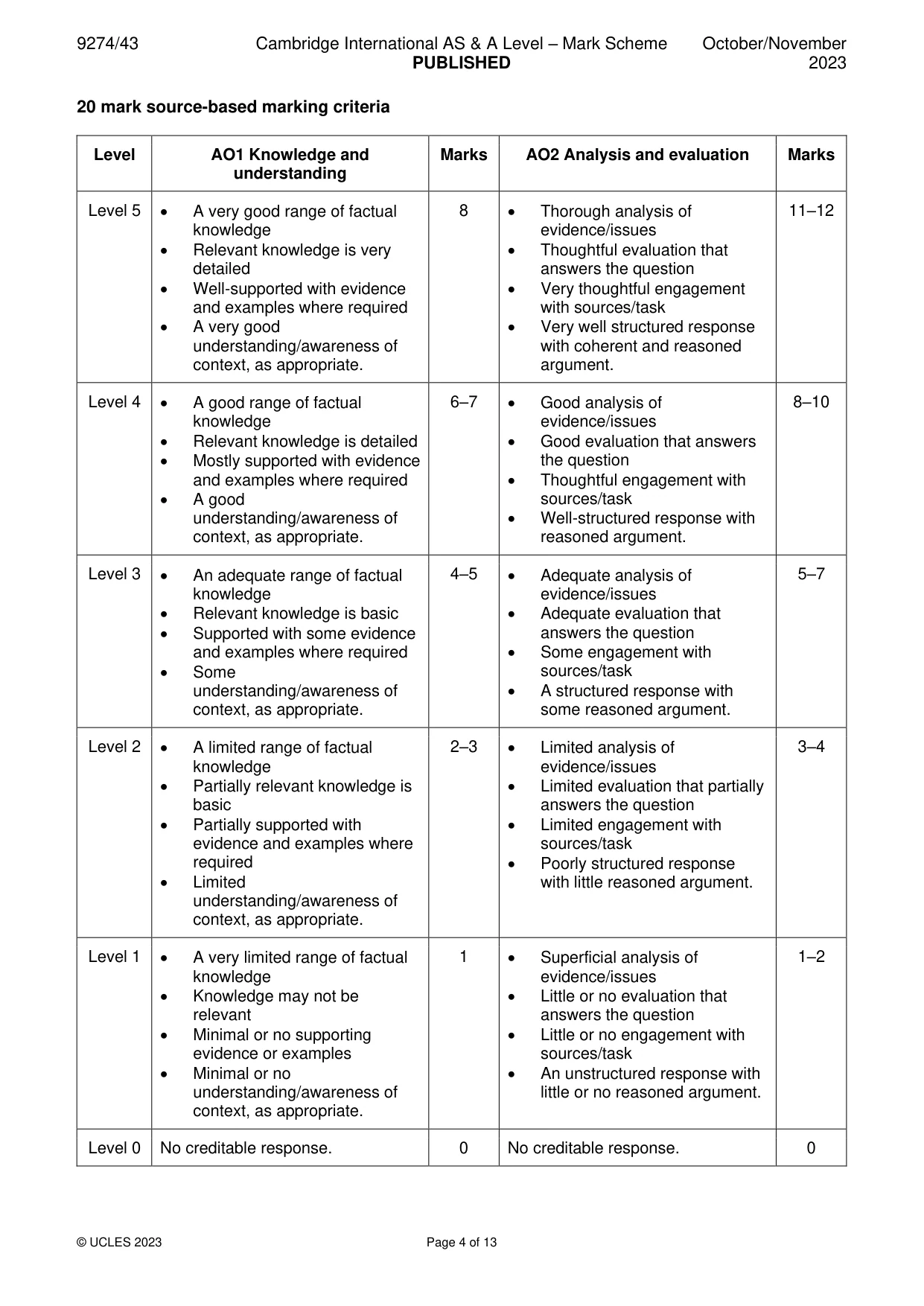
9274/43 Cambridge International AS & A Level – Mark Scheme PUBLISHED October/November 2023 © UCLES 2023 Page 4 of 13 20 mark source-based marking criteria Level AO1 Knowledge and understanding Marks AO2 Analysis and evaluation Marks Level 5 • A very good range of factual knowledge • Relevant knowledge is very detailed • Well-supported with evidence and examples where required • A very good understanding/awareness of context, as appropriate. 8 • Thorough analysis of evidence/issues • Thoughtful evaluation that answers the question • Very thoughtful engagement with sources/task • Very well structured response with coherent and reasoned argument. 11–12 Level 4 • A good range of factual knowledge • Relevant knowledge is detailed • Mostly supported with evidence and examples where required • A good understanding/awareness of context, as appropriate. 6–7 • Good analysis of evidence/issues • Good evaluation that answers the question • Thoughtful engagement with sources/task • Well-structured response with reasoned argument. 8–10 Level 3 • An adequate range of factual knowledge • Relevant knowledge is basic • Supported with some evidence and examples where required • Some understanding/awareness of context, as appropriate. 4–5 • Adequate analysis of evidence/issues • Adequate evaluation that answers the question • Some engagement with sources/task • A structured response with some reasoned argument. 5–7 Level 2 • A limited range of factual knowledge • Partially relevant knowledge is basic • Partially supported with evidence and examples where required • Limited understanding/awareness of context, as appropriate. 2–3 • Limited analysis of evidence/issues • Limited evaluation that partially answers the question • Limited engagement with sources/task • Poorly structured response with little reasoned argument. 3–4 Level 1 • A very limited range of factual knowledge • Knowledge may not be relevant • Minimal or no supporting evidence or examples • Minimal or no understanding/awareness of context, as appropriate. 1 • Superficial analysis of evidence/issues • Little or no evaluation that answers the question • Little or no engagement with sources/task • An unstructured response with little or no reasoned argument. 1–2 Level 0 No creditable response. 0 No creditable response. 0
Mark scheme, page 5
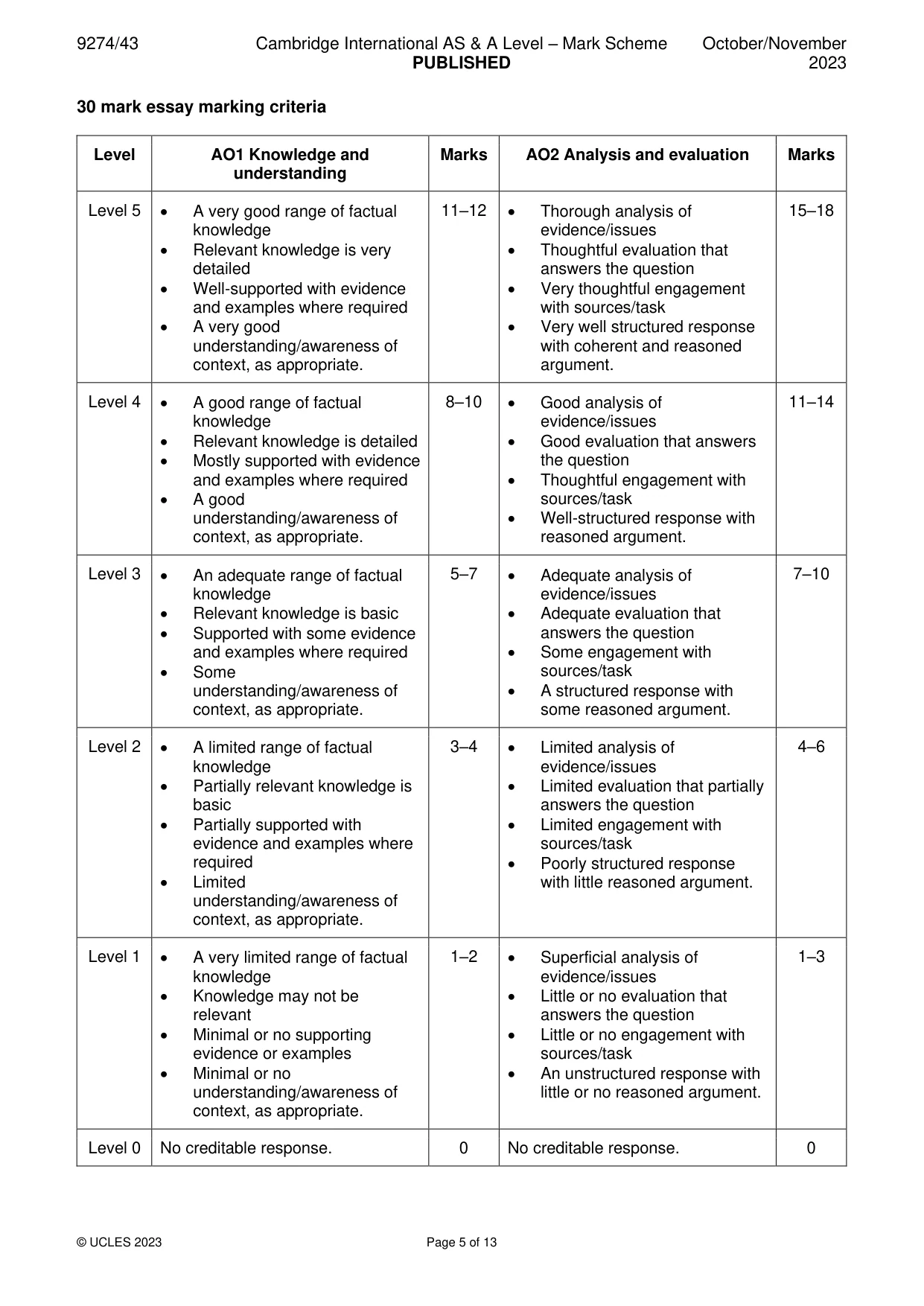
9274/43 Cambridge International AS & A Level – Mark Scheme PUBLISHED October/November 2023 © UCLES 2023 Page 5 of 13 30 mark essay marking criteria Level AO1 Knowledge and understanding Marks AO2 Analysis and evaluation Marks Level 5 • A very good range of factual knowledge • Relevant knowledge is very detailed • Well-supported with evidence and examples where required • A very good understanding/awareness of context, as appropriate. 11–12 • Thorough analysis of evidence/issues • Thoughtful evaluation that answers the question • Very thoughtful engagement with sources/task • Very well structured response with coherent and reasoned argument. 15–18 Level 4 • A good range of factual knowledge • Relevant knowledge is detailed • Mostly supported with evidence and examples where required • A good understanding/awareness of context, as appropriate. 8–10 • Good analysis of evidence/issues • Good evaluation that answers the question • Thoughtful engagement with sources/task • Well-structured response with reasoned argument. 11–14 Level 3 • An adequate range of factual knowledge • Relevant knowledge is basic • Supported with some evidence and examples where required • Some understanding/awareness of context, as appropriate. 5–7 • Adequate analysis of evidence/issues • Adequate evaluation that answers the question • Some engagement with sources/task • A structured response with some reasoned argument. 7–10 Level 2 • A limited range of factual knowledge • Partially relevant knowledge is basic • Partially supported with evidence and examples where required • Limited understanding/awareness of context, as appropriate. 3–4 • Limited analysis of evidence/issues • Limited evaluation that partially answers the question • Limited engagement with sources/task • Poorly structured response with little reasoned argument. 4–6 Level 1 • A very limited range of factual knowledge • Knowledge may not be relevant • Minimal or no supporting evidence or examples • Minimal or no understanding/awareness of context, as appropriate. 1–2 • Superficial analysis of evidence/issues • Little or no evaluation that answers the question • Little or no engagement with sources/task • An unstructured response with little or no reasoned argument. 1–3 Level 0 No creditable response. 0 No creditable response. 0
Mark scheme, page 6
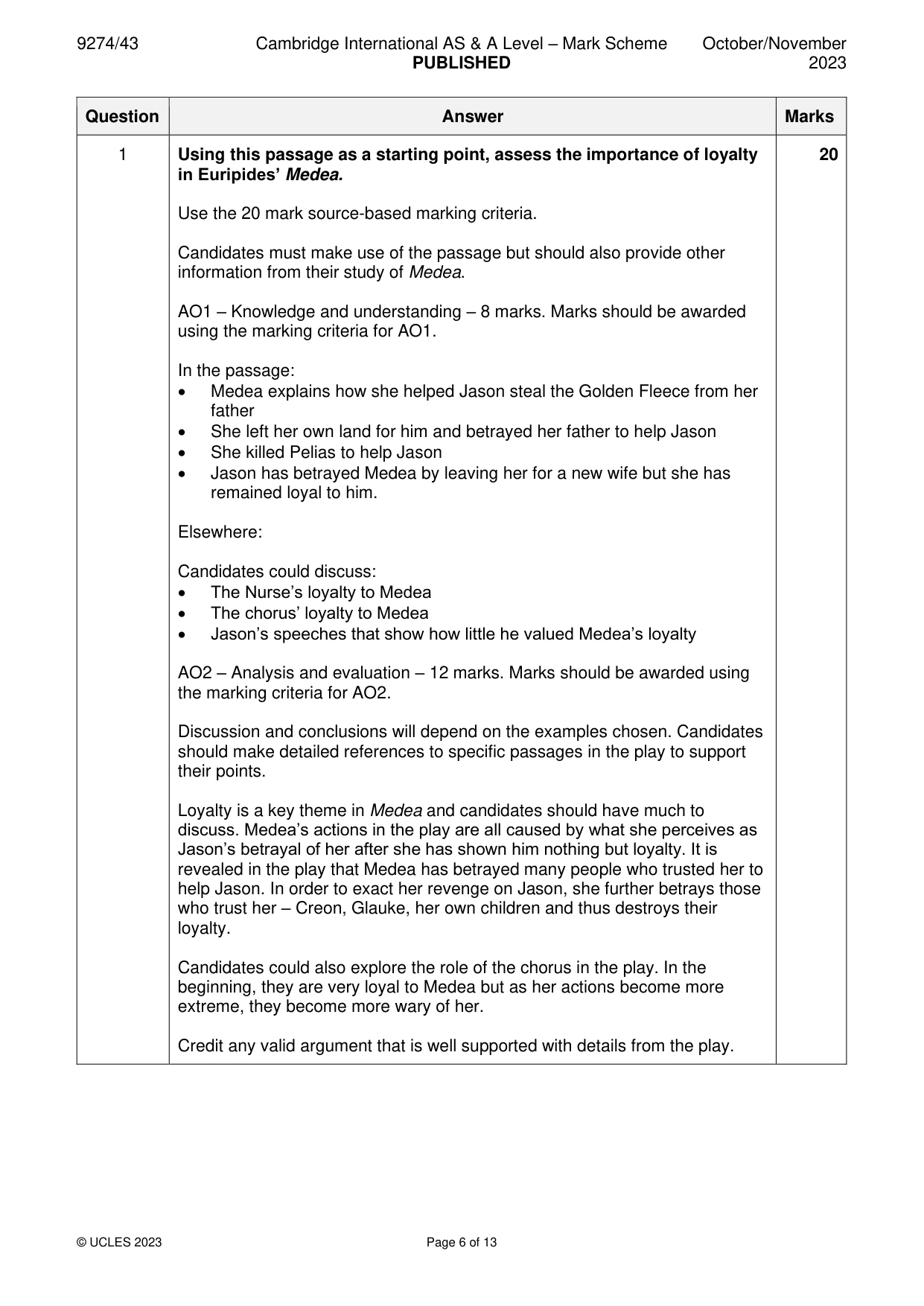
9274/43 Cambridge International AS & A Level – Mark Scheme PUBLISHED October/November 2023 © UCLES 2023 Page 6 of 13 Question Answer Marks 1 Using this passage as a starting point, assess the importance of loyalty in Euripides’ Medea. Use the 20 mark source-based marking criteria. Candidates must make use of the passage but should also provide other information from their study of Medea. AO1 – Knowledge and understanding – 8 marks. Marks should be awarded using the marking criteria for AO1. In the passage: • Medea explains how she helped Jason steal the Golden Fleece from her father • She left her own land for him and betrayed her father to help Jason • She killed Pelias to help Jason • Jason has betrayed Medea by leaving her for a new wife but she has remained loyal to him. Elsewhere: Candidates could discuss: • The Nurse’s loyalty to Medea • The chorus’ loyalty to Medea • Jason’s speeches that show how little he valued Medea’s loyalty AO2 – Analysis and evaluation – 12 marks. Marks should be awarded using the marking criteria for AO2. Discussion and conclusions will depend on the examples chosen. Candidates should make detailed references to specific passages in the play to support their points. Loyalty is a key theme in Medea and candidates should have much to discuss. Medea’s actions in the play are all caused by what she perceives as Jason’s betrayal of her after she has shown him nothing but loyalty. It is revealed in the play that Medea has betrayed many people who trusted her to help Jason. In order to exact her revenge on Jason, she further betrays those who trust her – Creon, Glauke, her own children and thus destroys their loyalty. Candidates could also explore the role of the chorus in the play. In the beginning, they are very loyal to Medea but as her actions become more extreme, they become more wary of her. Credit any valid argument that is well supported with details from the play. 20
Mark scheme, page 7
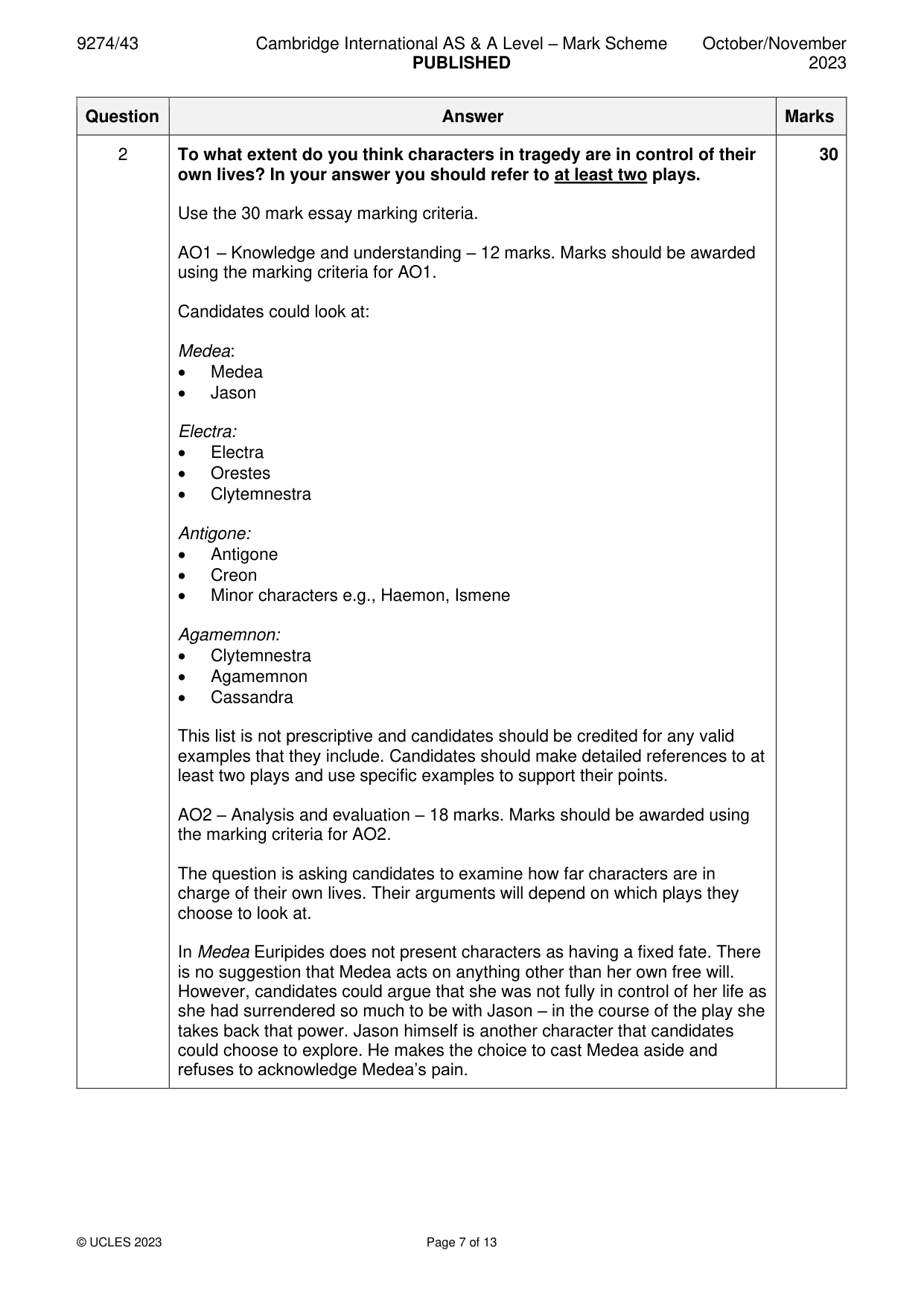
9274/43 Cambridge International AS & A Level – Mark Scheme PUBLISHED October/November 2023 © UCLES 2023 Page 7 of 13 Question Answer Marks 2 To what extent do you think characters in tragedy are in control of their own lives? In your answer you should refer to at least two plays. Use the 30 mark essay marking criteria. AO1 – Knowledge and understanding – 12 marks. Marks should be awarded using the marking criteria for AO1. Candidates could look at: Medea: • Medea • Jason Electra: • Electra • Orestes • Clytemnestra Antigone: • Antigone • Creon • Minor characters e.g., Haemon, Ismene Agamemnon: • Clytemnestra • Agamemnon • Cassandra This list is not prescriptive and candidates should be credited for any valid examples that they include. Candidates should make detailed references to at least two plays and use specific examples to support their points. AO2 – Analysis and evaluation – 18 marks. Marks should be awarded using the marking criteria for AO2. The question is asking candidates to examine how far characters are in charge of their own lives. Their arguments will depend on which plays they choose to look at. In Medea Euripides does not present characters as having a fixed fate. There is no suggestion that Medea acts on anything other than her own free will. However, candidates could argue that she was not fully in control of her life as she had surrendered so much to be with Jason – in the course of the play she takes back that power. Jason himself is another character that candidates could choose to explore. He makes the choice to cast Medea aside and refuses to acknowledge Medea’s pain. 30
Mark scheme, page 8
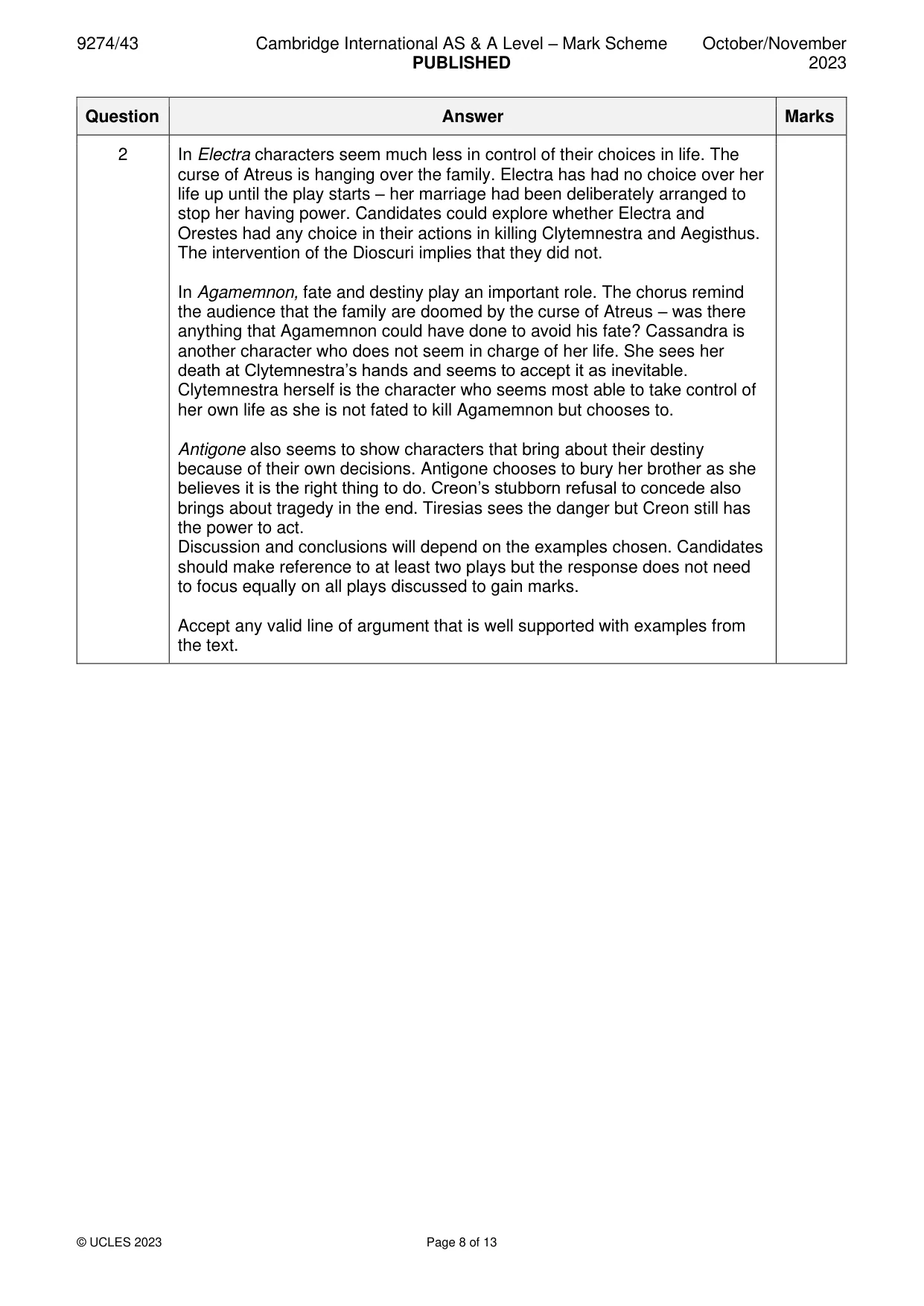
9274/43 Cambridge International AS & A Level – Mark Scheme PUBLISHED October/November 2023 © UCLES 2023 Page 8 of 13 Question Answer Marks 2 In Electra characters seem much less in control of their choices in life. The curse of Atreus is hanging over the family. Electra has had no choice over her life up until the play starts – her marriage had been deliberately arranged to stop her having power. Candidates could explore whether Electra and Orestes had any choice in their actions in killing Clytemnestra and Aegisthus. The intervention of the Dioscuri implies that they did not. In Agamemnon, fate and destiny play an important role. The chorus remind the audience that the family are doomed by the curse of Atreus – was there anything that Agamemnon could have done to avoid his fate? Cassandra is another character who does not seem in charge of her life. She sees her death at Clytemnestra’s hands and seems to accept it as inevitable. Clytemnestra herself is the character who seems most able to take control of her own life as she is not fated to kill Agamemnon but chooses to. Antigone also seems to show characters that bring about their destiny because of their own decisions. Antigone chooses to bury her brother as she believes it is the right thing to do. Creon’s stubborn refusal to concede also brings about tragedy in the end. Tiresias sees the danger but Creon still has the power to act. Discussion and conclusions will depend on the examples chosen. Candidates should make reference to at least two plays but the response does not need to focus equally on all plays discussed to gain marks. Accept any valid line of argument that is well supported with examples from the text.
Mark scheme, page 9
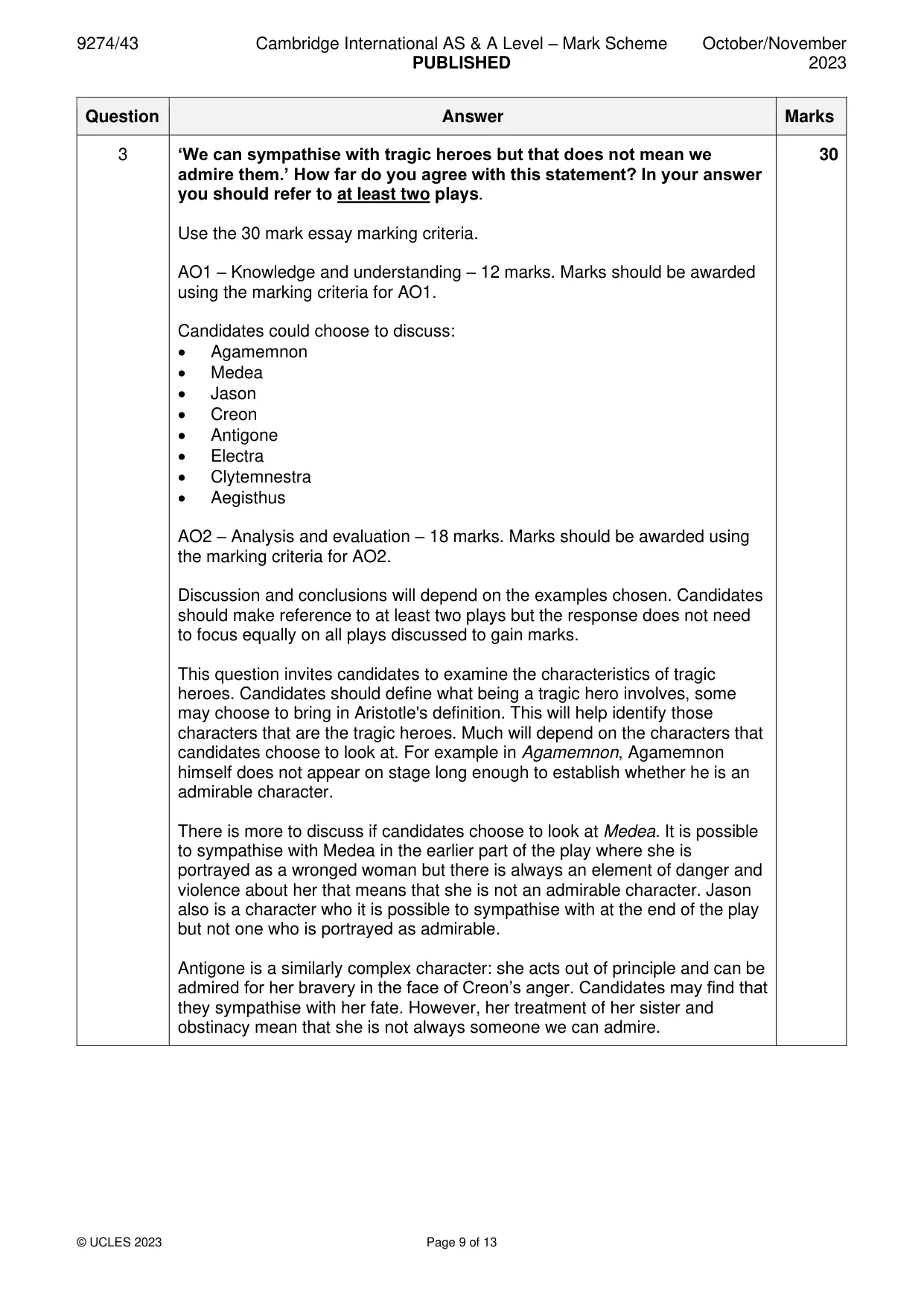
9274/43 Cambridge International AS & A Level – Mark Scheme PUBLISHED October/November 2023 © UCLES 2023 Page 9 of 13 Question Answer Marks 3 ‘We can sympathise with tragic heroes but that does not mean we admire them.’ How far do you agree with this statement? In your answer you should refer to at least two plays. Use the 30 mark essay marking criteria. AO1 – Knowledge and understanding – 12 marks. Marks should be awarded using the marking criteria for AO1. Candidates could choose to discuss: • Agamemnon • Medea • Jason • Creon • Antigone • Electra • Clytemnestra • Aegisthus AO2 – Analysis and evaluation – 18 marks. Marks should be awarded using the marking criteria for AO2. Discussion and conclusions will depend on the examples chosen. Candidates should make reference to at least two plays but the response does not need to focus equally on all plays discussed to gain marks. This question invites candidates to examine the characteristics of tragic heroes. Candidates should define what being a tragic hero involves, some may choose to bring in Aristotle's definition. This will help identify those characters that are the tragic heroes. Much will depend on the characters that candidates choose to look at. For example in Agamemnon, Agamemnon himself does not appear on stage long enough to establish whether he is an admirable character. There is more to discuss if candidates choose to look at Medea. It is possible to sympathise with Medea in the earlier part of the play where she is portrayed as a wronged woman but there is always an element of danger and violence about her that means that she is not an admirable character. Jason also is a character who it is possible to sympathise with at the end of the play but not one who is portrayed as admirable. Antigone is a similarly complex character: she acts out of principle and can be admired for her bravery in the face of Creon’s anger. Candidates may find that they sympathise with her fate. However, her treatment of her sister and obstinacy mean that she is not always someone we can admire. 30
Mark scheme, page 10
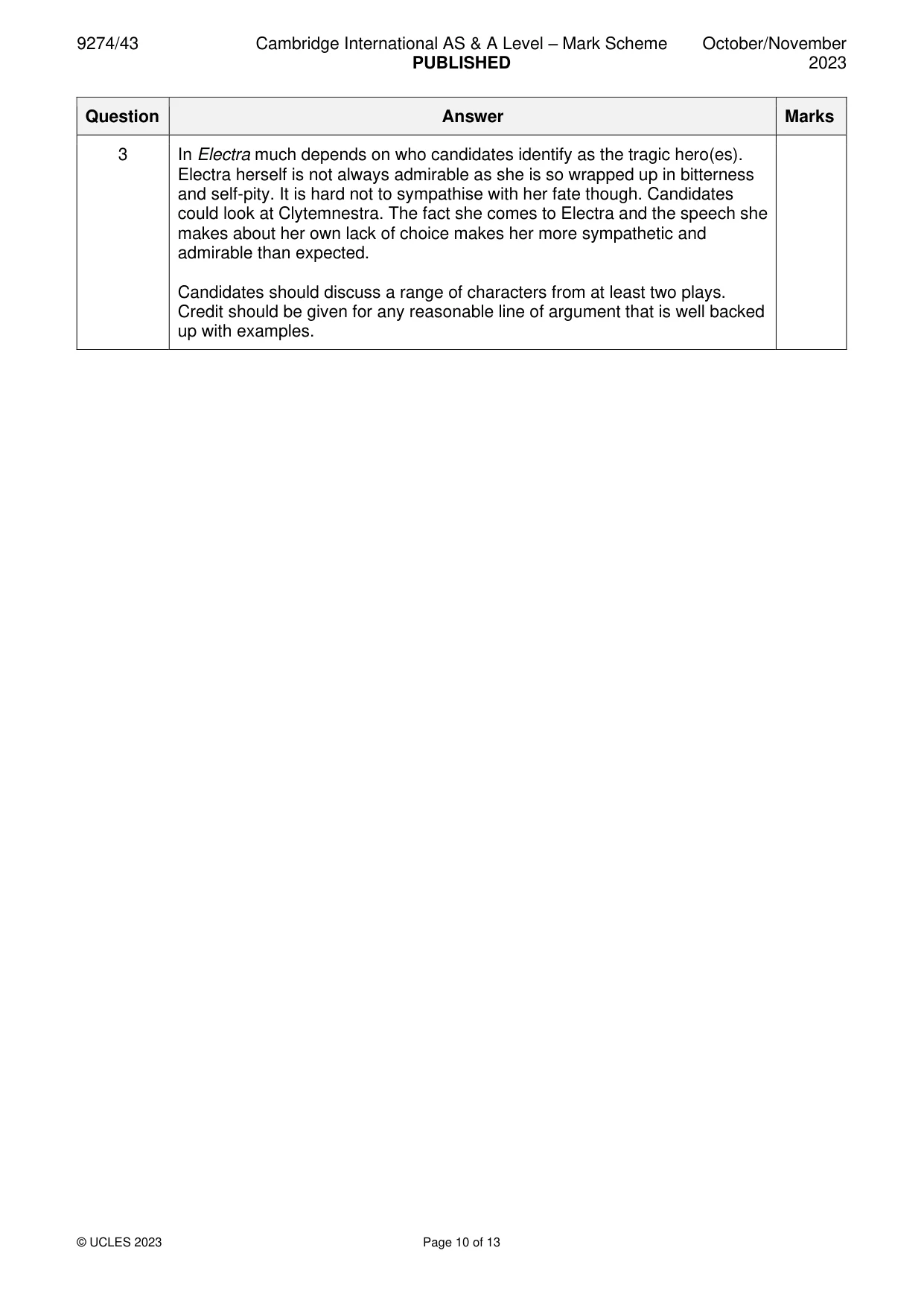
9274/43 Cambridge International AS & A Level – Mark Scheme PUBLISHED October/November 2023 © UCLES 2023 Page 10 of 13 Question Answer Marks 3 In Electra much depends on who candidates identify as the tragic hero(es). Electra herself is not always admirable as she is so wrapped up in bitterness and self-pity. It is hard not to sympathise with her fate though. Candidates could look at Clytemnestra. The fact she comes to Electra and the speech she makes about her own lack of choice makes her more sympathetic and admirable than expected. Candidates should discuss a range of characters from at least two plays. Credit should be given for any reasonable line of argument that is well backed up with examples.
Mark scheme, page 11
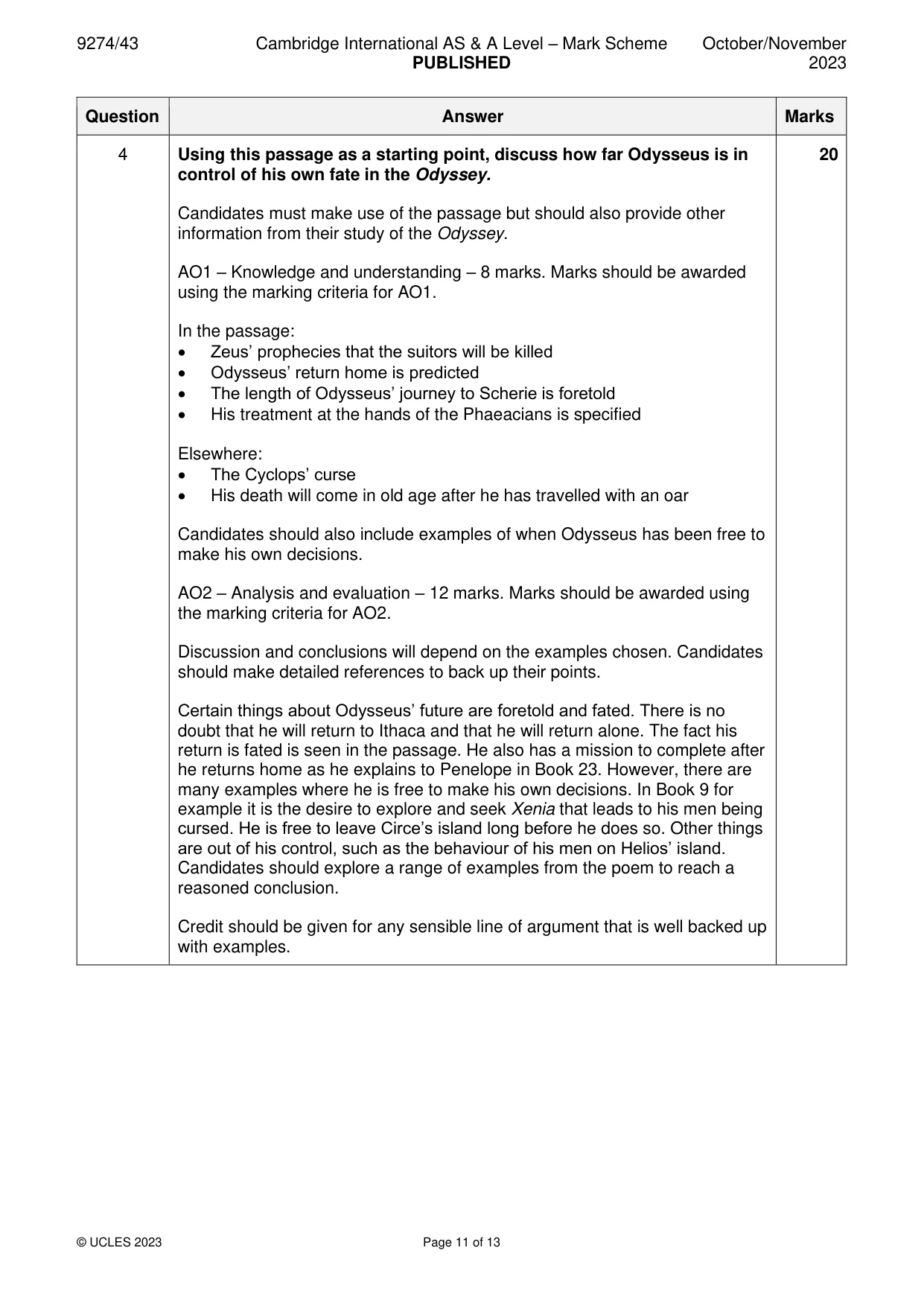
9274/43 Cambridge International AS & A Level – Mark Scheme PUBLISHED October/November 2023 © UCLES 2023 Page 11 of 13 Question Answer Marks 4 Using this passage as a starting point, discuss how far Odysseus is in control of his own fate in the Odyssey. Candidates must make use of the passage but should also provide other information from their study of the Odyssey. AO1 – Knowledge and understanding – 8 marks. Marks should be awarded using the marking criteria for AO1. In the passage: • Zeus’ prophecies that the suitors will be killed • Odysseus’ return home is predicted • The length of Odysseus’ journey to Scherie is foretold • His treatment at the hands of the Phaeacians is specified Elsewhere: • The Cyclops’ curse • His death will come in old age after he has travelled with an oar Candidates should also include examples of when Odysseus has been free to make his own decisions. AO2 – Analysis and evaluation – 12 marks. Marks should be awarded using the marking criteria for AO2. Discussion and conclusions will depend on the examples chosen. Candidates should make detailed references to back up their points. Certain things about Odysseus’ future are foretold and fated. There is no doubt that he will return to Ithaca and that he will return alone. The fact his return is fated is seen in the passage. He also has a mission to complete after he returns home as he explains to Penelope in Book 23. However, there are many examples where he is free to make his own decisions. In Book 9 for example it is the desire to explore and seek Xenia that leads to his men being cursed. He is free to leave Circe’s island long before he does so. Other things are out of his control, such as the behaviour of his men on Helios’ island. Candidates should explore a range of examples from the poem to reach a reasoned conclusion. Credit should be given for any sensible line of argument that is well backed up with examples. 20
Mark scheme, page 12
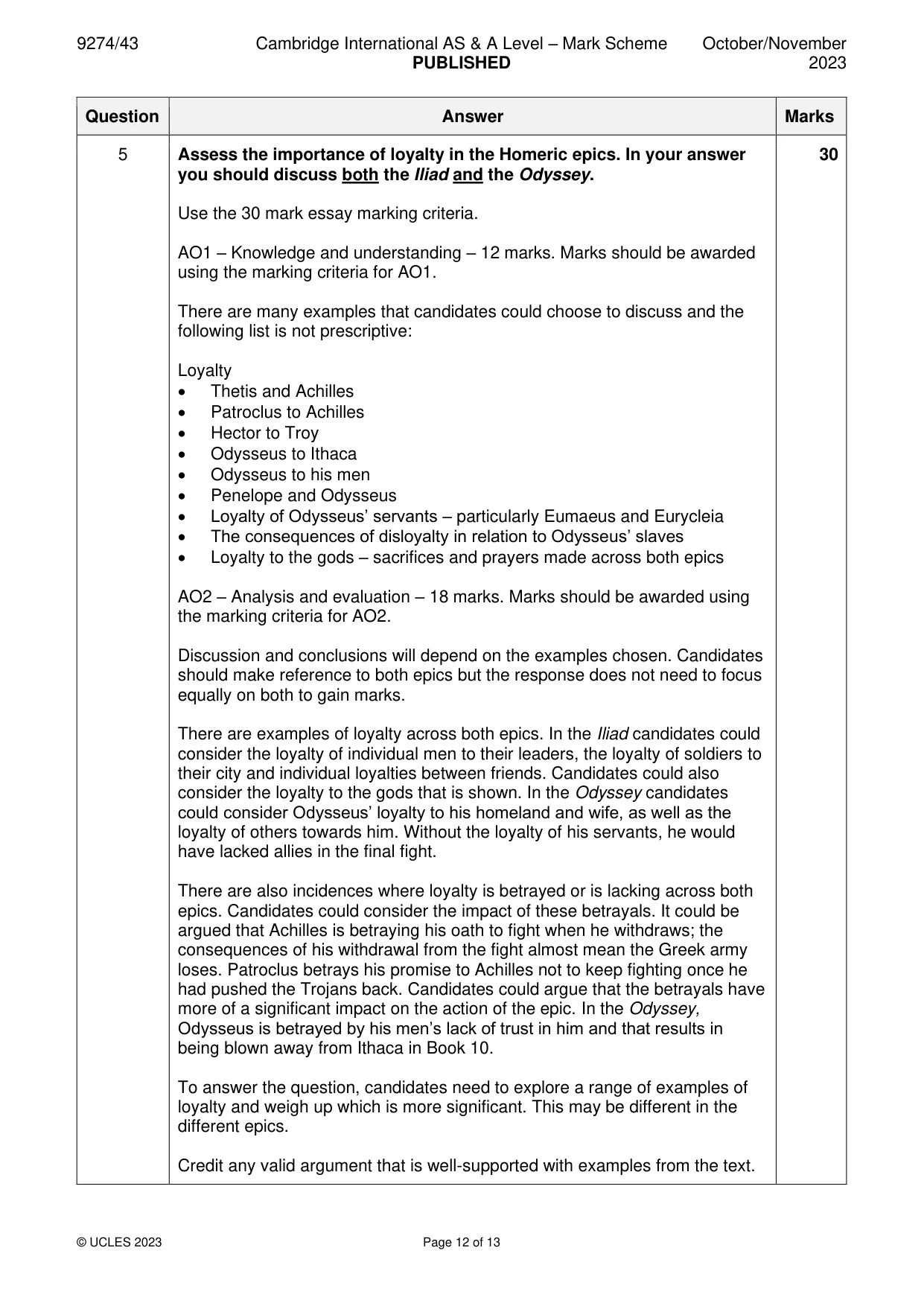
9274/43 Cambridge International AS & A Level – Mark Scheme PUBLISHED October/November 2023 © UCLES 2023 Page 12 of 13 Question Answer Marks 5 Assess the importance of loyalty in the Homeric epics. In your answer you should discuss both the Iliad and the Odyssey. Use the 30 mark essay marking criteria. AO1 – Knowledge and understanding – 12 marks. Marks should be awarded using the marking criteria for AO1. There are many examples that candidates could choose to discuss and the following list is not prescriptive: Loyalty • Thetis and Achilles • Patroclus to Achilles • Hector to Troy • Odysseus to Ithaca • Odysseus to his men • Penelope and Odysseus • Loyalty of Odysseus’ servants – particularly Eumaeus and Eurycleia • The consequences of disloyalty in relation to Odysseus’ slaves • Loyalty to the gods – sacrifices and prayers made across both epics AO2 – Analysis and evaluation – 18 marks. Marks should be awarded using the marking criteria for AO2. Discussion and conclusions will depend on the examples chosen. Candidates should make reference to both epics but the response does not need to focus equally on both to gain marks. There are examples of loyalty across both epics. In the Iliad candidates could consider the loyalty of individual men to their leaders, the loyalty of soldiers to their city and individual loyalties between friends. Candidates could also consider the loyalty to the gods that is shown. In the Odyssey candidates could consider Odysseus’ loyalty to his homeland and wife, as well as the loyalty of others towards him. Without the loyalty of his servants, he would have lacked allies in the final fight. There are also incidences where loyalty is betrayed or is lacking across both epics. Candidates could consider the impact of these betrayals. It could be argued that Achilles is betraying his oath to fight when he withdraws; the consequences of his withdrawal from the fight almost mean the Greek army loses. Patroclus betrays his promise to Achilles not to keep fighting once he had pushed the Trojans back. Candidates could argue that the betrayals have more of a significant impact on the action of the epic. In the Odyssey, Odysseus is betrayed by his men’s lack of trust in him and that results in being blown away from Ithaca in Book 10. To answer the question, candidates need to explore a range of examples of loyalty and weigh up which is more significant. This may be different in the different epics. Credit any valid argument that is well-supported with examples from the text. 30
Mark scheme, page 13
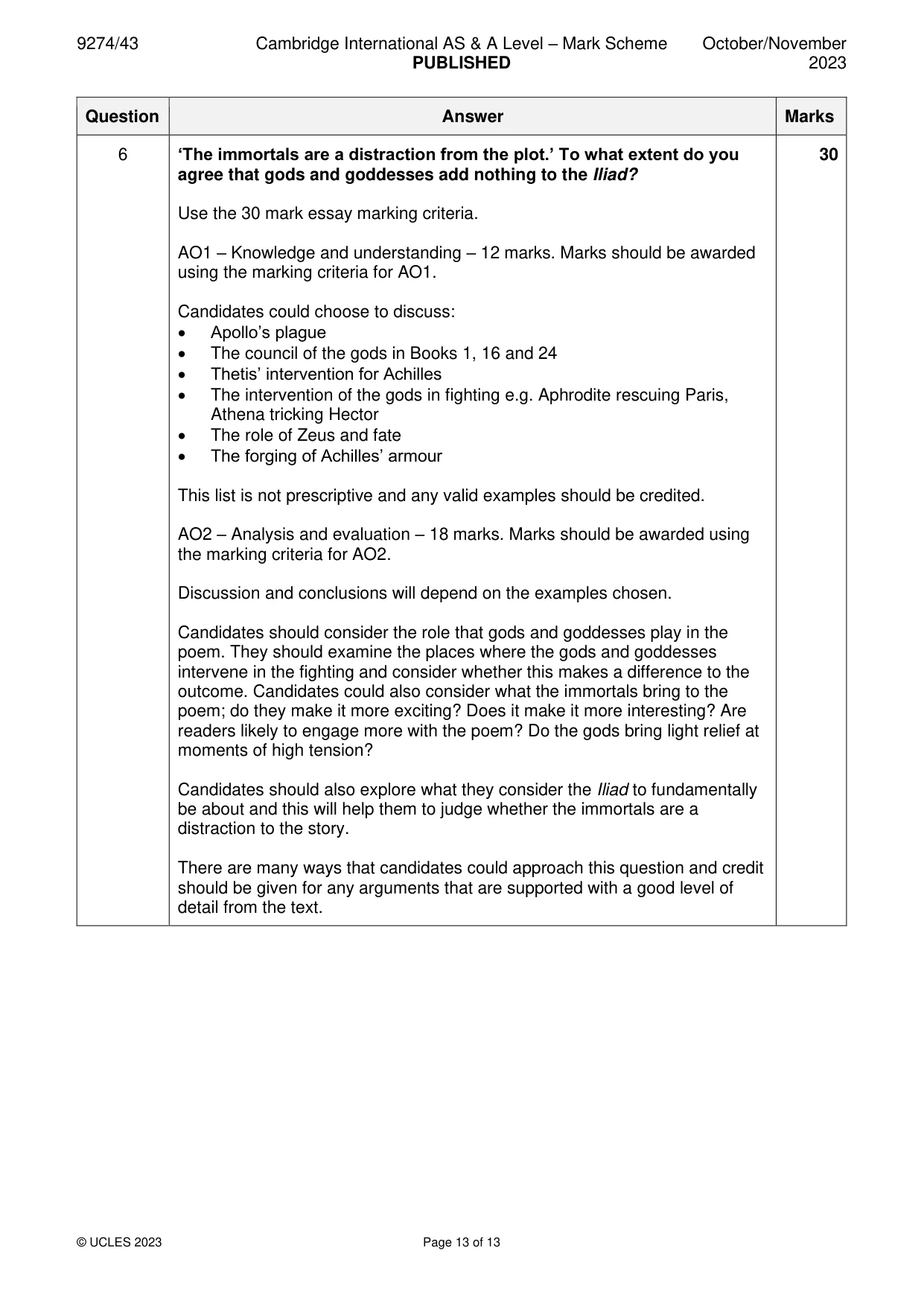
9274/43 Cambridge International AS & A Level – Mark Scheme PUBLISHED October/November 2023 © UCLES 2023 Page 13 of 13 Question Answer Marks 6 ‘The immortals are a distraction from the plot.’ To what extent do you agree that gods and goddesses add nothing to the Iliad? Use the 30 mark essay marking criteria. AO1 – Knowledge and understanding – 12 marks. Marks should be awarded using the marking criteria for AO1. Candidates could choose to discuss: • Apollo’s plague • The council of the gods in Books 1, 16 and 24 • Thetis’ intervention for Achilles • The intervention of the gods in fighting e.g. Aphrodite rescuing Paris, Athena tricking Hector • The role of Zeus and fate • The forging of Achilles’ armour This list is not prescriptive and any valid examples should be credited. AO2 – Analysis and evaluation – 18 marks. Marks should be awarded using the marking criteria for AO2. Discussion and conclusions will depend on the examples chosen. Candidates should consider the role that gods and goddesses play in the poem. They should examine the places where the gods and goddesses intervene in the fighting and consider whether this makes a difference to the outcome. Candidates could also consider what the immortals bring to the poem; do they make it more exciting? Does it make it more interesting? Are readers likely to engage more with the poem? Do the gods bring light relief at moments of high tension? Candidates should also explore what they consider the Iliad to fundamentally be about and this will help them to judge whether the immortals are a distraction to the story. There are many ways that candidates could approach this question and credit should be given for any arguments that are supported with a good level of detail from the text. 30
What you needed in this session
Cambridge’s own grade thresholds for 2023 Oct/Nov, Paper 4 · Variant 3. A higher threshold means an easier paper — the bar moves with how the cohort did.