Cambridge A Level Classical Studies 9274 — 2022 Oct/Nov Paper 4 · Variant 3
9274/43/O/N/22 · 50 marks · ≈56 min
The question paper and its mark scheme, free to read here and free to download. This is Cambridge’s own paper, exactly as it was sat.
Question paper4 pages

Mark scheme11 pages
Answers below. Sit the paper first if you are practising.
Paper as text
Question paper, page 1
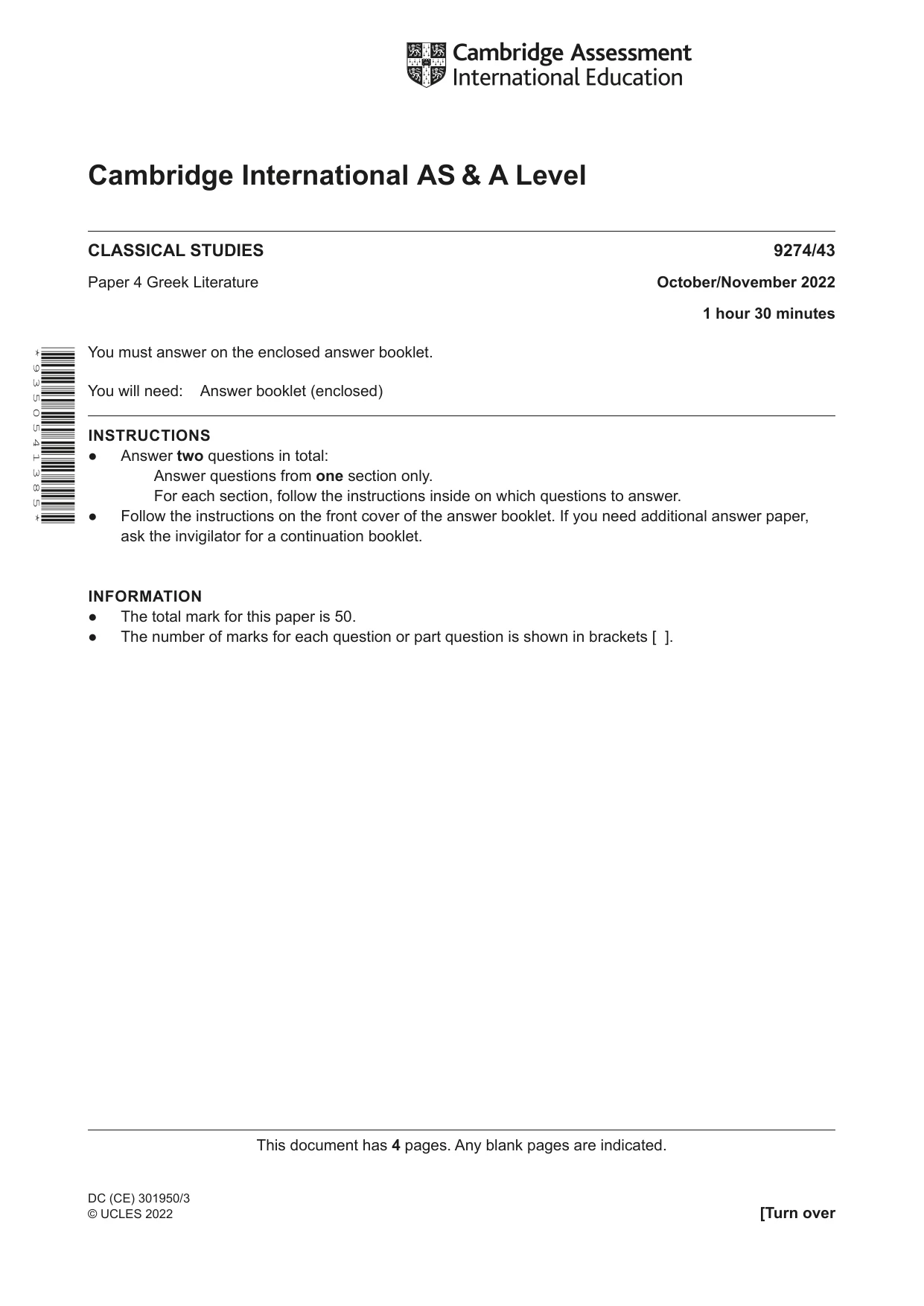
This document has 4 pages. Any blank pages are indicated. [Turn over Cambridge International AS & A Level DC (CE) 301950/3 © UCLES 2022 * 9 3 5 0 5 4 1 3 8 5 * CLASSICAL STUDIES 9274/43 Paper 4 Greek Literature October/November 2022 1 hour 30 minutes You must answer on the enclosed answer booklet. You will need: Answer booklet (enclosed) INSTRUCTIONS ● Answer two questions in total: Answer questions from one section only. For each section, follow the instructions inside on which questions to answer. ● Follow the instructions on the front cover of the answer booklet. If you need additional answer paper, ask the invigilator for a continuation booklet. INFORMATION ● The total mark for this paper is 50. ● The number of marks for each question or part question is shown in brackets [ ].
Question paper, page 2
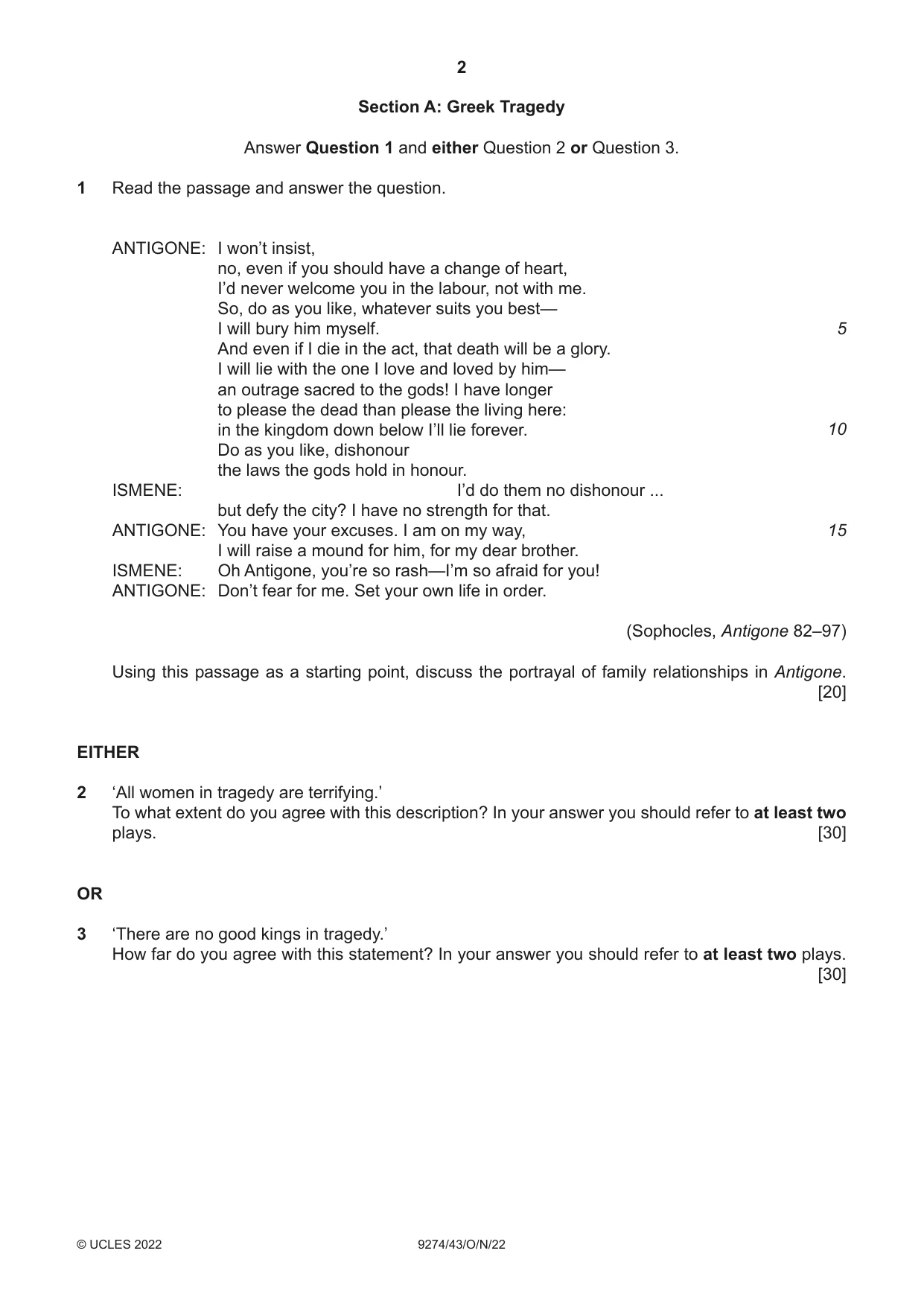
2 9274/43/O/N/22 © UCLES 2022 Section A: Greek Tragedy Answer Question 1 and either Question 2 or Question 3. 1 Read the passage and answer the question. ANTIGONE: I won’t insist, no, even if you should have a change of heart, I’d never welcome you in the labour, not with me. So, do as you like, whatever suits you best— I will bury him myself. And even if I die in the act, that death will be a glory. I will lie with the one I love and loved by him— an outrage sacred to the gods! I have longer to please the dead than please the living here: in the kingdom down below I’ll lie forever. Do as you like, dishonour the laws the gods hold in honour. ISMENE: I’d do them no dishonour ... but defy the city? I have no strength for that. ANTIGONE: You have your excuses. I am on my way, I will raise a mound for him, for my dear brother. ISMENE: Oh Antigone, you’re so rash—I’m so afraid for you! ANTIGONE: Don’t fear for me. Set your own life in order. (Sophocles, Antigone 82–97) Using this passage as a starting point, discuss the portrayal of family relationships in Antigone. [20] EITHER 2 ‘All women in tragedy are terrifying.’ To what extent do you agree with this description? In your answer you should refer to at least two plays. [30] OR 3 ‘There are no good kings in tragedy.’ How far do you agree with this statement? In your answer you should refer to at least two plays. [30] 5 10 15
Question paper, page 3
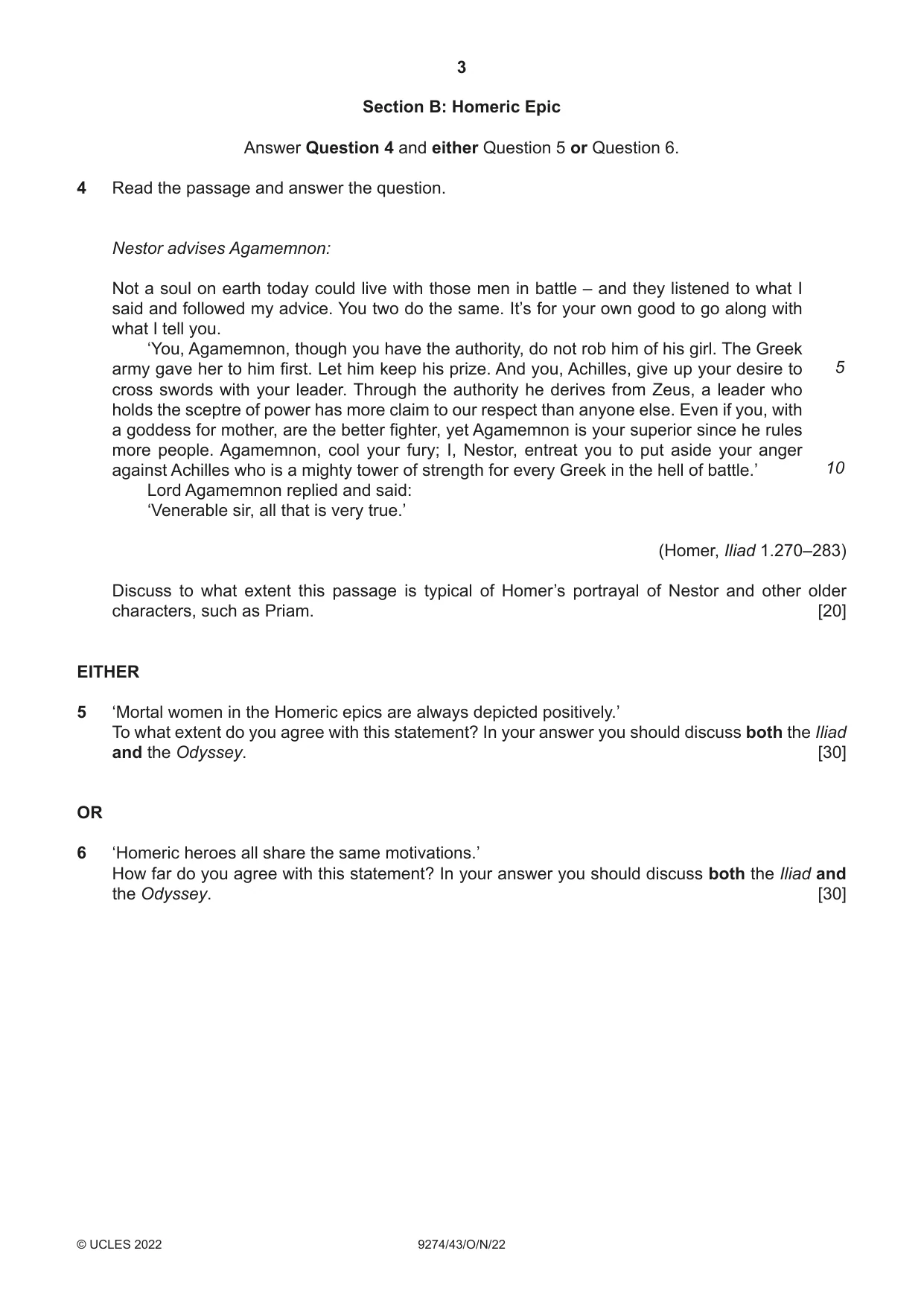
3 9274/43/O/N/22 © UCLES 2022 Section B: Homeric Epic Answer Question 4 and either Question 5 or Question 6. 4 Read the passage and answer the question. Nestor advises Agamemnon: Not a soul on earth today could live with those men in battle – and they listened to what I said and followed my advice. You two do the same. It’s for your own good to go along with what I tell you. ‘You, Agamemnon, though you have the authority, do not rob him of his girl. The Greek army gave her to him first. Let him keep his prize. And you, Achilles, give up your desire to cross swords with your leader. Through the authority he derives from Zeus, a leader who holds the sceptre of power has more claim to our respect than anyone else. Even if you, with a goddess for mother, are the better fighter, yet Agamemnon is your superior since he rules more people. Agamemnon, cool your fury; I, Nestor, entreat you to put aside your anger against Achilles who is a mighty tower of strength for every Greek in the hell of battle.’ Lord Agamemnon replied and said: ‘Venerable sir, all that is very true.’ (Homer, Iliad 1.270–283) Discuss to what extent this passage is typical of Homer’s portrayal of Nestor and other older characters, such as Priam. [20] EITHER 5 ‘Mortal women in the Homeric epics are always depicted positively.’ To what extent do you agree with this statement? In your answer you should discuss both the Iliad and the Odyssey. [30] OR 6 ‘Homeric heroes all share the same motivations.’ How far do you agree with this statement? In your answer you should discuss both the Iliad and the Odyssey. [30] 5 10
Question paper, page 4
4 9274/43/O/N/22 © UCLES 2022 Permission to reproduce items where third-party owned material protected by copyright is included has been sought and cleared where possible. Every reasonable effort has been made by the publisher (UCLES) to trace copyright holders, but if any items requiring clearance have unwittingly been included, the publisher will be pleased to make amends at the earliest possible opportunity. To avoid the issue of disclosure of answer-related information to candidates, all copyright acknowledgements are reproduced online in the Cambridge Assessment International Education Copyright Acknowledgements Booklet. This is produced for each series of examinations and is freely available to download at www.cambridgeinternational.org after the live examination series. Cambridge Assessment International Education is part of Cambridge Assessment. Cambridge Assessment is the brand name of the University of Cambridge Local Examinations Syndicate (UCLES), which is a department of the University of Cambridge. BLANK PAGE
Mark scheme, page 1
This document consists of 11 printed pages. © UCLES 2022 [Turn over Cambridge International AS & A Level CLASSICAL STUDIES 9274/43 Paper 4 Greek Literature October/November 2022 MARK SCHEME Maximum Mark: 50 Published This mark scheme is published as an aid to teachers and candidates, to indicate the requirements of the examination. It shows the basis on which Examiners were instructed to award marks. It does not indicate the details of the discussions that took place at an Examiners’ meeting before marking began, which would have considered the acceptability of alternative answers. Mark schemes should be read in conjunction with the question paper and the Principal Examiner Report for Teachers. Cambridge International will not enter into discussions about these mark schemes. Cambridge International is publishing the mark schemes for the October/November 2022 series for most Cambridge IGCSE™, Cambridge International A and AS Level components and some Cambridge O Level components.
Mark scheme, page 2
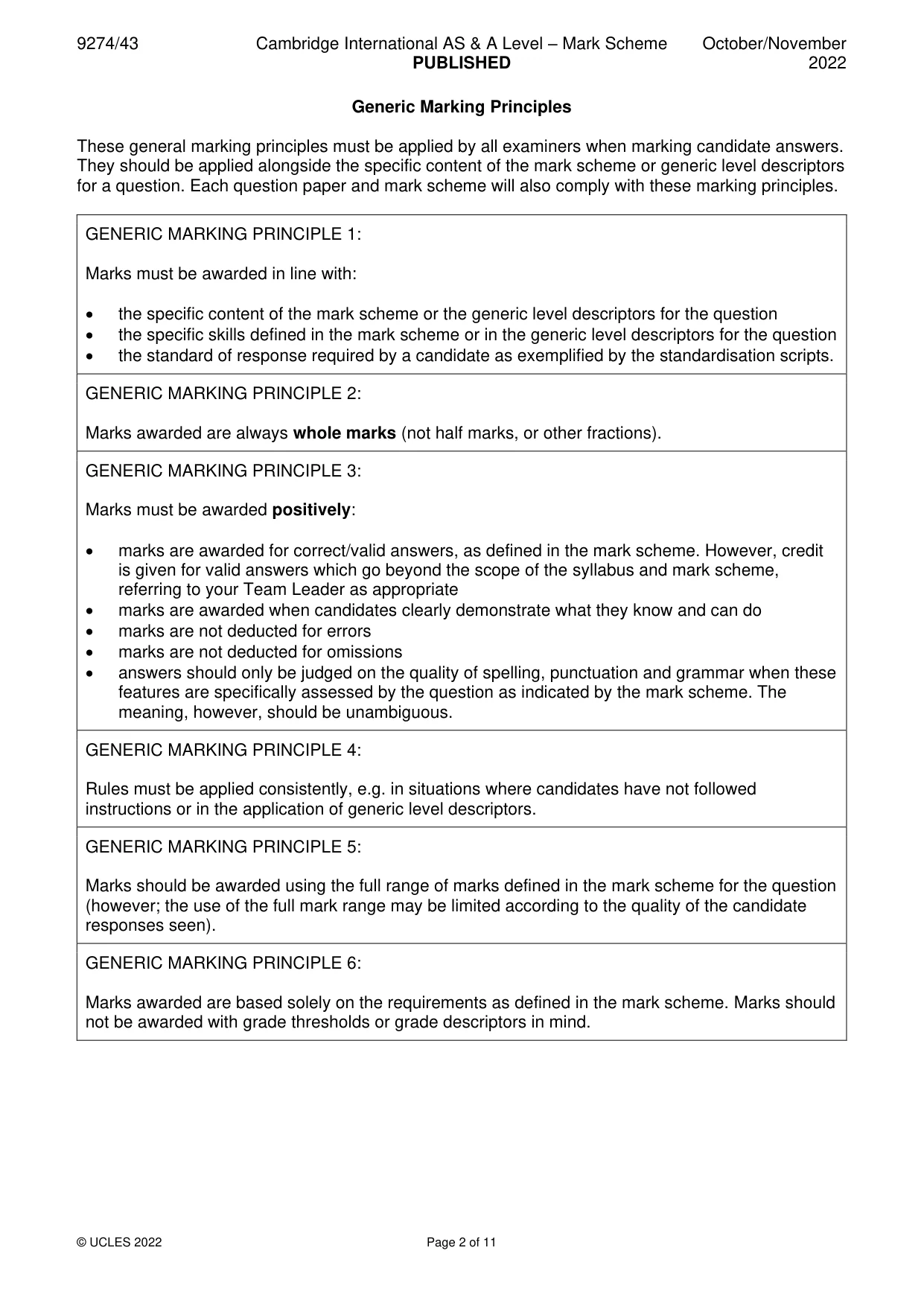
9274/43 Cambridge International AS & A Level – Mark Scheme PUBLISHED October/November 2022 © UCLES 2022 Page 2 of 11 Generic Marking Principles These general marking principles must be applied by all examiners when marking candidate answers. They should be applied alongside the specific content of the mark scheme or generic level descriptors for a question. Each question paper and mark scheme will also comply with these marking principles. GENERIC MARKING PRINCIPLE 1: Marks must be awarded in line with: • the specific content of the mark scheme or the generic level descriptors for the question • the specific skills defined in the mark scheme or in the generic level descriptors for the question • the standard of response required by a candidate as exemplified by the standardisation scripts. GENERIC MARKING PRINCIPLE 2: Marks awarded are always whole marks (not half marks, or other fractions). GENERIC MARKING PRINCIPLE 3: Marks must be awarded positively: • marks are awarded for correct/valid answers, as defined in the mark scheme. However, credit is given for valid answers which go beyond the scope of the syllabus and mark scheme, referring to your Team Leader as appropriate • marks are awarded when candidates clearly demonstrate what they know and can do • marks are not deducted for errors • marks are not deducted for omissions • answers should only be judged on the quality of spelling, punctuation and grammar when these features are specifically assessed by the question as indicated by the mark scheme. The meaning, however, should be unambiguous. GENERIC MARKING PRINCIPLE 4: Rules must be applied consistently, e.g. in situations where candidates have not followed instructions or in the application of generic level descriptors. GENERIC MARKING PRINCIPLE 5: Marks should be awarded using the full range of marks defined in the mark scheme for the question (however; the use of the full mark range may be limited according to the quality of the candidate responses seen). GENERIC MARKING PRINCIPLE 6: Marks awarded are based solely on the requirements as defined in the mark scheme. Marks should not be awarded with grade thresholds or grade descriptors in mind.
Mark scheme, page 3
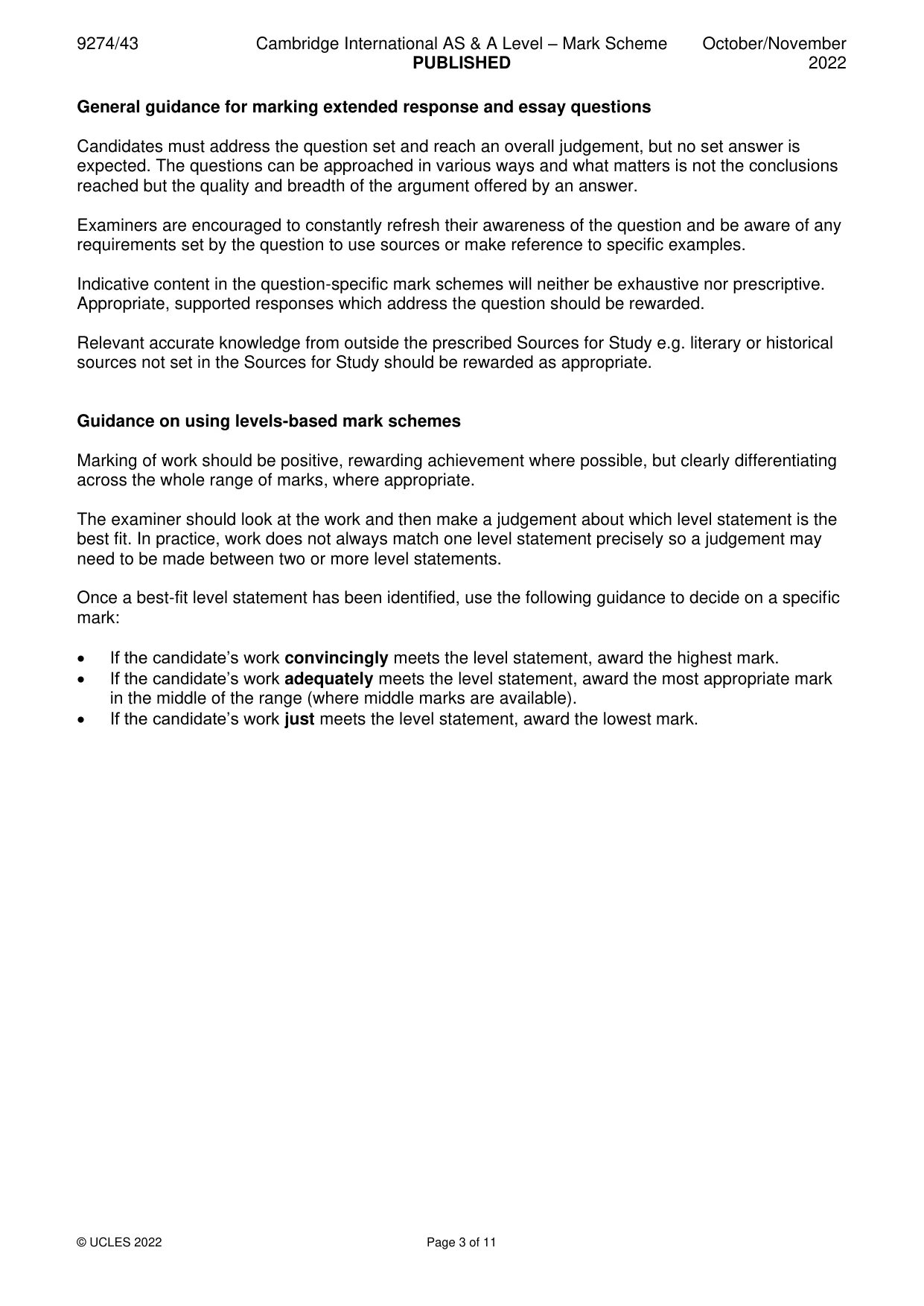
9274/43 Cambridge International AS & A Level – Mark Scheme PUBLISHED October/November 2022 © UCLES 2022 Page 3 of 11 General guidance for marking extended response and essay questions Candidates must address the question set and reach an overall judgement, but no set answer is expected. The questions can be approached in various ways and what matters is not the conclusions reached but the quality and breadth of the argument offered by an answer. Examiners are encouraged to constantly refresh their awareness of the question and be aware of any requirements set by the question to use sources or make reference to specific examples. Indicative content in the question-specific mark schemes will neither be exhaustive nor prescriptive. Appropriate, supported responses which address the question should be rewarded. Relevant accurate knowledge from outside the prescribed Sources for Study e.g. literary or historical sources not set in the Sources for Study should be rewarded as appropriate. Guidance on using levels-based mark schemes Marking of work should be positive, rewarding achievement where possible, but clearly differentiating across the whole range of marks, where appropriate. The examiner should look at the work and then make a judgement about which level statement is the best fit. In practice, work does not always match one level statement precisely so a judgement may need to be made between two or more level statements. Once a best-fit level statement has been identified, use the following guidance to decide on a specific mark: • If the candidate’s work convincingly meets the level statement, award the highest mark. • If the candidate’s work adequately meets the level statement, award the most appropriate mark in the middle of the range (where middle marks are available). • If the candidate’s work just meets the level statement, award the lowest mark.
Mark scheme, page 4
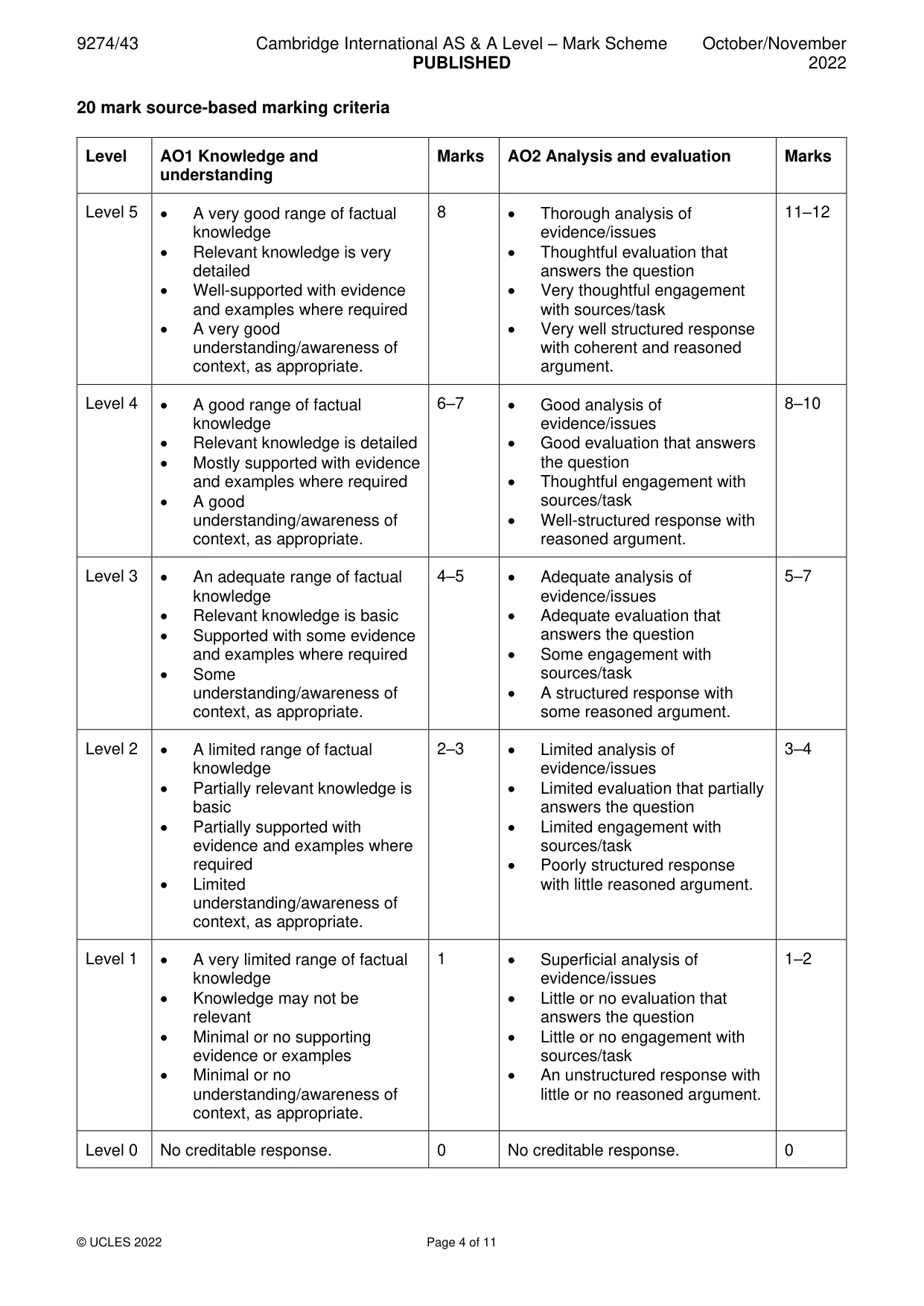
9274/43 Cambridge International AS & A Level – Mark Scheme PUBLISHED October/November 2022 © UCLES 2022 Page 4 of 11 20 mark source-based marking criteria Level AO1 Knowledge and understanding Marks AO2 Analysis and evaluation Marks Level 5 • A very good range of factual knowledge • Relevant knowledge is very detailed • Well-supported with evidence and examples where required • A very good understanding/awareness of context, as appropriate. 8 • Thorough analysis of evidence/issues • Thoughtful evaluation that answers the question • Very thoughtful engagement with sources/task • Very well structured response with coherent and reasoned argument. 11–12 Level 4 • A good range of factual knowledge • Relevant knowledge is detailed • Mostly supported with evidence and examples where required • A good understanding/awareness of context, as appropriate. 6–7 • Good analysis of evidence/issues • Good evaluation that answers the question • Thoughtful engagement with sources/task • Well-structured response with reasoned argument. 8–10 Level 3 • An adequate range of factual knowledge • Relevant knowledge is basic • Supported with some evidence and examples where required • Some understanding/awareness of context, as appropriate. 4–5 • Adequate analysis of evidence/issues • Adequate evaluation that answers the question • Some engagement with sources/task • A structured response with some reasoned argument. 5–7 Level 2 • A limited range of factual knowledge • Partially relevant knowledge is basic • Partially supported with evidence and examples where required • Limited understanding/awareness of context, as appropriate. 2–3 • Limited analysis of evidence/issues • Limited evaluation that partially answers the question • Limited engagement with sources/task • Poorly structured response with little reasoned argument. 3–4 Level 1 • A very limited range of factual knowledge • Knowledge may not be relevant • Minimal or no supporting evidence or examples • Minimal or no understanding/awareness of context, as appropriate. 1 • Superficial analysis of evidence/issues • Little or no evaluation that answers the question • Little or no engagement with sources/task • An unstructured response with little or no reasoned argument. 1–2 Level 0 No creditable response. 0 No creditable response. 0
Mark scheme, page 5
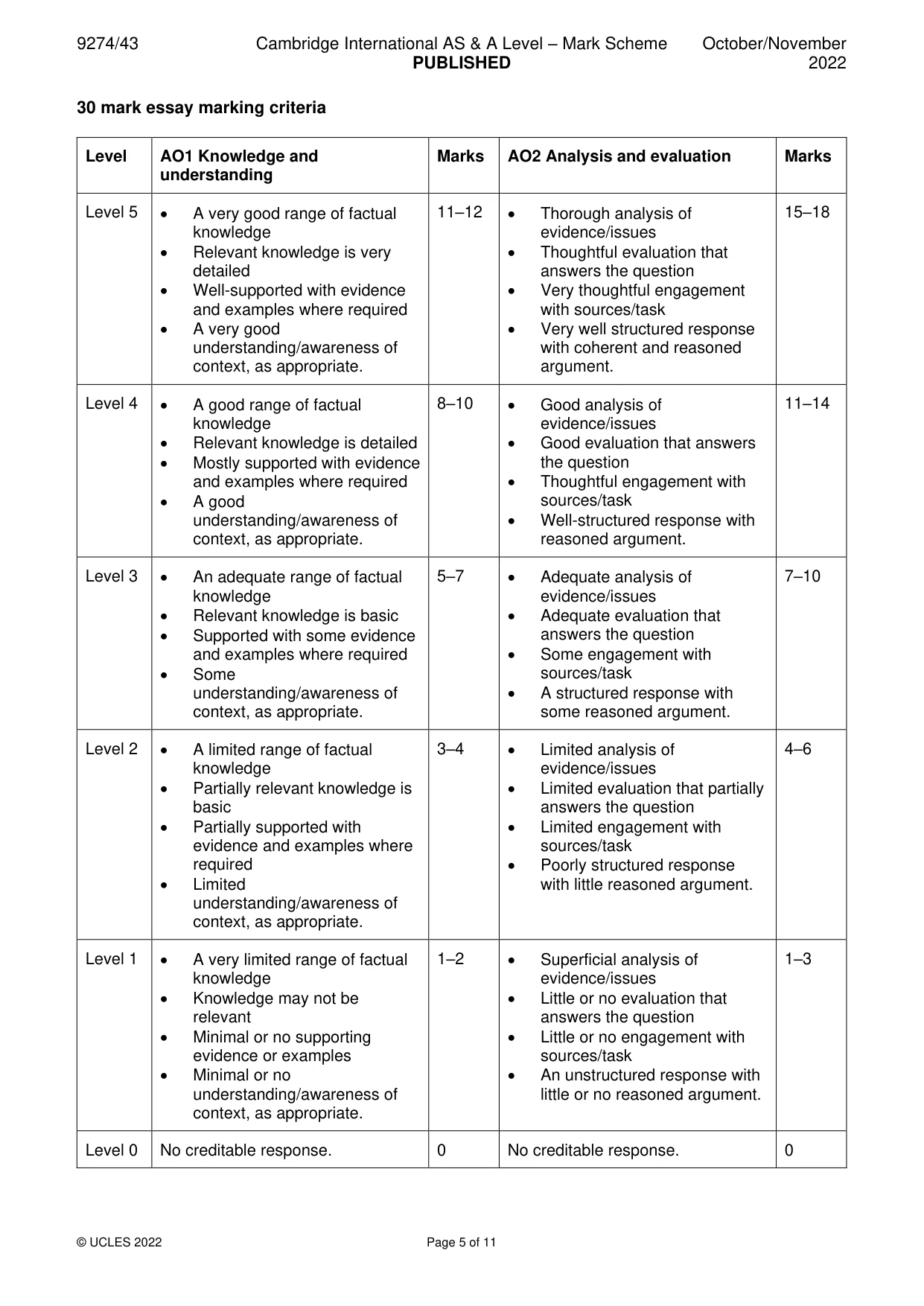
9274/43 Cambridge International AS & A Level – Mark Scheme PUBLISHED October/November 2022 © UCLES 2022 Page 5 of 11 30 mark essay marking criteria Level AO1 Knowledge and understanding Marks AO2 Analysis and evaluation Marks Level 5 • A very good range of factual knowledge • Relevant knowledge is very detailed • Well-supported with evidence and examples where required • A very good understanding/awareness of context, as appropriate. 11–12 • Thorough analysis of evidence/issues • Thoughtful evaluation that answers the question • Very thoughtful engagement with sources/task • Very well structured response with coherent and reasoned argument. 15–18 Level 4 • A good range of factual knowledge • Relevant knowledge is detailed • Mostly supported with evidence and examples where required • A good understanding/awareness of context, as appropriate. 8–10 • Good analysis of evidence/issues • Good evaluation that answers the question • Thoughtful engagement with sources/task • Well-structured response with reasoned argument. 11–14 Level 3 • An adequate range of factual knowledge • Relevant knowledge is basic • Supported with some evidence and examples where required • Some understanding/awareness of context, as appropriate. 5–7 • Adequate analysis of evidence/issues • Adequate evaluation that answers the question • Some engagement with sources/task • A structured response with some reasoned argument. 7–10 Level 2 • A limited range of factual knowledge • Partially relevant knowledge is basic • Partially supported with evidence and examples where required • Limited understanding/awareness of context, as appropriate. 3–4 • Limited analysis of evidence/issues • Limited evaluation that partially answers the question • Limited engagement with sources/task • Poorly structured response with little reasoned argument. 4–6 Level 1 • A very limited range of factual knowledge • Knowledge may not be relevant • Minimal or no supporting evidence or examples • Minimal or no understanding/awareness of context, as appropriate. 1–2 • Superficial analysis of evidence/issues • Little or no evaluation that answers the question • Little or no engagement with sources/task • An unstructured response with little or no reasoned argument. 1–3 Level 0 No creditable response. 0 No creditable response. 0
Mark scheme, page 6
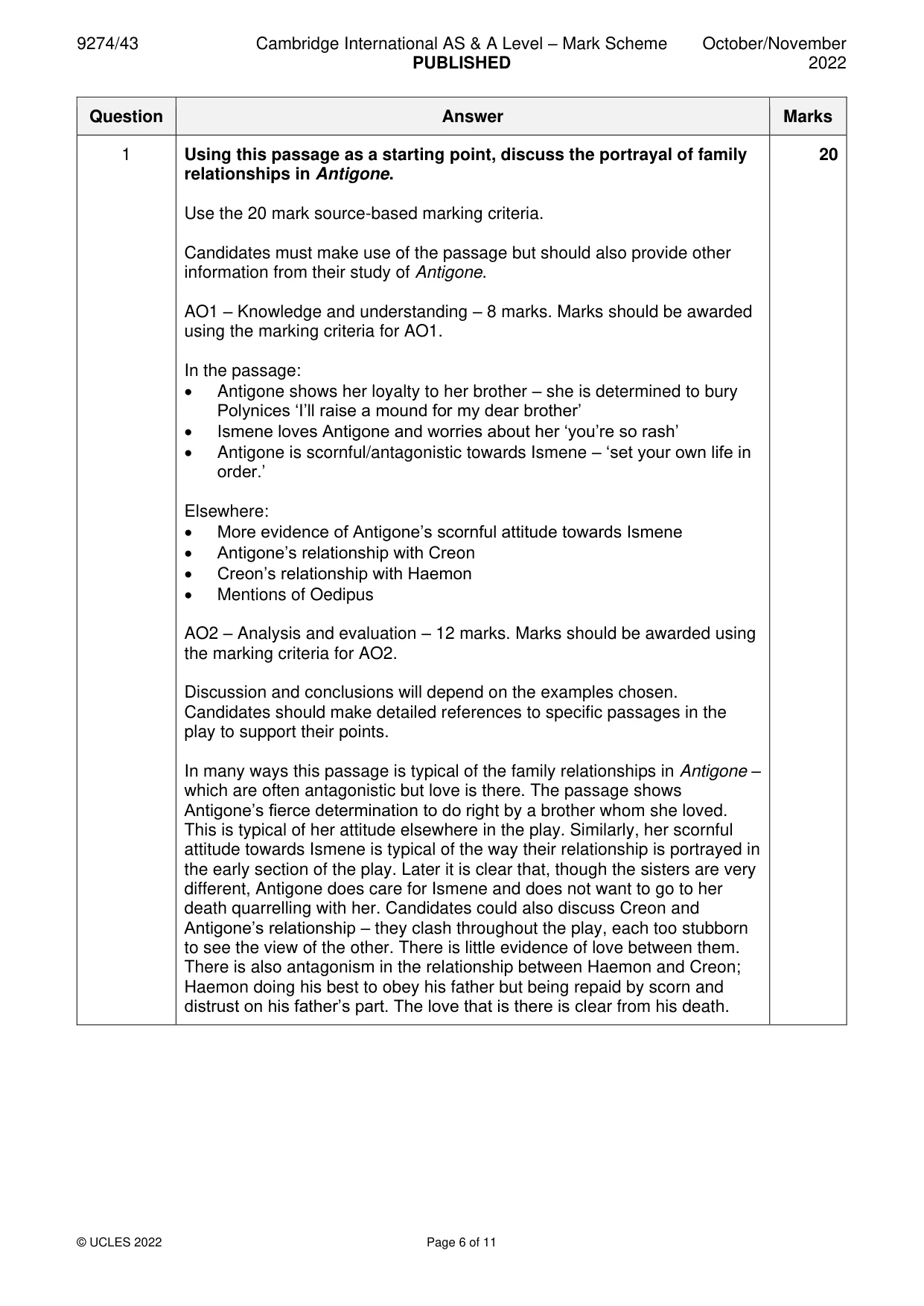
9274/43 Cambridge International AS & A Level – Mark Scheme PUBLISHED October/November 2022 © UCLES 2022 Page 6 of 11 Question Answer Marks 1 Using this passage as a starting point, discuss the portrayal of family relationships in Antigone. Use the 20 mark source-based marking criteria. Candidates must make use of the passage but should also provide other information from their study of Antigone. AO1 – Knowledge and understanding – 8 marks. Marks should be awarded using the marking criteria for AO1. In the passage: • Antigone shows her loyalty to her brother – she is determined to bury Polynices ‘I’ll raise a mound for my dear brother’ • Ismene loves Antigone and worries about her ‘you’re so rash’ • Antigone is scornful/antagonistic towards Ismene – ‘set your own life in order.’ Elsewhere: • More evidence of Antigone’s scornful attitude towards Ismene • Antigone’s relationship with Creon • Creon’s relationship with Haemon • Mentions of Oedipus AO2 – Analysis and evaluation – 12 marks. Marks should be awarded using the marking criteria for AO2. Discussion and conclusions will depend on the examples chosen. Candidates should make detailed references to specific passages in the play to support their points. In many ways this passage is typical of the family relationships in Antigone – which are often antagonistic but love is there. The passage shows Antigone’s fierce determination to do right by a brother whom she loved. This is typical of her attitude elsewhere in the play. Similarly, her scornful attitude towards Ismene is typical of the way their relationship is portrayed in the early section of the play. Later it is clear that, though the sisters are very different, Antigone does care for Ismene and does not want to go to her death quarrelling with her. Candidates could also discuss Creon and Antigone’s relationship – they clash throughout the play, each too stubborn to see the view of the other. There is little evidence of love between them. There is also antagonism in the relationship between Haemon and Creon; Haemon doing his best to obey his father but being repaid by scorn and distrust on his father’s part. The love that is there is clear from his death. 20
Mark scheme, page 7
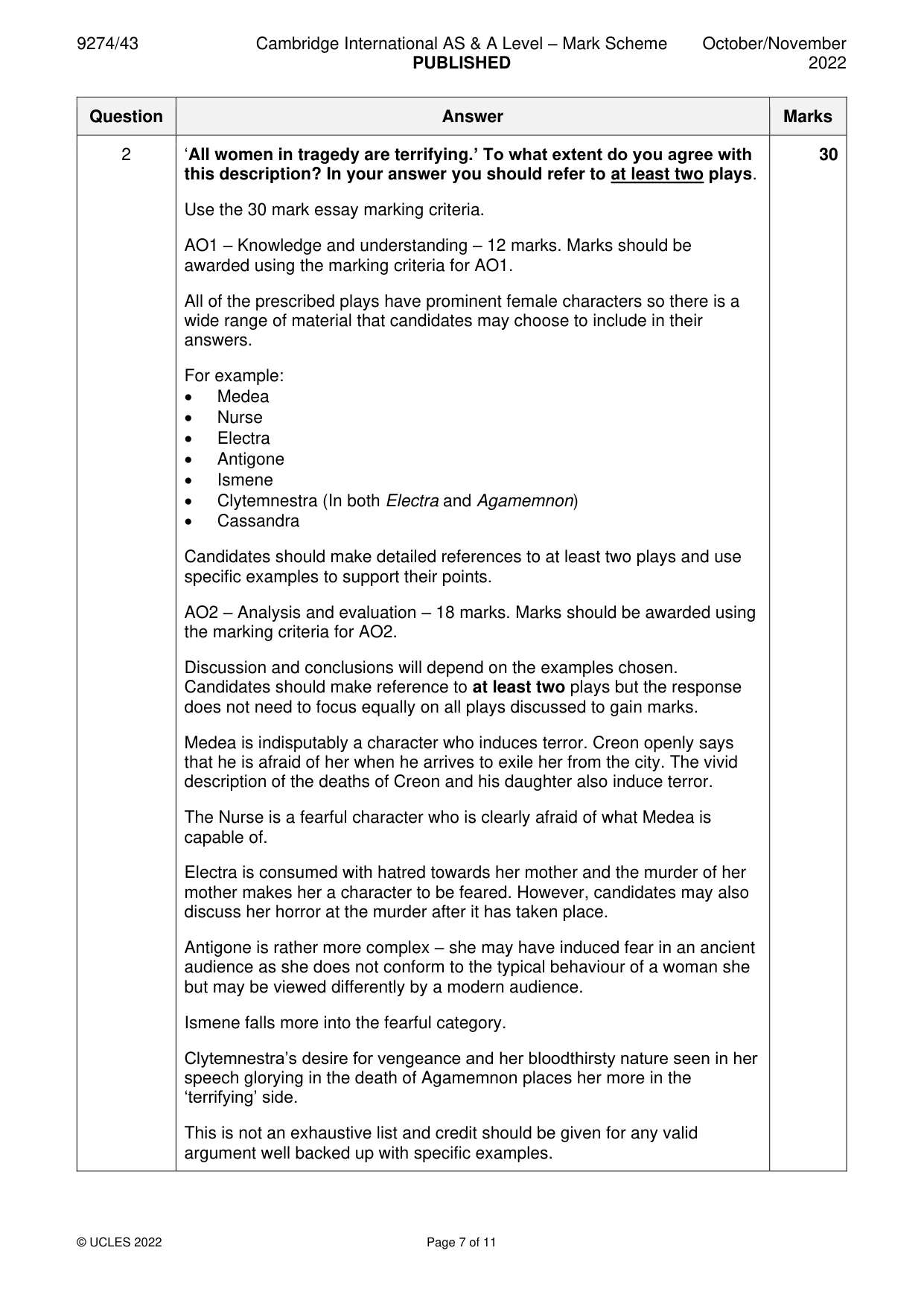
9274/43 Cambridge International AS & A Level – Mark Scheme PUBLISHED October/November 2022 © UCLES 2022 Page 7 of 11 Question Answer Marks 2 ‘All women in tragedy are terrifying.’ To what extent do you agree with this description? In your answer you should refer to at least two plays. Use the 30 mark essay marking criteria. AO1 – Knowledge and understanding – 12 marks. Marks should be awarded using the marking criteria for AO1. All of the prescribed plays have prominent female characters so there is a wide range of material that candidates may choose to include in their answers. For example: • Medea • Nurse • Electra • Antigone • Ismene • Clytemnestra (In both Electra and Agamemnon) • Cassandra Candidates should make detailed references to at least two plays and use specific examples to support their points. AO2 – Analysis and evaluation – 18 marks. Marks should be awarded using the marking criteria for AO2. Discussion and conclusions will depend on the examples chosen. Candidates should make reference to at least two plays but the response does not need to focus equally on all plays discussed to gain marks. Medea is indisputably a character who induces terror. Creon openly says that he is afraid of her when he arrives to exile her from the city. The vivid description of the deaths of Creon and his daughter also induce terror. The Nurse is a fearful character who is clearly afraid of what Medea is capable of. Electra is consumed with hatred towards her mother and the murder of her mother makes her a character to be feared. However, candidates may also discuss her horror at the murder after it has taken place. Antigone is rather more complex – she may have induced fear in an ancient audience as she does not conform to the typical behaviour of a woman she but may be viewed differently by a modern audience. Ismene falls more into the fearful category. Clytemnestra’s desire for vengeance and her bloodthirsty nature seen in her speech glorying in the death of Agamemnon places her more in the ‘terrifying’ side. This is not an exhaustive list and credit should be given for any valid argument well backed up with specific examples. 30
Mark scheme, page 8
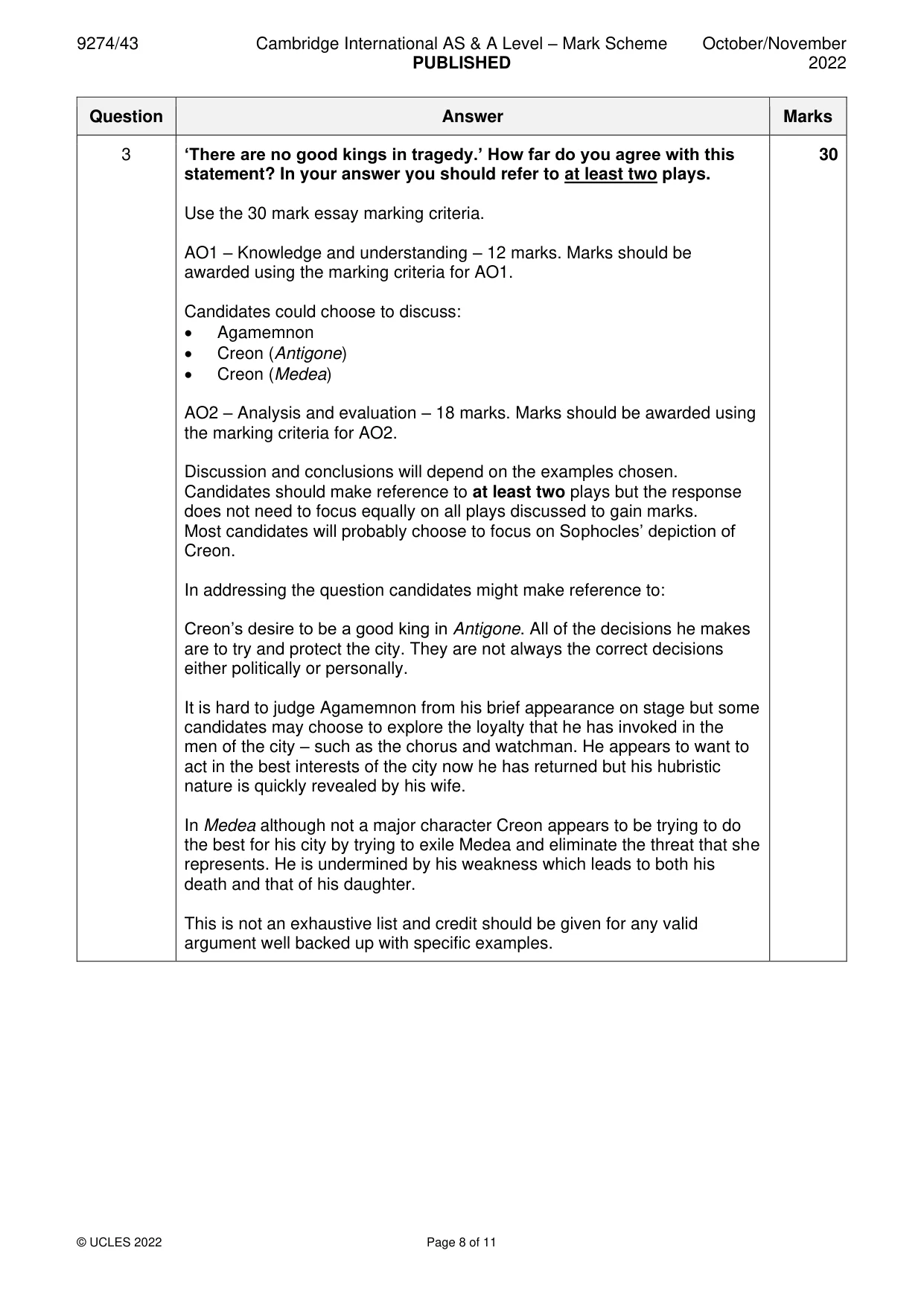
9274/43 Cambridge International AS & A Level – Mark Scheme PUBLISHED October/November 2022 © UCLES 2022 Page 8 of 11 Question Answer Marks 3 ‘There are no good kings in tragedy.’ How far do you agree with this statement? In your answer you should refer to at least two plays. Use the 30 mark essay marking criteria. AO1 – Knowledge and understanding – 12 marks. Marks should be awarded using the marking criteria for AO1. Candidates could choose to discuss: • Agamemnon • Creon (Antigone) • Creon (Medea) AO2 – Analysis and evaluation – 18 marks. Marks should be awarded using the marking criteria for AO2. Discussion and conclusions will depend on the examples chosen. Candidates should make reference to at least two plays but the response does not need to focus equally on all plays discussed to gain marks. Most candidates will probably choose to focus on Sophocles’ depiction of Creon. In addressing the question candidates might make reference to: Creon’s desire to be a good king in Antigone. All of the decisions he makes are to try and protect the city. They are not always the correct decisions either politically or personally. It is hard to judge Agamemnon from his brief appearance on stage but some candidates may choose to explore the loyalty that he has invoked in the men of the city – such as the chorus and watchman. He appears to want to act in the best interests of the city now he has returned but his hubristic nature is quickly revealed by his wife. In Medea although not a major character Creon appears to be trying to do the best for his city by trying to exile Medea and eliminate the threat that she represents. He is undermined by his weakness which leads to both his death and that of his daughter. This is not an exhaustive list and credit should be given for any valid argument well backed up with specific examples. 30
Mark scheme, page 9
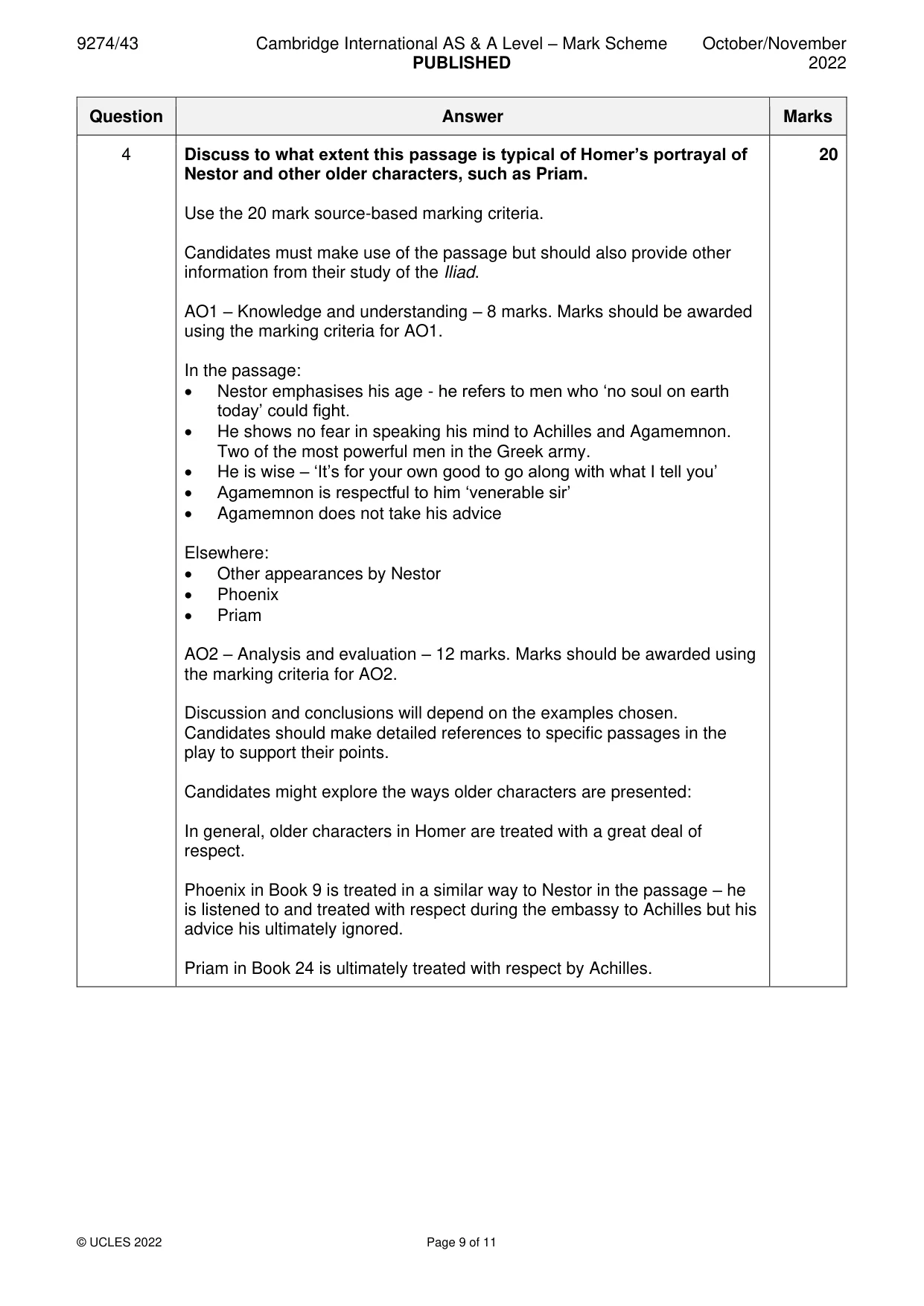
9274/43 Cambridge International AS & A Level – Mark Scheme PUBLISHED October/November 2022 © UCLES 2022 Page 9 of 11 Question Answer Marks 4 Discuss to what extent this passage is typical of Homer’s portrayal of Nestor and other older characters, such as Priam. Use the 20 mark source-based marking criteria. Candidates must make use of the passage but should also provide other information from their study of the Iliad. AO1 – Knowledge and understanding – 8 marks. Marks should be awarded using the marking criteria for AO1. In the passage: • Nestor emphasises his age - he refers to men who ‘no soul on earth today’ could fight. • He shows no fear in speaking his mind to Achilles and Agamemnon. Two of the most powerful men in the Greek army. • He is wise – ‘It’s for your own good to go along with what I tell you’ • Agamemnon is respectful to him ‘venerable sir’ • Agamemnon does not take his advice Elsewhere: • Other appearances by Nestor • Phoenix • Priam AO2 – Analysis and evaluation – 12 marks. Marks should be awarded using the marking criteria for AO2. Discussion and conclusions will depend on the examples chosen. Candidates should make detailed references to specific passages in the play to support their points. Candidates might explore the ways older characters are presented: In general, older characters in Homer are treated with a great deal of respect. Phoenix in Book 9 is treated in a similar way to Nestor in the passage – he is listened to and treated with respect during the embassy to Achilles but his advice his ultimately ignored. Priam in Book 24 is ultimately treated with respect by Achilles. 20
Mark scheme, page 10
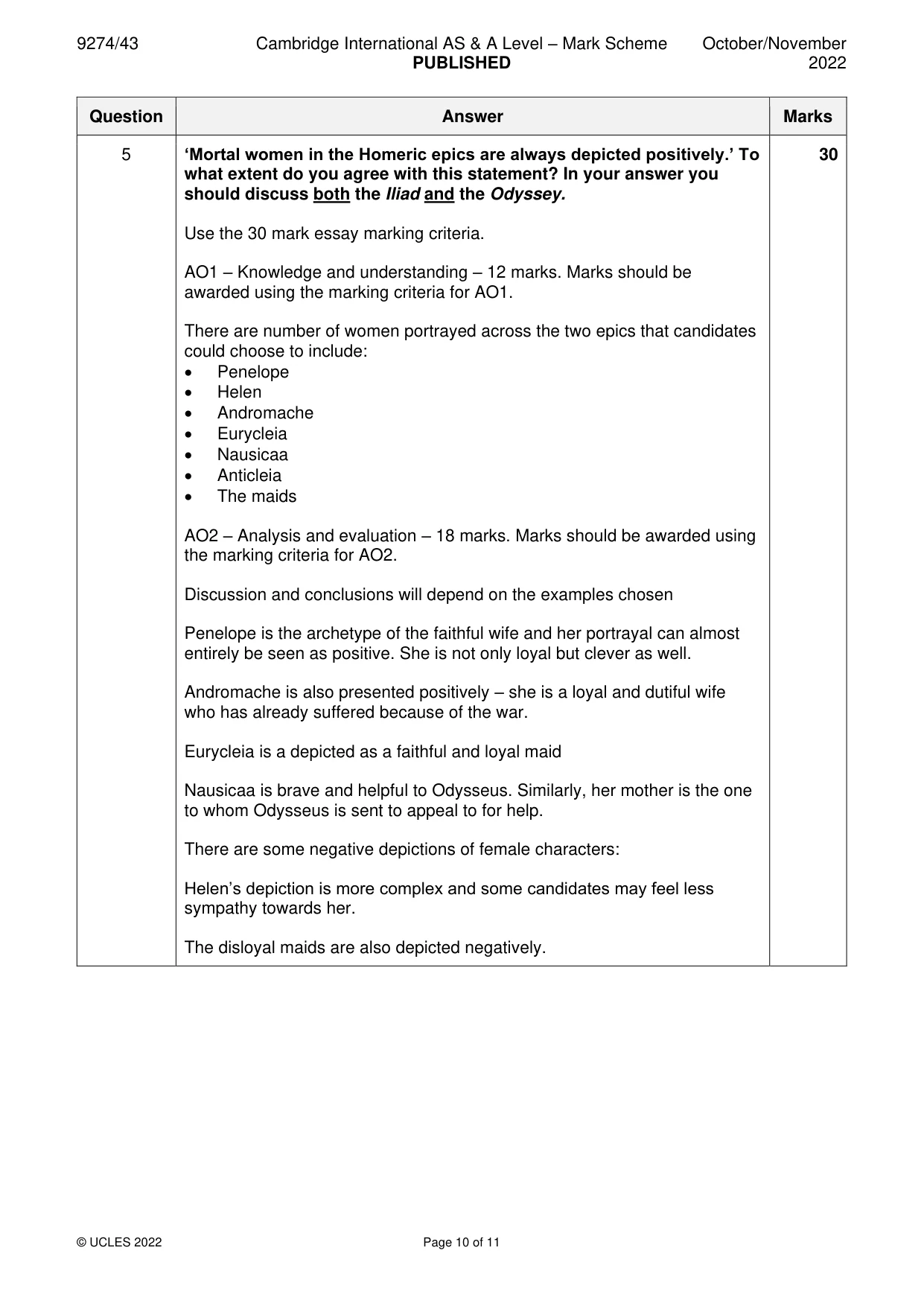
9274/43 Cambridge International AS & A Level – Mark Scheme PUBLISHED October/November 2022 © UCLES 2022 Page 10 of 11 Question Answer Marks 5 ‘Mortal women in the Homeric epics are always depicted positively.’ To what extent do you agree with this statement? In your answer you should discuss both the Iliad and the Odyssey. Use the 30 mark essay marking criteria. AO1 – Knowledge and understanding – 12 marks. Marks should be awarded using the marking criteria for AO1. There are number of women portrayed across the two epics that candidates could choose to include: • Penelope • Helen • Andromache • Eurycleia • Nausicaa • Anticleia • The maids AO2 – Analysis and evaluation – 18 marks. Marks should be awarded using the marking criteria for AO2. Discussion and conclusions will depend on the examples chosen Penelope is the archetype of the faithful wife and her portrayal can almost entirely be seen as positive. She is not only loyal but clever as well. Andromache is also presented positively – she is a loyal and dutiful wife who has already suffered because of the war. Eurycleia is a depicted as a faithful and loyal maid Nausicaa is brave and helpful to Odysseus. Similarly, her mother is the one to whom Odysseus is sent to appeal to for help. There are some negative depictions of female characters: Helen’s depiction is more complex and some candidates may feel less sympathy towards her. The disloyal maids are also depicted negatively. 30
Mark scheme, page 11
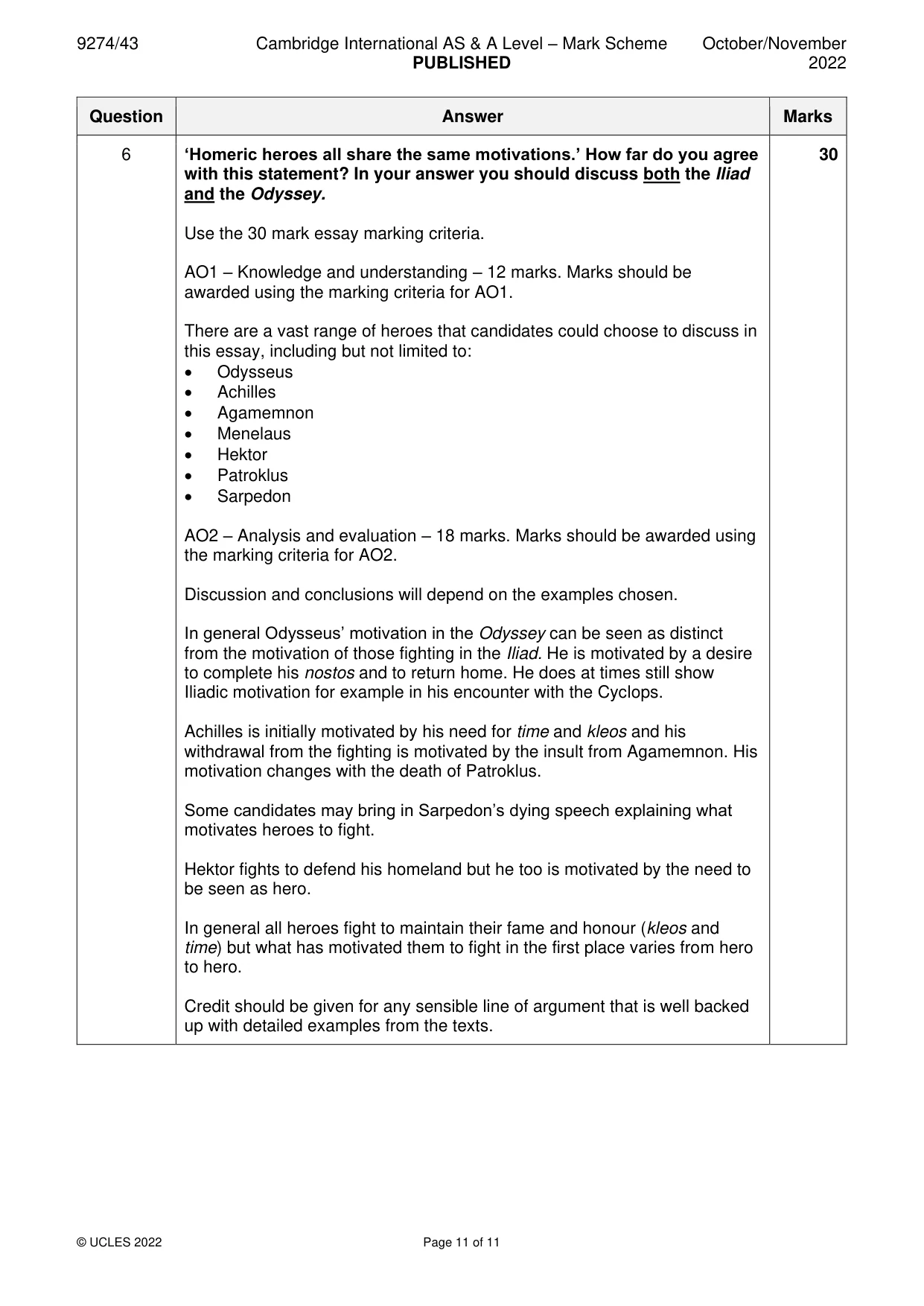
9274/43 Cambridge International AS & A Level – Mark Scheme PUBLISHED October/November 2022 © UCLES 2022 Page 11 of 11 Question Answer Marks 6 ‘Homeric heroes all share the same motivations.’ How far do you agree with this statement? In your answer you should discuss both the Iliad and the Odyssey. Use the 30 mark essay marking criteria. AO1 – Knowledge and understanding – 12 marks. Marks should be awarded using the marking criteria for AO1. There are a vast range of heroes that candidates could choose to discuss in this essay, including but not limited to: • Odysseus • Achilles • Agamemnon • Menelaus • Hektor • Patroklus • Sarpedon AO2 – Analysis and evaluation – 18 marks. Marks should be awarded using the marking criteria for AO2. Discussion and conclusions will depend on the examples chosen. In general Odysseus’ motivation in the Odyssey can be seen as distinct from the motivation of those fighting in the Iliad. He is motivated by a desire to complete his nostos and to return home. He does at times still show Iliadic motivation for example in his encounter with the Cyclops. Achilles is initially motivated by his need for time and kleos and his withdrawal from the fighting is motivated by the insult from Agamemnon. His motivation changes with the death of Patroklus. Some candidates may bring in Sarpedon’s dying speech explaining what motivates heroes to fight. Hektor fights to defend his homeland but he too is motivated by the need to be seen as hero. In general all heroes fight to maintain their fame and honour (kleos and time) but what has motivated them to fight in the first place varies from hero to hero. Credit should be given for any sensible line of argument that is well backed up with detailed examples from the texts. 30
What you needed in this session
Cambridge’s own grade thresholds for 2022 Oct/Nov, Paper 4 · Variant 3. A higher threshold means an easier paper — the bar moves with how the cohort did.