Cambridge A Level Classical Studies 9274 — 2021 Oct/Nov Paper 4 · Variant 3
9274/43/O/N/21 · 50 marks · ≈56 min
The question paper and its mark scheme, free to read here and free to download. This is Cambridge’s own paper, exactly as it was sat.
Question paper4 pages

Mark scheme7 pages
Answers below. Sit the paper first if you are practising.
Paper as text
Question paper, page 1
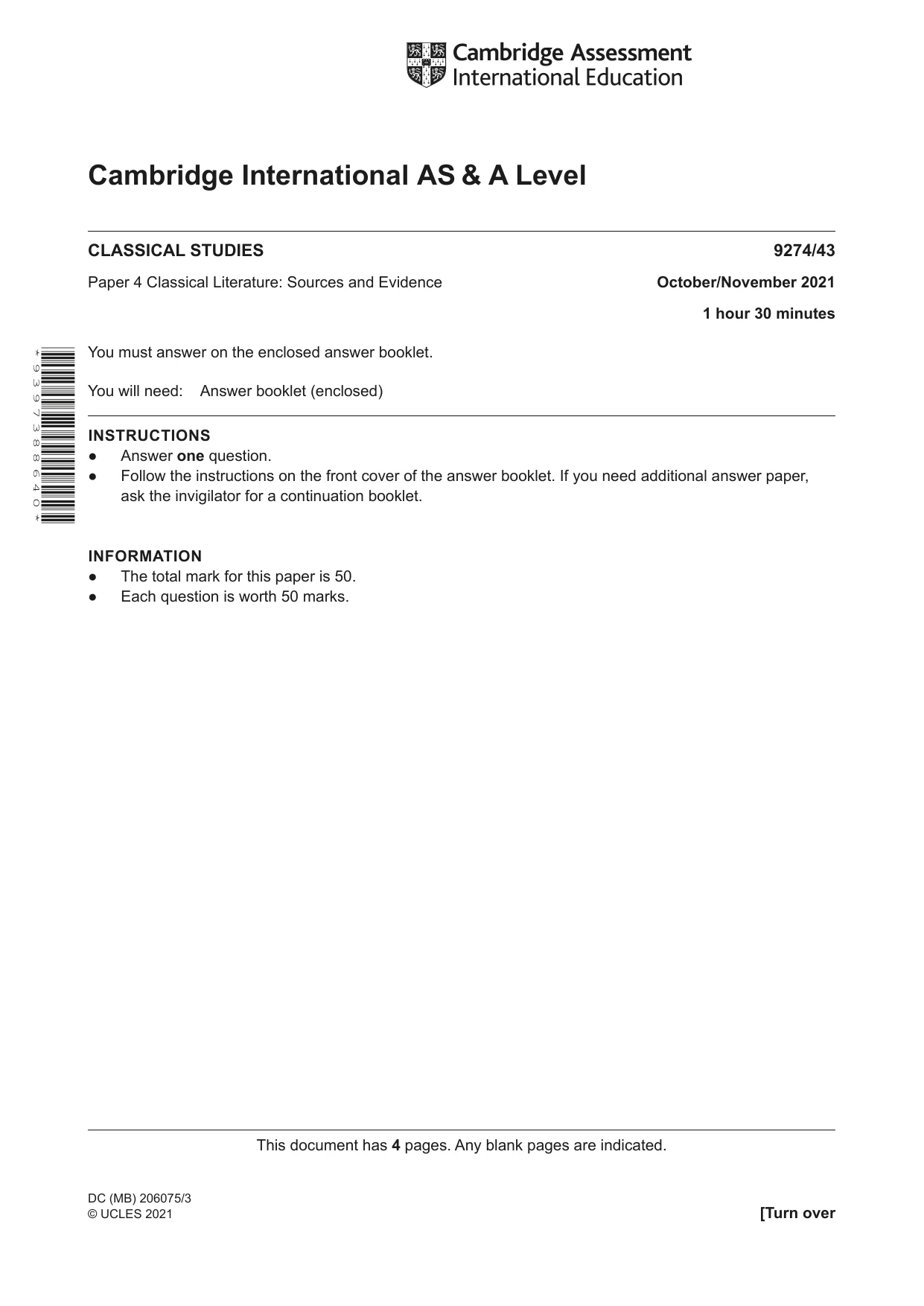
This document has 4 pages. Any blank pages are indicated. Cambridge International AS & A Level CLASSICAL STUDIES 9274/43 Paper 4 Classical Literature: Sources and Evidence October/November 2021 1 hour 30 minutes You must answer on the enclosed answer booklet. You will need: Answer booklet (enclosed) INSTRUCTIONS ● Answer one question. ● Follow the instructions on the front cover of the answer booklet. If you need additional answer paper, ask the invigilator for a continuation booklet. INFORMATION ● The total mark for this paper is 50. ● Each question is worth 50 marks. DC (MB) 206075/3 © UCLES 2021 [Turn over * 9 3 9 7 3 8 8 6 4 0 *
Question paper, page 2
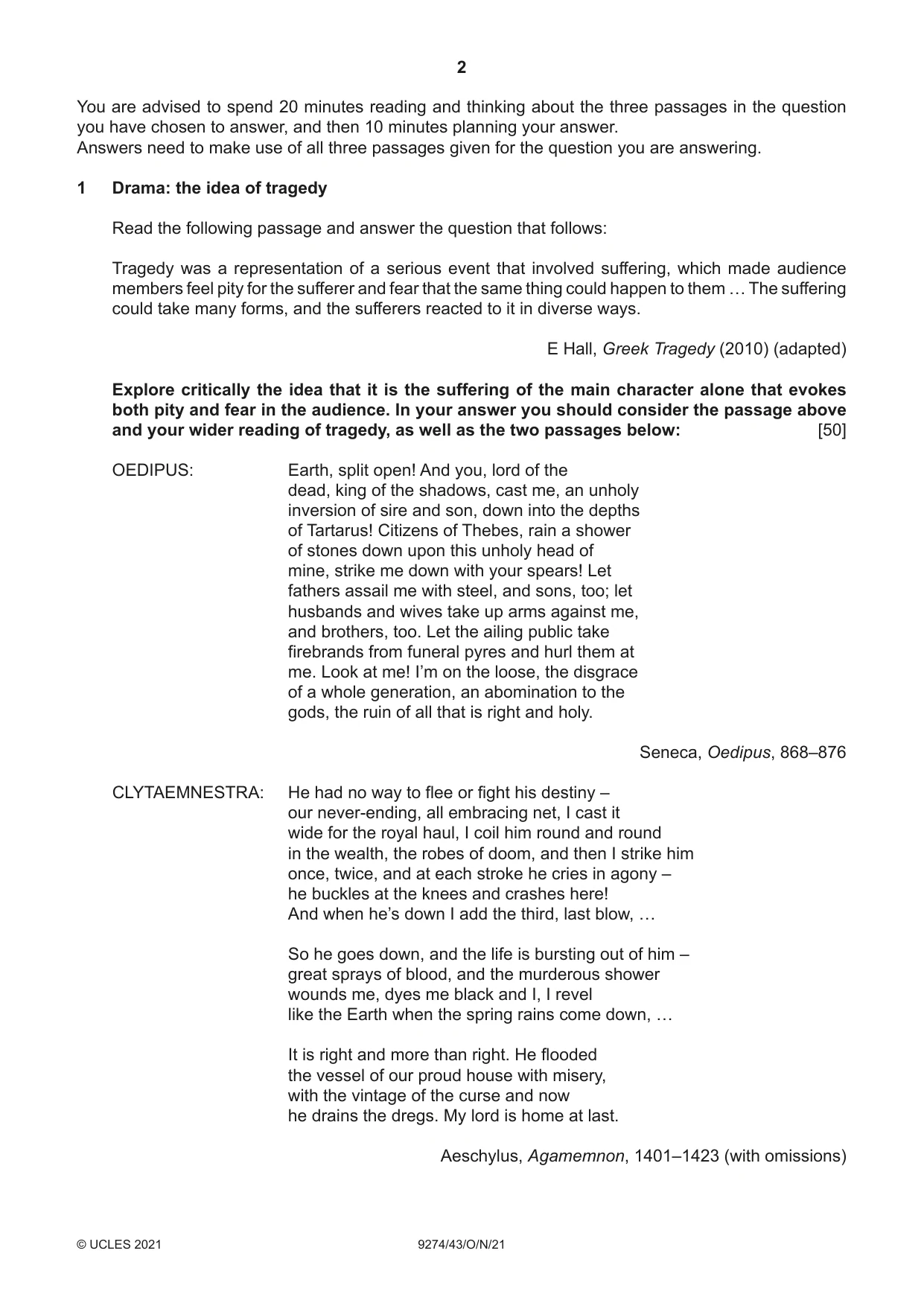
2 9274/43/O/N/21 © UCLES 2021 You are advised to spend 20 minutes reading and thinking about the three passages in the question you have chosen to answer, and then 10 minutes planning your answer. Answers need to make use of all three passages given for the question you are answering. 1 Drama: the idea of tragedy Read the following passage and answer the question that follows: Tragedy was a representation of a serious event that involved suffering, which made audience members feel pity for the sufferer and fear that the same thing could happen to them … The suffering could take many forms, and the sufferers reacted to it in diverse ways. E Hall, Greek Tragedy (2010) (adapted) Explore critically the idea that it is the suffering of the main character alone that evokes both pity and fear in the audience. In your answer you should consider the passage above and your wider reading of tragedy, as well as the two passages below: [50] OEDIPUS: Earth, split open! And you, lord of the dead, king of the shadows, cast me, an unholy inversion of sire and son, down into the depths of Tartarus! Citizens of Thebes, rain a shower of stones down upon this unholy head of mine, strike me down with your spears! Let fathers assail me with steel, and sons, too; let husbands and wives take up arms against me, and brothers, too. Let the ailing public take firebrands from funeral pyres and hurl them at me. Look at me! I’m on the loose, the disgrace of a whole generation, an abomination to the gods, the ruin of all that is right and holy. Seneca, Oedipus, 868–876 CLYTAEMNESTRA: He had no way to flee or fight his destiny – our never-ending, all embracing net, I cast it wide for the royal haul, I coil him round and round in the wealth, the robes of doom, and then I strike him once, twice, and at each stroke he cries in agony – he buckles at the knees and crashes here! And when he’s down I add the third, last blow, … So he goes down, and the life is bursting out of him – great sprays of blood, and the murderous shower wounds me, dyes me black and I, I revel like the Earth when the spring rains come down, … It is right and more than right. He flooded the vessel of our proud house with misery, with the vintage of the curse and now he drains the dregs. My lord is home at last. Aeschylus, Agamemnon, 1401–1423 (with omissions)
Question paper, page 3
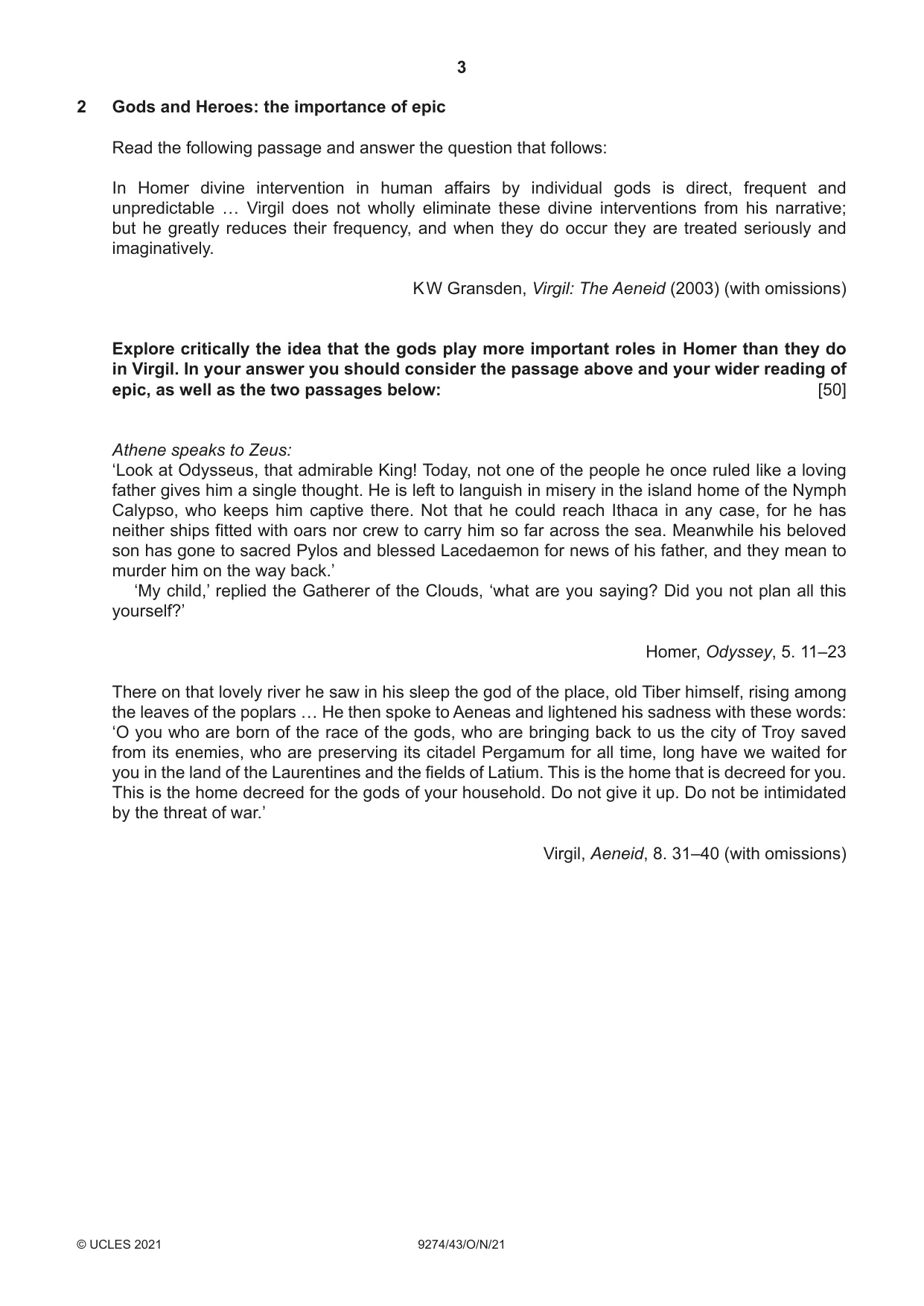
3 9274/43/O/N/21 © UCLES 2021 2 Gods and Heroes: the importance of epic Read the following passage and answer the question that follows: In Homer divine intervention in human affairs by individual gods is direct, frequent and unpredictable … Virgil does not wholly eliminate these divine interventions from his narrative; but he greatly reduces their frequency, and when they do occur they are treated seriously and imaginatively. K W Gransden, Virgil: The Aeneid (2003) (with omissions) Explore critically the idea that the gods play more important roles in Homer than they do in Virgil. In your answer you should consider the passage above and your wider reading of epic, as well as the two passages below: [50] Athene speaks to Zeus: ‘Look at Odysseus, that admirable King! Today, not one of the people he once ruled like a loving father gives him a single thought. He is left to languish in misery in the island home of the Nymph Calypso, who keeps him captive there. Not that he could reach Ithaca in any case, for he has neither ships fitted with oars nor crew to carry him so far across the sea. Meanwhile his beloved son has gone to sacred Pylos and blessed Lacedaemon for news of his father, and they mean to murder him on the way back.’ ‘My child,’ replied the Gatherer of the Clouds, ‘what are you saying? Did you not plan all this yourself?’ Homer, Odyssey, 5. 11–23 There on that lovely river he saw in his sleep the god of the place, old Tiber himself, rising among the leaves of the poplars … He then spoke to Aeneas and lightened his sadness with these words: ‘O you who are born of the race of the gods, who are bringing back to us the city of Troy saved from its enemies, who are preserving its citadel Pergamum for all time, long have we waited for you in the land of the Laurentines and the fields of Latium. This is the home that is decreed for you. This is the home decreed for the gods of your household. Do not give it up. Do not be intimidated by the threat of war.’ Virgil, Aeneid, 8. 31–40 (with omissions)
Question paper, page 4
4 9274/43/O/N/21 © UCLES 2021 Permission to reproduce items where third-party owned material protected by copyright is included has been sought and cleared where possible. Every reasonable effort has been made by the publisher (UCLES) to trace copyright holders, but if any items requiring clearance have unwittingly been included, the publisher will be pleased to make amends at the earliest possible opportunity. To avoid the issue of disclosure of answer-related information to candidates, all copyright acknowledgements are reproduced online in the Cambridge Assessment International Education Copyright Acknowledgements Booklet. This is produced for each series of examinations and is freely available to download at www.cambridgeinternational.org after the live examination series. Cambridge Assessment International Education is part of the Cambridge Assessment Group. Cambridge Assessment is the brand name of the University of Cambridge Local Examinations Syndicate (UCLES), which itself is a department of the University of Cambridge. BLANK PAGE
Mark scheme, page 1
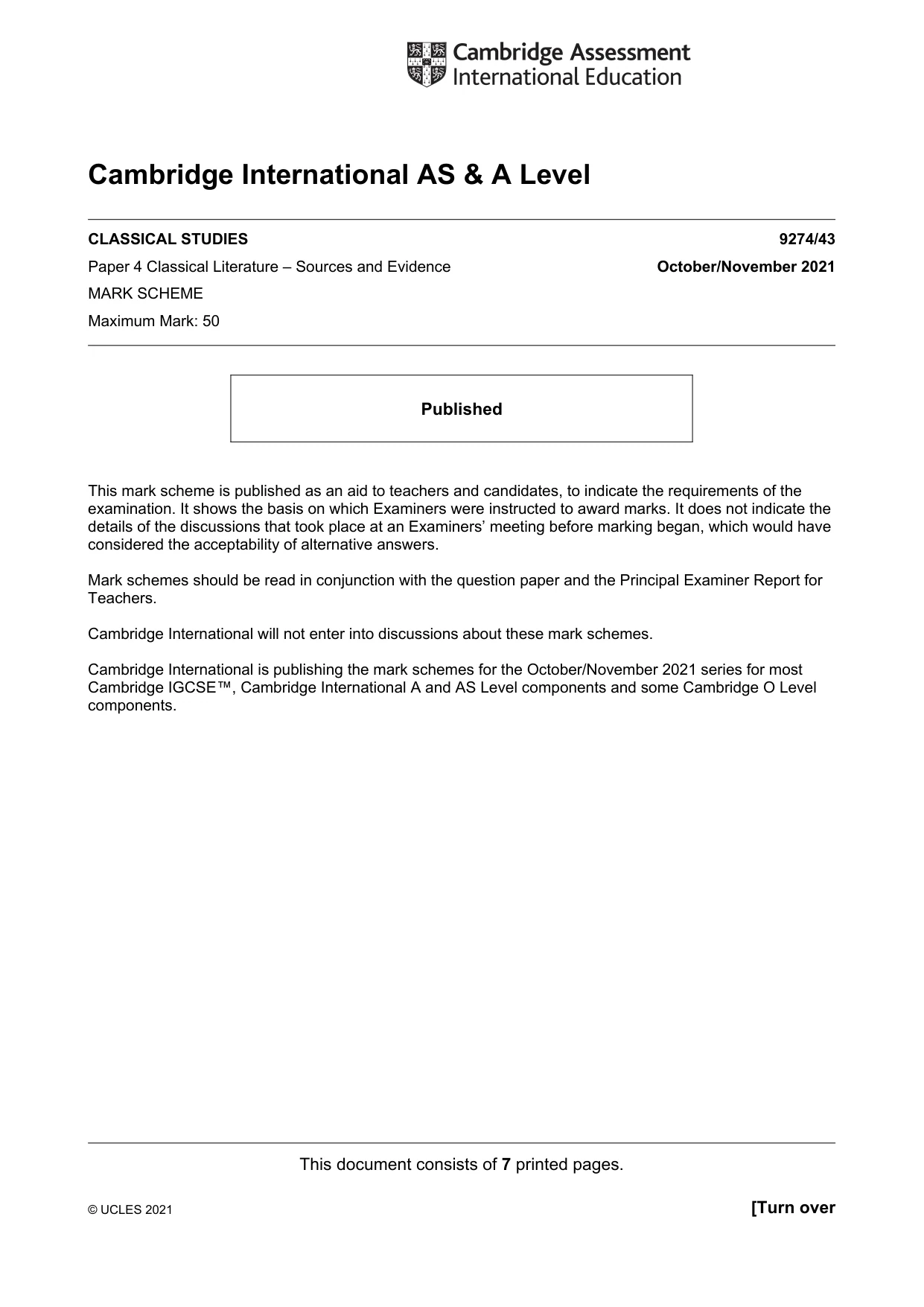
This document consists of 7 printed pages. © UCLES 2021 [Turn over Cambridge International AS & A Level CLASSICAL STUDIES 9274/43 Paper 4 Classical Literature – Sources and Evidence October/November 2021 MARK SCHEME Maximum Mark: 50 Published This mark scheme is published as an aid to teachers and candidates, to indicate the requirements of the examination. It shows the basis on which Examiners were instructed to award marks. It does not indicate the details of the discussions that took place at an Examiners’ meeting before marking began, which would have considered the acceptability of alternative answers. Mark schemes should be read in conjunction with the question paper and the Principal Examiner Report for Teachers. Cambridge International will not enter into discussions about these mark schemes. Cambridge International is publishing the mark schemes for the October/November 2021 series for most Cambridge IGCSE™, Cambridge International A and AS Level components and some Cambridge O Level components.
Mark scheme, page 2
9274/43 Cambridge International AS & A Level – Mark Scheme PUBLISHED October/November 2021 © UCLES 2021 Page 2 of 7 Generic Marking Principles These general marking principles must be applied by all examiners when marking candidate answers. They should be applied alongside the specific content of the mark scheme or generic level descriptors for a question. Each question paper and mark scheme will also comply with these marking principles. GENERIC MARKING PRINCIPLE 1: Marks must be awarded in line with: • the specific content of the mark scheme or the generic level descriptors for the question • the specific skills defined in the mark scheme or in the generic level descriptors for the question • the standard of response required by a candidate as exemplified by the standardisation scripts. GENERIC MARKING PRINCIPLE 2: Marks awarded are always whole marks (not half marks, or other fractions). GENERIC MARKING PRINCIPLE 3: Marks must be awarded positively: • marks are awarded for correct/valid answers, as defined in the mark scheme. However, credit is given for valid answers which go beyond the scope of the syllabus and mark scheme, referring to your Team Leader as appropriate • marks are awarded when candidates clearly demonstrate what they know and can do • marks are not deducted for errors • marks are not deducted for omissions • answers should only be judged on the quality of spelling, punctuation and grammar when these features are specifically assessed by the question as indicated by the mark scheme. The meaning, however, should be unambiguous. GENERIC MARKING PRINCIPLE 4: Rules must be applied consistently, e.g. in situations where candidates have not followed instructions or in the application of generic level descriptors. GENERIC MARKING PRINCIPLE 5: Marks should be awarded using the full range of marks defined in the mark scheme for the question (however; the use of the full mark range may be limited according to the quality of the candidate responses seen). GENERIC MARKING PRINCIPLE 6: Marks awarded are based solely on the requirements as defined in the mark scheme. Marks should not be awarded with grade thresholds or grade descriptors in mind.
Mark scheme, page 3
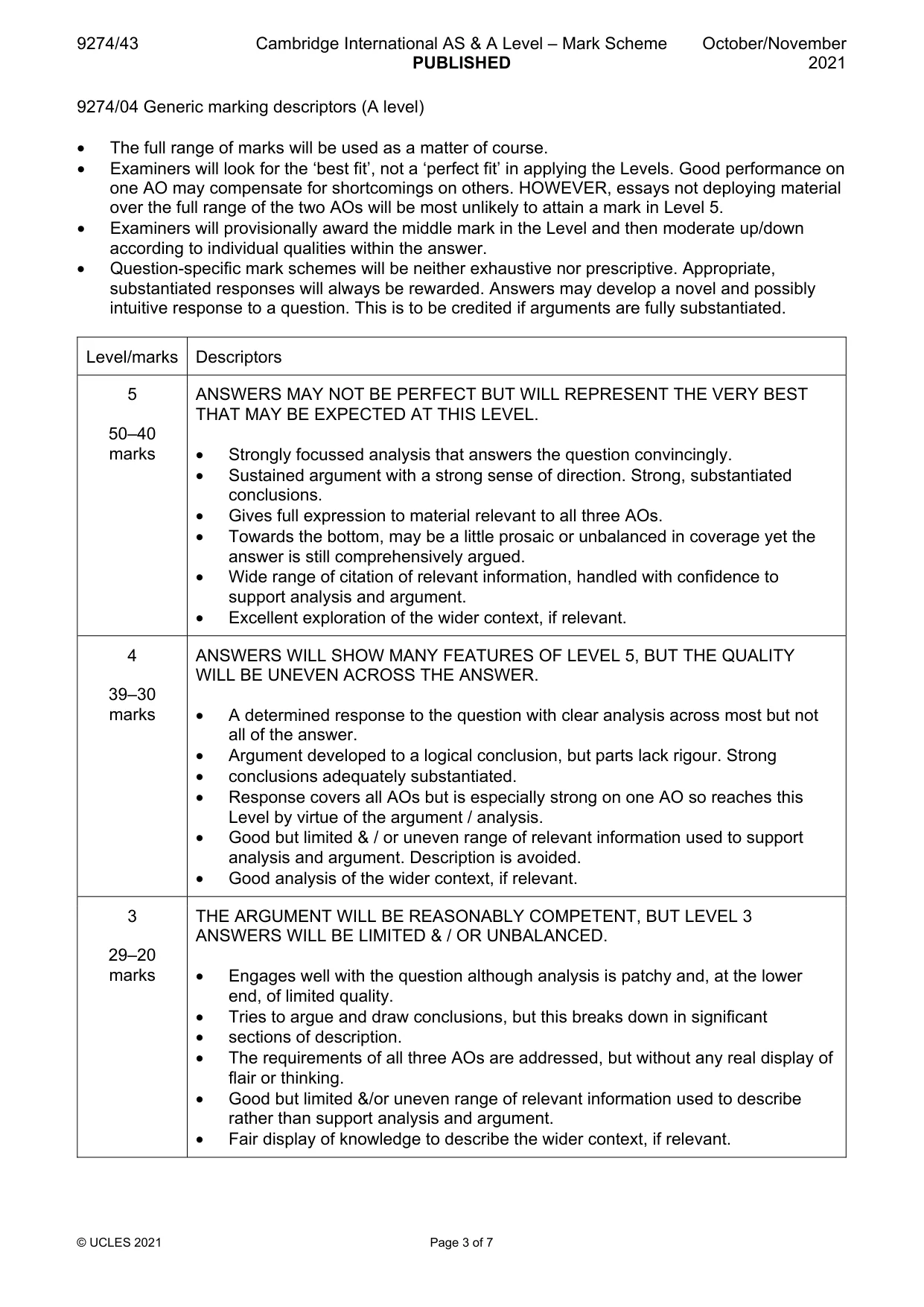
9274/43 Cambridge International AS & A Level – Mark Scheme PUBLISHED October/November 2021 © UCLES 2021 Page 3 of 7 9274/04 Generic marking descriptors (A level) • The full range of marks will be used as a matter of course. • Examiners will look for the ‘best fit’, not a ‘perfect fit’ in applying the Levels. Good performance on one AO may compensate for shortcomings on others. HOWEVER, essays not deploying material over the full range of the two AOs will be most unlikely to attain a mark in Level 5. • Examiners will provisionally award the middle mark in the Level and then moderate up/down according to individual qualities within the answer. • Question-specific mark schemes will be neither exhaustive nor prescriptive. Appropriate, substantiated responses will always be rewarded. Answers may develop a novel and possibly intuitive response to a question. This is to be credited if arguments are fully substantiated. Level/marks Descriptors 5 50–40 marks ANSWERS MAY NOT BE PERFECT BUT WILL REPRESENT THE VERY BEST THAT MAY BE EXPECTED AT THIS LEVEL. • Strongly focussed analysis that answers the question convincingly. • Sustained argument with a strong sense of direction. Strong, substantiated conclusions. • Gives full expression to material relevant to all three AOs. • Towards the bottom, may be a little prosaic or unbalanced in coverage yet the answer is still comprehensively argued. • Wide range of citation of relevant information, handled with confidence to support analysis and argument. • Excellent exploration of the wider context, if relevant. 4 39–30 marks ANSWERS WILL SHOW MANY FEATURES OF LEVEL 5, BUT THE QUALITY WILL BE UNEVEN ACROSS THE ANSWER. • A determined response to the question with clear analysis across most but not all of the answer. • Argument developed to a logical conclusion, but parts lack rigour. Strong • conclusions adequately substantiated. • Response covers all AOs but is especially strong on one AO so reaches this Level by virtue of the argument / analysis. • Good but limited & / or uneven range of relevant information used to support analysis and argument. Description is avoided. • Good analysis of the wider context, if relevant. 3 29–20 marks THE ARGUMENT WILL BE REASONABLY COMPETENT, BUT LEVEL 3 ANSWERS WILL BE LIMITED & / OR UNBALANCED. • Engages well with the question although analysis is patchy and, at the lower end, of limited quality. • Tries to argue and draw conclusions, but this breaks down in significant • sections of description. • The requirements of all three AOs are addressed, but without any real display of flair or thinking. • Good but limited &/or uneven range of relevant information used to describe rather than support analysis and argument. • Fair display of knowledge to describe the wider context, if relevant.
Mark scheme, page 4
9274/43 Cambridge International AS & A Level – Mark Scheme PUBLISHED October/November 2021 © UCLES 2021 Page 4 of 7 Level/marks Descriptors 2 19–10 marks ANSWERS WILL SHOW A GENERAL MISMATCH BETWEEN QUESTION AND ANSWER. • Some engagement with the question, but limited understanding of the issues. Analysis is limited / thin. • Limited argument within an essentially descriptive response. Conclusions are limited / thin. • Factually limited &/or uneven. Some irrelevance. • Perhaps stronger on AO1 than AO2 (which might be addressed superficially or ignored altogether). • Patchy display of knowledge to describe the wider context, if relevant. 1 9–0 marks ANSWERS IN LEVEL 1 WILL BE VERY POOR. • Little or no engagement with the question. Little or no analysis offered. • Little or no argument. Any conclusions are very weak. Assertions are unsupported and/or of limited relevance. • Little or no display of relevant information. • Little or no attempt to address AO3. • Little or no reference to the wider context, if relevant.
Mark scheme, page 5
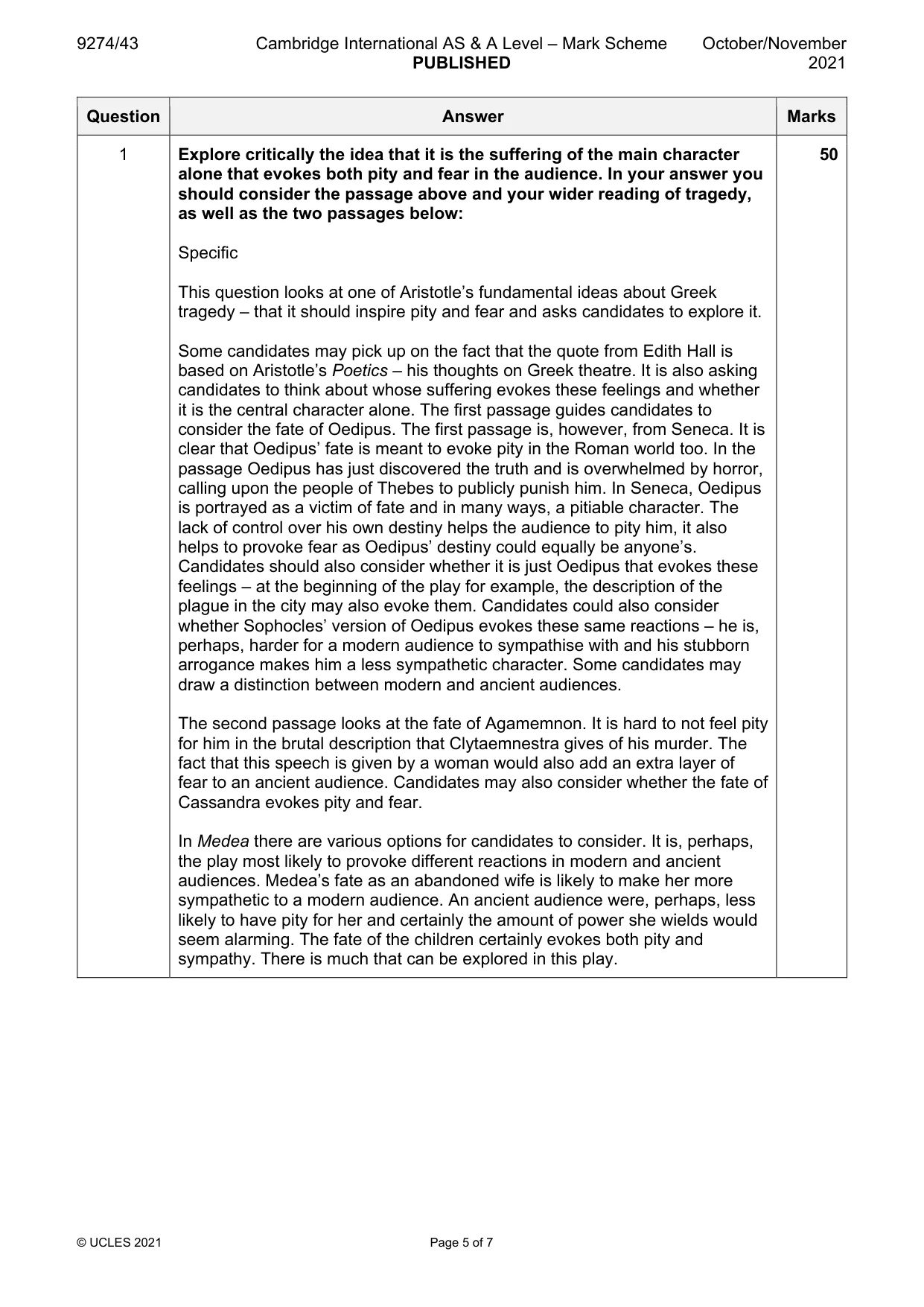
9274/43 Cambridge International AS & A Level – Mark Scheme PUBLISHED October/November 2021 © UCLES 2021 Page 5 of 7 Question Answer Marks 1 Explore critically the idea that it is the suffering of the main character alone that evokes both pity and fear in the audience. In your answer you should consider the passage above and your wider reading of tragedy, as well as the two passages below: Specific This question looks at one of Aristotle’s fundamental ideas about Greek tragedy – that it should inspire pity and fear and asks candidates to explore it. Some candidates may pick up on the fact that the quote from Edith Hall is based on Aristotle’s Poetics – his thoughts on Greek theatre. It is also asking candidates to think about whose suffering evokes these feelings and whether it is the central character alone. The first passage guides candidates to consider the fate of Oedipus. The first passage is, however, from Seneca. It is clear that Oedipus’ fate is meant to evoke pity in the Roman world too. In the passage Oedipus has just discovered the truth and is overwhelmed by horror, calling upon the people of Thebes to publicly punish him. In Seneca, Oedipus is portrayed as a victim of fate and in many ways, a pitiable character. The lack of control over his own destiny helps the audience to pity him, it also helps to provoke fear as Oedipus’ destiny could equally be anyone’s. Candidates should also consider whether it is just Oedipus that evokes these feelings – at the beginning of the play for example, the description of the plague in the city may also evoke them. Candidates could also consider whether Sophocles’ version of Oedipus evokes these same reactions – he is, perhaps, harder for a modern audience to sympathise with and his stubborn arrogance makes him a less sympathetic character. Some candidates may draw a distinction between modern and ancient audiences. The second passage looks at the fate of Agamemnon. It is hard to not feel pity for him in the brutal description that Clytaemnestra gives of his murder. The fact that this speech is given by a woman would also add an extra layer of fear to an ancient audience. Candidates may also consider whether the fate of Cassandra evokes pity and fear. In Medea there are various options for candidates to consider. It is, perhaps, the play most likely to provoke different reactions in modern and ancient audiences. Medea’s fate as an abandoned wife is likely to make her more sympathetic to a modern audience. An ancient audience were, perhaps, less likely to have pity for her and certainly the amount of power she wields would seem alarming. The fate of the children certainly evokes both pity and sympathy. There is much that can be explored in this play. 50
Mark scheme, page 6
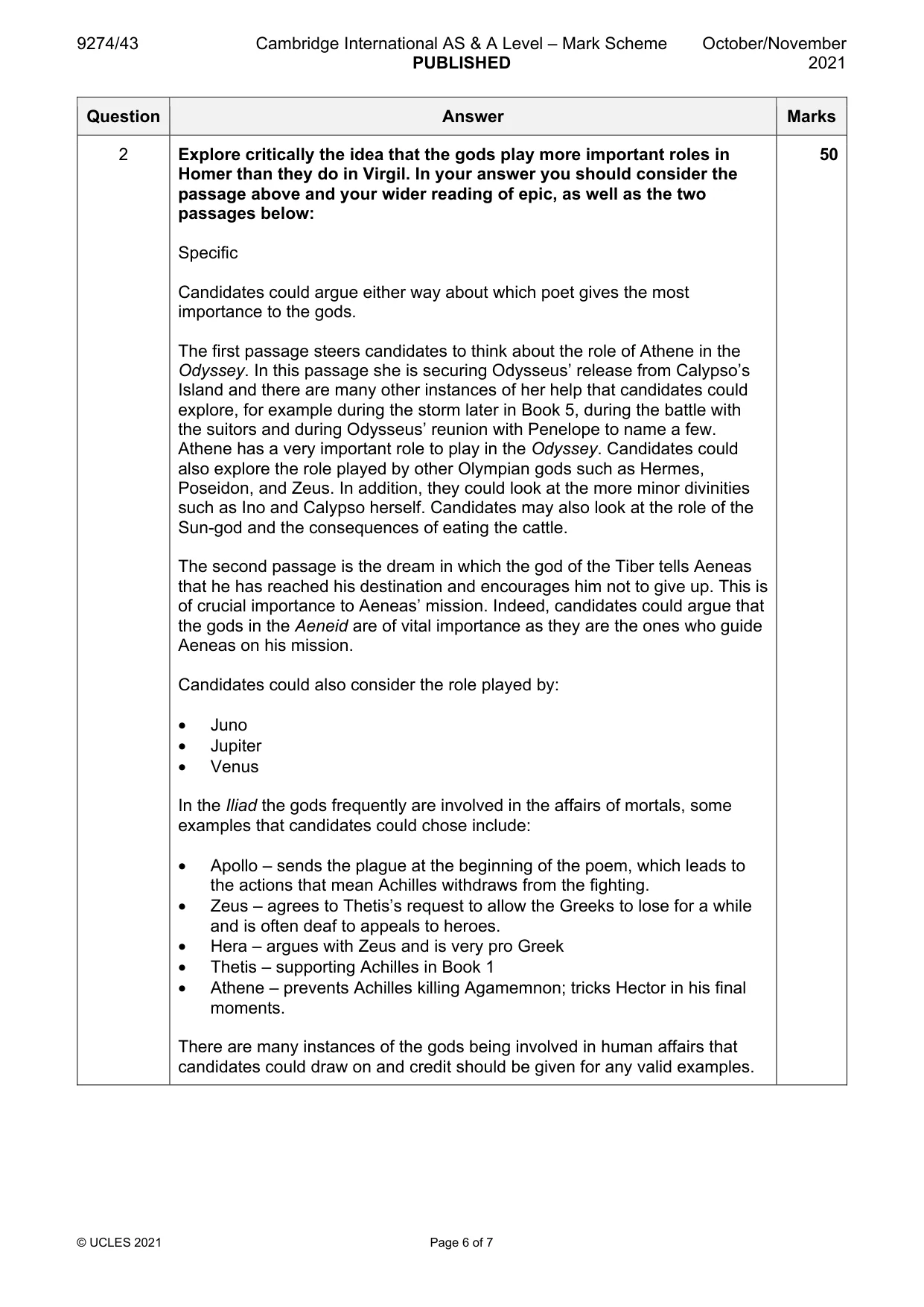
9274/43 Cambridge International AS & A Level – Mark Scheme PUBLISHED October/November 2021 © UCLES 2021 Page 6 of 7 Question Answer Marks 2 Explore critically the idea that the gods play more important roles in Homer than they do in Virgil. In your answer you should consider the passage above and your wider reading of epic, as well as the two passages below: Specific Candidates could argue either way about which poet gives the most importance to the gods. The first passage steers candidates to think about the role of Athene in the Odyssey. In this passage she is securing Odysseus’ release from Calypso’s Island and there are many other instances of her help that candidates could explore, for example during the storm later in Book 5, during the battle with the suitors and during Odysseus’ reunion with Penelope to name a few. Athene has a very important role to play in the Odyssey. Candidates could also explore the role played by other Olympian gods such as Hermes, Poseidon, and Zeus. In addition, they could look at the more minor divinities such as Ino and Calypso herself. Candidates may also look at the role of the Sun-god and the consequences of eating the cattle. The second passage is the dream in which the god of the Tiber tells Aeneas that he has reached his destination and encourages him not to give up. This is of crucial importance to Aeneas’ mission. Indeed, candidates could argue that the gods in the Aeneid are of vital importance as they are the ones who guide Aeneas on his mission. Candidates could also consider the role played by: • Juno • Jupiter • Venus In the Iliad the gods frequently are involved in the affairs of mortals, some examples that candidates could chose include: • Apollo – sends the plague at the beginning of the poem, which leads to the actions that mean Achilles withdraws from the fighting. • Zeus – agrees to Thetis’s request to allow the Greeks to lose for a while and is often deaf to appeals to heroes. • Hera – argues with Zeus and is very pro Greek • Thetis – supporting Achilles in Book 1 • Athene – prevents Achilles killing Agamemnon; tricks Hector in his final moments. There are many instances of the gods being involved in human affairs that candidates could draw on and credit should be given for any valid examples. 50
Mark scheme, page 7
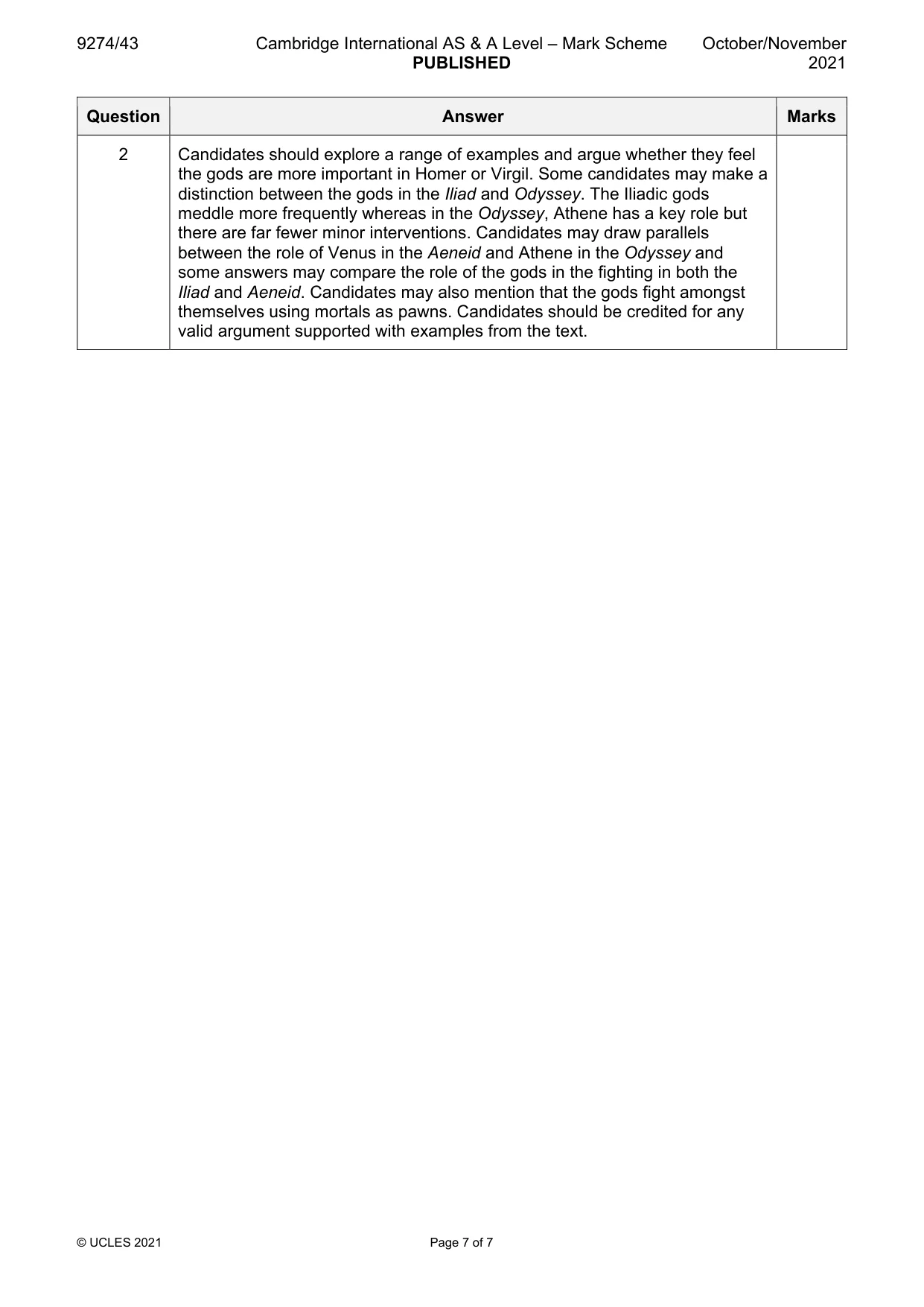
9274/43 Cambridge International AS & A Level – Mark Scheme PUBLISHED October/November 2021 © UCLES 2021 Page 7 of 7 Question Answer Marks 2 Candidates should explore a range of examples and argue whether they feel the gods are more important in Homer or Virgil. Some candidates may make a distinction between the gods in the Iliad and Odyssey. The Iliadic gods meddle more frequently whereas in the Odyssey, Athene has a key role but there are far fewer minor interventions. Candidates may draw parallels between the role of Venus in the Aeneid and Athene in the Odyssey and some answers may compare the role of the gods in the fighting in both the Iliad and Aeneid. Candidates may also mention that the gods fight amongst themselves using mortals as pawns. Candidates should be credited for any valid argument supported with examples from the text.
What you needed in this session
Cambridge’s own grade thresholds for 2021 Oct/Nov, Paper 4 · Variant 3. A higher threshold means an easier paper — the bar moves with how the cohort did.