Cambridge A Level Classical Studies 9274 — 2024 Oct/Nov Paper 4 · Variant 1
9274/41/O/N/24 · 50 marks · ≈56 min
The question paper and its mark scheme, free to read here and free to download. This is Cambridge’s own paper, exactly as it was sat.
Question paper4 pages

Mark scheme11 pages
Answers below. Sit the paper first if you are practising.
Paper as text
Question paper, page 1
[Turn over Cambridge International AS & A Level This document has 4 pages. Any blank pages are indicated. DC (WW) 336457/2 © UCLES 2024 CLASSICAL STUDIES 9274/41 Paper 4 Greek Literature October/November 2024 1 hour 30 minutes You must answer on the enclosed answer booklet. You will need: Answer booklet (enclosed) INSTRUCTIONS ● Answer two questions in total: Answer questions from one section only. For each section, follow the instructions inside on which questions to answer. ● Follow the instructions on the front cover of the answer booklet. If you need additional answer paper, ask the invigilator for a continuation booklet. INFORMATION ● The total mark for this paper is 50. ● The number of marks for each question or part question is shown in brackets [ ]. * 2 1 2 2 2 5 8 5 9 2 *
Question paper, page 2
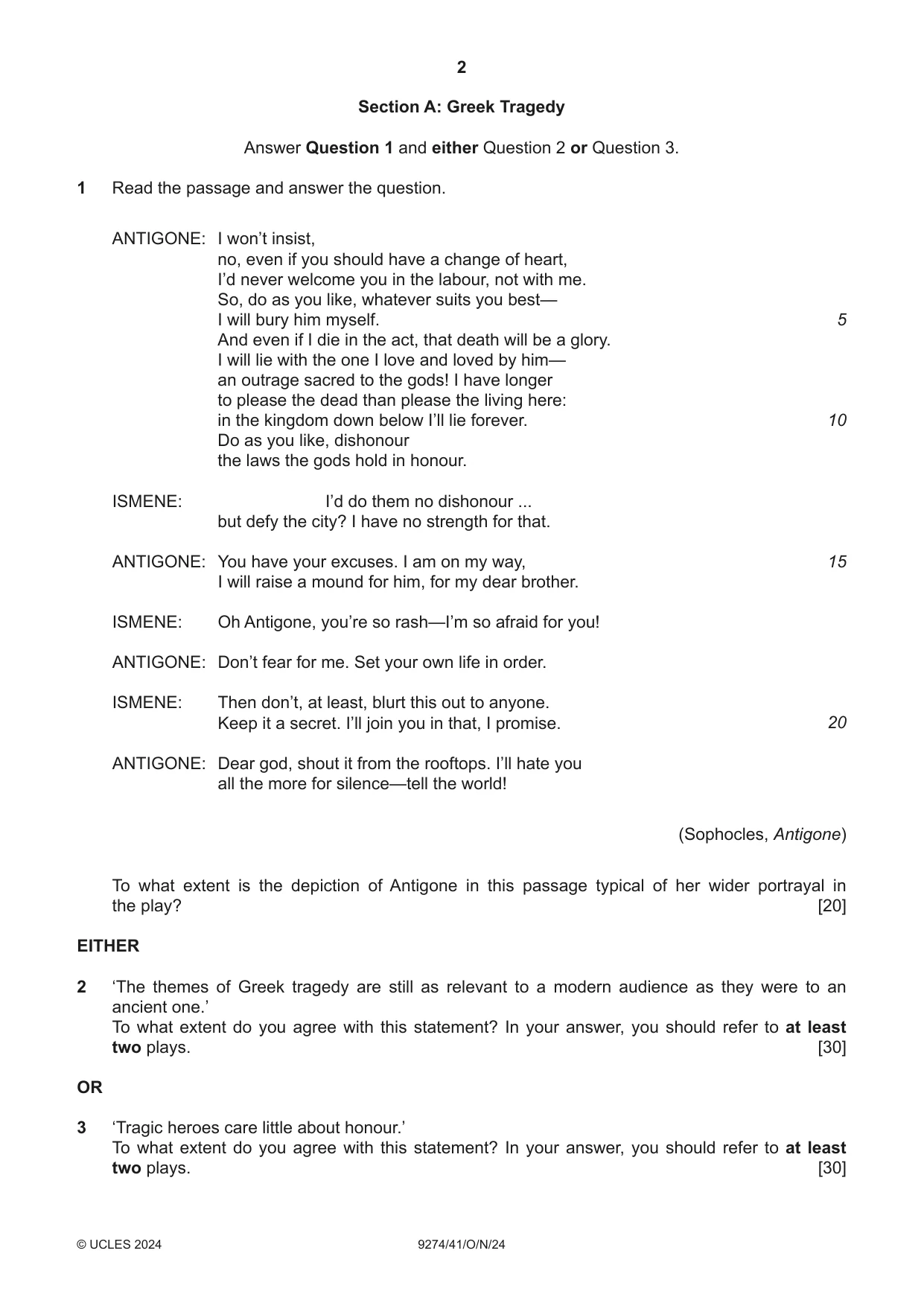
2 9274/41/O/N/24 © UCLES 2024 Section A: Greek Tragedy Answer Question 1 and either Question 2 or Question 3. 1 Read the passage and answer the question. ANTIGONE: I won’t insist, no, even if you should have a change of heart, I’d never welcome you in the labour, not with me. So, do as you like, whatever suits you best— I will bury him myself. And even if I die in the act, that death will be a glory. I will lie with the one I love and loved by him— an outrage sacred to the gods! I have longer to please the dead than please the living here: in the kingdom down below I’ll lie forever. Do as you like, dishonour the laws the gods hold in honour. ISMENE: I’d do them no dishonour ... but defy the city? I have no strength for that. ANTIGONE: You have your excuses. I am on my way, I will raise a mound for him, for my dear brother. ISMENE: Oh Antigone, you’re so rash—I’m so afraid for you! ANTIGONE: Don’t fear for me. Set your own life in order. ISMENE: Then don’t, at least, blurt this out to anyone. Keep it a secret. I’ll join you in that, I promise. ANTIGONE: Dear god, shout it from the rooftops. I’ll hate you all the more for silence—tell the world! (Sophocles, Antigone) To what extent is the depiction of Antigone in this passage typical of her wider portrayal in the play? [20] EITHER 2 ‘The themes of Greek tragedy are still as relevant to a modern audience as they were to an ancient one.’ To what extent do you agree with this statement? In your answer, you should refer to at least two plays. [30] OR 3 ‘Tragic heroes care little about honour.’ To what extent do you agree with this statement? In your answer, you should refer to at least two plays. [30] 5 10 15 20
Question paper, page 3
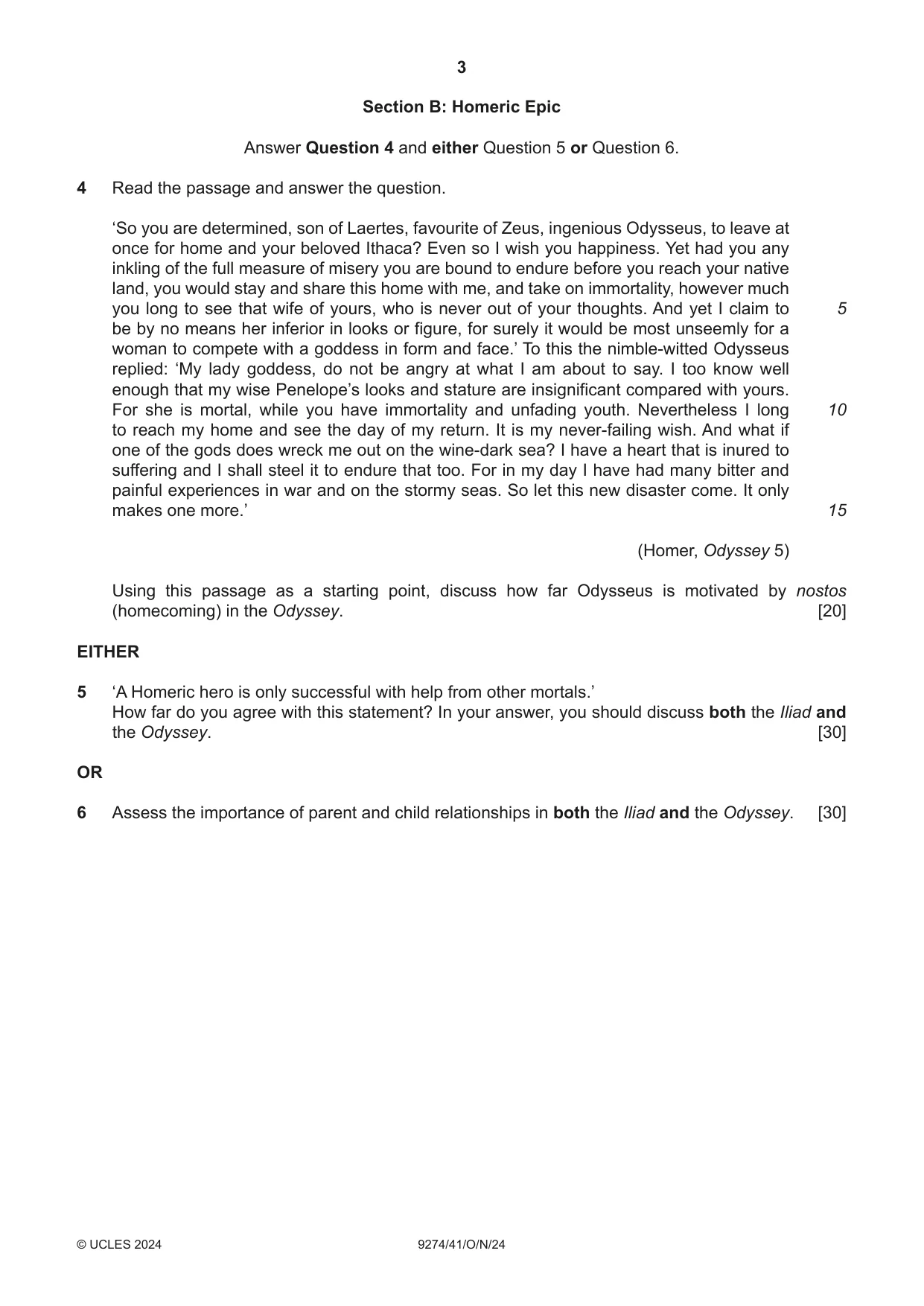
3 9274/41/O/N/24 © UCLES 2024 Section B: Homeric Epic Answer Question 4 and either Question 5 or Question 6. 4 Read the passage and answer the question. ‘So you are determined, son of Laertes, favourite of Zeus, ingenious Odysseus, to leave at once for home and your beloved Ithaca? Even so I wish you happiness. Yet had you any inkling of the full measure of misery you are bound to endure before you reach your native land, you would stay and share this home with me, and take on immortality, however much you long to see that wife of yours, who is never out of your thoughts. And yet I claim to be by no means her inferior in looks or figure, for surely it would be most unseemly for a woman to compete with a goddess in form and face.’ To this the nimble-witted Odysseus replied: ‘My lady goddess, do not be angry at what I am about to say. I too know well enough that my wise Penelope’s looks and stature are insignificant compared with yours. For she is mortal, while you have immortality and unfading youth. Nevertheless I long to reach my home and see the day of my return. It is my never-failing wish. And what if one of the gods does wreck me out on the wine-dark sea? I have a heart that is inured to suffering and I shall steel it to endure that too. For in my day I have had many bitter and painful experiences in war and on the stormy seas. So let this new disaster come. It only makes one more.’ (Homer, Odyssey 5) Using this passage as a starting point, discuss how far Odysseus is motivated by nostos (homecoming) in the Odyssey. [20] EITHER 5 ‘A Homeric hero is only successful with help from other mortals.’ How far do you agree with this statement? In your answer, you should discuss both the Iliad and the Odyssey. [30] OR 6 Assess the importance of parent and child relationships in both the Iliad and the Odyssey. [30] 5 10 15
Question paper, page 4
4 9274/41/O/N/24 © UCLES 2024 Permission to reproduce items where third-party owned material protected by copyright is included has been sought and cleared where possible. Every reasonable effort has been made by the publisher (UCLES) to trace copyright holders, but if any items requiring clearance have unwittingly been included, the publisher will be pleased to make amends at the earliest possible opportunity. To avoid the issue of disclosure of answer-related information to candidates, all copyright acknowledgements are reproduced online in the Cambridge Assessment International Education Copyright Acknowledgements Booklet. This is produced for each series of examinations and is freely available to download at www.cambridgeinternational.org after the live examination series. Cambridge Assessment International Education is part of Cambridge Assessment. Cambridge Assessment is the brand name of the University of Cambridge Local Examinations Syndicate (UCLES), which is a department of the University of Cambridge. BLANK PAGE
Mark scheme, page 1
This document consists of 11 printed pages. © Cambridge University Press & Assessment 2024 [Turn over Cambridge International AS & A Level CLASSICAL STUDIES 9274/41 Paper 4 Greek Literature October/November 2024 MARK SCHEME Maximum Mark: 50 Published This mark scheme is published as an aid to teachers and candidates, to indicate the requirements of the examination. It shows the basis on which Examiners were instructed to award marks. It does not indicate the details of the discussions that took place at an Examiners’ meeting before marking began, which would have considered the acceptability of alternative answers. Mark schemes should be read in conjunction with the question paper and the Principal Examiner Report for Teachers. Cambridge International will not enter into discussions about these mark schemes. Cambridge International is publishing the mark schemes for the October/November 2024 series for most Cambridge IGCSE, Cambridge International A and AS Level components, and some Cambridge O Level components.
Mark scheme, page 2
9274/41 Cambridge International AS & A Level – Mark Scheme PUBLISHED October/November 2024 © Cambridge University Press & Assessment 2024 Page 2 of 11 Generic Marking Principles These general marking principles must be applied by all examiners when marking candidate answers. They should be applied alongside the specific content of the mark scheme or generic level descriptions for a question. Each question paper and mark scheme will also comply with these marking principles. GENERIC MARKING PRINCIPLE 1: Marks must be awarded in line with: • the specific content of the mark scheme or the generic level descriptors for the question • the specific skills defined in the mark scheme or in the generic level descriptors for the question • the standard of response required by a candidate as exemplified by the standardisation scripts. GENERIC MARKING PRINCIPLE 2: Marks awarded are always whole marks (not half marks, or other fractions). GENERIC MARKING PRINCIPLE 3: Marks must be awarded positively: • marks are awarded for correct/valid answers, as defined in the mark scheme. However, credit is given for valid answers which go beyond the scope of the syllabus and mark scheme, referring to your Team Leader as appropriate • marks are awarded when candidates clearly demonstrate what they know and can do • marks are not deducted for errors • marks are not deducted for omissions • answers should only be judged on the quality of spelling, punctuation and grammar when these features are specifically assessed by the question as indicated by the mark scheme. The meaning, however, should be unambiguous. GENERIC MARKING PRINCIPLE 4: Rules must be applied consistently, e.g. in situations where candidates have not followed instructions or in the application of generic level descriptors. GENERIC MARKING PRINCIPLE 5: Marks should be awarded using the full range of marks defined in the mark scheme for the question (however; the use of the full mark range may be limited according to the quality of the candidate responses seen). GENERIC MARKING PRINCIPLE 6: Marks awarded are based solely on the requirements as defined in the mark scheme. Marks should not be awarded with grade thresholds or grade descriptors in mind.
Mark scheme, page 3
9274/41 Cambridge International AS & A Level – Mark Scheme PUBLISHED October/November 2024 © Cambridge University Press & Assessment 2024 Page 3 of 11 General guidance for marking extended response and essay questions Candidates must address the question set and reach an overall judgement, but no set answer is expected. The questions can be approached in various ways and what matters is not the conclusions reached but the quality and breadth of the argument offered by an answer. Examiners are encouraged to constantly refresh their awareness of the question and be aware of any requirements set by the question to use sources or make reference to specific examples. Indicative content in the question-specific mark schemes will neither be exhaustive nor prescriptive. Appropriate, supported responses which address the question should be rewarded. Relevant accurate knowledge from outside the prescribed Sources for Study e.g. literary or historical sources not set in the Sources for Study should be rewarded as appropriate. Guidance on using levels-based mark schemes Marking of work should be positive, rewarding achievement where possible, but clearly differentiating across the whole range of marks, where appropriate. The examiner should look at the work and then make a judgement about which level statement is the best fit. In practice, work does not always match one level statement precisely so a judgement may need to be made between two or more level statements. Once a best-fit level statement has been identified, use the following guidance to decide on a specific mark: • If the candidate’s work convincingly meets the level statement, award the highest mark. • If the candidate’s work adequately meets the level statement, award the most appropriate mark in the middle of the range (where middle marks are available). • If the candidate’s work just meets the level statement, award the lowest mark.
Mark scheme, page 4
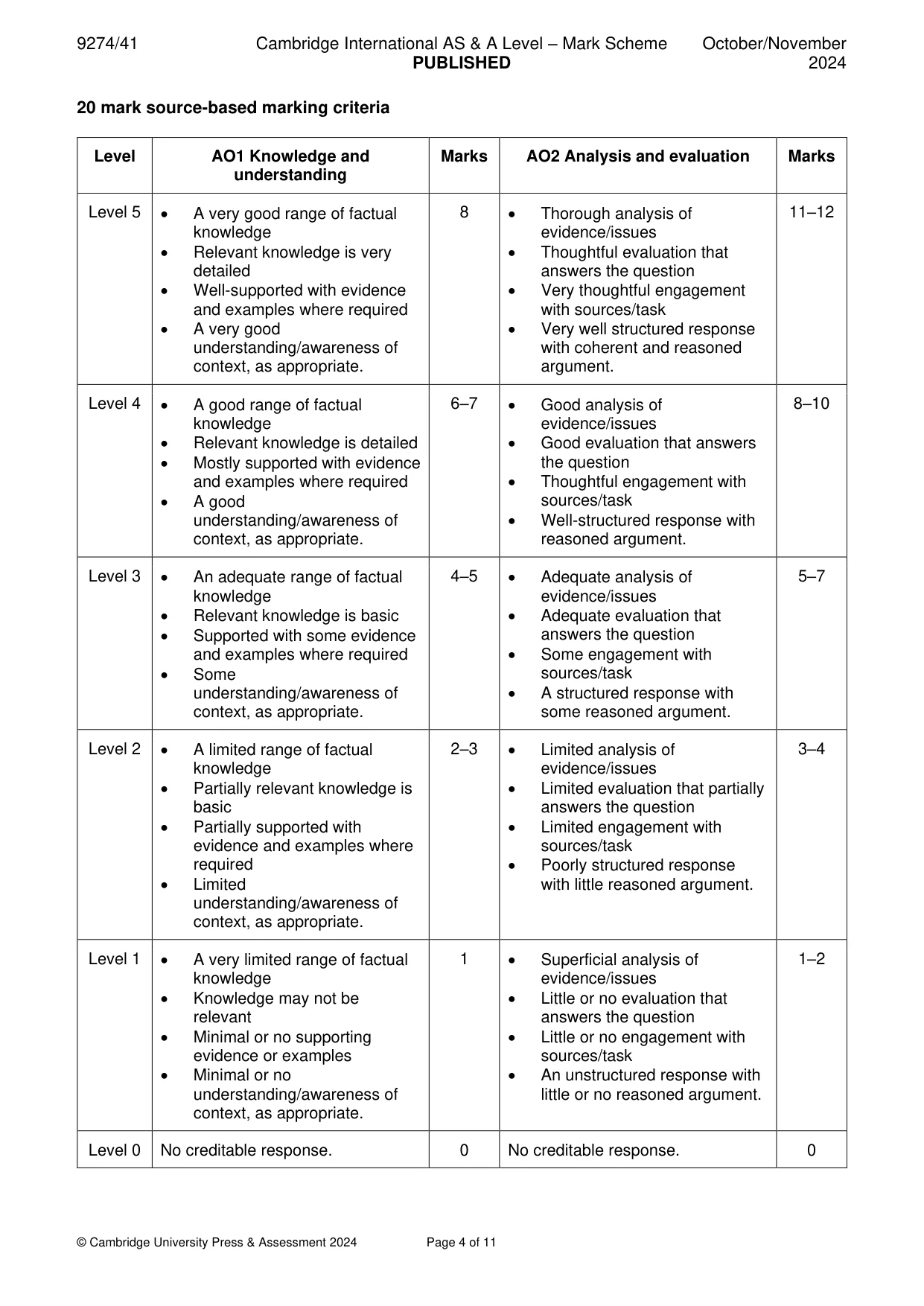
9274/41 Cambridge International AS & A Level – Mark Scheme PUBLISHED October/November 2024 © Cambridge University Press & Assessment 2024 Page 4 of 11 20 mark source-based marking criteria Level AO1 Knowledge and understanding Marks AO2 Analysis and evaluation Marks Level 5 • A very good range of factual knowledge • Relevant knowledge is very detailed • Well-supported with evidence and examples where required • A very good understanding/awareness of context, as appropriate. 8 • Thorough analysis of evidence/issues • Thoughtful evaluation that answers the question • Very thoughtful engagement with sources/task • Very well structured response with coherent and reasoned argument. 11–12 Level 4 • A good range of factual knowledge • Relevant knowledge is detailed • Mostly supported with evidence and examples where required • A good understanding/awareness of context, as appropriate. 6–7 • Good analysis of evidence/issues • Good evaluation that answers the question • Thoughtful engagement with sources/task • Well-structured response with reasoned argument. 8–10 Level 3 • An adequate range of factual knowledge • Relevant knowledge is basic • Supported with some evidence and examples where required • Some understanding/awareness of context, as appropriate. 4–5 • Adequate analysis of evidence/issues • Adequate evaluation that answers the question • Some engagement with sources/task • A structured response with some reasoned argument. 5–7 Level 2 • A limited range of factual knowledge • Partially relevant knowledge is basic • Partially supported with evidence and examples where required • Limited understanding/awareness of context, as appropriate. 2–3 • Limited analysis of evidence/issues • Limited evaluation that partially answers the question • Limited engagement with sources/task • Poorly structured response with little reasoned argument. 3–4 Level 1 • A very limited range of factual knowledge • Knowledge may not be relevant • Minimal or no supporting evidence or examples • Minimal or no understanding/awareness of context, as appropriate. 1 • Superficial analysis of evidence/issues • Little or no evaluation that answers the question • Little or no engagement with sources/task • An unstructured response with little or no reasoned argument. 1–2 Level 0 No creditable response. 0 No creditable response. 0
Mark scheme, page 5
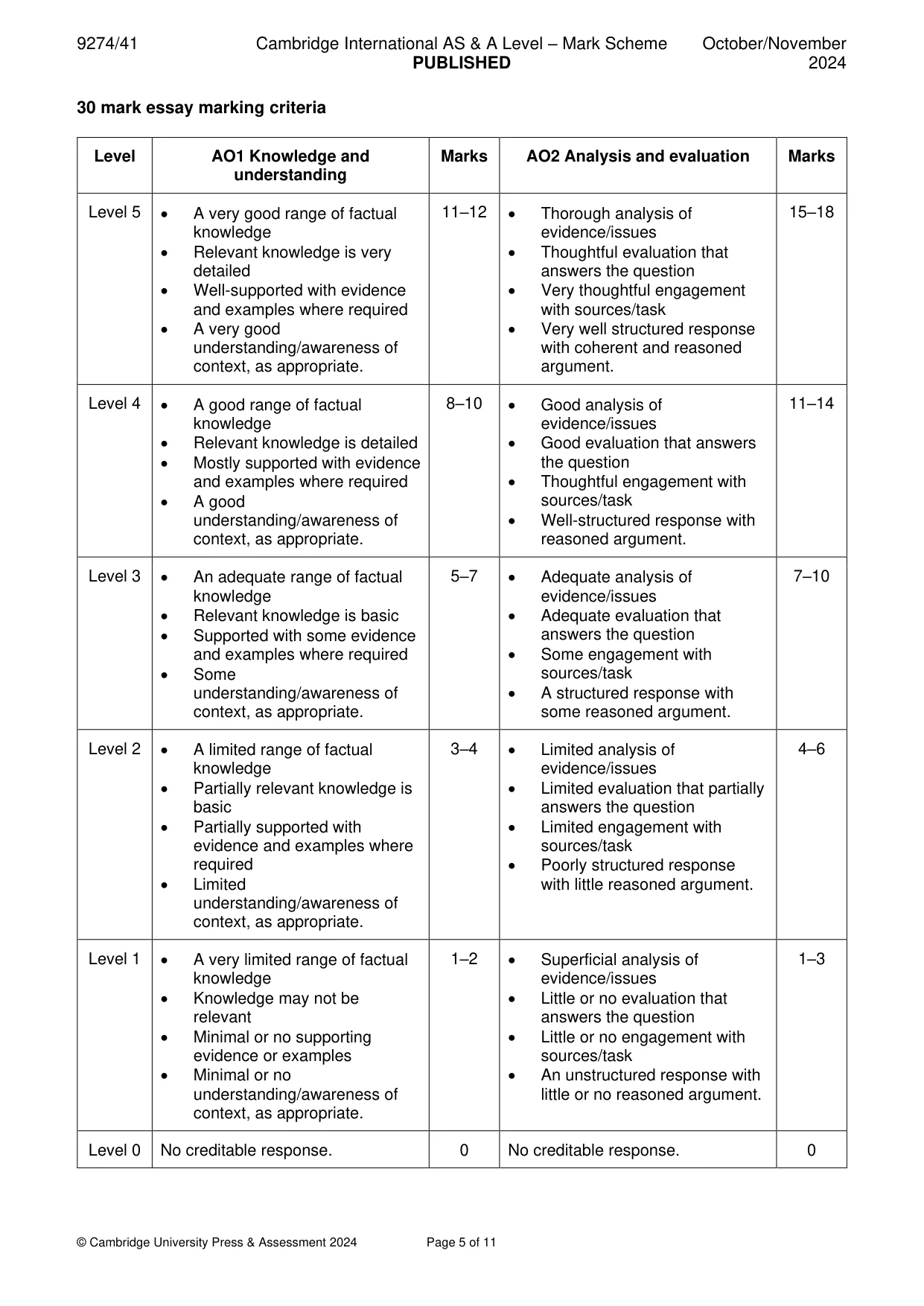
9274/41 Cambridge International AS & A Level – Mark Scheme PUBLISHED October/November 2024 © Cambridge University Press & Assessment 2024 Page 5 of 11 30 mark essay marking criteria Level AO1 Knowledge and understanding Marks AO2 Analysis and evaluation Marks Level 5 • A very good range of factual knowledge • Relevant knowledge is very detailed • Well-supported with evidence and examples where required • A very good understanding/awareness of context, as appropriate. 11–12 • Thorough analysis of evidence/issues • Thoughtful evaluation that answers the question • Very thoughtful engagement with sources/task • Very well structured response with coherent and reasoned argument. 15–18 Level 4 • A good range of factual knowledge • Relevant knowledge is detailed • Mostly supported with evidence and examples where required • A good understanding/awareness of context, as appropriate. 8–10 • Good analysis of evidence/issues • Good evaluation that answers the question • Thoughtful engagement with sources/task • Well-structured response with reasoned argument. 11–14 Level 3 • An adequate range of factual knowledge • Relevant knowledge is basic • Supported with some evidence and examples where required • Some understanding/awareness of context, as appropriate. 5–7 • Adequate analysis of evidence/issues • Adequate evaluation that answers the question • Some engagement with sources/task • A structured response with some reasoned argument. 7–10 Level 2 • A limited range of factual knowledge • Partially relevant knowledge is basic • Partially supported with evidence and examples where required • Limited understanding/awareness of context, as appropriate. 3–4 • Limited analysis of evidence/issues • Limited evaluation that partially answers the question • Limited engagement with sources/task • Poorly structured response with little reasoned argument. 4–6 Level 1 • A very limited range of factual knowledge • Knowledge may not be relevant • Minimal or no supporting evidence or examples • Minimal or no understanding/awareness of context, as appropriate. 1–2 • Superficial analysis of evidence/issues • Little or no evaluation that answers the question • Little or no engagement with sources/task • An unstructured response with little or no reasoned argument. 1–3 Level 0 No creditable response. 0 No creditable response. 0
Mark scheme, page 6
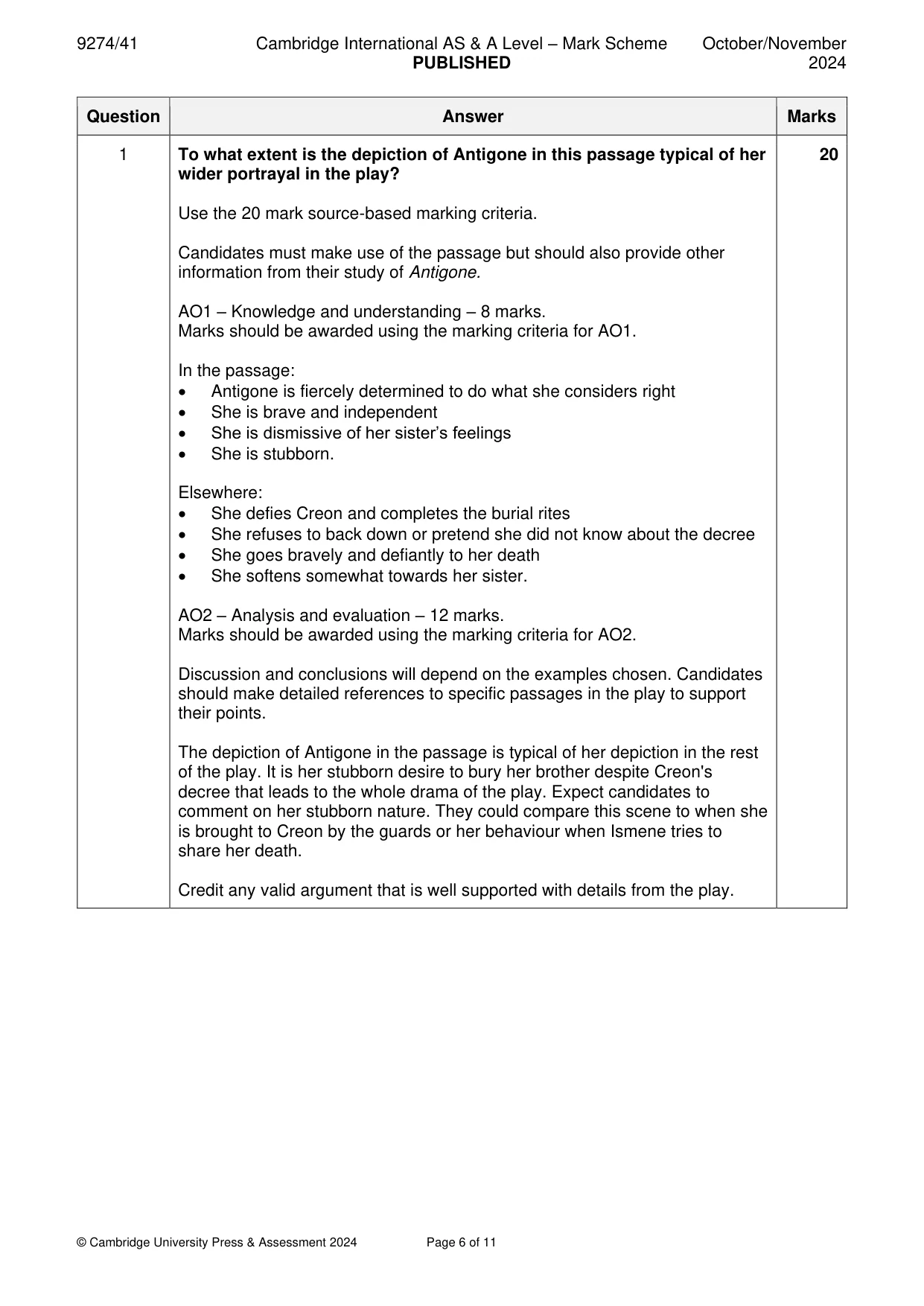
9274/41 Cambridge International AS & A Level – Mark Scheme PUBLISHED October/November 2024 © Cambridge University Press & Assessment 2024 Page 6 of 11 Question Answer Marks 1 To what extent is the depiction of Antigone in this passage typical of her wider portrayal in the play? Use the 20 mark source-based marking criteria. Candidates must make use of the passage but should also provide other information from their study of Antigone. AO1 – Knowledge and understanding – 8 marks. Marks should be awarded using the marking criteria for AO1. In the passage: • Antigone is fiercely determined to do what she considers right • She is brave and independent • She is dismissive of her sister’s feelings • She is stubborn. Elsewhere: • She defies Creon and completes the burial rites • She refuses to back down or pretend she did not know about the decree • She goes bravely and defiantly to her death • She softens somewhat towards her sister. AO2 – Analysis and evaluation – 12 marks. Marks should be awarded using the marking criteria for AO2. Discussion and conclusions will depend on the examples chosen. Candidates should make detailed references to specific passages in the play to support their points. The depiction of Antigone in the passage is typical of her depiction in the rest of the play. It is her stubborn desire to bury her brother despite Creon's decree that leads to the whole drama of the play. Expect candidates to comment on her stubborn nature. They could compare this scene to when she is brought to Creon by the guards or her behaviour when Ismene tries to share her death. Credit any valid argument that is well supported with details from the play. 20
Mark scheme, page 7
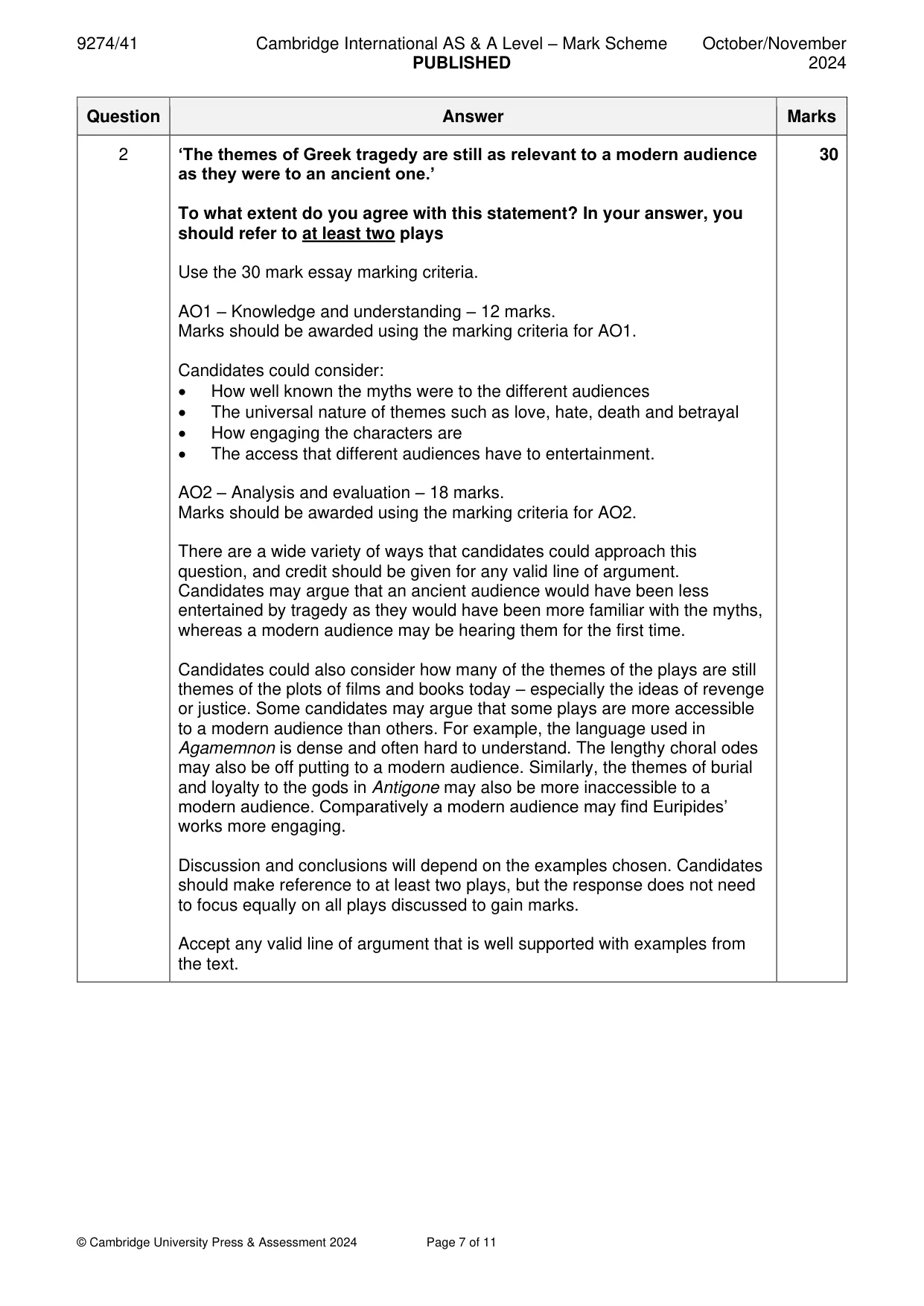
9274/41 Cambridge International AS & A Level – Mark Scheme PUBLISHED October/November 2024 © Cambridge University Press & Assessment 2024 Page 7 of 11 Question Answer Marks 2 ‘The themes of Greek tragedy are still as relevant to a modern audience as they were to an ancient one.’ To what extent do you agree with this statement? In your answer, you should refer to at least two plays Use the 30 mark essay marking criteria. AO1 – Knowledge and understanding – 12 marks. Marks should be awarded using the marking criteria for AO1. Candidates could consider: • How well known the myths were to the different audiences • The universal nature of themes such as love, hate, death and betrayal • How engaging the characters are • The access that different audiences have to entertainment. AO2 – Analysis and evaluation – 18 marks. Marks should be awarded using the marking criteria for AO2. There are a wide variety of ways that candidates could approach this question, and credit should be given for any valid line of argument. Candidates may argue that an ancient audience would have been less entertained by tragedy as they would have been more familiar with the myths, whereas a modern audience may be hearing them for the first time. Candidates could also consider how many of the themes of the plays are still themes of the plots of films and books today – especially the ideas of revenge or justice. Some candidates may argue that some plays are more accessible to a modern audience than others. For example, the language used in Agamemnon is dense and often hard to understand. The lengthy choral odes may also be off putting to a modern audience. Similarly, the themes of burial and loyalty to the gods in Antigone may also be more inaccessible to a modern audience. Comparatively a modern audience may find Euripides’ works more engaging. Discussion and conclusions will depend on the examples chosen. Candidates should make reference to at least two plays, but the response does not need to focus equally on all plays discussed to gain marks. Accept any valid line of argument that is well supported with examples from the text. 30
Mark scheme, page 8
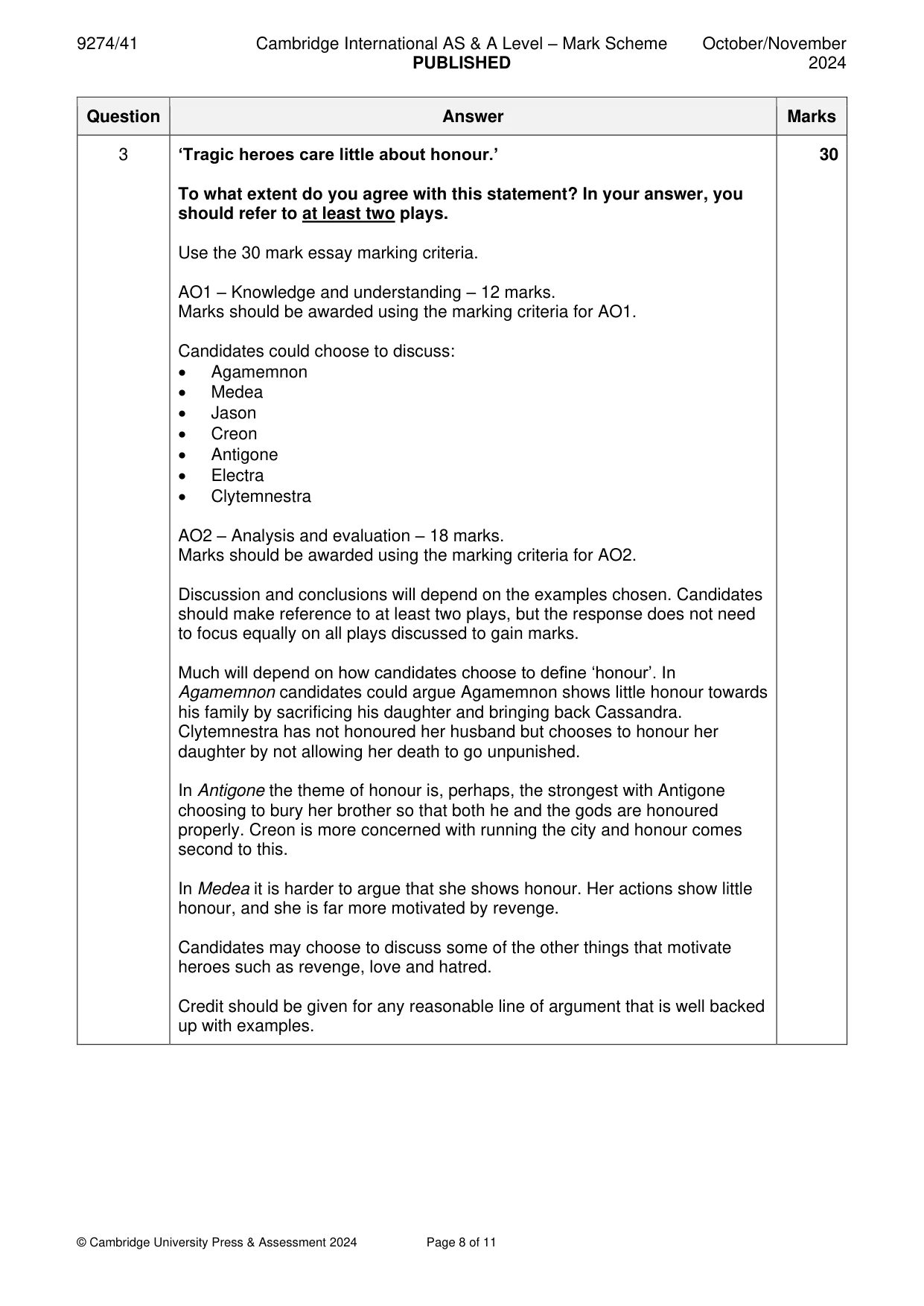
9274/41 Cambridge International AS & A Level – Mark Scheme PUBLISHED October/November 2024 © Cambridge University Press & Assessment 2024 Page 8 of 11 Question Answer Marks 3 ‘Tragic heroes care little about honour.’ To what extent do you agree with this statement? In your answer, you should refer to at least two plays. Use the 30 mark essay marking criteria. AO1 – Knowledge and understanding – 12 marks. Marks should be awarded using the marking criteria for AO1. Candidates could choose to discuss: • Agamemnon • Medea • Jason • Creon • Antigone • Electra • Clytemnestra AO2 – Analysis and evaluation – 18 marks. Marks should be awarded using the marking criteria for AO2. Discussion and conclusions will depend on the examples chosen. Candidates should make reference to at least two plays, but the response does not need to focus equally on all plays discussed to gain marks. Much will depend on how candidates choose to define ‘honour’. In Agamemnon candidates could argue Agamemnon shows little honour towards his family by sacrificing his daughter and bringing back Cassandra. Clytemnestra has not honoured her husband but chooses to honour her daughter by not allowing her death to go unpunished. In Antigone the theme of honour is, perhaps, the strongest with Antigone choosing to bury her brother so that both he and the gods are honoured properly. Creon is more concerned with running the city and honour comes second to this. In Medea it is harder to argue that she shows honour. Her actions show little honour, and she is far more motivated by revenge. Candidates may choose to discuss some of the other things that motivate heroes such as revenge, love and hatred. Credit should be given for any reasonable line of argument that is well backed up with examples. 30
Mark scheme, page 9
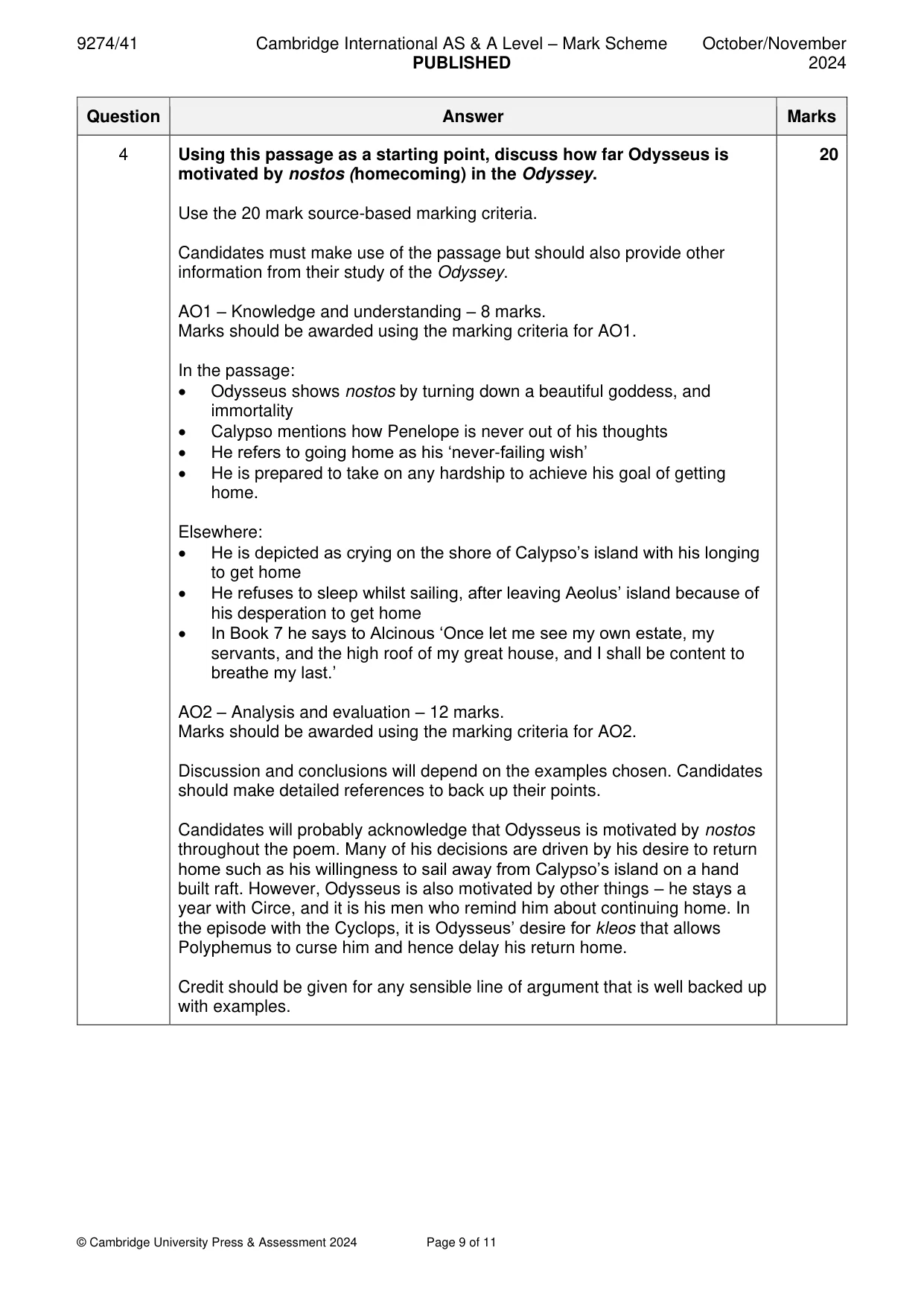
9274/41 Cambridge International AS & A Level – Mark Scheme PUBLISHED October/November 2024 © Cambridge University Press & Assessment 2024 Page 9 of 11 Question Answer Marks 4 Using this passage as a starting point, discuss how far Odysseus is motivated by nostos (homecoming) in the Odyssey. Use the 20 mark source-based marking criteria. Candidates must make use of the passage but should also provide other information from their study of the Odyssey. AO1 – Knowledge and understanding – 8 marks. Marks should be awarded using the marking criteria for AO1. In the passage: • Odysseus shows nostos by turning down a beautiful goddess, and immortality • Calypso mentions how Penelope is never out of his thoughts • He refers to going home as his ‘never-failing wish’ • He is prepared to take on any hardship to achieve his goal of getting home. Elsewhere: • He is depicted as crying on the shore of Calypso’s island with his longing to get home • He refuses to sleep whilst sailing, after leaving Aeolus’ island because of his desperation to get home • In Book 7 he says to Alcinous ‘Once let me see my own estate, my servants, and the high roof of my great house, and I shall be content to breathe my last.’ AO2 – Analysis and evaluation – 12 marks. Marks should be awarded using the marking criteria for AO2. Discussion and conclusions will depend on the examples chosen. Candidates should make detailed references to back up their points. Candidates will probably acknowledge that Odysseus is motivated by nostos throughout the poem. Many of his decisions are driven by his desire to return home such as his willingness to sail away from Calypso’s island on a hand built raft. However, Odysseus is also motivated by other things – he stays a year with Circe, and it is his men who remind him about continuing home. In the episode with the Cyclops, it is Odysseus’ desire for kleos that allows Polyphemus to curse him and hence delay his return home. Credit should be given for any sensible line of argument that is well backed up with examples. 20
Mark scheme, page 10
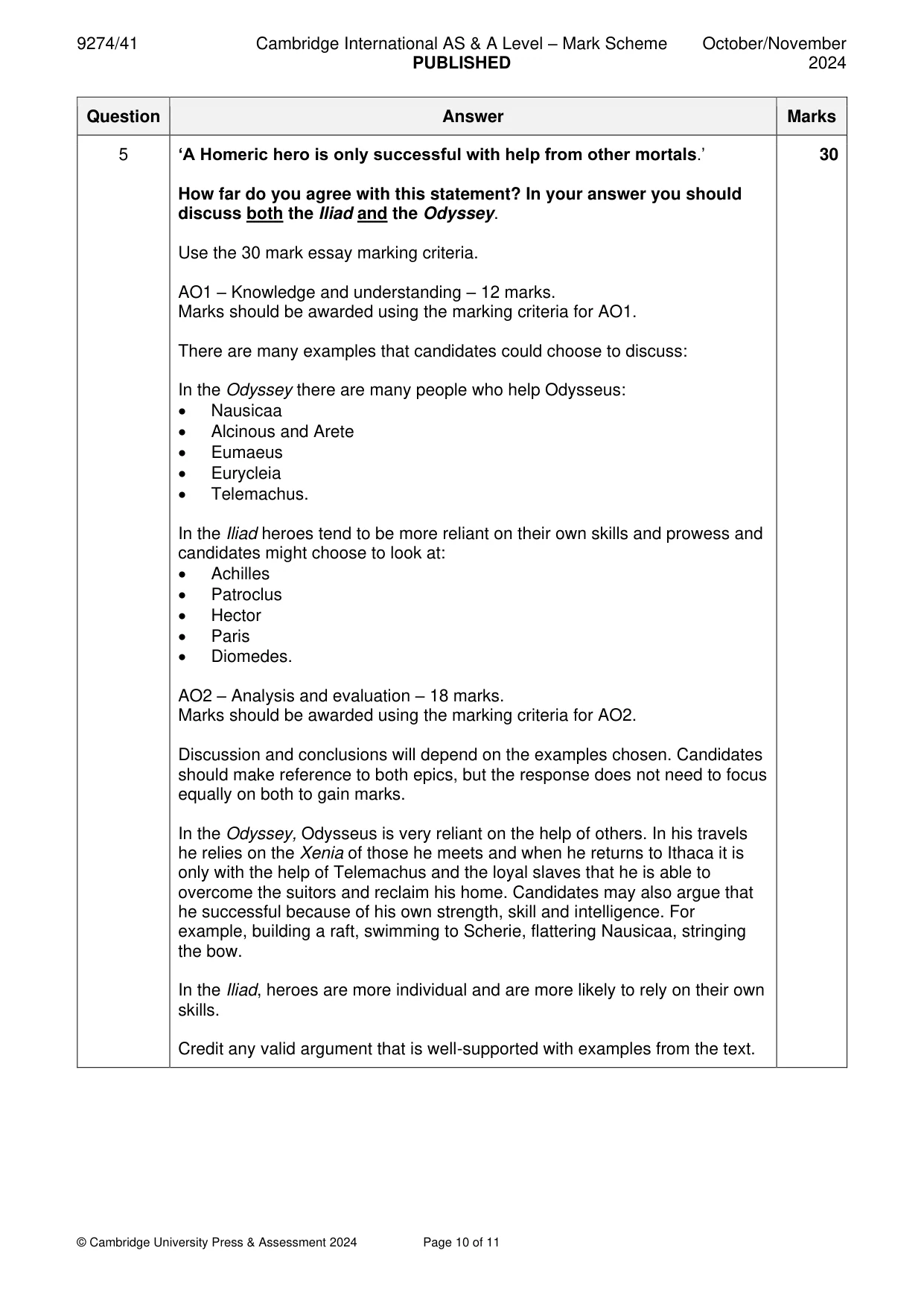
9274/41 Cambridge International AS & A Level – Mark Scheme PUBLISHED October/November 2024 © Cambridge University Press & Assessment 2024 Page 10 of 11 Question Answer Marks 5 ‘A Homeric hero is only successful with help from other mortals.’ How far do you agree with this statement? In your answer you should discuss both the Iliad and the Odyssey. Use the 30 mark essay marking criteria. AO1 – Knowledge and understanding – 12 marks. Marks should be awarded using the marking criteria for AO1. There are many examples that candidates could choose to discuss: In the Odyssey there are many people who help Odysseus: • Nausicaa • Alcinous and Arete • Eumaeus • Eurycleia • Telemachus. In the Iliad heroes tend to be more reliant on their own skills and prowess and candidates might choose to look at: • Achilles • Patroclus • Hector • Paris • Diomedes. AO2 – Analysis and evaluation – 18 marks. Marks should be awarded using the marking criteria for AO2. Discussion and conclusions will depend on the examples chosen. Candidates should make reference to both epics, but the response does not need to focus equally on both to gain marks. In the Odyssey, Odysseus is very reliant on the help of others. In his travels he relies on the Xenia of those he meets and when he returns to Ithaca it is only with the help of Telemachus and the loyal slaves that he is able to overcome the suitors and reclaim his home. Candidates may also argue that he successful because of his own strength, skill and intelligence. For example, building a raft, swimming to Scherie, flattering Nausicaa, stringing the bow. In the Iliad, heroes are more individual and are more likely to rely on their own skills. Credit any valid argument that is well-supported with examples from the text. 30
Mark scheme, page 11
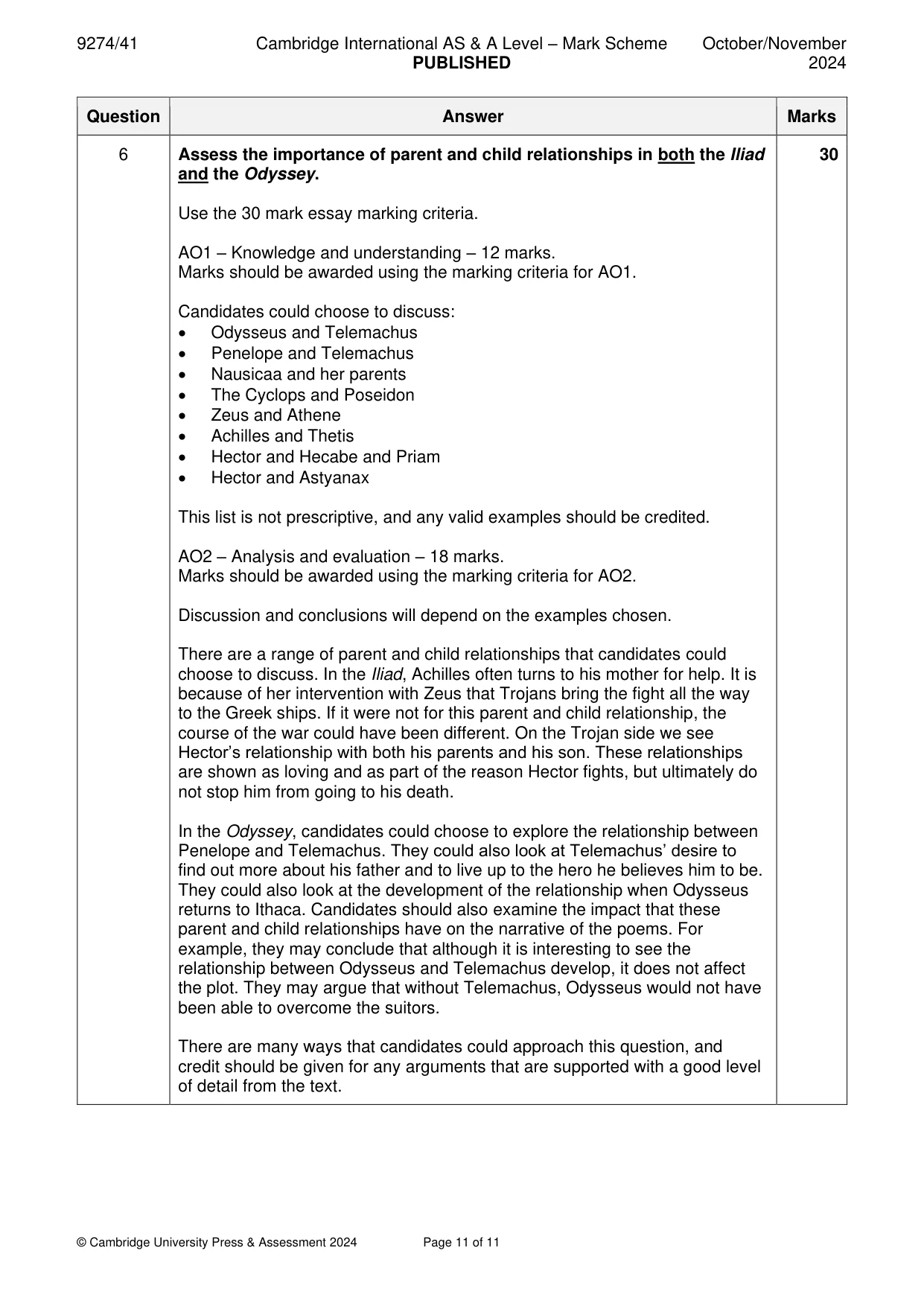
9274/41 Cambridge International AS & A Level – Mark Scheme PUBLISHED October/November 2024 © Cambridge University Press & Assessment 2024 Page 11 of 11 Question Answer Marks 6 Assess the importance of parent and child relationships in both the Iliad and the Odyssey. Use the 30 mark essay marking criteria. AO1 – Knowledge and understanding – 12 marks. Marks should be awarded using the marking criteria for AO1. Candidates could choose to discuss: • Odysseus and Telemachus • Penelope and Telemachus • Nausicaa and her parents • The Cyclops and Poseidon • Zeus and Athene • Achilles and Thetis • Hector and Hecabe and Priam • Hector and Astyanax This list is not prescriptive, and any valid examples should be credited. AO2 – Analysis and evaluation – 18 marks. Marks should be awarded using the marking criteria for AO2. Discussion and conclusions will depend on the examples chosen. There are a range of parent and child relationships that candidates could choose to discuss. In the Iliad, Achilles often turns to his mother for help. It is because of her intervention with Zeus that Trojans bring the fight all the way to the Greek ships. If it were not for this parent and child relationship, the course of the war could have been different. On the Trojan side we see Hector’s relationship with both his parents and his son. These relationships are shown as loving and as part of the reason Hector fights, but ultimately do not stop him from going to his death. In the Odyssey, candidates could choose to explore the relationship between Penelope and Telemachus. They could also look at Telemachus’ desire to find out more about his father and to live up to the hero he believes him to be. They could also look at the development of the relationship when Odysseus returns to Ithaca. Candidates should also examine the impact that these parent and child relationships have on the narrative of the poems. For example, they may conclude that although it is interesting to see the relationship between Odysseus and Telemachus develop, it does not affect the plot. They may argue that without Telemachus, Odysseus would not have been able to overcome the suitors. There are many ways that candidates could approach this question, and credit should be given for any arguments that are supported with a good level of detail from the text. 30
What you needed in this session
Cambridge’s own grade thresholds for 2024 Oct/Nov, Paper 4 · Variant 1. A higher threshold means an easier paper — the bar moves with how the cohort did.