Cambridge A Level Classical Studies 9274 — 2020 Oct/Nov Paper 4 · Variant 3
9274/43/O/N/20 · 50 marks · ≈56 min
The question paper and its mark scheme, free to read here and free to download. This is Cambridge’s own paper, exactly as it was sat.
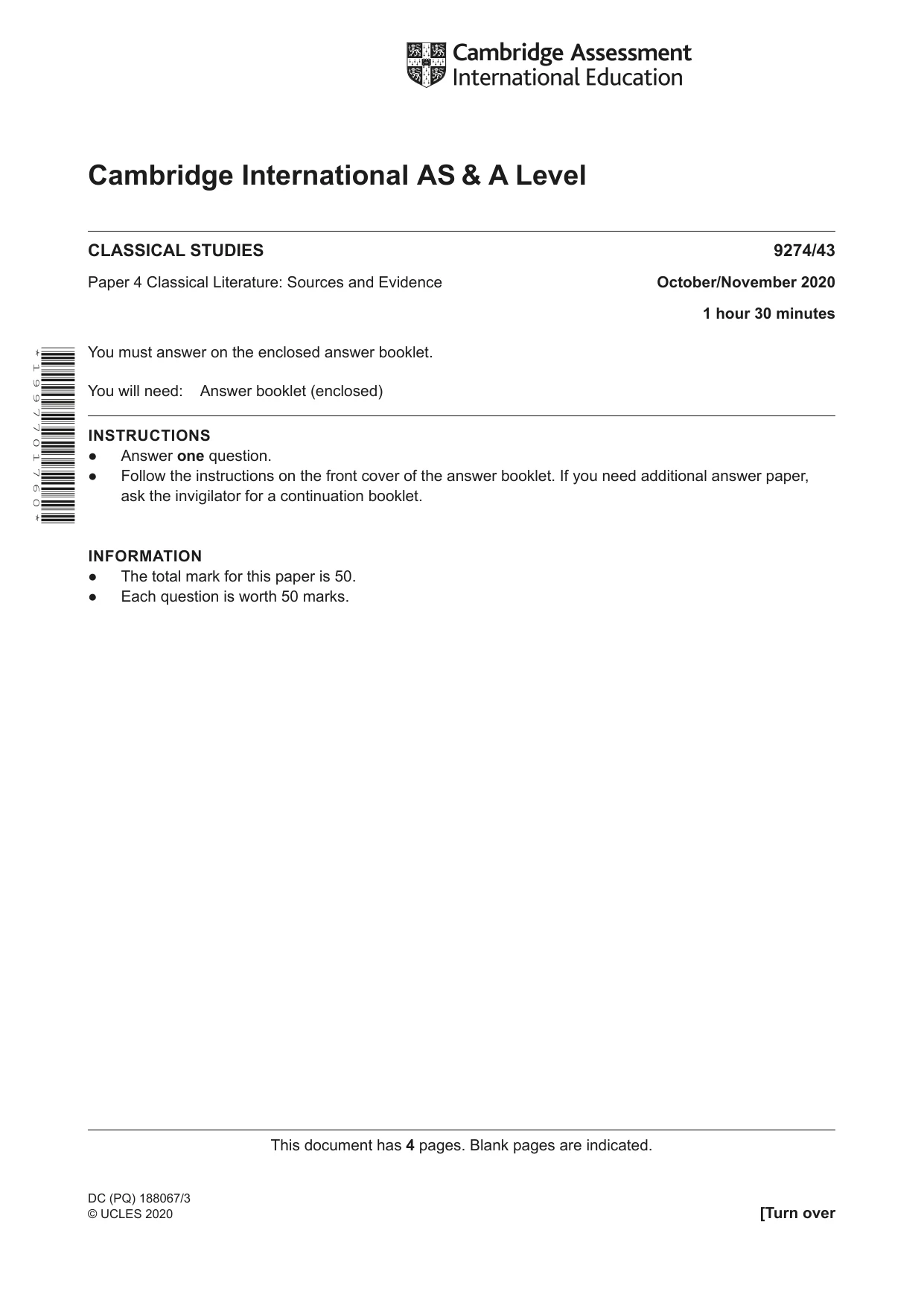
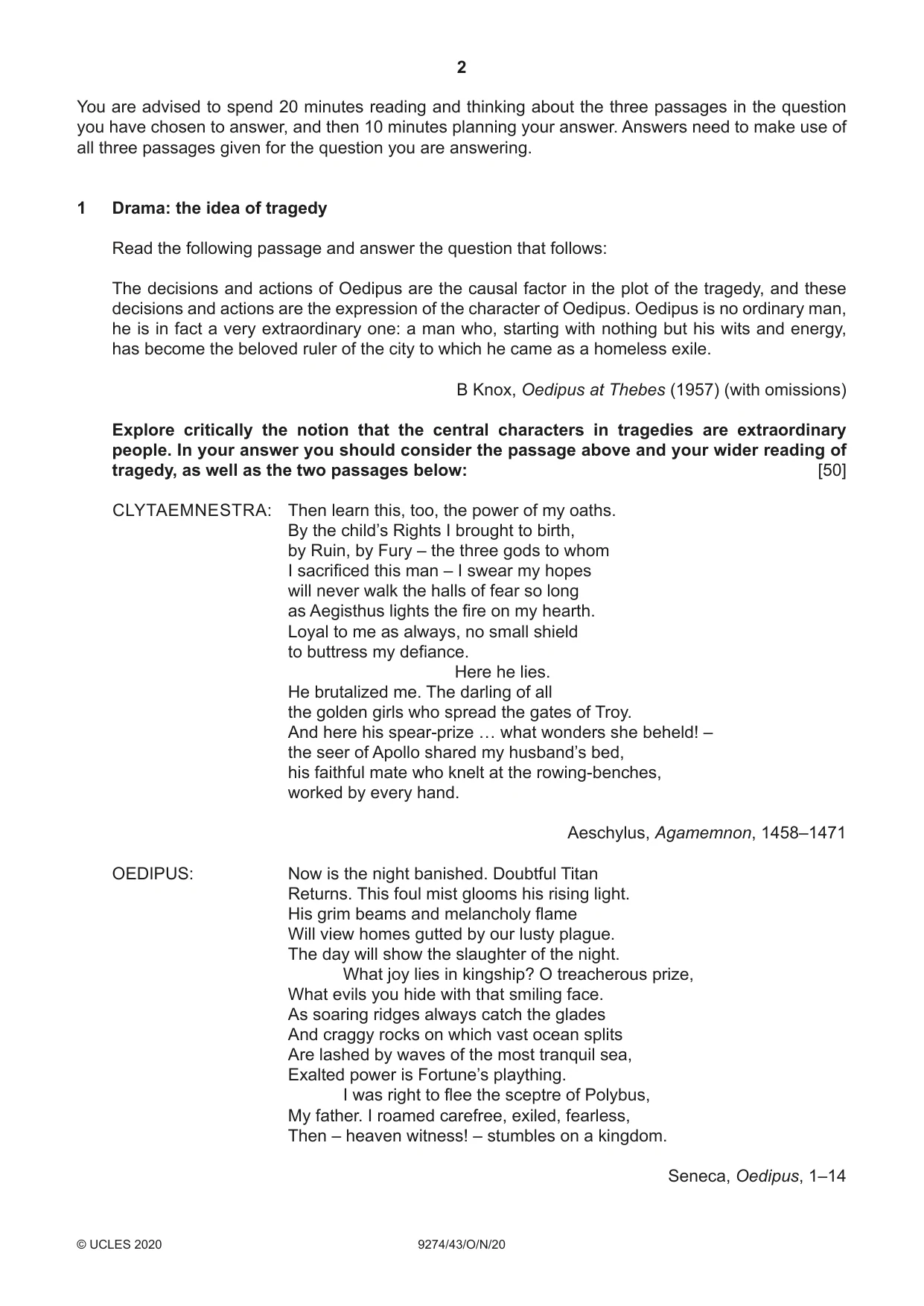
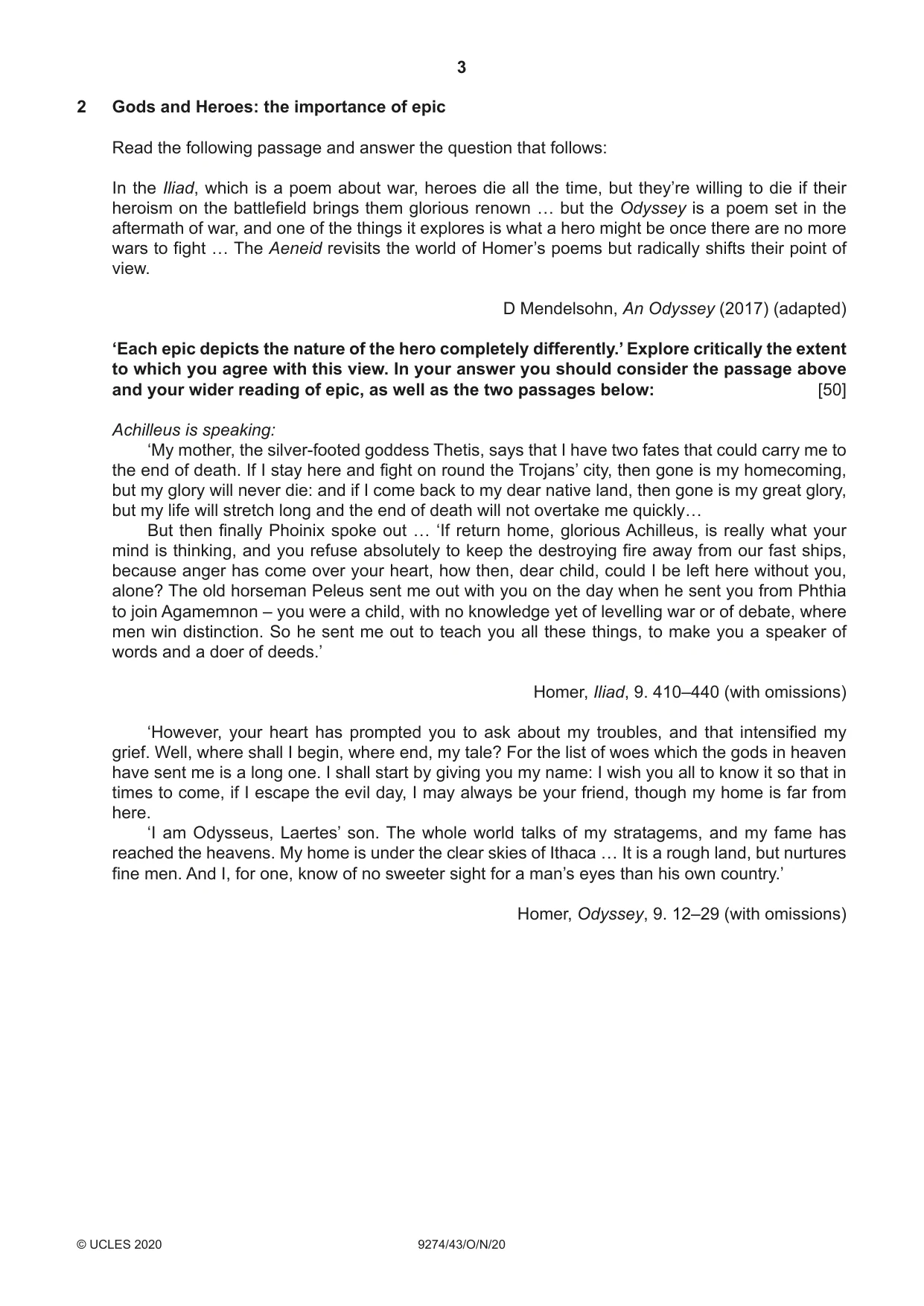
Question paper4 pages

Mark scheme8 pages
Answers below. Sit the paper first if you are practising.
Paper as text
Question paper, page 1
Cambridge International AS & A Level * 1 9 9 7 7 0 1 7 6 0 * DC (PQ) 188067/3 © UCLES 2020 [Turn over This document has 4 pages. Blank pages are indicated. CLASSICAL STUDIES 9274/43 Paper 4 Classical Literature: Sources and Evidence October/November 2020 1 hour 30 minutes You must answer on the enclosed answer booklet. You will need: Answer booklet (enclosed) INSTRUCTIONS ● Answer one question. ● Follow the instructions on the front cover of the answer booklet. If you need additional answer paper, ask the invigilator for a continuation booklet. INFORMATION ● The total mark for this paper is 50. ● Each question is worth 50 marks.
Question paper, page 2
2 9274/43/O/N/20 © UCLES 2020 You are advised to spend 20 minutes reading and thinking about the three passages in the question you have chosen to answer, and then 10 minutes planning your answer. Answers need to make use of all three passages given for the question you are answering. 1 Drama: the idea of tragedy Read the following passage and answer the question that follows: The decisions and actions of Oedipus are the causal factor in the plot of the tragedy, and these decisions and actions are the expression of the character of Oedipus. Oedipus is no ordinary man, he is in fact a very extraordinary one: a man who, starting with nothing but his wits and energy, has become the beloved ruler of the city to which he came as a homeless exile. B Knox, Oedipus at Thebes (1957) (with omissions) Explore critically the notion that the central characters in tragedies are extraordinary people. In your answer you should consider the passage above and your wider reading of tragedy, as well as the two passages below: [50] CLYTAEMNESTRA: Then learn this, too, the power of my oaths. By the child’s Rights I brought to birth, by Ruin, by Fury – the three gods to whom I sacrificed this man – I swear my hopes will never walk the halls of fear so long as Aegisthus lights the fire on my hearth. Loyal to me as always, no small shield to buttress my defiance. Here he lies. He brutalized me. The darling of all the golden girls who spread the gates of Troy. And here his spear-prize … what wonders she beheld! – the seer of Apollo shared my husband’s bed, his faithful mate who knelt at the rowing-benches, worked by every hand. Aeschylus, Agamemnon, 1458–1471 OEDIPUS: Now is the night banished. Doubtful Titan Returns. This foul mist glooms his rising light. His grim beams and melancholy flame Will view homes gutted by our lusty plague. The day will show the slaughter of the night. What joy lies in kingship? O treacherous prize, What evils you hide with that smiling face. As soaring ridges always catch the glades And craggy rocks on which vast ocean splits Are lashed by waves of the most tranquil sea, Exalted power is Fortune’s plaything. I was right to flee the sceptre of Polybus, My father. I roamed carefree, exiled, fearless, Then – heaven witness! – stumbles on a kingdom. Seneca, Oedipus, 1–14
Question paper, page 3
3 9274/43/O/N/20 © UCLES 2020 2 Gods and Heroes: the importance of epic Read the following passage and answer the question that follows: In the Iliad, which is a poem about war, heroes die all the time, but they’re willing to die if their heroism on the battlefield brings them glorious renown … but the Odyssey is a poem set in the aftermath of war, and one of the things it explores is what a hero might be once there are no more wars to fight … The Aeneid revisits the world of Homer’s poems but radically shifts their point of view. D Mendelsohn, An Odyssey (2017) (adapted) ‘Each epic depicts the nature of the hero completely differently.’ Explore critically the extent to which you agree with this view. In your answer you should consider the passage above and your wider reading of epic, as well as the two passages below: [50] Achilleus is speaking: ‘My mother, the silver-footed goddess Thetis, says that I have two fates that could carry me to the end of death. If I stay here and fight on round the Trojans’ city, then gone is my homecoming, but my glory will never die: and if I come back to my dear native land, then gone is my great glory, but my life will stretch long and the end of death will not overtake me quickly… But then finally Phoinix spoke out … ‘If return home, glorious Achilleus, is really what your mind is thinking, and you refuse absolutely to keep the destroying fire away from our fast ships, because anger has come over your heart, how then, dear child, could I be left here without you, alone? The old horseman Peleus sent me out with you on the day when he sent you from Phthia to join Agamemnon – you were a child, with no knowledge yet of levelling war or of debate, where men win distinction. So he sent me out to teach you all these things, to make you a speaker of words and a doer of deeds.’ Homer, Iliad, 9. 410–440 (with omissions) ‘However, your heart has prompted you to ask about my troubles, and that intensified my grief. Well, where shall I begin, where end, my tale? For the list of woes which the gods in heaven have sent me is a long one. I shall start by giving you my name: I wish you all to know it so that in times to come, if I escape the evil day, I may always be your friend, though my home is far from here. ‘I am Odysseus, Laertes’ son. The whole world talks of my stratagems, and my fame has reached the heavens. My home is under the clear skies of Ithaca … It is a rough land, but nurtures fine men. And I, for one, know of no sweeter sight for a man’s eyes than his own country.’ Homer, Odyssey, 9. 12–29 (with omissions)
Question paper, page 4
4 9274/43/O/N/20 © UCLES 2020 BLANK PAGE Permission to reproduce items where third-party owned material protected by copyright is included has been sought and cleared where possible. Every reasonable effort has been made by the publisher (UCLES) to trace copyright holders, but if any items requiring clearance have unwittingly been included, the publisher will be pleased to make amends at the earliest possible opportunity. To avoid the issue of disclosure of answer-related information to candidates, all copyright acknowledgements are reproduced online in the Cambridge Assessment International Education Copyright Acknowledgements Booklet. This is produced for each series of examinations and is freely available to download at www.cambridgeinternational.org after the live examination series. Cambridge Assessment International Education is part of the Cambridge Assessment Group. Cambridge Assessment is the brand name of the University of Cambridge Local Examinations Syndicate (UCLES), which itself is a department of the University of Cambridge.
Mark scheme, page 1
This document consists of 8 printed pages. © UCLES 2020 [Turn over Cambridge International AS & A Level CLASSICAL STUDIES 9274/43 Paper 4 Classical Literature – Sources and Evidence October/November 2020 MARK SCHEME Maximum Mark: 50 Published This mark scheme is published as an aid to teachers and candidates, to indicate the requirements of the examination. It shows the basis on which Examiners were instructed to award marks. It does not indicate the details of the discussions that took place at an Examiners’ meeting before marking began, which would have considered the acceptability of alternative answers. Mark schemes should be read in conjunction with the question paper and the Principal Examiner Report for Teachers. Cambridge International will not enter into discussions about these mark schemes. Cambridge International is publishing the mark schemes for the October/November 2020 series for most Cambridge IGCSE™, Cambridge International A and AS Level and Cambridge Pre-U components, and some Cambridge O Level components.
Mark scheme, page 2
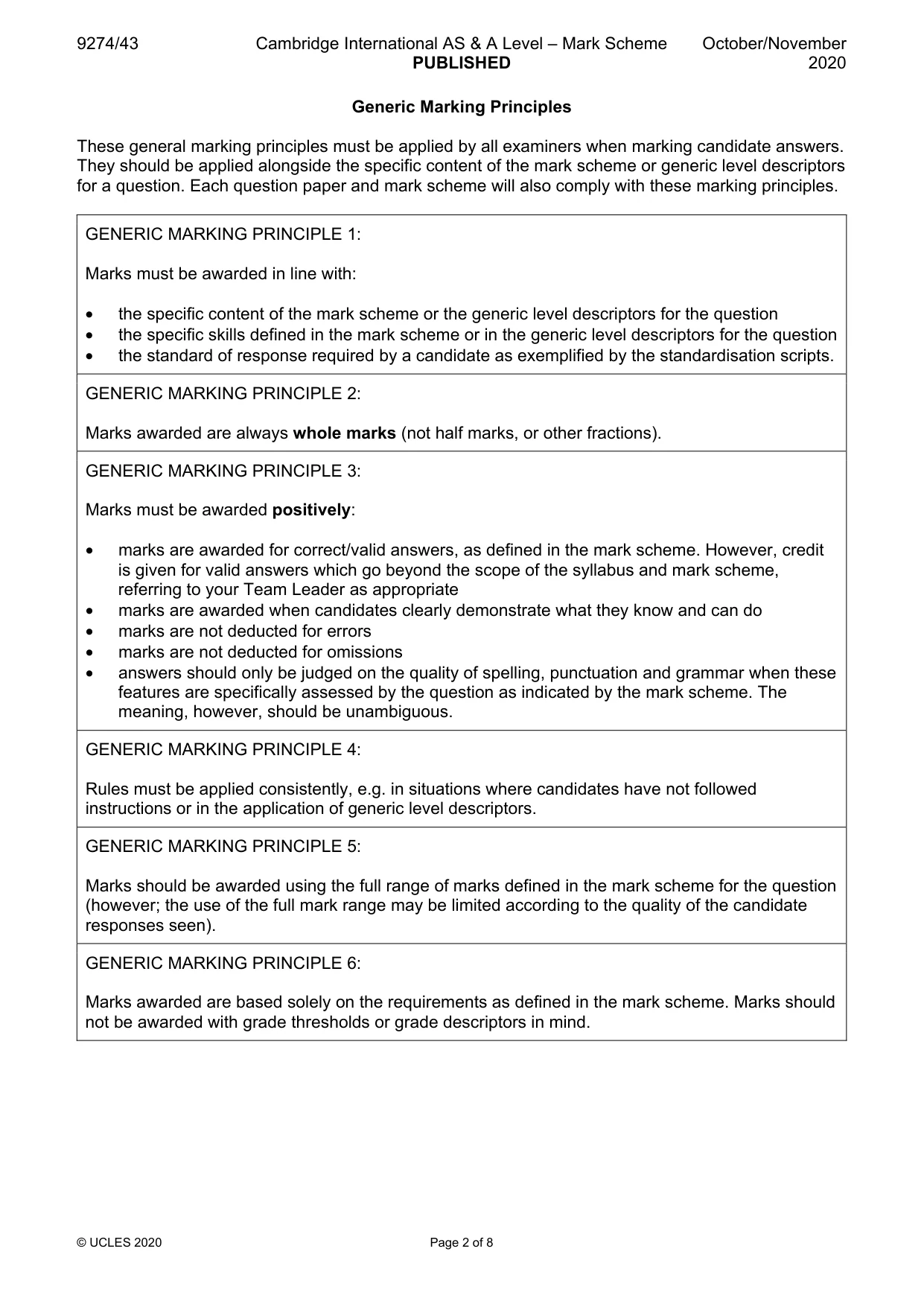
9274/43 Cambridge International AS & A Level – Mark Scheme PUBLISHED October/November 2020 © UCLES 2020 Page 2 of 8 Generic Marking Principles These general marking principles must be applied by all examiners when marking candidate answers. They should be applied alongside the specific content of the mark scheme or generic level descriptors for a question. Each question paper and mark scheme will also comply with these marking principles. GENERIC MARKING PRINCIPLE 1: Marks must be awarded in line with: • the specific content of the mark scheme or the generic level descriptors for the question • the specific skills defined in the mark scheme or in the generic level descriptors for the question • the standard of response required by a candidate as exemplified by the standardisation scripts. GENERIC MARKING PRINCIPLE 2: Marks awarded are always whole marks (not half marks, or other fractions). GENERIC MARKING PRINCIPLE 3: Marks must be awarded positively: • marks are awarded for correct/valid answers, as defined in the mark scheme. However, credit is given for valid answers which go beyond the scope of the syllabus and mark scheme, referring to your Team Leader as appropriate • marks are awarded when candidates clearly demonstrate what they know and can do • marks are not deducted for errors • marks are not deducted for omissions • answers should only be judged on the quality of spelling, punctuation and grammar when these features are specifically assessed by the question as indicated by the mark scheme. The meaning, however, should be unambiguous. GENERIC MARKING PRINCIPLE 4: Rules must be applied consistently, e.g. in situations where candidates have not followed instructions or in the application of generic level descriptors. GENERIC MARKING PRINCIPLE 5: Marks should be awarded using the full range of marks defined in the mark scheme for the question (however; the use of the full mark range may be limited according to the quality of the candidate responses seen). GENERIC MARKING PRINCIPLE 6: Marks awarded are based solely on the requirements as defined in the mark scheme. Marks should not be awarded with grade thresholds or grade descriptors in mind.
Mark scheme, page 3
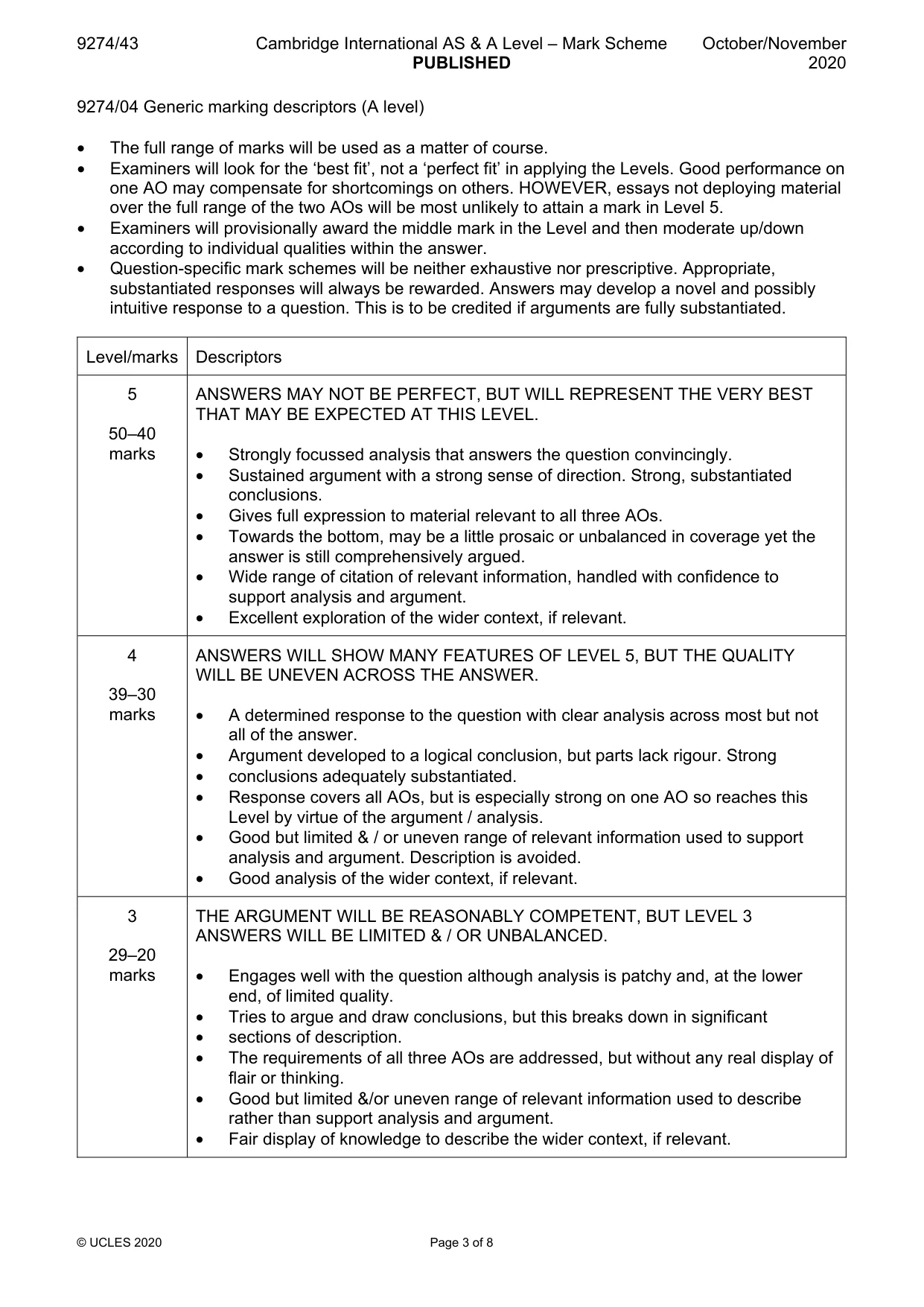
9274/43 Cambridge International AS & A Level – Mark Scheme PUBLISHED October/November 2020 © UCLES 2020 Page 3 of 8 9274/04 Generic marking descriptors (A level) • The full range of marks will be used as a matter of course. • Examiners will look for the ‘best fit’, not a ‘perfect fit’ in applying the Levels. Good performance on one AO may compensate for shortcomings on others. HOWEVER, essays not deploying material over the full range of the two AOs will be most unlikely to attain a mark in Level 5. • Examiners will provisionally award the middle mark in the Level and then moderate up/down according to individual qualities within the answer. • Question-specific mark schemes will be neither exhaustive nor prescriptive. Appropriate, substantiated responses will always be rewarded. Answers may develop a novel and possibly intuitive response to a question. This is to be credited if arguments are fully substantiated. Level/marks Descriptors 5 50–40 marks ANSWERS MAY NOT BE PERFECT, BUT WILL REPRESENT THE VERY BEST THAT MAY BE EXPECTED AT THIS LEVEL. • Strongly focussed analysis that answers the question convincingly. • Sustained argument with a strong sense of direction. Strong, substantiated conclusions. • Gives full expression to material relevant to all three AOs. • Towards the bottom, may be a little prosaic or unbalanced in coverage yet the answer is still comprehensively argued. • Wide range of citation of relevant information, handled with confidence to support analysis and argument. • Excellent exploration of the wider context, if relevant. 4 39–30 marks ANSWERS WILL SHOW MANY FEATURES OF LEVEL 5, BUT THE QUALITY WILL BE UNEVEN ACROSS THE ANSWER. • A determined response to the question with clear analysis across most but not all of the answer. • Argument developed to a logical conclusion, but parts lack rigour. Strong • conclusions adequately substantiated. • Response covers all AOs, but is especially strong on one AO so reaches this Level by virtue of the argument / analysis. • Good but limited & / or uneven range of relevant information used to support analysis and argument. Description is avoided. • Good analysis of the wider context, if relevant. 3 29–20 marks THE ARGUMENT WILL BE REASONABLY COMPETENT, BUT LEVEL 3 ANSWERS WILL BE LIMITED & / OR UNBALANCED. • Engages well with the question although analysis is patchy and, at the lower end, of limited quality. • Tries to argue and draw conclusions, but this breaks down in significant • sections of description. • The requirements of all three AOs are addressed, but without any real display of flair or thinking. • Good but limited &/or uneven range of relevant information used to describe rather than support analysis and argument. • Fair display of knowledge to describe the wider context, if relevant.
Mark scheme, page 4
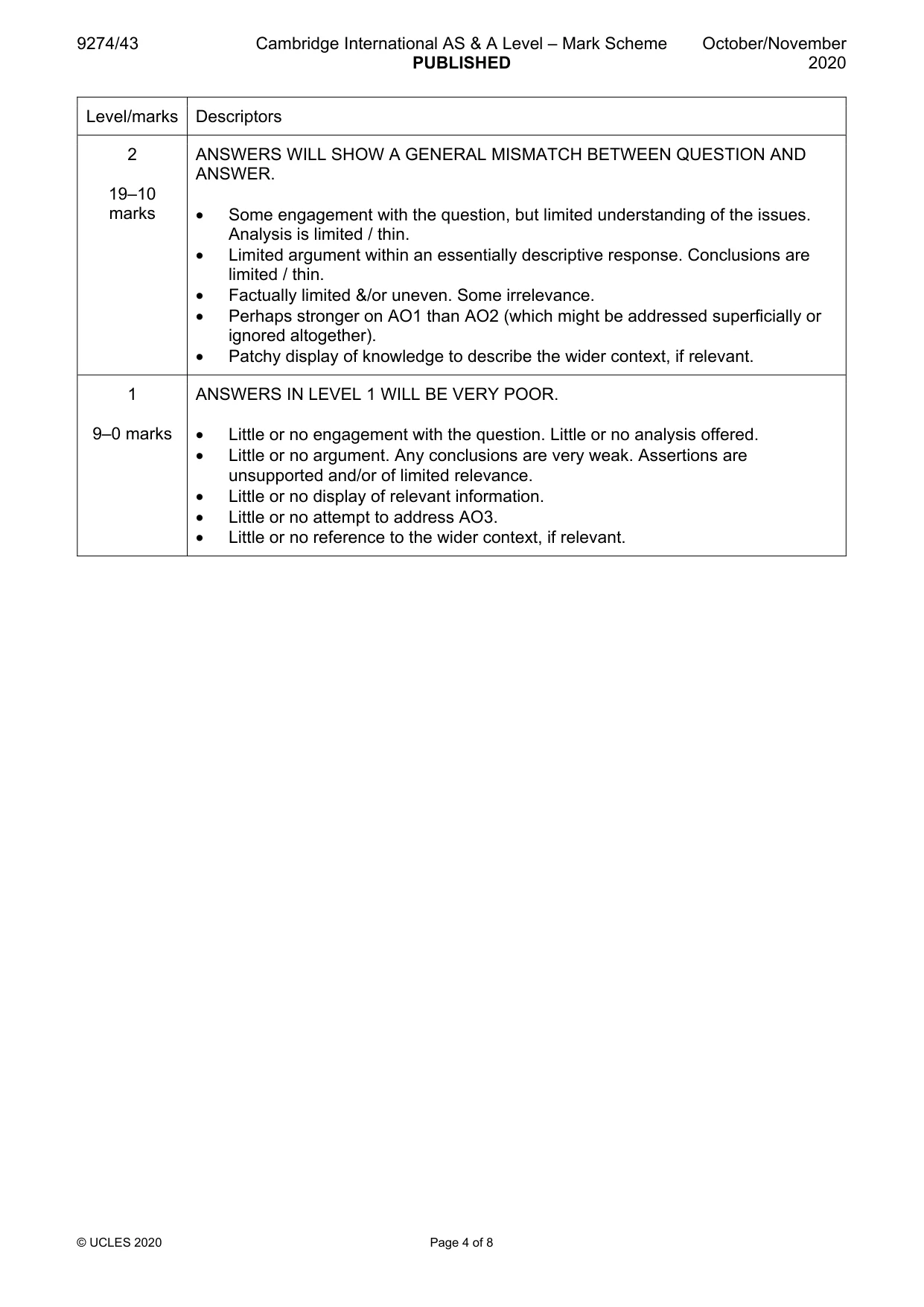
9274/43 Cambridge International AS & A Level – Mark Scheme PUBLISHED October/November 2020 © UCLES 2020 Page 4 of 8 Level/marks Descriptors 2 19–10 marks ANSWERS WILL SHOW A GENERAL MISMATCH BETWEEN QUESTION AND ANSWER. • Some engagement with the question, but limited understanding of the issues. Analysis is limited / thin. • Limited argument within an essentially descriptive response. Conclusions are limited / thin. • Factually limited &/or uneven. Some irrelevance. • Perhaps stronger on AO1 than AO2 (which might be addressed superficially or ignored altogether). • Patchy display of knowledge to describe the wider context, if relevant. 1 9–0 marks ANSWERS IN LEVEL 1 WILL BE VERY POOR. • Little or no engagement with the question. Little or no analysis offered. • Little or no argument. Any conclusions are very weak. Assertions are unsupported and/or of limited relevance. • Little or no display of relevant information. • Little or no attempt to address AO3. • Little or no reference to the wider context, if relevant.
Mark scheme, page 5
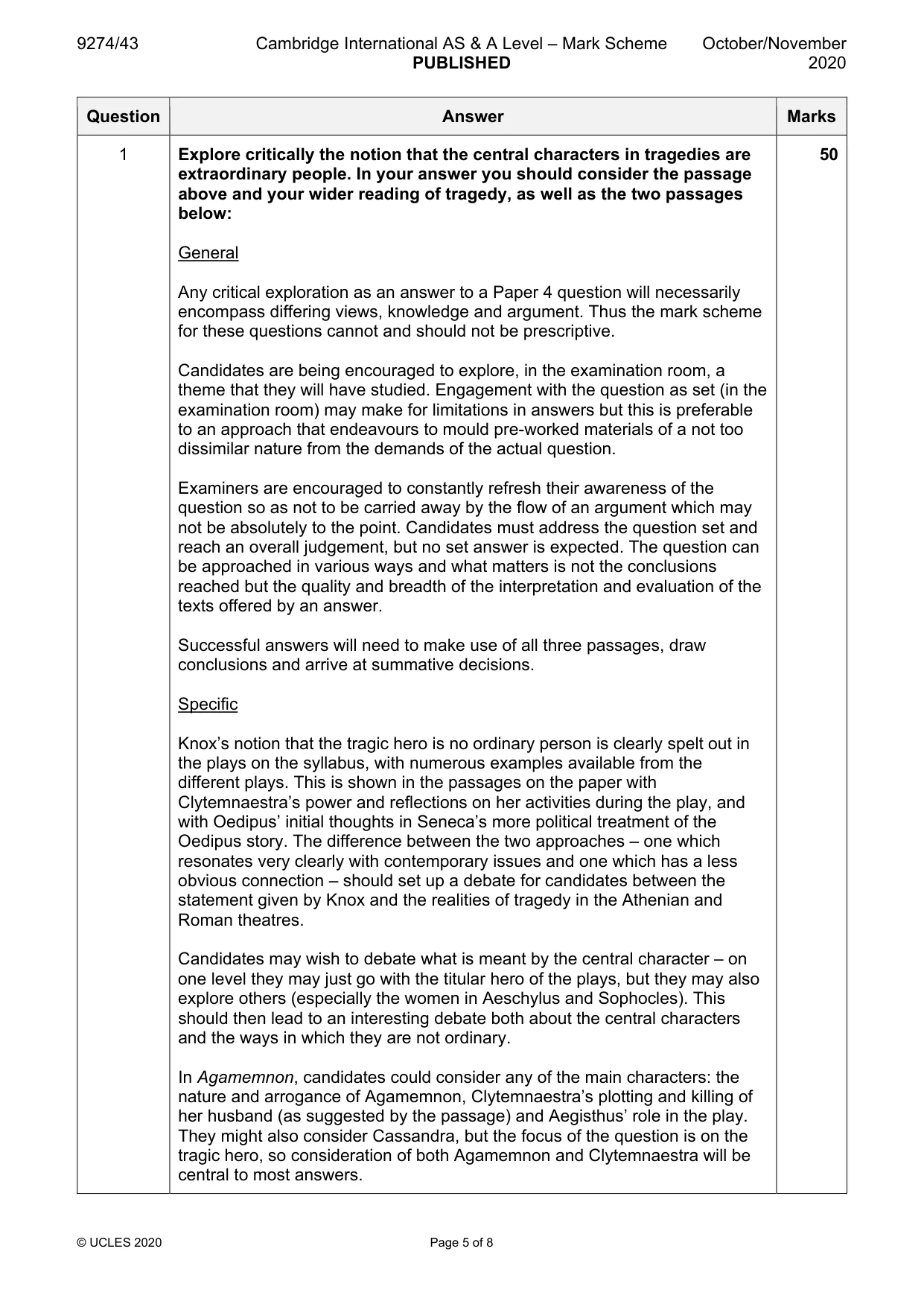
9274/43 Cambridge International AS & A Level – Mark Scheme PUBLISHED October/November 2020 © UCLES 2020 Page 5 of 8 Question Answer Marks 1 Explore critically the notion that the central characters in tragedies are extraordinary people. In your answer you should consider the passage above and your wider reading of tragedy, as well as the two passages below: General Any critical exploration as an answer to a Paper 4 question will necessarily encompass differing views, knowledge and argument. Thus the mark scheme for these questions cannot and should not be prescriptive. Candidates are being encouraged to explore, in the examination room, a theme that they will have studied. Engagement with the question as set (in the examination room) may make for limitations in answers but this is preferable to an approach that endeavours to mould pre-worked materials of a not too dissimilar nature from the demands of the actual question. Examiners are encouraged to constantly refresh their awareness of the question so as not to be carried away by the flow of an argument which may not be absolutely to the point. Candidates must address the question set and reach an overall judgement, but no set answer is expected. The question can be approached in various ways and what matters is not the conclusions reached but the quality and breadth of the interpretation and evaluation of the texts offered by an answer. Successful answers will need to make use of all three passages, draw conclusions and arrive at summative decisions. Specific Knox’s notion that the tragic hero is no ordinary person is clearly spelt out in the plays on the syllabus, with numerous examples available from the different plays. This is shown in the passages on the paper with Clytemnaestra’s power and reflections on her activities during the play, and with Oedipus’ initial thoughts in Seneca’s more political treatment of the Oedipus story. The difference between the two approaches – one which resonates very clearly with contemporary issues and one which has a less obvious connection – should set up a debate for candidates between the statement given by Knox and the realities of tragedy in the Athenian and Roman theatres. Candidates may wish to debate what is meant by the central character – on one level they may just go with the titular hero of the plays, but they may also explore others (especially the women in Aeschylus and Sophocles). This should then lead to an interesting debate both about the central characters and the ways in which they are not ordinary. In Agamemnon, candidates could consider any of the main characters: the nature and arrogance of Agamemnon, Clytemnaestra’s plotting and killing of her husband (as suggested by the passage) and Aegisthus’ role in the play. They might also consider Cassandra, but the focus of the question is on the tragic hero, so consideration of both Agamemnon and Clytemnaestra will be central to most answers. 50
Mark scheme, page 6
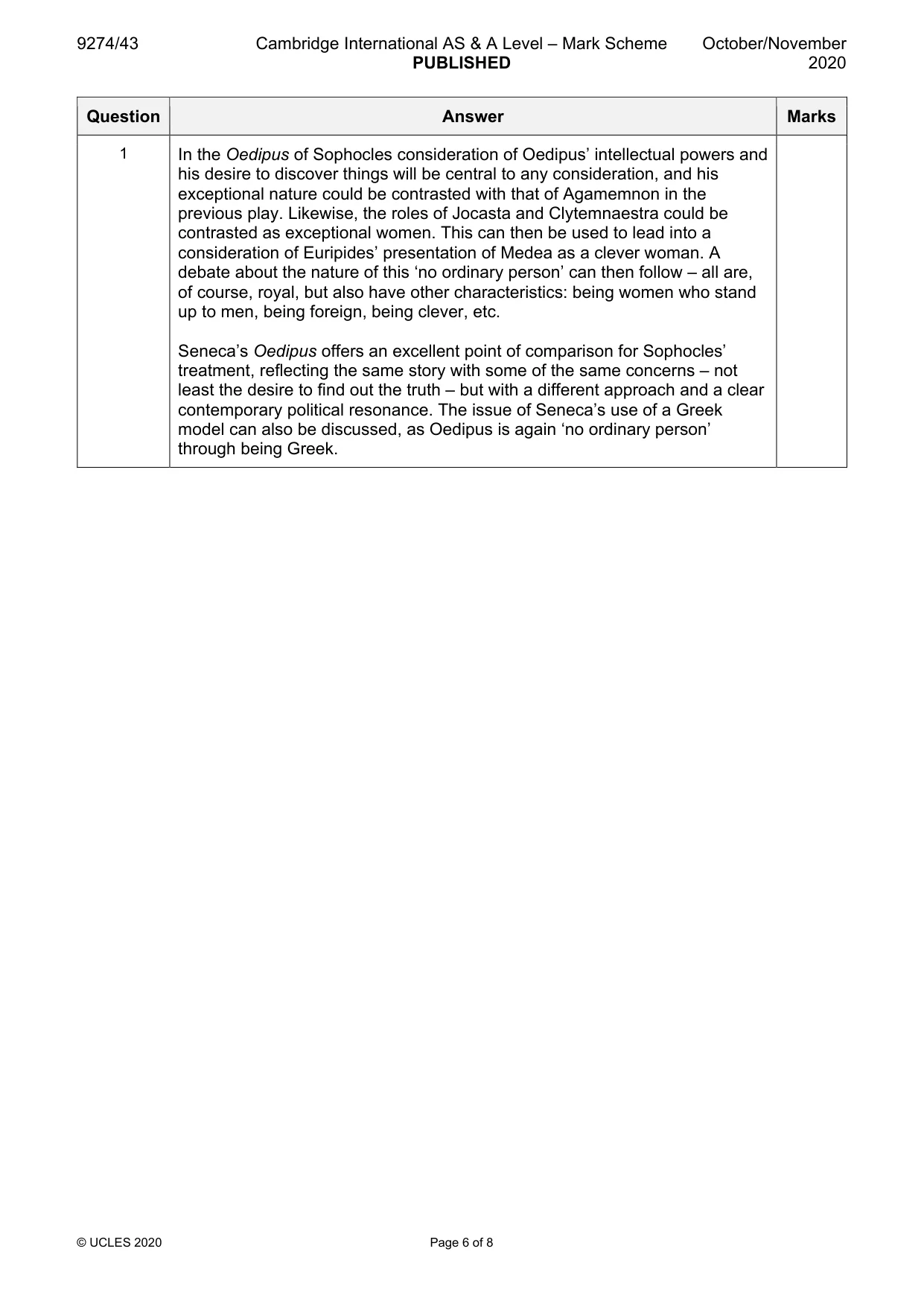
9274/43 Cambridge International AS & A Level – Mark Scheme PUBLISHED October/November 2020 © UCLES 2020 Page 6 of 8 Question Answer Marks 1 In the Oedipus of Sophocles consideration of Oedipus’ intellectual powers and his desire to discover things will be central to any consideration, and his exceptional nature could be contrasted with that of Agamemnon in the previous play. Likewise, the roles of Jocasta and Clytemnaestra could be contrasted as exceptional women. This can then be used to lead into a consideration of Euripides’ presentation of Medea as a clever woman. A debate about the nature of this ‘no ordinary person’ can then follow – all are, of course, royal, but also have other characteristics: being women who stand up to men, being foreign, being clever, etc. Seneca’s Oedipus offers an excellent point of comparison for Sophocles’ treatment, reflecting the same story with some of the same concerns – not least the desire to find out the truth – but with a different approach and a clear contemporary political resonance. The issue of Seneca’s use of a Greek model can also be discussed, as Oedipus is again ‘no ordinary person’ through being Greek.
Mark scheme, page 7
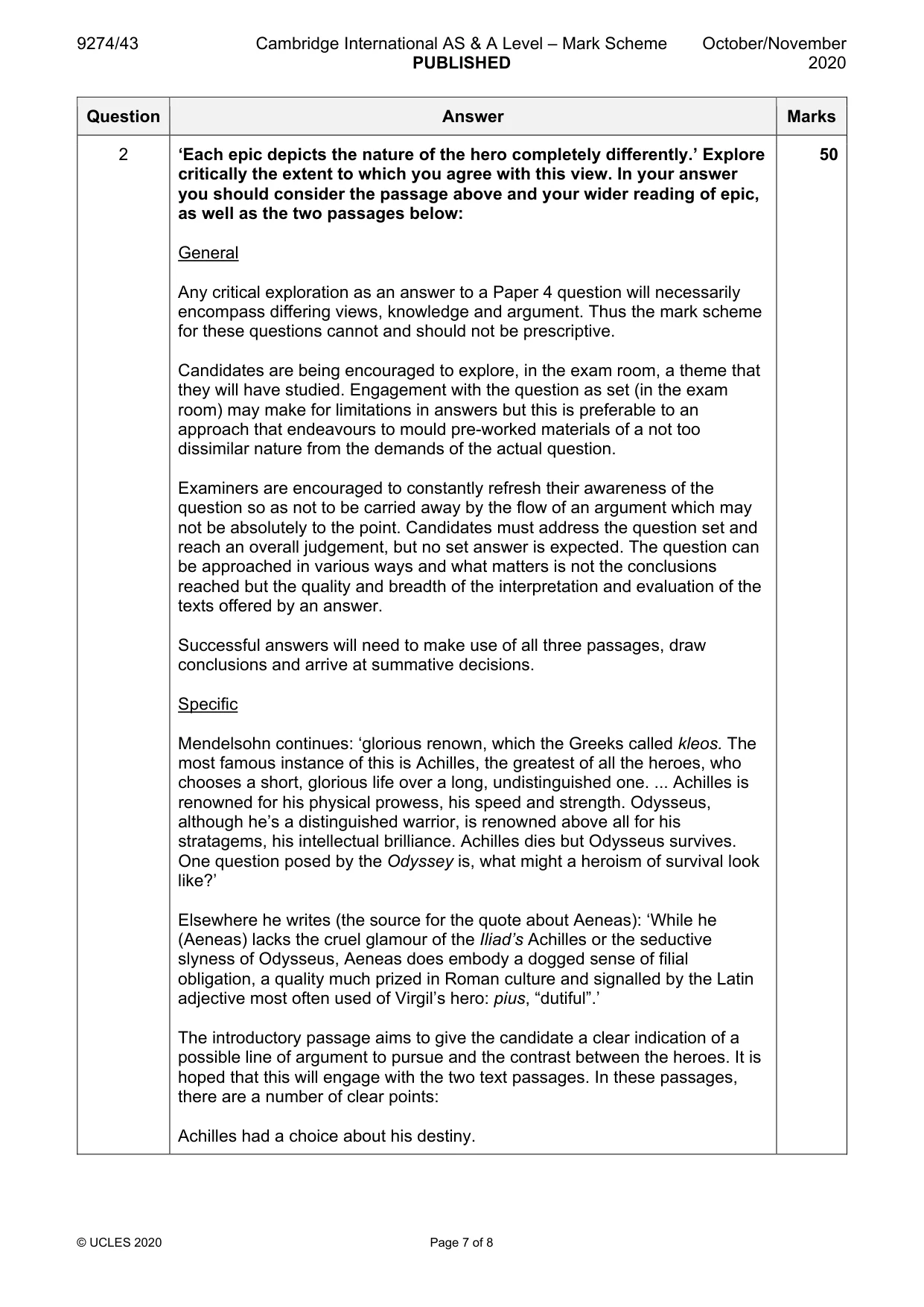
9274/43 Cambridge International AS & A Level – Mark Scheme PUBLISHED October/November 2020 © UCLES 2020 Page 7 of 8 Question Answer Marks 2 ‘Each epic depicts the nature of the hero completely differently.’ Explore critically the extent to which you agree with this view. In your answer you should consider the passage above and your wider reading of epic, as well as the two passages below: General Any critical exploration as an answer to a Paper 4 question will necessarily encompass differing views, knowledge and argument. Thus the mark scheme for these questions cannot and should not be prescriptive. Candidates are being encouraged to explore, in the exam room, a theme that they will have studied. Engagement with the question as set (in the exam room) may make for limitations in answers but this is preferable to an approach that endeavours to mould pre-worked materials of a not too dissimilar nature from the demands of the actual question. Examiners are encouraged to constantly refresh their awareness of the question so as not to be carried away by the flow of an argument which may not be absolutely to the point. Candidates must address the question set and reach an overall judgement, but no set answer is expected. The question can be approached in various ways and what matters is not the conclusions reached but the quality and breadth of the interpretation and evaluation of the texts offered by an answer. Successful answers will need to make use of all three passages, draw conclusions and arrive at summative decisions. Specific Mendelsohn continues: ‘glorious renown, which the Greeks called kleos. The most famous instance of this is Achilles, the greatest of all the heroes, who chooses a short, glorious life over a long, undistinguished one. ... Achilles is renowned for his physical prowess, his speed and strength. Odysseus, although he’s a distinguished warrior, is renowned above all for his stratagems, his intellectual brilliance. Achilles dies but Odysseus survives. One question posed by the Odyssey is, what might a heroism of survival look like?’ Elsewhere he writes (the source for the quote about Aeneas): ‘While he (Aeneas) lacks the cruel glamour of the Iliad’s Achilles or the seductive slyness of Odysseus, Aeneas does embody a dogged sense of filial obligation, a quality much prized in Roman culture and signalled by the Latin adjective most often used of Virgil’s hero: pius, “dutiful”.’ The introductory passage aims to give the candidate a clear indication of a possible line of argument to pursue and the contrast between the heroes. It is hoped that this will engage with the two text passages. In these passages, there are a number of clear points: Achilles had a choice about his destiny. 50
Mark scheme, page 8
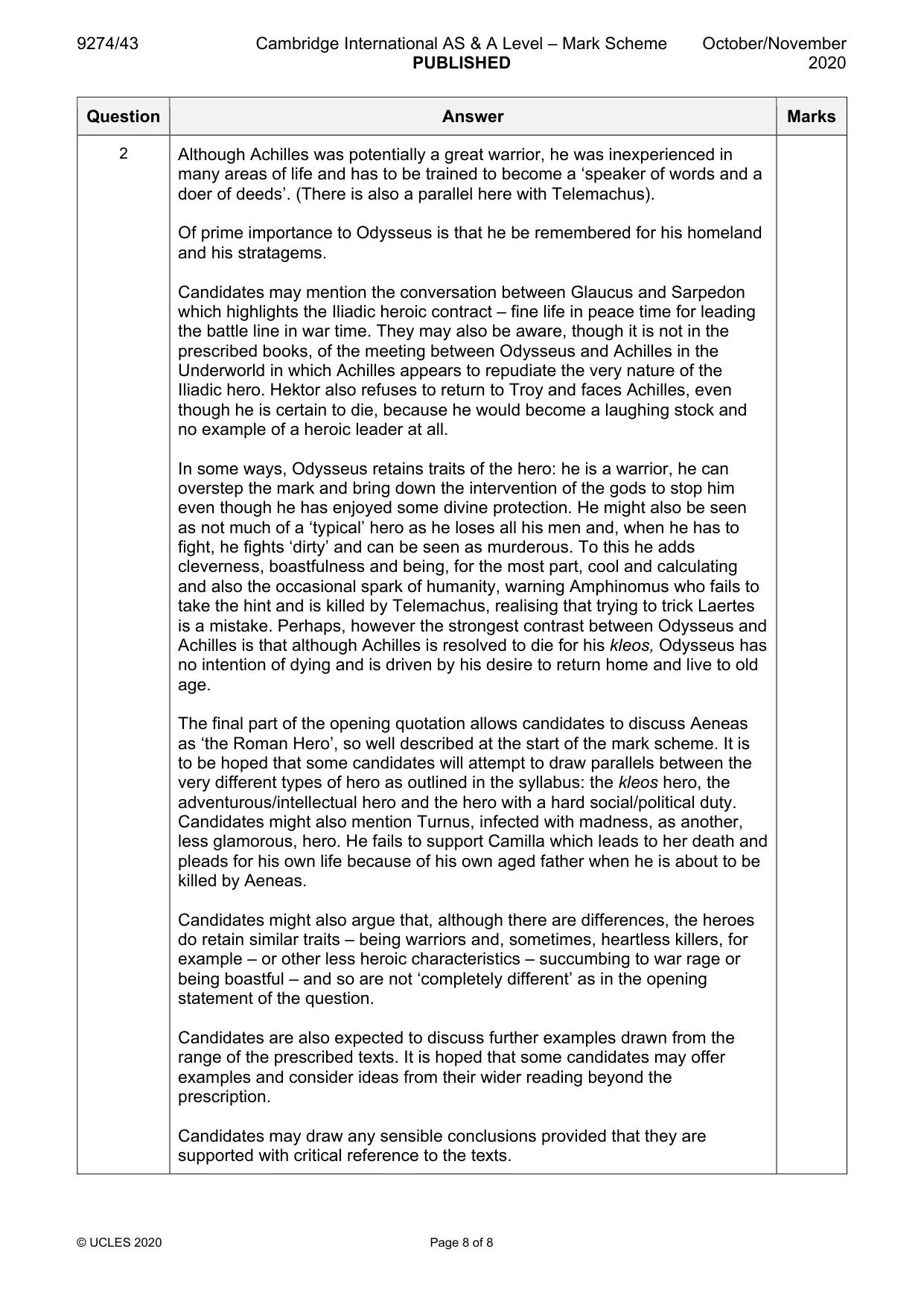
9274/43 Cambridge International AS & A Level – Mark Scheme PUBLISHED October/November 2020 © UCLES 2020 Page 8 of 8 Question Answer Marks 2 Although Achilles was potentially a great warrior, he was inexperienced in many areas of life and has to be trained to become a ‘speaker of words and a doer of deeds’. (There is also a parallel here with Telemachus). Of prime importance to Odysseus is that he be remembered for his homeland and his stratagems. Candidates may mention the conversation between Glaucus and Sarpedon which highlights the Iliadic heroic contract – fine life in peace time for leading the battle line in war time. They may also be aware, though it is not in the prescribed books, of the meeting between Odysseus and Achilles in the Underworld in which Achilles appears to repudiate the very nature of the Iliadic hero. Hektor also refuses to return to Troy and faces Achilles, even though he is certain to die, because he would become a laughing stock and no example of a heroic leader at all. In some ways, Odysseus retains traits of the hero: he is a warrior, he can overstep the mark and bring down the intervention of the gods to stop him even though he has enjoyed some divine protection. He might also be seen as not much of a ‘typical’ hero as he loses all his men and, when he has to fight, he fights ‘dirty’ and can be seen as murderous. To this he adds cleverness, boastfulness and being, for the most part, cool and calculating and also the occasional spark of humanity, warning Amphinomus who fails to take the hint and is killed by Telemachus, realising that trying to trick Laertes is a mistake. Perhaps, however the strongest contrast between Odysseus and Achilles is that although Achilles is resolved to die for his kleos, Odysseus has no intention of dying and is driven by his desire to return home and live to old age. The final part of the opening quotation allows candidates to discuss Aeneas as ‘the Roman Hero’, so well described at the start of the mark scheme. It is to be hoped that some candidates will attempt to draw parallels between the very different types of hero as outlined in the syllabus: the kleos hero, the adventurous/intellectual hero and the hero with a hard social/political duty. Candidates might also mention Turnus, infected with madness, as another, less glamorous, hero. He fails to support Camilla which leads to her death and pleads for his own life because of his own aged father when he is about to be killed by Aeneas. Candidates might also argue that, although there are differences, the heroes do retain similar traits – being warriors and, sometimes, heartless killers, for example – or other less heroic characteristics – succumbing to war rage or being boastful – and so are not ‘completely different’ as in the opening statement of the question. Candidates are also expected to discuss further examples drawn from the range of the prescribed texts. It is hoped that some candidates may offer examples and consider ideas from their wider reading beyond the prescription. Candidates may draw any sensible conclusions provided that they are supported with critical reference to the texts.
What you needed in this session
Cambridge’s own grade thresholds for 2020 Oct/Nov, Paper 4 · Variant 3. A higher threshold means an easier paper — the bar moves with how the cohort did.