Cambridge A Level Classical Studies 9274 — 2024 Oct/Nov Paper 1 · Variant 1
9274/11/O/N/24 · 50 marks · ≈56 min
The question paper and its mark scheme, free to read here and free to download. This is Cambridge’s own paper, exactly as it was sat.
Question paper8 pages




Mark scheme21 pages
Answers below. Sit the paper first if you are practising.
Paper as text
Question paper, page 1
This document has 8 pages. Any blank pages are indicated. [Turn over * 6 5 2 8 4 9 3 8 4 9 * Cambridge International AS & A Level CLASSICAL STUDIES 9274/11 Paper 1 Greek Civilisation October/November 2024 1 hour 30 minutes You must answer on the enclosed answer booklet. You will need: Answer booklet (enclosed) INSTRUCTIONS ● Answer two questions in total: Answer questions from one section only. For each section, follow the instructions inside on which questions to answer. ● Follow the instructions on the front cover of the answer booklet. If you need additional answer paper, ask the invigilator for a continuation booklet. INFORMATION ● The total mark for this paper is 50. ● The number of marks for each question or part question is shown in brackets [ ]. DC (DE/SG) 337703/3 © UCLES 2024
Question paper, page 2
2 9274/11/O/N/24 © UCLES 2024 Section A: Alexander the Great Answer Question 1 and either Question 2 or Question 3. 1 Read the passage and answer the questions: To return to Alexander at Gordium. Upon reaching this place he was irresistibly impelled to visit the palace of Gordius and his son Midas high up on the acropolis, in order to inspect the famous Wagon of Gordius and the Knot with which its yoke was fixed. There was a story about this wagon, widely believed in the neighbourhood. Gordius (so went the tale) lived in Phrygia in the ancient days; he was poor and had but two yoke of oxen and a small plot of land to till. With one pair of oxen he ploughed, with the other he drove his wagon. One day when he was ploughing an eagle perched on the yoke of his plough and stayed there until the oxen were loosed and the day’s work done. (Arrian, The Campaigns of Alexander 2) (a) (i) Which battle had Alexander won just before arriving at Gordium? [1] (ii) In which year did this battle take place? [1] (iii) How did Alexander free the wagon? Make two points. [2] (iv) What was the significance of Alexander freeing the wagon? [1] (b) Using this passage as a starting point, explain how effectively Alexander used his actions at Gordium and the other places he visited to enhance his reputation. [20] [Total: 25] EITHER 2 How far do you agree that Alexander always put himself and his own ambitions above the needs of his men? [25] OR 3 ‘Nothing more than a war to avenge the Persian attack on Greece.’ How far do you agree with this description of Alexander’s campaigns in Asia? [25] 5
Question paper, page 3
3 9274/11/O/N/24 © UCLES 2024 [Turn over Section B: Aristophanes Answer Question 4 and either Question 5 or Question 6. 4 Read the passage and answer the questions: EURIPIDES: Ladies, if you would like to come to terms from now on, this is your chance. I promise solemnly never to say anything bad about you again. This is a serious offer. CHORUS-LEADER: And what do you want in return for this proposal? EURIPIDES: The man on the plank there is a relative of mine. If I can get him out of here, you’ll never hear another bad word from me. But if you refuse to help, when your husbands get back from war I’ll tell them everything that’s been going on at home. CHORUS-LEADER: As far as we are concerned, we accept your terms. But you yourself must tackle the barbarian. EURIPIDES: Leave that to me. [He puts on the disguise, and calls out in an old woman’s voice.] Come on, Twinkletoes! [Enter a young DANCING-GIRL.] Now remember what I told you on the way here. We’ll just run through it – and don’t forget to hitch your skirt up. [To a PIPER in the orchestra] Give us a Persian dance, will you, piper? (Aristophanes, Women at the Thesmophoria) (a) (i) Who was Euripides? [1] (ii) What is the name of ‘the man on the plank’ (line 5)? [1] (iii) Why does this man need rescuing by Euripides? Make two points. [2] (iv) Who is ‘the barbarian’ (line 10)? [1] (b) How is Euripides portrayed in this passage? How typical is this of the way he is portrayed elsewhere in Women at the Thesmophoria? [20] [Total: 25] EITHER 5 Which of Aristophanes’ plays do you think is the most enjoyable for a modern audience? In your answer, you should discuss at least two plays. [25] OR 6 ‘Frogs is more about delivering a serious message than entertaining the audience.’ How far do you agree with this statement? [25] 5 10 15
Question paper, page 4
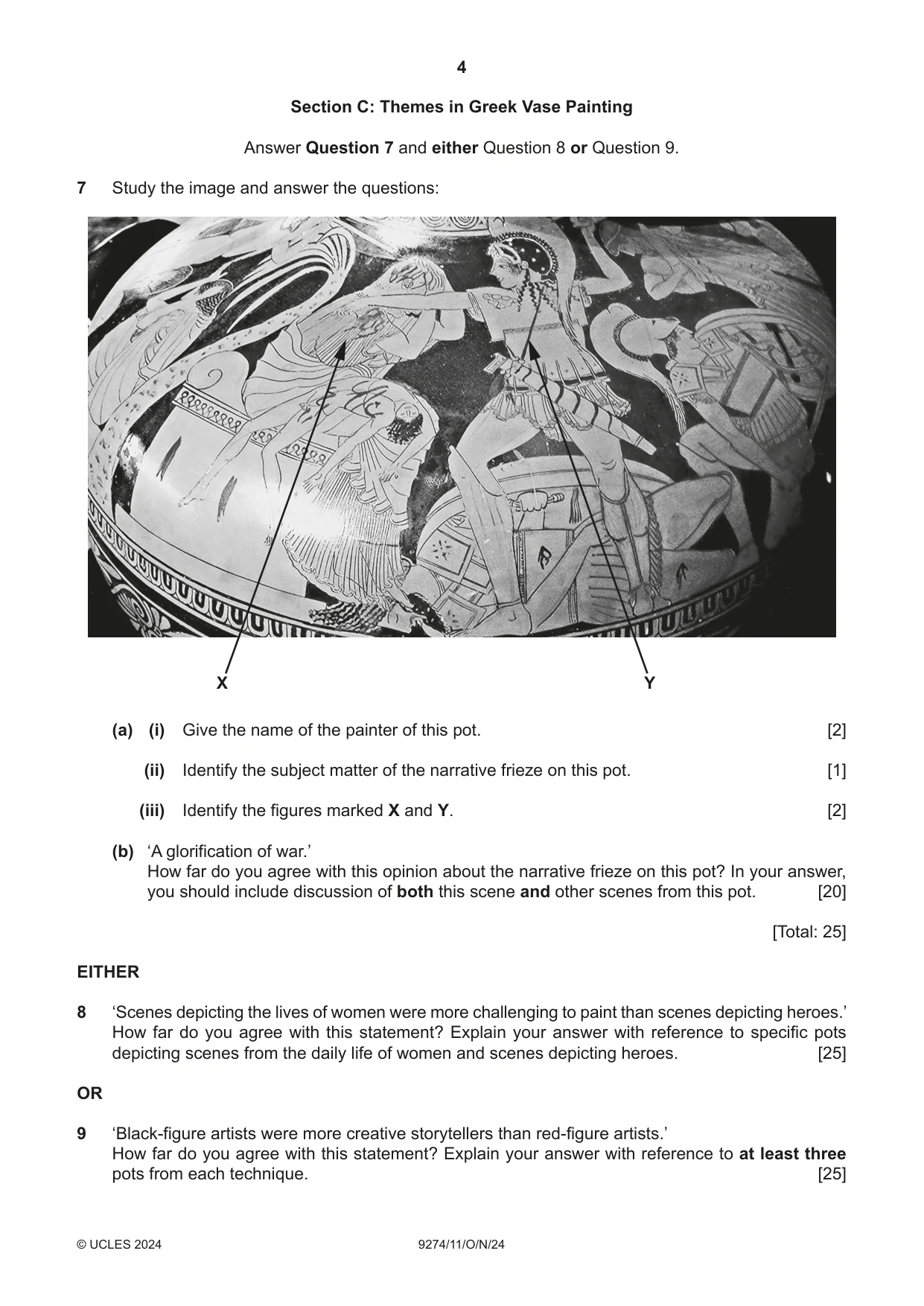
4 9274/11/O/N/24 © UCLES 2024 Section C: Themes in Greek Vase Painting Answer Question 7 and either Question 8 or Question 9. 7 Study the image and answer the questions: X Y (a) (i) Give the name of the painter of this pot. [2] (ii) Identify the subject matter of the narrative frieze on this pot. [1] (iii) Identify the figures marked X and Y. [2] (b) ‘A glorification of war.’ How far do you agree with this opinion about the narrative frieze on this pot? In your answer, you should include discussion of both this scene and other scenes from this pot. [20] [Total: 25] EITHER 8 ‘Scenes depicting the lives of women were more challenging to paint than scenes depicting heroes.’ How far do you agree with this statement? Explain your answer with reference to specific pots depicting scenes from the daily life of women and scenes depicting heroes. [25] OR 9 ‘Black-figure artists were more creative storytellers than red-figure artists.’ How far do you agree with this statement? Explain your answer with reference to at least three pots from each technique. [25]
Question paper, page 5
5 9274/11/O/N/24 © UCLES 2024 BLANK PAGE
Question paper, page 6
6 9274/11/O/N/24 © UCLES 2024 BLANK PAGE
Question paper, page 7
7 9274/11/O/N/24 © UCLES 2024 BLANK PAGE
Question paper, page 8
8 9274/11/O/N/24 © UCLES 2024 Permission to reproduce items where third-party owned material protected by copyright is included has been sought and cleared where possible. Every reasonable effort has been made by the publisher (UCLES) to trace copyright holders, but if any items requiring clearance have unwittingly been included, the publisher will be pleased to make amends at the earliest possible opportunity. To avoid the issue of disclosure of answer-related information to candidates, all copyright acknowledgements are reproduced online in the Cambridge Assessment International Education Copyright Acknowledgements Booklet. This is produced for each series of examinations and is freely available to download at www.cambridgeinternational.org after the live examination series. Cambridge Assessment International Education is part of Cambridge Assessment. Cambridge Assessment is the brand name of the University of Cambridge Local Examinations Syndicate (UCLES), which is a department of the University of Cambridge. BLANK PAGE
Mark scheme, page 1
This document consists of 21 printed pages. © Cambridge University Press & Assessment 2024 [Turn over Cambridge International AS & A Level CLASSICAL STUDIES 9274/11 Paper 1 Greek Civilisation October/November 2024 MARK SCHEME Maximum Mark: 50 Published This mark scheme is published as an aid to teachers and candidates, to indicate the requirements of the examination. It shows the basis on which Examiners were instructed to award marks. It does not indicate the details of the discussions that took place at an Examiners’ meeting before marking began, which would have considered the acceptability of alternative answers. Mark schemes should be read in conjunction with the question paper and the Principal Examiner Report for Teachers. Cambridge International will not enter into discussions about these mark schemes. Cambridge International is publishing the mark schemes for the October/November 2024 series for most Cambridge IGCSE, Cambridge International A and AS Level components, and some Cambridge O Level components.
Mark scheme, page 2
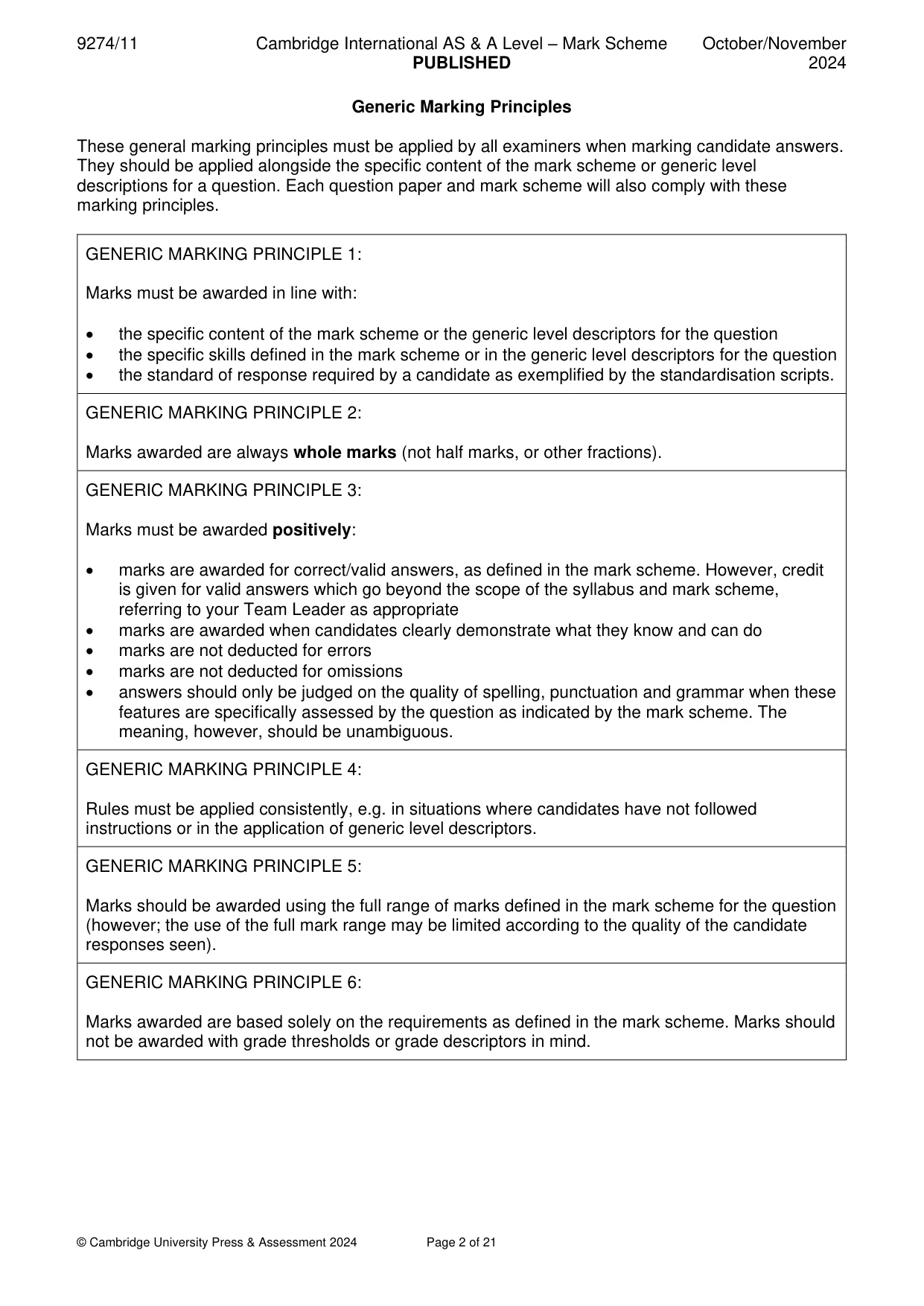
9274/11 Cambridge International AS & A Level – Mark Scheme PUBLISHED October/November 2024 © Cambridge University Press & Assessment 2024 Page 2 of 21 Generic Marking Principles These general marking principles must be applied by all examiners when marking candidate answers. They should be applied alongside the specific content of the mark scheme or generic level descriptions for a question. Each question paper and mark scheme will also comply with these marking principles. GENERIC MARKING PRINCIPLE 1: Marks must be awarded in line with: • the specific content of the mark scheme or the generic level descriptors for the question • the specific skills defined in the mark scheme or in the generic level descriptors for the question • the standard of response required by a candidate as exemplified by the standardisation scripts. GENERIC MARKING PRINCIPLE 2: Marks awarded are always whole marks (not half marks, or other fractions). GENERIC MARKING PRINCIPLE 3: Marks must be awarded positively: • marks are awarded for correct/valid answers, as defined in the mark scheme. However, credit is given for valid answers which go beyond the scope of the syllabus and mark scheme, referring to your Team Leader as appropriate • marks are awarded when candidates clearly demonstrate what they know and can do • marks are not deducted for errors • marks are not deducted for omissions • answers should only be judged on the quality of spelling, punctuation and grammar when these features are specifically assessed by the question as indicated by the mark scheme. The meaning, however, should be unambiguous. GENERIC MARKING PRINCIPLE 4: Rules must be applied consistently, e.g. in situations where candidates have not followed instructions or in the application of generic level descriptors. GENERIC MARKING PRINCIPLE 5: Marks should be awarded using the full range of marks defined in the mark scheme for the question (however; the use of the full mark range may be limited according to the quality of the candidate responses seen). GENERIC MARKING PRINCIPLE 6: Marks awarded are based solely on the requirements as defined in the mark scheme. Marks should not be awarded with grade thresholds or grade descriptors in mind.
Mark scheme, page 3
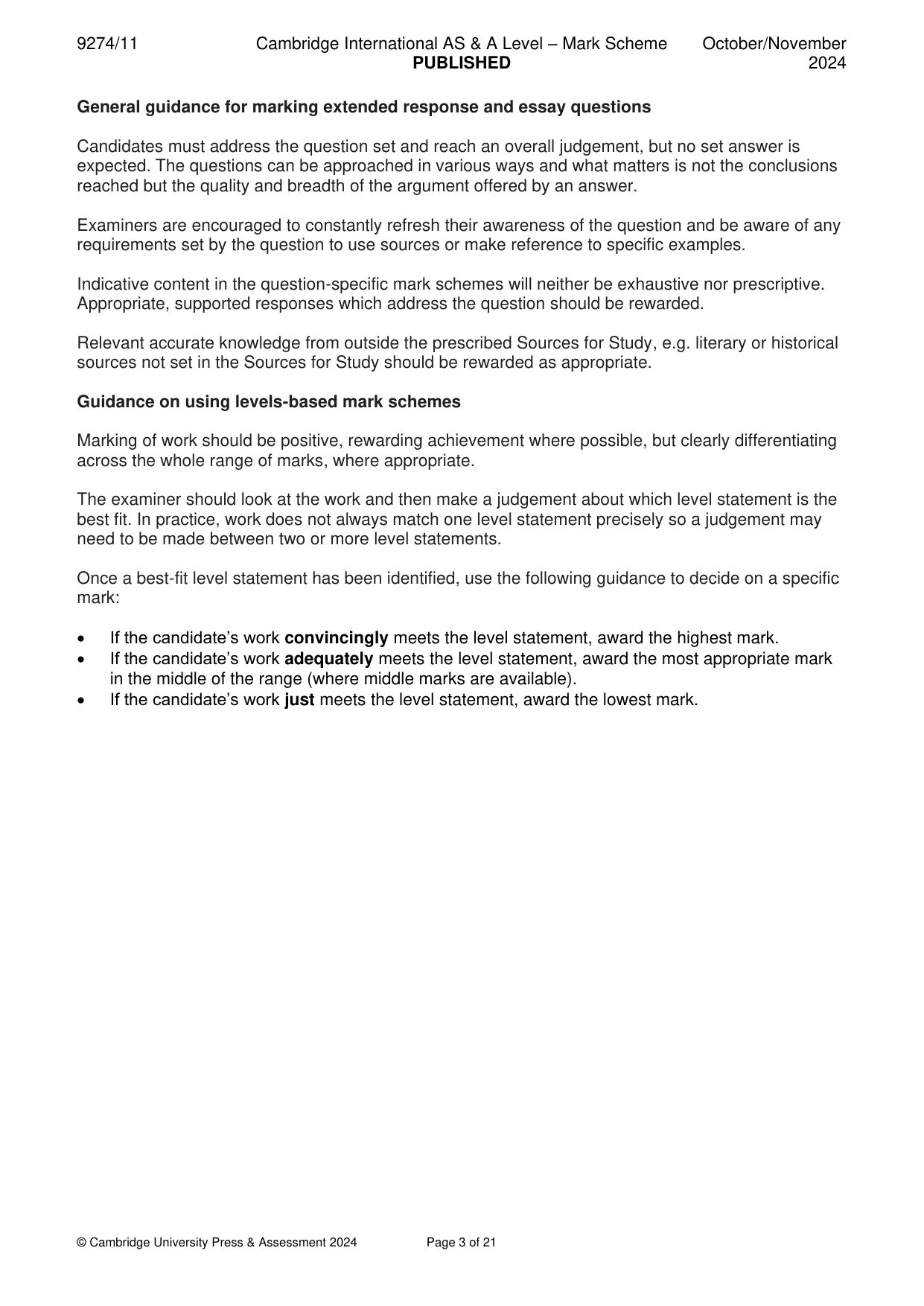
9274/11 Cambridge International AS & A Level – Mark Scheme PUBLISHED October/November 2024 © Cambridge University Press & Assessment 2024 Page 3 of 21 General guidance for marking extended response and essay questions Candidates must address the question set and reach an overall judgement, but no set answer is expected. The questions can be approached in various ways and what matters is not the conclusions reached but the quality and breadth of the argument offered by an answer. Examiners are encouraged to constantly refresh their awareness of the question and be aware of any requirements set by the question to use sources or make reference to specific examples. Indicative content in the question-specific mark schemes will neither be exhaustive nor prescriptive. Appropriate, supported responses which address the question should be rewarded. Relevant accurate knowledge from outside the prescribed Sources for Study, e.g. literary or historical sources not set in the Sources for Study should be rewarded as appropriate. Guidance on using levels-based mark schemes Marking of work should be positive, rewarding achievement where possible, but clearly differentiating across the whole range of marks, where appropriate. The examiner should look at the work and then make a judgement about which level statement is the best fit. In practice, work does not always match one level statement precisely so a judgement may need to be made between two or more level statements. Once a best-fit level statement has been identified, use the following guidance to decide on a specific mark: • If the candidate’s work convincingly meets the level statement, award the highest mark. • If the candidate’s work adequately meets the level statement, award the most appropriate mark in the middle of the range (where middle marks are available). • If the candidate’s work just meets the level statement, award the lowest mark.
Mark scheme, page 4
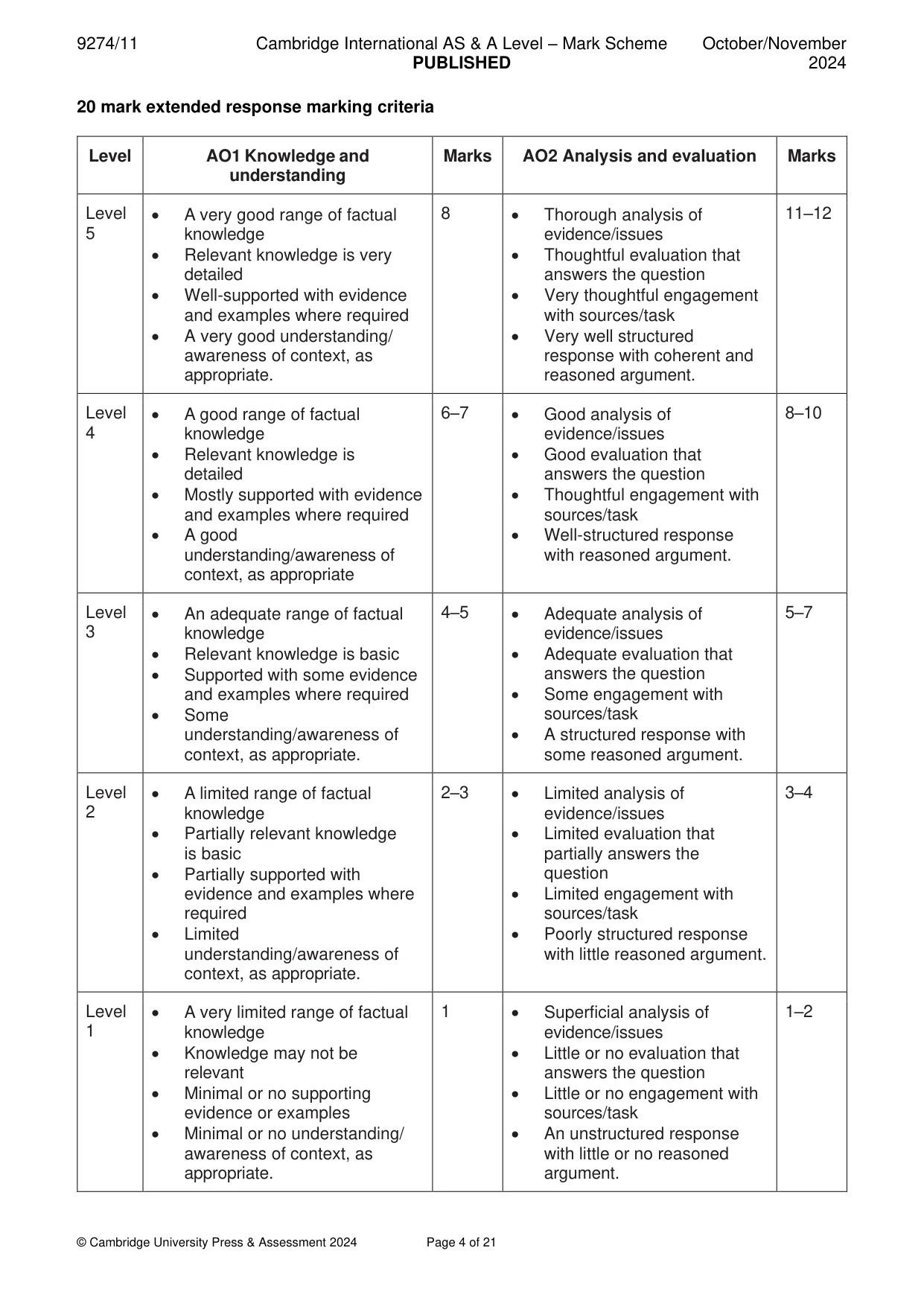
9274/11 Cambridge International AS & A Level – Mark Scheme PUBLISHED October/November 2024 © Cambridge University Press & Assessment 2024 Page 4 of 21 20 mark extended response marking criteria Level AO1 Knowledge and understanding Marks AO2 Analysis and evaluation Marks Level 5 • A very good range of factual knowledge • Relevant knowledge is very detailed • Well-supported with evidence and examples where required • A very good understanding/ awareness of context, as appropriate. 8 • Thorough analysis of evidence/issues • Thoughtful evaluation that answers the question • Very thoughtful engagement with sources/task • Very well structured response with coherent and reasoned argument. 11–12 Level 4 • A good range of factual knowledge • Relevant knowledge is detailed • Mostly supported with evidence and examples where required • A good understanding/awareness of context, as appropriate 6–7 • Good analysis of evidence/issues • Good evaluation that answers the question • Thoughtful engagement with sources/task • Well-structured response with reasoned argument. 8–10 Level 3 • An adequate range of factual knowledge • Relevant knowledge is basic • Supported with some evidence and examples where required • Some understanding/awareness of context, as appropriate. 4–5 • Adequate analysis of evidence/issues • Adequate evaluation that answers the question • Some engagement with sources/task • A structured response with some reasoned argument. 5–7 Level 2 • A limited range of factual knowledge • Partially relevant knowledge is basic • Partially supported with evidence and examples where required • Limited understanding/awareness of context, as appropriate. 2–3 • Limited analysis of evidence/issues • Limited evaluation that partially answers the question • Limited engagement with sources/task • Poorly structured response with little reasoned argument. 3–4 Level 1 • A very limited range of factual knowledge • Knowledge may not be relevant • Minimal or no supporting evidence or examples • Minimal or no understanding/ awareness of context, as appropriate. 1 • Superficial analysis of evidence/issues • Little or no evaluation that answers the question • Little or no engagement with sources/task • An unstructured response with little or no reasoned argument. 1–2
Mark scheme, page 5
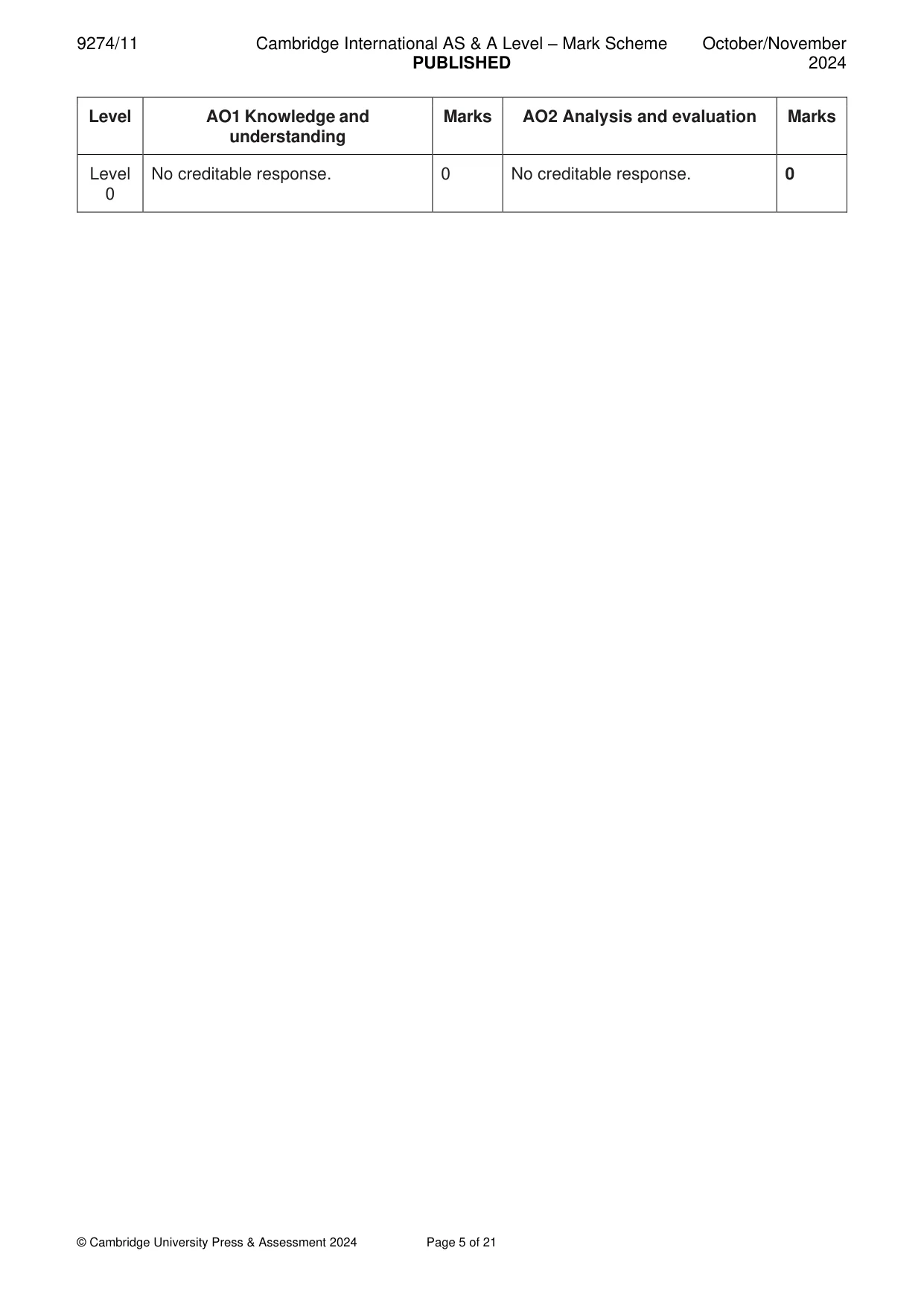
9274/11 Cambridge International AS & A Level – Mark Scheme PUBLISHED October/November 2024 © Cambridge University Press & Assessment 2024 Page 5 of 21 Level AO1 Knowledge and understanding Marks AO2 Analysis and evaluation Marks Level 0 No creditable response. 0 No creditable response. 0
Mark scheme, page 6
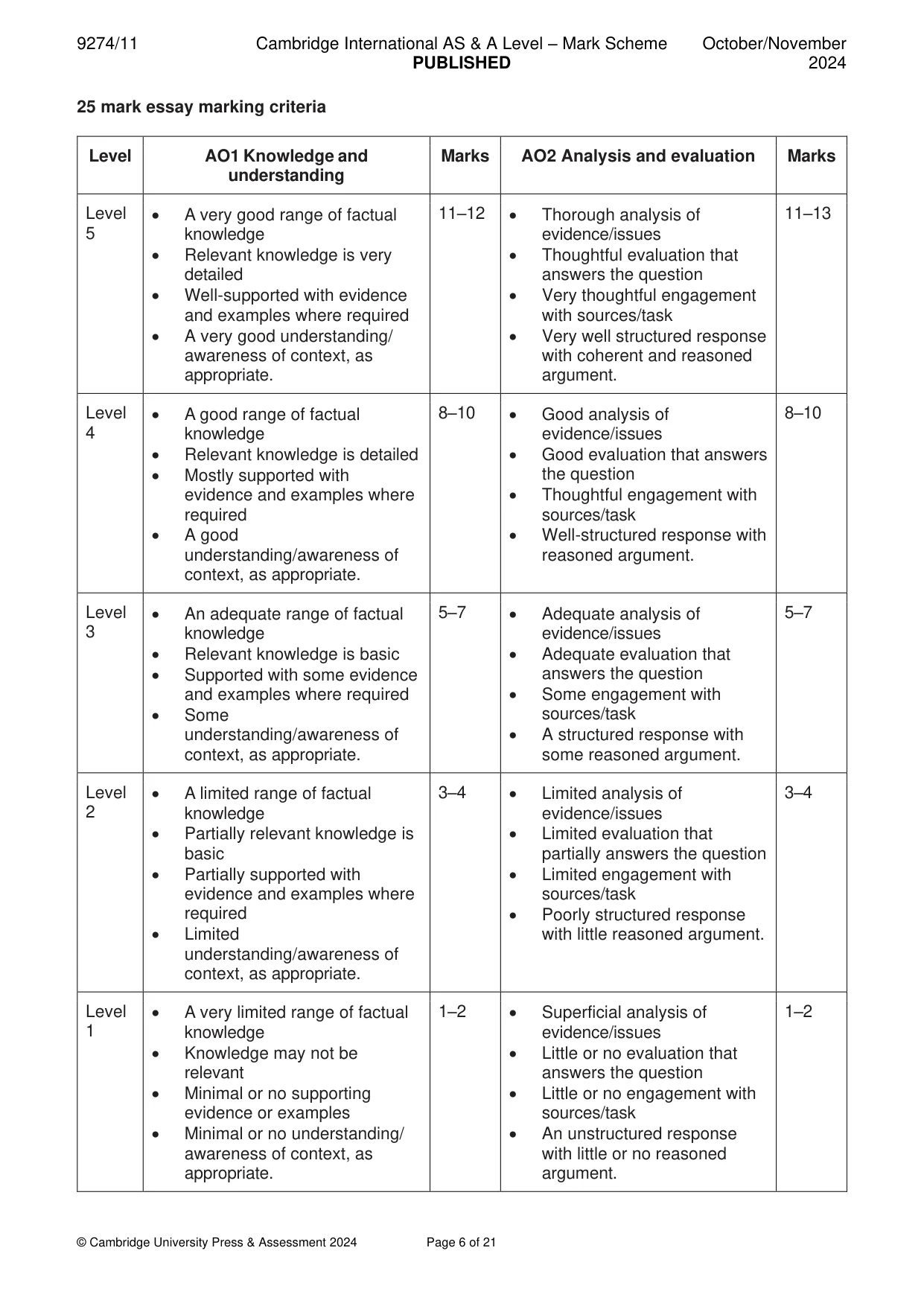
9274/11 Cambridge International AS & A Level – Mark Scheme PUBLISHED October/November 2024 © Cambridge University Press & Assessment 2024 Page 6 of 21 25 mark essay marking criteria Level AO1 Knowledge and understanding Marks AO2 Analysis and evaluation Marks Level 5 • A very good range of factual knowledge • Relevant knowledge is very detailed • Well-supported with evidence and examples where required • A very good understanding/ awareness of context, as appropriate. 11–12 • Thorough analysis of evidence/issues • Thoughtful evaluation that answers the question • Very thoughtful engagement with sources/task • Very well structured response with coherent and reasoned argument. 11–13 Level 4 • A good range of factual knowledge • Relevant knowledge is detailed • Mostly supported with evidence and examples where required • A good understanding/awareness of context, as appropriate. 8–10 • Good analysis of evidence/issues • Good evaluation that answers the question • Thoughtful engagement with sources/task • Well-structured response with reasoned argument. 8–10 Level 3 • An adequate range of factual knowledge • Relevant knowledge is basic • Supported with some evidence and examples where required • Some understanding/awareness of context, as appropriate. 5–7 • Adequate analysis of evidence/issues • Adequate evaluation that answers the question • Some engagement with sources/task • A structured response with some reasoned argument. 5–7 Level 2 • A limited range of factual knowledge • Partially relevant knowledge is basic • Partially supported with evidence and examples where required • Limited understanding/awareness of context, as appropriate. 3–4 • Limited analysis of evidence/issues • Limited evaluation that partially answers the question • Limited engagement with sources/task • Poorly structured response with little reasoned argument. 3–4 Level 1 • A very limited range of factual knowledge • Knowledge may not be relevant • Minimal or no supporting evidence or examples • Minimal or no understanding/ awareness of context, as appropriate. 1–2 • Superficial analysis of evidence/issues • Little or no evaluation that answers the question • Little or no engagement with sources/task • An unstructured response with little or no reasoned argument. 1–2
Mark scheme, page 7
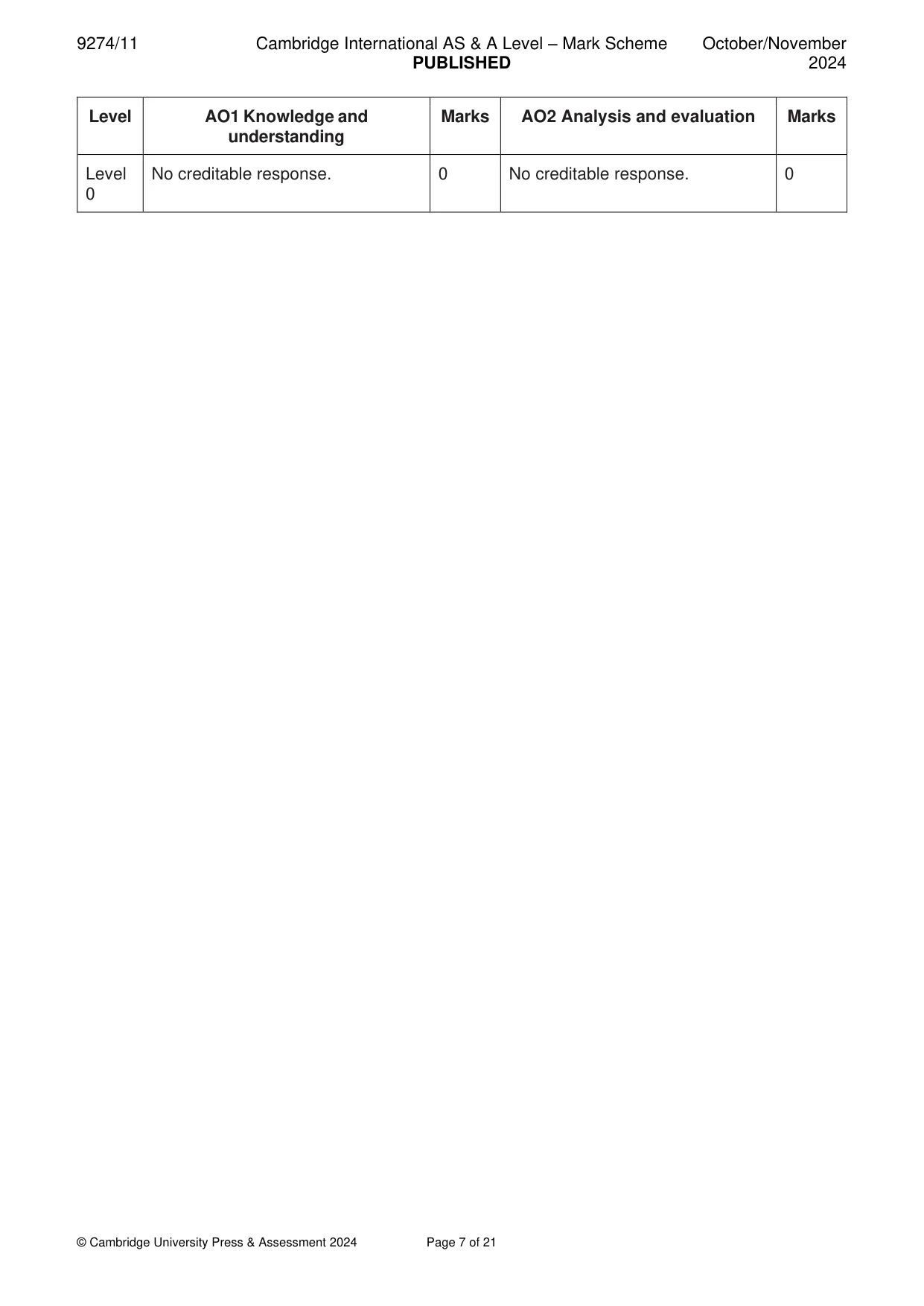
9274/11 Cambridge International AS & A Level – Mark Scheme PUBLISHED October/November 2024 © Cambridge University Press & Assessment 2024 Page 7 of 21 Level AO1 Knowledge and understanding Marks AO2 Analysis and evaluation Marks Level 0 No creditable response. 0 No creditable response. 0
Mark scheme, page 8
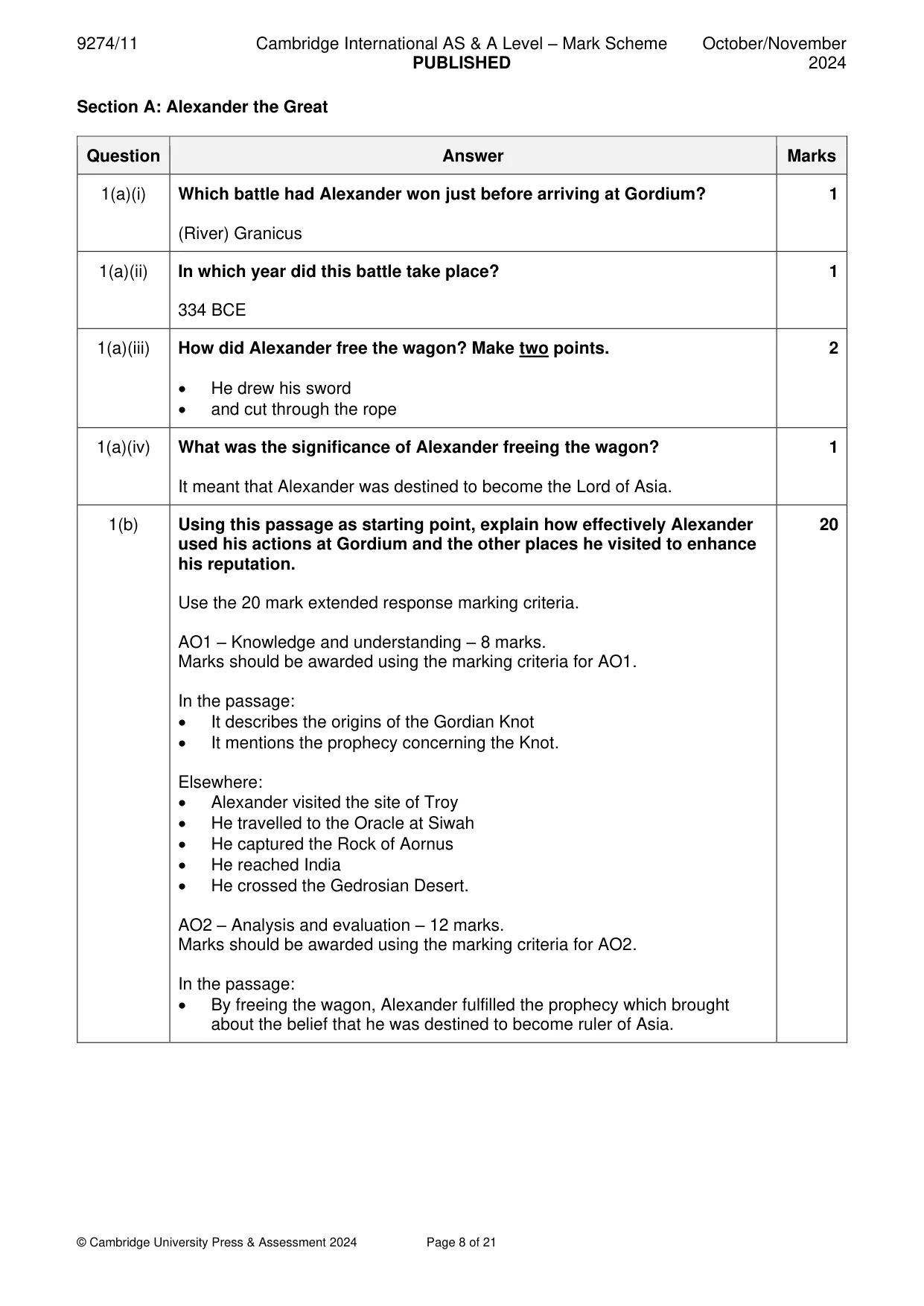
9274/11 Cambridge International AS & A Level – Mark Scheme PUBLISHED October/November 2024 © Cambridge University Press & Assessment 2024 Page 8 of 21 Section A: Alexander the Great Question Answer Marks 1(a)(i) Which battle had Alexander won just before arriving at Gordium? (River) Granicus 1 1(a)(ii) In which year did this battle take place? 334 BCE 1 1(a)(iii) How did Alexander free the wagon? Make two points. • He drew his sword • and cut through the rope 2 1(a)(iv) What was the significance of Alexander freeing the wagon? It meant that Alexander was destined to become the Lord of Asia. 1 1(b) Using this passage as starting point, explain how effectively Alexander used his actions at Gordium and the other places he visited to enhance his reputation. Use the 20 mark extended response marking criteria. AO1 – Knowledge and understanding – 8 marks. Marks should be awarded using the marking criteria for AO1. In the passage: • It describes the origins of the Gordian Knot • It mentions the prophecy concerning the Knot. Elsewhere: • Alexander visited the site of Troy • He travelled to the Oracle at Siwah • He captured the Rock of Aornus • He reached India • He crossed the Gedrosian Desert. AO2 – Analysis and evaluation – 12 marks. Marks should be awarded using the marking criteria for AO2. In the passage: • By freeing the wagon, Alexander fulfilled the prophecy which brought about the belief that he was destined to become ruler of Asia. 20
Mark scheme, page 9
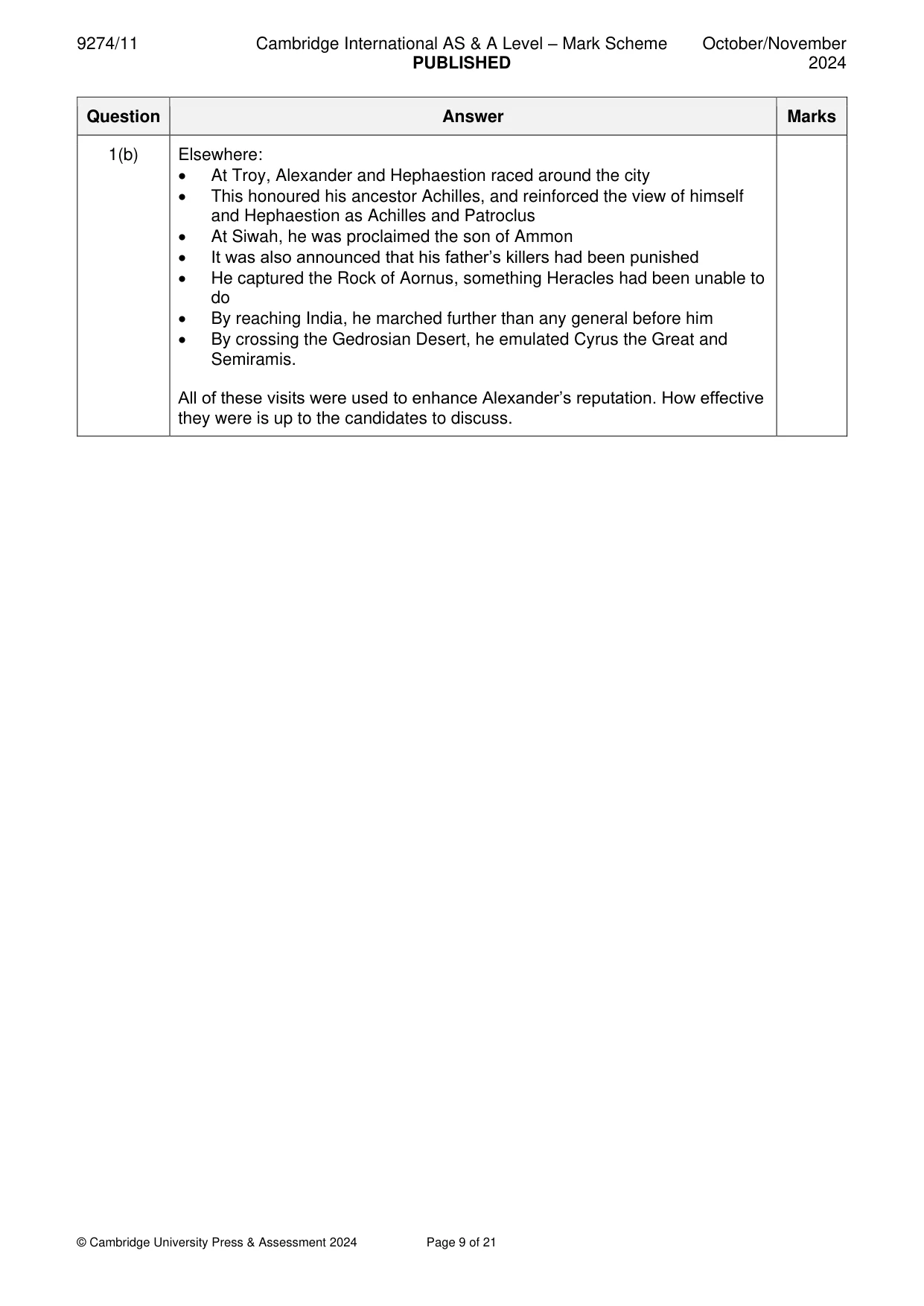
9274/11 Cambridge International AS & A Level – Mark Scheme PUBLISHED October/November 2024 © Cambridge University Press & Assessment 2024 Page 9 of 21 Question Answer Marks 1(b) Elsewhere: • At Troy, Alexander and Hephaestion raced around the city • This honoured his ancestor Achilles, and reinforced the view of himself and Hephaestion as Achilles and Patroclus • At Siwah, he was proclaimed the son of Ammon • It was also announced that his father’s killers had been punished • He captured the Rock of Aornus, something Heracles had been unable to do • By reaching India, he marched further than any general before him • By crossing the Gedrosian Desert, he emulated Cyrus the Great and Semiramis. All of these visits were used to enhance Alexander’s reputation. How effective they were is up to the candidates to discuss.
Mark scheme, page 10
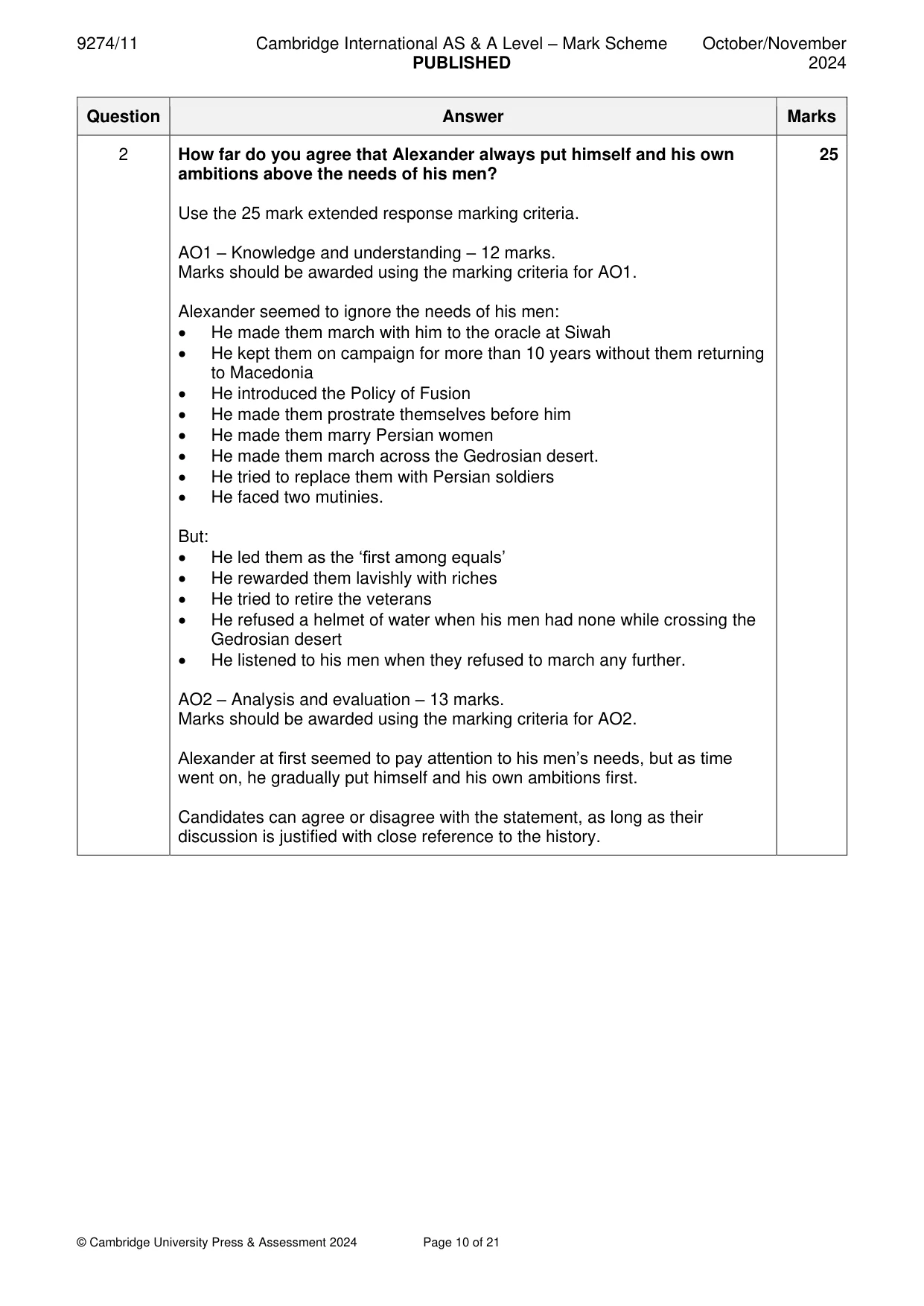
9274/11 Cambridge International AS & A Level – Mark Scheme PUBLISHED October/November 2024 © Cambridge University Press & Assessment 2024 Page 10 of 21 Question Answer Marks 2 How far do you agree that Alexander always put himself and his own ambitions above the needs of his men? Use the 25 mark extended response marking criteria. AO1 – Knowledge and understanding – 12 marks. Marks should be awarded using the marking criteria for AO1. Alexander seemed to ignore the needs of his men: • He made them march with him to the oracle at Siwah • He kept them on campaign for more than 10 years without them returning to Macedonia • He introduced the Policy of Fusion • He made them prostrate themselves before him • He made them marry Persian women • He made them march across the Gedrosian desert. • He tried to replace them with Persian soldiers • He faced two mutinies. But: • He led them as the ‘first among equals’ • He rewarded them lavishly with riches • He tried to retire the veterans • He refused a helmet of water when his men had none while crossing the Gedrosian desert • He listened to his men when they refused to march any further. AO2 – Analysis and evaluation – 13 marks. Marks should be awarded using the marking criteria for AO2. Alexander at first seemed to pay attention to his men’s needs, but as time went on, he gradually put himself and his own ambitions first. Candidates can agree or disagree with the statement, as long as their discussion is justified with close reference to the history. 25
Mark scheme, page 11
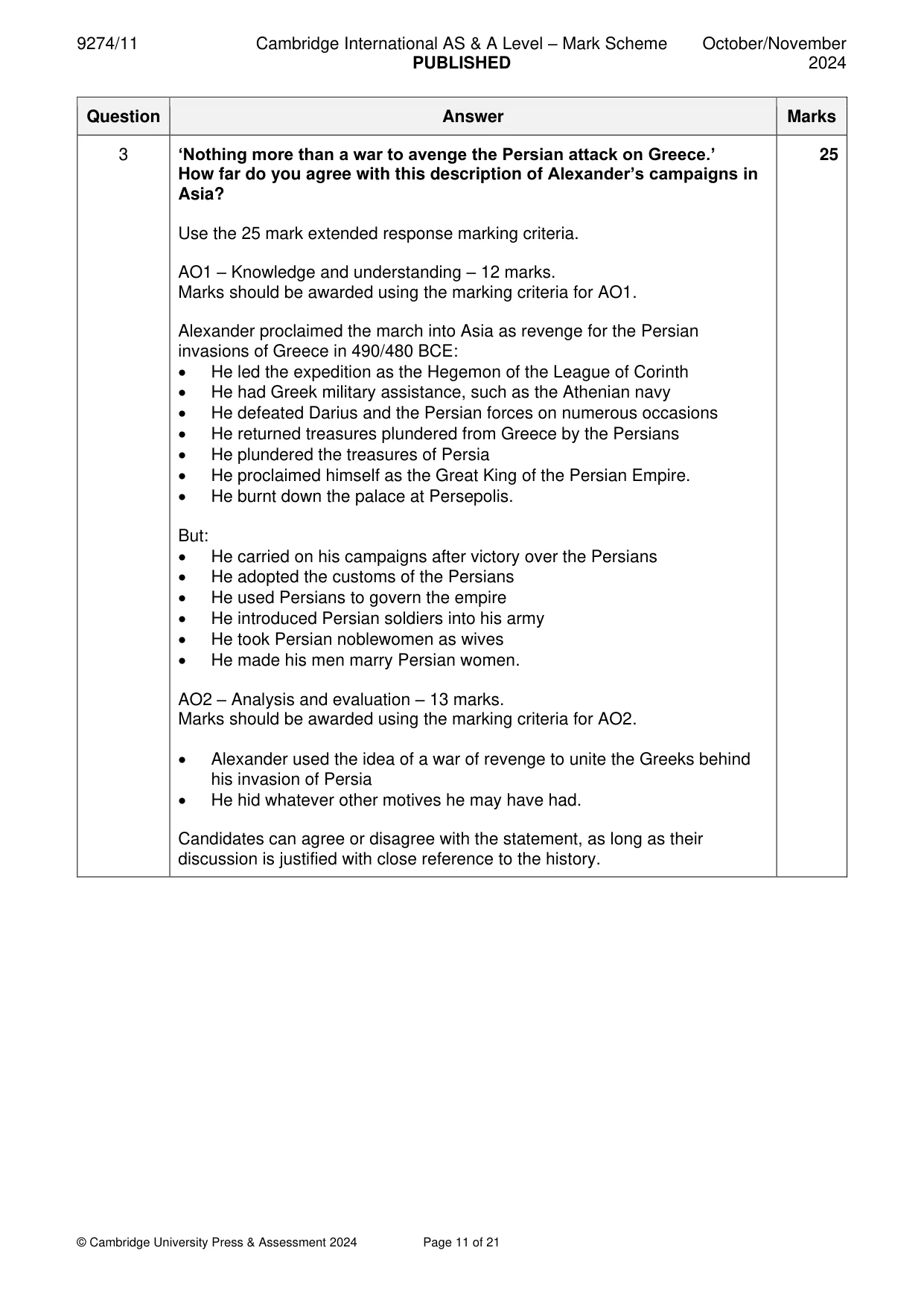
9274/11 Cambridge International AS & A Level – Mark Scheme PUBLISHED October/November 2024 © Cambridge University Press & Assessment 2024 Page 11 of 21 Question Answer Marks 3 ‘Nothing more than a war to avenge the Persian attack on Greece.’ How far do you agree with this description of Alexander’s campaigns in Asia? Use the 25 mark extended response marking criteria. AO1 – Knowledge and understanding – 12 marks. Marks should be awarded using the marking criteria for AO1. Alexander proclaimed the march into Asia as revenge for the Persian invasions of Greece in 490/480 BCE: • He led the expedition as the Hegemon of the League of Corinth • He had Greek military assistance, such as the Athenian navy • He defeated Darius and the Persian forces on numerous occasions • He returned treasures plundered from Greece by the Persians • He plundered the treasures of Persia • He proclaimed himself as the Great King of the Persian Empire. • He burnt down the palace at Persepolis. But: • He carried on his campaigns after victory over the Persians • He adopted the customs of the Persians • He used Persians to govern the empire • He introduced Persian soldiers into his army • He took Persian noblewomen as wives • He made his men marry Persian women. AO2 – Analysis and evaluation – 13 marks. Marks should be awarded using the marking criteria for AO2. • Alexander used the idea of a war of revenge to unite the Greeks behind his invasion of Persia • He hid whatever other motives he may have had. Candidates can agree or disagree with the statement, as long as their discussion is justified with close reference to the history. 25
Mark scheme, page 12
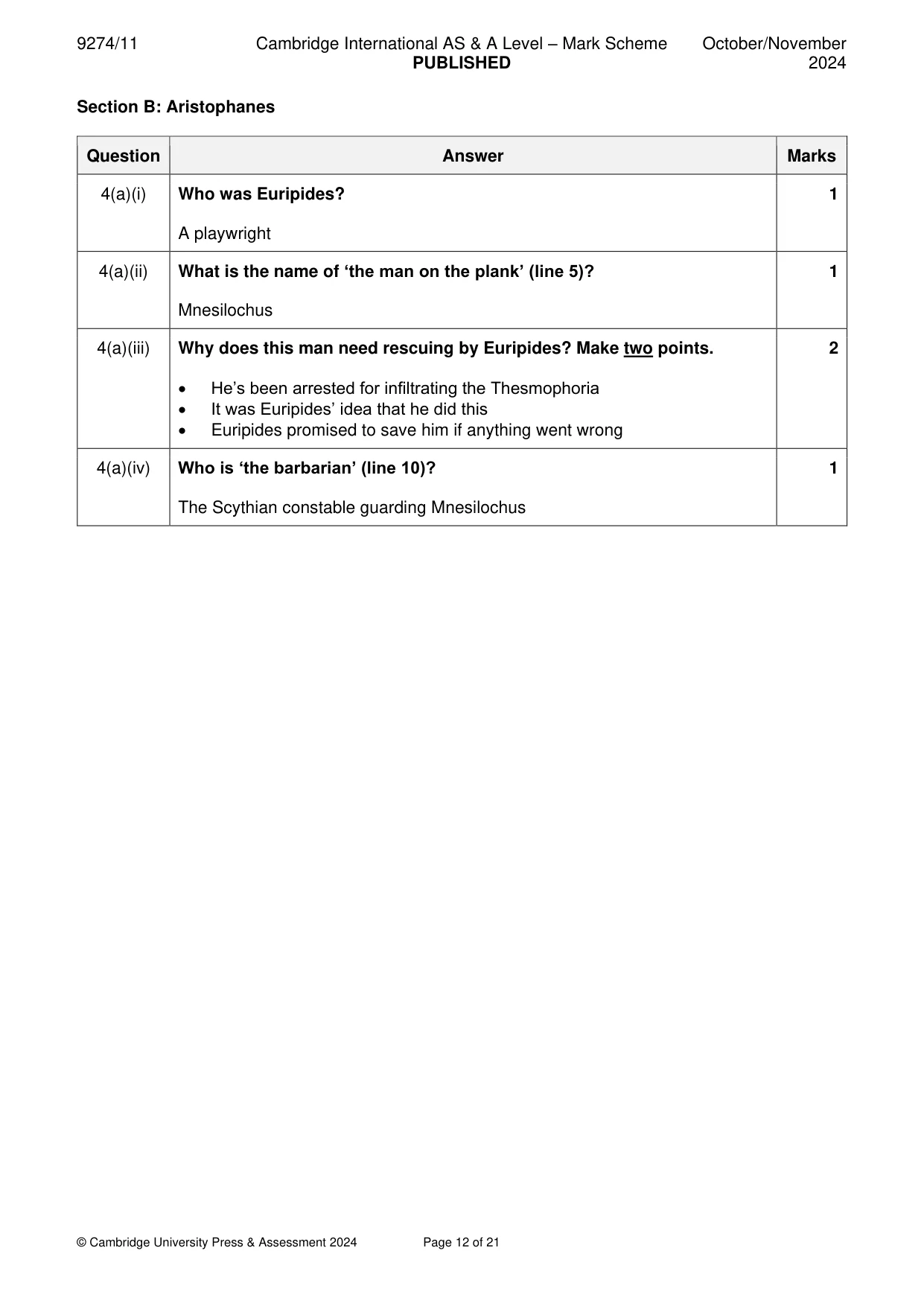
9274/11 Cambridge International AS & A Level – Mark Scheme PUBLISHED October/November 2024 © Cambridge University Press & Assessment 2024 Page 12 of 21 Section B: Aristophanes Question Answer Marks 4(a)(i) Who was Euripides? A playwright 1 4(a)(ii) What is the name of ‘the man on the plank’ (line 5)? Mnesilochus 1 4(a)(iii) Why does this man need rescuing by Euripides? Make two points. • He’s been arrested for infiltrating the Thesmophoria • It was Euripides’ idea that he did this • Euripides promised to save him if anything went wrong 2 4(a)(iv) Who is ‘the barbarian’ (line 10)? The Scythian constable guarding Mnesilochus 1
Mark scheme, page 13
9274/11 Cambridge International AS & A Level – Mark Scheme PUBLISHED October/November 2024 © Cambridge University Press & Assessment 2024 Page 13 of 21 Question Answer Marks 4(b) How is Euripides portrayed in this passage? How typical is this of the way he is portrayed elsewhere in Women at the Thesmophoria? Use the 20 mark extended response marking criteria. AO1 – Knowledge and understanding – 8 marks. Marks should be awarded using the marking criteria for AO1. In the passage: • Euripides is the one in control – he is doing the rescuing • Euripides is in disguise • Euripides wants to make peace with the chorus • Euripides threatens to tell the women’s husbands what they have been doing • Euripides has recruited an accomplice – the dancing girl. Elsewhere: • Euripides has the plan for someone to go to the Thesmophoria • Euripides has been disguised • Earlier he was worried that the women were going to condemn him to death • Euripides is prepared to involve others in his plan. AO2 – Analysis and evaluation – 12 marks. Marks should be awarded using the marking criteria for AO2. • In the passage Euripides is seen coming up with a clever plan to rescue Mnesilochus • To some extent this is similar to his characterisation elsewhere in the play • It was his idea to have someone disguise themselves to go and argue his case with the women • The idea of disguise is in character – he has also disguised himself as Perseus in an attempt to rescue Mnesilochus • His attitude to the women is different as earlier he seemed afraid of their opinion of him but here, he seems in control • His attitude to the women still seems negative as he threatens to tell their husbands what the women have been up to. Credit should be given for any valid line of argument that is well supported by examples from the text. 20
Mark scheme, page 14
9274/11 Cambridge International AS & A Level – Mark Scheme PUBLISHED October/November 2024 © Cambridge University Press & Assessment 2024 Page 14 of 21 Question Answer Marks 5 Which of Aristophanes’ plays do you think is most enjoyable for a modern audience? In your answer, you should discuss at least two plays. Use the 25 mark essay marking criteria. AO1 – Knowledge and understanding – 12 marks. Marks should be awarded using the marking criteria for AO1. Candidates might make reference to: • Lysistrata • Frogs • Women at the Thesmophoria • The social and political background of the plays • The types of humour used in the plays • The relevance of the plays to the modern world. AO2 – Analysis and evaluation – 13 marks. Marks should be awarded using the marking criteria for AO2. Candidates should define what makes an enjoyable play: • Lysistrata has, in general, been the most consistently performed play of Aristophanes in the modern world • It is perhaps the most accessible play for a modern audience as it does not require a complex understanding of the background • It is enough to understand that there was a war on without having to understand all the details • Frogs could be seen as enjoyable due to the fantasy elements • However, there is more that requires an understanding of ancient Athenian culture for the play to be fully understood • A similar argument could be made for Women at the Thesmophoria • There is a level of humour that can be enjoyed without understanding the background • But also a good deal of specific references that a modern audience may find harder. Expect candidates to give specific reasons and details from the plays in their answers. Stronger answers may look at the themes and types of comedy that are most accessible to a modern audience. Accept any valid line of argument that is well supported with details from the plays. 25
Mark scheme, page 15
9274/11 Cambridge International AS & A Level – Mark Scheme PUBLISHED October/November 2024 © Cambridge University Press & Assessment 2024 Page 15 of 21 Question Answer Marks 6 ‘Frogs is more about delivering a serious message than entertaining the audience.’ How far do you agree with this statement? Use the 25 mark essay marking criteria. AO1 – Knowledge and understanding – 12 marks. Marks should be awarded using the marking criteria for AO1. Candidates might make reference to: • Peloponnesian War that was happening when Aristophanes wrote the play • References to the state of the city • References to contemporary generals such as Alcibiades • Questioning of Aeschylus and Euripides about him • Message of the parabasis exhorting Athenians to turn to good men • To what extent this play is a serious critique of tragedy • The main aim of the play was to entertain the audience and win a comedy contest • More comic elements than serious ones • Contains fantastical elements • Parodies mythology • Puns and wordplay • Visual humour • Physical humour. AO2 – Analysis and evaluation – 13 marks. Marks should be awarded using the marking criteria for AO2. • In order to answer this question, candidates need to show an awareness of the elements of the play that could be considered serious such as the political background to the play and the contemporary references within • Candidates could also explore the idea that the play was considered serious as it was a judgement about tragedy and evaluate the contest between Aeschylus and Euripides • Candidates should also explore the counter argument that the main aim of the play was to entertain the audience and examine the many elements that make this play entertaining • The contest between Aeschylus and Euripides mirrors what is going on in the state • Old-fashioned values versus new values • The parabasis is believed to be responsible for the play being granted an unprecedented second performance in the same year. Accept any valid line of argument that is well-supported with details from the play. 25
Mark scheme, page 16
9274/11 Cambridge International AS & A Level – Mark Scheme PUBLISHED October/November 2024 © Cambridge University Press & Assessment 2024 Page 16 of 21 Section C: Themes in Greek Vase Painting Question Answer Marks 7(a)(i) Give the name of the painter of this pot. Kleophrades Painter 2 7(a)(ii) Identify the subject matter of the narrative frieze on this pot. Fall of Troy 1 7(a)(iii) Identify the figures marked X and Y. • X Priam • Y Neoptolemus 2
Mark scheme, page 17
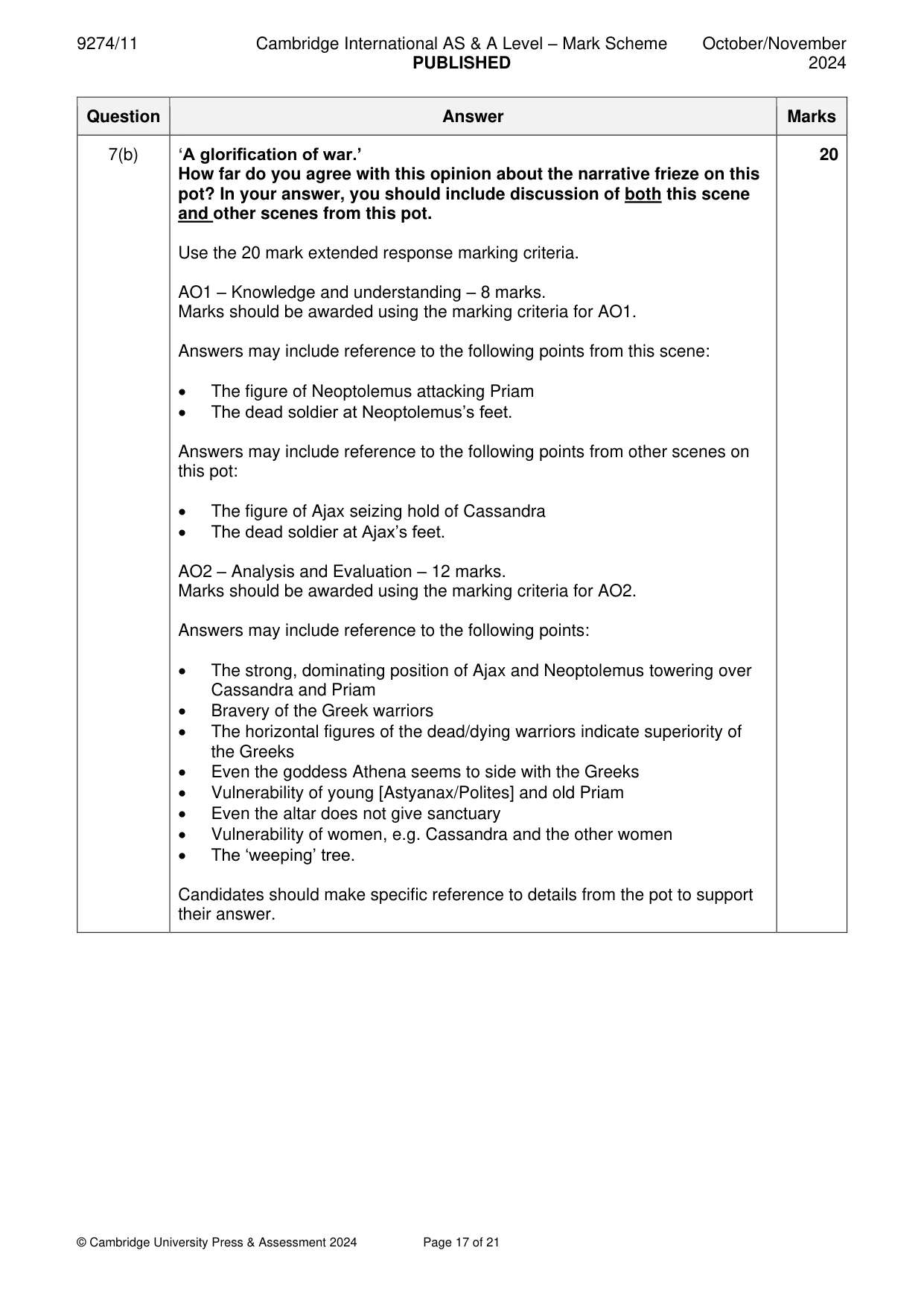
9274/11 Cambridge International AS & A Level – Mark Scheme PUBLISHED October/November 2024 © Cambridge University Press & Assessment 2024 Page 17 of 21 Question Answer Marks 7(b) ‘A glorification of war.’ How far do you agree with this opinion about the narrative frieze on this pot? In your answer, you should include discussion of both this scene and other scenes from this pot. Use the 20 mark extended response marking criteria. AO1 – Knowledge and understanding – 8 marks. Marks should be awarded using the marking criteria for AO1. Answers may include reference to the following points from this scene: • The figure of Neoptolemus attacking Priam • The dead soldier at Neoptolemus’s feet. Answers may include reference to the following points from other scenes on this pot: • The figure of Ajax seizing hold of Cassandra • The dead soldier at Ajax’s feet. AO2 – Analysis and Evaluation – 12 marks. Marks should be awarded using the marking criteria for AO2. Answers may include reference to the following points: • The strong, dominating position of Ajax and Neoptolemus towering over Cassandra and Priam • Bravery of the Greek warriors • The horizontal figures of the dead/dying warriors indicate superiority of the Greeks • Even the goddess Athena seems to side with the Greeks • Vulnerability of young [Astyanax/Polites] and old Priam • Even the altar does not give sanctuary • Vulnerability of women, e.g. Cassandra and the other women • The ‘weeping’ tree. Candidates should make specific reference to details from the pot to support their answer. 20
Mark scheme, page 18
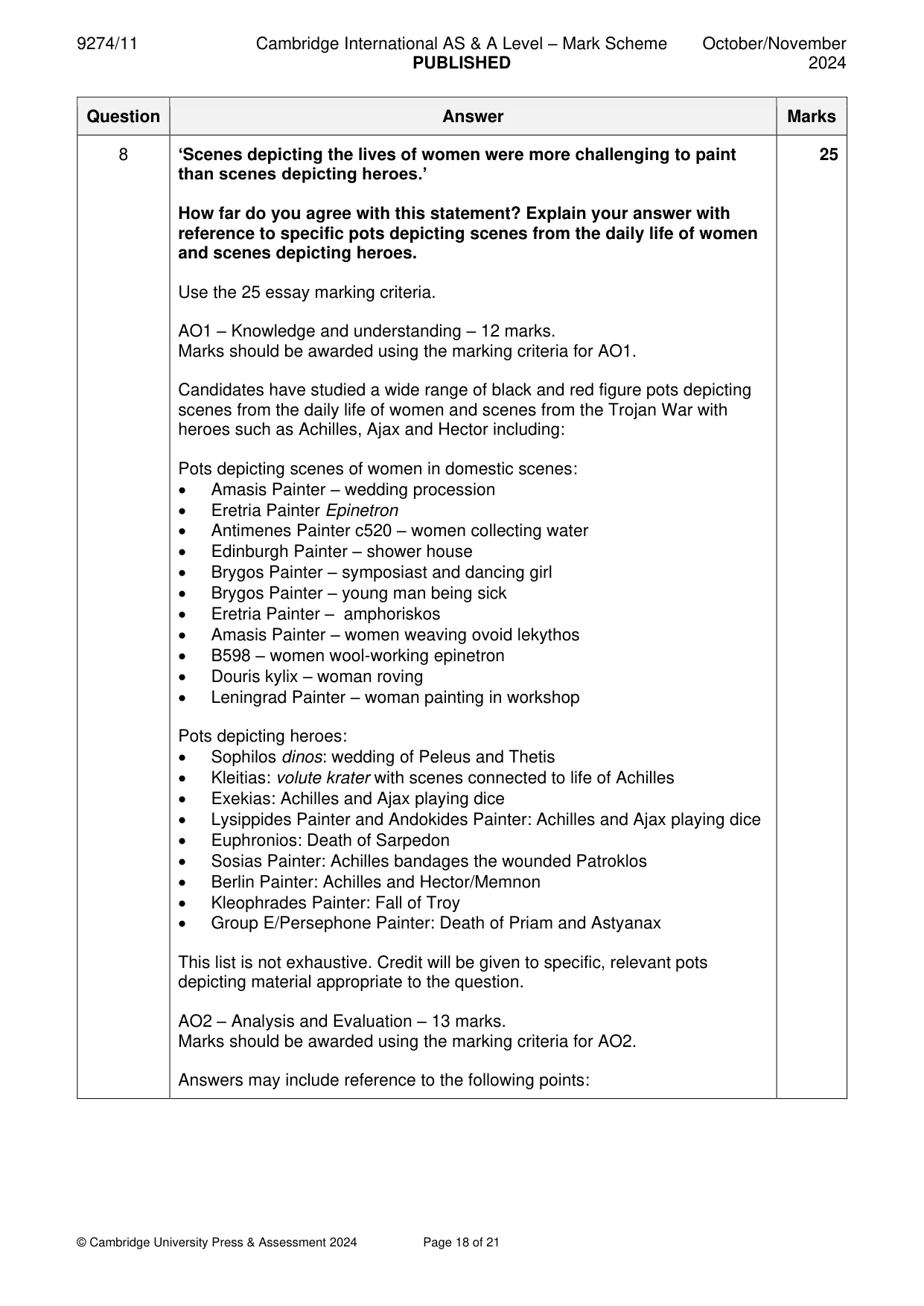
9274/11 Cambridge International AS & A Level – Mark Scheme PUBLISHED October/November 2024 © Cambridge University Press & Assessment 2024 Page 18 of 21 Question Answer Marks 8 ‘Scenes depicting the lives of women were more challenging to paint than scenes depicting heroes.’ How far do you agree with this statement? Explain your answer with reference to specific pots depicting scenes from the daily life of women and scenes depicting heroes. Use the 25 essay marking criteria. AO1 – Knowledge and understanding – 12 marks. Marks should be awarded using the marking criteria for AO1. Candidates have studied a wide range of black and red figure pots depicting scenes from the daily life of women and scenes from the Trojan War with heroes such as Achilles, Ajax and Hector including: Pots depicting scenes of women in domestic scenes: • Amasis Painter – wedding procession • Eretria Painter Epinetron • Antimenes Painter c520 – women collecting water • Edinburgh Painter – shower house • Brygos Painter – symposiast and dancing girl • Brygos Painter – young man being sick • Eretria Painter – amphoriskos • Amasis Painter – women weaving ovoid lekythos • B598 – women wool-working epinetron • Douris kylix – woman roving • Leningrad Painter – woman painting in workshop Pots depicting heroes: • Sophilos dinos: wedding of Peleus and Thetis • Kleitias: volute krater with scenes connected to life of Achilles • Exekias: Achilles and Ajax playing dice • Lysippides Painter and Andokides Painter: Achilles and Ajax playing dice • Euphronios: Death of Sarpedon • Sosias Painter: Achilles bandages the wounded Patroklos • Berlin Painter: Achilles and Hector/Memnon • Kleophrades Painter: Fall of Troy • Group E/Persephone Painter: Death of Priam and Astyanax This list is not exhaustive. Credit will be given to specific, relevant pots depicting material appropriate to the question. AO2 – Analysis and Evaluation – 13 marks. Marks should be awarded using the marking criteria for AO2. Answers may include reference to the following points: 25
Mark scheme, page 19
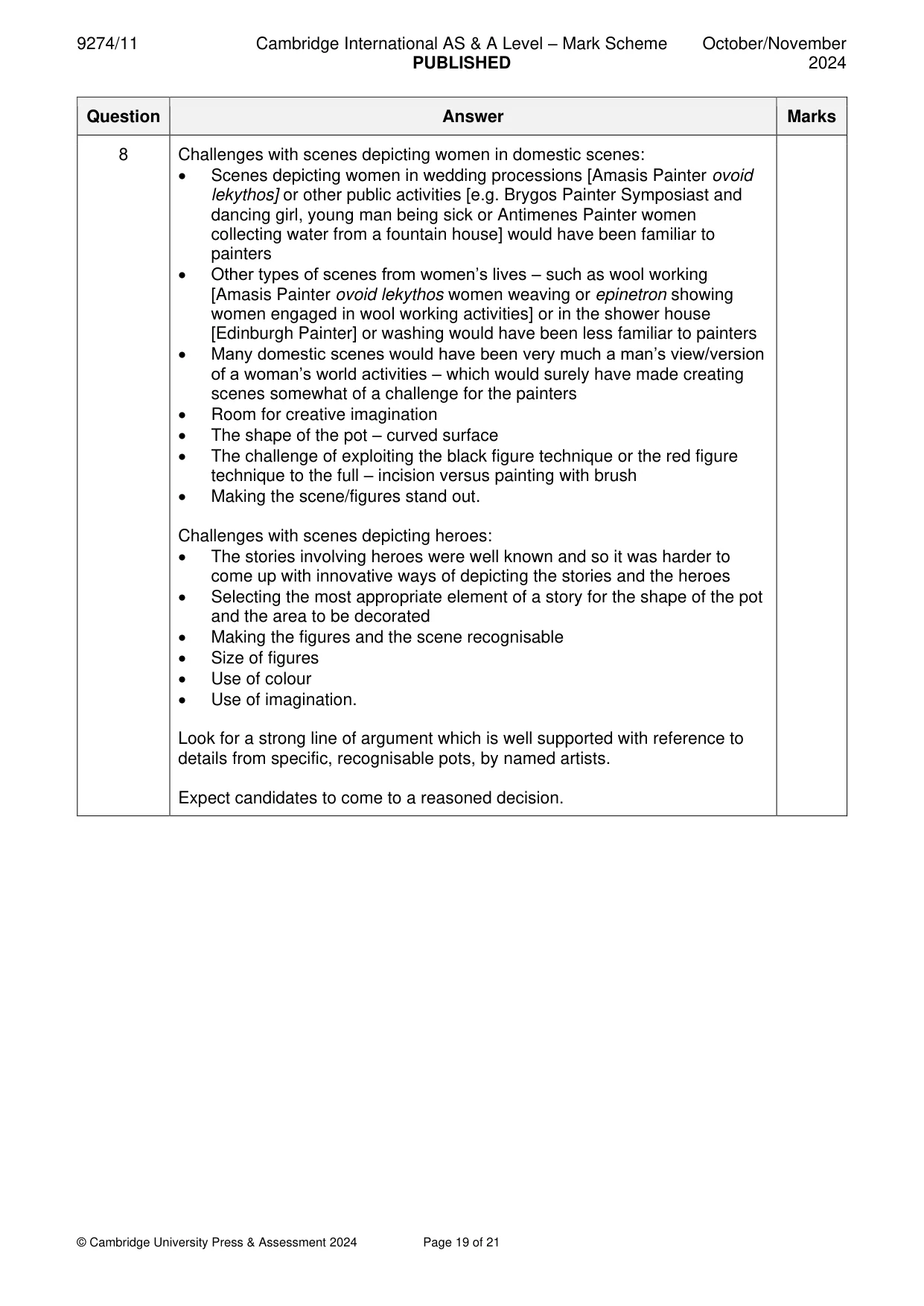
9274/11 Cambridge International AS & A Level – Mark Scheme PUBLISHED October/November 2024 © Cambridge University Press & Assessment 2024 Page 19 of 21 Question Answer Marks 8 Challenges with scenes depicting women in domestic scenes: • Scenes depicting women in wedding processions [Amasis Painter ovoid lekythos] or other public activities [e.g. Brygos Painter Symposiast and dancing girl, young man being sick or Antimenes Painter women collecting water from a fountain house] would have been familiar to painters • Other types of scenes from women’s lives – such as wool working [Amasis Painter ovoid lekythos women weaving or epinetron showing women engaged in wool working activities] or in the shower house [Edinburgh Painter] or washing would have been less familiar to painters • Many domestic scenes would have been very much a man’s view/version of a woman’s world activities – which would surely have made creating scenes somewhat of a challenge for the painters • Room for creative imagination • The shape of the pot – curved surface • The challenge of exploiting the black figure technique or the red figure technique to the full – incision versus painting with brush • Making the scene/figures stand out. Challenges with scenes depicting heroes: • The stories involving heroes were well known and so it was harder to come up with innovative ways of depicting the stories and the heroes • Selecting the most appropriate element of a story for the shape of the pot and the area to be decorated • Making the figures and the scene recognisable • Size of figures • Use of colour • Use of imagination. Look for a strong line of argument which is well supported with reference to details from specific, recognisable pots, by named artists. Expect candidates to come to a reasoned decision.
Mark scheme, page 20
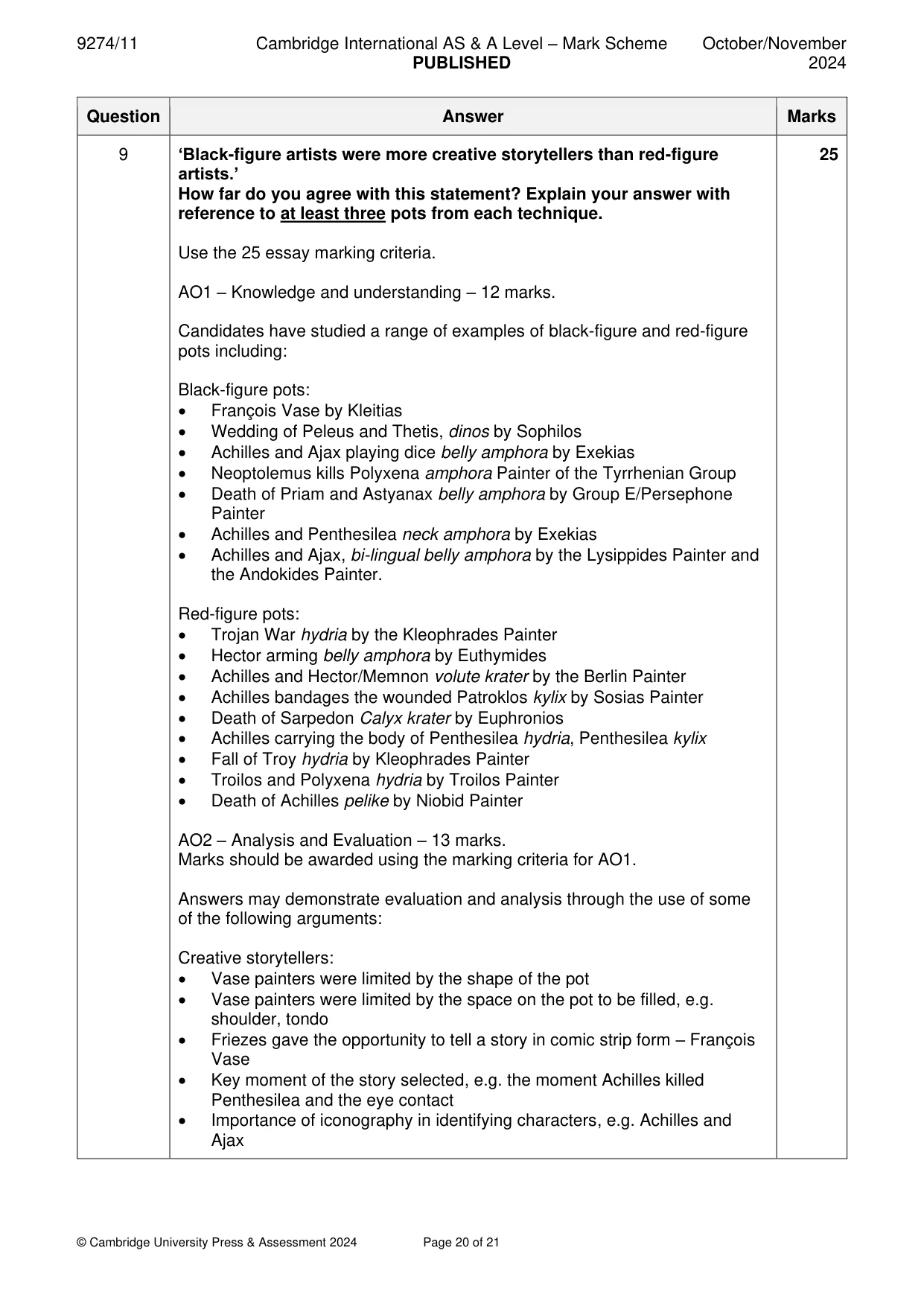
9274/11 Cambridge International AS & A Level – Mark Scheme PUBLISHED October/November 2024 © Cambridge University Press & Assessment 2024 Page 20 of 21 Question Answer Marks 9 ‘Black-figure artists were more creative storytellers than red-figure artists.’ How far do you agree with this statement? Explain your answer with reference to at least three pots from each technique. Use the 25 essay marking criteria. AO1 – Knowledge and understanding – 12 marks. Candidates have studied a range of examples of black-figure and red-figure pots including: Black-figure pots: • François Vase by Kleitias • Wedding of Peleus and Thetis, dinos by Sophilos • Achilles and Ajax playing dice belly amphora by Exekias • Neoptolemus kills Polyxena amphora Painter of the Tyrrhenian Group • Death of Priam and Astyanax belly amphora by Group E/Persephone Painter • Achilles and Penthesilea neck amphora by Exekias • Achilles and Ajax, bi-lingual belly amphora by the Lysippides Painter and the Andokides Painter. Red-figure pots: • Trojan War hydria by the Kleophrades Painter • Hector arming belly amphora by Euthymides • Achilles and Hector/Memnon volute krater by the Berlin Painter • Achilles bandages the wounded Patroklos kylix by Sosias Painter • Death of Sarpedon Calyx krater by Euphronios • Achilles carrying the body of Penthesilea hydria, Penthesilea kylix • Fall of Troy hydria by Kleophrades Painter • Troilos and Polyxena hydria by Troilos Painter • Death of Achilles pelike by Niobid Painter AO2 – Analysis and Evaluation – 13 marks. Marks should be awarded using the marking criteria for AO1. Answers may demonstrate evaluation and analysis through the use of some of the following arguments: Creative storytellers: • Vase painters were limited by the shape of the pot • Vase painters were limited by the space on the pot to be filled, e.g. shoulder, tondo • Friezes gave the opportunity to tell a story in comic strip form – François Vase • Key moment of the story selected, e.g. the moment Achilles killed Penthesilea and the eye contact • Importance of iconography in identifying characters, e.g. Achilles and Ajax 25
Mark scheme, page 21
9274/11 Cambridge International AS & A Level – Mark Scheme PUBLISHED October/November 2024 © Cambridge University Press & Assessment 2024 Page 21 of 21 Question Answer Marks 9 • Use of the written word, e.g. Sophilos dinos and François Vase • Use of dynamic poses to fill the space and tell the story • Use of the whole pot • Pots such as the dinos or volute krater were large and offered a long frieze-like strip, allowing a painter to tell a detailed story • Other pots, such as the amphora, offered a square-like shape so the painter had to be more succinct in telling a story and had to select elements of the story very carefully, e.g. the killing of Polyxena or Priam and Astyanax • The different elements of the two techniques enabled painters to tell a successful story to a greater or lesser extent • Much depended on the skill of the painter • Some candidates may choose to select pots from the depiction of women engaged in different activities – certainly some pots [e.g. the Amasis Painter’s women weaving] may well be considered to tell a story. This is intended to be an open question so that candidates are free to choose their own examples from both vase painting techniques. To answer this question effectively, candidates need to decide upon the criteria they are going to use in order to decide what they think of as being creative storytelling. Candidates need to come to a conclusion about whether black- figure artists were more creative storytellers than red-figure artists.
What you needed in this session
Cambridge’s own grade thresholds for 2024 Oct/Nov, Paper 1 · Variant 1. A higher threshold means an easier paper — the bar moves with how the cohort did.