Cambridge A Level Classical Studies 9274 — 2021 Oct/Nov Paper 1 · Variant 1
9274/11/O/N/21 · 50 marks · ≈56 min
The question paper and its mark scheme, free to read here and free to download. This is Cambridge’s own paper, exactly as it was sat.
Question paper8 pages
Mark scheme18 pages
Answers below. Sit the paper first if you are practising.
Paper as text
Question paper, page 1
This document has 8 pages. Any blank pages are indicated. Cambridge International AS & A Level CLASSICAL STUDIES 9274/11 Paper 1 Greek Civilisation October/November 2021 1 hour 30 minutes You must answer on the enclosed answer booklet. You will need: Answer booklet (enclosed) INSTRUCTIONS ● Answer two questions in total: Answer one question from two different sections. ● Follow the instructions on the front cover of the answer booklet. If you need additional answer paper, ask the invigilator for a continuation booklet. INFORMATION ● The total mark for this paper is 50. ● Each question is worth 25 marks. * 7 0 2 2 9 9 6 7 8 1 * DC (LK/SG) 205052/3 © UCLES 2021 [Turn over
Question paper, page 2
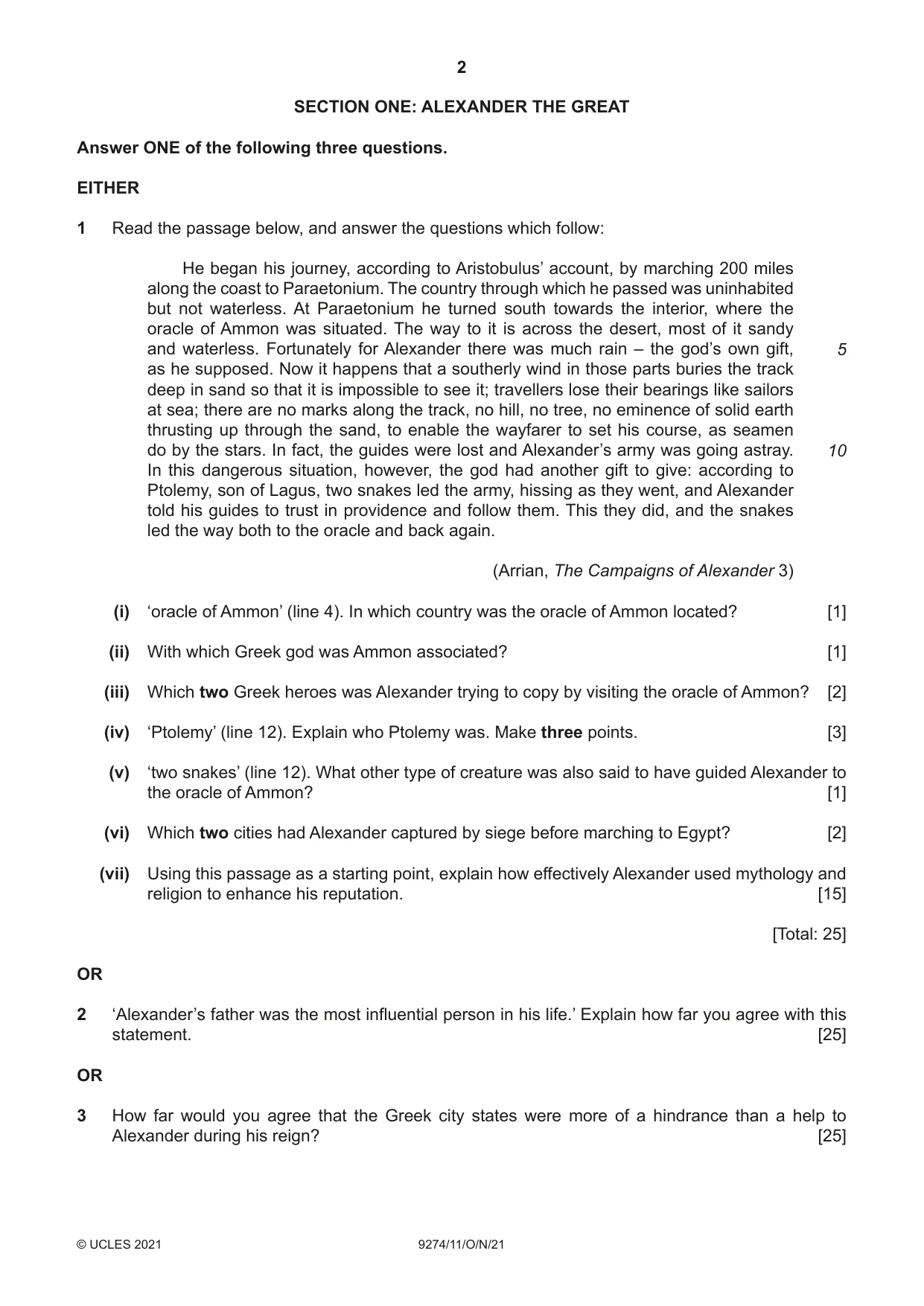
2 9274/11/O/N/21 © UCLES 2021 SECTION ONE: ALEXANDER THE GREAT Answer ONE of the following three questions. EITHER 1 Read the passage below, and answer the questions which follow: He began his journey, according to Aristobulus’ account, by marching 200 miles along the coast to Paraetonium. The country through which he passed was uninhabited but not waterless. At Paraetonium he turned south towards the interior, where the oracle of Ammon was situated. The way to it is across the desert, most of it sandy and waterless. Fortunately for Alexander there was much rain – the god’s own gift, as he supposed. Now it happens that a southerly wind in those parts buries the track deep in sand so that it is impossible to see it; travellers lose their bearings like sailors at sea; there are no marks along the track, no hill, no tree, no eminence of solid earth thrusting up through the sand, to enable the wayfarer to set his course, as seamen do by the stars. In fact, the guides were lost and Alexander’s army was going astray. In this dangerous situation, however, the god had another gift to give: according to Ptolemy, son of Lagus, two snakes led the army, hissing as they went, and Alexander told his guides to trust in providence and follow them. This they did, and the snakes led the way both to the oracle and back again. (Arrian, The Campaigns of Alexander 3) (i) ‘oracle of Ammon’ (line 4). In which country was the oracle of Ammon located? [1] (ii) With which Greek god was Ammon associated? [1] (iii) Which two Greek heroes was Alexander trying to copy by visiting the oracle of Ammon? [2] (iv) ‘Ptolemy’ (line 12). Explain who Ptolemy was. Make three points. [3] (v) ‘two snakes’ (line 12). What other type of creature was also said to have guided Alexander to the oracle of Ammon? [1] (vi) Which two cities had Alexander captured by siege before marching to Egypt? [2] (vii) Using this passage as a starting point, explain how effectively Alexander used mythology and religion to enhance his reputation. [15] [Total: 25] OR 2 ‘Alexander’s father was the most influential person in his life.’ Explain how far you agree with this statement. [25] OR 3 How far would you agree that the Greek city states were more of a hindrance than a help to Alexander during his reign? [25] 5 10
Question paper, page 3
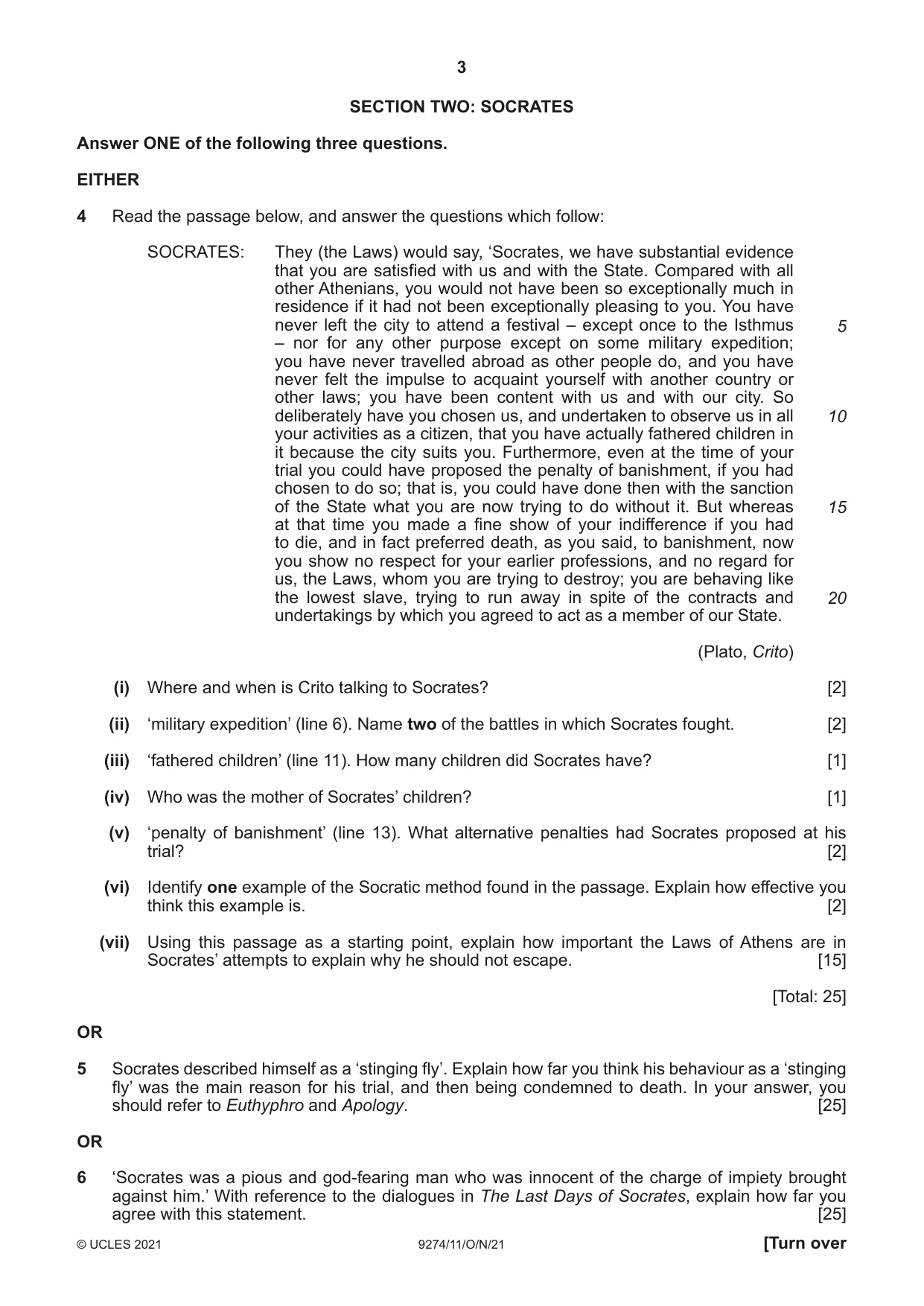
3 9274/11/O/N/21 © UCLES 2021 [Turn over SECTION TWO: SOCRATES Answer ONE of the following three questions. EITHER 4 Read the passage below, and answer the questions which follow: SOCRATES: They (the Laws) would say, ‘Socrates, we have substantial evidence that you are satisfied with us and with the State. Compared with all other Athenians, you would not have been so exceptionally much in residence if it had not been exceptionally pleasing to you. You have never left the city to attend a festival – except once to the Isthmus – nor for any other purpose except on some military expedition; you have never travelled abroad as other people do, and you have never felt the impulse to acquaint yourself with another country or other laws; you have been content with us and with our city. So deliberately have you chosen us, and undertaken to observe us in all your activities as a citizen, that you have actually fathered children in it because the city suits you. Furthermore, even at the time of your trial you could have proposed the penalty of banishment, if you had chosen to do so; that is, you could have done then with the sanction of the State what you are now trying to do without it. But whereas at that time you made a fine show of your indifference if you had to die, and in fact preferred death, as you said, to banishment, now you show no respect for your earlier professions, and no regard for us, the Laws, whom you are trying to destroy; you are behaving like the lowest slave, trying to run away in spite of the contracts and undertakings by which you agreed to act as a member of our State. (Plato, Crito) (i) Where and when is Crito talking to Socrates? [2] (ii) ‘military expedition’ (line 6). Name two of the battles in which Socrates fought. [2] (iii) ‘fathered children’ (line 11). How many children did Socrates have? [1] (iv) Who was the mother of Socrates’ children? [1] (v) ‘penalty of banishment’ (line 13). What alternative penalties had Socrates proposed at his trial? [2] (vi) Identify one example of the Socratic method found in the passage. Explain how effective you think this example is. [2] (vii) Using this passage as a starting point, explain how important the Laws of Athens are in Socrates’ attempts to explain why he should not escape. [15] [Total: 25] OR 5 Socrates described himself as a ‘stinging fly’. Explain how far you think his behaviour as a ‘stinging fly’ was the main reason for his trial, and then being condemned to death. In your answer, you should refer to Euthyphro and Apology. [25] OR 6 ‘Socrates was a pious and god-fearing man who was innocent of the charge of impiety brought against him.’ With reference to the dialogues in The Last Days of Socrates, explain how far you agree with this statement. [25] 5 10 15 20
Question paper, page 4
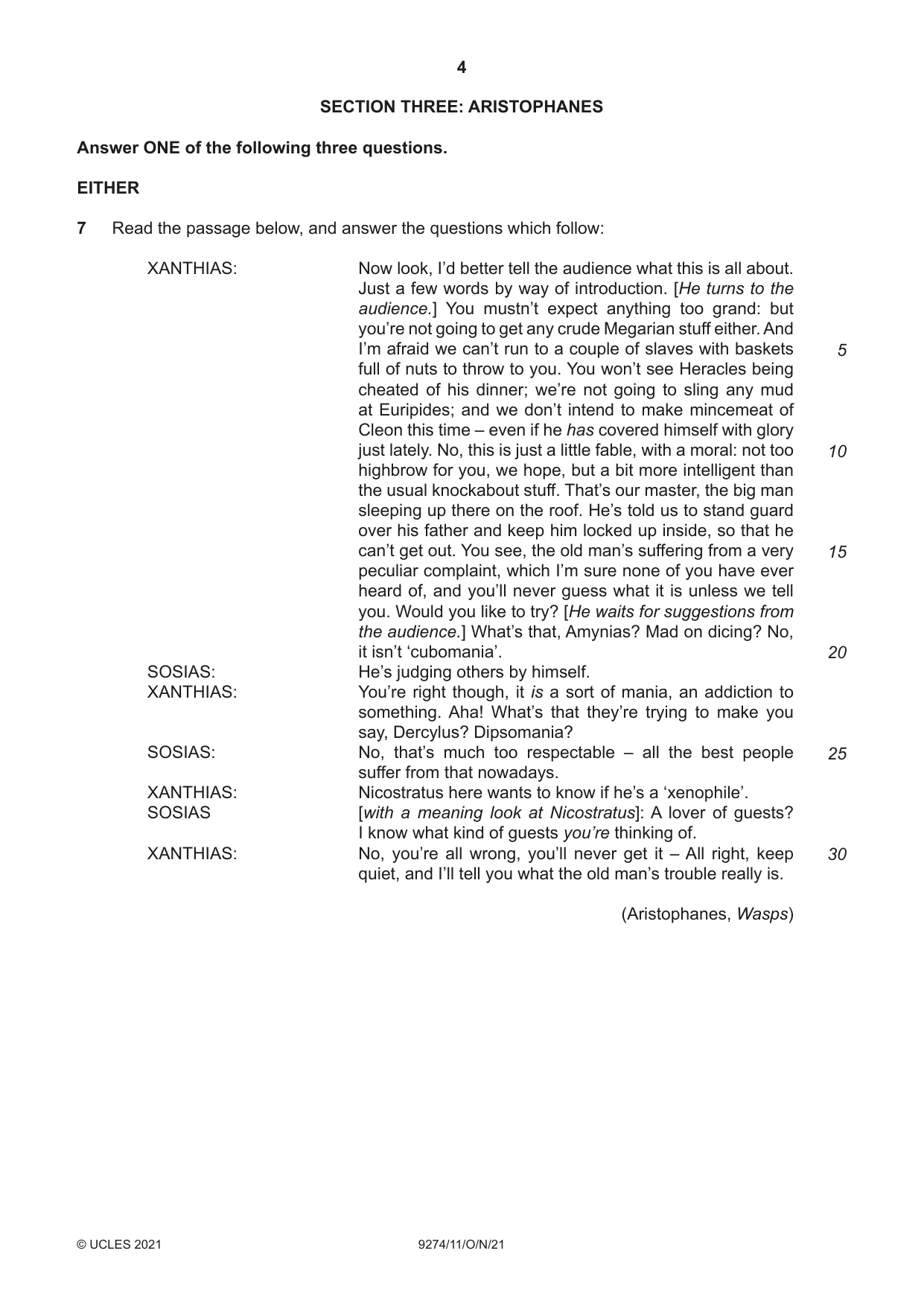
4 9274/11/O/N/21 © UCLES 2021 SECTION THREE: ARISTOPHANES Answer ONE of the following three questions. EITHER 7 Read the passage below, and answer the questions which follow: XANTHIAS: Now look, I’d better tell the audience what this is all about. Just a few words by way of introduction. [He turns to the audience.] You mustn’t expect anything too grand: but you’re not going to get any crude Megarian stuff either. And I’m afraid we can’t run to a couple of slaves with baskets full of nuts to throw to you. You won’t see Heracles being cheated of his dinner; we’re not going to sling any mud at Euripides; and we don’t intend to make mincemeat of Cleon this time – even if he has covered himself with glory just lately. No, this is just a little fable, with a moral: not too highbrow for you, we hope, but a bit more intelligent than the usual knockabout stuff. That’s our master, the big man sleeping up there on the roof. He’s told us to stand guard over his father and keep him locked up inside, so that he can’t get out. You see, the old man’s suffering from a very peculiar complaint, which I’m sure none of you have ever heard of, and you’ll never guess what it is unless we tell you. Would you like to try? [He waits for suggestions from the audience.] What’s that, Amynias? Mad on dicing? No, it isn’t ‘cubomania’. SOSIAS: He’s judging others by himself. XANTHIAS: You’re right though, it is a sort of mania, an addiction to something. Aha! What’s that they’re trying to make you say, Dercylus? Dipsomania? SOSIAS: No, that’s much too respectable – all the best people suffer from that nowadays. XANTHIAS: Nicostratus here wants to know if he’s a ‘xenophile’. SOSIAS [with a meaning look at Nicostratus]: A lover of guests? I know what kind of guests you’re thinking of. XANTHIAS: No, you’re all wrong, you’ll never get it – All right, keep quiet, and I’ll tell you what the old man’s trouble really is. (Aristophanes, Wasps) 5 10 15 20 25 30
Question paper, page 5
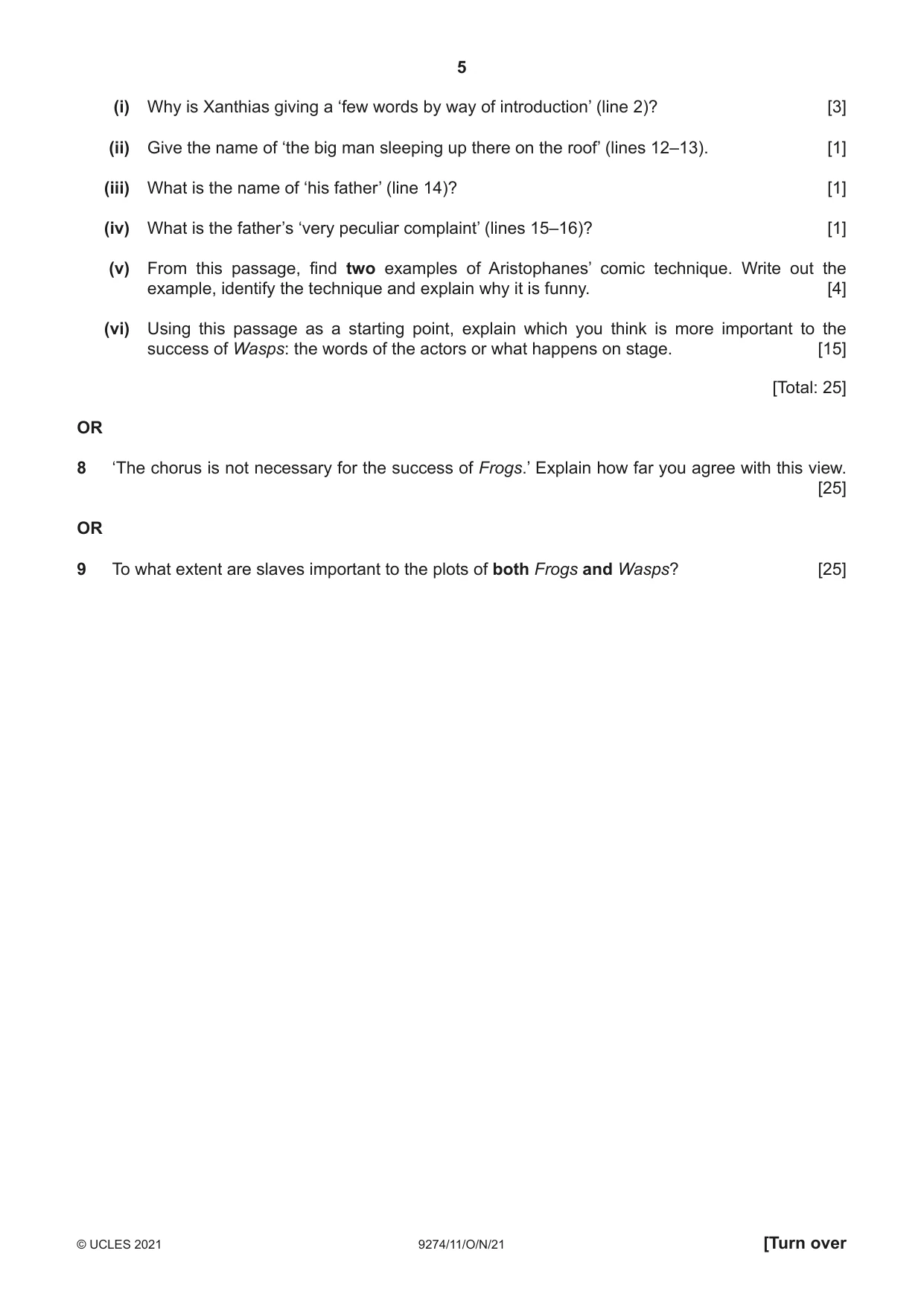
5 9274/11/O/N/21 © UCLES 2021 [Turn over (i) Why is Xanthias giving a ‘few words by way of introduction’ (line 2)? [3] (ii) Give the name of ‘the big man sleeping up there on the roof’ (lines 12–13). [1] (iii) What is the name of ‘his father’ (line 14)? [1] (iv) What is the father’s ‘very peculiar complaint’ (lines 15–16)? [1] (v) From this passage, find two examples of Aristophanes’ comic technique. Write out the example, identify the technique and explain why it is funny. [4] (vi) Using this passage as a starting point, explain which you think is more important to the success of Wasps: the words of the actors or what happens on stage. [15] [Total: 25] OR 8 ‘The chorus is not necessary for the success of Frogs.’ Explain how far you agree with this view. [25] OR 9 To what extent are slaves important to the plots of both Frogs and Wasps? [25]
Question paper, page 6
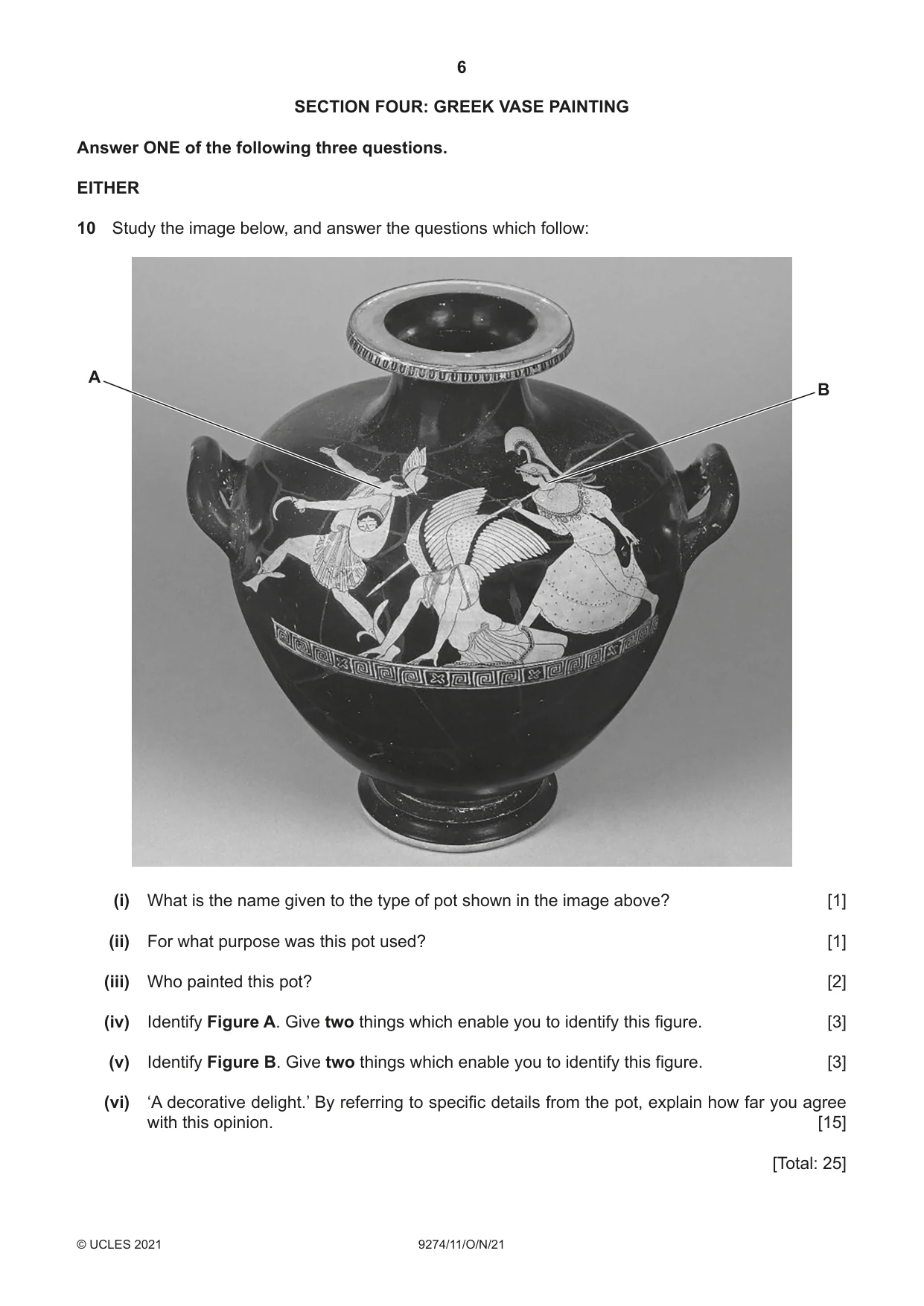
6 9274/11/O/N/21 © UCLES 2021 SECTION FOUR: GREEK VASE PAINTING Answer ONE of the following three questions. EITHER 10 Study the image below, and answer the questions which follow: B A (i) What is the name given to the type of pot shown in the image above? [1] (ii) For what purpose was this pot used? [1] (iii) Who painted this pot? [2] (iv) Identify Figure A. Give two things which enable you to identify this figure. [3] (v) Identify Figure B. Give two things which enable you to identify this figure. [3] (vi) ‘A decorative delight.’ By referring to specific details from the pot, explain how far you agree with this opinion. [15] [Total: 25]
Question paper, page 7
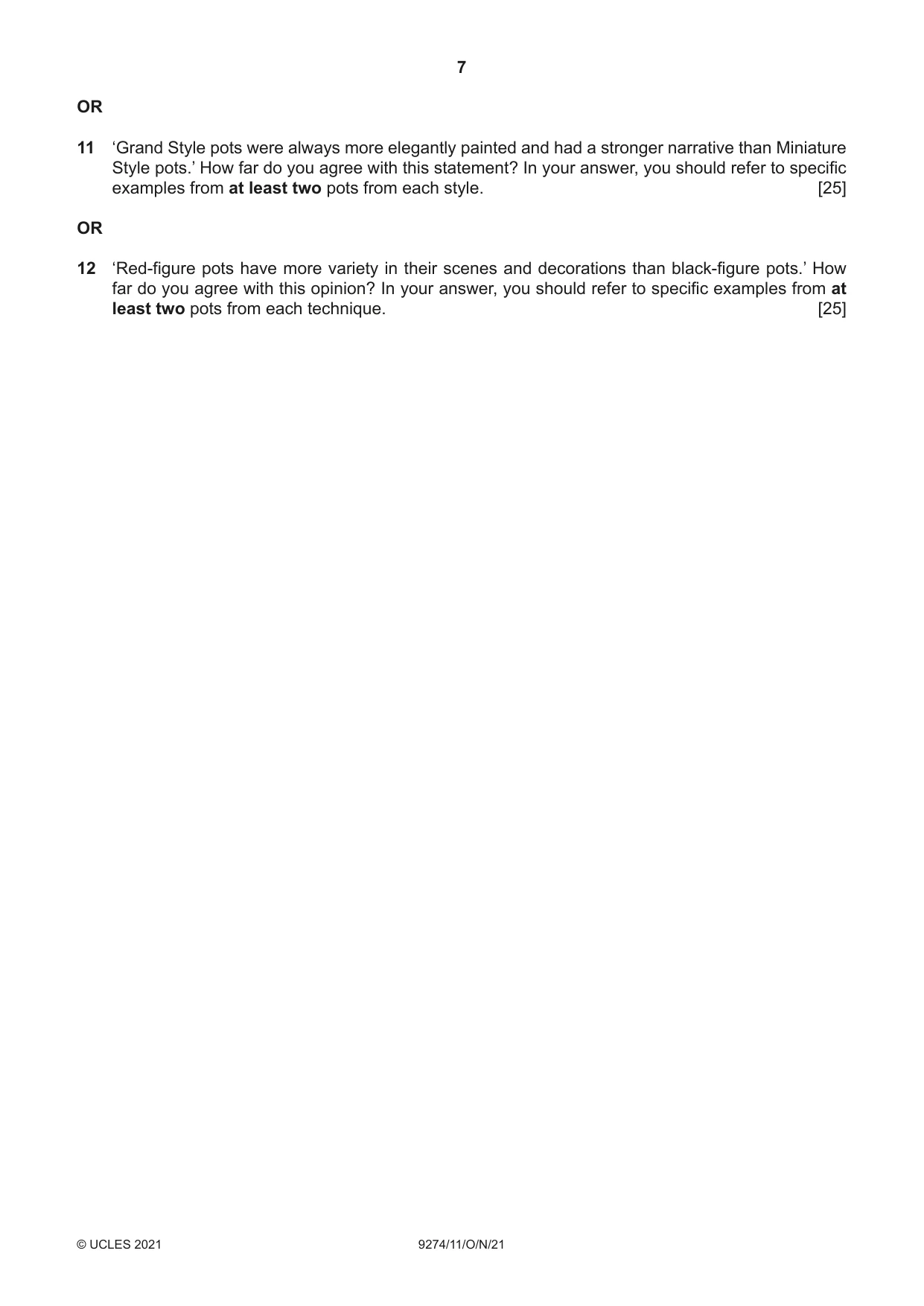
7 9274/11/O/N/21 © UCLES 2021 OR 11 ‘Grand Style pots were always more elegantly painted and had a stronger narrative than Miniature Style pots.’ How far do you agree with this statement? In your answer, you should refer to specific examples from at least two pots from each style. [25] OR 12 ‘Red-figure pots have more variety in their scenes and decorations than black-figure pots.’ How far do you agree with this opinion? In your answer, you should refer to specific examples from at least two pots from each technique. [25]
Question paper, page 8
8 9274/11/O/N/21 © UCLES 2021 Permission to reproduce items where third-party owned material protected by copyright is included has been sought and cleared where possible. Every reasonable effort has been made by the publisher (UCLES) to trace copyright holders, but if any items requiring clearance have unwittingly been included, the publisher will be pleased to make amends at the earliest possible opportunity. To avoid the issue of disclosure of answer-related information to candidates, all copyright acknowledgements are reproduced online in the Cambridge Assessment International Education Copyright Acknowledgements Booklet. This is produced for each series of examinations and is freely available to download at www.cambridgeinternational.org after the live examination series. Cambridge Assessment International Education is part of the Cambridge Assessment Group. Cambridge Assessment is the brand name of the University of Cambridge Local Examinations Syndicate (UCLES), which itself is a department of the University of Cambridge. BLANK PAGE
Mark scheme, page 1
This document consists of 18 printed pages. © UCLES 2021 [Turn over Cambridge International AS & A Level CLASSICAL STUDIES 9274/11 Paper 1 Greek Civilisation October/November 2021 MARK SCHEME Maximum Mark: 50 Published This mark scheme is published as an aid to teachers and candidates, to indicate the requirements of the examination. It shows the basis on which Examiners were instructed to award marks. It does not indicate the details of the discussions that took place at an Examiners’ meeting before marking began, which would have considered the acceptability of alternative answers. Mark schemes should be read in conjunction with the question paper and the Principal Examiner Report for Teachers. Cambridge International will not enter into discussions about these mark schemes. Cambridge International is publishing the mark schemes for the October/November 2021 series for most Cambridge IGCSE™, Cambridge International A and AS Level components and some Cambridge O Level components.
Mark scheme, page 2
9274/11 Cambridge International AS & A Level – Mark Scheme PUBLISHED October/November 2021 © UCLES 2021 Page 2 of 18 Generic Marking Principles These general marking principles must be applied by all examiners when marking candidate answers. They should be applied alongside the specific content of the mark scheme or generic level descriptors for a question. Each question paper and mark scheme will also comply with these marking principles. GENERIC MARKING PRINCIPLE 1: Marks must be awarded in line with: • the specific content of the mark scheme or the generic level descriptors for the question • the specific skills defined in the mark scheme or in the generic level descriptors for the question • the standard of response required by a candidate as exemplified by the standardisation scripts. GENERIC MARKING PRINCIPLE 2: Marks awarded are always whole marks (not half marks, or other fractions). GENERIC MARKING PRINCIPLE 3: Marks must be awarded positively: • marks are awarded for correct/valid answers, as defined in the mark scheme. However, credit is given for valid answers which go beyond the scope of the syllabus and mark scheme, referring to your Team Leader as appropriate • marks are awarded when candidates clearly demonstrate what they know and can do • marks are not deducted for errors • marks are not deducted for omissions • answers should only be judged on the quality of spelling, punctuation and grammar when these features are specifically assessed by the question as indicated by the mark scheme. The meaning, however, should be unambiguous. GENERIC MARKING PRINCIPLE 4: Rules must be applied consistently, e.g. in situations where candidates have not followed instructions or in the application of generic level descriptors. GENERIC MARKING PRINCIPLE 5: Marks should be awarded using the full range of marks defined in the mark scheme for the question (however; the use of the full mark range may be limited according to the quality of the candidate responses seen). GENERIC MARKING PRINCIPLE 6: Marks awarded are based solely on the requirements as defined in the mark scheme. Marks should not be awarded with grade thresholds or grade descriptors in mind.
Mark scheme, page 3
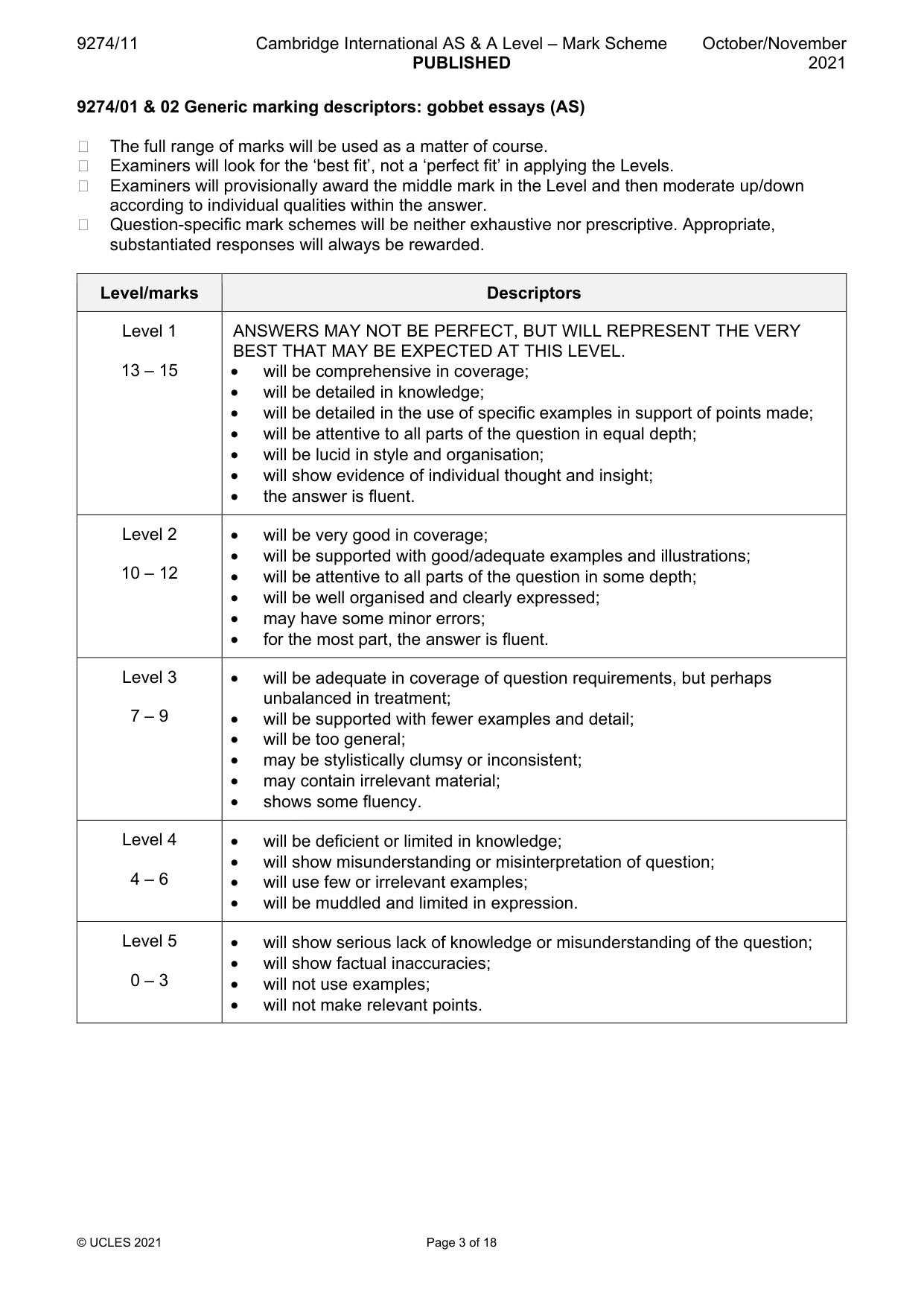
9274/11 Cambridge International AS & A Level – Mark Scheme PUBLISHED October/November 2021 © UCLES 2021 Page 3 of 18 9274/01 & 02 Generic marking descriptors: gobbet essays (AS) The full range of marks will be used as a matter of course. Examiners will look for the ‘best fit’, not a ‘perfect fit’ in applying the Levels. Examiners will provisionally award the middle mark in the Level and then moderate up/down according to individual qualities within the answer. Question-specific mark schemes will be neither exhaustive nor prescriptive. Appropriate, substantiated responses will always be rewarded. Level/marks Descriptors Level 1 13 – 15 ANSWERS MAY NOT BE PERFECT, BUT WILL REPRESENT THE VERY BEST THAT MAY BE EXPECTED AT THIS LEVEL. • will be comprehensive in coverage; • will be detailed in knowledge; • will be detailed in the use of specific examples in support of points made; • will be attentive to all parts of the question in equal depth; • will be lucid in style and organisation; • will show evidence of individual thought and insight; • the answer is fluent. Level 2 10 – 12 • will be very good in coverage; • will be supported with good/adequate examples and illustrations; • will be attentive to all parts of the question in some depth; • will be well organised and clearly expressed; • may have some minor errors; • for the most part, the answer is fluent. Level 3 7 – 9 • will be adequate in coverage of question requirements, but perhaps unbalanced in treatment; • will be supported with fewer examples and detail; • will be too general; • may be stylistically clumsy or inconsistent; • may contain irrelevant material; • shows some fluency. Level 4 4 – 6 • will be deficient or limited in knowledge; • will show misunderstanding or misinterpretation of question; • will use few or irrelevant examples; • will be muddled and limited in expression. Level 5 0 – 3 • will show serious lack of knowledge or misunderstanding of the question; • will show factual inaccuracies; • will not use examples; • will not make relevant points.
Mark scheme, page 4
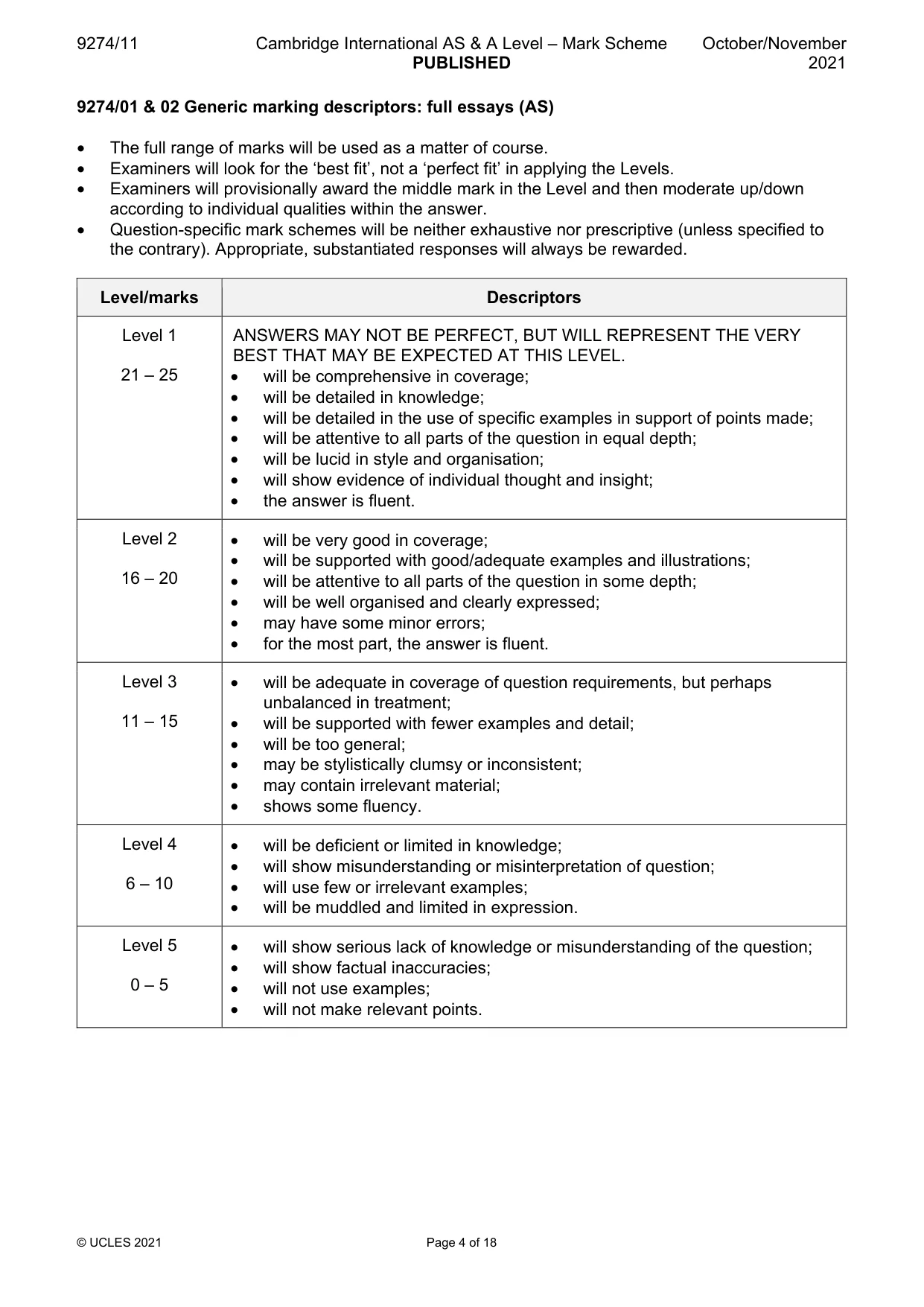
9274/11 Cambridge International AS & A Level – Mark Scheme PUBLISHED October/November 2021 © UCLES 2021 Page 4 of 18 9274/01 & 02 Generic marking descriptors: full essays (AS) • The full range of marks will be used as a matter of course. • Examiners will look for the ‘best fit’, not a ‘perfect fit’ in applying the Levels. • Examiners will provisionally award the middle mark in the Level and then moderate up/down according to individual qualities within the answer. • Question-specific mark schemes will be neither exhaustive nor prescriptive (unless specified to the contrary). Appropriate, substantiated responses will always be rewarded. Level/marks Descriptors Level 1 21 – 25 ANSWERS MAY NOT BE PERFECT, BUT WILL REPRESENT THE VERY BEST THAT MAY BE EXPECTED AT THIS LEVEL. • will be comprehensive in coverage; • will be detailed in knowledge; • will be detailed in the use of specific examples in support of points made; • will be attentive to all parts of the question in equal depth; • will be lucid in style and organisation; • will show evidence of individual thought and insight; • the answer is fluent. Level 2 16 – 20 • will be very good in coverage; • will be supported with good/adequate examples and illustrations; • will be attentive to all parts of the question in some depth; • will be well organised and clearly expressed; • may have some minor errors; • for the most part, the answer is fluent. Level 3 11 – 15 • will be adequate in coverage of question requirements, but perhaps unbalanced in treatment; • will be supported with fewer examples and detail; • will be too general; • may be stylistically clumsy or inconsistent; • may contain irrelevant material; • shows some fluency. Level 4 6 – 10 • will be deficient or limited in knowledge; • will show misunderstanding or misinterpretation of question; • will use few or irrelevant examples; • will be muddled and limited in expression. Level 5 0 – 5 • will show serious lack of knowledge or misunderstanding of the question; • will show factual inaccuracies; • will not use examples; • will not make relevant points.
Mark scheme, page 5
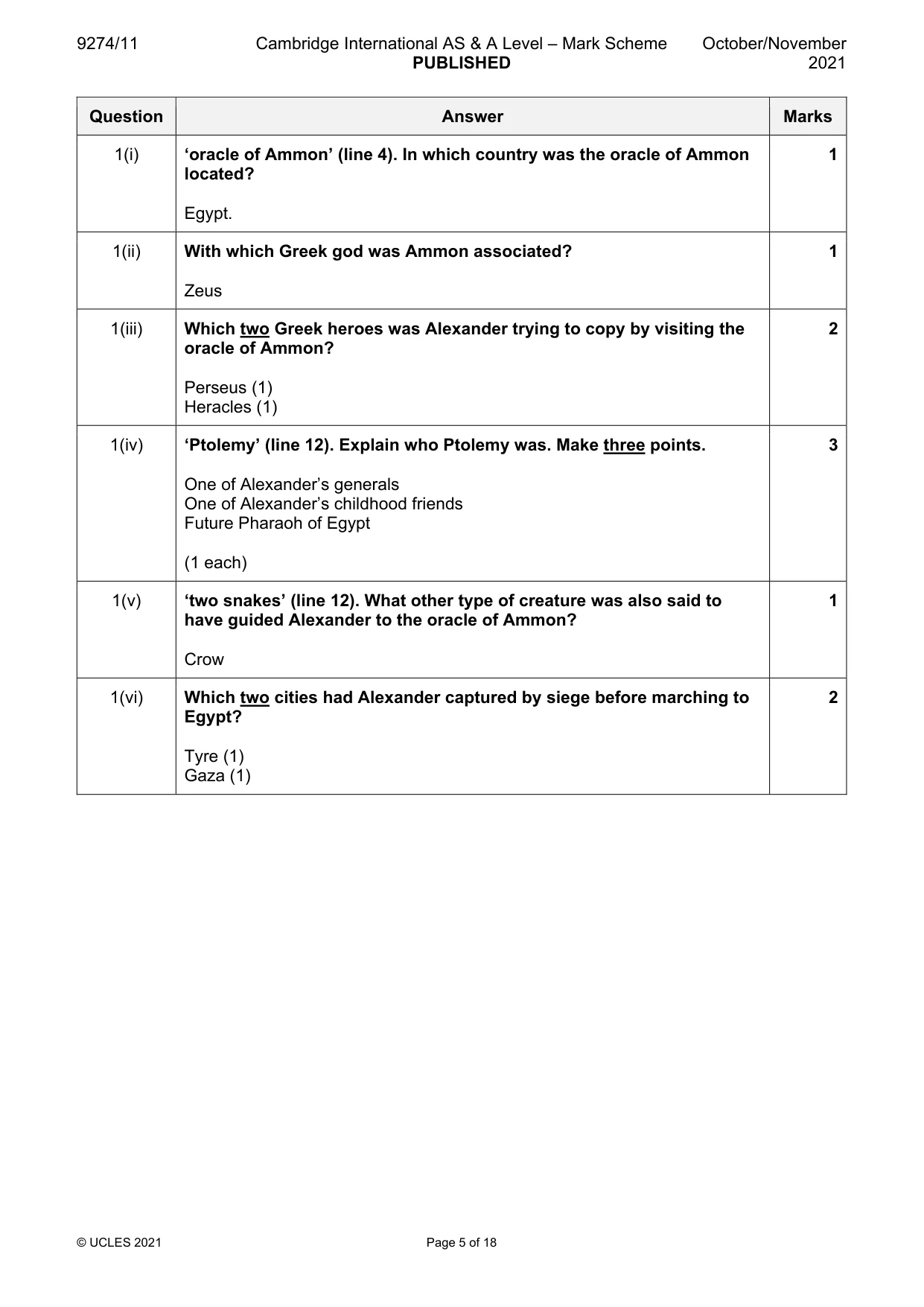
9274/11 Cambridge International AS & A Level – Mark Scheme PUBLISHED October/November 2021 © UCLES 2021 Page 5 of 18 Question Answer Marks 1(i) ‘oracle of Ammon’ (line 4). In which country was the oracle of Ammon located? Egypt. 1 1(ii) With which Greek god was Ammon associated? Zeus 1 1(iii) Which two Greek heroes was Alexander trying to copy by visiting the oracle of Ammon? Perseus (1) Heracles (1) 2 1(iv) ‘Ptolemy’ (line 12). Explain who Ptolemy was. Make three points. One of Alexander’s generals One of Alexander’s childhood friends Future Pharaoh of Egypt (1 each) 3 1(v) ‘two snakes’ (line 12). What other type of creature was also said to have guided Alexander to the oracle of Ammon? Crow 1 1(vi) Which two cities had Alexander captured by siege before marching to Egypt? Tyre (1) Gaza (1) 2
Mark scheme, page 6
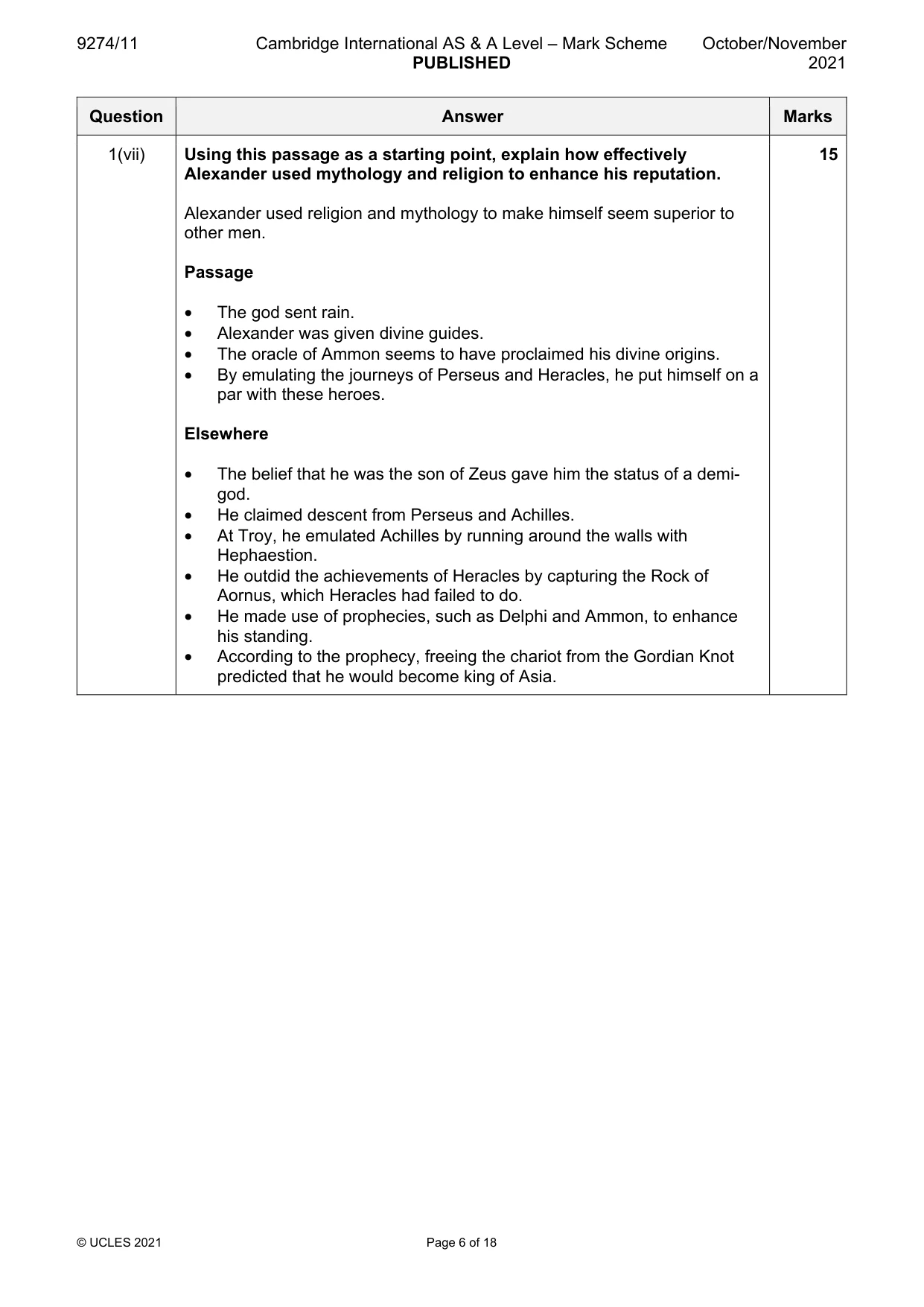
9274/11 Cambridge International AS & A Level – Mark Scheme PUBLISHED October/November 2021 © UCLES 2021 Page 6 of 18 Question Answer Marks 1(vii) Using this passage as a starting point, explain how effectively Alexander used mythology and religion to enhance his reputation. Alexander used religion and mythology to make himself seem superior to other men. Passage • The god sent rain. • Alexander was given divine guides. • The oracle of Ammon seems to have proclaimed his divine origins. • By emulating the journeys of Perseus and Heracles, he put himself on a par with these heroes. Elsewhere • The belief that he was the son of Zeus gave him the status of a demi- god. • He claimed descent from Perseus and Achilles. • At Troy, he emulated Achilles by running around the walls with Hephaestion. • He outdid the achievements of Heracles by capturing the Rock of Aornus, which Heracles had failed to do. • He made use of prophecies, such as Delphi and Ammon, to enhance his standing. • According to the prophecy, freeing the chariot from the Gordian Knot predicted that he would become king of Asia. 15
Mark scheme, page 7
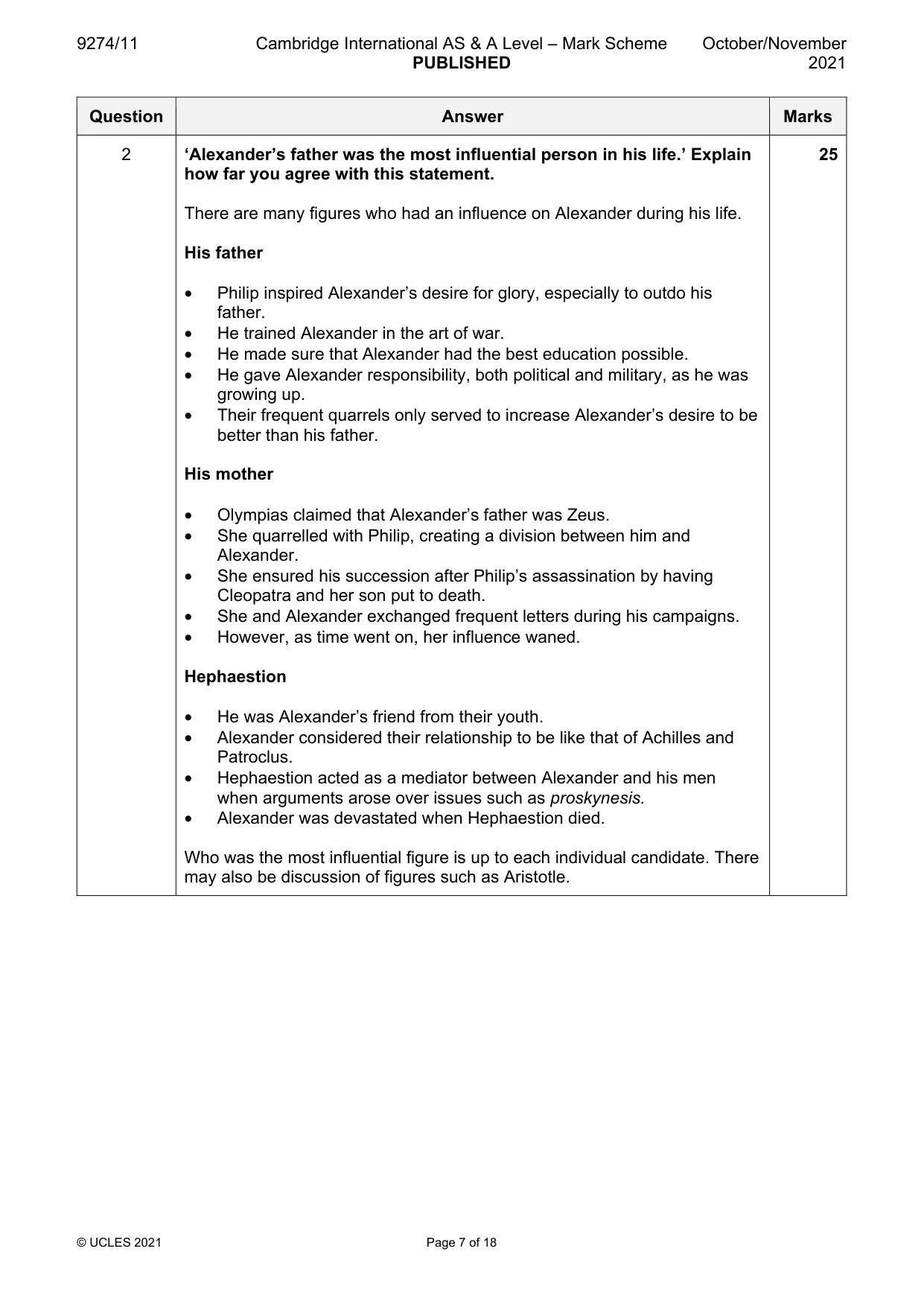
9274/11 Cambridge International AS & A Level – Mark Scheme PUBLISHED October/November 2021 © UCLES 2021 Page 7 of 18 Question Answer Marks 2 ‘Alexander’s father was the most influential person in his life.’ Explain how far you agree with this statement. There are many figures who had an influence on Alexander during his life. His father • Philip inspired Alexander’s desire for glory, especially to outdo his father. • He trained Alexander in the art of war. • He made sure that Alexander had the best education possible. • He gave Alexander responsibility, both political and military, as he was growing up. • Their frequent quarrels only served to increase Alexander’s desire to be better than his father. His mother • Olympias claimed that Alexander’s father was Zeus. • She quarrelled with Philip, creating a division between him and Alexander. • She ensured his succession after Philip’s assassination by having Cleopatra and her son put to death. • She and Alexander exchanged frequent letters during his campaigns. • However, as time went on, her influence waned. Hephaestion • He was Alexander’s friend from their youth. • Alexander considered their relationship to be like that of Achilles and Patroclus. • Hephaestion acted as a mediator between Alexander and his men when arguments arose over issues such as proskynesis. • Alexander was devastated when Hephaestion died. Who was the most influential figure is up to each individual candidate. There may also be discussion of figures such as Aristotle. 25
Mark scheme, page 8
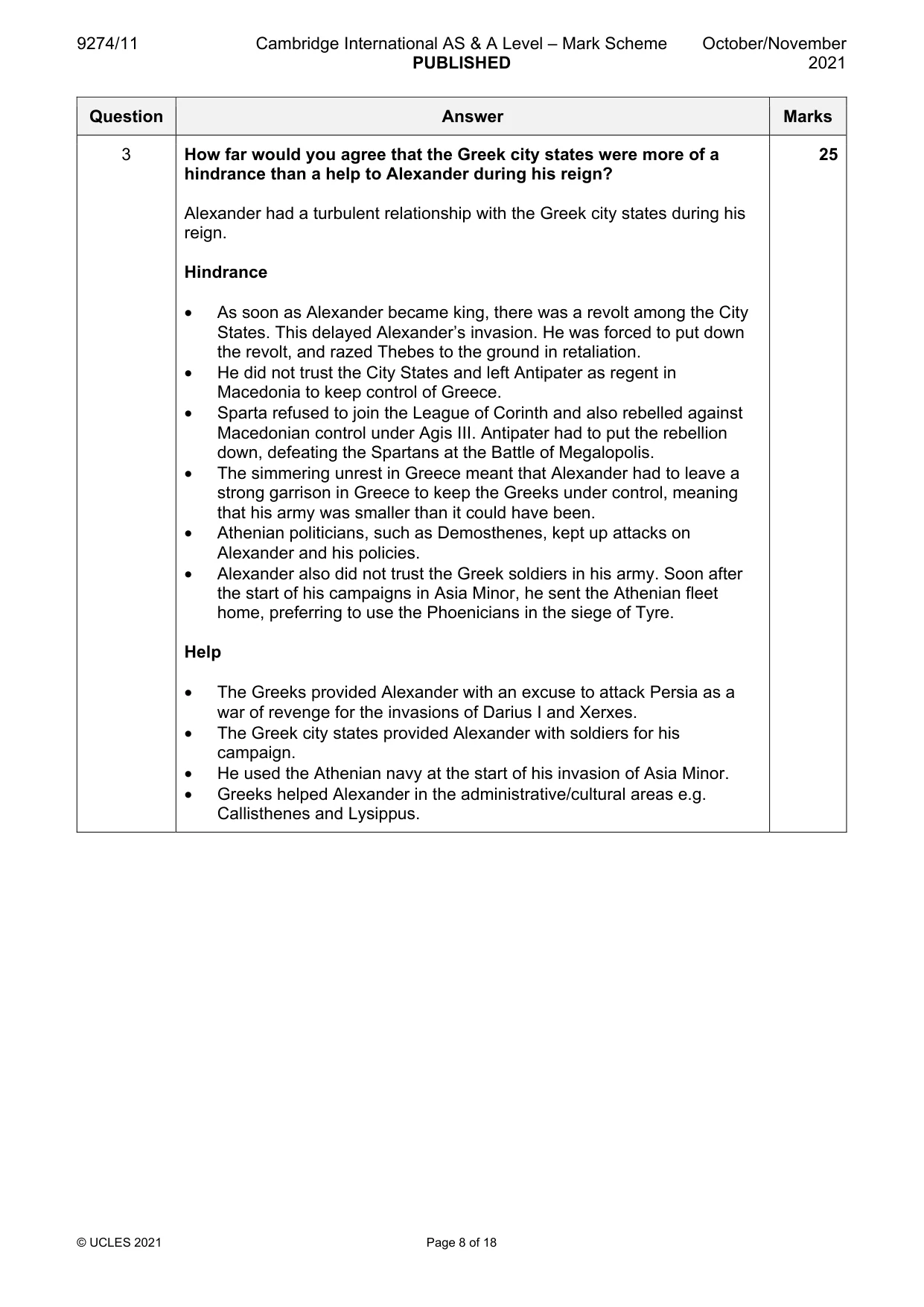
9274/11 Cambridge International AS & A Level – Mark Scheme PUBLISHED October/November 2021 © UCLES 2021 Page 8 of 18 Question Answer Marks 3 How far would you agree that the Greek city states were more of a hindrance than a help to Alexander during his reign? Alexander had a turbulent relationship with the Greek city states during his reign. Hindrance • As soon as Alexander became king, there was a revolt among the City States. This delayed Alexander’s invasion. He was forced to put down the revolt, and razed Thebes to the ground in retaliation. • He did not trust the City States and left Antipater as regent in Macedonia to keep control of Greece. • Sparta refused to join the League of Corinth and also rebelled against Macedonian control under Agis III. Antipater had to put the rebellion down, defeating the Spartans at the Battle of Megalopolis. • The simmering unrest in Greece meant that Alexander had to leave a strong garrison in Greece to keep the Greeks under control, meaning that his army was smaller than it could have been. • Athenian politicians, such as Demosthenes, kept up attacks on Alexander and his policies. • Alexander also did not trust the Greek soldiers in his army. Soon after the start of his campaigns in Asia Minor, he sent the Athenian fleet home, preferring to use the Phoenicians in the siege of Tyre. Help • The Greeks provided Alexander with an excuse to attack Persia as a war of revenge for the invasions of Darius I and Xerxes. • The Greek city states provided Alexander with soldiers for his campaign. • He used the Athenian navy at the start of his invasion of Asia Minor. • Greeks helped Alexander in the administrative/cultural areas e.g. Callisthenes and Lysippus. 25
Mark scheme, page 9
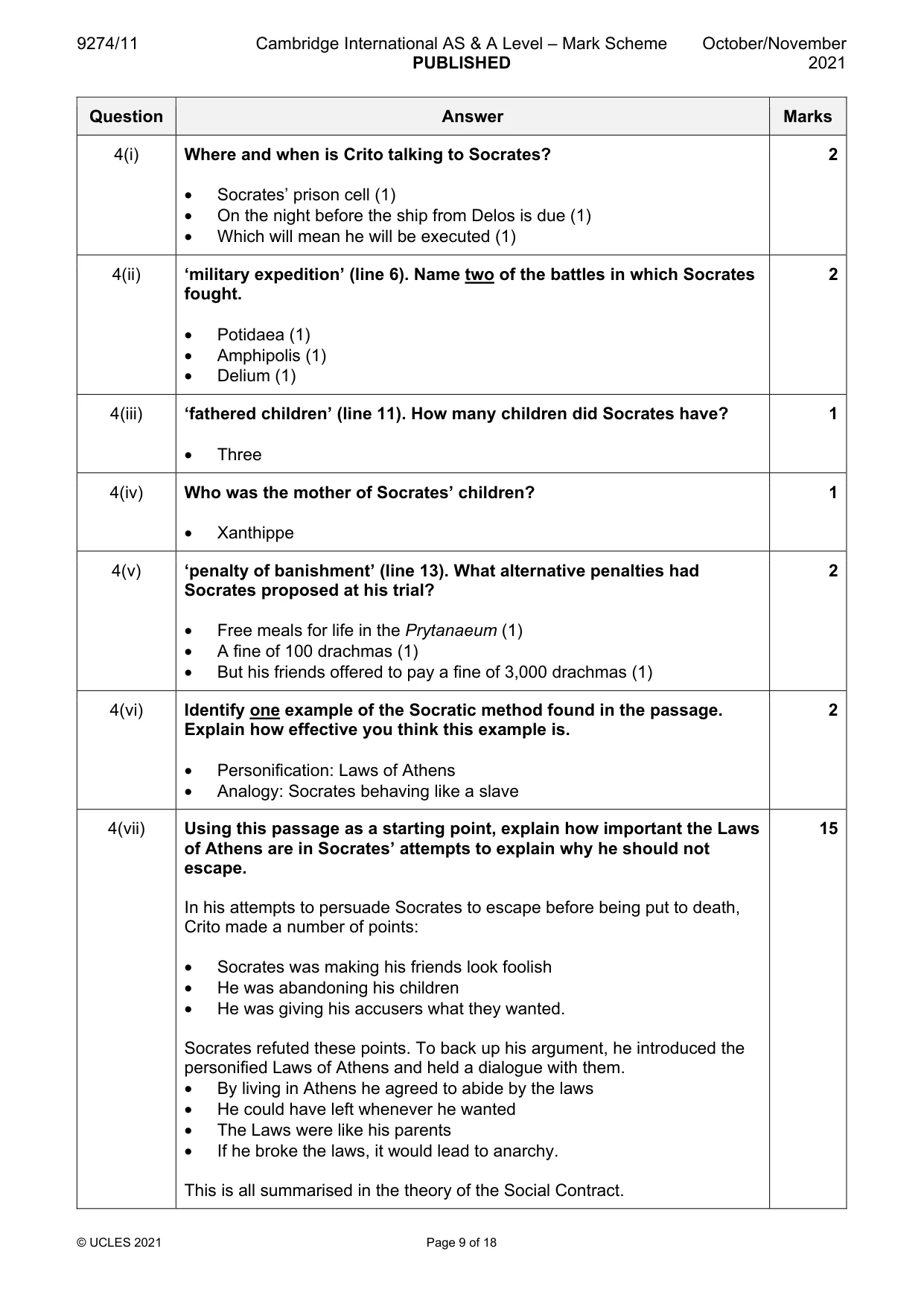
9274/11 Cambridge International AS & A Level – Mark Scheme PUBLISHED October/November 2021 © UCLES 2021 Page 9 of 18 Question Answer Marks 4(i) Where and when is Crito talking to Socrates? • Socrates’ prison cell (1) • On the night before the ship from Delos is due (1) • Which will mean he will be executed (1) 2 4(ii) ‘military expedition’ (line 6). Name two of the battles in which Socrates fought. • Potidaea (1) • Amphipolis (1) • Delium (1) 2 4(iii) ‘fathered children’ (line 11). How many children did Socrates have? • Three 1 4(iv) Who was the mother of Socrates’ children? • Xanthippe 1 4(v) ‘penalty of banishment’ (line 13). What alternative penalties had Socrates proposed at his trial? • Free meals for life in the Prytanaeum (1) • A fine of 100 drachmas (1) • But his friends offered to pay a fine of 3,000 drachmas (1) 2 4(vi) Identify one example of the Socratic method found in the passage. Explain how effective you think this example is. • Personification: Laws of Athens • Analogy: Socrates behaving like a slave 2 4(vii) Using this passage as a starting point, explain how important the Laws of Athens are in Socrates’ attempts to explain why he should not escape. In his attempts to persuade Socrates to escape before being put to death, Crito made a number of points: • Socrates was making his friends look foolish • He was abandoning his children • He was giving his accusers what they wanted. Socrates refuted these points. To back up his argument, he introduced the personified Laws of Athens and held a dialogue with them. • By living in Athens he agreed to abide by the laws • He could have left whenever he wanted • The Laws were like his parents • If he broke the laws, it would lead to anarchy. This is all summarised in the theory of the Social Contract. 15
Mark scheme, page 10
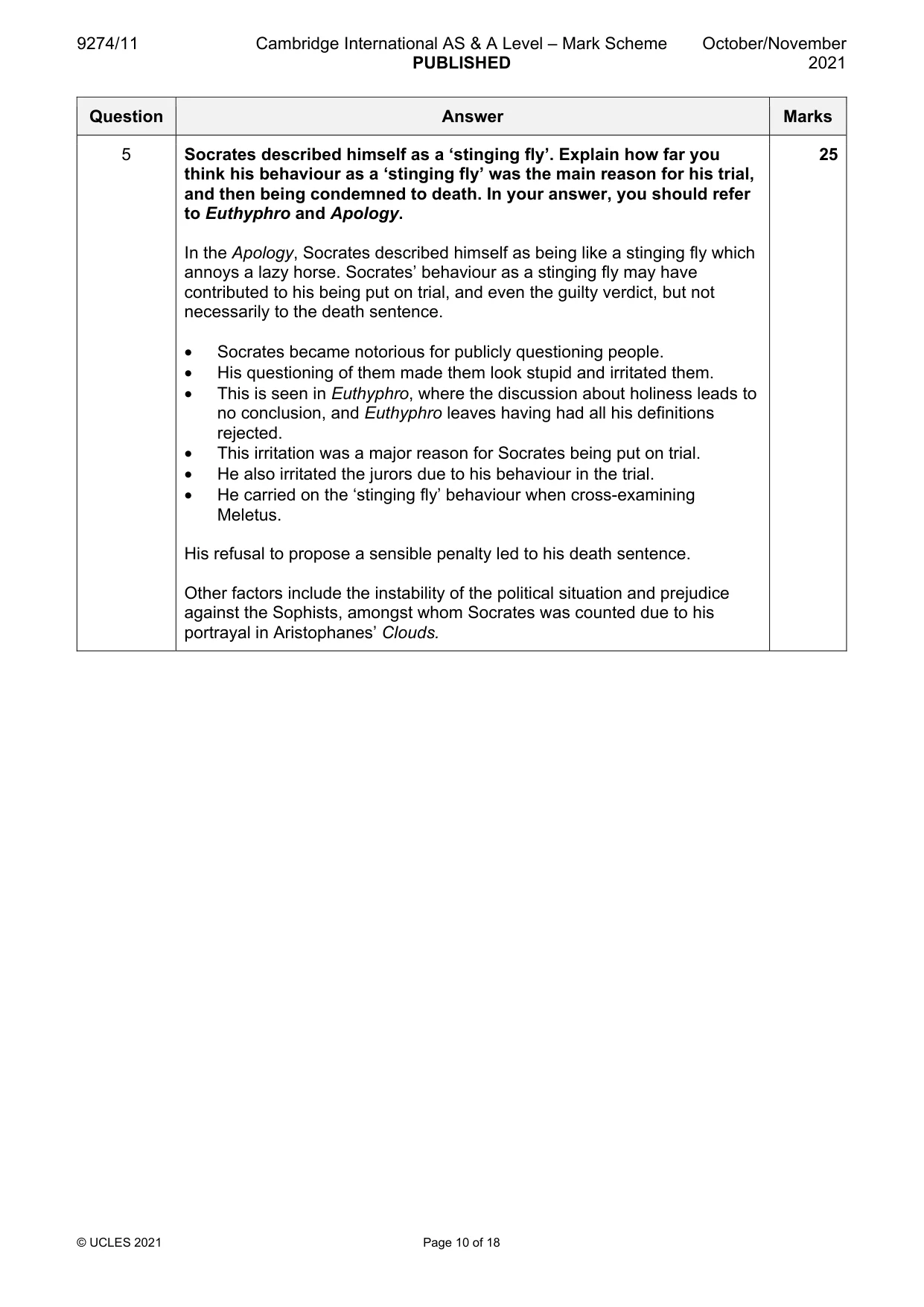
9274/11 Cambridge International AS & A Level – Mark Scheme PUBLISHED October/November 2021 © UCLES 2021 Page 10 of 18 Question Answer Marks 5 Socrates described himself as a ‘stinging fly’. Explain how far you think his behaviour as a ‘stinging fly’ was the main reason for his trial, and then being condemned to death. In your answer, you should refer to Euthyphro and Apology. In the Apology, Socrates described himself as being like a stinging fly which annoys a lazy horse. Socrates’ behaviour as a stinging fly may have contributed to his being put on trial, and even the guilty verdict, but not necessarily to the death sentence. • Socrates became notorious for publicly questioning people. • His questioning of them made them look stupid and irritated them. • This is seen in Euthyphro, where the discussion about holiness leads to no conclusion, and Euthyphro leaves having had all his definitions rejected. • This irritation was a major reason for Socrates being put on trial. • He also irritated the jurors due to his behaviour in the trial. • He carried on the ‘stinging fly’ behaviour when cross-examining Meletus. His refusal to propose a sensible penalty led to his death sentence. Other factors include the instability of the political situation and prejudice against the Sophists, amongst whom Socrates was counted due to his portrayal in Aristophanes’ Clouds. 25
Mark scheme, page 11
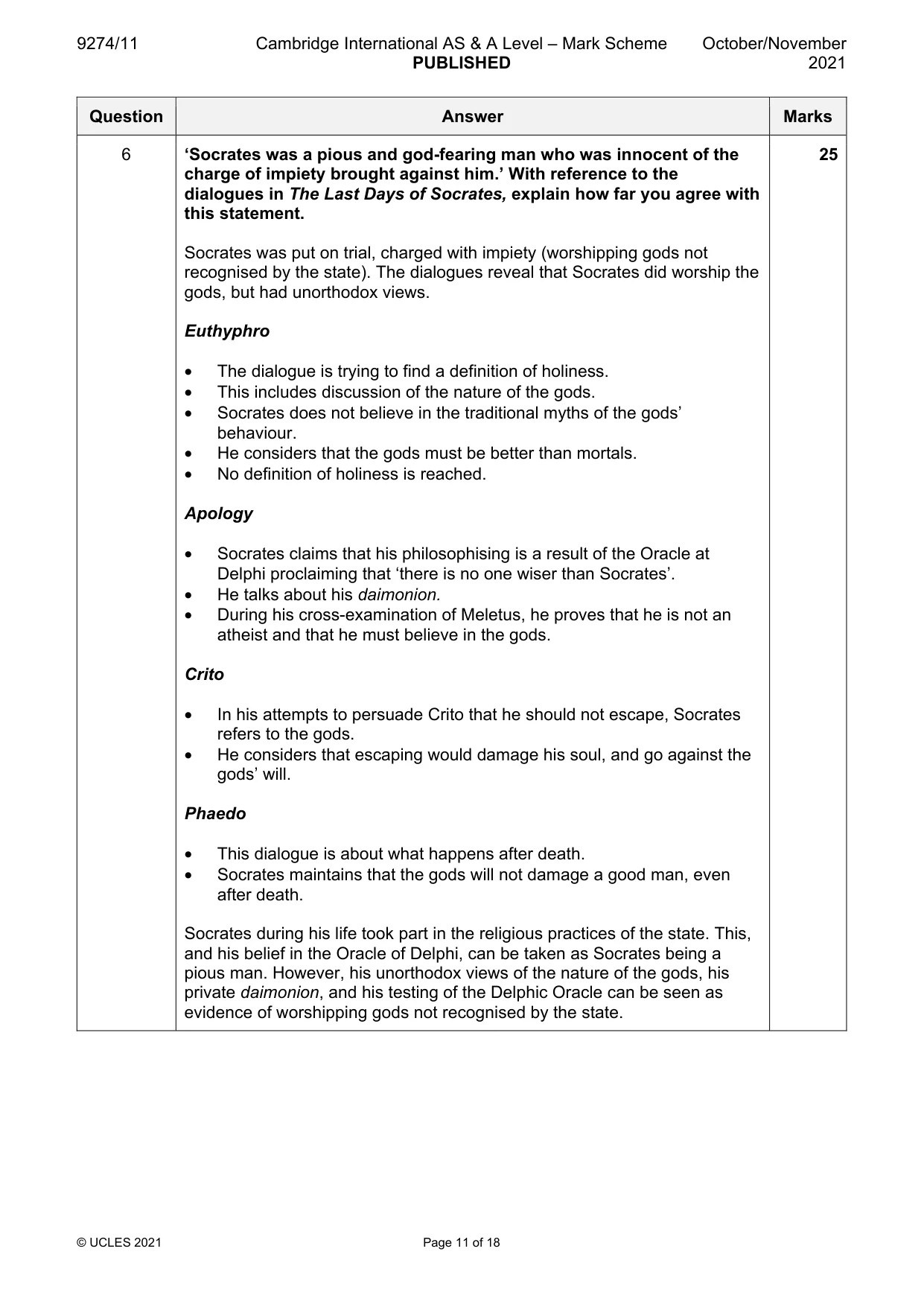
9274/11 Cambridge International AS & A Level – Mark Scheme PUBLISHED October/November 2021 © UCLES 2021 Page 11 of 18 Question Answer Marks 6 ‘Socrates was a pious and god-fearing man who was innocent of the charge of impiety brought against him.’ With reference to the dialogues in The Last Days of Socrates, explain how far you agree with this statement. Socrates was put on trial, charged with impiety (worshipping gods not recognised by the state). The dialogues reveal that Socrates did worship the gods, but had unorthodox views. Euthyphro • The dialogue is trying to find a definition of holiness. • This includes discussion of the nature of the gods. • Socrates does not believe in the traditional myths of the gods’ behaviour. • He considers that the gods must be better than mortals. • No definition of holiness is reached. Apology • Socrates claims that his philosophising is a result of the Oracle at Delphi proclaiming that ‘there is no one wiser than Socrates’. • He talks about his daimonion. • During his cross-examination of Meletus, he proves that he is not an atheist and that he must believe in the gods. Crito • In his attempts to persuade Crito that he should not escape, Socrates refers to the gods. • He considers that escaping would damage his soul, and go against the gods’ will. Phaedo • This dialogue is about what happens after death. • Socrates maintains that the gods will not damage a good man, even after death. Socrates during his life took part in the religious practices of the state. This, and his belief in the Oracle of Delphi, can be taken as Socrates being a pious man. However, his unorthodox views of the nature of the gods, his private daimonion, and his testing of the Delphic Oracle can be seen as evidence of worshipping gods not recognised by the state. 25
Mark scheme, page 12
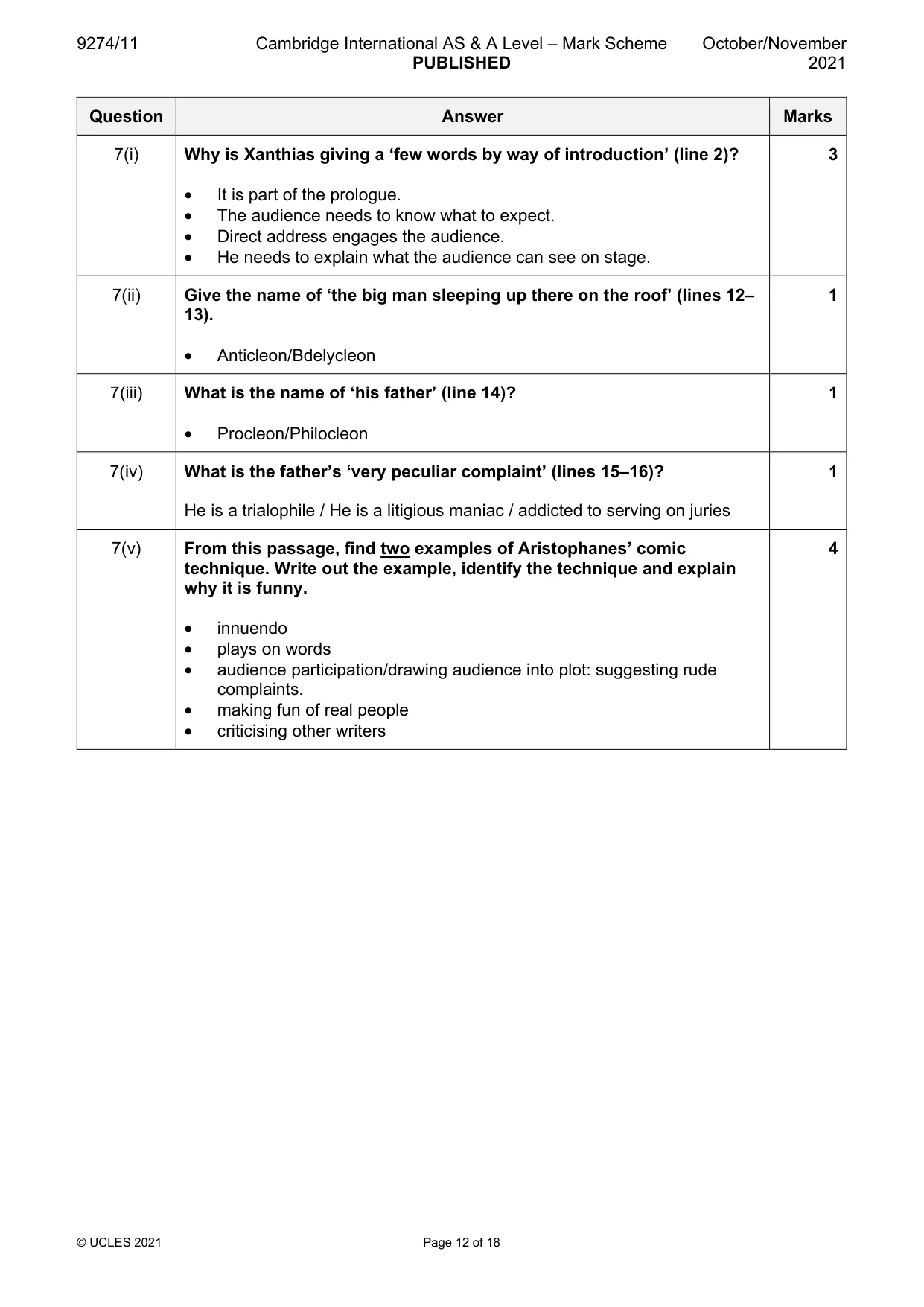
9274/11 Cambridge International AS & A Level – Mark Scheme PUBLISHED October/November 2021 © UCLES 2021 Page 12 of 18 Question Answer Marks 7(i) Why is Xanthias giving a ‘few words by way of introduction’ (line 2)? • It is part of the prologue. • The audience needs to know what to expect. • Direct address engages the audience. • He needs to explain what the audience can see on stage. 3 7(ii) Give the name of ‘the big man sleeping up there on the roof’ (lines 12– 13). • Anticleon/Bdelycleon 1 7(iii) What is the name of ‘his father’ (line 14)? • Procleon/Philocleon 1 7(iv) What is the father’s ‘very peculiar complaint’ (lines 15–16)? He is a trialophile / He is a litigious maniac / addicted to serving on juries 1 7(v) From this passage, find two examples of Aristophanes’ comic technique. Write out the example, identify the technique and explain why it is funny. • innuendo • plays on words • audience participation/drawing audience into plot: suggesting rude complaints. • making fun of real people • criticising other writers 4
Mark scheme, page 13
9274/11 Cambridge International AS & A Level – Mark Scheme PUBLISHED October/November 2021 © UCLES 2021 Page 13 of 18 Question Answer Marks 7(vi) Using this passage as a starting point, explain which you think is more important to the success of Wasps: the words of the actors or what happens on stage. Passage: Words: • Explanation essential for establishing plot and character. • Need to get audience laughing from the start so they are receptive to other parts of the play – hence direct address to audience and pretence of having heard suggestions from them. • Direct reference to well-known characters who could well be in the audience. • ‘little fable with a moral’ What happens on stage: • directing audience’s attention to Bdelycleon/Anticleon on the roof Elsewhere: Words: • ‘No-man’ joke in escape scene • Chorus parodos words establish background/generation/credibility of jurors • agon – audience are used to serious debate – gives the ‘moral’ of the ‘little fable’ • trial scene – caricature of Cleon’s mannerisms and language • caricature of speeches appealing for sympathy • Xanthias’ ‘messenger’ speech describing Procleon’s behaviour at Symposium sets up the final part of the play – baking-women etc. • Procleon’s ripostes to the various people he has injured What happens on stage: • Procleon’s escape attempts • especially parody of the Odyssey • Trial scene • Philocleon’s behaviour on stage after the Symposium • Crabs • Dance-off 15
Mark scheme, page 14
9274/11 Cambridge International AS & A Level – Mark Scheme PUBLISHED October/November 2021 © UCLES 2021 Page 14 of 18 Question Answer Marks 8 ‘The chorus is not necessary for the success of Frogs.’ Explain how far you agree with this view. Necessary Frogs is unusual in having 2 Choruses Frog Chorus: • visual spectacle • singing contest • provide transition to Underworld Initiates: • costumes – realistic for Eleusinian procession but also • stress point made later in Parabasis about poverty in Athens (cheap costumes) • Singing • opportunity for sexual puns/jokes (e.g. pork) • deliver Parabasis thus conveying ’serious’ message about Athenian politics • which was (parabasis) cited as the reason for unprecedented second performance • Comment on contest between Aeschylus and Euripides Not necessary • Neither chorus contributes to the plot • Humour is limited to Frogs scene • Comments on the contest make little contribution • The play does not really need a Chorus to succeed. But the play could be a success for other reasons not involving the Chorus, notably: Sources of humour: • Portrayal of Dionysus – both his character and his costume. • Humour arising from the interaction between Dionysus and Xanthias throughout the first part of the play. • The fantastical situation – Dionysus going to the Underworld to retrieve a playwright. • Individual episodes – e.g. the corpse, the landladies and the encounters with Heracles, Charon and Aeacus • Stage ‘business – e.g. use of props for the ‘weighing of poetry’. 25
Mark scheme, page 15
9274/11 Cambridge International AS & A Level – Mark Scheme PUBLISHED October/November 2021 © UCLES 2021 Page 15 of 18 Question Answer Marks 9 To what extent are slaves important to the plots of both Frogs and Wasps? General points: • Slaves in comedy generally play a minor role, explaining the plot or acting as the butt of jokes. • They are often characterised as lazy or drunken and often victims of comic beatings. • They are given one of a small number of stock names, Xanthias being the most common. • They rarely play a prominent role in the plot of the play. Frogs: Xanthias is more than just a minor character. • His interactions with Dionysus are a major source of humour in the first half of the play • Role reversal with Dionysus • He helps in establishing the comic portrayal of Dionysus • His comments about ‘the sea-battle’ contribute to part of the message of the play • the ‘beating’ scene • slapstick humour • His scene with Pluto’s slave creates verbal humour It could be argued that he contributes more to the humour and the underlying serious messages of the play than to the plot. Pluto’s slave is just a foil to Xanthias. Persephone’s Maid establishes the ‘mistaken identity’ element of the plot and contributes to the humour of the ‘costume swap’ episode. Wasps: • Xanthias and Sosias act as the Prologue. They set up the scene and explain the plot to the audience, thus enabling understanding of the rest of the play. • They also act as ‘warm-up’ men getting the audience to laugh • They contribute to the visual humour of the various ‘escape’ episodes. • Xanthias sets the scene for the final section of the play by describing Procleon’s/Philocleon’s behaviour at the Symposium. • His speech parodies messenger speeches in tragedy. It could be argued that while slaves play a more prominent role in Frogs, they are more essential to the plot in Wasps. 25
Mark scheme, page 16
9274/11 Cambridge International AS & A Level – Mark Scheme PUBLISHED October/November 2021 © UCLES 2021 Page 16 of 18 Question Answer Marks 10(i) What is the name given to the type of pot shown in the image above? • hydria 1 10(ii) For what purpose was this pot used? • Collecting/storing water 1 10(iii) Who painted this pot? Pan Painter 2 10(iv) Identify Figure A. Give two things which enable you to identify this figure. • Perseus • winged cap • winged boots • sickle • bag with Medusa’s head 3 10(v) Identify Figure B. Give two things which enable you to identify this figure. • Athena • helmet • spear • aegis 3 10(vi) ‘A decorative delight.’ By referring to specific details from the pot, explain how far you agree with this opinion. The pot was painted by the Pan Painter, 475–450 BC. It depicts Perseus, Athena and the decapitated body of Medusa falling gracefully to her death. Answers may include the following points: • The three figures fill the frieze. • The figures of Athena and Perseus form a triangular composition over the falling Medusa. • The drapery is detailed and indicates the movement of Perseus and Athena. • Medusa is no longer a terrifying figure, but an elegant figure as she slowly sinks to the floor. • The composition is balletic in the way that the figures move across the pot and are connected to each other. • The whole effect is one of elegance and charm which makes the pot a decorative delight. 15
Mark scheme, page 17
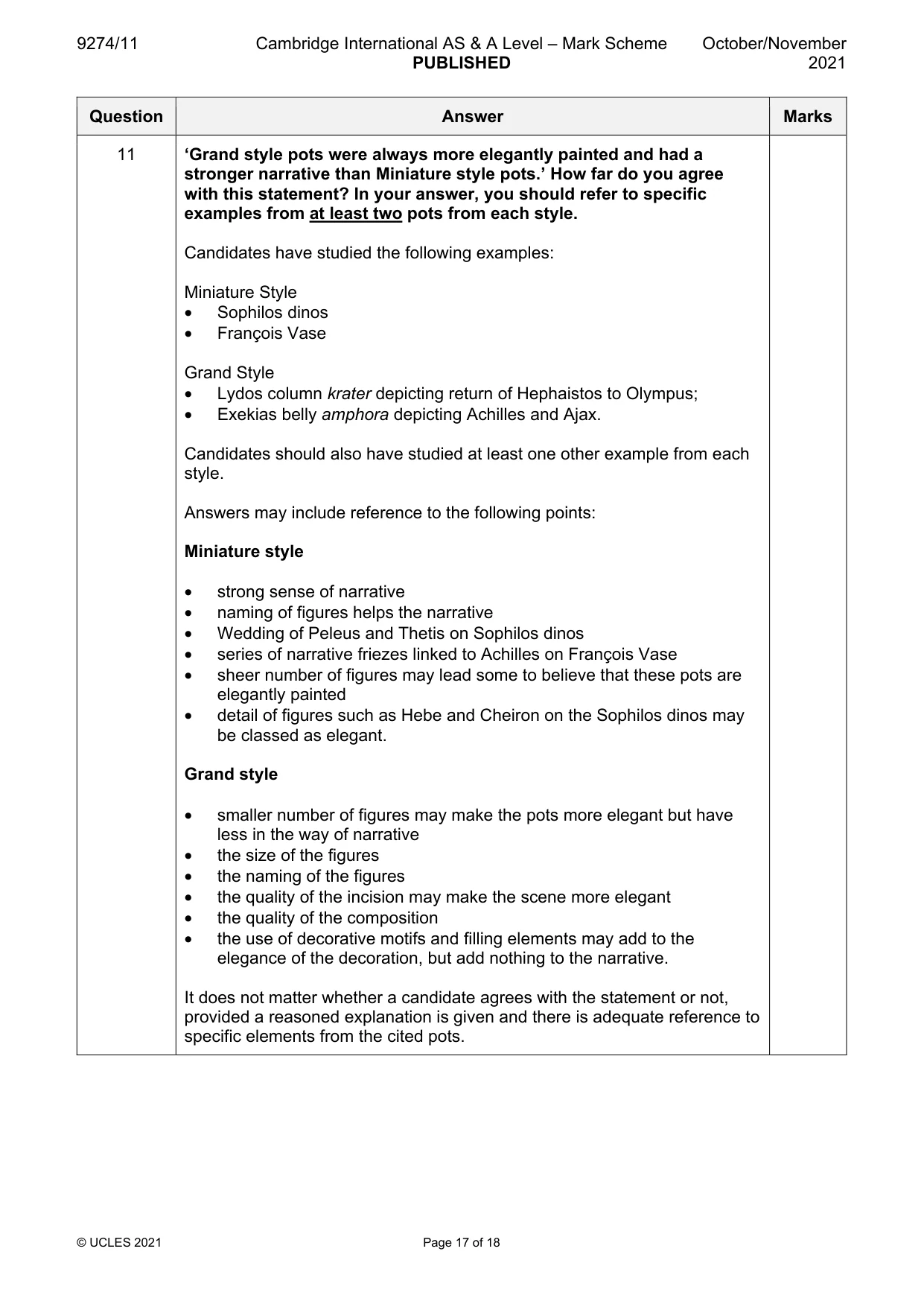
9274/11 Cambridge International AS & A Level – Mark Scheme PUBLISHED October/November 2021 © UCLES 2021 Page 17 of 18 Question Answer Marks 11 ‘Grand style pots were always more elegantly painted and had a stronger narrative than Miniature style pots.’ How far do you agree with this statement? In your answer, you should refer to specific examples from at least two pots from each style. Candidates have studied the following examples: Miniature Style • Sophilos dinos • François Vase Grand Style • Lydos column krater depicting return of Hephaistos to Olympus; • Exekias belly amphora depicting Achilles and Ajax. Candidates should also have studied at least one other example from each style. Answers may include reference to the following points: Miniature style • strong sense of narrative • naming of figures helps the narrative • Wedding of Peleus and Thetis on Sophilos dinos • series of narrative friezes linked to Achilles on François Vase • sheer number of figures may lead some to believe that these pots are elegantly painted • detail of figures such as Hebe and Cheiron on the Sophilos dinos may be classed as elegant. Grand style • smaller number of figures may make the pots more elegant but have less in the way of narrative • the size of the figures • the naming of the figures • the quality of the incision may make the scene more elegant • the quality of the composition • the use of decorative motifs and filling elements may add to the elegance of the decoration, but add nothing to the narrative. It does not matter whether a candidate agrees with the statement or not, provided a reasoned explanation is given and there is adequate reference to specific elements from the cited pots.
Mark scheme, page 18
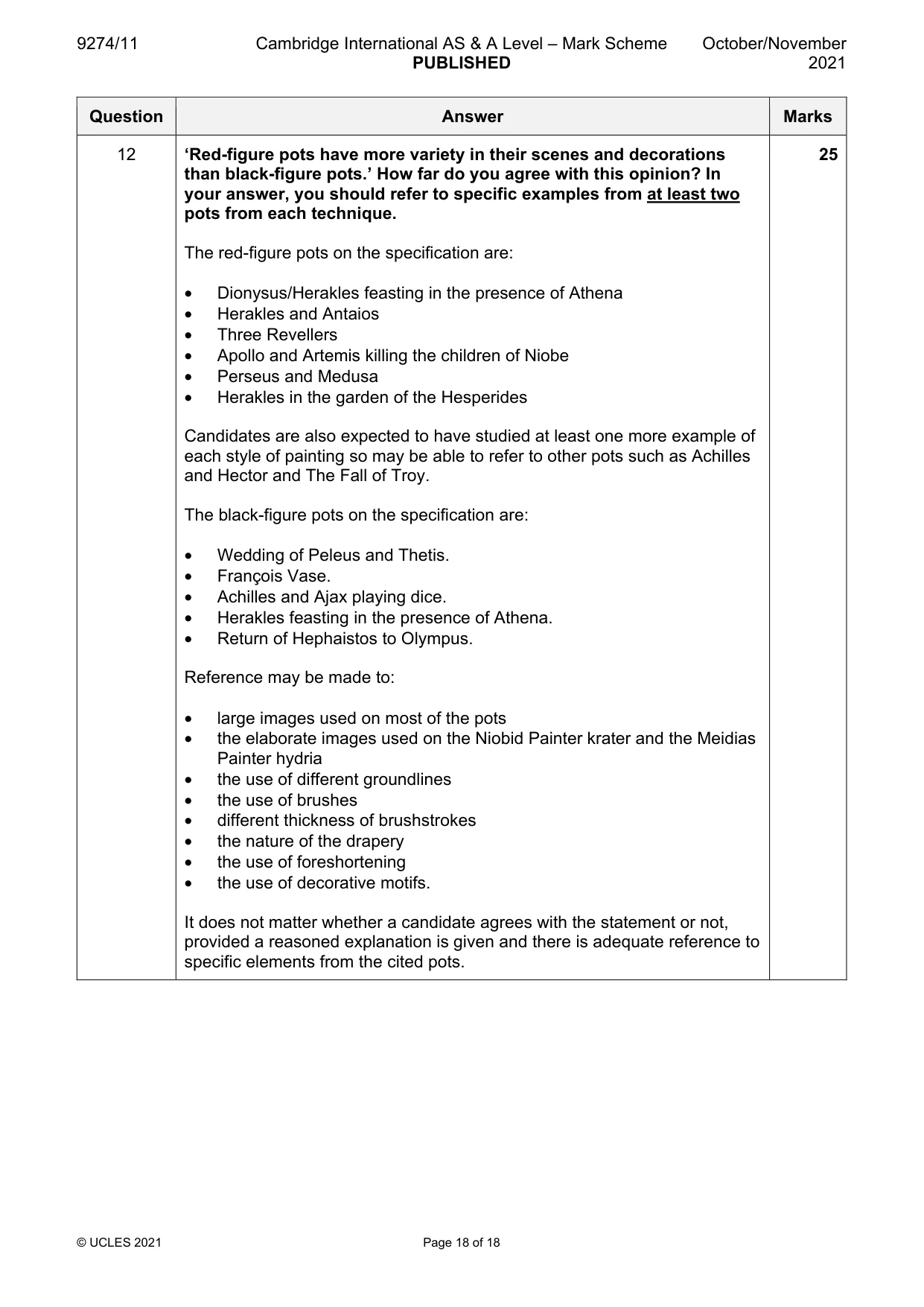
9274/11 Cambridge International AS & A Level – Mark Scheme PUBLISHED October/November 2021 © UCLES 2021 Page 18 of 18 Question Answer Marks 12 ‘Red-figure pots have more variety in their scenes and decorations than black-figure pots.’ How far do you agree with this opinion? In your answer, you should refer to specific examples from at least two pots from each technique. The red-figure pots on the specification are: • Dionysus/Herakles feasting in the presence of Athena • Herakles and Antaios • Three Revellers • Apollo and Artemis killing the children of Niobe • Perseus and Medusa • Herakles in the garden of the Hesperides Candidates are also expected to have studied at least one more example of each style of painting so may be able to refer to other pots such as Achilles and Hector and The Fall of Troy. The black-figure pots on the specification are: • Wedding of Peleus and Thetis. • François Vase. • Achilles and Ajax playing dice. • Herakles feasting in the presence of Athena. • Return of Hephaistos to Olympus. Reference may be made to: • large images used on most of the pots • the elaborate images used on the Niobid Painter krater and the Meidias Painter hydria • the use of different groundlines • the use of brushes • different thickness of brushstrokes • the nature of the drapery • the use of foreshortening • the use of decorative motifs. It does not matter whether a candidate agrees with the statement or not, provided a reasoned explanation is given and there is adequate reference to specific elements from the cited pots. 25
What you needed in this session
Cambridge’s own grade thresholds for 2021 Oct/Nov, Paper 1 · Variant 1. A higher threshold means an easier paper — the bar moves with how the cohort did.