Cambridge A Level Classical Studies 9274 — 2024 Oct/Nov Paper 1 · Variant 2
9274/12/O/N/24 · 50 marks · ≈56 min
The question paper and its mark scheme, free to read here and free to download. This is Cambridge’s own paper, exactly as it was sat.
Question paper8 pages



Mark scheme22 pages
Answers below. Sit the paper first if you are practising.
Paper as text
Question paper, page 1
[Turn over Cambridge International AS & A Level This document has 8 pages. Any blank pages are indicated. DC (EV) 348419 © UCLES 2024 * 2 0 3 1 1 5 7 2 4 0 * CLASSICAL STUDIES 9274/12 Paper 1 Greek Civilisation October/November 2024 1 hour 30 minutes You must answer on the enclosed answer booklet. You will need: Answer booklet (enclosed) INSTRUCTIONS ● Answer two questions in total: Answer questions from one section only. For each section, follow the instructions inside on which questions to answer. ● Follow the instructions on the front cover of the answer booklet. If you need additional answer paper, ask the invigilator for a continuation booklet. INFORMATION ● The total mark for this paper is 50. ● The number of marks for each question or part question is shown in brackets [ ].
Question paper, page 2
2 9274/12/O/N/24 © UCLES 2024 Section A: Alexander the Great Answer Question 1 and either Question 2 or Question 3. 1 Read the passage and answer the questions: Meanwhile, he himself set out by land and marched through the territory of the Oreites. Here he endured terrible privations and lost great numbers of men, with the result that he did not bring back from India so much as a quarter of his fighting force. And yet his strength had once amounted to a hundred and twenty thousand infantry and fifteen thousand cavalry. Some of his men died from disease, some of the wretched food, some of the scorching heat, but most from sheer hunger, for they had to march through an uncultivated region whose inhabitants only eked out a wretched existence. They possessed few sheep and even these were of a stunted breed, and the sea fish on which they subsisted made the animals’ flesh rank and unsavoury. It was only with great difficulty that Alexander succeeded in crossing this region in sixty days, but once he reached Gedrosia, he was immediately in a land of plenty, and the satraps and local rulers provided him with all his needs. (Plutarch, Alexander 66) (a) (i) Why was Alexander returning to Persia after defeating King Porus? Make two points. [2] (ii) Which city did Alexander capture on his return journey? [1] (iii) Which two historical figures inspired Alexander to cross the Gedrosian desert? [2] (b) ‘Alexander never cared about the well-being of his men.’ Using this passage as a starting point, explain how far you agree with this statement. [20] [Total: 25] EITHER 2 How far do you agree that Alexander was nothing more than a brutal and cruel conqueror? [25] OR 3 How far do you agree that Alexander was a master in the use of propaganda to promote his personal reputation? [25] 5 10
Question paper, page 3
3 9274/12/O/N/24 © UCLES 2024 [Turn over Section B: Aristophanes Answer Question 4 and either Question 5 or Question 6. 4 Read the passage and answer the questions: DIONYSUS: Now you must each take hold of your pan, hold it steady, and recite one line. Then, when I call ‘Cuckoo!’, you both let go. Ready? AESCHYLUS: Ready. EURIPIDES: Ready. DIONYSUS: Right, say your lines. EURIPIDES: ‘If only the Argo had never winged its way…’ AESCHYLUS: ‘The watery vale of Spercheius, where cattle graze…’ DIONYSUS: Cuckoo! AESCHYLUS and EURIPIDES [letting go]: Right! DIONYSUS: Look, this side’s going right down. EURIPIDES: Why is it doing that? DIONYSUS: He put in a river, like the wool merchants who wet their wool to make it weigh more; whereas you with your ‘winged its way’… EURIPIDES: Let’s try again. See what he can do this time. DIONYSUS: Right, take hold again. AESCHYLUS and EURIPIDES: Ready. DIONYSUS: Fire away. EURIPIDES: ‘Persuasion has no temple other than the word…’ AESCHYLUS: ‘Of all the gods, just Death it is that loves no gifts…’ DIONYSUS: Let go. Now, let’s see – this one again. You see, he put in Death, the heaviest burden of all. (Aristophanes, Frogs) (a) (i) Who was Aeschylus? [1] (ii) Where is this scene taking place? [1] (iii) Why is it appropriate that Dionysus is judging this contest? Make two points. [2] (iv) ‘take hold of your pan’ (line 1). What is the pan going to be used for? [1] (b) How far is the humour in this passage typical of the humour used by Aristophanes elsewhere in Frogs? Use the passage as a starting point for your answer. [20] [Total: 25] EITHER 5 ‘Comedy is always a fantasy world. We can learn nothing about Athenian life from it.’ How far do you agree with this statement? In your answer, you should discuss at least two plays. [25] OR 6 ‘In Lysistrata, characters contribute equally to the success of the play.’ How far do you agree with this statement? In your answer, you should discuss at least three characters. [25] 5 10 15 20
Question paper, page 4
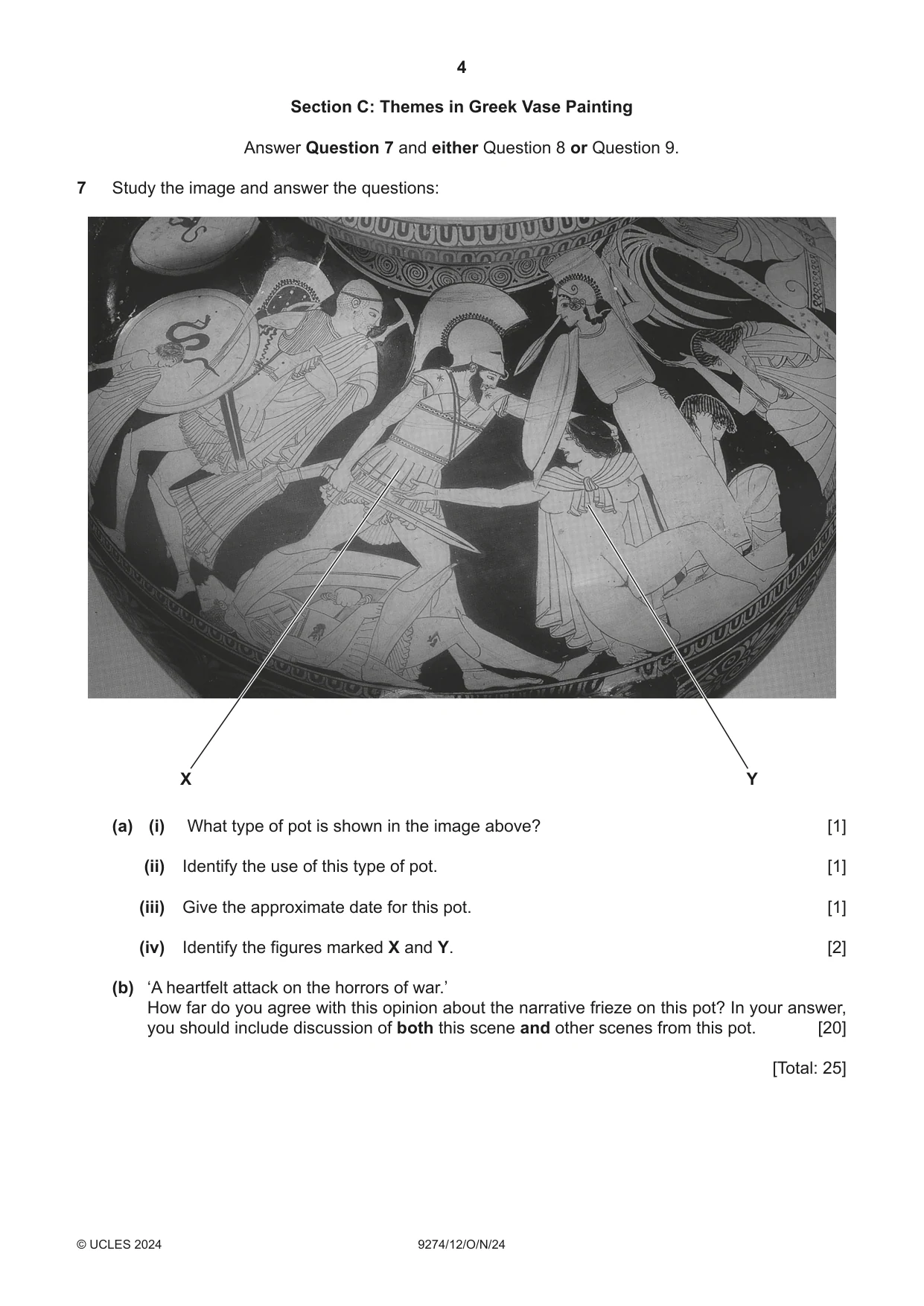
4 9274/12/O/N/24 © UCLES 2024 Section C: Themes in Greek Vase Painting Answer Question 7 and either Question 8 or Question 9. 7 Study the image and answer the questions: X Y (a) (i) What type of pot is shown in the image above? [1] (ii) Identify the use of this type of pot. [1] (iii) Give the approximate date for this pot. [1] (iv) Identify the figures marked X and Y. [2] (b) ‘A heartfelt attack on the horrors of war.’ How far do you agree with this opinion about the narrative frieze on this pot? In your answer, you should include discussion of both this scene and other scenes from this pot. [20] [Total: 25]
Question paper, page 5
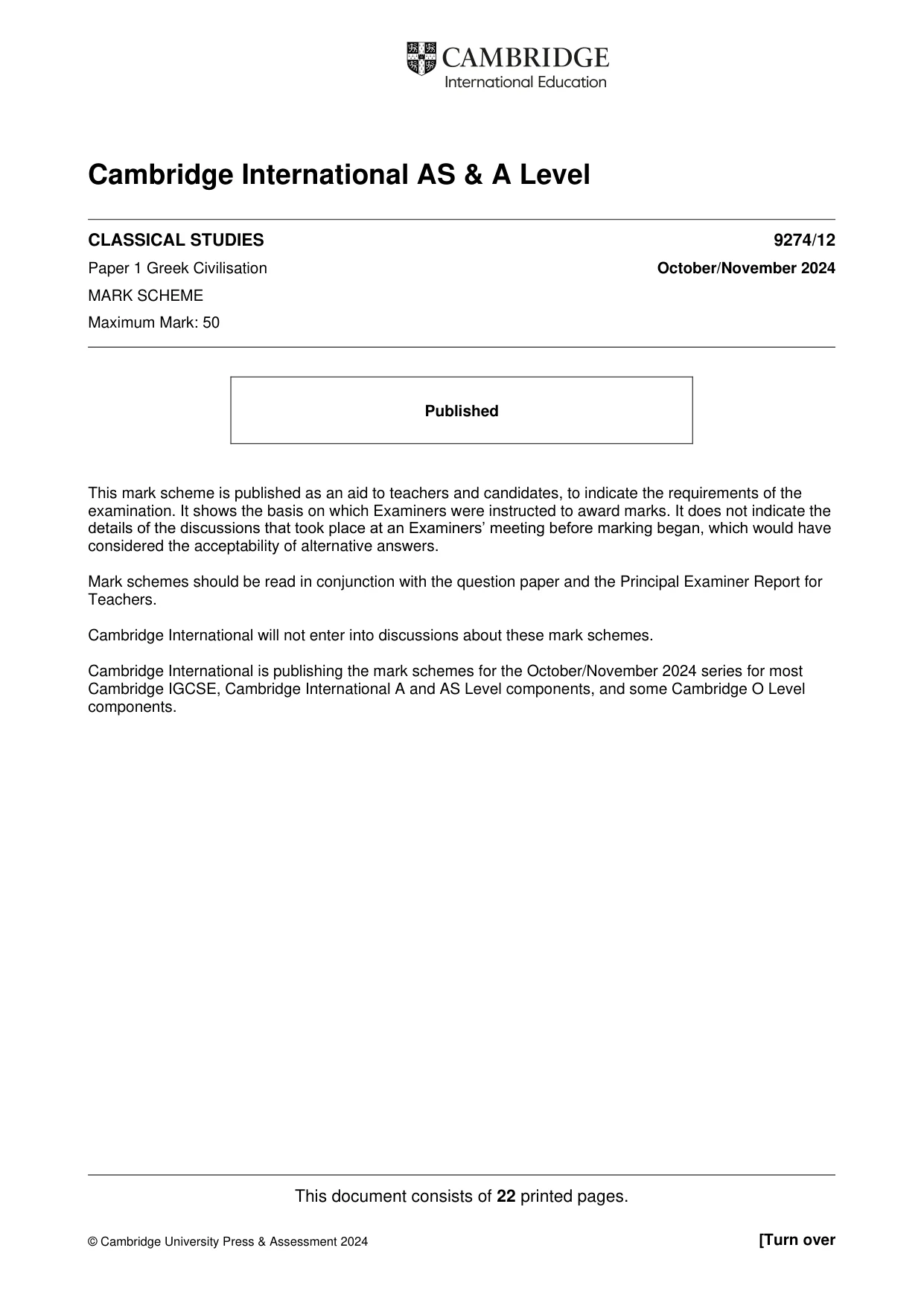
5 9274/12/O/N/24 © UCLES 2024 EITHER 8 ‘Scenes depicting heroes were more challenging to paint than those depicting women in domestic scenes.’ How far do you agree with this statement? Explain your answer with reference to specific pots depicting heroes and pots depicting scenes from the daily life of women. [25] OR 9 ‘Red-figure artists were more creative storytellers than black-figure artists.’ How far do you agree with this statement? Explain your answer with reference to at least three pots from each technique. [25]
Question paper, page 6
6 9274/12/O/N/24 © UCLES 2024 BLANK PAGE
Question paper, page 7
7 9274/12/O/N/24 © UCLES 2024 BLANK PAGE
Question paper, page 8
8 9274/12/O/N/24 © UCLES 2024 Permission to reproduce items where third-party owned material protected by copyright is included has been sought and cleared where possible. Every reasonable effort has been made by the publisher (UCLES) to trace copyright holders, but if any items requiring clearance have unwittingly been included, the publisher will be pleased to make amends at the earliest possible opportunity. To avoid the issue of disclosure of answer-related information to candidates, all copyright acknowledgements are reproduced online in the Cambridge Assessment International Education Copyright Acknowledgements Booklet. This is produced for each series of examinations and is freely available to download at www.cambridgeinternational.org after the live examination series. Cambridge Assessment International Education is part of Cambridge Assessment. Cambridge Assessment is the brand name of the University of Cambridge Local Examinations Syndicate (UCLES), which is a department of the University of Cambridge. BLANK PAGE
Mark scheme, page 1
This document consists of 22 printed pages. © Cambridge University Press & Assessment 2024 [Turn over Cambridge International AS & A Level CLASSICAL STUDIES 9274/12 Paper 1 Greek Civilisation October/November 2024 MARK SCHEME Maximum Mark: 50 Published This mark scheme is published as an aid to teachers and candidates, to indicate the requirements of the examination. It shows the basis on which Examiners were instructed to award marks. It does not indicate the details of the discussions that took place at an Examiners’ meeting before marking began, which would have considered the acceptability of alternative answers. Mark schemes should be read in conjunction with the question paper and the Principal Examiner Report for Teachers. Cambridge International will not enter into discussions about these mark schemes. Cambridge International is publishing the mark schemes for the October/November 2024 series for most Cambridge IGCSE, Cambridge International A and AS Level components, and some Cambridge O Level components.
Mark scheme, page 2
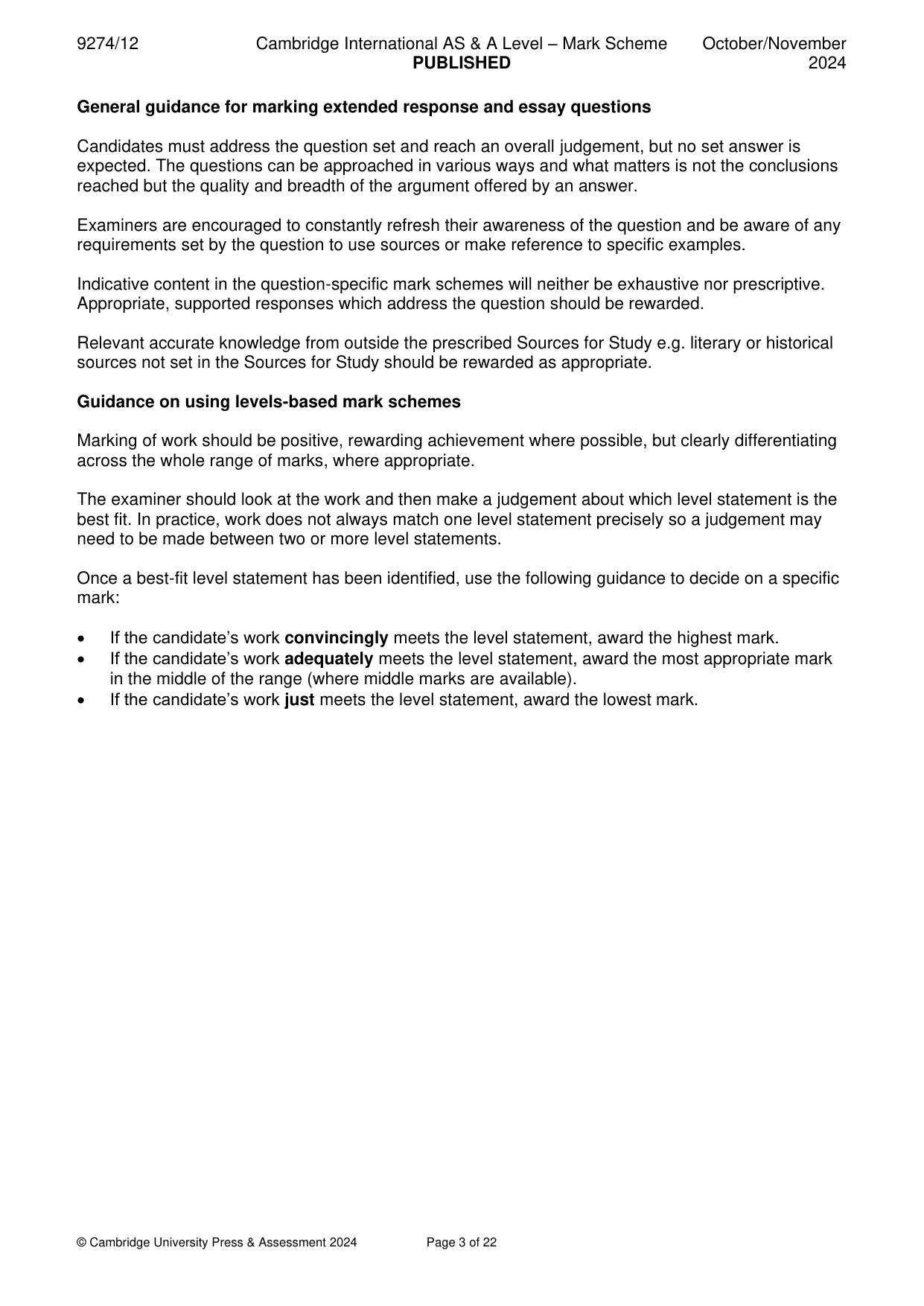
9274/12 Cambridge International AS & A Level – Mark Scheme PUBLISHED October/November 2024 © Cambridge University Press & Assessment 2024 Page 2 of 22 Generic Marking Principles These general marking principles must be applied by all examiners when marking candidate answers. They should be applied alongside the specific content of the mark scheme or generic level descriptions for a question. Each question paper and mark scheme will also comply with these marking principles. GENERIC MARKING PRINCIPLE 1: Marks must be awarded in line with: • the specific content of the mark scheme or the generic level descriptors for the question • the specific skills defined in the mark scheme or in the generic level descriptors for the question • the standard of response required by a candidate as exemplified by the standardisation scripts. GENERIC MARKING PRINCIPLE 2: Marks awarded are always whole marks (not half marks, or other fractions). GENERIC MARKING PRINCIPLE 3: Marks must be awarded positively: • marks are awarded for correct/valid answers, as defined in the mark scheme. However, credit is given for valid answers which go beyond the scope of the syllabus and mark scheme, referring to your Team Leader as appropriate • marks are awarded when candidates clearly demonstrate what they know and can do • marks are not deducted for errors • marks are not deducted for omissions • answers should only be judged on the quality of spelling, punctuation and grammar when these features are specifically assessed by the question as indicated by the mark scheme. The meaning, however, should be unambiguous. GENERIC MARKING PRINCIPLE 4: Rules must be applied consistently, e.g. in situations where candidates have not followed instructions or in the application of generic level descriptors. GENERIC MARKING PRINCIPLE 5: Marks should be awarded using the full range of marks defined in the mark scheme for the question (however; the use of the full mark range may be limited according to the quality of the candidate responses seen). GENERIC MARKING PRINCIPLE 6: Marks awarded are based solely on the requirements as defined in the mark scheme. Marks should not be awarded with grade thresholds or grade descriptors in mind.
Mark scheme, page 3
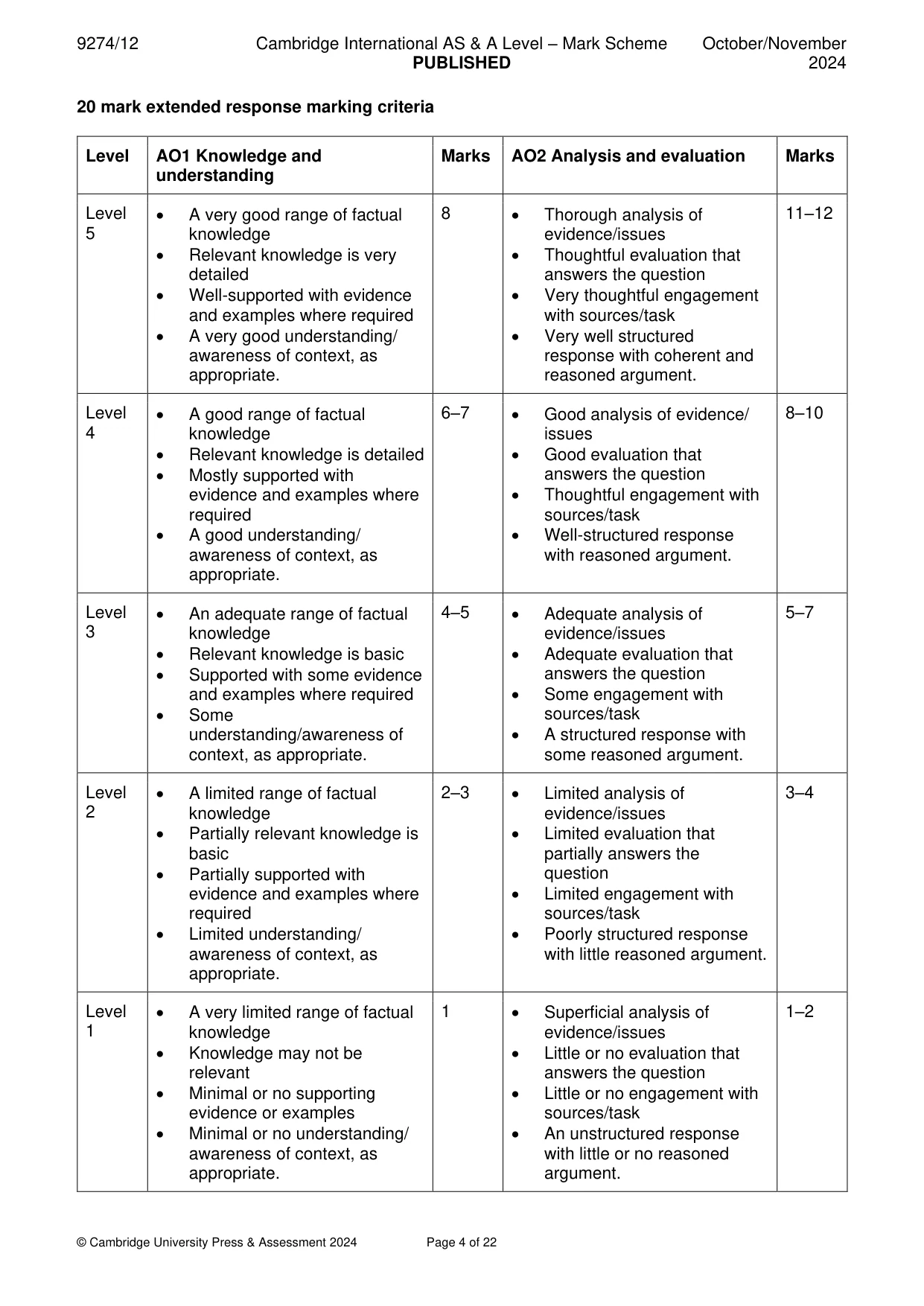
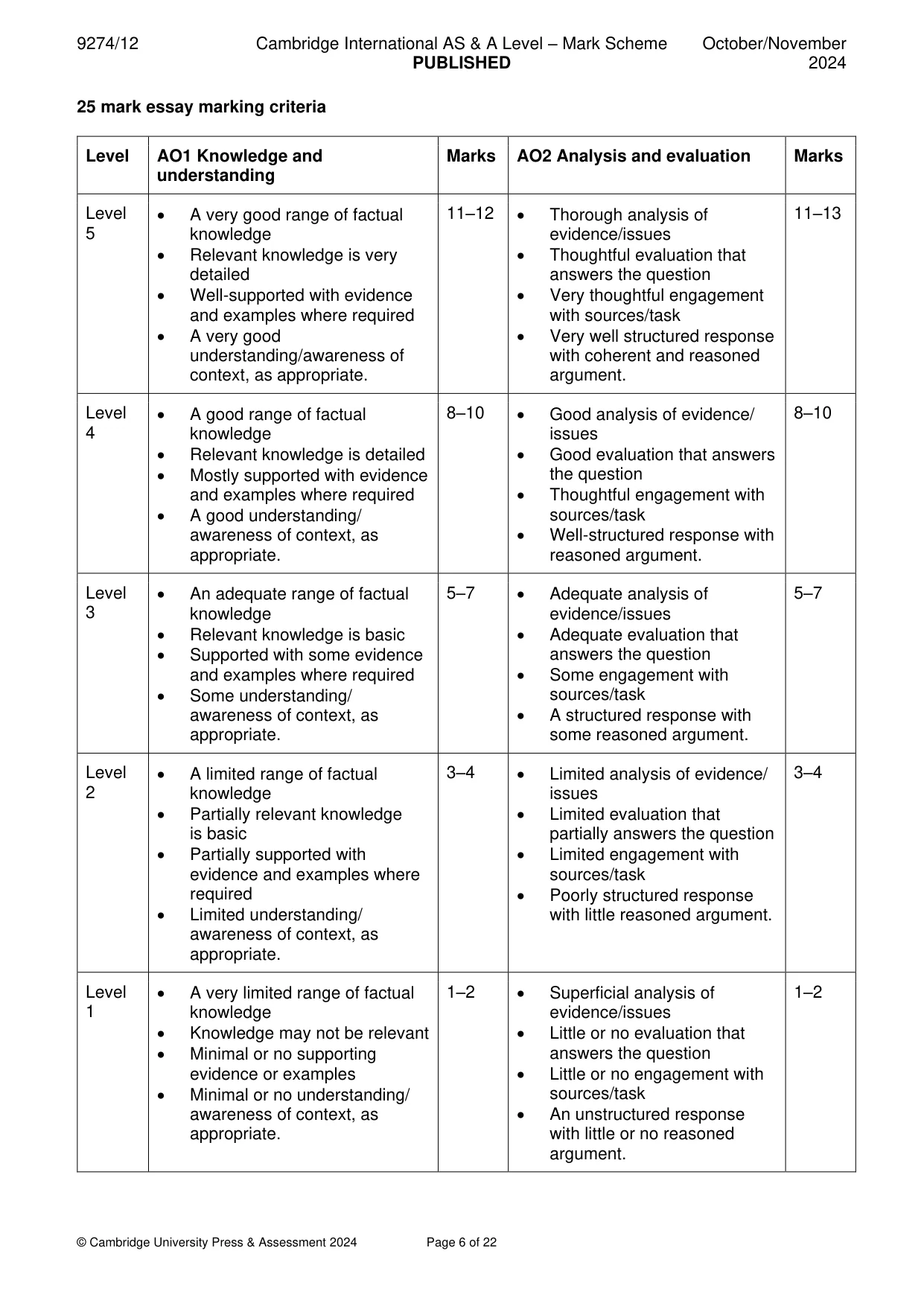
9274/12 Cambridge International AS & A Level – Mark Scheme PUBLISHED October/November 2024 © Cambridge University Press & Assessment 2024 Page 3 of 22 General guidance for marking extended response and essay questions Candidates must address the question set and reach an overall judgement, but no set answer is expected. The questions can be approached in various ways and what matters is not the conclusions reached but the quality and breadth of the argument offered by an answer. Examiners are encouraged to constantly refresh their awareness of the question and be aware of any requirements set by the question to use sources or make reference to specific examples. Indicative content in the question-specific mark schemes will neither be exhaustive nor prescriptive. Appropriate, supported responses which address the question should be rewarded. Relevant accurate knowledge from outside the prescribed Sources for Study e.g. literary or historical sources not set in the Sources for Study should be rewarded as appropriate. Guidance on using levels-based mark schemes Marking of work should be positive, rewarding achievement where possible, but clearly differentiating across the whole range of marks, where appropriate. The examiner should look at the work and then make a judgement about which level statement is the best fit. In practice, work does not always match one level statement precisely so a judgement may need to be made between two or more level statements. Once a best-fit level statement has been identified, use the following guidance to decide on a specific mark: • If the candidate’s work convincingly meets the level statement, award the highest mark. • If the candidate’s work adequately meets the level statement, award the most appropriate mark in the middle of the range (where middle marks are available). • If the candidate’s work just meets the level statement, award the lowest mark.
Mark scheme, page 4
9274/12 Cambridge International AS & A Level – Mark Scheme PUBLISHED October/November 2024 © Cambridge University Press & Assessment 2024 Page 4 of 22 20 mark extended response marking criteria Level AO1 Knowledge and understanding Marks AO2 Analysis and evaluation Marks Level 5 • A very good range of factual knowledge • Relevant knowledge is very detailed • Well-supported with evidence and examples where required • A very good understanding/ awareness of context, as appropriate. 8 • Thorough analysis of evidence/issues • Thoughtful evaluation that answers the question • Very thoughtful engagement with sources/task • Very well structured response with coherent and reasoned argument. 11–12 Level 4 • A good range of factual knowledge • Relevant knowledge is detailed • Mostly supported with evidence and examples where required • A good understanding/ awareness of context, as appropriate. 6–7 • Good analysis of evidence/ issues • Good evaluation that answers the question • Thoughtful engagement with sources/task • Well-structured response with reasoned argument. 8–10 Level 3 • An adequate range of factual knowledge • Relevant knowledge is basic • Supported with some evidence and examples where required • Some understanding/awareness of context, as appropriate. 4–5 • Adequate analysis of evidence/issues • Adequate evaluation that answers the question • Some engagement with sources/task • A structured response with some reasoned argument. 5–7 Level 2 • A limited range of factual knowledge • Partially relevant knowledge is basic • Partially supported with evidence and examples where required • Limited understanding/ awareness of context, as appropriate. 2–3 • Limited analysis of evidence/issues • Limited evaluation that partially answers the question • Limited engagement with sources/task • Poorly structured response with little reasoned argument. 3–4 Level 1 • A very limited range of factual knowledge • Knowledge may not be relevant • Minimal or no supporting evidence or examples • Minimal or no understanding/ awareness of context, as appropriate. 1 • Superficial analysis of evidence/issues • Little or no evaluation that answers the question • Little or no engagement with sources/task • An unstructured response with little or no reasoned argument. 1–2
Mark scheme, page 5
9274/12 Cambridge International AS & A Level – Mark Scheme PUBLISHED October/November 2024 © Cambridge University Press & Assessment 2024 Page 5 of 22 Level AO1 Knowledge and understanding Marks AO2 Analysis and evaluation Marks Level 0 No creditable response. 0 No creditable response. 0
Mark scheme, page 6
9274/12 Cambridge International AS & A Level – Mark Scheme PUBLISHED October/November 2024 © Cambridge University Press & Assessment 2024 Page 6 of 22 25 mark essay marking criteria Level AO1 Knowledge and understanding Marks AO2 Analysis and evaluation Marks Level 5 • A very good range of factual knowledge • Relevant knowledge is very detailed • Well-supported with evidence and examples where required • A very good understanding/awareness of context, as appropriate. 11–12 • Thorough analysis of evidence/issues • Thoughtful evaluation that answers the question • Very thoughtful engagement with sources/task • Very well structured response with coherent and reasoned argument. 11–13 Level 4 • A good range of factual knowledge • Relevant knowledge is detailed • Mostly supported with evidence and examples where required • A good understanding/ awareness of context, as appropriate. 8–10 • Good analysis of evidence/ issues • Good evaluation that answers the question • Thoughtful engagement with sources/task • Well-structured response with reasoned argument. 8–10 Level 3 • An adequate range of factual knowledge • Relevant knowledge is basic • Supported with some evidence and examples where required • Some understanding/ awareness of context, as appropriate. 5–7 • Adequate analysis of evidence/issues • Adequate evaluation that answers the question • Some engagement with sources/task • A structured response with some reasoned argument. 5–7 Level 2 • A limited range of factual knowledge • Partially relevant knowledge is basic • Partially supported with evidence and examples where required • Limited understanding/ awareness of context, as appropriate. 3–4 • Limited analysis of evidence/ issues • Limited evaluation that partially answers the question • Limited engagement with sources/task • Poorly structured response with little reasoned argument. 3–4 Level 1 • A very limited range of factual knowledge • Knowledge may not be relevant • Minimal or no supporting evidence or examples • Minimal or no understanding/ awareness of context, as appropriate. 1–2 • Superficial analysis of evidence/issues • Little or no evaluation that answers the question • Little or no engagement with sources/task • An unstructured response with little or no reasoned argument. 1–2
Mark scheme, page 7
9274/12 Cambridge International AS & A Level – Mark Scheme PUBLISHED October/November 2024 © Cambridge University Press & Assessment 2024 Page 7 of 22 Level AO1 Knowledge and understanding Marks AO2 Analysis and evaluation Marks Level 0 No creditable response. 0 No creditable response. 0
Mark scheme, page 8
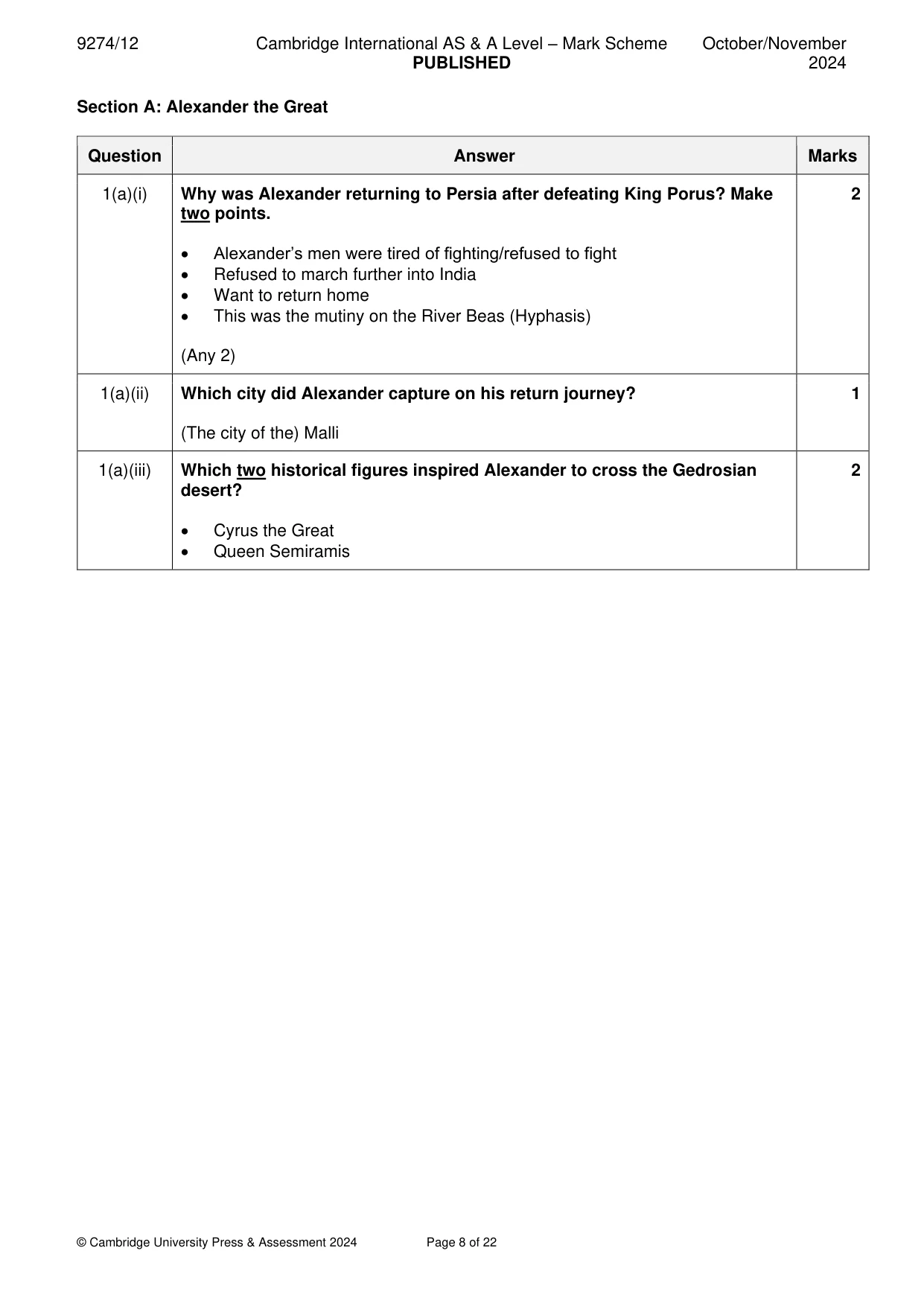
9274/12 Cambridge International AS & A Level – Mark Scheme PUBLISHED October/November 2024 © Cambridge University Press & Assessment 2024 Page 8 of 22 Section A: Alexander the Great Question Answer Marks 1(a)(i) Why was Alexander returning to Persia after defeating King Porus? Make two points. • Alexander’s men were tired of fighting/refused to fight • Refused to march further into India • Want to return home • This was the mutiny on the River Beas (Hyphasis) (Any 2) 2 1(a)(ii) Which city did Alexander capture on his return journey? (The city of the) Malli 1 1(a)(iii) Which two historical figures inspired Alexander to cross the Gedrosian desert? • Cyrus the Great • Queen Semiramis 2
Mark scheme, page 9
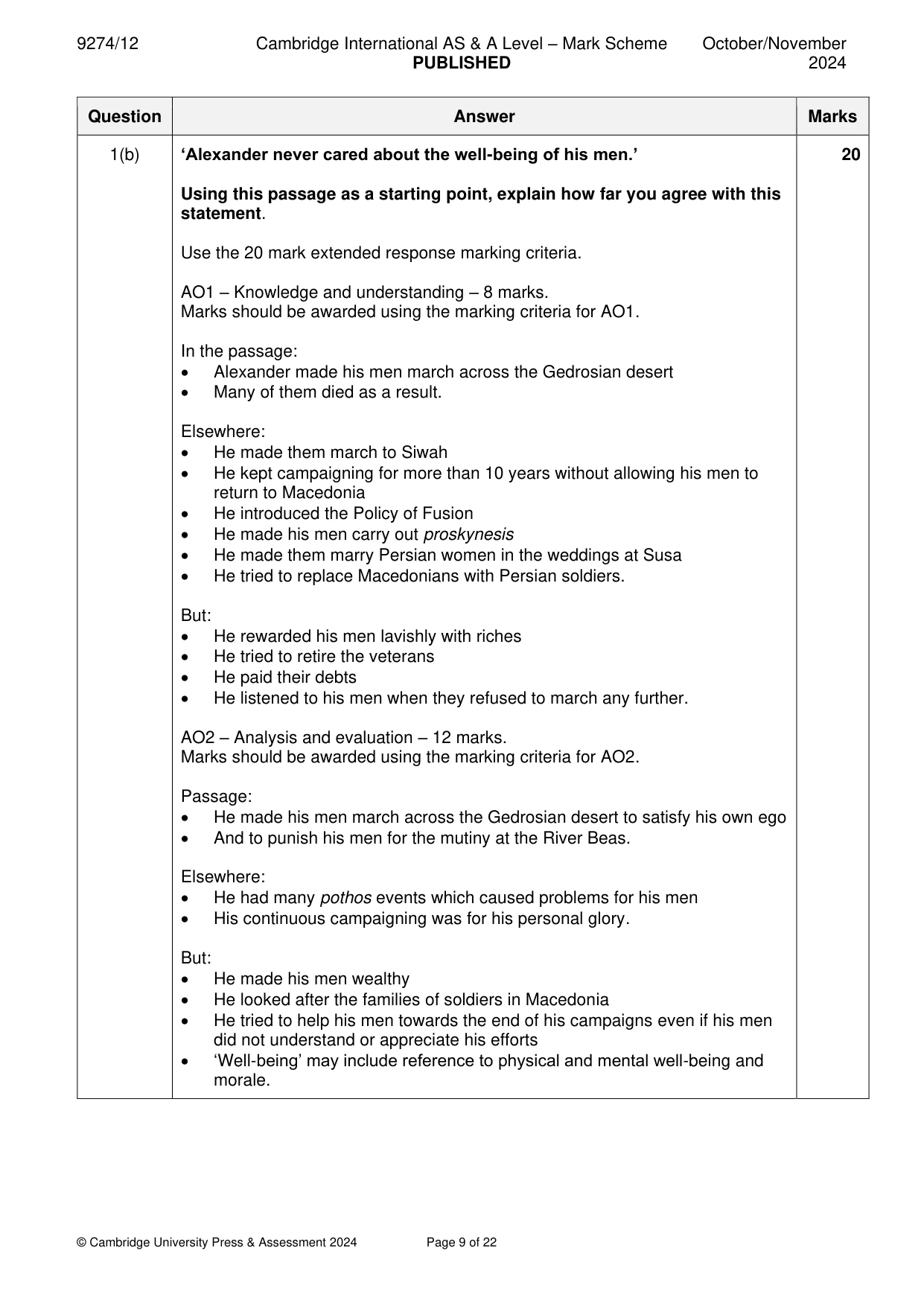
9274/12 Cambridge International AS & A Level – Mark Scheme PUBLISHED October/November 2024 © Cambridge University Press & Assessment 2024 Page 9 of 22 Question Answer Marks 1(b) ‘Alexander never cared about the well-being of his men.’ Using this passage as a starting point, explain how far you agree with this statement. Use the 20 mark extended response marking criteria. AO1 – Knowledge and understanding – 8 marks. Marks should be awarded using the marking criteria for AO1. In the passage: • Alexander made his men march across the Gedrosian desert • Many of them died as a result. Elsewhere: • He made them march to Siwah • He kept campaigning for more than 10 years without allowing his men to return to Macedonia • He introduced the Policy of Fusion • He made his men carry out proskynesis • He made them marry Persian women in the weddings at Susa • He tried to replace Macedonians with Persian soldiers. But: • He rewarded his men lavishly with riches • He tried to retire the veterans • He paid their debts • He listened to his men when they refused to march any further. AO2 – Analysis and evaluation – 12 marks. Marks should be awarded using the marking criteria for AO2. Passage: • He made his men march across the Gedrosian desert to satisfy his own ego • And to punish his men for the mutiny at the River Beas. Elsewhere: • He had many pothos events which caused problems for his men • His continuous campaigning was for his personal glory. But: • He made his men wealthy • He looked after the families of soldiers in Macedonia • He tried to help his men towards the end of his campaigns even if his men did not understand or appreciate his efforts • ‘Well-being’ may include reference to physical and mental well-being and morale. 20
Mark scheme, page 10
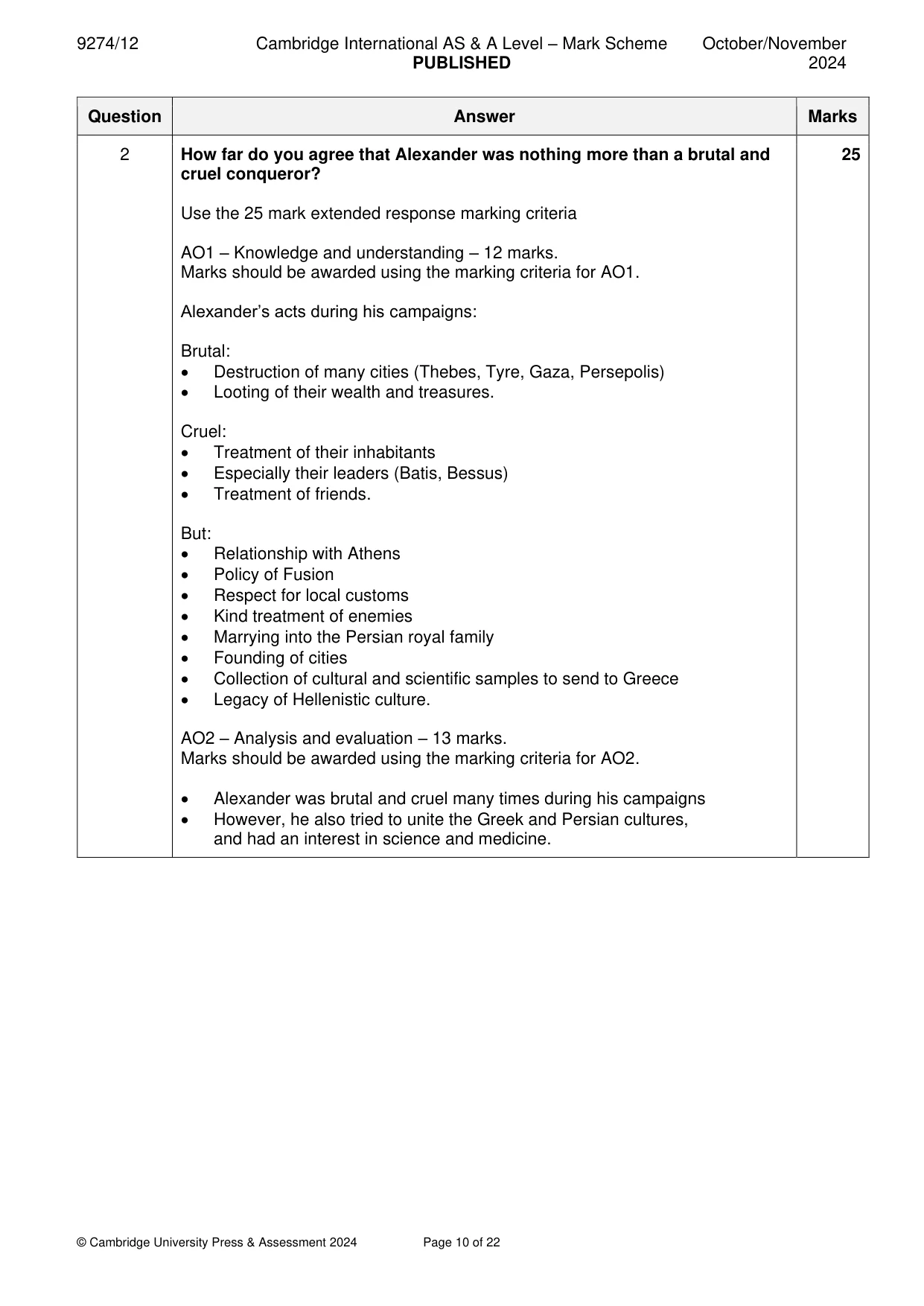
9274/12 Cambridge International AS & A Level – Mark Scheme PUBLISHED October/November 2024 © Cambridge University Press & Assessment 2024 Page 10 of 22 Question Answer Marks 2 How far do you agree that Alexander was nothing more than a brutal and cruel conqueror? Use the 25 mark extended response marking criteria AO1 – Knowledge and understanding – 12 marks. Marks should be awarded using the marking criteria for AO1. Alexander’s acts during his campaigns: Brutal: • Destruction of many cities (Thebes, Tyre, Gaza, Persepolis) • Looting of their wealth and treasures. Cruel: • Treatment of their inhabitants • Especially their leaders (Batis, Bessus) • Treatment of friends. But: • Relationship with Athens • Policy of Fusion • Respect for local customs • Kind treatment of enemies • Marrying into the Persian royal family • Founding of cities • Collection of cultural and scientific samples to send to Greece • Legacy of Hellenistic culture. AO2 – Analysis and evaluation – 13 marks. Marks should be awarded using the marking criteria for AO2. • Alexander was brutal and cruel many times during his campaigns • However, he also tried to unite the Greek and Persian cultures, and had an interest in science and medicine. 25
Mark scheme, page 11
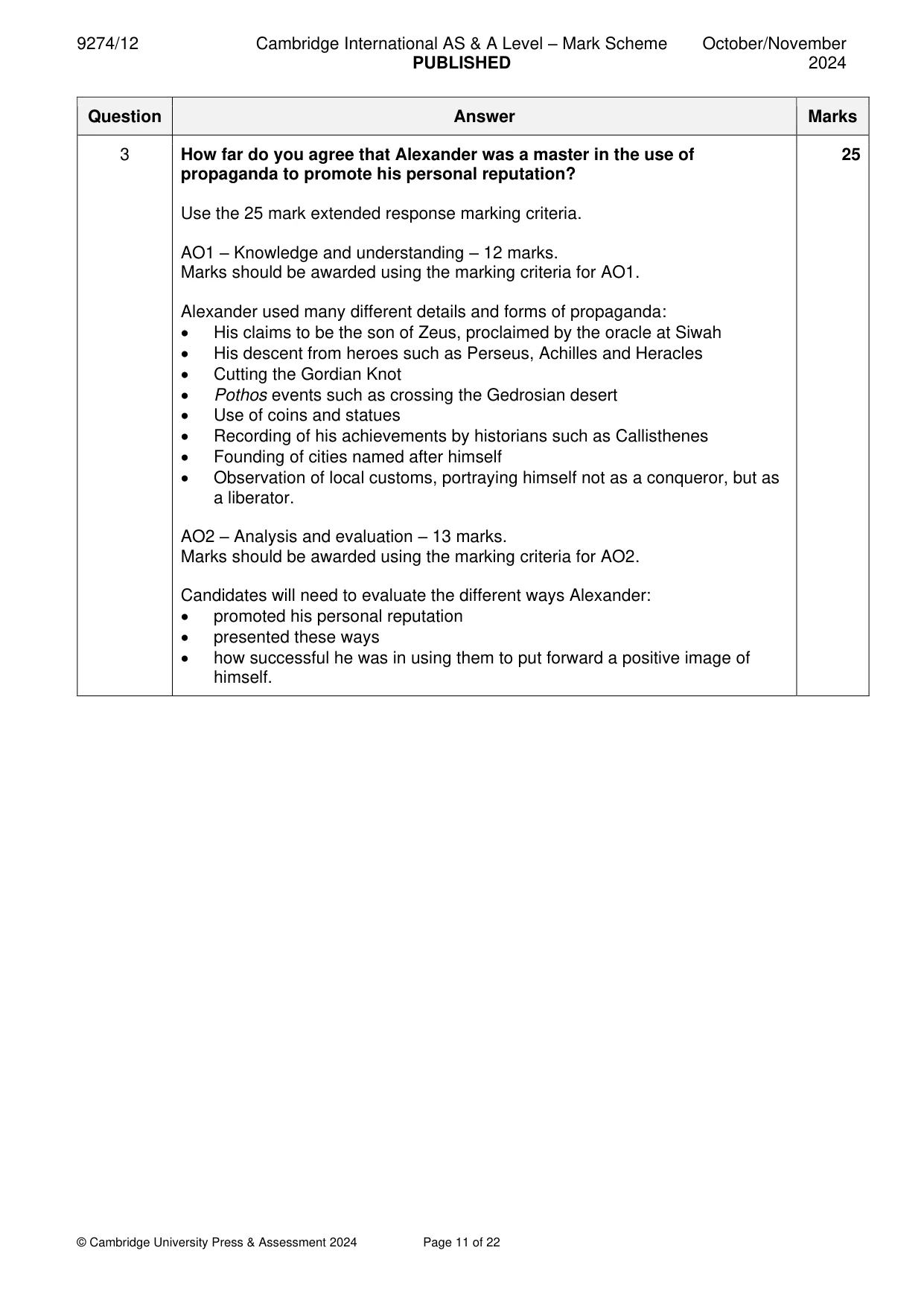
9274/12 Cambridge International AS & A Level – Mark Scheme PUBLISHED October/November 2024 © Cambridge University Press & Assessment 2024 Page 11 of 22 Question Answer Marks 3 How far do you agree that Alexander was a master in the use of propaganda to promote his personal reputation? Use the 25 mark extended response marking criteria. AO1 – Knowledge and understanding – 12 marks. Marks should be awarded using the marking criteria for AO1. Alexander used many different details and forms of propaganda: • His claims to be the son of Zeus, proclaimed by the oracle at Siwah • His descent from heroes such as Perseus, Achilles and Heracles • Cutting the Gordian Knot • Pothos events such as crossing the Gedrosian desert • Use of coins and statues • Recording of his achievements by historians such as Callisthenes • Founding of cities named after himself • Observation of local customs, portraying himself not as a conqueror, but as a liberator. AO2 – Analysis and evaluation – 13 marks. Marks should be awarded using the marking criteria for AO2. Candidates will need to evaluate the different ways Alexander: • promoted his personal reputation • presented these ways • how successful he was in using them to put forward a positive image of himself. 25
Mark scheme, page 12
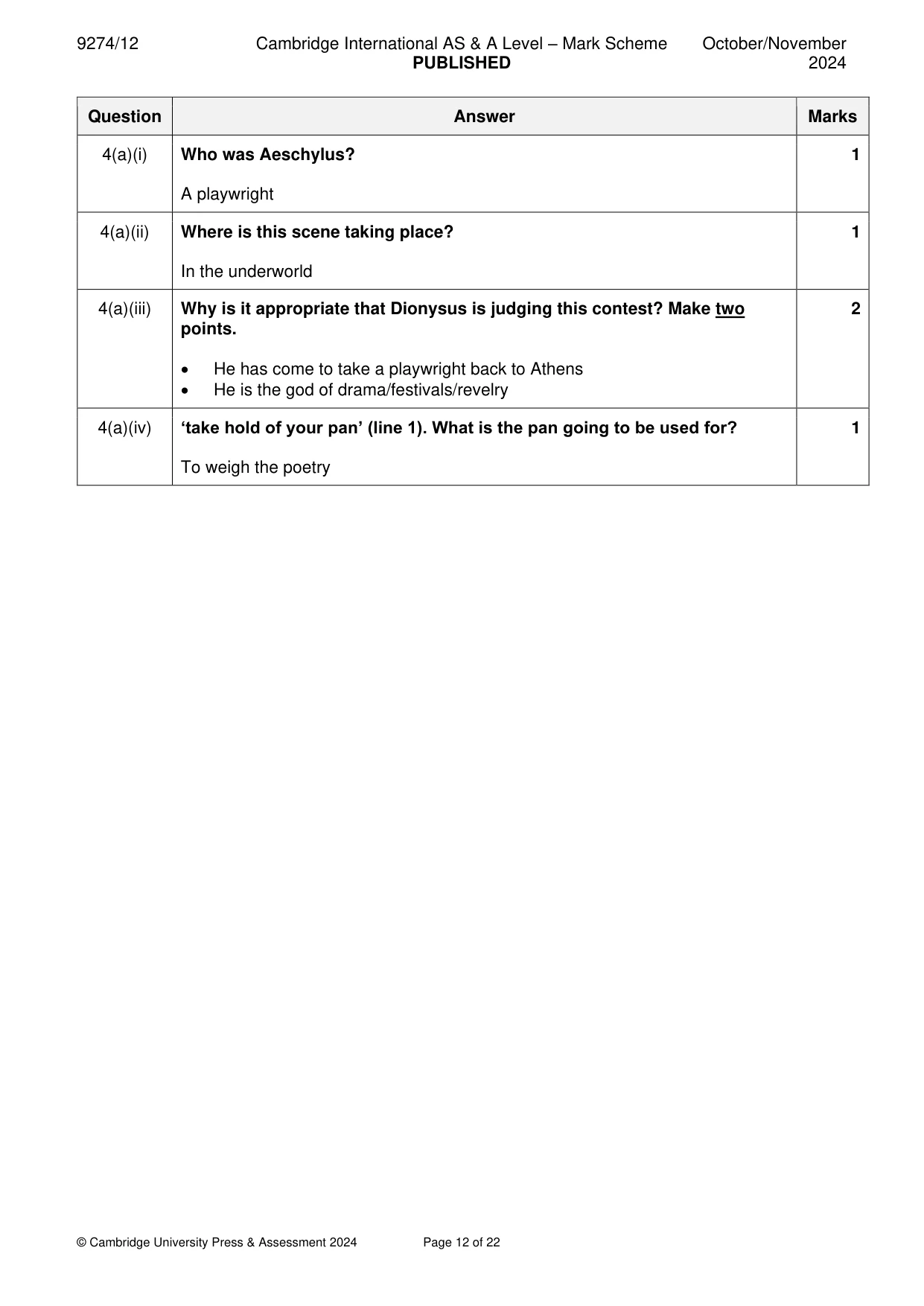
9274/12 Cambridge International AS & A Level – Mark Scheme PUBLISHED October/November 2024 © Cambridge University Press & Assessment 2024 Page 12 of 22 Question Answer Marks 4(a)(i) Who was Aeschylus? A playwright 1 4(a)(ii) Where is this scene taking place? In the underworld 1 4(a)(iii) Why is it appropriate that Dionysus is judging this contest? Make two points. • He has come to take a playwright back to Athens • He is the god of drama/festivals/revelry 2 4(a)(iv) ‘take hold of your pan’ (line 1). What is the pan going to be used for? To weigh the poetry 1
Mark scheme, page 13
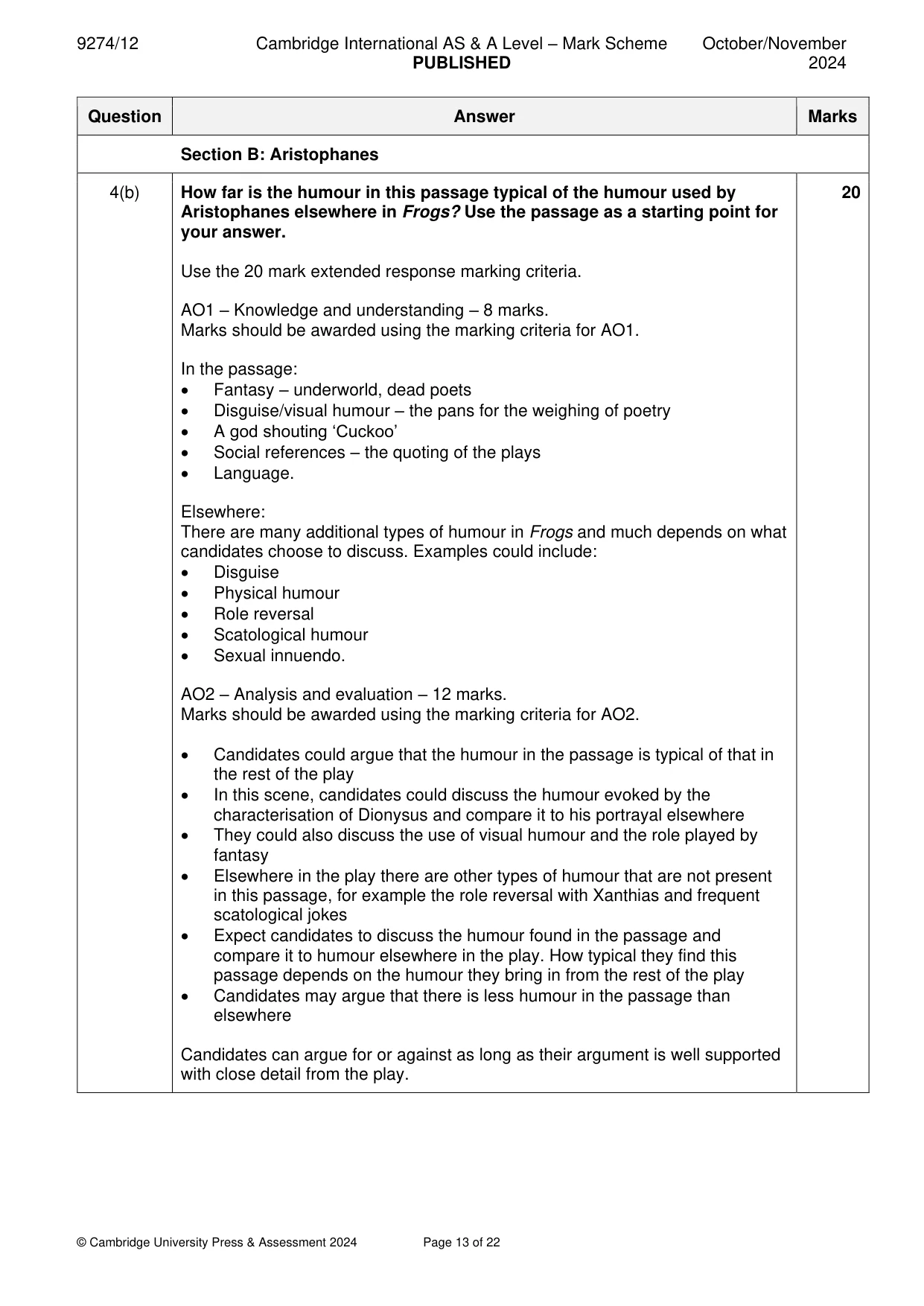
9274/12 Cambridge International AS & A Level – Mark Scheme PUBLISHED October/November 2024 © Cambridge University Press & Assessment 2024 Page 13 of 22 Question Answer Marks Section B: Aristophanes 4(b) How far is the humour in this passage typical of the humour used by Aristophanes elsewhere in Frogs? Use the passage as a starting point for your answer. Use the 20 mark extended response marking criteria. AO1 – Knowledge and understanding – 8 marks. Marks should be awarded using the marking criteria for AO1. In the passage: • Fantasy – underworld, dead poets • Disguise/visual humour – the pans for the weighing of poetry • A god shouting ‘Cuckoo’ • Social references – the quoting of the plays • Language. Elsewhere: There are many additional types of humour in Frogs and much depends on what candidates choose to discuss. Examples could include: • Disguise • Physical humour • Role reversal • Scatological humour • Sexual innuendo. AO2 – Analysis and evaluation – 12 marks. Marks should be awarded using the marking criteria for AO2. • Candidates could argue that the humour in the passage is typical of that in the rest of the play • In this scene, candidates could discuss the humour evoked by the characterisation of Dionysus and compare it to his portrayal elsewhere • They could also discuss the use of visual humour and the role played by fantasy • Elsewhere in the play there are other types of humour that are not present in this passage, for example the role reversal with Xanthias and frequent scatological jokes • Expect candidates to discuss the humour found in the passage and compare it to humour elsewhere in the play. How typical they find this passage depends on the humour they bring in from the rest of the play • Candidates may argue that there is less humour in the passage than elsewhere Candidates can argue for or against as long as their argument is well supported with close detail from the play. 20
Mark scheme, page 14
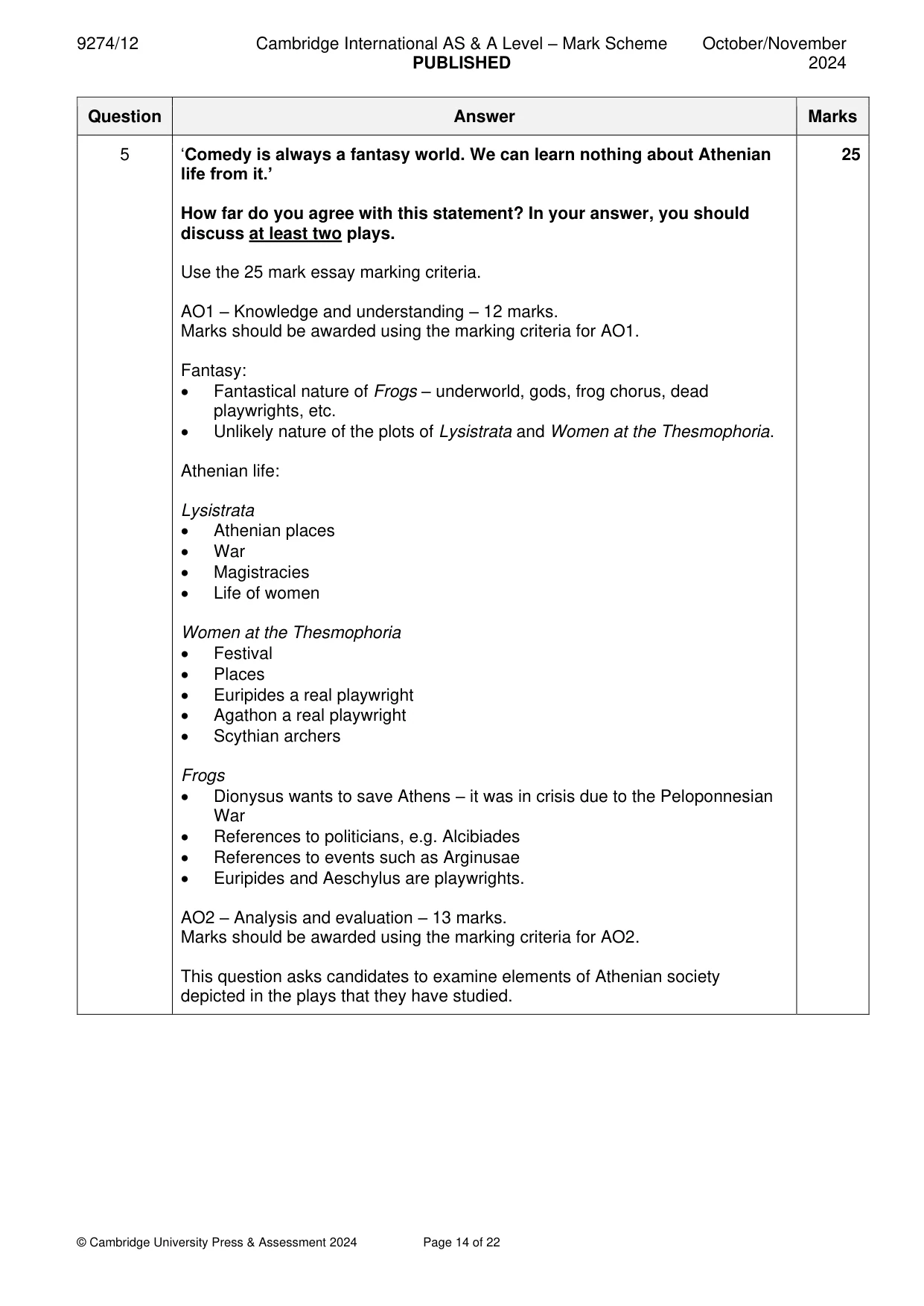
9274/12 Cambridge International AS & A Level – Mark Scheme PUBLISHED October/November 2024 © Cambridge University Press & Assessment 2024 Page 14 of 22 Question Answer Marks 5 ‘Comedy is always a fantasy world. We can learn nothing about Athenian life from it.’ How far do you agree with this statement? In your answer, you should discuss at least two plays. Use the 25 mark essay marking criteria. AO1 – Knowledge and understanding – 12 marks. Marks should be awarded using the marking criteria for AO1. Fantasy: • Fantastical nature of Frogs – underworld, gods, frog chorus, dead playwrights, etc. • Unlikely nature of the plots of Lysistrata and Women at the Thesmophoria. Athenian life: Lysistrata • Athenian places • War • Magistracies • Life of women Women at the Thesmophoria • Festival • Places • Euripides a real playwright • Agathon a real playwright • Scythian archers Frogs • Dionysus wants to save Athens – it was in crisis due to the Peloponnesian War • References to politicians, e.g. Alcibiades • References to events such as Arginusae • Euripides and Aeschylus are playwrights. AO2 – Analysis and evaluation – 13 marks. Marks should be awarded using the marking criteria for AO2. This question asks candidates to examine elements of Athenian society depicted in the plays that they have studied. 25
Mark scheme, page 15
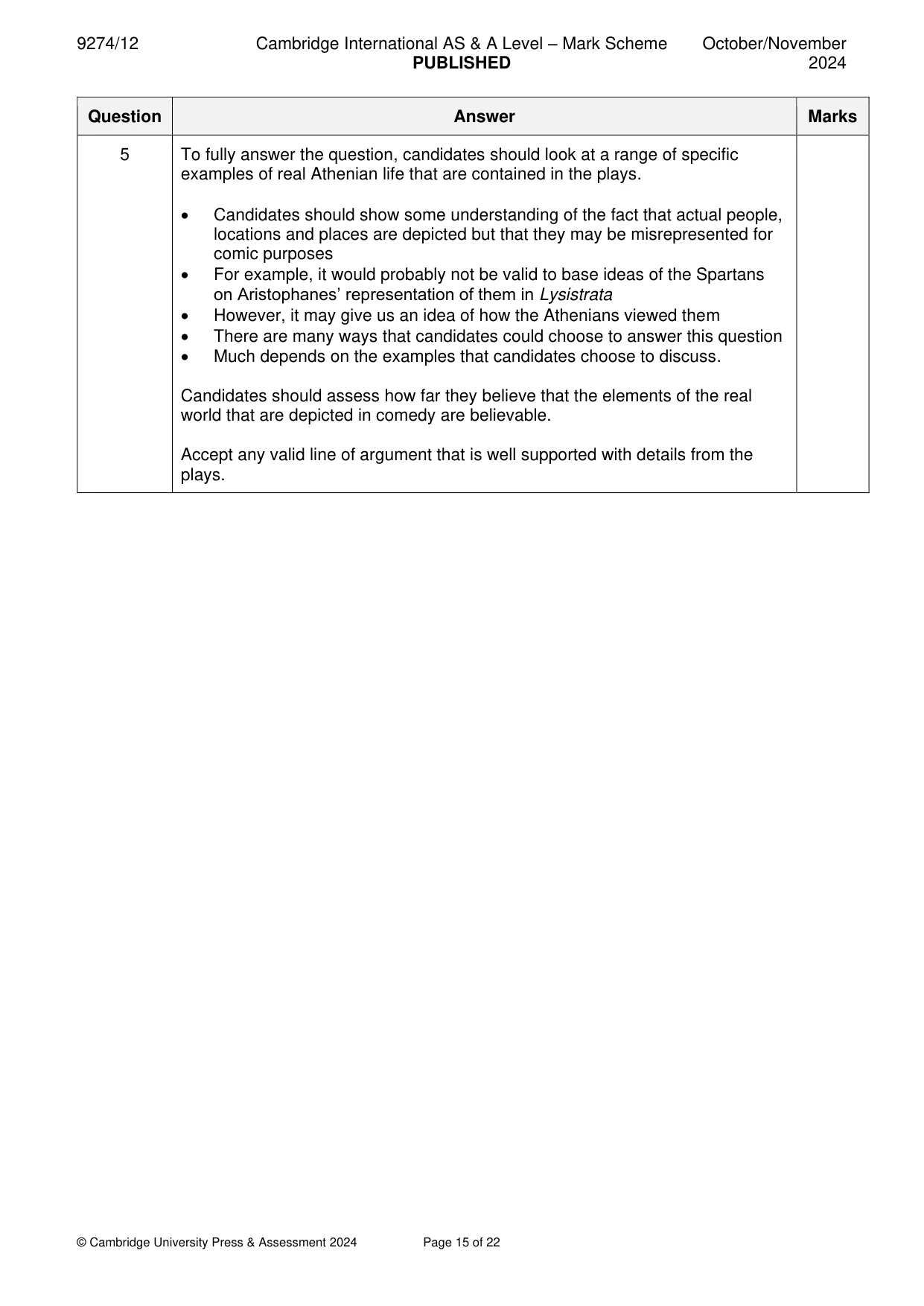
9274/12 Cambridge International AS & A Level – Mark Scheme PUBLISHED October/November 2024 © Cambridge University Press & Assessment 2024 Page 15 of 22 Question Answer Marks 5 To fully answer the question, candidates should look at a range of specific examples of real Athenian life that are contained in the plays. • Candidates should show some understanding of the fact that actual people, locations and places are depicted but that they may be misrepresented for comic purposes • For example, it would probably not be valid to base ideas of the Spartans on Aristophanes’ representation of them in Lysistrata • However, it may give us an idea of how the Athenians viewed them • There are many ways that candidates could choose to answer this question • Much depends on the examples that candidates choose to discuss. Candidates should assess how far they believe that the elements of the real world that are depicted in comedy are believable. Accept any valid line of argument that is well supported with details from the plays.
Mark scheme, page 16
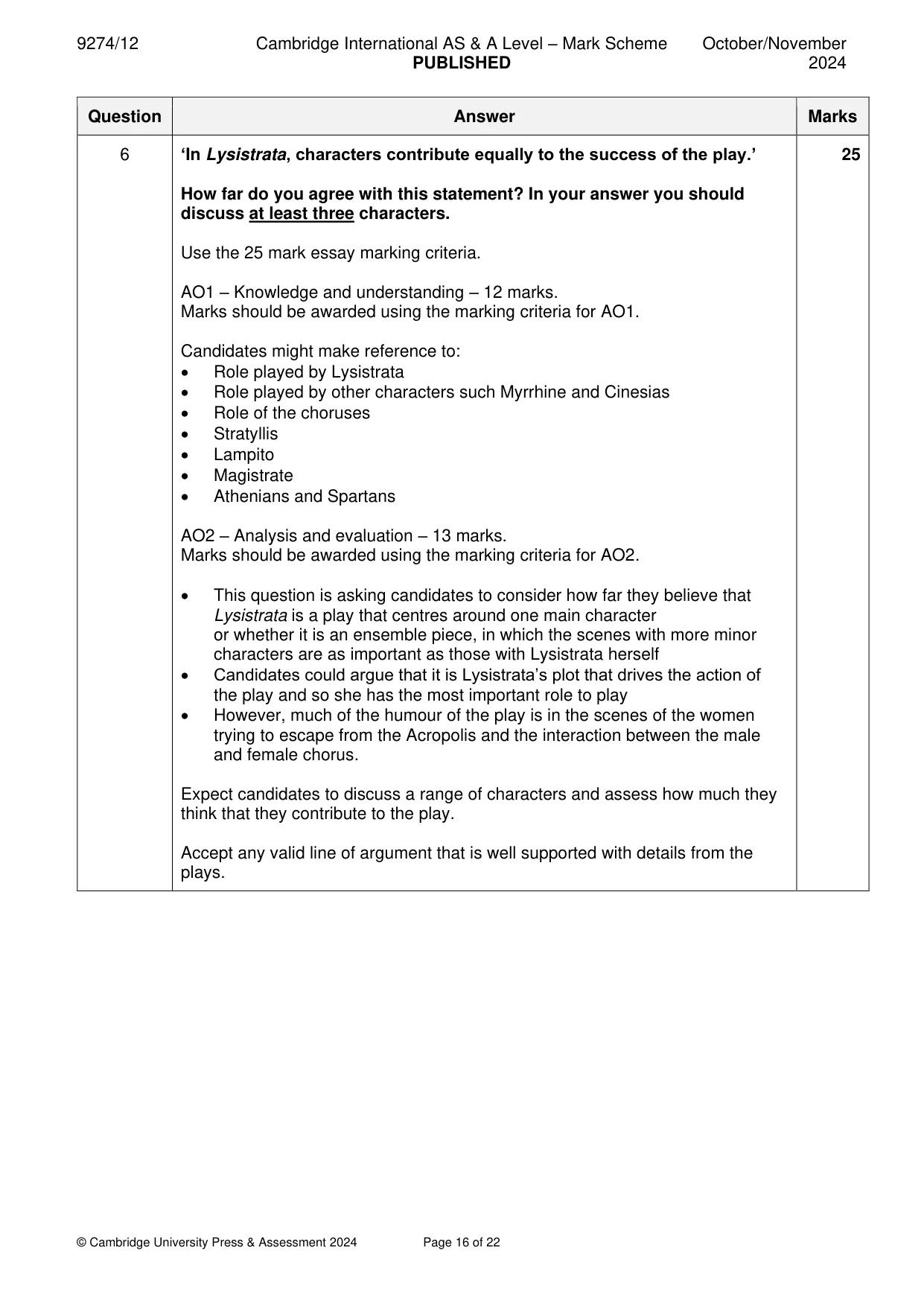
9274/12 Cambridge International AS & A Level – Mark Scheme PUBLISHED October/November 2024 © Cambridge University Press & Assessment 2024 Page 16 of 22 Question Answer Marks 6 ‘In Lysistrata, characters contribute equally to the success of the play.’ How far do you agree with this statement? In your answer you should discuss at least three characters. Use the 25 mark essay marking criteria. AO1 – Knowledge and understanding – 12 marks. Marks should be awarded using the marking criteria for AO1. Candidates might make reference to: • Role played by Lysistrata • Role played by other characters such Myrrhine and Cinesias • Role of the choruses • Stratyllis • Lampito • Magistrate • Athenians and Spartans AO2 – Analysis and evaluation – 13 marks. Marks should be awarded using the marking criteria for AO2. • This question is asking candidates to consider how far they believe that Lysistrata is a play that centres around one main character or whether it is an ensemble piece, in which the scenes with more minor characters are as important as those with Lysistrata herself • Candidates could argue that it is Lysistrata’s plot that drives the action of the play and so she has the most important role to play • However, much of the humour of the play is in the scenes of the women trying to escape from the Acropolis and the interaction between the male and female chorus. Expect candidates to discuss a range of characters and assess how much they think that they contribute to the play. Accept any valid line of argument that is well supported with details from the plays. 25
Mark scheme, page 17
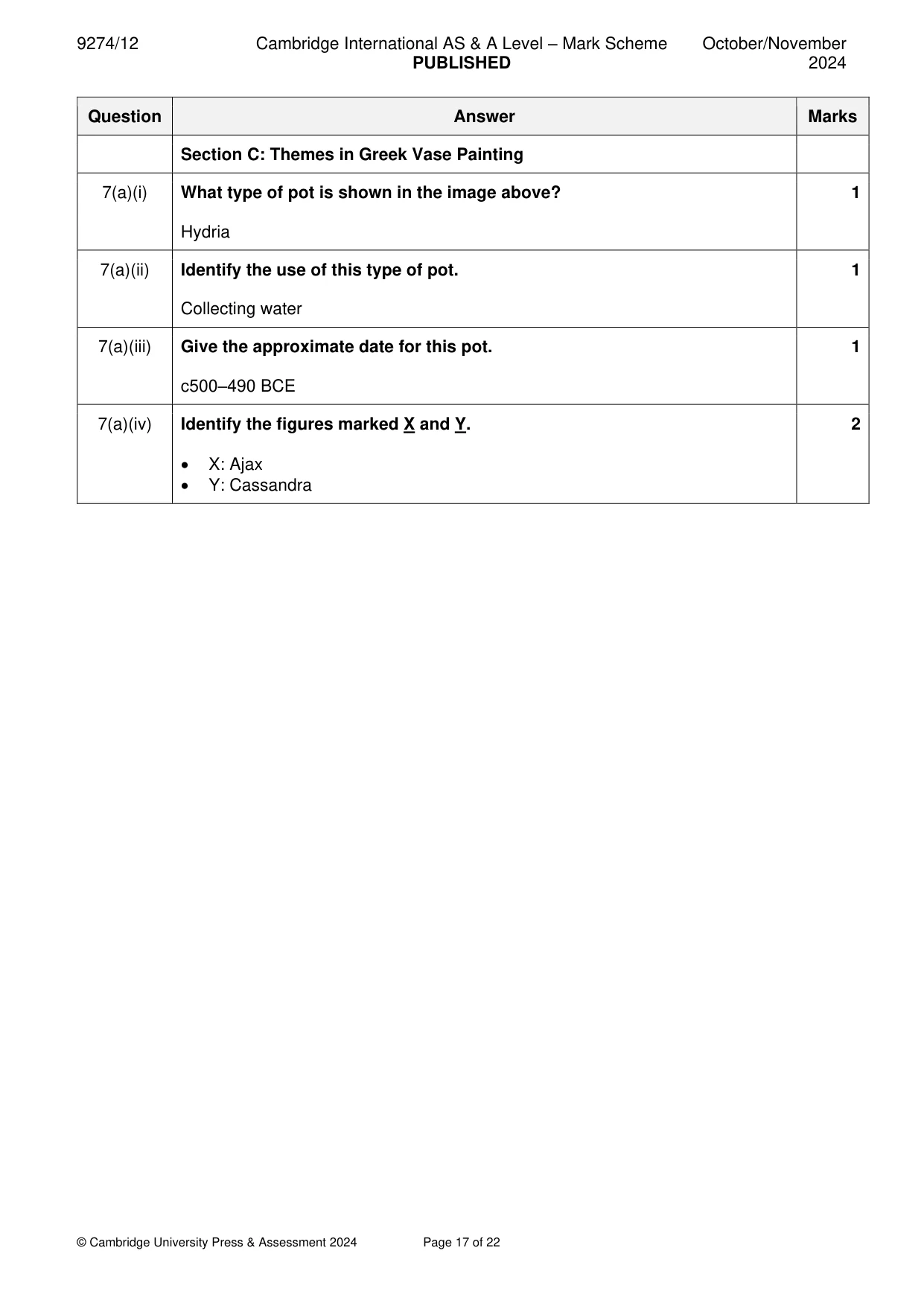
9274/12 Cambridge International AS & A Level – Mark Scheme PUBLISHED October/November 2024 © Cambridge University Press & Assessment 2024 Page 17 of 22 Question Answer Marks Section C: Themes in Greek Vase Painting 7(a)(i) What type of pot is shown in the image above? Hydria 1 7(a)(ii) Identify the use of this type of pot. Collecting water 1 7(a)(iii) Give the approximate date for this pot. c500–490 BCE 1 7(a)(iv) Identify the figures marked X and Y. • X: Ajax • Y: Cassandra 2
Mark scheme, page 18
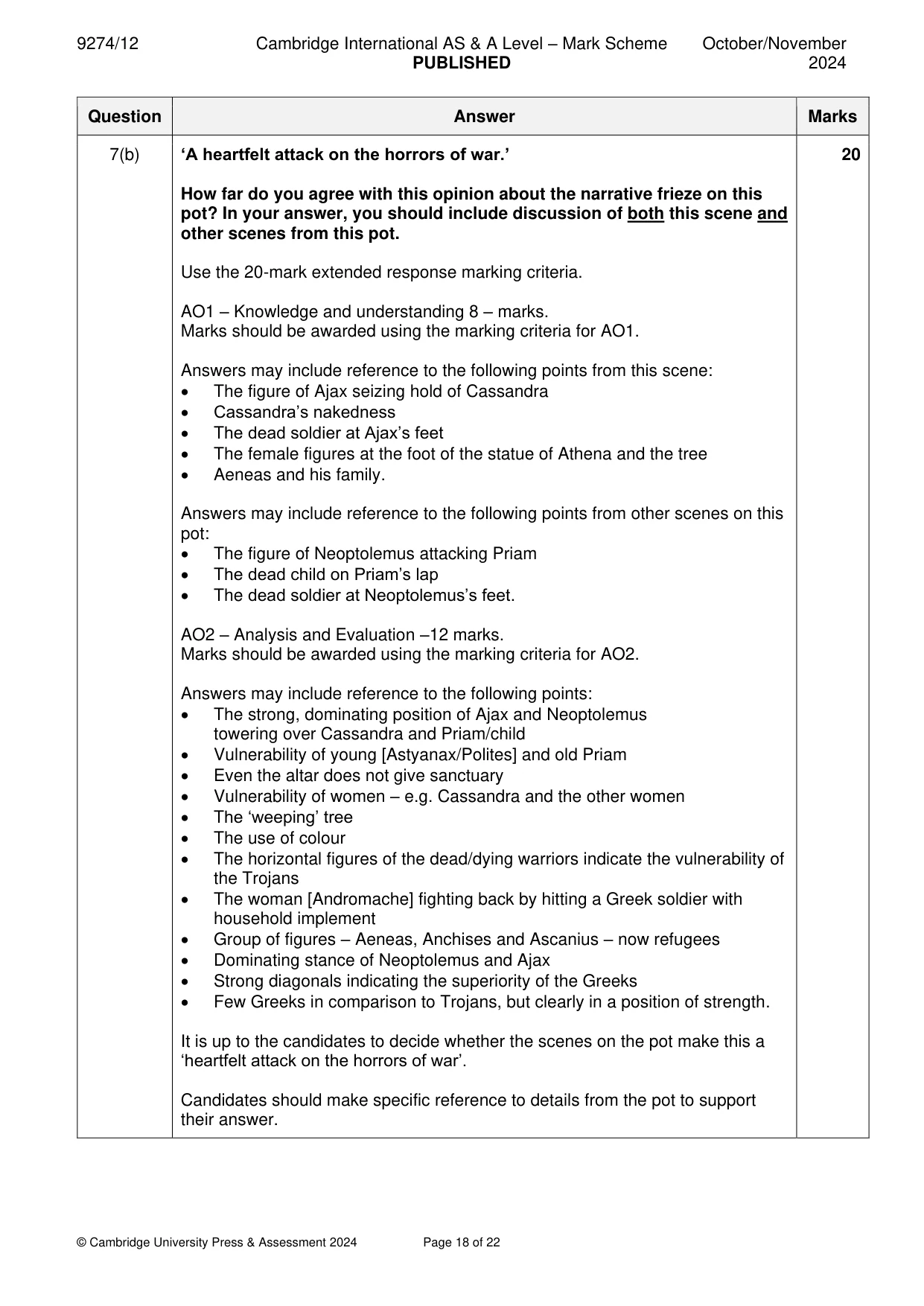
9274/12 Cambridge International AS & A Level – Mark Scheme PUBLISHED October/November 2024 © Cambridge University Press & Assessment 2024 Page 18 of 22 Question Answer Marks 7(b) ‘A heartfelt attack on the horrors of war.’ How far do you agree with this opinion about the narrative frieze on this pot? In your answer, you should include discussion of both this scene and other scenes from this pot. Use the 20-mark extended response marking criteria. AO1 – Knowledge and understanding 8 – marks. Marks should be awarded using the marking criteria for AO1. Answers may include reference to the following points from this scene: • The figure of Ajax seizing hold of Cassandra • Cassandra’s nakedness • The dead soldier at Ajax’s feet • The female figures at the foot of the statue of Athena and the tree • Aeneas and his family. Answers may include reference to the following points from other scenes on this pot: • The figure of Neoptolemus attacking Priam • The dead child on Priam’s lap • The dead soldier at Neoptolemus’s feet. AO2 – Analysis and Evaluation –12 marks. Marks should be awarded using the marking criteria for AO2. Answers may include reference to the following points: • The strong, dominating position of Ajax and Neoptolemus towering over Cassandra and Priam/child • Vulnerability of young [Astyanax/Polites] and old Priam • Even the altar does not give sanctuary • Vulnerability of women – e.g. Cassandra and the other women • The ‘weeping’ tree • The use of colour • The horizontal figures of the dead/dying warriors indicate the vulnerability of the Trojans • The woman [Andromache] fighting back by hitting a Greek soldier with household implement • Group of figures – Aeneas, Anchises and Ascanius – now refugees • Dominating stance of Neoptolemus and Ajax • Strong diagonals indicating the superiority of the Greeks • Few Greeks in comparison to Trojans, but clearly in a position of strength. It is up to the candidates to decide whether the scenes on the pot make this a ‘heartfelt attack on the horrors of war’. Candidates should make specific reference to details from the pot to support their answer. 20
Mark scheme, page 19
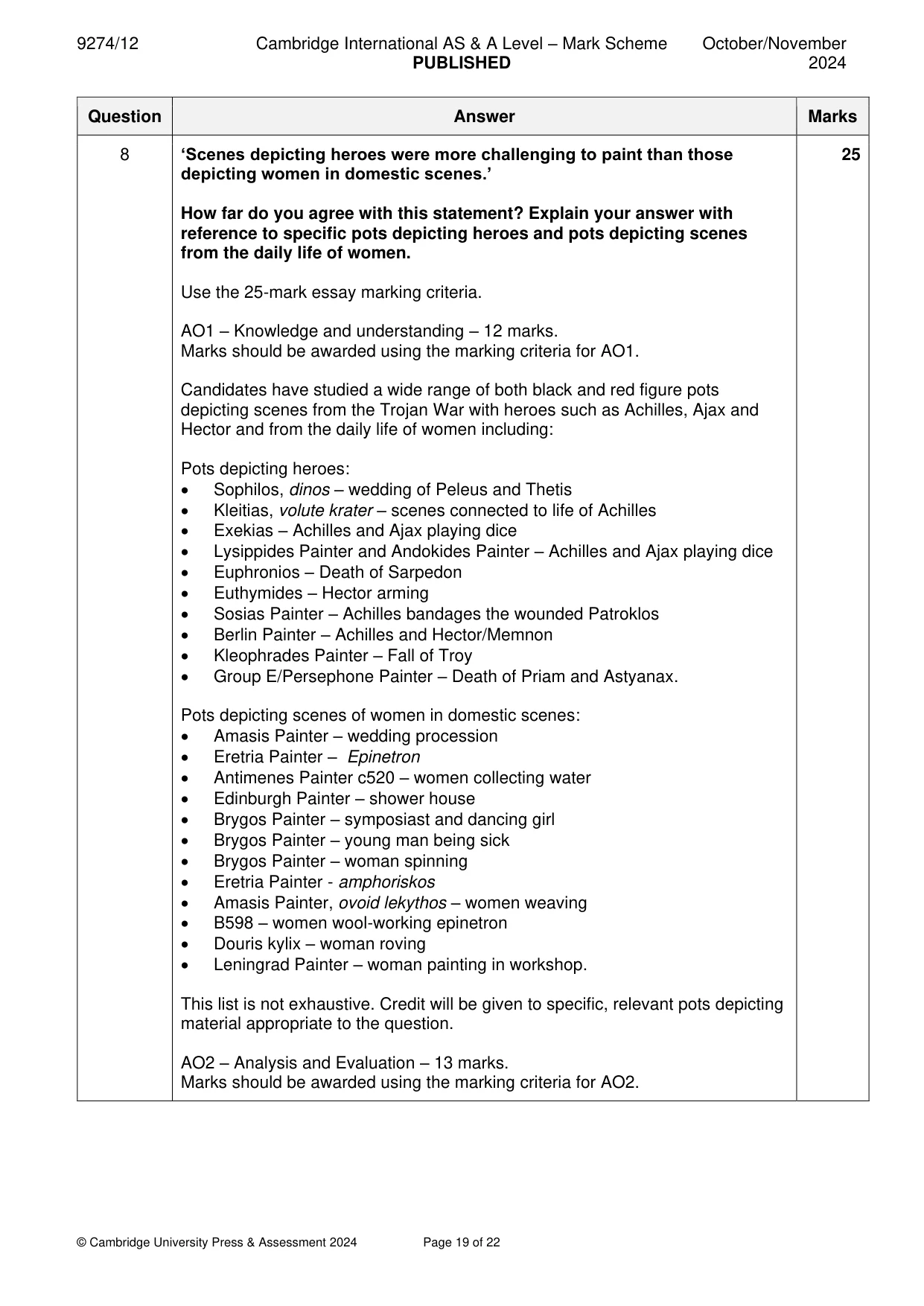
9274/12 Cambridge International AS & A Level – Mark Scheme PUBLISHED October/November 2024 © Cambridge University Press & Assessment 2024 Page 19 of 22 Question Answer Marks 8 ‘Scenes depicting heroes were more challenging to paint than those depicting women in domestic scenes.’ How far do you agree with this statement? Explain your answer with reference to specific pots depicting heroes and pots depicting scenes from the daily life of women. Use the 25-mark essay marking criteria. AO1 – Knowledge and understanding – 12 marks. Marks should be awarded using the marking criteria for AO1. Candidates have studied a wide range of both black and red figure pots depicting scenes from the Trojan War with heroes such as Achilles, Ajax and Hector and from the daily life of women including: Pots depicting heroes: • Sophilos, dinos – wedding of Peleus and Thetis • Kleitias, volute krater – scenes connected to life of Achilles • Exekias – Achilles and Ajax playing dice • Lysippides Painter and Andokides Painter – Achilles and Ajax playing dice • Euphronios – Death of Sarpedon • Euthymides – Hector arming • Sosias Painter – Achilles bandages the wounded Patroklos • Berlin Painter – Achilles and Hector/Memnon • Kleophrades Painter – Fall of Troy • Group E/Persephone Painter – Death of Priam and Astyanax. Pots depicting scenes of women in domestic scenes: • Amasis Painter – wedding procession • Eretria Painter – Epinetron • Antimenes Painter c520 – women collecting water • Edinburgh Painter – shower house • Brygos Painter – symposiast and dancing girl • Brygos Painter – young man being sick • Brygos Painter – woman spinning • Eretria Painter - amphoriskos • Amasis Painter, ovoid lekythos – women weaving • B598 – women wool-working epinetron • Douris kylix – woman roving • Leningrad Painter – woman painting in workshop. This list is not exhaustive. Credit will be given to specific, relevant pots depicting material appropriate to the question. AO2 – Analysis and Evaluation – 13 marks. Marks should be awarded using the marking criteria for AO2. 25
Mark scheme, page 20
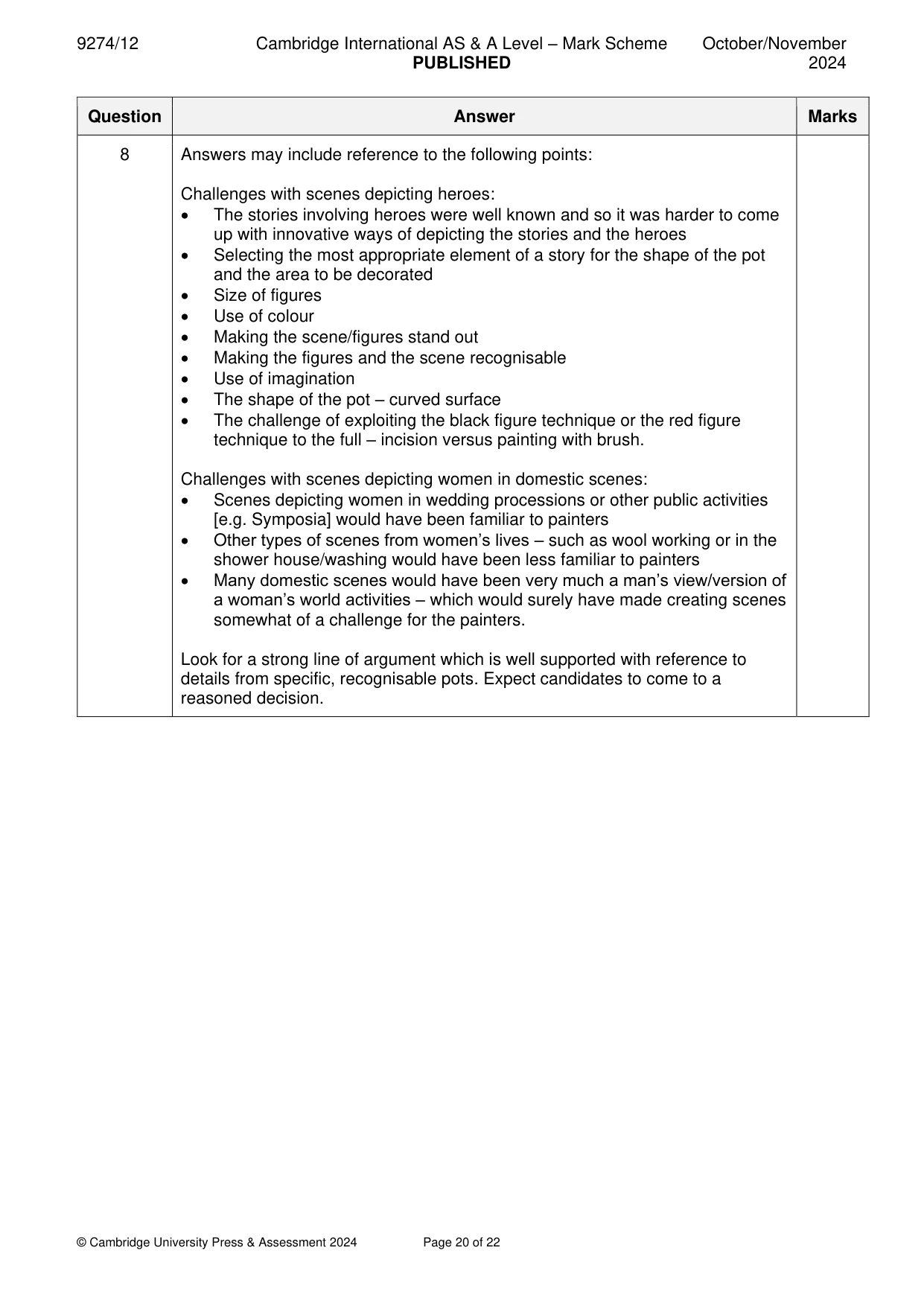
9274/12 Cambridge International AS & A Level – Mark Scheme PUBLISHED October/November 2024 © Cambridge University Press & Assessment 2024 Page 20 of 22 Question Answer Marks 8 Answers may include reference to the following points: Challenges with scenes depicting heroes: • The stories involving heroes were well known and so it was harder to come up with innovative ways of depicting the stories and the heroes • Selecting the most appropriate element of a story for the shape of the pot and the area to be decorated • Size of figures • Use of colour • Making the scene/figures stand out • Making the figures and the scene recognisable • Use of imagination • The shape of the pot – curved surface • The challenge of exploiting the black figure technique or the red figure technique to the full – incision versus painting with brush. Challenges with scenes depicting women in domestic scenes: • Scenes depicting women in wedding processions or other public activities [e.g. Symposia] would have been familiar to painters • Other types of scenes from women’s lives – such as wool working or in the shower house/washing would have been less familiar to painters • Many domestic scenes would have been very much a man’s view/version of a woman’s world activities – which would surely have made creating scenes somewhat of a challenge for the painters. Look for a strong line of argument which is well supported with reference to details from specific, recognisable pots. Expect candidates to come to a reasoned decision.
Mark scheme, page 21
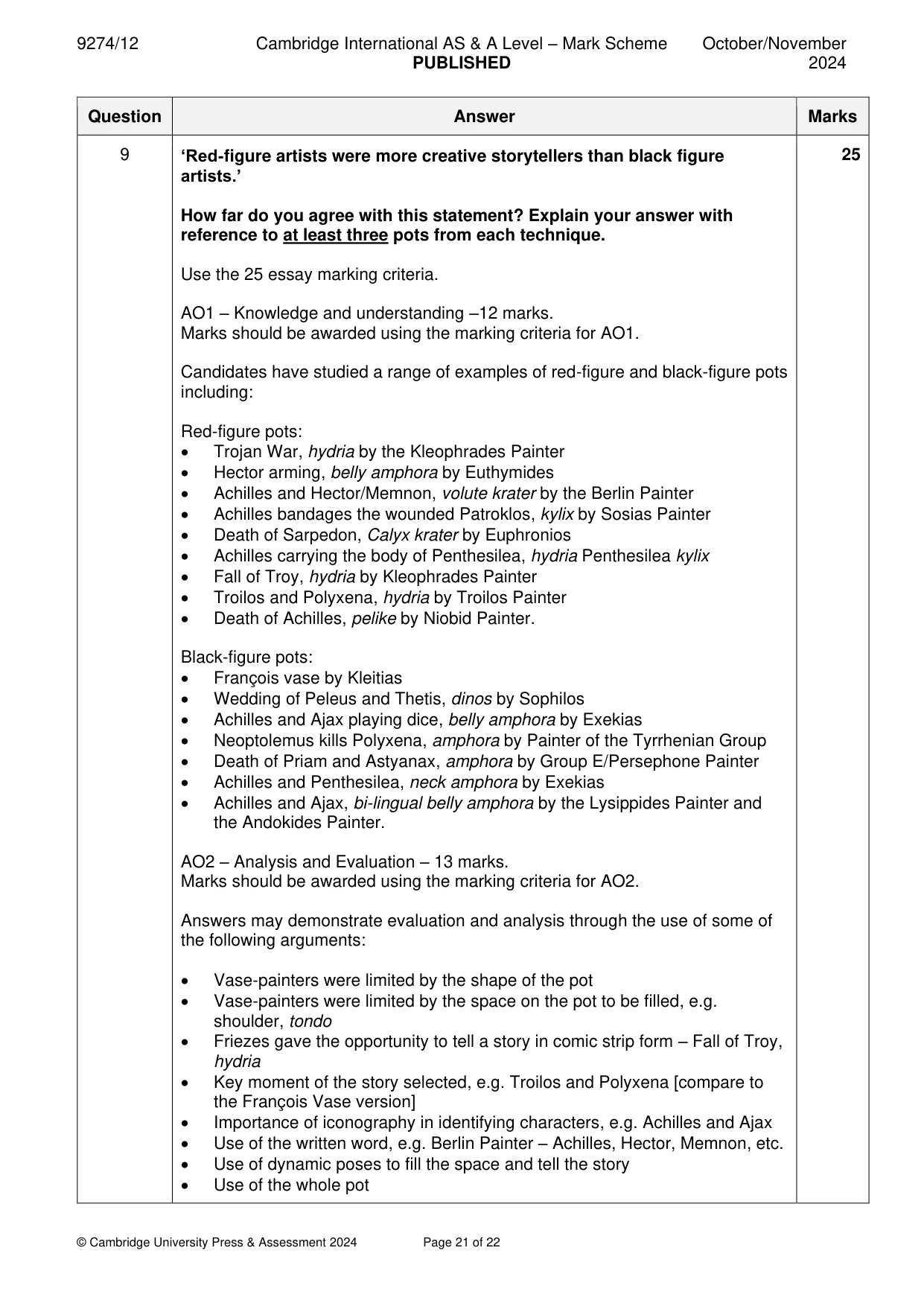
9274/12 Cambridge International AS & A Level – Mark Scheme PUBLISHED October/November 2024 © Cambridge University Press & Assessment 2024 Page 21 of 22 Question Answer Marks 9 ‘Red-figure artists were more creative storytellers than black figure artists.’ How far do you agree with this statement? Explain your answer with reference to at least three pots from each technique. Use the 25 essay marking criteria. AO1 – Knowledge and understanding –12 marks. Marks should be awarded using the marking criteria for AO1. Candidates have studied a range of examples of red-figure and black-figure pots including: Red-figure pots: • Trojan War, hydria by the Kleophrades Painter • Hector arming, belly amphora by Euthymides • Achilles and Hector/Memnon, volute krater by the Berlin Painter • Achilles bandages the wounded Patroklos, kylix by Sosias Painter • Death of Sarpedon, Calyx krater by Euphronios • Achilles carrying the body of Penthesilea, hydria Penthesilea kylix • Fall of Troy, hydria by Kleophrades Painter • Troilos and Polyxena, hydria by Troilos Painter • Death of Achilles, pelike by Niobid Painter. Black-figure pots: • François vase by Kleitias • Wedding of Peleus and Thetis, dinos by Sophilos • Achilles and Ajax playing dice, belly amphora by Exekias • Neoptolemus kills Polyxena, amphora by Painter of the Tyrrhenian Group • Death of Priam and Astyanax, amphora by Group E/Persephone Painter • Achilles and Penthesilea, neck amphora by Exekias • Achilles and Ajax, bi-lingual belly amphora by the Lysippides Painter and the Andokides Painter. AO2 – Analysis and Evaluation – 13 marks. Marks should be awarded using the marking criteria for AO2. Answers may demonstrate evaluation and analysis through the use of some of the following arguments: • Vase-painters were limited by the shape of the pot • Vase-painters were limited by the space on the pot to be filled, e.g. shoulder, tondo • Friezes gave the opportunity to tell a story in comic strip form – Fall of Troy, hydria • Key moment of the story selected, e.g. Troilos and Polyxena [compare to the François Vase version] • Importance of iconography in identifying characters, e.g. Achilles and Ajax • Use of the written word, e.g. Berlin Painter – Achilles, Hector, Memnon, etc. • Use of dynamic poses to fill the space and tell the story • Use of the whole pot 25
Mark scheme, page 22
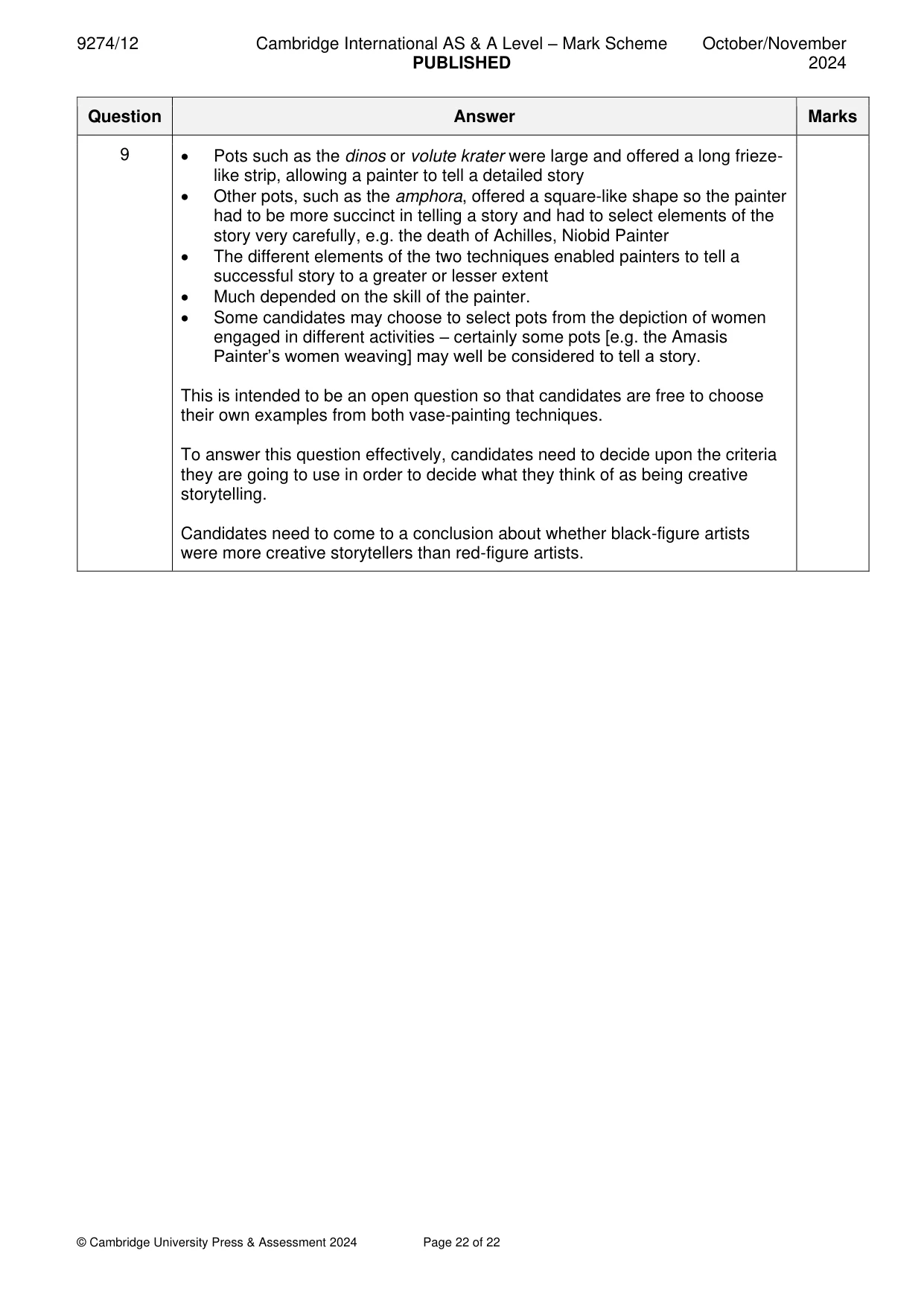
9274/12 Cambridge International AS & A Level – Mark Scheme PUBLISHED October/November 2024 © Cambridge University Press & Assessment 2024 Page 22 of 22 Question Answer Marks 9 • Pots such as the dinos or volute krater were large and offered a long frieze- like strip, allowing a painter to tell a detailed story • Other pots, such as the amphora, offered a square-like shape so the painter had to be more succinct in telling a story and had to select elements of the story very carefully, e.g. the death of Achilles, Niobid Painter • The different elements of the two techniques enabled painters to tell a successful story to a greater or lesser extent • Much depended on the skill of the painter. • Some candidates may choose to select pots from the depiction of women engaged in different activities – certainly some pots [e.g. the Amasis Painter’s women weaving] may well be considered to tell a story. This is intended to be an open question so that candidates are free to choose their own examples from both vase-painting techniques. To answer this question effectively, candidates need to decide upon the criteria they are going to use in order to decide what they think of as being creative storytelling. Candidates need to come to a conclusion about whether black-figure artists were more creative storytellers than red-figure artists.
What you needed in this session
Cambridge’s own grade thresholds for 2024 Oct/Nov, Paper 1 · Variant 2. A higher threshold means an easier paper — the bar moves with how the cohort did.