Cambridge A Level Classical Studies 9274 — 2023 Oct/Nov Paper 1 · Variant 1
9274/11/O/N/23 · 50 marks · ≈56 min
The question paper and its mark scheme, free to read here and free to download. This is Cambridge’s own paper, exactly as it was sat.
Question paper8 pages

Mark scheme18 pages
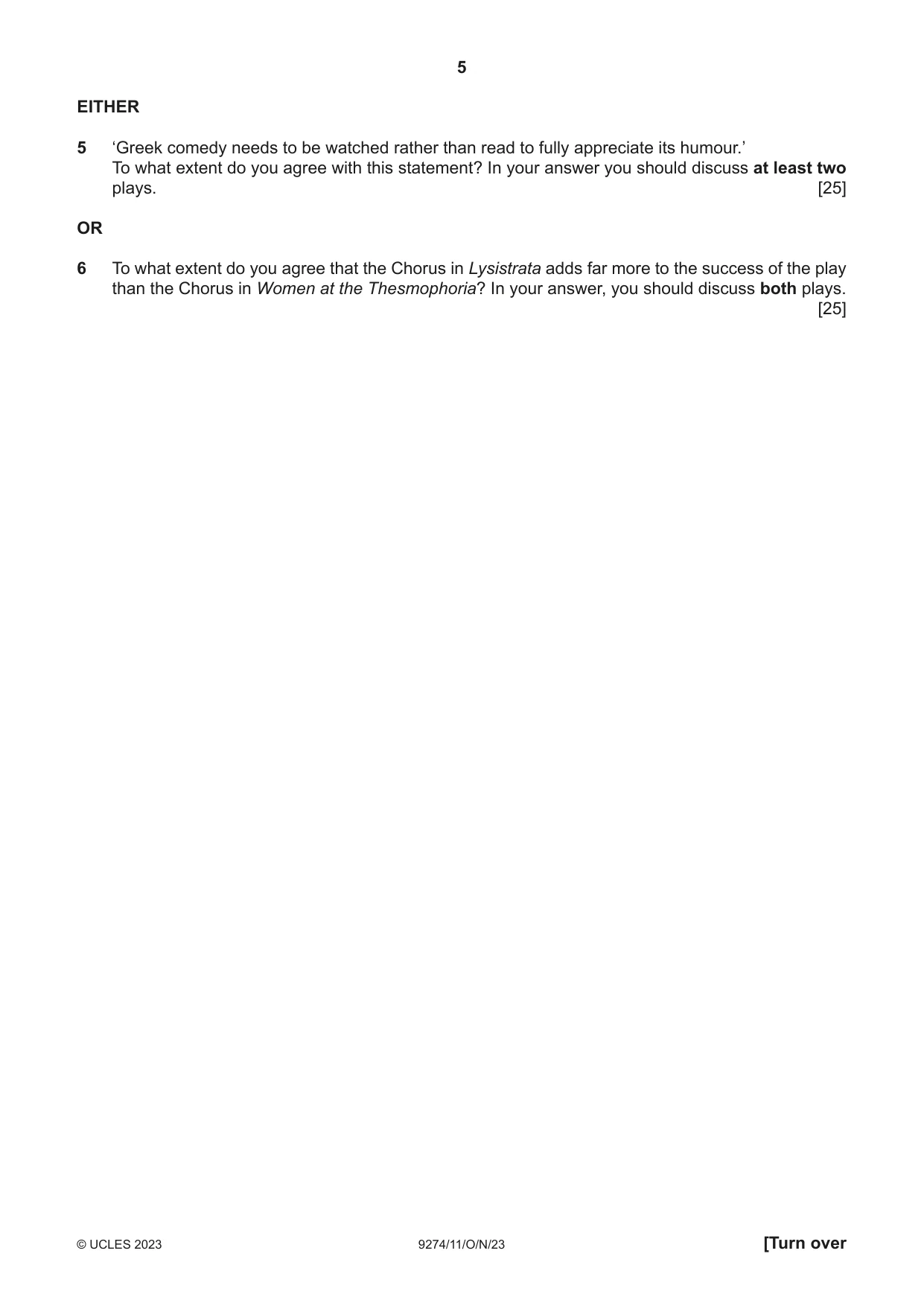
Answers below. Sit the paper first if you are practising.
Paper as text
Question paper, page 1
This document has 8 pages. Any blank pages are indicated. [Turn over Cambridge International AS & A Level CLASSICAL STUDIES 9274/11 Paper 1 Greek Civilisation October/November 2023 1 hour 30 minutes You must answer on the enclosed answer booklet. You will need: Answer booklet (enclosed) INSTRUCTIONS ● Answer two questions in total: Answer questions from one section only. For each section, follow the instructions inside on which questions to answer. ● Follow the instructions on the front cover of the answer booklet. If you need additional answer paper, ask the invigilator for a continuation booklet. INFORMATION ● The total mark for this paper is 50. ● The number of marks for each question or part question is shown in brackets [ ]. * 5 7 3 3 4 1 0 7 0 6 * DC (LK/CB) 321822/2 © UCLES 2023
Question paper, page 2
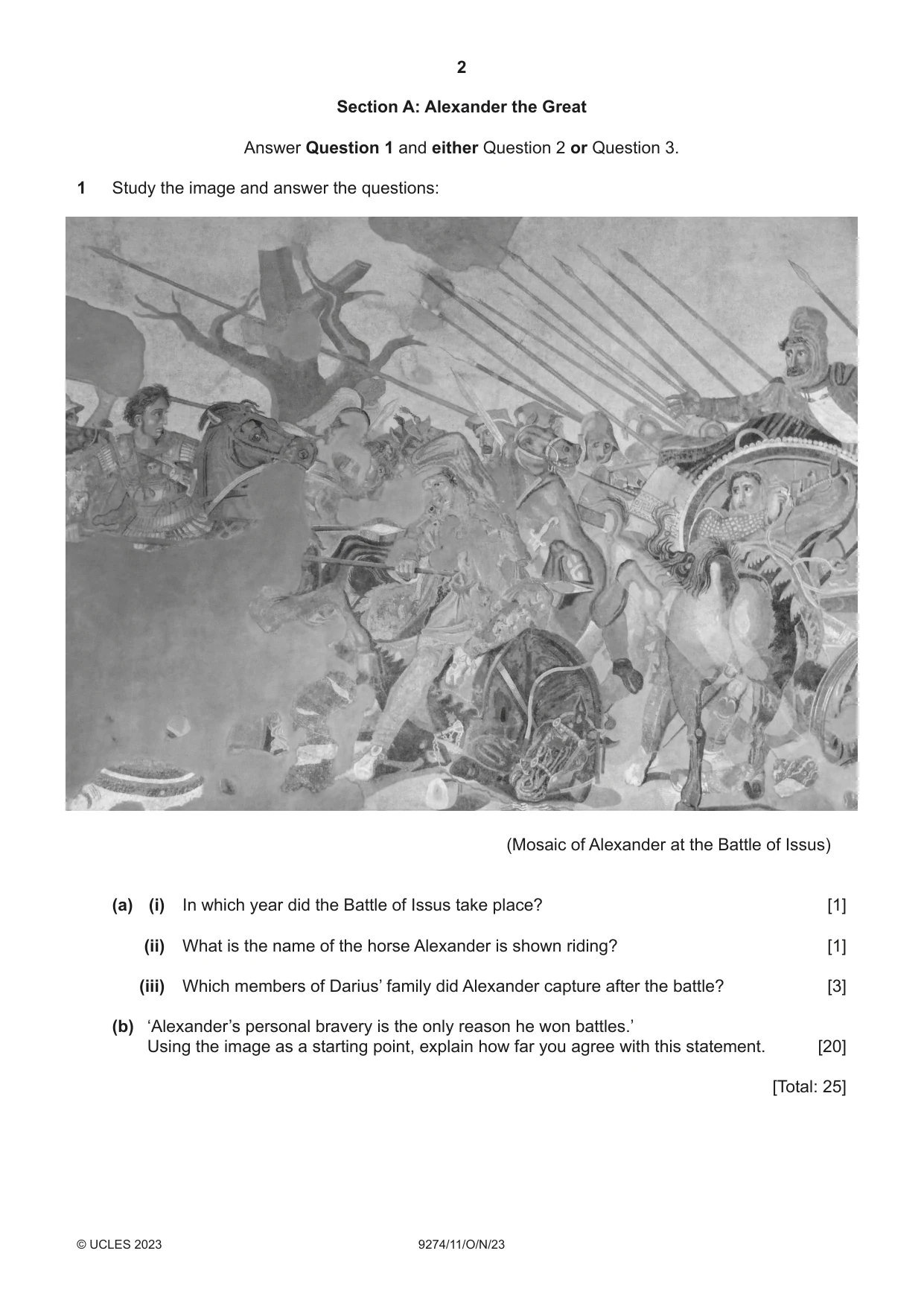
2 9274/11/O/N/23 © UCLES 2023 Section A: Alexander the Great Answer Question 1 and either Question 2 or Question 3. 1 Study the image and answer the questions: (Mosaic of Alexander at the Battle of Issus) (a) (i) In which year did the Battle of Issus take place? [1] (ii) What is the name of the horse Alexander is shown riding? [1] (iii) Which members of Darius’ family did Alexander capture after the battle? [3] (b) ‘Alexander’s personal bravery is the only reason he won battles.’ Using the image as a starting point, explain how far you agree with this statement. [20] [Total: 25]
Question paper, page 3
3 9274/11/O/N/23 © UCLES 2023 [Turn over EITHER 2 ‘Olympias had more impact on Alexander’s life than any other person.’ Explain how far you agree with this statement. [25] OR 3 ‘Alexander should not be called “the Great” because his empire fell apart after his death.’ To what extent do you agree with this opinion? [25]
Question paper, page 4
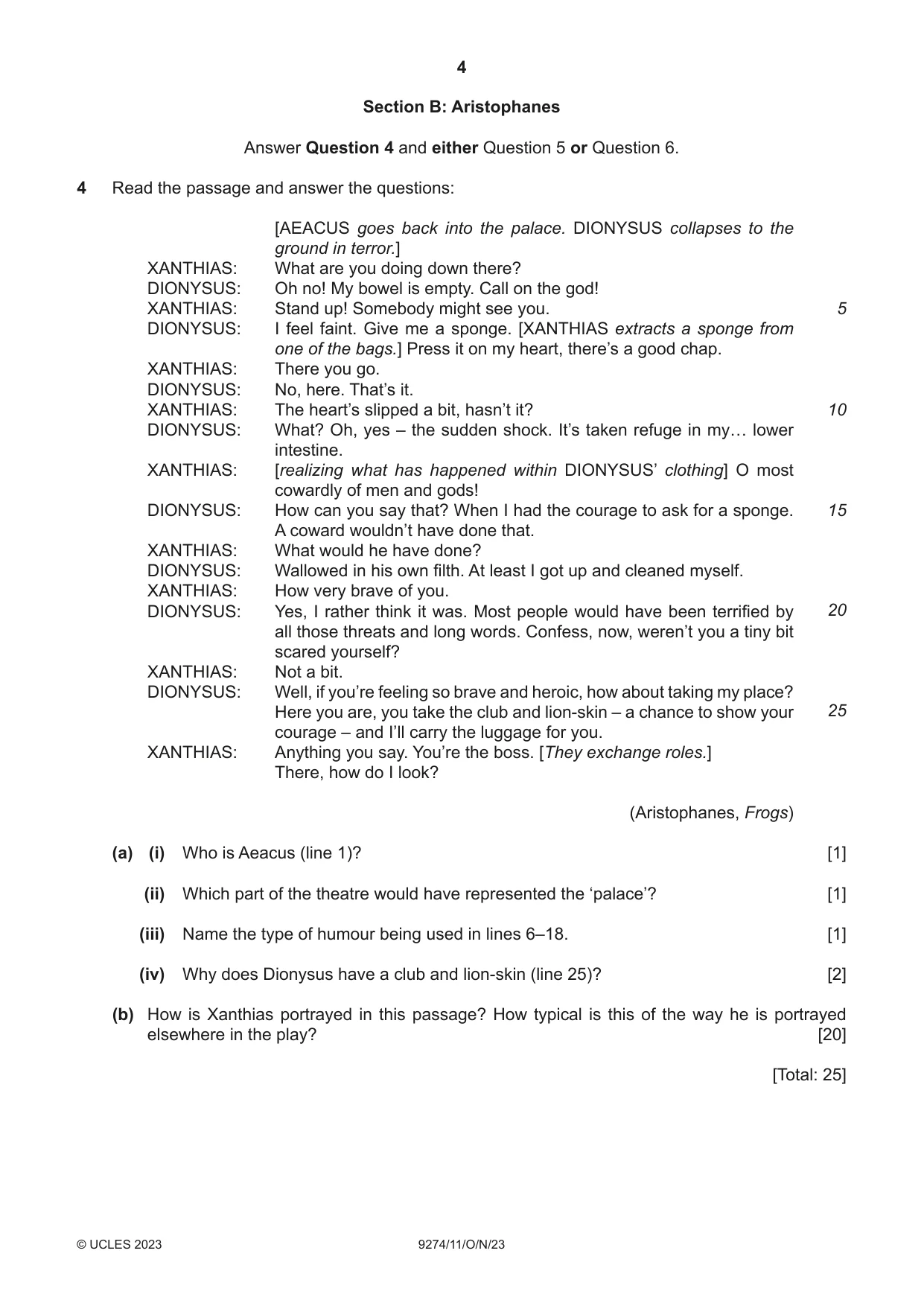
4 9274/11/O/N/23 © UCLES 2023 Section B: Aristophanes Answer Question 4 and either Question 5 or Question 6. 4 Read the passage and answer the questions: [AEACUS goes back into the palace. DIONYSUS collapses to the ground in terror.] XANTHIAS: What are you doing down there? DIONYSUS: Oh no! My bowel is empty. Call on the god! XANTHIAS: Stand up! Somebody might see you. DIONYSUS: I feel faint. Give me a sponge. [XANTHIAS extracts a sponge from one of the bags.] Press it on my heart, there’s a good chap. XANTHIAS: There you go. DIONYSUS: No, here. That’s it. XANTHIAS: The heart’s slipped a bit, hasn’t it? DIONYSUS: What? Oh, yes – the sudden shock. It’s taken refuge in my… lower intestine. XANTHIAS: [realizing what has happened within DIONYSUS’ clothing] O most cowardly of men and gods! DIONYSUS: How can you say that? When I had the courage to ask for a sponge. A coward wouldn’t have done that. XANTHIAS: What would he have done? DIONYSUS: Wallowed in his own filth. At least I got up and cleaned myself. XANTHIAS: How very brave of you. DIONYSUS: Yes, I rather think it was. Most people would have been terrified by all those threats and long words. Confess, now, weren’t you a tiny bit scared yourself? XANTHIAS: Not a bit. DIONYSUS: Well, if you’re feeling so brave and heroic, how about taking my place? Here you are, you take the club and lion-skin – a chance to show your courage – and I’ll carry the luggage for you. XANTHIAS: Anything you say. You’re the boss. [They exchange roles.] There, how do I look? (Aristophanes, Frogs) (a) (i) Who is Aeacus (line 1)? [1] (ii) Which part of the theatre would have represented the ‘palace’? [1] (iii) Name the type of humour being used in lines 6–18. [1] (iv) Why does Dionysus have a club and lion-skin (line 25)? [2] (b) How is Xanthias portrayed in this passage? How typical is this of the way he is portrayed elsewhere in the play? [20] [Total: 25] 5 10 15 20 25
Question paper, page 5
5 9274/11/O/N/23 © UCLES 2023 [Turn over EITHER 5 ‘Greek comedy needs to be watched rather than read to fully appreciate its humour.’ To what extent do you agree with this statement? In your answer you should discuss at least two plays. [25] OR 6 To what extent do you agree that the Chorus in Lysistrata adds far more to the success of the play than the Chorus in Women at the Thesmophoria? In your answer, you should discuss both plays. [25]
Question paper, page 6
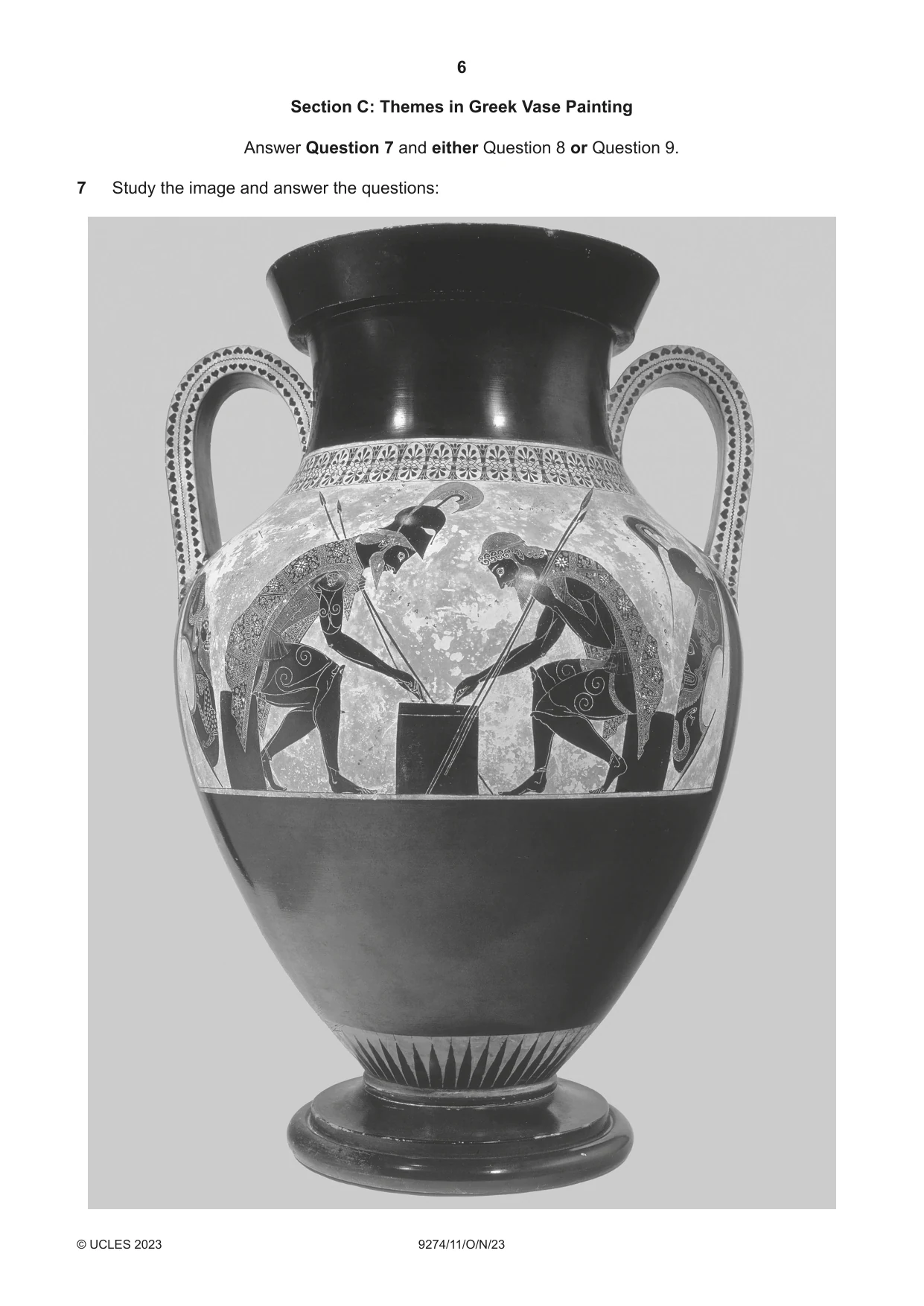
6 9274/11/O/N/23 © UCLES 2023 Section C: Themes in Greek Vase Painting Answer Question 7 and either Question 8 or Question 9. 7 Study the image and answer the questions:
Question paper, page 7
7 9274/11/O/N/23 © UCLES 2023 (a) (i) What type of pot is shown in the image? [2] (ii) What technique has been used to decorate this pot? [1] (iii) Give the approximate date for this pot. [1] (iv) Give the name of the painter of this pot. [1] (b) ‘This pot marks the high point of vase painting in the 6th century BCE.’ How far do you agree with this opinion? In your answer, you should include discussion of at least two other pots from the 6th century to explain your answer. [20] [Total: 25] EITHER 8 ‘The daily life of women was a popular subject for Greek vase painters.’ What opportunities and challenges did this subject offer to vase painters? Explain your answer with reference to specific pots depicting scenes from the daily life of women. [25] OR 9 ‘By the end of the 6th century BCE painters were experimenting and exploring different ways of painting and decorating pots.’ To what extent do you agree with this statement? In your answer, you should include discussion of a range of pots from both the black-figure and red-figure techniques. [25]
Question paper, page 8
8 9274/11/O/N/23 © UCLES 2023 Permission to reproduce items where third-party owned material protected by copyright is included has been sought and cleared where possible. Every reasonable effort has been made by the publisher (UCLES) to trace copyright holders, but if any items requiring clearance have unwittingly been included, the publisher will be pleased to make amends at the earliest possible opportunity. To avoid the issue of disclosure of answer-related information to candidates, all copyright acknowledgements are reproduced online in the Cambridge Assessment International Education Copyright Acknowledgements Booklet. This is produced for each series of examinations and is freely available to download at www.cambridgeinternational.org after the live examination series. Cambridge Assessment International Education is part of Cambridge Assessment. Cambridge Assessment is the brand name of the University of Cambridge Local Examinations Syndicate (UCLES), which is a department of the University of Cambridge. BLANK PAGE
Mark scheme, page 1
This document consists of 18 printed pages. © UCLES 2023 [Turn over Cambridge International AS & A Level CLASSICAL STUDIES 9274/11 Paper 1 Greek Civilisation October/November 2023 MARK SCHEME Maximum Mark: 50 Published This mark scheme is published as an aid to teachers and candidates, to indicate the requirements of the examination. It shows the basis on which Examiners were instructed to award marks. It does not indicate the details of the discussions that took place at an Examiners’ meeting before marking began, which would have considered the acceptability of alternative answers. Mark schemes should be read in conjunction with the question paper and the Principal Examiner Report for Teachers. Cambridge International will not enter into discussions about these mark schemes. Cambridge International is publishing the mark schemes for the October/November 2023 series for most Cambridge IGCSE, Cambridge International A and AS Level components, and some Cambridge O Level components.
Mark scheme, page 2
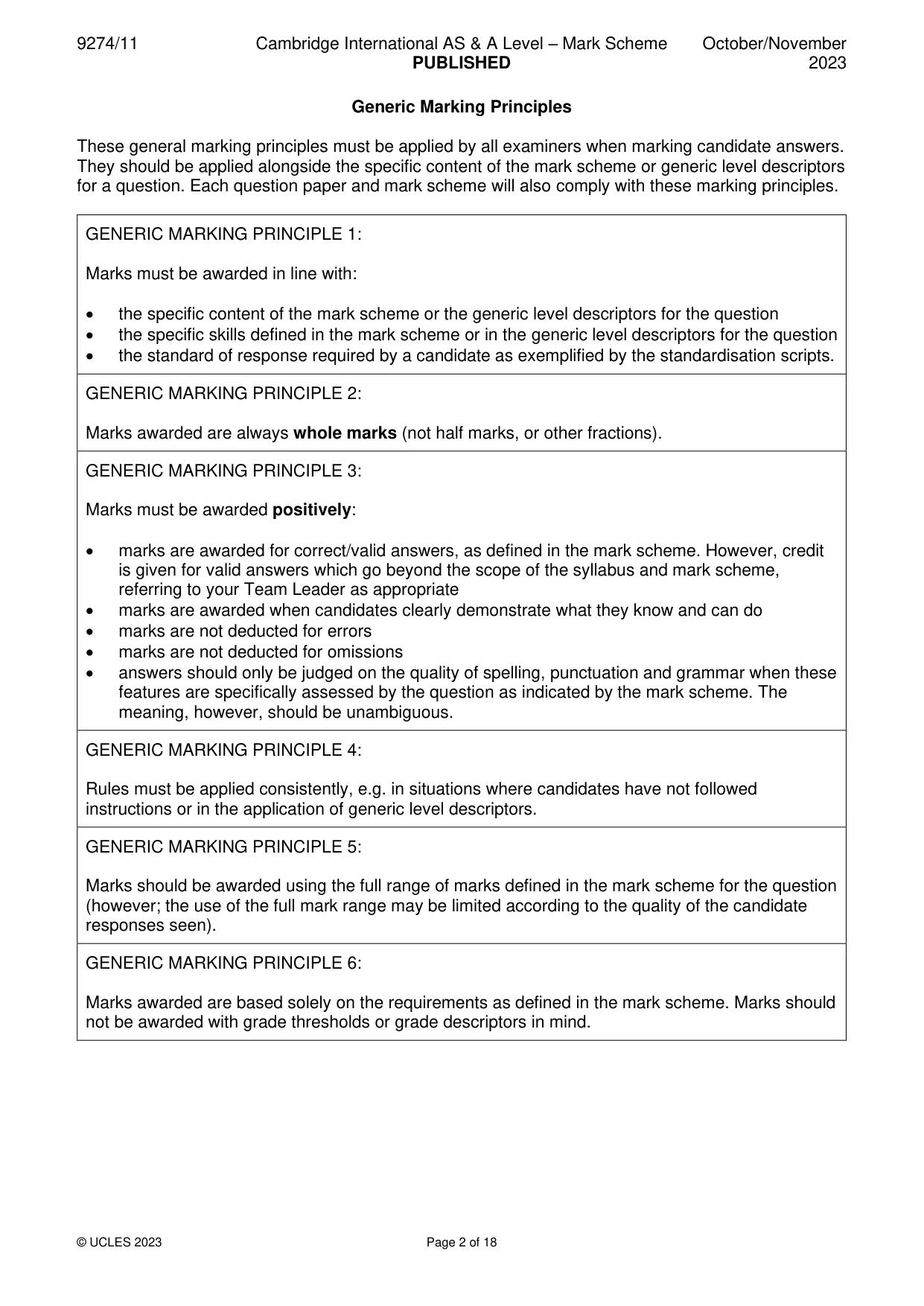
9274/11 Cambridge International AS & A Level – Mark Scheme PUBLISHED October/November 2023 © UCLES 2023 Page 2 of 18 Generic Marking Principles These general marking principles must be applied by all examiners when marking candidate answers. They should be applied alongside the specific content of the mark scheme or generic level descriptors for a question. Each question paper and mark scheme will also comply with these marking principles. GENERIC MARKING PRINCIPLE 1: Marks must be awarded in line with: • the specific content of the mark scheme or the generic level descriptors for the question • the specific skills defined in the mark scheme or in the generic level descriptors for the question • the standard of response required by a candidate as exemplified by the standardisation scripts. GENERIC MARKING PRINCIPLE 2: Marks awarded are always whole marks (not half marks, or other fractions). GENERIC MARKING PRINCIPLE 3: Marks must be awarded positively: • marks are awarded for correct/valid answers, as defined in the mark scheme. However, credit is given for valid answers which go beyond the scope of the syllabus and mark scheme, referring to your Team Leader as appropriate • marks are awarded when candidates clearly demonstrate what they know and can do • marks are not deducted for errors • marks are not deducted for omissions • answers should only be judged on the quality of spelling, punctuation and grammar when these features are specifically assessed by the question as indicated by the mark scheme. The meaning, however, should be unambiguous. GENERIC MARKING PRINCIPLE 4: Rules must be applied consistently, e.g. in situations where candidates have not followed instructions or in the application of generic level descriptors. GENERIC MARKING PRINCIPLE 5: Marks should be awarded using the full range of marks defined in the mark scheme for the question (however; the use of the full mark range may be limited according to the quality of the candidate responses seen). GENERIC MARKING PRINCIPLE 6: Marks awarded are based solely on the requirements as defined in the mark scheme. Marks should not be awarded with grade thresholds or grade descriptors in mind.
Mark scheme, page 3
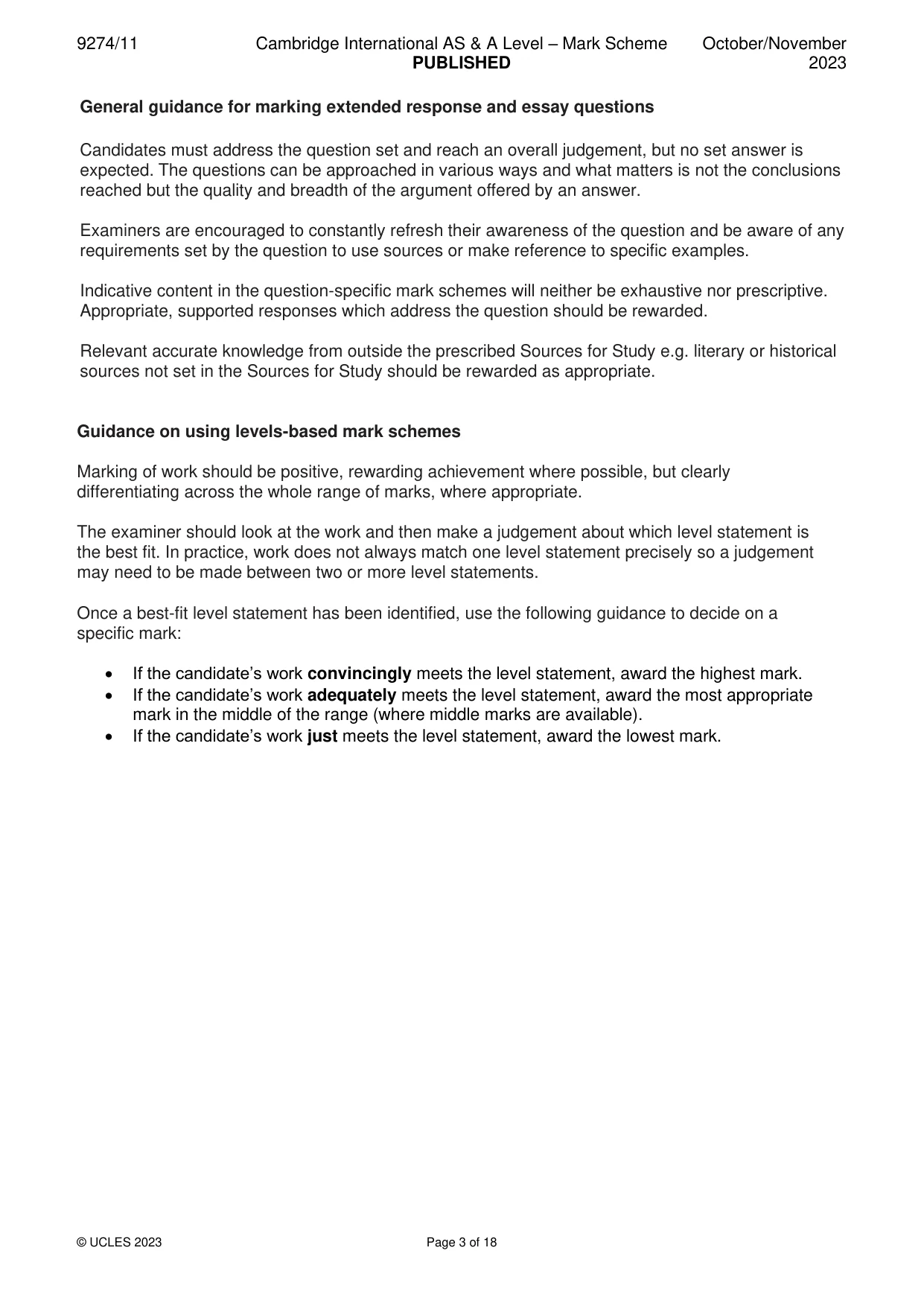
9274/11 Cambridge International AS & A Level – Mark Scheme PUBLISHED October/November 2023 © UCLES 2023 Page 3 of 18 General guidance for marking extended response and essay questions Candidates must address the question set and reach an overall judgement, but no set answer is expected. The questions can be approached in various ways and what matters is not the conclusions reached but the quality and breadth of the argument offered by an answer. Examiners are encouraged to constantly refresh their awareness of the question and be aware of any requirements set by the question to use sources or make reference to specific examples. Indicative content in the question-specific mark schemes will neither be exhaustive nor prescriptive. Appropriate, supported responses which address the question should be rewarded. Relevant accurate knowledge from outside the prescribed Sources for Study e.g. literary or historical sources not set in the Sources for Study should be rewarded as appropriate. Guidance on using levels-based mark schemes Marking of work should be positive, rewarding achievement where possible, but clearly differentiating across the whole range of marks, where appropriate. The examiner should look at the work and then make a judgement about which level statement is the best fit. In practice, work does not always match one level statement precisely so a judgement may need to be made between two or more level statements. Once a best-fit level statement has been identified, use the following guidance to decide on a specific mark: • If the candidate’s work convincingly meets the level statement, award the highest mark. • If the candidate’s work adequately meets the level statement, award the most appropriate mark in the middle of the range (where middle marks are available). • If the candidate’s work just meets the level statement, award the lowest mark.
Mark scheme, page 4
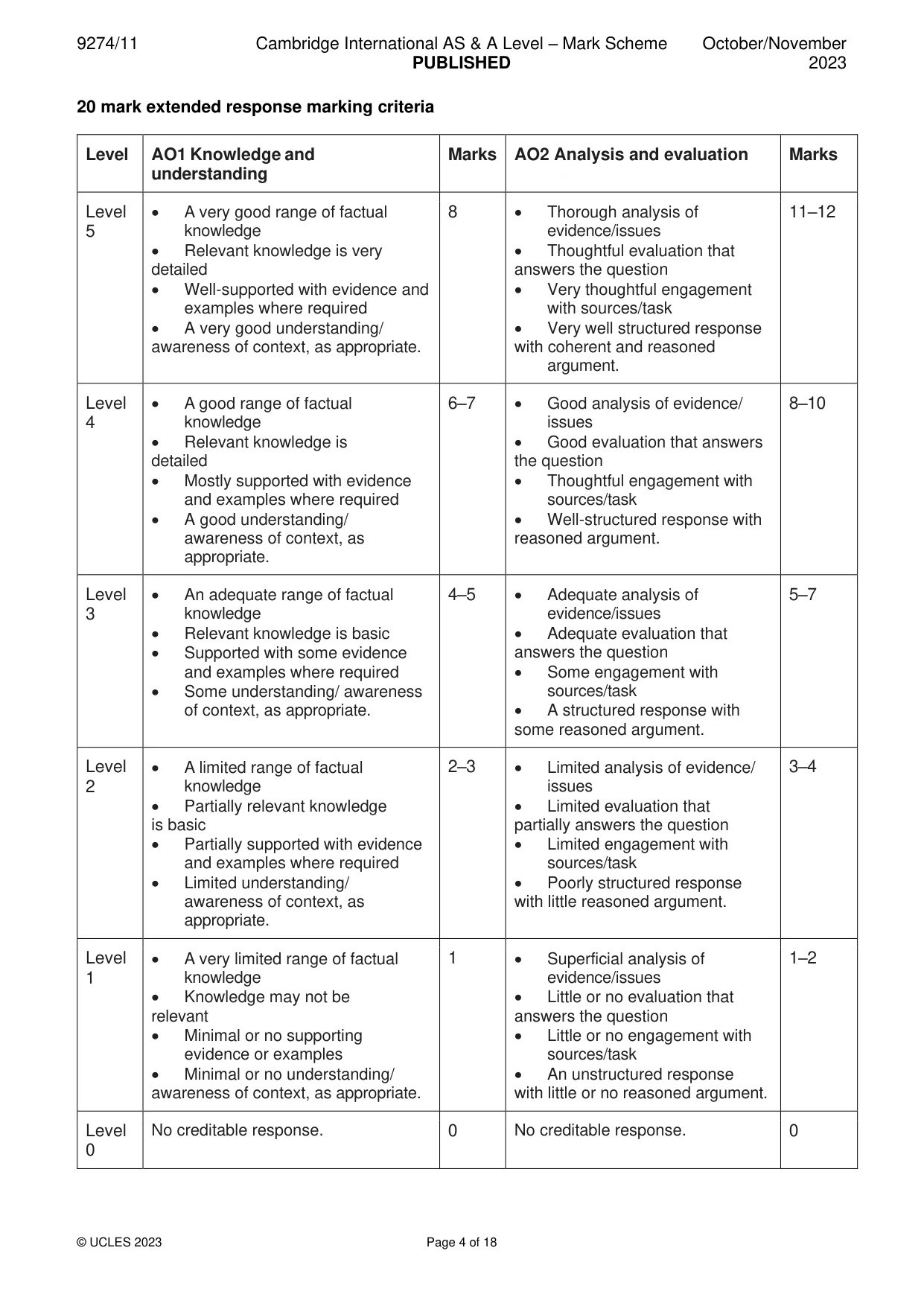
9274/11 Cambridge International AS & A Level – Mark Scheme PUBLISHED October/November 2023 © UCLES 2023 Page 4 of 18 20 mark extended response marking criteria Level AO1 Knowledge and understanding Marks AO2 Analysis and evaluation Marks Level 5 • A very good range of factual knowledge • Relevant knowledge is very detailed • Well-supported with evidence and examples where required • A very good understanding/ awareness of context, as appropriate. 8 • Thorough analysis of evidence/issues • Thoughtful evaluation that answers the question • Very thoughtful engagement with sources/task • Very well structured response with coherent and reasoned argument. 11–12 Level 4 • A good range of factual knowledge • Relevant knowledge is detailed • Mostly supported with evidence and examples where required • A good understanding/ awareness of context, as appropriate. 6–7 • Good analysis of evidence/ issues • Good evaluation that answers the question • Thoughtful engagement with sources/task • Well-structured response with reasoned argument. 8–10 Level 3 • An adequate range of factual knowledge • Relevant knowledge is basic • Supported with some evidence and examples where required • Some understanding/ awareness of context, as appropriate. 4–5 • Adequate analysis of evidence/issues • Adequate evaluation that answers the question • Some engagement with sources/task • A structured response with some reasoned argument. 5–7 Level 2 • A limited range of factual knowledge • Partially relevant knowledge is basic • Partially supported with evidence and examples where required • Limited understanding/ awareness of context, as appropriate. 2–3 • Limited analysis of evidence/ issues • Limited evaluation that partially answers the question • Limited engagement with sources/task • Poorly structured response with little reasoned argument. 3–4 Level 1 • A very limited range of factual knowledge • Knowledge may not be relevant • Minimal or no supporting evidence or examples • Minimal or no understanding/ awareness of context, as appropriate. 1 • Superficial analysis of evidence/issues • Little or no evaluation that answers the question • Little or no engagement with sources/task • An unstructured response with little or no reasoned argument. 1–2 Level 0 No creditable response. 0 No creditable response. 0
Mark scheme, page 5
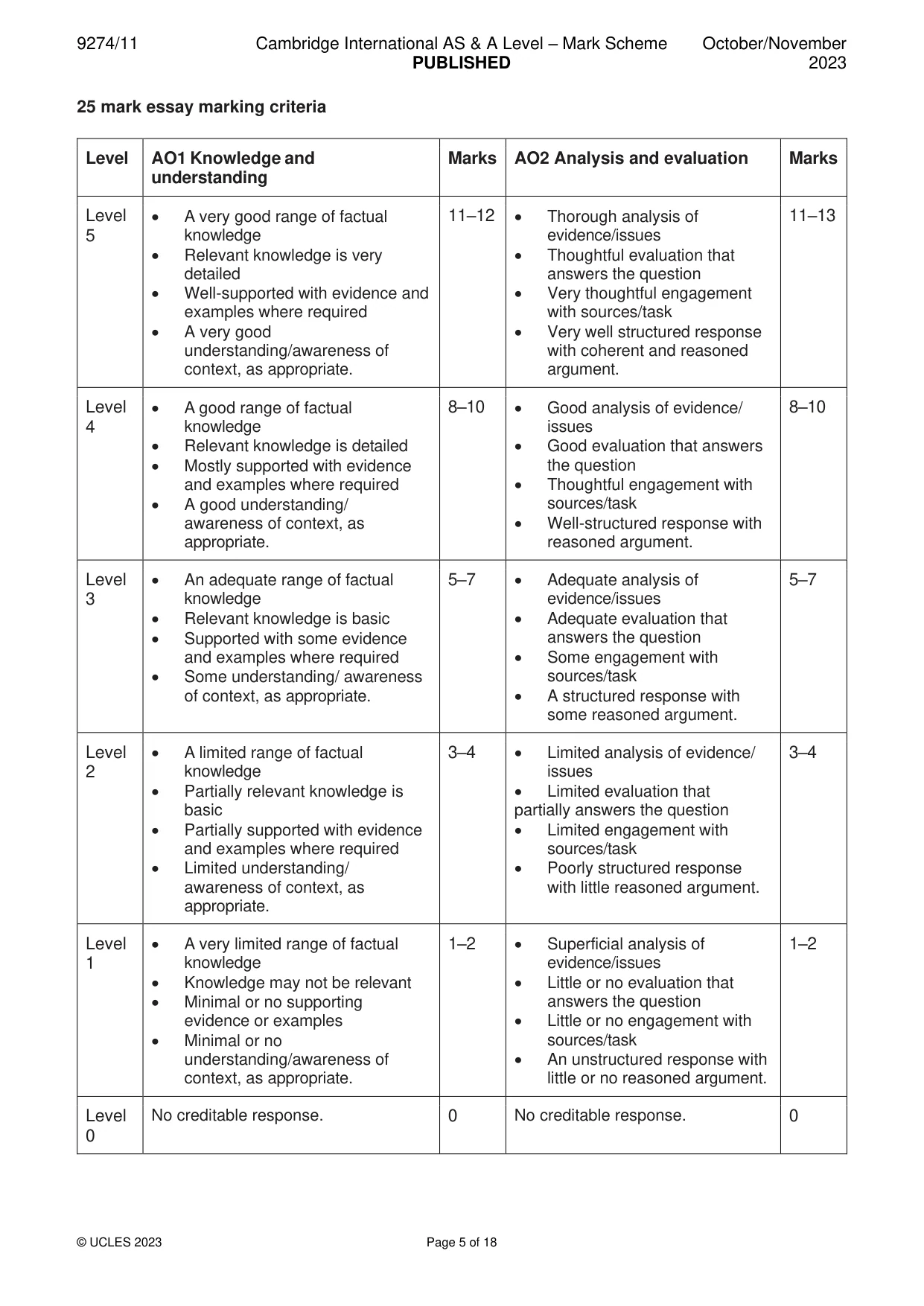
9274/11 Cambridge International AS & A Level – Mark Scheme PUBLISHED October/November 2023 © UCLES 2023 Page 5 of 18 25 mark essay marking criteria Level AO1 Knowledge and understanding Marks AO2 Analysis and evaluation Marks Level 5 • A very good range of factual knowledge • Relevant knowledge is very detailed • Well-supported with evidence and examples where required • A very good understanding/awareness of context, as appropriate. 11–12 • Thorough analysis of evidence/issues • Thoughtful evaluation that answers the question • Very thoughtful engagement with sources/task • Very well structured response with coherent and reasoned argument. 11–13 Level 4 • A good range of factual knowledge • Relevant knowledge is detailed • Mostly supported with evidence and examples where required • A good understanding/ awareness of context, as appropriate. 8–10 • Good analysis of evidence/ issues • Good evaluation that answers the question • Thoughtful engagement with sources/task • Well-structured response with reasoned argument. 8–10 Level 3 • An adequate range of factual knowledge • Relevant knowledge is basic • Supported with some evidence and examples where required • Some understanding/ awareness of context, as appropriate. 5–7 • Adequate analysis of evidence/issues • Adequate evaluation that answers the question • Some engagement with sources/task • A structured response with some reasoned argument. 5–7 Level 2 • A limited range of factual knowledge • Partially relevant knowledge is basic • Partially supported with evidence and examples where required • Limited understanding/ awareness of context, as appropriate. 3–4 • Limited analysis of evidence/ issues • Limited evaluation that partially answers the question • Limited engagement with sources/task • Poorly structured response with little reasoned argument. 3–4 Level 1 • A very limited range of factual knowledge • Knowledge may not be relevant • Minimal or no supporting evidence or examples • Minimal or no understanding/awareness of context, as appropriate. 1–2 • Superficial analysis of evidence/issues • Little or no evaluation that answers the question • Little or no engagement with sources/task • An unstructured response with little or no reasoned argument. 1–2 Level 0 No creditable response. 0 No creditable response. 0
Mark scheme, page 6
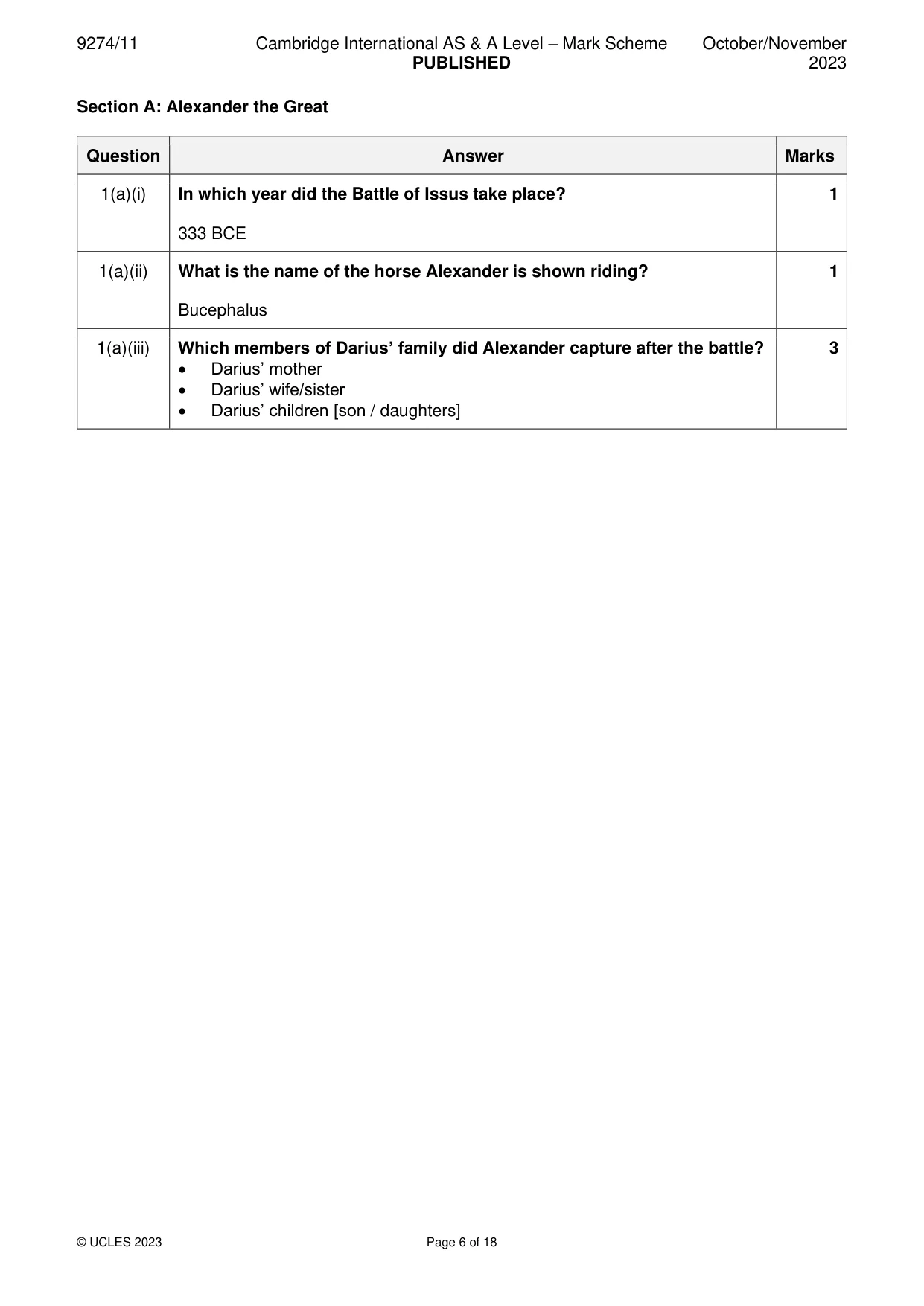
9274/11 Cambridge International AS & A Level – Mark Scheme PUBLISHED October/November 2023 © UCLES 2023 Page 6 of 18 Section A: Alexander the Great Question Answer Marks 1(a)(i) In which year did the Battle of Issus take place? 333 BCE 1 1(a)(ii) What is the name of the horse Alexander is shown riding? Bucephalus 1 1(a)(iii) Which members of Darius’ family did Alexander capture after the battle? • Darius’ mother • Darius’ wife/sister • Darius’ children [son / daughters] 3
Mark scheme, page 7
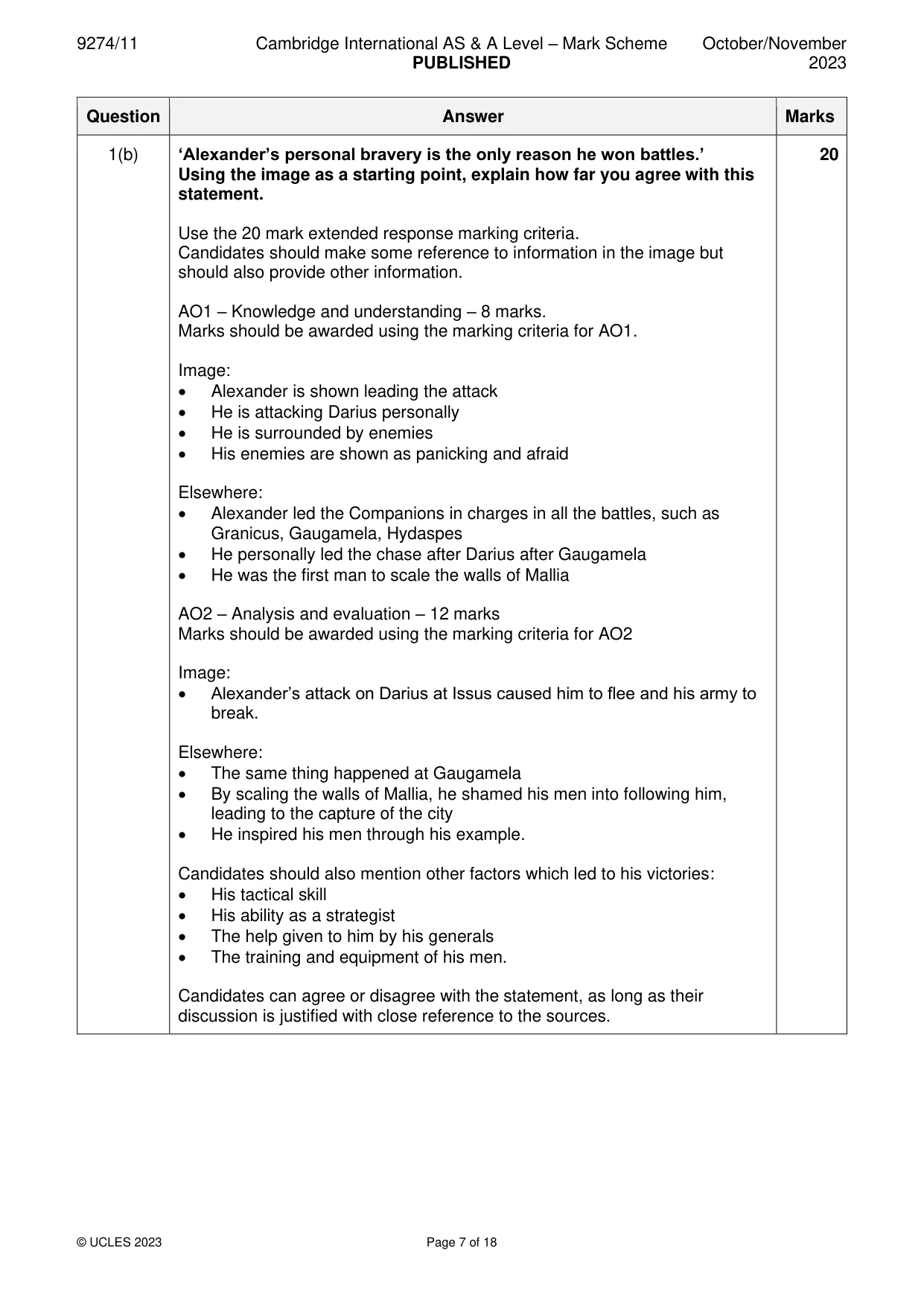
9274/11 Cambridge International AS & A Level – Mark Scheme PUBLISHED October/November 2023 © UCLES 2023 Page 7 of 18 Question Answer Marks 1(b) ‘Alexander’s personal bravery is the only reason he won battles.’ Using the image as a starting point, explain how far you agree with this statement. Use the 20 mark extended response marking criteria. Candidates should make some reference to information in the image but should also provide other information. AO1 – Knowledge and understanding – 8 marks. Marks should be awarded using the marking criteria for AO1. Image: • Alexander is shown leading the attack • He is attacking Darius personally • He is surrounded by enemies • His enemies are shown as panicking and afraid Elsewhere: • Alexander led the Companions in charges in all the battles, such as Granicus, Gaugamela, Hydaspes • He personally led the chase after Darius after Gaugamela • He was the first man to scale the walls of Mallia AO2 – Analysis and evaluation – 12 marks Marks should be awarded using the marking criteria for AO2 Image: • Alexander’s attack on Darius at Issus caused him to flee and his army to break. Elsewhere: • The same thing happened at Gaugamela • By scaling the walls of Mallia, he shamed his men into following him, leading to the capture of the city • He inspired his men through his example. Candidates should also mention other factors which led to his victories: • His tactical skill • His ability as a strategist • The help given to him by his generals • The training and equipment of his men. Candidates can agree or disagree with the statement, as long as their discussion is justified with close reference to the sources. 20
Mark scheme, page 8
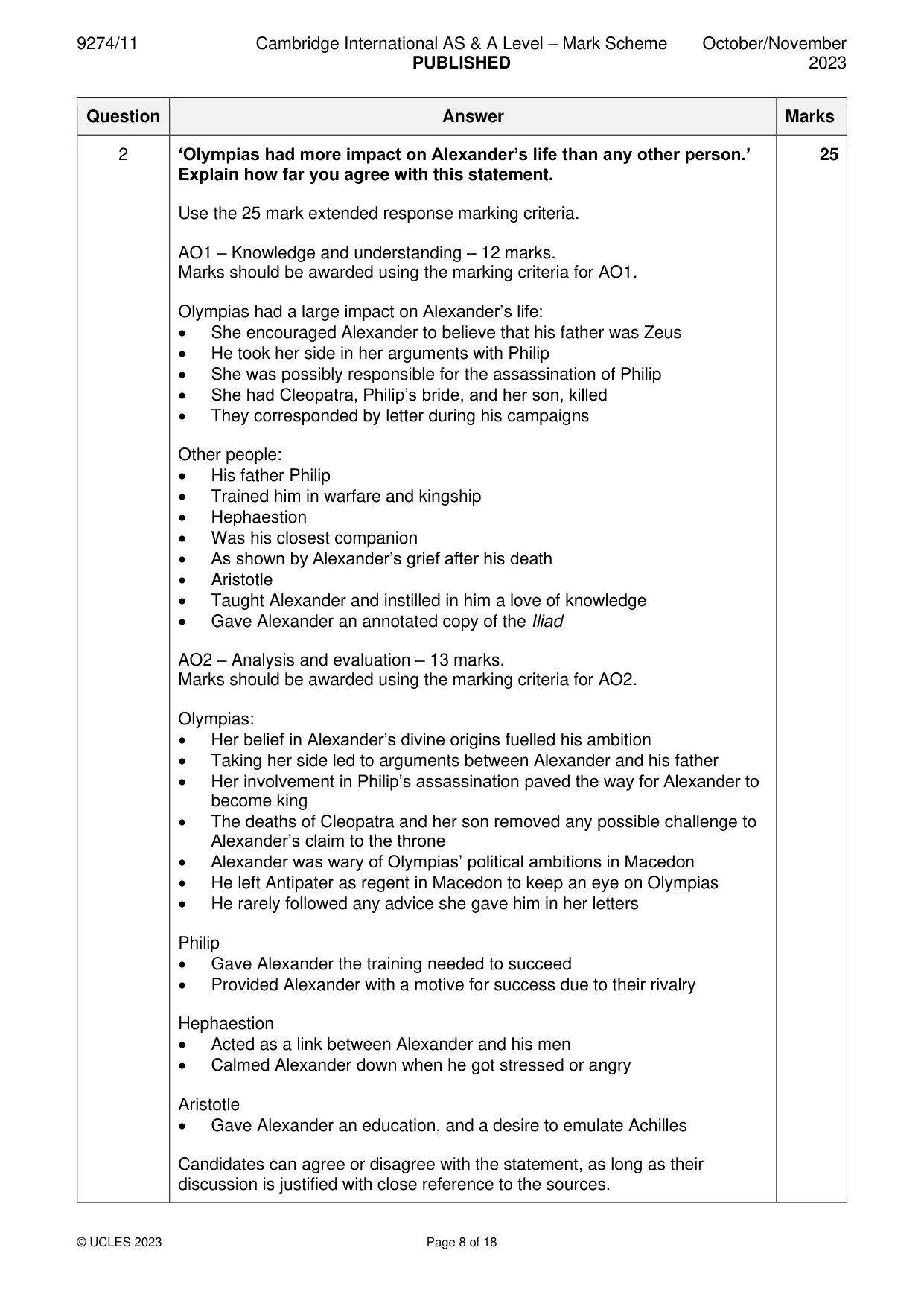
9274/11 Cambridge International AS & A Level – Mark Scheme PUBLISHED October/November 2023 © UCLES 2023 Page 8 of 18 Question Answer Marks 2 ‘Olympias had more impact on Alexander’s life than any other person.’ Explain how far you agree with this statement. Use the 25 mark extended response marking criteria. AO1 – Knowledge and understanding – 12 marks. Marks should be awarded using the marking criteria for AO1. Olympias had a large impact on Alexander’s life: • She encouraged Alexander to believe that his father was Zeus • He took her side in her arguments with Philip • She was possibly responsible for the assassination of Philip • She had Cleopatra, Philip’s bride, and her son, killed • They corresponded by letter during his campaigns Other people: • His father Philip • Trained him in warfare and kingship • Hephaestion • Was his closest companion • As shown by Alexander’s grief after his death • Aristotle • Taught Alexander and instilled in him a love of knowledge • Gave Alexander an annotated copy of the Iliad AO2 – Analysis and evaluation – 13 marks. Marks should be awarded using the marking criteria for AO2. Olympias: • Her belief in Alexander’s divine origins fuelled his ambition • Taking her side led to arguments between Alexander and his father • Her involvement in Philip’s assassination paved the way for Alexander to become king • The deaths of Cleopatra and her son removed any possible challenge to Alexander’s claim to the throne • Alexander was wary of Olympias’ political ambitions in Macedon • He left Antipater as regent in Macedon to keep an eye on Olympias • He rarely followed any advice she gave him in her letters Philip • Gave Alexander the training needed to succeed • Provided Alexander with a motive for success due to their rivalry Hephaestion • Acted as a link between Alexander and his men • Calmed Alexander down when he got stressed or angry Aristotle • Gave Alexander an education, and a desire to emulate Achilles Candidates can agree or disagree with the statement, as long as their discussion is justified with close reference to the sources. 25
Mark scheme, page 9
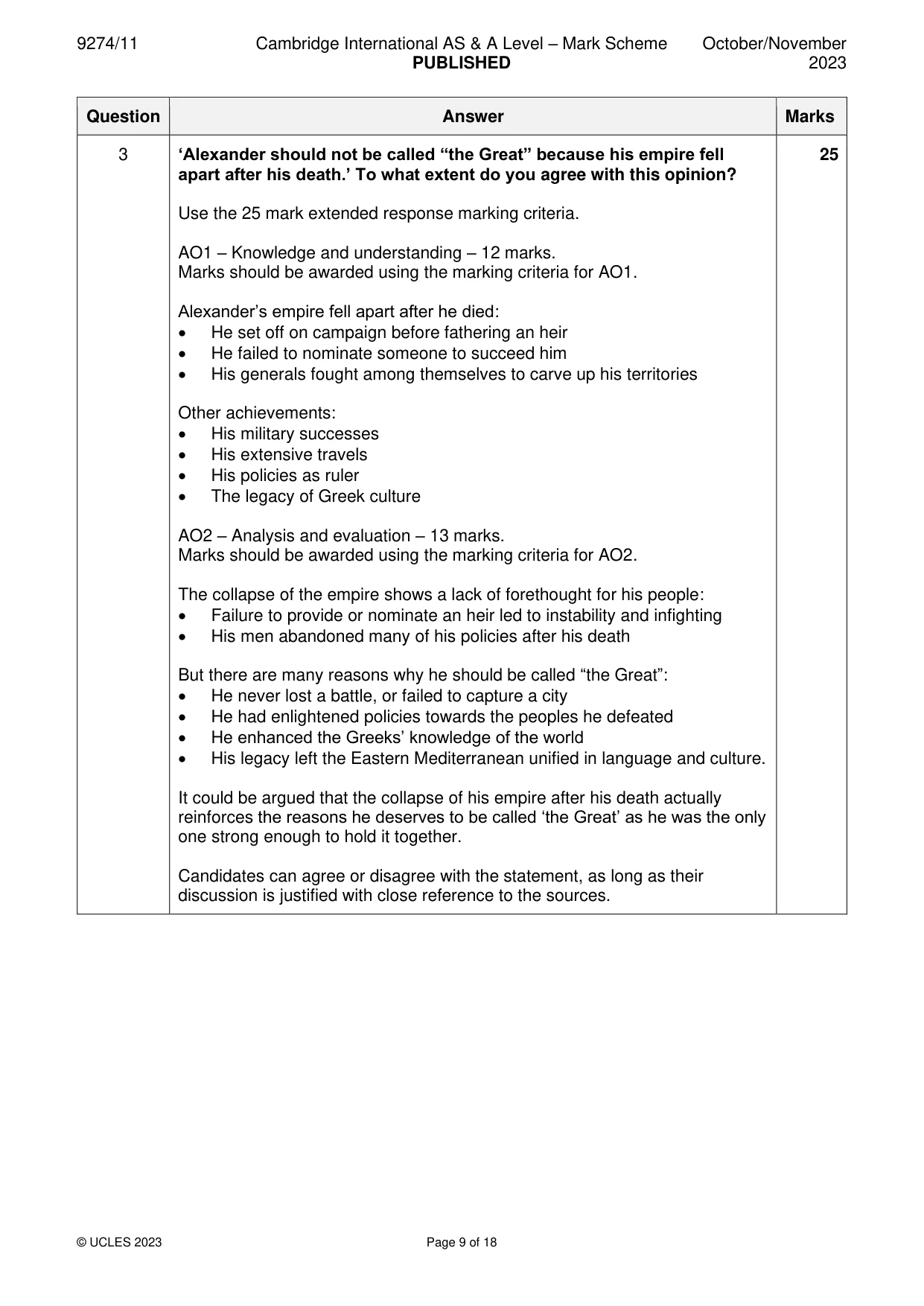
9274/11 Cambridge International AS & A Level – Mark Scheme PUBLISHED October/November 2023 © UCLES 2023 Page 9 of 18 Question Answer Marks 3 ‘Alexander should not be called “the Great” because his empire fell apart after his death.’ To what extent do you agree with this opinion? Use the 25 mark extended response marking criteria. AO1 – Knowledge and understanding – 12 marks. Marks should be awarded using the marking criteria for AO1. Alexander’s empire fell apart after he died: • He set off on campaign before fathering an heir • He failed to nominate someone to succeed him • His generals fought among themselves to carve up his territories Other achievements: • His military successes • His extensive travels • His policies as ruler • The legacy of Greek culture AO2 – Analysis and evaluation – 13 marks. Marks should be awarded using the marking criteria for AO2. The collapse of the empire shows a lack of forethought for his people: • Failure to provide or nominate an heir led to instability and infighting • His men abandoned many of his policies after his death But there are many reasons why he should be called “the Great”: • He never lost a battle, or failed to capture a city • He had enlightened policies towards the peoples he defeated • He enhanced the Greeks’ knowledge of the world • His legacy left the Eastern Mediterranean unified in language and culture. It could be argued that the collapse of his empire after his death actually reinforces the reasons he deserves to be called ‘the Great’ as he was the only one strong enough to hold it together. Candidates can agree or disagree with the statement, as long as their discussion is justified with close reference to the sources. 25
Mark scheme, page 10
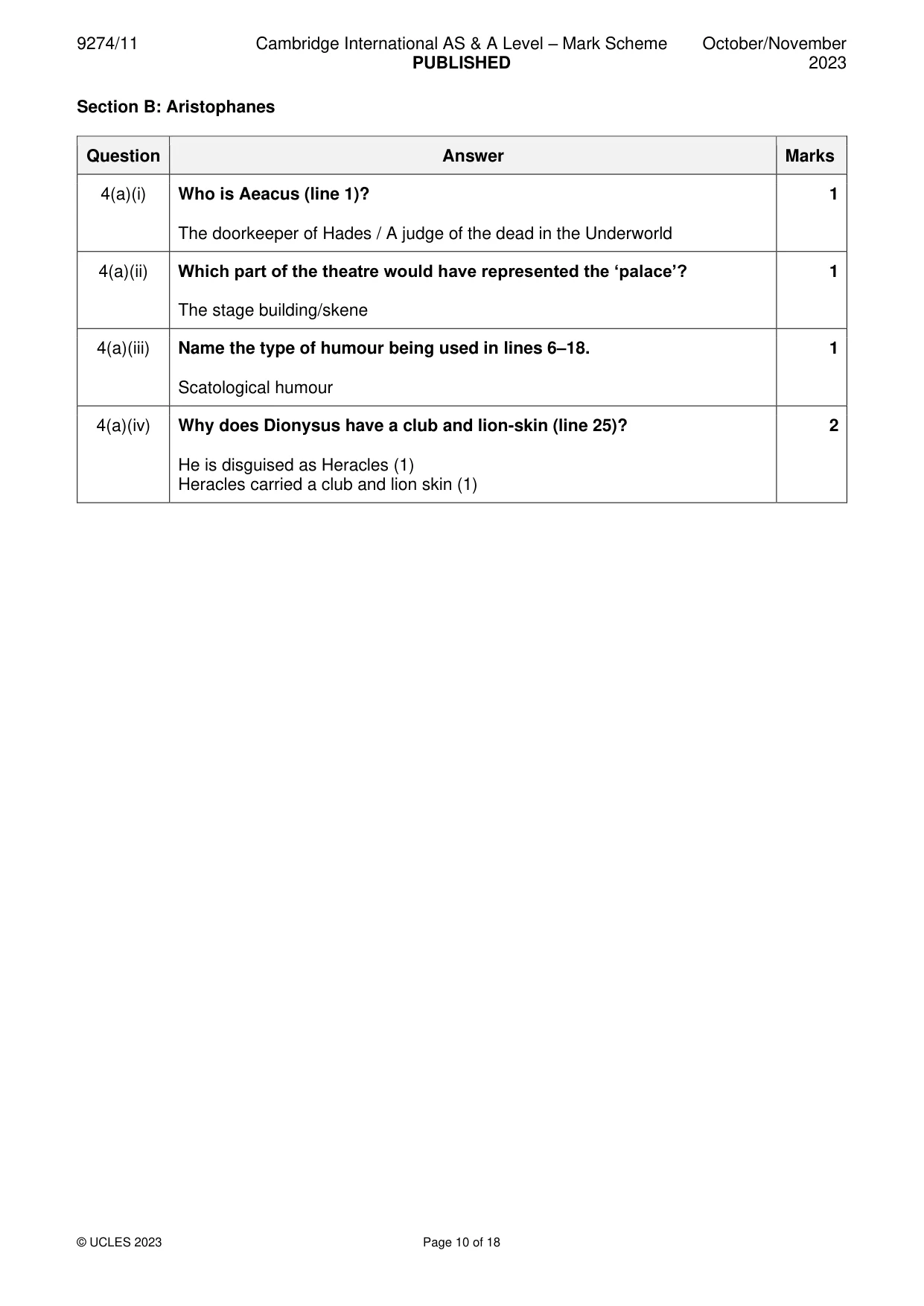
9274/11 Cambridge International AS & A Level – Mark Scheme PUBLISHED October/November 2023 © UCLES 2023 Page 10 of 18 Section B: Aristophanes Question Answer Marks 4(a)(i) Who is Aeacus (line 1)? The doorkeeper of Hades / A judge of the dead in the Underworld 1 4(a)(ii) Which part of the theatre would have represented the ‘palace’? The stage building/skene 1 4(a)(iii) Name the type of humour being used in lines 6–18. Scatological humour 1 4(a)(iv) Why does Dionysus have a club and lion-skin (line 25)? He is disguised as Heracles (1) Heracles carried a club and lion skin (1) 2
Mark scheme, page 11
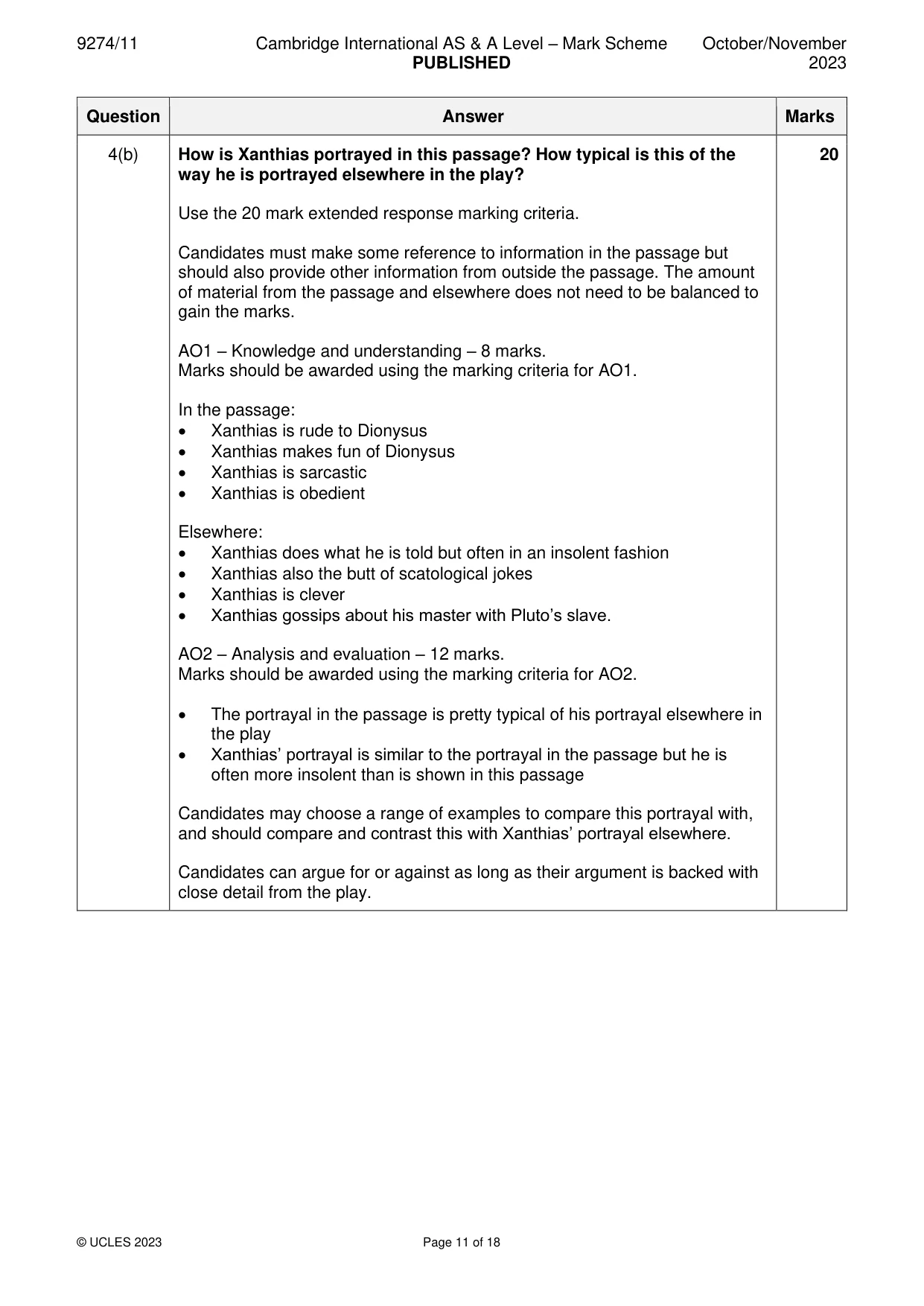
9274/11 Cambridge International AS & A Level – Mark Scheme PUBLISHED October/November 2023 © UCLES 2023 Page 11 of 18 Question Answer Marks 4(b) How is Xanthias portrayed in this passage? How typical is this of the way he is portrayed elsewhere in the play? Use the 20 mark extended response marking criteria. Candidates must make some reference to information in the passage but should also provide other information from outside the passage. The amount of material from the passage and elsewhere does not need to be balanced to gain the marks. AO1 – Knowledge and understanding – 8 marks. Marks should be awarded using the marking criteria for AO1. In the passage: • Xanthias is rude to Dionysus • Xanthias makes fun of Dionysus • Xanthias is sarcastic • Xanthias is obedient Elsewhere: • Xanthias does what he is told but often in an insolent fashion • Xanthias also the butt of scatological jokes • Xanthias is clever • Xanthias gossips about his master with Pluto’s slave. AO2 – Analysis and evaluation – 12 marks. Marks should be awarded using the marking criteria for AO2. • The portrayal in the passage is pretty typical of his portrayal elsewhere in the play • Xanthias’ portrayal is similar to the portrayal in the passage but he is often more insolent than is shown in this passage Candidates may choose a range of examples to compare this portrayal with, and should compare and contrast this with Xanthias’ portrayal elsewhere. Candidates can argue for or against as long as their argument is backed with close detail from the play. 20
Mark scheme, page 12
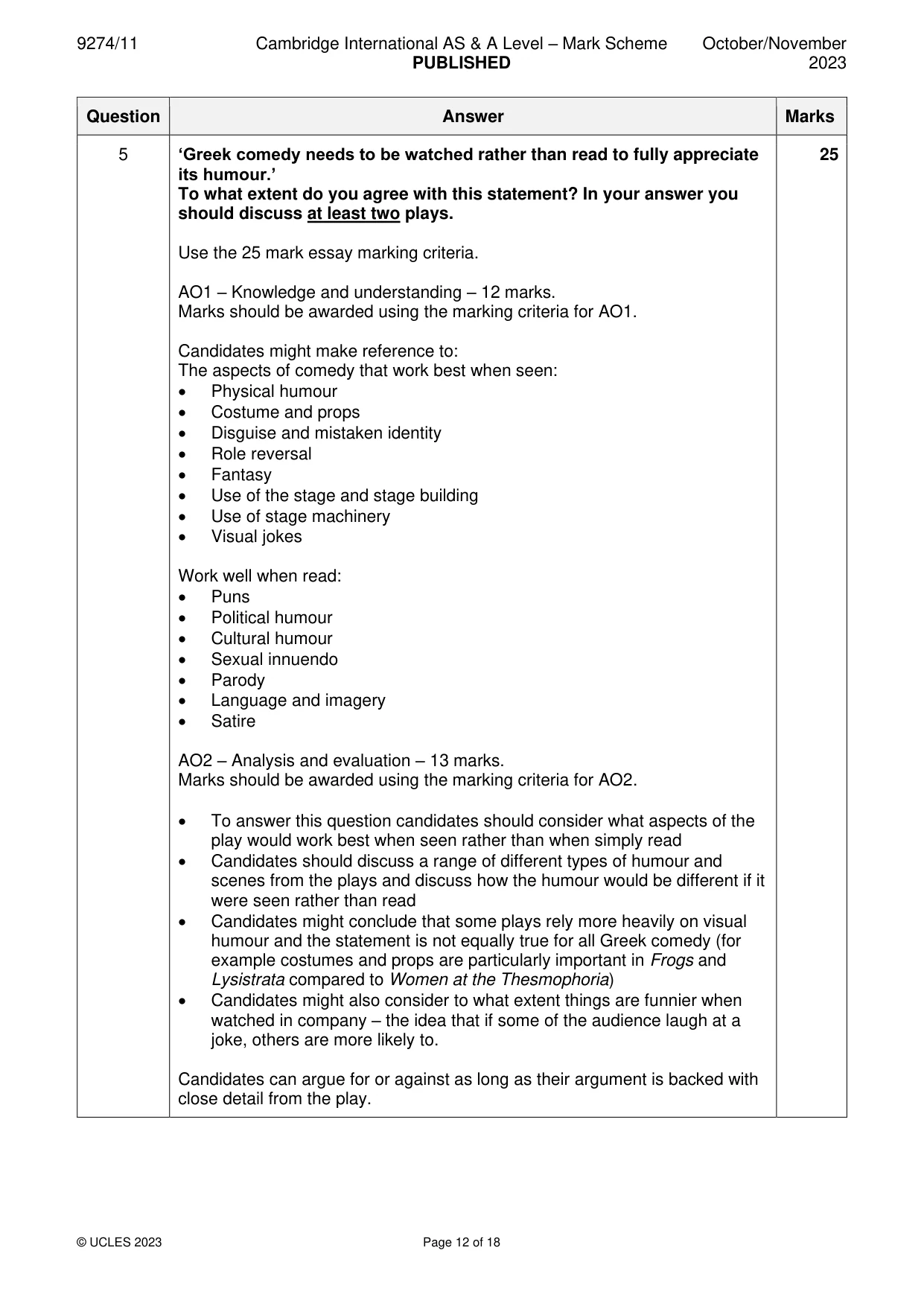
9274/11 Cambridge International AS & A Level – Mark Scheme PUBLISHED October/November 2023 © UCLES 2023 Page 12 of 18 Question Answer Marks 5 ‘Greek comedy needs to be watched rather than read to fully appreciate its humour.’ To what extent do you agree with this statement? In your answer you should discuss at least two plays. Use the 25 mark essay marking criteria. AO1 – Knowledge and understanding – 12 marks. Marks should be awarded using the marking criteria for AO1. Candidates might make reference to: The aspects of comedy that work best when seen: • Physical humour • Costume and props • Disguise and mistaken identity • Role reversal • Fantasy • Use of the stage and stage building • Use of stage machinery • Visual jokes Work well when read: • Puns • Political humour • Cultural humour • Sexual innuendo • Parody • Language and imagery • Satire AO2 – Analysis and evaluation – 13 marks. Marks should be awarded using the marking criteria for AO2. • To answer this question candidates should consider what aspects of the play would work best when seen rather than when simply read • Candidates should discuss a range of different types of humour and scenes from the plays and discuss how the humour would be different if it were seen rather than read • Candidates might conclude that some plays rely more heavily on visual humour and the statement is not equally true for all Greek comedy (for example costumes and props are particularly important in Frogs and Lysistrata compared to Women at the Thesmophoria) • Candidates might also consider to what extent things are funnier when watched in company – the idea that if some of the audience laugh at a joke, others are more likely to. Candidates can argue for or against as long as their argument is backed with close detail from the play. 25
Mark scheme, page 13
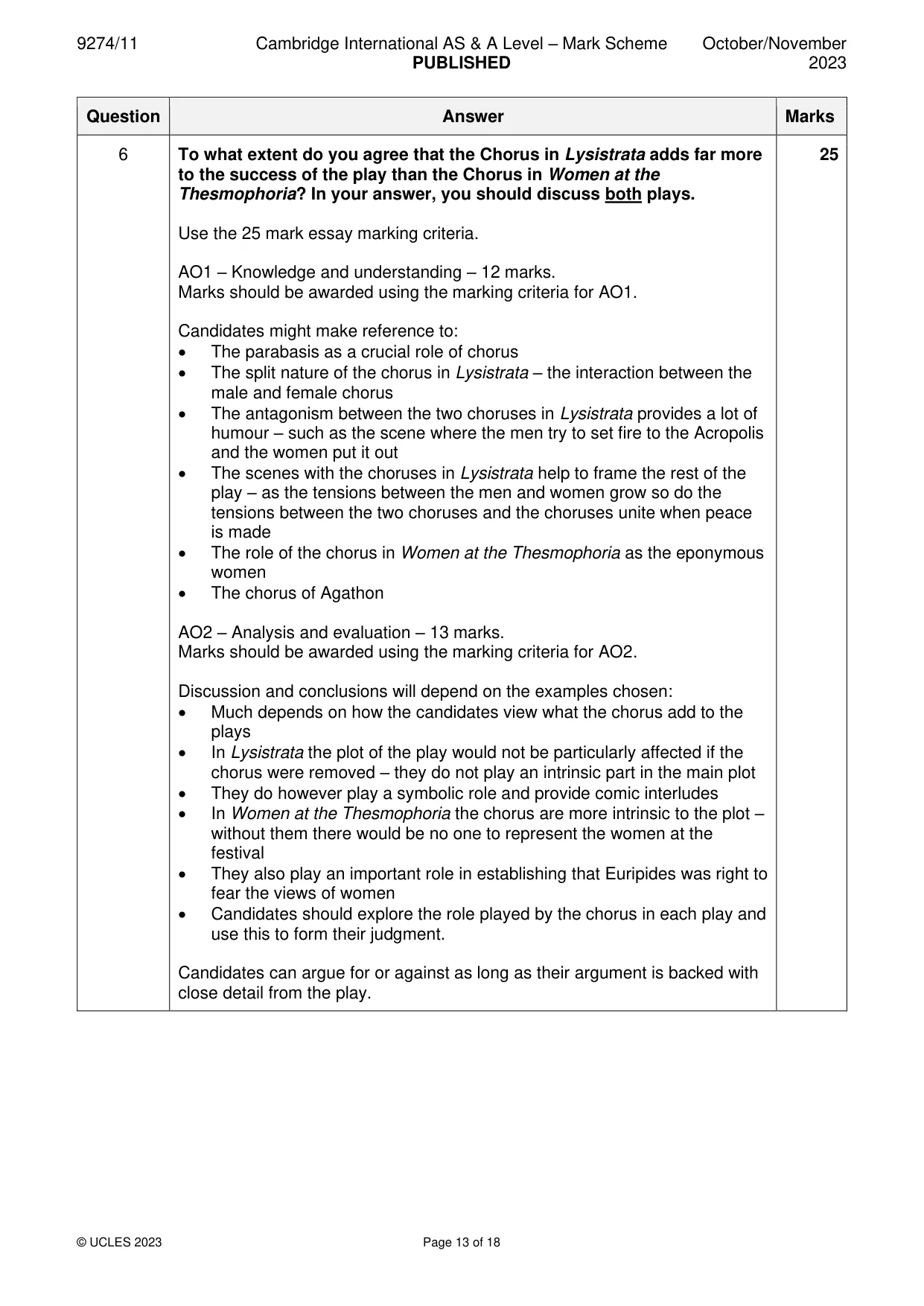
9274/11 Cambridge International AS & A Level – Mark Scheme PUBLISHED October/November 2023 © UCLES 2023 Page 13 of 18 Question Answer Marks 6 To what extent do you agree that the Chorus in Lysistrata adds far more to the success of the play than the Chorus in Women at the Thesmophoria? In your answer, you should discuss both plays. Use the 25 mark essay marking criteria. AO1 – Knowledge and understanding – 12 marks. Marks should be awarded using the marking criteria for AO1. Candidates might make reference to: • The parabasis as a crucial role of chorus • The split nature of the chorus in Lysistrata – the interaction between the male and female chorus • The antagonism between the two choruses in Lysistrata provides a lot of humour – such as the scene where the men try to set fire to the Acropolis and the women put it out • The scenes with the choruses in Lysistrata help to frame the rest of the play – as the tensions between the men and women grow so do the tensions between the two choruses and the choruses unite when peace is made • The role of the chorus in Women at the Thesmophoria as the eponymous women • The chorus of Agathon AO2 – Analysis and evaluation – 13 marks. Marks should be awarded using the marking criteria for AO2. Discussion and conclusions will depend on the examples chosen: • Much depends on how the candidates view what the chorus add to the plays • In Lysistrata the plot of the play would not be particularly affected if the chorus were removed – they do not play an intrinsic part in the main plot • They do however play a symbolic role and provide comic interludes • In Women at the Thesmophoria the chorus are more intrinsic to the plot – without them there would be no one to represent the women at the festival • They also play an important role in establishing that Euripides was right to fear the views of women • Candidates should explore the role played by the chorus in each play and use this to form their judgment. Candidates can argue for or against as long as their argument is backed with close detail from the play. 25
Mark scheme, page 14
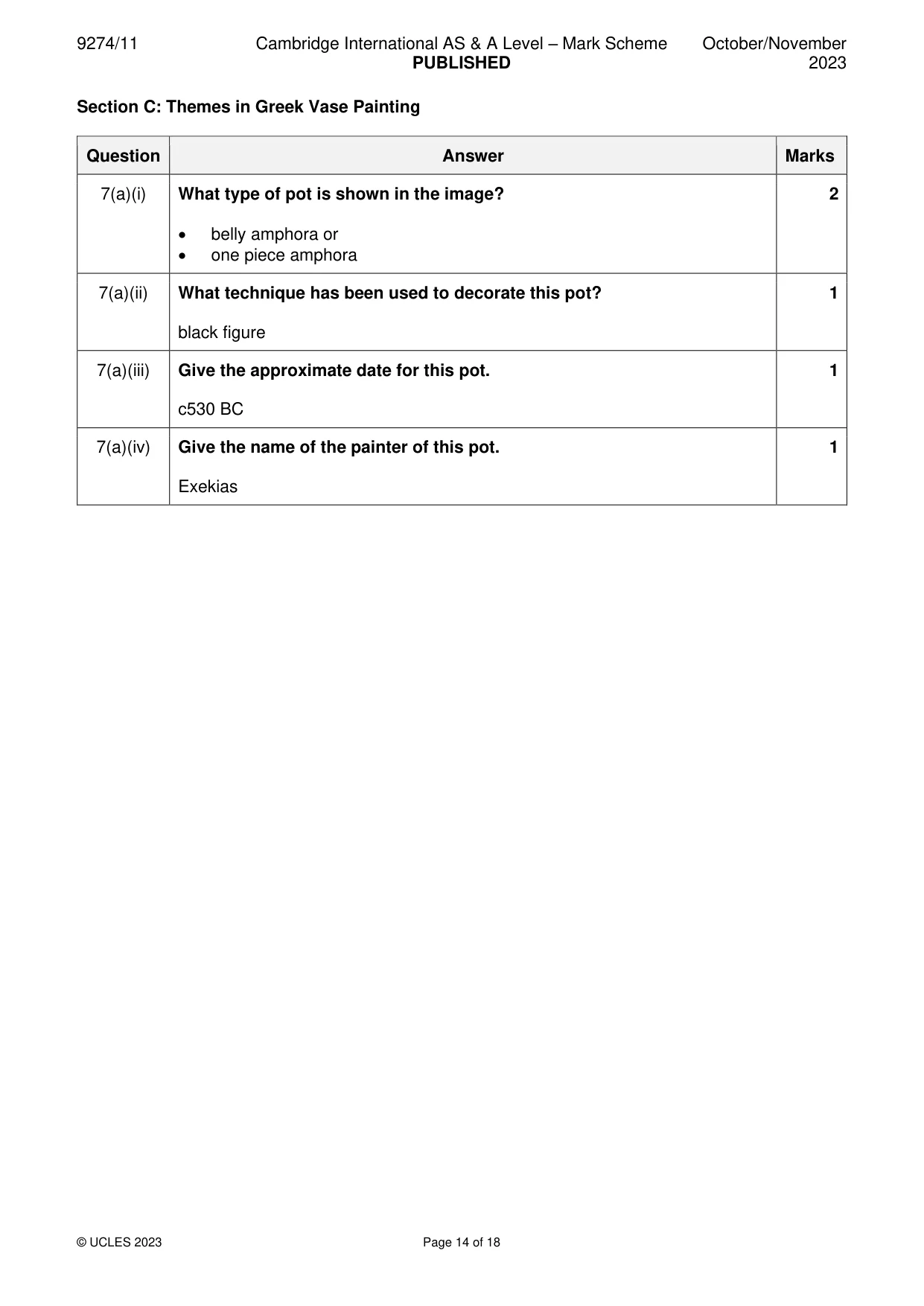
9274/11 Cambridge International AS & A Level – Mark Scheme PUBLISHED October/November 2023 © UCLES 2023 Page 14 of 18 Section C: Themes in Greek Vase Painting Question Answer Marks 7(a)(i) What type of pot is shown in the image? • belly amphora or • one piece amphora 2 7(a)(ii) What technique has been used to decorate this pot? black figure 1 7(a)(iii) Give the approximate date for this pot. c530 BC 1 7(a)(iv) Give the name of the painter of this pot. Exekias 1
Mark scheme, page 15
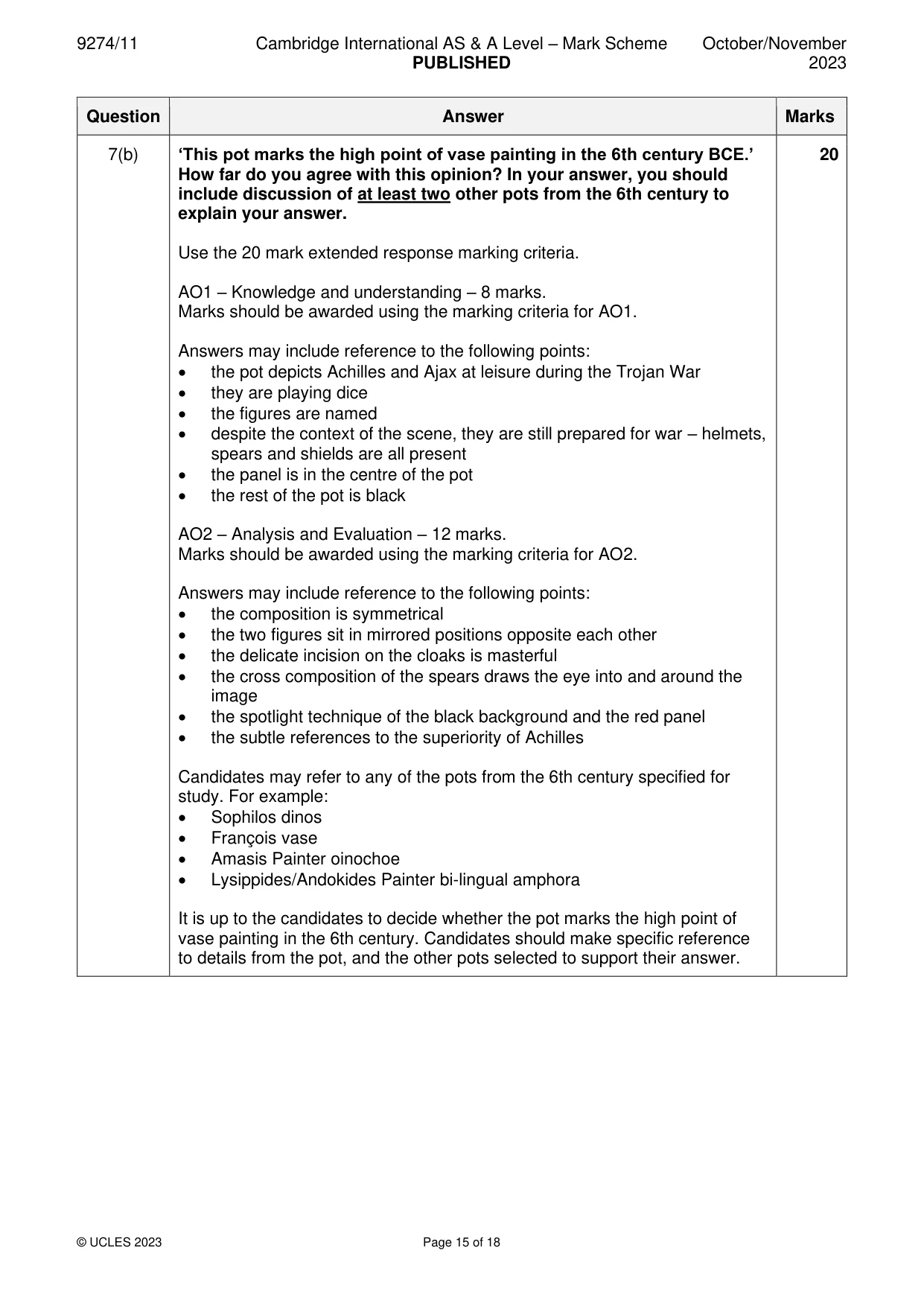
9274/11 Cambridge International AS & A Level – Mark Scheme PUBLISHED October/November 2023 © UCLES 2023 Page 15 of 18 Question Answer Marks 7(b) ‘This pot marks the high point of vase painting in the 6th century BCE.’ How far do you agree with this opinion? In your answer, you should include discussion of at least two other pots from the 6th century to explain your answer. Use the 20 mark extended response marking criteria. AO1 – Knowledge and understanding – 8 marks. Marks should be awarded using the marking criteria for AO1. Answers may include reference to the following points: • the pot depicts Achilles and Ajax at leisure during the Trojan War • they are playing dice • the figures are named • despite the context of the scene, they are still prepared for war – helmets, spears and shields are all present • the panel is in the centre of the pot • the rest of the pot is black AO2 – Analysis and Evaluation – 12 marks. Marks should be awarded using the marking criteria for AO2. Answers may include reference to the following points: • the composition is symmetrical • the two figures sit in mirrored positions opposite each other • the delicate incision on the cloaks is masterful • the cross composition of the spears draws the eye into and around the image • the spotlight technique of the black background and the red panel • the subtle references to the superiority of Achilles Candidates may refer to any of the pots from the 6th century specified for study. For example: • Sophilos dinos • François vase • Amasis Painter oinochoe • Lysippides/Andokides Painter bi-lingual amphora It is up to the candidates to decide whether the pot marks the high point of vase painting in the 6th century. Candidates should make specific reference to details from the pot, and the other pots selected to support their answer. 20
Mark scheme, page 16
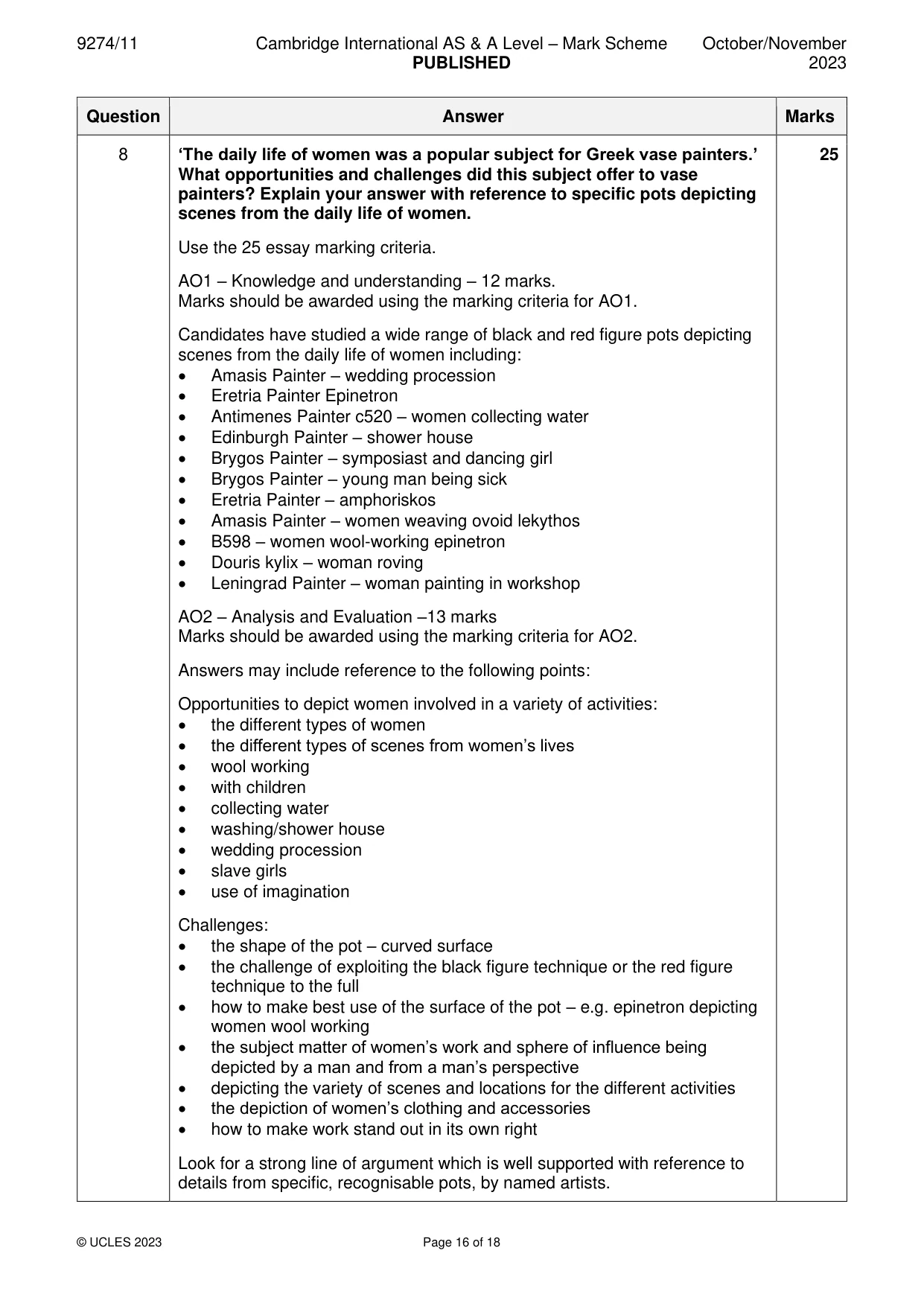
9274/11 Cambridge International AS & A Level – Mark Scheme PUBLISHED October/November 2023 © UCLES 2023 Page 16 of 18 Question Answer Marks 8 ‘The daily life of women was a popular subject for Greek vase painters.’ What opportunities and challenges did this subject offer to vase painters? Explain your answer with reference to specific pots depicting scenes from the daily life of women. Use the 25 essay marking criteria. AO1 – Knowledge and understanding – 12 marks. Marks should be awarded using the marking criteria for AO1. Candidates have studied a wide range of black and red figure pots depicting scenes from the daily life of women including: • Amasis Painter – wedding procession • Eretria Painter Epinetron • Antimenes Painter c520 – women collecting water • Edinburgh Painter – shower house • Brygos Painter – symposiast and dancing girl • Brygos Painter – young man being sick • Eretria Painter – amphoriskos • Amasis Painter – women weaving ovoid lekythos • B598 – women wool-working epinetron • Douris kylix – woman roving • Leningrad Painter – woman painting in workshop AO2 – Analysis and Evaluation –13 marks Marks should be awarded using the marking criteria for AO2. Answers may include reference to the following points: Opportunities to depict women involved in a variety of activities: • the different types of women • the different types of scenes from women’s lives • wool working • with children • collecting water • washing/shower house • wedding procession • slave girls • use of imagination Challenges: • the shape of the pot – curved surface • the challenge of exploiting the black figure technique or the red figure technique to the full • how to make best use of the surface of the pot – e.g. epinetron depicting women wool working • the subject matter of women’s work and sphere of influence being depicted by a man and from a man’s perspective • depicting the variety of scenes and locations for the different activities • the depiction of women’s clothing and accessories • how to make work stand out in its own right Look for a strong line of argument which is well supported with reference to details from specific, recognisable pots, by named artists. 25
Mark scheme, page 17
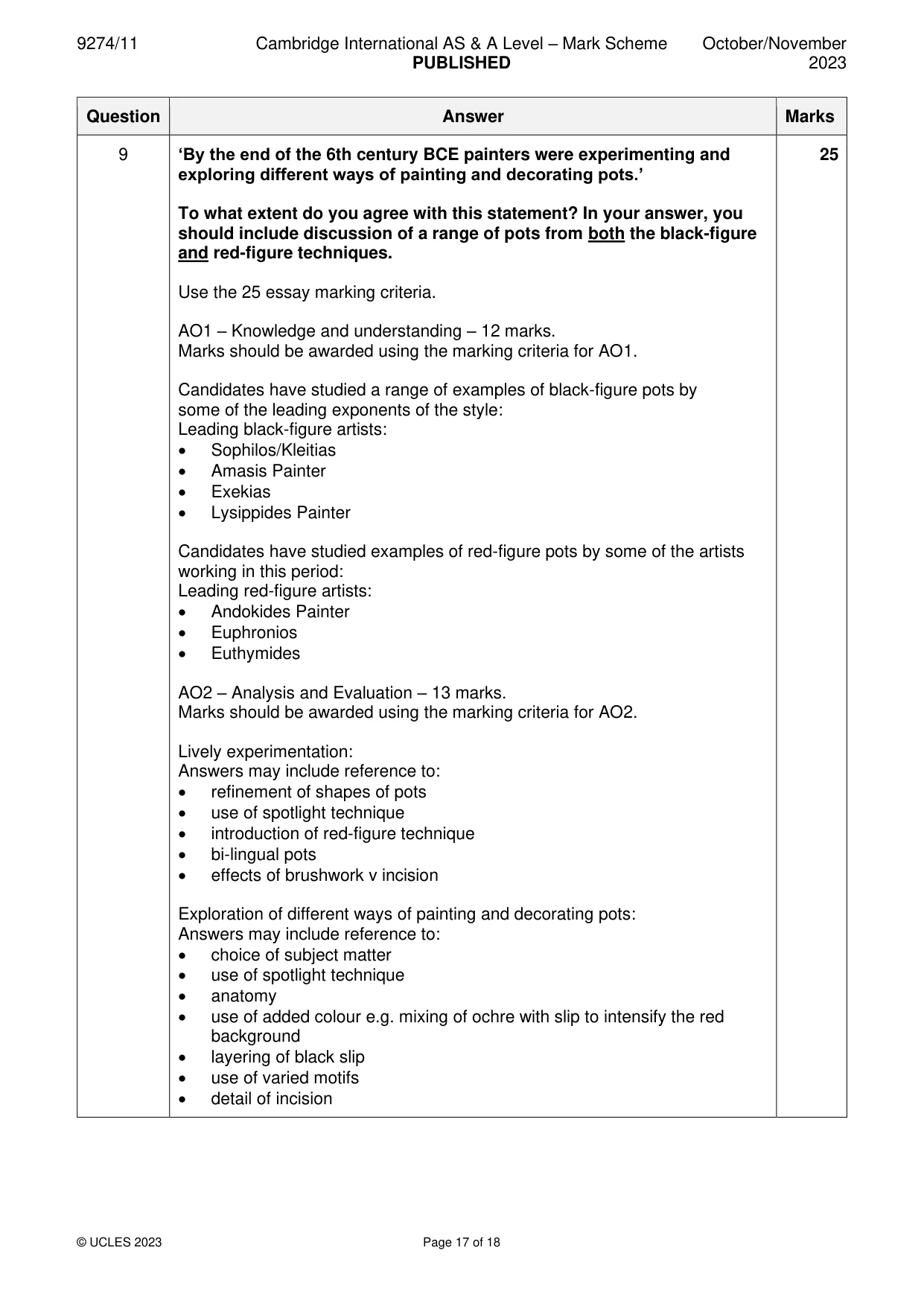
9274/11 Cambridge International AS & A Level – Mark Scheme PUBLISHED October/November 2023 © UCLES 2023 Page 17 of 18 Question Answer Marks 9 ‘By the end of the 6th century BCE painters were experimenting and exploring different ways of painting and decorating pots.’ To what extent do you agree with this statement? In your answer, you should include discussion of a range of pots from both the black-figure and red-figure techniques. Use the 25 essay marking criteria. AO1 – Knowledge and understanding – 12 marks. Marks should be awarded using the marking criteria for AO1. Candidates have studied a range of examples of black-figure pots by some of the leading exponents of the style: Leading black-figure artists: • Sophilos/Kleitias • Amasis Painter • Exekias • Lysippides Painter Candidates have studied examples of red-figure pots by some of the artists working in this period: Leading red-figure artists: • Andokides Painter • Euphronios • Euthymides AO2 – Analysis and Evaluation – 13 marks. Marks should be awarded using the marking criteria for AO2. Lively experimentation: Answers may include reference to: • refinement of shapes of pots • use of spotlight technique • introduction of red-figure technique • bi-lingual pots • effects of brushwork v incision Exploration of different ways of painting and decorating pots: Answers may include reference to: • choice of subject matter • use of spotlight technique • anatomy • use of added colour e.g. mixing of ochre with slip to intensify the red background • layering of black slip • use of varied motifs • detail of incision 25
Mark scheme, page 18
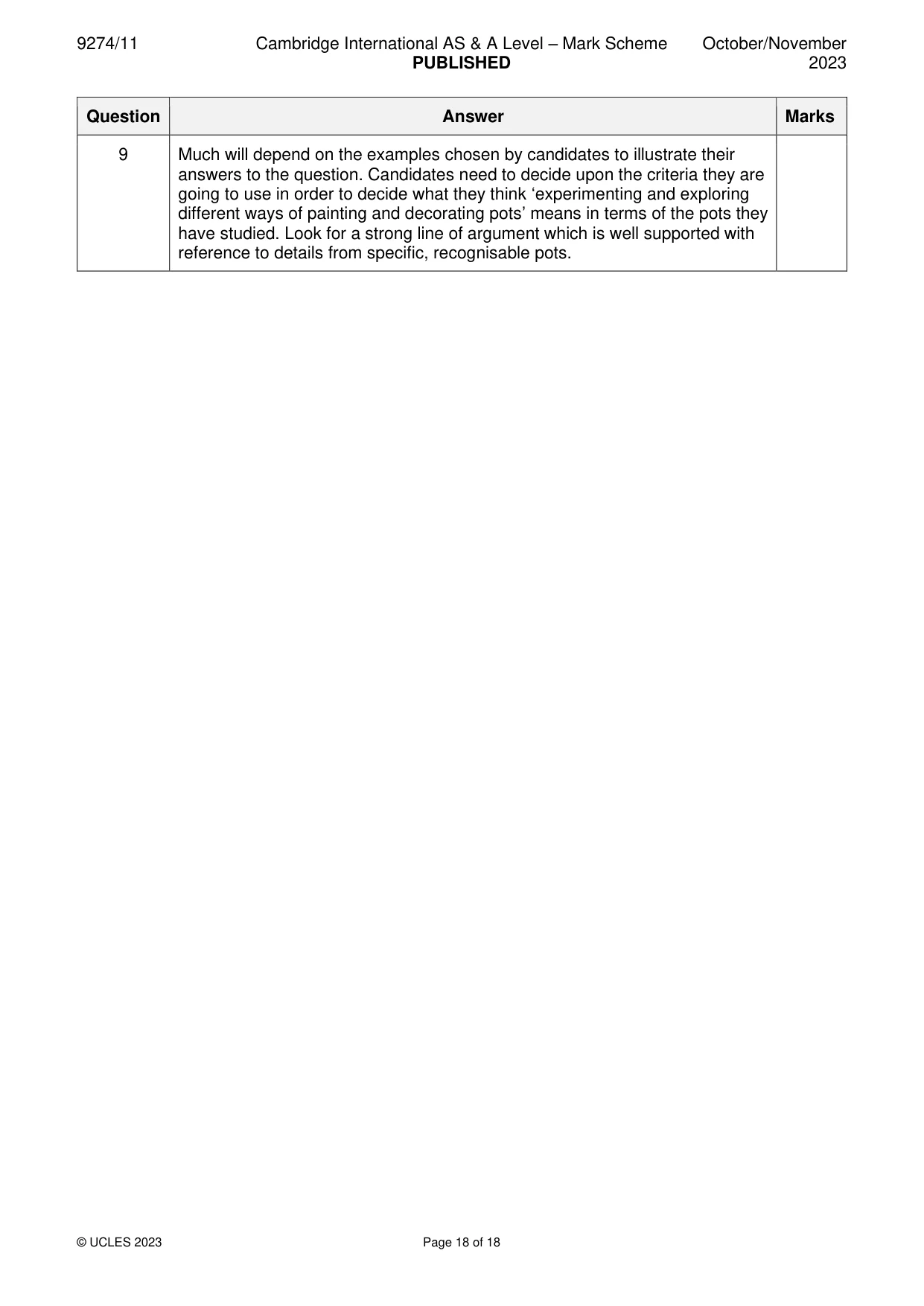
9274/11 Cambridge International AS & A Level – Mark Scheme PUBLISHED October/November 2023 © UCLES 2023 Page 18 of 18 Question Answer Marks 9 Much will depend on the examples chosen by candidates to illustrate their answers to the question. Candidates need to decide upon the criteria they are going to use in order to decide what they think ‘experimenting and exploring different ways of painting and decorating pots’ means in terms of the pots they have studied. Look for a strong line of argument which is well supported with reference to details from specific, recognisable pots.
What you needed in this session
Cambridge’s own grade thresholds for 2023 Oct/Nov, Paper 1 · Variant 1. A higher threshold means an easier paper — the bar moves with how the cohort did.