Cambridge A Level Classical Studies 9274 — 2020 Oct/Nov Paper 1 · Variant 1
9274/11/O/N/20 · 50 marks · ≈56 min
The question paper and its mark scheme, free to read here and free to download. This is Cambridge’s own paper, exactly as it was sat.
Question paper8 pages

Mark scheme18 pages
Answers below. Sit the paper first if you are practising.
Paper as text
Question paper, page 1
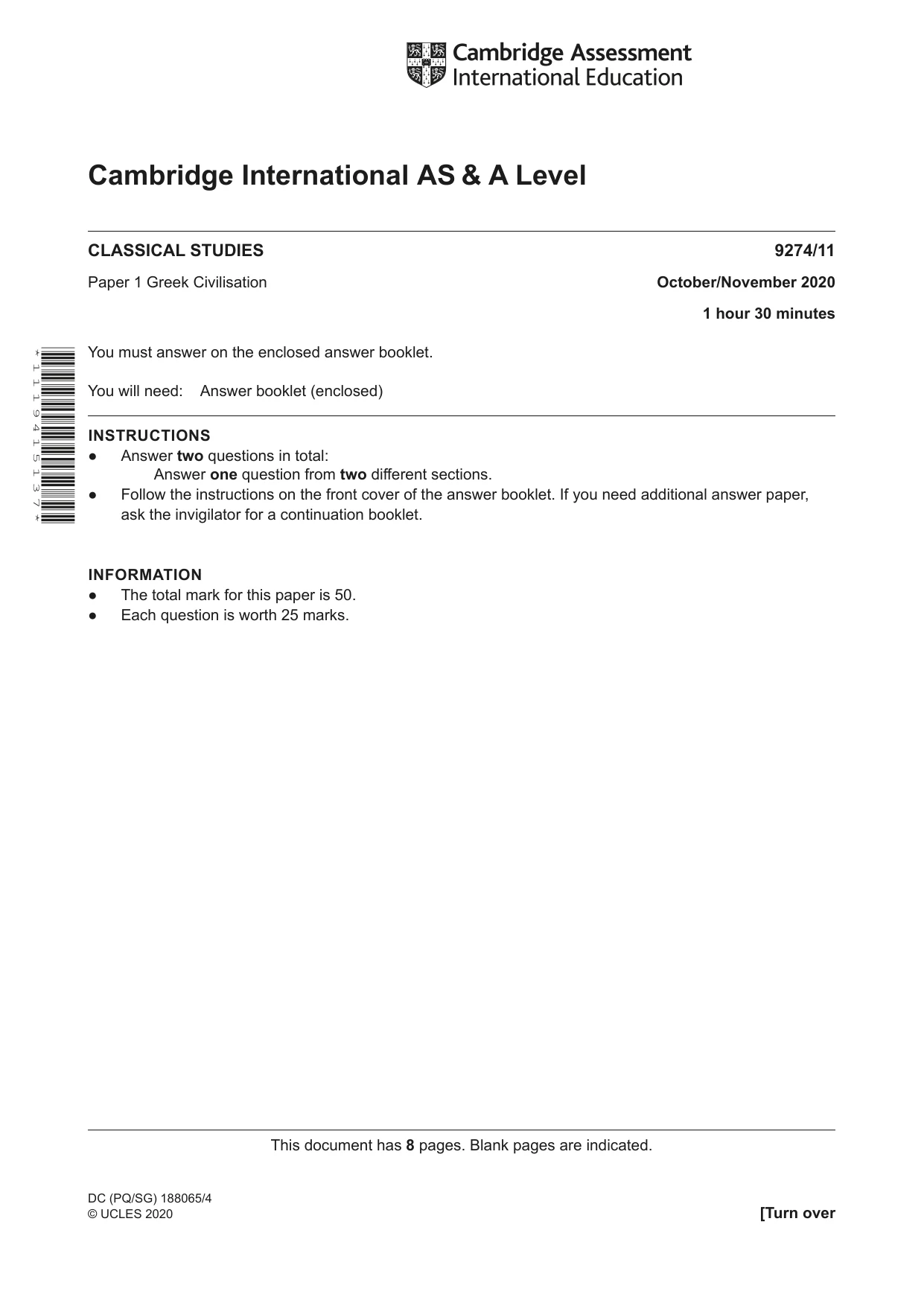
Cambridge International AS & A Level * 1 1 1 9 4 1 5 1 3 7 * DC (PQ/SG) 188065/4 © UCLES 2020 [Turn over This document has 8 pages. Blank pages are indicated. CLASSICAL STUDIES 9274/11 Paper 1 Greek Civilisation October/November 2020 1 hour 30 minutes You must answer on the enclosed answer booklet. You will need: Answer booklet (enclosed) INSTRUCTIONS ● Answer two questions in total: Answer one question from two different sections. ● Follow the instructions on the front cover of the answer booklet. If you need additional answer paper, ask the invigilator for a continuation booklet. INFORMATION ● The total mark for this paper is 50. ● Each question is worth 25 marks.
Question paper, page 2
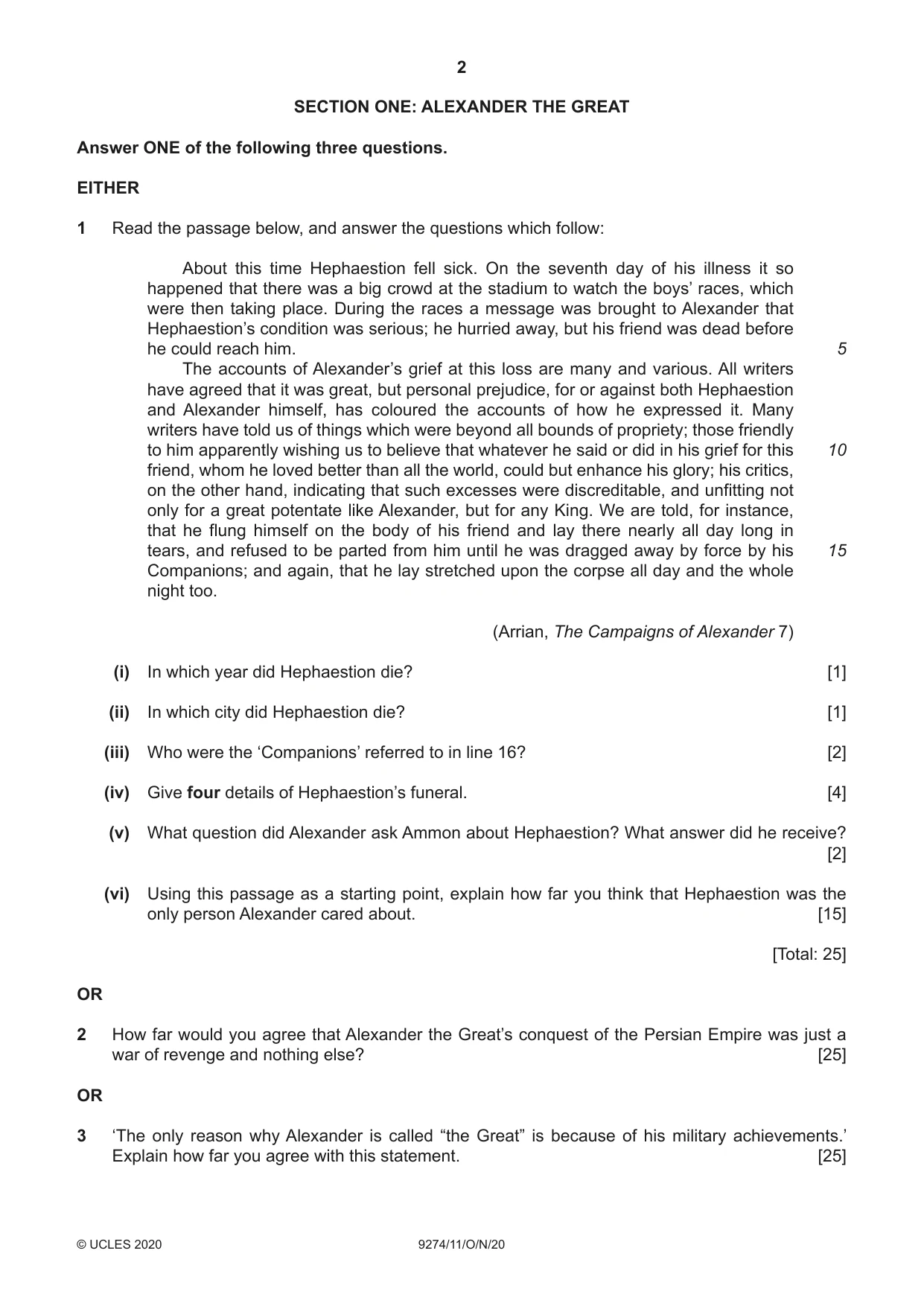
2 9274/11/O/N/20 © UCLES 2020 SECTION ONE: ALEXANDER THE GREAT Answer ONE of the following three questions. EITHER 1 Read the passage below, and answer the questions which follow: About this time Hephaestion fell sick. On the seventh day of his illness it so happened that there was a big crowd at the stadium to watch the boys’ races, which were then taking place. During the races a message was brought to Alexander that Hephaestion’s condition was serious; he hurried away, but his friend was dead before he could reach him. The accounts of Alexander’s grief at this loss are many and various. All writers have agreed that it was great, but personal prejudice, for or against both Hephaestion and Alexander himself, has coloured the accounts of how he expressed it. Many writers have told us of things which were beyond all bounds of propriety; those friendly to him apparently wishing us to believe that whatever he said or did in his grief for this friend, whom he loved better than all the world, could but enhance his glory; his critics, on the other hand, indicating that such excesses were discreditable, and unfitting not only for a great potentate like Alexander, but for any King. We are told, for instance, that he flung himself on the body of his friend and lay there nearly all day long in tears, and refused to be parted from him until he was dragged away by force by his Companions; and again, that he lay stretched upon the corpse all day and the whole night too. (Arrian, The Campaigns of Alexander 7) (i) In which year did Hephaestion die? [1] (ii) In which city did Hephaestion die? [1] (iii) Who were the ‘Companions’ referred to in line 16? [2] (iv) Give four details of Hephaestion’s funeral. [4] (v) What question did Alexander ask Ammon about Hephaestion? What answer did he receive? [2] (vi) Using this passage as a starting point, explain how far you think that Hephaestion was the only person Alexander cared about. [15] [Total: 25] OR 2 How far would you agree that Alexander the Great’s conquest of the Persian Empire was just a war of revenge and nothing else? [25] OR 3 ‘The only reason why Alexander is called “the Great” is because of his military achievements.’ Explain how far you agree with this statement. [25] 5 10 15
Question paper, page 3
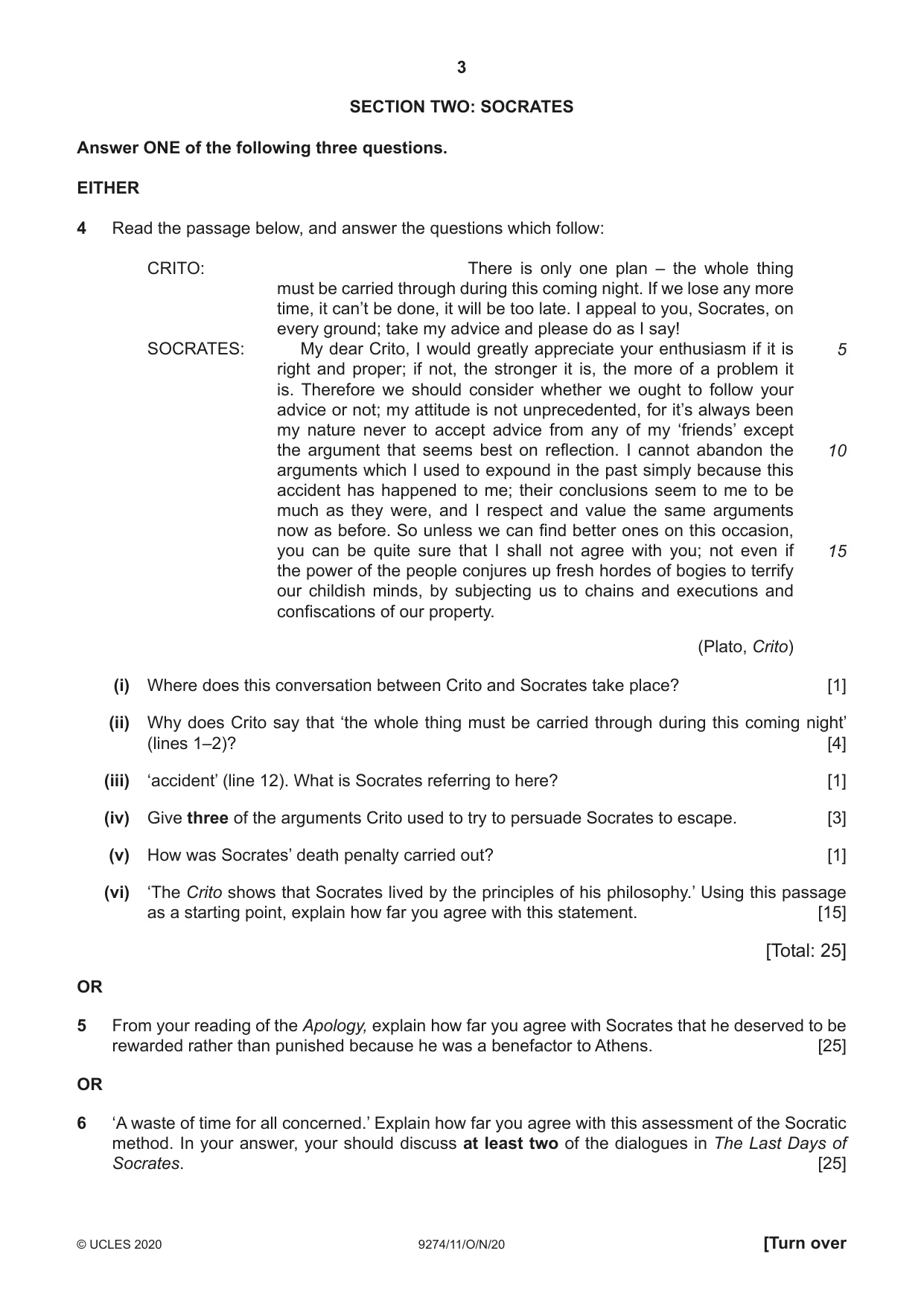
3 9274/11/O/N/20 © UCLES 2020 [Turn over SECTION TWO: SOCRATES Answer ONE of the following three questions. EITHER 4 Read the passage below, and answer the questions which follow: CRITO: There is only one plan – the whole thing must be carried through during this coming night. If we lose any more time, it can’t be done, it will be too late. I appeal to you, Socrates, on every ground; take my advice and please do as I say! SOCRATES: My dear Crito, I would greatly appreciate your enthusiasm if it is right and proper; if not, the stronger it is, the more of a problem it is. Therefore we should consider whether we ought to follow your advice or not; my attitude is not unprecedented, for it’s always been my nature never to accept advice from any of my ‘friends’ except the argument that seems best on reflection. I cannot abandon the arguments which I used to expound in the past simply because this accident has happened to me; their conclusions seem to me to be much as they were, and I respect and value the same arguments now as before. So unless we can find better ones on this occasion, you can be quite sure that I shall not agree with you; not even if the power of the people conjures up fresh hordes of bogies to terrify our childish minds, by subjecting us to chains and executions and confiscations of our property. (Plato, Crito) (i) Where does this conversation between Crito and Socrates take place? [1] (ii) Why does Crito say that ‘the whole thing must be carried through during this coming night’ (lines 1–2)? [4] (iii) ‘accident’ (line 12). What is Socrates referring to here? [1] (iv) Give three of the arguments Crito used to try to persuade Socrates to escape. [3] (v) How was Socrates’ death penalty carried out? [1] (vi) ‘The Crito shows that Socrates lived by the principles of his philosophy.’ Using this passage as a starting point, explain how far you agree with this statement. [15] [Total: 25] OR 5 From your reading of the Apology, explain how far you agree with Socrates that he deserved to be rewarded rather than punished because he was a benefactor to Athens. [25] OR 6 ‘A waste of time for all concerned.’ Explain how far you agree with this assessment of the Socratic method. In your answer, your should discuss at least two of the dialogues in The Last Days of Socrates. [25] 5 10 15
Question paper, page 4
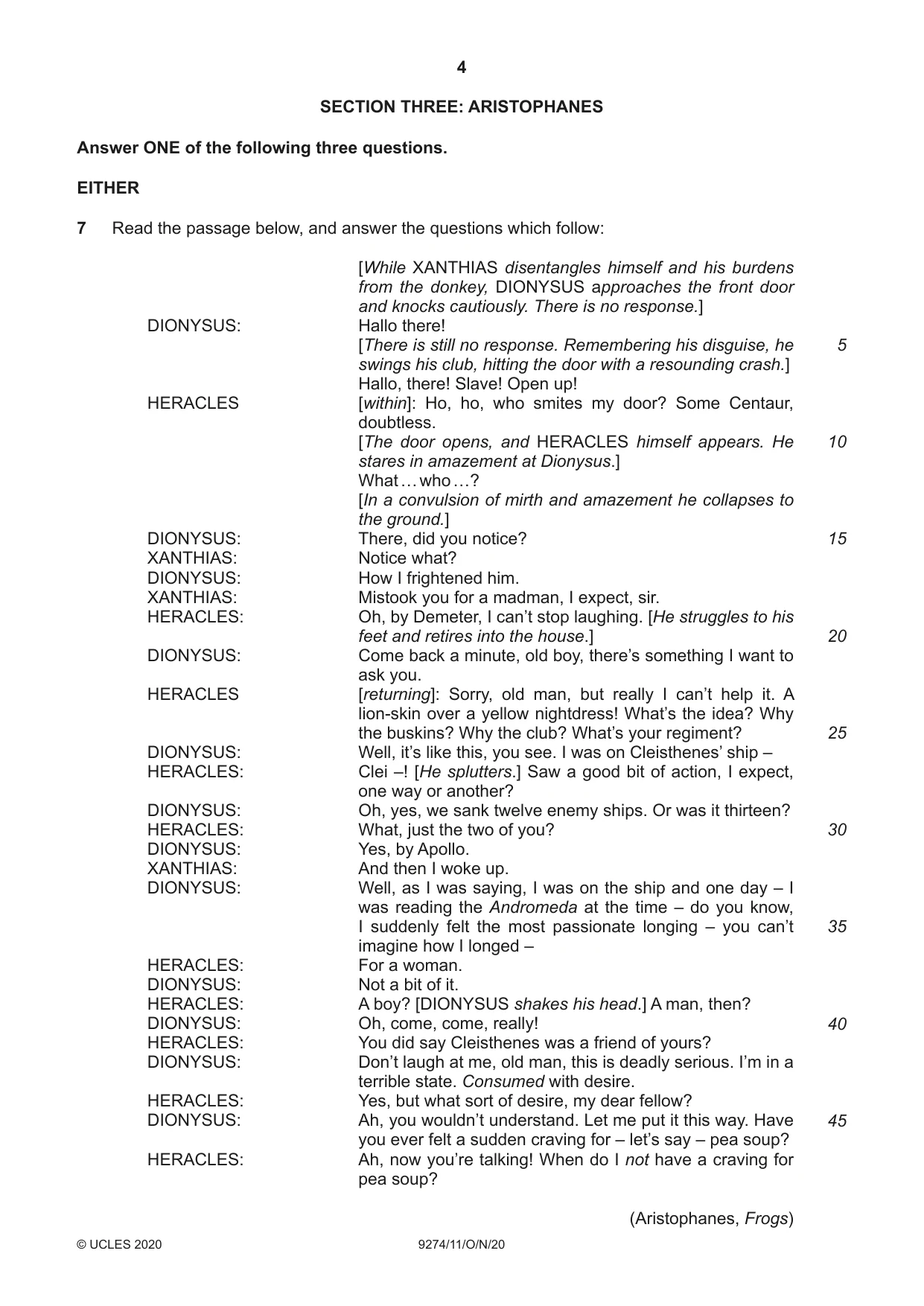
4 9274/11/O/N/20 © UCLES 2020 SECTION THREE: ARISTOPHANES Answer ONE of the following three questions. EITHER 7 Read the passage below, and answer the questions which follow: [While XANTHIAS disentangles himself and his burdens from the donkey, DIONYSUS approaches the front door and knocks cautiously. There is no response.] DIONYSUS: Hallo there! [There is still no response. Remembering his disguise, he swings his club, hitting the door with a resounding crash.] Hallo, there! Slave! Open up! HERACLES [within]: Ho, ho, who smites my door? Some Centaur, doubtless. [The door opens, and HERACLES himself appears. He stares in amazement at Dionysus.] What … who …? [In a convulsion of mirth and amazement he collapses to the ground.] DIONYSUS: There, did you notice? XANTHIAS: Notice what? DIONYSUS: How I frightened him. XANTHIAS: Mistook you for a madman, I expect, sir. HERACLES: Oh, by Demeter, I can’t stop laughing. [He struggles to his feet and retires into the house.] DIONYSUS: Come back a minute, old boy, there’s something I want to ask you. HERACLES [returning]: Sorry, old man, but really I can’t help it. A lion-skin over a yellow nightdress! What’s the idea? Why the buskins? Why the club? What’s your regiment? DIONYSUS: Well, it’s like this, you see. I was on Cleisthenes’ ship – HERACLES: Clei –! [He splutters.] Saw a good bit of action, I expect, one way or another? DIONYSUS: Oh, yes, we sank twelve enemy ships. Or was it thirteen? HERACLES: What, just the two of you? DIONYSUS: Yes, by Apollo. XANTHIAS: And then I woke up. DIONYSUS: Well, as I was saying, I was on the ship and one day – I was reading the Andromeda at the time – do you know, I suddenly felt the most passionate longing – you can’t imagine how I longed – HERACLES: For a woman. DIONYSUS: Not a bit of it. HERACLES: A boy? [DIONYSUS shakes his head.] A man, then? DIONYSUS: Oh, come, come, really! HERACLES: You did say Cleisthenes was a friend of yours? DIONYSUS: Don’t laugh at me, old man, this is deadly serious. I’m in a terrible state. Consumed with desire. HERACLES: Yes, but what sort of desire, my dear fellow? DIONYSUS: Ah, you wouldn’t understand. Let me put it this way. Have you ever felt a sudden craving for – let’s say – pea soup? HERACLES: Ah, now you’re talking! When do I not have a craving for pea soup? (Aristophanes, Frogs) 5 10 15 20 25 30 35 40 45
Question paper, page 5
5 9274/11/O/N/20 © UCLES 2020 [Turn over (i) From what part of Frogs does this passage come? [1] (ii) ‘Remembering his disguise’ (line 5). Who is Dionysus pretending to be? [1] (iii) ‘we sank twelve enemy ships’ (line 29). To which sea battle does this refer? [1] (iv) ‘I suddenly felt the most passionate longing’ (line 35). For whom is Dionysus feeling this longing? [1] (v) From this passage, find three examples of Aristophanes’ comic technique. Write out the example, identify the technique and explain why it is funny. [6] (vi) Using this passage as a starting point, discuss how far the presentation of the gods adds to the success of Frogs. [15] [Total: 25] OR 8 ‘Procleon/Philocleon contributes more to the success of Wasps than Anticleon/Bdelycleon.’ Discuss the extent to which you agree with this statement. [25] OR 9 Which do you think is the funnier play, Frogs or Wasps? In your answer, you should make reference to both plays. [25]
Question paper, page 6
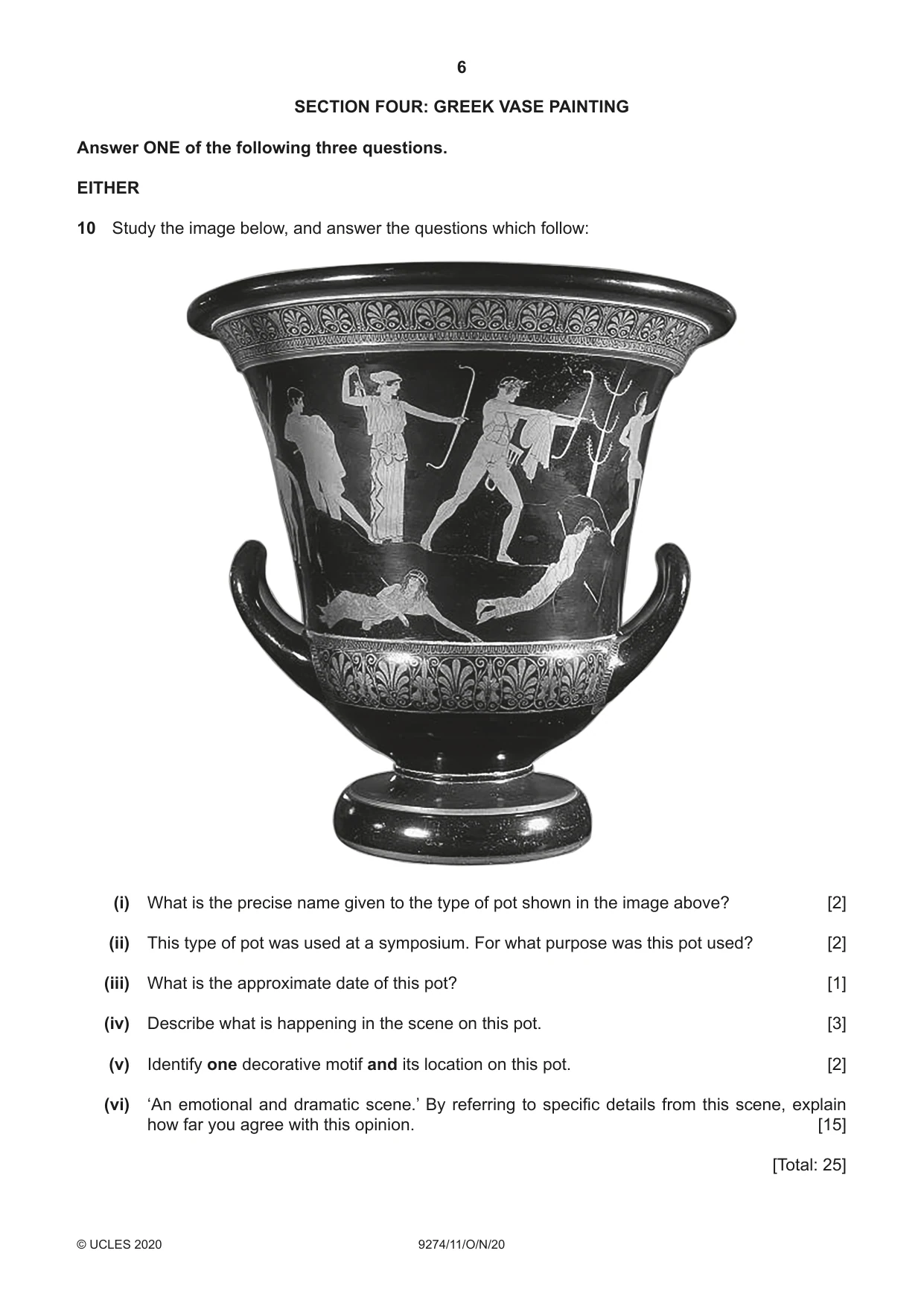
6 9274/11/O/N/20 © UCLES 2020 SECTION FOUR: GREEK VASE PAINTING Answer ONE of the following three questions. EITHER 10 Study the image below, and answer the questions which follow: (i) What is the precise name given to the type of pot shown in the image above? [2] (ii) This type of pot was used at a symposium. For what purpose was this pot used? [2] (iii) What is the approximate date of this pot? [1] (iv) Describe what is happening in the scene on this pot. [3] (v) Identify one decorative motif and its location on this pot. [2] (vi) ‘An emotional and dramatic scene.’ By referring to specific details from this scene, explain how far you agree with this opinion. [15] [Total: 25]
Question paper, page 7
7 9274/11/O/N/20 © UCLES 2020 OR 11 ‘Red-figure artists were capable of producing a range of emotions in their work.’ How far do you agree with this opinion? In your answer, you should refer to specific examples from the work of at least three painters. [25] OR 12 ‘An innovative and skilful painter.’ To which black-figure painter do you think that this description best applies? In your answer, you should refer to specific examples from the work of at least three painters. [25]
Question paper, page 8
8 9274/11/O/N/20 © UCLES 2020 Permission to reproduce items where third-party owned material protected by copyright is included has been sought and cleared where possible. Every reasonable effort has been made by the publisher (UCLES) to trace copyright holders, but if any items requiring clearance have unwittingly been included, the publisher will be pleased to make amends at the earliest possible opportunity. To avoid the issue of disclosure of answer-related information to candidates, all copyright acknowledgements are reproduced online in the Cambridge Assessment International Education Copyright Acknowledgements Booklet. This is produced for each series of examinations and is freely available to download at www.cambridgeinternational.org after the live examination series. Cambridge Assessment International Education is part of the Cambridge Assessment Group. Cambridge Assessment is the brand name of the University of Cambridge Local Examinations Syndicate (UCLES), which itself is a department of the University of Cambridge. BLANK PAGE
Mark scheme, page 1
This document consists of 18 printed pages. © UCLES 2020 [Turn over Cambridge International AS Level CLASSICAL STUDIES 9274/11 Paper 1 Greek Civilisation October/November 2020 MARK SCHEME Maximum Mark: 50 Published This mark scheme is published as an aid to teachers and candidates, to indicate the requirements of the examination. It shows the basis on which Examiners were instructed to award marks. It does not indicate the details of the discussions that took place at an Examiners’ meeting before marking began, which would have considered the acceptability of alternative answers. Mark schemes should be read in conjunction with the question paper and the Principal Examiner Report for Teachers. Cambridge International will not enter into discussions about these mark schemes. Cambridge International is publishing the mark schemes for the October/November 2020 series for most Cambridge IGCSE™, Cambridge International A and AS Level and Cambridge Pre-U components, and some Cambridge O Level components.
Mark scheme, page 2
9274/11 Cambridge International AS Level – Mark Scheme PUBLISHED October/November 2020 © UCLES 2020 Page 2 of 18 Generic Marking Principles These general marking principles must be applied by all examiners when marking candidate answers. They should be applied alongside the specific content of the mark scheme or generic level descriptors for a question. Each question paper and mark scheme will also comply with these marking principles. GENERIC MARKING PRINCIPLE 1: Marks must be awarded in line with: • the specific content of the mark scheme or the generic level descriptors for the question • the specific skills defined in the mark scheme or in the generic level descriptors for the question • the standard of response required by a candidate as exemplified by the standardisation scripts. GENERIC MARKING PRINCIPLE 2: Marks awarded are always whole marks (not half marks, or other fractions). GENERIC MARKING PRINCIPLE 3: Marks must be awarded positively: • marks are awarded for correct/valid answers, as defined in the mark scheme. However, credit is given for valid answers which go beyond the scope of the syllabus and mark scheme, referring to your Team Leader as appropriate • marks are awarded when candidates clearly demonstrate what they know and can do • marks are not deducted for errors • marks are not deducted for omissions • answers should only be judged on the quality of spelling, punctuation and grammar when these features are specifically assessed by the question as indicated by the mark scheme. The meaning, however, should be unambiguous. GENERIC MARKING PRINCIPLE 4: Rules must be applied consistently, e.g. in situations where candidates have not followed instructions or in the application of generic level descriptors. GENERIC MARKING PRINCIPLE 5: Marks should be awarded using the full range of marks defined in the mark scheme for the question (however; the use of the full mark range may be limited according to the quality of the candidate responses seen). GENERIC MARKING PRINCIPLE 6: Marks awarded are based solely on the requirements as defined in the mark scheme. Marks should not be awarded with grade thresholds or grade descriptors in mind.
Mark scheme, page 3
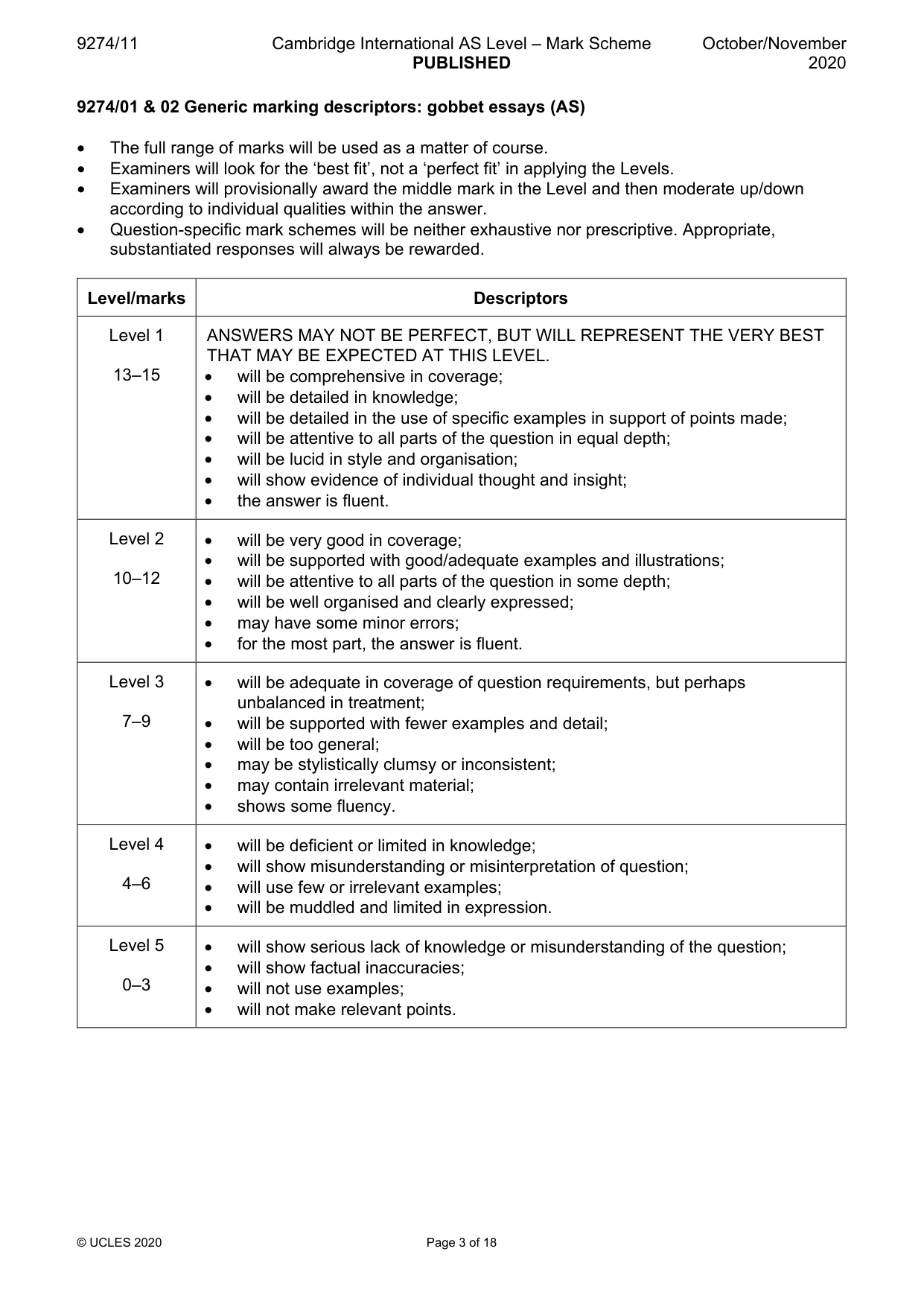
9274/11 Cambridge International AS Level – Mark Scheme PUBLISHED October/November 2020 © UCLES 2020 Page 3 of 18 9274/01 & 02 Generic marking descriptors: gobbet essays (AS) • The full range of marks will be used as a matter of course. • Examiners will look for the ‘best fit’, not a ‘perfect fit’ in applying the Levels. • Examiners will provisionally award the middle mark in the Level and then moderate up/down according to individual qualities within the answer. • Question-specific mark schemes will be neither exhaustive nor prescriptive. Appropriate, substantiated responses will always be rewarded. Level/marks Descriptors Level 1 13–15 ANSWERS MAY NOT BE PERFECT, BUT WILL REPRESENT THE VERY BEST THAT MAY BE EXPECTED AT THIS LEVEL. • will be comprehensive in coverage; • will be detailed in knowledge; • will be detailed in the use of specific examples in support of points made; • will be attentive to all parts of the question in equal depth; • will be lucid in style and organisation; • will show evidence of individual thought and insight; • the answer is fluent. Level 2 10–12 • will be very good in coverage; • will be supported with good/adequate examples and illustrations; • will be attentive to all parts of the question in some depth; • will be well organised and clearly expressed; • may have some minor errors; • for the most part, the answer is fluent. Level 3 7–9 • will be adequate in coverage of question requirements, but perhaps unbalanced in treatment; • will be supported with fewer examples and detail; • will be too general; • may be stylistically clumsy or inconsistent; • may contain irrelevant material; • shows some fluency. Level 4 4–6 • will be deficient or limited in knowledge; • will show misunderstanding or misinterpretation of question; • will use few or irrelevant examples; • will be muddled and limited in expression. Level 5 0–3 • will show serious lack of knowledge or misunderstanding of the question; • will show factual inaccuracies; • will not use examples; • will not make relevant points.
Mark scheme, page 4
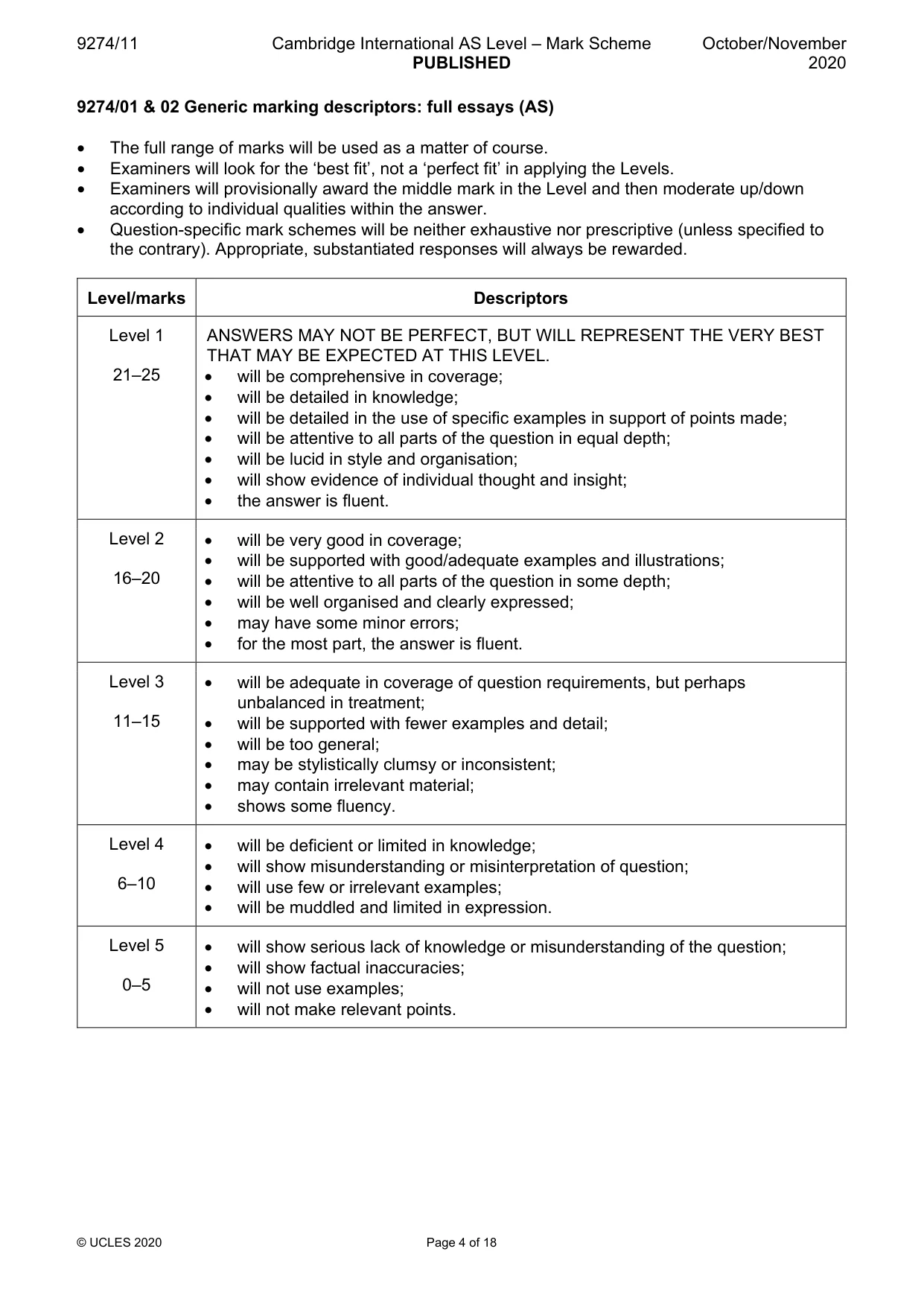
9274/11 Cambridge International AS Level – Mark Scheme PUBLISHED October/November 2020 © UCLES 2020 Page 4 of 18 9274/01 & 02 Generic marking descriptors: full essays (AS) • The full range of marks will be used as a matter of course. • Examiners will look for the ‘best fit’, not a ‘perfect fit’ in applying the Levels. • Examiners will provisionally award the middle mark in the Level and then moderate up/down according to individual qualities within the answer. • Question-specific mark schemes will be neither exhaustive nor prescriptive (unless specified to the contrary). Appropriate, substantiated responses will always be rewarded. Level/marks Descriptors Level 1 21–25 ANSWERS MAY NOT BE PERFECT, BUT WILL REPRESENT THE VERY BEST THAT MAY BE EXPECTED AT THIS LEVEL. • will be comprehensive in coverage; • will be detailed in knowledge; • will be detailed in the use of specific examples in support of points made; • will be attentive to all parts of the question in equal depth; • will be lucid in style and organisation; • will show evidence of individual thought and insight; • the answer is fluent. Level 2 16–20 • will be very good in coverage; • will be supported with good/adequate examples and illustrations; • will be attentive to all parts of the question in some depth; • will be well organised and clearly expressed; • may have some minor errors; • for the most part, the answer is fluent. Level 3 11–15 • will be adequate in coverage of question requirements, but perhaps unbalanced in treatment; • will be supported with fewer examples and detail; • will be too general; • may be stylistically clumsy or inconsistent; • may contain irrelevant material; • shows some fluency. Level 4 6–10 • will be deficient or limited in knowledge; • will show misunderstanding or misinterpretation of question; • will use few or irrelevant examples; • will be muddled and limited in expression. Level 5 0–5 • will show serious lack of knowledge or misunderstanding of the question; • will show factual inaccuracies; • will not use examples; • will not make relevant points.
Mark scheme, page 5
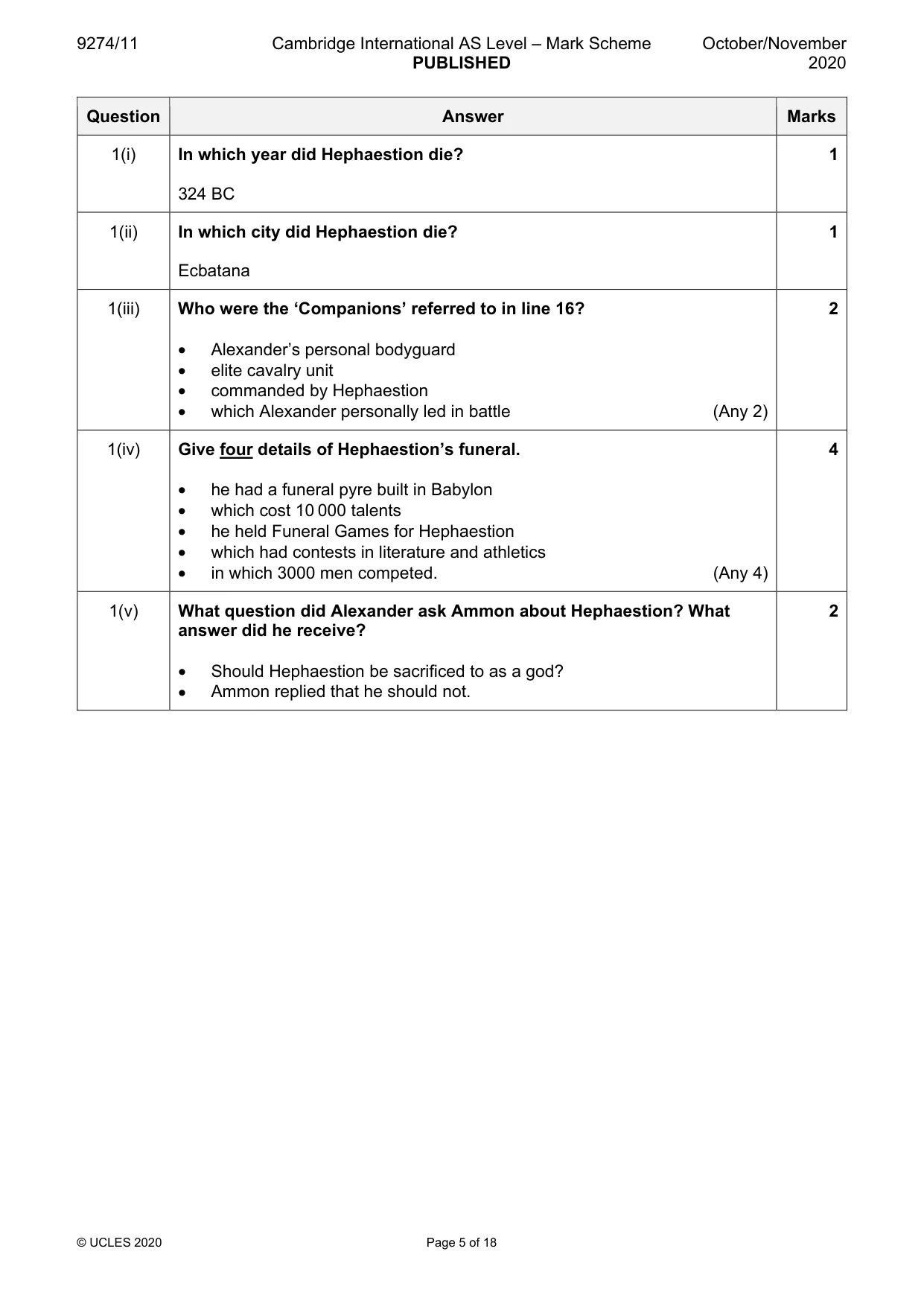
9274/11 Cambridge International AS Level – Mark Scheme PUBLISHED October/November 2020 © UCLES 2020 Page 5 of 18 Question Answer Marks 1(i) In which year did Hephaestion die? 324 BC 1 1(ii) In which city did Hephaestion die? Ecbatana 1 1(iii) Who were the ‘Companions’ referred to in line 16? • Alexander’s personal bodyguard • elite cavalry unit • commanded by Hephaestion • which Alexander personally led in battle (Any 2) 2 1(iv) Give four details of Hephaestion’s funeral. • he had a funeral pyre built in Babylon • which cost 10 000 talents • he held Funeral Games for Hephaestion • which had contests in literature and athletics • in which 3000 men competed. (Any 4) 4 1(v) What question did Alexander ask Ammon about Hephaestion? What answer did he receive? • Should Hephaestion be sacrificed to as a god? • Ammon replied that he should not. 2
Mark scheme, page 6
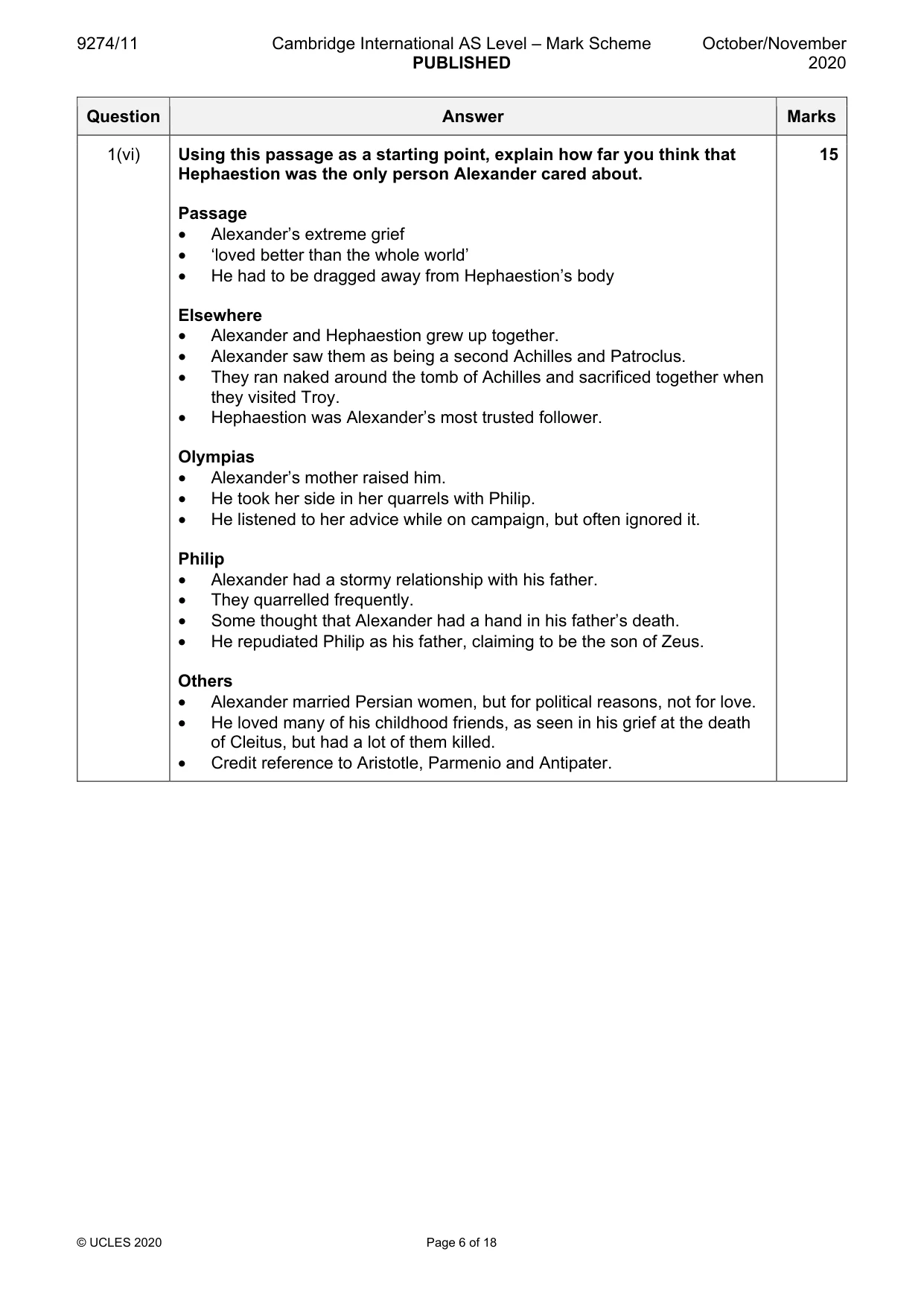
9274/11 Cambridge International AS Level – Mark Scheme PUBLISHED October/November 2020 © UCLES 2020 Page 6 of 18 Question Answer Marks 1(vi) Using this passage as a starting point, explain how far you think that Hephaestion was the only person Alexander cared about. Passage • Alexander’s extreme grief • ‘loved better than the whole world’ • He had to be dragged away from Hephaestion’s body Elsewhere • Alexander and Hephaestion grew up together. • Alexander saw them as being a second Achilles and Patroclus. • They ran naked around the tomb of Achilles and sacrificed together when they visited Troy. • Hephaestion was Alexander’s most trusted follower. Olympias • Alexander’s mother raised him. • He took her side in her quarrels with Philip. • He listened to her advice while on campaign, but often ignored it. Philip • Alexander had a stormy relationship with his father. • They quarrelled frequently. • Some thought that Alexander had a hand in his father’s death. • He repudiated Philip as his father, claiming to be the son of Zeus. Others • Alexander married Persian women, but for political reasons, not for love. • He loved many of his childhood friends, as seen in his grief at the death of Cleitus, but had a lot of them killed. • Credit reference to Aristotle, Parmenio and Antipater. 15
Mark scheme, page 7
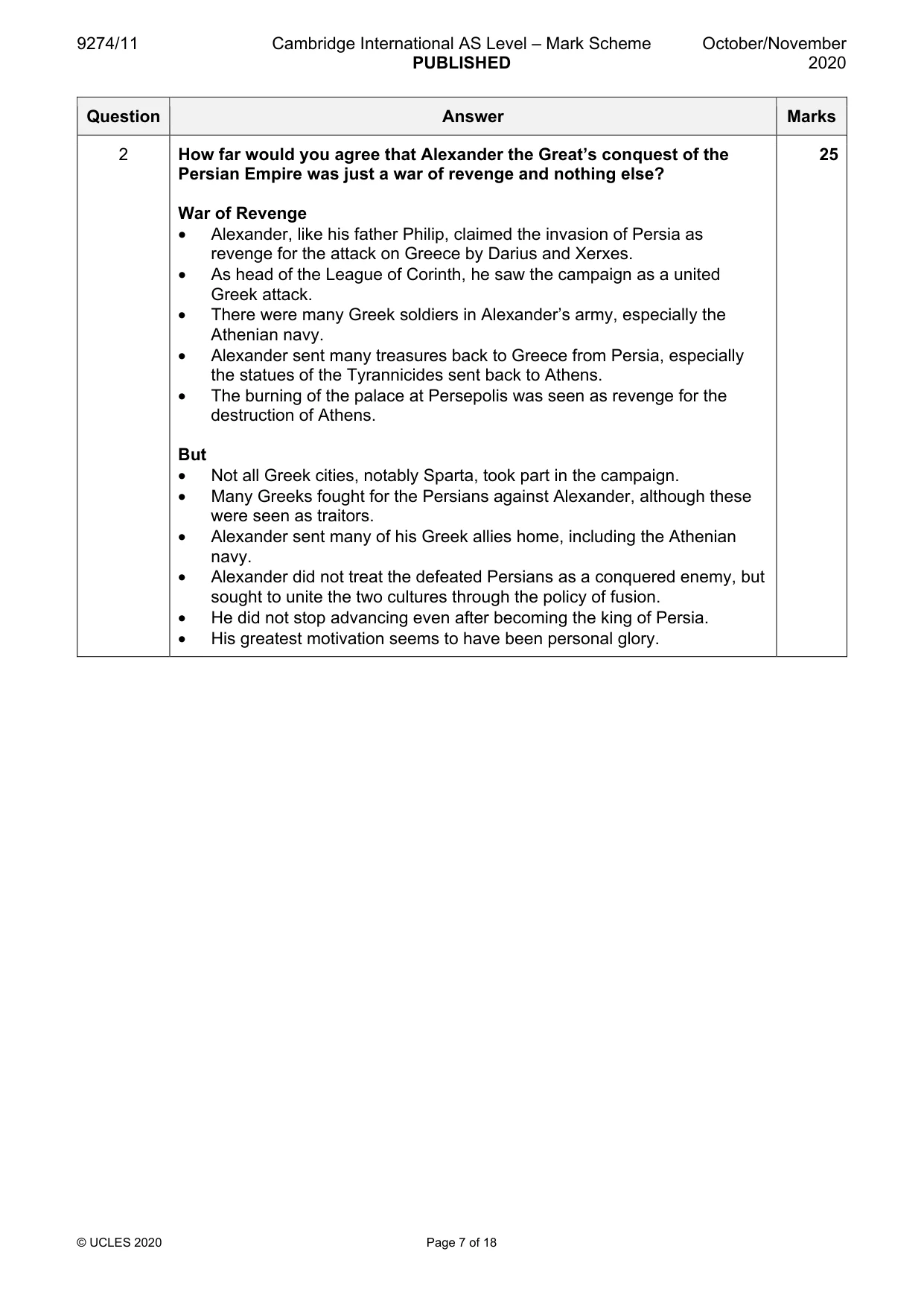
9274/11 Cambridge International AS Level – Mark Scheme PUBLISHED October/November 2020 © UCLES 2020 Page 7 of 18 Question Answer Marks 2 How far would you agree that Alexander the Great’s conquest of the Persian Empire was just a war of revenge and nothing else? War of Revenge • Alexander, like his father Philip, claimed the invasion of Persia as revenge for the attack on Greece by Darius and Xerxes. • As head of the League of Corinth, he saw the campaign as a united Greek attack. • There were many Greek soldiers in Alexander’s army, especially the Athenian navy. • Alexander sent many treasures back to Greece from Persia, especially the statues of the Tyrannicides sent back to Athens. • The burning of the palace at Persepolis was seen as revenge for the destruction of Athens. But • Not all Greek cities, notably Sparta, took part in the campaign. • Many Greeks fought for the Persians against Alexander, although these were seen as traitors. • Alexander sent many of his Greek allies home, including the Athenian navy. • Alexander did not treat the defeated Persians as a conquered enemy, but sought to unite the two cultures through the policy of fusion. • He did not stop advancing even after becoming the king of Persia. • His greatest motivation seems to have been personal glory. 25
Mark scheme, page 8
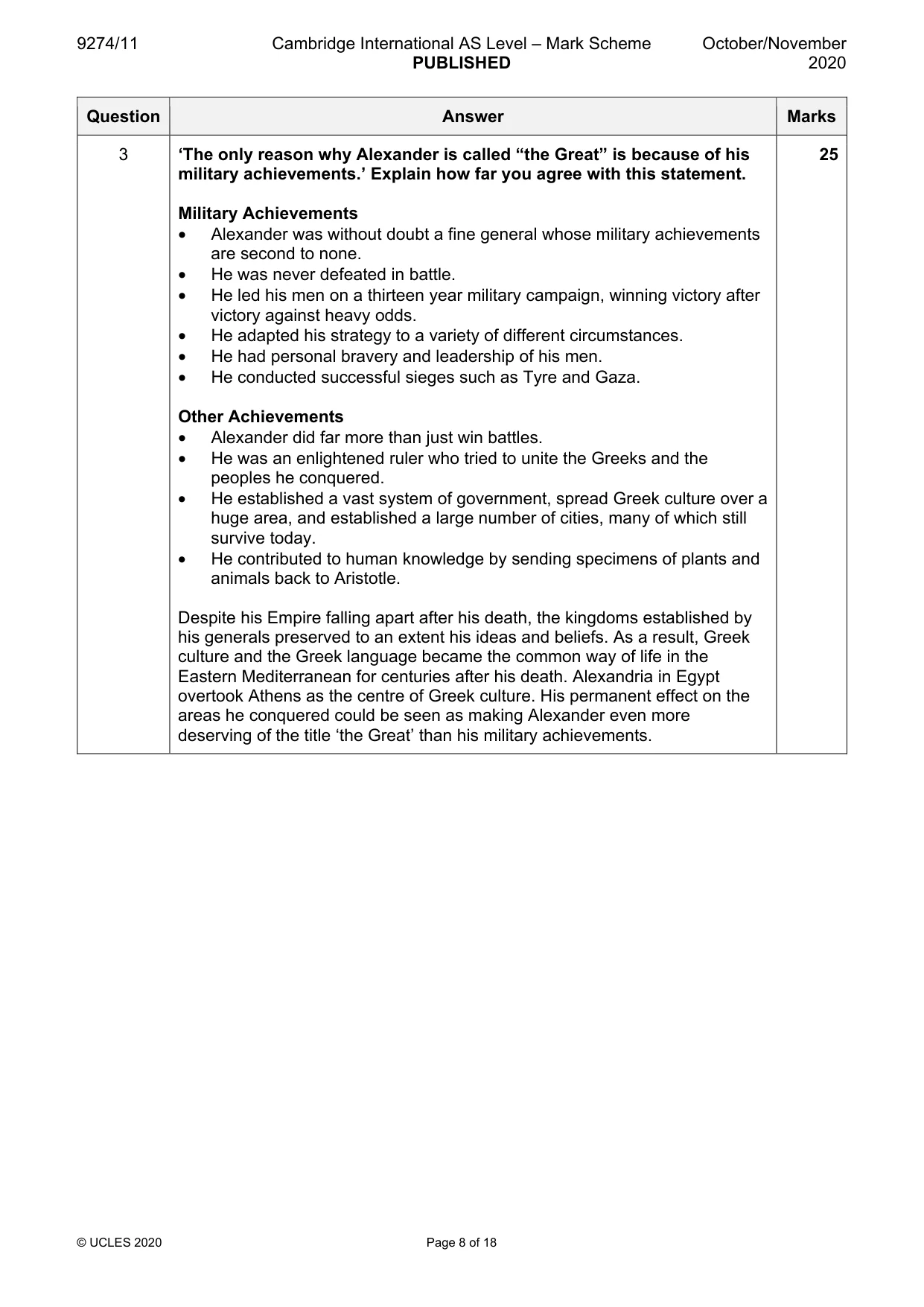
9274/11 Cambridge International AS Level – Mark Scheme PUBLISHED October/November 2020 © UCLES 2020 Page 8 of 18 Question Answer Marks 3 ‘The only reason why Alexander is called “the Great” is because of his military achievements.’ Explain how far you agree with this statement. Military Achievements • Alexander was without doubt a fine general whose military achievements are second to none. • He was never defeated in battle. • He led his men on a thirteen year military campaign, winning victory after victory against heavy odds. • He adapted his strategy to a variety of different circumstances. • He had personal bravery and leadership of his men. • He conducted successful sieges such as Tyre and Gaza. Other Achievements • Alexander did far more than just win battles. • He was an enlightened ruler who tried to unite the Greeks and the peoples he conquered. • He established a vast system of government, spread Greek culture over a huge area, and established a large number of cities, many of which still survive today. • He contributed to human knowledge by sending specimens of plants and animals back to Aristotle. Despite his Empire falling apart after his death, the kingdoms established by his generals preserved to an extent his ideas and beliefs. As a result, Greek culture and the Greek language became the common way of life in the Eastern Mediterranean for centuries after his death. Alexandria in Egypt overtook Athens as the centre of Greek culture. His permanent effect on the areas he conquered could be seen as making Alexander even more deserving of the title ‘the Great’ than his military achievements. 25
Mark scheme, page 9
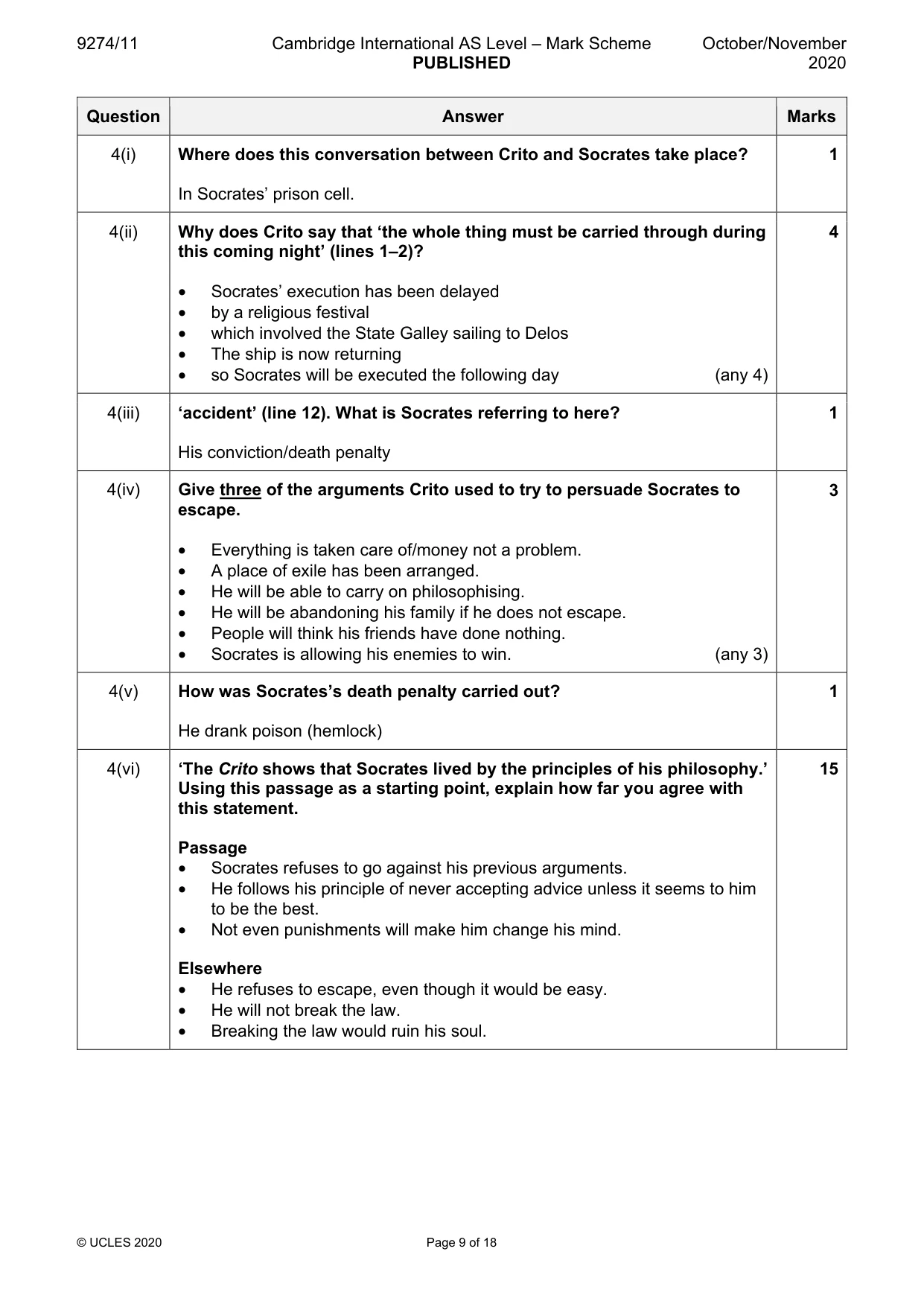
9274/11 Cambridge International AS Level – Mark Scheme PUBLISHED October/November 2020 © UCLES 2020 Page 9 of 18 Question Answer Marks 4(i) Where does this conversation between Crito and Socrates take place? In Socrates’ prison cell. 1 4(ii) Why does Crito say that ‘the whole thing must be carried through during this coming night’ (lines 1–2)? • Socrates’ execution has been delayed • by a religious festival • which involved the State Galley sailing to Delos • The ship is now returning • so Socrates will be executed the following day (any 4) 4 4(iii) ‘accident’ (line 12). What is Socrates referring to here? His conviction/death penalty 1 4(iv) Give three of the arguments Crito used to try to persuade Socrates to escape. • Everything is taken care of/money not a problem. • A place of exile has been arranged. • He will be able to carry on philosophising. • He will be abandoning his family if he does not escape. • People will think his friends have done nothing. • Socrates is allowing his enemies to win. (any 3) 3 4(v) How was Socrates’s death penalty carried out? He drank poison (hemlock) 1 4(vi) ‘The Crito shows that Socrates lived by the principles of his philosophy.’ Using this passage as a starting point, explain how far you agree with this statement. Passage • Socrates refuses to go against his previous arguments. • He follows his principle of never accepting advice unless it seems to him to be the best. • Not even punishments will make him change his mind. Elsewhere • He refuses to escape, even though it would be easy. • He will not break the law. • Breaking the law would ruin his soul. 15
Mark scheme, page 10
9274/11 Cambridge International AS Level – Mark Scheme PUBLISHED October/November 2020 © UCLES 2020 Page 10 of 18 Question Answer Marks 5 From your reading of the Apology, explain how far you agree with Socrates that he deserved to be rewarded rather than punished because he was a benefactor to Athens. In the ektmesis, Socrates claimed that he was a benefactor to Athens who deserved free meals in the Prytaneum as a reward for his work. • He claimed to have done more good for Athens than Olympic victors • He called himself a ‘Stinging Fly’ which stimulated the ‘tired horse’ which was Athens. • He was concerned with looking after peoples’ souls, which is far more important than looking after their bodies. • He believed that showing people how ignorant they were was good for them, as it was the first step to them acquiring wisdom. • He carried out his civic duties, fighting for Athens and preventing miscarriages of justice with the Trial of the Generals, and the arrest of Leon of Salamis. But • He was a destabilising influence on society through his constant questioning. • He was perceived as being anti-democratic. • Many of his ‘students’, such as Critias and Alcibiades, were harmful to Athens. 25
Mark scheme, page 11
9274/11 Cambridge International AS Level – Mark Scheme PUBLISHED October/November 2020 © UCLES 2020 Page 11 of 18 Question Answer Marks 6 ‘A waste of time for all concerned.’ Explain how far you agree with this assessment of the Socratic method. In your answer, you should discuss at least two of the dialogues in The Last Days of Socrates. Each of the dialogues has examples of the Socratic method. Euthyphro The dialogue deals with Socrates’ attempts to discover the true meaning of holiness. Socrates’ style of questioning led to the rejection of each definition offered by Euthyphro, and the dialogue ended without any agreed definition. Euthyphro left in a huff, having been humiliated, while Socrates did not discover what holiness is. Apology The dialogue deals with Socrates’ attempts to defend himself. He used the Socratic method to disprove the charges against him, but he was still found guilty. His questioning of Meletus may even have contributed to his condemnation due to confirming the jurors’ prejudices against him. Crito The dialogue deals with Socrates’ attitude towards morality and correct behaviour, and the duties of the citizen. His questioning of Crito does lead to conclusions about the reasons for Socrates’ refusal to escape, even if Crito still found it strange. Most of this comes not from the Socratic Method, but from Socrates explaining his thoughts to Crito. Phaedo The dialogue deals with Socrates’ views about death and gaining true knowledge. Socrates uses the Socratic Method to prove to his friends that death is nothing to be feared, providing them with a measure of consolation for his death. All of the dialogues contain the Socratic Method to a greater or lesser extent, with mixed results. 25
Mark scheme, page 12
9274/11 Cambridge International AS Level – Mark Scheme PUBLISHED October/November 2020 © UCLES 2020 Page 12 of 18 Question Answer Marks 7(i) From what part of Frogs does this passage come? • Prologue/Act One Scene 1 1 7(ii) ‘Remembering his disguise’ (line 5). Who is Dionysus pretending to be? • Heracles 1 7(iii) ‘we sank twelve enemy ships’ (line 29). To which sea battle does this refer? • Arginusae 1 7(iv) ‘I suddenly felt the most passionate longing’ (line 35). For whom is Dionysus feeling this longing? • Euripides 1 7(v) From this passage, find three examples of Aristophanes' comic technique. Write out the example, identify the technique and explain why it is funny. Any three of the following: • impersonation • role reversal – Xanthias riding the donkey • contemporary references to Cleisthenes • use of stereotypes – Dionysus, Heracles, Xanthias • exaggerated emotional longing for Euripides • mock tragedy; reference to Andromeda • sexual humour - ‘saw a good bit of action’ • visual humour of Dionysus’ costume and action on stage. 6
Mark scheme, page 13
9274/11 Cambridge International AS Level – Mark Scheme PUBLISHED October/November 2020 © UCLES 2020 Page 13 of 18 Question Answer Marks 7(vi) Using this passage as a starting point, discuss how far the presentation of the gods adds to the success of Frogs. Initially the presentation of the gods might seem to be surprising, but this adds to the comedy of the play. In particular, Dionysus is portrayed in an anthropomorphic way: • is easily scared • wets himself • wants to know where the restaurants and brothels are in the Underworld • talks as though dying is a possibility • fat and un-athletic • feels pain. He is also mocked and is presented as a figure of comedy rather than a god in the following ways: • his absurd costume • Heracles’ reaction when seeing him for the first time • the repeated role reversal with Xanthias • his inability to get the Corpse to carry his baggage • does not know how to row a boat • ends up sitting on the oar • at times, seems totally clueless when judging between Aeschylus and Euripides. Heracles is also presented as a figure of fun with his insatiable appetite. The landladies’ and Aeacus’ perceptions of him also make him seem less godlike. It should be noted, however, that Dionysus is worshipped by the Chorus of Initiates and is central to the plot in that he is the one visiting the Underworld to bring back a poet to save Athens as well as being the judge between Euripides and Aeschylus. As such, he is the vehicle to present Aristophanes’ own views. Credit reference to Pluto. 15
Mark scheme, page 14
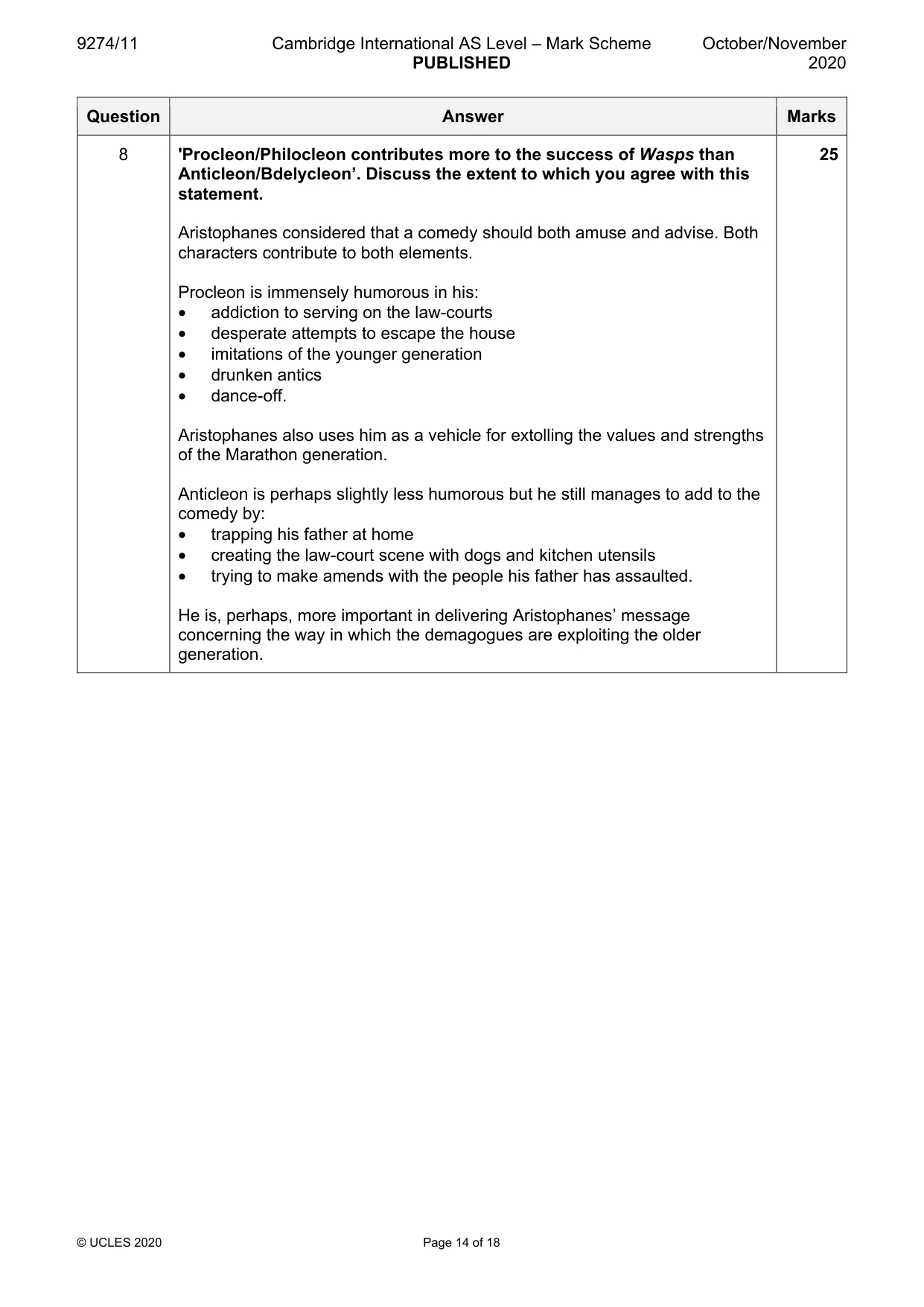
9274/11 Cambridge International AS Level – Mark Scheme PUBLISHED October/November 2020 © UCLES 2020 Page 14 of 18 Question Answer Marks 8 'Procleon/Philocleon contributes more to the success of Wasps than Anticleon/Bdelycleon’. Discuss the extent to which you agree with this statement. Aristophanes considered that a comedy should both amuse and advise. Both characters contribute to both elements. Procleon is immensely humorous in his: • addiction to serving on the law-courts • desperate attempts to escape the house • imitations of the younger generation • drunken antics • dance-off. Aristophanes also uses him as a vehicle for extolling the values and strengths of the Marathon generation. Anticleon is perhaps slightly less humorous but he still manages to add to the comedy by: • trapping his father at home • creating the law-court scene with dogs and kitchen utensils • trying to make amends with the people his father has assaulted. He is, perhaps, more important in delivering Aristophanes’ message concerning the way in which the demagogues are exploiting the older generation. 25
Mark scheme, page 15
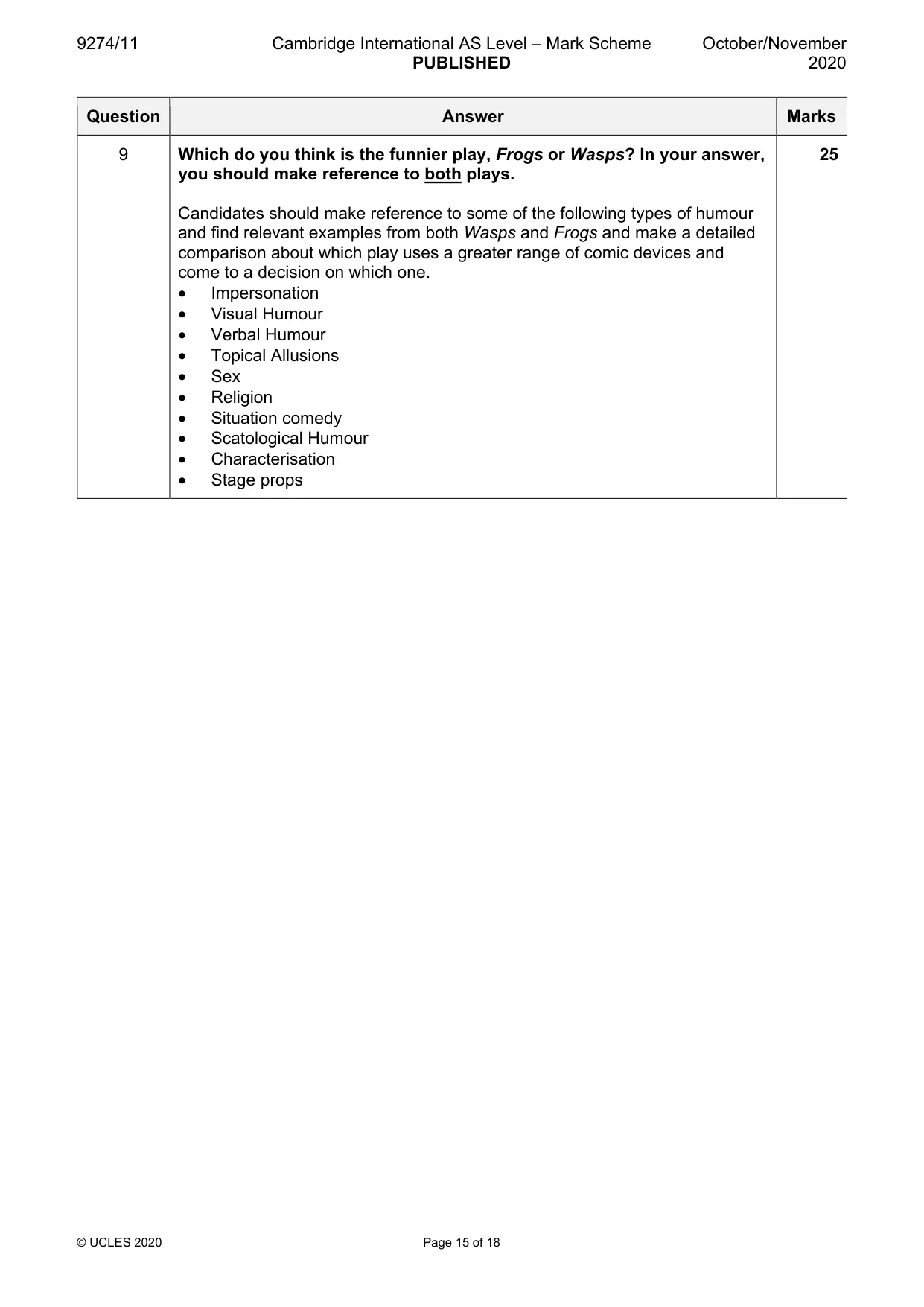
9274/11 Cambridge International AS Level – Mark Scheme PUBLISHED October/November 2020 © UCLES 2020 Page 15 of 18 Question Answer Marks 9 Which do you think is the funnier play, Frogs or Wasps? In your answer, you should make reference to both plays. Candidates should make reference to some of the following types of humour and find relevant examples from both Wasps and Frogs and make a detailed comparison about which play uses a greater range of comic devices and come to a decision on which one. • Impersonation • Visual Humour • Verbal Humour • Topical Allusions • Sex • Religion • Situation comedy • Scatological Humour • Characterisation • Stage props 25
Mark scheme, page 16
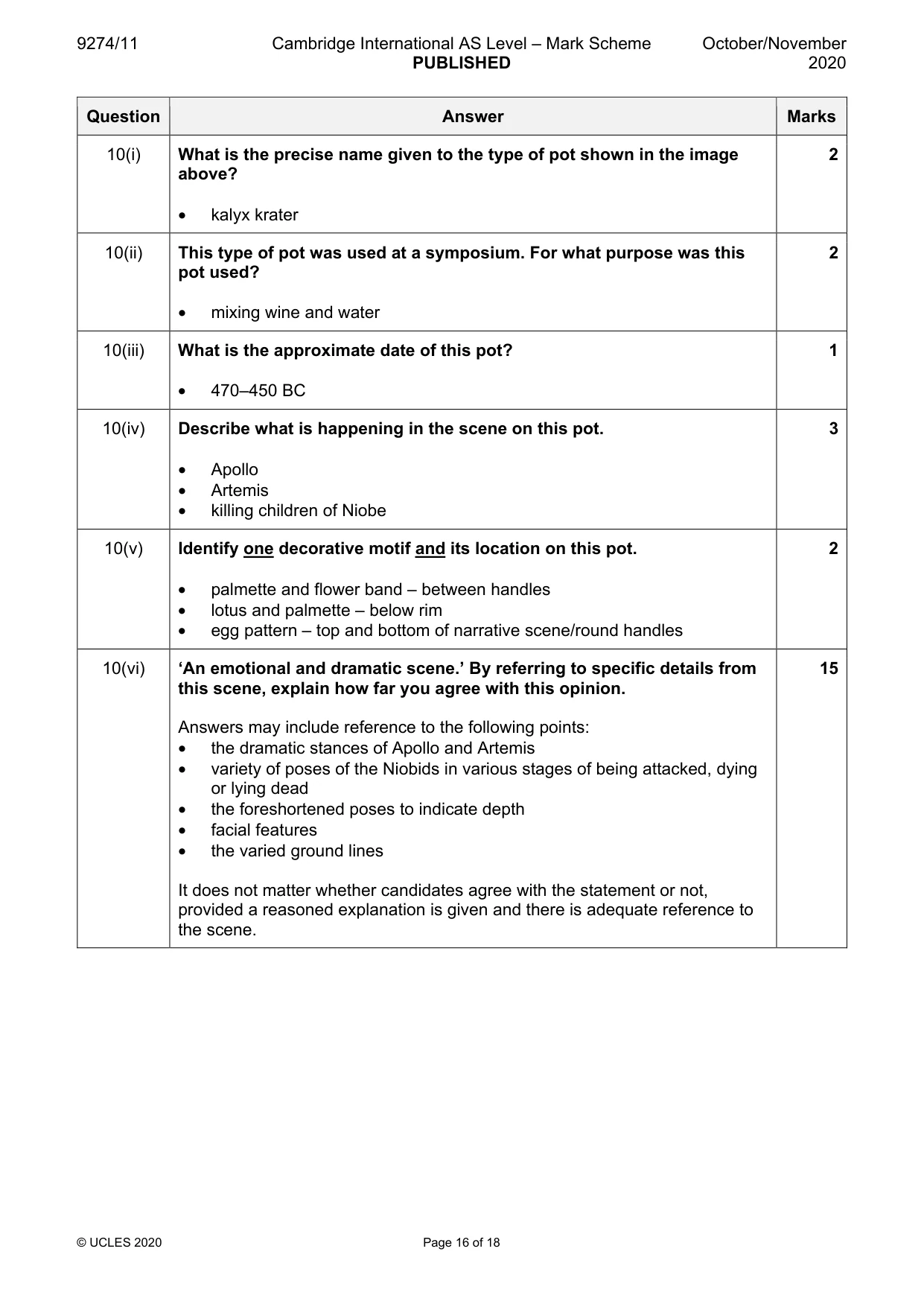
9274/11 Cambridge International AS Level – Mark Scheme PUBLISHED October/November 2020 © UCLES 2020 Page 16 of 18 Question Answer Marks 10(i) What is the precise name given to the type of pot shown in the image above? • kalyx krater 2 10(ii) This type of pot was used at a symposium. For what purpose was this pot used? • mixing wine and water 2 10(iii) What is the approximate date of this pot? • 470–450 BC 1 10(iv) Describe what is happening in the scene on this pot. • Apollo • Artemis • killing children of Niobe 3 10(v) Identify one decorative motif and its location on this pot. • palmette and flower band – between handles • lotus and palmette – below rim • egg pattern – top and bottom of narrative scene/round handles 2 10(vi) ‘An emotional and dramatic scene.’ By referring to specific details from this scene, explain how far you agree with this opinion. Answers may include reference to the following points: • the dramatic stances of Apollo and Artemis • variety of poses of the Niobids in various stages of being attacked, dying or lying dead • the foreshortened poses to indicate depth • facial features • the varied ground lines It does not matter whether candidates agree with the statement or not, provided a reasoned explanation is given and there is adequate reference to the scene. 15
Mark scheme, page 17
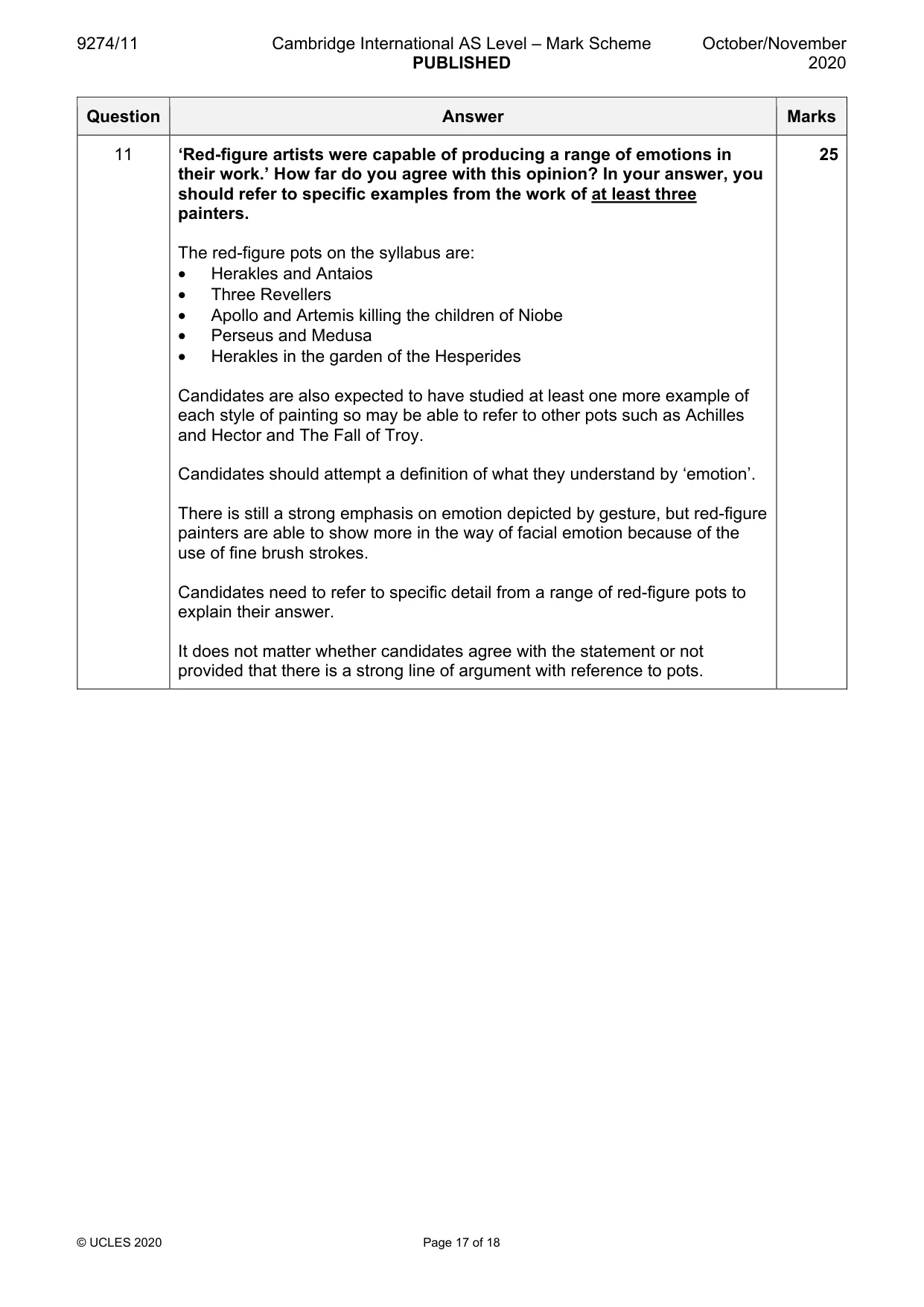
9274/11 Cambridge International AS Level – Mark Scheme PUBLISHED October/November 2020 © UCLES 2020 Page 17 of 18 Question Answer Marks 11 ‘Red-figure artists were capable of producing a range of emotions in their work.’ How far do you agree with this opinion? In your answer, you should refer to specific examples from the work of at least three painters. The red-figure pots on the syllabus are: • Herakles and Antaios • Three Revellers • Apollo and Artemis killing the children of Niobe • Perseus and Medusa • Herakles in the garden of the Hesperides Candidates are also expected to have studied at least one more example of each style of painting so may be able to refer to other pots such as Achilles and Hector and The Fall of Troy. Candidates should attempt a definition of what they understand by ‘emotion’. There is still a strong emphasis on emotion depicted by gesture, but red-figure painters are able to show more in the way of facial emotion because of the use of fine brush strokes. Candidates need to refer to specific detail from a range of red-figure pots to explain their answer. It does not matter whether candidates agree with the statement or not provided that there is a strong line of argument with reference to pots. 25
Mark scheme, page 18
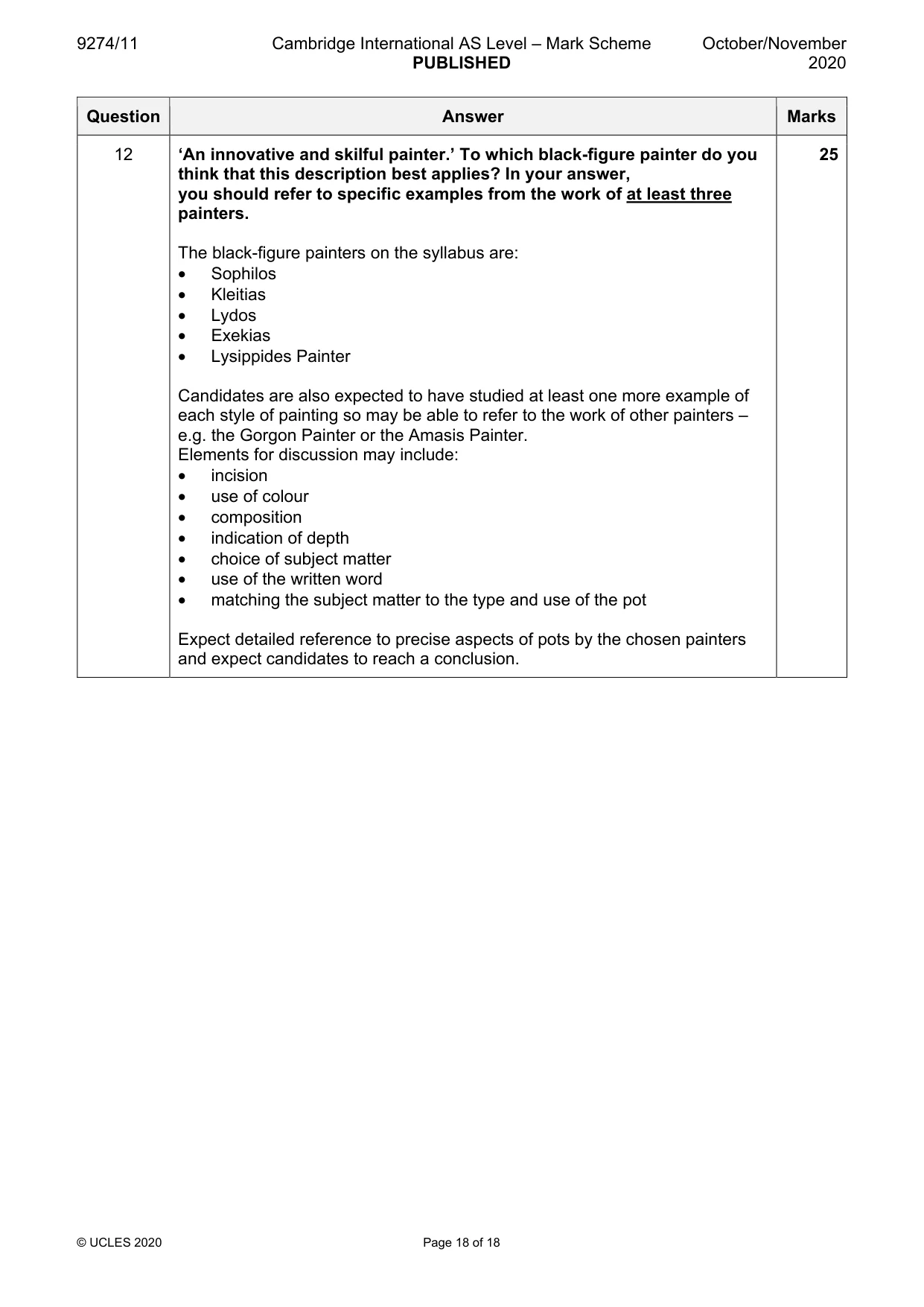
9274/11 Cambridge International AS Level – Mark Scheme PUBLISHED October/November 2020 © UCLES 2020 Page 18 of 18 Question Answer Marks 12 ‘An innovative and skilful painter.’ To which black-figure painter do you think that this description best applies? In your answer, you should refer to specific examples from the work of at least three painters. The black-figure painters on the syllabus are: • Sophilos • Kleitias • Lydos • Exekias • Lysippides Painter Candidates are also expected to have studied at least one more example of each style of painting so may be able to refer to the work of other painters – e.g. the Gorgon Painter or the Amasis Painter. Elements for discussion may include: • incision • use of colour • composition • indication of depth • choice of subject matter • use of the written word • matching the subject matter to the type and use of the pot Expect detailed reference to precise aspects of pots by the chosen painters and expect candidates to reach a conclusion. 25
What you needed in this session
Cambridge’s own grade thresholds for 2020 Oct/Nov, Paper 1 · Variant 1. A higher threshold means an easier paper — the bar moves with how the cohort did.