Cambridge A Level Classical Studies 9274 — 2022 Oct/Nov Paper 1 · Variant 1
9274/11/O/N/22 · 50 marks · ≈56 min
The question paper and its mark scheme, free to read here and free to download. This is Cambridge’s own paper, exactly as it was sat.
Question paper8 pages



Mark scheme18 pages
Answers below. Sit the paper first if you are practising.
Paper as text
Question paper, page 1
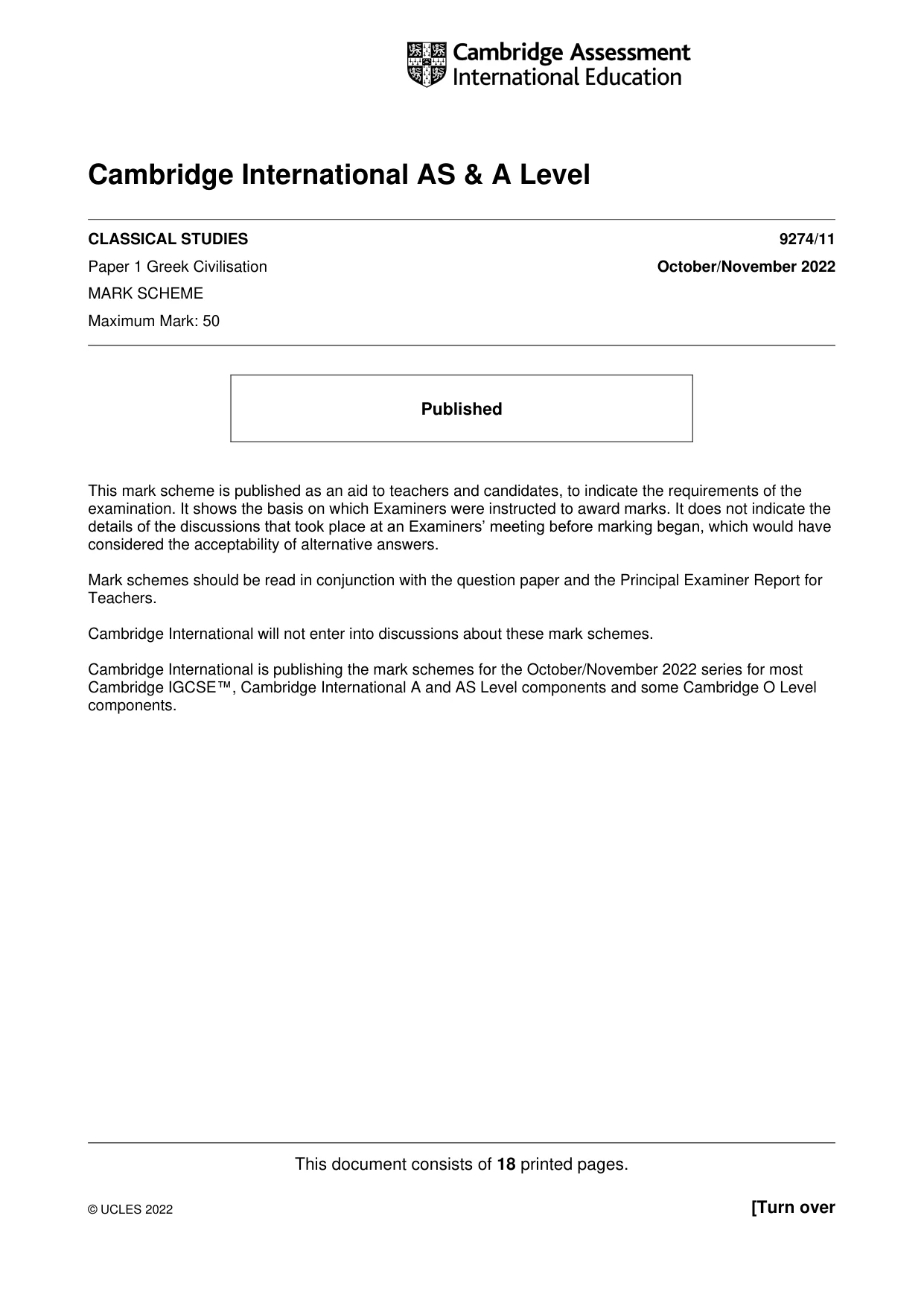
This document has 8 pages. Any blank pages are indicated. [Turn over Cambridge International AS & A Level CLASSICAL STUDIES 9274/11 Paper 1 Greek Civilisation October/November 2022 1 hour 30 minutes You must answer on the enclosed answer booklet. You will need: Answer booklet (enclosed) INSTRUCTIONS ● Answer two questions in total: Answer questions from one section only. For each section, follow the instructions inside on which questions to answer. ● Follow the instructions on the front cover of the answer booklet. If you need additional answer paper, ask the invigilator for a continuation booklet. INFORMATION ● The total mark for this paper is 50. ● The number of marks for each question or part question is shown in brackets [ ]. * 6 9 2 5 1 2 2 5 9 9 * DC (CJ/FC) 302667/2 © UCLES 2022
Question paper, page 2
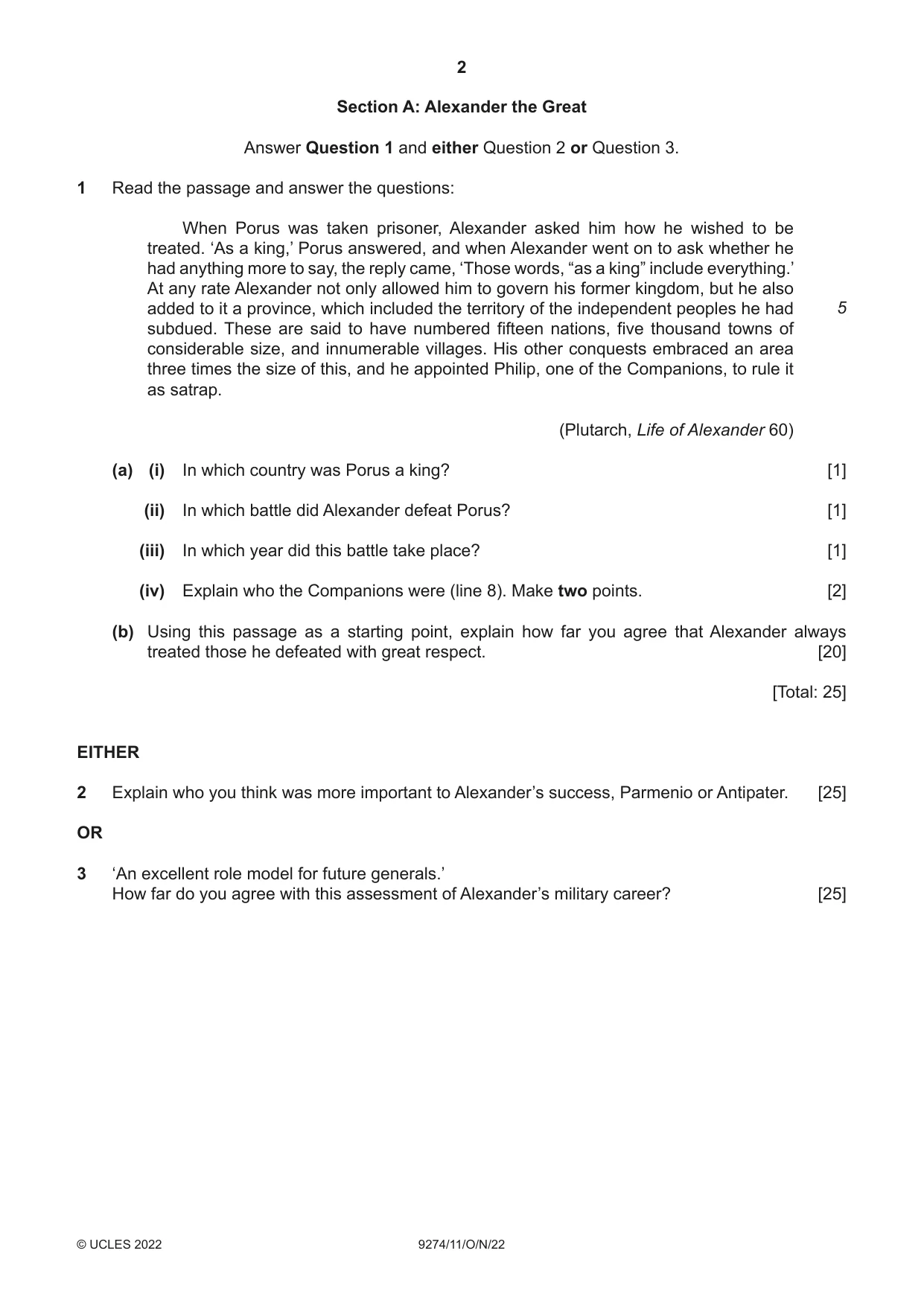
2 9274/11/O/N/22 © UCLES 2022 Section A: Alexander the Great Answer Question 1 and either Question 2 or Question 3. 1 Read the passage and answer the questions: When Porus was taken prisoner, Alexander asked him how he wished to be treated. ‘As a king,’ Porus answered, and when Alexander went on to ask whether he had anything more to say, the reply came, ‘Those words, “as a king” include everything.’ At any rate Alexander not only allowed him to govern his former kingdom, but he also added to it a province, which included the territory of the independent peoples he had subdued. These are said to have numbered fifteen nations, five thousand towns of considerable size, and innumerable villages. His other conquests embraced an area three times the size of this, and he appointed Philip, one of the Companions, to rule it as satrap. (Plutarch, Life of Alexander 60) (a) (i) In which country was Porus a king? [1] (ii) In which battle did Alexander defeat Porus? [1] (iii) In which year did this battle take place? [1] (iv) Explain who the Companions were (line 8). Make two points. [2] (b) Using this passage as a starting point, explain how far you agree that Alexander always treated those he defeated with great respect. [20] [Total: 25] EITHER 2 Explain who you think was more important to Alexander’s success, Parmenio or Antipater. [25] OR 3 ‘An excellent role model for future generals.’ How far do you agree with this assessment of Alexander’s military career? [25] 5
Question paper, page 3
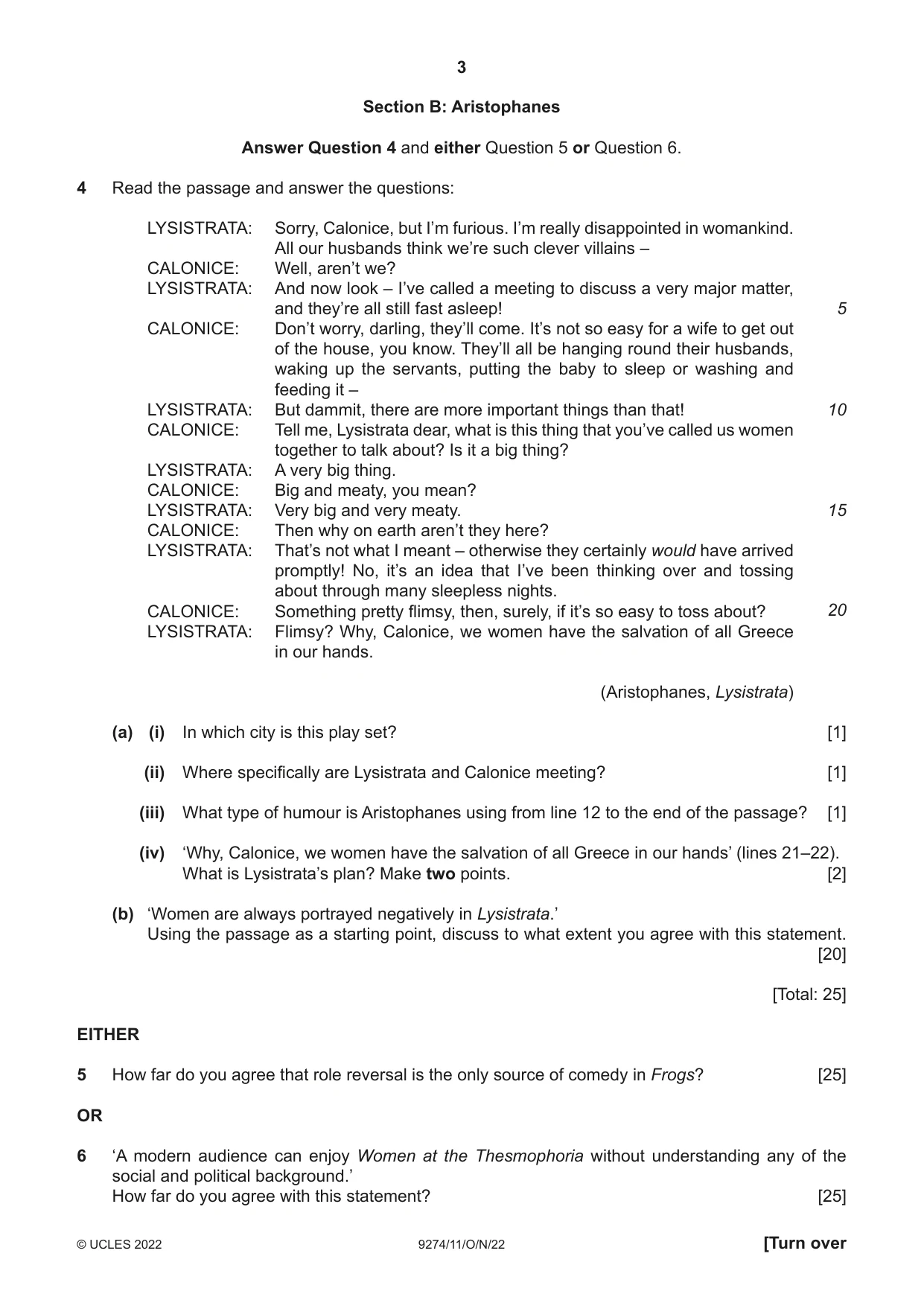
3 9274/11/O/N/22 © UCLES 2022 [Turn over Section B: Aristophanes Answer Question 4 and either Question 5 or Question 6. 4 Read the passage and answer the questions: LYSISTRATA: Sorry, Calonice, but I’m furious. I’m really disappointed in womankind. All our husbands think we’re such clever villains – CALONICE: Well, aren’t we? LYSISTRATA: And now look – I’ve called a meeting to discuss a very major matter, and they’re all still fast asleep! CALONICE: Don’t worry, darling, they’ll come. It’s not so easy for a wife to get out of the house, you know. They’ll all be hanging round their husbands, waking up the servants, putting the baby to sleep or washing and feeding it – LYSISTRATA: But dammit, there are more important things than that! CALONICE: Tell me, Lysistrata dear, what is this thing that you’ve called us women together to talk about? Is it a big thing? LYSISTRATA: A very big thing. CALONICE: Big and meaty, you mean? LYSISTRATA: Very big and very meaty. CALONICE: Then why on earth aren’t they here? LYSISTRATA: That’s not what I meant – otherwise they certainly would have arrived promptly! No, it’s an idea that I’ve been thinking over and tossing about through many sleepless nights. CALONICE: Something pretty flimsy, then, surely, if it’s so easy to toss about? LYSISTRATA: Flimsy? Why, Calonice, we women have the salvation of all Greece in our hands. (Aristophanes, Lysistrata) (a) (i) In which city is this play set? [1] (ii) Where specifically are Lysistrata and Calonice meeting? [1] (iii) What type of humour is Aristophanes using from line 12 to the end of the passage? [1] (iv) ‘Why, Calonice, we women have the salvation of all Greece in our hands’ (lines 21–22). What is Lysistrata’s plan? Make two points. [2] (b) ‘Women are always portrayed negatively in Lysistrata.’ Using the passage as a starting point, discuss to what extent you agree with this statement. [20] [Total: 25] EITHER 5 How far do you agree that role reversal is the only source of comedy in Frogs? [25] OR 6 ‘A modern audience can enjoy Women at the Thesmophoria without understanding any of the social and political background.’ How far do you agree with this statement? [25] 5 10 15 20
Question paper, page 4
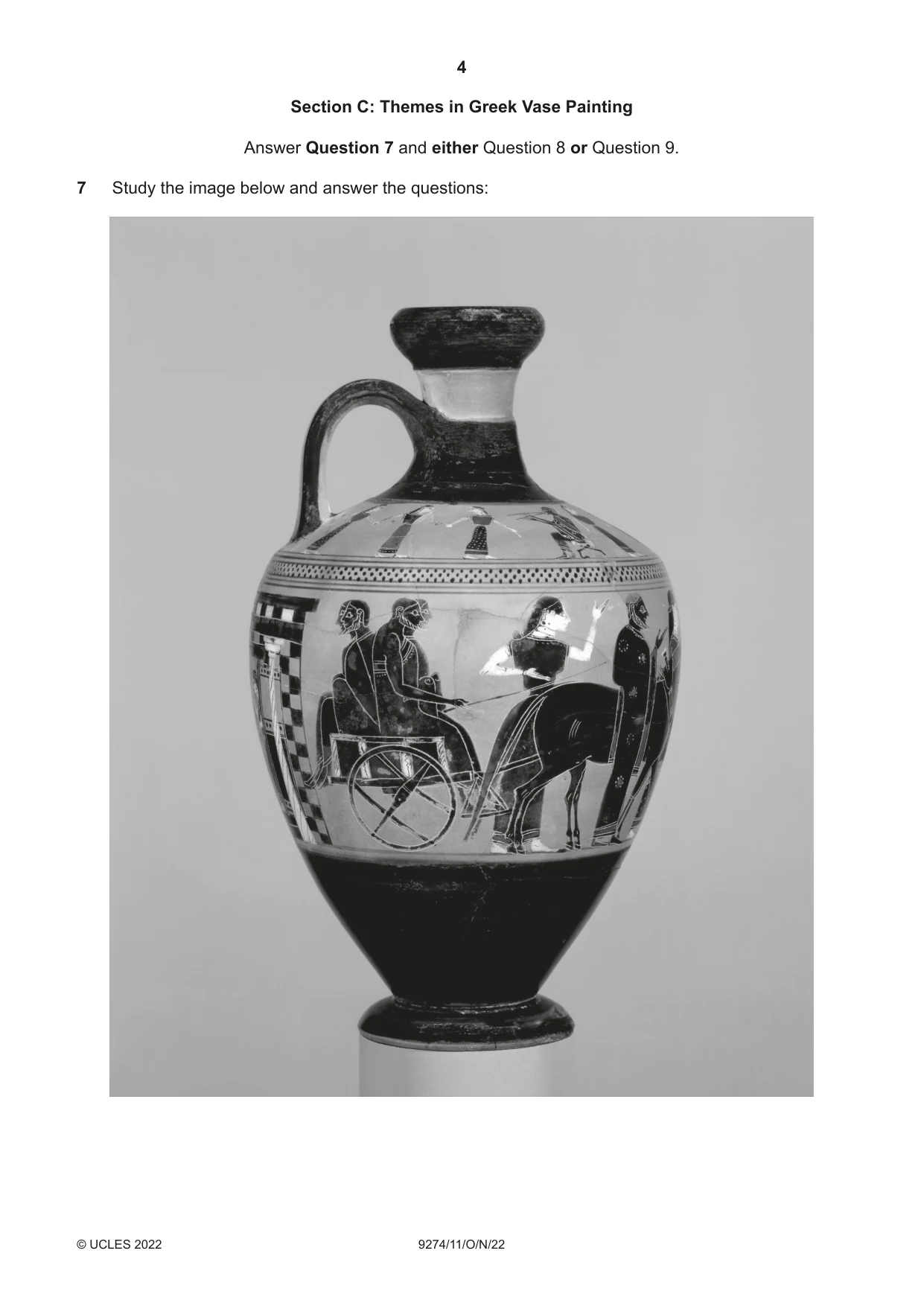
4 9274/11/O/N/22 © UCLES 2022 Section C: Themes in Greek Vase Painting Answer Question 7 and either Question 8 or Question 9. 7 Study the image below and answer the questions:
Question paper, page 5
5 9274/11/O/N/22 © UCLES 2022 (a) (i) What is the technical name given to the shape of this pot? [2] (ii) Give the approximate date of this pot. [1] (iii) What technique has been used to decorate this pot? [1] (iv) Identify the event depicted on this pot. [1] (b) ‘The artist has created a lively scene.’ How far do you agree with this opinion? In your answer, you should include discussion of specific examples of the content and composition of this pot. [20] [Total: 25] EITHER 8 ‘Achilles was a popular subject for Greek vase painters.’ What opportunities and challenges did this subject offer to vase painters? Explain your answer with reference to specific pots depicting scenes with Achilles. [25] OR 9 ‘Painters of red-figure pots were always imaginative and creative.’ How far do you agree with this point of view? In your answer, you should refer to specific details from pots you have studied. [25]
Question paper, page 6
6 9274/11/O/N/22 © UCLES 2022 BLANK PAGE
Question paper, page 7
7 9274/11/O/N/22 © UCLES 2022 BLANK PAGE
Question paper, page 8
8 9274/11/O/N/22 © UCLES 2022 Permission to reproduce items where third-party owned material protected by copyright is included has been sought and cleared where possible. Every reasonable effort has been made by the publisher (UCLES) to trace copyright holders, but if any items requiring clearance have unwittingly been included, the publisher will be pleased to make amends at the earliest possible opportunity. To avoid the issue of disclosure of answer-related information to candidates, all copyright acknowledgements are reproduced online in the Cambridge Assessment International Education Copyright Acknowledgements Booklet. This is produced for each series of examinations and is freely available to download at www.cambridgeinternational.org after the live examination series. Cambridge Assessment International Education is part of Cambridge Assessment. Cambridge Assessment is the brand name of the University of Cambridge Local Examinations Syndicate (UCLES), which is a department of the University of Cambridge. BLANK PAGE
Mark scheme, page 1
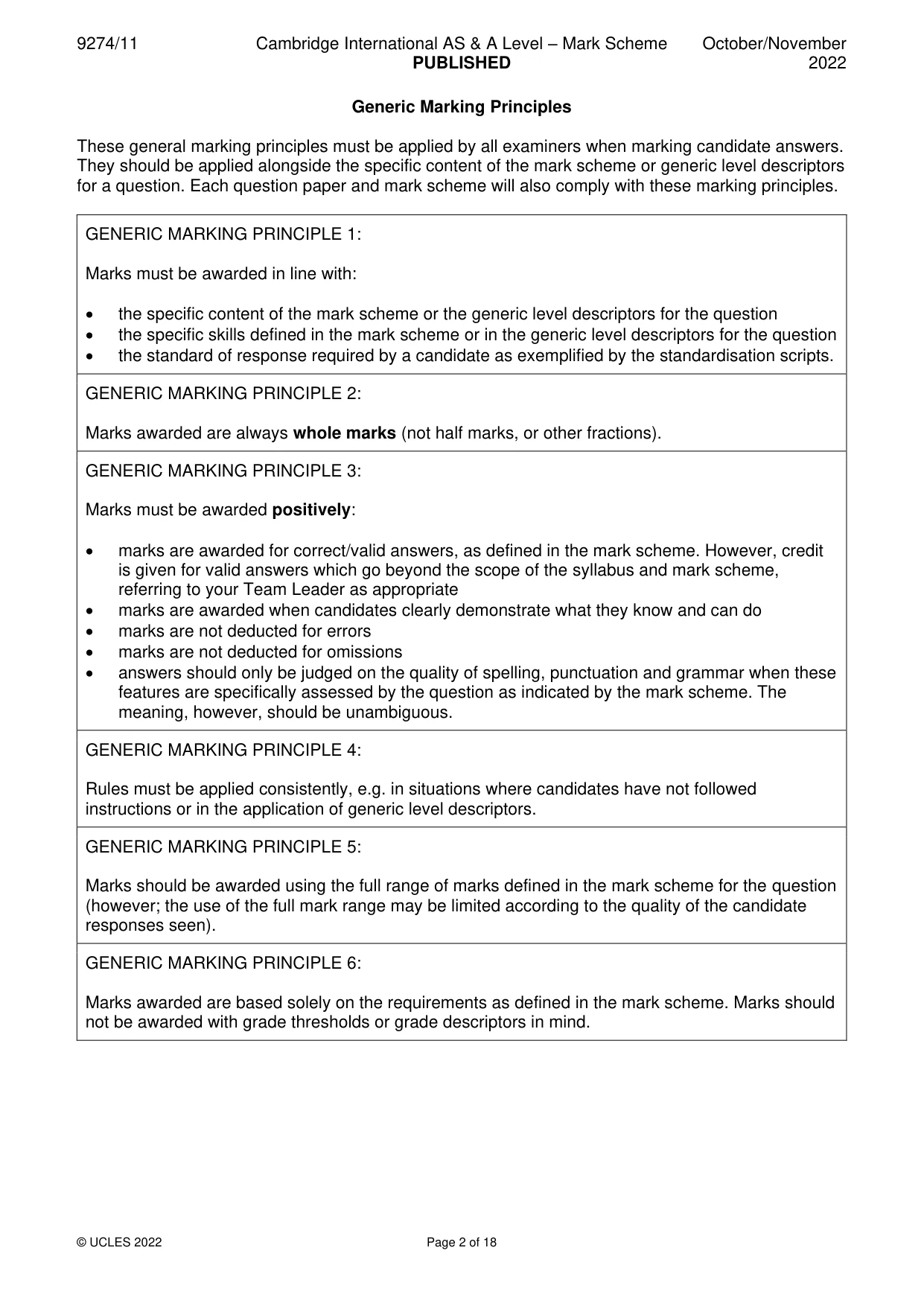
This document consists of 18 printed pages. © UCLES 2022 [Turn over Cambridge International AS & A Level CLASSICAL STUDIES 9274/11 Paper 1 Greek Civilisation October/November 2022 MARK SCHEME Maximum Mark: 50 Published This mark scheme is published as an aid to teachers and candidates, to indicate the requirements of the examination. It shows the basis on which Examiners were instructed to award marks. It does not indicate the details of the discussions that took place at an Examiners’ meeting before marking began, which would have considered the acceptability of alternative answers. Mark schemes should be read in conjunction with the question paper and the Principal Examiner Report for Teachers. Cambridge International will not enter into discussions about these mark schemes. Cambridge International is publishing the mark schemes for the October/November 2022 series for most Cambridge IGCSE™, Cambridge International A and AS Level components and some Cambridge O Level components.
Mark scheme, page 2
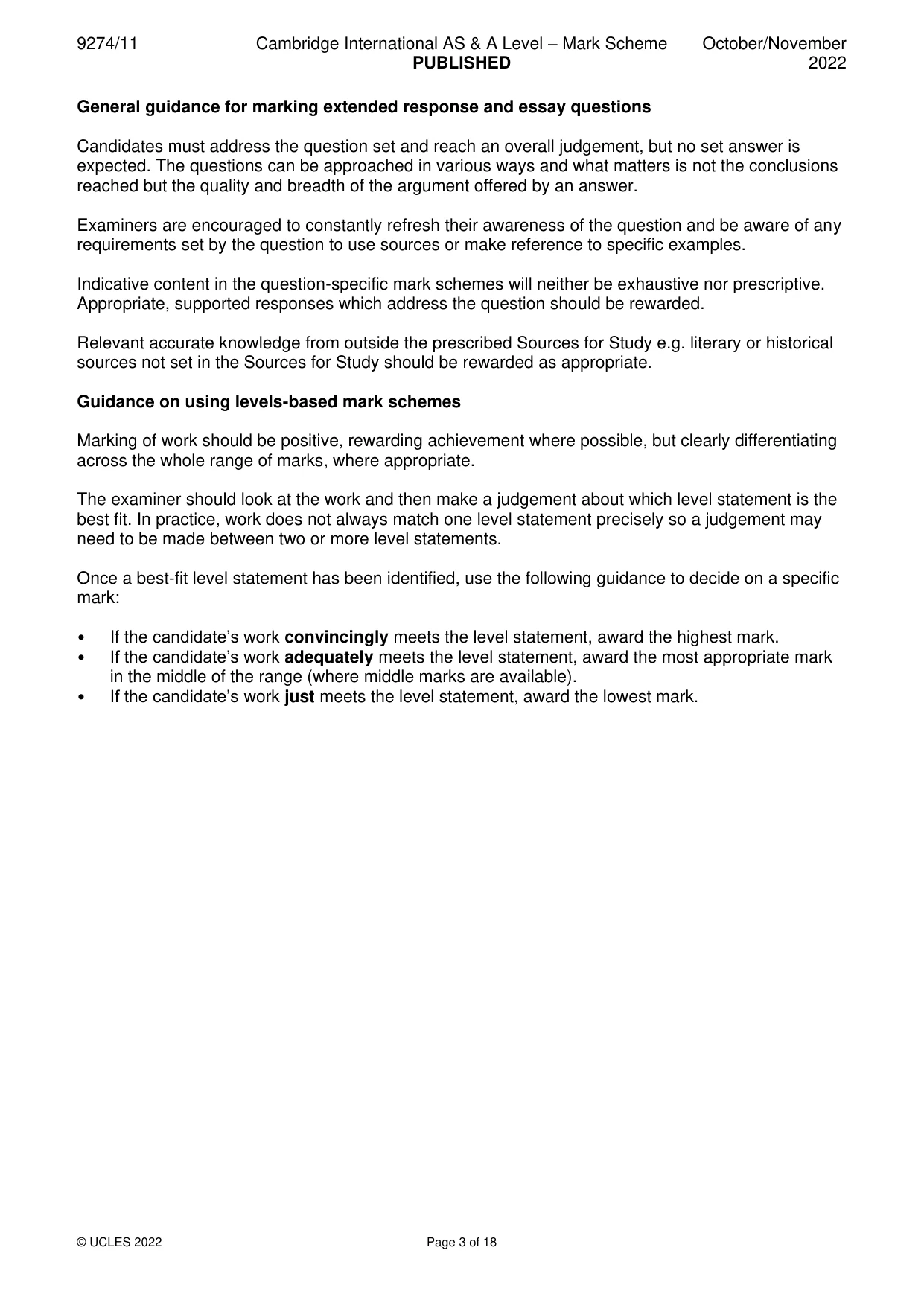
9274/11 Cambridge International AS & A Level – Mark Scheme PUBLISHED October/November 2022 © UCLES 2022 Page 2 of 18 Generic Marking Principles These general marking principles must be applied by all examiners when marking candidate answers. They should be applied alongside the specific content of the mark scheme or generic level descriptors for a question. Each question paper and mark scheme will also comply with these marking principles. GENERIC MARKING PRINCIPLE 1: Marks must be awarded in line with: • the specific content of the mark scheme or the generic level descriptors for the question • the specific skills defined in the mark scheme or in the generic level descriptors for the question • the standard of response required by a candidate as exemplified by the standardisation scripts. GENERIC MARKING PRINCIPLE 2: Marks awarded are always whole marks (not half marks, or other fractions). GENERIC MARKING PRINCIPLE 3: Marks must be awarded positively: • marks are awarded for correct/valid answers, as defined in the mark scheme. However, credit is given for valid answers which go beyond the scope of the syllabus and mark scheme, referring to your Team Leader as appropriate • marks are awarded when candidates clearly demonstrate what they know and can do • marks are not deducted for errors • marks are not deducted for omissions • answers should only be judged on the quality of spelling, punctuation and grammar when these features are specifically assessed by the question as indicated by the mark scheme. The meaning, however, should be unambiguous. GENERIC MARKING PRINCIPLE 4: Rules must be applied consistently, e.g. in situations where candidates have not followed instructions or in the application of generic level descriptors. GENERIC MARKING PRINCIPLE 5: Marks should be awarded using the full range of marks defined in the mark scheme for the question (however; the use of the full mark range may be limited according to the quality of the candidate responses seen). GENERIC MARKING PRINCIPLE 6: Marks awarded are based solely on the requirements as defined in the mark scheme. Marks should not be awarded with grade thresholds or grade descriptors in mind.
Mark scheme, page 3
9274/11 Cambridge International AS & A Level – Mark Scheme PUBLISHED October/November 2022 © UCLES 2022 Page 3 of 18 General guidance for marking extended response and essay questions Candidates must address the question set and reach an overall judgement, but no set answer is expected. The questions can be approached in various ways and what matters is not the conclusions reached but the quality and breadth of the argument offered by an answer. Examiners are encouraged to constantly refresh their awareness of the question and be aware of any requirements set by the question to use sources or make reference to specific examples. Indicative content in the question-specific mark schemes will neither be exhaustive nor prescriptive. Appropriate, supported responses which address the question should be rewarded. Relevant accurate knowledge from outside the prescribed Sources for Study e.g. literary or historical sources not set in the Sources for Study should be rewarded as appropriate. Guidance on using levels-based mark schemes Marking of work should be positive, rewarding achievement where possible, but clearly differentiating across the whole range of marks, where appropriate. The examiner should look at the work and then make a judgement about which level statement is the best fit. In practice, work does not always match one level statement precisely so a judgement may need to be made between two or more level statements. Once a best-fit level statement has been identified, use the following guidance to decide on a specific mark: • If the candidate’s work convincingly meets the level statement, award the highest mark. • If the candidate’s work adequately meets the level statement, award the most appropriate mark in the middle of the range (where middle marks are available). • If the candidate’s work just meets the level statement, award the lowest mark.
Mark scheme, page 4
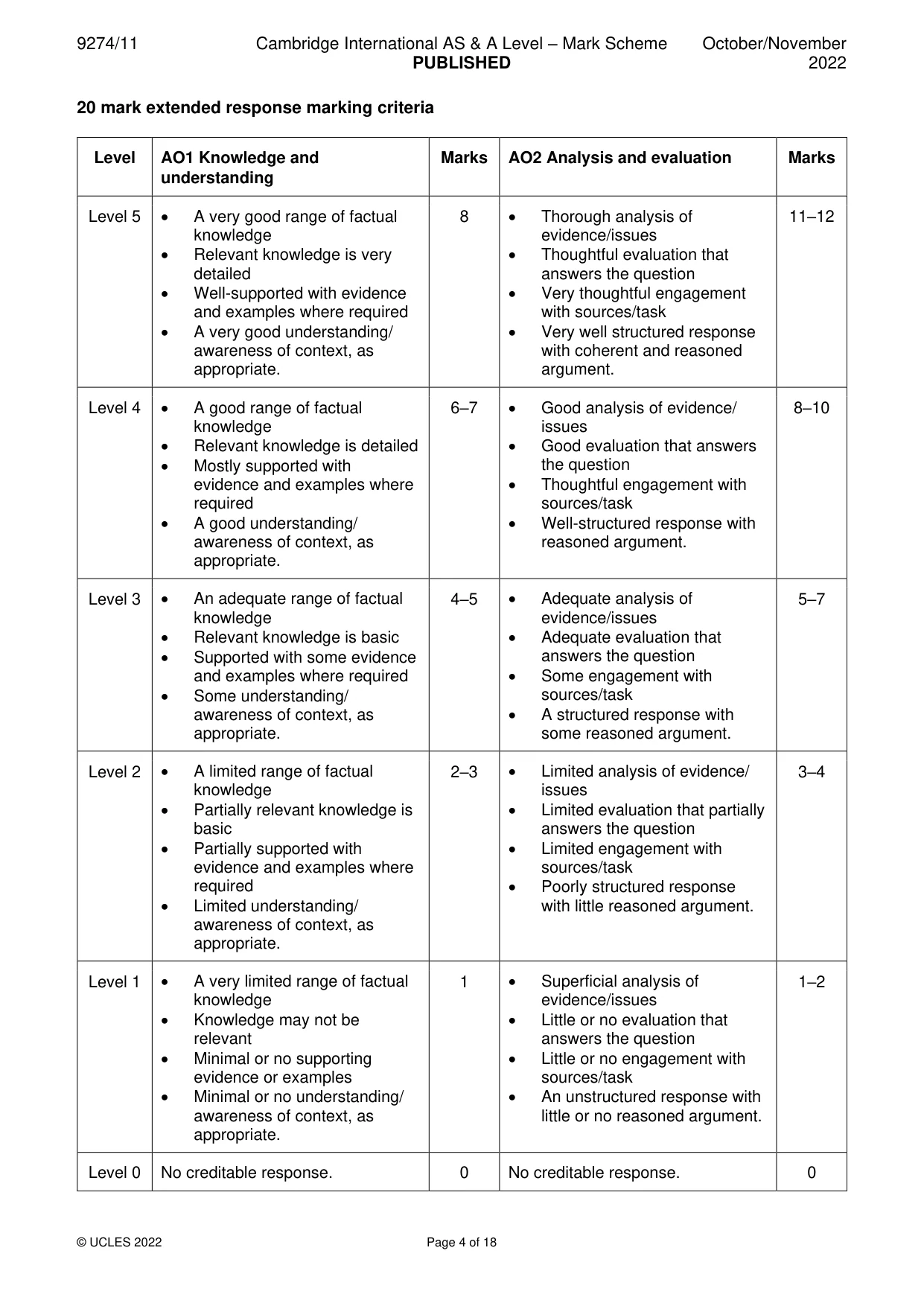
9274/11 Cambridge International AS & A Level – Mark Scheme PUBLISHED October/November 2022 © UCLES 2022 Page 4 of 18 20 mark extended response marking criteria Level AO1 Knowledge and understanding Marks AO2 Analysis and evaluation Marks Level 5 • A very good range of factual knowledge • Relevant knowledge is very detailed • Well-supported with evidence and examples where required • A very good understanding/ awareness of context, as appropriate. 8 • Thorough analysis of evidence/issues • Thoughtful evaluation that answers the question • Very thoughtful engagement with sources/task • Very well structured response with coherent and reasoned argument. 11–12 Level 4 • A good range of factual knowledge • Relevant knowledge is detailed • Mostly supported with evidence and examples where required • A good understanding/ awareness of context, as appropriate. 6–7 • Good analysis of evidence/ issues • Good evaluation that answers the question • Thoughtful engagement with sources/task • Well-structured response with reasoned argument. 8–10 Level 3 • An adequate range of factual knowledge • Relevant knowledge is basic • Supported with some evidence and examples where required • Some understanding/ awareness of context, as appropriate. 4–5 • Adequate analysis of evidence/issues • Adequate evaluation that answers the question • Some engagement with sources/task • A structured response with some reasoned argument. 5–7 Level 2 • A limited range of factual knowledge • Partially relevant knowledge is basic • Partially supported with evidence and examples where required • Limited understanding/ awareness of context, as appropriate. 2–3 • Limited analysis of evidence/ issues • Limited evaluation that partially answers the question • Limited engagement with sources/task • Poorly structured response with little reasoned argument. 3–4 Level 1 • A very limited range of factual knowledge • Knowledge may not be relevant • Minimal or no supporting evidence or examples • Minimal or no understanding/ awareness of context, as appropriate. 1 • Superficial analysis of evidence/issues • Little or no evaluation that answers the question • Little or no engagement with sources/task • An unstructured response with little or no reasoned argument. 1–2 Level 0 No creditable response. 0 No creditable response. 0
Mark scheme, page 5
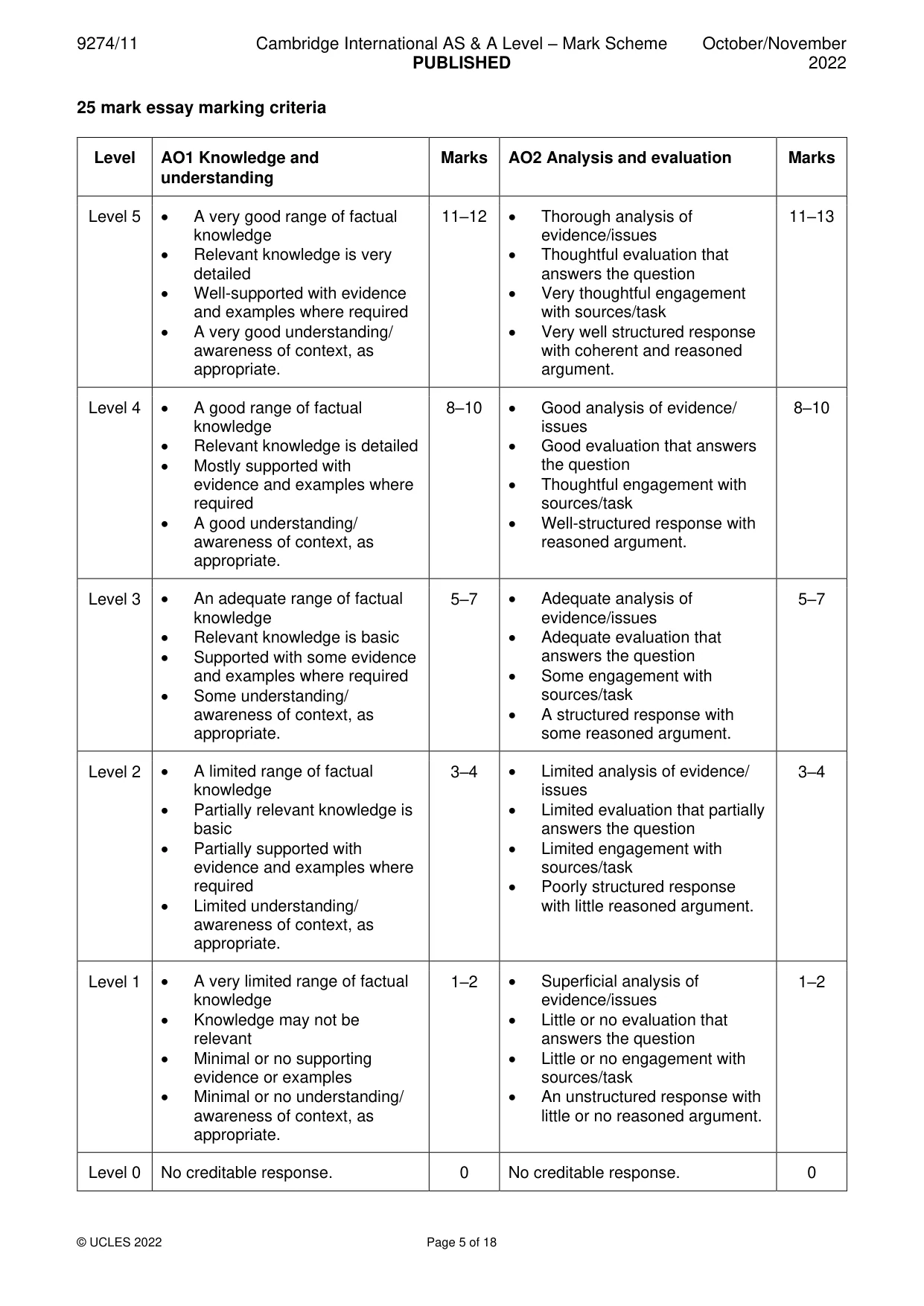
9274/11 Cambridge International AS & A Level – Mark Scheme PUBLISHED October/November 2022 © UCLES 2022 Page 5 of 18 25 mark essay marking criteria Level AO1 Knowledge and understanding Marks AO2 Analysis and evaluation Marks Level 5 • A very good range of factual knowledge • Relevant knowledge is very detailed • Well-supported with evidence and examples where required • A very good understanding/ awareness of context, as appropriate. 11–12 • Thorough analysis of evidence/issues • Thoughtful evaluation that answers the question • Very thoughtful engagement with sources/task • Very well structured response with coherent and reasoned argument. 11–13 Level 4 • A good range of factual knowledge • Relevant knowledge is detailed • Mostly supported with evidence and examples where required • A good understanding/ awareness of context, as appropriate. 8–10 • Good analysis of evidence/ issues • Good evaluation that answers the question • Thoughtful engagement with sources/task • Well-structured response with reasoned argument. 8–10 Level 3 • An adequate range of factual knowledge • Relevant knowledge is basic • Supported with some evidence and examples where required • Some understanding/ awareness of context, as appropriate. 5–7 • Adequate analysis of evidence/issues • Adequate evaluation that answers the question • Some engagement with sources/task • A structured response with some reasoned argument. 5–7 Level 2 • A limited range of factual knowledge • Partially relevant knowledge is basic • Partially supported with evidence and examples where required • Limited understanding/ awareness of context, as appropriate. 3–4 • Limited analysis of evidence/ issues • Limited evaluation that partially answers the question • Limited engagement with sources/task • Poorly structured response with little reasoned argument. 3–4 Level 1 • A very limited range of factual knowledge • Knowledge may not be relevant • Minimal or no supporting evidence or examples • Minimal or no understanding/ awareness of context, as appropriate. 1–2 • Superficial analysis of evidence/issues • Little or no evaluation that answers the question • Little or no engagement with sources/task • An unstructured response with little or no reasoned argument. 1–2 Level 0 No creditable response. 0 No creditable response. 0
Mark scheme, page 6
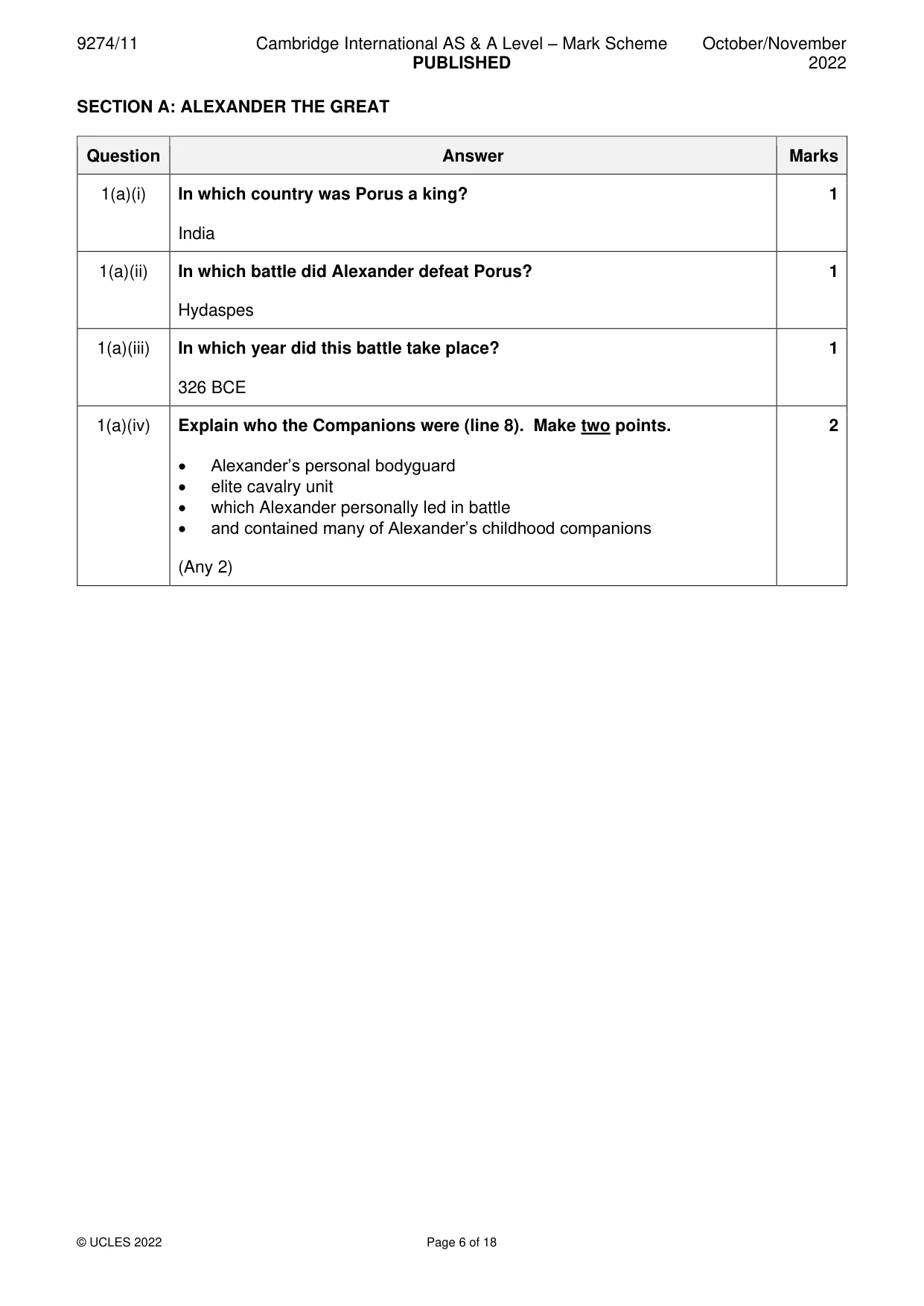
9274/11 Cambridge International AS & A Level – Mark Scheme PUBLISHED October/November 2022 © UCLES 2022 Page 6 of 18 SECTION A: ALEXANDER THE GREAT Question Answer Marks 1(a)(i) In which country was Porus a king? India 1 1(a)(ii) In which battle did Alexander defeat Porus? Hydaspes 1 1(a)(iii) In which year did this battle take place? 326 BCE 1 1(a)(iv) Explain who the Companions were (line 8). Make two points. • Alexander’s personal bodyguard • elite cavalry unit • which Alexander personally led in battle • and contained many of Alexander’s childhood companions (Any 2) 2
Mark scheme, page 7
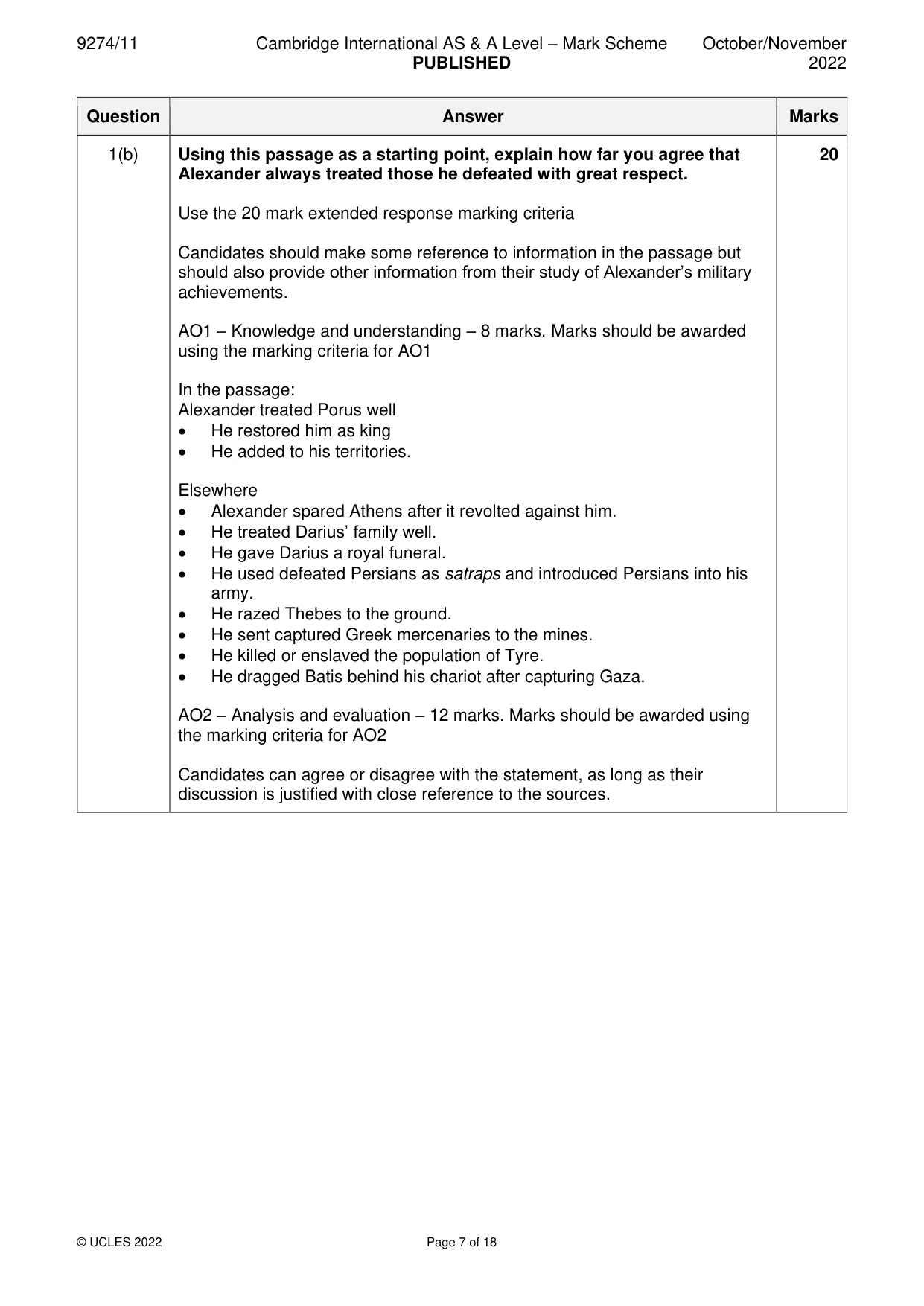
9274/11 Cambridge International AS & A Level – Mark Scheme PUBLISHED October/November 2022 © UCLES 2022 Page 7 of 18 Question Answer Marks 1(b) Using this passage as a starting point, explain how far you agree that Alexander always treated those he defeated with great respect. Use the 20 mark extended response marking criteria Candidates should make some reference to information in the passage but should also provide other information from their study of Alexander’s military achievements. AO1 – Knowledge and understanding – 8 marks. Marks should be awarded using the marking criteria for AO1 In the passage: Alexander treated Porus well • He restored him as king • He added to his territories. Elsewhere • Alexander spared Athens after it revolted against him. • He treated Darius’ family well. • He gave Darius a royal funeral. • He used defeated Persians as satraps and introduced Persians into his army. • He razed Thebes to the ground. • He sent captured Greek mercenaries to the mines. • He killed or enslaved the population of Tyre. • He dragged Batis behind his chariot after capturing Gaza. AO2 – Analysis and evaluation – 12 marks. Marks should be awarded using the marking criteria for AO2 Candidates can agree or disagree with the statement, as long as their discussion is justified with close reference to the sources. 20
Mark scheme, page 8
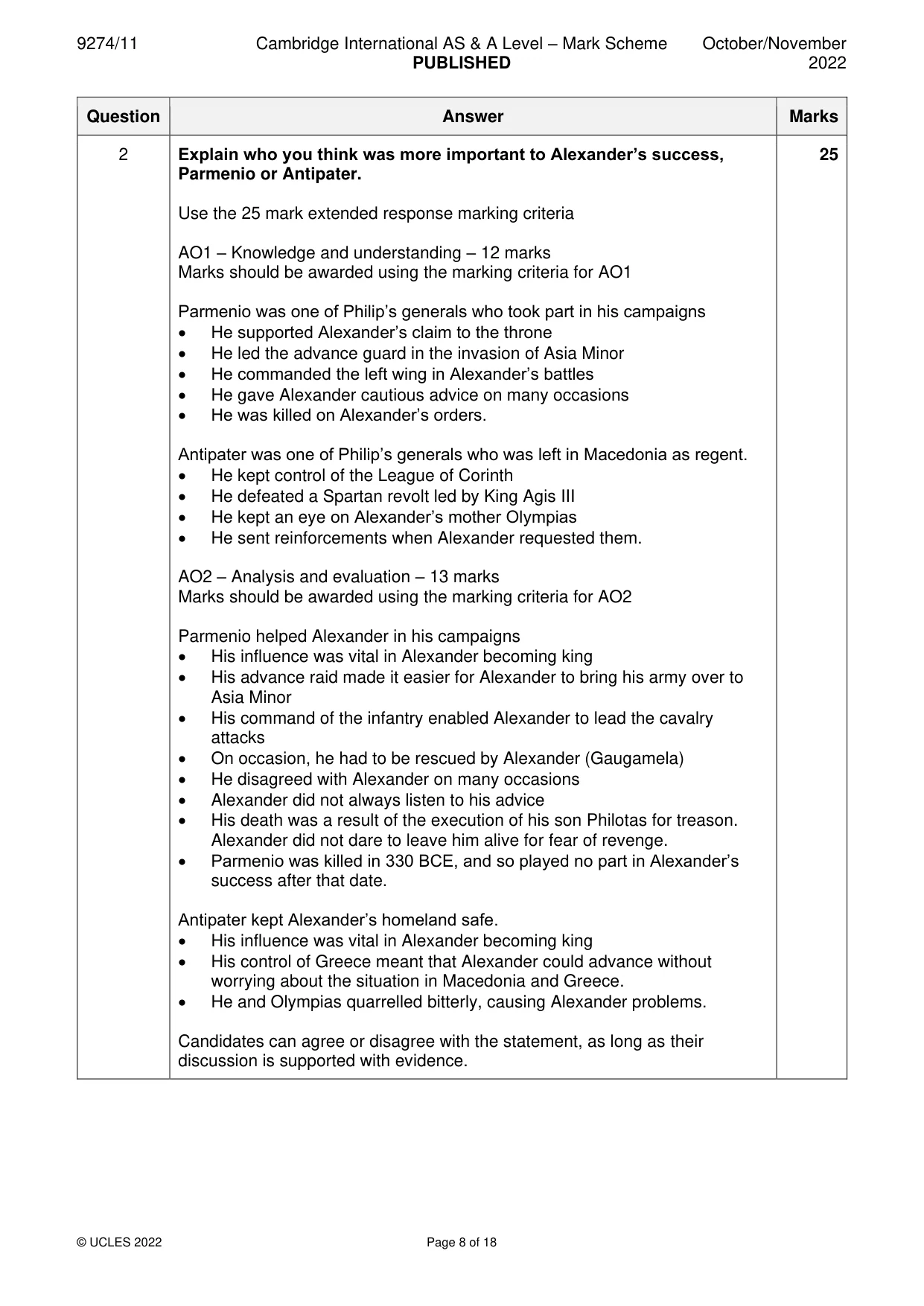
9274/11 Cambridge International AS & A Level – Mark Scheme PUBLISHED October/November 2022 © UCLES 2022 Page 8 of 18 Question Answer Marks 2 Explain who you think was more important to Alexander’s success, Parmenio or Antipater. Use the 25 mark extended response marking criteria AO1 – Knowledge and understanding – 12 marks Marks should be awarded using the marking criteria for AO1 Parmenio was one of Philip’s generals who took part in his campaigns • He supported Alexander’s claim to the throne • He led the advance guard in the invasion of Asia Minor • He commanded the left wing in Alexander’s battles • He gave Alexander cautious advice on many occasions • He was killed on Alexander’s orders. Antipater was one of Philip’s generals who was left in Macedonia as regent. • He kept control of the League of Corinth • He defeated a Spartan revolt led by King Agis III • He kept an eye on Alexander’s mother Olympias • He sent reinforcements when Alexander requested them. AO2 – Analysis and evaluation – 13 marks Marks should be awarded using the marking criteria for AO2 Parmenio helped Alexander in his campaigns • His influence was vital in Alexander becoming king • His advance raid made it easier for Alexander to bring his army over to Asia Minor • His command of the infantry enabled Alexander to lead the cavalry attacks • On occasion, he had to be rescued by Alexander (Gaugamela) • He disagreed with Alexander on many occasions • Alexander did not always listen to his advice • His death was a result of the execution of his son Philotas for treason. Alexander did not dare to leave him alive for fear of revenge. • Parmenio was killed in 330 BCE, and so played no part in Alexander’s success after that date. Antipater kept Alexander’s homeland safe. • His influence was vital in Alexander becoming king • His control of Greece meant that Alexander could advance without worrying about the situation in Macedonia and Greece. • He and Olympias quarrelled bitterly, causing Alexander problems. Candidates can agree or disagree with the statement, as long as their discussion is supported with evidence. 25
Mark scheme, page 9
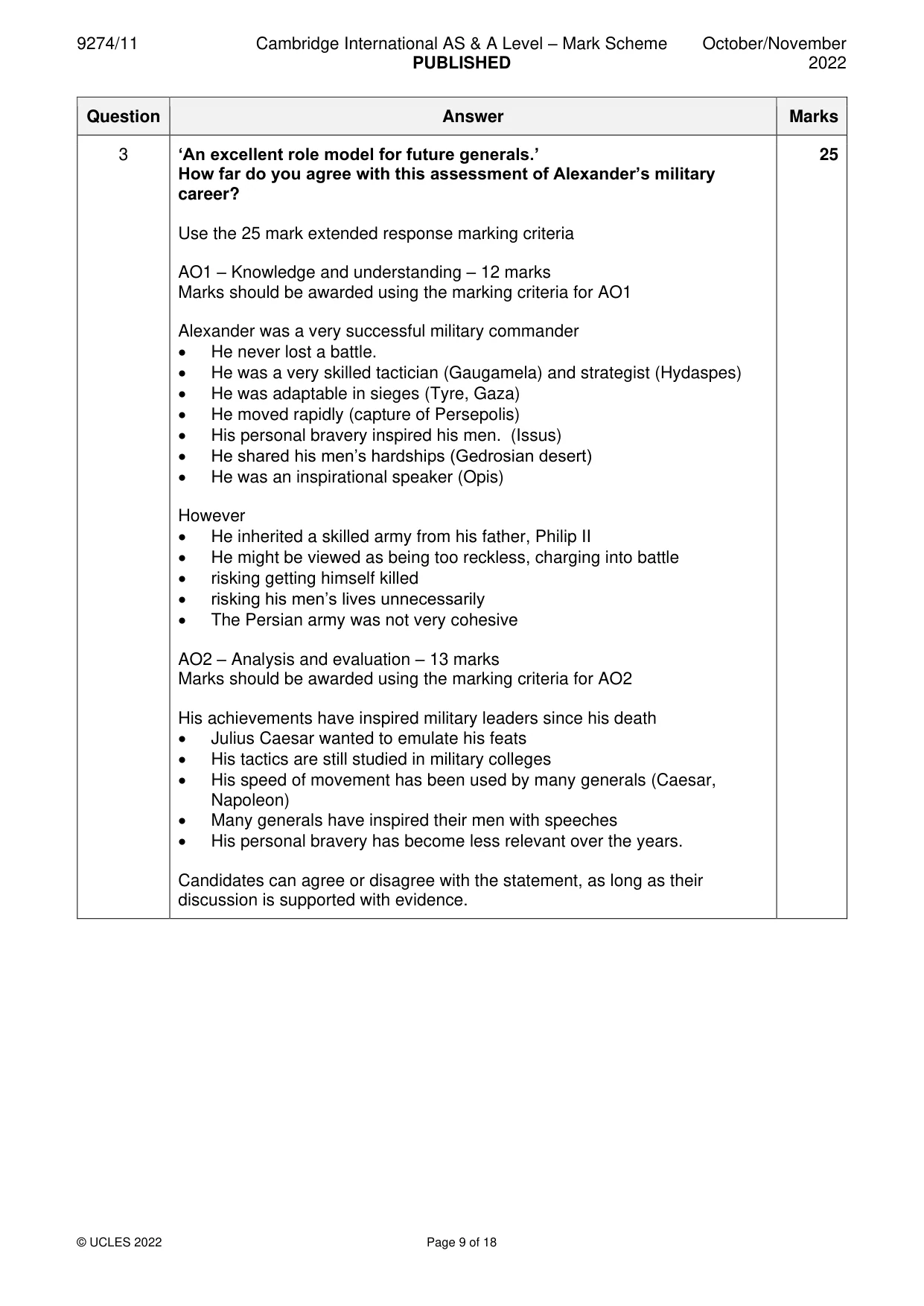
9274/11 Cambridge International AS & A Level – Mark Scheme PUBLISHED October/November 2022 © UCLES 2022 Page 9 of 18 Question Answer Marks 3 ‘An excellent role model for future generals.’ How far do you agree with this assessment of Alexander’s military career? Use the 25 mark extended response marking criteria AO1 – Knowledge and understanding – 12 marks Marks should be awarded using the marking criteria for AO1 Alexander was a very successful military commander • He never lost a battle. • He was a very skilled tactician (Gaugamela) and strategist (Hydaspes) • He was adaptable in sieges (Tyre, Gaza) • He moved rapidly (capture of Persepolis) • His personal bravery inspired his men. (Issus) • He shared his men’s hardships (Gedrosian desert) • He was an inspirational speaker (Opis) However • He inherited a skilled army from his father, Philip II • He might be viewed as being too reckless, charging into battle • risking getting himself killed • risking his men’s lives unnecessarily • The Persian army was not very cohesive AO2 – Analysis and evaluation – 13 marks Marks should be awarded using the marking criteria for AO2 His achievements have inspired military leaders since his death • Julius Caesar wanted to emulate his feats • His tactics are still studied in military colleges • His speed of movement has been used by many generals (Caesar, Napoleon) • Many generals have inspired their men with speeches • His personal bravery has become less relevant over the years. Candidates can agree or disagree with the statement, as long as their discussion is supported with evidence. 25
Mark scheme, page 10
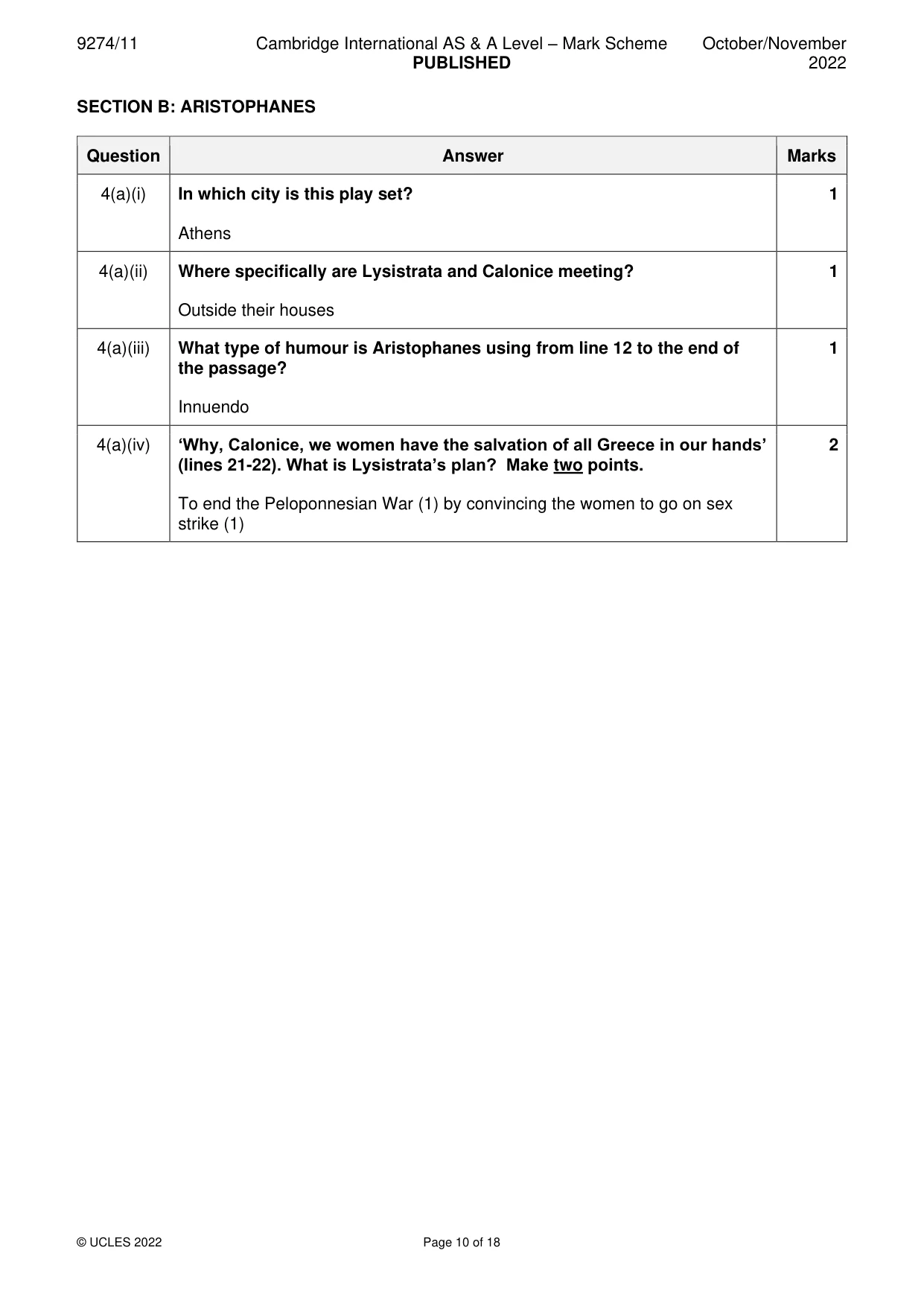
9274/11 Cambridge International AS & A Level – Mark Scheme PUBLISHED October/November 2022 © UCLES 2022 Page 10 of 18 SECTION B: ARISTOPHANES Question Answer Marks 4(a)(i) In which city is this play set? Athens 1 4(a)(ii) Where specifically are Lysistrata and Calonice meeting? Outside their houses 1 4(a)(iii) What type of humour is Aristophanes using from line 12 to the end of the passage? Innuendo 1 4(a)(iv) ‘Why, Calonice, we women have the salvation of all Greece in our hands’ (lines 21-22). What is Lysistrata’s plan? Make two points. To end the Peloponnesian War (1) by convincing the women to go on sex strike (1) 2
Mark scheme, page 11
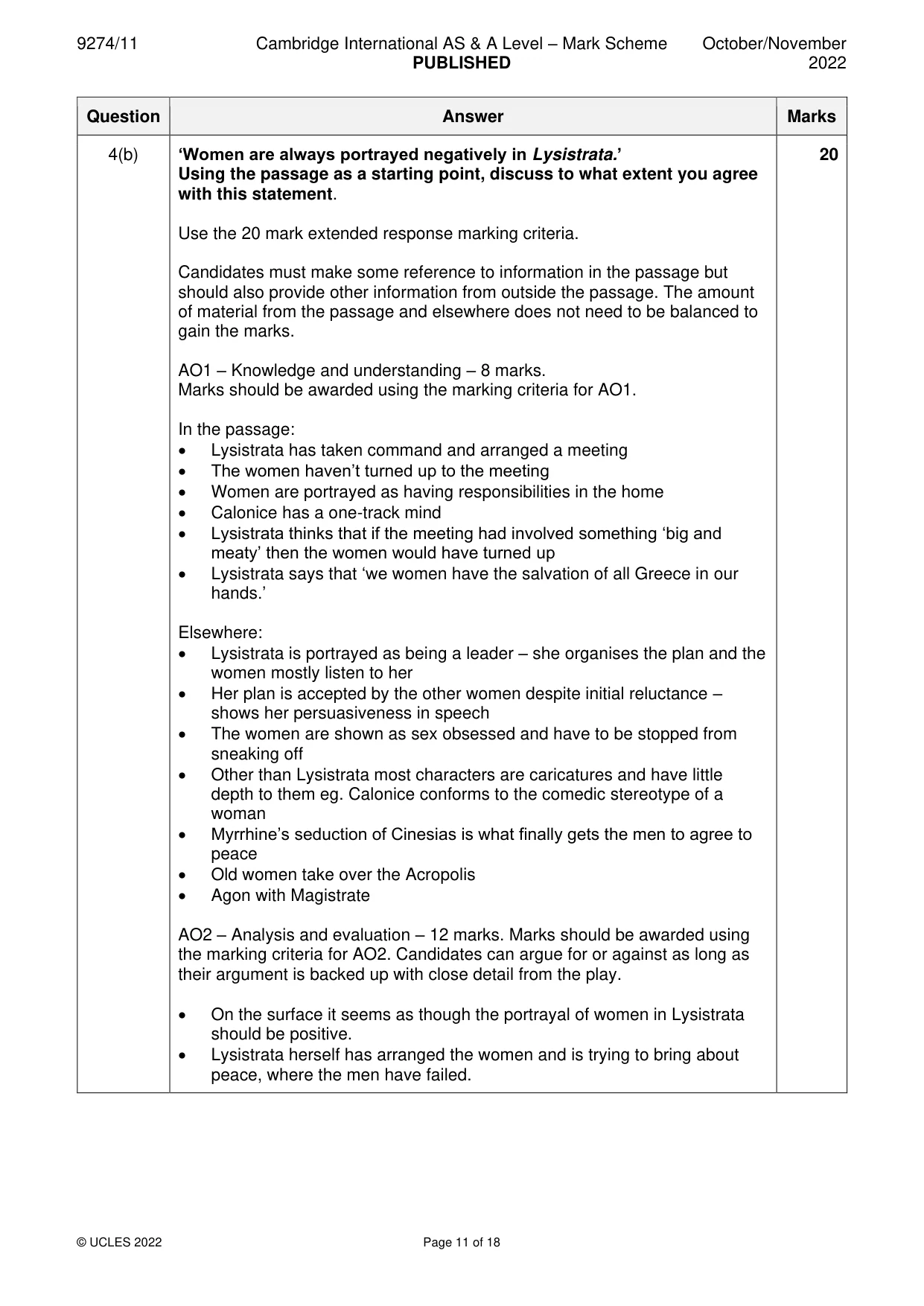
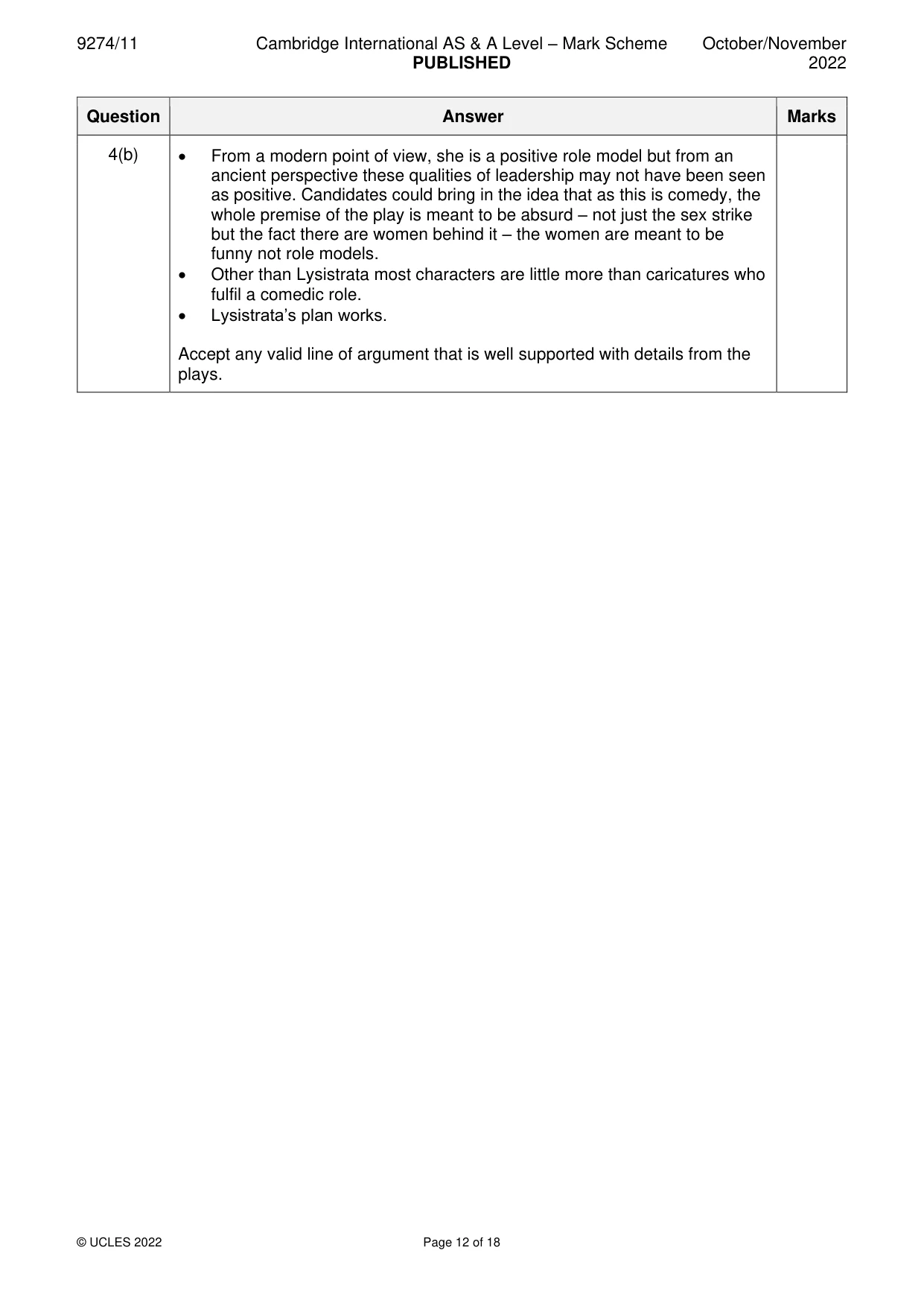
9274/11 Cambridge International AS & A Level – Mark Scheme PUBLISHED October/November 2022 © UCLES 2022 Page 11 of 18 Question Answer Marks 4(b) ‘Women are always portrayed negatively in Lysistrata.’ Using the passage as a starting point, discuss to what extent you agree with this statement. Use the 20 mark extended response marking criteria. Candidates must make some reference to information in the passage but should also provide other information from outside the passage. The amount of material from the passage and elsewhere does not need to be balanced to gain the marks. AO1 – Knowledge and understanding – 8 marks. Marks should be awarded using the marking criteria for AO1. In the passage: • Lysistrata has taken command and arranged a meeting • The women haven’t turned up to the meeting • Women are portrayed as having responsibilities in the home • Calonice has a one-track mind • Lysistrata thinks that if the meeting had involved something ‘big and meaty’ then the women would have turned up • Lysistrata says that ‘we women have the salvation of all Greece in our hands.’ Elsewhere: • Lysistrata is portrayed as being a leader – she organises the plan and the women mostly listen to her • Her plan is accepted by the other women despite initial reluctance – shows her persuasiveness in speech • The women are shown as sex obsessed and have to be stopped from sneaking off • Other than Lysistrata most characters are caricatures and have little depth to them eg. Calonice conforms to the comedic stereotype of a woman • Myrrhine’s seduction of Cinesias is what finally gets the men to agree to peace • Old women take over the Acropolis • Agon with Magistrate AO2 – Analysis and evaluation – 12 marks. Marks should be awarded using the marking criteria for AO2. Candidates can argue for or against as long as their argument is backed up with close detail from the play. • On the surface it seems as though the portrayal of women in Lysistrata should be positive. • Lysistrata herself has arranged the women and is trying to bring about peace, where the men have failed. 20
Mark scheme, page 12
9274/11 Cambridge International AS & A Level – Mark Scheme PUBLISHED October/November 2022 © UCLES 2022 Page 12 of 18 Question Answer Marks 4(b) • From a modern point of view, she is a positive role model but from an ancient perspective these qualities of leadership may not have been seen as positive. Candidates could bring in the idea that as this is comedy, the whole premise of the play is meant to be absurd – not just the sex strike but the fact there are women behind it – the women are meant to be funny not role models. • Other than Lysistrata most characters are little more than caricatures who fulfil a comedic role. • Lysistrata’s plan works. Accept any valid line of argument that is well supported with details from the plays.
Mark scheme, page 13
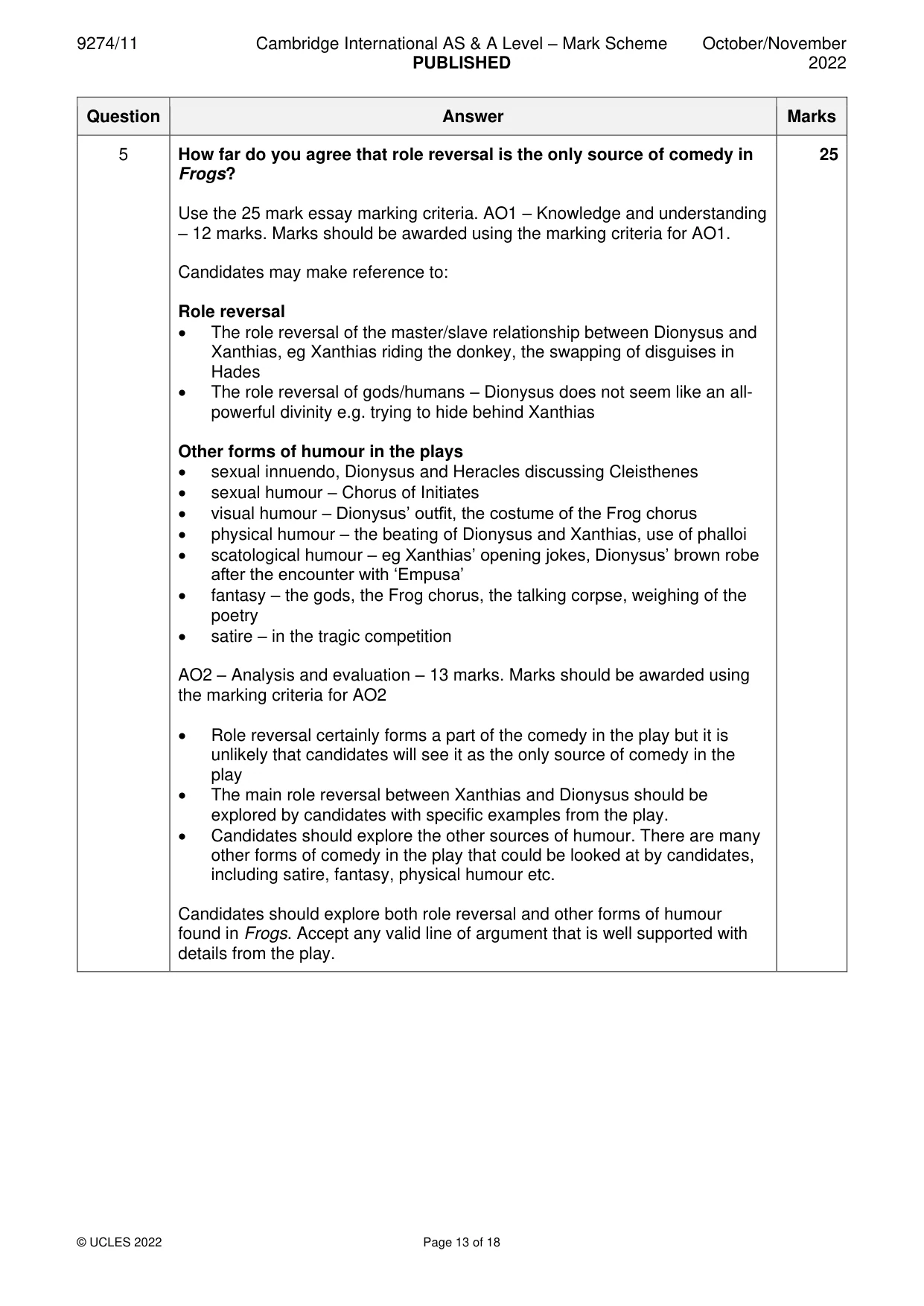
9274/11 Cambridge International AS & A Level – Mark Scheme PUBLISHED October/November 2022 © UCLES 2022 Page 13 of 18 Question Answer Marks 5 How far do you agree that role reversal is the only source of comedy in Frogs? Use the 25 mark essay marking criteria. AO1 – Knowledge and understanding – 12 marks. Marks should be awarded using the marking criteria for AO1. Candidates may make reference to: Role reversal • The role reversal of the master/slave relationship between Dionysus and Xanthias, eg Xanthias riding the donkey, the swapping of disguises in Hades • The role reversal of gods/humans – Dionysus does not seem like an all- powerful divinity e.g. trying to hide behind Xanthias Other forms of humour in the plays • sexual innuendo, Dionysus and Heracles discussing Cleisthenes • sexual humour – Chorus of Initiates • visual humour – Dionysus’ outfit, the costume of the Frog chorus • physical humour – the beating of Dionysus and Xanthias, use of phalloi • scatological humour – eg Xanthias’ opening jokes, Dionysus’ brown robe after the encounter with ‘Empusa’ • fantasy – the gods, the Frog chorus, the talking corpse, weighing of the poetry • satire – in the tragic competition AO2 – Analysis and evaluation – 13 marks. Marks should be awarded using the marking criteria for AO2 • Role reversal certainly forms a part of the comedy in the play but it is unlikely that candidates will see it as the only source of comedy in the play • The main role reversal between Xanthias and Dionysus should be explored by candidates with specific examples from the play. • Candidates should explore the other sources of humour. There are many other forms of comedy in the play that could be looked at by candidates, including satire, fantasy, physical humour etc. Candidates should explore both role reversal and other forms of humour found in Frogs. Accept any valid line of argument that is well supported with details from the play. 25
Mark scheme, page 14
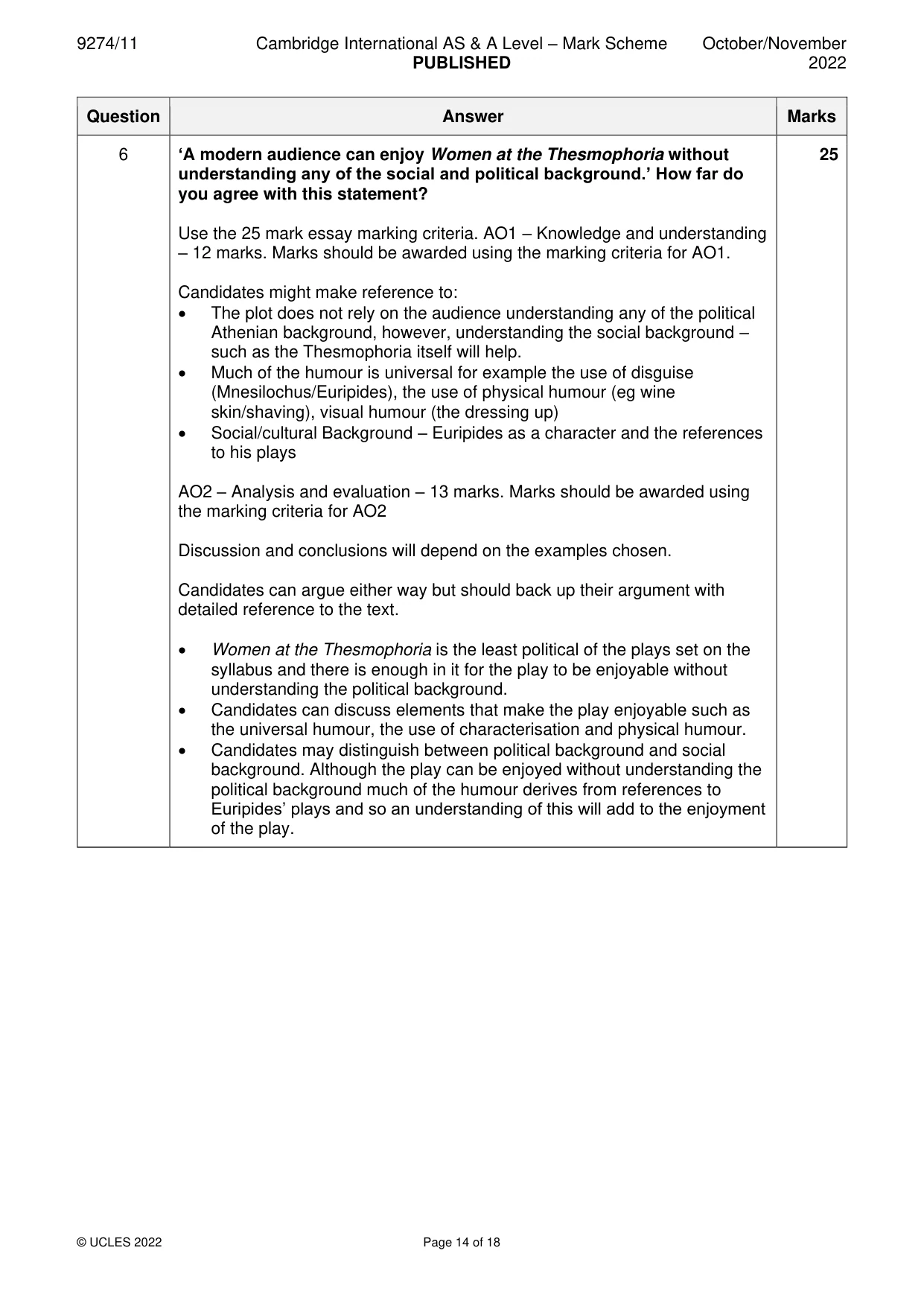
9274/11 Cambridge International AS & A Level – Mark Scheme PUBLISHED October/November 2022 © UCLES 2022 Page 14 of 18 Question Answer Marks 6 ‘A modern audience can enjoy Women at the Thesmophoria without understanding any of the social and political background.’ How far do you agree with this statement? Use the 25 mark essay marking criteria. AO1 – Knowledge and understanding – 12 marks. Marks should be awarded using the marking criteria for AO1. Candidates might make reference to: • The plot does not rely on the audience understanding any of the political Athenian background, however, understanding the social background – such as the Thesmophoria itself will help. • Much of the humour is universal for example the use of disguise (Mnesilochus/Euripides), the use of physical humour (eg wine skin/shaving), visual humour (the dressing up) • Social/cultural Background – Euripides as a character and the references to his plays AO2 – Analysis and evaluation – 13 marks. Marks should be awarded using the marking criteria for AO2 Discussion and conclusions will depend on the examples chosen. Candidates can argue either way but should back up their argument with detailed reference to the text. • Women at the Thesmophoria is the least political of the plays set on the syllabus and there is enough in it for the play to be enjoyable without understanding the political background. • Candidates can discuss elements that make the play enjoyable such as the universal humour, the use of characterisation and physical humour. • Candidates may distinguish between political background and social background. Although the play can be enjoyed without understanding the political background much of the humour derives from references to Euripides’ plays and so an understanding of this will add to the enjoyment of the play. 25
Mark scheme, page 15
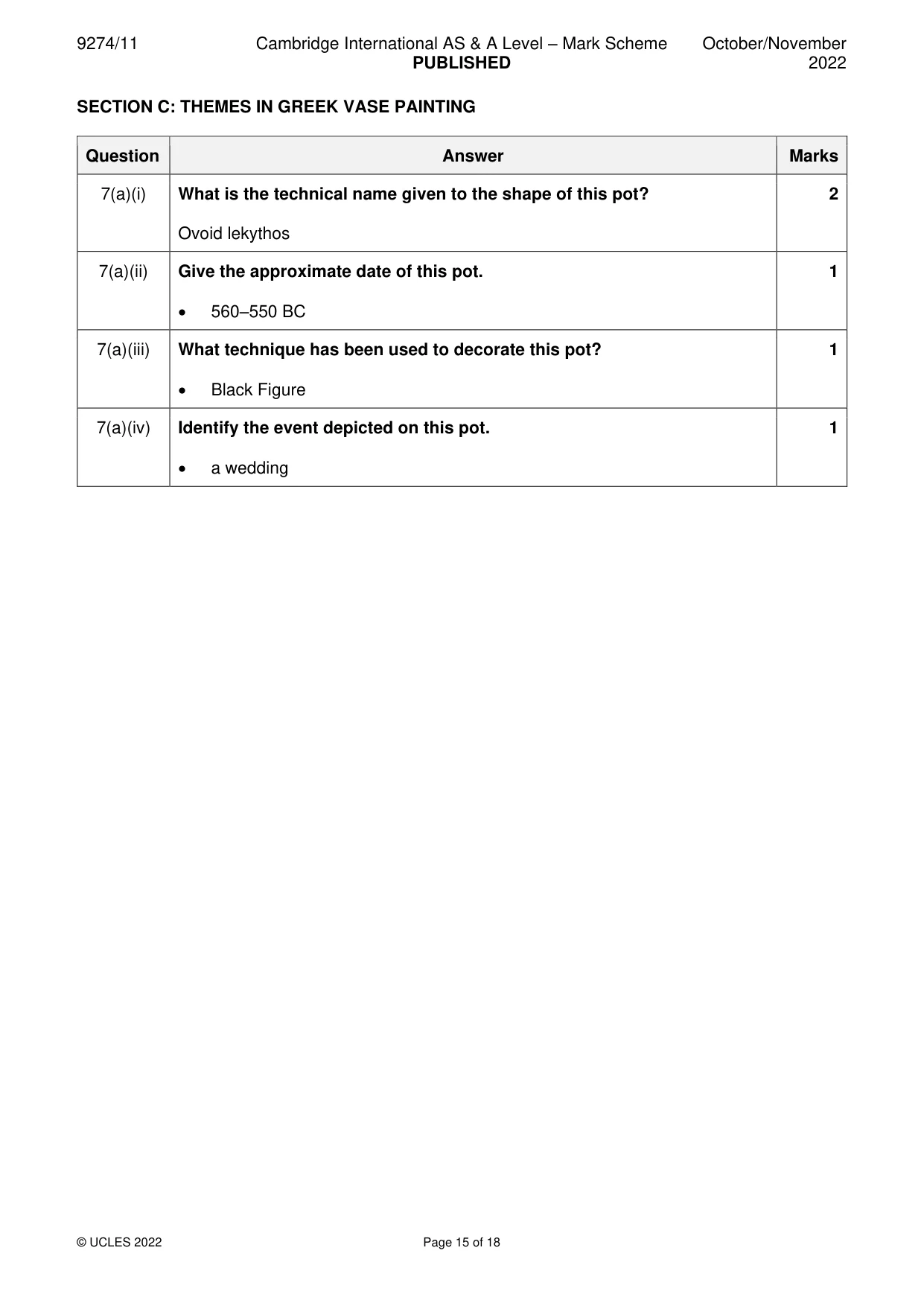
9274/11 Cambridge International AS & A Level – Mark Scheme PUBLISHED October/November 2022 © UCLES 2022 Page 15 of 18 SECTION C: THEMES IN GREEK VASE PAINTING Question Answer Marks 7(a)(i) What is the technical name given to the shape of this pot? Ovoid lekythos 2 7(a)(ii) Give the approximate date of this pot. • 560–550 BC 1 7(a)(iii) What technique has been used to decorate this pot? • Black Figure 1 7(a)(iv) Identify the event depicted on this pot. • a wedding 1
Mark scheme, page 16
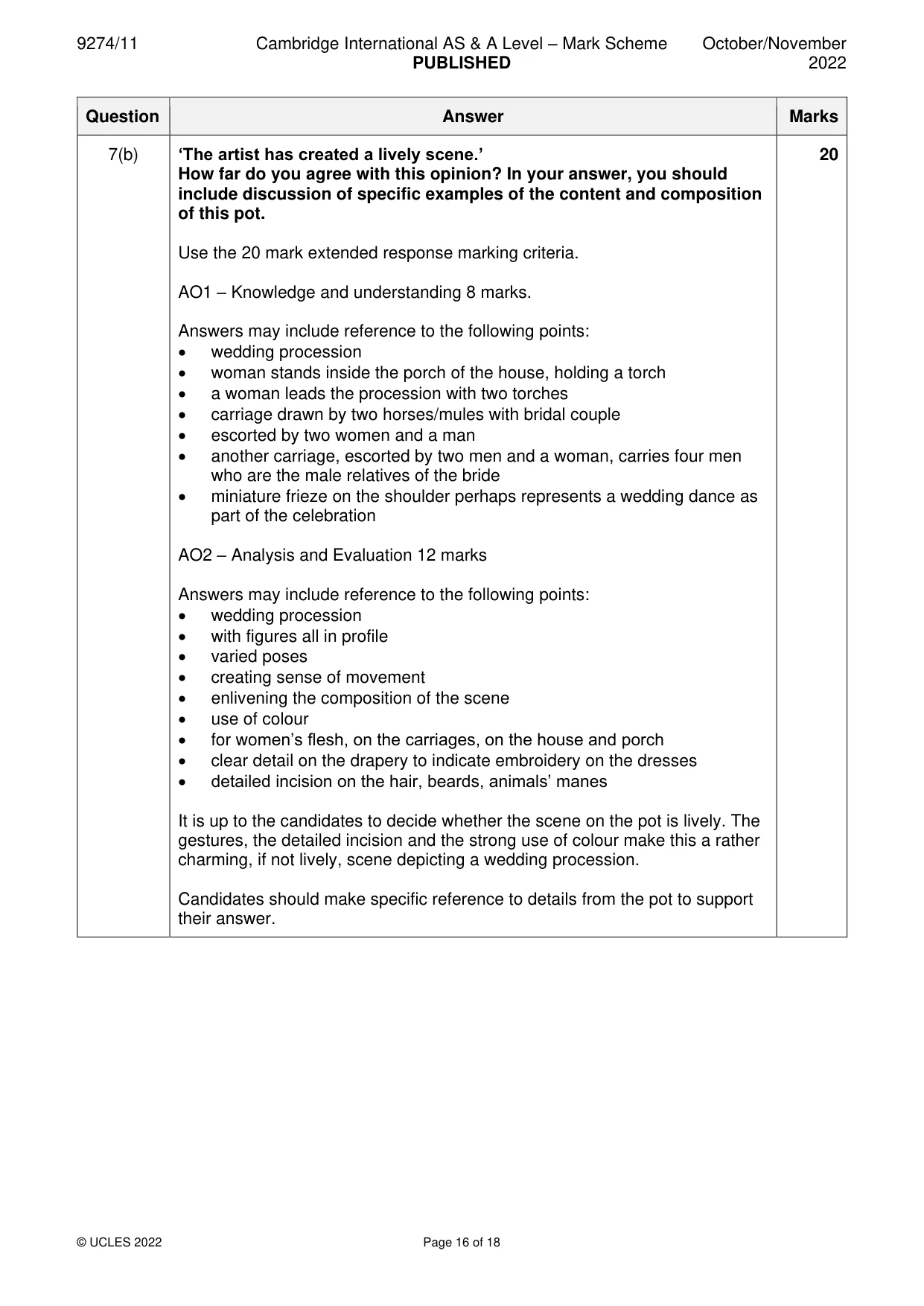
9274/11 Cambridge International AS & A Level – Mark Scheme PUBLISHED October/November 2022 © UCLES 2022 Page 16 of 18 Question Answer Marks 7(b) ‘The artist has created a lively scene.’ How far do you agree with this opinion? In your answer, you should include discussion of specific examples of the content and composition of this pot. Use the 20 mark extended response marking criteria. AO1 – Knowledge and understanding 8 marks. Answers may include reference to the following points: • wedding procession • woman stands inside the porch of the house, holding a torch • a woman leads the procession with two torches • carriage drawn by two horses/mules with bridal couple • escorted by two women and a man • another carriage, escorted by two men and a woman, carries four men who are the male relatives of the bride • miniature frieze on the shoulder perhaps represents a wedding dance as part of the celebration AO2 – Analysis and Evaluation 12 marks Answers may include reference to the following points: • wedding procession • with figures all in profile • varied poses • creating sense of movement • enlivening the composition of the scene • use of colour • for women’s flesh, on the carriages, on the house and porch • clear detail on the drapery to indicate embroidery on the dresses • detailed incision on the hair, beards, animals’ manes It is up to the candidates to decide whether the scene on the pot is lively. The gestures, the detailed incision and the strong use of colour make this a rather charming, if not lively, scene depicting a wedding procession. Candidates should make specific reference to details from the pot to support their answer. 20
Mark scheme, page 17
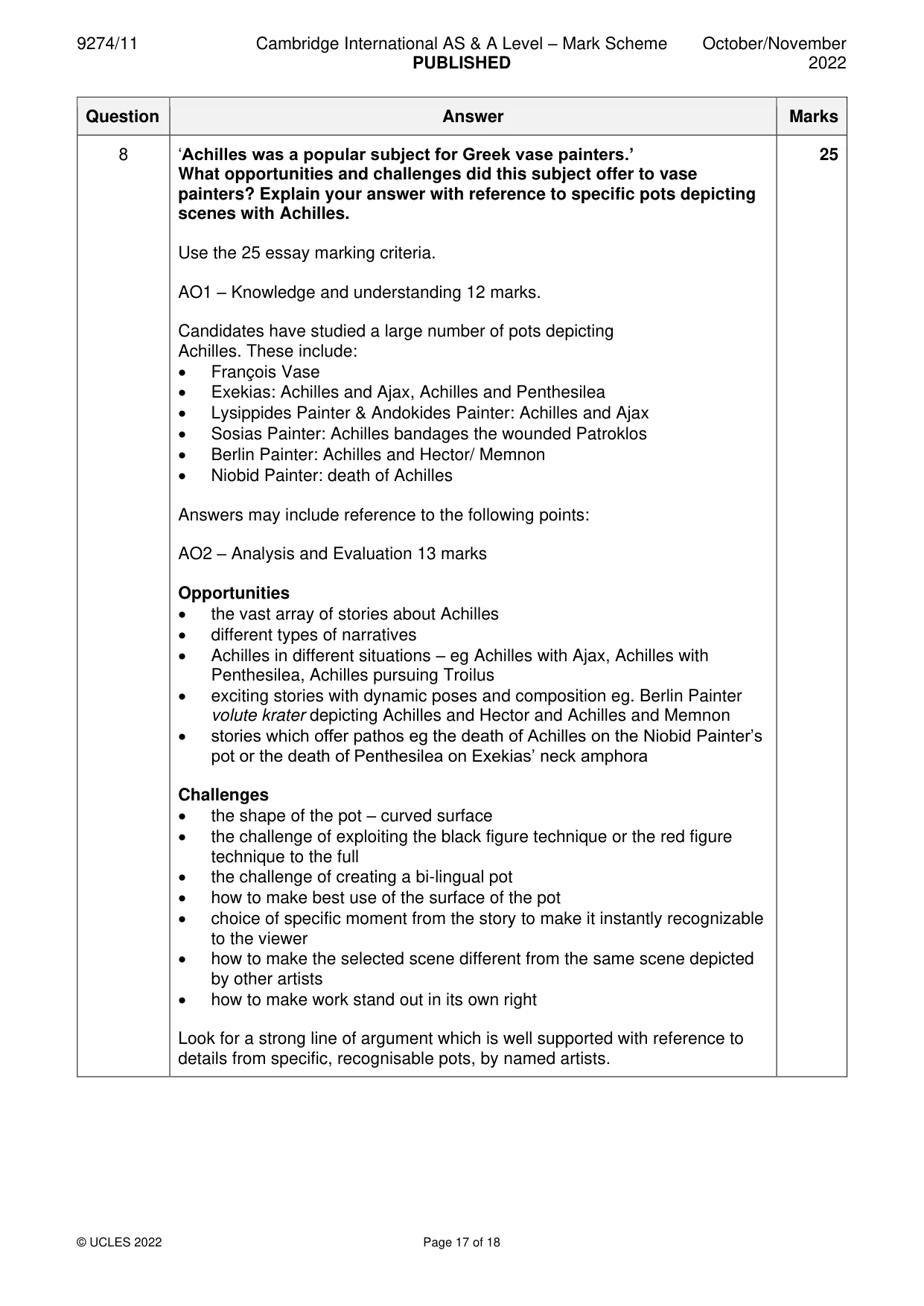
9274/11 Cambridge International AS & A Level – Mark Scheme PUBLISHED October/November 2022 © UCLES 2022 Page 17 of 18 Question Answer Marks 8 ‘Achilles was a popular subject for Greek vase painters.’ What opportunities and challenges did this subject offer to vase painters? Explain your answer with reference to specific pots depicting scenes with Achilles. Use the 25 essay marking criteria. AO1 – Knowledge and understanding 12 marks. Candidates have studied a large number of pots depicting Achilles. These include: • François Vase • Exekias: Achilles and Ajax, Achilles and Penthesilea • Lysippides Painter & Andokides Painter: Achilles and Ajax • Sosias Painter: Achilles bandages the wounded Patroklos • Berlin Painter: Achilles and Hector/ Memnon • Niobid Painter: death of Achilles Answers may include reference to the following points: AO2 – Analysis and Evaluation 13 marks Opportunities • the vast array of stories about Achilles • different types of narratives • Achilles in different situations – eg Achilles with Ajax, Achilles with Penthesilea, Achilles pursuing Troilus • exciting stories with dynamic poses and composition eg. Berlin Painter volute krater depicting Achilles and Hector and Achilles and Memnon • stories which offer pathos eg the death of Achilles on the Niobid Painter’s pot or the death of Penthesilea on Exekias’ neck amphora Challenges • the shape of the pot – curved surface • the challenge of exploiting the black figure technique or the red figure technique to the full • the challenge of creating a bi-lingual pot • how to make best use of the surface of the pot • choice of specific moment from the story to make it instantly recognizable to the viewer • how to make the selected scene different from the same scene depicted by other artists • how to make work stand out in its own right Look for a strong line of argument which is well supported with reference to details from specific, recognisable pots, by named artists. 25
Mark scheme, page 18
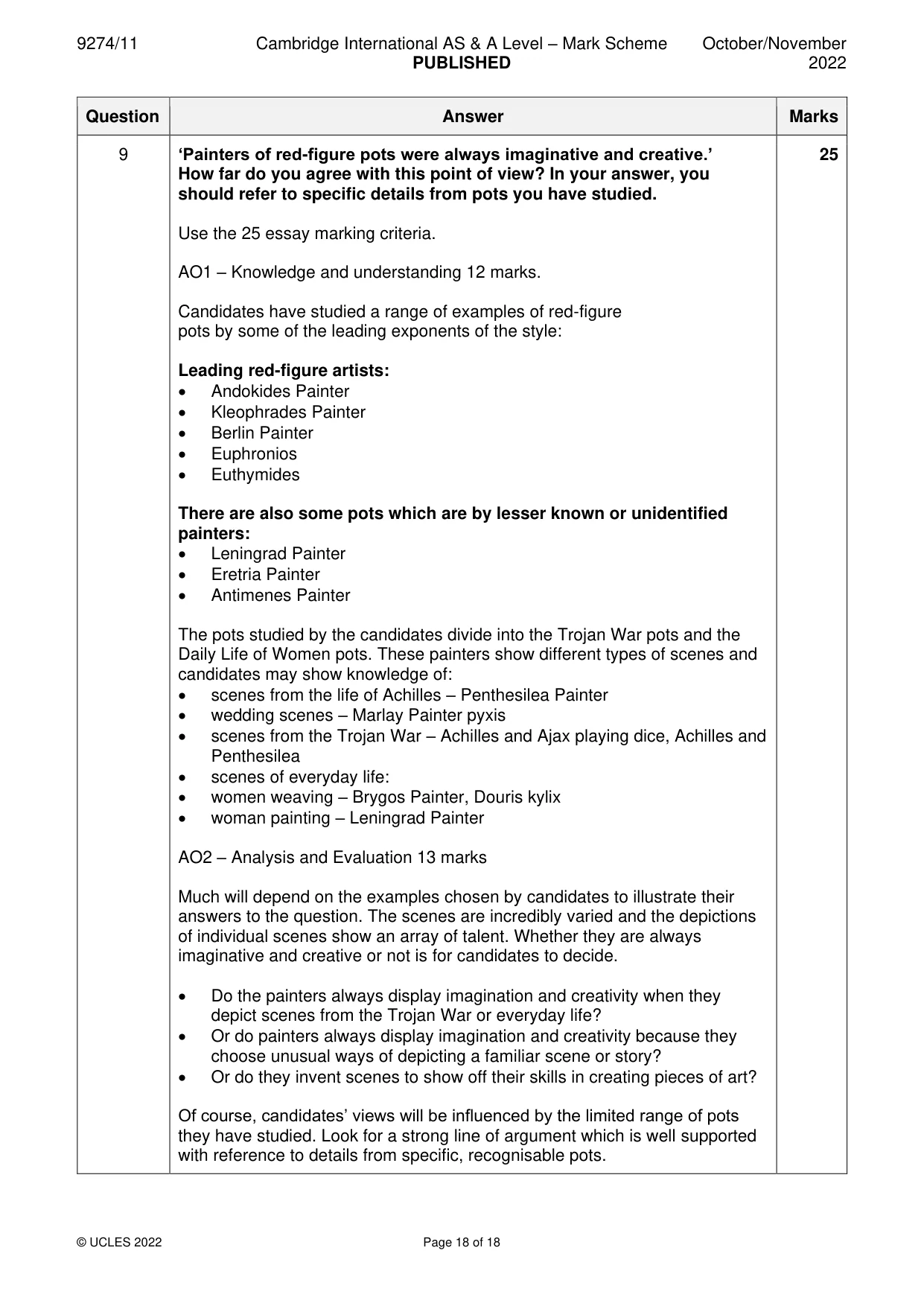
9274/11 Cambridge International AS & A Level – Mark Scheme PUBLISHED October/November 2022 © UCLES 2022 Page 18 of 18 Question Answer Marks 9 ‘Painters of red-figure pots were always imaginative and creative.’ How far do you agree with this point of view? In your answer, you should refer to specific details from pots you have studied. Use the 25 essay marking criteria. AO1 – Knowledge and understanding 12 marks. Candidates have studied a range of examples of red-figure pots by some of the leading exponents of the style: Leading red-figure artists: • Andokides Painter • Kleophrades Painter • Berlin Painter • Euphronios • Euthymides There are also some pots which are by lesser known or unidentified painters: • Leningrad Painter • Eretria Painter • Antimenes Painter The pots studied by the candidates divide into the Trojan War pots and the Daily Life of Women pots. These painters show different types of scenes and candidates may show knowledge of: • scenes from the life of Achilles – Penthesilea Painter • wedding scenes – Marlay Painter pyxis • scenes from the Trojan War – Achilles and Ajax playing dice, Achilles and Penthesilea • scenes of everyday life: • women weaving – Brygos Painter, Douris kylix • woman painting – Leningrad Painter AO2 – Analysis and Evaluation 13 marks Much will depend on the examples chosen by candidates to illustrate their answers to the question. The scenes are incredibly varied and the depictions of individual scenes show an array of talent. Whether they are always imaginative and creative or not is for candidates to decide. • Do the painters always display imagination and creativity when they depict scenes from the Trojan War or everyday life? • Or do painters always display imagination and creativity because they choose unusual ways of depicting a familiar scene or story? • Or do they invent scenes to show off their skills in creating pieces of art? Of course, candidates’ views will be influenced by the limited range of pots they have studied. Look for a strong line of argument which is well supported with reference to details from specific, recognisable pots. 25
What you needed in this session
Cambridge’s own grade thresholds for 2022 Oct/Nov, Paper 1 · Variant 1. A higher threshold means an easier paper — the bar moves with how the cohort did.