Cambridge A Level Classical Studies 9274 — 2023 Oct/Nov Paper 4 · Variant 1
9274/41/O/N/23 · 50 marks · ≈56 min
The question paper and its mark scheme, free to read here and free to download. This is Cambridge’s own paper, exactly as it was sat.
Question paper4 pages

Mark scheme12 pages
Answers below. Sit the paper first if you are practising.
Paper as text
Question paper, page 1
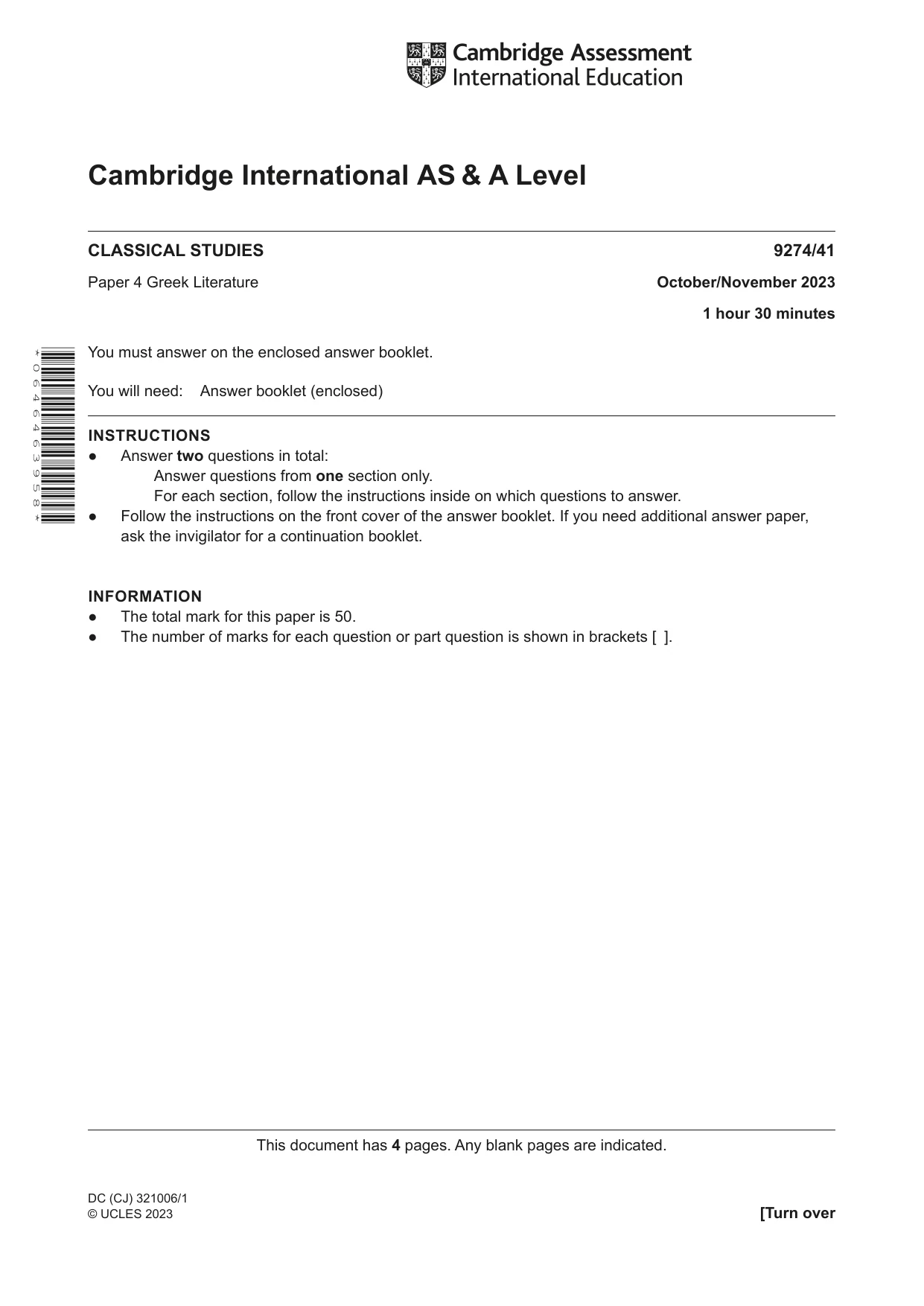
This document has 4 pages. Any blank pages are indicated. [Turn over Cambridge International AS & A Level CLASSICAL STUDIES 9274/41 Paper 4 Greek Literature October/November 2023 1 hour 30 minutes You must answer on the enclosed answer booklet. You will need: Answer booklet (enclosed) INSTRUCTIONS ● Answer two questions in total: Answer questions from one section only. For each section, follow the instructions inside on which questions to answer. ● Follow the instructions on the front cover of the answer booklet. If you need additional answer paper, ask the invigilator for a continuation booklet. INFORMATION ● The total mark for this paper is 50. ● The number of marks for each question or part question is shown in brackets [ ]. * 0 6 4 6 4 6 3 9 5 8 * DC (CJ) 321006/1 © UCLES 2023
Question paper, page 2
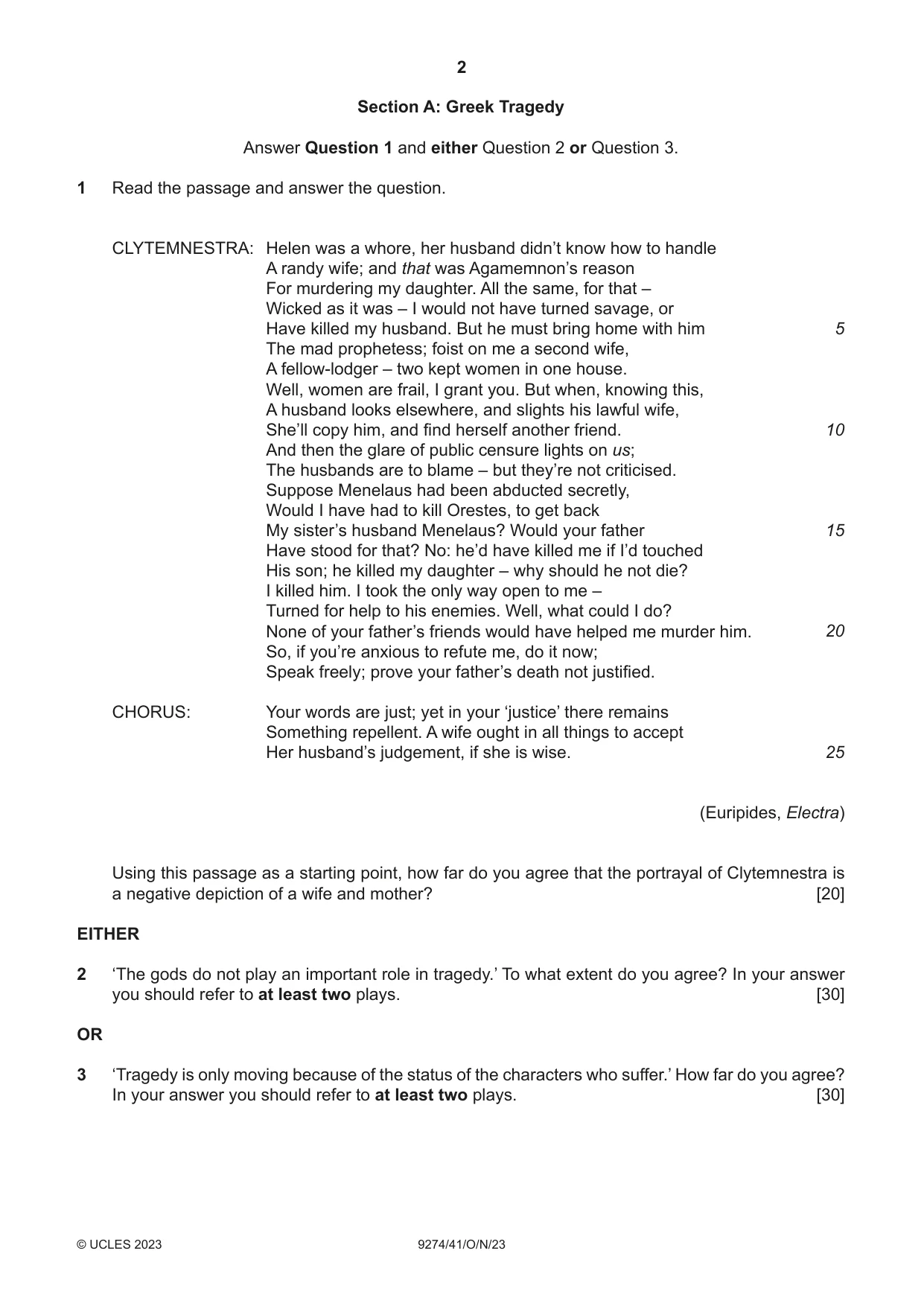
2 9274/41/O/N/23 © UCLES 2023 Section A: Greek Tragedy Answer Question 1 and either Question 2 or Question 3. 1 Read the passage and answer the question. CLYTEMNESTRA: Helen was a whore, her husband didn’t know how to handle A randy wife; and that was Agamemnon’s reason For murdering my daughter. All the same, for that – Wicked as it was – I would not have turned savage, or Have killed my husband. But he must bring home with him The mad prophetess; foist on me a second wife, A fellow-lodger – two kept women in one house. Well, women are frail, I grant you. But when, knowing this, A husband looks elsewhere, and slights his lawful wife, She’ll copy him, and find herself another friend. And then the glare of public censure lights on us; The husbands are to blame – but they’re not criticised. Suppose Menelaus had been abducted secretly, Would I have had to kill Orestes, to get back My sister’s husband Menelaus? Would your father Have stood for that? No: he’d have killed me if I’d touched His son; he killed my daughter – why should he not die? I killed him. I took the only way open to me – Turned for help to his enemies. Well, what could I do? None of your father’s friends would have helped me murder him. So, if you’re anxious to refute me, do it now; Speak freely; prove your father’s death not justified. CHORUS: Your words are just; yet in your ‘justice’ there remains Something repellent. A wife ought in all things to accept Her husband’s judgement, if she is wise. (Euripides, Electra) Using this passage as a starting point, how far do you agree that the portrayal of Clytemnestra is a negative depiction of a wife and mother? [20] EITHER 2 ‘The gods do not play an important role in tragedy.’ To what extent do you agree? In your answer you should refer to at least two plays. [30] OR 3 ‘Tragedy is only moving because of the status of the characters who suffer.’ How far do you agree? In your answer you should refer to at least two plays. [30] 5 10 15 20 25
Question paper, page 3
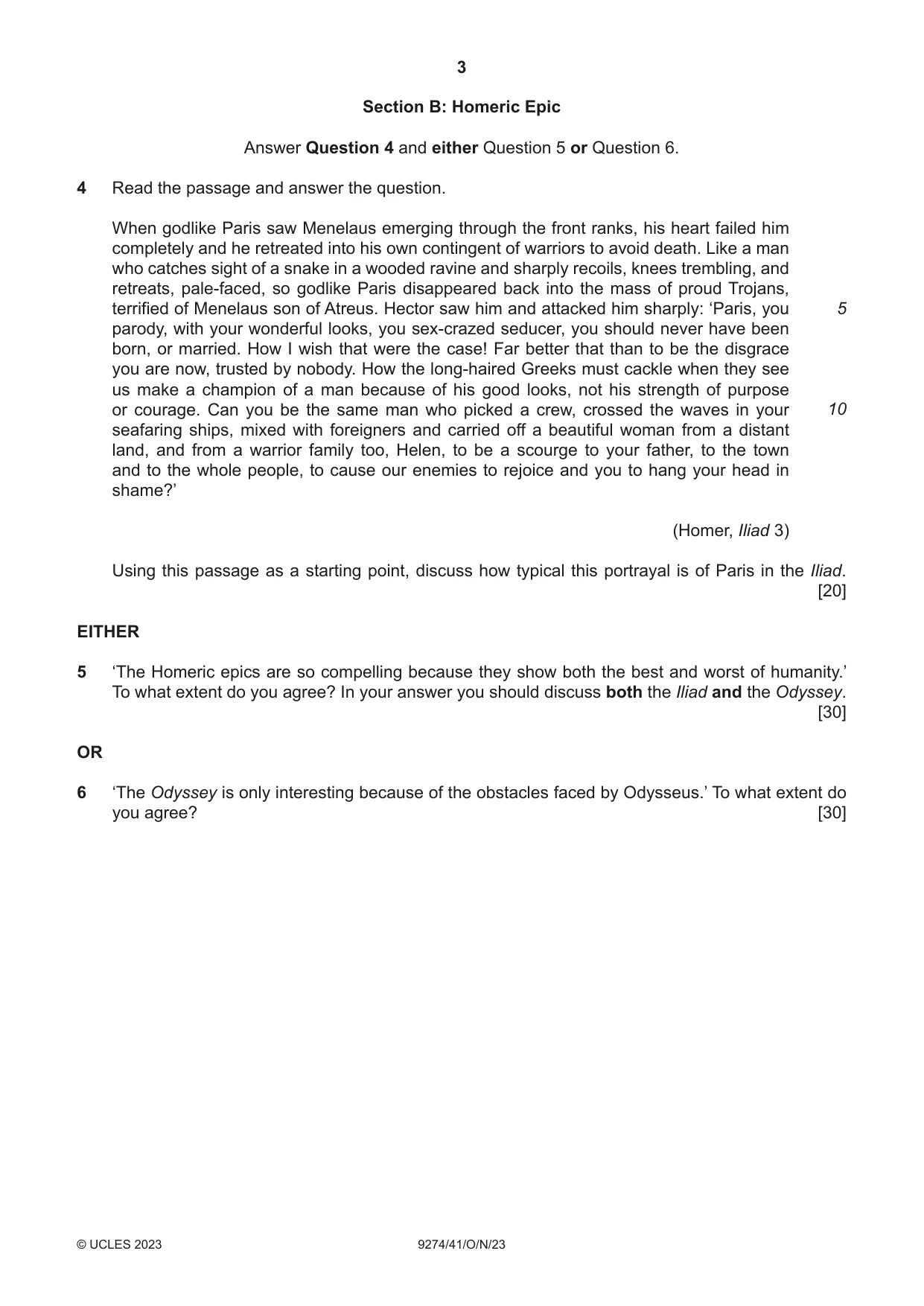
3 9274/41/O/N/23 © UCLES 2023 Section B: Homeric Epic Answer Question 4 and either Question 5 or Question 6. 4 Read the passage and answer the question. When godlike Paris saw Menelaus emerging through the front ranks, his heart failed him completely and he retreated into his own contingent of warriors to avoid death. Like a man who catches sight of a snake in a wooded ravine and sharply recoils, knees trembling, and retreats, pale-faced, so godlike Paris disappeared back into the mass of proud Trojans, terrified of Menelaus son of Atreus. Hector saw him and attacked him sharply: ‘Paris, you parody, with your wonderful looks, you sex-crazed seducer, you should never have been born, or married. How I wish that were the case! Far better that than to be the disgrace you are now, trusted by nobody. How the long-haired Greeks must cackle when they see us make a champion of a man because of his good looks, not his strength of purpose or courage. Can you be the same man who picked a crew, crossed the waves in your seafaring ships, mixed with foreigners and carried off a beautiful woman from a distant land, and from a warrior family too, Helen, to be a scourge to your father, to the town and to the whole people, to cause our enemies to rejoice and you to hang your head in shame?’ (Homer, Iliad 3) Using this passage as a starting point, discuss how typical this portrayal is of Paris in the Iliad. [20] EITHER 5 ‘The Homeric epics are so compelling because they show both the best and worst of humanity.’ To what extent do you agree? In your answer you should discuss both the Iliad and the Odyssey. [30] OR 6 ‘The Odyssey is only interesting because of the obstacles faced by Odysseus.’ To what extent do you agree? [30] 5 10
Question paper, page 4
4 9274/41/O/N/23 © UCLES 2023 Permission to reproduce items where third-party owned material protected by copyright is included has been sought and cleared where possible. Every reasonable effort has been made by the publisher (UCLES) to trace copyright holders, but if any items requiring clearance have unwittingly been included, the publisher will be pleased to make amends at the earliest possible opportunity. To avoid the issue of disclosure of answer-related information to candidates, all copyright acknowledgements are reproduced online in the Cambridge Assessment International Education Copyright Acknowledgements Booklet. This is produced for each series of examinations and is freely available to download at www.cambridgeinternational.org after the live examination series. Cambridge Assessment International Education is part of Cambridge Assessment. Cambridge Assessment is the brand name of the University of Cambridge Local Examinations Syndicate (UCLES), which is a department of the University of Cambridge. BLANK PAGE
Mark scheme, page 1
This document consists of 12 printed pages. © UCLES 2023 [Turn over Cambridge International AS & A Level CLASSICAL STUDIES 9274/41 Paper 4 Greek Literature October/November 2023 MARK SCHEME Maximum Mark: 50 Published This mark scheme is published as an aid to teachers and candidates, to indicate the requirements of the examination. It shows the basis on which Examiners were instructed to award marks. It does not indicate the details of the discussions that took place at an Examiners’ meeting before marking began, which would have considered the acceptability of alternative answers. Mark schemes should be read in conjunction with the question paper and the Principal Examiner Report for Teachers. Cambridge International will not enter into discussions about these mark schemes. Cambridge International is publishing the mark schemes for the October/November 2023 series for most Cambridge IGCSE, Cambridge International A and AS Level components, and some Cambridge O Level components.
Mark scheme, page 2
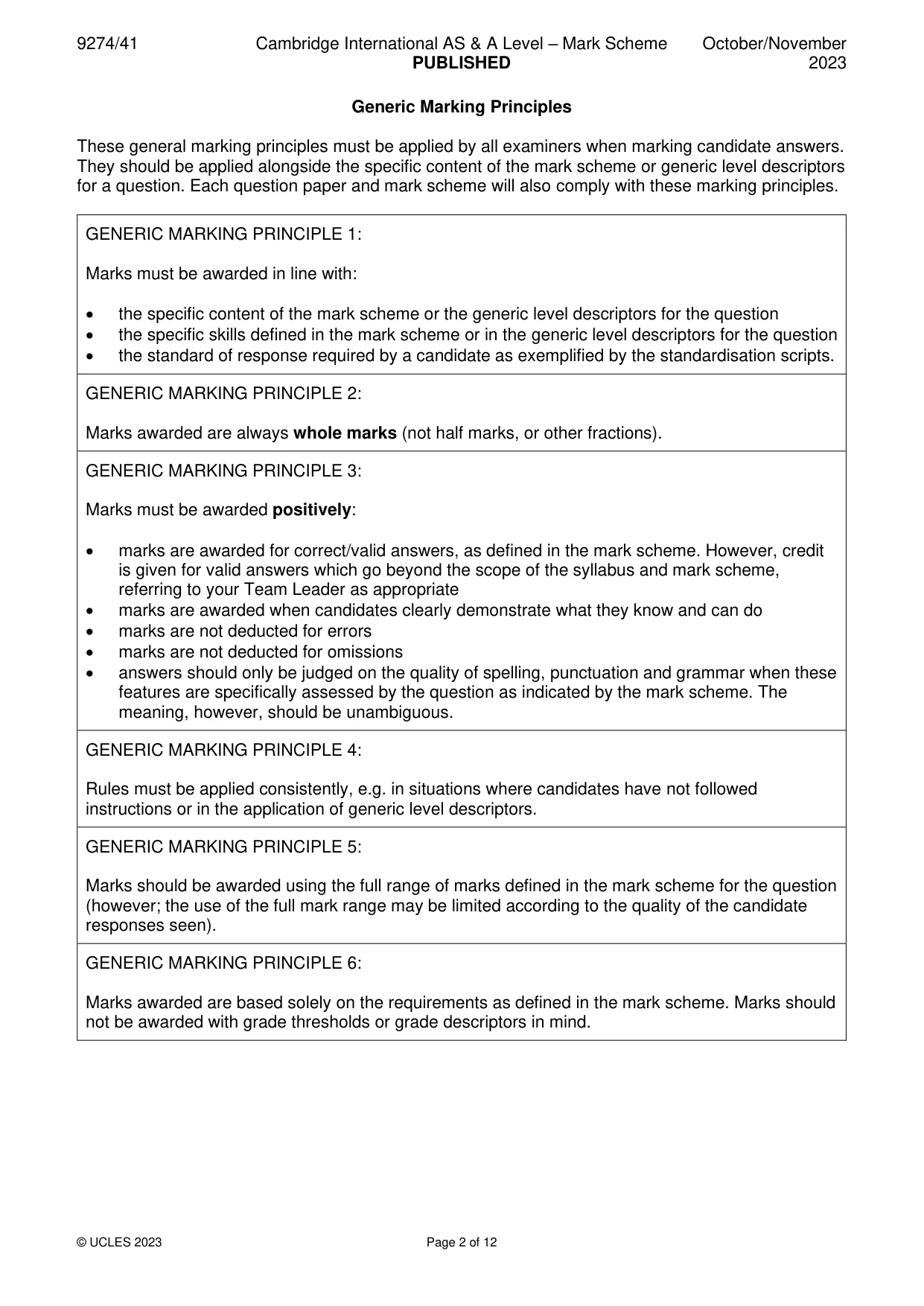
9274/41 Cambridge International AS & A Level – Mark Scheme PUBLISHED October/November 2023 © UCLES 2023 Page 2 of 12 Generic Marking Principles These general marking principles must be applied by all examiners when marking candidate answers. They should be applied alongside the specific content of the mark scheme or generic level descriptors for a question. Each question paper and mark scheme will also comply with these marking principles. GENERIC MARKING PRINCIPLE 1: Marks must be awarded in line with: • the specific content of the mark scheme or the generic level descriptors for the question • the specific skills defined in the mark scheme or in the generic level descriptors for the question • the standard of response required by a candidate as exemplified by the standardisation scripts. GENERIC MARKING PRINCIPLE 2: Marks awarded are always whole marks (not half marks, or other fractions). GENERIC MARKING PRINCIPLE 3: Marks must be awarded positively: • marks are awarded for correct/valid answers, as defined in the mark scheme. However, credit is given for valid answers which go beyond the scope of the syllabus and mark scheme, referring to your Team Leader as appropriate • marks are awarded when candidates clearly demonstrate what they know and can do • marks are not deducted for errors • marks are not deducted for omissions • answers should only be judged on the quality of spelling, punctuation and grammar when these features are specifically assessed by the question as indicated by the mark scheme. The meaning, however, should be unambiguous. GENERIC MARKING PRINCIPLE 4: Rules must be applied consistently, e.g. in situations where candidates have not followed instructions or in the application of generic level descriptors. GENERIC MARKING PRINCIPLE 5: Marks should be awarded using the full range of marks defined in the mark scheme for the question (however; the use of the full mark range may be limited according to the quality of the candidate responses seen). GENERIC MARKING PRINCIPLE 6: Marks awarded are based solely on the requirements as defined in the mark scheme. Marks should not be awarded with grade thresholds or grade descriptors in mind.
Mark scheme, page 3
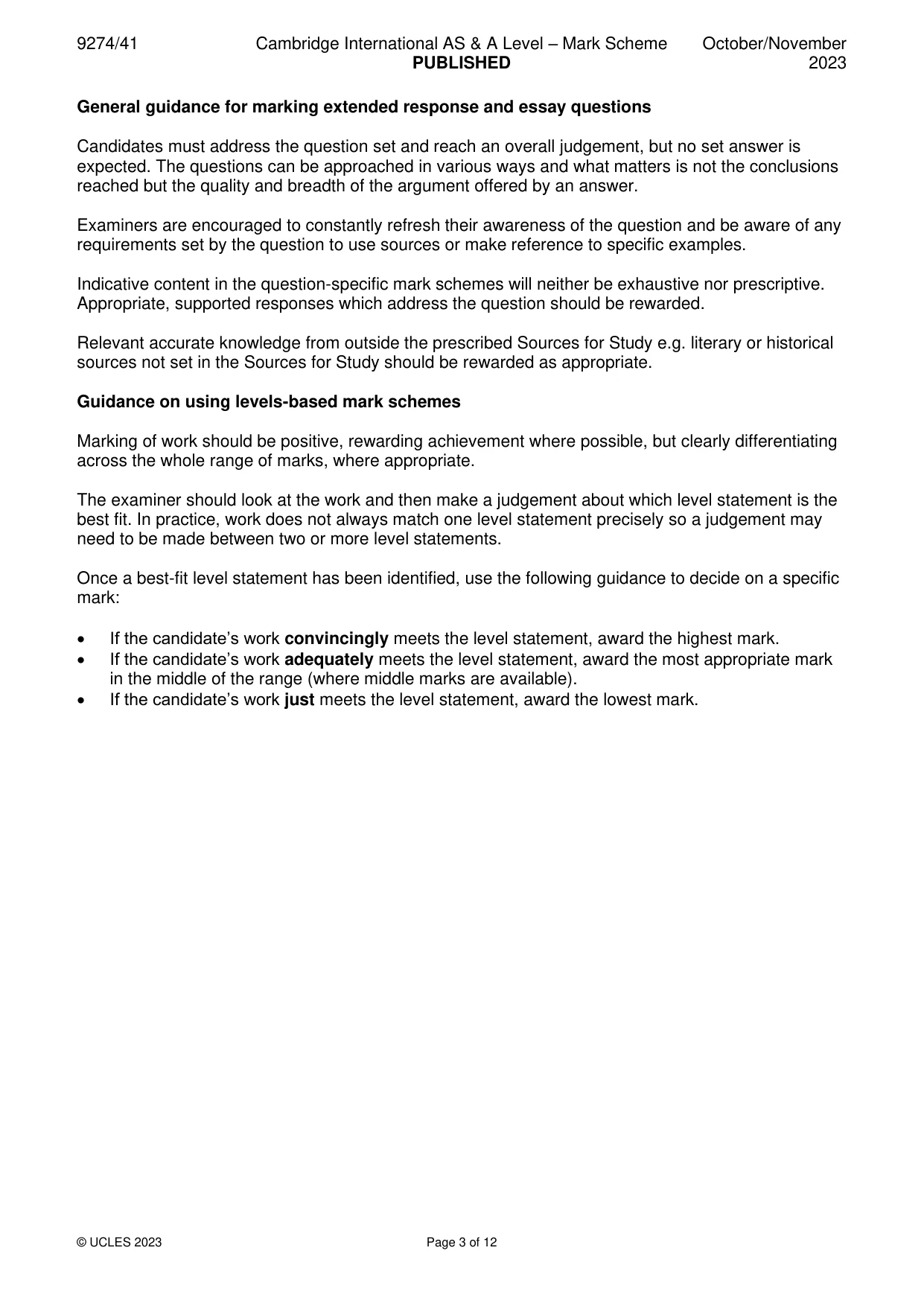
9274/41 Cambridge International AS & A Level – Mark Scheme PUBLISHED October/November 2023 © UCLES 2023 Page 3 of 12 General guidance for marking extended response and essay questions Candidates must address the question set and reach an overall judgement, but no set answer is expected. The questions can be approached in various ways and what matters is not the conclusions reached but the quality and breadth of the argument offered by an answer. Examiners are encouraged to constantly refresh their awareness of the question and be aware of any requirements set by the question to use sources or make reference to specific examples. Indicative content in the question-specific mark schemes will neither be exhaustive nor prescriptive. Appropriate, supported responses which address the question should be rewarded. Relevant accurate knowledge from outside the prescribed Sources for Study e.g. literary or historical sources not set in the Sources for Study should be rewarded as appropriate. Guidance on using levels-based mark schemes Marking of work should be positive, rewarding achievement where possible, but clearly differentiating across the whole range of marks, where appropriate. The examiner should look at the work and then make a judgement about which level statement is the best fit. In practice, work does not always match one level statement precisely so a judgement may need to be made between two or more level statements. Once a best-fit level statement has been identified, use the following guidance to decide on a specific mark: • If the candidate’s work convincingly meets the level statement, award the highest mark. • If the candidate’s work adequately meets the level statement, award the most appropriate mark in the middle of the range (where middle marks are available). • If the candidate’s work just meets the level statement, award the lowest mark.
Mark scheme, page 4
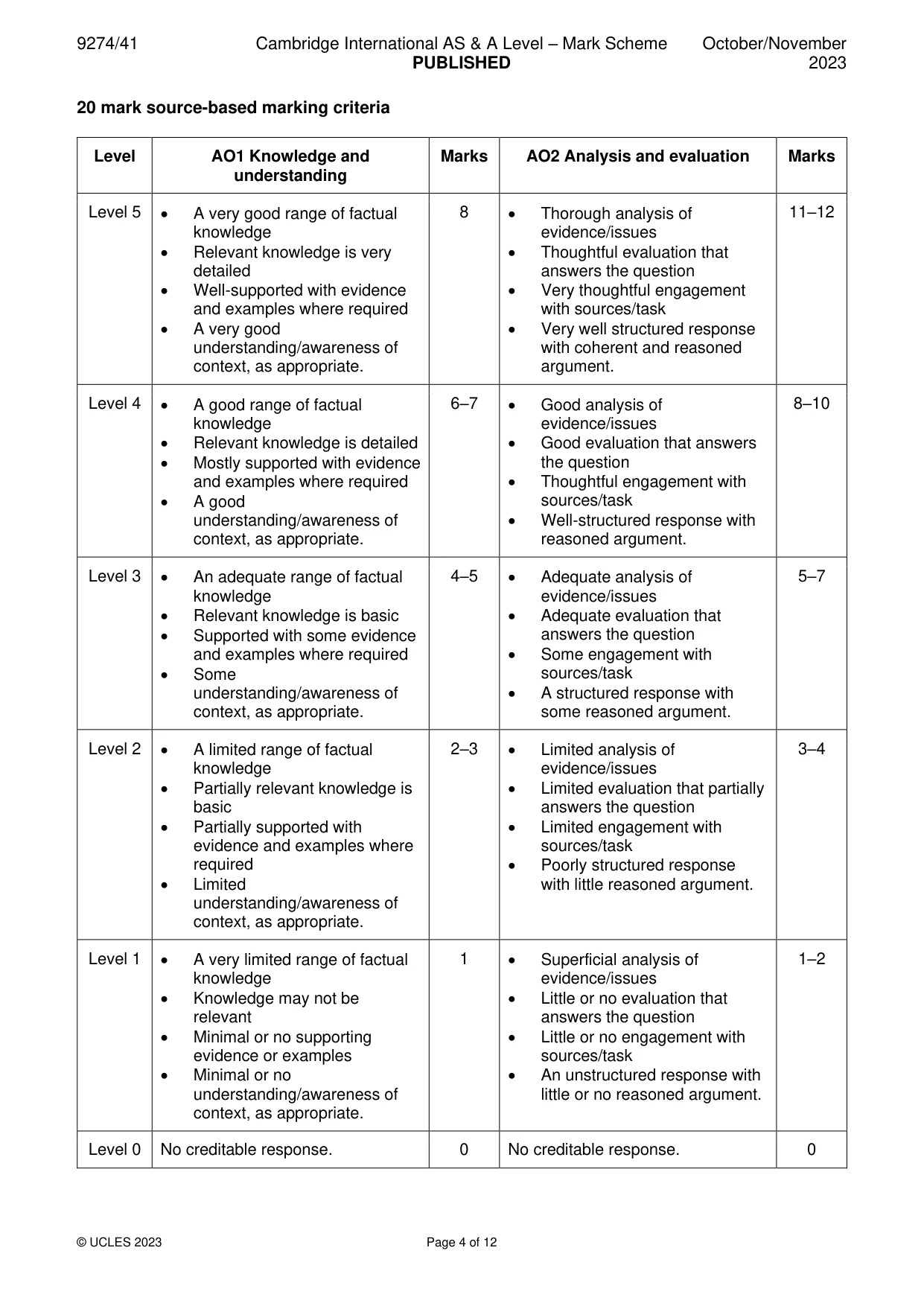
9274/41 Cambridge International AS & A Level – Mark Scheme PUBLISHED October/November 2023 © UCLES 2023 Page 4 of 12 20 mark source-based marking criteria Level AO1 Knowledge and understanding Marks AO2 Analysis and evaluation Marks Level 5 • A very good range of factual knowledge • Relevant knowledge is very detailed • Well-supported with evidence and examples where required • A very good understanding/awareness of context, as appropriate. 8 • Thorough analysis of evidence/issues • Thoughtful evaluation that answers the question • Very thoughtful engagement with sources/task • Very well structured response with coherent and reasoned argument. 11–12 Level 4 • A good range of factual knowledge • Relevant knowledge is detailed • Mostly supported with evidence and examples where required • A good understanding/awareness of context, as appropriate. 6–7 • Good analysis of evidence/issues • Good evaluation that answers the question • Thoughtful engagement with sources/task • Well-structured response with reasoned argument. 8–10 Level 3 • An adequate range of factual knowledge • Relevant knowledge is basic • Supported with some evidence and examples where required • Some understanding/awareness of context, as appropriate. 4–5 • Adequate analysis of evidence/issues • Adequate evaluation that answers the question • Some engagement with sources/task • A structured response with some reasoned argument. 5–7 Level 2 • A limited range of factual knowledge • Partially relevant knowledge is basic • Partially supported with evidence and examples where required • Limited understanding/awareness of context, as appropriate. 2–3 • Limited analysis of evidence/issues • Limited evaluation that partially answers the question • Limited engagement with sources/task • Poorly structured response with little reasoned argument. 3–4 Level 1 • A very limited range of factual knowledge • Knowledge may not be relevant • Minimal or no supporting evidence or examples • Minimal or no understanding/awareness of context, as appropriate. 1 • Superficial analysis of evidence/issues • Little or no evaluation that answers the question • Little or no engagement with sources/task • An unstructured response with little or no reasoned argument. 1–2 Level 0 No creditable response. 0 No creditable response. 0
Mark scheme, page 5
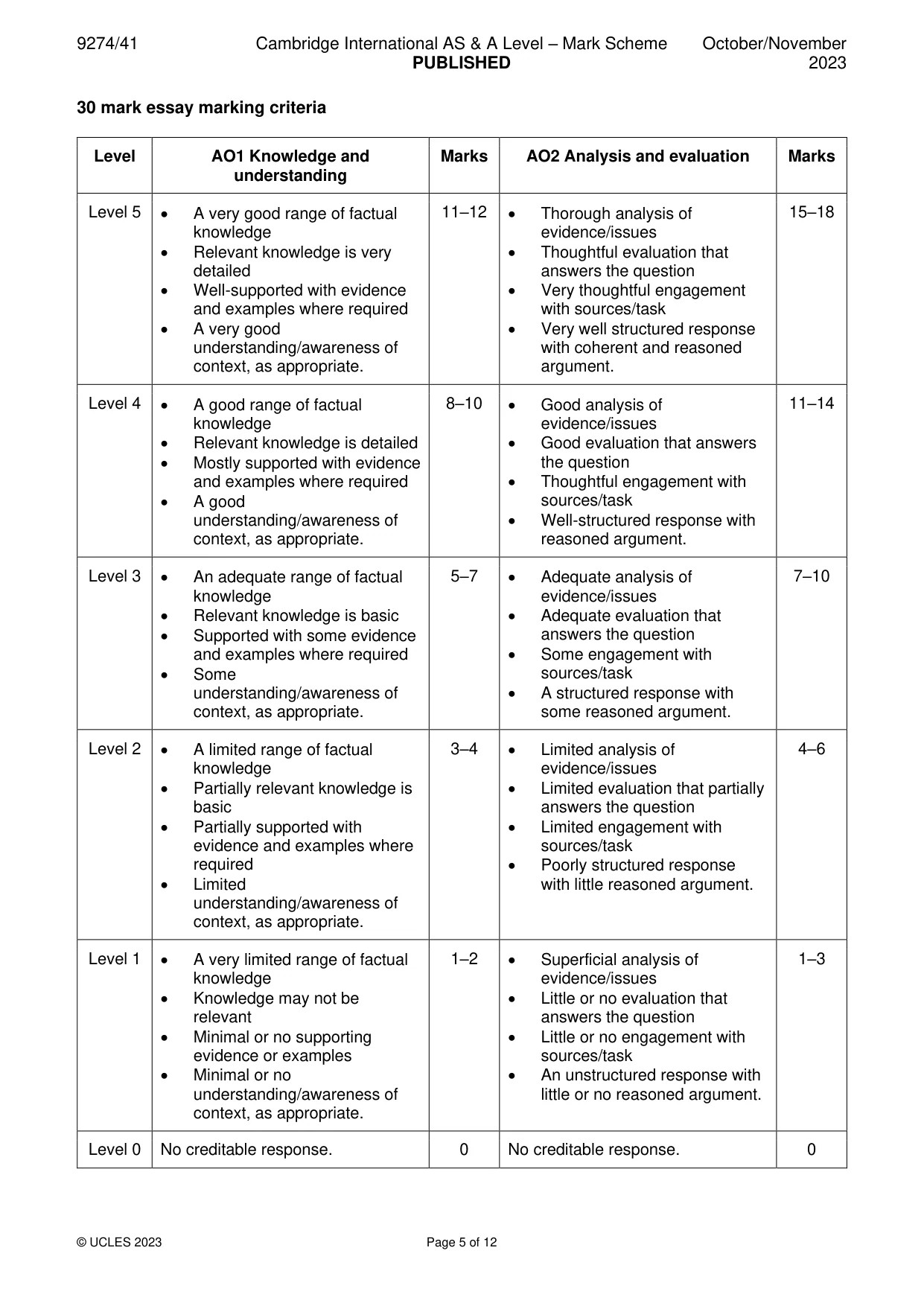
9274/41 Cambridge International AS & A Level – Mark Scheme PUBLISHED October/November 2023 © UCLES 2023 Page 5 of 12 30 mark essay marking criteria Level AO1 Knowledge and understanding Marks AO2 Analysis and evaluation Marks Level 5 • A very good range of factual knowledge • Relevant knowledge is very detailed • Well-supported with evidence and examples where required • A very good understanding/awareness of context, as appropriate. 11–12 • Thorough analysis of evidence/issues • Thoughtful evaluation that answers the question • Very thoughtful engagement with sources/task • Very well structured response with coherent and reasoned argument. 15–18 Level 4 • A good range of factual knowledge • Relevant knowledge is detailed • Mostly supported with evidence and examples where required • A good understanding/awareness of context, as appropriate. 8–10 • Good analysis of evidence/issues • Good evaluation that answers the question • Thoughtful engagement with sources/task • Well-structured response with reasoned argument. 11–14 Level 3 • An adequate range of factual knowledge • Relevant knowledge is basic • Supported with some evidence and examples where required • Some understanding/awareness of context, as appropriate. 5–7 • Adequate analysis of evidence/issues • Adequate evaluation that answers the question • Some engagement with sources/task • A structured response with some reasoned argument. 7–10 Level 2 • A limited range of factual knowledge • Partially relevant knowledge is basic • Partially supported with evidence and examples where required • Limited understanding/awareness of context, as appropriate. 3–4 • Limited analysis of evidence/issues • Limited evaluation that partially answers the question • Limited engagement with sources/task • Poorly structured response with little reasoned argument. 4–6 Level 1 • A very limited range of factual knowledge • Knowledge may not be relevant • Minimal or no supporting evidence or examples • Minimal or no understanding/awareness of context, as appropriate. 1–2 • Superficial analysis of evidence/issues • Little or no evaluation that answers the question • Little or no engagement with sources/task • An unstructured response with little or no reasoned argument. 1–3 Level 0 No creditable response. 0 No creditable response. 0
Mark scheme, page 6
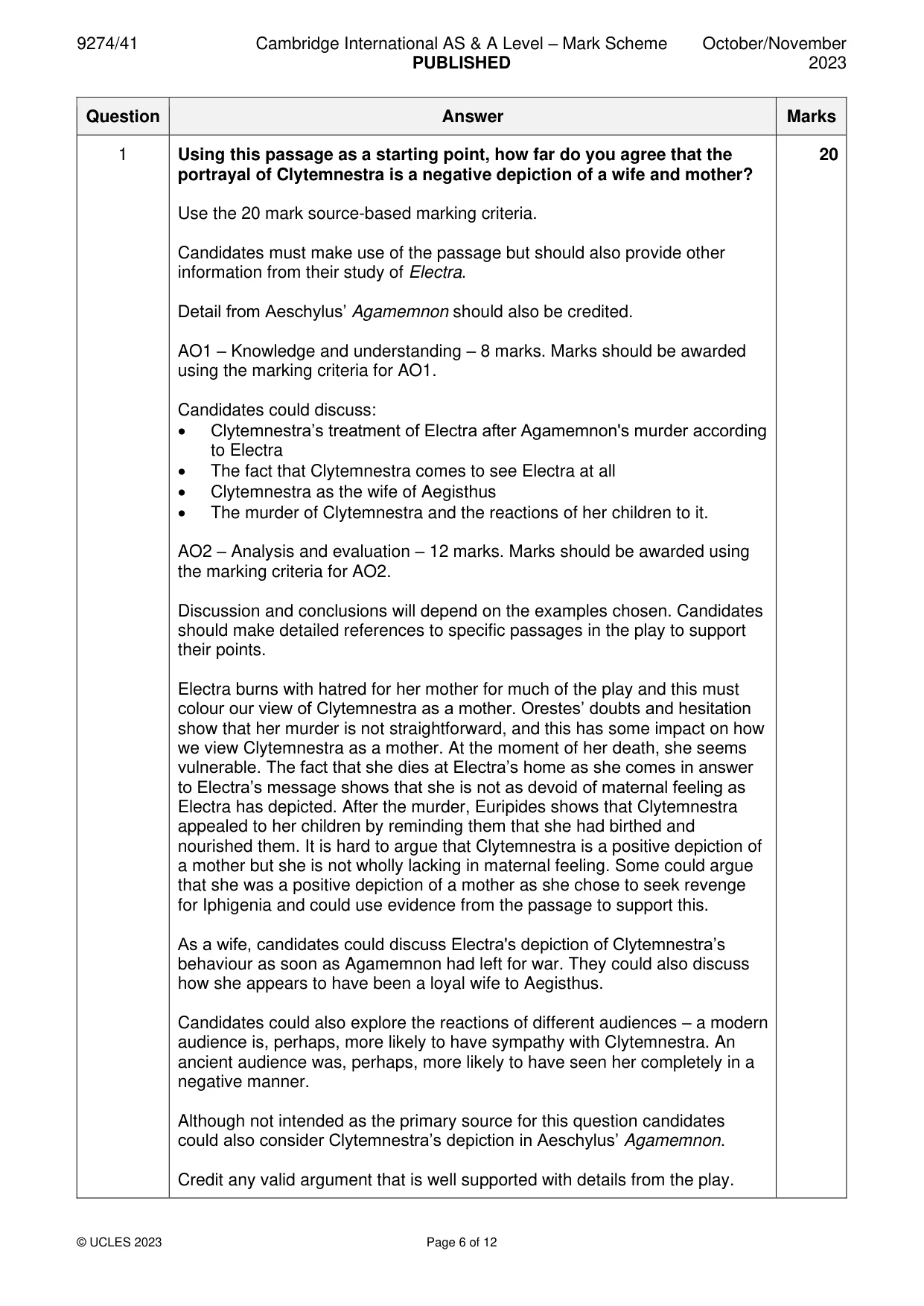
9274/41 Cambridge International AS & A Level – Mark Scheme PUBLISHED October/November 2023 © UCLES 2023 Page 6 of 12 Question Answer Marks 1 Using this passage as a starting point, how far do you agree that the portrayal of Clytemnestra is a negative depiction of a wife and mother? Use the 20 mark source-based marking criteria. Candidates must make use of the passage but should also provide other information from their study of Electra. Detail from Aeschylus’ Agamemnon should also be credited. AO1 – Knowledge and understanding – 8 marks. Marks should be awarded using the marking criteria for AO1. Candidates could discuss: • Clytemnestra’s treatment of Electra after Agamemnon's murder according to Electra • The fact that Clytemnestra comes to see Electra at all • Clytemnestra as the wife of Aegisthus • The murder of Clytemnestra and the reactions of her children to it. AO2 – Analysis and evaluation – 12 marks. Marks should be awarded using the marking criteria for AO2. Discussion and conclusions will depend on the examples chosen. Candidates should make detailed references to specific passages in the play to support their points. Electra burns with hatred for her mother for much of the play and this must colour our view of Clytemnestra as a mother. Orestes’ doubts and hesitation show that her murder is not straightforward, and this has some impact on how we view Clytemnestra as a mother. At the moment of her death, she seems vulnerable. The fact that she dies at Electra’s home as she comes in answer to Electra’s message shows that she is not as devoid of maternal feeling as Electra has depicted. After the murder, Euripides shows that Clytemnestra appealed to her children by reminding them that she had birthed and nourished them. It is hard to argue that Clytemnestra is a positive depiction of a mother but she is not wholly lacking in maternal feeling. Some could argue that she was a positive depiction of a mother as she chose to seek revenge for Iphigenia and could use evidence from the passage to support this. As a wife, candidates could discuss Electra's depiction of Clytemnestra’s behaviour as soon as Agamemnon had left for war. They could also discuss how she appears to have been a loyal wife to Aegisthus. Candidates could also explore the reactions of different audiences – a modern audience is, perhaps, more likely to have sympathy with Clytemnestra. An ancient audience was, perhaps, more likely to have seen her completely in a negative manner. Although not intended as the primary source for this question candidates could also consider Clytemnestra’s depiction in Aeschylus’ Agamemnon. Credit any valid argument that is well supported with details from the play. 20
Mark scheme, page 7
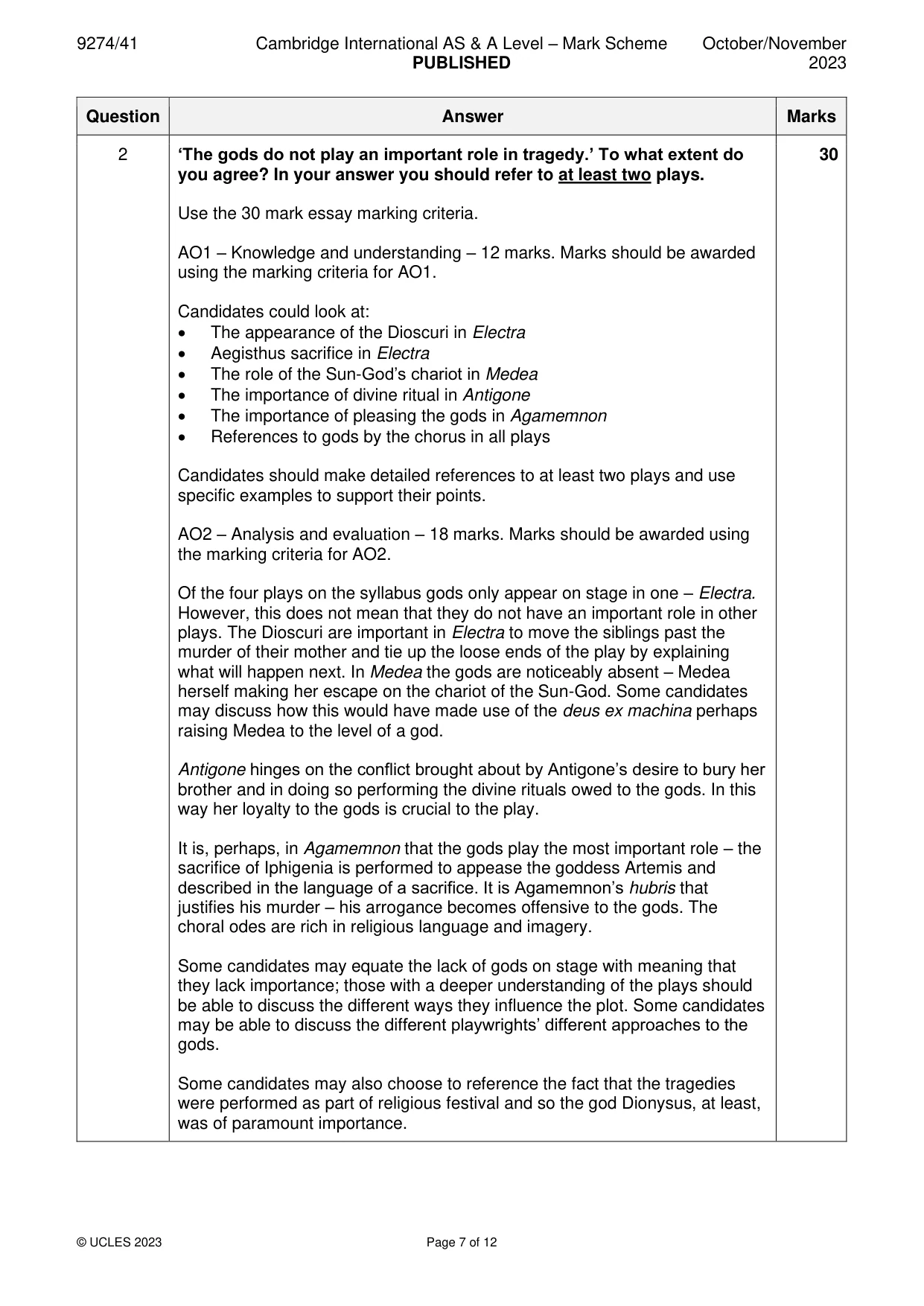
9274/41 Cambridge International AS & A Level – Mark Scheme PUBLISHED October/November 2023 © UCLES 2023 Page 7 of 12 Question Answer Marks 2 ‘The gods do not play an important role in tragedy.’ To what extent do you agree? In your answer you should refer to at least two plays. Use the 30 mark essay marking criteria. AO1 – Knowledge and understanding – 12 marks. Marks should be awarded using the marking criteria for AO1. Candidates could look at: • The appearance of the Dioscuri in Electra • Aegisthus sacrifice in Electra • The role of the Sun-God’s chariot in Medea • The importance of divine ritual in Antigone • The importance of pleasing the gods in Agamemnon • References to gods by the chorus in all plays Candidates should make detailed references to at least two plays and use specific examples to support their points. AO2 – Analysis and evaluation – 18 marks. Marks should be awarded using the marking criteria for AO2. Of the four plays on the syllabus gods only appear on stage in one – Electra. However, this does not mean that they do not have an important role in other plays. The Dioscuri are important in Electra to move the siblings past the murder of their mother and tie up the loose ends of the play by explaining what will happen next. In Medea the gods are noticeably absent – Medea herself making her escape on the chariot of the Sun-God. Some candidates may discuss how this would have made use of the deus ex machina perhaps raising Medea to the level of a god. Antigone hinges on the conflict brought about by Antigone’s desire to bury her brother and in doing so performing the divine rituals owed to the gods. In this way her loyalty to the gods is crucial to the play. It is, perhaps, in Agamemnon that the gods play the most important role – the sacrifice of Iphigenia is performed to appease the goddess Artemis and described in the language of a sacrifice. It is Agamemnon’s hubris that justifies his murder – his arrogance becomes offensive to the gods. The choral odes are rich in religious language and imagery. Some candidates may equate the lack of gods on stage with meaning that they lack importance; those with a deeper understanding of the plays should be able to discuss the different ways they influence the plot. Some candidates may be able to discuss the different playwrights’ different approaches to the gods. Some candidates may also choose to reference the fact that the tragedies were performed as part of religious festival and so the god Dionysus, at least, was of paramount importance. 30
Mark scheme, page 8
9274/41 Cambridge International AS & A Level – Mark Scheme PUBLISHED October/November 2023 © UCLES 2023 Page 8 of 12 Question Answer Marks 2 Discussion and conclusions will depend on the examples chosen. Candidates should make reference to at least two plays but the response does not need to focus equally on all plays discussed to gain marks. Accept any valid line of argument that is well supported with examples from the text.
Mark scheme, page 9
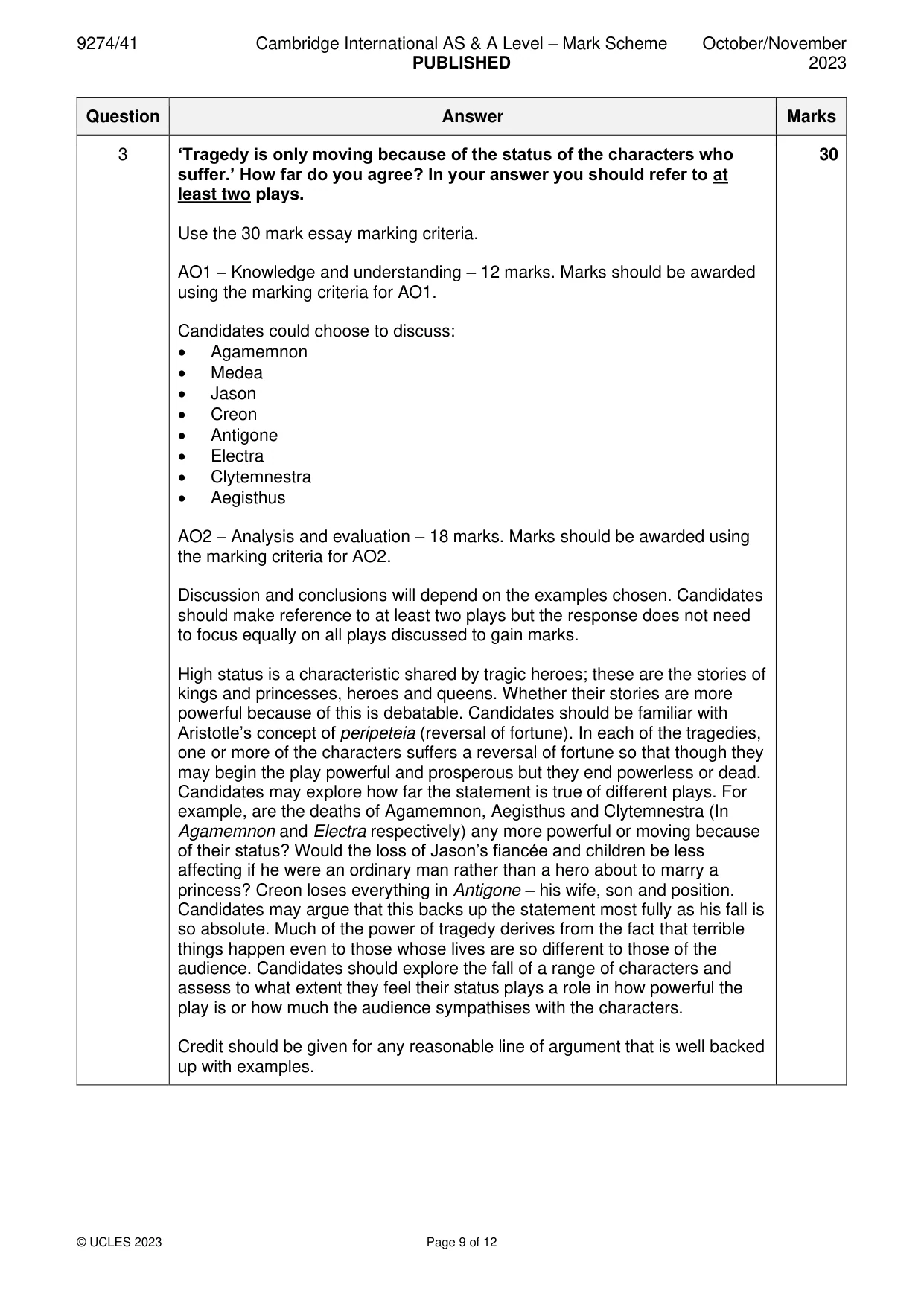
9274/41 Cambridge International AS & A Level – Mark Scheme PUBLISHED October/November 2023 © UCLES 2023 Page 9 of 12 Question Answer Marks 3 ‘Tragedy is only moving because of the status of the characters who suffer.’ How far do you agree? In your answer you should refer to at least two plays. Use the 30 mark essay marking criteria. AO1 – Knowledge and understanding – 12 marks. Marks should be awarded using the marking criteria for AO1. Candidates could choose to discuss: • Agamemnon • Medea • Jason • Creon • Antigone • Electra • Clytemnestra • Aegisthus AO2 – Analysis and evaluation – 18 marks. Marks should be awarded using the marking criteria for AO2. Discussion and conclusions will depend on the examples chosen. Candidates should make reference to at least two plays but the response does not need to focus equally on all plays discussed to gain marks. High status is a characteristic shared by tragic heroes; these are the stories of kings and princesses, heroes and queens. Whether their stories are more powerful because of this is debatable. Candidates should be familiar with Aristotle’s concept of peripeteia (reversal of fortune). In each of the tragedies, one or more of the characters suffers a reversal of fortune so that though they may begin the play powerful and prosperous but they end powerless or dead. Candidates may explore how far the statement is true of different plays. For example, are the deaths of Agamemnon, Aegisthus and Clytemnestra (In Agamemnon and Electra respectively) any more powerful or moving because of their status? Would the loss of Jason’s fiancée and children be less affecting if he were an ordinary man rather than a hero about to marry a princess? Creon loses everything in Antigone – his wife, son and position. Candidates may argue that this backs up the statement most fully as his fall is so absolute. Much of the power of tragedy derives from the fact that terrible things happen even to those whose lives are so different to those of the audience. Candidates should explore the fall of a range of characters and assess to what extent they feel their status plays a role in how powerful the play is or how much the audience sympathises with the characters. Credit should be given for any reasonable line of argument that is well backed up with examples. 30
Mark scheme, page 10
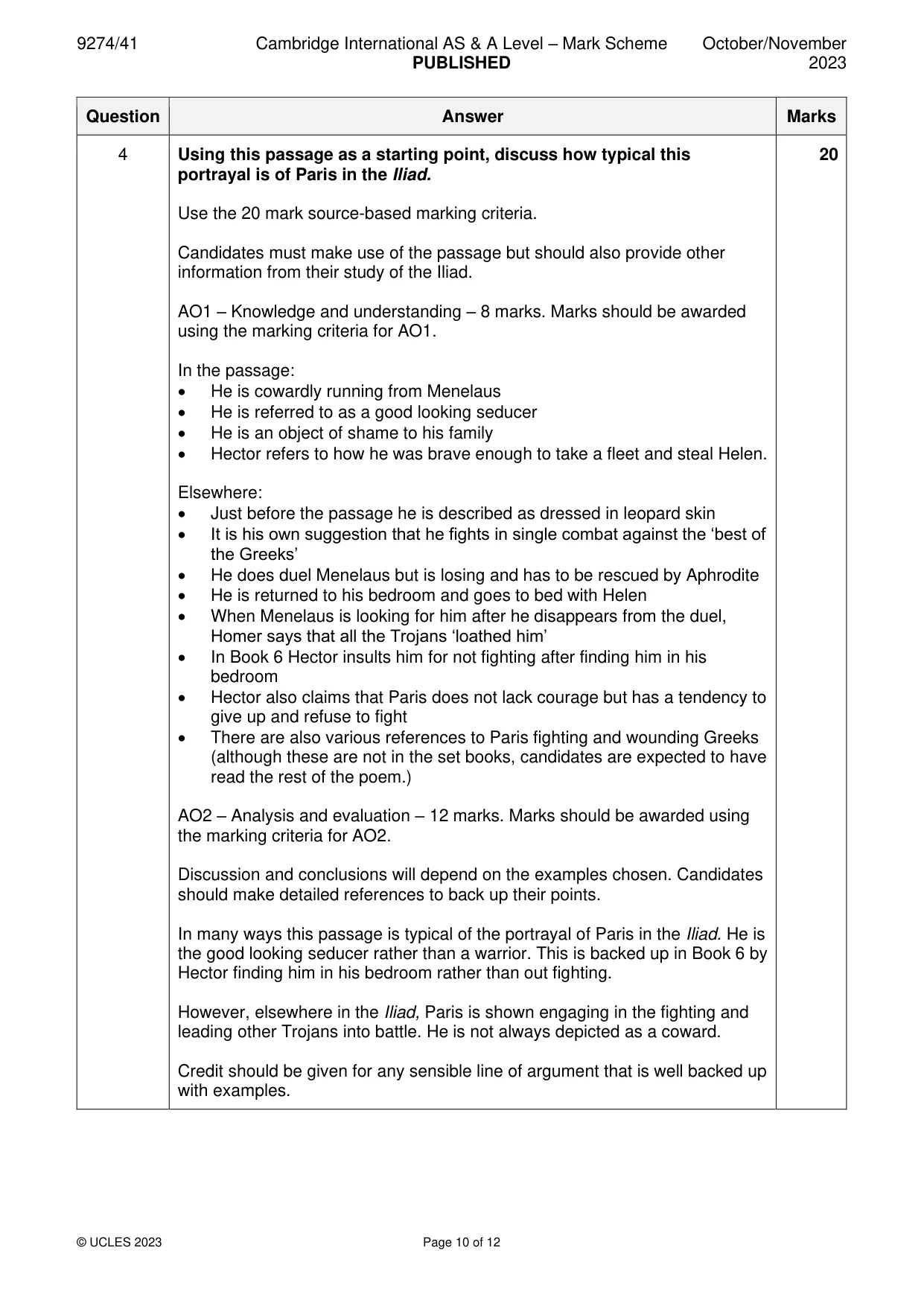
9274/41 Cambridge International AS & A Level – Mark Scheme PUBLISHED October/November 2023 © UCLES 2023 Page 10 of 12 Question Answer Marks 4 Using this passage as a starting point, discuss how typical this portrayal is of Paris in the Iliad. Use the 20 mark source-based marking criteria. Candidates must make use of the passage but should also provide other information from their study of the Iliad. AO1 – Knowledge and understanding – 8 marks. Marks should be awarded using the marking criteria for AO1. In the passage: • He is cowardly running from Menelaus • He is referred to as a good looking seducer • He is an object of shame to his family • Hector refers to how he was brave enough to take a fleet and steal Helen. Elsewhere: • Just before the passage he is described as dressed in leopard skin • It is his own suggestion that he fights in single combat against the ‘best of the Greeks’ • He does duel Menelaus but is losing and has to be rescued by Aphrodite • He is returned to his bedroom and goes to bed with Helen • When Menelaus is looking for him after he disappears from the duel, Homer says that all the Trojans ‘loathed him’ • In Book 6 Hector insults him for not fighting after finding him in his bedroom • Hector also claims that Paris does not lack courage but has a tendency to give up and refuse to fight • There are also various references to Paris fighting and wounding Greeks (although these are not in the set books, candidates are expected to have read the rest of the poem.) AO2 – Analysis and evaluation – 12 marks. Marks should be awarded using the marking criteria for AO2. Discussion and conclusions will depend on the examples chosen. Candidates should make detailed references to back up their points. In many ways this passage is typical of the portrayal of Paris in the Iliad. He is the good looking seducer rather than a warrior. This is backed up in Book 6 by Hector finding him in his bedroom rather than out fighting. However, elsewhere in the Iliad, Paris is shown engaging in the fighting and leading other Trojans into battle. He is not always depicted as a coward. Credit should be given for any sensible line of argument that is well backed up with examples. 20
Mark scheme, page 11
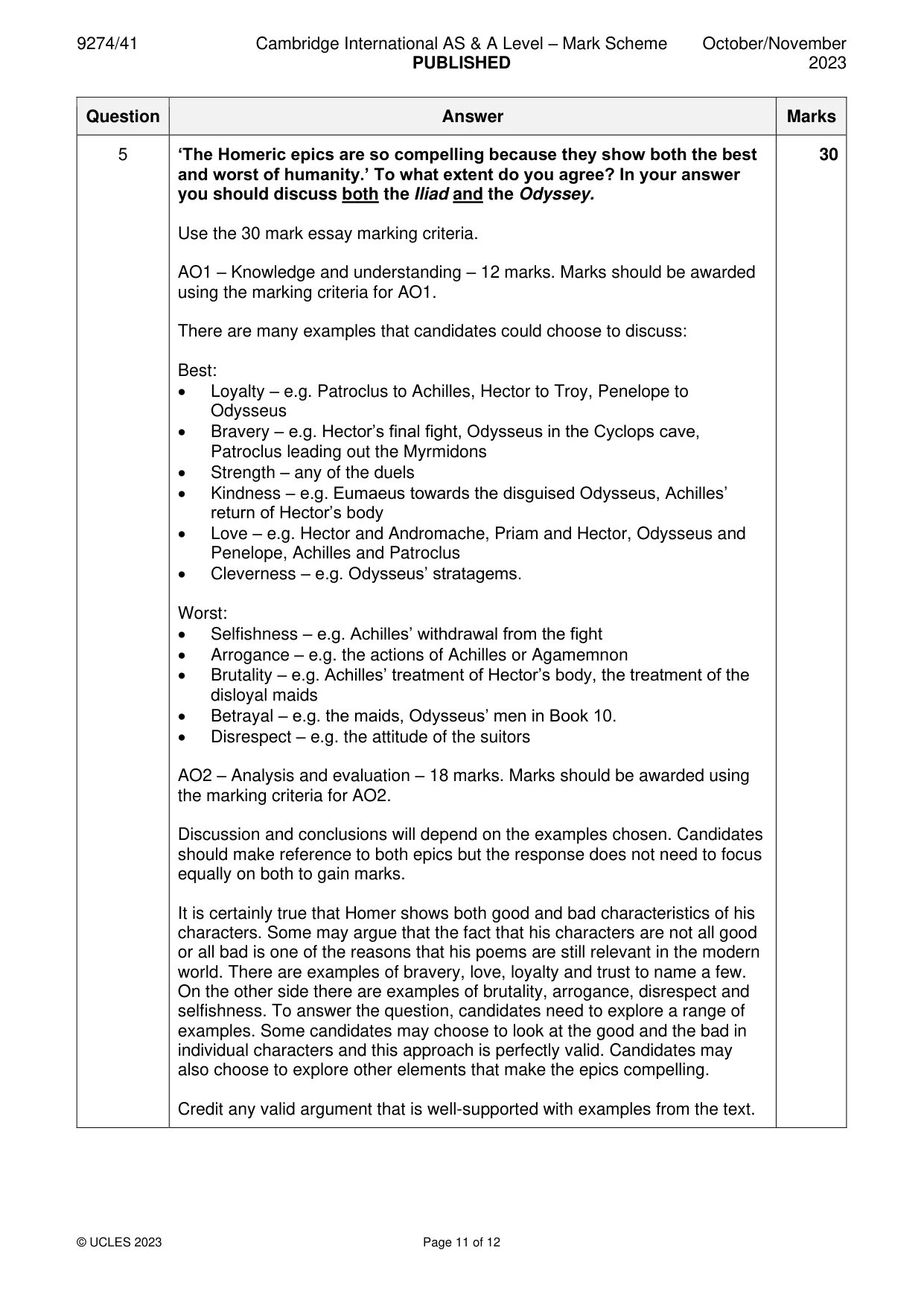
9274/41 Cambridge International AS & A Level – Mark Scheme PUBLISHED October/November 2023 © UCLES 2023 Page 11 of 12 Question Answer Marks 5 ‘The Homeric epics are so compelling because they show both the best and worst of humanity.’ To what extent do you agree? In your answer you should discuss both the Iliad and the Odyssey. Use the 30 mark essay marking criteria. AO1 – Knowledge and understanding – 12 marks. Marks should be awarded using the marking criteria for AO1. There are many examples that candidates could choose to discuss: Best: • Loyalty – e.g. Patroclus to Achilles, Hector to Troy, Penelope to Odysseus • Bravery – e.g. Hector’s final fight, Odysseus in the Cyclops cave, Patroclus leading out the Myrmidons • Strength – any of the duels • Kindness – e.g. Eumaeus towards the disguised Odysseus, Achilles’ return of Hector’s body • Love – e.g. Hector and Andromache, Priam and Hector, Odysseus and Penelope, Achilles and Patroclus • Cleverness – e.g. Odysseus’ stratagems. Worst: • Selfishness – e.g. Achilles’ withdrawal from the fight • Arrogance – e.g. the actions of Achilles or Agamemnon • Brutality – e.g. Achilles’ treatment of Hector’s body, the treatment of the disloyal maids • Betrayal – e.g. the maids, Odysseus’ men in Book 10. • Disrespect – e.g. the attitude of the suitors AO2 – Analysis and evaluation – 18 marks. Marks should be awarded using the marking criteria for AO2. Discussion and conclusions will depend on the examples chosen. Candidates should make reference to both epics but the response does not need to focus equally on both to gain marks. It is certainly true that Homer shows both good and bad characteristics of his characters. Some may argue that the fact that his characters are not all good or all bad is one of the reasons that his poems are still relevant in the modern world. There are examples of bravery, love, loyalty and trust to name a few. On the other side there are examples of brutality, arrogance, disrespect and selfishness. To answer the question, candidates need to explore a range of examples. Some candidates may choose to look at the good and the bad in individual characters and this approach is perfectly valid. Candidates may also choose to explore other elements that make the epics compelling. Credit any valid argument that is well-supported with examples from the text. 30
Mark scheme, page 12
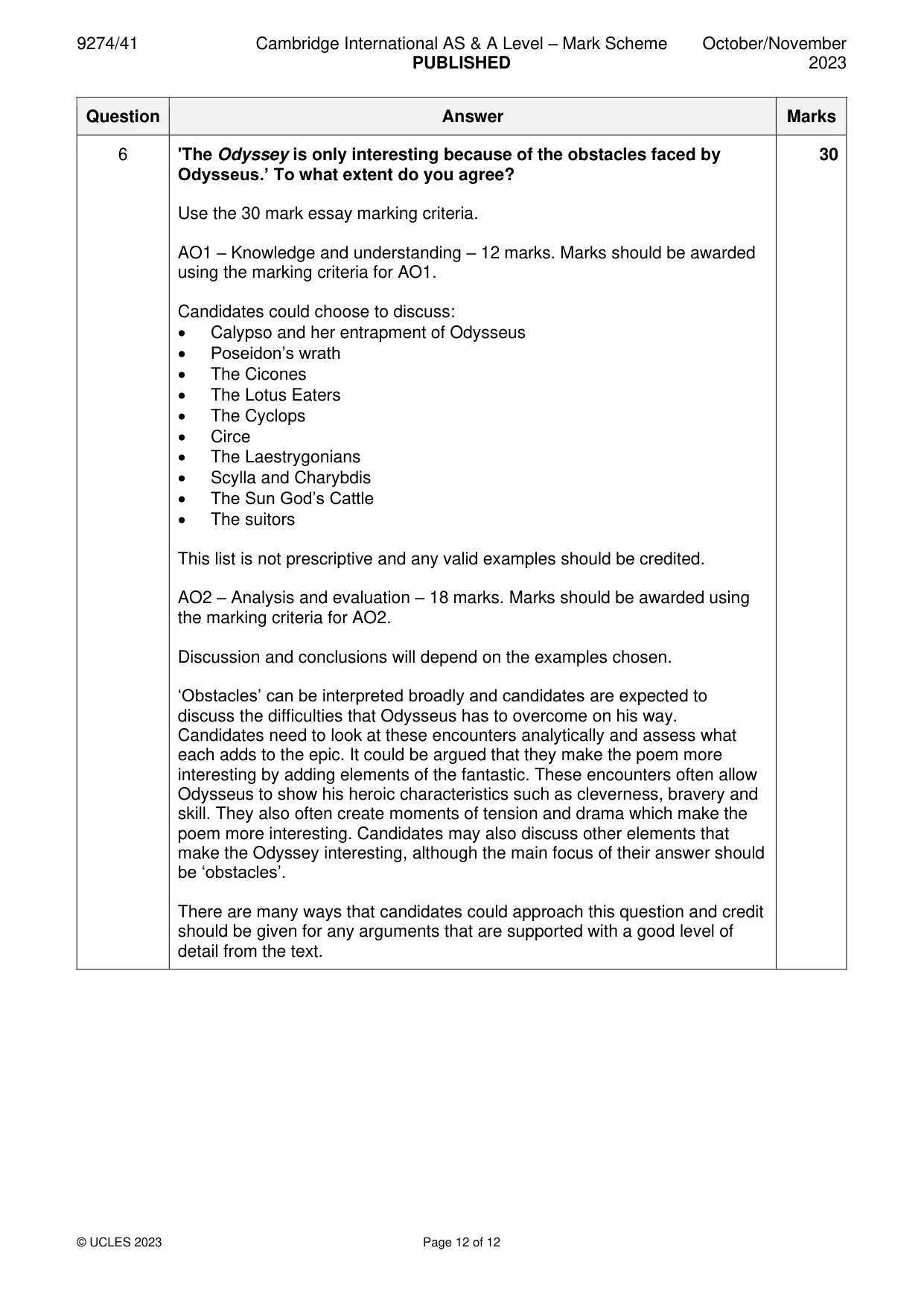
9274/41 Cambridge International AS & A Level – Mark Scheme PUBLISHED October/November 2023 © UCLES 2023 Page 12 of 12 Question Answer Marks 6 'The Odyssey is only interesting because of the obstacles faced by Odysseus.’ To what extent do you agree? Use the 30 mark essay marking criteria. AO1 – Knowledge and understanding – 12 marks. Marks should be awarded using the marking criteria for AO1. Candidates could choose to discuss: • Calypso and her entrapment of Odysseus • Poseidon’s wrath • The Cicones • The Lotus Eaters • The Cyclops • Circe • The Laestrygonians • Scylla and Charybdis • The Sun God’s Cattle • The suitors This list is not prescriptive and any valid examples should be credited. AO2 – Analysis and evaluation – 18 marks. Marks should be awarded using the marking criteria for AO2. Discussion and conclusions will depend on the examples chosen. ‘Obstacles’ can be interpreted broadly and candidates are expected to discuss the difficulties that Odysseus has to overcome on his way. Candidates need to look at these encounters analytically and assess what each adds to the epic. It could be argued that they make the poem more interesting by adding elements of the fantastic. These encounters often allow Odysseus to show his heroic characteristics such as cleverness, bravery and skill. They also often create moments of tension and drama which make the poem more interesting. Candidates may also discuss other elements that make the Odyssey interesting, although the main focus of their answer should be ‘obstacles’. There are many ways that candidates could approach this question and credit should be given for any arguments that are supported with a good level of detail from the text. 30
What you needed in this session
Cambridge’s own grade thresholds for 2023 Oct/Nov, Paper 4 · Variant 1. A higher threshold means an easier paper — the bar moves with how the cohort did.