Cambridge A Level Classical Studies 9274 — 2022 Oct/Nov Paper 4 · Variant 2
9274/42/O/N/22 · 50 marks · ≈56 min
The question paper and its mark scheme, free to read here and free to download. This is Cambridge’s own paper, exactly as it was sat.
Question paper4 pages

Mark scheme11 pages
Answers below. Sit the paper first if you are practising.
Paper as text
Question paper, page 1
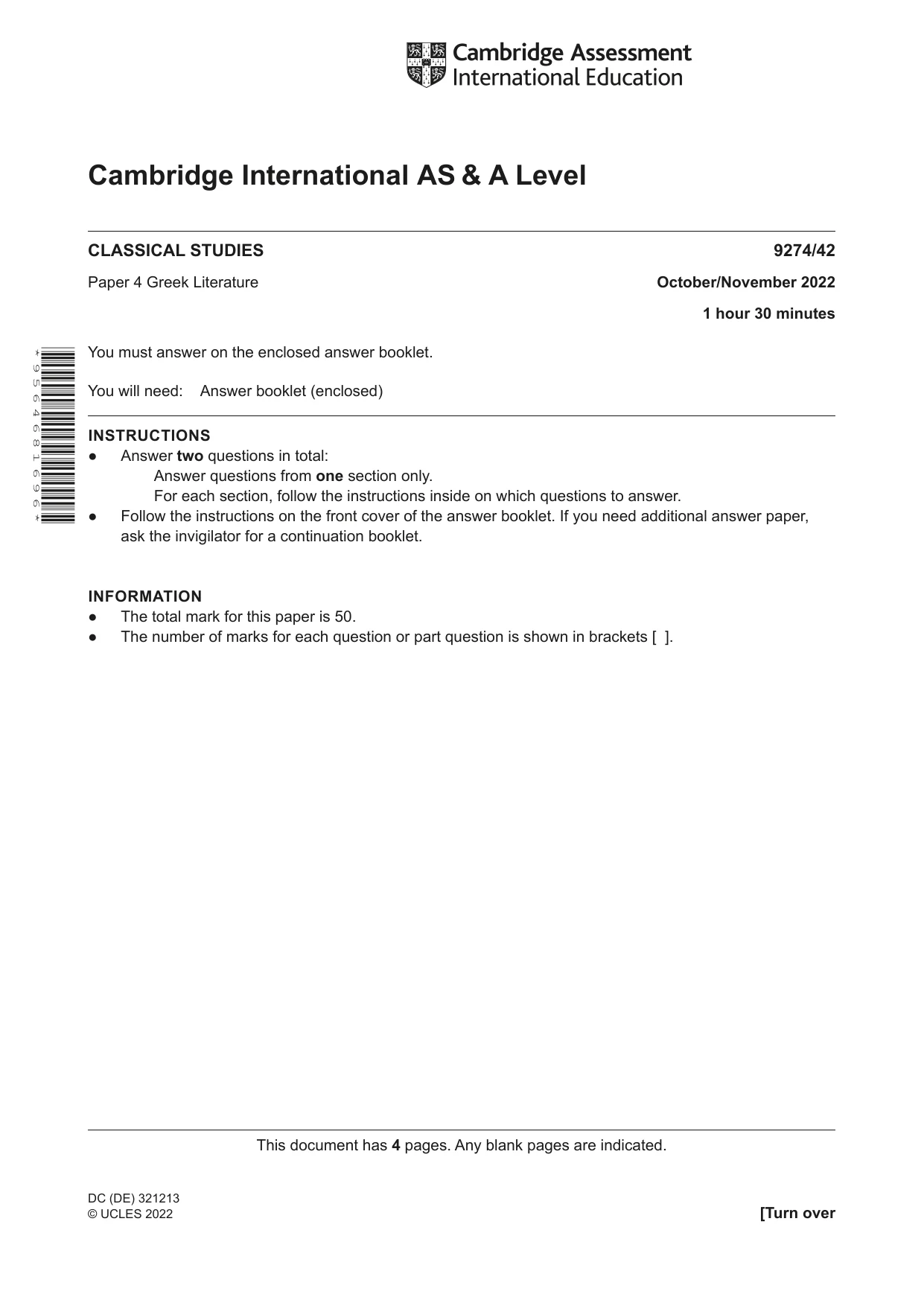
This document has 4 pages. Any blank pages are indicated. [Turn over Cambridge International AS & A Level DC (DE) 321213 © UCLES 2022 CLASSICAL STUDIES 9274/42 Paper 4 Greek Literature October/November 2022 1 hour 30 minutes You must answer on the enclosed answer booklet. You will need: Answer booklet (enclosed) INSTRUCTIONS ● Answer two questions in total: Answer questions from one section only. For each section, follow the instructions inside on which questions to answer. ● Follow the instructions on the front cover of the answer booklet. If you need additional answer paper, ask the invigilator for a continuation booklet. INFORMATION ● The total mark for this paper is 50. ● The number of marks for each question or part question is shown in brackets [ ]. * 9 5 6 4 6 8 1 6 9 6 *
Question paper, page 2
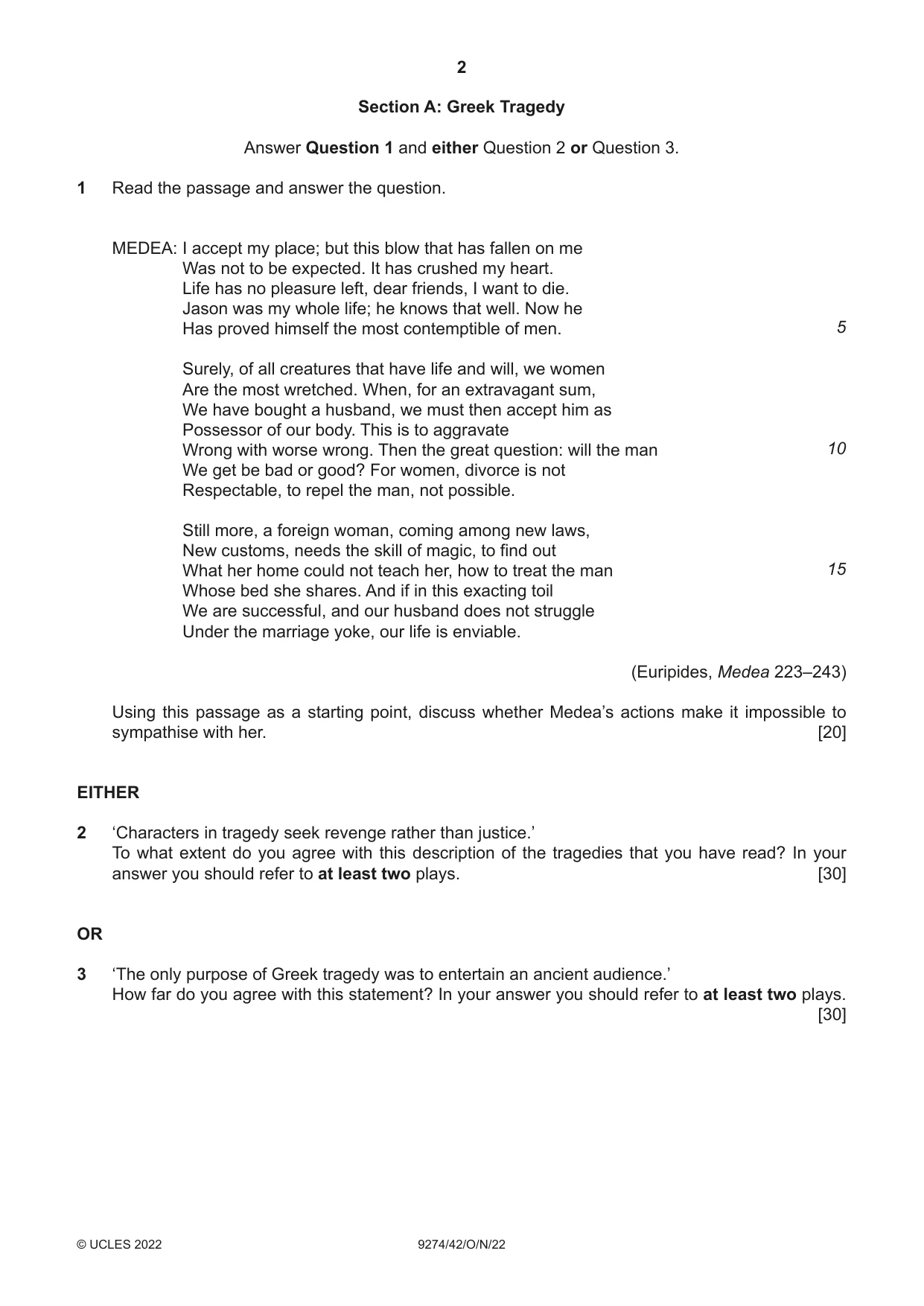
2 9274/42/O/N/22 © UCLES 2022 Section A: Greek Tragedy Answer Question 1 and either Question 2 or Question 3. 1 Read the passage and answer the question. MEDEA: I accept my place; but this blow that has fallen on me Was not to be expected. It has crushed my heart. Life has no pleasure left, dear friends, I want to die. Jason was my whole life; he knows that well. Now he Has proved himself the most contemptible of men. Surely, of all creatures that have life and will, we women Are the most wretched. When, for an extravagant sum, We have bought a husband, we must then accept him as Possessor of our body. This is to aggravate Wrong with worse wrong. Then the great question: will the man We get be bad or good? For women, divorce is not Respectable, to repel the man, not possible. Still more, a foreign woman, coming among new laws, New customs, needs the skill of magic, to find out What her home could not teach her, how to treat the man Whose bed she shares. And if in this exacting toil We are successful, and our husband does not struggle Under the marriage yoke, our life is enviable. (Euripides, Medea 223–243) Using this passage as a starting point, discuss whether Medea’s actions make it impossible to sympathise with her. [20] EITHER 2 ‘Characters in tragedy seek revenge rather than justice.’ To what extent do you agree with this description of the tragedies that you have read? In your answer you should refer to at least two plays. [30] OR 3 ‘The only purpose of Greek tragedy was to entertain an ancient audience.’ How far do you agree with this statement? In your answer you should refer to at least two plays. [30] 5 10 15
Question paper, page 3
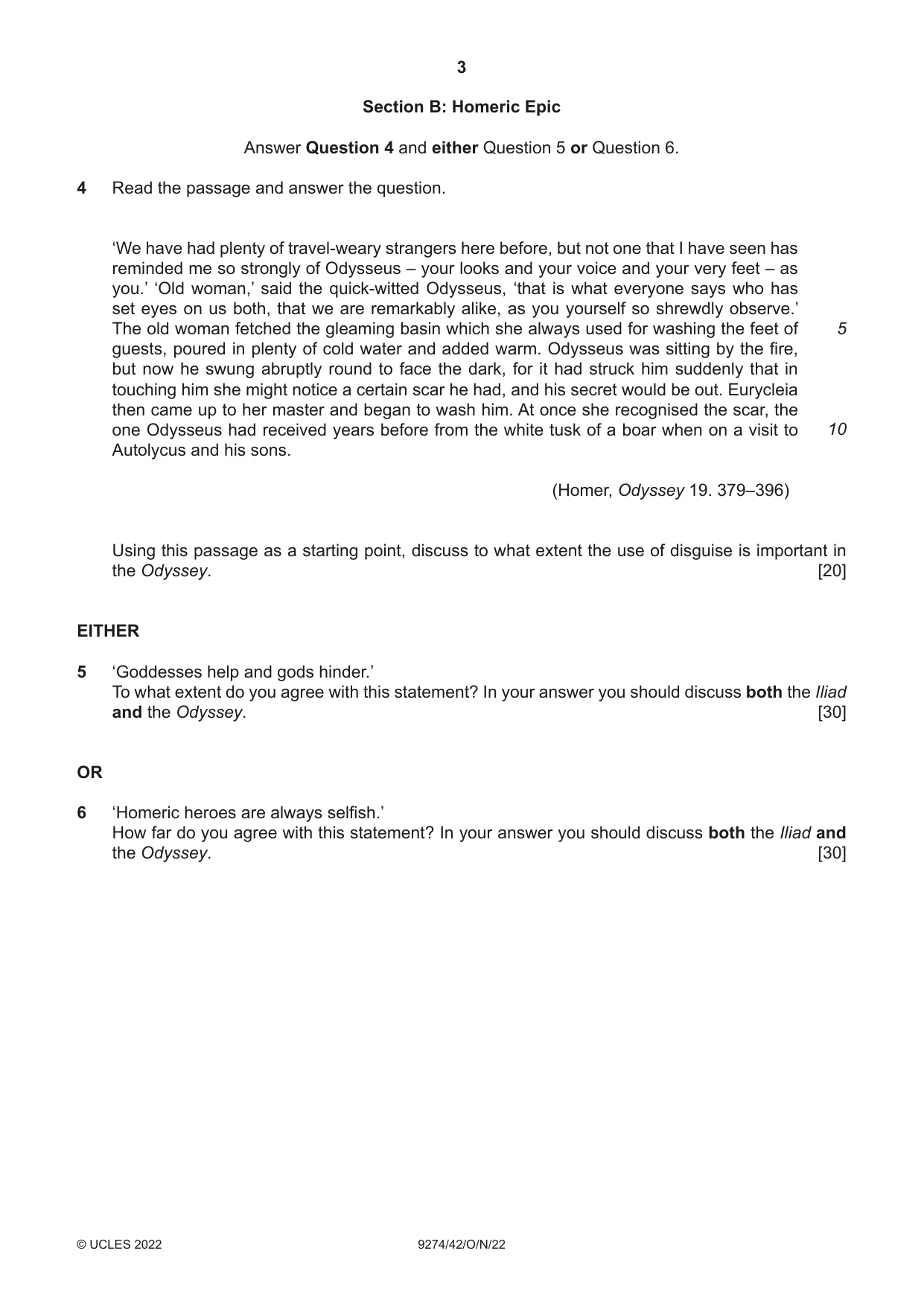
3 9274/42/O/N/22 © UCLES 2022 Section B: Homeric Epic Answer Question 4 and either Question 5 or Question 6. 4 Read the passage and answer the question. ‘We have had plenty of travel-weary strangers here before, but not one that I have seen has reminded me so strongly of Odysseus – your looks and your voice and your very feet – as you.’ ‘Old woman,’ said the quick-witted Odysseus, ‘that is what everyone says who has set eyes on us both, that we are remarkably alike, as you yourself so shrewdly observe.’ The old woman fetched the gleaming basin which she always used for washing the feet of guests, poured in plenty of cold water and added warm. Odysseus was sitting by the fire, but now he swung abruptly round to face the dark, for it had struck him suddenly that in touching him she might notice a certain scar he had, and his secret would be out. Eurycleia then came up to her master and began to wash him. At once she recognised the scar, the one Odysseus had received years before from the white tusk of a boar when on a visit to Autolycus and his sons. (Homer, Odyssey 19. 379–396) Using this passage as a starting point, discuss to what extent the use of disguise is important in the Odyssey. [20] EITHER 5 ‘Goddesses help and gods hinder.’ To what extent do you agree with this statement? In your answer you should discuss both the Iliad and the Odyssey. [30] OR 6 ‘Homeric heroes are always selfish.’ How far do you agree with this statement? In your answer you should discuss both the Iliad and the Odyssey. [30] 5 10
Question paper, page 4
4 9274/42/O/N/22 © UCLES 2022 Permission to reproduce items where third-party owned material protected by copyright is included has been sought and cleared where possible. Every reasonable effort has been made by the publisher (UCLES) to trace copyright holders, but if any items requiring clearance have unwittingly been included, the publisher will be pleased to make amends at the earliest possible opportunity. To avoid the issue of disclosure of answer-related information to candidates, all copyright acknowledgements are reproduced online in the Cambridge Assessment International Education Copyright Acknowledgements Booklet. This is produced for each series of examinations and is freely available to download at www.cambridgeinternational.org after the live examination series. Cambridge Assessment International Education is part of Cambridge Assessment. Cambridge Assessment is the brand name of the University of Cambridge Local Examinations Syndicate (UCLES), which is a department of the University of Cambridge. BLANK PAGE
Mark scheme, page 1
This document consists of 11 printed pages. © UCLES 2022 [Turn over Cambridge International AS & A Level CLASSICAL STUDIES 9274/42 Paper 4 Greek Literature October/November 2022 MARK SCHEME Maximum Mark: 50 Published This mark scheme is published as an aid to teachers and candidates, to indicate the requirements of the examination. It shows the basis on which Examiners were instructed to award marks. It does not indicate the details of the discussions that took place at an Examiners’ meeting before marking began, which would have considered the acceptability of alternative answers. Mark schemes should be read in conjunction with the question paper and the Principal Examiner Report for Teachers. Cambridge International will not enter into discussions about these mark schemes. Cambridge International is publishing the mark schemes for the October/November 2022 series for most Cambridge IGCSE™, Cambridge International A and AS Level components and some Cambridge O Level components.
Mark scheme, page 2
9274/42 Cambridge International AS & A Level – Mark Scheme PUBLISHED October/November 2022 © UCLES 2022 Page 2 of 11 Generic Marking Principles These general marking principles must be applied by all examiners when marking candidate answers. They should be applied alongside the specific content of the mark scheme or generic level descriptors for a question. Each question paper and mark scheme will also comply with these marking principles. GENERIC MARKING PRINCIPLE 1: Marks must be awarded in line with: • the specific content of the mark scheme or the generic level descriptors for the question • the specific skills defined in the mark scheme or in the generic level descriptors for the question • the standard of response required by a candidate as exemplified by the standardisation scripts. GENERIC MARKING PRINCIPLE 2: Marks awarded are always whole marks (not half marks, or other fractions). GENERIC MARKING PRINCIPLE 3: Marks must be awarded positively: • marks are awarded for correct/valid answers, as defined in the mark scheme. However, credit is given for valid answers which go beyond the scope of the syllabus and mark scheme, referring to your Team Leader as appropriate • marks are awarded when candidates clearly demonstrate what they know and can do • marks are not deducted for errors • marks are not deducted for omissions • answers should only be judged on the quality of spelling, punctuation and grammar when these features are specifically assessed by the question as indicated by the mark scheme. The meaning, however, should be unambiguous. GENERIC MARKING PRINCIPLE 4: Rules must be applied consistently, e.g. in situations where candidates have not followed instructions or in the application of generic level descriptors. GENERIC MARKING PRINCIPLE 5: Marks should be awarded using the full range of marks defined in the mark scheme for the question (however; the use of the full mark range may be limited according to the quality of the candidate responses seen). GENERIC MARKING PRINCIPLE 6: Marks awarded are based solely on the requirements as defined in the mark scheme. Marks should not be awarded with grade thresholds or grade descriptors in mind.
Mark scheme, page 3
9274/42 Cambridge International AS & A Level – Mark Scheme PUBLISHED October/November 2022 © UCLES 2022 Page 3 of 11 General guidance for marking extended response and essay questions Candidates must address the question set and reach an overall judgement, but no set answer is expected. The questions can be approached in various ways and what matters is not the conclusions reached but the quality and breadth of the argument offered by an answer. Examiners are encouraged to constantly refresh their awareness of the question and be aware of any requirements set by the question to use sources or make reference to specific examples. Indicative content in the question-specific mark schemes will neither be exhaustive nor prescriptive. Appropriate, supported responses which address the question should be rewarded. Relevant accurate knowledge from outside the prescribed Sources for Study e.g. literary or historical sources not set in the Sources for Study should be rewarded as appropriate. Guidance on using levels-based mark schemes Marking of work should be positive, rewarding achievement where possible, but clearly differentiating across the whole range of marks, where appropriate. The examiner should look at the work and then make a judgement about which level statement is the best fit. In practice, work does not always match one level statement precisely so a judgement may need to be made between two or more level statements. Once a best-fit level statement has been identified, use the following guidance to decide on a specific mark: • If the candidate’s work convincingly meets the level statement, award the highest mark. • If the candidate’s work adequately meets the level statement, award the most appropriate mark in the middle of the range (where middle marks are available). • If the candidate’s work just meets the level statement, award the lowest mark.
Mark scheme, page 4
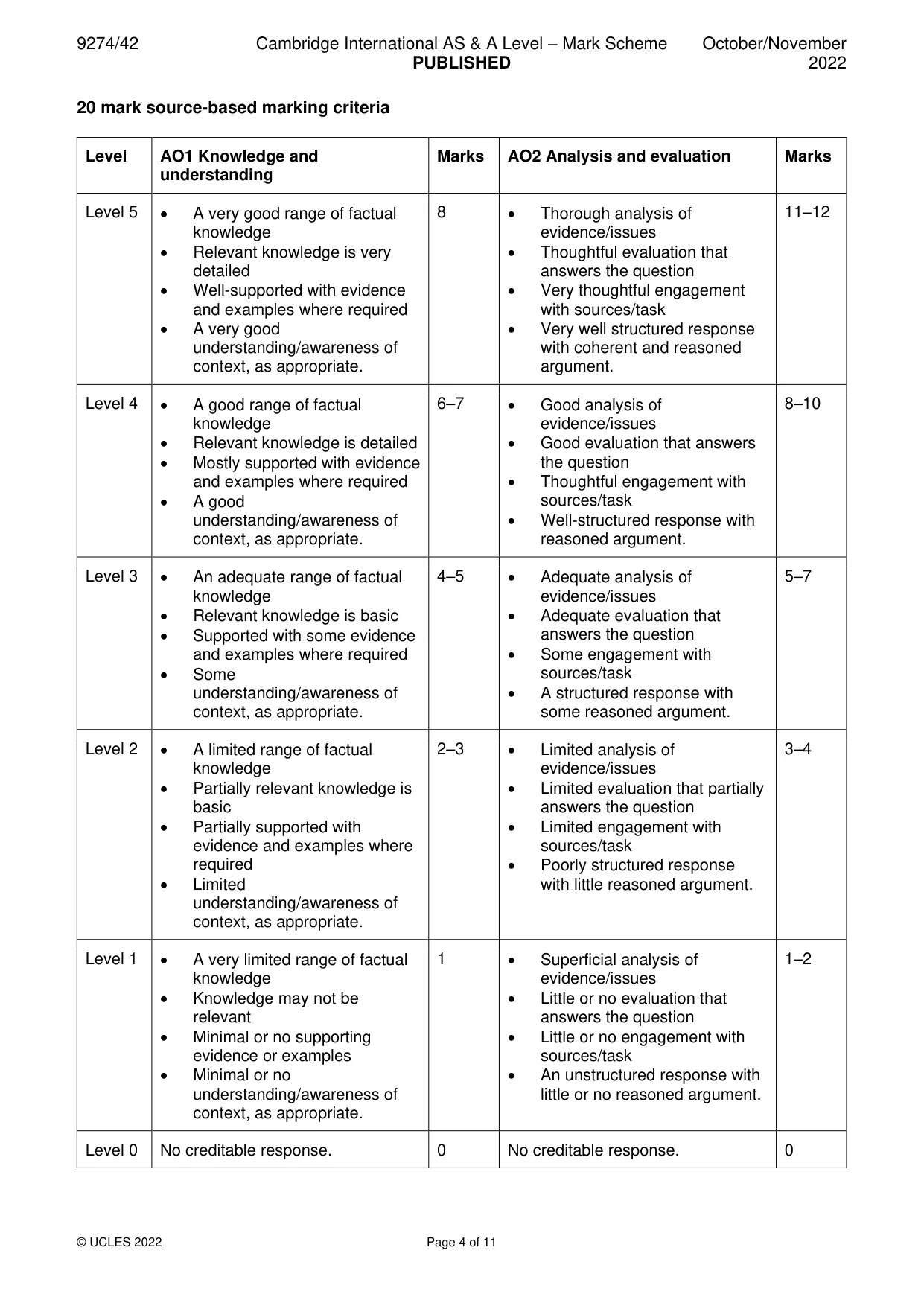
9274/42 Cambridge International AS & A Level – Mark Scheme PUBLISHED October/November 2022 © UCLES 2022 Page 4 of 11 20 mark source-based marking criteria Level AO1 Knowledge and understanding Marks AO2 Analysis and evaluation Marks Level 5 • A very good range of factual knowledge • Relevant knowledge is very detailed • Well-supported with evidence and examples where required • A very good understanding/awareness of context, as appropriate. 8 • Thorough analysis of evidence/issues • Thoughtful evaluation that answers the question • Very thoughtful engagement with sources/task • Very well structured response with coherent and reasoned argument. 11–12 Level 4 • A good range of factual knowledge • Relevant knowledge is detailed • Mostly supported with evidence and examples where required • A good understanding/awareness of context, as appropriate. 6–7 • Good analysis of evidence/issues • Good evaluation that answers the question • Thoughtful engagement with sources/task • Well-structured response with reasoned argument. 8–10 Level 3 • An adequate range of factual knowledge • Relevant knowledge is basic • Supported with some evidence and examples where required • Some understanding/awareness of context, as appropriate. 4–5 • Adequate analysis of evidence/issues • Adequate evaluation that answers the question • Some engagement with sources/task • A structured response with some reasoned argument. 5–7 Level 2 • A limited range of factual knowledge • Partially relevant knowledge is basic • Partially supported with evidence and examples where required • Limited understanding/awareness of context, as appropriate. 2–3 • Limited analysis of evidence/issues • Limited evaluation that partially answers the question • Limited engagement with sources/task • Poorly structured response with little reasoned argument. 3–4 Level 1 • A very limited range of factual knowledge • Knowledge may not be relevant • Minimal or no supporting evidence or examples • Minimal or no understanding/awareness of context, as appropriate. 1 • Superficial analysis of evidence/issues • Little or no evaluation that answers the question • Little or no engagement with sources/task • An unstructured response with little or no reasoned argument. 1–2 Level 0 No creditable response. 0 No creditable response. 0
Mark scheme, page 5
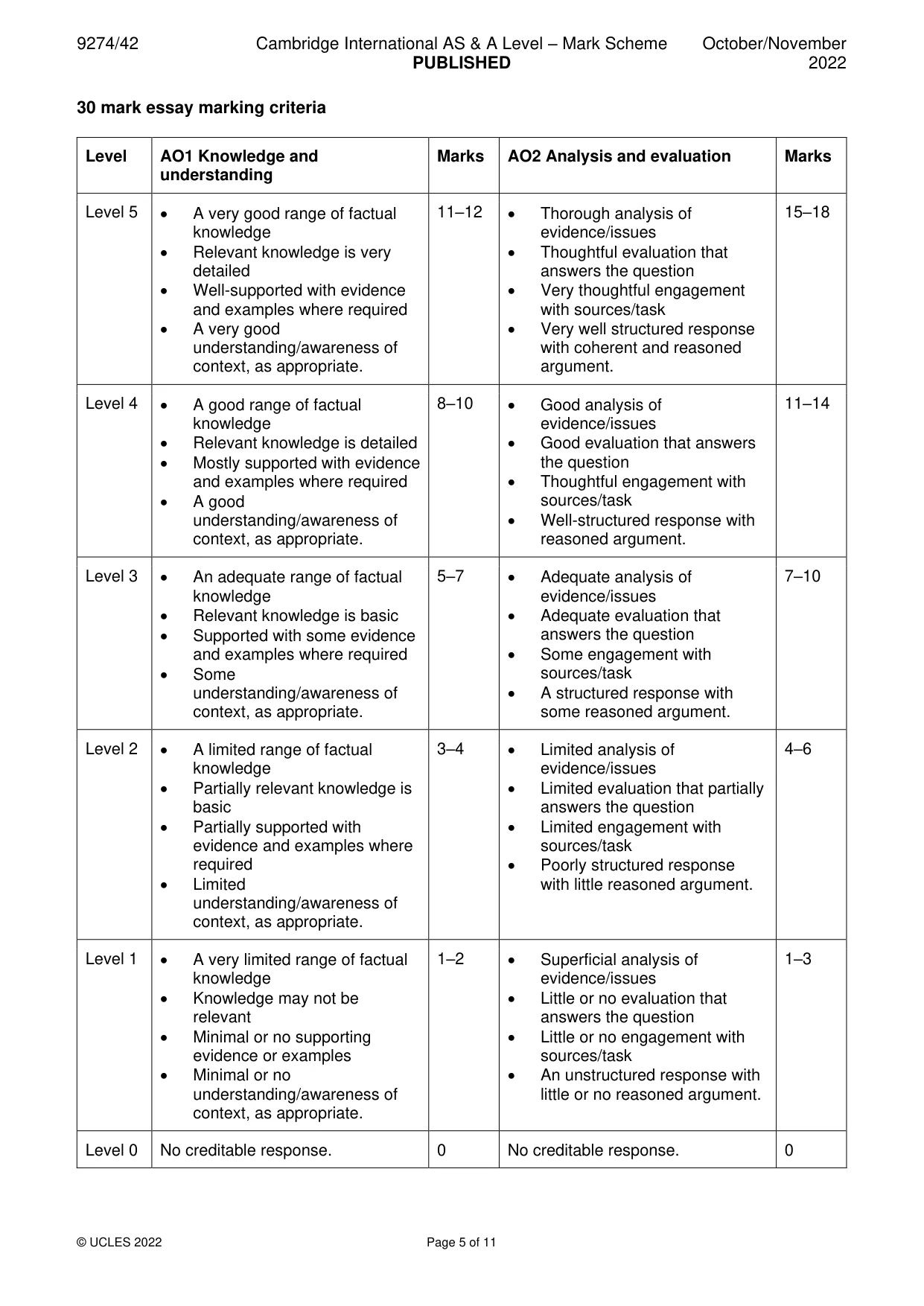
9274/42 Cambridge International AS & A Level – Mark Scheme PUBLISHED October/November 2022 © UCLES 2022 Page 5 of 11 30 mark essay marking criteria Level AO1 Knowledge and understanding Marks AO2 Analysis and evaluation Marks Level 5 • A very good range of factual knowledge • Relevant knowledge is very detailed • Well-supported with evidence and examples where required • A very good understanding/awareness of context, as appropriate. 11–12 • Thorough analysis of evidence/issues • Thoughtful evaluation that answers the question • Very thoughtful engagement with sources/task • Very well structured response with coherent and reasoned argument. 15–18 Level 4 • A good range of factual knowledge • Relevant knowledge is detailed • Mostly supported with evidence and examples where required • A good understanding/awareness of context, as appropriate. 8–10 • Good analysis of evidence/issues • Good evaluation that answers the question • Thoughtful engagement with sources/task • Well-structured response with reasoned argument. 11–14 Level 3 • An adequate range of factual knowledge • Relevant knowledge is basic • Supported with some evidence and examples where required • Some understanding/awareness of context, as appropriate. 5–7 • Adequate analysis of evidence/issues • Adequate evaluation that answers the question • Some engagement with sources/task • A structured response with some reasoned argument. 7–10 Level 2 • A limited range of factual knowledge • Partially relevant knowledge is basic • Partially supported with evidence and examples where required • Limited understanding/awareness of context, as appropriate. 3–4 • Limited analysis of evidence/issues • Limited evaluation that partially answers the question • Limited engagement with sources/task • Poorly structured response with little reasoned argument. 4–6 Level 1 • A very limited range of factual knowledge • Knowledge may not be relevant • Minimal or no supporting evidence or examples • Minimal or no understanding/awareness of context, as appropriate. 1–2 • Superficial analysis of evidence/issues • Little or no evaluation that answers the question • Little or no engagement with sources/task • An unstructured response with little or no reasoned argument. 1–3 Level 0 No creditable response. 0 No creditable response. 0
Mark scheme, page 6
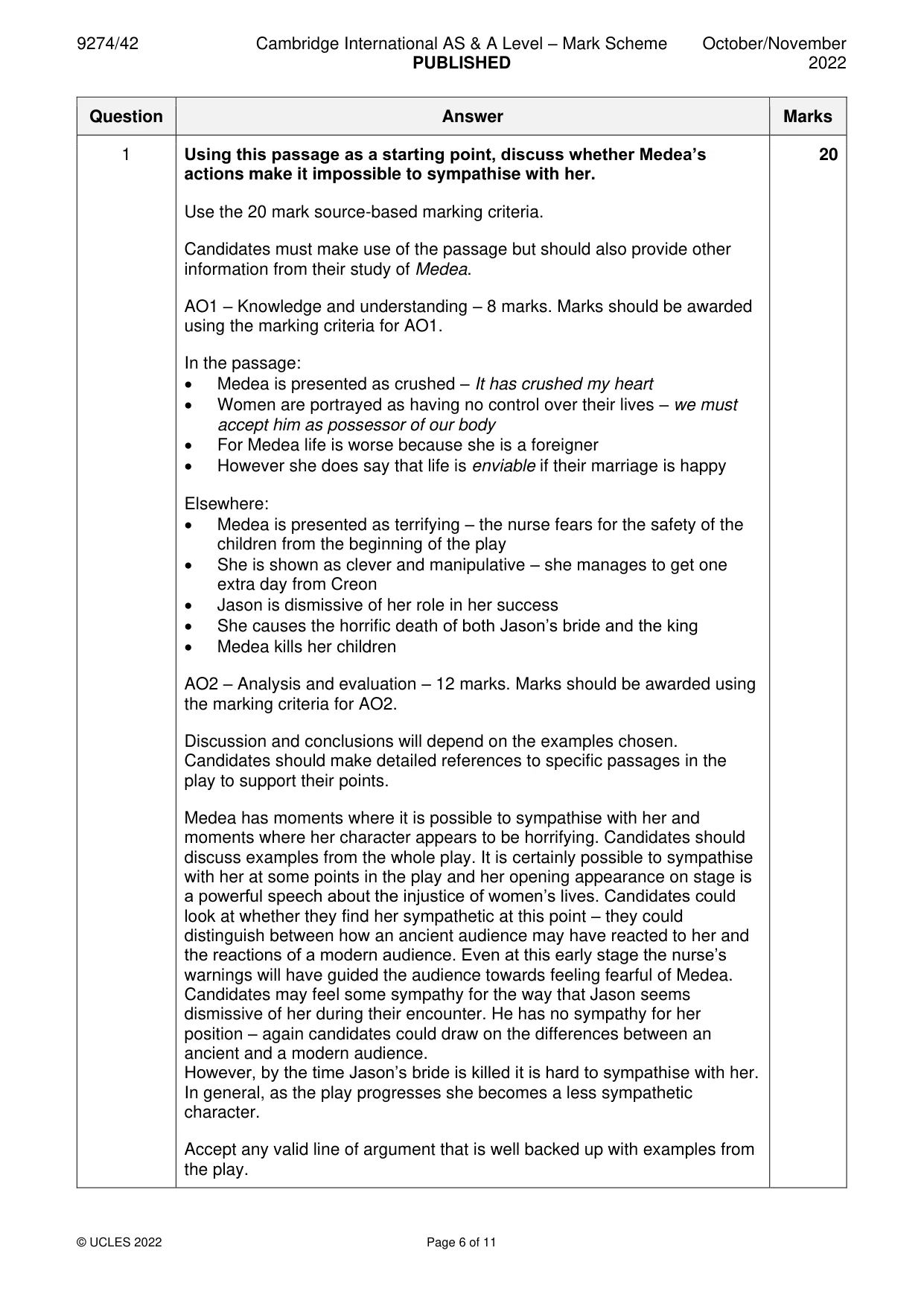
9274/42 Cambridge International AS & A Level – Mark Scheme PUBLISHED October/November 2022 © UCLES 2022 Page 6 of 11 Question Answer Marks 1 Using this passage as a starting point, discuss whether Medea’s actions make it impossible to sympathise with her. Use the 20 mark source-based marking criteria. Candidates must make use of the passage but should also provide other information from their study of Medea. AO1 – Knowledge and understanding – 8 marks. Marks should be awarded using the marking criteria for AO1. In the passage: • Medea is presented as crushed – It has crushed my heart • Women are portrayed as having no control over their lives – we must accept him as possessor of our body • For Medea life is worse because she is a foreigner • However she does say that life is enviable if their marriage is happy Elsewhere: • Medea is presented as terrifying – the nurse fears for the safety of the children from the beginning of the play • She is shown as clever and manipulative – she manages to get one extra day from Creon • Jason is dismissive of her role in her success • She causes the horrific death of both Jason’s bride and the king • Medea kills her children AO2 – Analysis and evaluation – 12 marks. Marks should be awarded using the marking criteria for AO2. Discussion and conclusions will depend on the examples chosen. Candidates should make detailed references to specific passages in the play to support their points. Medea has moments where it is possible to sympathise with her and moments where her character appears to be horrifying. Candidates should discuss examples from the whole play. It is certainly possible to sympathise with her at some points in the play and her opening appearance on stage is a powerful speech about the injustice of women’s lives. Candidates could look at whether they find her sympathetic at this point – they could distinguish between how an ancient audience may have reacted to her and the reactions of a modern audience. Even at this early stage the nurse’s warnings will have guided the audience towards feeling fearful of Medea. Candidates may feel some sympathy for the way that Jason seems dismissive of her during their encounter. He has no sympathy for her position – again candidates could draw on the differences between an ancient and a modern audience. However, by the time Jason’s bride is killed it is hard to sympathise with her. In general, as the play progresses she becomes a less sympathetic character. Accept any valid line of argument that is well backed up with examples from the play. 20
Mark scheme, page 7
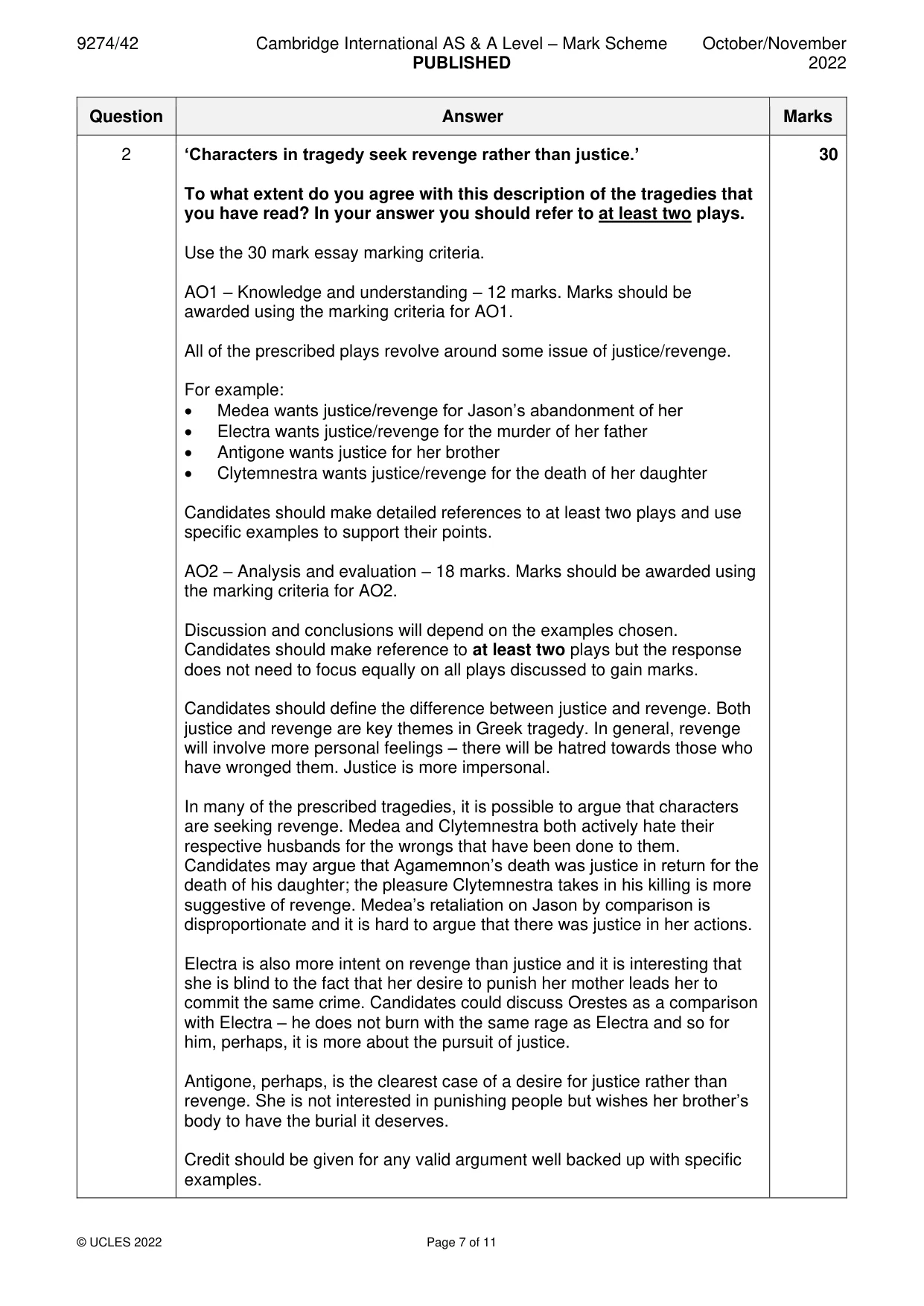
9274/42 Cambridge International AS & A Level – Mark Scheme PUBLISHED October/November 2022 © UCLES 2022 Page 7 of 11 Question Answer Marks 2 ‘Characters in tragedy seek revenge rather than justice.’ To what extent do you agree with this description of the tragedies that you have read? In your answer you should refer to at least two plays. Use the 30 mark essay marking criteria. AO1 – Knowledge and understanding – 12 marks. Marks should be awarded using the marking criteria for AO1. All of the prescribed plays revolve around some issue of justice/revenge. For example: • Medea wants justice/revenge for Jason’s abandonment of her • Electra wants justice/revenge for the murder of her father • Antigone wants justice for her brother • Clytemnestra wants justice/revenge for the death of her daughter Candidates should make detailed references to at least two plays and use specific examples to support their points. AO2 – Analysis and evaluation – 18 marks. Marks should be awarded using the marking criteria for AO2. Discussion and conclusions will depend on the examples chosen. Candidates should make reference to at least two plays but the response does not need to focus equally on all plays discussed to gain marks. Candidates should define the difference between justice and revenge. Both justice and revenge are key themes in Greek tragedy. In general, revenge will involve more personal feelings – there will be hatred towards those who have wronged them. Justice is more impersonal. In many of the prescribed tragedies, it is possible to argue that characters are seeking revenge. Medea and Clytemnestra both actively hate their respective husbands for the wrongs that have been done to them. Candidates may argue that Agamemnon’s death was justice in return for the death of his daughter; the pleasure Clytemnestra takes in his killing is more suggestive of revenge. Medea’s retaliation on Jason by comparison is disproportionate and it is hard to argue that there was justice in her actions. Electra is also more intent on revenge than justice and it is interesting that she is blind to the fact that her desire to punish her mother leads her to commit the same crime. Candidates could discuss Orestes as a comparison with Electra – he does not burn with the same rage as Electra and so for him, perhaps, it is more about the pursuit of justice. Antigone, perhaps, is the clearest case of a desire for justice rather than revenge. She is not interested in punishing people but wishes her brother’s body to have the burial it deserves. Credit should be given for any valid argument well backed up with specific examples. 30
Mark scheme, page 8
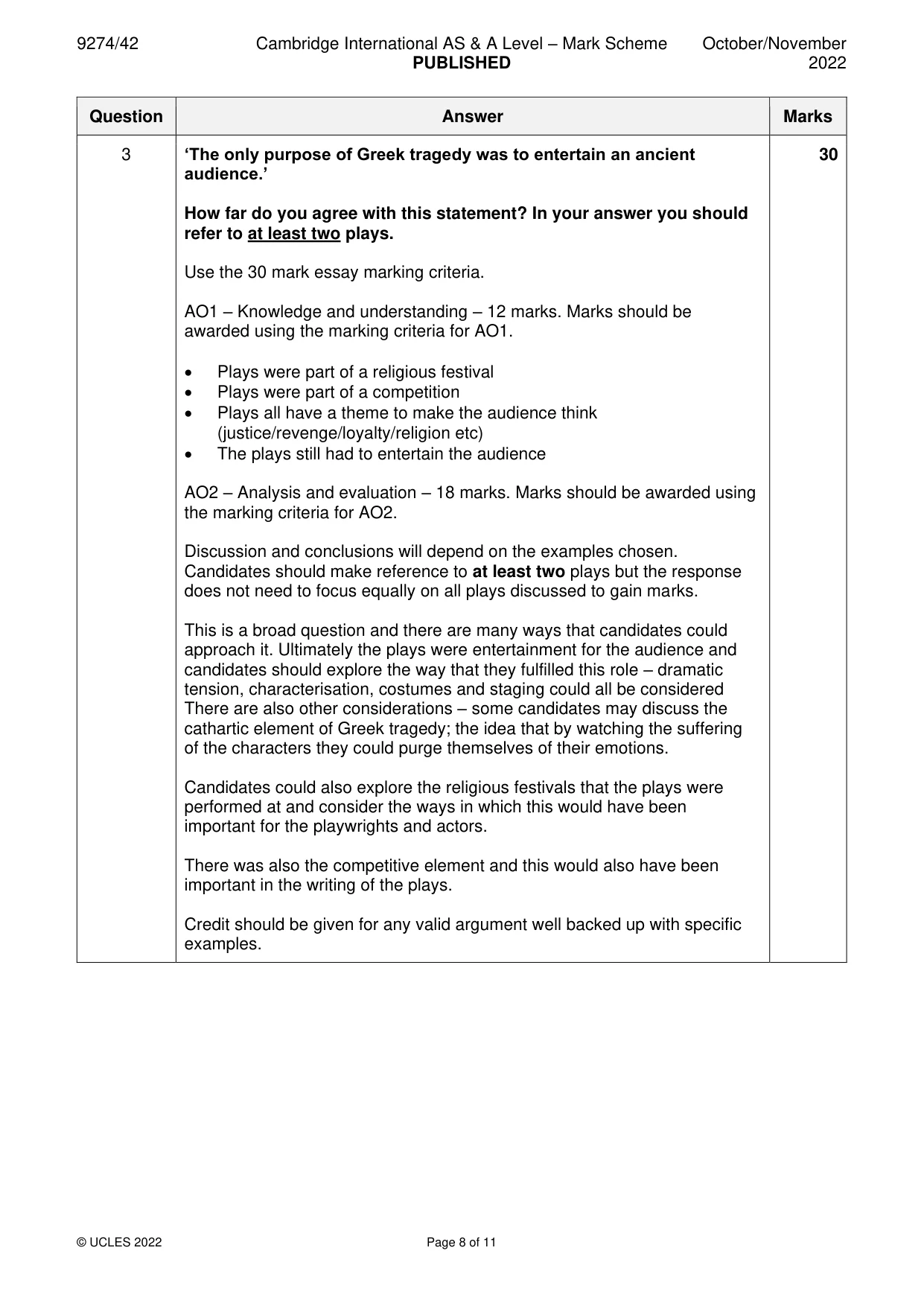
9274/42 Cambridge International AS & A Level – Mark Scheme PUBLISHED October/November 2022 © UCLES 2022 Page 8 of 11 Question Answer Marks 3 ‘The only purpose of Greek tragedy was to entertain an ancient audience.’ How far do you agree with this statement? In your answer you should refer to at least two plays. Use the 30 mark essay marking criteria. AO1 – Knowledge and understanding – 12 marks. Marks should be awarded using the marking criteria for AO1. • Plays were part of a religious festival • Plays were part of a competition • Plays all have a theme to make the audience think (justice/revenge/loyalty/religion etc) • The plays still had to entertain the audience AO2 – Analysis and evaluation – 18 marks. Marks should be awarded using the marking criteria for AO2. Discussion and conclusions will depend on the examples chosen. Candidates should make reference to at least two plays but the response does not need to focus equally on all plays discussed to gain marks. This is a broad question and there are many ways that candidates could approach it. Ultimately the plays were entertainment for the audience and candidates should explore the way that they fulfilled this role – dramatic tension, characterisation, costumes and staging could all be considered There are also other considerations – some candidates may discuss the cathartic element of Greek tragedy; the idea that by watching the suffering of the characters they could purge themselves of their emotions. Candidates could also explore the religious festivals that the plays were performed at and consider the ways in which this would have been important for the playwrights and actors. There was also the competitive element and this would also have been important in the writing of the plays. Credit should be given for any valid argument well backed up with specific examples. 30
Mark scheme, page 9
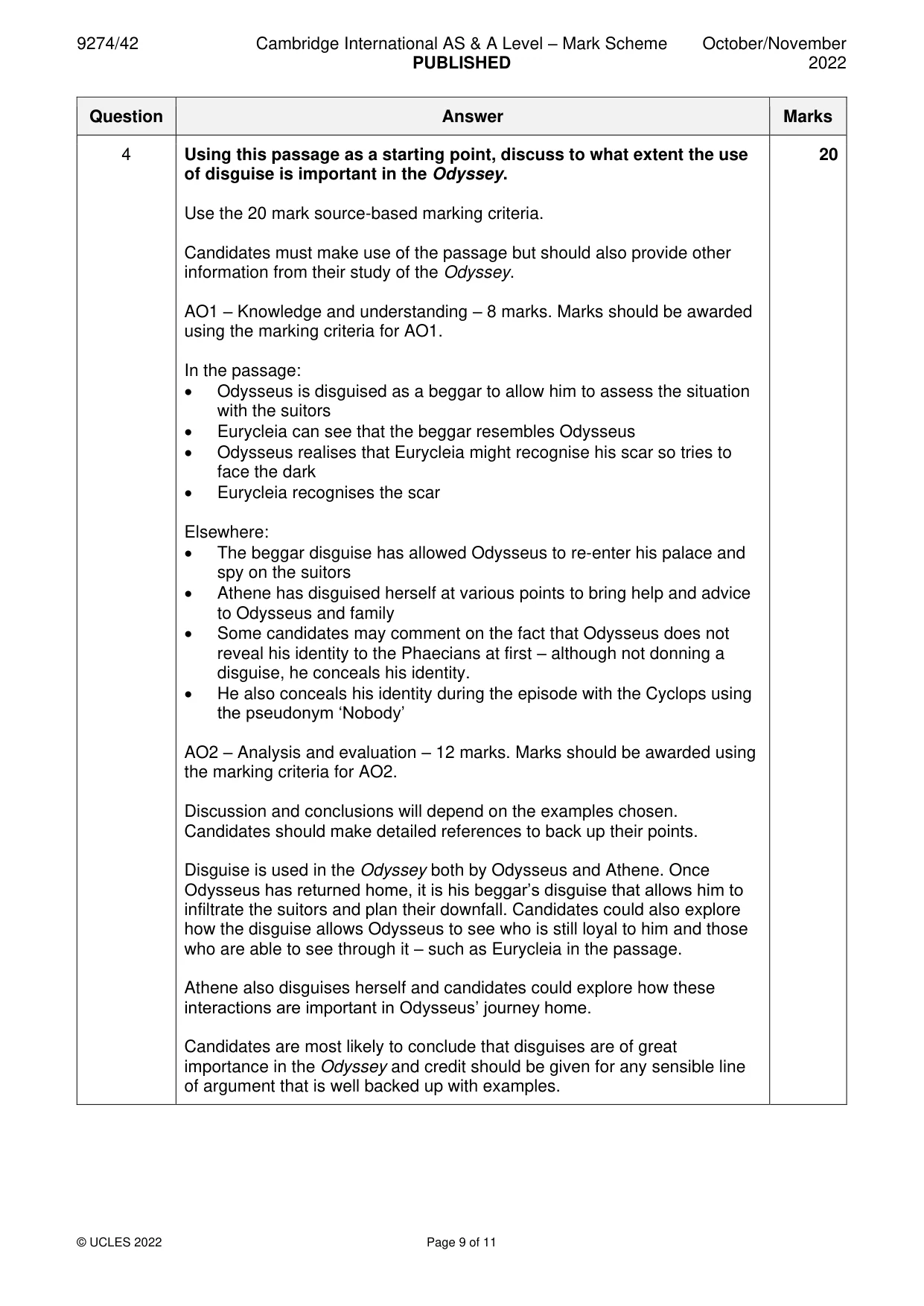
9274/42 Cambridge International AS & A Level – Mark Scheme PUBLISHED October/November 2022 © UCLES 2022 Page 9 of 11 Question Answer Marks 4 Using this passage as a starting point, discuss to what extent the use of disguise is important in the Odyssey. Use the 20 mark source-based marking criteria. Candidates must make use of the passage but should also provide other information from their study of the Odyssey. AO1 – Knowledge and understanding – 8 marks. Marks should be awarded using the marking criteria for AO1. In the passage: • Odysseus is disguised as a beggar to allow him to assess the situation with the suitors • Eurycleia can see that the beggar resembles Odysseus • Odysseus realises that Eurycleia might recognise his scar so tries to face the dark • Eurycleia recognises the scar Elsewhere: • The beggar disguise has allowed Odysseus to re-enter his palace and spy on the suitors • Athene has disguised herself at various points to bring help and advice to Odysseus and family • Some candidates may comment on the fact that Odysseus does not reveal his identity to the Phaecians at first – although not donning a disguise, he conceals his identity. • He also conceals his identity during the episode with the Cyclops using the pseudonym ‘Nobody’ AO2 – Analysis and evaluation – 12 marks. Marks should be awarded using the marking criteria for AO2. Discussion and conclusions will depend on the examples chosen. Candidates should make detailed references to back up their points. Disguise is used in the Odyssey both by Odysseus and Athene. Once Odysseus has returned home, it is his beggar’s disguise that allows him to infiltrate the suitors and plan their downfall. Candidates could also explore how the disguise allows Odysseus to see who is still loyal to him and those who are able to see through it – such as Eurycleia in the passage. Athene also disguises herself and candidates could explore how these interactions are important in Odysseus’ journey home. Candidates are most likely to conclude that disguises are of great importance in the Odyssey and credit should be given for any sensible line of argument that is well backed up with examples. 20
Mark scheme, page 10
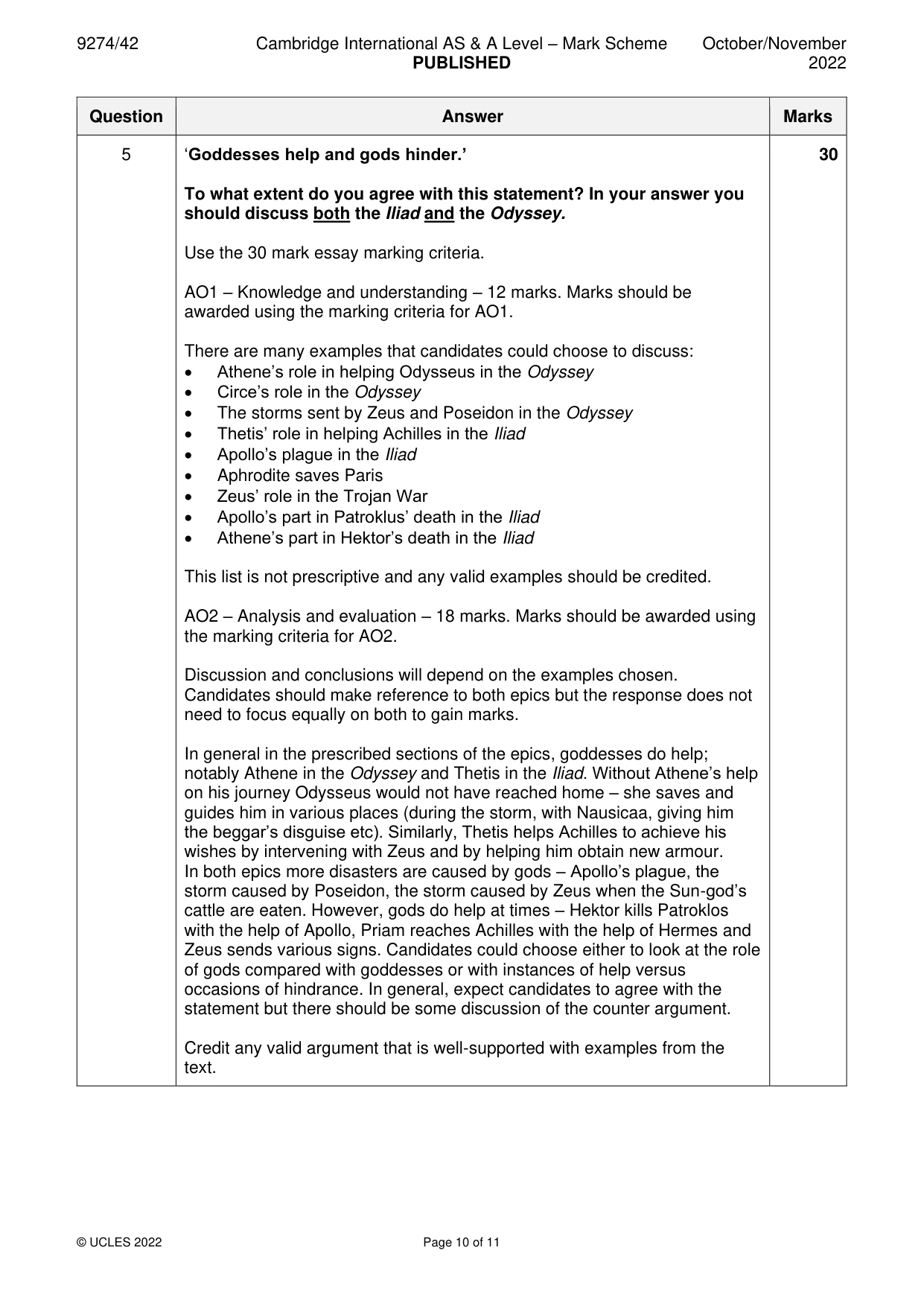
9274/42 Cambridge International AS & A Level – Mark Scheme PUBLISHED October/November 2022 © UCLES 2022 Page 10 of 11 Question Answer Marks 5 ‘Goddesses help and gods hinder.’ To what extent do you agree with this statement? In your answer you should discuss both the Iliad and the Odyssey. Use the 30 mark essay marking criteria. AO1 – Knowledge and understanding – 12 marks. Marks should be awarded using the marking criteria for AO1. There are many examples that candidates could choose to discuss: • Athene’s role in helping Odysseus in the Odyssey • Circe’s role in the Odyssey • The storms sent by Zeus and Poseidon in the Odyssey • Thetis’ role in helping Achilles in the Iliad • Apollo’s plague in the Iliad • Aphrodite saves Paris • Zeus’ role in the Trojan War • Apollo’s part in Patroklus’ death in the Iliad • Athene’s part in Hektor’s death in the Iliad This list is not prescriptive and any valid examples should be credited. AO2 – Analysis and evaluation – 18 marks. Marks should be awarded using the marking criteria for AO2. Discussion and conclusions will depend on the examples chosen. Candidates should make reference to both epics but the response does not need to focus equally on both to gain marks. In general in the prescribed sections of the epics, goddesses do help; notably Athene in the Odyssey and Thetis in the Iliad. Without Athene’s help on his journey Odysseus would not have reached home – she saves and guides him in various places (during the storm, with Nausicaa, giving him the beggar’s disguise etc). Similarly, Thetis helps Achilles to achieve his wishes by intervening with Zeus and by helping him obtain new armour. In both epics more disasters are caused by gods – Apollo’s plague, the storm caused by Poseidon, the storm caused by Zeus when the Sun-god’s cattle are eaten. However, gods do help at times – Hektor kills Patroklos with the help of Apollo, Priam reaches Achilles with the help of Hermes and Zeus sends various signs. Candidates could choose either to look at the role of gods compared with goddesses or with instances of help versus occasions of hindrance. In general, expect candidates to agree with the statement but there should be some discussion of the counter argument. Credit any valid argument that is well-supported with examples from the text. 30
Mark scheme, page 11
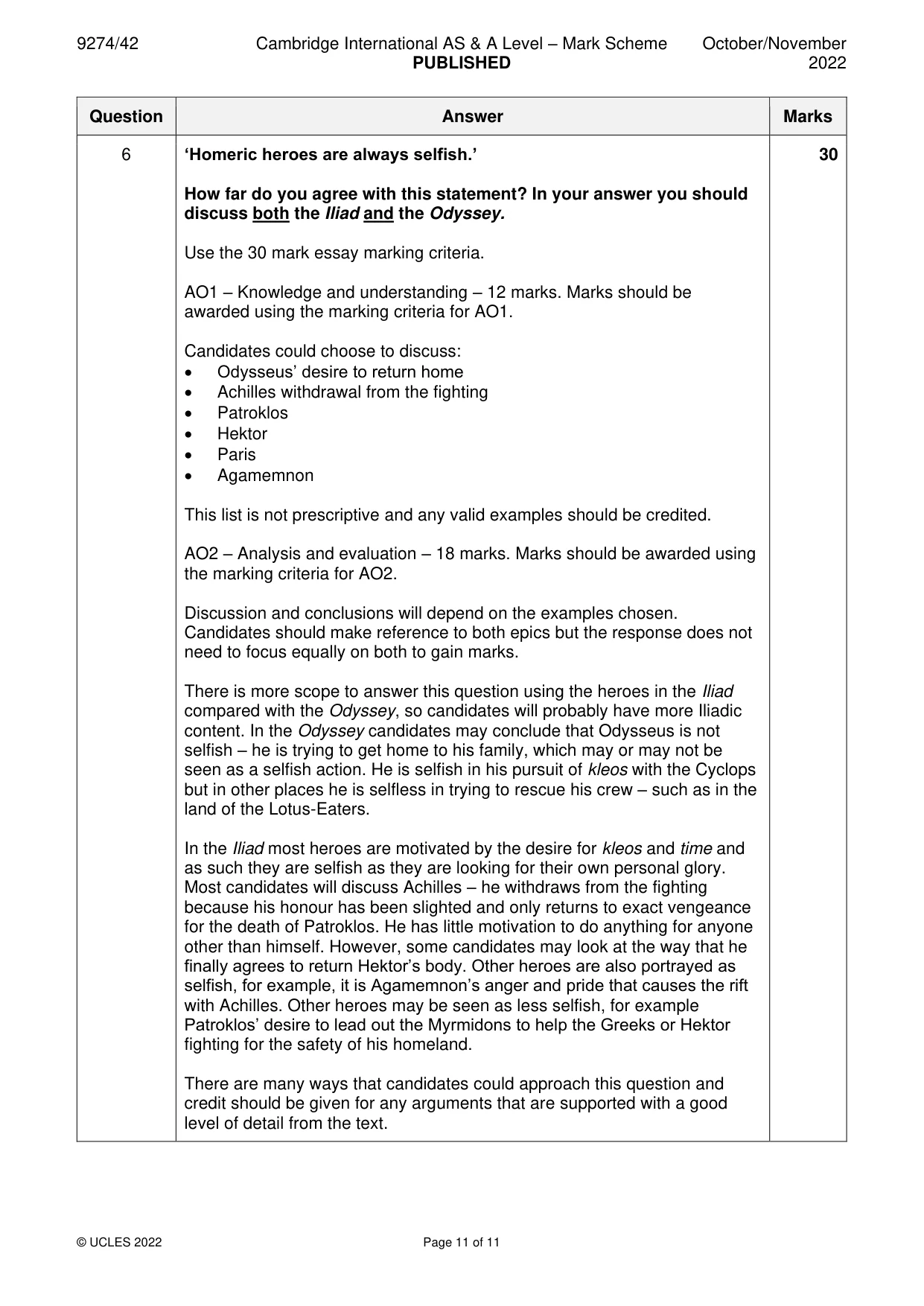
9274/42 Cambridge International AS & A Level – Mark Scheme PUBLISHED October/November 2022 © UCLES 2022 Page 11 of 11 Question Answer Marks 6 ‘Homeric heroes are always selfish.’ How far do you agree with this statement? In your answer you should discuss both the Iliad and the Odyssey. Use the 30 mark essay marking criteria. AO1 – Knowledge and understanding – 12 marks. Marks should be awarded using the marking criteria for AO1. Candidates could choose to discuss: • Odysseus’ desire to return home • Achilles withdrawal from the fighting • Patroklos • Hektor • Paris • Agamemnon This list is not prescriptive and any valid examples should be credited. AO2 – Analysis and evaluation – 18 marks. Marks should be awarded using the marking criteria for AO2. Discussion and conclusions will depend on the examples chosen. Candidates should make reference to both epics but the response does not need to focus equally on both to gain marks. There is more scope to answer this question using the heroes in the Iliad compared with the Odyssey, so candidates will probably have more Iliadic content. In the Odyssey candidates may conclude that Odysseus is not selfish – he is trying to get home to his family, which may or may not be seen as a selfish action. He is selfish in his pursuit of kleos with the Cyclops but in other places he is selfless in trying to rescue his crew – such as in the land of the Lotus-Eaters. In the Iliad most heroes are motivated by the desire for kleos and time and as such they are selfish as they are looking for their own personal glory. Most candidates will discuss Achilles – he withdraws from the fighting because his honour has been slighted and only returns to exact vengeance for the death of Patroklos. He has little motivation to do anything for anyone other than himself. However, some candidates may look at the way that he finally agrees to return Hektor’s body. Other heroes are also portrayed as selfish, for example, it is Agamemnon’s anger and pride that causes the rift with Achilles. Other heroes may be seen as less selfish, for example Patroklos’ desire to lead out the Myrmidons to help the Greeks or Hektor fighting for the safety of his homeland. There are many ways that candidates could approach this question and credit should be given for any arguments that are supported with a good level of detail from the text. 30
What you needed in this session
Cambridge’s own grade thresholds for 2022 Oct/Nov, Paper 4 · Variant 2. A higher threshold means an easier paper — the bar moves with how the cohort did.