Cambridge A Level Classical Studies 9274 — 2022 Oct/Nov Paper 1 · Variant 2
9274/12/O/N/22 · 50 marks · ≈56 min
The question paper and its mark scheme, free to read here and free to download. This is Cambridge’s own paper, exactly as it was sat.
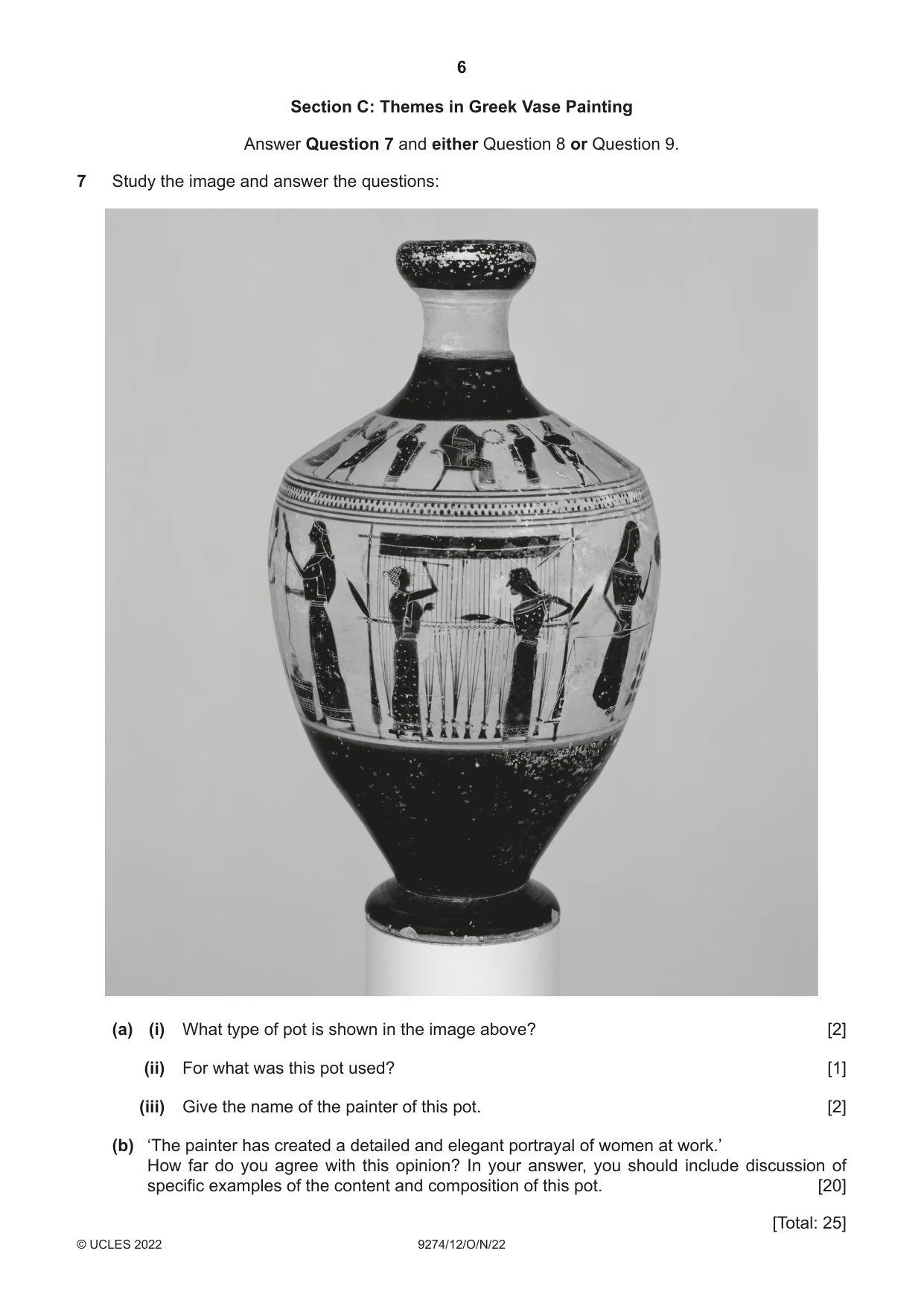
Question paper8 pages


Mark scheme17 pages
Answers below. Sit the paper first if you are practising.
Paper as text
Question paper, page 1
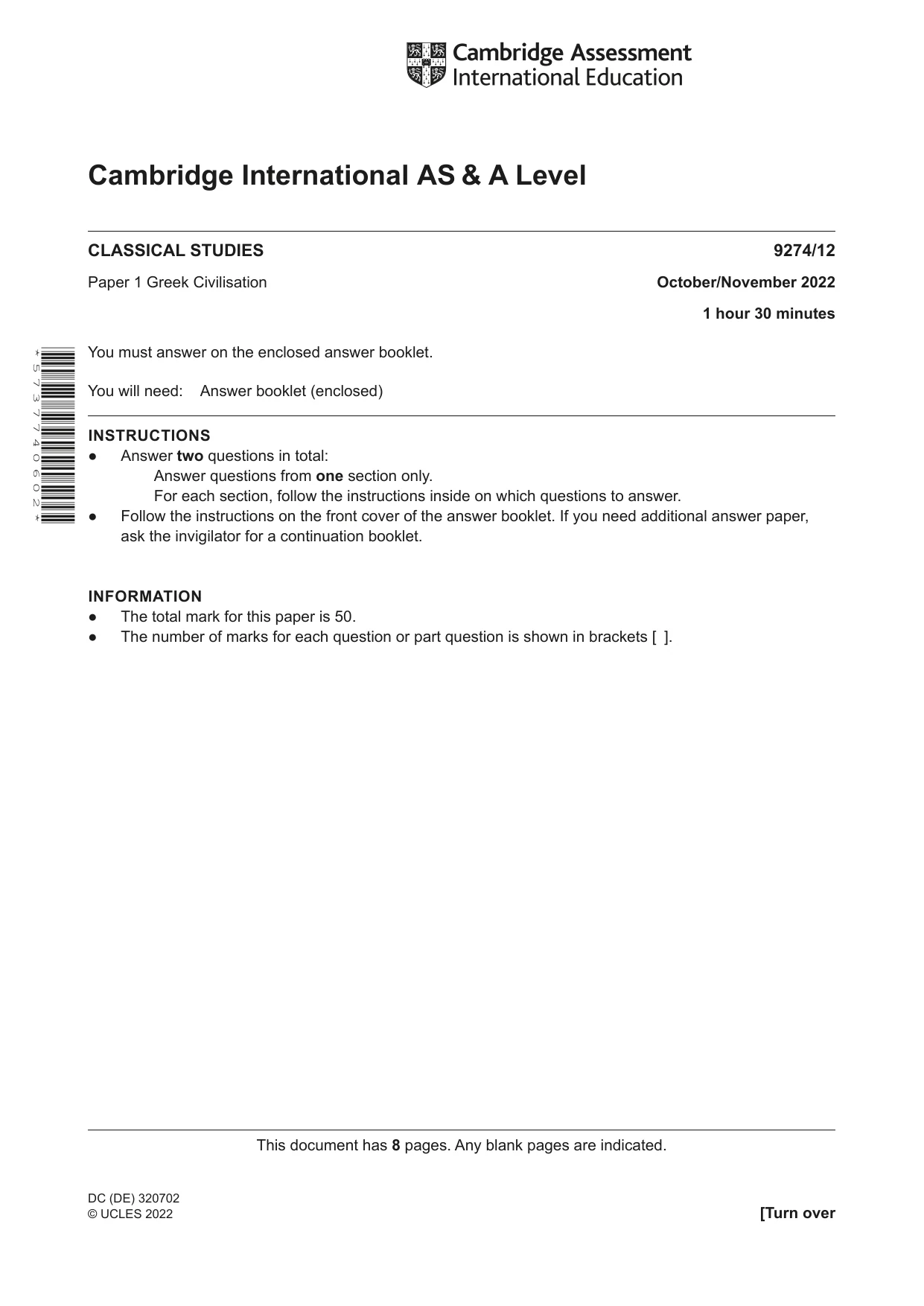
This document has 8 pages. Any blank pages are indicated. [Turn over Cambridge International AS & A Level DC (DE) 320702 © UCLES 2022 CLASSICAL STUDIES 9274/12 Paper 1 Greek Civilisation October/November 2022 1 hour 30 minutes You must answer on the enclosed answer booklet. You will need: Answer booklet (enclosed) INSTRUCTIONS ● Answer two questions in total: Answer questions from one section only. For each section, follow the instructions inside on which questions to answer. ● Follow the instructions on the front cover of the answer booklet. If you need additional answer paper, ask the invigilator for a continuation booklet. INFORMATION ● The total mark for this paper is 50. ● The number of marks for each question or part question is shown in brackets [ ]. * 5 7 3 7 7 4 0 6 0 2 *
Question paper, page 2
2 9274/12/O/N/22 © UCLES 2022 BLANK PAGE
Question paper, page 3
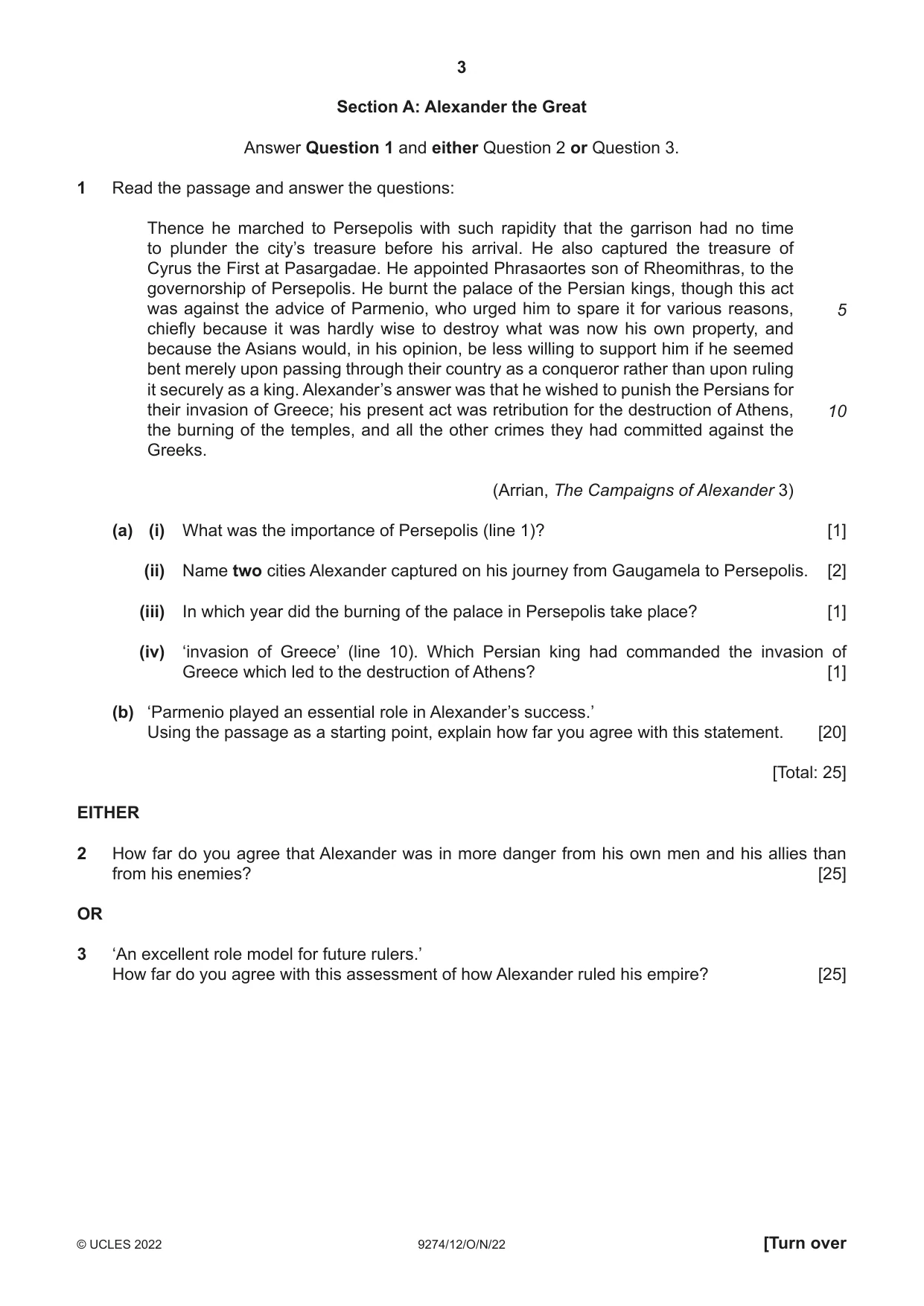
3 9274/12/O/N/22 © UCLES 2022 [Turn over Section A: Alexander the Great Answer Question 1 and either Question 2 or Question 3. 1 Read the passage and answer the questions: Thence he marched to Persepolis with such rapidity that the garrison had no time to plunder the city’s treasure before his arrival. He also captured the treasure of Cyrus the First at Pasargadae. He appointed Phrasaortes son of Rheomithras, to the governorship of Persepolis. He burnt the palace of the Persian kings, though this act was against the advice of Parmenio, who urged him to spare it for various reasons, chiefly because it was hardly wise to destroy what was now his own property, and because the Asians would, in his opinion, be less willing to support him if he seemed bent merely upon passing through their country as a conqueror rather than upon ruling it securely as a king. Alexander’s answer was that he wished to punish the Persians for their invasion of Greece; his present act was retribution for the destruction of Athens, the burning of the temples, and all the other crimes they had committed against the Greeks. (Arrian, The Campaigns of Alexander 3) (a) (i) What was the importance of Persepolis (line 1)? [1] (ii) Name two cities Alexander captured on his journey from Gaugamela to Persepolis. [2] (iii) In which year did the burning of the palace in Persepolis take place? [1] (iv) ‘invasion of Greece’ (line 10). Which Persian king had commanded the invasion of Greece which led to the destruction of Athens? [1] (b) ‘Parmenio played an essential role in Alexander’s success.’ Using the passage as a starting point, explain how far you agree with this statement. [20] [Total: 25] EITHER 2 How far do you agree that Alexander was in more danger from his own men and his allies than from his enemies? [25] OR 3 ‘An excellent role model for future rulers.’ How far do you agree with this assessment of how Alexander ruled his empire? [25] 5 10
Question paper, page 4
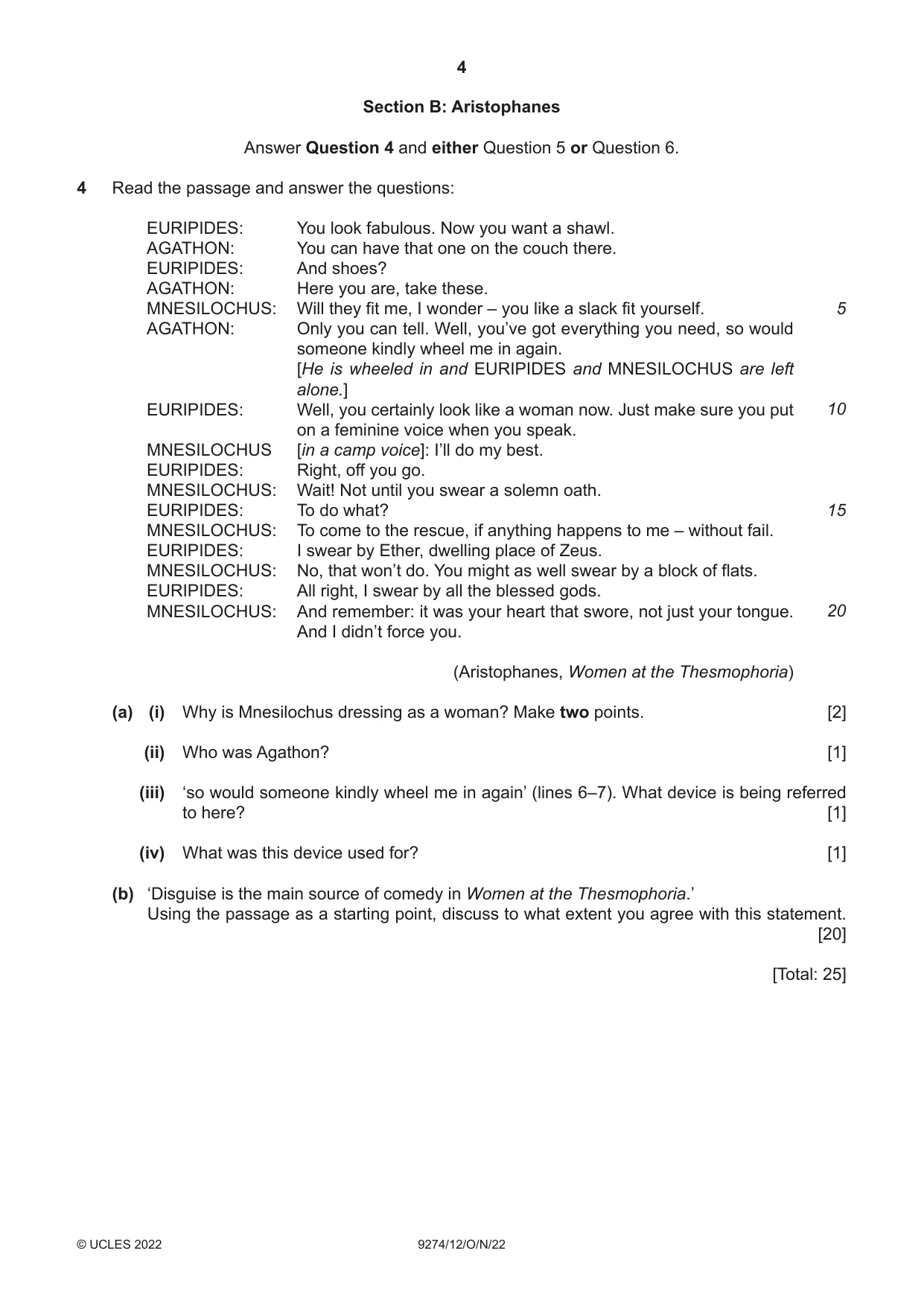
4 9274/12/O/N/22 © UCLES 2022 Section B: Aristophanes Answer Question 4 and either Question 5 or Question 6. 4 Read the passage and answer the questions: EURIPIDES: You look fabulous. Now you want a shawl. AGATHON: You can have that one on the couch there. EURIPIDES: And shoes? AGATHON: Here you are, take these. MNESILOCHUS: Will they fit me, I wonder – you like a slack fit yourself. AGATHON: Only you can tell. Well, you’ve got everything you need, so would someone kindly wheel me in again. [He is wheeled in and EURIPIDES and MNESILOCHUS are left alone.] EURIPIDES: Well, you certainly look like a woman now. Just make sure you put on a feminine voice when you speak. MNESILOCHUS [in a camp voice]: I’ll do my best. EURIPIDES: Right, off you go. MNESILOCHUS: Wait! Not until you swear a solemn oath. EURIPIDES: To do what? MNESILOCHUS: To come to the rescue, if anything happens to me – without fail. EURIPIDES: I swear by Ether, dwelling place of Zeus. MNESILOCHUS: No, that won’t do. You might as well swear by a block of flats. EURIPIDES: All right, I swear by all the blessed gods. MNESILOCHUS: And remember: it was your heart that swore, not just your tongue. And I didn’t force you. (Aristophanes, Women at the Thesmophoria) (a) (i) Why is Mnesilochus dressing as a woman? Make two points. [2] (ii) Who was Agathon? [1] (iii) ‘so would someone kindly wheel me in again’ (lines 6–7). What device is being referred to here? [1] (iv) What was this device used for? [1] (b) ‘Disguise is the main source of comedy in Women at the Thesmophoria.’ Using the passage as a starting point, discuss to what extent you agree with this statement. [20] [Total: 25] 5 10 15 20
Question paper, page 5
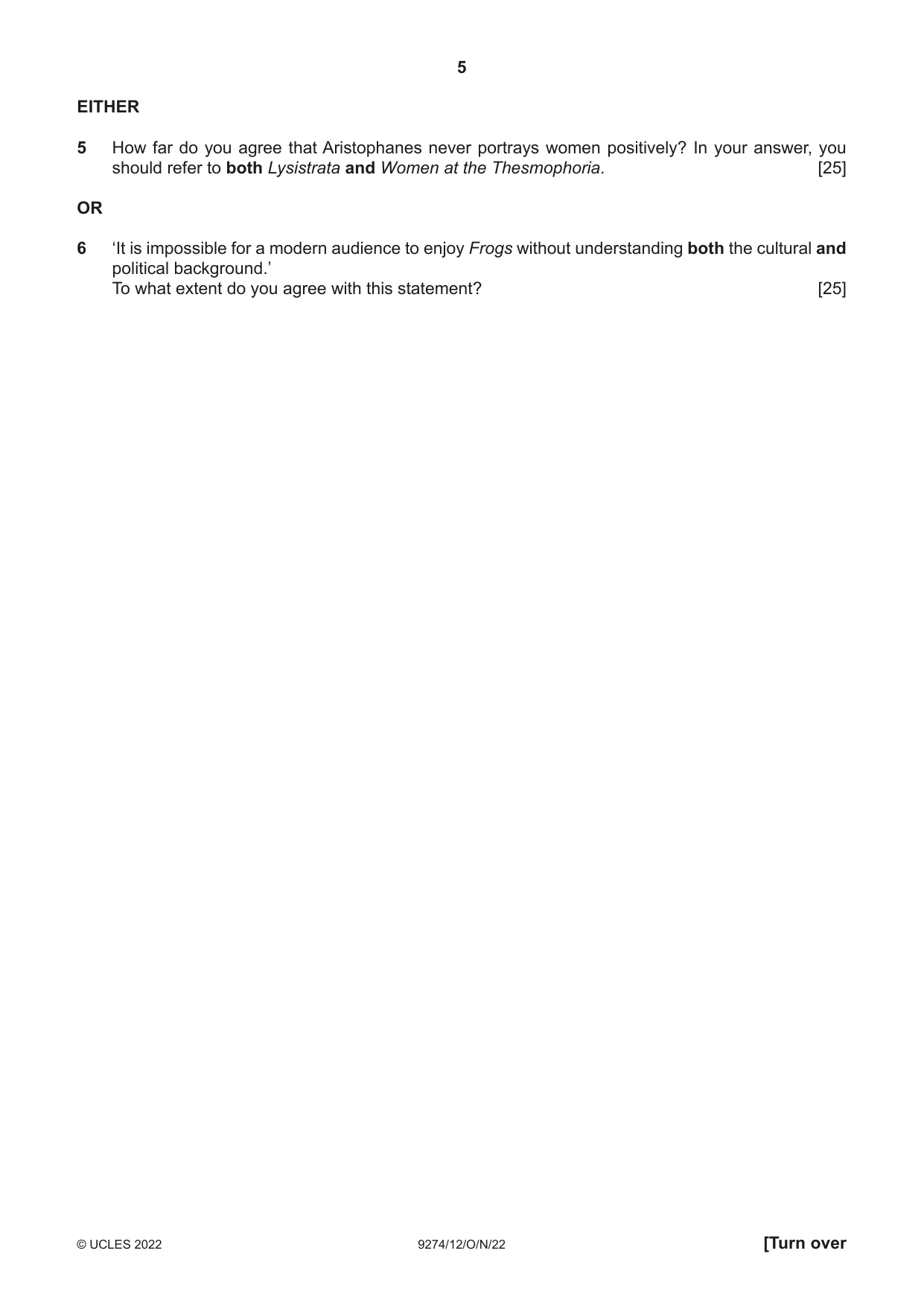
5 9274/12/O/N/22 © UCLES 2022 [Turn over EITHER 5 How far do you agree that Aristophanes never portrays women positively? In your answer, you should refer to both Lysistrata and Women at the Thesmophoria. [25] OR 6 ‘It is impossible for a modern audience to enjoy Frogs without understanding both the cultural and political background.’ To what extent do you agree with this statement? [25]
Question paper, page 6
6 9274/12/O/N/22 © UCLES 2022 Section C: Themes in Greek Vase Painting Answer Question 7 and either Question 8 or Question 9. 7 Study the image and answer the questions: (a) (i) What type of pot is shown in the image above? [2] (ii) For what was this pot used? [1] (iii) Give the name of the painter of this pot. [2] (b) ‘The painter has created a detailed and elegant portrayal of women at work.’ How far do you agree with this opinion? In your answer, you should include discussion of specific examples of the content and composition of this pot. [20] [Total: 25]
Question paper, page 7
7 9274/12/O/N/22 © UCLES 2022 EITHER 8 ‘The Trojan War was a popular subject for Greek vase painters.’ What opportunities and challenges did this subject offer to vase painters? Explain your answer with reference to specific pots depicting scenes from the Trojan War. [25] OR 9 ‘Painters of black-figure pots lacked imagination and creativity.’ How far do you agree with this point of view? In your answer, you should refer to specific details from pots you have studied. [25]
Question paper, page 8
8 9274/12/O/N/22 © UCLES 2022 Permission to reproduce items where third-party owned material protected by copyright is included has been sought and cleared where possible. Every reasonable effort has been made by the publisher (UCLES) to trace copyright holders, but if any items requiring clearance have unwittingly been included, the publisher will be pleased to make amends at the earliest possible opportunity. To avoid the issue of disclosure of answer-related information to candidates, all copyright acknowledgements are reproduced online in the Cambridge Assessment International Education Copyright Acknowledgements Booklet. This is produced for each series of examinations and is freely available to download at www.cambridgeinternational.org after the live examination series. Cambridge Assessment International Education is part of Cambridge Assessment. Cambridge Assessment is the brand name of the University of Cambridge Local Examinations Syndicate (UCLES), which is a department of the University of Cambridge. BLANK PAGE
Mark scheme, page 1
This document consists of 17 printed pages. © UCLES 2022 [Turn over Cambridge International AS & A Level CLASSICAL STUDIES 9274/12 Paper 1 Greek Civilisation October/November 2022 MARK SCHEME Maximum Mark: 50 Published This mark scheme is published as an aid to teachers and candidates, to indicate the requirements of the examination. It shows the basis on which Examiners were instructed to award marks. It does not indicate the details of the discussions that took place at an Examiners’ meeting before marking began, which would have considered the acceptability of alternative answers. Mark schemes should be read in conjunction with the question paper and the Principal Examiner Report for Teachers. Cambridge International will not enter into discussions about these mark schemes. Cambridge International is publishing the mark schemes for the October/November 2022 series for most Cambridge IGCSE™, Cambridge International A and AS Level components and some Cambridge O Level components.
Mark scheme, page 2
9274/12 Cambridge International AS & A Level – Mark Scheme PUBLISHED October/November 2022 © UCLES 2022 Page 2 of 17 Generic Marking Principles These general marking principles must be applied by all examiners when marking candidate answers. They should be applied alongside the specific content of the mark scheme or generic level descriptors for a question. Each question paper and mark scheme will also comply with these marking principles. GENERIC MARKING PRINCIPLE 1: Marks must be awarded in line with: • the specific content of the mark scheme or the generic level descriptors for the question • the specific skills defined in the mark scheme or in the generic level descriptors for the question • the standard of response required by a candidate as exemplified by the standardisation scripts. GENERIC MARKING PRINCIPLE 2: Marks awarded are always whole marks (not half marks, or other fractions). GENERIC MARKING PRINCIPLE 3: Marks must be awarded positively: • marks are awarded for correct/valid answers, as defined in the mark scheme. However, credit is given for valid answers which go beyond the scope of the syllabus and mark scheme, referring to your Team Leader as appropriate • marks are awarded when candidates clearly demonstrate what they know and can do • marks are not deducted for errors • marks are not deducted for omissions • answers should only be judged on the quality of spelling, punctuation and grammar when these features are specifically assessed by the question as indicated by the mark scheme. The meaning, however, should be unambiguous. GENERIC MARKING PRINCIPLE 4: Rules must be applied consistently, e.g. in situations where candidates have not followed instructions or in the application of generic level descriptors. GENERIC MARKING PRINCIPLE 5: Marks should be awarded using the full range of marks defined in the mark scheme for the question (however; the use of the full mark range may be limited according to the quality of the candidate responses seen). GENERIC MARKING PRINCIPLE 6: Marks awarded are based solely on the requirements as defined in the mark scheme. Marks should not be awarded with grade thresholds or grade descriptors in mind.
Mark scheme, page 3
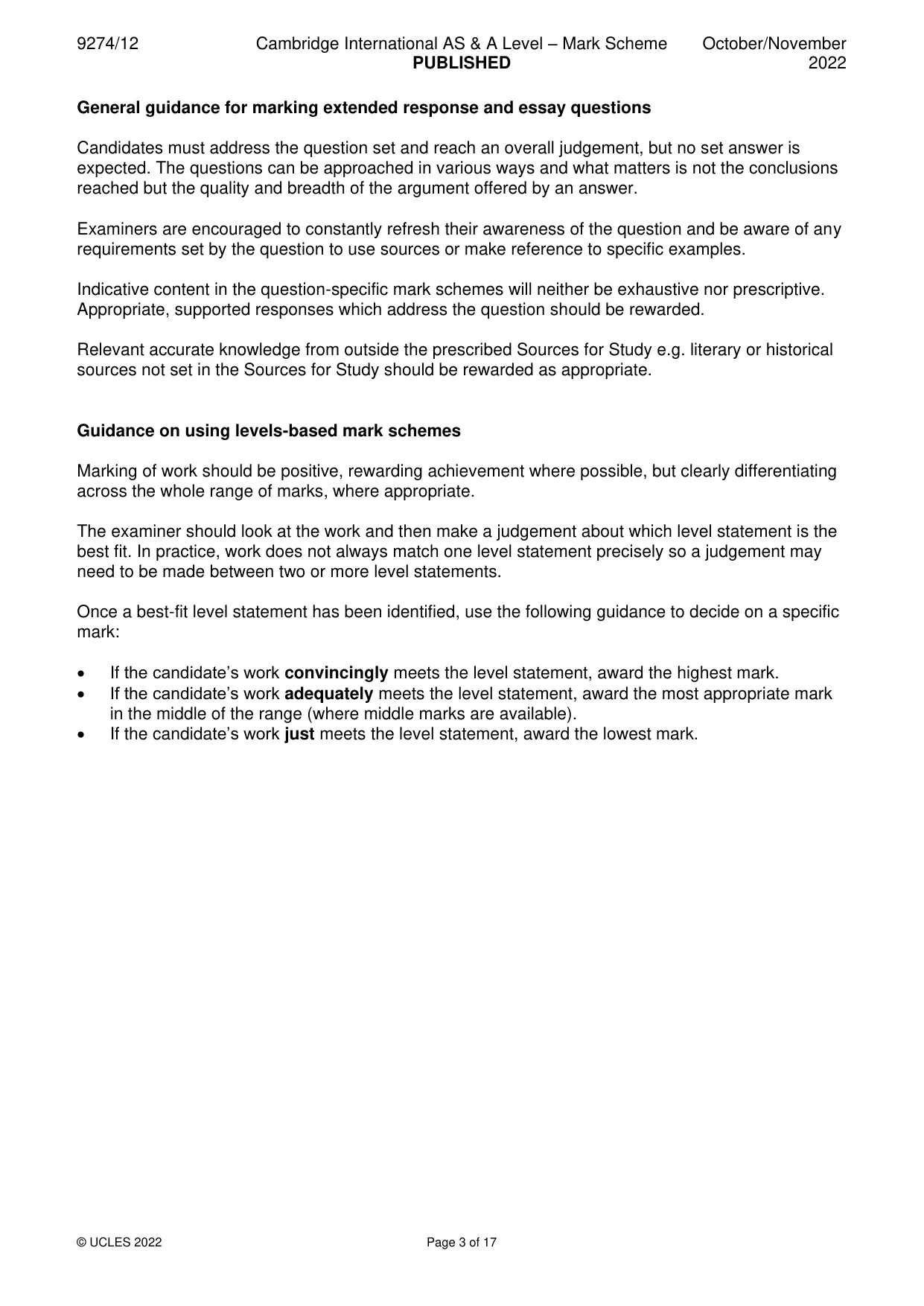
9274/12 Cambridge International AS & A Level – Mark Scheme PUBLISHED October/November 2022 © UCLES 2022 Page 3 of 17 General guidance for marking extended response and essay questions Candidates must address the question set and reach an overall judgement, but no set answer is expected. The questions can be approached in various ways and what matters is not the conclusions reached but the quality and breadth of the argument offered by an answer. Examiners are encouraged to constantly refresh their awareness of the question and be aware of any requirements set by the question to use sources or make reference to specific examples. Indicative content in the question-specific mark schemes will neither be exhaustive nor prescriptive. Appropriate, supported responses which address the question should be rewarded. Relevant accurate knowledge from outside the prescribed Sources for Study e.g. literary or historical sources not set in the Sources for Study should be rewarded as appropriate. Guidance on using levels-based mark schemes Marking of work should be positive, rewarding achievement where possible, but clearly differentiating across the whole range of marks, where appropriate. The examiner should look at the work and then make a judgement about which level statement is the best fit. In practice, work does not always match one level statement precisely so a judgement may need to be made between two or more level statements. Once a best-fit level statement has been identified, use the following guidance to decide on a specific mark: • If the candidate’s work convincingly meets the level statement, award the highest mark. • If the candidate’s work adequately meets the level statement, award the most appropriate mark in the middle of the range (where middle marks are available). • If the candidate’s work just meets the level statement, award the lowest mark.
Mark scheme, page 4
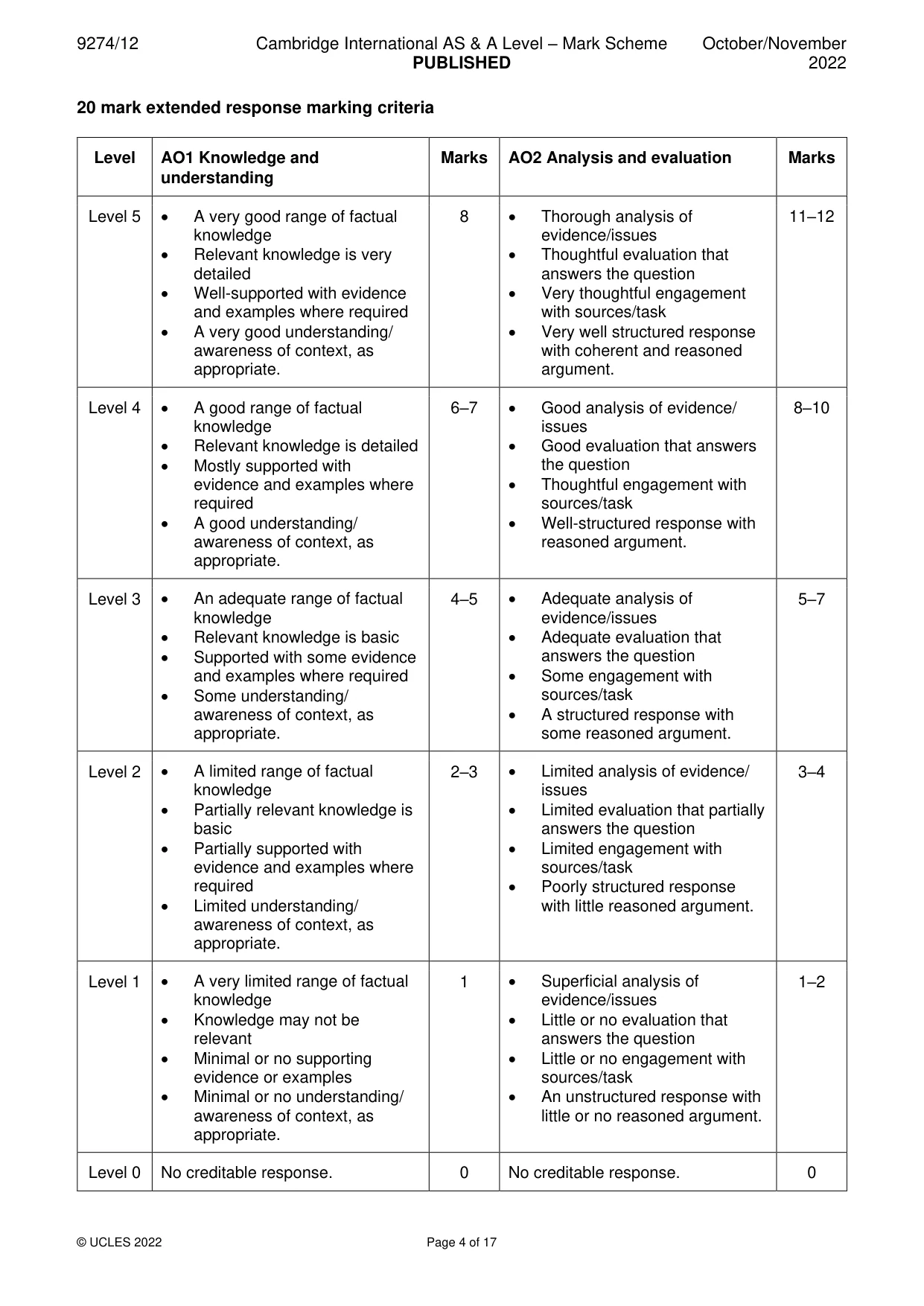
9274/12 Cambridge International AS & A Level – Mark Scheme PUBLISHED October/November 2022 © UCLES 2022 Page 4 of 17 20 mark extended response marking criteria Level AO1 Knowledge and understanding Marks AO2 Analysis and evaluation Marks Level 5 • A very good range of factual knowledge • Relevant knowledge is very detailed • Well-supported with evidence and examples where required • A very good understanding/ awareness of context, as appropriate. 8 • Thorough analysis of evidence/issues • Thoughtful evaluation that answers the question • Very thoughtful engagement with sources/task • Very well structured response with coherent and reasoned argument. 11–12 Level 4 • A good range of factual knowledge • Relevant knowledge is detailed • Mostly supported with evidence and examples where required • A good understanding/ awareness of context, as appropriate. 6–7 • Good analysis of evidence/ issues • Good evaluation that answers the question • Thoughtful engagement with sources/task • Well-structured response with reasoned argument. 8–10 Level 3 • An adequate range of factual knowledge • Relevant knowledge is basic • Supported with some evidence and examples where required • Some understanding/ awareness of context, as appropriate. 4–5 • Adequate analysis of evidence/issues • Adequate evaluation that answers the question • Some engagement with sources/task • A structured response with some reasoned argument. 5–7 Level 2 • A limited range of factual knowledge • Partially relevant knowledge is basic • Partially supported with evidence and examples where required • Limited understanding/ awareness of context, as appropriate. 2–3 • Limited analysis of evidence/ issues • Limited evaluation that partially answers the question • Limited engagement with sources/task • Poorly structured response with little reasoned argument. 3–4 Level 1 • A very limited range of factual knowledge • Knowledge may not be relevant • Minimal or no supporting evidence or examples • Minimal or no understanding/ awareness of context, as appropriate. 1 • Superficial analysis of evidence/issues • Little or no evaluation that answers the question • Little or no engagement with sources/task • An unstructured response with little or no reasoned argument. 1–2 Level 0 No creditable response. 0 No creditable response. 0
Mark scheme, page 5
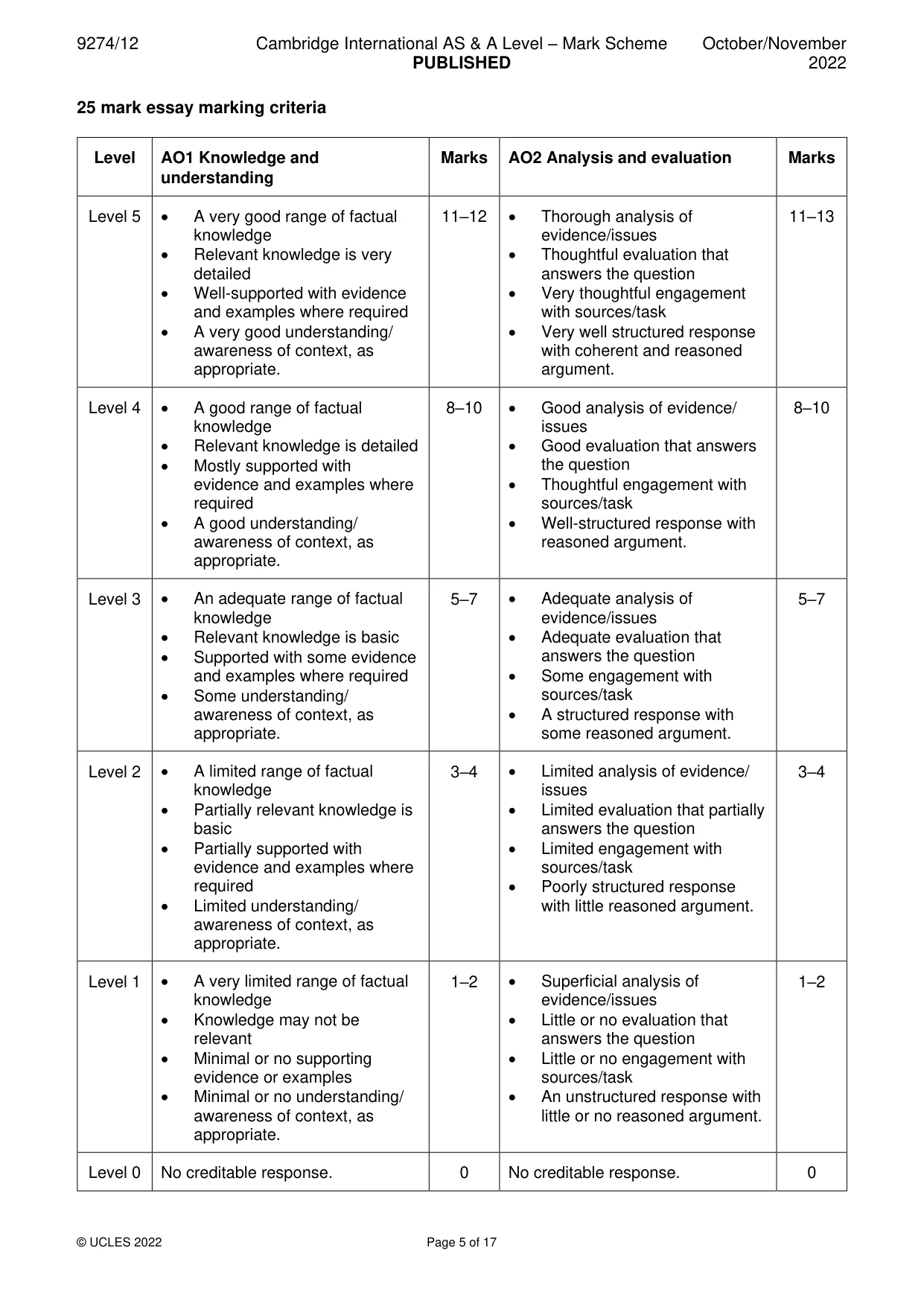
9274/12 Cambridge International AS & A Level – Mark Scheme PUBLISHED October/November 2022 © UCLES 2022 Page 5 of 17 25 mark essay marking criteria Level AO1 Knowledge and understanding Marks AO2 Analysis and evaluation Marks Level 5 • A very good range of factual knowledge • Relevant knowledge is very detailed • Well-supported with evidence and examples where required • A very good understanding/ awareness of context, as appropriate. 11–12 • Thorough analysis of evidence/issues • Thoughtful evaluation that answers the question • Very thoughtful engagement with sources/task • Very well structured response with coherent and reasoned argument. 11–13 Level 4 • A good range of factual knowledge • Relevant knowledge is detailed • Mostly supported with evidence and examples where required • A good understanding/ awareness of context, as appropriate. 8–10 • Good analysis of evidence/ issues • Good evaluation that answers the question • Thoughtful engagement with sources/task • Well-structured response with reasoned argument. 8–10 Level 3 • An adequate range of factual knowledge • Relevant knowledge is basic • Supported with some evidence and examples where required • Some understanding/ awareness of context, as appropriate. 5–7 • Adequate analysis of evidence/issues • Adequate evaluation that answers the question • Some engagement with sources/task • A structured response with some reasoned argument. 5–7 Level 2 • A limited range of factual knowledge • Partially relevant knowledge is basic • Partially supported with evidence and examples where required • Limited understanding/ awareness of context, as appropriate. 3–4 • Limited analysis of evidence/ issues • Limited evaluation that partially answers the question • Limited engagement with sources/task • Poorly structured response with little reasoned argument. 3–4 Level 1 • A very limited range of factual knowledge • Knowledge may not be relevant • Minimal or no supporting evidence or examples • Minimal or no understanding/ awareness of context, as appropriate. 1–2 • Superficial analysis of evidence/issues • Little or no evaluation that answers the question • Little or no engagement with sources/task • An unstructured response with little or no reasoned argument. 1–2 Level 0 No creditable response. 0 No creditable response. 0
Mark scheme, page 6
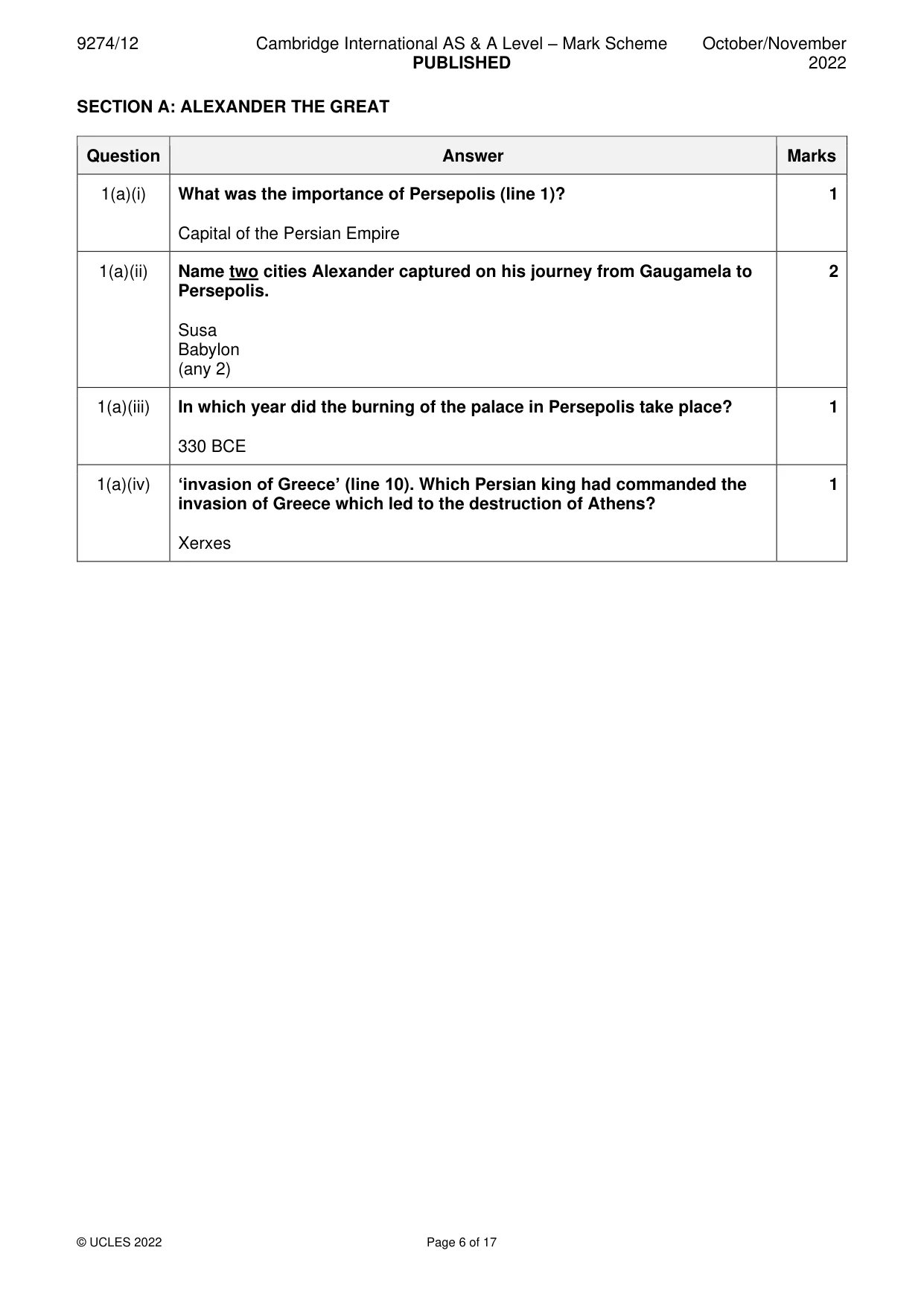
9274/12 Cambridge International AS & A Level – Mark Scheme PUBLISHED October/November 2022 © UCLES 2022 Page 6 of 17 SECTION A: ALEXANDER THE GREAT Question Answer Marks 1(a)(i) What was the importance of Persepolis (line 1)? Capital of the Persian Empire 1 1(a)(ii) Name two cities Alexander captured on his journey from Gaugamela to Persepolis. Susa Babylon (any 2) 2 1(a)(iii) In which year did the burning of the palace in Persepolis take place? 330 BCE 1 1(a)(iv) ‘invasion of Greece’ (line 10). Which Persian king had commanded the invasion of Greece which led to the destruction of Athens? Xerxes 1
Mark scheme, page 7
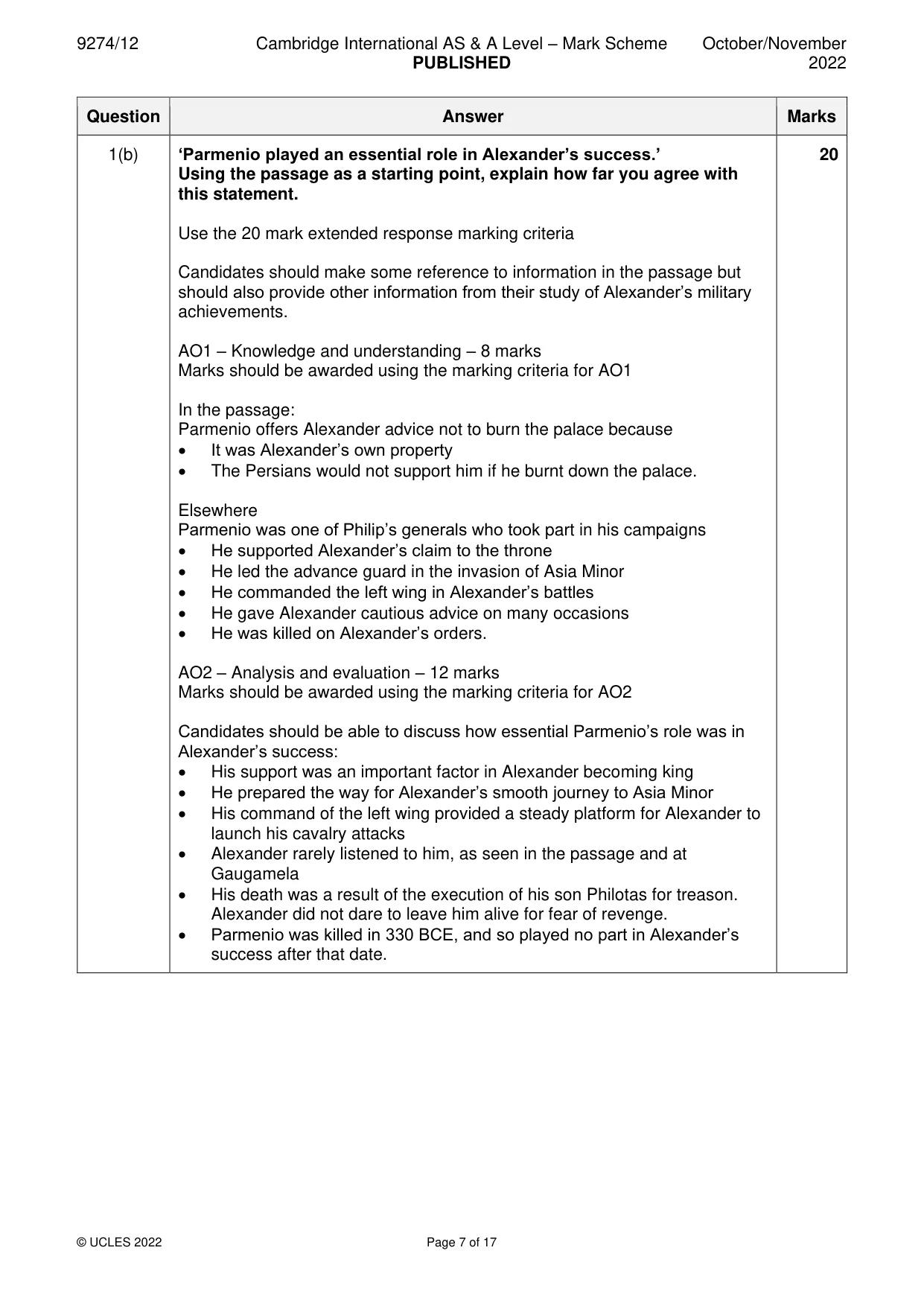
9274/12 Cambridge International AS & A Level – Mark Scheme PUBLISHED October/November 2022 © UCLES 2022 Page 7 of 17 Question Answer Marks 1(b) ‘Parmenio played an essential role in Alexander’s success.’ Using the passage as a starting point, explain how far you agree with this statement. Use the 20 mark extended response marking criteria Candidates should make some reference to information in the passage but should also provide other information from their study of Alexander’s military achievements. AO1 – Knowledge and understanding – 8 marks Marks should be awarded using the marking criteria for AO1 In the passage: Parmenio offers Alexander advice not to burn the palace because • It was Alexander’s own property • The Persians would not support him if he burnt down the palace. Elsewhere Parmenio was one of Philip’s generals who took part in his campaigns • He supported Alexander’s claim to the throne • He led the advance guard in the invasion of Asia Minor • He commanded the left wing in Alexander’s battles • He gave Alexander cautious advice on many occasions • He was killed on Alexander’s orders. AO2 – Analysis and evaluation – 12 marks Marks should be awarded using the marking criteria for AO2 Candidates should be able to discuss how essential Parmenio’s role was in Alexander’s success: • His support was an important factor in Alexander becoming king • He prepared the way for Alexander’s smooth journey to Asia Minor • His command of the left wing provided a steady platform for Alexander to launch his cavalry attacks • Alexander rarely listened to him, as seen in the passage and at Gaugamela • His death was a result of the execution of his son Philotas for treason. Alexander did not dare to leave him alive for fear of revenge. • Parmenio was killed in 330 BCE, and so played no part in Alexander’s success after that date. 20
Mark scheme, page 8
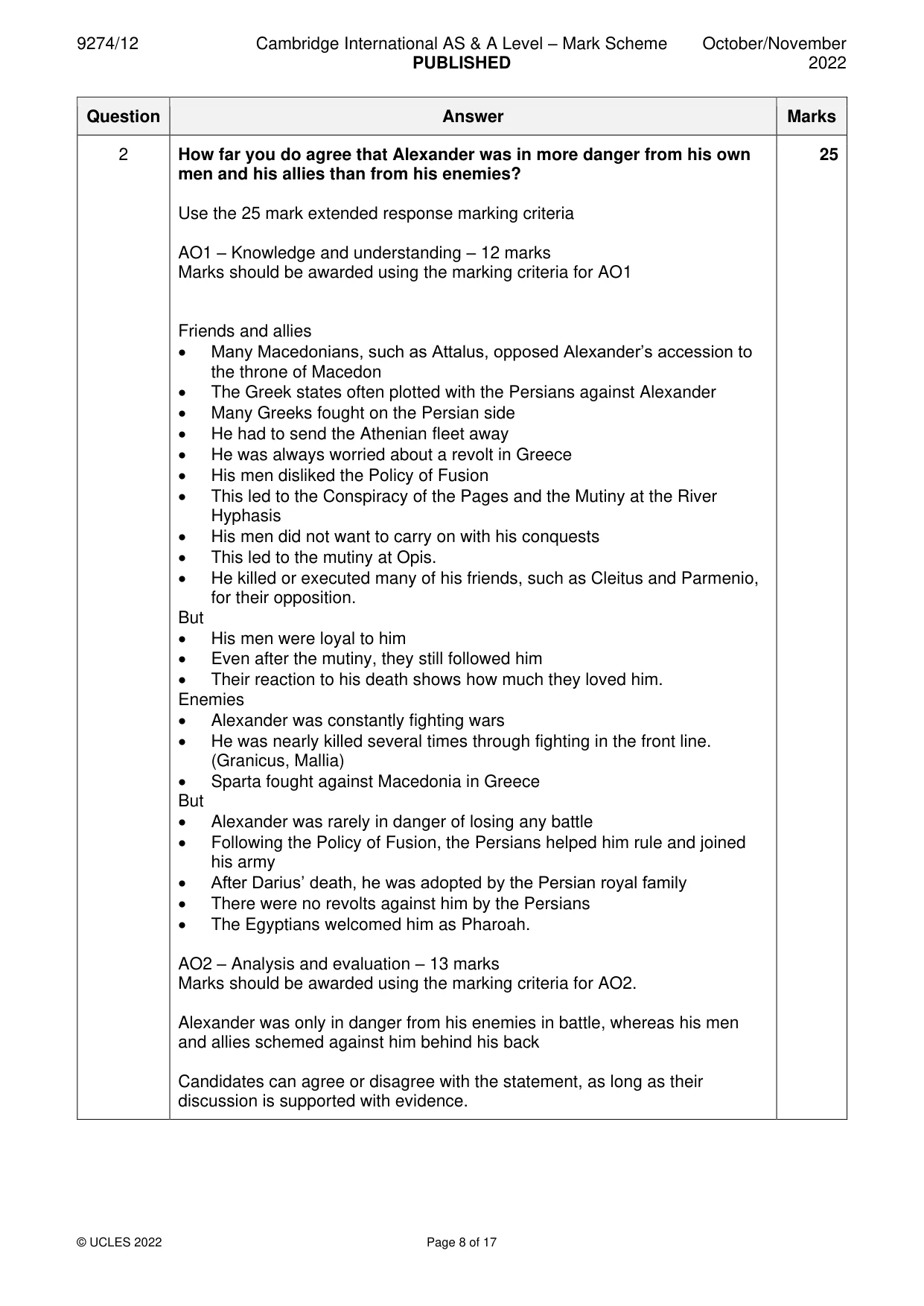
9274/12 Cambridge International AS & A Level – Mark Scheme PUBLISHED October/November 2022 © UCLES 2022 Page 8 of 17 Question Answer Marks 2 How far you do agree that Alexander was in more danger from his own men and his allies than from his enemies? Use the 25 mark extended response marking criteria AO1 – Knowledge and understanding – 12 marks Marks should be awarded using the marking criteria for AO1 Friends and allies • Many Macedonians, such as Attalus, opposed Alexander’s accession to the throne of Macedon • The Greek states often plotted with the Persians against Alexander • Many Greeks fought on the Persian side • He had to send the Athenian fleet away • He was always worried about a revolt in Greece • His men disliked the Policy of Fusion • This led to the Conspiracy of the Pages and the Mutiny at the River Hyphasis • His men did not want to carry on with his conquests • This led to the mutiny at Opis. • He killed or executed many of his friends, such as Cleitus and Parmenio, for their opposition. But • His men were loyal to him • Even after the mutiny, they still followed him • Their reaction to his death shows how much they loved him. Enemies • Alexander was constantly fighting wars • He was nearly killed several times through fighting in the front line. (Granicus, Mallia) • Sparta fought against Macedonia in Greece But • Alexander was rarely in danger of losing any battle • Following the Policy of Fusion, the Persians helped him rule and joined his army • After Darius’ death, he was adopted by the Persian royal family • There were no revolts against him by the Persians • The Egyptians welcomed him as Pharoah. AO2 – Analysis and evaluation – 13 marks Marks should be awarded using the marking criteria for AO2. Alexander was only in danger from his enemies in battle, whereas his men and allies schemed against him behind his back Candidates can agree or disagree with the statement, as long as their discussion is supported with evidence. 25
Mark scheme, page 9
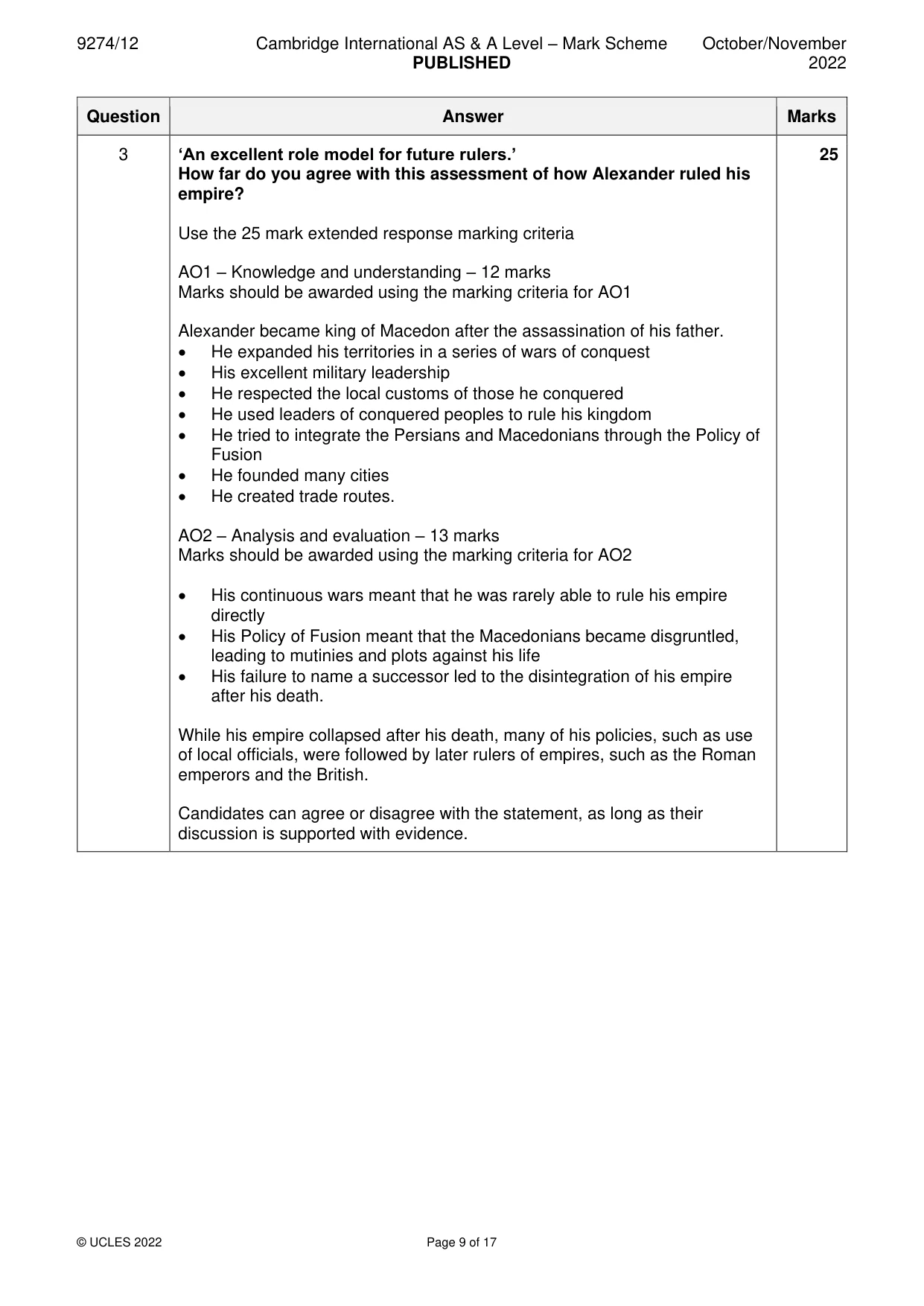
9274/12 Cambridge International AS & A Level – Mark Scheme PUBLISHED October/November 2022 © UCLES 2022 Page 9 of 17 Question Answer Marks 3 ‘An excellent role model for future rulers.’ How far do you agree with this assessment of how Alexander ruled his empire? Use the 25 mark extended response marking criteria AO1 – Knowledge and understanding – 12 marks Marks should be awarded using the marking criteria for AO1 Alexander became king of Macedon after the assassination of his father. • He expanded his territories in a series of wars of conquest • His excellent military leadership • He respected the local customs of those he conquered • He used leaders of conquered peoples to rule his kingdom • He tried to integrate the Persians and Macedonians through the Policy of Fusion • He founded many cities • He created trade routes. AO2 – Analysis and evaluation – 13 marks Marks should be awarded using the marking criteria for AO2 • His continuous wars meant that he was rarely able to rule his empire directly • His Policy of Fusion meant that the Macedonians became disgruntled, leading to mutinies and plots against his life • His failure to name a successor led to the disintegration of his empire after his death. While his empire collapsed after his death, many of his policies, such as use of local officials, were followed by later rulers of empires, such as the Roman emperors and the British. Candidates can agree or disagree with the statement, as long as their discussion is supported with evidence. 25
Mark scheme, page 10
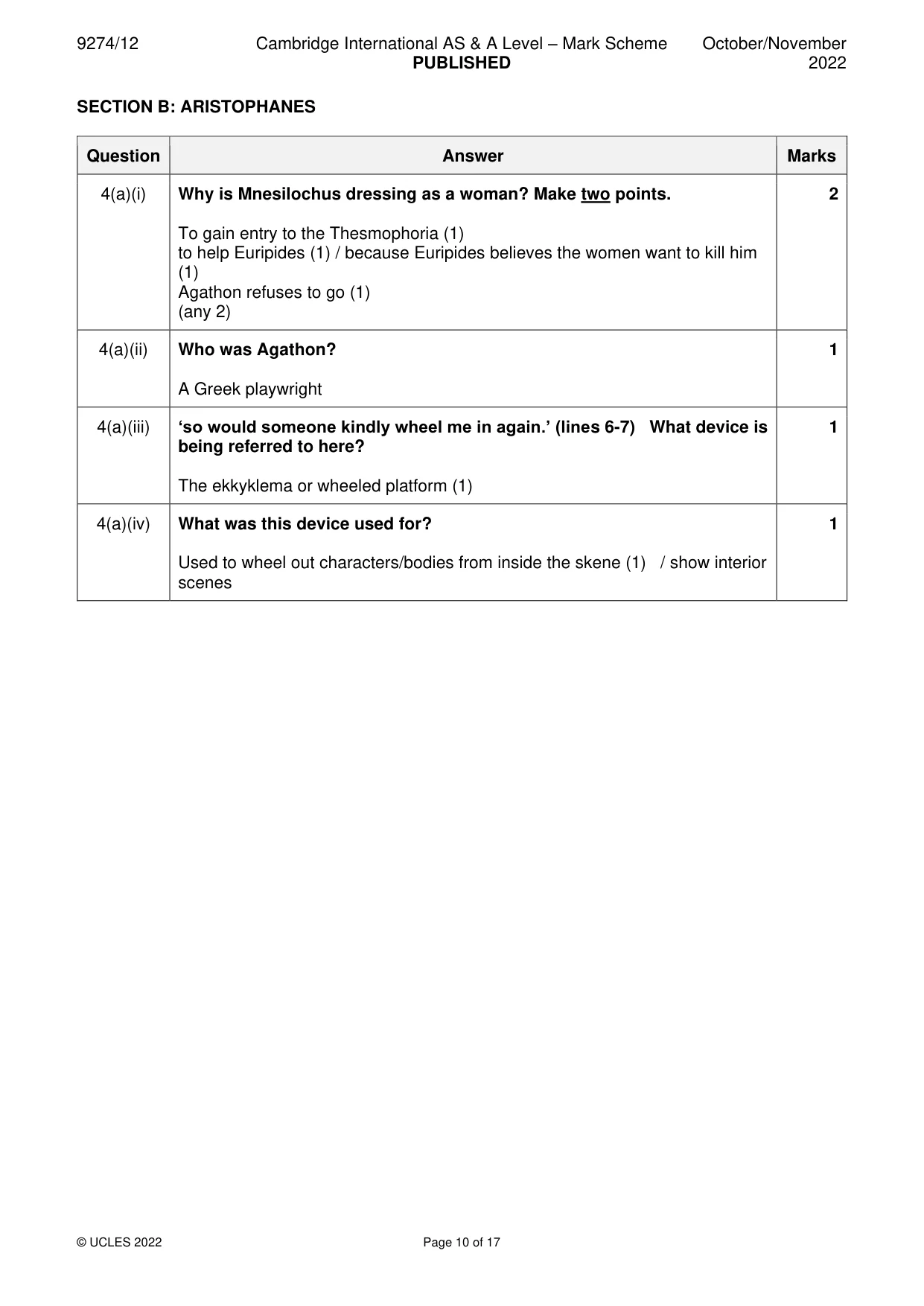
9274/12 Cambridge International AS & A Level – Mark Scheme PUBLISHED October/November 2022 © UCLES 2022 Page 10 of 17 SECTION B: ARISTOPHANES Question Answer Marks 4(a)(i) Why is Mnesilochus dressing as a woman? Make two points. To gain entry to the Thesmophoria (1) to help Euripides (1) / because Euripides believes the women want to kill him (1) Agathon refuses to go (1) (any 2) 2 4(a)(ii) Who was Agathon? A Greek playwright 1 4(a)(iii) ‘so would someone kindly wheel me in again.’ (lines 6-7) What device is being referred to here? The ekkyklema or wheeled platform (1) 1 4(a)(iv) What was this device used for? Used to wheel out characters/bodies from inside the skene (1) / show interior scenes 1
Mark scheme, page 11
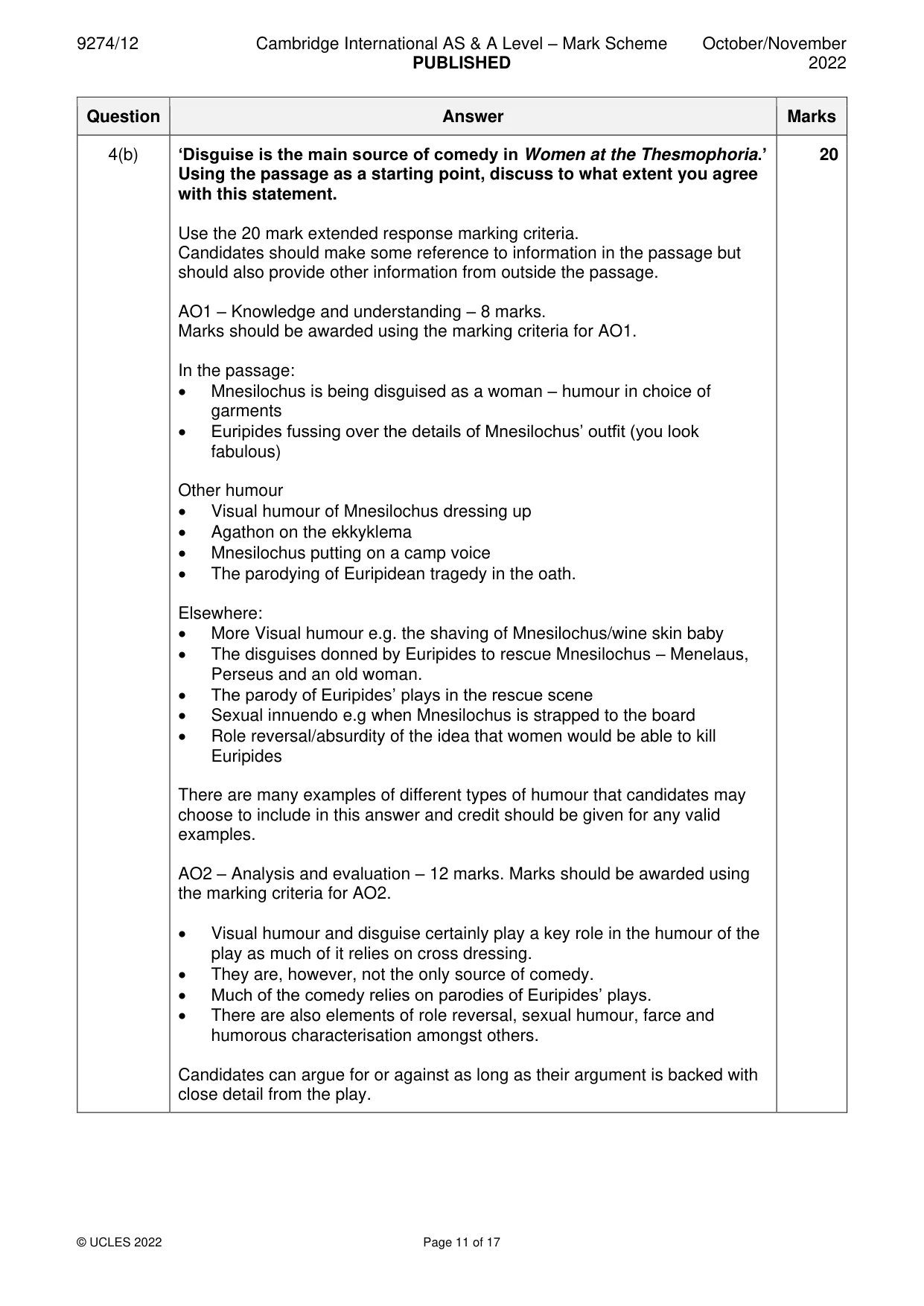
9274/12 Cambridge International AS & A Level – Mark Scheme PUBLISHED October/November 2022 © UCLES 2022 Page 11 of 17 Question Answer Marks 4(b) ‘Disguise is the main source of comedy in Women at the Thesmophoria.’ Using the passage as a starting point, discuss to what extent you agree with this statement. Use the 20 mark extended response marking criteria. Candidates should make some reference to information in the passage but should also provide other information from outside the passage. AO1 – Knowledge and understanding – 8 marks. Marks should be awarded using the marking criteria for AO1. In the passage: • Mnesilochus is being disguised as a woman – humour in choice of garments • Euripides fussing over the details of Mnesilochus’ outfit (you look fabulous) Other humour • Visual humour of Mnesilochus dressing up • Agathon on the ekkyklema • Mnesilochus putting on a camp voice • The parodying of Euripidean tragedy in the oath. Elsewhere: • More Visual humour e.g. the shaving of Mnesilochus/wine skin baby • The disguises donned by Euripides to rescue Mnesilochus – Menelaus, Perseus and an old woman. • The parody of Euripides’ plays in the rescue scene • Sexual innuendo e.g when Mnesilochus is strapped to the board • Role reversal/absurdity of the idea that women would be able to kill Euripides There are many examples of different types of humour that candidates may choose to include in this answer and credit should be given for any valid examples. AO2 – Analysis and evaluation – 12 marks. Marks should be awarded using the marking criteria for AO2. • Visual humour and disguise certainly play a key role in the humour of the play as much of it relies on cross dressing. • They are, however, not the only source of comedy. • Much of the comedy relies on parodies of Euripides’ plays. • There are also elements of role reversal, sexual humour, farce and humorous characterisation amongst others. Candidates can argue for or against as long as their argument is backed with close detail from the play. 20
Mark scheme, page 12
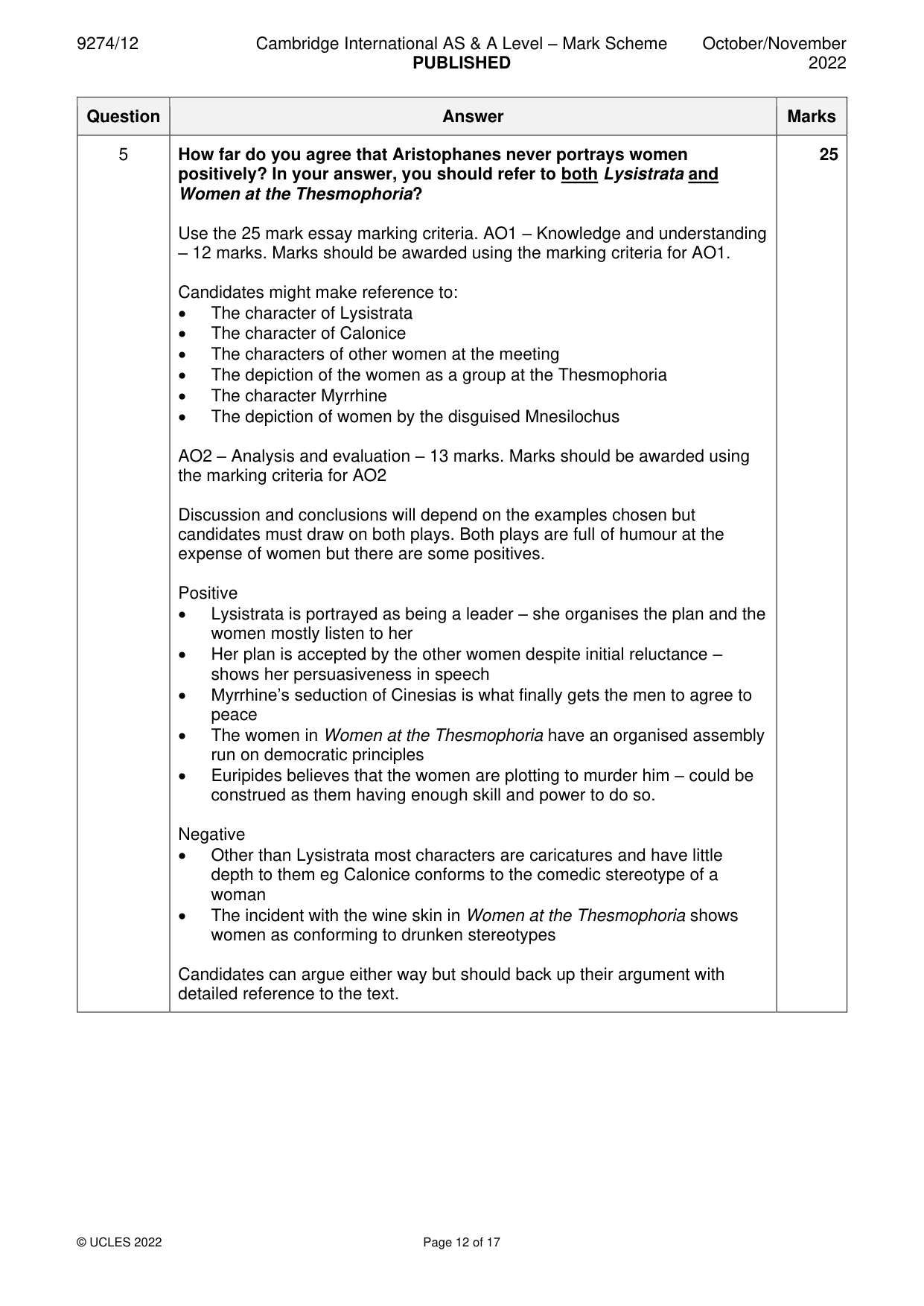
9274/12 Cambridge International AS & A Level – Mark Scheme PUBLISHED October/November 2022 © UCLES 2022 Page 12 of 17 Question Answer Marks 5 How far do you agree that Aristophanes never portrays women positively? In your answer, you should refer to both Lysistrata and Women at the Thesmophoria? Use the 25 mark essay marking criteria. AO1 – Knowledge and understanding – 12 marks. Marks should be awarded using the marking criteria for AO1. Candidates might make reference to: • The character of Lysistrata • The character of Calonice • The characters of other women at the meeting • The depiction of the women as a group at the Thesmophoria • The character Myrrhine • The depiction of women by the disguised Mnesilochus AO2 – Analysis and evaluation – 13 marks. Marks should be awarded using the marking criteria for AO2 Discussion and conclusions will depend on the examples chosen but candidates must draw on both plays. Both plays are full of humour at the expense of women but there are some positives. Positive • Lysistrata is portrayed as being a leader – she organises the plan and the women mostly listen to her • Her plan is accepted by the other women despite initial reluctance – shows her persuasiveness in speech • Myrrhine’s seduction of Cinesias is what finally gets the men to agree to peace • The women in Women at the Thesmophoria have an organised assembly run on democratic principles • Euripides believes that the women are plotting to murder him – could be construed as them having enough skill and power to do so. Negative • Other than Lysistrata most characters are caricatures and have little depth to them eg Calonice conforms to the comedic stereotype of a woman • The incident with the wine skin in Women at the Thesmophoria shows women as conforming to drunken stereotypes Candidates can argue either way but should back up their argument with detailed reference to the text. 25
Mark scheme, page 13
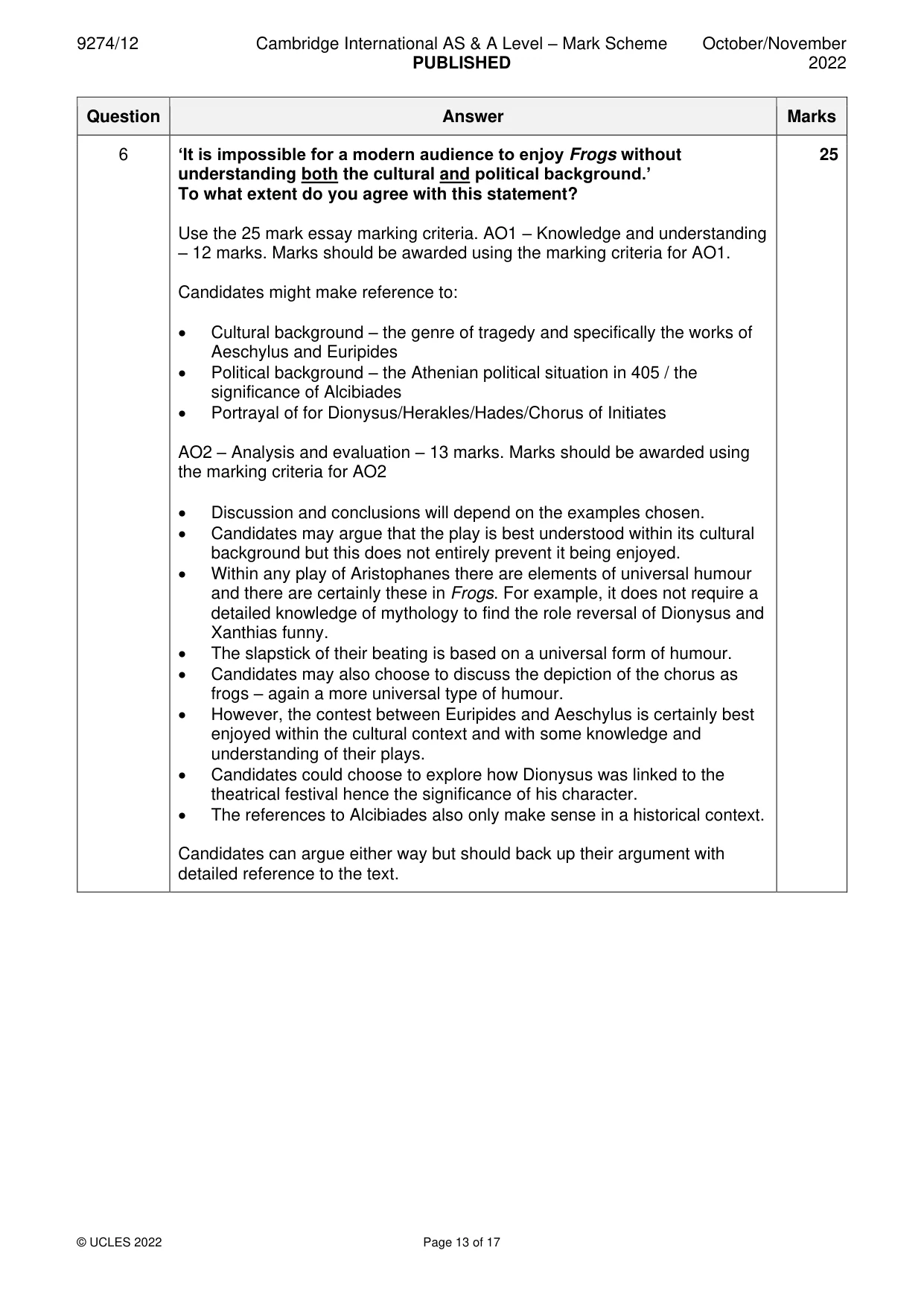
9274/12 Cambridge International AS & A Level – Mark Scheme PUBLISHED October/November 2022 © UCLES 2022 Page 13 of 17 Question Answer Marks 6 ‘It is impossible for a modern audience to enjoy Frogs without understanding both the cultural and political background.’ To what extent do you agree with this statement? Use the 25 mark essay marking criteria. AO1 – Knowledge and understanding – 12 marks. Marks should be awarded using the marking criteria for AO1. Candidates might make reference to: • Cultural background – the genre of tragedy and specifically the works of Aeschylus and Euripides • Political background – the Athenian political situation in 405 / the significance of Alcibiades • Portrayal of for Dionysus/Herakles/Hades/Chorus of Initiates AO2 – Analysis and evaluation – 13 marks. Marks should be awarded using the marking criteria for AO2 • Discussion and conclusions will depend on the examples chosen. • Candidates may argue that the play is best understood within its cultural background but this does not entirely prevent it being enjoyed. • Within any play of Aristophanes there are elements of universal humour and there are certainly these in Frogs. For example, it does not require a detailed knowledge of mythology to find the role reversal of Dionysus and Xanthias funny. • The slapstick of their beating is based on a universal form of humour. • Candidates may also choose to discuss the depiction of the chorus as frogs – again a more universal type of humour. • However, the contest between Euripides and Aeschylus is certainly best enjoyed within the cultural context and with some knowledge and understanding of their plays. • Candidates could choose to explore how Dionysus was linked to the theatrical festival hence the significance of his character. • The references to Alcibiades also only make sense in a historical context. Candidates can argue either way but should back up their argument with detailed reference to the text. 25
Mark scheme, page 14
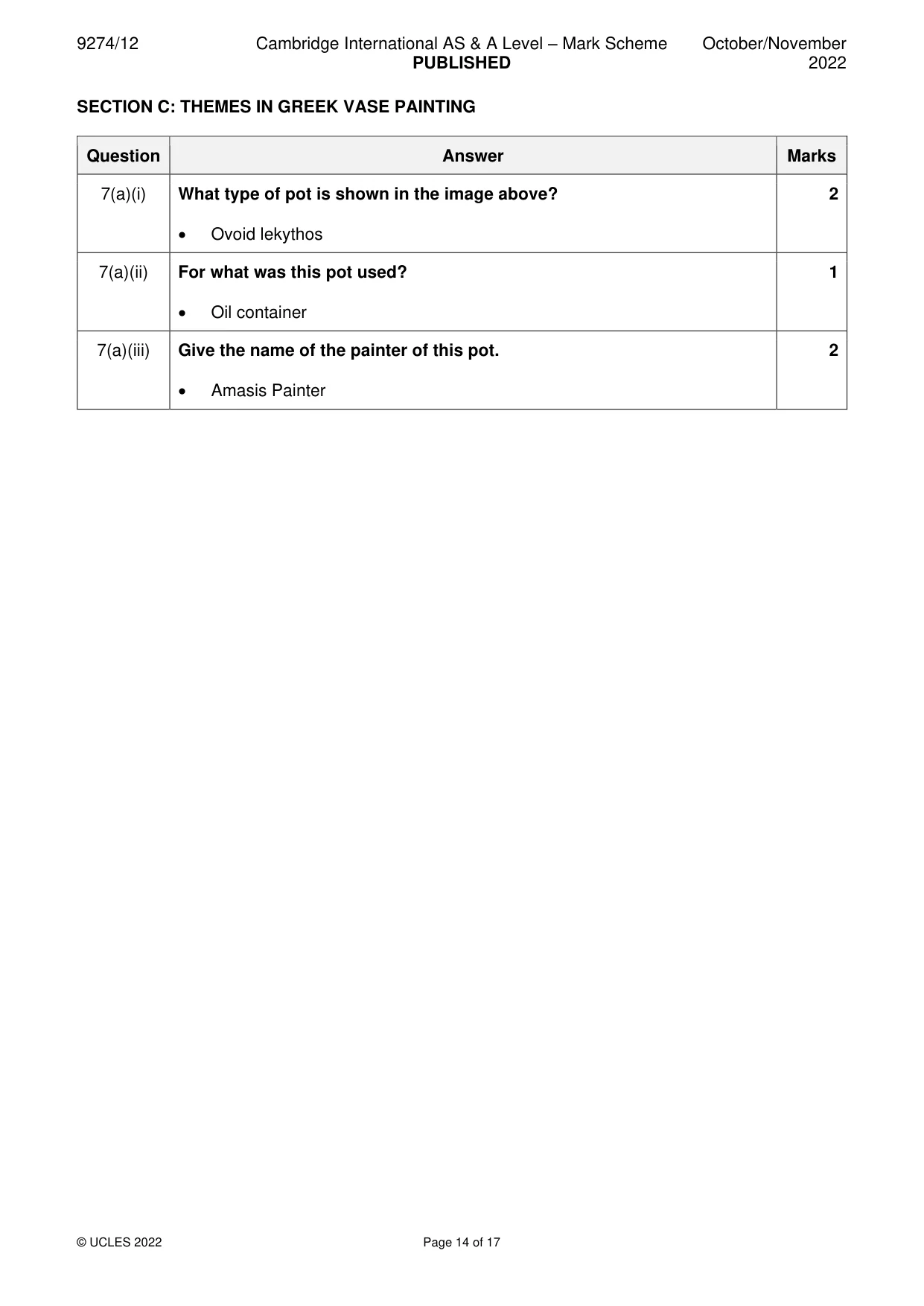
9274/12 Cambridge International AS & A Level – Mark Scheme PUBLISHED October/November 2022 © UCLES 2022 Page 14 of 17 SECTION C: THEMES IN GREEK VASE PAINTING Question Answer Marks 7(a)(i) What type of pot is shown in the image above? • Ovoid lekythos 2 7(a)(ii) For what was this pot used? • Oil container 1 7(a)(iii) Give the name of the painter of this pot. • Amasis Painter 2
Mark scheme, page 15
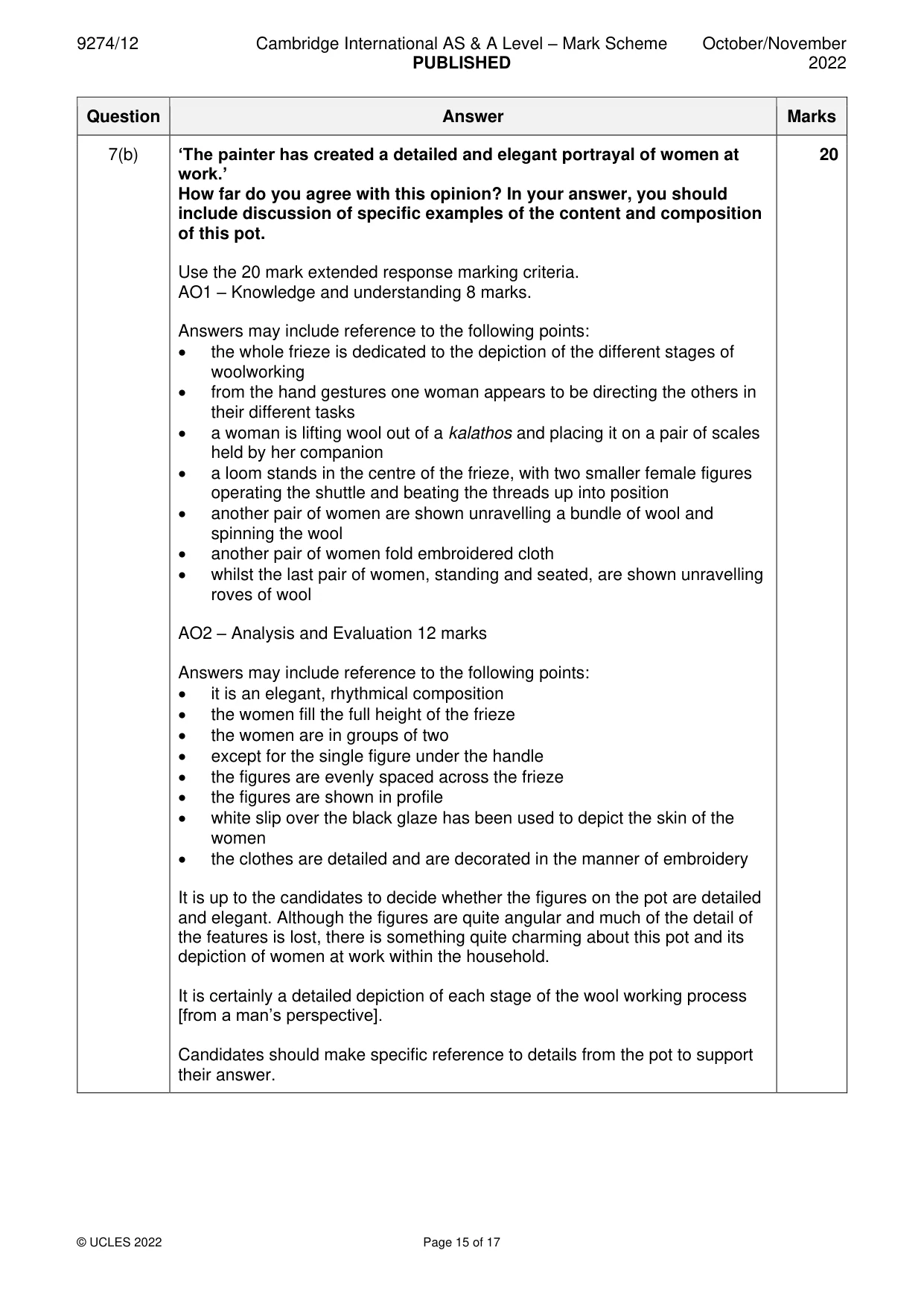
9274/12 Cambridge International AS & A Level – Mark Scheme PUBLISHED October/November 2022 © UCLES 2022 Page 15 of 17 Question Answer Marks 7(b) ‘The painter has created a detailed and elegant portrayal of women at work.’ How far do you agree with this opinion? In your answer, you should include discussion of specific examples of the content and composition of this pot. Use the 20 mark extended response marking criteria. AO1 – Knowledge and understanding 8 marks. Answers may include reference to the following points: • the whole frieze is dedicated to the depiction of the different stages of woolworking • from the hand gestures one woman appears to be directing the others in their different tasks • a woman is lifting wool out of a kalathos and placing it on a pair of scales held by her companion • a loom stands in the centre of the frieze, with two smaller female figures operating the shuttle and beating the threads up into position • another pair of women are shown unravelling a bundle of wool and spinning the wool • another pair of women fold embroidered cloth • whilst the last pair of women, standing and seated, are shown unravelling roves of wool AO2 – Analysis and Evaluation 12 marks Answers may include reference to the following points: • it is an elegant, rhythmical composition • the women fill the full height of the frieze • the women are in groups of two • except for the single figure under the handle • the figures are evenly spaced across the frieze • the figures are shown in profile • white slip over the black glaze has been used to depict the skin of the women • the clothes are detailed and are decorated in the manner of embroidery It is up to the candidates to decide whether the figures on the pot are detailed and elegant. Although the figures are quite angular and much of the detail of the features is lost, there is something quite charming about this pot and its depiction of women at work within the household. It is certainly a detailed depiction of each stage of the wool working process [from a man’s perspective]. Candidates should make specific reference to details from the pot to support their answer. 20
Mark scheme, page 16
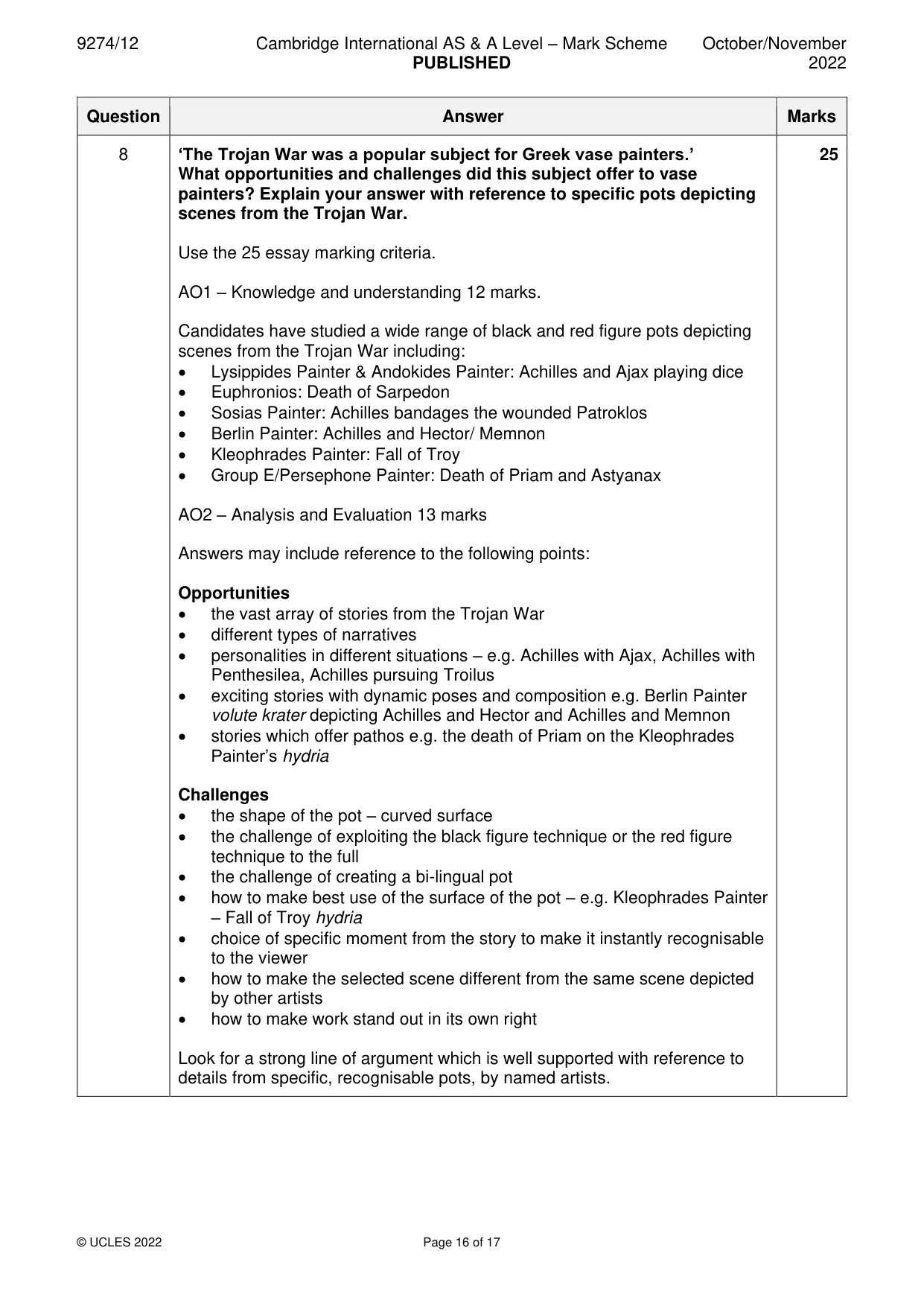
9274/12 Cambridge International AS & A Level – Mark Scheme PUBLISHED October/November 2022 © UCLES 2022 Page 16 of 17 Question Answer Marks 8 ‘The Trojan War was a popular subject for Greek vase painters.’ What opportunities and challenges did this subject offer to vase painters? Explain your answer with reference to specific pots depicting scenes from the Trojan War. Use the 25 essay marking criteria. AO1 – Knowledge and understanding 12 marks. Candidates have studied a wide range of black and red figure pots depicting scenes from the Trojan War including: • Lysippides Painter & Andokides Painter: Achilles and Ajax playing dice • Euphronios: Death of Sarpedon • Sosias Painter: Achilles bandages the wounded Patroklos • Berlin Painter: Achilles and Hector/ Memnon • Kleophrades Painter: Fall of Troy • Group E/Persephone Painter: Death of Priam and Astyanax AO2 – Analysis and Evaluation 13 marks Answers may include reference to the following points: Opportunities • the vast array of stories from the Trojan War • different types of narratives • personalities in different situations – e.g. Achilles with Ajax, Achilles with Penthesilea, Achilles pursuing Troilus • exciting stories with dynamic poses and composition e.g. Berlin Painter volute krater depicting Achilles and Hector and Achilles and Memnon • stories which offer pathos e.g. the death of Priam on the Kleophrades Painter’s hydria Challenges • the shape of the pot – curved surface • the challenge of exploiting the black figure technique or the red figure technique to the full • the challenge of creating a bi-lingual pot • how to make best use of the surface of the pot – e.g. Kleophrades Painter – Fall of Troy hydria • choice of specific moment from the story to make it instantly recognisable to the viewer • how to make the selected scene different from the same scene depicted by other artists • how to make work stand out in its own right Look for a strong line of argument which is well supported with reference to details from specific, recognisable pots, by named artists. 25
Mark scheme, page 17
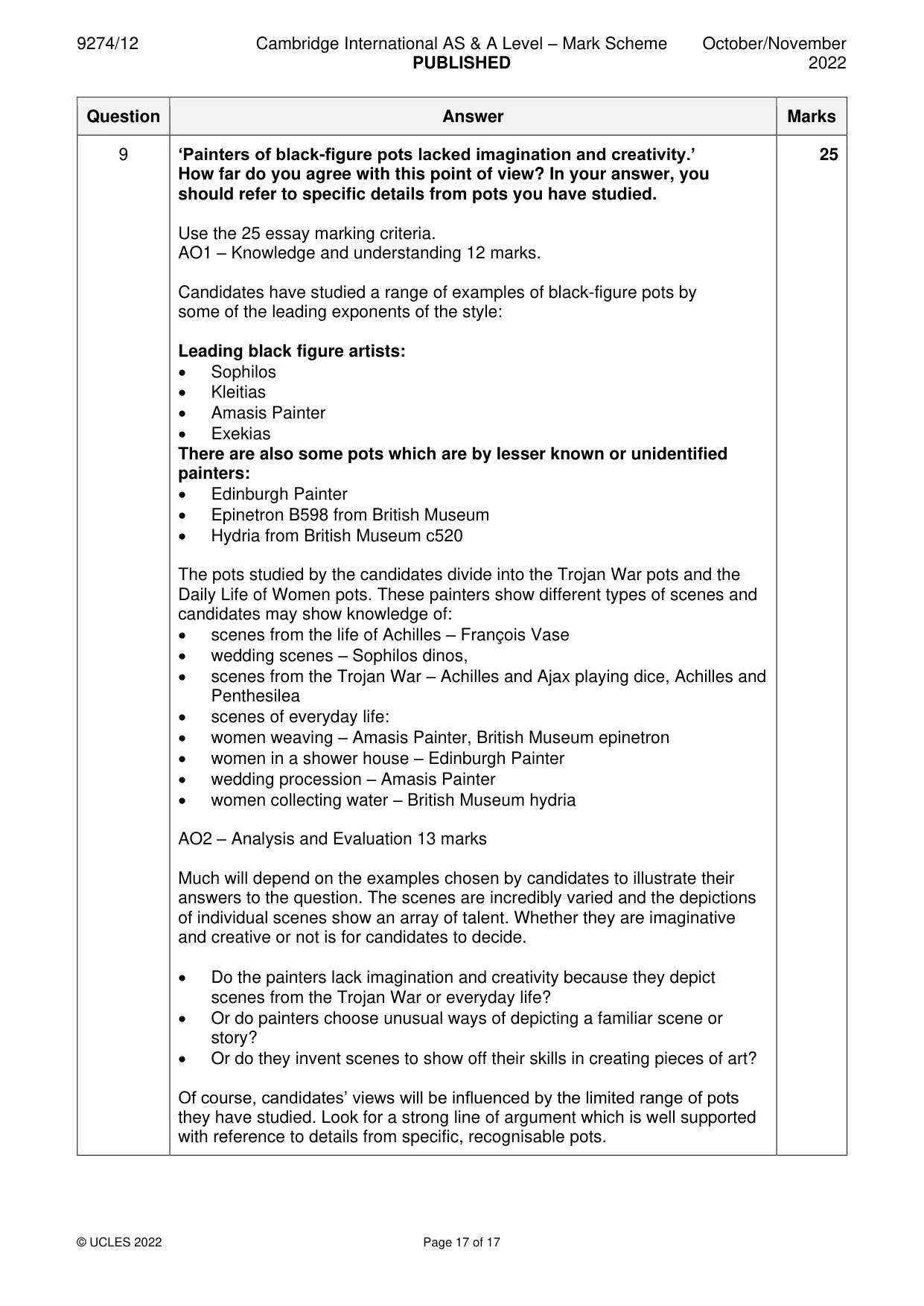
9274/12 Cambridge International AS & A Level – Mark Scheme PUBLISHED October/November 2022 © UCLES 2022 Page 17 of 17 Question Answer Marks 9 ‘Painters of black-figure pots lacked imagination and creativity.’ How far do you agree with this point of view? In your answer, you should refer to specific details from pots you have studied. Use the 25 essay marking criteria. AO1 – Knowledge and understanding 12 marks. Candidates have studied a range of examples of black-figure pots by some of the leading exponents of the style: Leading black figure artists: • Sophilos • Kleitias • Amasis Painter • Exekias There are also some pots which are by lesser known or unidentified painters: • Edinburgh Painter • Epinetron B598 from British Museum • Hydria from British Museum c520 The pots studied by the candidates divide into the Trojan War pots and the Daily Life of Women pots. These painters show different types of scenes and candidates may show knowledge of: • scenes from the life of Achilles – François Vase • wedding scenes – Sophilos dinos, • scenes from the Trojan War – Achilles and Ajax playing dice, Achilles and Penthesilea • scenes of everyday life: • women weaving – Amasis Painter, British Museum epinetron • women in a shower house – Edinburgh Painter • wedding procession – Amasis Painter • women collecting water – British Museum hydria AO2 – Analysis and Evaluation 13 marks Much will depend on the examples chosen by candidates to illustrate their answers to the question. The scenes are incredibly varied and the depictions of individual scenes show an array of talent. Whether they are imaginative and creative or not is for candidates to decide. • Do the painters lack imagination and creativity because they depict scenes from the Trojan War or everyday life? • Or do painters choose unusual ways of depicting a familiar scene or story? • Or do they invent scenes to show off their skills in creating pieces of art? Of course, candidates’ views will be influenced by the limited range of pots they have studied. Look for a strong line of argument which is well supported with reference to details from specific, recognisable pots. 25
What you needed in this session
Cambridge’s own grade thresholds for 2022 Oct/Nov, Paper 1 · Variant 2. A higher threshold means an easier paper — the bar moves with how the cohort did.