Cambridge A Level Classical Studies 9274 — 2021 Oct/Nov Paper 4 · Variant 2
9274/42/O/N/21 · 50 marks · ≈56 min
The question paper and its mark scheme, free to read here and free to download. This is Cambridge’s own paper, exactly as it was sat.
Question paper4 pages

Mark scheme6 pages
Answers below. Sit the paper first if you are practising.
Paper as text
Question paper, page 1
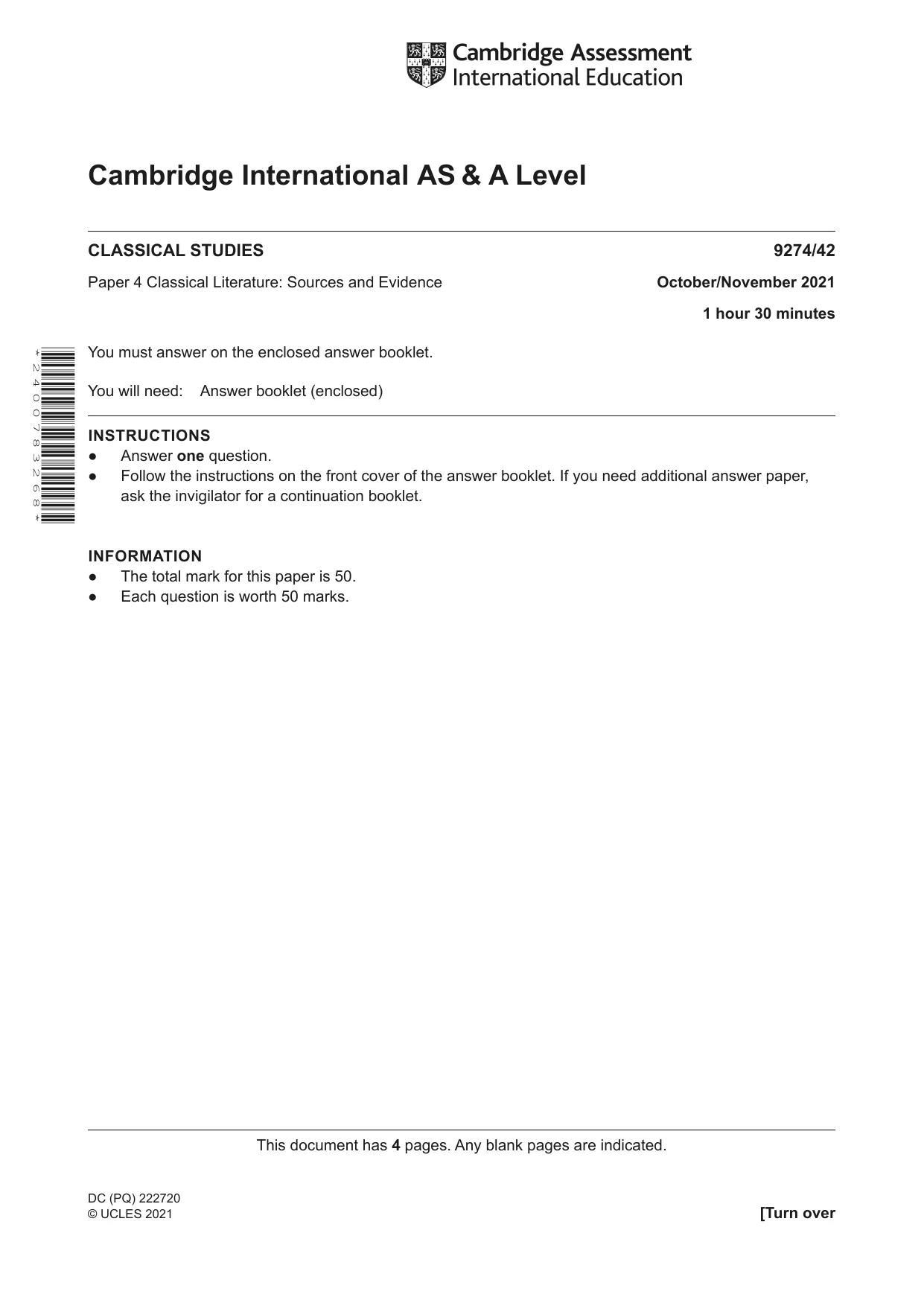
This document has 4 pages. Any blank pages are indicated. Cambridge International AS & A Level CLASSICAL STUDIES 9274/42 Paper 4 Classical Literature: Sources and Evidence October/November 2021 1 hour 30 minutes You must answer on the enclosed answer booklet. You will need: Answer booklet (enclosed) INSTRUCTIONS ● Answer one question. ● Follow the instructions on the front cover of the answer booklet. If you need additional answer paper, ask the invigilator for a continuation booklet. INFORMATION ● The total mark for this paper is 50. ● Each question is worth 50 marks. * 2 4 0 0 7 8 3 2 6 8 * DC (PQ) 222720 © UCLES 2021 [Turn over
Question paper, page 2
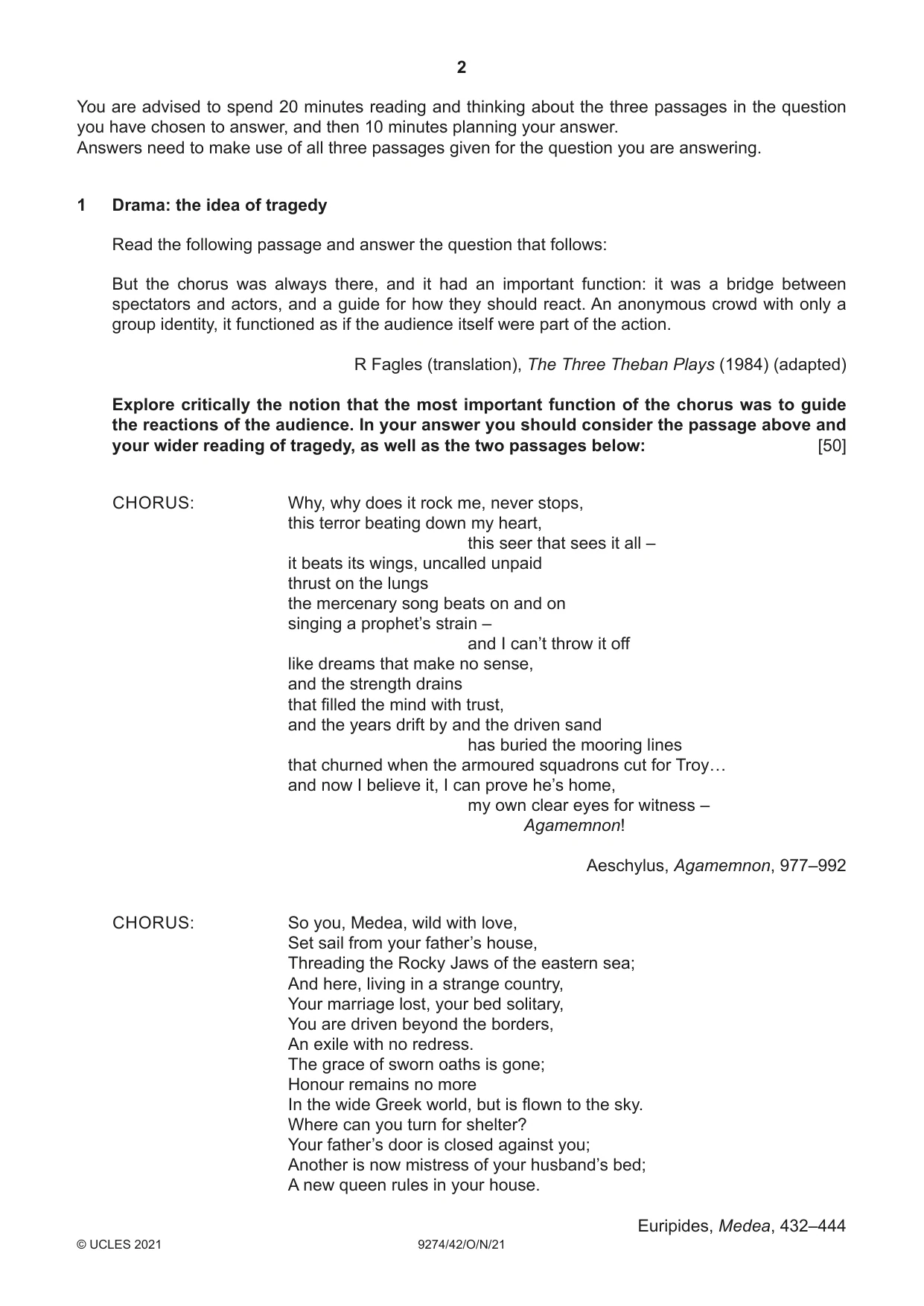
2 9274/42/O/N/21 © UCLES 2021 You are advised to spend 20 minutes reading and thinking about the three passages in the question you have chosen to answer, and then 10 minutes planning your answer. Answers need to make use of all three passages given for the question you are answering. 1 Drama: the idea of tragedy Read the following passage and answer the question that follows: But the chorus was always there, and it had an important function: it was a bridge between spectators and actors, and a guide for how they should react. An anonymous crowd with only a group identity, it functioned as if the audience itself were part of the action. R Fagles (translation), The Three Theban Plays (1984) (adapted) Explore critically the notion that the most important function of the chorus was to guide the reactions of the audience. In your answer you should consider the passage above and your wider reading of tragedy, as well as the two passages below: [50] CHORUS: Why, why does it rock me, never stops, this terror beating down my heart, this seer that sees it all – it beats its wings, uncalled unpaid thrust on the lungs the mercenary song beats on and on singing a prophet’s strain – and I can’t throw it off like dreams that make no sense, and the strength drains that filled the mind with trust, and the years drift by and the driven sand has buried the mooring lines that churned when the armoured squadrons cut for Troy… and now I believe it, I can prove he’s home, my own clear eyes for witness – Agamemnon! Aeschylus, Agamemnon, 977–992 CHORUS: So you, Medea, wild with love, Set sail from your father’s house, Threading the Rocky Jaws of the eastern sea; And here, living in a strange country, Your marriage lost, your bed solitary, You are driven beyond the borders, An exile with no redress. The grace of sworn oaths is gone; Honour remains no more In the wide Greek world, but is flown to the sky. Where can you turn for shelter? Your father’s door is closed against you; Another is now mistress of your husband’s bed; A new queen rules in your house. Euripides, Medea, 432–444
Question paper, page 3
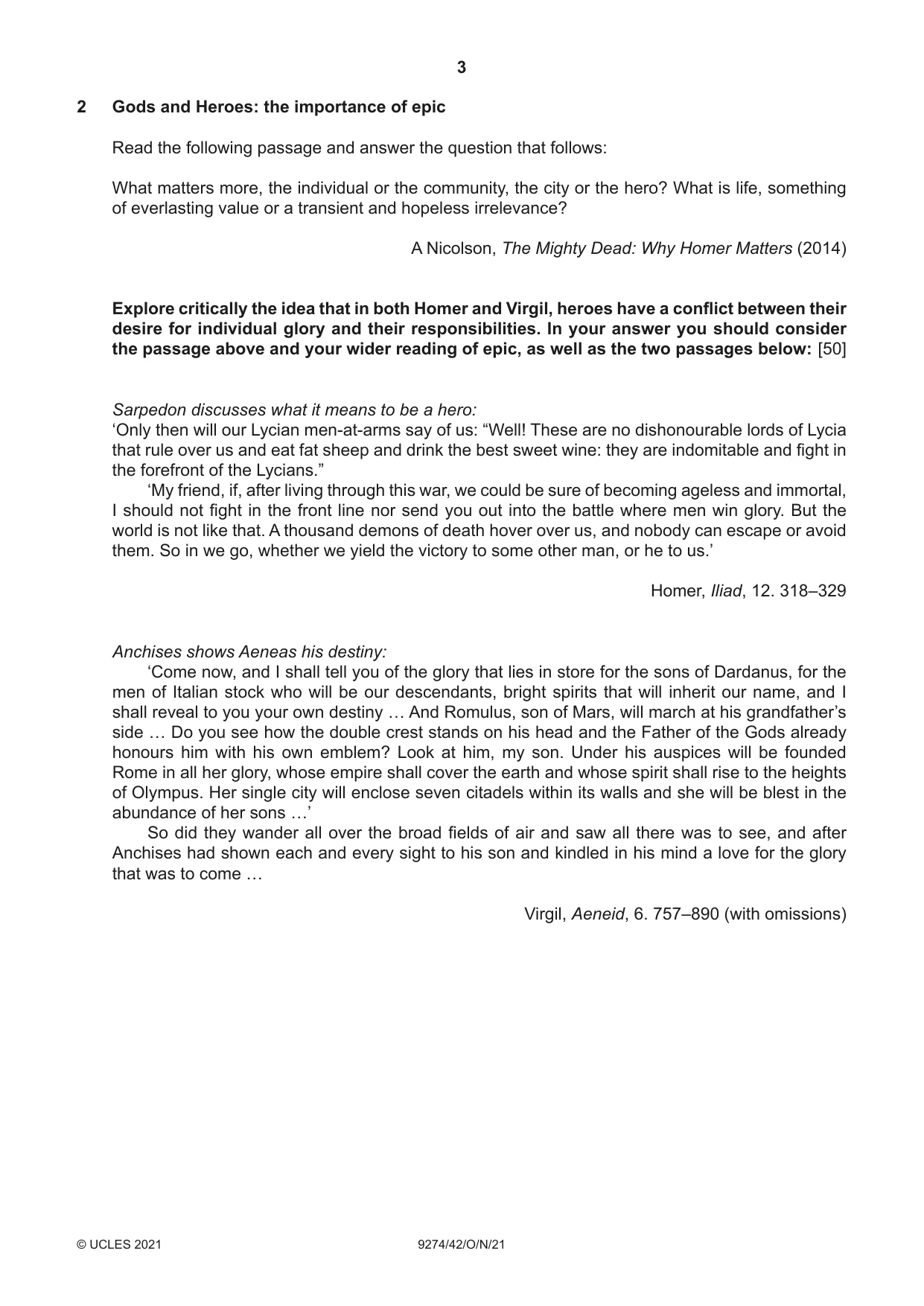
3 9274/42/O/N/21 © UCLES 2021 2 Gods and Heroes: the importance of epic Read the following passage and answer the question that follows: What matters more, the individual or the community, the city or the hero? What is life, something of everlasting value or a transient and hopeless irrelevance? A Nicolson, The Mighty Dead: Why Homer Matters (2014) Explore critically the idea that in both Homer and Virgil, heroes have a conflict between their desire for individual glory and their responsibilities. In your answer you should consider the passage above and your wider reading of epic, as well as the two passages below: [50] Sarpedon discusses what it means to be a hero: ‘Only then will our Lycian men-at-arms say of us: “Well! These are no dishonourable lords of Lycia that rule over us and eat fat sheep and drink the best sweet wine: they are indomitable and fight in the forefront of the Lycians.” ‘My friend, if, after living through this war, we could be sure of becoming ageless and immortal, I should not fight in the front line nor send you out into the battle where men win glory. But the world is not like that. A thousand demons of death hover over us, and nobody can escape or avoid them. So in we go, whether we yield the victory to some other man, or he to us.’ Homer, Iliad, 12. 318–329 Anchises shows Aeneas his destiny: ‘Come now, and I shall tell you of the glory that lies in store for the sons of Dardanus, for the men of Italian stock who will be our descendants, bright spirits that will inherit our name, and I shall reveal to you your own destiny … And Romulus, son of Mars, will march at his grandfather’s side … Do you see how the double crest stands on his head and the Father of the Gods already honours him with his own emblem? Look at him, my son. Under his auspices will be founded Rome in all her glory, whose empire shall cover the earth and whose spirit shall rise to the heights of Olympus. Her single city will enclose seven citadels within its walls and she will be blest in the abundance of her sons …’ So did they wander all over the broad fields of air and saw all there was to see, and after Anchises had shown each and every sight to his son and kindled in his mind a love for the glory that was to come … Virgil, Aeneid, 6. 757–890 (with omissions)
Question paper, page 4
4 9274/42/O/N/21 © UCLES 2021 Permission to reproduce items where third-party owned material protected by copyright is included has been sought and cleared where possible. Every reasonable effort has been made by the publisher (UCLES) to trace copyright holders, but if any items requiring clearance have unwittingly been included, the publisher will be pleased to make amends at the earliest possible opportunity. To avoid the issue of disclosure of answer-related information to candidates, all copyright acknowledgements are reproduced online in the Cambridge Assessment International Education Copyright Acknowledgements Booklet. This is produced for each series of examinations and is freely available to download at www.cambridgeinternational.org after the live examination series. Cambridge Assessment International Education is part of the Cambridge Assessment Group. Cambridge Assessment is the brand name of the University of Cambridge Local Examinations Syndicate (UCLES), which itself is a department of the University of Cambridge. BLANK PAGE
Mark scheme, page 1
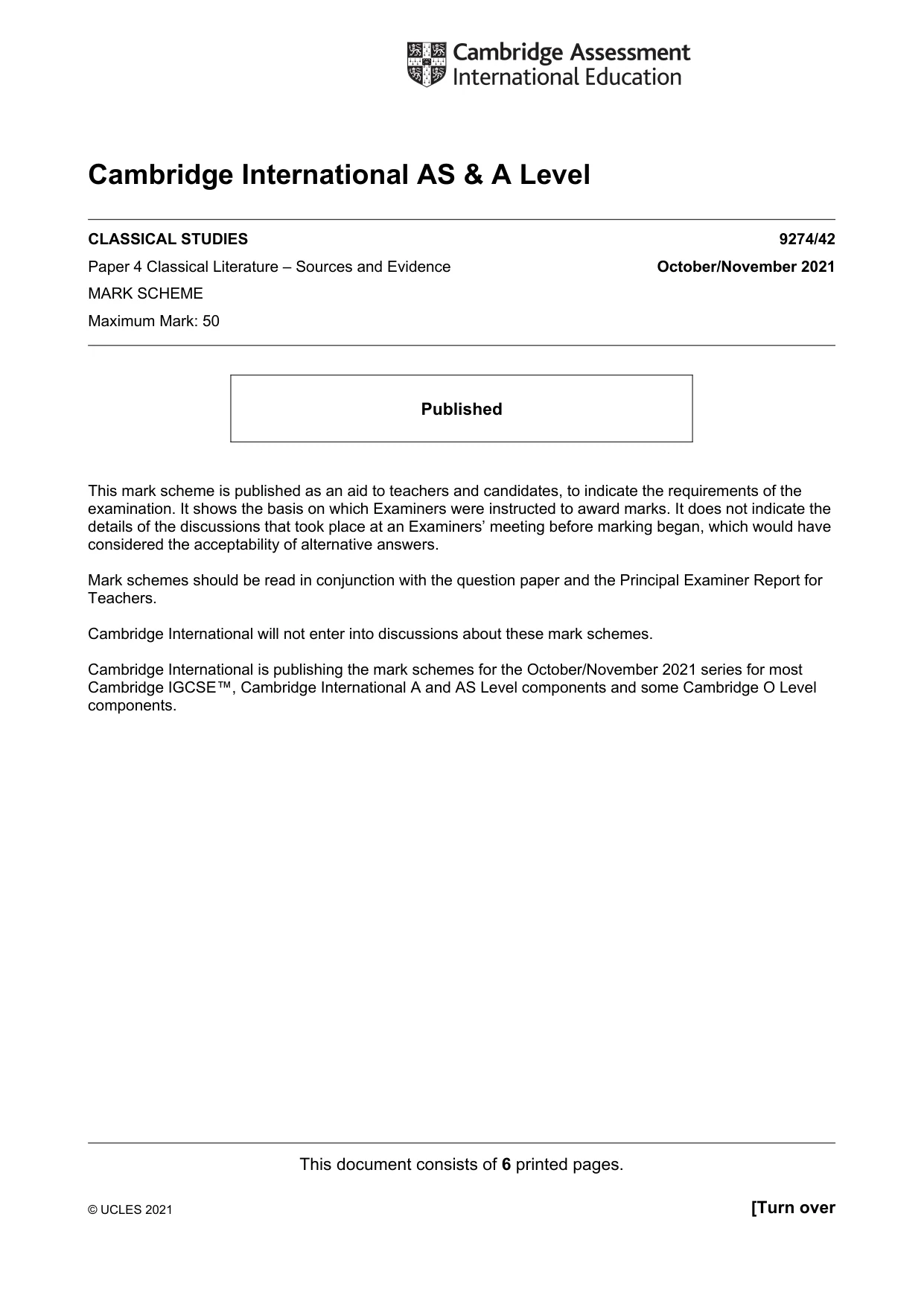
This document consists of 6 printed pages. © UCLES 2021 [Turn over Cambridge International AS & A Level CLASSICAL STUDIES 9274/42 Paper 4 Classical Literature – Sources and Evidence October/November 2021 MARK SCHEME Maximum Mark: 50 Published This mark scheme is published as an aid to teachers and candidates, to indicate the requirements of the examination. It shows the basis on which Examiners were instructed to award marks. It does not indicate the details of the discussions that took place at an Examiners’ meeting before marking began, which would have considered the acceptability of alternative answers. Mark schemes should be read in conjunction with the question paper and the Principal Examiner Report for Teachers. Cambridge International will not enter into discussions about these mark schemes. Cambridge International is publishing the mark schemes for the October/November 2021 series for most Cambridge IGCSE™, Cambridge International A and AS Level components and some Cambridge O Level components.
Mark scheme, page 2
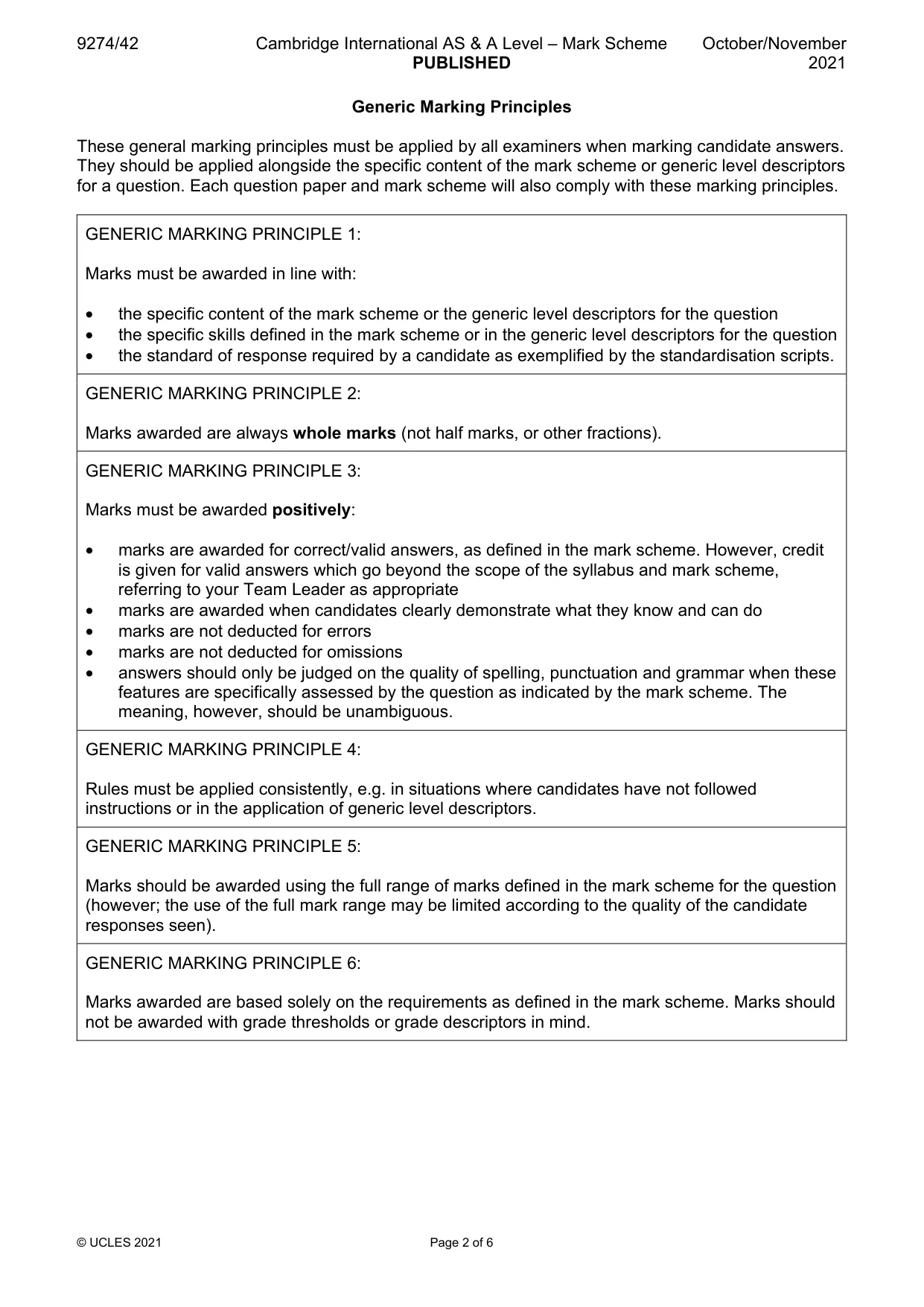
9274/42 Cambridge International AS & A Level – Mark Scheme PUBLISHED October/November 2021 © UCLES 2021 Page 2 of 6 Generic Marking Principles These general marking principles must be applied by all examiners when marking candidate answers. They should be applied alongside the specific content of the mark scheme or generic level descriptors for a question. Each question paper and mark scheme will also comply with these marking principles. GENERIC MARKING PRINCIPLE 1: Marks must be awarded in line with: • the specific content of the mark scheme or the generic level descriptors for the question • the specific skills defined in the mark scheme or in the generic level descriptors for the question • the standard of response required by a candidate as exemplified by the standardisation scripts. GENERIC MARKING PRINCIPLE 2: Marks awarded are always whole marks (not half marks, or other fractions). GENERIC MARKING PRINCIPLE 3: Marks must be awarded positively: • marks are awarded for correct/valid answers, as defined in the mark scheme. However, credit is given for valid answers which go beyond the scope of the syllabus and mark scheme, referring to your Team Leader as appropriate • marks are awarded when candidates clearly demonstrate what they know and can do • marks are not deducted for errors • marks are not deducted for omissions • answers should only be judged on the quality of spelling, punctuation and grammar when these features are specifically assessed by the question as indicated by the mark scheme. The meaning, however, should be unambiguous. GENERIC MARKING PRINCIPLE 4: Rules must be applied consistently, e.g. in situations where candidates have not followed instructions or in the application of generic level descriptors. GENERIC MARKING PRINCIPLE 5: Marks should be awarded using the full range of marks defined in the mark scheme for the question (however; the use of the full mark range may be limited according to the quality of the candidate responses seen). GENERIC MARKING PRINCIPLE 6: Marks awarded are based solely on the requirements as defined in the mark scheme. Marks should not be awarded with grade thresholds or grade descriptors in mind.
Mark scheme, page 3
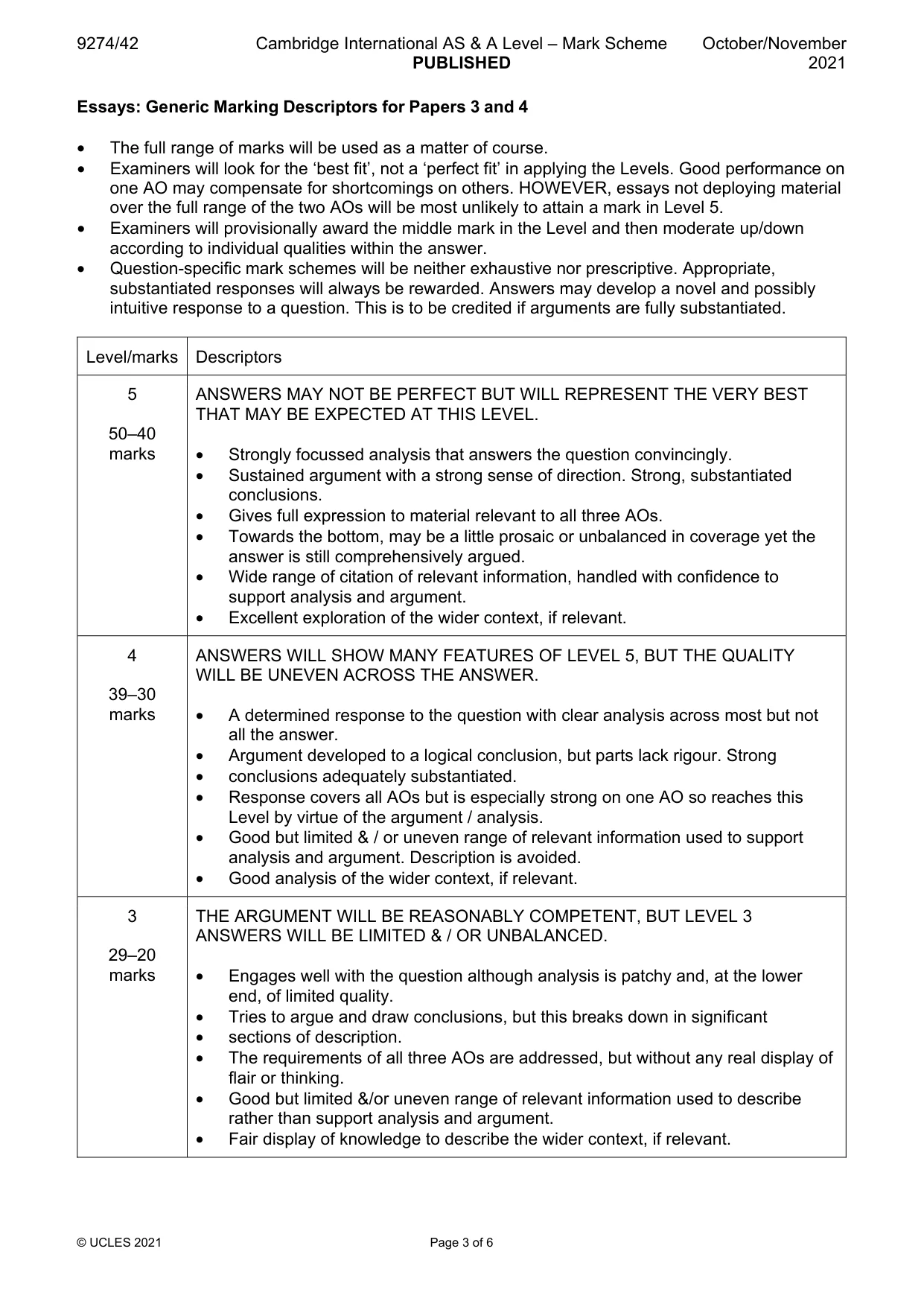
9274/42 Cambridge International AS & A Level – Mark Scheme PUBLISHED October/November 2021 © UCLES 2021 Page 3 of 6 Essays: Generic Marking Descriptors for Papers 3 and 4 • The full range of marks will be used as a matter of course. • Examiners will look for the ‘best fit’, not a ‘perfect fit’ in applying the Levels. Good performance on one AO may compensate for shortcomings on others. HOWEVER, essays not deploying material over the full range of the two AOs will be most unlikely to attain a mark in Level 5. • Examiners will provisionally award the middle mark in the Level and then moderate up/down according to individual qualities within the answer. • Question-specific mark schemes will be neither exhaustive nor prescriptive. Appropriate, substantiated responses will always be rewarded. Answers may develop a novel and possibly intuitive response to a question. This is to be credited if arguments are fully substantiated. Level/marks Descriptors 5 50–40 marks ANSWERS MAY NOT BE PERFECT BUT WILL REPRESENT THE VERY BEST THAT MAY BE EXPECTED AT THIS LEVEL. • Strongly focussed analysis that answers the question convincingly. • Sustained argument with a strong sense of direction. Strong, substantiated conclusions. • Gives full expression to material relevant to all three AOs. • Towards the bottom, may be a little prosaic or unbalanced in coverage yet the answer is still comprehensively argued. • Wide range of citation of relevant information, handled with confidence to support analysis and argument. • Excellent exploration of the wider context, if relevant. 4 39–30 marks ANSWERS WILL SHOW MANY FEATURES OF LEVEL 5, BUT THE QUALITY WILL BE UNEVEN ACROSS THE ANSWER. • A determined response to the question with clear analysis across most but not all the answer. • Argument developed to a logical conclusion, but parts lack rigour. Strong • conclusions adequately substantiated. • Response covers all AOs but is especially strong on one AO so reaches this Level by virtue of the argument / analysis. • Good but limited & / or uneven range of relevant information used to support analysis and argument. Description is avoided. • Good analysis of the wider context, if relevant. 3 29–20 marks THE ARGUMENT WILL BE REASONABLY COMPETENT, BUT LEVEL 3 ANSWERS WILL BE LIMITED & / OR UNBALANCED. • Engages well with the question although analysis is patchy and, at the lower end, of limited quality. • Tries to argue and draw conclusions, but this breaks down in significant • sections of description. • The requirements of all three AOs are addressed, but without any real display of flair or thinking. • Good but limited &/or uneven range of relevant information used to describe rather than support analysis and argument. • Fair display of knowledge to describe the wider context, if relevant.
Mark scheme, page 4
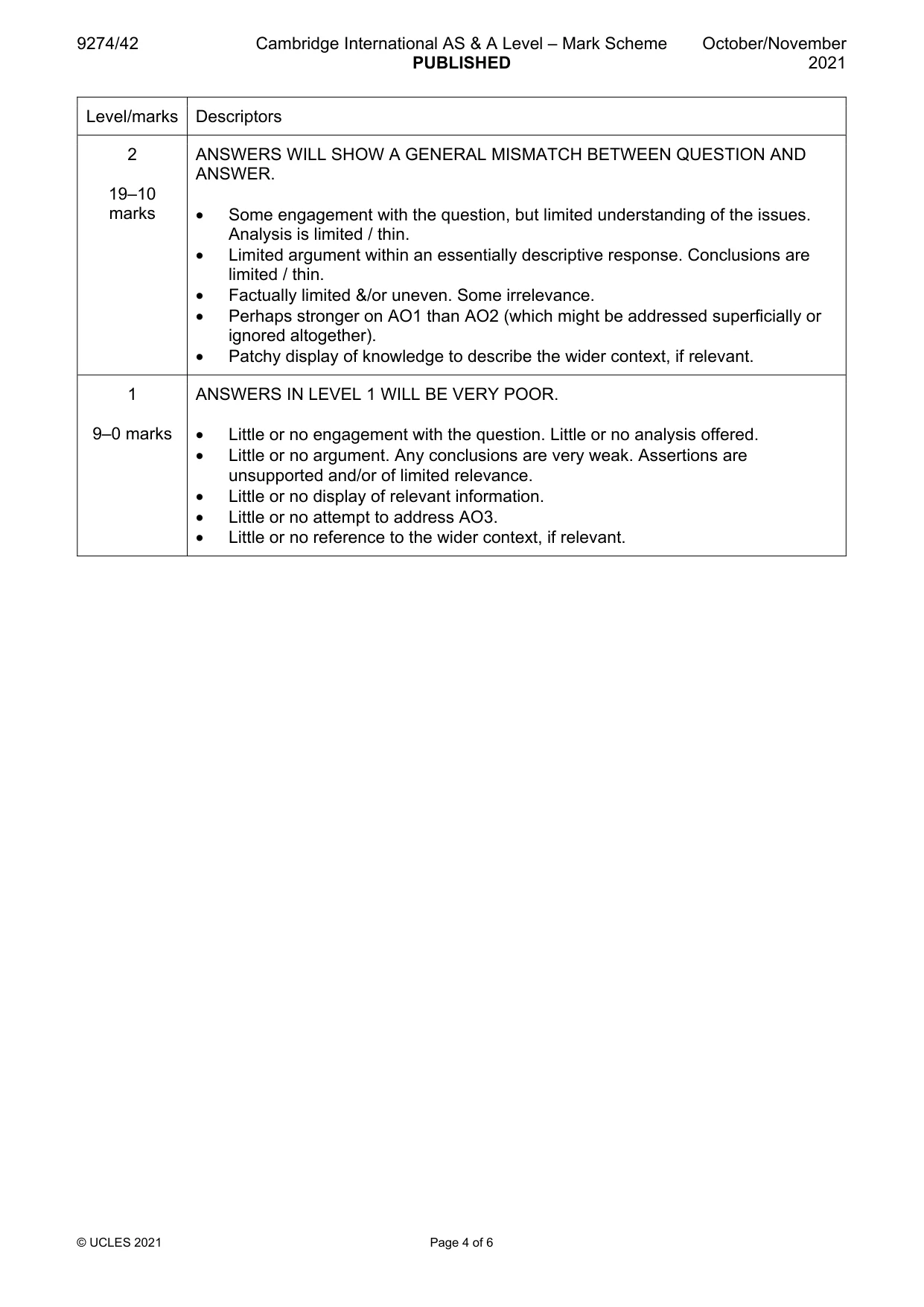
9274/42 Cambridge International AS & A Level – Mark Scheme PUBLISHED October/November 2021 © UCLES 2021 Page 4 of 6 Level/marks Descriptors 2 19–10 marks ANSWERS WILL SHOW A GENERAL MISMATCH BETWEEN QUESTION AND ANSWER. • Some engagement with the question, but limited understanding of the issues. Analysis is limited / thin. • Limited argument within an essentially descriptive response. Conclusions are limited / thin. • Factually limited &/or uneven. Some irrelevance. • Perhaps stronger on AO1 than AO2 (which might be addressed superficially or ignored altogether). • Patchy display of knowledge to describe the wider context, if relevant. 1 9–0 marks ANSWERS IN LEVEL 1 WILL BE VERY POOR. • Little or no engagement with the question. Little or no analysis offered. • Little or no argument. Any conclusions are very weak. Assertions are unsupported and/or of limited relevance. • Little or no display of relevant information. • Little or no attempt to address AO3. • Little or no reference to the wider context, if relevant.
Mark scheme, page 5
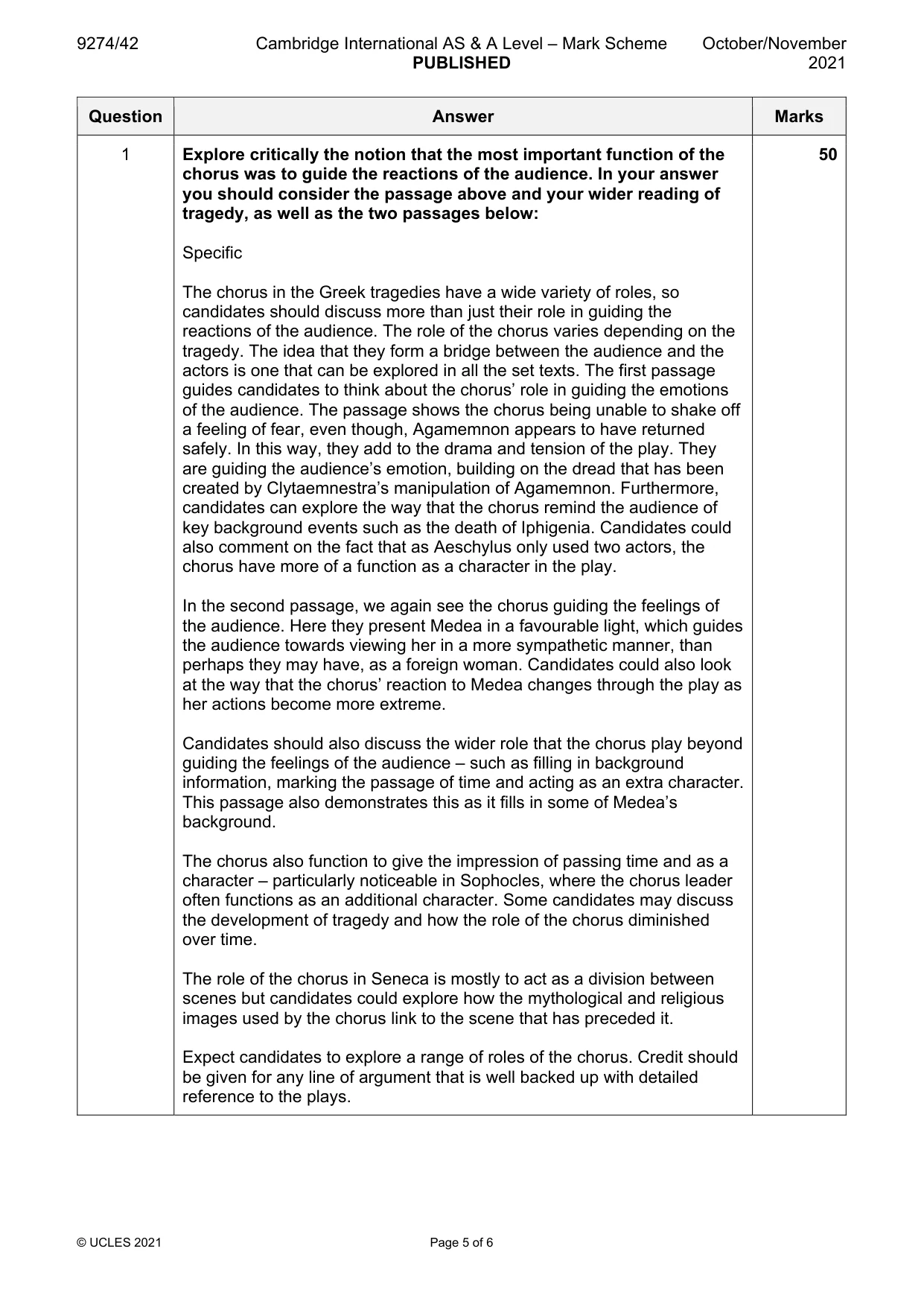
9274/42 Cambridge International AS & A Level – Mark Scheme PUBLISHED October/November 2021 © UCLES 2021 Page 5 of 6 Question Answer Marks 1 Explore critically the notion that the most important function of the chorus was to guide the reactions of the audience. In your answer you should consider the passage above and your wider reading of tragedy, as well as the two passages below: Specific The chorus in the Greek tragedies have a wide variety of roles, so candidates should discuss more than just their role in guiding the reactions of the audience. The role of the chorus varies depending on the tragedy. The idea that they form a bridge between the audience and the actors is one that can be explored in all the set texts. The first passage guides candidates to think about the chorus’ role in guiding the emotions of the audience. The passage shows the chorus being unable to shake off a feeling of fear, even though, Agamemnon appears to have returned safely. In this way, they add to the drama and tension of the play. They are guiding the audience’s emotion, building on the dread that has been created by Clytaemnestra’s manipulation of Agamemnon. Furthermore, candidates can explore the way that the chorus remind the audience of key background events such as the death of Iphigenia. Candidates could also comment on the fact that as Aeschylus only used two actors, the chorus have more of a function as a character in the play. In the second passage, we again see the chorus guiding the feelings of the audience. Here they present Medea in a favourable light, which guides the audience towards viewing her in a more sympathetic manner, than perhaps they may have, as a foreign woman. Candidates could also look at the way that the chorus’ reaction to Medea changes through the play as her actions become more extreme. Candidates should also discuss the wider role that the chorus play beyond guiding the feelings of the audience – such as filling in background information, marking the passage of time and acting as an extra character. This passage also demonstrates this as it fills in some of Medea’s background. The chorus also function to give the impression of passing time and as a character – particularly noticeable in Sophocles, where the chorus leader often functions as an additional character. Some candidates may discuss the development of tragedy and how the role of the chorus diminished over time. The role of the chorus in Seneca is mostly to act as a division between scenes but candidates could explore how the mythological and religious images used by the chorus link to the scene that has preceded it. Expect candidates to explore a range of roles of the chorus. Credit should be given for any line of argument that is well backed up with detailed reference to the plays. 50
Mark scheme, page 6
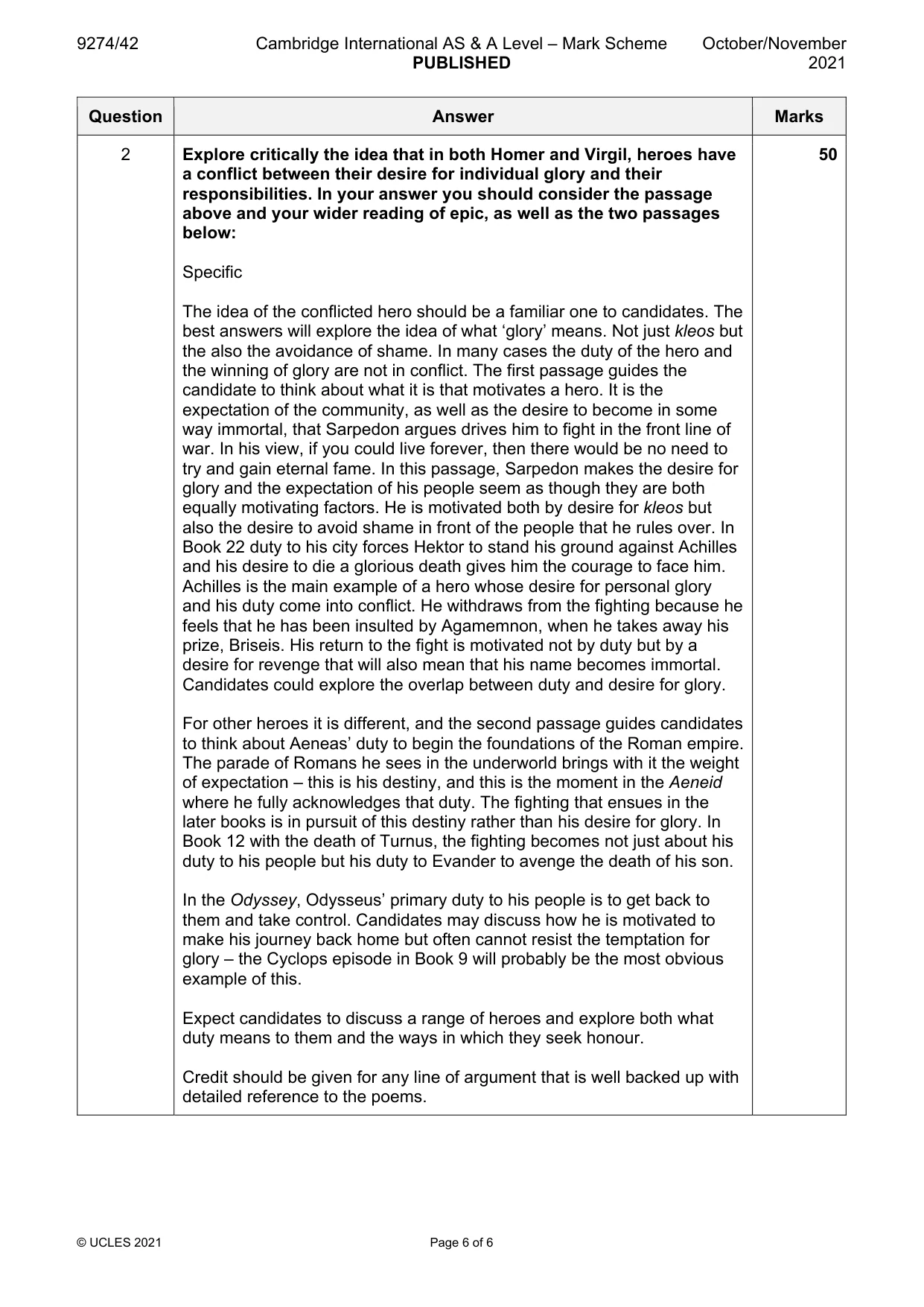
9274/42 Cambridge International AS & A Level – Mark Scheme PUBLISHED October/November 2021 © UCLES 2021 Page 6 of 6 Question Answer Marks 2 Explore critically the idea that in both Homer and Virgil, heroes have a conflict between their desire for individual glory and their responsibilities. In your answer you should consider the passage above and your wider reading of epic, as well as the two passages below: Specific The idea of the conflicted hero should be a familiar one to candidates. The best answers will explore the idea of what ‘glory’ means. Not just kleos but the also the avoidance of shame. In many cases the duty of the hero and the winning of glory are not in conflict. The first passage guides the candidate to think about what it is that motivates a hero. It is the expectation of the community, as well as the desire to become in some way immortal, that Sarpedon argues drives him to fight in the front line of war. In his view, if you could live forever, then there would be no need to try and gain eternal fame. In this passage, Sarpedon makes the desire for glory and the expectation of his people seem as though they are both equally motivating factors. He is motivated both by desire for kleos but also the desire to avoid shame in front of the people that he rules over. In Book 22 duty to his city forces Hektor to stand his ground against Achilles and his desire to die a glorious death gives him the courage to face him. Achilles is the main example of a hero whose desire for personal glory and his duty come into conflict. He withdraws from the fighting because he feels that he has been insulted by Agamemnon, when he takes away his prize, Briseis. His return to the fight is motivated not by duty but by a desire for revenge that will also mean that his name becomes immortal. Candidates could explore the overlap between duty and desire for glory. For other heroes it is different, and the second passage guides candidates to think about Aeneas’ duty to begin the foundations of the Roman empire. The parade of Romans he sees in the underworld brings with it the weight of expectation – this is his destiny, and this is the moment in the Aeneid where he fully acknowledges that duty. The fighting that ensues in the later books is in pursuit of this destiny rather than his desire for glory. In Book 12 with the death of Turnus, the fighting becomes not just about his duty to his people but his duty to Evander to avenge the death of his son. In the Odyssey, Odysseus’ primary duty to his people is to get back to them and take control. Candidates may discuss how he is motivated to make his journey back home but often cannot resist the temptation for glory – the Cyclops episode in Book 9 will probably be the most obvious example of this. Expect candidates to discuss a range of heroes and explore both what duty means to them and the ways in which they seek honour. Credit should be given for any line of argument that is well backed up with detailed reference to the poems. 50
What you needed in this session
Cambridge’s own grade thresholds for 2021 Oct/Nov, Paper 4 · Variant 2. A higher threshold means an easier paper — the bar moves with how the cohort did.