Cambridge A Level Classical Studies 9274 — 2021 Oct/Nov Paper 1 · Variant 2
9274/12/O/N/21 · 50 marks · ≈56 min
The question paper and its mark scheme, free to read here and free to download. This is Cambridge’s own paper, exactly as it was sat.
Question paper8 pages

Mark scheme18 pages
Answers below. Sit the paper first if you are practising.
Paper as text
Question paper, page 1
This document has 8 pages. Any blank pages are indicated. Cambridge International AS & A Level DC (PQ) 222477 © UCLES 2021 [Turn over * 7 9 6 1 2 7 5 5 8 1 * CLASSICAL STUDIES 9274/12 Paper 1 Greek Civilisation October/November 2021 1 hour 30 minutes You must answer on the enclosed answer booklet. You will need: Answer booklet (enclosed) INSTRUCTIONS ● Answer two questions in total: Answer one question from two different sections. ● Follow the instructions on the front cover of the answer booklet. If you need additional answer paper, ask the invigilator for a continuation booklet. INFORMATION ● The total mark for this paper is 50. ● Each question is worth 25 marks.
Question paper, page 2
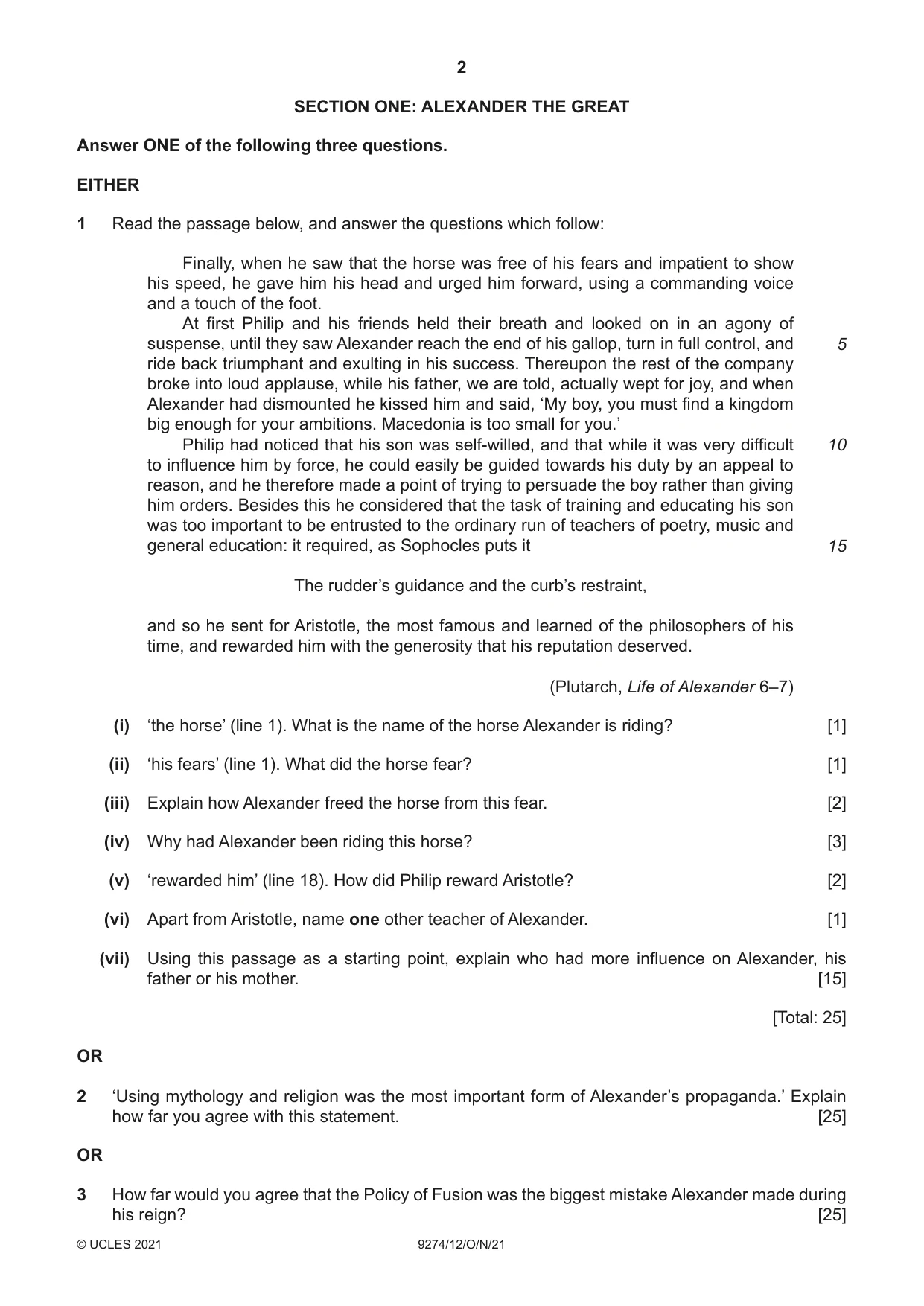
2 9274/12/O/N/21 © UCLES 2021 SECTION ONE: ALEXANDER THE GREAT Answer ONE of the following three questions. EITHER 1 Read the passage below, and answer the questions which follow: Finally, when he saw that the horse was free of his fears and impatient to show his speed, he gave him his head and urged him forward, using a commanding voice and a touch of the foot. At first Philip and his friends held their breath and looked on in an agony of suspense, until they saw Alexander reach the end of his gallop, turn in full control, and ride back triumphant and exulting in his success. Thereupon the rest of the company broke into loud applause, while his father, we are told, actually wept for joy, and when Alexander had dismounted he kissed him and said, ‘My boy, you must find a kingdom big enough for your ambitions. Macedonia is too small for you.’ Philip had noticed that his son was self-willed, and that while it was very difficult to influence him by force, he could easily be guided towards his duty by an appeal to reason, and he therefore made a point of trying to persuade the boy rather than giving him orders. Besides this he considered that the task of training and educating his son was too important to be entrusted to the ordinary run of teachers of poetry, music and general education: it required, as Sophocles puts it The rudder’s guidance and the curb’s restraint, and so he sent for Aristotle, the most famous and learned of the philosophers of his time, and rewarded him with the generosity that his reputation deserved. 5 10 15 (Plutarch, Life of Alexander 6–7) (i) ‘the horse’ (line 1). What is the name of the horse Alexander is riding? [1] (ii) ‘his fears’ (line 1). What did the horse fear? [1] (iii) Explain how Alexander freed the horse from this fear. [2] (iv) Why had Alexander been riding this horse? [3] (v) ‘rewarded him’ (line 18). How did Philip reward Aristotle? [2] (vi) Apart from Aristotle, name one other teacher of Alexander. [1] (vii) Using this passage as a starting point, explain who had more influence on Alexander, his father or his mother. [15] [Total: 25] OR 2 ‘Using mythology and religion was the most important form of Alexander’s propaganda.’ Explain how far you agree with this statement. [25] OR 3 How far would you agree that the Policy of Fusion was the biggest mistake Alexander made during his reign? [25]
Question paper, page 3
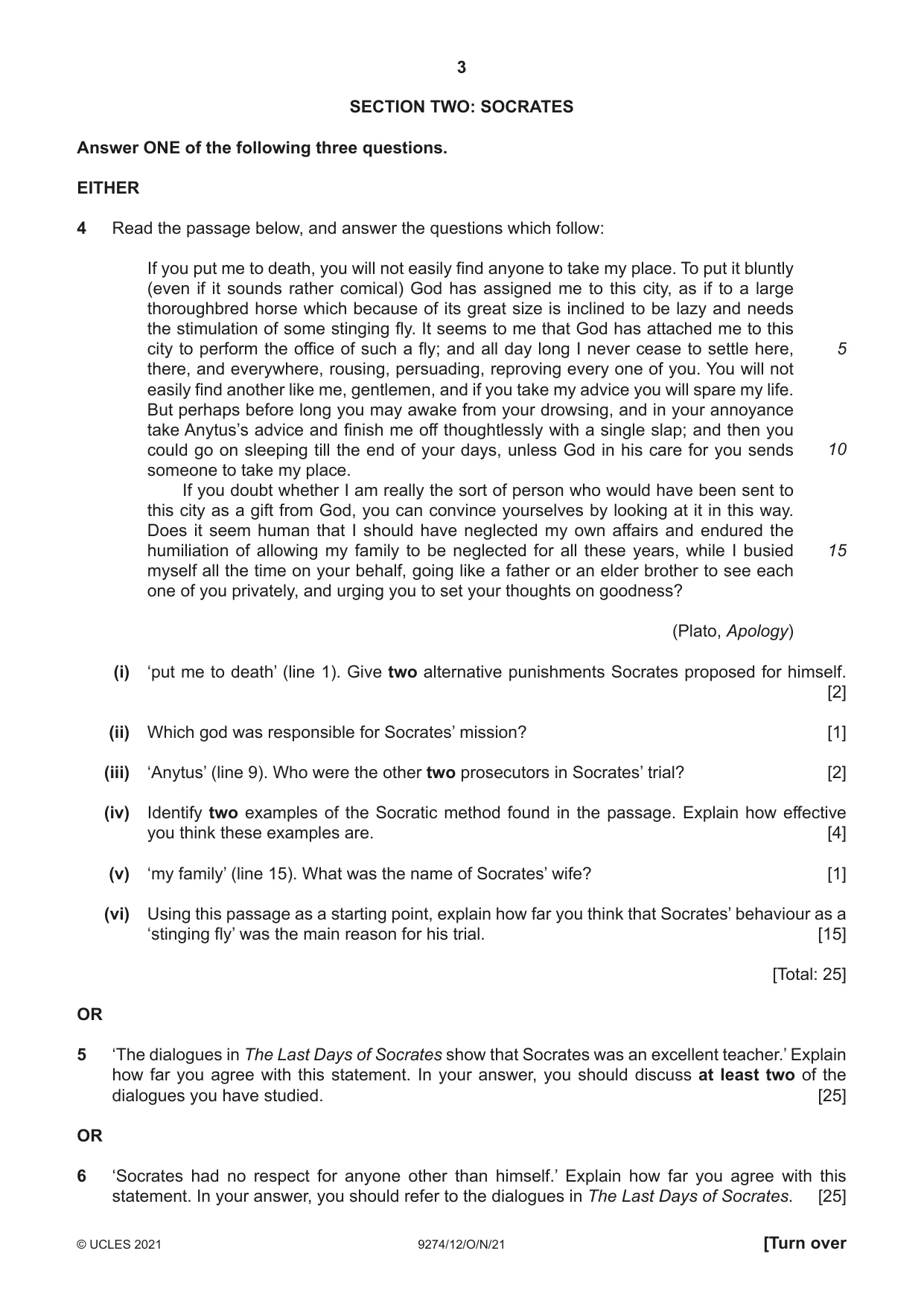
3 9274/12/O/N/21 © UCLES 2021 [Turn over SECTION TWO: SOCRATES Answer ONE of the following three questions. EITHER 4 Read the passage below, and answer the questions which follow: If you put me to death, you will not easily find anyone to take my place. To put it bluntly (even if it sounds rather comical) God has assigned me to this city, as if to a large thoroughbred horse which because of its great size is inclined to be lazy and needs the stimulation of some stinging fly. It seems to me that God has attached me to this city to perform the office of such a fly; and all day long I never cease to settle here, there, and everywhere, rousing, persuading, reproving every one of you. You will not easily find another like me, gentlemen, and if you take my advice you will spare my life. But perhaps before long you may awake from your drowsing, and in your annoyance take Anytus’s advice and finish me off thoughtlessly with a single slap; and then you could go on sleeping till the end of your days, unless God in his care for you sends someone to take my place. If you doubt whether I am really the sort of person who would have been sent to this city as a gift from God, you can convince yourselves by looking at it in this way. Does it seem human that I should have neglected my own affairs and endured the humiliation of allowing my family to be neglected for all these years, while I busied myself all the time on your behalf, going like a father or an elder brother to see each one of you privately, and urging you to set your thoughts on goodness? 5 10 15 (Plato, Apology) (i) ‘put me to death’ (line 1). Give two alternative punishments Socrates proposed for himself. [2] (ii) Which god was responsible for Socrates’ mission? [1] (iii) ‘Anytus’ (line 9). Who were the other two prosecutors in Socrates’ trial? [2] (iv) Identify two examples of the Socratic method found in the passage. Explain how effective you think these examples are. [4] (v) ‘my family’ (line 15). What was the name of Socrates’ wife? [1] (vi) Using this passage as a starting point, explain how far you think that Socrates’ behaviour as a ‘stinging fly’ was the main reason for his trial. [15] [Total: 25] OR 5 ‘The dialogues in The Last Days of Socrates show that Socrates was an excellent teacher.’ Explain how far you agree with this statement. In your answer, you should discuss at least two of the dialogues you have studied. [25] OR 6 ‘Socrates had no respect for anyone other than himself.’ Explain how far you agree with this statement. In your answer, you should refer to the dialogues in The Last Days of Socrates. [25]
Question paper, page 4
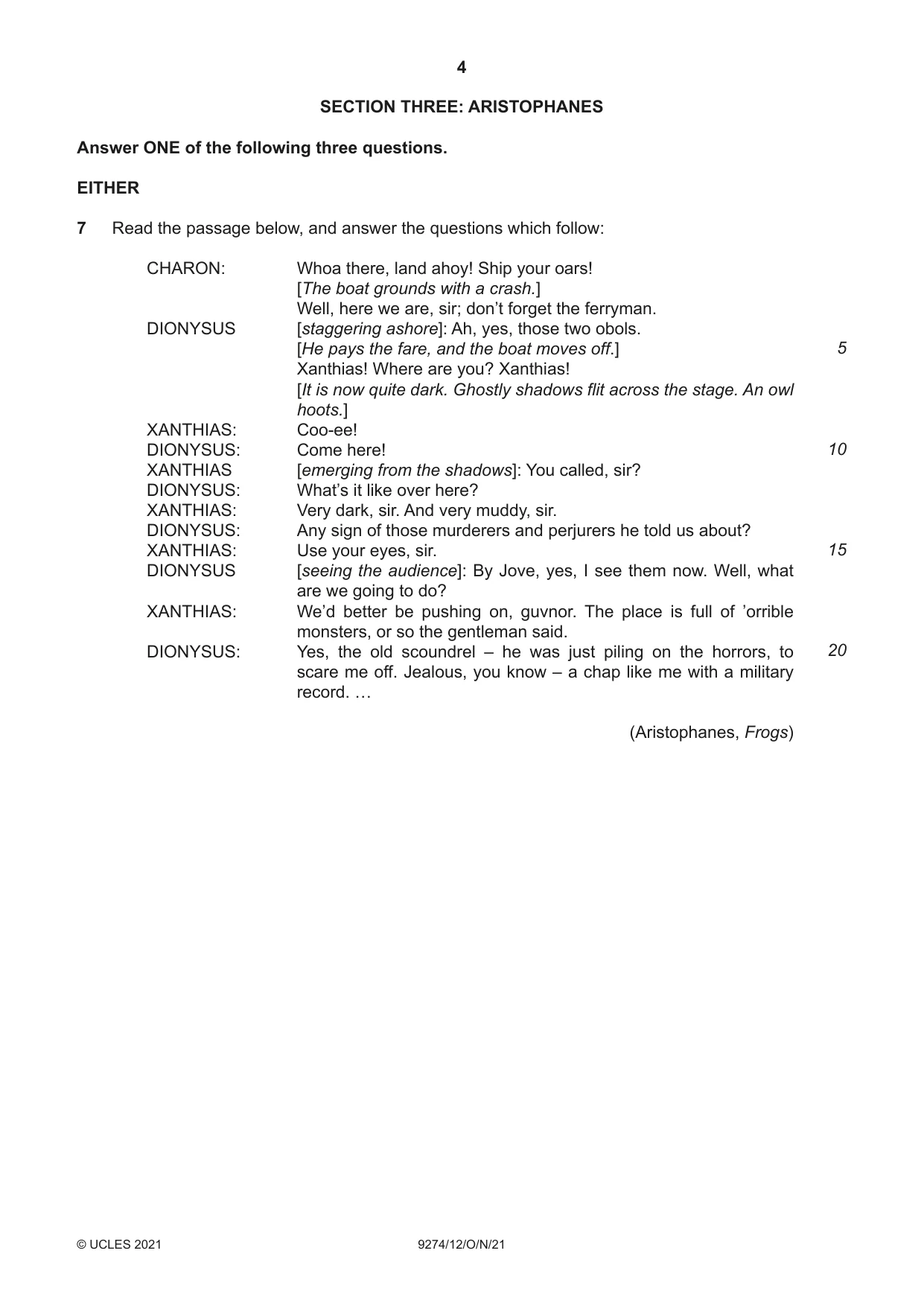
4 9274/12/O/N/21 © UCLES 2021 SECTION THREE: ARISTOPHANES Answer ONE of the following three questions. EITHER 7 Read the passage below, and answer the questions which follow: CHARON: Whoa there, land ahoy! Ship your oars! [The boat grounds with a crash.] Well, here we are, sir; don’t forget the ferryman. DIONYSUS [staggering ashore]: Ah, yes, those two obols. [He pays the fare, and the boat moves off.] Xanthias! Where are you? Xanthias! [It is now quite dark. Ghostly shadows flit across the stage. An owl hoots.] XANTHIAS: Coo-ee! DIONYSUS: Come here! XANTHIAS [emerging from the shadows]: You called, sir? DIONYSUS: What’s it like over here? XANTHIAS: Very dark, sir. And very muddy, sir. DIONYSUS: Any sign of those murderers and perjurers he told us about? XANTHIAS: Use your eyes, sir. DIONYSUS [seeing the audience]: By Jove, yes, I see them now. Well, what are we going to do? XANTHIAS: We’d better be pushing on, guvnor. The place is full of ’orrible monsters, or so the gentleman said. DIONYSUS: Yes, the old scoundrel – he was just piling on the horrors, to scare me off. Jealous, you know – a chap like me with a military record. … 5 10 15 20 (Aristophanes, Frogs)
Question paper, page 5
5 9274/12/O/N/21 © UCLES 2021 [Turn over (i) How has Charon helped Dionysus reach Hell? [2] (ii) ‘he told us about’ (line 14). To whom does Dionysus refer? [1] (iii) From this passage, find two examples of Aristophanes’ comic technique. Write out the example, identify the technique and explain why it is funny. [4] (iv) Describe how this passage might have been staged. [3] (v) ‘Dionysus’ journey through the underworld is more entertaining than the contest between Aeschylus and Euripides.’ Using the passage as a starting point, explain how far you agree. [15] [Total: 25] OR 8 ‘The chorus is not necessary for the success of Wasps.’ Explain how far you agree with this view. [25] OR 9 ‘The unusual and the unexpected.’ How far are these two elements essential for an audience to enjoy both Frogs and Wasps? [25]
Question paper, page 6
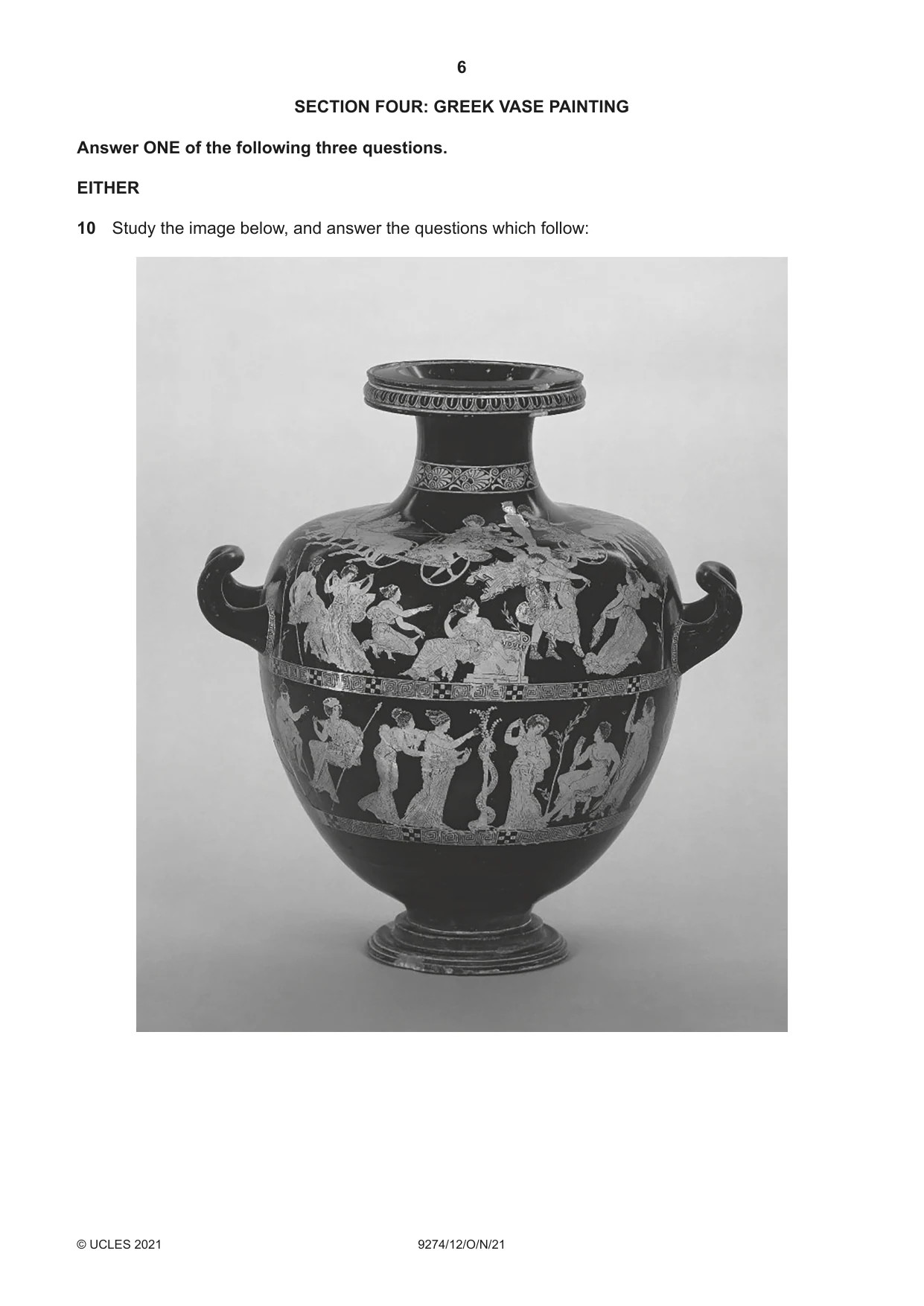
6 9274/12/O/N/21 © UCLES 2021 SECTION FOUR: GREEK VASE PAINTING Answer ONE of the following three questions. EITHER 10 Study the image below, and answer the questions which follow:
Question paper, page 7
7 9274/12/O/N/21 © UCLES 2021 (i) This pot is a hydria. For what purpose was a hydria used? [1] (ii) Explain how the features of the hydria make it suitable for its purpose. [3] (iii) Who painted this pot? [2] (iv) Identify two decorative motifs and their location on this pot. [4] (v) ‘A decorative delight.’ By referring to specific details from the pot, explain how far you agree with this opinion. [15] [Total: 25] OR 11 ‘The limitations of the black-figure technique meant that black-figure artists could never produce great works of art.’ How far do you agree with this opinion? In your answer, you should include reference to specific pots by named painters. [25] OR 12 Which do you think was the more innovative, the style of the Pioneer Painters or the style of the Mannerist Painters? Explain your answer with reference to the typical features of each style and discuss specific examples from each style. [25]
Question paper, page 8
8 9274/12/O/N/21 © UCLES 2021 Permission to reproduce items where third-party owned material protected by copyright is included has been sought and cleared where possible. Every reasonable effort has been made by the publisher (UCLES) to trace copyright holders, but if any items requiring clearance have unwittingly been included, the publisher will be pleased to make amends at the earliest possible opportunity. To avoid the issue of disclosure of answer-related information to candidates, all copyright acknowledgements are reproduced online in the Cambridge Assessment International Education Copyright Acknowledgements Booklet. This is produced for each series of examinations and is freely available to download at www.cambridgeinternational.org after the live examination series. Cambridge Assessment International Education is part of the Cambridge Assessment Group. Cambridge Assessment is the brand name of the University of Cambridge Local Examinations Syndicate (UCLES), which itself is a department of the University of Cambridge. BLANK PAGE
Mark scheme, page 1
This document consists of 18 printed pages. © UCLES 2021 [Turn over Cambridge International AS & A Level CLASSICAL STUDIES 9274/12 Paper 1 Greek Civilisation October/November 2021 MARK SCHEME Maximum Mark: 50 Published This mark scheme is published as an aid to teachers and candidates, to indicate the requirements of the examination. It shows the basis on which Examiners were instructed to award marks. It does not indicate the details of the discussions that took place at an Examiners’ meeting before marking began, which would have considered the acceptability of alternative answers. Mark schemes should be read in conjunction with the question paper and the Principal Examiner Report for Teachers. Cambridge International will not enter into discussions about these mark schemes. Cambridge International is publishing the mark schemes for the October/November 2021 series for most Cambridge IGCSE™, Cambridge International A and AS Level components and some Cambridge O Level components.
Mark scheme, page 2
9274/12 Cambridge International AS & A Level – Mark Scheme PUBLISHED October/November 2021 © UCLES 2021 Page 2 of 18 Generic Marking Principles These general marking principles must be applied by all examiners when marking candidate answers. They should be applied alongside the specific content of the mark scheme or generic level descriptors for a question. Each question paper and mark scheme will also comply with these marking principles. GENERIC MARKING PRINCIPLE 1: Marks must be awarded in line with: • the specific content of the mark scheme or the generic level descriptors for the question • the specific skills defined in the mark scheme or in the generic level descriptors for the question • the standard of response required by a candidate as exemplified by the standardisation scripts. GENERIC MARKING PRINCIPLE 2: Marks awarded are always whole marks (not half marks, or other fractions). GENERIC MARKING PRINCIPLE 3: Marks must be awarded positively: • marks are awarded for correct/valid answers, as defined in the mark scheme. However, credit is given for valid answers which go beyond the scope of the syllabus and mark scheme, referring to your Team Leader as appropriate • marks are awarded when candidates clearly demonstrate what they know and can do • marks are not deducted for errors • marks are not deducted for omissions • answers should only be judged on the quality of spelling, punctuation and grammar when these features are specifically assessed by the question as indicated by the mark scheme. The meaning, however, should be unambiguous. GENERIC MARKING PRINCIPLE 4: Rules must be applied consistently, e.g. in situations where candidates have not followed instructions or in the application of generic level descriptors. GENERIC MARKING PRINCIPLE 5: Marks should be awarded using the full range of marks defined in the mark scheme for the question (however; the use of the full mark range may be limited according to the quality of the candidate responses seen). GENERIC MARKING PRINCIPLE 6: Marks awarded are based solely on the requirements as defined in the mark scheme. Marks should not be awarded with grade thresholds or grade descriptors in mind.
Mark scheme, page 3
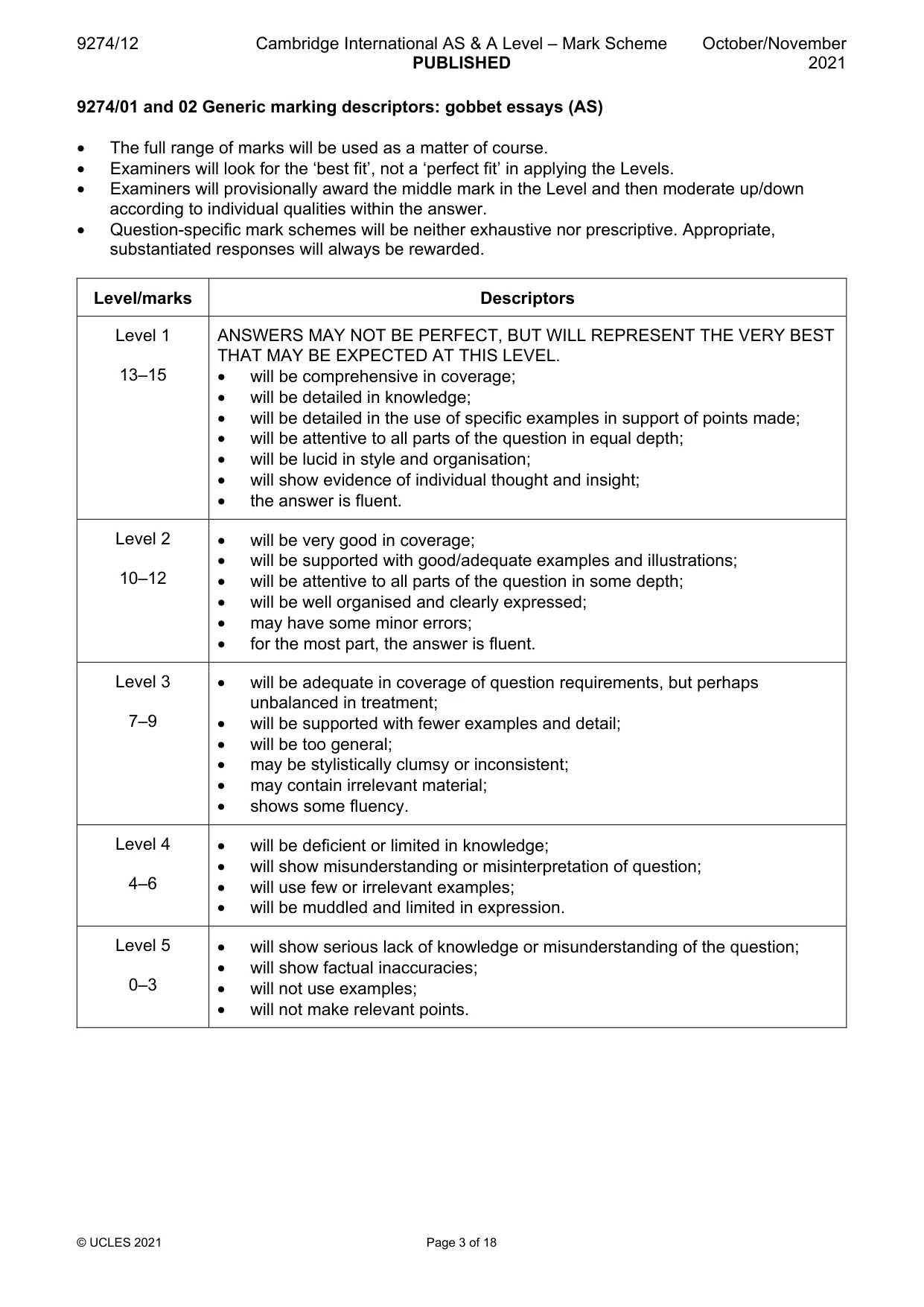
9274/12 Cambridge International AS & A Level – Mark Scheme PUBLISHED October/November 2021 © UCLES 2021 Page 3 of 18 9274/01 and 02 Generic marking descriptors: gobbet essays (AS) • The full range of marks will be used as a matter of course. • Examiners will look for the ‘best fit’, not a ‘perfect fit’ in applying the Levels. • Examiners will provisionally award the middle mark in the Level and then moderate up/down according to individual qualities within the answer. • Question-specific mark schemes will be neither exhaustive nor prescriptive. Appropriate, substantiated responses will always be rewarded. Level/marks Descriptors Level 1 13–15 ANSWERS MAY NOT BE PERFECT, BUT WILL REPRESENT THE VERY BEST THAT MAY BE EXPECTED AT THIS LEVEL. • will be comprehensive in coverage; • will be detailed in knowledge; • will be detailed in the use of specific examples in support of points made; • will be attentive to all parts of the question in equal depth; • will be lucid in style and organisation; • will show evidence of individual thought and insight; • the answer is fluent. Level 2 10–12 • will be very good in coverage; • will be supported with good/adequate examples and illustrations; • will be attentive to all parts of the question in some depth; • will be well organised and clearly expressed; • may have some minor errors; • for the most part, the answer is fluent. Level 3 7–9 • will be adequate in coverage of question requirements, but perhaps unbalanced in treatment; • will be supported with fewer examples and detail; • will be too general; • may be stylistically clumsy or inconsistent; • may contain irrelevant material; • shows some fluency. Level 4 4–6 • will be deficient or limited in knowledge; • will show misunderstanding or misinterpretation of question; • will use few or irrelevant examples; • will be muddled and limited in expression. Level 5 0–3 • will show serious lack of knowledge or misunderstanding of the question; • will show factual inaccuracies; • will not use examples; • will not make relevant points.
Mark scheme, page 4
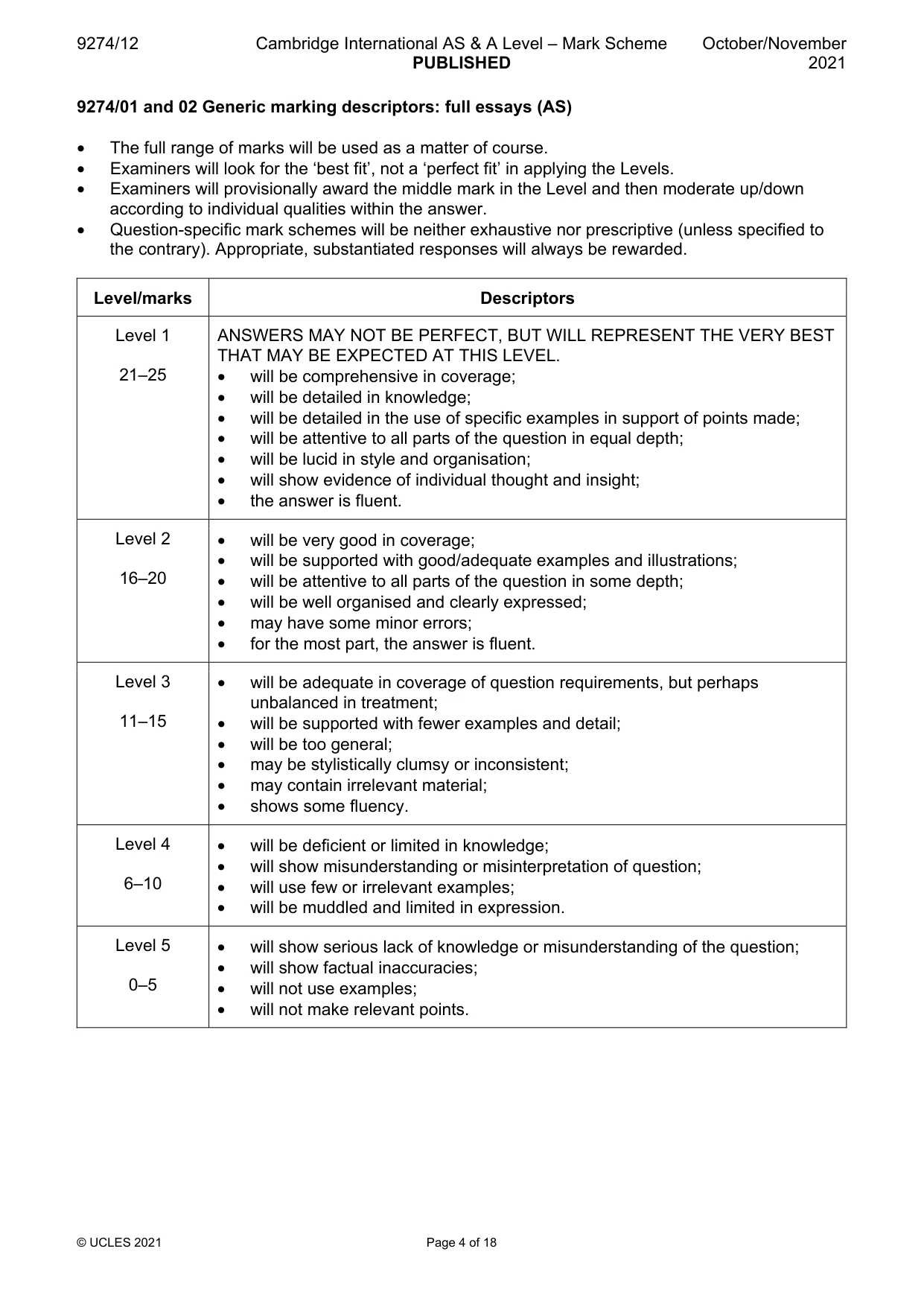
9274/12 Cambridge International AS & A Level – Mark Scheme PUBLISHED October/November 2021 © UCLES 2021 Page 4 of 18 9274/01 and 02 Generic marking descriptors: full essays (AS) • The full range of marks will be used as a matter of course. • Examiners will look for the ‘best fit’, not a ‘perfect fit’ in applying the Levels. • Examiners will provisionally award the middle mark in the Level and then moderate up/down according to individual qualities within the answer. • Question-specific mark schemes will be neither exhaustive nor prescriptive (unless specified to the contrary). Appropriate, substantiated responses will always be rewarded. Level/marks Descriptors Level 1 21–25 ANSWERS MAY NOT BE PERFECT, BUT WILL REPRESENT THE VERY BEST THAT MAY BE EXPECTED AT THIS LEVEL. • will be comprehensive in coverage; • will be detailed in knowledge; • will be detailed in the use of specific examples in support of points made; • will be attentive to all parts of the question in equal depth; • will be lucid in style and organisation; • will show evidence of individual thought and insight; • the answer is fluent. Level 2 16–20 • will be very good in coverage; • will be supported with good/adequate examples and illustrations; • will be attentive to all parts of the question in some depth; • will be well organised and clearly expressed; • may have some minor errors; • for the most part, the answer is fluent. Level 3 11–15 • will be adequate in coverage of question requirements, but perhaps unbalanced in treatment; • will be supported with fewer examples and detail; • will be too general; • may be stylistically clumsy or inconsistent; • may contain irrelevant material; • shows some fluency. Level 4 6–10 • will be deficient or limited in knowledge; • will show misunderstanding or misinterpretation of question; • will use few or irrelevant examples; • will be muddled and limited in expression. Level 5 0–5 • will show serious lack of knowledge or misunderstanding of the question; • will show factual inaccuracies; • will not use examples; • will not make relevant points.
Mark scheme, page 5
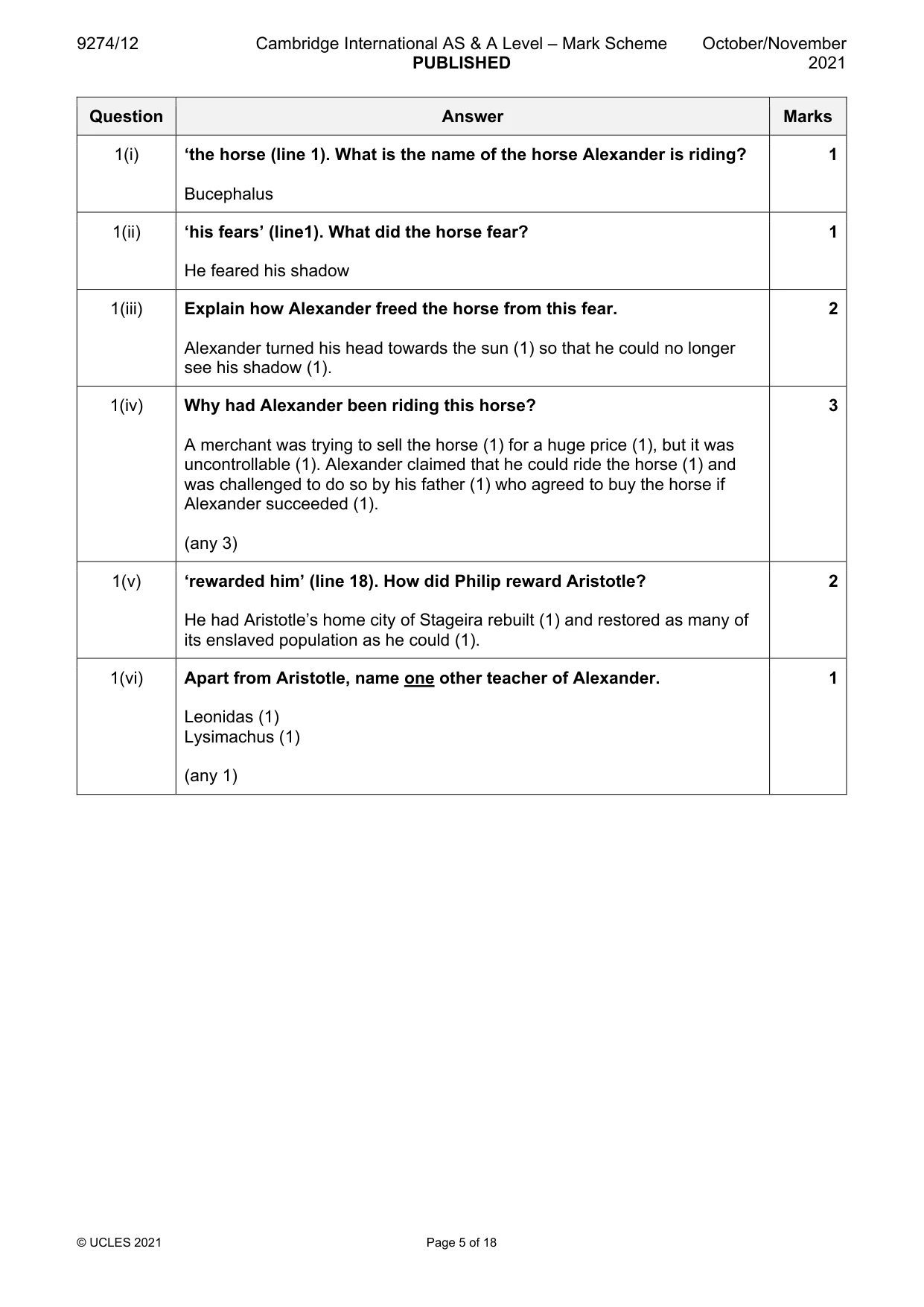
9274/12 Cambridge International AS & A Level – Mark Scheme PUBLISHED October/November 2021 © UCLES 2021 Page 5 of 18 Question Answer Marks 1(i) ‘the horse (line 1). What is the name of the horse Alexander is riding? Bucephalus 1 1(ii) ‘his fears’ (line1). What did the horse fear? He feared his shadow 1 1(iii) Explain how Alexander freed the horse from this fear. Alexander turned his head towards the sun (1) so that he could no longer see his shadow (1). 2 1(iv) Why had Alexander been riding this horse? A merchant was trying to sell the horse (1) for a huge price (1), but it was uncontrollable (1). Alexander claimed that he could ride the horse (1) and was challenged to do so by his father (1) who agreed to buy the horse if Alexander succeeded (1). (any 3) 3 1(v) ‘rewarded him’ (line 18). How did Philip reward Aristotle? He had Aristotle’s home city of Stageira rebuilt (1) and restored as many of its enslaved population as he could (1). 2 1(vi) Apart from Aristotle, name one other teacher of Alexander. Leonidas (1) Lysimachus (1) (any 1) 1
Mark scheme, page 6
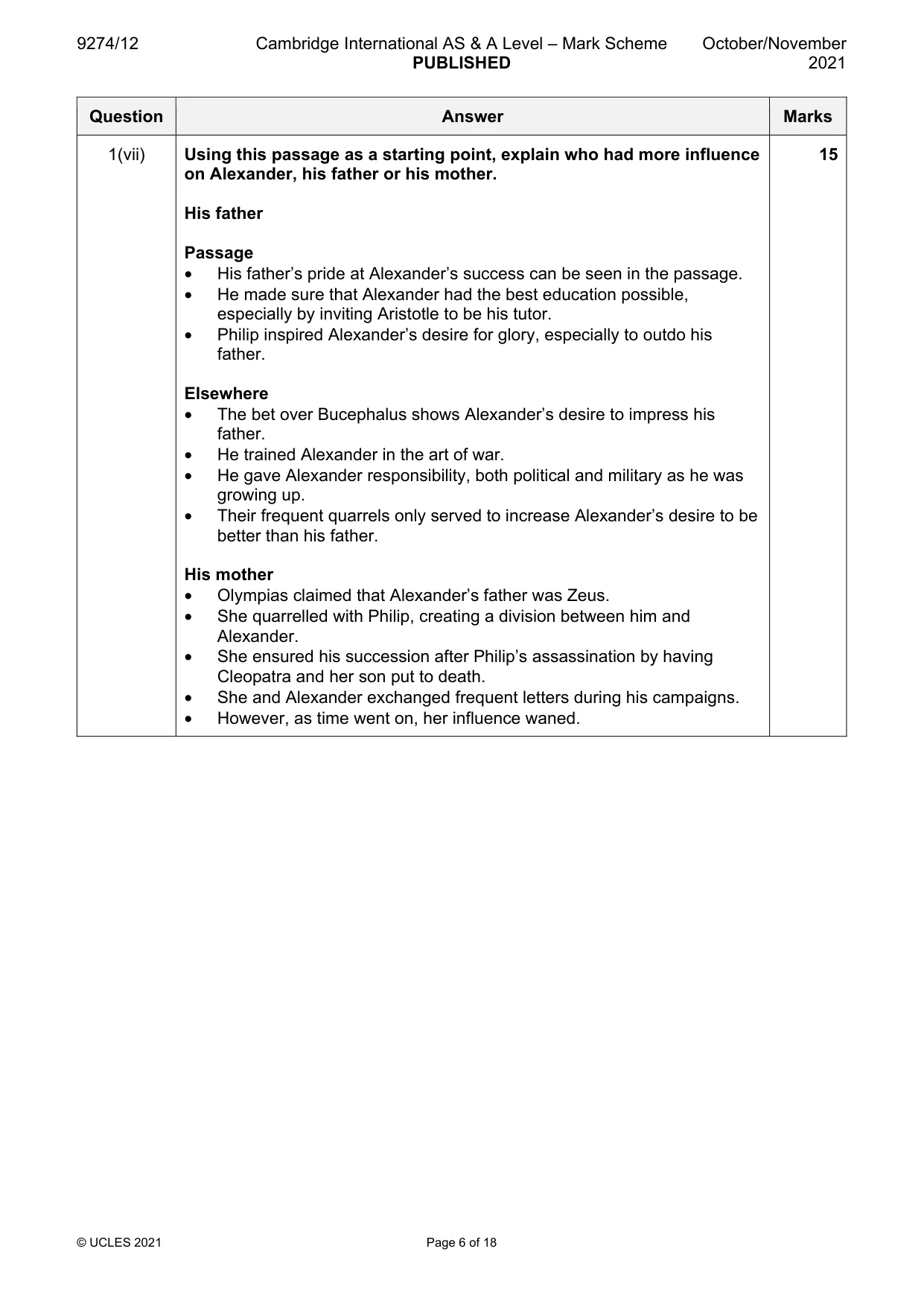
9274/12 Cambridge International AS & A Level – Mark Scheme PUBLISHED October/November 2021 © UCLES 2021 Page 6 of 18 Question Answer Marks 1(vii) Using this passage as a starting point, explain who had more influence on Alexander, his father or his mother. His father Passage • His father’s pride at Alexander’s success can be seen in the passage. • He made sure that Alexander had the best education possible, especially by inviting Aristotle to be his tutor. • Philip inspired Alexander’s desire for glory, especially to outdo his father. Elsewhere • The bet over Bucephalus shows Alexander’s desire to impress his father. • He trained Alexander in the art of war. • He gave Alexander responsibility, both political and military as he was growing up. • Their frequent quarrels only served to increase Alexander’s desire to be better than his father. His mother • Olympias claimed that Alexander’s father was Zeus. • She quarrelled with Philip, creating a division between him and Alexander. • She ensured his succession after Philip’s assassination by having Cleopatra and her son put to death. • She and Alexander exchanged frequent letters during his campaigns. • However, as time went on, her influence waned. 15
Mark scheme, page 7
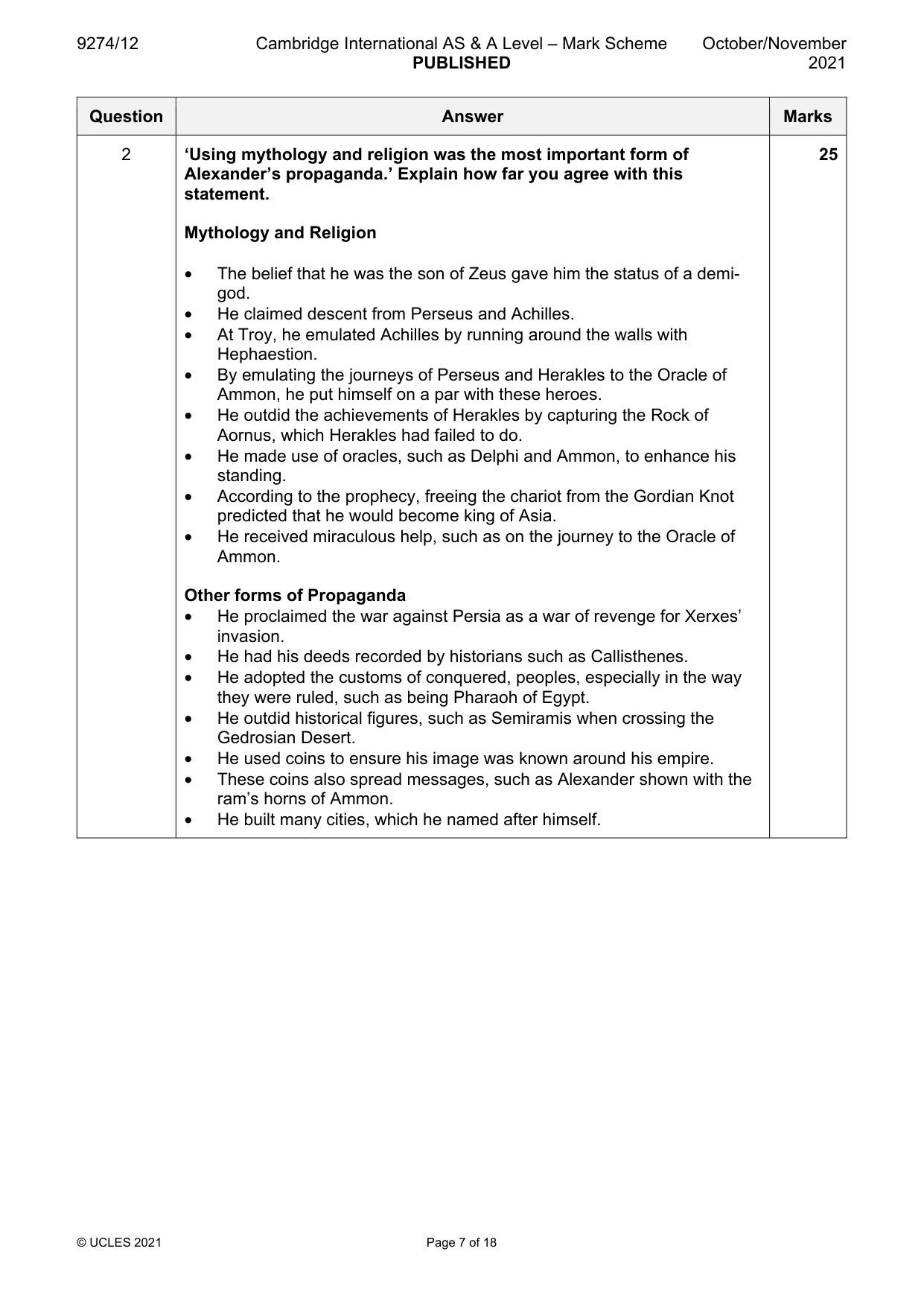
9274/12 Cambridge International AS & A Level – Mark Scheme PUBLISHED October/November 2021 © UCLES 2021 Page 7 of 18 Question Answer Marks 2 ‘Using mythology and religion was the most important form of Alexander’s propaganda.’ Explain how far you agree with this statement. Mythology and Religion • The belief that he was the son of Zeus gave him the status of a demi- god. • He claimed descent from Perseus and Achilles. • At Troy, he emulated Achilles by running around the walls with Hephaestion. • By emulating the journeys of Perseus and Herakles to the Oracle of Ammon, he put himself on a par with these heroes. • He outdid the achievements of Herakles by capturing the Rock of Aornus, which Herakles had failed to do. • He made use of oracles, such as Delphi and Ammon, to enhance his standing. • According to the prophecy, freeing the chariot from the Gordian Knot predicted that he would become king of Asia. • He received miraculous help, such as on the journey to the Oracle of Ammon. Other forms of Propaganda • He proclaimed the war against Persia as a war of revenge for Xerxes’ invasion. • He had his deeds recorded by historians such as Callisthenes. • He adopted the customs of conquered, peoples, especially in the way they were ruled, such as being Pharaoh of Egypt. • He outdid historical figures, such as Semiramis when crossing the Gedrosian Desert. • He used coins to ensure his image was known around his empire. • These coins also spread messages, such as Alexander shown with the ram’s horns of Ammon. • He built many cities, which he named after himself. 25
Mark scheme, page 8
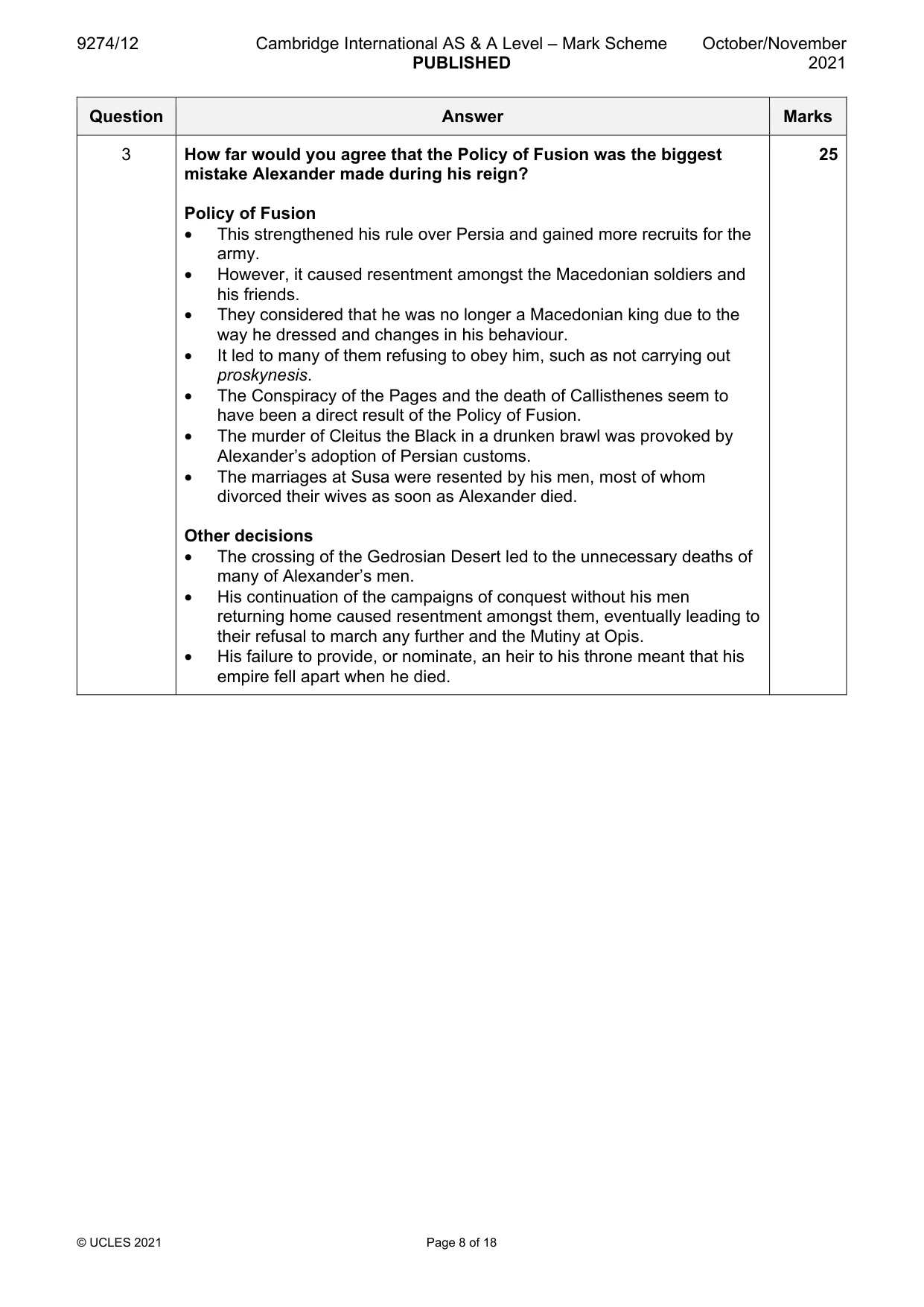
9274/12 Cambridge International AS & A Level – Mark Scheme PUBLISHED October/November 2021 © UCLES 2021 Page 8 of 18 Question Answer Marks 3 How far would you agree that the Policy of Fusion was the biggest mistake Alexander made during his reign? Policy of Fusion • This strengthened his rule over Persia and gained more recruits for the army. • However, it caused resentment amongst the Macedonian soldiers and his friends. • They considered that he was no longer a Macedonian king due to the way he dressed and changes in his behaviour. • It led to many of them refusing to obey him, such as not carrying out proskynesis. • The Conspiracy of the Pages and the death of Callisthenes seem to have been a direct result of the Policy of Fusion. • The murder of Cleitus the Black in a drunken brawl was provoked by Alexander’s adoption of Persian customs. • The marriages at Susa were resented by his men, most of whom divorced their wives as soon as Alexander died. Other decisions • The crossing of the Gedrosian Desert led to the unnecessary deaths of many of Alexander’s men. • His continuation of the campaigns of conquest without his men returning home caused resentment amongst them, eventually leading to their refusal to march any further and the Mutiny at Opis. • His failure to provide, or nominate, an heir to his throne meant that his empire fell apart when he died. 25
Mark scheme, page 9
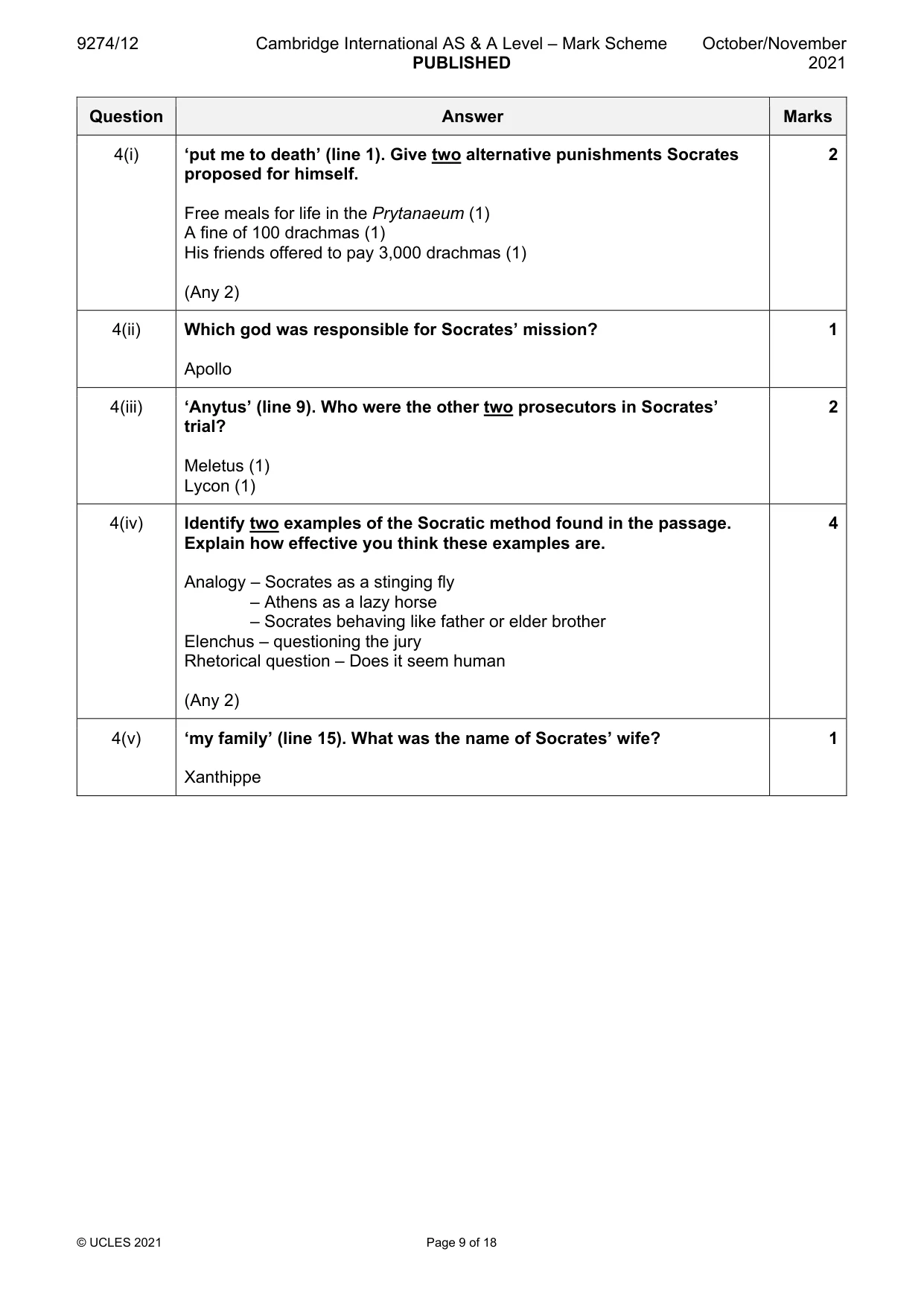
9274/12 Cambridge International AS & A Level – Mark Scheme PUBLISHED October/November 2021 © UCLES 2021 Page 9 of 18 Question Answer Marks 4(i) ‘put me to death’ (line 1). Give two alternative punishments Socrates proposed for himself. Free meals for life in the Prytanaeum (1) A fine of 100 drachmas (1) His friends offered to pay 3,000 drachmas (1) (Any 2) 2 4(ii) Which god was responsible for Socrates’ mission? Apollo 1 4(iii) ‘Anytus’ (line 9). Who were the other two prosecutors in Socrates’ trial? Meletus (1) Lycon (1) 2 4(iv) Identify two examples of the Socratic method found in the passage. Explain how effective you think these examples are. Analogy – Socrates as a stinging fly – Athens as a lazy horse – Socrates behaving like father or elder brother Elenchus – questioning the jury Rhetorical question – Does it seem human (Any 2) 4 4(v) ‘my family’ (line 15). What was the name of Socrates’ wife? Xanthippe 1
Mark scheme, page 10
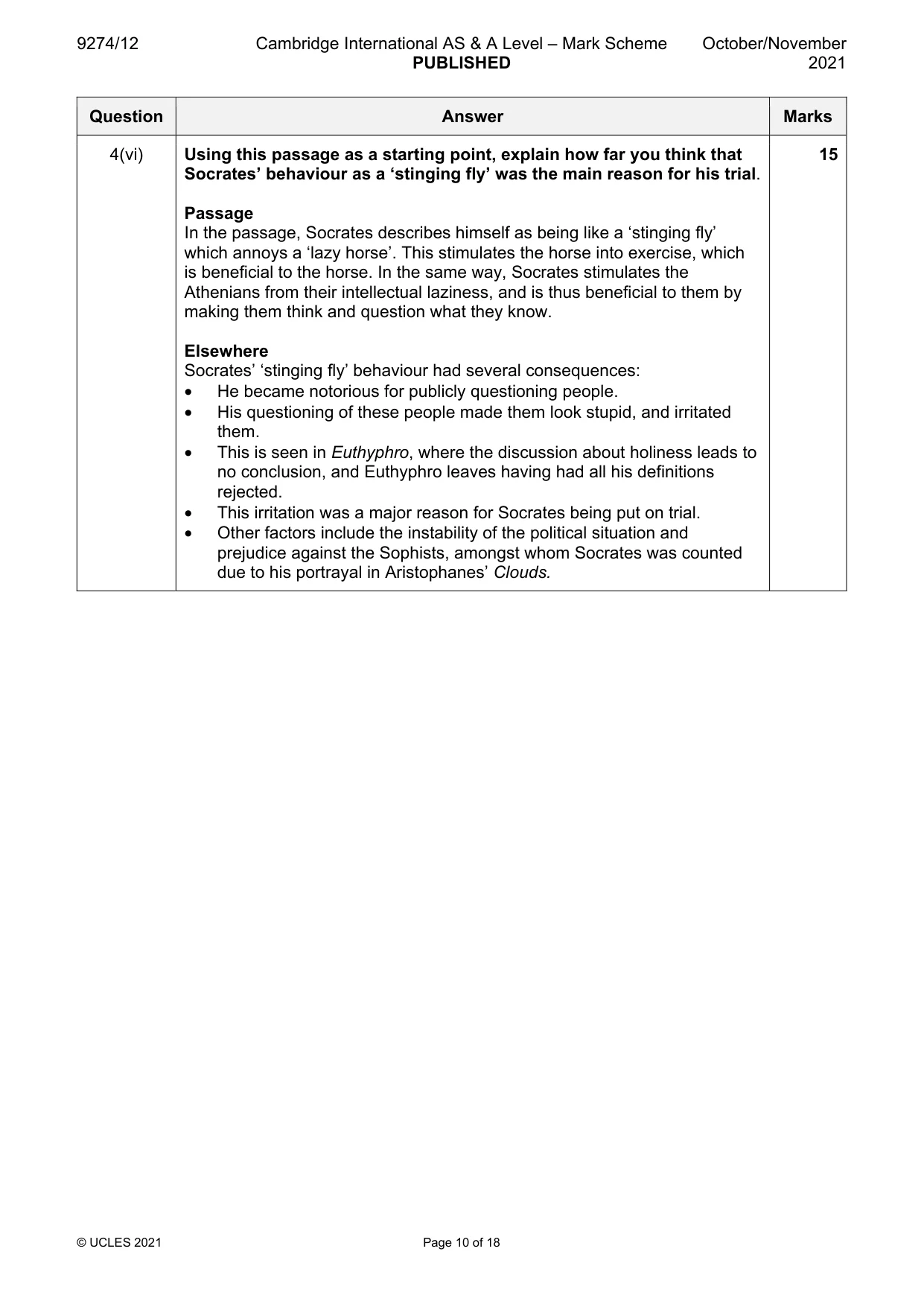
9274/12 Cambridge International AS & A Level – Mark Scheme PUBLISHED October/November 2021 © UCLES 2021 Page 10 of 18 Question Answer Marks 4(vi) Using this passage as a starting point, explain how far you think that Socrates’ behaviour as a ‘stinging fly’ was the main reason for his trial. Passage In the passage, Socrates describes himself as being like a ‘stinging fly’ which annoys a ‘lazy horse’. This stimulates the horse into exercise, which is beneficial to the horse. In the same way, Socrates stimulates the Athenians from their intellectual laziness, and is thus beneficial to them by making them think and question what they know. Elsewhere Socrates’ ‘stinging fly’ behaviour had several consequences: • He became notorious for publicly questioning people. • His questioning of these people made them look stupid, and irritated them. • This is seen in Euthyphro, where the discussion about holiness leads to no conclusion, and Euthyphro leaves having had all his definitions rejected. • This irritation was a major reason for Socrates being put on trial. • Other factors include the instability of the political situation and prejudice against the Sophists, amongst whom Socrates was counted due to his portrayal in Aristophanes’ Clouds. 15
Mark scheme, page 11
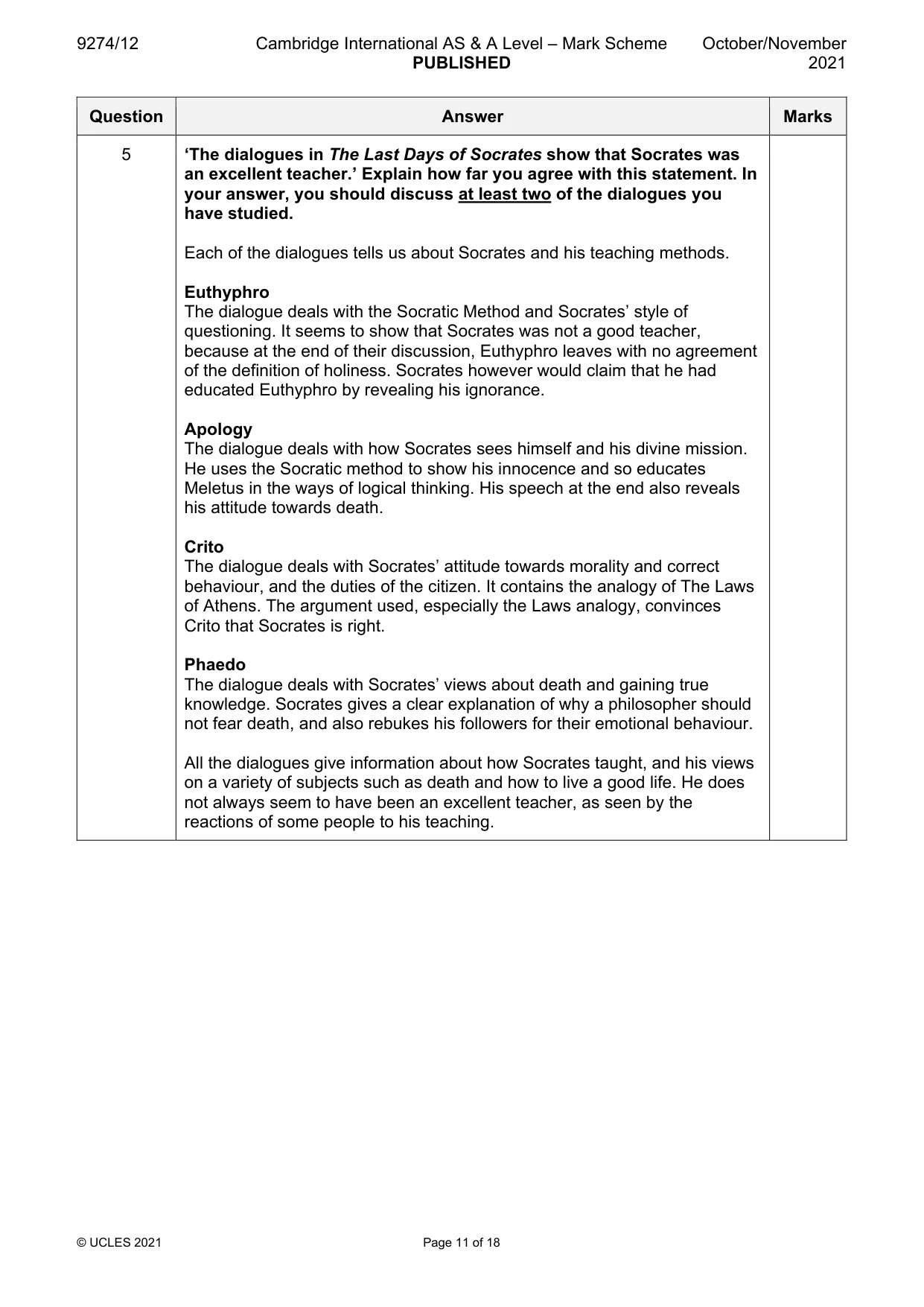
9274/12 Cambridge International AS & A Level – Mark Scheme PUBLISHED October/November 2021 © UCLES 2021 Page 11 of 18 Question Answer Marks 5 ‘The dialogues in The Last Days of Socrates show that Socrates was an excellent teacher.’ Explain how far you agree with this statement. In your answer, you should discuss at least two of the dialogues you have studied. Each of the dialogues tells us about Socrates and his teaching methods. Euthyphro The dialogue deals with the Socratic Method and Socrates’ style of questioning. It seems to show that Socrates was not a good teacher, because at the end of their discussion, Euthyphro leaves with no agreement of the definition of holiness. Socrates however would claim that he had educated Euthyphro by revealing his ignorance. Apology The dialogue deals with how Socrates sees himself and his divine mission. He uses the Socratic method to show his innocence and so educates Meletus in the ways of logical thinking. His speech at the end also reveals his attitude towards death. Crito The dialogue deals with Socrates’ attitude towards morality and correct behaviour, and the duties of the citizen. It contains the analogy of The Laws of Athens. The argument used, especially the Laws analogy, convinces Crito that Socrates is right. Phaedo The dialogue deals with Socrates’ views about death and gaining true knowledge. Socrates gives a clear explanation of why a philosopher should not fear death, and also rebukes his followers for their emotional behaviour. All the dialogues give information about how Socrates taught, and his views on a variety of subjects such as death and how to live a good life. He does not always seem to have been an excellent teacher, as seen by the reactions of some people to his teaching.
Mark scheme, page 12
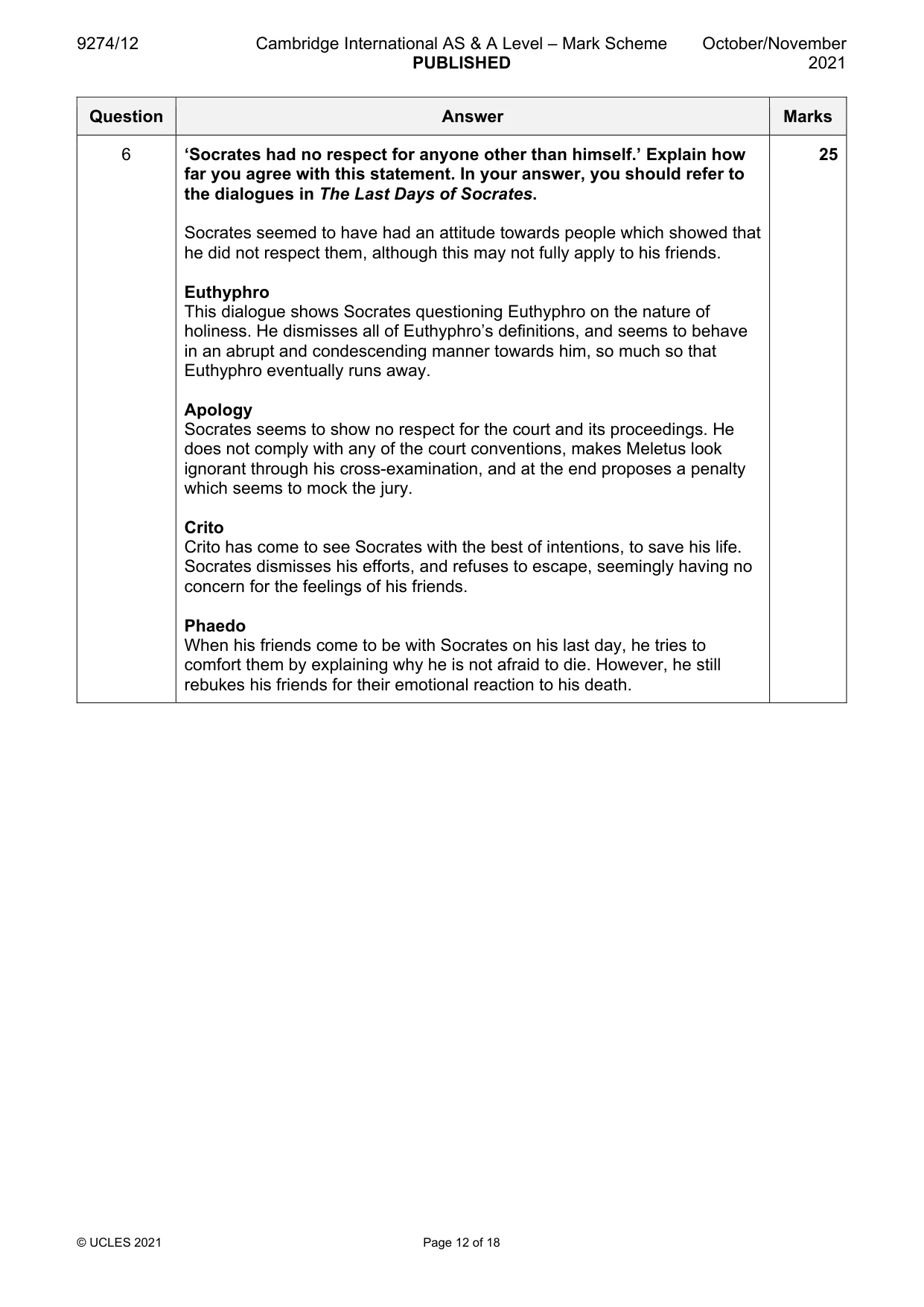
9274/12 Cambridge International AS & A Level – Mark Scheme PUBLISHED October/November 2021 © UCLES 2021 Page 12 of 18 Question Answer Marks 6 ‘Socrates had no respect for anyone other than himself.’ Explain how far you agree with this statement. In your answer, you should refer to the dialogues in The Last Days of Socrates. Socrates seemed to have had an attitude towards people which showed that he did not respect them, although this may not fully apply to his friends. Euthyphro This dialogue shows Socrates questioning Euthyphro on the nature of holiness. He dismisses all of Euthyphro’s definitions, and seems to behave in an abrupt and condescending manner towards him, so much so that Euthyphro eventually runs away. Apology Socrates seems to show no respect for the court and its proceedings. He does not comply with any of the court conventions, makes Meletus look ignorant through his cross-examination, and at the end proposes a penalty which seems to mock the jury. Crito Crito has come to see Socrates with the best of intentions, to save his life. Socrates dismisses his efforts, and refuses to escape, seemingly having no concern for the feelings of his friends. Phaedo When his friends come to be with Socrates on his last day, he tries to comfort them by explaining why he is not afraid to die. However, he still rebukes his friends for their emotional reaction to his death. 25
Mark scheme, page 13
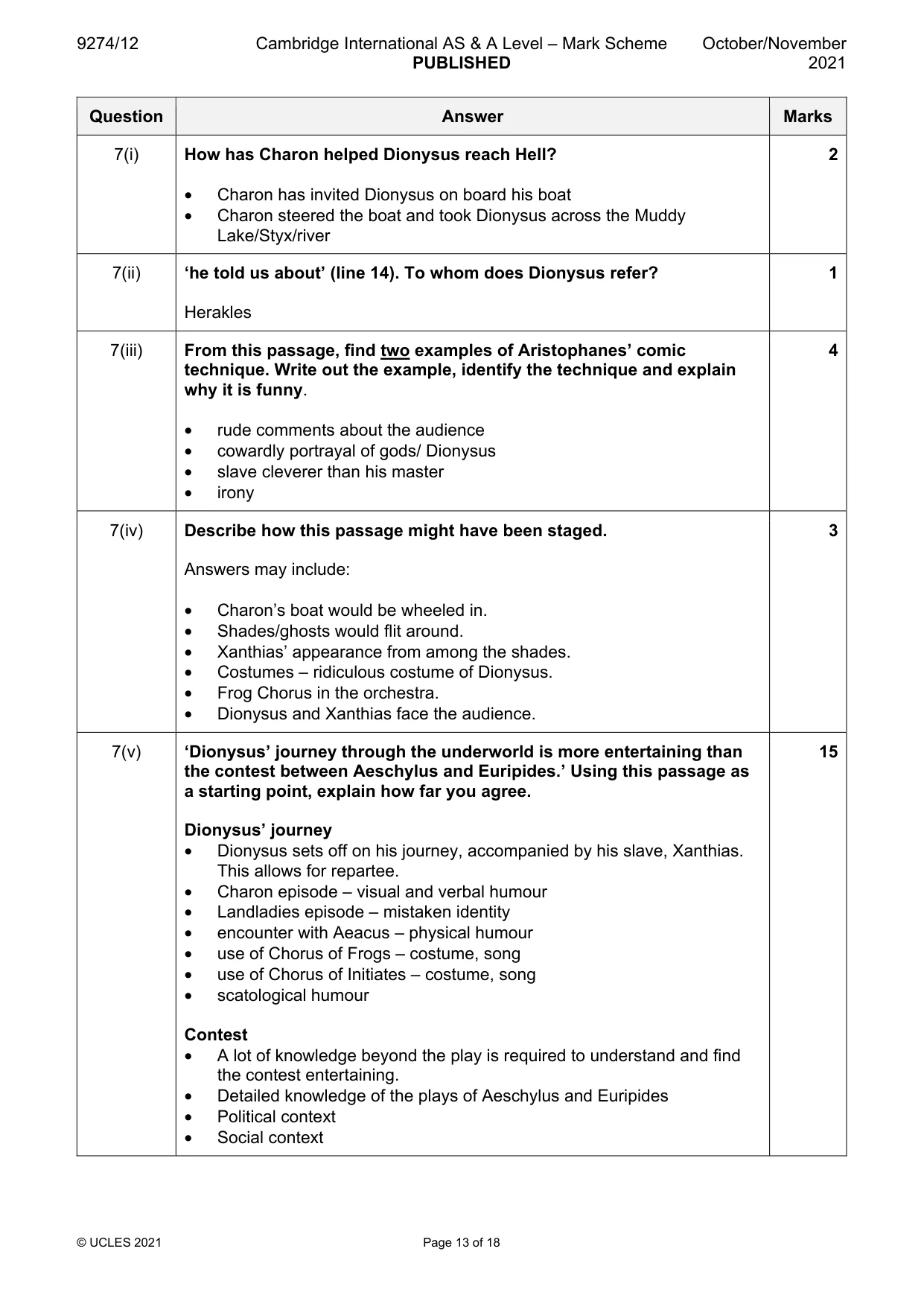
9274/12 Cambridge International AS & A Level – Mark Scheme PUBLISHED October/November 2021 © UCLES 2021 Page 13 of 18 Question Answer Marks 7(i) How has Charon helped Dionysus reach Hell? • Charon has invited Dionysus on board his boat • Charon steered the boat and took Dionysus across the Muddy Lake/Styx/river 2 7(ii) ‘he told us about’ (line 14). To whom does Dionysus refer? Herakles 1 7(iii) From this passage, find two examples of Aristophanes’ comic technique. Write out the example, identify the technique and explain why it is funny. • rude comments about the audience • cowardly portrayal of gods/ Dionysus • slave cleverer than his master • irony 4 7(iv) Describe how this passage might have been staged. Answers may include: • Charon’s boat would be wheeled in. • Shades/ghosts would flit around. • Xanthias’ appearance from among the shades. • Costumes – ridiculous costume of Dionysus. • Frog Chorus in the orchestra. • Dionysus and Xanthias face the audience. 3 7(v) ‘Dionysus’ journey through the underworld is more entertaining than the contest between Aeschylus and Euripides.’ Using this passage as a starting point, explain how far you agree. Dionysus’ journey • Dionysus sets off on his journey, accompanied by his slave, Xanthias. This allows for repartee. • Charon episode – visual and verbal humour • Landladies episode – mistaken identity • encounter with Aeacus – physical humour • use of Chorus of Frogs – costume, song • use of Chorus of Initiates – costume, song • scatological humour Contest • A lot of knowledge beyond the play is required to understand and find the contest entertaining. • Detailed knowledge of the plays of Aeschylus and Euripides • Political context • Social context 15
Mark scheme, page 14
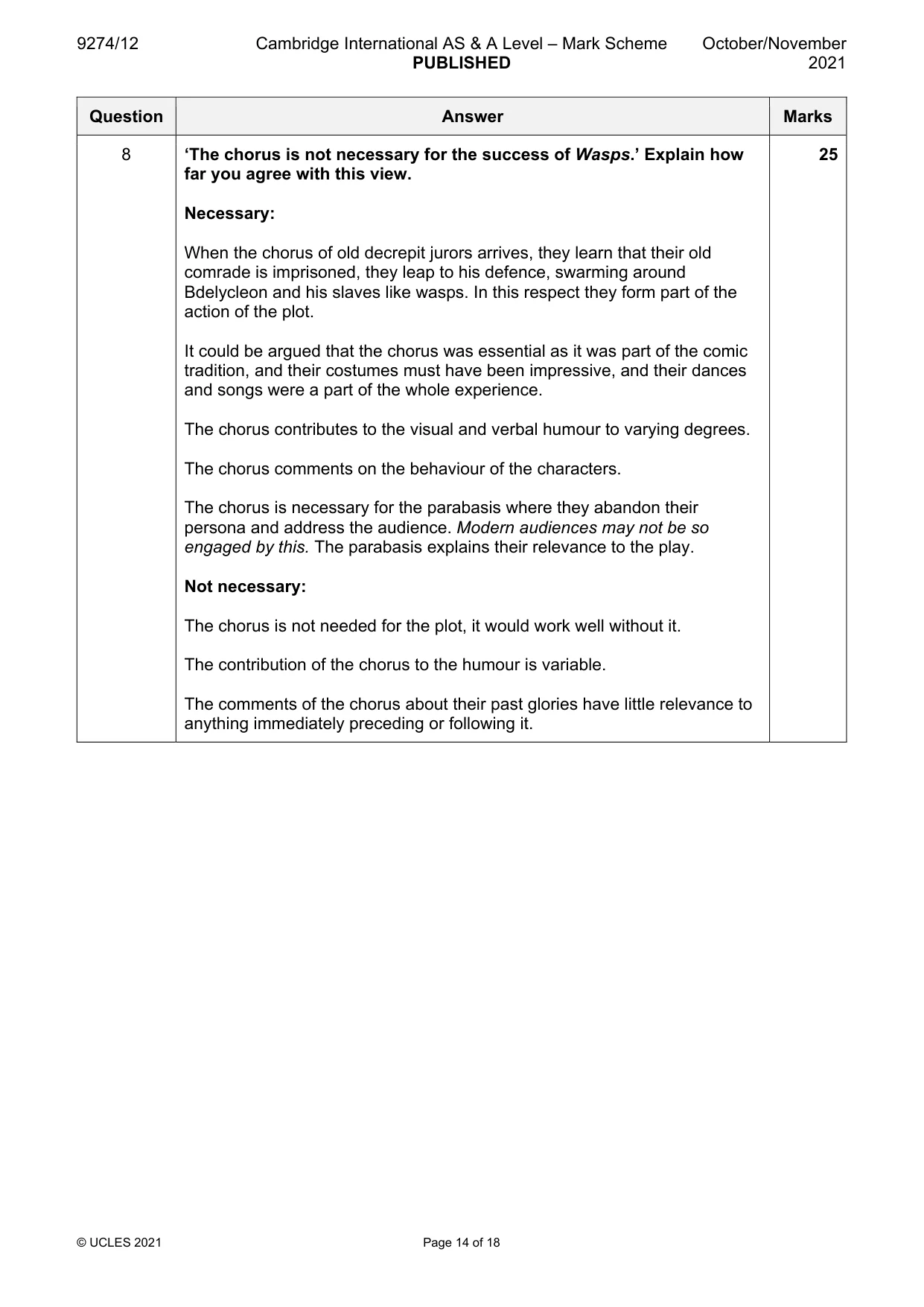
9274/12 Cambridge International AS & A Level – Mark Scheme PUBLISHED October/November 2021 © UCLES 2021 Page 14 of 18 Question Answer Marks 8 ‘The chorus is not necessary for the success of Wasps.’ Explain how far you agree with this view. Necessary: When the chorus of old decrepit jurors arrives, they learn that their old comrade is imprisoned, they leap to his defence, swarming around Bdelycleon and his slaves like wasps. In this respect they form part of the action of the plot. It could be argued that the chorus was essential as it was part of the comic tradition, and their costumes must have been impressive, and their dances and songs were a part of the whole experience. The chorus contributes to the visual and verbal humour to varying degrees. The chorus comments on the behaviour of the characters. The chorus is necessary for the parabasis where they abandon their persona and address the audience. Modern audiences may not be so engaged by this. The parabasis explains their relevance to the play. Not necessary: The chorus is not needed for the plot, it would work well without it. The contribution of the chorus to the humour is variable. The comments of the chorus about their past glories have little relevance to anything immediately preceding or following it. 25
Mark scheme, page 15
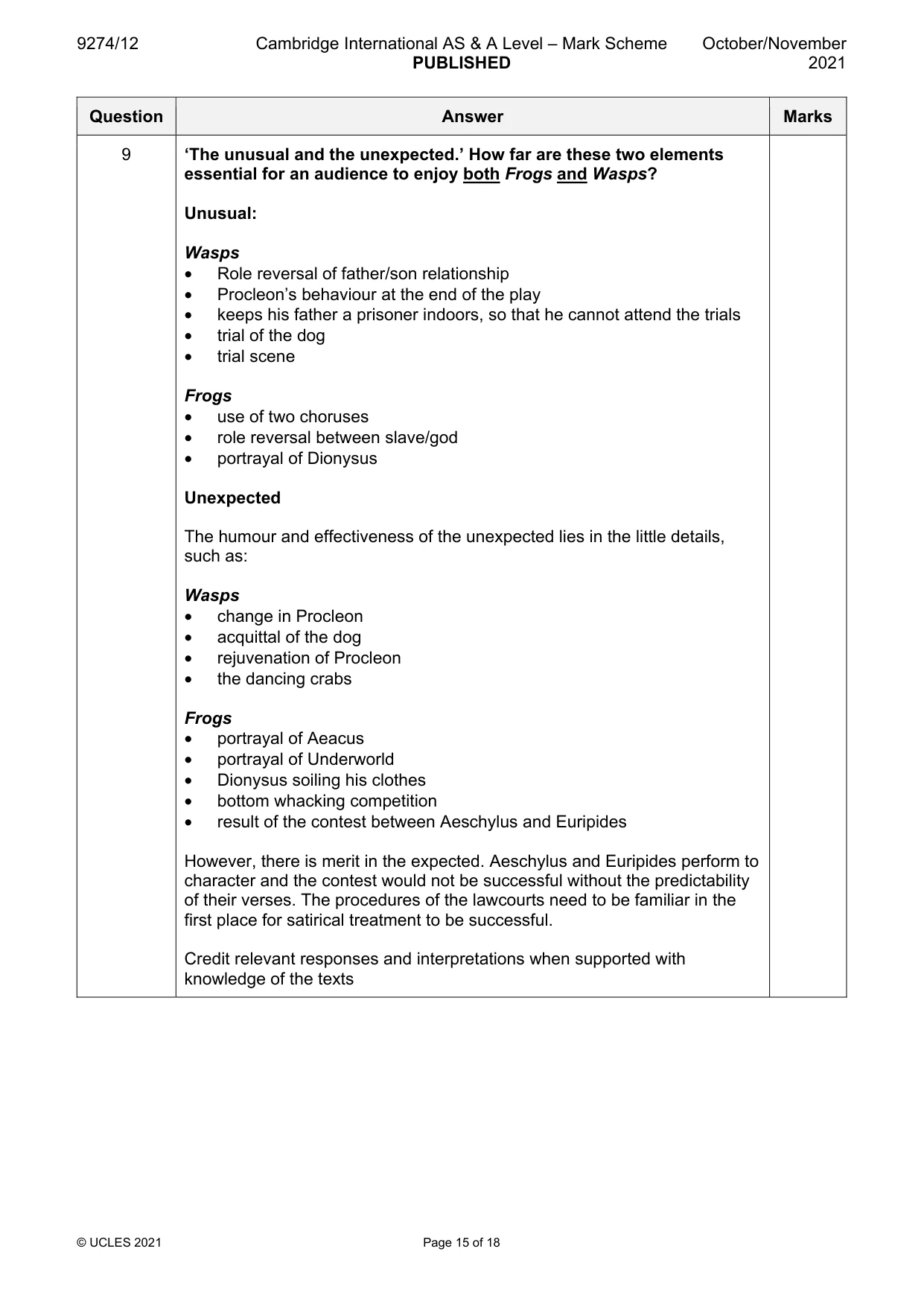
9274/12 Cambridge International AS & A Level – Mark Scheme PUBLISHED October/November 2021 © UCLES 2021 Page 15 of 18 Question Answer Marks 9 ‘The unusual and the unexpected.’ How far are these two elements essential for an audience to enjoy both Frogs and Wasps? Unusual: Wasps • Role reversal of father/son relationship • Procleon’s behaviour at the end of the play • keeps his father a prisoner indoors, so that he cannot attend the trials • trial of the dog • trial scene Frogs • use of two choruses • role reversal between slave/god • portrayal of Dionysus Unexpected The humour and effectiveness of the unexpected lies in the little details, such as: Wasps • change in Procleon • acquittal of the dog • rejuvenation of Procleon • the dancing crabs Frogs • portrayal of Aeacus • portrayal of Underworld • Dionysus soiling his clothes • bottom whacking competition • result of the contest between Aeschylus and Euripides However, there is merit in the expected. Aeschylus and Euripides perform to character and the contest would not be successful without the predictability of their verses. The procedures of the lawcourts need to be familiar in the first place for satirical treatment to be successful. Credit relevant responses and interpretations when supported with knowledge of the texts
Mark scheme, page 16
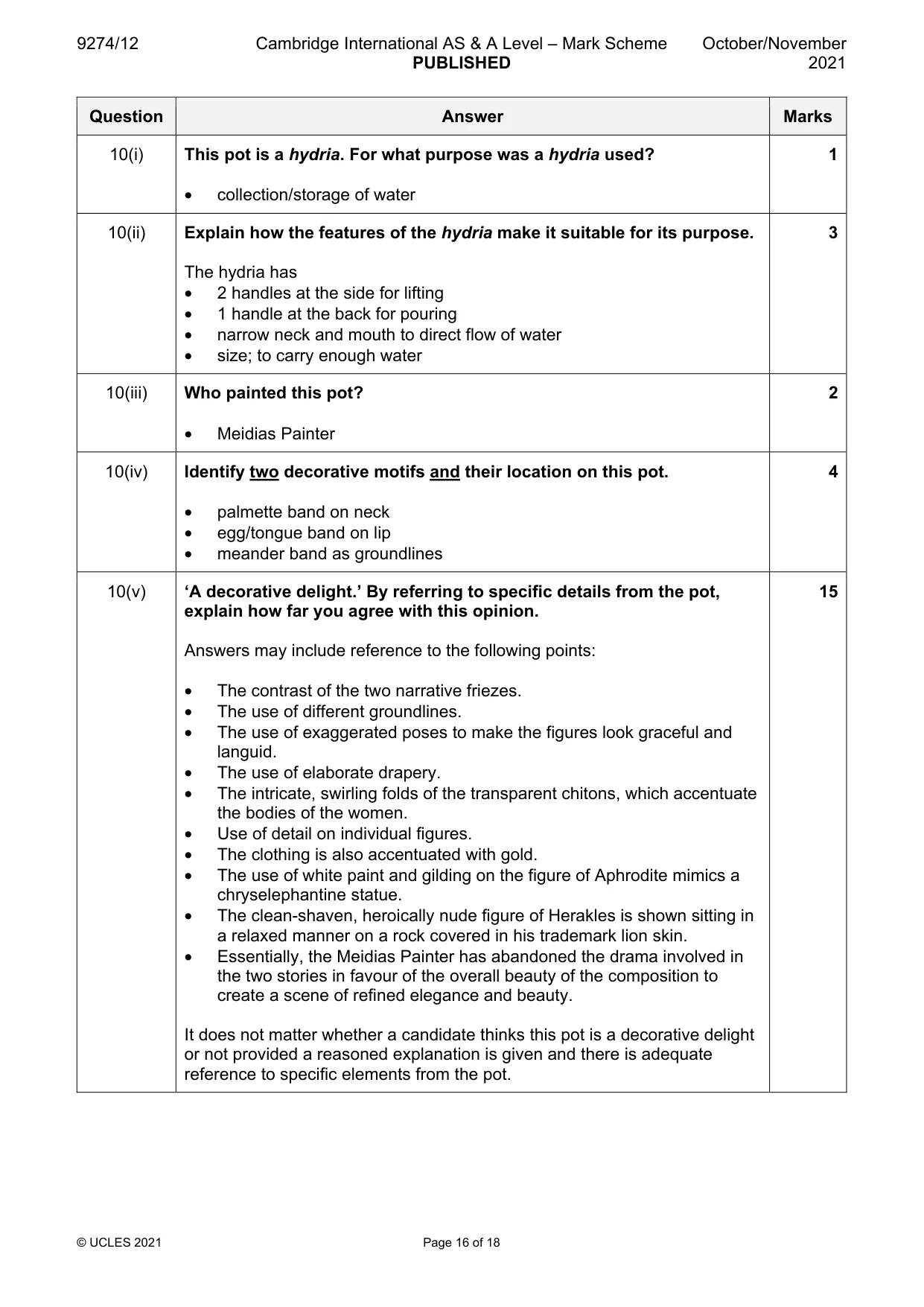
9274/12 Cambridge International AS & A Level – Mark Scheme PUBLISHED October/November 2021 © UCLES 2021 Page 16 of 18 Question Answer Marks 10(i) This pot is a hydria. For what purpose was a hydria used? • collection/storage of water 1 10(ii) Explain how the features of the hydria make it suitable for its purpose. The hydria has • 2 handles at the side for lifting • 1 handle at the back for pouring • narrow neck and mouth to direct flow of water • size; to carry enough water 3 10(iii) Who painted this pot? • Meidias Painter 2 10(iv) Identify two decorative motifs and their location on this pot. • palmette band on neck • egg/tongue band on lip • meander band as groundlines 4 10(v) ‘A decorative delight.’ By referring to specific details from the pot, explain how far you agree with this opinion. Answers may include reference to the following points: • The contrast of the two narrative friezes. • The use of different groundlines. • The use of exaggerated poses to make the figures look graceful and languid. • The use of elaborate drapery. • The intricate, swirling folds of the transparent chitons, which accentuate the bodies of the women. • Use of detail on individual figures. • The clothing is also accentuated with gold. • The use of white paint and gilding on the figure of Aphrodite mimics a chryselephantine statue. • The clean-shaven, heroically nude figure of Herakles is shown sitting in a relaxed manner on a rock covered in his trademark lion skin. • Essentially, the Meidias Painter has abandoned the drama involved in the two stories in favour of the overall beauty of the composition to create a scene of refined elegance and beauty. It does not matter whether a candidate thinks this pot is a decorative delight or not provided a reasoned explanation is given and there is adequate reference to specific elements from the pot. 15
Mark scheme, page 17
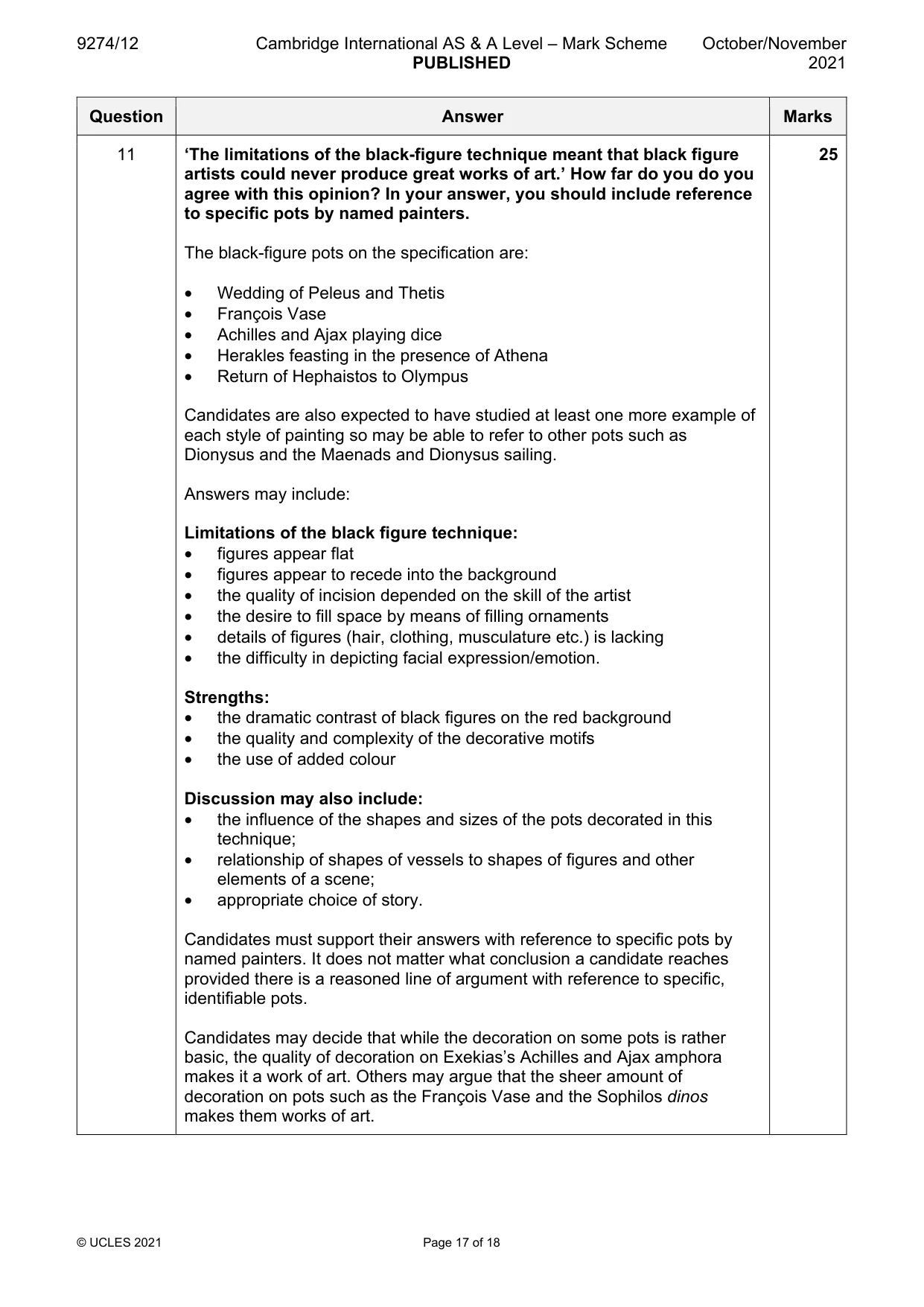
9274/12 Cambridge International AS & A Level – Mark Scheme PUBLISHED October/November 2021 © UCLES 2021 Page 17 of 18 Question Answer Marks 11 ‘The limitations of the black-figure technique meant that black figure artists could never produce great works of art.’ How far do you do you agree with this opinion? In your answer, you should include reference to specific pots by named painters. The black-figure pots on the specification are: • Wedding of Peleus and Thetis • François Vase • Achilles and Ajax playing dice • Herakles feasting in the presence of Athena • Return of Hephaistos to Olympus Candidates are also expected to have studied at least one more example of each style of painting so may be able to refer to other pots such as Dionysus and the Maenads and Dionysus sailing. Answers may include: Limitations of the black figure technique: • figures appear flat • figures appear to recede into the background • the quality of incision depended on the skill of the artist • the desire to fill space by means of filling ornaments • details of figures (hair, clothing, musculature etc.) is lacking • the difficulty in depicting facial expression/emotion. Strengths: • the dramatic contrast of black figures on the red background • the quality and complexity of the decorative motifs • the use of added colour Discussion may also include: • the influence of the shapes and sizes of the pots decorated in this technique; • relationship of shapes of vessels to shapes of figures and other elements of a scene; • appropriate choice of story. Candidates must support their answers with reference to specific pots by named painters. It does not matter what conclusion a candidate reaches provided there is a reasoned line of argument with reference to specific, identifiable pots. Candidates may decide that while the decoration on some pots is rather basic, the quality of decoration on Exekias’s Achilles and Ajax amphora makes it a work of art. Others may argue that the sheer amount of decoration on pots such as the François Vase and the Sophilos dinos makes them works of art. 25
Mark scheme, page 18
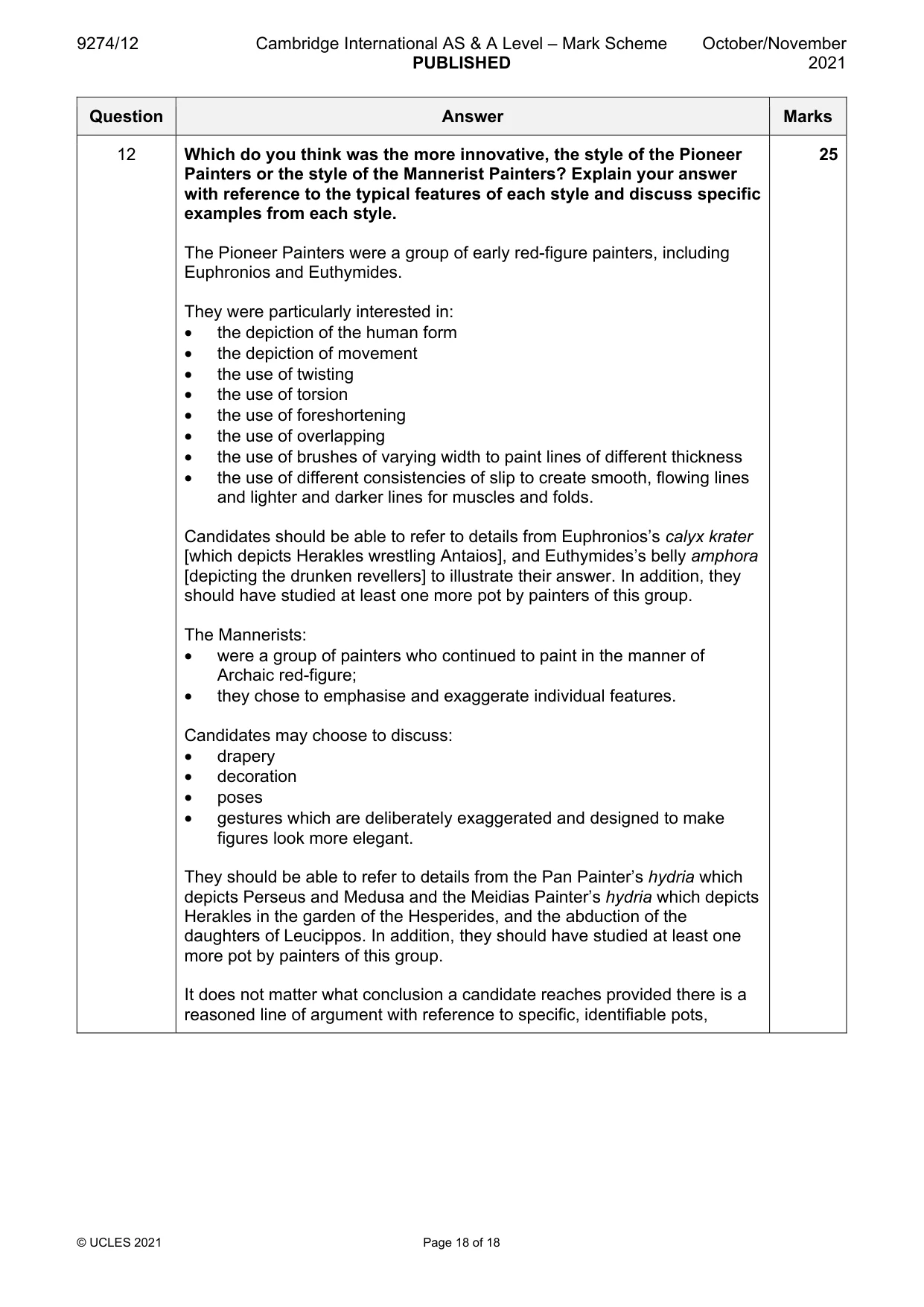
9274/12 Cambridge International AS & A Level – Mark Scheme PUBLISHED October/November 2021 © UCLES 2021 Page 18 of 18 Question Answer Marks 12 Which do you think was the more innovative, the style of the Pioneer Painters or the style of the Mannerist Painters? Explain your answer with reference to the typical features of each style and discuss specific examples from each style. The Pioneer Painters were a group of early red-figure painters, including Euphronios and Euthymides. They were particularly interested in: • the depiction of the human form • the depiction of movement • the use of twisting • the use of torsion • the use of foreshortening • the use of overlapping • the use of brushes of varying width to paint lines of different thickness • the use of different consistencies of slip to create smooth, flowing lines and lighter and darker lines for muscles and folds. Candidates should be able to refer to details from Euphronios’s calyx krater [which depicts Herakles wrestling Antaios], and Euthymides’s belly amphora [depicting the drunken revellers] to illustrate their answer. In addition, they should have studied at least one more pot by painters of this group. The Mannerists: • were a group of painters who continued to paint in the manner of Archaic red-figure; • they chose to emphasise and exaggerate individual features. Candidates may choose to discuss: • drapery • decoration • poses • gestures which are deliberately exaggerated and designed to make figures look more elegant. They should be able to refer to details from the Pan Painter’s hydria which depicts Perseus and Medusa and the Meidias Painter’s hydria which depicts Herakles in the garden of the Hesperides, and the abduction of the daughters of Leucippos. In addition, they should have studied at least one more pot by painters of this group. It does not matter what conclusion a candidate reaches provided there is a reasoned line of argument with reference to specific, identifiable pots, 25
What you needed in this session
Cambridge’s own grade thresholds for 2021 Oct/Nov, Paper 1 · Variant 2. A higher threshold means an easier paper — the bar moves with how the cohort did.