Cambridge A Level Classical Studies 9274 — 2020 Oct/Nov Paper 4 · Variant 2
9274/42/O/N/20 · 50 marks · ≈56 min
The question paper and its mark scheme, free to read here and free to download. This is Cambridge’s own paper, exactly as it was sat.
Question paper4 pages
Mark scheme8 pages
Answers below. Sit the paper first if you are practising.
Paper as text
Question paper, page 1
Cambridge International AS & A Level * 2 2 8 0 5 4 7 5 8 0 * DC (MB) 207499 © UCLES 2020 [Turn over This document has 4 pages. Blank pages are indicated. CLASSICAL STUDIES 9274/42 Paper 4 Classical Literature: Sources and Evidence October/November 2020 1 hour 30 minutes You must answer on the enclosed answer booklet. You will need: Answer booklet (enclosed) INSTRUCTIONS ● Answer one question. ● Follow the instructions on the front cover of the answer booklet. If you need additional answer paper, ask the invigilator for a continuation booklet. INFORMATION ● The total mark for this paper is 50. ● Each question is worth 50 marks.
Question paper, page 2
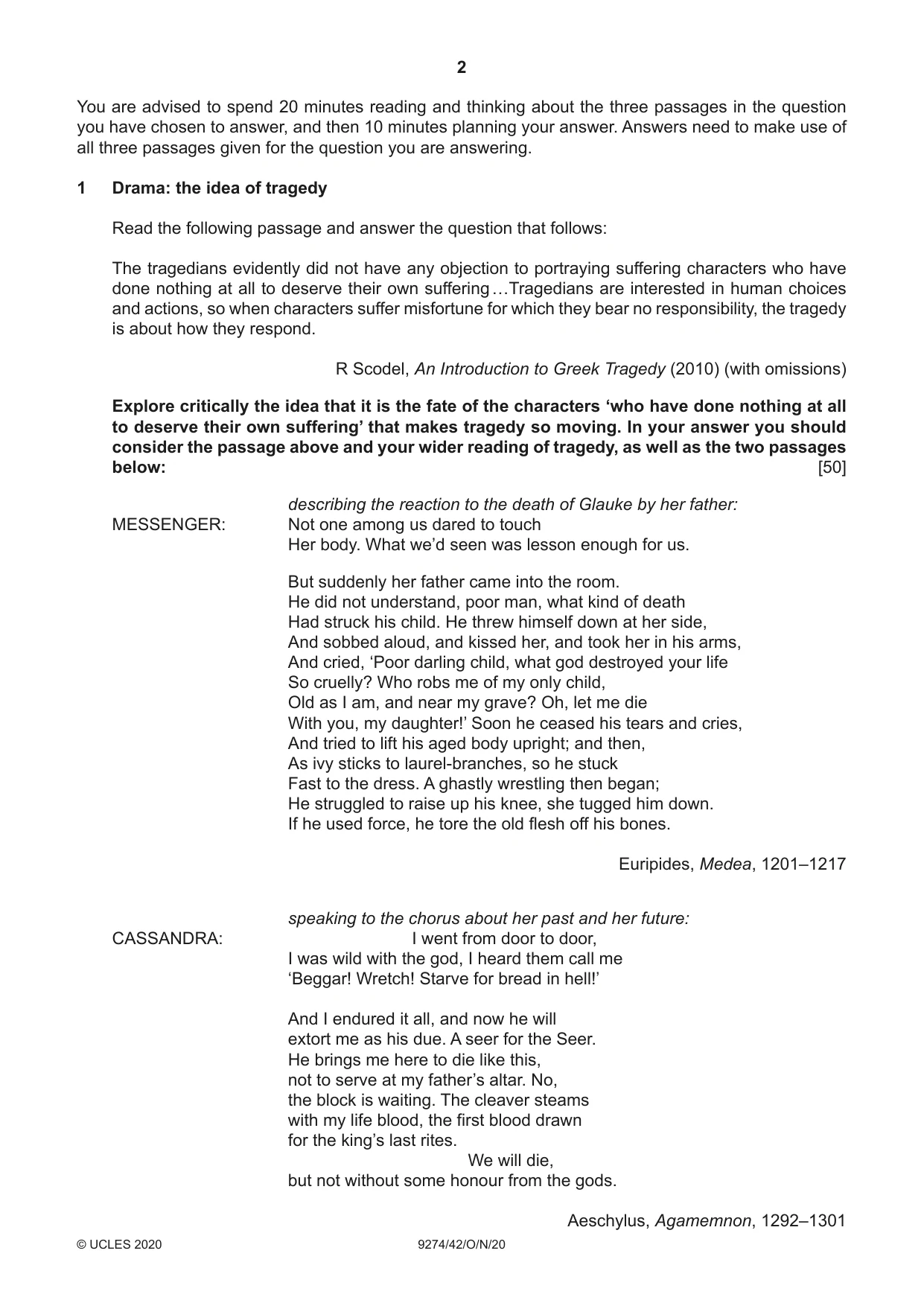
2 9274/42/O/N/20 © UCLES 2020 You are advised to spend 20 minutes reading and thinking about the three passages in the question you have chosen to answer, and then 10 minutes planning your answer. Answers need to make use of all three passages given for the question you are answering. 1 Drama: the idea of tragedy Read the following passage and answer the question that follows: The tragedians evidently did not have any objection to portraying suffering characters who have done nothing at all to deserve their own suffering …Tragedians are interested in human choices and actions, so when characters suffer misfortune for which they bear no responsibility, the tragedy is about how they respond. R Scodel, An Introduction to Greek Tragedy (2010) (with omissions) Explore critically the idea that it is the fate of the characters ‘who have done nothing at all to deserve their own suffering’ that makes tragedy so moving. In your answer you should consider the passage above and your wider reading of tragedy, as well as the two passages below: [50] describing the reaction to the death of Glauke by her father: MESSENGER: Not one among us dared to touch Her body. What we’d seen was lesson enough for us. But suddenly her father came into the room. He did not understand, poor man, what kind of death Had struck his child. He threw himself down at her side, And sobbed aloud, and kissed her, and took her in his arms, And cried, ‘Poor darling child, what god destroyed your life So cruelly? Who robs me of my only child, Old as I am, and near my grave? Oh, let me die With you, my daughter!’ Soon he ceased his tears and cries, And tried to lift his aged body upright; and then, As ivy sticks to laurel-branches, so he stuck Fast to the dress. A ghastly wrestling then began; He struggled to raise up his knee, she tugged him down. If he used force, he tore the old flesh off his bones. Euripides, Medea, 1201–1217 speaking to the chorus about her past and her future: CASSANDRA: I went from door to door, I was wild with the god, I heard them call me ‘Beggar! Wretch! Starve for bread in hell!’ And I endured it all, and now he will extort me as his due. A seer for the Seer. He brings me here to die like this, not to serve at my father’s altar. No, the block is waiting. The cleaver steams with my life blood, the first blood drawn for the king’s last rites. We will die, but not without some honour from the gods. Aeschylus, Agamemnon, 1292–1301
Question paper, page 3
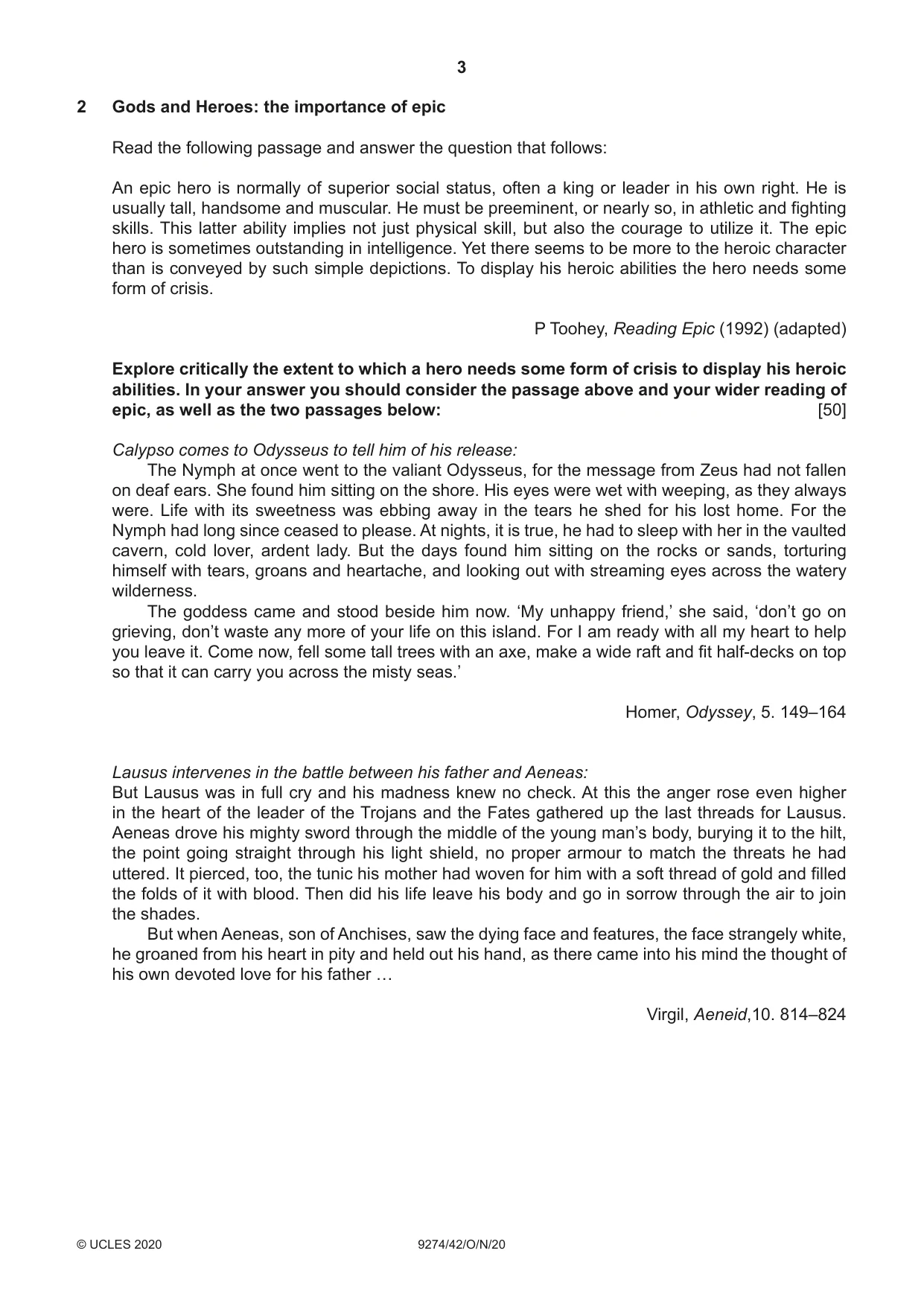
3 9274/42/O/N/20 © UCLES 2020 2 Gods and Heroes: the importance of epic Read the following passage and answer the question that follows: An epic hero is normally of superior social status, often a king or leader in his own right. He is usually tall, handsome and muscular. He must be preeminent, or nearly so, in athletic and fighting skills. This latter ability implies not just physical skill, but also the courage to utilize it. The epic hero is sometimes outstanding in intelligence. Yet there seems to be more to the heroic character than is conveyed by such simple depictions. To display his heroic abilities the hero needs some form of crisis. P Toohey, Reading Epic (1992) (adapted) Explore critically the extent to which a hero needs some form of crisis to display his heroic abilities. In your answer you should consider the passage above and your wider reading of epic, as well as the two passages below: [50] Calypso comes to Odysseus to tell him of his release: The Nymph at once went to the valiant Odysseus, for the message from Zeus had not fallen on deaf ears. She found him sitting on the shore. His eyes were wet with weeping, as they always were. Life with its sweetness was ebbing away in the tears he shed for his lost home. For the Nymph had long since ceased to please. At nights, it is true, he had to sleep with her in the vaulted cavern, cold lover, ardent lady. But the days found him sitting on the rocks or sands, torturing himself with tears, groans and heartache, and looking out with streaming eyes across the watery wilderness. The goddess came and stood beside him now. ‘My unhappy friend,’ she said, ‘don’t go on grieving, don’t waste any more of your life on this island. For I am ready with all my heart to help you leave it. Come now, fell some tall trees with an axe, make a wide raft and fit half-decks on top so that it can carry you across the misty seas.’ Homer, Odyssey, 5. 149–164 Lausus intervenes in the battle between his father and Aeneas: But Lausus was in full cry and his madness knew no check. At this the anger rose even higher in the heart of the leader of the Trojans and the Fates gathered up the last threads for Lausus. Aeneas drove his mighty sword through the middle of the young man’s body, burying it to the hilt, the point going straight through his light shield, no proper armour to match the threats he had uttered. It pierced, too, the tunic his mother had woven for him with a soft thread of gold and filled the folds of it with blood. Then did his life leave his body and go in sorrow through the air to join the shades. But when Aeneas, son of Anchises, saw the dying face and features, the face strangely white, he groaned from his heart in pity and held out his hand, as there came into his mind the thought of his own devoted love for his father … Virgil, Aeneid,10. 814–824
Question paper, page 4
4 9274/42/O/N/20 © UCLES 2020 Permission to reproduce items where third-party owned material protected by copyright is included has been sought and cleared where possible. Every reasonable effort has been made by the publisher (UCLES) to trace copyright holders, but if any items requiring clearance have unwittingly been included, the publisher will be pleased to make amends at the earliest possible opportunity. To avoid the issue of disclosure of answer-related information to candidates, all copyright acknowledgements are reproduced online in the Cambridge Assessment International Education Copyright Acknowledgements Booklet. This is produced for each series of examinations and is freely available to download at www.cambridgeinternational.org after the live examination series. Cambridge Assessment International Education is part of the Cambridge Assessment Group. Cambridge Assessment is the brand name of the University of Cambridge Local Examinations Syndicate (UCLES), which itself is a department of the University of Cambridge. BLANK PAGE
Mark scheme, page 1
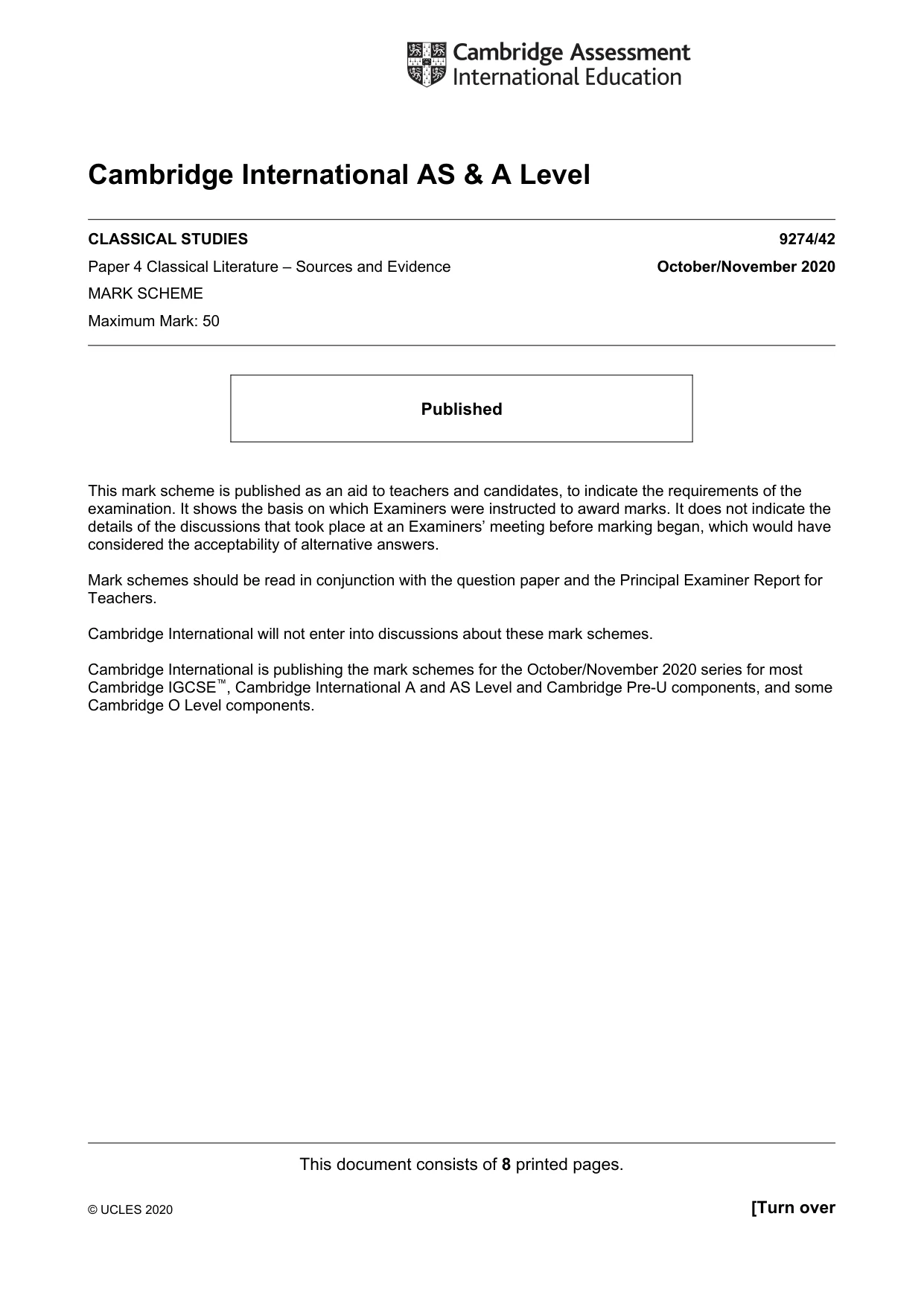
This document consists of 8 printed pages. © UCLES 2020 [Turn over Cambridge International AS & A Level CLASSICAL STUDIES 9274/42 Paper 4 Classical Literature – Sources and Evidence October/November 2020 MARK SCHEME Maximum Mark: 50 Published This mark scheme is published as an aid to teachers and candidates, to indicate the requirements of the examination. It shows the basis on which Examiners were instructed to award marks. It does not indicate the details of the discussions that took place at an Examiners’ meeting before marking began, which would have considered the acceptability of alternative answers. Mark schemes should be read in conjunction with the question paper and the Principal Examiner Report for Teachers. Cambridge International will not enter into discussions about these mark schemes. Cambridge International is publishing the mark schemes for the October/November 2020 series for most Cambridge IGCSE™, Cambridge International A and AS Level and Cambridge Pre-U components, and some Cambridge O Level components.
Mark scheme, page 2
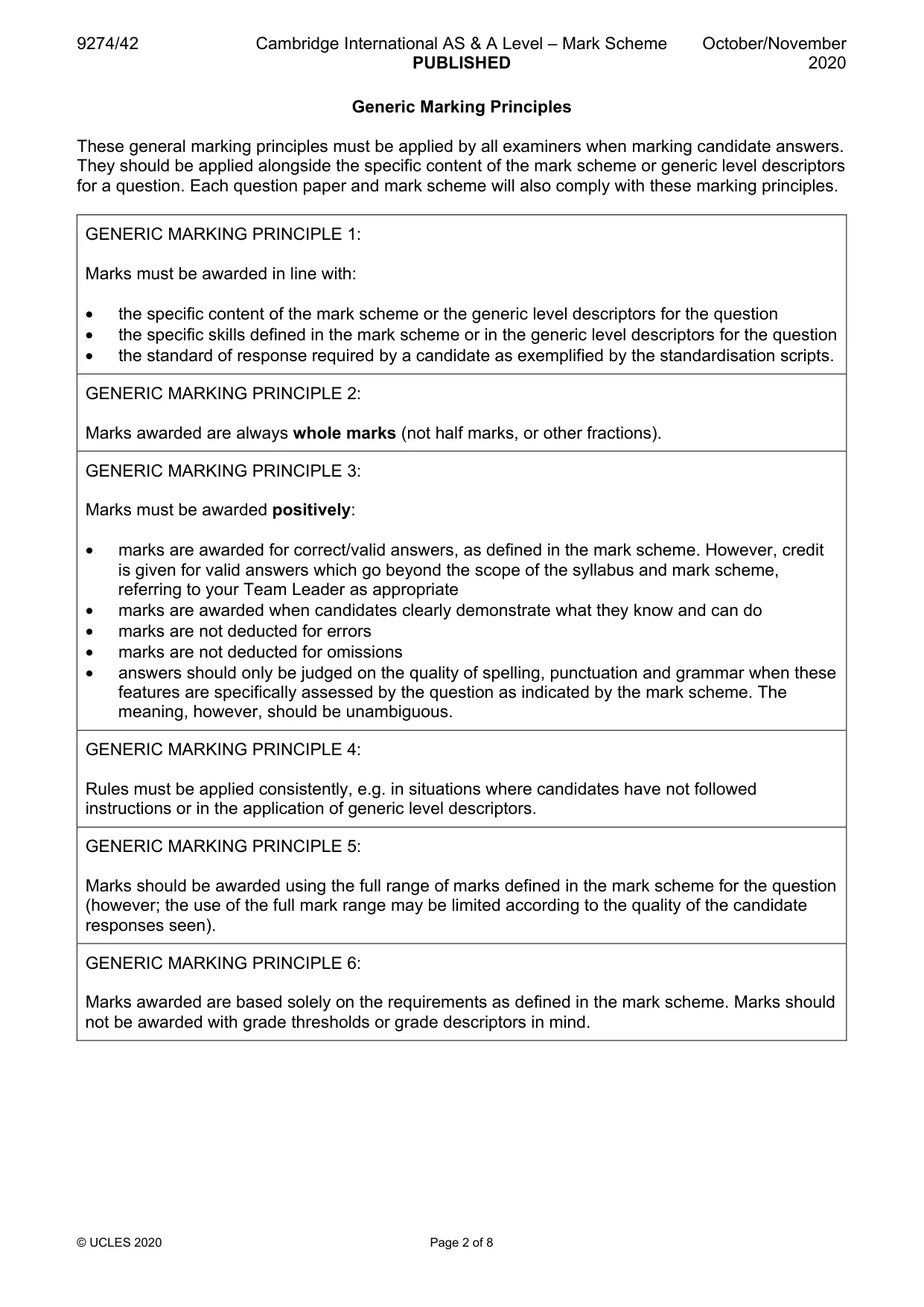
9274/42 Cambridge International AS & A Level – Mark Scheme PUBLISHED October/November 2020 © UCLES 2020 Page 2 of 8 Generic Marking Principles These general marking principles must be applied by all examiners when marking candidate answers. They should be applied alongside the specific content of the mark scheme or generic level descriptors for a question. Each question paper and mark scheme will also comply with these marking principles. GENERIC MARKING PRINCIPLE 1: Marks must be awarded in line with: • the specific content of the mark scheme or the generic level descriptors for the question • the specific skills defined in the mark scheme or in the generic level descriptors for the question • the standard of response required by a candidate as exemplified by the standardisation scripts. GENERIC MARKING PRINCIPLE 2: Marks awarded are always whole marks (not half marks, or other fractions). GENERIC MARKING PRINCIPLE 3: Marks must be awarded positively: • marks are awarded for correct/valid answers, as defined in the mark scheme. However, credit is given for valid answers which go beyond the scope of the syllabus and mark scheme, referring to your Team Leader as appropriate • marks are awarded when candidates clearly demonstrate what they know and can do • marks are not deducted for errors • marks are not deducted for omissions • answers should only be judged on the quality of spelling, punctuation and grammar when these features are specifically assessed by the question as indicated by the mark scheme. The meaning, however, should be unambiguous. GENERIC MARKING PRINCIPLE 4: Rules must be applied consistently, e.g. in situations where candidates have not followed instructions or in the application of generic level descriptors. GENERIC MARKING PRINCIPLE 5: Marks should be awarded using the full range of marks defined in the mark scheme for the question (however; the use of the full mark range may be limited according to the quality of the candidate responses seen). GENERIC MARKING PRINCIPLE 6: Marks awarded are based solely on the requirements as defined in the mark scheme. Marks should not be awarded with grade thresholds or grade descriptors in mind.
Mark scheme, page 3
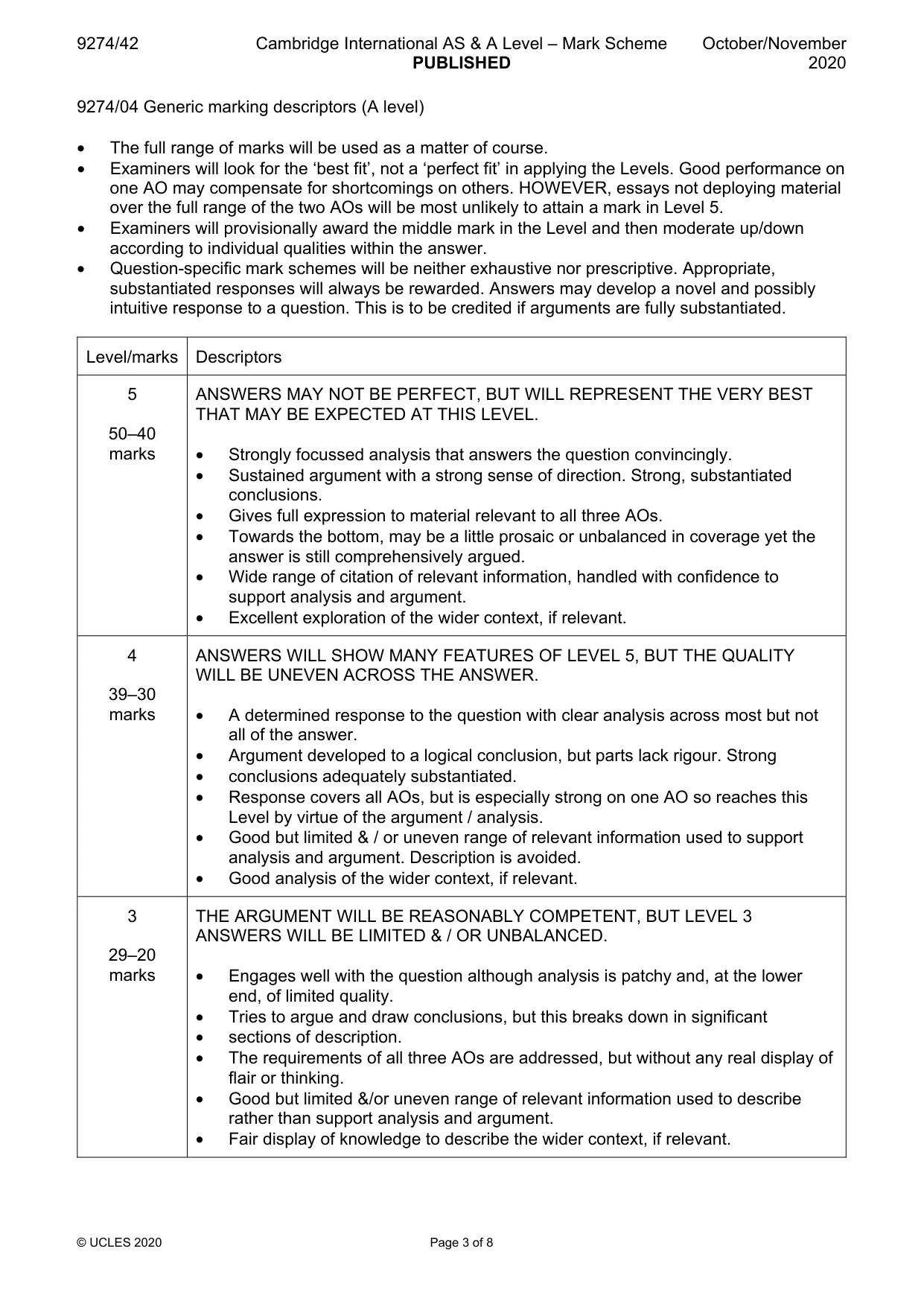
9274/42 Cambridge International AS & A Level – Mark Scheme PUBLISHED October/November 2020 © UCLES 2020 Page 3 of 8 9274/04 Generic marking descriptors (A level) • The full range of marks will be used as a matter of course. • Examiners will look for the ‘best fit’, not a ‘perfect fit’ in applying the Levels. Good performance on one AO may compensate for shortcomings on others. HOWEVER, essays not deploying material over the full range of the two AOs will be most unlikely to attain a mark in Level 5. • Examiners will provisionally award the middle mark in the Level and then moderate up/down according to individual qualities within the answer. • Question-specific mark schemes will be neither exhaustive nor prescriptive. Appropriate, substantiated responses will always be rewarded. Answers may develop a novel and possibly intuitive response to a question. This is to be credited if arguments are fully substantiated. Level/marks Descriptors 5 50–40 marks ANSWERS MAY NOT BE PERFECT, BUT WILL REPRESENT THE VERY BEST THAT MAY BE EXPECTED AT THIS LEVEL. • Strongly focussed analysis that answers the question convincingly. • Sustained argument with a strong sense of direction. Strong, substantiated conclusions. • Gives full expression to material relevant to all three AOs. • Towards the bottom, may be a little prosaic or unbalanced in coverage yet the answer is still comprehensively argued. • Wide range of citation of relevant information, handled with confidence to support analysis and argument. • Excellent exploration of the wider context, if relevant. 4 39–30 marks ANSWERS WILL SHOW MANY FEATURES OF LEVEL 5, BUT THE QUALITY WILL BE UNEVEN ACROSS THE ANSWER. • A determined response to the question with clear analysis across most but not all of the answer. • Argument developed to a logical conclusion, but parts lack rigour. Strong • conclusions adequately substantiated. • Response covers all AOs, but is especially strong on one AO so reaches this Level by virtue of the argument / analysis. • Good but limited & / or uneven range of relevant information used to support analysis and argument. Description is avoided. • Good analysis of the wider context, if relevant. 3 29–20 marks THE ARGUMENT WILL BE REASONABLY COMPETENT, BUT LEVEL 3 ANSWERS WILL BE LIMITED & / OR UNBALANCED. • Engages well with the question although analysis is patchy and, at the lower end, of limited quality. • Tries to argue and draw conclusions, but this breaks down in significant • sections of description. • The requirements of all three AOs are addressed, but without any real display of flair or thinking. • Good but limited &/or uneven range of relevant information used to describe rather than support analysis and argument. • Fair display of knowledge to describe the wider context, if relevant.
Mark scheme, page 4
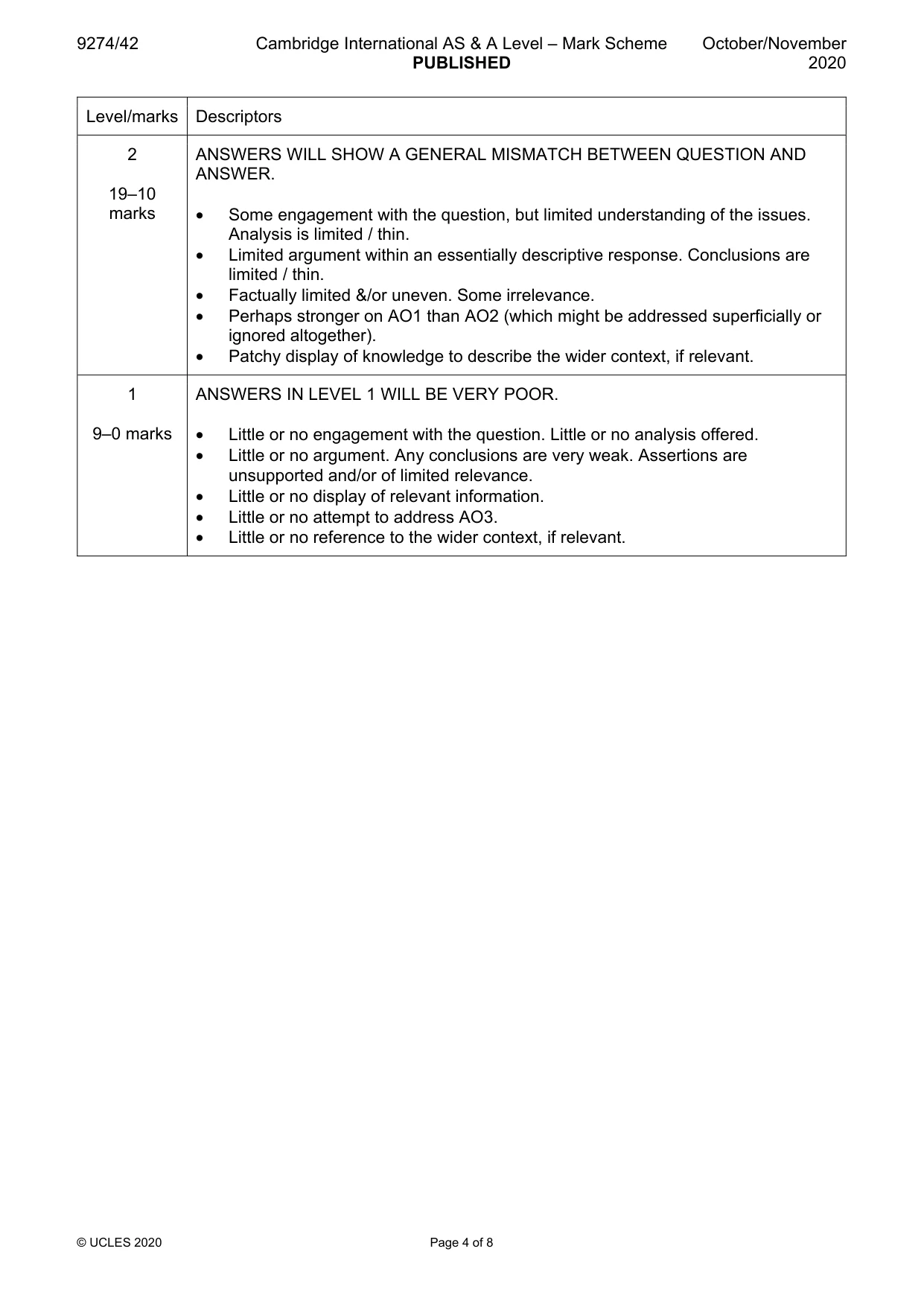
9274/42 Cambridge International AS & A Level – Mark Scheme PUBLISHED October/November 2020 © UCLES 2020 Page 4 of 8 Level/marks Descriptors 2 19–10 marks ANSWERS WILL SHOW A GENERAL MISMATCH BETWEEN QUESTION AND ANSWER. • Some engagement with the question, but limited understanding of the issues. Analysis is limited / thin. • Limited argument within an essentially descriptive response. Conclusions are limited / thin. • Factually limited &/or uneven. Some irrelevance. • Perhaps stronger on AO1 than AO2 (which might be addressed superficially or ignored altogether). • Patchy display of knowledge to describe the wider context, if relevant. 1 9–0 marks ANSWERS IN LEVEL 1 WILL BE VERY POOR. • Little or no engagement with the question. Little or no analysis offered. • Little or no argument. Any conclusions are very weak. Assertions are unsupported and/or of limited relevance. • Little or no display of relevant information. • Little or no attempt to address AO3. • Little or no reference to the wider context, if relevant.
Mark scheme, page 5
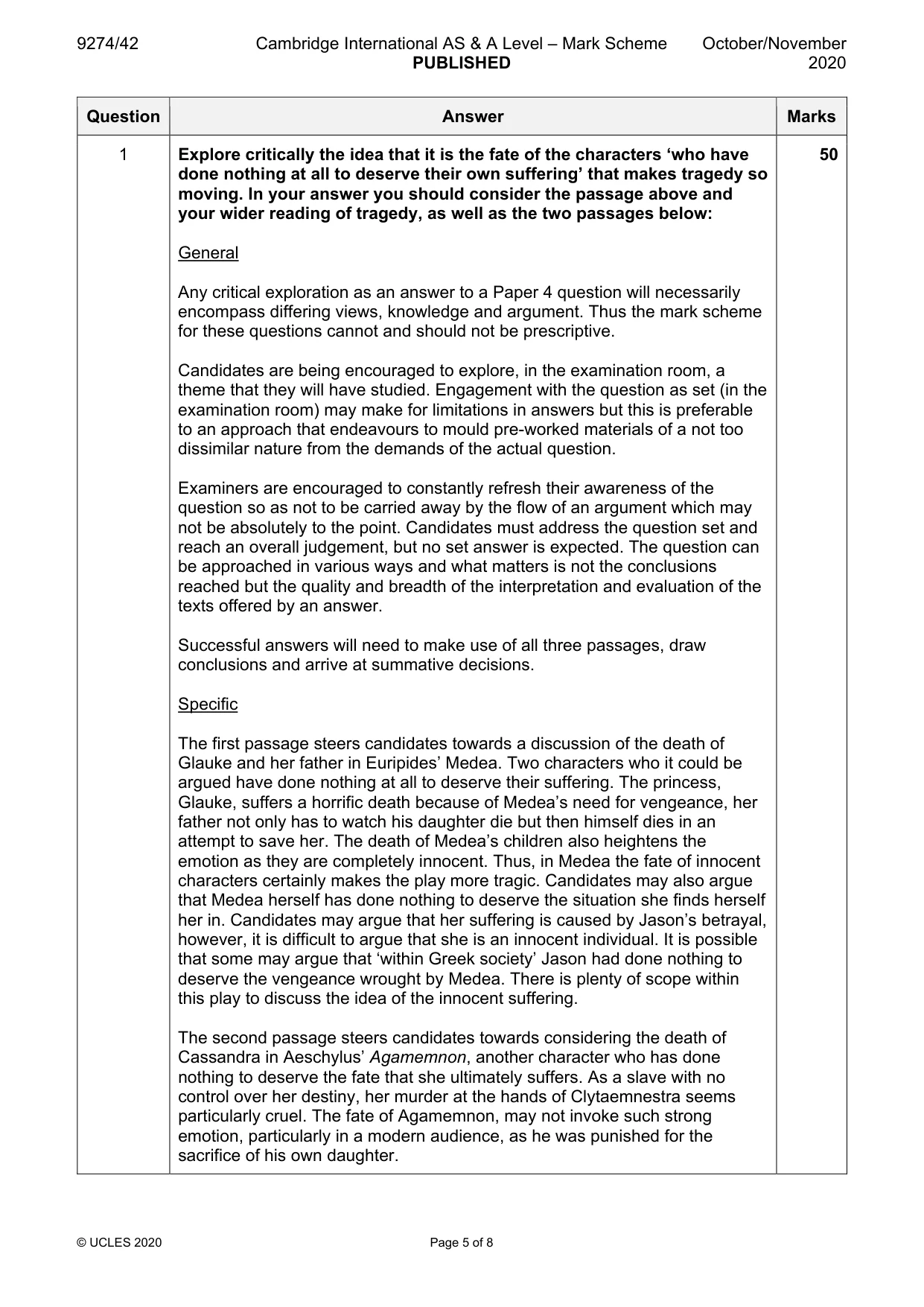
9274/42 Cambridge International AS & A Level – Mark Scheme PUBLISHED October/November 2020 © UCLES 2020 Page 5 of 8 Question Answer Marks 1 Explore critically the idea that it is the fate of the characters ‘who have done nothing at all to deserve their own suffering’ that makes tragedy so moving. In your answer you should consider the passage above and your wider reading of tragedy, as well as the two passages below: General Any critical exploration as an answer to a Paper 4 question will necessarily encompass differing views, knowledge and argument. Thus the mark scheme for these questions cannot and should not be prescriptive. Candidates are being encouraged to explore, in the examination room, a theme that they will have studied. Engagement with the question as set (in the examination room) may make for limitations in answers but this is preferable to an approach that endeavours to mould pre-worked materials of a not too dissimilar nature from the demands of the actual question. Examiners are encouraged to constantly refresh their awareness of the question so as not to be carried away by the flow of an argument which may not be absolutely to the point. Candidates must address the question set and reach an overall judgement, but no set answer is expected. The question can be approached in various ways and what matters is not the conclusions reached but the quality and breadth of the interpretation and evaluation of the texts offered by an answer. Successful answers will need to make use of all three passages, draw conclusions and arrive at summative decisions. Specific The first passage steers candidates towards a discussion of the death of Glauke and her father in Euripides’ Medea. Two characters who it could be argued have done nothing at all to deserve their suffering. The princess, Glauke, suffers a horrific death because of Medea’s need for vengeance, her father not only has to watch his daughter die but then himself dies in an attempt to save her. The death of Medea’s children also heightens the emotion as they are completely innocent. Thus, in Medea the fate of innocent characters certainly makes the play more tragic. Candidates may also argue that Medea herself has done nothing to deserve the situation she finds herself her in. Candidates may argue that her suffering is caused by Jason’s betrayal, however, it is difficult to argue that she is an innocent individual. It is possible that some may argue that ‘within Greek society’ Jason had done nothing to deserve the vengeance wrought by Medea. There is plenty of scope within this play to discuss the idea of the innocent suffering. The second passage steers candidates towards considering the death of Cassandra in Aeschylus’ Agamemnon, another character who has done nothing to deserve the fate that she ultimately suffers. As a slave with no control over her destiny, her murder at the hands of Clytaemnestra seems particularly cruel. The fate of Agamemnon, may not invoke such strong emotion, particularly in a modern audience, as he was punished for the sacrifice of his own daughter. 50
Mark scheme, page 6
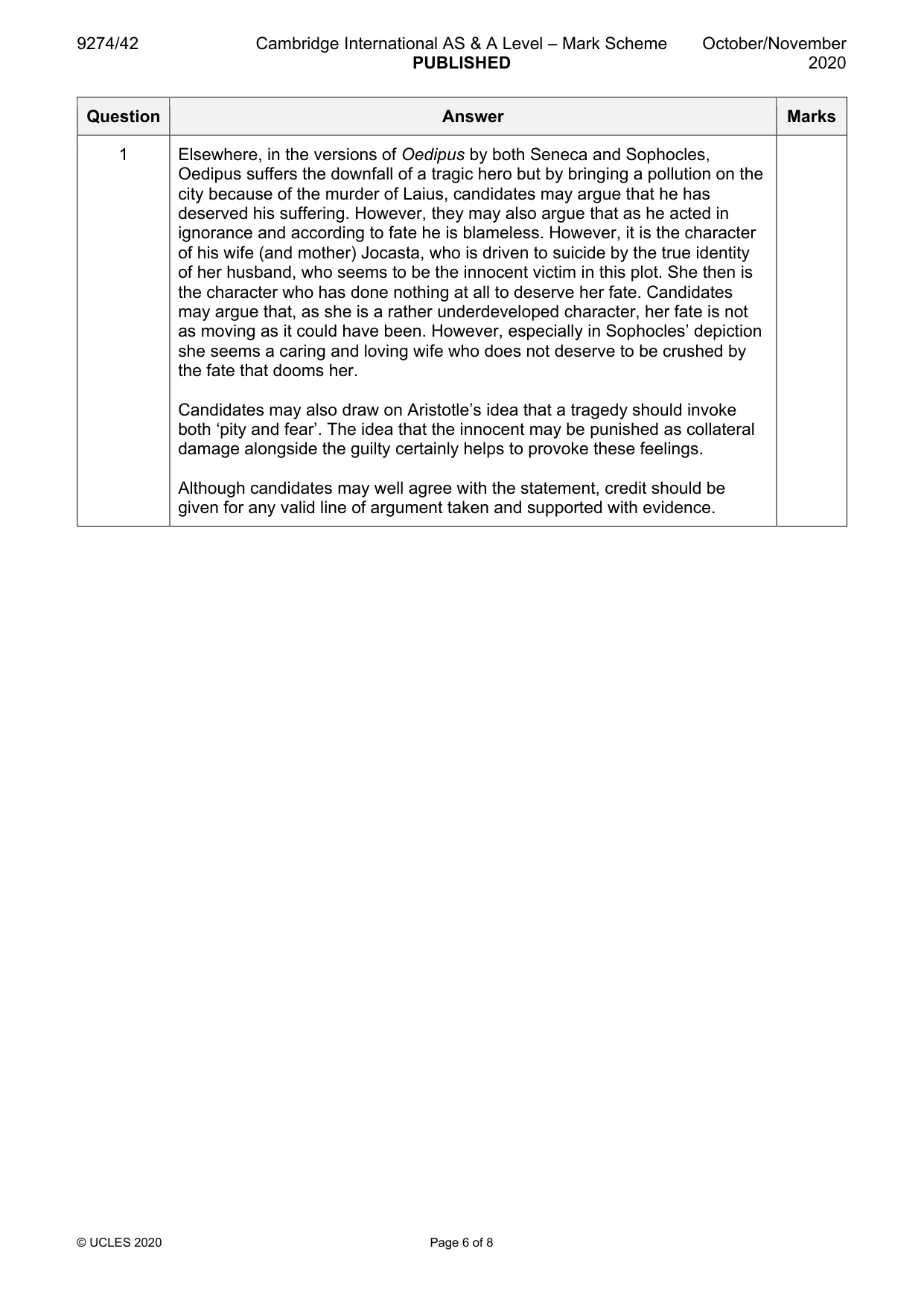
9274/42 Cambridge International AS & A Level – Mark Scheme PUBLISHED October/November 2020 © UCLES 2020 Page 6 of 8 Question Answer Marks 1 Elsewhere, in the versions of Oedipus by both Seneca and Sophocles, Oedipus suffers the downfall of a tragic hero but by bringing a pollution on the city because of the murder of Laius, candidates may argue that he has deserved his suffering. However, they may also argue that as he acted in ignorance and according to fate he is blameless. However, it is the character of his wife (and mother) Jocasta, who is driven to suicide by the true identity of her husband, who seems to be the innocent victim in this plot. She then is the character who has done nothing at all to deserve her fate. Candidates may argue that, as she is a rather underdeveloped character, her fate is not as moving as it could have been. However, especially in Sophocles’ depiction she seems a caring and loving wife who does not deserve to be crushed by the fate that dooms her. Candidates may also draw on Aristotle’s idea that a tragedy should invoke both ‘pity and fear’. The idea that the innocent may be punished as collateral damage alongside the guilty certainly helps to provoke these feelings. Although candidates may well agree with the statement, credit should be given for any valid line of argument taken and supported with evidence.
Mark scheme, page 7
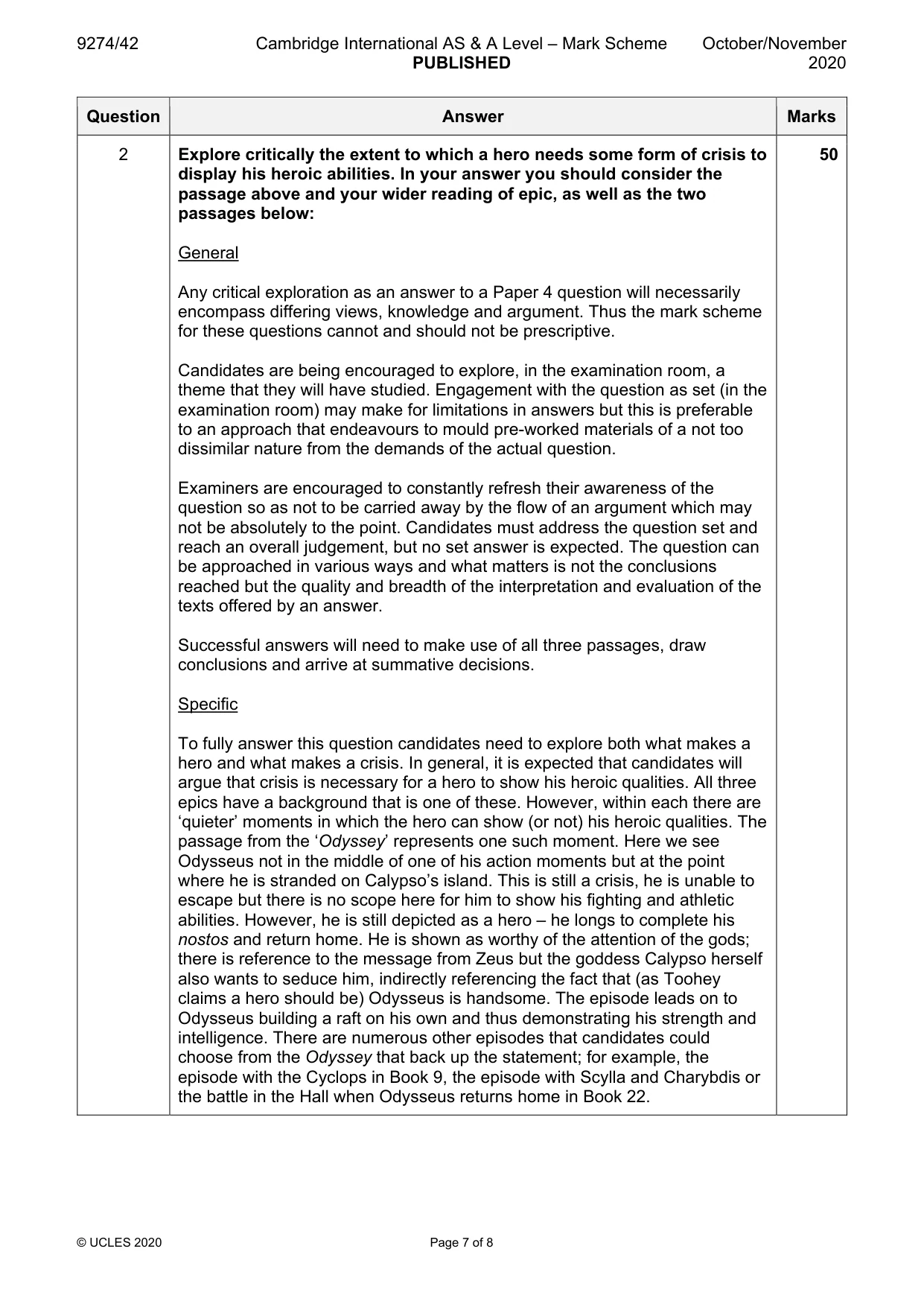
9274/42 Cambridge International AS & A Level – Mark Scheme PUBLISHED October/November 2020 © UCLES 2020 Page 7 of 8 Question Answer Marks 2 Explore critically the extent to which a hero needs some form of crisis to display his heroic abilities. In your answer you should consider the passage above and your wider reading of epic, as well as the two passages below: General Any critical exploration as an answer to a Paper 4 question will necessarily encompass differing views, knowledge and argument. Thus the mark scheme for these questions cannot and should not be prescriptive. Candidates are being encouraged to explore, in the examination room, a theme that they will have studied. Engagement with the question as set (in the examination room) may make for limitations in answers but this is preferable to an approach that endeavours to mould pre-worked materials of a not too dissimilar nature from the demands of the actual question. Examiners are encouraged to constantly refresh their awareness of the question so as not to be carried away by the flow of an argument which may not be absolutely to the point. Candidates must address the question set and reach an overall judgement, but no set answer is expected. The question can be approached in various ways and what matters is not the conclusions reached but the quality and breadth of the interpretation and evaluation of the texts offered by an answer. Successful answers will need to make use of all three passages, draw conclusions and arrive at summative decisions. Specific To fully answer this question candidates need to explore both what makes a hero and what makes a crisis. In general, it is expected that candidates will argue that crisis is necessary for a hero to show his heroic qualities. All three epics have a background that is one of these. However, within each there are ‘quieter’ moments in which the hero can show (or not) his heroic qualities. The passage from the ‘Odyssey’ represents one such moment. Here we see Odysseus not in the middle of one of his action moments but at the point where he is stranded on Calypso’s island. This is still a crisis, he is unable to escape but there is no scope here for him to show his fighting and athletic abilities. However, he is still depicted as a hero – he longs to complete his nostos and return home. He is shown as worthy of the attention of the gods; there is reference to the message from Zeus but the goddess Calypso herself also wants to seduce him, indirectly referencing the fact that (as Toohey claims a hero should be) Odysseus is handsome. The episode leads on to Odysseus building a raft on his own and thus demonstrating his strength and intelligence. There are numerous other episodes that candidates could choose from the Odyssey that back up the statement; for example, the episode with the Cyclops in Book 9, the episode with Scylla and Charybdis or the battle in the Hall when Odysseus returns home in Book 22. 50
Mark scheme, page 8
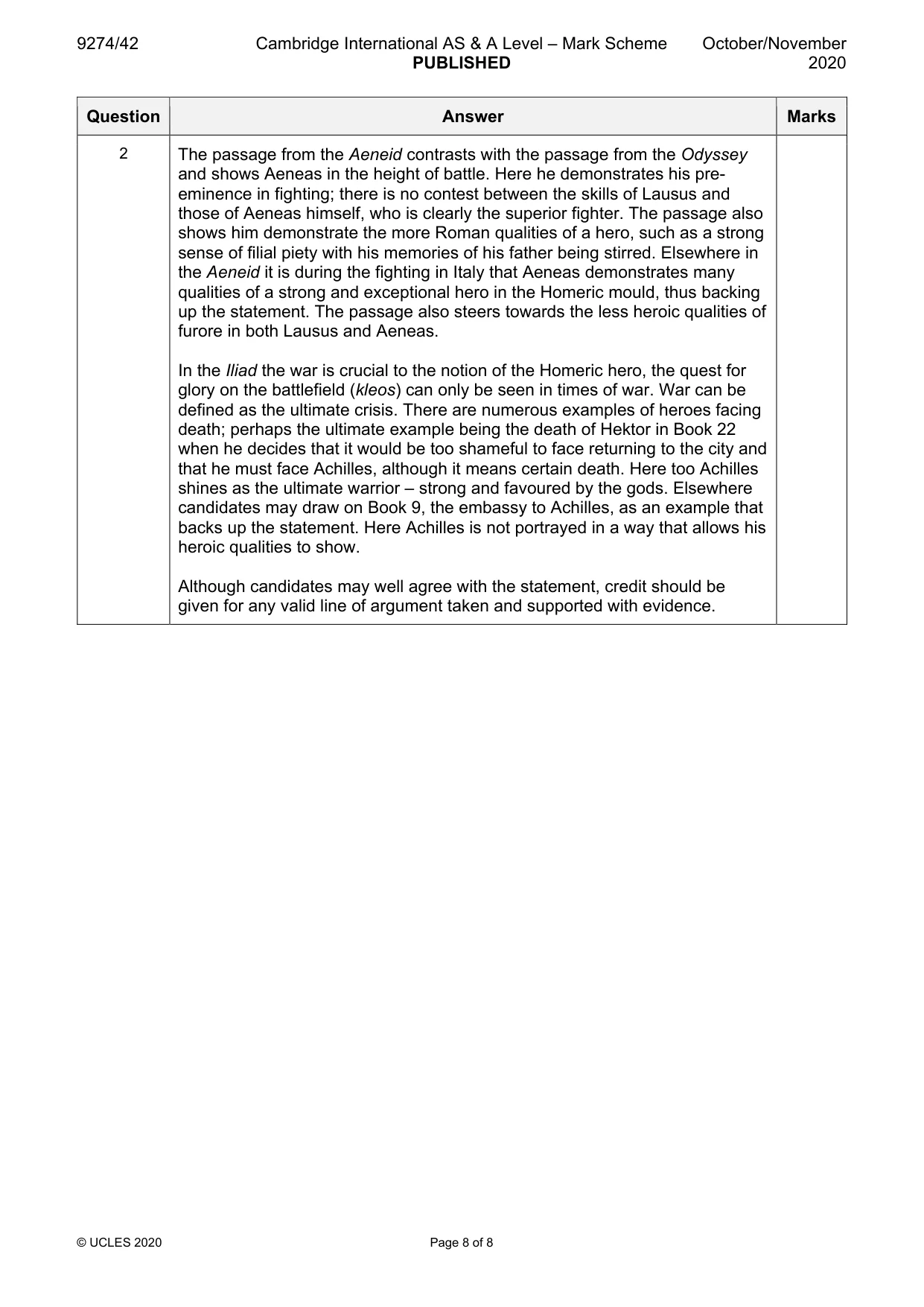
9274/42 Cambridge International AS & A Level – Mark Scheme PUBLISHED October/November 2020 © UCLES 2020 Page 8 of 8 Question Answer Marks 2 The passage from the Aeneid contrasts with the passage from the Odyssey and shows Aeneas in the height of battle. Here he demonstrates his pre- eminence in fighting; there is no contest between the skills of Lausus and those of Aeneas himself, who is clearly the superior fighter. The passage also shows him demonstrate the more Roman qualities of a hero, such as a strong sense of filial piety with his memories of his father being stirred. Elsewhere in the Aeneid it is during the fighting in Italy that Aeneas demonstrates many qualities of a strong and exceptional hero in the Homeric mould, thus backing up the statement. The passage also steers towards the less heroic qualities of furore in both Lausus and Aeneas. In the Iliad the war is crucial to the notion of the Homeric hero, the quest for glory on the battlefield (kleos) can only be seen in times of war. War can be defined as the ultimate crisis. There are numerous examples of heroes facing death; perhaps the ultimate example being the death of Hektor in Book 22 when he decides that it would be too shameful to face returning to the city and that he must face Achilles, although it means certain death. Here too Achilles shines as the ultimate warrior – strong and favoured by the gods. Elsewhere candidates may draw on Book 9, the embassy to Achilles, as an example that backs up the statement. Here Achilles is not portrayed in a way that allows his heroic qualities to show. Although candidates may well agree with the statement, credit should be given for any valid line of argument taken and supported with evidence.
What you needed in this session
Cambridge’s own grade thresholds for 2020 Oct/Nov, Paper 4 · Variant 2. A higher threshold means an easier paper — the bar moves with how the cohort did.