Cambridge A Level Classical Studies 9274 — 2020 Oct/Nov Paper 1 · Variant 3
9274/13/O/N/20 · 50 marks · ≈56 min
The question paper and its mark scheme, free to read here and free to download. This is Cambridge’s own paper, exactly as it was sat.
Question paper12 pages
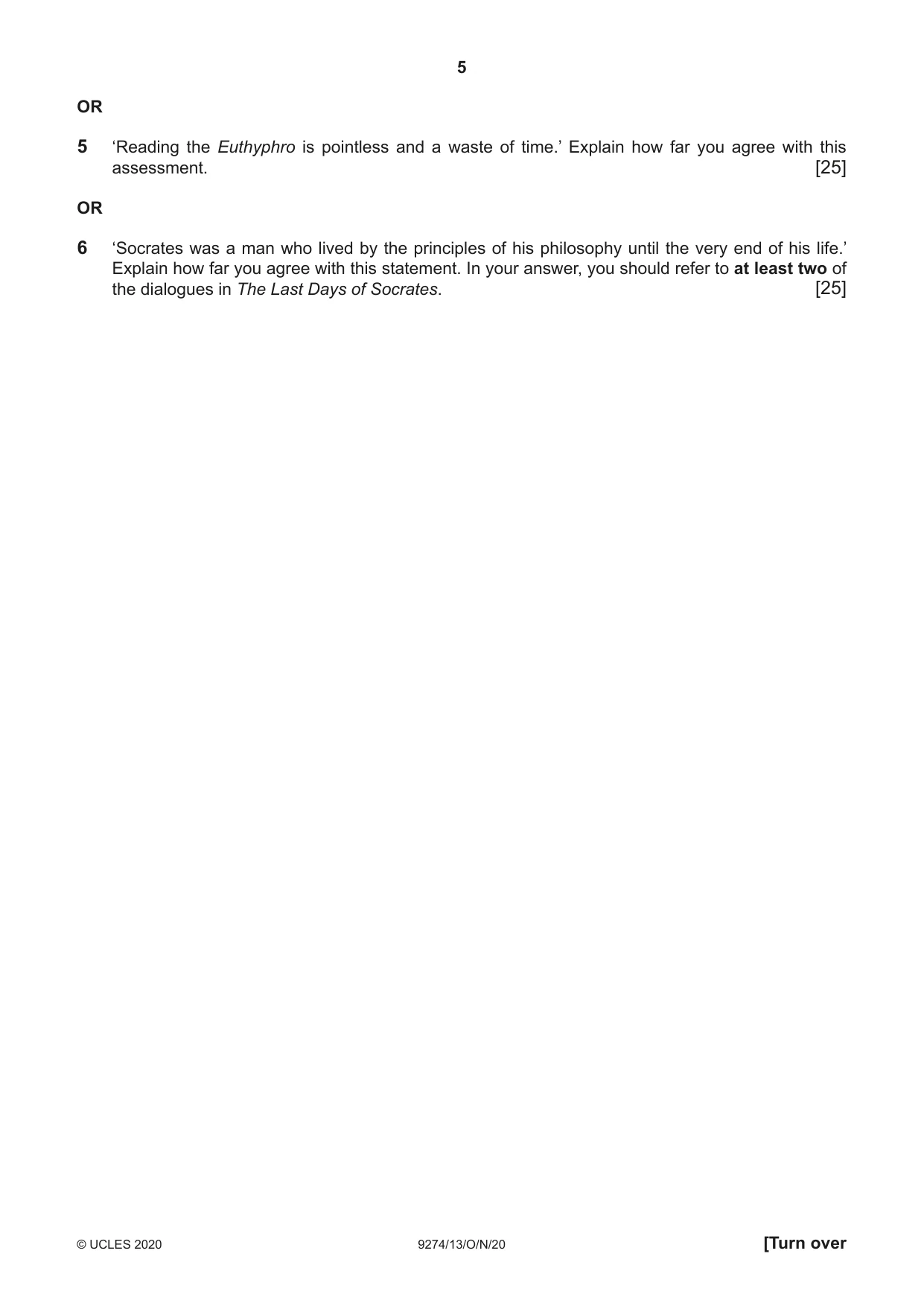
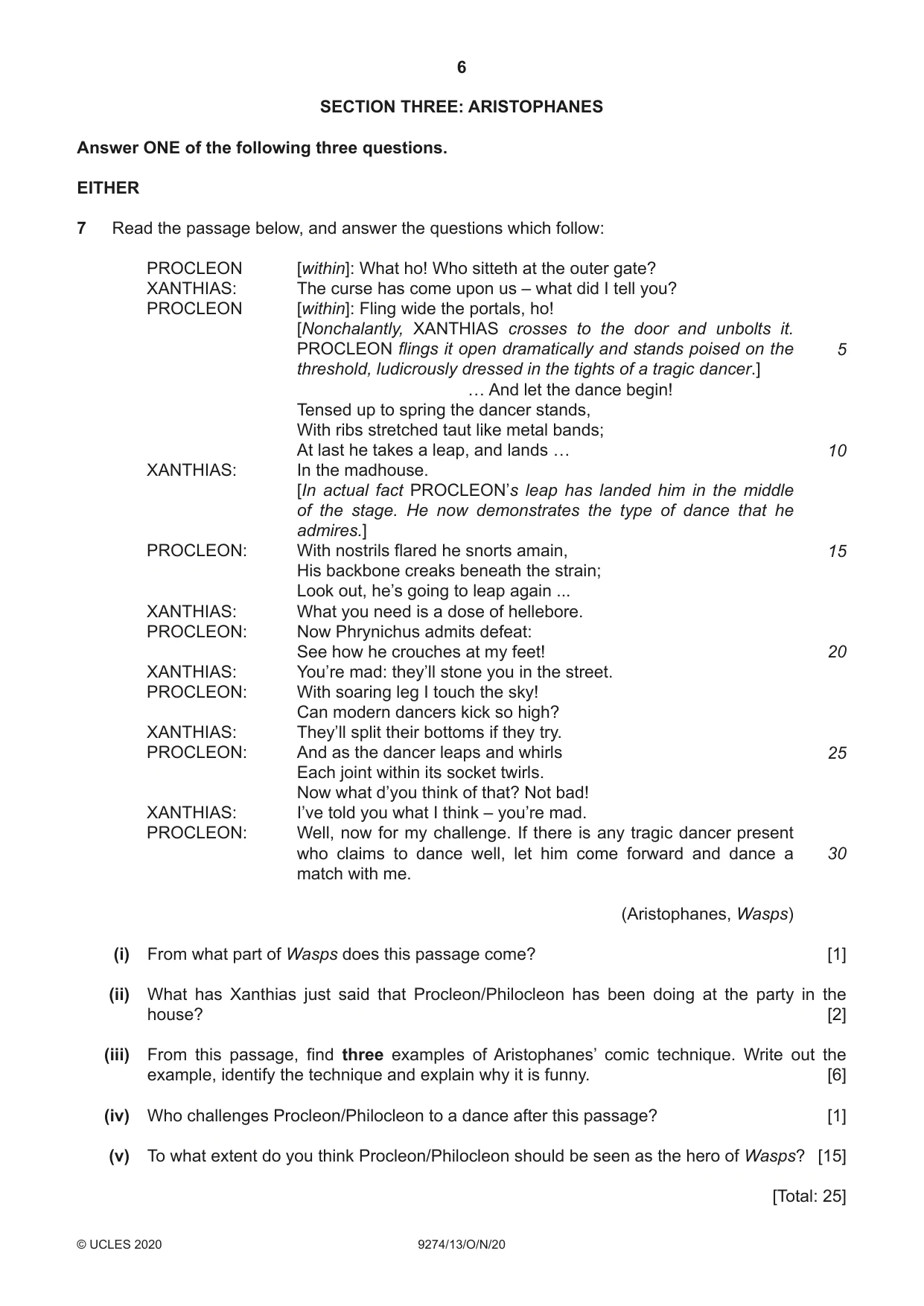



Mark scheme18 pages
Answers below. Sit the paper first if you are practising.
Paper as text
Question paper, page 1
Cambridge International AS & A Level * 2 6 6 2 4 3 0 8 5 3 * DC (PQ/SG) 188111/4 © UCLES 2020 [Turn over This document has 12 pages. Blank pages are indicated. CLASSICAL STUDIES 9274/13 Paper 1 Greek Civilisation October/November 2020 1 hour 30 minutes You must answer on the enclosed answer booklet. You will need: Answer booklet (enclosed) INSTRUCTIONS ● Answer two questions in total: Answer one question from two different sections. ● Follow the instructions on the front cover of the answer booklet. If you need additional answer paper, ask the invigilator for a continuation booklet. INFORMATION ● The total mark for this paper is 50. ● Each question is worth 25 marks.
Question paper, page 2
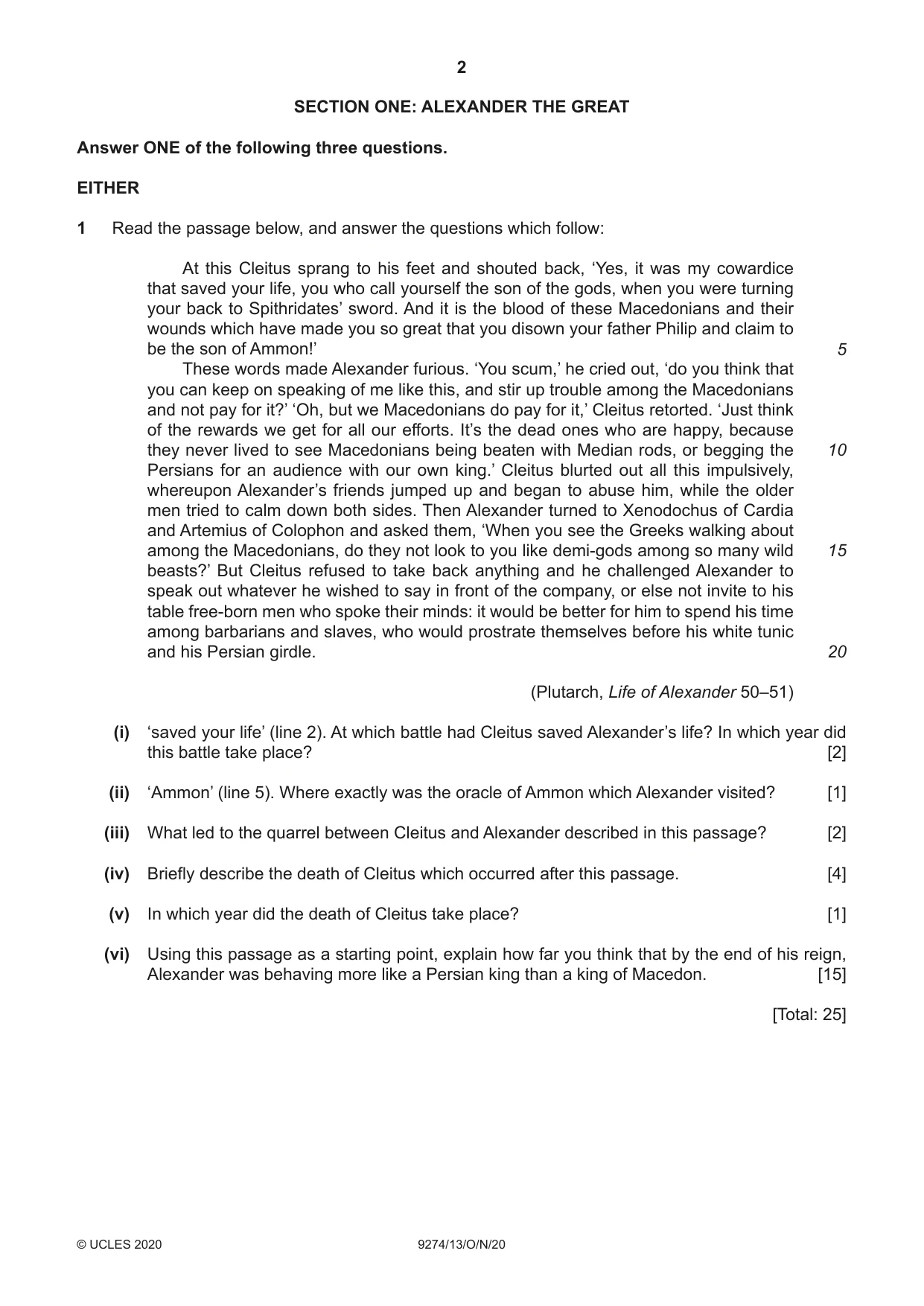
2 9274/13/O/N/20 © UCLES 2020 SECTION ONE: ALEXANDER THE GREAT Answer ONE of the following three questions. EITHER 1 Read the passage below, and answer the questions which follow: At this Cleitus sprang to his feet and shouted back, ‘Yes, it was my cowardice that saved your life, you who call yourself the son of the gods, when you were turning your back to Spithridates’ sword. And it is the blood of these Macedonians and their wounds which have made you so great that you disown your father Philip and claim to be the son of Ammon!’ These words made Alexander furious. ‘You scum,’ he cried out, ‘do you think that you can keep on speaking of me like this, and stir up trouble among the Macedonians and not pay for it?’ ‘Oh, but we Macedonians do pay for it,’ Cleitus retorted. ‘Just think of the rewards we get for all our efforts. It’s the dead ones who are happy, because they never lived to see Macedonians being beaten with Median rods, or begging the Persians for an audience with our own king.’ Cleitus blurted out all this impulsively, whereupon Alexander’s friends jumped up and began to abuse him, while the older men tried to calm down both sides. Then Alexander turned to Xenodochus of Cardia and Artemius of Colophon and asked them, ‘When you see the Greeks walking about among the Macedonians, do they not look to you like demi-gods among so many wild beasts?’ But Cleitus refused to take back anything and he challenged Alexander to speak out whatever he wished to say in front of the company, or else not invite to his table free-born men who spoke their minds: it would be better for him to spend his time among barbarians and slaves, who would prostrate themselves before his white tunic and his Persian girdle. (Plutarch, Life of Alexander 50–51) (i) ‘saved your life’ (line 2). At which battle had Cleitus saved Alexander’s life? In which year did this battle take place? [2] (ii) ‘Ammon’ (line 5). Where exactly was the oracle of Ammon which Alexander visited? [1] (iii) What led to the quarrel between Cleitus and Alexander described in this passage? [2] (iv) Briefly describe the death of Cleitus which occurred after this passage. [4] (v) In which year did the death of Cleitus take place? [1] (vi) Using this passage as a starting point, explain how far you think that by the end of his reign, Alexander was behaving more like a Persian king than a king of Macedon. [15] [Total: 25] 5 10 15 20
Question paper, page 3
3 9274/13/O/N/20 © UCLES 2020 [Turn over OR 2 ‘No one was more important in Alexander’s life than Hephaestion.’ Explain how far you agree with this opinion. [25] OR 3 ‘Nothing more than a successful military commander.’ Explain how far you agree with this assessment of Alexander the Great’s career. [25]
Question paper, page 4
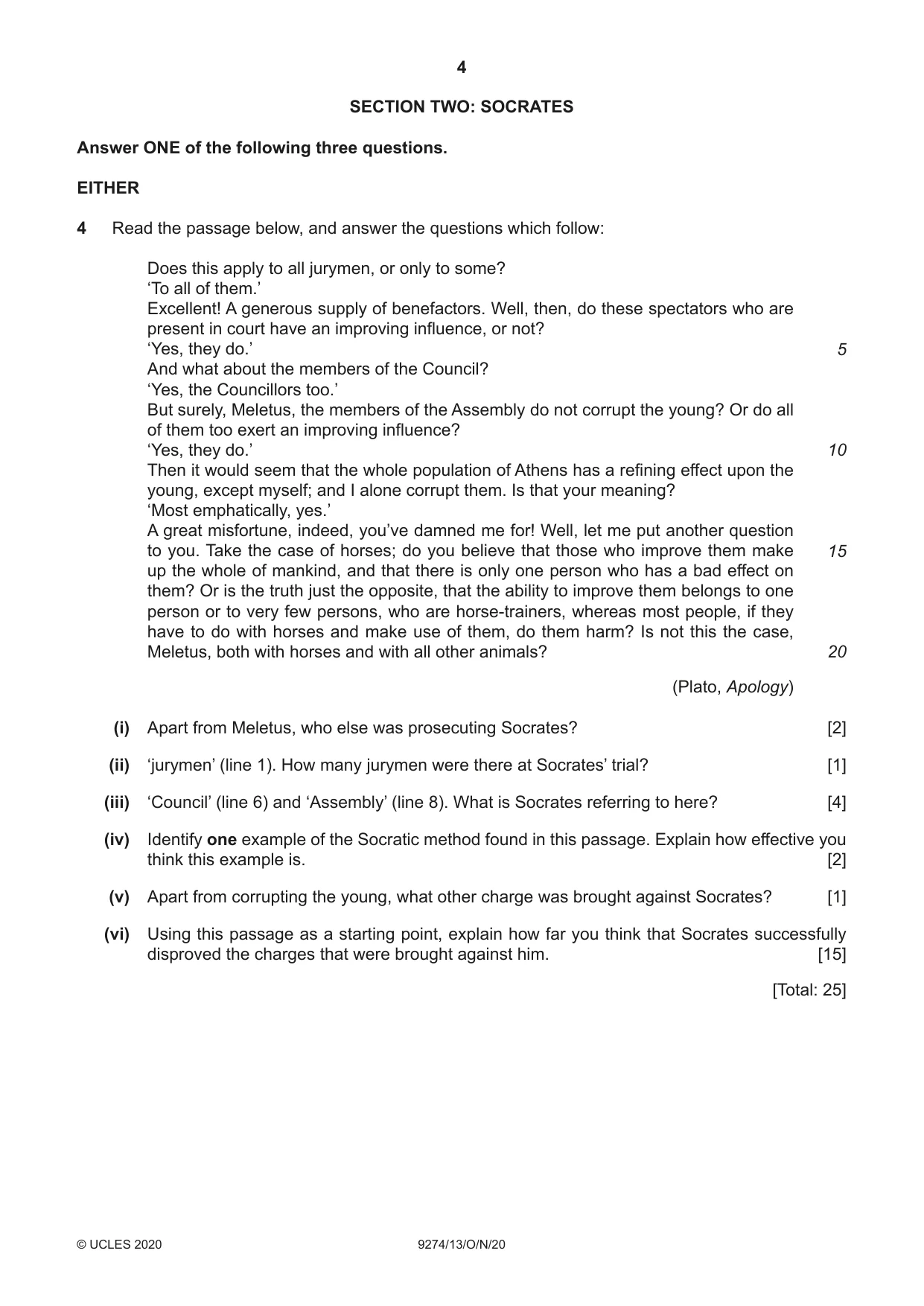
4 9274/13/O/N/20 © UCLES 2020 SECTION TWO: SOCRATES Answer ONE of the following three questions. EITHER 4 Read the passage below, and answer the questions which follow: Does this apply to all jurymen, or only to some? ‘To all of them.’ Excellent! A generous supply of benefactors. Well, then, do these spectators who are present in court have an improving influence, or not? ‘Yes, they do.’ And what about the members of the Council? ‘Yes, the Councillors too.’ But surely, Meletus, the members of the Assembly do not corrupt the young? Or do all of them too exert an improving influence? ‘Yes, they do.’ Then it would seem that the whole population of Athens has a refining effect upon the young, except myself; and I alone corrupt them. Is that your meaning? ‘Most emphatically, yes.’ A great misfortune, indeed, you’ve damned me for! Well, let me put another question to you. Take the case of horses; do you believe that those who improve them make up the whole of mankind, and that there is only one person who has a bad effect on them? Or is the truth just the opposite, that the ability to improve them belongs to one person or to very few persons, who are horse-trainers, whereas most people, if they have to do with horses and make use of them, do them harm? Is not this the case, Meletus, both with horses and with all other animals? (Plato, Apology) (i) Apart from Meletus, who else was prosecuting Socrates? [2] (ii) ‘jurymen’ (line 1). How many jurymen were there at Socrates’ trial? [1] (iii) ‘Council’ (line 6) and ‘Assembly’ (line 8). What is Socrates referring to here? [4] (iv) Identify one example of the Socratic method found in this passage. Explain how effective you think this example is. [2] (v) Apart from corrupting the young, what other charge was brought against Socrates? [1] (vi) Using this passage as a starting point, explain how far you think that Socrates successfully disproved the charges that were brought against him. [15] [Total: 25] 5 10 15 20
Question paper, page 5
5 9274/13/O/N/20 © UCLES 2020 [Turn over OR 5 ‘Reading the Euthyphro is pointless and a waste of time.’ Explain how far you agree with this assessment. [25] OR 6 ‘Socrates was a man who lived by the principles of his philosophy until the very end of his life.’ Explain how far you agree with this statement. In your answer, you should refer to at least two of the dialogues in The Last Days of Socrates. [25]
Question paper, page 6
6 9274/13/O/N/20 © UCLES 2020 SECTION THREE: ARISTOPHANES Answer ONE of the following three questions. EITHER 7 Read the passage below, and answer the questions which follow: PROCLEON [within]: What ho! Who sitteth at the outer gate? XANTHIAS: The curse has come upon us – what did I tell you? PROCLEON [within]: Fling wide the portals, ho! [Nonchalantly, XANTHIAS crosses to the door and unbolts it. PROCLEON flings it open dramatically and stands poised on the threshold, ludicrously dressed in the tights of a tragic dancer.] … And let the dance begin! Tensed up to spring the dancer stands, With ribs stretched taut like metal bands; At last he takes a leap, and lands … XANTHIAS: In the madhouse. [In actual fact PROCLEON’s leap has landed him in the middle of the stage. He now demonstrates the type of dance that he admires.] PROCLEON: With nostrils flared he snorts amain, His backbone creaks beneath the strain; Look out, he’s going to leap again ... XANTHIAS: What you need is a dose of hellebore. PROCLEON: Now Phrynichus admits defeat: See how he crouches at my feet! XANTHIAS: You’re mad: they’ll stone you in the street. PROCLEON: With soaring leg I touch the sky! Can modern dancers kick so high? XANTHIAS: They’ll split their bottoms if they try. PROCLEON: And as the dancer leaps and whirls Each joint within its socket twirls. Now what d’you think of that? Not bad! XANTHIAS: I’ve told you what I think – you’re mad. PROCLEON: Well, now for my challenge. If there is any tragic dancer present who claims to dance well, let him come forward and dance a match with me. (Aristophanes, Wasps) (i) From what part of Wasps does this passage come? [1] (ii) What has Xanthias just said that Procleon/Philocleon has been doing at the party in the house? [2] (iii) From this passage, find three examples of Aristophanes’ comic technique. Write out the example, identify the technique and explain why it is funny. [6] (iv) Who challenges Procleon/Philocleon to a dance after this passage? [1] (v) To what extent do you think Procleon/Philocleon should be seen as the hero of Wasps? [15] [Total: 25] 5 10 15 20 25 30
Question paper, page 7
7 9274/13/O/N/20 © UCLES 2020 OR 8 Discuss how far the use of parody adds to the success of Frogs. [25] OR 9 In which play is the Chorus used more effectively, Wasps or Frogs? In your answer, you should make reference to both plays. [25] [Turn over
Question paper, page 8
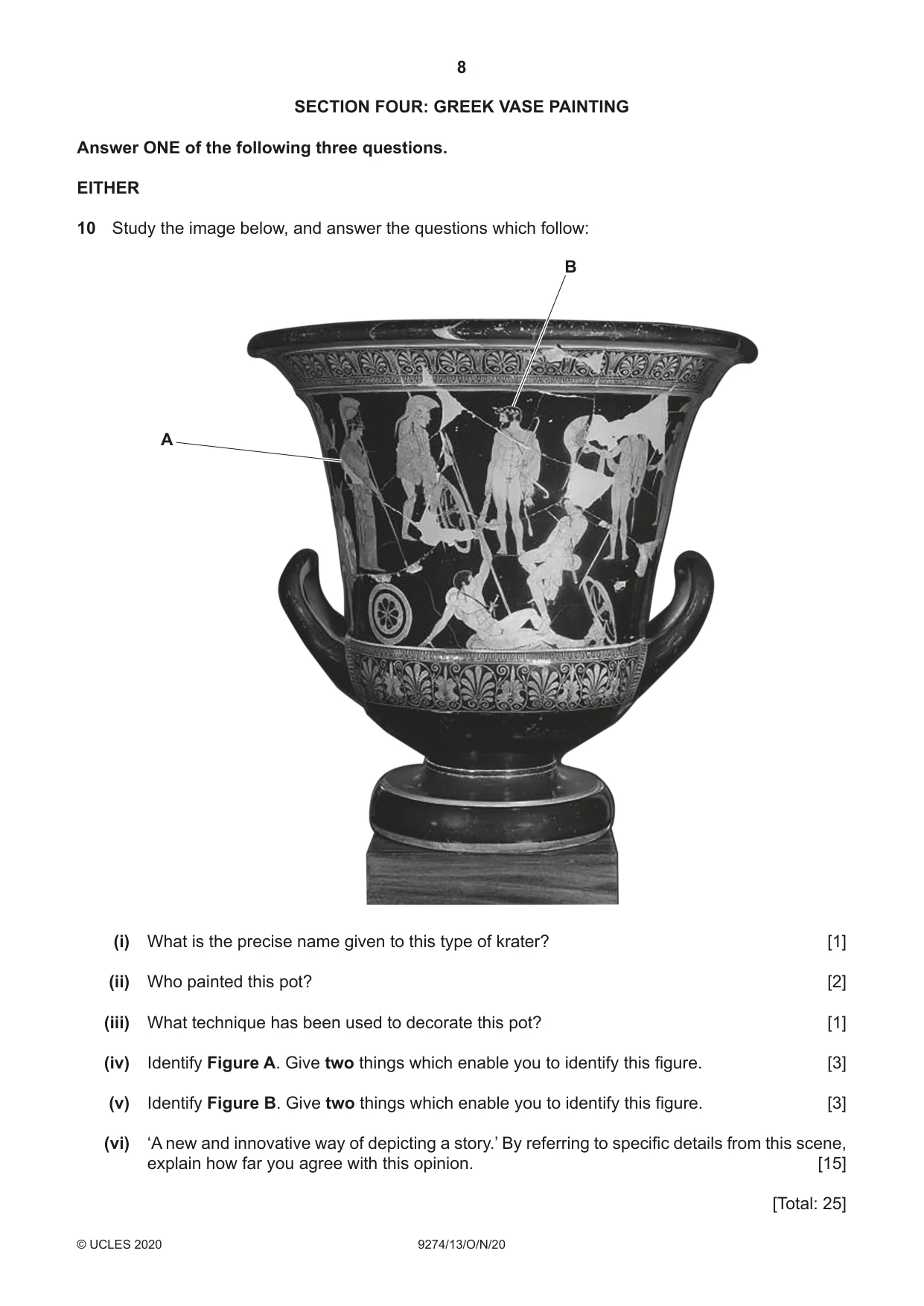
8 9274/13/O/N/20 © UCLES 2020 SECTION FOUR: GREEK VASE PAINTING Answer ONE of the following three questions. EITHER 10 Study the image below, and answer the questions which follow: B A (i) What is the precise name given to this type of krater? [1] (ii) Who painted this pot? [2] (iii) What technique has been used to decorate this pot? [1] (iv) Identify Figure A. Give two things which enable you to identify this figure. [3] (v) Identify Figure B. Give two things which enable you to identify this figure. [3] (vi) ‘A new and innovative way of depicting a story.’ By referring to specific details from this scene, explain how far you agree with this opinion. [15] [Total: 25]
Question paper, page 9
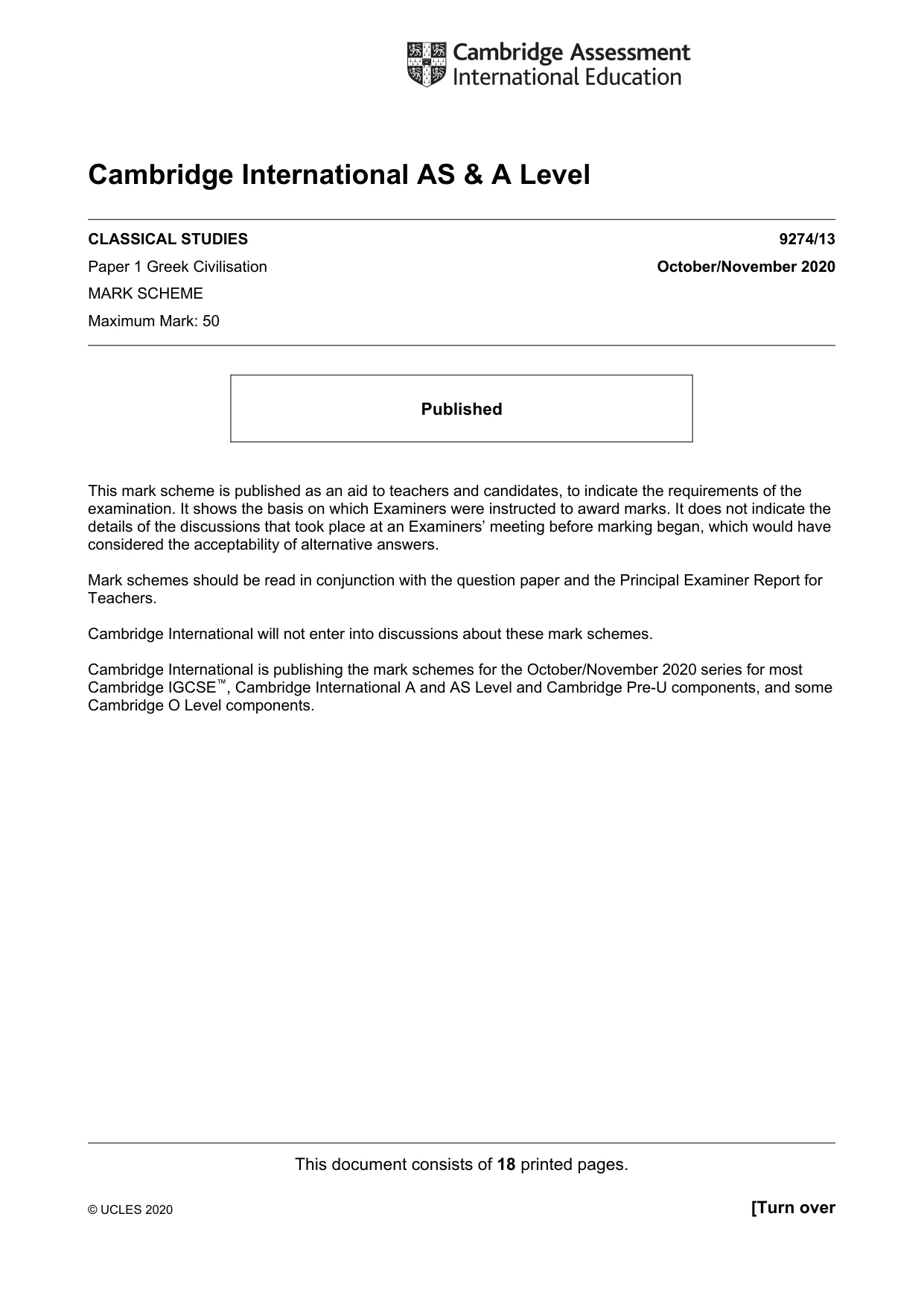
9 9274/13/O/N/20 © UCLES 2020 OR 11 ‘Black-figure artists were completely incapable of depicting emotion in their work.’ How far do you agree with this opinion? In your answer, you should refer to specific examples from the work of at least three painters. [25] OR 12 ‘An innovative and skilful painter.’ To which red-figure painter do you think that this description best applies? In your answer, you should refer to specific examples from the work of at least three painters. [25]
Question paper, page 10
10 9274/13/O/N/20 © UCLES 2020 BLANK PAGE
Question paper, page 11
11 9274/13/O/N/20 © UCLES 2020 BLANK PAGE
Question paper, page 12
12 9274/13/O/N/20 © UCLES 2020 BLANK PAGE Permission to reproduce items where third-party owned material protected by copyright is included has been sought and cleared where possible. Every reasonable effort has been made by the publisher (UCLES) to trace copyright holders, but if any items requiring clearance have unwittingly been included, the publisher will be pleased to make amends at the earliest possible opportunity. To avoid the issue of disclosure of answer-related information to candidates, all copyright acknowledgements are reproduced online in the Cambridge Assessment International Education Copyright Acknowledgements Booklet. This is produced for each series of examinations and is freely available to download at www.cambridgeinternational.org after the live examination series. Cambridge Assessment International Education is part of the Cambridge Assessment Group. Cambridge Assessment is the brand name of the University of Cambridge Local Examinations Syndicate (UCLES), which itself is a department of the University of Cambridge.
Mark scheme, page 1
This document consists of 18 printed pages. © UCLES 2020 [Turn over Cambridge International AS & A Level CLASSICAL STUDIES 9274/13 Paper 1 Greek Civilisation October/November 2020 MARK SCHEME Maximum Mark: 50 Published This mark scheme is published as an aid to teachers and candidates, to indicate the requirements of the examination. It shows the basis on which Examiners were instructed to award marks. It does not indicate the details of the discussions that took place at an Examiners’ meeting before marking began, which would have considered the acceptability of alternative answers. Mark schemes should be read in conjunction with the question paper and the Principal Examiner Report for Teachers. Cambridge International will not enter into discussions about these mark schemes. Cambridge International is publishing the mark schemes for the October/November 2020 series for most Cambridge IGCSE™, Cambridge International A and AS Level and Cambridge Pre-U components, and some Cambridge O Level components.
Mark scheme, page 2
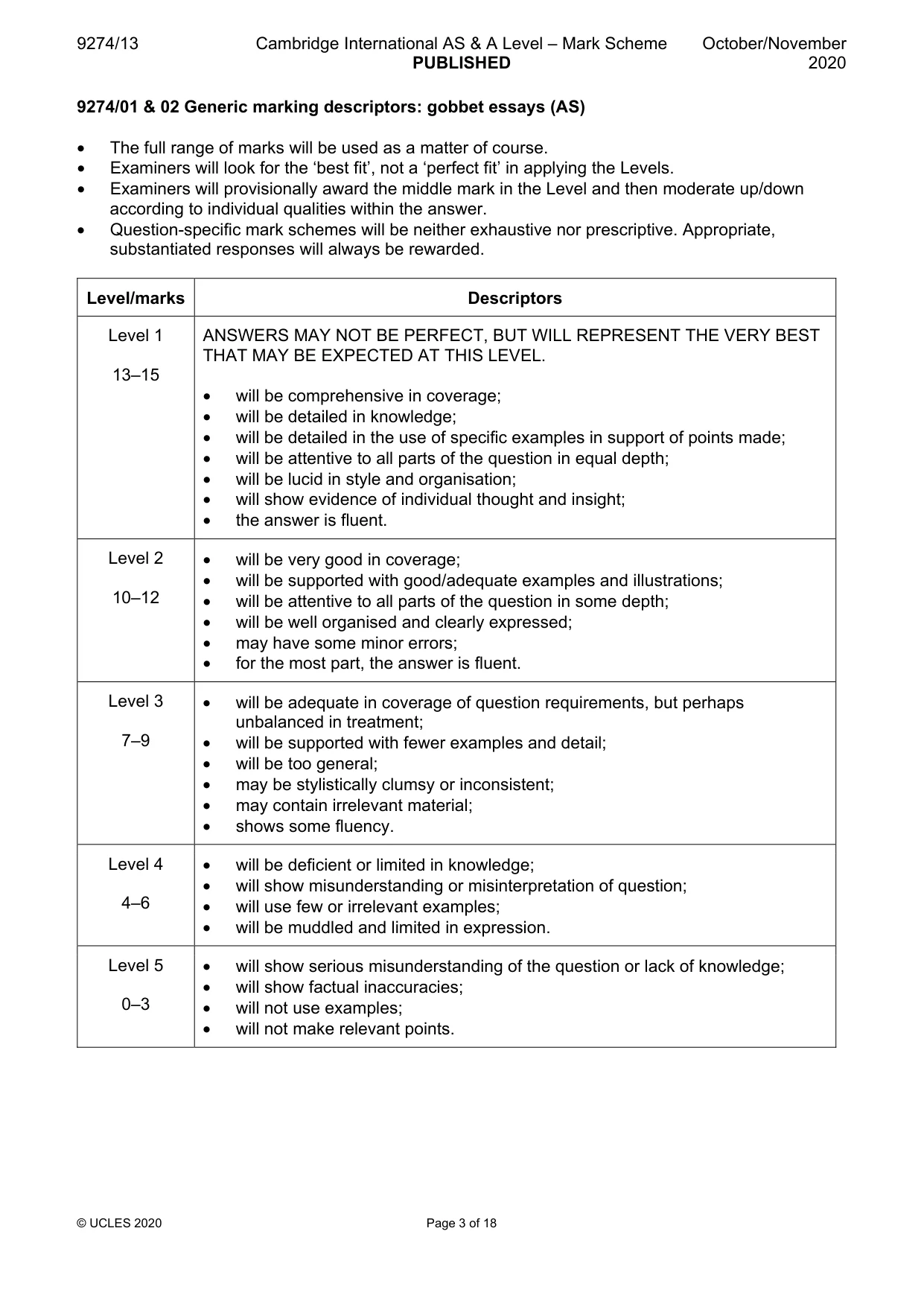
9274/13 Cambridge International AS & A Level – Mark Scheme PUBLISHED October/November 2020 © UCLES 2020 Page 2 of 18 Generic Marking Principles These general marking principles must be applied by all examiners when marking candidate answers. They should be applied alongside the specific content of the mark scheme or generic level descriptors for a question. Each question paper and mark scheme will also comply with these marking principles. GENERIC MARKING PRINCIPLE 1: Marks must be awarded in line with: • the specific content of the mark scheme or the generic level descriptors for the question • the specific skills defined in the mark scheme or in the generic level descriptors for the question • the standard of response required by a candidate as exemplified by the standardisation scripts. GENERIC MARKING PRINCIPLE 2: Marks awarded are always whole marks (not half marks, or other fractions). GENERIC MARKING PRINCIPLE 3: Marks must be awarded positively: • marks are awarded for correct/valid answers, as defined in the mark scheme. However, credit is given for valid answers which go beyond the scope of the syllabus and mark scheme, referring to your Team Leader as appropriate • marks are awarded when candidates clearly demonstrate what they know and can do • marks are not deducted for errors • marks are not deducted for omissions • answers should only be judged on the quality of spelling, punctuation and grammar when these features are specifically assessed by the question as indicated by the mark scheme. The meaning, however, should be unambiguous. GENERIC MARKING PRINCIPLE 4: Rules must be applied consistently, e.g. in situations where candidates have not followed instructions or in the application of generic level descriptors. GENERIC MARKING PRINCIPLE 5: Marks should be awarded using the full range of marks defined in the mark scheme for the question (however; the use of the full mark range may be limited according to the quality of the candidate responses seen). GENERIC MARKING PRINCIPLE 6: Marks awarded are based solely on the requirements as defined in the mark scheme. Marks should not be awarded with grade thresholds or grade descriptors in mind.
Mark scheme, page 3
9274/13 Cambridge International AS & A Level – Mark Scheme PUBLISHED October/November 2020 © UCLES 2020 Page 3 of 18 9274/01 & 02 Generic marking descriptors: gobbet essays (AS) • The full range of marks will be used as a matter of course. • Examiners will look for the ‘best fit’, not a ‘perfect fit’ in applying the Levels. • Examiners will provisionally award the middle mark in the Level and then moderate up/down according to individual qualities within the answer. • Question-specific mark schemes will be neither exhaustive nor prescriptive. Appropriate, substantiated responses will always be rewarded. Level/marks Descriptors Level 1 13–15 ANSWERS MAY NOT BE PERFECT, BUT WILL REPRESENT THE VERY BEST THAT MAY BE EXPECTED AT THIS LEVEL. • will be comprehensive in coverage; • will be detailed in knowledge; • will be detailed in the use of specific examples in support of points made; • will be attentive to all parts of the question in equal depth; • will be lucid in style and organisation; • will show evidence of individual thought and insight; • the answer is fluent. Level 2 10–12 • will be very good in coverage; • will be supported with good/adequate examples and illustrations; • will be attentive to all parts of the question in some depth; • will be well organised and clearly expressed; • may have some minor errors; • for the most part, the answer is fluent. Level 3 7–9 • will be adequate in coverage of question requirements, but perhaps unbalanced in treatment; • will be supported with fewer examples and detail; • will be too general; • may be stylistically clumsy or inconsistent; • may contain irrelevant material; • shows some fluency. Level 4 4–6 • will be deficient or limited in knowledge; • will show misunderstanding or misinterpretation of question; • will use few or irrelevant examples; • will be muddled and limited in expression. Level 5 0–3 • will show serious misunderstanding of the question or lack of knowledge; • will show factual inaccuracies; • will not use examples; • will not make relevant points.
Mark scheme, page 4
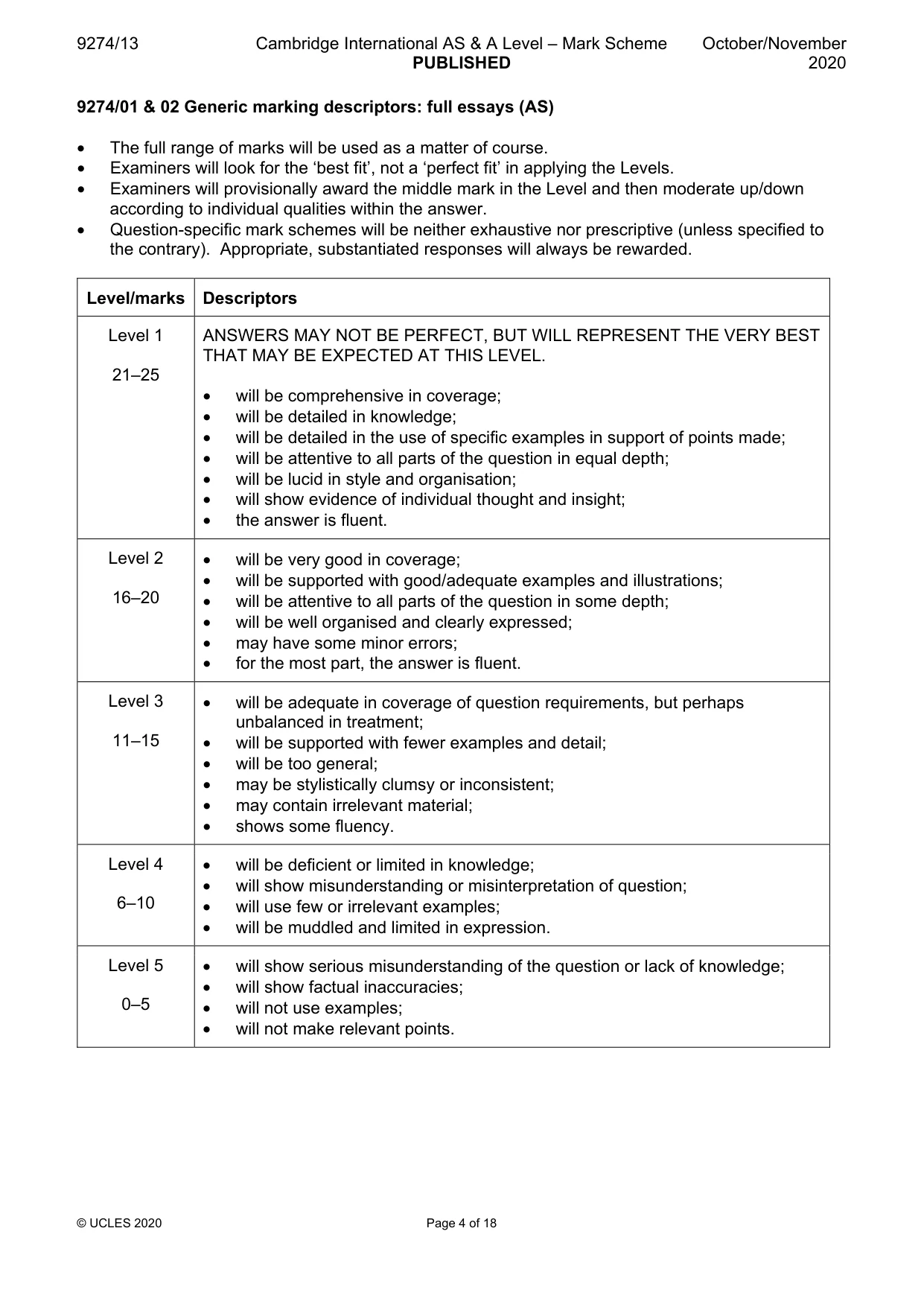
9274/13 Cambridge International AS & A Level – Mark Scheme PUBLISHED October/November 2020 © UCLES 2020 Page 4 of 18 9274/01 & 02 Generic marking descriptors: full essays (AS) • The full range of marks will be used as a matter of course. • Examiners will look for the ‘best fit’, not a ‘perfect fit’ in applying the Levels. • Examiners will provisionally award the middle mark in the Level and then moderate up/down according to individual qualities within the answer. • Question-specific mark schemes will be neither exhaustive nor prescriptive (unless specified to the contrary). Appropriate, substantiated responses will always be rewarded. Level/marks Descriptors Level 1 21–25 ANSWERS MAY NOT BE PERFECT, BUT WILL REPRESENT THE VERY BEST THAT MAY BE EXPECTED AT THIS LEVEL. • will be comprehensive in coverage; • will be detailed in knowledge; • will be detailed in the use of specific examples in support of points made; • will be attentive to all parts of the question in equal depth; • will be lucid in style and organisation; • will show evidence of individual thought and insight; • the answer is fluent. Level 2 16–20 • will be very good in coverage; • will be supported with good/adequate examples and illustrations; • will be attentive to all parts of the question in some depth; • will be well organised and clearly expressed; • may have some minor errors; • for the most part, the answer is fluent. Level 3 11–15 • will be adequate in coverage of question requirements, but perhaps unbalanced in treatment; • will be supported with fewer examples and detail; • will be too general; • may be stylistically clumsy or inconsistent; • may contain irrelevant material; • shows some fluency. Level 4 6–10 • will be deficient or limited in knowledge; • will show misunderstanding or misinterpretation of question; • will use few or irrelevant examples; • will be muddled and limited in expression. Level 5 0–5 • will show serious misunderstanding of the question or lack of knowledge; • will show factual inaccuracies; • will not use examples; • will not make relevant points.
Mark scheme, page 5
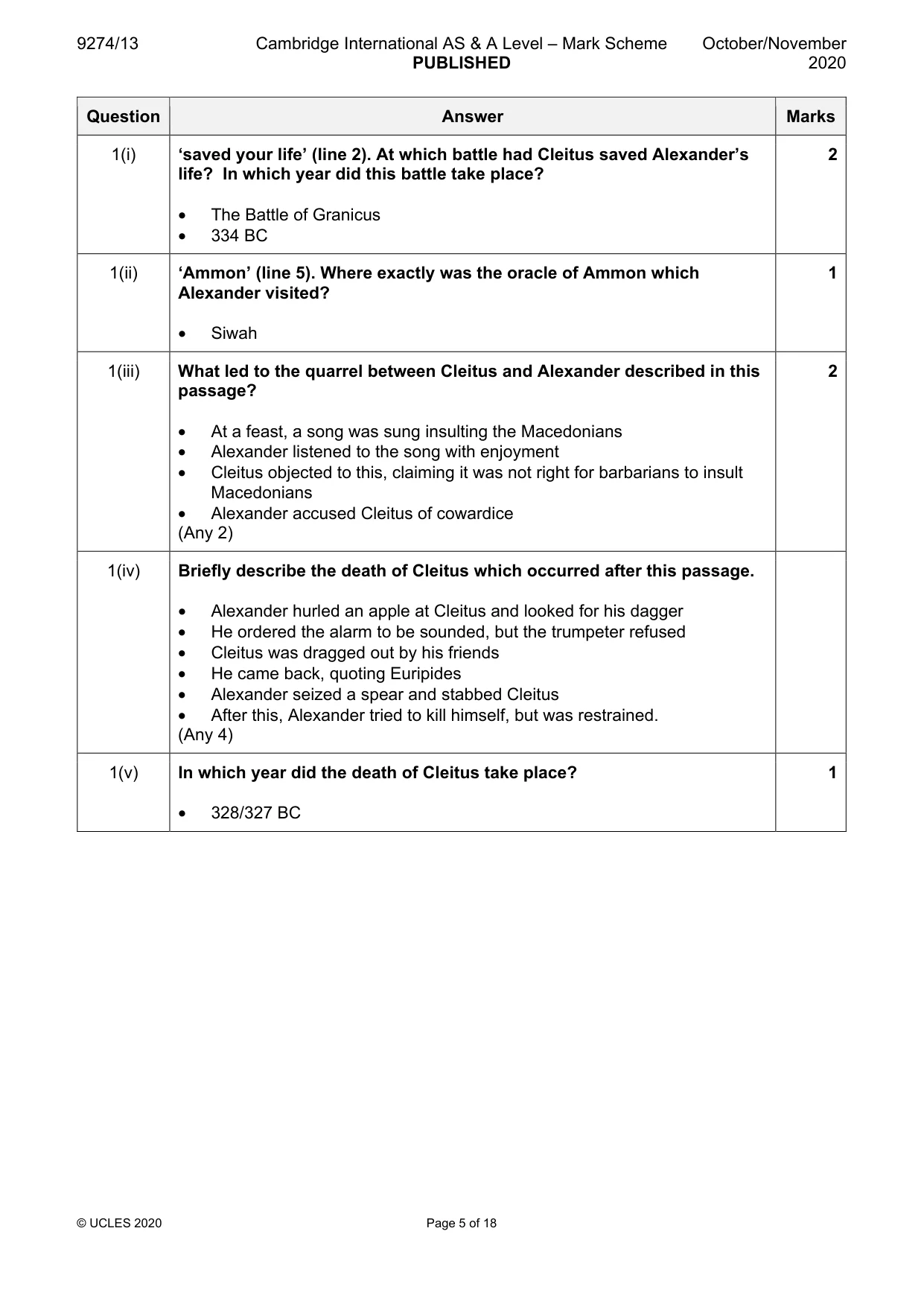
9274/13 Cambridge International AS & A Level – Mark Scheme PUBLISHED October/November 2020 © UCLES 2020 Page 5 of 18 Question Answer Marks 1(i) ‘saved your life’ (line 2). At which battle had Cleitus saved Alexander’s life? In which year did this battle take place? • The Battle of Granicus • 334 BC 2 1(ii) ‘Ammon’ (line 5). Where exactly was the oracle of Ammon which Alexander visited? • Siwah 1 1(iii) What led to the quarrel between Cleitus and Alexander described in this passage? • At a feast, a song was sung insulting the Macedonians • Alexander listened to the song with enjoyment • Cleitus objected to this, claiming it was not right for barbarians to insult Macedonians • Alexander accused Cleitus of cowardice (Any 2) 2 1(iv) Briefly describe the death of Cleitus which occurred after this passage. • Alexander hurled an apple at Cleitus and looked for his dagger • He ordered the alarm to be sounded, but the trumpeter refused • Cleitus was dragged out by his friends • He came back, quoting Euripides • Alexander seized a spear and stabbed Cleitus • After this, Alexander tried to kill himself, but was restrained. (Any 4) 1(v) In which year did the death of Cleitus take place? • 328/327 BC 1
Mark scheme, page 6
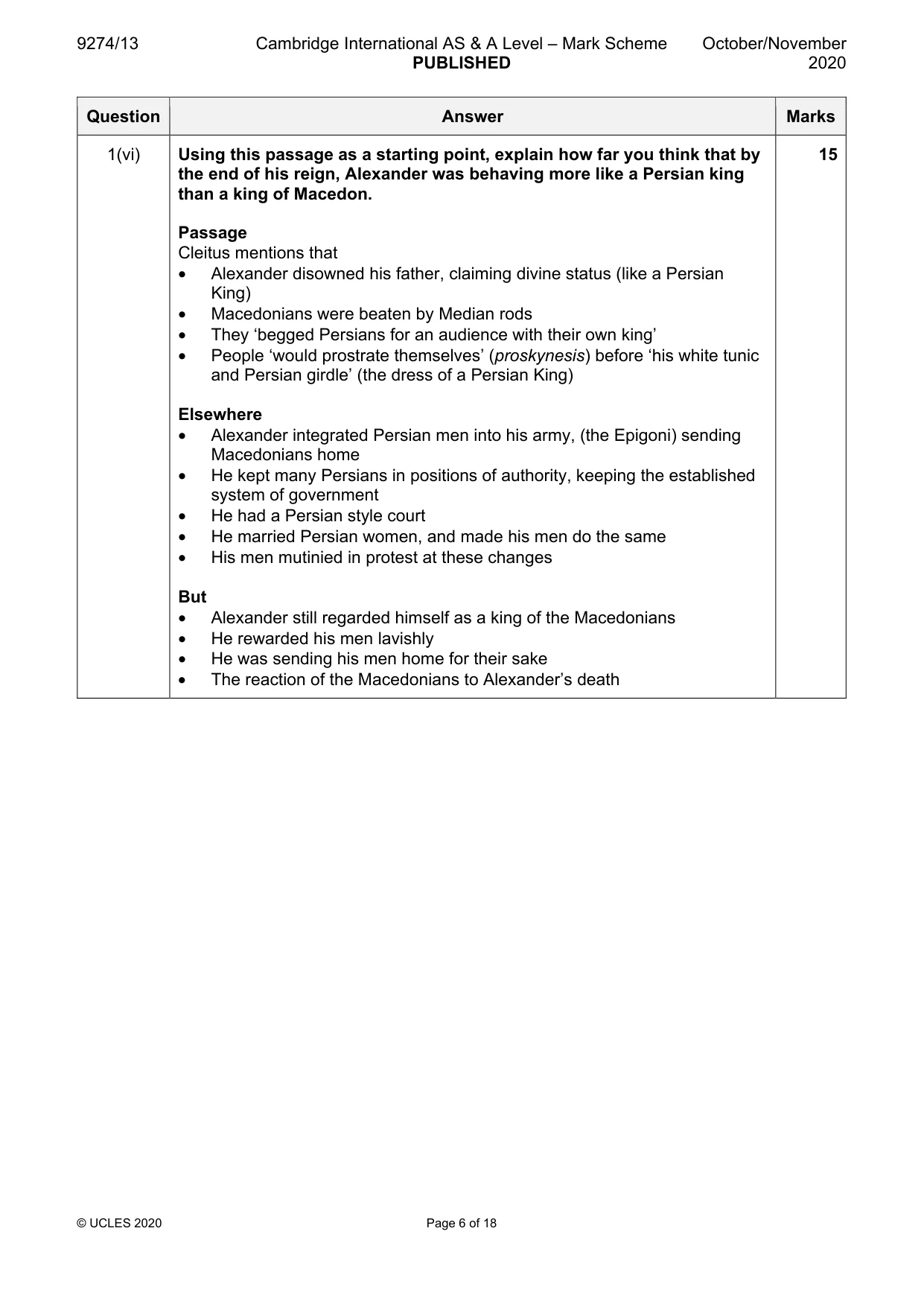
9274/13 Cambridge International AS & A Level – Mark Scheme PUBLISHED October/November 2020 © UCLES 2020 Page 6 of 18 Question Answer Marks 1(vi) Using this passage as a starting point, explain how far you think that by the end of his reign, Alexander was behaving more like a Persian king than a king of Macedon. Passage Cleitus mentions that • Alexander disowned his father, claiming divine status (like a Persian King) • Macedonians were beaten by Median rods • They ‘begged Persians for an audience with their own king’ • People ‘would prostrate themselves’ (proskynesis) before ‘his white tunic and Persian girdle’ (the dress of a Persian King) Elsewhere • Alexander integrated Persian men into his army, (the Epigoni) sending Macedonians home • He kept many Persians in positions of authority, keeping the established system of government • He had a Persian style court • He married Persian women, and made his men do the same • His men mutinied in protest at these changes But • Alexander still regarded himself as a king of the Macedonians • He rewarded his men lavishly • He was sending his men home for their sake • The reaction of the Macedonians to Alexander’s death 15
Mark scheme, page 7
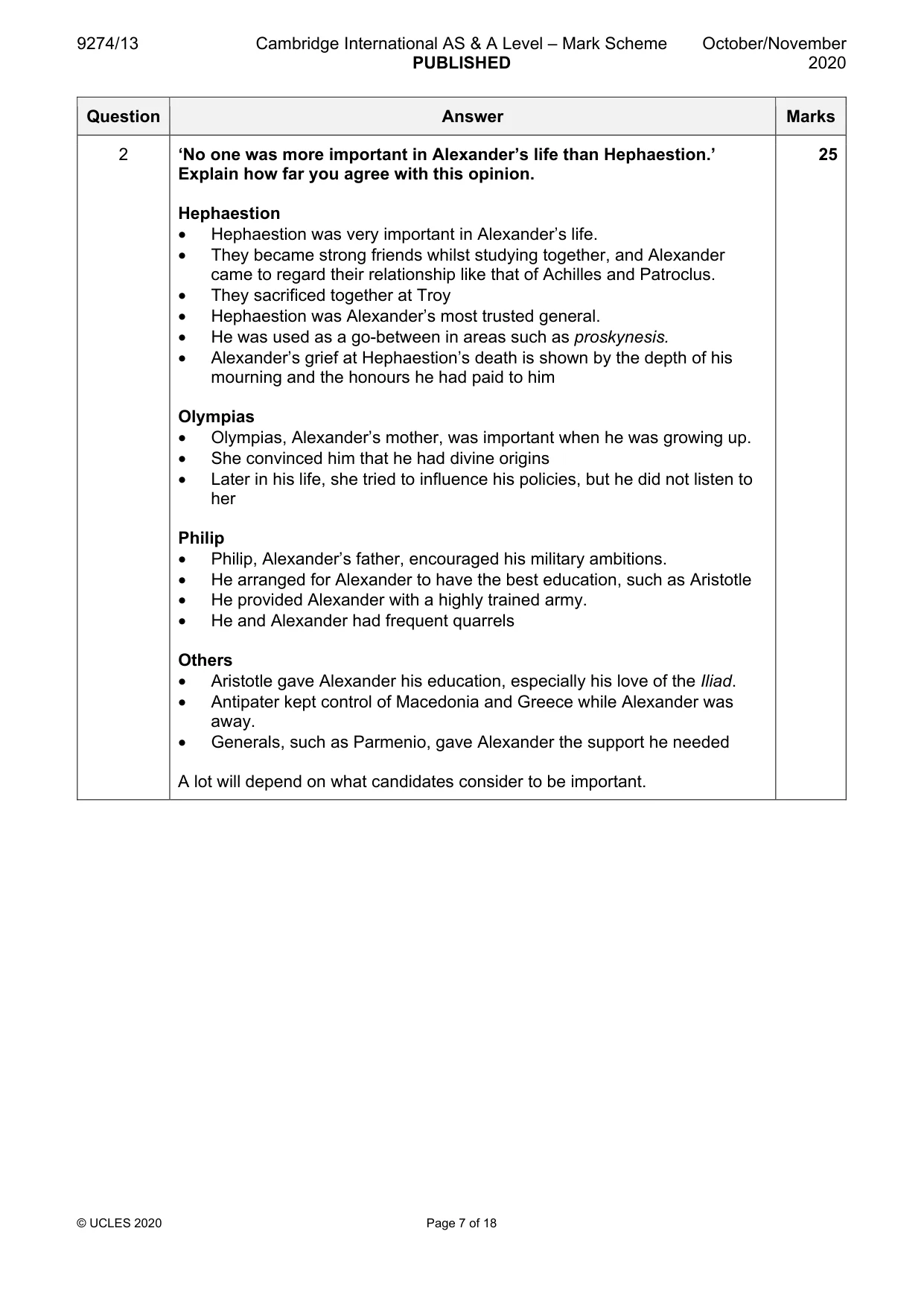
9274/13 Cambridge International AS & A Level – Mark Scheme PUBLISHED October/November 2020 © UCLES 2020 Page 7 of 18 Question Answer Marks 2 ‘No one was more important in Alexander’s life than Hephaestion.’ Explain how far you agree with this opinion. Hephaestion • Hephaestion was very important in Alexander’s life. • They became strong friends whilst studying together, and Alexander came to regard their relationship like that of Achilles and Patroclus. • They sacrificed together at Troy • Hephaestion was Alexander’s most trusted general. • He was used as a go-between in areas such as proskynesis. • Alexander’s grief at Hephaestion’s death is shown by the depth of his mourning and the honours he had paid to him Olympias • Olympias, Alexander’s mother, was important when he was growing up. • She convinced him that he had divine origins • Later in his life, she tried to influence his policies, but he did not listen to her Philip • Philip, Alexander’s father, encouraged his military ambitions. • He arranged for Alexander to have the best education, such as Aristotle • He provided Alexander with a highly trained army. • He and Alexander had frequent quarrels Others • Aristotle gave Alexander his education, especially his love of the Iliad. • Antipater kept control of Macedonia and Greece while Alexander was away. • Generals, such as Parmenio, gave Alexander the support he needed A lot will depend on what candidates consider to be important. 25
Mark scheme, page 8
9274/13 Cambridge International AS & A Level – Mark Scheme PUBLISHED October/November 2020 © UCLES 2020 Page 8 of 18 Question Answer Marks 3 ‘Nothing more than a successful military commander.’ Explain how far you agree with this assessment of Alexander the Great’s career. Successful Military Commander • Alexander was without doubt a fine general who was one of the greatest military commanders in history. • He was never defeated in battle. • He led his men on a thirteen-year military campaign, winning victory after victory against heavy odds. • He adapted his strategy to a variety of different circumstances. • He had personal bravery and charismatic leadership of his men. • He conducted successful sieges such as Tyre and Gaza. But • Alexander did far more than just win battles. • He was an enlightened ruler who tried to unite the Greeks and the peoples he conquered. • He established a vast system of government, spread Greek culture over a huge area, and established a large number of cities, many of which still survive today. • He contributed to human knowledge by sending specimens of plants and animals back to Aristotle. Despite his Empire falling apart after his death, Alexander left a legacy which lasted for centuries. To some extent, the kingdoms established by his generals preserved his ideas and beliefs. As a result, Greek culture and the Greek language became the common way of life in the Eastern Mediterranean. Alexandria in Egypt overtook Athens as the centre of Greek culture. But these achievements were only possible because of his military success. 25
Mark scheme, page 9
9274/13 Cambridge International AS & A Level – Mark Scheme PUBLISHED October/November 2020 © UCLES 2020 Page 9 of 18 Question Answer Marks 4(i) Apart from Meletus, who else was prosecuting Socrates? • Anytus and Lycon 2 4(ii) ‘jurymen’ (line 1). How many jurymen were there at Socrates’ trial? • 501/500 1 4(iii) ‘Council’ (line 6) and ‘Assembly’ (line 8). What is Socrates referring to here? Council (Boule) – The body that prepared business for the Assembly. It was made up of 500 people. Assembly (Ecclesia) – Where citizens met to debate and vote on legislation. 4 4(iv) Identify one example of the Socratic method found in this passage. Explain how effective you think this example is. • Elenchus – questioning people to find out what they know. • Analogy – using everyday examples to stress the point he is making (One mark for example and one mark for explanation of its effectiveness) 2 4(v) Apart from corrupting the young, what other charge was brought against Socrates? • Impiety – believing in gods not recognised by the state. 1 4(vi) Using this passage as a starting point, explain how far you think that Socrates successfully disproved the charges that were brought against him. Passage • Socrates cross-examines Meletus • He gets him to state that only Socrates is guilty of corrupting the young • The trainer analogy proves that only a few people can improve a group such as the young, rather than the whole state. Elsewhere • Socrates claims not to be a teacher, so he cannot corrupt the young • He gets Meletus to state that he does not believe in any gods, which is clearly untrue • He points out that he is obeying Apollo by trying to find out what the Delphic Oracle meant about him being the wisest of men. But • Many of the opponents of democracy, such as Critias and Alcibiades were followers of Socrates • He set a bad example for them by going against the wishes of the Assembly in the debate over the trial of the generals after Arginusae • He talked about his daimonion, which showed he did believe in gods not accepted by the state. 15
Mark scheme, page 10
9274/13 Cambridge International AS & A Level – Mark Scheme PUBLISHED October/November 2020 © UCLES 2020 Page 10 of 18 Question Answer Marks 5 ‘Reading the Euthyphro is pointless and a waste of time.’ Explain how far you agree with this assessment. The ostensible purpose of the Euthyphro was an attempt by Socrates to discover what holiness is. Pointless and a Waste of Time • A number of definitions are proposed, which are all rejected by Socrates • This means that at the end of the dialogue, the reader is no more aware of the definition of holiness than at the start • Socrates himself makes no contribution to the purpose of the dialogue • Euthyphro himself gets more and more frustrated with Socrates’ continual rejection of his definitions • He eventually leaves in a state of aporia, like the reader But • The dialogue is helpful by revealing what holiness is not • It is a perfect example of the Socratic method • It gives the reader an insight into Socrates’ personality, and gives clues to why he was so unpopular as to be put on trial and executed 25
Mark scheme, page 11
9274/13 Cambridge International AS & A Level – Mark Scheme PUBLISHED October/November 2020 © UCLES 2020 Page 11 of 18 Question Answer Marks 6 ‘Socrates was a man who lived by the principles of his philosophy until the very end of his life.’ Explain how far you agree with this statement. In your answer, you should refer to at least two of the dialogues in The Last Days of Socrates. Each of the dialogues tells us about Socrates and his philosophy. Euthyphro The dialogue deals with the Socratic Method and Socrates’ style of questioning. It shows us that Socrates stuck to his principles in trying to discover what is meant by concepts, such as holiness. He did this even if it meant annoying the interlocutor. Apology The dialogue deals with how Socrates sees himself and his philosophy. It shows his attitude towards the jury, in as much as he does not act as defendants were expected to. His defence is unconventional, like his life. The ektmesis shows Socrates’ philosophy concerning his mission and death. Crito The dialogue deals with Socrates’ philosophy about morality and correct behaviour, and the duties of the citizen. It shows him refusing to escape, even if this means his death, rather than corrupt his soul by breaking the laws of the State. Phaedo The dialogue deals with Socrates’ philosophy about death and gaining true knowledge. It shows how he considers death to be nothing to be afraid of, and even a benefit to a philosopher. His attitude, and the drinking of the hemlock, is in marked contrast to the behaviour of his followers. All the dialogues give information about the philosophy Socrates used to guide how he lived and his views on a variety of subjects such as death and how to live a good life. They all seem to show that, whatever the consequences, Socrates always lived his life according to the principles of his philosophy. 25
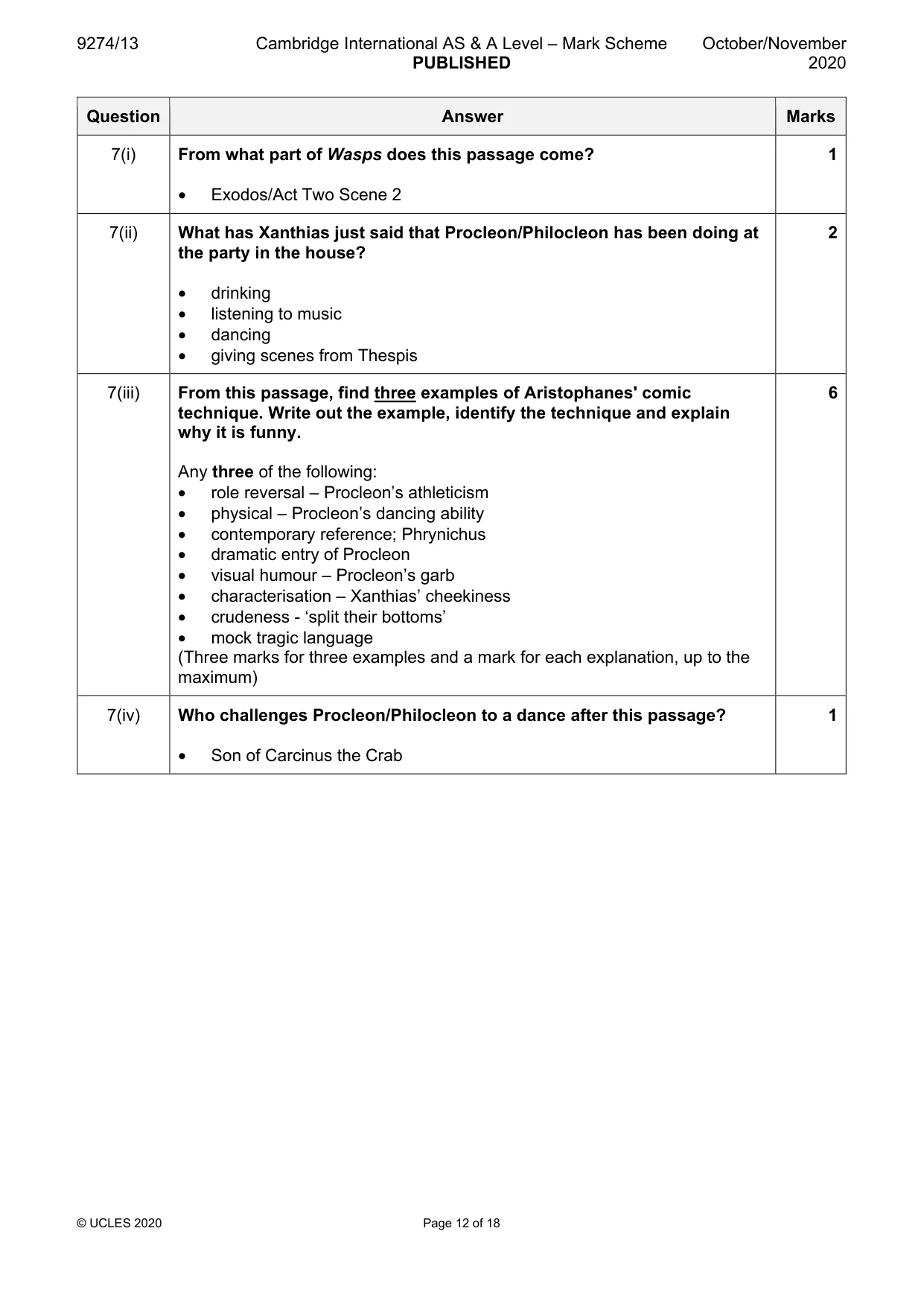
Mark scheme, page 12
9274/13 Cambridge International AS & A Level – Mark Scheme PUBLISHED October/November 2020 © UCLES 2020 Page 12 of 18 Question Answer Marks 7(i) From what part of Wasps does this passage come? • Exodos/Act Two Scene 2 1 7(ii) What has Xanthias just said that Procleon/Philocleon has been doing at the party in the house? • drinking • listening to music • dancing • giving scenes from Thespis 2 7(iii) From this passage, find three examples of Aristophanes' comic technique. Write out the example, identify the technique and explain why it is funny. Any three of the following: • role reversal – Procleon’s athleticism • physical – Procleon’s dancing ability • contemporary reference; Phrynichus • dramatic entry of Procleon • visual humour – Procleon’s garb • characterisation – Xanthias’ cheekiness • crudeness - ‘split their bottoms’ • mock tragic language (Three marks for three examples and a mark for each explanation, up to the maximum) 6 7(iv) Who challenges Procleon/Philocleon to a dance after this passage? • Son of Carcinus the Crab 1
Mark scheme, page 13
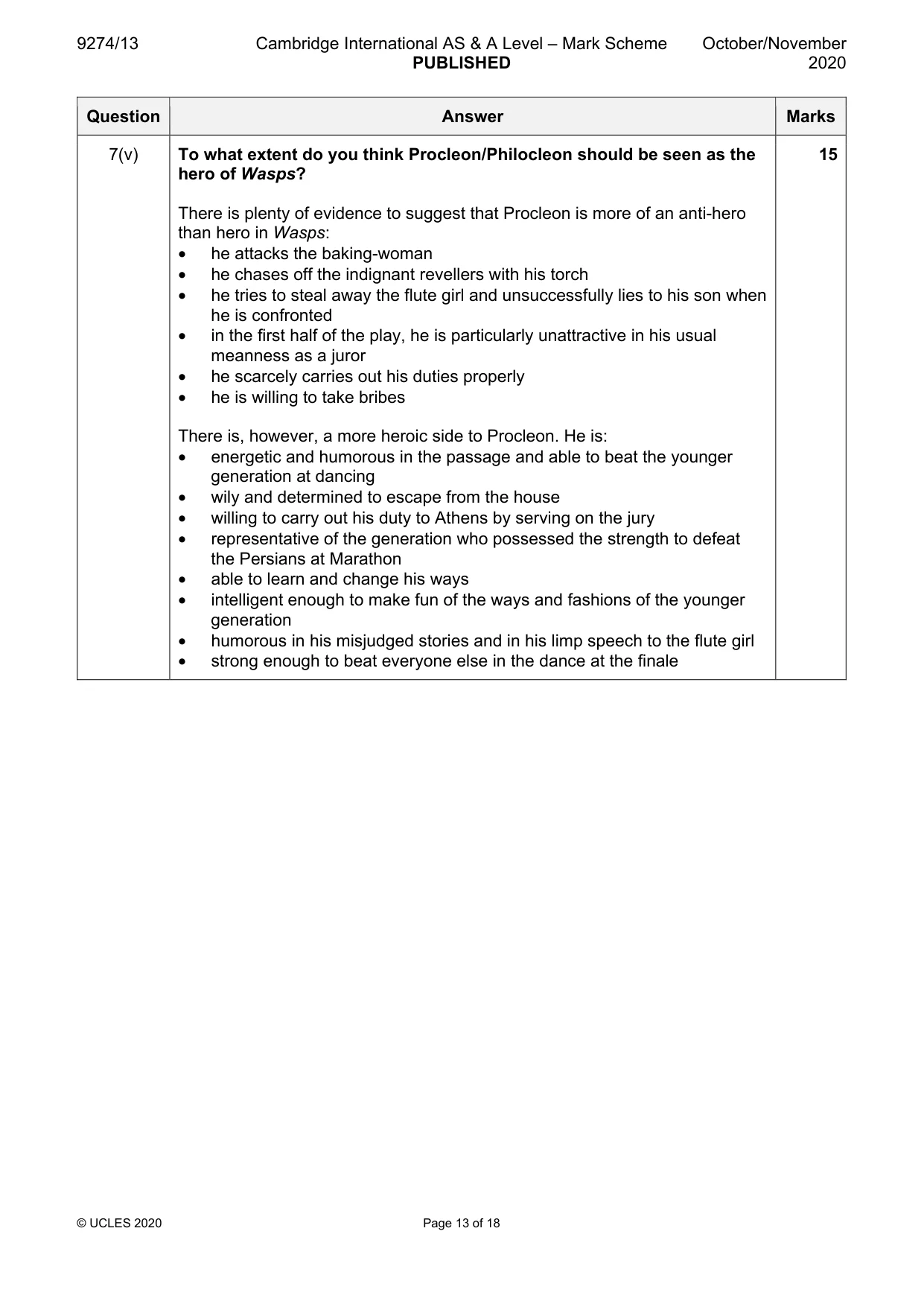
9274/13 Cambridge International AS & A Level – Mark Scheme PUBLISHED October/November 2020 © UCLES 2020 Page 13 of 18 Question Answer Marks 7(v) To what extent do you think Procleon/Philocleon should be seen as the hero of Wasps? There is plenty of evidence to suggest that Procleon is more of an anti-hero than hero in Wasps: • he attacks the baking-woman • he chases off the indignant revellers with his torch • he tries to steal away the flute girl and unsuccessfully lies to his son when he is confronted • in the first half of the play, he is particularly unattractive in his usual meanness as a juror • he scarcely carries out his duties properly • he is willing to take bribes There is, however, a more heroic side to Procleon. He is: • energetic and humorous in the passage and able to beat the younger generation at dancing • wily and determined to escape from the house • willing to carry out his duty to Athens by serving on the jury • representative of the generation who possessed the strength to defeat the Persians at Marathon • able to learn and change his ways • intelligent enough to make fun of the ways and fashions of the younger generation • humorous in his misjudged stories and in his limp speech to the flute girl • strong enough to beat everyone else in the dance at the finale 15
Mark scheme, page 14
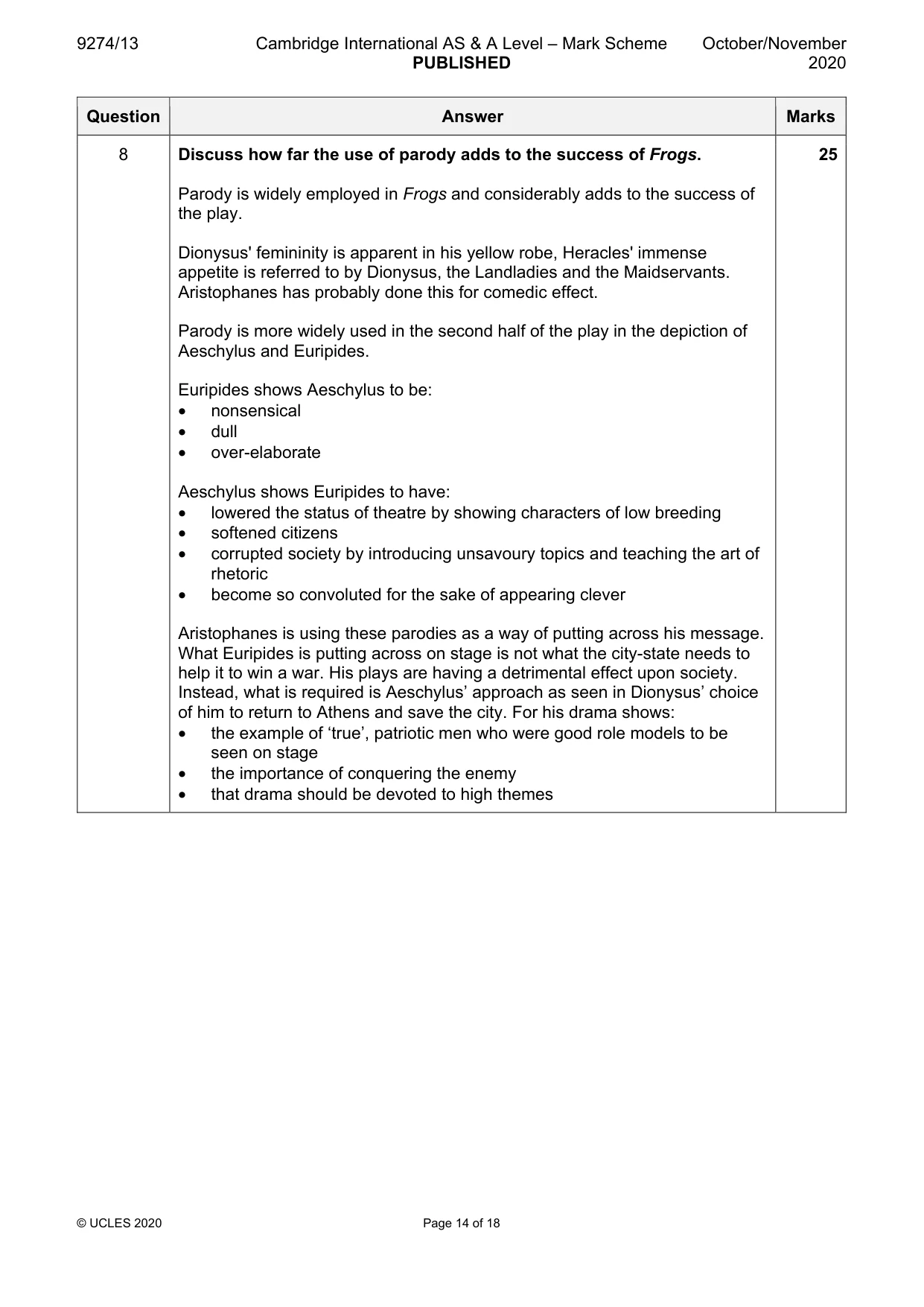
9274/13 Cambridge International AS & A Level – Mark Scheme PUBLISHED October/November 2020 © UCLES 2020 Page 14 of 18 Question Answer Marks 8 Discuss how far the use of parody adds to the success of Frogs. Parody is widely employed in Frogs and considerably adds to the success of the play. Dionysus' femininity is apparent in his yellow robe, Heracles' immense appetite is referred to by Dionysus, the Landladies and the Maidservants. Aristophanes has probably done this for comedic effect. Parody is more widely used in the second half of the play in the depiction of Aeschylus and Euripides. Euripides shows Aeschylus to be: • nonsensical • dull • over-elaborate Aeschylus shows Euripides to have: • lowered the status of theatre by showing characters of low breeding • softened citizens • corrupted society by introducing unsavoury topics and teaching the art of rhetoric • become so convoluted for the sake of appearing clever Aristophanes is using these parodies as a way of putting across his message. What Euripides is putting across on stage is not what the city-state needs to help it to win a war. His plays are having a detrimental effect upon society. Instead, what is required is Aeschylus’ approach as seen in Dionysus’ choice of him to return to Athens and save the city. For his drama shows: • the example of ‘true’, patriotic men who were good role models to be seen on stage • the importance of conquering the enemy • that drama should be devoted to high themes 25
Mark scheme, page 15
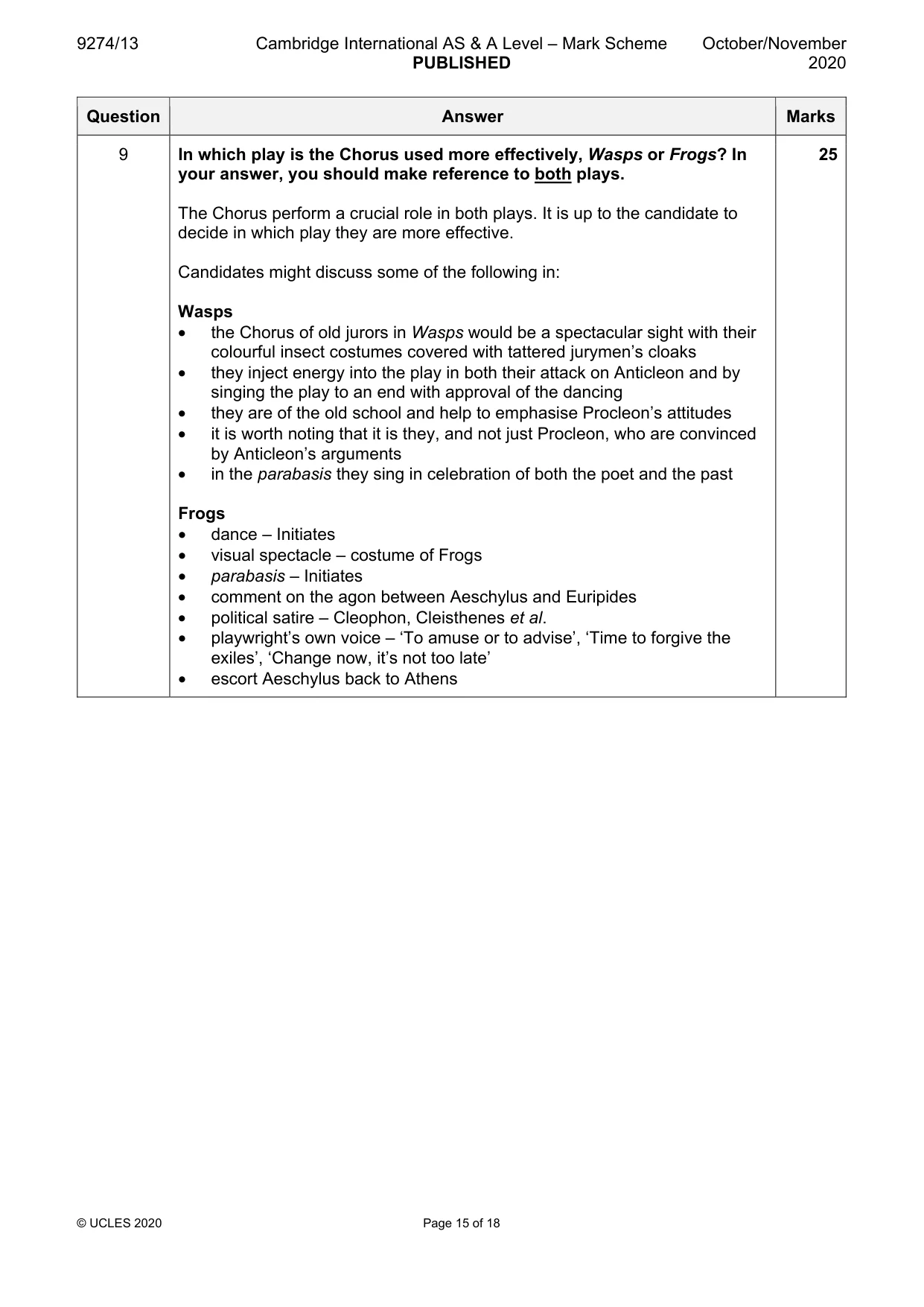
9274/13 Cambridge International AS & A Level – Mark Scheme PUBLISHED October/November 2020 © UCLES 2020 Page 15 of 18 Question Answer Marks 9 In which play is the Chorus used more effectively, Wasps or Frogs? In your answer, you should make reference to both plays. The Chorus perform a crucial role in both plays. It is up to the candidate to decide in which play they are more effective. Candidates might discuss some of the following in: Wasps • the Chorus of old jurors in Wasps would be a spectacular sight with their colourful insect costumes covered with tattered jurymen’s cloaks • they inject energy into the play in both their attack on Anticleon and by singing the play to an end with approval of the dancing • they are of the old school and help to emphasise Procleon’s attitudes • it is worth noting that it is they, and not just Procleon, who are convinced by Anticleon’s arguments • in the parabasis they sing in celebration of both the poet and the past Frogs • dance – Initiates • visual spectacle – costume of Frogs • parabasis – Initiates • comment on the agon between Aeschylus and Euripides • political satire – Cleophon, Cleisthenes et al. • playwright’s own voice – ‘To amuse or to advise’, ‘Time to forgive the exiles’, ‘Change now, it’s not too late’ • escort Aeschylus back to Athens 25
Mark scheme, page 16
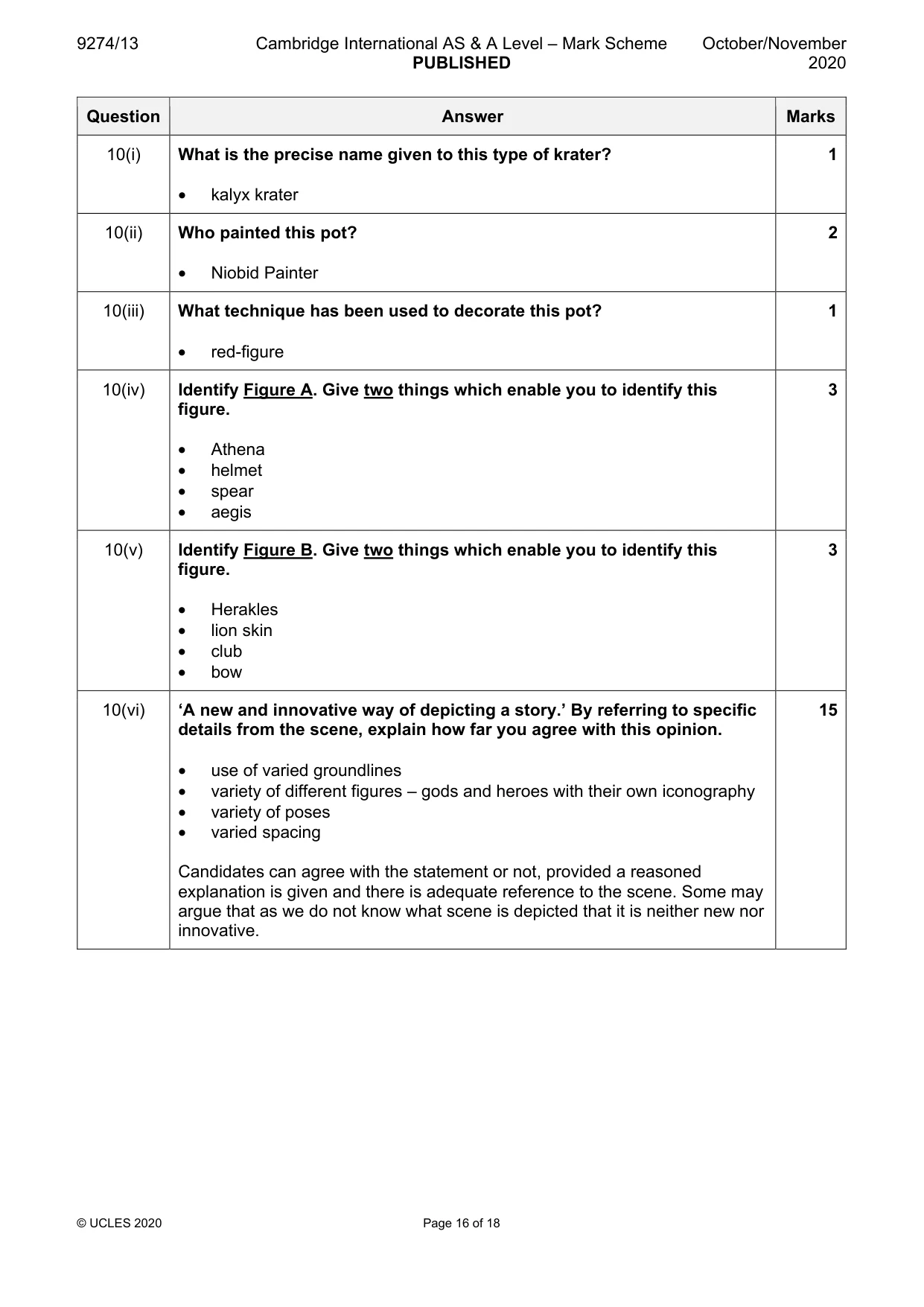
9274/13 Cambridge International AS & A Level – Mark Scheme PUBLISHED October/November 2020 © UCLES 2020 Page 16 of 18 Question Answer Marks 10(i) What is the precise name given to this type of krater? • kalyx krater 1 10(ii) Who painted this pot? • Niobid Painter 2 10(iii) What technique has been used to decorate this pot? • red-figure 1 10(iv) Identify Figure A. Give two things which enable you to identify this figure. • Athena • helmet • spear • aegis 3 10(v) Identify Figure B. Give two things which enable you to identify this figure. • Herakles • lion skin • club • bow 3 10(vi) ‘A new and innovative way of depicting a story.’ By referring to specific details from the scene, explain how far you agree with this opinion. • use of varied groundlines • variety of different figures – gods and heroes with their own iconography • variety of poses • varied spacing Candidates can agree with the statement or not, provided a reasoned explanation is given and there is adequate reference to the scene. Some may argue that as we do not know what scene is depicted that it is neither new nor innovative. 15
Mark scheme, page 17
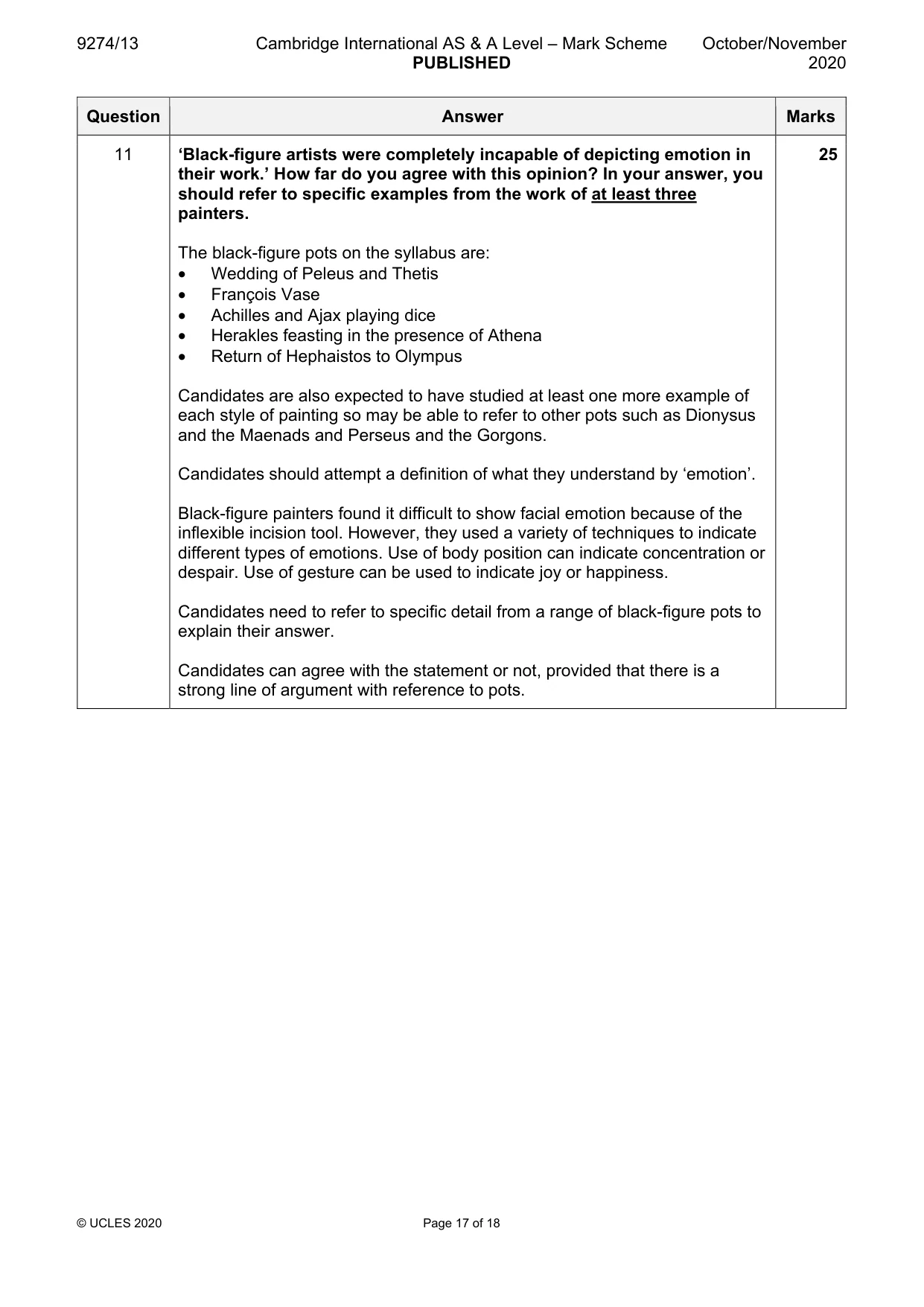
9274/13 Cambridge International AS & A Level – Mark Scheme PUBLISHED October/November 2020 © UCLES 2020 Page 17 of 18 Question Answer Marks 11 ‘Black-figure artists were completely incapable of depicting emotion in their work.’ How far do you agree with this opinion? In your answer, you should refer to specific examples from the work of at least three painters. The black-figure pots on the syllabus are: • Wedding of Peleus and Thetis • François Vase • Achilles and Ajax playing dice • Herakles feasting in the presence of Athena • Return of Hephaistos to Olympus Candidates are also expected to have studied at least one more example of each style of painting so may be able to refer to other pots such as Dionysus and the Maenads and Perseus and the Gorgons. Candidates should attempt a definition of what they understand by ‘emotion’. Black-figure painters found it difficult to show facial emotion because of the inflexible incision tool. However, they used a variety of techniques to indicate different types of emotions. Use of body position can indicate concentration or despair. Use of gesture can be used to indicate joy or happiness. Candidates need to refer to specific detail from a range of black-figure pots to explain their answer. Candidates can agree with the statement or not, provided that there is a strong line of argument with reference to pots. 25
Mark scheme, page 18
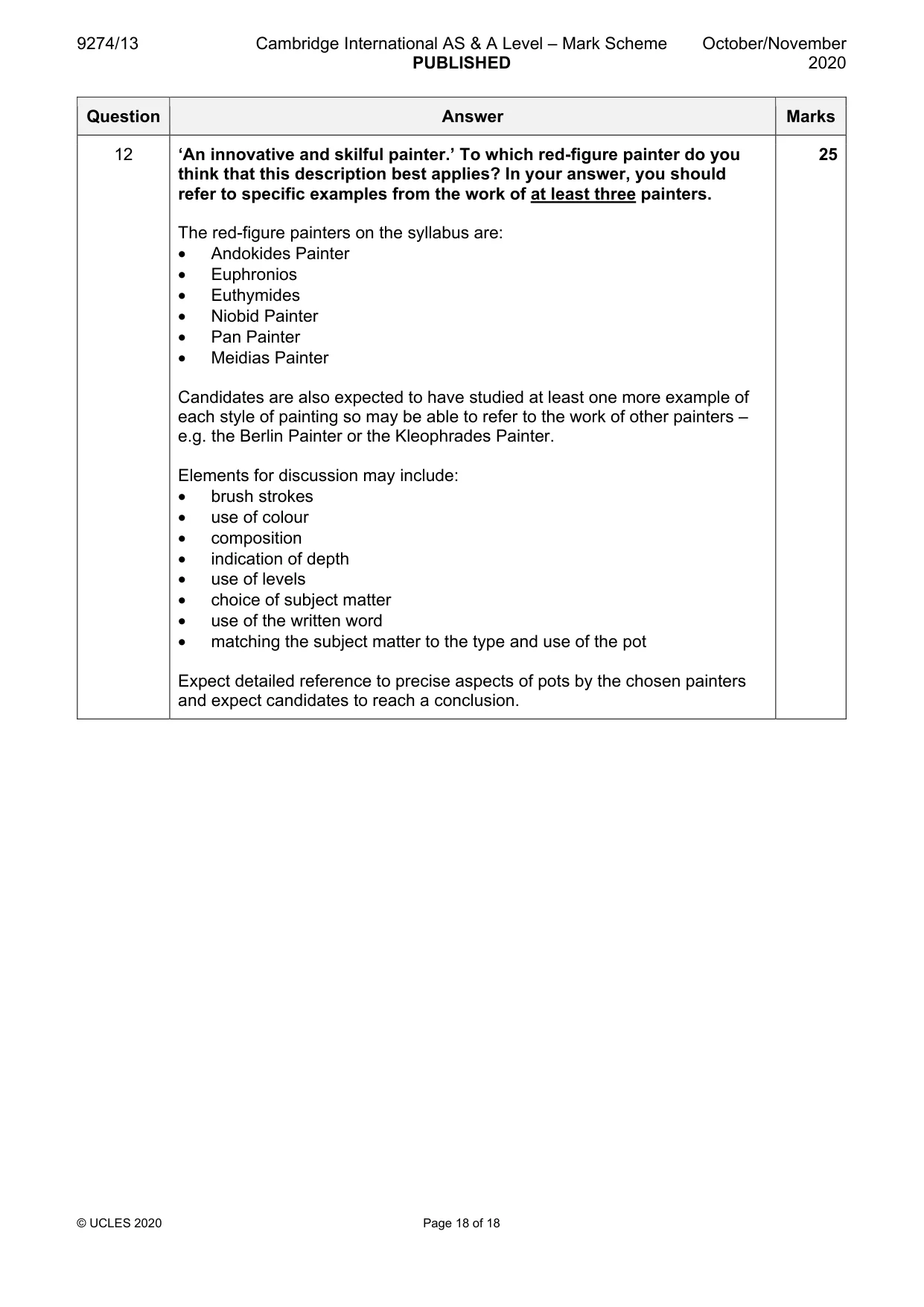
9274/13 Cambridge International AS & A Level – Mark Scheme PUBLISHED October/November 2020 © UCLES 2020 Page 18 of 18 Question Answer Marks 12 ‘An innovative and skilful painter.’ To which red-figure painter do you think that this description best applies? In your answer, you should refer to specific examples from the work of at least three painters. The red-figure painters on the syllabus are: • Andokides Painter • Euphronios • Euthymides • Niobid Painter • Pan Painter • Meidias Painter Candidates are also expected to have studied at least one more example of each style of painting so may be able to refer to the work of other painters – e.g. the Berlin Painter or the Kleophrades Painter. Elements for discussion may include: • brush strokes • use of colour • composition • indication of depth • use of levels • choice of subject matter • use of the written word • matching the subject matter to the type and use of the pot Expect detailed reference to precise aspects of pots by the chosen painters and expect candidates to reach a conclusion. 25
What you needed in this session
Cambridge’s own grade thresholds for 2020 Oct/Nov, Paper 1 · Variant 3. A higher threshold means an easier paper — the bar moves with how the cohort did.