Cambridge A Level Classical Studies 9274 — 2013 Oct/Nov Paper 1 · Variant 1
9274/11/O/N/13 · 50 marks · ≈56 min
The question paper and its mark scheme, free to read here and free to download. This is Cambridge’s own paper, exactly as it was sat.
Question paper8 pages

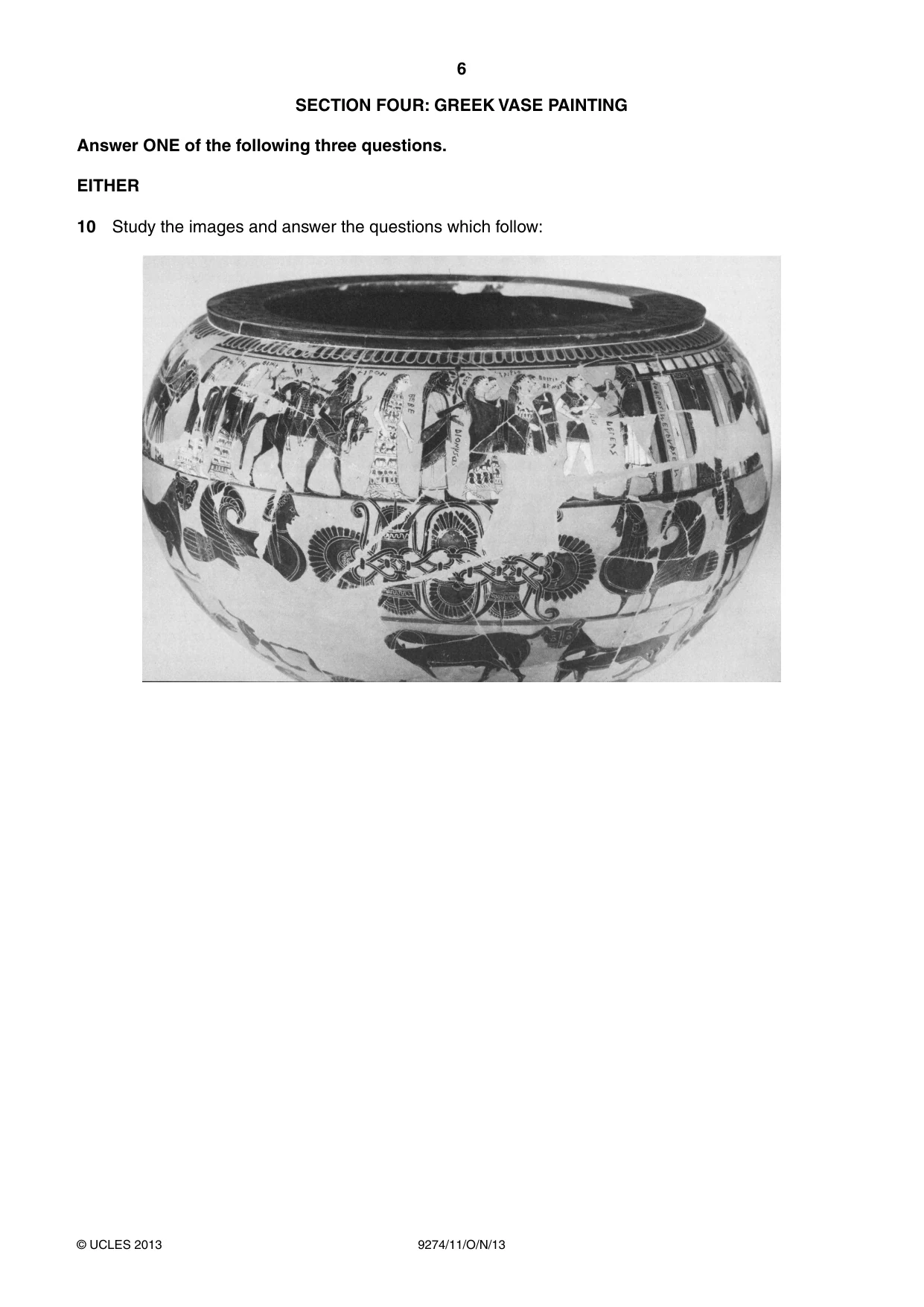
Mark scheme11 pages
Answers below. Sit the paper first if you are practising.
Paper as text
Question paper, page 1
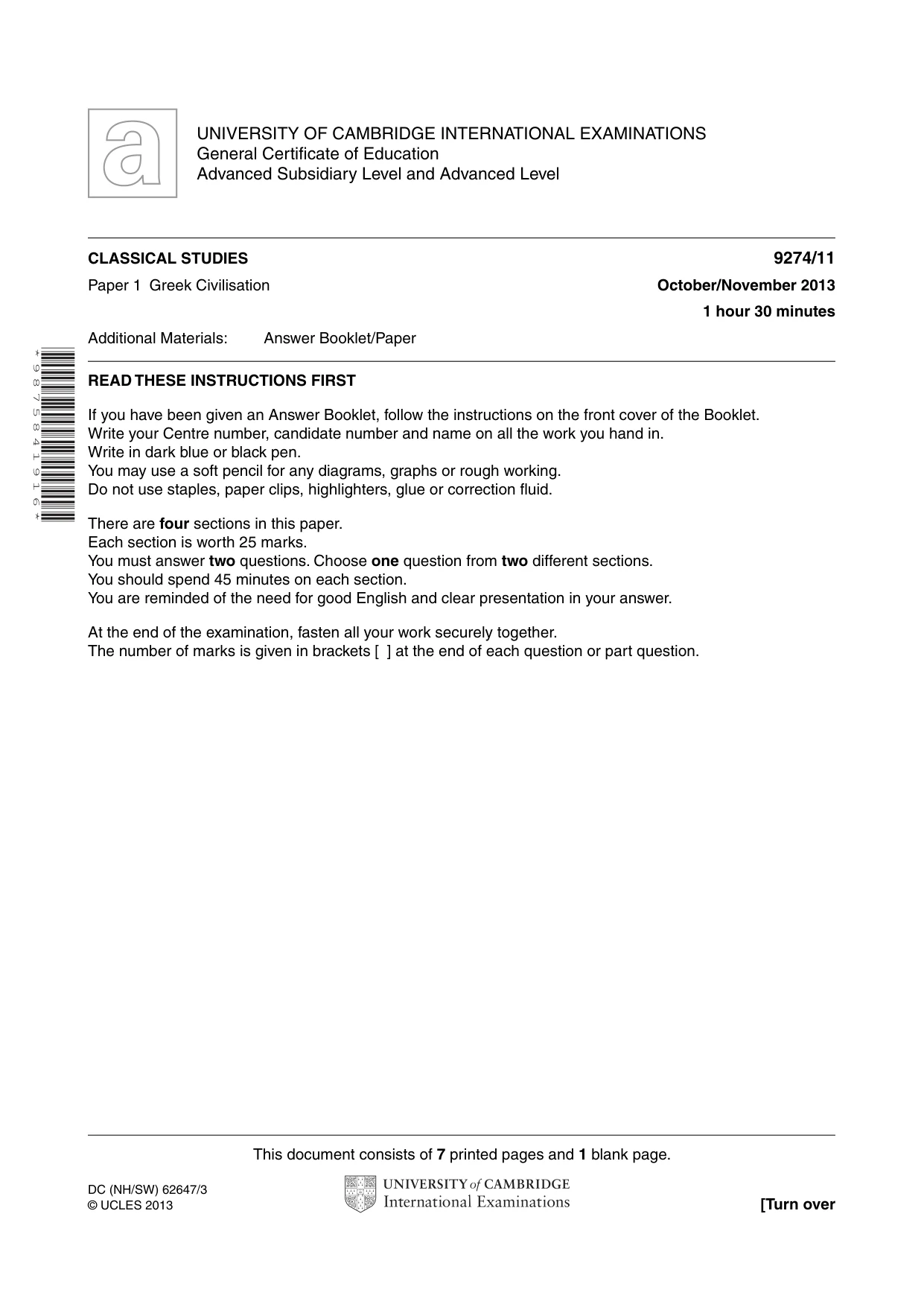
This document consists of 7 printed pages and 1 blank page. DC (NH/SW) 62647/3 © UCLES 2013 [Turn over UNIVERSITY OF CAMBRIDGE INTERNATIONAL EXAMINATIONS General Certificate of Education Advanced Subsidiary Level and Advanced Level * 9 8 7 5 8 4 1 9 1 6 * CLASSICAL STUDIES 9274/11 Paper 1 Greek Civilisation October/November 2013 1 hour 30 minutes Additional Materials: Answer Booklet/Paper READ THESE INSTRUCTIONS FIRST If you have been given an Answer Booklet, follow the instructions on the front cover of the Booklet. Write your Centre number, candidate number and name on all the work you hand in. Write in dark blue or black pen. You may use a soft pencil for any diagrams, graphs or rough working. Do not use staples, paper clips, highlighters, glue or correction fluid. There are four sections in this paper. Each section is worth 25 marks. You must answer two questions. Choose one question from two different sections. You should spend 45 minutes on each section. You are reminded of the need for good English and clear presentation in your answer. At the end of the examination, fasten all your work securely together. The number of marks is given in brackets [ ] at the end of each question or part question.
Question paper, page 2
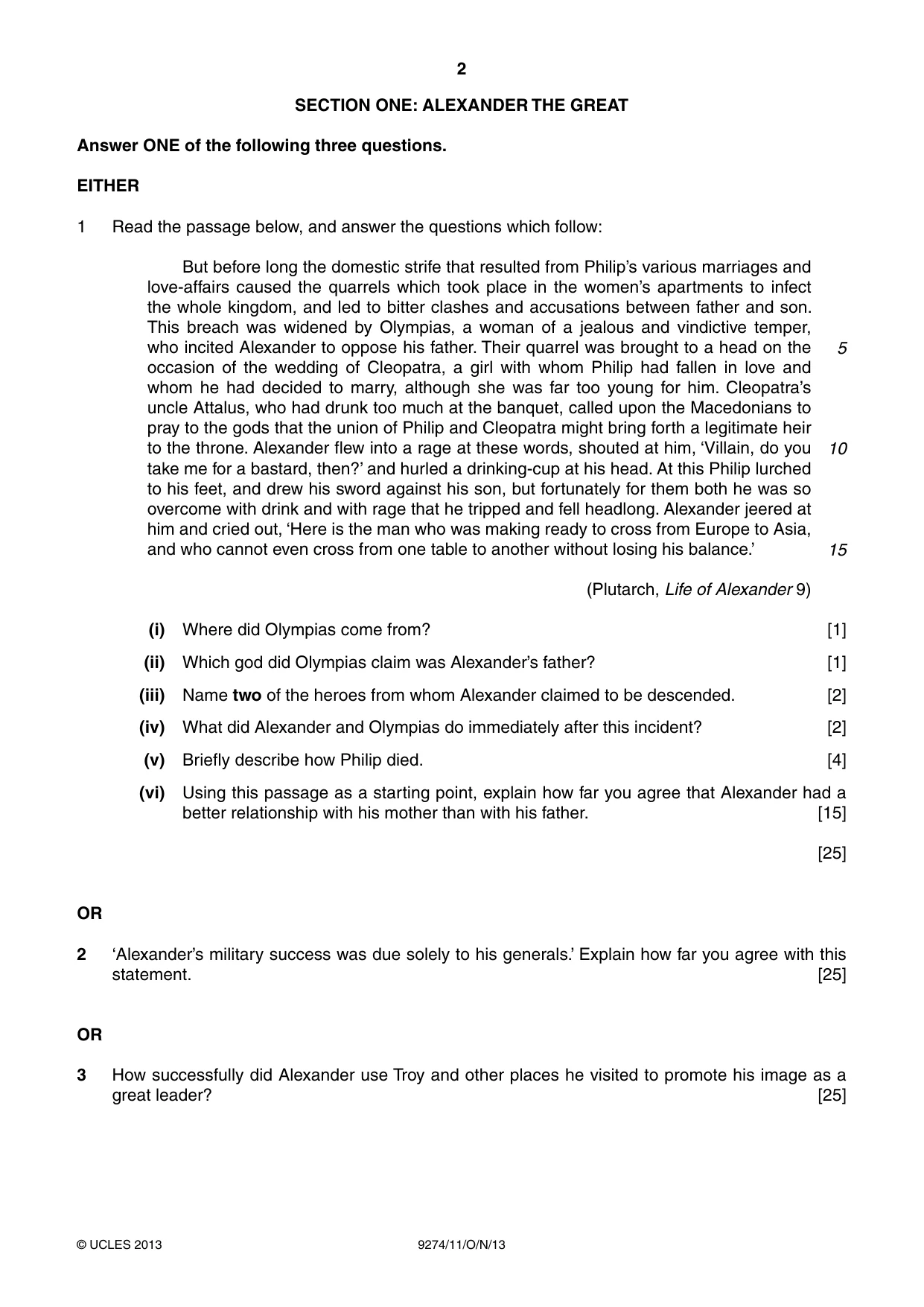
2 9274/11/O/N/13 © UCLES 2013 SECTION ONE: ALEXANDER THE GREAT Answer ONE of the following three questions. EITHER 1 Read the passage below, and answer the questions which follow: But before long the domestic strife that resulted from Philip’s various marriages and love-affairs caused the quarrels which took place in the women’s apartments to infect the whole kingdom, and led to bitter clashes and accusations between father and son. This breach was widened by Olympias, a woman of a jealous and vindictive temper, who incited Alexander to oppose his father. Their quarrel was brought to a head on the occasion of the wedding of Cleopatra, a girl with whom Philip had fallen in love and whom he had decided to marry, although she was far too young for him. Cleopatra’s uncle Attalus, who had drunk too much at the banquet, called upon the Macedonians to pray to the gods that the union of Philip and Cleopatra might bring forth a legitimate heir to the throne. Alexander flew into a rage at these words, shouted at him, ‘Villain, do you take me for a bastard, then?’ and hurled a drinking-cup at his head. At this Philip lurched to his feet, and drew his sword against his son, but fortunately for them both he was so overcome with drink and with rage that he tripped and fell headlong. Alexander jeered at him and cried out, ‘Here is the man who was making ready to cross from Europe to Asia, and who cannot even cross from one table to another without losing his balance.’ (Plutarch, Life of Alexander 9) (i) Where did Olympias come from? [1] (ii) Which god did Olympias claim was Alexander’s father? [1] (iii) Name two of the heroes from whom Alexander claimed to be descended. [2] (iv) What did Alexander and Olympias do immediately after this incident? [2] (v) Briefly describe how Philip died. [4] (vi) Using this passage as a starting point, explain how far you agree that Alexander had a better relationship with his mother than with his father. [15] [25] OR 2 ‘Alexander’s military success was due solely to his generals.’ Explain how far you agree with this statement. [25] OR 3 How successfully did Alexander use Troy and other places he visited to promote his image as a great leader? [25] 5 10 15
Question paper, page 3
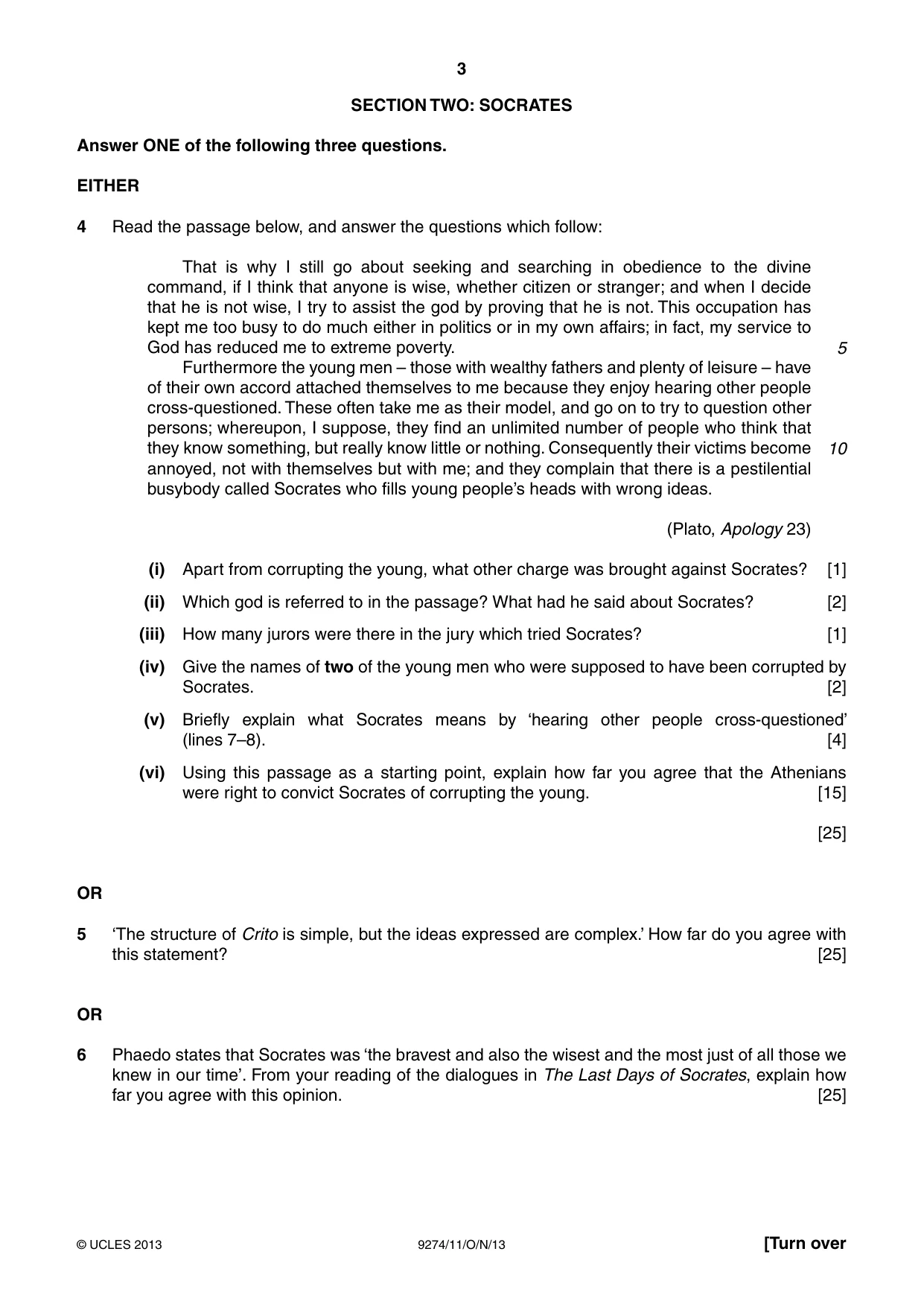
3 9274/11/O/N/13 © UCLES 2013 [Turn over SECTION TWO: SOCRATES Answer ONE of the following three questions. EITHER 4 Read the passage below, and answer the questions which follow: That is why I still go about seeking and searching in obedience to the divine command, if I think that anyone is wise, whether citizen or stranger; and when I decide that he is not wise, I try to assist the god by proving that he is not. This occupation has kept me too busy to do much either in politics or in my own affairs; in fact, my service to God has reduced me to extreme poverty. Furthermore the young men – those with wealthy fathers and plenty of leisure – have of their own accord attached themselves to me because they enjoy hearing other people cross-questioned. These often take me as their model, and go on to try to question other persons; whereupon, I suppose, they find an unlimited number of people who think that they know something, but really know little or nothing. Consequently their victims become annoyed, not with themselves but with me; and they complain that there is a pestilential busybody called Socrates who fills young people’s heads with wrong ideas. (Plato, Apology 23) (i) Apart from corrupting the young, what other charge was brought against Socrates? [1] (ii) Which god is referred to in the passage? What had he said about Socrates? [2] (iii) How many jurors were there in the jury which tried Socrates? [1] (iv) Give the names of two of the young men who were supposed to have been corrupted by Socrates. [2] (v) Briefly explain what Socrates means by ‘hearing other people cross-questioned’ (lines 7–8). [4] (vi) Using this passage as a starting point, explain how far you agree that the Athenians were right to convict Socrates of corrupting the young. [15] [25] OR 5 ‘The structure of Crito is simple, but the ideas expressed are complex.’ How far do you agree with this statement? [25] OR 6 Phaedo states that Socrates was ‘the bravest and also the wisest and the most just of all those we knew in our time’. From your reading of the dialogues in The Last Days of Socrates, explain how far you agree with this opinion. [25] 5 10
Question paper, page 4
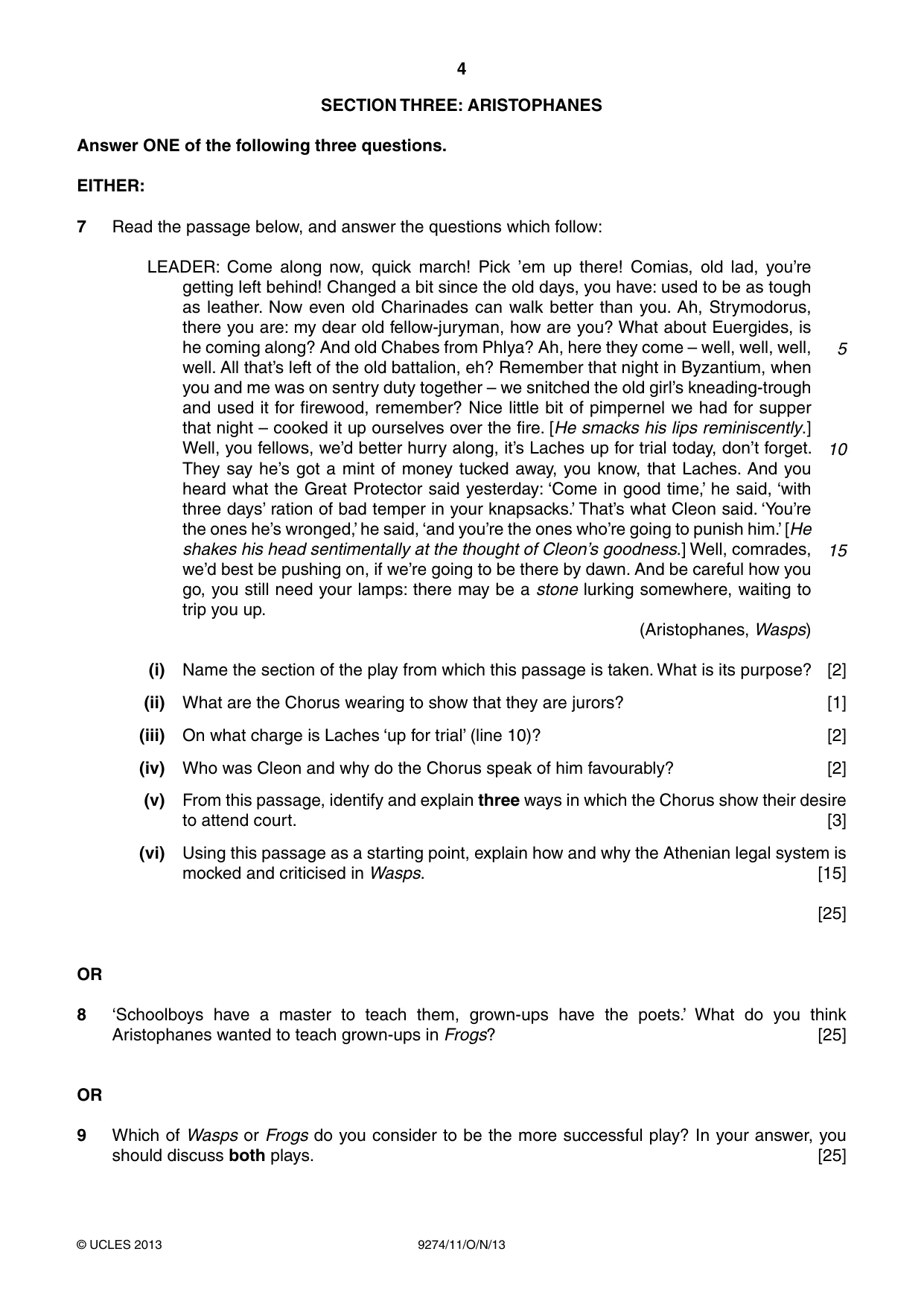
4 9274/11/O/N/13 © UCLES 2013 SECTION THREE: ARISTOPHANES Answer ONE of the following three questions. EITHER: 7 Read the passage below, and answer the questions which follow: LEADER: Come along now, quick march! Pick ’em up there! Comias, old lad, you’re getting left behind! Changed a bit since the old days, you have: used to be as tough as leather. Now even old Charinades can walk better than you. Ah, Strymodorus, there you are: my dear old fellow-juryman, how are you? What about Euergides, is he coming along? And old Chabes from Phlya? Ah, here they come – well, well, well, well. All that’s left of the old battalion, eh? Remember that night in Byzantium, when you and me was on sentry duty together – we snitched the old girl’s kneading-trough and used it for firewood, remember? Nice little bit of pimpernel we had for supper that night – cooked it up ourselves over the fire. [He smacks his lips reminiscently.] Well, you fellows, we’d better hurry along, it’s Laches up for trial today, don’t forget. They say he’s got a mint of money tucked away, you know, that Laches. And you heard what the Great Protector said yesterday: ‘Come in good time,’ he said, ‘with three days’ ration of bad temper in your knapsacks.’ That’s what Cleon said. ‘You’re the ones he’s wronged,’ he said, ‘and you’re the ones who’re going to punish him.’ [He shakes his head sentimentally at the thought of Cleon’s goodness.] Well, comrades, we’d best be pushing on, if we’re going to be there by dawn. And be careful how you go, you still need your lamps: there may be a stone lurking somewhere, waiting to trip you up. (Aristophanes, Wasps) (i) Name the section of the play from which this passage is taken. What is its purpose? [2] (ii) What are the Chorus wearing to show that they are jurors? [1] (iii) On what charge is Laches ‘up for trial’ (line 10)? [2] (iv) Who was Cleon and why do the Chorus speak of him favourably? [2] (v) From this passage, identify and explain three ways in which the Chorus show their desire to attend court. [3] (vi) Using this passage as a starting point, explain how and why the Athenian legal system is mocked and criticised in Wasps. [15] [25] OR 8 ‘Schoolboys have a master to teach them, grown-ups have the poets.’ What do you think Aristophanes wanted to teach grown-ups in Frogs? [25] OR 9 Which of Wasps or Frogs do you consider to be the more successful play? In your answer, you should discuss both plays. [25] 5 10 15
Question paper, page 5
5 9274/11/O/N/13 © UCLES 2013 [Turn over BLANK PAGE Please turn to page 6 for Section Four.
Question paper, page 6
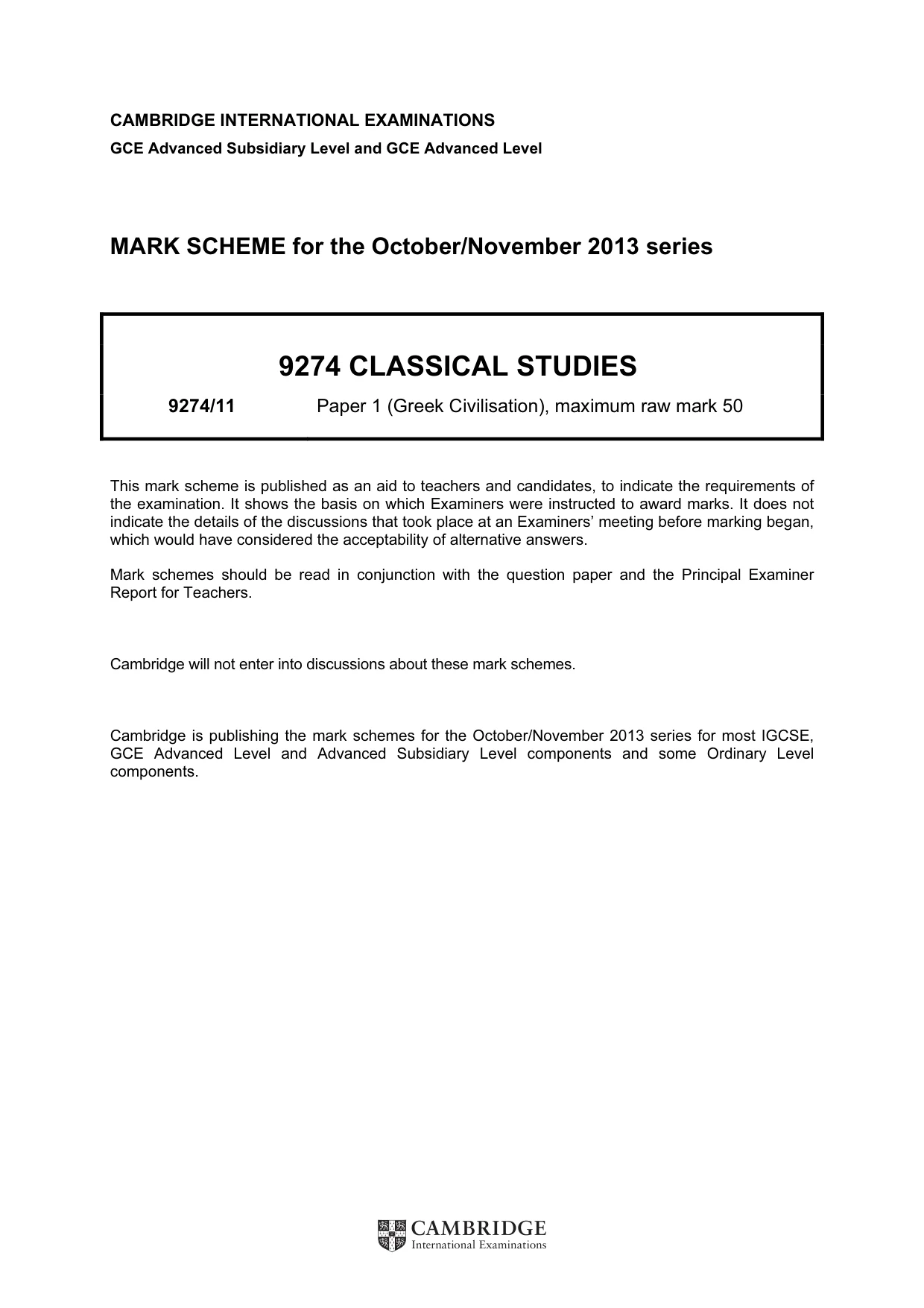
6 9274/11/O/N/13 © UCLES 2013 SECTION FOUR: GREEK VASE PAINTING Answer ONE of the following three questions. EITHER 10 Study the images and answer the questions which follow:
Question paper, page 7
7 9274/11/O/N/13 © UCLES 2013 [Turn over DETAIL OF THE NARRATIVE FRIEZE (i) What name is given to this type of pot? [1] (ii) On what occasion might this pot have been used, and for what purpose? [3] (iii) Explain how the shape of this pot makes it suitable for its purpose. [3] (iv) Who painted this pot? [1] (v) What is the subject matter of the narrative frieze on this pot? [2] (vi) Compare the content and composition of the narrative frieze on this pot with any one of the narrative friezes on the François Vase. [15] [25]
Question paper, page 8
8 9274/11/O/N/13 © UCLES 2013 11 ‘A master storyteller.’ In your opinion, to which of the painters you have studied does this description best apply? In your answer, you should include discussion of at least three painters, and specific pots by the painters you have chosen. [25] 12 ‘Greek vase-painters were only interested in depicting scenes of bravery and heroism.’ To what extent does your study of Greek vase-painting support this view? In your answer, you must include discussion of specific pots. [25] Copyright Acknowledgements: Question 1 © Ian Scott Kilvert; Plutarch, Age of Alexander; Penguin Books Ltd; 1973. Question 4 © trans. H Tredennick & H Tarrant; Plato; The Last Days of Socrates; Penguin Books Ltd; 2003. Question 7 © trans. D Barratt; Aristophanes; The Wasps; Penguin Books Ltd; 1964. Question 10 © Susan Woodford; An Introduction to Greek Art; Gerald Duckworth & Co. Ltd; 1986. Permission to reproduce items where third-party owned material protected by copyright is included has been sought and cleared where possible. Every reasonable effort has been made by the publisher (UCLES) to trace copyright holders, but if any items requiring clearance have unwittingly been included, the publisher will be pleased to make amends at the earliest possible opportunity. University of Cambridge International Examinations is part of the Cambridge Assessment Group. Cambridge Assessment is the brand name of University of Cambridge Local Examinations Syndicate (UCLES), which is itself a department of the University of Cambridge.
Mark scheme, page 1
CAMBRIDGE INTERNATIONAL EXAMINATIONS GCE Advanced Subsidiary Level and GCE Advanced Level MARK SCHEME for the October/November 2013 series 9274 CLASSICAL STUDIES 9274/11 Paper 1 (Greek Civilisation), maximum raw mark 50 This mark scheme is published as an aid to teachers and candidates, to indicate the requirements of the examination. It shows the basis on which Examiners were instructed to award marks. It does not indicate the details of the discussions that took place at an Examiners’ meeting before marking began, which would have considered the acceptability of alternative answers. Mark schemes should be read in conjunction with the question paper and the Principal Examiner Report for Teachers. Cambridge will not enter into discussions about these mark schemes. Cambridge is publishing the mark schemes for the October/November 2013 series for most IGCSE, GCE Advanced Level and Advanced Subsidiary Level components and some Ordinary Level components.
Mark scheme, page 2
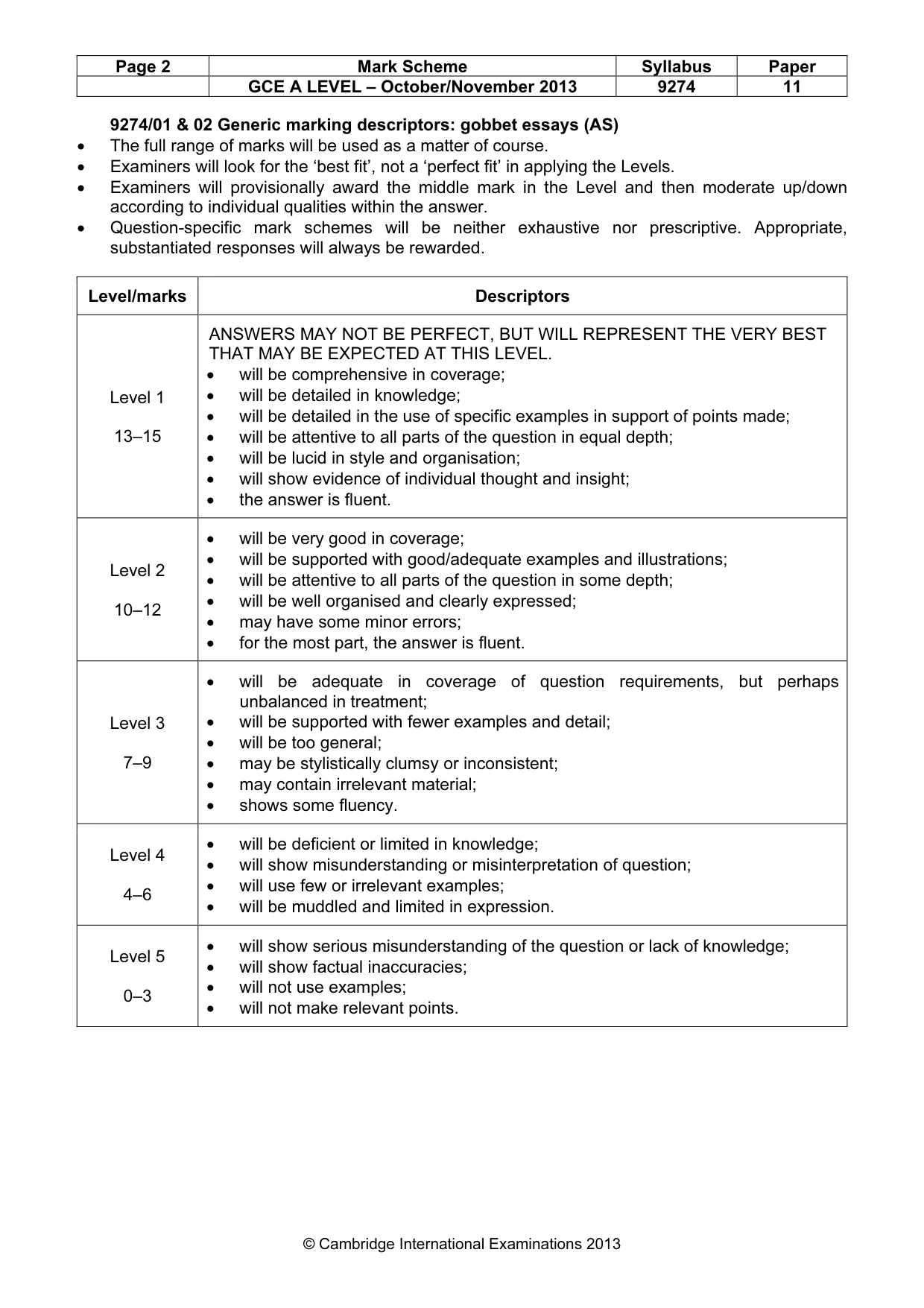
Page 2 Mark Scheme Syllabus Paper GCE A LEVEL – October/November 2013 9274 11 © Cambridge International Examinations 2013 9274/01 & 02 Generic marking descriptors: gobbet essays (AS) • The full range of marks will be used as a matter of course. • Examiners will look for the ‘best fit’, not a ‘perfect fit’ in applying the Levels. • Examiners will provisionally award the middle mark in the Level and then moderate up/down according to individual qualities within the answer. • Question-specific mark schemes will be neither exhaustive nor prescriptive. Appropriate, substantiated responses will always be rewarded. Level/marks Descriptors Level 1 13–15 ANSWERS MAY NOT BE PERFECT, BUT WILL REPRESENT THE VERY BEST THAT MAY BE EXPECTED AT THIS LEVEL. • will be comprehensive in coverage; • will be detailed in knowledge; • will be detailed in the use of specific examples in support of points made; • will be attentive to all parts of the question in equal depth; • will be lucid in style and organisation; • will show evidence of individual thought and insight; • the answer is fluent. Level 2 10–12 • will be very good in coverage; • will be supported with good/adequate examples and illustrations; • will be attentive to all parts of the question in some depth; • will be well organised and clearly expressed; • may have some minor errors; • for the most part, the answer is fluent. Level 3 7–9 • will be adequate in coverage of question requirements, but perhaps unbalanced in treatment; • will be supported with fewer examples and detail; • will be too general; • may be stylistically clumsy or inconsistent; • may contain irrelevant material; • shows some fluency. Level 4 4–6 • will be deficient or limited in knowledge; • will show misunderstanding or misinterpretation of question; • will use few or irrelevant examples; • will be muddled and limited in expression. Level 5 0–3 • will show serious misunderstanding of the question or lack of knowledge; • will show factual inaccuracies; • will not use examples; • will not make relevant points.
Mark scheme, page 3
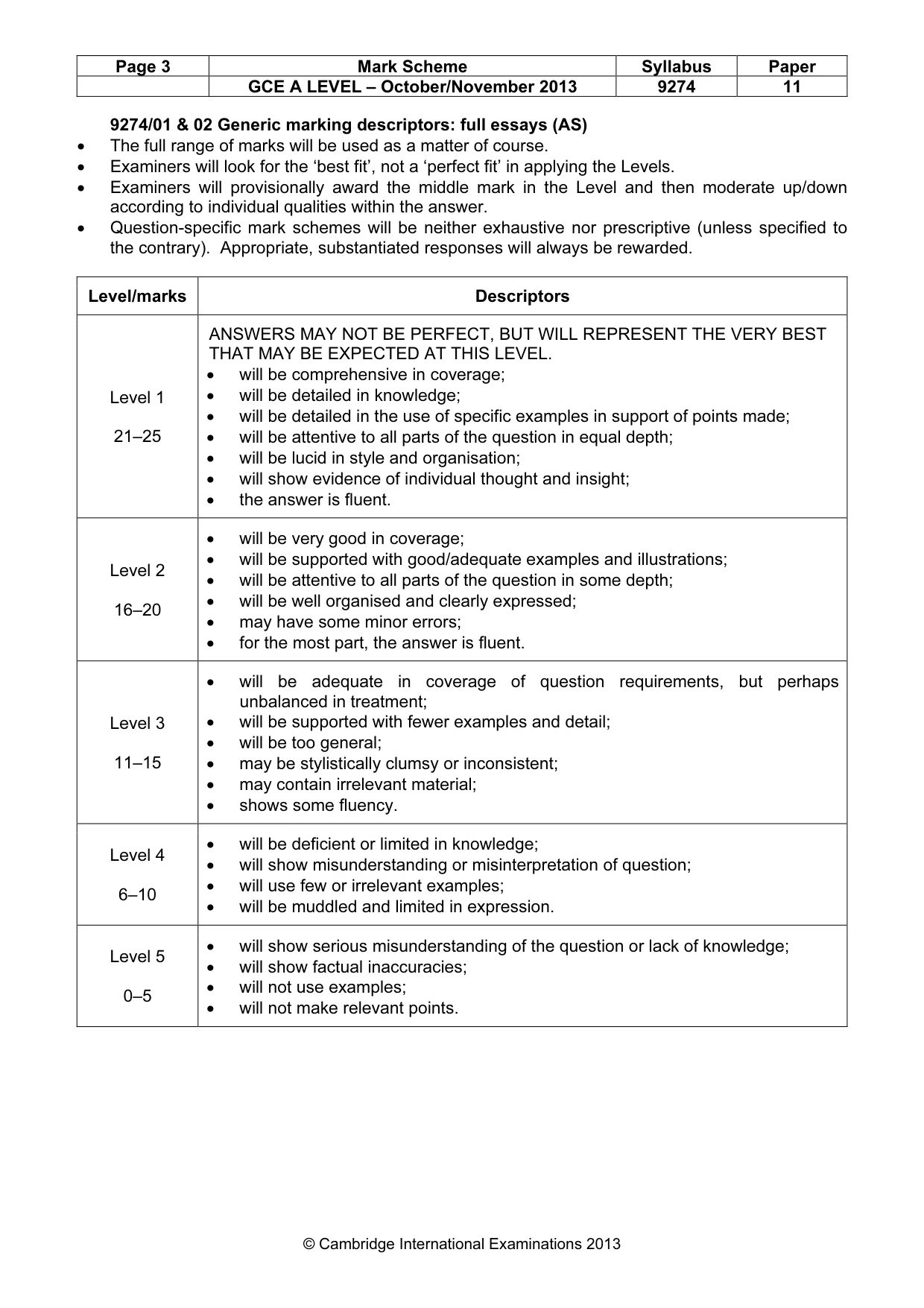
Page 3 Mark Scheme Syllabus Paper GCE A LEVEL – October/November 2013 9274 11 © Cambridge International Examinations 2013 9274/01 & 02 Generic marking descriptors: full essays (AS) • The full range of marks will be used as a matter of course. • Examiners will look for the ‘best fit’, not a ‘perfect fit’ in applying the Levels. • Examiners will provisionally award the middle mark in the Level and then moderate up/down according to individual qualities within the answer. • Question-specific mark schemes will be neither exhaustive nor prescriptive (unless specified to the contrary). Appropriate, substantiated responses will always be rewarded. Level/marks Descriptors Level 1 21–25 ANSWERS MAY NOT BE PERFECT, BUT WILL REPRESENT THE VERY BEST THAT MAY BE EXPECTED AT THIS LEVEL. • will be comprehensive in coverage; • will be detailed in knowledge; • will be detailed in the use of specific examples in support of points made; • will be attentive to all parts of the question in equal depth; • will be lucid in style and organisation; • will show evidence of individual thought and insight; • the answer is fluent. Level 2 16–20 • will be very good in coverage; • will be supported with good/adequate examples and illustrations; • will be attentive to all parts of the question in some depth; • will be well organised and clearly expressed; • may have some minor errors; • for the most part, the answer is fluent. Level 3 11–15 • will be adequate in coverage of question requirements, but perhaps unbalanced in treatment; • will be supported with fewer examples and detail; • will be too general; • may be stylistically clumsy or inconsistent; • may contain irrelevant material; • shows some fluency. Level 4 6–10 • will be deficient or limited in knowledge; • will show misunderstanding or misinterpretation of question; • will use few or irrelevant examples; • will be muddled and limited in expression. Level 5 0–5 • will show serious misunderstanding of the question or lack of knowledge; • will show factual inaccuracies; • will not use examples; • will not make relevant points.
Mark scheme, page 4
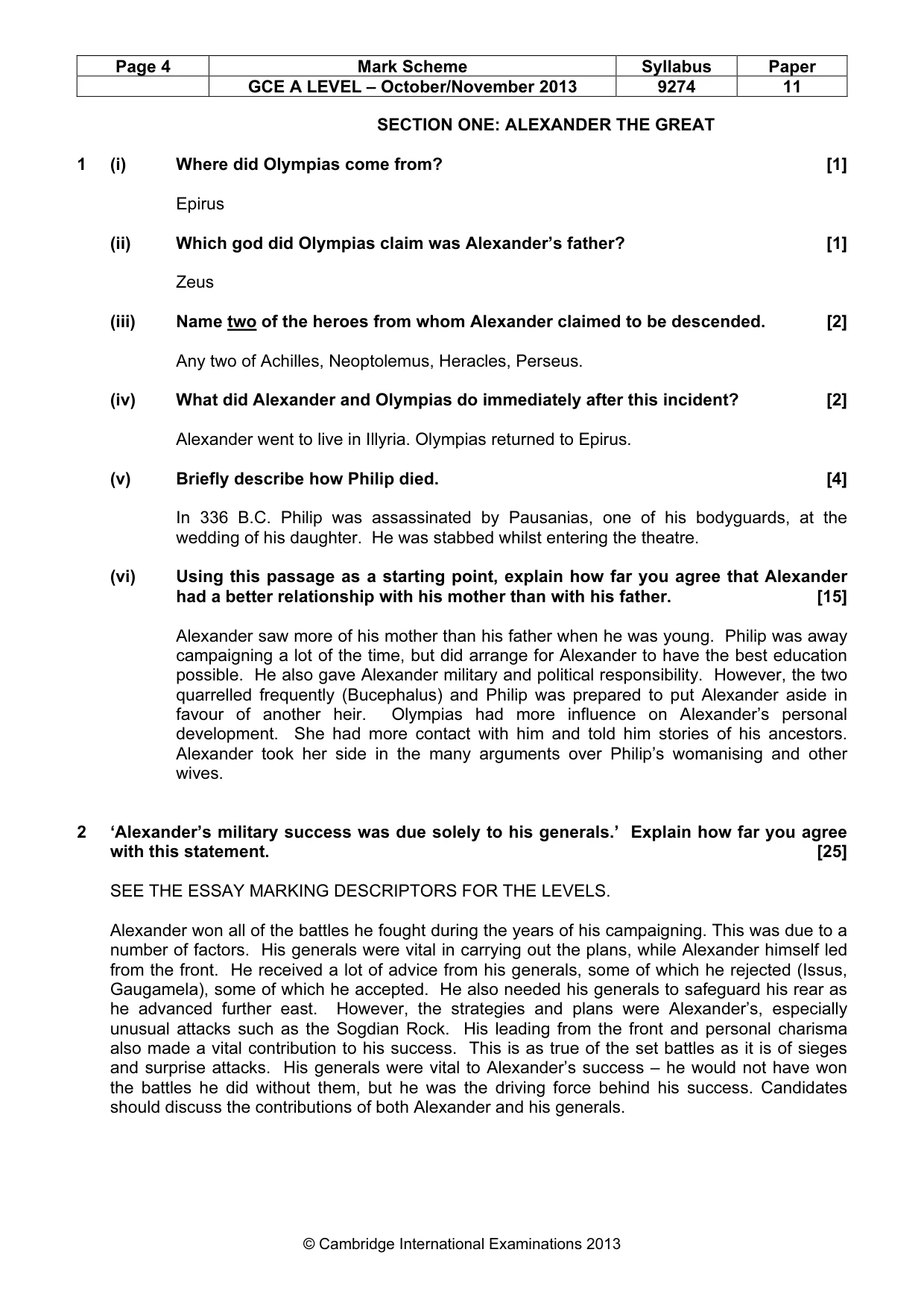
Page 4 Mark Scheme Syllabus Paper GCE A LEVEL – October/November 2013 9274 11 © Cambridge International Examinations 2013 SECTION ONE: ALEXANDER THE GREAT 1 (i) Where did Olympias come from? [1] Epirus (ii) Which god did Olympias claim was Alexander’s father? [1] Zeus (iii) Name two of the heroes from whom Alexander claimed to be descended. [2] Any two of Achilles, Neoptolemus, Heracles, Perseus. (iv) What did Alexander and Olympias do immediately after this incident? [2] Alexander went to live in Illyria. Olympias returned to Epirus. (v) Briefly describe how Philip died. [4] In 336 B.C. Philip was assassinated by Pausanias, one of his bodyguards, at the wedding of his daughter. He was stabbed whilst entering the theatre. (vi) Using this passage as a starting point, explain how far you agree that Alexander had a better relationship with his mother than with his father. [15] Alexander saw more of his mother than his father when he was young. Philip was away campaigning a lot of the time, but did arrange for Alexander to have the best education possible. He also gave Alexander military and political responsibility. However, the two quarrelled frequently (Bucephalus) and Philip was prepared to put Alexander aside in favour of another heir. Olympias had more influence on Alexander’s personal development. She had more contact with him and told him stories of his ancestors. Alexander took her side in the many arguments over Philip’s womanising and other wives. 2 ‘Alexander’s military success was due solely to his generals.’ Explain how far you agree with this statement. [25] SEE THE ESSAY MARKING DESCRIPTORS FOR THE LEVELS. Alexander won all of the battles he fought during the years of his campaigning. This was due to a number of factors. His generals were vital in carrying out the plans, while Alexander himself led from the front. He received a lot of advice from his generals, some of which he rejected (Issus, Gaugamela), some of which he accepted. He also needed his generals to safeguard his rear as he advanced further east. However, the strategies and plans were Alexander’s, especially unusual attacks such as the Sogdian Rock. His leading from the front and personal charisma also made a vital contribution to his success. This is as true of the set battles as it is of sieges and surprise attacks. His generals were vital to Alexander’s success – he would not have won the battles he did without them, but he was the driving force behind his success. Candidates should discuss the contributions of both Alexander and his generals.
Mark scheme, page 5
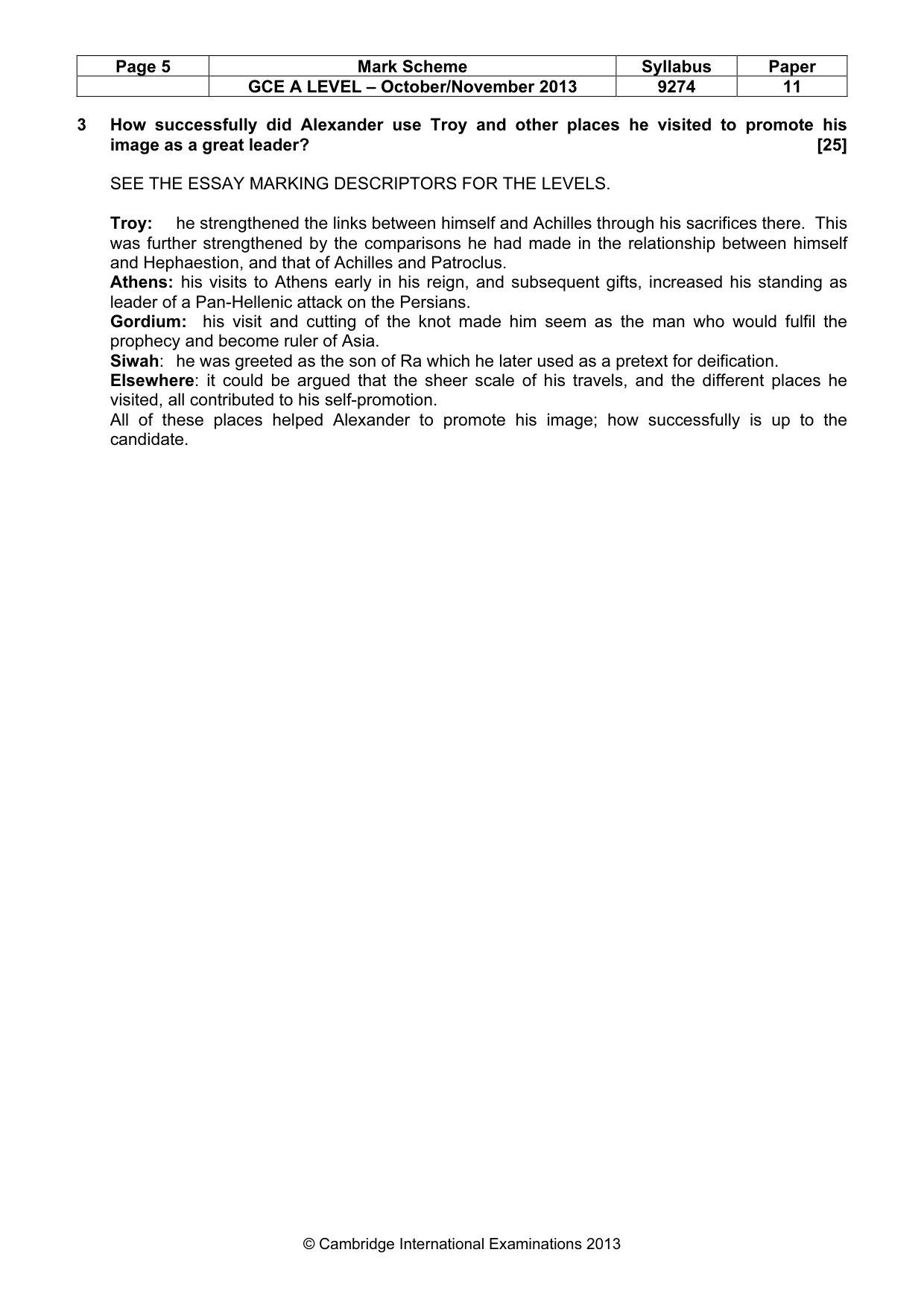
Page 5 Mark Scheme Syllabus Paper GCE A LEVEL – October/November 2013 9274 11 © Cambridge International Examinations 2013 3 How successfully did Alexander use Troy and other places he visited to promote his image as a great leader? [25] SEE THE ESSAY MARKING DESCRIPTORS FOR THE LEVELS. Troy: he strengthened the links between himself and Achilles through his sacrifices there. This was further strengthened by the comparisons he had made in the relationship between himself and Hephaestion, and that of Achilles and Patroclus. Athens: his visits to Athens early in his reign, and subsequent gifts, increased his standing as leader of a Pan-Hellenic attack on the Persians. Gordium: his visit and cutting of the knot made him seem as the man who would fulfil the prophecy and become ruler of Asia. Siwah: he was greeted as the son of Ra which he later used as a pretext for deification. Elsewhere: it could be argued that the sheer scale of his travels, and the different places he visited, all contributed to his self-promotion. All of these places helped Alexander to promote his image; how successfully is up to the candidate.
Mark scheme, page 6
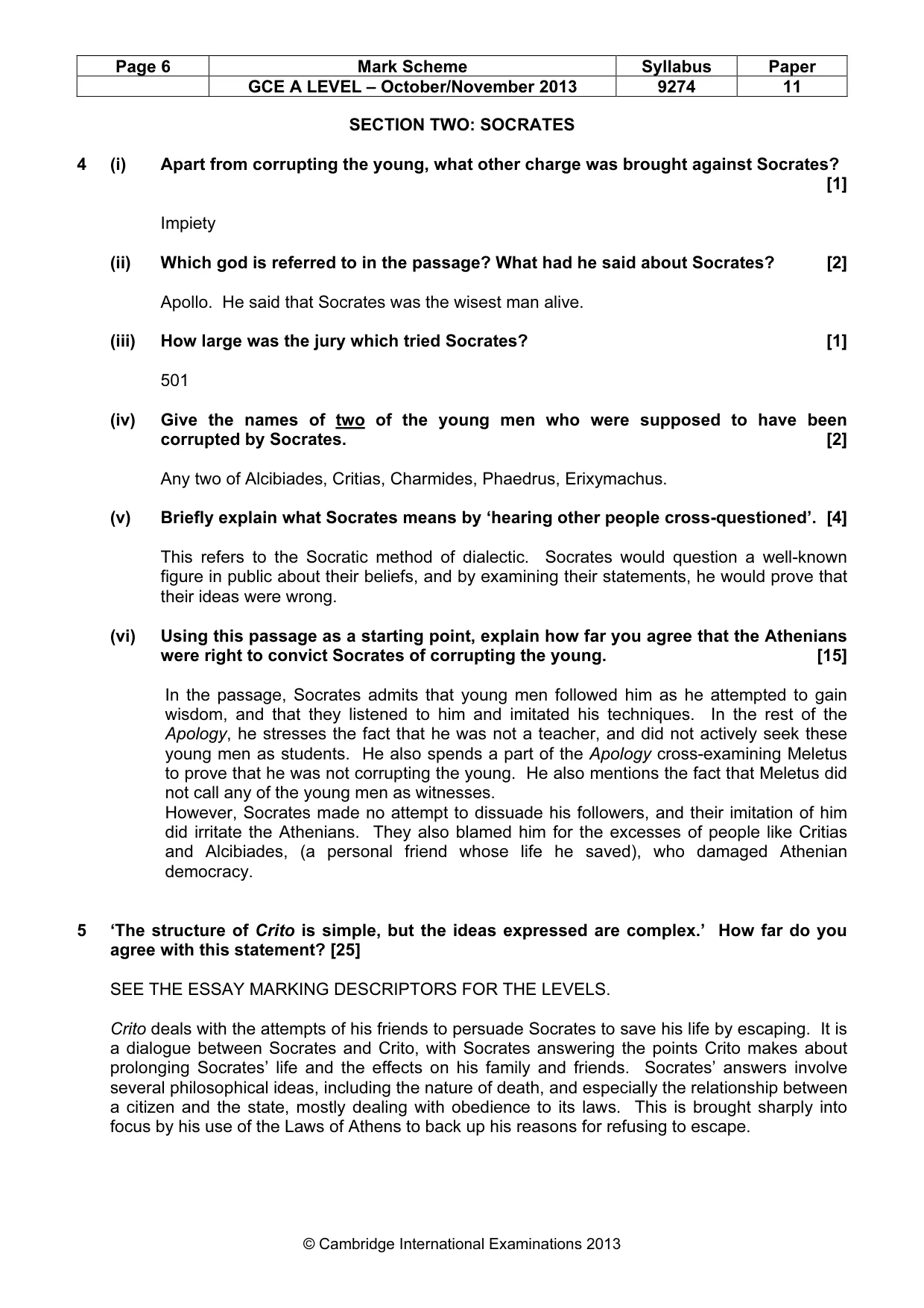
Page 6 Mark Scheme Syllabus Paper GCE A LEVEL – October/November 2013 9274 11 © Cambridge International Examinations 2013 SECTION TWO: SOCRATES 4 (i) Apart from corrupting the young, what other charge was brought against Socrates? [1] Impiety (ii) Which god is referred to in the passage? What had he said about Socrates? [2] Apollo. He said that Socrates was the wisest man alive. (iii) How large was the jury which tried Socrates? [1] 501 (iv) Give the names of two of the young men who were supposed to have been corrupted by Socrates. [2] Any two of Alcibiades, Critias, Charmides, Phaedrus, Erixymachus. (v) Briefly explain what Socrates means by ‘hearing other people cross-questioned’. [4] This refers to the Socratic method of dialectic. Socrates would question a well-known figure in public about their beliefs, and by examining their statements, he would prove that their ideas were wrong. (vi) Using this passage as a starting point, explain how far you agree that the Athenians were right to convict Socrates of corrupting the young. [15] In the passage, Socrates admits that young men followed him as he attempted to gain wisdom, and that they listened to him and imitated his techniques. In the rest of the Apology, he stresses the fact that he was not a teacher, and did not actively seek these young men as students. He also spends a part of the Apology cross-examining Meletus to prove that he was not corrupting the young. He also mentions the fact that Meletus did not call any of the young men as witnesses. However, Socrates made no attempt to dissuade his followers, and their imitation of him did irritate the Athenians. They also blamed him for the excesses of people like Critias and Alcibiades, (a personal friend whose life he saved), who damaged Athenian democracy. 5 ‘The structure of Crito is simple, but the ideas expressed are complex.’ How far do you agree with this statement? [25] SEE THE ESSAY MARKING DESCRIPTORS FOR THE LEVELS. Crito deals with the attempts of his friends to persuade Socrates to save his life by escaping. It is a dialogue between Socrates and Crito, with Socrates answering the points Crito makes about prolonging Socrates’ life and the effects on his family and friends. Socrates’ answers involve several philosophical ideas, including the nature of death, and especially the relationship between a citizen and the state, mostly dealing with obedience to its laws. This is brought sharply into focus by his use of the Laws of Athens to back up his reasons for refusing to escape.
Mark scheme, page 7
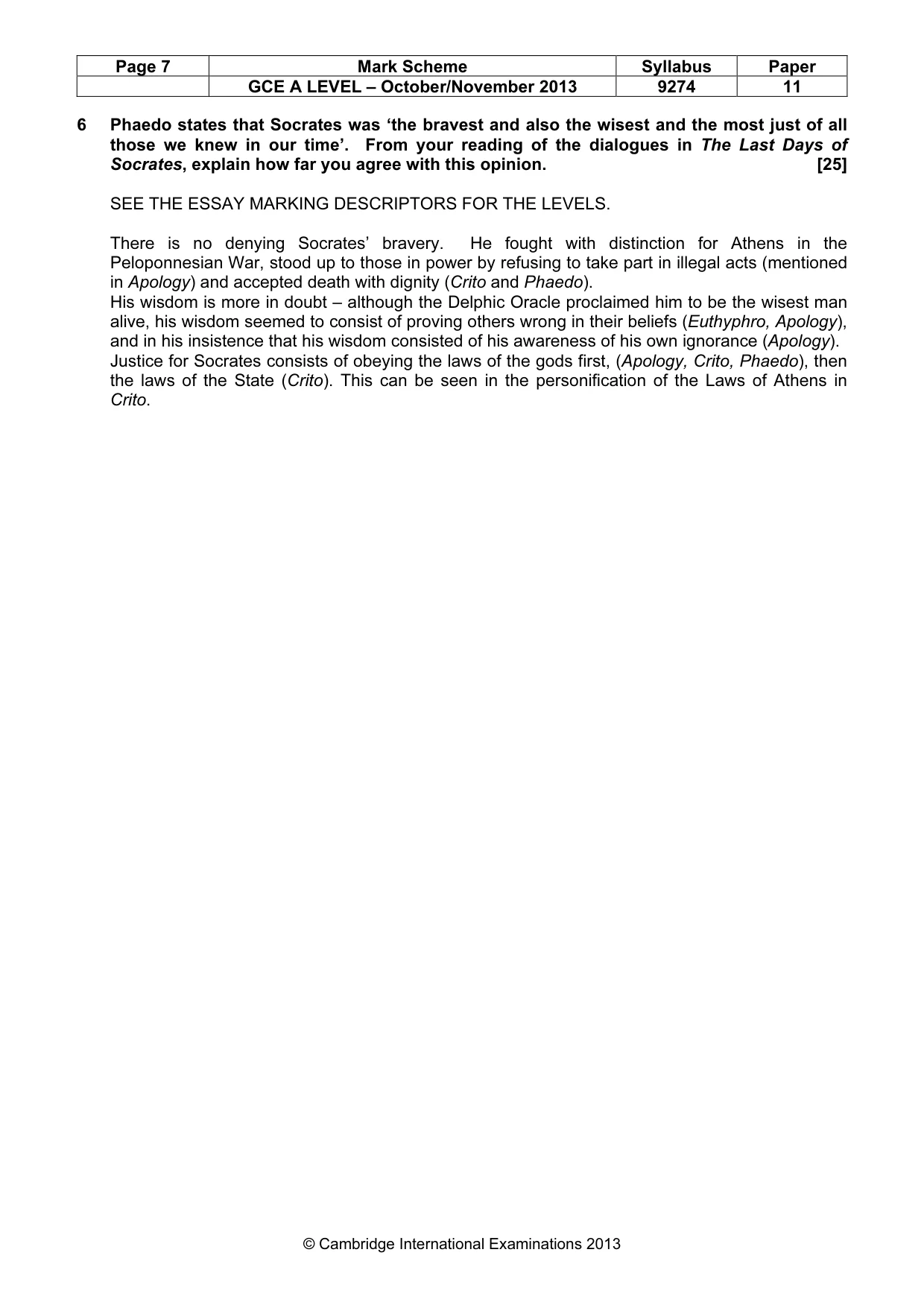
Page 7 Mark Scheme Syllabus Paper GCE A LEVEL – October/November 2013 9274 11 © Cambridge International Examinations 2013 6 Phaedo states that Socrates was ‘the bravest and also the wisest and the most just of all those we knew in our time’. From your reading of the dialogues in The Last Days of Socrates, explain how far you agree with this opinion. [25] SEE THE ESSAY MARKING DESCRIPTORS FOR THE LEVELS. There is no denying Socrates’ bravery. He fought with distinction for Athens in the Peloponnesian War, stood up to those in power by refusing to take part in illegal acts (mentioned in Apology) and accepted death with dignity (Crito and Phaedo). His wisdom is more in doubt – although the Delphic Oracle proclaimed him to be the wisest man alive, his wisdom seemed to consist of proving others wrong in their beliefs (Euthyphro, Apology), and in his insistence that his wisdom consisted of his awareness of his own ignorance (Apology). Justice for Socrates consists of obeying the laws of the gods first, (Apology, Crito, Phaedo), then the laws of the State (Crito). This can be seen in the personification of the Laws of Athens in Crito.
Mark scheme, page 8
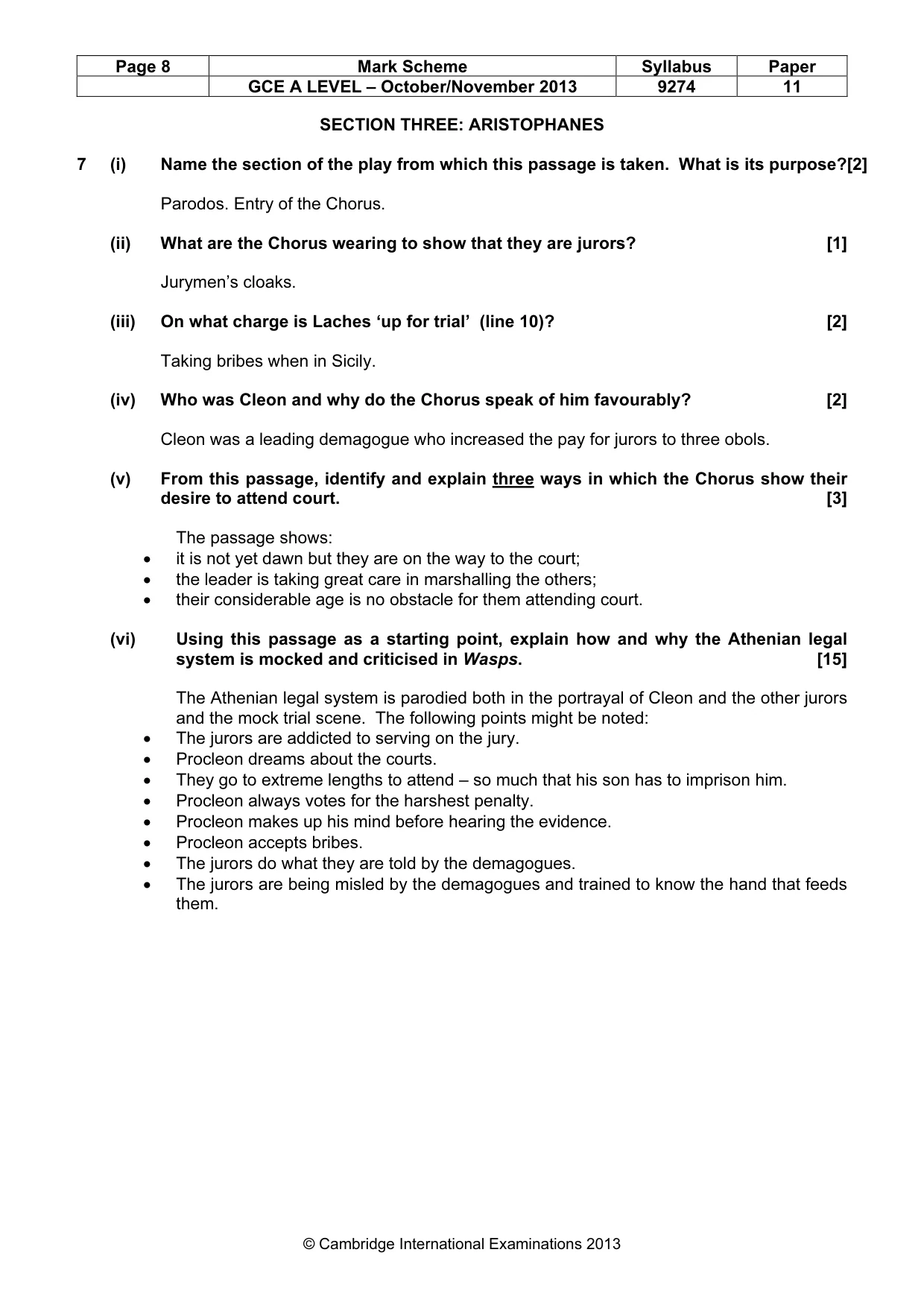
Page 8 Mark Scheme Syllabus Paper GCE A LEVEL – October/November 2013 9274 11 © Cambridge International Examinations 2013 SECTION THREE: ARISTOPHANES 7 (i) Name the section of the play from which this passage is taken. What is its purpose?[2] Parodos. Entry of the Chorus. (ii) What are the Chorus wearing to show that they are jurors? [1] Jurymen’s cloaks. (iii) On what charge is Laches ‘up for trial’ (line 10)? [2] Taking bribes when in Sicily. (iv) Who was Cleon and why do the Chorus speak of him favourably? [2] Cleon was a leading demagogue who increased the pay for jurors to three obols. (v) From this passage, identify and explain three ways in which the Chorus show their desire to attend court. [3] The passage shows: • it is not yet dawn but they are on the way to the court; • the leader is taking great care in marshalling the others; • their considerable age is no obstacle for them attending court. (vi) Using this passage as a starting point, explain how and why the Athenian legal system is mocked and criticised in Wasps. [15] The Athenian legal system is parodied both in the portrayal of Cleon and the other jurors and the mock trial scene. The following points might be noted: • The jurors are addicted to serving on the jury. • Procleon dreams about the courts. • They go to extreme lengths to attend – so much that his son has to imprison him. • Procleon always votes for the harshest penalty. • Procleon makes up his mind before hearing the evidence. • Procleon accepts bribes. • The jurors do what they are told by the demagogues. • The jurors are being misled by the demagogues and trained to know the hand that feeds them.
Mark scheme, page 9
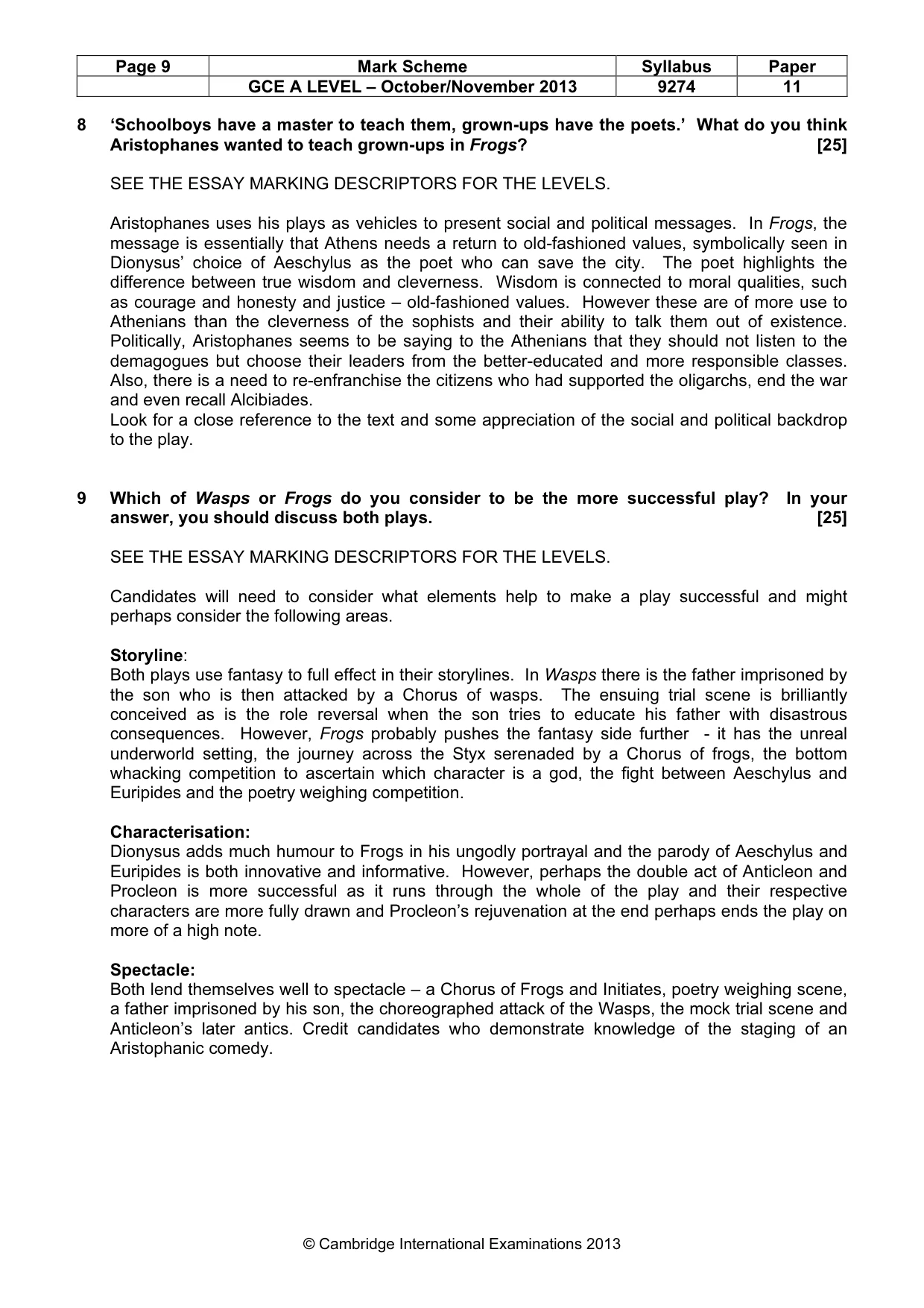
Page 9 Mark Scheme Syllabus Paper GCE A LEVEL – October/November 2013 9274 11 © Cambridge International Examinations 2013 8 ‘Schoolboys have a master to teach them, grown-ups have the poets.’ What do you think Aristophanes wanted to teach grown-ups in Frogs? [25] SEE THE ESSAY MARKING DESCRIPTORS FOR THE LEVELS. Aristophanes uses his plays as vehicles to present social and political messages. In Frogs, the message is essentially that Athens needs a return to old-fashioned values, symbolically seen in Dionysus’ choice of Aeschylus as the poet who can save the city. The poet highlights the difference between true wisdom and cleverness. Wisdom is connected to moral qualities, such as courage and honesty and justice – old-fashioned values. However these are of more use to Athenians than the cleverness of the sophists and their ability to talk them out of existence. Politically, Aristophanes seems to be saying to the Athenians that they should not listen to the demagogues but choose their leaders from the better-educated and more responsible classes. Also, there is a need to re-enfranchise the citizens who had supported the oligarchs, end the war and even recall Alcibiades. Look for a close reference to the text and some appreciation of the social and political backdrop to the play. 9 Which of Wasps or Frogs do you consider to be the more successful play? In your answer, you should discuss both plays. [25] SEE THE ESSAY MARKING DESCRIPTORS FOR THE LEVELS. Candidates will need to consider what elements help to make a play successful and might perhaps consider the following areas. Storyline: Both plays use fantasy to full effect in their storylines. In Wasps there is the father imprisoned by the son who is then attacked by a Chorus of wasps. The ensuing trial scene is brilliantly conceived as is the role reversal when the son tries to educate his father with disastrous consequences. However, Frogs probably pushes the fantasy side further - it has the unreal underworld setting, the journey across the Styx serenaded by a Chorus of frogs, the bottom whacking competition to ascertain which character is a god, the fight between Aeschylus and Euripides and the poetry weighing competition. Characterisation: Dionysus adds much humour to Frogs in his ungodly portrayal and the parody of Aeschylus and Euripides is both innovative and informative. However, perhaps the double act of Anticleon and Procleon is more successful as it runs through the whole of the play and their respective characters are more fully drawn and Procleon’s rejuvenation at the end perhaps ends the play on more of a high note. Spectacle: Both lend themselves well to spectacle – a Chorus of Frogs and Initiates, poetry weighing scene, a father imprisoned by his son, the choreographed attack of the Wasps, the mock trial scene and Anticleon’s later antics. Credit candidates who demonstrate knowledge of the staging of an Aristophanic comedy.
Mark scheme, page 10
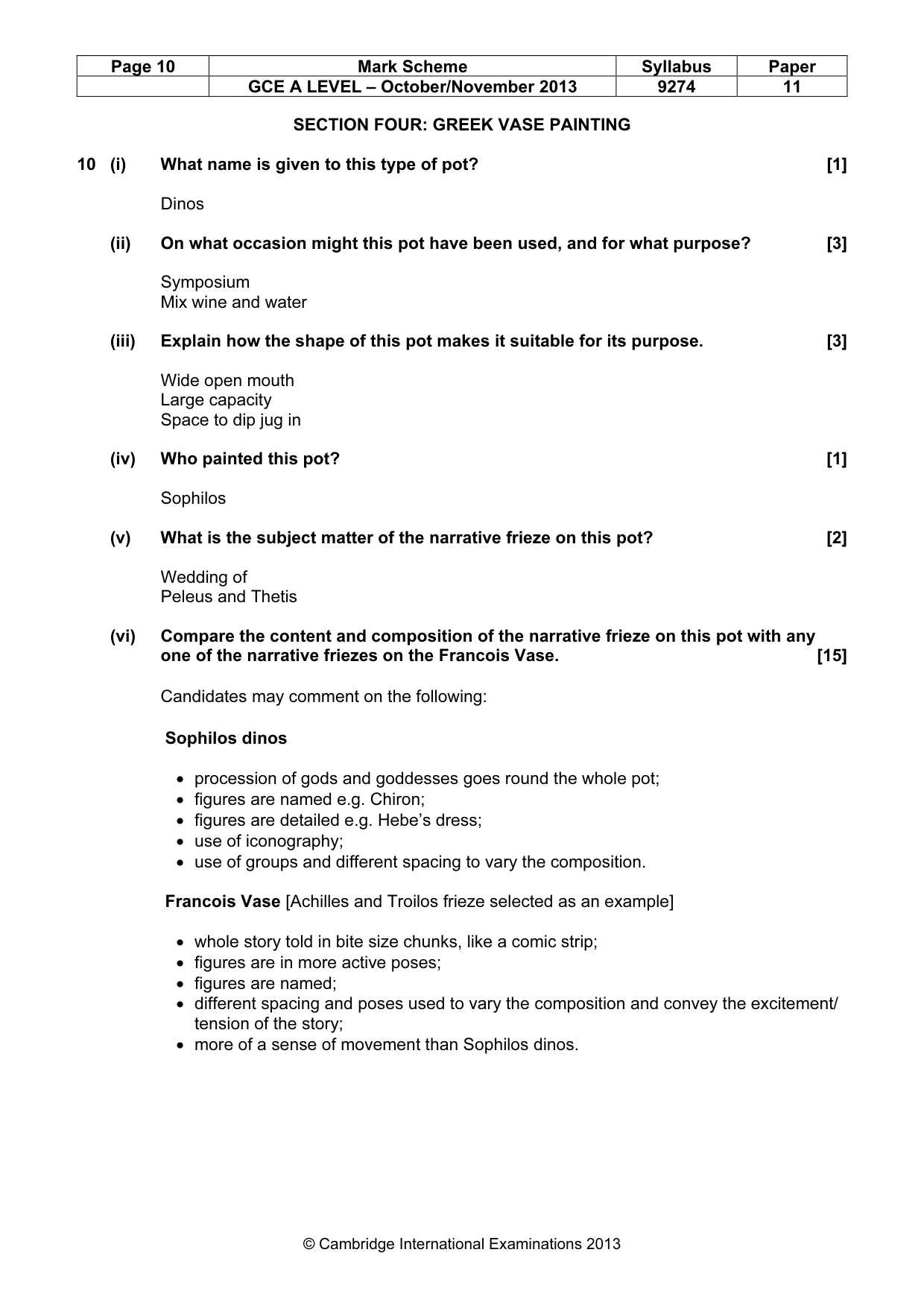
Page 10 Mark Scheme Syllabus Paper GCE A LEVEL – October/November 2013 9274 11 © Cambridge International Examinations 2013 SECTION FOUR: GREEK VASE PAINTING 10 (i) What name is given to this type of pot? [1] Dinos (ii) On what occasion might this pot have been used, and for what purpose? [3] Symposium Mix wine and water (iii) Explain how the shape of this pot makes it suitable for its purpose. [3] Wide open mouth Large capacity Space to dip jug in (iv) Who painted this pot? [1] Sophilos (v) What is the subject matter of the narrative frieze on this pot? [2] Wedding of Peleus and Thetis (vi) Compare the content and composition of the narrative frieze on this pot with any one of the narrative friezes on the Francois Vase. [15] Candidates may comment on the following: Sophilos dinos • procession of gods and goddesses goes round the whole pot; • figures are named e.g. Chiron; • figures are detailed e.g. Hebe’s dress; • use of iconography; • use of groups and different spacing to vary the composition. Francois Vase [Achilles and Troilos frieze selected as an example] • whole story told in bite size chunks, like a comic strip; • figures are in more active poses; • figures are named; • different spacing and poses used to vary the composition and convey the excitement/ tension of the story; • more of a sense of movement than Sophilos dinos.
Mark scheme, page 11
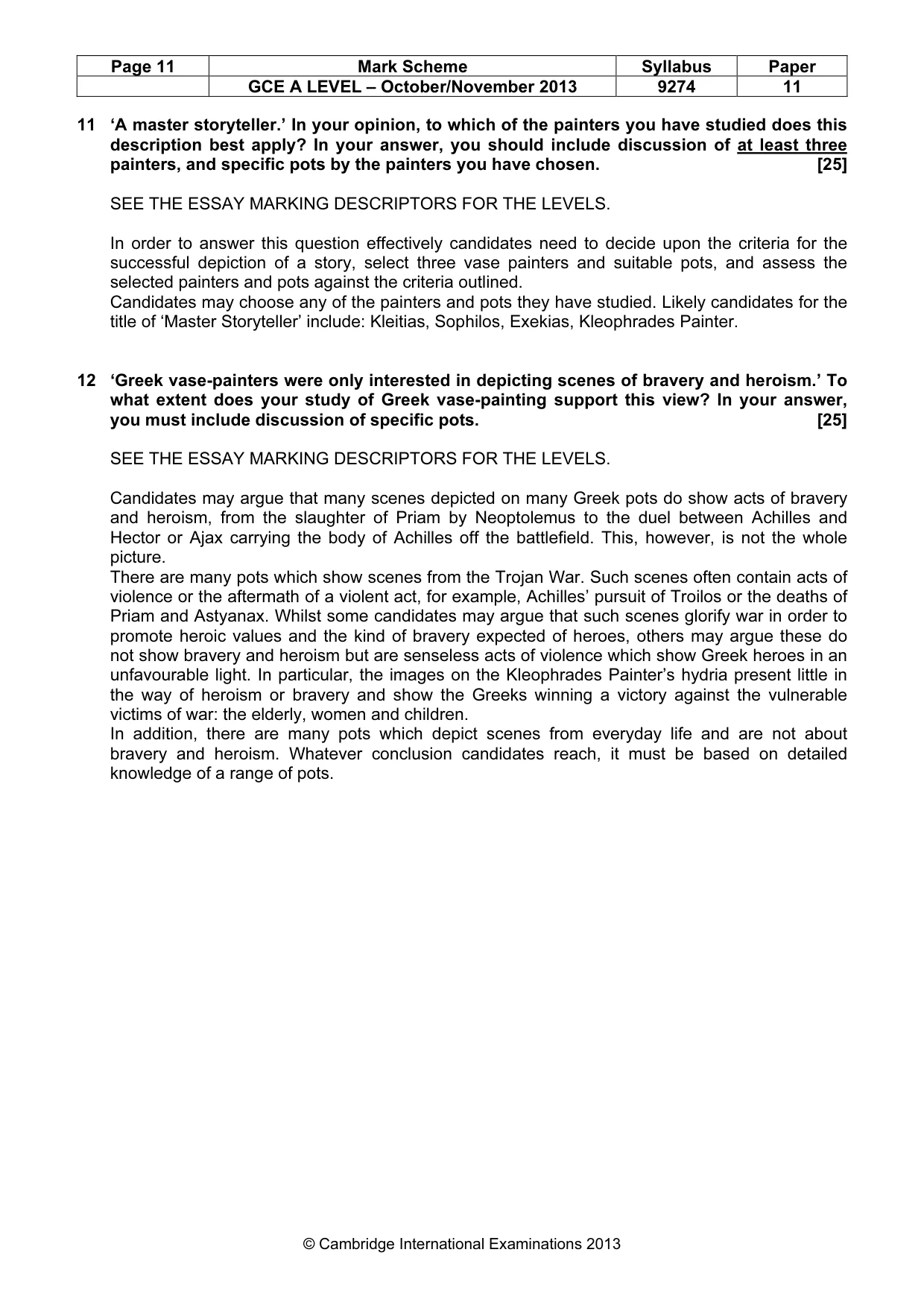
Page 11 Mark Scheme Syllabus Paper GCE A LEVEL – October/November 2013 9274 11 © Cambridge International Examinations 2013 11 ‘A master storyteller.’ In your opinion, to which of the painters you have studied does this description best apply? In your answer, you should include discussion of at least three painters, and specific pots by the painters you have chosen. [25] SEE THE ESSAY MARKING DESCRIPTORS FOR THE LEVELS. In order to answer this question effectively candidates need to decide upon the criteria for the successful depiction of a story, select three vase painters and suitable pots, and assess the selected painters and pots against the criteria outlined. Candidates may choose any of the painters and pots they have studied. Likely candidates for the title of ‘Master Storyteller’ include: Kleitias, Sophilos, Exekias, Kleophrades Painter. 12 ‘Greek vase-painters were only interested in depicting scenes of bravery and heroism.’ To what extent does your study of Greek vase-painting support this view? In your answer, you must include discussion of specific pots. [25] SEE THE ESSAY MARKING DESCRIPTORS FOR THE LEVELS. Candidates may argue that many scenes depicted on many Greek pots do show acts of bravery and heroism, from the slaughter of Priam by Neoptolemus to the duel between Achilles and Hector or Ajax carrying the body of Achilles off the battlefield. This, however, is not the whole picture. There are many pots which show scenes from the Trojan War. Such scenes often contain acts of violence or the aftermath of a violent act, for example, Achilles’ pursuit of Troilos or the deaths of Priam and Astyanax. Whilst some candidates may argue that such scenes glorify war in order to promote heroic values and the kind of bravery expected of heroes, others may argue these do not show bravery and heroism but are senseless acts of violence which show Greek heroes in an unfavourable light. In particular, the images on the Kleophrades Painter’s hydria present little in the way of heroism or bravery and show the Greeks winning a victory against the vulnerable victims of war: the elderly, women and children. In addition, there are many pots which depict scenes from everyday life and are not about bravery and heroism. Whatever conclusion candidates reach, it must be based on detailed knowledge of a range of pots.
What you needed in this session
Cambridge’s own grade thresholds for 2013 Oct/Nov, Paper 1 · Variant 1. A higher threshold means an easier paper — the bar moves with how the cohort did.