Cambridge A Level Chemistry 9701 — 2017 Feb/March Paper 1 · Variant 2
9701/12/F/M/17 · 40 marks · ≈45 min
The question paper and its mark scheme, free to read here and free to download. This is Cambridge’s own paper, exactly as it was sat.
Question paper16 pages

Mark scheme3 pages
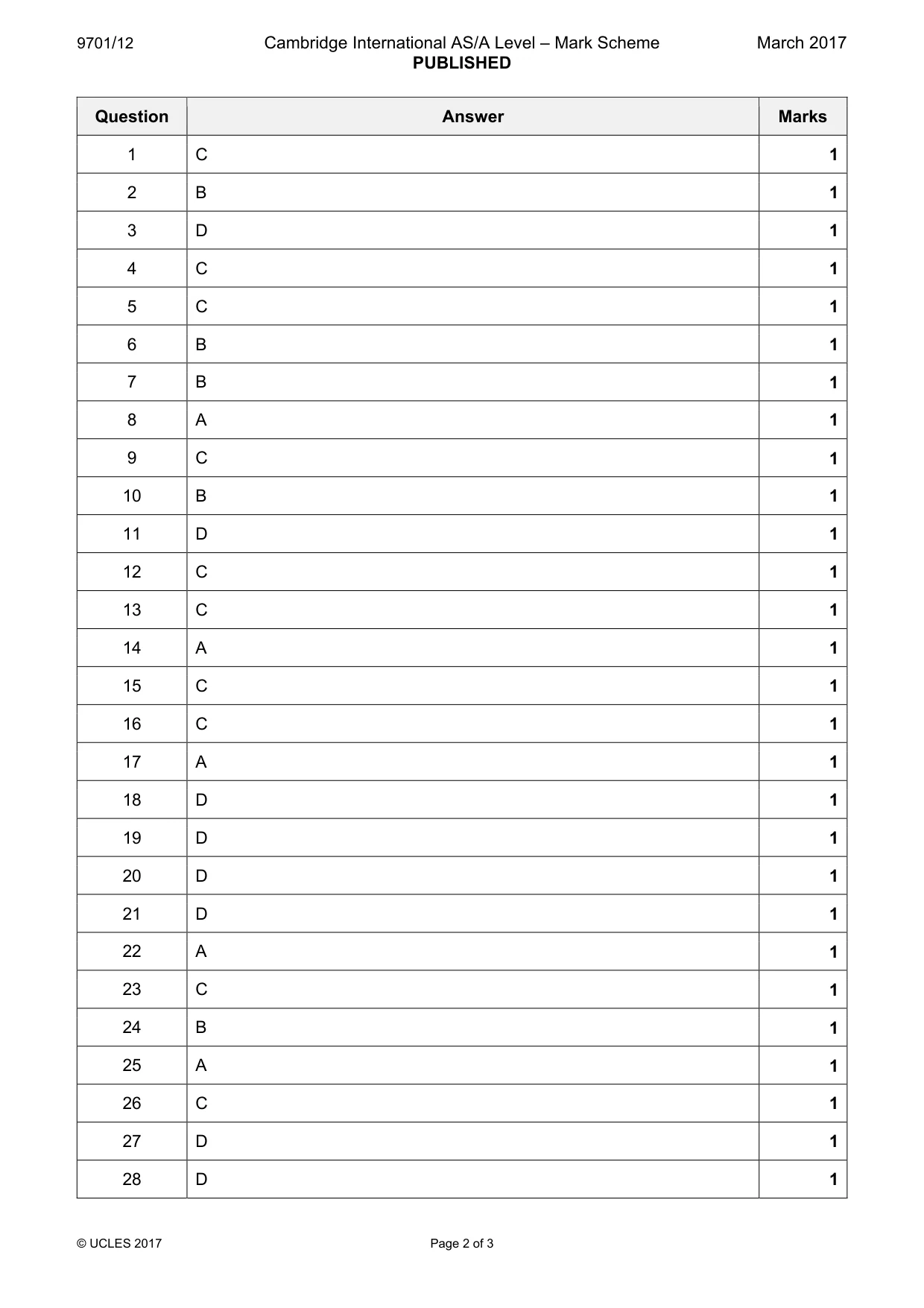
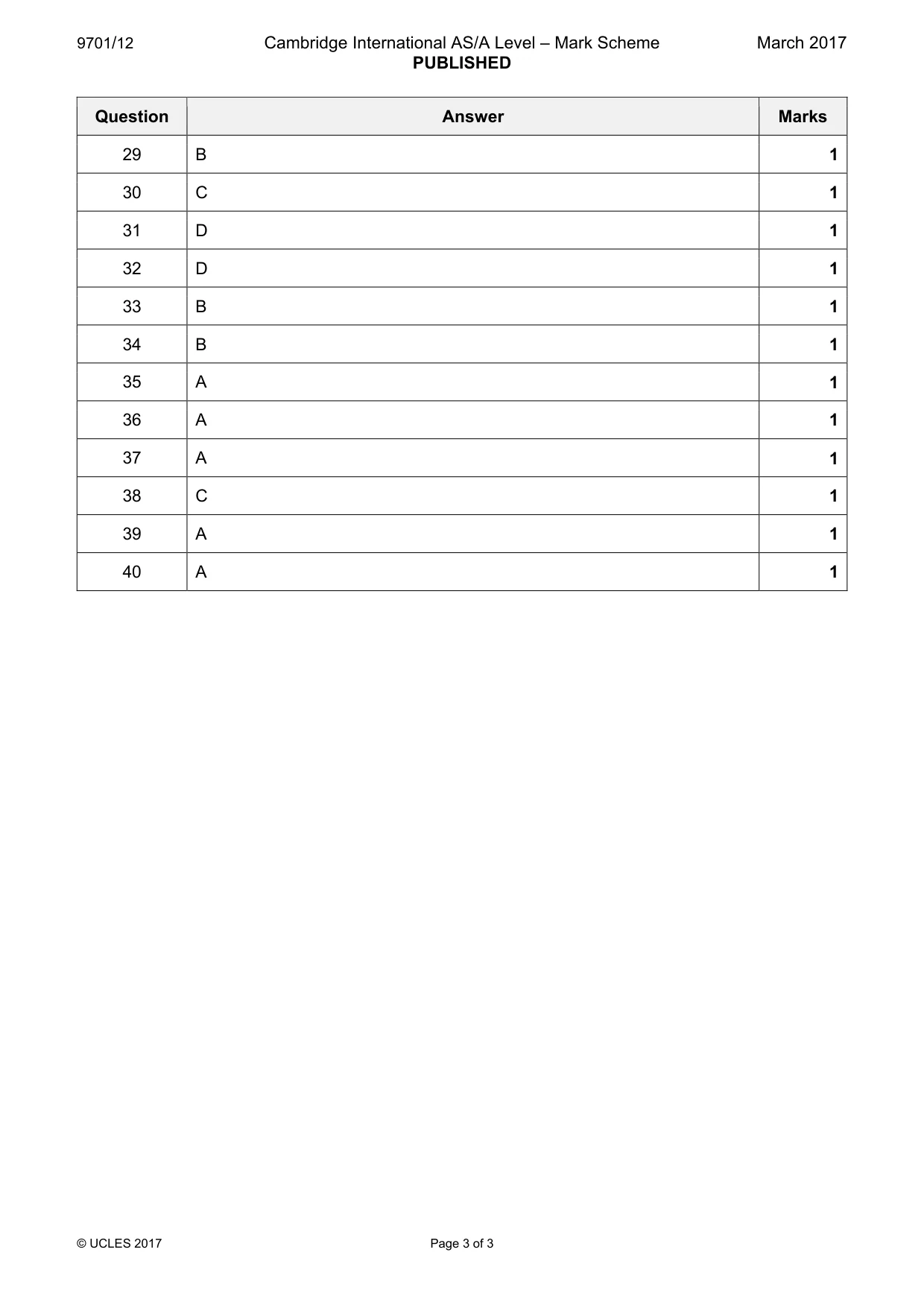
Answers below. Sit the paper first if you are practising.
Paper as text
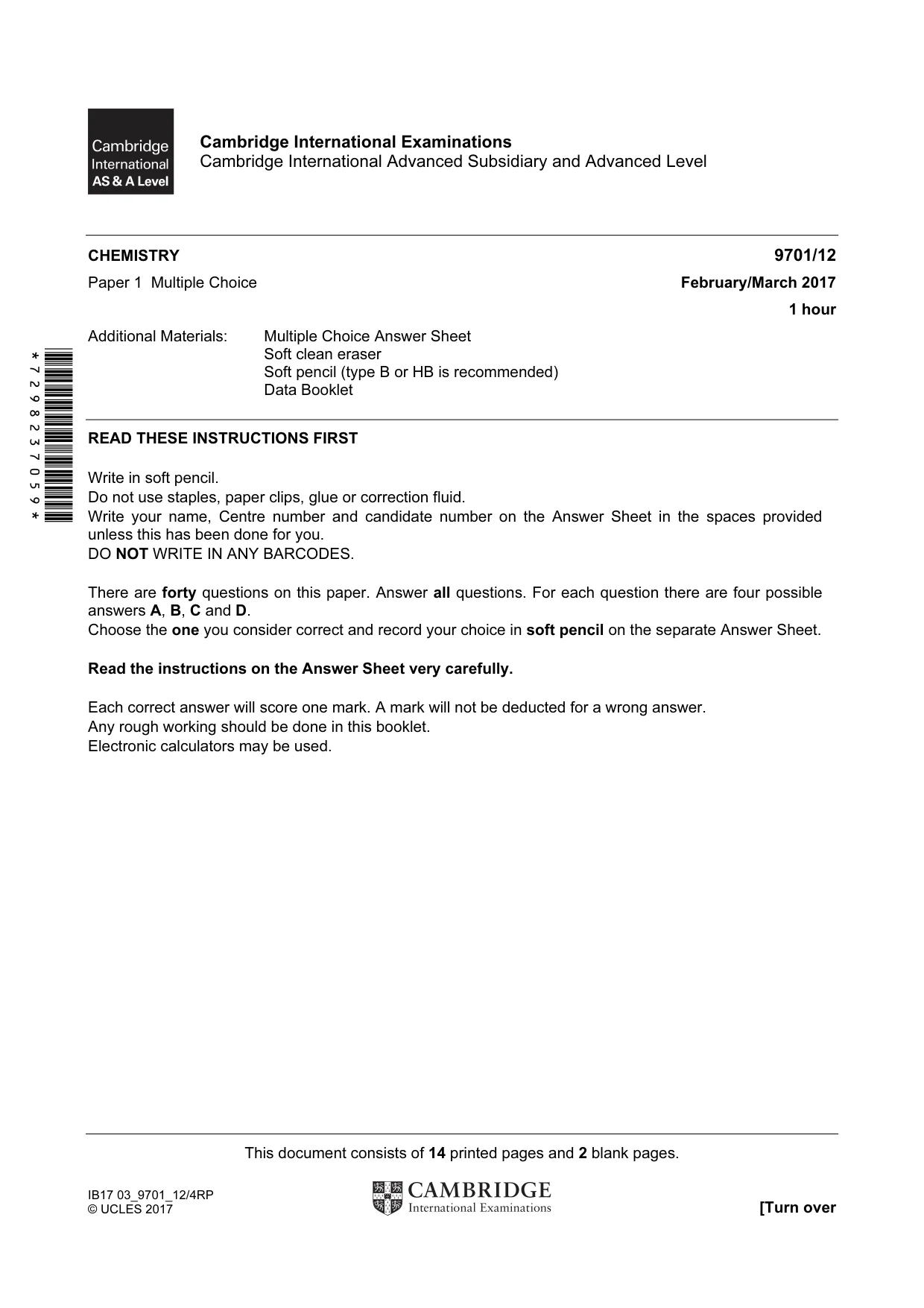
Question paper, page 1
This document consists of 14 printed pages and 2 blank pages. IB17 03_9701_12/4RP © UCLES 2017 [Turn over *7298237059* Cambridge International Examinations Cambridge International Advanced Subsidiary and Advanced Level CHEMISTRY 9701/12 Paper 1 Multiple Choice February/March 2017 1 hour Additional Materials: Multiple Choice Answer Sheet Soft clean eraser Soft pencil (type B or HB is recommended) Data Booklet READ THESE INSTRUCTIONS FIRST Write in soft pencil. Do not use staples, paper clips, glue or correction fluid. Write your name, Centre number and candidate number on the Answer Sheet in the spaces provided unless this has been done for you. DO NOT WRITE IN ANY BARCODES. There are forty questions on this paper. Answer all questions. For each question there are four possible answers A, B, C and D. Choose the one you consider correct and record your choice in soft pencil on the separate Answer Sheet. Read the instructions on the Answer Sheet very carefully. Each correct answer will score one mark. A mark will not be deducted for a wrong answer. Any rough working should be done in this booklet. Electronic calculators may be used.
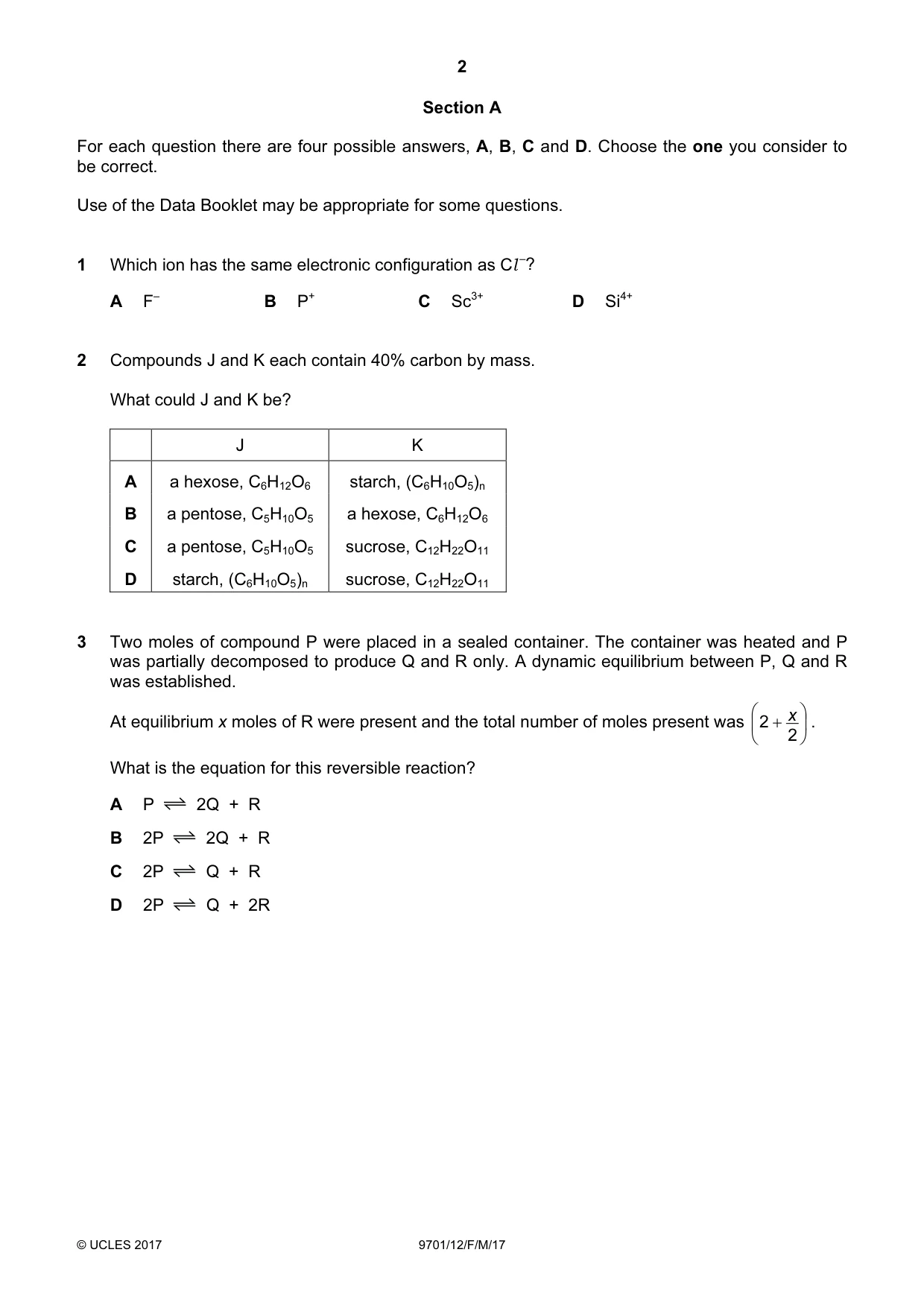
Question paper, page 2
2 © UCLES 2017 9701/12/F/M/17 Section A For each question there are four possible answers, A, B, C and D. Choose the one you consider to be correct. Use of the Data Booklet may be appropriate for some questions. 1 Which ion has the same electronic configuration as Cl –? A F– B P+ C Sc3+ D Si4+ 2 Compounds J and K each contain 40% carbon by mass. What could J and K be? J K A a hexose, C6H12O6 starch, (C6H10O5)n B a pentose, C5H10O5 a hexose, C6H12O6 C a pentose, C5H10O5 sucrose, C12H22O11 D starch, (C6H10O5)n sucrose, C12H22O11 3 Two moles of compound P were placed in a sealed container. The container was heated and P was partially decomposed to produce Q and R only. A dynamic equilibrium between P, Q and R was established. At equilibrium x moles of R were present and the total number of moles present was + 2 2 x . What is the equation for this reversible reaction? A P 2Q + R B 2P 2Q + R C 2P Q + R D 2P Q + 2R
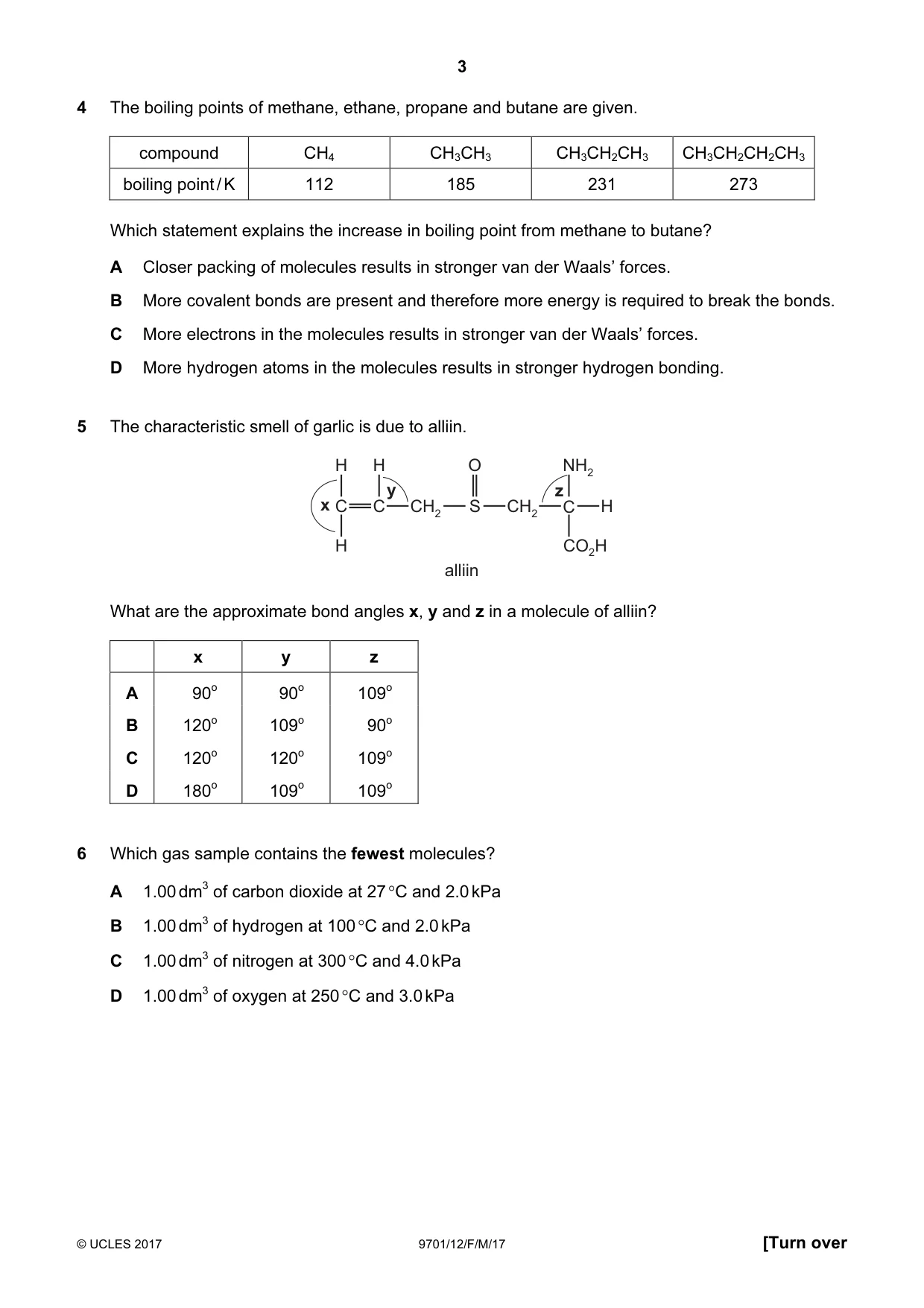
Question paper, page 3
3 © UCLES 2017 9701/12/F/M/17 [Turn over 4 The boiling points of methane, ethane, propane and butane are given. compound CH4 CH3CH3 CH3CH2CH3 CH3CH2CH2CH3 boiling point / K 112 185 231 273 Which statement explains the increase in boiling point from methane to butane? A Closer packing of molecules results in stronger van der Waals’ forces. B More covalent bonds are present and therefore more energy is required to break the bonds. C More electrons in the molecules results in stronger van der Waals’ forces. D More hydrogen atoms in the molecules results in stronger hydrogen bonding. 5 The characteristic smell of garlic is due to alliin. C H H CO2H C S CH2 H O NH2 H C CH2 x y z alliin What are the approximate bond angles x, y and z in a molecule of alliin? x y z A 90o 90o 109o B 120o 109o 90o C 120o 120o 109o D 180o 109o 109o 6 Which gas sample contains the fewest molecules? A 1.00 dm3 of carbon dioxide at 27 °C and 2.0 kPa B 1.00 dm3 of hydrogen at 100 °C and 2.0 kPa C 1.00 dm3 of nitrogen at 300 °C and 4.0 kPa D 1.00 dm3 of oxygen at 250 °C and 3.0 kPa
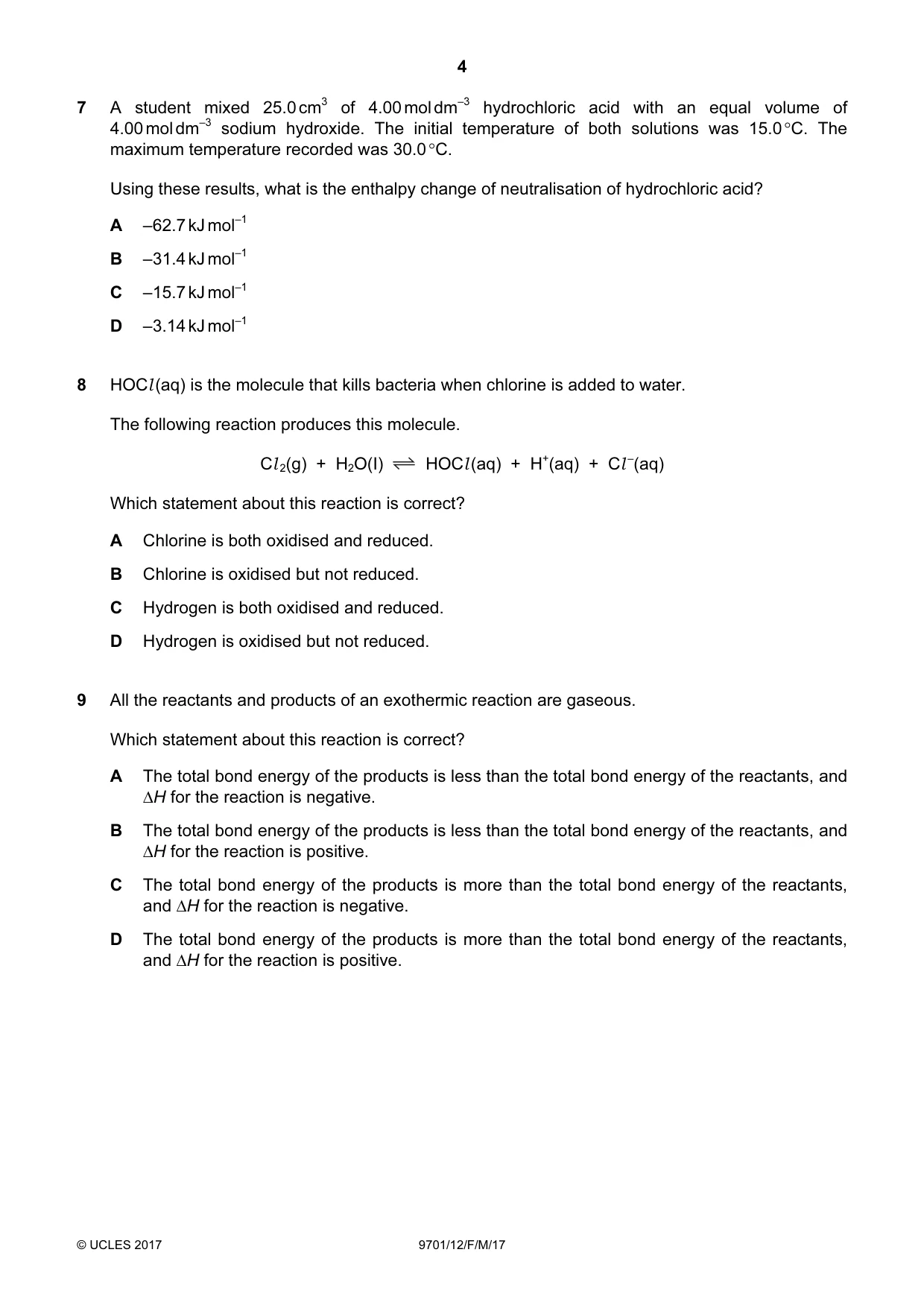
Question paper, page 4
4 © UCLES 2017 9701/12/F/M/17 7 A student mixed 25.0 cm3 of 4.00 mol dm–3 hydrochloric acid with an equal volume of 4.00 mol dm–3 sodium hydroxide. The initial temperature of both solutions was 15.0 °C. The maximum temperature recorded was 30.0 °C. Using these results, what is the enthalpy change of neutralisation of hydrochloric acid? A –62.7 kJ mol–1 B –31.4 kJ mol–1 C –15.7 kJ mol–1 D –3.14 kJ mol–1 8 HOCl (aq) is the molecule that kills bacteria when chlorine is added to water. The following reaction produces this molecule. Cl 2(g) + H2O(I) HOCl (aq) + H+(aq) + Cl –(aq) Which statement about this reaction is correct? A Chlorine is both oxidised and reduced. B Chlorine is oxidised but not reduced. C Hydrogen is both oxidised and reduced. D Hydrogen is oxidised but not reduced. 9 All the reactants and products of an exothermic reaction are gaseous. Which statement about this reaction is correct? A The total bond energy of the products is less than the total bond energy of the reactants, and ∆H for the reaction is negative. B The total bond energy of the products is less than the total bond energy of the reactants, and ∆H for the reaction is positive. C The total bond energy of the products is more than the total bond energy of the reactants, and ∆H for the reaction is negative. D The total bond energy of the products is more than the total bond energy of the reactants, and ∆H for the reaction is positive.
Question paper, page 5
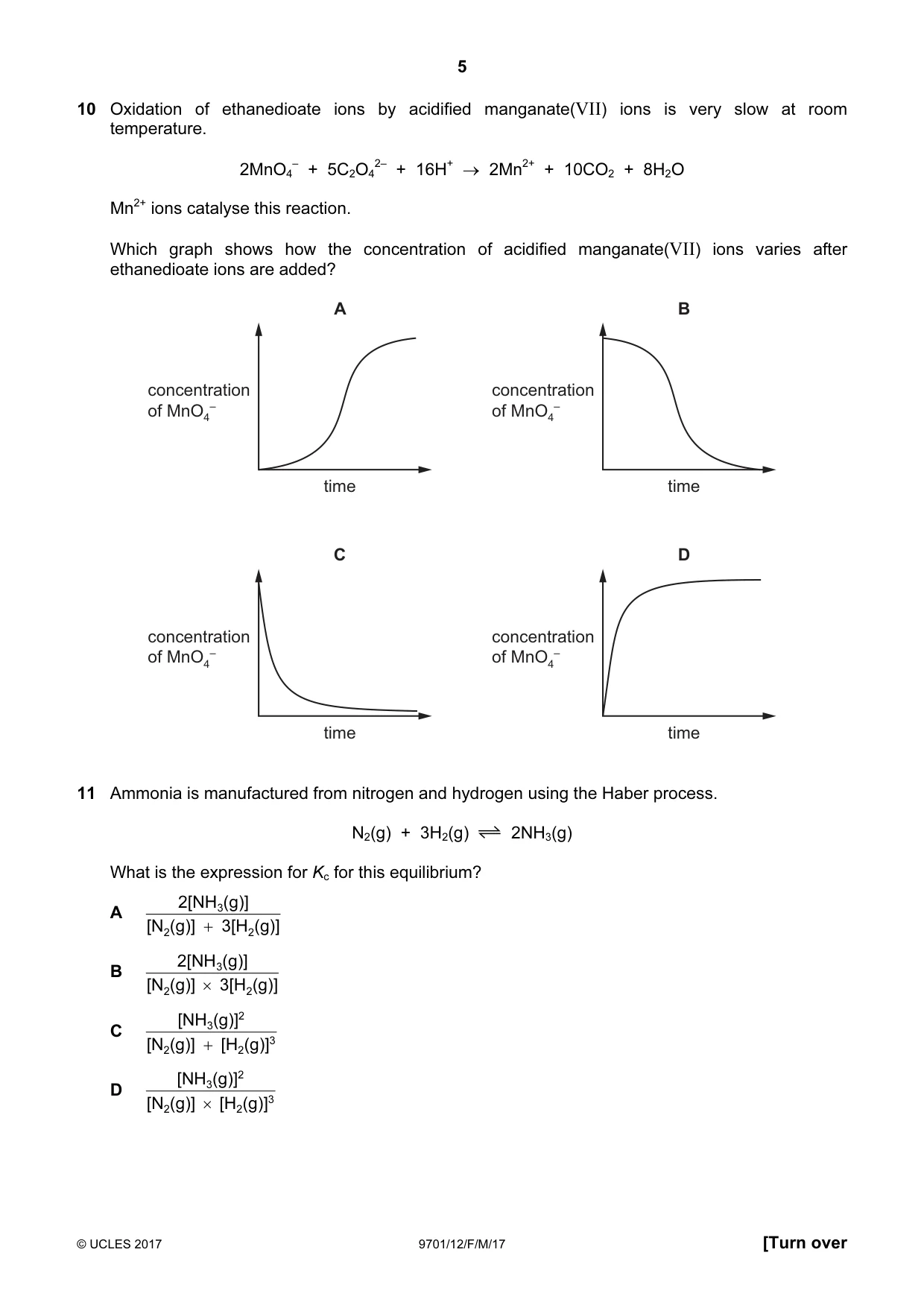
5 © UCLES 2017 9701/12/F/M/17 [Turn over 10 Oxidation of ethanedioate ions by acidified manganate(VII) ions is very slow at room temperature. 2MnO4 – + 5C2O4 2– + 16H+ → 2Mn2+ + 10CO2 + 8H2O Mn2+ ions catalyse this reaction. Which graph shows how the concentration of acidified manganate(VII) ions varies after ethanedioate ions are added? concentration of MnO4 – time A concentration of MnO4 – time B concentration of MnO4 – time C concentration of MnO4 – time D 11 Ammonia is manufactured from nitrogen and hydrogen using the Haber process. N2(g) + 3H2(g) 2NH3(g) What is the expression for Kc for this equilibrium? A (g)] 3[H (g)] [N (g)] 2[NH 2 2 3 + B (g)] 3[H (g)] [N (g)] 2[NH 2 2 3 × C 3 2 2 2 3 (g)] [H (g)] [N (g)] [NH + D 3 2 2 2 3 (g)] [H (g)] [N (g)] [NH ×
Question paper, page 6
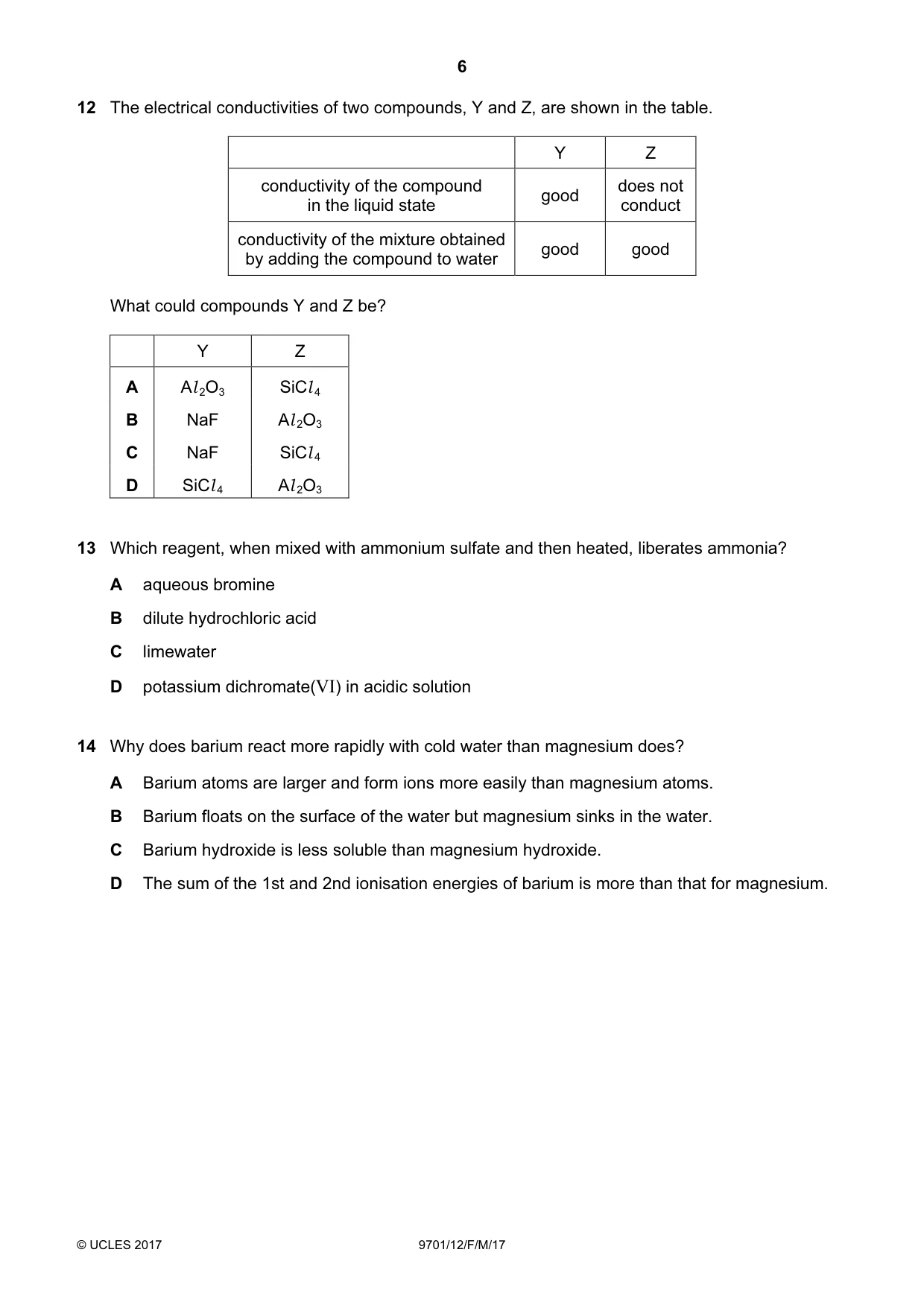
6 © UCLES 2017 9701/12/F/M/17 12 The electrical conductivities of two compounds, Y and Z, are shown in the table. Y Z conductivity of the compound in the liquid state good does not conduct conductivity of the mixture obtained by adding the compound to water good good What could compounds Y and Z be? Y Z A Al 2O3 SiCl 4 B NaF Al 2O3 C NaF SiCl 4 D SiCl 4 Al 2O3 13 Which reagent, when mixed with ammonium sulfate and then heated, liberates ammonia? A aqueous bromine B dilute hydrochloric acid C limewater D potassium dichromate(VI) in acidic solution 14 Why does barium react more rapidly with cold water than magnesium does? A Barium atoms are larger and form ions more easily than magnesium atoms. B Barium floats on the surface of the water but magnesium sinks in the water. C Barium hydroxide is less soluble than magnesium hydroxide. D The sum of the 1st and 2nd ionisation energies of barium is more than that for magnesium.
Question paper, page 7
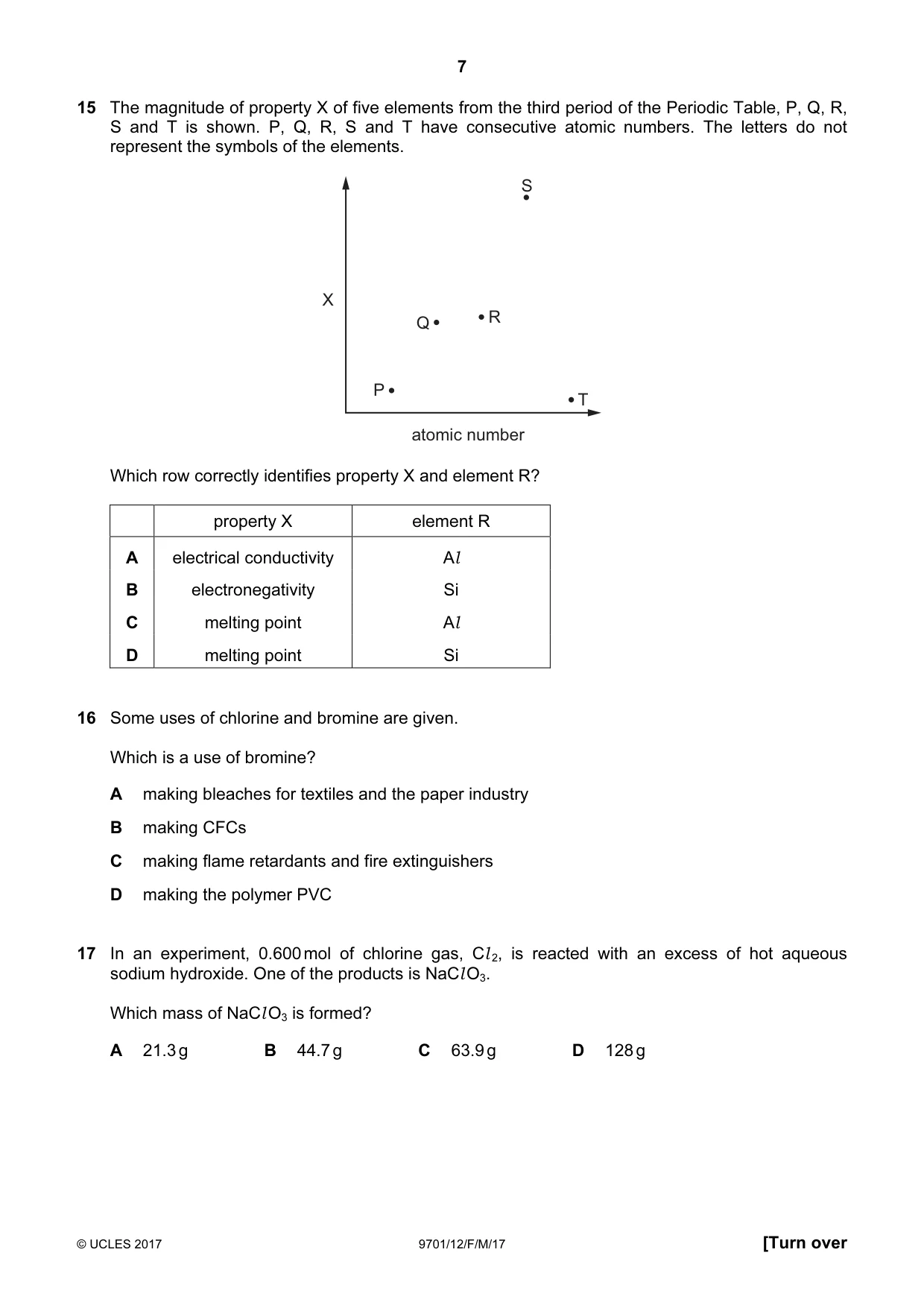
7 © UCLES 2017 9701/12/F/M/17 [Turn over 15 The magnitude of property X of five elements from the third period of the Periodic Table, P, Q, R, S and T is shown. P, Q, R, S and T have consecutive atomic numbers. The letters do not represent the symbols of the elements. X atomic number P Q R S T Which row correctly identifies property X and element R? property X element R A electrical conductivity Al B electronegativity Si C melting point Al D melting point Si 16 Some uses of chlorine and bromine are given. Which is a use of bromine? A making bleaches for textiles and the paper industry B making CFCs C making flame retardants and fire extinguishers D making the polymer PVC 17 In an experiment, 0.600 mol of chlorine gas, Cl 2, is reacted with an excess of hot aqueous sodium hydroxide. One of the products is NaCl O3. Which mass of NaCl O3 is formed? A 21.3 g B 44.7 g C 63.9 g D 128 g
Question paper, page 8
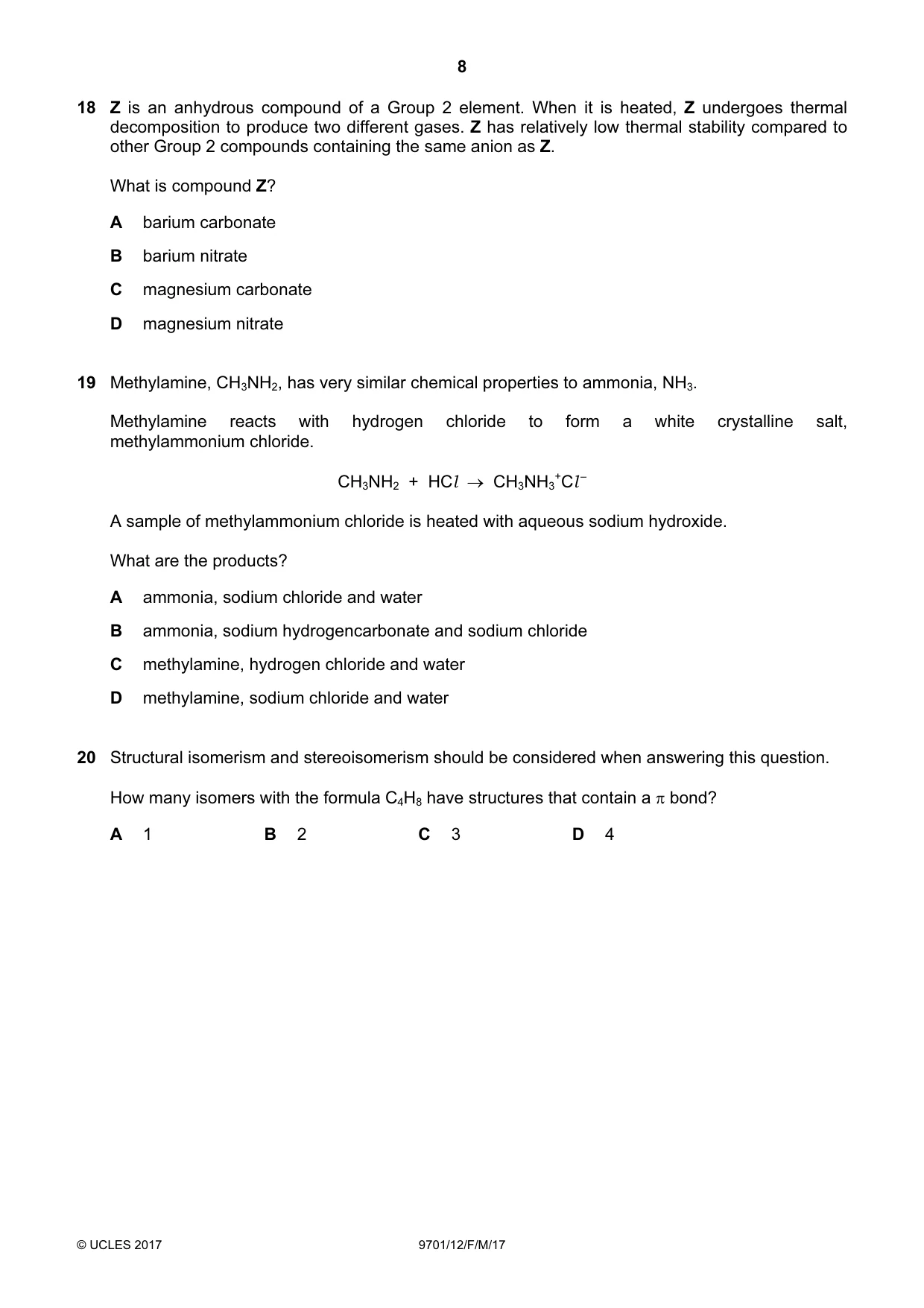
8 © UCLES 2017 9701/12/F/M/17 18 Z is an anhydrous compound of a Group 2 element. When it is heated, Z undergoes thermal decomposition to produce two different gases. Z has relatively low thermal stability compared to other Group 2 compounds containing the same anion as Z. What is compound Z? A barium carbonate B barium nitrate C magnesium carbonate D magnesium nitrate 19 Methylamine, CH3NH2, has very similar chemical properties to ammonia, NH3. Methylamine reacts with hydrogen chloride to form a white crystalline salt, methylammonium chloride. CH3NH2 + HCl → CH3NH3 +Cl – A sample of methylammonium chloride is heated with aqueous sodium hydroxide. What are the products? A ammonia, sodium chloride and water B ammonia, sodium hydrogencarbonate and sodium chloride C methylamine, hydrogen chloride and water D methylamine, sodium chloride and water 20 Structural isomerism and stereoisomerism should be considered when answering this question. How many isomers with the formula C4H8 have structures that contain a π bond? A 1 B 2 C 3 D 4
Question paper, page 9
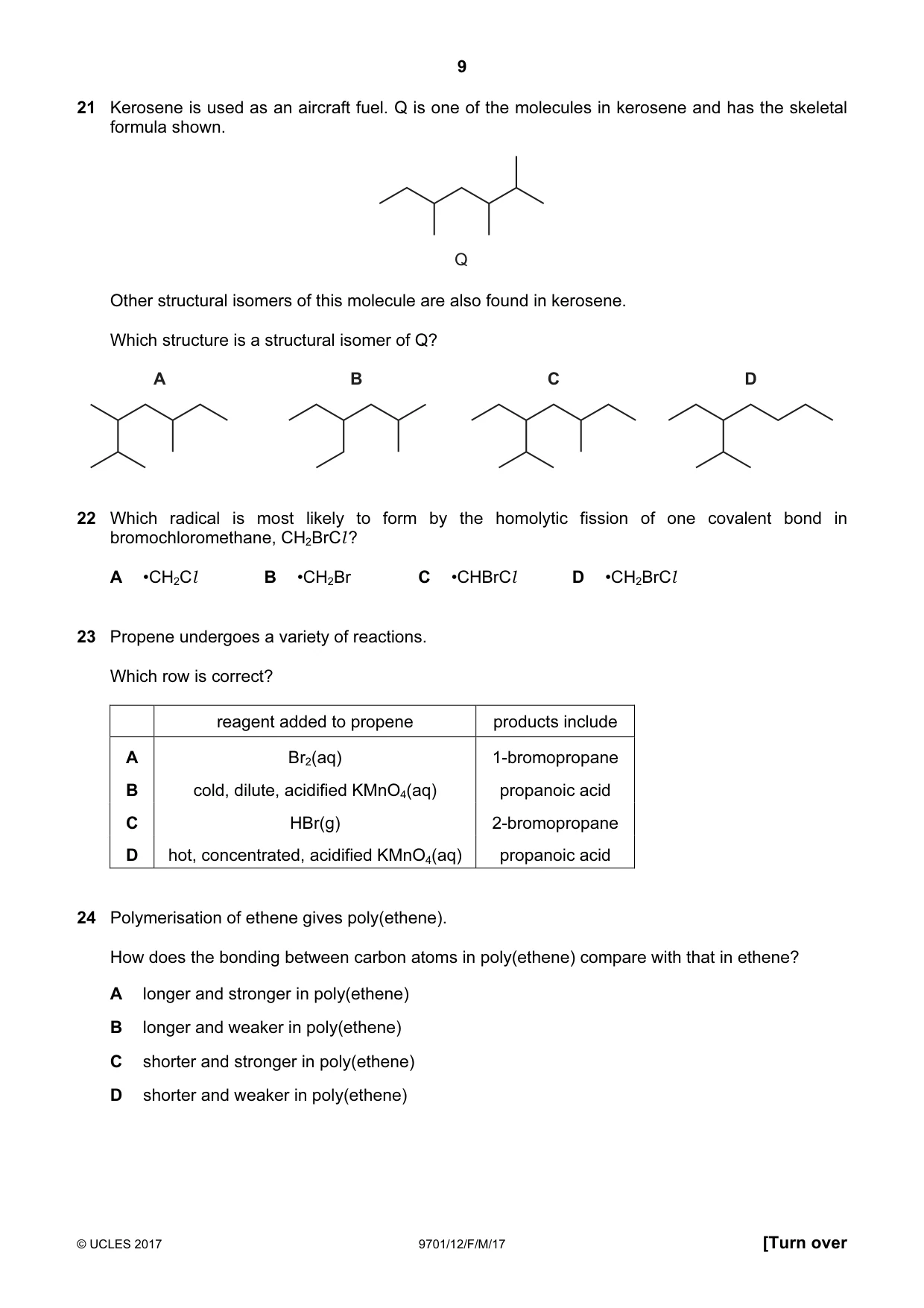
9 © UCLES 2017 9701/12/F/M/17 [Turn over 21 Kerosene is used as an aircraft fuel. Q is one of the molecules in kerosene and has the skeletal formula shown. Q Other structural isomers of this molecule are also found in kerosene. Which structure is a structural isomer of Q? A B C D 22 Which radical is most likely to form by the homolytic fission of one covalent bond in bromochloromethane, CH2BrCl ? A •CH2Cl B •CH2Br C •CHBrCl D •CH2BrCl 23 Propene undergoes a variety of reactions. Which row is correct? reagent added to propene products include A Br2(aq) 1-bromopropane B cold, dilute, acidified KMnO4(aq) propanoic acid C HBr(g) 2-bromopropane D hot, concentrated, acidified KMnO4(aq) propanoic acid 24 Polymerisation of ethene gives poly(ethene). How does the bonding between carbon atoms in poly(ethene) compare with that in ethene? A longer and stronger in poly(ethene) B longer and weaker in poly(ethene) C shorter and stronger in poly(ethene) D shorter and weaker in poly(ethene)
Question paper, page 10
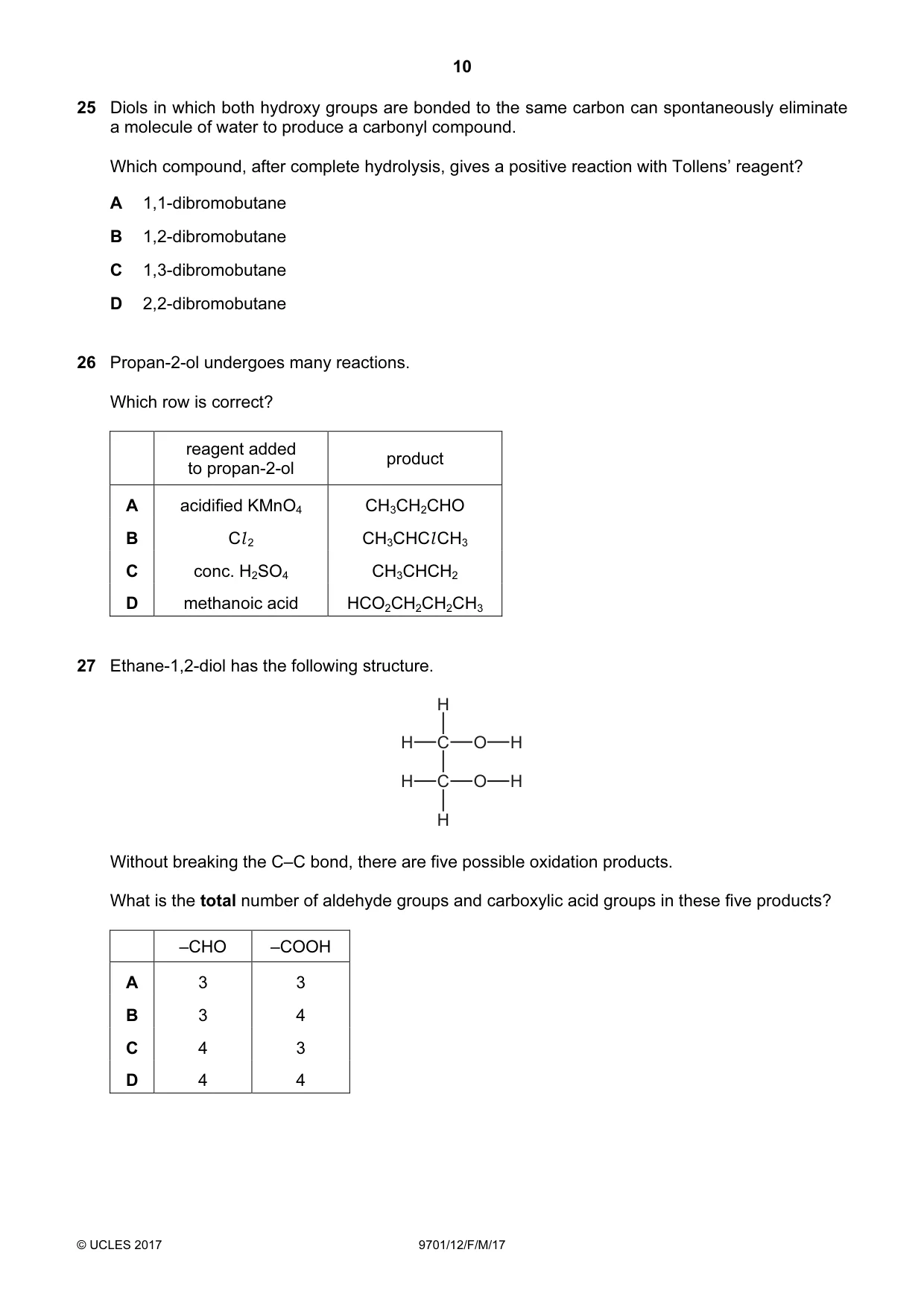
10 © UCLES 2017 9701/12/F/M/17 25 Diols in which both hydroxy groups are bonded to the same carbon can spontaneously eliminate a molecule of water to produce a carbonyl compound. Which compound, after complete hydrolysis, gives a positive reaction with Tollens’ reagent? A 1,1-dibromobutane B 1,2-dibromobutane C 1,3-dibromobutane D 2,2-dibromobutane 26 Propan-2-ol undergoes many reactions. Which row is correct? reagent added to propan-2-ol product A acidified KMnO4 CH3CH2CHO B Cl 2 CH3CHCl CH3 C conc. H2SO4 CH3CHCH2 D methanoic acid HCO2CH2CH2CH3 27 Ethane-1,2-diol has the following structure. H H C H H O H H C O Without breaking the C–C bond, there are five possible oxidation products. What is the total number of aldehyde groups and carboxylic acid groups in these five products? –CHO –COOH A 3 3 B 3 4 C 4 3 D 4 4
Question paper, page 11
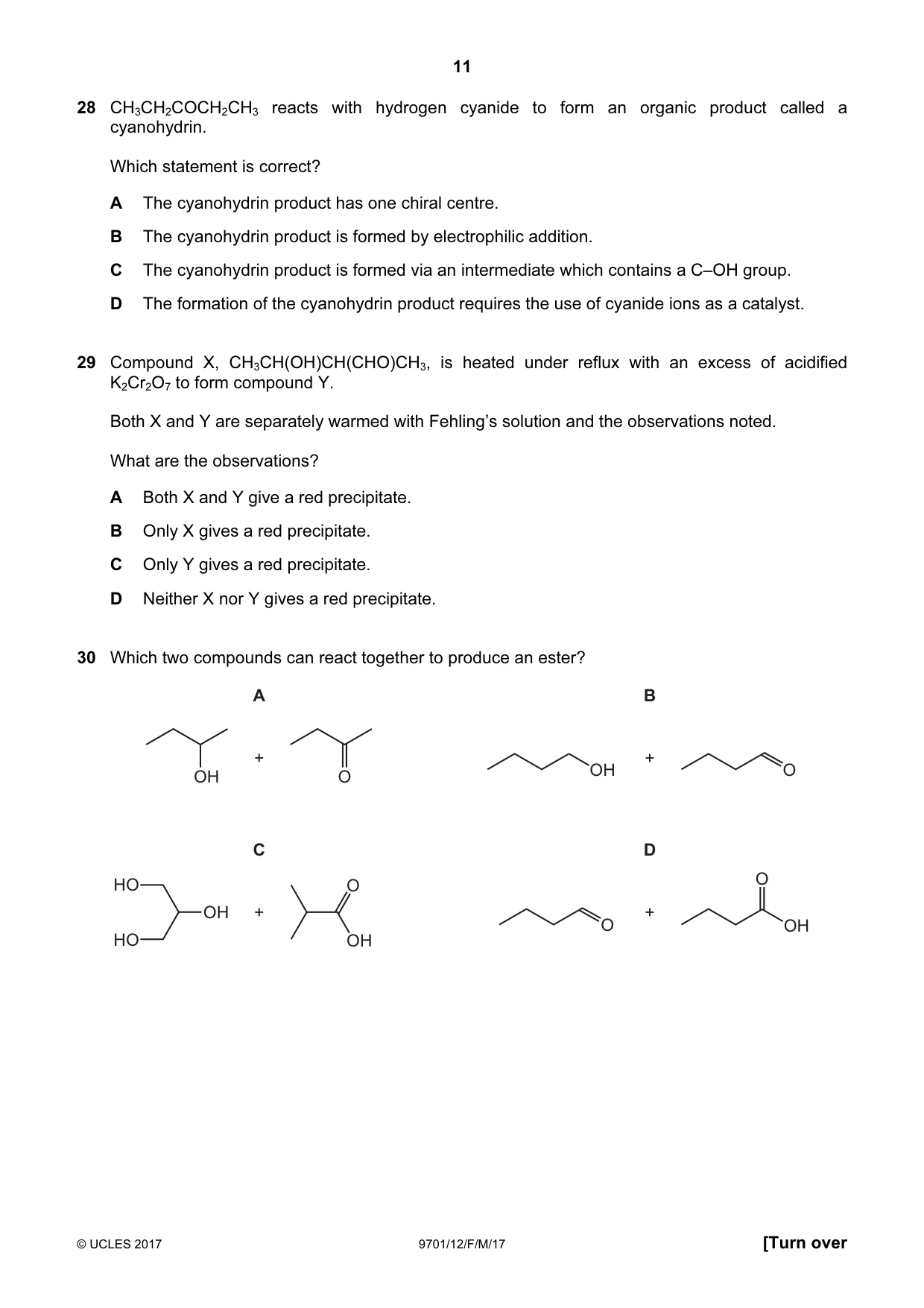
11 © UCLES 2017 9701/12/F/M/17 [Turn over 28 CH3CH2COCH2CH3 reacts with hydrogen cyanide to form an organic product called a cyanohydrin. Which statement is correct? A The cyanohydrin product has one chiral centre. B The cyanohydrin product is formed by electrophilic addition. C The cyanohydrin product is formed via an intermediate which contains a C–OH group. D The formation of the cyanohydrin product requires the use of cyanide ions as a catalyst. 29 Compound X, CH3CH(OH)CH(CHO)CH3, is heated under reflux with an excess of acidified K2Cr2O7 to form compound Y. Both X and Y are separately warmed with Fehling’s solution and the observations noted. What are the observations? A Both X and Y give a red precipitate. B Only X gives a red precipitate. C Only Y gives a red precipitate. D Neither X nor Y gives a red precipitate. 30 Which two compounds can react together to produce an ester? OH O A + OH O O B + HO OH HO OH C + D + O OH O
Question paper, page 12
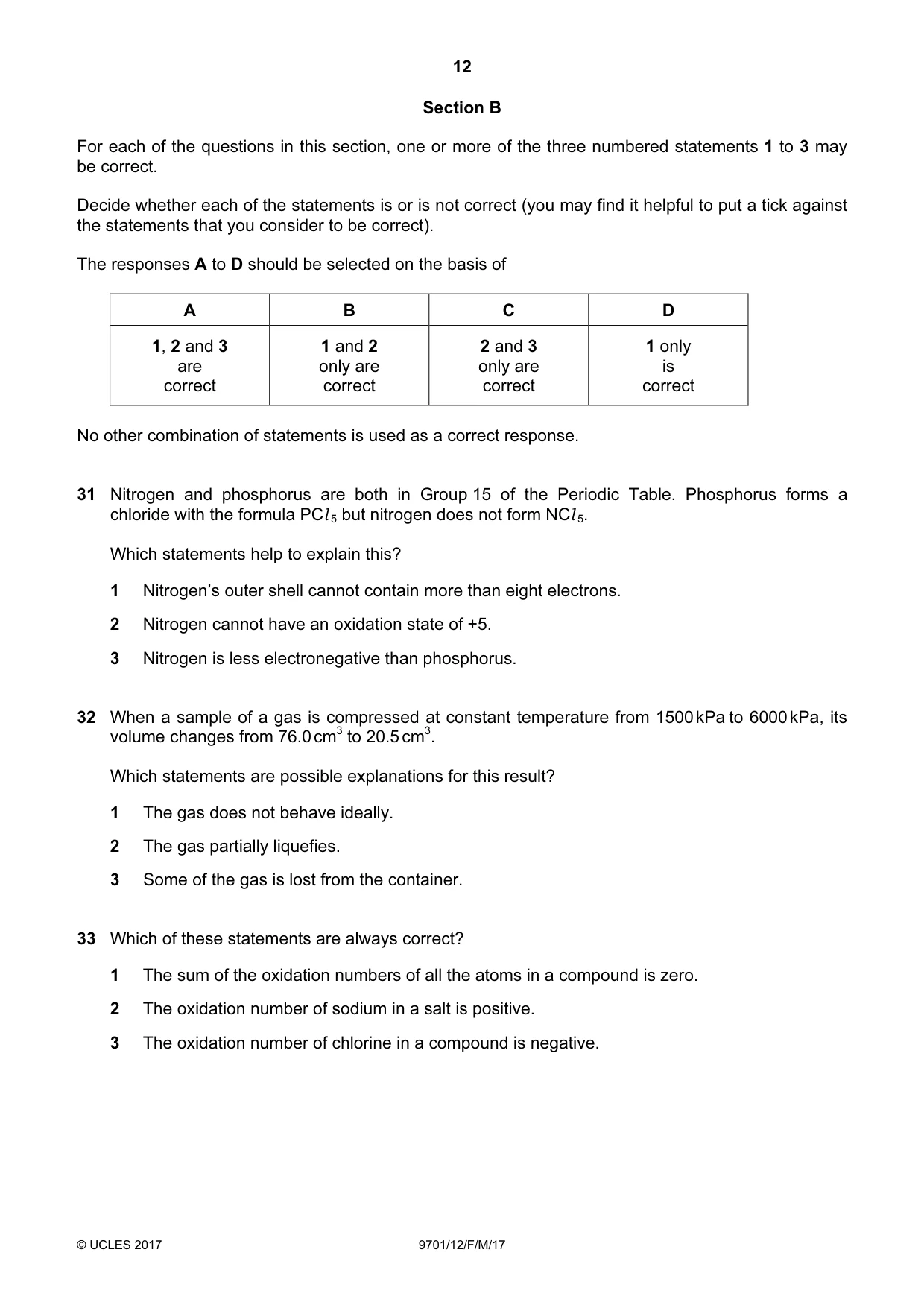
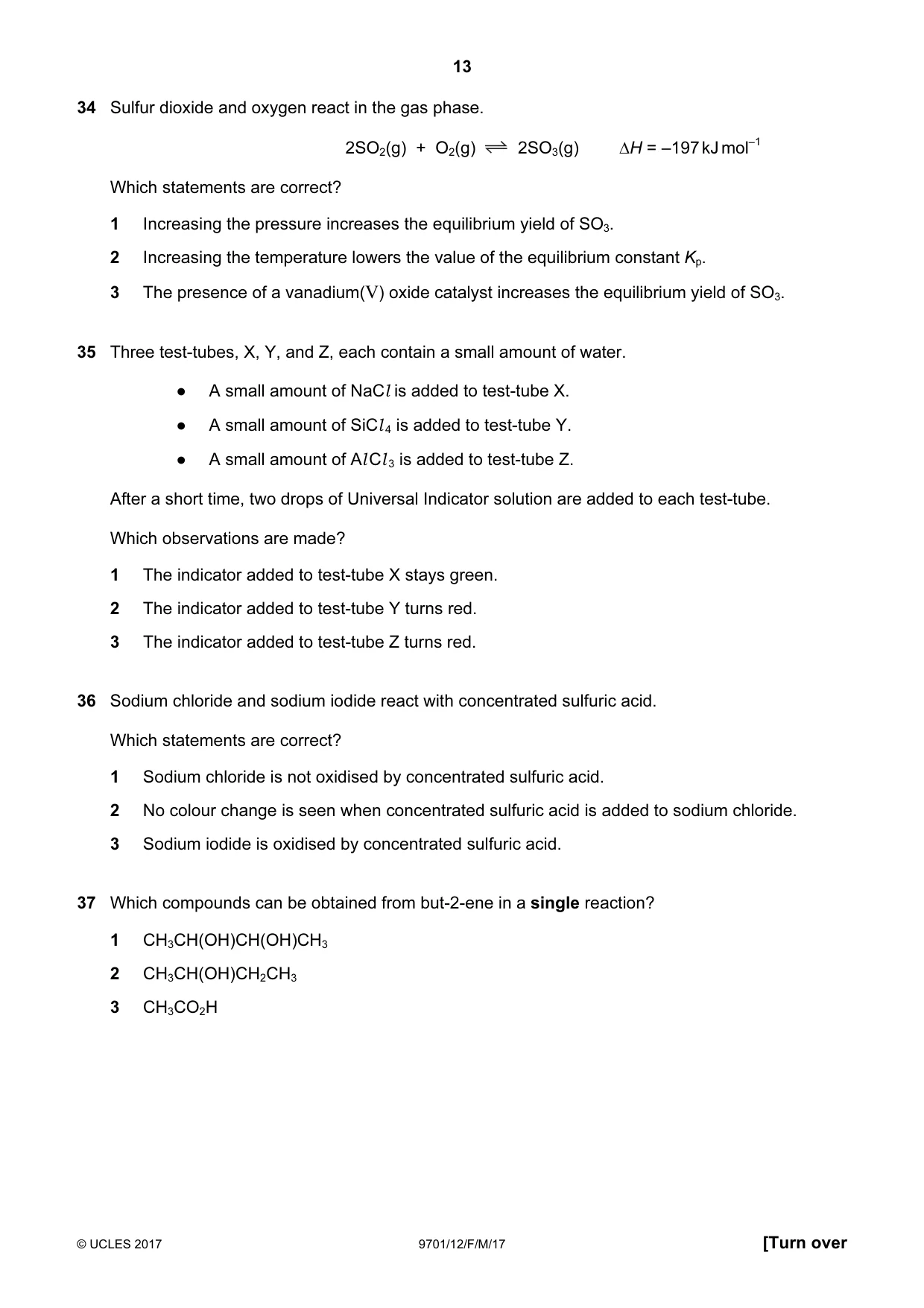
12 © UCLES 2017 9701/12/F/M/17 Section B For each of the questions in this section, one or more of the three numbered statements 1 to 3 may be correct. Decide whether each of the statements is or is not correct (you may find it helpful to put a tick against the statements that you consider to be correct). The responses A to D should be selected on the basis of A B C D 1, 2 and 3 are correct 1 and 2 only are correct 2 and 3 only are correct 1 only is correct No other combination of statements is used as a correct response. 31 Nitrogen and phosphorus are both in Group 15 of the Periodic Table. Phosphorus forms a chloride with the formula PCl 5 but nitrogen does not form NCl 5. Which statements help to explain this? 1 Nitrogen’s outer shell cannot contain more than eight electrons. 2 Nitrogen cannot have an oxidation state of +5. 3 Nitrogen is less electronegative than phosphorus. 32 When a sample of a gas is compressed at constant temperature from 1500 kPa to 6000 kPa, its volume changes from 76.0 cm3 to 20.5 cm3. Which statements are possible explanations for this result? 1 The gas does not behave ideally. 2 The gas partially liquefies. 3 Some of the gas is lost from the container. 33 Which of these statements are always correct? 1 The sum of the oxidation numbers of all the atoms in a compound is zero. 2 The oxidation number of sodium in a salt is positive. 3 The oxidation number of chlorine in a compound is negative.
Question paper, page 13
13 © UCLES 2017 9701/12/F/M/17 [Turn over 34 Sulfur dioxide and oxygen react in the gas phase. 2SO2(g) + O2(g) 2SO3(g) ∆H = –197 kJ mol–1 Which statements are correct? 1 Increasing the pressure increases the equilibrium yield of SO3. 2 Increasing the temperature lowers the value of the equilibrium constant Kp. 3 The presence of a vanadium(V) oxide catalyst increases the equilibrium yield of SO3. 35 Three test-tubes, X, Y, and Z, each contain a small amount of water. ● A small amount of NaCl is added to test-tube X. ● A small amount of SiCl 4 is added to test-tube Y. ● A small amount of Al Cl 3 is added to test-tube Z. After a short time, two drops of Universal Indicator solution are added to each test-tube. Which observations are made? 1 The indicator added to test-tube X stays green. 2 The indicator added to test-tube Y turns red. 3 The indicator added to test-tube Z turns red. 36 Sodium chloride and sodium iodide react with concentrated sulfuric acid. Which statements are correct? 1 Sodium chloride is not oxidised by concentrated sulfuric acid. 2 No colour change is seen when concentrated sulfuric acid is added to sodium chloride. 3 Sodium iodide is oxidised by concentrated sulfuric acid. 37 Which compounds can be obtained from but-2-ene in a single reaction? 1 CH3CH(OH)CH(OH)CH3 2 CH3CH(OH)CH2CH3 3 CH3CO2H
Question paper, page 14
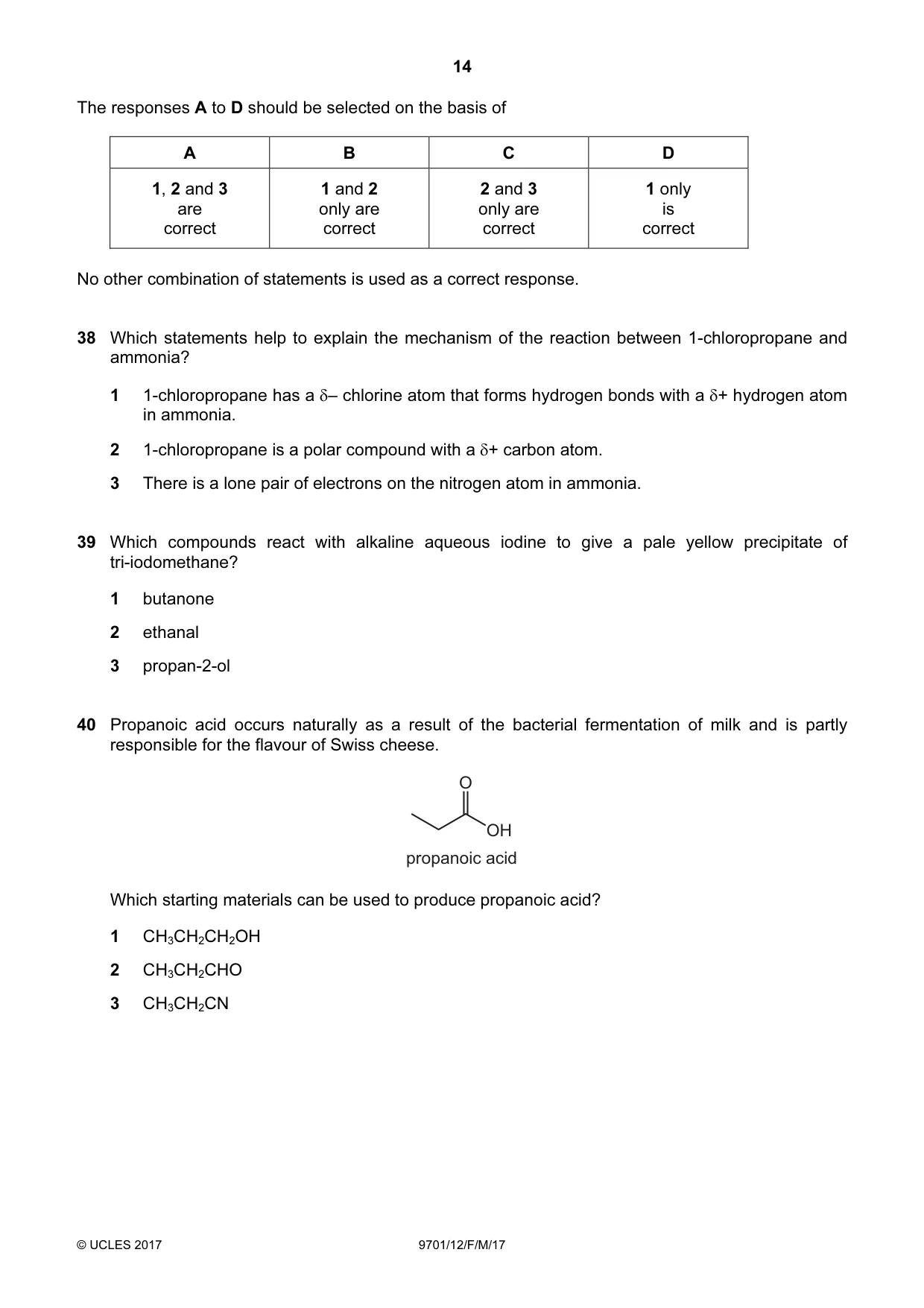
14 © UCLES 2017 9701/12/F/M/17 The responses A to D should be selected on the basis of A B C D 1, 2 and 3 are correct 1 and 2 only are correct 2 and 3 only are correct 1 only is correct No other combination of statements is used as a correct response. 38 Which statements help to explain the mechanism of the reaction between 1-chloropropane and ammonia? 1 1-chloropropane has a δ– chlorine atom that forms hydrogen bonds with a δ+ hydrogen atom in ammonia. 2 1-chloropropane is a polar compound with a δ+ carbon atom. 3 There is a lone pair of electrons on the nitrogen atom in ammonia. 39 Which compounds react with alkaline aqueous iodine to give a pale yellow precipitate of tri-iodomethane? 1 butanone 2 ethanal 3 propan-2-ol 40 Propanoic acid occurs naturally as a result of the bacterial fermentation of milk and is partly responsible for the flavour of Swiss cheese. propanoic acid OH O Which starting materials can be used to produce propanoic acid? 1 CH3CH2CH2OH 2 CH3CH2CHO 3 CH3CH2CN
Question paper, page 15
15 © UCLES 2017 9701/12/F/M/17 BLANK PAGE
Question paper, page 16
16 Permission to reproduce items where third-party owned material protected by copyright is included has been sought and cleared where possible. Every reasonable effort has been made by the publisher (UCLES) to trace copyright holders, but if any items requiring clearance have unwittingly been included, the publisher will be pleased to make amends at the earliest possible opportunity. To avoid the issue of disclosure of answer-related information to candidates, all copyright acknowledgements are reproduced online in the Cambridge International Examinations Copyright Acknowledgements Booklet. This is produced for each series of examinations and is freely available to download at www.cie.org.uk after the live examination series. Cambridge International Examinations is part of the Cambridge Assessment Group. Cambridge Assessment is the brand name of University of Cambridge Local Examinations Syndicate (UCLES), which is itself a department of the University of Cambridge. © UCLES 2017 9701/12/F/M/17 BLANK PAGE
Mark scheme, page 1
® IGCSE is a registered trademark. This document consists of 3 printed pages. © UCLES 2017 [Turn over Cambridge International Examinations Cambridge International Advanced Subsidiary and Advanced Level CHEMISTRY 9701/12 Paper 1 Multiple Choice March 2017 MARK SCHEME Maximum Mark: 40 Published This mark scheme is published as an aid to teachers and candidates, to indicate the requirements of the examination. Mark schemes should be read in conjunction with the question paper and the Principal Examiner Report for Teachers. Cambridge will not enter into discussions about these mark schemes. Cambridge is publishing the mark schemes for the March 2017 series for most Cambridge IGCSE®, Cambridge International A and AS Level components and some Cambridge O Level components.
Mark scheme, page 2
9701/12 Cambridge International AS/A Level – Mark Scheme PUBLISHED March 2017 © UCLES 2017 Page 2 of 3 Question Answer Marks 1 C 1 2 B 1 3 D 1 4 C 1 5 C 1 6 B 1 7 B 1 8 A 1 9 C 1 10 B 1 11 D 1 12 C 1 13 C 1 14 A 1 15 C 1 16 C 1 17 A 1 18 D 1 19 D 1 20 D 1 21 D 1 22 A 1 23 C 1 24 B 1 25 A 1 26 C 1 27 D 1 28 D 1
Mark scheme, page 3
9701/12 Cambridge International AS/A Level – Mark Scheme PUBLISHED March 2017 © UCLES 2017 Page 3 of 3 Question Answer Marks 29 B 1 30 C 1 31 D 1 32 D 1 33 B 1 34 B 1 35 A 1 36 A 1 37 A 1 38 C 1 39 A 1 40 A 1
What you needed in this session
Cambridge’s own grade thresholds for 2017 Feb/March, Paper 1 · Variant 2. A higher threshold means an easier paper — the bar moves with how the cohort did.