Cambridge A Level Business Studies (for final examination in 2015) 9707 — 2015 Oct/Nov Paper 3 · Variant 2
9707/32/O/N/15
The question paper and its mark scheme, free to read here and free to download. This is Cambridge’s own paper, exactly as it was sat.
Question paper8 pages



Mark scheme10 pages
Answers below. Sit the paper first if you are practising.
Paper as text
Question paper, page 1
This document consists of 5 printed pages and 3 blank pages. DC (LK) 106730/2 © UCLES 2015 [Turn over Cambridge International Examinations Cambridge International Advanced Subsidiary and Advanced Level * 2 0 6 4 1 9 2 8 4 3 * BUSINESS STUDIES 9707/32 Paper 3 October/November 2015 CASE STUDY 3 hours Additional Materials: Answer Booklet/Paper READ THESE INSTRUCTIONS FIRST If you have been given an Answer Booklet, follow the instructions on the front cover of the Booklet. Write your Centre number, candidate number and name on all the work you hand in. Write in dark blue or black pen. You may use an HB pencil for any diagrams, graphs or rough working. Do not use staples, paper clips, glue or correction fluid. DO NOT WRITE IN ANY BARCODES. Section A Answer all questions. Section B Answer one question. You are advised to spend 40 minutes on Section B. The businesses described in this question paper are entirely fictitious. At the end of the examination, fasten all your work securely together. The number of marks is given in brackets [ ] at the end of each question or part question.
Question paper, page 2
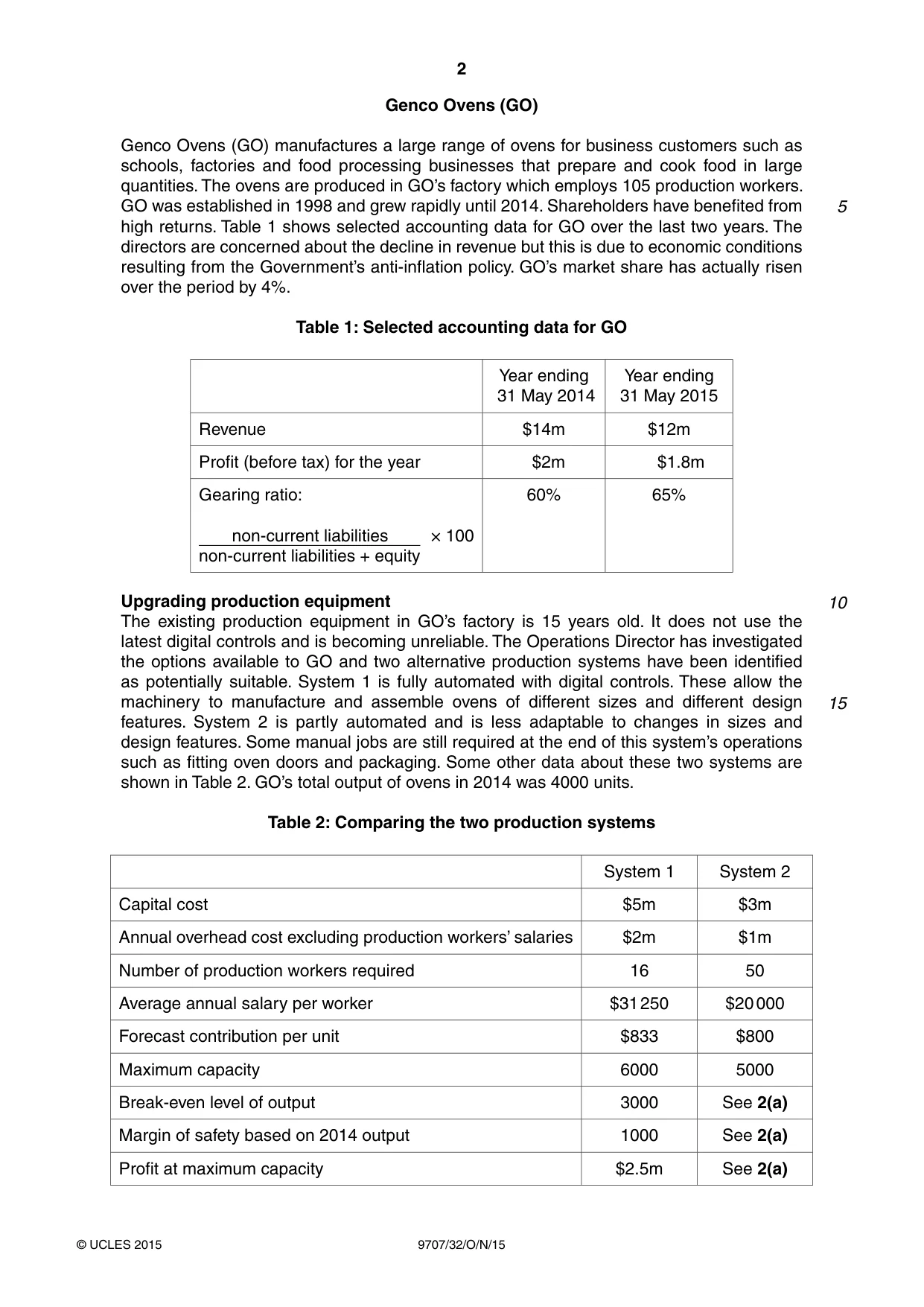
2 9707/32/O/N/15 © UCLES 2015 Genco Ovens (GO) Genco Ovens (GO) manufactures a large range of ovens for business customers such as schools, factories and food processing businesses that prepare and cook food in large quantities. The ovens are produced in GO’s factory which employs 105 production workers. GO was established in 1998 and grew rapidly until 2014. Shareholders have benefited from high returns. Table 1 shows selected accounting data for GO over the last two years. The directors are concerned about the decline in revenue but this is due to economic conditions resulting from the Government’s anti-inflation policy. GO’s market share has actually risen over the period by 4%. Table 1: Selected accounting data for GO Year ending 31 May 2014 Year ending 31 May 2015 Revenue $14m $12m Profit (before tax) for the year $2m $1.8m Gearing ratio: non-current liabilities × 100 non-current liabilities + equity 60% 65% Upgrading production equipment The existing production equipment in GO’s factory is 15 years old. It does not use the latest digital controls and is becoming unreliable. The Operations Director has investigated the options available to GO and two alternative production systems have been identified as potentially suitable. System 1 is fully automated with digital controls. These allow the machinery to manufacture and assemble ovens of different sizes and different design features. System 2 is partly automated and is less adaptable to changes in sizes and design features. Some manual jobs are still required at the end of this system’s operations such as fitting oven doors and packaging. Some other data about these two systems are shown in Table 2. GO’s total output of ovens in 2014 was 4000 units. Table 2: Comparing the two production systems System 1 System 2 Capital cost $5m $3m Annual overhead cost excluding production workers’ salaries $2m $1m Number of production workers required 16 50 Average annual salary per worker $31 250 $20 000 Forecast contribution per unit $833 $800 Maximum capacity 6000 5000 Break-even level of output 3000 See 2(a) Margin of safety based on 2014 output 1000 See 2(a) Profit at maximum capacity $2.5m See 2(a) 5 10 15
Question paper, page 3
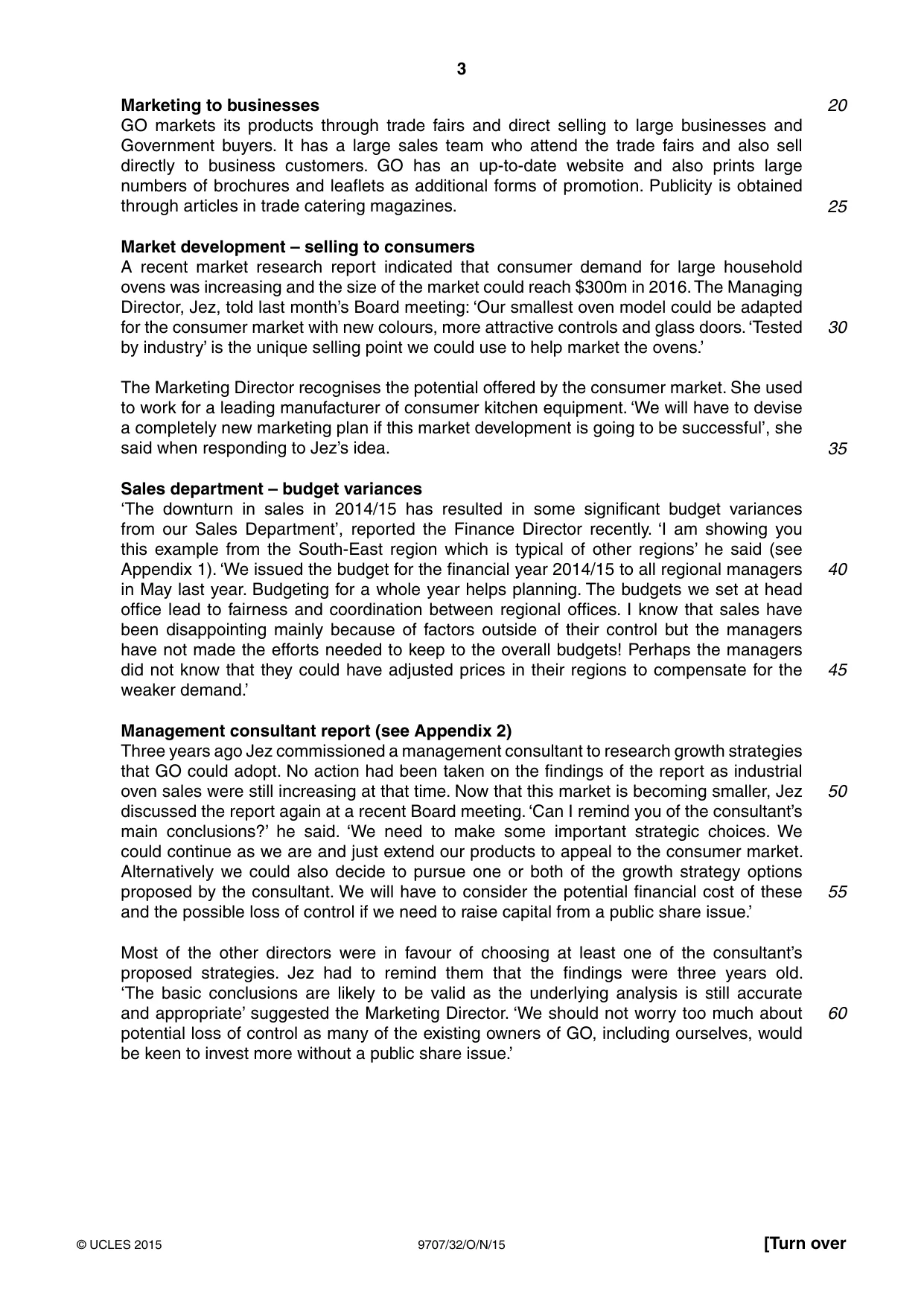
3 9707/32/O/N/15 © UCLES 2015 [Turn over Marketing to businesses GO markets its products through trade fairs and direct selling to large businesses and Government buyers. It has a large sales team who attend the trade fairs and also sell directly to business customers. GO has an up-to-date website and also prints large numbers of brochures and leaflets as additional forms of promotion. Publicity is obtained through articles in trade catering magazines. Market development – selling to consumers A recent market research report indicated that consumer demand for large household ovens was increasing and the size of the market could reach $300m in 2016. The Managing Director, Jez, told last month’s Board meeting: ‘Our smallest oven model could be adapted for the consumer market with new colours, more attractive controls and glass doors. ‘Tested by industry’ is the unique selling point we could use to help market the ovens.’ The Marketing Director recognises the potential offered by the consumer market. She used to work for a leading manufacturer of consumer kitchen equipment. ‘We will have to devise a completely new marketing plan if this market development is going to be successful’, she said when responding to Jez’s idea. Sales department – budget variances ‘The downturn in sales in 2014/15 has resulted in some significant budget variances from our Sales Department’, reported the Finance Director recently. ‘I am showing you this example from the South-East region which is typical of other regions’ he said (see Appendix 1). ‘We issued the budget for the financial year 2014/15 to all regional managers in May last year. Budgeting for a whole year helps planning. The budgets we set at head office lead to fairness and coordination between regional offices. I know that sales have been disappointing mainly because of factors outside of their control but the managers have not made the efforts needed to keep to the overall budgets! Perhaps the managers did not know that they could have adjusted prices in their regions to compensate for the weaker demand.’ Management consultant report (see Appendix 2) Three years ago Jez commissioned a management consultant to research growth strategies that GO could adopt. No action had been taken on the findings of the report as industrial oven sales were still increasing at that time. Now that this market is becoming smaller, Jez discussed the report again at a recent Board meeting. ‘Can I remind you of the consultant’s main conclusions?’ he said. ‘We need to make some important strategic choices. We could continue as we are and just extend our products to appeal to the consumer market. Alternatively we could also decide to pursue one or both of the growth strategy options proposed by the consultant. We will have to consider the potential financial cost of these and the possible loss of control if we need to raise capital from a public share issue.’ Most of the other directors were in favour of choosing at least one of the consultant’s proposed strategies. Jez had to remind them that the findings were three years old. ‘The basic conclusions are likely to be valid as the underlying analysis is still accurate and appropriate’ suggested the Marketing Director. ‘We should not worry too much about potential loss of control as many of the existing owners of GO, including ourselves, would be keen to invest more without a public share issue.’ 20 25 30 35 40 45 50 55 60
Question paper, page 4
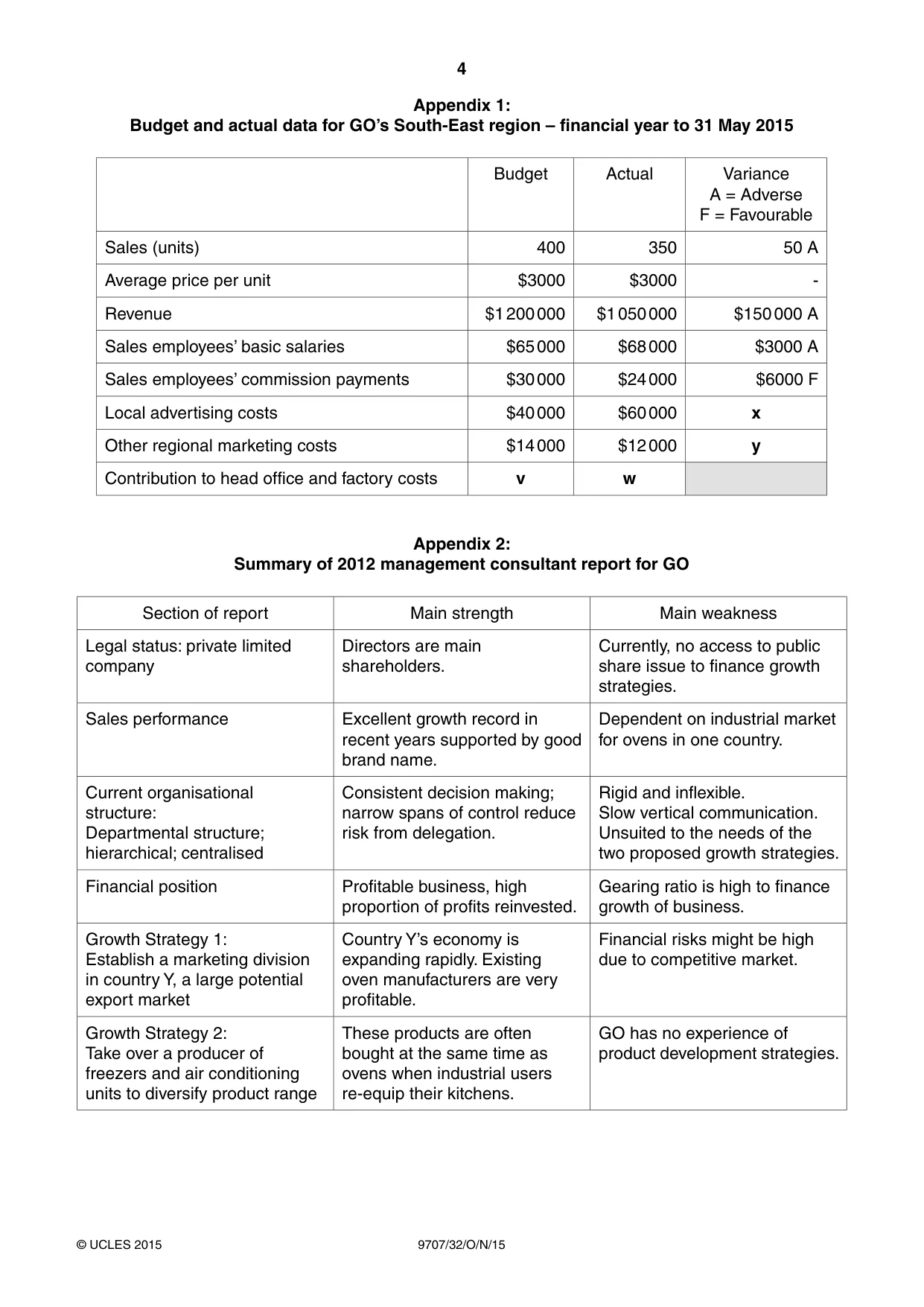
4 9707/32/O/N/15 © UCLES 2015 Appendix 1: Budget and actual data for GO’s South-East region – financial year to 31 May 2015 Budget Actual Variance A = Adverse F = Favourable Sales (units) 400 350 50 A Average price per unit $3000 $3000 - Revenue $1 200 000 $1 050 000 $150 000 A Sales employees’ basic salaries $65 000 $68 000 $3000 A Sales employees’ commission payments $30 000 $24 000 $6000 F Local advertising costs $40 000 $60 000 x Other regional marketing costs $14 000 $12 000 y Contribution to head office and factory costs v w Appendix 2: Summary of 2012 management consultant report for GO Section of report Main strength Main weakness Legal status: private limited company Directors are main shareholders. Currently, no access to public share issue to finance growth strategies. Sales performance Excellent growth record in recent years supported by good brand name. Dependent on industrial market for ovens in one country. Current organisational structure: Departmental structure; hierarchical; centralised Consistent decision making; narrow spans of control reduce risk from delegation. Rigid and inflexible. Slow vertical communication. Unsuited to the needs of the two proposed growth strategies. Financial position Profitable business, high proportion of profits reinvested. Gearing ratio is high to finance growth of business. Growth Strategy 1: Establish a marketing division in country Y, a large potential export market Country Y’s economy is expanding rapidly. Existing oven manufacturers are very profitable. Financial risks might be high due to competitive market. Growth Strategy 2: Take over a producer of freezers and air conditioning units to diversify product range These products are often bought at the same time as ovens when industrial users re-equip their kitchens. GO has no experience of product development strategies.
Question paper, page 5
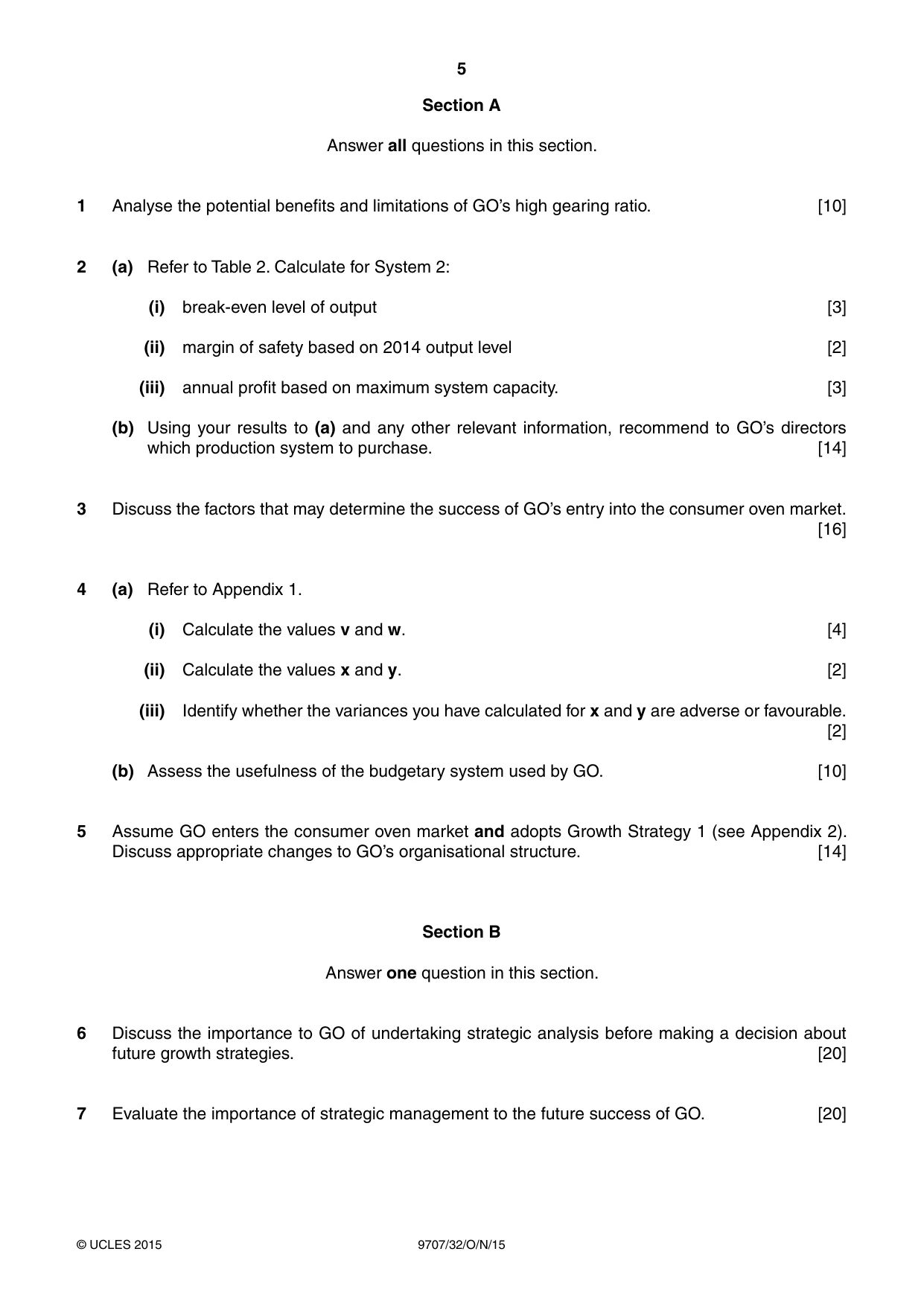
5 9707/32/O/N/15 © UCLES 2015 Section A Answer all questions in this section. 1 Analyse the potential benefits and limitations of GO’s high gearing ratio. [10] 2 (a) Refer to Table 2. Calculate for System 2: (i) break-even level of output [3] (ii) margin of safety based on 2014 output level [2] (iii) annual profit based on maximum system capacity. [3] (b) Using your results to (a) and any other relevant information, recommend to GO’s directors which production system to purchase. [14] 3 Discuss the factors that may determine the success of GO’s entry into the consumer oven market. [16] 4 (a) Refer to Appendix 1. (i) Calculate the values v and w. [4] (ii) Calculate the values x and y. [2] (iii) Identify whether the variances you have calculated for x and y are adverse or favourable. [2] (b) Assess the usefulness of the budgetary system used by GO. [10] 5 Assume GO enters the consumer oven market and adopts Growth Strategy 1 (see Appendix 2). Discuss appropriate changes to GO’s organisational structure. [14] Section B Answer one question in this section. 6 Discuss the importance to GO of undertaking strategic analysis before making a decision about future growth strategies. [20] 7 Evaluate the importance of strategic management to the future success of GO. [20]
Question paper, page 6
6 9707/32/O/N/15 © UCLES 2015 BLANK PAGE
Question paper, page 7
7 9707/32/O/N/15 © UCLES 2015 BLANK PAGE
Question paper, page 8
8 9707/32/O/N/15 © UCLES 2015 Permission to reproduce items where third-party owned material protected by copyright is included has been sought and cleared where possible. Every reasonable effort has been made by the publisher (UCLES) to trace copyright holders, but if any items requiring clearance have unwittingly been included, the publisher will be pleased to make amends at the earliest possible opportunity. To avoid the issue of disclosure of answer-related information to candidates, all copyright acknowledgements are reproduced online in the Cambridge International Examinations Copyright Acknowledgements Booklet. This is produced for each series of examinations and is freely available to download at www.cie.org.uk after the live examination series. Cambridge International Examinations is part of the Cambridge Assessment Group. Cambridge Assessment is the brand name of University of Cambridge Local Examinations Syndicate (UCLES), which is itself a department of the University of Cambridge. BLANK PAGE
Mark scheme, page 1
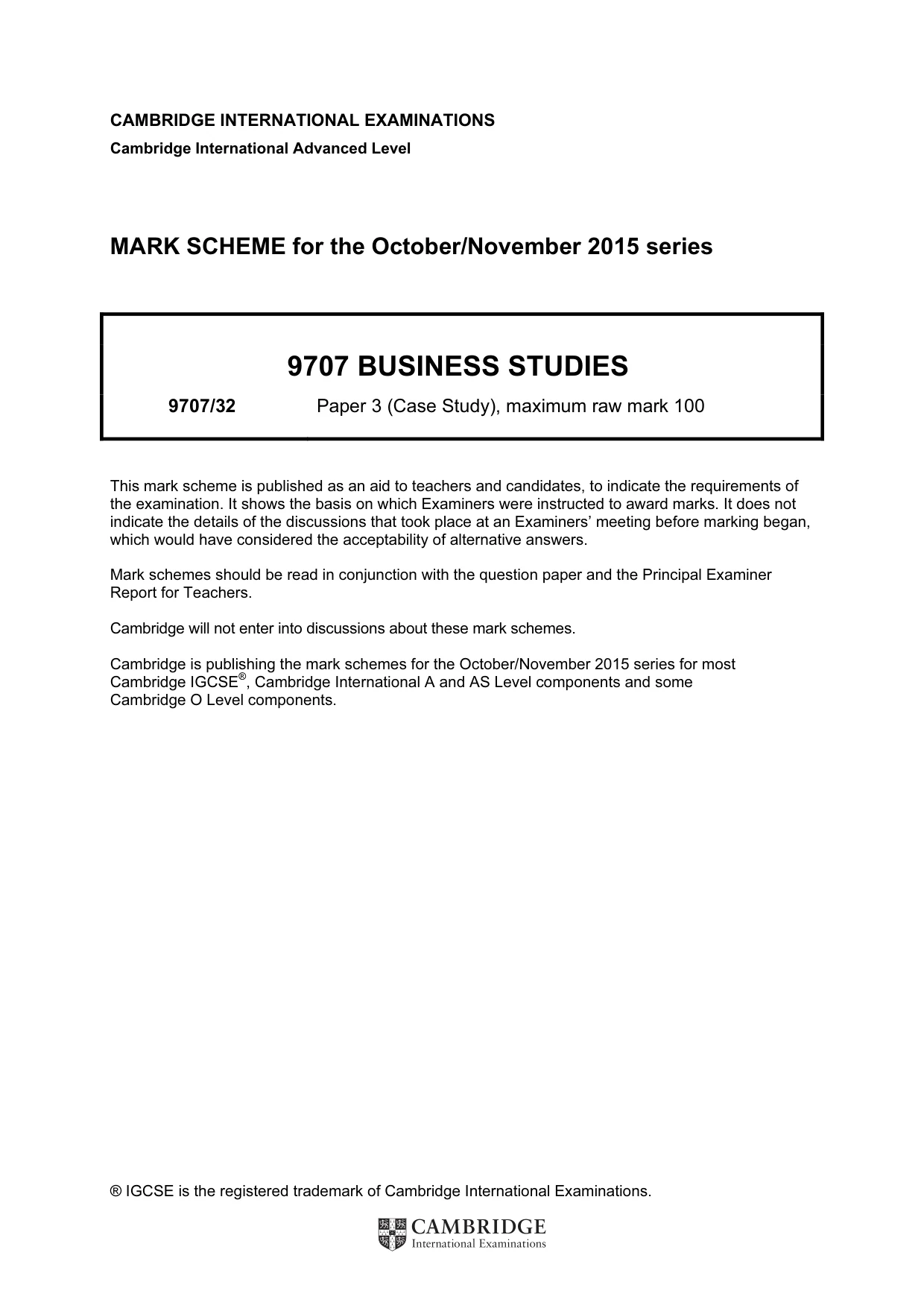
® IGCSE is the registered trademark of Cambridge International Examinations. CAMBRIDGE INTERNATIONAL EXAMINATIONS Cambridge International Advanced Level MARK SCHEME for the October/November 2015 series 9707 BUSINESS STUDIES 9707/32 Paper 3 (Case Study), maximum raw mark 100 This mark scheme is published as an aid to teachers and candidates, to indicate the requirements of the examination. It shows the basis on which Examiners were instructed to award marks. It does not indicate the details of the discussions that took place at an Examiners’ meeting before marking began, which would have considered the acceptability of alternative answers. Mark schemes should be read in conjunction with the question paper and the Principal Examiner Report for Teachers. Cambridge will not enter into discussions about these mark schemes. Cambridge is publishing the mark schemes for the October/November 2015 series for most Cambridge IGCSE®, Cambridge International A and AS Level components and some Cambridge O Level components.
Mark scheme, page 2
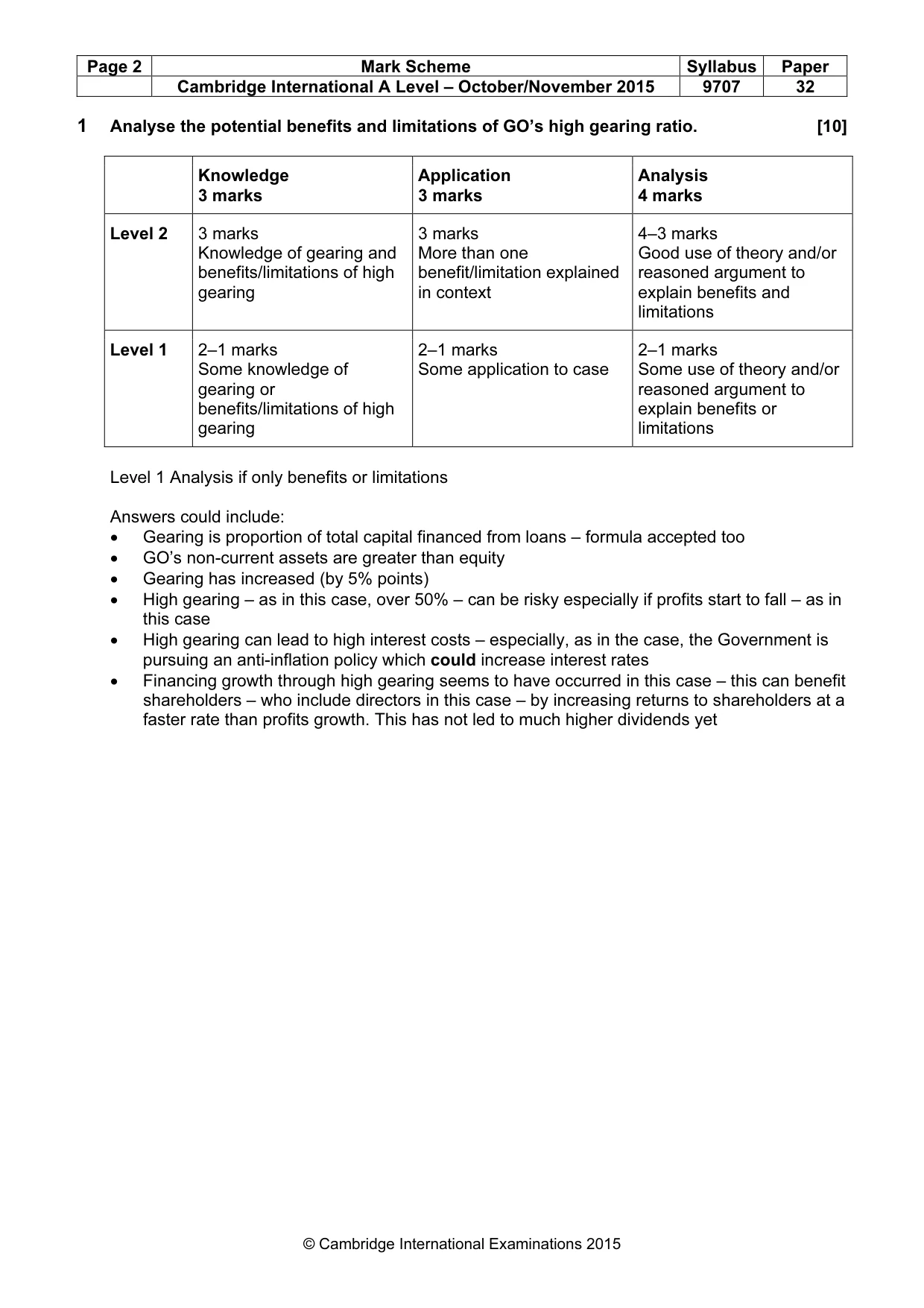
Page 2 Mark Scheme Syllabus Paper Cambridge International A Level – October/November 2015 9707 32 © Cambridge International Examinations 2015 1 Analyse the potential benefits and limitations of GO’s high gearing ratio. [10] Knowledge 3 marks Application 3 marks Analysis 4 marks Level 2 3 marks Knowledge of gearing and benefits/limitations of high gearing 3 marks More than one benefit/limitation explained in context 4–3 marks Good use of theory and/or reasoned argument to explain benefits and limitations Level 1 2–1 marks Some knowledge of gearing or benefits/limitations of high gearing 2–1 marks Some application to case 2–1 marks Some use of theory and/or reasoned argument to explain benefits or limitations Level 1 Analysis if only benefits or limitations Answers could include: • Gearing is proportion of total capital financed from loans – formula accepted too • GO’s non-current assets are greater than equity • Gearing has increased (by 5% points) • High gearing – as in this case, over 50% – can be risky especially if profits start to fall – as in this case • High gearing can lead to high interest costs – especially, as in the case, the Government is pursuing an anti-inflation policy which could increase interest rates • Financing growth through high gearing seems to have occurred in this case – this can benefit shareholders – who include directors in this case – by increasing returns to shareholders at a faster rate than profits growth. This has not led to much higher dividends yet
Mark scheme, page 3
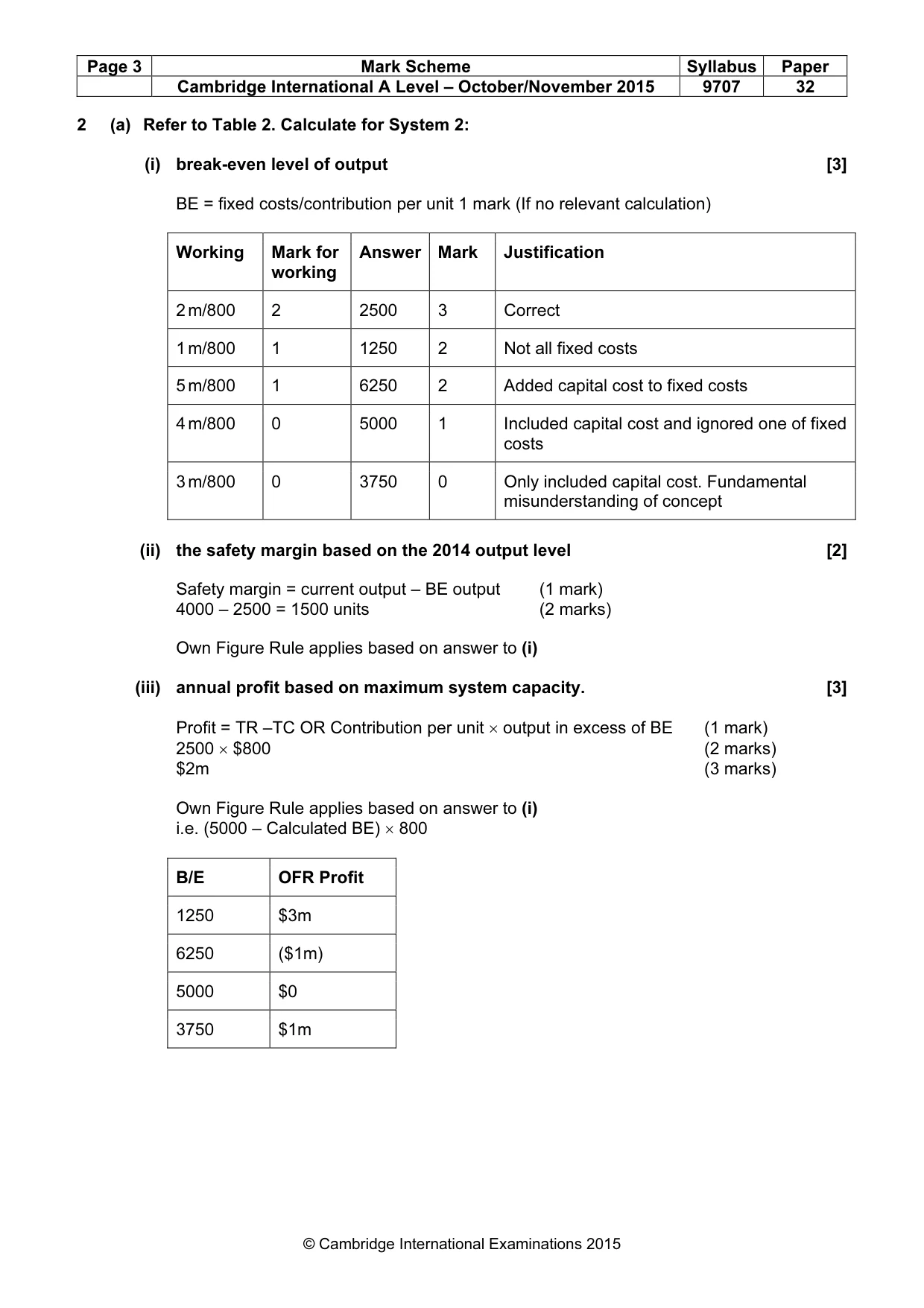
Page 3 Mark Scheme Syllabus Paper Cambridge International A Level – October/November 2015 9707 32 © Cambridge International Examinations 2015 2 (a) Refer to Table 2. Calculate for System 2: (i) break-even level of output [3] BE = fixed costs/contribution per unit 1 mark (If no relevant calculation) Working Mark for working Answer Mark Justification 2 m/800 2 2500 3 Correct 1 m/800 1 1250 2 Not all fixed costs 5 m/800 1 6250 2 Added capital cost to fixed costs 4 m/800 0 5000 1 Included capital cost and ignored one of fixed costs 3 m/800 0 3750 0 Only included capital cost. Fundamental misunderstanding of concept (ii) the safety margin based on the 2014 output level [2] Safety margin = current output – BE output (1 mark) 4000 – 2500 = 1500 units (2 marks) Own Figure Rule applies based on answer to (i) (iii) annual profit based on maximum system capacity. [3] Profit = TR –TC OR Contribution per unit × output in excess of BE (1 mark) 2500 × $800 (2 marks) $2m (3 marks) Own Figure Rule applies based on answer to (i) i.e. (5000 – Calculated BE) × 800 B/E OFR Profit 1250 $3m 6250 ($1m) 5000 $0 3750 $1m
Mark scheme, page 4
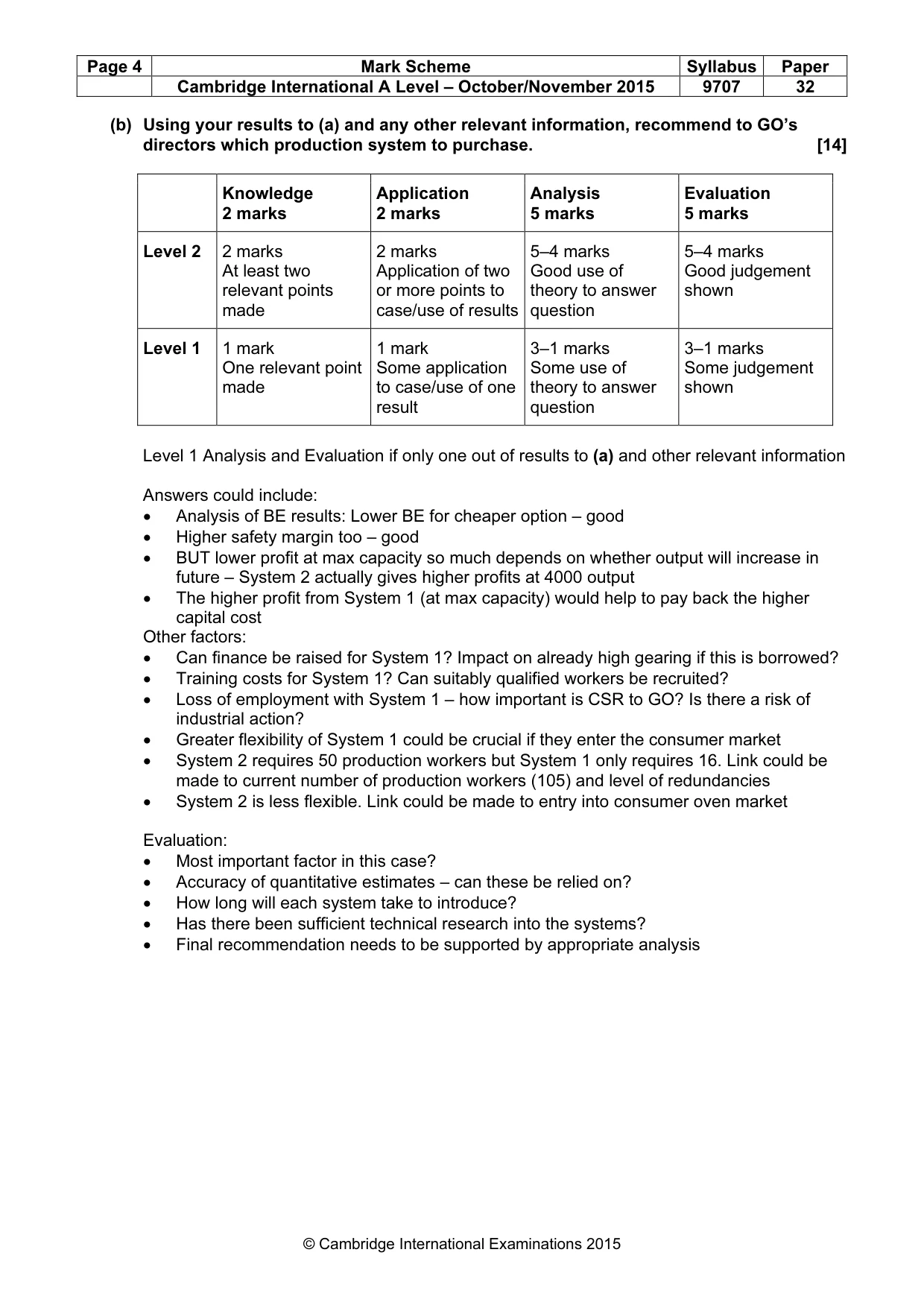
Page 4 Mark Scheme Syllabus Paper Cambridge International A Level – October/November 2015 9707 32 © Cambridge International Examinations 2015 (b) Using your results to (a) and any other relevant information, recommend to GO’s directors which production system to purchase. [14] Knowledge 2 marks Application 2 marks Analysis 5 marks Evaluation 5 marks Level 2 2 marks At least two relevant points made 2 marks Application of two or more points to case/use of results 5–4 marks Good use of theory to answer question 5–4 marks Good judgement shown Level 1 1 mark One relevant point made 1 mark Some application to case/use of one result 3–1 marks Some use of theory to answer question 3–1 marks Some judgement shown Level 1 Analysis and Evaluation if only one out of results to (a) and other relevant information Answers could include: • Analysis of BE results: Lower BE for cheaper option – good • Higher safety margin too – good • BUT lower profit at max capacity so much depends on whether output will increase in future – System 2 actually gives higher profits at 4000 output • The higher profit from System 1 (at max capacity) would help to pay back the higher capital cost Other factors: • Can finance be raised for System 1? Impact on already high gearing if this is borrowed? • Training costs for System 1? Can suitably qualified workers be recruited? • Loss of employment with System 1 – how important is CSR to GO? Is there a risk of industrial action? • Greater flexibility of System 1 could be crucial if they enter the consumer market • System 2 requires 50 production workers but System 1 only requires 16. Link could be made to current number of production workers (105) and level of redundancies • System 2 is less flexible. Link could be made to entry into consumer oven market Evaluation: • Most important factor in this case? • Accuracy of quantitative estimates – can these be relied on? • How long will each system take to introduce? • Has there been sufficient technical research into the systems? • Final recommendation needs to be supported by appropriate analysis
Mark scheme, page 5
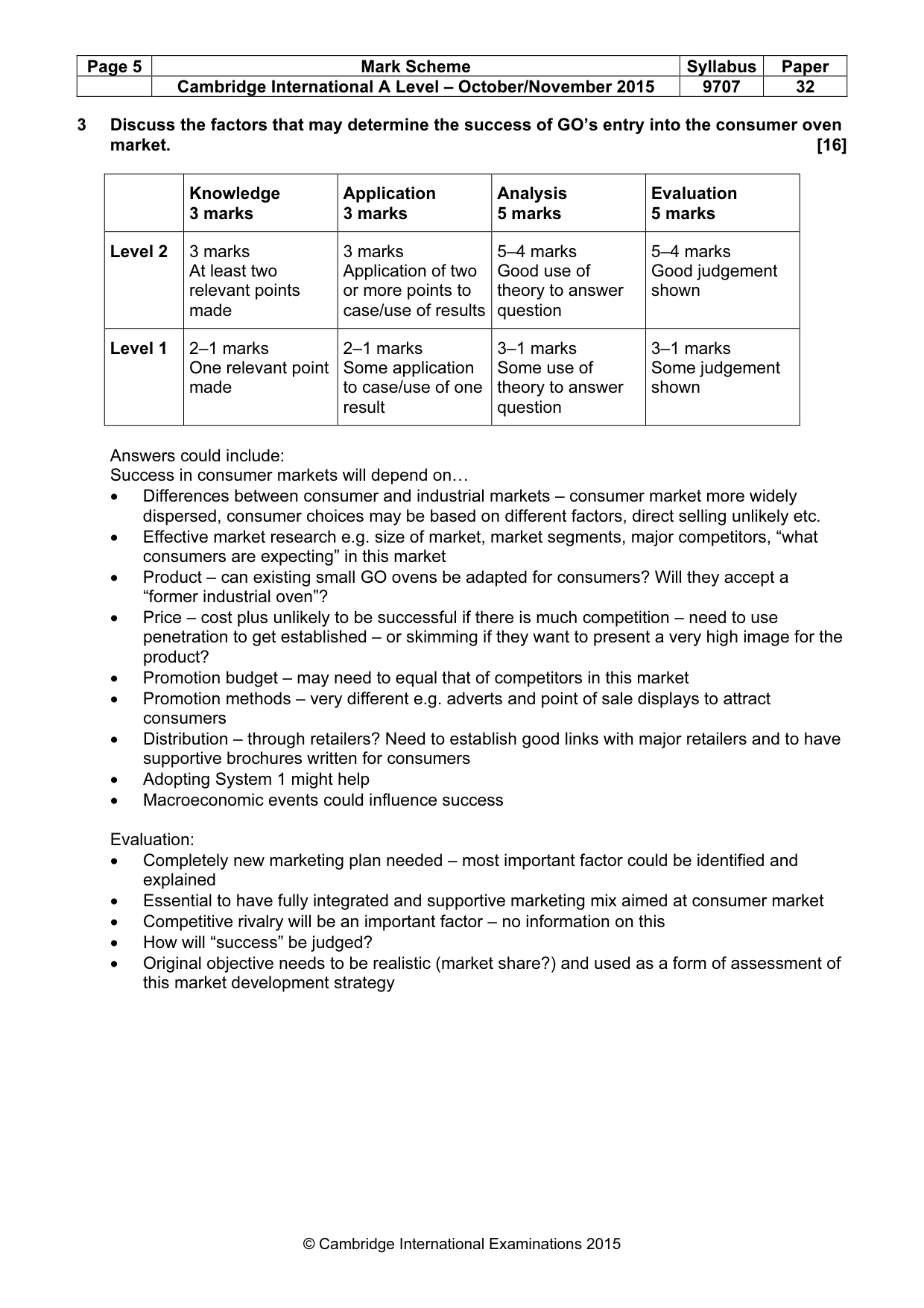
Page 5 Mark Scheme Syllabus Paper Cambridge International A Level – October/November 2015 9707 32 © Cambridge International Examinations 2015 3 Discuss the factors that may determine the success of GO’s entry into the consumer oven market. [16] Knowledge 3 marks Application 3 marks Analysis 5 marks Evaluation 5 marks Level 2 3 marks At least two relevant points made 3 marks Application of two or more points to case/use of results 5–4 marks Good use of theory to answer question 5–4 marks Good judgement shown Level 1 2–1 marks One relevant point made 2–1 marks Some application to case/use of one result 3–1 marks Some use of theory to answer question 3–1 marks Some judgement shown Answers could include: Success in consumer markets will depend on… • Differences between consumer and industrial markets – consumer market more widely dispersed, consumer choices may be based on different factors, direct selling unlikely etc. • Effective market research e.g. size of market, market segments, major competitors, “what consumers are expecting” in this market • Product – can existing small GO ovens be adapted for consumers? Will they accept a “former industrial oven”? • Price – cost plus unlikely to be successful if there is much competition – need to use penetration to get established – or skimming if they want to present a very high image for the product? • Promotion budget – may need to equal that of competitors in this market • Promotion methods – very different e.g. adverts and point of sale displays to attract consumers • Distribution – through retailers? Need to establish good links with major retailers and to have supportive brochures written for consumers • Adopting System 1 might help • Macroeconomic events could influence success Evaluation: • Completely new marketing plan needed – most important factor could be identified and explained • Essential to have fully integrated and supportive marketing mix aimed at consumer market • Competitive rivalry will be an important factor – no information on this • How will “success” be judged? • Original objective needs to be realistic (market share?) and used as a form of assessment of this market development strategy
Mark scheme, page 6
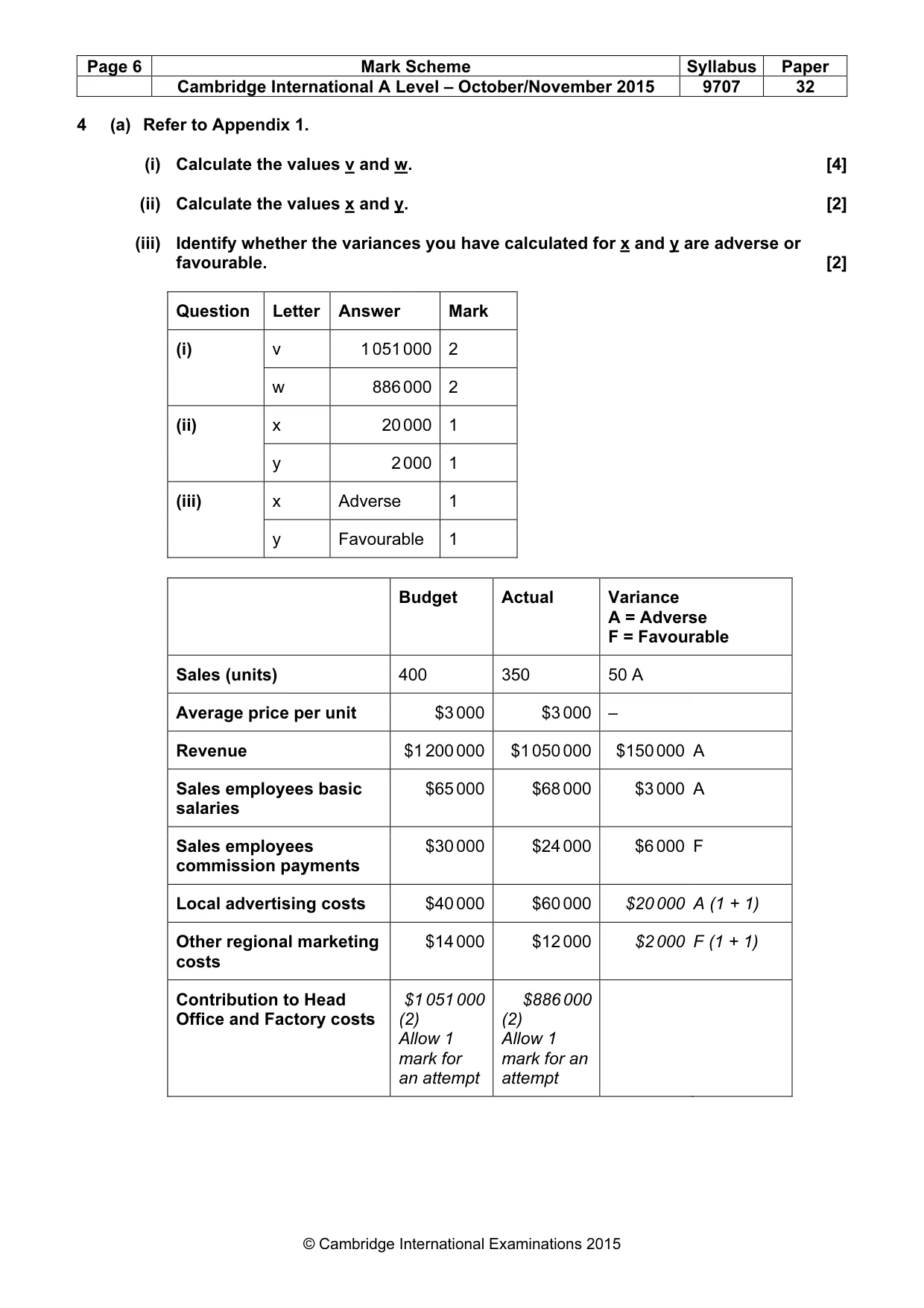
Page 6 Mark Scheme Syllabus Paper Cambridge International A Level – October/November 2015 9707 32 © Cambridge International Examinations 2015 4 (a) Refer to Appendix 1. (i) Calculate the values v and w. [4] (ii) Calculate the values x and y. [2] (iii) Identify whether the variances you have calculated for x and y are adverse or favourable. [2] Question Letter Answer Mark (i) v 1 051 000 2 w 886 000 2 (ii) x 20 000 1 y 2 000 1 (iii) x Adverse 1 y Favourable 1 Budget Actual Variance A = Adverse F = Favourable Sales (units) 400 350 50 A Average price per unit $3 000 $3 000 – Revenue $1 200 000 $1 050 000 $150 000 A Sales employees basic salaries $65 000 $68 000 $3 000 A Sales employees commission payments $30 000 $24 000 $6 000 F Local advertising costs $40 000 $60 000 $20 000 A (1 + 1) Other regional marketing costs $14 000 $12 000 $2 000 F (1 + 1) Contribution to Head Office and Factory costs $1 051 000 (2) Allow 1 mark for an attempt $886 000 (2) Allow 1 mark for an attempt
Mark scheme, page 7
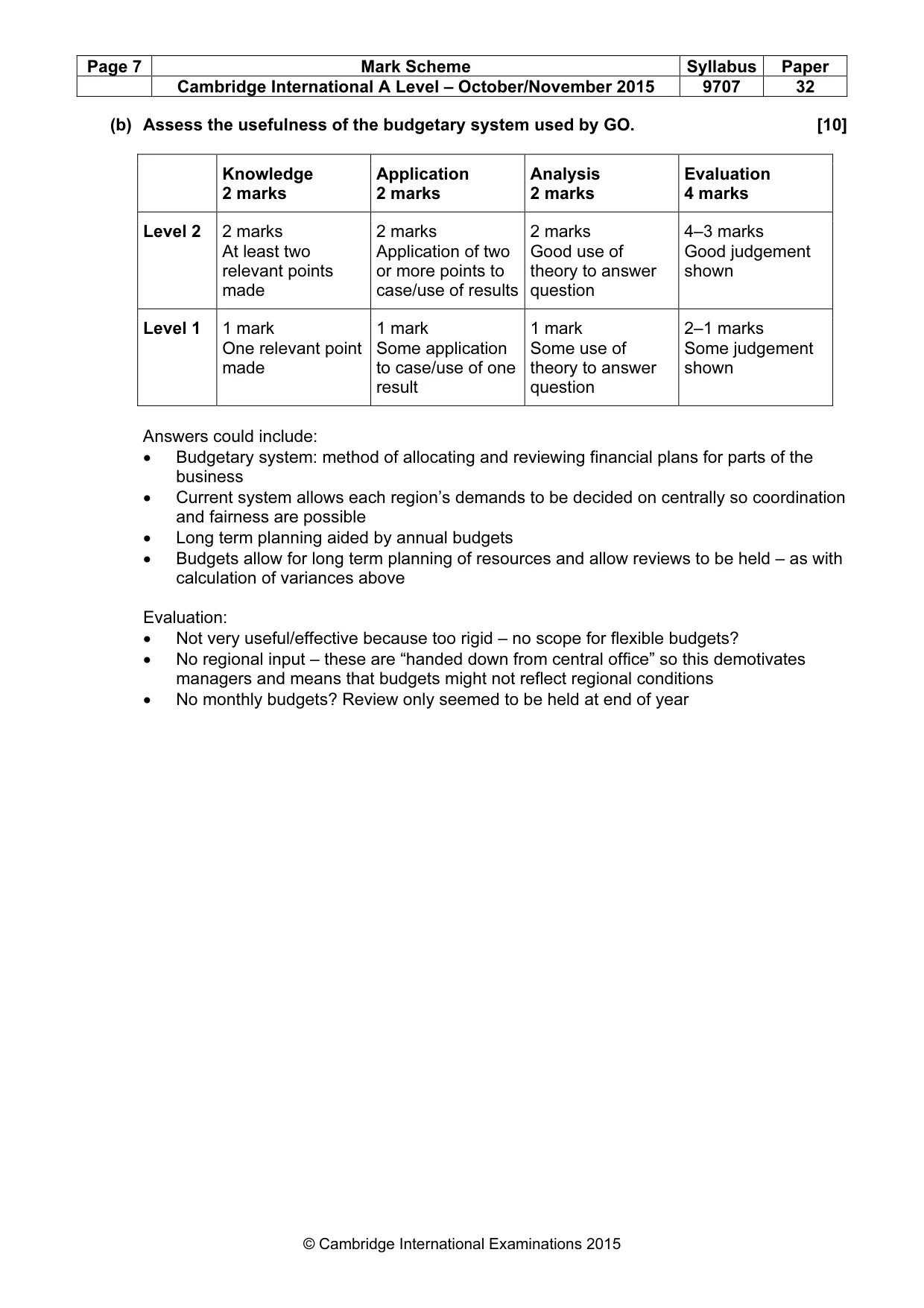
Page 7 Mark Scheme Syllabus Paper Cambridge International A Level – October/November 2015 9707 32 © Cambridge International Examinations 2015 (b) Assess the usefulness of the budgetary system used by GO. [10] Knowledge 2 marks Application 2 marks Analysis 2 marks Evaluation 4 marks Level 2 2 marks At least two relevant points made 2 marks Application of two or more points to case/use of results 2 marks Good use of theory to answer question 4–3 marks Good judgement shown Level 1 1 mark One relevant point made 1 mark Some application to case/use of one result 1 mark Some use of theory to answer question 2–1 marks Some judgement shown Answers could include: • Budgetary system: method of allocating and reviewing financial plans for parts of the business • Current system allows each region’s demands to be decided on centrally so coordination and fairness are possible • Long term planning aided by annual budgets • Budgets allow for long term planning of resources and allow reviews to be held – as with calculation of variances above Evaluation: • Not very useful/effective because too rigid – no scope for flexible budgets? • No regional input – these are “handed down from central office” so this demotivates managers and means that budgets might not reflect regional conditions • No monthly budgets? Review only seemed to be held at end of year
Mark scheme, page 8
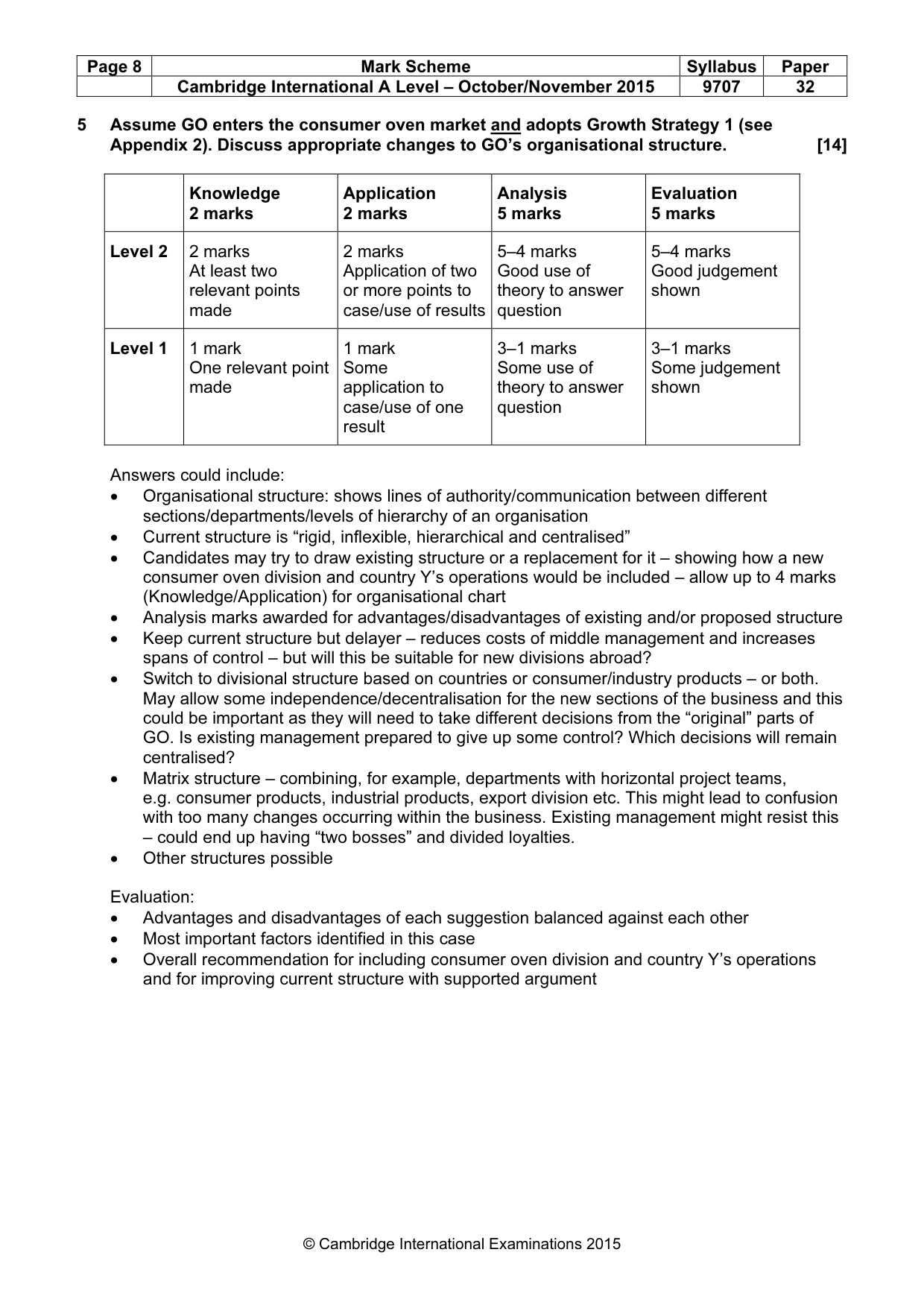
Page 8 Mark Scheme Syllabus Paper Cambridge International A Level – October/November 2015 9707 32 © Cambridge International Examinations 2015 5 Assume GO enters the consumer oven market and adopts Growth Strategy 1 (see Appendix 2). Discuss appropriate changes to GO’s organisational structure. [14] Knowledge 2 marks Application 2 marks Analysis 5 marks Evaluation 5 marks Level 2 2 marks At least two relevant points made 2 marks Application of two or more points to case/use of results 5–4 marks Good use of theory to answer question 5–4 marks Good judgement shown Level 1 1 mark One relevant point made 1 mark Some application to case/use of one result 3–1 marks Some use of theory to answer question 3–1 marks Some judgement shown Answers could include: • Organisational structure: shows lines of authority/communication between different sections/departments/levels of hierarchy of an organisation • Current structure is “rigid, inflexible, hierarchical and centralised” • Candidates may try to draw existing structure or a replacement for it – showing how a new consumer oven division and country Y’s operations would be included – allow up to 4 marks (Knowledge/Application) for organisational chart • Analysis marks awarded for advantages/disadvantages of existing and/or proposed structure • Keep current structure but delayer – reduces costs of middle management and increases spans of control – but will this be suitable for new divisions abroad? • Switch to divisional structure based on countries or consumer/industry products – or both. May allow some independence/decentralisation for the new sections of the business and this could be important as they will need to take different decisions from the “original” parts of GO. Is existing management prepared to give up some control? Which decisions will remain centralised? • Matrix structure – combining, for example, departments with horizontal project teams, e.g. consumer products, industrial products, export division etc. This might lead to confusion with too many changes occurring within the business. Existing management might resist this – could end up having “two bosses” and divided loyalties. • Other structures possible Evaluation: • Advantages and disadvantages of each suggestion balanced against each other • Most important factors identified in this case • Overall recommendation for including consumer oven division and country Y’s operations and for improving current structure with supported argument
Mark scheme, page 9
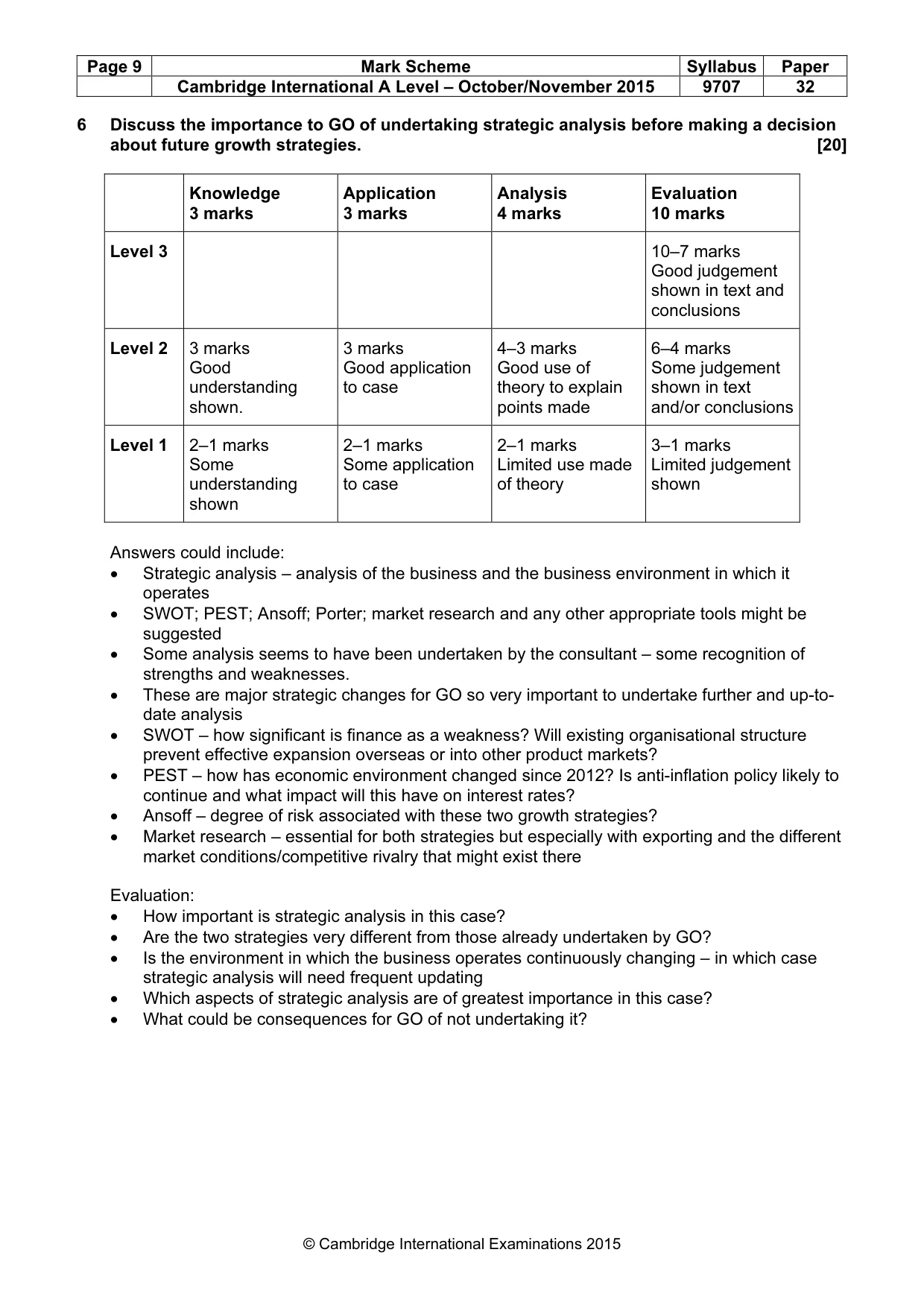
Page 9 Mark Scheme Syllabus Paper Cambridge International A Level – October/November 2015 9707 32 © Cambridge International Examinations 2015 6 Discuss the importance to GO of undertaking strategic analysis before making a decision about future growth strategies. [20] Knowledge 3 marks Application 3 marks Analysis 4 marks Evaluation 10 marks Level 3 10–7 marks Good judgement shown in text and conclusions Level 2 3 marks Good understanding shown. 3 marks Good application to case 4–3 marks Good use of theory to explain points made 6–4 marks Some judgement shown in text and/or conclusions Level 1 2–1 marks Some understanding shown 2–1 marks Some application to case 2–1 marks Limited use made of theory 3–1 marks Limited judgement shown Answers could include: • Strategic analysis – analysis of the business and the business environment in which it operates • SWOT; PEST; Ansoff; Porter; market research and any other appropriate tools might be suggested • Some analysis seems to have been undertaken by the consultant – some recognition of strengths and weaknesses. • These are major strategic changes for GO so very important to undertake further and up-to- date analysis • SWOT – how significant is finance as a weakness? Will existing organisational structure prevent effective expansion overseas or into other product markets? • PEST – how has economic environment changed since 2012? Is anti-inflation policy likely to continue and what impact will this have on interest rates? • Ansoff – degree of risk associated with these two growth strategies? • Market research – essential for both strategies but especially with exporting and the different market conditions/competitive rivalry that might exist there Evaluation: • How important is strategic analysis in this case? • Are the two strategies very different from those already undertaken by GO? • Is the environment in which the business operates continuously changing – in which case strategic analysis will need frequent updating • Which aspects of strategic analysis are of greatest importance in this case? • What could be consequences for GO of not undertaking it?
Mark scheme, page 10
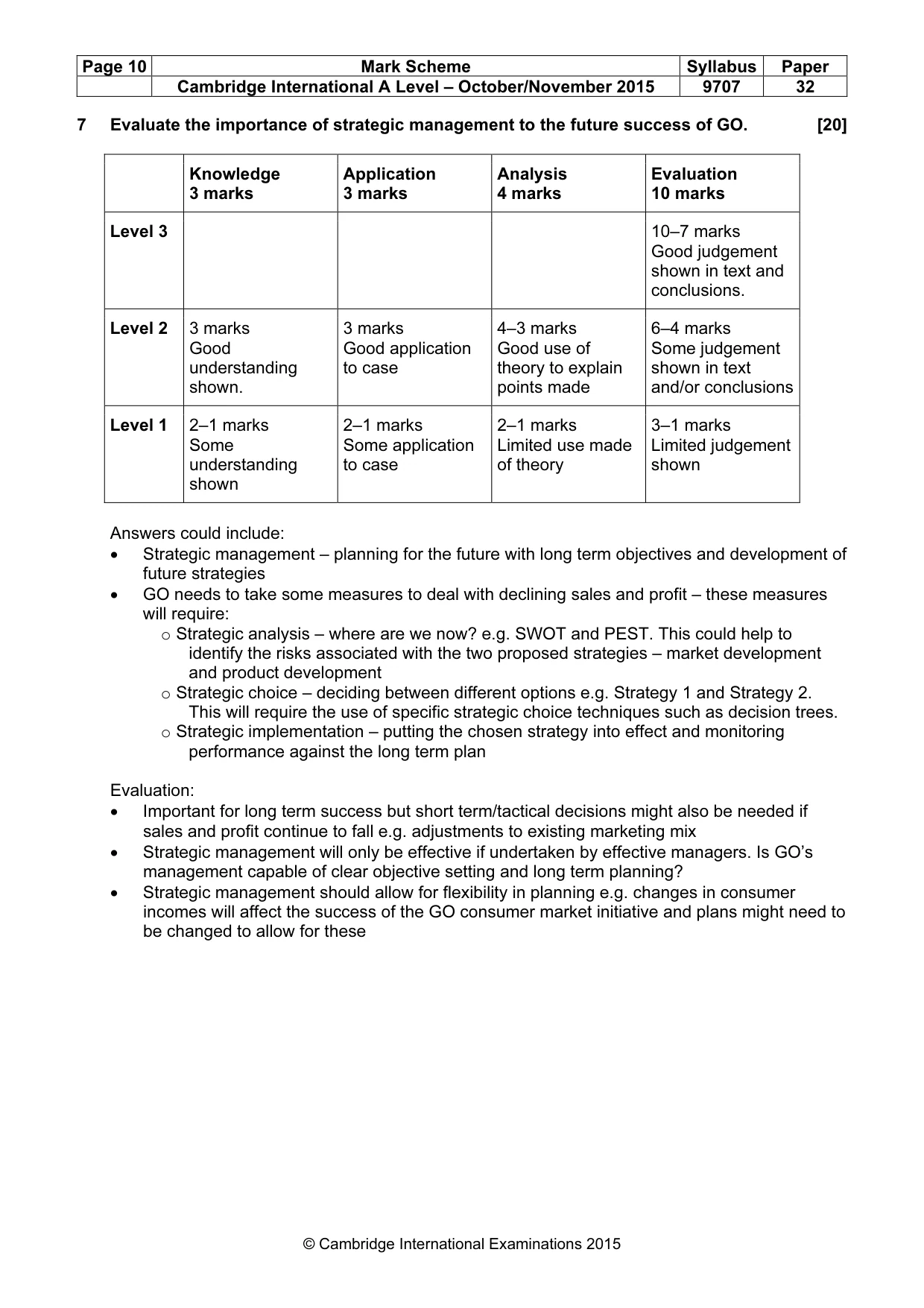
Page 10 Mark Scheme Syllabus Paper Cambridge International A Level – October/November 2015 9707 32 © Cambridge International Examinations 2015 7 Evaluate the importance of strategic management to the future success of GO. [20] Knowledge 3 marks Application 3 marks Analysis 4 marks Evaluation 10 marks Level 3 10–7 marks Good judgement shown in text and conclusions. Level 2 3 marks Good understanding shown. 3 marks Good application to case 4–3 marks Good use of theory to explain points made 6–4 marks Some judgement shown in text and/or conclusions Level 1 2–1 marks Some understanding shown 2–1 marks Some application to case 2–1 marks Limited use made of theory 3–1 marks Limited judgement shown Answers could include: • Strategic management – planning for the future with long term objectives and development of future strategies • GO needs to take some measures to deal with declining sales and profit – these measures will require: o Strategic analysis – where are we now? e.g. SWOT and PEST. This could help to identify the risks associated with the two proposed strategies – market development and product development o Strategic choice – deciding between different options e.g. Strategy 1 and Strategy 2. This will require the use of specific strategic choice techniques such as decision trees. o Strategic implementation – putting the chosen strategy into effect and monitoring performance against the long term plan Evaluation: • Important for long term success but short term/tactical decisions might also be needed if sales and profit continue to fall e.g. adjustments to existing marketing mix • Strategic management will only be effective if undertaken by effective managers. Is GO’s management capable of clear objective setting and long term planning? • Strategic management should allow for flexibility in planning e.g. changes in consumer incomes will affect the success of the GO consumer market initiative and plans might need to be changed to allow for these