Cambridge A Level Business Studies (for final examination in 2015) 9707 — 2014 May/June Paper 3 · Variant 2
9707/32/M/J/14 · 100 marks · ≈113 min
The question paper and its mark scheme, free to read here and free to download. This is Cambridge’s own paper, exactly as it was sat.
Question paper8 pages



Mark scheme10 pages
Answers below. Sit the paper first if you are practising.
Paper as text
Question paper, page 1
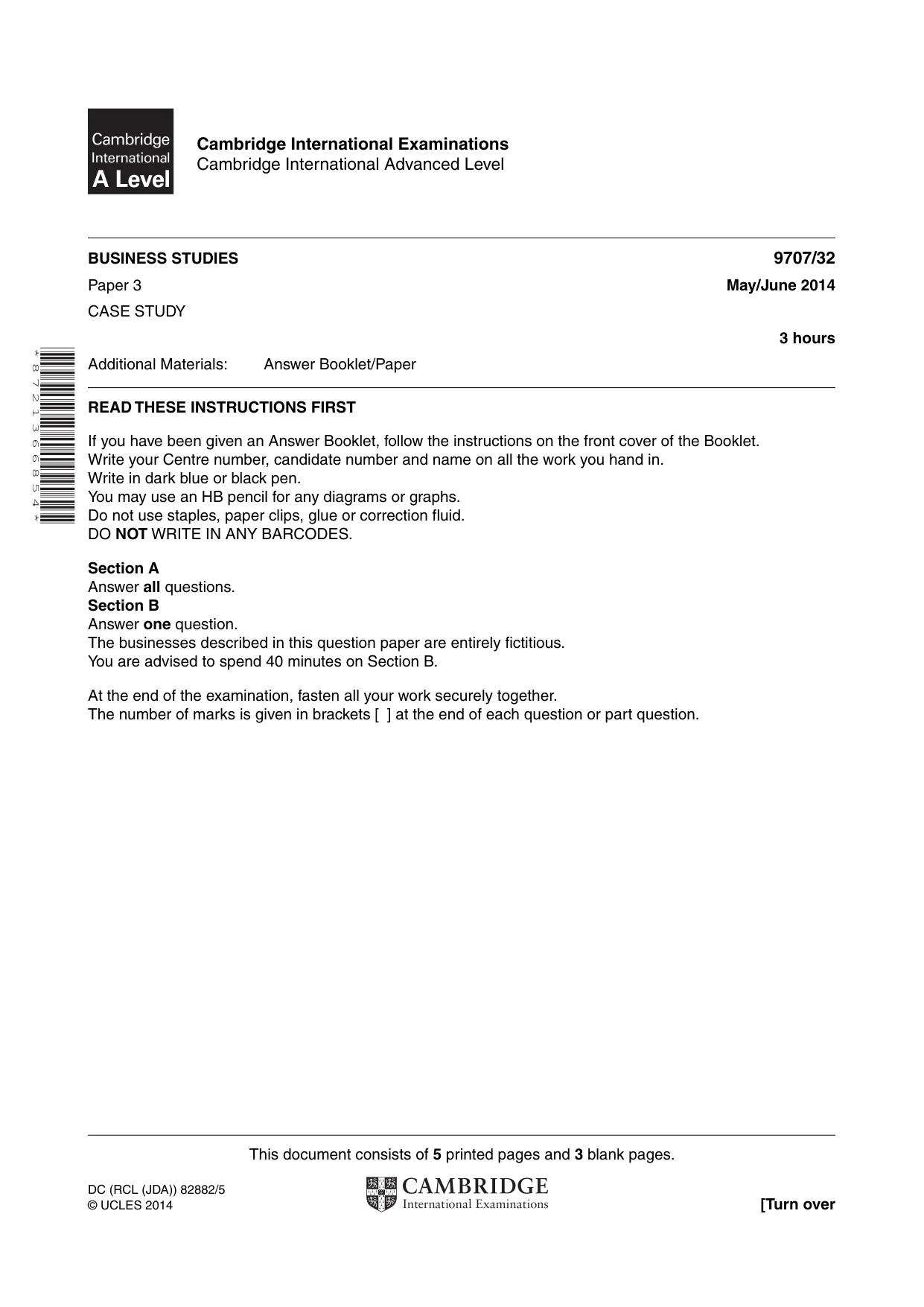
This document consists of 5 printed pages and 3 blank pages. DC (RCL (JDA)) 82882/5 © UCLES 2014 [Turn over Cambridge International Examinations Cambridge International Advanced Level * 8 7 2 1 3 6 6 8 5 4 * BUSINESS STUDIES 9707/32 Paper 3 May/June 2014 CASE STUDY 3 hours Additional Materials: Answer Booklet/Paper READ THESE INSTRUCTIONS FIRST If you have been given an Answer Booklet, follow the instructions on the front cover of the Booklet. Write your Centre number, candidate number and name on all the work you hand in. Write in dark blue or black pen. You may use an HB pencil for any diagrams or graphs. Do not use staples, paper clips, glue or correction fluid. DO NOT WRITE IN ANY BARCODES. Section A Answer all questions. Section B Answer one question. The businesses described in this question paper are entirely fictitious. You are advised to spend 40 minutes on Section B. At the end of the examination, fasten all your work securely together. The number of marks is given in brackets [ ] at the end of each question or part question.
Question paper, page 2
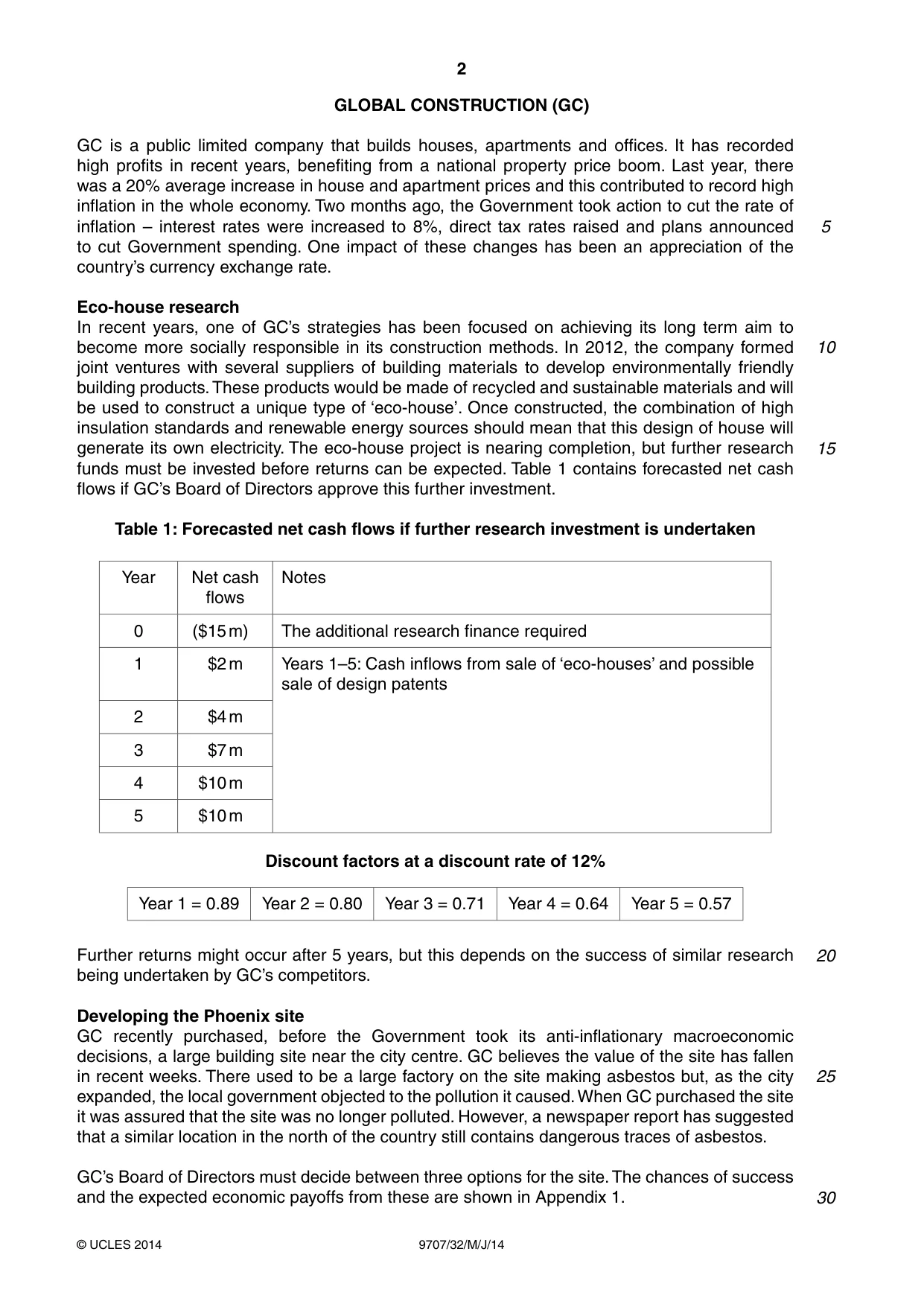
2 9707/32/M/J/14 © UCLES 2014 GLOBAL CONSTRUCTION (GC) GC is a public limited company that builds houses, apartments and offices. It has recorded high profits in recent years, benefiting from a national property price boom. Last year, there was a 20% average increase in house and apartment prices and this contributed to record high inflation in the whole economy. Two months ago, the Government took action to cut the rate of inflation – interest rates were increased to 8%, direct tax rates raised and plans announced to cut Government spending. One impact of these changes has been an appreciation of the country’s currency exchange rate. Eco-house research In recent years, one of GC’s strategies has been focused on achieving its long term aim to become more socially responsible in its construction methods. In 2012, the company formed joint ventures with several suppliers of building materials to develop environmentally friendly building products. These products would be made of recycled and sustainable materials and will be used to construct a unique type of ‘eco-house’. Once constructed, the combination of high insulation standards and renewable energy sources should mean that this design of house will generate its own electricity. The eco-house project is nearing completion, but further research funds must be invested before returns can be expected. Table 1 contains forecasted net cash flows if GC’s Board of Directors approve this further investment. Table 1: Forecasted net cash flows if further research investment is undertaken Year Net cash flows Notes 0 ($15 m) The additional research finance required 1 $2 m Years 1–5: Cash inflows from sale of ‘eco-houses’ and possible sale of design patents 2 $4 m 3 $7 m 4 $10 m 5 $10 m Discount factors at a discount rate of 12% Year 1 = 0.89 Year 2 = 0.80 Year 3 = 0.71 Year 4 = 0.64 Year 5 = 0.57 Further returns might occur after 5 years, but this depends on the success of similar research being undertaken by GC’s competitors. Developing the Phoenix site GC recently purchased, before the Government took its anti-inflationary macroeconomic decisions, a large building site near the city centre. GC believes the value of the site has fallen in recent weeks. There used to be a large factory on the site making asbestos but, as the city expanded, the local government objected to the pollution it caused. When GC purchased the site it was assured that the site was no longer polluted. However, a newspaper report has suggested that a similar location in the north of the country still contains dangerous traces of asbestos. GC’s Board of Directors must decide between three options for the site. The chances of success and the expected economic payoffs from these are shown in Appendix 1. 5 10 15 20 25 30
Question paper, page 3
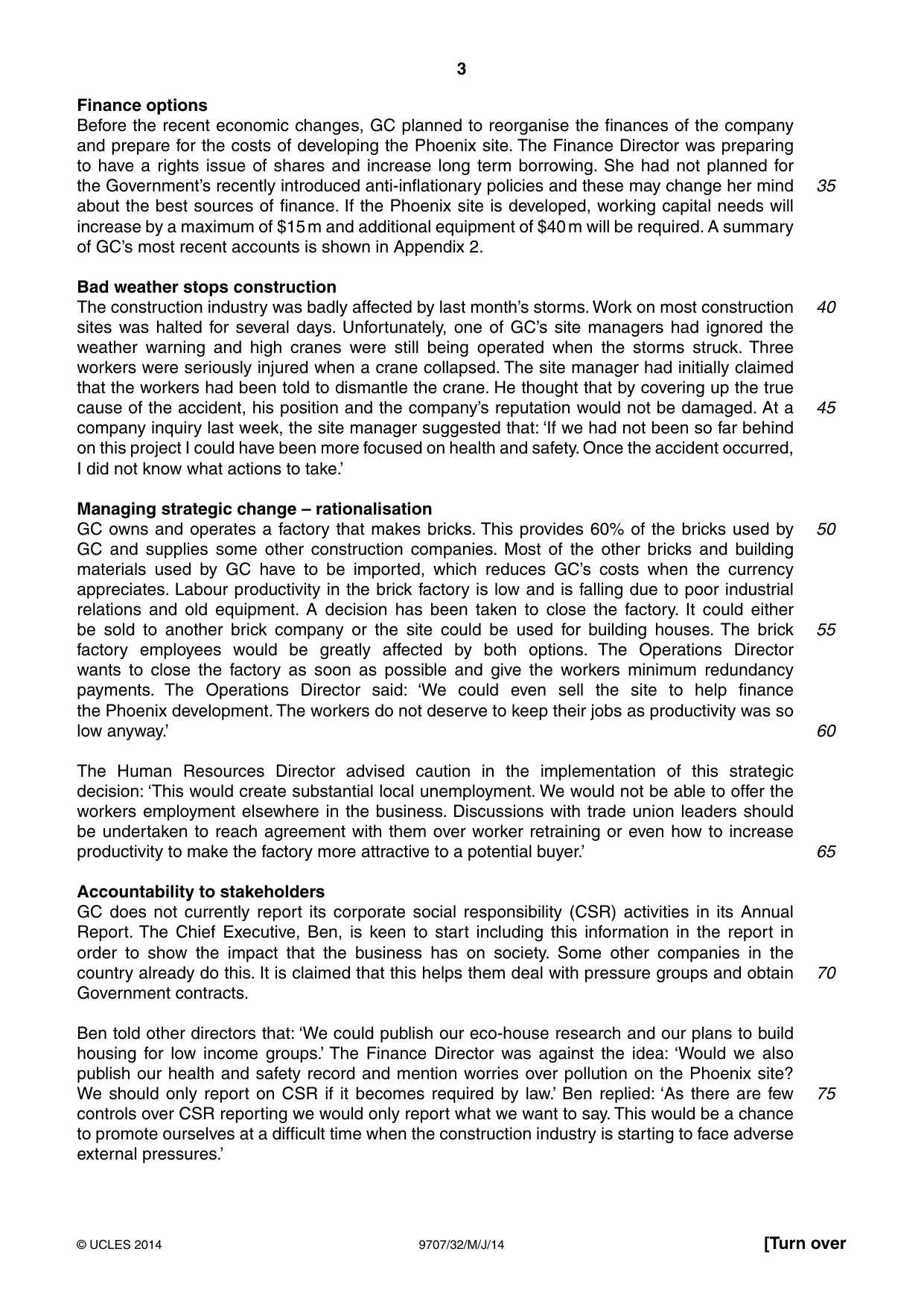
3 9707/32/M/J/14 © UCLES 2014 [Turn over Finance options Before the recent economic changes, GC planned to reorganise the finances of the company and prepare for the costs of developing the Phoenix site. The Finance Director was preparing to have a rights issue of shares and increase long term borrowing. She had not planned for the Government’s recently introduced anti-inflationary policies and these may change her mind about the best sources of finance. If the Phoenix site is developed, working capital needs will increase by a maximum of $15 m and additional equipment of $40 m will be required. A summary of GC’s most recent accounts is shown in Appendix 2. Bad weather stops construction The construction industry was badly affected by last month’s storms. Work on most construction sites was halted for several days. Unfortunately, one of GC’s site managers had ignored the weather warning and high cranes were still being operated when the storms struck. Three workers were seriously injured when a crane collapsed. The site manager had initially claimed that the workers had been told to dismantle the crane. He thought that by covering up the true cause of the accident, his position and the company’s reputation would not be damaged. At a company inquiry last week, the site manager suggested that: ‘If we had not been so far behind on this project I could have been more focused on health and safety. Once the accident occurred, I did not know what actions to take.’ Managing strategic change – rationalisation GC owns and operates a factory that makes bricks. This provides 60% of the bricks used by GC and supplies some other construction companies. Most of the other bricks and building materials used by GC have to be imported, which reduces GC’s costs when the currency appreciates. Labour productivity in the brick factory is low and is falling due to poor industrial relations and old equipment. A decision has been taken to close the factory. It could either be sold to another brick company or the site could be used for building houses. The brick factory employees would be greatly affected by both options. The Operations Director wants to close the factory as soon as possible and give the workers minimum redundancy payments. The Operations Director said: ‘We could even sell the site to help finance the Phoenix development. The workers do not deserve to keep their jobs as productivity was so low anyway.’ The Human Resources Director advised caution in the implementation of this strategic decision: ‘This would create substantial local unemployment. We would not be able to offer the workers employment elsewhere in the business. Discussions with trade union leaders should be undertaken to reach agreement with them over worker retraining or even how to increase productivity to make the factory more attractive to a potential buyer.’ Accountability to stakeholders GC does not currently report its corporate social responsibility (CSR) activities in its Annual Report. The Chief Executive, Ben, is keen to start including this information in the report in order to show the impact that the business has on society. Some other companies in the country already do this. It is claimed that this helps them deal with pressure groups and obtain Government contracts. Ben told other directors that: ‘We could publish our eco-house research and our plans to build housing for low income groups.’ The Finance Director was against the idea: ‘Would we also publish our health and safety record and mention worries over pollution on the Phoenix site? We should only report on CSR if it becomes required by law.’ Ben replied: ‘As there are few controls over CSR reporting we would only report what we want to say. This would be a chance to promote ourselves at a difficult time when the construction industry is starting to face adverse external pressures.’ 35 40 45 50 55 60 65 70 75
Question paper, page 4
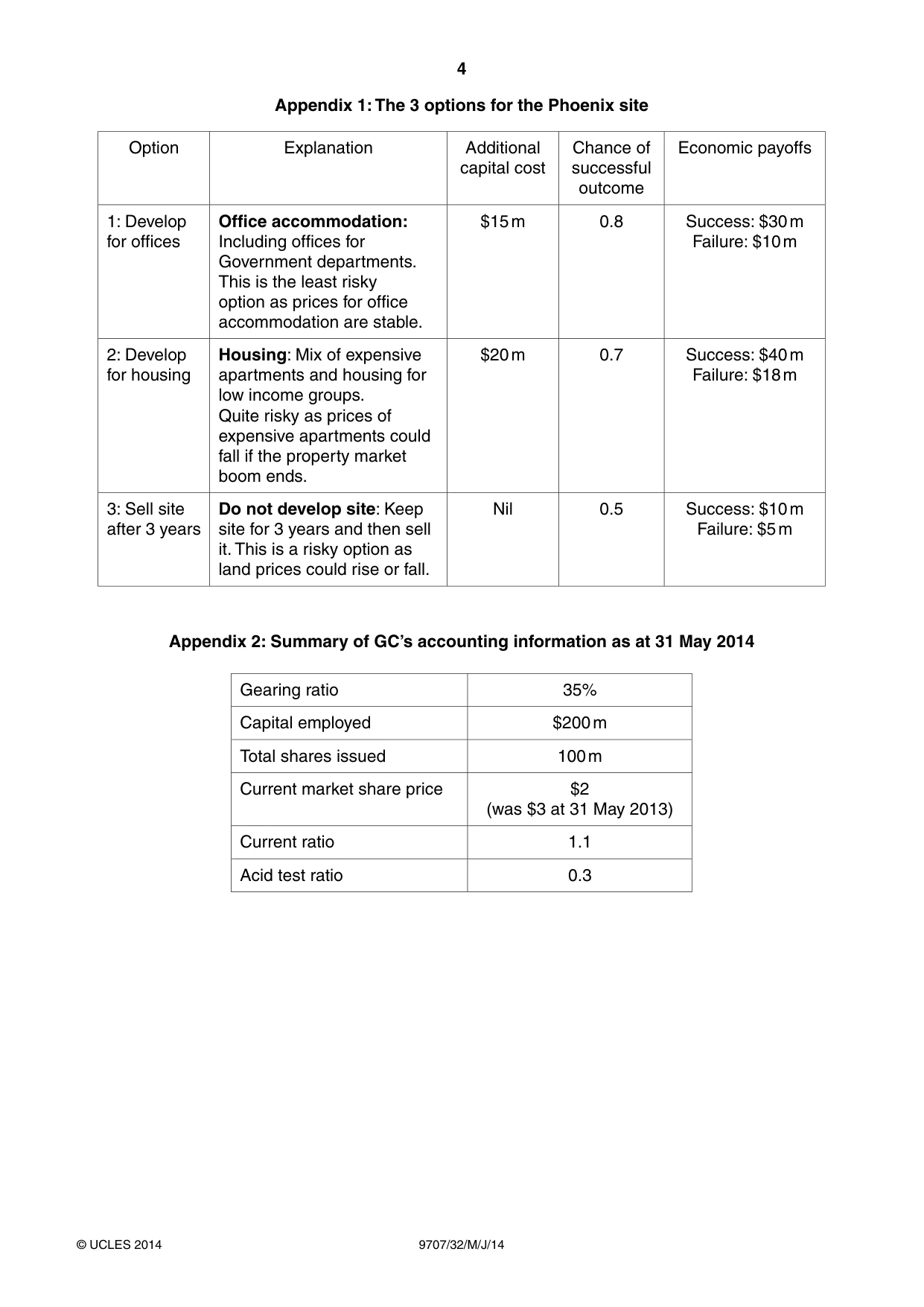
4 9707/32/M/J/14 © UCLES 2014 Appendix 1: The 3 options for the Phoenix site Option Explanation Additional capital cost Chance of successful outcome Economic payoffs 1: Develop for offices Office accommodation: Including offices for Government departments. This is the least risky option as prices for office accommodation are stable. $15 m 0.8 Success: $30 m Failure: $10 m 2: Develop for housing Housing: Mix of expensive apartments and housing for low income groups. Quite risky as prices of expensive apartments could fall if the property market boom ends. $20 m 0.7 Success: $40 m Failure: $18 m 3: Sell site after 3 years Do not develop site: Keep site for 3 years and then sell it. This is a risky option as land prices could rise or fall. Nil 0.5 Success: $10 m Failure: $5 m Appendix 2: Summary of GC’s accounting information as at 31 May 2014 Gearing ratio 35% Capital employed $200 m Total shares issued 100 m Current market share price $2 (was $3 at 31 May 2013) Current ratio 1.1 Acid test ratio 0.3
Question paper, page 5
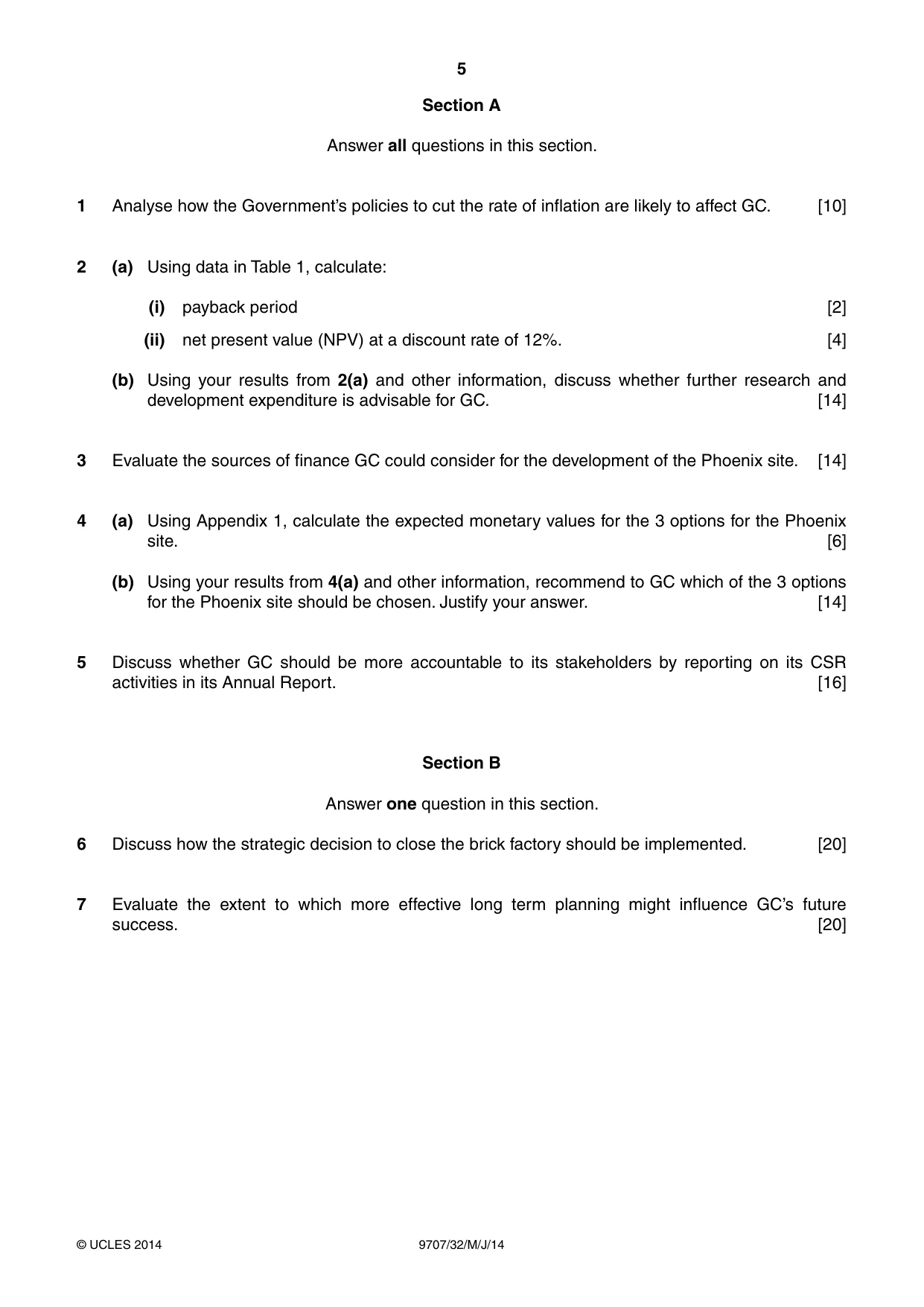
5 9707/32/M/J/14 © UCLES 2014 Section A Answer all questions in this section. 1 Analyse how the Government’s policies to cut the rate of inflation are likely to affect GC. [10] 2 (a) Using data in Table 1, calculate: (i) payback period [2] (ii) net present value (NPV) at a discount rate of 12%. [4] (b) Using your results from 2(a) and other information, discuss whether further research and development expenditure is advisable for GC. [14] 3 Evaluate the sources of finance GC could consider for the development of the Phoenix site. [14] 4 (a) Using Appendix 1, calculate the expected monetary values for the 3 options for the Phoenix site. [6] (b) Using your results from 4(a) and other information, recommend to GC which of the 3 options for the Phoenix site should be chosen. Justify your answer. [14] 5 Discuss whether GC should be more accountable to its stakeholders by reporting on its CSR activities in its Annual Report. [16] Section B Answer one question in this section. 6 Discuss how the strategic decision to close the brick factory should be implemented. [20] 7 Evaluate the extent to which more effective long term planning might influence GC’s future success. [20]
Question paper, page 6
6 9707/32/M/J/14 © UCLES 2014 BLANK PAGE
Question paper, page 7
7 9707/32/M/J/14 © UCLES 2014 BLANK PAGE
Question paper, page 8
8 9707/32/M/J/14 © UCLES 2014 BLANK PAGE Permission to reproduce items where third-party owned material protected by copyright is included has been sought and cleared where possible. Every reasonable effort has been made by the publisher (UCLES) to trace copyright holders, but if any items requiring clearance have unwittingly been included, the publisher will be pleased to make amends at the earliest possible opportunity. Cambridge International Examinations is part of the Cambridge Assessment Group. Cambridge Assessment is the brand name of University of Cambridge Local Examinations Syndicate (UCLES), which is itself a department of the University of Cambridge.
Mark scheme, page 1
CAMBRIDGE INTERNATIONAL EXAMINATIONS GCE Advanced Level MARK SCHEME for the May/June 2014 series 9707 BUSINESS STUDIES 9707/32 Paper 3 (Case Study), maximum raw mark 100 This mark scheme is published as an aid to teachers and candidates, to indicate the requirements of the examination. It shows the basis on which Examiners were instructed to award marks. It does not indicate the details of the discussions that took place at an Examiners’ meeting before marking began, which would have considered the acceptability of alternative answers. Mark schemes should be read in conjunction with the question paper and the Principal Examiner Report for Teachers. Cambridge will not enter into discussions about these mark schemes. Cambridge is publishing the mark schemes for the May/June 2014 series for most IGCSE, GCE Advanced Level and Advanced Subsidiary Level components and some Ordinary Level components.
Mark scheme, page 2
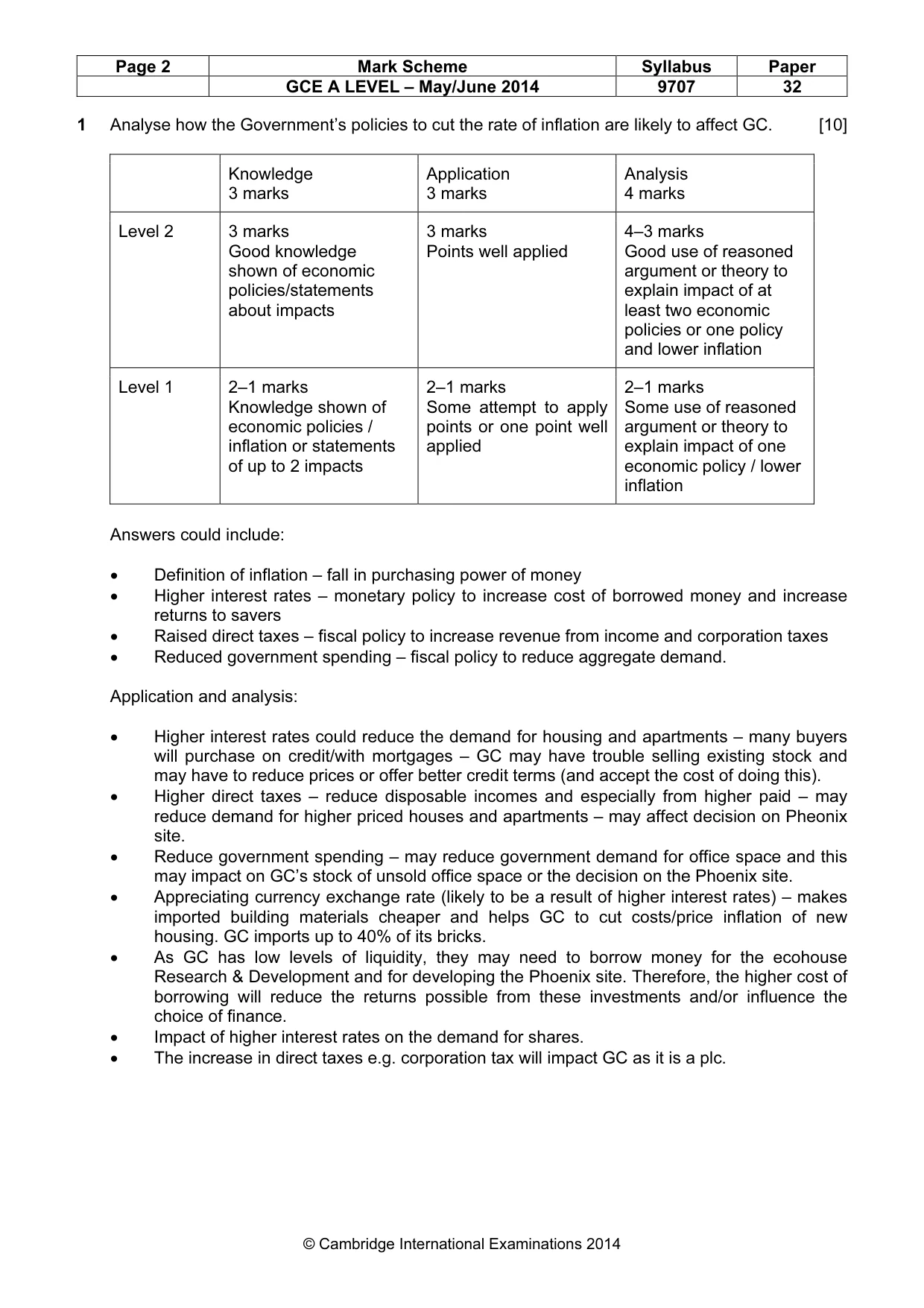
Page 2 Mark Scheme Syllabus Paper GCE A LEVEL – May/June 2014 9707 32 © Cambridge International Examinations 2014 1 Analyse how the Government’s policies to cut the rate of inflation are likely to affect GC. [10] Knowledge 3 marks Application 3 marks Analysis 4 marks Level 2 3 marks Good knowledge shown of economic policies/statements about impacts 3 marks Points well applied 4–3 marks Good use of reasoned argument or theory to explain impact of at least two economic policies or one policy and lower inflation Level 1 2–1 marks Knowledge shown of economic policies / inflation or statements of up to 2 impacts 2–1 marks Some attempt to apply points or one point well applied 2–1 marks Some use of reasoned argument or theory to explain impact of one economic policy / lower inflation Answers could include: • Definition of inflation – fall in purchasing power of money • Higher interest rates – monetary policy to increase cost of borrowed money and increase returns to savers • Raised direct taxes – fiscal policy to increase revenue from income and corporation taxes • Reduced government spending – fiscal policy to reduce aggregate demand. Application and analysis: • Higher interest rates could reduce the demand for housing and apartments – many buyers will purchase on credit/with mortgages – GC may have trouble selling existing stock and may have to reduce prices or offer better credit terms (and accept the cost of doing this). • Higher direct taxes – reduce disposable incomes and especially from higher paid – may reduce demand for higher priced houses and apartments – may affect decision on Pheonix site. • Reduce government spending – may reduce government demand for office space and this may impact on GC’s stock of unsold office space or the decision on the Phoenix site. • Appreciating currency exchange rate (likely to be a result of higher interest rates) – makes imported building materials cheaper and helps GC to cut costs/price inflation of new housing. GC imports up to 40% of its bricks. • As GC has low levels of liquidity, they may need to borrow money for the ecohouse Research & Development and for developing the Phoenix site. Therefore, the higher cost of borrowing will reduce the returns possible from these investments and/or influence the choice of finance. • Impact of higher interest rates on the demand for shares. • The increase in direct taxes e.g. corporation tax will impact GC as it is a plc.
Mark scheme, page 3
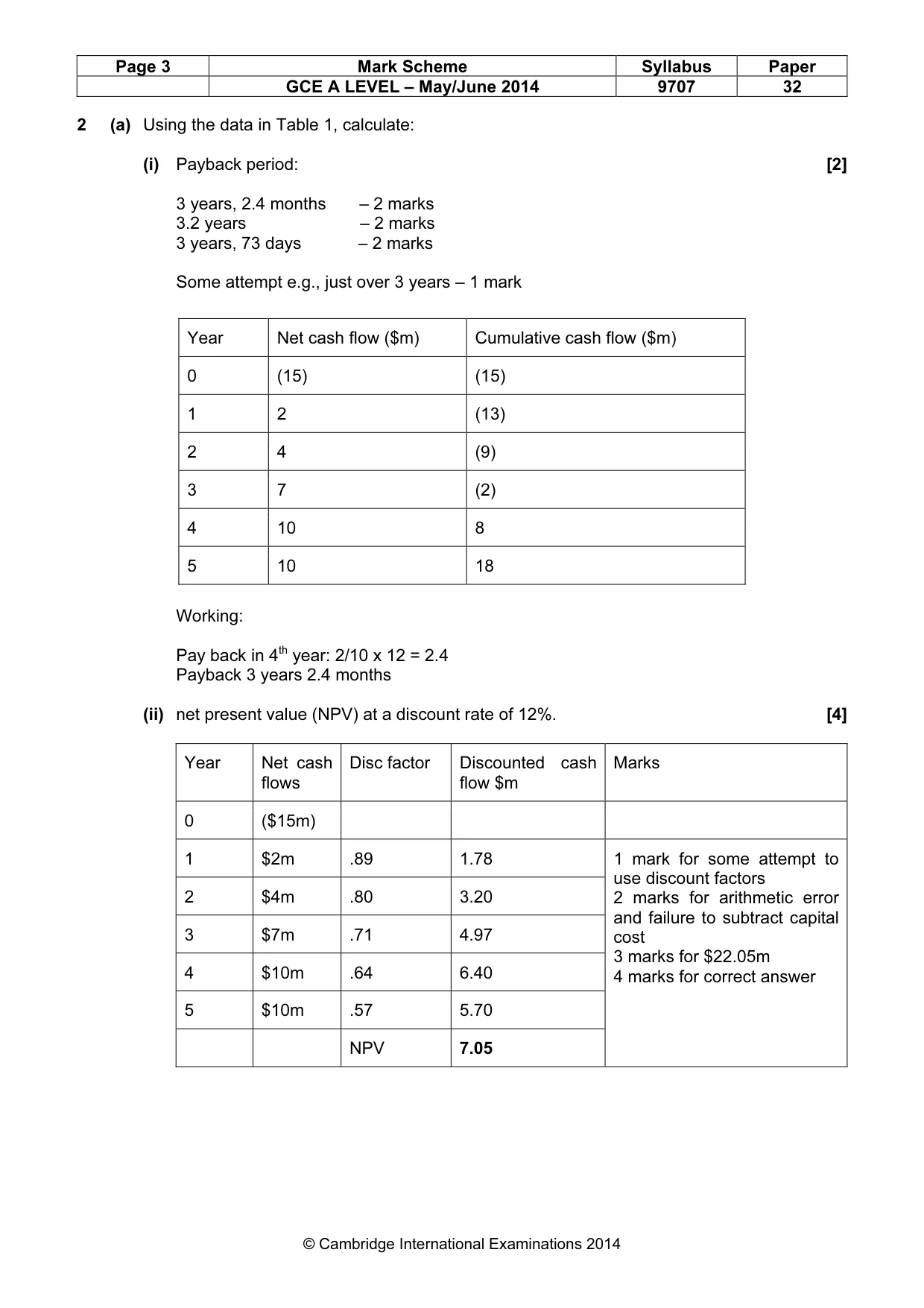
Page 3 Mark Scheme Syllabus Paper GCE A LEVEL – May/June 2014 9707 32 © Cambridge International Examinations 2014 2 (a) Using the data in Table 1, calculate: (i) Payback period: [2] 3 years, 2.4 months – 2 marks 3.2 years – 2 marks 3 years, 73 days – 2 marks Some attempt e.g., just over 3 years – 1 mark Working: Pay back in 4th year: 2/10 x 12 = 2.4 Payback 3 years 2.4 months (ii) net present value (NPV) at a discount rate of 12%. [4] Year Net cash flows Disc factor Discounted cash flow $m Marks 0 ($15m) 1 $2m .89 1.78 1 mark for some attempt to use discount factors 2 marks for arithmetic error and failure to subtract capital cost 3 marks for $22.05m 4 marks for correct answer 2 $4m .80 3.20 3 $7m .71 4.97 4 $10m .64 6.40 5 $10m .57 5.70 NPV 7.05 Year Net cash flow ($m) Cumulative cash flow ($m) 0 (15) (15) 1 2 (13) 2 4 (9) 3 7 (2) 4 10 8 5 10 18
Mark scheme, page 4
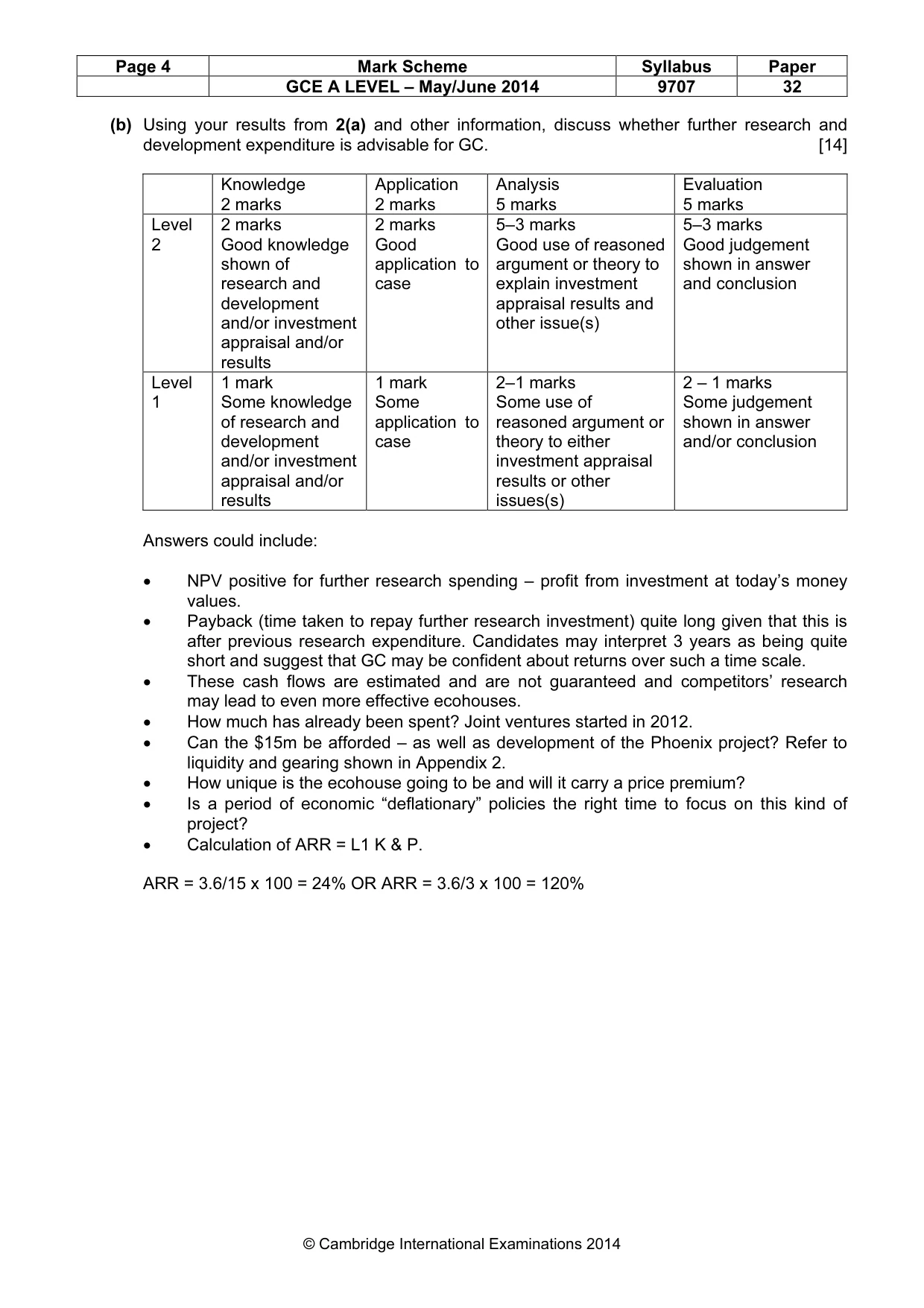
Page 4 Mark Scheme Syllabus Paper GCE A LEVEL – May/June 2014 9707 32 © Cambridge International Examinations 2014 (b) Using your results from 2(a) and other information, discuss whether further research and development expenditure is advisable for GC. [14] Knowledge 2 marks Application 2 marks Analysis 5 marks Evaluation 5 marks Level 2 2 marks Good knowledge shown of research and development and/or investment appraisal and/or results 2 marks Good application to case 5–3 marks Good use of reasoned argument or theory to explain investment appraisal results and other issue(s) 5–3 marks Good judgement shown in answer and conclusion Level 1 1 mark Some knowledge of research and development and/or investment appraisal and/or results 1 mark Some application to case 2–1 marks Some use of reasoned argument or theory to either investment appraisal results or other issues(s) 2 – 1 marks Some judgement shown in answer and/or conclusion Answers could include: • NPV positive for further research spending – profit from investment at today’s money values. • Payback (time taken to repay further research investment) quite long given that this is after previous research expenditure. Candidates may interpret 3 years as being quite short and suggest that GC may be confident about returns over such a time scale. • These cash flows are estimated and are not guaranteed and competitors’ research may lead to even more effective ecohouses. • How much has already been spent? Joint ventures started in 2012. • Can the $15m be afforded – as well as development of the Phoenix project? Refer to liquidity and gearing shown in Appendix 2. • How unique is the ecohouse going to be and will it carry a price premium? • Is a period of economic “deflationary” policies the right time to focus on this kind of project? • Calculation of ARR = L1 K & P. ARR = 3.6/15 x 100 = 24% OR ARR = 3.6/3 x 100 = 120%
Mark scheme, page 5
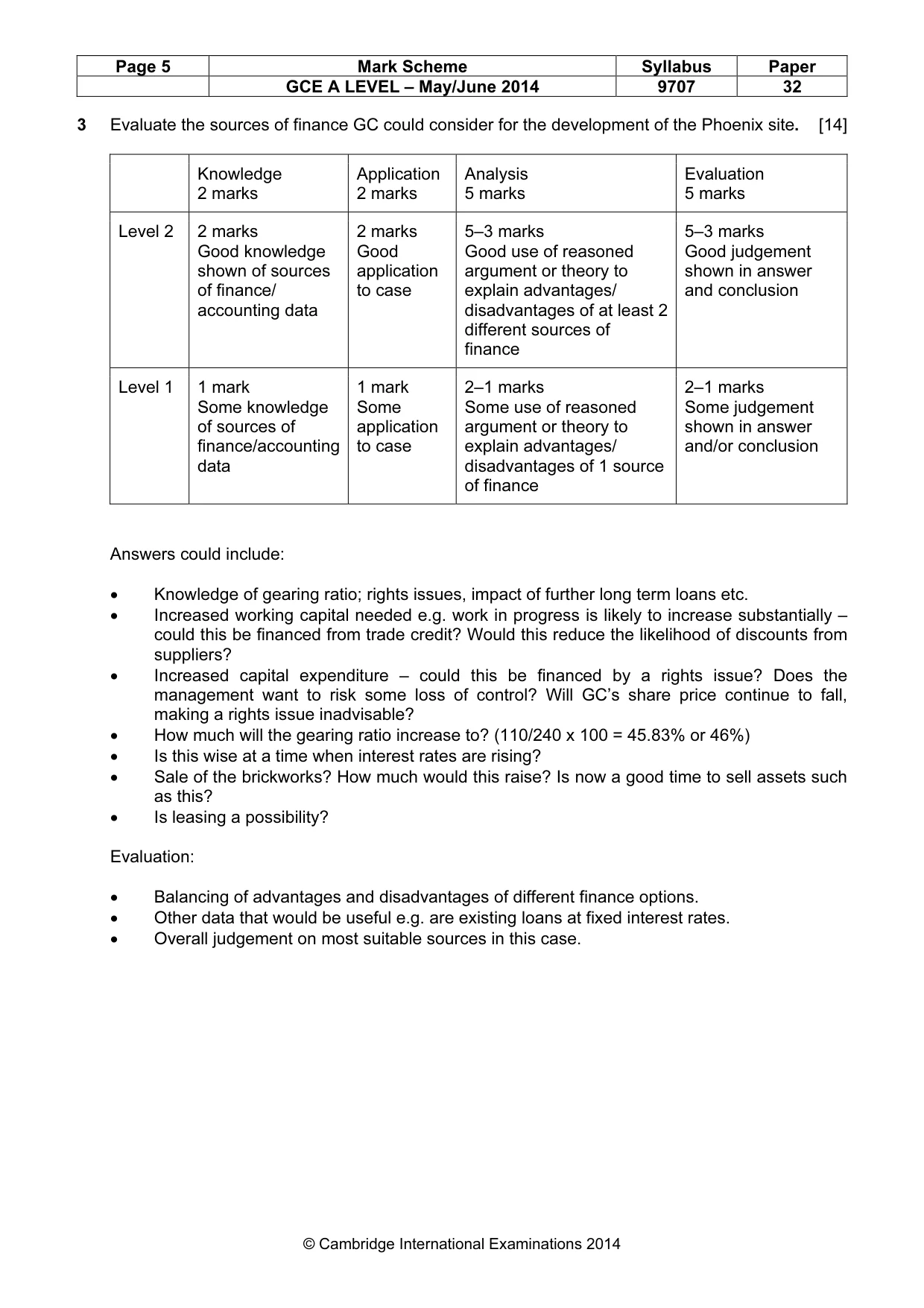
Page 5 Mark Scheme Syllabus Paper GCE A LEVEL – May/June 2014 9707 32 © Cambridge International Examinations 2014 3 Evaluate the sources of finance GC could consider for the development of the Phoenix site. [14] Knowledge 2 marks Application 2 marks Analysis 5 marks Evaluation 5 marks Level 2 2 marks Good knowledge shown of sources of finance/ accounting data 2 marks Good application to case 5–3 marks Good use of reasoned argument or theory to explain advantages/ disadvantages of at least 2 different sources of finance 5–3 marks Good judgement shown in answer and conclusion Level 1 1 mark Some knowledge of sources of finance/accounting data 1 mark Some application to case 2–1 marks Some use of reasoned argument or theory to explain advantages/ disadvantages of 1 source of finance 2–1 marks Some judgement shown in answer and/or conclusion Answers could include: • Knowledge of gearing ratio; rights issues, impact of further long term loans etc. • Increased working capital needed e.g. work in progress is likely to increase substantially – could this be financed from trade credit? Would this reduce the likelihood of discounts from suppliers? • Increased capital expenditure – could this be financed by a rights issue? Does the management want to risk some loss of control? Will GC’s share price continue to fall, making a rights issue inadvisable? • How much will the gearing ratio increase to? (110/240 x 100 = 45.83% or 46%) • Is this wise at a time when interest rates are rising? • Sale of the brickworks? How much would this raise? Is now a good time to sell assets such as this? • Is leasing a possibility? Evaluation: • Balancing of advantages and disadvantages of different finance options. • Other data that would be useful e.g. are existing loans at fixed interest rates. • Overall judgement on most suitable sources in this case.
Mark scheme, page 6
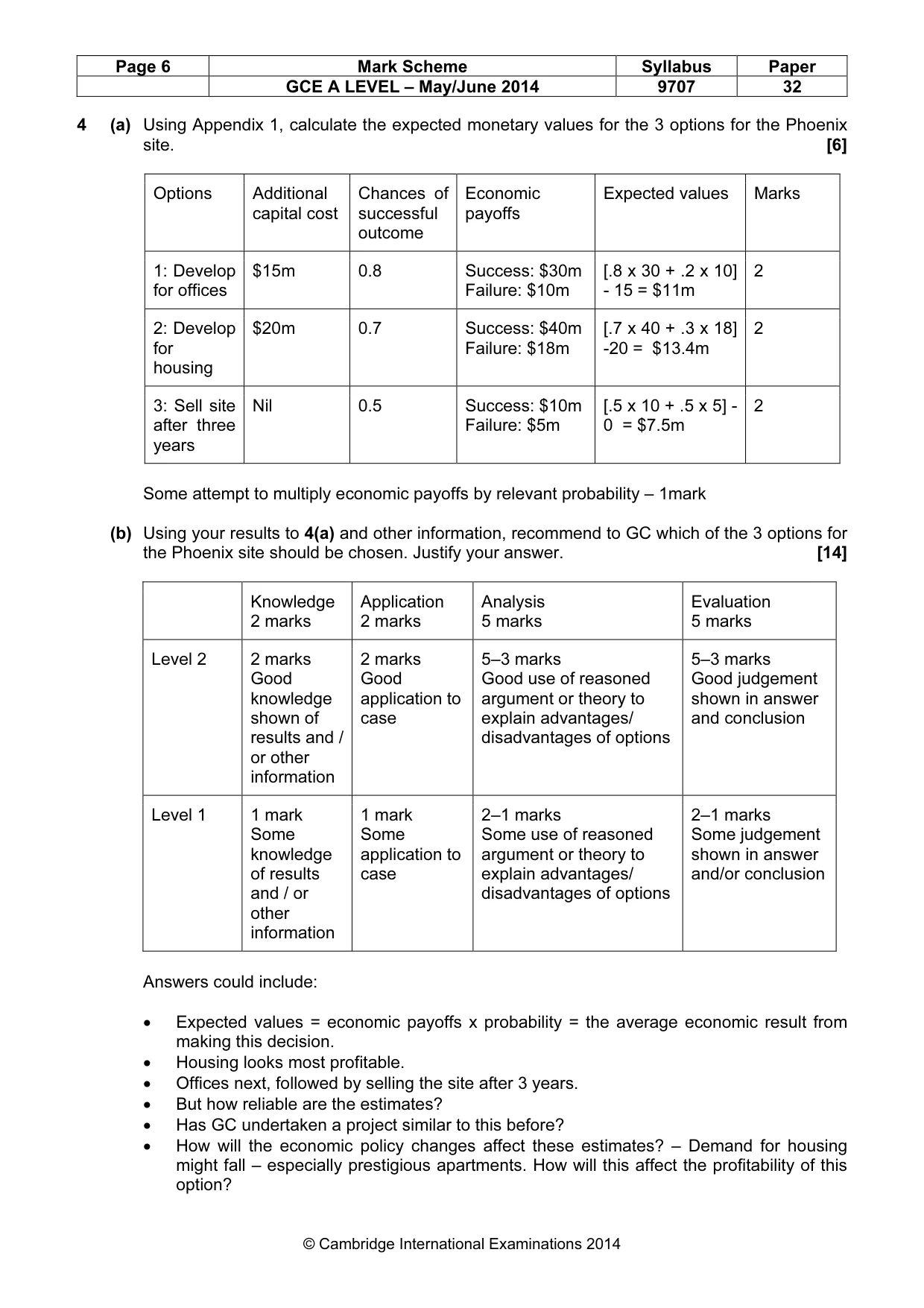
Page 6 Mark Scheme Syllabus Paper GCE A LEVEL – May/June 2014 9707 32 © Cambridge International Examinations 2014 4 (a) Using Appendix 1, calculate the expected monetary values for the 3 options for the Phoenix site. [6] Options Additional capital cost Chances of successful outcome Economic payoffs Expected values Marks 1: Develop for offices $15m 0.8 Success: $30m Failure: $10m [.8 x 30 + .2 x 10] - 15 = $11m 2 2: Develop for housing $20m 0.7 Success: $40m Failure: $18m [.7 x 40 + .3 x 18] -20 = $13.4m 2 3: Sell site after three years Nil 0.5 Success: $10m Failure: $5m [.5 x 10 + .5 x 5] - 0 = $7.5m 2 Some attempt to multiply economic payoffs by relevant probability – 1mark (b) Using your results to 4(a) and other information, recommend to GC which of the 3 options for the Phoenix site should be chosen. Justify your answer. [14] Knowledge 2 marks Application 2 marks Analysis 5 marks Evaluation 5 marks Level 2 2 marks Good knowledge shown of results and / or other information 2 marks Good application to case 5–3 marks Good use of reasoned argument or theory to explain advantages/ disadvantages of options 5–3 marks Good judgement shown in answer and conclusion Level 1 1 mark Some knowledge of results and / or other information 1 mark Some application to case 2–1 marks Some use of reasoned argument or theory to explain advantages/ disadvantages of options 2–1 marks Some judgement shown in answer and/or conclusion Answers could include: • Expected values = economic payoffs x probability = the average economic result from making this decision. • Housing looks most profitable. • Offices next, followed by selling the site after 3 years. • But how reliable are the estimates? • Has GC undertaken a project similar to this before? • How will the economic policy changes affect these estimates? – Demand for housing might fall – especially prestigious apartments. How will this affect the profitability of this option?
Mark scheme, page 7
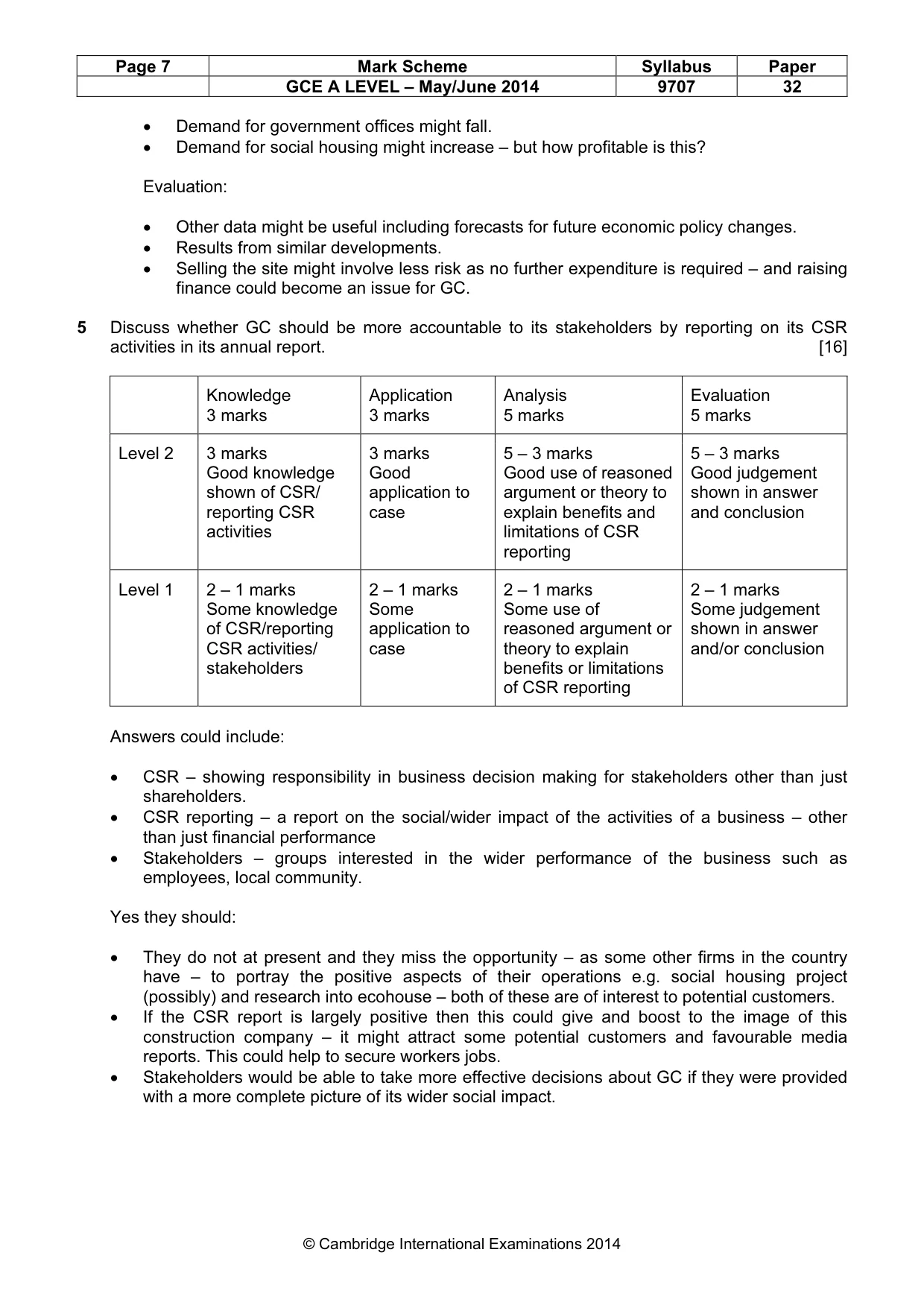
Page 7 Mark Scheme Syllabus Paper GCE A LEVEL – May/June 2014 9707 32 © Cambridge International Examinations 2014 • Demand for government offices might fall. • Demand for social housing might increase – but how profitable is this? Evaluation: • Other data might be useful including forecasts for future economic policy changes. • Results from similar developments. • Selling the site might involve less risk as no further expenditure is required – and raising finance could become an issue for GC. 5 Discuss whether GC should be more accountable to its stakeholders by reporting on its CSR activities in its annual report. [16] Knowledge 3 marks Application 3 marks Analysis 5 marks Evaluation 5 marks Level 2 3 marks Good knowledge shown of CSR/ reporting CSR activities 3 marks Good application to case 5 – 3 marks Good use of reasoned argument or theory to explain benefits and limitations of CSR reporting 5 – 3 marks Good judgement shown in answer and conclusion Level 1 2 – 1 marks Some knowledge of CSR/reporting CSR activities/ stakeholders 2 – 1 marks Some application to case 2 – 1 marks Some use of reasoned argument or theory to explain benefits or limitations of CSR reporting 2 – 1 marks Some judgement shown in answer and/or conclusion Answers could include: • CSR – showing responsibility in business decision making for stakeholders other than just shareholders. • CSR reporting – a report on the social/wider impact of the activities of a business – other than just financial performance • Stakeholders – groups interested in the wider performance of the business such as employees, local community. Yes they should: • They do not at present and they miss the opportunity – as some other firms in the country have – to portray the positive aspects of their operations e.g. social housing project (possibly) and research into ecohouse – both of these are of interest to potential customers. • If the CSR report is largely positive then this could give and boost to the image of this construction company – it might attract some potential customers and favourable media reports. This could help to secure workers jobs. • Stakeholders would be able to take more effective decisions about GC if they were provided with a more complete picture of its wider social impact.
Mark scheme, page 8
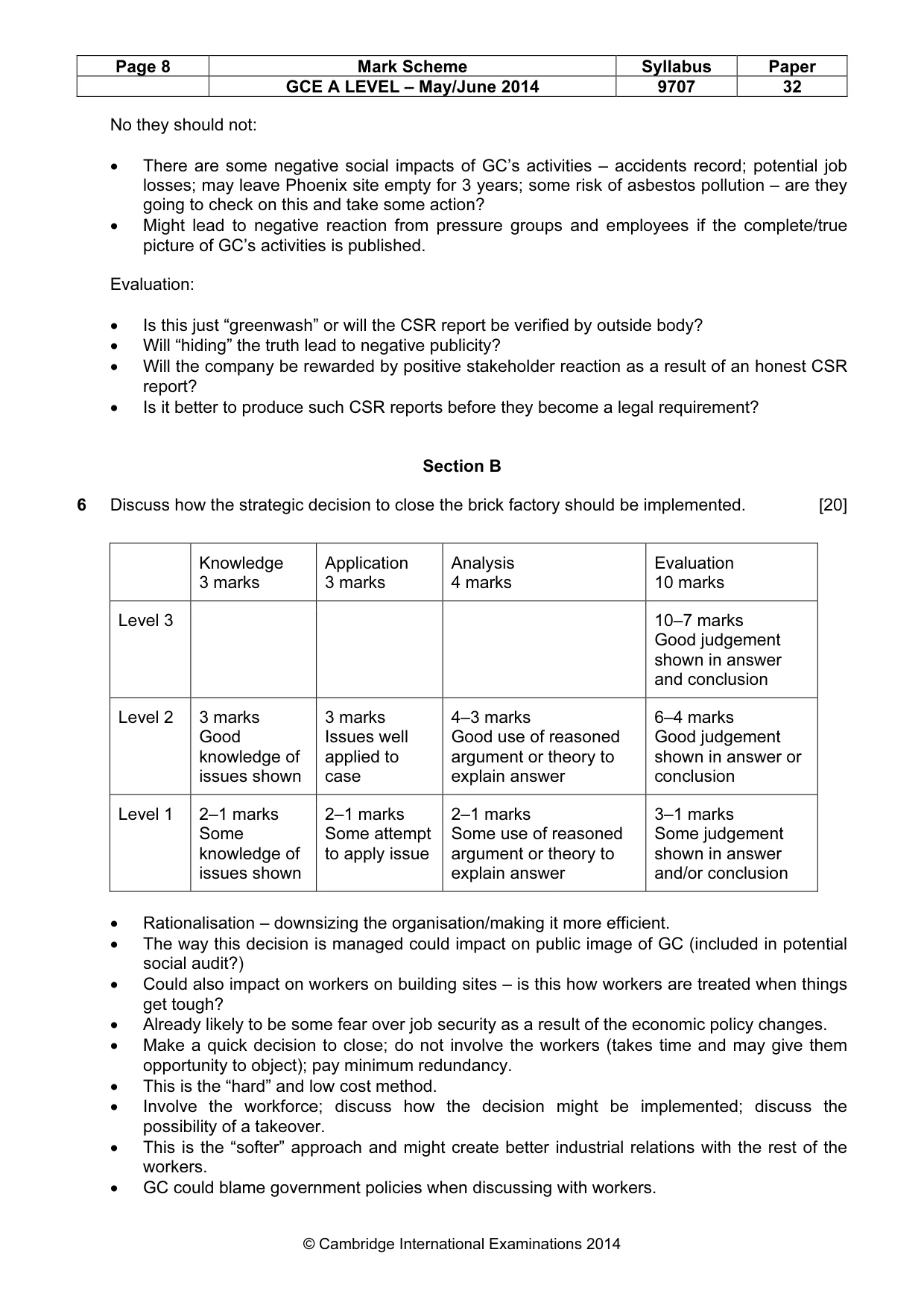
Page 8 Mark Scheme Syllabus Paper GCE A LEVEL – May/June 2014 9707 32 © Cambridge International Examinations 2014 No they should not: • There are some negative social impacts of GC’s activities – accidents record; potential job losses; may leave Phoenix site empty for 3 years; some risk of asbestos pollution – are they going to check on this and take some action? • Might lead to negative reaction from pressure groups and employees if the complete/true picture of GC’s activities is published. Evaluation: • Is this just “greenwash” or will the CSR report be verified by outside body? • Will “hiding” the truth lead to negative publicity? • Will the company be rewarded by positive stakeholder reaction as a result of an honest CSR report? • Is it better to produce such CSR reports before they become a legal requirement? Section B 6 Discuss how the strategic decision to close the brick factory should be implemented. [20] • Rationalisation – downsizing the organisation/making it more efficient. • The way this decision is managed could impact on public image of GC (included in potential social audit?) • Could also impact on workers on building sites – is this how workers are treated when things get tough? • Already likely to be some fear over job security as a result of the economic policy changes. • Make a quick decision to close; do not involve the workers (takes time and may give them opportunity to object); pay minimum redundancy. • This is the “hard” and low cost method. • Involve the workforce; discuss how the decision might be implemented; discuss the possibility of a takeover. • This is the “softer” approach and might create better industrial relations with the rest of the workers. • GC could blame government policies when discussing with workers. Knowledge 3 marks Application 3 marks Analysis 4 marks Evaluation 10 marks Level 3 10–7 marks Good judgement shown in answer and conclusion Level 2 3 marks Good knowledge of issues shown 3 marks Issues well applied to case 4–3 marks Good use of reasoned argument or theory to explain answer 6–4 marks Good judgement shown in answer or conclusion Level 1 2–1 marks Some knowledge of issues shown 2–1 marks Some attempt to apply issue 2–1 marks Some use of reasoned argument or theory to explain answer 3–1 marks Some judgement shown in answer and/or conclusion
Mark scheme, page 9
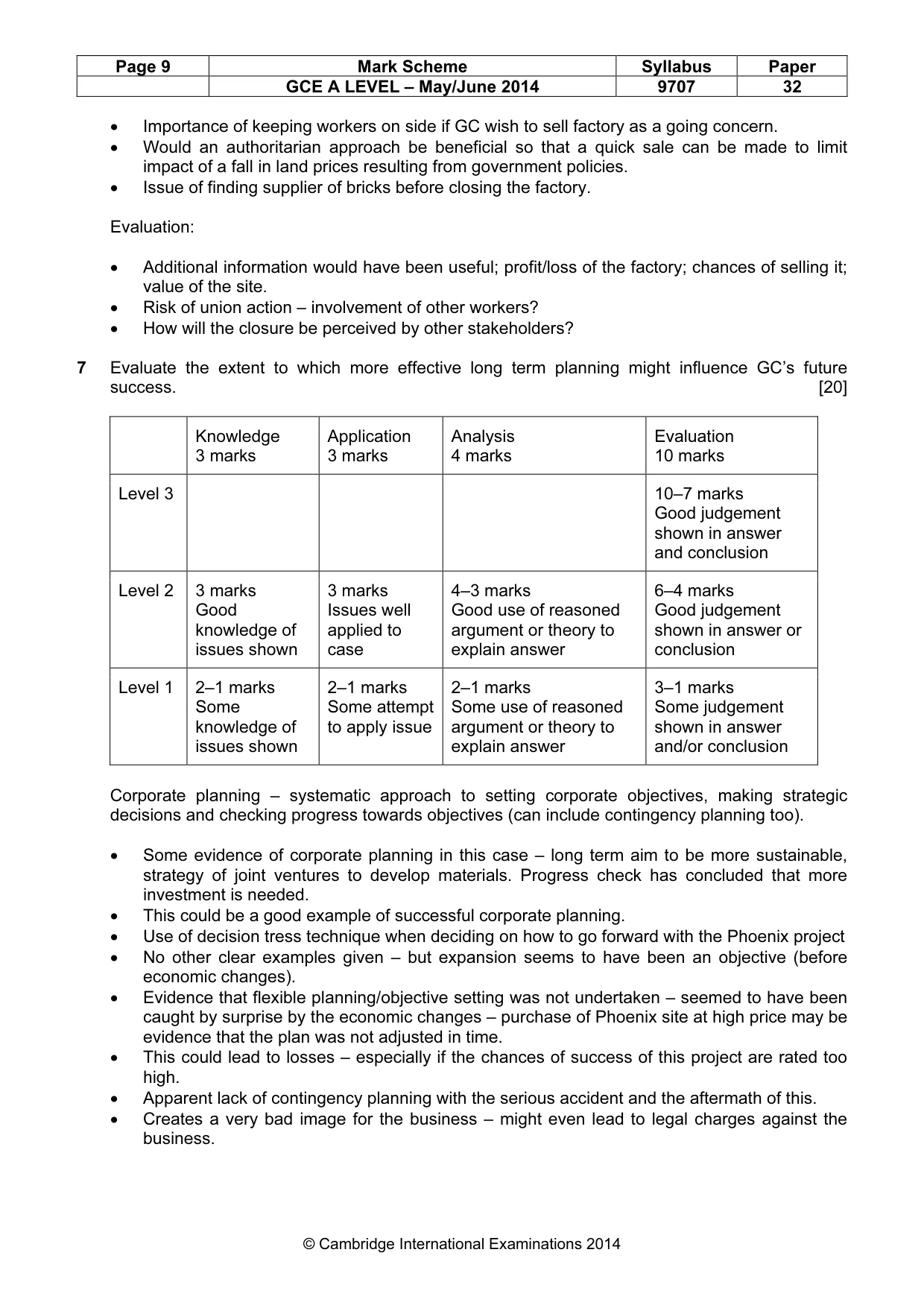
Page 9 Mark Scheme Syllabus Paper GCE A LEVEL – May/June 2014 9707 32 © Cambridge International Examinations 2014 • Importance of keeping workers on side if GC wish to sell factory as a going concern. • Would an authoritarian approach be beneficial so that a quick sale can be made to limit impact of a fall in land prices resulting from government policies. • Issue of finding supplier of bricks before closing the factory. Evaluation: • Additional information would have been useful; profit/loss of the factory; chances of selling it; value of the site. • Risk of union action – involvement of other workers? • How will the closure be perceived by other stakeholders? 7 Evaluate the extent to which more effective long term planning might influence GC’s future success. [20] Knowledge 3 marks Application 3 marks Analysis 4 marks Evaluation 10 marks Level 3 10–7 marks Good judgement shown in answer and conclusion Level 2 3 marks Good knowledge of issues shown 3 marks Issues well applied to case 4–3 marks Good use of reasoned argument or theory to explain answer 6–4 marks Good judgement shown in answer or conclusion Level 1 2–1 marks Some knowledge of issues shown 2–1 marks Some attempt to apply issue 2–1 marks Some use of reasoned argument or theory to explain answer 3–1 marks Some judgement shown in answer and/or conclusion Corporate planning – systematic approach to setting corporate objectives, making strategic decisions and checking progress towards objectives (can include contingency planning too). • Some evidence of corporate planning in this case – long term aim to be more sustainable, strategy of joint ventures to develop materials. Progress check has concluded that more investment is needed. • This could be a good example of successful corporate planning. • Use of decision tress technique when deciding on how to go forward with the Phoenix project • No other clear examples given – but expansion seems to have been an objective (before economic changes). • Evidence that flexible planning/objective setting was not undertaken – seemed to have been caught by surprise by the economic changes – purchase of Phoenix site at high price may be evidence that the plan was not adjusted in time. • This could lead to losses – especially if the chances of success of this project are rated too high. • Apparent lack of contingency planning with the serious accident and the aftermath of this. • Creates a very bad image for the business – might even lead to legal charges against the business.
Mark scheme, page 10
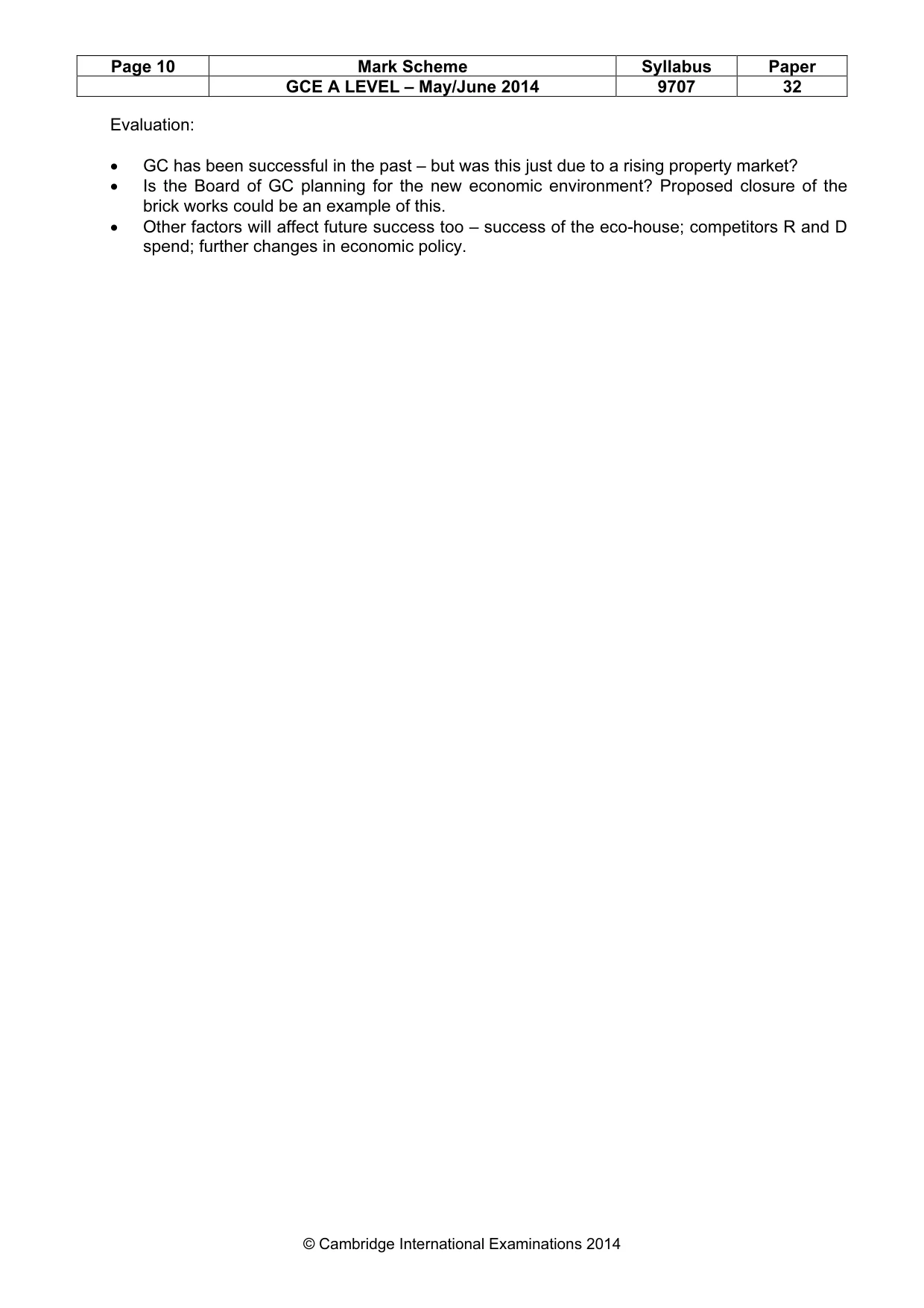
Page 10 Mark Scheme Syllabus Paper GCE A LEVEL – May/June 2014 9707 32 © Cambridge International Examinations 2014 Evaluation: • GC has been successful in the past – but was this just due to a rising property market? • Is the Board of GC planning for the new economic environment? Proposed closure of the brick works could be an example of this. • Other factors will affect future success too – success of the eco-house; competitors R and D spend; further changes in economic policy.
What you needed in this session
Cambridge’s own grade thresholds for 2014 May/June, Paper 3 · Variant 2. A higher threshold means an easier paper — the bar moves with how the cohort did.